
International Research Journal of Engineering and Technology (IRJET) e-ISSN: 2395-0056
Volume: 11 Issue: 02 | Feb 2024 www.irjet.net p-ISSN: 2395-0072
International Research Journal of Engineering and Technology (IRJET) e-ISSN: 2395-0056
Volume: 11 Issue: 02 | Feb 2024 www.irjet.net p-ISSN: 2395-0072
Rishitha Reddy Gudipati , Sruthika Bachu , Dr. Narayana
Rishitha & Student, Dept of AI&ML, Chaitanya Bharathi Institute of Technology
Sruthika & Student, Dept of AI&ML, Chaitanya Bharathi Institute of Technology
Dr. Narayana & Asst. Professor, Dept of AI&ML ,Chaitanya Bharathi Institute of Technology
Abstract - The health of oceans and marine ecosystems is seriously threatened by marine plastic trash. Every year, at least 14 million tonnes of plastic enter the ocean. At now, plastic waste dominates the marine litter population, accounting for 80% of all debris found in the ocean, ranging from surface waters to deep-sea sediments. Every continent has plastic beaches, with higher concentrations of plastic debris found close to well-known tourist attractions and densely populated places. Finding and keeping an eye on plastic debris in marine habitats is essential to creating mitigationplans that workandprotectingaquaticecosystem biodiversity.
Keywords Yolov3, Yolov4, Yolov5, object detection, deep learning, transfer learning, and marine plastic detection
1.INTRODUCTION
Marine plastic debris (MPD) is a major environmental problem withdevastating impactson marinelife, beaches, tourism,andfishing.DetectingMPDisessentialforeffective monitoring and management, but traditional methods are time-consumingandlabour-intensive.Newtechnologiesfor automated MPD detection are being developed, including image processing, machine learning, and sensor-based technologies.Eachtechnologyhasitsown advantagesanddisadvantages,butallhavethepotentialto revolutionize MPD detection. MPD detection technologies canbeusedforavarietyofpurposes,includingmonitoring pollution levels, tracking the movement of MPD, and assistingwithcleanupefforts.Bydevelopingmoreaccurate, robust, and scalable MPD detection technologies, we can reducetheimpactofMPDonthemarineenvironment.
1.1.
Plastic pollution poses an imminent threat to the marine environment,foodsafety,humanhealth,eco-tourism,and contributestoclimatechange.Globalplasticproductionhas exceeded500milliontonsofplastic,andprojectionsindicate that30%ofallproducedplasticwillendupdiscardedinthe oceans.Researchershavedocumentedafive-foldincreasein plasticdebriswithintheCentralPacificGyreandhaveshown thatplasticpiecesnowoutnumberthenativeplankton6:1in termsofabundance.Asignificantamountofmarineplastic (about 80%) originates from land-based sources : Most
commonly in the form of food containers, such as plastic bagsandbottles,andpackagingmaterials.Theother20% stems from shipping vessel discharges and discarded commercialfishinggear.Studieshaveshownthatremoving plastic from the oceans will exponentially benefit the ecosystems.Thisincludesthepreventionofthemovementof invasive species between regions, the prevention of its degradation into micro-plastics , and the decrease in emissionsofgreenhousegases(therebydeceleratingclimate change)].
[11]The research paper by Hipolito et al. published in 2021 delves into the pressing issue of marine debris and proposes a solution using machine vision, specifically the YOLOv3method,todetectunderwatermarineplasticwaste. The authors effectively contextualize the environmental significance of the problemandadvocate for technological advancements to mitigate its impact. The methodology is robust, employing a well-structured approach involving datasetpreparation,imageannotation,deeptransferlearning algorithms,and data augmentation. Thedatasetutilizedin thisinquirycamefromtheDataRepositoryfortheUniversity ofMinnesota(DRUM),specificallytheDatasetofUnderwater Trash.Thereare8580picturesinthecollection,splitintotwo categories: bio images (4290) and non-bio images (4290). The proponents chose a small sample size of 300 non-bio images. The chosen image dataset was used to construct training and validation sets. The training dataset featured 80%ofthedata,whilethevalidationsetonlyhad20%ofthe images. Results and discussions comprehensively present training, validation outcomes, and model evaluation using mean Average Precision (mAP). The study concludes by emphasizing the potential ofmachinevision in addressing marine plastic debris, highlighting an impressive mAP of 98.15%formodel19.Overall,thepaper
effectively communicates the gravity of the issue and demonstratestheefficacyofYOLOv3inautomatedmarine debrisdetection.
[10]An article by Nur Athirah Zailan and Anis Salwa MohdKhairuddinpublishedin2021effectivelytackles the pressing issue of plastic debris pollution in riverine environmentsbyproposinga YOLOv4-basedalgorithmfor debris detection. It begins with a strong introduction,
2395-0056
Volume: 11 Issue: 02 | Feb 2024 www.irjet.net p-ISSN: 2395-0072
highlightingthegravityoftheproblemandthenecessityfor efficientmonitoringsystems.Theproposeddebrisdetection system is trained on five object classes such as styrofoam, plastic bags, plastic bottle, aluminium can and plastic container.Atotalof300originalimagesareaugmentedby adjustingthebrightnessleveltoimitatevariousenvironment conditions.Hence,atotalof900imagesareusedastraining dataset.Ontheotherhand,30testimagesforeachclassare used to test the effectiveness of the proposed detection model.Thedata processingsectionmeticulouslydiscusses image acquisition, dataset augmentation, and transfer learning using the MS-COCO dataset. The object detection methodology utilizing YOLOv4 is explained thoroughly, emphasizingthesignificanceofspatialpyramidpoolingand path aggregation network. The paper introduces and properlyelucidatescrucialperformanceevaluationmetrics likemeanaverageprecision,precision,recall,andF1score, offeringacomprehensiveanalysisofthedetectionsystem's accuracy. The results and discussion section meticulously presents the outcomes, demonstrating the improvements achievedthroughtransferlearninganddataaugmentation, furthersubstantiatedbycomparisontablesandgraphs.The conclusionappropriatelysummarizesthestudy,emphasizing the advantages of YOLOv4 implementation and suggesting avenuesforfutureenhancements.Whileanacknowledgment section recognizes the funding source, additional details regardingthedatasetsource,specificsoftheYOLOv4model architecture, and potential limitations could enhance the paper'sdepthandcompleteness.
[12]AnarticlebyXueetal.published2021makesa significantcontributiontothefieldofmarineenvironmental studies by focusing on deep-sea debris classification using deep convolutional neural networks (CNNs). The authors successfullyconstructedtheDDIdatasetwhichisestablished basedonthe9deep-seadebrisdatabaseobtainedfromthe realdeepseabytheJapanAgencyforMarine-EarthScience and Technology (JAMSTEC) a crucial resource for training andvalidatingmachinelearningmodelsinthisdomain.The proposedShuffle-Xceptionnetworkmodelshowedpromising results,outperformingfiveothercomparedmodels,including LeNet,ResNetV2-34,ResNetV2-152,MobileNet,andXception. Shuffle-Xception demonstrated the highest accuracy in classifying deep-sea debris categories, with an overall accuracy of 93.32%. The research is well-structured, providing a clear methodology and detailed experimental setups. The authors effectively interpret and present the experimental results, allowing for a comprehensive assessment of the proposed approach's effectiveness. In summary, this paper significantly advances the field by addressingacriticalenvironmentalconcernandintroducing avaluabledatasetforfutureresearch.Theproposedmodel, Shuffle-Xception,showcasesstrongpotentialandsetsasolid foundation for further advancements in deep sea debris identificationandenvironmentalmonitoring.
Theprimaryaimistoselectbestalgorithmforthemodel building. On studying about features and implications of variouswehavechosen2models.AndtheEvaluationMetrics defined in different papers are also carefully studied and examinedandconsideritfortheevaluationforourmodel.
3.1
Thedatasetwascuratedbycollectingvideosofmarine plasticfromthefieldinCalifornia(SouthLakeTahoe,Bodega Bay, San Francisco Bay). The videos vary significantly in quality,depth,andvisibilitytobetterrepresenttheharshness of marine environments. Collected various images of subsurfaceplasticdebris.
3.2
The following procedures were implemented for the deep learning models to detect marine plastic: a) Dataset Formatting The input data constituted of images and annotation labels for bounding boxes were converted into either a TFRecords (FasterRCNN and SSD), PyTorch (YOLOv5-S)oraDarknetformat(YOLOv8)toprocesseach respectivemodel.Theboundingboxesdelimitedeachimage’s regions of interest based on 2D coordinates located in the respectiveannotationfile.b)ImagePre-processingToensure that learning occurs on the same image properties, auto orient was applied to strip images of their exchangeable Imagefileformat(EXIF)data sothatthemodelsinterpret imagesregardlessofimageformat.Finally,theinputimages getresizedandboundingboxesadjustedto416x416pixels. c) Data Augmentation To mitigate the effects of the model generalizing towards undesired features and to replicate underwater conditions such as variable illumination, occlusion, and color–the dataset was further enhanced by randomly changing the brightness and saturation of the images via PyTorch’s builtin Transforms augmentation. These modified images were then added back into the dataset,effectivelytriplingthesizeofourdataset.
We used four state-of-the-art neural network architectures FasterRCNN with Inception v2, Single Shot Multibox Detector with MobileNet v2, YOLOv5- S and YOLOv4,downloadedfromtheirrespectiverepositories.The following software versions were used: Tensorflow1.5, PyTorch v1.8.1, Darknet, OpenCV version 3.2.0, and CUDA 11.2
1)FasterR-CNN:
The Faster R-CNN approach is employed in a real-time crimesceneevidenceprocessingsystemthatcandetectitems in an interior setting. The proposed system employs the RegionProposalNetworkandtheVGG-16networkforobject
Volume: 11 Issue: 02 | Feb 2024 www.irjet.net p-ISSN: 2395-0072
detection.SevenConvolutionlayerswithMax-pooling,one Flatten, and the SoftMax activation function comprise the following architecture. The first convolution layer has 32 filters, while the next six hidden layers include 100 filters, eachmeasuring3x3.Max-poolingisalsoperformedateach layer on a 2 x 2 scale. The convolutional layers are then flattened and normalised using the SoftMax step. The activation function "ReLu" is used by all layers, and the outputrangerangesfrom0toinfinity.Theshearandstride valuesareboth1.
YOLOv5 (You Only Look Once) is now regarded the benchmarkforobjectdetectionandfacerecognition.Ithas fourversions:YOLOv5s,YOLOv5m,YOLOv5l,andYOLOv5xl. Itisdividedintothreephases.Thefirststepisthebackbone network, which is a convolutional neural network that focusesonlearninghigh-levelfeaturesfrominputpictures. Theneckisthesecondlevelofthenetwork,anditisfocused with learning characteristics at multiple scales in order to learnthesamepicturewithvariedsizes.Incomparisontothe backbone network, it has more layers. Finally, there is the headnetwork,whichisprimarilyresponsibleforidentifying bounding boxes around objects and delivering final annotatedpictures.
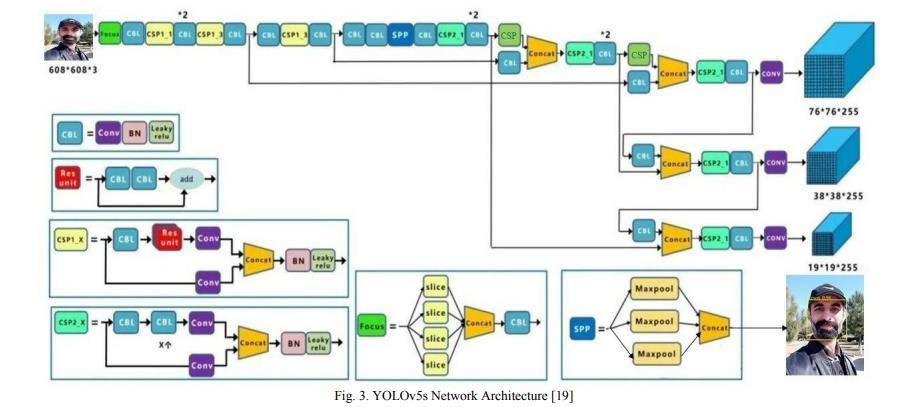
The You Only Look Once algorithm's primary goal is item recognitionandcategorization.TheYOLOalgorithmhasfour variations,eachofwhichimprovesthemodel'sperformance. IncomparisontoRCNN,theYOLOalgorithmemploysawhole picturefeatureratherthanaportionofthecollectedimage. The YOLO method conducts bounding box and class prediction concurrently, which distinguishes it from other standardsystems.Insteadofastandardregionproposaland classification,YOLOaddressestheobjectdetectionproblem as a regression problem. This allows YOLO to run more effectivelyinreal-timewhilesacrificingsomeaccuracy.
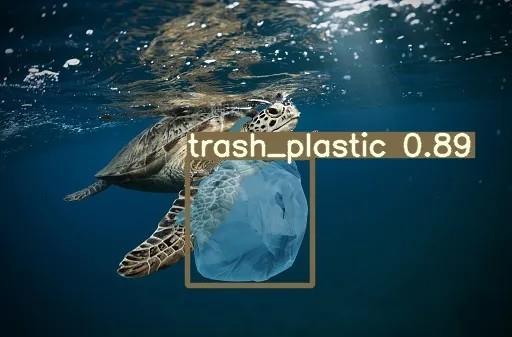
ThemodelsareevaluatedusingPrecision,AccuracyLoss,etc
4. Results
MODEL METRICS
YOLOV5-S
Thiswork’sobjectivewastodevelopadeeplearningvision model capable of consistently identifying and quantifying marineplasticnearreal-time.Toattainthisobjective,apair ofgeneralobjectdetectionmodelswereconstructedusing twostate of-the-artdeeplearningmodelsbuiltforinference speed to measure which performed best. This study concludes that a marine plastic debris detection system basedontheYOLOv5-Smodelwouldbefast,accurate,and robust enough to enable real-time marine plastic debris detection.Thisstudyshowsthateffectiveobjectdetection models can be constructed using readily available, preenabledGPUsforreasonablecosts.Furthermore,thedataset created for and utilized by this general detection model demonstratesthatmassive,highlycurateddatasetscanbe usedinconjunctionwithsamplesrelativetothedomainof object detection and web scraping to produce promising results. This computer vision system enables multiple deploymentmethodstodetect/monitormarineplasticand allowsresearcherstoquantifymarineplasticdebriswithout physicalremoval.
[1]X.Li,M.Tian,S.Kong,L.Wu,J.Yu,“AmodifiedYOLOv3 detection method for vision-based water surface garbage
International Research Journal of Engineering and Technology (IRJET) e-ISSN: 2395-0056
Volume: 11 Issue: 02 | Feb 2024 www.irjet.net p-ISSN: 2395-0072
capture robot”, International Journal of Advanced Robotic Systems.(2020).doi:10.1177/1729881420932715
[2]L.Sherwood,M.Peterson,“Applyingobjectdetectionto monitoring marinedebris”, Tropical ConservationBiology and Environmental Science TCBES Theses. University of Hawaii(2020).
[3]K.Selvam,K.Xavier,A.Shivakrishna,T.Bhutia,S.Kamat, and L. Shenoy, "Abundance, composition, and sources of marinedebristrawled-upinthefishinggroundsalongthe north-eastArabiancoast",ScienceofTheTotalEnvironment, vol. 751, p. 141771, 2021. doi: 10.1016/j.scitotenv.2020.141771.
[4]G.ThushariandJ.Senevirathna,"Plasticpollutioninthe marineenvironment",Heliyon,vol.6,no.8,p.e04709,2020. doi:10.1016/j.heliyon.2020.e04709.
[5]M.SimulBhuyanetal.,"Plasticsinmarineecosystem:A review of their sources and pollution conduits", Regional Studies in Marine Science, vol. 41, p. 101539, 2021. doi: 10.1016/j.rsma.2020.101539.
[6] Borrelle, S.B.; Ringma, J.; Law, K.L.; Monnahan, C.C.; Lebreton,L.;McGivern,A.;Murphy,E.;Jambeck,J.;Leonard, G.H.;Hilleary,M.A.;etal.Predictedgrowthinplasticwaste exceedseffortstomitigateplasticpollution.Science2020, 369,1515–1518.
[7] Geyer, R.; Jambeck, J.R.; Law, K.L. Production, use, and fateofallplasticsevermade.Sci.Adv.2017,3,e1700782.
[8]Deep-SeaDebrisIdentificationUsingDeepConvolutional NeuralNetworksBingXue,BaoxiangHuang,Member,IEEE, GeChen,HaitaoLi,andWeiboW,VOL.14,2021
[9]S.KhetkeereeandS.Liangrocapart,"DetectingFloating Plastic Marine Debris using Sentinel-2 Data via Modified Infrared NDVI," 2021 18th International Conference on Electrical Engineering/Electronics, Computer, Telecommunications and Information Technology (ECTICON), Chiang Mai, Thailand, 2021, pp. 633-636, doi: 10.1109/ECTI-CON51831.2021.9454748.
[10] R. De Vries, M. Egger, T. Mani and L. Lebreton, "Quantifying Floating Plastic Debris at Sea Using VesselBased Optical Data and Artificial Intelligence," 2021 IEEE International Geoscience and Remote Sensing Symposium IGARSS, Brussels, Belgium, 2021, pp.1118-1121,doi: 10.1109/IGARSS47720.2021.9554154.
[11] J. C. Hipolito, A. Sarraga Alon, R. V. Amorado, M. G. Z. FernandoandP.I.C.DeChavez,"DetectionofUnderwater MarinePlasticDebrisUsinganAugmentedLowSampleSize Dataset for Machine Vision System: A Deep Transfer LearningApproach,"2021IEEE19thStudentConferenceon Research and Development (SCOReD), Kota Kinabalu,
2024, IRJET | Impact Factor value: 8.226 |
Malaysia, 2021, pp. 82-86, doi: 10.1109/SCOReD53546.2021.9652703.
[12] B. Xue et al., "An Efficient Deep-Sea Debris Detection Method Using Deep Neural Networks," in IEEE Journal of SelectedTopicsinAppliedEarthObservationsandRemote Sensing, vol. 14, pp. 12348-12360, 2021, doi: 10.1109/JSTARS.2021.3130238.
[13]Córdova, M.; Pinto, A.; Hellevik, C.C.; Alaliyat, S.A.A.; Hameed,I.A.;Pedrini,H.;Torres,R.D.S.LitterDetectionwith DeepLearning:AComparativeStudy.Sensors2022,22,548.