
Experimental Work on Graphene Concrete Using Jarofix as Partial Replacement for Fine Aggregate
1 K.Divya, 2 J.Sree Naga Chaitanya, 3 Dr.K.Chandramouli, 4 P Naveen
1&2Assistant Professor, 3 Professor & HOD, 4B.Tech Student
1,2,3,4Department of Civil Engineering, NRI Institute of Technology, Visadala (V), Medikonduru (M), Guntur, Andhra Pradesh, India.
Abstract:
The way that concrete is made has a big impact on its health because it is utilised everywhere. Because of urbanisation and industrialization, concrete is a crucial building material in the modern world. This day, concrete is a prerequisite for all constructions. The growing population places a great deal of pressure on civil engineers to design affordable, environmentally sustainable structures that meet the needs of the populace. Concrete is a heterogeneous mixture of water, fine, coarse, and binding ingredient (lime or cement) In this investigation, jarofix is utilised in place of fine aggregate. In the current investigation, fine aggregate in concrete is successfully replaced with Jarofix, an industrial waste by-product from the manufacture of zinc. Concrete's compressive and split tensile strengths were investigated at 0%,5%,10% and 15% Jarofix replacement in place of fine aggregate. The use of graphene concrete, mortar, and cement additives brings up new, potentially eco-friendly possibilities in building and infrastructure design.These ingredients result in stronger and more durable concrete structures. When evaluated utilising international standard criteria, external testing revealed increases in both tensile and compressive strength. Concrete's compressive strength and split tensile strength were investigated when cement was replaced with 0%, 0.05%, 0.10%, and 0.15% grafine oxide. The examinations were conducted over 7 and 28 days.
Key Points: Jarofix, Grafine Oxide, compression strength andsplittensilestrengthofconcrete.
1. INTRODUCTION
Because of industrialization and population growth, concrete is the most essential and often used building material worldwide. Concrete is significant because it can be moulded into any shape andis made toresist the most extreme conditions. The modern community and society wouldnotbepossiblewithoutconcrete.Analternativethat lowers building costs and encourages the use of less natural raw materials in concrete is the use of industrial
wastes. Additionally, there is a way to dispose of waste effectivelyandlessentheissuesthatarisefromdoingso.In this investigation, jarofix is utilised in place of fine aggregate.In the current investigation, fine aggregate in concreteissuccessfullyreplacedwithJarofix,anindustrial waste by-product from the manufacture of zinc.The application of cement additives, mortar, and graphene concrete opens up new, possibly environmentally friendly ways to design buildings and infrastructure. These ingredients result in stronger and more durable concrete structures. When evaluated utilising international standard criteria, external testing revealed increases in bothtensileandcompressivestrength.
2. OBJECTIVES
1. To make the best use of jarofix in fine aggregate.
2. To make the best possible use of graphene oxide in cement.
3. To assess the concrete's split tensile and compressive strengths.
3. MATERIALS
3.1 Cement: Cement becomes more cohesive and sticky when water is added. We refer to these cements as hydraulic cements. Most of these are composed of clay, silicatesderivedfromlimestone,andlimealuminates.
3.2 Fine Aggregate: This study employed manufactured sand, which was readily accessible locally and had the appropriate grading needed to make concrete, as the fine aggregate.
3.3 Coarse Aggregate: 20 mm coarse aggregate that satisfies IS: 383-1970 is used in the current experiment. The specific gravity of aggregate is measured with a pycnometer test. The aggregate fineness modulus was calculated using sieve analysis on the material used in the study, which was retained on a 4.75 mm screen following passagethrougha20mmsieve.
International Research Journal of Engineering and Technology (IRJET) e-ISSN:2395-0056 Volume: 11 Issue: 01 | Jan 2024 www.irjet.net p-ISSN:2395-0072 © 2024, IRJET | Impact Factor value: 8.226 | ISO 9001:2008 Certified Journal | Page463
***
3.4 Water: Water is one of the most important building supplies since it is needed for a variety of tasks, such as curing work, mixing cement, and creating mortar. The longevity of cement concrete and mortar in building is directlyimpactedbythequalityofthewaterused.
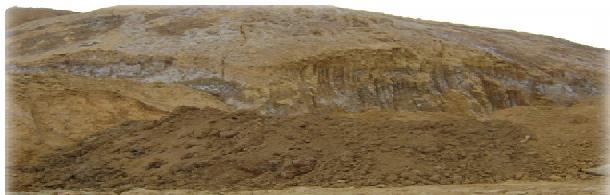
3.5Jarofix: In this investigation, jarofix is utilised in place offineaggregate.Thejarofixused inthestudyis gathered from this location and transported in plastic bags to the laboratory.Thesubstanceappearsasafinepowderthatis light brown in colour, with the lumps broken up by pulverising between the fingers. The jarofix samples were airdried,ground,andthenplacedinplasticbagsandkept inairtightcontainersatroomtemperature.
3.6 Graphene oxide: Graphene oxide quickly exfoliates and breaks down at temperatures between 280 and 300 °C,producingfinelyscatteredamorphouscarbon.
4. EXPERIMENTAL INVESTIGATION
4.1 Compressive Strength Test
The table below shows the outcomes of the compressive strength test that was conducted on the cast and cured specimeninthecompressivetestingmachine.
compressive strength of % of jarofix With Partial Replacement Of Fine Aggregate.
Table 2: Compressive Strength Of % Of Graphene Oxide With Partial Replacement Of Cement. Sl.no
Compressive strength (N/mm2)
Table 3: Combined Compressive Strength Of 10 % Of Jarofix With Partial Replacement Of Fine Aggregate+0.10 % Of Graphene Oxide With Partial Replacement of Cement. Sl.no
4.2 Split Tensile Strength Test
The split tensile strength test findings, which were obtainedusingaflexuraltestingmachineoncastandcured specimens,are
Table 4: Split tensile strength of % Of jarofix With Partial Replacement Of Fine Aggregate.
tensile strength
International Research Journal of Engineering and Technology (IRJET) e-ISSN:2395-0056 Volume: 11 Issue: 01 | Jan 2024 www.irjet.net p-ISSN:2395-0072 © 2024, IRJET | Impact Factor value: 8.226 | ISO 9001:2008 Certified Journal | Page464
Fig: Jarofix
S.No % of Jarofix Compressive strength (N/mm2) 7 days 28 days 1 0% 19.03 27.19 2 5% 19.23 27.46 3 10% 19.81 28.27 4 15% 18.99 27.73
Table 1:
7 days 28
1 0 19.03 27.19 2 0.05% 26.12 37.28 3 0.10% 27.65 39.45 4 0.15% 26.59 38.54
%ofGO
days
7
28
1 0 19.03 27.19 2 10%ofJF+0.10%of GO 31.85 45.31
%ofjarofix+%of Grafineoxide Compressive strength (N/mm2)
days
days
2) 7
28
1 0% 1.87 2.68 2 5% 1.89 2.71 3 10% 1.92 2.74 4 15% 1.86 2.72
S.No % of jarofix Split
(N/mm
days
days
5. CONCLUSION
1. The Normal Concrete of Compressive Strength result for7and28daysis19.03N/mm2 and27.19N/mm2
2. At 10% replacement of fine aggregate by Jarofix the compressive strength of concrete is for 7 and 28 days 19.81N/mm2 and28.27N/mm2 .
3. At 0.10% of Grafine Oxide with cement the compressivestrengthofconcretefor7and28daysare 27.65N/mm2and39.45N/mm2
4. Combined replacement of compressive strength of concrete with 10% of Jarofix and 0.10 % of Grafine Oxide for 7 and 28 days are 31.85 N/mm2 and 45.31 N/mm2
5. The Normal Concrete of Split tensile Strength a result isfor7and28daysis1.87N/mm2and2.68N/mm2
6. At 10% replacement of fine aggregate by Jarofix the Split tensile strength of concrete is for 7 and 28 days 1.92N/mm2 and2.74N/mm2
7. At0.10%ofGrafineOxidewithcementtheSplittensile strengthofconcretefor7and28daysare2.73N/mm2 and3.91N/mm2
8. Combined replacement of Split tensile strength of concrete with 10% of Jarofix and 0.10 % of Grafine Oxide for 7 and 28 days are 3.18 N/mm2 and 4.56 N/mm2
6. REFERENCES
1.J.SreeNagaChaitanya,Dr.K.Chandramouli,K.DivyaDr.D. Vijayakumar, K. Akarshitha. Mechanical Properties Of Bamboo Fiber Reinforced Concrete By Using Ggbs As Partial Replacement Cement And Zeolite Powder As Fine Aggregate Powder, North Asian International Research JournalConsortiums,9(6),(2023),17-23.
2.MohamedR.A.S,EffectOfPolypropyleneFibersOnThe Mechanical Properties Of Normal Concrete,Journal of Engineering Sciences, Assiut University, Vol. 34, No. 4, pp. 1049-1059,July2006.
3.Chandramouli,K, Marouthuramya Sai, Anitha,V, Pannirselvamet.al.,(2019),ImprovementofSilicaFumeon Concrete by using Mix Proportions, Journal of Applied ScienceandComputations,6(4),pp.187-192.
4.Structures Deveshan L. Pillay,1Oladimeji B. Olalusi, Paul O. Awoyera, Carlos Rondon, Ana, Mar´ıaecheverr´ıa, and John Temitope kolawa Review of the Engineering Properties of Metakaolin based concrete: Towards CombattingChlorideAttackinCoastal/Marine(2020)(8)
5.Chandramouli,K, Marouthuramya Sai, Anitha,V, Pannirselvamet.al.,(2019),ImprovementofSilicaFumeon Concrete by using Mix Proportions, Journal of Applied ScienceandComputations,6(4),pp.187-192.
6.Chandra Sekhar I, Gopinathan P and Ramamohana B. Influence Of Graphene Oxide On Mechanical Properties Of Qc-Lfs And Ggbfs Based Hardened Cementitious Composites,5(4),2018,387-392.
7.Annirselvam,N, Chandramouli,K, Anitha,V, (2018), Pulse Velocity Test on Banana Fibre Concrete with Nano Silica, International Journal of Civil Engineering and Technology, 9(11),pp.2853-58.
8.A.Santhiya et al, A Review of Experimental Investigation on Coconut Shell as Replacement on Concrete as Course AggregateintheirStrength,Volume4IssueV,May2016
9.J.SreeNagaChaitanya,Dr.K.Chandramouli,K.DivyaDr.D. Vijayakumar, K. Akarshitha. Mechanical Properties Of Bamboo Fiber Reinforced Concrete By Using Ggbs As Partial Replacement Cement And Zeolite Powder As Fine Aggregate Powder, North Asian International Research JournalConsortiums,9(6),(2023),17-23.
10.W. S. Hummers Jr. and R. E. Offeman, “Preparation of graphiticoxide,”JournaloftheAmericanChemicalSociety, vol.80,no.6,p.1339,1958.
International Research Journal of Engineering and Technology (IRJET) e-ISSN:2395-0056 Volume: 11 Issue: 01 | Jan 2024 www.irjet.net p-ISSN:2395-0072 © 2024, IRJET | Impact Factor value: 8.226 | ISO 9001:2008 Certified Journal | Page465
Sl.no %of Grafine Oxide Split tensile strength (N/mm2) 7 days 28 days 1 0 1.87 2.68 2 0.05% 2.61 3.72 3 0.10% 2.73 3.91 4 0.15% 2.61 3.79
Table 5: Split tensile strength Of % Of % Of Grafine Oxide With Partial Replacement Of Cement.
Sl.no %ofJF+%ofGO Split tensile strength (N/mm2) 7 days 28 days 1 0 1.87 2.68 2 10%ofJF+0.10%ofGO 3.18 4.56
Table 6: Split tensile strength of 10 % Of Jarofix with Partial Replacement of Fine Aggregate+0.10 % Of Grafine oxide With Partial Replacement of Cement.
11.Chandramouli,K, Pannirselvam,N, Vijayakumar,D, (2019), Strength Studies on Pine Apple Fibre Concrete with Nano Silica, International Journal of Innovative Technology and Exploring Engineering, 8(7), pp. 30633065.
12.A.Santhiyaetal,AReviewofExperimentalInvestigation on Coconut Shell as Replacement on Concrete as Course AggregateintheirStrength,Volume4IssueV,May2016.
13.Dr.K. Chandramouli, J. Sree Naga Chaitanya, Dr.N.Pannirselvam, A. Murali Strength Concrete by Using Alccofine(1203),InternationalJournalofCreative.
14.Egwuonwu, William, C., Iboroma, Z.S Akobo Barisua E. Ngekpe Effect of Metakaolin as a Partial Replacement for Cement on the Compressive Strength of High Strength Concrete,atVaryingWater/BinderRatios(6)(1)(2019).
15.MylavarapuPhani Sekhar, K.Raju, A Study on effect of mechanical properties of recron3s fiber concrete on different grades exposed to elevated temperatures//volume:4//issue:1//june2017.
International Research Journal of Engineering and Technology (IRJET) e-ISSN:2395-0056 Volume: 11 Issue: 01 | Jan 2024 www.irjet.net p-ISSN:2395-0072 © 2024, IRJET | Impact Factor value: 8.226 | ISO 9001:2008 Certified Journal | Page466