
Review on Synthesis and Applications of Nanomaterial Molybdenum
Disulphide (MOS2) and Photocatalysis Process
PAVITHRA. B.N.1,2
,
PRAVEEN. B M1,*
,
ARATI C1 , SUDHAKAR A.3 , BOMMANNA K4
1Department of Chemistry, Srinivas University, Institute of Engineering & Technology, Mukka, Srinivas Nagar, Mangaluru, Karnataka, India.
2 School of Engineering, Department of Chemistry, Presidency University, Itgulpura, Bengaluru, Karnataka, India.
3 Department of Chemistry, Raja Rajeswari College of Engineering, Ramohalli Cross, Kumbalagodu, Bengaluru, Karnataka, India.
4 Assistant Professor, Department of Mechanical Engineering, APS College of Engineering, Bengaluru, Karnataka, India. ***
Abstract: Researchonthecreationanduseofnanomaterialshasbeendoneforalongtime.Becauseofthecontrastsbetween the two chemical elements-Sulphur, an oxygen family element, and molybdenum, the base element they have a range of desirablequalities.Therearestill a numberofobstaclestoovercomedespitesignificantadvancementsinourunderstanding ofthemechanismsunderlyingthebiologicalcharacteristicsandcatalyticactivityofmolybdenumdisulphidenanoparticles,as wellastheproceduresinvolvedintheirnucleation,development,andstructure. Theevolutionofnano-materialshasmadeit possible to modify a material's structure and form at the nano-scale level to achieve specific uses. To discriminate between metallic phases and semiconducting, also layered transition metal chalcogenides (TMDs), such as molybdenum disulfide (MoS2), and quasi two-dimensional (2D) materials like graphene and 2D honeycomb silicon were developed.. Because it can displayabroadvarietyofpropertiesasitmovesfromthebulktothenano-scale.Amongthese,molybdenumdisulfide(MoS2) isanintriguingmultifunctionalsubstance.MoS2 isagreatmaterialforpost-siliconelectronicsonasinglesheetbecauseofits straight band-gap value of 1.9 eV. Its mobility is around 200cm2(Vs-1) at room temperature, and it has high on/off current ratio MoS2's structure also contributes to two of its properties. It is a useful instrument for gas sensing because of its hexagonal structure, covalent connections between S-Mo-S atomic layers, and Van der Waals interactions between neighboringMoS2layers
Becauseofitspromisingcharacteristics,MoS2 canbeusedinavarietyofpracticalapplications
Ourgoalinthisworkistotalk about the most recent synthesis techniques and how they can be used to create 2D MoS2 materials. Photocatalytic materials thatreacttovisiblelighthavenumerous significantuses,from energystorageand conversiontotheprocessingofindustrial waste.Forall photocatalytic applications,molybdenum disulfide(MoS2)anditsderivativesareideal becausetheyhavegood stability and recyclability, when exposed to visible light it has more photocatalytic activity. Because of their superior physicochemical characteristics, MoS2-based materials have found extensive application in a variety of sectors, including organic transformation processes, environmental remediation, and wastewater treatment. This review centres on the basic characteristics of molybdenum Disulphide (MoS2), its current applications and unresolved issues, as well as important approachestoaddressproblemspertainingtoMoS2useinphotocatalysis.ThereisalsoacriticaldiscussionoftheuseofMoS2 -based materials in visible-light-induced catalytic processes for the treatment of various pollutants, such as industrial, pharmaceutical, environmental, and agricultural waste The review concludes by outlining MoS2's potential applications in bothestablishedanddevelopingphotocatalysisfields.
Keywords:Molybdenumdisulphide(MoS2),transitionmetaldichalcogenides(TMDs),Photocatalysis.
1. Introduction
Duetopopulation expansionandthefastindustrializationofdevelopingcountries, thereisanincreasingdemandfor energy worldwide, which is driving up the usage of fossil fuels and perhaps causing irreversible anthropogenic climate change. Photocatalytictechnologieshaveshownalotofpromiseinrecentyearsforreducingenvironmentalpollutionandtheenergy issue[1].Thecapacityofvisible-lightdrivenphotocatalysistoefficientlyharnessthevastenergyofsolarradiationasaclean, inexpensive, and renewable driving force[2] is one of its primary advantages. Visible-light-active photo catalysts have attractedalotofinterestbecausetheyareveryeasytocreateandrecycleusingfundamentalchemicalprocesses[3].
International Research Journal of Engineering and Technology (IRJET) e-ISSN:2395-0056 Volume: 11 Issue: 01 | Jan 2024 www.irjet.net p-ISSN:2395-0072 © 2024, IRJET | Impact Factor value: 8.226 | ISO 9001:2008 Certified Journal | Page410

A few advantages of employing photo catalysts for pollutant removal are illustrated in Figure 1. These photo catalysts' band gapenergydetermineshowmuchlighttheycanabsorb. Amongthoseusedasphotocatalysts,semiconductorsreferredtoas metaloxidesandmetalchalcogenideshavepiquedthemostattention. Sincemetaloxidesarestable,environmentallybenign, and readily available, they have been used in photo catalysis. Nevertheless, the majority of the only light that metal oxide photocatalystscandetectisultraviolet(UV)lightthatmakesupapproximately8%ofthesolarspectrum'senergy,compared to43%forvisiblelight [4]. Ontheotherhand,metal chalcogenides,having highervisiblelight sensitivity,smaller bandgaps than metal oxides, and the ability to function as visible light-active photo catalysts [5]. The use of metal chalcogenides in photocatalytic systems is becoming more and more common due to their among other advantageous features, large surface area,configurableform,andbandgapenergies[6-7].Molybdenumdisulfide(MoS2)isoneofthechalcogenidesthathasdrawn theattentionofscientistsduetoitsremarkableproperties,[8-9]thatincludes,andmoreoflocationsthatarecatalyticallyhave hardness, highstabilityand, activestrongoxidizingactivity, andnon-toxicity[10] Amongtheprincipal usesfor MoS2 [11-12] are the oxidative desulfurization ,photocatalytic evolution of hydrogen, and the photocatalytic destruction of organic contaminants. One- or few-layered MoS2 has been compared to graphene due to its hexagonal Mo and S atom arrangement;[13]butMoS2 Withasmallerbandgapthangraphene,MoS2 isagoodoptionforphotocatalysisdrivenbyvisible lightbecauseitcanproduceelectron/holepairs(e−/h+) whenexcitedbylight. MoS2'ssuperiorlightabsorptioncapacityand strong chemical stability have garnered a lot of interest in photo catalysis. Previous studies have demonstrated that doping MoS2 with metal or nonmetal elements or modifying it with a second semiconductor or metal are efficient methods for increasingitsphotocatalyticactivity.AC3N4/1%Ni2P/MoS2 heterojunction,forexample,demonstratedahighH2 generation of 532.41 μ mol g−1 h−1, according to Lu et al.[14]. In comparison with the g-C3N4/ 1.5% MoS2 and g-C3N4/1% Ni2P, respectively,thiswas2.47and5.15timeshigher.
Using several sulfur sources and molybdenum precursors, such as elemental sulfur powder [15], thiourea[16], thioacetamide[17], and L-cysteine[18], there are several approaches to manufacture MoS2. By varying the reaction solvent, temperature, pH, length of the reaction, and the addition of ligands or surfactants all of which are essential for controlling the synthesis to yield the intended chalcogenide a variety of intriguing morphologies can be created. A review of the literature demonstrates the many techniques employed in the synthesis of MoS2 materials as well as their uses. The most populartechniquesarehybrid,solvothermal,hydrothermal,solid-state[20-23]
The structure, characteristics, and synthetic techniques pertaining to MoS2 and MoS2-based materials are the main topics of thisreview.Asuccinctsummaryofthechallengesaddressedbyresearchersinthefieldisstillmissing,despiteanexponential growthinpublicationsoverthepreviousfiveyearspertainingtothephoto-catalyticusesofMoS2-basedmaterials.Therefore, thepurposeofthisstudyistoprovideanoverviewofthemajorissuesand essentialtacticsforresolvingtheissuesthathave been discovered. Furthermore discussed will bethemostcurrent advancementsin the agricultural waste and photocatalytic degradation of pharmaceutical, environmental, industrial using materials based on molybdenum disulfide (MoS2). Lastly,the prospectsforthisquicklydevelopingtopicwillbediscussed,alongwithsomespecificrecommendationsforfutureresearch.
International Research Journal of Engineering and Technology (IRJET) e-ISSN:2395-0056 Volume: 11 Issue: 01 | Jan 2024 www.irjet.net p-ISSN:2395-0072 © 2024, IRJET | Impact Factor value: 8.226 | ISO 9001:2008 Certified Journal | Page411
Figure1:Benefitsofutilizingphotocatalyststoremovecontaminants
2. Challenges Facing Chalcogenide-Based Photo- catalysis:
The majority of metal oxides have broad band gaps, which restricts their use as photocatalysts in visible light. Since most metalchalcogenideshave bandgapenergiesthanmetaloxides,theyaremoresuitableforphotocatalysistriggeredbyvisible light. Although, as will be discussed in more detail below, some adjustments are needed to enhance their photocatalytic activity. Another difficulty confronted by researchers is the stability of chalcogenides that have been synthesized in photocatalytic settings. The photocatalytic efficacy of chalcogenides has been demonstrated to be impacted by challenging conditionssuchasphotocorrosionandabriefexcited-statelifespan[39].Forexample,Caietal.showedthat photocorrosion producedsignificantlevelsofCd2+ insolution40whenpureCdSwasusedforphotocatalyticrhodamineBdegradation[40]. Because of its exceptional photo stability in solution, MoS2 does not suffer from photo corrosion. This is because the interactionbetweenthesulfurpzandmolybdenumdz2orbitalsatthetopofthevalenceband(VB)leadstothedevelopment of the antibonding state [41]. In addition, there may be issues with the photo catalyst’s recovery following the conclusion of thephotocatalytic activity. Finally,butjustasimportantly,a majorproblemwiththe majorityofmetal chalcogenidesistheir limitedabilitytotransferandsegregatethephotogeneratedchargecarrierstoactivecatalyticsites.Thiscanbeattributedto lowcarriermobility,shortcarrierlifetimes,oramixofthetwo[42]
2.1 Realistic Approaches to Address the Difficulties in Chalcogenide-Based Photocatalysis:
AlthoughMoS2 isavisiblelight-responsivephotocatalyst,itswideapplicabilitytophotocatalysisisrestrictedduetoacommon restriction shared by narrow band gap photocatalysts: e /h+ pairs' high recombination efficiency. Consequently, a variety of materials,includingmetals[43],metaloxides[11],andcarbon-basedcompounds,havebeendopedandcombinedwithMoS2,in ordertoincreasechargecarrierseparation[44] Ag@MoS2'sincreasedH2evolutionactivityundervisiblelightirradiationwas demonstratedbyCheahetal.[45]
Theauthorsdiscoveredthat thee andh+ separation wasaidedbythedepositionof AgontoMoS2,Italsoenhancedthetotal photocatalytic efficacy by preventing charge recombination. Additionally, the SPR effect of the nanosized Ag particles enhancedthephotocatalyst'sabilitytoharvestlight. ThesefindingsshowedthatMoS2 hashigherphotocatalyticactivitythan pure MoS2.suggesting that material modification through composite creation represents a viable tactic for enhancing MoS2's photocatalyticefficacy.
2.2 MoS2's optical and structural characteristics:
Attractive van der Waals forces hold MoS2's layered S-Mo-S atomic layers a multilayer transition metal dichalcogenide, together [51] The characteristics of MoS2 change dramatically as it goes from bulk to nanoscale, which makes it a material with multiple functions. Two aspects of MoS2's structure are:
1) a S−Mo−S atomic layer configuration arranged hexagonally, with the Mo and S atoms having strong covalent connections
2) Van der Waals forces hold together the constituent layers [35,36].
International Research Journal of Engineering and Technology (IRJET) e-ISSN:2395-0056 Volume: 11 Issue: 01 | Jan 2024 www.irjet.net p-ISSN:2395-0072 © 2024, IRJET | Impact Factor value: 8.226 | ISO 9001:2008 Certified Journal | Page412
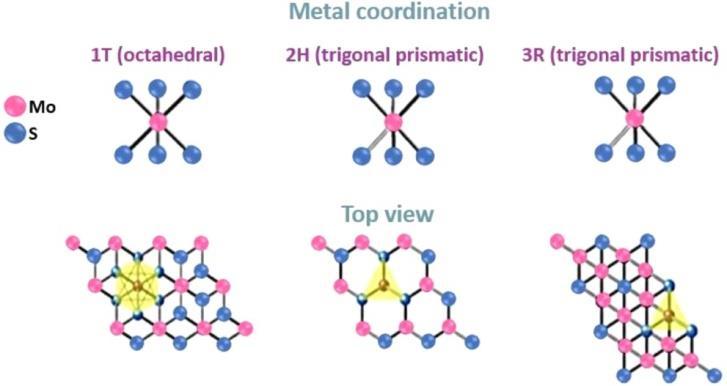
Figure2:MoS2 threedifferentphases'crystalstructuresandmetalcoordination.
Figure 2 , MoS2 shows many phases. We can see 1T, 2H, and 3R. 2H-MoS2 or 3R-MoS2, H- hexagonal and R- rhombohedral symmetries, In nature MoS2 is present in Crystalline form. Each Mo atom is bound covalently with six S2 is in centre in a trigonalprismaticcoordinationsphere , Anewtrigonalsymmetrymetastablemetallicphaseknownas1T Figure2showsthe distinct phases of MoS2, specifically 1T, 2H, and 3R. Natural forms of crystalline MoS2 are 2H-MoS2 or 3R-MoS2, where the letters"H"and"R"denote,respectively,rhombohedralandhexagonalsymmetry.Inthesefigures,everyMoatomiscovalently connected to six S2 ions and centered in a each S atom has coordination which is pyramidal and is connected to three Mo atoms[26] Abrand-new,trigonalsymmetrymetastablemetallicphaseknownas1T-MoS2 isproducedwhenalkalimetalsare intercalatedwith2H-MoS2.Thisphaseisnotfoundinthenaturalworld[29].
2.3The Use of MoS2 and MoS2-Based Materials as Photocatalysts:
MoS2 has garnered a lot of interest, and a number of advantageous photocatalytic characteristics, including low toxicity and cost, have been documented. These characteristics include good optical absorptivity, a small band gap energy and strong charge carrier mobility. However, photocorrosion, edge activity effect, and photogenerated e−/h+ recombination limit the performance of MoS2. Controlling the morphology, doping to modulate energy bands, band alignment via carbon nanostructurealteration,heterojunctioncreation,andconjunctionwithsurfaceplasmonresonance-exhibitingmetalparticles have all been tried in the past to improve the photocatalytic properties of MoS2. The generation charge carrier pairs photoexcited(e /h+)isthefirststepinthephotocatalyticredoxreactions.
2.4 Using MoS2 and MoS2-based materials, photocatalytic treatment of microorganisms, organic pollutants, and inorganic pollutants:
Inadequate wastewater treatment, coupled maintaining both human health and the natural ecology, remain major global issues as a result of industrialization's impact on the environment. Water bodies are contaminated by both organic and inorganic pollutants, such as wastes from industry, the environment, pharmaceuticals, and agriculture, making the efficient treatment of wastewater essential. Figure 3 illustrates the uses of MoS2 and MoS2-based materials under visible-light irradiation.

3. Photocatalytic Treatment of Industrial Waste:
One of the main causes of environmentally dangerous water contamination is industrial waste effluents. Wastewater pollutants have been removed via coagulation, adsorption, precipitation, and biodegradation, among other treatment methods.Anadditionalpotentiallyeffectivetechniqueforeliminatingcontaminantsthatareincapableofbeingbrokendown byphysicalorbiologicalprocessesisphotocatalysis.Evenatlowquantities,dyescontainingcolouredpigmentsthatarenot biodegradable are hazardous to living organisms and present in water. Therefore, it is essential to remove colours from wastewater.UsinghydrothermallyproducedflowerlikeMoS2,Injustninetyminutes,Shengetal.wereabletodemonstrate
International Research Journal of Engineering and Technology (IRJET) e-ISSN:2395-0056 Volume: 11 Issue: 01 | Jan 2024 www.irjet.net p-ISSN:2395-0072 © 2024, IRJET | Impact Factor value: 8.226 | ISO 9001:2008 Certified Journal | Page413
Figure3.MoS2 andMoS2-basedmaterialsexposedtovisiblelight[courtesyfromgoogle]
thephotocatalyticbreakdownofdyemethylenebluewithadegradationactivityof95.6%whenexposedtovisiblelight[31]. In a different study, Zhang et al. used a hydrothermal technique using CTAB as the surfactant to effectively construct MoS2 nanosheetpetalswith2.05eVbandgapenergy[34].
3.1Photocatalytic Treatment of Environmental Waste:
One well-known way to prevent environmental problems brought by releasing of industrial effluents directly or indirectly into the environment is to remove heavy metals from the ecosystem. The precipitation method, membrane separation, activated carbon adsorption, and activated carbon adsorption are some of the commonly utilized heavy metal removal techniques25.In addition to these more well-established techniques,photocatalysisisbecomingmoresignificant asa heavy metal pollution cleanup strategy. Growing concern is being expressed about the expanding usage of chromium in modern civilization, which can contaminate land and water. There are various oxidation states in which Cr can exist. Cr(VI) is dangerous due to its high mobility, while Cr(III) is less toxic due to its lower mobility28. Using a MoS2/ZnS/ZnO composite, Zhao et al. effectively demonstrated photocatalytic Cr(VI) reduction with a 98.7% reduction in 90 minutes30. In order to create high efficiency of Mo-based photocatalysts and the capacity to optimise the heavy metal treatment effect, various methods for enhancing the photocatalytic activity of MoS2 materials should be further researched. Moreover, additional procedures,includingelectrocatalysisandphotocatalysis,adsorptionandphotocatalysis,etc.,mightbecombinedtoremove heavymetalsmoreeffectively.
4. Prospects for the future:
ManystudieshaveaddressedthesynthesisofMoS2 andMoS2-basednanomaterialsaswellastheirmanyusesnevertheless;a numberofobstaclesstillneedtobeovercome.
1) Because of their exceptional physical and chemical properties, materials based on molybdenum will find extensive applicationinavariousfieldsandmayevenbecomecommerciallyviableinthefuture. Thiswillmakeitpossibletoapply MoS2 on different types of media and release it into the environment, which could have an impact on human health and environmentalsafety.Assuch,athoroughassessmentofthetoxicityofMoS2-basedmaterialsisneeded.
2) Up until now, the application of MoS2-based photocatalysts has only been possible in laboratory settings. Real-world environmental applications for MoS2 have not yet been investigated, and there is currently no perfect photocatalyst that canbeutilizedcommerciallyoronalargescale.
3) Majorissuesstillincludetheshortlifeofchargecarriers,rapidrecombination,andcatalystrecoveryafteruse Becauseof theseinherentissueswithMoS2,itisimperativetofindanewclassofmaterialstoimproveitsphotocatalyticproperties.
4) Becauseofitsexceptionalopticalcharacteristics,thephotocatalyticactivityofMoS2 inavarietyofmodelsystemshasbeen thoroughlyinvestigated.Nevertheless,a keygoal continuesto bethecreationof reasonablypricedMoS2-based products thatcanspecificallytargetthepollutantsfoundinwastewater.
5) When exposed to visible light Some MoS2 composites become unstable. Thus, additional research is needed to create photostableMoS2-basedmaterial.
6) Information on the variables that influence photocatalytic activity, such as temperature, pH, and the presence of many pollutants, is scarce. Thus, a greater variety of experimental circumstances should be used to study photo-catalytic degradation.
7) OneofthemainchallengesiscomingupwithworkablewaystoprepareMoS2 inlargeenoughamountsforindustrialuse. Therefore,additionalstudyisrequiredtodeterminehowtoscaleupsyntheticprocessesforlarge-scaleproduction.
5. Conclusion:
AlotofresearchisnowbeingdoneonMoS2 andMoS2-basednanomaterialsaspossiblephotocatalysts forthe destructionof organic and inorganic contaminants and the eradication and/or inactivation of microorganisms. Due to their exceptional physicochemicalcharacteristics,MoS2 andMoS2-basedmaterialscanbepreparedusingavarietyofsynthetictechniques,and theyfinduseinawiderangeofindustries.ThispaperexaminedthelatestdevelopmentsinMoS2 modification,suchastheuse
International Research Journal of Engineering and Technology (IRJET) e-ISSN:2395-0056 Volume: 11 Issue: 01 | Jan 2024 www.irjet.net p-ISSN:2395-0072 © 2024, IRJET | Impact Factor value: 8.226 | ISO 9001:2008 Certified Journal | Page414
ofcarbon-basedsupports,couplingwithothersemiconductorsormetals,anddopingwithmetalsandnonmetals.Additionally, a summary of the synthesised materials' photocatalytic capabilities towards the breakdown of particular contaminants was provided. Lastly, the prospects for employing MoS2-based materials for effective visible-light-induced photocatalysis were explored.
References:
1) Fahimi-Kashani, N.; Rashti, A.; Hormozi-Nezhad, M. R.; Mahdavi, V. MoS2 Quantum-Dots as a Label-Free Fluorescent NanoprobefortheHighlySelectiveDetectionofMethylParathionPesticide. Anal. Methods 2017, 9 (4),716−723.
2) Chen, W.; Liu, M.; Wei, S.; Li, X.; Mao, L.; Shangguan, W. Solid-State Synthesis of Ultrathin MoS2 as a Cocatalyst on Mesoporousg-C3N4 forEXcellentEnhancementofVisibleLightPhotoactivity. J. Alloys Compd. 2020, 836,155401.
3) Nagaraju, C.; V. V. Muralee Gopi, C.; Ahn, J.-W.; Kim, H.-J. Hydrothermal Synthesis of MoS2 and WS2 Nanoparticles for HighPerformanceSupercapacitorApplications. New J. Chem. 2018, 42(15), 12357−12360.
4) Chothe, U.; Ugale,C.;Kulkarni,M.; Kale,B.Solid-StateSynthesisofLayeredMoS2 NanosheetswithGrapheneforSodium-Ion Batteries. Crystals 2021, 11 (6),660.
5) Dante,R.C.MetalSulfides.In Handbook of Friction Materials and their Applications;Elsevier,2016;pp79−91.
6) Rahman, A.; Khan, M. M. Chalcogenides asPhotocatalysts. New J. Chem. 2021, 45 (42), 19622−19635.
7) Gu, W.; Yan, Y.; Zhang, C.; Ding, C.; Xian, Y. One-StepSynthesisofWater-SolubleMoS2 QuantumDotsviaaHydrothermal MethodasaFluorescentProbeforHyaluronidaseDetection. ACS Appl. Mater. Interfaces 2016, 8 (18),11272−11279.
8) PrabhakarVattikuti, S. V.; Byon, C.; Venkata Reddy, C.;Venkatesh,B.;Shim,J.SynthesisandStructuralCharacterizationof MoS2 NanospheresandNanosheetsUsingSolvothermalMethod. J. Mater. Sci. 2015, 50 (14),5024−5038.
9) Chen,W.; Sun, L.; Li, Q.; Huo, L.; Zhao, H. Defect-RichMoS2/r-GOHybridviaMicrowave-AssistedSolvothermalProcessfor EfficientElectrocatalyticHydrogenEvolution. Int. J. Hydrogen Energy2020, 45 (43), 22459−22468.
10) Wang, C.; Wang, L.; Jin, J.; Liu, J.; Li, Y.; Wu, M.; Chen, L.; Wang, B.; Yang, X.; Su, B.-L. Probing Effective Photocorrosion Inhibition and Highly Improved Photocatalytic Hydrogen Production on Monodisperse PANI@CdS Core-Shell Nanospheres. Appl. Catal.,B 2016, 188, 351−359.
11) Ikram,M.;Khan,M.I.;Raza,A.;Imran,M.;Ul-Hamid,A.;Ali,S.OutstandingPerformanceofSilver-DecoratedMoS2 Nanopetals UsedasNanocatalystforSyntheticDyeDegradation. Phys. E 2020, 124, 114246.
12) Wang,M.;Ju,P.;Li,J.;Zhao,Y.;Han,X.;Hao,Z.FacileSynthesisofMoS2/g-C3N4/GOTernaryHeterojunctionwithEnhanced PhotocatalyticActivityforWaterSplitting. ACS SustainableChem. Eng. 2017, 5 (9),7878−7886.
13) Cheah, A. J.; Chiu, W. S.; Khiew, P. S.; Nakajima, H.; Saisopa, T.; Songsiriritthigul, P.; Radiman, S.; Hamid, M. A. A. Facile Synthesis ofaAg/MoS2 Nanocomposite Photocatalystfor EnhancedVisible-Light Driven Hydrogen Gas Evolution. Catal. Sci. Technol. 2015, 5 (8), 4133−4143.
14) San Martín, S.; Rivero, M. J.; Ortiz, I. Unravelling theMechanismsThatDrivethePerformanceofPhotocatalyticHydrogen Production. Catalysts 2020, 10 (8), 901.
15) Hu, Y.; Yu, X.; Liu, Q.; Wang, L.; Tang, H. Highly Metallic Co- Doped MoS2 Nanosheets as an Efficient Cocatalyst to Boost PhotoredoXDualReactionforH2 ProductionandBenzylAlcoholOXidation. Carbon 2022, 188, 70−80.
16) Lai, H.; Ma, G.; Shang, W.; Chen, D.; Yun, Y.; Peng, X.; Xu, F. Multifunctional Magnetic Sphere-MoS2@Au Hybrid for SurfaceEnhancedRamanScatteringDetectionandVisibleLightPhoto-FentonDegradationofAromaticDyes. Chemosphere 2019, 223, 465−473.
International Research Journal of Engineering and Technology (IRJET) e-ISSN:2395-0056 Volume: 11 Issue: 01 | Jan 2024 www.irjet.net p-ISSN:2395-0072 © 2024, IRJET | Impact Factor value: 8.226 | ISO 9001:2008 Certified Journal | Page415
17) Gottam,S.R.; Tsai,C.-T.; Wang,L.-W.; Wang,C.-T.;Lin,C.- C.;Chu,S.-Y.HighlySensitiveHydrogen GasSensorBasedona MoS2-PtNanoparticleComposite. Appl. Surf. Sci. 2020, 506,144981
18) Hu, J.; Zhang, C.; Li, X.; Du, X. An Electrochemical Sensor Based on Chalcogenide Molybdenum Disulfide-Gold-Silver NanocompositeforDetectionofHydrogenPeroXideReleasedbyCancerCells. Sensors 2020, 20 (23), 6817.
19) Chi,M.;Zhu,Y.;Jing,L.;Wang,C.;Lu,X. FabricationofTernary MoS2-Polypyrrole-Pd Nanotubes as PeroXidase Mimics witha SynergisticEffectandTheirSensitiveColorimetricDetectionofL-Cysteine. Anal. Chim. Acta 2018, 1035,146−153.
20) Sabar,M.;Amara,U.;Riaz,S.; Hayat,A.;Nasir,M.;Nawaz,M.H.FabricationofMoS2 EnwrappedCarbonClothasElectrochemical ProbeforNon-EnzymaticDetectionofDopamine. Mater. Lett. 2022, 308 (PB), 131233.
21) Zhang, X.; Suo, H.; Zhang, R.; Niu, S.; Zhao, X. qi; Zheng, J. Guo, C. Photocatalytic Activity of 3D Flower-like MoS2 Hemispheres. Mater. Res. Bull. 2018, 100,249−253.
22) Huang, S.; Chen, C.; Tsai, H.; Shaya, J.; Lu, C. Photocatalytic Degradation of Thiobencarb by a Visible Light-Driven MoS2 Photocatalyst. Sep. Purif. Technol. 2018, 197,147−155.
23) Sheng, B.;Liu,J.; Li,Z.;Wang,M.; Zhu,K.; Qiu, J.; Wang, J.EffectsofEXcessSulfurSourceontheFormationandPhotocatalytic PropertiesofFlower-likeMoS2 SpheresbyHydrothermalSynthesis. Mater. Lett. 2015, 144,153−156.
24) Liu, L.; Huang, Z.; Peng, Y.; Huang, P. Enhanced Lubrication and Photocatalytic Degradation of Liquid Paraffin by Coral-like MoS2 New J. Chem. 2017, 41 (15), 7674−7680.
25) Liu, Y.; Zhong, Q.; Chen, K.; Zhou, J.; Yang, X.; Chen, W. Morphologies Controllable Synthesis of MoS2 by Hot-Injection Method:FromQuantumDotstoNanosheets. J. Mater. Sci.: Mater. Electron. 2017, 28 (18), 13633−13637.
26) Li,X.;Tang,A.;Li,J.;Guan,L.;Dong,G.;Teng,F.Heating-upSynthesis ofMoS2 Nanosheets and TheirElectrical Bistability Performance. Nanoscale Res. Lett. 2016, 11 (1),171.
27) Wan, J.; Du, X.; Liu, E.; Hu, Y.; Fan, J.; Hu, X. Z-Scheme Visible-Light-Driven Ag3PO4 Nanoparticle@MoS2 Quantum Dot/ Few-LayeredMoS2NanosheetHeterostructureswithHighEfficiencyandStabilityforPhotocatalyticSelectiveOXidation. J. Catal. 2017, 345, 281−294.
28) Wei,Z.; Xu, M.;Liu, J.;Guo, W.; Jiang, Z.;Shangguan, W.SimultaneousVisible-Light-InducedHydrogenProductionEnhancementandAntibioticWastewaterDegradationUsingMoS2@ZnxCd1‑XS:Solid-Solution-AssistedPhotocatalysis. Chin. J. Catal. 2020, 41 (1), 103−113.
29) Yang, W.;Wang,Y.EnhancedElectronandMassTransferFlow-throughCellwithC3N4-MoS2 SupportedonThree-DimensionalGraphenePhotoanodefortheRemovalofAntibioticandAntibacterialPotenciesinAmpicillinWastewater. Appl. Catal., B 2021, 282, 119574.
30) Zhou, M.; Cheng, L.; Chen, Z.; Chen, L.; Ma, Y. CdSe QDs@ MoS2 Nanocomposites with Enhanced Photocatalytic Activity towardsCeftriaxoneSodiumDegradationunderVisible-LightIrradiation. J. Alloys Compd. 2021, 869,159322.
31) Xia,J.;Ge, Y.;Zhao,D.; Di,J.; Ji,M.; Yin,S.;Li, H.;Chen,R. Microwave-AssistedSynthesis of Few-LayeredMoS2/BiOBrHollow Microspheres with Superior Visible-Light-Response Photocatalytic Activity for CiprofloXacin Removal. CrystEngComm 2015, 17 (19),3645−3651.
32) Huang, W.; Li, Y.; Fu, Q.; Chen, M. Fabrication of a Novel Biochar Decorated Nano-Flower-like MoS2 Nanomaterial for the EnhancedPhotodegradationActivityofCiprofloXacin:PerformanceandMechanism. Mater. Res. Bull. 2022, 147,111650.
33) Barakat,M.A.NewTrendsinRemovingHeavyMetalsfromIndustrial Wastewater. Arabian J. Chem. 2011, 4 (4), 361−377.
34) Oliveira,H.ChromiumasanEnvironmentalPollutant:InsightsonInduced PlantToXicity. J. Bot. 2012, 2012,1−8.
International Research Journal of Engineering and Technology (IRJET) e-ISSN:2395-0056 Volume: 11 Issue: 01 | Jan 2024 www.irjet.net p-ISSN:
© 2024, IRJET | Impact Factor value: 8.226 | ISO 9001:2008 Certified Journal | Page416
2395-0072
35) Wang,X.;Hong,M.;Zhang,F.;Zhuang,Z.;Yu,Y.RecyclableNanoscaleZeroValentIronDopedG-C3N4/MoS2 forEfficient PhotocatalysisofRhBandCr(VI)DrivenbyVisibleLight. ACS Sustainable Chem. Eng. 2016, 4 (7),4055−4063.
36) Zhang, Z.; Liu, C.; Dong, Z.; Dai, Y.; Xiong, G.; Liu, Y.; Wang,Y.; Wang, Y.; Liu, Y. Synthesis of Flower-like MoS2/g-C3N4 Nanosheet Heterojunctions with Enhanced Photocatalytic Reduction Activity of Uranium(VI). Appl. Surf. Sci. 2020, 520, 146352.
37) Li,Z.;Zhang,Z.;Dong,Z.;Wu,Y.;Liu,J.;Cheng,Z.;Liu,Y.;Wang,Y.;Zheng,Z.;Cao,X.;Wang,Y.;Liu,Y.SynthesisofMoS2/Pg-C3N 4 NanocompositeswithEnhancedVisible-LightPhotocatalyticActivityfortheRemovalofUranium(VI). J. Solid State Chem. 2021, 302, 122305.
38) Peng,J.;Wang,X.;Yin,F.;Xu,G.CharacterizingtheRemovalRoutesofSevenPharmaceuticalsintheActivatedSludgeProcess. Sci. Total Environ. 2019, 650,2437−2445.
39) Shi,Z.;Zhang,Y.;Duoerkun,G.;Cao,W.;Liu,T.;Zhang,L.;Liu,J.;Li,M.;Chen,Z.FabricationofMoS2/BiOBrHeterojunctions on Carbon Fibers as a Weaveable Photocatalyst for Tetracycline Hydrochloride Degradation and Cr(vi) Reduction under VisibleLight. Environ. Sci.: Nano 2020, 7 (9),2708−2722.
40) Guo,P.;Zhao,F.;Hu,X.FabricationofaDirectZ-SchemeHeterojunctionbetweenMoS2 andB/Eu-g-C3N4 foranEnhanced PhotocatalyticPerformancetowardTetracyclineDegradation. J. Alloys Compd. 2021, 867, 159044.
41) Zhang,X.;Zhang,G.;Zhang,H.;Liu,X.;Shi,J.;Shi,H.;Yao,X.;Chu,P.K.;Zhang,X.ABifunctionalHydrogelIncorporatedwith CuS@MoS2 MicrospheresforDisinfectionandImprovedWoundHealing. Chem. Eng. J. 2020, 382,122849.
42) Ray,S.K.;Dhakal,D.;Hur,J.;Lee,S.W.VisibleLightDrivenMoS2/α-NiMoO4 Ultra-ThinNanoneedleCompositeforEfficient StaphylococcusAureusInactivation. J. Hazard. Mater. 2020, 385,121553.
43) Zhang,N.;Zhang,Y.;Pan,X.;Fu,X.;Liu,S.;Xu,Y.J.AssemblyofCdSNanoparticlesontheTwo-DimensionalGrapheneScaffold asVisible-Light-DrivenPhotocatalystforSelectiveOrganicTransformationunderAmbientConditions. J. Phys. Chem. C 2011, 115 (47), 23501−23511.
44) He,Y.;Ma,Z.;Junior,L.B.DistinctiveBinaryG-C3N4/MoS2 HeterojunctionswithHighlyEfficientUltrasonicCatalyticDegradationforLevofloXacinandMethyleneBlue. Ceram. Int. 2020, 46 (8),12364−12372.
45) Zhou, H.; Lai, L.; Wan, Y.; He, Y.; Yao, G.; Lai, B. Molybdenum Disulfide (MoS2): A Versatile Activator of Both PeroXymonosulfateandPersulfatefortheDegradationofCarbama-zepine. Chem. Eng. J. 2020, 384,123264.
46) Bernardes, M. F. F.; Pazin, M.; Pereira, L. C.; Dorta, D. J.Impact of Pesticides on Environmental and Human Health. In Toxicology Studies - Cells, Drugs and Environment;InTech,2015;p13.
47) Ilyas, T.; Raziq, F.; Ali, S.; Zada, A.; Ilyas, N.; Shaha, R.; Wang, Y.; Qiao, L. Facile Synthesis of MoS2/Cu as Trifunctional CatalystforElectrochemicalOverallWaterSplittingandPhoto-catalyticCO2 Conversion. Mater. Des. 2021, 204,109674.
48) Kumari,S.;Gusain,R.;Kumar,A.;Manwar,N.;Jain,S.L.; Khatri,O.P.DirectGrowthofNanostructuralMoS2overtheH-BN Nanoplatelets: An Efficient Heterostructure for Visible Light Photoreduction of CO2 to Methanol. J. CO2 Util. 2020, 42, 101345
49) Wang, F.; Liu, D.; Wen, J.; Zheng, X. In-Situ Sulfurized In2S3/MoO3@MoS2 Heterojunction for Visible Light Induced CO2 Photoreduction. J. Environ. Chem. Eng. 2021, 9 (5),106042.
50) Ma, J.; Liu, C.; Yan, K. CQDs-MoS2 QDs Loaded on Dendritic Fibrous Nanosilica/Hydrophobic Waterborne Polyurethane AcrylateforAntibacterialCoatings. Chem. Eng. J. 2022, 429,132170.
51) Peng, W.; Chen, Y.; Li, X. MoS2/Reduced Graphene OXideHybridwith CdSNanoparticlesasa VisibleLight-Driven PhotocatalystfortheReductionof4-Nitrophenol. J. Hazard. Mater. 2016, 309, 173−179.
International Research Journal of Engineering and Technology (IRJET) e-ISSN:2395-0056 Volume: 11 Issue: 01 | Jan 2024 www.irjet.net p-ISSN:
© 2024, IRJET | Impact Factor value: 8.226 | ISO 9001:2008 Certified Journal | Page417
2395-0072
2395-0072
52) Li, H.; Liu, Y.; Liu, Y.; Wang, L.; Tang, R.; Deng, P.; Xu, Z.; Haynes, B.; Sun, C.; Huang, J. Efficient Visible Light Driven AmmoniaSynthesisonSandwichStructuredC3N4/MoS2/Mn3O4 Catalyst. Appl. Catal., B 2021, 281, 119476.
53) Liu, X.; Han, X.; Liang, Z.; Xue, Y.; Zhou, Y.; Zhang, X.; Cui, H.; Tian, J. Phosphorous-Doped 1T-MoS2 Decorated NitrogenDopedg-C3N4 NanosheetsforEnhancedPhotocatalyticNitrogenFiXation. J. Colloid Interface Sci. 2022, 605,320−32
International Research Journal of Engineering and Technology (IRJET) e-ISSN:
Volume: 11 Issue:
| Jan 2024 www.irjet.net p-ISSN:
© 2024, IRJET | Impact Factor value: 8.226 | ISO 9001:2008 Certified Journal | Page418
2395-0056
01