
A Review on Behavior of Connected Tall Buildings with Lateral Load
Resisting Systems and Dampers Under Seismic Load
Vishvesh Jayswal1 , Aakash Suthar2 ,
1M. Tech Student, L.J. University, Ahmedabad
2Aakash Suthar, Head of Department, Structural Engineering Department, L.J. University, Ahmedabad, India.
Abstract: - Tall constructions are becoming increasingly popular as a result of land acquisition issues. A linked tall building is a skyscraper or Highrise structurethatisphysically connected to one or more nearby buildings via bridges or other structural features. It improves structural performance under lateral stresses while simultaneously providing users with horizontal connection. To manage the lateral displacement of a tall building, various lateral load resisting systems and vibration control systems must be used. In this thesis, several construction models with Shear Wall systems, bracing systems, and Linear Viscous Dampers are compared. Models of 25-story linked tall structureswithvariouslocations of sky bridges and dampers are investigated. Thebuildingsare examined using linear time history analysis, response spectrum analysis, and wind analysis, and the best approach for improved building performance is determined. It has been discovered that buildings coupled with Sky Bridge and dampers are more successful in lowering different reactions such as story shear, displacement,acceleration,andstorydrift
Key Words: Connected Tall Building, Shear Wall, Bracing, Damper, Earthquake & wind load.
1. INTRODUCTION: -
Althoughnopreciseheightisnecessaryforabuildingtobe categorizedas"tall,"IS16700:2017definesa"tallbuilding" asonethatisgreaterthan50metersinheightbutlessthan orequalto250meters.Aextremelytallskyscraperisone that stands higher than 250 meters. These constructions, known as skyscrapers, are generally found in densely populatedurbanareaswithexpensiveandrestrictedland. Tallbuildingsareoftendesignedwithalargeamountoffloor spacecontainedwithinasmallfootprint.Varioususes,such asoffices,apartments,hotels,orretailestablishments,canbe achievedbytheirconstruction.Usually,steelorconcreteare usedtomakethem.Sophisticatedengineeringanddesigngo intotheconstructionoftallstructurestoguaranteethatthey are stable, safe, and able to withstand wind and gravity. Notable skyscrapers across the world include the Empire StateBuildinginNewYork City,Taipei101inTaiwan,the BurjKhalifainDubai,andtheShanghaiTowerinChina.
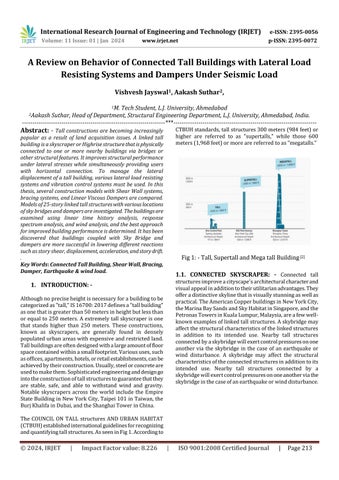
The COUNCIL ON TALL structures AND URBAN HABITAT (CTBUH)establishedinternationalguidelinesforrecognizing andquantifyingtallstructures.AsseeninFig1.Accordingto
CTBUHstandards,tallstructures300meters(984feet)or higher are referred to as "supertalls," while those 600 meters(1,968feet)ormorearereferredtoas"megatalls."
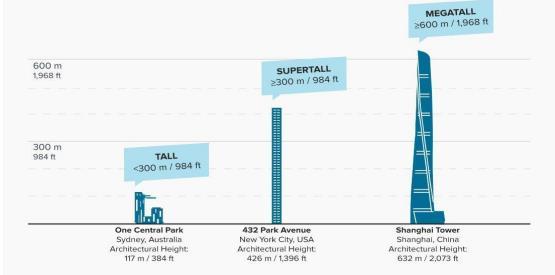
1.1. CONNECTED SKYSCRAPER: - Connected tall structuresimproveacityscape'sarchitecturalcharacterand visualappealinadditiontotheirutilitarianadvantages.They offeradistinctiveskylinethatisvisuallystunningaswellas practical.TheAmericanCopperbuildingsinNewYorkCity, theMarinaBaySandsandSkyHabitatinSingapore,andthe PetronasTowersinKualaLumpur,Malaysia,areafewwellknownexamplesoflinkedtallstructures.Askybridgemay affectthestructuralcharacteristicsofthelinkedstructures in addition to its intended use. Nearby tall structures connectedbyaskybridgewillexertcontrolpressuresonone another via the skybridge in the case of an earthquake or wind disturbance. A skybridge may affect the structural characteristicsoftheconnectedstructuresinadditiontoits intended use. Nearby tall structures connected by a skybridgewillexertcontrolpressuresononeanotherviathe skybridgeinthecaseofanearthquakeorwinddisturbance.
International Research Journal of Engineering and Technology (IRJET) e-ISSN: 2395-0056 Volume: 11 Issue: 01 | Jan 2024 www.irjet.net p-ISSN: 2395-0072 © 2024, IRJET | Impact Factor value: 8.226 | ISO 9001:2008 Certified Journal | Page213
***
Fig1:-Tall,SupertallandMegatallBuilding[2]
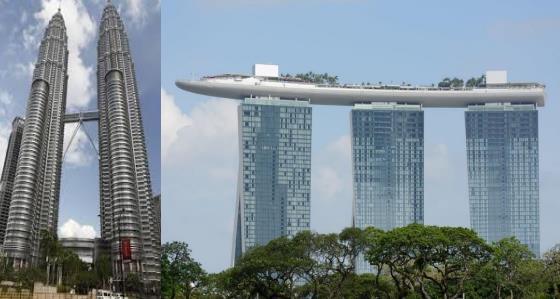
1.2. FLUID VISCOUS DAMPER: -Using the motion of the structuretoproducereactiveforces,aFluidViscousDamper isapassivevibrationcontrolmethod.Velocitydependency existsinfluidviscousdampers.Theyfunctionbyproviding the force necessary to stop structural motion during a seismic event using the idea of fluid passing through an aperture. Without increasing rigidity, they provide the structure more damping. The structure consists of a cylindricalcylinderwithacentralpistonthattravelsthrough achamberfilledwithfluid.Thepressuredifferenceacross thepistonheadgeneratesthedamperforce.Foroptimum performanceandstability,asilicone-basedfluidistypically utilized.Onecommonfluidthatguaranteescorrectoperation andstabilityissilicon-basedfluid.
1.3. OBJECTIVE: -
1. To investigate how various lateral load-resisting systems such as shear walls and bracing performinlinkedtallstructures,bothsymmetric andasymmetric.
2. To examine the operation of symmetric and asymmetric linked tall structures using a fluid viscous damper model that is represented by a
passive viscous schematic.to investigate several factors for the linked structures under consideration,suchasnaturalperiod,baseshear, displacement,acceleration,andstoreydrift.
3. Toresearchtheactionsandfunctionalityoflinked buildingsatdifferentSkyBridgesites.
2. LITERATURE REVIEW: -
[1] Kim, J., Ryu, J., & Chung, L. (2006). Seismic performance of structures connected by viscoelastic dampers. Engineering Structures, 28(2), 183-195 [1]
INTRODUCTION: - Because they maximize relative interstory drift and velocity, viscoelastic dampers, or VEDs, are oftenlocatedinabuilding'sinterstories.However,because oftheinterferencethatVEDslinkedtodiagonalorchevron bracing generate, which impedes internal visibility and hinders spatial design, architects and building owners frequentlyprotesttosuchplacements.Intheeventthatthis strategyissufficientlysuccessful,theseconstraintsmaybe overcome by putting VEDs in skybridge links or across seismicjoints.Bydoingthis,itwouldalsobeimpossiblefor nearbystructurestopoundagainstoneanother.
OBSERVATION TABLE: -
Table 2.1 Maximum Displacement (shear area) [1]
Viscoelastic Damper
Story Maximum Displacement (cm2)
Sheararea(cm2)
VED(Top story) (4-16.8) (cm2) (4-16.8)(cm2)
VED(All Story) (3.9-16.5)(cm2) (3.9-16.5)(cm2)
CONCLUSION: - In order to reduce structural reactions brought on by earthquakes, an analysis of the effects of installingviscoelasticdampersatseismicjointsandlinkages betweenbuildingsandsky-bridgeshasbeenconducted.The parametric study first concentrated on systems with one degreeoffreedomthatwerelinkedbyVEDsandthatapplied bothwhitenoiseandgroundseismicexcitations.
[2] Bharti, S. D., Dumne, S. M., & Shrimali, M. K. (2010). Seismic response analysis of adjacent buildings connected with MR dampers. Engineering Structures, 2122- 2133.[2]
INTRODUCTION;-Inlightofthis,installingandmaintaining these sensors comes with extra expenses as compared to passive control. Researchers have looked closely at magnetorheological(MR)dampersamongsemiactivecontrol systems because of its possible use in mitigating seismic
International Research Journal of Engineering and Technology (IRJET) e-ISSN: 2395-0056 Volume: 11 Issue: 01 | Jan 2024 www.irjet.net p-ISSN: 2395-0072 © 2024, IRJET | Impact Factor value: 8.226 | ISO 9001:2008 Certified Journal | Page214
Fig2:-ConnectedBuildings[4]
Fig3:-Schematicmodeloffluidviscousdamper[6]
reaction.OnebenefitofusingMR dampersisthattheyare lowpowerconsumptionandcancontinuetoworkaspassive devices even if the control algorithm fails. To forecast the dynamicbehaviorofMRdampers,Spenceretal.havecreated amodelbasedontheBouc-Wenhysteresismodel.
CONCLUSION:-Previousresearchhavelookedattheefficacy of magnetorheological (MR) dampers for reducing seismic response in nearby multistory structures under a linked buildingcontrolsystem.Theuseofpassive-off,passive-on, andsemi-activecontroltechniqueshasbeeninvestigatedin theseworks.Tworeinforcedconcretestructures,onewith20 levelsandtheotherwith10floors,werethesubjectofthe study.
[3] Zhu, H. P., Ge, D. D., & Huang, X. (2011). Optimum connecting dampers to reduce the seismic responses of parallelstructures.JournalofSoundandVibration,19311949.[3]
INTRODUCTION;-Theidealconnectingdamperparameters have always been determined by meticulous parametric analysisinallofthepublishedtheoreticalstudiespertaining to the coupling control technique of 2-mdof neighboring structures.Duringthepreliminarydesignphase,engineers willfinditconvenienttopickacceptabledamperparameters if the necessary connecting damper parameters can be obtainedusinggenericexpressions.
OBSERVATION TABLE: -
[3]
Root Mean Square Of Seismic Response
CONCLUSION:-Throughtheuseoftheoreticalanalysis,we examinedthefactorsrelatedtotheconnectionofdampers between two neighboring structures and a twin-tower structurewithabigpodium.TheKelvinmodelwasusedto simulate the connecting viscos-elastic damper (VED), and the Maxwell model was used to simulate the connecting viscousfluiddamper(VFD).
[4] Lee, D. G., Kim, H. S., & Ko, H. (2012). Evaluation of coupling-control effect of a sky-bridge for adjacent tall buildings. Structural Design of Tall and Special Buildings, 21(5), 311-328 [4]
INTRODUCTION;-Fewsignificantstudieshavebeendoneon thecoupling-controlmechanismusingasky-bridge,despite the fact that many have been done on the application of variouscontroltechniques,suchaspassive,active,orsemiactive control, in the context of linked building control. Therefore,thispaper'sgoalistoofferresearchthatexplores thisunchartedterritory.
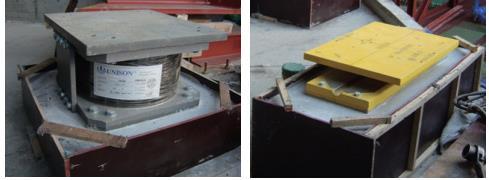
Fig.4:-Bearingsusedinthisstudy:(a)leadrubber bearing;(b)linearmotionbearing[4]
CONCLUSION: - An assessment of a skybridge's couplingcontrolimpactonnearbytallstructureshasbeencompleted. A sky-bridge situated at the 34th story connected two buildings,onehaving49floorsandtheother42stories.With theuseofwindloaddatafromwindtunnelexperimentsand seismic excitations, a boundary nonlinear time history analysiswascarriedout.
[5] Patel, C., & Jangid, R. (2014). Dynamic response of identical adjacent structures connected by viscous damper.StructuralControlandHealthMonitoring,21(2), 205-224.[5]
INTRODUCTION;-Themaingoalofthisstudyistofindout howwellaviscousdamperworkstoregulatethedynamic responseofidenticalconnectedstructuresthatarenext to one another. This study includes stationary white-noise randomstimulationinadditiontoharmonicexcitation.The researchseekstocompleteanumberofparticulargoalsin ordertoreachthispurpose.Itsinitialgoalistoascertainthe dynamic reaction of nearby buildings with two degrees of freedomthatarecoupledtoviscousdampers.
CONCLUSION:- Analysisofthedynamicbehaviouroftwo similar,symmetrical,neighbouringstructureswaspartofthe inquiry.Baseaccelerationactsonthesestructures,whichare coupledviaviscousdampers.
International Research Journal of Engineering and Technology (IRJET) e-ISSN: 2395-0056 Volume: 11 Issue: 01 | Jan 2024 www.irjet.net p-ISSN: 2395-0072 © 2024, IRJET | Impact Factor value: 8.226 | ISO 9001:2008 Certified Journal | Page215
Table 3.1 Percentage reduction of (RMS) of seismic response in double
TopFloor Displacem ent TopFloor Velocity TopFloor acceleratio n Baseshear force 11% (11%) 20% (20%) 27% (27%) 26% (26%) 35% (36%) 36% (38%) 38% (38%) 33% (32%) 39% (39%) 42% (43%) 42% (43%) 32% (31%)
[A] [B]
OBSERVATION TABLE: -
Observed that percentage responses reduction
dampers.Anumberofcharacteristicswereacquiredunder theassumptionthattheearthquakestimulationwaswhite noise,includingfrequencyresponsefunctions,displacement powerspectraldensity(PSD)functions,andtime-averaged totalvibrationenergy.
[7] Khan, S., Kumar, C. M., & Shwetha, K. (2020). Analytical study on the seismic behaviour of two adjacent buildings connected by viscous dampers. AIP ConferenceProceedings. Bengaluru.[7]
[6] Huang-sheng, S., Mo-han, L., & Hong-ping, Z. (2014). Connecting parameters optimization on unsymmetrical twin-tower structure linked by sky-bridge. Journal of Central South University, 21(6), 2460–2468.[6]
INTRODUCTION;-Kimandassociatescarriedoutresearch on the ideal connection parameters ignoring the skybridge'smass betweentowersandskyscrapers.Themegastructurereducestoagroupofnearbystructureslinkedby seismicdampersinthecasewhenthemassofthesky-bridge is deemed tiny and inconsequential. Viscoelastic dampers (VEDs)wereusedtolinknearbybuildings,andZhangandXu investigatedtheseismicresponseanddynamicpropertiesof thesestructures.
OBSERVATION GRAPHS: -

CONCLUSION: - Thisstudyusedascaled-downmodelofa twin-tower construction connected by a skybridge. The system was shown as a single-degree-of-freedom (SDOF) system, and the Voigt model was used to characterize the
INTRODUCTION;-Inthisresearch,welookattwonearby buildingsonewith10storiesandtheotherwithfifteen.The purposeofinstallingdampersbetweenthesestructuresisto lessentheirstructuralreactiontoseismicactivity.Numerous studies have shown that linking buildings with various fundamentalfrequenciesviadamperssignificantlyreduces the seismic reactions that each structure experiences. Furthermore, it has been shown that a smaller number of strategically placed dampers can still greatly lessen the earthquake reaction, negating the need for dampers to be placedateachfloor.Throughtheuseofdampers,theeffects ofmovement,vibration,andfrictioncausedbyoutsideforces onthestructuremaybelessened.
OBSERVATION TABLE: -
Table 7.1 Comparison Of maximum torsion 10-3Rad
CONCLUSION:- Myresearchfocusesontheseismicreaction of two nearby buildings that are connected by a viscous damper. The structures are ten stories and fifteen stories tall,respectively.Furthermore,Iusedcriticallydampedand underdamped dampers to compare how these structures responded. According to the IS code, the design was completed.
International Research Journal of Engineering and Technology (IRJET) e-ISSN: 2395-0056 Volume: 11 Issue: 01 | Jan 2024 www.irjet.net p-ISSN: 2395-0072 © 2024, IRJET | Impact Factor value: 8.226 | ISO 9001:2008 Certified Journal | Page216
Table 5.1 Seismic Responses of the two adjacent structures connected with Viscous Damper [5]
ake Topfloor displacement(m) Topfloor acceleration(m/s) Unconn ected connect ed Unconn ected connect ed Imperial Valley 0.189 0.088 8.409 4.147 Kobe 0.433 0.332 19.557 14.747 Northri dge 0.260 0.180 12.407 8.512 Loma Prieta 0.328 0.241 13.254 10.746
Earthqu
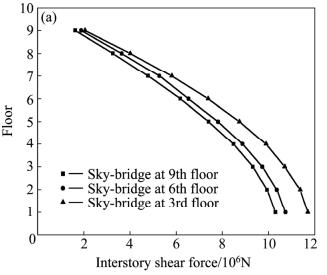
Fig5:-Interstoryshearforcedistributionoftowers excitedbyE1Centrowave:P-tower;A-tower[6]
Earthqu ake Leftbuilding Rightbuilding Acciden tal Eccentri cities Connect ing Damper s Acciden tal Eccentri cities Connect ing Damper s ELCentro 6.69 5.90 7.56 4.89 Taft 5.57 4.11 8.76 5.84 Michoac án 6.12 5.99 6.20 6.22 Chichi 7.40 8.04 10.28 8.48
Comparison Of maximum torsion
[8] Penumatcha, K. R., Vipparthy, R., & Yadav, A. (2020). A Study on effect of Connecting Beams in a Twin Tower Structure. JournalofTheInstitutionofEngineers(India): Series A, 101(4), 847–856.[8]
INTRODUCTION; - To satisfy the needs of the urban population, emerging countries are progressively moving towardtheconstructionoftoweringstructures.Theideathat the developed areas, which presently include low-rise buildings,shouldbereplacedwithtallerstructuresthatbetter meet the community's changing demands would be considered bold. By adopting eco-friendly technology and addingmodernconveniences,thismaybeaccomplished.The notion of keeping a space between many towers has also emergedfromtherequirementforsufficientventilationon all sides of the structures. Meeting serviceability requirements,includinglateralswayandstoreydrift,isthe main goal of these buildings, especially when it comes to windandseismicactivity.
CONCLUSION: -Ithasbeenextensivelyresearchedwhereto place Connecting Beams (CB) between twin tower constructions in the event of lateral stresses, particularly windandearthquake.Fourresidentialunitswereexamined intheresearch;eachunitwasaneighteen-storyreinforced concretebuildingwithplandimensionsof20by40meters andaheightof54meters.TheISCodewasfollowedwhen designingtheproject.
[9] Avinash, A. R., Padigela, A., Karthik, B., & Kamath, K. (2016). A Study on Seismic Performance of Adjacent Structures Connected with Fluid Viscous Dampers. International Journal of Advances in Mechanical and Civil Engineering, 21-25[9]
INTRODUCTION; - Structuresthatarelocatedneartoone anotheraremorevulnerabletoearthquakedamage.When two structures have significantly different fundamental periods, there is an increased chance of collision during seismic events, whichmightcausesignificantdamageand harm to the inhabitants. The International Building Code (IBC) suggests specific rules to guarantee a minimum distancebetweenadjacentstructuresinordertoavoidsuch accidents. conducted finite element analyses on hard, medium, and soft soils, among other soil types. It is importanttonotethatthereisn'tresearchthatlooksathow SSI affects nearby structures that are connected by finite verticaldisplacements(FVDs).
CONCLUSION: -Anexperimentisconductedtounderstand the behaviour of buildings that are connected by fluid viscousdampersandthataresituatedclosetooneanother, while accounting for the influence of soil-structure interactions.Bycomparingtheheightratiosofthebuildings, thebehaviourofthestructuresisinvestigated.Theresults showthatthelinkedstructure'sreactionisverysensitiveto theinteractionbetweenthesoilandthestructure.
[10] Anjali Mistry, A., Mevada, S. V., & Agrawal, V. V. (2022). Vibration Control of Tall Structure using Various Lateral Load Resisting Systems and Dampers. InternationalJournalofCivilEngineering,9(6),2842.[10]
INTRODUCTION; - As to the IS16700 standard, super tall constructions surpass 250 meters in height, whereas tall buildings are defined as those that are higher than 50 meters. With little land available these days, tall buildings offer a practical solution for meeting the needs of the residential,commercial,andindustrialsectors.Thepresence ofwindandseismicstresscausessignificantproblemsfor tallbuildings.Occupantdiscomfortandstructuralandnonstructural damage are the results of the substantial displacement of the structure caused by these lateral stresses. For the purpose of minimizing this lateral displacement, a vibration control system or lateral load resistingdeviceisneeded.Avibrationcontrolsystemorany otherdevicethatresistslateralloadsisrequired.

CONCLUSION:- Comparedtotheothersystems,thebraced frame and Diagrid systems exhibit more rigidity. The displacementandaccelerationresponseofthestructuremay be effectively controlled by providing LVDs. The braced framesystemfittedwithLVDsisfoundtohaveanaverage percentage decrease in base shear, maximum storey displacement, and acceleration at the top storey of 43%, 25%, and 56%, respectively, according to time history analysis.
International Research Journal of Engineering and Technology (IRJET) e-ISSN: 2395-0056 Volume: 11 Issue: 01 | Jan 2024 www.irjet.net p-ISSN: 2395-0072 © 2024, IRJET | Impact Factor value: 8.226 | ISO 9001:2008 Certified Journal | Page217
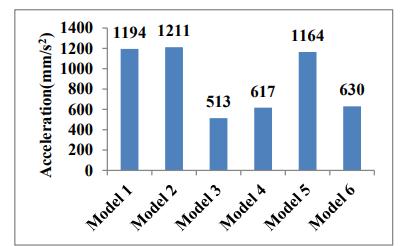
Fig6:-ComparisonofMaxtopstoreyAccelerationdueto ResponseSpectrumanalysis&TimeHistoryanalysis[10]
3. CONCLUSIONS
• The properties (such as PGA and frequency content) of the ground motion define the high valuesofbaseshearfromtimehistoryanalysis.
• The top storey lateral acceleration for EQ TH analysisislowestfor SW withLVDsin both the X andYaxes.
• Itisfoundthatbyconsideringdampersanddevices that resist lateral loads, the drift ratio may be effectivelydecreased
• LesslateraltopstorymovementisseenintheXand YdirectionsintheBracingandBracing+Alternate Dampersystems.
• The results indicate that the storey shear for bracingsystemsistheminimumforbothwindand dynamicwindinvestigations.
• Baseshearisdistributeddifferentlyforeachtower in an asymmetrical construction than in a symmetricalone,wherebaseshearisdividedinto twoequalparts.
• TheSWsystemislessflexiblethanthebracedframe system
REFERENCES: -
[1] Kim, J., Ryu, J., & Chung, L. (2006). Seismic performanceofstructuresconnectedbyviscoelastic dampers.EngineeringStructures,28(2),183-195.
[2] Bharti,S.D.,Dumne,S.M.,&Shrimali,M.K.(2010). Seismic response analysis of adjacent buildings connected with MR dampers. Engineering Structures,2122-2133.
[3] Zhu,H.P., Ge,D.D., &Huang,X.(2011).Optimum connecting dampers to reduce the seismic responses of parallel structures. Journal of Sound andVibration,1931-1949.
[4] Lee,D.G.,Kim,H.S.,&Ko,H.(2012).Evaluationof coupling-controleffectofasky-bridgeforadjacent tallbuildings.StructuralDesignofTallandSpecial Buildings,21(5),311-328.
[5] Patel,C.,&Jangid,R.(2014).Dynamicresponseof identicaladjacentstructuresconnectedbyviscous damper.StructuralControlandHealthMonitoring, 21(2),205-224.
[6] Huang-sheng, S., Mo-han, L., & Hong-ping, Z. (2014). Connecting parameters optimization on unsymmetricaltwin-towerstructurelinkedbyskybridge. Journal of Central South University, 21(6), 2460–2468
[7] Khan, S., Kumar, C. M., & Shwetha, K. (2020). Analytical study on the seismic behavior of two adjacentbuildingsconnectedbyviscousdampers. AIPConferenceProceedings.Bengaluru
[8] Penumatcha,K.R.,Vipparthy,R.,&Yadav,A.(2020). A Study on effect of Connecting Beams in a Twin Tower Structure. Journal of The Institution of Engineers(India):SeriesA,101(4),847–856.
[9] Avinash,A.R.,Padigela,A.,Karthik,B.,&Kamath,K. (2016). A Study on Seismic Performance of AdjacentStructuresConnectedwithFluidViscous Dampers. International Journal of Advances in MechanicalandCivilEngineering,21-25
[10]Anjali Mistry, A., Mevada, S. V., & Agrawal, V. V. (2022). Vibration Control of Tall Structure using Various Lateral Load Resisting Systems and Dampers.InternationalJournalofCivilEngineering, 9(6),28-42.
INDIAN STANDARDS: -
[1] IS16700:2017,CriteriaforStructuralSafetyofTall ConcreteBuildings.(2017,November).NewDelhi: BureauofIndianStandards.
[2] IS 1893 (Part 1): 2016, Criteria for Earthquake ResistantDesignofStructures. (2016,December). NewDelhi:BureauofIndianStandards.
[3] IS800:2007,GeneralConstructioninSteel-Codeof Practice.(2007,December).NewDelhi:Bureauof IndianStandards.
[4] IS875(Part1):1987,CodeofPracticeforDesign Loads (Other than Earthquake)ForBuildings and Structures, Dead Loads - Unit Weights of Building MaterialsandStoredMaterials.(1987).NewDelhi: BureauofIndianStandards.
[5] IS875(Part2):1987,CodeofPracticeforDesign Loads (Other than Earthquake)For Buildings and Structures, (Imposed Loads). (1987). New Delhi: BureauofIndianStandards.
[6] IS 875 (Part 3): 2015, Design Loads (Other than Earthquake)forBuildingsandStructures-Codeof Practice.(2015,April).NewDelhi:BureauofIndian Standards.
International Research Journal of Engineering and Technology (IRJET) e-ISSN: 2395-0056 Volume: 11 Issue: 01 | Jan 2024 www.irjet.net p-ISSN: 2395-0072 © 2024, IRJET | Impact Factor value: 8.226 | ISO 9001:2008 Certified Journal | Page218