
International Research Journal of Engineering and Technology (IRJET) e-ISSN: 2395-0056
Volume: 12 Issue: 05 | May 2025 www.irjet.net p-ISSN: 2395-0072
International Research Journal of Engineering and Technology (IRJET) e-ISSN: 2395-0056
Volume: 12 Issue: 05 | May 2025 www.irjet.net p-ISSN: 2395-0072
Satyajit Panigrahy1 , Saswat Kumar Panda2 , Pattabhi Ramaiah Budarapu3 Manas Mohan Mahapatra4
1,2 PhD research scholar at School of Mechanical Sciences ,IIT, Bhubaneswar, Argul, India
3 Associate Professor at School of Mechanical Sciences ,IIT, Bhubaneswar, Argul, India
4 Professor at School of Mechanical Sciences ,IIT, Bhubaneswar, Argul, India
Abstract - This study addresses the critical, yet often overlooked, impact of air intake design on cruise missile performance. Traditional analyses frequently neglect detailed intake geometry, resulting in approximate evaluations. This research employs Computational Fluid Dynamics(CFD)tooptimizeintegratedairintakes,focusing on minimizing inlet distortion in both land and submarinelaunched cruise missiles. B-spline curve-fitted geometries with varying curve factors were analyzed, demonstrating superior performance compared to baseline designs. The study highlights the significance of specialized intake shapes, including those with trapezoidal or elliptical openings and sharp edges, which generate vortices to improve airflow and reduce drag. Optimized designs enhance stealth capabilities by minimizing radar reflection and contribute to smoother engine operation. By incorporating detailed intake analysis, this research provides a more realistic performance assessment, yielding practical results for gas turbine development. The findings demonstratethatB-splinecurve-fittedairintakeseffectively minimize circumferential distortion at transonic speeds, offering a promising approach to enhance cruise missile efficiency and overall performance. This study emphasizes the importance of integrating optimized distortion conditions into gas turbine inlet analyses, contributing to the development of more effective and efficient cruise missilepropulsionsystems
Key Words: cruisemissile,airintake,distortion,CFD,inlet distortion,B-spline.
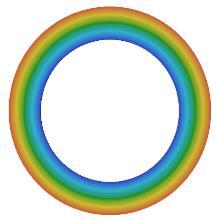
Inlet distortion in compressors defined as non-uniform airflow, is a critical concern. It arises from upstream flow irregularities, including obstructions, ducting anomalies, and external influences, ultimately affecting compressor performance and stability. Understanding and mitigating these distortions is essential for optimized engine operation., it often incorporates non-uniform pressure distributions across compressor stages, resulting in imbalanced loading. This unevenness leads to efficiency
degradation and compromises overall compressor performance, highlighting the critical need for distortion mitigation.

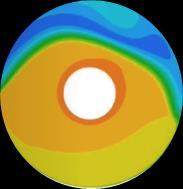
FIGURE 1 : INLETDISTORTIONINCOMPRESSORS
compressor performance, manifests as circumferential and radial variations. Circumferential distortion, or swirl distortion, arises from uneven tangential flow, causing non-uniform loading around the compressor's circumference.Radialdistortion,conversely,involvesflow variations perpendicular to the rotation axis, leading to uneven radial loading. Both types degrade efficiency. Mitigation strategies include optimizing inlet guide vanes and blade shapes, supported by CFD and experimental validation.
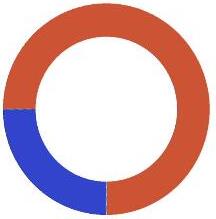
CircumferentialDistortion RadialDistortion
FIGURE 2 : TWOMAINCATEGORIESOFDISTORTION
While extensive literature exists on supersonic and hypersonic air intake regimes, research on curve fitting and intake cross-sectional area variation for land and submarine-launchedcruisemissilesisnotablyabsent.This researchpresentsanovelapproachtoaddressingthisgap in intake design. Foundational work on relevant profiles,
International Research Journal of Engineering and Technology (IRJET) e-ISSN: 2395-0056
Volume: 12 Issue: 05 | May 2025 www.irjet.net p-ISSN: 2395-0072
includingnoseconesandmissileintakes,isoutlinedin[1]. Document [2] provides essential geometries, captured airflow data, and internal design details. A comparison of simplified and Navier-Stokes models for intake design, emphasizing accuracy versus efficiency, is presented in [3].UnsteadyRANSsimulationsofhypersonicintakeflow, revealing unsteadiness and separation phenomena, are validated against experimental data in [4]. RANS simulations of hypersonic intake starting, correlating unstarting with mass capture reduction and wall conditions,showgoodagreementwithexperiments(Mach 3-8) in [5]. Wind tunnel tests on helicopter side intakes, detailed in [6], demonstrate the effectiveness of retrofit modifications for optimizing performance across flight speeds,highlightingtheadvantagesofsidewaysintakesat lowspeedsandforward-facingintakesathighspeeds.For distortion evaluation, ARP 1420 provides detailed calculation methods [7]. Finally, polyhedral hexcore meshes generated using Mosaic technology are selected fortheirefficiency.
This paper emphasizes the critical role of optimized air intake (Integrated [NACA / Flush-type] intakes) design, specifically using B-spline curves, in mitigating inlet distortion for transonic cruise missiles. It highlights the importance of realistic distortion modeling in simulations toenhancecompressorandoverallmissileperformance.
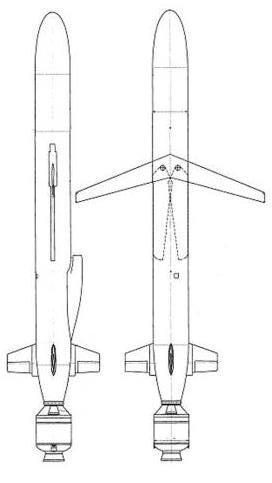
IntegratedintakeTYPE-1
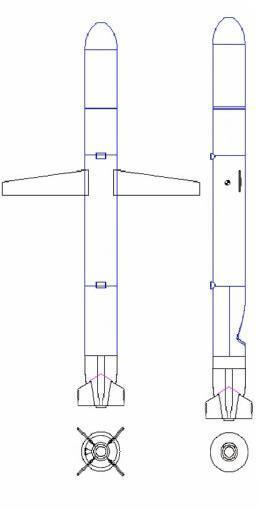
IntegratedintakeTYPE-2
FIGURE 3 : (NACA-TYPE/FLUSH-TYPE)AIRINTAKES
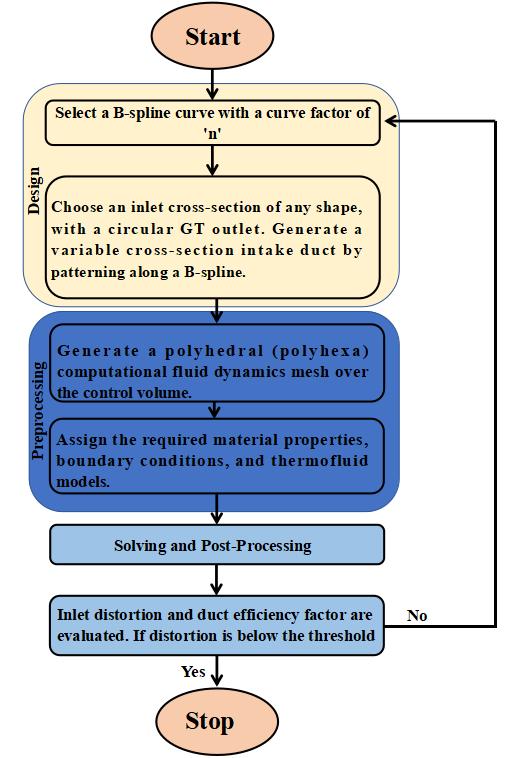
The methodology of this research integrates numerical simulation with a design iteration process to optimize the aerodynamic characteristics of cruise missile nose cones, particularly focusing on integrated air-intake design. Recognizing the limitations of solely experimental approaches, whichare oftenresource-intensive,this study
utilized CFD simulations based on the finite volume method. Multiple intake geometries were generated, each featuring B-spline curve-fitted integrated air intakes of [NACA/Flush-type]configurations.
These designs were then subjected tocomprehensive CFD analyses to evaluate their aerodynamic performance, specifically targeting the identification of an optimal airintake design that enhances performance in both landlaunchedandsubmarine-launchedcruisemissilescenarios. This approach facilitated a more efficient and comprehensive exploration of design parameters compared to traditional experimental methods. The figure xshowsthecompleteworkplanforthesame.
Toinvestigatetheinfluenceofairintakegeometryonflow performance, a set of integrated [NACA / Flush-type] intakes with consistent circular cross-sections were analyzed.Theseintakes,showninFigure5,aredefinedby varying curve factors (n = -4, -2, 0, 2, 4) ofa B-spline, and their performance was evaluated under diverse flow outputconditions,accountingforairintaketubedistortion.
International Research Journal of Engineering and Technology (IRJET) e-ISSN: 2395-0056
Volume: 12 Issue: 05 | May 2025 www.irjet.net p-ISSN: 2395-0072
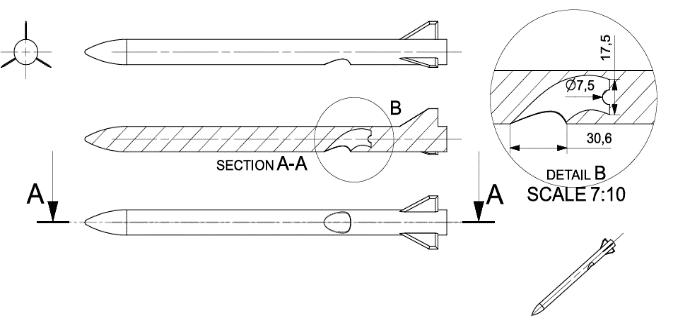

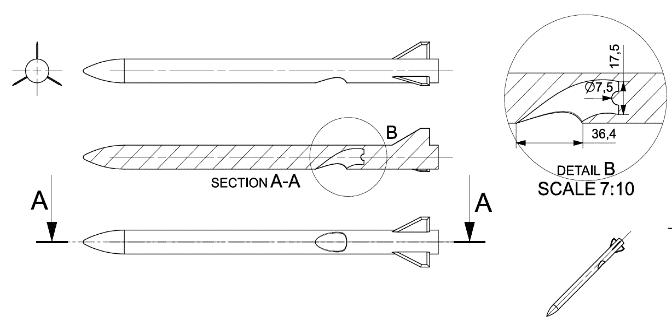
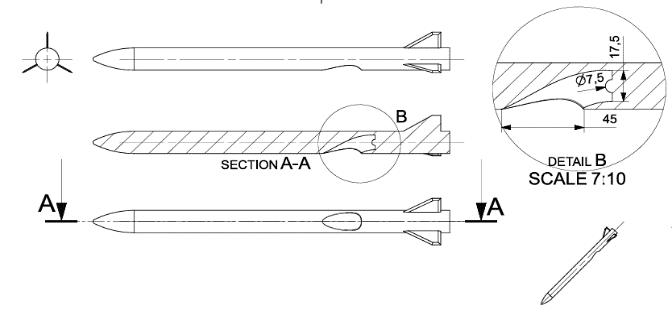
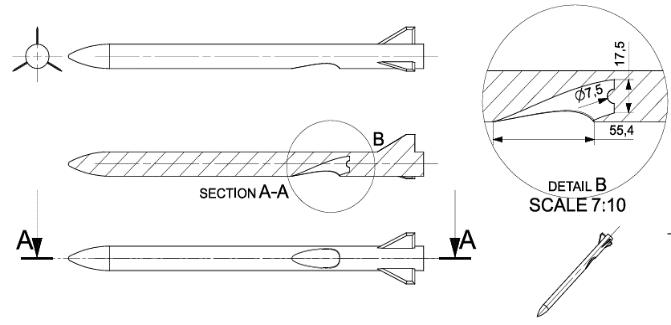
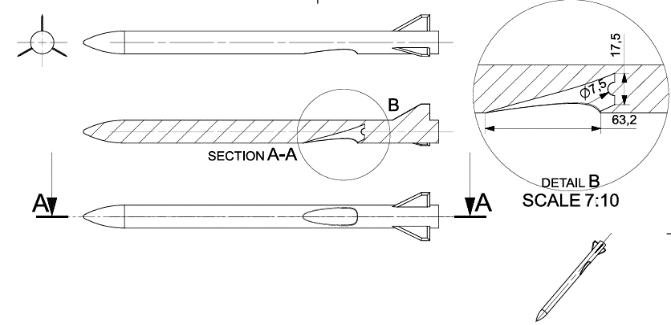
5: THEDIFFERENTSHAPESCONSIDEREDFOR THESTUDY.CURVEFACTORS(n=-4,-2,0,2,4)
This study examines five integrated intake shapes, each definedbyaB-splinecurvewithvaryingcurvefactors(n= -4, -2, 0, 2, 4), as detailed in previous sections and illustrated in Figure 3. Mesh details are presented in Figure 6. A grid independence test was conducted using 10, 15, 20, 25, and 30 million elements. The results demonstrated convergence after 20 million elements. A polyhedral hexcore mesh, generated using Mosaic technology,wasselectedduetoitsbalanceofaccuracyand computationalefficiency.Mosaictechnologyallowsforthe automated combination of different mesh types, offering improved accuracy and efficiency compared to traditional manualmeshing.Necessarymeshrefinementandinflation wereperformedtoachievehighaccuracyresults.
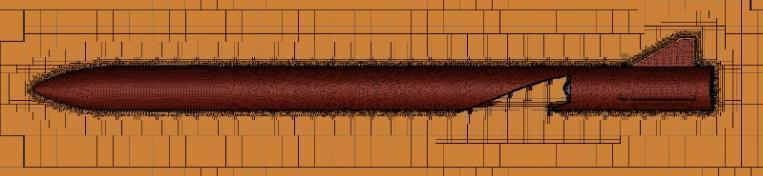
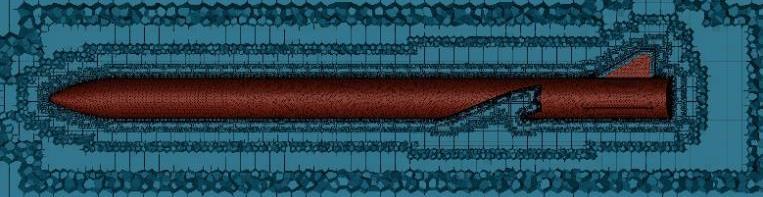

A velocity inlet boundary condition was applied to the complete meshed model within ANSYS Fluent (Fluent Mesh23R2),withtheairintakeoutletsettotheinletflow conditions suitable for a single gas turbine. The study's boundaryconditionsarespecifiedinTable1
Table -1:BoundaryConditionsForTheSimulation
Inletpressure
Pa Inlettemperature 300K Inletvelocity
m/s(M=0.8)
Pressureoutletwithmf1
International Research Journal of Engineering and Technology (IRJET) e-ISSN: 2395-0056
Volume: 12 Issue: 05 | May 2025 www.irjet.net p-ISSN: 2395-0072
Turbulentkineticenergy
289.1341m2/s2
Specificdissipationrate 1890062
CFLNumber 5
The following assumptions were taken into considerationduringthenumericalstudy.
a. Thesolverwasasteadystatesolver
b. ThesolverwasaDensitybasedsolverasM>0.33
c. Flowwascompressible
d. Theflow-fieldwas3D
e. Gravity is taken into consideration along negative y-axis
Along with the above assumptions, the governing equations taken into consideration for the solution are as follows:
Massconservationequation:
Momentumconservationequation:
Energyconservationequation:
Turbulentkineticenergyequation:
Turbulentenergydissipationrateequation:
Turbulentenergydissipationrateequation:
Thek-Turbulentkineticenergyisdefinedbythefollowing equation:
Theω-Specificdissipationrateisdefinedbythefollowing equation:
2.4
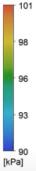
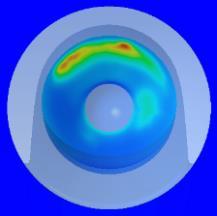
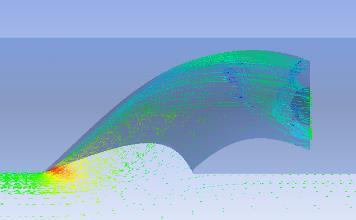
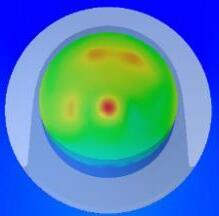
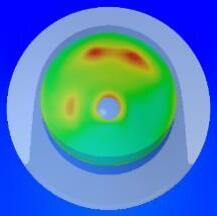
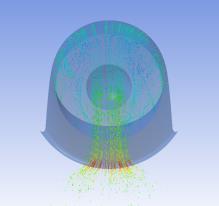
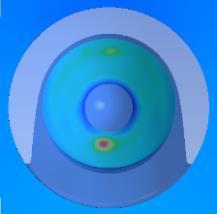
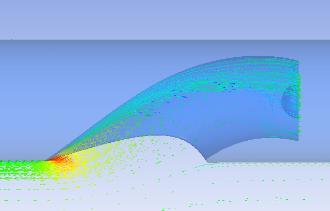
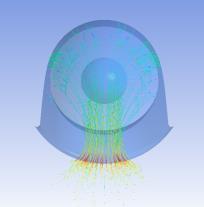
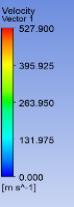
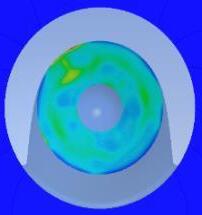
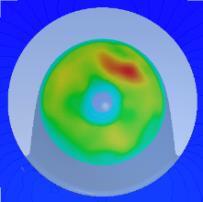
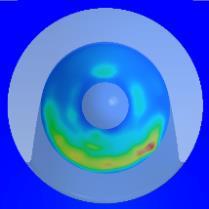
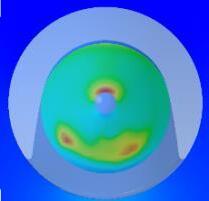
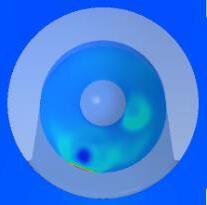
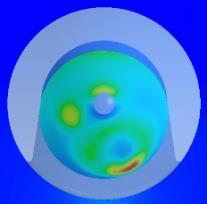
Numerical simulations, based on established boundary conditions, were performed to analyze NACA/ flush-type air intakes. The figures presented below show the resultingstreamlineandpressuredistributiondatawithin the control volume, which are essential for distortion analysisofallflush-typedesigns.




International Research Journal of Engineering and Technology (IRJET) e-ISSN: 2395-0056
Volume: 12 Issue: 05 | May 2025 www.irjet.net p-ISSN: 2395-0072
10:
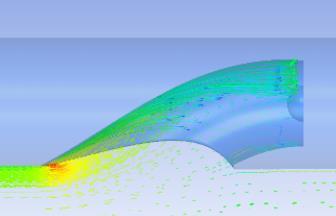
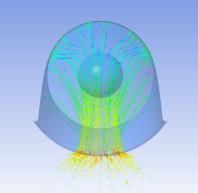
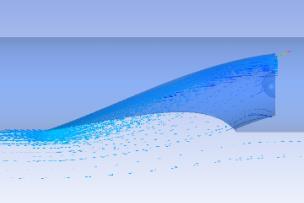
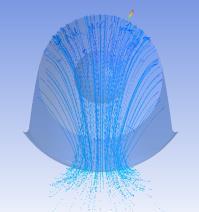
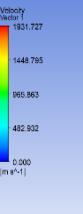
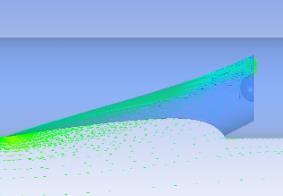
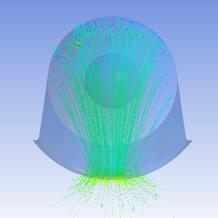
11: THESTUDYFOR(n=4)
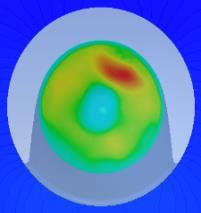
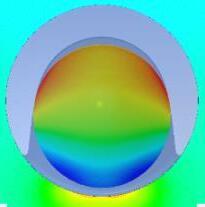
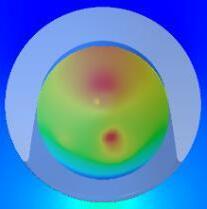

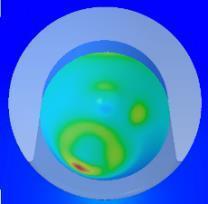
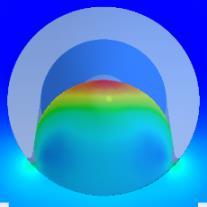
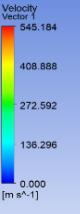
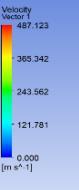
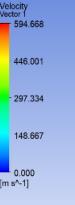
[Figures 7 through 11 illustrate the flow phenomenon using: pressure contours near the gas turbine inlet (at 99% intake length), side-view velocity vector plots, pressure distributions at 80% and 50% intake length, front-view velocity vector plots, and pressure contours at 50%intakelength(clockwisedirection)]
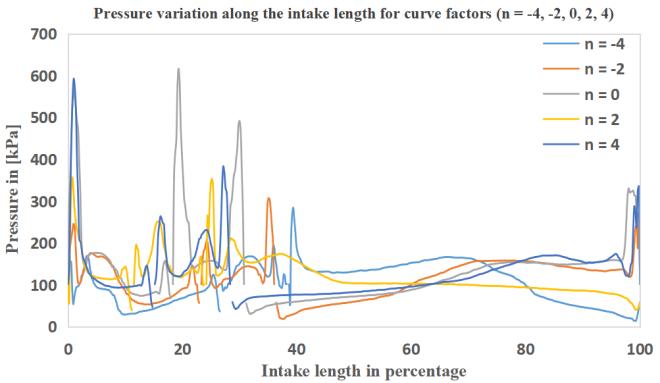
FIGURE 12: ACOMPARISIONOF PRESSURE VARIATIONALONGTHEINTAKELENGTH
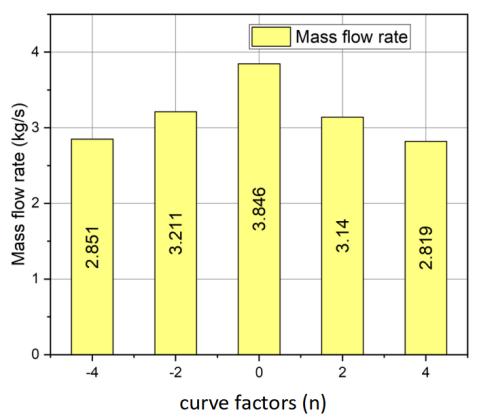
FIGURE 13: ACOMPARISIONMASSFLOW VARIATION OFEACHINTAKE
This study examined the flow characteristics of B-spline curve-fitted NACA/flush-type air intakes across various curve factors (n= -4, -2, 0, 2, 4). While the intake with a curvefactorofn=0exhibitedthehighestmassflow,then = -2 intake demonstrated the most efficient performance due to its minimal flow distortion within the duct. In nearly all tested conditions, the airspeed reached supersonic velocities. The hemispherical nose cone at the gas turbine intake effectively prevented shock wave formation nearthecompressorintakezone. Furthermore, then=-2intakeachievedashorterlengthcomparedtothe n = 2 design while maintaining a higher mass flow rate under operating conditions. Conversely, the n = 2 intake displayedhighdistortion,andthen=4intakewasdeemed undesirable due to its excessive length, posing structural challenges.
Chin,S.S,1961,“MissileConfigurationDesign.”
Gérard LARUELLE, 2002, “Air Intakes: Role, Constraints AndDesign” ICAS2002CONGRESS
International Research Journal of Engineering and Technology (IRJET) e-ISSN: 2395-0056
Volume: 12 Issue: 05 | May 2025 www.irjet.net p-ISSN: 2395-0072
O. Penanhoat D. Darracqt,., 1996, “Simplified Model and Navier-Stokes Calculations for Hypersonic Air Intakes Design,” JOURNAL OF PROPULSION AND POWER Vol. 12,No.3,
Soumyajit Saha and Debasis Chakraborty, 2015, “Numerical Simulation of a Hypersonic Air Intake,” Defence Science Journal, Vol. 65, No. 3, May 2015, pp. 189-195
Soumyajit Saha and Debasis Chakraborty, 2012, “Hypersonic Intake Starting Characteristics–A CFD ValidationStudy”DefenceScienceJournal,Vol.62,No. 3,May2012,pp.147-152
Florian Knoth and Christian Breitsamter 2017, “Aerodynamic Testing of Helicopter Side Intake
RetrofitModifications”MDPI
Gas Turbine Engine Inlet Flow Distortion Guidelines(STABILIZEDApr2017)ARP1420C