
International Research Journal of Engineering and Technology (IRJET) e-ISSN: 2395-0056
Volume: 12 Issue: 05 | May 2025 www.irjet.net p-ISSN: 2395-0072
International Research Journal of Engineering and Technology (IRJET) e-ISSN: 2395-0056
Volume: 12 Issue: 05 | May 2025 www.irjet.net p-ISSN: 2395-0072
Tain-Lieng Kao1 , Sheng-Hsin Wang 2 , Guan-Hsiung Liaw 3*
1Assistant professor, Dept. of Information Engineering, I-Shou University, Taiwan, R.O.C.
2 Dept. of Electronics Engineering, National Taiwan University of Science and Technology, Taiwan, R.O.C.
3* Assistant professor, Dept of Information Engineering, I-Shou University, Taiwan, R.O.C Corresponding Author
Abstract - Thisresearchinvestigatestheimplementation and performance evaluation of the IEEE 802.11ah lowpower wireless network protocol in IoT applications. We implemented this protocol on the Xilinx Virtex6 FPGA platform, supporting 802.11ah PHY layer specifications and implementing key power-saving mechanisms, particularly theExplicitTWT functionality,enablingstationsto function as complete Non-TIM stations. Through the Non-TIM TWT mechanism,terminaldevicescannegotiatespecificwake-up times with base stations, significantly reducing energy consumption. In terms of experimental evaluation, this research compares the system resource utilization performance of three IoT communication protocols - MQTT, MQTT-SN, and AMQP, focusing on key metrics such as processor utilization and memory consumption. The 802.11ah protocol is particularly suitable for IoT applicationscenariosrequiringlowpowerconsumptionand long-distance transmission, such as industrial automation and smart agriculture. Compared to other IoT technologies (like LoRa), 802.11ah demonstrates advantages in power efficiency and communication effectiveness. Notably, when operating in Non-TIM TWT mode, the 802.11ah system saves approximately 33% more power compared to traditional systems, demonstrating significant energysavingeffectsduringlong-termoperation.
Key Words: IEEE 802.11ah, TWT, IoT, Power conservation.
Power conservation is one of the most critical challenges in IoT applications. Most sensors run on battery power, with wireless communication being the biggest power consumer. This poses a significant challenge for IoT devicesthatneedtooperatelong-term.
To address this issue, numerous studies have proposed various power-saving technologies. One significant technology is IEEE 802.11ah, which is a low-power communication protocol specifically designed for IoT. It features two main power-saving functions: Target Wake Time(TWT)andRestrictedAccessWindow(RAW).These features not only ensure stable connectivity between devicesbutalsosignificantlyextendbatterylife.
IEEE 802.11ah is a new Wi-Fi technology specifically designed for IoT. Launched in 2017, its main features are power efficiency and long-range transmission. It operates at frequencies around 900 MHz, which is lower than conventional Wi-Fi frequencies. Compared to other IoT communication technologies (such as LoRa, Sigfox), 802.11ah's biggest advantage is its compatibility with existingWi-Fisystems.
However, implementing this technology involves several keychallenges.First,weneedtoensureprotocolintegrity, particularlyintheimplementationofMACandPHYlayers. To address these challenges, we propose a complete implementationsolution.
This paper provides a detailed description of implementing a low-power IoT communication system based on IEEE 802.11ah protocol on the Xilinx Virtex6 FPGA platform. The system employs an innovative dualprocessor architecture design, optimizing performance through task division between upper and lower layer processors. The upper layer processor handles the MAC layer implementation of the 802.11ah protocol and integratestheLinuxoperatingsystemanditscoretimerto enable Active Scanning and Target Wake Time functionality.UnderLinuxsystemmanagement,theupper layer processor not only maintains stable connections with APs but also executes various IoT communication protocols for topic data transmission and subscription. The lower layer processor focuses on low-level packet transmission and reception, precisely adjusting antenna parameters to control communication rates and transmission power. The two processors communicate through Xilinx's high-performance IP core (Intellectual Property Core). In terms of implementation, the system's 802.11ah PHY layer is fully compatible with the 802.11 legacy standard and integrates its power-saving modes. FortheMAClayer,weimplementedthe802.11ahprotocol specifications, particularly the Explicit Target Wake Time functionality, enabling the transceiver to function as a completeNon-TIMstationforoptimalenergyefficiency.
ThisresearchchoseFPGAastheimplementationplatform primarily due to its excellent hardware reconfigurability and powerful system integration advantages. The core focus of the research not only includes the technical
International Research Journal of Engineering and Technology (IRJET) e-ISSN: 2395-0056
Volume: 12 Issue: 05 | May 2025 www.irjet.net p-ISSN: 2395-0072
implementationoftheIEEE802.11ahprotocolbutfurther emphasizes evaluating its energy efficiency performance in actual IoT sensor-end application scenarios, thereby providingacompleteimplementationreferencesolution.
To validate the system's IoT applications, we conducted practical tests. We used the implemented system as a sensor and compared three common IoT communication protocols: MQTT, MQTT-SN, and AMQP. We primarily observed how much system resources these communication methods would consume, including their processorutilizationandmemoryspacerequirements.
This paper consists of five main sections: Section 2 analyzes the performance of power-saving modes in 802.11ah wireless networks; Section 3 describes the designed system; Section 4 demonstrates the test results of this system in different IoT application scenarios; and finally,section5providestheconclusion.
2. The Proposed Implementation for IEEE 802.11ah Target Wake Time
2.1 802.11ah vs. LoRa
Internet of Things (IoT) technology collects data through sensors and enables wireless communication, allowing people to remotely manage and monitor various devices. From agricultural sensors transmitting farm information, smart meters collecting user data for public utilities, to temperature monitoring in industrial cold storagerooms,theseapplicationsrequirelong-term,stable transmission of small amounts of information. Therefore, low-power operation ofsensor nodes is more crucial than hightransmissionthroughput.
802.11ah and LoRa can adapt to various IoT applications through different modes and share common characteristics of low data rate, low power consumption, andwide-areatransmission.
LoRaoffersthreeoperatingmodesbasedonapplication requirements[1]:
Class A: After the station triggers data transmission, it monitors for confirmation. If transmission is successful, it enters sleep mode; if failed, it retransmits. During sleep mode, theAP cannotactively contact the stationand must waituntilthenode'snextwake-uptonotifyviaACKpacket.
Class B: Also known as Beacon mode, stations periodicallywakeuptocheckAPsignals(monitorBeacon), thusconsumingmorepowerthanClassA.
Class C:Suitableforcontinuouslypoweredstations,has no sleep mode, and maintains a receiving state after data transmission.
IEEE 802.11ah provides the following three operating modes:
Restricted Access Window: Nodes monitor the AP's Beacon to determine if data needs to be transmitted. If required, data is transmitted during the designated Slot Time;ifnot,thenodecontinuestosleep.
Implicit Target Wake Time: Requires monitoring the AP'sBeacontolearnthenextcompetitiontime.
Explicit Target Wake Time: No need to monitor Beacon(Non-TIM),transmitsdataperiodically.
Compared to 802.11 Legacy, 802.11ah places greater emphasis on power-saving capabilities and transmission range. 802.11ah defines three types of stations, each with differentaccessproceduresandtimeperiods.
Traffic Indication Map (TIM) Stations: Nodes must receive Beacon packets and transmit data within the Restricted Access Window (RAW), causing nodes to waste considerablepoweronthereceivingend.
Non-TIM Stations: Nodes can transmit data without listeningforBeacons,thusbeingmorepower-efficient.This type can be combined with features such as NDP Paging, TargetWakeTime(TWT),andSpeedFrameExchange.
Unscheduled Stations: Nodes do not need to receive Beacons. Unlike Non-TIM Stations, they can send PS-Poll packetsduringanyRAWperiodtorequestchannelaccess. TheAPwillrespondwithanavailablechannelaccesstime window. This type is most suitable for stations that only occasionallyneedtojointhenetwork.
In IoT applications, devices generally have characteristics of small battery capacity, short dutycycles, and low data transmission volume, making power efficiency more important than transmission throughput. In this context, Non-TIM Station's power-saving mode is mostsuitable.Furthermore,802.11ah'sNon-TIM TWThas significant advantages over LoRa Class B, primarily because it doesn't need to monitor Beacons and uses a moreefficientCSMA/CAmechanism[2][3][4][5].
Based on these advantages, the Non-TIM TWT mechanism of 802.11ah is particularly suitable for IoT applications requiring long-term low-power operation. ComparedtotheLoRacommunicationprotocol,itnotonly provides more flexible wake-up mechanisms but also achieves more efficient energy management. These characteristics give 802.11ah competitive advantages in application scenarios such as industrial automation and smartagriculture.
International Research Journal of Engineering and Technology (IRJET) e-ISSN: 2395-0056
Volume: 12 Issue: 05 | May 2025 www.irjet.net p-ISSN: 2395-0072
TargetWakeTime(TWT)allowsAccessPoints(AP)and Stations to negotiate communication periods, where devices only wake up to transmit and receive data during scheduled TWT periods, remaining in deep sleep mode at other times, thereby significantly reducing power consumption.
TIM Mode (Traffic Indication Map): Stations must periodically wake up to listen for the TIM field in Beacon frames to determine if there is pending data, leading to frequentwake-upsandincreasedpowerconsumption.
Non-TIM TWT Mode: Stations and AP negotiate TWT periods in advance, allowing stations to wake up only during agreed-upon periods without the need to periodically listen for Beacons, further reducing power consumption. This is particularly suitable for IoT applications with low frequency and high latency tolerance.
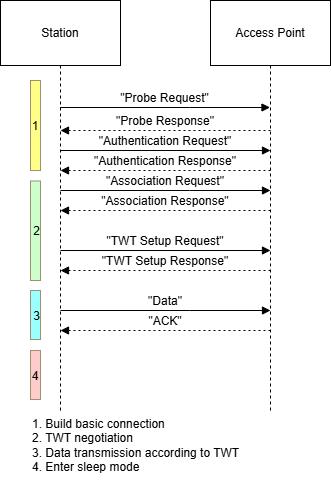
Fig -1:Theconnectionestablishmentprocessbetween StationandAPin802.11ah
The Non-TIM TWT setup process typically involves the Station sending a TWT Request to the AP, followed by negotiation and an AP response with TWT Response, confirming wake-up periods and intervals. This process can use either implicit or explicit TWT protocols. After negotiation, Stations only need to wake up during specified TWT periods, remaining in sleep mode otherwise[6][7][8].
Implicit TWT: After setting up the initial TWT service period,theAPandNon-TIMstationcalculatethestarttime of the next TWT Service Period when the current one begins.ThecalculationaddstheTWTWakeIntervaltothe currentTWTvalue,makingImplicitTWTaperiodicTWT.
Explicit TWT: After completing the initial TWT service period setup, the AP must send control messages containing TWT information to notify the next TWT service period start time. For IoT stations with variable latency and large numbers, AP control of individual node TWTsoffersbetterpowerefficiencyadvantagescompared to Implicit TWT's periodic mode, which is why this study implementsthisapproach[9][10].
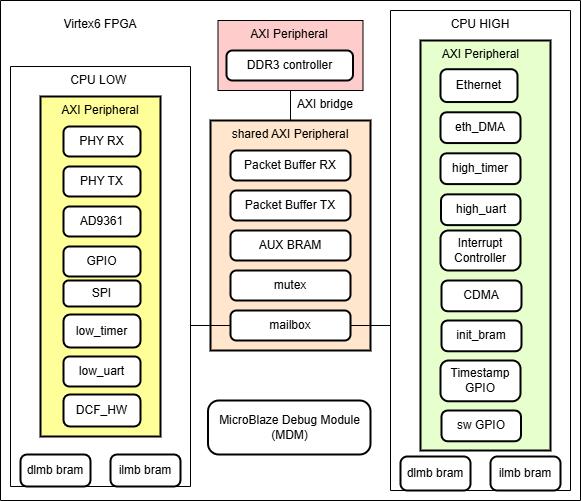
This paper implements a low-power IoT communication system based on the IEEE 802.11ah protocol using the Xilinx Virtex6 FPGA platform. The system employs an innovative dual-processor architecture design: CPU HIGH and CPU LOW, each independently controlling their respective AXI Peripheral through read and write operations. Additionally, the FPGA platform includes a sharedAXIPeripheral busthatconnectshardwareshared between both CPUs. The upper-layer CPU (CPU HIGH) is primarily responsible for 802.11ah protocol packet generation, encapsulation, and management, while also handlingEthernetpackettransmissionandreception.The lower-layer CPU (CPU LOW) handles wireless packet transmission and reception, as well as adjusting antenna transceiversettingstocontrolwirelesstransmissionrates andpowerlevels[11][12].
International Research Journal of Engineering and Technology (IRJET) e-ISSN: 2395-0056
Volume: 12 Issue: 05 | May 2025 www.irjet.net p-ISSN: 2395-0072
The upper-layer CPU's AXI Peripheral needs to connect to multiple components: Ethernet, Direct Memory Access (DMA),InterruptControllerCentral DirectMemoryAccess (CDMA, which works with CPU HIGH to write data to the Packet Buffer TX), and Timestamp GPIO (for generating timestampsrequiredforwirelesspackets).Thelower-layer CPU's AXI Peripheral mainly connects to physical layer hardware and antenna hardware, such as AD9361 and DCF_HW, responsible for physical layer reception and transmission, as well as real-time antenna-related tasks. The Shared AXI Peripheral coordinates communication between the upper and lower CPUs, including mailbox, packet buffer bram (Packet Buffer Rx and Packet Buffer Tx),andDRAM,asshowninFigure2[13][14].
The software architecture is also divided to run on two processors, with the lower CPU's software executing initialization and running the peripheral hardware of the lower processor, handling 802.11ah low-level MAC layer operations. The upper processor's software architecture incorporates a Linux operating system, using the mac80211 subsystem in the Linux kernel along with the upper processor's peripheral hardware to handle packet transmissionandreception[15].
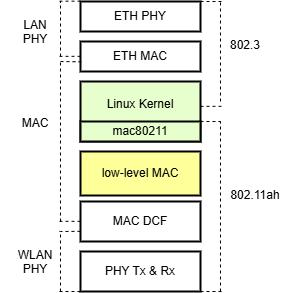
Fig -3:SystemSoftwareArchitecture
mac80211
The mac80211 subsystem provides various IEEE 802.11 standardfunctionalitiesforhardwarechips,allowingchips with different wireless communication standards to interfacewiththissubsystem.Userscanadjustandcontrol wireless network devices through user space via the mac80211 subsystem. The system offers multiple modes, suchasStationModeandAccessPointMode.Hardwarein different modes must have specific capabilities, and their drivers must implement corresponding functions. This paper focuses on Station Mode, integrating the 802.11ah protocol into the Linux system by modifying the
mac80211 subsystem, with the lower-layer processor handling lower MAC layer mechanisms. The mac80211 subsystem implements the MAC layer management entity (MLME) functionality of the IEEE802.11 protocol, while lowerMAClayermechanisms(suchasACK,CSMA/CA)are executedbywirelessnetworkdevicehardware[16]
The mac80211 subsystem controls the FPGA hardware and conducts data transfer with the upper CPU through custom-writtenWiFidrivers.Thisdrivercontainssixmain components: Mailbox, Mutex, CDMA, Timestamp, Rx PacketBuffer,andTXPacketBuffer.Amongthese,Mailbox handles communication between upper and lower CPUs; Mutex ensures that upper and lower processors don't simultaneously access the packet buffer; CDMA executes data transfer from memory to packet buffer; Timestamp provides the necessary timestamps for packet transmission; and RX/TX Packet Buffer serves as packet bufferspaceforupperandlowerprocessors.
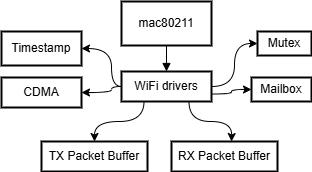
Fig -4:WiFiDrivers
3.4 Implementation of 802.11ah
3.4.1 Linux Kernel Timer
The Linux kernel provides a set of APIs for creating and managing timers. The following explains how these timer APIs are used to implement the scanning procedure and 802.11ahTWTmechanism.
When users enable the wireless network interface using the "ifconfig wlan0 up" command, the driver sets up four timers: a scan timer (scan_timer) for completing the scanning procedure, a wake timer (wake_timer) for controlling wake-up behavior, a sleep timer (sleep_timer) for putting the system into power-saving mode, and a poll_twt_timer for implementing the explicit TWT mechanism.
3.4.2
The scanning procedure is divided into active scanning and passive scanning. Stations typically use active scanning to search for networks. Therefore, this study implementedascan_timerinthedriver.Whenusersenter the iwlist command, the lower layer continuously sends
Volume: 12 Issue: 05 | May 2025 www.irjet.net p-ISSN: 2395-0072
proberequestsuntilitreceivesaproberesponse,atwhich pointthescanningtimerispaused.
When the mac80211 subsystem sends a probe request to thedriver,thesystemusesLinuxkernelAPIstodetermine if the packet is a probe request. After confirmation, the scanning timer is activated. When the timer expires, the kernel obtains the tx_queue for storing packets and the wlan_workqueueresponsibleforpackettransmission.The system then adds the probe request received from the mac80211 subsystem to the tx_queue, and uses the queue_work function to send the work to the kernel thread, where the kernel calls the relevant functions to completepackettransmission.
3.4.3 Association Procedure
ToimplementtheTWTfunctionalityforNon-TIMstations, the packet format must be modified to 802.11ah, and kernel timers must be utilized to implement TWT functionalityduringtheassociationphase.
3.4.3.1 Association request + TWT IE
The mac80211 subsystem is responsible for generating the association request packet, to which we added the TWT IE. Since this TWT IE is sent from the station, the TWTRequestissetto1.TheTWTsetupcommandissetto 1 to indicate suggest TWT, meaning all TWT parameters are determined by the station, with the Request Type set to 0x9000. The TWT field is set to 10 seconds after the time when the station creates the association request. After adding the TWT IE, the mac80211 subsystem sends this association request to the driver, which is then transmittedbythehardware.
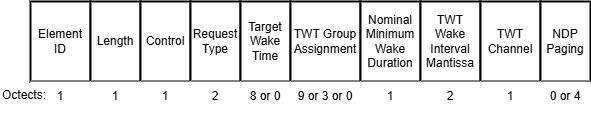
3.4.3.2 Association
When the AP receives an association request from the station, it first determines whether this association requestcontainsaTWTIE,thenexaminestheControlfield in the TWT IE to verify if the TWT indicator is enabled. If the TWT indicator is 1, it means the station wants to implement the TWT power-saving function. The AP then checkstheRequestTypefieldintheTWTIE todetermine if the packet is from the station and what the TWT Setup Commandis.AfterconfirmingtheTWTformrequestedby thestation,theAP will send back anassociation response withTWTIEtothestation.
3.4.3.3
After the station receives the association response with TWT IE, the driver determines whether the AP accepts these TWT parameters bycheckingtheRequest Typeand Control fields in the TWT IE. If the AP's TWT Setup Command response is "accept TWT," the TWT value from the received TWT IE is set as the wake_timer expiration timeandthetimerisstarted.WhentheLinuxsystemtime reaches this TWT value, the wake_timer expires, and the kernel calls the callback function previously registered with the wake_timer. After setting the wake-up time, the system enters power-saving mode first, and only enters thefirstserviceperiodafterthewake_timerexpires.After completing these actions, the driver sends theassociation response to the mac80211 subsystem, which establishes theconnectiontocompletetheassociationprocedure.
3.4.4.1
After receiving the association response with TWT IE, the station immediately triggers the sleep_timer to expire. At this point, the kernel uses the mailbox to request the lower-layer processor to turn off the antenna and enter power-savingmode.Itthennotifiestheupperlayertostop sending packets to avoid packet loss or unnecessary systemloadwhiletheantennaisoff.
3.4.4.2
When the wake_timer expires, it indicates that the first wake-up time has arrived. At this point, the upper-layer processor uses the mailbox to request the lower-layer processor to turn on the antenna, allowing the station to beginpacketexchangewiththeAP.Next,thesleeptimeis set; according to the 802.11ah SPEC, the station enters power-saving mode after a nominal minimum wake duration following wake-up. Therefore, the station's first wake-uptimeplusthenominalminimumwakedurationis set as the sleep time point and configured as the sleep_timer expiration time, ensuring the station enters power-saving mode at the specified time. Finally, wake_proc immediately activates the poll_twt_timer. The poll_twt_timerisresponsibleforimplementingtheexplicit TWTmechanism.
International Research Journal of Engineering and Technology (IRJET) e-ISSN: 2395-0056
Volume: 12 Issue: 05 | May 2025 www.irjet.net p-ISSN: 2395-0072
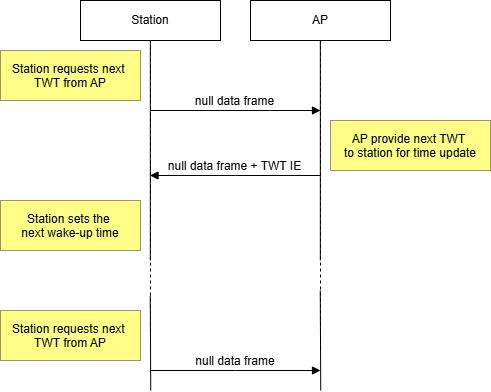
3.4.5
Toimplement the explicitTWT mechanism, this studyset up a poll_twt_timer. When a station wakes up, it activates thepoll_twt_timerandsendsanulldataframetotheAPto notifythatthestationhasentereditsserviceperiod.After the AP receives the null data frame from the station, it responds with a null data frame containing a TWT IE. When the station successfully receives this response packet, it can determine the next wake-up time from the TWT IE and activate the wake_timer accordingly. This mechanism ensures that the station won't receive outdated wake-up times while guaranteeing it will wake up at the correct future time points, thereby maintaining stableoperationoftheexplicitTWTmechanism.
Figure 7 shows the IoT application transmission architecture, where the implemented system serves as an 802.11ah Non-TIM station for conducting application scenario experiments with three IoT communication protocols:MQTT,MQTT-SN,and AMQP. The implemented system is responsible for publishing and subscribing to IoT messages, while the AP handles packet forwarding including transferring packets received from wireless networks through Ethernet, or transmitting packets from Ethernetwirelesslytostations[17][18][19]
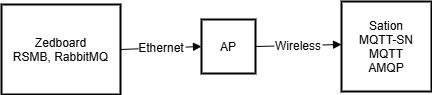
Fig -7:ExperimentalscenarioswiththreeIoT communicationprotocols
Intheexperiment,theAPforwardspacketsreceivedfrom the 802.11ah Non-TIM station to the Xilinx Zedboard. We set up a Linux operating system on the Zedboard to run IoT applications, enabling it to serve as both an IoT message broker and endpoint. RSMB (Really Small Message Broker) is a lightweight MQTT message broker program developed by IBM, designed specifically for resource-constrained embedded systems. RabbitMQ is an open-source message broker software that implements the Advanced Message Queuing Protocol (AMQP). The Zedboard can process MQTT and MQTT-SN protocols through RSMB, or handle AMQP protocol through the RabbitMQserver.
MQTTisanIoTcommunicationprotocol basedonTCP/IP networks, utilizing a publish/subscribe messaging mechanism. After a subscriber subscribes to a specific topic through the broker, when a publisher posts a messagetothattopic,thebrokersendsthemessagetoall subscribers of that topic, enabling message transmission betweenvarioussensorsandmobiledevices.
MQTT-SN uses the UDP protocol for transmission, eliminating the need to establish connections before sending data, thus saving memory and power. Additionally, MQTT-SN introduces a topic ID mechanism: afterasubscribersubscribestoatopic,thebrokerreturns a 2-byte topic ID, which the subscriber can use to replace thecompletetopicname,furtherreducingmemoryusage.
AMQP is an open standard application layer protocol. When an AMQP broker receives a message from a publisher, it first stores the message in an exchange, then forwards it to specific message queues based on routing rules.Thereceivingconsumermonitorsthecorresponding queue, and when a receivable message appears in the queue, the broker sends the message to the consumer. Compared to the subscribe/publish architecture of MQTT andMQTT-SN,AMQPoffersricherfunctionalitybutcomes with higher overhead, requiring special attention to systemresourceefficiency.
By running different message broker software on the Zedboard, weconductedindependent experiments onIoT protocol scenarios and analyzed the system resource usageofthe802.11ahNon-TIMstation.
Table -1: Memory Usage of Three Communication Protocols
Volume: 12 Issue: 05 | May 2025 www.irjet.net p-ISSN: 2395-0072
In terms of system resource utilization, different communication protocols show minimal differences in CPUusage. Regardingmemoryusage,test resultsindicate thatMQTT-SNhasthelowestmemoryfootprint,requiring only about 500KB of RAM during operation, while MQTT needs approximately 572KB, and AMQP requires about 876KB.Duetoitsrichfeaturesandnotbeingdesignedfor resource-constrained devices, AMQP is less memoryefficient. In contrast, MQTT, designed for devices with limited hardware performance and network bandwidth, uses significantly less memory than AMQP. MQTT-SN, which uses UDP transmission and doesn't need to maintain TCP connections like MQTT, along with its topic IDmechanism,hasevenlowermemoryusagethanMQTT. SinceMQTT-SNhasthelowestmemoryrequirements,itis particularly suitable for resource-constrained IoT devices andistheoptimalchoicefor802.11ahNon-TIMstations.
802.11ahisapower-savingorientedprotocol.Toevaluate its power-saving effectiveness, we compared the antenna switching times between 802.11ah systems and 802.11 legacy systems. The AD9361 antenna used in the experiment operates in FDD mode, 2.4GHz channel, and 20MHz bandwidth, consuming 620mA current with a supply voltage of 1.3V, resulting in a total power consumption of 806mW. Unlike the 802.11 legacy system design where the antenna remains continuously on, the 802.11ah Non-TIM TWT system employs a periodic switching mode turning on for 4 seconds, then off, and reactivating after 2 seconds. Within the same 6-second cycle, the 802.11ah system saves approximately 1.6J of energy, 33% more than the traditional system. Therefore, in long-term operation, the energy-saving effect of the 802.11ahNon-TIMTWTsystemisquitesignificant.
This research successfully demonstrated the practicality and benefits of IoT applications by implementing the explicit TWT functionality of the IEEE 802.11ah protocol on the FPGA Vertex6 platform. The study successfully integrated the Linux system and modified the mac80211 subsystemtoimplementtheNon-TIMstationfunctionality of the 802.11ah MAC protocol, achieving particularly significant breakthroughs in the time-sensitive explicit TWT mechanism. Furthermore, we placed special emphasisonoptimizingthesystemarchitecturetoensure thestabilityandreliabilityoftheprotocolimplementation.
In the system resource utilization assessment, the researchfoundthattheMQTT-SNprotocolismostsuitable forresource-constrainedIoTdevices,requiringonlyabout 500KB of RAM, significantly less than the memory space neededforMQTTandAMQP.Regardingenergyefficiency, experimental results showed that the 802.11ah Non-TIM TWT system saves approximately 1.6J of energy per 6second cycle compared to traditional 802.11 systems, confirming its significant energy-saving advantages in
long-term operation. These results not only demonstrate the potential of the 802.11ah protocol in IoT applications but also lay the foundation for future expansion of TWT mechanism functionality and improvement of transmission performance during service periods, contributing to further enhancement of overall system performance.
[1] N. Sornin, “LoRaWAN Specification - Version 1.1, ” LoRaAlliance,Inc.,Beaverton,OR,USA.
[2] IEEE 802.11ah-2016, “IEEE standard for information technology-telecommunications and information exchange between systems - local and metropolitan area networks-specific requirements - part 11: Wireless lan medium access control (mac) and physical layer (phy) specifications amendment 2: Sub 1GHzlicenseexemptoperation,”pp.1-594,2017.
[3] T.Adame,A.Bel,B.Bellalta,J.Barcelo,M.Oliver,“IEEE 802.11AH: the WiFi approach for M2M communications,”IEEEWirelessCommunications,vol. 21, no. 6, Dec. 2014, pp. 144-152, doi: 10.1109/MWC.2014.7000982.
[4] P. Sthapit, S. Subedi, G. R. Kwon, and J. Y. Pyun, “Performance Analysis of Association Procedure In IEEE802.11ah,”ICSNC2015:The Tenth International Conference on Systems and Networks Communications,pp.70-73,2015.
[5] S. Santi, L. Tian, E. Khorov and J. Famaey , “Accurate Energy Modeling and Characterization of IEEE 802.11ahRAWandTWT,”Sensors,vol.19,no.11,Jun 2019,pp.2614,doi:10.3390/s19112614.
[6] N.Andrade,G.Guimaraes,H.Dornelas,P.Toledo,“Low power IEEE 802.11 ah receiver system-level design aimingforIoTapplications,”201730thSymposiumon Integrated Circuits and Systems Design (SBCCI), pp. 11-16,Aug2017,doi:10.1145/3109984.3110013.
[7] T.L.Kao,H.C.Wang,C.H.Lu,T.H.Cheng,“AnEnergy Consumption Evaluation of Non-TIM Strategy in IEEE 802.11ah,” IOP Conference Series: Materials Science andEngineering,vol.644,2019,pp.1-8.
[8] P. Z. Sotenga, K. Djouani, A. M. Kurien, “Evaluation of 802.11ah TIM and RAW Scheduling Protocol for IoT,” 2019 IEEE AFRICON, Accra, Ghana, 2019, doi: 10.1109/AFRICON46755.2019.9134009.
[9] M. C. Kim, Y. T. Kim, “Design and Implementation of IEEE 802.11ah (HaLow) Dongle for IoT Wireless Networking,” 2020 21st Asia-Pacific Network Operations and Management Symposium (APNOMS),
International Research Journal of Engineering and Technology (IRJET) e-ISSN: 2395-0056
pp. 361-364, Daegu, Korea, 2020, doi: 10.23919/APNOMS50412.2020.9237023.
[10] A. Farhad, J. Y. Pyun, “Resource Management for Massive Internet of Things in IEEE 802.11ah WLAN: Potentials, Current Solutions, and Open Challenges,” Sensors, vol. 22, no. 23, Dec 2022, pp. 9509, doi: 10.3390/s22239509.
[11] AD9361_Reference_Manual_UG-570, Analog Device Inc.,2021.
[12] AD9361_Register_Map_Reference_Manual_UG-671, AnalogDeviceInc.,2021.
[13] Xilinx DS747 LogiCORE IP AXI INTC (v1.04a), at: https://docs.amd.com/v/u/en-US/ds747_axi_intc, 2013
[14] Xilinx PG079 LogiCORE IP AXI Timer v2.0, at: https://docs.amd.com/v/u/en-US/pg079-axi-timer, Oct.2016
[15] R. Rosen, Linux Kernel Networking implementation andtheory.JerseyCity,NJ: Apress, 2013
[16] Linux wireless subsystem about mac80211, at: https://wireless.docs.kernel.org/en/latest/en/develo pers/documentation/mac80211.html
[17] MQTT Version 3.1.1 OASIS Standard, 2014, at: https://docs.oasisopen.org/mqtt/mqtt/v3.1.1/os/mqtt-v3.1.1-os.pdf
[18] MQTT-SN Version 1.2 Standard, 2019, at: https://groups.oasisopen.org/higherlogic/ws/public/download/66091/M QTT-SN_spec_v1.2.pdf
[19] Eclipse Foundation Inc., Embedded MQTT C/C++ Client Libraries, at: https://eclipse.dev/paho/clients/c/embedded/
Volume: 12 Issue: 05 | May 2025 www.irjet.net p-ISSN: 2395-0072 © 2025, IRJET | Impact Factor value: 8.315 | ISO