
International Research Journal of Engineering and Technology (IRJET) e-ISSN:2395-0056
Volume: 12 Issue: 06 | Jun 2025 www.irjet.net p-ISSN:2395-0072
International Research Journal of Engineering and Technology (IRJET) e-ISSN:2395-0056
Volume: 12 Issue: 06 | Jun 2025 www.irjet.net p-ISSN:2395-0072
Collins Iyaminapu Iyoloma1, Tamunotonye Sotonye Ibanibo2, Solomon Malcolm Ekolama3 . 1, 2 &3
Dept. of Electrical Engineering, Rivers State University, Port Harcourt, Nigeria
Abstract
This paper proposes a Frequency Quadrature Amplitude Modulation (FQAM) scheme that integrates adaptive optimal finetuning with a hybrid approach combining Frequency Shift Keying (FSK) and Quadrature Amplitude Modulation (QAM). The FQAM scheme is identified as a power conservation scheme and MATLAB simulations considering Power Spectral Density (PSD)plotsareperformedincomparisonwiththeQAMandAmplitudeBinaryPhaseShiftKeying(ABPSK).Theresultclearly showsthatFQAMwillconsumetheleastamountofpowerfollowedbyABPSKandhenceFQAMismorepowerefficient.
Keywords: Frequency,Modulation,Power,PSD,Simulations
I. Introduction
Earlymobileradiosystems, whichreliedonantennasmountedontalltowers,offeredexcellentcoveragebutwerelimitedin theirabilitytoreusefrequenciesacrosstheentirenetworkduetointerferenceissues.Asgovernmentregulatorybodieswere unabletoallocateenoughspectrumtomeettherapidlygrowingdemandformobileservices,the cellular concept emergedas a groundbreaking solution to address challenges related to user capacity and spectrum congestion. This concept enabled a substantial increase in capacity within a constrained spectrum allocation, without the need for significant technological breakthroughs.Thecellularapproachfundamentallyshiftedfromusingasingle,largecoveragearea poweredbyhigh-power transmitters to deploying multiple smaller cells, each served by low-power transmitters covering a portion of the overall servicearea[1].
Cellularradiosystemsdependonthestrategicandefficientallocationandreuseofchannelsthroughoutthecoveragearea[2]. Eachbasestationisallocatedaspecificgroupofradiochannelstoserveadefinedgeographicregionknownasa“cell,”which offerslocalizedradiocoverage.Thedesignofacellfocusesonensuringreliableserviceforthemostdistantorweakestmobile users, typically located near the cell’s boundaries. The process of assigning and organizing these channel groups for all the basestations(BS)withinthenetworkisdefined Frequency Reuse [3].
FromanalogsystemstoLTE,eachgenerationofmobiletechnologyhasdevelopedasaresponsetotheshortcomingsoftheone beforeit.Forexample,theshiftfromto3Gfrom2Gwaslargelymotivatedbythegrowingdemandformobileinternetaccess onconsumerdevices.While3Gdidintroducedataconnectivity,itwasn’tuntiltheemergenceof3.5Gthatusersexperienceda significant improvement. The combination of mobile broadband and smartphones delivered a far more advanced mobile internet experience, laying the foundation for today’s app-driven digital landscape. Mobile broadband has transformed everydaylife enablingeverythingfromsocialmediaandemailtovideoandmusicstreaming,andeventheremotecontrolof homeappliances.Theseinnovations,supportedbybothtelecomoperatorsandthird-partyserviceproviders,haveprofoundly enhancedthewaypeopleinteractwiththeworldaroundthem[4].
As a result, the emerging fifth-generation (5G) wireless access networks designed to offer seamless, high-speed data connectivity areexpectedtorelyheavilyonadensedeploymentofsmaller-sizedbasestations.Whilethisstrategysupports improveddataratesandcapacity,italsointroducesamajorchallenge:increasedinter-cellinterference(ICI)[5].Furthermore, The rapid increase in connected devices, along with the emergence of data-intensive applications like Ultra-High-Definition (UHD)multimediastreaming,hassubstantiallyheightenedthedemandforgreatercellcapacityandhigherend-userdatarates [6].
International Research Journal of Engineering and Technology (IRJET) e-ISSN:2395-0056
Volume: 12 Issue: 06 | Jun 2025 www.irjet.net p-ISSN:2395-0072
This unprecedented surge in mobile traffic and device connectivity imposes new and stringent requirements on 5G systems, whichwereprojectedtobecommerciallyavailablearound2020[7].
To meet these requirements and ensure wide coverage with high data throughput, the use of advanced small cells is anticipatedin5G networks[5].However,deployingthesesmallcellsathigherdensitiesintroducesatrade-off.Whilesmaller cellsreducepathlossandcanenhancedatarates,thisbenefitiscounteractedbytheincreasedlevelofinter-cellinterference, whichposesaseriouschallengetomaintainingnetworkperformance.
Frequency Quadrature Amplitude Modulation (FQAM), which integrates the concepts of Frequency Shift Keying (FSK) and Quadrature Amplitude Modulation (QAM), has demonstrated significant promise in improving transmission rates for users situated at the edges of cells [8], [9]. In this study, we explore an FQAM scheme that incorporates adaptive optimization of thresholdtuningtofurtherimproveperformance.
Accordingto[5],TheperformanceofFrequencyQuadratureAmplitudeModulation(FQAM)wasassessedbyanalyzingthebit error rate (BER) and frame error rate (FER) under interference conditions, and then compared to conventional QAM. Furthermore, the cumulative distribution function (CDF) of the signal-to-interference-plus-noise ratio (SINR) for FQAM was numerically calculated, analyzed, and benchmarked against that of QAM. The study demonstrated that FQAM outperforms QAMinbothBERandFER,particularlyforusersatthecelledge,acrosssingleandmultiplebasestationscenarios.
Furthermore, FQAM showed significant benefits in SINR distribution, where an approximate 10 dB improvement was observedatthe10%outagelevel.ThesefindingssuggestthatFQAMholdsstrongpotentialasakeyenablingtechnologyfor5G mobilenetworksanddeservesincreasedattentionandconsideration.
Similarly, in [28], FQAM was also assessed under interference-limited scenarios and compared with QAM. The results reaffirmeditsadvantagesin termsofBER,FER,andSINR performance,particularlyinchallenging edge-of-cell environments and across various deployment conditions. Collectively, these insights underscore FQAM’s promise in enhancing 5G network reliabilityandefficiency.
In[10],OFDMwithIndexModulation(OFDM-IM)andFrequencyQuadratureAmplitudeModulation(FQAM)wereextensively studied and evaluated across various configurations and setup scenarios. The results revealed that both schemes offered notable improvements in signal-to-noise ratio (SNR) and spectral efficiency when compared to conventional OFDM. Furthermore, under identical spectral efficiency conditions, OFDM-IM demonstrated greater robustness and outperformed FQAM,particularlyinhighSNRregions.
They concluded that current research indicates various grouping and activation strategies for OFDM-IM subcarriers can further enhance system performance. Consequently, developing new closed-form expressions for the exact, approximate, or asymptoticevaluationoftheoutputinOFDM-IMandFQAMsystemsiscriticallyimportant.
A. Frequency Quadrature Amplitude-Modulation (FQAM)
The Frequency Quadrature Amplitude-Modulation (FQAM) is a hybrid solution that incorporates the useful features of both
theFSKandQAM[11].InanFQAMsystem,eachn-bitsymbolisdividedinton-kor log2L and k = log2M bits;thissplitisbased ontheFSKandQAMsetofmodulatedsymbolswhereeverymemberofaQAMsubsetisorthogonaltotheFSKsubset.
FQAMmaybeapproximatedusingtherelationdefinedbelowas:
t e ai bi um t (1) um t (2)
International Research Journal of Engineering and Technology (IRJET) e-ISSN:2395-0056
Volume: 12 Issue: 06 | Jun 2025 www.irjet.net p-ISSN:2395-0072
where,i=1,2... M-1andm=1,2 L-1
The parameters "ai" and "bi" represent the in-phase and quadrature components, respectively, of an FQAM signal. The constellation diagram of FQAM closely resembles that of QAM. One of the main advantages of this technique lies in its combinedstrengths Providingresilienceinbothbandwidthandpowerefficiency keyadvantagesinheritedfromQAMand FSK,respectively.
In M-ary modulation schemes, multiple bits are transmitted simultaneously rather than one at a time, which leads to more efficientuse of bandwidth. Thisapproachemploys morethan twodistinctsignal waveformsto represent groupsof bits. The binarybitstreamissegmentedintoblocksofKbits,referredtoassymbols,whereeachsymbolcorrespondstooneofM= possiblesignalwaveforms,eachwithadurationofT.Thenumberofsymbolstransmittedpersecondisdefinedasthesymbol rate.Giventhateachsymbol carriesKbits,thebitrateisdeterminedbydividingthetotal numberoftransmittedbitsbythe symbolduration[12].
In any communication system, a decoding or demodulation process is essential to complete the transmission and accurately retrievethetransmittedinformation.Whileadetailedexplanationofthedemodulationtechniquesemployedinmoderndigital communication systems falls outside the scope of this study, a broader perspective can be adopted by viewing the demodulation process as a form of temporal integrative filtering designed to minimize the probability of error to the lowest possiblelevel[13].
Forinstance,ifamessage istransmittedthroughamodulationsystemasasignalandreceivedbythereceiverasasignalthen theprocessofcommunicationcanberepresentedbythefollowingrelationship[13]:
Ifamessage istransmittedthroughamodulationsystemasasignal ( ),andreceivedbythereceiverasasignal r t ,the communicationprocesscanbedescribedbythefollowingrelationship[13]:
r t ( ) ( ) (3)
where,
The term ( )denotes the amount of noise interference introduced into the system, which affects the integrity of the transmittedsignal.
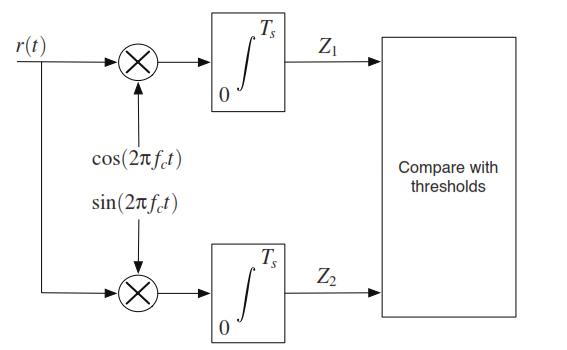
FordemodulatorschemesresemblingQAM-FQAM,themethodillustratedinFigure1canbeutilized.
International Research Journal of Engineering and Technology (IRJET) e-ISSN:2395-0056
Volume: 12 Issue: 06 | Jun 2025 www.irjet.net p-ISSN:2395-0072
A. Log-likelihood and Bit Error Response Results
Thelog-likelihooderrorresponseofFQAMforapre-definedbinarymessagecodeisasshowninFigure2.Thecomparative responseintermsofbit-errorrateswiththe4QAM,16QAM,and4FSKareequallypresentedinFigure3.TheresultinFigure2 showsclearlyareducingerrorovertime.
Negative Log-Likelihood (NLL) Estimate (FQAM)
Fig.2.FQAMLog-likelihoodresponse
Bit Eror Rates for 4/4FQAM,4-QAM,16-QAM,4-FSK
4/4FQAM 4QAM 16QAM 4FSK
Fig.3.ComparativeBit-ErrorRates(BERs)
International Research Journal of Engineering and Technology (IRJET) e-ISSN:2395-0056
The mean bit and symbol error estimates of 4-FQAM, 4-QAM and ABPSK schemes after 100 sampled SNR points (-15dB to +15dB) are presented in Table 1. The log-likelihood plots (Figures 4-1 to 4-3) also show that the error response of FQAM, QAM,andAmplitudeBinaryPhaseShiftKeying(ABPSK)arelargeatstartupbutgraduallyimprovesthroughtime.
Table1:MeanErrorestimatesoftheFQAM,QAM,ABPSKandFSKtechniques
AscanbeseenfromtheTable1,theABPSKgivesthebesterrorresponsewhichisfollowedbyFSKandFQAM.
Power
InTable2,Thereportedpowerspectraldensity(PSD) estimatesforvariousmodulationschemes,incomparisonwithFQAM, arepresented.
Table2:PSDestimates(meanvalues)oftheFQAM,QAM,ABPSKandFSKtechniques
The result clearly shows that FQAM will consume the least amount of power followed by ABPSK and hence FQAM is more powerefficient.
V. Conclusion
Up to this point, the performance of various digital modulation schemes has been thoroughly analyzed. The simulations and results obtained have been quite promising, contributing to a deeper understanding of how these modulation techniques function from fundamental principles. Looking ahead, it is recommended to conduct more detailed investigations into the potential application of the MATLAB codes developed for cell-edge detection and inter-cell interference modeling. Additionally, exploring the integration of FQAM with ABPSK features could offer notable improvements in symbol error performance,whichwouldbeaninterestingdirectionforfutureresearch.
References
[1] T. S. Rappaport, "The Cellular Concept - System Design Fundamentals," in Wireless Communications. Principles & Practice,NewJersey,PrenticeHallPTR,1995,pp.25-69.
[2] J. Oeting, "Cellular Mobile Radio - An Emerging Technology," IEEE Communications Magazine, pp. 10-15, November 1983.
Volume: 12 Issue: 06 | Jun 2025 www.irjet.net p-ISSN:2395-0072 © 2025, IRJET | Impact Factor value: 8.315 | ISO 9001:2008 Certified Journal | Page1252
International Research Journal of Engineering and Technology (IRJET) e-ISSN:2395-0056
[3] V.MacDonald,"TheCellularConcept," The Bell Systems Technical Journal, vol.58,no.1,pp.15-43,1979.
[4] D. Warren and C. Dewar, "Understanding 5G:Perspectives on future technological advancements in mobile," GSMA Intelligence,London,2014.
[5] S. Wu, Y. Wang, M. Al-Imari and M. Nekovee, "Frequency and Quadrature Amplitude Modulation For 5G Networks," IEEE,Athens,Greece,2016.
[6] Samsung, "5G vision," August 2015. [Online]. Available: http://www.samsung.com/global/businessimages/insights/2015/Samsung-5G-Vision-0.pdf.[Accessed2019December03].
[7] J.G.Andrews,S.Buzzi,W.Choi,S.Hanly,A.Lozano,A.C.SoongandJ.C.Zhang,"WhatWill5GBe?,"IEEE,2014.
[8] S. Hong, M. Sagong, C. Lim, S. Cho, K. Cheun and K. Yang, "Frequency and Quadrature-Amplitude Modulation for Downlink CellularOFDMANetworks," IEEE Journal on Selected Areas in Communications, vol.32,no.6,pp.1256-1267, 2014.
[9] B. M. Hochwald and S. T. Brink, "Achieving near-capacity on a multiple-antenna channel," IEEE Transactions on Communications, vol.51,no.3,pp.389-399,2003.
[10] S.G.Domouchtsidis,G.D.Ntouni,V.M.KapinasandG. K.Karagiannidis,"OFDM-IM vsFQAM:Acomparativeanalysis," 23rd International Conference on Telecommunications (ICT), pp.1-5,2016.
[11] Latif, A., & Gohar, N. D. (2006, November). BER performance evaluation and PSD analysis of non-coherent hybrid MQAM-LFSKOFDMtransmissionsystem.In 2006 International Conference on Emerging Technologies (pp.53-59).IEEE.
[12] J. G. Proakis and M. Salehi, "Digital Modulation Methods In An Additive White Gaussian Channel," in Fundamentals of CommunicationSystems,NewJersey,PrenticeHall,2014,p.420.
[13] Thompson, R. A., Tipper, D., Krishnamurthy, P., & Kabara, J. (2006, Chaps.14). The physical layer of communication systems,ArtechHousePublishers,2006.
Volume: 12 Issue: 06 | Jun 2025 www.irjet.net p-ISSN:2395-0072 © 2025, IRJET | Impact Factor value: 8.315 | ISO 9001:2008 Certified Journal | Page1253