
International Research Journal of Engineering and Technology (IRJET) e-ISSN:2395-0056
Volume: 12 Issue: 05 | May 2025 www.irjet.net p-ISSN:2395-0072
International Research Journal of Engineering and Technology (IRJET) e-ISSN:2395-0056
Volume: 12 Issue: 05 | May 2025 www.irjet.net p-ISSN:2395-0072
Mahmoud AboBbakr Elsediak1 , Ahmed Hussain zaki2 and Tarek NaguibRadwan3
Faculty of Engineering, Alazher universty, Cairo, EGYPT ***
ABSTRACT: This study investigates the influence of pile length onsettlement and straining actionsofa piled raft foundationandload-sharing mechanism betweenpiles andthe raft.Finite element analysisusing PLAXIS 3D and SAP 2000was conductedtostudykey parameters such as settlement, bending moment, shear force, and load distribution.It can be observed fromthe resultsthatwithanincrease inpile length from 8m to 12m,thesettlementreducesby 42%,, whilefurtherextensionto14mand16mresultsindiminishingreturnswithreductionsof12.7%and9.97%,respectively. Regardingbendingmoment,anincreaseinpilelengthfrom8mto12mdecreasesitby4.7%,whileextendingfrom12mto 16mresultsin anadditional 5%reduction. Similarly, theraftshear force decreases by5.26%whenpilelength increases from 8mto12m, withmarginal reductions beyondthat. Theload-sharinganalysisrevealsthatat8m pile length,the raft carries 38% of the total load, which reduces to 22% at 12m and 14m, and 19% at 16m, demonstrating the increasing reliance on piles for load-bearing. The study highlights the optimal pile length for maximizing settlement reduction and efficientloaddistribution,offeringpracticalguidanceforfoundationdesignimprovements Keywords: (Pile length, Settlement,Bending moment, Shear force, Load distribution)
Piled raft foundations are an advanced geotechnical solutioninwhichtheload-carrying capacityofpilesand rafts interacts synergistically to effectively transfer structuralloadstosubsurfacestrata.Thishybridsystem is particularly useful in optimizing foundation performance, especially in cases where sole raft foundations may be inadequate due to excessive settlement or inadequate bearing capacity. Design and behavior of piled raft foundations are based on several important parameters:Pile Length and Diameter: The diameterandlengthofpilesareessentialindetermining thecapacityoftheloadandsettlementofthefoundation. Piles are longer, since they extend deeper into competent strata, causing higher stability and lower settlements. Similarly, pile diameter increase enhances the contact area between the pile and the soil, enabling better load transfer and further minimizing settlement issues.Raft Thickness: Raft thickness plays a significant role in determining the overall stiffness of the foundation system. A thicker raft can distribute loads more evenly and reduce differential settlements within thestructure.Buttheraftthicknessmustbebalancedto avoid excessive material consumption and self-weight, which could adversely affect the foundation performance. Soil Characteristics: The soil properties and type below the foundation play a significant role in determining the design and performance of piled raft systems. Variations in soil stiffness, density, and stratification necessitate comprehensive geotechnical investigationstoinformdesigndecisions.Understanding
load behavior plays a key role in the estimation of settlement behavior and long-term foundation stability., the American Society of Civil Engineers (ASCE) has also developed simplified design methods for piled raft foundations, which are highly effective tools at preliminary design levels.These methods enable simple estimation of load sharing between piles and raft, enablingengineerstodesignthefoundationsystemwith respect to performance as well as cost. Thus successful use of piled raft foundations involves a holistic understanding of the relationship between structural membersandgeotechnicalconditions.
By exercising diligent consideration of matters like pile diameter, raft thickness, and soil type, and by strict adherence to current American standards and codes, engineers are able to successfully design foundations that are both strong and efficient in a way that ensures thestrengthandsafetyofthestructurestobesupported. The objective of the research is to study the effect of increase in pile length and its penetration into dense ground on piled raft foundation behavior. The objective ofthe researchis todetermine the effect oftheincrease in pile penetration in high-strength soil on the piles and raft load distribution, and to study its effect on the foundation behavior regarding settlement, bending moment, and shear force. By finite element analysis, the research seeks to determine the pile length that is optimum in that it achieves enhanced stability and minimizedsettlementaswellaslesspressureontheraft and improved load distribution between the raft and
International Research Journal of Engineering and Technology (IRJET) e-ISSN:2395-0056
Volume: 12 Issue: 05 | May 2025 www.irjet.net p-ISSN:2395-0072
piles.. Ultimately, this study contributes to the development of foundation design strategies in strong soil conditions, enhancing structural performance and leading to more efficient and safer engineering designs inconstruction
Previousstudieshavelookedatthebehaviorofpiled raftfoundationsunderstaticloadingusingfiniteelement modeling. The investigation in this research goes a step furtherbysystematicallyanalyzingtheeffectofdifferent pile lengths (ranging from 8 m to 16 m) on the contact/noncontact mechanism between raft and soil. Furthermore,theintegrationofPLAXIS3DandSAP2000 provides a dual analytical approach addressing both geotechnical and structural aspects, offering deeper insights into stress distribution and enhancing design efficiencycomparedtotraditionalmethods.
Thecurrentresearchcontributesacriticalknowledge gap to the geotechnical engineering discipline by providing a detailed analysis of the effects of pile length onthebehaviorofpiledraftfoundations.Although most previous studies have focused on general design and behavior of piles raft foundations, only a small number of studies have examined the performance and effect of incremental increases in length on the settlement, bending moments, shear forces, and load distribution controlling parameters at the contact surface. The findingsofthisresearchbuildstheresearchrecordwith a parametric analysis and detailed finite element modelling (Plaxis 3D and SAP 2000) to improve the understanding of how the length of the piles influences theglobalbehaviourofthefoundationsystem.Thevalue of this research study is potential guidance for optimizing design of piled raft foundations and possibly reducing settlements and optimizing load distribution. By quantifying the effect of varying pile lengths, this study provides engineers with evidence-based recommendations that can be applied in practice. These findings offer practical implications for designing more stable, cost-effective, and efficient foundation systems, especially in geotechnical challenging environment, the study’s findings extend beyond theoretical knowledge. They provide valuable insights that can be applied to real-worldprojectsinvolvingpiledraftfoundations,such as high-rise buildings, bridges, and large-scale infrastructure projects. The research is expected to be particularly beneficial for engineers working in regions with complex soil conditionsincorporating 110 piles, each with a fixed diameter , offering them data-driven solutions for optimizing foundation performance. This research makes a significant contribution to the field by
improving our understanding of pile-soil-raft interactions and their impact on foundation stability. It provides new avenues for future studies on foundation design and helps refine engineering practices for more reliableandsustainablefoundationsystems.Usingfinite elementmodelingthroughPLAXIS3DandSAP2000,this study provides a detailed analysis of how pile-soil-raft interactions affect the overall structural efficiency. The results show that more pile length reduces settlement, enhances load distribution, and increases the foundation's stability. The results advance the field of geotechnical engineering by providing useful modification strategies for foundation design, allowing for cost-effective construction and efficient designing processes. The research will help engineers who are designing piled raft foundations over a range of soil conditions to successfully increase performance and safety.
The current study examined using a threedimensional finite element model utilizing PLAXIS 3D (version 2013) and SAP 2000 to analyze the theoretical effect of pile length on piled raft foundations. Proposed Model . The presentcase wassetupfora particularsite in a government project in Egypt. Fig(1) shows the boreholeprofileatthestudysite,showingamultilayered soil profile that is modelled as a semi-infinite elastic, homogeneous and isotropic material. The analysis consists of a piled raft foundation system Piled raft foundation in contact with soil Piled raft foundation withoutcontactwithsoil.Specificationsandvariationsof keyparametersareshownintables(1)-(3).Pilelengths (Lp = 8m,12m, 14m and 16m) for two main cases (D = 0.6 m) and a spacing of (Sp = 5D), The 14 m and 16 m section lengths were selected to examine the performance of the piled raft system at larger depths wherethesoilstiffnessincreaseswherebycouldobserve the point of diminishing returns whereby additional length does not produce settlement reductions in any economically viable way and thus inform us about the best design length. To guarantee a uniform load distribution beneath the raft and to also eliminate any localpunchingshearingeffects,itwasdecidedtouse110 piles at 0.6m and 5D spacing. This approach meets the EgyptianCodeforSoilMechanicsandFoundationDesign (1995)(Part4,2001)andisconsistentwithon-siteJohn experience practical applications for medium to large foundations projects. The soil properties presented in Tables2werederivedfromactualsiteinvestigationdata from a governmental project in Egypt. These properties represent the stratigraphy of medium-stiff and stiff clayey soils typical of the study location. All parameters were verified according to the EgyptianCode for Geotechnical Works (2001) and usedconsistently throughouttheanalysis
International Research Journal of Engineering and Technology (IRJET) e-ISSN:2395-0056
Volume: 12 Issue: 05 | May 2025 www.irjet.net p-ISSN:2395-0072
Table1.Investigatedcasesofstudy
Table2PropertiesofSoilLayers
Table3pilesandraftparameters
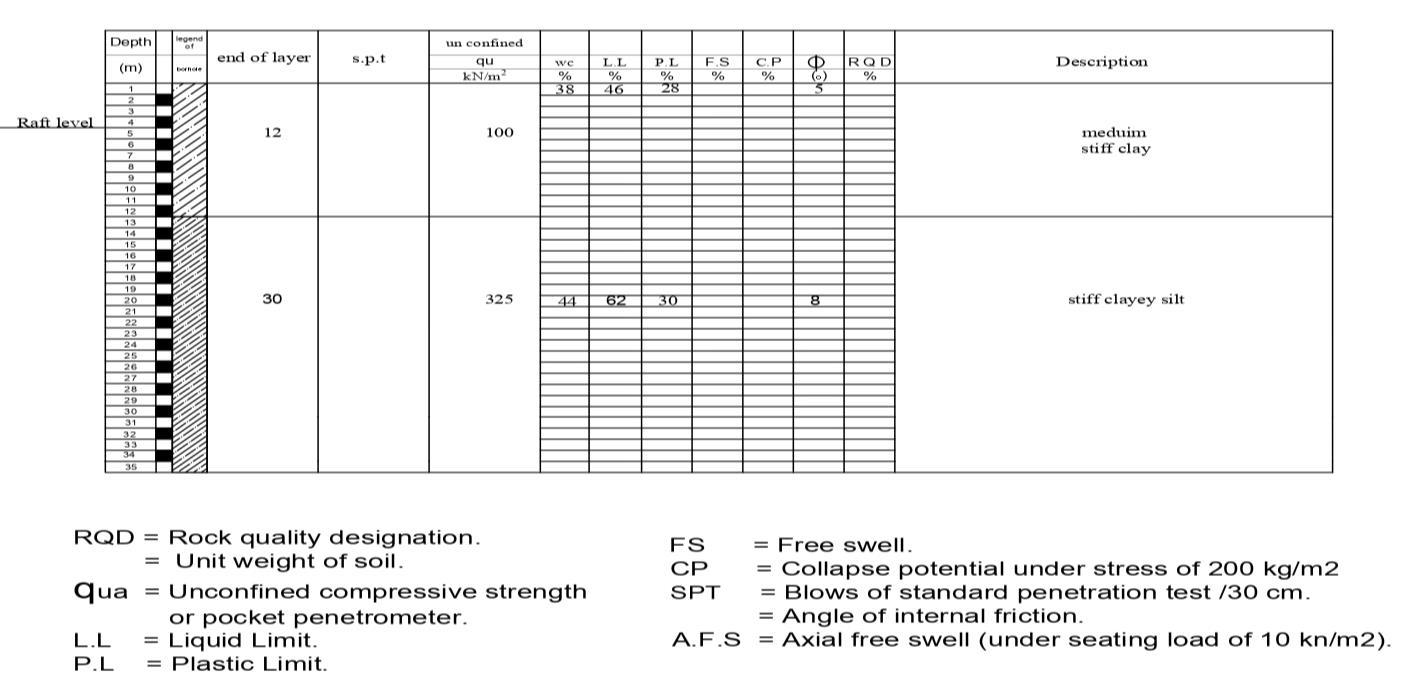
Fig1.Boreholeforthemodel
International Research Journal of Engineering and Technology (IRJET) e-ISSN:2395-0056
Volume: 12 Issue: 05 | May 2025 www.irjet.net p-ISSN:2395-0072
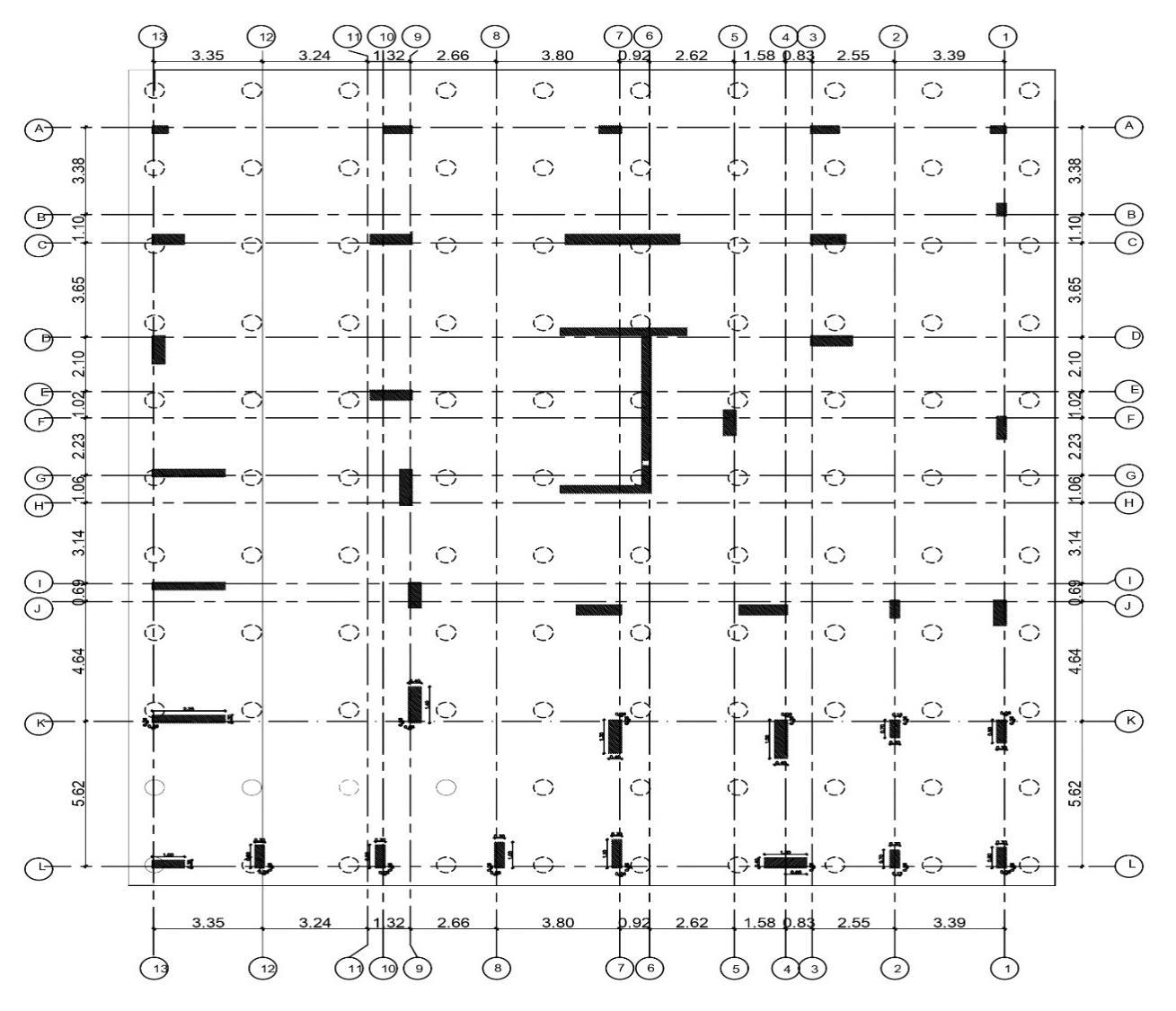
This section reviews how pile length may affect important structural and geotechnical parameters of piled raft foundations, including: piled raft foundation settlement the bending moment in raft Shear Force in theraftLoaddistributionbetweenpilesandraft
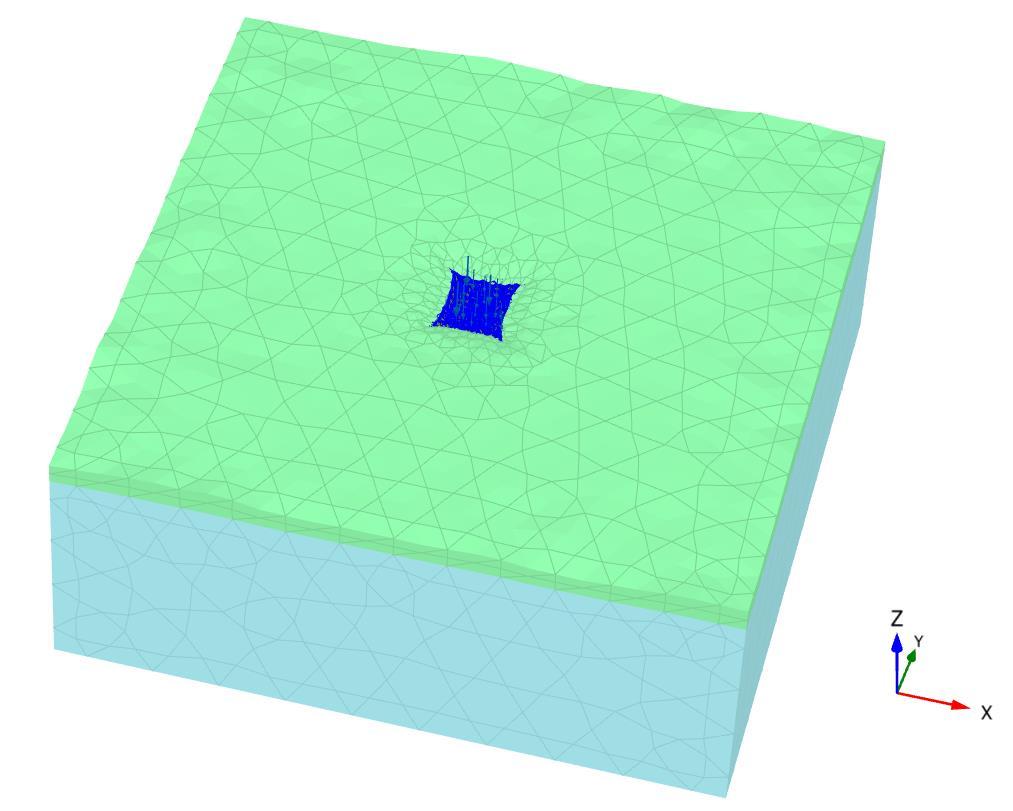
FiniteelementsoftwarepackageofPLAXIS3Dversion 2013 have been adopted for the finite element modelling within this study. This allowed the use of embeddedpilesconsistingofbeamelementsthatsatisfy the primary goal of portraying the interaction with soil and modelling the raft principally as a plate element. Soil is modelled employing the Mohr-Coulomb model (MC).SAP2000hasbeenadoptedforthecalculationsof straining actions in the raft such as bending moment and shear force in the raft. Piled raft simulation was achieved by assigning springs (horizontal and vertical) at the nodes of the piles and area springs at the
membrane of the raft. Modulus of subgrade reaction (ks)werecalculatedutilisingVesic'sTheory.ks=q/δ.A mesh size of 0.5 meters was adopted in the PLAXIS 3D modeling,following recommendationsfromthe PLAXIS 3D Reference Manual (2013), which balances computational efficiency and result accuracy. Convergence wasverifiedbyreducingthemeshsizeby 20%, resulting in displacement and stress variations of less than 5%, thus confirming the numerical stability andreliabilityofthemodel.
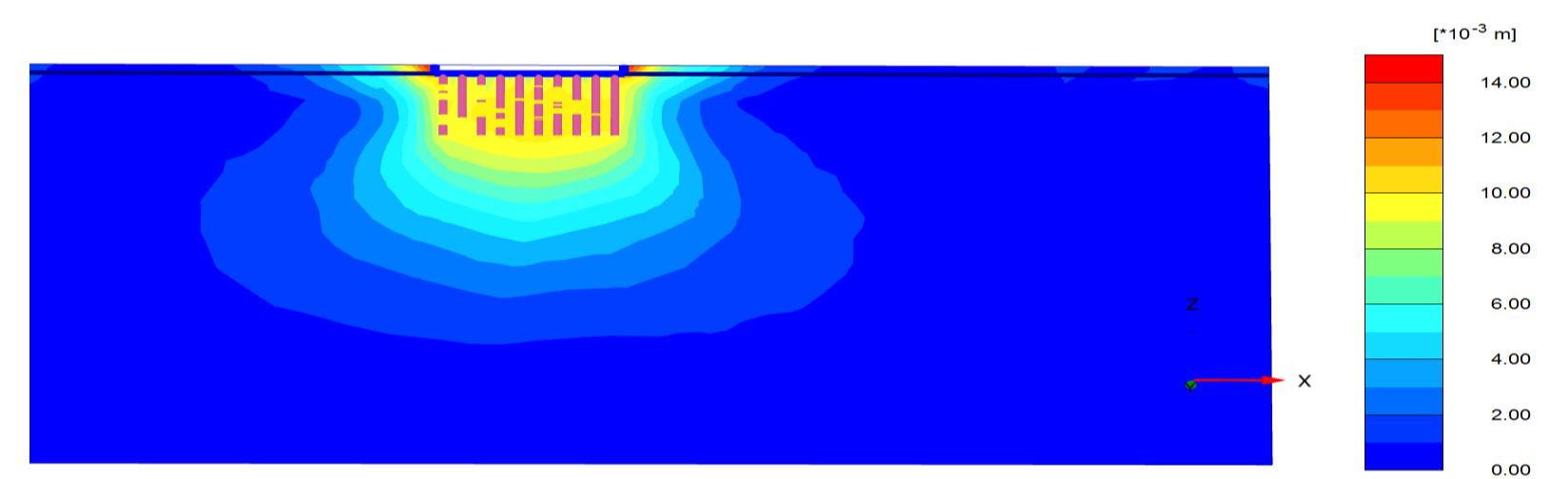
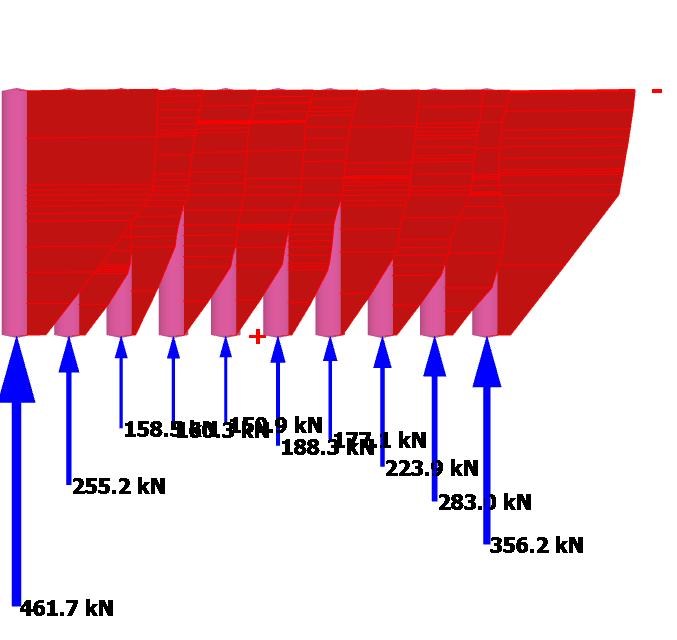
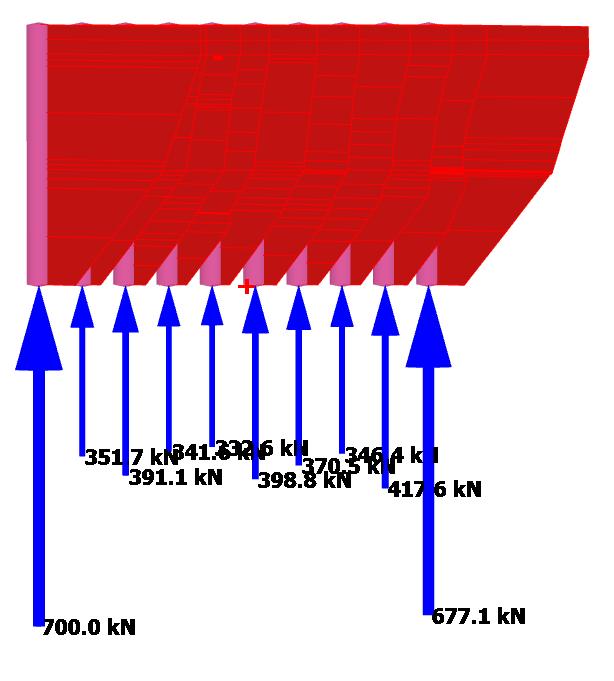
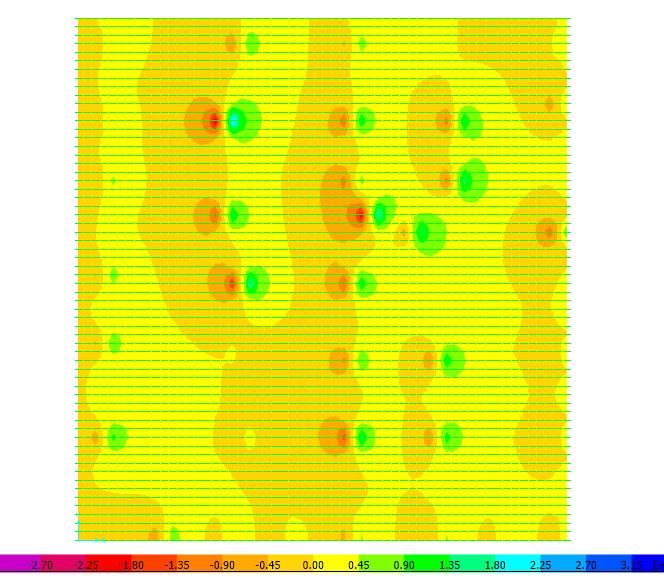
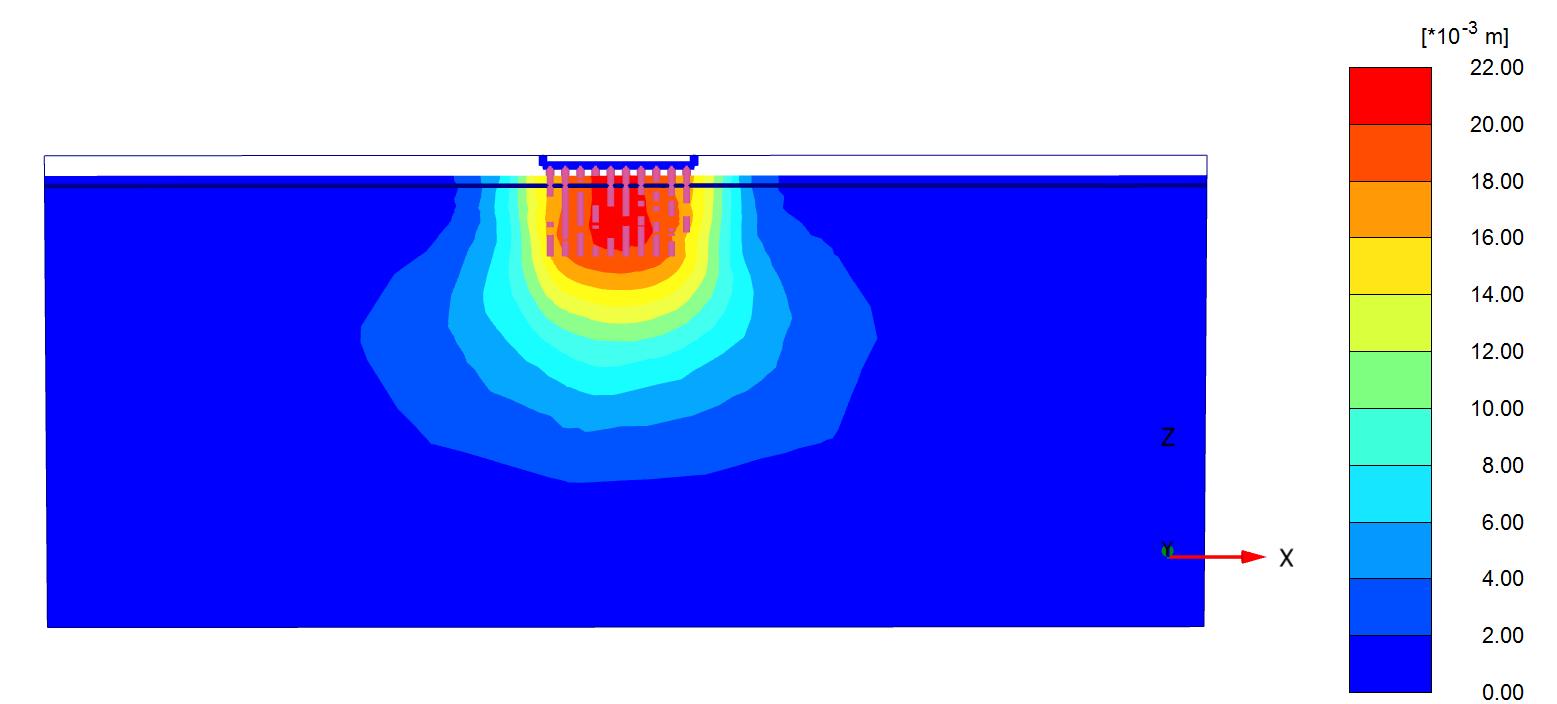
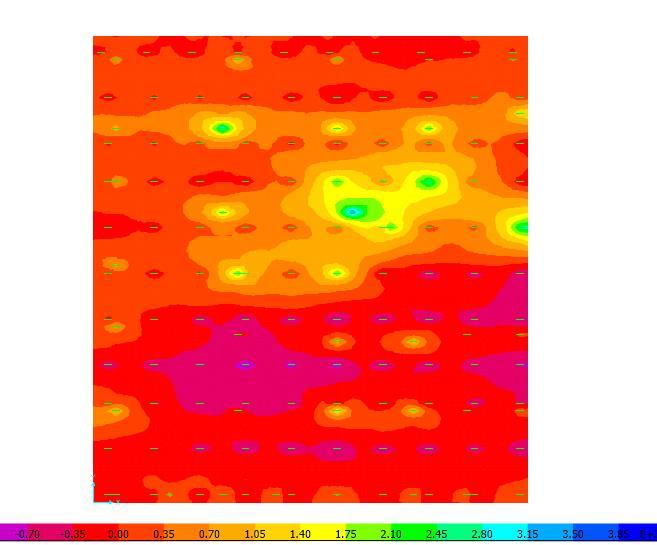
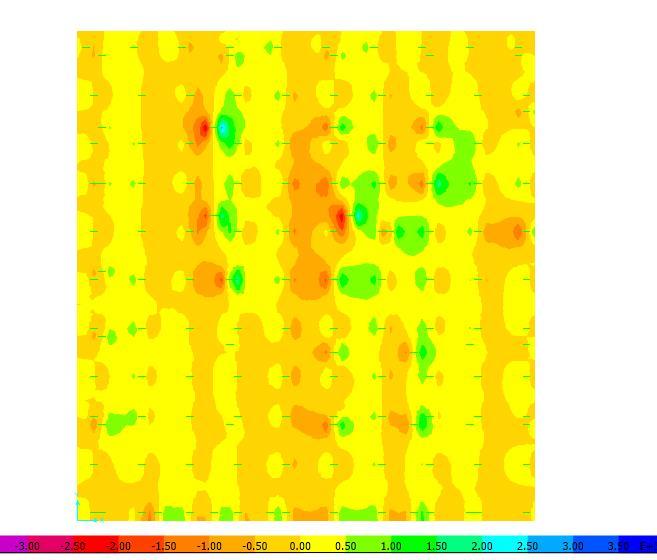
The results derived from the selected cases are presented in Figures 3 to 10, illustrating various scenarios and their corresponding outcomes Figure (4) illustrates settlement for rested piled raft with pile length16m.Figures(5Aand5B)presenttheaxialforce on the pile for both the case of rested pile raft and unrested piled raft. Figure (6) provides the bending momentontheraftforrestedpiledraftfoundationwith pile length 16m. Figure (7) provides the shear force on theraftforrestedpiledraftfoundationwithpilelength
International Research Journal of Engineering and Technology (IRJET) e-ISSN:2395-0056
Volume: 12 Issue: 05 | May 2025 www.irjet.net p-ISSN:2395-0072
16m.Fig (8) shows settlement for un rested piled raft wit pile length 16mFig (9) show the bending moment ontheraftforun-restedpiledraftfoundationwithpile
length16m. Fig(10)showtheshearforceontheraftforunrested. .
International Research Journal of Engineering and Technology (IRJET) e-ISSN:2395-0056
Volume: 12 Issue: 05 | May 2025 www.irjet.net p-ISSN:2395-0072
restedpiledraft
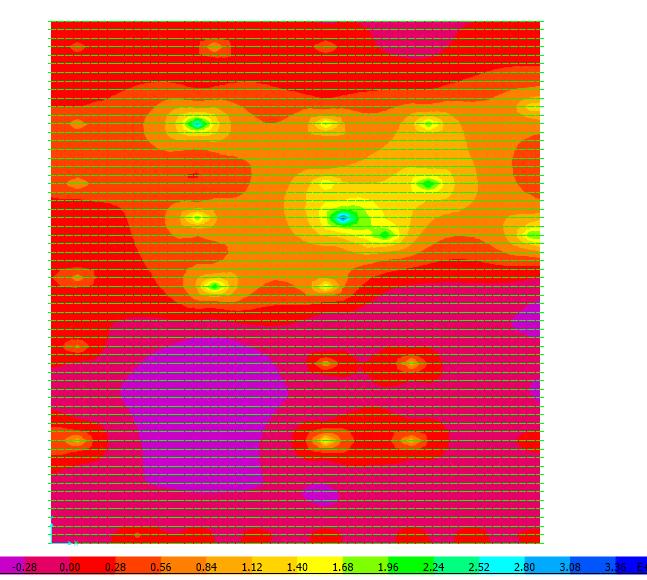
Fig 6Thebendingmomentforrestedpileraftfoundationwithpilelength16m
International Research Journal of Engineering and Technology (IRJET) e-ISSN:2395-0056
Volume: 12 Issue: 05 | May 2025 www.irjet.net p-ISSN:2395-0072
International Research Journal of Engineering and Technology (IRJET) e-ISSN:2395-0056
Volume: 12 Issue: 05 | May 2025 www.irjet.net p-ISSN:2395-0072
International Research Journal of Engineering and Technology (IRJET) e-ISSN:2395-0056
Volume: 12 Issue: 05 | May 2025 www.irjet.net p-ISSN:2395-0072
5.1 Settlement Behavior
It can be seen in Figure 9 and clarified in Table 4, a longerpilelength diminishesthesettlement of the piled raft foundation considerably. The increase in pile length from8mto12mresultedinonly42%reduction, while additional increases to piles of length 14 m and 16 m caused a 12.7% reduction and a 9.97% reduction, respectively.. This reflects the law of diminishing returns, particularly beyond 12 m, where deeper soil layers have already been effectively mobilized. The impact of raft-soil contact is clearly evident: in the unrested configuration, where the raft is isolated from thesoil,settlementisapproximately48%greaterthanin the rested configuration. This is visible in the displacementpatternsshowninFigures4and8.
5.2 Bending Moment on the Raft
Figure10andTable5bothshowthat,asthelengthof the pile increased, the bending moment on the raft becomes less. A reduction of 4.7% was observed from piles 8 m to 12 m, followed by a 2.5% reduction from piles 12 m to 14 m, and from piles 14 m to 16 m.This behaviorcorrespondstothepiletipsreachingthestiffer clayeysiltlayer,whichprovidesgreaterlateral restraint and better load distribution. The bending moment distribution across the raft for both contact types is visualized in Figures 6 and 9, reinforcing the positive effectofsoil-raftinteraction.
ThevariationofshearforceispresentedinFigure11 and Table 6. Increasing pile length from 8 m to 12 m leads to a 5.26% reduction in shear force, with further decreasesof2.68%(12–14m)and2.7% (14–16 m). These values support the trend of improved shear performance with longer piles, though the marginalgaindiminishesatgreaterdepths.Additionally, Figure 7 (rested case) and Figure 10 (unrested case) highlight the difference in shear behavior. The unrested raft system experiences 17% higher shear force, emphasizingthestabilizing
roleofraft-soilcontact.furtherdecreasesof2.68%(12–14 m) and 2.7% (14–16 m). These values support the trend of improved shear performance with longer piles, though the marginal gain diminishes at greater depths. Additionally, Figure 7 (rested case) and Figure 10 (unrested case) highlight the difference in shear behavior. The unrested raft system experiences 17% higher shear force, emphasizing the stabilizing role of raft-soilcontact.
AsshowninTable7andvisualizedinFigure12,load sharingvariessignificantlywithpilelength:
At8m,theraftcarries38%oftheload.At12mand 14 m, this share drops to 22%.At 16 m, it further declines to 19%.Longer pilesengage deeper, stiffer soil layers,attractingmoreloadandreducingthedemandon theraft.However,overlyreducingtheraft’scontribution mayresultinoverdesignandinefficiency.Theseshiftsin load sharing are also evident in the axial force distributions shown in Figures 5A (rested) and 5B (unrested).
Settlement decreased by 42% when increasing pile lengthfrom8mto12m,withdiminishingreturnsthere after.Unrested rafts showed 48% more settlement and 17% more shear force than rested rafts .Bending moments reduced progressively with increased pile length, particularly up to 12 m.Shear force also declined withincreasingpilelength,reflectingmoreefficientload redistribution.
Load sharing shifted from raft to piles, with raft contributiondecreasingfrom38%to19%
Table4.Piledraftsettlementwithdifferentpilelength withpilemand16m.
Pile length(m) Settleme nt(mm) For rested piledraft Settleme nt(mm) For unrested piledraft Settleme nt (mm) For raft without piles 0.02D+0.5QL/E A allowable settlement(mm )
Table5 Theinfluenceofpilelengthonthebending momentontheraftwithpilediameter60cm.
Pilelength(m) Bendingmoment(KN.m) rested piledraft Bending moment (KN.m) un rested piledraft
International Research Journal of Engineering and Technology (IRJET) e-ISSN:2395-0056
Volume: 12 Issue: 05 | May 2025 www.irjet.net p-ISSN:2395-0072
Table6.Theinfluenceoflengthofpileontheraftshearforceonpiledraftfoundain.
Pilelength (m)
Shearforce(KN) Rested piled raft foundation
Shearforce(KN) Un Rested piled raft foundation
Table7 Theloaddistributionbetweenpile&raft
by pile
Settlem en t( m m ) pile length(m) un rested piled raft Piled raft rested on the soil raft without piles
Fig.9.RelationshipBetweenPileLengthandSettlementinPiledRaftFoundationsThefiguredemonstratesthatincreasing thelengthofPilefrom8mto16mleadstoa55%reductioninsettlement,highlightingtheeffectivenessoflongerpilesin enhancingfoundationstability
International Research Journal of Engineering and Technology (IRJET) e-ISSN:2395-0056
Volume: 12 Issue: 05 | May 2025 www.irjet.net p-ISSN:2395-0072
Fig.10CorrelationBetweenPileLengthandBendingMomentinPiledRaftFoundationsThefigureillustrateshow bendingmomentontheraftisinfluencedbypilelength.Itisevidentthataspilelengthincreasesfrom8mto16m,the bendingmomentontheraftexperiencesareductionof10
Fig 11VariationofShearForceontheRaftwithPileLengthThefigureshowsthatextendingthepilelengthfrom8mto 16mresultsinan11%reductioninshearforceontheraft,demonstratingtheimpactofpilelengthonsheardistribution.
International Research Journal of Engineering and Technology (IRJET) e-ISSN:2395-0056
Volume: 12 Issue: 05 | May 2025 www.irjet.net p-ISSN:2395-0072
Althoughthisstudyprovidesvaluableinsightsintothe behaviorofpiledraftfoundations,several
6.1
Simplified Soil Modeling Using Mohr-Coulomb: The soil was modeled using the Mohr-Coulomb constitutive model, which is widely adopted in geotechnical engineering due to its simplicity. However, it does not capturecomplex behaviors suchasnon-linearity,strainsoftening, or time-dependent effects (e.g., creep and consolidation), which may influence real-life performance.
No Advanced Interface Modeling: The interaction between the raft, piles, and soil was modeled without using advanced interface elements to simulate slip and friction.Thissimplificationmayaffecttheaccuracyofthe load transfer mechanism in the simulation. Static Loading Conditions Only: The analysis was limited to static loading scenarios. Dynamic loads such as seismic effects, traffic-induced vibrations, or cyclic loading were not considered, although they are critical in certain design contexts Fixed Structural Parameters: The study kept pile diameter, spacing, and raft thickness constant across. All cases. Varying these parameters could affect the results and broaden the understanding of system behavior under different design configurations. Single SoilProfile:Thenumericalanalysiswasconductedusing a specific soil profile representative of a site in Egypt. Therefore,thefindingsmaynotbeuniversallyapplicable withoutadjustmentsfordifferentsoilconditions.
6.2
Different Soil Profiles: Examining how varying soil types (e.g., sands, soft clays) affect pile-raft interaction
and settlement trends. Based on the study findings, the piled raft foundation system with varying pile lengths performs most effectively in medium-stiff to soft clay soils,asthesesoilsbenefit significantlyfromdeeperpile penetration to stiffer layers. In contrast, dense sandy soils may not necessitate such pile lengths, as adequate bearing capacity can be achieved at shallower depths .RaftThicknessVariations:Assessinghowchangesinraft thickness influence bending moments and load-sharing .Pile Diameter and Spacing: Investigating the effects of different pile geometries system performance Seismic and Dynamic Loading: Evaluating the behavior of piled raft foundations under earthquake or vibration-induced loads .and Spacing: Investigating the effects of different pilegeometriesonsystemperformance.
The findings Suggest that partial contact stiffness between the raft and soil should be incorporated into futuremodelstobettercapturethetransitionalbehavior between full contact and no contact conditions. Such advanced modeling would allow a more realistic simulation of soil-structure interaction, particularly for casesinvolvingnon-uniformsettlement
This study investigated the impact of pile length on the structural behavior of piled raft foundations using finite element analysis through PLAXIS 3D and SAP2000. The analysis demonstrated that increasing pile length significantly improves foundation performance by reducingsettlement,bendingmoments,andshearforces. However, the results also reveal diminishing returns with longer piles beyond 12 meters. Key conclusions include: Increasing pile length from 8 m to 12 m results in a 42% reduction in total settlement. However, the settlementreductionbetween12mto14mand14mto 16mwasonly12.7%and9.97%,respectively.
International Research Journal of Engineering and Technology (IRJET) e-ISSN:2395-0056
Volume: 12 Issue: 05 | May 2025 www.irjet.net p-ISSN:2395-0072
The raft bending moment decreased by 4.7% when increasing pile length from 8 m to 12 m, with smaller reductions of 2.5% in subsequent intervals. Raft shear force was reduced by 5.26% for the 8 m to 12 m range, againshowingreducedbenefitsbeyondthislength Load distribution shifted significantly: at 8 m, the raft carried 38%ofthetotalload,whileat16m,itcarriedonly19%, emphasizing the increasing role of piles in load resistanceThecomparisonbetweenrestedandunrested raft conditions shows that direct raft-soil contact significantlyenhancesperformance,reducingsettlement by up to 48% and decreasing internal stresses. These findings highlight the importance of optimizing pile
8 REFERENCES: length,ratherthanmerelyincreasingit,forcost-effective and structurally sound foundation designs. The results canassistengineersindesigningmoreefficientpiledraft foundations,especiallyinsoftorlayeredsoilconditions
[1] Akinmusuru, J. O. Interaction of Piles and Cap in PiledFootings,ASCE,Vol.106,1980,PP.63-1268.
[2] Bisht, R.S., and Singh, B. Behavior Of Piled Raft FoundationByNumericalModelingSAITMResearch SymposiumOnEngineeringAdvancements(SAITM–RSEA2012).PP.23-26
[3] Clancy, P. and Randolph, M. F. An Approximate Analysis Procedure for Piled Raft Foundations, International Journal for Numerical and Analytical Methods in Geomechanics, Vol.17, No.12,1993, pp.849.869.
[4] Elsamny,M.K. and AbdEL Samee W. NashaatandEssa.Tasneem. A . Analysis of pile-raft foundations non-rested and directly rested on soil International Journal of Civil Engineering and Technology(IJCIET)Volume 9,Issue3,March2018, pp.418–439.
[5] Elsamny,M.K., Ezz-Eldeen, H. A.,Elbatal, S. A. and Kamar, A. M Effect of Pile Length on Load Sharing Of Pile Raft Foundation under Different Loads NEW YORK SCIENCE JOURNAL · July 2020
[6] El Gendy,M,Ibrahim,H and Reda.A., " Optimization Of Piled Raft In Port-Said" Port-Said Engineering Research Journal. Volume 13, No. 1, March 2009, pp. 27-45
[7] Egyptian Code (2001), "Soil Mechanics and Design and Construction of Foundation", Part 4, "Deep Foundation"PP1-103
[8] Hegazy,A., Aly . Analysis of piled-raft foundations subjected to general loadingInternational Journal of
Civil Engineering (IJCE) ISSN(P): 2278-9987; ISSN(E):2278-9995Vol.5,Issue6,2016,pp.69-82
[9] Poulos,H.G., Piled raft foundations design and applications Geotechnique 51, No. 2,2001,P.P 95113
[10] Saif,A., Ankit. P and Siddharth . J, Parametric Study of Piled Raft Foundation for High Rise Buildings. International Journal of Civil engineer Engineering Research& Technology (IJERT), ISSN: 2278-018,Vol.9,Issue122021,P.P.548-555.