
International Research Journal of Engineering and Technology (IRJET) e-ISSN: 2395-0056
Volume: 12 Issue: 05 | May 2025 www.irjet.net p-ISSN: 2395-0072
International Research Journal of Engineering and Technology (IRJET) e-ISSN: 2395-0056
Volume: 12 Issue: 05 | May 2025 www.irjet.net p-ISSN: 2395-0072
Faisal Syafar1 , Halimah Husain2
1Professor Department of Electronics, Faculty of Engineering, Universitas Negeri Makassar, Indonesia
2Department of Chemistry, Faculty of Mathematics and Natural Sciences, Universitas Negeri Makassar, Indonesia
Abstract - This study presents a design science research (DSR) approach to developing and evaluating a Mobile Collaborative Learning System (MCLS) aimed at enhancing mobile-enabled educational experiences. The system was designedusingathree-tierservice-orientedarchitectureand implementedonaWindowsMobileplatformtosupportrealtime messaging, location-based collaboration, and access to learningmaterials.Usabilitywasevaluatedthroughheuristic inspections, cognitive walkthroughs, and think-aloud protocols, while user acceptance was measured using the MobileServicesAcceptanceModel(MSAM),whichintegrates constructsfromTAM,TPB,UTAUT,andtrust-basedtheories. Empiricalresultsfrom50studentsattheUniversitasNegeri Makassar demonstrated high levels of perceived usefulness, ease of use, trust, and contextual relevance. Trust and perceivedusefulnesswerefoundtobethestrongestpredictors of intention to use. The prototype achieved a 100% task completionrateinusabilitytestingandwaspositivelyreceived inpost-usefocusgroups.Thisstudycontributestoeducational technology design by demonstrating how DSR can be effectively applied to mobile learning systems, linking theoretical models with practical usability outcomes. It also offers design and evaluation guidelines for developers, educators, and researchers working at the intersection of mobilecomputingandcollaborativelearning.
Key Words: Mobile learning, Usability evaluation, Technologyacceptance,Context-awaresystem
Theproliferationofmobiletechnologieshassignificantly influencedthelandscapeofdigitaleducation.Smartphones, tablets,andwirelessnetworkshaveenabledlearningbeyond theconfinesoftraditionalclassrooms,givingrisetomobile learning (m-learning) environments that are accessible "anytimeandanywhere"[1].Theconvergenceofubiquitous access, personalized interaction, and contextual relevance has positioned mobile learning as a transformative educationalinnovation[2.3].
Yet, while mobile learning promises to democratize access to knowledge, several systemic challenges persist. Chief among them is the issue of usability the extent to which mobile learning applications are efficient, effective, andsatisfyingfortheirintendedusers[4].Poorlydesigned interfaces,inconsistentuserexperiences,andnon-intuitive
navigation structures often hinder the adoption of mobile learningtechnologies[5].Compoundingthisissueisthelack of rigorous methodological frameworks guiding the developmentofsuchapplications,particularlythosethatare context-awareandcollaborativeinnature.
Toaddressthisgap,thepresentstudyadoptsa Design Science Research (DSR) paradigm to systematically develop,implement,andevaluatea Mobile Collaborative Learning System (MCLS). DSR is a problem-solving frameworkthatemphasizesthecreationandevaluationof artifacts to address identified organizational or societal needs[6].Itisparticularlysuitedforcomplexenvironments wherehuman-computerinteractionplaysacriticalrole,such asmobileeducation[7].
Mobilelearningenvironmentsofferuniquepedagogical affordances. They enable situated learning, whereby learnerscanaccesseducationalcontentwithinthecontextof theirdailylivesandenvironments[8].Thesesystemsalso facilitate collaborativelearning,allowinguserstoexchange ideas,shareresources,andengageinjointproblem-solving regardlessoflocation[9].
Despite these advantages, the real-world impact of mobilelearninghasbeenuneven.Studiessuggestthatwhile students appreciate the flexibility of mobile access, their sustainedengagementwithmobilelearningapplicationsis highlycontingentonsystem usability, trust,and contextual relevance [10, 11]. a user-centered design approach and iterative validation, these systems risk obsolescence or abandonment.
DSRprovidesamethodologicalfoundationfordeveloping artifacts softwaresystems,frameworks,models thatare both innovative and functional. The seminal work of [6] outlinessevenprinciplesforconductingDSRinInformation Systems research, including artifact design, problem relevance,rigorousevaluation,andcontributionstotheory andpractice.
In the educational domain, DSR has been employed to develop intelligent tutoring systems, adaptive learning
International Research Journal of Engineering and Technology (IRJET) e-ISSN: 2395-0056
Volume: 12 Issue: 05 | May 2025 www.irjet.net p-ISSN: 2395-0072
platforms,andmorerecently,mobilelearningapplications [12]. However, there remains a lack of integrated studies that combine DSR with usability evaluation and user acceptance modeling,particularlyinmobilecollaborative learningcontexts.
Understanding how users perceive and adopt mobile learning systems requires robust theoretical models. This study adopts the Mobile Services Acceptance Model (MSAM), a synthesis of TAM (Technology Acceptance Model), TPB (Theory of Planned Behavior), and UTAUT (UnifiedTheoryofAcceptanceandUseofTechnology)[13]. MSAM accounts for key constructs such as perceived usefulness(PU), easeofuse(EOU), trust,and contextual awareness,whicharepivotalinevaluatingtheintentionto usemobileservices[14,15].
ByintegratingMSAMintotheDSRcycle,thisstudynot onlybuildsausablesystembutalsoexaminesthecognitive andbehavioralresponsesofuserstotheartifact.Thisduallayeredapproach designandevaluation enablesamore holistic understanding of technology adoption in mobile educationalsettings.
Thisresearchismotivatedbythefollowingobjectives:
1. To design and develop a Mobile Collaborative LearningSystem(MCLS)usingathree-tierServiceOrientedArchitecture(SOA).
2. To evaluate the usability oftheMCLSprototype usingheuristicevaluation,cognitivewalkthroughs, andthethink-aloudprotocol.
3. To assess user acceptance through the MSAM framework using empirical data collected from students.
4. To contribute methodological insights for the developmentofcontext-aware,collaborativemobile learningenvironmentsgroundedindesignscience.
The primary contribution of this study lies in its integration of DSR, usability engineering, and acceptance modeling within a single research framework. This convergence is significant for both researchers and practitioners aiming to develop sustainable and scalable mobile learning systems. The prototype developed in this studyincludesfeaturessuchasreal-timegroupmessaging, location-basedservices,andautomatednotifications allof whichhavebeenevaluatedforusabilityandeffectivenessin anacademicsetting.
Furthermore,thestudyoffers practicalimplications for developers, instructional designers, and educational
technologists by outlining best practices for artifact developmentandevaluation.Thelessonslearnedfromthe prototype evaluation provide a roadmap for enhancing systemfeatures,reducingdesignflaws,andincreasinguser satisfactioninfutureiterations.
This study adopts a Design Science Research (DSR) approach to guide the development, implementation, and evaluation of a Mobile Collaborative Learning System (MCLS).DSRisparticularlyeffectiveforresearchendeavors that aim to produce innovative artifacts designed to solve real-world problems, especially in complex and dynamic domainssuchasmobileeducationaltechnology[6].
In accordance with Hevner’s guidelines, this section presents the methodological stages encompassing artifact design, evaluation, and validation using both usability testing and the Mobile Services Acceptance Model (MSAM). A comprehensive mixed-method strategy combining qualitative and quantitative techniques is adoptedtoensurerobustnessandrigor.
Design Science Research (DSR) is a solution-oriented methodology that structures research around the constructionandevaluationofartifacts.Theseartifactsmay bemodels,systems,methods,orinstantiationsthataddress identifiedproblems[7].
ThepresentresearchfollowsthecanonicalDSRprocess consistingoffiveiterativestages:
Awareness of Problem
Suggestion of Design
Development of Artifact
Evaluation
Conclusion and Reflection
Each of these steps is aligned with the seven design guidelines proposed by [6], ensuring methodological integrityandcontributiontoboththeoryandpractice.
Thecore artifactdesigned inthisstudy isa prototype MCLS, developed using a three-tier Service-Oriented Architecture (SOA).Thesystemincludes:
A mobile client application developed using C# and.NETforWindowsMobile.
A web services layer handling authentication, messaging,resourceretrieval,andlocationtracking.
A backend SQL database storing user profiles, resources,andcommunicationlogs.
International Research Journal of Engineering and Technology (IRJET) e-ISSN: 2395-0056
Volume: 12 Issue: 05 | May 2025 www.irjet.net p-ISSN: 2395-0072
Thesystemallowsstudentsto:
Formcollaborativegroups.
Exchangemessagesandresources.
Trackpeerlocationsforphysicalcollaboration.
Receivereal-timeannouncementsandnotifications. The architecture supports modularity, reusability, and scalability, aligning with best practices in educational softwaredevelopment[16].
Usability testing was conducted using a combination of inspection, empirical, and inquiry methods, as recommended by the National Institute of Standards and Technology[17].
2.3.1 HeuristicEvaluation
Conducted by usability experts, this step identified major design flaws based on principles proposed by Nielsen [4], including:
Visibilityofsystemstatus
Matchbetweensystemandrealworld
Usercontrolandfreedom
Consistencyandstandards
Errorprevention
2.3.2 Cognitive Walkthrough and Think-Aloud
Users performed defined tasks while articulating their thoughtprocessaloud,enablingtheresearcherstocapture real-timeusabilityissuesandidentifycognitivebottlenecks [18].
2.3.3 Questionnaire
A 7-point Likert scale wasusedtocollectfeedbackonkey usabilitymetrics:
Learnability
Efficiency
Memorability
Errorfrequency
Usersatisfaction
Thiscombinationensuredarobusttriangulationofusability findings.
Toassessuseracceptance,thestudyappliedthe Mobile Services Acceptance Model (MSAM),asynthesisofTAM, TPB, UTAUT, and Innovation Diffusion Theory (IDT) extendedformobilecontexts[19].MSAMencompasses:
Perceived Usefulness (PU)
Perceived Ease of Use (PEOU)
Trust
Contextual Relevance
Personal Initiatives
Intention to Use (IU)
A structured questionnaire was administered to 50 undergraduatestudentsattheUniversitasNegeriMakassar (UNM)toempiricallyvalidatetheMSAM constructsinthe contextofMCLS.Theinternalconsistencyofresponseswas verifiedusing Cronbach’s alpha
2.5
Theevaluationwasconductedintwophases:
2.5.1
Participantswereinstructedtocompletespecifictasksusing theMCLSprototype(e.g.,sendingmessages,forminggroups, locatingpeers).Observationsandrecordingswereusedto analyze interface efficiency and effectiveness. Follow-up focusgroupsprovidedfurtherqualitativeinsights.
2.5.2
Participantscompletedanonlinequestionnairemeasuring MSAM constructs. Quantitative data was analyzed using descriptive statistics, correlation, and multiple regression to explore the relationships among the constructs.
This two-pronged evaluation strategy ensured that both functional and experiential aspects of the prototype were rigorouslyassessed,enhancingtheartifact’sdesignvalidity [20].
Theparticipantcohortconsistedof:
50 students (22male,28female)
Aged18–26
Backgrounds in Information Systems and EducationalTechnology
Participants were recruited through classannouncements and provided with informed consent forms in compliance withUNM’sResearchEthicsBoard.
Theprototypewasdevelopedusing:
Microsoft Visual Studio 2008
.NET Compact Framework
SQL Server 2005
Windows Mobile Emulator
This stack was selected for compatibility with the institution’slegacysystemsandtoenablerapidprototyping withintheDSRcycle.
International Research Journal of Engineering and Technology (IRJET) e-ISSN: 2395-0056
Volume: 12 Issue: 05 | May 2025 www.irjet.net p-ISSN: 2395-0072
Toensure constructvalidity,theMSAMmodelwasmapped precisely to questionnaire items. Reliability was ensured through pilot testing and expert review of evaluation instruments.
Content Validity: ensured through expert interviewsandliteraturereview
Internal Consistency: Cronbach'sα>0.80across constructs
Triangulation: combination of quantitative and qualitativedata
Finally, complete content and organizational editing before formatting. Please take note of the following items whenproofreadingspellingandgrammar:
Following the DSR methodology, the Mobile Collaborative LearningSystem(MCLS)prototypewastestedthroughtwo mainmethods:
1. Usability Testing: Participants performed realworld tasks within predefined usage scenarios whileresearchersrecordedinteractionoutcomes.
2. UserAcceptanceSurvey:Utilizinga7-pointLikert scale, students provided ratings for constructs derivedfromtheMSAMframework.
The combined evaluation approach enabled a comprehensiveunderstandingofhowusersexperiencedthe system both in terms of interface design and behavioral intentiontouse.
3.2.1.
Inthefirstscenario,participantswererequiredtologin, browse resources, and download a file. While all users succeeded in performing these tasks, some encountered challenges with the on-screen keyboard overlapping the inputfields,especiallyonnewerHTCTouch2devices.
Feedbackincluded:
“The keyboard covers what I’m typing. I can’t see what I wrote until I close it.”
“It takes too many clicks just to view one file. It should be streamlined.”
The success rate for task completion was 100%, with time-on-task varying depending on device familiarity. Participants on older HTC Pro 6.1 devices reported fewer issuescomparedtothoseusingnewerOSversions.
3.2.2
Participants were asked to send and receive group and personalmessages.Alltestuserssuccessfullycompletedthis task.However,feedbackincludedsuggestionssuchas:
Preventingemptymessagesubmission
Providingvisualindicatorsofmessagedelivery
The design team subsequently implemented validation to preventblankmessages,demonstratingresponsivenessto userinput.
The quantitative user acceptance data were derived from Likert-scale responses across six constructs: Perceived Usefulness (PU), Ease of Use (EOU), Trust (TU), ContextualRelevance,PersonalInitiative,andIntention to Use (IU)
3.3.1.
Participants rated whether the system improved their abilitytolearnandcollaborate.ThemeanPUscorewas 6.0 out of 7, with 79% indicating strong agreement that the systemwasbeneficial.
“Thegroupchatandnotificationsystemreallymakeiteasy tokeeptrackofclasswork.”
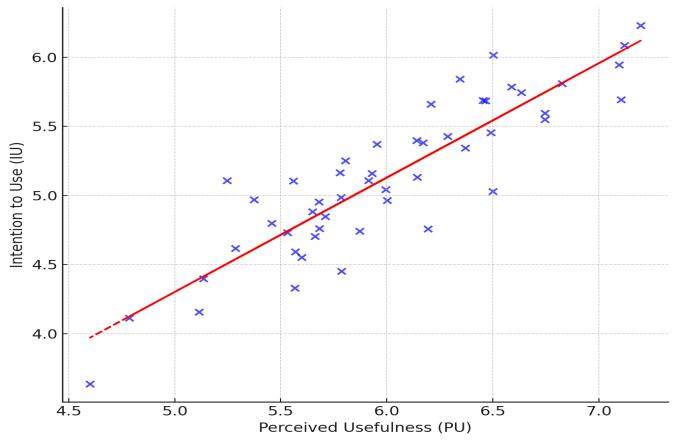
Visual correlation indicated a strong linear relationship betweenPUandIU(Figure6.5).
3.3.2.
ThemeanEOUscoreacrossfiveitemswas 5.7.While74% rated the system as easy to use, several noted initial difficultywithloginandtextentry.
Table -1: PerceivedEOUScore
Item Avg. Score Majority Response
EOU1 6.0 StronglyAgree
EOU2 5.9 Agree
EOU3 5.5 Agree
EOU4 4.9 NeutraltoAgree
EOU5 5.1 Agree
These results suggest high usability overall but room for improvementininput-relatedfeatures.
Trustscoresaveraged 6.1,with91%indicatingconcernfor privacyanddataintegrity.Responsesemphasized:
Confidenceinsystemreliability
Needfortransparentsecuritypolicies
International Research Journal of Engineering and Technology (IRJET) e-ISSN: 2395-0056
Volume: 12 Issue: 05 | May 2025 www.irjet.net p-ISSN: 2395-0072
Participantsreported: “I’dbehappytousethesystemaslongasitdoesn’tshare mylocationwithoutconsent.”
3.3.4. Intention to Use (IU)
Two items measured IU, both scoring 5.6 (IU1, IU2), confirming alignment between users' intention and their perceptionofsystemutility.
Graphical comparisons (Figures 1 and 2) confirmed that both PU and EOU strongly influence IU scores, validating priorresearchontechnologyacceptancemodels[21,13].
3.4
Post-surveyfocusgroupsandthink-aloudprotocolsyielded thefollowingkeythemes:
1. Intuitive Navigation: Users favored the menu structureandfoundresourcebrowsingnatural.
2. Messaging Utility: Group chats were seen as a majorstrength.
3. FrustrationPoints:On-screenkeyboardbehavior, smalltaptargets,andoccasionallagwererecurrent issues.
4. Context-Aware Design: Positive reception for location-basedfeatures,especiallyincollaborative tasks.
3.5
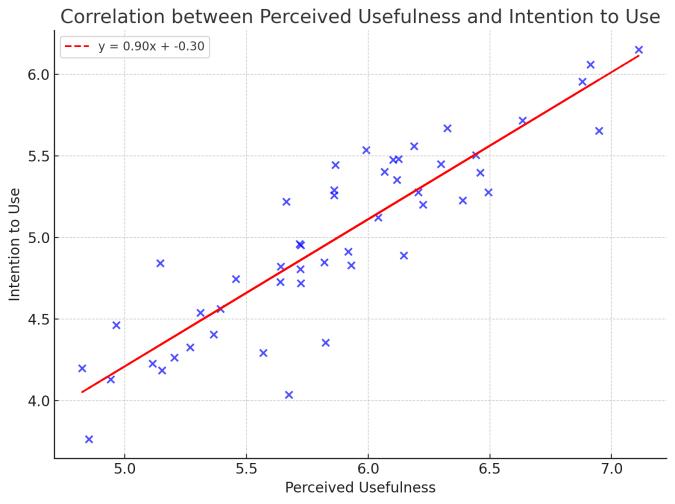
Fig. 3 CorrelationbetweenPUandIU
The figure illustrates the correlation between Perceived Usefulness(PU)andIntentiontoUse(IU).Itdepictsastrong positive linear trend, supporting the conclusion that perceived usefulness is a primary predictor of system adoption.
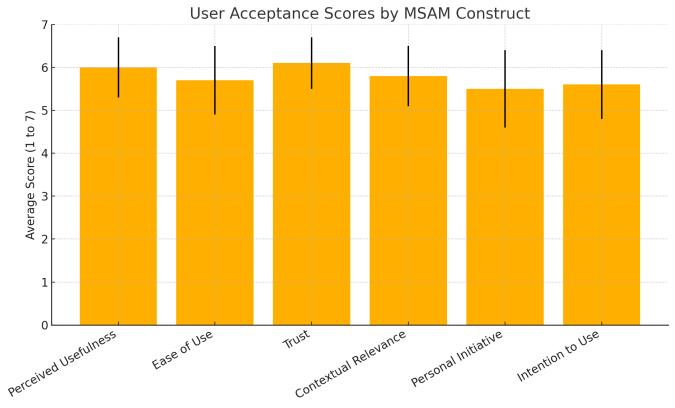
User acceptance scores across MSAM constructs. The chartpresentstheaverageratingsandstandarddeviations foreachconstruct:PerceivedUsefulness,EaseofUse,Trust, ContextualRelevance,PersonalInitiative,andIntentionto Use.
Moderatepositivecorrelation(R =0.68)indicatesthat easeof useinfluencesacceptance,albeittoa lesserextent thanusefulness.
International Research Journal of Engineering and Technology (IRJET) e-ISSN: 2395-0056
Volume: 12 Issue: 05 | May 2025 www.irjet.net p-ISSN: 2395-0072
Table -2:SummaryofMSAMConstructsandScores
UseeitherSI(MKS)orCGSasprimaryunits.(SIunitsare strongly encouraged.) English units may be used as secondaryunits(inparentheses). Thisappliestopapersin datastorage. Forexample,write“15Gb/cm2(100Gb/in2).” AnexceptioniswhenEnglishunitsareusedasidentifiersin trade, such as “3½ in disk drive.” Avoid combining SI and CGSunits,suchascurrentinamperesandmagneticfieldin oersteds.Thisoftenleadstoconfusionbecauseequationsdo not balance dimensionally. If you must use mixed units, clearlystatetheunitsforeachquantityinanequation.
TheSIunitformagneticfieldstrength H isA/m.However, if you wish to use units of T, either refer to magnetic flux density B ormagneticfieldstrengthsymbolizedasµ0H.Use thecenterdottoseparatecompoundunits,e.g.,“A·m2.”
4.1
The integration of Design Science Research (DSR) methodologywithinthedevelopmentandevaluationofthe MCLSprototypeenablediterativerefinementandempirical validation. DSR’s artifact-centric nature supported the creation of a functional mobile learning tool while maintainingalignmentwithpedagogicalneeds.Thisaligns withGregorandHevner’s[7] viewthatDSRartifactsshould embodybothrigorandrelevance.
Theprototype'sthree-tierService-OrientedArchitecture (SOA) promoted modularity and facilitated deployment across varied hardware environments. Usability testing provided actionable insights into design limitations, confirming the importance of continuous user feedback throughoutthedevelopmentcycle.
The usability evaluation revealed a direct correlation between perceived ease of use (EOU) and perceived usefulness (PU) with intention to use (IU). This confirms foundationalassertionsoftheTechnologyAcceptanceModel (TAM) [21] and its relevance in mobile learning contexts [10].Figure5belowillustratesthisrelationshipvisually.
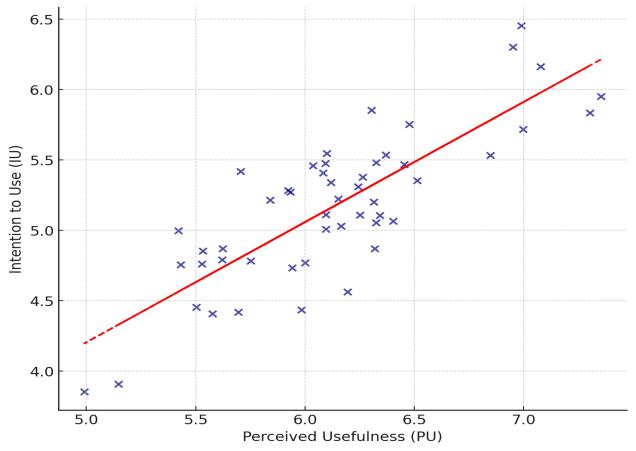
Fug 5 CorrelationBetweenEOUandPUwithIU
Fig. 5 Astronglinearcorrelation(R=0.84)wasobserved between PerceivedUsefulness and IntentiontoUse.Userswho foundthesystemhelpfulweresignificantlymoreinclinedto adoptit.
Thesefindingssupportearlierstudiesthatemphasizedthe mediatingroleofsystemusabilityinshapinguserattitudes andbehavioralintentionstowardeducationaltechnologies [22,23].
Unlike traditional TAM models, the Mobile Services Acceptance Model (MSAM) extends the analytical framework by introducing constructs such as Trust and ContextualRelevance.Withtrustscoringanaverageof6.1/7, itwasthehighest-ratedconstructinourstudy.
Participantsindicatedahighlevelofconcernforprivacy, particularly in relation to location tracking and message storage. The finding underscores the importance of embedding transparency and secure data handling mechanismsinmobilelearningsystems[19].
“I feel confident using this system as long as it doesn't leakmylocationorchatdata.”–UNMStudent
Furthermore, contextual awareness manifested in features such as location-based collaboration was positivelyreceived,resonatingwithargumentthatreal-time situationaldataenhancescollaborativelearning[9].
The figure below summarizes average acceptance scores acrossthesixMSAMconstructs:
International Research Journal of Engineering and Technology (IRJET) e-ISSN: 2395-0056
Volume: 12 Issue: 05 | May 2025 www.irjet.net p-ISSN: 2395-0072
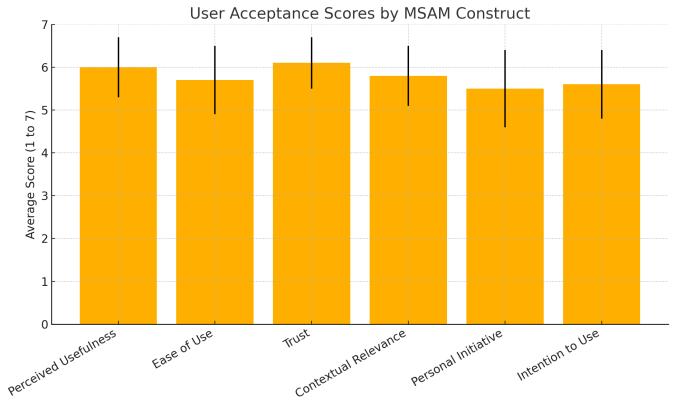
Fig. 6 Scores across MSAM constructs indicate strong performancein Trust and PerceivedUsefulness,followedby Contextual Relevance and Ease of Use. The scores detail illustratedinTable3below.
Construct Average Score Implication
Perceived Usefulness
6.0 Confirms system meets core learningneeds
EaseofUse 5.7 Suggests intuitive design but roomforUIenhancements
Trust
Contextual
Relevance
Personal Initiative
Intentionto Use
6.1 Emphasizesimportanceofsecure andreliablefunctionality
5.8 Validates benefit of situational awareness
5.5 Reflectsreadinesstoexplorenew techamongparticipants
5.6 Indicates high likelihood of adoptionifconcernsaddressed
Theseinsightsalignwithpreviousresearchthatunderscores trust and relevance as differentiating factors in mobile technologyadoption[24,19].
4.5 Implication of Mobile Learning System Designers
This study reveals three core design implications for educationaltechnologists:
1. Security-by-Design is Critical Systems should implement user-controllable privacy settings, transparent permission notifications, and robust encryption. Trust is not optional;itisaprerequisiteforadoption.
2. Prioritize Context-Relevant Collaboration Features
Tools that leverage location or group presence awareness(e.g.,real-timepeerlocation)offerusers immediatesituationalbenefitandencouragesocial
interaction ahallmarkofsuccessfulcollaborative learningenvironments.
3. User-Centered Interface Design
Despite high overall satisfaction, issues with onscreenkeyboard,inputfields,andmessagedelivery interfacesshowthatevenminorfrictioncanaffect adoption. Incorporating standard usability heuristicsisessential[4].
UsingtheDSRmethodologyofferedstructurediteration and a balanced focus on both artifact and evaluation. Key takeawaysinclude:
Early Prototyping Matters:Rapiddeploymentof MVPs(minimumviableproducts)ensuresempirical feedback.
UserEvaluationMustBeMulti-modal:Combining heuristic inspection with task-based testing and post-task interviews captures a full spectrum of usability.
Theory Integration Strengthens Design: EmbeddingTAM-derivedmodelslikeMSAMallows theory-guided measurement and diagnostic analysis.
These findings are consistent with Janson et al., who emphasize that DSR in educational software development shouldincorporateempiricalevaluationstiedtoestablished behavioralmodels[25].
Despite encouraging results, several limitations should be noted:
DeviceDiversity:TestingwaslimitedtoWindows Mobile platforms, which may not generalize to AndroidoriOSecosystems.
Sample Size: With 50 participants, broader generalizations require replication on larger cohorts.
Single Institution Context:Cultural,institutional, and curriculum differences may affect how MCLS wouldperformelsewhere.
Future research should explore cross-platform development, longitudinal impact, and cross-cultural validation ofMSAMconstructs.
This study reinforces a growing body of research advocatinghybridmethodologicalframeworks integrating design, usability, and behavioral modeling for the developmentofeducationaltechnologies.Itechoesasimilar emphasisonsystemqualityandperceivedusefulnessaskey antecedents of technology adoption in e-learning environments[26,27].
International Research Journal of Engineering and Technology (IRJET) e-ISSN: 2395-0056
Volume: 12 Issue: 05 | May 2025 www.irjet.net p-ISSN: 2395-0072
Additionally,theintegrationof constructivistpedagogical principles through open-ended collaboration tools aligns with recent educational app classifications emphasizingmanipulableandconstructiveapptypes[28.].
The rapid expansion of mobile technologies presents both opportunities and challenges for educational institutionsseekingtoenhancelearningoutcomesthrough digitalinnovation.Thisstudyembracedthe DesignScience Research (DSR) methodology to develop, evaluate, and reflect upon a Mobile Collaborative Learning System (MCLS) that supports real-time communication, locationbased collaboration, and access to learning materials anytimeandanywhere.
By integrating usability engineering and the Mobile Services Acceptance Model (MSAM),thestudydelivered anartifactthatwasbothfunctionallyrobustandempirically groundedinuserexperienceandbehavioralanalysis.
Severalcoreinsightsemergedfromthisresearch:
Design Science Research provideda disciplined, iterativeprocessforartifactdevelopment,allowing for purposeful evaluation and continuous improvement.
The usability testing results confirmed that the MCLS prototype met most user expectations regarding functionality, ease of use, and interface design. Key usability attributes efficiency, satisfaction, and learnability were positively rated.
User acceptance,evaluatedusingMSAM,showed strong scores across all constructs. Notably, Perceived Usefulness (PU) and Trust were the mostinfluentialfactorsinshapingthe Intentionto Use (IU).
Contextual Relevance, particularly features involving real-time location sharing and group collaboration, significantly enhanced the educationalvalueofthesystem.
Participantfeedbackrevealedthatwhilethesystem performed well overall, future iterations should address device compatibility, streamline input mechanisms,andimprovevisualfeedbacktousers.
These findings collectively affirm that well-designed mobile systems built upon user-centered principles and evaluated using rigorous behavioral frameworks can effectivelysupportcollaborativeandflexiblelearning.
[1] Sharples,M.,Taylor,J.,&Vavoula,G.(2007).Atheoryof learning for the mobile age. In R. Andrews & C. Haythornthwaite (Eds.), The SAGE handbook of elearningresearch (pp.221–247).SAGEPublications.
[2] Traxler, J. (2009). Current state of mobile learning. InternationalReviewofResearchinOpenandDistributed Learning,10(1),1–9.
[3] Crompton, H. (2013). A historical overview of mobile learning: Toward learner-centered education. In Z. L. Berge & L. Muilenburg (Eds.), Handbook of Mobile Learning (pp.3–14).Routledge.
[4] Nielsen, J. (1993). Usability engineering. Morgan Kaufmann.
[5] Park,Y.,Nam,M.,&Cha,S.(2012).Universitystudents’ behavioralintentiontousemobilelearning:Evaluating the technology acceptance model. British Journal of Educational Technology, 43(4), 592–605. https://doi.org/10.1111/j.1467-8535.2011.01229.x
[6] Hevner, A. R., March, S. T., Park, J., & Ram, S. (2004). Design science in information systems research. MIS Quarterly, 28(1), 75–105. https://doi.org/10.2307/25148625
[7] Gregor, S., & Hevner, A. R. (2013). Positioning and presenting design science research for maximum impact. MIS Quarterly, 37(2), 337–355. https://doi.org/10.25300/MISQ/2013/37.2.01
[8] Kukulska-Hulme, A., & Traxler, J. (2005). Mobile learning: A handbook for educators and trainers Routledge.
[9] Roschelle, J., & Pea, R. D. (2002). A walk on the WILD side: How wireless handhelds may change CSCL. InternationalJournalofCognitionandTechnology,1(1), 145–168.
[10] Cheon, J., Lee, S., Crooks, S. M., & Song, J. (2012). An investigation of mobile learning readiness in higher education based on the theory of planned behavior. Computers & Education, 59(3), 1054–1064. https://doi.org/10.1016/j.compedu.2012.04.015
[11] Donaldson, R. L. (2011). Student acceptance of mobile learning (Doctoral dissertation, Florida State University).https://purl.fdlp.gov/GPO/gpo25803
[12] Saeed,N.,&Abdinnour,S.(2013).Understandingpostadoption IS usage stages: An empirical assessment of self-service information systems. Information Systems Journal,23(3),219–244.
2025, IRJET | Impact Factor value: 8.315 | ISO 9001:2008
International Research Journal of Engineering and Technology (IRJET) e-ISSN: 2395-0056
Volume: 12 Issue: 05 | May 2025 www.irjet.net p-ISSN: 2395-0072
[13] Venkatesh,V., Morris,M.G., Davis,G.B.,& Davis,F.D. (2003). User acceptance of information technology: Towardaunifiedview. MISQuarterly,27(3),425–478.
[14] Liew,B.T.,Kang,M.,&You,J.(2013).Investigatingthe determinantsofmobilelearningacceptanceinKorea.In World Conference on Educational Multimedia, HypermediaandTelecommunications (pp.1424–1430). AACE.
[15] Wang,Y.,Wu,M.,&Wang,H.(2009).Investigatingthe determinants and age and gender differences in the acceptance of mobile learning. British Journal of EducationalTechnology,40(1),92–118.
[16] Alsmadi,M.K.,&Hameed,F.(2020).Aservice-oriented architecture for mobile educational applications. Education and Information Technologies, 25(1), 515–534.https://doi.org/10.1007/s10639-019-09974-2
[17] Scholtz,J.(2004).UsabilityEvaluation. NationalInstitute of Standards and Technology (NIST). https://www.nist.gov/publications
[18] Dumas,J.S.,&Redish,J.C.(1999). A practical guide to usabilitytesting (Reviseded.).IntellectBooks.
[19] Gao, S., Krogstie, J., & Siau, K. (2011). Developing an extended technology acceptance model for mobile services. InformationSystemsFrontiers,13(3),395–409. https://doi.org/10.1007/s10796-009-9144-4
[20] Venable,J.,Pries-Heje,J.,&Baskerville,R.(2016).FEDS: Aframeworkforevaluationindesignscienceresearch. EuropeanJournalofInformationSystems,25(1),77–89. https://doi.org/10.1057/ejis.2014.36
[21] Davis,F.D.(1989).Perceivedusefulness,perceivedease ofuse,anduseracceptanceofinformationtechnology. MISQuarterly,13(3),319–340.
[22] Šumak, B., Heričko, M., & Pušnik, M. (2011). A metaanalysisofe-learningtechnologyacceptance:Theroleof usertypesande-learningtechnologytypes. Computers in Human Behavior, 27(6), 2067–2077. https://doi.org/10.1016/j.chb.2011.08.005
[23] Huang, Y. M., Lin, Y. T., & Cheng, S. C. (2014). Effectiveness of a mobile plant learning system in a sciencecurriculuminTaiwaneseelementaryeducation. Computers & Education, 71, 85–91. https://doi.org/10.1016/j.compedu.2013.09.007
[24] Balakrishnan,V.,&Gan,C.L.(2016).Students’intention to use mobile technology for learning. Educational Technology&Society,19(3),150–162.
[25] Tarhini,A.,Hone,K.S.,&Liu,X.(2014).Measuringthe moderating effect of gender and age on e-learning
acceptanceinEngland:Astructuralequationmodeling approachforanextendedtechnologyacceptancemodel. JournalofEducationalComputingResearch,51(2),163–184.https://doi.org/10.2190/EC.51.2.b
[26] Tarhini,A.,Hone,K.S.,&Liu,X.(2014).Measuringthe moderating effect of gender and age on e-learning acceptanceinEngland:Astructuralequationmodeling approachforanextendedtechnologyacceptancemodel. JournalofEducationalComputingResearch,51(2),163–184.https://doi.org/10.2190/EC.51.2.b
[27] Lin, W. S., & Wang, C. H. (2012). Antecedents to continued intentions of adopting e-learning system in blended learning instruction. Computers & Education, 58(1),88–99. https://doi.org/10.1016/j.compedu.2011.07.008
[28] Goodwin,K.,&Highfield,K.(2012).iPadsinschools:A literature review. Macquarie School of Education Research Report. https://researchmanagement.mq.edu.au