
International Research Journal of Engineering and Technology (IRJET) e-ISSN: 2395-0056
Volume: 12 Issue: 09 | Sep 2025 www.irjet.net p-ISSN: 2395-0072
International Research Journal of Engineering and Technology (IRJET) e-ISSN: 2395-0056
Volume: 12 Issue: 09 | Sep 2025 www.irjet.net p-ISSN: 2395-0072
Mazeen J Bisti1 , Shradha Hiremath2
1Post graduate student, Dept of civil Engineering, SGBIT college, Belagavi, Karnataka, India
2Assistant professor, Dept of civil Engineering, SGBIT college, Belagavi, Karnataka, India
Abstract -The structural performance of building is highly dependent on soil condition and the geometryofthe structural system. Irregular building configurations such as L-shaped plans are more vulnerable to seismic and differential settlement effects compared to regular structures. This study investigates the influence of soil parameters onthe response of an L-shaped reinforced concrete building. A skeleton model of the building is developed and analyses using STAAD.Pro, incorporating soil-structure interaction. The results obtained from the software are compared with manual calculations based on IS codes to validate accuracy.
Key Words: Soil-Structure Interaction (SSI) Shear force, Bending moment, Soil parameters
1.INTRODUCTION
Structural safety and serviceability are significantly influencedbysoilproperties,asthefoundationactsasaload transferring medium between the superstructure and the ground. Building with irregular plans, such as L-shaped configuration,areincreasinglycommonduetoarchitectural and functional requirements. However, irregularity in geometry makes such structures more prone to torsional effect,unevenloaddistribution,anddifferentialsettlement.
Traditionallystructuralanalysishasbeencarriedoutusing manual methods considering simplified assumptions. However, modern structural software like STAAD.Pro enables detailed three- dimensional modelling, soil interactioninclusion,andrealisticloadsimulation.Despite the efficiency of software, validation through manual calculations remains essential to ensure accuracy and reliability.
A foundation is the lowest part of a structure that transfers the load of the building safely to the ground. It provides stability by spreading the loads uniformly over a sufficient area ofsoil, preventing excessivesettlement and structuralfailure.Inshort,foundationactasbridgebetween the superstructure above ground and the soil It gives the buildingstability, keeps it from settling,and makes sure it remainssturdyinthefaceofwind,earthquakesandchanges
inload.Thefoundationrolesputboththedeadandliveloads ontheground.
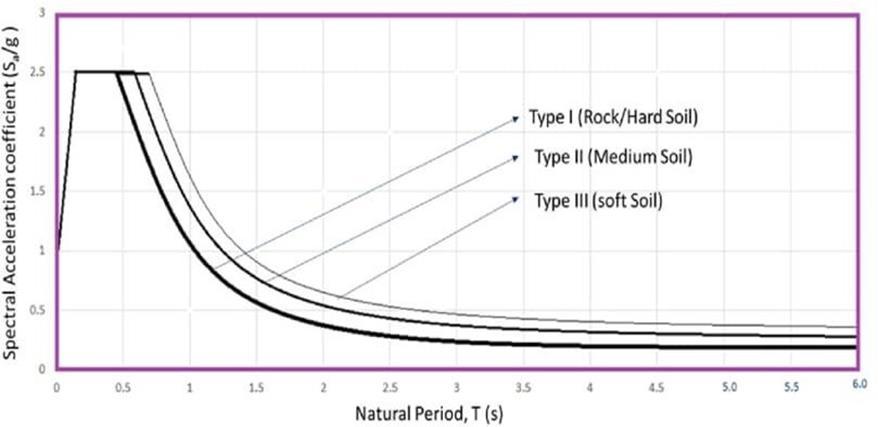
Soil condition refers to the physical mechanical, and chemical characteristics of the soil at a construction site. Theseconditionsplayacrucialroleindeterminingthetypes of foundation, the stability, compressibility, drainage, and moisture content directly affect how soil interacts with structuralloads.
2. LITERATURE REVIEW
1. Seismicdesignofmultistorybuildingwithdifferentsoil condition:DurgeshVermaMahroofAhmed(2024)Analyzed RCC multi-Storey structures on varying soil types using STAADProV8iwiththeequivalentstaticmethod,focusingon displacement,baseshear,anddrifttoassessstabilityunder seismicloading.examinedresearchonstructuresoverhard, medium,andsoftsoils,pointingoutthatmoststudiesfocus on the seismic effects of medium soils while paying less attentiontowindeffects.comparedvariousheightsandsoil conditions in STAAD Pro simulations to investigate the impact of seismic zones and soil stiffness on SMRF frame performance
2.Seismicanalysisanddesignofbuildingindifferentzone and soil types using STAAD PRO Software: Prof Girish Vinayak Joshi, Mr. Rahul (2023) analyzed G+6 residential structures in seismic zones III and IV using STAAD Pro, reporting notable variations in material cost with zone changes. Compared multi-story building designs using staadproandmanualmethodsfindingthatsoftware-based
International Research Journal of Engineering and Technology (IRJET) e-ISSN: 2395-0056
Volume: 12 Issue: 09 | Sep 2025 www.irjet.net p-ISSN: 2395-0072
approaches save time and increase accuracy. Examined seismic responses of buildings across all Indian zones throughstaticanalysisaidingsaferdesigndecisions.thenthe demonstratedthesignificantroleofsoiltypeininfluencing seismic performance of multi-Storey structures validated STAAD Pro’s efficiency in seismic evaluation, ensuring compliancewithdesignstandards.
3.Impact of varying soil condition of the design of tall building foundation:VijayShivajiandSamina Kazi(2024) studiedtheeffectofvaryingaspectratiosontallbuildings under wind loads using the equivalent static method in staadproandshowingthatnotablechangesindisplacement appliedtheGustEffectivenessFactorMethod,offeringbetter accuracyforflexiblehigh-risestructures.enhancedthegust loading factor approach to overcome limitations in predictingcertainstructuralresponses.
4.Study of soil structure interaction for framed structures withshallowfoundation:Dr.RajeevGoelandDr.AjitKumar (2018) Research indicates that soil–structure interaction (SSI) significantly influences structural behavior under earthquakes. Observed that softer soils lead to greater displacements and base shear in framed buildings. found that closer spacing between buildings increases seismic response.warnedthatneglectingSSIwhileconsideringonly site conditions may compromise safety on soft soils. reported that inertial interaction is more critical than kinematic effects, especially in taller structures. that SSI increases vibration periods and reduces structural resistanceinflexiblebasesystems
3. OBJECTIVES
To analyze the structural response of an L- shaped buildingunderdifferentsoilconditions.
TomodelandstudythebuildingusingSTAAD.Prowith soil-structureinteraction.
Compare soil types see how structures behave differently on soft soil, medium soil, and hard rock underthesameearthquakeload.
To evaluate the effect of soil flexibility on the overall safetyandserviceabilityofirregularbuilding.
Toanalyzethebuildinginvarioussoiltypesandseismic zones.
Problem Definition
Collection of data
Modelling of building
Software Analysis in staad.pro
Study of soil parameters
Comparing the software results and manual calculation
Conclusions
Future scope
Table -1: Designparameter
Particularofitemsproperties
Totalbuilt-uparea 379m2
Numberofstories G+4
Floortofloorheight 3.6m
Beamsize 230x600mm
Columnsize 230x600mm,230x450mm
Slabthickness 150mm
Mainwallthickness 230mm
Gradeofconcrete M30
Gradeofsteel Fe550
Densityofreinforced concrete 25kN/m3
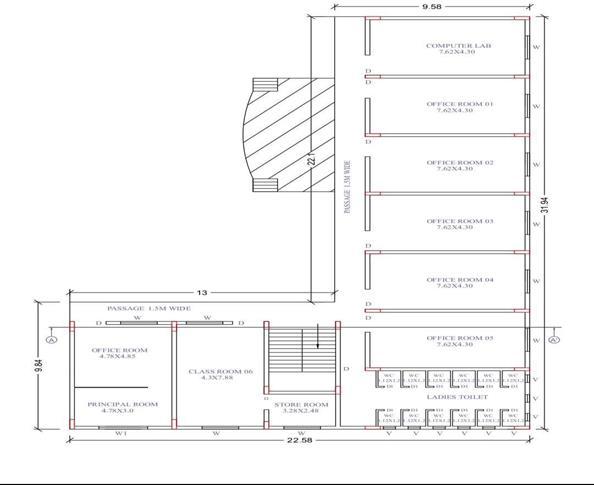
InthisprojectaG+4storeystructureofaL-buildingwith3.6 floorheighthasbeenanalyzedR.C.CbuildingusingSTAAD ProsoftwareinzoneV.Thestructurehasbeenanalyzedfor seismicconditionHard,Medium,andsoftsoilconditionhas beenselectedforthestructure.
International Research Journal of Engineering and Technology (IRJET) e-ISSN: 2395-0056
Volume: 12 Issue: 09 | Sep 2025 www.irjet.net p-ISSN: 2395-0072
Structural Analysis in STAAD Pro
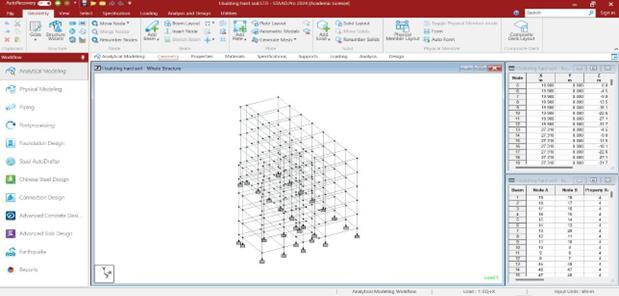
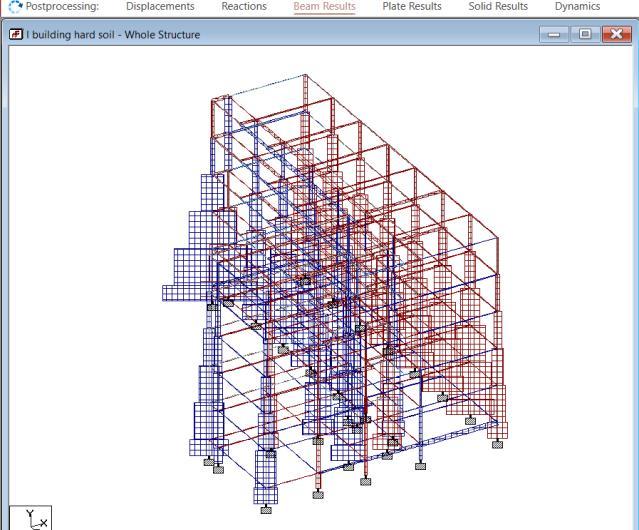
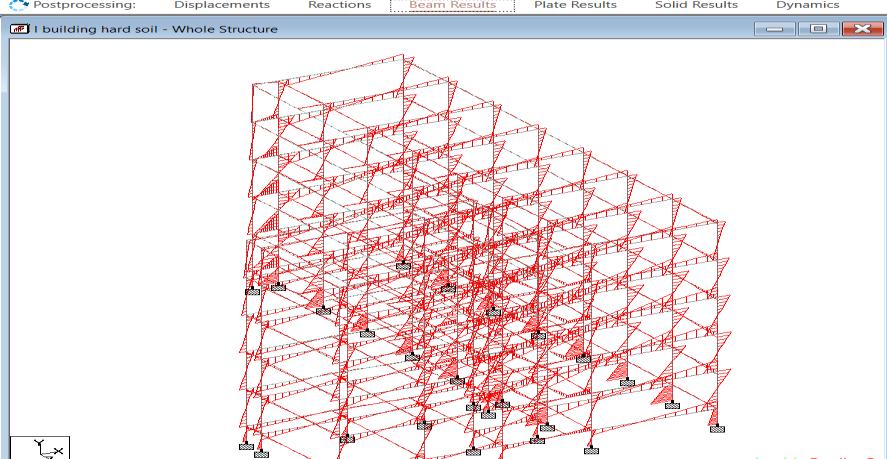
TheanalysisoftheL-shapedbuildingwascarriedoutforthe three-differentsoilconditionhardsoil,mediumsoil,andsoft soil.Thestructuralresponsewasstudiedintermsofshear force (SF), bending moment (BM). Results obtained from STAAD.Prowerevalidatedwithmanualcalculations.
Table -2: Comparisonofsoftwareresulttomanual
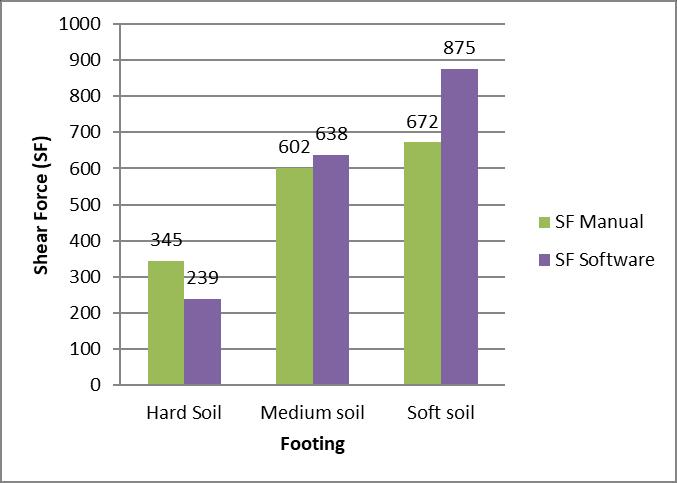
Chart-1:DesignofShearforce
The SF of hard soil, medium soil and soft soil footing is 239kN,638kNand875kNrespectively
International Research Journal of Engineering and Technology (IRJET) e-ISSN: 2395-0056
Volume: 12 Issue: 09 | Sep 2025 www.irjet.net p-ISSN: 2395-0072
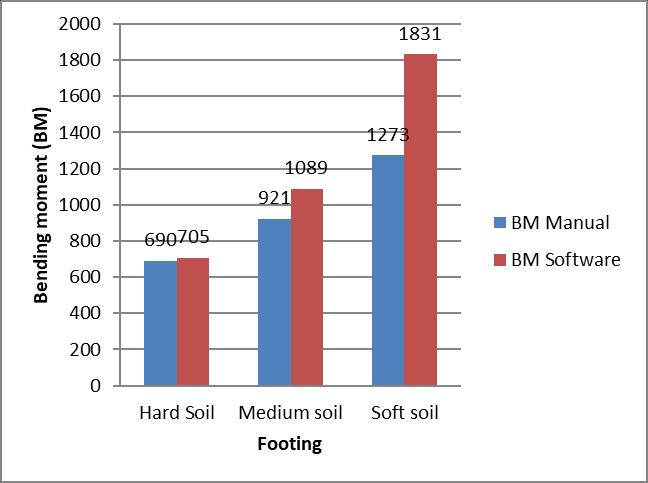
Chart-2: DesignofBendingmoment
The BM of hard soil, medium soil and soft soil footing is 705kNm,1089kNmand1831kNmrespectively
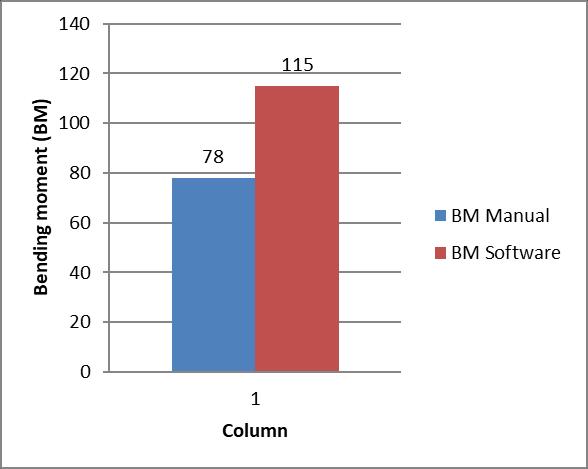
Chart-3:Designofcolumn
Bendingmoment(BMD)andshearforce(SFD)valuesrise assoilstrengthfallsfromhardtomediumtosoft,according to a comparison of STAAD Pro analysis and manual calculationsforL-shapedbuildingswithvarioussoiltypes. This suggests that the structural response is directly influencedbysoilcondition,withsoftersoilsplacinggreater demands on members. Because of the uneven load distribution at the corners, L-shaped buildings typically exhibithigherforcesthanothertypesofbuildings.Thevalues derivedfromSTAADProareconsistentlyhigherduetoits accurate modeling of load distribution and soil–structure interaction, even though manual results are fairly close. Although manual techniques are helpful for initial inspections,STAADProresultsshouldbeusedforsafeand dependabledesignsincetheymoreaccuratelydepictactual structuralbehaviors.
IwanttoexpressmygratitudetoMs.ShradhaHiremath,an assistant professor in the S.G. Balekundri Institute of
Technology's Department of Civil Engineering, for her unwaveringsupportanddirectionduringthisprojectreport. Additionally, I am appreciative of the helpful advice and supportprovidedbyDr. SantoshChikkabagewadi,Headof Department,and Mr. Parasharam Sawant, PG Coordinator. Mysinceregratitudetotheprincipal,Dr.B.R.Patagundi,for his unwavering encouragement. I also want to thank my parents, teachers, and friends for their encouragement throughoutthisproject.
•Ramamrutham,S.,andNarayan,R.,“Designofreinforced concretestructures”,Dhanpatiraypublishingcompany,14th edition,1998.
•H.S.Vishwanath,“DesignofReinforcedCementConcrete”, Sapnabookhouse,2018.
•IS456:2000,IndianStandardCodeforpracticeofplainand reinforced concrete (Fourth revision), Bureau of Indian standards,NewDelhi,July2000
• Mr.MagadeS.B,Prof.Patankar.JP“Effectofsoilstructure interaction on the dynamic behaviors of buildings”. IOSR JournalofcomputerEngineering(IOSR-JCE)2018.
• Barkha Verma, Anurag Wahane “Effect of different soil condition on seismic response of multi- storey irregular modelusingSTAADPro.V8i”.InternationalResearchJournal ofEngineeringandtechnology(IRJET)Volume06Issue09 Sep2019.