
International Research Journal of Engineering and Technology (IRJET) e-ISSN: 2395-0056
Volume: 12 Issue: 11 | Nov 2025 www.irjet.net p-ISSN: 2395-0072
International Research Journal of Engineering and Technology (IRJET) e-ISSN: 2395-0056
Volume: 12 Issue: 11 | Nov 2025 www.irjet.net p-ISSN: 2395-0072
Sakthieswari B1,Mrs.B.Shyamala devi M.sc, M.phil.2
1PG Student, Department Of Computer Applications, Jaya College Of Arts and Science, Thiruninravur, Tamilnadu,India
2Assistant Professor Department Of Computer Applications, Jaya College Of Arts and Science, Thiruninravur, Tamilnadu,India ***
Abstract - Cloud-basedstorageoptimizationhasbecomea critical area of research as organizations increasingly rely on cloud computing for managing vast amounts of data. Thispaperexploresadvancedstrategiesaimedatenhancing the efficiency, scalability, and cost-effectiveness of cloud storage systems. Key optimization techniques such as data deduplication, compression, caching, tiered storage, and intelligent resource allocation are discussed for their roles in minimizing redundancy, improving access speed, and maximizing storage utilization. The study also examines major challenges including latency, data security, and cost management that affect cloud performance. Emerging technologies like AI-drivenautomation, predictiveanalytics, and edge computing integration are highlighted as transformative tools for intelligent data management and faster retrieval processes. Furthermore, the paper emphasizes the importance of achieving a balance between high performance and sustainability to reduce energy consumption and carbon footprint. Future trends such as quantum cloud storage and decentralized storage networks are explored for their potential to revolutionize data storage paradigms. Overall, this research provides a comprehensive understanding of modern cloud storage optimization methods, focusing on how innovative technologies and strategies can deliver efficient, reliable, and eco-friendly cloud-based storage solutions for the growingdigitalecosystem.
Key Words : Cloud storage, Storage optimization, Data management, Cloud computing, Data deduplication.
Cloud computing has revolutionized data storage by offeringscalable,pay-as-you-gomodelsthroughplatforms suchasAmazonWebServices(AWS),MicrosoftAzure,and GoogleCloud.Theseplatformsprovidevirtualizedstorage infrastructurethatallowsusers to storeand retrieve data anytime, anywhere. As organizations generate massive volumes of data from IoT devices, social media, business analytics, and multimedia applications, efficient storage optimization is essential to reduce costs, improve access speed, and maintain system reliability. Storage
optimization in cloud environments aims to maximize performance and resource utilization while minimizing redundancy and latency. Moreover, advanced techniques such as automated data tiering, AI-based workload management, and predictive analytics are increasingly being integrated to enhance storage efficiency. The adoption of hybrid and multi-cloud architectures further supports flexibility and scalability, allowing businesses to distribute workloads intelligently. Security and data integrity also play a crucial role, ensuring that optimized storage solutions do not compromise confidentiality or compliance. Ultimately, effective cloud storage optimization contributes to improved operational efficiency, sustainability, and long-term data management success.
1.Tostudyandanalyzevarioustechniquesforoptimizing cloud-basedstoragesystems.
2. To identify challenges in managing large-scale data efficientlyincloudenvironments.
3. To explore future trends and technologies that can enhancecloudstorageperformanceandcost-efficiency.
Severalstudieshaveexploredcloudstorageoptimization:
- Zhou et al. (2022) emphasized deduplication and compression to reduce redundant data storage by up to 60%. - Kumar and Singh (2021) highlighted the role of hybridcloudmodelsforbalancingperformanceandcost.
- Li et al. (2023) proposed AI-driven storage allocation models that predict demand patterns and dynamically allocateresources.
These studies demonstrate that combining multiple optimization strategies can significantly enhance performanceandcostsavings.
Atypicalcloudstoragesystemconsistsof: -Front-endinterface:HandlesuserrequestsandAPIcalls.
- Storage management layer: Manages data distribution, replication,andfaulttolerance.
2025, IRJET | Impact Factor value: 8.315 | ISO 9001:2008 Certified Journal | Page 24
International Research Journal of Engineering and Technology (IRJET) e-ISSN: 2395-0056
Volume: 12 Issue: 11 | Nov 2025 www.irjet.net p-ISSN: 2395-0072
-Physicalstorageinfrastructure:Composedofdistributed serversandstoragedevices.
- Network layer: Ensures secure and reliable data transmission.
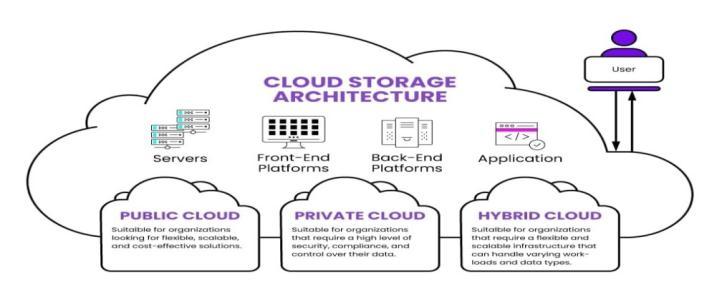
. Fig-1:Cloudstoragearchitecture
5.1 Data Deduplication
Deduplication eliminates redundant data by storing only unique copies and referencing duplicates. It significantly reduces storage usage, especially in backup and archival systems.
5.2 Data Compression
Compression reduces file size without losing essential information, improving storage efficiency and network bandwidthusage.
5.3 Caching and Tiered Storage
Caching frequently accessed data in faster storage (e.g., SSDs) improves access speed. Tiered storage combines high-performance and low-cost storage media based on dataaccessfrequency.
5.4 Erasure Coding and Replication
These methods ensure fault tolerance and data recovery. Erasure coding offers storage efficiency compared to traditionalreplication.
5.5 AI and Machine Learning-Based Optimization
AI models can predict access patterns, dynamically allocate resources, and automate backup and migration processes,improvingperformanceandreducingcosts.
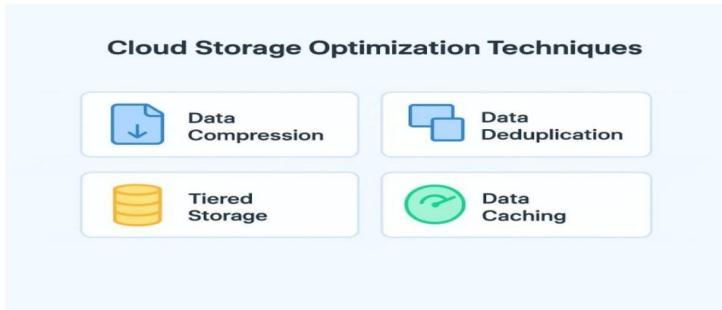
Fig-2:Cloudstorageoptimizationtechniques
1.DataSecurityandPrivacy:Protectingdataduring transmissionandstorageremainsamajorconcern.
2.Latency:Geographicdistanceandnetworkcongestion cancausedataretrievaldelays.
3.CostManagement:Balancingcostandperformanceis difficultforlarge-scaledatastorage.
4.VendorLock-in:Migratingdatabetweenproviderscan becomplexandexpensive.
5.ScalabilityIssues:Rapiddatagrowthrequiresdynamic andscalablestoragesolutions.
- Edge Computing Integration: Processing data closer to thesourcereduceslatencyandbandwidthusage.
- AI-Driven Resource Management: Predictive models for demandforecastingandauto-scaling.
- Blockchain-Based Storage: Enhances transparency and dataintegrity.
- Green Cloud Storage: Focus on energy-efficient storage architecturesusingrenewableenergy.
- Quantum Storage Prospects: Future quantum systems mayrevolutionizestoragedensityandsecurity.
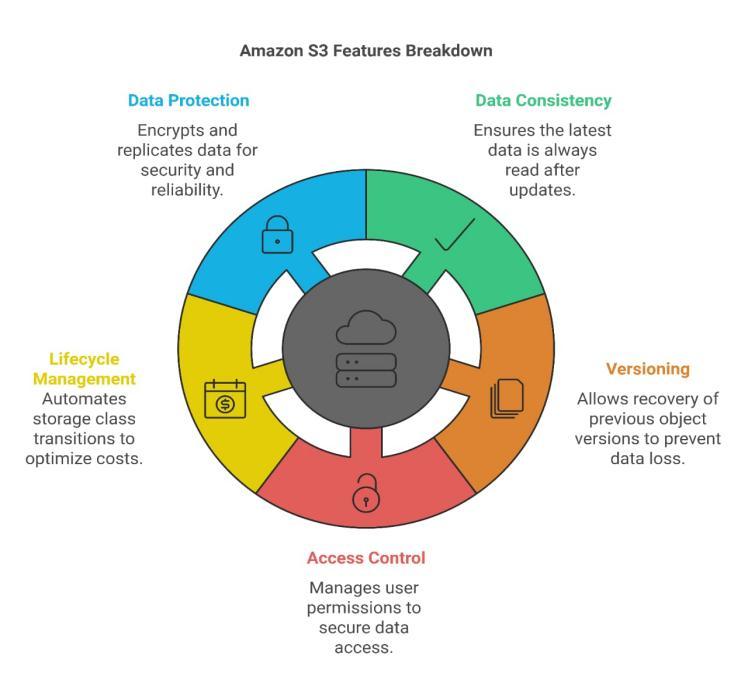
Amazon S3 employs multiple optimization layers including automatic tiering (Standard, Infrequent Access, Glacier), object lifecycle management, and compression. By adopting these strategies, AWS customers have achieved cost reductions of up to 40% for long-term storage.
International Research Journal of Engineering and Technology (IRJET) e-ISSN: 2395-0056
Volume: 12 Issue: 11 | Nov 2025 www.irjet.net p-ISSN: 2395-0072
Cloud-based storage optimization is essential to handle the ever-increasing data generated by modern applications. Techniques such as deduplication, compression, caching, and AI-driven allocation enable more efficient use of cloud infrastructure. However, challenges related to security, latency, and cost require continuousresearchandinnovation.TheintegrationofAI, edge computing, and blockchain represents the future of optimized, intelligent, and sustainable cloud storage systems.These advancements not only improve performance and reduce operational costs but also promoteenergyefficiency,pavingthewayforgreenerand more resilient cloud environments capable of supporting thedemandsofnext-generationdigitalapplications.
10. REFERENCES
[1] Zhang, Q., Cheng, L., & Boutaba, R. (2010). Cloud computing: State-of-the-art and research challenges. JournalofInternetServicesandApplications,1(1),7–18.
[2] Borthakur, D. (2011). The Hadoop distributed file system: Architecture and design. Hadoop Project WhitePaper,ApacheSoftwareFoundation.
[3] El-Shimi,A.,Kalach,R.,Kumar,A.,O’Donovan,B.,Li,J., & Sengupta, S. (2012). Primary data deduplication Large scale study and system design. USENIX Conference on Annual Technical Conference (ATC), 285–296.
[4] Li, J., Zhou, X., & Xu, Z. (2018). An intelligent caching mechanism for cloud storage optimization. IEEE TransactionsonCloudComputing,6(3),700–712.
[5]AlZain,M.A.,Pardede,E.,Soh,B.,&Thom,J.A.(2012). Cloud storage security: A survey of risks, threats, and mitigation techniques. Journal of Network and ComputerApplications,35(3),745–754.
[6]Wang,C.,Ren,K.,Lou,W.,&Li,J.(2010).Toward publiclyauditablesecureclouddatastorageservices. IEEENetwork,24(4),19–24.
[7] Satyanarayanan, M. (2017). The emergence of edge computing.Computer,50(1),30–39.
[8] Wu, J., Ping, L., Ge, X., Wang, Y., & Fu, J. (2010). Cloud storage as the infrastructure of cloud computing. InternationalConferenceonIntelligentComputingand CognitiveInformatics,380–383.
[9] Singh, S., Jeong, Y. S., & Park, J. H. (2016). A survey on cloud computing security: Issues, threats, and solutions. Journal of Network and Computer Applications,75,200–222.
[10] Lloyd, W., Pallickara, S., & David, O. (2020). Energyefficientcloudcomputing:Balancingperformanceand sustainability. IEEE Transactions on Cloud Computing,8(2),409–422.