
International Research Journal of Engineering and Technology (IRJET) e-ISSN: 2395-0056
Volume: 12 Issue: 05 | May 2025 www.irjet.net p-ISSN: 2395-0072
International Research Journal of Engineering and Technology (IRJET) e-ISSN: 2395-0056
Volume: 12 Issue: 05 | May 2025 www.irjet.net p-ISSN: 2395-0072
Siddhant Singh1 , Chandan Dubey1 , Nasir Hussain 1 , Parvez Ahmad1 , Mr. Umesh Chandra Pandey2
1 B. Tech Mechanical Engineering final year, Goel Institute of Technology &Management, Lucknow 2 Assistant Professor, Department of Mechanical Engineering, Goel Institute of Technology &Management, Lucknow
Abstract -:Thisprojectintroducesabrakingsystemthatis designed to operate autonomously in automobile systems. This system is capable of sensing any danger through the sensor installed in it. It is also equipped with an obstacle detectionsystemtonavigatethroughcomplexenvironments. Onceanobstacleorsuddenbrakeisdetectedthenthesystem activates and start pumping the brake automatically. The systemispoweredthroughabattery,whichisinstalledinthe automobile. This approach allows for sustainable and offguardoperation,particularlyusefulinsettingslikeforestsor isolatedzoneswheretheroadsarenotingoodcondition.
Key Words: - ElectronicStabilityControl,TractionControl, Steerability, Hydraulic Modulator, Wheels Speed Sensors, WheelLock,Pump,Controlleretc.
1. INTRODUCTION
ABS is a critical safety feature in automobiles, designed to mitigatewheellock-upduringabruptbraking.Bymodulating brake pressure, ABS maintains tire traction with the road, allowingdriverstosteerwhilebraking.Thisreportanalyzes ABS mechanics its evolution, and its impact on accident prevention
ThisisakindofsystemthatpreventslockingtheWheelsat thetimeofbraking.ItalwayskeepseyesontheWheelsSpeed andcontrolsthevehicletoskid.
1.1 KEY FEATURES
TherearevariouskeyfeaturesoftheAntilockBrakingSystem givenbelow.
Thissystemwilldevelopadvancedvehiclecontrol.
Itwillimprovebrakingperformanceofthevehicle.
Itwillincreasethedistanceofstoppingvehicles.
Itwillenhancethestabilityofthevehicle.
Thiswillimprovetheefficiencyoftiresandenhance
Thelifeofthevehicle.
1.2 Objective
Themainobjectiveistocreatean autonomoussystemthat operatesonbatteriesinstalledinthevehicleandthesensor
will detect the speed of wheels. This system is designed to improvethesafetyoftravelersandreducetheaccidentsthat takeplacebecauseofthetechnologydefectinthevehicles
[1] This volume provides a comprehensive introduction to thefundamentalsofautomobileengineering,focusingonthe design, construction, and operation of various automotive systems.Itisstructuredtoserveundergraduatestudentsand beginnersinthefield,withemphasisonclarityandpractical understanding.
[2] The Anti-lock Braking System (ABS) is a crucial safety featureinmodernvehicles,designedtopreventwheellockupduringbraking,therebymaintainingtractivecontactwith the road surface and allowing the driver to retain steering control.Here'sacomprehensivesummaryofitscomponents andoperation
[3] The history of Anti-lock Braking Systems (ABS) traces backtotheearly20thcentury,withsignificantdevelopments overthedecadesleadingtothesophisticatedsystemsusedin modernvehicles.Here'saconcisesummary
[4] This review is part of a research initiative focused on designing intelligent ABS tailored for the diverse road conditionsofSaudiArabia.ItexaminestheevolutionofABS control methodologies, highlighting the transition from traditionaltointelligentcontrolsystems.
[5] The primary goal of the research was to design an ABS controller that maintains the wheel slip ratio close to an optimal value of 0.2. Achieving this slip ratio ensures maximum traction between the tires and the road surface, thereby improving braking efficiency and vehicle stability duringemergencybrakingsituations.
[6] The dissertation focuses on developing a Fuzzy Logic Controller (FLC) for an Anti-lock Braking System (ABS) that improves braking performance by maintaining the optimal wheel slip ratio (around 0.2) undervaryingroad anddrivingconditions.
International Research Journal of Engineering and Technology (IRJET) e-ISSN: 2395-0056
Volume: 12 Issue: 05 | May 2025 www.irjet.net p-ISSN: 2395-0072
[7] The authors present ABS as a critical safety feature in modernvehicles,designedtopreventwheellock-upduring braking,therebymaintainingsteeringcontrolandreducing stoppingdistances.ThepaperdiscussestheevolutionofABS technology,itsfundamentalcomponents,anditssignificance inenhancingvehiclesafety.
Inthissystemwehavechangedsomedesignpreferencesand workedontheefficiencyofworkingofthesystem.
An antilock braking system has a wide range of potential applications, especially in conditions where sustainability, safety, and limited access to critical technology. Key applicationareasinclude:
Remote and Wildland Areas: Idealforcombatingforestor grasslandroadconditionswherehumanaccessisdifficultand technicalsourcesareunavailable.
Industries: Useful in factories and, warehouses, where technical support is difficult. Antilock system can prevent damageandprotectproductsinhazardousenvironments.
Disaster Areas: Effective in post-earthquake or disasterareas with damaged infrastructure, offering help in performingoperationwithoutanyinterferenceandincreases efficiency.
Defense Sectors: Can be deployed in high- risk zones like ammunitiondepotsorconflictareaswhere armedvehicles areused.
In Smart Cities:Forthesmartcitiesthissystemwillbegame changerinpreventingtheaccidents.
In Agricultural Sectors: Useful for protecting crops and equipment in farmlands, especially during rainy days or in remotelocationslackinginfrastructureinfarmlands.
5. Methodology: The Methodology for the project titled antilock breaking system typically involves severel key fhases. These includes requirement analysis planning hardwerwassemblyformulationofaneffectivesystem.
Planning: The planning of project taken place because of accident parsentage is increasiing arround the world, We have planned it on the previouse work taken placed in the sectors.
Hardware Selection: Selectsuitablesensorssuchasspeed detectionandcontrolunitalongwithactuatorlikevalveand
pump ensuring compativility with the project functional requirement.
Design And Assembaly: Cunstructthemechanicalstructure ofthesystemtoprovidesecuremountingandprotectionfor all components. Asemble the system in line with the establisheddesignbluprint,makingsurethatsensor,actuator andcontrolunitareaccuratlyplaced.
[Wheel Speed Sensors]
[ECU]
[Hydraulic Modulator] → [Brake Valves]
[Brake Pads]
[Wheels]
Fig-1:ANTILOCKBRAKINGSYSTEM
6 Working: ABS works during locking up of a wheels in closed-loopsystemwithaseriesofinputsandoutputs.The inputcomesfromthewheelspeedsensorsandtheoutputs arefromthebrakesystemandpressurecontrolbymaking useofECUcommands.TheECUthesignalsfromallthewheel sensors&computetheaccelerationofan individualwheel. Fromthisinformation,thebrakepressuregoestothewheels iscontrolled.
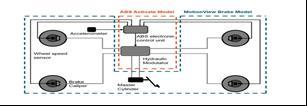
Fig-2:ANTILOCKBRAKINGSYSTEM
7 BILL OF MATERIAL
Table1:BillofMaterial
International
Volume: 12 Issue: 05 | May 2025 www.irjet.net
echanicalbooster.com/2017/08/anti-lock-brakingsystem.html,” 2017. [Online]. Available: https://www.mechanicalbooster.com/2017/08/anti-lockbrakingsystem.html
[6]A.A.Aras,DesignofacontrollerforABSantilockbreaking system using fuzzy logic control (Doctoral dissertation, Northridge,2013.
8. FUTURE SCOPE
The future scope of Anti-lock Braking Systems (ABS) is promisingduetoadvancementsinvehiclesafety,automation, andsmartmobility.
1. Integration with Advanced Driver Assistance Systems (ADAS)
2. EssentialinAutonomousandElectricVehicles
3. IoTandConnectedVehicleTechnologies
4. AIandMachineLearningEnhancements
9. CONCLUSION
ABSrevolutionizesvehicularsafetybyblendingmechanics andelectronicstopreventaccidents.Whilelimitationsexist, ongoing advancements promise smarter, more efficient\ systems.Itsadoptionunderscorestheautomotiveindustry’s commitmenttosavinglivesthroughinnovation.
10. REFERENCE
[1]D.K.Singh,“AutomobileEngineering,”vol.1,2008.
[2] “ABS COMPONENT DESCRIPTIONS & OPERATION. https://www.gonefcon.com/trucktcom/b_abs_components.ht m#top.”[Online].
Available: http://www.gonefcon.com/trucktcom/b_abs_components.ht m#top
[3]D.Hartman,“TheHistoryofABSBrakes.Retrievedfrom https://itstillruns.com/history-abs-brakes-5042665.html,” 2009.[Online].Available: https://itstillruns.com/history-abs-brakes-5042665.html
[4] A. A. Aly, E. S. Zeidan, A. Hamed, and F. Salem, “An antilock-brakingsystems(ABS)control:Atechnicalreview,” IntelligentControlandAutomation,vol. 2,no.3,pp.186–195,2011.
[5] P. Mishra, “Anti-lock Braking System (ABS) - Working Principle, Main Components with Advantages and Disadvantages.Retrievedfromhttps://www.m
[7]V.Mundhe,A.Deshpande,A.Mandvekar,N.Parkhad,and S. Kulwant, “A Review of Antilock Braking System,” InternationalJournalofResearchinAdvent Technology(IJRAT),pp.220–222,2017.





Siddhant Singh
B. Tech Mechanical Engineering final year
Chandan Dubey
B.TechMechanicalEngineeringfinal year
Nasir Hussain
B. Tech Mechanical Engineering final year
Pervez Ahmad
B.TechMechanicalEngineeringfinal Year
Mr.UmeshChandraPandey,Assistant Professor,GITM