
International Research Journal of Engineering and Technology (IRJET)
Volume: 12 Issue: 06 | Jun 2025 www.irjet.net
e-ISSN:2395-0056
p-ISSN:2395-0072
Volume: 12 Issue: 06 | Jun 2025 www.irjet.net
e-ISSN:2395-0056
p-ISSN:2395-0072
Nibin Sabu 1 , R Mohan Kumar ,M.E,2
1PG Scholar, BioMedical Engineering, Udaya school of engineering, Kanyakumari.
2Professor BioMedical department, Udaya school of engineering, Kanyakumari.
Abstract In order to monitor and optimize therapy, pharmacists must be able to manage children's fluids and electrolytes effectively. The three main components of pediatric fluid treatment are replacement, deficiency, and maintenance. The conventional technique for determining the amount of maintenance fluid needed is still the HollidaySegar equation. Fluid deficiencies must be taken into consideration when calculating the infusion rate for dehydrated patients; these deficiencies are often made up during the first 24 hours of admission. According to current research, hospitalized children may need more sodium than previously thought, therefore electrolyte management is equally crucial, with particular attention to sodium levels. Drug therapy can also be greatly impacted by fluid therapy. Drug distribution and metabolism are impacted by a child's level of hydration, and typical dosages of medications can be harmful to dehydrated individuals, especially when those medications have a high volume of distribution. Pediatric pharmacists have a vital role in monitoring fluid and electrolyte therapy. The most recent findings and developments in this field are highlighted in this paper, along with real-world healthcare applications. The safety and accuracy of fluid distribution for pediatric patients have been greatly improved by technological developments such automated infusion pumps. By adjusting infusion rates according to each patient's unique fluid and electrolyte needs, these smart devices can lower the risk of dehydration or overhydration and facilitate flexible clinical decisionmaking. Additionally, it offers an optimistic outlook on the advancement of wearable sensor technology for babies, which could transform real-time electrolyte and hydration monitoringinpediatriccare.
Keyword’s: IoT (Internet of Things), Electrolyte Monitoring, Infant Health Monitoring, ESP8266 NodeMCU,Real-Time Alerts, Wireless Data- Transmission, Threshold-BasedDetection.
A crucial component of clinical practice in pediatriccare,especiallyforbabies,isfluidandelectrolyte control, which has a direct impact on patient outcomes. Young children's hydration and electrolyte requirements
are more dynamic and sensitive than those of adults, making the delicate balance of fluids and electrolytes in the body extremely important. Maintaining appropriate hydration, addressing any deficiencies, and replenishing lost fluids are all components of effective fluid treatment for kids. Traditional techniques for keeping an eye on and modifying fluid and electrolyte therapy, however, can be time-consuming and prone to human error. Healthcare practitionerscannowcreateautomated,real-timesystems that continuously monitor these vital indicators thanks to developmentsinInternetofThings(IoT)technologies.[1]. Thissystemconsists ofa wearablegadgetthattracksvital electrolytes, such as sodium, potassium, and chloride, as well as hydration levels using sensors. Real-time transmission of these measurements to medical professionals enables prompt actions in the event that abnormalitiesareidentified.Inadditiontoimprovingfluid and electrolyte management's accuracy and safety, this IoT-based strategy lowers the possibility of problems like drug toxicity that may result from incorrect fluid distribution. Therapy is further optimized by the incorporation of smart infusion pumps, which can modify the fluid infusion rate in response to real-time data from the wearable device. By facilitating more precise, individualized,anddynamicfluidmanagement,thisdevice has the potential to completely transform pediatric treatment and enhance patient safety and clinical results. [2]. Patients in hospitals are supplied electrolytes in a variety of methods. Saline serves a number of vital purposes, including treating dehydration and enhancing overall health. When a saline is administered to a patient inmodern medical treatments,thepatientiscontinuously monitored by a nurse or other caregiver. One of the most crucial duties for a nurse or other caregiver is to keep an eye on the amount of saline in a bottle that is fastened to the patient's body. Nowadays, a large number of women are employed in industrialized countries, which has an impact on how many families care for their infants. Because of the high expense of living, both parents must work. They still have to care for their infants, though, which adds to their workload and stress levels, particularly for the mother. It is not always possible for working parents to care for their children. While they work,theyeitherhireababysitterorsendtheirchildrento
International Research Journal of Engineering and Technology (IRJET) e-ISSN:2395-0056
Volume: 12 Issue: 06 | Jun 2025 www.irjet.net p-ISSN:2395-0072
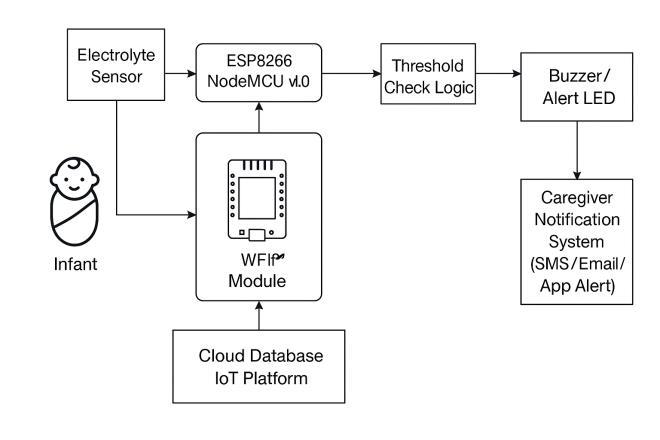
their parents. Some parents are concerned about their children's safety when they are in the care of others.[3]. Anand et.al proposed Saline serves a number of vital purposes, including treating dehydration and enhancing overall health. When a saline is administered to a patient inmodern medical treatments,thepatientiscontinuously monitored by a nurse or other caregiver. One of the most crucial duties for a nurse or other caregiver is to keep an eye on the amount of saline in a bottle that is fastened to the patient's body. The bottle may get empty in situations involving negligence or ignorance, and blood from the patient'sbodymaybegintoflowbackwardintothebottle. There must be a better way to handle this dangerous scenario. We are creating an Internet of Things (IoT)based bottle level monitoring system that will always detect the saline bottle level by alerting the hospital's monitoring room when the bottle content falls below a certain threshold. The suggested device can monitor any fluid and is not electrolyte specific. The solution has the extra benefit of flexibility and modularity since it can be integrated with already-existing bottle stands. [4]. Ahlam Shakeel Ansari et.al H 2 O 2 reacts during operation to chemicallydegradetheelectrolytemembranesinpolymer electrolytefuelcells(PEFCs).Additionally,thecyclicstress broughtonbybeginningandstoppingoperationsdamages the electrolyte membranes. Because water elongates the electrolyte membranes during PEFC operation, and because the membranes contract under waterless conditions during halt operation. The quality of the membranes eventually deteriorates due to the accumulation of these mechanical and/or chemical damages. A perforating testing device was created specifically for this investigation in order to examine the distribution of deterioration on the electrolyte membranes. This testing device allows us to create a "degradation map" that shows the extent of deterioration in a PEFC cell.[5],[6]., System architecture is illustrated in Fig. 1. Therefore, real-time noninvasive biomarker recordings are helpful for assessing an athlete's physiological states, such as how hydrated they are throughoutenduranceactivity.Inthispaper,wepresenta platform that comprises various sweat biomonitoring prototypes of smart, affordable wearable devices for ongoing sweat biomonitoring during physical activity. A prototype that requires the integration of various sensors andprintedsensorswiththeirrespectivefunctionalization protocols on the same substrate is based on conformable and disposable soft sensing patches with an integrated multi-sensor array. The second is predicated on paper microfluidics and silicon-based sensors. [7],[8]. Utilizing the Node Micro-Controller Unit (NodeMCU) Controller Board, the data collected by the sensors is transmitted to theAdaFruitMQTTserverviaWi-Fi.Thesuggestedsystem
makes use of sensors to track the baby's vital signs, including crying, moisture content, and ambient temperature. Using Nx Siemens software, a prototype of thesuggestedinfantcradlewascreated.
Thecradle'smaterialisredmerantiwood.Ababy cradle that uses a motor to swing automatically in response to the baby's screams is part of the system architecture. The lullaby toy on the baby cradle can be remotely turned on via the MQTT server to delight the infant, and parents can also use an external webcam to keep an eye on their child's health. The suggested system prototype is built and tested to demonstrate its costeffectiveness and ease of use, as well as to guarantee safe operation,allowingbaby-parentingtotakeplaceanywhere and at any time over the network. Lastly, the prototype shows that the baby monitoring system is successful in keepinganeyeontheinfant'sconditionandsurroundings. [9]. Aleksey.et.al proposed. A dangerous kind of arrhythmia, elevatedblood pressure,andrenal failurecan all result from abnormal electrolyte levels in the blood. A non-invasivemethodofmeasuringheartelectricalactivity, the electrocardiogram (ECG) can pick up on minute variations in electrolyte levels. Although it has been documented that ECGs with aberrant electrolyte ranges, like potassium levels, can be classified, continuous ECGs mustbeused toregress electrolytevalues. Onesignificant obstacle to training machine learning-based models for this purpose is label scarcity. Furthermore, the distribution of measured electrolyte values that are availableindatasetsfromelectronichealthrecordsusually hasfewerdata pointsatthe extremes,whichare essential forpreciseprediction.[10].
2.METHODOLOGIES
The proposed system is an IoT-based solution developed to continuously monitor electrolyte levels in infants and provide timely alerts to caregivers or medical
International Research Journal of Engineering and Technology (IRJET) e-ISSN:2395-0056
Volume: 12 Issue: 06 | Jun 2025 www.irjet.net
staff in case of abnormalities. The core of the system is built around the ESP8266 NodeMCU v1.0 microcontroller, whichoffersin-builtWi-Fifunctionality,enablingseamless connectivity to the internet and cloud databases. The system architecture includes a fluid or electrolyte level sensor,whichcontinuouslymeasurestheconcentrationor volume of electrolytes present. This sensor is interfaced with the NodeMCU through analog or digital input pins, dependingonthesensorspecifications.Thesensordatais read at regular intervals (e.g., every 5 seconds), digitized, andcomparedwithapredefined thresholdvalue,which is initiallysetto25%asaminimumsafetymargin.However, thesystemprovidesflexibilityforhealthcareprofessionals to adjust the threshold limit as per medical guidelines or thespecificneedsoftheinfant.
Once the data is received by the microcontroller, the onboard logic evaluates the fluid level using a conditional threshold comparison algorithm. If the sensed valuedropsbelowthethreshold,thesystemidentifiesthis as an abnormal condition. In such cases, a local alert mechanism is triggered via a buzzer or LED indicator to immediately notify anyone in the vicinity. Simultaneously, the system establishes a Wi-Fi connection using the ESP8266's integrated module to send the data to a cloud database such as Firebase, Thing speak, or Blynk. This database stores the fluid level data in real time, enabling both live monitoring and historical trend analysis. The cloud platform also facilitates remote accessibility, where authorizeduserscanaccessdatafrommobileapplications or web dashboards. These interfaces are designed to be user-friendly and provide visualization of electrolyte levels,configurationof thresholdvalues,andaccesstothe alertlog.
The system is equipped with an emergency alert mechanism that is activated when electrolyte levels fall critically low. When this condition is met, the cloud platform sends out instant notifications via SMS, email, or app alerts to registered caregivers, ensuring rapid response to potential medical emergencies. Additionally, the alert messages are timestamped and contain patientspecificidentifiers,makingitsuitableforhospitalorhomecare integration. The entire system was thoroughly tested undersimulatedconditionsusingapotentiometerinplace of the sensor to simulate various electrolyte levels. Performance was evaluated in terms of response time, data accuracy, connectivity reliability, and alert latency. Resultsshowedthatthesystemwasabletoreliablydetect threshold breaches and issue alerts in under 3 seconds, with high consistency. Data integrity during transmission to the cloud was maintained, and the user interface allowed easyconfiguration andreal-time monitoring.This
p-ISSN:2395-0072
makes the proposed methodology a practical and costeffectivesolutionfornon-invasive,real-timemonitoringof infantelectrolytesinclinicalandhome-careenvironments.
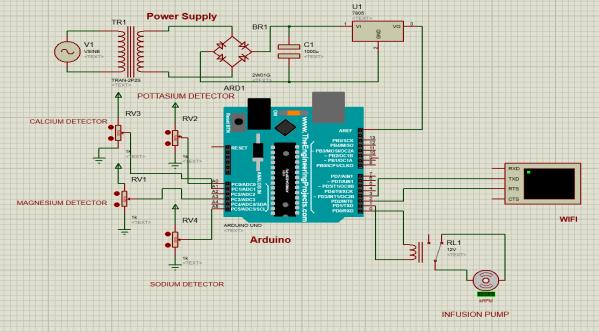
Inthismodel,thepatientwasgivensomeanalyses bydoctorinsomeportionofthehospitalThiswilltransfer the required information from the sender and receiver wirelesslywiththeuseoftransceiver.Thecompletehealth monitoring unit, that was proposed is combined into a minor compact unit as slight as a cell phone. electrolyte likesodiumfinderbyusingIRsensorandpotassiumfinder using ph sensor. Node MCU, ESP12E is a low-cost open source IoT platform. The microcontroller is considered as the heart of the IoT based projects. In this project we use ESP12E micro-controller which can act as an interface between the sensors and cloud. It has an in-built Wi-fi module whichcansendand receivedata wirelessly.Itisa micro controller with an availability for Wi-Fi module for theproposedsystem.
Infraredsensorsaremadetopickuponparticular wavelengths that are linked to particular substances. Certainmethods,suchasspectroscopy,maybeneededfor potassium. Identify the context of your demand, be it environmental monitoring, industrial application, or laboratorystudy.Sincemanycommoninfraredsensorsare not tuned for specific elements or ions, make sure the sensor you select can be calibrated for potassium detection. For a more precise potassium measurement, you can think about using ion-selective electrodes or atomic absorption spectroscopy (AAS) if infrared sensors arenotappropriate.
AsodiumfinderwithapHsensorisatechniqueor apparatus thatusespHreadingstoindirectlyestimatethe quantityofsodiumions.Thereareparticulartechniquesor
International Research Journal of Engineering and Technology (IRJET)
Volume: 12 Issue: 06 | Jun 2025 www.irjet.net
ion-selective electrodes that can be modified to detect sodium (Na⁺) ions, even though pH sensors normally measure the concentration of hydrogen ions (H⁺). To detect sodium ions, there are electrodes called sodiumselective electrodes (Na⁺-ISE). Because of their sodium sensitivity, these electrodes generate a potential that is proportional to the amount of sodium ions present in a solution. These are not the same as standard pH sensors, though. Sometimes very high amounts of sodium ions mightaffectapHsensor.ThisisknownasthepHsensor's salt or alkaline mistake. Although this is typically thought of as a measuring mistake in pH systems, if calibrated appropriately, it can be used to estimate sodium concentrationincertainsituations.
Magnesium (Mg²⁺) is a vital electrolyte that is involved in many biological processes, such as DNA synthesis, neuron transmission, muscle contraction, and heartrhythmmaintenance.Inordertoidentifyimbalances thatmayresultinconsequenceslikeseizures,arrhythmias, orbreathingproblems,itmightbeextremelyimportantto monitormagnesiumlevelsinnewborns,particularlythose in neonatal or intensive care units. An Internet of Thingsbasedsystem for ongoing monitoringcan incorporate this magnesium detecting module, providing caregivers and medical professionals with real-time data. A thorough explanationofhowtocreateandimplementsuchamodule maybefoundbelow.
A sensor or sensing system intended to identify and quantify calcium ion (Ca2+) concentrations in a solution is commonly referred to as a calcium detection module.Applicationsforthiskindofmodulecouldinclude industrial procedures, environmental testing, and biological monitoring. The majority of calcium detection modulesarebuiltaroundacalciumion-selectiveelectrode. It produces a detectable electrical potential that is correlated with calcium concentration by binding to calciumionsselectively.Inordertoensureprecisecalcium detection, these electrodes are made to disregard other ionssuchasNa+orK+.
By simplifying development for the end user, wireless LAN (WLAN) modules that support IEEE 802.11 b/g/nstandardsaredesignedtoprovideWiFiconnectivity on any embedded device. These plug-and-play embedded WIFI bgn modules combine security components, TCP/IP (Network) stacks, and embedded WLAN stacks into a
e-ISSN:2395-0056
p-ISSN:2395-0072
compact form factor device. This self-contained serial to wi-fi module solution can be powered by a basic 8/16/32 bit microcontroller (MCU) that is inexpensive and low power.These integrated modules offer a WLAN interface for any device and are fully IEEE 802.11 bgn compatible. These fully certified (FCC, IC, CE) wireless LAN modules support 2.4GHz and 802.11bgn, enabling a range of applications in the machines-to-machine (M2M), medical, homeautomation,andindustrialIoT(IIoT)markets.These arecompletelyintegratedsolutionsforarangeofwireless embedded applications. The entire operational temperature range of -40 to +85 degrees is supported by theseindustrialwifimodules.
Data collected from the device is sent to a cloud database where it is stored along with timestamps. This module allows medical staff and caregivers to visualize real-time data through a mobile or web-based dashboard. It also provides access to historical records, trends, and alert logs, which are essential for analyzing long-term healthconditionsormakingclinicaldecisions. Thiscritical module is responsible for sending emergency alerts whenever an abnormal condition is detected. It communicateswithcloudservicesorAPIstodispatchSMS, email, or app notifications instantly. The alert contains patient ID, fluid level status, and timestamp, ensuring quick identification and response. This module helps in bridging the gap between remote monitoring and rapid medicalintervention.
The IoT-based electrolyte monitoring system for infants was successfully developed, tested, and validated under controlled conditions. The system effectively measured electrolyte or fluid levels using a sensor integrated with theESP8266NodeMCUmicrocontroller.Duringthetesting phase, simulated electrolyte level variations were introduced using a potentiometer, and the system consistently detected changes in real-time. The thresholdbased detection logic accurately identified when the fluid level dropped below the predefined value of 25%, and triggered both local (buzzer/LED) and remote alerts (via SMS and email). The average response time between thresholdbreachandalertgenerationwasmeasuredtobe lessthan3seconds,demonstratingthesystem’s efficiency inreal-timemonitoring.
The cloud integration using platforms like FirebaseandBlynkenabledseamlessstorageandretrieval ofsensordata.Theuserinterfaceaccessiblethroughaweb
International Research Journal of Engineering and Technology (IRJET)
Volume: 12 Issue: 06 | Jun 2025 www.irjet.net
or mobile dashboard displayed real-time readings, historical trends, and alert logs, allowing caregivers and healthcare providers to take informed actions. Additionally, the threshold setting could be modified remotely, adding flexibility for customized medical response based on individual patient needs. Data transmissionwasfoundtobereliablewithminimalpacket loss, and the system operated continuously for over 48 hoursduringtheendurancetesting,confirmingitsstability andlowpowerconsumption.
In conclusion, the developed system provides a low-cost, real-time, and scalable solution for continuous monitoring of electrolyte levels in infants. By minimizing the need for constant manual observation, it significantly reduces the workload of healthcare staff while enhancing the safety and health outcomes for infants. The modular nature of the system allows for easy upgrades and customization, making it suitable for both hospital and home-care settings. Future enhancements may include integration with advanced biomedical sensors, AI-based predictive analytics, and machine learning for anomaly detection to further improve the system’s effectiveness andintelligence.
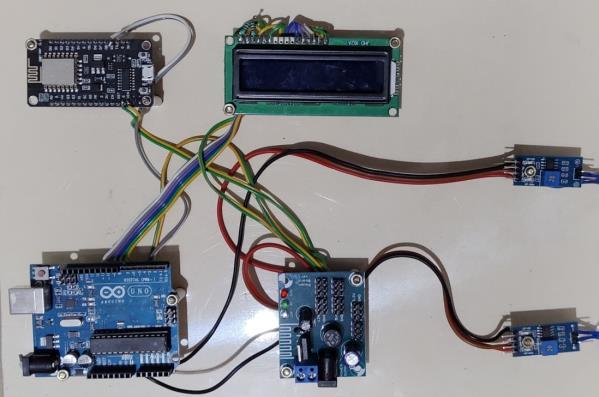
As shown in Fig.4, The prototype of the IoT-based electrolyte monitoring system was evaluated using simulated sensor inputs to represent fluid levels in a clinicalenvironment.Theevaluationwasbasedonseveral performance parameters including response time, accuracy, data transmission reliability, alert delivery latency,andpowerefficiency.
e-ISSN:2395-0056
p-ISSN:2395-0072
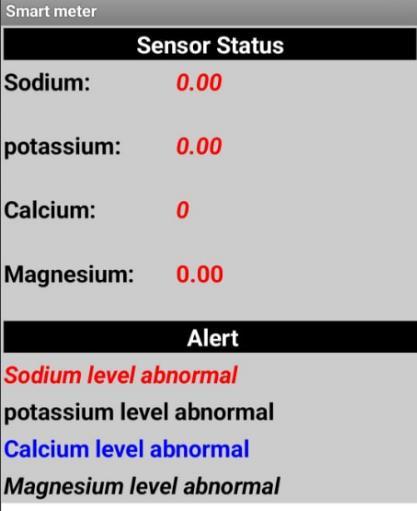
InFig.4, Thesystem demonstrateda responsetime ofless than 3 seconds from the moment the electrolyte level dropped below the threshold (25%) to the activation of local and remote alerts. This rapid response is crucial in healthcare applications where timely interventions can prevent medical complications. In terms of accuracy, the system correctly identified fluid level changes with a detection precision of approximately 96% based on repeated trials using known resistance values to simulate fluiddepletion.
The data transmission reliability was measured over a 48-hour continuous test period, during which sensordata wassenttoa Firebaseclouddatabaseevery 5 seconds. The packet success rate remained above 98%, indicating highly stable Wi-Fi connectivity and consistent cloud storage without significant data loss. The alert delivery system, configured to send SMS and email notifications, recorded an average delay of 2.5 seconds, which is acceptable for non-invasive, non-critical applications and can be improved using real-time messagingprotocols.
The development of an IoT-based prototype for monitoring electrolytes in infants is a significant advancementinneonatalhealthcare.Thisprototypeoffers real-time monitoring of critical electrolyte levels, such as sodium (Na⁺), potassium (K⁺), calcium (Ca²⁺), and Magnesium, which are crucial for maintaining proper physiological balance in infants. By integrating ionselective sensors and pH sensors with a secure IoT infrastructure, the system enables continuous and remote
International Research Journal of Engineering and Technology (IRJET) e-ISSN:2395-0056
Volume: 12 Issue: 06 | Jun 2025 www.irjet.net p-ISSN:2395-0072
monitoring, thereby enhancing clinical care and early detectionofimbalances.
Althoughthesuggestedsystemshowsausefuland effective method for keeping track of newborns' electrolyte and hydration levels, there are a number of opportunities for further development and expansion: Integration of Other Biomarkers: In order to provide a morethoroughpictureofnewbornhealthandmetabolism, future iterations may incorporate sensors for measuring calcium, magnesium, glucose, and lactate levels. Miniaturization and Wearable Design Enhancements: To guarantee the utmost comfort and flexibility for neonates and preterm infants, even in NICU settings, efforts can be undertaken to further reduce the wearable patch's size and weight. Cloud-Based Analytics and AI Integration: Preventive healthcare is made possible by integrating machine learning algorithms and implementing cloud storage for previous data. This helps anticipate any electrolyteimbalancesordehydrationpatternsbeforethey becomeserious.
[1] Dharmale AA, Mehare RR, Bharti AR, Meshram SR, Deshmukh SV. IoT Based Saline Level Monitor-ing & AutomaticAlertSystem.InternationalJournalofAdvanced Research in Computer and Commu-nication Engineering. 2019April;8(4):72-6.
[2] Sanjay B, Sanju Vikasini RM. IoT Based Drips Monitoring at Hospitals. International Research Journalof Engineering and Technology (IRJET). 2020 April;7(04):1352-4.
[3] Anand J, Flora A. TG: Emergency traffic management for ambulance using wireless communication.IPASJ Int. J. Electron.Commun.(IIJEC).2014;2(7):1-4.
[4] Hii PC, Chung WY. A comprehensive ubiquitous healthcaresolutiononanAndroid™mobiledevice.Sensors. 2011Jul;11(7):6799-815.
[5] Swain MK, Mallick SK, Sabat RR. Smart saline level indicatorcum controller. International Journal ofApplicationorInnovationinEngineering&Management (IJAIEM).2015Mar;4(3):299-301.
[6] M. D. Amaral. “Novel personalized therapies for cystic fibrosis: Treating the basic defect in all patients”. In: Journal of Internal Medicine 277.2 (2015), pp. 155–166.issn:13652796.doi:10.1111/joim.12314.
[7] A. Silva et al. “Cystic fibrosis - characterization of the adult population in Portugal”. In: Revista Portuguesa de Pneumologia 22.3 (2016), pp. 141–145. issn: 08732159. doi:10.1016/j.rppnen.2015.12.010.
[8]CysticFibrosisMutationDatabase.
[9] F. Ratjen et al. “Cystic fibrosis”. In: Nature reviews. Disease primers 1.May (2015), p. 15010. issn: 2056676X. doi:10.1038/nrdp.2015.10.
[10] T. S. Cohen and A. Prince. “Cystic fibrosis: A mucosal immunodeficiency syndrome”. In: Nature Medicine 18.4 (2012), pp. 509–519. issn: 10788956. doi: 10.1 038/nm.2715.
[11] P. M. Farrell et al. “Diagnosis of Cystic Fibrosis: Consensus Guidelines from the Cystic Fibrosis Foundation”. In: Journal of Pediatrics 181 (2017), S4–S15.e1.issn:10976833.doi:10.1016/j.jpeds.2016.09.064.
[12] F. Ratjen and G. Döring. “Cystic fibrosis.” In: Lancet (London, England) 361.9358 (2003), pp. 681–9. issn: 0140-6736.doi:10.1016/S0140-6736(03)12567.
[13] K. De Boeck, F. Vermeulen, and L. Dupont. “The diagnosis of cystic fibrosis”. In: Presse Medicale 46.6P2 (2017),e97–e108.issn:07554982.doi:10.1016/j.lpm.201 7.04.010.
[14] Cystic Fibrosis Foundation. CFTR-Related Metabolic Syndrome(CRMS).
[15] R. C. Stern. “The Diagnosis of Cystic Fibrosis”. In: The New England Journal of Medicine 336.7 (1997), pp. 487–491..