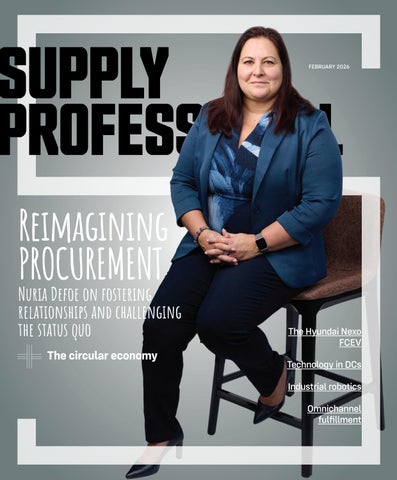
Supply Professional February 2026

Page 1


Reimagining PROCUREMENT

Nuria Defoe on fostering relationships and challenging the status quo The circular economy

UNLOCK HIDDEN BUSINESS VALUE WITH THE POWER OF INTRALOGISTICS

Successful intralogistics is all about building smart and staying agile throughout every stage of facilities management. With our engagement model that helps you ideate, activate and adapt innovative solutions, combined with the power of our family of companies, we can help you optimize your facilities for whatever tomorrow brings. Tackle the challenges of today and make the most of the opportunities of tomorrow.

ONE TRUSTED PARTNER THREE STAGES OF OPTIMIZATION ENDLESS OPERATIONAL ADVANTAGE

Robotics

Unified

Change

MOVING BEYOND RESILIENCY

The reaction to the news last month after Canada and China announced lower tariffs on products, including both Chinese electric vehicles and Canadian canola oil, made headlines globally. Media outlets including the BBC, The Wall Street Journal, and The New York Times covered the story. Some agreed with the move, others didn’t.

Through the deal, Canada expects that China will drop canola seed duties to 15 per cent, down from 84 per cent. As well, Canadian canola meal, lobsters, crabs, and peas will no longer be hit with “anti-discrimination” tariffs.

On the Canadian side, up to 49,000 EVs from China can enter the Canadian market each year at a 6.1 per cent tariff, down from the 100 per cent tariff we now apply.

Yet one thing that Canada’s China engagement highlighted was the importance of pragmatism in a turbulent world. Whether it’s more tariffs, regulatory surprises, environmental shocks, or geopolitical uncertainty, turbulence awaits at every turn within supply chains.

With volatility increasingly the norm, the importance of building resilience is highlighted more than ever. Yet toughing it out isn’t enough. Rather than simply surviving uncertainty, we must turn that disruption into a competitive advantage.

Resiliency has always been a hallmark of effective supply chain management. The COVID-19 pandemic highlighted the need for agility as organizations pivoted to other sources of supply when their usual suppliers couldn’t meet orders. Contingency planning, dual sourcing, and buffer inventory became expected. In 2026, companies must have this agility as a matter of course. The quicker and more smoothly they pivot, the better.

Disruptions have also highlighted the importance of healthy supplier relations. If prices rise or capacity tightens, the ability to appeal to trusted suppliers for collaboration is an advantage. Those relationship go beyond negotiating the lowest price. The strategic advantage comes from the deeper relationship, especially in a crisis.

This highlights the importance of focusing not on price alone, but the total cost drivers within supply chains. Organizations must invest in market data, cost modelling and other areas to help protect against price increases.

This is an area in which technology can lend a hand. Technology can help us visualize the total cost of decisions. Digital twins in supply chain or manufacturing, for example, can simulate how risks can affect various stages of the process – including suppliers, manufacturing, DCs, and so on. To learn more about digital twins, see our article on page 18.

Canada’s pivot on Chinese tariffs is one example of how a pragmatic approach can boost resiliency and move things forward. Most supply chain professionals realize the dangers of waiting for a stability that may never arrive before making changes. Stability is rarely the norm. These days, with volatility a constant, organizations can use resiliency not only to survive. They can transform it into a strategic advantage.

EDITOR

MICHAEL POWER 416-441-2085 x7 michael@supplypro.ca

PUBLISHER

FARIA AHMED 416-441-2085 x 5 faria@supplypro.ca

DESIGN

Art Direction ROY GAIOT Design Consultation BLVD AGENCY

iQ BUSINESS MEDIA INC.

Vice President STEVE WILSON 416-441-2085 x3 swilson@iqbusinessmedia.com

President & Executive Publisher ALEX PAPANOU

PUBLICATION MAIL AGREEMENT

NO. 43096012 ISSN 1497-1569 (print); 1929-6479 (digital)

CIRCULATION

Mail: 126 Old Sheppard Ave, Toronto ON M2J 3L9

SUBSCRIPTION RATES

Published six times per year

Canada: 1 Year $ 99.95 CDN

Outside Canada: 1 Year $ 172.95 USD Single price per copy $18.00 CDN

Opinions expressed in this magazine are not necessarily those of the editor or the publisher. No liability is assumed for errors or omissions. All advertising is subject to the publisher’s approval. Such approval does not imply any endorsement of the products or services advertised.

Publisher reserves the right to refuse advertising that does not meet the standards of the publication.

No part of the editorial content of this publication may be reprinted without the publisher’s written permission. © 2021 iQ Business Media Inc. All rights reserved. Printed in Canada.

Supply Professional is the Official Magazine for NISCL

MICHAEL POWER, Editor

A REMARKABLE SPEECH WHAT THE PM SAID, AND DIDN’T SAY, IN DAVOS

I was a teenager when inflation was rearing its ugly head in the early 1970s. The Liberal leader at the time was Pierre Elliott Trudeau. Robert Stanfield headed the Progressive Conservatives. Trudeau had won a landslide victory in 1968, had eked out a minority in 1972, and the next election was in 1974.

It hinged around one issue: wage and price controls. The Conservatives put forward a plan that would have significantly limited the economic liberties of both individuals and organizations, modelled very much after what Richard Nixon had instituted in the US. Trudeau and the Liberals unequivocally rejected that idea.

The result was a landslide victory: 141 Liberal seats to 123 for all other parties combined. It meant that the Libs could do (or not do) exactly what they wanted, exactly what they promised. Just over a year later, wage and price controls were imposed on the Canadian people.

SUCCESS IN THE BUREAUCRATIC WORLD

The reason why I share this anecdote is because I didn’t vote for Mark Carney. Had I voted, it would have probably been Conservative. Not that my vote would have mattered: The Liberal MP in my riding won by 4,554 votes and had more than five times the votes of her Conservative opponent. I’ve known the Mark Carneys of the world: Incredibly successful in bureaucratic, top-down organizations. To progress in that world, you share its dominant values, be conscious and not rock the boat.

This is why I found Carney’s Davos speech so remarkable. If you listened to what he said, you’d realize that he was upsetting the apple cart. The way the mainstream media reported it – and how Donald Trump interpreted it – was that it was about taking shots at our southern neighbour’s President. The flawed interpretation was that Carney said the old order was based on morality, and now it’s “might makes right” and that’s because of the Orange Guy in the White House. But that’s not what Carney said. Allow me to quote him at some length:

“We knew the story of the international rules-based order was partially false. That the strongest would exempt themselves when convenient. That trade rules were enforced asymmetrically. And we knew that international law applied with varying rigour depending on the identity of the accused or the victim. This fiction was useful. And American hegemony in particular helped provide public goods, open sea lanes, a stable financial system, collective security, and a framework for resolving disputes. And we largely avoided calling out the gaps between rhetoric and reality.”

I have to stop here. There has never, and I mean never, been a Canadian PM (at least in my lifetime) with the intellectual bandwidth to have delivered that paragraph. A while ago I explained why Mark Carney has been so successful. It’s not a knock on his character. We all make decisions about the compromises we’re willing to make to achieve our desired goals. By any objective metric, Mark Carney is infinitely more

successful than I am or will ever be. But the one thing we have in common is that both of us have sacrificed part of our integrity to get what we want. Welcome to the human condition.

THE MISSING PIECE

But here’s where Carney screwed up. After the rhetoric and reality sentence he should have pivoted and said the following: “Donald Trump is a strong leader. He gets it. He understands that it’s not that might makes right, but without might what’s right is meaningless. He has a vision to make America stronger and we can work with him or oppose him. It’s a binomial choice and I choose to work with Donald Trump, our neighbour and the best friend, and worst enemy, that any country could have.”

Then he should have shut his pie-hole and sat down.

But one of the defining characteristics of politicians is that they love to hear the sound of their own voices and are cursed by self-importance. Carney went on and started lecturing, disrespecting Trump’s approach (without identifying him specifically) to global affairs.

At the beginning of his speech, Carney paraphrased Thucydides: “The natural logic of international relations is that the strong can do what they can, and the weak will suffer.” Interesting that he cited this particular historian. For those of you who have read Thucydides, Mark Carney is setting up Canada – in an economic sense – to be the Melians to the USA’s Athens. If you’re familiar with how that played out, it does not bode well for us. SP

“We knew the story of the international rules-based order was partially false. That the strongest would exempt themselves when convenient. That trade rules were enforced asymmetrically.”

Toronto-based Michael Hlinka is a tenured professor at George Brown College. His website is www. michaelhlinka.com

BRIDGING GENERATIONS MENTORING IN PUBLIC PROCUREMENT

As a public procurement professional you have likely taken your share of procurement related courses in purchasing and supply chain management. You probably have a procurement certification, or two, yet wonder where your professional development can go from here. Conversely, you may be a newer procurement staff working though public procurement training programs towards procurement certification and are looking at the seasoned public procurement professional for their knowledge and experience.

Those two ends of the professional spectrum often lose sight of each other, and their paths may not often cross. How do organizations retain that valuable knowledge and how do we prepare the next generation of public procurement professionals while setting them up for success? Formal procurement education, public sector procurement training courses and learning from court case results are great information sources but can lose sight of the human, personal experience that’s learned by doing.

BRINGING GROUPS TOGETHER

Experienced professionals can be intimidating or difficult to approach. Sometimes our experience can cloud the fresh perspective and inquisitive nature of those new to the profession. How do we bring these two groups together? How do we leverage the expertise that comes with experience to advantage those entering or new public procurement professionals?

We can create formal policies and procedures. We can build in succession planning and responsibility to cross train, but these can be arduous tasks. What are the alternatives? Consider mentoring, working together, sharing information, and building relationships.

Mentoring does not have to be structured and does not have to follow programs or a set of rules. A quick online search garners a number of different models, like the three A’s of mentoring or the rules to follow, and more. These have their place, but mentoring should focus on relationship building and supporting one and other. Consider a simpler approach like scheduled coffee catch ups. A walking meeting can be a great option. It could be weekly or monthly engagements; it could be connecting at an annual conference or event, which is great for building a professional network. Whatever you choose, the format and schedule must work for both parties and everyone must be comfortable openly expressing their thoughts. You should be there to support one another. Having a resource, a phone call away can give peace of mind and instill confidence.

Mentoring should be a mutually beneficial partnership, a two-way street. The best way to learn is to teach. Teaching, guiding, or advising others can reinforce your own knowledge and skills.

It can keep you in check with your own goals and solidify your plans while keeping you connected to the procurement profession. The

more people in our network, the more diverse perspectives, and experiences we can draw from.

In my experience on both sides of the table, a good mentor is there to support and listen, provide insight and guidance while allowing the mentee to form their own conclusions and make their own decisions. This is where coaching and mentoring can differ.

COACHING VERSUS MENTORING

Coaching is often supervisorto-employee and specific to solutions to specific problems or achieving goals within a project. Coaching is usually a shorter-term commitment that focuses on overcoming a problem or a successful conclusion to a project. Coaches are frequently assigned based on their expertise in a specific area to solve the problem at hand, not necessarily matched with the person. Mentoring is broader, offering professional advice related to an outlook or how to achieve a goal, a career path, or a look at successful projects, their attributes, and how they can be replicated. Mentoring is an opportunity to share possible professional development paths and options, and to achieve goals. It’s helping mentees gain perspective, inspiration, and insight they can apply to their career.

Looking for a mentor or to be a mentee? How do you find the right person and what should you look for in that person? Because of the personal nature of these relationships, look for someone you admire,

“Sometimes our experience can cloud the fresh perspective and inquisitive nature of those new to the profession.”

respect, and wish to emulate –someone with similar expectations and values. Talk to people, take recommendations. Consider using professional procurement associations or places like the Procurement School Community. If you’re interested in becoming a mentor, the same places can help match you with the right person. Reach out to your network. You may know someone who’s just right. Supporting other procurement professionals is important and rewarding. Sharing your experience and watching others prosper makes a positive impact on the public procurement profession that benefits us all. SP

Trish Refuse is an industry expert at Procurement School, hello@ procurementschool. com

PortsToronto returns to the name Toronto Port Authority

After operating as PortsToronto for a decade, the organization that owns and operates Billy Bishop Toronto City Airport and is responsible for stewardship of Toronto’s harbour will once again be known as the Toronto Port Authority.

This rebrand marks a return to its legal name and historic federal identity, the organization said.

This rebrand comes at a pivotal moment. Canada is placing new urgency on resilient supply chains, modernized infrastructure and sustainable urban mobility. At the heart of this shift is Billy Bishop Toronto City Airport, one of the country’s most important urban airports and major contributor to the region’s economic dynamism, the Port of Toronto, and the Cruise Ship Terminal, which support growth and strengthen Canada’s interconnected infrastructure network, the organization said.

CEO revenue confidence drops: survey

CEO confidence in their company’s revenue prospects has fallen to its lowest level in five years, as business leaders grapple with uneven returns from AI, rising geopolitical risk, and intensifying cyber threats.

According to PwC’s 29th Global CEO Survey, only three-in-10 (30 per cent) CEOs say they are confident about revenue growth over the next 12 months—down from 38 per cent in 2025 and 56 per cent in 2022. The findings suggest that as CEOs navigate a complex operating environment shaped by rapid technological change, geopolitical uncertainty, and economic pressure, many companies have yet to translate investment into consistent financial gains. The survey is based on responses from 4,454 CEOs across 95 countries and territories.

Bombardier to build Dorval manufacturing plant

Bombardier has announced a new 126,000-square-foot, state-of-theart manufacturing centre in Dorval. Located near the Challenger manufacturing centre and the Laurent Beaudoin Completion Centre, this new facility will further expand Bombardier’s industrial footprint and strengthen its production capabilities, the company said.

The project represents an investment of about $100 million and is part of the company’s longterm strategy to boost productivity as it responds to growing demand for business aircraft. This new facility, which is scheduled to open before the end of 2027, is expected to create skilled job opportunities.

Hyster-Yale, IntegratR partner on zero-emissions

Hyster-Yale Materials Handling’s Hyster-Yale Nederland BV entity has joined forces with IntegratR, a cooperative that helps companies turn zero-emission concepts into reality for the heavy-duty off-road industry. IntegratR will feature an Innovation Campus where companies, industry experts, research institutions, and technologies converge to help accelerate the clean energy transition. This hub will enable prototype testing, certification, and series production readiness, helping reduce time-to-market, improve quality, and foster knowledge sharing.

The campus will include facilities including an electromagnetic compatibility (EMC) test site, a roll-on/roll-off (RoRo) quay for vessels, an outdoor equipment test track, and both ultra-high-power megawatt (MW) charging and hydrogen filling facilities. Spanning 17,500 square metres in Nijmegen, The Netherlands, the campus will have waterside access and a site for testing realistic duty cycles and logistics trials. The test track will be complete in 2026, followed by more facilities and features in 2027.

Kinaxis appoints Razat Gaurav CEO

Kinaxis Inc., a global supply chain orchestration company, has appointed Razat Gaurav as chief executive officer effective.

“Razat’s 25 years of experience in supply chain solutions, his proven track record in advancing innovation-driven growth, and his passion for developing high-performing cultures make him uniquely qualified for this role,” said Bob Courteau, Kinaxis’s interim CEO and board chair.

Gaurav is the former CEO of Planview and LLamasoft and has previously held senior roles at Blue Yonder and i2 Technologies. He is also a board member at SPS Commerce, a SaaS company.

Bob Courteau, Interim CEO, will now return to his role as non-executive board chair of Kinaxis.

Feds enact Buy Canadian policy

Canada has implemented a Buy Canadian Policy, changing how the federal government purchases goods and services. The policy represents a shift in federal procurement toward nation-building and long-term economic resilience, the government said.

The Policy on Prioritizing Canadian Suppliers and Canadian Content in Strategic Federal Procurement gives advantage to companies with a Cana-

dian footprint. Federal procurements will prioritize bids with Canadian content, including manufacturing, research and development. Priority will be given to Canadian businesses and content for major federal procurements. This applies immediately to large, strategic procurements valued at $25 million and over, and will expand to contracts valued at $5 million.

Canada will also require Canadian-produced steel, aluminum and wood products in large federal construction and defence projects. This applies to projects worth $25 million or more, where at least $250,000 worth of these materials is required and a Canadian source of supply is available.

Additional measures will be rolled out by spring 2026.

CIRCULAR SHIFT WHY THE CIRCULAR TRANSITION IS GOOD NEWS FOR LOGISTICIANS

What is the circular economy?

The circular economy (CE) is a new way of thinking about how we use resources. Instead of the traditional “take-make-dispose” approach, it’s about designing out waste and keeping materials in use for as long as possible. This model has gained momentum in business, policy, and civil society as a response to overconsumption and environmental challenges like pollution.

Much like nature’s cycles, the circular economy ensures that nothing goes to waste as resources are reused, repaired, and regenerated. The goal is to break the link between economic growth and environmental degradation by preserving natural capital and reducing our consumption footprint. At its heart, the circular economy is built on three core principles: Design out waste and pollution by rethinking products and processes from the start.

Keep products and materials in use through strategies like reuse, repair, refurbishing, and remanufacturing. Regenerate natural systems by restoring ecosystems and ensuring that processes give back more than they take. Putting this into action, strategies include responsible production and resource use, as well as high-quality

recycling and composting. The result is products that are long-lasting, safe, and affordable, supported by systems that make recycling and reuse more widespread. Ultimately, the circular economy is a powerful driver of industrial transformation, climate action, and the global shift toward a low-carbon economy.

THE CIRCULAR ECONOMY AND CANADA

Like many countries, Canada is at a crossroads. The traditional “takemake-dispose” economy is proving

unsustainable, driving waste, pollution, biodiversity loss, and climate change. The circular economy offers a smarter path forward: one that keeps materials in circulation, regenerates natural systems, and decouples economic growth from resource depletion.

Canada’s current overall level of circularity for the country’s material flows sits at just 6.1 per cent, leaving significant room for growth. Embracing the circular economy could position Canada as a leader in sustainable innovation while ensur-

ing long-term competitiveness in the global market. Ultimately, the circular economy is more than a recycling strategy. It’s a global transition from a throwaway culture to one that prioritizes resource efficiency, resilience, and sustainability. For Canada, this shift is not just about reducing environmental harm; it’s about reimagining how we grow, compete, and thrive in a low-carbon future.

The transition to a circular economy isn’t just about protecting the planet; it’s about unlocking new economic opportunities. Globally, circular economy strategies are helping cut emissions, create jobs, and drive innovation. For Canada, adopting circular models in key sectors like construction, food manufacturing, metals, zero-emission vehicles, alternative proteins, and green chemistry could generate enormous value.

Canada already has strong foundations in areas like mining innovation, plastics recycling, sustainable forestry, and digital technologies. Scaling these strengths with coordinated investment and roadmaps will be critical to moving from concept to impact.

As the shift toward a circular economy accelerates, logisticians are stepping into a pivotal role. Extended producer responsibility (EPR) legislation, new business models, and digital tools are reshaping how supply chains work. The result? A logistics landscape full of new challenges and even bigger opportunities.

One of the most significant changes is the spread of EPR policies. These rules hold producers accountable for their products from design to disposal. That means designing with circularity in mind, so goods can be collected, reused, repaired, or recycled. For logisticians, this transforms reverse logistics from a side operation into a core function. Collection, sorting, and transportation of end-of-life goods will become just as critical as forward supply chains.

Take Ontario, for instance. New regulations require producers to set up recovery systems for blue box items, electronics, batteries, tires,

and hazardous products. Those working in logistics are now key partners in building and running these recovery networks.

Waste is no longer just a cost; it’s a market. Industries focused on recycling, repair, and refurbishment are expanding rapidly. The trade in secondary raw materials, scrap, and second-hand goods is creating fresh revenue streams. Innovative companies are already capturing value from waste by:

Transforming mining by-products into new resources.

Advancing chemical recycling of plastics.

Converting organic waste into bioenergy.

Producing low-carbon construction materials.

For logisticians, these new markets mean new flows of goods to move, manage, and track.

In a circular economy, inventories aren’t just about new products. They now include used goods, components, and recycled inputs. Valuing these items requires thinking

“The circular economy isn’t just another policy; it’s a game-changer for logistics.”

beyond cost, considering durability, reparability, and upgrade potential.

The rise of Product-as-a-Service (PaaS) makes this even more complex. When companies keep ownership of their products, the focus shifts to maximizing use and efficiency. Logisticians must track assets in real time, manage spare parts, and integrate recovered materials into supply chains. New types of circular inventory are emerging, from surplus textiles repurposed into insulation panels to bio-based feedstocks derived from waste. Each requires precise monitoring and classification.

THE BACKBONE OF CIRCULAR LOGISTICS

If logistics is the engine of circularity, technology is the fuel. Digital tools are enabling traceability, efficiency, and transparency across

supply chains. Here are some technologies that are in the early stages of being implemented: Digital product passports track a product’s materials, repair history, and end-of-life options.

IoT sensors and smart assets support predictive maintenance, repair, and pay-per-use models.

AI and machine learning improve demand forecasting, route optimization, and waste categorization.

Blockchain builds trust in trading secondary raw materials and verifying sustainability claims. Yet, the absence of reliable, standardized, and interoperable data remains a critical barrier to scaling circular logistics. The circular economy isn’t just another policy; it’s a game-changer for logistics. From reverse logistics under EPR to growing waste-based markets and digital tools that redefine inventory, the rules of the

25_015608_Supply_Professional_FEB_CN Mod: December 26, 2025 8:48 AM Print: 01/19/26 page 1 v2.5

game are shifting fast. For logisticians, the question is simple: follow the change or lead it. Those who adapt early won’t just manage new systems, they’ll capture value from waste, pioneer sustainable supply chains, and help shape the next era of global logistics. SP

Victoria Le is a research assistant in the School of Hospitality, Food & Tourism Management at the University of Guelph.

VALUE BEYOND THE BOTTOM LINE

NURIA DEFOE ON TRANSFORMING

PROCUREMENT INTO A STRATEGIC, VALUE-DRIVEN FUNCTION

For Nuria Defoe, supply chain is about relationships. A self-described people person, developing her team is perhaps her favourite part of her job, she says. She enjoys communicating with people, sharing stories with suppliers and the trades she works with in her role as vice-president of procurement at Mattamy Homes. And tied to that is a desire to boost the profile and visibility of the procurement profession. Traditionally, Defoe says, that profession hasn’t gotten as much recognition as it could.

“Procurement is one of those career paths that often starts out undervalued,” she says. “Historically, it’s been viewed mostly as an administrative function, with limited strategic value. However, in more progressive organizations and certainly in every organization I’ve worked for, I’ve made it a priority to elevate the value and impact of procurement and overall supply chain. For me, it’s about driving real business value through strategic initiatives –things like market analysis, negotiated cost savings, continuous improvement through VAVE,

risk management, governance, contract management with strong processes. These aren’t just levers that deliver measurable results, they deliver measurable results and help the business stay competitive.”

That career now spans over two decades. Defoe began working at Sanmina-SCI, a manufacturing solutions provider, as a buyer in 1999. She then moved up to a senior buyer position at AT&T, before landing a role at Siemens in 2002 as a commodity manager, a position she held for about three-and-a-half years. She then went to a purchasing manager position at Magna Powertrain. After six years in that position, she took a job as director of supply chain management at Welded Tube of Canada/Welded Tube USA, remaining there until 2019. That seven-year stint was followed by a position as director of procurement at Napoleon in Barrie, Ontario. She became the vice-president of procurement at Mattamy Homes in May 2025.

“I’ve managed portfolios ranging from under $1 million up to several billion, covering every-

thing from global sourcing to localized sourcing and across diverse industries. My experience spans automation and drives at Siemens, automotive at Magna, telecom at AT&T, fireplaces, grills, and HVAC at Napoleon to home building at Mattamy. Regardless of spend, every critical part  or service requires the same level of scrutiny to ensure the business needs are met without compromising quality and other key deliverables.

I’ve always had a strong background in manufacturing which has been my passion. I love understanding how things are made, what drives cost for each product or service and then identifying opportunities for continuous improvement. That focus, combined with the challenge of solving complex problems is what keeps me invested in this career. I genuinely love a challenge.”

One factor that drew Defoe to Mattamy, her current employer, was that the company has established Stelumar Advanced Manufacturing Inc., known as SAMI. The company specializes in advanced manufacturing for the residential construction industry. SAMI is focused on automation, robotics, and artificial intelligence. It looks to help provide affordable, livable homes in Canada by using modular and prefabricated construction. The company, a division of Mattamy, has secured two manufacturing locations in Mississauga, Ontario, and is commissioning equipment to start production on cabinets as well as panelization going forward.

During her interview process at Mattamy, Defoe met the company’s founder, Peter Gilgan, a noted public figure in Canada. He founded Mattamy Homes in 1978 and eventually became among Canada’s most successful entrepreneurs. The Peter Gilgan Foundation is a large benefactor of hospitals in Canada, and his lifetime charitable donations total more than $500 million. He is a member of the Order of Canada and the Order of Ontario, among several other accolades.

“He’s a true visionary entrepreneur who’s passionate about continuous improvement and challenging the status quo, Defoe says. “When you think about home building, the industry hasn’t really evolved much over the years. Traditionally, it’s been stick-framing a home but now we are evolving to panelization, which is prefabricating walls and floors.

“Mattamy’s real passion is creating more affordable housing without compromising on quality. The goal is to give homeowners the best value and a sense of pride when they buy a Mattamy Home. Right now, the market has become extremely unaffordable which puts a lot of pressure on procurement. By working closely with our trade partners, we are identifying cost-effective solutions while maintaining high

standards to help bridge the gap. That said, affordability goes well beyond what homebuilders can do – it requires a broader look at all the factors that drive the total cost of a home.”

Volumetric homes are constructed in a factory from large, three-dimensional modules that are fully finished with walls, floors, ceilings, plumbing, and electrical, then transported to a site, where they are assembled. This offsite construction method reduces building time and waste while improving quality control. Other benefits include enhanced safety by shifting work from uncontrolled site conditions to a controlled factory environment. Defoe compares it to the use of Lego pieces.

Many people have a preconceived impression of modular homes as like a shipping container that’s turned into a house. But that’s not the case, Defoe stresses.

“We will be using high-quality materials and the efficiency will come from repeatability and improved cycle times achieved through automation rather than manual processes,” she notes.

STRATEGIC ROAD MAP

Defoe is a relatively new addition to Mattamy, starting as vice-president of procurement last May. Much of her focus is on developing a strategic road map and laying out a strategic approach to operations. Defoe is also looking to identify opportunities for Value Analysis/Value Engineering (VAVE), which improves a product’s value by analyzing components and processes to lower costs, enhance function, or both.

“There’s only so much you can negotiate out once you’ve hit the bottom of the market,” she says. “After that, it’s about exploring alternatives such as different materials, new applications, and ways to save through continuous improvement initiatives. We look at how to optimize what we already have, improve cycle times, and ensure our trade partners are aligned with the same approach. These are the kinds of activities the team brings to the table to deliver real value.”

Defoe is also working to open up the organization’s sourcing by looking at new, innovative, and locally focused products while also consid-

ering various regions. Another focus is raising the bar on risk management while getting more cost transparency and breakdowns for trades.

“Since May, my main focus has been on building and developing my team, reviewing current processes to determine the baseline and then creating a roadmap for continuous improvement.”

Human interaction remains perhaps Defoe’s favourite aspect of her job. She enjoys the communication, sharing stories and building relationships with suppliers, trades, and others. She considers team development and motivation highly important to what she does.

As part of that process, Defoe works to get more visibility for her team within whatever organization she’s working for. Procurement as a function hasn’t always gotten the recognition

it deserves and has involved a lot of administrative roles. Yet progressive companies recognize its value, and Defoe works to elevate the perception of procurement and the value of what the department does. “I’d say team development and continuous improvement,” she notes. “I really enjoy identifying areas where things can be improved and then developing a plan to put those initiatives into action.”

Not surprisingly, Defoe’s career highlights relate to team development, enhancing the value of what procurement contributes, and elevating the department while shifting from administrative tasks to a high-performing, strategic, value-add focus beyond dollars saved.

Others have also noticed this dedication. Late last year, Defoe was nominated as a Senior Leader of the Year by the National Institute of Supply Chain Leaders (NISCL), at the organization’s inaugural Awards and Gala 2025 event last November. Her department has always ranked high in annual surveys in terms of employee satisfaction, regardless of where she’s worked.

“I place a high degree of value on showcasing my team’s efforts while supporting and guiding them with their career goals,” Defoe says. “I strive to create a collaborative and respectful work environment where everyone feels heard and valued. I do set high expectations, but they come with motivation and support from me. I don’t believe in setting the ceiling for anyone, I encourage my team to challenge and discover their own potential. Throughout my career, annual employee satisfaction surveys have consistently shown some of the highest response and satisfaction ratings in the organizations I’ve worked for, which is something I’m very proud of.”

Working with Peter Gilgan is another career highlight. Defoe remains impressed by how much philanthropy he is involved in, having donated to hospitals across Canada. Also impressive is his entrepreneurial spirit, having built Mattamy from scratch into a large enterprise, and now having started Stelumar.

“He’s also a very generous person with his time,” she notes. “That to me is a career highlight, to have the opportunity to work with Peter Gilgan. I’d also add our CEO, Brad Carr and my boss Jeremy Sage have been instrumental in welcoming me into Mattamy. Their depth of experience and leadership is truly inspiring. Overall, the people and culture are incredibly talented, highly skilled, and collaborative people I’m grateful to work with.”

Defoe thrives in challenging environments because it’s necessary to be creative and innovative to survive. Tough times provide opportunities to push for change. Look for chances to

“I really enjoy identifying areas where things can be improved and then developing a plan to put those initiatives into action.”

challenge the status quo and align yourself with suppliers and partners with the same mindset, Defoe suggests. Go through supply chain tiers to ask suppliers what they’re doing to take costs out of their operations.

“Right now, our focus is on passing every possible dollar of savings down to the buyer,” Defoe says. “That’s a mission our team takes seriously as we’re constantly looking for opportunities to think differently and challenge existing processes and costs, identify areas where we can drive efficiency and delivery exceptional value.”

Other priorities include optimizing processes, efficiency improvement, and benchmarking. Defoe advocates for supply chain careers, which she’s passionate about. The field offers several paths for entrants and touches practically every organizational department. She has mentored several people throughout her career. In fact, Defoe’s daughter, who will graduate from Carlton University in Ottawa this June with an honours bachelor of commerce, has pivoted her future plans to focus on supply chain.

Advice that she’s given her daughter, as well as her friends who also plan to enter supply chain, involves developing active listening skills and becoming an effective communicator. That’s important during negotiations, for example. Also, supply chain professionals must learn not to take “no” for an answer.

“In my automotive days, taking no for an answer was never acceptable,” Defoe says. “Parts couldn’t take weeks to arrive because that would risk shutting down a production line and that was simply not an option. You had to be very resourceful, problem solve quickly and find alternatives to keep the line running. Maintaining a strong sense of urgency with the ability to think outside of the box was essential. That experience proved invaluable when supporting Napoleon during COVID-19. Shutting down a line and sending 200 people home? That’s something I take very personally and will ensure my team and I do everything in our power to mitigate it. Every challenge creates an opportunity to be better and this is where procurement can truly excel and shine.”

Complacent people and those uncomfortable with being uncomfortable are ill suited for many supply chain roles, she says. Challenging discus-

sions often come with the territory, and supply chain professionals must be OK with that.

“But it’s such a versatile career path,” Defoe says. “It’s always going to be very relevant in any industry. I’ve been able to pivot across industries. It’s always been very rewarding to me.”

Defoe is proud of her professional progress. Whether it’s her past achievements, or the reputation and respect she’s earned, continuous improvement has let her challenge herself. Defoe dislikes boredom and has sought change throughout her career. Learning how things work is an important part of her professional direction. “My future plans would be more around elevating the strategic focus of procurement within Mattamy and optimizing what our team can deliver to the bottom line,” she says.

THE VALUE OF VOLUNTEERING

Defoe enjoys volunteering, which she has pursued since a young age. She works with the Children’s Aid Society (CAS) to help provide respite for young mothers. It’s an area that Defoe has also gotten her children involved in.

“Giving back is something I really value,” she says. “Outside of work, I love spending time on the trails. I live in Uxbridge, Ontario which is actually the trail capital of Canada. Being out in nature helps me recharge and reflect. I’m also an avid reader and enjoy diving into books that inspire me or help me escape.”

Defoe also likes to travel. Exploring historical sites is an important pursuit, as it provides opportunities to learn about different locations, foods, and cultures. She also has a 17-year-old son with autism, prompting her to support that cause. She works hard to advocate for him, she says. Navigating the system has been an enormous challenge. Her determination not to take no for an answer in the professional arena has served her well in this aspect of her life as well.

“There was a time when I considered pivoting my career to focus on helping families with children on the spectrum navigate the system and access resources they need. It’s a cause that’s deeply personal to me. My personal journey has been extremely challenging but also meaningful which inspired me to want to remove roadblocks for others who may not have the time or resources to advocate extensively for their child’s needs.”

Some final advice that Defoe offers is to join professional organizations like the NISCL. “That’s what will help shape and roadmap your future in supply chain. I’d definitely recommend being part of that and pursuing your designation. The networking opportunities it provides are also incredibly valuable and something I would strongly encourage.” SP

REAL-WORLD AI BRIDGING THE GAP BETWEEN SOPHISTICATED ALGORITHMS AND AUTONOMOUS EXECUTION

Digital transformation has reached a tipping point where artificial intelligence is no longer a goal, but the engine of modern business. The next frontier lies in democratizing this power – ensuring high-level intelligence is affordable, accessible, and woven into the autonomous systems that manage our world.

Three transformative trends are redefining corporate AI: plummeting inference costs, the democratization of intelligence via accessible platforms, and interoperability between agentic and autonomous systems. Organizations must align with partners positioned at the intersection of these forces.

Historically, the cost of running AI models, known as inference, has been a bottleneck, limiting real-time decision-making to the most well-funded organizations. The cost of AI inference is plummeting due to a powerful trifecta of innovation.

First, there is hardware specialization that is replacing general-purpose chips with custom AI

accelerators like TPUs (tensor processing unit), which boost processing efficiency and reduce power consumption in hyperscale data centres. Secondly, model optimization and architectural improvements are making AI lighter and faster through techniques like quantization and knowledge distillation, allowing high-performance models to run on fewer resources. Lastly, there is competition and market forces, particularly from open-source alternatives, compelling providers to convert efficiencies into price cuts.

NEW OPERATIONAL REALITY

There is a perfect storm of hardware and software efficiency that doesn’t just lower bills, it changes what’s possible. With the economic barriers to AI evolving, the following benefits are unlocked.

The plummeting cost of AI inference is ushering in operational advantages, primarily by enabling levels of optimization previously considered cost prohibitive. Businesses can move beyond occasional batch processing to running AI models continuously across every transaction and operational decision. In logistics, this shift is transformative. It allows for real-time optimization of every truck route, vehicle move, and time slot allocation. The economic incentive has flipped from periodic analysis to real-time optimization.

The collapse of inference costs is fuelling the wider adoption of advanced AI models. By making sophisticated tools like those used for fraud-related anomaly detection or complex scheduling economically viable, medium-sized businesses can leverage high-performance intelligence for lower-value, higher-volume processes previously too expensive to automate.

Lower inference costs enable operational agility. AI shifts from a premium feature to a standard tool, empowering businesses to manage complexity, reduce resource waste, and improve customer service levels at a sustainable price point.

A barrier to widespread adoption used to involve the reliance on specialized data scientists and software engineers but this is changing. The movement toward democratizing AI, making it accessible to domain experts and “citizen developers,” is key to unlocking its potential.

While core optimization engines are sophisticated, the platforms that deliver them are increasingly designed for ease of use. Low-code/ no-code platforms comprise a set of visual development tools and software environments that simplify and accelerate the creation of software applications, including those that embed AI and business logic. Using low-code/no-code interfaces: “Citizen developers”: Domain experts can configure, fine-tune, and deploy custom AI logic without writing code. This autonomy is a nascent frontier for most software providers, but it’s essential for aligning technology with operational reality.

Accelerated time-to-value: Lowcode/no-code platforms collapse the development cycle for new features and adaptations. Updates can be implemented in minutes. Aligning AI investment with human expertise: Democratization can transform users from passive recipients of technology into active participants. They can leverage their industry knowledge, ensuring the AI aligns with human objectives and business realities.

AUTONOMOUS ORCHESTRATION

The next generation of AI-powered systems can perceive their environment, plan, reason, and take independent, goal-directed actions. For industries in supply chain, logistics, automotive, fleet management and aviation, advanced AI-driven platforms execute decisions directly, such as what a time slot management system can do with autonomously re-sequencing a truck queue, or a yard management system with directing an autonomous mobile robot (AMR).

Effective autonomous operations require seamless communication and control to provide interoperability. Today’s advanced optimization software must act as the “brain” that orchestrates the actions of numerous “bodies.”

Agentic integration: Certain platforms are designed to not just output optimal schedules but to communicate those commands to an ecosystem of agentic systems. This requires robust APIs and standardized communication protocols to ensure that the AI’s intelligent decisions are translated into action. Human-in-the-loop: Even with high autonomy, human-centric AI remains a core principle. The system must communicate its autonomous decisions and reasoning to human operators.

Affordable, accessible AI and seamless interoperability leads to end-to-end process automation. For a port terminal, this means the process from fleet unloading to container stacking and final pickup can be coordinated by a central AI system.

AI business platforms are positioned to lead into the new era of intelligent operations. By reducing the cost, broadening accessibility through low-cost/no-code AI platforms, and ensuring interoperability among autonomous systems, the company is delivering a blueprint for a future where optimized, resilient, and human-centric decision-making provide competitive advantage. The democratization of AI is now the next step in global business excellence. SP

Justin Newell is CEO of INFORM North America, www.informsoftware.com.

SMARTER WAREHOUSES

TECHNOLOGY, AI, AND SOFTWARE ARE SHAPING THE FUTURE OF DISTRIBUTION

Even in today’s connected business world, warehouses face no shortage of challenges. Labour shortages, sky-high customer expectations, and the need for real-time operations are just some of the issues facing logistics and distribution. Yet logistics professionals are using technology to soften the effects of these trends. Artificial intelligence (AI), software innovations, robotics, vision technology, and other tech are converging to reshape how warehouses are run. Crucial to this transformation is the integration of these technologies within the warehouse. Yet barriers to that integration remain. Companies are catching on to how transformative such technologies are. The Smart Factory by Deloitte @ Montreal, for example, offers visitors a view of what a fully automated factory and warehouse look like. The facility provides simulations, demos, and workshops of the solutions offered by sponsors and alliance partners. AWS, Siemens, and Cisco are among the companies with solutions on display there.

Many of those technologies use AI, says Alan Taliaferro, partner, consulting at Deloitte and the founder of the facility. An example of this is the use of AI to look at data collected from various sensors to predict potential failure. That way, steps can be taken before that failure materializes.

“The worst thing that can happen to you in a production line is a stoppage due to a maintenance failure,” Taliaferro says. “If we can use AI to read temperatures and pressures and electricity consumption of motors and things like that, we can predict when those devices are going to fail, and we can plan the scheduled maintenance on our time, not have to come in and stop the line, or to come in after hours to do it.”

Many of The Smart Factory by Deloitte @ Montreal’s technology uses machine learning, Taliaferro adds. For example, one such technology uses cameras to photograph and remember items picked up by robots. AI is then employed to recognize the items, even though it might not look the same as in the

past, such as polybagged goods or those that have slightly beaten-up packaging. Based on that recognition, items can then be picked up in the most effective way.

Vision technology is also used on automated mobile robots (AMRs) to detect objects and steer around them. As well, in the facility’s smart receiving area, cameras are used to read the barcodes on pallets and determine their contents.

“The idea is, let’s speed up receiving by not having to stop and have someone count everything manually, key it into the system and then keep going,” Taliaferro says.

“Especially if we have an ASN (advanced shipping notice), we can read the ASN right away, receive the product, move it directly to storage and not have that dwell time on the dock while we’re waiting for someone to scan and check it in, count the cases, and so on.”

THE GROWTH OF AI

Artificial intelligence has become as much a buzz word in supply chain as it has in most other areas. And its influence in the field is

likely to grow. The US-based Material Handling Institute (MHI) surveyed practitioners for their annual industry report and found that while 28 per cent of respondents used AI as of late 2024, 54 per cent said they planned to adopt it within five years. That means, 82 per cent will have adopted its use by 2029.

In terms of incorporating AI into warehouse and DC functions, most companies can benefit, at least to a certain extent, from an improved ability to predict demand fluctuations, says Sunderesh Heragu, Regents Professor of Industrial Engineering and Management at Oklahoma State University. It may also prove useful in spotting trends gleaned from social media, as well as helping to cope with disruptions, such as tariffs, he said.

“I think AI can help us automate decision-making processes that are within the warehouse, for example, slotting, figuring out where to store items, which ones to retrieve, because that is somewhat driven by the demand,” Her-

“Logistical decisions that need to be made can be optimized because of AI technology – you’ve got higher visibility, more data, you’re able to see the logistical network much better.”

agu says, noting that artificial intelligence can help coordinate between factory and warehouse.

“Logistical decisions that need to be made can be optimized because of AI technology – you’ve got higher visibility, more data, you’re able to see the logistical network much better than just the factory in the warehouse. That’s where it comes in handy.”

There are several companies in North America that have adapted well to using AI for functions like truck routing and distribution logistics between the factory and warehouse, as well as the warehouse and customers, Heragu notes. Yet there remain areas where technology adaptation can still happen.

“We have the technology with multiple companies available today,” he says. “What we don’t have is a true integration of artificial intelligence in all of the warehouse management, warehouse operation, warehouse-for-warehouse planning purposes. I think that’s where, if we had access to data across the supply chain, and we are able to leverage these models fully for the benefit of all the links in the supply chain, that’s where there is a greater need and greater potential.”

SOFTWARE’S ROLE

These days, warehouse software goes beyond inventory management, says Ryan Kirklewski, director, software product management, at Dematic. There’s

more focus on multi-agent orchestration in these systems, such as with A MRs and AGBs. While coordinating that is tough, the biggest challenge within distribution is the move towards omnichannel or multichannel environments. It’s now about making these systems more intelligent within a complex environment.

“Turning these environments and these operations into operations that can handle different types of orders within the same flow is really challenging,” Kirklewski says. “And then having that added complexity requires these operations to be a lot more intelligent when it comes to, ‘are you deploying the assets inside of your facility?’”

Predictive analytics becomes even more important, he says. The rise of mobile automation – especially AMRs, robotics arms, and related technology – means that it must be easy for companies to

integrate them into their operations and ensure they function properly.

“Integration is often a long pole in the tent when you’re doing deployments of warehouse systems,” Kirklewski says. “A lot of the AMR companies can deploy a robot in hours. You can have it shipped, have it on the floor ready to go, but you have to get that integrated into your overall warehouse system. That integration and that capability of using it with the warehouse system also has to be done rapidly. More intelligent, more adaptable, easier to deploy assets – those are really what’s required of systems.”

The industry is now building solutions that are more configurable, intelligent, and adaptable, Kirklewski says. As companies add complexity to their operations, they don’t want to deploy new systems each time there’s a change or to pay for extensive customizations.

Dematic is also prototyping an AI-driven virtual assistant, which Kirklewski likens to a warehouse chat capability comparable to Google’s Gemini or ChatGPT. The tool will allow for better use of data, he says, without needing multiple screens. Users ask questions of their data, get insights, and so on, all through a virtual assistant.

“Instead of saying, ‘hey, I want to go in and create a bunch of replenishments,’ or ‘I want to release a bunch of orders for a wave,’ or ‘I want to do this or that,’ having virtual agent assistants to help execute these things provide insights,” Kirklewski says. “It potentially eliminates the need for a lot of the analytics things we use today – dashboards, reports – a lot of that can be generated on demand in the way in which a specific user, a specific customer, wants to see their data.”

The tools exist to build a smart, connected warehouse. Going forward, improved integration will help these tools work seamlessly across operations. SP

AI MEETS THE PHYSICAL WORLD

ARTIFICIAL INTELLIGENCE HELPS TO AUTOMATE PHYSICAL PROCESSES

The moniker “artificial intelligence,” coined by computer-science pioneer John McCarthy, will turn 70 this summer. Few terms have had more impact – its mere appearance in an earnings report, a 2023 study found, causes a company’s share price to rise by an average of over eight per cent. The transformation to an AI-powered workplace, many believe, is already underway, and business leaders are feeling relentless pressure to jump on the bandwagon or risk falling behind.

Projects launched with the expressed purpose of finding uses for AI, however, haven’t fared well. According to The GenAI Divide: State of AI in Business 2025, a multiyear study by MIT, 95 per cent of AI pilots failed to demonstrate a measurable ROI despite $30-to-$40 billion invested in generative AI. Lack of alignment with the rest of the business is cited as a major factor. “Most fail due to brittle workflows, lack of contextual learning, and misalignment with day-to-day operations,” the study says.

Part of the problem is the depiction of AI as an all-purpose magic bullet. The reality is that no single technology represents AI – today the category includes a portfolio of “thinking” technologies, including machine learning, deep learning, computer vision, and the large-language model (LLM) technology of ChatGPT fame that’s now behind the largest data centre buildout in history, and typically the default choice for AI solutions.

LLMs enjoy wide active use by millions in the workplace and are phenomenally adept at tasks involving languages – both human and computer coding – but begin to break down in industrial automation settings.

“LLMs are extremely good with language and tokens, understanding that world, and creating output,” says Sheldon Fernandez, AI strategist and founder and former CEO of DarwinAI. “However, what a lot of critics have said is it doesn’t understand the physical world around which it’s being asked to operate – it doesn’t under-

stand the physics, and it doesn’t understand 3D objects.”

PRECISION REQUIRED

Whether further developments in LLMs will eventually overcome these limitations, Fernandez notes, is a matter of debate. While improvements such as transformer technology are making LLM solutions extremely powerful at manipulating information in real time, the technology, due to its probabilistic methods of computation, may not be ideally suited to deliver the precision required in changing environments. Accordingly, many AI experts, including Fernandez, argue that a new paradigm is needed.

The quest for a better way has led to the development of what are called world models which, when combined with vision systems, augment visual data with spatial intelligence based on the laws of physics. The acknowledged leader of this technology, Stanford Professor Fei Fei Li, has become known as the “godmother” of AI, and companies developing solutions include Li’s

company World Labs, NVIDIA, Google/DeepMind, and Detroitbased robotics start up, Inbolt.

Spatially aware models are informed by basic principles that have eluded AI in the past but are obvious to humans. “If I throw a bowling ball in the air, it’s going to behave differently than if I throw a balloon in the air – that’s something a child understands,” says Fernandez. “And I would tend towards the viewpoint that you need some physical understanding that is embedded in AI model architecture itself to get us to that step change in capability.”

Inbolt uses a proprietary spatially aware AI model called Generalist AI to power its vision guidance system for industrial robots. Used by Stellantis, Ford, Volkswagen and others, the technology leverages enhanced 3D vision to improve precision, shorten setup times, and reduce downtime.

Vision, powerful as it is, isn’t the only means for understanding the physical world. “We’re blessed as humans to have two amazing

eyes and an incredible capacity to process new patterns and adapt to things we’ve never seen before,” says Chris Savoia, global head of UR+ Ecosystem, Universal Robots. “And most important, and often overlooked in modern robotics, is this wonderful thing we have called a human hand, which is, I think, really important to the way we solve problems.”

Combining visual and touch information opens new horizons. “What’s really interesting about our new robotic arm is that it doesn’t just take vision information,” says Savoia. “It can take force information as well, and when combined with vision information this provides a level of precision that’s similar to what humans get when we touch an object with our fingers.”

“And so,” Savoia continues, “we’re now starting to combine vision and force together to be able to really offer a complete suite of information that allows us to adapt to changes on the fly. And that also allows us to have that extra data to be able to build a real-world type of model.”

ALIGNING SOLUTIONS WITH THE BUSINESS

Perhaps the biggest danger in AI deployment is falling victim to the “shiny object syndrome,” that is, expecting that an impressive new technology can’t fail to have a positive impact on the business. Fernandez cautions against this approach. “Never ask, “where can I use AI?” says Fernandez. “You need to ask, ‘what processes do I have that are inefficient, where some level of automation could be useful.’ Then, you have to treat this not as an ‘AI pilot,’ but a program with executive sponsors, product owners, governance, and infrastructure.”

One conclusion of the abovementioned MIT study is that companies should harness the robust “shadow AI economy” in which unofficial AI projects are being successfully initiated at a workgroup level. The study suggests that this could be the key

“Perhaps the biggest danger in AI deployment is falling victim to the ‘shiny object syndrome,’ that is, expecting that an impressive new technology can’t fail.”

to solving the divide that’s stalling 95 per cent of AI pilots.

“Forward-thinking organizations are beginning to bridge this gap by learning from shadow usage and analyzing which personal tools deliver value before procuring enterprise alternatives,” says the study.

The key is anticipating how a proposed solution will perform at scale. “A pilot is good to validate that AI will solve the problem that you’ve defined,” says Fernandez, “but to implement it at scale from the pilot stage requires commitment to the program, and many organizations don’t have the knowhow or the management resolve to follow up on this.”

Companies should also prepare for the consequences of a large-scale rollout, which are often the ultimate determinant of whether a deployment will deliver measurable value to the bottom line. Scaling a solution by a factor of 10, for example, may not give you 10 times the productivity.

“When you scale these projects, it’s critical to have governance and controls in place – policies such as

who has the right to approve or override an action,” says Fernandez. “Without this, any speedup in performance can be offset by ambiguity around exceptions and outliers. So, you really need to get that under control.”

All this will require people who understand not just the technology, but the processes in which the technology is being deployed. “I do believe that even in a future where we have incredible AI that can respond to new patterns that it’s never seen before, I still believe that there will be a market for having human experts around,” says Savoia. SP

SEEING DOUBLE DIGITAL TWIN TECHNOLOGY GOES MAINSTREAM

Digital twin technology has moved from the outskirts of advanced engineering into mainstream logistics strategy. What started initially as a tool for overseeing complex asset management, has now transformed how supply chain leaders understand, manage, and optimize their operations. In a business environment disrupted by unyielding instability, rising costs and high service expectations, digital twins have emerged as a strong solution for shifting operational complexity into an organization’s competitive advantage.

At its core, a digital twin is a virtual representation of a physical process, system or asset that is updated consistently with real-time data. A digital twin, unlike its traditional model or static simulations counterpart, continuously evolves beside the operation it represents. The digital twin reproduces the current system or process conditions, even predicts future states all while allowing the organization to test various options or directions before they are implemented in the live operation. This ability to experiment often costly changes sets a new standard for supply chain leaders in how they measure and manage operational performance, risk, and resilience.

NEW METHODS

Digital twins have gained traction in manufacturing organizations as more organizations look for new methods of process improvement such as using it to model future production lines and material flows. For example, by creating a virtual model of a shop floor, an organization can analyze its potential throughput, identify bottle-

necks, and therefore test process changes all without impacting the live operation. Further applications in manufacturing include evaluating facility layout changes, production schedule changes or even equipment changes by examining them in a virtual environment that imitates reality. These duplicates help leaders to make better and faster decisions with greater confidence, as compared to the traditional trial-anderror approaches which can result in costly delays or missteps.

A significant benefit of digital twins in logistics is the impact on maintenance and production downtime. Unplanned disruption is a major challenge for manufacturers, which can result in detrimental impacts that cascade throughout the supply chain causing missed customer deliveries which incurs penalties, having to expedite freight and ultimately in dissatisfied customers.

Digital twins receiving sensor data from material handling systems or equipment, can enable the organization to have a stronger, more predictable approach to its maintenance schedule. Minor changes in temperature, vibration or performance patterns in equipment can be identified and analyzed in a digital model, which provides earlier warning signs of potential equipment failure. This early warning, results in better proactive maintenance while minimizing production disruption and maximizing an asset’s useful life.

Looking beyond manufacturing applications, digital twins are also starting to change how organizations manage their supply chains through improved end-to-end visibility which has been

illusive due to generally fragmented systems and disengaged stakeholders. Digital twins bridge this gap by bringing all the elements together into one dynamic virtual model of the supply network. All components of the supply chain; customer demand, inventory levels, transportation flows, supplier performance can be analyzed in real time, providing leaders with an ability to not only see what is happening but to also see what will likely occur next. The ability to predict what may happen next is critical during the current state of ongoing disruption. Whether an organization responds to supplier challenges, transportation delays or abrupt customer demand changes, by using digital twins, organizations can run various scenarios and evaluate each along with their trade-offs to optimize outcomes. This ability to not only predict changes but also understand the downstream effects of the disruption is powerful to ensuring the decision-making process is well informed and coordinated across stakeholders both internal and external.

Digital twins are already being utilized in highly automated warehouses, to simulate various inventory picking approaches, optimize inventory slotting and balancing workloads across multiple employee shifts. While in transportation organizations, digital twins are being used to allow these organizations to replicate routes and their fleets to analyze impacts of weather or traffic congestion on service levels and operating costs.

Although very promising, digital twin technology does have its challenges. Like many tech-

Mariete F. Pacheco, MBA, PMP, is managing director at FRW Services Ltd.

nologies, its effectiveness is only as strong as the quality of the data feeding it. Inconsistent, inaccurate, or missing data is commonplace in logistics organizations as many legacy systems weren’t designed to be integrated into real-time applications. Enabling a robust digital twin requires a great deal of investment in data standardization and governance as well as healthy cross-functional collaboration across the organization and often with suppliers as well.

Integrating digital twins into existing enterprise systems including warehouse management, transportation management or ERP systems can pose another hurdle for organizations who operate a combination of legacy and modern technology. This integration can be very complex, resulting in a time-consuming and financially costly project.

DEALING WITH CHANGE

Lastly, like any major change that impacts the organization itself; change management will be paramount to determining the level of success of the implementation of digital twins. Digital twin technology involves a new level of skill

“At its core, a digital twin is a virtual representation of a physical process, system or asset that is updated consistently with real-time data.”

from employees which overlaps data analytics, operations, and technology. Employees are required to not only learn how to interpret model-based insights but also trust it. Leaders will be required to adapt their decision-making process to incorporate new predictive and scenario-based information.

The path to a successful adoption of digital twins starts with a clearly defined problem and objective for the new technology, whether it’s improving a warehouse’s throughput or reducing production downtime of the operation’s equipment. The gradual approach will allow organizations to demonstrate the technology’s value early on while simultaneously building out its techni-

cal skills and organizational maturity to set it up for success as it scales.

These focused initiatives will help the organization to build its capabilities and confidence in digital twin technology. These newfound strengths will allow the organization to expand its utilization to much broader processes and eventually across its larger supply chain network.

Digital twin technology isn’t set to replace human judgement; its goal is to enhance it by providing clearer and more dynamic understanding of an organization’s complex systems. Digital twins will improve leaders’ decision-making process through enhanced confidence and speed. This advanced technology is helping to redefine what operational excellence will look like in the new supply chain world. Looking forward, digital twin technology is anticipated to play a larger role in organizations’ supply chain strategies. With the greater interconnectedness of supply chains and the increasing demand for speed, transparency, and network resilience, digital twins’ capability to simulate and predict process and system changes will set itself apart from other supply chain technologies. SP

BEYOND OMNICHANNEL WHY UNIFIED COMMERCE IS NOW A LEADERSHIP TEST FOR CANADIAN RETAIL

For more than a decade, omnichannel has been one of the most celebrated and least understood concepts in retail. It promised convenience, personalization, and seamless experiences across stores, websites, and mobile apps, all under the banner of meeting the customer where they are. What it often delivered instead was complexity layered on complexity, rising operating costs, and customer experiences that looked polished in strategy decks but fractured under real-world execution.

As we fast forward into 2026, Canadian retailers are entering a new phase. Omnichannel, as a concept, is no longer the differentiator. Execution is. The retailers that pull ahead will be those prepared to move beyond channel proliferation and adopt what is increasingly referred to as unified commerce. This is not a technology upgrade. It is a fundamental reset of the retail operating model.

OMNICHANNEL REWRITTEN

The pandemic accelerated omnichannel adoption at extraordinary speed. Almost overnight, curbside pickup, ship from store, and expanded delivery options moved from pilot projects to mission-critical capabilities. In Canada, this shift was both impressive and revealing.

Retailers demonstrated that they could move quickly when forced. They also exposed the

fragility of their underlying operations. Inventory accuracy, data consistency, labour models, and system integration were frequently stretched to the limit. During the height of disruption, customers showed patience. That patience has now disappeared.

Canadian consumers are no longer judging retailers by how many channels they offer. They judge them by whether the experience is reliable, consistent, and aligned with the promises being made. Incremental improvement within broken structures will no longer be enough.

FROM OMNICHANNEL TO UNIFIED COMMERCE

Unified commerce represents a decisive shift in thinking. Omnichannel attempted to combine channels. In practice, it often did the opposite, multiplying them without meaningful coordination. Unified commerce requires leadership teams to step back and redesign how the business actually needs to work to support both customer experience and sustainable profitability.

Rather than managing ecommerce, stores, and supply chain as semi-autonomous functions, unified commerce treats the enterprise as a single system with shared objectives, shared data, and shared accountability. At its core, unified commerce requires one version of the truth:

One accurate view of inventory across the entire network;

•One integrated view of the customer and their interactions;

•One consistent set of promises around availability, delivery, and returns;

•One decision framework balancing cost, speed, and service in real time; and

•One clear view of the customer and order level profitability.

In practical terms, unified commerce is not about offering more options to customers. It is about orchestrating existing options intelligently. It reduces duplication, removes internal competition between channels, and forces leadership teams to define what the business can reliably deliver at scale.

AI AND DATA-DRIVEN PERSONALIZATION

Artificial intelligence is frequently positioned as the engine that will power the next generation of retail experiences. In reality, AI’s impact will depend far more on leadership discipline and operational foundations than on algorithms.

AI can improve demand sensing, inventory placement, personalization, and fulfilment decision making. However, without clean data, accurate inventory, and disciplined processes, AI sim-

Gary Newbury is a Canadian endto-end retail supply chain strategist and transformation leader.

ply accelerates poor decisions. Technology does not compensate for structural weakness.

The retailers that succeed in 2026 will use AI quietly and operationally. Customers may never notice the technology itself. What they will notice is fewer substitutions, more accurate delivery commitments, relevant offers, and smoother returns. Personalization will feel less like targeted marketing and more like the business consistently getting the basics right.

CANADIAN RETAIL IN PRACTICE

Several Canadian retailers are already signalling the direction of travel. Large multi-banner organizations such as Canadian Tire Corporation have invested heavily in inventory visibility, loyalty integration, and flexible fulfilment capabilities. While complexity remains, their ability to leverage stores as fulfilment assets is materially stronger than it was just a few years ago.

Lululemon continues to demonstrate strong integration between digital and physical experiences, supported by disciplined inventory management and a focus on consistency rather than constant promotional intensity. Indigo, following a period of restructuring, has made visible progress aligning its digital and store experiences, even as legacy systems continue to constrain speed.

At the same time, large segments of the Canadian mid-market remain exposed. Many specialty retailers layered new tools on top of fragmented data during the pandemic. Grocery click and collect scaled rapidly, but substitution logic, inventory accuracy, and labour efficiency remain uneven. The result is a widening gap between customer expectations and operational capability.

CHALLENGES IN 2026

The path to unified commerce is not primarily a technology challenge. It is an execution challenge. It requires disciplined processes that deliver consistency across volatile demand patterns.

Data fragmentation remains the most common failure point. Many retailers still reconcile inventory and performance after the fact rather than operating in real time. Marketing commitments often exceed operational reality, triggering costly recovery efforts downstream.

Labour pressures add another layer of complexity. Omnichannel models increase touches and handling unless workflows are redesigned. Too often, stores are asked to do more without being structurally reconfigured to succeed. This includes layout design. Store space continues to be organized around traditional merchandising categories rather than efficient picking, fulfilment flow, and customer segmentation.

“Unified commerce requires leadership teams to step back and redesign how the business actually needs to work to support both customer experience and sustainable profitability.”

There is also a persistent technology execution gap. Platforms are increasingly capable, but organizations struggle to adapt decision rights, incentives, and accountability. Unified commerce demands cross-functional ownership. Many retailers remain structured in silos. As Steve Dennis has aptly noted, silos belong on farms, not in retail organizations.

WHERE THE OPPORTUNITY LIES

Despite these challenges, the opportunity for Canadian retailers is substantial. Unified commerce enables fewer promises that are kept consistently. It supports smarter inventory placement, lower markdown exposure, and more resilient fulfilment models.

Retailers that treat stores as strategic assets, redesigning layouts, replenishment logic, and labour models, can unlock both service improvement and cost efficiency. When AI is applied to these redesigned foundations, it becomes a force multiplier rather than a distraction.

Most importantly, unified commerce shifts leadership focus away from growth at any cost and toward profitable growth built on control, clarity, and discipline.

HARD TRUTH FOR 2026

Omnichannel will no longer be a strategy. It will be table stakes. The real differentiator will be whether Canadian retailers have unified their operations behind a single, executable vision of the customer experience.

Those that do will deliver reliability in a market that increasingly values it. Those that do not will continue to look modern on the surface while quietly bleeding margin and creating friction in the eyes of consumers.

In the next chapter of Canadian retail, the winners will not be the ones with the most channels, but the ones whose businesses operate as a coherent and consistent whole. SP

CH-CH-CH CHANGES WHY CHANGE MANAGEMENT AS A CORE SUPPLY CAPABILITY

Supply professionals influence engineering, operations, finance, legal, suppliers and leadership. We own the processes, but we don’t own the people. Yet we are expected to deliver savings, compliance, resilience, and transformation.

The challenge is getting buy in without positional power. The hardest part of change is not the solution, it’s the human system around it. Change management is no longer a secondary skill for supply chain and procurement – it’s a core requirement. For supply professionals, it has become one of the most critical capabilities of all. New systems, shifting risk profiles, ESG expectations, supplier consolidation, cost pressures, and global disruption have made change a constant. Supply professionals must lead change in environments where they have responsibility for outcomes, but limited authority over the people who must change. How to drive change without direct authority over the people

who need to change? Unlike functional leaders who manage within vertical reporting structures, supply professionals operate horizontally. They sit at the intersection of finance, operations, engineering, legal, IT, and suppliers. Success depends on cooperation, not command. A sourcing policy is ineffective if operations ignore it. A new supplier strategy fails if engineering refuses to change specifications. Supply is accountable for outcomes without the authority to mandate behaviour.

Executive mandates, policy rollouts, or rigid timelines – frequently fall short. Change succeeds not through command, but credibility, influence, and trust. Effective supply professionals understand their role is less about enforcing rules and more about orchestrating alignment across a complex system.

COMFORT OF GOOD ENOUGH

An underestimated barrier to change in supply environments is not resistance, but comfort. Stakeholders often acknowledge that a process is inefficient, outdated, or suboptimal, yet defend it because it’s familiar and still works. From their perspective, change introduces uncertainty, threatening routines, performance metrics, and sometimes professional identity. From a supply perspective, the status quo hides risks: unmanaged supplier concentration, compliance gaps, disruption exposure, or missed improvement opportunities.

Effective change management requires reframing the conversation. Instead of positioning change as a critique of past practices, we must articulate why the future state is safer, more resilient, or more aligned with the organization’s strategic direction. The goal is to help stakeholders see that staying still carries greater longterm risk than moving forward.

Cost savings have long been procurement’s most visible value metric. While savings remain important, many supply initiatives deliver

value that doesn’t immediately show up on a spreadsheet. Risk mitigation, supplier diversification, ethical sourcing, cybersecurity, and business continuity planning protect value rather than reduce spend.

Framing change just around cost often doesn’t resonate with stakeholders who prioritize speed, reliability, and stability. Position change around continuity, resilience, speed, and business protection by translating risk into operational and financial language. Resistance can soften when leaders understand how change reduces downtime, protects revenue, or prevents reputational damage.

Supply teams are often at the centre of multiple initiatives: new systems, policy updates, supplier transitions, governance changes, and compliance requirements. While each initiative must be justified, the cumulative impact can overwhelm stakeholders.

Change fatigue manifests as disengagement, workarounds, and passive resistance. Stakeholders may not oppose change, but stop fully committing to it. This is dangerous in supply environments, as partial adoption undermine results.

Strong change management means recognizing the organization’s capacity for change. Not every improvement must happen at once. Sequencing initiatives, prioritizing based on impact, and allowing time for stabilization are essential. Sometimes, the strategic decision is to slow down in order to protect credibility and preserve long-term momentum. Change is not just about what’s implemented, but how much the organization can absorb without breaking trust.

Supply change rarely stops at the organization’s walls. Suppliers are often expected to adopt new processes, systems, or standards with little notice. Internal stakeholders feel the impact and may blame the change rather than the execution. Treating suppliers as passive recipients of change is a common mistake. Successful supply professionals

view suppliers as active participants. Early engagement, clear communication, realistic timelines, and mutual benefit are critical. When suppliers understand the rationale for change, adoption improves. Change management in supply is not just internal leadership, it’s ecosystem leadership.

Almost every change initiative introduces a temporary performance decline. New systems take time to learn. New suppliers require rampup. New processes expose gaps. For supply professionals, this dip can feel risky. The temptation is to minimize or hide early issues. Transparency builds trust. Setting expectations upfront about what may get worse before it gets better prepares stakeholders and reduces backlash. We must no longer view change management as a soft skill, but a strategic capability.

Change in supply is not about forcing compliance. It’s about building belief, aligning incentives, and leading people through uncertainty – often without formal power. The question is no longer whether change will happen. The question is whether supply professionals are equipped to lead it.

Effective supply leaders communicate frequently during transitions, acknowledge challenges, and demonstrate responsiveness. Credibility is not damaged by short-term disruption, it’s damaged by surprises and silence. SP

Lisa Fenton, NISCLCSCL/CSCMP/MCIPS, is Global Supply Chain & Inventory Manager, Custom Plastics International Ltd.

1.

Managing fleet information

Practical applications for fleet data analytics

Achieving internal objectives in your fleet program depends on the ability of managers to access and analyze fleet data. Data analytics is a required element of any compliance program. This article examines access to fleet data and the use of data analytics in recent fleet studies focused on evaluating utilization, lifecycle analysis and maintenance staffing.

Data analytics is a broad term for processes that transform raw datasets into insightful and actionable information. This starts with collecting quality data, which requires thoughtful planning for both determining what information to capture and how to capture it. The technical case studies that follow include cleaning data to optimize its use, identifying trends, calculating key indicators, and finding creative ways to present insights. Prescriptive analytics is a subset of data analytics that focuses on answering the question, “what should we do?” Our team excels at using prescriptive

analytics methodologies to evaluate fleet programs.

2.

Information technology provides powerful tools to fleet managers to align fleet usage, replacement, and maintenance with organizational objectives. These systems produce real-time and historical data that can be monitored, analyzed, and used to drive accountability. The tools available include fleet management information systems (FMIS), telematics, fuel systems and enterprise systems used for asset or financial management. Integration of systems will ensure that data integrity is preserved and enhances the value of available data for decision making.

In the case studies that follow, the fleet managers for the organizations established internal goals and objectives and a data collection and analysis strategy to measure the progress towards the achievement of those objectives. In adopting leading information technology and structuring processes to prioritize informed decision-making,

they changed the simple collection of data to a culture of accountability and continuous improvement across their fleets.

Fleet utilization

The first example is a large Southern city with a fleet of approximately 1,500 vehicles and motorized assets, supporting departments including police, fire, parks and public works, and parking across a compact but complex coastal environment. The City had adopted a suite of effective information technology tools and had several years of “good” data. This data was analyzed to see if they could achieve their primary goal, which was to identify opportunities to right-size, replace, or eliminate underused vehicles and ensure the City met the operational needs of users while reducing unnecessary costs. A secondary goal was to establish data-driven practices for managing vehicle lifecycles. The methodology combined quantitative analysis with qualita-

tive input. Odometer and hour-meter data, fuel use, and maintenance histories were examined, comparing each unit against equipment classification averages to identify under-utilized units. The City’s data from odometer readings and their telematics system allowed for comparison of units within each classification, creating a portrait of each asset’s usage pattern (frequency of use, trip lengths, driving to idling ratios, and typical number of hours used in the workday). Extensive staff interviews provided additional context for low-usage units, especially where emergency readiness, specialized functions, or pandemic-related impacts influenced utilization.

The results of the exercise highlighted 337 low-use units and 215 assets past recommended lifecycles. Each asset was assigned a disposition category of retain, replace, right-type, pool, or eliminate and the recommendations were projected to result in $700,000 in capital savings while better aligning the

fleet with the City’s operational needs. By leveraging relevant data collection and a sophisticated analytics methodology, the City was able to identify actionable strategies, enhancing fiscal responsibility and service delivery.

In the second example, the client, with a fleet of approximately 245 units, wanted to create a replacement plan that would smooth annual expenditures over 20 years and convert assets to alternative fuels where possible. The challenge for this fleet was that, although the majority of assets were relatively new, there were high ticket, specialized assets that needed to be considered in future planning. These assets had replacement costs that exceeded $5 million in outlying years which would cause major spikes in capital spend.

An analytical model was built that considered the ages of each asset and when it was initially planned for replacement. In addition, the replacement costs for each asset were established, including for units recom-

mended for conversion to alternative fuels. Once these parameters were built, assets were recommended for early or delayed replacement to level the capital spend. The result was an overall plan that allowed assets to be replaced without large peaks or valleys in capital spend.

Maintenance

In the third example, the organization, with a fleet with over 1,700 units, wanted to confirm whether they were appropriately staffed to maintain their assets. With two maintenance shops and 14 mechanic positions, they were concerned that there were too few positions to adequately maintain and repair their units.

A vehicle equivalency analysis (VEU) was completed to confirm optimal staffing levels. The study methodology involved assigning a VEU to each vehicle based on asset classification. VEUs are used to equate the level of effort required to maintain dissimilar types of vehicles to a passenger car, which is

given a baseline VEU of 1.0. All other vehicle classifications are allocated a VEU value based on their relationship to a passenger car.

For example, a half-ton pickup truck is assigned a VEU of 1.5, meaning that a truck of this type on average requires 1.5 times the annual maintenance hours of a passenger car. This led to a VEU calculation for the entire fleet at 2,422 VEUs. The industry standard is that each VEU requires an average of 10 mechanic hours each year, subject to local factors such as operating environment that may increase this standard. In this City, the baseline hours per VEU was increased from 10 to 11 due to a lack of data integrations. It was then determined that a total of 26,642 hours were required to maintain the fleet. Next, mechanic productivity was calculated. Out of 2,080 work hours per year (52 weeks x 40 hours per week), mechanics can be expected to be 70 per cent productive and work 1,456 labour hours per year. The remaining time is spent on vacation, sick

Integration of systems will ensure that data integrity is preserved and enhances the value of available data for decision making.”

time, holidays, and indirect time such as training and meetings.

Dividing the 1,456 productive labour hours into the 26,642 needed yearly hours resulted in a need for 18.3 mechanics to maintain the fleet adequately. This analysis was helpful to identify staffing requirements using an objective and data-driven approach for an organization that was currently staffed with only 14 full-time equivalent (FTE) mechanics.

Having completed dozens of fleet reviews in 2025 to date, the criticality of data analytics in managing fleet, fuel and maintenance programs is steadily increasing. Fleet managers with the personnel, training and technology can harness the data available to measure progress towards goals and make the best decisions for their organizations. FM/SP

The numbers don’t lie.

(s + hrv + lte)

(safety + high resale value + long-term efficiency)

What’s the smart fleet investment?

The equation is simple, offer your team the three essentials: safety, high resale value, and long-term efficiency. Subaru solves your fleet needs with precision. And it’s not just smart, it’s mathematically sound. Do the math, optimize your fleet costs.

A smooth experiencedriving

Test driving the 2026 Hyundai Nexo FCEV

Hyundai is bringing its updated Nexo fuel cell EV (FCEV) to Canada as a fleet exclusive vehicle. Fleet managers who already have hydrogen filling infrastructure on site or public stations nearby (British Columbia’s lower mainland, this one is for you) should take a look at the 2026 Nexo compact SUV

The revamped zero-emission vehicle offers extended range, better efficiency, and a larger, more practical capacity. It is an easy-to-drive, comfortable people mover.

FCEVs run on compressed hydrogen that is used to power electric motors for propulsion without combustion. A small, onboard battery powers the vehicle’s electricity supply, which in the Nexo includes

both interior and exterior vehicleto-load outlets for tools, appliances, and devices. In the 2026 Nexo, battery output has climbed from 40 kW to 80 kW which combined with improved fuel cell output, boosts total system output to 190 kW, up from 135 kW. That means it’s faster, now with a zero-to-100 km/h time of 7.8 seconds, improved from 9.2 seconds.

The Nexo now has an estimated range of 826 kilometres. The previous version was rated at 612 km. That is thanks to a bigger hydrogen tank onboard which holds 6.7 kilograms or 163 litres, and to the more efficient fuel cell system. The Nexo’s aerodynamics have been improved as well, with a smoother underbody.

Comfortable on the road

On a long drive across both city and highway roads in Korea as Hyundai’s guest, the 2026 Nexo proved to be reliable and unobtrusive, while offering the latest in technology and safety. Passengers are treated to comfortable seating and a panoramic roof. Combined with the light upholstery of our tester the overall effect is modern, bright, and airy. Improved sound deadening, quieter tires and better aerodynamics keep the cabin calm so passengers can enjoy the multi-speaker Bang & Olufsen sound system.

Up front, Hyundai has added seats with footrests, and that are designed to allow more legroom for the rear passengers. Second row

riders have plenty of space with expanded shoulder and legroom, lots of stowage, and wider door openings for easier access.

The new Nexo is longer, taller, and wider than its predecessor. Cargo capacity behind the rear seats is 993 litres, and with the seats folded down it jumps to 1,719 litres. Clever accessories are available to compartmentalize the rear storage.

Nexo’s new design is eye-catching and angular, with distinctive lights based on Hyundai’s H2 hydrogen branding. It’s a futuristic-looking package, befitting the relatively novel technology that powers the vehicle. Driving the new Nexo is easy. In fact, it is almost bland, which in the context of a fleet people-mover

1. Hyundai’s new dual 12.3-inch curved display screens put lots of information at hand, and a head-up display ensures the essentials are right in front of you.

2. Second-row riders have plenty of space with expanded shoulder and legroom, lots of stowage, and wider door openings for easier access.

is a good attribute. Lots of tech in the cockpit helps the driver stay focused and relaxed. Hyundai’s new dual 12.3-inch curved display screens put lots of information at hand, and a head-up display ensures the essentials are right in front of you.

Wireless Apple CarPlay and Android Auto are standard. Biometric and NFC start and access are available and there is AI-enabled voice recognition. USB fast charging at 15 watts is also aboard.

Digital side mirror displays are a new tech that Hyundai has added here. A digital centre mirror is nothing new these days, but the wing mirror tech is odd, forcing the driver to look at screens inside the vehicle instead of at mirrors mounted out-

side. This innovation is – thankfully – not approved in Canada.

The FCEV is equipped with a smart regenerative braking system that helps to manage deceleration, considering traffic, speed bumps and other potential hazards. It employs torque control, adjusting the electric motor output for better traction, stability, and steering response. The result is a responsive and smooth driving experience.

The 2026 Nexo is loaded with safety features. Along with Hyundai’s suite of driver assistance features, the Nexo includes the manufacturer’s new dash cam, nine airbags, and new ultra-high strength steel frame components. The hydrogen tank is well-protect-

ed and reinforced for safety beyond its required rating.

Canadian considerations

FCEVs can use heat generated in the hydrogen conversion process for cabin heating, which increases the overall efficiency of the vehicle. For the new Nexo, the cold weather advantage has been amplified through the addition of a new anti-freezing function that activates the control unit periodically while the vehicle is turned off. It’s ready to drive in the cold without a long preconditioning period.

The 2026 Nexo is slated for deliveries in Canada in early 2026. Pricing and trims have yet to be finalized. FM/SP

Nexo’s new design is eyecatching and angular, with distinctive lights based on Hyundai’s H2 hydrogen branding. It’s a futuristic looking package.

Price (incl. freight and PDI): TBD

Engine: 1.6L turbocharged four-cylinder plus 44.2kW electric motor

Powertrain: 150 kW motor / 80 kW battery

Horsepower/Torque: 110 kW gross & 94 kW net fuel cell system output

Drivetrain: Front-wheel drive

Range: 826 km

Fill-up: 95% fill in 5 minutes

Fuel consumption: 0.81 kg H2 / 100 km (18-in. wheels)

Competitors: Toyota Mirai

As Tested (2026 Hyundai Nexo)

FOCUSING ON FUNDAMENTALS FIXING PUBLIC PROCUREMENT

IS OF NATIONAL IMPORTANCE

The foundations of our public procurement system are crumbling. Long-term neglect, coupled with a lack of coherent strategic direction, is resulting in chronic structural failures at all levels of government in every region in Canada. If they hope to reverse course, public institutions need to focus on the fundamentals of good governance and prioritize the restoration of their procurement operations.

While government institutions continue to politicize public procurement with preferential practices that violate long-standing non-discrimination rules, and with “cost saving” schemes that lead to centralized gridlock but never seem to save any money, the public procurement system is chronically under-prioritized, under-resourced, under-staffed, under-trained, and under-performing.

Many public institutions, who struggle to keep the lights on and source the goods and services that are critical to delivering essential services to the public, chronically short-change the system that lies at the heart of their operations while imposing arbitrary, contradictory, and onerous new burdens onto that system. The deadly combination of long-term neglect and short-sighted expedience has led to misplaced priorities and a lack of strategic direction, which has inevitably resulted in widespread systemic failures.

The evidence on this point is irrefutable. The latest case studies confirm what was proven years ago. The failures speak for themselves. They are both systemic and chronic. They are systemic because they are caused by long-standing structural defects in the institutional governance of public institutions. They are chronic because the sys-

temic defects are well known across the public sector, but many public institutions keep making the same mistakes year after year with no course corrections.

SIGNS ALL AROUND

The symptoms of systemic failure are everywhere. We see the signs in repeated reports and rulings that call for more procurement training to improve system-wide compliance and efficiency while many public institutions cut their training budgets for short-sighted savings and then wonder why billions in government spending are chronically mismanaged.

We see the signs in the recurring failure to implement recommendations flowing out of public inquiries and public audit reports, and in the slow and steady erosion of regulatory oversight at federal and provincial levels.

We see the signs in the ongoing failure to adopt ethical standards that promote a culture of compliance, and in the recurring circumvention of open tendering rules through sole-sourcing loopholes, contract splitting schemes, and non-transparent invitational tendering processes. We see the signs in the speed with which many public institutions concoct new ways to circumvent the procurement rules while having no apparent sense of urgency when it comes to maintaining public infrastructure and reducing wasteful spending.

We see the signs in chronic conflict and collusion controversies including political interference, improper lobbying, influence peddling, bid-rigging, bribery, insider advantage and biased contract awards.

We see the signs in recurring major project failures, caused by the same structural defects in project governance, that year after year lead to the same delivery delays and cost overruns. We see the signs in the inability to manage the basic mechanics of a bidding system, where public institutions regularly fail to meet minimum tendering timelines, follow transparent procedures, define clear mandatory bid requirements, disclose transparent evaluation criteria, or maintain proper records to defend their award decisions. We see the signs in the repeated failure to meet minimum contract administration standards, including the failure to review invoices and confirm that work was performed before payments are made.

Finally, and most fundamentally, we see the signs of chronic systemic failure in the perpetual vacuum in leadership, where senior governments are more likely to serve as the source of new procurement problems then they are to deliver any meaningful solutions for the broader public sector, and in the long-standing failure to replace stagnant organizational cultures that are mired in inertia, risk avoidance and red tape with dynamic operating systems that reward improvement and innovation.

The signs are as clear as the consequences are stark. For example, in this past year alone, we saw how procurement failures led to billions in cost overruns in military and technology procurements and billions in waste in our health sector. We saw how procurement failures led to major extra charges in a highway expansion project, delays in launching new public transit sys-

is the general counsel of The Procurement Office and can be reached at paul.emanuelli@ procurementoffice. com.

“The

deadly combination of long-term neglect and short-sighted expedience has led to misplaced priorities and a lack of strategic direction, which has inevitably resulted in widespread systemic failures.”

tems, delays in repairing existing university facilities, delays in maintaining municipal sewer infrastructure, and longer wait times in a strained public housing system. When procurement stops working, government stops functioning. Given the consequences of failure, it is now a matter of national importance that Canadian public institutions forge a path forward by implementing long overdue reforms to their procurement operations. SP

Paul Emanuelli

YOUR STRATEGIC AUTOMATION PARTNER

Discover the next step in your automation journey

Automation that’s rooted in strategy—the right technology at the right time for the right application—boosts team productivity, engagement and satisfaction. And that’s good for business. No matter what stage you’re in, GNJ Automation brings years of intralogistics expertise to help evolve your systems and empower your people.

READY TO AUTOMATE, INTEGRATE AND INSPIRE?

Connect with a member of our team and let’s start the conversation.

Beyond racking. Beyond limits.

Turn static files into dynamic content formats.

Create a flipbook
Issuu converts static files into: digital portfolios, online yearbooks, online catalogs, digital photo albums and more. Sign up and create your flipbook.