yngve bustnesli | olav boye sivertsen hans petter nordby | tore ulleberg (editors)
OIL AND GAS ACTIVITIES IN NORWAY

REGULATORY AND
CONTRACTUAL FRAMEWORK
oil and gas activities in norway
yngve bustnesli, olav boye sivertsen, hans petter nordby and tore ulleberg (editors)
oil and gas activities in norway
regulatory and contractual framework
© Gyldendal Norsk Forlag AS 2021 1. utgave, 1. opplag 2021
ISBN 978-82-05-50753-1
Photo on Cover: Øyvind Torjusen / Equinor
Cover: Gyldendal Akademisk
Typesetting: have a book
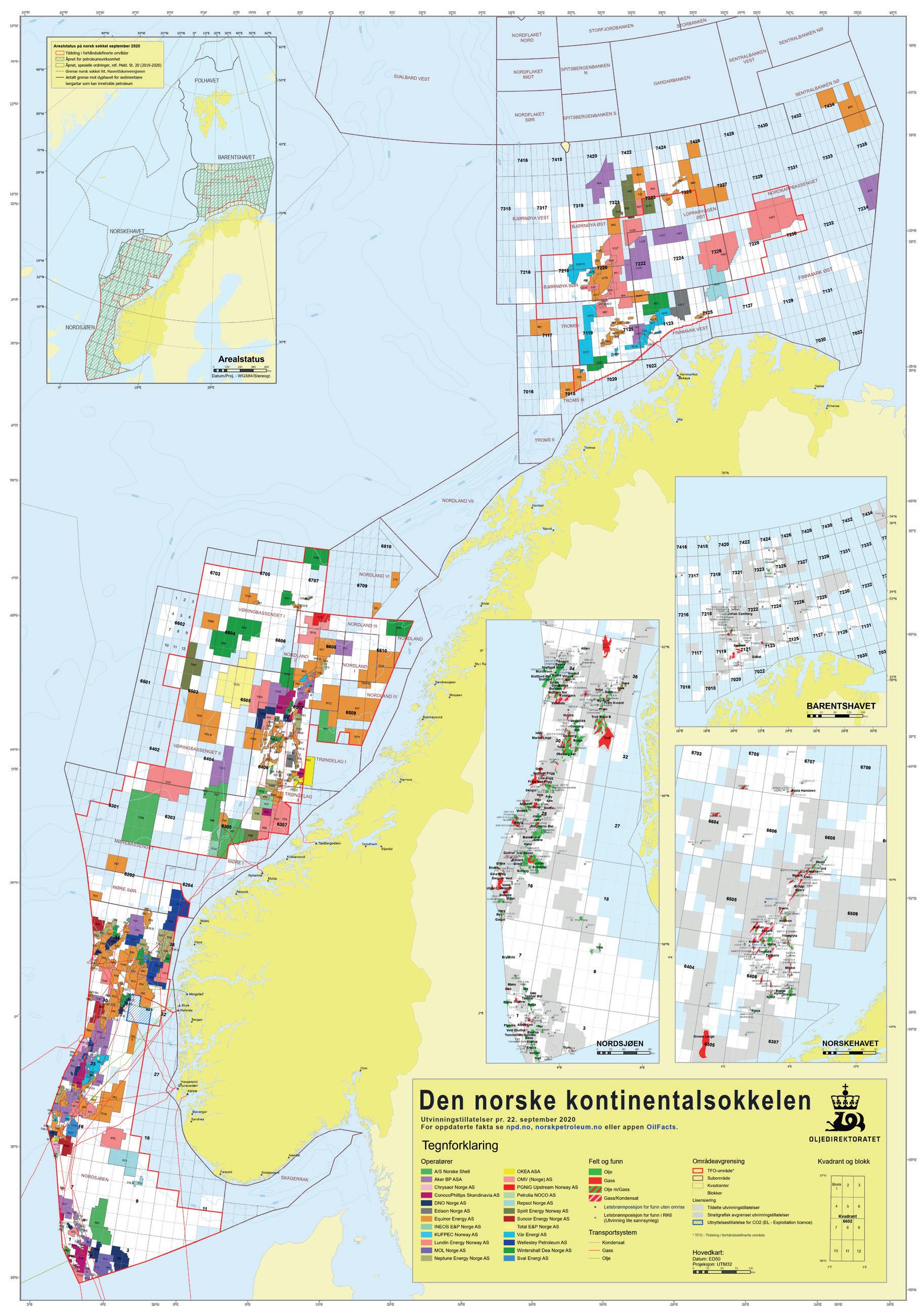
Illustrations: Maps pp. 258 and 261 are reproduced with permission from www.norskpetroleum.no
Font: Minion 10/14 pkt
Paper: Amber graphic 80 g
Printed by: Renessanse Media, Norway 2021
Inquiries regarding this book may be directed to Gyldendal Akademisk
Postboks 6730 St. Olavs plass 0130 Oslo
Norway
www.gyldendal.no/akademisk akademisk@gyldendal.no
All rights reserved. No part of this book may be reprinted or reproduced or utilized in any form or by any electronic, mechanical, or other means,now known or hereafter invented, including photocopying and recording, or in any information storage or retrieval system, without permission in writing from publishers.
Foreword
A new chapter in Norway’s modern history started in 1969 with the discovery of the Ekofisk field. Since then, more than 100 fields on the Norwegian continental shelf have been developed, and approximately 40 exploration and production companies are active on the shelf. Throughout these 50 years a new industry cluster has been developed based on a stable regulatory regime emerging. This book is dedicated to all legal professionals who have contributed to the evolution, and is the first publication providing a comprehensive overview of the Norwegian regulatory regime and model contracts used in the petroleum industry. This unique publication provides insightful guidance to key topics within the various phases of petroleum activities.
In addition to the editors (and co-authors) Yngve Bustnesli, Hans Petter Nordby, Olav Boye Sivertsen and Tore Ulleberg, more than 30 subject matter experts have given invaluable contributions. The author to each chapter is listed, and the editors would like to express our appreciation to the contributors. Without their dedicated work, this book project would never have been realised. We also express our sincere gratitude to Umar Ajaz for his extensive review of numerous references and electronic links, accompanied by constructive suggestions, and to Linda Veronica Jensen who has kept track of the various chapters and the correspondence between the editors and the authors.
Our hope is that this book, published by Gyldendal Akademisk and the digital publishing through Gyldendal Rettsdata, will be a helpful tool within government agencies, industry, law firms, academic institutions and among students – in Norway and abroad. Its aim is to give a comprehensive overview of the regulatory regime for the petroleum sector, while at the same time balancing the depth of details.
Authors often have different linguistic preferences. Through frequent dialogues with several of the authors throughout the process, we have endeavoured to ensure that a common terminology has been used, and not least that all key topics have been covered.
When the project started in early 2017 it was the editors’ clear objective to enter the digital era by facilitating – for the benefit of the reader – the use of electronic links with direct access to relevant web references. This objective proved to be challenging as publishers on the internet often make changes, resulting in links not functioning. To make linkage more robust over time, the editors have in some cases elected to refer to a web site on a ‘higher level’ rather than referring to an exact web page which is more likely to change.
Some web sites are published in Norwegian only. We have elected also to include these for completeness’ sake. It should be observed that all translations from Norwegian are unofficial. We believe that the book is now up to date, that is, when we as editors now close the last chapter and hand over the manuscript to Gyldendal.
Dear reader – we do hope this book will prove to be a valuable tool in your regulatory and contractual ‘toolbox’ for many years to come.
Oslo/Stavanger October 2020,
Yngve Bustnesli
Olav Boye Sivertsen
Hans Petter Nordby
Tore Ulleberg
2.1
1.4.3.4
1.4.3.5
1.4.3.6
1.4.3.11
1.4.3.12
1.4.3.13
2.1.1
2.1.2
Boye Sivertsen
and the management of the State’s Direct Financial Interest (SDFI)
2.1.3 Petoro and the main principles for the management of the State’s Direct Financial
2.1.4 The special provisions in the standard Joint Operating Agreements (JOAs) relating to the management of the State’s Direct Financial Interest (SDFI) 86
2.1.5 Monitoring of Equinor’s sale of oil and gas under the Marketing Instruction
2.2 Exploration phase 88 Catherine Marchand Støle
2.2.1
2.2.2
2.2.3
2.2.4
2.2.11
2.3
Eirik Tveit
2.3.2.1
Christian Fredrik Michelet & Hans Petter Nordby
2.5.1
2.7
2.5.4
2.5.6
2.5.7
2.5.8
2.5.9
2.5.10
2.5.11
Tore Ulleberg & Knut Høivik
2.6.1
2.6.2
2.6.3
2.6.4
2.6.8
2.6.8.1
2.6.8.2
Karl Erik Navestad & Tonje Pareli Gormley
2.7.1
chapter 3 joint venture-related agreements – joint operating agreement, accounting agreement, etc
3.1 Overview of the standard Joint Operating Agreement
Yngve Bustnesli
3.1.1 Introduction to the licensing system and the standard Joint Operating Agreement (JOA) .........................................
3.1.1.1 The role of the Norwegian state in the petroleum activities ...
3.1.1.2 Mandatory participation in a joint venture under the standard form Agreement concerning Petroleum Activities ..........
3.1.1.3 Introduction to the standard Joint Operating Agreement (JOA)
3.1.2 Ownership,
3.1.2.1
3.1.2.2
3.1.2.3 Funding – the operator’s
3.1.2.4
3.1.2.5
3.1.3 The
3.1.3.1
3.1.3.2
3.1.4
3.1.4.1
3.1.11
3.1.8.3
3.1.8.4
3.1.8.5
3.1.8.6
3.1.9.1
3.1.9.3
3.3
3.1.13.1
3.1.13.2
3.1.13.3
3.1.14.2
3.1.14.3
3.1.14.4
3.1.14.5
3.4
4.1
Eirik Tveit
3.4.1 Pre-Unit Agreements and other joint work agreements
3.4.2 The Norwegian continental shelf (NCS) Standard Unitisation Agreement
3.4.2.1 General
3.4.2.2 Differences between the Joint Operating Agreement (JOA) and the standard Unitisation Agreement ....................
3.4.2.3 Specific
to be determined by the parties
Thomas Nordby & Jan Magne Langseth
4.1.1 Introduction
4.1.2 The application of EU legislation on the Norwegian continental shelf (NCS)
4.1.3 Third-Party Access (TPA) to the upstream gas pipeline network
4.1.4 Single market impacts on the Norwegian continental shelf (NCS) – some general reflections ...................................
4.1.5
4.1.6
4.2 International conventions .........................................
Hans Petter Nordby & Dag Erlend Henriksen
4.2.1 The United Nations Convention on the Law of the Sea (UNCLOS) .....
4.2.2
4.2.2.1
4.2.2.2
4.2.2.3 The Geneva Convention on the Continental Shelf of 1958
4.2.2.4 The United Nations Convention on the Law of the Sea (UNCLOS) 252
4.2.2.5 The Convention for the Protection of the Marine Environment of the North-East Atlantic (OSPAR Convention) ........... 253
4.2.2.6 The London Convention on the Prevention of Marine Pollution by Dumping of Wastes and Other Matter (London Convention) 255
4.2.2.7
4.3 Oil and gas treaties between Norway and neighbouring countries
Dag Erlend Henriksen & Hans Petter Nordby
4.3.1 Introduction
4.3.2 Treaties on delimitation of the Norwegian continental shelf (NCS) and the continental shelves of neighbouring countries ....................
4.3.2.1 Norway – United Kingdom ...........................
4.3.2.2 Norway – Denmark ................................
4.3.2.3 Norway (Svalbard, Jan Mayen) – Denmark, Greenland and the Faroes ........................................
4.3.2.4 Norway – Russia ...................................
4.3.3 Treaties on cross-border projects on the Norwegian continental shelf (NCS) and the continental shelf of the United Kingdom ..................
4.3.3.1 Introduction
4.3.4 Framework Agreement on cross-boundary co-operation
4.3.4.1 Treaty on the Ekofisk field
4.3.4.2 Treaty on the Frigg field
4.3.4.3
4.3.4.4
on the Statfjord field
4.3.5 Treaty between Norway and Denmark on the Trym field
4.3.6 Treaties on pipelines from the Norwegian continental shelf (NCS) to neighbouring countries
4.4 Extractive Industries Transparency Initiative (EITI) .......................
Hans Petter Nordby
4.4.1
4.4.2
4.4.3
4.5 Regulation (EU) 1227/2011 on wholesale energy market integrity and transparency (REMIT) ............................................
Odd-Harald B. Wasenden
4.5.1
4.5.8
4.5.9
5.2
5.1.3.3
6.1
Sverre Sydnes & Torkjel Kleppo Grøndalen
5.2.1
5.2.2
Yngve
6.1.1
6.1.2
6.1.3
6.1.4
6.1.5
5.2.3.4
5.2.3.5
5.2.3.6
Audun Våge
6.2.1
6.2.2
6.3 Mergers and acquisitions – share
Rune Solberg
6.3.1
6.3.2
6.3.3
6.4
Peter A. Hiorth
6.4.1
6.4.3 The Norwegian Oil and Gas Association’s (NOROG’s) model
6.4.3.1
6.4.3.2 The Norwegian Oil and Gas Association (NOROG) model Decommissioning
6.4.4
6.5 Debt financing of petroleum activities on the
6.5.1
6.6
6.5.3
6.5.2.2
6.5.2.4
6.5.3.1
6.5.3.2
6.5.3.3
6.5.4
6.6.1
6.6.2.1
6.6.3
6.6.4
6.7
6.6.2.3
6.6.2.4
Knut Høivik
6.7.1
6.7.2
6.7.3
6.8
Dag Toven & Knut Høivik
6.8.1
6.8.2
6.8.3
6.8.4
6.8.5
6.8.3.1
6.8.3.2
6.8.6.2
7.2
7.1.6
7.1.12
7.1.13
7.2.1
7.2.2
8.1.4
8.1.5
8.1.7.1
8.1.7.2
8.2
8.4
8.1.7.3 Collaboration with the Norwegian Armed Forces’ Joint Headquarters (FOH) in the implementation of drills
8.1.7.4 The use of pipeline-to-pipeline tie-ins, crossing, proximity and confidentiality
8.1.7.5
8.1.7.6
8.1.7.7
Stig Gunleiksrud
8.2.2.2
8.2.2.4
8.2.3
8.4.3 Offshore field development and contract strategies ................
8.4.4 Sources of law, the contract documents and interpretation
8.4.5 Obligations of the parties
8.4.5.1 Performance of the work – Appendix A
8.4.5.2 Payment of the contract price – Appendix B
8.4.5.3 The contract schedule – Appendix C
8.4.5.4 Administrative requirements – Appendix D
8.4.5.5 The Company’s materials and deliverables – Appendix G or F
8.4.6 Representatives of the parties. Written communications .............
8.4.7 The Company’s documents and the Company’s materials. The Contractor’s documents ..............................................
8.4.8
8.4.9
8.4.10
8.4.11
8.6
8.7
8.6.1
8.6.2
8.6.3
8.9
8.6.3.7
Sverre B.
8.9.1
8.10.6
8.11
Håvard Hauan
8.11.1
8.11.2
8.11.3
8.11.4
8.11.5
8.12
8.12.3
8.12.4