
February 1, 2026


February 1, 2026
SISTERS Joan Williams and Karen Pascal, along with Pascal’s daughter, Tramaine Bollers Yan, have transformed their family legacy into a mission of wellness for the Guyanese community and beyond. The sibling duo, originally from the small village of Islington, have published two books, Self-Care Is Intentional and Your Gut and You, which blend their professional training from the Institute for Integrative Nutrition (IIN) with the values instilled by their mother and grandmother.
As certified holistic health coaches, podcasters, and former healthcare professionals, the sisters are now working towards workshops, wellness retreats, and community partnerships to help individuals understand the connection between inner health and outer wellbeing.
This week, sisters Joan Williams and Karen Pascal spoke to Pepperpot Magazine about their simple yet powerful mantra: transformation begins with intentional choices about self-care and understanding how gut health affects every aspect of life.

The older sister in the duo, Joan Williams, began her journey into the world of wellness by becoming a nurse, working in the profession for several years before migrating and furthering her education in the field. Her introduction to the importance of inner health,


however, was sparked by her mother and grandmother, traditional Guyanese women who valued inner health and instilled this belief in Williams.
“I was in the nursing field, migrated to the U.S., and started to look at my life and say there is more in me than just being a nurse or a caregiver, dealing one-onone, but on a broader scale,” Williams added.
“I started to attend IIN, which is one of the world’s largest nutrition schools in the U.S., and started training there and learning more about a holistic lifestyle. Everything we are doing now is a legacy of our mother and grandmother. Growing up as kids and coming all the way from Islington, a small village, our mother and grandmother instilled certain values. Everything we share right now and everything we are giving back is from our mother and our grandmother.”
Karen Pascal followed in
her sister’s footsteps, studying holistic care as well. Explaining the philosophy behind the duo’s work, Pascal said that the centre of their work is holistic care. While not focusing on the medical side, she explained that their work seeks to take into account all pillars of health and encourages people to pay attention to them.
“Understanding all the pillars of health helps an individual to understand more, not to sweep things under the carpet, because many times we are feeling stressed out. Why are we feeling stressed out? Are we getting to the core? That is where Your Gut and You comes in. It’s your inner world and your outer world,” she added.
“When you understand the gut-brain axis, you understand more about yourself, because whatever you decide to eat is going to affect your brain. Beautifying yourself is quite okay. But what are you doing for your inner? That TURN TO PAGE XIII
Educators reveal the weeks of planning, creativity, and passion that bring children’s Mash to life

With Region Three, Essequibo Islands–West Demerara, hosting its Mashramani 2026 celebrations, Pepperpot Magazine sat down with just two of the many educators across the region working with their students to bring culture and creativity to life.
Shaundell Fresco, Head Teacher at Vergenoegen Nursery School and Assistant Coordinator, says that staging the children’s Mashramani competition is no small undertaking, with planning, training, and creating done weeks in advance to ensure each school’s performers shine.
In the nursery segment, 36 of the 51 schools are participating in one or more segments or categories of the competition, while the primary level has 97 entries and the secondary level has 59 entries. Also adding to the glow of the region’s Mashramani competition is Seon Wallis, a teacher at Greenwich Park Primary School, who walked us through this year’s design and highlighted the work that goes into making costumes
for what could be one of the most competitive stages.
Head Teacher at Vergenoegen Nursery School,
Shaundell Fresco, is an integral part of this year’s regional competition, working alongside the committee to plan and address any issues that may arise. The aim, Fresco shared, is to ensure that everything runs smoothly, working with fellow teachers and students to make the competition as seamless as possible.
“It has begun with a lot of planning from the nursery throughout the secondary sectors. We begin with assembling our programme together—what categories of the programme we’d like to have showcased. We have also considered having the team for the road march competition; we usually have a regional team,” she added. “It begins with a lot of training, a lot of pulling together of
persons who are professional in different areas like music, drama, and dance. We have professionals who come together and conduct training programmes. We also have meetings with all of those categories of persons.”
The entry and scrutiny process for the competition is harder than most would think. As Fresco explained, schools across the region are contacted and given categories for the competitions, and then present their entries to the committee.
After entries are submitted, Fresco and her team must determine whether each entry is eligible for the category for which it has applied; this includes reviewing themes, which she noted can be particularly challenging. “This year, we have had a lot of scrutiny because we have looked at entries that really spoke against religion and politics, because we do not


want that to be a part of our competition,” she added. “We have had meetings upon meetings and training sessions with our teachers, head teachers, and all stakeholders in order to have this competition today and make it a success.”
Seon Wallis is a teacher with a creative touch at Greenwich Park Primary, where he has worked for the past few years. This year marks only his second time participating in the Mashramani competition, but Wallis was undeterred, sharing that his costume—worn and modelled by one of his pupils—draws inspiration from Guyana’s development to convey the theme Gateway to Region Three.
“This year we chose to enter the costume competition category in the 8 to 10 age group at this year’s Mashramani Regional Competition in Region Three. My costume is depicting the gateway to Region Three, which features the newly constructed Bharrat Jagdeo Demerara River Bridge,” he explained. “When you reach
the west side, there’s a roundabout there.
That is where the bodice of our costume, the body part, is depicting that monument associated with our Indigenous people. My costume portrays the growth and development of our country while also paying homage to our culture.”
Sharing insight into the creative process, Wallis explained that he partnered with well-known Guyanese designer Randy Madray to help create the unique piece. The goal this year, he said, was to improve upon last year, when he placed second in his category.
“Randy and I shared a little insight this year because we wanted to better last year’s costume. Costume-making is not easy work, and I must thank him greatly because the time and effort—it’s not easy to produce such a wonderful costume for this year’s competition.” He also noted that the costume is largely made using local materials. “Most of the materials used include
TURN TO PAGE VII
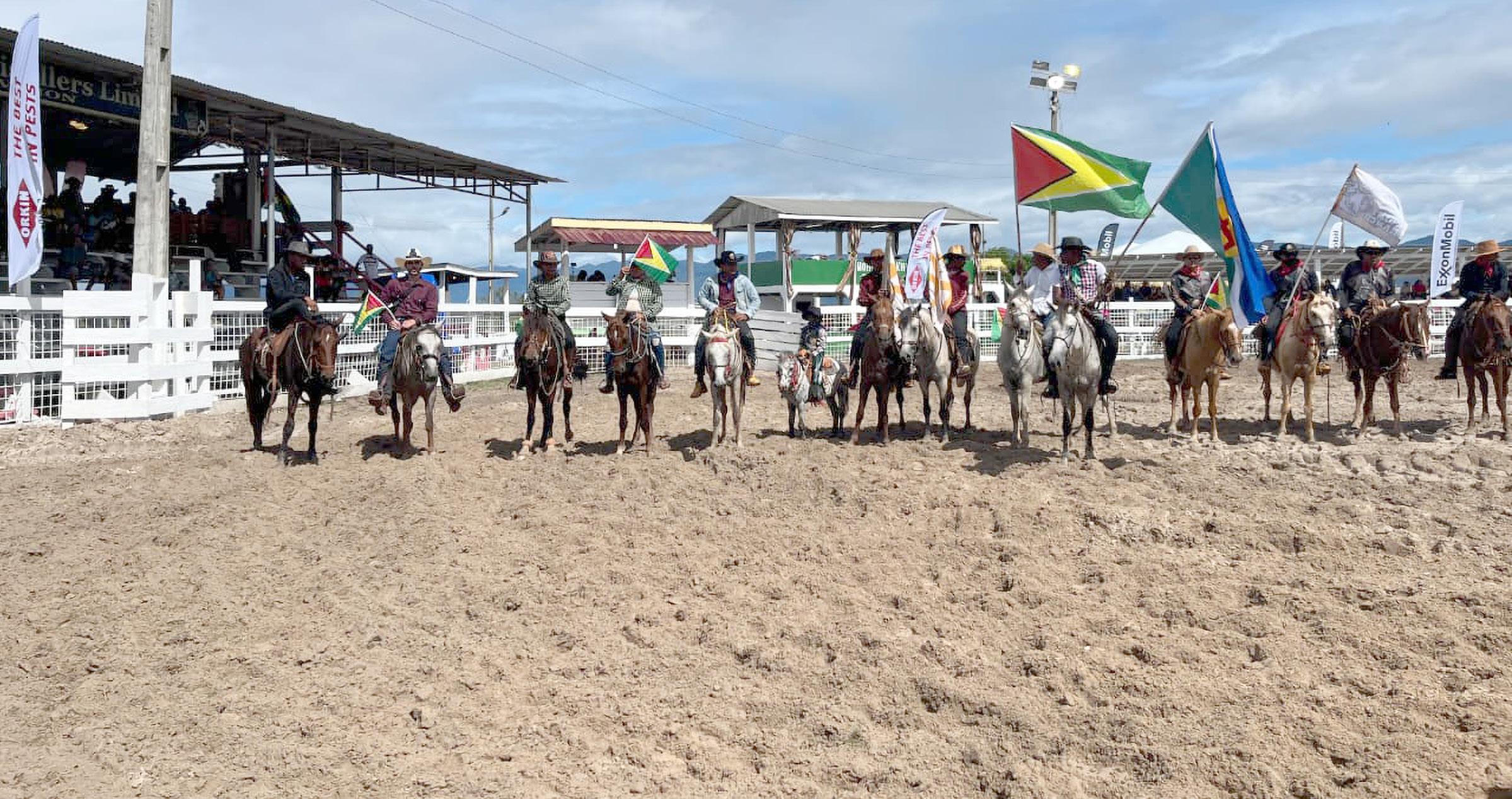
BEFORE the sun rises, the Rupununi is already alive. In the blue-grey calm of morning, vaqueros move quietly across the rodeo grounds. Boots sink into dry earth still cool from the night. Horses snort softly, their breath visible in the morning air. Saddles are
lifted, ropes uncoiled, and bridles checked by hands that have done this thousands of times before.
Nearby, a small fire burns, coffee strong and black, shared in a communal ceremony. This is the rodeo before the crowd. Before the dust. Before the
noise. For the vaqueros of the Rupununi, the Rupununi Ranchers’ Rodeo does not start when the gates open. It begins here, at first light, in ritual, memory, and traditions passed down through generations. More than sixty years ago, there were no grandstands or announcers.
What existed were annual cattle roundups held across the Rupununi Savannahs in the 1950s and 1960s, before the rains came. Ranchers gathered to brand cattle, separate herds, assess livestock, and prepare for flooding that would soon change the land. When work ended, the
vaqueros tested one another informally at first. Who could ride the wildest horse? Who could rope cleanest and fastest? There were no prizes, only reputation and pride. That story, of a rodeo born as an extension of ranch life, was highlighted at the Georgetown launch earlier
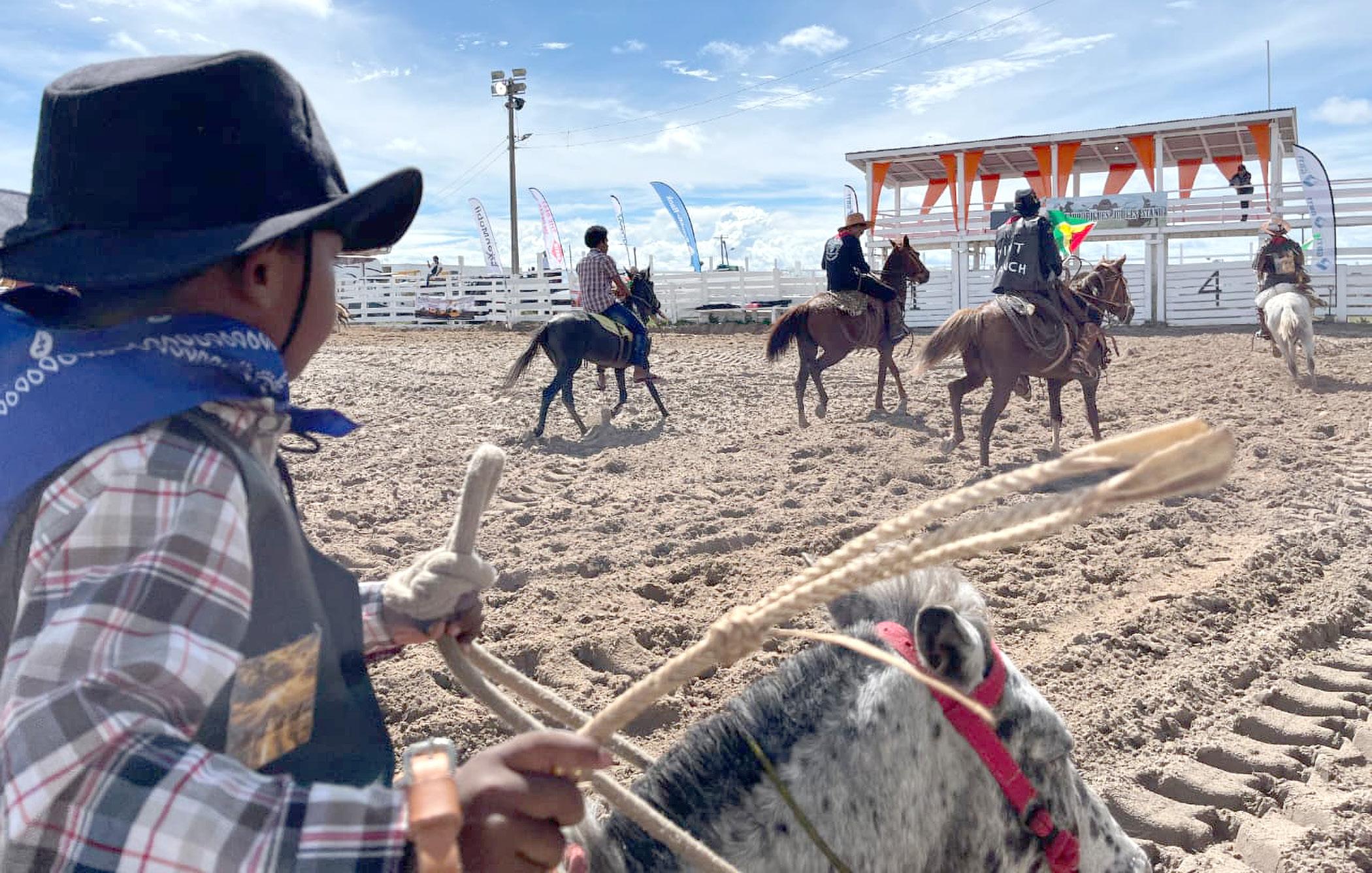
this year. Organisers reminded audiences that the event grew from necessity, skill, and community, not from a desire for spectacle. It was a reminder that the rodeo’s roots run far deeper than Easter weekend. From Savannah to the National Stage.
As participation grew through the 1960s and 1970s, the informal competitions moved from ranches to public places, including the Stock Farm at St. Ignatius, before finding a permanent home in the 1980s at Tabatinga, Lethem—now known as the Triple R Rodeo Grounds. By that time, the rodeo had become an annual event, held over Easter when travel across the savannahs is easiest and when roundups historically took place.
At the Georgetown launch, organisers described that evolution as organic rather than engineered. This tradition expanded because communities embraced it, not because it was planned to grow. This year’s rodeo is backed by a team that was often described at the launch as vibrant and committed. This team combines deep ranching roots with a clear national vision. Alongside the vaqueros, organisers highlighted the vibrant team shaping this year’s celebrations. Led by the Rupununi Livestock Producers Association’s (RLPA) Chairman Kyle Joseph, with strengthened collaboration from the Ministry of Tour-
ism, Industry and Commerce and the Guyana Tourism Authority, the team was described as both rooted and forward-looking — committed to preserving authenticity while positioning the rodeo as a flagship national cultural event. Speaking at the launch, Joseph emphasised that bringing the rodeo to Georgetown was not about changing its identity, but about meeting partners where they are and ensuring the Rupununi story is heard and supported across the nation.
This year’s Rupununi Ranchers’ Rodeo will be held from April 3 to April 5, 2026, at the Triple R Rodeo Grounds in Lethem, Region Nine, during Easter weekend. Today, the Rupununi Ranchers’ Rodeo is one of Guyana’s most well-known cultural events. It attracts spectators from around the country and visitors from Brazil, North America, and Europe. But its origins have never shifted.
“The vaquero remains at the heart of this story,” one speaker noted at the launch. “Everything else grows around that.” The term “vaquero” itself tells a story— one of cross-border movement, Brazilian influence, and a ranching culture shaped by geography rather than borders. In the Rupununi, vaqueros are not performers trained for an arena.
They are horsemen and women whose everyday lives demand mastery of riding, roping, and handling animals across vast, open savannahs. Events like bareback bronc riding, calf roping, and wild cow milking are not just symbols; they are competitive displays of real work—skills
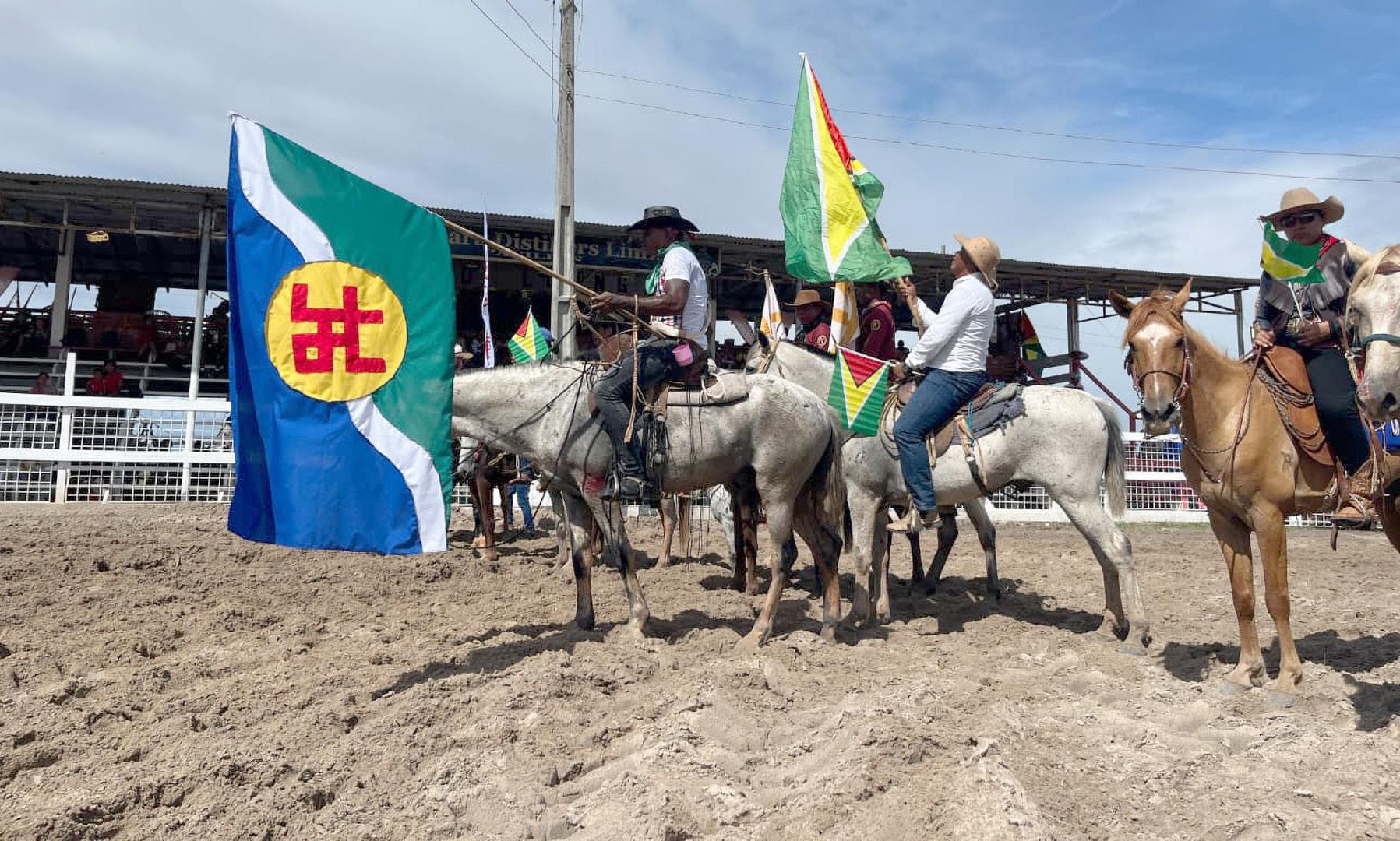
learned at a young age, often from parents and grandparents who once rode the same grounds. At the launch, speakers pointed out that the rodeo serves as a living record—a place where intergenerational knowledge is not documented but demonstrated, roped, and repeated. Over time, the rodeo has grown beyond competition.
Today, it unfolds as a multi-day cultural festival featuring horse racing, music, parades, food fairs, craft and agricultural markets, pageants, and dance. Gov-
ernment representatives at the launch spoke candidly about the rodeo’s expanding role in cultural tourism and regional development, noting its economic impact on Region Nine—from transportation and accommodation to small vendors and artisans. But there was also a clear note of caution. As one organiser said, “Growth must never come at the cost of authenticity.”
The goal, they said, is not to remake the rodeo but to preserve what makes it distinctly Rupununi while allowing more Guyanese to
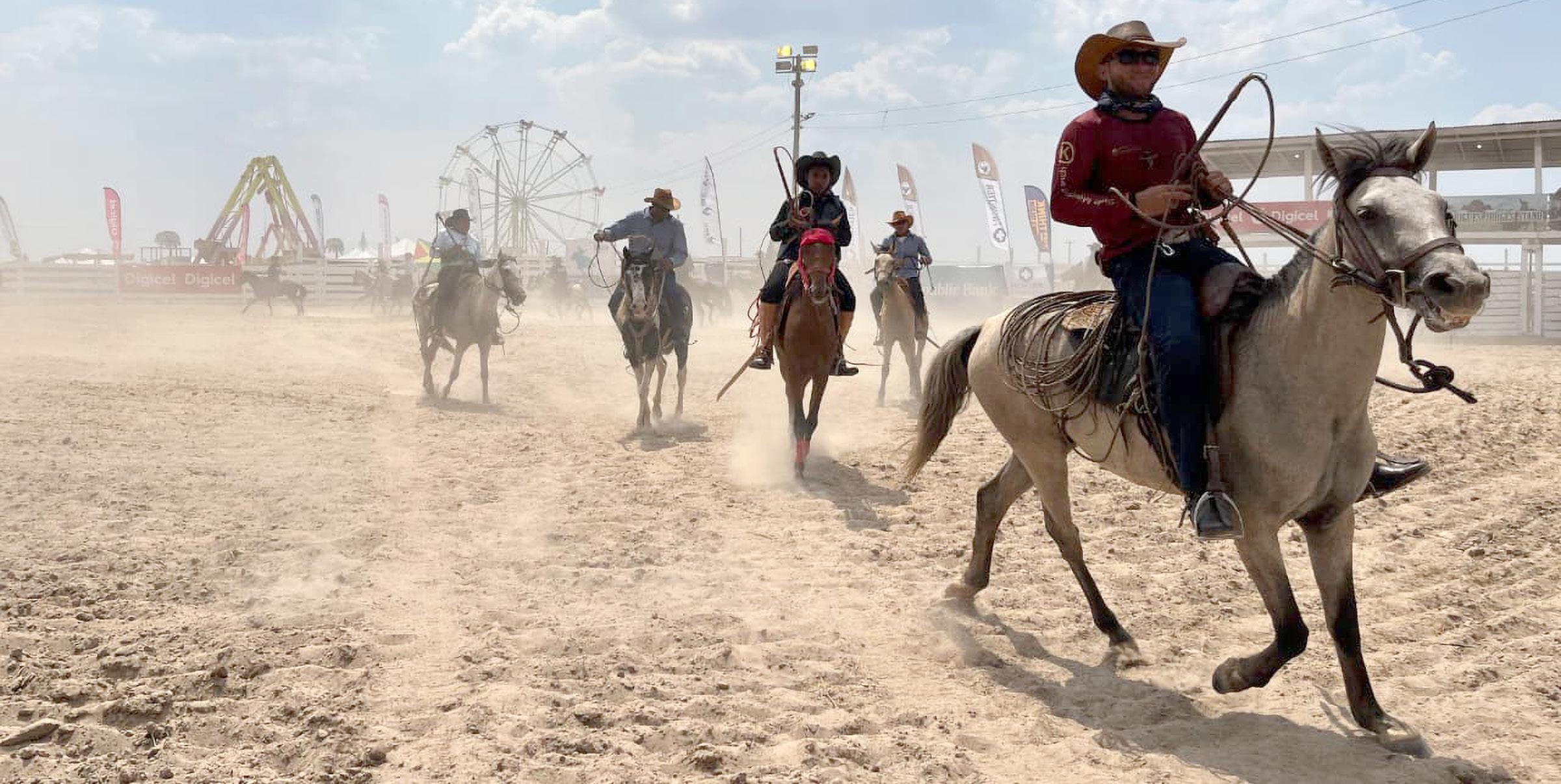
experience it. Back at the rodeo grounds, the sun has risen. Dust swirls as horses are led toward the pens. Music floats across the savannah. Spectators gather, cameras in hand.
The vaqueros mount up. When the gate swings open and the crowd erupts, it may look like a sport. But beneath the spectacle lies something older—a tradition shaped by land, hard work, and resilience, still honoured quietly at dawn before anyone is watching.
The 2026 celebrations are expected to be a major
homecoming event, with renewed emphasis on Guyanese culture, local creatives and community participation. Organisers and government representatives pointed to the rodeo’s expanding role within what recent reports describe as Guyana’s growing “orange economy” — where culture, creativity and heritage generate both identity and income.
From artisans and musicians to food vendors, designers, and performers, the rodeo weekend has become a powerful platform for showcasing local talent while driving economic activity
across Region Nine. As the Rupununi Ranchers’ Rodeo continues to grow in national and international recognition, it stands as a unique opportunity: a cultural institution that remains rooted while reaching outward.
For partners and sponsors seeking to connect with heritage, authenticity, and community impact, the rodeo provides more than visibility. It offers a chance to be part of a living Guyanese story—one that has lasted for generations and, with the right support, will keep moving forward.
By Indrawattie
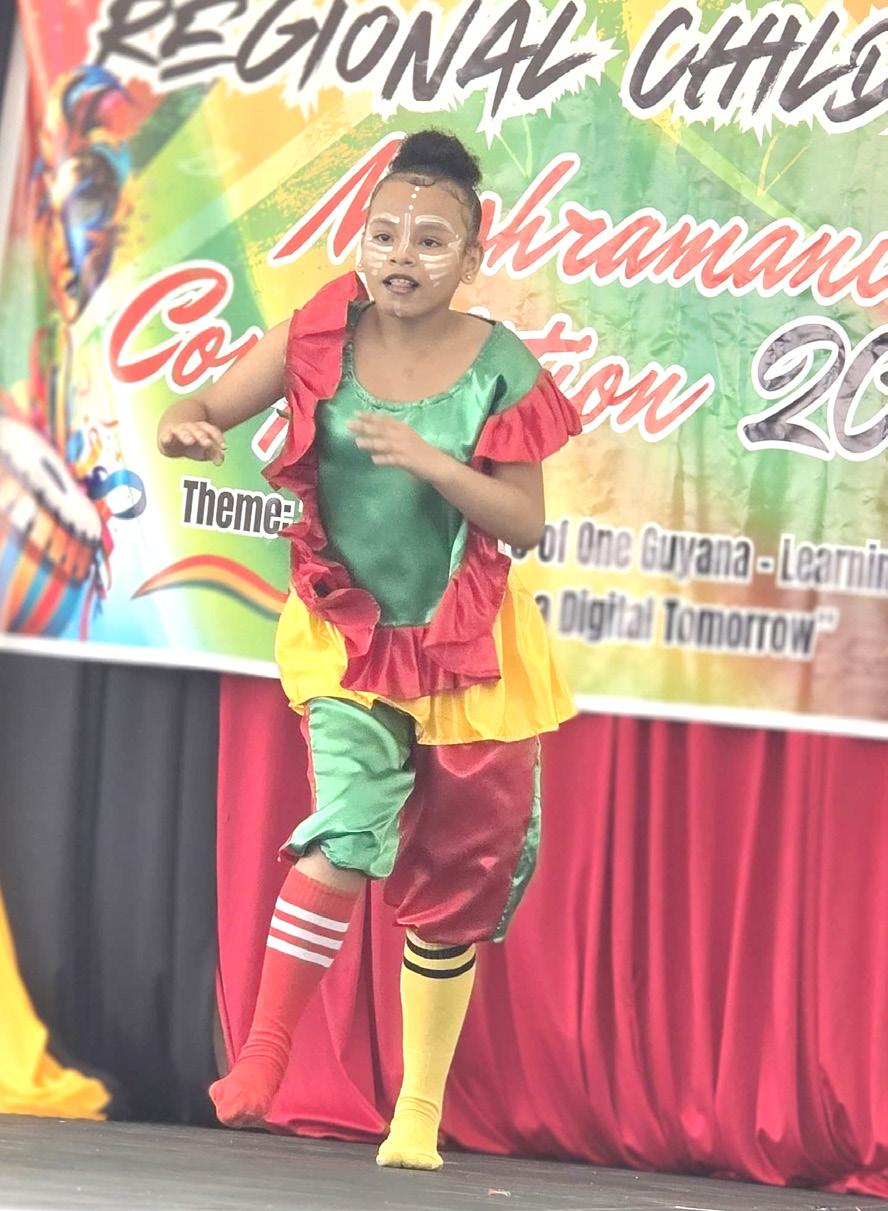
THE Anna Regina Secondary School Ground came alive with colour, rhythm, and youthful excitement on Thursday morning as students from across the Essequibo Coast gathered for Day Two of the Children’s Regional Mashramani Competition 2026. Under the vibrant theme, “Little Builders of One Guyana – Learning Together, Shaping a Digital Tomorrow,” the atmosphere was charged with anticipation as parents, teachers, and supporters filled the venue from early morning.
At exactly 10:00 hrs, Chairperson Munirah Reedon called the programme to order. A moment of silent prayer followed, bringing calm to the large gathering, and then, with pride echoing across the grounds, all present stood to recite the National Pledge—a fitting reminder that the day’s performances were not only about competition but also about unity, culture, and national pride.
The event opened with the Group Dance for ages 5 to 7 years, where tiny performers from 8th of May Primary, Aurora Primary, Better Hope Primary, Mainstay

Lake Primary, Onderneeming Primary, C.V. Nunes Primary, Taymouth Manor Primary, and Queenstown Primary charmed the audience. Their colourful costumes and coordinated movements drew loud applause, proving that even the youngest children could confidently represent Guyana’s rich cultural heritage. The stage then belonged
to the Individual Dance competitors aged 8 to 10 years from Mainstay Lake, Onderneeming, C.V. Nunes, and Martindale Primary. Each dancer displayed confidence, rhythm, and creativity well beyond their years.
Excitement heightened during the Group Masquerade for ages 8 to 10 years, as pupils from C.V. Nunes, Mashabo, Suddie, Tapakuma
Lake, Fisher, Mainstay Lake, Good Hope, and Onderneeming Primary transformed the ground into a traditional Mashramani spectacle. Their flouncing skirts, vibrant headpieces, and rhythmic masquerade steps reminded spectators of the deep cultural roots of this beloved art form.
The momentum continued with the Group Dance 8

to 10 years category, featuring C.V. Nunes and Queenstown Primary, where lively music and energetic choreography thrilled the crowd.
As the competition moved into the 11- to 13-year-old segment, the performances grew even more
refined. In the Individual Masquerade and Individual Dance categories, students from C.V. Nunes, Anna Regina Secondary, Abram Zuil Secondary, Cotton Field Secondary, Mashabo, Sparta, Better Hope, Charity, TURN TO PAGE VII

FROM PAGE VI
Mainstay Lake, and Aurora displayed impressive poise and stage presence.
One of the most heartwarming highlights of the day was the Group Masquerade for 11- to 13-year-olds, which included the Cotton Field Secondary SEND Unit. Their participation drew standing applause from the audience, symbolising true inclusion and the spirit of “One Guyana.”
The Group Dance 11 to 13 years category brought powerful performances from Anna Regina, Charity, Abram Zuil, Mainstay Lake, Cotton Field, and Johanna Cecelia Secondary, with each group interpreting the theme with originality and passion.
The crowd’s energy soared during the Male Hip Hop Group Dance 11 to 13 years, as Cotton Field and Anna Regina Secondary stu-

dents electrified the ground with modern beats and sharp choreography, blending contemporary style with Mashramani flair.
The senior competitors, aged 14 to 18 years, closed the day with breathtaking performances. In both Individual and Group Masquerade and Dance categories, students from Anna Regina, Aurora, Charity, Cotton Field, Abram Zuil, 8th of May, Johanna Cecelia, Essequibo Technical Institute, and Wakapoa Secondary demonstrated maturity, discipline, and artistic excellence.
The Male Hip Hop Group Dance 14 to 18 years was a thrilling finale, with schools including Charity Secondary, Anna Regina Secondary, Essequibo Technical Institute, Cotton Field, Abram Zuil, and Wakapoa Secondary commanding the stage with high-energy routines that had the audience cheering loudly.
Throughout the day, Chairpersons Munirah Reedon, Evadne Spencer, and Cheryl Peters Moore ensured the programme flowed smoothly, while teachers and parents beamed with pride at the remarkable talents on display.
Day Two of the competition was more than a showcase of dance and masquerade; it was a celebration of culture, creativity, inclusion, and unity.

binding wires, glitter foam, and regular items that you can mostly pick up in stores here in Guyana to produce something so spectacular, bringing out our culture, our history, and the tremendous development our country has experienced over the past five years.”
One striking aspect of the event is the level of competitiveness among children and teachers alike. This, however, is for good reason, says Wallis, as each year becomes more competitive, with schools bringing new levels of creativity. “I competed last year. After entering last year’s competition with our creativity and vision, as the years go by, it’s the real truth of growth.
At these costume competitions, it’s either you go topical or you go fantasy. Fantasy pays homage to our culture, for example, the Old Higue stories or the Bacco.” Explaining his decision to go topical, he added, “Topical-wise, it’s the development in our country and what is most relevant today. We have major development: the new bridge, the roundabouts in Region
Three that allow easy traffic flow, the Heroes Highway, and so forth.”
The next step after the regional competitions will be the national competitions, which will be held in the coming weeks. The event is about more than costumes; every level features a variety of dance and music categories.
This diversity is what teams look forward to. As Fresco explained, Vergenoegen Nursery School is often among those vying for top spots and bringing home trophies.
“Overall, as the years have gone by, we’ve done excellently. We have always brought back trophies. Even for road march, we bring back lots of trophies.”
Speaking about this year’s competition, she added, “This year is going to be no different. We will take more than the amount we have taken in years past.”
Beyond the competition, detailed costumes, and vibrant dances, children’s Mash in Guyana offers much more. As Fresco shared, it is one of the most anticipated events on the school calen-
dar, bringing balance to a year primarily focused on academics.
“This is so important because the wider spectrum of society believes in education and in giving children a strong academic foundation. But for education to be realised in the lives of our children, there must be balance,” she said, adding that events like these give children opportunities to explore their creative talents.
“Some children may not excel in English or maths, but they may be very good at dancing, dramatic poetry, or music. We are giving every child an opportunity to be themselves and to excel in a way that is most comfortable for them.”
Whether through planning, designing, choreography, or music, children’s Mash involves much more than meets the eye, with significant effort invested in placing young stars on stage. Both educators agreed, however, that it is essential—not just for teachers or the event, but for the moments of happiness and laughter it creates for children.


IN the realm of this column, we’ve spoken of many forms of abuse and the many faces of victims and perpetrators. However, this week will be my first time addressing sibling abuse. An urge to write on this topic stemmed from listening to someone share their personal experiences online about “sibling abuse” and how it affects them to this day.
Their older sibling was very verbally and physically abusive. It was always conditioned within that person that “it’s simply how older siblings behave”. They grew up thinking that it was okay for siblings to hit and verbally assault or abuse you to the point where it physically and mentally affects you. However, as they grew older and learned more about abuse, they realised that they expe-
rienced “sibling abuse”, and they are no longer in contact with the sibling who perpetuated the violence against them.
I am sharing this scenario to firstly start by saying that sibling abuse can be masked as “tough love”, as do many other forms of abuse. Unfortunately, it is about time we label abuse for what it is and not make excuses for the actions of others, even if

they’re our family members. In many households, “sibling teasing” is normalised. In fact, it is so normalised that mainstream media often portrays sibling relationships as “rivalries”. Now, I am an only child, and given the tone of this column, I am sure you can pick up on those tones.
as if their feelings cannot be validated because it is simply “sibling rivalry”. I think one of the main factors to consider is that caregivers and parents can sometimes be underinformed about what sibling abuse is. Sometimes, it might be difficult to imagine another child being a per-
portrayed as the “favourite child”. This creates a significant imbalance of power in the relationship, with the “less favourable” child—for reasons only the parents can attest to—being abused by the “favourable child”. We might think that the effects of sibling abuse stay
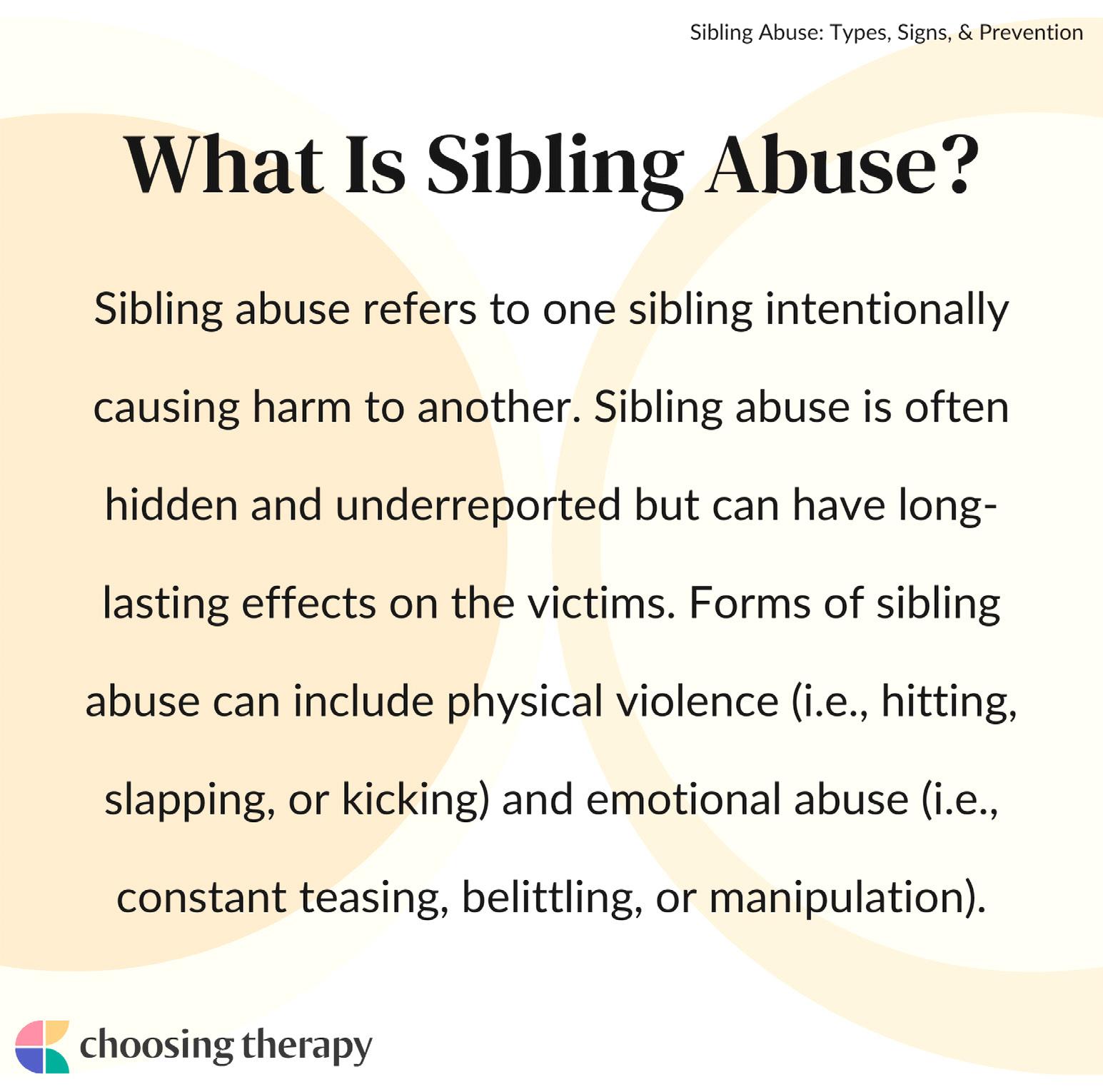
Nonetheless, siblings disagree as you would with any other family member or relative. However, there comes a time when we must clearly draw the line between what is acceptable and what isn’t. Sibling abuse does not only come in physical or verbal forms; it also comes in the form of sexual, psychological, or emotional abuse. Unfortunately, the harm that is often done within these relationships is minimised, and victims are made to feel
petrator of violence, let alone doing it to their own sibling. I also believe it is important for us to assess sibling power imbalances and how they can affect relationship dynamics.
In some instances, the “power” lies with the older child or children because they are older, physically bigger, or have more advanced knowledge in certain areas. In other instances, it might be a case where a child or children have “power” by being
within the realm of childhood. However, there is evidence that sibling abuse, as with most forms of abuse, can lead to chronic anxiety, depression, difficulty with trust, intimacy issues, low self-esteem, and a distorted sense of adult boundaries. Some victims also experience a form of internalised guilt, where they feel they should have done more to prevent the abuse from happening to TURN TO PAGE XI

A SUPERB guide to the role information plays in the workplace, Information Systems for Management breaks down exactly what those in high-level positions should know about information and how to utilise it. Systems accountant and regular user of business information systems, Geary Reid, explains how organisations must view information as a resource to be gathered, tailored, and used to the greatest benefit.
This is an ideal starting point for those learning about business information systems and the many ways information can shape the business landscape. Perhaps most importantly, this guide clarifies exactly how organisations can use information to achieve their goals.
1. Information Needs
Many people need information in their daily lives, to the point that they would not be able to make basic decisions without it. For example, before some people leave their homes for work, they will check the weather and traffic updates. These updates are essential, as they inform them of the clothing that will be most appropriate for the day, among other things. One day, the weather may be hot or rainy, and on other days, they may need to leave earlier to avoid traffic delays. Fortunately, the approach to obtaining this information is no longer the traditional one, as modern technologies have enabled us to provide relevant weather forecasts and traffic updates.
The cost of fuel is an important expense for some families and organisations, so they have to make the best decisions about traffic, especially the routes they take. Some countries provide regular updates on traffic flow and inform commuters
which roads are congested and whether there are any accidents. These updates are so frequent that decisions can be made quickly.
Stock market information is also easily available to people via advanced technologies such as smartphones, tablets, and computers. Managers can be in the office and see how their organisation’s trading stocks are affected by the stock market.
Managers need a regular supply of high-quality information to make decisions, such as how changes in raw-material prices will affect production and the final price of a product. Suppliers may increase their prices as world market prices for certain commodities rise.
Traditionally, employees provided their supervisors with manual data. If an error occurred on one document, it could affect other reports as well. Correcting the error took time, and sometimes correcting it caused additional errors.
Data processing has changed over the years. Some decades ago, people had to endure many challenges in compiling data for submission to others. If there were changes or updates to a report, the task was very arduous and could cause additional errors.
Some people spend long hours in the office and earn substantial overtime. Some are even pleased when certain reports, especially month-end reports, must be completed, as they earn additional income. These employees calculate their overtime hours, as it may become standard for them, and they use that extra income for personal expenses or leisure activities.
Employees who possess specific institutional knowledge may hold many senior
persons hostage to their will, since they may be the only individuals able to perform certain tasks. Therefore, supervisors may not be able to function without them and often try to maintain good relationships, even when the employee is wrong. This may cause resistance to system or process changes that would help companies become more efficient and less dependent on specific individuals.
If the employee who prepares a report is ill, managers and supervisors may have to wait until that employee has recovered to receive the report. On some occasions, other individuals are trained to produce certain reports, but sometimes they are not taught everything.
Moreover, when those who hold institutional knowledge are due for vacation, their leave must be carefully negotiated to avoid disruption to the organisation. This approach is not ideal for the employer, but because the employee is vital to the organisation’s success, their presence is considered important.
Many major reports depend on secondary reports. When a secondary report contains an error and that error is not detected or corrected, the information in the major reports—and the information presented for decision-making—will also contain inaccuracies.
Managers are often pressed to collect past data and information. They use this information alongside current activities to make projections for the future. The future is never known, but assumptions can be made based on previous trends. Some managers feel they do not need to know what has happened in the past, believing they already have the
answers for the future. There are times when past data may not be relevant, but on other occasions, it provides valuable guidance. If trends continue, future outcomes may follow a similar pattern. Completely ignoring past activities is not always advisable, as they can prevent current frustrations. However, the past should not be the sole basis for future decisions. The future is full
of uncertainties, and managers should be willing to consider them. For example, the weather is a major factor in agriculture or outdoor sports. While the weather may be reasonably predicted from past cycles and technology, assumptions must still be made to account for uncertainty.
Managers planning sales can use previous years’ performance, but must also
make assumptions about what consumers may want in the future. When natural disasters occur, many predictions may no longer hold true, and uncertainty increases. It is not advisable for managers to operate in isolation and expect to make high-quality decisions for the entire organisation in the absence of complete TURN TO PAGE XV


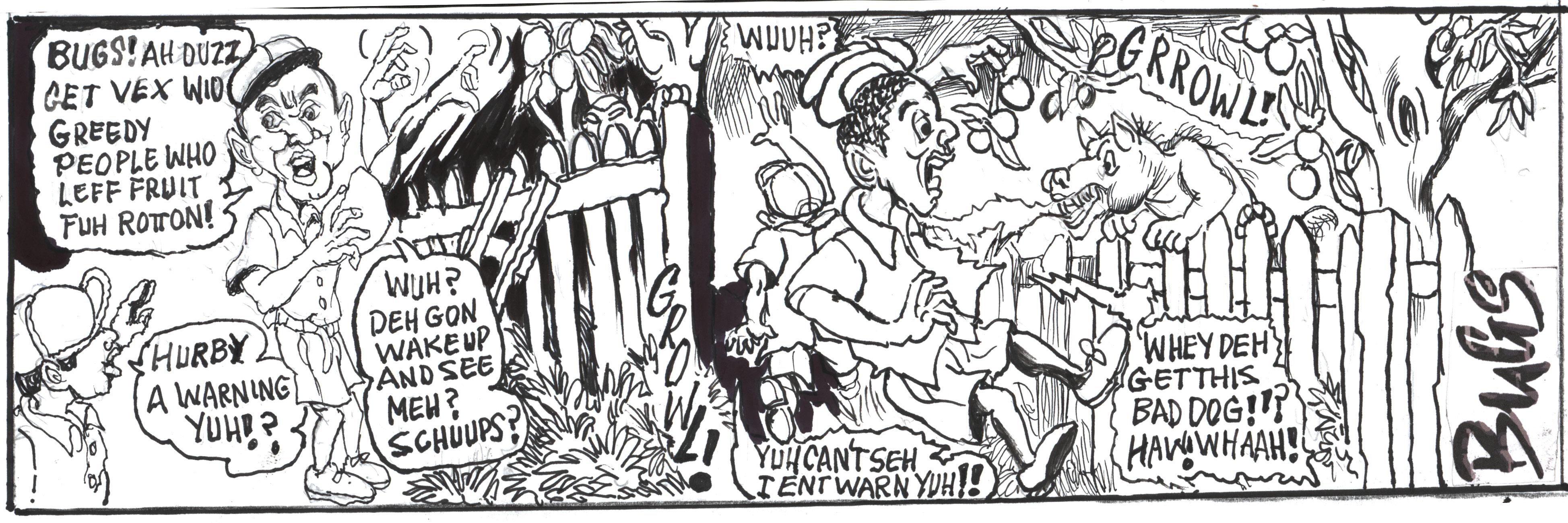
I WAS on my way along Regent Street to enter Bourda Street last Saturday when I fell into a clog of traffic a few feet before the Bourda Street entrance. Where cars could park was somewhat unclear. There, I saw an older person standing a few feet before the Bourda Street entrance, where she might have assumed, by some error or custom, that this was just another Bourda vehicle stop.
I could not ignore the car edging up to the woman. Because I was coming up behind her, I passed almost beside her and tried to warn the driver or companion that the adult woman was uneasy and shak-
ing. A rude answer followed, and I lost it and responded in kind— something that I had promised myself not to do.
It had started a while ago, when I jumped out of a minibus just over Cummings and Regent Street and asked the conductor if he hadn’t noticed there were pretty young children on the bus, given the kind of music he was playing. He merely took my fare and did not respond.
My family had insisted that I remove myself from what was happening in our home world—this wasn’t my day. I just couldn’t remember what I had eaten, because I had promised myself not to get
into public issues. I did agree with myself and my family to stay out of public engagements, but I didn’t.
A young man stated to me, “You’re using hostile language.” I did not recognise him; probably I knew his folks. So, I related to him what had occurred with the latter incident.
He shook his head and related that everyone is hostile—you just have to move on. It’s easy to get into trouble nowadays. I replied, “Thanks for the gesture.” I couldn’t tell him how many issues I’ve crossed as a young man, but this wasn’t right. I can’t make magic happen; I’ve got to be more careful.
Along the way, I consoled
myself, but what about those childhood teachings to channel the challenge that threatens and presents a definite mood beyond hostility? If so trained, or does every situation speak to a different realm of one’s consciousness? No one could have imagined this obviously hostile world. Is there some trend, not immediate, that we are ignoring— something I’ve not brought into observation? Do we still have good folks? Could it be that everything is required to be extreme?
Are we in the age of the “egoflu,” or are we missing something much more rooted in our reality that requires a dialogue of means? When we were much younger,
and cinemas existed, we visited cinemas that allowed time travel to other realms nearby—but they’re gone. True, local talent exists to reflect and neutralise bad inner vibes in drama, but it must be developed within the realities of our time, not with guesswork, but with folks who know the dark inner world that summons constant hostility rather than the proposed healing balm of logical resolution.
From our beginnings towards human civilisation, the pageant carried the esoteric pitch versus the mundane. The format has changed, but the necessity obviously remains for those who share this craft.

IN the north-west part of the Indian Ocean, there is an archipelago of beautiful islands called Socotra. Among the many other extraordinary qualities of this Yemeni island is a very special kind of tree found exclusively in Socotra and nowhere else in the world. This is the Dragon Blood Tree.
The Dragon Blood Tree, scientifically known as Dracaena cinnabari, is known for its striking appearance and rarity. Most importantly, it is known for its tendency to ‘bleed’ when cut. The bark of the Dragon Blood Tree, when damaged or cut, oozes a dark red sap that, quite mysteriously, resembles blood.
Even more interestingly, this blood-like sap is known to have extraordinary medicinal properties, including pain relief, antimicrobial effects, and healing properties. In fact, the sap from this tree has been used in different forms of ancient medicine for these very purposes. Of course, like many ot her beautiful and fascinating
flora and fauna, the Dragon Blood Tree is now considered vulnerable to extinction. Some scientists even predict that the species may become completely extinct within the next 30 to 80 years. It is heartbreaking to wonder what the Earth must have looked like 500 years ago. What marvellous creatures have we caused the erasure of? What mighty trees have we felled to clear spaces for twisted masses of concrete and steel? Which of our ancestors’ stories will we never understand simply because we will never see the planet in the same way that they did?
Every year, we face new predictions about the things we will lose on our planet. Unfortunately, the predictions of these losses are overshadowed by the announcement of some form of makeshift growth we experience, which often does not reach everyone who needs it. In fact, can we really consider some forms of growth as a positive change if they can only exist as a product of blind destruction?
As members of a younger generation, we will eventually inherit the responsibility of caring for our planet. Although it is easy to condemn our predecessors who made decisions that damaged our planet, we will come to realise that sometimes it truly is a choice between the development and stability of an entire group of people and the protection of the planet. For instance, would it be acceptable to cut down trees if they were being used to provide shelter for the homeless? Would it be alright to damage the habitat of an endangered species if the land was being used to grow food for the starving? Considering these questions helps us understand that protecting the planet can often be quite difficult when it means that sacrificing parts of it can help humanity survive and evolve.
Perhaps it would be helpful to start viewing the planet not as a separate entity from humanity, but as part of it, co-existing with us and within us. Nature is benevolent and forgiving in the way that
them, or they believe that it does not count as abuse in adulthood. Unfortunately, sibling abuse can also be increased when parents or guardians leave their children unattended or in the care of other siblings. As such, it is imperative that all caregivers are aware of and educated about sibling abuse. I think it can be difficult to come to terms with the reality of sibling abuse, yet it is still something we must raise awareness about. It can be troubling to confront these realities because they threat-
en our sense of safety and security within the family unit. Just the mere thought of abuse within the family can be earth-shattering. There are also cultural implications, such as the normalisation of a certain level of hostility and “roughness” among siblings. I think the first step to addressing this issue is to understand that sibling abuse is not an “inconvenience”. It is actual abuse, and it requires us to rethink what we have learned and believe about childhood innocence. Unfortunately, children themselves can hurt
FROM PAGE VIII
other children, and that is a reality we must confront.
As we move forward, I hope we consider taking the testimonies and stories of victims of sibling abuse more seriously.
There is already the Family Act in Guyana that generally caters for abuse against any family member, not just spouses within a family unit. As such, this is a first step towards institutional awareness. Sibling abuse is real. Silence is not protection. And naming harm is not betrayal—it is the first act of justice.
it has provided for us. Everything from the air we breathe to the water we drink comes from this very planet. Although we have damaged it in many ways, we still continue to thrive. The Dragon Blood Tree, even upon being cut and damaged, does not poison or prick, but bleeds an extraordinary substance that could heal its very assailants. Thus, it is now our turn
to be benevolent. There are some effects on the planet we simply cannot stop creating. However, there are many others we can most certainly cease. We cause much damage by using and destroying for the sake of convenience. Something as seemingly small as stopping the use of single-use plastics can create a meaningful impact on the health of our planet. We can make intentional efforts to
avoid clothing, food, and cosmetics manufacturers that use resources excessively and generate large amounts of waste.
We can embrace a more minimalist and sustainable lifestyle, even if it means we miss out on trends or don’t own products that many others do. We must make sacrifices to protect the only home that we have


inner.” The trio’s first book is Self-Care Is Intentional. The book’s core message is simple: self-care is not selfish or random; it is a conscious, daily choice. The duo told Pepperpot Magazine that their personal and professional journeys inspired the book on health, caregiving, and healing, and that they saw how often people—especially women—put themselves last. “We started with Self-Care Is Intentional and Your Gut and You, starting to focus on your inner world, what kind of food you eat, how you are focusing on your microbiome, so that you can be healthy, you can be strong, eliminating brain fog,” Williams shared.
The book explores themes of listening to your body and emotions, setting boundaries and learning to say no, and shares practical self-care practices people can start today, even in small ways. According to Williams, the book is targeted towards anyone who has been neglecting themselves, running on empty, or waiting for a crisis before paying attention to their own needs, and who is now ready to choose themselves with intention.
The second accompanying book published by the duo, Your Gut and You, places gut health as one of the central pillars of overall health, assessing the gutbrain link, mood, stress, intuition, and emotional health, as well as what we eat, how we live, and our relation -
ship with food and our bodies. The book’s key themes explore these connections, looking at lifestyle changes and steps towards supporting healthy living.
Reinforcing the significance of lifestyle, Pascal shared, “A lot of times, you are dealing with the outer, but not the inner. That person could be experiencing depression. They may be having anxiety—so many things are happening with that individual. Awareness. If you want to understand more, it’s not just to read the book; it’s into your lifestyle. If you want it in your daily living, so that you experience that transformational state. Transformation doesn’t just happen just like that. It takes time.”
While the three-woman team has already developed a brand and support base through their podcasts and YouTube channels, moving forward they would like to engage more with their readers and audiences, particularly those in Guyana.
Highlighting the need for greater education on holistic health, Pascal shared that, looking ahead, they would like to spearhead projects that not only educate but also connect with and work with communities. “We want to be intentional, and that means looking at whether we can do a pilot programme and workshops. That is how education can be broadened—part of it with communities, part of it with organisations.

That is where the knowledge can come in. There is more that needs to be done,” she added. Williams, Pascal and Bollers Yan welcome readers to connect with them for more information on holistic health, upcoming workshops, and wellness programmes. They can be reached at 592-622-6953 or via social media.



ROY A. K. Heath wrote psychologically acute novels about Guyanese people living in Guyana—and about nothing else. They are the sole, unbroken focus of his fiction. Across nine novels—A Man Come Home (1974), The Murderer (1979), Kwaku, or, The
Man Who Could Not Keep His Mouth Shut (1982), Orealla (1984), From the Heat of the Day (1979), One Generation (1980), Genetha (1981), later collected as The Armstrong Trilogy (1994), The Shadow Bride (1988), and The Ministry of Hope (1997)—Heath
returned obsessively to the psychic, social, and moral textures of a small, fraught society.
He also published a memoir, Shadows Round the Moon, in 2000. No other landscape intrudes. None of his novels is set outside Guyana, and none imagines
a meaningful escape from it.
Heath belonged to the formidable generation of Caribbean writers that includes Kamau Brathwaite, V. S. Naipaul, Derek Walcott, and Michael Anthony. Yet he was a late bloomer, publishing his first novel at the age of fifty. Born in Georgetown in 1926 and educated at Central High School, he worked as a civil servant before migrating to Britain in 1951.
Although he lived there until his death in 2008, he maintained a tenuous but persistent connection to Guyana through frequent visits. Notably, none of his novels is set abroad. Taken together, they map—almost comprehensively—the psychic and social history of Guyana across the twentieth century.
Heath’s novels are remarkable artefacts of a deliberate artistic ambition: to show Guyana and Guyanese people as they are. He realised this ambition through extraordinary fidelity to the fine-grained details of everyday Guyanese life.
His portraits are sensitive and unvarnished, offering characters without metaphorical disguise—figures bound to their native place
and often at odds with it.
These characters move restlessly within Guyana—New Amsterdam to Georgetown, Georgetown to Wismar, coast to interior—but never beyond its borders. They are rooted yet restless, resentful yet loyal, frequently unhappy and only intermittently hopeful. A defining feature of Heath’s oeuvre is its moral ambiguity: his characters are never sufficiently good, kind, or prudent to redeem themselves.
Heath wrote a realism that suggests lived experience: rooms one has inhabited, people one has known, the moral claustrophobia one has felt.
His novels are wholly engaged with the social realities of Guyana and the full spectrum of people who inhabit it. Nearly all aspire to tragedy, even those that begin in comic registers.
The pages accumulate towards an eventual shock of awfulness, arriving slowly and incrementally, with dreadful inevitability. In
The Murderer, his Guardian Prize–winning novel, dread arises from the reader’s growing certainty that the victim—innocent, ordinary, hopeful—is doomed. The

narrative crucible tightens around her. At the same time, Heath charts the murderer’s descent with unnerving plausibility, rendering madness as both tragic and terrifyingly real.
Ameena Gafoor’s Aftermath of History: The Novels of Roy A. K. Heath (UWI Press, 2017) remains the best full-length study of Heath’s work. It is erudite, accessible, and indispensable. Gafoor argues persuasively that Heath’s fiction is driven by a deep ethical commitment to inclusiveness and by a sustained examination of how history—colonialism, race, class, and economic deprivation—presses upon intimate lives.
If Wilson Harris is the most formally innovative novelist Guyana has produced, Roy Heath is arguably its finest realist.
There is much to admire in Heath’s work, not least his immersive rendering of the Guyanese milieu—the full catastrophe of its social, racial, and economic contradictions—from the 1920s to the late 1990s. Across these decades, Heath tracks the country’s transformations with particular attention to class stratification. His fiction exposes the destructive obsession with maintaining distinctions of class and colour, residues of colonial values that continue to corrode everyday life.
The Armstrong Trilogy—From the Heat of the Day, One Generation, and Genetha—is Heath’s masterpiece of social realism. It chronicles the slow collapse of a Georgetown middle-class family from relative comfort to desperation, culminating in the surviving daughter’s descent into prostitution. A parallel collapse unfolds in The Murderer, where a middle-class woman marries badly, is murdered by her husband, and is dumped, with

AN overwhelming feeling of relief and joy rushed through Arvind’s being upon seeing that she had made something of her life, free from abuse in a literal prison. She smiled warmly and shook his hand after the introduction by the home manager.
He had never seen her close up from the distance across the two houses, but now he did, and his heart warmed to her simple beauty, gentle smile, and the fact that she had become a teacher to mould young minds.
“Miss Priya Prashad has become a great asset to this school,” the home manager said to Arvind, “for her patience and dedication.”
“That’s wonderful,” Arvind expressed. They spoke for a little while more, then he took his leave. “I will stay in touch with you,” he said to the home manager in her office, “once the project plans for repairs and refurbishing are finalised and for supplies to be sent in.”
“Thanks, Mr Mahadeo. The children’s home will be
given a great boost from your charitable initiative.”
He smiled and nodded. “I will work towards making it a success.”
He had felt so happy on seeing Priya again that every time he thought of her, as the days went by, it brought a smile to his lips. Two weeks later, he called the home manager to inform her he would be sending in some dry goods and learning supplies to the home. He had wanted to go himself, but he was tied up on a project to ensure it did not fall behind the deadline.
Two weeks later, he visited the home with a contractor to assess the necessary repairs and refurbishments to improve comfort and convenience for the children.
That day, the home manager called a formal meeting with the teachers to discuss how the home could be improved.
Priya suggested remodelling the library and creating a room for art, given the talent she had seen in some of the children. There were suggestions from other teachers for

new equipment for the children’s playground and some new furniture for the classrooms. At the conclusion, Arvind assured the home manager that the suggestions would be considered and addressed in a timely manner.
As everyone thanked him and left, he called for Priya.
“Miss Prashad, about the library and art room, I would need more help with the design and literary materials.”
“Sure, whatever I can do.”
He gave her his card so she could contact him with any other needs or ideas for the home, and through this, he got to talk to her a little more. He was quite cautious not to ask her anything about herself, to avoid painful memories of her past, so instead he told her about himself. He spoke of his re-immigration after fourteen years, and his dreams and ambitions. “That’s wonderful,” she expressed.
“So, teaching is your passion?” he asked.
“Not exactly, but certain circumstances caused me to
information. Managers must carefully use information about past activities and analyse the organisation’s future. Careful decisions should be made about how to consider previous years’ data. For example, a ten-year weather pattern may not be appropriate for future decision-making, but a shorter period might be more useful. Similarly, a threeyear sales trend may provide reasonable guidance where
patterns are consistent. On some occasions, decisions are made as soon as information becomes available. However, with many things happening rapidly, timely information is often required. The faster supervisors and managers receive information, the faster they can make decisions. With increased competition, timely information is critical. Organisations that can analyse and make de -
FROM PAGE IX
cisions based on accurate, timely information may become leaders within their industries. For more information about Geary Reid and his books:
Amazon: http://www.amazon.com/author/gearyreid Website: www.reidnlearn.
com
Facebook: Reid n Learn Email: info@reidnlearn. com
Mobile: +592-645-2240
give up my ambition.”
“Oh, and what was your ambition?”
“Being a paediatrician.”
“To work with children,” he stated, “and you’re still doing that.”
“Yes,” she smiled, and it was such a sweet smile that it sent an incredible rush through his being. As a young boy, he had felt a strange attraction towards her, and now, as a man, that feeling
was still there, but stronger. He wanted to tell her, but was not sure how. Her traumatic past might be a stumbling block in his way.
“Gotta find a way around TURN TO PAGE XXI







chilling indifference, into the dark Demerara River.
The Murderer is a profoundly dark novel, but Heath is never a writer of happy endings. His characters suffer without release. They often suffer towards further suffering, and then they die. Consider Kwaku Cholmondely, the protagonist of Kwaku and The Ministry of Hope. These novels enshrine exploitation as a ladder, rung after rung of opportunists preying on the vulnerable—poor against poor, rich against poor, rich against rich.
Kwaku spends his life scraping along the margins and dies no better than he lived. Heath’s ideal subject is psychic pain: thwarted ambition, disappointed hope, the small dream collapsing into futility. This is true of Ben in Orealla, Rohan in One
Generation, and Genetha in Genetha.
Heath’s narrative machinery frustrates desire itself, often ending not merely in disappointment but in madness and murder. In this respect, Heath is kin to Cormac McCarthy—less mythic, less apocalyptic, but equally committed to exposing the darkness underwriting human conduct.
Yet Heath’s work is not without humour. Kwaku and The Ministry of Hope contain genuinely comic scenes, moments of abrasive wit and social satire. But humour cannot survive the pressures of deprivation and survival; it flickers briefly before being overwhelmed by harsher truths.
Reading Heath, one becomes conscious of the illusory nature of “elsewhere”— the belief that movement of-
fers reprieve. Kwaku moves from New Amsterdam to Georgetown; Galton Flood from Georgetown to Wismar; Genetha from middle-class respectability into the underworld of Tiger Bay. Ben imagines Orealla as a sanctuary, only to discover that it too is compromised. Elsewhere is merely the same place under a different name.
Rohan is as unhappy in Essequibo as he was in Georgetown; Flood leaves the capital only to lose his mind and murder his wife. Darkness is everywhere.
Gafoor argues that Heath is the most inclusive of Guyanese writers, and it is difficult to disagree. His work articulates a Guyaneseness that is both panoramic and intimate. Heath is arguably the finest Afro-Guyanese writer of Indo-Guyanese life, particular-

ly in The Shadow Bride, but he also renders Amerindian communities with seriousness and empathy.
His oeuvre is marked by deliberate inclusiveness—of race, class, region, and texture of experience. This capaciousness, combined with devastating psychological insight, secures his place among Guyana’s greatest novelists.
The city, as conceptualised in Heath’s fiction, is far more a site of chaos than of enlightenment. He is not merely sceptical of urbanisation; he is palpably hostile to it.
In The Armstrong Trilogy, Orealla, and The Ministry of Hope, Heath persistently stages clashes between town and country, the urban and the pastoral, the “enlightened” and the “primitive”. These conflicts arise not from authorial dogma but from the friction between incompatible ways of life.
Agrarian theory offers a useful lens for understanding this hostility. It contrasts the
rootedness of rural life with the alienation of the city, arguing that when human beings are severed from the soil, civilisation enters a state of moral entropy.
In this view, instinct yields to abstraction, myth to rationalism, and barter to money; the city becomes a profit-driven system in which individuals are commodified, community erodes, and identity is measured in economic terms. Heath’s Georgetown exemplifies this condition.
Across The Armstrong Trilogy, Orealla, and The Ministry of Hope, the protagonists are village people uprooted from their native soil and thrust into Georgetown. They are internal migrants confronting poverty, loss of identity, and the sensation of becoming foreigners in their own country.
Rural spaces become “harbours for tired souls,” even as return remains impossible. The poignancy of Heath’s fiction lies in this tension between remembered peace and lived brutality, between the village as sanctuary and Georgetown as moral labyrinth.
Ultimately, the city in Heath’s novels is both opportunity and doom. It promises advancement but demands psychic annihilation in return. Heath’s protagonists—mostly internal migrants—navigate this tension with tragic inevitability. Their stories powerfully affirm agrarian theory’s bleak claim: that severing human beings from the soil produces not progress, but alienation, corruption, and despair.
Their inherited values— tradition, superstition, myth, communal obligation—hold little currency in a city of machines, corruption, and greed. The trilogy dramatises this collapse across generations: Sonny Armstrong’s disastrous marriage, Rohan’s doomed affair, and Genetha’s descent into prostitution. Country life, by contrast, exists as memory and longing—a moral refuge imagined but rarely recovered.

that,” he said to himself. “She needs some joy, laughter and cheerfulness in her life.”
She lived alone in an apartment building, with just a few friends and little social life.
“Maybe she has severed ties with her family,” he surmised.
“Something that could be within her right to do.”
The work on the children’s home went along at a good pace, and three months later, after putting the final touches to a spanking-new art room, she said to Arvind with deep gratitude, “Thank you so much, the children will be so thrilled.”
“Happy to make a difference in their lives,” he said.
They had been so engaged in the project work at home that she had begun to feel at ease in his presence and to speak with less shyness and caution. So, one day whilst in the library, he cautiously asked,
“Can I invite you to the movies one day?”
She stopped arranging books on the newly designed shelves, looked at him somewhat surprised, and asked in a quiet tone, “How old are you?”
“Ah, thirty-two,” he answered, knowing where she was going with that question.
“I am forty-three,” she informed him.
“I don’t see anything wrong with that.”
“But I do, because I don’t want to be judged by society for going out with someone eleven years younger than me.”
He smiled, understanding her point, but stated firmly, “Society has no right to judge you because you are in control of your own life—and what has society ever done for you?”
She sighed and smiled wryly. “Nothing.”
In that moment, he took the chance to tell her what was in his heart.
“I like you—your simple beauty and your warm personality—so age matters not to me.”
She hesitated, not sure what to say, unaware that two teenage female students packing books had overheard their conversation, and one of them advised her, “Say yes, miss.”
“He’s a nice guy,” said the other.
“What!” Priya looked at them, taken aback by surprise, and Arvind had to
laugh a little, saying, “That’s good advice.”
Priya shook her head and had to laugh a little before accepting his invitation.
He picked her up that Saturday for the movies, then took her for a drive and stopped at a roadside stand for barbecue, which was quite tasty. At home, she said to him, “It was a great evening, thank you.”
And so it began—but just a friendship, because she showed no interest in a close relationship. He knew it would take time for her to feel safe with a man again after the horrors she had lived through.
Then his mother and father came for a visit, which caused a dramatic change.
He invited Priya to dinner to introduce her, and though his mother was surprised that he liked an older woman, she said nothing, trusting that her son knew what he wanted.
As dinner progressed, Arvind’s mother, looking at Priya, declared, “I seem to know you from somewhere.”
Priya smiled and said, “Maybe.”
“So where are you from?” the old lady persisted.
“Essequibo.”
“And you have never lived anywhere else?”
Priya smiled patiently and answered, “Two places in the city.”
“Never at Le Ressouvenir?”
Arvind noticed her pause in eating and the little pale colour on her face.
“It’s where we belong,” the old lady was saying, when Arvind managed to change the conversation.
Priya was quiet on the way home, and Arvind asked after reaching her apartment, “Are you okay?”
“Yeah,” she managed a smile, a little “good night.”
He called her the next day, but she did not answer, nor the following day, and just when he was starting to get a little worried, a message came on his phone.
“Can I see you this evening, please?”
He went to see her, a little worry still on his mind.
“Hope she’s okay.”
She was not okay, looking quite disturbed.
“Is something wrong?” he asked her.
She took a deep breath before answering, “Your mother came to the children’s home today to donate
some foodstuffs, and she told me a little story.”
Arvind said nothing, just waiting with bated breath for her to continue.
“So we were old neighbours?”
“Yes.”
“And, as a young boy, you were concerned about my suffering and wanted someone to help me?”
He nodded. “I used to
hear your screams late in the night, and watching you in the garden, I felt sorry for you.”
“You came back fourteen years later and were still concerned about me?”
“Yes. I had hoped that one day you could free yourself, and you stayed in my mind all those years. So when I saw you at the children’s home, it gave me an
overwhelming sense of joy.”
Tears filled her eyes, spilling down her cheeks, and she said, deep emotion in her voice,
“I never thought someone cared for me, all those years to now.”
Her voice broke, and he hugged her, letting her cry. When she had regained her composure, he wiped the tears from her eyes and said,
“If from fourteen years old through the years to now, I still think of you and care for you, what do you think?”
She inhaled slowly and looked at him, a soft gleam in her eyes that said she indeed believed that it was love.
“And age doesn’t matter,” he said softly against her cheek. “It’s my undeniable love for you.”











Welcome, reading friend. Your revision timetable should be as important as your study timetable. Start revising each lesson at the beginning of every session to be well prepared for your examination. Be not caught in common pitfalls like too little revision, revising material that were not previously mastered, and running out of revision time. These issues may prevent you from thoroughly covering the examination content and can lead to misreading or misunderstanding examination instructions. Focus on effective revision. Be smart. Love you.
Knowing about the letter of apology
Today we begin a series of letters or notes beginning with the letter of apology.
►About the apology letter or note – when it is done:
1. On some occasion or the other you might have done something that turned out to be quite wrong, unfair,
careless, or even hurtful to another person. State directly what you are apologising for.
2. Perhaps you thought of writing one but found it difficult to put your honourable intention down on paper. Clear your mind of this burden. Put all unwilling thoughts and actions behind you; bring out your strong hidden character which reflects good personality and face up to the situation.
3. Do it early. The earlier you apologise and explain, the more genuine, earnest and gracious your letter or note will be to both you and the recipient of letter.
4. Take full responsibility. It is always better to let someone know that you are aware of what difficulty you caused them than to say nothing about the matter.
►Guidelines for writing an effective note of apology:
1. Be prompt in sending the missive of direct apology if you know that your actions deserve one.
2. Believe that what you have said was the best thing under the prevailing circumstances, as you offer full
responsibility.
3. Describe the impact you think it made on the recipient. Show empathy. Ask for forgiveness.
4. Offer payment of some kind, or a replacement if you have damaged something, to fix the situation.
5. Avoid making excuses that could irritate.
6. Promise to prevent future occurrences.
7. Make your letter brief, sincere, and be focused on the issue at hand.
8. Keep a firm and respectful tone for professional contexts. Try to repair relationships, especially in personal situations.
►Here is an acceptable letter of apology or explanation.
Dear Ms. Wharton, Yesterday afternoon I promptly walked away when you asked me not to pick off your ripe mangoes that were hanging over into my mother’s yard. Please accept my apology for my rudeness. I could not see then to whom
the mangoes belonged. You were right to speak to me when and how you did for whether the mangoes were hanging in your yard or over into ours, they were still yours.
There is no excuse for my behaviour, Ms. Wharton, and I am truly sorry. After all, we are longstanding neighbours even before the tree was planted near the fence, and you are a kind and courteous person always.
Yours truly,
John Gooding
► Important points that you should have gathered. These are now garnished with some additional information.
1. Need: At some time or another, you will need to inform someone of the reason for a mistake, negligence, or incident that occurred. You do this to clear up miscommunication that resulted from sudden or unclear circumstances.
2. Be strictly careful about how you treat your facts, truth, and best language for each situation. The recipient can use it as a formal
There is not one of you who has not in his knapsack the field marshal’s baton; it is up to you to bring it out.
document, or record-keep for future reference. Yes, a letter of apology is very important. It can be used for different kinds of transactions or situations. It draws much upon your character.
3. In business, the letter of apology is used in response to a client who is concerned or enquiring about a situation or circumstance in a business transaction. It can keep business relationships intact, rectify errors, and restore trust after some business failure.
4. Say that you are sorry to cause the hurt or anxiety. Own up to your mistake. De-

scribe clearly what happened. Also, suggest a plan to fit the situation, such as a restitution or some other possible solution. Ask for forgiveness in a contrite way to be believed and forgiven.
►Note especially, that apologies, though short, do great battle with people’s conscience, character, and use of language. Fight and win. Grow strong on this level to be able to apologise even on behalf of someone else.
►For practice:
1. You have sprayed both red and yellow paint on two sports bicycles by placing them against your side of the family’s chain-link fence. You ruined many potted plants over in your neighbour’s yard as a result. She loves those exotic plants most among her numerous other outdoor pots.
So far, she has not called it to your attention because you are her landlord’s son; but she knows you have seen the ruin.
Write a note of apology offering a proper solution to the problem. State whatever steps you can implement to prevent a repetition of something like that. Look over your note with a few buddy partners and note their findings and suggestions.
2. Write a note to a friend who means much to you. Apologise for your inability to reach her and the usual bunch outside the new city mall just a few blocks away from where you live last Saturday.
As a result, not much beneficial discussion was done about assignments, projects, and science presentations – a great loss for those who really needed your kind support. You need to keep this favourite group from disintegrating.

MOST people do not realise the problems that arise after dentures are placed. Would you rather have an artificial leg than your natural one? I feel on very safe ground in assuming that you would emphatically answer: “Definitely not!”
So, replacing your natural teeth with either a full or partial denture is about as desirable as having an artificial leg.
The name immediate dentures sounds like something produced by a fast-food version of a dental office. However, in this context, immediate means the denture is placed immediately after the dentist assesses the mouth’s condition, and there is a distinct possibility of a prosthesis.
Dentures allow you to chew; an artificial leg allows you to walk. The problem in both instances is the performance quality of the artificial replacement in comparison
to what nature originally provided. Quite simply, the artificial replacement will never function as well as your natural teeth, no matter how good it looks.
Dentures are not maintenance-free; they need adjustments. It is not that the denture changes; it is the tissues under the dentures that change. A denture adjustment is necessary when denture material must be removed to relieve pressure at pressure spots that occur when bone and tissue shrink. Since tissue shrinks as it heals, dentures placed immediately after tooth extraction may need to be relined once the tissue has healed. All dentures need relining periodically to adjust for normal tissue changes. So, a denture is not a one-shot cure. It is very important to see your dentist once a year so the tissue under the denture can be monitored.
With this overview, let
me offer a word of caution. Your dentist may offer you options on the types of tooth replacements possible in your case.
Offering you treatment options is part of your dentist’s obligation. This is where you need to become a wise, informed dental consumer so you can discuss the best decision for your situation with him.
As a rule of thumb, fixed prosthodontics (crowns and bridges) are more expensive than removable prosthodontics (full or partial dentures). However, fixed prosthodontics is usually a more desirable replacement.
Dentures also vary in cost depending on the type of teeth, the material used to make the denture base, and the number of steps involved in constructing the prosthetic device. If you find a place that claims to be able to make your denture in one day for much less than the fee being
charged in the area by most other dentists, you will probably get exactly what you pay for. Let the buyer beware! There are no bargains in healthcare!
Here is a typical example of what happens in preparation for an immediate denture. The first phase is the removal of all teeth posterior to (behind) the cuspid teeth. These ridges are then allowed to heal and act as a stable base for the future denture. After healing, the denture is constructed.
Then, the natural teeth are extracted, and the dentures are immediately placed in the mouth. This keeps the patient from being without his or her anterior (front) teeth at any time.
There are many advantages to immediate dentures, besides the immediate aesthetic considerations. They protect sensitive extraction sites, help control bleeding from the tooth sockets, and
cover the surgical area, keeping food and debris out of the extraction sockets.
An additional advantage that you might consider worth the extra expense of the immediate denture is that your dentist knows how your “natural” teeth appeared. Thus, he is likely to be able to construct a denture that more closely resembles your natural teeth. This makes the transition easier when you see your friends and family because your appearance is minimally changed. The other option is that you can change your appearance with new dentures, if you want.
Finally, an immediate denture gives the dentist a better idea of how your natural teeth were biting. He can construct a denture that better stimulates the bite you had before extractions.
Aesthetically, immediate dentures are a better option than having dentures made after a period of toothless-
ness. However, they do not present more problems.
More denture adjustments are needed when immediate dentures are placed, and these dentures may need to be relined shortly after they are seated. The reason is that the tissue, including the bone in the area, shrinks during the healing process after the teeth are removed. The healing process lasts about six months.
This shrinkage causes the denture to become loose and alters its fit. Relining is not needed immediately for conventional dentures fitted on ridges, even if time has elapsed since the teeth were extracted.
Usually, the immediate dentures themselves are not any more expensive than conventional dentures. However, since immediate dentures must often be relined once the ridges have healed, the reline is usually an additional charge.