–– President Ali says, highlights government’s push to position country as global leader in biodiversity, climate, ecological services
* Zero-collateral, zero-interest Small and Medium-Sized Enterprises (SMEs) Development Bank loans up to $3 million, plus technical advisory and mentorship
* Co-financing window so SMEs with sound plans can access up to an additional $7 million from commercial banks at preferential interest rates
* Entrepreneurial loans targeting persons with disabilities
* Youth Entrepreneurial and Skills Training (YEST) programme to train youths and transition them into employment and entrepreneurship
* Expansion of WIIN and BIT training in technical entrepreneurial skills for women
* Upgraded SkillsConnect App to match workers with jobs
* Planned Junior Stock Exchange and special-purpose vehicles for small investors
* Orange Economy Taskforce and investments (recording studios, museum, cultural market) to monetise creative talents and cultural industries President Ali discusses infrastructural projects with
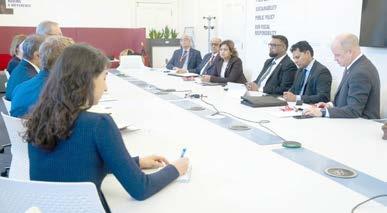
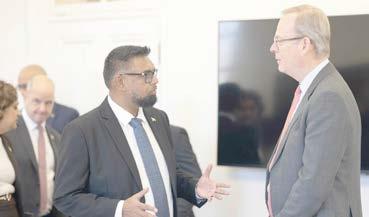
President Dr. Irfaan Ali meets with UK Export Finance CEO, Tim Reid, on
expansion and potential portfolio growth in Guyana (Office of the President photos)
Guyana ‘future proofing’ its economy
GUYANA has signalled its intention to become a global leader in biodiversity and ecosystem services as President Dr. Irfaan Ali, on an official visit to the United Kingdom, announced plans for a Commonwealth Centre of Excellence on Biodiversity in Guyana and revealed renewed backing from King Charles for the country’s pioneering work on climate, forests and the environment.
The Head of State, in a video posted to his Facebook page Wednesday morning, disclosed that discussions were held on creating a market-based biodiversity financing model to fund conservation and ecosystem services.
He stressed that the government intends to position the country as a global leader in biodiversi-
ty and ecosystem services, linked to pharmaceuticals, indigenous culture, rights and language.
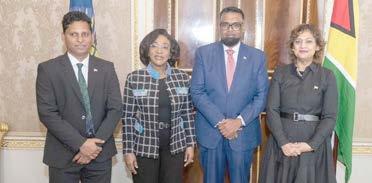
President Ali and his delegation also met with the Commonwealth Secretary-General, Shirley Botchwey, who he confirmed is backing the establishment of a Commonwealth Centre of Excellence on Biodiversity in Guyana.
“I think there are some exciting announcements, some exciting programmes and exciting opportunities ahead of us, and this is all part of building that resilient, sustainable economy that has diversified; not only diversified in traditional areas, but diversified in new areas that are future proof,” the President said.
The goal is to build a resilient, sustainable economy through environmental services, ensuring future-proofing and global
leadership in biodiversity and ecological services.
“As you know, biodiversity is integrally related to pharmaceuticals, indigenous culture, rights, language, so all of this enable us to position Guyana as the focal point on this issue of biodiversity,” the President said.
President Ali noted that Guyana’s Centre of Excellence will be integrated with similar institutions across the world; this type of collaboration, he noted, is critical to bolstering conservation efforts.
Already the world has 60 per cent of its biodiversity. President Ali had previously emphasised the urgency of protecting biodiversity, noting the loss of 10 million hectares of forest annually and the extinction of one billion species.
The world, he had said, is quickly approaching a
–– President Ali says, highlights government’s push to position country as global leader in biodiversity, climate, ecological services
‘irreversible tipping point’ as key ecosystems are coming under siege.
“Environmental Services, ecological services and biodiversity services are future proof, just like we have massive interest and investment in AI [Artificial Intelligence] and digitization, the future will be about biodiversity, ecological services, Forest Services, climate services, and we are positioning Guyana ahead of that time,” he said adding:
“[We are] future proofing our economy for our people, for sustainability and resilience, but more importantly, for the world, taking responsibility, pro-
viding leadership in a value-based system, so that we support a world that is stronger, safer, and one in which sustainability and resilience are a part of our everyday life.”
Back in July 2025, Guyana had launched the global biodiversity summit, where several leaders signed what is known as the Georgetown Declaration, an ambitious roadmap to protect and conserve biodiversity, halt biodiversity loss, and accelerate nature-positive action.
The Alliance has five pillars, first to advance the global goal of conserving at least 30 per cent of land and oceans by 2030;
secondly, to embed biodiversity in national and corporate planning through measurable indicators. Its third pillar will be focusing on unlocking innovative finance, including biodiversity credits, green bonds, and debt-for-nature swaps. Fourthly, the empowerment of Indigenous peoples and local communities is crucial, alongside the establishment of institutionalised monitoring and transparency mechanisms, such as the Global Biodiversity Product and the Gross Biodiversity Power Index.
On Tuesday, President Dr Irfaan Ali met with the Commonwealth Secretary-General, Shirley Ayorkor Botchwey. A key outcome is an agreement to collaborate on strategic initiatives to support the Global Biodiversity Alliance. A Joint Working Team will advance efforts to establish an International Biodiversity Centre of Excellence based in Guyana
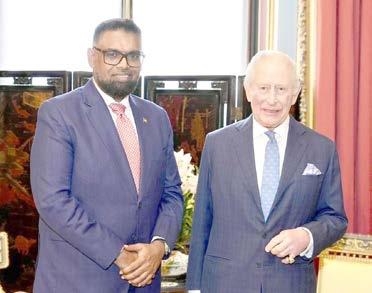
During his visit, President Ali also met with His Majesty King Charles III, King of the United Kingdom and Head of the Commonwealth at Buckingham Palace. Discussions focused on ongoing collaborations in the areas of the environment, biodiversity, and climate (Office of President photos)
‘A journey of continuation’
–– Budget 2026 absorbs billions in inflationary pressure, shocks
says President Ali
WHILE many nations globally are shifting their fiscal investments away from budgetary measures, Guyana is maintaining its deliberate effort to shield ordinary Guyanese from global economic shocks while deepening opportunities for wealth creation across households and businesses, President Dr Irfaan Ali has said.
The country’s 2026 national budget outlines a series of measures that, he says, collectively absorb hundreds of billions of dollars in potential inflationary pressure that would otherwise fall on families, farmers, and enterprises.
Examining some of these key fiscal policies and measures, Dr Ali, on Wednesday, stressed that the objective is to ease the cost of living and expand economic opportunities.
“I’m happy once again, that I can give some additional insights into budget 2026, a journey of continuation for the people…budget 2026 will continue in this tradition … to ensure price stability for food, expand local production, reduce the cost of local
production, and improve our competitiveness for small and medium enterprise,” the President said.
Among the core planks of the budget is the continuation of zero-rated value added tax (VAT) on key food items and basic household necessities, a policy first introduced in the country’s Budget 2021.
This is coupled with the removal of VAT on electricity, water, and medical supplies, a measure the President said is costing the Government around $4 billion annually but directly lowering expenses for ordinary families.
The administration is also maintaining subsidies on electricity and water, with targeted support for old-age pensioners, and sustaining programmes such as the Because We Care grant, old-age pension increases, and oneoff bonuses for specific categories of workers and pensioners.
“Since we came into office, we restored zero rated VAT status on key food items and basic household necessities. You will recall budget 2021, did exactly this.
We removed VAT on fertilisers, agrochemicals, pesticides that benefit directly every single farmers, whether you are small, medium or large scale; we removed VAT on machinery and equipment used by farmers [and] used in mining. [We] reversed the 220 per cent increase in D&I charges and a 600 per cent increase in land rental that was imposed upon farmers by the then APNU+ AFC [A Partnership for National Unity+Alliance for Change] government,” President Ali said.
BACKING FARMERS AND BOOSTING
LOCAL PRODUCTION
A major component of Budget 2026 is to bring down food prices by investing heavily in domestic production; to this end President Ali highlighted substantial allocations for drainage and irrigation, aimed at opening up tens of thousands of acres of new farmland for cultivation.
These investments, he said, will particularly benefit small- and medium-scale farmers, including those on five-acre plots, and support expansion into livestock and non-traditional crops.
And to further reduce production costs and stimulate investment, he reminded that the government has removed VAT on fertilisers,
agrochemicals, pesticides, and machinery and equipment used in farming and mining; removed corporate tax on interest earned by banks and relief for the poultry sector, with the aim of lowering borrowing costs and production expenses; and eliminated all taxes on agriculture and agro-processing under Budget 2026, intended to boost lending, confidence, and capital access in the sector.
President Ali asserted that higher output, supported by these measures, will increase supply and translate into lower prices for consumers, while helping farmers access greater markets locally and internationally.
“One of the ways in which you can address rising costs and costs of food is by boosting local production to reduce price pressure. That is why we invest billions of dollars in drainage and irrigation so that we can have more lands available for farming.
The investment we’re making in budget 2026 will open up tens of thousands of acreage of new farmlands,” Dr Ali said.
CONTAINING IMPORTED INFLATION
The President also underscored the importance of measures designed to cushion the brunt of the impact of global fuel and shipping costs.
The government has set the excise tax on gasoline and diesel to zero, a policy he said is saving the Guyanese public hundreds of billions of dollars annually and directly limiting fuel-related inflation.
Alongside this, the administration is continuing freight-cost reduction measures, which, according to the president, have already saved consumers close to $20 billion by preventing sharp increases in imported food and essential commodities.
HOME OWNERSHIP AND FAMILY WEALTH
Budget 2026 also places substantial emphasis on housing and infrastructure, which the President linked to longterm wealth building for families.
The government, he said, is investing hundreds of billions of dollars in housing infrastructure to make home ownership easier nationwide, continuing the housing mortgage relief programme, which is putting “tens of billions of dollars” back into households’ pockets.
Supporting lower interest rates on loans up to $30 million, leading to what the President described as “billions of dollars in savings” annually for families and providing targeted housing subsidies.
President Dr Irfaan Ali
‘Education is the core of national development’
— Minister Parag commissions two new Nursery Schools in Region Six
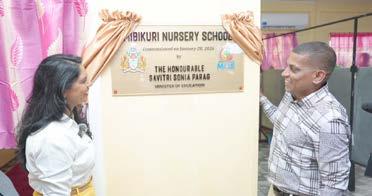
MINISTER of Education, Sonia Parag, on Wednesday, commissioned two spanking new nursery schools in Region Six; those are the Mibicuri Nursery School and Chesney Nursery School, further strengthening early childhood education in the region.
The newly opened facilities are expected to provide a safe, modern, and stimulating learning environment for young children, while improving access to quality education for families in the surrounding communities.
During the commissioning ceremony, Minister Parag underscored the government’s commitment to investing in early childhood development, noting that a strong educational foundation is critical to students’ long-term academic success.
She highlighted that the new schools are outfitted with age-appropriate classrooms and learning resources designed to support holistic development.
Speaking at the opening of the Chesney Nursery School, Parag stressed that “this is more than just a physical space, it is more than the building.”
She stated, that “the impact of this should not be lost on this community”, as according to her, this invest-
ment shows how the government values the education sector pointing out that the education budget is the second largest “and there is a reason for that, the reason is that if we don’t educate our people, this is not nursery students, its those children in primary, those children in secondary, those who would have gone on to become adults.”
Parag stressed that the education sector is about “national developnment, human capacity developnment” which means “that our most valuable assets, our people have to develop with our country, as a matter of fact our people shouldn’t be developing alongside, they should be developing before anything else and that is why education remains the core.”
She pointed out that over the last five years hundreds of schools have been built.
She noted that schools are being built in communities to ensure easier access to education, “closer to your homes.”
“It is telling someone that we were able to give access where there was no access to education to all of our children who deserve it.”
In Mibicuri, the new school which cost some $62.5 M, can accommodate 100 learners and has four classrooms, a kitchen, an
office space along with a sick bay.
Minister Parag, at the Mibicuri location, also noted that education is the foundation and core of national development in any country. “Education is one of the things that focus is placed on to ensure that our human capital develops,” the minister added as well.
Another 40 additional schools are set for completion under the 2026 budget and the Minister encouraged those gathered to upkeep the new buildings.
Meanwhile, Regional Chairman, Junior Basant, stated that the milestone is not just the establishment of a new school but rather “it is a powerful step forward in our collective commitment by the PPP/C government in bettering the future of our children and our community.”
He said, “for too long, many families in Chesney and nearby areas have faced challenges in accessing quality early childhood education. Overcrowding in existing schools made it difficult for every child to receive the attention and nurturing they deserve. Today, with the opening of this nursery school, we are addressing that need head-on.”
According to him, the institutions were built with a clear vision to increase access to quality nursery
The $62.5M Mibicuri Nursery School was officially commissioned by Minister of Education, Sonia Parag. The facility, which can comfortably accommodate 100 learners, contains four spacious classrooms, a kitchen, a sickbay, and an office space
education for all children, to reduce overcrowding in our existing schools and to support the Ministry of Education’s commitment to early childhood development in Region Six.
He added, “But the impact of this school goes beyond education. It represents equity in the distribution of resources, ensuring that every child, regardless of where they live, has a safe, child-centred learning environment closer to home. This proximity is especially important for our working parents and guardians, who can now balance their responsibilities with greater ease, knowing their children
are learning and growing in a secure space nearby.”
Basant related that the Chesney Nursery School is not only a place of learning, it is a driver of community development. By creating employment opportunities, it strengthens our local economy and empowers families.
“Residents, this school is a beacon of hope. It symbolises our shared belief that every child deserves the best start in life. Together, we are building a foundation that will shape the leaders, innovators, and citizens of tomorrow”, he told those gathered.
The opening of the Chesney Nursery School on Wednesday is expected to play a critical role in laying a strong educational foundation and supporting early childhood development in the region
Putting People First
THE theme for Budget 2026, "Putting People First," is more than just an annual fiscal package; it makes a clear statement about the type of society Guyana wants to build
President Dr. Irfaan Ali and Finance Minister Dr. Ashni Singh outline measures that signal a developing model. This model recognizes that economic growth is only meaningful when it improves lives, promotes dignity, and creates more opportunities.
Critics who dismiss direct cash transfers as merely political handouts will struggle to maintain that viewpoint with this budget.
There are significant transfers, including the $100,000 national cash grant for adults, the continuation of the $100,000 grant for newborns, the expanded education grant offering $85,000 per child, and increased pensions with transport support for the elderly.
However, these are not just standalone gifts. They fit into a sensible
framework that increases disposable income, reduces vulnerability, and stimulates local demand in a growing and diverse economy.
What stands out is the intentional link between immediate relief and long-term change. The introduction of Special Development Zones with targeted financial incentives, the removal of corporate tax on agriculture and agro-processing, and the increase in export allowances for value-added forestry products show a strategic focus on production rather than just consumption.
Along with the expected reduction in electricity costs from the Gas-to-Energy project, Budget 2026 aims to make manufacturing, agro-processing, and downstream forestry genuinely competitive both at home and abroad. This approach helps a commodity producer move up the value chain.
Equally important is the shift in how cost-of-living and social protection are approached
Keeping the excise tax on fuel at zero, extending relief on freight, and setting aside an additional $9 billion for cost-of-living support demonstrate that the government understands how quickly inflation and price shocks can erase progress. Additionally, raising the income tax threshold to $140,000 and eliminating net property tax on individuals is a bold acknowledgment that working families and emerging middle-income households need room to breathe, save, and invest
One of the most transformative aspects of Budget 2026, though less visible at first, is its focus on savings through public services. By expanding dialysis facilities to every regional hospital, implementing telemedicine and virtual clinics, building level four and five hospitals across regions, and strengthening the Emergency Medical System, the government is extending care while keeping money in households that would otherwise be spent on private healthcare and chronic
illnesses.
This principle applies to spectacles, dental care, and exam fee support for thousands of CSEC and CAPE students. When the state covers these costs, families can redirect their limited resources toward nutrition, home improvements, or small business efforts.
The government’s message is clear: “we are not holding back,” as President Ali stated. This budget marks the first major step in a five-year development plan that prioritizes people while also focusing on investment. It challenges the false choice between growth and fairness by applying oil revenues and fiscal space to support both.
Once the execution aligns with the goals, Budget 2026 will be seen as a turning point, the year Guyana began to secure not only higher GDP numbers but also a fairer, more resilient, and more hopeful future for its people.
I SEEK your indulgence to respond to the September 27, 2026 letter by MP Sherod Duncan titled ‘The $30 Million Low-Income Mortgage Ceiling Confession’ following the recent announcement by the Government of Guyana to increase the low-income mortgage ceiling from $20M to $30M this year.
Mr Duncan contends that this adjustment reveals three “dangerous realities”: first that it is a confession of runaway inflation; second that it redefines ‘low Income’ out of existence; and third that the inclusion of insurance companies as lenders signals “lender fatigue” among current lending institutions. I contend that his interpretation is not only flawed, but that he fundamentally misunderstands how modern housing finance and affordability policy operates.
First, the policy to raise the ceiling reflects market alignment amid rising construction costs driven by supply chain shifts, labour demands, and energy prices. For clarity, the policy does not increase house prices, but rather increases access to preferential financing for homes already priced by the market. If the ceiling remained at $20M, people would still purchase homes between $25M to $30M but would be doing so using commercial loans at much higher interest rates. The ceiling increase therefore reduces the cost of borrowing. It is therefore incorrect and irresponsible to suggest that raising the ceiling is “authorizing the poor to borrow more because the government has failed”. Instead, it is an attempt to shield households from higher financing costs in a higher-cost environment. Secondly, in economies across the world, low-income thresholds evolve with the growth of income and changes in household
structures, and Guyana is no different. Our economy has expanded significantly over the last five years, resulting in a corresponding increase in income across sectors. A static $20M threshold would therefore artificially exclude thousands of Guyanese who are still structurally within the low and lower-middle income brackets.
I hasten to add that though the ceiling has been raised to $30M, a tiered affordability model guides the PPP/C Government’s housing policy. The Ministry of Housing’s homeownership programme is designed to accommodate various income groups through graduated interventions, from subsidized low-income homes to affordable financing schemes for moderate earners, and public-private partnerships for middle-income buyers, including young professionals.
The “low-income” earners who Mr Duncan references continue to benefit from lands
subsidized by as much as $4.8M (US$23,500), and still has access to low-income homes constructed at varying costs ranging from $5.5M to $9.5M. Further, low-income families will also benefit this year from home improvement subsidies through a $7.5B programme budgeted for. “Low-income” in housing policy is an affordability category, not a sociological label. Regarding Mr Duncan’s question of which low-income earner takes home enough to pay a mortgage of $150,000 monthly, I wish to remind him that mortgage affordability is assessed by lending institutions through debtto-income ratios. The ceiling being raised to $30M does not force a borrower to take $30M. It simply allows those who can afford a $30M loan to now qualify for lower interest rates and longer amortization periods. Thirdly, there is no shift to insurance
OP-ED Focus and results must be the essence of international organisations
By Dr Muhammad Ibrahim
AUSTERITY, knowledge, focus, efficiency, and results translate into actions that have an impact on countries.
These should be the main guidelines, offerings and deliverables of international organisations that aspire to remain relevant over time and increase their effectiveness by adding value to their Member States.
To achieve these objectives, that is, to endure and grow while remaining useful, it is necessary to take on the fundamental task of becoming meeting places designed to facilitate coordination and consensus among member states and to actively collaborate—based on science, innovation, and best practices—to help overcome common problems and take advantage of opportunities. The work must deliver results and positive impacts.
The areas of agriculture and livestock, which connect vital issues such as food and
nutrition security, rural development, supply for new value chains, the incorporation of new technologies, and natural resource management, among others, face great challenges as a result of the current situation characterised by changes and disruptions in areas such as the economy, health, and geopolitics.
In the coming decades, it will be necessary to produce food for 10 billion people, and it will be necessary to do so with diversified and nutritious diets based on production systems that are resilient to shocks caused by environmental stress, while also being efficient in the management of natural resources and capable of generating decent jobs throughout all the value chains in which they are inserted.
In this sense, the Western Hemisphere, or simply the Americas, is the world’s crucial territory because of its contribution to global food security—it is the main net exporter of food—and because of its cen-
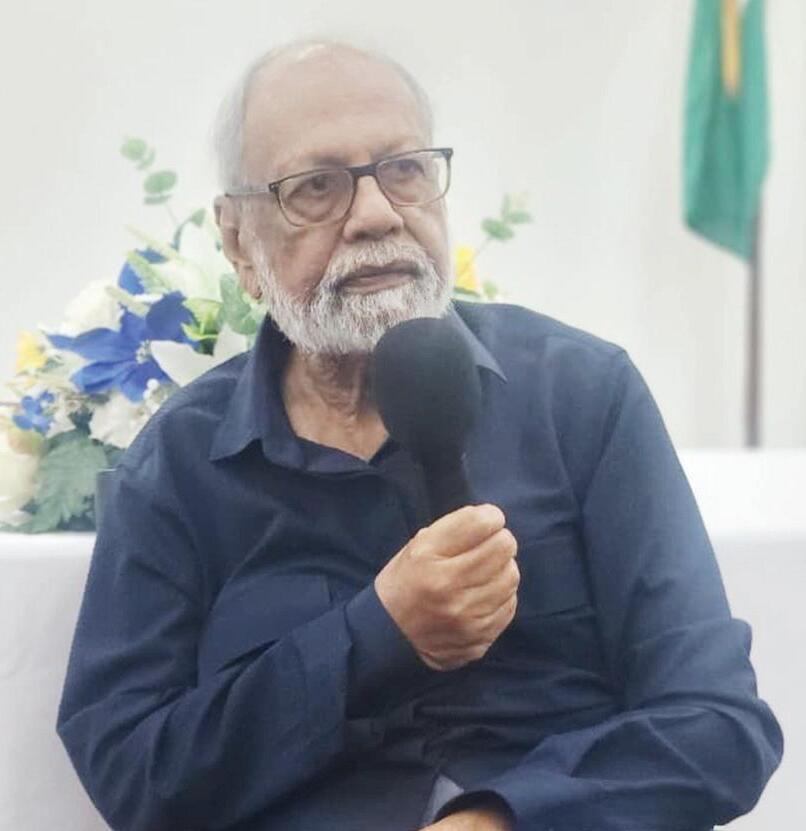
Director General of the Inter-American Institute for Cooperation on Agriculture (IICA), Dr Muhammad Ibrahim
tral components of the planet’s water and oxygen cycle.
In this region, our region, agri-food systems and their rural areas are dynamic and offer opportunities not only for agricultural producers and their families. They also provide an essential service to society as a whole by generating economic development, jobs, helping to reduce crime and uncontrolled migration, and contributing to social peace and political stability through their supply of healthy food.
Addressing the multiple challenges that threaten the Americas’ position as the key region for feeding and nourishing the world
requires a renewed and sustained effort in science, technology, and innovation, as well as the design and implementation of new policies and institutional and financial instruments that make a difference so that farmers, ranchers, and other actors in the value chains are central agents, participants, and committed to the large-scale implementation of the necessary solutions.
A focused and purposeful international organisation, such as the one I am honoured to lead, must work with countries, their governments, farmers, ranchers, and the private sector to help develop and disseminate the technological, policy, and institutional solutions needed to successfully meet the challenges of feeding a growing population with healthy and sustainable diets, while generating investment, income, and employment to boost prosperity in rural areas.
Now more than ever, we need to help lay the foundations for prosperity, opportunity, and national security. International support—delivered with technical and institutional capacity—to countries’ agricultural complexes plays a central role in achieving these objectives.
Our work must focus on addressing specific problems, contributing to their resolution with respect for the sovereign decisions of countries, without assuming supranational functions or exceeding mandates, and with prudent and responsible management of the resources allocated to us by countries.
That is what we are here for.
From vision to action: 2026 Budget delivers for citizens
Dear Editor,
IN the coming days, many will become overnight budgeting experts.
Yet most self-proclaimed fly-by-night experts lack the most rudimentary understanding of what a budget truly is, what it seeks to accomplish, and how it is crafted. While their commentary will be loud and bold, we need to take their commentary with abundant caution.
For those interested in the national budget, it is important to first understand that the budget is an annual plan that seeks
to fulfil the government’s manifesto promises (a medium-term policy).
Any analysis of the budget should therefore start with the question, “Is the budget designed to translate the governing party’s manifesto into action?” If the answer is yes, the budget can therefore rightly be considered a ‘good budget’ because it signals that the government is delivering on its commitment to the people. This year’s budget, like those presented over the last five years, is extremely good because it is perfectly aligned with the PPP’s 2025 Manifesto.
It is also important to recognise that it is very rare that a single budget will implement all the measures in the government’s manifesto. Indeed, many promises require multiple budgets to be fully implemented. Equally important is that the benefits of some manifesto promises are not immediate but are fully realised in the medium-to long-term. For this reason, judging a budget solely on short-term outcomes misses the bigger picture. A well-constructed budget is not about instant gains or gratification, but rather lays the foundation
or builds on it for sustained progress. Again, this budget builds on the foundation laid by the government to promote broad-based, people-centric development.
This budget, for instance, offers direct transfers, targeted social-support programmes, and increases in Old Age Pension and Public Assistance that will benefit the most vulnerable in the shortterm. It also includes measures to stimulate economic growth, create sustainable businesses and jobs, and enhance citizens’ well-being in the medium and long term.
In other words, this is a budget that balances immediate relief for citizens with investment that will provide benefits way beyond 2030.
Editor, any deep analysis of this year’s budget will therefore confirm that it is not only the biggest, but one that will continue to transform the social and economic landscape of our country. Beyond its scale, this budget is designed to deliver sustained benefits that will uplift every community, develop our transport infrastructure, and expand opportunities in every economic sector.
In this increasingly
$30M
companies away from commercial banks and other lending institutions like the New Building Society.
Instead, there is a widening of the pool of lenders by including insurance companies, in keeping with international practices. The diversification of housing finance channels allows for increased competition in the market which triggers improved interest rate offerings to the benefit of borrowers.
So, the expansion of the pool of lenders does not signal that commercial banks are reaching their risk limits as Mr Duncan incorrectly states. In fact, a simple google search would reveal that commercial banks in Guyana have been recording phenomenal success – particularly in residential mortgages – over the past five years. Demerara Bank for instance, recorded a historic $8.4B net profit after tax, with zero non-performing loans for the financial year ending September 2025. This represented a 50.5% increase over the previous year and a 184.7% growth over the past five years. Similarly, GBTI and
uncertain global environment, the 2026 Budget will continue to insulate Guyana from global shocks that have wreaked havoc across the world, as countries struggle to register economic growth exceeding 3% and curtail inflation at low single-digit rates.
In this regard, this year’s budget will position Guyana as a beacon of resilience and progress, a shining star whose development story would be an exemplar.
Regards, Kevin Persaud
Citizens Bank both recorded significant increases in their net profits when compared to the corresponding period in 2024. These figures are incompatible with any narrative of lender fatigue.
Finally, infrastructural rollout across housing schemes and mortgage financing are separate but complementary activities. As the Government continues large scale investment in road and water networks, electricity expansion, and drainage, the process of accessing finance for homeownership cannot be frozen until schemes are completed.
It may have been the policy of the APNU+AFC who only delivered 7,000 house lots in 5 years, but it certainly isn’t for the PPP/C Government.
I wish Mr Duncan well in his budget presentation next week and respectfully suggest that a little more time be devoted to understanding housing policies he so confidently critiques.
Yours faithfully, Ravin Singh
The best analytical description of the United States by far
I HAVE read dozens of books profoundly analysing the conundrum named the United States of America by some of the world’s most erudite minds.
The list includes writers, journalists, academics, artists, philosophers, former non-American diplomats, former American diplomats, and former leaders of foreign governments. But for me the best I have seen so far is by Adam Shatz in the London Review of Books, Vol. 48, No. 2, February 5, 2026, titled “Another country.”
I don’t think any human currently on Planet Earth can better understand who or what the US is if they do not read Shatz. This is fine scholarship that reaches into the labyrinthine corners of intellectual analysis and produces a study that provides the definitive conclusion about just what this place on earth called the USA is.
I spent the beginning hours of Tuesday morning reading this 8000-word essay that Shatz should develop into a book. I would recommend any university lecturer that teaches American politics and/or International Relations or a course in Comparative Politics or Contemporary Political Theory or a course on 20th-century civilization (a course I did when I was at McMaster University, which was one of all time my favourites university courses) to put this 8000-word essay on their reading list.
It is difficult to review this essay in a newspaper column, and I don’t want to serialize the column. What I will do is twofold. I will reproduce a selection of Shatz of the thinking of great minds on what they had to say about the US and I will offer an ending quote from the author himself.
A word before I do the reproduction. I honestly was not surprised by the analysis and description of the US by Shatz and the quotes he offered of how others saw the US. I have never been enamoured or attracted to the United States. I would like to think my ontological DNA revolted against any potential embrace of the US. I was never tempted to visit the US. I am in my early seventies, and I have seen the USA for just three days in 2000 when I did eye surgery in Miami. From hospital to airport.
Sorry to disappoint you with this tiny rather than a broader review, but here now are the people Shatz quoted, followed by a quote from Shatz himself. All of the people Shatz cited are world famous personalities of deep minds.
James Baldwin –“The very word “America”remains a new, almost completely undefined and extremely controversial proper noun. No one in the world seems to know exactly what it describes, not even we motley millions who call ourselves Americans.”
Serge Daney – “America is a place that makes it possible to dream, but also the corner of reality that dreams crash into.”
Pierre Melville, “America is the sublime and the abominable”’
Franz Fanon – “Two centuries ago a former European colony decided to catch up with Europe. It succeeded so well that the United States became a monster, in which the ... sickness and inhumanity of Europe have grown to appalling dimensions.”
George Kennan - “America is a prehistoric monster with a ‘brain the size of
a pin.”
Simone de Beauvoir – “America is a ‘battlefield and you can only become passionate about the battle it is waging with itself, in which the stakes are beyond measure.”
Anders Stephanson - “The alarming fact is that everyone on this earth has an enormous stake in how the United States chooses to be and act in this world.”
Frederick Douglass – “America is a thin veil to cover up crimes which would disgrace a nation of savages.”
CLR James - “The US, the greatest power in Western civilization no longer knows what to believe about itself.”
Martin Luther King - “Nothing provides the communists with a better climate for expansion and infiltration than the continued alliance of our nation with racism and exploitation throughout the world.”
Amin Maalouf – “Americans have the means to rid the human species of all the
plagues that assail it ... and here we are, however, launched at full speed in the opposite direction.”
Amiri Baraka – “One of the most baffling things about America is that despite its essentially vile profile, so much beauty continues to exist here.”
The quotes here are not fully contextualised especially the ones from Baldwin, de Beauvoir and King, so there are more meaning to what they had to say.
I end with the final paragraph by Shatz himself: “What I mostly feel these days, as I look at the disaster unfolding in America and its horrifying repercussions throughout the world, is an intense sense of shame. Shame isn’t a pleasant emotion, but any honest reckoning with what my country has become has to start with it.”
DISCLAIMER: The views and opinions expressed in this column are solely those of the author and do not necessarily reflect the official policy or position of the Guyana National Newspapers Limited.
GRA employees terminated over vehicle transfer linked to sanctioned Azruddin Mohamed
–– legal action being pursued after breach of AML/CFT regulations
THE Guyana Revenue Authority (GRA) has terminated several employees, including a manager, following an investigation into the unauthorised transfer of vehicles linked to Mr. Azruddin Mohamed, who has previously been sanctioned and indicted for alleged fraud, customs violations, and money laundering.
The action comes after authorities determined that the employees acted in violation of the Anti-Money Laundering and Countering the Financing of Terrorism
(AML/CFT) Act. The legislation criminalises the transfer or conversion of property believed to be the proceeds of crime, even if the person has not been convicted of a serious offence.
According to the GRA, the employees facilitated the transfer of motor vehicles from Azruddin Mohamed’s name to others, contrary to statutory requirements and established agency procedures. Following the discovery, the staff involved were dismissed from their positions.
The Authority, in collaboration with the Guyana Police Force, said it is pursuing legal proceedings against Mohamed and the former employees for the breach.
The GRA in a press statement noted: “A person commits the offence of money laundering if he knowingly or having reasonable grounds to believe that any property in whole or in part directly or indirectly represents any person’s proceeds of crime – converts or transfer property knowing or having rea-
son to believe that property is the proceeds of crime, with the aim of concealing or disguising the illicit origin of that property.” Moreover, section 3(4) of the said act explicitly states that “For the purposes of this Act, it is not necessary for any person to be convicted of a serious offence to prove that property is the proceeds of crime.”
The GRA reiterated its call for the public to report any suspected illicit or unlawful activities, noting that all information will be treated confidentially and
may result in rewards under applicable law.
In June 2024, the U.S. Department of the Treasury’s Office of Foreign Assets Control (OFAC) sanctioned Azruddin Mohamed, his father, Nazar ‘Shell’ Mohamed, and their company, Mohamed’s Enterprise, for allegedly participating in schemes to evade taxes and launder money tied to gold export activities.
On October 2, 2025, a Florida federal grand jury unsealed an 11 - count in -
dictment against Azruddin and Nazar Mohamed for conspiracy, wire fraud, mail fraud, money laundering and customs violations connected to an extensive tax evasion scheme involving millions of dollars and fraudulent gold exports.
On October 30, 2025, police arrested Azruddin and his father under a U.S. extradition request, moving to process them for transfer to face the U.S. charges. They were granted bail but remain subject to ongoing extradition proceedings in courts.
Manufacturers welcome ‘strong response’ as most GMSA proposals make it into Budget 2026
THE Guyana Manufacturing and Services Association (GMSA) has welcomed what it described as a strong response from the government to its recommendations for the 2026 national budget, revealing that about 80 per cent of its proposals were accepted.
This was according to President of the GMSA, Rafeek Khan, during a press conference on Wednesday where he stated that, “Of all the years we have made submissions, perhaps this year, our most recent submission for 2026 budget, at least 80 per cent of them were achieved.
It was then that he added that the government had answered the call to solutions to address competitiveness in manufacturing.
Khan said manufacturers across the association’s wide range of
sub-sectors, including agriculture, agro-processing, forestry, construction, engineering and ICT, continue to face common challenges, particularly in relation to human resources and access to raw materials.
“These are two biggest challenges… for every single one of our
sectors of our economy,” he noted, while expressing satisfaction that the 2026 budget addressed several of these issues.
One of the most significant initiatives highlighted was the proposed establishment of special development zones, which Khan said would help ease the high do -
mestic cost of logistics.
“The cost of moving the raw material from the hinterlands of Guyana to our manufacturing hubs is a major cost,” he said, describing logistics expenses as very burdensome for local manufacturers.
According to Khan, the development zones
would allow for the consolidation of like-minded manufacturers in shared spaces, reducing operational costs while improving efficiency.
He added that shared electricity arrangements within these zones would help manufacturers become “more competitive in terms of energy cost” and allow for better monitoring of quality and production standards.
The GMSA president also welcomed the introduction of export incentives, which he said were proposed by the association to help manufacturers manage rising costs, particularly those linked to tariffs in key export markets.
“Without export we cannot grow our GDP in a certain manner. We cannot get the foreign currency that we need to get,” Khan said.
Support for small and micro manufacturers also
featured prominently, as he pointed to the role of development finance in expanding access to capital. He said this would be “a great help to our small manufacturers”, many of whom supply larger companies within the manufacturing value chain.
Khan further describ ed the removal of value-added tax on locally manufactured furniture and jewellery as a “tremendous” boost for the sector, noting that these items are “basic essentials that everyone needs in a house” and that the measure would help local products compete more effectively with imports
To this end, Khan said the association remains optimistic, projecting that “every single sector in the GMSA is expected to see double-digit growth in 2026 and beyond”.
Strengthening existing ties critical as Caribbean looks to new markets
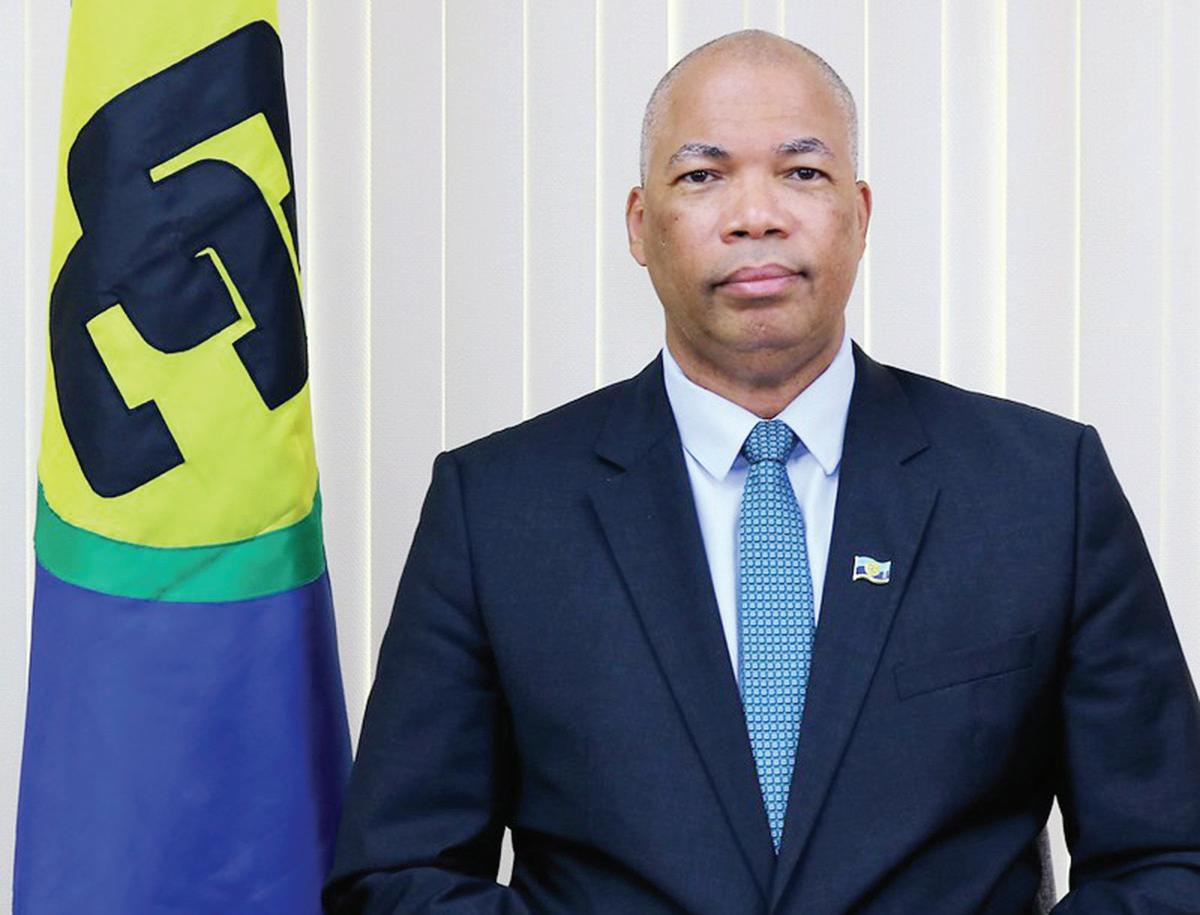
THE Caribbean region should focus on strengthening its existing trade relationships while carefully expanding engagement with new markets such as Africa, India and Brazil, according to Assistant Secretary-General CARICOM Single Market and Economy, Wayne McCook.
McCook was at the time speaking at the World Trade Centre Georgetown during the forum Perspectives on Global Trade 2026: Challenges and Opportunities.
During his presentation, he outlined what he described as a practical and balanced approach to trade policy as the region
prepares for continued global uncertainty.
“All of these, I think, need to be practical and purposeful,” McCook said, noting that as the Caribbean looks outward, it must not neglect partners with which it already has established links.
“Part of the strategy must be to strengthen our existing relationships, while we seek to deepen and explore contacts with India, with Africa, with Brazil.”
He stressed that this approach should not be seen as either-or, but rather as a comprehensive strategy that also involves nurturing existing trade agreements. “We also
need to nurture the agreements we have,” he said Against this backdrop, he pointed specifically to agreements with the Dominican Republic and Costa Rica. “So, it’s an all-of-the-above strategy, each being prioritised in its own way,” he added.
McCook linked this broader trade outlook to developments within the region, highlighting the role Guyana has played in shaping regional policy discussions, particularly in agriculture. He noted that work on the regional agricultural policy has been driven at the highest level, with President Dr Irfaan Ali serving as the lead Head for agriculture
within CARICOM.
“The 25 by 25 plus five programme is already yielding results,” he disclosed while adding that trade policy must be viewed through both an agricultural and industrial lens.
To this end, he explained that, alongside the regional agricultural policy, CARICOM is moving to advance a regional industrial policy, which he said is critical to addressing long-standing weaknesses. One of the
major challenges, he noted, has been the lack of competitiveness.
Meanwhile, McCook said that while policies are important, their success will ultimately depend on implementation. “The practical measures done by businesses in giving effect to these policies and more importantly, driving them, will be critical,” he noted.
Looking ahead for this year, McCook cautioned that global trade conditions are unlikely to stabilise quickly; however, he expressed confidence in the region’s ability to navigate the challenges ahead through solid partnerships and strong private sector engagement.
GMSA President, Rafeek Khan (centre), flanked by other executive members and sub-sector chairpersons
Assistant Secretary-General CARICOM Single Market and Economy, Ambassador Wayne McCook
CSME Assistant-Secretary General tells trade forum
City and Guilds launches professional recognition programme for Guyanese
THE City and Guilds-approved Centre in Guyana is offering local professionals the opportunity to earn an internationally recognised award that acknowledges years of service, competence, and professionalism.
On Tuesday, Executive Director of City and Guilds (Trinidad and Tobago), Selwyn Bhajan, along with the Guyana Centre, hosted an information session for prospective participants at the National Library in Georgetown.
The session highlighted the benefits of the Professional Recognition Award, which is based on the United Kingdom’s National Vocational Qualifications (NVQ) system.
Bhajan emphasised the importance of developing
skilled professionals amid Guyana’s rapid growth, noting that the programme offers participants a way to gain international recogni-
tion of their expertise.
Candidates can obtain the award with a 25 percent down payment and six months to settle the balance.
Academic achievements and professional work experience are also taken into account, with individualised coaching and guidance
provided for portfolio submissions.
The Professional Recognition Award is offered at four levels: Licentiateship, equivalent to a higher diploma; Affiliateship, equivalent to an associate degree; Graduateship, equivalent to a bachelor’s degree based on work experience; and Membership, equivalent to a master’s degree. “When you get your certificate from City and Guilds, you also receive a letter confirming its equivalency to a bachelor’s or master’s degree,” Bhajan explained.
During the session, an appreciation award was presented to Elon Sooknanan, Chairman of the Council for Technical and Vocational Education and Training (TVET) at the Ministry of Education,
for his support in introducing City and Guilds training in Guyana.
Sooknanan, who has benefitted personally from City and Guilds training, highlighted the programme’s potential to provide international accreditation for Guyanese professionals who may not have had the opportunity to attend university.
“This programme offers a pathway for individuals to fulfill their dreams and gain recognition at an international level,” he said.
He added that with Guyana experiencing significant growth and transformation, this initiative provides citizens with the tools to make a lasting impact and leave a mark for future generations.
Young voices, big impact: Region Two Mashramani kicks off
By: Indrawattie Natram
THE spirit of Mashramani came alive at the Anna Regina Secondary School on Wednesday as students from across Region Two gathered for Day One of the Children’s Regional Mashramani Competition under the inspiring theme, “Little Builders of One Guyana – Learning Together, Shaping a Digital Tomorrow.”
The auditorium buzzed with excitement from as early as 10:00 hrs. as proud teachers, parents, and supporters filled the venue to witness the region’s young talents take centre stage in Dramatic Poetry and Calypso.
The programme commenced with a Call to Order by Ms. Cheryl Peters Moore, followed by a Silent Prayer and the recitation of the National Pledge by all present. The atmosphere was one of unity and anticipation as Ms. Shondelle Hercules, Regional Education Officer, delivered the Welcome and Opening Remarks, reminding students that Mashramani is not only a celebration of Guyana’s Republic status, but also a platform for young minds to express creativity, culture, and national pride.
The competition began with Dramatic Poetry for ages 5 to 7, featuring charming and confident per-
formances from Hampton Court Primary, Queenstown Primary, and Mainstay Lake Primary. Though small in stature, these children delivered powerful lines with clarity and expression, captivating the audience.
The energy shifted into rhythm and melody with the Calypso segment for ages 5 to 7, where pupils from Dredge Creek Primary and Mainstay Lake Primary sang their hearts out, delivering witty and meaningful calypsos that reflected the theme of unity and progress.
The 8 to 10 years Dramatic Poetry category saw an impressive lineup from schools across the region, including Aurora Primary, Onderneeming Primary, Mashabo Primary, the Exceptional Learners Centre, Taymonth Manor Primary, 8th of May Primary, Riverstown Primary, Martindale Primary, Lima Sands Primary, Sparta Primary, C.V. Nunes Primary, Hampton Court Primary, Mainstay Lake Primary, and Huis’t Dieren Primary.
Each performance reflected hours of preparation, as pupils confidently used voice, gestures, and emotion to bring their poems to life. Themes of national unity, technology, learning, and cultural pride were beautifully woven into their presentations.
The Calypso 8 to 10
years category followed, with 8th of May Primary, St. John’s Primary, Charity Primary, Queenstown Primary, Mainstay Lake Primary, and C.V. Nunes Primary delivering vibrant and entertaining performances that had the audi-
ence clapping along.
The older students continued to raise the bar in the 11 to 13 years Dramatic Poetry segment, with entries from Abram Zuil Secondary, Lima Sands Primary, Mainstay Lake Primary, Johanna Cecelia
Secondary, Anna Regina Secondary, and Wakapoa Secondary. Their presentations showed maturity, confidence, and a deep understanding of the competition’s theme.
In the Calypso 11 to 13 years, Abram Zuil Second-
ary and St. John’s Primary used music to creatively express messages of togetherness and the role of youth in shaping Guyana’s future.
The day culminated with outstanding performances from the 14 to 17 years category. Students from Abram Zuil Secondary, Aurora Secondary, 8th of May Secondary, Cotton Field Secondary, and Anna Regina Secondary delivered dramatic poetry pieces that were both thought-provoking and inspiring.
The final Calypso segment featured Anna Regina Secondary, Aurora Secondary, Abram Zuil Secondary, Essequibo Technical Institute, and Wakapoa Secondary, closing the day with rhythm, humour, and powerful social commentary.
Chairpersons Ms. Munirah Reedon, Ms. Evadne Spencer, and Ms. Cheryl Peters Moore ensured the programme flowed smoothly, while teachers and parents beamed with pride at the confidence displayed by the region’s young performers.
Mashramani 2026 in Region Two has begun on a high note, celebrating not only talent, but unity, culture, and the boundless potential of Guyana’s youth.
Executive Director of City and Guilds (Trinidad and Tobago), Selwyn Bhajan
Chairman of the Council for TVET, Elon Sooknanan
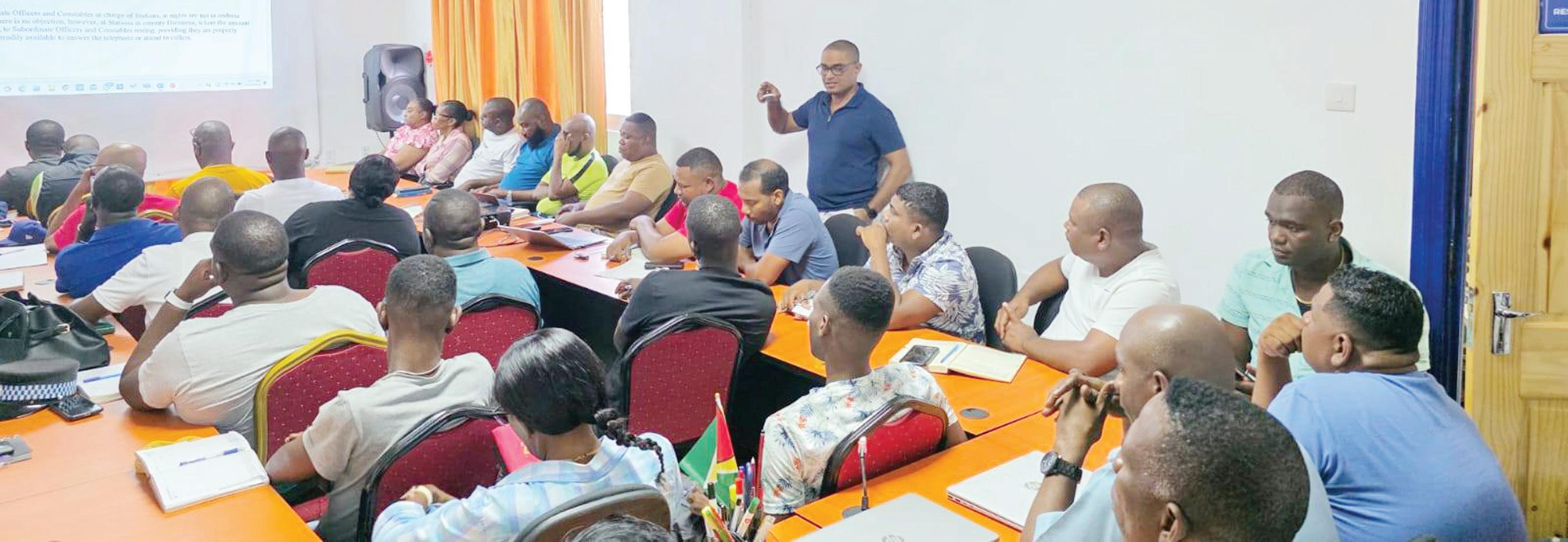
COMMANDER of Regional Police Division #6, Assistant Commissioner Shivpersaud Bacchus, conducted a refresher training session recently for Inspectors and Sergeants serving across the Division.
The session focused on effective communication, confidentiality, leadership, and the implementation of Standing Order No. 6, which outlines the duties and responsibilities of Inspectors and subordinate officers.
Commander Bacchus underscored the importance of maintaining authority, acting impartially, setting professional examples, and properly supervising junior ranks.
He also emphasised the critical responsibilities of officers when in charge of stations or departments, including discipline, operational efficiency, crime
Students get hands-on technology experience at STARR Computer Commander Bacchus leads refresher training for Inspectors, Sergeants in Region Six
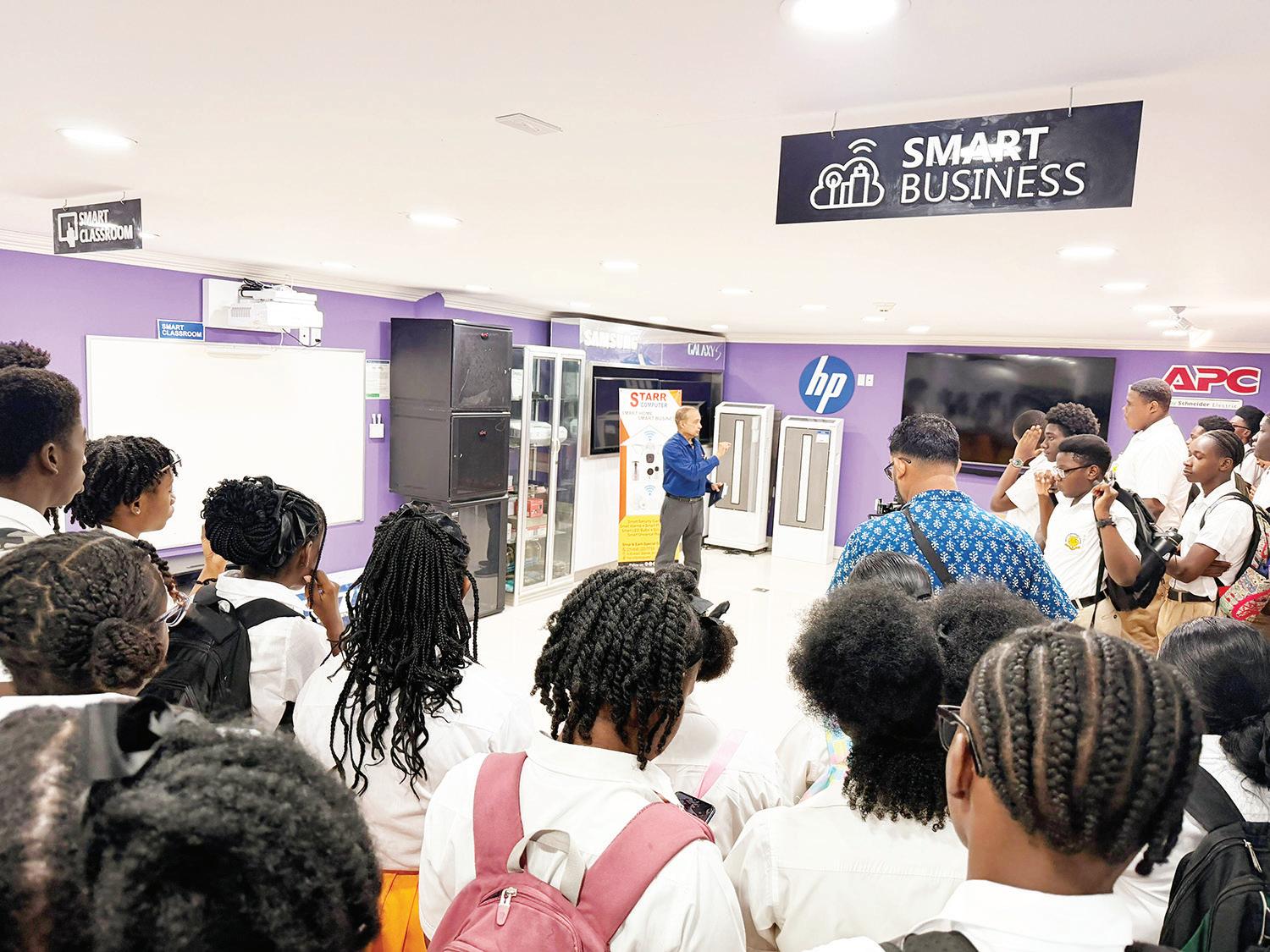
A GROUP of 90 students from Brickdam Secondary and Charlestown Secondary schools were exposed to the world of modern technology on Wednesday during an educational tour of STARR Computer, led by the company’s President, Mike Mohan and his team.
The visit formed part of efforts to introduce students to practical applications of technology and to broaden their understanding of digital transformation, innovation, and career opportunities within the information and communications technology sector.
Among the highlights of the visit was STARR Computer’s impressive range of smart home technologies.
Students were shown how everyday appliances such as smart cameras, smart electrical systems, and even smart animal feeders can be controlled using smartphone applications. The demonstration illustrated how integrated technology can improve convenience, efficiency, and safety in daily life.
The students were also introduced to a wide array of branded IT products from internationally recognised companies such as HP, Lenovo, APC, Epson, Accvent and others.
These included comput-
investigation, staff training, welfare, duty organisation, and oversight of records, property, and public interactions.
The interactive session concluded with participants pledging to uphold the highest standards of professionalism within the Guyana Police Force.
ers, printers, scanners, projectors, accessories, and networking equipment, giving students a comprehensive look at the tools that power modern offices, schools, and businesses.
Another major area of interest was the display of point-of-sale and mobility systems. Products from brands such as Zebra, Elo, Custom America, and STAR Micronics were showcased,
demonstrating how advanced POS and mobile computing technologies support retail operations and business management across various industries.
At the Samsung Experience Center, students explored a range of genuine Samsung smartphones equipped with the latest artificial intelligence features. This segment of the tour gave them a closer look at
how AI is being integrated into everyday mobile devices and how it is transforming the way people communicate and use technology.
The tour also included a visit to the Bargain Centre, where students learned about the affordability side of technology.
The section featured major brands offered at discounts of up to 50 percent, highlighting the importance
of smart purchasing and making quality technology more accessible to a wider audience.
Students were further exposed to STARR’s Hybrid Call Center, where they observed a modern communication hub designed to manage remote customer support operations. The facility demonstrated how businesses can now serve customers from virtually anywhere using digital communication platforms.
At the Innovation Center, the students participated in an interactive session with STARR Computer’s President, Mike Mohan. This segment of the tour focused on creativity, problem-solving, and the development of new technological ideas, giving students a glimpse into how innovation is nurtured within the company.
The visit also featured a stop at the company’s Solar Station, where students were shown how STARR Computer integrates renewable energy into its operations.
The demonstration highlighted the company’s own solar-powered systems and underscored its commitment to sustainability and environmentally responsible technology use.
In a brief presentation, Mohan spoke about the importance of digital transfor-
mation, explaining that it goes beyond simply converting paper documents into digital formats.
He noted that true digital transformation involves cultural change, infrastructure development, improved customer experiences, and stronger collaboration between businesses, consumers, and government institutions. He also spoke about the importance of digitising documents for long-term access, safety, and record-keeping, and highlighted how modern classroom and corporate tools, such as projectors and interactive devices, are changing the way people learn and work.
Encouraging the students to think long-term about their personal and professional development, Mohan stressed the importance of reinventing oneself every year, as an individual, as a business, and through continuous education.
He also shared the story of STARR Computer’s origins and his own journey from Albuystown to the corporate world, reminding students that success is a matter of choice and determination.
The visit concluded with refreshments for the students and teachers, bringing an informative and inspiring tour to a close.
Students from Brickdam Secondary and Charlestown Secondary schools listen attentively to discussions and topics presented by Mr. Mohan during their visit to STARR Computer in Brickdam, Georgetown
Commander, Assistant Commissioner Shivpersaud Bacchus (standing), interacts with ranks during the refresher training for Inspectors and Sergeants in Regional Police Division #6
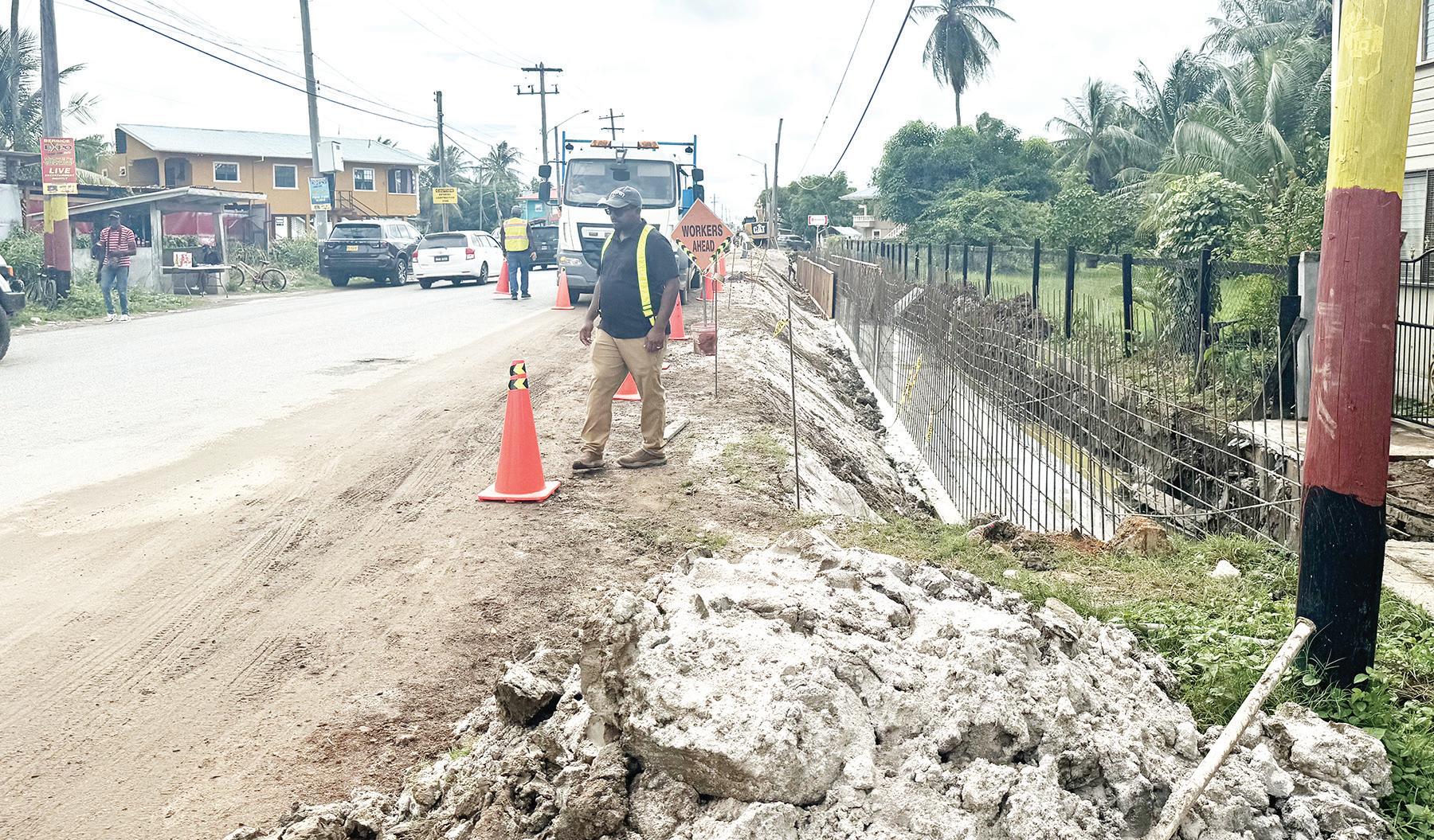
Ministers inspect progress on PalmyraMoleson creek highway expansion
MINISTER
of Public Utiliti es and Aviation, Deodat Indar, accompanied by Minister within the Ministry of Public Works, Madanlall Ramraj, and senior technical officials, conducted a site visit this week to Region Six to review progress on the Palmyra-Moleson Creek road expansion project.
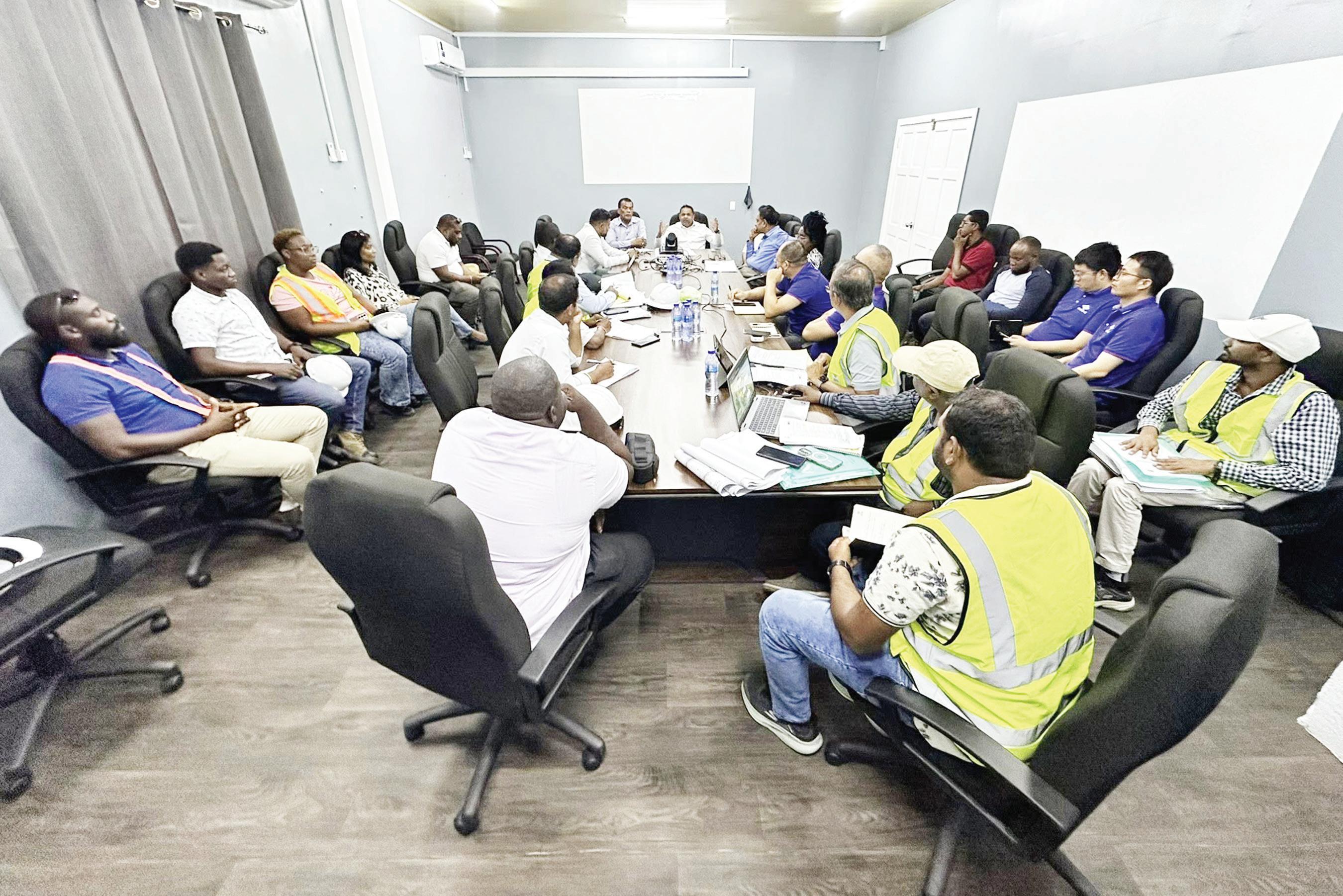
During the visit, the ministers engaged with the project team, including representatives from the supervisory engineering firm RITES Ltd. and contractors China Road and Bridge Corporation and Vishwa Samooja Private Ltd. Discussions focused on key project deliverables and the resolution of encumbrances along the highway’s alignment.
The four-lane highway project, part of the PPP/C Government’s infrastructural agenda, has been allocated $15.1 billion in the 2026 budget to support its advancement. Senior technical officials from the Guyana Power and Light (GPL), Guyana Water Incorporated (GWI), and the Ministry of Public Works provided technical support during the meeting to en-
The ministers engaged with the project team, including representatives from the supervisory engineering firm RITES Ltd. and contractors China Road and Bridge Corporation and Vishwa Samooja Private Ltd.
sure coordination across all relevant agencies.
The visit highlights
the government’s ongoing commitment to improving road connectivity, safety, and infrastructural development in Region Six, which is expected to benefit both commuters and the transport of goods across the area.
‘Pay the cost and take it back’, Minister
Edghill on derelict vehicle recovery
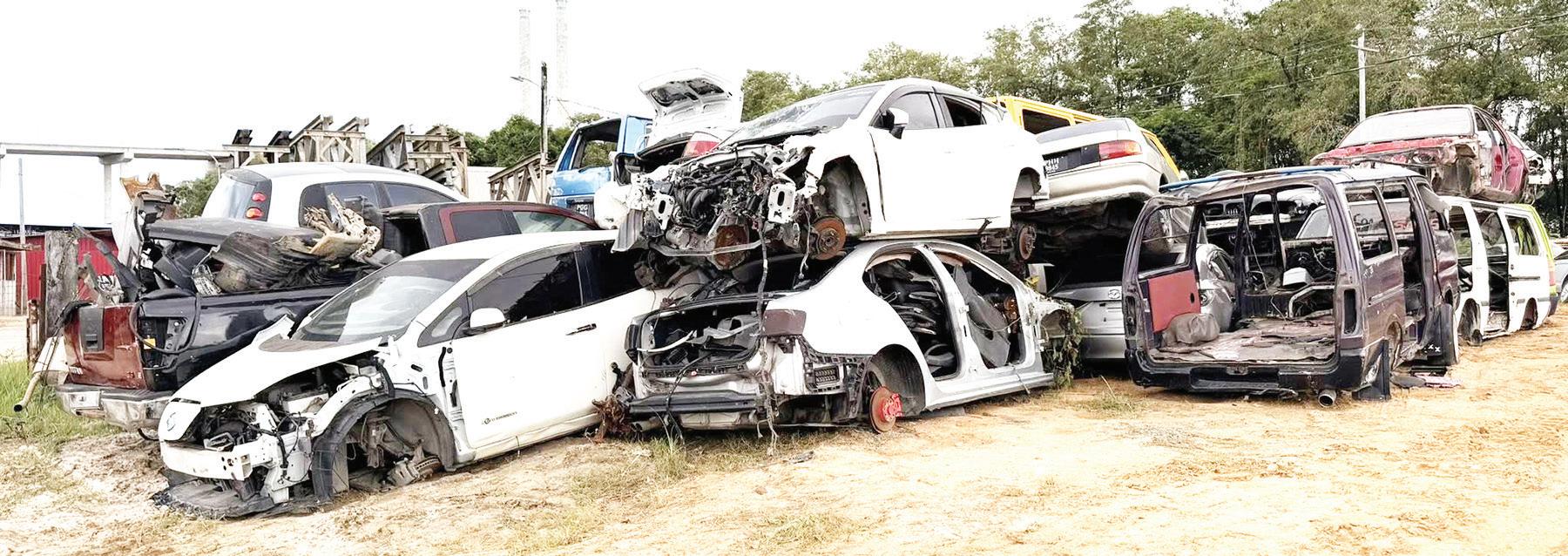
MINISTER of Public Works, Bishop Juan Edghill, has clarified procedures for citizens seeking to reclaim vehicles and other property removed during the government’s ongoing derelict removal exercise.
The announcement followed a recent site visit where the Minister engaged with former staff of the Demerara Harbour Bridge Corporation (DHBC).
Minister Edghill emphasised that while the government does not intend to permanently withhold property, owners must bear the financial cost of removal. “All the persons whose stuff got picked
The Ministry of Public Works reminded citizens that the derelict removal exercise is ongoing, that encroachment on government reserves will not be tolerated
up—if you really, really want it before I take it to the derelict dump site— they have to come into the Ministry, pay us what it
cost to remove it, then you can get it back,” he stated.
The Minister specifically addressed the removal of serviceable vehicles,
including trucks, that were deliberately left to obstruct the Ministry’s work. Owners of such vehicles are now able to retrieve them,
provided they cover the costs associated with the removal process.
“These measures are necessary to prevent en -
croachment and ensure that public reserves remain accessible and safe,” Minister Edghill added.
The Ministry of Public Works reminded citizens that the derelict removal exercise is ongoing, that encroachment on government reserves will not be tolerated, and that urgent action is required to voluntarily remove derelicts or unauthorised structures to avoid fees and administrative hurdles.
The Ministry reiterated its commitment to maintaining clear and safe public spaces while urging the public to co-operate fully with the exercise to uphold the law.
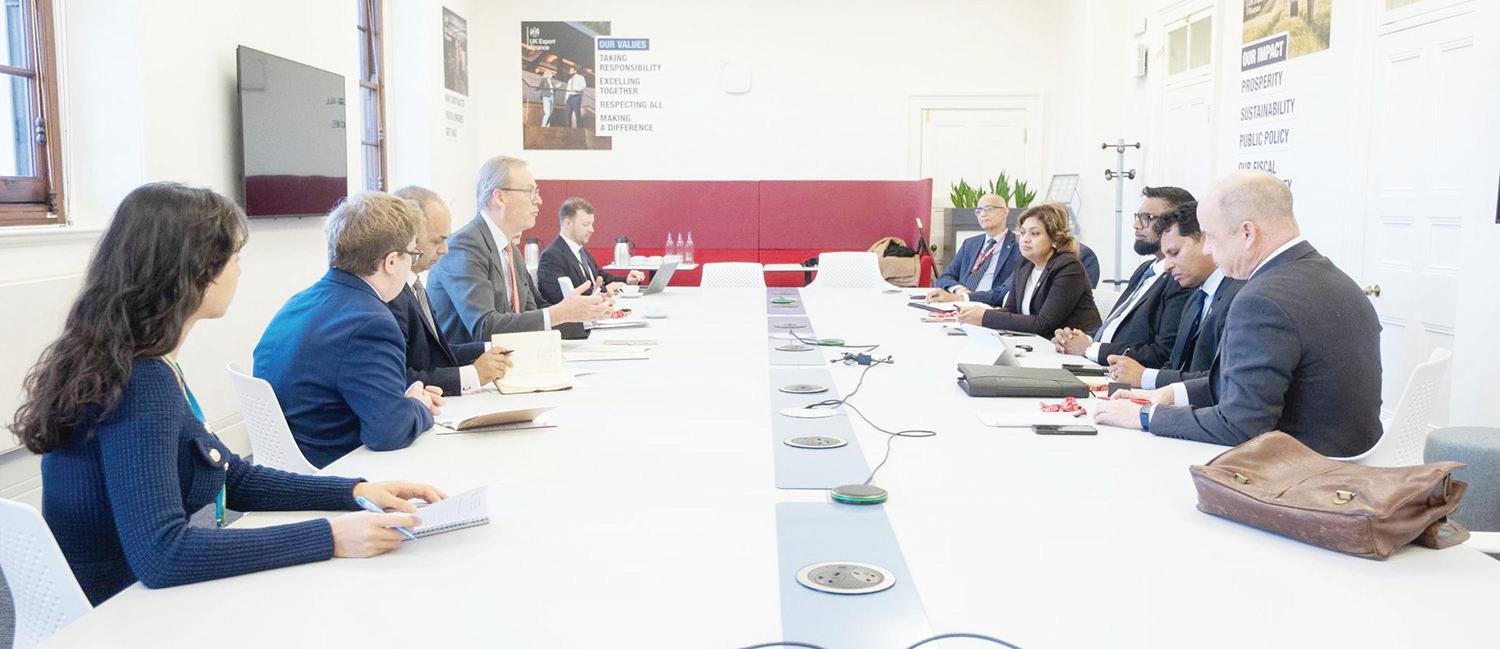
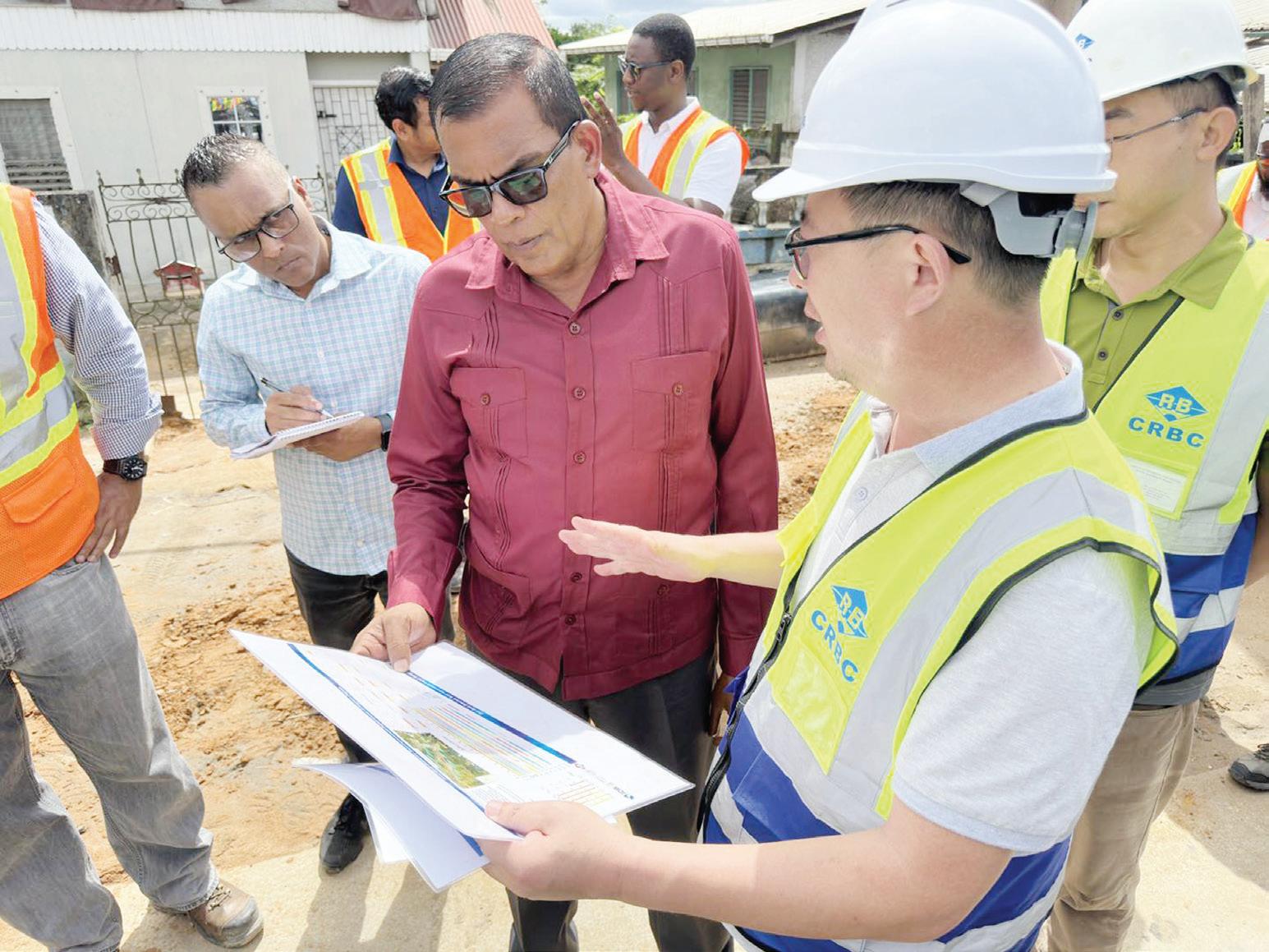
President Ali discusses infrastructural projects with UK Export Finance CEO
President Dr Irfaan Ali meets with UK Export Finance (UKEF) CEO, Tim Reid, on Wednesday, to discuss potential collaboration on major infrastructural projects aligned with Guyana’s development agenda
PRESIDENT Dr Irfaan Ali, on Wednesday, met with Chief Executive Officer of UK Export Finance (UKEF), Tim Reid, to discuss potential collaboration on major infrastructural projects aligned with Guyana’s development agenda. According to information released following the meeting, discussions focused on several key initiatives, including pipeline projects and the expansion of the Cheddi Jagan International Airport (CJIA) terminal. The possibility of expanding UKEF’s portfolio in Guyana was also explored as part of broader efforts to support the country’s ongoing transformation. Officials indicated that technical teams from the
Government of Guyana and UKEF are expected to hold follow-up meetings within the next three weeks to further advance the discussions and examine specific areas for co-operation.
Also in attendance at the
meeting were Minister of Local Government and Regional Development, Priya Manickchand, and Presidential Adviser on Climate Change and Biodiversity, Shyam Nokta. The engagement forms part of the government’s wider push to secure international partnerships and financing for large-scale infrastructural projects aimed at supporting economic growth and national development.
CCJ delegation concludes visit to Suriname - explores accession to appellate jurisdiction
A HIGH-LEVEL delegation from the Caribbean Court of Justice (CCJ) concluded a five-day official visit to Suriname from January 20-24, following an invitation from the Honourable Mr Justice Iwan Rasoelbaks, President of the Court of Justice of Suriname.
The delegation, which included CCJ President Honourable Mr Justice Winston Anderson, Judge Honourable Mr Justice Peter Jamadar, former CCJ President Sir Dennis Byron, and Registrar Ga-
brielle Figaro-Jones, participated in the Congress on the Modernisation of the Judiciary on January 22 at the Torarica Resort in Paramaribo. The Congress brought together members of Suriname’s judiciary, parliamentarians, and key stakeholders to discuss the Court’s framework, effectiveness, and the potential for Suriname’s accession to the CCJ’s Appellate Jurisdiction.
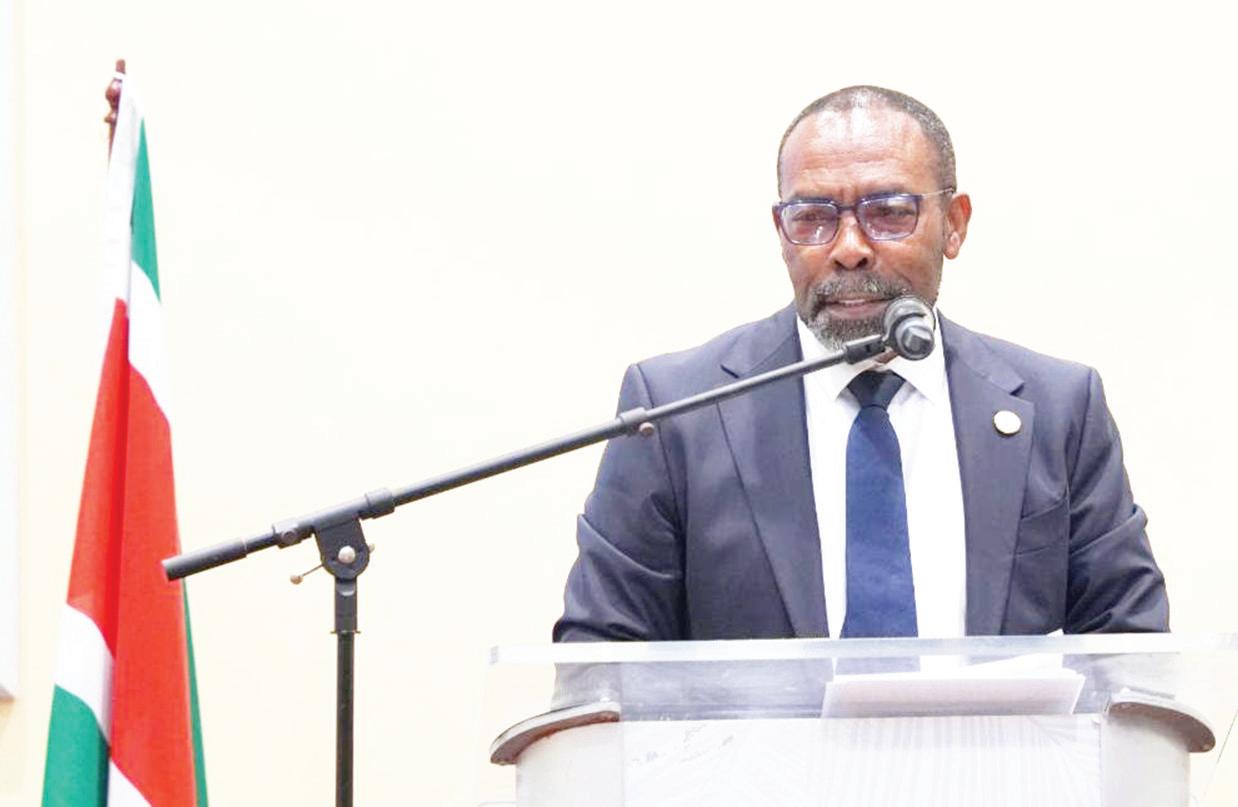
President Anderson highlighted that accession would strengthen Suriname’s sovereignty,
Justice Winston Anderson, CCJ President, addresses the audience at the Congress on the Modernisation of the Judiciary in Paramaribo, Suriname
enhance regional institutions, and contribute to the diversity of Caribbean
jurisprudence. Recognising Suriname’s civil law tradition, which differs
from the common law systems of most Caribbean Community (CARICOM) Member States, he proposed the creation of a Civil Law Chamber within the CCJ to hear appeals from Suriname.
The proposed chamber would be staffed by judges with expertise in civil law, and all proceedings, filings, and correspondence would be conducted in Dutch, reflecting Suriname’s legal and linguistic context.
During the visit, the CCJ delegation also held a courtesy call with Her
Excellency Jennifer Geerlings-Simons, President of the Republic of Suriname, to discuss judicial modernisation and the Court’s role in supporting reform and regional integration.
The CCJ expressed its commitment to continued engagement with Suriname as the country works toward modernising its judiciary, in line with the Court’s mandate to advance access to justice, regional integration, and the rule of law across the Caribbean.
Guyana to explore reliable markets for rice in Mexico, Europe
THE government of Guyana in 2026 will explore new markets with Mexico and Europe to export rice.
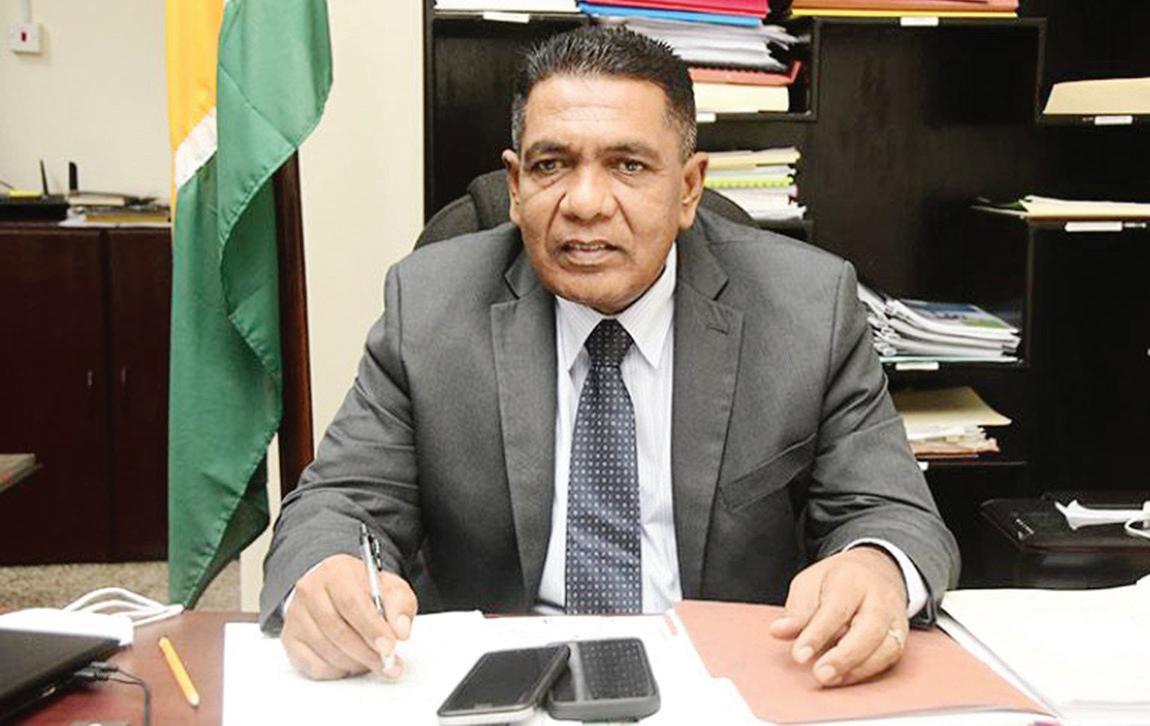
According to Agriculture Minister Zulfikar Mustapha, this measure, outlined in the 2026 national budget will see farmers having access to expansive markets.
“In 2025 we exported rice and [its] by-product to over 30 countries and we will continue in the new year to work to increase that so that we can have more lucrative markets for the rice industry,” Mustapha said on Tuesday, during a post-budget discussion.
In this year’s fiscal package, the government said it will invest in seed-processing facilities; establish rice-producing clusters; promote domestic fertiliser production; increase storage capacity through climate-controlled silos; work diligently to secure lucrative markets for paddy and rice and develop and market value-added rice-based products.
To this end, an amount of $1 billion is budgeted to commence construction of silos.
“With this allocation, GRDB [Guyana Rice Development Board] will continue to invest in Seed-processing facilities, establish rice-producing clusters and develop and market value-added rice-based products,” the minister said, adding: “This here is very important, because we have seen this success story in the rice industry. We have seen farmers. We have seen increased cultivation of rice lands. We have seen higher yields. As a matter of fact, we have seen yields up to 6.6 tonnes per hectare, and we will continue to promote high-yielding varieties.”
In the last five years the government has introduced five new rice varieties, among them were the GRDB 16, GRDB 18, and the zinc-infused bio-fortified rice, all high-yielding varieties that promote nutritional health.
In 2026, work to strengthen production through improved tillage, and the use of nano fertiliser and certified seeds will commence. In addition, we will work to commercialise bio-fortified rice, introduce a new variety of aromatic rice and expand value-added production.
Senior Minister within
the Office of the President with Responsibility for Finance, Dr. Ashni Singh, during Monday’s presentation of this year’s fiscal package to the National Assembly in 2025, not including fertiliser and paddy subsidies, government spent $430.9 billion to support development of
another year of strong output.
The rice-growing sector is estimated to have expanded by 15.7 percent in 2025, with the GRDB reporting a rice-production level of 810,299 tonnes.
This year the rice sector is expected to grow by 1.8 percent, with a pro -
vourable weather conditions and consistent yields, with the first crop of 2025 achieving an average of 6.6 tonnes per hectare, the same as in 2024.
The country’s production has seen a steady increase over the past four years. In 2020, the first crop averaged at 5.7
the rice industry.
This year the government will expend some $430 million to support the sector.
The finance minister also reported that despite softer global rice prices, milling bottlenecks, and cash-flow challenges, the rice sub-sector delivered
duction target of 827,500 tonnes.
Data from GRDB shows that 410,194 tonnes of rice equivalent was produced between January and June 2025, up from 362,030 tonnes for the same period last year.
Officials have attributed the increase largely to fa-
tonnes, and by 2024, it had increased to 6.6 tonnes per hectare.
This incremental increase in rice production has been ongoing since 2021, when production was 559,789 tonnes. In 2022, it increased to 610,595 tonnes and 653,706 tonnes in 2023.
Four-lane expansion commences in Canje
THE four-lane road expansion currently underway in Region Six has now officially commenced along the East Canje corridor, igniting excitement and renewed optimism among residents and commuters.
The long-anticipated project is expected to significantly enhance transportation efficiency, improve road safety, and elevate the overall quality of life for communities along the Canje stretch and beyond.
On Wednesday morning, Minister of Public Works, Bishop Juan Edghill, met with residents at the Canje Turn to discuss the scope and importance of the project. Addressing those gathered, Minister Edghill emphasised that the road expansion forms part of the government’s wider national transformation agenda.
The minister noted that the process has not been without its challenges, explaining that there are approximately 500 roadside
encroachments, including vending stalls, fences, and in some cases, extensions of homes onto government reserves.
“People have brought out their fences, and some have even extended their homes onto the reserves,” Edghill stated. He stressed, however, that the government is committed to working collaboratively with all affected parties.
“It is a matter of getting co-operation from everybody for relocation, so we can secure the required width for this road expansion,” he added.
Providing an update on other major infrastructural works in the area, Minister Edghill revealed that the Palmyra-Molsen Creek Road project has already been signed with two contractors, both of whom have commenced work. This project, he said, will further strengthen connectivity and support economic activity across the region.
Works have since commenced in Canje as part of the four-lane expansion project now going on in Region Six
Focusing specifically on Canje, the Minister reflected on the community’s journey from hardship to renewal. He recalled the closure of the Rose Hall Estate, which plunged many residents into what he described as dark days. Today, however, Canje is witnessing transformative
development, including the four-lane road expansion and the planning of a budgeted municipal airport, clear indicators of renewed confidence and growth.
Minister Edghill also criticised the previous APNU+AFC administration, accusing them of neglecting
communities they perceived as strongholds of PPP/C support. “Canje was one such area,” he said. He pointed out that under the former government, “not one single road was done” in Black Bush Polder. In contrast, he highlighted that the PPP/C administration
has delivered tangible results, with more than 2,000 community roads completed across Region Six.
“Now, what we are addressing are the major main roads and access routes to ensure better traffic flow,” the Minister explained. He underscored that projects like the Canje road expansion are designed to benefit not only local residents but also the wider population of the Corentyne and Region Six as a whole.
In closing, Minister Edghill reaffirmed the Government’s people-centred approach. “The people of the Corentyne, the people of Region Six, should be well advised that we in the PPP/C put people first,” he said, adding that the ongoing and planned infrastructural developments are clear proof of the administration’s commitment to inclusive growth and national development.
Agriculture Minister Zulfikar Mustapha
Public Works Ministry conducts field inspections of ongoing infrastructural projects
SENIOR officials from the Ministry of Public Works, on Tuesday, conducted a series of field inspections at multiple infrastructural project sites as part of ongoing efforts to monitor progress, ensure quality standards, and address public concerns.
The inspection exercise was led by Minister of Public Works, Bishop Juan Edghill and Minister within the Ministry of Public Works, Deodat Indar, along with Permanent Secretary, Vladim Persaud and Acting Head of the Works Services Group, Ron Rahaman.
The team visited several locations where projects are currently under construction or rehabilitation.
According to the ministry, the visits were aimed at assessing the pace and quality of work being carried out and engaging directly with residents in the areas affected by the projects. Officials
The team visited several locations where projects are currently under construction or rehabilitation
said the exercise forms part of the government’s broader push to strengthen oversight, improve accountability, and ensure
contractors meet agreed standards.
The ministry noted that feedback from citizens is being taken into account
Contractors pledge to accelerate completion of East Bank Demerara Road Project
CONTRACTORS
working on the East Bank Demerara Road Improvement Project have committed to speeding up construction following a site inspection by Minister within the Ministry of Public Works, Madanlall Ramraj, accompanied by senior ministry engineers.
The inspection focused on Section B of the project, which
stretches from Supply to the Soesdyke Junction and is approximately 70 percent complete. Overall, the US$75.8 million project, funded by the Inter-American Development Bank (IDB), is about 50 percent finished, with work progressing steadily across all three sections. The project has been divided into sections to minimise disruption to road users while keeping
construction on schedule.
During the visit, Minister Ramraj emphasised the importance of accelerating progress while maintaining high standards of construction quality and safety. He directed contractors to improve efficiency on site and deploy additional teams where necessary to prevent delays.
In response, con -
and that contractors are being held to account to deliver projects in a timely and satisfactory manner. The field inspections
come as the government continues to roll out a nationwide infrastructural programme focused on improving roads, drain-
age, and other critical public works to support economic development and improve living conditions.
Minister
tractors pledged to ramp up operations and expedite completion of the major in-
frastructural project, acknowledging its critical role in improving connectivity, easing
traffic congestion, and enhancing daily travel along the East Bank Demerara corridor.
within the Ministry of Public Works, Madanlall Ramraj, emphasised the importance of accelerating progress while maintaining high standards of construction quality and safety
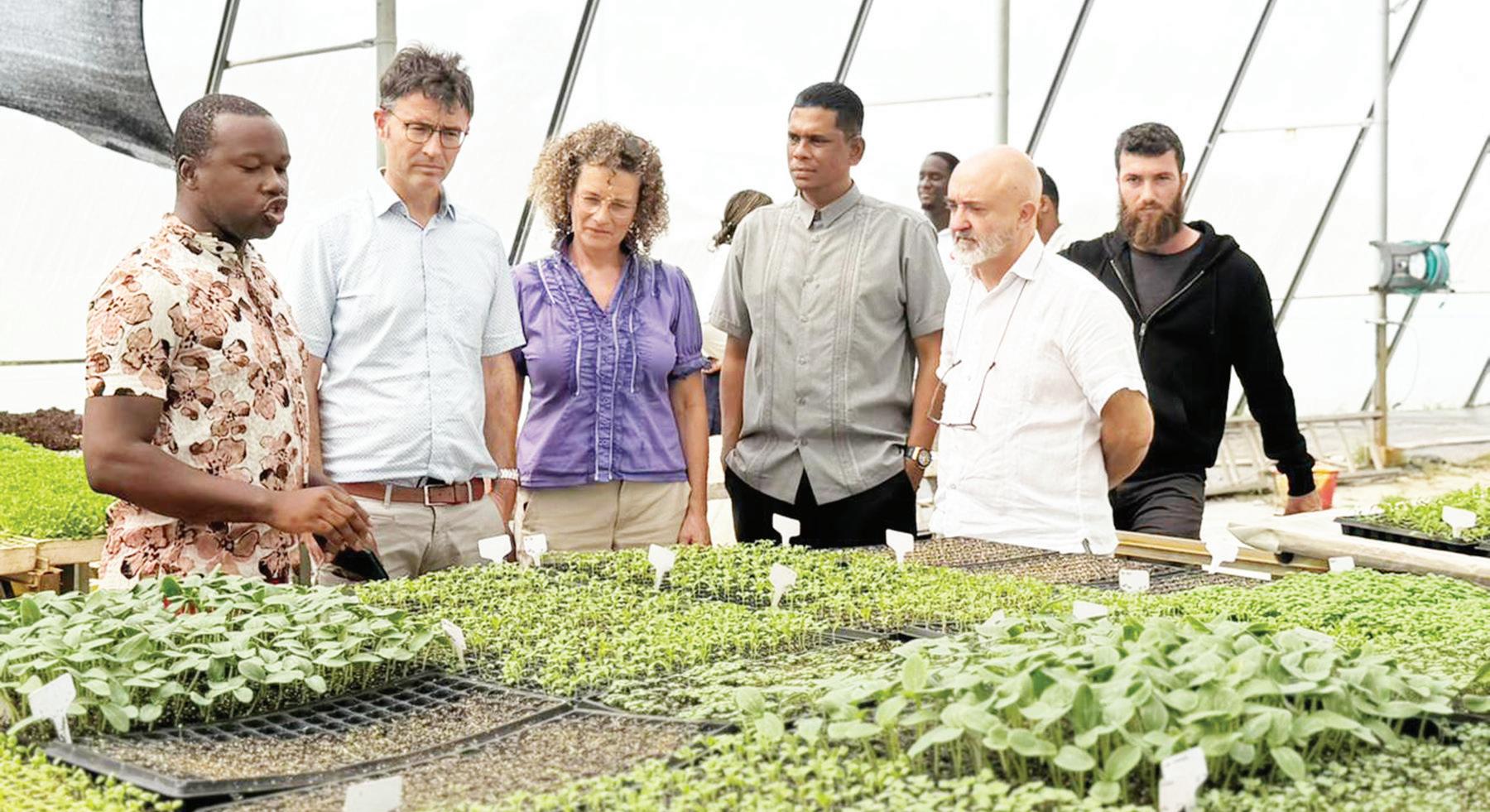
International delegation visits NAREI to explore climate-smart agriculture, research collaboration
REPRESENTATIVES
from Wageningen University and the European Union (EU) Delegation to Guyana, Suriname, and Caribbean OCTs visited the National Agricultural Research and Extension Institute (NAREI) this week to assess research facilities and discuss collaboration opportunities.
The delegation included Ms. Ria Hulsman, Manager of International Cooperation with Latin America and the Caribbean, and Dr. Jouke Campen, Senior Researcher specialising in Climate-Smart Agriculture, along with Mr. Joan Nadal Sastre, First Counsellor and Head of Cooperation at the EU Delegation.
During the visit, the team toured NAREI’s Soils, Tissue Culture, and Biotechnology Laboratories, Vermicomposting and Thermophilic Facil-
ities, Mangrove Department, AIEP shade houses, and the Victoria Greens hydroponics facility.
Delegates engaged with senior NAREI staff, including Deputy CEO, Mr. Seeraj, Senior Research Scientists Mr. Fredericks, Dr. Chandran-
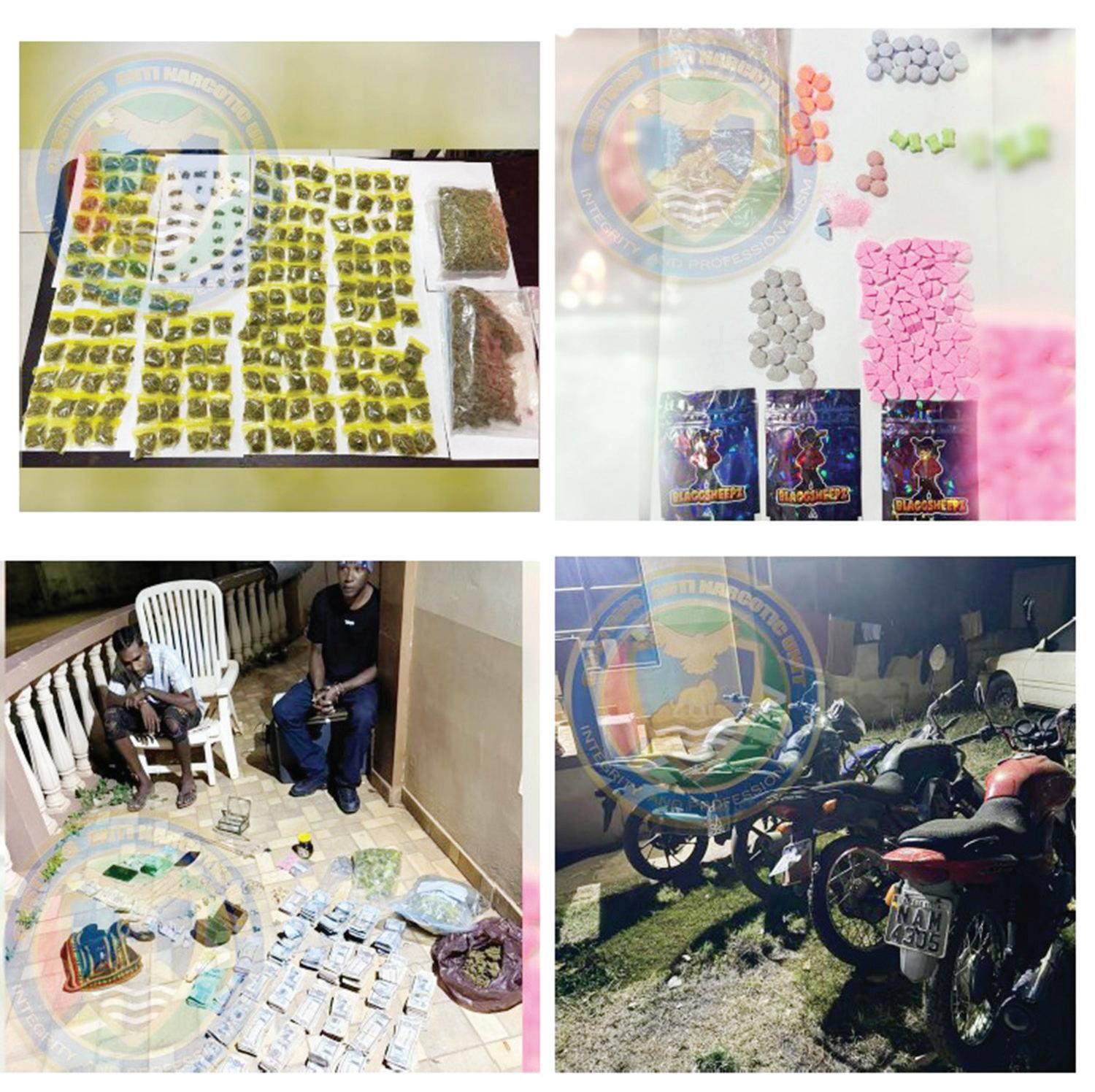
CANU seizes narcotics, stolen motorcycles, and uncustomed goods in Lethem operation
OFFICERS of the Customs Anti-Narcotic Unit (CANU) conducted an intelligence-led operation in Tabatinga, Lethem, on Tuesday, resulting in the seizure of suspected narcotics, stolen motorcycles, and uncustomed goods.
D uring the operation, officers discovered multiple zip-lock bags containing suspected cannabis in a bush near a property linked to Marlon Jarvis. A man identifying himself as Alim Kartel was detained and interviewed in connection with the discovery. Following information obtained during the interview, officers sought to search Jarvis’s premises. After he declined entry, a search warrant was obtained from the Lethem Magistrates’ Court. With support from the Guyana Fire Service, offi-
cers gained access to two structures on the property: a two-storey building and a concrete shop. Searches uncovered: In the shop: Suspected cannabis in ziplock bags, empty bags, digital scales, and uncustomed liquor. In the two-storey building: Additional uncustomed liquor, pink pills suspected to be ecstasy MDMA), local and foreign currencies, and a quantity of yellow metal. In the yard: Additional suspected cannabis and four motorcycles confirmed as stolen from Brazil. No occupants were present during the search. The operation was recorded using officers’ body-worn cameras. The Guyana Revenue Authority (GRA) subsequently took possession of the uncustomed liquor. Marlon Jarvis later ar-
rived at the premises, was cautioned, arrested, and escorted to the Lethem Police Station along with the seized items. At the station, the suspected narcotics were weighed: Suspected cannabis: 519 g (Bulk 1) and 1.626 kg (Bulk 2) and suspected ecstasy (MDMA): 65 g.
The currencies seized totaled: GYD: $2,174,600; USD: $572; TTD: $100; GBP: £45; EUR: €30, and BRL: R$5,416
Both Jarvis and Kartel remain in police custody, and investigations are ongoing.
CANU reaffirmed its commitment to working closely with local and international law enforcement partners to combat narcotics trafficking and related criminal activities in Guyana.
auth, and Dr. Sukhna, to discuss capacity building, advanced agro-processing techniques, climate-smart agriculture, cutting-edge
biotechnology, and collaborative scientific research.
The discussions aim to strengthen NAREI’s human resource capacity, enhance agricultural output, and contribute to Guyana’s long-term goal of achieving food security.
During the visit, the team toured NAREI’s departments and facilities
Labour Ministry, PAHO advance talks on expanding support for Persons With Disabilities
THE Ministry of Labour and Manpower Planning (MOLMP) has begun discussions with the Pan American Health Organization/ World Health Organization (PAHO/WHO) aimed at strengthening national systems that support persons living with disabilities, following the presentation of Guyana’s 2026 National Budget.
The talks were held during a virtual engagement this week as part of Guyana’s participation in the Assistive Technology Assessment (ATA) process under the World Health Organization’s GATE Initiative and the
AT2030 Programme.
The assessment is intended to evaluate the country’s readiness to expand access to assistive technologies, improve workplace accommodations and broaden inclusive employment opportunities.
The discussions come against the backdrop of Budget 2026, which includes a series of measures targeted at improving services, training and employment prospects for persons with disabilities.
According to information presented during the meeting, more than 1,200 persons with disabilities are expected to benefit from skills training across
several regions this year, while more than 70 are to receive entrepreneurial loans to support self-employment.
Construction has also started on Guyana’s first school for autistic learners at the Cyril Potter College of Education, and $316.5 million has been allocated for the establishment of Child Development and Education Management Services (CEMS) centres in every region, along with an Assessment, Screening, Evaluation and Needs (ASEN) Unit at Port Kaituma Primary School.
The government is also continuing its disability-support programmes,
including the payment of permanent disability benefits to more than 26,000 people and the distribution of a one-off $50,000 grant to all registered persons with disabilities.
Officials noted that these initiatives build on measures implemented in 2025, which included the construction of the country’s first school for the hearing impaired, expanded teacher training in special education needs, and wider access to literacy and skills development programmes.
During the engagement, Minister of Labour and Manpower Planning, Keoma Griffith, said the measures outlined in the
Pawandeep Rajan to perform in
Guyana for first time at
Pre-Phagwah concert
Guyana Hindu Dharmic
has announced that internationally acclaimed singer and musician Pawan-
Rajan will perform in Guyana for the first time as part of a special Pre-Phagwah concert.
The concert is scheduled for Saturday, February 28, and will be held at the Dharmic Rama Krishna School Tarmac, Pattensen, Georgetown, next to Giftland Mall.
Pawandeep Rajan will perform alongside his band in
what organizers are describing as a highly anticipated cultural and musical event leading up to the Phagwah celebrations.
The Guyana Hindu Dharmic Sabha said the event forms part of its efforts to promote cultural expression while raising funds for educational and social development initiatives. All proceeds from the concert will go towards the Dharmic Rama Krishna School and Bal Nivas, supporting education and childcare services.
Organizers are encouraging members of the public to secure their tickets early, as strong interest is already being shown in the event. Tickets can be booked by calling 2276181.
Pawandeep Rajan, known for his exceptional musical talent and wide fan following, is expected to draw a large crowd for what promises to be one of the major cultural highlights of the pre-Phagwah season in Guyana.
2026 budget reflect the government’s commitment to improving inclusion and economic participation for persons with disabilities.
Discussions between the ministry and PAHO focused on strengthening national mechanisms to support access to work, assistive technology and structured return-to-work and training programmes.
Among the areas identified for improvement were greater inclusion of persons with disabilities in labour market initiatives, stronger workplace accommodation systems, improved coordination among government agencies, expanded accessible
training through the Board of Industrial Training and technical and vocational institutions, and better data collection on disability and employment.
The minister said the initiatives are in keeping with Guyana’s obligations under the United Nations Convention on the Rights of Persons with Disabilities and form part of the broader push for inclusive national development.
The ministry said it will continue working with PAHO/WHO and other partners as the Assistive Technology Assessment process moves forward.
Minister of Labour and Manpower Planning, Keoma Griffith, said the measures outlined in the 2026 budget reflect the government’s commitment to improving inclusion and economic participation for persons with disabilities
The
Sabha
deep
Public Works Minister calls for quality, efficiency during asphalt plant visit
MINISTER of Public Works, Bishop Juan Edghill, on Tuesday, conducted a site visit and inspection of the government-operated asphalt plant, underscoring the need for improved operational performance to support the country’s expanding infrastructural programme.
Accompanied by a team of senior technical officers from the ministry, the minister toured the facility’s compound and processing units to assess current operational capacity and identify areas requiring immediate attention.
Following the inspection, Minister Edghill met with the plant’s staff and management, where he outlined expectations for the facility’s operations, focusing on three main areas: quality control, production efficiency, and management systems.
During the engagement, the minister stressed the importance of maintaining high standards in
asphalt production, noting that the material plays a critical role in the durability of the national road network. He instructed technical staff to ensure that all output meets required specifications to support long-term road performance.
The minister also highlighted the need to increase production efficiency, pointing to the government’s accelerated infrastructure timetable and the importance of avoiding delays in road construction and maintenance projects.
In addition, he called for stronger management and oversight at the facility, emphasising accountability and improved workflows to ensure the plant operates efficiently within the public sector.
The visit concluded with staff indicating their willingness to work closely with the ministry’s leadership to implement the directives outlined during the inspection.
The government-operated asphalt plant
Stokes and Moeen to coach Lions white-ball tour
ENGLAND Test captain, Ben Stokes and all-rounder Moeen Ali will be part of the England Lions coaching staff for their series against Pakistan Shaheens in the United Arab Emirates next month.
Stokes is currently recovering from an adductor injury he sustained in the fifth Test against Australia earlier this month, while Moeen takes on his first coaching role with the Lions.
Moeen and Stokes, who will continue his injury rehabilitation in the UAE, will assist head coach Andrew Flintoff for a three-match T20 series and five 50-over matches against Pakistan's second string.
Moeen played 298 matches for England before retiring from international cricket in 2024, but announced on Monday he was cancelling plans to retire from domestic cricket and signing for Yorkshire.
Elite national pace bowling lead Troy Cooley, who rejoined the England set-up last week, former South Africa batter Neil McKenzie, ex-England wicketkeeper Sarah Taylor, former Durham seamer Neil Killeen and Amar
Rashid, brother of England spinner Adil, make up the rest of the coaching party.
Jordan Cox and Dan Mousley will captain the respective T20 and 50-over squads on the Lions' first away white-ball series since touring Sri Lanka in 2022.
The pair are joined by fellow full internationals Saqib Mahmood, who is named in the T20 squad, and Matthew Potts, who will play in the 50over matches.
Essex seamer Sam Cook, who won his one Test cap against Zimbabwe last summer but missed out on the Lions touring party that shadowed the Ashes squad, is named in both squads.
The highly regarded James Rew, Asa Tribe and James Coles also feature in the squads, while Scott Currie has been selected after being ruled out of Scotland's T20 World Cup squad.
"It's exciting to have such a strong England Lions squad selected," said ECB men's performance director Ed Barney.
"This group brings a real blend of proven performers, exciting talent who have performed over the winter and retains an eye on future best.
"With limited 50-over cricket on offer, this series combined with tours over the remainder of 2026 will give players the opportunity to develop and deliver as we build towards the 2027 ICC Men's World Cup in South Africa."
Rashid has previously coached England pathway cricketers and joins the Lions coaching staff for a spell before returning to the South Asian Cricket Academy (SACA), which has produced a number of players for county sides.
"We've seen just what Amar is capable of as a coach and it comes as little surprise to us that his skills have been recognised by those running the Lions set up," said SACA founder Tom Brown.
"At SACA we are enormously proud of the opportunities we have created in the professional game for not only our South Asian players, but for our coaches too."
The tour begins with the first T20 match on February 21, with members of the coaching party attending either all or part of the tour.
Lions T20 squad: Jordan Cox (Essex, capt), Sonny Baker (Hampshire),
Luc Benkenstein (Essex), James Coles (Sussex), Sam Cook (Essex), Scott Currie (Hampshire), Calvin Harrison (Northamptonshire), Eddie Jack (Hampshire), Saqib Mahmood (Lancashire), Ben McKinney (Durham), Tom Moores (Nottinghamshire), Dan Mousley (Warwickshire), Matt Revis (Yorkshire), Will Smeed (Somerset), Nathan Sowter (Durham), Mitchell Stanley (Lancashire), Asa Tribe (Glamorgan)
shire, capt), Sonny Baker (Hampshire), Luc Benkenstein (Essex), Sam Cook (Essex), James Coles (Sussex), Scott Currie (Hampshire), Calvin Harrison (Northamptonshire), Eddie Jack (Hampshire), Ben McKinney (Durham), Liam Patterson-White (Nottinghamshire), Matthew Potts (Durham), Matt Revis (Yorkshire), James Rew (Somerset), Mitchell Stanley (Lancashire), Asa Tribe (Glamorgan), James Wharton (Yorkshire)
Kawhi Leonard, James Harden carry surging Clippers past Jazz
KAWHI Leonard scored 21 points while James Harden tallied 16 points and 10 assists to lead the Los Angeles Clippers to a 115-103 victory over the Utah Jazz on Tuesday night.
Kris Dunn and Brook Lopez chipped in with 14 points apiece to help the Clippers win for the ninth time in 10 games. Los Angeles scored 23 points off 17 Utah turnovers. Dunn and Harden combined for nine steals alone.
Ace Bailey led the Jazz with 20 points. Lauri Markkanen added 19 points and two blocks for Utah, which has one win in its last eight
Djokovic scrapes into
games.
The Jazz played without two starters. Keyonte George (rest) and Jusuf Nurkic (illness) both sat out for Utah. Markkanen returned to action after missing multiple games because of illness.
The Clippers made six baskets over seven possessions to break open a close game and grab a 73-61 lead midway through the third quarter. Dunn capped the scoring flurry with backto-back buckets. He totaled nine points in the quarter.
Los Angeles extended
Australian Open semis after
NOVAK Djokovic's bid to make more tennis history is still alive as he scraped into the Australian Open semi-finals when Lorenzo Musetti retired injured while leading by two sets.
Djokovic, aiming for a stand-alone record 25th Grand Slam singles title, was wayward, error-strewn and irritable against the inspired Italian in front of a stunned crowd.
Musetti was 6-4 6-3 up and looked set for the semi-finals when he pulled up early in the third set.
The fifth seed took a medical timeout for treatment on his thigh but, unable to serve or move properly, he walked to the net and shook hands at 3-1 down in the third.
A heartbroken Musetti was helped down the corridor by a member of his team as he left the court.
"He was a far better player - I was on my way home tonight," the 38-year-old Serb great said.
"I really wish him a speedy recovery. He should have been a winner today, there's no doubt.
"I am extremely lucky to get through this one today."
Djokovic received treatment for blisters on his feet
Musetti injury
at the end of the second set and could also have been tested physically had the match continued.
It is another stroke of luck for Djokovic after fourth-round opponent Jakub Mensik withdrew before their scheduled match with injury.
Djokovic has not won a set since his third-round victory over Botic van de Zandschulp on 24 January. He will need to be at his best in Friday's semi-final against Jannik Sinner, who has won six of their past seven meetings.
Two-time defending champion Sinner had some physical struggles but was good enough to beat Ben Shelton 6-3 6-4 6-4 in the other quarter-final. For Djokovic to move
ahead of Margaret Court's record of 24 major singles titles, he will need to limit his time on court, keep the points short and hope some good fortune goes his way.
He has managed those so far - but he would not have anticipated reaching the semi-finals with such a heavy reliance on fortuity.
Djokovic started sharply against Musetti, going an immediate break up, but then spectacularly lost his way.
A dreadful miss on an overhead handed the break back to Musetti and Djokovic never recovered, sending down just one ace and committing 18 unforced errors to nine winners on his way to losing the first set.
Djokovic frequently turned to his box in disbelief and annoyance, but he
only had himself to blame at the start of the second set.
After breaking Musetti and getting out to a 30-0 lead on serve, Djokovic hit five unforced errors in six points to hand the initiative back.
Anchored by a one-handed backhand that kept Djokovic guessing and an improved serve, Musetti held off his opponent to move within touching distance of a first Australian Open semi-final.
Musetti's level just made the injury all the more surprising. After being broken in the third set, he immediately called for the trainer and, after a valiant attempt at his next service game, called it quits.
"I honestly have no words to describe how I'm feeling right now," Musetti said.
"I felt it at the beginning of the second set. I was feeling that the pain was increasing and the problem was not getting away."
Djokovic had warm words for his opponent at the net and afterwardsand, having struggled with physical issues early in his career, would know how devastated the 23-yearold was.
the lead to 19 later in the quarter, going up 84-65 after Harden and Lopez drained back-to-back 3-pointers to cap a 9-0 run.
Utah came out of the gates blistering hot on offence. The Jazz made four field goals on their first four possessions and started 5-of5 from the field. Bailey led the way with three baskets and helped Utah charge to 21 points for a 15-4 lead.
Los Angeles trimmed the deficit to a basket, closing to within 19-17 on a floater from Harden. Utah closed
out the first quarter with a 10-1 run, holding the Clippers without a basket for three minutes. Walter Clayton Jr. buried a 3-pointer to cap the run and give the Jazz a 29-18 lead heading into the second quarter.
The Clippers erased a second double-digit deficit behind a 14-3 run to open the second quarter and took a 33-31 lead on Leonard's pull-up jumper. Utah went four minutes without a field goal before Bailey ended the drought with a 3-pointer. (Reuters)
Netherlands qualify for their maiden Women's T20 World Cup
NETHERLANDS beat United States of America by 21 runs [DLS Method] to clinch three wins in three in the Super Six stage of the ICC Women's T20 World Cup Global Qualifiers, and secure their maiden qualification to the Women's T20 World Cup. With two wins in two games, having already beaten Nepal and Thailand in the group stage, the European nation was aware that they were only one positive result away from clinching qualification. With USA batting first, medium pace bowler Hannah Landheer picked up 3 for 30 to restrict them to 129 for 7 in 20 overs.
A 57-run opening stand from Heather Siegers and Phebe Molkenboer put Netherlands in control of the chase but the heavens opened up after the 12th over. Netherlands were 90 for 2 at this stage and were 21 runs ahead of the DLS par score. As no further play was possible due to the
unrelenting rain, they took the points and will board the flight to England and Wales, later this June.
Alongside Netherlands, Bangladesh too clinched their spot for the marquee event with a 39-run win over Thailand. They had earlier beaten Namibia and Ireland in the group stage. With the Women's T20 World Cup to feature 12 teams for the 2026 edition, ten teams have now qualified with two more teams left to be finalised. The remaining teams in the fight for the final two spots are Scotland, Ireland, USA and Thailand.
Having played their first international game in 1937, Netherlands were among the stronger teams in women's cricket from the 1980s to the early years of the 21st century, featuring in four successive world cups from 1988 to 2000. However, since the advent of T20 cricket, they hadn't qualified for a world cup. (Cricbuzz)
Kawhi Leonard netted 21 points
Novak Djokovic has not won a Grand Slam since the 2023 US Open
Netherlands skipper, Babette de Leede, celebrates after her team's win over USA
Sophie Molineux set to be named Australia's all-format captain
IN a significant leadership shift, left-arm spinner Sophie Molineux is set to be named Australia Women's new all-format captain. Cricbuzz understands the 28-year-old Victorian, who has been a mainstay of Australia's white-ball spin attack, has emerged as a frontrunner ahead of Tahlia McGrath.
Earlier this month, Alyssa Healy had announced her desire to retire from all international cricket following the upcoming home series against India in February-March. Since it's only four months out from theT20 World Cup 2026 in the UK, she excused herself from the T20 leg of the series as well to allow Australia, and her replacement, more time to settle in.
The official announcement of Molineux's appointment is expected soon with Australia set to name the squads for the multi-format series against India which includes three T20Is to kick off the tour.
Molineux's elevation caps a remarkable comeback story. Battling a stress fracture in the foot, she was sidelined from Australia's 2022 Ashes triumph, the ODI World Cup win and
a historic Commonwealth Games gold.
On domestic comeback, she led Melbourne Renegades to their maiden WBBL title, claiming 16 wickets in the campaign. Earlier in that year, Molineux also won WPL 2024 with Royal Challengers Bengaluru, finishing the season as the league's joint-second highest wicket-taker with 12 scalps. Her all-formats comeback in the Australian side also put her back in the national contracts list.
Molineux spent more time on the sidelines with recurring knee trouble that ruled her out of the Ashes and WPL 2025. She returned to the side just ahead of the ODI World Cup in India, but was played selectively owing to workload management with the injury.
Her WBBL captaincy record stands at 17-19 (1 no-result) in 37 matches.
McGrath, who was the designated vice-captain under Healy's leadership, has been overlooked, possibly due to poor run of form. She had an underwhelming ODI World Cup with just 55 runs in four innings and seven outings. She accumulated only 98 runs in nine innings of the WBBL that followed, with five wickets across the eight times she bowled in the competition.
Her leadership record, however, has been stellar with a 100% win record in the six ODIs she led Australia in. McGrath also captained the country in nine T20Is in Healy's absence, winning eight with the only loss coming at the T20 World Cup 2024 semifinal against South Africa. (Cricbuzz)
Seifert, Santner help Kiwis beat India by 50 Runs despite Dube's 65
Visakhapatnam, (IANS) TIM Seifert's explosive 62 and skipper Mitchell Santner's three-wicket haul powered New Zealand to a convincing 50-run victory over India in the fourth T20I at the ACA-VDCA Stadium on Wednesday, despite a blistering 65 from Shivam Dube.
Seifert gave New Zealand a flying start in the powerplay by attacking India's pacers to set the tone for top-scoring with 62 off 36 balls, laced with seven fours and three sixes. Devon Conway provided steady support with 44 off 23 deliveries, studded with four boundaries and three maximums as the pair raced towards a century stand before Kuldeep Yadav removed him and halted the momentum.
Though India clawed back in the middle overs, with Kuldeep and Arshdeep Singh picking two wickets each, Daryl Mitchell ensured New Zealand had a strong finish by hitting 39 not out off 18 balls, laced with two fours and three sixes, to push New Zealand to 215/7.
In defence of the huge total, New Zealand left India, effecting a batter short due to Ishan Kishan's niggle-enforced absence, struggling at 82/5. Dube then launched a stunning counter-attack, smashing a 15-ball fifty and eventually made 65 off 23 balls – his career-best score in T20Is laced with seven sixes and three fours.
But his dismissal – run out at non-striker's end off a bowler's deflection - ended India's hopes, as they were bowled out for 165 in 18.4 overs. Apart from Santner, New Zealand's bowlers maintained their control to secure their first win of the
series, and offer themselves a timely boost ahead of the Men's T20 World Cup, despite a mid-innings collapse and Dube's late assault.
India's chase began on a disastrous note as Abhishek Sharma fell first ball to Matt Henry after slicing to backward point. Suryakumar Yadav followed soon after, caught and bowled by Jacob Duffy for eight. Sanju Samson and Rinku Singh attempted a rebuild by hitting seven boundaries between themselves.
The pair stitched a 46run stand before Santner struck in his first over by castling Samson for 24, and followed it up by having Hardik Pandya caught at backward point. Rinku continued to look fluent, before being trapped by Zak Foulkes which left India reeling at 87/5. That brought Dube to the crease, and the lefthander immediately changed the complexion of the innings.
He launched Santner for a towering 101m six to get going, and then tore into Ish Sodhi in the 12th over – clearing his front leg and showcasing his brute force to smash four sixes and two fours to collect 29 runs. After surviving an lbw scare, Dube raced to his fifty in just 15 balls – the third-fastest for India in T20Is – by flicking a full toss from Duffy over square leg and kept India's hopes alive with audacious hitting.
But his innings ended in anti-climactic fashion when he was run out backing up at the non-striker's end after Matt Henry deflected a straight drive onto the stumps. The dismissal silenced the crowd, who had been lifted by his fireworks.
From there, India's lower order folded quickly, as New Zealand recorded a convincing win.
Previously, inserted into batting first, Seifert set the tone from the very first over by hitting Arshdeep for three successive boundaries. By the fourth over, Seifert had already hammered Rana by hammering him for sixes over long-on and fours going over extra cover fence.
Conway, at the other end, took his time before opening up with a boundary steered past third man in the fourth over. Even as Conway hammered Kuldeep and Ravi Bishnoi for two fours and as many sixes, Seifert brought up his fifty in just 25 balls – the joint fastest mark for a New Zealand men's batter against India.
Mark Chapman and Mitchell Santner tried to rebuild but the former fell to Bishnoi, before the latter was run out by Hardik Pandya's direct hit. Zakary Foulkes provided some relief with a six and a four off Arshdeep but perished soon after to the pacer.
Mitchell then took charge in the death overs by smashing Bumrah for a six and two boundaries in the 19th over and continued his assault against Rana by carting him for a six and four to finish unbeaten on 39 off 18 balls, as New Zealand crossed the 200-run mark, while Rinku stood out for India with his four catches in the outfield.
Brief Scores: New Zealand 215/7 in 20 overs (Tim Seifert 62, Devon Conway 44; Arshdeep Singh 2-33, Kuldeep Yadav 2-39) beat India 165 all out in 18.4 overs (Shivam Dube 65, Rinku Singh 39; Mitchell Santner 3-26.
Arsenal thrash AS FAR Rabat to reach Champions Cup final
ARSENAL booked their place in the inaugural Women's Champions Cup final with a comfortable victory over Moroccan side AS FAR Rabat.
Renee Slegers' side qualified for the competition as winners of the Women's Champions League and were strong favourites in Brentford.
They were in ruthless form, fresh from their huge victory over Chelsea in the Women's Super League on Saturday, and were 4-0 up by
half-time.
African champions AS FAR Rabat showed glimpses of threat and quality but were largely overawed by Arsenal, who fielded a strong side despite making changes.
Star names such as Alessia Russo, Emily Fox and Leah Williamson were not in the starting XI but Arsenal had more than enough quality to cause problems.
Sweden striker Stina Blackstenius, who scored the winning goal in their Champions League final vic-
tory over Barcelona, headed Arsenal in front within eight minutes.
Frida Maanum's powerful strike made it 2-0 shortly afterwards, then Mariona
Caldentey netted from the penalty spot and Olivia Smith added a fourth before the break.
Slegers made several changes in the second half, bringing on striker Russo with England manager Sarina Wiegman watching in the stands, and she confirmed victory with two well-taken efforts shortly afterwards.
There was also a return for England winger Chloe Kelly, who came off the bench after recovering from an injury she has managed
since December.
"First of all, compliments to the opposition. Of course it was a hard game for them but I think the way they represented Morocco and Africa was very inspirational," said Arsenal manager Slegers.
"I'm really happy with our performances. The players dealt so well with the unknown as it was the first time we played against them.
"We are doing things with a lot of discipline and I'm happy to have five different goal scorers as well.
Sophie Molineux is set to lead Australia across formats
Defending champs T&T go down to Windwards in opening Super 50 Cup fixture
KINGSTOWN,
St Vincent, (CMC )– Defending champions Trinidad & Tobago Women began the defence of their CG United Women’s Super 50 cup title on a losing note, after going down by 91 runs to the Windward Islands Women in their opening-round fixture at Sion Hill on Tuesday.
AT SION HILL
Sent in to bat, the Windward Islands Women posted a formidable total of 225 for seven in their allotted 50 overs, West Indies all-rounder Jannillea Glasgow led the way with 73 from 88 balls, which included nine fours. She was eventually run out in the final over as she
got good support from veteran West Indies player Afy Fletcher, who weighed in with 61 from 63 balls, with five fours and two sixes.
Another West Indies player Zaida James, chipped in with 38 against two wickets for Nadia Mohammed.
In reply, T&T got off to the worse possible start, losing two wickets inside three overs with just four runs on the board. Britney Cooper conjured up a brief recovery with a fighting 28 to get them to 54, but wickets continued to tumble at regular intervals.
Lee Ann Kirby, with 31, and captain Karishma Ramharack, 29, tried to resurrect the innings, but when the pair fell the writing was on
the wall.
Afy Fletcher picked up her fourth wicket by removing the last batter, Shalini Samaro, for four, as T&T were all out for 134. Glasgow finished with two wickets for 14 runs.
AT CUMBERLAND
Guyana’s Women got the better of Jamaica’s Women by five wickets at the Cumberland playing field. The Jamaicans made a mess of batting first after winning the toss, as they were skittled out for 76 in 27.3 overs.
Once again, spin did the trick, as the Guyanese trio of Ahsmini Munisar, Kaysia Shultz, and Tramaine Marks picked up eight wickets between them in a lacklustre
Aaron Jones charged under anti-corruption code; provisionally suspended from all cricket
USA batter, Aaron Jones, has been charged with five breaches of the anti-corruption codes of Cricket West Indies (CWI) and the International Cricket Council (ICC), the governing body, announced via a media release on Wednesday.
The charges largely stem from alleged incidents during Barbados' Bim10 tournament in the 2023-24 season, which comes under the jurisdiction of the CWI Anti-Corruption Code. Two of the five charges also relate to international matches and fall under the ICC's Anti-Corruption Code.
Under the CWI Code, Jones has been charged with codes dealing with fixing or attempting to fix aspects of matches in the Bim10 tournament, failing to disclose approaches to engage in corrupt conduct, and failing to co-operate with a reasonable investigation by the designated anti-corruption official.
In addition, the ICC has charged Jones with codes dealing with failing to disclose to its Anti-Corruption Unit (ACU) full details of
approaches or invitations to engage in corrupt conduct, and with obstructing an ACU investigation by allegedly concealing or tampering with information relevant to the inquiry. The charges form part of a wider investigation, with the ICC indicating that further charges against other individuals may follow in due course. Jones has been provisionally suspended from all forms of cricket with immediate effect. He has 14 days from January 28, 2026, to respond to the charges. The ICC said it would make no further
...wins also for Guyana and Barbados
effort with the bat for the Jamaicans.
Opener Chrishana McKenzie 25, Chedean Nation 12, and Kate Wilmot 10 were the only batters who got into double figures, as Munisar ended with four for 23, Shultz two for 16 and Marks two for seven.
Shabika Gajnabi then hit an unbeaten 23 to go along with 17 from Sheneta Grimmond to steer Guyana to 77 for 5 in 27 overs.
AT PARK HILL
Barbados Women carved out a 79-run win over the Leeward Islands Women at Park Hill in Colonarie. Batting first, Barbados got their way to 144 in 47.5 overs. Naijanni Cumberbatch put on a show with a classy 74 not out from 139 balls with five fours.
She got good support from Asabi Callender with 21 and captain Aaliyah Alleyne with 20. Medium pacer Shanisha Hector continued her good form by bagging four wickets for 19 runs, with Davronique Maynard chipping in with 3 for 22.
Seamers Shamillia Connell and Alleyne then combined to skittle out the Leewards for 65 in 25.5 overs. Connell ended with 4-17 and
Alleyne 3 for 3. Tonya Martin with 15 and Chey-Ann Moses 11 not out were the only batters to reach double figures.
Defeat to Aussies leaves West Indies on the verge...
six runs an over, Carter and Tanez Francis gave the Windies a whirlwind start in an opening partnership of 88 runs, while going at eight runs an over.
comment until the conclusion of the disciplinary proceedings.
The 31-year-old Jones has featured in 100 international games (52 ODIs, 48 T20Is) for USA. In addition, he's been active on the T20 circuit, playing for the Seattle Orcas in USA's Major League Cricket and for the St Lucia Kings in the CPL and even top-scored for the Kings in the final of their triumph in 2024. Jones was last in action at the Abu Dhabi T10 league in November 2025. (Cricbuzz)
Carter was especially brutal on his way to registering the fourth fastest half century of the tournament, pulling Will Malajczuk to the midwicket boundary off the 29th ball he faced.
Australia needed some luck to make the breakthrough, when Francis missed a full toss from Charles Lachmund and was adjudged lbw, despite the ball seemingly headed past the leg stump.
Carter and Jewel Andrew then added 35 runs in just over three overs, before Carter unnecessarily tried to heave the first delivery from legspinner Naden Cooray over the legside and was bowled for 64 off 42 balls, inclusive of seven fours and four sixes.
His dismissal brought Dorne to the crease, and together with Andrew, they
(From back page)
maintained the momentum to carry the score to 171 for two after 26 overs.
The reintroduction of pacer Hayden Schiller reaped immediate dividends for Australia, with his yorker piercing Andrew’s defence to bowl him for 44.
Dorne then found a useful partner in Kunal Tilokani, with the two adding 68 runs for the fourth wicket. During that partnership, Dorne reached his first half century of the tournament off 80 balls.
But just as the two looked to accelerate, Tilokani edged Lachmund behind to be caught for 35 off 42 balls and with just seven runs added, Schiller returned to bowl Dorne for 62 off 97 balls, to leave the Windies 246 for five in the 43rd over.
Jonathan van Lange and Shaquan Belle tried their best, but the required run rate, which crept up to over 12 runs, proved too much for the Windies to overcome and they lost their four wickets
for seven runs in the last 14 balls.
Lachmund ended with 4-66, Aryan Sharma took 2-47 and Schiller 2-54.
Earlier, Peake’s effort along with a half century from Nitesh Samuel and important knocks by Will Malajczuk and Alex Lee Young helped Australia post a mammoth total.
Malajczuk, who scored 48 off 30 balls and Samuel, who made 56 from 74 balls, shared an opening stand of 73 in nine overs that proved to be the foundation.
Fast bowler R’Jai Gittens removed Malajczuk and Steven Hogan, who made four, in quick succession to leave Australia 84 for two after 11 overs.
But Peake, who scored 109 off 117 balls, first added 85 with Samuel and then 69 with Lee Young, who scored 45, to frustrate the Windies’ bowlers.
For the Windies Jakeem Pollard took 2-37 and Gittens 2-45.
Ahsmini Munisar ended with figures of four for 23
Aaron Jones last played for USA in April 2025
(ICC/Getty Images)
Zachary Carter belted
64 off 42 balls in a losing cause for West Indies Under-19s
Defeat to Aussies leaves West Indies on the verge of U-19 World Cup elimination
HARARE, Zimbabwe, (CMC) – WEST Indies Under-19’s hopes of reaching the semifinal of the ICC Men’s Under-19 Cricket World Cup suffered a major setback when they went down by 22 runs to defending champions Australia in their crucial Super Six,
Group 1 encounter here on Wednesday.
Needing a victory to boost their chances of reaching the final four, the regional team produced a below par bowling effort after sending the Aussies into bat at the Harare Sports Club, as captain Oliver Peake scored an impressive
century to power his side to a formidable 314 for seven in their 50 overs
Through the efforts of Zachary Carter and skipper Joshua Dorne, who scored contrasting half centuries, West Indies put themselves in a strong position to pull off a memorable win, but faltered
No need to panic after loss to South Africa, says Chase
PAARL, South Africa, (CMC) – West Indies stand in T20 captain, Roston Chase isn’t fazed by their disappointing start to their series against South Africa, having revealed that implementing and executing strategies are the team’s main focus as they prepare for the T20 World Cup.
The Windies were thrashed by nine wickets in the opener of the three-match series at Boland Park on Tuesday, with the hosts cruising to 176 for one in 17.5 overs in response to the visitors’ total of 173 for seven.
However, speaking in a press conference after the match, Chase, who stood in for regular skipper Shai Hope, said the team was using their final series before next month’s World Cup to fine tune certain aspects of their game.
He said while winning was always the objective, being able to execute their plans was of paramount importance
“I think we’re just trying to get the combinations and the tactics and the strategies right going into the World Cup.
“I mean it’s going to be different conditions when we get to India, but I still think that once we play here we can still get a good idea of what we’re looking to do, what we want to do, and put the people in the right places to execute those roles.” Chase said.
He admitted that the Windies were not up to par with either bat or ball in the first match.
With the second match slated to be held on Thursday, Chase said the players would continue to work on improving all aspects of their game.
“Firstly, I thought we were probably 15 to 20 runs short [in the opener]. We were
initially looking for 190-195, so I thought we were short in the batting and then to start the bowling in the Power Play we didn’t have the best of starts and it was hard to pull back the game from there, because the batters just had to knock around the ball and they didn’t have to take too many risks to keep up with the run rate after that Power Play,” Chase said.
“I think we will prepare the same way we’ve been preparing for this match, but I think we just need to have a bit more plans in the Power Play to the batters.
“And I mean it’s just for the batters to continue. I think that we had starts and we had a decent start in our Power Play, but we lost too many wickets at crucial stages. When we had the momentum going in our favour, we got out and put the game back into South Africa’s hands, and I think that slowed us down a lot,” he added.
at the death to finish on 292 for nine.
With the result, the unbeaten Australians advanced to the semifinal stage of the tournament, leaving the Windies needing a miracle due to their poor net run rate.
They are currently tied on four points with Afghanistan,
who are currently in second place on net run rate ahead of Sri Lanka.
However, the Windies would need both Afghanistan, who is set to play Ireland in their final Super Six match on Friday, and Sri Lanka, who take on South Africa on Thursday, to suffer heavy
defeats if they are to have any chance of progressing in the tournament.
They will rue a missed opportunity against Australia, who for the first time in the competition looked headed for defeat.
Needing to score at over
(Turn to page 27)
GBF welcomes government’s allocation for sports in national budget
THE Guyana Basketball Federation (GBF) has hailed the Government of Guyana’s proposed $6 billion allocation to the sports sector as a defining moment for national development, youth empowerment and the future of athletics across the country.
GBF president Michael Singh described the investment as a transformative step that signals the government’s strong belief in the power of sport to shape healthier communities and create meaningful opportunities for young people.
“This level of support is unprecedented, and it sends a powerful message about the value being placed on youth development, healthy lifestyles, and social unity through sport,” Singh said.
According to Singh, “basketball stands ready to play its part in ensuring this investment brings lasting benefits to communities nationwide.”
Singh expressed sincere appreciation to President, Dr Mohamed Irfaan Ali and his administration for what
he called a sustained and deliberate focus on sport as a pillar of national progress. He noted that the federation has already experienced the impact of that support in recent years.
“The GBF has enjoyed a good relationship with the Government of Guyana over the years, and particularly recently, when we were able to host several historic regional and international events,” Singh pointed out, while adding, “that collaboration has helped to elevate Guyana’s profile on the regional
basketball stage.”
The federation also acknowledged the leadership of Minister of Culture, Youth and Sport Charles Ramson Jr and Minister within the Ministry Steven Jacobs for their roles in advancing plans aimed at modernising the country’s sporting framework.
Looking ahead, Singh emphasised that the funding must be managed with care and strategic vision to ensure equitable development across all sporting disciplines.
“With this significant investment comes great responsibility. As the GBF embarks on a busy 2026, we look forward to working closely with the Ministry of Culture, Youth and Sport to ensure basketball continues to grow in a structured and sustainable way,” Singh said.
The GBF reaffirmed its commitment to strengthening governance, expanding opportunities for youth and women, and contributing to the development of modern facilities, all to leave a lasting legacy for future generations.
Oliver Peake celebrates his century (ICC/Getty Images)