



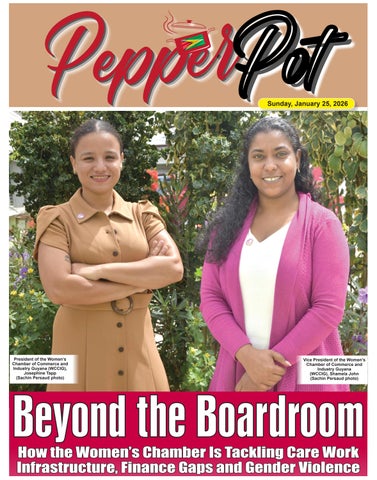
President of the Women’s Chamber of Commerce and Industry Guyana (WCCIG), Josephine Tapp (Sachin Persaud photo)
Vice President of the Women’s Chamber of Commerce and Industry Guyana (WCCIG), Shamela John (Sachin Persaud photo)
By Frederick Halley
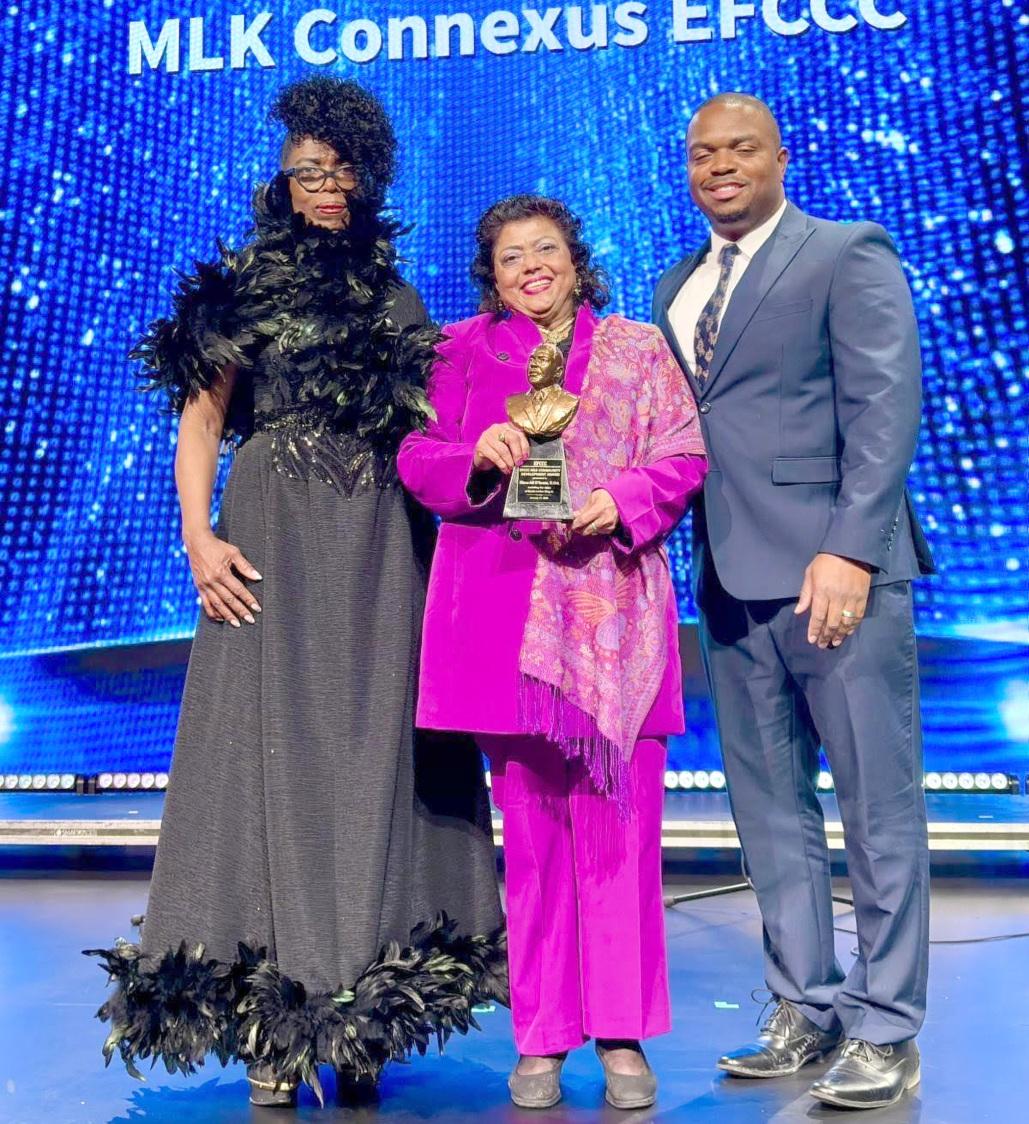
HAVING spent a few years of her life in Guyana during the early 1970s, following her marriage to a Guyanese jeweller in England, Diana Alli D’Souza proudly considers herself an “honorary Guyanese”.
A phenomenal individual who is the recipient of numerous prestigious awards and accolades, Diana was recently the recipient of the Educational Foundation for Children’s Care Canada (EFCCC) Martin Luther King Leadership and Community Award, and one of this year’s distinguished honourees of the Martin Luther King 3-D Bronze Sculpture as a humanitarian.
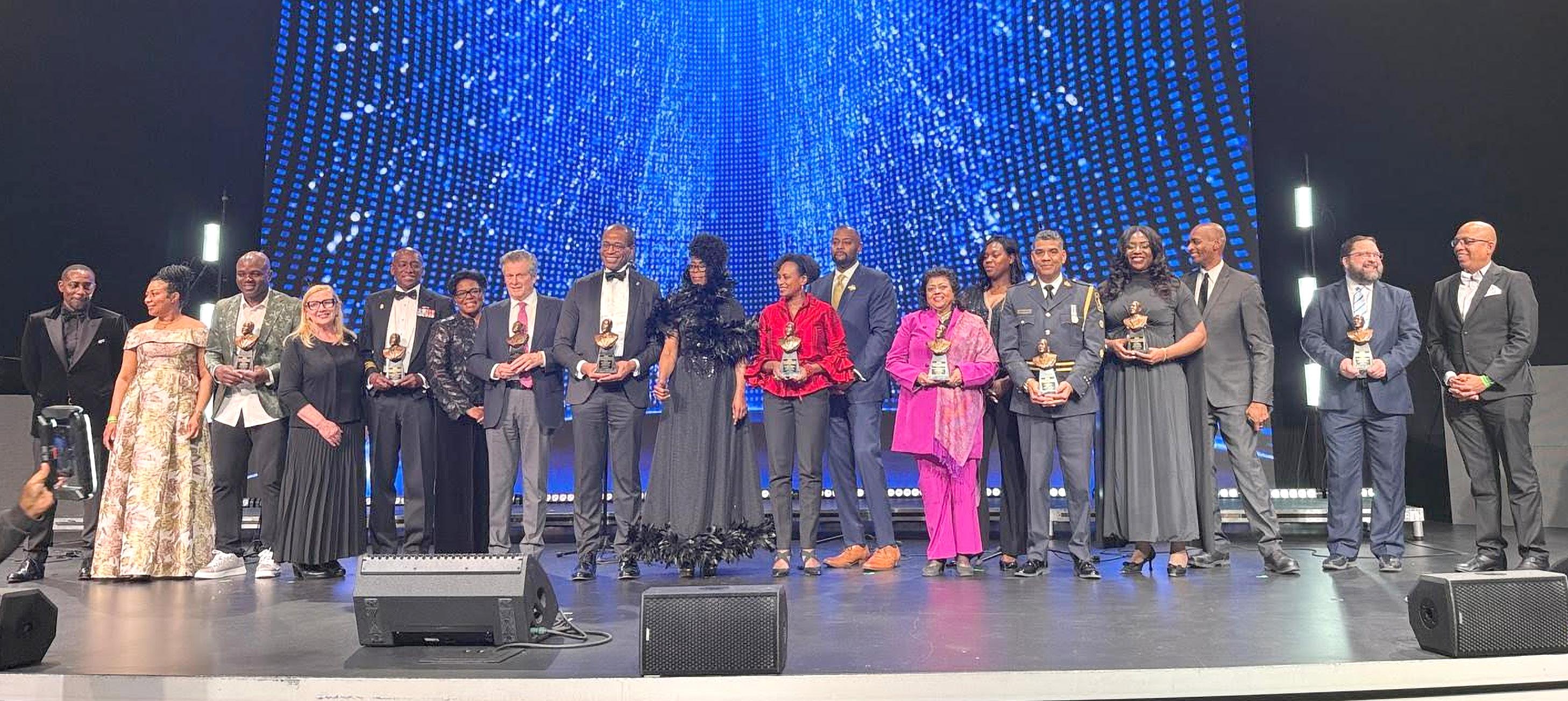
Among the other awardees at last Saturday night’s landmark celebration honouring the enduring legacy of Dr Martin Luther King Jr, held at the Canada Event Centre, Whitby, Ontario, Canada, were Honourable Greg Fergus – First Black Speaker of the House of Commons; John Tory – Mayor of Toronto; Ndidi Nwuneli – CEO, ONE Campaign
(Global); Wes Hall – Chancellor, University of Toronto; Commander Paul Smith – Royal Canadian Navy; Orlando Bowen – Founder, One Voice; Dr Rhonda McEwen – First Black Female President, Victoria University (U of T); Superintendent Kolin Alexander – York Regional Police; Judge Dalton Burger – Jurist and Educator, Durham College; and Tanya Walker – First Black Female Bencher elected in Toronto.
EFCCC’s President, Pauline Christian, cites Diana’s extraordinary leadership within higher education, her commitment to mentorship, and tireless advocacy for equity and access, which have transformed lives and opened doors for countless individuals from underrepresented and marginalised communities.
“Through your work at the University of Toronto, the founding of meaningful outreach initiatives, and your leadership with the Access Empowerment Council, you have consistently demonstrated what it means to lead with purpose, compassion, and integrity.”
Christian complements
Diana’s dedication to empowering young people, advancing social justice, and creating systems of opportunity, which reflect the very essence of Dr Martin Luther King Jr’s legacy. “This year’s theme, ‘From Dreamer to Torch Bearer… The Legacy Continues,’ was chosen with leaders like you in mind— those who not only carry the dream forward, but actively light the way for others.”
The award also adds to Diana’s extensive collection, which includes the coveted Harry Jerome Award from the Black Business and Professional Association of Canada; Canada’s Summit Nation Builder’s Award for Youth Empowerment, standing on the shoulders of legends and trailblazers; Order of Ontario; Queen Elizabeth II Diamond Jubilee Medal; U of T’s Chancellor’s Award; Arbor Alumni Award; Co-recipient, Faculty of Medicine Aikins Teaching Award; over a dozen medical student graduation awards recognising compassion, mentorship, and contributions to student TURN TO PAGE XI
By Shaniya Harding
AS Guyana’s economy expands and new opportunities emerge, the Women’s Chamber of Commerce and Industry Guyana (WCCIG) is sharpening its focus beyond traditional business support, placing advocacy, capacity building, and economic inclusion at the centre of its work. Under the leadership of President Josephine Tapp and Vice President Shamela John, the Chamber is working to strengthen women-owned businesses, address structural barriers such as access to finance and care work, and influence national policy on issues ranging from gender-responsive procurement to gender-based violence.
Through training programmes, mentorship, government engagement, and targeted initiatives for women at different stages of their professional journeys, the Chamber is positioning itself as both a support network and a policy voice for women navigating Guyana’s rapidly changing development landscape.
Now serving her second term as president, Josephine Tapp has been in business for most of her life, being part of her family’s construction business before venturing into law. Today, she works primarily in construction alongside her role at the Chamber. “I studied law professionally. I worked with a tax law firm for about four years. Then I essentially moved back to my family’s business. I think at that age I finally understood that there is this thing that my parents have built, and I really wanted to be able to give back to that and ensure that it continues.” Tapp joined the Chamber several years ago; since then, she has been an active member of the board, secretary, and now president. “I went to my first meeting, I met some incredible women, and I thought that this is really something I could be a part of,” Tapp said.
The Chamber’s main
goal, according to Tapp, is to form a community and social network of women. This drive led to the development of some of the organisation’s major capacity-building projects. As Tapp shared, Chamber members have benefitted from a wide range of training and upskilling opportunities. “We do periodic training
realm of business that still profoundly impact women in business as a whole. Among the leading gaps is the lack of care work structures, something Tapp says could have a major positive impact on women in business once implemented. “One of the main things we’ve been focusing on is care work structures—

with members. We would actually have the banks come in and tell them what they are looking for and what their opportunities are. We have done training on networking, negotiation, creating partnerships, and incorporating your business. When we identify a gap that members have, we execute seminars to address those,” Tapp explained. The Chamber has also identified gaps outside the
ensuring that women have the space to be able to go to work, to work overtime, without having to sacrifice the well-being of their families. We would want to see school transportation systems established,” she said. “We would want to see some gender-responsive procurement, understanding that women don’t have the same level of assets as men who have been around in business for a long time.”
Gender-based violence is also something that the Chamber plans to continue working on. As Tapp explained, the effects of gender-based violence range from immediate harm to long-term challenges in attaining independence, making it an economic as well as
represented in spaces, specifically in public consultations and on boards of state organisations. A lot of our publicly traded companies don’t meet 40 per cent women in their directorship. We want to execute a mentorship network of women in corporates.”
Vice President of the Women’s Chamber of Com-

a social ill. “Gender-based violence is usually seen as a social issue, and it is social, but it is also economic. We’re losing business owners. It’s women who contribute to the economy. If our women are affected by gender-based violence, our economy suffers.” Moreover, the Chamber would also like to see more women represented in corporate spaces. “We would want to see a lot more women
merce and Industry Guyana, Shamela John, is also a longstanding member of the Chamber. With a background in finance and working as a specialist in her field, John joined the Chamber when she transitioned into opening a business venture of her own. “At the time of finding the Chamber, that was my transition period from being an employee to an employer. I joined the Chamber shortly
after. I spent two years as Secretary and two years as Treasurer,” she shared.
Drawing on her expertise, John has firsthand experience of the challenges women face in accessing finance. This led to the creation of the Women Evolve Initiative. “Women Evolve exists primarily to help women who are transitioning into being structured. A lot of women make it to the second or third year and then exit because they didn’t structure their finances. We help them organise their finances, get compliance in place, and position them to approach an investor.”
However, the hurdles women face in accessing finance go beyond financial literacy. As John explains, they highlight larger structural issues and access to information. “For us women, access to finance can still be a challenge. Financial literacy was not a big topic discussed. Women do not get to network the way men do. Access to knowledge may be an issue. A lot of women have businesses but don’t register them.
Something as simple as tax returns becomes a barrier. If you have the knowledge, you can negotiate interest rates, amounts, and deposits. The average person doesn’t have that knowledge.” Highlighting her own experience, she added, “I have experienced going to the bank where things were said to me that would not have been said to a male applicant. It was because I had the knowledge that I could question it.”
As Guyana continues its rapid economic transformation, the Women’s Chamber of Commerce and Industry remains committed to ensuring that women are not just participants but leaders in this growth. Through strategic advocacy, targeted training programmes, and a deepening focus on systemic barriers—from care work infrastructure to gender-responsive policies—the Chamber is building both the skills and the structural support women need to thrive.
By Shaniya Harding
FOR more than three decades, Food for the Poor Guyana Inc. has been providing relief to the less fortunate across the country, establishing itself as one of Guyana’s oldest non-profit organisations. Recently, however, the charity has shifted its focus from relief and brought down the curtain on its housing initiative.
This is not a troubling sign, nor an indication that the organisation is shutting
down. On the contrary, the organisation’s strategic retreat highlights and emphasises the country’s substantial leaps forward. This week, Pepperpot Magazine sat down with Chief Executive Officer Andrea Benjamin to learn why the closure of relief and housing projects reflects well on the nation, and how the charity is now shifting its focus towards capacity building.
While she has held the title of CEO for only a few years, Andrea Benjamin has been with Food for the
Poor for almost two decades.
During that time, Benjamin says she has seen the organisation continuously transform, beginning with a primary focus on relief.
“Food for the Poor began just over 30 years ago as a relief organisation.
The original objective was to bring in in-kind items such as food, clothing, and toiletries, and distribute them to families in need, with the aim of ensuring food security and basic comfort,” she explained. “Over time, we recognised that food alone

was not the solution to most challenges, and the organisation shifted towards development-focused interventions.”
Historically known for its housing initiative, Benjamin shared that the organisation’s shift to capacity-building and development was motivated by changes taking place in Guyana.
The last five years have seen the rollout of numerous housing and relief projects, particularly by the Government of Guyana—a push that Benjamin says has profoundly affected the needs of Guyanese families. “Guyana has expanded housing, agriculture, and livelihood
enhancement programmes.
Within the past five years, we also recognised that Guyana as a country is changing, particularly with the development of the oil and gas sector,” she said.
“As the country develops, the organisation must evolve as well. We examined where Guyana is heading and aligned our programmes with the country’s development trajectory.”
Guyana’s development trajectory is moving upward rapidly. To match this growth and the nation’s changing needs, Food for the Poor has shifted its main focus towards capacity building,
development, and eventual independence. While the organisation still conducts relief missions occasionally, most of its programmes now focus on education, upskilling, and training.
As Benjamin shared, while immediate relief may no longer be a primary need for many families, the organisation is targeting long-term stability—taking Guyanese from relief to resilience.
“While we continue to provide relief, our focus has shifted to moving families from relief to resilience.
The emphasis is now on teaching families to become TURN TO PAGE XII


I HAVE referenced the concept of burnout in advocacy, social work, and community development many times in this column. I have expanded on how long hours, limited funding, and emotional fatigue can lead to an inability to get work done.
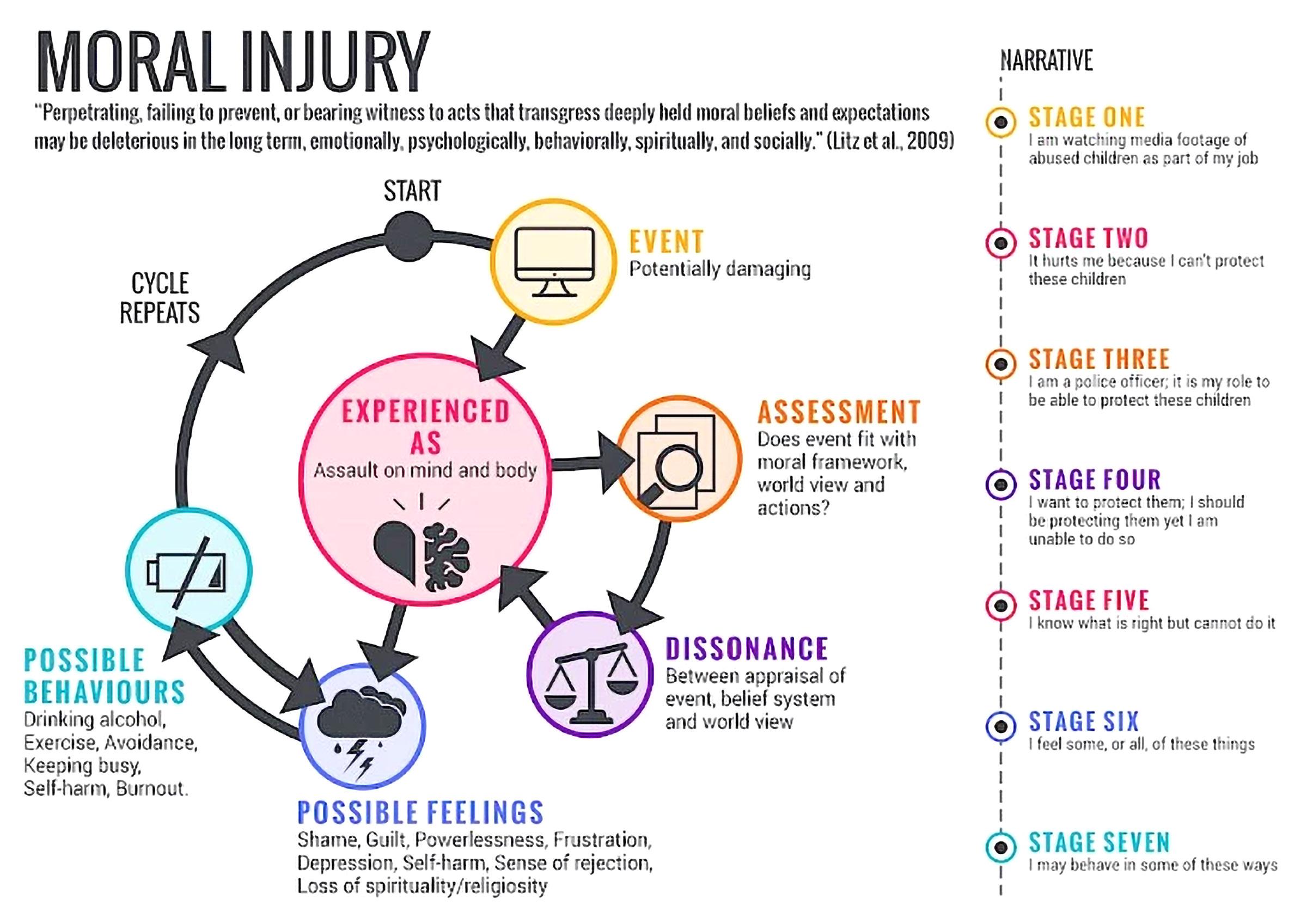
The concept of “burnout” is not the only one that is affecting people severely. I recently learned about “moral injury” and have experienced it many times without even realising what the label was. It is a quieter wound that many people in “helping professions” carry. Rest, vacation, or breaks, unfortunately, cannot help with this concept.
Moral injury is a bit self-explanatory in its definition. It happens when professionals are repeatedly placed in situations that go against their “morals”. It is where they know what the right thing to do is, but are constrained from doing it. Burnout stems from being overworked, but moral injury stems from betrayal.
For those working in social justice, humanitarian aid, health, education, or advocacy, moral injury often shows up when resources are scarce but needs are overwhelming—when a survivor is turned away because funding has run out; when a community is consulted but never truly heard; when photography opportunities and reporting requirements mean more than the outcome of a project; when success is measured in statistics rather than human dignity.
Unfortunately, there can be a misuse of the word “resilience”, and it often adds to the intensity of moral injury. Workers are told to be “resilient” in environments that do not protect them or the
people they serve. When a culture of unethical practices exists, you question your role in it over time. Even as an innocent bystander, you might feel the “moral injury” of being complicit. In small societies like Guyana’s and across the Caribbean, the effects of moral injury can be even more detrimental because communities are very small and tight-knit.
The professionals who often work in these communities have a higher caseload ratio, which means the entire
community might also fall into their portfolios. In these cases, the community members are not just “clients”; they are your relatives, childhood friends, classmates, and family members. The ethical considerations become personal. You might be wondering what moral injury looks like. It comes in many forms. You might feel numb, experience withdrawal from spaces you once cared deeply about, intense anger or shame, and feelings of worthlessness. It is often described as
cynicism where hope once lived.
A common misconception is that people leave their jobs simply because they do not care. That is quite the opposite. They often leave because they indeed care— and they care enough to know the system is working against them and those they serve.
The concept of moral injury needs to be addressed deeply and not just at a surface level. If you think you are experiencing moral injury, you can attend wellness
workshops, motivational speeches, or visit your counsellor for further help.
Apart from personal efforts to alleviate its effects, moral injury also requires strong leadership, adequate resources, and a culture of responsibility and accountability. It requires the ability to understand that sometimes the issues are beyond us and result from “broken systems”.
As I end this week’s column on this newfound topic, I hope you consider putting a label on “moral injury” if
that is what you think you are experiencing.
Validate the experience, because it is a sign that your moral compass is still intact. It means you can still set boundaries and see things objectively—for what they are.
The ability to do good work should not come at the cost of losing yourself in the process. If our systems break the very people trying to uphold justice, then the problem is not the workers—it is the work environment itself.

THERE are strange, hidden lines that run between each choice of ‘yes’ and ‘no’. Lying between a seemingly black-andwhite decision, between the seemingly well-defined boundaries of two different routes, are silent yet formidable paths that remind us of how little we sometimes know about the choices that we make.
Some people may go so far as to say that choice is an illusion; however, this is not true. The reality of a choice is only as elusive as we allow it to be. Before every choice we make, there is a glimmer of clarity we receive—something that may not show us what is right, but at least shows us what our future will feel like if we choose it.
Our lives are often centred around consequences— what happens after a choice is made, and how we can live through those outcomes comfortably. We should instead focus on the action of making those choices in the first place. It is not the things that happen to us which make up our days.
Rather, it is the things we choose to do that define them. The key to peace and happiness lies in becoming comfortable shouldering the responsibility of making the choices that shape our lives, and not in becoming comfortable living through the things that happen to us.
One of the defining characteristics of the modern world is its complexity. As a result, it can be a little more difficult to know whether a choice we are making is right or wrong. For instance, the simple act of printing out a document can mean that we
are willing to harm trees by using paper.
The choice to eat a steak instead of a salad is not as personal as it seems; it can, in fact, affect the environment by increasing our carbon footprint. Even purchasing a bottle of fruit juice in a single-use plastic bottle is a choice that has an impact greater than ourselves.
This new complexity in the choices we make may initially seem like a burden. On the contrary, it is actually a gift. In the past, it was not as easy to understand the impact of one’s choices. One could live an entire life engaging in harmful behaviours and dangerous choices without ever understanding the extent of the damage they cause to themselves and to those around them.
For instance, not more than 500 years ago, it was very common for makeup to contain extraordinarily dangerous chemicals like arsenic. Similarly, everyday objects such as watches, hats, and glazed ceramic items were made with radium, mercury, and lead.
Today, we stand appalled at how easily one can be poisoned in daily life, without even realising the harm being done.
In the past, when those objects were used, the dangers were either unknown or the public was simply not well informed.
The information we receive daily may seem overwhelming. At times, it can feel impossible to make the right choice, no matter what we decide to do. When such thoughts overcome us, it is helpful to reflect on the

importance and beauty of being well-informed and autonomous.
As a generation gradually assuming more responsibility for our world, we may not always know what the best path is, but we can certainly
try our best to discover it by gathering information and listening to experts.
Everything we do in a day has hidden consequences. Even choosing to do nothing has its own consequences. As such, we cannot
resign ourselves to making choices passively.
We must make a conscious effort to live life in a manner that makes the utmost use of the knowledge we have been gifted with—in the smallest
lifestyle choices we make and in the great decisions that can impact the wider world around us. We are often told that knowledge is power, but knowledge is only powerful if we choose to use it in powerful ways.


I inherited a copy of Kenneth Ram Chand’s West Indian Narrative – An Introductory Anthology. The subject of this literature was the question that first confused, then inspired, and became more innovative as the years went on. I must share this foreword with you, imposing its logic:
“How would the terror and agony of a slave rising become a part of the West Indian experience if Mettelholzer had not made it so? Or the burning of Castries becomes a part of the West Indian memory if one who saw his world dissolving had not written… ‘Wanted to tell more than wax, of faiths that were snapped like wire, All day I walked abroad among the rubbled tales.
Shocked at each wall that stood on the street like a liar…’? Or Mourant Bay, in Jamaica, with its rusted corrugated-iron roofs set against vivid green hills, would have become part of the West Indian heritage if Vic Reid had not made it ours.
For it is the artist who fashions the symbols of unity in the English-speaking Caribbean, not the politician. In Lamming’s phrase, he charts the West Indian memory.”
This little book covered the lives and works of numerous Caribbean writers, as I read it then, of the past, as there were others to come. Some narrated with excellence, like the tale by Mittelholzer, My Bones and My Flute, narrated
on radio by the then tremendous voice of James Sydney, followed by the incredible drama of Tides of Susan Berg, written by my friend, Francis Quamina Farrier. And the many who followed, contributing to the national memory, with other reflections of how we live and endure—whether in satire or folk legend, we persist.
I cannot summarise the distractions of this era today. We are not enticed to explore the ego, with numerous alter-egos that have eclipsed the recognition of all that I have referred to, and the rites of the balance of living.
But I can recognise what our fathers knew: that a man who forgets the salient truths taught to him through parables, and with
living examples and local street and village tales of the tough, but wise and principled characters against the sinister that stood out, can make a judgement and realise that whatever mysteries we may construe of the principles of religion and philosophy do whisper to our memories. There are examples in history that can debate our questioning.
There are always tempting paths inhabited by luring whispers that infiltrate our observations with persuasive arguments that lead towards regret. For even our learned aesthetics can be misinterpreted, based on moments of self-accusation and confusion, if one fails to explore.
The talents are there, and in
diverse areas. Talents have left us examples; the mechanism, however, is where the knowing effort is lacking.
However, new talents, if aware, will shape the nexus of a tremendous heritage that must be shaped to inspire those gifted to learn. In conclusion, the task must be the need to know, and rather than follow, choose to lead, as the brothers and sisters before us stumbled and rose again— simply because you don’t have to justify folly. In our world of self-examination, every experience is a lesson learnt. Let the new awareness be your guide; inhale, breathe again, and enter the ring for the next encounter of awareness.

FINISH
Strong will motivate you to take control of your life, set goals, and find the determination you need to achieve them.
In his book, Geary Reid provides insight into what will make you stand out from the competition and win the race. Here, you will learn about the obstacles you might face along the way, such as discouragement, fear, and a lack of motivation. You can overcome these obstacles by surrounding yourself with positive people, listening to feedback from others, and channelling the discipline of an athlete. You are in control and can start making your dreams a reality today.
1. Bad Start – It Happens to Everyone
Everyone wants victory
every day, all the time. No one expects that life will present so many challenges before they reach their destination. While a person may have a good plan, there will be many obstacles in their path, and if they fail to find strategies to manoeuvre, they will fail when those obstacles come between their plan and their intended victory or goals.
No one wants to fail. People will plan and plan to gain victory, but in all their planning they must consider that the wrong thing could happen.
A bad start never announces that it will occur to a particular individual. In the midst of many good things happening, something bad can happen and change all of the good things that were
planned.
For example, someone preparing for an examination may go to bed early so they will wake early the next morning, have breakfast, take a bath, and then put on clothes to sit the examination. As they leave the house, their vehicle does not start.
They decide to take public transportation and, on their way to the examination, the wheel of the vehicle punctures. The breakfast they consumed causes them to experience frequent bowel movements.
You can see from these unfortunate occurrences that the person never planned for them, yet they happened at an inconvenient moment. While some of these events mentioned here may not affect everyone, some people

experience a series of events that prevent them from reaching their end goal. Every person has a list of bad things that have happened to them. For some, these are one-off events, but for others, they are recurring.
No one is perfect. However, some people will make their best effort to do everything they know they must do. Some people are very careful in what they say, what they do, and where they go, yet bad things still happen to them.
Have you ever considered that medical doctors advise patients on what to do, yet the doctor has died from the same condition? Some people follow most food and nutrition guidelines, yet they are affected by something they were making their best effort to prevent.
Bad things will happen to good people. While no one may be qualified to be called a good person, some people constantly make great efforts to do the right things they have learned.
When bad things want to happen, they never ask for permission from those doing the right thing before affecting them. Life is never equal for everyone. While some people may face many bad things, no one will entirely escape them.
How people respond to bad things is very important for their victory. Many parents encourage their children to learn from bad experiences and try to do better. A toddler learning to walk will fall TURN TO PAGE XI



life; Association of American Medical Colleges (AAMC) recognition for student advocacy (Northeast Group on Student Affairs); and Toronto District School Board awards for mentorship and outreach initiatives, among others.
Reminiscing, Diana acknowledged that her legacy of service was shaped over nearly four decades at the University of Toronto, Faculty of Medicine (38 years; retired 2012). “I held senior roles spanning student life, admissions, awards, service learning, community partnerships, and national diversity representation.
Humbly, I also founded 21-plus outreach initiatives supporting underrepresented and marginalised communities across the Greater Toronto Area—mentoring and tutoring youth, supporting those experiencing homelessness, and engaging isolated seniors.”
Touching on her early roots, Diana reflected that her parents gifted her a humanitarian lens from early childhood, “grounding me in kindness, compassion, social responsibility, and a global awareness of poverty and interfaith harmony. I grew up in Mumbai in an interfaith neighbourhood, surrounded by Jewish, Catholic/Christian, and other faith communities, which shaped my deep respect for cultural diversity and learning from one another. It further extended through my travels and to my children and spouses immersed in other faiths and cultures.”
“In my teens, I went to London with hopes of entering medicine, but life circumstances shifted my path and responsibilities early. Those formative experiences strengthened my resilience and deepened my commitment to family, community,
and service.”
“In the early 1970s, I moved with my husband to Georgetown, Guyana, with our two children, and our third was born at St Joseph Mercy Hospital (now in her 50s). That chapter, along with the gift of an extended family through my husband, ignited a deep love for Guyana’s people and its rich cultural heritage.”
“The 1970s, however, were also marked by political instability, ethnic division, and economic decline, alongside challenges in my personal life of separating from a marriage after coming to Canada. Canada welcomed us, as did the Caribbean community, especially the Guyana diaspora. I have remained committed to Guyana’s progress and sustainability ever since.”
“Over the years, I have supported Guyanese initiatives through community re-
many times, but once they develop balance and strength, they will be able to walk without falling.
A person who learns to ride a bicycle may fall many times, but that is part of the learning process. Once that person learns to balance, riding becomes easy. No one matures overnight, so there is a learning period. However, it appears that some people remain in the learning period after many years of trying. Many others came after them, learned the lessons, and moved on, but they remain stuck in the learning phase.
Obstacles will always be present. Anyone who wants to be victorious must be aware that they will encounter obstacles. Under the best conditions, obstacles await everyone who is going to the finish line. Some obstacles may be so large that people must find a way to go around them, as they cannot jump over them. Not all obstacles can be moved, as some are permanently located, and everyone who must pass that point will encounter them.
Too many people expend much energy trying to move obstacles they do not have
the strength, knowledge, or power to move. Anyone who wants victory must know that they will not be able to move all obstacles, but they must go around them.
2.
If you are going to finish strong, you have to find what works best for you. You cannot run everybody’s race. Find your event and give it your best.
If you do not know what you are called to do, you will be shifted by every wind that blows. At the beginning, you may not be strong, but once you find your bearings, you ought to be moving in the right direction. You may have many trials and errors as you try to find what you are called to do. Each individual is unique, and each person’s calling will complement something in this world. As you continue to do what you are called to do, you will recognise that you can perform it with little effort or energy—it becomes almost instinctive.
If you do not know your calling, take some time to find it. You will finish strong when you know what you
lationships and partnerships, including work connected to women’s issues and disadvantaged children, with leaders such as Janet Naidu, President of the Guyanese Canadians for Unity (GCU), and other community organisations.”
Among those expressing congratulations to Diana was Guyana’s Honorary Consul to Toronto, Mani Singh. His congratulatory message read: “On behalf of my fellow Guyanese of our Guyanese
Canadian diaspora, I extend heartfelt congratulations to you on being selected as a recipient of the Martin Luther King Leadership and Community Award – 2026, and as one of this year’s distinguished honourees of the Martin Luther King 3-D Bronze Sculpture. The Guyanese Canadian diaspora is very proud of your work both inside and outside of Guyana.”
In her pre-taped, broadcast speech, she concluded:
“I accept this recognition with humility, honoured to carry forward Dr King’s legacy as a torch bearer, where we are each called to hold and pass on together to the next generation.”
Diana is filled with gratitude and sees the honour as a call to pass on to the next generation, urging young people to be bold, resilient, and courageous, guided by compassion, justice, and peace, and by the enduring legacy of Dr King.
FROM PAGE IX
are called to do and follow your calling with passion. At an early age or stage, some people know their calling. They need little help or guidance, since they have already begun to do something that gives them victory, and many people celebrate their success.
After a prolonged period, some people find their calling. They know what they are called to do and are eager to start. They must now move a step further by perfecting their skills. For example, a person may be able to play football, but they need to develop certain techniques. The development phase may be time-consuming, but it is important in moving a person from an average to an extraordinary position.
For more information about Geary Reid and his books, please use the following contact information: Amazon: http://www. amazon.com/author/ gearyreid Website: www.reidnlearn.
com
Facebook: Reid n Learn
Email: info@reidnlearn. com
Mobile #: 592-645-2240

independent through capacity-building and development. Instead of simply providing food support, we examine why families need assistance. Is it unemployment? Lack of skills? If so, how can we network to connect them to jobs or training opportunities?”
At its core, Food for the Poor’s focus remains on aid and development, a commitment highlighted through several projects the organisation has pioneered in recent years.
Among the most impactful is the Youth Enhancement Programme. “Our Youth Enhancement Programme focuses on building young people’s capacity for employment and sustainable livelihoods. We have worked with 30 youths so
far, most of whom are now employed or pursuing further skills training,” she said. Another youth-focused project currently being developed is Braids of Hope. “This upcoming initiative targets unemployed and outof-school young women. The programme will train 15 women and girls in hair braiding, equipping them with an income-generating skill.”
The organisation is also taking a holistic approach, working with families in agriculture to provide sustainable solutions. “Rather than providing food supplements, we decided to teach families how to grow food where they live. This led to the creation of our urban agriculture project in Festival City, which currently supports 20
families from the community and surrounding areas.”
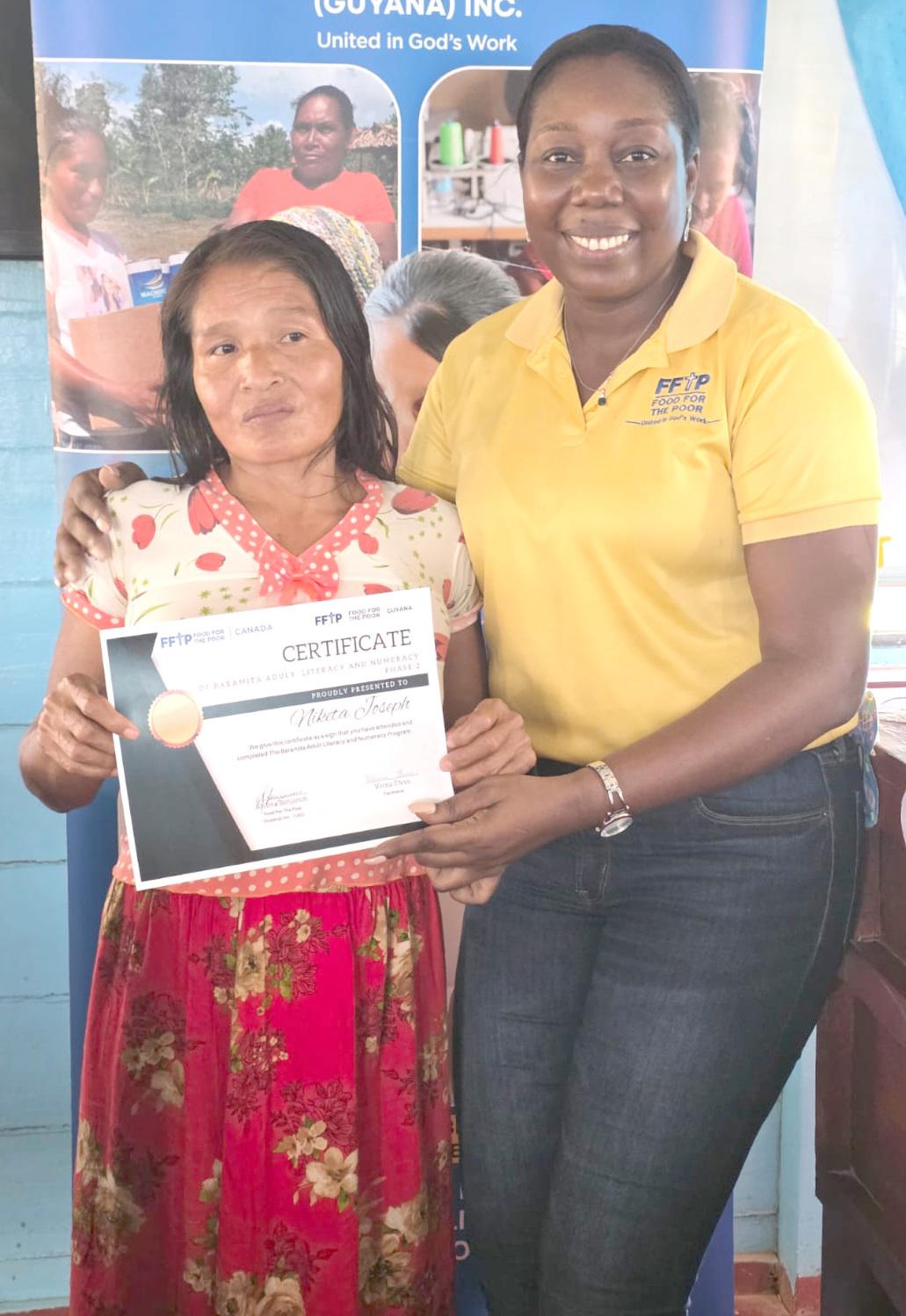
Food for the Poor’s work extends far beyond the capital city, with impactful initiatives reaching Guyana’s hinterland regions. One of the organisation’s most successful ventures in the interior has been its literacy programme for women. “We also operate literacy programmes in the hinterland, recognising that the needs there differ from those on the coast.
In communities such as Baramita, we identified a critical need for adult literacy among women,” Benjamin stated. To date, Food for the Poor has worked with 47 women, teaching them to read and write independently—a project that has had far-reaching, posi-

tive impacts, particularly in their access to services and healthcare. “Beyond literacy and numeracy, the programme significantly boosted women’s confidence.
They are now more engaged with their children’s schools, more confident interacting within their communities, and better equipped to advocate for themselves. For Indigenous women in remote communities, this is critical to personal growth and development.”
Another area the organisation has stepped away from is its housing programme, which closed in 2023. According to Benjamin, this decision was influenced by the government’s housing push, which she describes as impressive and commendable.
“Food for the Poor has tradi-
tionally been known for food distribution and housing. In 2023, we closed our housing programme after recognising the government’s aggressive and effective housing initiative. We did not want to duplicate efforts and commended the government for its work,” she said. “As a result, our core focus is now on building the capacity of vulnerable individuals, families, and communities so they can take advantage of the opportunities Guyana has to offer.”
In alignment with this approach, the organisation has ensured its work complements Guyana’s national development strategy.
“Food for the Poor maintains a strong relationship with the Government of Guyana and aligns its work with
the national development strategy. We ensure that our efforts complement rather than duplicate government initiatives,” Benjamin noted.
Looking ahead, Food for the Poor will launch its 2026 programme appeal, outlining projects available for funding, including costs and implementation plans. While the organisation continues to change and evolve alongside the country, Benjamin emphasised that it remains very much active.
“Food for the Poor is alive and well. While our focus is no longer heavily on relief, we remain committed to building capacity at the individual, family, and community levels, in line with Guyana’s changing development landscape.”



JAMES (Doubleday, $17.86) is the twenty-fifth novel by the extraordinarily prolific African American
writer Percival Everett, who has also published four collections of short stories and seven collections of
poetry. James was awarded both the 2024 Pulitzer Prize for Fiction and the National Book Award, which

represents a remarkable achievement in an already distinguished career. James is, quite simply, a remarkable novel.
Everett, a Distinguished Professor of English at the University of Southern California, has been enjoying a late-career renaissance. His recent novels, The Trees and Dr. No, were both critically acclaimed and became bestsellers, while an earlier work, Erasure, was adapted into the Oscar-winning film American Fiction, starring Jeffrey Wright. Erasure explores questions of Black identity—how Black Americans are categorised, stereotyped, and come to see themselves. These concerns run throughout Everett’s vast oeuvre. He is a relentlessly questioning, philosophical writer, often very funny in a dry, deadpan way. James is a rigorously reasoned novel about the poetics of race, at once funny, harrowing, and deeply sad. It achieves a rare balance of intellectual inquiry and the emotional weight of lived experience.
A pointed aspect of the novel is its exposure of the soul-killing restrictions that slavery imposes upon the Black body and mind. Within such a system, any subterfuge employed to resist this erasure of self becomes morally justifiable. This concern is especially evident in the novel’s philosophical engagements, particularly where James enters into dialogue with white philosophers such as Voltaire on the concept of “freedom”. In the white philosophical imagination, freedom is not conceived as universal but as unequal—Black freedom is understood as a diminished, conditional version of white freedom. From this logic, it is not a great leap to imagine that whites would extend such inequity beyond earthly life, envisioning even Heaven as racially stratified.
James has frequently been reviewed as a sequel

or retelling of Mark Twain’s 1884 novel, The Adventures of Huckleberry Finn. It is not.
Rather, it is its own work— one that reimagines characters from an earlier text and grants them a depth and interiority they did not previously possess. In this sense, it resembles Jean Rhys’s novel, Wide Sargasso Sea, Maryse Condé’s Windward Heights, or Tom Stoppard’s play, Rosencrantz and Guildenstern Are Dead.
In such works of retextualisation, peripheral or supporting characters from canonical texts are brought to the foreground and endowed with a history and psychology only faintly suggested—or absent—in the original. They scarcely resemble their earlier incarnations. Instead, they become protagonists, heroes, and heroines of a new narrative, granted full agency and intelligence.
In Rhys’s novel, the socalled “madwoman in the attic” from Jane Eyre is reimagined with a full backstory and, crucially, a psy-
chological logic that explains her breakdown. Similarly, in Stoppard’s Rosencrantz and Guildenstern—minor figures in Hamlet—become fully realised protagonists of their own drama. Everett’s James may be the most successful reinvention of a fictional character yet.
In Twain’s novel, Jim— short for James—is a runaway slave and Huck’s companion, often treated as a sidekick. No one calls him James, the more formal and dignified name. Instead, he is referred to as Jim, “Nigger Jim”, or worse.
The racial slur appears more than two hundred times in the novel, reflecting the attitudes of the era and Twain’s attempt to expose the brutal normalcy of racism. Its ubiquity has long fuelled controversy over the novel’s place in the American canon, though Huckleberry Finn remains, undeniably, a great work.
Everett’s James is not a retelling of Twain’s novel, TURN TO PAGE XIX

ARVIND slowly got out of the car and inhaled the fresh air. He lifted his head a little so the morning sun kissed his face with its gentle warmth, and his mind exulted.
“I am home.”
He had migrated to the US at 14 with his family, which wasn’t something he was happy about, but he was a young boy with a bright future, and he had to comply with his parents’ decision.
“I’ll come back one day, though,” he had said to the coconut trees he often climbed, the neighbour’s cats he frequently bought special treats for, and the dogs he sometimes took for walks. But the one he was concerned about leaving was the neighbour’s wife.
She lived next door in one of the most beautiful houses in the neighbourhood, a young woman married to an older man who was obsessive and abusive. She was not allowed to speak to anyone and was forced to stay in the house. Any time she had to go somewhere, a driver took her and brought her back home.
The only place he saw her outside of the house was in the flower garden, and looking at her, so young and beautiful, he had felt a sense of pity. No one should have to live such a life, like the broken wings of a butterfly.
Some nights, whilst up late studying, he would hear her screams and the man’s deep, angry voice, and he had asked his mother and father, “Why doesn’t someone help her?”
His father, who was a mild-mannered, easy-going person, had answered, “That man is rich, powerful and
aggressive, and I’m sure he’s a licensed firearm holder, so no one would want to cross his path.”
“But he is abusing her; doesn’t she have a family?”
“Apparently, from what I heard,” his father told him, “the family owes the man a lot of money due to a bad business deal with the father and son.”
“So she’s trapped to pay off the family’s debt,” Arvind had surmised like the broken wings of a butterfly.
He had wished he could have done something to help her, but if adults were afraid to do so, what could he, as a young boy, do?
The following year, he had migrated with his family, hoping that somehow, she could find a way to free herself. He had never spoken to her, and she never saw him—the boy next door who was concerned for her.
For all the years he had spent in a foreign land, she stayed at the back of his mind: a stranger, an older woman whose plight had affected him as a young man.
He returned home fourteen years later, now a grown young man with excited hopes and plans to invest in the country he loved. As his uncle and aunt, who were staying at the family home, welcomed him, he looked across to the beautiful house, but it stood there wrapped in silence and creeping shadows.
“Did the neighbours move out?” he asked his uncle.
“Yes, about six years ago. The house is up for sale, but no one wants to buy it.”
“Why?”
“Something terrible happened one night, with gunshots and screams. The police

came, and there was an investigation for a week; then, after that, nothing was spoken of the incident. No reports, nor any news of what happened there that night.”
A shiver of fear pulsed through Arvind’s body, and he asked the dreadful question, “Did the man kill his wife?”
“No,” his uncle answered. “Someone he had a bad business deal with killed him, but she was spared.”
Deep relief filled his heart, and he expressed quietly, “Thank God she wasn’t harmed. She was trapped in that abusive relationship, and a tragedy set her free.”
In his old room that night, he heard her screams no more—just a haunting silence—and the next morning, he did not see her in the garden, now overgrown with shrubs and thick grass.
“A beautiful house that could have been her dream,” he mused, “but was instead a nightmare.”
He sighed with a smile, happy she was free, probably now in her forties, and though he was more than 10 years younger, he was still concerned for her.
“I wonder where she is and how she’s doing,” he said to himself.
Those questions stayed quiet in his mind, unanswered, as he focused on his business initiatives, securing a bank loan and laying the groundwork. He was a new face and business name in machinery and construction projects, a young man with degrees in engineering and economics, passionate and enthusiastic about succeeding.
He knew his success would contribute to the development of the country, to
building his dream home, and to helping the less fortunate. He was commended by his family and all those who knew him for his great plans and ambition.
Three years later, his business had been established, and the foundation of his home had begun to be built with a bank loan.
Now, he could focus on establishing a charity drive, and he decided to start at a
children’s home. Children are the future and, in his view, once given the assistance and opportunity, they can achieve their set goals in life.
The children’s home manager took him on a tour of the facilities, and he noted the improvements that needed to be done: dietary and medical supplies, tools for learning, and more reading materials for the library. He was given a brief introduction to the teach-
ers in their classrooms, with a formal meeting to follow at a later date.
In the last class, which overlooked a flower garden, the teacher at her desk, marking papers, looked up as the manager entered the classroom, and Arvind’s heart did a double-take.
He recognised her! She was his neighbour’s wife.
To be continued…









despite what some reviewers have claimed. It is a reinvention—an act of imaginative recovery. Everett takes a character about whom we know very little and renders him fully human within a new fictional context. James has a wife and a daughter whom he loves deeply, and it is this filial bond that sets the plot in motion. When James learns he is to be sold and separated from his family, he flees, hiding on a nearby island. There, by coincidence, he encounters Huck Finn, who is himself in hiding from his abusive, drunken father. The reason for the father’s hatred of James is one of the novel’s many unsettling revelations.
What follows is a harrowing journey filled with danger, narrow escapes, and moments of quiet philosophical reflection on the “peculiar institution” of slavery. James is bookish and erudite—a reader who interrogates what he reads.
One of the novel’s most striking elements is its portrayal of the elaborate performances enslaved people must adopt to ensure white comfort. They must pretend to be ignorant, to speak in a debased dialect that confirms white assumptions about Black stupidity.
Their words and actions are carefully tailored to a white gaze. This deception is a survival strategy. One of James’s responsibilities, in fact, is to teach enslaved children not only how to read, but how to pretend they can-
FROM PAGE XIV
not—how to mangle proper English into something less threatening. He corrects their grammar only to distort it again into what white society expects to hear.
The novel is also, unmistakably, an adventure story, employing many of the genre’s familiar tropes: pursuit, peril, and last-minute escapes. When James and Huck flee the island together, the narrative opens onto a broader American landscape and assumes the shape of a picaresque journey.
Everett is a careful, deliberate writer, attentive to balance and moral complexity. The novel engages fully with its central concerns: slavery, freedom, family bonds under duress, and the violent contradictions at the heart of 1850s America. It is also often very funny, particularly in its use of African American humour.
This humour shines most vividly in James’s interactions with other Black characters encountered along his descent through a country gripped by rabid racism—a society that denies Black people even the right to exist without white permission. It is an era in which a Black man could be nearly beaten to death for stealing a pencil.
James is an unforgettable novel: beautifully paced, populated by vivid and singular characters, and grounded in a historical reality that feels both authentic and immediate. It is, without question, a must-read.
















Welcome, reading friend. Keep a diary - it can be incredibly useful to any serious student. A well-kept one helps navigate academic pressures and improves self-awareness. It helps increase skills like writing and communication, and organisation of study. This private notebook and daily companion accommodates your fearless processing of emotions, enhances your focus, and monitors your learning progress. In it, you can note important bits of information in real time. Overall, a diary acts as a tool for mental clarity. Be smart. Love you.
Every paragraph has a main idea
1. Finding out the man idea of a paragraph To find out the main idea of a paragraph, you need to distinguish its main idea from the supporting details. A main idea is often summed up in a single sentence somewhere in the paragraph either at its beginning, middle, or end. Look what you should do:
a) First, identify the topic (who/what the passage is all about).
b) Then, ask what the author is saying about it – the
controlling idea(s).
c) To help you do this, look for words/phrases or equivalents repeatedly used; check the title/ heading also – these highlight important pointers.
d) Now, combine the topic and controlling idea(s) to form the main idea.
e) Also, make a summary of the passage in one sentence using your own words covering the topic and key point(s) to see if it fits.
The process of finding the main idea of a paragraph becomes a little harder when it is not actually stated in a topic sentence. In that case, you aim to decipher the general meaning of the paragraph.
Here is a paragraph. Read it through thoroughly. Try to find out its main idea, then respond to the questions at its end.
The first agent Leamas lost was a girl. She was only a small link in the network; she was used for courier jobs. They shot her dead in the street as she left a West Berlin cinema. The police never found the murderer and was at first inclined to write the incident off as unconnected with her work. A month later, a railway porter in Dresden, a discarded agent from Peter Guillam’s network, was found dead and mutilated beside a railway track. Leamas knew it wasn’t coincidence
any longer. Soon after that two members of another network under Leamas’ control were arrested and summarily sentenced to death. So, it went on: remorseless and unwavering.
(J. LeCarré: “The Spy Who Came in from the Cold”)
The main idea of the passage is that:
(A) The police couldn’t stop the murders of Leamas’ men.
(B) Leamas couldn’t understand why so many people were killed.
(C) Leamas knew someone was killing his agents.
(D) The murders of Leamas’ agents were savage and cruel.
Dealing with writing an autobiography 2. What constitutes an autobiography?
In an autobiography the story of a person’s life is written or told by that person himself, sometimes with a collaborator or ghost writer. It is a chronological, non-fiction narrative which is presented in the first person (“I”) and uses other first-person pronouns like “me,” and “my”.
The author’s narrative can be presented as recollections of key events, experiences, and insights spanning from
January 25th, 2026
childhood to the present, providing a chronological account of significant milestones. Alternatively, his story may weave together themes or time periods that link experiences into a more meaningful narrative, reflecting his unique perspective. But he must first select a theme or time to guide his story and know why he is writing it; this of course will determine which events to include. Note that people, animals, places, and experiences important to the author might appear in his autobiography. Note also that autobiographical accounts can fall anywhere within a range of presentations - from formal book lengths to shorter essays, journals, or memoirs.
One authority on essay writing says this: “It (the autobiography) can be used in many occasions such as in an application to a college or for a position of great importance.”
What you should do:
From what you have read, plot, and then write an autobiography of your life. Structure it either chronologically or thematically. Focus on a selection from these aspects: experiences, vulnerability or mistakes, childhood, personal growth, achievements, relationships, values, or cultural identity. Ensure that it is presented as a thorough and
Though the mills of God grind slowly, yet they grind exceedingly small.
“Sinngedichte” (1653), III.ii.24 (tr. H.W. Longfellow).
detailed record as required. Show your reader who you are and how you have become that person.
GRAMMAR
Strengthen your subject-verb ability
Making verbs agree with their subjects. Today we continue to probe into your skill in making the subject and verb agree in your expressions.
Choose the correct verb for each sentence that follows.
1. Josephus and Sunny Beatty (is, are) absent.
2. The pruning shares (is, are) on the kitchen table.
3. Twenty-four percent of the students (owns, own) one laptop and one desktop each.
4. Shaundel, as well as her two sisters, (has, have) similar albums of Biblical CDs.
5. (Doesn’t, Don’t) Squinty Chin live four doors from Tom Johnson?
6. (Was, Were) you at the impromptu meeting this morning? The new science project sponsor (has, have) awarded two hundred and twenty thousand to our science programme.
7. One of the members (has, have) been awarded a substantial science exhibition contract to our team.
8. They (was, were) an hour late for the wedding ceremony. Time (doesn’t, don’t) seem to mean much to the Kyte’s family.
9. It (doesn’t, don’t) seem right though. Fifty-five thousand dollars (is, are) not too much for a bridal banquet.
10. Each winning boy (was, were) given a substantial piece of arable land for planting cassava, sweet potato and cabbage.


AT least 8 out of every 10 patients who seek dental treatment do so because of an infection. Most, if not all, expect that if a person’s face is swollen, then their dentist will automatically prescribe medication. However, an immediate extraction is often required.
There are two basic methods to control an infection: prevention and treatment. In both cases, non-pharmacological (not using drugs) efforts are of considerable importance. In prevention, one must focus on eliminating factors that lead to infection: bacterial plaque, oral debris, decayed teeth, etc.
A bacterial attack can manifest as a condition which may range from a simple carie (tooth decay) to an acute facial abscess.
The incidence of post-surgical infections can be reduced by proper wound closure and the use of aseptic (sterile) and atraumatic (conservative) techniques. In the treatment of infections, one must provide indicated local treatment (scraping, incision, drainage, etc.) and supportive care (ensuring adequate rest, nutrition, and fluid intake).
Antibiotics are only a part of the treatment for infections. The other major part is the removal of the cause of the infection. It means, therefore, that in order to solve the problem of a dental abscess, the first step is to decide if the condition is acute or chronic. Acute abscesses must be drained and/or deinfected before instituting medication.
It is common for people with facial abscesses to consult physicians rather than dentists for treatment. While the physician can only prescribe an antibiotic, the dentist can also remove the aetiologic agent of the infection (which is crucial), in addition to prescribing the appropriate antibiotic.
Someone who acquires a swollen face with a painful area because of a decayed tooth is suffering from the first stage of a periodontal abscess. It is important for
the dentist to carefully examine the patient and decide whether they should perform the extraction immediately.
Depending on the stage of the infection, anti-inflammatory and antibiotic therapy may be prescribed for at least five days.
If an attempt is made to extract the offending tooth without first applying this treatment, two things may happen: the pus surrounding the tooth may disseminate to adjacent tissues or enter the bloodstream, thus exacerbating the situation; and, due to the acidity of the swollen tissues, the anaesthetic may not work sufficiently, resulting in a very painful extraction.
The need for antibiotic prophylaxis to prevent subacute bacterial endocarditis in patients with rheumatic heart disease who are to undergo procedures likely to precipitate bacteria into the bloodstream is well known.
The recommended dosage for most patients is 600,000 units of procaine penicillin G mixed with 200,000 units of crystalline penicillin G, administered intramuscularly 1 hour prior to the dental procedure and once daily for 2 days following.
A second aspect of prophylactic antibiotic coverage concerns the use of antibiotics to prevent infections after dental procedures. Studies show that, apart from rheumatic heart disease as stated above, there is no need for a person to take antibiotics before undergoing any kind of surgery, whether it is a simple extraction or periodontal surgery.
Most bacteria that cause dental infections fall within the antibacterial spectra of penicillin G, penicillin V, phenethicillin, ampicillin, erythromycin, tetracyclines, lincomycins, clindamycin, and the cephalosporins.
Penicillin is the safest and most powerful antibiotic for severe infections. However, it should not be abused. It should only be used in severe infections, when the body’s defences
are impaired, and where drug toxicity is particularly significant, such as in infants, small children, the elderly, the debilitated, pregnant women, and
those with liver and kidney disorders.


By Frederick Halley
HAVING spent a few years of her life in Guyana during the early 1970s, following her marriage to a Guyanese jeweller in England, Diana Alli D’Souza proudly considers herself an “honorary Guyanese”.
A phenomenal individual who is the recipient of numerous prestigious awards and accolades, Diana was recently the recipient of the Educational Foundation for Children’s Care Canada (EFCCC) Martin Luther King Leadership and Community Award, and one of this year’s distinguished honourees of the Martin Luther King 3-D Bronze Sculpture as a humanitarian.
Among the other awardees at last Saturday night’s landmark celebration honouring the enduring legacy of Dr Martin Luther King Jr, held at the Canada Event Centre, Whitby, Ontario, Canada, were Honourable Greg Fergus – First Black Speaker of the House of Commons; John Tory – Mayor of Toronto; Ndidi Nwuneli – CEO, ONE Campaign
(Global); Wes Hall – Chancellor, University of Toronto; Commander Paul Smith – Royal Canadian Navy; Orlando Bowen – Founder, One Voice; Dr Rhonda McEwen – First Black Female President, Victoria University (U of T); Superintendent Kolin Alexander – York Regional Police; Judge Dalton Burger – Jurist and Educator, Durham College; and Tanya Walker – First Black Female Bencher elected in Toronto.
EFCCC’s President, Pauline Christian, cites Diana’s extraordinary leadership within higher education, her commitment to mentorship, and tireless advocacy for equity and access, which have transformed lives and opened doors for countless individuals from underrepresented and marginalised communities.
“Through your work at the University of Toronto, the founding of meaningful outreach initiatives, and your leadership with the Access Empowerment Council, you have consistently demonstrated what it means to lead with purpose, compassion, and integrity.”
Christian complements
Diana’s dedication to empowering young people, advancing social justice, and creating systems of opportunity, which reflect the very essence of Dr Martin Luther King Jr’s legacy. “This year’s theme, ‘From Dreamer to Torch Bearer… The Legacy Continues,’ was chosen with leaders like you in mind— those who not only carry the dream forward, but actively light the way for others.”
The award also adds to Diana’s extensive collection, which includes the coveted Harry Jerome Award from the Black Business and Professional Association of Canada; Canada’s Summit Nation Builder’s Award for Youth Empowerment, standing on the shoulders of legends and trailblazers; Order of Ontario; Queen Elizabeth II Diamond Jubilee Medal; U of T’s Chancellor’s Award; Arbor Alumni Award; Co-recipient, Faculty of Medicine Aikins Teaching Award; over a dozen medical student graduation awards recognising compassion, mentorship, and contributions to student TURN TO PAGE XI
By Shaniya Harding
AS Guyana’s economy expands and new opportunities emerge, the Women’s Chamber of Commerce and Industry Guyana (WCCIG) is sharpening its focus beyond traditional business support, placing advocacy, capacity building, and economic inclusion at the centre of its work. Under the leadership of President Josephine Tapp and Vice President Shamela John, the Chamber is working to strengthen women-owned businesses, address structural barriers such as access to finance and care work, and influence national policy on issues ranging from gender-responsive procurement to gender-based violence.
Through training programmes, mentorship, government engagement, and targeted initiatives for women at different stages of their professional journeys, the Chamber is positioning itself as both a support network and a policy voice for women navigating Guyana’s rapidly changing development landscape.
Now serving her second term as president, Josephine Tapp has been in business for most of her life, being part of her family’s construction business before venturing into law. Today, she works primarily in construction alongside her role at the Chamber. “I studied law professionally. I worked with a tax law firm for about four years. Then I essentially moved back to my family’s business. I think at that age I finally understood that there is this thing that my parents have built, and I really wanted to be able to give back to that and ensure that it continues.” Tapp joined the Chamber several years ago; since then, she has been an active member of the board, secretary, and now president. “I went to my first meeting, I met some incredible women, and I thought that this is really something I could be a part of,” Tapp said.
The Chamber’s main
goal, according to Tapp, is to form a community and social network of women. This drive led to the development of some of the organisation’s major capacity-building projects. As Tapp shared, Chamber members have benefitted from a wide range of training and upskilling opportunities. “We do periodic training
realm of business that still profoundly impact women in business as a whole. Among the leading gaps is the lack of care work structures, something Tapp says could have a major positive impact on women in business once implemented. “One of the main things we’ve been focusing on is care work structures—
with members. We would actually have the banks come in and tell them what they are looking for and what their opportunities are. We have done training on networking, negotiation, creating partnerships, and incorporating your business. When we identify a gap that members have, we execute seminars to address those,” Tapp explained. The Chamber has also identified gaps outside the
ensuring that women have the space to be able to go to work, to work overtime, without having to sacrifice the well-being of their families. We would want to see school transportation systems established,” she said. “We would want to see some gender-responsive procurement, understanding that women don’t have the same level of assets as men who have been around in business for a long time.”
Gender-based violence is also something that the Chamber plans to continue working on. As Tapp explained, the effects of gender-based violence range from immediate harm to long-term challenges in attaining independence, making it an economic as well as
represented in spaces, specifically in public consultations and on boards of state organisations. A lot of our publicly traded companies don’t meet 40 per cent women in their directorship. We want to execute a mentorship network of women in corporates.”
Vice President of the Women’s Chamber of Com-
a social ill. “Gender-based violence is usually seen as a social issue, and it is social, but it is also economic. We’re losing business owners. It’s women who contribute to the economy. If our women are affected by gender-based violence, our economy suffers.” Moreover, the Chamber would also like to see more women represented in corporate spaces. “We would want to see a lot more women
merce and Industry Guyana, Shamela John, is also a longstanding member of the Chamber. With a background in finance and working as a specialist in her field, John joined the Chamber when she transitioned into opening a business venture of her own. “At the time of finding the Chamber, that was my transition period from being an employee to an employer. I joined the Chamber shortly
after. I spent two years as Secretary and two years as Treasurer,” she shared.
Drawing on her expertise, John has firsthand experience of the challenges women face in accessing finance. This led to the creation of the Women Evolve Initiative. “Women Evolve exists primarily to help women who are transitioning into being structured. A lot of women make it to the second or third year and then exit because they didn’t structure their finances. We help them organise their finances, get compliance in place, and position them to approach an investor.”
However, the hurdles women face in accessing finance go beyond financial literacy. As John explains, they highlight larger structural issues and access to information. “For us women, access to finance can still be a challenge. Financial literacy was not a big topic discussed. Women do not get to network the way men do. Access to knowledge may be an issue. A lot of women have businesses but don’t register them.
Something as simple as tax returns becomes a barrier. If you have the knowledge, you can negotiate interest rates, amounts, and deposits. The average person doesn’t have that knowledge.” Highlighting her own experience, she added, “I have experienced going to the bank where things were said to me that would not have been said to a male applicant. It was because I had the knowledge that I could question it.”
As Guyana continues its rapid economic transformation, the Women’s Chamber of Commerce and Industry remains committed to ensuring that women are not just participants but leaders in this growth. Through strategic advocacy, targeted training programmes, and a deepening focus on systemic barriers—from care work infrastructure to gender-responsive policies—the Chamber is building both the skills and the structural support women need to thrive.
By Shaniya Harding
FOR more than three decades, Food for the Poor Guyana Inc. has been providing relief to the less fortunate across the country, establishing itself as one of Guyana’s oldest non-profit organisations. Recently, however, the charity has shifted its focus from relief and brought down the curtain on its housing initiative.
This is not a troubling sign, nor an indication that the organisation is shutting
down. On the contrary, the organisation’s strategic retreat highlights and emphasises the country’s substantial leaps forward. This week, Pepperpot Magazine sat down with Chief Executive Officer Andrea Benjamin to learn why the closure of relief and housing projects reflects well on the nation, and how the charity is now shifting its focus towards capacity building.
While she has held the title of CEO for only a few years, Andrea Benjamin has been with Food for the
Poor for almost two decades.
During that time, Benjamin says she has seen the organisation continuously transform, beginning with a primary focus on relief.
“Food for the Poor began just over 30 years ago as a relief organisation.
The original objective was to bring in in-kind items such as food, clothing, and toiletries, and distribute them to families in need, with the aim of ensuring food security and basic comfort,” she explained. “Over time, we recognised that food alone
was not the solution to most challenges, and the organisation shifted towards development-focused interventions.”
Historically known for its housing initiative, Benjamin shared that the organisation’s shift to capacity-building and development was motivated by changes taking place in Guyana.
The last five years have seen the rollout of numerous housing and relief projects, particularly by the Government of Guyana—a push that Benjamin says has profoundly affected the needs of Guyanese families. “Guyana has expanded housing, agriculture, and livelihood
enhancement programmes.
Within the past five years, we also recognised that Guyana as a country is changing, particularly with the development of the oil and gas sector,” she said.
“As the country develops, the organisation must evolve as well. We examined where Guyana is heading and aligned our programmes with the country’s development trajectory.”
Guyana’s development trajectory is moving upward rapidly. To match this growth and the nation’s changing needs, Food for the Poor has shifted its main focus towards capacity building,
development, and eventual independence. While the organisation still conducts relief missions occasionally, most of its programmes now focus on education, upskilling, and training.
As Benjamin shared, while immediate relief may no longer be a primary need for many families, the organisation is targeting long-term stability—taking Guyanese from relief to resilience.
“While we continue to provide relief, our focus has shifted to moving families from relief to resilience.
The emphasis is now on teaching families to become TURN TO PAGE XII
I HAVE referenced the concept of burnout in advocacy, social work, and community development many times in this column. I have expanded on how long hours, limited funding, and emotional fatigue can lead to an inability to get work done.
The concept of “burnout” is not the only one that is affecting people severely. I recently learned about “moral injury” and have experienced it many times without even realising what the label was. It is a quieter wound that many people in “helping professions” carry. Rest, vacation, or breaks, unfortunately, cannot help with this concept.
Moral injury is a bit self-explanatory in its definition. It happens when professionals are repeatedly placed in situations that go against their “morals”. It is where they know what the right thing to do is, but are constrained from doing it. Burnout stems from being overworked, but moral injury stems from betrayal.
For those working in social justice, humanitarian aid, health, education, or advocacy, moral injury often shows up when resources are scarce but needs are overwhelming—when a survivor is turned away because funding has run out; when a community is consulted but never truly heard; when photography opportunities and reporting requirements mean more than the outcome of a project; when success is measured in statistics rather than human dignity.
Unfortunately, there can be a misuse of the word “resilience”, and it often adds to the intensity of moral injury. Workers are told to be “resilient” in environments that do not protect them or the
people they serve. When a culture of unethical practices exists, you question your role in it over time. Even as an innocent bystander, you might feel the “moral injury” of being complicit. In small societies like Guyana’s and across the Caribbean, the effects of moral injury can be even more detrimental because communities are very small and tight-knit.
The professionals who often work in these communities have a higher caseload ratio, which means the entire
community might also fall into their portfolios. In these cases, the community members are not just “clients”; they are your relatives, childhood friends, classmates, and family members. The ethical considerations become personal. You might be wondering what moral injury looks like. It comes in many forms. You might feel numb, experience withdrawal from spaces you once cared deeply about, intense anger or shame, and feelings of worthlessness. It is often described as
cynicism where hope once lived.
A common misconception is that people leave their jobs simply because they do not care. That is quite the opposite. They often leave because they indeed care— and they care enough to know the system is working against them and those they serve.
The concept of moral injury needs to be addressed deeply and not just at a surface level. If you think you are experiencing moral injury, you can attend wellness
workshops, motivational speeches, or visit your counsellor for further help.
Apart from personal efforts to alleviate its effects, moral injury also requires strong leadership, adequate resources, and a culture of responsibility and accountability. It requires the ability to understand that sometimes the issues are beyond us and result from “broken systems”.
As I end this week’s column on this newfound topic, I hope you consider putting a label on “moral injury” if
that is what you think you are experiencing.
Validate the experience, because it is a sign that your moral compass is still intact. It means you can still set boundaries and see things objectively—for what they are.
The ability to do good work should not come at the cost of losing yourself in the process. If our systems break the very people trying to uphold justice, then the problem is not the workers—it is the work environment itself.
THERE are strange, hidden lines that run between each choice of ‘yes’ and ‘no’. Lying between a seemingly black-andwhite decision, between the seemingly well-defined boundaries of two different routes, are silent yet formidable paths that remind us of how little we sometimes know about the choices that we make.
Some people may go so far as to say that choice is an illusion; however, this is not true. The reality of a choice is only as elusive as we allow it to be. Before every choice we make, there is a glimmer of clarity we receive—something that may not show us what is right, but at least shows us what our future will feel like if we choose it.
Our lives are often centred around consequences— what happens after a choice is made, and how we can live through those outcomes comfortably. We should instead focus on the action of making those choices in the first place. It is not the things that happen to us which make up our days.
Rather, it is the things we choose to do that define them. The key to peace and happiness lies in becoming comfortable shouldering the responsibility of making the choices that shape our lives, and not in becoming comfortable living through the things that happen to us.
One of the defining characteristics of the modern world is its complexity. As a result, it can be a little more difficult to know whether a choice we are making is right or wrong. For instance, the simple act of printing out a document can mean that we
are willing to harm trees by using paper.
The choice to eat a steak instead of a salad is not as personal as it seems; it can, in fact, affect the environment by increasing our carbon footprint. Even purchasing a bottle of fruit juice in a single-use plastic bottle is a choice that has an impact greater than ourselves.
This new complexity in the choices we make may initially seem like a burden. On the contrary, it is actually a gift. In the past, it was not as easy to understand the impact of one’s choices. One could live an entire life engaging in harmful behaviours and dangerous choices without ever understanding the extent of the damage they cause to themselves and to those around them.
For instance, not more than 500 years ago, it was very common for makeup to contain extraordinarily dangerous chemicals like arsenic. Similarly, everyday objects such as watches, hats, and glazed ceramic items were made with radium, mercury, and lead.
Today, we stand appalled at how easily one can be poisoned in daily life, without even realising the harm being done.
In the past, when those objects were used, the dangers were either unknown or the public was simply not well informed.
The information we receive daily may seem overwhelming. At times, it can feel impossible to make the right choice, no matter what we decide to do. When such thoughts overcome us, it is helpful to reflect on the
importance and beauty of being well-informed and autonomous.
As a generation gradually assuming more responsibility for our world, we may not always know what the best path is, but we can certainly
try our best to discover it by gathering information and listening to experts.
Everything we do in a day has hidden consequences. Even choosing to do nothing has its own consequences. As such, we cannot
resign ourselves to making choices passively.
We must make a conscious effort to live life in a manner that makes the utmost use of the knowledge we have been gifted with—in the smallest
lifestyle choices we make and in the great decisions that can impact the wider world around us. We are often told that knowledge is power, but knowledge is only powerful if we choose to use it in powerful ways.
I inherited a copy of Kenneth Ram Chand’s West Indian Narrative – An Introductory Anthology. The subject of this literature was the question that first confused, then inspired, and became more innovative as the years went on. I must share this foreword with you, imposing its logic:
“How would the terror and agony of a slave rising become a part of the West Indian experience if Mettelholzer had not made it so? Or the burning of Castries becomes a part of the West Indian memory if one who saw his world dissolving had not written… ‘Wanted to tell more than wax, of faiths that were snapped like wire, All day I walked abroad among the rubbled tales.
Shocked at each wall that stood on the street like a liar…’? Or Mourant Bay, in Jamaica, with its rusted corrugated-iron roofs set against vivid green hills, would have become part of the West Indian heritage if Vic Reid had not made it ours.
For it is the artist who fashions the symbols of unity in the English-speaking Caribbean, not the politician. In Lamming’s phrase, he charts the West Indian memory.”
This little book covered the lives and works of numerous Caribbean writers, as I read it then, of the past, as there were others to come. Some narrated with excellence, like the tale by Mittelholzer, My Bones and My Flute, narrated
on radio by the then tremendous voice of James Sydney, followed by the incredible drama of Tides of Susan Berg, written by my friend, Francis Quamina Farrier. And the many who followed, contributing to the national memory, with other reflections of how we live and endure—whether in satire or folk legend, we persist.
I cannot summarise the distractions of this era today. We are not enticed to explore the ego, with numerous alter-egos that have eclipsed the recognition of all that I have referred to, and the rites of the balance of living.
But I can recognise what our fathers knew: that a man who forgets the salient truths taught to him through parables, and with
living examples and local street and village tales of the tough, but wise and principled characters against the sinister that stood out, can make a judgement and realise that whatever mysteries we may construe of the principles of religion and philosophy do whisper to our memories. There are examples in history that can debate our questioning.
There are always tempting paths inhabited by luring whispers that infiltrate our observations with persuasive arguments that lead towards regret. For even our learned aesthetics can be misinterpreted, based on moments of self-accusation and confusion, if one fails to explore.
The talents are there, and in
diverse areas. Talents have left us examples; the mechanism, however, is where the knowing effort is lacking.
However, new talents, if aware, will shape the nexus of a tremendous heritage that must be shaped to inspire those gifted to learn. In conclusion, the task must be the need to know, and rather than follow, choose to lead, as the brothers and sisters before us stumbled and rose again— simply because you don’t have to justify folly. In our world of self-examination, every experience is a lesson learnt. Let the new awareness be your guide; inhale, breathe again, and enter the ring for the next encounter of awareness.
FINISH
Strong will motivate you to take control of your life, set goals, and find the determination you need to achieve them.
In his book, Geary Reid provides insight into what will make you stand out from the competition and win the race. Here, you will learn about the obstacles you might face along the way, such as discouragement, fear, and a lack of motivation. You can overcome these obstacles by surrounding yourself with positive people, listening to feedback from others, and channelling the discipline of an athlete. You are in control and can start making your dreams a reality today.
1. Bad Start – It Happens to Everyone
Everyone wants victory
every day, all the time. No one expects that life will present so many challenges before they reach their destination. While a person may have a good plan, there will be many obstacles in their path, and if they fail to find strategies to manoeuvre, they will fail when those obstacles come between their plan and their intended victory or goals.
No one wants to fail. People will plan and plan to gain victory, but in all their planning they must consider that the wrong thing could happen.
A bad start never announces that it will occur to a particular individual. In the midst of many good things happening, something bad can happen and change all of the good things that were
planned.
For example, someone preparing for an examination may go to bed early so they will wake early the next morning, have breakfast, take a bath, and then put on clothes to sit the examination. As they leave the house, their vehicle does not start.
They decide to take public transportation and, on their way to the examination, the wheel of the vehicle punctures. The breakfast they consumed causes them to experience frequent bowel movements.
You can see from these unfortunate occurrences that the person never planned for them, yet they happened at an inconvenient moment. While some of these events mentioned here may not affect everyone, some people
experience a series of events that prevent them from reaching their end goal. Every person has a list of bad things that have happened to them. For some, these are one-off events, but for others, they are recurring.
No one is perfect. However, some people will make their best effort to do everything they know they must do. Some people are very careful in what they say, what they do, and where they go, yet bad things still happen to them.
Have you ever considered that medical doctors advise patients on what to do, yet the doctor has died from the same condition? Some people follow most food and nutrition guidelines, yet they are affected by something they were making their best effort to prevent.
Bad things will happen to good people. While no one may be qualified to be called a good person, some people constantly make great efforts to do the right things they have learned.
When bad things want to happen, they never ask for permission from those doing the right thing before affecting them. Life is never equal for everyone. While some people may face many bad things, no one will entirely escape them.
How people respond to bad things is very important for their victory. Many parents encourage their children to learn from bad experiences and try to do better. A toddler learning to walk will fall TURN TO PAGE XI
life; Association of American Medical Colleges (AAMC) recognition for student advocacy (Northeast Group on Student Affairs); and Toronto District School Board awards for mentorship and outreach initiatives, among others.
Reminiscing, Diana acknowledged that her legacy of service was shaped over nearly four decades at the University of Toronto, Faculty of Medicine (38 years; retired 2012). “I held senior roles spanning student life, admissions, awards, service learning, community partnerships, and national diversity representation.
Humbly, I also founded 21-plus outreach initiatives supporting underrepresented and marginalised communities across the Greater Toronto Area—mentoring and tutoring youth, supporting those experiencing homelessness, and engaging isolated seniors.”
Touching on her early roots, Diana reflected that her parents gifted her a humanitarian lens from early childhood, “grounding me in kindness, compassion, social responsibility, and a global awareness of poverty and interfaith harmony. I grew up in Mumbai in an interfaith neighbourhood, surrounded by Jewish, Catholic/Christian, and other faith communities, which shaped my deep respect for cultural diversity and learning from one another. It further extended through my travels and to my children and spouses immersed in other faiths and cultures.”
“In my teens, I went to London with hopes of entering medicine, but life circumstances shifted my path and responsibilities early. Those formative experiences strengthened my resilience and deepened my commitment to family, community,
and service.”
“In the early 1970s, I moved with my husband to Georgetown, Guyana, with our two children, and our third was born at St Joseph Mercy Hospital (now in her 50s). That chapter, along with the gift of an extended family through my husband, ignited a deep love for Guyana’s people and its rich cultural heritage.”
“The 1970s, however, were also marked by political instability, ethnic division, and economic decline, alongside challenges in my personal life of separating from a marriage after coming to Canada. Canada welcomed us, as did the Caribbean community, especially the Guyana diaspora. I have remained committed to Guyana’s progress and sustainability ever since.”
“Over the years, I have supported Guyanese initiatives through community re-
many times, but once they develop balance and strength, they will be able to walk without falling.
A person who learns to ride a bicycle may fall many times, but that is part of the learning process. Once that person learns to balance, riding becomes easy. No one matures overnight, so there is a learning period. However, it appears that some people remain in the learning period after many years of trying. Many others came after them, learned the lessons, and moved on, but they remain stuck in the learning phase.
Obstacles will always be present. Anyone who wants to be victorious must be aware that they will encounter obstacles. Under the best conditions, obstacles await everyone who is going to the finish line. Some obstacles may be so large that people must find a way to go around them, as they cannot jump over them. Not all obstacles can be moved, as some are permanently located, and everyone who must pass that point will encounter them.
Too many people expend much energy trying to move obstacles they do not have
the strength, knowledge, or power to move. Anyone who wants victory must know that they will not be able to move all obstacles, but they must go around them.
2.
If you are going to finish strong, you have to find what works best for you. You cannot run everybody’s race. Find your event and give it your best.
If you do not know what you are called to do, you will be shifted by every wind that blows. At the beginning, you may not be strong, but once you find your bearings, you ought to be moving in the right direction. You may have many trials and errors as you try to find what you are called to do. Each individual is unique, and each person’s calling will complement something in this world. As you continue to do what you are called to do, you will recognise that you can perform it with little effort or energy—it becomes almost instinctive.
If you do not know your calling, take some time to find it. You will finish strong when you know what you
lationships and partnerships, including work connected to women’s issues and disadvantaged children, with leaders such as Janet Naidu, President of the Guyanese Canadians for Unity (GCU), and other community organisations.”
Among those expressing congratulations to Diana was Guyana’s Honorary Consul to Toronto, Mani Singh. His congratulatory message read: “On behalf of my fellow Guyanese of our Guyanese
Canadian diaspora, I extend heartfelt congratulations to you on being selected as a recipient of the Martin Luther King Leadership and Community Award – 2026, and as one of this year’s distinguished honourees of the Martin Luther King 3-D Bronze Sculpture. The Guyanese Canadian diaspora is very proud of your work both inside and outside of Guyana.”
In her pre-taped, broadcast speech, she concluded:
“I accept this recognition with humility, honoured to carry forward Dr King’s legacy as a torch bearer, where we are each called to hold and pass on together to the next generation.”
Diana is filled with gratitude and sees the honour as a call to pass on to the next generation, urging young people to be bold, resilient, and courageous, guided by compassion, justice, and peace, and by the enduring legacy of Dr King.
FROM PAGE IX
are called to do and follow your calling with passion. At an early age or stage, some people know their calling. They need little help or guidance, since they have already begun to do something that gives them victory, and many people celebrate their success.
After a prolonged period, some people find their calling. They know what they are called to do and are eager to start. They must now move a step further by perfecting their skills. For example, a person may be able to play football, but they need to develop certain techniques. The development phase may be time-consuming, but it is important in moving a person from an average to an extraordinary position.
For more information about Geary Reid and his books, please use the following contact information: Amazon: http://www. amazon.com/author/ gearyreid Website: www.reidnlearn.
com
Facebook: Reid n Learn
Email: info@reidnlearn. com
Mobile #: 592-645-2240
independent through capacity-building and development. Instead of simply providing food support, we examine why families need assistance. Is it unemployment? Lack of skills? If so, how can we network to connect them to jobs or training opportunities?”
At its core, Food for the Poor’s focus remains on aid and development, a commitment highlighted through several projects the organisation has pioneered in recent years.
Among the most impactful is the Youth Enhancement Programme. “Our Youth Enhancement Programme focuses on building young people’s capacity for employment and sustainable livelihoods. We have worked with 30 youths so
far, most of whom are now employed or pursuing further skills training,” she said. Another youth-focused project currently being developed is Braids of Hope. “This upcoming initiative targets unemployed and outof-school young women. The programme will train 15 women and girls in hair braiding, equipping them with an income-generating skill.”
The organisation is also taking a holistic approach, working with families in agriculture to provide sustainable solutions. “Rather than providing food supplements, we decided to teach families how to grow food where they live. This led to the creation of our urban agriculture project in Festival City, which currently supports 20
families from the community and surrounding areas.”
Food for the Poor’s work extends far beyond the capital city, with impactful initiatives reaching Guyana’s hinterland regions. One of the organisation’s most successful ventures in the interior has been its literacy programme for women. “We also operate literacy programmes in the hinterland, recognising that the needs there differ from those on the coast.
In communities such as Baramita, we identified a critical need for adult literacy among women,” Benjamin stated. To date, Food for the Poor has worked with 47 women, teaching them to read and write independently—a project that has had far-reaching, posi-
tive impacts, particularly in their access to services and healthcare. “Beyond literacy and numeracy, the programme significantly boosted women’s confidence.
They are now more engaged with their children’s schools, more confident interacting within their communities, and better equipped to advocate for themselves. For Indigenous women in remote communities, this is critical to personal growth and development.”
Another area the organisation has stepped away from is its housing programme, which closed in 2023. According to Benjamin, this decision was influenced by the government’s housing push, which she describes as impressive and commendable.
“Food for the Poor has tradi-
tionally been known for food distribution and housing. In 2023, we closed our housing programme after recognising the government’s aggressive and effective housing initiative. We did not want to duplicate efforts and commended the government for its work,” she said. “As a result, our core focus is now on building the capacity of vulnerable individuals, families, and communities so they can take advantage of the opportunities Guyana has to offer.”
In alignment with this approach, the organisation has ensured its work complements Guyana’s national development strategy.
“Food for the Poor maintains a strong relationship with the Government of Guyana and aligns its work with
the national development strategy. We ensure that our efforts complement rather than duplicate government initiatives,” Benjamin noted.
Looking ahead, Food for the Poor will launch its 2026 programme appeal, outlining projects available for funding, including costs and implementation plans. While the organisation continues to change and evolve alongside the country, Benjamin emphasised that it remains very much active.
“Food for the Poor is alive and well. While our focus is no longer heavily on relief, we remain committed to building capacity at the individual, family, and community levels, in line with Guyana’s changing development landscape.”
JAMES (Doubleday, $17.86) is the twenty-fifth novel by the extraordinarily prolific African American
writer Percival Everett, who has also published four collections of short stories and seven collections of
poetry. James was awarded both the 2024 Pulitzer Prize for Fiction and the National Book Award, which
represents a remarkable achievement in an already distinguished career. James is, quite simply, a remarkable novel.
Everett, a Distinguished Professor of English at the University of Southern California, has been enjoying a late-career renaissance. His recent novels, The Trees and Dr. No, were both critically acclaimed and became bestsellers, while an earlier work, Erasure, was adapted into the Oscar-winning film American Fiction, starring Jeffrey Wright. Erasure explores questions of Black identity—how Black Americans are categorised, stereotyped, and come to see themselves. These concerns run throughout Everett’s vast oeuvre. He is a relentlessly questioning, philosophical writer, often very funny in a dry, deadpan way. James is a rigorously reasoned novel about the poetics of race, at once funny, harrowing, and deeply sad. It achieves a rare balance of intellectual inquiry and the emotional weight of lived experience.
A pointed aspect of the novel is its exposure of the soul-killing restrictions that slavery imposes upon the Black body and mind. Within such a system, any subterfuge employed to resist this erasure of self becomes morally justifiable. This concern is especially evident in the novel’s philosophical engagements, particularly where James enters into dialogue with white philosophers such as Voltaire on the concept of “freedom”. In the white philosophical imagination, freedom is not conceived as universal but as unequal—Black freedom is understood as a diminished, conditional version of white freedom. From this logic, it is not a great leap to imagine that whites would extend such inequity beyond earthly life, envisioning even Heaven as racially stratified.
James has frequently been reviewed as a sequel
or retelling of Mark Twain’s 1884 novel, The Adventures of Huckleberry Finn. It is not.
Rather, it is its own work— one that reimagines characters from an earlier text and grants them a depth and interiority they did not previously possess. In this sense, it resembles Jean Rhys’s novel, Wide Sargasso Sea, Maryse Condé’s Windward Heights, or Tom Stoppard’s play, Rosencrantz and Guildenstern Are Dead.
In such works of retextualisation, peripheral or supporting characters from canonical texts are brought to the foreground and endowed with a history and psychology only faintly suggested—or absent—in the original. They scarcely resemble their earlier incarnations. Instead, they become protagonists, heroes, and heroines of a new narrative, granted full agency and intelligence.
In Rhys’s novel, the socalled “madwoman in the attic” from Jane Eyre is reimagined with a full backstory and, crucially, a psy-
chological logic that explains her breakdown. Similarly, in Stoppard’s Rosencrantz and Guildenstern—minor figures in Hamlet—become fully realised protagonists of their own drama. Everett’s James may be the most successful reinvention of a fictional character yet.
In Twain’s novel, Jim— short for James—is a runaway slave and Huck’s companion, often treated as a sidekick. No one calls him James, the more formal and dignified name. Instead, he is referred to as Jim, “Nigger Jim”, or worse.
The racial slur appears more than two hundred times in the novel, reflecting the attitudes of the era and Twain’s attempt to expose the brutal normalcy of racism. Its ubiquity has long fuelled controversy over the novel’s place in the American canon, though Huckleberry Finn remains, undeniably, a great work.
Everett’s James is not a retelling of Twain’s novel, TURN TO PAGE XIX
ARVIND slowly got out of the car and inhaled the fresh air. He lifted his head a little so the morning sun kissed his face with its gentle warmth, and his mind exulted.
“I am home.”
He had migrated to the US at 14 with his family, which wasn’t something he was happy about, but he was a young boy with a bright future, and he had to comply with his parents’ decision.
“I’ll come back one day, though,” he had said to the coconut trees he often climbed, the neighbour’s cats he frequently bought special treats for, and the dogs he sometimes took for walks. But the one he was concerned about leaving was the neighbour’s wife.
She lived next door in one of the most beautiful houses in the neighbourhood, a young woman married to an older man who was obsessive and abusive. She was not allowed to speak to anyone and was forced to stay in the house. Any time she had to go somewhere, a driver took her and brought her back home.
The only place he saw her outside of the house was in the flower garden, and looking at her, so young and beautiful, he had felt a sense of pity. No one should have to live such a life, like the broken wings of a butterfly.
Some nights, whilst up late studying, he would hear her screams and the man’s deep, angry voice, and he had asked his mother and father, “Why doesn’t someone help her?”
His father, who was a mild-mannered, easy-going person, had answered, “That man is rich, powerful and
aggressive, and I’m sure he’s a licensed firearm holder, so no one would want to cross his path.”
“But he is abusing her; doesn’t she have a family?”
“Apparently, from what I heard,” his father told him, “the family owes the man a lot of money due to a bad business deal with the father and son.”
“So she’s trapped to pay off the family’s debt,” Arvind had surmised like the broken wings of a butterfly.
He had wished he could have done something to help her, but if adults were afraid to do so, what could he, as a young boy, do?
The following year, he had migrated with his family, hoping that somehow, she could find a way to free herself. He had never spoken to her, and she never saw him—the boy next door who was concerned for her.
For all the years he had spent in a foreign land, she stayed at the back of his mind: a stranger, an older woman whose plight had affected him as a young man.
He returned home fourteen years later, now a grown young man with excited hopes and plans to invest in the country he loved. As his uncle and aunt, who were staying at the family home, welcomed him, he looked across to the beautiful house, but it stood there wrapped in silence and creeping shadows.
“Did the neighbours move out?” he asked his uncle.
“Yes, about six years ago. The house is up for sale, but no one wants to buy it.”
“Why?”
“Something terrible happened one night, with gunshots and screams. The police
came, and there was an investigation for a week; then, after that, nothing was spoken of the incident. No reports, nor any news of what happened there that night.”
A shiver of fear pulsed through Arvind’s body, and he asked the dreadful question, “Did the man kill his wife?”
“No,” his uncle answered. “Someone he had a bad business deal with killed him, but she was spared.”
Deep relief filled his heart, and he expressed quietly, “Thank God she wasn’t harmed. She was trapped in that abusive relationship, and a tragedy set her free.”
In his old room that night, he heard her screams no more—just a haunting silence—and the next morning, he did not see her in the garden, now overgrown with shrubs and thick grass.
“A beautiful house that could have been her dream,” he mused, “but was instead a nightmare.”
He sighed with a smile, happy she was free, probably now in her forties, and though he was more than 10 years younger, he was still concerned for her.
“I wonder where she is and how she’s doing,” he said to himself.
Those questions stayed quiet in his mind, unanswered, as he focused on his business initiatives, securing a bank loan and laying the groundwork. He was a new face and business name in machinery and construction projects, a young man with degrees in engineering and economics, passionate and enthusiastic about succeeding.
He knew his success would contribute to the development of the country, to
building his dream home, and to helping the less fortunate. He was commended by his family and all those who knew him for his great plans and ambition.
Three years later, his business had been established, and the foundation of his home had begun to be built with a bank loan.
Now, he could focus on establishing a charity drive, and he decided to start at a
children’s home. Children are the future and, in his view, once given the assistance and opportunity, they can achieve their set goals in life.
The children’s home manager took him on a tour of the facilities, and he noted the improvements that needed to be done: dietary and medical supplies, tools for learning, and more reading materials for the library. He was given a brief introduction to the teach-
ers in their classrooms, with a formal meeting to follow at a later date.
In the last class, which overlooked a flower garden, the teacher at her desk, marking papers, looked up as the manager entered the classroom, and Arvind’s heart did a double-take.
He recognised her! She was his neighbour’s wife.
To be continued…
despite what some reviewers have claimed. It is a reinvention—an act of imaginative recovery. Everett takes a character about whom we know very little and renders him fully human within a new fictional context. James has a wife and a daughter whom he loves deeply, and it is this filial bond that sets the plot in motion. When James learns he is to be sold and separated from his family, he flees, hiding on a nearby island. There, by coincidence, he encounters Huck Finn, who is himself in hiding from his abusive, drunken father. The reason for the father’s hatred of James is one of the novel’s many unsettling revelations.
What follows is a harrowing journey filled with danger, narrow escapes, and moments of quiet philosophical reflection on the “peculiar institution” of slavery. James is bookish and erudite—a reader who interrogates what he reads.
One of the novel’s most striking elements is its portrayal of the elaborate performances enslaved people must adopt to ensure white comfort. They must pretend to be ignorant, to speak in a debased dialect that confirms white assumptions about Black stupidity.
Their words and actions are carefully tailored to a white gaze. This deception is a survival strategy. One of James’s responsibilities, in fact, is to teach enslaved children not only how to read, but how to pretend they can-
FROM PAGE XIV
not—how to mangle proper English into something less threatening. He corrects their grammar only to distort it again into what white society expects to hear.
The novel is also, unmistakably, an adventure story, employing many of the genre’s familiar tropes: pursuit, peril, and last-minute escapes. When James and Huck flee the island together, the narrative opens onto a broader American landscape and assumes the shape of a picaresque journey.
Everett is a careful, deliberate writer, attentive to balance and moral complexity. The novel engages fully with its central concerns: slavery, freedom, family bonds under duress, and the violent contradictions at the heart of 1850s America. It is also often very funny, particularly in its use of African American humour.
This humour shines most vividly in James’s interactions with other Black characters encountered along his descent through a country gripped by rabid racism—a society that denies Black people even the right to exist without white permission. It is an era in which a Black man could be nearly beaten to death for stealing a pencil.
James is an unforgettable novel: beautifully paced, populated by vivid and singular characters, and grounded in a historical reality that feels both authentic and immediate. It is, without question, a must-read.
Welcome, reading friend. Keep a diary - it can be incredibly useful to any serious student. A well-kept one helps navigate academic pressures and improves self-awareness. It helps increase skills like writing and communication, and organisation of study. This private notebook and daily companion accommodates your fearless processing of emotions, enhances your focus, and monitors your learning progress. In it, you can note important bits of information in real time. Overall, a diary acts as a tool for mental clarity. Be smart. Love you.
Every paragraph has a main idea
1. Finding out the man idea of a paragraph To find out the main idea of a paragraph, you need to distinguish its main idea from the supporting details. A main idea is often summed up in a single sentence somewhere in the paragraph either at its beginning, middle, or end. Look what you should do:
a) First, identify the topic (who/what the passage is all about).
b) Then, ask what the author is saying about it – the
controlling idea(s).
c) To help you do this, look for words/phrases or equivalents repeatedly used; check the title/ heading also – these highlight important pointers.
d) Now, combine the topic and controlling idea(s) to form the main idea.
e) Also, make a summary of the passage in one sentence using your own words covering the topic and key point(s) to see if it fits.
The process of finding the main idea of a paragraph becomes a little harder when it is not actually stated in a topic sentence. In that case, you aim to decipher the general meaning of the paragraph.
Here is a paragraph. Read it through thoroughly. Try to find out its main idea, then respond to the questions at its end.
The first agent Leamas lost was a girl. She was only a small link in the network; she was used for courier jobs. They shot her dead in the street as she left a West Berlin cinema. The police never found the murderer and was at first inclined to write the incident off as unconnected with her work. A month later, a railway porter in Dresden, a discarded agent from Peter Guillam’s network, was found dead and mutilated beside a railway track. Leamas knew it wasn’t coincidence
any longer. Soon after that two members of another network under Leamas’ control were arrested and summarily sentenced to death. So, it went on: remorseless and unwavering.
(J. LeCarré: “The Spy Who Came in from the Cold”)
The main idea of the passage is that:
(A) The police couldn’t stop the murders of Leamas’ men.
(B) Leamas couldn’t understand why so many people were killed.
(C) Leamas knew someone was killing his agents.
(D) The murders of Leamas’ agents were savage and cruel.
Dealing with writing an autobiography 2. What constitutes an autobiography?
In an autobiography the story of a person’s life is written or told by that person himself, sometimes with a collaborator or ghost writer. It is a chronological, non-fiction narrative which is presented in the first person (“I”) and uses other first-person pronouns like “me,” and “my”.
The author’s narrative can be presented as recollections of key events, experiences, and insights spanning from
January 25th, 2026
childhood to the present, providing a chronological account of significant milestones. Alternatively, his story may weave together themes or time periods that link experiences into a more meaningful narrative, reflecting his unique perspective. But he must first select a theme or time to guide his story and know why he is writing it; this of course will determine which events to include. Note that people, animals, places, and experiences important to the author might appear in his autobiography. Note also that autobiographical accounts can fall anywhere within a range of presentations - from formal book lengths to shorter essays, journals, or memoirs.
One authority on essay writing says this: “It (the autobiography) can be used in many occasions such as in an application to a college or for a position of great importance.”
What you should do:
From what you have read, plot, and then write an autobiography of your life. Structure it either chronologically or thematically. Focus on a selection from these aspects: experiences, vulnerability or mistakes, childhood, personal growth, achievements, relationships, values, or cultural identity. Ensure that it is presented as a thorough and
Though the mills of God grind slowly, yet they grind exceedingly small.
“Sinngedichte” (1653), III.ii.24 (tr. H.W. Longfellow).
detailed record as required. Show your reader who you are and how you have become that person.
GRAMMAR
Strengthen your subject-verb ability
Making verbs agree with their subjects. Today we continue to probe into your skill in making the subject and verb agree in your expressions.
Choose the correct verb for each sentence that follows.
1. Josephus and Sunny Beatty (is, are) absent.
2. The pruning shares (is, are) on the kitchen table.
3. Twenty-four percent of the students (owns, own) one laptop and one desktop each.
4. Shaundel, as well as her two sisters, (has, have) similar albums of Biblical CDs.
5. (Doesn’t, Don’t) Squinty Chin live four doors from Tom Johnson?
6. (Was, Were) you at the impromptu meeting this morning? The new science project sponsor (has, have) awarded two hundred and twenty thousand to our science programme.
7. One of the members (has, have) been awarded a substantial science exhibition contract to our team.
8. They (was, were) an hour late for the wedding ceremony. Time (doesn’t, don’t) seem to mean much to the Kyte’s family.
9. It (doesn’t, don’t) seem right though. Fifty-five thousand dollars (is, are) not too much for a bridal banquet.
10. Each winning boy (was, were) given a substantial piece of arable land for planting cassava, sweet potato and cabbage.
AT least 8 out of every 10 patients who seek dental treatment do so because of an infection. Most, if not all, expect that if a person’s face is swollen, then their dentist will automatically prescribe medication. However, an immediate extraction is often required.
There are two basic methods to control an infection: prevention and treatment. In both cases, non-pharmacological (not using drugs) efforts are of considerable importance. In prevention, one must focus on eliminating factors that lead to infection: bacterial plaque, oral debris, decayed teeth, etc.
A bacterial attack can manifest as a condition which may range from a simple carie (tooth decay) to an acute facial abscess.
The incidence of post-surgical infections can be reduced by proper wound closure and the use of aseptic (sterile) and atraumatic (conservative) techniques. In the treatment of infections, one must provide indicated local treatment (scraping, incision, drainage, etc.) and supportive care (ensuring adequate rest, nutrition, and fluid intake).
Antibiotics are only a part of the treatment for infections. The other major part is the removal of the cause of the infection. It means, therefore, that in order to solve the problem of a dental abscess, the first step is to decide if the condition is acute or chronic. Acute abscesses must be drained and/or deinfected before instituting medication.
It is common for people with facial abscesses to consult physicians rather than dentists for treatment. While the physician can only prescribe an antibiotic, the dentist can also remove the aetiologic agent of the infection (which is crucial), in addition to prescribing the appropriate antibiotic.
Someone who acquires a swollen face with a painful area because of a decayed tooth is suffering from the first stage of a periodontal abscess. It is important for
the dentist to carefully examine the patient and decide whether they should perform the extraction immediately.
Depending on the stage of the infection, anti-inflammatory and antibiotic therapy may be prescribed for at least five days.
If an attempt is made to extract the offending tooth without first applying this treatment, two things may happen: the pus surrounding the tooth may disseminate to adjacent tissues or enter the bloodstream, thus exacerbating the situation; and, due to the acidity of the swollen tissues, the anaesthetic may not work sufficiently, resulting in a very painful extraction.
The need for antibiotic prophylaxis to prevent subacute bacterial endocarditis in patients with rheumatic heart disease who are to undergo procedures likely to precipitate bacteria into the bloodstream is well known.
The recommended dosage for most patients is 600,000 units of procaine penicillin G mixed with 200,000 units of crystalline penicillin G, administered intramuscularly 1 hour prior to the dental procedure and once daily for 2 days following.
A second aspect of prophylactic antibiotic coverage concerns the use of antibiotics to prevent infections after dental procedures. Studies show that, apart from rheumatic heart disease as stated above, there is no need for a person to take antibiotics before undergoing any kind of surgery, whether it is a simple extraction or periodontal surgery.
Most bacteria that cause dental infections fall within the antibacterial spectra of penicillin G, penicillin V, phenethicillin, ampicillin, erythromycin, tetracyclines, lincomycins, clindamycin, and the cephalosporins.
Penicillin is the safest and most powerful antibiotic for severe infections. However, it should not be abused. It should only be used in severe infections, when the body’s defences
are impaired, and where drug toxicity is particularly significant, such as in infants, small children, the elderly, the debilitated, pregnant women, and
those with liver and kidney disorders.