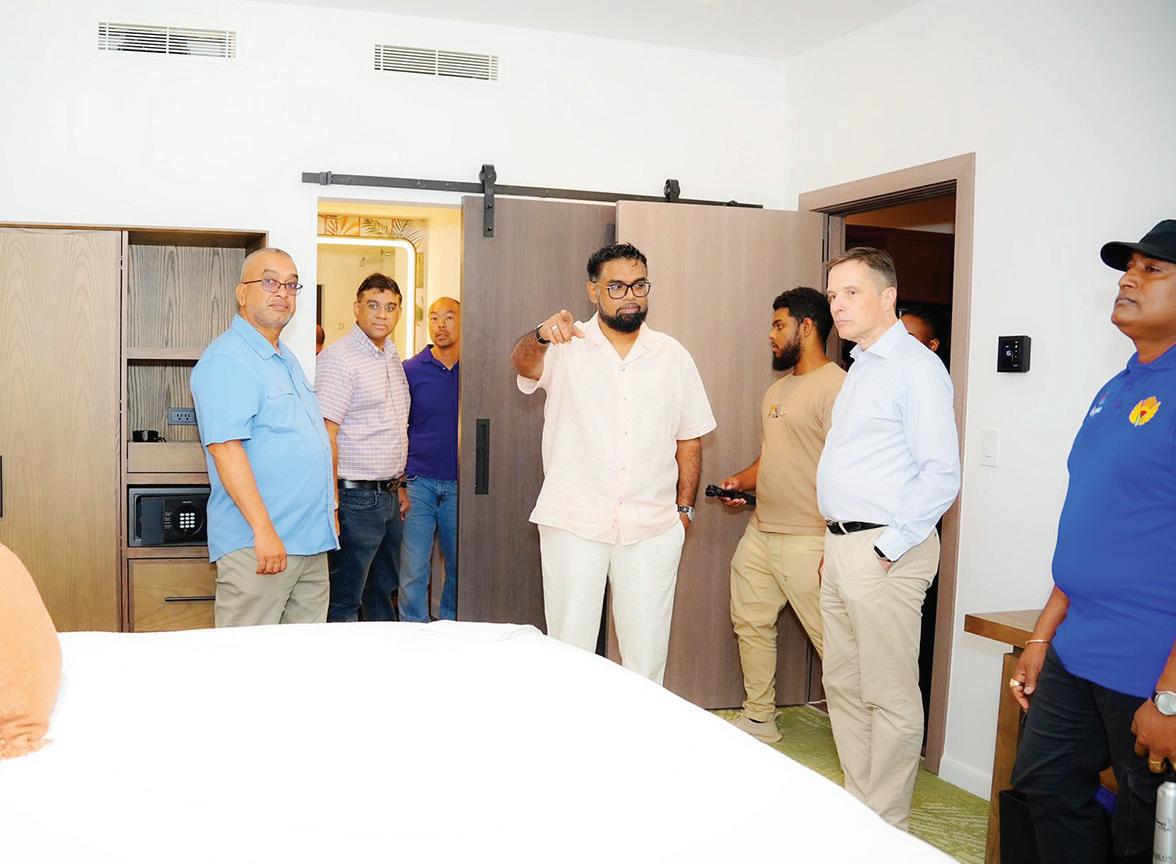
On Saturday night, President Dr. Irfaan Ali had a guided tour of the Four Points by Sheraton at Caneview Avenue and Heroes Highway. This new addition to Guyana’s hospitality sector is nearing completion, and will be opened shortly, further strengthening
(Photo: President Irfaan
Clean energy central to Guyana’s growth, low-carbon future - PM Phillips
PRIME Minister Brigadier (Ret’d) the Honourable Mark Phillips has reaffirmed Guyana’s commitment to a balanced and responsible energy transition, describing clean energy as essential to national development and environmental protection.
In a message in observance of International Day of Clean Energy 2026, PM Phillips noted that Guyana is “endowed with an abundance of natural gas, alongside vast renewable energy sources, such as solar, wind and hydropower,” placing the country in a strong position to modernise its energy systems.
He said that by harnessing these resources, Guyana is working to strengthen economic growth, improve energy access, decarbonise the power sector, and reduce
reliance on imported fossil fuels. He stressed that the country is well positioned to lead “an energy transition that is environmentally responsible, equitable and development oriented”.
PM Phillips highlighted natural gas as a key component of this transition, describing it as a reliable, efficient, and lower-emitting source of energy capable of meeting Guyana’s rapidly growing electricity demand.
Central to this effort is the landmark 300-megawatt Gas-to-Energy (GtE) project under construction in Wales, Region Three.
The Prime Minister said this is expected to transform the power sector by cutting electricity costs by 50 per cent, improving reliability, and supporting domestic production of liquefied petroleum gas for cleaner
household cooking.
Beyond lowering electricity bills, the GtE initiative is projected to enhance industrial competitiveness, strengthen the national energy mix, and support longer-term renewable ambitions, ensuring that power remains “affordable, reliable, and sustainable for all citizens”.
Observing International Day of Clean Energy, PM Phillips further highlighted the urgency of transitioning away from high-emitting fuels, stating, “clean energy is not a luxury; it is a necessity for our people to grow, to thrive and to lead productive and meaningful lives”.
He said Guyana’s approach reflects a strong commitment to a just energy transition built on public-private partnerships and shared respon-
sibility for low-carbon development.
The Prime Minister also pointed to the LowCarbon Development Strategy (LCDS) 2030 as the framework guiding the integration of renewable energy with the responsible development of natural gas. This, he said, is designed to deliver an energy matrix that is affordable, dependable, and aligned with national decarbonisation goals.
To this end, he described the Wales project as the largest investment in electricity generation in Guyana’s history, PM Phillips said it is expected to double generation capacity, reduce fuel imports and stabilise energy costs.
The project includes a combined-cycle gas turbine plant, a Natural Gas Liquids facility and upgraded transmission infrastructure, using gas
piped from the Liza Field offshore. Full operations are anticipated in the latter part of 2026.
Looking ahead, the Prime Minister announced plans for a second Gas-to-Energy project in Region Six, with a second gas line expected to be brought ashore by 2030 to strengthen long-term energy security. Together with projects such as the Amaila Falls Hydropower Project and utility-scale solar initiatives, Phillips said Guyana’s energy agenda is focused on securing a prosperous, sustainable, and low-carbon future for current and future generations.
Modern Garroway Roundabout nears completion
THE transformation of the Garroway Roundabout, well known as the Four-Way Corner, will be bringing immediate and long-term benefits to residents, commuters, and businesses in Onderneeming, Region One and surrounding communities.
As part of the $1.2 billion Onderneeming Road Development Project, the almost complete roundabout is designed to significantly improve traffic flow at one of the busiest intersections in the area. With construction works finished and only road markings and signage remaining, the junction is set to operate more efficiently, reducing congestion, confusion, and delays for motorists throughout the day.
The Onderneeming population is vastly growing, and the upgrade was badly needed, according to residents. Roundabouts are internationally recognised for improving road safety, and the Garroway
upgrade is no exception.
The new design at Onderneeming creates a safer environment for drivers, pedestrians, cyclists, and especially schoolchildren who traverse the area daily.
According to Minis-
ter within the Ministry of Public Works Madanlall Ramraj, the benefits extend beyond safety, and will enable smoother traffic movements. It will reduce travel time for workers commuting to and from their jobs,
easier access for farmers and vendors transporting produce, and improved connectivity for residents conducting daily business. Public transportation operators will also experience fewer bottlenecks, improving reliability for passengers.
The roundabout is one of several major components of the 10,641-metre road project executed across eleven lots in three phases. Together, these works are strengthening the road network, enhancing durability, and creating infrastructure capable of supporting increasing traffic and future development in the region.
“By improving connectivity and accessibility, the project is also expected to stimulate
economic activity, encourage investment, and make the community more welcoming to visitors,” Minister Ramraj said.
During an inspection on Saturday, the minister emphasised that these on-site visits ensure the works meet required standards and are delivered in keeping with the government’s commitment to real, people-centred development.
With the Garroway Roundabout nearing full completion, residents of Onderneeming can look forward to safer roads, faster travel, and a more modern roadway system that supports both daily life and longterm growth in Region Two.
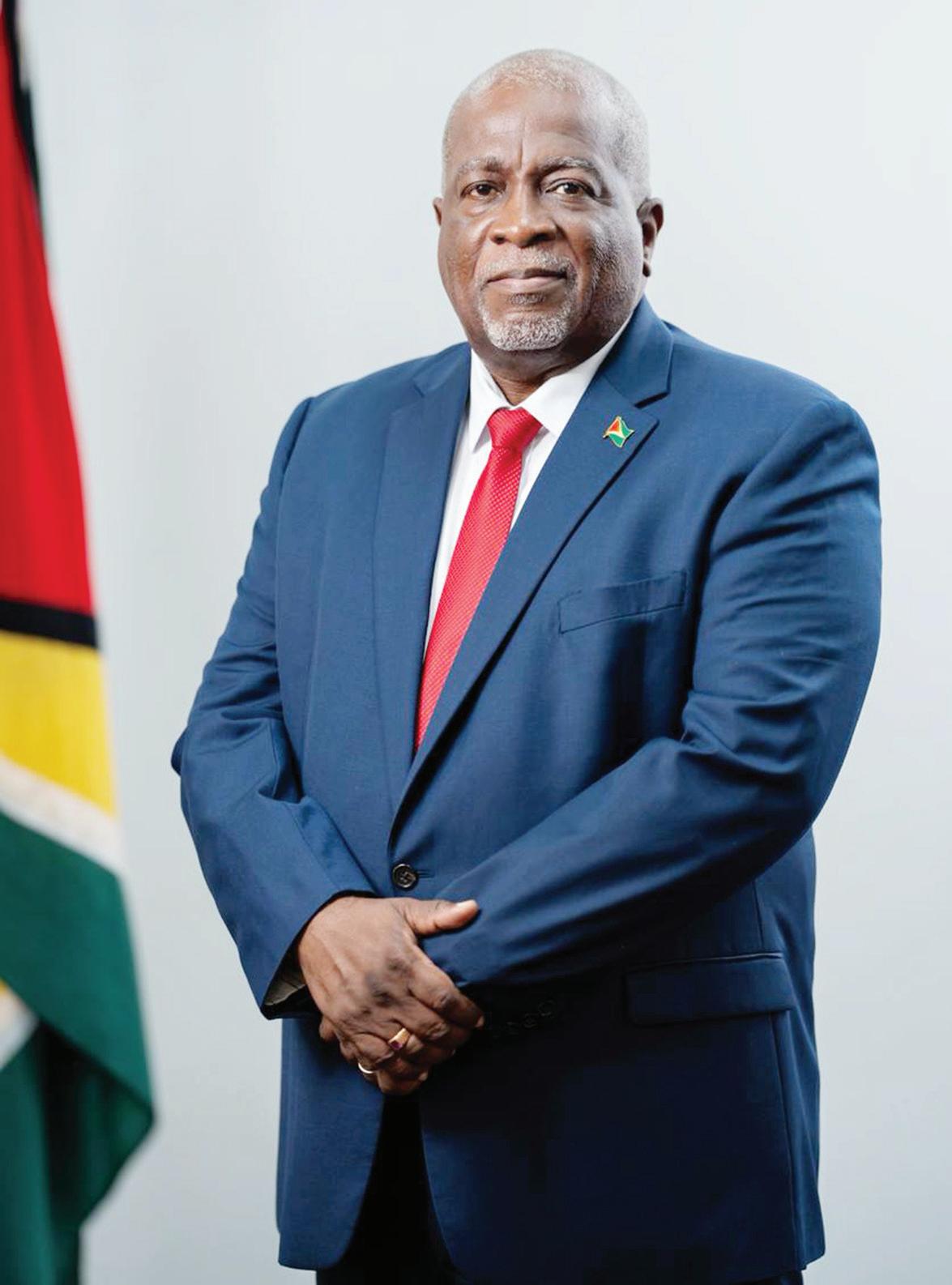
Prime Minister Brigadier (Ret’d) the Honourable Mark Phillips
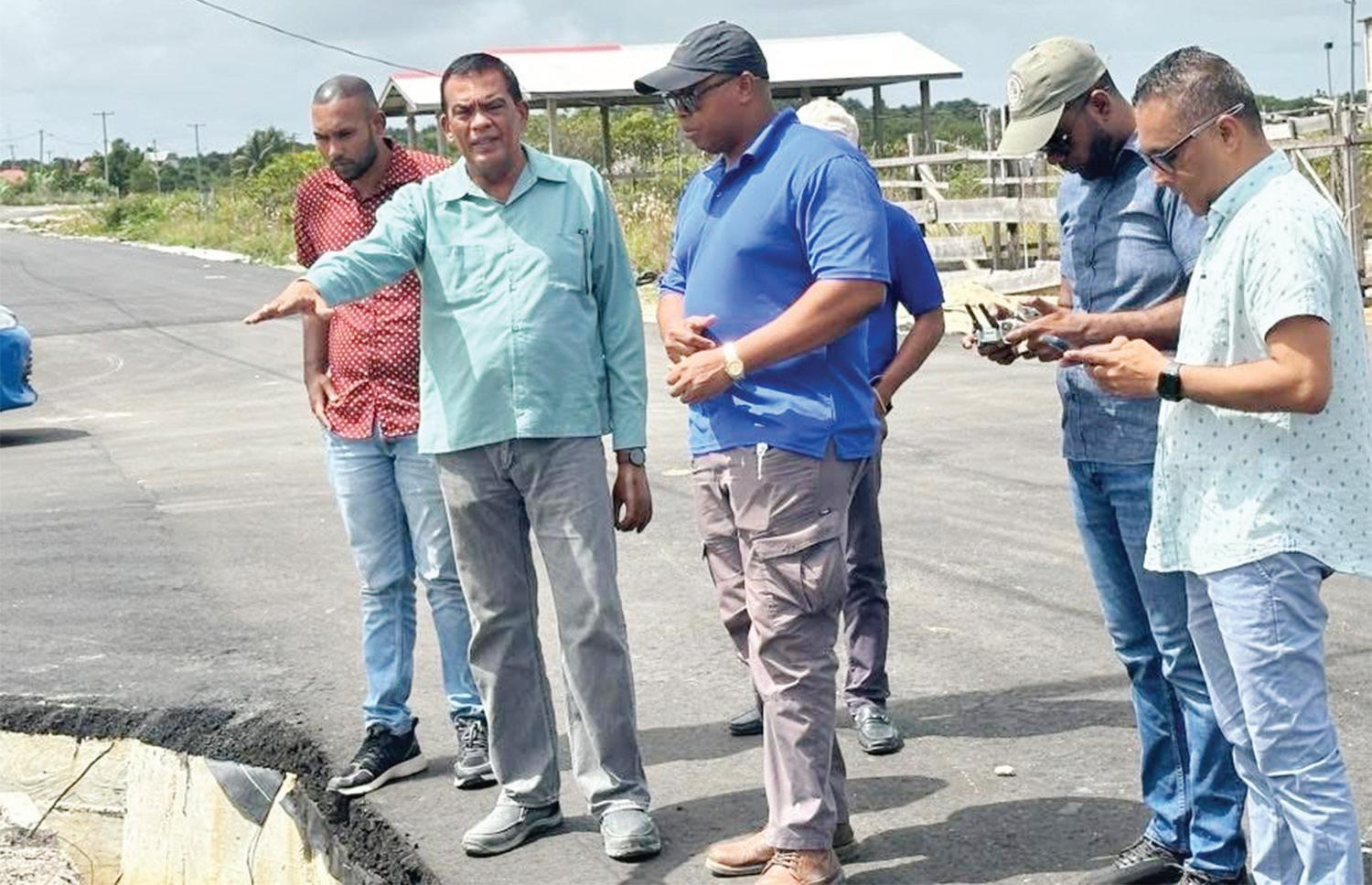
Minister within the Ministry of Public Works Madanlall Ramraj inspecting the work being done at the Garroway Roundabout
Highly anticipated Budget 2026 to be unveiled today
- expected to reflect prosperity, growth, continuity
HAVING already signalled priorities for growth, delivery and national development, Senior Minister in the Office of the President with responsibility for Finance, Dr Ashni Singh, will today present the 2026 fiscal package to the National Assembly.
Speaking in the build-up to today’s presentation, Dr Singh had previously underscored the central role of “policy, consistency, clarity and continuity” in guiding the People’s Progressive Party/ Civic (PPP/C) government’s economic agenda.
The 2026 budget follows the expansive fiscal framework of 2025, when the national budget reached G$1.382 trillion and emphasised inclusive growth, sustainability and prosperity.
In recent weeks, extensive engagement between government officials and private-sector representatives has helped shape expectations for Budget 2026. Consultations between the Ministry of Finance and business stakeholders have focused on the need for practical support to help firms expand capacity, access affordable financing and participate more fully in national-development opportunities.
BUILDING ON HISTORIC ACHIEVEMENTS
In December 2025, President, Dr Irfaan Ali
had unveiled a sweeping five-year agenda for what he described as “the most ambitious phase” of Guyana’s economic and social transformation, anchored in diversification, digitisation, and broad-based prosperity.
President Ali said that the re-elected PPP/C administration would “build on the historic achievements” of the past five years, with a sharpened focus on ensuring that growth is widely shared.
At the centre of the plan is a major push to deepen financial inclusion and expand access to capital.
He revealed that the soon-to-be-established Guyana Development Bank, capitalised with US$200 million, will provide zero interest, zero collateral, Micro, Small and Medium-sized Enterprises (MSMEs), women-owned businesses, young entrepreneurs, and persons living with disabilities, alongside structured mentorship and training.
The President also announced the creation of a junior stock exchange, and new investment vehicles to allow ordinary Guyanese here and in the diaspora to participate directly in large industrial projects through equity promising guaranteed returns.
“We are building an ecosystem where financial knowledge, unprecedented access to capital and new av-
enues for investment converge,” he said.
MSMEs will be able to access up to $3 million without collateral at zero interest, with a further $7 million available through co financing with commercial banks at preferential rates. Agent-banking networks, digital banking, and mobile wallets will be rolled out to reach remote communities, supported by legal and regulatory reforms, and a modernised Bank of Guyana.
He announced too that Budget 2026 will make provision for a $100,000 cash grant to every Guyanese citizen aged 18 years and older.
He further disclosed that additional cash grants will be paid over the next five years, as the government continues to roll out measures
aimed at improving household welfare, and strengthening disposable income.
Alongside new financing instruments, the President pledged additional tax incentives and targeted cash grants, building on more than G$70 billion already distributed in direct transfers in the government’s last term in office, and extensive tax reductions on income, fuel, and key household costs.
President Ali stressed that diversification would run “both vertically and horizontally,” with value-added agriculture, manufacturing, tourism, and the creative industries all identified as pillars of a more resilient economy.
ORANGE ECONOMY
The President had emphasised too that the
building out of Guyana’s orange economy will be not only a cultural aspiration, but a strategic economic driver as well.
“We are not only building a digital society, we are laying the foundation for a new family of digital industries where knowledge drives success. We are also going to launch out the full strategic plan for the building out of the orange economy that will detail the investments we’ll make to accelerate the orange economy, and to demonstrate how the orange economy is going to be integrated into the rest of the economy,” he said.
President Ali had revealed that a calendar of grand celebrations will usher in the country’s 60th commemoration as an independent nation in 2026.
These celebrations, he said, will see greater support for creatives, tourism expansion, and the creation of entertainment and cultural hubs being placed at the core.
“We’re going to invest heavily in the orange economy, and our 60th anniversary gives us an enormous opportunity to kickstart that investment,” the President said.
To achieve this, the government, he said, will place emphasis on the country’s talent at a magnitude never seen before, deploying every aspect of the country’s rich tapestry and artistic talents.
A cornerstone of this strategy is the creation of a film industry and entertainment hubs, designed to give local artists a structured form of income.
Youth group condemns WIN’s divisive action, violence instigated by party
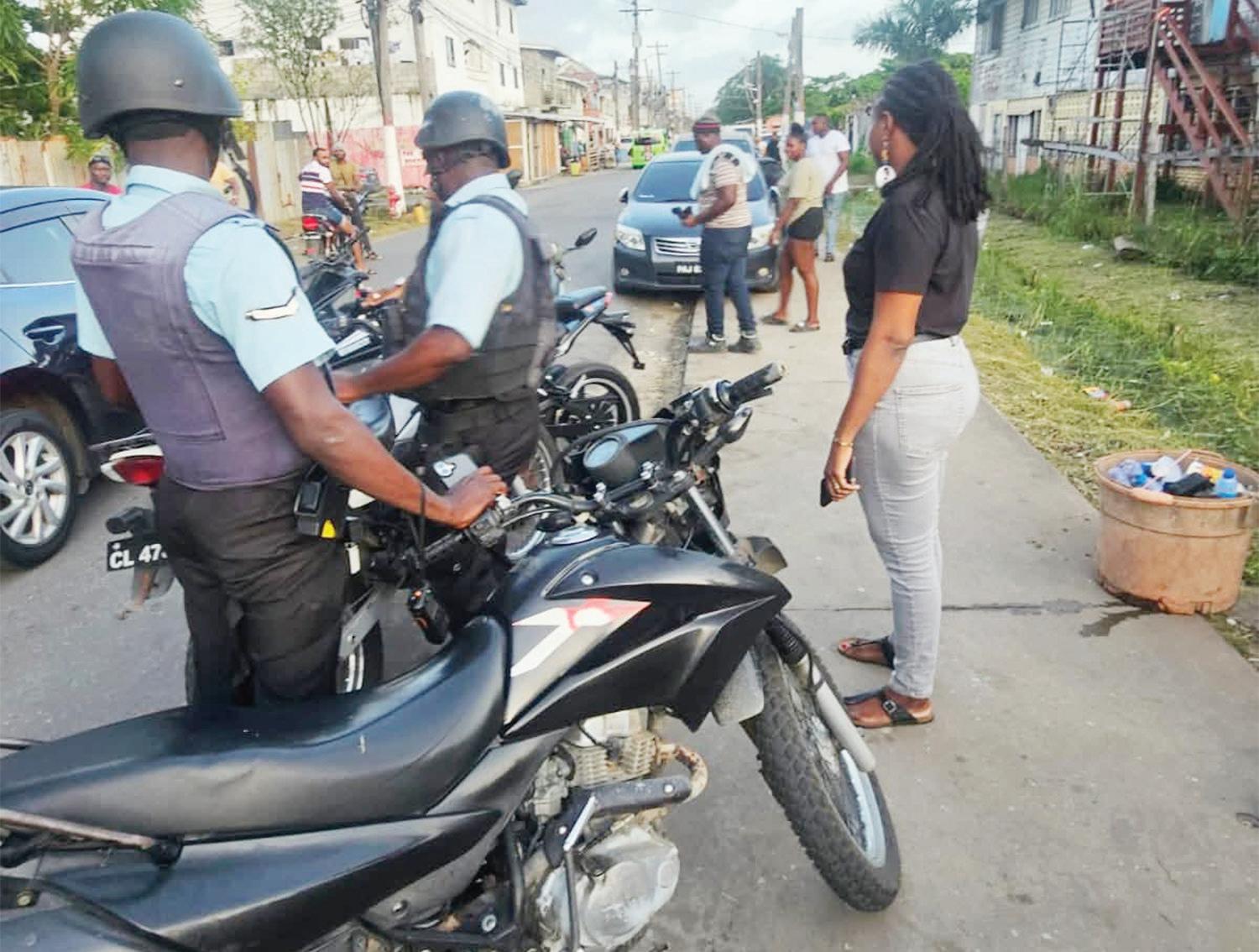
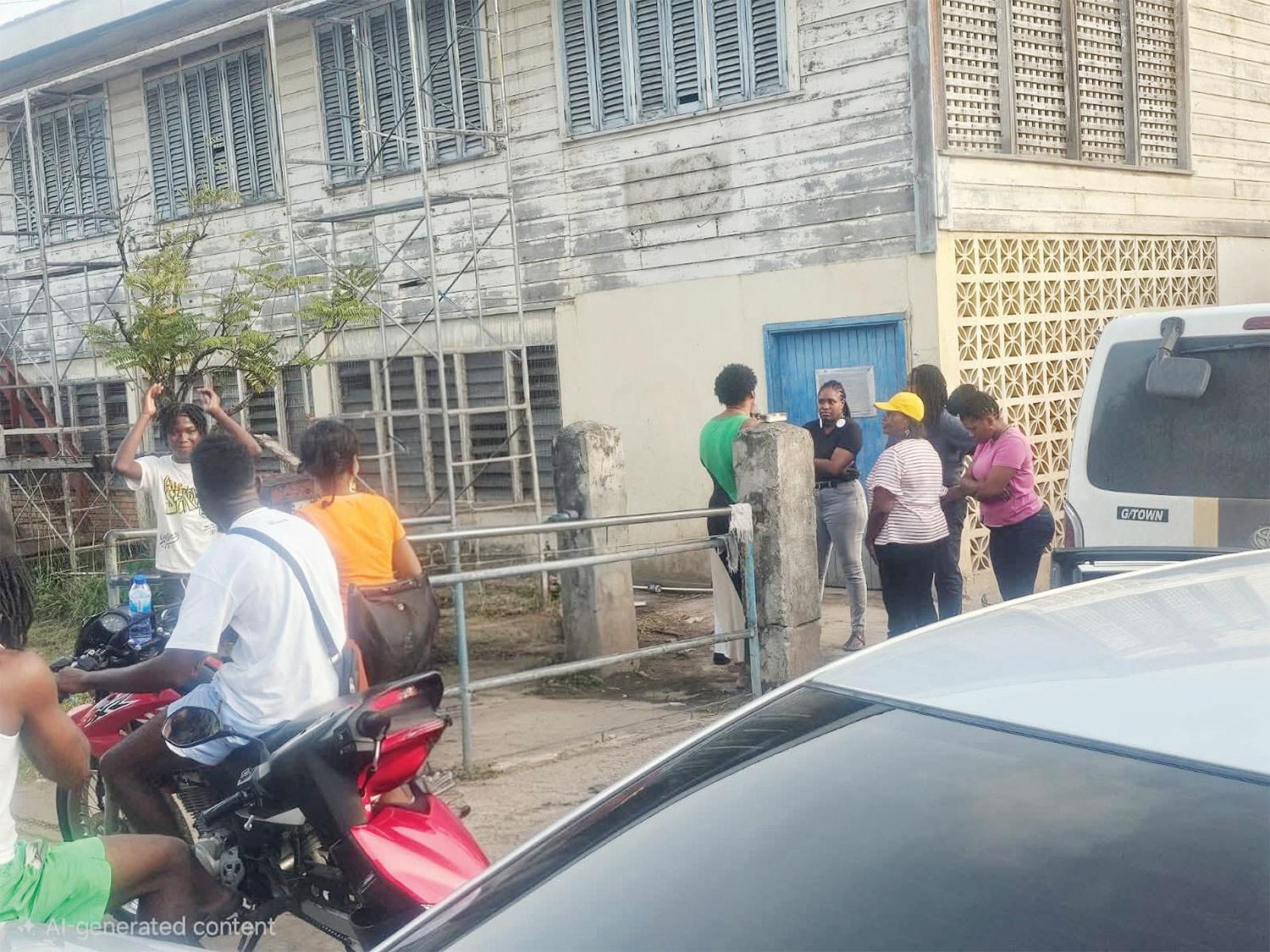
THE Mildred Mansfield Youth Club on Sunday issued a strongly worded statement condemning the alleged assault of its President, Mr. Andrew Daly, following a “heated and unnecessary” interaction with community members, which it said was instigated by leaders of the We Invest in Nationhood (WIN) party
and led by MP Tabitha Sarabo-Halley.
The Club said the incident, which occurred on Saturday, January 24, in front of the premises, did not happen in a vacuum, as it was the direct result of rising tensions fueled and instigated by the leadership of the WIN party, who continue to insert themselves into community matters
in a reckless and divisive manner.
“Their repeated interference promotes distrust, inflames emotions, and fractures the unity that communities like ours depend on to function peacefully. We view this as an irresponsible provocation which resulted in the unfortunate outcome of violence,” the Club said in a statement.
It added that the Club will not accept or normalise this dangerous behaviour.
“For over 50 years, the MMYC has served
as a pillar of youth development, community service, discipline, and empowerment. We have worked consistently and constructively with Werken-Rust and other neighbouring communities to uplift young people, build social cohesion, and create opportunities. We hate to see that progress collapse because of petty politics, manipulation, or division. We will not be distracted, intimidated, or derailed by those who see community spaces as platforms for
conflict and political disruption.
“The MMYC calls on the WIN party leadership to cease and desist from actions that undermine community trust and which lead to the creation of hostile environments.
The well-being and safety of residents, especially young people, must never be sacrificed for attention or political gain,” the statement said.
The Club emphasised that it remains committed to peace, partnership, and
progress, and will continue its work, as it always has, with Werk-en-Rust and communities across Guyana.
The Club also stated that it will continue to defend its integrity, and ensure the safety of those who serve it.
“Violence has no place in our community work, unless that work is to end the violence and build better relations to ensure the wellbeing of community dwellers,” the Club said in closing.
The Mildred Mansfield Youth Club on Sunday accused MP Tabitha Sarabo-Halley and other leaders of the WIN party of instigated violence that allegedly resulted in the assault of its President, Mr. Andrew Daly
Mahipaul exposes Mohamed’s lack of basic parliamentary knowledge
- hours before selection of Opposition Leader
A
Partnership for National Unity (APNU)
Member of Parliament, Ganesh Mahipaul has exposed leader of the We Invest in Nationhood (WIN) party, Azruddin Mohamed's lack of knowledge about basic parliamentary procedures.
Mahipaul publicly rebuked the US-indicted Mohamed over claims that he could unilaterally determine opposition membership on Parliamentary Committees, warning that such a pronouncement runs counter to the Standing Orders of the National Assembly.
As concerns grow over the elevation of Mohamed, who is charged in the US for a series of crimes, Mahipaul exposed another deficiency in the WIN leader's eligibility to be Leader of the Opposition.
The APNU parliamentarian, in a statement on his Facebook page on Sunday, said:
“The Standing Orders are clear. Membership of Parliamentary Committees is determined strictly on the basis of proportional representation, not personal discretion.”
Mahipaul said Mohamed’s position was misleading and misguided, stressing that committee membership is governed strictly by proportional representation, not personal discretion.
“Accordingly, a ten-member committee will comprise six PPP/C members, two WIN members and two APNU members.
A nine-member committee will comprise five PPP/C members, two WIN members and two APNU members.
A seven-member committee will comprise four PPP/C members, two WIN members and one APNU member,” he reminded.
“The formula is straightforward. Party’s seats in the National Assembly are divided
by the total number of seats to determine its percentage representation, which is then applied to the size of each committee. On this basis, no individual can “name” Opposition Members to committees outside of this proportional framework,” he added.
Mahipual’s statements come just hours before the selection of the Opposition Leader, highlighting early tensions between APNU and WIN as they manoeuvre for influence in the 13th sitting of the National Assembly.
Last week, Mahipaul accused the WIN
party of making no effort to establish a collective opposition in Parliament.
It was reported in sections of the local press that the two parties had agreed on a proposed agenda during telephone meetings.
The agenda, according to reports, included the composition of Parliamentary committees, the Chairmanship of the Public Accounts Committee (PAC) and Sectoral committees, the appointment of Shadow Ministers, and other parliamentary matters.
Mahipaul said that the WIN party, al -
though setting a proposed date, time, and venue for a formal meeting, failed to make any further effort to hold discussions.
It was reported that the National Assembly is facing a defining Rule-of-Law challenge amidst the mounting questions as to whether the installation or continued recognition of a parliamentarian, who is formally being sought after by US law-enforcement authorities, could proceed without damaging the credibility of the legislative arm of the government.
Mohamed and his father, Nazar “Shell” Mohamed, have been indicted by a federal grand jury in the US District Court of the Southern District of Florida on 11 criminal charges, including wire fraud, mail fraud, tax evasion, and money laundering.
The US had made a request for the Mohameds to be extradited to face the indictments.
Those extradition proceedings are currently pending in the local courts.
This case has sparked debate and even international concern as to whether Guyana’s Parliament can continue business as usual while one of its members remain under the cloud of an international crime, with even the US Ambassador Nicole Theriot previously publicly describing Mohamed’s potential participation in Parliament in an official capacity as “concerning” and “problematic” for Washington. Parliaments across the globe rely on legitimacy. Installing a leader formally wanted by law enforcement can erode confidence in democratic institutions, and signal tolerance for impunity, and using comparative experiences across democracies, the sensitivity of the matter at hand has been proven.
Guyana’s most contradictory day
TODAY, Guyana stands at a significant crossroads. This moment reflects both the great promise of its transformation and the troubling weakness of its political culture.
As Finance Minister Dr. Ashni Singh speaks in the National Assembly to present Budget 2026, a plan expected to deliver $100,000 cash grants, start the construction of 40,000 new homes, and make unprecedented investments in infrastructure, the nation must also face the possible rise of Azruddin Mohamed.
He is a businessman facing US charges for gold smuggling, money laundering, wire fraud, and allegedly defrauding the Guyanese State of over $50 million. His potential elevation to the influential office of Leader of the Opposition raises serious concerns.
The clash of these two events on January 26, 2026, symbolises the contradictions that characterise modern Guyana.
On the one hand, Budget 2026 reflects President Irfaan Ali's ambitious five-year plan, which is based on extensive public input. It aims to ensure that the exceptional economic growth leads to real improvements in education, healthcare, housing, and infrastructure.
The government promises to diversify the economy, transform digital services, lower electricity costs through the gas-to-energy project, and position Guyana as the industrial hub of the Caribbean. These commitments have the potential to change the lives of ordinary Guyanese families.
However, this positive
story unfolds against the backdrop of an opposition led by a man whose presence in Parliament has been labeled by civil society organisations, former political leaders, and even the Speaker of the National Assembly as "a disgrace", "shameful", and a "stain" on Guyana's democracy.
The indictment released by a US Grand Jury in Florida reveals a complex, multiyear scheme involving the fraudulent reuse of customs declarations, systematic bribing of officials, and under-reporting over 10,000 kilogrammes of gold exports. These are not just claims from political opponents; they are official charges backed by international sanctions that limit Mohamed's ability to interact with the global financial system.
The constitutional role
Mohamed is about to take on is far from symbolic. The Leader of the Opposition plays a direct part in appointing service commissions, the Chancellor of the Judiciary, the Chief Justice, the Police Commissioner, and members of the Guyana Elections Commission.
This person represents an alternative government, interacts with foreign diplomats, and acts as a crucial check on the executive power.
Promoting someone under extradition proceedings to such a role raises serious questions about Guyana's institutional maturity at a time when the country requires strong governance.
The real tragedy is not that voters chose to support the We Invest in Nationhood party; democracy requires people to have that freedom.
The tragedy lies in the fact that WIN parliamentarians seem ready to move forward with Mohamed's election, despite the potential reputational, diplomatic, and governance risks for the nation.
Communication consultant Kit Nascimento pointed out that a truly responsible leader facing such serious accusations would step back, go through the US legal process, clear his name, and return with his reputation intact instead of dragging his country into international shame.
Today, as Guyanese digest the details of Budget 2026's promising investments, they must also face the uncomfortable truth that their parliamentary democracy will have in opposition a figure whose alleged actions defrauded the treasury
now being used for national progress.
The US$50 million that Mohamed and his father allegedly evaded in taxes and royalties could have built schools, upgraded hospitals, or improved infrastructure in underserved areas.
Mixed emotions do not fully capture what Guyanese should feel today.
This day reflects a deep national contradiction which requires immediate reflection on how the country can safeguard its democratic achievements and governance institutions while accelerating its economic transformation.
Budget 2026 brings genuine hope; however, Mohamed's potential rise serves as a warning about how fragile that hope can become when political convenience overshadows institutional integrity.
Mohamed becoming Opposition Leader has consequences for the PNC
Dear Editor,
MUCH has been speculated on the potential implications of the presumptive Opposition Leader formally ascending to the post today. I’ve seen many viewpoints expressing worry about what a Mohamed-led Parliamentary Opposition would mean for the country and our democracy. I will respectfully depart from these notions, as I believe this anxiety is misplaced.
Over 55 per cent of the Guyanese electorate rejected APNU, the AFC, the FGM, and WIN at the polls, delivering the PPP/C the largest share of the popular vote in Guyana’s electoral history, disregarding Burnham’s magic numbers. The elections are over; the will of the people has already spoken. No government squatting in office. No manipulation of voter tabulation and certainly no Constitutional violation. Whatever unfolds today has implications for the Opposition
and the Opposition alone. Our democracy remains strong and will handle it.
Our Constitution is clear: Article 184 (1) of the Constitution prescribes a meeting of all non-governmental members of the House where a vote is taken to elect an Opposition Leader. The Speaker chairs the meeting, but is ineligible to vote; Section 4 confirms that the vote shall be taken by a show of hands; Section 3 stipulates that the Opposition Leader can only be removed by a simple majority of non-Government members passing a vote of no-confidence at another meeting convened by the Speaker.
The PNC voting for Mohamed will only amount to an overt political posture, disregarding the doctrine of contagion by association under OFAC Magnitsky guidelines, and rejecting the merits of an eleven-count indictment in the Florida jurisdiction. By electing Mr. Mohamed as Opposition
Leader, the PNC will send an unmistakable message to the United States that they endorse a fugitive offender indicted in their country. This message will be aimed at Guyana’s most important diplomatic partner, which recently played a decisive role in neutralising the most immediate threat to our territorial sovereignty, Nicolas Maduro, who has alleged ties to said fugitive offender as per Reuters.
This isn’t a neutral act; it is a deliberate political alignment with international consequences. Unsurprisingly, Demerara Waves reports that the Terrence Campbell-led APNU is against abstaining in the hopes of “future collaboration” with WIN. Of course, this comes after Ganesh Mahipaul told the press that WIN rebuffed APNU upon request for parliamentary collaboration. What is this, if not feeble subservience?
Attempts to cloud this matter with emotive outbursts
are woefully telling. Nazar Mohamed’s open letter to the Speaker relies on personal grievance, bitterness and accusations of betrayal, whilstagain- evading the substance of the indictments themselves. He refers to the Florida indictments as “minimal, unproven allegations” without elaboration. He refers to the 2023 Reuters report as “sensational”, and insists that the OFAC sanctions and Reuters report translated “solely to an alleged tax matter” in indictments and not the large-scale drug trafficking, smuggling of Venezuelan gold and financing terrorism that Reuters has alleged. If such is the case, why hasn’t Azruddin convened a Press Conference and addressed the merits of the Florida indictments and the Reuters’ accusations? Hiding behind curated Facebook monologues won’t provide the clarity, scrutiny and coverage that comes with a press conference.
Amidst all of this, several APNU MPs, including Sherod Duncan, have sought to justify Azruddin Mohamed’s election to Opposition Leader as akin to Cheddi Jagan’s election to Office of Premier in the 1960s.
Dr. Cheddi Jagan sought to liberate Guyana from colonialism and dictatorship; Mohamed seeks to liberate himself from his tax obligations. Drawing this parallel is a grave insult to our history.
This also feeds into the false narrative of persecution being peddled by the Mohameds. The Florida indictments entail an investigation period beginning in 2017, under Granger with Trump in power in the U.S. The 2024 OFAC sanctions arrived under the Biden Presidency and Ali in his first term. The Florida indictments landed with both Trump and Ali in their second terms. The U.S. Congress can barely compel the release of the Epstein files, yet we are
asked to believe that the Government of Guyana can somehow “request” sealed filings from the U.S. Department of Justice, triggering an extradition request signed by Marco Rubio himself. This is a terribly flimsy argument. No doubt, the office of Opposition Leader will be used to legitimize and further embellish this spurious narrative.
What’s at stake here is not the stability of Guyana’s democracy, but the future credibility and survival of the PNC, now grappling with fragmentation after its historic electoral collapse in 2025 following attempts to subvert democracy in 2020. Mohamed will only emerge as the second South American political leader to be indicted with pending extraction from the U.S. As for the PNC, it seems they only seek to bury themselves further. Indeed, better must come.
Yours faithfully, Nikhil Sankar
Questions for the opposition today
Dear Editor,
TODAY, January 26, 2026, is “Dee Day”. No!, Not the Day the Allied invasion took place in Normandy during WWII on June 6, 1944, when thousands of soldiers were killed fighting in the name of freedom. It was the largest amphibious invasion of about 160,000 troops, representatives of the US, the UK, Canada and other countries.
Today is the day when freedom of choice, freedom of expression, and freedom of making the right or the wrong decision will be allowed in the 13th Sitting of Guyana’s Parliament with the blessings of the Speaker of the House, Mr. Mansoor Nadir, all things being equal and as summoned by him.
It is also the day when the PPP/C Government
will present Budget 2026 by Dr. Ashni Singh, the Senior Minister in the Office of the President, with Responsibility for Finance. Guyanese are anxiously awaiting his much-anticipated Speech, in particular to know if their “good behaviour” will be rewarded or denied, and by how much, if any.
The high stake of electing a leader from the Opposition comes to an end today. The sitting PPP/C Government Members of Parliament do not play any part, or vote in this procedure. How and for whom will the Opposition MPs vote has been an open secret displayed in the public. Will this pronouncement materialize, or will there be a surprise?
Will there be a voluntary process of their free will, or will there be any degree of coercion or
persuasion? Will there be any form of corruption, confusion or interruption?
Will the choice be “ethics-driven” for a leader who can advocate dignity, integrity and honour for selfless services rather than wealth and power for selfish reasons? Will the successful one be free of troubles, trials and tribulations, or one burdened with a bag of controversies on his or her shoulder?
Will such a gentleman or lady personify any degree of purity, maturity or tranquility? Or will the winner be a component of anger, adolescence and agitation portraying bribery, corruption and violence?
Will the elected one be a selection from the grass route grounded primarily in the interest of the man in the street, or will such a person be from a higher level aloof only with
self-interest and unaware of the function of the work of the state?
Will the chosen one be rooted in spiritual values and routed in the way of sacrifice, dedicated to the welfare of citizens, communities and the country?
Will such a one be the type to reflect, “do as I say and not as I do?”
Will such a ruler be free of malpractices, rowdyism, illegalities, illegitimacies and irregularities? Will that person be objective or obsessive, an egoist or altruist, a chancer or changer?
Will the Opposition Members of Parliament vote with a clear and not cloudy conscience, a mentored or mean mind, or a doyen and not a delusive thought?
Will the image of the country be mirrored in this reflection or tainted with a deflection?
Guyana has fathomed shame, disgrace and embarrassment in previous engagements with an Opposition which has misled this country to doom and gloom, many moons ago. Are Guyanese to be burdened with the dark ages of devious, dare-deviled and demented leadership again?
Will Guyanese be allowed a bit of fresh air from the Atlantic Ocean with the scent of rejuvenation and rejoice and not rancour or resentment?
Can we accommodate trust, faith and hope in today’s deliberation for a common-sense guidance? Or should we depend on
fate that there will be despair, dispute and delusion?
A lot will be riding on the backs of the voters. How responsible or irresponsible they will act or react will be determined if they do the right or wrong thing. The outcome will have serious consequences, repercussions and significance.
Will the voters be loyal to truth, honesty and probity, or will they be candour to opportunity? How will the finger be guided, by a royal and loyal hand or a religious and restorative hand? The moment of judgement is but momentarily!
Yours respectfully, Jai Lall
Azruddin Mohamed’s presence, Dion Bascom’s absence
IN 2022, detective Dion Bascom made some devastating allegations against Azruddin Mohamed in relation to a shooting outside Palm Court that led to the immediate death of Ricardo Fagundes, a very close friend of Roger Khan. At the funeral service held at the motor racing club on Albert Street, Khan in his eulogy told the “mourn-
ers” or attendees that the target of the attack was him, but the hitmen mistook Fagundes for him. The incident occurred outside Palm Court, on Main Street, a joint that attracts some of Guyana’s most questionable nouveau riche personalities. The murder was a nighttime hit.
I will always remember the motor-racing club funeral ser -
vice. I was doing my regular, matutinal exercise in the National Park and had difficulty gaining entrance onto Thomas Road because the funeral service created a traffic jam.
There was a sociological lesson to be learnt from that episode. The deceased and Mr Khan attracted the presence of some high-society women and men from the
nouveau riche class at the service, some of whom no doubt would revolt at the idea of stopping and having a beer at Stabroek Market Square - I took my wife there yesterday (Sunday) morning. When I was small, I drank heavily on a sermon that went like this: “Everything outside but nothing inside.” I am still drinking that intoxicant.
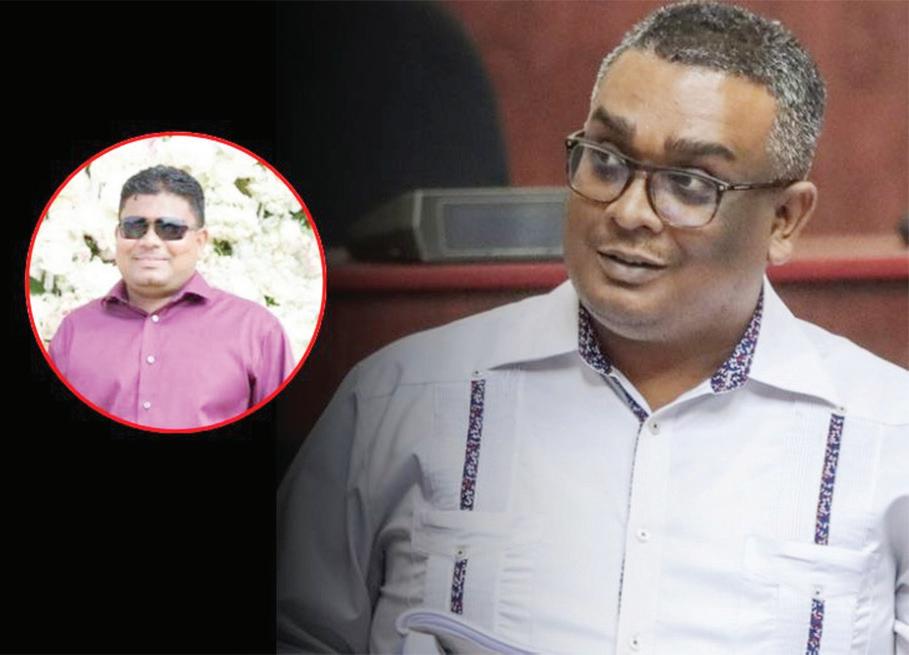
Things went badly for Azruddin Mohamed when in 2020, Bascom went public with his allegations. Mr Mohamed and Superintendent of Police, Mitchell Caesar rejected the statement made by Bascom. Mohamed sued Bascom for $200M. Bascom’s attorney Nigel Hughes then asked the state to provide a security detail for Bascom out of fear for his life.
In 2025, Mohamed withdrew the libel writ on the basis of an apology Bascom gave to him. Surprisingly, Bascom went public and denied this claim, saying that he had not spoken or seen Mohamed since 2022, so there could not have been any apology.
Last week, two media houses – Village Voice and HGPTV -publicly stated that it has been alleged that Mr Caesar had his U.S. visa revoked this year. There has been no confirmation of this action by the police and the U.S. Embassy, so it remains in the domain of hearsay.
Today (Monday) the presence of Mohamed
will be conspicuous as he waits to be voted in as Opposition Leader, a direction that is regrettable. Even though Mr Mohamed’s status as Opposition Leader will be short-lived because of the inevitability of extradition, the WIN party, literally a oneman show, should see its executives part company with Mohamed and request Mohamed to step aside in favour of one of his parliamentarians.
The WIN executives (I’m not sure WIN has an executive committee) will have a wretched political life and will be unable to face this nation should they vote for Mohamed as Opposition Leader. When Mohamed is extradited, what will these people do? What would their politics be like? How can they muster decency to speak to the nation about policies and laws?
Given his baggage, both in terms of allegations against him and him showing off his opulence, why would the WIN people want to have Azruddin as the Opposition Leader of their country? What political character has Mohamed displayed to earn him the respect of the nation? But this country had a taste of Mohamed during the election campaign.
Dorwin Bess, the leader of an opposition party, noted on his Facebook page that at a meeting to discuss party collaboration, Mohamed was only interested in Bess subsuming his identity under
WIN. Dr Mark France made some damning revelations against Mohamed on the Freddie Kissoon Show after the elections results, which show what Mohamed will become as a parliamentarian.
One is that he, France, was not allowed to campaign freely using his ANUG trademark, even though ANUG was in a coalition with WIN. Secondly, it was Mohamed not ANUG leaders who picked the parliamentarian who would represent ANUG. Should such a person become the Opposition Leader? If the APNU and WIN parliamentarians vote for Mohamed today to become the official Opposition Leader, I want to see if in the next four years, they have the temerity to speak about bad governance.
So today, Guyana will see a juxtaposition. Mohamed’s presence will be very visible. But where is the visibility of Dion Bascom? He said he did not apologise to Mohamed for his Fagundes allegations, and who would risk harming him now if he speaks out, though I acknowledge that his security is paramount. At this point in time, Bascom and lawyer, Nigel Hughes, should resurface and let the games begin.
DISCLAIMER: The views and opinions expressed in this column are solely those of the author and do not necessarily reflect the official policy or posi tion of the Guyana National Newspapers Limited.
Business hubs, stronger standards, financing support anticipated in Budget 2026
By Naomi Parris
LEADERS of Guyana’s private sector are optimistic that the 2026 national budget will strengthen support for small and growing businesses, cementing longterm economic sustainability for the country’s evolving business landscape.
President of the Guyana Manufacturing and Services Association (GMSA), Rafeek Khan anticipates targeted budget measures to help small manufacturers and exporters scale up, boost exports, enforce standards, and gain faster access to affordable finance.
During an interview with the Guyana Chronicle, Khan explained that rising domestic demand, particularly in housing and construction, presents a critical opportunity to convert local production into sustainable industrial growth.
He said government support must be practical and tailored, especially for cottage-scale producers who struggle with high overheads.
“We would like to see
businesses being supported with industrial centres or hubs to help bring down their overhead costs,” Khan said, stressing that
makers, building material producers and agro-processors to expand output if given access to shared warehousing, packaging
these should be shared facilities rather than largescale industrial parks.
“Not mega, large industrial hubs where they can apply for land and so on. I’m talking about facilities that could be provided that enable them to scale up their businesses to take advantage of the growing market,” he explained.
With construction activity expected to accelerate, Khan pointed to the potential for local furniture
about poor workmanship, and called for stronger regulatory action so consumers can easily identify certified producers.
and labelling services.
He described many of these operators as “bottom house operations”, noting: “You know folks who produce in small quantities, we want to see how they can scale up and start producing in larger quantities.”
Standards enforcement, particularly in the construction sector, was another priority, Khan said the Association continues to receive complaints
across industries.
The GMSA also urged fiscal incentives for fully local products, including tax relief or zero rating, to level the playing field for domestic manufacturers.
At the same time, the Georgetown Chamber of Commerce and Industry (GCCI) has expressed confidence in the government’s approach to budget preparation, citing extensive consultations with the Ministry of Finance and senior officials in the Office of the President.
However, Smith issued a strong reminder to small and micro enterprises that formalisation and compliance will be essential if they are to benefit from new incentives and financing facilities.
“We constantly get complaints of poor standards, especially in the building industry,” he said, while acknowledging the work already done by standards bodies and certification agencies. He added that more intentional enforcement is needed to raise and police quality
Speaking on private sector expectations, GCCI President Kathy Smith highlighted what she described as a longstanding and meaningful engagement process. She noted that some GCCI recommendations were reflected in the 2025 budget, and said early announcements, including plans for a development bank, have fuelled expectations that the 2026 fiscal package will further support business and economic sector growth.
She urged businesses to ensure proper registration beyond the deeds registry, full compliance with the National Insurance Scheme (NIS) and Guyana Revenue Authority (GRA), accurate financial records, and a clear separation of personal and business finances.
With both a development bank and private financial institutions expected to play a larger role in funding enterprises, she cautioned that unstructured businesses will struggle to access capital.
“The businesses must be structured so that they can be trusted not just by the government bank, but by private banks as well. Structure is a big thing for me,” she stressed.
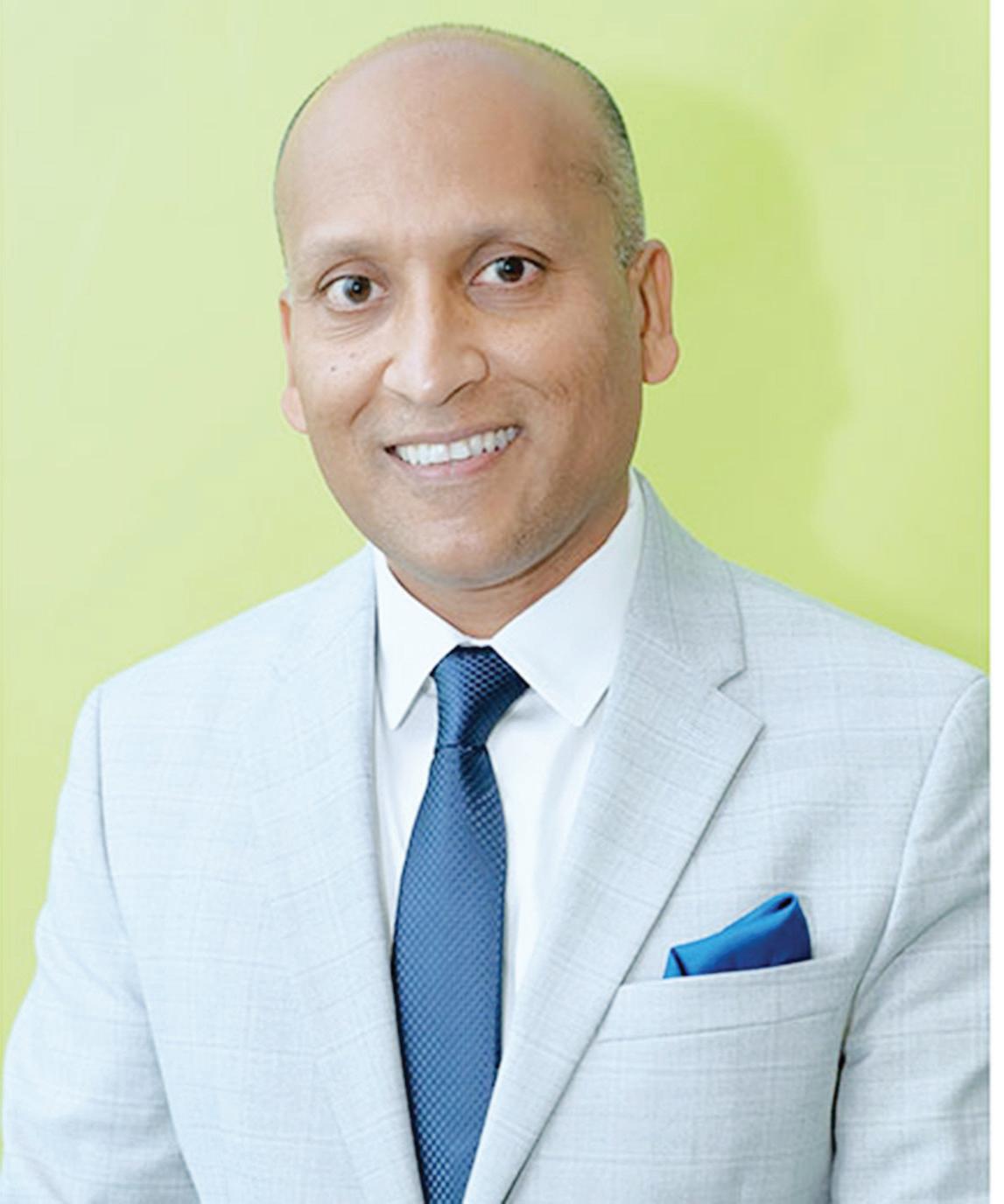
CCI President Kathy Smith
GMSA President Rafeek Khan
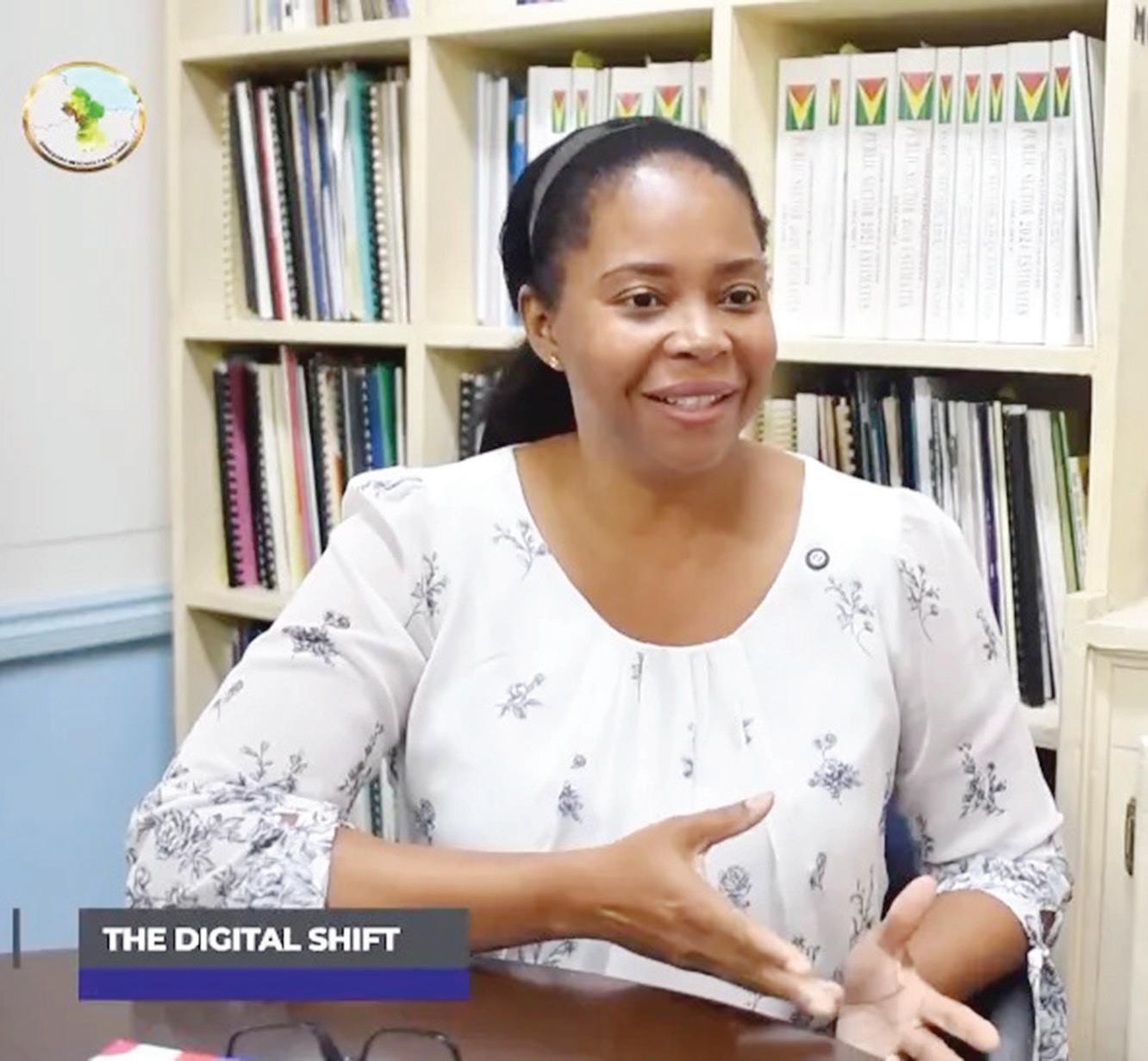
Guyana Digital School expands access to quality education nationwide – MP White-Griffith
GOVERNMENT MP
and Chief Planning Officer at the Ministry of Education, Mischka White-Griffith says the digitisation of Guyana’s education system is key to preparing students for life beyond the classroom.
She noted that education must evolve with technology, moving beyond academics to equip students with skills for a fast-changing, digital world.
She said that learn-
ing today goes beyond academics to equipping students with life-ready skills.
White-Griffith pointed to the Guyana Digital School, a presidential initiative that aims to bridge the digital divide and give all students equal access to learning, whether on the coast or in the hinterland.
The platform, she said, has transformed how students learn, ensuring continuity during disruptions like the COVID-19 pandemic while sparking growing interest among lower secondary students.
Emphasising that technology complements, not replaces teachers, she added that digital tools im -
prove engagement and outcomes, and help to build a generation ready to drive Guyana’s development.
Importantly, she noted that the initiative helps to close longstanding gaps between coastal and hinterland communities by delivering the same quality of education to all Guyanese students.
According to her, the Guyana Digital School initially focused on Fourth and Fifth-Form students, but interest from First and Second-Form students is increasing. She announced that materials for Grades Seven to Nine will soon be added, along with new features to further enhance the learning experience.
While underscoring that technology could never replace the classroom or the teacher, she said digital tools serve as a powerful complement to traditional teaching by presenting material in multiple formats, and catering to different learning styles. This, she added, increases student engagement, effectiveness and efficiency, ultimately improving learning outcomes.
White-Griffith said the long-term goal of the digitisation drive is to produce a generation of students who are well-prepared to enter the workforce, contribute meaningfully to society, and help advance Guyana’s economy. (DPI)
Mischka White-Griffith
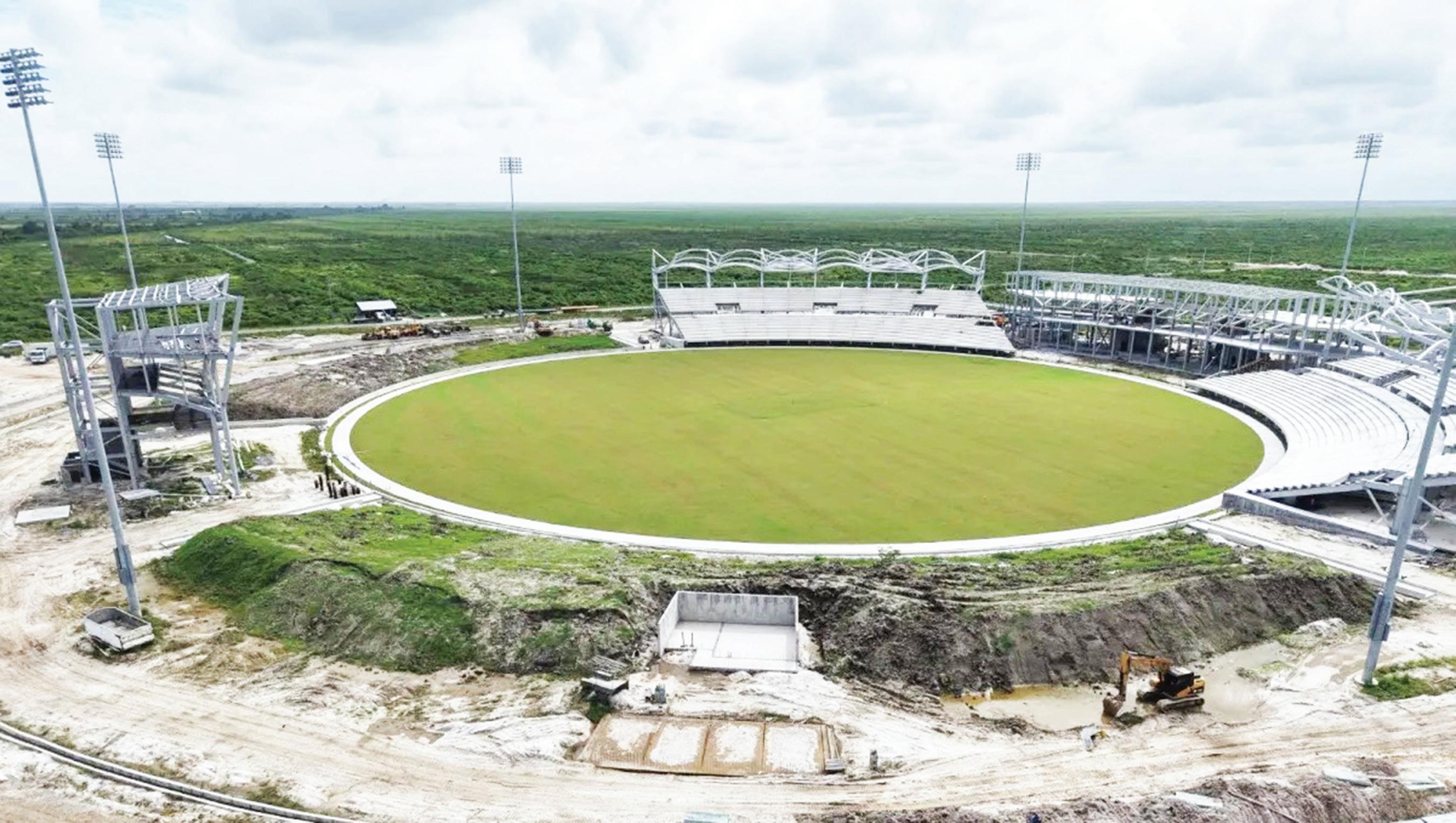
Excitement builds as Palmyra Multipurpose Stadium nears completion
BERBICE is poised to benefit from a major transformation in sports and community development with the completion of the Palmyra Multipurpose Facility in Region Six.
During a visit to the facility on Saturday, Minister within the Ministry of Culture, Youth and Sport, Steven Jacobs, said its completion will complement other major investments, such as the Albion Cricket Academy, the New Amsterdam synthetic track, multiple boxing gyms across the country, and future projects such as a deep-water port and the new Berbice Bridge.
Minister Jacobs said the government’s investment in the Palmyra facility forms part of a broader national strategy to create a sustainable sports ecosystem that nurtures talent, strengthens communities, and generates economic opportunities.
Minister within the Ministry of Culture, Youth and Sport, Seven Jacobs, engages contractors at the Palmyra Multipurpose Stadium
“This is the vision of the People’s Progressive Party/Civic government. No one in Berbice would have imagined five or six years
ago that we would have a stadium. Now we are seeing the reality of this,” he outlined.
Minister Jacobs also
reaffirmed the government’s commitment to supporting former athletes through a career pathway programme, enabling them to return to
communities as coaches and mentors, passing on knowledge and experience to the next generation.
Member of Parliament Zamal Hussain welcomed the development, noting Berbice’s long-standing contribution to cricket and national sports.
“Berbice has consistently produced some of Guyana’s finest cricketers. This multipurpose stadium will not only enhance sporting performance but will also stimulate economic activity,” he said.
The MP further pointed to the wider economic spill-over effects, including accommodation services, transportation, logistics, creative industries, and opportunities within the Orange Economy through concerts and other largescale events.
“This is a game-changer for young people. The opportunities that will come from a facility like this are tremendous, not just for cricket, but for community development as a whole,” Bishoo said.
The stadium is expected to play a central role in transforming Berbice into a hub for sport, culture, and economic activity, reflecting the government’s people-centred approach to national development.
The visit brought together key stakeholders, including former national and West Indies cricketers Jonathan Foo, Veerasammy Permaul, Asad Fudadin, Devendra Bishoo, and Sewnarine Chattergoon, many of whom have early ties to the region. (DPI)
Former West Indies player Devendra Bishoo described the facility as a historic milestone for Berbice, noting that such infrastructure was unimaginable during his early playing years.
From family farm to climate ‘tech’: How one Kenyan woman is helping farmers outsmart drought
“GIVING up is not an option; so many people depend on you.” These are the words of Maryanne Gichanga, a participant in a UN-supported initiative, which aims to help farmers in Kenya find solutions to alleviate the pressures of climate change on agriculture production.
In Kenya, agriculture employs up to 75 per cent of the population, but farmers’ livelihoods are being threatened by a changing climate and the loss of productive land, which is impacting the whole of Africa.
As droughts and extreme weather events in the East African nation increase in frequency and intensity, Maryanne Gichanga believes innovation is vital in helping Kenya's agricultural community build resilience.
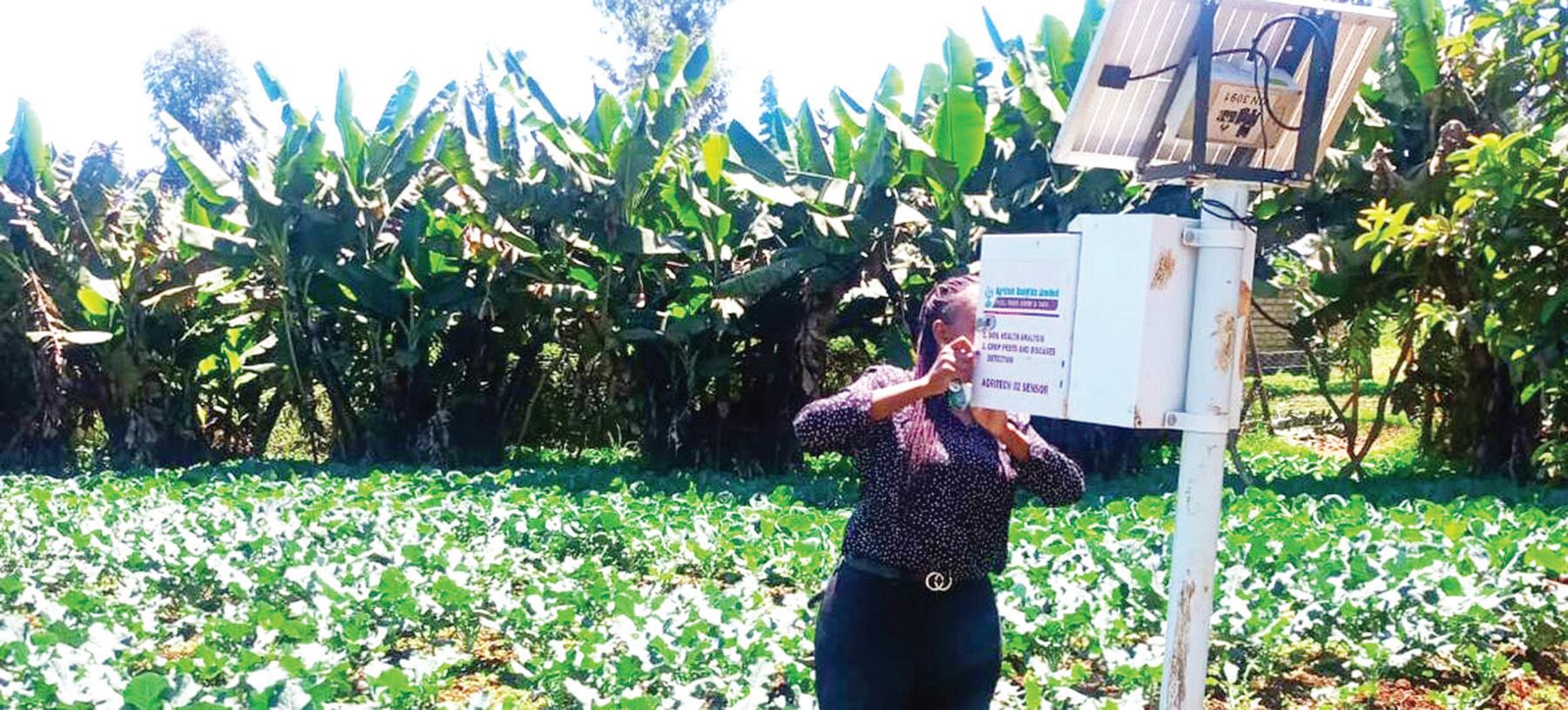
Speaking to the UN ahead of the International Day of Clean Energy, marked annually on 26 January, she explains how in a ‘male-dominated field’, she has succeeded in providing farmers with insights into soil and crop health as well as weather patterns by using solar-powered sensors and AI-powered satellite data. FROM FARMERS TO HELPING FARMERS
“I grew up in a farming set-up. My parents are farmers. I witnessed a lot of harvests, but when climate change started happening, we could not understand what was happening. Since our source of income was farming, when the harvest was
bad, it directly affected our quality of life, and it meant that we could not go to school.
I always wanted to offer solutions to my parents and other people from farming families. That is what inspired me to start my company and get people who are like-minded to build this solution to support smallholder farmers.
Greenovations Africa, an initiative supported by the UN which supports women entrepreneurs like myself, was a very important part of the process, because they believed in companies that are small and offered them training and seed capital to help them grow.
GIVING UP IS NOT AN OPTION
In Africa, communities are quite patriarchal. So, trying to get into this male-dominated field is a thing. It is hard. It has its own challenges, because people would rather work with a man. They feel that men understand what you do better than you do. In many places, they do not believe in female leadership; even women offering solutions is not a thing they would take up.
What really helped me on this journey was persistence and having training and demonstrations to show what we do and that we know what we are doing. You cannot give up. Collaborate with the people you meet and eventually it will work out.
It is also important to keep your eyes on why
you started; knowing that my parents are no longer struggling and thinking about the millions of children whose parents are farmers, and the futures of
depend on you. That is what keeps me focused. THE REWARD
My highest point is when I see lives changed directly.
When you see that the farmer, who did not even have the money to buy seeds, is in control of the prices they sell their harvest on, that is very en -
You will learn along the way, and there are a lot of people who will support you financially or offer technical support,
those children that would be jeopardised if their parents don't have stable incomes.
Sometimes you look at how far you have come and think, giving up is not an option. So many people
When you empower farmers, their lives change.
When you see a direct increase in crop yields or when people are no longer struggling, it makes you want to work even harder.
couraging for me. THE CALL TO OTHERS
To other women and girls who want to innovate in agriculture or climate action, I would just say go for it.
advice, and training. There is no right time to start, and you will never be prepared enough - you just have do it…don’t be scared!”
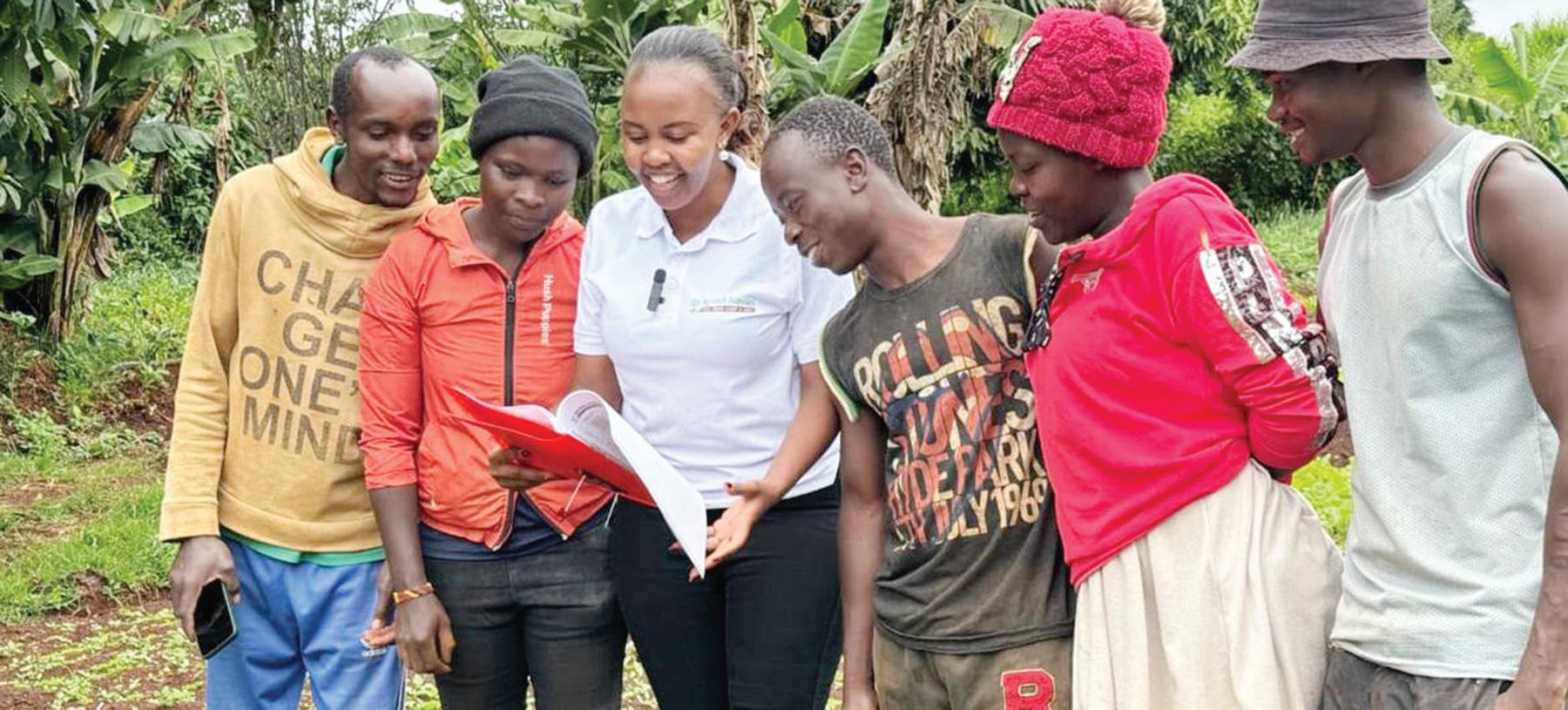
Maryanne Gichanga (centre), a Kenyan agricultural innovator, demonstrates satellite data tools to local farmers (Agritech Analytics photos)
Farmers in Kenya are using new data tools to improve their productivity
From childhood calling to community care: the journey of Dr Bibi Jagnarayan
FROM childhood play that mimicked healing to a career grounded in service and social responsibility, Bibi Jagnarayan’s journey into medicine has been shaped by compassion, curiosity, and commitment to community health.
Long before medical school, Dr Jagnarayan was already imagining herself as a healer. Her mother remains one of the strongest influences in her decision to pursue medicine, nurturing a calling that would grow into a life-long vocation.
Dr Jagnarayan, Medical Officer at the Campbellville Health Centre, trained as a medical doctor in Cuba, where medical education is deeply rooted in community-oriented, preventive care and a strong awareness of social determinants of health. This experience shaped her clinical philosophy, emphasising not only the treatment of disease but also the conditions in which people live, work, and age.
Over the past decade, she has accumulated extensive clinical experience, including two years in obstetrics and gynaecology and more than five years in family medicine, an area that allows her
to provide continuous, comprehensive care to patients across the lifespan. Her academic journey reflects the same integrative vision. In addition to her medical degree, Dr Jagnarayan holds a Master’s degree in Global Public Health and is currently pursuing a Master’s in Family Medicine. Together, these disciplines strengthen her ability to blend clinical expertise with public-health principles, enabling her to deliver holistic, equitable care tailored to diverse and often underserved populations. In family medicine, no two days are the same. Dr Jagnarayan’s work involves a dynamic balance of outpatient care, preventive services, chronic disease management, and patient education.
She works closely with multidisciplinary teams to address not only immediate medical concerns but also the broader social and environmental factors that influence health outcomes. Drawing on her background in obstetrics and gynaecology, she frequently provides women’s health services and prenatal care, ensuring continuity and trust throughout different stages of life. Community outreach
Dr Bibi Jagnarayan
and population-health initiatives are also integral to her practice, reinforcing the bridge between clinical care and public health.
What she finds most rewarding is the opportunity to build lasting relationships with patients and families. Family medicine allows her to walk alongside patients through illness, recovery, and long-term wellness.
For Dr Jagnarayan, helping underserved patients overcome barriers to care and witnessing how education
and support empower them reaffirms her purpose. The continuity of care inherent in family medicine, and the privilege of being a trusted presence in patients’ lives, remains deeply fulfilling.
At the core of her practice is a personalised, patient-centred approach. Dr Jagnarayan prioritises shared decision-making and culturally sensitive communication, recognising that health is shaped by social, economic, and environmental realities. Her
goal is simple yet profound: to ensure that every patient feels seen, heard, and better when they leave her care than when they arrive.
Dr Jagnarayan believes patients value empathy above all else.
She shared, “Doctors are like the mothers of this world: as a child, if you scrape your knee, you run to your mother for that comfort and care, and that is essentially what a doctor embodies. Patients often value being heard, respected, and involved in their care decisions. They look for trustworthy relationships where their unique circumstances are understood and addressed, not just their symptoms.”
Beyond individual care, Dr Jagnarayan sees family medicine as a cornerstone of public healthcare. By integrating prevention, chronic disease management, education, and community engagement, family medicine departments help reduce health disparities and promote health equity. They serve as essential access points for underserved populations and contribute to sustainable public health systems.
On challenging days, her motivation comes from a deep
sense of responsibility to her patients and a belief that prevention is always better than cure. By delivering effective primary care, she not only improves individual lives but also eases the burden on hospitals, strengthening the healthcare system as a whole.
Dr Jagnarayan advises young doctors and medical students to embrace life-long learning, cultivate empathy, prioritise their own health and strengthen communication skills alongside clinical expertise.
Looking to the future, Dr Jagnarayan hopes to see expanded access to quality primary care throughout Guyana in both urban and rural communities. She envisions a healthcare system that prioritises equity, invests in its workforce, strengthens public health infrastructure, and fosters collaboration between healthcare providers and community organisations.
For Dr Bibi Jagnarayan, medicine is more than a profession, it is a life-long commitment to care, community, and the belief that meaningful change begins at the primary level, one patient at a time.
(GPHC)
Education Ministry outlines topics ahead of CSEC mathematics mock exam
THE Ministry of Education has issued detailed guidance to Grade 10 and Grade 11 students as they prepare for the second Caribbean Secondary Education Certificate (CSEC) mathematics mock examinations set to take place soon. This was disclosed in a video message posted to the ministry’s Facebook page during which Minister of Education Sonia Parag said the guidance is aimed at easing anxiety among students, while helping parents support effective preparation ahead of both the mock examination and the final exam set for May.
“I know you stu -
dents… are anxious, you’re a bit nervous, and you need some guidance,” Minister Parag said, noting that mathematics remains critical to students’ academic development and future opportunities.
The upcoming mock examination will test parts of the Grade 10 syllabus alongside content that will appear in the final CSEC examination. According to the ministry, performance in the first mock exam held in December was used to identify areas where students require additional support.
Head of the ministry’s Mathematics Intervention Programme,
Leon Beaton, explained that the CSEC mathematics exam consists of three components: the School-Based Assessment (SBA), worth 20 per cent; Paper One, which accounts for 30 per cent; and Paper Two, which carries the remaining 50 per cent. He emphasised that strategic preparation across all components is essential.
“Once you work strategically, passing the exam becomes a lot easier,” Beaton said.
For Paper Two, Beaton identified computation and number theory as a major focus area. This includes fractions, approximations, percentages, ratios, con -
sumer arithmetic and effective use of the scientific calculator. He urged students to become confident with their calculators, noting that strong calculator skills can significantly boost scores.
Added to this, algebra was highlighted as another critical topic. Students should be able to simplify expressions, solve equations
TURN TO PAGE 16
Minister of Education Sonia Parag
Education Ministry outlines topics...
FROM PAGE 15
and linear inequalities,
substitute values into expressions and solve simultaneous equations using either the substitution or elimination method.
Statistics is also expected to feature heavily, even as Beaton advised to practise completing frequency tables, distinguishing between class limits and class boundaries, calculating cumulative frequency and determining probability
To this end, functions were described
as an area where students should aim to maximise marks. This includes evaluating functions, finding composite and inverse functions, and solving equations involving function notation.
“You should not be getting anything wrong in the functions question,” Beaton said.
Students should also
focus on other key areas such as patterns and sequences, matrices, and related topics. Meanwhile, for paper one, Beaton encouraged students to practise multiple-choice questions extensively, using CSEC-style past papers.
Comprehensive review of Companies Act underway
ATTORNEY-GENER
-
AL and Minister of Legal Affairs Anil Nandlall has announced that the Government of Guyana has begun a wide-ranging review of Guyana’s Companies Act, with the goal of modernising the country’s corporate regulatory framework.
Speaking recently, Nandlall said the existing legislation, enacted in 1991, is no longer suited to the realities of Guyana’s rapidly expanding and evolving economy.
“It is against that backdrop that we have to bring changes to the corporate environment of our country,” he said, noting that both President, Dr Irfaan
Ali, Vice-President Dr Bharrat Jagdeo and the Minister of Finance have already been addressing the need for reform. We are reviewing it comprehensively,” Nandlall stated.
He explained that the structure and scale of the
corporate sector today bear little resemblance to that of the early 1990s, making legislative reform unavoidable.
“Thirty-five years ago, the Guyana corporate sector was radically different than it is now. The regulatory framework that gov-
erned a 1991 commercial economy in Guyana can’t be the same framework to govern corporate Guyana in 2025,” the Attorney General said.
Nandlall pointed to the significant growth in commercial activity and company registrations in recent years, arguing that governance standards must keep pace with economic expansion.
Among the key areas to be addressed in the review are protections for minority shareholders, stronger oversight mechanisms and greater transparency in corporate ownership.
“We are going to have minority shareholders’
rights being protected properly,” he said, emphasising that modern corporate governance requires safeguards for investors who do not control companies.
He also indicated that the revised legislation would allow authorities to pierce the corporate veil in cases of wrongdoing.
“We’re going to have the corporate veil being able to penetrate if there is fraudulent conduct,” Nandlall added while signalling tougher measures against abuse of corporate structures.
He further highlighted the need for robust beneficial ownership provisions, particularly in light of
Guyana’s obligations to international transparency and anti-money laundering standards.
“We have to create robust beneficial ownership type provisions,” he stated.
According to Nandlall, the reforms are part of a broader effort to create a more sophisticated and resilient commercial environment capable of supporting continued economic growth.
“We have to make the commercial environment more sophisticated,” he said, adding that the review would also extend to capital-market infrastructure.
Attorney-General Anil Nandlall
Schools Basketball League
QC and ‘Saints’ take comfortable wins
St Stanislaus College and St Roses in heated battle in the Schools Basketball League
QUEENS College and St Stanislaus College earned
hard-fought victories when action continued in the coaches-led Schools Basketball League on Friday.
Over at Marian Academy, the home side clashed with top rivals Queens College.
QC, after a strong opening stint where they led by six points at the half, delivered the win.
They led 11-5 at the half before pressing on to capture a 34-point victory, 48-14.
QC also won their open-
ing contest last week 66-42 over St Stanislaus College.
Meanwhile, in the second clash on Friday over at the Burnham Hard Court, Saints tipped St Roses High 48-39.
‘Saints’ won all but one quarter, leading 10-9 at the end of the first quarter and 21-12 at the break.
‘Roses’ had their best showing in the third quarter outscoring Saints 22-13, but the home team put in a strong fourth quarter to clinch the
CRICKET QUIZ CORNER
(Monday, January 26, 2026)
COMPLIMENTS OF CUMMINGS ELECTRICAL COMPANY LTD 83 Garnett Street, Campbellville, Georgetown (Tel: 225-6158)
Answers to yesterday’s quiz: (1) Zachary Carter-114 (vs SA)
(2) Shaquan Belle-6/40 (vs SA)
Today’s Quiz:
(1) Which ENG batsman has compiled most runs in the Group stage of the current Under 19 World Cup?
(2) Which ENG bowler claimed most Test wickets? Answers in tomorrow’s issue
victory 48-39.
QC leads the standing with two wins in two outings, followed by the Government Technical Institute, President’s College and St Stanislaus College with a win each.
The games continue weekly on a home-and-away basis.
The Schools Basketball League (SBL) was established to provide consistent, meaningful, and competitive games for student-athletes while promoting sportsmanship, discipline, and longterm player development.
Designed as a coach-led and school-supported initiative, the league was created in response to the growing need for regular competition beyond traditional knockout tournaments.
The inaugural season, runs from January to March featuring six secondary schools competing in a double round-robin format, guaranteeing each team 10 league games.
BCB not challenging ICC decision to replace Bangladesh with Scottland
(ESPNCRICINFO) - The BCB are not going to challenge the ICC's decision to replace Bangladesh with Scotland in the upcoming T20 World Cup. Amzad Hossain, the BCB's media committee chairman, made the announcement following a board meeting in Dhaka on Saturday.
This comes after reports that the BCB had requested the ICC's dispute resolution committee to look into the matter, but Amzad said no such measures were taken.
"We have accepted the decision of the ICC board," Amzad said. "Since the ICC has said that we cannot go and play or they cannot shift
our games to Sri Lanka, in this case we cannot go and play in India. Our position remains the same. We are not going to any separate arbitration or anything here."
Last week, at an ICC Board meeting, Bangladesh were told that if they cannot come to India for the T20 World Cup, they would be replaced. Amzad said the BCB had taken this to their government, which reiterated its stance that there remained concerns for their players security in India. When the BCB came back to the ICC with this information, the ICC decided to replace Bangladesh with the next team on the qualification table,
Scotland.
"After the ICC board meeting, there was a cabinet meeting of the Bangladesh government and a decision was made there. The decision clearly stated that our team will not be able to go to India. This decision has been communicated by the government," Amzad said.
"After that, the ICC asked us to reply within 24 hours. We told them politely that it is not possible for us to go and play according to this fixture."
During the meeting, the BCB were informed that Ishtiaque Sadeque resigned as a board director, citing personal reasons.
Why Arsenal's wobble may not even matter ‒ despite 'feeling pressure'
(BBC) - Arsenal are still four points clear at the top of the Premier Leaguebut are things just starting to get a bit nervy for the Gunners?
Only eight days after spurning the chance to go nine points ahead of second-placed Manchester City, their lead has been cut dramatically following a goalless draw at Nottingham Forest and Sunday's 3-2 defeat by Manchester United.
That first home loss of the season means the Gunners are now three without a win in the top flight.
"It's pressure. The pressure was on Arsenal today," former Manchester United captain Roy Keane said on Sky Sports.
"They'll have seen the other results, they're in a great position, they've got everything going for them... but it's pressure.
"They're feeling the pressure and it's how they deal with it over the next
month or two. That's what's cost them over the last few years.
"I can't believe they don't look like a confident team for where they are in the league. They've got to get back to basics and start embracing this challenge instead of being frightened of it."
Top of the table and with everything in their hands, the Gunners have been here before. They have finished runners-up in each of the past three seasons. Is this latest wobble a sign of things to come? Not necessarily.
The stats that support Arsenal as title favourites Whatever happens next, there's no denying Arsenal are having a hugely impressive season up to this point.
Top of the table, a 100% record in the Champions League, an advantage over Chelsea in the Carabao Cup semi-finals and into the fourth round of the FA Cup.
Breetzke, Stubbs bring Sunrisers back from dead to seal third SA20 title
All four trophies remain on the table.
In terms of the Premier League, they are still overwhelming favourites to win the title, according to Opta.
They give the Gunners an 84.44% chance of holding on to top spot despite their recent run, with Manchester City in second just a 8.38% chance and Aston Villa on 7.09%.
Every other club in the Premier League has a less than 1% chance of winning the title.
A key factor behind that number could be the inconsistency of the chasing pack as much as Arsenal's dominance (until very recently, of course).
Despite losing one and drawing two of their past three fixtures, Arsenal still have the second-best pointsper-game ratio across the past six rounds of games out of any of the top six teams. Manchester United have the best.
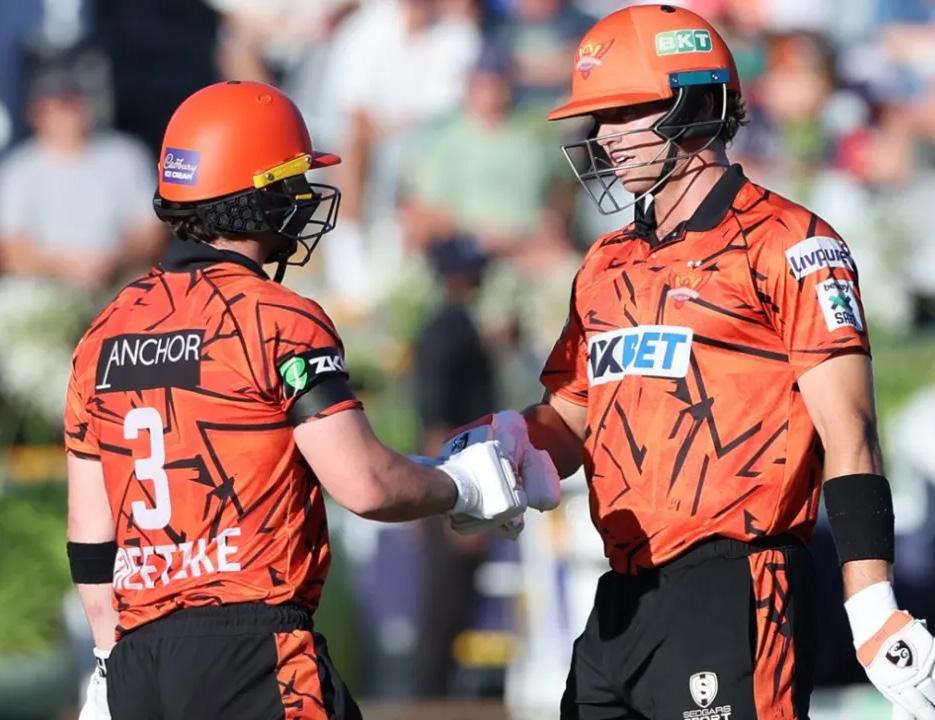
(ESPNCRICINFO) - Sunrisers Eastern Cape (SEC) won a third SA20 title in four years with a stunning six-wicket win over Pretoria Capitals (PC) at Newlands. A 114-run unbeaten fifth-wicket stand between Matthew Breetzke and Tristan Stubbs, both of whom went on to make half-centuries, trumped Dewald Brevis' 101, the lone-hand for PC who only scored 158.
In the closest of the four finals played to date, PC had one hand on the trophy when they reduced SEC to 48 for 4 in the ninth over and caused the required run-rate to balloon to 14 runs an over by the end of the 16th. But Breetzke and Stubbs prised PC's fingers off in the final exchanges with a record stand for SEC to seal a memorable win.
Breetzke, on 45, began
the charge when he lofted Lizaad Williams over midoff for a boundary off the second ball of Williams' final over. He then gave strike to Stubbs, who hit Williams over extra cover and passed the strike back. Breetzke finished the over with a four through square leg to take 14 runs off Williams and reduce the equation to 42 needed from the last three overs.
The 18th over began with four leg byes before Stubbs reverse-swept Gideon Peters over short third for four, then Peters bowled a wide and a no-ball and the free hit went for six. His over cost 21 and SEC needed 21 from the last two. Lungi Ngidi's final over cost 12 before Stubbs' slammed back to back sixes to finish the match with four balls to spare.
Stubbs' performance was particularly notable, given
his call-up to South Africa's T20 World Cup squad, and his struggle for form throughout 2025. His 63 not out was his first half-century in the format in 51 innings since his 76 against West Indies in August 2024.
Overall, SEC had another season for the books as they kept their record of reaching finals, and recruiting well, intact. Their new signing, Quinton de Kock finished as the leading run-scorer with 390 runs while another acquisition, Anrich Nortje, was second on the wicket-takers' list. SEC regular Marco Jansen's 13 wickets this season has left him one behind Ottneil Baartman as the SA20's most successful bowler, and he underlined his status as among the best with a signature performance in the final.
GBF recognized as ‘one of... (From
With 2026 shaping up to be another busy year, the GBF Vice President stated that the federation will be leaning heavily on the NSC and the Ministry of Culture, Youth and Sport to help bring many of its programmes and initiatives to fruition.
For his part, Ninvalle reiterated that the GBF has been one of the most active
and functional federations in Guyana, highlighting its balanced calendar of local and international events, across both male and female competitions. He assured the federation that the NSC stands firmly behind its goals and aspirations.
Ninvalle also reminded that the GBF was named Sports Association of the Year for 2024 at the National
page 22)
Sports Awards, describing the honour as a testament to the work being done under the leadership of President Michael Singh.
The NSC has indicated that it will continue its engagement with all national sporting bodies, as it works to strengthen governance, performance and development across Guyana’s sports sector.
Matthew Breetzke and Tristan Stubbs led the chase for Sunrisers Eastern Cape (SA20)
certified vet
Major improvements recorded for horses in Guyana
ON the preparation cusp of another Guyana Cup some seven months away, experienced Brazilian veterinarian Flavio Geo has assessed and recorded some improvement of horses and horsemen in Guyana.
According to Geo, based on evidence in his initial visit three years ago, there are some areas to improve on despite the success shown.
“The horses are nice. Much better than I thought.
GBF recognised as ‘one of the most active sporting bodies’ – NSC
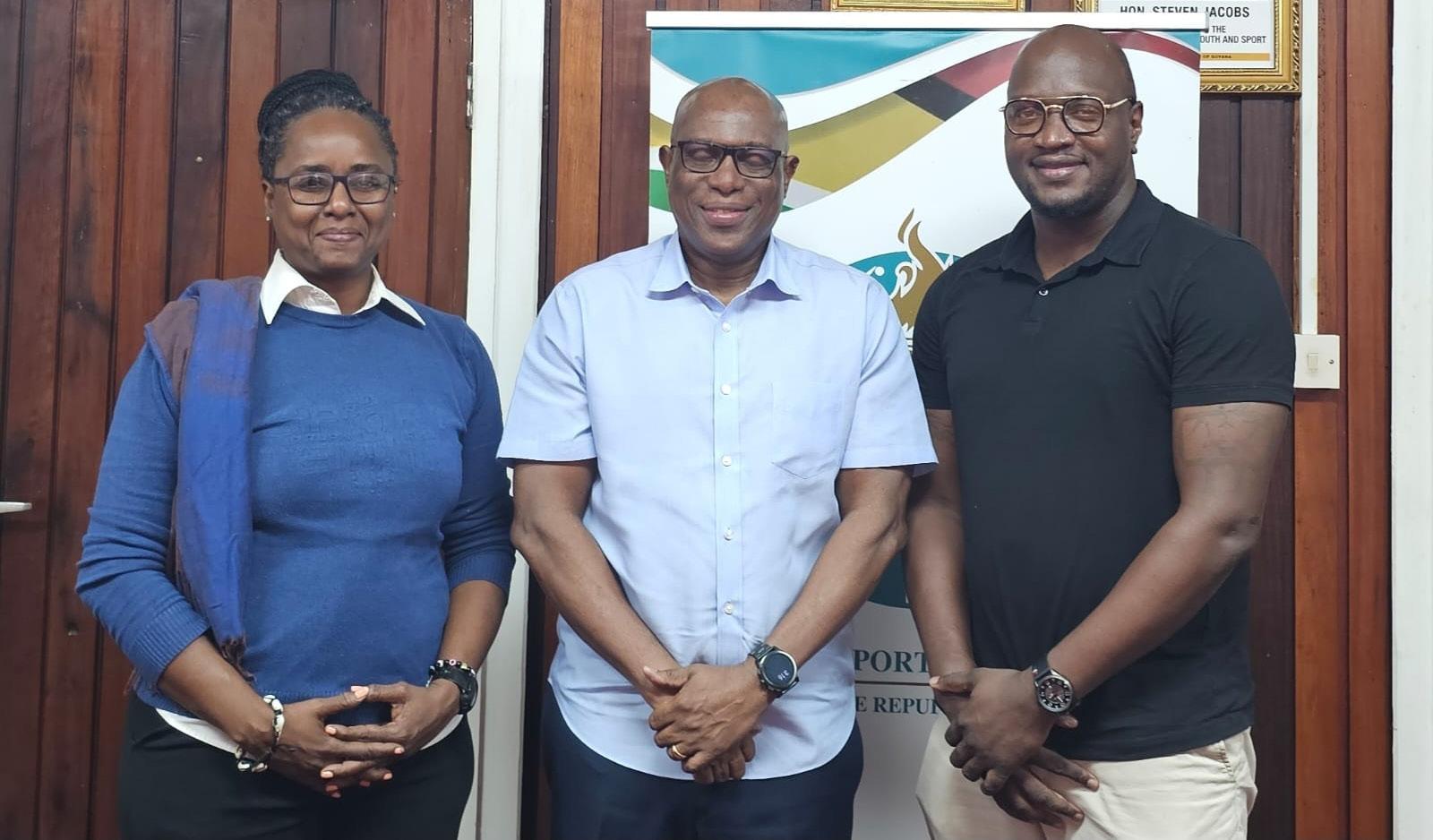
THE Guyana Basketball Federation (GBF) continues to be recognised as one of the country’s most active sporting bodies, following a recent engagement with the National Sports Commission (NSC) as part of the commission’s ongoing meetings with national associations and federations.
The meeting saw the GBF represented by Vice President Rawle Toney, while Director of Sport Steve Ninvalle, alongside his assistant Melisa Dow-Richardson, led discussions on behalf of the NSC. The engagement focused on reviewing the federation’s recent activities, strengthening collaboration and aligning plans for the year ahead.
According to the GBF, the NSC highlighted the
federation’s high level of activity throughout 2025, noting that basketball enjoyed steady interaction and consistent support from the commission.
The NSC pointed to the GBF as an example of effective governance and programme execution within Guyana’s sporting landscape.
Speaking following the meeting, Toney confirmed that 2025 had indeed been a demanding but rewarding year for the federation.
He noted that the GBF successfully hosted two major international events: the One Guyana 3x3 Quest and the Women’s Caribbean Championship, both of which placed Guyana firmly on the regional and international basketball map.
In addition, Toney referenced the staging of the One Guyana Premier League, describing it as the largest basketball league in the Caribbean. He said the competition not only elevated the standard of local play but also provided meaningful opportunities for athletes, officials, and administrators.
Toney said the GBF is extremely thankful to the NSC for its unwavering support, adding that the relationship will be even more critical as basketball prepares for an ambitious 2026.
According to Toney, local basketball’s governing body has rolled out an expansive development plan aimed at strengthening the game locally, regionally and internationally.
(Turn to page 21)
I like them and they are improvements.
“We need to improve the movement of the horses from the training centre to the track. We need better transportation. It’s a lot of stress when horses go up and down. We need the horses to stay close. Things are improving. This is the third time I am here and things have improved from the first time,” Geo said.
In addition to more ethical practices shown by
horsemen in Guyana, the Government of Guyana has also had the best interest in the sport. This was shown when legislation was passed late last year.
Geo made an important point, highlighting the need for horses to have adequate rest time between races and the classification is matched.
“We need to have respect for the horses. We need to ask what races they are to run and the classification. They should race the
race they are able to. The climate is hot and the horses can’t do more work than they have to do,” Geo said.
The next official race day is set for February 1 at the Port Mourant Turf Club, which also marks the opening day of nomination day for the Guyana Cup.
The horses have intensified preparation with one eye on the main prize, the Guyana Cup set for August 23 at a venue to be announced.
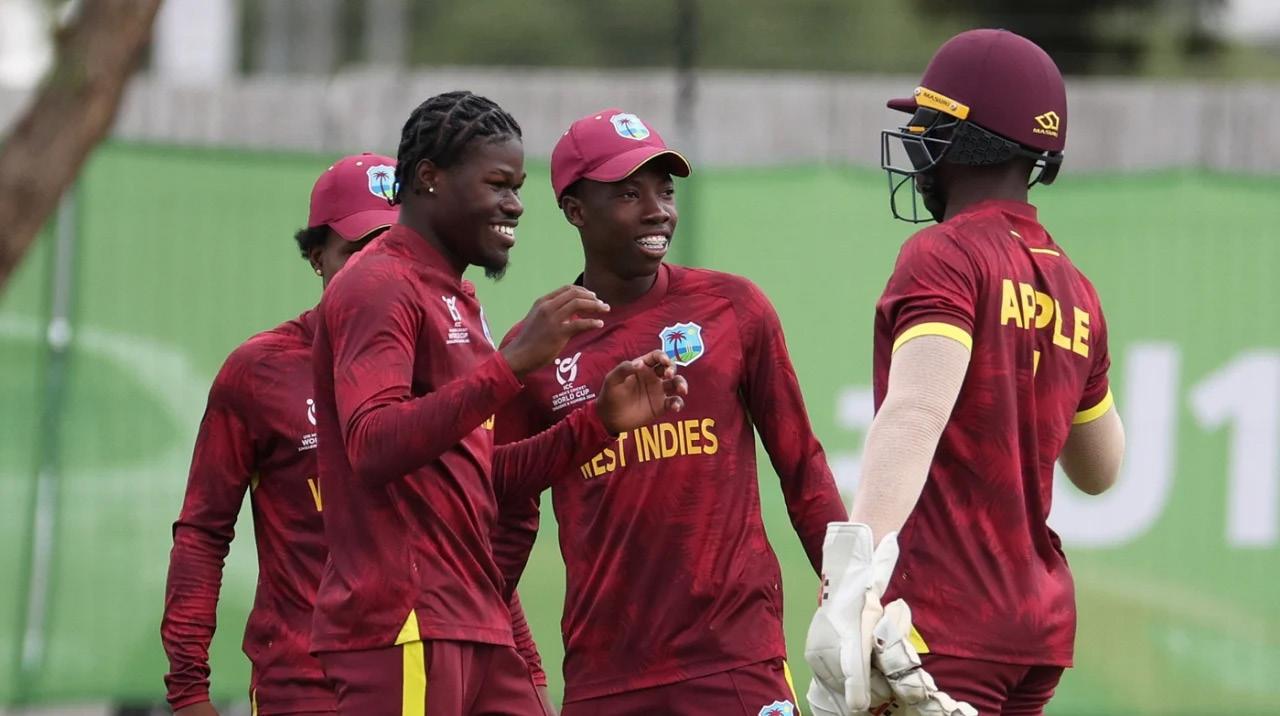
Spin twins sink Ireland as West Indies seal rain-affected victory
CMC – IN a rain-disrupted clash that underscored the growing prowess of their young talent, the West Indies Under-19s secured a crucial 25-run victory (DLS method) over Ireland, propelled by a masterclass in spin bowling from Micah McKenzie and Vitel Lawes.
Before that, the regional side showed that they still have not yet gotten their batting act completely together, as for the third time, they have been dismissed in the tournament.
Choosing to bat first at the High Performance Centre, the Windies’ innings was a story of one stand-out performance amid general fragility.
That fragility started when Zachary Carter ran himself out for eight, following a direct throw from the deep by Reuben Wilson.
Wicketkeeper-batter Jewel Andrew, arriving at number three, played a mature and anchoring knock of 66 from 82 balls. His innings, punctuated by four fours and four sixes, provided the backbone.
He watched from the other end as Tanez Francis was trapped in front for 19, but the Antiguan soon found his most reliable partner in Jonathan van Lange, with the pair adding 67 for the
fourth wicket to stabilise the innings.
However, Andrew’s dismissal in the 33rd over triggered a collapse. From a promising position, the lower order faltered against the disciplined Irish attack.
Reuben Wilson was particularly effective, removing van Lange and two tailenders to finish with 3 for 50, while James West’s miserly spell of 2 for 24 from seven overs restricted the Caribbean side to a modest 226 all out.
Aiden Racha chipped in with some handy runs, scoring 28 from 47 balls, before he was the final wicket to fall. Last man Vitel Lawes also swung his willow and weighed in with an unbeaten 18, which included two fours and a six.
Ireland’s chase began with assured intent, spearheaded by the all-round efforts of West. Following his excellent bowling, West opened the batting and raced to a 45-ball 45, laced with eight boundaries.
It took the introduction of Racha to ultimately get the breakthrough, as he had wicket-keeper Freddy Ogilbie brilliantly caught behind by Shamar Apple for 14. West would follow next, as he got a peach of a delivery from Lawes, to be bowled. Despite that, at 82
for 2 in the 18th over, Ireland were firmly in the driver’s seat.
The next over, Micah McKenzie, extracting sharp turn and bounce from a responsive surface, became the tormentor of the Irish middle order, slicing through with four critical wickets.
He rattled Adam Leckey’s stumps for 18, then he knocked over Sebastien Dijkstra for 7 to make it 98 for four. After a brief resistance, McKenzie was in the act once again, sending back Marko Bates for 22.
One wicket would bring another quickly as Rob Obrian fell to the same combination of McKenzie and van Lange for 26, at 143 for six.
Just as Ireland sought to rebuild, Vitel Lawes delivered a devastating final over. He knocked over captain Oliver Riley with his first ball, finishing with two wickets.
His intervention left Ireland reeling at 164 for 7 after 40 overs, needing a steep 63 from the final 60 balls. A persistent downpour washed away any lingering hopes of a miraculous finish.
When the conditions failed to improve, the Duckworth-Lewis-Stern calculation confirmed Ireland were well behind the par score, handing the West Indies a decisive 25-run win.
Vet Flavio Geo
NSC Assistant Director Melissa Dow Richardson, Director Steve Ninvalle and GBF executive Rawle Toney
Amsterdam registers first-round
KO in feature bout
By Sean Devers
WHILE not a capacity crowd, a large gathering turned out at the refurbished Cliff Anderson Sports Hall on Saturday night for the Briso Promotions/Caribbean Boxing Organisation Pro-Am Caribbean Boxing Showdown.
When the dust had settled just after 1 AM yesterday, the fans sitting in the comfort of an air-conditioned venue were thoroughly entertained by the 12 bouts of fistic fury.
The atmosphere was riveting as pulsating music emanated from the Shocking Sounds from Kitty, while the Police steel band provided added entertainment during the interval between the amateur and professional bouts.
The Card commenced with the amateur bouts, with Roopesh Balgobin beating Junior Madray in the 40kg over three rounds.
Ossis Prince failed his ‘medical’ and provided Shakquain James with a walkover in the 71kg division before Guyana’s Ken Henry stopped Zahir Tampico of Suriname in two minutes and 24 seconds of the second round of their 76 kg contest.
Travis Inverary, who was judged the best amateur pu-
gilist, was clinical in his victory over Mordino Massie of Suriname in their 72kg matchup.
The talented Inverary executed several body shots, which followed some nice jabs to the head.
The Surinamese counterpunched with some good combinations, but Inverary was too good and won on points.
In another 76kg battle, Surinamese Chivoro Blackson used his longer reach to outbox Guyana’s Jofes Jackman, who was hurt with an uppercut and a right cross, to get a couple of standing eight counts as he tried to fight back.
In the lone female bout of the night, Guyana’s heavyweight Abiola Jackman traded blows with Angel George from Trinidad and Tobago. The pair went at each other, and Jackman was given the win. But the result could have gone either way.
In the professional card, Delon Charles won a unanimous decision over fellow Guyanese Jamal Eastman in their Junior Welterweight battle.
Surinamese Mitchell Wielson, the shorter of the two, outpunched Bajan Tyreece Taitt in a shot-filled contest to win on a unani-
mous verdict in their Middleweight affair.
Guyana’s Junior Welterweight Joel Williamson was all over Surinamese Damson Haslam, who failed to answer the bell for the third round, suffering from hypotension (low blood pressure).
Guyana’s Kevin Issacs beat Suriname’s Samuel Green on points, while Bajan Charles Cox unleashed a pounding on Guyana’s Quincy Gomes with a couple of right hooks, causing swelling of Gomes’ left eye.
Cox targeted the injury with telling shots to the head, resulting in the referee halting the fight in 56 seconds in the fourth round in a contest scheduled for six rounds.
The penultimate bout of the night provided the crowd, which included Guyana’s only Olympic medalist, Mike Parris, who won a bronze in the 1980 Games in Moscow, Olympian Keevin Allicock and Shondell Alfred, one of only two female Guyanese boxers to win a world title, with great entertainment.
Rasheed Williams from the Bahamas was attacked in the first stanza by Jamaican Nico Yeyo with a flurry of vicious combinations.
The Jamaican had the Bahamian on the ropes.
In the second round, the taller Williams caught Yeyo with some well-executed jabs and began to drop his guard, stick out his tongue and taunt his opponent.
He began to hit Yeyo with a few good three-shot combinations, dancing to music and looking at the crowd while throwing his punches which evoked laughter from the spectators.
By the middle of the eight-round bout, Yeyo was throwing fewer punches and employing the ‘holding’ tactic, was warned by the referee and had a point deducted.
By the sixth round, Williams started showing off some fancy footwork, which had the Sports Hall roaring.
An accidental head butt caused bleeding from Williams’s nose. But while Yeyo tried to counter punch, he was ‘hugging’ his man more often to survive.
Yeyo tried to target Williams’s nose and forced him onto the ropes in a clinch.
Yeyo went the full eight rounds but lost on the scorecards of all three judges.
The much-anticipated feature event commenced close to 1 AM, but fizzled out
like a damp squib as Declou seemed reluctant to fight. Amsterdam threw punches in bunches and staggered Declou, and after being given two eight counts, the fight was over in two minutes, 59 seconds of the opening round. Meanwhile, it was announced that Elton Dharry will fight a boxer from Tanzania on March 28 at the Pegasus Suites in what will be the first world title bout in Guyana by a male.
Dexter Marques will match gloves with Allicock for the Guyana title.
CBO’s Briso promotions Boxing Caribbean Showdown
Guyana's Abiola Jackman (right) beat T&T's Angel George in a fight that could have gone either way (Sean Devers photo)
Rasheed Williams (left) defeated Jamaican Nico Yeyo (Sean Devers photo)
Desmond Amsterdam sends Edmond Declou to the canvas as the fight was stopped two mins 59 secs of the first round (Sean Devers photo)
Micah McKenzie took four wickets (Jan 25, 2026 ICC/ Getty Images)