- PM Phillips says project aligns with govt’s broader energy agenda, signals major shift toward solar-powered electricity
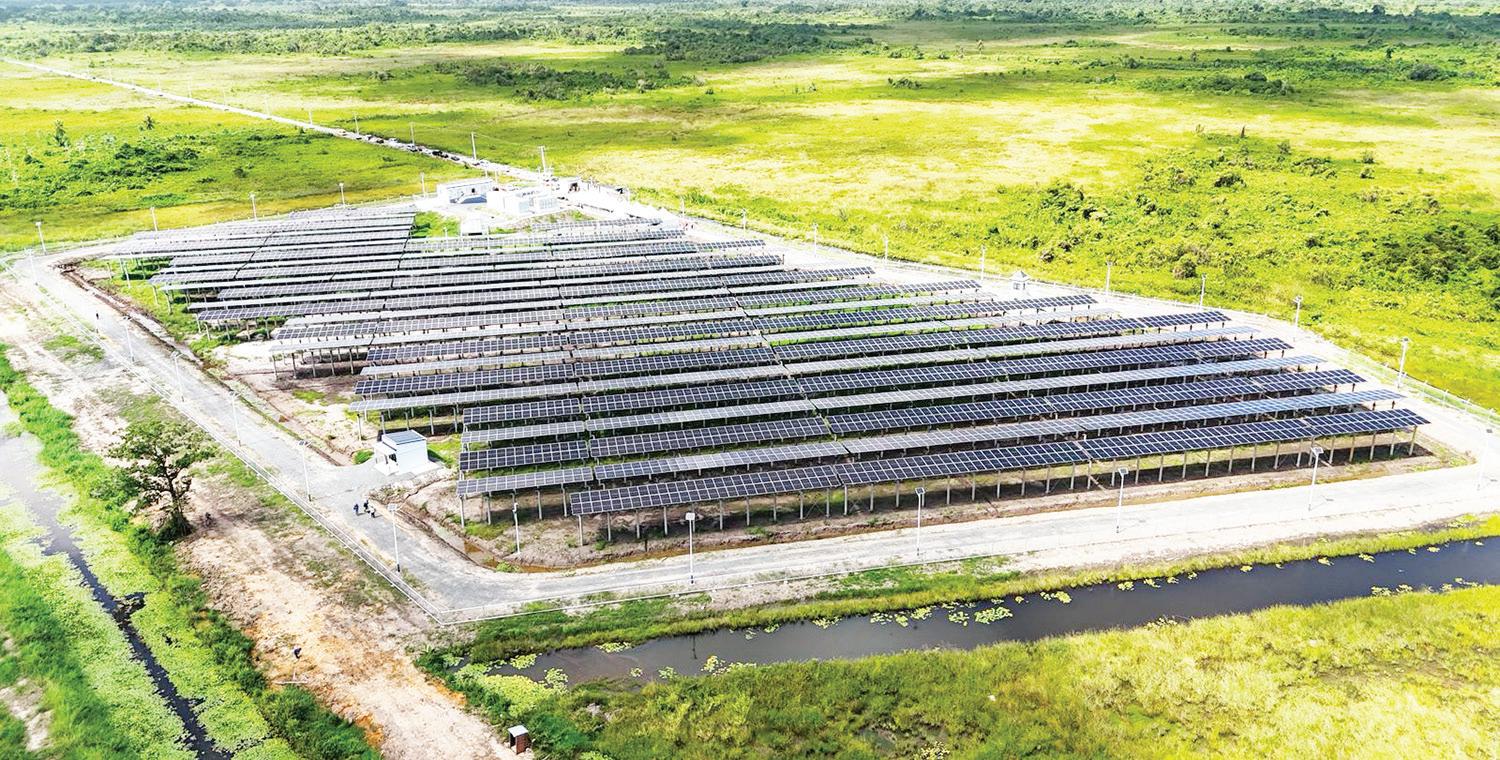
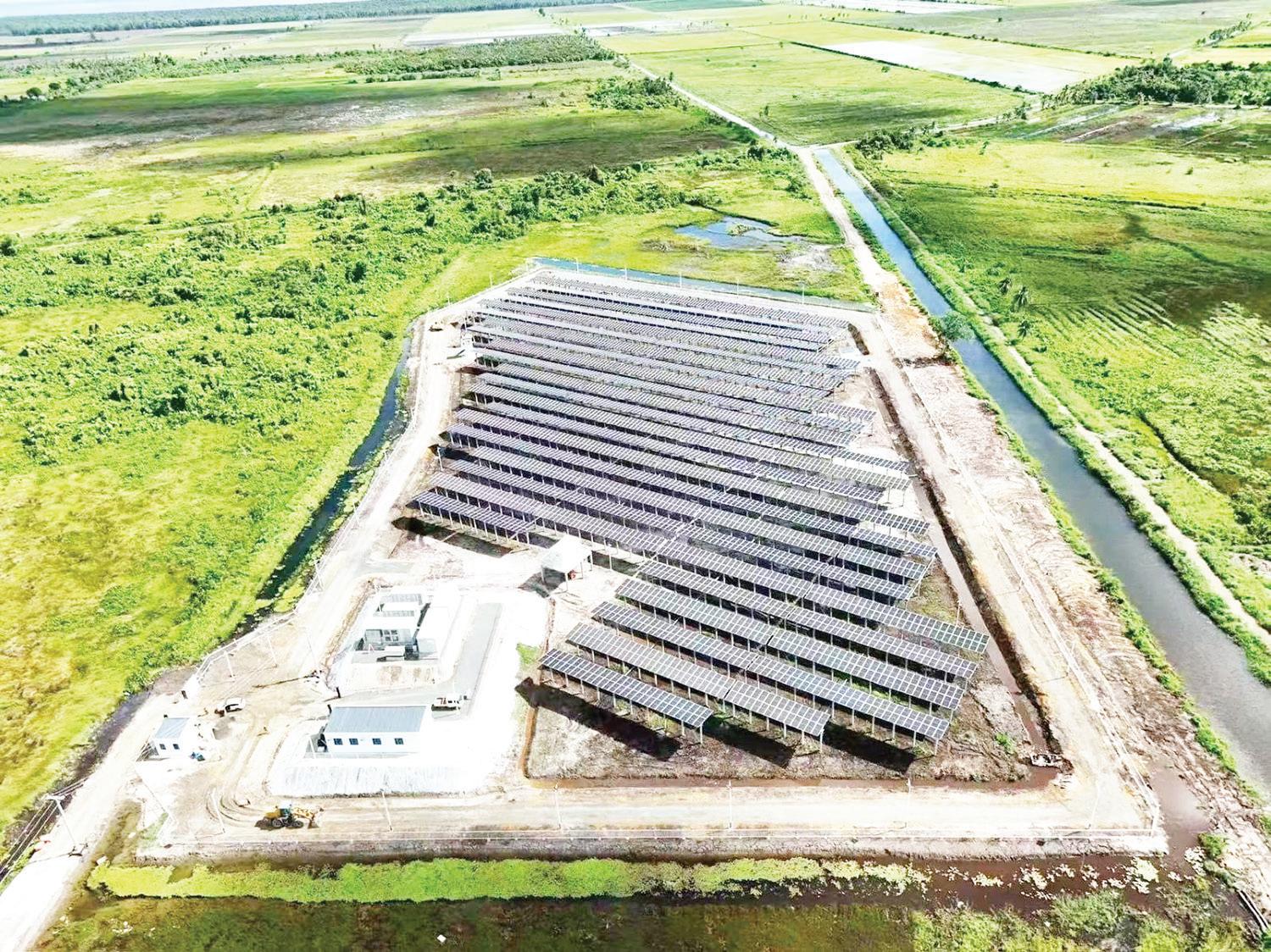
Region Two continues its transition into a cleaner energy future with the commissioning of the Charity Solar Farm, which will bring an additional 3MWp of renewable power to the Essequibo Coast. Constructed at a cost of US$8.14 million under the Guyana Utility Scale Solar PV Programme (GUYSOL), the Charity Solar Farm, supported by 2.25MW of battery energy storage, is expected to generate approximately 4,600MWh annually, offset nearly 3,500 tonnes of CO2 emissions, and avoid about GY$267 million per year in fossil fuel generation costs (OPM photo)
Inclusion
of marginalised groups critical to national prosperity
- President Ali says
a
- lessons already timetabled, tailored for every level, Education Minister says
— Minister Croal says Region Two’s housing application backlog being steadily cleared
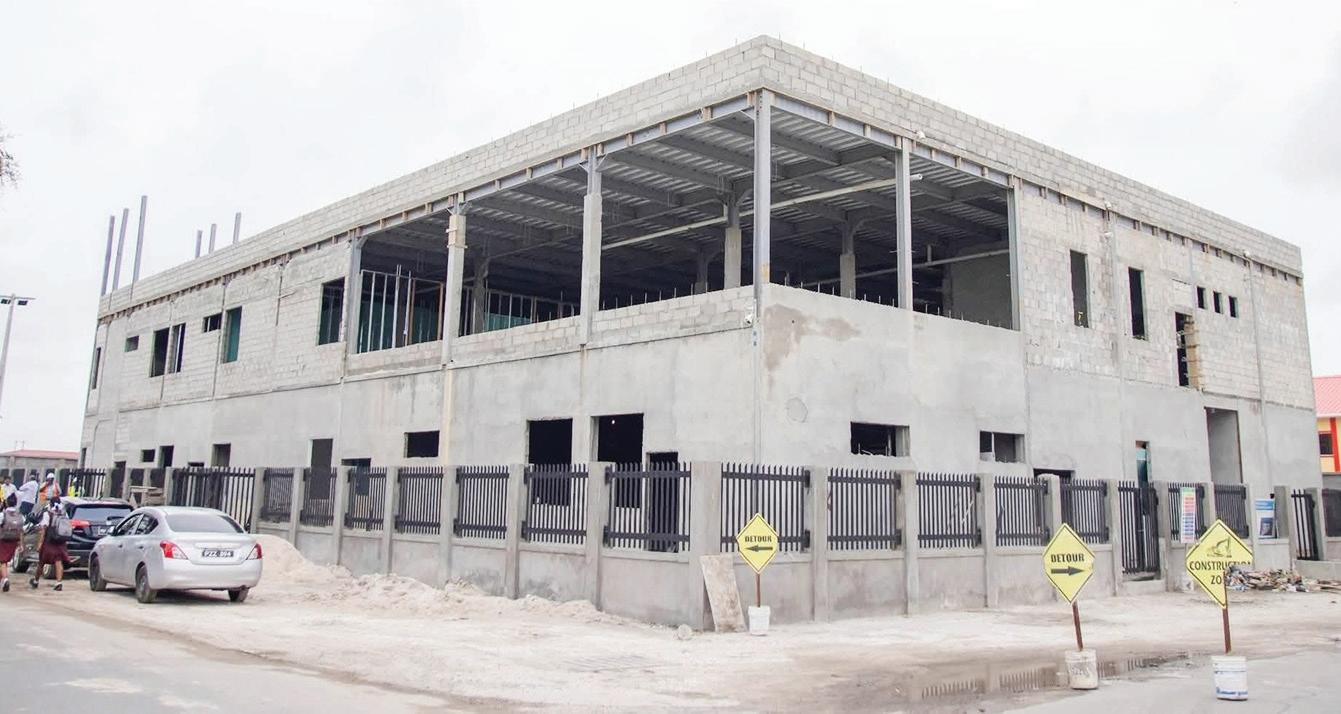
The Campbellville Polyclinic which is being constructed at
cost of $831 million is taking shape. When complete, the modern facility will replace the old health centre (Photo: President Irfaan Ali/Facebook)
US$8.14M solar farm commissioned at Charity
- PM Phillips says project aligns with govt’s broader energy agenda, signals major shift toward
By Indrawattie Natram
OVER 3,000 Region Two residents are set to benefit from more reliable, clean, and renewable energy following the commissioning of the US$8.14 million, 3MWp Charity Solar Farm on Friday.
The project, which will significantly reduce power outages and support Guyana’s transition to sustainable energy, is expected to slash annual fossil-fuel generation costs by GY$267 million, generate approximately 4,600MWh of power annually and offset nearly 3,500 tonnes of CO₂ emissions. Additionally, the solar farm will be supported by 2.25MW of battery-energy storage.
Prime Minister, Brigadier (Ret’d) Mark Phillips in his remarks said the project signals a major shift towards solar-powered electricity, noting that Region Two is experiencing rapid development with essential services being decentralised to reach even the most remote communities, which requires an increase in reliable power.
solar-powered electricity
taic Programme (GUYSOL), executed by GPL and administered by the Inter-American Development Bank (IDB). GUYSOL will deliver 33MW of solar power across Regions Two, Five, Six, and 10, utilising some US$83.8 million from Guyana’s earnings under the Guyana–Norway Partnership for forest services. Of that amount, US$18.5 million—nearly G$4 billion—has been invested in Region Two alone, with the Charity Solar Farm accounting for US$8.14 million, or approximately G$1.75 billion.
programmes in engineering, finance, procurement, and environmental management.
He noted that the project aligns directly with Guyana’s Low Carbon Development Strategy 2030 and complements the government’s 300MW gas-to-energy project at Wales, which aims to reduce electricity costs and improve grid reliability nationwide.
He urged residents to take advantage of the expanding opportunities that will be created by the improved energy access.
ment’s development agenda.
Highlighting the government’s broader energy agenda which included investments in solar, small hydro, and the landmark gas-to-energy project, he noted that by the end of 2026, approximately 300 megawatts of electricity will be generated from gas, while the proposed 165-megawatt Amaila Falls Hydropower Project remains on the govern-
He further stated that the government plans to construct more solar farms across Guyana to meet the country’s growing energy needs.
Last November, a US$10.4M solar farm was commissioned at Onderneeming. This together with the one at Charity is expected to offset more than 9,300 tonnes of carbon dioxide emissions annually. Investments in remote-controlled substations
and real-time monitoring systems are also expected to improve grid reliability and responsiveness. The two facilities contribute 8MWp of solar capacity and 12MWh of battery storage to the regional grid.
Meanwhile, Minister of
Nandlall explained that the Charity Solar Farm is a stateof-the-art facility constructed on a 10.8-acre site and features 4,928 solar modules, eight solar PV inverters, and a 2.25MW, two-hour (4.5MWh) battery-energy storage system. The 3MW system can deliver up to 2.64MW of solar power and 2.25MW from battery storage, providing critical support to the Essequibo Coast grid.
Further, Chief of Operations at the IDB, Ivan Gaviria, said the commissioning represents a strong commitment to the people of Guyana, describing the project as an investment that will lead to lower energy costs, increased business opportunities, and a stronger foundation for investment. He commended the Government of Guyana for its leadership.
Regional Chairman Devin Mohan in his remarks, described the solar farm as a landmark investment in sustainable energy and long-term resilience for Region Two. He said the project delivers
Public Utilities and Aviation, Deodat Indar, described the commissioning as “a happy day for Region Two,” noting that the solar farm will supply electricity to approximately 3,500 households.
He said the project has created new opportunities for residents and will support long-term development across the region.
Also speaking at the ceremony was Chief Executive Officer of the Guyana Power and Light Inc. (GPL), Kesh Nandlall, who described the commissioning of the Charity Solar Farm as a proud moment and a significant milestone in Guyana’s journey towards a resilient, low-carbon energy future.
He explained that the project forms part of the Guyana Utility-Scale Solar Photovol-
A newly constructed 13.8kV transmission line connects the facility to the north feeder, further enhancing grid stability.
Under the GUYSOL programme, Berbice has also benefitted from the addition of 10MWp of solar capacity through the commissioning of solar farms at Hampshire, Prospect, and Trafalgar, strengthening energy security in Regions Five and Six.
Highlighting the programme’s focus on inclusive development, he informed the gathering that 31 women, including nine from Region Two, have been trained in solar PV installation, while 20 young professionals—including persons with disabilities— have gained hands-on experience through apprenticeship
immediate and lasting benefits by strengthening grid stability, improving electricity supply to households and essential services, and contributing to a cleaner and healthier environment.
He added that reliable energy will create conditions for growth in agro-processing, tourism, and other industries, while boosting investor confidence and employment opportunities for residents.
The Charity Solar Farm was built through a joint venture between SUMEC Complete Equipment and Engineering Company Limited and XJ Group Corporation. Financing was provided through the Guyana–Norway partnership and administered by the Inter-American Development Bank.
The Charity Solar Farm will generate approximately 4,600MWh of power annually and offset nearly 3,500 tonnes of CO2 emissions
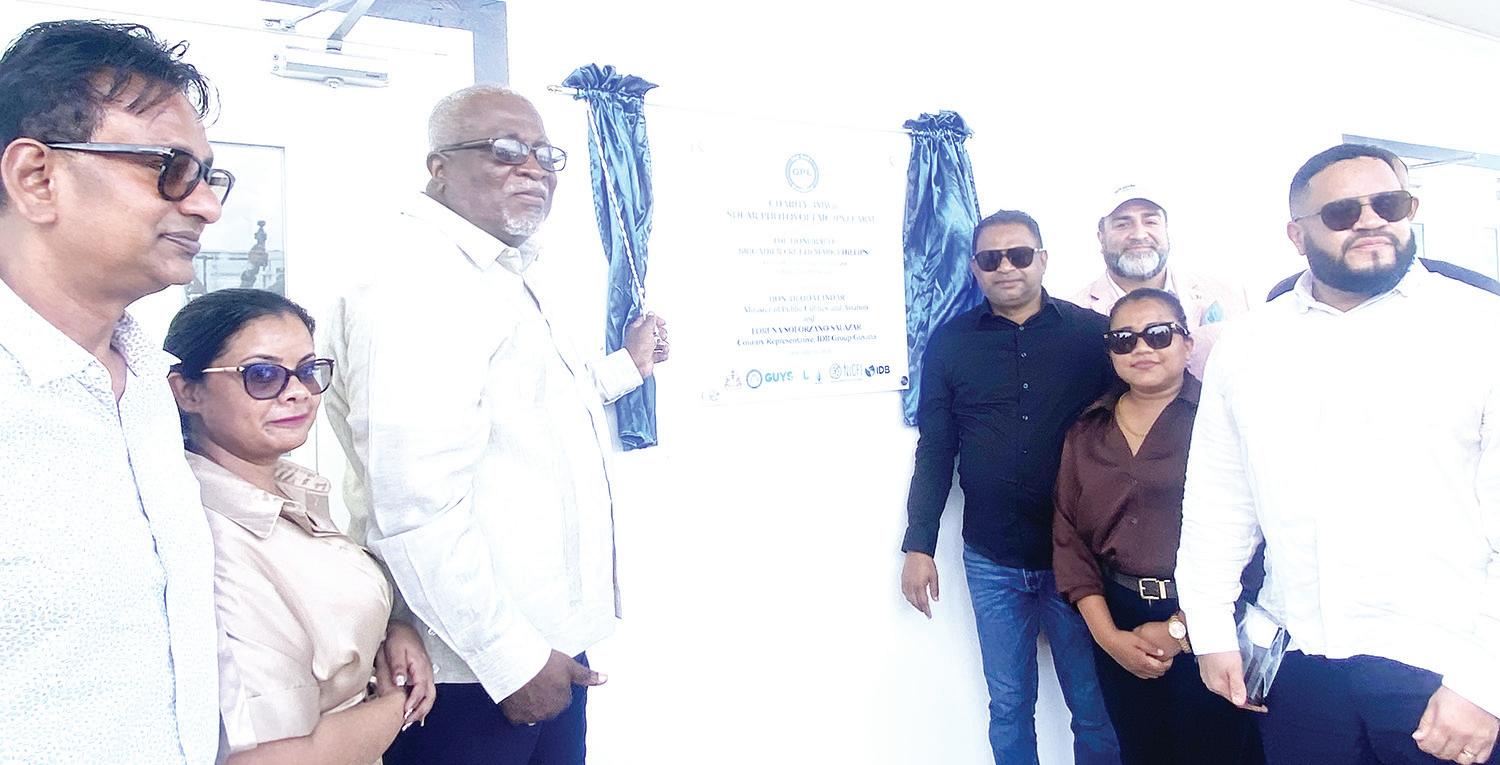
PM Phillips officially commissions the US$8.14M Charity Solar Farm
Inclusion of marginalised groups critical to national prosperity - President Ali says
PRESIDENT Dr Irfaan Ali on Thursday restated his government’s commitment to inclusive development, declaring that national progress must be measured by how well society protects and uplifts its most vulnerable citizens.
The Head of State made this known while speaking at Thursday’s opening of the Yas School of Inspiration at Crane, Region Three, during which he said, inclusion is not a peripheral policy objective but a core principle guiding his administration’s development agenda.
“The government that I lead has entered a covenant with every Guyanese child, every family facing
hardship, every citizen waiting for their moment to blossom,” President Ali said.
He went on to add that his administration has pledged to build “a Guyana where development is everywhere, for everyone.”
He described this approach as a daily discipline and said that it serves as the promise that guides every policy and is the ‘yardstick’ by which progress is measured.
Dr Ali stressed that national prosperity must extend beyond economic growth and physical infrastructure, warning that development which excludes marginalised groups ultimately undermines social stability.
“We have vowed to build a society that protects the marginalised and empowers the differently abled,” he said.
“We have promised that in this era of unprecedented national prosperity, ‘no one would be left on the sidelines; all would be carried forward in the rising tide.’”
According to the President, inclusion is central to the country’s national plan which seeks to dismantle longstanding systems of neglect while creating opportunities for all citizens.
Against this backdrop, he highlighted that the school serves an integral part of a national plan and a vision that spans from the hinterland to the coastland, from the
youngest child to the most senior elder and from the able-bodied to those requiring unique support.
He said the government is, “dismantling the architecture of neglect and constructing, in its place, an ecosystem of opportunity,” positioning social investment as a deliberate policy choice rather than an act of charity.
President Ali also linked Guyana’s growing oil wealth to a responsibility to ensure equitable outcomes, arguing that economic gains must translate into tangible improvements in citizens’ quality of life.
Further to this, President Ali indicated that this project is proof that the country’s wealth is
being used as a pipeline of hope into every home and is further proof that the partnerships established are not just for trade balances but for balancing the scales of justice and opportunity.
The President rejected the notion that national success should be defined by visible wealth concentrated among a few, stating that true prosperity must be felt broadly across society.
“Our blossoming
era,” he said, should be one “where prosperity is not evinced by a glittering and towering skyline seen by a few, but a fertile ground felt by all.”
To this end, Dr Ali framed inclusion as a moral imperative, stating, “A nation cannot build true and lasting greatness unless it consciously uplifts its most vulnerable citizens becaus e the very foundation of greatness is moral integrity and unified strength.”
GDF’s support to Jamaica’s recovery efforts powerful demonstration of regional solidarity
JAMAICAN Prime
Minister Dr Andrew Holness, on Friday, expressed heartfelt appreciation to members of the Guyana Defence Force (GDF) who are currently deployed in Jamaica, describing their presence as a powerful demonstration of regional solidarity and Caribbean co-operation in times of need.
During an engagement with the contingent at White House, Westmoreland, Prime Minister Holness acknowledged the critical role being played by the Guyanese ranks in Jamaica’s ongoing recovery and rebuilding efforts following the destruction of Hurricane Melissa, noting that their assistance is making a meaningful difference
for affected families and communities.
“I met with members of the Guyanese Defence Force who are currently in Jamaica providing critical support to our national recovery efforts. Their presence is a powerful demonstration of regional solidar-
ity and the strength of Caribbean co-operation in times of need,” Prime Minister Holness said. He commended the officers and ranks for their professionalism, dedication and selfless service, and extended gratitude on behalf of the government and peo-
ple of Jamaica, particularly the beneficiaries whose lives have been directly impacted by the intervention.
The Jamaican leader also conveyed thanks to His Excellency President Dr Mohamed Irfaan Ali and the government and people of
– PM Holness
Guyana for what he described as timely and generous support to Jamaica.
“I must commend you and your team, and President Ali, for sending the contingent along with much-needed materials. For the dedication and effort, you have put into assisting your Caribbean brothers and sisters, I speak on behalf of all beneficiaries when I say we are most grateful for your support,” Prime Minister Holness added.
Similarly, Jamaica has been an active partner in regional disaster response initiatives, underscoring the collective responsibility of Caribbean nations to support each other in moments of crisis.
Last November, President Ali was on the
ground in the hardest-hit areas of Jamaica, where he committed to the rebuilding of 200 roofs in communities affected by Hurricane Melissa. Guyana agreed to provide both manpower and materials to accelerate reconstruction.
Guyana’s deployment of the GDF forms part of its longstanding commitment to regional co-operation under the framework of the Caribbean Community (CARICOM). Over the years, Guyana has consistently provided humanitarian and technical assistance to sister CARICOM states during periods of natural disasters and national emergencies, a policy strongly championed by President Ali. (DPI)
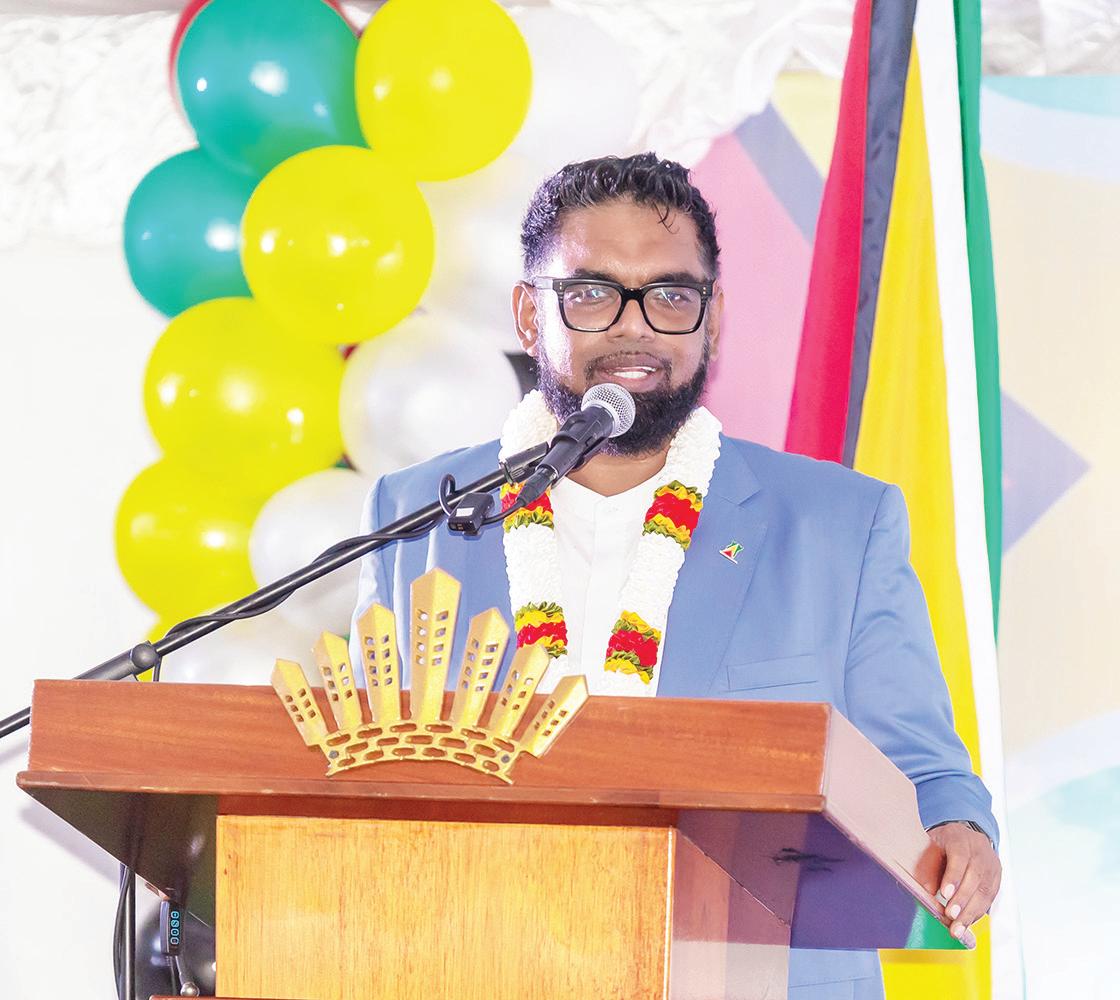
President Dr Irfaan Ali (Delano Williams photo)
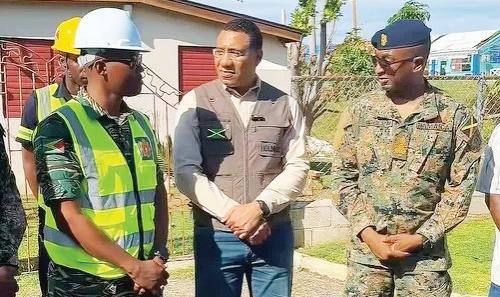
Prime Minister Holness engaging GDF ranks at White House, Westmoreland
Over $120M to be invested in Mashramani floats for govt entities
The Ministry of Culture, Youth and Sport alongside scores of excited Guyanese and members of the cabinet, on Friday evening gathered at the Railway Courtyard on Lamaha Street, Georgetown, for the launch of Mashramani 2026. This year’s theme is ‘Expressing Our Culture Through Innovation and Creativity.” Emphasising the need to be proud of our culture, Minister Charles Ramson said that this year, over $120 million will be invested in floats for the various government entities. (Sachin Persaud photos)
Free weekly legal clinic eases the cost barrier for vulnerable citizens
THE cost of legal services can be a major barrier to seeking justice, particularly for citizens facing social and economic challenges. In an effort to ease that burden, the Ministry of Human Services and Social Security (MOHSSS) offers free legal advice every Thursday at its head office on Lamaha Street.
Jagnandan helps complainants or survivors in criminal cases who may feel too afraid to go to court by providing free legal representation when needed.
This initiative is rooted in the MOHSSS’s broader push to institutionalise pro bono legal services and ensure that persons who cannot afford legal assistance can still gain access to expert advice.
The service, provided by Attorney-at-Law Andre Jagnandan, runs from 09:00hrs to 12:00hrs. The service covers a broad range of legal matters such as protection, occupations, tenancy and ancillary orders, as well as child support and spousal maintenance. Since its inception, Jagnandan has seen over 25 persons.
The weekly legal sessions build on the ministry’s Legal Pro-Bono 500 Initiative, launched in December 2021 in collaboration with the Guyana Bar Association. Under a Memorandum of Understanding signed by both parties, the Bar Association committed to providing pro bono legal support to 500 victims of gender-based violence annually, helping to break down financial and logistical barriers to justice for survivors.
The weekly legal sessions complement existing programmes
by providing regular opportunities for citizens to seek legal help without cost, while reinforcing the Ministry’s
commitment to equitable justice.
Pro bono services are vital for helping people who struggle
with financial and administrative challenges in getting legal representation. (DPI)
Action on inclusive education
THE commissioning of the Yas School of Inspiration at Crane, West Coast Demerara, on Thursday, is more than the opening of another public facility.
It is a statement about values, priorities and the kind of society Guyana is striving to build.
For too long, children with special-education needs and disabilities have existed on the margins of our education system, supported more by goodwill than by structure.
The establishment of a purpose-built, specialised institution signals that this is beginning to change in a deliberate and meaningful way.
Funded through a part -
nership between the Government of Guyana and the United Arab Emirates, the new school stands as a practical example of what can be achieved when diplomacy is tied to development goals and when co-operation is guided by shared values.
As President, Dr Irfaan Ali noted at the commissioning, the facility reflects a commitment to building institutions that allow people, especially children, to become the best versions of themselves.
The school, which will cater for about 50 learners, is not intended to be a standalone gesture. It forms part of a broader effort to create what the gov-
ernment has described as an “ecosystem of care” for children with differing abilities.
That concept is important. Inclusion cannot be achieved by buildings alone; it requires trained staff, thoughtful governance, reliable transportation and sustained support systems.
In this regard, the administration’s plans for specialised training, enhanced security, free transport, and a parent-led governance model are encouraging signs that this initiative is being approached with seriousness and long-term intent.
Equally significant is the wider context in which this development is taking place. According to Education Min-
Adolf Hitler: revisionist notes
FOR my birthday in 2005, my wife got me a book titled, “Tyrants: History 100 most evil despots and dictators.” I still have it because of the inscription my wife wrote. This book lists 100 men that the author described as despotic.
The book stops in 2003. It was written by Nigel Cawthorne, a British journalist. In the identification of dictators in the 20th century there are only two entries from Europe, none from the United States. European empires conquered and committed genocide in the Global South but there is no modern European leader (except Hitler and Kaiser Wilhelm 11) who is described as a dictator. France committed unspeakable atrocities in Algeria, but Mr. Cawthorne didn’t find the leader of that country to be a dictator. Mr. Cawthorne left out the white despots of South Africa and the Prime Ministers of Israel who have taken over the Palestinian lands and have thrown thousands of their freedom fighters in jail. There is no mention of Henry
Kissenger who was responsible for more deaths around the world than any human at the time.
Mr. Cawthorne’s book is about who writes history for people to read. If the reader inculcates the narrative of only one side, then the mind becomes a sponge.
The European empires after the Second World War wrote the history of the world from their perspectives and the psychologies of the colonies were shaped by European epistemology.
Two aspects of what the West handed us are firstly, that it was the West that defeated Nazi Germany in the war and that secondly Hitler was the world’s most brutal dictator. One of the factual edifices of history is that the USSR (now Russia) was pivotal to the defeat of Germany in which the USSR suffered the most casualties.
A brilliant British historian, David Irving, began to question the narrative handed down to the world that Hitler was a maniac. Irving questioned the occurrence of the Holocaust as presented
by the West. Irving remains the most prolific historian the world produced, writing about 23 top class books on history and translating three more.
Irving ran into trouble with the e ntire Western world including Canada and Australia because all those countries passed legislation that no citizen, whether scholar or journalist or ordinary citizen, can deny the Holocaust which was punishable by jail and deportation. Dr. Irving was jailed in Austria and deported from several other countries including Canada. There is no legislation in former European empires barring scholars from denying that slavery and colonialism were not anti-human.
Irving has raised three questions which are not allowed to be debated or written about in the newspapers or in academic papers, whether in journals or books. One is that no document with Hitler’s signature discussing anything relating to killing Jews was ever found. Irving offered a huge reward for
ister Sonia Parag, the number of recognised spaces for children with special-education needs and disabilities has grown from 13 in 2020 to 48 by the beginning of 2026, serving about 1,300 learners, with more facilities on the way.
This expansion, driven by partnerships, capacity-building and targeted investment, suggests a policy direction that is finally matching rhetoric with resources.
The remarks by UAE Minister of State for International Cooperation, Reem bint Ebrahim Al Hashimy, also deserve reflection.
Her emphasis on col -
lective responsibility and on dignity as a central principle of inclusion, underscores a truth that Guyana must continue to embrace: inclusion is not a favour granted to a few, but a standard by which a society measures its own progress.
None of this is to suggest that the work is finished. As Minister Parag candidly acknowledged, inclusive education is not a project that can ever be declared complete. It requires constant evaluation, adjustment and commitment.
There will be challenges in staffing, in financing, in ensuring consistent quality across regions, but
the direction matters, and the Yas School of Inspiration points in the right one. In the end, the real test of development is not how many roads are paved or how many buildings are erected, but how well the most vulnerable are served.
If Guyana is serious about building a future that leaves no one behind, then initiatives such as this must not be exceptions, they must become the norm.
The Yas School of Inspiration should therefore be seen not only as a welcome achievement, but as a benchmark against which future efforts in inclusive education are measured.
anyone finding such a document. Secondly, there is no document that has been found purporting to come from the Germany government about the killing of Jews. To date no such document on both issues has been located by any historian from any country since 1945.
Thirdly, Irving contends that the number of six million Jews is exaggerated. He argues that Germany did not have the resources and space to kill and bury six million people within the space of five years. These are three iconoclastic points by Irving which remain unexplored because the law in Europe prevents any discussion that questions the Holocaust.
Sadly, Dr. Irving is not in good health today and has not been engaged in writing. But in a world where pow-
erful leaders in the Western world are saying terribly anti-human things, horribly anti-human things that Hitler would not have even uttered, it is time that scholars around the world conduct revisionist research on Hitler and his government.
In the dozens of books that Irving wrote on Germany, he has concluded that Hitler was not irrational, mad or had a terrible mind as portrayed by the one-dimensional narrative that the West gave the world after World War 2 and was in fact a very likeable person when you get to know him.
Is there evidence that Hitler was not the horrible person, a portrait that the West forced down our throat? Was Hitler more anti-human than the current Prime Minister of Israel? The
answer is no. The bestialities the government and military of Israel have committed against the helpless, unarmed civilians of Gaza have no parallel with Nazi Germany. In the space of six months, Netanyahu and the armed forces of Israel killed more journalists, aid workers, doctors, nurses, babies and women than the Nazi government did in five years. Academics around the world need to take a revisionist reflection on Hitler. This column is a contribution to that effort.
DISCLAIMER: The views and opinions expressed in this column are solely those of the author and do not necessarily reflect the official policy or position of the Guyana National Newspapers Limited.
OP-ED: The diminishing returns of Canada’s digital diplomacy and diplomatic over-exposure in Guyana
By Dr. Walter H. Persaud
IN November of last year, I felt compelled to address High Commissioner Sébastien Sigouin’s public exhortations for Guyanese citizens to “speak up” regarding domestic electoral processes—a move I characterised then as an overreach into our sovereign internal affairs.
Today, observing the High Commissioner’s recent social media output regarding his "engagement" with the National Assembly and various stakeholders, I find a different, yet equally
troubling trend: the transition from quiet, effective diplomacy to overt self-advertisement.
As a dual citizen of both Canada and Guyana, I have long valued the deep, historically grounded relationship between our two nations. However, the efficacy of that relationship is compromised when the representative of a sovereign partner appears to prioritize a high-frequency public profile over the traditional "mystique" of the diplomatic office.
There is a fine line between modern "digital di-
plomacy" and what looks increasingly like personal branding. When a diplomat frames every routine meeting or "engagement" as a public affirmation of their personal "belief in institutions," they inadvertently centre themselves in the narrative.
In the world of high-level international relations, a diplomat’s power is often inverse to their visibility. True influence happens in the quiet corridors of the Ministry of Finance or the Office of the President, not on a Facebook feed.
By constantly "advertising" his presence and his personal philosophies, the High Commissioner risks compromising his own diplomatic autonomy. To be an effective interlocutor, an envoy must remain a neutral bridge. When an envoy becomes a local "influencer" or a celebrity commentator on the functioning of our Parliament, they lose the gravitas required for the "hard miles" of bilateral negotiation.
Canada’s commitment to Guyana is unquestioned and appreciated. But that
commitment is best served by an approach that respects the quiet dignity of Guyanese institutions without the need for a play-by-play public commentary.
As I noted weeks ago, democracy belongs to the Guyanese people. So, too, does the right to manage our institutions without the constant, televised "endorsement" or "engagement" of foreign representatives who seem more focused on their digital footprint than their diplomatic footprint.
Opposition backroom manoeuvring could undermine democracy, cause political instability
Dear Editor,
I ask readers to carefully envision the following scenario and reflect on what its implications could mean for Guyana’s democracy and political stability.
Imagine a meeting of
opposition parliamentarians convened by the Speaker of the National Assembly. At that meeting, APNU nominates one of its members to serve as Leader of the Opposition. That nominee then secures the support of the three WIN
MPs, alongside APNU’s twelve, and is duly elected to the post.
Now consider this: what if the Speaker subsequently refuses to accede to WIN’s request to recall and replace those three MPs? What if the dispute
then has to be taken to the courts, and the matter drags on for years—five years, perhaps—by which time Azruddin Mohamed may already have been extradited to the United States? Is such a scenario possible? This is not an
idle question. History has shown that backroom manoeuvring and Machiavellian scheming, aided or facilitated by external Western forces, are not unheard of in this part of the world.
While this may sound
far-fetched to some, it would be unwise to dismiss it outright. For now, all that remains is to watch closely, remain vigilant, and wait to see how events unfold.
Yours sincerely Sharon McDonald
Walter H. Persaud, Ph.D., is a retired GuyaneseCanadian professor of political and cultural studies. He has worked in national broadcasting media in Canada and taught in Thailand for a quarter century. He currently resides in Guyana where he publishes regularly on a variety of national and regional issues. Dr. Persaud holds a Bachelor’s in History and a Ph.D. in Social and Political Thought from York University, Toronto
Organised rice clusters to be developed – Minister Mustapha
MINISTER of Agriculture, Zulfikar Mustapha, has announced that plans are underway to establish organised rice-producing clusters, an initiative aimed at transforming the way rice farming is done across the country.
Using this approach, farmers will be encouraged to come together in structured clusters, allowing for better coordination, shared resources, and improved efficiency in production.
The minister explained that farmers within these clusters will receive targeted support from the government, including access to inputs, technical guidance, and other forms of assistance designed to boost productivity and reduce individual costs. By working collectively, farmers are expected to benefit from economies of scale, improved land preparation, and more efficient use of machinery and irrigation systems.
According to Minister Mustapha, the rice-pro -
ducing cluster model is part of the government’s broader strategy to modernise the agriculture sector, strengthen food security, and increase farmers’ incomes.
He noted that the initiative will also help to improve planning and marketing, ensuring that rice production is better aligned with national de-
mand and export opportunities.
While speaking in Region Six on Saturday last, Minister Mustapha said, “we want to build organised rice producing cluster. The President already pronounced on that where we will look at various areas, bring farmers into cluster and provide the necessary machinery, for
example if you got a set of farmers, the government purchase the combined harvester, purchase the tractor, purchase the plough and harrow and we give that group to run it for themselves and they utilise it for the cluster so that cost can be absorbed with what the govenrment produce.”
He stressed, “We are
looking also to do that to help farmers; we are looking to do that.”
Additionally, Minister Mustapha stated that they are also working to enhance the storage facilities. “You know just you get the paddy so you got to sell it so you na get no storage so we are looking also to expand and enhance the facility,
and we will work more aggressively to secure international markets so that we can have better and more options.”
The minister said too that he is currently in talks with the Ambassador of Mexico “trying to get a market in Mexico so that we can have rice sold in Mexico.”
Minister Mustapha speaking to rice farmers last Saturday in Bushlot, Corentyne
Civic and moral education rollout begins in schools
- lessons already timetabled, tailored for every level, Education Minister says
THE Ministry of Education (MoE) has begun rolling out civic and moral education as stand-alone subjects in schools across the country, with lessons already timetabled and tailored to suit leaners at each level.
This was according to Minister of Education, Sonia Parag, who was at the time speaking on the ‘Starting Point’ podcast, during which she said the subjects have been formally scheduled within the school system following coordination with education officers and head
teachers nationwide.
“We have already timetabled it,” she said, noting that this was done with the coordination of the education officers and the nursery, primary and secondary schools.
Minister Parag noted that civic and moral education will not be integrated into existing subjects, but will be delivered independently to ensure their importance is fully recognised.
“These are stand-alone subjects. So, we don’t want them to be incorporated… we want it [sic] to be taught as a
standalone [sic], as a separate subject [sic], because it deserves that sort of importance, and it deserves that significance,” she said.
She went on to explain that while elements of civic and moral instruction may already exist in subjects such as history, the new approach ensures a structured and intentional focus on nationhood, citizenship and behaviour.
At the nursery level, the emphasis will be on identity, patriotism and basic civic conduct.
“Children need to know
patriotism. They need to know their identity. They need to know their nationality, and it is all towards nationhood, building co-operation, building unity,” the minister said. Against this backdrop, she noted that young learners will be taught appropriate conduct during national observances, including how to stand during the national anthem.
“If the national anthem is being played, what do you have to do? You stand right. You stand at attention with your hands to your sides,” Minister Parag said.
The programme will also introduce national songs at an early age. “We have a lot of adults in Guyana who do not know the national songs, we’re starting them… We’re starting it from a young age,” she added.
As learners progress through the education system, the curriculum will expand to include democratic principles and civic responsibility.
Minister of Education Sonia Parag
The minister said those in the upper primary and secondary levels will learn about governance and leadership.
“They will be learning about democracy. They will be learning about how fragile democracy is, and how you need to keep it strong and steady, and how they play a part in that,” she said.
They will also be taught how they may one day contribute as policymakers and leaders within their communities.
Moral education, meanwhile, will focus on values and behaviour, rather than rote learning.
“Those abstract nouns like kindness… how you can foster teamwork, how you can work as a co-operative,” Parag said, are central to the programme.
She stressed that mor -
al education is intended to shape conduct, not simply academic recall. “That’s not how it should work, because, in reality, in everyday life, you have to live and behave in that manner and moral education will contribute to your behavioural patterns,” she explained.
The minister said the curriculum was finalised after months of internal development.
“For the last three months, we’ve been working on the curriculum in-house and making sure that it captures what we want and what the definition of what these things should look like,” Minister Parag said.
It was then that the minister stated that the rollout of civic and moral education began last week in schools.
Certificates of Title issued to 85 Onderneeming Phase Four residents
By Indrawattie Natram
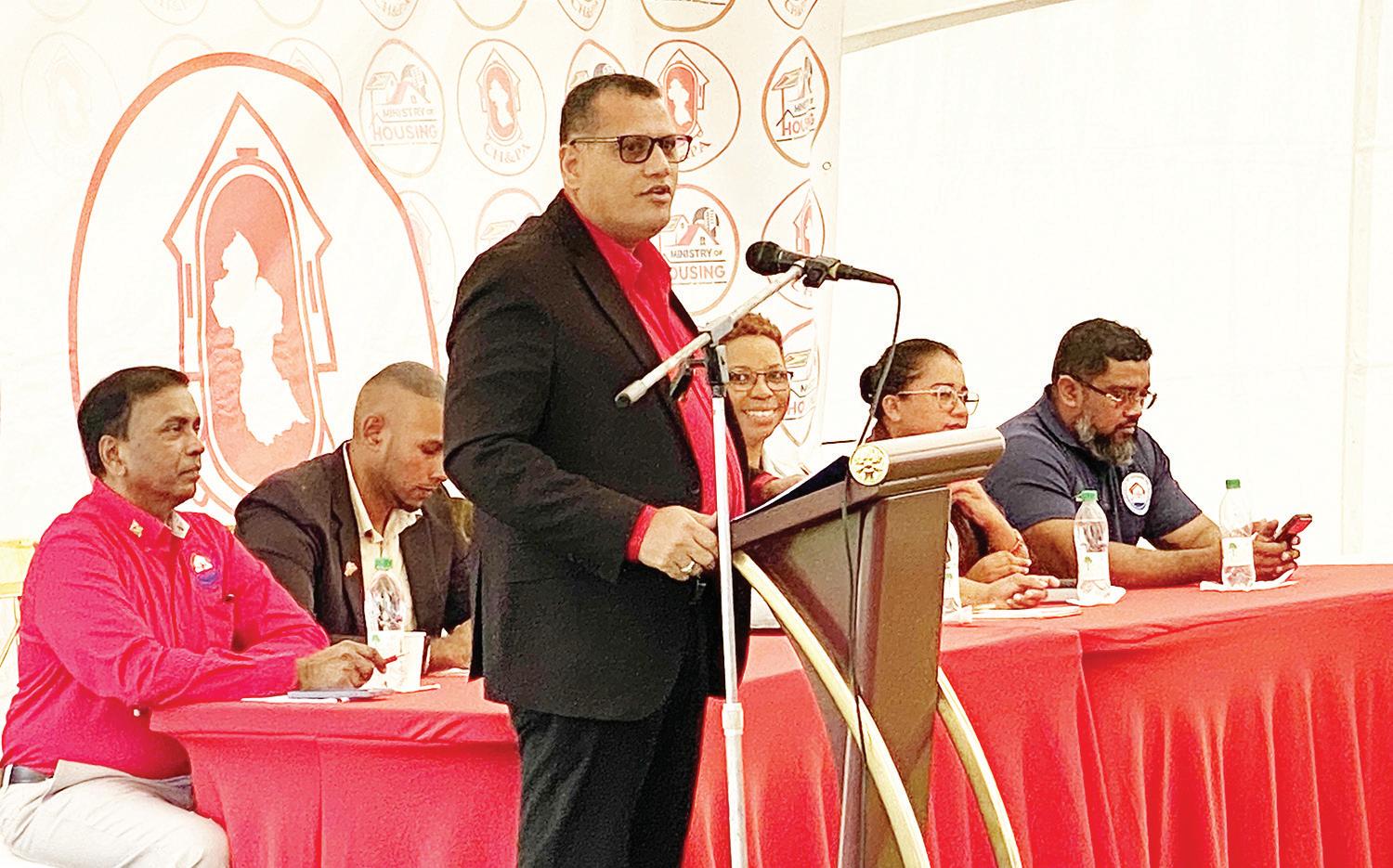
EIGHTY-FIVE Essequibians were all smiles on Friday as they received the ownership document for plots of land at Onderneeming Phase Four, marking another milestone in the government’s efforts to clear outstanding housing issues.
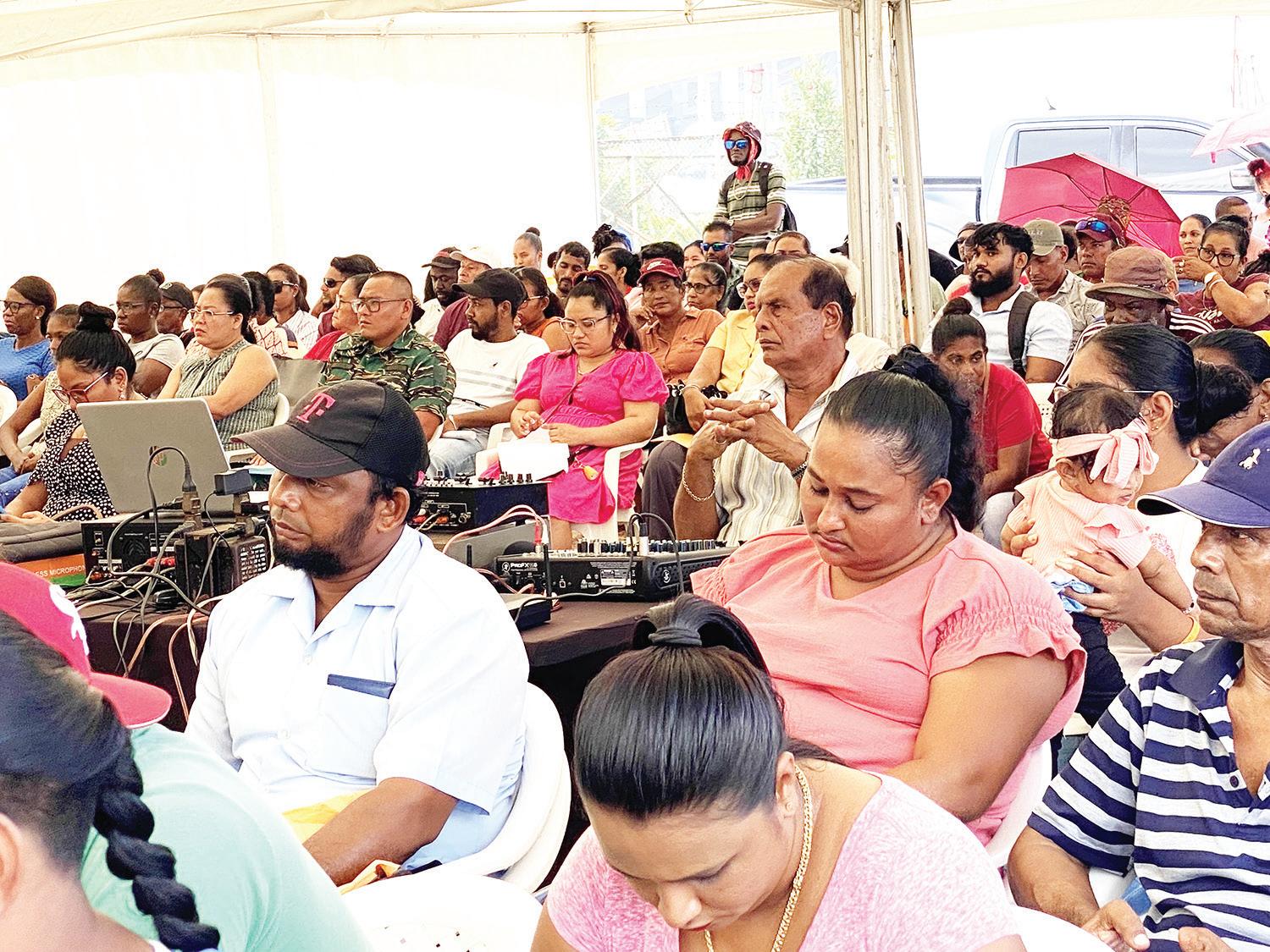
The documents were presented by Minister of Housing and Water, Collin Croal, during a housing outreach held on the lawns of the Regional Housing Office at the Takuba Lodge Compound, Anna Regina.
Minister Croal explained that the outreach formed part of the ministry’s follow-up activities, which aim to resolve outstanding housing matters across the country.
He noted that, to date, approximately 50,000 house lots have been allocated out of a backlog of 75,000 applications, adding that Region Two has a relatively smaller volume of applications.
He further announced that the government is embarking on the construction of a minimum of 40,000 houses nationwide over a five-year period.
Initiatives such as Men on Mission were highlighted as key support mechanisms for persons who are unable to complete their homes or require assistance with repairs through subsidies or material support. He said that the ministry also has similar programmes and subsidies that are offered to persons.
According to Minister Croal, once the national budget is presented, direct assistance for home construction and upgrades as outlined in the government’s manifesto will be rolled out.
He also underscored
— Minister Croal says Region Two’s housing application backlog being steadily cleared
special programmes targeting hinterland residents, single women, and youth, noting that persons as young as 22 years old are now being allocated house lots, an opportunity that was previously unheard of.
The minister also referenced ongoing infrastructural works in Region Two that are being executed through the National Drainage and Irrigation Authority (NDIA). These include drainage channels and structures in Charity.
He added that issues raised during the previous outreach, particularly relating to title processing, were investigated and addressed.
Areas currently benefitting from house lot allocations include Charity, Onderneeming, and Hoff Van Aurich, with new lands being opened up at Hoff Van Aurich.
Minister Croal also revealed that the ministry will soon commence block housing construction at Onderneeming and Hoff Van Aurich, targeting moderate-income earners and young professionals, as part of its efforts to decentralise housing services.
Meanwhile, Minister within the Ministry of Housing, Vanessa Benn,
assured residents that Cabinet remains committed to addressing issues beyond housing, including land allocation, access to building materials, and settlement concerns.
She reaffirmed the government’s focus on national development and pledged that the PPP/C Administration will continue to deliver for the people.
“We must ensure that contractors deliver houses in a timely and efficient manner. Efficiency is key,” Minister Benn emphasised. Further, Permanent Secretary Bishram Kuppen stated that the ministry is fully committed to delivering results, noting that multiple departments are working collaboratively to address housing issues as the government
moves towards its goal of constructing 40,000 homes.
CEO of the Central Housing and Planning Authority (CH&PA), Dr. Martin Pertab, in his remarks, noted in addition to the construction of 40 houses, the ministry’s plans include eliminating informal settlements and fully addressing housing backlogs.
He noted that more than $800 billion has been earmarked to tackle these challenges, including expanding subsidy programmes for steel and cement and improving the overall quality of life for citizens. Essequibo, he stressed, remains a key part of this national housing drive.
Also addressing residents was Regional Chairman Devin Mohan, who described the outreach as people-centred and reflective of the massive transformation taking place under the current government.
Many of the resident could not contain their emotions after collecting their land ownership document.
“I am so happy for my title, and I am glad it didn't take long. Thanks to the government for such speed in issuing title,” one resident said.
Certificates of Title are vital legal documents that establish bona fide ownership of land. They are also commonly used as collateral at financial institutions, enabling beneficiaries to secure residential mortgages for home construction. The issuance of these documents plays a critical role in increasing occupancy and accelerating development within new housing schemes.
He said the regional administration remains committed to addressing residents’ concerns and expressed satisfaction with the growing number of homeowners in Region Two.
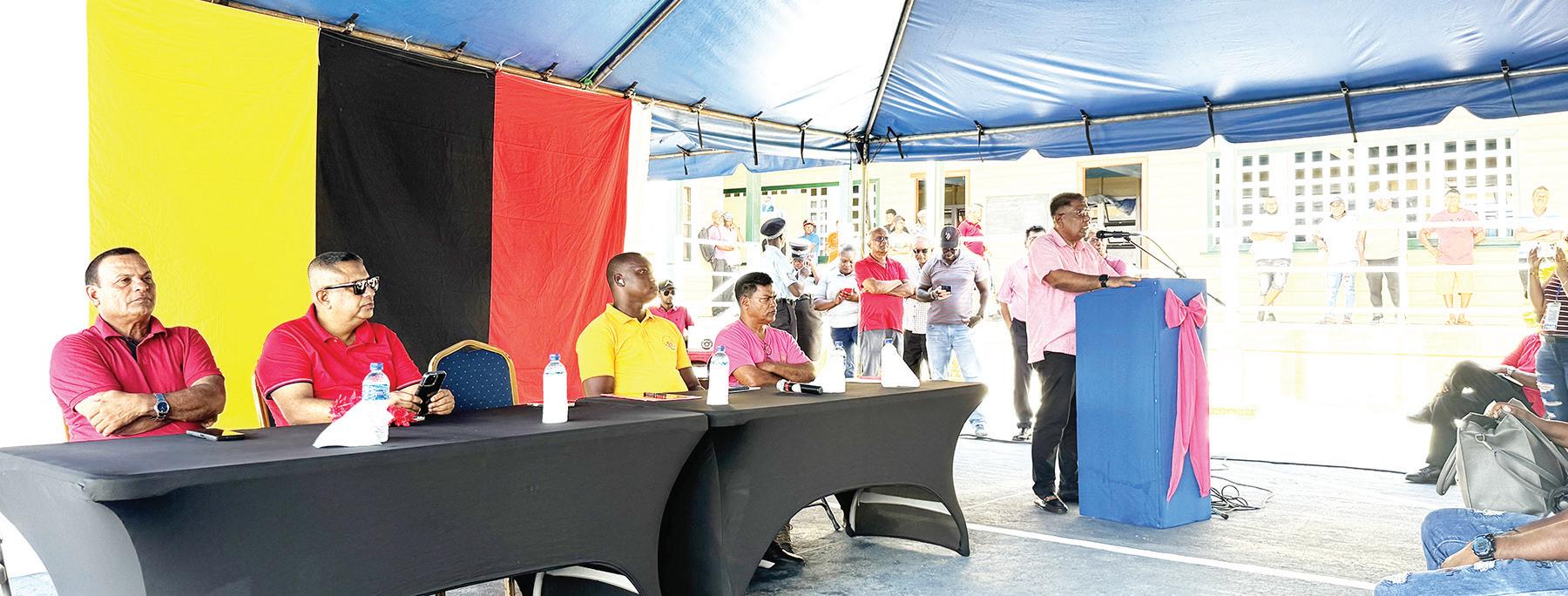
Minister of Housing, Collin Croal, addresses residents during an outreach at Anna Regina on Friday
R3PSInc welcomes Yas School launch as milestone for inclusive development in Region Three
THE commissioning of the Yas School of Inspiration at Crane, West Coast Demerara, on Thursday, has been welcomed by Head of the Region Three Private Sector Inc. (R3PSInc.), Halim Khan, as a major milestone in inclusive development and a clear reflection of President Dr. Irfaan Ali’s commitment to ensuring that no child is left behind.
Khan said the initiative, which was driven by President Ali’s education and social inclusion agenda, also underscores the PPP/C Government’s sustained investment in building a more equitable and modern education system, one that serves every child, including those with special needs.
The school, which will provide specialised education for children with disabilities, was funded through a partnership between the Government of Guyana and the United Arab Emirates (UAE). It was formally commissioned by President Ali in the presence of First Lady
Arya Ali, Cabinet members, educators, parents and community stakeholders.
“This project represents the practical expression of the President’s vision that no child must be left behind,”
Khan said. “It also demonstrates the PPP/C Government’s clear and consistent commitment to developing the education sector in a way that is inclusive, compassionate and forward-looking.”
He added that the facility reflects the kind of people-centred development that Region Three has long been advocating for—growth that improves infrastructure while directly expanding opportunity for families and vulnerable groups.
“This is the type of initiative that changes lives in real ways,” Khan said. “As a region, we are not only seeing economic growth, but also the expansion of services that ensure every citizen, including children with special needs, has a fair chance to reach their potential.”
Khan noted that the pri-
vate sector in Region Three stands ready to support complementary initiatives, including skills training, community services and employment pathways, to ensure that inclusive education translates into long-term social and economic participation.
The Yas School of Inspiration, located at Crane, is designed to cater for about 50 learners and forms part of the government’s broader strategy to create an “ecosystem of care” for children with differing abilities. It also complements the recently commissioned $130 million state-of-the-art call and business centre for Persons with Disabilities (PWD) at Palmyra, Region Six, which is expected to create opportunities for hundreds of citizens.
Addressing the commissioning ceremony, President Ali said the new school demonstrates what can be achieved when international solidarity is paired with national commitment and a clear development philosophy that puts people first.
“We are here because of these children,” the Head of State said. “Through these walls, they will now have access to world-class facilities—facilities that would enable them to be the best they can be. That is what the Government of the UAE and the Government of Guyana value: creating institutions that ensure people can be the best they can be.”
The President outlined several measures to ensure the school’s smooth start-up, including specialised staff training, enhanced security arrangements, and free, dedicated transportation for students.
He also announced that a parent-led governance model will be established, with a board comprised of parents to oversee and manage the school’s operations. Teacher placements are being finalised, and on-site activities are expected to begin within two weeks.
Khan said these operational commitments show that the project is not sym-
bolic, but part of a serious, long-term investment in inclusive education.
“Inclusive development only works when the systems are properly resourced and managed. The focus on governance, staffing and transport shows this is being treated as a serious and sustainable initiative,” he said.
President Ali also described the project as a product of diplomacy and shared values, stressing that the Guyana–UAE partnership is forward-looking and rooted in mutual respect and shared development goals.
For Khan and the Region Three Private Sector Inc., the Crane facility also signals
the region’s growing role in Guyana’s national development agenda.
“Region Three is increasingly becoming a hub not only for economic activity, but for social investment and innovation,” Khan said. “Projects like this remind us that development must always be measured by how many lives we improve, not just by how many buildings we put up.”
He said R3PSInc. will continue to advocate for policies and partnerships that align economic growth with social responsibility, ensuring that the benefits of development are shared across all communities.
Region Six fishermen say cash grant a timely boost
By Bebi Shafeah Oosman
FISHERFOLK in Region
Six have lauded the government’s $150,000 cash grant describing it as a timely and much-needed intervention that will bring significant relief to them and their families.
Many said the grant comes at a critical time, helping to ease financial pressures, support household expenses, and offset the costs associated with fishing activities, including fuel, equipment, and boat maintenance.
A total of 1,704 fisherfolk in Region Six benefitted from the $255.6 million investment in the regional fishing sector, which is part of a wider $1.5 billion national payout to fisherfolk across Guyana.
The announcement was reinforced last Saturday during distribution exercises at Albion, Corentyne, and the Number 66, Corentyne Co-op, where Minister of Agriculture Zulfikar Mustapha described the initiative as another clear demonstration of the People’s Progressive Party/ Civic (PPP/C) government delivering on commitments
made to working people.
Minister Mustapha said that between 2020 and 2025, every major promise made by President, Dr Irfaan Ali has been honoured, with sustained support to fisherfolk remaining a priority area.
“We recognise the important role that you are playing. We recognise that you are risking your life to bring in catches. Without you, the country can’t have enough food, and we recognise that effort,” the minister said.
Chairman of the Upper Corentyne Fishermen Coop, Parmeshwar Jainarine told the Guyana Chronicle on Friday that the grant was very much welcomed.
“We really thank the government for it and it come in at a right time because remember boats come in for the holiday. A lot of us money been done on the holidays and it come in nice.”
According to him, fishermen used the grant they received for number of things.
“Some people look after them homes, couple will buy scooter for them children move around, ac-
and the concerns of those persons were noted.
“We had the exercise at the landing sites for months and we encouraged fishermen to sign up but some of them, genuine fisherman, didn’t listen. So now we trying to see if we can lobby for them.”
Some of the beneficiaries noted that the assistance demonstrates the government’s continued commitment to supporting the livelihoods of fisherfolk, who play a vital role in food security and the regional economy.
tually a lot of them boys buy scooter. Couple say them bank it and put it up for hard time.”
Meanwhile, Jainarine also used the opportunity to call on fishermen to ensure they are registered so that they can benefit from similar grants.
He said a few fishermen have indicated that they did not receive the grant and explained to this publication that those persons did not register even though that process was going for more than a week. He said that there was a complaint desk during the distribution
They expressed gratitude for the initiative, adding that the grant will not only help sustain their operations but also provide greater stability for their families during challenging economic conditions.
Boodram of Number 54 Village, Corentyne, said the cash grant will provide a much-needed opportunity to reinvest in his fishing operation, particularly to better support his work at sea.
“This cash grant will help to invest back in the business to help out at sea, so we feel good about it,” he stated, expressing ap-
preciation for the timely assistance.
Meanwhile, Dan Valentine of Rose Hall Town, Corentyne, praised President Dr. Irfaan Ali for the initiative, noting that the support will have a meaningful impact on his household. “I really like what the President is doing, because the grant that he is sharing will really help us out. I have a wife and two daughters, and it will help us a lot,” Valentine said.
He added that his happiness extends beyond his own benefit, noting, “I’m not glad for myself alone, I’m glad for everyone who received it too.”
A young fisherman from Albion, Corentyne, also welcomed the initiative, explaining that he intends to reinvest the funds into a small business to supplement his income. He said the grant provides a valuable opportunity to diversify his earnings and build greater financial security for the future.
Edward [only name given] a 25-year-old of Albion, Corentyne, said the grant will provide meaningful support in managing his household expenses. “I
plan to buy lil groceries and help run my house. I live with my parents, and I’m so glad for that,” he said.
Eighteen-year-old Ernest Bob also welcomed the initiative, noting that it is his first time receiving such support. “I really like to thank the President for giving us this fishing cash grant. It’s my first time, and it really helped me out,” he said.
Josephine Ramroop expressed happiness over the government’s intervention, describing it as a significant form of support for fisherfolk. “I feel happy to know our government can give us such great help. I am very happy,” she added.
Vishana Dookie, from Yakusari, Black Bush Polder thanked President Ali and expressed hope that the assistance will continue.
Shahadat Khan, of Islington Village, who has been a fisherman for the last twenty five years stated, “This grant will help me a lot. This grant will help me to buy my wood and put it down for my pen. I will like to thank the govenrment and President for this initiative.”
More Region Two residents benefit from cement and steel subsidy
THE dream of homeownership in Region Two took a major step forward as an additional 55 residents received vouchers under the Central Housing and Planning Authority’s (CH&PA) cement and steel subsidy programme, during the Ministry of Housing’s first major outreach of the year in the region.
The event, held at Anna Regina, was led by Minister of Housing, Collin Croal, Minister within the Ministry, Vanessa Benn, and CHPA CEO, Dr. Martin Pertab. It attracted hundreds of residents, including Permanent Secretary Bishram Kuppen, Regional Chairman Devin Mohan, Parliamentarian Sonia Latchman,
and other regional representatives.
The voucher programme is designed to assist firsttime homeowners in offsetting rising construction costs, giving many beneficiaries the boost needed to move their building projects forward.
Ms. Samantha (only name given), one of the
recipients, expressed her gratitude, stating that the support would immediately go toward purchasing materials. She encouraged other landowners to take advantage of such opportunities.
In addition to the subsidy distribution, the outreach provided a comprehensive housing services hub, including the issuance
of Certificates of Title and the allocation of new house lots to eligible applicants. Staff from the Legal, Surveys, Accounts, Community Development, and Land Administration departments worked alongside regional housing officers to address concerns and resolve pending matters on the spot.
Minister Croal emphasised the government’s ongoing commitment to making homeownership accessible and affordable. By bringing services directly to the region, the ministry aims to reduce bureaucratic hurdles and accelerate residential development across the country.
Minister of Housing, Collin Croal and Minister within the Ministry, Vanessa Benn, on Friday, distributed cement and steel vouchers to 55 Region Two landowners during an outreach at Anna Regina
PM receives update on CEGEB project from World Bank team
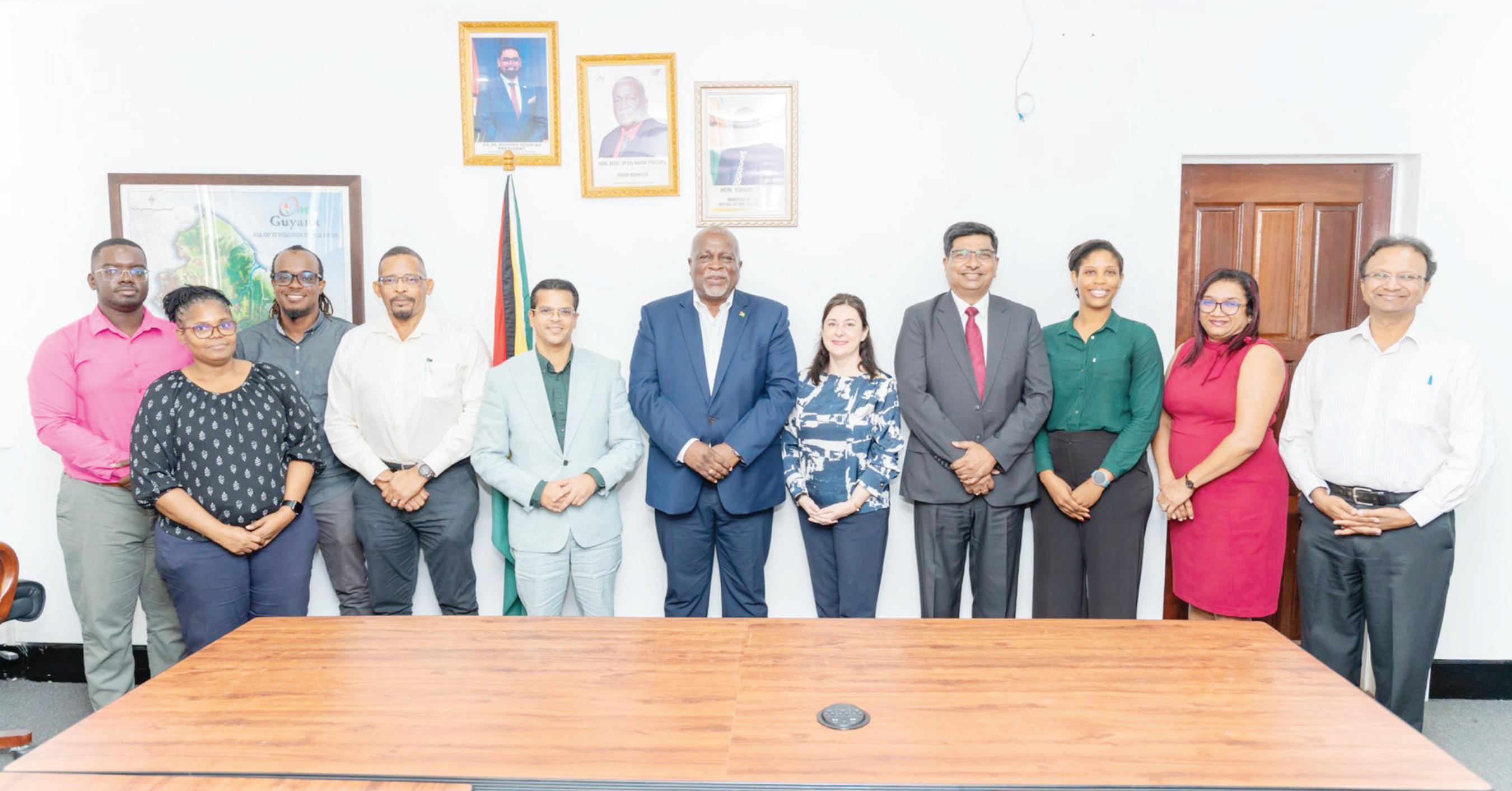
During a meeting with members of the World Bank Mission Team, Prime Minister, Brigadier (Ret’d) Mark Phillips, was briefed on the ongoing implementation of the Caribbean Efficient and Green-Energy Buildings (CEGEB) Project, which aims to reduce dependence on imported fossil fuels and support a resilient, affordable, low-carbon future. Representatives from Guyana Energy Agency and the Ministry of Finance were also present (Photos: OPM/Facebook)
PRIME Minister, Brigadier (Ret’d) Mark Phillips, met with representatives of the World Bank Mission Team on Wednesday at the Office of the Prime Minister on Camp Street, where he received an update on the ongoing implementation of the Caribbean Efficient and Green-Energy Buildings (CEGEB) Project, under which Guyana is an active participating country. The delegation was led by World Bank Group Resident Representative for Guyana and Suriname, Ms Diletta Doretti, and comprised of Senior Energy Specialist, Mr Ashok Sarkar; Energy Specialist, Ms Rochelle Johnson; Senior Social De-
velopment Specialist, Mr Sanjay Agarwal, and Programme Assistant, Ms Angel Bhojedat.
Prime Minister Phillips, who holds responsibility for the nation’s energy sector, was briefed by the team on Guyana’s participation on the CEGEB project, which aims to reduce dependence on imported fossil fuels and support a resilient, affordable, low-carbon future.
The Prime Minister was also updated on the project's financing framework, which represents a total investment of US$38.6 million supported by the World Bank through the International Development Association (IDA).
During the meeting,
discussions focused on reviewing progress achieved since the project’s commencement in 2025, and the next phases of activities under the initiative, including utility-focused technical assistance to support Guyana Power and Light Inc (GPL) in strengthening system efficiency and readiness for renewable energy integration
In Guyana, the project is targeting approximately 259 public buildings across Regions Three, Four, Five, Six and 10 with a focus on reducing energy consumption and increasing the deployment of renewable energy systems across the public sector.
Prime Minister Phillips reaffirmed Guy -
ana’s commitment to the pursuit of a low-carbon energy future, with renewable energy serving as a key component. He further emphasised that the project aligns directly with Guyana’s development priorities under the Low Carbon Development Strategy (LCDS) 2030 and complements ongoing national efforts to expand renewable energy generation, including the Government’s ambitious target of adding 100 megawatts of renewable energy capacity over the next five years.
Ms Doretti, in her remarks, reiterated the institution’s openness to continued partnership with Guyana. She noted that collaboration extends beyond financ-
ing to include technical expertise in support of the country’s energy transition efforts.
The regulatory and institutional strengthening component, which supports the development and implementation of frameworks to encourage green energy investments, was also discussed. This includes the establishment of energy performance standards, net billing arrangements for solar power, and policies to facilitate the integration of electric vehicles and charging infrastructure.
Significantly, capacity-building and gender inclusion, which form key elements of the project, were also discussed. Chief Executive Officer of the Guyana Energy Agency, Dr Ma-
hender Sharma, reported that 20 women have been engaged as part of a Female Apprenticeship Programme, financed by the Canada Clean Energy and Forest Climate Facility (CCEFCF) with additional support from the World Bank’s Energy Sector Management Assistance Program (ESMAP). He noted that training is being facilitated by the Ministry of Labour’s Board of Industrial Training unit as part of a two-year curriculum in electrical installations and solar photovoltaic technology. Representatives from Guyana Energy Agency and the Ministry of Finance were also at the meeting. (OPM)
ENGAGE 2.0 builds on first year of success
- environmental sustainability, green entrepreneurship, job readiness to be key areas of focus
By Faith Greene
RECOVER Guyana’s ENGAGE Project was officially launched Friday at the Ramada Princess Hotel, East Bank Demerara, with a focus on environmental sustainability, green entrepreneurship, and job readiness in Regions Two and Four.
ENGAGE supports youth-led green enterprises, and equips young people with the skills, confidence, and resources to create sustainable livelihoods while at the same time, contributing to a greener, more resilient, and prosperous Guyana.
When ENGAGE was launched in 2024, it was done with the simple belief that with the right skills, guidance and opportunity, young people will rise.
Through the first run of ENGAGE, Recover Guyana worked with 100 youths in Regions Three and Six, equipping them with practical green skills, financial knowledge, and entrepreneurial support.
They grew confidence, and their ideas took shape, with real opportunities emerging, whether it was through employment, in -
ternships, or the launch of small green enterprises.
ENGAGE 2.0 is set to build directly on that success. This next phase, according to the First Vice-President of Recover Guyana, Dr. Omesh Balmacoon, expands the programme to regions two and four, and provides some $2 million in grant funding.
“Just as it did in the pilot to support youth-led green businesses, participants will receive hands-on training in eco-friendly technologies, sustainable agriculture, and green entrepreneurship, along with mentorship that extends well beyond the classroom,” Dr. Balmacoon said.
Moreover, he remarked that the goal is to not just train, but to provide real, lasting pathways to sustainable livelihoods.
Dr. Balmacoon added that Recover Guyana remains committed as an organisation to investing in our youth, supporting innovation, and promoting environmental stewardship.
Together with their partners, Recover Guyana intends to continue to create opportunities that allow participants to lead, inno -
vate, and to help shape a sustainable future for their communities, and by extension, our country.
During the pilot phase in Regions Three and Six, 100 youth participants were trained in eco-friendly technologies such as hydroponics, composting, recycling, and renewable energy, while at the same time, they received entrepreneurial training, financial literacy, job readiness support, and professional mentorship.
Within six months, almost half of the participants had already launched their businesses while others successfully submitted business profiles to their Neighbourhood Democratic Councils (NDCs) for employment.
Second Vice-President, Mrs. Naudya Hoosein stated that many of the participants were able to secure jobs, internships, and advance professionally within a year.
One of the most tangible demonstrations of impact, she highlighted, was the distribution of $2 million dollars in business grants, which was awarded to outstanding youths with viable green business ideas.
For ENGAGE 2.0, Recover Guyana aims to deep-
en its impact in Region Three, while also extending opportunities to Regions Two and Four, reaching urban, peri-urban and rural communities across Guyana.
It will begin with a refresher business clinic for original participants, ensuring sustainability, growth and continuity.
The expectation is set, that 180 youths across the three regions to complete this programme, new green businesses to be launched, sustainable jobs to be secured, and environmentally responsible practices to take root in communities.
“We expect young people to become leaders, mentoring peers, supporting each other, and contributing meaningfully to Guyana's green economy. But more than numbers, we expect transformation. We expect youth who lack the opportunity to find direction and become innovators, entrepreneurs, and environmental stewards,” Mrs. Hoosein said.
Meanwhile the Country Manager of Scotia Bank Guyana - the corporate partner of Recover Guyana on the ENGAGE Project -
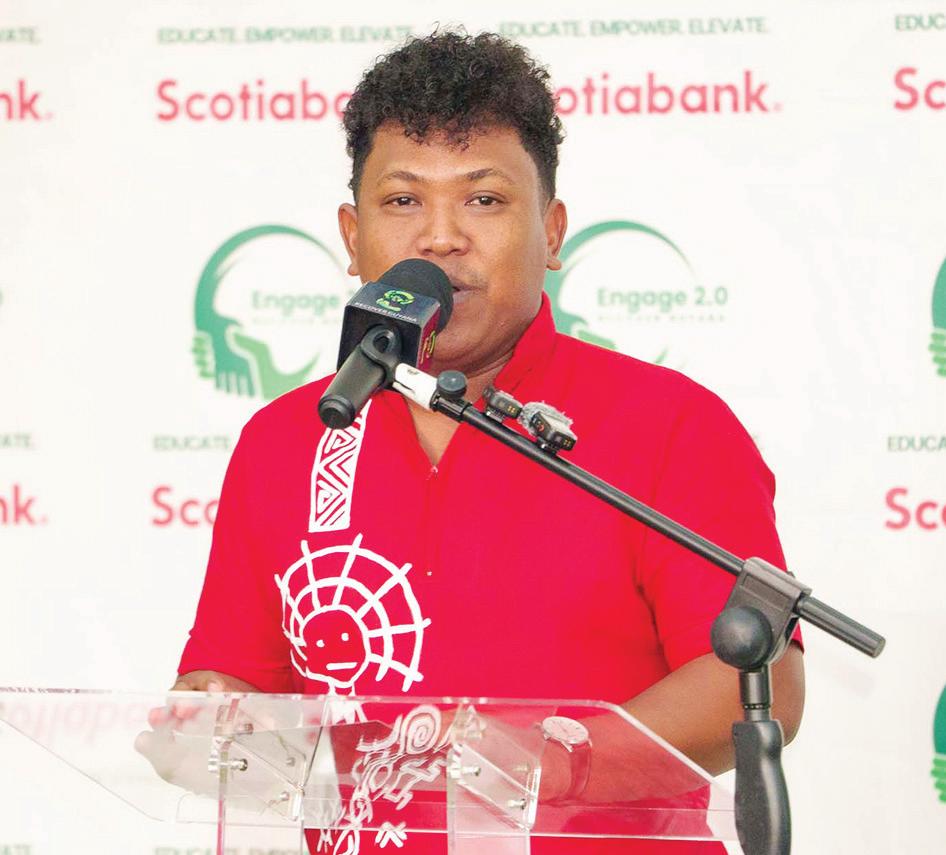
Calvin Roberts, a participant of ENGAGE 1.0, shares his experience during the launch of ENGAGE 2.0, Recover Guyana’s youth empowerment initiative focused on environmental sustainability, green entrepreneurship, and job readiness (Recover Guyana photos)
Nafeeza Gaffoor, said the bank is proud to continue its collaboration with Recover Guyana, building on the partnership that started in 2024.
According to Gaffoor, the programme delivered tangible outcomes in its first run, adding that the results of the project reaffirm Scotia Bank’s decision to support the initiative then, and why it is proud to do so again.
“Our involvement in
ENGAGE is guided by Scotia Rise, Scotiabank's global community investment and social impact strategy. Scotia Rise focuses on strengthening economic resilience by removing barriers that prevent disadvantaged groups from fully realising their potential, particularly in the areas of education, employment and financial inclusion. ENGAGE fits squarely within these priorities,” she said.
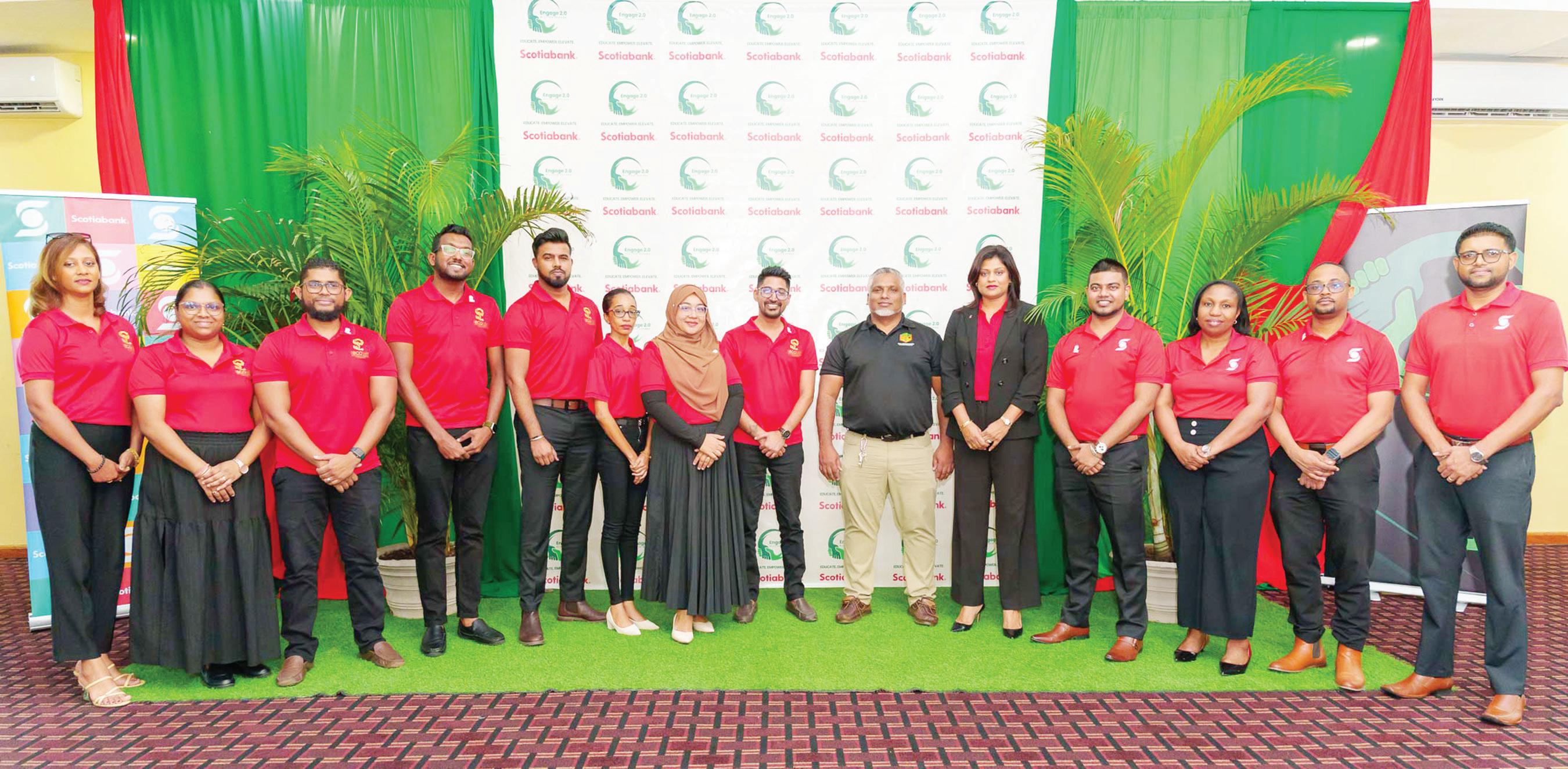
Recover Guyana and Scotiabank Guyana officially launch ENGAGE 2.0, marking the next phase in empowering young entrepreneurs and promoting environmental sustainability in Guyana
Wales white sugar refinery set to boost Guyana’s regional competitiveness
GUYANA’S sugar industry will see a real turnaround in the next few years, with the introduction of the white sugar refinery that is being built at the former Wales Sugar Estate in Region Three, according to Gaico Construction’s Chief Executive Officer, Dr. Komal Singh.
Dr. Singh, Chair of the Guyana Shipping Association, shared this view during a recent online broadcast of ‘The Guyana Dialogue.’
According to previous reports, this project, which is being developed by Gaico Inc. in partnership with U.S. company, Sucro, is set to boost the local sugar industry and strengthen regional supply chain.
Sucro has developed similar facilities in the region, including the
Caribbean Sugar Refinery and the Santander Sugar in Belize. When it becomes operational, the plant is slated to create a dedicated, reliable market for sugar that is produced by the Guyana Sugar Corporation (GuySuCo), producing approximately 100,000 tonnes of white sugar.
Dr. Singh said that as an investor, he sees this as an equal opportunity, adding that it is hoped that in another two years, GuySuCo will have a turnaround to satisfy this demand fully.
Belize, a country that has similar weather and soil to
Guyana, is producing 76,000-tonnes of sugar annually.
“They can afford to produce it very competitively; they’re 100 percent mechanised. They even have a cogen system, where they sell extra energy that they have,” Dr. Singh stated, adding that we
can mirror that practice here.
“GuySuCo has an opportunity here right now to work with the guys out of Belize; they’re willing to work with them. We’ve had meetings with them, they were here. We’re hoping that within the next month or so, we can see GuySuCo people visiting Belize and start to try and work in collaboration with them,” he disclosed.
Dr. Singh remarked that looking at the trends in the world market, the demand for white sugar continues to grow from a consumer standpoint, against the brown sugar. He noted that the price for white sugar is stable.
With this, he posited that because of what is happening now,
GuySuCo has a more guaranteed future. He emphasised that ongoing work is focused on ensuring the entity’s profitability.
The entire project costs around US$20 million and is expected to generate around 75 jobs during the construction phase, with an additional 60 permanent jobs when operations commence.
This noble venture will aid in the reduction of the Caribbean’s dependence on imported refined sugar. The development forms part of continued efforts to revitalise the former Wales Sugar Estate, which has been earmarked for major agro-industrial investments since the closure of sugar operations at the estate in 2017.
IPED marks 40 years with celebratory activities
AS the Institute of Private Enterprise Development (IPED) marks 40 years of service in Guyana, Business Development and Marketing Manager, Robert Williams, on Friday, unveiled a series of activities to showcase the entity’s work.
According to him, these activities highlight how the institute has been transforming lives and the impact it has had on the Guyanese society.
Williams told the Guyana Chronicle that recently, they signed a loan agreement with the Inter-American Development Bank (IDB) to further expand their services.
He stated that their vision is about entrepreneurship, sustainability, growth and business and as such all efforts are made to provide vital financing to Guyanese who want to start a small business but do not qualify for a bank loan.
Among the anniversary activities was a recently held Business Pitching Competition which attracted 39 persons. They pitched their ideas with the hope of securing financing. The prize-giving ceremony for this competition is set for April 2, 2026. He emphasised that IPED
Robert Williams, IPED’s Business Development and Marketing Manager
has no role in the judging process. As part of efforts to remove bias and ensure transparency, persons from Action Coach and the Centre for Local
Business Development are being used as judges.
The IPED official added that individuals were tasked with making their business pitch in keeping with a list of criteria. This had to be done in person before the judges.
He emphasised the funds the winners receive must be used for business activities only.
“We expect them to sign up for the enhancement of their businesses. IPED, based on different levels, we will be providing business guidance and support for one year to six months. So, we will insert ourselves into their businesses and they can come to us, and we can analyse their businesses
to help them to build records and so on. Even though they are not clients of ours we are helping them to build their businesses,” he said while being interviewed at IPED’s South Road head office.
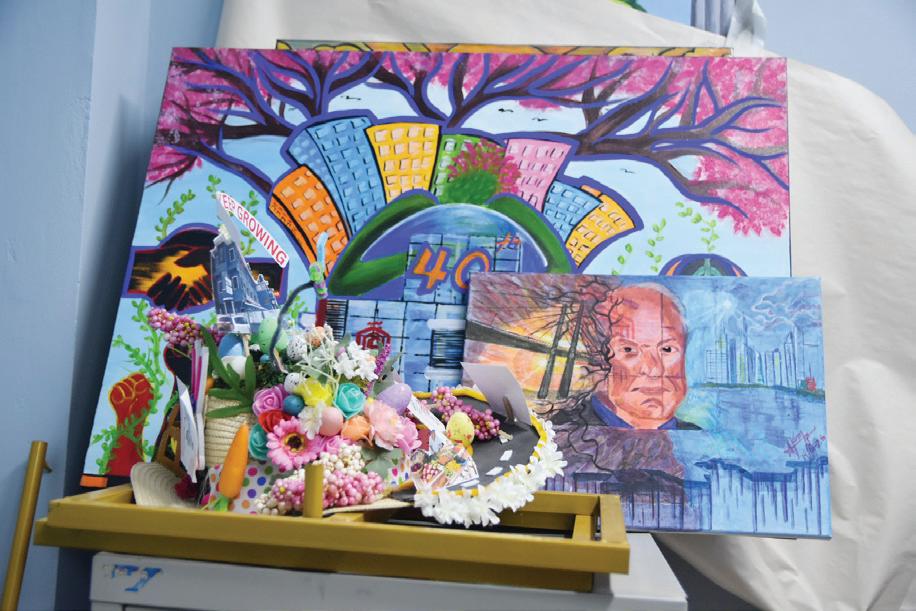
Meanwhile, IPED also launched an Art Competition as part of its anniversary activities. Participants were expected to depict IPED’s journey over the past 40 years under a given theme.
Art specialists from Burrowes School of Arts will now review the submissions and choose a winner.
Williams noted that IPED plans to give the 45 participants an opportunity to sell their work at the upcoming
two-day Micro Conference.
This event, which is the highlight of the anniversary celebrations, is slated for March 19 to 20, 2026 at the Pegasus Hotel.
During the conference, IPED will be reflecting on its journey in Guyana while honouring clients and staff. It will also be the ideal platform for the dissemination of information regarding micro financing and how one can access it.
Williams pointed out that while a wide spectrum of professionals will be in attendance, the focus will be on real-life testimonials.
Additionally, a micro exposition will be held on March 18 and 19 on Main Street, giving
20 persons an opportunity to showcase their businesses and services.
IPED Guyana is a non-profit organisation established in 1985 to empower Guyanese entrepreneurs by providing micro-financing, technical support, and business guidance to build sustainable micro and small enterprises. The organisation’s work also includes helping to improve livelihoods and foster economic self-reliance, particularly for women and vulnerable groups. It acts as a developmental lender and capacity builder, offering loans and training to help individuals start or grow businesses across all ten regions of Guyana.
ENGLISH RACING TIPS
ASCOT
08:25 hrs Winston Junior
09:00 hrs The Jukebox Kid
09:40 hrs La Conquiere
10:20 hrs Vincenzo
10:55 hrs Came From Nowhere 11:30 hrs Il Etait Temps
12:05 hrs La Guana Beach
HAYDOCK
08:15 hrs Throatlash
08:50 hrs Caballo De Guerra
09:25 hrs Old Park Star
10:00 hrs Konfusion
10:35 hrs Solar Dystem
11:10 hrs Judical Deference 11:45 hrs Kykorock
LINGFIELD
08:05 hrs Girl Of Gold
08:40 hrs Zoulu Chief
09:15 hrs Sky Safari
09:55 hrs Jungle Fever
10:30 hrs Watermelon
Sugar 11:05 hrs East Tyrone 11:40 hrs Tommy’s Promise
IRISH RACING TIPS NAVAN
08:10 hrs Lazare De Star
08:46 hrs Court Compliance
09:20 hrs Son Of Anarchy
09:50 hrs Shellrunforbriggs
10:25 hrs Slade Steel
11:00 hrs Made In The Woods 11:35 hrs The Irish Avatar
SOUTH AFRICA RACING DURBANVILLE
09:20 hrs Born Of Fire
09:50 hrs Volegov
10:25 hrs Xtines Princess
11:00 hrs Kelp Forest
11:35 hrs Hunga Tonga
12:10 hrs Lady Look Alike 12:45 hrs Man Of Consequence
AMERICAN RACING TIPS
Race 1 Confabulation Race 2 Three B’s Race 3 Off Script Race 4 Trust Fund Race 5 Mr Tipple
Sammy eyes ‘bright light’ for Sampson in future West Indies plans
WEST Indies head coach Daren Sammy has hailed all-rounder Quentin Sampson as a “bright light” for the future, naming the 25-yearold as a key inclusion for the upcoming Twenty20 International series against Afghanistan in India.
Sampson, a powerful middle-order hitter and seamer, earned his maiden call-up following a breakout 2025 Caribbean Premier League (CPL) campaign.
His rise marks a significant transition from the local tapeball and softball circuits of Caria Caria, a riverain community in Essequibo, to the international stage.
“I am looking forward to him; he is one of the bright lights that shone [in the CPL],” Sammy told Cricket West Indies media ahead of preparation in India.
“He is definitely one for the future, and I am looking forward to seeing what he does at the international level.”
The three-match series, which begins on Jan. 19, serves as the final selection checkpoint before the West Indies announce their T20 World Cup squad, hosted by India and Sri Lanka from Feb. 7.
Despite missing several established stars, Sam -
Saturday, January 17th, 2026
CUMMINGS ELECTRICAL COMPANY LTD83 Garnett Street, Georgetown (Tel: 225-6158)
Answers to yesterday’s quiz: (1) 2016 (2) Shimron Hetmyer
Today’s Quiz: (1) Which team competed with the WI Under 19 side when we won the title? (2) Who was voted Man of the Match?
Answers in tomorrow’s issue.
my said the tour is “critical preparation” to finalise tactical roles and test the depth of his squad on spin-friendly sub-continental tracks.
“We are focused on the specific roles that need to be filled within our tactical blueprint,” Sammy said. “The youth infusion is part of a broader strategy to build a versatile squad capable of adapting to the conditions we expect.”
Following the Afghanistan series, the West Indies are expected to travel to South Africa for three preparatory matches before returning to the subcontinent for the World Cup.
Director of sport mourns loss of former GBBFF president
DIRECTOR of Sport, Steve Ninvalle, has joined the local sporting fraternity in mourning the passing of former President of the Guyana Bodybuilding and Fitness Federation (GBBFF), Donald Sinclair, who died on Thursday evening after losing his battle to cancer.
In offering condolences, Ninvalle paid glowing tribute to Sinclair’s contribution to sport, describing him as an innovative and forward-thinking administrator whose leadership helped position bodybuilding among the top sports in Guyana during his tenure.
“Donald Sinclair was innovative in his approach to the governance of sport and played a critical role in placing bodybuilding at the forefront of Guyana’s sporting landscape,” Ninvalle said. According to Ninvalle, Sinclair’s vision, structure and commitment elevated the sport locally and regionally, and his impact will be felt for generations.
Ninvalle further noted that Sinclair’s influence extended well beyond bodybuilding, highlighting his willingness to work closely with other disciplines in a personal capacity to assist with improving both on-field performance and administrative systems.
“He was always ready to share his knowledge and experience,” Ninvalle added.
“Whether it was helping athletes improve their performance or guiding associations on governance and administration, Sinclair gave freely of his time and expertise for the betterment of sport,” the Director of Sport noted.
Sinclair was a towering figure in both sport and tourism in Guyana.
Widely regarded as one of the country’s leading tourism experts, he served in several capacities within the tourism sector, where his vision and commitment helped advance Guyana’s profile as a destination for sport and leisure.
Within bodybuilding, Sinclair leaves behind a legacy of dedicated and transformative leadership. He is remembered as one of the longest-serving presidents of the GBBFF, during which time he played a pivotal role in elevating the sport.
Among his most notable achievements was being instrumental in Guyana hosting the Central American and Caribbean (CAC) Bodybuilding Championships for the first time in 2004.
Sinclair was also the owner of the Fitness Paradise Gym, which became a hub for athlete development across multiple disciplines and a strong symbol of his advocacy for healthy living. He was known for his unwavering support of athletes and his consistent push for sports associations to embrace sports tourism as a pathway to growth.
Ninvalle stated that Sinclair’s passing represents a significant loss to Guyana’s sporting and tourism communities.
Current and past GBBFF praise Sinclair as icon of sports in Guyana
PRESIDENT of the Guyana Body Building and Fitness Federation
Roger Callender has expressed their condolences on the passing of Donald Sinclair, a former president and stalwart in the sports arena.
Callender says Sinclair “Was instrumental in bodybuilding and fitness for a number of years, helping to inspire so many athletes and pushing the sport either it is bodybuilding, fitness, health, he advocated for so many thing and inspire so many people and behalf of the Guyana bodybuilding and fitness and all the athletes we send condolences to the family and all his loved ones.”
Meanwhile former longtime sports administrator and attorney at law Keavon Bess says it is a profound loss.” Bess, also a former GBBFF President said, “He was indeed an icon for bodybuilding, and a lot of the old athletes would have fond memories of the different parts he played in the development and evolution of bodybuilding in Guyana especially as it relates to the fitness component of bodybuilding and fitness. His death is a loss for sure from the fraternity because we have lost a source of knowledge, we had access to relative to the administration of the sport and
relative to the development of athletes.”
Bess said he hopes it brings the family comfort that ‘Donald’ has touched so many lives and had a unique impact on sports people.
“His walk on this earth was not in vain in fact it was highly appreciated by the many lives it has touched through sports, academia and his decades of contribution to the tourism industry, so my condolences to his family friend and loved ones.”
Sinclair was head of the Guyana Bodybuilding and fitness federation and event hosted his own bodybuilding show dubbed ‘Flex Night’ for several years.
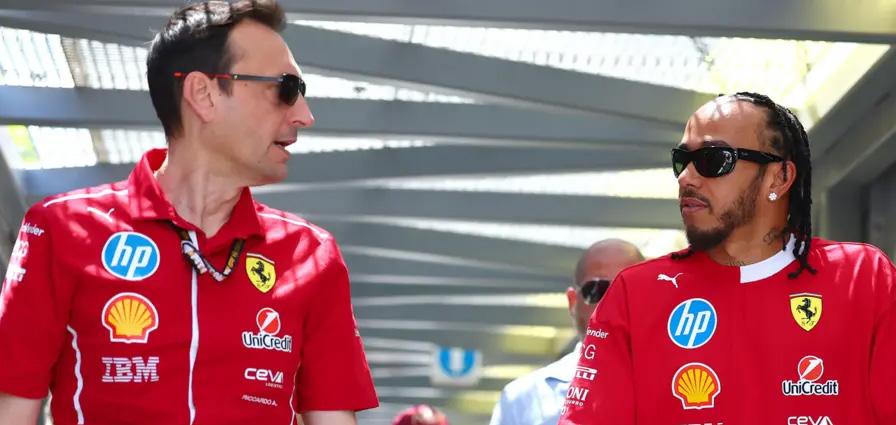
Adami moved to new Ferrari role as Hamilton gets new Engineer
LEWIS Hamilton’s race engineer from the 2025 Formula 1 season has been moved to a new role at Ferrari.
Riccardo Adami will take over as manager of the Ferrari driver academy and their programme for testing previous cars.
A Ferrari statement made no reference to Hamilton by name, saying only: “The appointment of the new race engineer for car number 44 will be announced in due course.”
The move comes after consistent speculation throughout the 2025 campaign there were communication problems between Hamilton and Adami.
Hamilton, 41, always denied that was the case and insisted their relationship was fine, despite the impression left by a number of their conversations over team radio.
The relationship with their race engineer is one of the most important for any driver.
The engineer is the person the driver talks to over the radio from the car, they decide together on changes to improve a car’s performance and at times the role is as much a counsellor as colleague.
Before joining Ferrari, Hamilton worked with one engineer at Mercedes - Peter Bonnington - for all his 12 years at the team.
Seven-time champion Hamilton had a difficult first season at Ferrari and spoke a number of times of his belief changes were needed within the organisation, without specifying what they were.
Ferrari’s statement added: “[Adami’s] extensive trackside experience and Formula 1 expertise contributes to the development of future talent and to strengthening performance culture across the programme.”
Testing previous cars programmes have become important within F1 as ways of giving young drivers experience, with in-season testing in current cars heavily restricted.
Hamilton was outperformed by team-mate Charles Leclerc during his first season at Ferrari.
The Briton finished one place and 84 points behind Leclerc in the championship and was beaten by the Monegasque 22 times to seven in qualifying at an average advantage of 0.15 seconds a lap. Leclerc’s average grid position was 5.6 while Hamilton’s was 9.5.
Hamilton was knocked out in the first session of qualifying for the final three races of the season.
At the final race of the year in Abu Dhabi there was an apparently awkward between Hamilton and Adami, when the Briton told his engineer not to inform him who was ahead of him on track.
Having been advised the car in front was Sauber’s Gabriel Bortoleto, Hamilton responded: “Stop telling me I’m racing people. I know I’m racing him, man. Just leave me to it. I’m racing everyone ahead of me.”
Adami previously worked with both Carlos Sainz and Sebastian Vettel - and had an at-times strained relationship with the German.
There were a number of times during the 2017-18 season, when Ferrari had a competitive car but let their title hopes slip away with a series of mistakes, when Vettel ran out of patience with the team’s race operations.
Sainz also questioned the team’s strategy choices on a number of occasions during his four years at Ferrari.
Riccardo Adami (left) and Lewis Hamilton had numerous awkward radio conversations in 2025
Caribbean Boxing Organisation/Pro Am Card
Declou looking past fight with Amsterdam
By Joe Chapman
NATIONAL middleweight champion
Edmond DeClou is confident that he will be victorious against his opponent Desmond Amsterdam when they square-off in a six-rounder eliminator clash next Saturday night, to launch the first Pro/Am card of the newly formed Caribbean Boxing Organisation (CBO).
The Card, a promotion of the newly formed CBO which is headed by Guyanese Seon Bristol will be held in collaboration with local boxing Bris-O Promotions at the Cliff Anderson Sports Hall.
This past week DeClou, who has 20 victories with five losses in his professional career, under the tutelage of coach Orlan ‘Pocket’ Rogers, has been working out at the ‘Inspire Fitness By Kevin’s’ gym in Blueberry Hill in Wismar, Linden.
This Amsterdam’s second fight after winning his first professional bout, following an outstanding amateur career representing Guyana at several international tournaments.
The proud Linden boxer, currently Guyana’s national middleweight champion, who holds also the CABOFFE Middleweight championship belt, is coming off a second-round knockout loss to Saint Vincent and The Grenadines boxer Keithland King.
They met for the FECABOX Super middleweight title in Barbados on 25th October last year.
He blames that loss to not being fully prepared, while cornerman Rogers offered that DeClou had problems with his weight and was ‘punished’ after “barely having breakfast, and not being able to eat before the weigh-in,” which was just about two hours before that fight.
Further, DeClou was adamant that he
would not lose consecutive fights, saying “If I lose two fights in a stretch, I would quit boxing…. No matter what, I am not losing that fight next week Saturday against Amsterdam.”
Looking ahead of this clash, DeClou said he wants to fight on the Dharry Promotion’s card next month with the hope of getting revenge against Barbadian King. Rogers said that preparations are going smoothly for DeClou who does road work in the mornings and has been getting into shape at the Fitness Gym in Wismar. He said that DeClou is at about 75 to 80 per cent ready for this Amsterdam fight and will be in top shape as the clock winds down.
IKO Guyana Academy efforts bearing fruit at Hope Secondary
THE International Karate Organisation (IKO) Guyana Academy schools programme is bearing fruit according to sensei Swabrien Khan who’s in charge of the club at Hope Secondary.
She says the programme is having an impact on the youths at the school.
“We are going into our third year as a karate club and I must say that karate has helped to enhance our student discipline and focus, we have 66 current member of the club and it is growing every day we are also proud to be part of the 48 schools that are part of the Guyana national cadet core who are also partnering with IKO Guyana Academy to have karate done in schools.
Khan says that the school’s facility also served students of neighboring schools.
“You will see students of Hope Secondary and Golden Grove Secondary at training that is part of our ongoing partnership focusing on the president initiative sports in schools and also his commitment to the IKO Guyana Academy…… the president would have committed to Hope Secondary that he would have enhance the training facility, so very soon we are going to be having a resurfaced tarmac for students to train on and a shaded area for them to practice.”
She said they partnership has been beneficial “We are very happy to be in partnership with IKO as well as being proud to continue develop Guyana’s youth and we are taking the president inatatives seriously , we want to
Walsh to be Zimbabwe bowling coach
(ESPNCRICINFO) - Courtney Walsh will be Zimbabwe’s bowling consultant for the upcoming T20 World Cup. A Zimbabwe Cricket (ZC) statement said Walsh had already begun working with the squad. Walsh, the West Indies great who was the first man to take 500 Test wickets, has previously served as specialist bowling coach for Bangladesh men and as head coach with West Indies women. In 2024, he was also a technical consultant with the Zimbabwe women’s team.
“I think we have a very good chance once we execute well and work together as a team and adapt to the conditions,” Walsh said after
his appointment. “The combination of the attack has impressed me from watching and the potential that’s within the team.”
Zimbabwe’s bowling attack in their T20 World Cup squad, under Sikandar Raza’s captaincy, includes Blessing Muzarabani, Richard Ngarava and Tinotenda Maposa as their quicks. Brad Evans and Tashinga Musekiwa are the seam-bowling allrounders. Their spinners, Wellington Masakadza, Graeme Cremer and Raza, form an experienced pack.
ZC managing director Givemore Makoni said Walsh’s appointment aimed at harnessing his “ability to mentor” the bowlers.
“As we prepare for the ICC Men’s T20
World Cup, it was important for us to bring in someone who understands what it takes to succeed on the global stage,” Makoni said. “Courtney’s knowledge, professionalism and ability to mentor players will be invaluable as we sharpen our bowling resources for the challenges ahead.”
Zimbabwe are in Group B at the T20 World Cup, alongside Australia, Ireland, Oman and tournament co-hosts Sri Lanka. All four of Zimbabwe’s group games are in Sri Lanka across three venues, two in Colombo and one in Pallekele. They return to the tournament after failing to qualify for the 2024 edition.
produce healthy students who become better citizens.”
When the IKO Guyana Academy held their club championship Hope secondary’s growth was evident as they clinched the top club prize after dominating the competition.
President Irfaan Ali had pledged financial support to purchase training mats as well as provide infrastructural upgrades at the School, such as outfitted the area with basketball, badminton, and tennis facilities to support youth development. The president’s office has collaborated with the local karate body to run off their Karate in Schools programme around the country.
The academy has developed structured cluster karate training across key regions, including Annandale Secondary, Golden Grove Secondary, President’s College, and Bygeval Secondary in Region Four; Abram Zuil Secondary, Aurora Secondary, Cotton Field Secondary, and Charity Secondary in Region Two; McKenzie High, Linden Foundation Secondary, Harmony Secondary, and New Silver City Secondary in Region 10; and North Ruimveldt Secondary along with other schools in Georgetown.
IKO- Academy Guyana is led by Sensei Jeffrey Wong who is also Vice President of Dojo development for the USA headquartered International Karate Organisation.
Wong is working closely with Ministry of Culture Youth and Sport to ensure successful implementation.
Courtney Walsh during his stint with Bangladesh men • Getty Images
Students during the training session at Hope Secondary
Edmond DeClou
Donald Sinclair
Quentin Samspon made a mark a the Breakout Player of CPL 2025
Sensei Jeffrey Wong during a demonstration with a karateka