




By Keri White CEG CORRESPONDENT
Gross Dam in Boulder County, Colorado, is undergoing a $565 million expansion, with the dam’s height being raised to nearly triple the Gross Reservoir’s capacity from 42,000 acre-ft. to 119,000 acre-ft.
The Gross Reservoir serves the Front Range region of the Denver Metropolitan area along the Interstate 25 corridor, which includes the cities of Denver, Boulder and Fort Collins. The entire Denver Water system supplies 1.5 million people.
The dam’s expansion is key to Denver Water’s long-term supply plan.
Historically, there has been an imbalance in the northsouth water reservoir systems, with 90 percent of the storage in the south system and only 10 percent in the north system where the Gross Reservoir is located. This disparity leaves the water supply vulnerable — if there is a failure in the south system, the north system doesn’t have a sufficient water storage capacity to supply the entire region.
The expansion is designed to mitigate that risk and foster a greater resilience in the face of climate-related events or other catastrophes.
In addition, the expansion will enable the system to capture water during wet seasons and reserve it for future use. Before this improvement, excess water runoff flowed out of the area. As a dry, drought-prone region, Colorado was surrendering a precious resource.
Originally built in the 1950s, the Gross Dam was always intended to be a three-phase project, with raises implemented over time by the system’s needs.
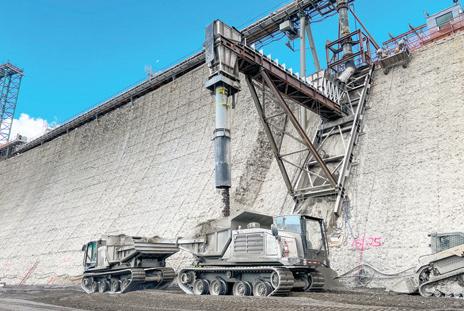
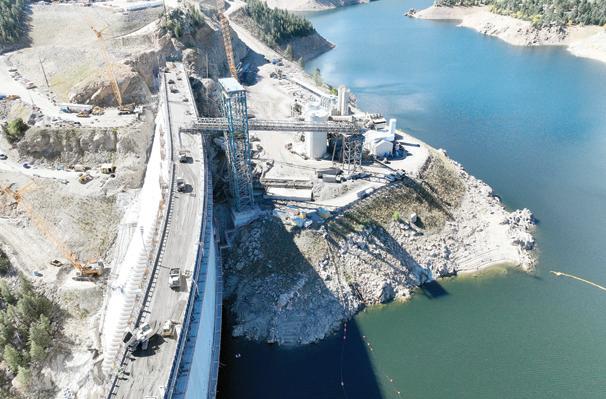
This current phase involves building 118 concrete steps, which raises the dam by 131 ft. The expansion brings the dam’s full height to 471 ft., the width to 2,000 ft. and makes the Gross Dam the highest in Colorado. This is the largest dam raise project in the United States to date., according to Denver Water.
Kiewit Corp. and Barnard Construction Co. formed a joint
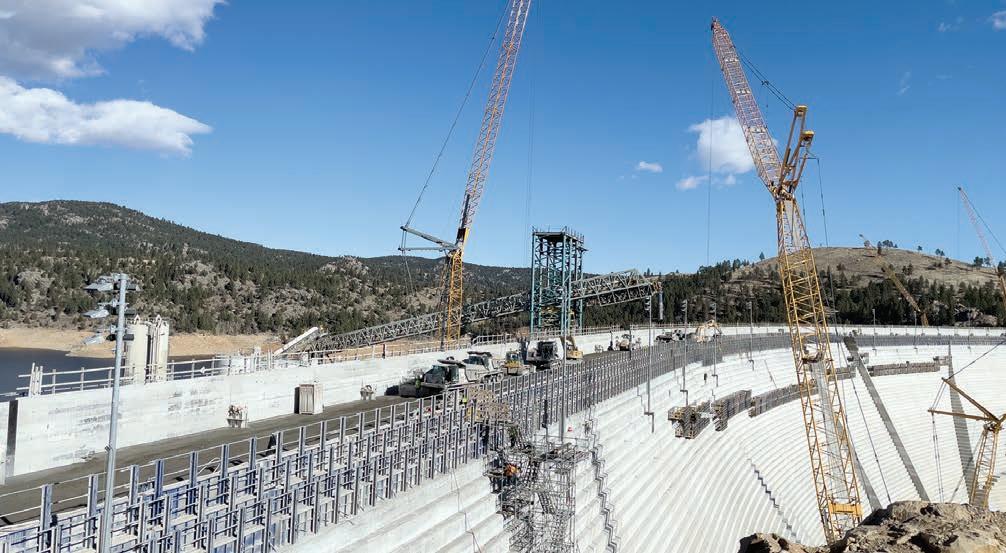
Gross Dam was raised to 7,398 ft. before stopping for the winter, an addition of 109 ft. atop the
venture to complete the project. The construction process is complex and involved an enormous amount of material and work, highlighted by these numbers:
• 2 million tons of aggregate processing
• 230,000 sq. ft. of hydro-demolition
• 1 million cu. yds. of site excavation
• 90,000 cu. yds. of conventional concrete
• 23,000 sq. ft. of wire saw demolition
The raised dam will be steeper than the original version. Its base will span 300 ft., and the top narrows to just 25 ft. Each of the 118 steps is 4-ft. tall and 2-ft. wide.
see DAM page 6



Elk, pronghorn, mule deer, black bears, mountain lions and a variety of other species are now able to cross the Interstate 25 Greenland wildlife overpass near Larkspur, which is North America’s largest wildlife overpass.
In December 2025, the Colorado Department of Transportation (CDOT) completed construction of the structure, including covering the overpass surface with dirt and vegetation. The project was completed in less than a year, ahead of schedule and on budget.
This overpass spans six lanes of interstate traffic, connecting 39,000 acres of habitat on both sides of I-25 between Larkspur and Monument.
“Colorado is leading the way in reducing wildlife-vehicle collisions, and improving safety for both our motorists and wildlife,” said Colorado Gov. Jared Polis. “The I-25 Greenland wildlife overpass is a momentous feat, in our continued work to expand safe transportation options for both humans and wildlife, protecting critical habitat and our amazing outdoor spaces for generations to come.”
“The I-25 Greenland wildlife overpass is critical to the safety of both wildlife and motorists,” said Shoshana Lew, CDOT executive director. “The overpass is an essential component of the wildlife crossing system in this area, which is expected to reduce wildlife-vehicle crashes by 90 percent.”
The overpass is strategically located to address the 3.7-mi. gap from other wildlife crossings and completes the wildlife crossing system of underpasses and fencing as a part of the I25 South Gap project — which improved 18 mi. of I-25 from Castle Rock to Monument. Before the system was built, there was an average of one wildlife-vehicle crash a day in the fall and spring wildlife movement seasons. CDOT’s research shows that the five underpasses are successfully being used by large and small mammals.
However, the Greenland overpass was specifically designed and constructed to provide safe passage for elk and pronghorn. These species prefer wide open overpass structures.
The overpass location connects wildlife corridors and preserves open space with good proximity to water. The location also is a known area for high movement of large game.
A multi-agency partnership with the Federal Highway Administration, Colorado Parks and Wildlife, Douglas County, the Douglas Land Conservancy and the Colorado Cattleman’s Agricultural Land Trust made the Greenland wildlife crossing possible. A federal grant award provided the bulk of the funding for the project.
“In Douglas County, we take great pride in being responsible stewards of our resources — including our natural spaces and wildlife,” said Commissioner George Teal. “Since 1996, our county — in partnership with CDOT, Colorado Parks and Wildlife and FHWA — has been safeguarding the wildlife habitat along the I-25 corridor. ”
“After more than nine years of planning and work, Colorado Parks and Wildlife is excited for Colorado’s wildlife to utilize this overpass,” said Matt Martinez, CPW area wildlife manager. “In collaboration with our partners at CDOT, Douglas County, Douglas Land Conservancy and other stakeholders, wildlife overpasses and underpasses along I-25 will reconnect large tracts of open space along the southern Douglas County I-25 corridor.”
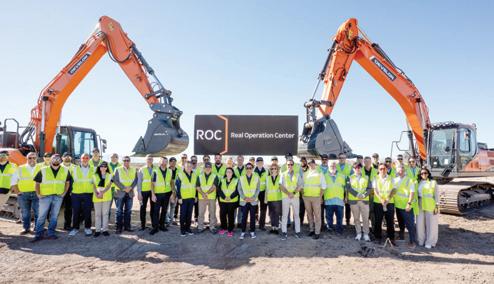
DEVELON has opened a new construction equipment training, testing and education facility called the HD Construction Equipment (HDCE) Real Operation Center (ROC) in Tucson, Ariz.
The facility replaces the previous testing and training center. It is adjacent to the Tucson International Airport and provides a convenient site to hold training sessions on advanced technologies, test the lineup of current and new DEVELON heavy and compact equipment and host dealer and customer events.
“For the past 15 years at our former facility, we hosted thousands of construction equipment owners, operators and dealer representatives for hands-on training, product testing and special events,” said Morgan Stallings, senior director of dealer development and marketing of DEVELON. “The new facility will build upon its success and support our North American dealers. It will have acres of open operation area where visitors can come year-round to see and feel what makes DEVELON machines different from other brands.”
DEVELON broke ground on the new facility in October 2024. While at the HDCE ROC, operators and sales teams will eventually be able to learn from experts in a classroom setting; a permanent building is planned for the site. As part of the planned building, there also will be service bays available for dealer training and maintenance purposes.
Visitors will get one-on-one time with DEVELON experts who will highlight key machine differences, describe key features and demonstrate innovations like the transpar-
DEVELON has opened a new construction equipment training, testing and education facility called the HD Construction Equipment Real Operation Center in Tucson, Ariz.
ent bucket and around view monitor (AVM) camera system.
“The training facility plays a key role in what we do,” said Armand Cencetti, vice president of sales of Best Line Equipment. “It helps our sales team get hands-on equipment experience and gives us a place to test machines and gather real data. And it lets us bring in customers to see and demo DEVELON equipment in person, building stronger, longstanding relationships along the way.”
For more information, visit develon-ce.com/en.
The Arizona Department of Transportation (ADOT) announced on Jan. 8, 2026, that is moving forward with the highest-ranking contractor for the State Route 347 Improvement Project south of the Phoenix metropolitan area.
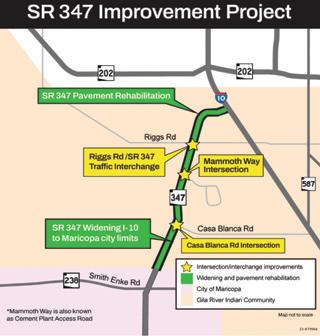
The project will improve a 15-mi. section of SR 347 between Interstate 10 and the city of Maricopa. This project corridor runs through Maricopa and Pinal counties and is primarily located within the Gila River Indian Community.
Sundt Construction was selected as the highest-ranking contractor after an extensive review process by the SR 347 Improvement Project team. Negotiations for the pre-construction services contract will begin next week and are expected to be finalized in February. This will allow Sundt’s construction team to provide valuable input into the ongoing design for the planned improvements.
The total amount programmed for the SR 347 Improvement Project is $396 million. The project’s funding
Arizona Department of Transportation graphic A map of the impacted area of State Route 347 in Arizona
includes money from the state of Arizona, the Maricopa Association of Governments, the city of Maricopa and Pinal County. There is no federal funding for this project.
In spring 2023, ADOT completed a safety study on SR 347 between I-10 and the northern city limits of Maricopa. The road safety assessment identified potential safety issues relat-
ed to roadway traffic and evaluated possible ways to improve safety for drivers. Interim improvements based on the assessment were completed in fall 2024.
The planned improvements include:
• adding one lane in each direction along SR 347 from I-10 to the city of Maricopa;
• rehabilitating the existing pavement along that same 15-mi. stretch of roadway;
• constructing new grade-separated interchanges at Riggs Road and Mammoth Way; and
• adding turn lanes and other intersection improvements at Casa Blanca Road and Maricopa Road.
Once complete, the SR 347 Improvement Project will provide added capacity, help alleviate congestion and improve safety and traffic flow along a busy stretch of roadway. Construction on the SR 347 Improvement Project is expected to begin in summer 2026 and take approximately three years to complete.
The Colorado Department of Transportation (CDOT), in partnership with SEMA Construction, has made major progress on the new Interstate 25 and U.S. 50B interchange in just one year of construction.
Construction on the $114 million I-25 and U.S. 50B interchange project began in December 2024.
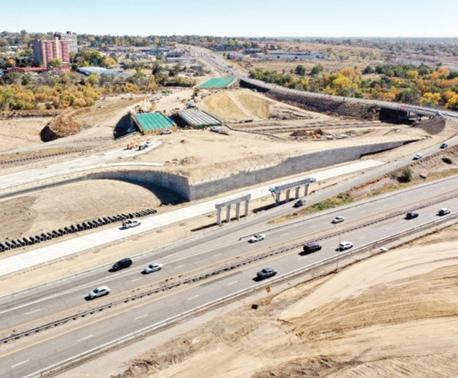
During construction, crews will build five new bridge structures; retaining and noise walls; roadway and ramp reconstruction; embankment; safety improvements; drainage; and erosion control. Once complete, the interchange will be just north of the current interchange and operate as a diverging diamond interchange to improve drivability and provide safer driving conditions for motorists. The project is scheduled for completion in early summer 2027.
earthwork to elevate the roadway to support bridge construction, moving 650,000 cu. yds. of soil, which could fill an Olympic swimming pool 200 times.
Colorado Department of Transportation photo
An aerial photo from west of the Interstate 25/U.S. 50B Interchange construction site in Pueblo
Closing out the first year of construction, the project is celebrating the key milestones with significant progress anticipated in 2026.
Accomplishments to date include:
Bridge construction: Crews have made significant progress on three of the five bridges under construction, including a new bridge over Fountain Creek and two new bridges over the Union Pacific Railroad. Crews have set 46 girders and installed 91 structural caissons, totaling 3,140 linear ft., which is three times as tall as the Eiffel Tower.
New pavement: Crews have placed 14,000 sq. yds. of concrete, equal to two NFL regulation football fields, to partially complete paving on the new northbound I25 collector-distributor road between U.S. 50B and 29th Street. This work required 450 truckloads of concrete.
Bridge and ramp demolition: To advance and facilitate construction, crews demolished the existing U.S. 50B bridge over I-25, and the southbound I-25 on- and off-ramps. Crews removed 600 tons of material, which is about five times the weight of a blue whale. Completing removal of the U.S. 50B bridge and southbound ramps demolition ahead of schedule improves the efficiency of each construction phase. It opens new work areas at an accelerated rate, allowing vital project elements to be completed ahead of time without affecting traffic later.
Embankment: Crews completed major
Local economy support: Thirty Pueblo natives are employed on the project.
Anticipate impacts to traffic through the remainder of the project as Phase 1 (the offline portion) comes to completion in early 2026. The remaining phases will require numerous traffic pattern changes to complete the project.
In February/March, crews plan to shift northbound I-25 traffic to the east and southbound I-25 traffic to the west to work on the construction of the new mainline I-25 alignment.
As bridge construction progresses, work will begin in spring 2026 on the remaining portion (the western half) of the new U.S. 50B over I-25 structure, which will require temporary closures of I-25 for girder placement and bridge deck pours.
Crews will continue constructing the new 29th Street on- and off-ramps, the I-25 collector-distributor roads and the northbound I-25 bypass road.
Construction on the sound wall adjacent to southbound I-25 between 29th Street and US 50B is scheduled to begin in early 2026.
Westbound U.S. 50B traffic will move to the new alignment just north of the old US 50B interchange as early as July 2026.
Eastbound U.S. 50B traffic will move to the new alignment toward the end of 2026 or the beginning of 2027.
The realignment of Chinook Lane will be completed in late spring or early summer 2026.





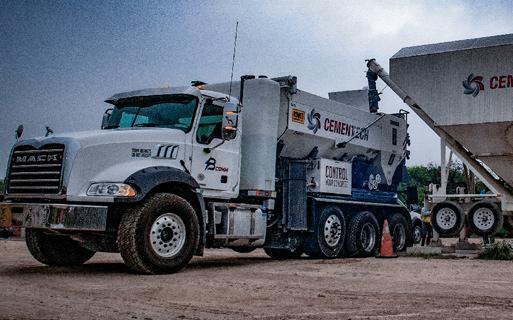



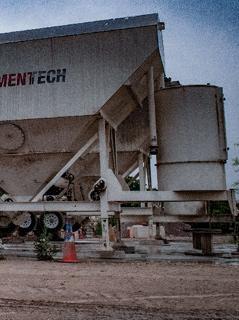




























The steps are comprised of roller-compacted concrete, which is being placed over the existing structure. This is considered an efficient method of installing concrete to accelerate the building process. The stepped design was essential during construction to support the trucks that held, transported and deposited the materials.
Bob Mahoney, Denver Water’s chief of engineering, discussed the project’s long-term impact.
“Four years of design, 20 years of permitting, three years of construction got us to the top of the existing dam,” he said. “This project is going to give more security and resiliency to Denver Water’s supply to serve our customers over many years to come.”
Casey Dick, deputy program manager of the Gross Reservoir Expansion Project, described the process.
“The way we are raising the height of the dam is by using roller-compacted concrete,” he said. “A critical part of the new construction is building the formwork. That’s the blue framing that is used to hold the concrete in place until it cures … The original structure was built as a curved gravity dam.
“Now, we are taking advantage of that curved geometry to create what’s called a thick arched dam in the center of the canyon. This arched style means the force of the water in the reservoir pushes up against the dam and into the canyon wall to give it its strength.”
The crews have set up a batch plant on site to make the concrete being used in the dam. They are employing a large conveyor system to transport the concrete from the batch plant to the dam. The engineers designed the delivery system to accommodate the incline as the dam rises gradually higher.
In addition to the 118-step rise, other key features are being added. Two walls up the middle of the dam
form a spillway channel, and thrust blocks were erected on the sides of the dam to provide additional support by extending the canyon walls upward to bolster the arched dam in the center.
Environmental concerns about the project were raised, including the loss of trees, depletion of the Upper Colorado River, urban sprawl and quarrying, which resulted in litigation. A judge issued an order to stop work in April of 2025 on the grounds of improper permitting, but the ruling was vacated, and construction resumed the following month.
To address ecological issues, the project includes a 5,000-acre-ft. environmental pool to increase stream flow and enhance the habitat for the flora and fauna in a 17-mi. long section of South Boulder Creek. It will be used to release water during low-flow periods to support fish populations.
“I understand the water storage requirements of the state need to be balanced with the environmental impacts the projects may have,” state Rep. Karen McCormick said. “I know that the project has experienced many hurdles, and I was glad to hear that Denver Water was able to come to an agreed upon resolution with the local residents and communities ...
“I had some hesitancy about the project early on, but learning about the alternatives and how this was the best plan to ensure water availability for Coloradans into the future and how Denver Water has worked through each hurdle, I now am fully supportive of the project. The increased water storage and recreational opportunities will benefit us all.”
Crews worked around the clock this fall to advance the project before winter weather made outdoor construction impossible.
Anticipated completion of the dam is expected in 2027. CEG
(All photos courtesy of Denver Water.)
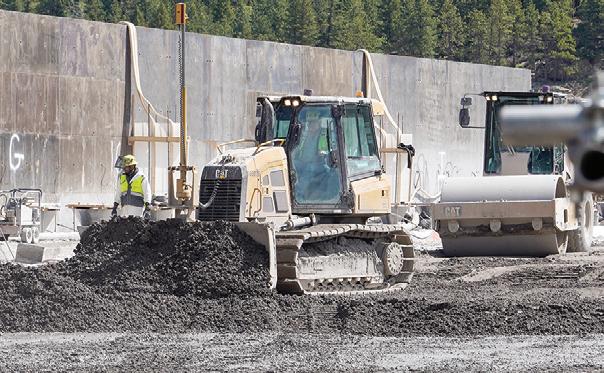
Several large Arizona Department of Transportation projects are set to get under way along Phoenix-area freeways in 2026, including the first projects funded under Proposition 479 approved by Maricopa County voters in 2024.
Substantial progress also will be made during the new year on two Proposition 400-funded widening projects along Loop 101 and Loop 202. Voters approved Proposition 400 in 2004. Here is ADOT’s overview of Valley freeway project heading into 2026:
• Loop 303 Improvement Project between Interstate 17 and 51st Avenue: This $129 million project scheduled to start by late January 2026 will add direct freeway-to-freeway ramps at the I-17/Loop 303 interchange in north Phoenix. Crews also will widen Loop 303 to three lanes in each direction from I-17 west to 51st Avenue.
It is the first project to be funded using Proposition 479 half-cent sales tax revenue
managed under the Maricopa Association of Governments (MAG) Regional Transportation Plan. It is scheduled to be completed in 2028.
• Loop 303 Widening Project (51st Avenue to Lake Pleasant Parkway): This is a separate project west of the larger project near I-17 that also will widen Loop 303 to three lanes in each direction and add other improvements. It also will be funded via the MAG Proposition 479 Regional Transportation Plan. Work is scheduled to start by fall 2026.
• Loop 101 (Pima Freeway) Widening Project (Shea Boulevard to Princess Drive): New north- and southbound lanes along 4.5 mi. of Loop 101 opened in November 2025 as part of this $108 million project in Scottsdale. Construction began in January 2024. Substantial completion is scheduled in early 2026.
• Loop 303 Improvement Project (Van Buren Street to Maricopa County
85): This project in the West Valley will construct Loop 303 along 4 mi. of the Cotton Lane corridor, providing three lanes in each direction between Van Buren Street and Lower Buckeye Road.
Crews also will build two lanes in each direction between Lower Buckeye Road and MC 85. Preconstruction work including utility relocation is currently under way. The four-year project is scheduled to start by mid-2026.
• Interstate 10/Loop 101 Interchange Improvement Project in the West Valley:
A new elevated bridge will be added to carry HOV lanes between the two freeways (to and from downtown Phoenix area). The project will widen both I-10 and Loop 101 near the existing interchange.
A separate ramp will be built to allow southbound Loop 101 drivers to make a direct connection to 91st Avenue south of I10. Work is expected to start spring 2026 and take approximately three years to com-
plete.
• Loop 101 (Agua Fria Freeway) Widening Project (I-17 to 75th Avenue): Crews will continue work to construct new lanes in each direction along 6.5 mi. of Loop 101 in the Northwest Valley. Other improvements are being made along freeway frontage roads.
Another southbound 75th Avenue turn lane to eastbound Loop 101 will be added. The $140 million project started in September 2024 and is scheduled for completion in spring 2027.
• Loop 202 (Santan Freeway) Widening Project (Loop 101 to Val Vista Drive): The $200 million project in Chandler and Gilbert is adding two lanes in each direction between Loop 101 and Gilbert Road. One lane in each direction will be added between Gilbert Road and Val Vista Drive. Freeway bridges are being widened. Work began in August 2024 and is scheduled for completion in spring 2027.















y ackast-tr can f tions and t solu our See how productivity technology our