MICHAEL MOORE says obstinate party members have set up opportunities for future independents
Stop the tram, it’s time for a rethink
MIKE QUIRK
Why is it hard to get a good snap
The Evil Scientist’s demise still sends a message ANTONIO DI DIO
FEBRUARY 5, 2026
ESCAPE with love
Win a romantic escape to the Southern Highlands for two
MEET OUR PAIN MANAGEMENT EXPERTS
Holly Hazelwood – Exercise Physiologist
Holly is a former sports journalist who believed so strongly in the power of exercise to heal and nurture that she undertook her 4 year degree in Exercise Physiology. Holly is be able to work with people directly to support them through their pain journey and regain independence and a joy for living again. Holly provides one on one and group exercise classes both on land and at our hydrotherapy centres to support people to gain freedom from chronic pain.
Sophie Bullock – Exercise Physiologist
Sophie has post graduate qualifications in hydrotherapy, and as a non-sports centred Exercise Physiologist, helps clients who struggle with engaging in exercise due to a lack of sports participation. Sophie’s goal is to improve clients health via our hydrotherapy program, gym instruction and in-home visits. Sophie also is known for her passion for working with children.
Nick van Diemen – Physiotherapist
Nick (they/them, he/him) has returned to Canberra after completing a Master’s in Physiotherapy at the University of Queensland. Their passion comes from a love of science and helping people. With eight years in disability support, Nick brings broad experience and enjoys working with clients across a wide range of needs.
Blake Dean – Exercise Physiologist
Blake has expertise in improving clients mobility and decreasing their pain through appropriate exercise. Blake delivers our ‘My Exercise’ program, targeting the relief of lower back and sciatic pain, shoulder and upper body concerns as well as leg, hip and ankle interventions – for those who do not qualify for physiotherapy-led GLAD programs. Blake provides individual & group exercise for younger people with a disability. Blake treats clients in-clinic or via our hydrotherapy program as well as attending your gym with you.
Sarah Solano – Exercise Physiologist
Sarah believes that exercise is the best medicine. She is an Accredited Exercise Physiologist with her degree in exercise physiology and rehabilitation. Previously Sarah was a swim teacher, personal trainer and an allied health assistant in the hydrotherapy field.
Natasha Elword – Exercise Scientist
Tash discovered her passion for exercise after completing her Certificate IV in Personal Training in 2015, later earning a Sport and Exercise Science degree from the University of Canberra. She joined Arthritis ACT in 2019 and now supports group classes, exercise programs and administration. Outside work, she enjoys family time, running, hiking and cooking.
• GLA:D® Program for hip and knee osteoarthritis.
• Education and supervised group sessions to build strength and confidence.
• Pain management strategies to reduce medication use Tailored support including preparation for or avoiding joint replacement.
NEWS / Little Moments Jewellery
Paris fashion takes a shine to silversmith Sarah
By Elizabeth KOVACS
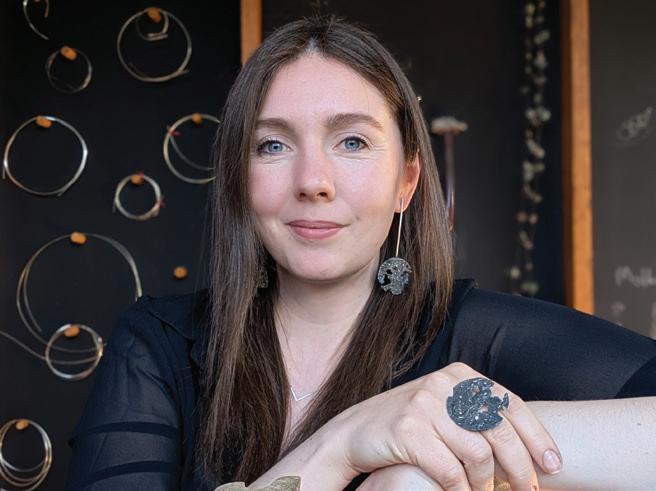
Silversmith Sarah James, knows what she wants in life. However, a surprise email from Paris threw her off guard, in the best way possible.
From a young age, Sarah has been interested in jewellery making.
Originally from Ungarie, NSW, she took a double degree in gold and silversmithing as well as psychology at the Australian National University
The 29-year-old runs her business, Little Moments Jewellery, part time, while working in the AttorneyGeneral’s Department in research and science full time.
“Having the two jobs together is a really beautiful balance for me, so I’d never want to just pick one,” she says.
However, Sarah’s business received a boost in public interest after she received an email, challenging her carefully crafted balance.
“[The email] said: ‘Hey Sarah, we’d love you to come to Paris Fashion Week with us, please apply’,” she says.
“I thought, ‘cool, spam’, and deleted it.
“Then they reached out again.”
She checked with other businesses
and brands who had previously attended the event.
“They were super helpful and I realised that it was a legitimate thing, so I applied, thinking I’d be rejected the first year, because I had no idea what I was doing,” she says.
“They accepted me in the first round.”
With decades of experience, Linda will help you create a Will and Estate plan stipulating all your wishes and concerns.
Linda assists with:
• Wills and Testamentary Wills
• Power of Attorney
• Self-managed super funds
• Advice on potential claims against estates
• Advice for blended families
Having recently moved back to Canberra, Sarah hadn’t set up her studio, nor did she have stock that would be appropriate for the early October show.
Specialising in minimalist jewellery, her first job was to upsize the pieces so they would show up on the runway.
General manager: Tracey Avery, tracey@citynews.com.au
Sales & marketing executives:
Damien Klemke, 0439 139001
Ashika Nambiar, 0425 149860
Lisa Clarke, 0413 590811
Editor: Ian Meikle, editor@citynews.com.au
Arts editor: Helen Musa, helen@citynews.com.au
Production manager: Janet Ewen
Graphic designer: Mona Ismail
Distribution manager: Penny McCarroll
Picking three of her collections to take with her, she says it was a busy few months in the lead up to Paris.
Out of the three collections (Molten, Coalescence and Coercive Control), she was particularly pleased to see Coercive Control making waves.
Inspired by her day job, she was attracted to the idea of raising awareness for coercive control (a pattern of behaviour used to control another person).
The Coercive Control collection features oxidised silver, something she had not previously worked with under her brand.
“I was a little worried, because my whole heart and brain had been in it for so long, but it was well received and encouraged conversations,” she says.
Featuring small bumps in texture, Sarah says her collection is a conversation starter, with the polish slowly returning to the blackened silver with each wear, symbolising the importance of speaking up and speaking wide about the topic.
“It wasn’t like anyone on the runway knew, until we spoke about it,” she says.
“It was nice to have [the conversations], but heartbreaking.”
The Paris debut wasn’t without its moments, with three pieces of her jewellery (two of which were one-ofa-kind) disappearing after the two
shows she had been featured in.
Despite her new global presence, she says it hasn’t ignited anything in her to grow bigger, instead finding peace and tranquillity in her Cook studio.
“I love selling worldwide, but I don’t want to leave my workshop,” she says.
“When you want to do it at that scale, you have to start getting other people to make your jewellery, and it very quickly becomes less ethical, worse quality, less personable, and it gets rid of the stuff that I like about what I do.
“Staying small is the goal.”
Primarily working in silver, Sarah uses offcuts from larger-scale jewellers, ensuring nothing is put to waste. Finding new ways to use the silver scraps in her collections is a challenge.
“It’s similar to writing something,” she says.
“Staring at a blank page is the worst part, but if someone gives you words, you can fit them together.”
Although Sarah can make any piece in gold, she prefers to work in more affordable silver.
“Part of why I enjoy making jewellery is making lifelong pieces, but at a more accessible point,” she says.
Far from being “special-occasion jewellery”, she says she aims to make pieces that are loved and “fidgeted with” daily.
Silversmith Sarah James models some of her creations… “I love selling worldwide, but I don’t want to leave my workshop.”
Photo: supplied
POLITICS / ‘least-worst’ decision making
‘Less relevant’ Greens opt for perfect over good
Ideologues in political parties drive for the perfect. This is often why they have joined a political party.
Aspirational goals have a place to set an agenda for a better world. However, they can become impossible commitments.
Despite best intentions, political reality is that our parliamentarians and their supporters most often are put in a position where they need to make the “least-worst” decision.
Once again, the Greens in the ACT have made themselves less relevant as they look for the “perfect”. While Australian Greens founder Bob Brown was urging them to show political maturity, the Greens party put the kibosh on any meaningful discussion with the Liberals.
In disempowering themselves, the ACT Greens have failed to support the mature approach of Shane Rattenbury, and have created opportunities for current and future independents.
In 2009 the Federal Greens’ vote against Labor’s emission trading scheme effectively shelving any seriously effective carbon pollution reduction scheme for years. The Greens argued that the scheme did not go far enough. With the wisdom of hindsight, the damage caused to efforts on climate change in Australia
under Meg Lees found compromise with John Howard allowing the introduction of the GST. The exemptions around basics such as fundamental food products allowed the implementation of the broader policy while protecting life’s basics. Howard did not allow the perfect to be the enemy of the good.
At the extreme, Bob Hawke’s 1987 campaign commitment “by 1990, no Australian child will be living in poverty” was always aspirational and impossible to deliver. Even by 2030 there will be many children living in poverty. No compromise meant Peter Dutton’s campaign on the very
In disempowering themselves, the ACT Greens have failed to support the mature approach of Shane Rattenbury, and have created opportunities for current and future independents.
conservative side of politics devastated the Liberal Party and effectively handed many moderate seats to the
The MLAs in the ACT are facing at least three more years of Labor in power. At what point are both the Liberals and the Greens going to step beyond seeking policy perfection?
Over the holiday period discussions between the leaders of the Greens and the Liberals made some progress towards closer co-operation. However, it seems some members of each party considered the discussions completely out of order. This is not surprising.
The diehard supporters both on the left and right of politics have joined their respective political parties with a clear agenda. The agenda is to differentiate themselves from the other side of politics and seek a solution that they believe will deliver a better government.
In this case a “better government” is one consistent with their own
ideology. Except that staying out of government means not being able to deliver at all.
Managing change in politics is difficult. Seven hundred years ago diplomat, philosopher and political commentator Niccolò Machiavelli argued in his treatise, The Prince: “It ought to be remembered that there is nothing more difficult to take in hand, more perilous to conduct, or more uncertain in its success, than to take the lead in the introduction of a new order of things”.
Change was difficult for the Medici Popes. It remains difficult for the leaders of political parties in the ACT. Specific interests pull the strings of all political parties. These are not only financial, but include ideology, personalities and personal agendas.
Ironically, since self-government in 1989, the ACT Legislative Assembly has proven it is capable of innovation.
MLAs have understood the challenge of perfection and the value of the good. In the last few years Michael Pettersson has ably taken the Assembly through the next steps in drug law reform.
The original steps were taken in the early 1990s. However, at the time
the current laws on illicit drugs were a step too far. Rather than the “perfect”, compromises were reached. For some it went too far. For others not far enough.
Similarly, with legalisation on prostitution. Thanks to compromise and not letting the perfect be the enemy of the good, effective legislation has remained in place for more than 30 years.
There are three years to go for this eleventh ACT Legislative Assembly. If even a week is a long time in politics, the years ahead provide an opportunity for the Greens and Liberals to reconsider the best interests of the ACT. In doing so, they can improve their electoral chances by accepting the “least-worst” and becoming more relevant.
Michael Moore is a former member of the ACT Legislative Assembly and an independent minister for health. He has been a political columnist with “CityNews” since 2006.
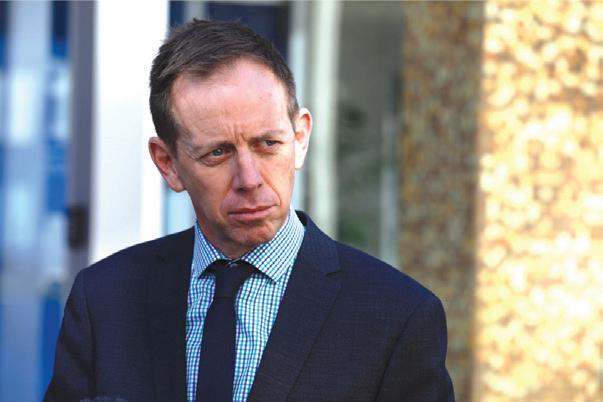
Greens leader Shane Rattenbury.
When Liberal heresy suddenly turns to strategy
“The Canberra Liberals have reached the point where ideology must finally concede to pragmatism. They can achieve nothing in permanent opposition,” writes GWYN REES.
The speculation around crossparty discussions between the Canberra Liberals and the Greens is quietly ironic.
Barely more than a year ago, it was Liberal Leader Elizabeth Lee’s willingness post-election to talk seriously with the Greens that helped cost her the leadership. That outreach, framed internally as a breach of ideological discipline, was treated as reckless, even disloyal. She was replaced by Leanne Castley, a move widely interpreted as a retreat to factional comfort rather than a step toward electoral relevance.
Fast forward to early 2026 and the conversation has returned, this time under Mark Parton. The same idea that helped unseat Lee is now being cautiously repackaged as “cross-party collaboration” and “pragmatism”. The irony is difficult to ignore. What was once heresy is suddenly strategy. And let’s be honest: the Canberra Liberals have reached the point where ideology must finally concede to pragmatism. They can achieve nothing in permanent opposition.
Twenty-four years is also a very long time for any government to hold power. At that scale, longevity moves beyond stability and becomes a liability. Bureaucracies empire-build and harden. Systems begin to serve the government rather than the com munity. Institutional culture shifts from delivery to self-protection, and accountability weakens.
Canberra offers no shortage of examples. The ACT government’s failed HR system cost taxpayers $78 million before being abandoned, a textbook case of what happens when scrutiny is absent and consequences are not enforced.
repackaged as “cross-party collaboration”.
threat, and no threat means no real re-evaluation.
The health portfolio tells a similar story: escalating costs, chronic access problems, and outcomes that stubbornly refuse to match the rhetoric or the spend. Promised surpluses, floated as part of the shift to a landbased tax regime, never materialised.
Rates continue their stratospheric rise, with new levies added for whatever pinch point comes to mind, yet fiscal discipline remains elusive.
And to be frank, this is what happens when a government becomes permanent. No refresh means no
Against that backdrop, renewed talk of Greens-Liberals co-operation should be assessed less as a power play and more as a potential circuitbreaker.
The case for collaboration is not about forming a comfortable longterm government. It is about doing the uncomfortable work that entrenched governments rarely do to themselves. If there is a role for the Greens, who hold the balance of power and have already signalled they would not prop up another four years of managed
decline, it is to force a reset from the crossbench.
A short, disciplined arrangement with the Liberals, explicitly limited in scope, could focus on one core task: an extensive, independent audit of the ACT’s finances, agencies, and major
Not a cosmetic review, but a genuine, line-by-line examination of what works, what doesn’t, and where money is being absorbed without measurable benefit.
Such an audit would not require ideological alignment. It would require agreement on a single proposition: after 24 years, the system needs sunlight.
This is where the irony sharpens further. Lee’s original willingness to engage the Greens was arguably the most strategically realistic move the Canberra Liberals have made in years.
It signalled adaptability, a recognition of Canberra’s political culture, and an understanding that governing this city requires more than shouting “Labor bad” or “Labor tired” from opposition.
Yet that instinct was punished internally, only to resurface almost immediately once the leadership deckchairs were rearranged.
Meanwhile, ACT Labor continues to benefit from its opponents’ confusion. Each Liberal spill reinforces the
narrative that they are inward-looking and not ready. The Chief Minister Andrew Barr plays this masterfully, allowing his government to govern by inertia rather than inspiration.
And then there’s the tantalising personal symmetry. Shane Rattenbury MLA has been a fixture of ACT politics for a generation. One can’t help but ask: if his political tenure is nearing its natural close, what better way to exit than a brief, historic stint as chief minister? A year focused on stabilisation, transparency and reform. Commission the audit. Reset expectations.
Then hand over to a Liberal-led government heading into an election with a cleared ledger rather than a fiscal fog. A caretaker chief minister for reform. A Greens leader overseeing a reset. Liberals inheriting a map instead of a minefield.
What a shake-up that would be. At the very least, it would force Canberra politics to confront an uncomfortable truth. Ideological purity is a luxury. Governance is not.
And after nearly a quarter of a century, the ACT doesn’t need another recycled argument. It needs pragmatism, accountability, and the courage to admit that permanence is the enemy of performance.
Gwyn Rees is a Canberra-based business advocate.
PLANNING / future of light rail
Stop the tram – seriously, it’s time for a rethink
The Barr government believes that light rail (LR) is the appropriate transport choice for shaping Canberra’s future, despite the absence of an assessment demonstrating its superiority to alternatives.
The continued development of the project should be based on more than an act of faith in a time of high and increasing debt and unmet community needs across a wide range of areas including health, housing, childcare, sport and recreation.
Other jurisdictions have or are reassessing LR, primarily in response to its high costs.
In Australia, the Queensland government adopted bus rapid transport (BRT) rather than heavy or LR to meet the public transport demands from the Birtinya heavy rail stop (north of Caloundra) to the Sunshine Coast Airport.
It also cancelled Stage 4 of the Gold Coast LR on financial and environmental grounds.
The Brisbane City Council built the BRT Brisbane Metro after assessing it as a superior option to LR. The Perth Metro Area Express (MAX) LR proposal was cancelled in 2016 and options including the trackless tram are being considered.
superior in providing greater connectivity than other transport infrastructure?
Internationally, projects are also being deferred. The Auckland LR was cancelled in 2024 and a review of transport options is being undertaken. LR projects in West Yorkshire, Bristol, Seattle, Copenhagen, Dubai, Delhi and Johannesburg are all being reassessed.
As well as financial considerations, the merits of LR and possible alternatives should be considered in the context of the vision in the ACT Transport and Planning strategies for the development of a compact, sustainable, resilient, accessible and liveable city.
Transport Minister Chris Steel claims LR drives higher housing density, generates construction jobs and
The continued development of light rail should be based on more than an act of faith in a time of high and increasing debt and unmet community needs across a wide range of areas.
business growth, reduces congestion by attracting people from cars, reduces emissions from reduced use of petrol/ diesel vehicles, transforms the city by connecting key areas and provides mass transit which buses alone can’t achieve. How valid are such claims?
Higher housing density: The Northbourne Avenue corridor was identified as a key element of the inter-town public transport route in the late 1960s. Because of its accessibility, the Territory Plan identified it as a location for major redevelopment in the early 1990s. The substantial increase in the supply of higher density in Canberra over the last 20 years was underlain by a change in housing preferences and declining affordability. The change is reflected in the surge in supply of housing in the Belconnen, Woden and Tuggeranong town centres and Kingston, developed in the absence of LR. What matters is accessibility.
Construction jobs and business
growth: Yes, but using the funds to develop LR on other infrastructure (eg housing, road and bus infrastructure) would also deliver financial and community benefits, at least on par with LR. Auditor-General’s reports on the Gungahlin to Civic and Stage 2A, Civic to Commonwealth Park, found LR to be a poor use of public funds.
Provides mass transit that buses alone can’t achieve: The improved capacity and performance of electric buses and the increase in working from home have reduced the merits of this claim, a claim which may never have had validity in the Canberra context.
Reduces congestion by attracting people from cars: Yes, but other initiatives such as increasing the frequency, coverage and comfort of buses, transit lanes, improved cycling and pedestrian infrastructure, reduced parking supply, increased parking charges and employment dispersal to centres well served by public transport could be as, or more, effective.
Transforms the city by connecting key areas: Where is the evidence that LR is superior in providing greater connectivity than other transport infrastructure?
LR has had limited success as a marketing strategy with images of a sleek
red tram creating an impression of a cool, forward-looking city. However, it fails as a city development strategy as it is based on a limited understanding of factors determining transport and housing choices.
The goal of the transport strategy is to reduce car use from 85 per cent of work trips in 2006 to 70 per cent in 2026. Indications are the car share actually increased. The funds devoted to LR may have contributed to the failure by reducing the resources available to potentially more effective strategies.
It’s unlikely the Assembly can hold the government to account given the Greens past involvement with the project.
Given the extensive evidence of the project’s inadequacy, the government should cease work on the extension and reassess the project as part of a review of the city’s development strategy.
Mike Quirk is a former NCDC and ACT government planner.
HUMOUR
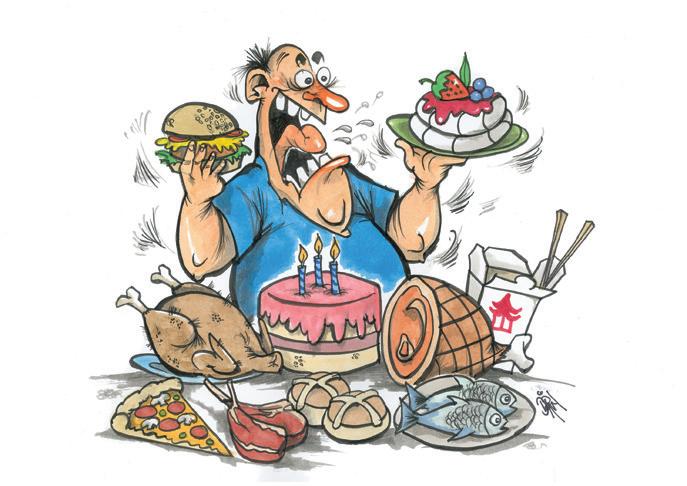
Savouring the celebration of life, a bite at a time
Special-occasion foods are deeply tied to tradition and symbolism; they are edible links to our heritage, writes PAUL DORIN.
While we could enjoy them anytime, certain foods are reserved specifically for celebrations.
In Australia, Australia Day is synonymous with lamb and barbecues; Anzac Day is marked by the iconic Anzac biscuit; Easter brings hot cross buns and seafood; birthdays call for cake and party snacks; Fun Friday often means takeout; and Christmas Day centres around turkey, plum pudding, and pavlova with Boxing Day devoted to enjoying the leftovers.
On Australia Day, the smell of a barbecue is the scent of good times and good company.
Anzac biscuits are eaten to commemorate Australian and NZ soldiers from World War I, honouring their service and sacrifice. The biscuits were sent in care packages because their non-perishable ingredients (oats, flour, and syrup) survived the long sea journey. Originally known as Soldier Biscuits, they were later renamed Anzac Biscuits after the Gallipoli landing.
In the Christian tradition, Good Friday commemorates the crucifixion of Jesus Christ. To honour this sacrifice, Christians have traditionally abstained from eating meat on this day, a practice followed for centuries, with fish served instead.
A modern Boxing Day tradition has emerged: the appearance of the Easter treat, hot cross buns, on Australian supermarket shelves! Is it too early? Perhaps. But if you love them, the answer is a firm no.
In the Christian tradition, the making and eating of buns marked with a cross after breaking the fast on Good Friday commemorates the crucifixion of Jesus Christ. The cross symbolises the crucifixion and the bun itself was traditionally a special treat marking
the end of Lent.
The best thing about Fun Friday takeaway is that it signals the start of the weekend. By eliminating cooking and chores, it’s a chance to unwind whether it’s pizza, kebabs, burgers, Indian, Thai or Chinese.
The modern birthday cake tradition began in the 18th century. This celebratory treat represents the sweetness of life, and blowing out the candles gives you the chance to make a wish for the year ahead.
Alongside this, there are some superstitions and a “penalty” tradition, one was cutting the cake if the knife came out with cake still stuck to it, it was considered bad luck usually followed by the added horror of having to kiss the nearest boy or girl.
The other was hitting the bottom of the cake plate with the knife. It was said to mean the birthday wish wouldn’t come true, or worse misfortune might follow.
The Australian Christmas menu is wonderfully diverse, with each family blending tradition with practical, summery choices. Think glazed ham, roasted chicken or turkey, and roasted vegetables, alongside lighter, summerfriendly options such as prawns and salads, all reflecting the reality of a warm December Christmas.
Ultimately, these foods are more than just what’s on the plate. They carry stories, beliefs, memories, and a sense of belonging, turning ordinary meals into meaningful moments.
Whether it’s lamb on the barbecue, hot cross buns appearing far too early or a birthday cake cut under intense supervision, these traditions remind us that food is how we celebrate life, mark time, and connect with one another truly celebrating life, one bite at a time.
Paul Dorin is the CityNews cartoonist.
Cartoon: Paul Dorin
/ artificial intelligence
How AI threatens human expertise and thinking
“Gen AI research points to a potential loss of human capital through undermining three important characteristics of a high-functioning workforce: critical thinking skills, subject knowledge and motivation,” says Dr KAREN MACPHERSON.
Across the globe, organisations are embracing Generative AI with open arms.
Touted by its Big Tech company developers, we have been assured that Gen AI will increase efficiencies and cut costs, thereby raising productivity – the holy grail of any government or business enterprise.
What should we make of Gen AI?
Undoubtedly, it is bringing significant benefits in medicine, science, industry, and in many other fields.
But we need to be clear-eyed about its potential downsides as well – and identify and manage these downsides proactively. We must not repeat the mistakes we made in recent decades with social media harms.
There are some significant emerging concerns with Gen AI that already warrant attention.
One is that Google Gemini has hijacked our internet search vehicle and is now in the driver’s seat as we speed along the information superhighway.
There are two important implications: first, humans have been
relegated to passenger status, so that our individual agency to locate accurate information from credible sources has been diminished. Second, our need to recognise misinformation has increased dramatically.
Fortunately, we already have tools that can be used to mitigate these harms: we can ensure that every school across Australia teaches the package of skills known as “information literacy”.
Information literacy is all about how to navigate, locate, interpret and use information, including from that firehose of undifferentiated “information” that is the internet.
Critical thinking skills of evaluating the credibility, relevance and bias of information are a major subset of the information literacy suite. These skills can and should be taught explicitly (step-by-step) in every subject and reinforced at every age level. They are powerful tools for understanding and decision making.
Yet significantly, for the workforce of the future, there is mounting evidence that suggests too much reliance
Thinking… each of us carries in our head the most creative, intuitive, sense-making instrument that has ever evolved.
Photo: Karolina Grabowska
on Gen AI could actually result in an erosion of these essential thinking skills; a decrease in subject knowledge, the narrowing of pathways to expertise and disengagement from work tasks.
A key term in these discussions is “cognitive offloading”. We all offload various mental operations and/or memory tasks. Examples are writing a “to-do” list, or engaging cruise control when driving. In terms of mental effort, this is useful: it frees up thinking room for more complex tasks, such as monitoring road
conditions for danger.
But the issue with Gen AI is that offloading too many complex thinking tasks on a regular basis could mean that essential thinking skills are lost. Another concerning issue is the reduction of entry-level work opportunities through AI-related job cuts that are now occurring in many organisations. Quite apart from the impact of the job losses themselves, this trend is worrying from a human learning perspective.
Deep knowledge, or expertise, is developed over many years. It is acquired through learning, practice and wide experience. Think apprentice/ master; intern/specialist; student teacher/principal; flight officer/ captain. Humans become experts by identifying and understanding patterns in large datasets, starting with junior level tasks.
If juniors are not performing tasks such as routine reading of reports and work-related information, or writing summaries and reports themselves, important pathways to the development of human expertise are being narrowed.
Over time, expertise builds as patterns of information, and mental models of those patterns, become complex and unique.
Eventually, an expert is able to identify patterns in highly complex information that a novice does not
even see. Coupled with the human brain’s ability to reason and to make rapid unconscious novel connections (“intuition”), this sophisticated pattern recognition underpins expert judgment. Who would you rather have diagnosing your complex medical condition: an intern or a specialist? We already have significant shortages of expertise in many trades and professions: electricians, engineers, scientists, teachers and doctors. These shortages are causing serious systemic performance and service issues around Australia. We must be careful to balance productivity gains from Gen AI with the need to provide meaningful and engaging jobs, and long-term opportunities for our workforce to grow expertise and human capital.
A final thought. There is a colossal network of AI data centre superstructures spreading across the surface of our planet. It is a voracious energy consumer. Yet that vast global network cannot yet compete with the reasoning power of a single human mind. Each of us carries in our head the most creative, intuitive, sensemaking instrument that has ever evolved. We are called homo sapiens for a reason. We really do need to value what we have.
Dr Karen Macpherson is an independent advocate for public education.
From South.Point to Southern Highlands With Love
Dear Canberra,
We’ve loved you since we first opened our doors in 1987. We’ve loved celebrating the little moments, the big milestones, and every community activity in between. Whether it’s a quick visit or a full day out, we’re proud to be a place where you can find joy, escape, and celebrate life’s special moments.
This Valentine’s Day, we want to show our appreciation for all the love we’ve shared together.
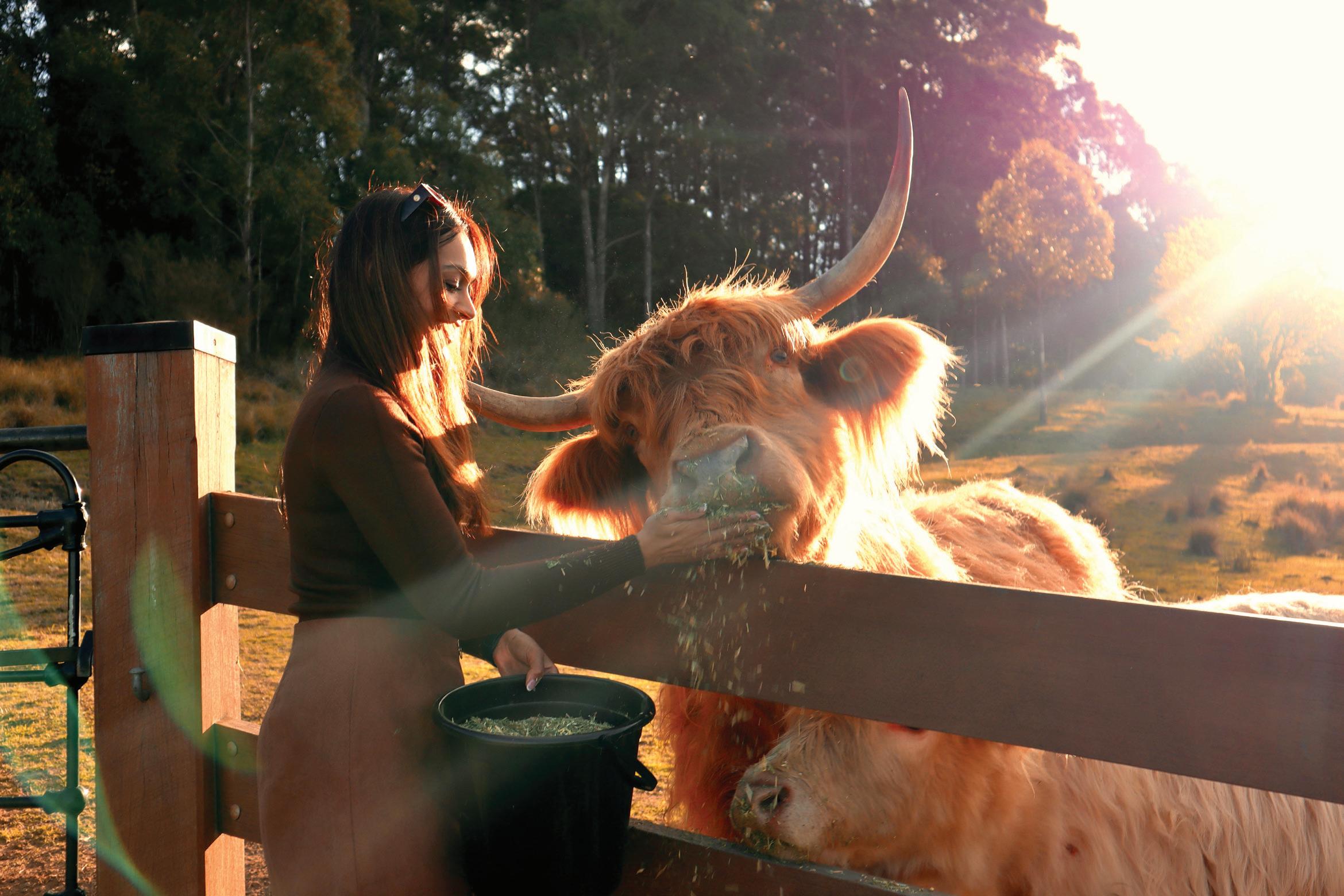
One lucky shopper will win a Southern Highlands escape for two, featuring:
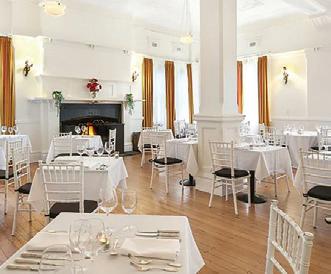
• One night’s accommodation for two at The Robertson Hotel
• A romantic dinner for two at The Robertson Hotel
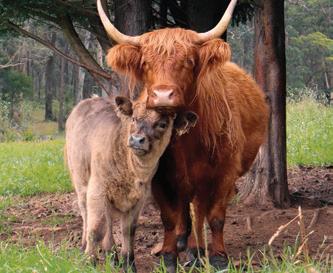
• A Highland cow meet and greet
• Wine tasting for two at Centennial Vineyards
• Bowral Honey Farm tour for two
To enter, simply shop at South.Point during our Valentine’s promotion period and visit the Concierge desk. Because every love story deserves a beautiful getaway. With love, South.Point
Come shop. Come see. Come feel the love.
TECHNOLOGY
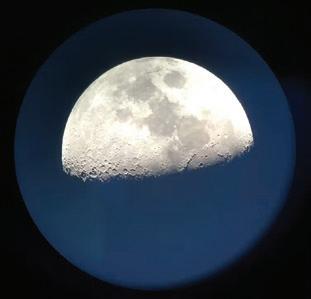
Why is it so hard to take a good photo of the moon with a mobile phone? MICHAEL BOWN explains…
It’s a beautiful clear night. The stars are out and the moon looks breathtaking against the sky, so you reach for your phone to take a snap. The results are, to be blunt, disappointing.
Try again. Steady your hands, focus on the moon, take a photo and… it’s another underwhelming white smudge against a dark background. Hardly Instagram-worthy.
Phones often take superb photos, but why do they struggle with the moon? It’s a little bit to do with what we are photographing, and a little bit to do with phone camera technology.
The first mistake novice astrophotographers make is assuming it is night time. Sure, it may be night time where you are on earth but is it night time on the moon?
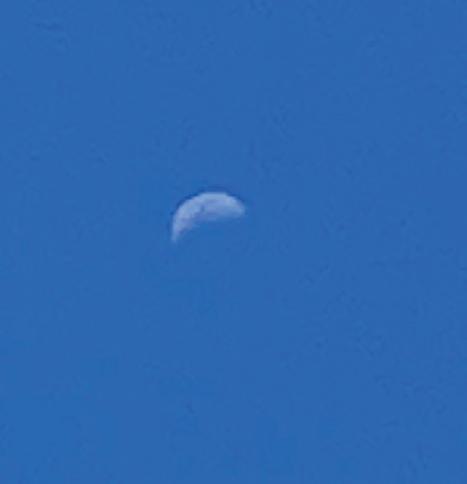
When you take a snap of the moon, you are photographing its sunlit side. In other words, you are photographing broad daylight. Regardless of your camera, this means your settings should be similar to those for daytime photography rather than nighttime photography.
Phones typically automate photography, including focus and exposure
time. Unfortunately, this means that when the moon is seen against a vast dark sky, the exposure time is set by the dark sky rather than the moon. This means we turn the moon into an overexposed bright smudge.
The easiest way to get around this prob lem is to photograph the moon during the daytime. With a bright blue sky as the background (techni cally the foreground) your phone will use a suitably short exposure and you’ll likely get a better picture.
Why is it hard to get a good snap of the moon?
Another way to prevent over-exposed phone photographs is to dial down the exposure time manually, if you can.
So, you tried all that and the pics still look pretty average? Even with the right exposure time and good focus, phone photos of the moon aren’t great and often don’t capture detail well.
This comes down to the design of phone cameras.
Phones are great at taking photos of
sweeping vistas. For example, some phones can take photos of the horizon that span from due north to due east –that’s a 90-degree field of view.
Unfortunately, the moon (which is just half a degree across in the sky) gets lost in such an image. This comes down to the design choices that allow a camera to fit into a standard mobile phone.
Cameras and telescopes focus light coming from different directions onto detectors, be they old-fashioned photographic film or modern digital
Professional, fun tuition in Ballroom Dancing
• PRIVATE DANCING LESSONS
– Individuals or Groups
– Perfect for Wedding Parties BY APPOINTMENT
• KIDS MEDAL CLASSES
Recommencing 5th February from 5pm at the Pearce Community Centre, Building 2, Collett Place, Pearce.
• ADULT BEGINNER CLASSES
Recommencing 4th February Wednesday 7pm-8pm
• ADULT INTERMEDIATE & ADVANCED
Recommencing 4th February Wednesday 8pm-9pm
ADULT CLASSES NOW AT: WESTON NEIGHBOURHOOD HALL, HILDER STREET, WESTON
each pixel receives light from an angle of about 0.02 degrees – and since the moon is 0.5 degrees across in the sky, its image ends up being only 25 pixels wide.
An image just 25 pixels wide is not going to have much detail. Phone camera software may add more pixels, attempt to sharpen the image or interpolate to add pixels, but this won’t add real detail to your moon pic.
The obvious solution is to zoom in to get a more detailed image of the moon.
For conventional cameras this is done with a zoom lens where the focal length can be increased (for example, from 50mm to 200mm). However, in phones the zoom is typically done
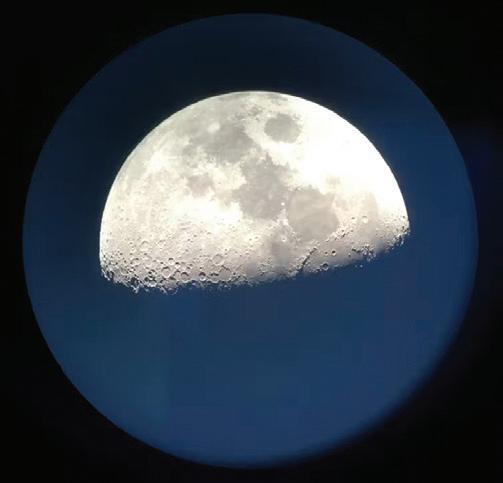
digitally (in software) so the physical focal length is unchanged. Your disappointment will thus continue. However, there is a solution. Why limit yourself to a phone camera lens? Phones can take photographs with telescopes. Point a telescope at the moon, hover your phone carefully above the eyepiece and you can get a remarkably good photo. This is because you’ve used the magnification of the telescope to effectively multiply the focal length of your camera. Instead of a 6mm focal length you may be working with 300mm. Instead of 25 pixels you may have 1250 pixels. Now you can have great moon photos. Phone photography using telescopes has really taken off over the past 10 years. You can even get special clamps to hold your phone securely to a telescope.
But what if you don’t have a telescope handy? Well, instead of trying to zoom in, try zooming out. Remember that phones are great at taking in sweeping vistas.
Your phone may not be great at taking moon photos, but it can take excellent photos of the Milky Way. And if you’re lucky, you can snap photos of rare visitors such as bright comets or auroras.
Michael J. I. Brown, associate professor in astronomy, Monash University. Republished from The Conversation.
Phones can take great moon photos when paired with telescopes. Photo: Michael Brown
Got a few pics like this on your photo reel? Photos: Michael Brown
The Evil Scientist’s demise still sends a message
If you ever find yourself thumbing through a comic-book values catalogue (now there’s an image) you’ll find that the canonical issue 1 of Fantastic Four is fairly expensive!
It was the November 1961 book that ushered in the Marvel age and turned a struggling schlock house of cowboy, comedy and monster rip-off books into a juggernaut now in its seventh decade of publishing and movie domination.
Second to that, by mid-decade, Fantastic Four numbers 46, 47, 48, 49, 50 and 52 are also worth thousands and sought like grails by collectors.
Writer/editor Stan Lee and artist/ legend Jack Kirby were in a creative fertility space that had not been seen since somebody gave Agatha Christie a typewriter, and these particular issues included the first appearances of The Inhumans, The Silver Surfer, The Black Panther and other members of the marvel pantheon that endure and thrive to this day.
After a lifetime of collecting these treasures, I’m no closer to owning one of them ever, but the joy they bring is great.
The thing is, nestled among those treasures, and appearing in Australian newsagencies in early August
When I was 11, life was often hard. I read that comic 20 times and felt such shame that I related more to the evil scientist than to the heroes.
it is my favourite comic book of all time and I read it about once a year, whenever my wife rereads Pride and Prejudice. It’s got fewer bonnets but more explosions so, you know, swings and roundabouts.
The story is simple. In every issue since number 1, Reed Richards, famed scientist and the leader of the FF, promises but fails to cure his best buddy Ben Grimm from being a monster made from rocks, known as The Thing.
Like the creators of the comic, Stan and Jack, they had served in World War II and been defined by challenge.
1966, at exactly the same time I first appeared too, was the little known number 51.
It’s worth a small fraction of the others and is a lame and ordinary 20-page story introducing a villain (the evil scientist Ricardo Jones) who was so uninteresting that he dies at the end of the story and was never seen again.
From the moment I first read it,
The story begins with Ben being so frustrated at never getting cured that he falls in with the Evil Scientist, who is jealous of Reed’s fame and fortune.
The scientist successfully turns Ben back into a normal man. Ben races to his girlfriend’s house to show off his normality and finally propose. Evil scientist is turned into the rock monster himself and impersonates The Thing, his plan being to destroy the hated rock-star scientist Reed Richards.
& your family/friends are welcome to join us the
LUNAR NEW YEAR FAMILY FESTIVAL
Enjoy Exciting Activities
• Lion Dance performing by Mountains Lion Dance Team
• Red Lucky Envelope & 1000s FREE Buddhism Books to ALL
• New Year Gift presented to all Children
• Lucky Fruits & Well Wishing Verses to ALL
• FireCrackers, Music performance & Food Stalls
• COURTESY Annual Vegetarian Dinner, ALL INVITED (strictly between 6.30pm to 7.30pm)
at Monday, 16 February 2026 - at 6:00 pm - 01:00 am, at Sakyamuni Buddhist Centre, 32 Archibald St, Lyneham ACT 2602 ADMISSION FREE - ALL WELCOME
The comic features the first appearance of The Negative Zone (creativity unbound, this zone is still big in the comics and movies, too) and soon the Evil Scientist bloke is stunned to discover that, like everything else he does, Reed bravely risks his life to explore the place for the good of humanity, not for fame or fortune. Furthermore, when going deeper, Reed asks the bloke he thinks is Ben to hold his tethering line, and literally puts his life in his friend’s hand. A scary thing happens and Reed offers his life to save his friend.
In a finale my 11-year-old self had never seen before, the Evil Scientist realises that his loneliness and failures are not Reed’s fault but his own, and inspired by the selfless friendship he first sees here in Reed, sacrifices himself in the first unselfish act of his whole life.
Classic comics melodrama demands that when the evil bloke dies, Ben, about to propose to his girlfriend in his handsome human body, instantly turns back into the ugly Thing and fails to pop the question. Alicia, we know, doesn’t care what he looks like and loves him for him, but he never sees it.
When I was 11, life was often hard. I read that comic 20 times and felt such shame that I related more to the evil scientist than to Reed and Ben, our heroes.
I understood his loneliness and anger so much better than their easy success, belonging and having a best friend. I loved the redemption that could be gained from a single act.
Kindness to me is finding all those people who are behaving like the evil scientist, blaming everything for things they cannot grasp, and showing them all the love and respect we can, to open their own hearts.
People who have undergone unfair treatment, fear, and despair and seek recognition or refuge in our modern Australia – people who’ve been here for six years or 60,000 – there’s plenty here who need our love today more than ever.
Local GP and ANU associate professor, Antonio Di Dio says he’s been a bad influence on medi cal students since the late 1980s.
Fantastic Four edition 51… a lame and ordinary 20-page story, but is “my favourite comic book of all time,” writes Antonio Di Dio.
The new metro rail system that shows up Canberra
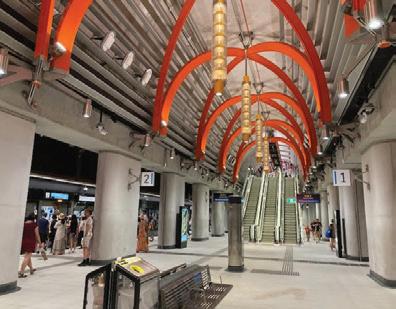
Melbourne Metro! Now that’s a state-of-the-art new light rail system.
It shows up Canberra Metro’s poorly conceived (and still very expensive) surface light rail Stage 2, which requires a new bridge across Lake Burley Griffin and will wreak havoc in the central national area, with dif ficult intersections requiring some tunnelling and loss of hundreds of heritage trees.
Ultimately, a tunnel under Civic will also be necessary as traffic congestion inevitably increases. A tunnel now from Commonwealth Park to Adelaide Avenue would be the only sensible solution to stage 2b.
Richard Johnston, Kingston
Change operations, not party combinations
Michael Moore’s column (CN January 19) is a mixture of righteous frustration accompanied by a very challenging option.
I liked his view that while “It is not an election year, change is not beyond imagination”.
Moore’s frustration captures the essence of the feelings of many in the ACT that policy matters have been garnered to benefit the few. The present ALP government is a minority government but retains the qualities associated with too lengthy an administration period.
However, Moore’s hint at a possible realignment of the political groups pres-
ently elected in the Legislative Assembly is a challenging one.
Change for change’s sake isn’t an answer. There has been no evidence to suggest that an alternative political realignment in the Legislative Assembly would produce any better governance as a result.
Politics is theoretically about the will of the people, but this has long since been ignored and hard to judge anyway in an apathetic milieu, abetted by a limited communication system in an ever-more complex world.
Governments do need time to achieve outcomes and may make mistakes trying to do the right thing by the electorate. The present ALP government presents both of
Relying on painkillers for back pain?
Free Workshop
Sunday 1 March 2026
Tuggeranong Seniors Centre
For people with bulging or herniated discs — everyday sitting and sleeping strategies to reduce pain levels.
Reserve your free spot and get back to loving life.
tegan@gokhalemethod.com
these circumstances and thus it is now time for change of some sort.
Consistent with Moore’s view, I too see the possibility of short-term change at the Legislative Assembly level but in its operation rather than party combinations.
For example, use the Legislative Assembly power to generate more public discourse; give overseeing bodies such as the ACT Audit Office or the Commissioner for Sustainability more airspace, including via sub-committee operations; and demand of the government genuine, funded and open public consultation processes.
In my view rearranging Legislative Assembly combinations, theoretically an option, isn’t tackling the deeper and more fundamental governance issues. Hopefully, Mr Moore’s article will help stimulate wider discussion on better governance.
Geoffrey Pryor, via email
Left/Woke-Islamist
alliance remains secure
The Left/Woke-Islamist alliance remains secure despite the Bondi massacre with 180 writers and director Louise Adler sacrificing the Adelaide Writers Festival for the cause.
The Woke Identity gambit is seemingly invincible – “I can attack you. But you can’t attack me because of my identity!” The logic goes no further.
Randa Abdel-Fatah called on her Palestinian/Anti-Zionist identity to trump her public affirmation of terrorists, threats
to Jews and attempts to block Jews from Arts shindigs including New York Times journalist, Thomas Friedman, from last year’s Adelaide Writers’ Festival.
His crime: Friedman likened all parties in the Gaza conflict to creatures; Hamas scored a trap-door spider. Randa howled and director Adler promptly punted the Pulitzer Prize winner, citing scheduling difficulties. When booted herself, Randa’s hypocrisy revealed splashes of narcissism and hyperbole: “What makes this so egregiously racist is that the Adelaide Writers’ Festival Board has stripped me of my humanity and agency, reducing me to an object on to which others can project their racist fears and smears.” Yet, for a mere smeared object she seems quite buoyant and oozes oodles of agency.
Her powerful identity card extends to Hamas and trumps their sins, too. This insanity is not fantasy; a large cohort of Australia’s politically minded accept this bewildering logic. Which begs the question – how long will the Woke pander to Randa and Islamists? Were any of the 180 writers aware of the extent Randa panders to Hamas?
She disputed the brutal sexual crimes of October 7 as “atrocity propaganda” despite autopsies and testimony including Hamas footage of 22-year-old Shani Louk, whose semi-naked body was paraded on a ute tray by triumphant merrymakers.
Did the Adelaide Writers Festival board do any due diligence before prostrating itself before Randa and naming her number
one invitee for 2026?
The Woke may have won a battle in this stoush, but, if human decency counts for anything, if sympathy for murdered innocence remains alive, they have lost the war.
Peter Robinson
Another false promise from ACT government
To reduce the number of detainees housed at the AMC, the implementation of electric monitoring (EM) must be a priority.
EM means that some offenders and some on bail wear ankle bracelets that show their location.
EM can be used for low-risk offenders who have caring responsibilities and/or gainful employment, as well as domestic and family violence offenders.
The ACT is the only Australian jurisdiction that does not use electronic monitoring.
The 2023-24 ACT budget included $377,000 for a “feasibility study and trial to explore the introduction of electronic monitoring of offenders in the ACT”.
Both the study and trial are unnecessary. The ACT can replicate EM legislation and its implementation from other jurisdictions. But instead of doing something, the government has now shelved EM. This is yet another example of a false promise by the Barr government.
Janine Haskins, prison reform advocate
“I’ve hardly taken any pain relief since doing the Gokhale Method. Before, I was taking prescription painkillers every day.”
~Emily Krout-Ryan
Melbourne Metro… a state-of-the-art new rail system. Photo: Richard Johnston
What about nashos of ‘forgotten’ Korean conflict?
I enjoy reading CityNews, which is a welcome change to the declining standards of the Canberra Times.
However, the feature article “Why we need ‘nashos’ in a dangerous world” by Ross Fitzgerald and Dick Whitaker (CN January 22) requires a revisit by the authors.
Whilst the Vietnam conflict was without doubt a significant situation resulting in the reintroduction of “conscription”, the article should give justifiable recognition of the earlier legislated conscription in the 1951-1959 period.
Fellow National Servicemen of the period comment that the article is yet another example of disrespect of their military service.
In the 1950s all males reaching the age of 18 years (adult age was 21) were subject to the conditions of conscription. Legislation was introduced in 1950 by the Menzies government and with bipartisan support.
A total of 227,000 served in 52 intakes. Initially training was undertaken in any of the three arms of the services, but this changed with the Army taking some 198,000, Air Force 22,300 and Navy 7000.
Also reference to the term “nashos” was common in the 1950s and did not originate with the Vietnam intake.
The lack of remembrance for such historical military detail is part of the ongoing “forgotten” Korean conflict.
The world is currently facing increasing
conflicts and should Australia be drawn into military action there is the view it is very unlikely younger generations will volunteer for military service.
Former National Servicemen of the 1950s period, together with those members of the National Serviceman’s Association of Australia, have expressed the view that a National Service (aka conscription) should be introduced.
Options other than military service, such as emergency services, should be included but the former given the highest priority for able-bodied men and women.
John W Hawke, Red Hill
I’ll have a nuclear reactor in my backyard
The Indonesian government last year authorised the building of 29 reactors from one end of the country to the other, and this immediately resulted in big public protests with placards of “Indonesia is Not Chernobyl”. Considering that Indonesia is on the “Ring of Fire” such a response from residents is perhaps understandable.
As I was preparing a paper that required the use of nuclear power and could speak with personal experience of three years in the boiler station and the turbine floor of coal power stations and also three other years handling radioactive material on a daily basis, I included a section on these also.
The paper “Climate Change in Indonesia: Green Steel” (in “Recent in Science and
Technology”, vol 3, (03),54-68, 2025) can be downloaded free, and its nuclear part, which is in simple language, should be read by everyone – especially politicians to understand why I will gladly have a nuclear power reactor in my backyard.
My conditions are that I and the other residents in my suburb and our heirs and descendants get free power 24/7 for life.
To ensure that a meltdown is impossible and any leaks are not radioactive, the reactor must be like a Mitsubishi He HTGR operating in closed circuit with a gas turbine, so that the only water that will be used in the whole plant is for cups of tea (or coffee) and in the toilets.
As to the cost of nuclear power and that of renewables I will be glad to prove –definitely not using modelling but only the ABS data, that for 24/7 renewables power is 10 times more expensive per KWh than nuclear power. I use only the ABS data so anybody can check my arithmetic.
Nick Standish, Macquarie
Genocide rate should ‘please’ the Palestinians
Peter Robinson (letters, CN January 22) contends that the claim of genocide against Israel in relation to Palestinian deaths remains weak as the death rate (about 3-4 per cent) is low compared with other conflicts.
He cites the Vietnam War’s death rate (5-7 per cent) and the second Congo War (10 per cent) as the worst since World War II.
I guess, by implication, Palestinians should be pleased that Israel stayed below the generally accepted genocide rate and about 70,000 deaths, and many more maimed and traumatised, is acceptable.
Herman van de Brug, Holt
Those Nats won’t be sorely missed
Hard to believe that 11 National Party politicians were privileged to hold shadow ministry positions (“Nats protest walk-out implodes the coalition”, citynews.com.au January 22).
Hard to recall what positive, substantive contributions they made and spoke about during their eight-month period of incumbency.
Easy to remember their inward-looking flurry of activity and imploring noises in late 2025 about trying to keep Barnaby Joyce in the party pen.
Won’t easily forget their inability, and that of their then Liberal colleagues too, to support a few new firearms controls and protections in January 2026 for public safety and security reasons.
Sue Dyer, Downer
So many questions that need answers
One ponders whether, in the light of deficit spending and outcomes, are we being
adequately served? Is Canberra losing its direction under self government?
Are our police, schools, hospital and medical services still meeting needs?
Does present infrastructure spend conform with modern economic principles?
If you lose your credit ratings and plunge into debt, what spirals you into disrepute. What then would be a definition of calamity?
John Lawrence via e-mail
System is failing at Canberra Hospital
The medical system is failing as there is no common sense from the supposedly smart people who run the Canberra Hospital.
Just recently a cardiologist left, so if you do not have private health cover they are sending you to Wollongong.
In the last 12 months a large number of senior doctors have left and gone private.
The medical system needs a shake up for those who are in high positions to get a better understanding on how doctors do their job.
Silvano Zorzi, via email
Funding a news reader’s chair?
To readers who watch the ABC News: Do we have to run a “fund me” collection for our news readers to have a chair?
Ben Gershon, via email
‘Calwell became so infuriated that he ordered the Daily Telegraph and the Sydney Morning Herald off the streets altogether’
Minister who lost the media censorship war of ‘44
“It was an awesome display of the power of the press, with the newspaper proprietors easily defeating an elected cabinet minister.” Historians ROSS FITZGERALD and DICK WHITAKER recall how the Commonwealth Censor took on the media… and lost.
During times of war, the government of the day is invariably conscious of how the local media is portraying the conflict, and above all, very concerned about the publishing or broadcasting of any material that might benefit the enemy.
During World War II in Australia, one of the governmental portfolios was Minister for Information, who had sweeping powers with regard to censorship, and indeed was directly in control of an important public official, the Commonwealth Censor.
In 1944, the Minister for Information was Arthur Calwell, who was serving under Prime Minister John Curtin. Calwell would eventually lead the Labor Party in opposition, only to miss out on becoming prime minister during the federal elections of 1961 by the narrowest of margins.
Calwell was awkward in appearance and speech, and was endlessly lampooned in the newspapers, sometimes appearing in cartoons as a giant parrot.
Earlier in the war, Calwell had stated: “I am no believer of the so-called liberty of the press, which actually amounts to liberty for certain newspaper proprietors, who assume the right to exploit the nation and boost their own circulation.”
In 1944, Sydney had begun to recover from the depths of wartime depression. Two years before, it had been a grim picture. Thousands of Australian soldiers had been killed, wounded or captured fighting the Germans and the Japanese in widespread theatres of combat. Darwin had been bombed and Sydney Harbour penetrated by Japanese submarines, convincing many that invasion was imminent, and real estate prices across the eastern sub -
urbs plummeted as people fled inland from the coast.
However in the following two years the Allies gradu ally got the upper hand, and by 1944 it was considered unlikely that there would now be a Japanese invasion.
The emphasis of the media gradually returned more to domestic issues.
The media of the day consisted of daily newspapers, magazines and the radio – television was 12 years away –and concepts such as privately owned computers and the internet were too far fetched even for science fiction writers.
to the censor on a daily basis before publication, and the placing of blank spaces was forbidden.
ment backing Calwell and denigrating off when the High Court ruling came through. The crisis was over.
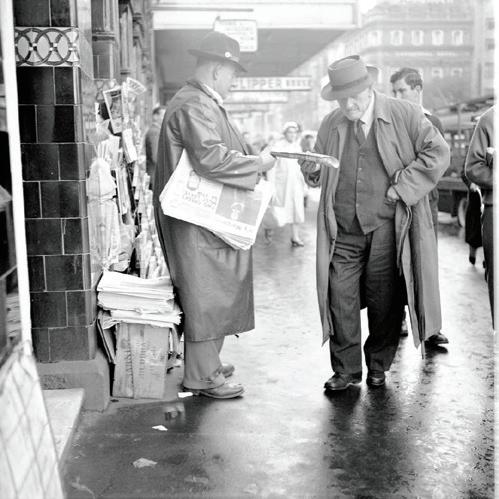
Daily newspapers were by far the most influential media, with a typical Sydneysider’s workday beginning with the Sydney Morning Herald or the Daily Telegraph, and then for the trip home on the train or tram, the Sun or the Daily Mirror.
These newspapers were run by powerful media barons, including Frank Packer (Daily Telegraph and Sunday Telegraph), Warwick Fairfax (Sydney Morning Herald), Ezra Norton (Daily Mirror) and Hugh Denison (The Sun). There was no love lost between these groups, with frequent circulation and editorial battles erupting between them. Together they comprised most of the notoriously tough jungle of the Sydney daily newspaper scene.
However, a rather remarkable series of events was to unite these rivals in a way perhaps never seen before – or since – and those events were precipitated by the Sydney Morning Herald in 1944.
In America, with the war finally running the way of the Allies,
Rupert Henderson, general manager of the Sydney Morning Herald, issued a statement that said, in part: “Because of censorship, many American war correspondents have left Australia, and this was one reason why America is not properly informed on Australia’s policies.”
He added: ”Australian correspondents have not been able to inform their papers truly of Australia’s effort.”
This statement infuriated Calwell who, in turn, issued his own release, accusing Henderson of lying and exaggerating, and threatened to call him before a Parliamentary Censorship Enquiry Committee.
When the Sydney Morning Herald and the Daily Telegraph proposed to run the story, together with Henderson’s response to Calwell, the Commonwealth Censor directed that all copy must be submitted to him before publication. The copy was then returned, but with Henderson’s reply heavily edited.
The Telegraph, under Frank Packer’s personal direction, then ran the story, but with blank spaces placed where the censor had cut out information. This was a threat to one of the censor’s most important powers – that of withholding the fact that censorship had ever taken place, and
The other newspapers joined in the struggle and several confrontations occurred when the Commonwealth Police arrived to prevent the distribution of newspapers.
The Telegraph’s printing presses were shut down, although a small number of papers were produced in midnight printing runs at the old Labour Daily plant at the corner of Brisbane and Goulburn streets in Surry Hills.
Calwell became so infuriated that he ordered the Daily Telegraph and the Sydney Morning Herald off the streets altogether, followed soon after by the Melbourne Herald and the Adelaide News.
This precipitated street protests in which hundreds of university students marched through Sydney streets, converging on the censor’s office and demanding the reopening of the newspapers.
Frank Packer, a tough and pugnacious character, had not been idle. He convened a meeting of all the different newspaper heads in the Daily Telegraph boardroom at the Consolidated Press Building in Elizabeth Street, where it was decided to mount a High Court challenge to the rulings of the censor. The High Court quickly upheld this challenge and the papers were soon back on the streets.
It was an awesome display of the power of the press, with the newspaper proprietors easily defeating an elected cabinet minister.
The lesson of this has not been lost on following generations of politicians, who now go to great lengths to ensure generally peaceful relationships with the media.
Since 1944 the media landscape has changed substantially, with the power of newspapers significantly eroded by the arrival of television in 1956 and then the birth of the internet giant during the 1990s.
Despite these fundamental changes it seems likely that there will always be a place for newspapers in the modern media, with artificial intelligence (AI) playing an increasing role in their production, distribution and consumption.
As well as the old “hard copy” form of newspapers, online versions are increasingly popular enabling more frequent news updates to be initiated and also the ability to personalise news content.
Ross Fitzgerald AM is emeritus professor of history and politics at Griffith University. His most recent book is Chalk and Cheese: A Fabrication (Hybrid), co-authored with Ian McFadyen. Dick Whitaker is a widely published author and lecturer in the fields of meteorology and Australian history.
The Canberra Retirement
Village & Resort Expo
Wonderful opportunity to ask questions and gather information
On display will be the latest resort style developments, as well as established villages from many different organisations, offering a wide range of services & facilities, sizes, prices & locations, all under one roof. Don’t miss this special event!
Photo: Wikipedia Commons
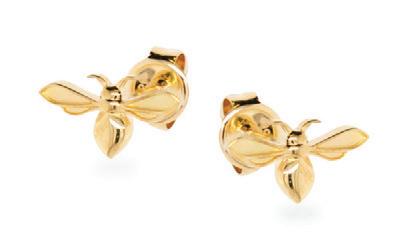
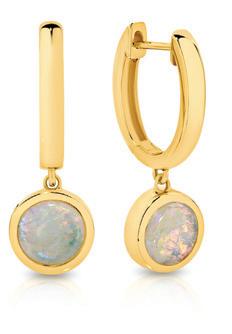
gold earrings to meaningful rings designed to mark your story. Each piece is thoughtfully chosen for its beauty, quality and ability to be worn and loved long after the roses have faded.
Whether you’re celebrating a new romance, a lifelong partnership, or simply want to spoil someone special, our range offers heartfelt gifts to suit every style. Classic or contemporary, subtle or statement – we’re here to help you find the piece that feels just right.
As a fully independent jewellery studio with experienced jewellers on-site, we offer more than beautiful jewellery. We design and handcraft custom pieces, remodel sentimental jewellery, and provide
Not sure what to choose? Our knowledgeable team is happy to guide you, whether you’re selecting from our Valentine’s range or considering a bespoke piece created especially for your loved one.
This Valentine’s Day, give a gift that lasts a lifetime – beautifully made, deeply personal, and crafted with love. Visit us in-store and let us help you make this Valentine’s Day unforgettable.
Venetia Major – Bespoke Jewellery 3/8 Victoria Street, Hall. Call 02 6230 9587 or visit venetiamajor.com
Love at first bite
Donut Bouquet Canberra is a small, family-run business that began in 2020 during the height of COVID-19, with one simple goal, to spread joy through delicious, thoughtful gifts. What started as experimenting with recipes and creative designs quickly grew into a business now trusted to be part of thousands of birthdays, an niversaries, baby showers and special celebrations across Canberra and surrounding areas.
At the heart of Donut Bouquet Canberra is a belief in the power of giving. There is something truly special about making someone’s day with a gift that feels personal, beautiful and made with care.
Every bouquet, hamper and box is thoughtfully prepared using quality ingredients and presented in eye-catching packaging designed to delight from the moment it arrives.
The range includes signature donut bouquets, grazing boxes, fruit hampers and chocolate boxes, offering something for every taste and every occasion. Being a small business means flexibility, with custom orders available to suit individual requests and themes.
Open six days a week, the team prides itself on reliability, friendly service and consistent quality, reflected in numerous five-star customer reviews. Whether you are planning ahead or need something last minute, same-day delivery is available for orders placed before 12pm.
When you order, you are supporting a local business that genuinely cares. Donut Bouquet Canberra continues to grow with one mission in mind, bringing smiles, one sweet gift at a time.
Donut Bouquet Canberra donutbouquetcanberra.com
This Valentine’s Day, say I love you with
• Ready made jewellery, including one of a kind, handmade pieces by Venetia
• Gift Vouchers for finished pieces and Design Appointments
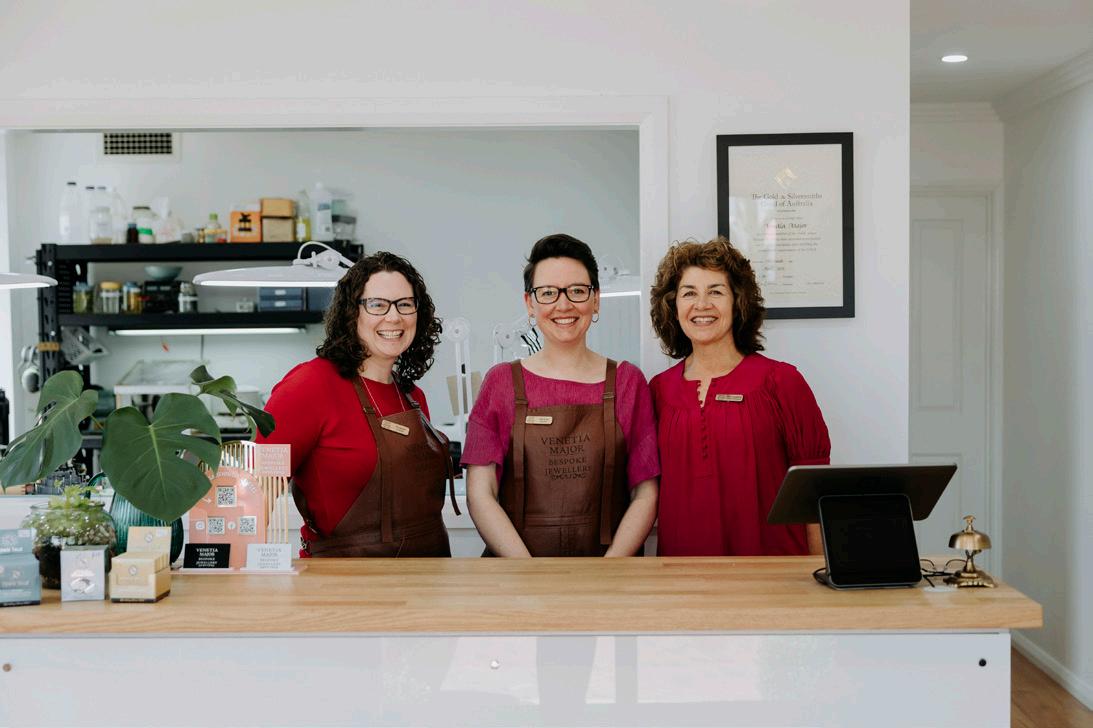
From left, Sinead Buckney (jeweller), Venetia Major (owner/jeweller), Bernadette Ticehurst (sales consultant).
Some of the best Valentine’s gifts are memories
Not every meaningful gift comes in a jewellery box. Sometimes, it’s a memory, beautifully preserved and displayed.
Gemma Lingwood helps people turn life’s most treasured moments into lasting pieces for their home. From wedding photos and family portraits to travel memories, children’s artwork and sentimental keepsakes, each piece is handled with care and attention.
“Not only will the piece look its best, but it becomes something to enjoy on the wall every day,” Gemma says.
Framing a special photograph or meaningful artwork can be a deeply personal Valentine’s gift, celebrating shared experiences and the people who matter most. Gemma says her favourite part of the
Previously known as Discount Gallery, the rebrand does best.
“We surround art with care, protection and a sense of celebration,” Gemma says. “Like a hug.”
HUG Framing + Gallery
50 Weedon Close, Belconnen Call 6251 3837 or visit hugframing.com.au
The National Zoo and Aquarium is Canberra’s “Centre of Adventure” and there is no better time to become a member than right now!
This year the National Zoo and Aquarium announces an exciting events calendar that features a variety of activities every week, celebrating animals, cultures and events from around the world. Live music, food tastings and overall fun and action will enhance experiences throughout the year and these fun-filled free events will occur weekly, on top of the amazing pre-existing benefits.
Have a picnic or barbecue and listen to some live music in front of the rhinos, enjoy a cultural food experience with your loved ones or watch the kids enjoy learning about animals from across the world on a ‘World Animal Day’. Each week offers a new experience for you and the family.
On top of this exciting news all memberships continue the amazing offerings of early access to the zoo, a sneak peek to brand new events and of course discounts throughout the zoo and Jamala Wildlife Lodge.
This year is gearing up to be the most exciting yet and memberships can mean a trip to the zoo is as little as $3 per person (if you go weekly, and why wouldn’t you!).
Memberships range from a tier list of multiple benefits to suit all your Zoo needs.
Head to www.nationalzoo.com.au/zoo-memberships to become a member today!
National Zoo & Aquarium Canberra Call 02 6287 8400 or visit nationalzoo.com.au
At HUG Framing + Gallery, we specialise in custom framing that turns your most meaningful moments into lasting pieces for your home. From wedding photos and family portraits to travel memories and sentimental artwork, we help preserve the stories that matter most in a way that suits your style and space.
Call us today: (02) 6251 3837 or Visit: hugframing.com.au
Renovation Matters is changing the way home owners across the ACT experience renovations, delivering projects that are clear, well-managed and genuinely stress-free.
Led by owner Kim Persson, a finalist for Business Woman of the Year, the Canberra-based business specialises in smart, considered renova tions that improve both everyday liveability and property value. With more than 100 successful projects completed, including over 50 renovateto-sell transformations, Renovation Matters has earned a strong reputation among homeowners at every stage.
From small upgrades to full home transforma tions, each project is carefully planned and professionally managed, with clear communica tion guiding clients from start to finish.
“Renovating doesn’t need to feel overwhelm ing,” Kim says. “Our role is to remove the pressure by managing every detail with honesty, care and experience.”
Renovation Matters works exclusively with trusted local trades and suppliers, selected for their quality workmanship and reliable com munication. This ensures smooth coordination on site and projects delivered to dependable timelines.
At the heart of every project is a simple focus: creating comfortable, functional and stylish homes that make everyday living easier.
“We treat every home as if it were our own,” Kim says.
Renovation Matters
Call 0427 696 662
Visit renovationmatters.com.au
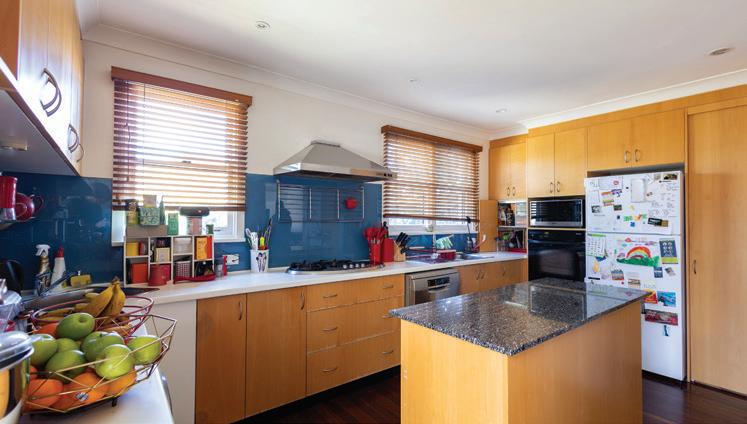
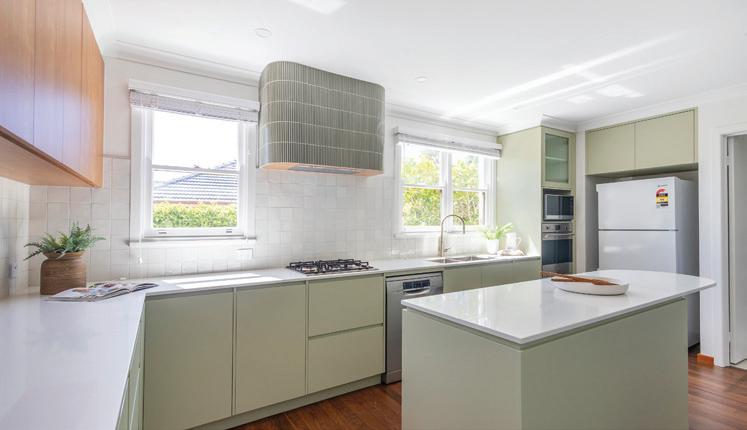
Renovation Matters offers transformational renovations that add the biggest impact and value when selling your property.
you are not selling, we can help you renovate to meet your specific requirements!
feature
Hurry
Living Simply is Canberra’s go-to specialist for plant hire for venues and events, says director Graham Holbrook.
Offering plant rentals for pre-property sales, weddings and special events, Graham says adding a fresh touch of greenery can enhance any space.
With a track record of the many houses they’ve styled selling, he says it’s a great way to improve a home before listing.
At the end of March, Living Simply is clos ing its retail outlet for plant sales in Pialligo with a massive sale of existing stock from anywhere between 10 and 50 percent off.
“We will have 25 percent off pots & plants storewide until we sell everything,” Graham says.
“Last year and all red dot stock will be up to 50 percent off, with indoor plants at 10 percent off.”
Sales last until their relocation, where they will turn their attention to their special-event and commercial office plant hire together with their landscape design and garden maintenance.
Working closely with property stylists, Living Simply provides the full styling service on the day of the event, with the team meticulously caring for the plants before, during and after the event to ensure they look just right.
Living Simply 10 Beltana Road, Pialligo. Call 6249 1552 or visit livingsimply.com.au
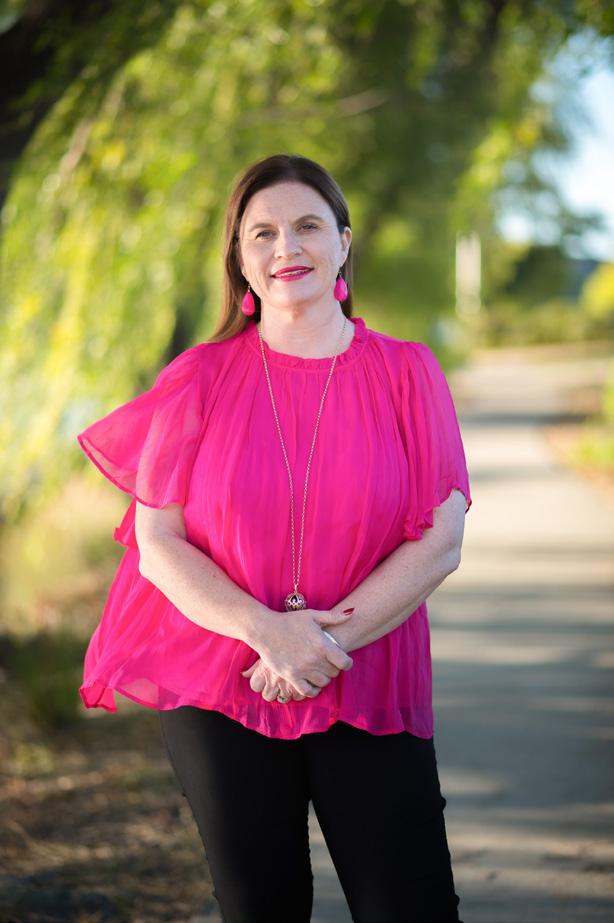
Kim Persson, owner of Renovation Matters.
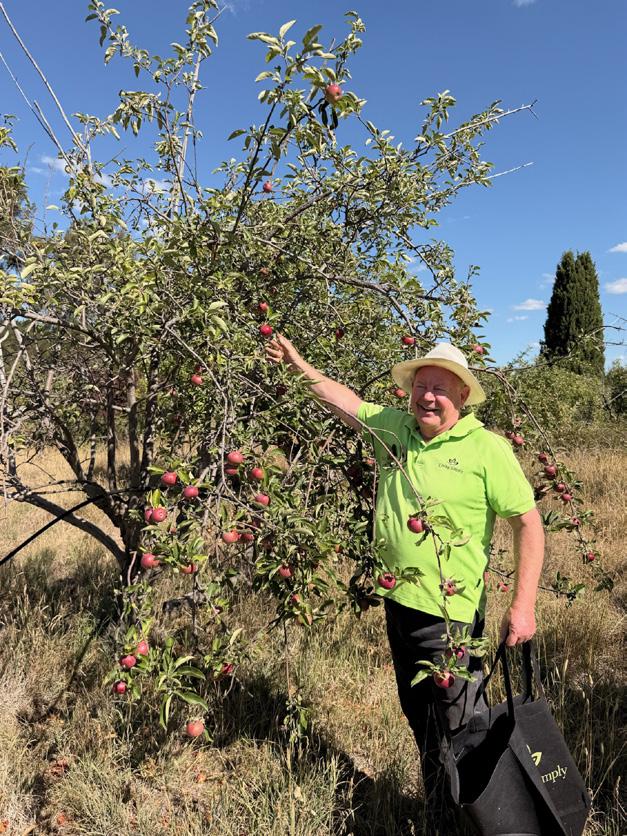
Graham Holbrook, director of Living Simply.
Home Improvements
an honour to be Canberra’s trusted leader in the workwear industry.
“It’s extremely important that we provide the right equipment and the best safety products to our clients,” says Pat.
“We want to get it right the first time so that we build long-term relationships with our clients.”
Providing clothing and safety items for a wide variety of industries, Pat says they can help labourers, chefs, blue and white-collar workers all the way to government departments, such as Defence, and hospitals.
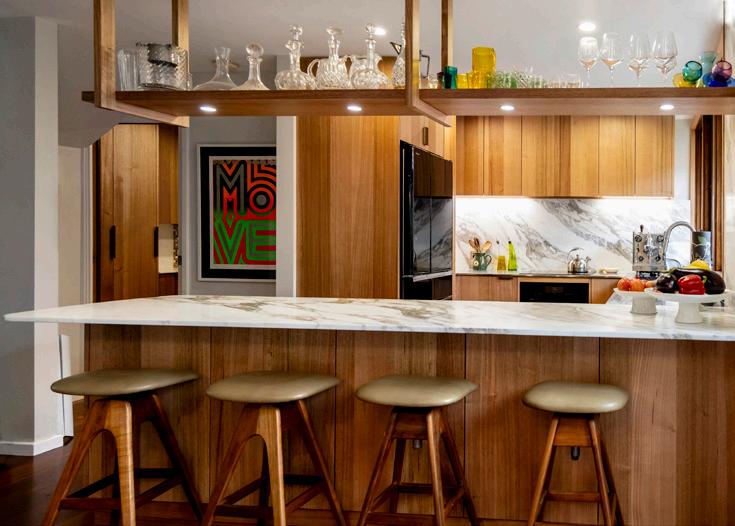
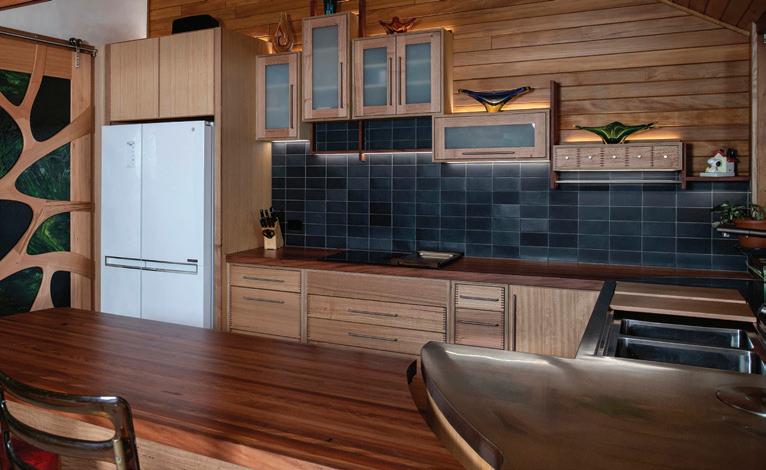
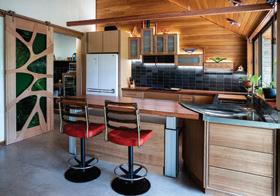
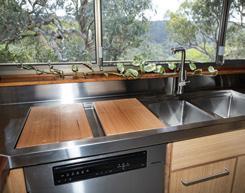
Transforming kitchens with passion
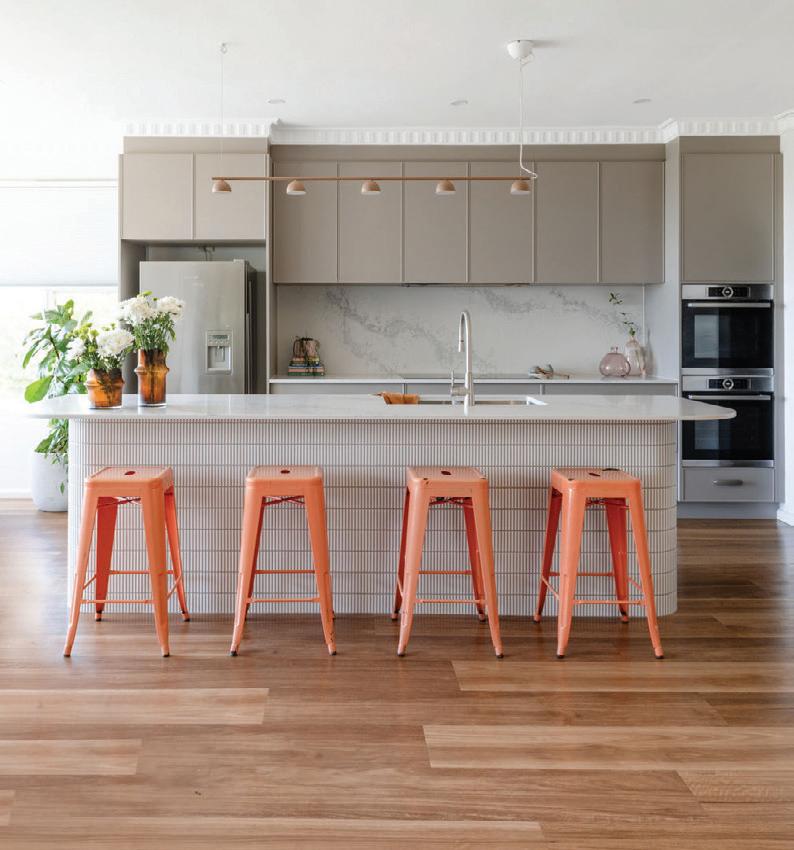
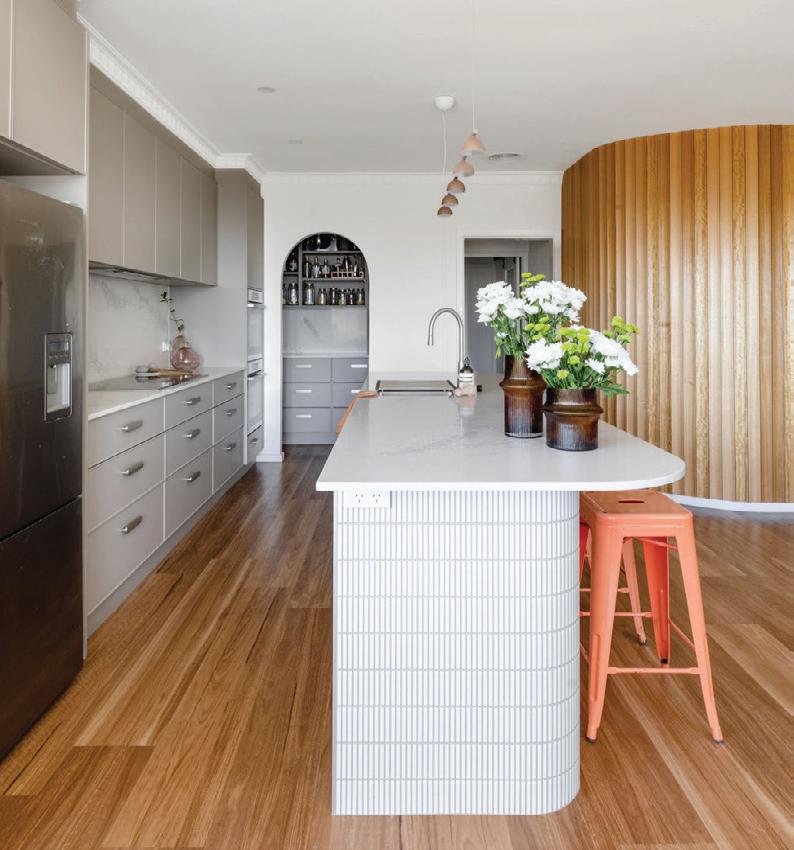
The Kitchen Company is very much a Canberra-focused family business, that’s very much about the homeowner.
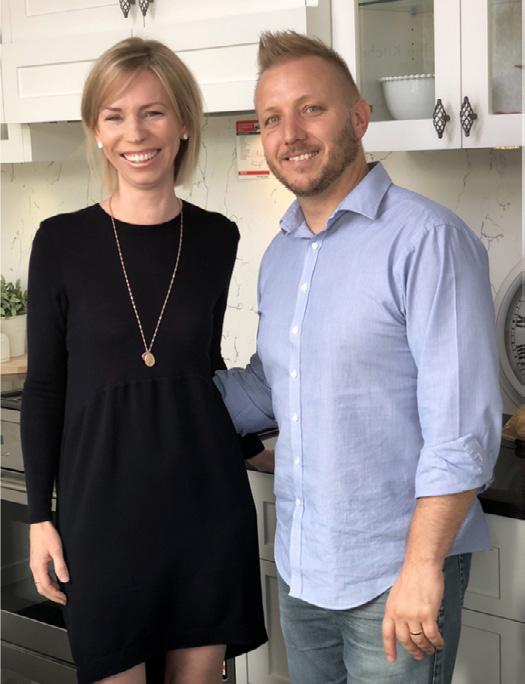
General manager Charlotte Batley said the company was started by her husband Adam Batley’s father, Peter, in 1981.
Adam had worked there for 25 years, 15 years running it, “and I’ve been here for 10”.
“We offer custom kitchens in forever homes, we have dedicated interior designers who will work with clients for months or even years to achieve their dream, and a fabulous team who can do it all, from start to finish,” she said.
“The kitchen is such a big part of the home, so really we feel like we’re transforming people’s lives.
“We are big believers in Canberra, we love it here and we love the community, some clients are repeat clients or spread the word about how pleased they are with us, and seeing them so happy keeps us passionate.
Providing a free measure-and-quote and free delivery service, Pat says they also provide a full embroidery and screen printing service.
“We are competitively priced and are prepared to negotiate on bulk orders,” he says.
“These are just some factors on why we believe Seears Workwear has become a household name.”
“People really get a personal, lovely and different experience when they come through us.”
Charlotte said they also offered a free design and quote service, so customers could be confident in their decision before making a financial commitment.
The Kitchen Company Unit 1/4 Wiluna Street, Fyshwick. Call 6239 2944 or visit thekitchenco.com.au
Seears Workwear owners Pat Seears, right, with son Shane.
Charlotte and Adam Batley.
Home Improvements
A bright way to spruce up the house
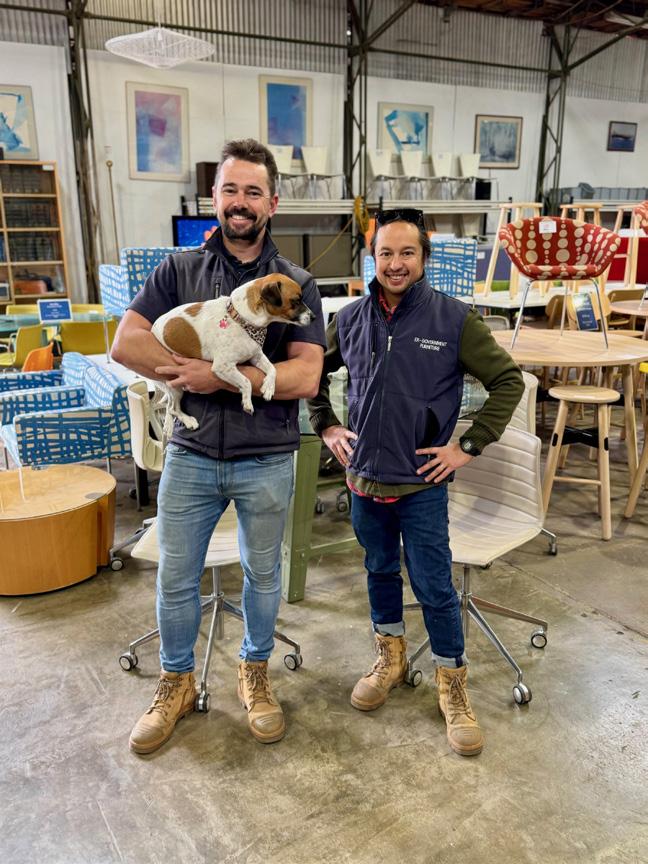
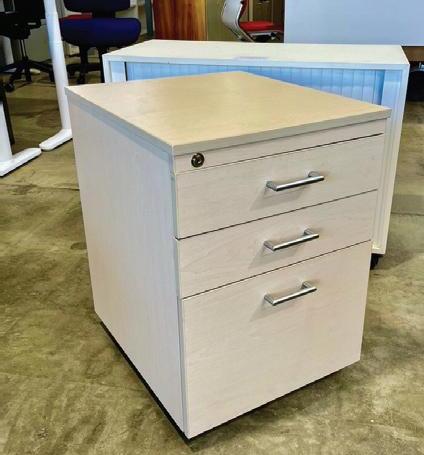
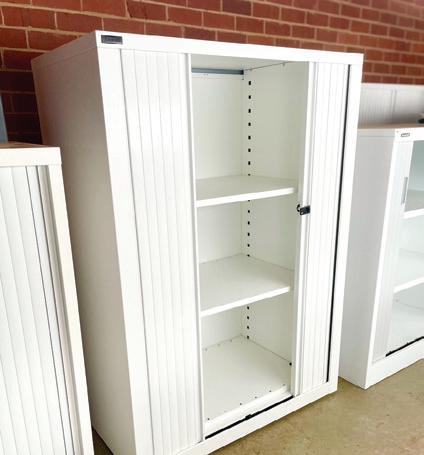
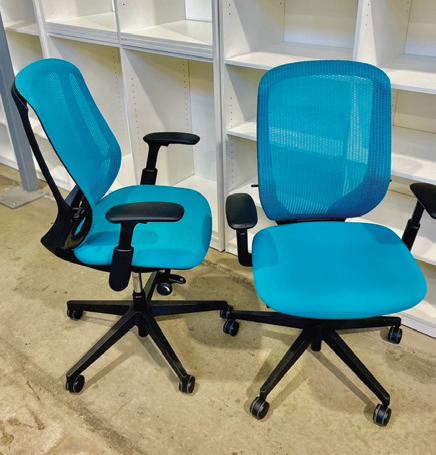
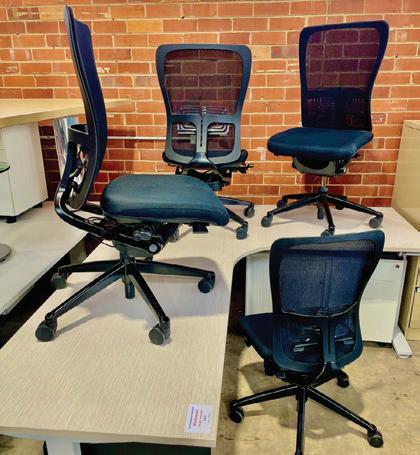
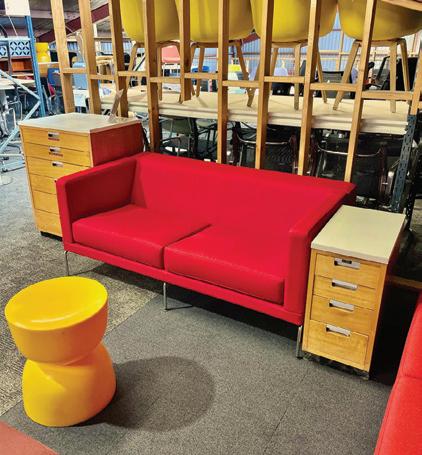
With summer underway, now is a great time to freshen up the home and get organised. For those looking to tackle cluttered garages, spare rooms or home offices, Ex-Government Furniture currently has a strong range of practical furniture available. Sourcing furniture from government and commercial businesses, Ex-Government Furniture offers quality pieces designed to last and suited to everyday use.
“We’ve got more than 30 years of experience in picking out furniture and have lots of advice to give,” says co-owner James Fullerton. He says storage has been a key focus in recent weeks. “At the moment, we have a lot of storage solutions and full-height shelving that’s perfect to get the garage sorted,” James says. “It’s ideal for anyone wanting to declutter and make better use of their space.” Stock moves quickly through the warehouse, with new items arriving regularly. “We travel at least once a week to pick up furniture,” says James. “There’s always something new coming in.” Recent arrivals have included shelving units, cabinets, tables, dining chairs and a range of commercialgrade storage solutions suited to both home and workshop use. “We’ve also got a bunch of Haworth Zody chairs coming in,” James says. “They’re a premium chair in terms of build and comfort, without drifting into the hype and luxury end of the market.”
With a wide selection of sturdy, functional furniture on offer, James says customers can find practical solutions without stretching the budget.
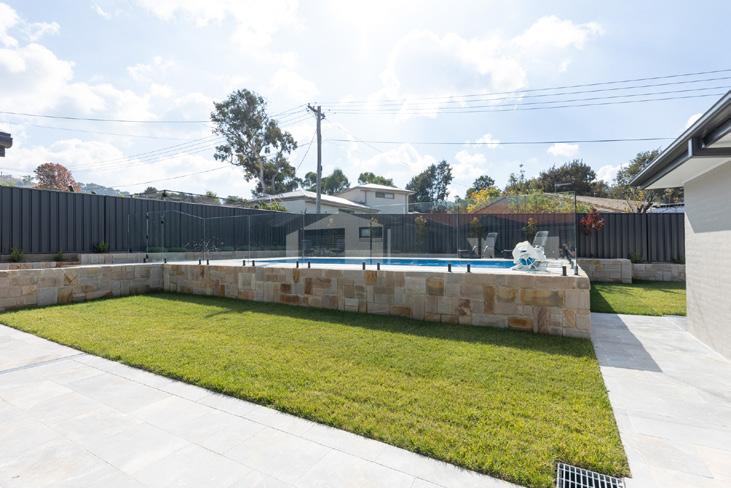
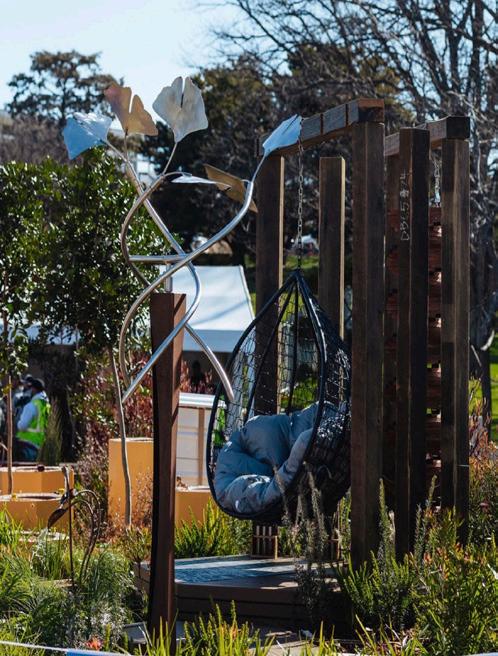
Landscape Design: where outdoor spaces become a way of life
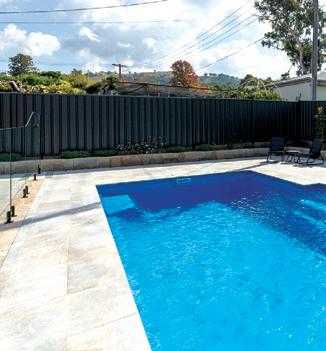
Landscape design is about far more than planting greenery, it is about shaping outdoor spaces to enhance how you live, relax, and connect with your home. A well-designed landscape should feel like a natural extension of the house, balancing aesthetics, functionality, and long-term value.
Today, homeowners increasingly want outdoor spaces that can be enjoyed year-round. Successful landscape design begins with understanding how a space will be used, from entertaining and children’s play areas to quiet retreats and everyday practicality. Thoughtful integration of paving, decking, retaining walls, planting, lighting, and drainage ensures the landscape performs as beautifully as it looks.
Planning is the foundation of every great design. Considering site conditions such as sun orientation, soil type, slope, and climate allows designers to create tailored solutions that last. In Canberra, smart layouts and durable material selections improve usability while reducing maintenance requirements and long-term costs.
Sustainability has also become a focus in modern landscape design. Water-wise planting, efficient irrigation systems, and robust materials help homeowners minimise environmental impact without compromising on style or quality. These considered choices support healthier gardens and long-term performance. When executed professionally, landscape design adds genuine value to a property. It transforms underused outdoor areas into purposeful, inviting spaces that enhance liveability and street appeal, encouraging people to spend more time outdoors.
At In-Depth Landscape Construction, our experienced Landscape Architects and Designers are ready to help transform your home. Contact our team today to start designing an outdoor space that works for you and suits your lifestyle.
In-Depth Landscape Construction Unit 3, 1 Sawmill Circuit, Hume. Call 02 6293 2257. indepethlandscaping.com.au
Ex-Government Furniture co-owners Taylor Radnell, left, with Tilly, and James Fullerton.
Home Improvements
Finding space for household items during a renovation can be stressful.
The local team at House to Home are experienced packers who have been helping Canberrans get their property ready for sales, renovations, insurance work, downsizing and relocating for more than 12 years, says co-owner Renee Le Grande.
Offering a pack-and-store solution for anyone renovating, Renee says it’s the perfect option to get rid of clutter around the house until the work is done.
“With meticulous planning and years of expertise in the moving industry, House to Home takes the stress out of relocation or renovation by handling every aspect,” she says.
“Our expert team will save you hours of time and stress by packing all your personal belongings, household items, right through to packing up the shed,” she says.
“Our team offers a personalised service and recognises every client is unique and has different needs and expectations.
“Some people want the kitchen, bathroom and wardrobes packed, others want absolutely everything including the garden pots at the front door.”
Charging a weekly fee for offsite storage, Renee says it’s the perfect solution for anyone needing a quick, temporary solution for storage during renovation work.
“People can store items for as short as a week to as long as a few years,” she says.
“We can pack up excess items and store it separately to take the stress out of fixing up a house.”
House to Home Call 0457 456 767. house-to-home.com.au
DOWNSIZING AND DECLUTTERING
No two Canberra gardens are the same, and Realityscapes Canberra owner Mitch Tilbrook designs each space to suit how people actually live. Every project starts with understanding how the area will be used, what the client wants it to feel like, and what will realistically work for your home, block and season.
Mitch and his team focus on creating outdoor spaces with clear structure, balanced planting and thoughtful detail, so gardens feel intentional rather than pieced together.
The goal is a space that enhances the home and reflects the owner’s personal style, whether that means a calm retreat, a family-friendly area, an entertaining space, or a clean, low-maintenance garden that still looks sharp. But great design isn’t where it ends.
Realityscapes has an experienced landscaping team that can bring design plans to life with careful preparation, quality finishes and an eye for the small details that lift the whole space. From defining garden beds and improving flow through the yard, to refining lawn areas and planting for colour and texture, the team works to deliver a finished result that feels cohesive and well considered.
seasonal adjustments to keep gardens healthy and consistent year-round, so the original design continues to perform as intended.
Realityscapes is fully insured and holds Working with Vulnerable People (WWVP) accreditation.
A thriving garden also needs ongoing care, and Realityscapes supports that with maintenance that protects both the look and structure of the space. Services include mowing, pruning, weeding and
Your ultimate destination for home & lifestyle inspiration
Upgrading a home shouldn’t be expensive, says John
an expensive adventure, says store-owner John Rivers.
“At Handyman’s Trading Post, people can find a great range of new, factory used and used parts and pieces at half the price,” he says.
Currently overstocked with many second-hand materials, including windows, glass sliding doors and timber panel (swinging) doors, John says CityNews readers can get a further 10 per cent off the prices of all second-hand items by mentioning this article.
This excludes never-used, factory-seconds and items that have already been discounted by more than 10 per cent.
A leading supplier of factory-second and used windows and doors, John says they are also the experts in delivering purchased windows and doors
Offering to take “want lists” from customers, John says they can alert customers when products from their list have arrived in store. John says customers can save hundreds, or even thousands, by buying second hand windows and doors. Items he says are often the key feature of renovations.
“For more than 42 years, Handyman’s Trading Post has supplied Canberrans with quality and affordable home and commercial building materials,” says John.
The Handyman’s Trading Post 167 Newcastle Street, Fyshwick. Call 02 6280 4036. On facebook.com/p/Handymans-Trading-Post or Instagram.com/htpcanberra
The ShowRoom Canberra Home & Lifestyle Show returns in 2026, and it’s set to be bigger and more inspiring than ever before. Whether you’re planning a major renovation, updating a single room, building a new home, keeping up with the latest design trends, or simply enjoying a little retail therapy, this must-visit event has something for everyone – all under one roof and completely free to attend.
With more than 100 exhibitors on show, you’ll discover endless ideas and practical solutions for every corner of your home. Explore innovative home designs, outdoor living spaces, cutting-edge home technology, and sustainable living options.
Speak directly with industry experts about flooring, window furnishings, home entertainment and automation, security systems, heating and cooling solutions, orthopaedic bedding, spas, stylish furniture, affordable living options, and trusted home renovation specialists ready to make your
project easier from start to finish.
Along with the new outdoor living area, one of this year’s highlights is the new Meet a Tradie Hub, offering a relaxed and informal setting to connect with skilled tradespeople and service professionals, ask questions, and gain valuable advice.
Enjoy exclusive show specials, exciting prizes, and plenty of shopping opportunities throughout the weekend. Don’t miss your chance to turn your home ideas into reality.
Join us March 14–15 at the Budawang Pavilion, EPIC, from 9am to 3pm.
Register now for your FREE ticket at www.theshowroomcanberra.com.au. See you there!
The ShowRoom Canberra Home & Lifestyle Show Budawang Pavilion, EPIC. theshowroomcanberra.com.au
Home Improvements
Can’t imagine life without gardens
Only four years into owning her own business, Panacea Landscapes owner Shannon Blackbourn has already built a strong reputation for creative, high-quality outdoor spaces.
Shannon won first prize at the Melbourne International Flower & Garden Show Balcony Garden Competition in 2024 and followed it with third place in 2025. She also won first place at Floriade 2025 for her garden, further showcasing her design skill, plant knowledge and ability to transform spaces into something special. These achievements highlight her design skill, plant knowledge and ability to transform even small or challenging spaces into something special.
Working in landscaping since the age of 16, Shannon brings years of hands-on experience to projects ranging from compact courtyards to large residential properties.
Panacea Landscapes specialises in garden makeovers, planting plans and complete outdoor transformations, creating spaces that are not only beautiful but practical and suited to the way clients live.
Whether homeowners want a low-maintenance garden, an inviting entertaining area or a full refresh to lift street appeal, Shannon works closely with them to deliver a result that feels personal and considered.
Starting young in the industry means Shannon under stands landscaping from the ground up. Today, that practical knowledge allows her to guide clients confidently through the entire process, from concept to completed garden.
“I love helping people turn their outdoor areas into spaces they truly enjoy spending time in,” she says. “Every project is different, and that’s what keeps it exciting.”
With demand for landscaping increasing as homeowners invest more in their outdoor areas, Shannon recommends planning ahead to secure a spot.
Panacea Landscapes
Call 0498 287 789 or visit panacealandscapes.com
Panacea Landscapes
Canberra & East Coast Soft-Landscaping Experts
• Led by a qualified horticulturist and landscape designer with over 15 years of experience
• Specialising in soft-landscape design, garden transformations and ongoing maintenance programs
• Serving residential, commercial, strata and real-estate clients with friendly, reliable service
• A family-owned local business committed to the highest quality workmanship and tailored solutions Contact Shannon Blackbourn 0498 287 789
really beautiful to look at, it’s a great joy,” says Robyn Monteleone, partner at Select Custom Joinery.
Operating since 2000, Select Custom Joinery is known for creating sustainable kitchens and joinery.
“We are a niche business and specialise in using timber and other solid materials,” she says.
Their commitment goes beyond just using sustainable materials, and Robyn says they always think about longevity, with everything they design meant to last for a long time.
Robyn’s husband Gino Monteleone, the primary cabinet maker and partner of the business, trained as a furniture maker.
“Gino’s training started with building custom furniture,” she says.
“Our kitchens and custom pieces are built to
come.
With the aim of creating pieces that are customised for each client’s lifestyle and personality, Robyn says they often design a feature in each person’s home which is unique to them.
“The satisfaction that clients get something that really suits their lifestyle and them, something they’re proud of and really enjoy using is the most rewarding thing,” she says.
“We are only a small team, so client meetings are by appointment.”
Are you interested in using plywood, recycled timber and other sustainable materials? We’ll work with you to design a kitchen that’s innovative, unique, sustainable and durable.
Kitchens, internal joinery & furniture.
Panacea Landscapes, led by Shannon Blackbourn, won first place at the 2025 Floriade.
ARTS & ENTERTAINMENT
‘Stubborn’ star finds betrayal in Irish troubles play
By Helen MUSA
When your name is Emily O’Mahoney, there’s a fair chance you have Irish ancestry, as I find when I catch up with the actor playing the lead role in Never Closer, a 2022 drama by Australian playwright Grace Chapple.
Director Lachlan Houen believes this is probably the third production of the play. Full of lively Irish dialogue, the work is set on Christmas Eve, 1987, in a fictional Northern Irish border town during The Troubles which eviscerated the country from around 1968 to 1998.
Briefly, a reunion of childhood friends at Deirdre’s house blows up when one of them, Niamh, turns up with her surprise English fiancé and all the home truths come out.
O’Mahoney couldn’t be more pleased to be playing the lead role of Deirdre in a cast that also features Nick Bisa, Joel Hrbek, Breanna Kelly, Pippin Carroll and Natasha Lyall.
A former Merici College student in Canberra who has performed in Rockspeare at The Mill Theatre, she’s been in Melbourne
Back on vacation, she reconnected with Houen, whom she had met while taking part in Canberra Youth Theatre’s Emerge Company, founded by actor Christopher Samuel Carroll.
O’Mahoney has nothing but praise for the relatively new theatre course at the VCA, which runs in tandem with the acting course but focuses more on writing, training and
an independent theatre company such as the experimental performance collective Pony Cam.
Inevitably, O’Mahoney and I share our Irish ancestral stories. Her grandparents on her father’s side migrated to Australia in the 1960s from Dublin – not from the north, but well aware of the tensions of The Troubles.
When her family heard she’d been cast
“I’ve been hearing about it all my life, and this is a wonderful opportunity,” she says.
As for Chapple, her mother is from Ireland, so there’s a semi-autobiographical element.
More than that, O’Mahoney believes Chapple has an acute ear for dialogue and its subtle nuances.
“It’s funny, it’s sharp – it’s so natural, a gift to an actor,” she says. “It’s brutal as well, and
without giving too much away, it doesn’t exactly have a happy ending.”
Her character Deirdre – a classic Irish name if ever there was one – is the stay-at-home figure. The whole play is set in her house and while she’s grounded in her town, most of the other characters have moved away.
“I think I love her so much because she’s stubborn, and I’m also stubborn,” O’Mahoney says. “She’s strong in her beliefs. She’s a Catholic and very much in support of a united Ireland.
“Her sense of loyalty extends to all parts of her life, but it’s not shown back to her, and she experiences loss and betrayal, although she does not lose her independence. She’s single, and part of the plot is to do with romance.”
Most of the characters are teenagers in the prologue, but the main action sees them at around 28 or 29, after most have been away, creating a fractured group. The cast has worked out that the fictional town is something like Omagh, roughly 90 minutes from Belfast.
While some characters are involved in politics, the play is humanistic rather than political. O’Mahoney says the characters are spread across the spectrum, and Chapple’s empathy extends across the range.
“It’s a tragedy,” she says, “but it’s so bloody funny.”
Never Closer, Courtyard Studio, February 19-28.
From left, Breanna Kelly as Mary, Emily Mahoney as Deidre and Natasha Lyall as Niamh.
The year promises lots of love for Shakespeare
For Canberrans 2026 is going to be a very good year for those interested in William Shakespeare and his work, writes NOEL BEDDOE .
The Mockingbird Theatre Company starts off our opportunities to enjoy plays about and by Shakespeare with its coming production of Shakespeare in Love.
Based on Marc Norman and Tom Stoppard’s Oscar-winning screenplay, Lee Hall’s stage adaptation of is an involving and very funny play most recently seen in Canberra when the Melbourne Theatre Company production toured in 2019.
Mockingbird is the resident company and the Belconnen Arts Centre. The relationship was created in 2025, and provides a series of interesting approaches to modern theatre through productions and a popular and successful drama school. Casting opportunities are advertised on the company web page.
Director/producer Chris Baldock believes that, probably, this production of Shakespeare in Love will be the most popular money spinner for the group for this year:
“We like to go early with what we think will be our most popular; start the year with a bang.”
Baldock has a simple philosophy as to what the company should attempt: “We want to present theatre that people will want to attend and enjoy, and theatre that
deserves to be seen.”
This is a major effort – between 40 and 50 characters, shared among a cast of 21.
Baldock is undaunted by the scope – he is with us after a storied career in the Melbourne theatre scene for nearly 25 years.
In 2017 he settled on Canberra as did many of us, after some years of visiting, because of dedication to family.
“Melbourne got so big; Canberra, by comparison, is a very peaceful place, so easy to move around. I’ve loved the falling away of pressure.”
Mockingbird is a fascinating concept; the theatre space used for Shakespeare in Love will be the Mockingbird Studio, one of two theatre spaces at the centre.
By coincidence, the production to follow the Mockingbird offering in Belconnen will be Lakespeare’s outdoor production of Shakespeare’s The Taming of the Shrew, which will wind up in Belconnen having done a series of performances around the ACT including free shows outdoors at Tuggeranong, the Patrick White Lawns outside the National Library, Glebe Park and Haigh Park, as well as performance/meal matinees at Pialligo Estate.
Then, in April, Bell Shakespeare will be here with Julius Caesar and theatre legend Peter Carroll cast as Casca; we’ll have the opportunity to hear that mellow voice, that
which in fact go back to his work with Sydney’s Genesians group in the 1960s. My own was his performance as Fool to John Bell’s Lear of 2010, when Carroll created a depth of character and humanity through his powerful non-verbal reactions to the observation of his friend and mentor’s arrogant self-destruction.
COME & TRY MORRIS DANCING!
in university town Belconnen, with its bookshops and array of exotic restaurants, the Belconnen Arts Centre certainly is worth a visit if you’ve never been; there are four spaces for the showings of individual art exhibitions, two theatrical performance spaces, a small gift shop selling the creations of local craftspeople and a charming café
ARTS IN THE CITY
with seating indoor and outside on the shore
an enjoyment of Shakespeare in Love would provide the opportunity for the beginning of a valued relationship.
Shakespeare in Love, February 11-28, The Taming of the Shrew, February 26-27 both at Belco Arts. Bell Shakespeare’s Julius Caesar, The Playhouse, April 10-18.
Latham still managing music
Former CityNews Artist of the Year Chris Latham will continue as artist in residence at the Australian War Memorial for a further three years, it has been announced. His focus will be on creating playlists and videos, ensuring recordings and sheet music are properly archived, and making them accessible via the AWM, Flowers of Peace and related websites, securing the material for the future.
The Canberra theatre community has done it again. After the summer lull, four productions will open within just two days, creating the kind of program ming pile-up that frustrates seasoned theatregoers.
The Street Theatre launches La Souris Blanche on February 18, followed on February 19 by Canberra Rep’s Bedroom Farce, Off the Ledge’s Never Closer and Lakespeare’s The Taming of the Shrew. In contrast, the music community has been successfully running an online calendar to help avoid future clashes.
Canberra Bach Ensemble opens its 2026 season with a program of Bach cantatas directed by Andrew Koll and led by Stephen Freeman at St Christopher’s Cathedral, February 14.
Accordion star James Crabb headlines a Valentine’s weekend concert, Accordion Dances, part of the Canberra Symphony Orchestra’s 2026 Chamber Series. The concert visits Renaissance Spain, baroque Germany and 19th-century Romanticism, Gandel Hall, National Gallery of Australia, February 15.
Art Song Canberra launches its 2026 Season of Song with soprano Amy Moore and pianist Edward Neeman in Robert Schumann’s Frauenliebe und Leben. The recital is inspired by Hungarian composer György Kurtág – who turns 100 just days later – highlighting the continuing influence of Schumann on contemporary music. Embassy of Hungary, February 15.
The Gallery of Small Things, Wade Street, Watson, opens its first exhibition of 2026 alongside a newly reimagined exhibitions program, shifting from a shopfront gallery to a dedicated curatorial space. In the inaugural show, gallery owner Anne Masters pairs NSW painter Kiata Mason with Melbourne ceramicist Hamish Bassett, both of whom spent formative teenage years in Canberra. Until February 16.
Chris Latham… the war memorial’s Mr Music.
Crime novels come with a strong Scottish accent BOOKS REVIEWS / Scottish crime
Three recent, excellent crime novels set in Scotland, have caught the eye of book reviewer ANNA CREER .
Award-winning Scottish crime writer Val McDermid, the creator of Tartan Noir, has received the Diamond Dagger from the Crime Writer’s Association.
The award was in recognition of her lifetime achievement as a crime writer, as well as the Theakston’s Old Peculiar award for an outstanding Contribution to Crime Writing. McDermid’s novels have also been adapted for TV and radio, most notably the Wire in the Blood series featuring DCI Carol Jordan and clinical psychologist Dr Tony Hill and, more recently, Karen Pirie, based on her novels featuring Detective Inspector Karen Pirie of the Scottish Historic Crimes Unit. Silent Bones (Sphere) is the eighth novel in the series.
It’s midwinter and the rain in Edinburgh is torrential, creating a massive mudslide dislodging a steep bank on the M73, reveal -
ing “unmistakably human remains” with “the grim sight of a skull grinning up… out of the mud”. The stretch of motorway was built in the spring of 2014 and, therefore, Karen Pirie and her team are assigned to the case.
DNA identifies the victim as an investigative journalist Sam Nimmo, who before his disappearance had been the chief suspect in the murder of his pregnant girlfriend. The HCU investigation reveals Nimmo had been chasing evidence of a sexual assault at an expensive fundraiser for the “Yes” campaign in the referendum for Scottish independence.
procedural. McDermid can be forgiven for focusing more on her intriguing plot than on indepth characterisations.
MELBOURNE-based writer, editor and actor Laura McCluskey sets her debut novel, The Wolf Tree (HarperCollins) on a remote Scottish Island. Her grandfather was born and raised in Glasgow and she says she has “always felt a particular pull towards Scotland”.
survive. An air of menace develops during the short, dark winter days in a tense, atmospheric story with gothic undertones.
Last, and the most Scottish, is Natalie Jayne Clark’s debut novel, The Malt Whiskey Murders (Polygon) about a couple reopening an abandoned whisky distillery near Campbelltown in Kintyre.
At the same time Drew Jamison contacts the HCU about his brother Tom, whose death five years earlier had been declared an accident. Drew is convinced his brother was murdered on the Scotsman Steps, a wide spiral staircase that’s a short cut from the Royal Mile to Waverley Station. He also claims he knows the identity of the murderer.
Just before his death, Tom had joined
WINE / Gewurztraminer
an exclusive, influential male book group called The Justified Sinners. The name came from The Private Memoirs and Confessions of a Justified Sinner, by James Hogg (1824), which argues that “if you were one of God’s chosen ones, the elect, you could do what the hell you liked on earth because your place in heaven was guaranteed. Right up to and including murder”.
The investigations of the two murders eventually merge as Pirie and her team are relentless in their pursuit of the truth.
Silent Bones is a clever, cold case police
McCluskey’s fictional island of Eilean Eadar is isolated and difficult to reach, with only 200 inhabitants. When 18-year-old Alan Ferguson is found dead at the foot of the island’s lighthouse, it’s declared a suicide, but the mainland police decide to investigate and send two detective inspectors, Georgie Lennox and Richard Stewart to the island.
They learn that Alan had been “a bright boy robbed of a bright future”. They are told that “he was a happy child, then a happy teenager” and he had applied to a number of universities on the mainland. Why would he commit suicide?
The Wolf Tree is a story of a community resistant to change and resentful of outsiders. Although the Roman Catholic priest, Father Ross, is the main authority on the island, sinister pagan superstitions
Feeling the love, but failing the taste test
We tried some wines in Auckland, New Zealand, over the Christmas/ New Year break.
My sister and her partner have an extensive collection of wines and to surprise us they opened a Vinoptima Ormond Gewurztraminer 2009.
My sister’s partner said that the Gisbornebased vineyard had decided to specialise in this German-originated varietal and he had been told that the aim of this winery was to produce the very best possible gewurztraminer wine. He said he had been cellaring it for a special occasion and our visit from Oz was the trigger to open his sole bottle. We felt the love.
He said that he thought a quality brand of this varietal could keep its characteristics for more than 10 years.
More about that expectation soon, but I must forewarn you that the outcome was a bit like this story about Putin, from that leader’s perspective:
Putin asks a magic fairy: “Where will I be this time next year?”
The fairy responds: “I see you in a limo driving through Kyiv, the war between Russia and Ukraine has ended, everyone is cheering.”
Putin asks:” Am I saluting them?”
“No,” says the fairy, “the coffin is closed.” For context, gewurztraminer is not often consumed in the Calver household, although I have in the past praised the local Vintner’s Daughter 2022 Gewurztraminer as an exemplar of the style when I tasted it at the cellar door. That wine is aromatic, with a bouquet of spice and lychees. It finished sweet but that is good when consuming Asian food as it dampens the hit that chilli can give to the palate and
in this German-originated varietal with the aim of producing the best possible gewurztraminer wine.
is therefore a good wine to serve with often consumed Thai meals.
I understand that the local Linear winery also produces a Gewurztraminer 2022, but which finishes with an acidic crispness. It’s on my list of wines to try. My spreadsheet also tells me that in 2020 I tried a Delatite Deadman’s Hill Gewurztraminer 2015, grown from vines in the Victorian High Country, and had found it full bodied and mouth filling, finishing sweet. My notes also say that it had a musky, almost funky, taste that was not unpleasant.
Alas, the same could not be said for the Vinoptima. The cork was brittle and hadn’t lasted well.
The wine had a good colour, almost amber.
But it had very little on the nose.
On taste there was none of the expected crispness or fruit characteristic, think pineapple, that you get from the top wines of this varietal. Instead and unfortunately it had hints of wet cardboard and something that was akin to mouthwash, neither of which flavours were welcome and seemed to be the product of cork taint.
We speculated that this wine, along with many others in the late 1990s and early 2000s, was the subject of less-than-ideal cork imported mainly from Portugal and France, the poor quality of which led to most NZ wine makers shifting to screw caps. I politely declined to finish my glass and the wine went down the sink, with my sister and partner conceding that the wine was spoiled and also disposing of their pours.
The lesson is that some varietals should be consumed more immediately than others, especially if under cork.
While some brands say that gewurztraminer can be kept for more than 10 years, the fresh aromatic and fruit flavours that impress with this varietal should be enjoyed while the wine is relatively young… oops, maybe I shouldn’t have mentioned relatives.
“In family life, love is the oil that eases friction, the cement that binds closer together, and the music that brings harmony.”
–Friedrich Nietzsch
Eilidh and her wife Morag know that the whisky left to mature in the 50-year-old barrels in the distillery could be priceless. But there’s a problem.
In two of the barrels they discover murdered men perfectly preserved by the alcohol. Morag decides they’ll keep their find a secret because they’ve poured all their resources into reopening the distillery, but Eilidh becomes obsessed with uncovering the truth.
Although the murder mystery is intriguing, it is almost a secondary detail to an exploration of the joys of whisky, its history and the processes to distill and age a great variety.
Clark herself is an active whisky ambassador and her enthusiasm about the topic is compelling even to this non-whisky drinking reviewer.
Scottish author Val McDermid… the creator of Tartan Noir.
By Jackie WARBURTON
Daylilies are an ordinary garden plant that has been around for a long time. However, with a surge of new colours and varieties, they have become popular again.
Botanically known as Hemerocallis, daylilies are not true lilies, despite their common name. They are summer-flowering plants, with each flower lasting just one day. Fortunately, there are many buds on each long flowering stalk, so plants flower over an extended period.
Daylilies are tough, surviving on very little water. They prefer full sun to flower well and, in our climate, are deciduous, with fresh growth appear-
ing in spring as the weather warms.
The best time to plant daylily tubers is autumn, allowing them to establish before cold weather sets in. They are not fussy about soil and grow well among other garden plants. Clumps can be divided to propagate new plants, provided each division includes part of the crown and some fleshy, waterstoring roots. Cut most of the foliage off to encourage root growth and replant straight away.
All parts of the daylily are edible. The tubers taste similar to potatoes, the leaves can be steamed, and the flower buds eaten raw.
However, it is essential to thoroughly research the plants you have and be confident in their botanical identification before eating any part.
Hemerocallis fulva is a vigorous, clump-forming daylily that grows well in our climate and is suitable for rural properties.
It is drought tolerant, not eaten
by rabbits, and a fast grower. Its tall tangerine flowers are borne on stalks at least a metre high. When planted in swales, it can look very effective.
Enjoy the autumn colour, then trim plants to the ground and mulch for winter. This variety can be too vigorous for suburban backyards, where modern varieties are better suited to smaller spaces and also perform well in pots. An annual top-up of compost is all they need.
A LOVELY little native currently putting on a show in the dry garden is Chrysocephalum apiculatum, commonly known as everlasting yellow buttons.
This plant is endemic to most Australian states and thrives with little care. It dislikes excess water, preferring full sun and open positions rather than growing under trees. Although short-lived, its branchlets can root along the ground, forming new plants and thickening the ground cover.
Its flowers are only yellow, but it grows well alongside other native flowers such as Xerochrysum bracteatum, or strawflowers, which come in many vibrant colours and thrive in the same conditions.
An added advantage of strawflowers is that they can be picked once finished in the garden and used in dried arrangements, bouquets or vases.
IN the vegetable patch, tomatoes should now be starting to show red colouring, as heat is required for ripening. Keep compost topped up and fertilise with a product high in potash that is suitable for fruiting vegetables. Foliar feeding works more quickly than soil application and should only be done in the cool of the day.
SOIL preparation for autumn planting can begin now. Plan where crops will be grown, and if you intend to grow legumes, raise the soil pH with a light application of lime. Continue practising crop rotation to minimise pests and disease. If you would like to give garden beds a rest, consider planting a green manure crop in autumn.
jackwar@home.netspeed.com.au
Jottings…
• Start ordering spring flowering bulbs to be planted in autumn.
• Take semi-hardwood cuttings of camellias and daphnes now.
• Sow seed for annual autumn planting.
• Spray fungicide on cherry trees for shothole.
Photos: Jackie Warburton
HOROSCOPE PUZZLES
By Joanne Madeline Moore
February 9-15, 2026
ARIES (Mar 21 – Apr 20)
Taskmaster Saturn transits back into your sign (on Saturday) where it stays until 2028. Which could bring more stability into your life – and more challenges. You’ll find the more disciplined, responsible and self-reliant you are, the smoother the transition will be. Your motto for the moment is from fellow Aries, movie icon Bette Davis: “The key to life is accepting challenges.” The weekend favours catching up with old acquaintances and/or current friends.
TAURUS (Apr 21 – May 21)
Saturn (the planet of work, self-improvement and wisdom) shifts into your self-reflection zone. So, over the next two years, do your best to consolidate your strengths and work on your weaknesses. As Saturn and Neptune both deepen your humanitarian and spiritual perspectives, some Bulls will become involved with volunteer work while others embrace yoga, meditation, religion and/or metaphysical study. The weekend’s a good time to go on an adventure.
GEMINI (May 22 – June 21)
With responsible Saturn transiting through your hopes-and-wishes zone for the next two years, you need to get serious about your future plans. It’s time to dream an ambitious dream… and then put in the hard work and discipline required to make it happen. Plus, do your best to replace restlessness with patience and short-term schemes with long-term resilience. Mystery and intrigue surround you on the weekend – but can you be trusted to keep a secret?
CANCER (June 22 – July 23)
Saturn shifts into your career zone, so get serious about your professional ambitions. It also bodes well for a promotion, better job or professional break over the next two years, as long as you are patient, persistent and thoroughly prepared. If you’ve taken shortcuts or have been working below par, then there could be some challenges along the way. With the Moon transiting through your relationship zone, the weekend is all about love, connection and companionship.
LEO (July 24 – Aug 23)
Stop being a listless Lion and get cracking, Cats! On Saturday, ambitious Saturn transits into your aspirations zone (where it stays until 2028). So, it’s time to be confident, creative and determined, as you dream big dreams for the future – and then make them happen by being proactive and making smart choices. Your motivational mantra for the moment is from fellow Leo, actress Helen Mirren: “You write your life story by the choices you make.”
VIRGO (Aug 24 – Sept 23)
Serious Saturn transits into your intrigue-and-secrets zone, which is good for all types of study, research and detailed detective work. And this week you’ve also got four planets (the Sun, Venus, Mars and Pluto) moving through your job zone. So don’t be shy and overly modest, Virgo – it’s your time to shine at work! The weekend is all about leisure, entertainment, sport and hobbies, as you share the good times with family members and/or close friends.
LIBRA (Sept 24 – Oct 23)
Saturn shifts into your partnership zone, so – sometime over the next two years –you could end a relationship that’s no longer working. With Neptune also in your partnership zone, aim to be more generous towards loved ones and try to view a troubled relationship from a more compassionate perspective. Are you looking for love? You could be attracted to someone much older, or a long-term friendship could gradually develop into a serious romance.
SCORPIO (Oct 24 – Nov 22)
Are you a Scorpio who has lost your pep? Have you been feeling run-down and lacking energy? Saturn transits through your wellbeing zone (until 2028), so the next two years is the time to focus on your physical and mental health. Discipline, determination, patience and gradual progress will get you where you want to go, as you restructure your daily routine so it includes more nutritious food, a sustainable exercise program and a regular form of relaxation.
SAGITTARIUS (Nov 23 – Dec 21)
Over the next two years, Saturn visits your love, romance, children and friendship zones. These relationships should strengthen and solidify, but there could also be some challenges and extra responsibilities placed on your broad Sagittarian shoulders. And you may decide to give a false friend the flick. So, your motto is from birthday great, author and activist Alice Walker: “No person is your friend who demands your silence or denies your right to grow.”
CAPRICORN (Dec 22 – Jan 20)
Saturn (your ruler) transits into your domestic zone. So, there are plenty of professional and DIY jobs that need to be done around the home as things wear out (or break down) and need to be fixed. Also – over the next two years – you could become more interested in your personal history, your family tree and the lives of your ancestors. Be inspired by fellow Capricorn, singer/writer Patti Smith: “Family means putting your arms around each other and being there.”
AQUARIUS (Jan 21 – Feb 19)
Prepare for some substantial changes in your local community, as serious Saturn moves through your neighbourhood zone for the next two years. Work out ways that you can make a contribution that will be meaningful and have a long-lasting effect. And look for local people who share your interests, values and goals. It’s also a suitable time to take on the responsibility of serious, long-term study. The weekend is a good time to relax, rewind and rejuvenate.
PISCES (Feb 20 – Mar 20)
With penny-pinching Saturn transiting through your money zone (until 2028), expect extra expenses and financial responsibilities over the next two years. Which will teach you some valuable lessons about being financially organised, responsible and frugal. Spontaneous spending sprees are definitely not recommended! The Moon is visiting your peer group zone on the weekend, so it’s a wonderful time to catch up with old friends and new acquaintances.
Copyright Joanne Madeline Moore 2026
2 Which
3 Name spectacles devised to protect the eyes from wind, dust, etc. (7)
4 What are long-bladed weapons? (6)
5 When one lays something open to view, one does what? (7)
A preserved footprint found more than 60 years ago in a sandstone quarry has been identified as the oldest-known dinosaur fossil in Australia, reports LLOYD JONES.
Australia’s oldest dinosaur fossil has been identified more than 60 years after a teenager found it while fossicking in a sandstone quarry.
The 18.5cm footprint was found at Albion in Brisbane’s inner south by Bruce Runnegar in 1958 while he was looking for plant fossils.
University of Queensland palaeontologist Anthony Romilio has confirmed the footprint is that of a prosauropod, a small dinosaur from the early Late Triassic period 230 million years ago.
It was the oldest known dinosaur fossil in Australia and one of the oldest in the world, Dr Romilio said.
It proved that dinosaurs were present in Australia a lot earlier than previously recognised.
“It shows how globally significant discoveries can remain hidden in plain sight,” Dr Romilio said.
The sandstone found at Petrie’s Quarry was used for buildings such as Brisbane’s General Post Office and people would visit to look for plant fossils from the Triassic.
“It happened that when Bruce was in high school in 1958 he and his buddies came across this particular fossil, chiselled it out and he’s been hanging on to it for over six decades,” Dr Romilio said.
BRIEFLY
Clothing for sale
Clothing for all ages, shoes and towels and linen will feature at the latest Clothing & Garage Sale @ St Ninian’s Market Place, 9am-1pm, February 13 and 14. The kitchen will be serving scones, cooked on the premises. St Ninian’s Uniting Church, cnr Mouat & Brigalow streets, Lyneham.
The teenage fossil fossicker went on to become a palaeontologist and decades later got in touch with Dr Romilio when he learned of his use of new photographic and 3D technology to study dinosaur footprints.
“When I saw Dr Romilio’s ability to reconstruct, analyse and map dinosaur footprints, I decided to reach out to have the fossil formally documented,” Prof Runnegar said.
“More than 60 years after we found it, it’s extraordinary to see it recognised as Australia’s oldest dinosaur fossil.”
Comparisons with other fossilised footprints and skeletal remains from other finds around the world enabled the identification of the dinosaur as a prosauropod.
“It’s likely the dinosaur was walking through or alongside a waterway when it left the footprint, before it was then preserved in sandstone,” Dr Romilio said.
The previous oldest-known dinosaur fossils in Australia were footprints found in Ipswich, west of Brisbane, dating from around 215 million years ago.
The prosauropod was a primitive relative of later long - necked dinosaurs and was roughly 75cm to 80cm tall at the hip and weighed about 140kg, Dr Romilio said.
The fossil is now at the Queensland Museum where it will be available for ongoing research. –AAP
Fund runners for charity
Charity team The Bold Bandannas are heading to the annual Relay for Life on the AIS athletics’ track on March 28-29. Before then, they’re raising funds for cancer research with a charity stall at the Fyshwick Markets (within Ziggy’s shop), 8.30am to 4.30pm, on February 21. They say it’s nothing fancy, just their “trademark” marmalades and jams (full and low-sugar varieties); lemon and passionfruit butter, and lots of chutneys and pickles.
A decades-old mystery has been solved after a dinosaur fossil was identified as the nation’s oldest. Image: supplied
NO MORE BOONDAH Tackling Indigenous Smoking
Your journey to better health starts here.
At Winnunga Nimmityjah Aboriginal Health and Community Services, we stand with you on your journey to quit smoking — for yourself, for your family, and for future generations. Smoking is one of the biggest health challenges in our community, but you are stronger than the smokes. Every cigarette not smoked is a step toward a longer, healthier life.
YOU’RE NOT ALONE
Winnunga offers culturally safe, free, and confidential support:
• Quit plans tailored for you
Why Quit?
Stronger lungs, stronger heart, stronger you
More money in your pocket — save thousands every year
Healthy bubbas — quitting before or during pregnancy helps babies grow strong
Be a role model for your kids, your mob, your community
It’s Never Too Late
Whether it’s your first time trying or your fifth, Winnunga is here to walk with you. Every day smoke-free is a win.
• Yarn with our friendly Aboriginal Health Workers