
BLACKBUSINESS
Dear Valued Readers,
Welcome to the premiere issue of The CanadianSME Black Business Magazine. We are proud to launch this inaugural edition in February, Black History Month, a time dedicated to honoring the legacy, contributions, and ongoing impact of Black communities across Canada. Launching this magazine during Black History Month is intentional. It reflects our commitment to recognition, representation, and progress.
Our vision is to showcase the strength, creativity, and determination that define Black entrepreneurship. This magazine is built to highlight the stories that matter —stories of innovation, resilience, and transformation that continue to shape Canada’s economic and cultural landscape.
Each page of this first edition reflects our commitment to empowerment and progress. From thought leadership to practical insights, we aim to provide inspiration and guidance for entrepreneurs building their path to success.
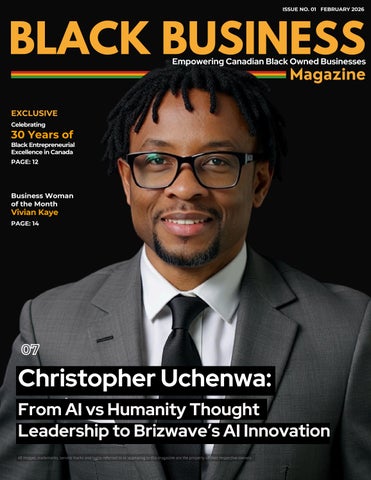
In this issue, Christopher Uchenwa shares his journey from AI vs Humanity Thought Leadership to driving Brizwave’s AI Innovation. Our Business Woman of the Month, Vivian Kaye, exemplifies excellence through her entrepreneurial journey and influence in the Canadian business community. We also feature Beauty, Confidence, and Black Entrepreneurship with Ellesha Patino, a powerful conversation centered on authenticity, purpose, and empowerment.
This edition also includes a special feature celebrating 30 Years of Black Entrepreneurial Excellence in Canada, reflecting on the milestones, challenges, and contributions that have paved the way for future generations. We bring you insights from the Workplace Safety and Insurance Board through an interview with Rebecca McFarlane, Manager of Operations at WSIB, discussing workplace safety and support for businesses. In addition, we explore how the Black Business Association of BC is redefining Black entrepreneurship, highlighting community driven growth and leadership.
You will also find thoughtful reads such as The Rise of Black Women Entrepreneurs in Canada and Building Resilience in a Disruptive World, exploring leadership, innovation, and perseverance at the core of Black excellence.
You’ll also find thoughtful reads like The Rise of Black Women Entrepreneurs in Canada by SK Uddin, and Building Resilience in a Disruptive World with Kripa Anand, both exploring the spirit of leadership, innovation, and perseverance that drives Black excellence forward.
This magazine was created to be more than a platform—it’s a collective voice for connection, collaboration, and change. Through every story, we aim to inspire growth, build unity, and remind every reader that their voice, vision, and contribution matter deeply to the future of Canadian business.
As we begin this journey together, let this first issue serve as a testament to progress, power, and possibility.

blackbusinessmagazineca
info@canadiansmeca canadiansme canadian sme canadiansme canadiansme

Editor&Publisher ShaikKhaleeluddin(SK)
Sr.MediaManager MaheenBari
MediaManager KripaAnand
Sr ContentManager AmandaSpearing
CreativeDesign CmarketingInc
SocialMedia CmarketingInc
Events ShaikRaoofUddin
Photography DepositPhotos,CmarketingInc
Web CmarketingInc
ForAdvertisements info@canadiansmeca CmarketingInc 6345DixieRd, Unit202,Mississauga,ON L5T2E6
Callusat+14166550205/6476685785

Thank you for joining us at the beginning of this exciting journey. Together, we will celebrate the achievements of Black businesses, confront and overcome obstacles, and seize the opportunities that lie ahead. Let us move forward with a shared vision of prosperity, unity, and innovation for Black entrepreneurs across Canada.
With heartfelt gratitude and anticipation,
SK Editor-in-Chief
The CanadianSME Black Business Magazine
ISSN2562-0657(Online)

PublishedbyCmarketingInc 6345DixieRd, Unit202,Mississauga,ON,L5T2E6
Copyright©2026CMarketingInc Allrightsreserved Reproductioninwholeorpartofanytext,photography orillustrationswithoutwrittenpermissionfromthe publisherisprohibited.
ThecontentsintheBlackBusinessMagazinearefor informationalpurposesonly.NeitherCmarketingInc,the publishersnoranyofitspartners,employeesoraffiliates acceptanyliabilitywhatsoeverforanydirector consequentiallossarisingfromanyuseofitscontents










Mentorship, Networking, and Community Support for Black Founders
Systemic Barriers and Building Resilience in Business

From Survival to Systems: Tolu on Scaling Safely
53 63 20
Balancing Work, Wellness, and a Scent Empire

From Layoff to Leading Change: Building Resilience in a Disruptive World

30
Accessing Funding and Grants for Black Entrepreneurs in Canada



Christopher Uchenwa: FromAIvsHumanityThought LeadershiptoBrizwave’sAI Innovation

In this exclusive feature with The CanadianSME Black Business Magazine, we sit down with CHRISTOPHER UCHENWA, Founder and CEO of Brizwave Inc , an award winning AI strategist whose work is reshaping how businesses and communities navigate the age of intelligent machines With a rare combination of financial expertise, technological insight, and human centered leadership, Christopher has become a prominent voice in responsible AI adoption across Canada and beyond
InterviewBySKUddin

Award-WinningTechEntrepreneur &AIStrategist|#1Bestselling Author|KeynoteSpeaker
Christopher Uchenwa is an awardwinning AI strategist, CPA, and technology entrepreneur recognized as one of Canada’s emerging leaders in responsible artificial intelligence, digital transformation, and innovation leadership He is the Founder and CEO of Brizwave Inc , a Canadian AI and digital transformation company that helps small and mid-sized enterprises adopt AI with clarity, ethics, and measurable business impact.
FounderandCEO
In 2025, Christopher received two national honours from the CanadianSME National Business Awards:
Black Entrepreneur of the Year (Winner) Immigrant Entrepreneur of the Year (Winner)
He was also named a Top 5 Finalist for the OBSIDI/BMO Black Entrepreneur of the Year Award (Tech Category). His thought leadership has been featured in CEO Times, Digital Journal, and the CanadianSME Small Business Magazine, and on the CanadianSME Small Business Podcast, where he shared insights on “Responsible AI: How Businesses Can Thrive with Ethics and Empathy ”
Christopher is the author of the Amazon #1 bestseller AI vs Humanity – The Battle for Human Relevance, a groundbreaking exploration of how individuals and organizations can thrive in an era shaped by intelligent machines He is the host of the global AI vs Humanity 404 Podcast, where he simplifies complex AI concepts and challenges audiences to rethink technology’s role in ethics, society, work, creativity, and human potential.
This led me to specialize in business systems, project consulting, and enterprise optimization I completed an Advanced Diploma in Information Systems Analysis with a focus on ERP and spent years helping large enterprises and multiple Canadian government departments implement ERP systems and navigate digital transformation
When I founded Brizwave in 2018, my goal was to bring that same level of transformation to small and mid-sized businesses; organizations that are often overlooked because traditional ERP solutions are too costly and complex The arrival of OpenAI in 2022 accelerated that mission AI suddenly became accessible, affordable, and capable of leveling the playing field for SMEs.
But with opportunity comes responsibility My mission today, “AI with ethics and empathy”, is rooted in ensuring SMEs adopt AI in a way that is transparent, human-centered, and costeffective, empowering them to grow without compromising their values or people
You’ve been named CanadianSME Immigrant Entrepreneur of the Year and a Top 5 finalist for the OBSIDI/BMO Black Entrepreneur of the Year (Tech). How did your journey from CPA to AI strategist and founder of Brizwave shape the mission you now have around “AI with ethics and empathy” for small and mid-sized businesses?
My journey from CPA to AI strategist has been shaped by one consistent conviction: technology must serve people, not overwhelm them I began my career in 2003 at Deloitte, where the world of finance and consulting inspired me to pursue professional accounting through the ACCA (UK) and later the CPA designation after immigrating to Canada But even then, I was drawn to technology and its ability to transform how businesses operate

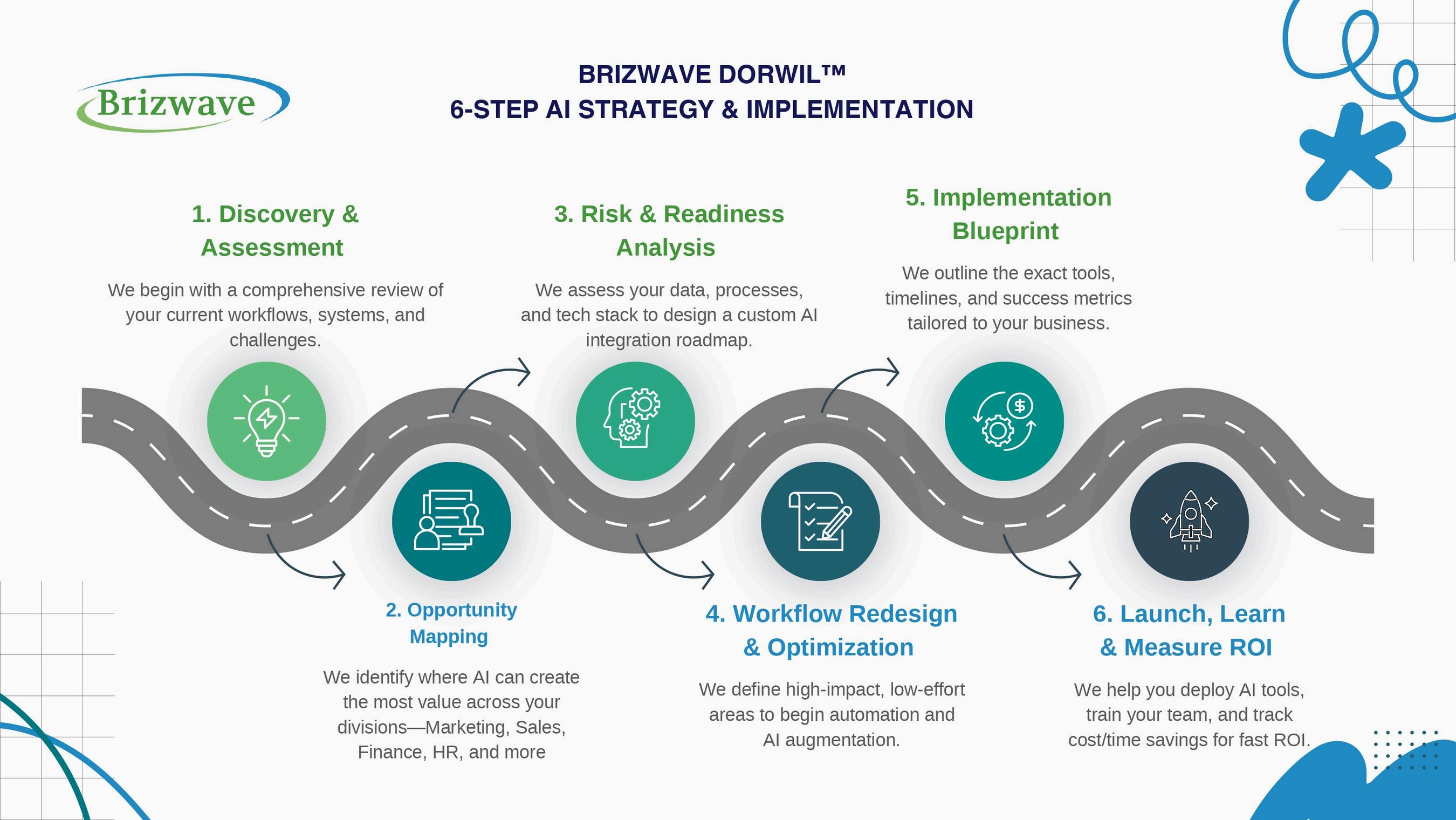
Brizwave’s proprietary DORWIL™ Methodology offers a structured roadmap for AI adoption. For business owners who feel overwhelmed by AI, how does this six-step approach help them move from buzzwords and fear to clear strategy, responsible implementation, and measurable ROI?
Many business owners feel overwhelmed by AI because it’s surrounded by hype, technical jargon, and fear of the unknown The Brizwave DORWIL™ Methodology was created to solve this exact problem It’s a simple, structured, six-step roadmap that helps organizations move from confusion to clarity and from experimenting with AI to achieving real business results
DORWIL™beginswithDiscovery,whereweidentifygenuine businessproblems,notjust“AIideas.”Wethenmoveinto OpportunityMapping,showingleadersexactlywhereAIcan reduceinefficiency,cutcosts,orincreaserevenue.Thethird step,Risk&Readiness,ensuresethical,safe,andresponsible adoptionbyevaluatingdataquality,policygaps,employee readiness,andpotentialrisks.
In step four, Workflow Redesign, we translate AI concepts into practical process improvements that integrate smoothly with the team’s daily work Step five, Implementation, focuses on launching cost-effective AI tools; often lightweight automations and copilots that SMEs can afford Finally, Learning & Optimization ensures teams are trained, supported, and equipped to sustain long-term value
By breaking AI into a clear, human-centered sequence, DORWIL™ removes the fear and guesswork It helps business owners adopt AI ethically and confidently, with measurable ROI, predictable outcomes, and a transformation journey they can actually understand and lead
You’re also building Brizap Pay and the Universal Authenticity Verification Protocol (UAVP) to tackle global payments and deepfake threats. What real-world problems did you see—like your Mexico travel experience or the rise of AI-generated fraud—that convinced you these tools were urgently needed for businesses and everyday people?
Brizap Pay and UAVP were born from real-world problems I personally encountered; problems that millions of people and businesses face every day
The idea for Brizap Pay emerged during a family vacation in Mexico I found myself searching for foreign exchange shops, dealing with unpredictable rates, and carrying cash just to make simple purchases. It highlighted a major gap: in a globalized world, travelers still struggle to spend their own money seamlessly. That frustration inspired the vision for Brizap Pay; a borderless, intelligent, multi-currency travel payment solution Today, the startup is in development under Brizap Inc , and we are actively welcoming early-stage investors who see the future of frictionless travel finance
Recognizing the urgency, my team and I began shaping UAVP; an AI-driven authenticity verification framework designed to help businesses and individuals confirm what is real in a world where “seeing is no longer believing ”
Through your AI vs Humanity book, podcast, and School Impact Tour, you’re engaging students, professionals, and policymakers on the future of work, ethics, and human relevance. What are the biggest misconceptions about AI you encounter, especially in Black communities and among small business owners, and how do you address them?
Across my book AI vs Humanity, the AI vs Humanity 404 Podcast, and the School Impact Tour, I’ve seen the same misconceptions repeated, especially within Black communities and among small business owners who often feel underserved in the AI conversation.
The first misconception is “AI will replace all of us.” Many believe technology is coming to take jobs, not realizing that AI actually creates new opportunities when people are empowered with the right skills I address this by teaching the concept of human relevance; the idea that our creativity, judgment, emotional intelligence, and intuition become even more valuable in an AI-driven world
The second misconception is “AI is only for big corporations.” Small business owners often think AI is too expensive or too technical. Through Brizwave and the DORWIL™ Methodology, I show them that simple automations, digital workflows, and AI copilots can reduce costs, eliminate inefficiencies, and help them compete globally; often at a fraction of the cost of traditional systems.
The third misconception is “AI is neutral.” In Black communities, there is growing awareness of bias in algorithms, surveillance risks, and unequal access to digital tools I address this through education, transparency, and advocacy for ethical AI governance, empowering people to use AI responsibly while protecting their rights and identity
Ultimately, my mission is to replace fear with understanding, and confusion with empowerment.
As a Black tech founder leading multiple ventures and advocacy initiatives—from Brizwave and Briz Learning to GEWO and youth education—what key advice would you share with Black entrepreneurs who want to innovate with AI, protect their communities, and build purpose-driven businesses that can scale globally?
My advice to Black entrepreneurs who want to innovate with AI and build purpose-driven businesses is simple: start with purpose, stay informed, and build boldly
First, use your lived experience as your superpower. Many of the problems facing our communities financial inequity, lack of access, digital exclusion, educational gaps are opportunities waiting for innovators. Brizwave, Briz Learning, GEWO, and even Brizap Pay were all born from real challenges I faced and observed. Innovation begins with solving problems that matter.
Second, embrace AI early, but responsibly. AI is not just a trend it’s the infrastructure of the future Learn the tools, understand the risks, and use frameworks like the DORWIL™ Methodology to guide ethical adoption Black communities must not be left behind in the AI revolution, nor should we be exploited by systems we don’t understand
Third, build your business on values, not just ambition. Purpose-driven ventures scale because they attract partners, customers, and investors who believe in the mission. Whether through climate action with GEWO or youth education through the School Impact Tour, impact amplifies influence.
Finally, grow beyond borders Your ideas are global Technology removes limitations visibility, reach, and transformation can all be achieved from anywhere
ToeveryBlackfounder: theworldneedsyour innovation,yourstory, andyourleadership. Buildwithcourage.
Disclaimer:Theviewsandopinionsexpressedinthis interviewarethoseoftheguestanddonotnecessarily reflecttheofficialpolicyorpositionofBlackBusiness Magazineoritsaffiliates Themagazineiscommitted tosupportingBlackentrepreneursandfostering conversationsthatpromoteinclusionandeconomic empowerment

Celebrating
30 Years of BlackEntrepreneurial ExcellenceinCanada

BySkUddin
Under the theme "30 Years of Black History Month: Honouring Black Brilliance Across Generations From Nation Builders to Tomorrow's Visionaries," Canada will formally celebrate Black History Month for the 30th time in 2026 This milestone is an opportunity to examine attentively how Black genius has always included leadership in business, from national businesses and digital startups to barbershops and beauty salons
In Canada, black entrepreneurs have increased communal wealth, produced jobs, and opened doors in formerly closed industries However, their significance remains underappreciated in the broader narrative of Canadian invention The growth, tenacity, and promise of Black-owned companies provide one of the most obvious examples of genius influencing Canada's economic destiny as the nation considers three decades of formal recognition
Roots of Black business in Canada
Despite inadequate and frequently localized documentation, Black entrepreneurship in Canada has a long history dating back more than a century. To generate income and maintain their dignity in the face of discrimination, early Black communities in Nova Scotia established businesses in barbering, beauty services, taxi services, trucking, shoe manufacturing, newspapers, and cooperatives One of the most famous individuals is Viola Desmond, who, by the 1930s, ran a beauty salon in Halifax, started a mailorder business, and established a beauty school that trained Black women from across the area
Particularly during and after the Underground Railroad era, when formerly enslaved people established farms, stores, and services in new settlements, Toronto and Chatham became centers of Black economic and political life in Ontario By the 1870s, Black entrepreneurs had spread beyond Central and Atlantic Canada to locations such as Alberta, where rancher John Ware established his own business near the Red Deer River Despite racist laws, segregation, and restricted access to money, these early company owners managed to carve out space for enterprise and communal survival




The State Of Black Entrepreneurship Today
Despite their growing contributions, Black company owners remain underrepresented in Canada's economy today
According to Statistics Canada, there were around 66,880 Black business owners in the nation in 2018, or 2 1% of all business owners The majority of Black company owners reside in Ontario and Quebec, with slightly more than half residing in Ontario alone
Despite this, Black adults are generally less likely than the general population to be entrepreneurs; according to a recent analysis, Black adults in Canada have an entrepreneurship rate of roughly 1 3% as opposed to 2.3% for all adults.
Important traits of this entrepreneurial community are also shown by the statistics Compared to other business owners, Black entrepreneurs are typically younger and more likely to be immigrants Many operate smaller, newer businesses and are more likely to start them with personal funds than with institutional funding Black women entrepreneurs are a growing and powerful force in industries ranging from professional services and technology to beauty and food, but the majority of Black business owners are men
These facts underscore the urgency and opportunity: Black Canadians are creating companies that reflect contemporary Canada, but they still face structural obstacles that limit their ability to grow and remain sustainable in the long run
Barriers And Systemic Challenges
Many Black businesses face structural obstacles on a daily basis that are hidden behind the headline figures. Access to funding, inexpensive loans, and investment capital remains difficult, according to research from the Black Entrepreneurship Knowledge Hub and economic studies conducted across Canada To launch or expand their businesses, entrepreneurs report higher loan rejection rates, smaller loan amounts, and greater reliance on personal and family savings
Entrepreneurial experiences are also shaped by bias and discrimination in business ecosystems and labour marketplaces While some Black entrepreneurs struggle to get leases, contracts, or supplier partnerships on equitable terms, others are forced into self-employment due to racism in recruiting, promotion, or workplace culture Growth is further hampered by a lack of networks, mentorship opportunities, and specialized business support, particularly for young and firstgeneration entrepreneurs These impediments do not diminish Black entrepreneurs' intelligence; rather, they highlight the untapped potential that exists if Canada makes a sincere commitment to eliminating structural barriers
Building The Next 30 Years
Visionaries presently working in communities across Canada will shape the next thirty years of Black business in Canada A new generation is creating businesses that are unabashedly Black, globally focused, and grounded in community impact, ranging from tech founders and creative entrepreneurs to leaders in the food, wellness, and professional services industries Their companies serve as platforms for cultural storytelling, legislative activism, and youth mentoring in addition to being engines of innovation and employment
Support ecosystems are slowly growing Over the last several years, the government's Black Entrepreneurship Program has invested hundreds of millions of dollars to improve access to funding, business support, and data. Local Black business associations, incubators, and chambers are offering locations for founders to meet mentors, investors, and peers who understand their circumstances To properly honour "Black talent in business," Canada must prioritize long-term investment, procurement reform, and equitable market access, rather than just symbolic celebrations If that dedication is maintained, the next chapter of Black entrepreneurship will redefine not only balance sheets but also the whole concept of what Canadian wealth looks like
Disclaimer:Thisarticleisforinformationalpurposesonly.BlackBusinessMagazinedoesnot endorseorguaranteeanyproducts,services,organizations,orindividualsmentioned Readersareencouragedtoconducttheirownresearchandduediligencebeforemaking anybusiness,financial,orpersonaldecisions
VivianKaye BusinessWoman oftheMonth
Business&EmpowermentExpert,KeynoteSpeaker,
Vivian Kaye and the Rise of KinkyCurlyYaki
Vivian Kaye's narrative is one of courage, cultural grounding, and a keen eye for what Canada's cosmetics market lacked A Ghanaian immigrant who landed in the Hamilton-GTA region, she rose from a self-described college dropout to the founder of KinkyCurlyYaki, a premium textured-hair extensions brand she bootstrapped into a seven-figure business serving Black women across Canada and beyond Her entrepreneurial journey, as she often describes it, was never linear It arose from personal experience, cultural pride, and a desire to see Black women honoured rather than marginalized
Early Roots Of Learning Enterprise in Ghana and Canada
Kaye often credits her mother for shaping her entrepreneurial outlook Born in Ghana, she spent her earliest years on her mothers back while her mother sold in local markets to support their family After moving to Canada as a toddler, Kaye grew up hearing those stories and watching her mother work with the same drive in a new country That combination built her sense of initiative Before starting her wedding décor business, Kaye worked in customer service, marketing, startups, and franchise environments, where she learned how operations, people, and growth work in practice

That initiative put her at the center of an industry where Black women were expected to adhere to limited standards of "professional" beauty She frequently observed other professional Black women struggling to reconcile their natural hair textures with expectations established by straight-hair ideals The conflict between authenticity and acceptance sowed the seeds that would eventually sprout into her own brand
How It All Sparked Off
KinkyCurlyYaki began as a solution to a personal problem. Kaye found it challenging to obtain highquality hair extensions that replicated the kinky, coily texture of her natural hair while running her wedding décor business The market was saturated with straight, smooth options, leaving Black women with few viable options
Determinedtofindasolutionforherself,she beganprocuringhumanhairand experimentingwithtexturestotrytomatchher own.Sheworeherextensionstonetworking gatherings,andotherBlackwomenquickly askedwhodidherhair;whenshetoldthem theywereextensions,theyexpressedinterest inpurchasingthesamepieces.Thatquick validationverifiedwhatshehadalready suspected:therewasaclearmarketvacuum waitingtobefilled.
Building a Seven-Figure Brand from Scratch
KinkyCurlyYaki debuted quietly online in late 2012 as a side project during the wedding off-season. Kaye used Shopify to build the business and relied on organic promotion, including forums, YouTube reviews, social media groups, and good old-fashioned word of mouth The response was quick

Within the first year, she had six-figure revenues By 2016, the company had reached their first million dollars in annual revenue without the help of paid ads, outside investors, bank loans, or venture capital Orders were transported from her apartment, then her parents' basement, before she hired employees and relocated to a business premises. Her success became a case study for how a specialized, community-focused ecommerce firm can grow from humble beginnings
A Product Line Built for Black Hair, Not Around It
KinkyCurlyYaki distinguishes itself by offering textures designed to complement the variety of Black hair Clip-ins, wefts, ponytails, closures, and wigs are available in a variety of textures, including My Kinks, My Coils, My Curls, and various coarse-to-straight designs meant to complement natural or transitioning hair Canadian beauty periodicals credit the brand with pioneering the textured-extensions niche in the country

While competitors have since followed, KinkyCurlyYaki has retained its lead via precise product quality, deep community trust, and an awareness of Black women ' s relationships with their hair something that mainstream providers had previously minimized or ignored.
A Voice for Black Entrepreneurship in Canada
Kaye's impact reaches far beyond the firm she founded She's been refreshingly open about the realities of starting KinkyCurlyYaki "from scratch" as a Black immigrant woman with no wealth networks or financial assistance Her openness has made her a popular mentor and speaker for platforms such as Ownr, CanadianSME, startup hubs, and university entrepreneurship programs
Her experience is widely cited as evidence that highrevenue businesses can be developed within structural constraints and that the places most disregarded by traditional sectors often have the most significant entrepreneurial potential
Leadership, Coaching, and Cultural Impact
Kaye is still a major player in Canada's business scene, even after KinkyCurlyYaki was acquired in 2022 She now works as a coach, keynote speaker, media personality, and advocate for underrepresented and marginalized founders Her work focuses on price clarity, real-world marketing, and mental wellness, debunking misconceptions about sudden success and emphasizing the importance of constant action and community support in driving significant growth Representation, Confidence, and the Canadian Beauty Landscape
More than just a retail offering, the brand filled a representation void in Canada's beauty market Kaye challenged ingrained standards that associated straight hair with polish and opportunity, particularly in corporate settings, by focusing on natural Black textures and portraying them as professional, attractive, and daily
Many consumers, as reported in Canadian interviews, used KinkyCurlyYaki to transition away from chemical relaxants while remaining work-ready The items became inextricably linked to identity, confidence, and career visibility, demonstrating how something as intimate as hair can influence deeper feelings of belonging and empowerment
VivianKayeandKinkyCurlyYakiprovide aroadmapformodernBlackCanadian entrepreneurship:startwithlived experience,solvearealneed,honour yourcommunity,andcompete confidentlyonaglobalscale.
Disclaimer:Thisarticleisforinformationalpurposesonly Black BusinessMagazinedoesnotendorseorguaranteeanyproducts, services,organizations,orindividualsmentioned.Readersare encouragedtoconducttheirownresearchandduediligencebefore makinganybusiness,financial,orpersonaldecisions

ByMaheenBari

Black Entrepreneur HowTo Builda StrongBrand IdentityAsa

We often ask this: Why does brand identity matter? Your brand identity is more than simply a colour scheme or a logo; it's the first impression buyers have of your company It influences how others see, trust, and remember you A strong brand identity provides even more benefits for Black businesses in Canada It serves as a platform to celebrate culture, fight preconceptions, and stand out in a congested marketplace with authenticity A well-crafted brand may help your company gain trust, inspire loyalty, and resonate deeply with customers and the community
Finding your voice and brand story is all-important Begin by asking yourself why you started this business Personal history, cultural background, and lived experience might be your brand's most valuable assets Authentic storytelling creates emotional connections that go beyond facts and data, allowing clients to comprehend not only what you sell but also why you exist
Map Out How You Are Here Crafting a Standout Visual Identity
Plan your journey What prompted your venture? Were there market gaps due to cultural or community needs? Perhaps you started your business because you wanted to help underrepresented customers or reflect your own identity These roots difficulties, heritage, and vision should inform how you communicate your brand
Make sure your story is visually accessible Use photographs, videos, design, or packaging to convey lived experience, diversity, and identity It allows viewers to connect emotionally and recognize themselves in your brand Share your journey, accomplishments, founder's voice, and progress regularly on social media and your website.
This continual connection encourages authenticity and keeps your brand relevant. A notable example of this technique is when Black-owned firms incorporate cultural identity into their narrative and aesthetics, transforming a brand into a relatable story
Thiscontinual connection encourages authenticityandkeeps yourbrandrelevant.A notableexampleof thistechniqueiswhen Black-ownedfirms incorporatecultural identityintotheir narrativeand aesthetics, transformingabrand intoarelatablestory.
Visual identity colours, logos, fonts, and design style has a significant impact on how your business is regarded Consistency across channels helps small businesses in Canada develop recognition and trust.
Use tools like Canva or free font libraries to produce professional-looking marketing assets without spending a fortune. If possible, hire designers, preferably from the Black community, or work with creatives who are familiar with your culture and vision. This authenticity can help your brand establish a distinct, meaningful identity.
Ensure that your visual identity is consistent throughout your website, packaging, social media, and printed materials Whether a customer visits your Instagram, website, or physical store, the branding should seem familiar and consistent Consistency improves brand memory and professionalism.

Building Market Visibility an
Joining Black business directories and platfo improve your visibility and credibility For exa Direct (operated by the Canadian Black Cha includes thousands of Black-owned busines making it easier for clients to find and suppo Leverage digital channels as well: social me page, or an e-commerce store powered by can help you expand your reach without bre
Consistent, authentic communication fosters and trust over time Combining it with collab promotions with other Black entrepreneurs w larger audience and gain community suppo testimonials, reviews, and user-generated c significant When potential clients see genui recommending your business, they gain con
Practical Marketing Tips for Stage Founders

Focus your messaging on values and customer needs
Rather than using generic slogans, talk directly to what your clients care about: cultural identity, authenticity, quality, and community
Maintain your regular presence. Whether it's blog posts, email newsletters, Instagram stories, or community updates, regularity helps you stay visible and remembered
Use analytics tools to determine what works. Monitor engagement, clicks, and conversions. Use statistics to influence your messaging, posting times, and content types.
Use free or low-cost courses and resources. Banks, startup hubs, and entrepreneurship organizations offer training in marketing, branding, and digital marketing.
Enter pitch competitions or award ceremonies for diverse businesses. These can provide visibility, credibility, and, in some instances, finance, which is a significant benefit for early-stage startups.
Building a great brand identity as a Black entrepreneur in Canada is much more than just sticking out; it's about communicating your story with pride, instilling trust and belonging, and forging genuine connections Your brand may become a powerful engine for growth, recognition, and long-term success by including creative storytelling, consistent imagery, community support, and strategic marketing
Disclaimer:Thisarticleisforinformational purposesonly.BlackBusinessMagazine doesnotendorseorguaranteeany products,services,organizations,or individualsmentioned Readersare encouragedtoconducttheirownresearch andduediligencebeforemakingany business,financial,orpersonaldecisions
Balancing Work, Wellness, andaScent Empire



Rebecca is a highly motivated entrepreneur with 15+ years of customer service experience She is passionate about continuous growth and self-improvement and embodying that through different ventures in life Rebecca is an entrepreneur who is working to master juggling a full-time job, and running a thriving smallbusiness on the side
You juggle a full-time career, an EMBA, and a growing scent business. How has this journey shaped your understanding of what it really takes to be a working entrepreneur, beyond the “highlight reel” people usually see?
RebeccaMcFarlane, Manager,OperationsWorkplace SafetyandInsuranceBoard(WSIB)

In an exclusive interview with CanadianSME Black Business Magazine, Rebecca McFarlane, Manager of Operations at the Workplace Safety and Insurance Board (WSIB) and Founder of Undertonez, shares her inspiring entrepreneurial journey From balancing a full-time job to building a business, Rebecca discusses the challenges she faced, her approach to wellness and self-care, and how she navigated barriers in events and funding.
Being a working entrepreneur is all about prioritizing and time management It can be overwhelming when you have competing interests but it’s important to remember that we exist beyond the 9-5 Sometimes things get lost in the shuffle but when I have those days I just try and get one thing done for my business, because if I at least get something done I am moving the needle forward, even if it is just a little bit We get so caught up in where we are going in life that we forget to enjoy how we got there so I make a point of trying to slow down and truly appreciate how amazing it is and how fulfilling it can be to do all the things. While yes exhausting sometimes, its a blessing to be able to do all the things you dream of doing It takes determination and consistency to maintain all the things you juggle in life But it’s important to learn to not only prioritize all the things you need to do in a day or week, but also to prioritize self-care because if my glass is empty, I can’t pour into anyone else’s
Your handmade air fresheners offer a unique scent experience in a simple, compact format. What inspired the concept, and how did you refine your three signature scents to stand out in such a crowded market?
I had a business before where I learned how to make wax melts and air fresheners, after this business ended, I didn’t think about starting a new business because the prior one was so taxing But when the opportunity presented itself with my new partner, I took it And it has been one of the best decisions I ever made Our OG scent, Perfection
was the first creation After mixing together our first scent experiment, Perfection was born. We were so proud of the fact that it smelt like something familiar but also nothing we’d ever smelt before all at once And our other two scents would follow in a similar manner, just through trusting our gut with scent combinations We wanted to make fresheners that brought nostalgia and newness Other scents smelt either too strong or artificial and we just wanted to make something that changed the scent game Also making something a little more subtle that we have even had the co-sign from some of the scent sensitive community !
As a Black woman entrepreneur focused on wellness, self‑care, and continuous improvement, how do you protect your own well‑being while pushing for growth in both your career and your business?
It can be tiring getting all the things done So I make it a point to seek out experiences that fill my cup Whether it be spending time with my boyfriend, spending time with friends, or spending time alone Every year people set resolutions, I however set intentions for one thing that I want to do that pours into me for the year Last year that thing was having what I called my “Concert Year” Without guilt, I went to any and every concert I wanted to, with both loved ones as well as by myself And I can say with certainty, it was one of the most fulfilling years I have had in a long time. Experiences pour into us more than we realize and sometimes we get so caught up in the hustle and bustle that we forget to slow down and enjoy the life we are living It is also important to set boundaries, know when to push ahead and get things done, but also when you have to truly respect how you are feeling and give yourself some grace It’s important to sometimes embrace that slow soft life when your body calls for it
You’ve mentioned barriers to entering events, markets, and accessing funding. Can you share specific challenges you’ve faced in these areas and what has helped you break through or work around those obstacles?
In our first year of business, it was so difficult to figure out where to go for markets And as we would find them it was the difficulty of getting noticed and accepted into these markets As well,
depending on how big the event was, as a small business, some of those markets are expensive ! It’s important to put yourself in the right spaces, but sometimes those spaces are unaffordable We would see markets or tradeshow opportunities we wanted to be a part of, but they were costing thousands of dollars It can be hard for a small business seeking brand awareness to afford some events So we started to aim smaller, decided to seek out events and cap our expenses for a smaller budget We were able to find smaller and more feasibly priced events and farmer’s markets that allowed us a space to showcase our business at a more reasonable price As we continued to do more smaller markets, we began to have businesses start to reach out to us and ask us to be a part of their market So stick within your budget, you can find success there too
From being invited to events like CIRA’s “Canadians Connected Toronto” to expanding into more markets, what lessons or practical advice would you offer to other small business owners— especially Black women—who are trying to grow sustainably while balancing work and life?
To do lists are your best friend No really Using lists to set intentions for your weeks, months, year is important. Asana is an amazing tool if you are looking for one. Understand that there will be some times where you feel like giving up, its persevering beyond those times that truly show your strength But also remember in those times to give yourself grace and assess why you feel like giving up If it’s a valid reason, maybe that is something to explore, and if it’s just fear or apprehension or anxiety, remember that moderate levels of anxiety are needed to achieve success Dream all the big dreams, and lay all the foundational bricks to get there One day, when you still feel like you ’ re still not where you want to be yet, someone will come and remind you (like this article is doing for me) that you have done something that a lot of people don’t do You have dedicated yourself to something meaningful You turned your dream, your vision into reality, and not many women, especially black women can say they did that, and you should be so very proud
Disclaimer:Theviewsandopinionsexpressedinthisintervieware thoseoftheguestanddonotnecessarilyreflecttheofficialpolicyor positionofBlackBusinessMagazineoritsaffiliates Themagazineis committedtosupportingBlackentrepreneursandfostering conversationsthatpromoteinclusionandeconomicempowerment.
Beauty,Confidence,and BlackEntrepreneurshipwith
Ellesha Patino

In this exclusive feature for The CanadianSME Black Business Magazine, we sit down with Ellesha Patino, Founder of Beauty and Nails by Yaz, whose commitment to care, education, and representation is reshaping the beauty experience for Black women across her community With a background that spans legal administration, early childhood education, and beauty artistry, Ellesha brings a rare blend of precision, professionalism, and heartfelt connection to her studio.
InterviewByMaheenBari
My name is Elle, the owner of Beauty and Nails by Yaz. I’m a wife, a mother of three, and a proud Black entrepreneur dedicated to creating a beauty experience where women feel seen, valued, and cared for I began my professional journey as a legal assistant before returning to school to complete my Early Childhood Education and becoming a Registered Educator While pursuing my Bachelor of Arts in Early Childhood Studies, I was also building my beauty business one client, one service, and one vision at a time.
Beauty and Nails by Yaz was named after my daughter and was born from my love for enhancing natural beauty and creating a warm, welcoming space for women to unwind I specialize in nail services, lash extensions, and makeup, with a strong focus on education, quality, and client connection

My goal is always to provide an experience that feels personal, intentional, and professional
As a Black woman in the beauty industry, representation is deeply important to me I strive to inspire other women, especially young girls, to dream boldly and pursue their passions My work is not just about beauty it’s about confidence, community, and creating space for women to feel empowered in every season of life.
What inspired you to launch Beauty and Nails of Yaz, and how does your identity as a Black entrepreneur shape the kind of beauty experience you want your clients to have?
I launched Beauty and Nails by Yaz because I’ve always been passionate about creating spaces where women feel seen, cared for, and confident When I first entered the beauty industry specifically nails I noticed something that truly shaped my journey: so many of us, especially Black women, were the main consumers of beauty services, yet very few service providers actually looked like us That gap inspired me to step forward and become the representation I didn’t see
As a Black female entrepreneur, my identity is woven into every part of my business. I understand the importance of feeling understood and welcomed, so I’ve created an experience that is warm, inclusive, educational, and rooted in excellence I want my clients to walk in and instantly feel safe, respected, and celebrated

The beauty and nails space is very competitive. How do you make your brand and studio feel different—whether through your services, client care, or the atmosphere you create?
The beauty and nails space is definitely competitive, but what sets Beauty and Nails by Yaz apart is the level of care, intention, and education that clients experience the moment they walk in My focus isn’t just on creating something pretty for the moment I’m committed to long-term nail health I take the time to help clients understand their natural nails, track their progress, and grow their own nails in a healthy, sustainable way That alone already creates a different kind of trust
My brand is built on quality, connection, and a calm atmosphere where clients feel genuinely cared for I prioritize personalized service, clean techniques, proper preparation, and products that support retention and growth. Clients dont just receive a service they learn, they feel listened to, and they see real results.

Thestudioitselfis designedtofeelwarm, welcoming,and peaceful,almostlikea resetinthemiddleofa busyweek.It’sthe combinationof professionalism, comfort,andeducation thattrulysetsmybrand apart.Myclientsknow thatwhentheycometo me,theirbeautyand theirwell-beingare equallyimportant.
What have been some of the biggest challenges you’ve faced as a Black business owner in the beauty industry, and what helped you keep going during the toughest moments?
One of the biggest challenges I’ve faced as a Black business owner in the beauty industry has been navigating a space where representation is still limited. When I started, I didn’t see many women who looked like me offering high-quality nail and beauty services, even though we were the main consumers That lack of visibility made it harder to gain trust at first, prove my expertise, and carve out space for myself in a saturated market
Another challenge has been balancing everything being a wife, a mother of three, building a brand, and still showing up consistently for my clients There were moments I felt overwhelmed, tired, or questioned if I could really juggle it all
What kept me going was purpose. I knew I was building more than a studio I was building a legacy for my children, creating representation for other Black women, and giving clients a safe, educational, healthynail–focused space they couldn’t find anywhere else My clients’ trust, my family’s support, and my own determination pushed me through every hard moment I’ve learned that showing up even on tough days is what keeps a dream alive
Community and representation are powerful in beauty. How do you see your work contributing to greater visibility, confidence, and empowerment for Black women and girls who sit in your chair?
Community and representation are at the heart of everything I do When Black women and girls sit in my chair, I want them to see themselves reflected not just in the services I provide, but in the space, the energy, and the professionalism they experience For many of us, growing up, we didn’t always see Black women leading in beauty spaces. So every time I show up in my business, I’m showing what’s possible.
My work goes beyond nails It’s about creating a space where Black women feel understood, prioritized, and celebrated When I help clients grow their natural nails, enhancing their natural beauty through makeup, or feel beautiful without apology, it builds confidence in ways that last long after the appointment I share knowledge, I educate, and I create an atmosphere where they feel safe to be fully themselves
For younger girls, especially, I want them to see that they can own a business, build a brand, and create opportunities for themselves My presence, my journey, and my commitment to excellence all contribute to greater visibility And when they walk out of my studio feeling empowered, that’s the real impact because confidence changes how we show up in the world.
For aspiring Black beauty entrepreneurs who want to start a salon or nail business of their own, what practical advice or key mindset would you like to leave them with?
For aspiring Black beauty entrepreneurs, the first thing I’d say is: start before you feel “ready ” There will never be a perfect moment What matters is taking consistent steps and believing that your voice, your skills, and your presence belong in this industry
Practically,focusonyourfoundation.Invest inpropereducation,practiceyourcraftuntil you’reconfident,andchoosequalityover shortcuts—yourclientswillalwaysfeelthe difference.Buildyourbusinessslowlyand intentionally:trackyourclients’progress, documentyourwork,andcreateaservice experiencethatreflectswhoyouare,not whateveryoneelseisdoing.
The mindset that carried me is knowing that representation matters Even when it feels tough or overwhelming, remember that you are opening doors for someone else Stay disciplined, stay professional, and stay true to your values
Most importantly, don’t compare your journey to anyone else’s Social media shows the highlight reel, not the late nights, slow seasons, or learning curves Keep showing up, keep learning, and trust that your consistency will separate your business from the rest Your community needs what you have to offer so step into it boldly
Disclaimer:Theviewsandopinionsexpressedinthisinterviewarethoseofthe guestanddonotnecessarilyreflecttheofficialpolicyorpositionofBlack BusinessMagazineoritsaffiliates Themagazineiscommittedtosupporting Blackentrepreneursandfosteringconversationsthatpromoteinclusionand economicempowerment


HowtheBlackBusiness AssociationofBCis RedefiningBlackEntrepreneurship
ByMaheenBari
TheBlackBusinessAssociationofBCisoneofthe mostsignificantBlack-ledorganizations supportingentrepreneursinBritishColumbiaand acrossCanada.Itsworkfocusesonstrengthening Black-ownedbusinessesthrougheducation, mentorship,marketaccess,andglobaltrade opportunities,helpingentrepreneurscompete andgrowinarapidlychangingeconomiccontext.
Rather than operating as a single program, BBABC is establishing an integrated ecosystem: a communitydriven model to assist Black entrepreneurs in innovating, scaling, and fully participating in regional, national, and international markets For readers of Black Business Magazine, BBABC is a model for longterm, community-centred business development
Founding Story and Vision
BBABC was founded in 2020 by Nerissa Allen and Clavia Alleyne at the height of the COVID-19 pandemic, when Black businesses in British Columbia were facing tremendous financial strain and losing market presence What began as a quick-response campaign quickly became a long-term goal: to boost Black entrepreneurs' ability to expand, create commerce, and contribute significantly to the Canadian economy
Building Capacity from Idea to Scale
BBABC uses a layered assistance methodology to meet entrepreneurs right where they are in their journey The organization leverages its ecosystem partners to ensure members can access the foundational skills they need to start their businesses Through these collaborations, it provides core support to new founders, including business planning, registration, financial projections, marketing basics, and tax knowledge, guaranteeing entrepreneurs can launch with clarity and confidence
Established enterprises receive comprehensive growth and scale support through advanced services such as procurement preparation, export readiness, retail market access, and digital adoption Their programs are built on the principle that theory alone is not enough, they integrate real-world activations to maximize business impact
At the core of this capacity-building strategy are several accelerators that position businesses for impact and scale Through their Retail & Expansion Accelerator and the Internationalization Accelerator, businesses gain access to structured training and real-world activations that expand their footprint; whether scaling to national distribution or exporting internationally

BBABCalsoinvestsinthenext generationthroughyouthprograms thatteachyoungpeoplehowto transformcreativeideasinto tangibleproducts,pricethem effectively,andsellwithpurpose; shapingfuturebusinessleaders.
Innovation in Market Access Afro World Expo
One of the most critical challenges for Black entrepreneurs is gaining access to markets BBABC addresses this problem by innovating across both physical and digital commerce
U.E.L Marketplace - U.E.L Marketplace, located on Granville Island in Vancouver and available online, is a retail social enterprise that showcases products from Black-owned businesses. It offers participants shelf space, brand recognition, hands-on retail training, and a pipeline for sales growth
Black Biz Global - This exclusive digital platform combines B2C, B2B, and B2G ecommerce, serving as both a marketplace and a comprehensive directory of Blackowned enterprises. By diversifying regional and national supplier chains, Black Biz Global improves procurement paths and assists enterprises looking to expand their reach beyond provincial borders.
Events and Flagship Initiatives
Each year, BBABC presents a number of highimpact events to promote Black business in British Columbia and across Canada
The Afro World fair is the largest fair of Black-owned enterprises in the Northern Pacific region, bringing together entrepreneurs, suppliers, investors, and partners under one roof It honors invention, encourages collaboration, and creates new business prospects
Trade Missions
BBABC sponsors international trade and investment trips to countries throughout Africa and the Caribbean These missions introduce entrepreneurs to new markets, enhance cultural and commercial relationships, and facilitate worldwide alliances
Business Excellence Awards
This annual gala recognizes outstanding Black-owned businesses and leaders via networking, storytelling, and celebration It has become a defining event that celebrates achievement and inspires leadership in British Columbia's Black business community
Elevate Her Conference
Elevate Her Conference is a premier gathering celebrating the power and potential of Black women in leadership, entrepreneurship, and community impact Presented in partnership with the Black Women Connect Vancouver (BWCV), this dynamic event goes beyond traditional panels; offering immersive experiences, interactive sessions, and meaningful networking opportunities

Ecosystem,
Partnerships, and Policy Context
As part of a broader national discourse on equity in entrepreneurship, BBABC is an essential part of British Columbia's ecosystem for Black business growth Its work aligns with efforts such as the Black Entrepreneurship Program (BEP) Ecosystem Fund, demonstrating a shared commitment to improving economic opportunities for Black Canadians
Aside from services, BBABC employs storytelling to mainstream Black business success By publicizing the accomplishments of entrepreneurs across its network, it builds role models, transforms narratives, and plants seeds of possibility for the greater community
Looking Ahead
Looking ahead, BBABC intends to scale its programs nationally, broaden Black Biz Global's reach, expand the Afro World Expo, deepen trade missions abroad, and continue innovating on how NGOs can build economic ecosystems for Black businesses
BBABCisconsistentlyrecognizedasa reliableresourceforBlackbusinesses,with strongvisibilityonplatformssuchas LinkedIn,Instagram,andFacebook.Itis increasingitsinfluenceacrosssectors throughpartnershipswithregional stakeholders,economicdevelopment agencies,technologynetworks,and communityorganizations.
For Black entrepreneurs, it is preferable to join the BBABC programs, participate in the incubator, list your business on Black Biz Global, and explore opportunities at U E L Marketplace and Afro World Expo For companies and institutions, it is advised to collaborate with BBABC to increase supplier diversity, procurement inclusiveness, sponsorships, and ecosystem-building initiatives to benefit Black-owned businesses
BBABC leadership frequently views Black entrepreneurship as fertile ground, brimming with creativity, invention, and tenacity Their efforts demonstrate that when this soil is nourished, the entire Canadian economy becomes stronger
Youth, Climate, and Community Impact
BBABC's youth entrepreneurship programs help young people improve their abilities in ideation, product creation, pricing, marketing, and performance evaluation These programs foster entrepreneurial thinking early on, ensuring that future generations regard business ownership as a viable and feasible option
The organization is also promoting climatefriendly business practices BBABC is Climate Smart Certified and supports preparing its members to incorporate sustainability into their operations, putting Black entrepreneurs at the forefront of Canada's green economy

Ourvisionistocreateanecosystem hereBlackentrepreneursdon’tjust urvive—theythrive,innovate,and eadonaglobalstage.BBABCis uildingpathwaysthatturnideas ntoenterprisesandenterprisesinto legacies,ensuringthatBlack-owned businessesareintegraltoCanada’s economicfuture.”NerissaAllen, Co-Founder&President,BBABC
Disclaimer:Thisarticleisforinformationalpurposesonly Black BusinessMagazinedoesnotendorseorguaranteeanyproducts, services,organizations,orindividualsmentioned Readersare encouragedtoconducttheirownresearchandduediligencebefore makinganybusiness,financial,orpersonaldecisions.

BlackEntrepreneurs inCanada AccessingFundingandGrantsfor

BySkUddin
When it comes to funding and business support, black entrepreneurs in Canada still confront historic and structural impediments. Recognizing these issues, the federal government, financial institutions, and charity organizations are now offering a broader range of grants, loans, and ecosystem services
These targeted supports aim to help Black-owned firms launch, grow, and thrive by providing not only financing but also mentorship, data insights, and community-building tools to ensure long-term success
Major Grant and Loan Programs
The Black Entrepreneurship Program (BEP) is a federal initiative that will be extended with a $189 million investment in 2025, as part of a targeted lifetime total of up to $265 million BEP consists of three key streams meant to support Black businesses across Canada:
The Loan Fund, administered by the Federation of African Canadian Economics (FACE) in collaboration with the Business Development Bank of Canada (BDC), provides up to $250,000 in capital to eligible Black-owned enterprises.
Black Entrepreneurship Program (BEP)
The Ecosystem Fund provides funding to Black-led nonprofit organizations across Canada, enabling them to offer mentorship, training, advisory services, and business-support infrastructure.
Knowledge Hub: Working with academic and community partners, the Hub collects research and data to identify structural hurdles and analyze trends in the Black entrepreneurial ecosystem.
Since its inception, BEP has helped over 24,000 Black entrepreneurs, with over $70 million already disbursed through 801 authorized loans through the Loan Fund
Other Programs and Bank Loans
Major Canadian banks provide targeted financing and support to Black entrepreneurs via dedicated initiatives For example, the RBC Black Entrepreneur Program offers an "Entrepreneur Business Loan" of up to $250,000 to qualified business owners RBC supplements its loans with personalized banking products, business-planning tools, cash-flow calculators, and mentorship services, extending help beyond money
Similarly, although the lending terms differ, other banks, such as CIBC, and institutions that collaborate with community organizations offer micro- and small-business funding to support Black entrepreneurship
Regional and Specialized Grants
Aside from national initiatives and bank loans, smaller-scale or sector-specific grants and microloans offer extra assistance These may serve startups or specialty firms in the arts, technology, food, or communityoriented industries
Some programs provide microloans smaller amounts (e g , up to $50,000) for earlystage or small-scale businesses There are also region- or sector-specific subsidies available, often aimed at Black-owned small companies operating in the creative industries, social enterprises, or communitybased projects
Tips for Stronger Applications
To increase your chances of obtaining funds or grants, try the following strategies:
Create a detailed business plan. Outline your funding needs, growth trajectory, and the potential benefit your company might provide to the Black community or society

Maintain current documentation, which includes business registration certificates, financial records, tax returns, and personal identification. Accurate and thorough documentation increases trustworthiness and eligibility.
Use grant-discovery services – services that collect grants and funding opportunities (encompassing thousands of programs) can assist you in tracking deadlines and identifying lesser-known funding streams.
Apply ahead of the deadlines Submitting early demonstrates organizational readiness and gives you time to revise and personalize your proposal to each fund's objectives
Tailor applications to each fund's goals. Show how your company matches with the fund's mission: community impact, innovation potential, equity, employment creation, or market shortages.
Collect references or endorsements – Letters or recommendations from mentors, communitybased organizations, or industry colleagues can help your application's legitimacy.
Seek mentorship and network assistance Consult incubators, accelerators, Black-focused business networks, or nonprofit support groups for advice on application strategy, business planning, and expansion.
Expert Insights from Funders
The Minister for Women and Gender Equality: “Access to capital, mentorship, and reliable data enables Black entrepreneurs to turn ideas into jobs and prosperity”
The official 2025 renewal announcement for BEP emphasized that “When Black entrepreneurs can access capital, mentorship and reliable data, they turn ideas into jobs and community prosperity.”
Funders and lenders emphasize the importance of business readiness, including accurate records, financial transparency, and a well-articulated growth or job-creation strategy. They underline that investment should go to entrepreneurs who demonstrate not only need, but also vision, readiness, and potential for impact.
Ultimately, many feel that collaboration between government, banks, and Black-led ecosystem organizations is critical to removing systemic hurdles and guaranteeing long-term, inclusive economic growth in Canada's Black communities.

Key Resources for Black Entrepreneurs
FACE: Black Entrepreneurship Loan Fund (for loan applications)
Government of Canada BEP Information Portal (for details on BEP Loan Fund, Ecosystem Fund, and Knowledge Hub)
The RBC Black Entrepreneur Program provides banking solutions, loans, and mentorship.
CIBC/Black Opportunity Fund (business finance and support)
Canada is progressively establishing an ecosystem that gives Black entrepreneurs greater access to the funding, tools, and networks required for success Black business owners now have more resources than ever, thanks to federal efforts such as BEP, helpful bank programs, and community-driven grants, but success remains dependent on meticulous preparation, strategic planning, and community collaboration.
Disclaimer:Thisarticleisforinformationalpurposesonly BlackBusinessMagazinedoesnotendorseorguarantee anyproducts,services,organizations,orindividuals mentioned Readersareencouragedtoconducttheirown researchandduediligencebeforemakinganybusiness, financial,orpersonaldecisions.
Black women entrepreneurs in Canada are starting enterprises at an unprecedented rate, thereby increasing cultural influence, community impact, and economic growth Their leadership is transforming industries ranging from technology and consulting to wellness and creative services However, despite this progress, many Black women continue to encounter distinct structural impediments that make scaling difficult Nonetheless, their persistence, ingenuity, and communitydriven approach are opening new avenues for the next generation of Canadian leaders

TheRiseof BlackWomen Entrepreneursin Canada
BySkUddin

Growth Of Black Women in Canada’s Business World
The number of Black women entrepreneurs in Canada has increased consistently over the last decade, with Black women outpacing many other demographic groups in new business formation Since 2020, particularly an increase in Black women-owned startups and established businesses, which has significantly boosted local economic resilience and national innovation trends
However, despite this increased trend, Black women are still underrepresented among established business owners This demonstrates clear structural impediments that impede long-term growth and economic viability According to research, many Black women establish firms out of necessity rather than opportunity, citing lack of promotion, workplace discrimination, and limited recognition in standard job channels (Rise Up: A Study of 700 Black Women Entrepreneurs) These factors highlight both the urgency and the potential for increased systemic support
Core Challenges and Opportunities
Funding Access: More than 80% of Black women entrepreneurs start their businesses with personal savings, while less than 1% receive venture capital funding (Rise Up Study) This funding gap emphasizes the crucial need for more equitable financing channels, such as low-interest loan programs, grants, and inclusive investment strategies customized to their specific circumstances.
Balancing Multiple Roles: Many B the challenges of caring for other obligations, and community invol competing duties frequently redu networking, product development business planning.
Bias and Visibility: Approximately female entrepreneurs report facin looking for business help, media e supply-chain opportunities. The la representation limits access to m and larger business ecosystems
Emerging Opportunities: Despite specialized government and nonp such as the Women Entrepreneurs (WES) and the Black Entrepreneur (BEP), are bridging the gap These funding, training, and research as specifically targeted to empower entrepreneurs and provide the ne framework for success.
The Power of Community Networks
Community networks have emerged as one of the most potent drivers of growth for Black female entrepreneurs in Canada Organizations like the Black Women Business Network (BWBN), the BWBN Expo, and the Professionelle House Social Club help women connect with resources, clients, and mentors These networks provide safe areas for entrepreneurs to openly communicate, interact, and form long-term professional ties
Peer-led summits and platforms, such as the We Rise Summit and BWBN conferences, magnify the impact by fostering accountability, strategic relationships, and direct referrals Data from community events demonstrate that more than 60% of attendees report increased revenue, confidence, and visibility for their businesses (Black Women Business Network reports)

Furthermore, relationships between community groups and government agencies have resulted in culturally relevant accelerator programs, leadership development initiatives, and technology-based learning centers These efforts ensure that Black women have access not only to finance but also to the knowledge and support networks required for long-term success
Actionable Steps for Leadership and Visibility
Invest in Leadership Development: Participate in workshops, accelerators, or leadership programs run by Black women-led organizations These provide culturally appropriate instruction and hands-on learning experiences
Secure Mentorship: Look for mentors and sponsors who can help you build your professional profile. Formal mentorship opportunities, such as Futurpreneur's Black Entrepreneur Startup Program, are especially beneficial for early-stage innovators seeking to refine their plan and get financing
Grow Your Brand: Create an online presence, share your narrative across digital channels, and seek media coverage that highlights your entrepreneurial journey Pitch competitions and leadership awards also improve awareness and reputation
Advocate for Others: Community helps to strengthen leadership. Contribute your knowledge in public forums, mentor new entrepreneurs, and join organizations that promote the progress of Black women in business Collective advocacy improves the whole environment
Building Confidence and Resilience
Strong networks, mentorship, and collaborative circles are often cited as sources of resilience among black female entrepreneurs Sharing tales, celebrating accomplishments, and developing mutual support systems all contribute to maintaining confidence in the face of adversity Each accomplishment made by a Black woman entrepreneur not only enhances her own path but also inspires many others to take up leadership with courage and dedication

Disclaimer:Thisarticleisforinformationalpurposes only BlackBusinessMagazinedoesnotendorseor guaranteeanyproducts,services,organizations,or individualsmentioned.Readersareencouragedto conducttheirownresearchandduediligencebefore makinganybusiness,financial,orpersonaldecisions
DigitalTransformation forBlack-OwnedSmall BusinessesinCanada

ByKripaAnand
Adopting digital tools is no longer an option for Black-owned businesses in Canada; it is a need In today's rapidly changing world, technology helps small businesses stay competitive, increase revenue, and reach larger markets Many Black entrepreneurs benefit from affordable, accessible technology that allows them to overcome historical barriers and opens new opportunities
Affordable Tech Solutions for Small Businesses
E-commerce Platforms: Services such as Shopify help small businesses set up online stores with minimal overhead, including payment processing, inventory management, shipping, and storefront design.
AI & Automation: Tools like Google Analytics, social media schedulers, email marketing platforms, and automation utilities automate repetitive tasks such as follow-ups, marketing, and client outreach, allowing entrepreneurs to focus on their core business
Cloud-Based Productivity: Cloud suites, accounting software, and collaboration tools enable small teams to operate productively from anywhere, managing documents, finances, meetings, and communications without incurring significant IT costs

Online directories and marketplaces explicitly designed for Black-owned businesses help entrepreneurs boost visibility and interact with clients and colleagues Curated directories make it easier for customers to find Blackowned goods and enterprises
In short, digital tools lessen the entry barrier for Black entrepreneurs by providing scalable, cost-effective solutions for running, growing, and marketing their firms.
Inspiring Black-Owned Firms
Numerous Black-owned businesses in Toronto and across Canada are included in web directories, demonstrating the value of digital presence These platforms enable them to reach audiences beyond local foot traffic, a vital edge in today's digital economy
Many small Canadian enterprises that use modern techniques report increased operational efficiency, greater client involvement, and greater competitiveness A recent 2025 survey of SMEs found that organizations with stronger digital adoption beat their counterparts in terms of efficiency and market reach
These successes demonstrate how Black-owned small businesses in Canada can use digital transformation not only to survive, but also to grow
Steps to Start Your Digital Transformation
Assess Needs and Goals: Start by assessing your present workflows, customer channels, and growth aspirations Understanding where you ' re wasting time or potential helps you determine which tools will bring the most value
Choose Scalable Tools: Begin with basic or trial plans for cloud-based software, ecommerce platforms, and automation tools As your company expands, upgrade to plans with more features.
Prioritize E-commerce and Payments: Use platforms like Shopify or other low-cost storefront solutions to streamline online sales, including payments, inventory management, order tracking, and shipping
Automate repetitive tasks like email marketing, social media posting, scheduling, bookkeeping, and client followup. This enables entrepreneurs to focus on strategic growth rather than mundane tasks
Invest in Training: Take advantage of free or low-cost webinars, tutorials, and support from government or charitable programs to support digital adoption Learning the tools effectively allows you to maximize benefits while avoiding typical blunders
Track key performance indicators (KPIs): Use analytics and performance tracking to measure sales growth, customer engagement, operational efficiency, and return on investment, and alter tactics as needed.
Overcoming Challenges and Finding Support
Access to Funding and Mentorship
Programs such as the Black Innovation Fellowship and broader government initiatives offer grants, mentoring, and, occasionally, technical assistance, allowing entrepreneurs and small businesses to adopt digital tools without incurring high upfront costs
Community Networks
Organizations like the Black Business Ventures Association, local Black-business networks, and Black-owned business directories facilitate peer connections, resource sharing, and referrals, thereby bridging the digital divide through community support.
Government and VC Initiatives
National digital adoption programs (such as the Canada Digital Adoption Program) provide funding or advisory services to SMEs looking to increase their digital capabilities
Practical Guidance & Toolkits
Business assistance organizations and community groups frequently publish free toolkits, how-to guides, and recommendations suited to SMB needs, making it easier for small business owners to get started, even if they lack prior technical knowledge

Scaling with Tech and AI
Digital transformation, particularly the usage of AI, analytics, cloud services, and e-commerce, will continue to be a gamechanger for Black-owned small businesses in Canada. As enterprises adopt these technologies, many are better positioned to scale operations, enhance efficiency, enter new markets, and gain a competitive advantage Furthermore, as government backing and community-focused financing increase, the cost barrier becomes lower
With mentorship, technical resources, and collaborative networks, Black entrepreneurs will be able to drive innovations, create jobs, and contribute more robustly to the Canadian economy, thereby promoting inclusion and fair opportunity in the digital age
Digital adoption is more than just technology; it is about equity, access, and empowerment For Black-owned small businesses in Canada, digital transformation offers a path to growth, sustainability, and long-term success With community networks and innovative tools at their disposal, the future seems brighter
Disclaimer:Thisarticleisforinformational purposesonly.BlackBusinessMagazinedoesnot endorseorguaranteeanyproducts,services, organizations,orindividualsmentioned Readers areencouragedtoconducttheirownresearch andduediligencebeforemakinganybusiness, financial,orpersonaldecisions

Zechariah Thomas BuildsAnInclusiveCanadian SportsBrand

ByMaheenBari

Every founder story has a trigger For Zechariah Thomas, it was seeing young players do whatever it took to stay in the game, including borrowing sticks and taping broken ones together. That expertise is highlighted in his Forbes profile and serves as the foundation for Swift Hockey Inc's mission: to provide high-performance hockey items without forcing families to pay premium prices Swift Hockey was founded in 2022 and has since emerged as one of the mostfollowed new brands in Canadian hockey retail and directto-consumer sports, with plans to expand into additional sports categories
Thomas,aformerminorprofessionalhockeyplayer fromOshawa,Ontario,wentintobusinessforhimself andcreatedSwiftHockeyInc.,acutting-edgehockey companywithasignificantonlinepresence.His selectiontotheForbes30Under302026lististhe mostrecentheadline.
With his profile being last updated on January 1, 2026, Forbes describes him as the founder of Swift Hockey, based in Scugog, Canada He was recently included in NHL com ' s The Colour of Hockey series, which strengthened the legitimacy of the company ' s trajectory and founder narrative
Why Affordability In Hockey Is Not A Small Issue
One of the most persistent obstacles to participating in sports in Canada is expense Using data from a nationwide 2023 survey, Statistics Canada has released new information on sport participation and the obstacles to it According to data from the Sport Information Resource Center, affordability encompasses more than just registration fees; it also includes time, equipment, and transportation expenses that add up and subtly exclude families
The issue has been quantified by Canadian reporting, which highlights how equipment and travel can make youth sports a significant household expense and how hockey differs from many other sports due to the amount of equipment required Because of this, Swift Hockey's posture is not only emotionally compelling but also commercially relevant
The Swift Hockey Model: Performance, Price Discipline, And Modern Distribution
Swift Hockey's public brand messaging is consistent: professional-level performance without the premium price tag What makes the business model appealing to Canadian readers is its combination of direct shipping and increased store availability Swift Hockey products, including apparel and sticks, are sold through local pro shops and a substantial portion of Play It Again

Sports outlets in North America, with direct shipment to customers in Canada, the United States, and Europe According to the same source, the company employs 12 people and receives more than 10 million monthly web views That's a meaningful indication It shows Swift is not reliant on a single channel It's increasing both reach and resilience
Not just sticks: Swift is building a wearable brand too
If you only equate Swift Hockey with sticks, you ' re missing out on an important aspect of how the company ' s identity is evolving. Swift Hockey's official merchandise line includes a Swift T-shirt, a toque, a warm hoodie and a jersey. These are not side items. They provide brand visibility, community building, and an opportunity for customers to represent the identity off the ice
For a national media audience, this is significant because clothes are sometimes where a sports brand becomes a lifestyle brand It transforms a transaction into something customers can wear, share, and retain
Canada’s Hockey Landscape Is Changing
Canadian hockey is evolving in ways that present both challenges and opportunities According to Hockey Canada's women ' s and girls paper, 108,313 women and girls were registered in Hockey Canada-sanctioned programs during the 2023-2024 season, accounting for 19 9 percent of all participants, the greatest share in Canadian hockey history This momentum is reflected in Swift Hockey’s partnership as an official sponsor and supplier to the Professional Women’s Hockey League (PWHL)
At the same time, cost pressures continue to dominate the national participation discourse In this climate, a business that uses clothes to communicate accessibility, credibility, and community is selling more than just things. It aligns with where the market is headed.
What Entrepreneurs Can Learn From This
1) 2) 3) 4)
Founder Story
A serious situation provides rapid clarity Borrowed and taped-up equipment are not abstract. They're a visible source of anguish. Forbes directly attributes Thomas' founder drive to what he saw in youth hockey
A brand is something people wear and use again Swift's clothing line is a realistic reminder that modern firms gain attention by expanding beyond their primary product. The hoodie, toque, and tee are not distractions They serve as the story's distribution channel
Distribution is strategic, not logistical The Durham Region profile shows Swift expanding into pro stores, major resale sporting networks, and direct delivery. This combination can lower dependency risk while keeping customer feedback loops tight
Credibility stacking increases trust Forbes recognition, followed by NHL coverage, and features in top-tier Canadian media outlets indicates that the company is being validated by media outlets that influence both customer confidence and industry perception.
Zechariah Thomas is establishing Swift Hockey Inc at a time when Canadian families are more concerned with cost and value than ever, and hockey culture is growing into new audiences and forms of identity
The most intriguing aspect of this narrative is not just the product It's the intention behind it Create access Keep the quality high Make the brand feel like it belongs in the community Then give folks hoodies, toques, and jerseys so they can carry their identity with them every day
Disclaimer:Thisarticleisforinformationalpurposesonly BlackBusinessMagazinedoesnotendorseorguarantee anyproducts,services,organizations,orindividuals mentioned Readersareencouragedtoconducttheirown researchandduediligencebeforemakinganybusiness, financial,orpersonaldecisions


Mentorship,Networking, andCommunity Supportfor BlackFounders

BySkUddin
Mentorship, community, and strong professional networks can help Black entrepreneurs overcome structural barriers and advance in Canada's business landscape Research consistently shows that founders with mentors are more likely to secure funding, gain market access, and scale sustainably National organizations, sector-specific programs, and regional accelerators now provide tailored support to Black founders, granting them access to business experience, investor links, and peer communities that are critical for long-term success
Top Canadian Black Entrepreneur Programs
Futurpreneur Black Entrepreneur Startup Program - This program combines early-stage funding with up to 2 years of personalized mentorship for innovators aged 18 to 39. This effort is powered by collaborations with RBC and Black business associations around the country, which help young Black founders develop strong business foundations through coaching, professional advisors, and growth tools

Calgary Black Chambers, Black Business Ventures Association, and Black Founders Network - Across Alberta and Western Canada, groups like the Calgary Black Chambers and the Black Business Ventures Association (BBVA) provide local mentorship, scholarships, and accelerator programming specifically for Black founders. For individuals in the tech environment, the University of Toronto's Black Founders Network offers mentorship, sponsored programs, and community events for entrepreneurs at all stages.
DMZ Black Innovation Programs - The Black Innovation Programs are offered by Toronto Metropolitan University's DMZ, and they include grants, sales bootcamps, one-onone advice, legal support, and investorready training Their annual Black Innovation Summit highlights pitches and raises attention for promising firms
Black Entrepreneurship Alliance & Atlantic Canada Black Entrepreneurship Ecosystem
- The ecosystem programs of the Black Entrepreneurship Alliance (BEA) and Atlantic Canada provide mentorship, mental health support, market navigation workshops, and access to finance They assist entrepreneurs in developing l unlocking natio procurement a
Google for Sta (Canada) - Go innovators by p global mentors access to a glo The Canadian funding to high to expand and
Community Where to Fi
Black Business Association (B events, includi Awards and bu valuable netwo industry visibil
Black Entrepre Canada Societ nationwide pitc circles, and ce entrepreneurs connect them opportunities
Black Mentorship Inc - Black Mentorship Inc focuses on leadership development and one-on-one matching, offering mentoring to both rising and established Black professionals
EY Entrepreneurs Access Network - This accelerator provides Black and Indigenous innovators with business growth tools, strategic planning guidance, and investor networks
Tribe Network - Tribe, headquartered in Atlantic Canada, provides the Black Start-Up Project, skillbuilding workshops, and community forums to Black and Indigenous creators.

How to Choose the Right Program and Mentor
Choosing the best program begins with matching the offering to your business stage. Incubators, campus-based accelerators, and mentorship-heavy programs such as Futurpreneur or BBVA are especially beneficial to early-stage creators More experienced founders may prefer venture-ready accelerators or national initiatives like DMZ or EY EAN
Strong alumni networks are critical: programs with active peer communities and regular mentor interaction are likely to provide more long-term value Mentors should have experience in your sector and with your company model Good mentorship provides accountability, strategic insight, and connections that are beyond your current capabilities Attending webinars, onboarding sessions, or open Q&A events is an excellent method to determine fit before committing
Getting the Most from Mentorship and Networks
To maximize the benefits of mentorship, founders should establish clear goals, growth milestones, and critical questions before each session Transparent communication about successes, challenges, and hurdles improves mentor relationships and speeds up learning Networking is still essential: attending pitch events, summits, local gatherings, and online community sessions helps founders increase exposure and attract collaborators
The most successful entrepreneurs also give back by sharing their knowledge with colleagues and new founders to help build the ecosystem. Using internet directories, Slack groups, and financing portals allows founders to stay informed about new accelerators, pitch challenges, and grant opportunities
Success Stories and Impact
Graduates of the DMZ Black Innovation Programs have gone on to raise millions of dollars in venture capital, receive national honours, and expand worldwide, citing structured mentorship and capital access as key drivers of their development The Black Founders Network at U of T has sponsored hundreds of enterprises and built a strong alumni network that continues to sponsor and encourage new founders
Navigating SystemicBarriers andBuilding Resilience inBusiness

ByKripaAnand


BlackentrepreneursinCanadaface persistentchallenges,including discriminatorylendingpolicies,limited accesstonetworks,andeveryday racism.Evidencesuggeststhatthese constraintsnotonlyimpedeaccessto capitalbutalsostiflegrowth,erode confidence,andlimitlong-term success.Addressingtheseissues involvesbothsystemicreformand individualresilience.Thisessaydelves intothestructuralchallengesBlack businessownersfaceandoffersideas, resources,andreal-worldexamplesfor buildingresilienceandsucceedingin thefaceofadversity.
Key Systemic Barriers
Discriminatory Lending and Capital Access
A national survey of Black entrepreneurs revealed that 76% believe institutional racism makes business more difficult Access to capital remains a significant challenge: many Black entrepreneurs, particularly newcomers, lack typical credit histories or collateral, reducing their chances of obtaining loans or credit through conventional institutions
Limited Networks and Mentorship
Compared with their white contemporaries, Black entrepreneurs in Canada often have less access to professional networks, experienced mentors, and business connections This underrepresentation in leadership and industry circles limits prospects for collaborations, contracts, and guidance, all of which are necessary for business growth
Regulatory and Institutional Bias
Credit-rating systems and financing practices that rely mainly on credit history, collateral, or inherited wealth disproportionately harm Black businesses, particularly newcomers with no established Canadian financial footprint As a result, viable enterprises are neglected because structural criteria fail to account for systemic disparities
Societal and Consumer Discrimination
Beyond finance, Black business owners report confronting racism in their daily operations, ranging from supplier or vendor hesitancy to overt consumer prejudice or racial hostility Such prejudice erodes trust, harms customer relations, and adds emotional stress to the job of running a business
Strategies for Overcoming Barriers
Build strong support networks - Engaging with organizations like the Black Founders Network (BFN), the Black African and Caribbean Entrepreneurship Leadership (BACEL) program, and networks like Tribe Network can provide mentorship, shared knowledge, peer support, and advocacy, thereby providing a social and professional safety net to combat isolation
Utilize Targeted Government Programs - Programs like the Black Entrepreneurship Program (BEP) give loans, training, advisory services, and research support, helping to level the playing field for Black entrepreneurs.
Seek Alternative Funding Channels - When traditional bank financing falls short, entrepreneurs can consider microloans, community-based savings clubs, or credit unions, which understand structural limitations and offer more flexible terms These alternative financing sources are frequently more accessible and community-focused
Advocate and tell your story - Sharing lived experiences, whether through industry forums, surveys, or public campaigns, helps reveal systemic injustices and shape policy. Participation in research or advocacy activities promotes data-driven change and amplifies the voice of Black entrepreneurs.
Voices of Change
Many business owners have turned to community-based entrepreneurship networks for assistance Leaders in networks like Tribe, as well as members in BACEL and BFN, value tenacity, mutual support, and advocacy
Resilience and Growth by the Numbers
According to the most recent Statistics Canada data, there were around 66,880 Black business owners in Canada in 2018, accounting for roughly 2 1% of all business owners While Black-owned businesses are generally smaller and less successful than non-Blackowned firms, many continue to operate and grow despite systemic hurdles.

Community-Led Solutions & Cooperative Models
Some Black entrepreneurs use collaborative methods, such as cooperatives or collective business groupings, to pool resources, share risk, and form mutual support networks These community-led methods have proven effective at overcoming funding and operational challenges.
Lived Experience & Commitment
Despite the hurdles, many Black business owners are optimistic According to recent industry polls, community support remains an important factor: a significant share sees Black-led enterprises as fundamental to their survival and success Through persistence, reputation-building, and community commitment, these entrepreneurs continue to establish enterprises that promote economic inclusion and cultural diversity
How Community and Policy Are Powering Black Entrepreneurship
Experts and stakeholders emphasize the importance of systemic transformation alongside individual resilience Organizations such as the Business Development Bank of Canada (BDC) argue that financial institutions must adopt more egalitarian lending rules and provide specialized assistance. Meanwhile, advocacy groups say that focused, community-led programs, rather than broad financial initiatives, are necessary for genuine impact. Empowering Black entrepreneurs requires combining access to finance, mentorship, education, and policy reform
BlackentrepreneursinCanadacontinue tofacestructuralinequitiesand institutionalracism.However,with communitysupport,alternativefinance methods,andfocusedlegislative interventions,manypeopleare establishingsustainable,profitable enterprises.Afundamental transformationwillrequirepersistent commitmentfromgovernments, financialinstitutions,andcommunities, butexpandingnetworksandresources offerahopefulpathforwardforinclusive entrepreneurship.

Disclaimer:Thisarticleisforinformationalpurposesonly.Black BusinessMagazinedoesnotendorseorguaranteeanyproducts, services,organizations,orindividualsmentioned Readersare encouragedtoconducttheirownresearchandduediligence beforemakinganybusiness,financial,orpersonaldecisions.
LegalEssentialsTo ProtectYourBusiness

ByMaheenBari
Understanding key legal foundations is critical for Black entrepreneurs in Canada seeking long-term commercial success
Strong legal structures not only safeguard your firm but also help you build trust with clients, banks, and corporate procurement programs. This guide highlights crucial legal essentials and offers practical tools for Black-owned businesses across the country.
Laying Your Foundation
Incorporation separates personal and business funds, protecting your personal assets from business obligations and instilling trust in customers, lenders, and corporate buyers


To incorporate, register with the CRA and your provincial corporate portal Prepare a company plan, articles of incorporation, and proof of signing power. Many Black founders receive low-cost guidance from mentorship programs, law clinics, and entrepreneurial hubs that provide model documents
Selecting the appropriate structure establishes the tone for your governance, taxation, and legal obligations Entrepreneurs can form sole proprietorships, partnerships, provincial companies, federal corporations, non-profit organizations, or social enterprises, each with its own set of responsibilities, disclosure, and tax reporting requirements
Consider whether incorporating as a charity or social enterprise corresponds with your funding sources
Intellectual Property (IP): Protecting Intangible Assets
Intellectual property protection is often underestimated, ye one of the most essential safeguards for Black entrepreneu particularly those developing brands, digital platforms, or n goods
Trademarks - A trademark protects corporate names, taglines, and symbols from imitation or misuse Registe with the Canadian Intellectual Property Office (CIPO) g enterprises nationwide exclusivity and the ability to pu infringement Source: The Canadian Intellectual Proper Office (CIPO)

Copyright - Copyright protects creative work, including website copy, product designs, photos, marketing assets, elearning resources, and written content Registration is voluntary, although it provides greater legal protection during disputes.
Patents - Consider patent protection if your company uses innovative tools, technology, or procedures Any invention should be filed for a patent before being made public, as early disclosure may affect eligibility for patent protection. It is advised to consult an innovation clinic or a patent agency. CIPO Patents Overview is the source.
Contracts Are The Engine of Your Business
Contracts guarantee clarity in every transaction and safeguard your commercial connections Although verbal agreements may seem practical, they expose business owners to disagreements and financial danger
Trade Secrets Certain - companies depend on proprietary procedures, formulas, or customer lists. NDAs, confidentiality provisions in employee contracts, and internal training are ways to safeguard sensitive material. Written contracts should be used by all businesses for:
Important Considerations
To assist Black founders, CIPO provides free training sessions, IP webinars, and specialized clinics
Common Error: neglecting to register intellectual property early or neglecting to verify whether your company name is already trademarked
CIPO for Black Entrepreneurs and CIPO Learning Resources are available
Agreements with clients
Partnerships with suppliers or vendors
Contractor and employee agreements
Distribution and licensing agreements
Deliverables, pricing and payment conditions, deadlines, confidentiality, intellectual property ownership, liability limitations, and dispute resolution procedures should all be included in a solid contract
Legal Duty of Good Faith
All business contracts in Canada are subject to an obligation of truthfulness and good faith Even in the absence of express stipulations, breaching trust can render contracts void and result in legal repercussions This is stated in ‘Duty of Good Faith in Contracts, Supreme Court of Canada
As per ‘Common Contract Mistakes Guide, Prudent Law,’ for significant agreements, such as long-term contracts, high-value transactions, or contracts involving intellectual property or equity, obtain a legal review Local chambers of commerce, Black entrepreneurship programs, and law clinics can provide free or reasonably priced contract review services to entrepreneurs ’
Compliance and Regulation
Compliance ensures that your company fulfills all federal and provincial legal obligations. Many entrepreneurs mistakenly miss filing deadlines or fail to comply with industry-specific rules
Key Compliance Areas
Register for GST/HST, payroll accounts, and import/export numbers with the CRA.
Licenses and Zoning: Confirm municipal ordinances, zoning permissions, health and safety regulations, and industry-specific permits
Privacy Laws: Companies that collect client data (particularly in ecommerce or finance) must comply with Canada's Personal Information Protection and Electronic Documents Act (PIPEDA)
Keep accurate accounting, receipts, and documentation, especially for audits and government contracts.
Independent Contractors: Keep written agreements, delivery logs, and invoices to prevent misclassification during audits
You can check CPA4IT Audit and Risk, CRA Compliance Guidance, and Federal Contracting Guidelines for more details Avoiding shortcuts is critical noncompliance is the primary cause of fines, CRA audits, and even business closures
Regular audits and regular government filings help your company stay in good standing

Common Legal Mistakes
Many new entrepreneurs confront legal issues that might be avoided with early detection
Common pitfalls include:
Choosing the incorrect structure and neglecting to incorporate despite the liability risk
Not registering trademarks, copyrights, or searching for duplicates
Using handshake agreements instead of formal contracts
When annual filings, taxes, and license upgrades are all missing
Avoiding legal examination even when the company expands or enters new areas
Law clinics, Black entrepreneurship clusters, and national legal foundations that aid early-stage founders all offer free assistance
Disclaimer:Thisarticleisforinformationalpurposesonly Black BusinessMagazinedoesnotendorseorguaranteeanyproducts, services,organizations,orindividualsmentioned Readersare encouragedtoconducttheirownresearchandduediligence beforemakinganybusiness,financial,orpersonaldecisions


HowToScaleFromA StartuptoSustainable BusinessinCanada
BySkUddin
Scaling a business is a watershed moment in an entrepreneur's career, particularly for Black founders developing enterprises in industries that have historically lacked fair access to funding, hiring pipelines, and strategic collaborations Today, Canada is providing increasing support through national initiatives, mentorship networks, and financing mechanisms to help Black-owned businesses prosper This guide outlines the essentials for long-term growth
Planning for Growth
Early, careful planning is the foundation for successful growth Entrepreneurs should have a clear growth strategy, defined revenue targets, and a workable plan for operations, people, and processes. A plan can help you decide whether to employ, invest in systems, and diversify.
Canada's Black Entrepreneurship Program (BEP) provides Black innovators with targeted company planning seminars, coaching, and access to funding as they prepare for expansion These resources help entrepreneurs establish sound operational foundations before entering new markets or expanding capacity
Hiring and Building a Great Team
Attracting the Right Talent - A strong team drives scalable growth Black entrepreneurs can find matched talent through job boards, recruiting events, and community networks like Black business groups, postsecondary career portals, and industry meetups Leveraging targeted networks also provides access to a varied pool of talented individuals

Inclusive Hiring and Support - Fair pay, rigorous training, and mentorship all contribute to higher retention rates Programs like Futurpreneur's Black Entrepreneur Startup Program and BEP components offer referrals, professional development support, and, in some cases, pay subsidies or founder training to help grow early teams.
Cultural and Team Engagement - A growing organization needs clear responsibilities, established workflows, and career advancement opportunities
Creating a diverse and supportive culture increases employee loyalty and improves business reputation
Onboarding & Retention - Investing in onboarding, skill-building, and feedback loops helps maintain consistency as your team grows Strong retention boosts productivity, lowers hiring costs, and increases collective expertise over time.
Expanding Operations and Increasing Revenue
Assessing Readiness for Growth - Before scaling, ensure that internal systems can handle additional demand. This comprises a study of supply chains, production capacity, digital tools, financial systems, and customer support channels. Businesses should implement scalable technology early to avoid bottlenecks later.
Product and Market DiversificationMarket research and customer feedback offer potential for new products, services, and global expansion Testing innovative concepts through pilot projects or smallmarket initiatives lowers risk while proving demand
Digital Tools for Scaling - Modern growth necessitates digital integration, ranging from ecommerce platforms like Shopify to CRM systems, cloud-based tools, automation, and personalized digital marketing. These enable small teams to achieve big-business efficiency.
Financing Growth
Canada provides various financing schemes for Black-owned businesses:
The Black Entrepreneurship Loan Fund provides loans of up to $250,000 for expansion (inventory, staffing, and equipment).

Business Development Bank of Canada (BDC) provides growth finance and consultancy services to Black entrepreneurs
Futurpreneur's Black Entrepreneur Startup Program combines early-stage investment with long-term coaching.
These technologies enable founders to improve capacity, upgrade equipment, and expand operations while reducing financial burden.
Measure and Adjust
Evaluate performance using data-driven measures such as sales, profitability, cash flow, and customer engagement Scaling necessitates not only ambition but also thorough financial monitoring to inform expansion decisions.
Corporate and Supplier Diversity Programs
Strategic partnerships are required for growth Supplier diversity certifications from: allow blackowned businesses to gain significant procurement opportunities The Canadian Aboriginal and Minority Supplier Council, or CAMSC BEBC (Black Entrepreneurs and Business of Canada Society), Corporate supplier diversity programs at RBC, TELUS, and TD provide opportunities for reliable, high-value contracts Community networks, such as the Canadian Black Chamber of Commerce, help founders connect with distribution partners, government prospects, and B2B clients Peer entrepreneurs frequently offer recommendations, shared services, and joint marketing opportunities
Networking for Growth
Sustaining Growth and Long-Term Stability
Strengthening Governance - Creating a board of advisors or mentors ensures responsibility and an external perspective Advisors help entrepreneurs make leadership decisions, plan for risks, and develop long-term strategies.
Continuing Education and Leadership Programs - Leadership and accelerator programs, such as the Black North B.E.G.I.N. Program, provide training, coaching, and peer learning opportunities. Regional BEP initiatives also offer ongoing development opportunities for founders looking to scale their enterprises
Resilience Strategy - Increase resilience by diversifying funding sources, accumulating financial reserves, and developing risk management plans for revenue changes or supply chain interruptions.
Tracking Metrics and KPIs - KPIs for hiring, customer acquisition, revenue, and partnerships must be tracked on an ongoing basis to ensure sustainable growth Regular assessment ensures that founders remain aligned with strategic objectives
Success Stories and Support Resources
and Community Partnerships
Local chambers, non-profits, and Black-led groups provide founders with visibility and new client streams through joint programs, events, and mentorship
The Black Entrepreneurship Program has assisted over 24,000 Black business owners in Canada with expansion, recruiting, and technology adoption. The Canadian Black Chamber of Commerce and Black Opportunity Fund continue to promote strategic alliances, founder training, and community investment to help businesses develop
Black-led groups across Canada use the BEP Ecosystem Fund to provide direct mentorship, training, and relationship matchmaking, connecting entrepreneurs with new corporate and government partners
Futurpreneur'sBlackEntrepreneurStartupProgram emphasizestheneedtocombinefinancingandlong-term mentorshiptoprovideBlackfounderswiththeframework andsupporttheyneedtotransitionfromstartuptoa sustainablefirm.Peernetworks,chambers,andcommunity hubsplaycriticalrolesinmotivatingindividuals,sharing knowledge,andofferingaccesstonewopportunities.
Disclaimer:Thisarticleisforinformationalpurposesonly BlackBusiness Magazinedoesnotendorseorguaranteeanyproducts,services, organizations,orindividualsmentioned Readersareencouragedto conducttheirownresearchandduediligencebeforemakingany business,financial,orpersonaldecisions.
In this exclusive interview with The CanadianSME Black Business Magazine, we speak with Tolu Amadi, technologist, burn survivor, and Founder of Aceit Digital, whose work is redefining what sustainable growth looks like for modern entrepreneurs Known for her trauma informed approach to scaling and her proprietary Secure Growth Method™, Tolu helps founders move from survival mode to structured, confident leadership through automation, operational clarity, and systems built for real life.
InterviewBySKUddin
Tolu Amadi is a burn survivor, technologist, and founder of Aceit Digital, a consultancy that helps entrepreneurs automate operations, strengthen systems, and scale sustainably using her proprietary Secure Growth Method™. With over a decade of experience in technology project management, workflow design, and digital transformation, she has helped organizations reduce costs by up to 60% and increase operational efficiency by more than 90%
Her work is rooted in lived experience, navigating childhood trauma, surviving three chronic illnesses, rebuilding her career while raising four children, and learning firsthand that growth without systems is a straight path to burnout Today, she champions trauma-informed scaling for underestimated founders and leads initiatives like AI for Kidpreneurs and The Secure Growth Circle, empowering the next generation of Black entrepreneurs to build businesses rooted in resilience, clarity, and confidence.

From Survival toSystems:

Toluon ScalingSafely

ToluAmadi,Technologist, andFounderofAceitDigital

You created The Secure Growth Method™ and now The Secure Growth Blueprint because you saw too many brilliant founders stall from weak systems, not weak ideas. What turning point in your own journey—especially navigating burnout and recovery—made you realize founders needed a new, traumainformed way to scale sustainably?
The turning point wasnt a single moment; it was a pattern I kept meeting founders who were talented, visionary, and hardworking, yet their businesses were held together by survival rather than structure I recognized it immediately because I had lived it myself
After surviving a major burn accident as a child, navigating chronic illness years later, and rebuilding my career while raising four children, I became painfully familiar with systems breaking at the exact moment life demanded more from me
My real shift happened during recovery from my illnesses last year I realized my body had forced me to confront what I had been teaching others: growth cannot depend on your stamina It must depend on your systems. I realized founders didn’t need more hustle or complexity. They required a trauma-informed way to scale, one that accounts for capacity, unpredictability, and emotional bandwidth, not just strategy and software

Through Aceit Digital, you help entrepreneurs automate key processes, integrate tools, and reclaim 10+ hours a week so they can focus on high-impact work. For small business owners in “survival mode,” what are the first one or two systems or automations you recommend they put in place to create more stability and calm?
When someone is in survival mode, they don’t need complicated software they need breathing room. The first system I recommend is a Task Intake & Prioritization System. Most founders are overwhelmed because everything is in their heads. A simple automated intake form or central task hub instantly reduces mental load and organizes work around what actually moves the business.
The second is Client Delivery Automation. This includes automated onboarding emails, invoices, confirmations, and follow-ups When these steps don’t depend on memory or energy, founders reclaim time and reduce costly miscommunication
These two systems alone help founders regain control, reduce anxiety, and create immediate stability, often saving 5–10 hours weekly When your operations stop relying on adrenaline and start relying on structure, everything else becomes possible
You describe yourself as a burn survivor, technologist, and “Secure Growth Architect.” How has surviving trauma shaped your leadership philosophy, the way you design systems, and your commitment to making sure underestimated founders—especially Black entrepreneurs —aren’t left behind in the automation and AI wave?
Surviving trauma reshaped my leadership philosophy in ways no textbooks ever could When youve lived through something that takes your voice, your health, or your stability, you learn to build with empathy, precision, and foresight I design systems the same way: anticipating breakdowns, building safety nets, and creating businesses that protect the people running them
My work is shaped by lived experience navigating systems that were not designed for resilience or ease of access This perspective informs how I design human-centered technology and operational frameworks that reduce friction, expand access, and work for real people in real conditions
That’s why access for all isn’t an afterthought in my work; it’s foundational Automation and AI are changing the business landscape, but without intentional inclusion, founders risk being automated out instead of being elevated

Mycommitmentissimple: nofoundershouldlose theirbusinessbecause theylackaccessto systems,knowledge,or support.Ibuildframeworks thathelpunderestimated entrepreneursscalesafely, reclaimtheirtime,and operatewithconfidence, eveninenvironmentsnot builtforthem.
You’re expanding initiatives like AI for Kidpreneurs and The Secure Growth Circle to prepare both youth and founders for a more digital future. Looking ahead to 2026, what key shifts do you predict in automation, AI, and digital transformation—and what should Black entrepreneurs start doing now to be ready?
By 2026, automation will no longer be a “competitive advantage”; it will be a basic requirement for survival AI will handle 60–70% of administrative tasks, customer support will be largely AI-assisted, and businesses without systems will struggle to keep pace
But this shift also presents an opportunity. Black entrepreneurs have always excelled at innovation, creativity, and resilience. With the right tools, we can leapfrog barriers that once held us back
Topreparenow,founders
Documentyourprocesses.AIcan’tautomate whatyoucan’tdescribe
Adoptonecoreautomation.Payment, scheduling,oronboardingstartsmallbutstart.
Builddigitalliteracy.Notperfection, confidence.Enoughtoasktherightquestions andchoosetherighttools.
Thosewhostartnowwillnotjustsurvive2026, they’llleadit
For Black founders who are exhausted, overextended, and afraid that if they slow down everything will fall apart, what encouraging message or practical first step would you offer about building a business that protects their health, honors their story, and still grows with confidence?
The first thing I want Black founders to know is this: your exhaustion is not a personal failure, it’s a systems failure You were never meant to build a business by carrying everything on your back
You can slow down and still succeed You can rest and still rise
The most practical first step is to choose one area of your business that drains you and automate it. One email. One form. One workflow. That single system is evidence that your business can grow without consuming you
Your story, your resilience, your lived experience, your brilliance, is not a liability It’s your advantage But you can’t lead boldly if your business depends entirely on your constant hustle
Buildabusinessthatprotectsyouthesame wayyouprotecteveryoneelse.Structureis notarestriction;it’sfreedom.Andwhen yoursystemssupportyou,yougettolead fromclarity,notsurvival.
Disclaimer:Theviewsandopinionsexpressedinthisinterviewarethose oftheguestanddonotnecessarilyreflecttheofficialpolicyorposition ofBlackBusinessMagazineoritsaffiliates.Themagazineiscommitted tosupportingBlackentrepreneursandfosteringconversationsthat promoteinclusionandeconomicempowerment


Spotlight on Black Innovation in Canada
ByKripaAnand
Black entrepreneurs in Canada are reinventing what innovation means in technology, healthcare, retail, culture, and the creative economy Black founders are altering Canada's economic future through accelerators, investment programs, and community-driven lobbying These innovators are not only breaking down boundaries but also developing new models of excellence that are impacting sectors across the country
Tech Leaders and Digital Trailblazers
DMZ Black Innovation Programs - The DMZ Black Innovation Programs at Toronto Metropolitan University have assisted over 2,500 Black startups, awarding over $3 million in grants and providing sales bootcamps, mentorship, legal support, and investor access The project remains Canada's premier innovation program for fostering Black-led technology enterprises
AirMatrix - AirMatrix, based in Toronto, was founded by Bashir Khan and Alexandra McCalla. The company develops innovative drone navigation and traffic control software for crowded metropolitan areas. Their work has been highlighted in national innovation spotlights for using AI-enabled mapping to improve drone safety Their success story exemplifies how mentorship, accelerator support, and collaboration opportunities help Black-led deeptech startups thrive
Tech Spark Canada - Tamar Huggins developed Tech Spark Canada, which provides digital literacy, coding, and UX design education to Black kids and marginalized groups The award-winning company is known for addressing opportunity gaps and developing the next generation of Canadian digital talent
Dream Maker Ventures - Dream Maker Ventures, founded by entrepreneur and investor Isaac Olowolafe Jr., is Canada's first venture fund geared for diverse founders The fund invests in technology, real estate, and innovation-driven companies, while also actively addressing equity inequalities in entrepreneurship and venture capital
Tribe Network - Alfred Burgesson founded the Network, which assists Black, Indigenous, and other people of colour entrepreneurs in highgrowth areas. The network offers programs, founder circles, and peer-led learning, creating one of Canada's most robust environments for early-stage innovation.

Healthcare and Retail Visionaries
Frank Baylis, a former MP and entrepreneur, runs Baylis Medical Solutions, a global medical device innovator that develops high-impact solutions for operating rooms worldwide Baylis is primarily credited with increasing Canada's presence in health innovation
Rosine Sido, a Quebec entrepreneur and founder of Rosidor, has expanded her beauty business beyond salons into major pharmacies, ecommerce outlets, and Africa-Canada trade networks. Export Development Canada has highlighted her story as a prime example of global Black business

Kerin John founded Black-Owned Toronto, which is one of Canada's most significant directories for Black retail owners The platform has expanded into an ecommerce marketplace and seasonal shops, helping hundreds of small businesses and gaining national attention for Black-led brands.
Vickie Joseph, co-founder of Groupe 3737 and V Kosmetik, has created significant opportunities for Black and disenfranchised entrepreneurs through mentorship, incubation, and brandbuilding initiatives Groupe 3737 supports around 200 businesses each year
Arts, Media, and Culture
Toronto Caribbean Carnival (Caribana), North America's most significant cultural celebration, celebrates Black artistic innovation and generates hundreds of millions of dollars in economic activity Led by innovative organizers, the event promotes creative business in music, costume design, fashion, and gastronomy
Parkwood's Canadian brand strategists and creatives remain influential in music, fashion, and entertainment Strategic leadership in this arena improves representation and helps emerging Black artists build global brands
How Innovation Shapes Futures
Black entrepreneurs are altering Canada through technology, social entrepreneurship, and creative leadership Accelerators like the DMZ Black Innovation Summit raise awareness and funding options, while peer mentoring and increased private investment indicate a more supportive ecosystem for Black-led ventures Youth entrepreneurship is growing as organizations like Tech Spark Canada and Black Boys Code train future innovators, and retail pioneers expand supply chains and provide access to inclusive products Across industries, Black inventors reinvest in communities by sponsoring scholarships, establishing mentorship networks, and assisting new entrepreneurs
Insights, Networks, and Getting Involved
BryanJohnsonfoundedBlack BoysCode,whichdeliversSTEM educationtoBlackstudents acrossCanada.Withchapters acrossthecountry,theprogram prepareschildrenandteenagers forprofessionsinsoftware engineering,robotics,and science,fosteringthenext generationofinnovators.
Emerging founders can receive personalized support from the DMZ Black Innovation Programs, Tribe Network, and The Black Professionals in Tech Network (BPTN) These are specialized organizations that host networking events
The Black Innovation Summit, Youth Entrepreneurship Awards, and BIZ Collective offer funding competitions, professional coaching, and collaborations with high-growth firms
Entrepreneurs can also use community-based organizations, peer mentorship groups, and Blackowned company directories for marketing, collaboration, and ongoing education Sectorspecific programs facilitate access to new financing sources and boost business expansion
From Afro-inspired fashion lines to Black-led galleries and theatre groups, Canada's creative entrepreneurs promote cross-cultural understanding while opening up new commercial opportunities in the arts and design
Disclaimer:Thisarticleisforinformationalpurposesonly. BlackBusinessMagazinedoesnotendorseorguarantee anyproducts,services,organizations,orindividuals mentioned Readersareencouragedtoconducttheir ownresearchandduediligencebeforemakingany business,financial,orpersonaldecisions.
HowBlackBusinesses CanAccessCorporate Procurement

ByMaheenBari
Supplier diversity programs help level the playing field for Black entrepreneurs by ensuring equal access to corporate and government procurement opportunities These activities are critical for creating inclusive economies, larger networks, and long-term company growth

Major Supplier Diversity Programs in Canada
In Canada, the federal government and major enterprises have begun to institutionalize supplier diversity. Public Services and Procurement Canada (PSPC) drives government initiatives through its Supplier Diversity Action Plan, including pilot programs such as the Black Business Procurement Pilot, which focuses on contracts for Black-owned or Black-led firms
Manysignificantcorporations inCanada,includingbanks, telecommunications companies,andother industries,collaboratewith groupsliketheCanadian AboriginalandMinority SupplierCouncil(CAMSC)to sourcefromrecognized minority-ownedbusinesses. TheCanadianfederal government,majorbanks (RBC,BDC),andcorporations (TELUS,Rogers)allhaveactive supplierdiversityinitiatives thatestablishtargetsfor purchasingfromBlackand otherminority-ownedfirms.
These initiatives provide opportunities for B2B contracts, networking, and regular revenue streams For many Black entrepreneurs, being on big corporate or government procurement lists means access to consistent agreements, which are essential for both growth and long-term stability
How to Get Certified as a Diverse Supplier
To qualify, your company must be at least 51% owned, managed, and controlled by a visible minority, including Black-owned businesses, and operate in Canada as a legally registered, for-profit corporation This means that the majority owner must also make crucial decisions, exercise operational control, and demonstrate long-term financial responsibility for the company Certifying agencies also look for proof of active Canadian management, sufficient documentation, and a demonstrated ability to supply products or services consistently to corporate and government buyers
Key Certifying Bodies
CAMSC — Canadian Aboriginal and Minority Supplier Council A widely recognized certifier for minority-owned businesses
Member organizations under the Supplier Diversity Alliance Canada (SDAC) work to strengthen diverse procurement across Canada.


Steps To Get Certified
Complete the online application using the certifying body's portal
Provide the relevant papers, including proof of ownership, business registration, recent financials, and evidence of operational control
Conduct a review and, in many circumstances, a site visit.
Once authorized, you'll be accredited and have access to directories, RFPs, and networking events
Certification frequently entails payments (for example, in the case of CAMSC, many businesses pay annual fees ranging from CAD 350 to 750) For enterprises with limited resources, third-party programs (or regional support efforts) might help offset costs or provide advice
Extra Recommendations
Attend orientation webinars, meet with procurement officers, and participate in matchmaking events hosted by certification organizations and corporate members These stages contribute to certification becoming more than a mere badge and to actual procurement prospects
Best Practices to Access Procurement Opportunities
Monitor supplier-diversity portals (government and corporate) for new RFPs or tenders; create reminders for key dates, particularly those aimed at diverse suppliers
Create a brief capabilities statement outlining what your company does, its value proposition, and its social impact as a diverse supplier.
Develop ties with supplier diversity liaisons at target companies; many corporations have dedicated staff for this.
Participate in corporate networking events, supplier summits, and industry conferences to boost your visibility
Request feedback after filing bids, even if they are rejected, and utilize it to better future proposals.
These procedures are consistent with fundamental recommendations from diversity certification bodies such as CAMSC and broader business best-practice guidelines
Success Stories and Community Impact
Several Black-owned firms in Canada have successfully acquired contracts in technological services, construction, catering, and professional services by utilizing accreditation from organizations such as CAMSC and Black Entrepreneurs and Firms of Canada (BEBC)
Federalandcorporateprocurementhas becomemoreaccessibletoBlackentrepreneurs thankstoprogramssuchastheBlackBusiness ProcurementPilotandongoinginitiativesunder theSupplierDiversityActionPlan,whichhave resultedinlong-termpartnerships,increased revenue,andstrongercommunity representationinsupplychains.
Over time, supplier diversity efforts have helped raise awareness about fair procurement practices, resulting in social and economic advantages such as job creation, increased wealth distribution among underrepresented groups, and more inclusive marketplaces across Canada

Supplier diversity is more than equitable sourcing; it enables Black entrepreneurs to secure significant contracts, grow their firms, and contribute to a more inclusive Canadian economy For Black-owned businesses willing to pursue certification and active outreach, these initiatives offer a genuine opportunity for long-term growth and substantial impact
Disclaimer:Thisarticleisforinformationalpurposesonly Black BusinessMagazinedoesnotendorseorguaranteeanyproducts, services,organizations,orindividualsmentioned Readersare encouragedtoconducttheirownresearchandduediligence beforemakinganybusiness,financial,orpersonaldecisions.
FromLayofftoLeadingChange: BuildingResilience inaDisruptiveWorld

In this exclusive interview with The CanadianSME Black Business Magazine, we speak with Yvonne Ruke Akpoveta, Change Management Strategist, Advisor, and Founder of The Change Leadership, whose work has shaped how leaders, teams, and organizations navigate disruption in today’s rapidly evolving business landscape. With more than 20 years of global experience, Yvonne has become a trusted guide for executives and professionals seeking to build resilience and respond to change with clarity, confidence, and purpose
InterviewByKripaAnand
Yvonne is a Change Management Strategist & Advisor, Founder of The Change Leadership, and a Change Leadership Advocate with over 20 years of experience helping professionals and organizations lead amd navigate change in today's disruptive environment.
She also sits on the Board of Directors for the Ontario Education Quality and Accountability Office and other boards
YvonneRukeAkpoveta
ChangeManagementStrategist&Advisor, andFounderofTheChangeLeadership MBA,CDir

Her passion lies in empowering professionals and organizations to lead and respond to change, ultimately benefiting society. She believes that when change is done right, it yields invaluable benefits to stakeholders and the wider community
She has worked with a broad range of organizations globally, including RBC, TD, Deloitte, Loblaws, Ontario Public Service, and JP Morgan Chase, to lead and manage their Strategic, Technology, and Regulatory Change Initiatives She is the founder of The Change Leadership, a community focused on preparing professionals, change leaders, and organizations to successfully navigate change in today's fast-paced and disruptive business environment.
Yvonne holds a BSc Honours in Business Information Technology & Marketing from London Guildhall University, an MBA from Warwick Business School, England, a Change Leadership Certificate from Cornell University, and a Chartered Director (C Dir ) from DeGroote & McMaster University
She is a published author, speaker, and change leadership advocate

You’ve built a global advisory and training firm and founded The Change Leadership after personally experiencing how sudden disruption can upend even a “stable” career. How did that early layoff reshape your view of security, and how did it lead you toward dedicating your work to change leadership for professionals and organizations?

That early layoff fundamentally reshaped how I understand job security Until then, I believed that doing good work, being loyal, and building tenure would protect you When that sense of stability disappeared overnight, I realized that traditional security can be an illusion What truly sustains a career is adaptability, self awareness, and the ability to navigate uncertainty with intention
That experience forced me to reflect deeply on how both individuals and organizations lead and respond to change I saw talented, capable professionals struggle not because they lacked skill, but because they were unprepared for the emotional and strategic realities of disruption
I have also seen firsthand what happens when change fails The impact extends far beyond the organization Employees, families, and entire communities are affected Founding The Change Leadership was a direct response to that realization
You often say that in today’s disruptive economy—driven by AI, DEI, regulation, and sustainability—change leadership is no longer optional. For Black entrepreneurs and small business owners, what does “leading change” practically look like when resources are limited but the pace of change keeps accelerating?
For Black entrepreneurs and small business owners, leading change looks like adaptability, innovation, and intentional leadership in the face of constraint When resources are limited, the goal is not to do everything, but to focus on the few moves that create the greatest impact This is where 10x thinking becomes powerful Instead of small incremental improvements, it forces clarity on what truly moves the business forward
Ourworkisabouthelping professionalsand organizationsbuildtrue changeleadership capability,notjust technicalskills.Ifocuson equippingindividuals, teams,andleaderswith themindset,tools,and confidencetolead throughuncertainty ratherthanbeblindsided byit.Atthecoreofthis workisabeliefthata risingtideliftsallboats. Whenorganizationslead changewellandsucceed sustainably,the communitiesaround thembenefittoo.
Practically, this means making conscious choices about where to invest time and energy. For example, using AI to draft proposals, analyze customer feedback, automate marketing content, or simulate strategic thinking can free up hours that would otherwise require a full team It also means tracking only the most critical signals such as customer behaviour shifts, regulatory changes, or cost drivers, rather than reacting to every trend
Leading change also requires investing in learning and relationships Joining peer networks, learning communities, or advisory circles provides access to insight and support without heavy financial investment While AI and technology are not perfect, they are levelling the playing field and reducing barriers to access With focus, curiosity, and intentional leadership, small businesses can lead change with confidence even in fast moving and uncertain conditions
Through OliveBlue and The Change Leadership, you work with executives and teams at major institutions to accelerate adoption, reduce risk, and build resilient cultures. What are the most common mistakes you see organizations make when managing change, and what can entrepreneurs learn from those missteps before they scale?
Whether small businesses or major institutions, one of the most common mistakes organizations make is treating change as a project rather than a human experience Leaders often focus on timelines, tools, and structures, while underestimating the emotional and behavioural shifts required for real adoption Communication becomes transactional instead of meaningful, and resistance is viewed as a problem to manage rather than a signal to understand
Another frequent misstep is assuming alignment without checking for understanding Leaders believe they have communicated clearly, yet teams remain unsure how the change affects their roles, priorities, or sense of security
Entrepreneurscanlearnagreatdealfrom thisbeforescaling.Theworkstartswith clarityandconnection.Explainthewhy behinddecisions,listenactively,andinvolve peopleinshapingthechangewherever possible.Donotwaituntilgrowthcreates complexitytothinkaboutculture,trust,and leadershipbehaviours.Thehabitsyouform whenyourorganizationissmallwilleither supportyourabilitytoscaleorquietly undermineit.
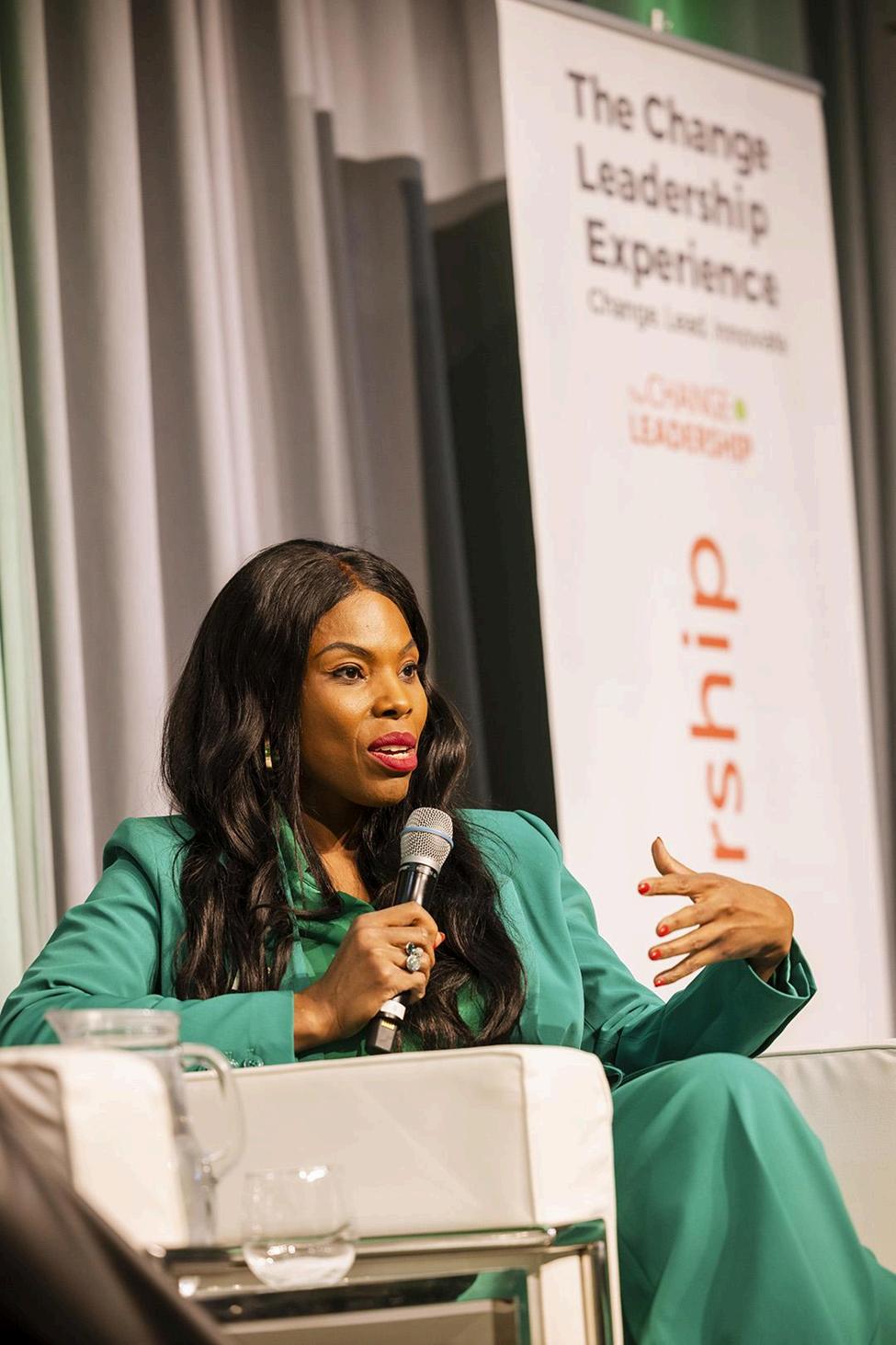

The Change Leadership Conference is now approaching its 10-year anniversary as a premier conference for leading change. Looking back, what are one or two standout moments—perhaps a story from a participant or client— that convinced you this movement is genuinely shifting how leaders respond to disruption?
As the Change Leadership Conference approaches its 10 year anniversary, it is the human stories that have most affirmed that this work is creating real impact
A couple of months ago, as I walked into an event and looked for a seat, someone turned to me and said, “I know you ” Within seconds, we made the connection She had attended the very first Change Leadership Conference nine years ago She shared that the experience changed the trajectory of her career It opened her eyes to new possibilities and gave her the clarity and courage to pivot into an entirely new path She is now a small business owner
At that same event, another person approached me and introduced themselves as a former conference volunteer. They shared that listening to one of our speakers planted a seed, one that eventually led them to launch their own AI startup
These moments stay with me because this has never been about hosting a conference It has always been about creating the spark, the connections, and the environment where something shifts In a world driven by data, dashboards, and deadlines, these stories are a powerful reminder that change is human, and lasting change happens through one story at a time
For Black founders and professionals who feel overwhelmed by constant change market shifts, new technologies, economic uncertainty what key piece of advice would you share about building personal resilience and developing the change leadership skills needed to thrive rather than merely survive?
My first piece of advice is to stop measuring yourself by how much you can endure Resilience is not about pushing harder or absorbing endless pressure It is about building the capacity to adapt without losing yourself in the process
Start with clarity and adaptive leadership You do not need to respond to every market shift or new technology Adaptive leaders assess what truly matters, experiment thoughtfully, and adjust course as conditions change Agility comes from making informed decisions quickly, not perfectly, and being willing to learn as you go
Strongchangeleadership alsomeansempowering otherstoact.Eveninsmall teamsorsolobusinesses, creatingsharedownership reducesburnoutand increasesmomentum.This couldlooklikedelegating decisions,leveragingAI tools,orinviting collaboratorsintoproblem solvingratherthan carryingeverythingalone.
Equally important is emotional intelligence The ability to regulate your own emotions, read the room, and make decisions under pressure is what allows leaders to move from reaction to intention. Thriving in uncertainty is not about constant acceleration. It is about self trust, thoughtful decision making, and leading change at a pace you can sustain, so you are shaping change rather than simply surviving it
Disclaimer:Theviewsandopinionsexpressedinthis interviewarethoseoftheguestanddonotnecessarily reflecttheofficialpolicyorpositionofBlackBusiness Magazineoritsaffiliates Themagazineiscommittedto supportingBlackentrepreneursandfosteringconversations thatpromoteinclusionandeconomicempowerment
SMALL BUSINESS SHOW 2026
The Future of Growth is Now