ISSUE NO. 01
JANUARY 2026
AI BUSINESS REVIEW Strategy and Insights for the AI-Powered Business.
Page: 6
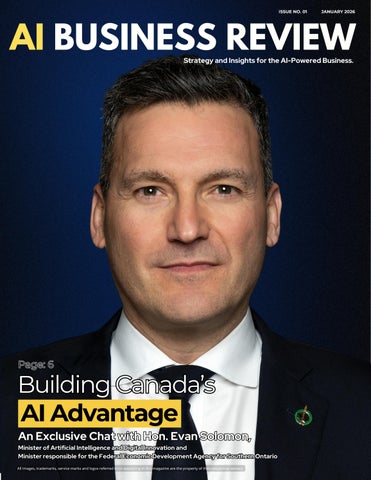
Building Canada’s AI Advantage An Exclusive Chat with Hon. Evan Solomon,
Minister of Artificial Intelligence and Digital Innovation and Minister responsible for the Federal Economic Development Agency for Southern Ontario All Images, trademarks, service marks and logos referred to or appearing in this magazine are the property of their respective owners.
Dear Valued Readers, Welcome to the inaugural edition of AI Business Review Magazine, powered by the CanadianSME platform. This launch issue highlights how artificial intelligence is reshaping business, innovation, and leadership across Canada, bringing together expert insights and real-world applications that reflect AI’s expanding role in our economy. We open with an in-depth conversation with The Honourable Evan Solomon, Minister of Artificial Intelligence and Digital Innovation, who outlines Canada’s strategy for accelerating AI adoption through investment, innovation readiness, and workforce development, grounded in trust and transparency. You will also find a compelling interview with Kree Govender, SMB Canada Leader at Microsoft, offering practical guidance on how small and medium businesses are using AI to enhance productivity and drive meaningful innovation. Cinzia Bazzo, Managing Director of Canada at Sage, shares how automation and AI-powered tools are transforming operations for SMEs and supporting long-term business growth. This edition further features an exclusive discussion with Jeff Dutton, founder of goHeather, on the rising role of AI in contract review and legal workflows, and an insightful conversation with Asma Aziz, General Manager of Intel Canada, who provides a global perspective on emerging trends, workforce readiness, cybersecurity, and the ethical foundations needed for responsible AI adoption. Alongside these interviews, we present timely articles on AI in retail and ecommerce, as well as the contributions of women leading sustainable AI innovation in rural Canada. Our goal is to make AI Business Review Magazine a trusted resource for leaders, innovators, entrepreneurs, and policymakers navigating rapid technological change.
AI BUSINESS REVIEW MAGAZINE
aibusinessreview.ca info@canadiansme.ca canadiansme canadian_sme canadiansme canadiansme
Editor & Publisher Shaik Khaleeluddin(SK) Sr. Media Manager Maheen Bari Media Manager Kripa Anand Sr. Content Manager Amanda Spearing Creative Design Cmarketing Inc Social Media Cmarketing Inc Events Shaik Raoof Uddin Photography Deposit Photos, Cmarketing Inc. Web Cmarketing Inc
For Advertisements info@canadiansme.ca Cmarketing Inc 6345 Dixie Rd, Unit 202, Mississauga, ON L5T 2E6 Call us at +1 416 655 0205 /647 668 5785
ISSN 3110-9810 (Online)
Warm regards, Shaik Khaleeluddin (SK) Editor-in-Chief, AI Business Review Magazine
Published by Cmarketing Inc 6345 Dixie Rd, Unit 202, Mississauga, ON, L5T 2E6 Copyright © 2024 CMarketing Inc. All rights reserved. Reproduction in whole or part of any text, photography or illustrations without written permission from the publisher is prohibited.
All Images, trademarks, service marks and logos referred to or appearing in this magazine are the property of their respective owners.
The contents in the AI Business Review Magazine are for informational purposes only. Neither Cmarketing Inc, the publishers nor any of its partners, employees or affiliates accept any liability whatsoever for any direct or consequential loss arising from any use of its contents.
IN THIS ISSUE AI Business Review Magazine
24
14
Empowering Canadian SMBs with AI: Microsoft’s Perspective Kree Govender, SMB Area Lead at Microsoft Canada
Why AI Matters in Canadian Healthcare Today and How It Changes Diagnosis & Patient Care
31
AI Policy & Regulation in Canada: What Businesses Should Prepare For
34
Canada’s AI Powerhouse: The Role of Vector Institute & Mila in AI Growth
47
AI for Retail & eCommerce in Canada: Powering Digital Transformation
49
Reskilling for AI: Canadian Programs & Success Stories
55
Transforming Canadian Finance with AI Delphia’s Innovative Approach and Beyond
60
Canadian VC & Investment in AI Startups: Fueling Growth and Innovation
IN THIS ISSUE AI Business Review Magazine
20
How AI Drives SME Growth in Canada (2025): Opportunities, ROI, and Real-World Barriers
11 Building Strategic AI Leadership in Canada: A conversation with
Intel’s Asma Aziz
44
Women in Canadian AI: Spotlight on Entrepreneurs & Leaders
57 37
AI for Energy and Agriculture: Powering Sustainable Innovation in Rural Canada
Justine Melman
on Blending Human Insight with AI to Transform Retail
IN THIS ISSUE AI Business Review Magazine
52
41
Transforming Legal Contracts with AI Innovation
The Future of AI Marketing with Randy Marks
31 AI Policy & Regulation in Canada: What Businesses Should Prepare For
28 Strategy Before Tools: Unlocking True AI ROI
17
How Canadian SMEs Can Harness AI for Growth
Evan Solomon is the Honourable Evan Solomon, who serves as the Canadian Minister of Artificial Intelligence and Digital Innovation and Minister responsible for the Federal Economic Development Agency for Southern Ontario. His profile may be found on the Government of Canada’s official website or related professional networks.
The magazine's focus is on application, not just research. What is the federal government's most critical strategic objective for the next 18 months to ensure Canadian businesses, particularly midmarket and enterprise firms, successfully
Image Courtesy: Evan Solomon
apply AI to boost national productivity and secure a global competitive advantage? AI has the potential to boost national productivity and secure a global competitive advantage, and that is what our new
government aims to do. We are updating our National Strategy almost two years ahead of time by focusing on balancing innovation, competitiveness, and enabling businesses to build AI for all.
Evan Solomon
on Advancing Canada’s AI Leadership
Minister of Artificial Intelligence and Digital Innovation and Minister responsible for the Federal Economic Development Agency for Southern Ontario In an exclusive interview with The CanadianSME AI Business Review Magazine , The Honourable Evan Solomon, Minister of Artificial Intelligence and Digital Innovation, shares how Canada is accelerating AI adoption through strategic investment, innovation, and workforce development. He highlights the government’s mission to balance growth with trust, empowering Canadian businesses to lead globally in responsible AI.
We recently announced an AI Strategy Task Force and a national 30-day sprint to gather fresh thinking from industry, academia, and invited every Canadian to have their say. We look forward to these submissions so we can pair expertise and everyday Canadian views on how the government should incorporate AI and move forward together.
6 - AI Business Review Magazine - January 2026
AI BUSINESS REVIEW MAGAZINE
The new strategy will focus on research and talent, accelerating AI adoption across industry and government, commercializing AI, scaling Canadian AI champions, attracting investments, building safe AI systems to strengthen public trust, developing education and skills, and building and securing Canadian infrastructure and capacity. By prioritizing actionable insights and practical ideas from stakeholders, the new AI strategy will reimagine how we harness innovation, secure our digital sovereignty, and position Canada at the forefront of the AI revolution.
The cost, complexity, and talent gap are primary barriers. What specific, scalable federal programs are being put in place to
AI Policy
Canada's Global Innovation Clusters were allocated $275 million from the Pan-Canadian AI Strategy (PCAIS) to accelerate the commercialization and adoption of AI technologies. To date, the clusters have announced 47 projects and invested more than $79 million in projects to drive responsible adoption of AI across Canada.
assist the entire spectrum of Canadian businesses—from a small, regional firm to a large, national corporation—to afford and successfully implement practical AI solutions? To support Canadian businesses in adopting AI,
this effort is the Canadian Sovereign AI Compute Strategy, a $2-billion initiative ensuring affordable access to world-class AI compute for innovators, SMEs, and researchers. Key elements include the AI Compute Challenge, which is mobilizing $700 million to grow domestic data centers; the establishment of public supercomputing infrastructure with up to $1 billion in funding; and the AI Compute Access Fund.
The AI Compute Access Fund provides up to $300 million to make advanced computing more affordable for Canadian innovators, notably SMEs and startups. This fund helps companies develop high-impact AI solutions by subsidizing access to domestic computational resources, easing one of the highest costs of AI adoption. It prioritizes sectors with steep compute needs and high AI potential, including life sciences, energy, and advanced manufacturing.
7 - AI Business Review Magazine - January 2026
Image Courtesy: Canva
the Government of Canada has launched several scalable programs focused on cost, compute infrastructure, and talent. Central to
AI Policy
AI BUSINESS REVIEW MAGAZINE
Some of our champions also include our National AI Institutes. Amii in Edmonton, Mila in Montreal, and Vector in my hometown, Toronto. These institutes are building AI capacity in their cities and surrounding areas by offering tailored commercialization and training programs that support SMEs and startups. While talent development is prioritized through the CIFAR Canada AI Chairs program, growing a pipeline of skilled workers. These efforts collectively lower barriers of cost, complexity, and skills gaps for practical AI use across Canadian businesses, advancing Canada’s leadership in responsible AI.
Trust and responsible use are paramount. How will your ministry ensure that necessary legislation and regulation (such as the proposed Artificial Intelligence and Data Act) is structured to protect citizens without creating an administrative burden that stifles innovation and slow down the adoption pace for Canadian businesses?
In addition to my role as Minister of AI, I am also
Adopting AI can bring benefits to Canadian businesses, such as increased productivity and efficiency, but rapid advances in artificial intelligence (AI) have also underscored the risks associated with this transformative technology. To
developing the AI ecosystem across the country
steps:
responsible for the Federal Economic Development Agency for Southern Ontario, which is playing a role through investments in scaling companies and programs delivered by innovation hubs. In 2024, the Government of Canada allocated $200 million over five years to Canada’s regional development
agencies (RDAs) to deliver the Regional Artificial Intelligence Initiative to help bring new AI technologies to market and accelerate AI adoption in SMEs in
critical sectors. This includes for example support for the Toronto Region Board of Trade, to launch its new AI Business Catalyst (AIBC) program to help
businesses access the tools they need to adopt AI solutions and compete globally.
Through strategic investments to support responsible
In 2023, the Government launched the Voluntary Code of Conduct on the Responsible Development and Management of Advanced Generative AI Systems. The Code sets out riskmitigation measures for developers and managers of AI systems. The Code currently has 46 signatories, from small- and mediumsized businesses to fortune 500 enterprises. In 2024, the Government of Canada launched the Canadian Artificial Intelligence Safety Institute with a mandate to advance scientific understanding of the risks associated with the most advanced AI systems.
Image Courtesy: Canva
AI adoption, Canada is strengthening its AI ecosystem and enhancing productivity across the country.
encourage trustworthy AI governance and support AI adoption, the government has taken a number of
8 - AI Business Review Magazine - January 2026
AI Policy
AI BUSINESS
Image Courtesy: Canva
REVIEW MAGAZINE
Moving forward, the government is committed to ensuring that the regulatory environment supports safe and responsible AI innovation, commercialization, and adoption in Canada. Increasing trust can help drive adoption and advance productivity and economic growth. We have reaffirmed our commitment to
modernizing privacy laws, with a focus on protecting children and consumers in the digital age, while providing regulatory clarity to organizations to support innovation.
We are currently consulting Canadians on their views to
inform a new National AI Strategy, including with respect to trust, safety and the regulatory environment. Public consultations were open until October. In parallel, we launched a Task Force that will provide advice on the
future strategy, including with respect to trust and safety. As the government considers its next steps, we are committed to putting measures in place to protect Canadians while supporting AI innovation and adoption in Canada.
Successful AI integration requires a digitally fluent workforce, not just a few data scientists. What is the government’s plan to rapidly retrain and upskill the existing non-technical workforce across key Canadian industries to effectively work alongside AI tools? As previously announced, the Government of Canada has launched an AI Strategy Task Force and a 30-day national sprint that will help shape Canada’s approach to AI. Retraining and upskilling the non-technical workforce is part of the education and skills theme that is being explored by four leaders in this space. The government has also asked Canadians for their thoughts through the launch of a public consultation. 9 - AI Business Review Magazine - January 2026
As part of this new AI strategy, the government will leverage strategic investments in skills, through national AI Institutes and other initiatives, to help Canadian firms upskill their workforce, enabling AI adoption and driving economic growth.
This is also a joint effort between myself and Patty Hajdu, Minister of Jobs and Families and Minister responsible for the Federal Economic
Development Agency for Northern Ontario, who announced support to upskill workers in Edmonton at Amii. As well, Melanie Joly, the
Minister of Industry, is responsible for the Upskill
for Industry Initiative, designed to support shortcycle upskilling programs driven by industry needs in high-growth sectors. In February 2023,
Palette Skills was selected as a national organization to deliver the initiative. This $250million investment is now helping train Canadian workers, including individuals from equityseeking groups, in high-growth sectors such as:
Digital Technology Cybersecurity Advanced Manufacturing Clean Technology Biomanufacturing Agriculture Technology
AI Policy
AI BUSINESS REVIEW MAGAZINE
How can the government best incentivize Canadian businesses to invest in and adopt Made-in-Canada AI solutions, thereby creating a stronger domestic market and encouraging more domestic and international venture capital to fund Canadian B2B AI companies? The Government of Canada is taking a leadership role in helping Canadian businesses understand and adopt artificial intelligence to boost productivity and drive economic growth. Major initiatives like the Regional Artificial Intelligence Initiative, delivered by the RDAs, are providing targeted support for start-ups and scale-ups to develop made-in-Canada AI solutions and unlock AI’s
transformative potential to foster economic growth. Their programming aims to build on regional AI ecosystems by providing financial support for technology demonstrations,
business development, strategic AI integration, and tailored programming for entrepreneurs.
This includes leveraging our purchasing power to procure Made-in-Canada AI solutions aligned with Federal priorities to send validation signals to market. The Innovative Solutions Canada (ISC) program ($147.6 million) supports small- and medium-sized businesses by procuring and testing innovative products, providing financial support and credibility, which can lead to increased domestic and export sales. We are our own best customers. Canada is looking to elevate the global
visibility of our AI ecosystem by promoting our companies and success stories, further positioning Canadian AI companies as trusted global players.
The NRC AI Assist Program ($100 million) further supports small- and medium-sized businesses with direct technical
Together, these government initiatives not only help Canadian businesses harness AI to improve productivity but also build a vibrant
across industries.
for high-quality, made-in-Canada innovation.
guidance, pilot projects, and advisory services, lowering barriers and making AI adoption practical and accessible
domestic market, support Canadian AI companies, and create an ecosystem known
By adopting AI solutions across the economy, we can
empower Canadians to be more productive and more competitive on the global stage. Canada has what it takes to succeed in that new economy. We have world-class AI institutes in Mila, Vector, and Amii
To ensure everyone benefits from transformation, the $50 million Sectoral Workforce Solutions Program provides reskilling for workers in industries impacted by technological change. Now is the time to act. The goals we've set are ambitious and urgent. First, we need to scale our AI industry here in Canada.
10 - AI Business Review Magazine - January 2026
Image Courtesy: Canva
that deliver specialized training, workshops, mentorship, and commercialization support. Their programming helps companies and investors understand the opportunities of AI, while hands-on partnerships turn academic research into industry-ready solutions. Consistent high demand for these programs shows their critical role in helping Canadian businesses gain the skills and confidence to deploy AI effectively.
Building Strategic AI Leadership in Canada: A conversation with
Intel’s Asma Aziz In an exclusive interview with The CanadianSME AI Business Review Magazine , Asma Aziz, General Manager of Intel Canada, shares her perspective on how AI and emerging technologies are shaping the future of Canadian businesses. Drawing on over 20 years of global experience across six countries, Asma discusses key AI trends, strategies for SMEs to overcome barriers, and the ethical and cybersecurity considerations essential for responsible adoption. She also highlights practical steps for preparing Canadian workforces for AI-driven transformation, offering insights that combine innovation, sustainability, and human-
Asma Aziz is a seasoned technology executive with over 20 years of global experience, having lived and worked in six countries across North America, Europe, and Asia. She currently serves as the General Manager of Intel Canada, where she leads the company’s strategic initiatives, business growth, and engagement with key stakeholders across the country. Asma has spent 19 years at Intel Corporation, shaping the end-to-end IT ecosystem across semiconductors, software, and hardware. With a proven track record of penetrating untapped markets and identifying new growth opportunities, her leadership has been instrumental in driving impactful campaigns, strengthening strategic partnerships, and leading projects that deliver tangible bottomline results. 11 - AI Business Review Magazine - January 2026
General Manager for Canada at Intel Corporation What are the most significant AI trends shaping Canadian businesses in 2025, and how is Intel Canada supporting their adoption among SMEs? We’re seeing a few clear AI trends shaping Canadian businesses. First is Agentic AI systems that don’t just analyze but also execute. Intel’s recent study with IDC found that 16.3% of Canadian organizations are exploring Agentic AI, the highest rate in the Americas, with nearly half of respondents viewing it as transformational for their business. Adoption in sectors like healthcare and manufacturing, where automation is critical, could unlock even more value.
Image Courtesy: Asma Aziz
centered leadership.
AI BUSINESS REVIEW MAGAZINE
Tech Leadership
Another big trend is around real-time data at the Edge. Companies want to bring AI closer to where data is created, but data readiness is still a hurdle. The research also showed that only about half of Canadian organizations consider their data fully AIready and without good data, AI can’t
In your view, what ethical considerations should business leaders prioritize when deploying AI-powered solutions, especially as automation and generative AI become more advanced?
For small and mid-sized businesses, cost and complexity are still challenges, but that’s where Intel Canada plays a
trustworthy, responsible AI. That means ensuring fairness by training systems on diverse data, being transparent about what AI can and can’t do, protecting customer data through
deliver.
significant role. We’re making AI infrastructure more accessible and
continue to work with partners to provide flexible, scalable solutions. We’re also focused on education and responsible AI,
Ethical AI is about balancing innovation with responsibility. As AI-powered solutions become more common place and
more advanced, business leaders need to look at the bigger picture – beyond technical performance – to prioritize
strong privacy and security, and taking accountability for outcomes. It also means paying attention to sustainability and ensuring employees are supported with training and reskilling as automation changes roles.
so SMEs can adopt solutions with confidence. We closely partner with SMEs to understand their specific business needs and objectives to match the right technology solutions.
How can Canadian companies overcome common barriers to AI implementation, such as talent shortages and data privacy concerns? Canadian companies can overcome barriers like talent shortages and data
privacy concerns by taking a few practical steps. On the talent side, not every organization needs an army of AI specialists to get started. Companies can lean on partnerships with technology providers, universities, and industry groups to access expertise, while also upskilling their existing workforce through targeted training programs. Governments are investing in AI skills programs as well, and tapping into those resources can help smaller firms close the gap.
At Intel, we’ve long recognized the ethical and human rights implications of technology, and AI makes that responsibility even more important. We’ve built internal frameworks guided by principles such as respecting human rights, ensuring transparency, promoting equity, and protecting the environment. We also work with academic partners worldwide on research into privacy, security, explainability, and AI sustainability.
Image Courtesy: Canva
When launching new AI projects, security is paramount. The adoption of clear governance frameworks is imperative to help keep data protected. But companies don’t need to go at this alone; working with partners that prioritize compliance and transparency can simplify adoption and lower the risk. 12 - AI Business Review Magazine - January 2026
Tech Leadership
AI BUSINESS REVIEW MAGAZINE
How is Intel driving innovation in AI-driven cyber security, and what proactive measures should Canadian organizations take against evolving cyber threats in 2025?
What practical steps can Canadian SMEs take today to prepare their workforce for AIdriven transformation and long-term business sustainability?
Cyberattacks are evolving as quickly as AI itself. For businesses, the risk is clear: any value created by AI can
Canadian SMEs shouldn’t wait for the perfect conditions to start preparing their people for
combines risk mitigation, trust frameworks, and strong governance. Traditional, perimeter-based defenses are no longer enough. True protection starts deeper.
sustainability.
be wiped out if sensitive data is exposed. To adopt AI securely, organizations need a layered approach that
Software alone can be bypassed if lower layers like
firmware or the operating system are compromised. That’s why Intel embeds silicon-enabled security into its platforms, creating a root of trust at the hardware layer. In the data center or cloud, this approach helps protect AI models and data, while Intel Xeon processors provide
built-in security engines for encryption, secure enclaves, and rapid response to threats. On PCs, Intel Core Ultra processors and Intel vPro technologies extend this foundation, enabling features like AI-powered threat
AI. There are several steps they can take today that will build confidence and long-term
First, invest in digital and AI literacy across the workforce. This doesn’t mean everyone needs to become a data scientist, but employees at every level should understand what AI can and can’t do, and how it connects to their role. Short training programs, online modules, or partnerships with local colleges can make this accessible. Creating a culture of continuous learning can also encourage employees to experiment with AI tools in safe, low-risk settings.
detection that can identify attacks earlier and free up performance for critical workloads.
Second, focus on reskilling for higher-value work. As AI automates repetitive tasks, people
Beyond technology, Intel works with governments, academia, and industry partners to advance
need to be redeployed into roles that demand creativity, judgment, and relationship building – areas machines can’t
confidential computing, zero-trust architectures, and shared security standards.
For Canadian businesses, pairing these innovations with strong governance and privacy compliance is essential to stay ahead of increasingly complex cyber threats. Just as important is investing in workforce training so employees can recognize and respond to risks, as well as building resilience through incident
replicate. Third, embed responsible AI practices early. Training should cover not just how to use AI, but how to do so ethically, with attention to bias, privacy, and transparency. Finally, SMEs should leverage partnerships, with technology providers like Intel, with government programs, and with industry peers, to access resources and expertise they may not be able to build alone.
response planning and partnerships with trusted technology providers. Combined, these measures create a layered defense that leverages AI innovation with organizational readiness, helping Canadian businesses protect their and their customer’s data, in an increasingly complex threat landscape.
Disclaimer: The views and opinions expressed in this interview are those of the guest and do not necessarily reflect the views of The CanadianSME AI Business Review Magazine . This content is for informational and inspirational purposes only and is not intended as professional business, legal, or wellness advice.
13 - AI Business Review Magazine - January 2026
Empowering Canadian SMBs with AI:
Microsoft’s Perspective conversation explores how AI is transforming the SMB landscape, enabling businesses to work smarter, engage customers more effectively, and build responsible, scalable AI solutions for the future. A dynamic, senior leader with a proven track record in delivering results and building high performance teams. I lead by setting a mission, communicating my values, Image Courtesy: Kree Govender
creating clarity through synthesizing the complex and generating energy with and for my team. A passion for people, leadership is interwoven into my DNA and I pride myself on creating a culture of performance, collaboration and excellence, underpinned by strong ethics.
Kree Govender
SMB Area Lead at Microsoft Canada In this exclusive interview with The CanadianSME AI Business Review Magazine , Kree Govender, SMB Canada Leader at Microsoft, shares how small and medium businesses across Canada are leveraging AI to drive growth, productivity, and innovation in 2025. With a deep understanding of AI adoption, ethical implementation, and practical business impact, Kree Govender highlights emerging trends, real-world success stories, and actionable strategies for Canadian entrepreneurs and leaders. Conducted by SK Uddin, this
How has your role as SMB Canada Leader at Microsoft shaped your view on how small and medium businesses are leveraging AI in 2025, and which Canadian trends are most exciting to you right now? My role as SMB Canada Leader at Microsoft has given me a front-row seat to one of the most exciting chapters in Canada’s business story. Small and medium businesses have always been the heartbeat of our economy, but in 2025, AI is becoming the oxygen that helps them breathe differently…faster, deeper, and with more possibility! What excites me most is that AI is no longer something abstract or reserved for large enterprises with big budgets. Canadian SMBs are baking it into their daily operations; whether it’s a family-owned retailer using Copilot’s image generation AI to personalize marketing at scale, a professional services firm leveraging Copilot to simplify complex workflows, or manufacturers tapping into predictive insights to stay competitive globally. 14 - AI Business Review Magazine - January 2026
AI BUSINESS REVIEW MAGAZINE
Business Insights
The trend that stands out to me is the shift from experimentation to adoption with intent. A couple of years ago, AI was a curiosity. Today, it’s a capability. SMBs aren’t just asking, “What is AI?” but “How do I use AI to win more customers, unlock productivity, and futureproof my business?” That mindset shift is powerful.
What do you see as the most transformative AI applications for Canadian SMBs in the next 12-18 months, particularly in terms of productivity, security, or customer engagement?
And in true Canadian fashion, what I’m seeing is an approach rooted in
time saved not in hours but in days, freeing leaders and teams to focus on growth rather than administration.
both innovation and responsibility. Businesses want to grow with AI, but they also want to do it in a way
that’s ethical, inclusive, and trusted. This is an area that Microsoft excels at and these principles are built into all our offerings. That balance is uniquely Canadian, and it’s why I believe the next wave of AI-led transformation will be written right here, by SMBs across the country.
Over the next 12–18 months, I see three transformative AI applications shaping Canadian SMBs: productivity, security, and customer engagement. On productivity, generative AI copilots will become as essential as email once was helping employees draft proposals, summarize meetings, and automate repetitive workflows. For SMBs, this means
On security, AI will act like a digital immune system. With cyber threats growing in both sophistication and frequency, SMBs who
often lack large IT teams, can lean on AI-driven defenses that detect anomalies in real time, automatically patch vulnerabilities, and reduce human error. This levels the playing field between a 20-person business and a 20,000-person enterprise.
And in customer engagement, AI is already enabling SMBs to deliver personalization at scale. From AI voice agents that feel truly conversational to insights that predict customer needs before they’re voiced, AI gives small businesses the ability to compete and even outpace larger competitors.
In short, the most transformative applications will be those that make AI less of a tool and more of a teammate, amplifying the human side of Canadian SMBs.
With the rapid advancements in generative AI and automation, how do you recommend that Canadian businesses ensure the ethical adoption of AI and build responsible, trustworthy AI solutions? As AI adoption accelerates, the question is no longer just what AI can do, but how we ensure it’s used responsibly. For Canadian businesses, the path forward starts with recognizing that trust is the true currency of AI. Customers, employees, and partners all need to believe that AI is being deployed ethically, inclusively, and transparently. At Microsoft, we anchor this in our Responsible AI principles— fairness, reliability and safety, privacy and security, inclusiveness, transparency, and accountability. For SMBs, this doesn’t mean building an AI ethics department overnight. It means embedding these principles into decision-making from the start. For example: Image Courtesy: Canva
15 - AI Business Review Magazine - January 2026
AI BUSINESS REVIEW MAGAZINE
When rolling out generative AI tools, ensure human oversight remains in the loop for critical decisions. When handling customer data, adopt privacyby-design approaches so security is never an afterthought.
And when building customer-facing experiences, communicate openly that AI is being used and how it benefits them. By grounding innovation in responsibility, Canadian businesses can avoid short-term risks while unlocking long-term trust. In my view, the companies that embrace AI most responsibly will also be the ones that customers choose to grow with.
Can you share a recent example or success story from a Canadian business using Microsoft’s AI platforms or services that demonstrates measurable impact or innovation? One recent success story that stands out involves a mid-sized Canadian professional services firm that embraced generative AI to transform both productivity and client engagement. Like many
SMBs, their teams were stretched thin; juggling proposal writing, client reporting, and administrative tasks that often left little time for strategic work.
By integrating AI copilots into their daily workflows,
the firm was able to reduce proposal creation time by over 40%, while ensuring documents were tailored to each client’s needs. Meeting summaries that once took hours are now generated in minutes, freeing consultants to focus on analysis and client relationships rather than paperwork. But the impact went beyond productivity. The AI tools uncovered patterns in client interactions that the team hadn’t seen before. This helped them anticipate needs and deliver a more personalized experience. As a result, client satisfaction scores rose, and the firm reported a measurable increase in renewals and upsell opportunities. This example captures the promise of AI for Canadian SMBs: it’s not about replacing people, but about amplifying their expertise; giving them more time, sharper insights, and stronger connections with the customers they serve.
Business Insights
What advice would you give to Canadian entrepreneurs and business leaders looking to upskill themselves and their teams in AI, especially as the technology continues to evolve so quickly? My advice to Canadian entrepreneurs and business leaders is simple - treat AI not as a onetime skill to learn, but as a journey of continuous education and experimentation. The technology is evolving at a pace we haven’t seen before, and the most successful organizations will be those that build a culture of curiosity and learning. Start by investing time in foundational knowledge. What AI can and cannot do, how it impacts productivity, customer engagement, and security,
and where it creates new opportunities. A great entry point is the free training and learning resources available at Microsoft Learn. These selfpaced modules help leaders and teams build practical skills at their own pace.
Equally important is experimentation. Don’t wait for the “perfect” use case. Test AI in small, low-risk areas of your business, gather feedback, and build from there. To accelerate this, take advantage of our free solution assessments, which provide a structured, personalized view of where AI can deliver immediate value.
The call to action is clear: start learning, start experimenting, and start now. The businesses that lean in early will be the ones best positioned to lead in this new era.
Disclaimer: The views and opinions expressed in this interview are those of the guest and do not necessarily reflect the views of The CanadianSME AI Business Review Magazine . This content is for informational and inspirational purposes only and is not intended as professional business, legal, or wellness advice.
16 - AI Business Review Magazine - January 2026
Image Courtesy: Cinzia Bazzo
How Canadian SMEs Can Harness AI for Growth In an exclusive interview with The CanadianSME AI Business Review Magazine , Cinzia Bazzo, Managing Director of Canada at Sage, shares her insights on how AI and automation are transforming small and medium-sized businesses. She discusses practical AI strategies, tools that boost productivity, and how SMEs can harness technology to streamline operations, enhance decision-making, and future-proof their growth. Cinzia Bazzo is the Managing Director of Canada at Sage, driving impactful initiatives that empower the businesses forming the backbone of Canada’s economy. Cinzia brings a wealth of experience to Sage having led transformative growth across the technology sector throughout her career. Before joining Sage, she served as Country Leader for Workday Canada, where she helped businesses unlock the power of data to overcome challenges, seize new opportunities, and streamline operations. Additionally, in her successful six-year tenure at Salesforce, she advanced to become Canada’s Country Leader for Service Cloud, a leading customer service platform.
Cinzia Bazzo
Managing Director of Canada at Sage Canada
Business Strategy
AI BUSINESS REVIEW MAGAZINE
AI and automation are reshaping how businesses operate. From your perspective as Managing Director of Sage Canada, what are the most impactful AIdriven tools or strategies that Canadian SMEs can adopt today to boost productivity and growth? AI and automation are transforming how
Canadian SMEs operate, unlocking significant opportunities for productivity and growth. The most impactful AI-driven tools today focus on finance and operations, where time and resources are often stretched thin. Tools that free up time for finance leaders such as AI-powered accounts payable automation can cut manual processing in half, close the books faster, and deliver real-time visibility into cash flow and spending.
With rising costs, tariffs, and shifting demand creating uncertainty, SMEs that
adopt AI to automate repetitive tasks and generate actionable insights become more resilient and better equipped to make
informed decisions. My advice to leaders is to start small. Pick a single pain point, such
as month-end close or invoice matching and scale from there. The productivity gains are tangible, and the impact on resilience and confidence is immediate.
Many organizations are still navigating the challenges of digital transformation. How does Sage in Canada help SMEs leverage AI and data analytics to make smarter, faster decisions? Digital transformation can feel daunting, especially for smaller firms without large IT teams. Sage simplifies this journey by embedding AI and data analytics directly into the workflows SMEs already rely on. For example, With Sage
Intacct, leaders can view budget variances in real time, run predictive cash flow analysis, and access plain language insights to make astute business decisions backed by easy-to-use financial data. In a landscape filled with fleeting trends, Sage stands out through trust and proven expertise. Our AI is grounded in
customer needs, proven data and decades of expertise. We’ve been embedding AI into products for years, from task-based automation to generative assistants, to today’s AI Agents that act on a customer’s behalf. Every Sage AI tool is designed to save time, reduce stress, and support
growth by integrating seamlessly into daily workflows and delivering meaningful automation and insights tailored for SMEs.
Beyond our products, Sage’s extensive partner ecosystem strengthens SMEs’ digital transformation efforts. Recent research Sage conducted with IDC shows that 76% of
Canadian software partners now act as strategic advisors. They guide SMEs to invest wisely in scalable AI-powered solutions that deliver recurring value.
As technology evolves rapidly, leaders need to balance innovation with practicality. What approaches or frameworks do you recommend for integrating AI solutions into existing business processes without overwhelming teams?
Image Courtesy: Canva
The key to integrating AI without overwhelming teams is to start where it delivers clear, immediate value. Rather than focusing on recreating past processes, businesses should prioritize gaining insights that drive growth and agility. That begins with leadership. Today’s CFO are increasingly strategic and forward-looking, making their guidance essential for successful AI adoption. 18 - AI Business Review Magazine - January 2026
AI BUSINESS REVIEW MAGAZINE
Begin by identifying workflow bottlenecks that consume time and carry risk, such as accounts payable, payroll reconciliation, or supplier onboarding. Piloting AI in these specific areas allows teams to achieve quick wins, while building confidence and momentum for broader integration. AI can also enhance employee experience and operational efficiency. Can you share an example of how Sage in Canada has helped a business harness AI or automation to improve performance and decision-making? Running a business is rewarding but demanding. For
many, admin tasks quickly become a necessary distraction. The real promise of AI is that it doesn’t replace people, it elevates them. For SMEs, where teams wear multiple hats, that shift is transformative. When technology reduces friction, people thrive, and businesses grow.
A great example is Ottawa-based Doran Contractors, which adopted Sage Estimating to modernize their estimating process. Just two years ago, their team
handled everything manually. Today, Sage Estimating’s advanced bid analysis automation has eliminated repetitive tasks and streamlined workflows. This shift has freed their employees to focus on higher-value work like advising business strategies, refining bid analysis, and driving growth.
Business Strategy
Looking ahead, which emerging AI trends or productivity tools do you believe will have the most transformative impact on Canadian SMEs in the next 3–5 years, and what advice would you give leaders who want to stay ahead? Too often, AI solutions are built for large enterprises, leaving SMEs behind. Sage is changing that by building practical, accessible AI
solutions shaped by decades of expertise and data. Our AI strategy has evolved through successive waves - from task-based automation to generative assistants, to today’s AI Agents that act on a customer’s behalf. We’re already preparing for the next frontier: unified, autonomous systems tailored to the realities of running a business.
These AI Agents operate quietly in the background within parameters defined by the user. They manage reconciliation, compliance, onboarding, payroll and more, freeing teams to focus on higher-value work. For small businesses, that
means automating invoicing, bookkeeping and tax filing, helping them get paid faster and saving hours each week. For accountants, it streamlines compliance and data collection, enabling more proactive client advisory. Medium-sized businesses are beginning to see an AI-native Office of the CFO emerge, with faster closes, improved financial visibility, and real-time decision-making using Sage’s AI solutions.
Stories like this illustrate how AI and automation can make work more rewarding, not just more efficient. By shifting focus from manual tasks to
My advice to leaders is to start small and build momentum. Experiment with pilot projects, validate value, and scale thoughtfully. Choose partners you can trust and who will help guide you. SMEs that adopt AI with transparency and domain expertise at the core won’t just keep up, they’ll pull ahead.
strategic contributions, employees feel more engaged, and businesses are better positioned to grow. That’s the real power of AI: creating space for people to do their best work.
Disclaimer: The views and opinions expressed in this interview are those of the guest and do not necessarily reflect the views of The CanadianSME AI Business Review Magazine . This content is for informational and inspirational purposes only and is not intended as professional business, legal, or wellness advice.
19 - AI Business Review Magazine - January 2026
Image Courtesy: Canva
How AI Drives SME Growth in Canada (2025): Opportunities, ROI, and Real-World Barriers For small and medium-sized businesses (SMEs) in Canada, artificial intelligence has evolved from an experiment to an engine. By the middle of 2025, 71% of Canadian SMBs are expected to be utilizing AI or GenAI solutions, and nearly 75% of them intend to increase their investment. Additionally, 70% of them have already reported productivity increases as a result of deployment. Meanwhile, according to Statistics Canada, the use of AI in manufacturing or providing services has doubled from 6.1% in Q2 2024 to 12.2% in Q2 2025. The information, cultural, professional, and financial sectors are leading the adoption of AI. In an effort to "protect Canada's AI advantage," the federal government allocated C$2.4 billion, which included funds for SME adoption initiatives and access to computing resources.
20 - AI Business Review Magazine - January 2026
AI BUSINESS REVIEW MAGAZINE
SME Productivity
Areas Where AI Is Delivering ROI for SMEs
Image Courtesy: Canva
Operations & 1) Leaner Faster Cycle Times Automating repetitive operations (such as service chat, claims triage, and invoicing), summarizing documents, and helping with coding and analytics are all areas where SMEs report noticeable efficiency increases. These factors are major contributors to the 70% productivity increase rate observed in Canadian SMBs utilizing AI.
Uplift via Personalization 2) Revenue & Sales Enablement By producing on-brand product copy, conducting A/B testing on creative assets, and enabling
conversational product advising, GenAI enhances top-line performance. Additionally, Canadian SMBs report that they are prioritizing these capabilities (63%) as they increase their usage of AI.
Decisions with 3) Better Embedded Analytics More businesses are transitioning from
dashboarding to AI-assisted forecasting and scenario planning as adoption increases, particularly in areas with the highest utilization rates, including information & cultural industries (35.6%), professional services (31.7%), and banking & insurance (30.6%).
Leverage—Not 4) Talent Replacement
Canada’s AI Tailwinds SMEs Can Ride Federal Investment & Infrastructure - For SMEs that cannot afford high-end AI technology, the C$2.4 billion allocated for AI in Budget 2024 includes C$2 billion for compute and infrastructure to assist researchers, startups, and scale-ups in accessing necessary capacity.
An SME-Centric Economy Ready to Scale - Even small AI-driven productivity increases can have a significant national impact, as SMEs account for the majority of Canada's business environment and contribute a substantial portion of the country's GDP. For this reason, Ottawa is allocating cash to SME adoption programs in addition to research investments.
Employer reports of productivity increases rather than decreases are consistent with StatsCan's 2025 analysis, which shows that headcount implications will continue to be restricted to job redesign and task reallocation rather than widespread layoffs.
21 - AI Business Review Magazine - January 2026
SME Productivity
AI BUSINESS REVIEW MAGAZINE
How The Real World Looks Like With Barriers Holding Back SME Adoption
Opportunity Map: High-Impact AI Use Cases for Canadian SMEs
1 ) Cost & Compute Constraints - The most common reason
Front-office: AI voice and chat agents for scheduling appointments, providing quotes, and creating content for marketing and e-commerce.
2 ) Skills, Training, and AI Literacy Gaps - Only 24% of
Middle-office: Demand planning, revenue forecasting, AP/AR automation, invoice extraction, and collections prioritizing.
for not adopting AI, according to comparative studies, is cost; in Canada's AI-computing discussions, compute access and tooling prices are significant issues.
Canadians report having received AI training, and fewer than half believe they can effectively utilize AI tools. This results in a significant enablement gap for SME workforces, as Canada ranks 44th out of 47 countries in terms of AI literacy and training.
Back-office: To lessen workload and backlog, use IT copilots, coding assistants, security alert triage, and policy summarizing.
3 ) Patchy Regulatory Clarity - Following prorogation, the proposed Artificial Intelligence and Data Act (AIDA), a component of Bill C-27, was left on the order paper in
January 2025, leaving regulatory clarity uncertain until a new federal framework is established. (Experts predict that the bill will be reintroduced at a later session.)
Key Factors Of Adoption for SMEs Workflows should come first, not
4 ) Fragmented Data & Change Management - Data
preparedness, model integration, and change management are practical barriers that impede production roll-outs beyond trials, particularly for companies without specialized data teams, according to StatsCan and ecosystem reports.
models. Select two or three procedures that have quantifiable KPIs (e.g., dayssales-outstanding, firstresponse time). Pilot automations or copilots using GenAI, then grow. Reduce the disparity in literacy. Set aside money for organized AI training, which includes rolebased enablement and introductory courses. If you invest, the 24% training rate indicates a clear route to distinctiveness. Utilize common infrastructure and public programs. Monitor federal and provincial efforts to lower adoption and compute costs resulting from the C$2.4 billion package.
Image Courtesy: Canva
AI BUSINESS REVIEW MAGAZINE
Govern early. Adopt internal AI policies (use-case approvals, data handling, and human-in-the-loop QA) even if AIDA is not in effect. Many adopters already have these best practices in place. Track ROI over time. Reinvest savings in data quality and staff upskilling; link deployments to revenue increases and cost-to-serve decreases.
SME Productivity
Make 2025 the Year AI Moves the SME P&L The majority of Canadian SMEs are utilizing AI, with many increasing their investments; quantifiable productivity advantages are already becoming apparent, indicating that they have
surpassed the awareness threshold. Closing the literacy gap, practicing responsible governance, and focusing on high-ROI workflows—while leveraging shared compute and
Image Courtesy: Canva
federal funding to outperform your competitors—are the future competitive advantages. The SMEs
that operationalize AI now will set the pace for Canada's next productivity leap in a market where adoption has quadrupled annually.
Your role in staying informed is essential to our mission of building a strong community of AI-driven
innovators. The CanadianSME AI Business Review Magazine is your goto resource for insights, strategies, and updates shaping the future of artificial intelligence in business.
Sector Snapshots Professional Services & Agencies: Higher than average adoption rate (31.7%) for client support, proposal writing, and research—quick return on investment due to time savings. Strong governance is necessary to achieve a 30.6% adoption rate for agent support, risk triage, and KYC summaries in the finance and insurance sectors. Leading the way at 35.6% are the information and cultural sectors, which use GenAI for audience targeting, translation, and content operations.
23 - AI Business Review Magazine - January 2026
Subscribe to our monthly editions at aibusinessreview.ca to keep pace with the latest AI trends and developments in the Canadian business landscape. Your engagement enables us to continue supporting and empowering the AI ecosystem.
Disclaimer: This article is based on publicly available information and is intended solely for informational purposes. The CanadianSME AI Business Review Magazine does not endorse or guarantee any products or services mentioned. Readers are encouraged to conduct independent research and due diligence before making business decisions.
Why AI Matters in Canadian Healthcare Today and How It Changes Diagnosis & Patient Care From aging populations and rising expenditures to lengthy wait times and burnout among clinicians, Canadian healthcare is under tremendous strain. In addition to improving patient outcomes and diagnostic accuracy, artificial intelligence (AI) presents intriguing solutions that increase operational efficiency. Workflows are
already being streamlined by AI technologies, which also help with early disease detection and provide data-driven insights for individualized care. AI has the potential to be a force multiplier, assisting healthcare providers in providing quicker, safer, and more egalitarian care when properly applied.
Game-Changing Statistics & Economic Impact AI-powered diagnostic systems at Canadian hospitals have been shown to
detect diseases with up to 95% accuracy in the early stages; in certain institutions, wait times have been lowered by 40%. Healthcare cost savings of $4 billion are anticipated by 2025. According to a McKinsey report, AI may improve care quality, experience, administrative efficiency, and system management, resulting in CAD $14–26 billion in net annual savings. Public health planning and population health have the most significant potential savings, with CAD 9–16 billion, followed by clinical care at CAD 2–5 billion and capacity/resource optimization at CAD 3–5 billion.
24 - AI Business Review Magazine - January 2026 Image Courtesy: Canva
Health Innovation
AI BUSINESS REVIEW MAGAZINE
Through 2030, the healthcare AI market is expected to expand at about a 37% CAGR due to its ability to improve patient data management, facilitate early detection, and streamline operations.
Tackling Administrative
3 ) Burden & Clinician Burnout Up to 30% of a clinician's time is spent on administrative duties. In Ontario, AI scribes have cut that by roughly 69.5%, saving doctors almost three hours every week.
Real‑World Applications in Canada 1)
By automating paperwork during consultations, AI medical scribes are lowering fatigue and increasing job happiness. During a large-scale implementation in
Personalized Treatment & Medical Imaging In Canada, generative AI is being utilized to create customized treatment regimens using real-time data,
the UK, four out of five general practitioners observed improved
genetics, and patient history with remarkable success:
patient rapport and time savings.
Oncology at Vancouver General Hospital found a 25% increase in treatment efficacy.
A 40% increase in early cancer detection is one example of enhanced imaging detection.
30% faster processing of diagnostic imaging, which helps shorten wait times and expedite clinical decisions.
4)
Remote Monitoring & Telehealth Innovations a) Remote patient monitoring (RPM) post-surgery has shown: 5% fewer readmissions
2 ) Diagnostics, Virtual Care & Admin Efficiency AI is applied in: Optimized clinical trials and hospital workflows (e.g., scheduling, staffing) Diagnostics via advanced imaging and lab result analysis In 2023, Canadian AI health startups raised ~USD 740 million Robotic assistance Precision medicine using genomic data Virtual health tools like symptom-checking chatbots
30% more medication errors detected 10–14% reduction in pain b) In Canada (Alberta, British Columbia, Manitoba, Ontario, and others), teleophthalmology has made it possible to screen for diabetic retinopathy and reduce wait times, which in Ontario were reduced from an average of six months to four weeks. c) For quicker results and more informed diagnoses, telepathology programs in Ontario and British Columbia (CAD 1.2 million, sponsored by Canada Health Infoway) connect distant facilities to pathologists. 25 - AI Business Review Magazine - January 2026
AI BUSINESS REVIEW MAGAZINE
5 ) AI for Population Health & Data‑Driven Insights To improve patient risk assessment and expedite diagnosis, researchers at the Alberta Machine Intelligence Institute (AMII) are using historical data from 4.7 million Albertans, including hundreds of thousands of medical scans. Without compromising patient privacy, a federated learning model for diabetes prediction that utilized multivariate clinical data from different provinces demonstrated performance comparable to centralized models.
Infrastructure & Regulatory Support The government-funded digital health promoter Canada
Health Infoway assists with the implementation of digital diagnostics, e-prescribing, and EMRs. As of 2018, connected health data adds around CAD $1 billion to the system value annually, while EMRs saved CAD $1.3 billion over six years. As an indication of the expanding institutional support for AI-enabled solutions, Infoway's Vendor Innovation
Health Innovation
Emerging Leaders & Academic Collaboration Collaborations are being made possible by top AI centers (such as Vector Institute in Ontario and AMII in Alberta): For improved diagnostics and illness registries, Dr. Ross Mitchell of AMII is utilizing Alberta's extensive dataset. Elham Dolatabadi develops AI conversational bots at the Vector Institute to assist frontline staff with mental health support by
suggesting resources and context clues while on the phone. Hero AI is a system that initiates diagnostic testing for patients while they wait in the emergency room, significantly accelerating patient flow. Dr. Devin Singh (SickKids, Toronto) co-founded the system.
Program recognized businesses like Ava Industries Ltd. in 2025 for their contributions to interoperability and patient-centric digital health.
Challenges: Equity, Privacy & Ethical Use
Image Courtesy: Canva
Issues with bias, fairness, and ethics still exist. According to studies, biased datasets and algorithms increase the likelihood of inequities in AI-driven care; therefore, diverse data, transparency, and strong regulatory frameworks are necessary for mitigation methods. Interoperable, standardized data infrastructures are essential for integration. Scalable, equitable, and effective AI utilization depends on safe systems, conformance to frameworks like FHIR and HL7, and consistency among EMRs. 26 - AI Business Review Magazine - January 2026
AI BUSINESS REVIEW MAGAZINE
Particularly in light of PIPEDA, which promotes privacy and ethical data governance in Canadian healthcare, AI must strike a balance between innovation, accountability, and trust.
Looking Ahead: Future Trends in AI-Powered Healthcare With the combination of a patient's genetics, lifestyle, and surroundings, personalized therapy will become even more focused in the times to come. Proactive chronic care will be made possible by real-time remote/v wearable monitoring. Precision and recovery will be improved by robotics and AI-guided therapies (such as minimally invasive, image-guided surgeries). AI in precision
Health Innovation Your role in staying informed is essential to our mission of building a strong community of AI-driven innovators. The CanadianSME AI Business Review Magazine is your go-to resource for insights, strategies, and updates shaping the future of artificial intelligence in business.
Subscribe to our monthly editions at aibusinessreview.ca to keep pace with the latest AI trends and developments in the Canadian business landscape. Your engagement enables us to continue supporting and empowering the AI ecosystem.
medicine and drug discovery will speed up the development of novel treatments.
AI is actively transforming the Canadian healthcare landscape and is no longer just a futuristic concept. AI is ushering in a new era of accessible, accurate, and
Disclaimer: This article is based on publicly
individualized therapy, telehealth, administrative efficiency, and predictive care. However, careful
Business Review Magazine does not endorse or guarantee any products or services mentioned.
equitable healthcare, encompassing imaging,
consideration of data integration, privacy, equity, clinical
Readers are encouraged to conduct independent research and due diligence before making business decisions.
Image Courtesy: Canva
trust, and ethical governance will be necessary to fully realize its promise.
available information and is intended solely for informational purposes. The CanadianSME AI
27 - AI Business Review Magazine - January 2026
In an exclusive interview with The CanadianSME AI Business Review Magazine , Shadi Yazdan, Strategic AI Advisor and 2024 Most Inspirational Woman in AI, shares her insights on helping business leaders move beyond tools and trends to build real, results-driven AI strategies. She discusses the
Shadi holds an Executive MBA from Northwestern University’s Kellogg School of Management and is a trusted advisor to founders, boards, and C-suites across North America and Europe. Known for making complex technology simple and actionable,
mindset shifts, leadership alignment, and cultural foundations needed to turn AI into a true growth engine.
she helps leadership teams identify highimpact AI opportunities and build the internal capabilities required to lead confidently in a rapidly changing landscape.
Shadi Yazdan is a Strategic AI Advisor, executive educator, and the 2024 Most Inspirational Woman in AI, recognized for helping CEOs and leadership teams cut through the noise and lead AI transformation with clarity and confidence. She works with mid-sized companies ($10M–$500M+ in revenue) to design and implement strategic AI roadmaps that drive ROI, operational efficiency,
Today, Shadi is a sought-after speaker and advisor, delivering executive workshops, private strategy sessions, and long-term advisory partnerships that equip leaders to make smarter decisions, align their teams, and stay ahead of disruption.
and long-term growth. A 4x founder with 2- exits, including an AI company that predicted customer behavior in real time with over 90% accuracy, Shadi brings a rare blend of entrepreneurial grit, technical depth, and practical business strategy. Over the past 15+ years, she has built and scaled companies across sectors, led global teams, and advised leadership on high-stakes decisions at the intersection of innovation, systems, and scale.
Strategy Before Tools:
Image Courtesy: Shadi Yazdan
Unlocking True AI ROI Shadi Yazdan Strategic AI Advisor
Leadership Insights
AI BUSINESS REVIEW MAGAZINE
Many business leaders begin their AI journey by investing in the latest tools—often without a clear strategy. From your experience, why is this the wrong approach, and how should leaders shift their thinking to align AI with real business outcomes instead of trends? The biggest mistake CEOs/leaders continue to make is treating AI like a shopping list instead of a strategy. They chase the latest tools hoping for quick wins, but without clarity on why they’re using them or what problems they’re solving.
This almost always leads to wasted budgets, fragmented adoption, and little measurable impact.
AI isn’t a plug-and-play solution; it’s a strategic capability that should directly serve your business goals. Before bringing in any technology, leaders should ask:
What decisions do we want to make faster or smarter? Where are the real inefficiencies or missed opportunities? How could data and automation free our teams to focus on higher-value work?
When you start with these questions, AI becomes a true growth enabler, not a distraction, and you are not chasing tool after tool. You start building systems that create real value. The shift is from “which tool should we use?” to “which outcomes matter most, and how can AI help us achieve them?” That’s the work I do with CEOs and their leadership teams, helping them move beyond tools and into transformation that delivers stronger margins, better decisions, and empowered teams.
You emphasize that mindset and leadership culture often matter more than technology in successful AI transformation. What specific shifts do you believe are essential for leadership teams to foster true, organization-wide adoption of AI? When it comes to AI, technology isn’t the hardest part, leadership is.
The biggest shift leaders need to make is moving from fear and reaction to curiosity and intention. Many are being pressured by their board to “do something AI” and they have no idea what that even means, or they see AI as a threat or a quick fix, but lasting transformation
happens when leadership teams see it as an opportunity to build smarter, more human-centered organizations. The first mindset shift is from control to clarity. Instead of trying to control every new tool, leaders need to focus on
what truly drives value, clear goals, transparent data, and empowered teams. The second is from expertise to experimentation. You
don’t need to have all the answers; you need to create a culture where learning and testing are safe. AI success comes from iteration, not perfection. And finally, from efficiency to elevation, using AI not just
to do things faster, but to help people think, decide, and create at a higher level. When leaders model these shifts, AI adoption stops being a technical project and becomes a cultural movement that inspires innovation across the entire organization.
In your advisory work, what are some of the “invisible” reasons you see AI projects stall or fail—and what practical steps should CEOs take to build a foundation where AI initiatives can deliver measurable impact? In my advisory work, I’ve seen that most AI tools still aren’t ready to deliver on their promises, which is why I often don’t start by talking about tools with my clients. There’s a lot of shiny marketing, but very few solutions that actually move the needle. That said, the real reason most AI projects stall isn’t the tech, it’s the environment they’re introduced into.
29 - AI Business Review Magazine - January 2026
Leadership Insights
AI BUSINESS REVIEW MAGAZINE
First, there’s misalignment at the leadership level. If executives aren’t aligned on why AI is being used and what success looks like, momentum fades fast.
So, during the AI Clarity Intensive™, we didn’t start with technology. We started with people and processes. Very quickly, it became clear that the problem was leadership misalignment and broken handoffs between teams. No one was clear on what actually mattered most, so no tool could fix it.
Another is unclear goals. Many
Once we got alignment around the business goals and simplified
tools, often because they were told it would transform the business, but can’t tie any of it back to real outcomes.
was finally ready.
companies jump into AI without a clear business problem to solve. They chase
Then there’s data readiness. AI depends on clean, structured, and accessible data. But in many companies, data is scattered or stuck in outdated systems, which slows progress.
To avoid these issues, CEOs should focus on 4-essentials: 1.Start with a real business challenge 2.Align leadership around outcomes 3.Get data in order early 4.Build a culture of learning and experimentation With these foundations, AI becomes a real growth engine, not just another trend.
Through your AI Clarity Intensive and executive workshops, you help leaders rapidly identify high-impact AI opportunities. Can you share an anecdote or case where a shift in business strategy, rather than technology, led to transformational results for a client? One client I worked with had already spent over $200K on AI tools and vendors, with no real results to show for it. They were frustrated and overwhelmed. Everyone was talking about automation and AI, but no one was asking the most important question: What’s actually blocking growth in this business?
one core internal process, everything changed. Only then did we bring in a lightweight AI tool, and it worked, because the foundation
That’s the difference. Strategy first, then technology, not the other way around. That’s where real transformation happens.
As the pace of AI innovation accelerates, what final advice would you offer to Canadian small and medium-sized business leaders to ensure their teams remain adaptive, confident, and ahead of the disruption curve? First, learn as much as you can. This is a great time to explore AI because we’re all starting from the same place.
Don’t rush to adopt tool after tool hoping for a miracle. AI won’t fix
a messy business and no matter what anyone tells you, it still requires human oversight. Most tools still make mistakes and need someone to double-check the output. Focus on what matters most in your business. AI is evolving quickly, but that also means there’s a lot of noise and not enough substance. When you start with clarity, you stay focused, and that gives you an edge.
Reacting from fear or pressure leads to wasted time, money, and burnedout teams. It’s important to invest in a strong foundation: Clear leadership alignment A shared understanding of top business challenges A culture that supports curiosity and learning, not perfection AI isn’t just another tool. It’s a mindset shift. Leaders must create space for testing, learning, and adapting. That’s what builds real confidence. Start small. Choose one business problem to solve. Involve your team early. If you focus on clarity over chaos, you’ll stay ahead, no matter how fast the tech moves.
Disclaimer: The views and opinions expressed in this interview are those of the guest and do not necessarily reflect the views of The CanadianSME AI Business Review Magazine . This content is for informational and inspirational purposes only and is not intended as professional business, legal, or wellness advice.
AI Policy & Regulation in Canada: What Businesses Should Prepare For
Canada is aggressively developing its policy framework to ensure that innovation aligns with principles such as safety, justice, and responsibility, as AI rapidly integrates into all aspects of business.
Understanding new laws is essential for companies using AI to remain competitive and compliant. Let us delve into the evolving regulatory landscape.
Bill C‑27 & AIDA: The Legislative Foundations The Digital Charter Implementation Act, 2022, or Bill
Hazards to human rights, safety, and health. The extent and magnitude of possible harm. Not being able to opt out. Current regulatory protections. Inequalities in society or the economy. The scope of these systems will be similar to that of the EU AI Act, encompassing
applications such as job screening, biometric systems, access to critical services, and health or emergency services.
C-27, proposes three significant reforms: the Artificial Intelligence and Data Act (AIDA), the Personal Information and Data Protection Tribunal
The goal of AIDA, Canada's proposed first government rule specifically addressing AI, is to ensure that AI systems used in the country are secure and nondiscriminatory and that companies are held accountable for their use of AI.
What Businesses Need to Know: Obligations & Expectations Here is all you need to know about high-impact AI systems. So what are they? High-impact AI systems are the focus of the bill, while the Act does not yet define the phrase. Instead, definitions will be provided by associated rules that use standards such as:
31 - AI Business Review Magazine - January 2026
Image Courtesy: Canva
Act, and the Consumer Privacy Protection Act.
AI BUSINESS REVIEW MAGAZINE
AI Regulation
Business Obligations Under AIDA
Timeline & Compliance Journey
Companies utilizing high-impact AI need to:
AIDA is presently proceeding through the legislative process and is being read aloud in Parliament. Regulatory development will commence upon Royal Assent, with two consultation stages before the publication of draft
Assess risks, paying particular attention to biases and harms. Implement human monitoring and governance procedures. Implement efforts for transparency, such as clear English public descriptions. Continue to monitor, document, and provide guidance to users.
Enforcement & Penalties AIDA plans to implement enforcement through: A new Commissioner for AI and Data to supervise record generation, audits, and compliance. 5% of worldwide yearly income or hefty fines of up to $25 million CAD are imposed by Administrative Monetary Penalties (AMPs).
Image Courtesy: Canva
Possible criminal penalties for deliberate or detrimental AI system misuse.
32 - AI Business Review Magazine - January 2026
regulations. It is unlikely that initial laws would be implemented before 2025, and experts predict a two-year transition period. Businesses will have time to adjust during the first enforcement window, which will prioritize voluntary compliance and education.
Looking Beyond AIDA: Voluntary Guidance & Strategic Readiness The government issued a voluntary code of conduct for the responsible development of
generative artificial intelligence in September 2023. It lists six fundamental principles that
companies can proactively embrace while official regulations are being finalized: responsibility, safety, fairness, openness, human oversight, and robustness.
AI BUSINESS REVIEW MAGAZINE
Companies ought to begin: Analyzing AI use cases to see if they fit the criteria for high-impact Performing documentation procedures and internal risk assessments Putting in place governance and transparency procedures that adhere to global AI ethics standards
AI Regulation
Your role in staying informed is essential to our mission of building a strong community of AIdriven innovators. The CanadianSME AI Business Review Magazine is your go-to resource for insights, strategies, and updates shaping the future of artificial intelligence in business. Subscribe to our monthly editions at aibusinessreview.ca to keep pace with the latest AI trends and developments in the Canadian business landscape. Your engagement enables us to continue supporting and empowering the AI ecosystem.
Civil society organizations and experts have voiced serious concerns about AIDA's: Ambiguity in essential phrases such as "highimpact" and "damage" Concentration of regulatory power in one organization (the Commissioner and ISED), which could jeopardize impartial oversight
Cost and complexity are disproportionately high
for SMEs, potentially favouring larger companies.
Image Courtesy: Canva
Strategic Imperatives for Business Canada's AI regulations are changing, but companies can't sit back and watch. Organizations will be ahead of the curve if they take immediate action to implement ethical AI practices, enhance governance, and prepare for risk-based laws. This will also demonstrate trust and accountability to partners, consumers, and regulators. Do you need assistance converting these commitments into workable steps, such as creating risk assessments, policy checklists, or ensuring compliance with international standards like the EU AI Act? I'd be pleased to assist you in making an industry-specific AI compliance plan.
Disclaimer: This article is based on publicly available information and is intended solely for informational purposes. The CanadianSME AI Business Review Magazine does not endorse or guarantee any products or services mentioned. Readers are encouraged to conduct independent research and due diligence before making business decisions.
33 - AI Business Review Magazine - January 2026
Canada’s AI Powerhouse: The Role of Vector Institute & Mila in AI Growth Two organizations—Toronto's Vector Institute and
Montreal's Mila—are at the center of Canada's rise to prominence in the world of artificial intelligence. Both play a key role in the Pan-Canadian Artificial
Intelligence Strategy, which propels talent development, industry collaborations, and research nationwide. Beyond academia, they have shaped economic growth, real-world innovation, and Canada's place in the global AI competition.
Vector Institute: Powering AI Innovation in Ontario
Vector is a University of Toronto-affiliated nonprofit AI research institute that was established in 2017. By 2023, it had more than 500 students and postdoctoral researchers, as well as 143 academic affiliates, including 38 Canada CIFAR AI Chairs. Uber, Google, Shopify, and other corporate and public sector entities contributed $200 million CAD to the institute's initial funding. Later, the federal government provided more funding through CIFAR's national AI plan.
34 - AI Business Review Magazine - January 2026
Image Courtesy: Canva
1 ) Research & Funding Ecosystem
AI BUSINESS REVIEW MAGAZINE
Innovation Hubs Measuring Economic
2 ) Driving Industry Adoption & Partnerships
4 ) Impact in Ontario
Vector aggressively promotes the application of AI in the real world. Among the notable applications are:
Vector's Ontario AI Snapshot for 2024–2025 shows rapid expansion:
Using model-based reinforcement learning to reduce Telus data center energy consumption by about 15%
39,327 AI jobs were retained (+8%) and 17,196 new jobs were created (+101%).
subsequently making it open-source Wahi Building recommendation systems
$2.6 billion in private funding for AI startups in Ontario, a 69% increase from the previous year
Making Children's Tools Counsellors can use the Help Phone.
70 new AI businesses were introduced.
Open-source monitoring instruments for the use of clinical AI Through partnerships with Communitech, SMEs can
access assistance through the FastLane initiative, which connects businesses with Communitech's AI resources and expertise. Furthermore, Vector worked with OMERS, a significant pension plan, to leverage AI for financial insights and process efficiencies, getting access to compute infrastructure, expertise, and research.
3 ) Building the AI Talent Pipeline Vector makes preparation and upskilling investments: Operates programs for SMEs and inclusive audiences, including caregivers pursuing careers in AI, such as FastLane, bootcamps, and tailored programming.
Image Courtesy: Canva
Partners with WatSPEED at the University of Waterloo to offer "Managing AI Projects," a professional oneday training that equips non-technical leaders to lead AI initiatives. To increase commercialization and talent retention, the company will collaborate with ICTC to provide 150 paid student placements over a three-year period, placing students with AI businesses and the FastLane community.
35 - AI Business Review Magazine - January 2026
Innovation Hubs
AI BUSINESS REVIEW MAGAZINE
Mila: Montreal’s AI Research & Innovation Hub Institutional Strength & Talent Magnet - Mila stands tall as an institutional strength & talent magnet. As of 2022, Mila, founded in 2017 and based on the work of deep learning pioneers such as Yoshua Bengio, has 100 faculty members and approximately 1,000 students and researchers. With more than 87 top AI professors, the institute's faculty has nearly tripled, and it has acquired 48 Canada CIFAR AI chairs, representing 44% of the country's total. There have been almost 1,400 published scholarly articles, including over 340 industry collaborations. Economic & Industrial Impact in Quebec - Mila's impact led Montreal to surpass Canada in academic AI funding in 2020, attracting $1.34 billion annually. Since 2018, more than 30 foreign IT companies have opened labs or offices in Montreal, and the institute now has 84 industrial partners, a 400% growth in just four years. One hundred seventy-six trainees have worked in more than 55 Quebec organizations, and the applied research team has completed over 112 projects with enterprises. Half of the 46 startups that are Mila members are Quebec-owned, and 16 of them were spun out straight from the organization's research community. Numerous AI firms have accelerated thanks to support for innovation initiatives like Centech, Creative Destruction Lab, and Next AI. Macro-Economic Outcomes - In 2020, there were 19,400 direct AI-related jobs in Quebec, with an additional 95,000 indirect jobs in Montreal alone. The creation of 3,500 new AI jobs and $625 million in economic value that year contributed to an increase of $385 million in Quebec's GDP. Investments in public AI generated an economic multiplier of 1.76 times. Between 2018 and 2020, Quebec AI firms secured over $1.7 billion in venture capital funding. Excellent Work in Applied Innovation - For quicker and safer identification in robotic inspections, Mila collaborated with Hydro-Québec to develop computer vision algorithms trained on annotated cable anomalies. At NeurIPS 2024, this industrial project was showcased. Additionally, Mila and Amgen collaborated to create an open-source protein language model that will enable small labs to advance medicinal research without incurring prohibitive computational expenses.
36 - AI Business Review Magazine - January 2026
Conclusion Vector Institute and Mila are foundational pillars of Canada’s AI renaissance. The former is bolstering Ontario through talent development, industry integration, and job creation, while the latter is positioning Montreal and Quebec as hubs for AI research, commercialization, and startup creation. Leveraging the resources and reach of these organizations may boost innovation and increase the impact of
AI across Canada, regardless of your role as a policymaker, business leader, or AI practitioner. Together, they are creating a globally competitive, innovation-driven economy that other countries are starting to imitate, in addition to advancing Canadian AI.
Your role in staying informed is essential to our mission of building a
strong community of AI-driven innovators. The CanadianSME AI Business Review Magazine is your go-
to resource for insights, strategies, and updates shaping the future of artificial intelligence in business.
Subscribe to our monthly editions at aibusinessreview.ca to keep pace with the latest AI trends and developments in the Canadian business landscape. Your engagement enables us to continue supporting and empowering the AI ecosystem.
Disclaimer: This article is based on publicly available information and is intended solely for informational purposes. The CanadianSME AI Business Review Magazine does not endorse or guarantee any products or services mentioned. Readers are encouraged to conduct independent research and due diligence before making business decisions.
AI for Energy and Agriculture: Powering Sustainable Innovation in Rural Canada Artificial Intelligence is transforming the backbone of rural Canada—agriculture and energy—by driving more innovative, more
sustainable practices across both sectors. In farming, AI enables precision agriculture tools
that enhance crop yields, minimize input waste, and promote climate-resilient food systems. Simultaneously, AI is helping modernize
Canada’s energy grid—improving the integration of renewable energy, optimizing electric vehicle infrastructure, and reducing emissions in rural and remote communities.
With rising demands for food and clean power, AI is no longer optional—it’s becoming a critical engine of economic resilience, environmental stewardship, and rural innovation across the country.
Precision Farming Across Rural Canada Precision farming driven by AI is transforming Canadian rural agriculture, making it more
intelligent, sustainable, and environmentally friendly for both farmers and the environment. Canadian farmers can significantly increase productivity, improve resource efficiency, and cut waste by
combining satellite imaging, IoT devices, and machine intelligence. As rural communities strive to become more resilient in the face of market and climate concerns, the shift to digital farming is particularly important.
Precision Agriculture: A Sustainable Leap Forward
Image Courtesy: Canva
Compared to conventional approaches, Canadian farms using AI-driven precision agriculture achieve 15–20% higher crop yields, 30–40% improved water and fertilizer usage, and 25–30% reduced waste. These benefits are primarily due to technologies such as blockchain-driven traceability, AI advisory systems, and satellitebased crop health monitoring, which enable supply chain transparency, real-time insights, and sub-field analysis.
37 - AI Business Review Magazine - January 2026
AI BUSINESS REVIEW MAGAZINE
Canadian Innovators Driving the Change 1 ) Through web, mobile, and API interfaces,
Farmonaut, a pioneer in agtech, provides farmers with blockchain traceability, AI-driven decision tools, crop health satellite imaging, and resource management solutions.
2 ) Networked "smart farms," such as those at
Olds College (Alberta) and Emili's Innovation Farms, serve as actual testing grounds for AI technologies before wider distribution, ensuring accessibility and uptake.
How and Whys Of Predictive Analysis and Targeted Actions By using AI-powered vision to detect and destroy weeds with focused lasers, technologies such as Carbon Robotics' LaserWeeder G2 reduce the need for herbicides while maintaining crop health.
Another Canadian-adopted technology, John Deere's "See & Spray" system, used AI to spray only weeds on more than one million acres,
Farmers are leveraging generative AI technologies, such as ChatGPT, for analytics, planning, and personalized farm management, alongside field equipment, demonstrating that these solutions are adaptable for both largescale operations and small farms.
AI in Canada’s Energy Sector: Powering a Smarter, Sustainable Grid AI is being actively used by the Canadian government to update its energy infrastructure. A number of programs run by Natural Resources Canada (NRCan) stimulate innovation: Using AIpowered, self-driving labs, Accelerated Materials Discovery (2019–2024)
accelerates the creation of renewable energy materials by utilizing machine learning to identify optimal experimental settings. Grid & EV Infrastructure Management (2020): AI analytics makes it possible to effectively manage electrical grids by modelling energy demand and
optimizing charging infrastructure for widespread EV adoption.
Image Courtesy: Canva
saving eight million gallons of pesticide in 2024 alone.
Sustainable Tech
38 - AI Business Review Magazine - January 2026
AI BUSINESS REVIEW MAGAZINE
Sustainable Tech
Forecast for Remote Community Load (2020–2021): Developed ML models that predict energy demand patterns for off-grid populations, encouraging transitions away from diesel reliance. Canada's Natural Resources.
These initiatives demonstrate how AI fosters innovation, efficiency, and national energy resiliency.
Private Sector & Local Industry Applications AI is being used by Canadian organizations and businesses in the energy sector: BluWave-ai: Uses artificial intelligence (AI) to assist utilities in Ontario and New Brunswick with demand
forecasting, renewable energy integration, and grid load optimization, increasing resilience and efficiency. Cléo (Hydro-Québec): Cléo leverages machine learning (ML) to optimize the electrification of commercial fleets, utilizing Scale AI to detect charging irregularities and estimate usage, thereby assisting e-mobility. For vital mineral supply chains, Geosapiens provides
Image Courtesy: Canva
predictive modelling that tracks resource traceability and reduces environmental risks during the extraction and logistics processes. These instances highlight Canada's growing capacity to utilize AI to enhance operations in the resource and energy infrastructure sectors.
Resolving the Impact on the Environment and Energy Demand The strain on Canada's electrical system is increasing, along with the need for AI: Increase in Energy Demand from AI and Data Centers: According to RBC, by 2030, data centers are projected to account for up to 14% of Canada's overall electricity consumption. Approximately ten times as much energy is used by a single ChatGPT inquiry as by a Google search, highlighting concerns about sustainability and grid reliability.
Federal Green Data Center Incentive: To address the growing demand for digital services in a sustainable manner, the Canadian government is exploring offering pension funds incentives of up to $15 billion to encourage them to invest in AI data centers powered by renewable energy.
These actions recognize the economic potential and environmental obligations associated with the growth of AI.
39 - AI Business Review Magazine - January 2026
Sustainable Tech
AI BUSINESS REVIEW MAGAZINE
Smart Grid Upgrades & Research Collaboration Canada is using innovative grid technologies to strengthen its energy architecture:
AI energy demands increase, data centers may consume a significant portion of the grid; therefore, strategic investments and alignment with
Siemens and U of T Partnership (2024): Working together to improve grid integration with renewables using AI while fortifying security to thwart contemporary cyber-physical threats.
renewable energy sources become
National Policy Vision: Supported by frameworks for interoperability, open data, and utility incentives, thought leaders advocate for recognizing AI-powered energy systems as national infrastructure. Provinces, innovators,
resilient energy systems and a cleaner
and utilities might come together under a "National Energy Intelligence Strategy."
essential. By working together, green infrastructure and AI innovation can help Canada move toward innovative, future. Canada's distinct blend of technology, policy, and standards creation positions it to lead the world in climate-smart, AIdriven innovation as the energy and
agriculture sectors flourish. Adopting these solutions now lays the groundwork for a more resilient and environmentally friendly future.
Image Courtesy: Canva
Your role in staying informed is essential to our mission of building a strong community of AI-driven innovators. The CanadianSME AI Business Review Magazine is your go-to resource for insights, strategies, and updates shaping the future of artificial intelligence in business.
Conclusion AI-powered precision farming tools, intelligent weed management, and traceability systems are improving productivity, sustainability, and transparency in rural Canadian agriculture. Additionally, technological advancements such as sustainable energy analytics and agrivoltaics help rural communities achieve their sustainability and energy goals. The energy industry in Canada is undergoing a rapid transformation, thanks to AI, which is facilitating cleaner data infrastructure, more innovative grid management, and the electrification of fleets. Canada is embracing AI as a partner for sustainability and as a source of innovation, from enhancing municipal utility efficiency to breakthroughs driven by federal labs. However, as
Subscribe to our monthly editions at aibusinessreview.ca to keep pace with the latest AI trends and developments in the Canadian business landscape. Your engagement enables us to continue supporting and empowering the AI ecosystem.
Disclaimer: This article is based on publicly available information and is intended solely for informational purposes. The CanadianSME AI Business Review Magazine does not endorse or guarantee any products or services mentioned. Readers are encouraged to conduct independent research and due diligence before making business decisions.
40 - AI Business Review Magazine - January 2026
The Future of AI Marketing with
Randy Marks In an exclusive interview with The CanadianSME AI Business Review Magazine , Randy Marks, Founder and CEO of MediGram AI, offers a candid look at how AI is reshaping the future of marketing and customer engagement. Known for decades of innovation across print, digital signage, and now artificial intelligence, Randy brings
Image Courtesy: Randy Marks
a rare mix of creativity, technical insight, and practical experience to the conversation. Led by visionary Randy Marks, MediGram AI has evolved from his AI incubator, AI Cre8tive, into a multi-award-winning leader in AI marketing, offering transformative solutions for healthcare, retail, training, and more. Randy has always been at the forefront of innovation—from launching North America's first environmentally conscious printing company in the early ’90s to pioneering digital signage technology in the 2000s, and now advancing AI marketing. With expertise in creating impactful, resultsdriven campaigns, Randy works with top companies across North America. At MediGram AI, he’s redefining marketing with personalized, interactive AI videos that feature AI-powered digital twins and brand ambassadors—creating personal connections that are transforming the marketing landscape. This groundbreaking technology levels the playing field for businesses of all sizes, making AI-driven marketing accessible and impactful for all.
Founder and CEO of MediGram AI How is agentic and generative AI transforming the way brands plan and execute marketing campaigns in 2025? In 2025 we are seeing AI become a practical partner in marketing rather than a complicated back-room technology. I see this every day in my own work. I use AI to research, check facts, gather data, and understand what is happening in the market. It gives me speed, but it does not replace my judgment. AI is a predictive tool. It can only offer its best guess based on what it has learned, so it should never be treated as the final source of truth. 41 - AI Business Review Magazine - January 2026
Marketing Innovation
AI BUSINESS REVIEW MAGAZINE
This is why human oversight is essential. People understand tone, trust, emotion, and how a message feels, which is very different from how AI processes information. The creativity, clarity, and intent still come from us. AI simply handles the repetitive or time-consuming tasks that used to slow teams down. For many businesses, this is the first time they can
access marketing capabilities once limited to large corporations. AI helps teams plan faster, create more consistent content, and respond more effectively to customer needs. When used properly,
At the national sales meeting, I presented the project to the full team. Many were worried that AI meant they were being replaced. We explained that the real purpose was to help them reach more people with less effort. Once they understood that, the fear shifted to confidence.
it actually strengthens human connection by making it easier to communicate in a personal and timely way. With the right guidance, AI becomes a helpful tool rather than something to fear.
Can you share a recent application of where AIpowered personalization was implemented to create measurable growth or engagement? A recent project comes to mind where our AIpowered personalization was used to support a sales team - not replace them. A national
healthcare company wanted to expand the reach of its sales force. They were strong communicators, but they faced a capacity problem. Reaching both new prospects and existing clients through email,
We created digital twins of their sales team so they could deliver short personalized video messages that clients could watch on their own time. The videos included interactive options for quick responses, which made communication easier and more flexible. The goal is to help the sales team stay present and consistent without adding pressure to their schedules. Because this program will roll out in stages, we built it for scale. A single base video can be updated with new scripts, new avatar segments, and new messaging while keeping the same branding and structure. This allows the company to launch multiple campaigns efficiently without starting over each time.
Image Courtesy: Canva
voicemail, or repeated attempts to book meetings was becoming harder and more time consuming.
As AI automates more tasks, how are you blending machine efficiency with human creativity to deliver standout marketing experiences? In my own work, blending machine efficiency with human creativity has become a very natural process. We use AI every day to speed up the parts of marketing that used to take the most time. Research that once required weeks of digging can now be done in days, which lets us understand markets and audiences much faster. That gives us more time to focus on the ideas that actually matter. 42 - AI Business Review Magazine - January 2026
AI BUSINESS REVIEW MAGAZINE
AI also plays a role in the creation of our generative video content. There are moments when we cannot find the exact image or footage we need to express a concept. In those cases, we use AI to help bring the vision to life. But the
We also invest heavily in security. Our avatars and video content are stored on enterprise-level infrastructure, including AWS environments designed for high privacy standards. We follow strict consent procedures for every digital twin we create. Individuals must give live consent for both video and audio capture, and they retain ownership of their likeness. If they choose not to have it used, we remove it.
What surprises many people is that this actually leads to a more human experience for the viewer. The speed and flexibility of AI allow us to personalize messages, create digital twins, and build interactive paths that feel natural and
AI remains largely unregulated, which makes due diligence essential. Any business exploring AI should ask clear questions about privacy, consent, data handling, and transparency. Trustworthy solutions require
proprietary processes, so the final result is not
What advice would you give marketers and business
only creative but also performs at a higher level.
owners who want to future-proof their strategies and upskill for the new AI-powered marketing era?
With data privacy and ethics gaining
The best advice I can offer is to take the time to understand what you are getting into. AI is everywhere right now. There are tools, platforms, and promises
direction, the story, and the intention still come from us. The technology simply helps us execute it more efficiently.
relevant. We combine this with better analytics and measurement, supported by our own
importance, what best practices do you follow to ensure responsible and trustworthy AI marketing solutions? Responsible AI is something we take very
seriously. After more than forty years working with major North American companies in highly regulated industries, privacy and compliance have always been part of how I work. With AI, those expectations only increase. There is understandable concern today about deep
fakes and false content, and we address that directly in every project we produce. Each of our videos includes a small on-screen icon that identifies it as AI generated. We do this so there is never any confusion about what the viewer is watching. That simple level of transparency goes a long way in building trust.
Image Courtesy: Canva
Marketing Innovation
responsible practices behind the scenes.
coming at businesses from every direction. That makes it even more important to do your homework. Look closely at what is being offered, how the technology works, and what role it will actually play in your marketing.
If you have the resources, speak with someone who works in AI-driven marketing every day. An experienced partner can help you sort out what is relevant, what is noise, and what is the right application for your business. Not every tool fits every situation, and choosing the wrong one can set you back instead of moving you forward.
AI is an exciting and fast-moving field. It can open up new opportunities and make your work more efficient, but it also changes quickly. To future-proof your strategy, stay curious and stay informed. Follow best practices, not just trends. Learn the fundamentals so you can make smart decisions. And most of all, treat AI as a tool that supports your ideas and your customers, rather than something that replaces the human insight that makes your marketing meaningful.
Disclaimer: The views and opinions expressed in this interview are those of the guest and do not necessarily reflect the views of The CanadianSME AI Business Review Magazine . This content is for informational and inspirational purposes only and is not intended as professional business, legal, or wellness advice. 43 - AI Business Review Magazine - January 2026
Image Courtesy: Canva
Women in Canadian AI: Spotlight on Entrepreneurs & Leaders Canada's AI ecosystem isn't only powered by innovation—it’s being led and influenced by women across research, tech, education, and entrepreneurship. From pioneering CEOs and startup founders to corporate leaders and advocates, these women are at the forefront of pushing AI while advocating for diversity, equity, and inclusion in STEM. In 2024, women held nearly 29% of AI-related leadership roles in Canada—an increase from 23% just two years prior ([CIFAR, 2024]). Programs like the Women in AI Awards Canada and WAI Hub chapters in Toronto, Montreal, and Calgary are further spotlighting female-led breakthroughs across sectors. Let us identify the leading stars who have shown excellent entrepreneurship in the field of Artificial Intelligence in Canada.
Leading Figures in AI Entrepreneurship & Leadership Dr. Foteini Agrafioti
Chief Science Officer, RBC & Head of Borealis AI At the helm of RBC’s Borealis AI, Foteini Agrafioti supervises over 150 researchers and controls more than $100 million CAD in AI investment. Her leadership has produced 34% improvement in fraud detection accuracy, contributed to $230 million in yearly savings, and garnered her accolades as one of “Top 40 Under 40” and “Inventor of the Year”
44 - AI Business Review Magazine - January 2026
Women Leaders
AI BUSINESS REVIEW MAGAZINE
Dr. Raquel Urtasun
Tamar Huggins
A veteran of Uber’s self-driving unit and a University of Toronto professor, Raquel Urtasun started Waabi in 2021. The startup designs AI-first simulation systems for autonomous transportation, substantially lowering development time. She’s
Beginning in Brampton, Tamar Huggins founded Spark Plug AI, a generative tool that centers Black culture, a technology school for young people (Tech Spark), and Canada's first tech accelerator dedicated to BIPOC founders (DRIVEN). She
Dr. Joëlle Pineau
Sinead Bovell
At Meta, Joëlle Pineau is in charge of large-
"The AI Educator for Non-Nerds"- is known for
integrated into daily life, her work also highlights the reduction of inclusion and prejudice.
CNN and Wired. As a result, Sinead Bovell is democratizing access to AI.
Founder & CEO, Waabi
collected hundreds of millions—over $280 million CAD—and continues to draw top-tier support from corporations like Nvidia and Uber.
VP of AI Research, Meta; Former McGill Professor language models like LLaMA and oversees a global AI research team of more than 1,000 researchers spread over ten sites. As AI becomes increasingly
Founder, Tech Spark & Spark Plug AI
secured $1 million from TD Canada Trust to expand her educational technology to 40,000 pupils across North America.
Futurist & Founder of WAYE promoting ethics, education, and inclusivity in AI through WAYE (Weekly Advice for Young Entrepreneurs) and media appearances, including
Ritika Dutt
Suhayya Abu‑Hakima
An NLP-powered legal aid software called Botler
A pioneer in artificial intelligence since the 1990s,
provides impartial, judgment-free advice by automatically analyzing stories and legal codes.
Diamond Jubilee Medal and the Order of Ontario.
Co-founder & CEO, Botler AI:
Suhayya Abu-Hakima has established several AI communications and security firms, is the owner of 30 patents, and has received the Queen Elizabeth II
Image Courtesy: Canva
AI was developed by Montreal-based Ritika Dutt to assist survivors of sexual harassment in navigating the court system. Her AI program
Founder of Amika Mobile (Alstari)
45 - AI Business Review Magazine - January 2026
Women Leaders
AI BUSINESS REVIEW MAGAZINE
Community Builders & Ecosystem Champions Saadia Muzaffar
Founder, TechGirls Canada With the help of Saadia Muzaffar, TechGirls Canada has grown into a nationwide network that supports women of colour, Indigenous women, and people with disabilities in the STEM fields. She is a strong voice for inclusive innovation through advocacy, policy leadership, and campaigns like #PortraitsOfStrength.
Frincy Clement
Manager, Data Science & Analytics at TELUS; Ambassador for Women in AI (WAI) Canada As the Canadian Ambassador for Women in AI, Frincy
Clement oversees TELUS Insights teams, mentoring and promoting women in AI specialties across various fields.
Conclusion These women are essential architects of Canada's AI future, leading startups, corporate laboratories, policy lobbying, and mentorship initiatives. They offer diversity of thought and purpose to AI, ensuring it benefits every community. There is no denying the momentum, since more than 40 women-led AI firms have emerged in the last three years, and national initiatives like Elevate Women+Tech are helping them grow.
Building a more moral, inclusive, and internationally competitive AI ecosystem will
require sustained support for women leaders as Canada grows its AI policies and global presence. By emphasizing their creativity and leadership, we reinforce that Canada’s AI growth is powered not just by algorithms —but by visionary women creating impact.
Humera Malik
CEO, Canvass AI Canvass AI, which offers industrial AI solutions for
manufacturing, is led by Humera Malik. She is an RBC Women of Influence Entrepreneur, a member of Canada's AI Technology Advisory Council, and a regular speaker on the topic of AI's contribution to sustainability and industry change.
Mahshid Yassaei & Shriya Gupta AI Startup Founders
Mahshid Yassaei (Tali AI) provides healthcare professionals with AI technologies. Shriya Gupta (Daily Blends AI), founder of Girls in Tech Toronto and recipient of the DMZ's "Women of the Year 2024" award, utilizes AI-powered kiosks to provide access to fresh food in the workplace.
Your role in staying informed is essential to our mission of building a strong community
of AI-driven innovators. The CanadianSME AI Business Review Magazine is your go-to resource for insights, strategies, and updates shaping the future of artificial intelligence in business.
Subscribe to our monthly editions at aibusinessreview.ca to keep pace with the latest AI trends and developments in the Canadian business landscape. Your engagement enables us to continue supporting and empowering the AI ecosystem.
Nicole Janssen
Co-founder & Co-CEO, AltaML Nicole Janssen is based in Alberta and co-leads AltaML, which scales responsible AI across several industries. She was a finalist in the Start-Up category of the 2021 RBC Canadian Women Entrepreneur Awards.
46 - AI Business Review Magazine - January 2026
Disclaimer: This article is based on publicly available information and is intended solely for informational purposes. The CanadianSME AI Business Review Magazine does not endorse or guarantee any products or services mentioned. Readers are encouraged to conduct independent research and due diligence before making business decisions.
AI for Retail & eCommerce in Canada:
Powering Digital Transformation AI and eCommerce platforms are driving a technological revolution in Canada's retail industry. AI solutions are being used by retailers of all sizes, from little shops to large chains, to improve customer service, optimize pricing, improve inventory management, and streamline operations. Canadian companies are setting the standard for AI strategies that increase
productivity and foster customer loyalty as online and in-store channels seamlessly blend into "phygital" experiences.
Canadian AI Innovations in Action Shopify & "Shopify Magic" - Shopify's AI package, known as "Shopify Magic," is making
AI more accessible to retailers. By automating processes like producing discounts and product descriptions it provides small shops with access to features that were previously
only available to large retailers. Shopify Magic is credited by Heather Perry of Klatch Coffee with increasing productivity and simplifying operations.
Accelerated GenAI Adoption
Generating Productivity at Dollarama - By
According to a KPMG Canada poll of 135
Dollarama has processed and compiled thousands of customer service calls, saving staff members dozens of minutes each and
retail executives, 81% of them think that, to remain competitive, generative AI investment is necessary. 38% of
respondents now have GenAI implemented, and 39% intend to do so in the next six months. Essential use cases consist of:
using artificial intelligence (AI) internally,
allowing them to provide more effective customer service.
Fraud detection (69%)
Individualized product suggestions (67%) AI-driven scheduling and search functions (67%) Significantly increasing customer engagement, sales ROI, and marketing
47 - AI Business Review Magazine - January 2026
Image Courtesy: Canva
Forecasting demand (68%)
Retail Tech
AI BUSINESS REVIEW MAGAZINE
Virtual Shopping Assistants Using massive language models, Canadian Tire introduced CeeTee, a generative AI assistant that uses natural language to help clients choose tires, check inventories, and complete transactions. With Shopify's Sidekick, retailers can create visuals and descriptions for their products, engage customers, and even automate checkouts with chatbot interactions.
Daisy Intelligence and Smart Pricing Reinforcement learning is used by Toronto-based Daisy Intelligence to assist grocers in optimizing pricing and promotional tactics. In Canada, this analytical AI is becoming a significant factor in
Hyper-Personalization: Using AI-driven real-time information, merchants are tailoring prices and promotions to the 71% of Canadian consumers who want individualized experiences. SME Growth: 72% of Canadian SMEs are leveraging AI to enhance supply chain efficiency, with retail SMEs such as The Source and Fiba Retail utilizing AI-inventory solutions through 2025. MOQ Gains: Hudson's Bay Company reduced operating expenses and surplus inventory by 23% by utilizing AI demand forecasting.
Ethical Considerations Fairness and consumer privacy are crucial as AI
changes Canadian retail. Consumer concerns about algorithmic bias and data usage are underscored by a recent study, compelling businesses to prioritize transparency, bias audits, and privacy protections.
retail prices.
Conclusion
Autonomous Delivery with Gatik & Loblaw By collaborating with Loblaw's PC Express to distribute groceries over a 13-mile stretch using driverless vehicles, Gatik established Canada's first autonomous delivery fleet in Ontario.
Smart Inventory Solutions: Attabotics The Calgary-based company Attabotics provides 3D, robot-native inventory retrieval systems for automated warehouse management, which reduces warehouse space and improves fulfillment center efficiency.
Wider Effects on Canadian Retail Inventory & Logistics Optimization: By employing predictive analytics, Canadian Tire was able to reduce carrying costs by 25%, while major chains such as Shoppers Drug Mart were able to minimize stockouts by 15% and boost sales efficiency by 12%.
48 - AI Business Review Magazine - January 2026
AI is becoming more and more prevalent in Canadian
retail and eCommerce, from data-driven pricing and flexible virtual assistants to smart carts and autonomous delivery. These developments boost productivity in businesses of all sizes while also enhancing client satisfaction and efficiency. Transition to a smarter, more individualized, and trustworthy shopping ecosystem will be spearheaded by Canadian companies that properly integrate AI capabilities into the retail industry, striking a balance between innovation and transparency. Your role in staying informed is essential to our mission of building a strong community of AI-driven innovators. The CanadianSME AI Business Review Magazine is your go-to resource for insights, strategies, and updates shaping the future of artificial intelligence in business. Subscribe to our monthly editions at aibusinessreview.ca to keep pace with the latest AI trends and developments in the Canadian business landscape. Your engagement enables us to continue supporting and empowering the AI ecosystem.
Disclaimer: The views and opinions expressed in this interview are those of the guest and do not necessarily reflect the views of The CanadianSME AI Business Review Magazine . This content is for informational and inspirational purposes only and is not intended as professional business, legal, or wellness advice.
Canada's workforce equally faces a significant challenge and a massive opportunity as artificial intelligence (AI) continues to transform industries. The emergence of intelligent systems, from automation in manufacturing to AI-powered solutions in healthcare and finance, is changing the competencies that Canadian workers require to remain competitive. "The good news?" To address this need, an increasing number of governmentsupported initiatives, business collaborations, and successful real-world reskilling initiatives are being developed. This article examines how Canada is
preparing its workforce for a future driven by artificial intelligence (AI), highlighting reskilling initiatives, actual case studies, and Image Courtesy: Canva
the implications for Canadian employment.
Reskilling for AI: Canadian Programs & Success Stories
Why Reskilling for AI Matters Now The World Economic Forum estimates that by 2025, the effects of automation and artificial intelligence will require reskilling up to 50% of all workers globally. The stakes are just as significant in Canada. According to a 2023 Brookfield Institute assessment, developing technologies could significantly alter the work demands of over 11 million Canadian workers over the next decade. AI is changing how jobs are done, not just removing them. Thus, upskilling and reskilling are essential to preventing Canadian workers from falling behind.
49 - AI Business Review Magazine - January 2026
Workforce Development
AI BUSINESS REVIEW MAGAZINE
Key Sectors Impacted by AI in Canada 1)
3)
Programs that connect students with actual businesses through workintegrated learning.
Healthcare: Because AI is being used in imaging, diagnostics, and patient data management, healthcare workers must become digitally literate and proficient in data handling.
While students acquire employable AIrelated skills, employers have access to subsidized project support.
2) Finance: Roles in customer service, risk analysis,
and compliance are changing as a result of automation and machine learning.
4)
professions are evolving due to the integration of
including AI and data analytics.
robotics and predictive maintenance systems, which require technical and programming skills. 5)
customer experience is evolving due to the integration of AI chatbots, targeted marketing, and predictive inventory systems.
5) Public Sector & Education: AI is being utilized by
governments and educational institutions for planning, resource allocation, and individualized instruction.
Government and Publicly Funded Reskilling Programs 1) Canada Digital Adoption Program (CDAP)
Training employees in digital literacy and assisting small firms in implementing digital tools. Provides pay subsidies to recruit young, tech-savvy workers.
Canada Job Grant (Provincial Variants) Covers up to two-thirds of training costs for employees to acquire in-demand skills,
3) Manufacturing & Logistics: Traditional
4) Retail & Customer Service: The landscape of the
Riipen FuturePath & Level UP
Palette Skills Prepares mid-career workers for highdemand digital jobs, such as those using artificial intelligence. Teamed up with employers to guarantee actual job placements following training.
Real Stories: Canadians Reskilling for an AI-Powered Future From Service to Tech: SalesCamp Career Transformation After working in retail and customer service, Vanessa C. completed Palette Skills’ SalesCamp —a tech sales upskilling program. Within weeks, she landed a job at a B2B software company. “SalesCamp helped me transition into an industry I never thought I’d be a part of. Now I’m thriving in tech,” was what she had to say about the camp.
2) Mitacs
Links researchers and students in higher education with businesses working on AI and innovation projects. Trains the next generation of talent while assisting businesses in gaining access to AI knowledge.
AI Talent in Action: Granularity’s FuturePath Success Granularity, a Canadian tech startup, utilized Riipen FuturePath to recruit student talent for an AI project. The students helped streamline data processes, improving model performance 50 - AI Business Review Magazine - January 2026
AI BUSINESS REVIEW MAGAZINE
by 15% and accelerating delivery timelines. One participant was later offered an extended work arrangement. The testimonial was, “FuturePath gave us skilled talent when we needed it most —with minimal overhead.” Cybersecurity Job Breakthrough After Training A participant in Palette Skills’ Accelerated Cybersecurity Training Program moved from a non-tech background into a cybersecurity role within months. The program reported a 96% job placement rate across cohorts. A participant added, “I was intimidated by tech at first, but the structure and support made it possible. Now I work in cybersecurity—and love it.”
Mitacs Fuels Canada’s AI Innovation Workforce Through Mitacs, graduate students across Canada are working directly with industry on AI challenges, ranging from NLP to robotics. Over 14,000 AI internships have been completed, linking academic research to real-world applications and job opportunities. A candidate added, “Mitacs helped me turn my thesis into a working AI prototype used by a national retail partner.”
Difficulties with AI Reskilling Even while momentum is increasing, obstacles still exist: Availability of high-quality training in underserved and remote locations Time and money limitations for full-time employees and small business owners There is a lack of awareness about the reskilling programs that are accessible. Governments and businesses must maintain easily accessible, helpful, and expedited learning pathways to address these challenges.
Adaptability Is the New Currency for Canadian Jobs of the Future The Canadian labour market is changing rather than contracting. People will still be needed for work in the future, but they will need to have new skills in data, artificial intelligence, and digital fluency. New positions have already emerged, including data storytellers, machine learning operations managers (MLOps), and AI ethicists. In the AI era, reskilling and upskilling are essential for job security and are no longer optional.
Workforce Development
What You Can Do Next Whether you're a worker exploring new skills, a business owner trying to stay competitive, or a policymaker shaping Canada's digital future, reskilling for AI is a national priority. Here’s what you can do: Explore programs like Riipen FuturePath, Palette Skills, and Mitacs Discuss reskilling subsidies with your employer through the Canada Job Grant.
Start small—online AI and data literacy courses are widely accessible and often free.
Think long-term—investing in skills today ensures opportunity tomorrow. Your role in staying informed is essential to our mission of building a strong community of AI-driven innovators. The CanadianSME AI Business Review
Magazine is your go-to resource for insights, strategies, and updates shaping the future of artificial intelligence in business.
Subscribe to our monthly editions at aibusinessreview.ca to keep pace with the latest AI trends and developments in the Canadian business landscape. Your engagement enables us to continue supporting and empowering the AI ecosystem.
Disclaimer: This article is based on publicly available information and is intended solely for informational purposes. The CanadianSME AI Business Review Magazine does not endorse or guarantee any products or services mentioned. Readers are encouraged to conduct independent research and due diligence before making business decisions. 51 - AI Business Review Magazine - January 2026
Transforming Legal Contracts with AI Innovation In an exclusive interview with The CanadianSME AI Business Review Magazine , Jeff Dutton, founder of Toronto-based legal tech startup goHeather, shares how AI is transforming contract review and legal workflows for small and mid-sized businesses. Drawing on his decade-long experience as a lawyer and legal tech executive, Jeff discusses how goHeather’s AI-driven platform helps SMEs review, negotiate, and manage contracts efficiently, leveling the playing field with
Jeff Dutton is a Canadian lawyer and the founder of Toronto-based legal tech startup goHeather, an AIpowered contract review tool for business. With over a decade of experience advising on technology, corporate, employment, privacy, and commercial law, Jeff previously served with the Ontario Ministry of the Attorney General, and he also practiced at a national boutique law firm. With over a decade of experience as a lawyer advising on technology, corporate, and employment law, how did your legal career inspire the creation of goHeather? I have seen firsthand how traditional legal technologies often fail to meet the realities of small and mid-sized general counsel, law firms and businesses, whether it’s due to cost, speed, or accessibility. That insight shaped my entrepreneurial path. That realization inspired me to create goHeather in 2023, an AI-powered legal tech platform designed to democratize contract review and other legal workflows. My legal career provided me with the perspective to identify where smaller businesses, legal departments, and law firms were underserved, as well as the solutions necessary to help them succeed. goHeather helps deliver big law legal tech tools at a fraction of the cost, built with the agility and innovation required to meet today’s demands of small law firms and small to medium-sized businesses. 52 - AI Business Review Magazine - January 2026
Jeff Dutton
Founder of goHeather goHeather offers features like in-line AI redlining, smart filters, and Playbooks. How do these innovations fundamentally change the way businesses review and negotiate contracts? Traditionally, contract review has been one of the most time-consuming and expensive aspects of doing business. Even for routine agreements like NDAs, companies often face a choice of either paying for legal review or taking the risk of signing without it. goHeather’s innovations, such as in-line AI insights specially designed for taskspecific workflows, AI redlining, AI legal chat, smart filters and playbooks, change that equation by helping businesses take a solid first pass at reviewing and negotiating contracts with the speed and efficiency of a lawyer-trained system, but at a fraction of the cost.
Image Courtesy: Jeff Dutton
larger companies.
Legal Tech
AI BUSINESS REVIEW MAGAZINE
In-line AI redlining proposes new language, allowing users to view the proposed edits directly within the document, making the review process faster and more intuitive. Smart filters and clause-byclause navigation enable business owners to avoid wading through legal jargon, allowing them to focus on what truly matters to their position. Playbook takes it a step further by allowing companies to easily integrate their policies and standards, ensuring that every contract is automatically reviewed against their unique needs. This can reduce review time by up to 75% while ensuring consistency across the board.
Ultimately, this innovation empowers SMEs, legal departments and small law firms to engage in contract negotiations with confidence. They eliminate bottlenecks, reduce costs, and make legal protection
The result is a more level playing field. SMEs can negotiate with greater confidence, close deals more quickly, and allocate resources more effectively toward growth. AI won’t replace the nuanced judgment of a lawyer. Still, it ensures smaller businesses have affordable, practical first-pass tools to help protect themselves from liability or unfair terms and conditions and compete on fairer terms.
accessible in a way that was previously unattainable for many.
Image Courtesy: Canva
Many SMEs struggle with the high cost and time required for legal reviews. In your view, how can AI-powered platforms like goHeather level the playing field for smaller businesses? For small and mid-sized businesses, legal costs can feel and be prohibitive. Many owners face a difficult choice between spending thousands of dollars on routine contract reviews or skipping legal oversight altogether, thereby taking on unnecessary risk. This imbalance leaves SMEs at a disadvantage compared to larger
As both a lawyer and a founder,
companies with in-house counsel or big budgets for outside firms.
you bring a unique perspective to LegalTech. What challenges have
AI-powered platforms like goHeather are designed to
you faced in bridging the gap between traditional law and AIdriven solutions, and how have you
change that dynamic. By delivering lawyer-trained, instant AI contract review, goHeather gives smaller businesses access to insights, information, and drafting tools that were once out of reach. Features such as in-line AI suggested redlining, smart filters, and clause-by-clause explanations enable entrepreneurs to understand their contracts quickly, ask questions in plain language, and identify risks without waiting days for feedback. Playbooks add another layer of value by enabling businesses to enforce their own standards and policies automatically, creating consistency and reducing review times by up to 75 per cent.
overcome them? Bridging the gap between traditional law and AI-driven solutions has been both a challenge and the greatest opportunity for building goHeather. The legal industry is inherently conservative. Lawyers and clients alike are trained to be risk-averse, which makes introducing new technology especially challenging. Early on, I faced skepticism around whether AI could truly capture the nuance of legal language or be trusted with sensitive information. Many businesses were also hesitant to move away from the traditional model of “call your lawyer” when reviewing contracts. 53 - AI Business Review Magazine - January 2026
Legal Tech
AI BUSINESS REVIEW MAGAZINE
Overcoming those challenges required two things: trust and transparency. From day one, we built goHeather with bank-grade security and a clear commitment that client data would never be used to retrain models or shared with other parties except our foundational AI models. We also designed the platform to work the way lawyers think by delivering workflows, not just “chat” like some of our competitors (indeed, we only just released a chat feature), in-line AI redlines, and DIY customizable Playbooks. This demonstrated to clients that AI isn’t replacing lawyers; it’s augmenting their capabilities for speed and efficiency.
My background as both a practicing lawyer and executive in legal tech has helped navigate the intersection between these two worlds,
balancing the caution of the legal profession with innovation that makes legal services more accessible, faster, more transparent, and more affordable.
Looking ahead, what role do you see AI playing in the future of contract law and legal services, and how should businesses prepare for this shift? AI is poised to fundamentally reshape how businesses conduct “legal” by automating the most repetitive tasks, making them faster, likely more accurate, and far, far more affordable. In the future, I envision AI becoming a standard first pass for contracts, flagging risks, suggesting edits, and, of course, drafting new contracts. Lawyers will focus more on
higher-value tasks, such as strategy, negotiation and enforcement. This shift won’t replace human lawyers; instead, it will free them up to provide
Image Courtesy: Canva
the nuanced advice and advocacy that only people can deliver.
For businesses, this means contracts will no longer be bottlenecks. Deals that once took weeks can be negotiated in hours. Smaller companies, in particular, will have access to tools that level the playing field with larger competitors who’ve traditionally had more
resources. AI will also bring more consistency, as companies can codify their policies into playbooks that apply across every agreement.
To prepare, businesses should
start by embracing AI for routine legal tasks today. By integrating platforms like goHeather into their legal workflows, they can reduce costs, expedite contract
reviews and drafting, and foster internal familiarity with AI-driven processes. The companies that lean in early will be best positioned to operate with greater agility, confidence, and legal protection in the years ahead.
Disclaimer: The views and opinions expressed in this interview are those of the guest and do not necessarily reflect the views of The CanadianSME AI Business Review Magazine . This content is for informational and inspirational purposes only and is not intended as professional business, legal, or wellness advice.
54 - AI Business Review Magazine - January 2026
Transforming Canadian Finance with AI Delphia’s Innovative Approach and Beyond The financial services industry in Canada is
undergoing a transformation driven by artificial intelligence (AI), which is enabling creativity, efficiency, and personalized client experiences. Financial institutions can now provide better, faster, and more secure services thanks to AI technologies, which range from fraud detection and risk management to predictive analytics.
Businesses like Delphia, which use AIpowered insights to transform investment strategies, are at the forefront. Let's examine how artificial intelligence is transforming Canadian finance and what
Artificial Intelligence's Ascent in Canadian Finance AI is being increasingly utilized by Canadian financial institutions to optimize operations, enhance client engagement, and inform better decision-making. As a result of the industry's increasing reliance on datadriven technology, AI-related employment in Canadian finance has risen steadily, according to the Information and Communications Technology Council (ICTC).
Image Courtesy: Canva
the future holds.
Financial Innovation
AI BUSINESS REVIEW MAGAZINE
Applications of AI in finance include: Forecasting consumer behaviour and market trends is known as predictive analytics. Real-time detection of anomalous transactions is commonly referred to as fraud detection. Automation of Customer Service: AI chatbots and virtual assistants enhance customer service. Risk management is the process of more precisely evaluating market risks and creditworthiness.
Delphia: Pioneering AI-Driven Investment Insights
Future of AI in Canadian Financial Services AI's place in Canadian finance is anticipated to grow with continued investments and government assistance. Funding and infrastructure are available to speed up AI innovation through the federal government's Digital Technology Supercluster initiative and initiatives like Scale AI. Furthermore, data privacy and the ethical
application of AI remain significant concerns. Industry leaders and Canadian authorities are collaborating to make sure AI implementation complies with fairness and transparency standards.
The fintech company Delphia, situated in Toronto, is a prime example of how artificial intelligence is upending conventional investment management. The company builds dynamic investment portfolios
Conclusion
tailored to individual tastes by utilizing AI algorithms to analyze millions of data points, including consumer behaviour, social media trends, and market data.
With its unmatched potential for innovation and
By making it possible for regular investors to gain
use of AI demonstrates how data-driven insights may make investment more accessible, while well-known institutions utilize AI to improve
access to advanced data insights that were previously only available to huge institutions, Delphia's AI-driven strategy democratizes investing. Through constant portfolio allocation adjustments based on real-time data signals, their model increases returns.
Beyond Delphia: Increased Use of AI in Canadian Finance To remain competitive, big Canadian banks and financial service companies are incorporating AI in addition to startups:
customer-focused solutions, artificial intelligence is revolutionizing the Canadian financial services industry. Delphia's innovative
security and service quality. More creative, quicker, and more effective processes will
continue to benefit Canadian finance as AI technologies advance.
Your role in staying informed is essential to our mission of building a strong community of AIdriven innovators. The CanadianSME AI Business Review Magazine is your go-to resource for insights, strategies, and updates shaping the future of artificial intelligence in business.
The Royal Bank of Canada (RBC) utilizes AI to assess credit risk, detect fraud, and deliver personalized banking experiences. TD Bank utilizes AI chatbots to respond to consumer inquiries, enhancing productivity and customer satisfaction. Manulife utilizes AI to detect insurance fraud and streamline the claims processing process.
Disclaimer: This article is based on publicly available information and is intended solely for informational purposes. The CanadianSME AI Business Review Magazine does not endorse or guarantee any products or services mentioned. Readers are encouraged to conduct independent research and due diligence before making business decisions. 56 - AI Business Review Magazine - January 2026
In an exclusive interview with The CanadianSME AI Business Review Magazine , Justine Melman, CMO at Optimum Retailing, shares her insights on how AI and data-driven strategies are transforming the retail landscape. Drawing on more than two decades of experience in marketing and customer engagement for top global and national brands, Justine explains how retailers can use AI to personalize experiences, optimize operations, and connect with customers in meaningful ways. Justine Melman has more than two decades of experience delivering cutting-edge marketing and user engagement programs for major global and national B2B and B2C brands, including Optimum Retailing, Cineplex Entertainment, Holt Renfrew, and eBay.
You’ve spent more than two decades building marketing and engagement strategies for global B2B and B2C brands. How has this experience shaped your approach as CMO at Optimum Retailing? Working across both B2B and B2C marketing has been invaluable in shaping how I approach my role today. The
strategies and tactics may look different, but at the core of every decision is still a person. B2C marketing really leans into understanding people, their motivations, emotions, and what drives their choices. What I’ve learned is that those same truths apply in B2B. Behind every “business decision” is a human being who also wants to succeed, look good to their boss, or be seen as a leader.
At Optimum Retailing, I carry those customer-first principles into a B2B context. It’s about building strategies that don’t just appeal to logic but also connect on an emotional level, because that’s what creates relevance and impact. My background also taught me the importance of agility, being willing to adjust campaigns as expectations shift.
Image Courtesy: Justine Melman
Today, I blend the empathy of B2C with the precision of B2B, always remembering that marketing is, at its heart, about people. That perspective has been key to developing strategies that not only deliver results but also build deeper, more meaningful engagement.
Justine Melman on Blending Human Insight with AI to Transform Retail Chief Marketing Officer at Optimum Retailing
Retail Insight
AI BUSINESS REVIEW MAGAZINE
Optimum Retailing focuses on transforming the customer experience. What role does data and AIdriven insight play in helping retailers better connect with their customers? We focus on helping retailers unlock insights at the store level, because no two stores are the same. A flagship in New York will naturally attract and engage customers differently than a suburban store in Los Angeles. AI makes it possible to uncover those differences at scale and turn them into something actionable. By looking at store-specific data, like inventory levels, product engagement, or sales, we help retailers adapt
everything from merchandising to planograms to signage so they reflect the needs of each store and community. What AI does is cut through the complexity: it shows not just what’s happening but why it matters and how to respond in ways that will resonate.
That ability to personalize at scale is critical today. Shoppers expect experiences that feel tailored, not
cookie-cutter. When retailers can adapt based on local context, customers feel understood. That’s what builds trust and loyalty, which are far harder to earn than a one-time sale.
You first joined Optimum Retailing as a consultant before taking on the role of CMO. What was it about the company’s vision and growth trajectory that inspired you to commit full-time? When I first came on as a consultant, what stood out was the sheer depth and impact of Optimum Retailing’s platform. I saw firsthand how it helped retailers plan and execute strategies more effectively, and I was impressed by how consistently it delivered measurable results for both operations and customer experience. It wasn’t just a promise on paper, the technology worked, and it worked well.
So when the chance came to join full-time, I already had full confidence in what the
platform could do. What really sealed my decision was the company’s vision for the
future. In conversations with our CEO, it was
clear the company was deeply committed to
advancing AI capabilities and pushing the industry forward. The idea of helping retailers not only understand their stores but adapt
them in real time to better serve customers was incredibly compelling. That blend of innovation, authenticity, and ambition resonated with me. I wanted to be
part of an organization that wasn’t just keeping
Ultimately, AI gives retailers
up with industry change but actively shaping it. Taking on the CMO role felt like the right step, and an exciting opportunity to help define the future of retail technology.
clarity and speed, so they can make smarter decisions and create customer experiences that feel relevant. And in such a Image Courtesy: Canva
competitive landscape, that level of connection is what drives long-term growth. 58 - AI Business Review Magazine - January 2026
Retail Insight
AI BUSINESS REVIEW MAGAZINE
Consumer expectations in retail are rapidly changing. From your perspective, what are the biggest challenges and opportunities retailers face today in delivering meaningful customer engagement? The biggest challenge right now is the pace of
The key is to be clear about the problems you’re trying to solve and where AI can help most. That could be improving forecasting, tailoring assortments by region, or automating repetitive tasks so teams can focus more energy on customers.
change. Customers expect seamless, personalized experiences across every touchpoint, whether they’re
Canadian retailers have a unique advantage in the diversity of our market. Each community looks and
adapt quickly, and still keep a human touch. That’s no small feat, especially when supply chains, staffing,
data, invest in cloud-based tools, and build realtime analytics capabilities will be able to adapt
browsing online, shopping in-store, or engaging through social media. Delivering that consistency requires retailers to integrate data across silos,
and budgets are under pressure.
But challenges often open doors. The same shifts that make retail more complex also create opportunity. With AI and data-driven insights,
retailers can move past one-size-fits-all approaches and create experiences that feel truly personal. For example, AI can reveal local shopping patterns that inform everything from store layouts to product
assortments to promotions. That kind of adaptability means meeting customers where they are, on their terms, in real time.
behaves differently, and AI can help reflect that nuance in ways that feel authentic. At the same time, agility is essential. Retailers who integrate
faster and stay ahead in a highly competitive environment.
Future-proofing isn’t about predicting every trend, it’s about creating the ability to evolve. Those who embrace AI thoughtfully and strategically won’t just keep up with change, they’ll help define the future of retail.
The retailers who embrace these tools will turn
complexity into connection. Instead of being overwhelmed by rising expectations, they’ll be able to anticipate needs, deepen loyalty, and stand out in a
Image Courtesy: Canva
crowded market. The challenge may be complexity, but the opportunity is building relationships that last beyond transactions, and that’s where meaningful engagement really begins.
Looking ahead, what advice would you give to Canadian retailers aiming to future-proof their customer experience strategies in an AI-driven, highly competitive market? I’d say the first step is to stop thinking of AI as a standalone project and start seeing it as a business enabler. Too often, it’s treated as something separate or experimental, when in reality it should be part of day-to-day decision-making, whether that’s how you allocate inventory, design stores, or engage with customers in real time.
Disclaimer: The views and opinions expressed in this interview are those of the guest and do not necessarily reflect the views of The CanadianSME AI Business Review Magazine . This content is for informational and inspirational purposes only and is not intended as professional business, legal, or wellness advice.
59 - AI Business Review Magazine - January 2026
With venture capital and institutional financing driving startups in the fields of healthcare, autonomous systems, and enterprise AI, Canada is becoming a global leader in AI. Due to strong talent, research institutions, and government-industry cooperation that sustain the pace, Canadian AI investment is substantial even in the face of a worldwide slowdown.
Venture Capital Trends & Investment Volume There has been a long history of robust funding initiatives in Canada. According to the C.D. Howe Institute, Canadian AI companies have raised over
US$12.5 billion in venture capital over the last six years, with 42% of all investments coming from the banking, IT,
Image Courtesy: Canva
and business services sectors. With US$8.64 billion in VC investment in Canadian AI in 2022–2023, Canada is now the third-highest per capita destination for VC investment in AI among the G7.
Canadian VC & Investment in AI Startups:
Fueling Growth and Innovation Recent Patterns In Fundraising Even if investment has decreased in 2025, generative AI has only raised US$19.6M so far—highgrowth businesses continue to draw in investors. Notably, Ontario's AI industry generated CAD 2.6 billion (approximately US $2 billion) in private investment in 2024–2025, outperforming sectors such as energy and agriculture, and creating 17,000 new jobs.
Deal Levels and Market Resilience Around 40% (approximately US$824 million) of the US$2.1 billion in agreements made by Canadian startups in Q4 2024 went to AI enterprises. One notable example was Tenstorrent, which raised around US$700 million in a Series D financing. VC strength persisted in H1 2024, with US$408 million raised by Canadian AI firms, exceeding prior yearly highs and boosting investor confidence.
60 - AI Business Review Magazine - January 2026
Venture Growth
AI BUSINESS REVIEW MAGAZINE
Flagship AI Companies: Big Rounds And Government Support
Image Courtesy: Canva
In mid-2024, Toronto-based Cohere, valued at US$5.5 billion, closed a US$500 million fundraising round. Additionally, as part of the Sovereign AI Compute Strategy, the Canadian federal government gave it C$240M to develop domestic AI compute capacity. The autonomous trucking firm Waabi raised more than US$280 million from investors, including Khosla Ventures, Nvidia, and Uber.
Moving Forward with Momentum Government Initiatives Fueling AI Investment Since 2017, Canada's Pan-Canadian AI
Strategy has invested over CAD 936 million in AI research, setting the stage for venture capital and commercialization. The NGen AI Manufacturing Challenge (CAD 13M), the AI Compute Access Fund (up to CAD 300M), and Scale AI financing (CAD 30M) are additional sources of assistance for the development of high-impact projects.
Strategic and Regional Investment Drivers Major firms like Cohere have received crucial support from VCs like Real Ventures and Radical Ventures, who have also fueled expansion through specialist AI funds (such as Radical's US$800M AI growth fund). AI is being utilized by Canadian venture capital firms, such as Radius Ventures and Georgian Partners, to expedite due diligence and transaction discovery, resulting in a 40% increase in efficiency and a reduction in assessment times.
With the help of robust institutional underpinnings, proactive government assistance, and well-known success stories like Cohere and Waabi, Canada's AI startup scene continues to draw sizable venture investments. Even if funding for generative AI has decreased in 2025, the ecosystem's durability and allure are highlighted by the ongoing investment activity. Canada must continue to expand its computational infrastructure, increase its research and development (R&D) investment, and
establish scalable commercialization pathways to sustain this trajectory. At the same time, it must make sure that financial access is available across all regions and startup stages.
Your role in staying informed is essential to our mission of building a strong community of AI-driven innovators. The CanadianSME AI Business Review Magazine is your go-to resource for insights, strategies, and updates shaping the future of artificial intelligence in business.
Subscribe to our monthly editions at aibusinessreview.ca to keep pace with the latest AI trends and developments in the Canadian business landscape. Your engagement enables us to continue supporting and empowering the AI ecosystem.
Disclaimer: This article is based on publicly available information and is intended solely for informational purposes. The CanadianSME AI Business Review Magazine does not endorse or guarantee any products or services mentioned. Readers are encouraged to conduct independent research and due diligence before making business decisions. 61 - AI Business Review Magazine - January 2026
Image Courtesy: Sandesh Patil
Sandesh has built and advised data-driven teams across myriad sectors, from high-growth startups to enterprise innovation groups. He has held leadership positions at Bank of America, Manulife, and IBM, and served on Microsoft Data’s Advisory Board. Known for spearheading grassroots engineering transformation, he led the deployment of the first cloud-native platform in Canada and rapidly scaled teams from 30 to 200+ data professionals. Across all his roles, he has observed a recurring challenge: while data is invaluable, it is often fundamentally misaligned with how organizations actually work. This insight continues to shape his mission as Co-Founder & CEO - bridging the gap between data potential and real-world organizational needs.
Sandesh Patil
Co-Founder and CEO of Morpheo AI
Data-First AI and the Rise of the AI Data Coworker: Faster Insights, Greater Efficiency, Better Decisions In an exclusive interview with The CanadianSME AI Business Review Magazine , Sandesh Patil, CoFounder and CEO of Morpheo AI, challenges a longstanding assumption in enterprise technology: that more data automatically leads to better decisions. Drawing on decades of experience leading largescale data and engineering organizations, Sandesh has seen firsthand why traditional data platforms often fall short when confronted with the messy reality of how businesses actually operate.
You’ve seen enterprises invest millions in modern data stacks and still struggle to get trusted, usable insights. What are the most
Sandesh Patil is a seasoned data and engineering leader with deep experience driving innovation across startups, scale-ups, and global enterprises. Throughout his career, including roles as Head of Data Office and Head of Architecture & Engineering, he has led large, high-impact technology organizations and helped transform how companies use data to operate and grow.
paper, companies define metrics, pipelines, and ownership. In reality, decisions happen across teams, in meetings, with half the
common disconnects you see between “data strategy” and how organizations actually work, and how does Morpheo Omega’s AI data coworker close that gap in practice? The most common disconnect is that data strategies assume organizations are neat and linear, while real work is anything but. On
context living in people’s heads. By the time data reaches a dashboard, it’s already out of sync with how the business actually operates.
AI BUSINESS REVIEW MAGAZINE
That’s why leaders don’t trust the numbers - even after spending millions on modern data stacks. The tools are powerful, but they’re built for specialists, not for how decisions get made. Morpheo Omega closes this gap by acting like a data coworker, not a reporting layer. It lets teams ask questions in natural language, test assumptions, and see how answers are derived. Instead of freezing logic in dashboards, Omega keeps it open, explainable, and adaptable. That’s what turns data from something you look at into something you actually use. Morpheo AI is positioned as business-first and AInative, with Omega enabling users to ask, refine, and validate data through natural language. How does this conversational approach change the roles of business and technical teams, and what does “human-in-the-loop” look like in your ecosystem? The conversational approach fundamentally changes who participates in data work. Business teams no longer have to translate their questions or wait for someone else to interpret them. They can explore, refine, and validate insights directly—using their own language.
AI Intelligence
But conversation isn’t just a chat interface. We’re creating an experience that feels like working alongside a seasoned data professional. Omega understands context, remembers it over time, and builds on past interactions, so teams don’t have to repeat themselves or start from scratch every time. Our conversation canvas lets each business user shape and explore data in the way that works best for them—visually, iteratively, and collaboratively. Technical teams don’t lose control or relevance. Their role shifts from being constant intermediaries to designing trust, logic, and governance. Instead of spending time maintaining traditional pipelines or writing one-off code, they can focus on driving growth and efficiency.
“Human-in-the-loop” at Morpheo means no insight is a black box. Omega proposes and explains, but people validate and decide. That balance strengthens
Image Courtesy: Canva
collaboration rather than replacing it.
AI Intelligence
AI BUSINESS REVIEW MAGAZINE
You describe Omega as part of a shift from traditional SaaS to “Service-as-Software,” where AI coworkers actually do the data work. How does this new model differ from classic data platforms, and what kinds of outcomes are early preview customers
It’s often said that the real barrier to AI value is not the model but the data feeding it. What are the most overlooked challenges around data readiness—like duplicate data, conflicting metrics, or fragmented ownership—and how does Morpheo Omega’s AI-native architecture (Connect, Understand, Shape, Secure,
seeing in terms of speed, quality, and cost savings?
Collaborate) address these at scale?
Traditional SaaS gives you tools and expects your team to do the work. Service-as-
bad data - it’s unclear ownership and shared understanding. Duplicate records, conflicting metrics, and
The biggest overlooked challenge in data readiness isn’t
Software is different—the software actually works alongside you. Omega doesn’t rush to
silent assumptions build up because no system captures how the business actually understands its data.
produce answers. It first helps connect, understand, and shape the data so insights
Morpheo Omega starts where your data already lives—
are grounded in shared context and trusted definitions.
admin systems, marketing platforms, operational tools, or data lakes. Connect works with existing systems without forcing heavy migrations.
If a question has already been answered or a metric already exists, Omega surfaces it
Understand focuses on meaning. Omega helps teams
immediately. If not, it works with teams to clarify assumptions, reconcile differences, and build understanding before generating results. We’re very deliberate about being data-first
clearly understand what the data represents—fields, metrics, relationships, what’s possible, and what isn’t—so expectations are grounded in reality.
before analytics, because speed without trust doesn’t create value.
This shift matters because most organizations don’t struggle due to a lack of tools—they
struggle because data work is slow, manual, and fragmented. With Omega acting as an AI data coworker, teams start with real questions and build reliable answers together, without
Shape orchestrates data
layers of dashboards or reports.
engineering workflows, understands
Early preview customers are seeing significant savings in engineering effort and cost, much
data context, generates and
faster time to insight since data work no longer takes months, and better decisions as trusted data becomes available earlier.
maintains high-quality data products, and resolves issues over time. Instead of one-off fixes, data improves continuously as the
Image Courtesy: Canva
system learns.
AI Intelligence
AI BUSINESS REVIEW MAGAZINE
Secure ensures the right access without slowing teams down, and Collaborate turns data into a shared, ongoing conversation rather than a static report. Because Omega is AI-
native, it preserves context, flags inconsistencies, and scales understanding as organizations grow. That’s
For SMB and mid-market leaders, the opportunity with AI isn’t to copy what large enterprises are doing—it’s to move faster than them. The biggest mistake is turning AI into a long, committee-driven initiative. Speed and focus matter far more than perfection.
The first step is to build a lean organization that’s outcome-driven. Pick a few high-impact areas—customers, revenue, operations, finance—and be clear about what decisions you want to improve. AI should serve those outcomes, not become a science project.
Second, partner smartly. SMBs don’t need to build everything in-house or wait years for transformation programs. Partnering with startups and innovative technology companies allows them to experiment, pivot, and deliver value quickly. The right partners bring fresh thinking and move at the pace the market demands.
Finally, invest in platforms that work with how your teams already operate. AInative systems like Morpheo Omega reduce complexity and let teams learn and adapt as they go. The SMBs that win in 2025–26 will be the ones that stayed lean, partnered well, and built the muscle to act on data faster than their competitors.
Image Courtesy: Morpheo AI
how data becomes dependable—not just clean, but truly usable at scale.
Many Canadian SMB and mid-market leaders feel overwhelmed by data complexity but see AI as unavoidable for competitiveness. What first steps would you recommend they take in 2025–26 to prepare their organizations —people, processes, and platforms—for an AI-native, data-powered future?
Disclaimer: The views and opinions expressed in this interview are those of the guest and do not necessarily reflect the views of The CanadianSME AI Business Review Magazine . This content is for informational and inspirational purposes only and is not intended as professional business, legal, or wellness advice.
SMALL BUSINESS SHOW 2026 The Future of Growth is Now Mastering Technology, Capital, and Innovation
22nd May, 2026 Metro Toronto Convention Centre, North Building, Level 100
Register Now
www.smeshow.ca #SMBshow2026