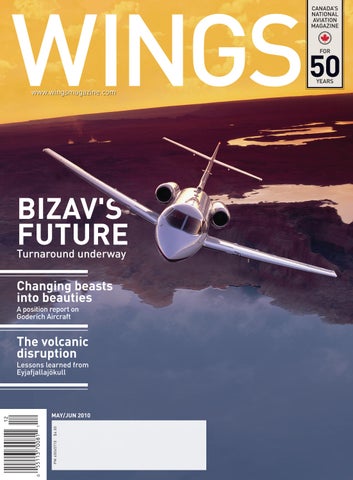
The april 2010 eyjafjallajökull volcanic eruption brought european and North atlantic air traffic to a halt. P.34.
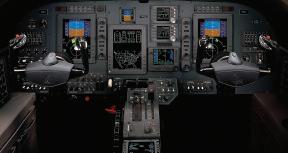
Raisbeck’s EPIC PLATINUM Performance System gives you the operational flexibility to take off and land safely on every airfield, runway and dirt strip in Canada.
Includes a new FAA-Approved Flight Manual Supplement to take advantage of the increased performance.
• Shorter takeoff and landing distances (operate in and out of more airports)
• Increased cruise speeds and better specific fuel consumption (return on investment)
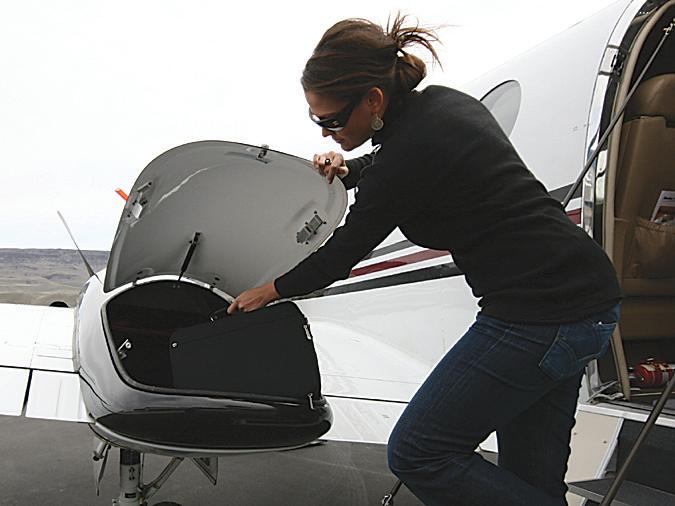
Raisbeck Crown Wing Lockers are optional on all 200 Series EPIC Performance Packages, and carry up to 600 lbs of payload outside the cabin.
Raisbeck Engineering’s EPIC PLATINUM (featuring Raisbeck Performance Props!) is available for all 200/B200/ B200GT models, and includes its own new FAA/Transport Canada-Approved Airplane Flight Manual Supplement. Both EPIC PLATINUM and EPIC GOLD* contain specific performance systems designed to enhance all aspects of payload, range and flight characteristics, and are attractively priced to save you money in both purchase and installation.
* Applicable to serial # BB-1509 and subsequent (utilizes Hartzell 4-blade propellers)
EPIC Performance Benefits
| By Drew McCarthy
Who pays?
Government avoiding security responsibilities
In the Nov/Dec 2009 issue of Wings magazine, John McKenna, president and CEO of the Air Transport Association of Canada (ATAC) wrote a guest column called, “Olympic Security Yes; But not to the detriment of the B.C. air transport industry.”
In that column, McKenna told Canadian aviation and the Canadian government that ATAC members whose businesses were disrupted because of Olympic security measures would require compensation for their financial losses.
Flight schools, air shuttle services, sightseeing operators, and carriers flying people and cargo to various spots in the province would all be adversely impacted by the 2010 Winter Olympic Games.
Now the tally is in, and according to ATAC, “a dozen impacted stakeholders have concluded that the security measures had a major negative financial impact upon air operators during the period of restrictions. In some instances operators saw a drop in revenue as much as 80 per cent from the same period in previous years.”
The dollar value lost by those members primarily serving the Lower Mainland and Vancouver Island is estimated at more than $7 million.
ATAC has intensified its lobbying to the federal government for compensation ever since security measures were formally announced. According to the association, ATAC has written to Prime Minister Stephen Harper twice since November 2009 asking that the air operators be compensated. The latest letter, dated Jan. 19, 2010, had not, as of April 1, 2010, been acknowledged by the Office of the Prime Minister.
In his Wings column, McKenna had expressed his hope that the government would see fit to make reparations to those affected on its own and “not as a result of a
court action.”
Following a meeting held in Vancouver in March 2010, ATAC and the air operators remain determined to seek compensation from the federal government by any means, including litigation.
LEADING EDGE
as 80 per cent because of measures imposed by the government. We are only asking that the government accept its responsibilities.”
This should be a matter of public policy, not litigation. The government’s failure to respond to Canada’s leading aviation association demonstrates a lack of understanding of aviation and a lack of vision regarding its future. Should it come down to it, forcing a legitimate and valued association to take court action on this matter is a waste of time, money, energy, and most importantly, good will.
It seems that government really isn’t willing to accept its responsibilities. Since 9/11, the downloading of aviation-related security costs has continued on an ongoing basis.
In early April 2010, Transport Canada eliminated funding to our eight busiest airports to offset the cost for police to patrol the terminals. The government will save $15.6 million a year. (Federal regulations require armed police presence at terminals, and the airports are now responsible for the costs.)
The air operators remain determined to seek compensation from the federal government by any means, including litigation.
Says McKenna, “These B.C. air operators are only asking that the government cover the operating losses resulting from the strict limitations imposed on their operations by Olympic security measures. These were Transport Canada imposed restrictions. We are not questioning the need for Olympic security but why should these small business operators bear additional and unreasonable costs while seeing their commercial activities restricted by as much
tOP DAtA bursts in this issue
1. Currently about 28,000 aircraft fly through euro-controlled airspace … on a daily basis (pg 36). 2. POC oversight is reverting to Transport canada (pg 14). 3. tony smyth was appointed Director general of the canada aviation Museum in 2002 (pg 19). 4. twenty-two years after the last Dash 7 rolled out, over half of them are still in operation (pg 45). 5. sMs was first introduced in the 1980s in the chemical industry (pg 31).
The Canadian Airports Council says that passengers will have to make up for the funding shortfall. Is this really acceptable? Airport terminals are open to the public and, as such, individuals who have business to do there should be able to count on security – the same security afforded to all citizens, wherever they might find themselves in Canada.
It seems that every time security measures are undertaken, the aviation community is told to bear the brunt.
Only when government and its departments are able to see the fundamental economic and social value of all forms of aviation in this country can we begin to expect better treatment.
The task then falls to us as members of the community to take our message forward as often and as loudly as possible, to explain, show proof, expound and when necessary, sue. Canadian aviation needs much more respect and consideration from those who are making the rules, especially in the realm of security. | W
Your feedback on our new design or any other issue is always welcome. Please contact me at dmccarthy@annexweb.com.
CONsuLtiNG eDitOr Matt nicholls • mnicholls@annexweb.com 416-725-5637
PrODuCtiON Artist kelli kramer
FLiGHt DeCK
ken armstrong, Roger Beebe, Ray canon, James careless, David carr, Paul Dixon, Brian Dunn, frederick k. Larkin, neil MacDonald, carroll Mccormick, Mike Minnich, David olsen, Peter Pigott, Dr. Tarek sardana, Rob seaman, Blair watson
From paper clips to business aircraft, ever y capital expenditure must satisfy the same burden of proof – does it make your company more profitable?
Which is why prudent business leaders demand that every tool used by their organization contributes positively to fiscal performance:
• Will it return more than it costs?
• Will it improve or enhance our customer service or brand?
• Will it help our employees work, communicate and sell better?
• Will it make our organization more competitive?
• Will it expand our market and foster growth?
The past 25 years of business aviation offer tangible proof that most corporate aviators grow faster and make more profits than their earthbound competitors.
Of course, not every organization needs an airplane. But the value and utility of business aviation are by no means exclusive to mega-corporations – they also benefit those who have set their sights on becoming one. In fact, the vast majority of companies that currently rely on business aviation are small- to medium-sized operations.
We’re Citation Team Canada, Execaire’s premier aviation sales and service organization and Cessna’s exclusive Authorized Canadian Sales Representative for the world’s best selling family of business aircraft. Call us – we’d love to show you why more successful Canadian companies get down to business in a Citation than any other business jet, and help you deter mine if you’re ready to take your organization to new heights.
A Citation business jet puts your best people face-to-face with clients and prospects faster and more often. That's a competitive advantage you can take to the bank.
ON THE FLY
over the past decade and resulted in bringing high-performance and fuel-efficient products to market.”
Dassault Aviation selected the PW308C for the Falcon 2000EX jet in 1999 and later picked the PW307A to power its Falcon 7X three-engine business jet, marking the extension of a growing business collaboration between the company and P&WC.
iNDustrY NeWs
PrAtt & WHitNeY CANADA CeLebrAtes
500tH PW308C
DeLiverY tO DAssAuLt AviAtiON
At EBACE this past May, Pratt & Whitney Canada (P&WC) celebrated the delivery of its 500th PW308C turbofan engine to France's Dassault Aviation.
Pratt & Whitney Canada held a special ceremony during the 10th annual European Business Aviation Convention and Exhibition (EBACE) in Geneva, Switzerland, to honour the milestone delivery, reached in March 2010.
“This is a tremendous achievement and attests to the success of the PW308Cpowered Falcon 2000DX/EX/LX business jet,” said Michael Perodeau, VP, Corporate Aviation and Military Programs, P&WC.
“This delivery also underscores the close relationship that has developed between Pratt & Whitney Canada and Dassault Aviation
The PW308C, a member of the popular PW300 family of engines, is rated at 7,000 lbs thrust (ISA + 23C) and has accumulated more than 550,000 flight hours in service on the Falcon fleet. The PW300 engine family today powers 1,321 business jets in 71 countries and has accumulated a total of 8.5 million flight hours.
u.s. tO OrDer Q400 Fixes tO PreveNt stALLs
U.S. air-safety regulators are ordering fixes to Bombardier Q400 turboprops to prevent stalls in icy conditions. The directive from the Federal Aviation Administration requires airlines to inspect, and possibly replace, various parts on 69 turboprops in service with U.S. carriers.
The directive focuses on possible malfunctions of devices that help warn pilots about an impending aerodynamic stall, particularly in icy conditions. The FAA has determined that the devices can provide inaccurate data to the stall-warning system in the cockpit
after seizing up or becoming coated with ice in certain low-temperature conditions.
The agency says there have been no reported incidents or accidents involving the problem, which is unrelated to the crash of a Colgan Air Q400 in Buffalo, N.Y., in February 2009 that killed 50 people.
bOMbArDier, Ge CAPitAL AviAtiON serviCes Get AFrA ACCreDitAtiON
There are approximately 6,000 older-type aircraft expected to reach their end-oflife in the next 20 years. According to the Aircraft Fleet Recycling Association (AFRA), the disposal of these aircraft is a major problem and many companies have now launched environmental programs to address it.
Founded in 2005 by 11 organizations committed to drive the aircraft industry towards solutions for the safe and most environmentally responsible way of managing end-of-life aircraft, AFRA now encompasses 42 members from 10 countries. Aircraft manufacturer Bombardier and GE Capital Aviation Services are the latest to be awarded AFRA accreditation for their dismantling operations.
AFRA says of the 400 to 450 aircraft that are scrapped and disassembled globally each year, around one-third are parted out and disassembled by its member companies, producing upwards of 30,000 tons of aluminum and 1,800 tons of other specialty alloy metals for recycling annually. Members are targeting a 95 per cent recyclability rate.
About half of the world’s parked aircraft
PW300 engine family powers
Bombardier has delivered its first learjet 60 Xr and challenger 850 jets to customers in mainland china.
fleet is stored at AFRA member facilities. The organization says a key priority is the safe handling and disposal of materials that cannot be recycled, as well as returning reclaimed metals and composite materials back into commercial and aircraft manufacturing.
First LeArJet 60 xr AND CHALLeNGer 850 Jets DeLivereD iN CHiNA
Bombardier Aerospace has announced that it has delivered its first Learjet 60 XR and Challenger 850 jets to customers based in mainland China, this past March 5 and March 26, respectively.
China is among a number of countries identified as emerging markets for business aviation. Globalization, increased travel requirements by businesspeople and a general positive trend towards the acceptance of business aircraft use are among the contributors to increased activity in the region. Bombardier delivered its first Global 5000 jet for operation in mainland China in July 2009.
Both the Learjet 60 XR and Challenger 850 jets are Type Certificated by the Civil Aviation Administration of China.
CAe siGNs CONtrACt WitH HANGAr8
CAE announced at the European Business Aviation Convention and Exhibition (EBACE) the signing of a contract with corporate jet company Hangar8 for pilot training services on eight aircraft types. CAE will provide training on Hawker
Beechcraft, Bombardier Challenger, Cessna Citation, Dassault Falcon and Embraer aircraft models. The Hawker training will be conducted at Emirates-CAE Flight Training (ECFT) in Dubai, UAE; training on other aircraft types will occur at Burgess Hill, U.K. near London; and CAE SimuFlite in Dallas, Texas.
“Hangar8 and the entire CAE team share an unparalleled commitment to safety and customer service,” said Dustin Dryden, Chief Executive Officer, Hangar8. “CAE's presence around the globe and training flexibility are important to our expanding base of operations.”
“We are very pleased that Hangar8 has decided to begin training with CAE, and look forward to helping them grow their business by producing proficient and effective pilots,” said Jeff Roberts, CAE Group President, Civil Simulation Products, Training and Services. “Our global network
of business aviation training centres helps bring operationally relevant training closer to our customers' base of operations.”
Viking Air of Victoria, B.C., has appointed Team JAS of Jacksonville, Fla., and Universal Avionique Inc. of Miami, Fla., as the first two Factory- Endorsed Component Centers (FECC) in the Twin Otter Series 400 and legacy de Havilland Canada aircraft support network. The companies were selected for the FECC program due to their longstanding history of providing quality service to the worldwide Twin Otter fleet, and their ability to meet the demands of the changing landscape as new Series 400 Twin Otters are introduced to the market.
The FECC program develops strategic partnerships with specialized industry professionals to provide factory-certified service and warranty repairs on components for both the new Viking Series 400 Twin Otters and legacy de Havilland Canada fleet, including items such as main and nose landing gear, and rotable components.
The core business strategy of Team JAS has focused on the Twin Otter for nearly 25 years, supplying parts or repairs to virtually every Twin Otter operator on every continent. Team JAS, an FAA- and JAA-approved component repair station, maintains a large inventory of Twin Otter parts and rotables,
Hangar8 ceo dustin dryden (left) and Jeff roberts, cae Group President, civil Simulation Products, Training and Services, at eBace 2010.
making it an ideal facility to join the FECC network as the eastern United States representative.
Universal Avionique Inc. is an FAA- and EASA-approved organization specializing in repair and overhaul of avionics, instruments, and accessories for multiple aircraft types, including the Twin Otter and Dash 7. Universal Avionique Inc. has a comprehensive list of capabilities, and adds avionics and electronic expertise to the FECC support network.
reNteCH’s sYNtHetiC Jet FueL POWers First u.s. COMMerCiAL FLiGHt
Rentech Inc. has announced that a successful engineering validation flight was conducted on April 30, 2010, by United Airlines using Rentech’s certified synthetic jet fuel (RenJet). The flight marks the first time a U.S. commercial airline has used synthetic jet fuel in flight.
In December 2009, United, along with 12 other domestic and international passenger and cargo carriers, signed a memorandum of understanding that is intended to serve as a framework for a future definitive supply agreement for approximately 250 million gallons per year of certified synthetic jet fuel from Rentech’s proposed synthetic fuels and power facility in Adams County, Miss. (Natchez Project).
The synthetic jet fuel used in today’s engineering validation flight was produced at Rentech’s Product Demonstration Unit, which is believed to be the only operating integrated synthetic transportation fuels facility in the U.S. RenJet, produced from renewable or fossil feedstocks, is the first and only alternative fuel type certified for use by commercial aviation. Rentech’s synthetic jet fuel can be distributed and used in existing infrastructure including pipelines and engines and is cleaner burning than traditional petroleum-derived jet fuel.
The validation flight was conducted using a 40/60 mix of Rentech’s synthetic jet fuel with conventional Jet A fuel in one of two engines on an Airbus 319 aircraft. The aircraft departed Denver International Airport and climbed to an altitude of 39,000 feet, where the onboard team collected data on the performance of the fuel during several manoeuvres, including taxi, takeoff, climb, cruise, auxiliary power unit start,
descent and approach. The synthetic jet fuel, derived from natural gas and converted to liquid fuel through the Rentech Fischer Tropsch process, is approved by the ASTM International and is safe for use on passenger flights.
In August 2009, United was among eight airlines that signed an unprecedented multi-year agreement with Rentech for up to 1.5 million gallons per year of renewable synthetic diesel (RenDiesel) for ground service equipment operations at Los Angeles International Airport (LAX) beginning in late 2012, when Rentech’s Rialto Renewable Energy Center is scheduled to go into service.
Earlier this year, Rentech and ClearFuels Technology jointly received a $22.6-million grant from the U.S. Department of Energy to construct a biomass gasifier at Rentech’s Energy Technology Center in Denver. The gasifier will be integrated with Rentech’s Product Demonstration Unit for the production of renewable synthetic fuels from biomass in late 2011.
NeW DireCtOr GeNerAL, CANADA AviAtiON MuseuM
Denise Amyot, president and CEO of the Canada Science and Technology Museum Corp., has announced the appointment of Stephen Quick as director general of the Canada Aviation Museum.
“Mr. Quick brings a heartfelt passion for aviation to his new position at the helm of Canada’s national aeronautical museum,” says Amyot. “With his extensive experience within the public and private sectors, and more than 30 years as a professional artist, Quick is uniquely qualified to guide the Museum in showcasing Canadian achievement and innovation.”
“As museums,” says Quick, “we should not only function as stewards and guardians of our collective past, but be proactive in introducing future generations to the tools that will help forge their future. We should act as extensions of established learning
PeOPLe
New canada aviation museum director General Stephen Quick
institutions, helping to shape the future and engender pride in Canadian endeavours by telling the stories of those who have dared follow their dreams, and by showcasing the next wave of exploration and innovation.”
Deeply involved in Canada’s arts and culture sector, Quick has been painting professionally since 1978, and has been a professional aircraft and military illustrator since 1984. He spent 27 years in the Canadian publishing industry, including senior positions with both McClelland & Stewart and Stoddart Publishing. He has also worked within the public sector, including positions at the Department of Canadian Heritage and the National Gallery of Canada, prior to becoming associate director general of the Canada Aviation Museum in 2008.
vANCOuver AirPOrt AutHOritY CHAir stePs DOWN
After 13 years, Graham Clarke is stepping down as chair of Vancouver Airport Authority effective June 10, 2010. Clarke, who has been a member of the board of directors since YVR became Canada’s first community-based airport authority in 1992, will continue as a director. The Airport Authority's new chair will be announced at its annual public meeting on May 13.
Vancouver Airport Authority president and CEO, Larry Berg said Clarke’s leadership as chair of the board of directors went a long way to keeping YVR closely connected to the community.
Clarke will continue to chair Vancouver Airport Services (YVRAS), a company owned jointly by Citi Infrastructure Investors and Vancouver Airport Authority. Currently, YVRAS manages a network of 18 airports around the world.
Graham Clarke is president and owner of the Clarke Group of companies, which does business in the transportation, hospitality, marine and tourism sectors. Clarke has served as director or chair of numerous organizations and companies, including the Vancouver Board of Trade and Tourism Vancouver.
WiLLiAM A. restALL tAKes HeLM At CAC
The Canadian Airports Council has announced that, in addition to his duties as Saskatoon Airport Authority president and CEO, William A. Restall has been
named acting president of the Canadian Airports Council.
Currently the association’s chair, Restall has served on the board of the CAC since 2004, and will act in an interim capacity after the departure of outgoing president and CEO, Jim Facette.
“Under Jim’s tenure, the CAC matured into a modern trade association, a voice for Canada’s airports community,” said Restall. “In the coming months, the CAC will be turning its attention to recruiting a new full-time executive to lead the organization. In the meantime, the CAC will continue to serve as the voice of Canada’s airports in Ottawa and play an important role in regulatory and legislative affairs.”
Restall has been president and CEO of Saskatoon Airport Authority since 1999. One of the first executives accredited by the International Association of Airport Executives, Restall has 36 years experience in air transportation. In addition to his role at the CAC, Mr. Restall is a director of the Saskatchewan Aviation Council, and a director of the Northwest Chapter of the American Association of Airport Executives.
OPerAtOrs
KeLOWNA FLiGHtCrAFt
CeLebrAtes 40 YeArs
Launched on March 25, 1970, Kelowna Flightcraft has grown over the last 40 years to become an icon of success in the Canadian aviation industry.
Founded by Barry Lapointe and Jim Rogers in Kelowna, B.C., Flightcraft started as an Aircraft Maintenance Operation and bought, imported and sold aircraft in the early years. By 1974, it acquired an Air Operators Certificate and entered the charter market. In 1977, Flightcraft began a long-term relationship with Purolator Courier that continues today.
Starting with one aircraft in Western Canada, Flightcraft now operates 18 aircraft as part of an across-Canada network to support Purolator’s overnight delivery service. Line maintenance bases were established across Canada and a large heavy maintenance facility was built in Hamilton, Ont., in 1995 to support Purolator’s needs.
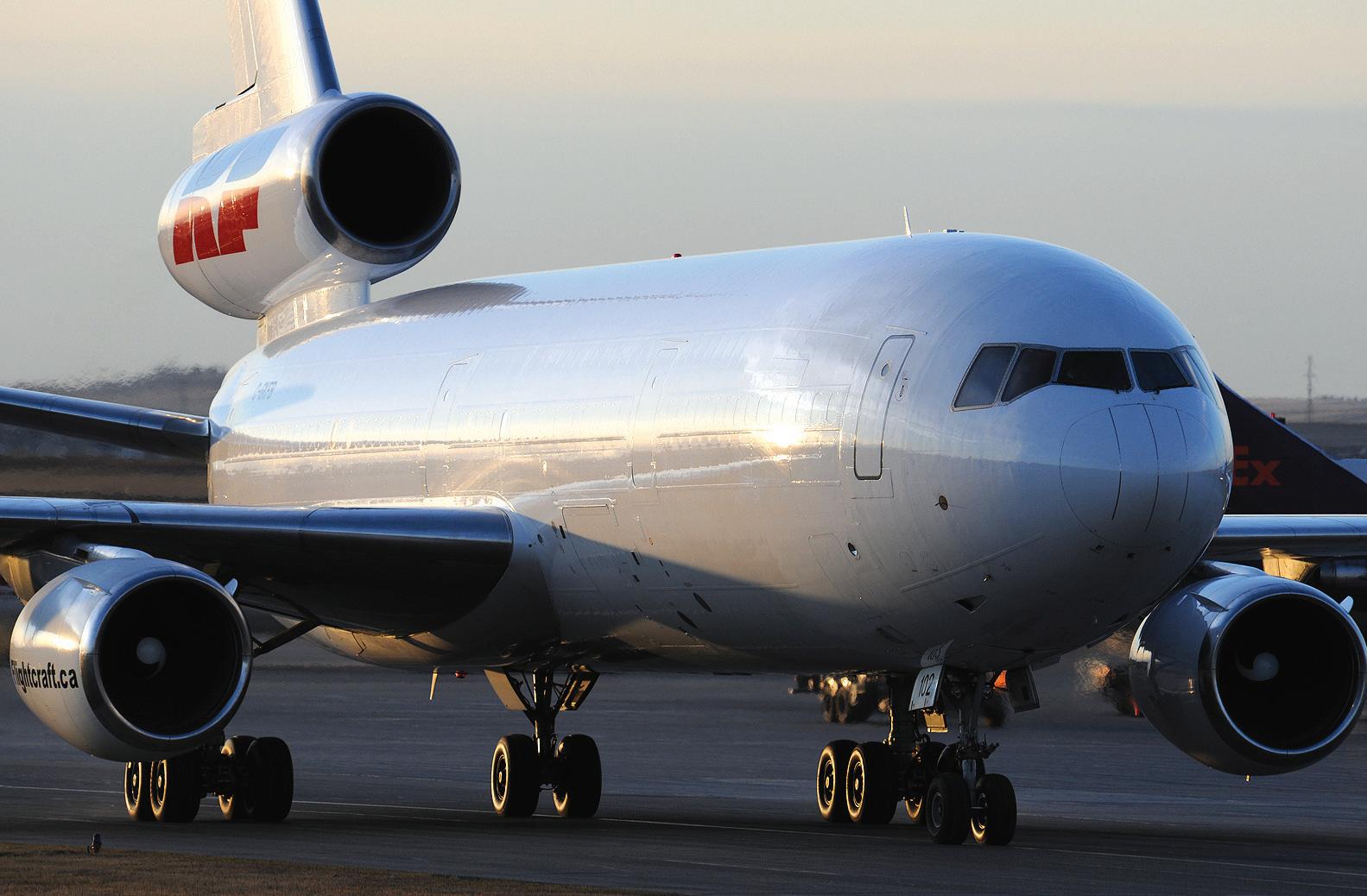
Today, Flightcraft also operates the largest cargo aircraft registered in Canada (DC10-30F) to provide dedicated heavy lift air service to Canada Post.
eveNts CALeNDAr
MAY 2010
5th Annual Wings & Wheels
Heritage Festival
Canadian Air & Space Museum
May 29-30
Toronto, Ont. www.wingsandwheelsfestival.com
JUNE 2010
CANSEC 2010
Defence and Security Tradeshow
June 2, 3
Ottawa, Ont.
www.defenceandsecurity.ca
JULY 2010
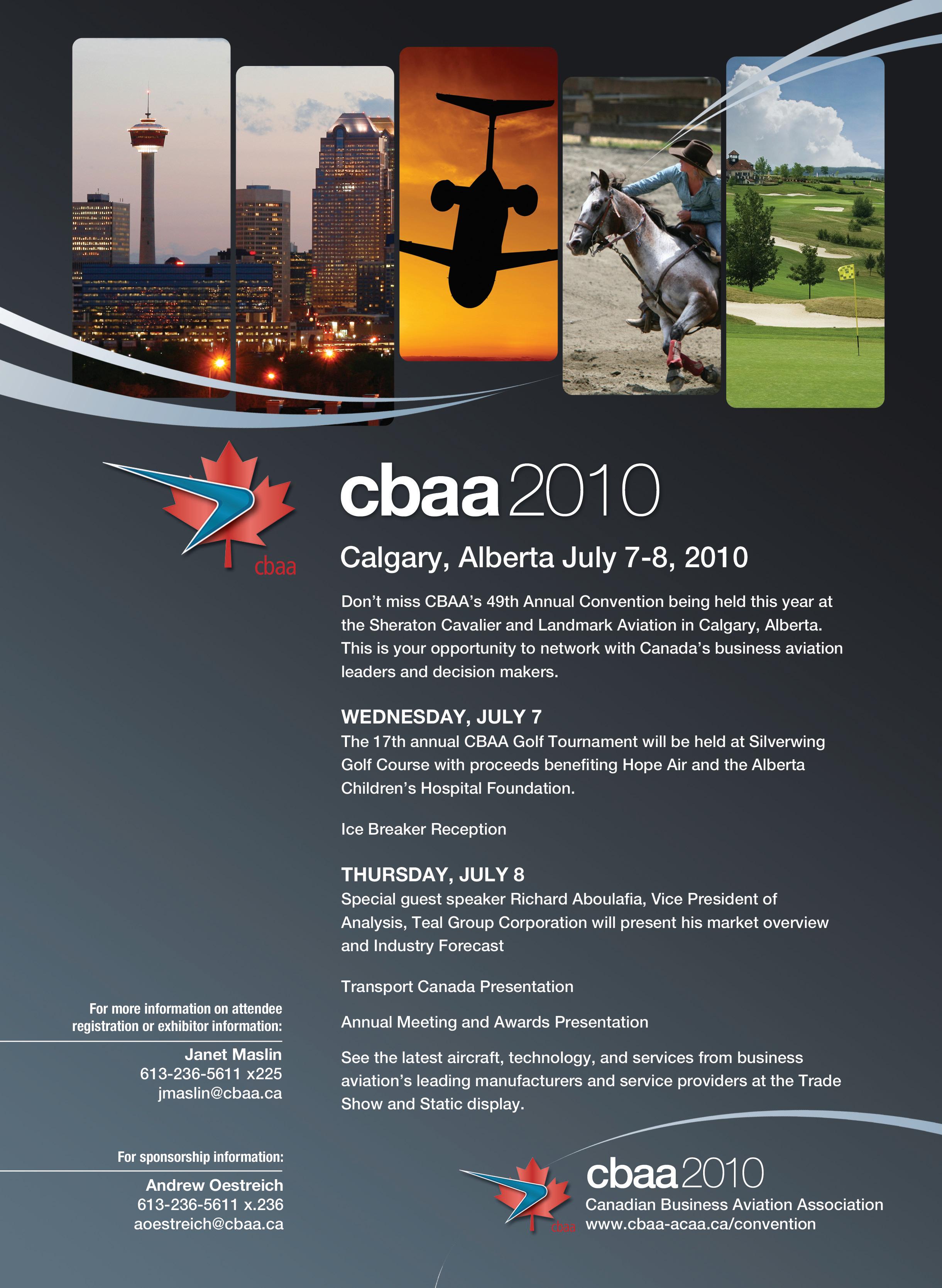
CBAA 2010 - Annual Convention, Trade Show and Static Display
July 7-8
Calgary, Alta. www.cbaa.ca/portal/convention
Farnborough International Airshow
July 19 - 25
Farnborough, U.K. www.farnborough.com
SEPTEMBER 2010
Aircraft Interiors Expo 2010
Sept. 14-16
Long Beach, Calif. www.aircraftinteriorsexpo-us.com
OCTOBER 2010
NBAA 63rd Annual Meeting and Convention 2010
Oct. 19-21
Atlanta, Ga. www.nbaa.org/events
MARCH 2011
Heli-Expo 2011
March 5-8
Orlando, Fla. www.rotor.com
For a full list of events, please visit www.wingsmagazine.com and click on events.
In March 2005, the largest contract in Flightcraft’s history was awarded to Allied Wings, a subsidiary of Flightcraft. It received a 22-year, $1.77-billion contract to provide training and support to Canada’s Air Force pilots in Southport, Man.
Flightcraft has continued to build a very strong maintenance organization. The company’s staff is capable of performing heavy maintenance and modifications to a wide range of aircraft, including structural modifications and avionic upgrades. Work is performed on both civilian and military aircraft from around the world in Kelowna, where a focus on niche markets is honed.
In 1997, Flightcraft became the OEM for the Convair aircraft line, providing technical, engineering and parts manufacturing for a fleet flown around the world. Shop facilities include engine, component, landing gear, plating, NDT, machining, and fabrication shops. The maintenance operations are supported by Transport Canada certified Engineering and Training groups, and maintain an ISO 9001 Quality Assurance program.
Today, Kelowna Flightcraft operates or leases more than 75 aircraft; is Canada’s largest cargo airline; is an aircraft maintenance and manufacturing organization; is a transport Canada Design Approval organization (engineering); owns the type certificate for the Convair airplane, and is a Transport Canada Approved Training Organization delivering training to a wide range of aviation companies.
shelf and were only taken down when they knew Transport Canada was coming to perform an audit.
Also quoted in the Op/Ed: “...it is irresponsible of Government to restrict or reduce the ability of TC to ensure the highest possible standards of public safety.” Here’s the fact: SMS does not reduce or eliminate any standard of public safety. It is not Transport Canada’s “responsibility” to assure safety, it is the responsibility of the operator to ensure safety. SMS/QA will provide the tools necessary to accomplish the process control needed for public safety. Perhaps Olsen would benefit from a briefing on the goals of the SMS/QA system and DTI’s interpretation and teachings. Perhaps he also misinterpreted the article, as evidenced in the next paragraph.
Finally, we really don’t know what to say about Olsen’s assertion “Most people don’t go into aviation to make money…” I wish I had known that before I bought WestJet stock. Let’s face reality, profit is what keeps commercial civil aviation companies in business.
Mr. Olsen replies:
Although some certificate holders may have been slack in their approach, it would be unfair (unless Dennis had assessed all Canadian companies prior to 2001) to the Canadian aerospace industry and Transport Canada to assume that they had not monitored or improved processes and procedures and ignored their own manuals.
Dennis Taboada of DTI has responded to the Op-Ed in our Jan/Feb 2010 issue. We print the (edited) comments below, with a response from our writer David Olsen.
In the Jan/Feb 2010 Op/Ed “Safety Management Debate,” David Olsen comments on an article in the Sept/ Oct 2009 issue entitled, “DTI spreads a Quality Message.” Unfortunately, Olsen’s opinions on the article are not backed up by facts. Prior to SMS, many certificate holders seldom-monitored processes or improved procedures in an organized documented fashion on their own. Their procedures were kept in manuals on the
He says in the Op/Ed, “DTI stated in Wings that safety management is just QA by another name. Well it isn’t...” Nowhere in the article is this stated. As a 30-year fellow of the American Society for Quality, I can assure you the QA principles of “Process Control” are the engines that drive the SMS system.
Olsen further quotes in the Op/Ed: “I have not met certificate holders who ‘fear’ SMS and QA.” Objective evidence in the form of response questions to over 700 TC inspectors and 350 certificate holders is evidence the majority are “afraid ” they cannot meet the SMS/QA requirement. This is because no one has taken the time to explain to them what SMS/QA really is, and what they need and should want to do to meet it.
It is a statutory duty of Transport Canada to ensure the safety of the travelling public. On January 12, the Transport Canada spokesperson stated to Wings:
“The safety and well being of all Canadians when they travel by air is important to this government…The International Civil Aviation Organization has recognized Transport Canada as the world leader in the implementation of safety management systems and other countries are following our lead.”
The quote reference about SMS being the same as QA was in the Fall issue of the DTI newsletter Talking Frog, which stated:
“Consultants across the continent are jumping on the fears of small businesses that SMS is something new and exotic, when all it is, is just plain good ole QA at its core. In the next issue, we will ... bring this SMS monster to its knees and show why you want to implement QA...oh, I mean SMS.”
Kelowna flightcraft was founded by Barry lapointe and Jim rogers in Kelowna, B.c
THE NEW GREEN
Falcon 2000LX Owners Fly 20 to 40% Greener
And smarter. Because on a typical business trip, the 2000LX uses that much less fuel and releases fewer emissions than anything else in its large-cabin class. In fact, less than most jets in the next smaller class. The secret? Superior aerodynamics, lighter-stronger materials, leading technology and experience building legendary ghter jets. Learn about the efcient 4,000 nm Falcon 2000LX – and the other smart, green Falcons at falconjet.com/greener.
By Rob Seaman |
CbAA out, transport Canada in
Is it necessity or politics?
Transport Minister John Baird’s March 16 announcement that the POC oversight is reverting to Transport Canada (TC) represents a major change for CAR 604 flight departments. It’s a key step involving CBAA POC operations and one that, in the opinion of many, is heading in entirely the wrong direction. This change is going to bear a significant cost in time and money – for everyone.
The 2003 changeover to the CBAA POC involved the development of unique SMS and Operations manuals. It cost operators time and money to do this. There were fees for audits and an annual POC/Membership levee. That said, it was generally understood while the new system might have “front-end loading,” the downstream benefits and saving would justify it.
Remember, too, that when CBAA first assumed POC oversight, it was also widely considered that if the 604 mandate stayed with TC, there would be increased recovery by government through a series of user service fees. Under the CBAA, however, the POC proramme was expected to cost less and involve more controlled and predictable charges in the long run.
With Minister Baird’s decision to switch everything around – again – all the parties involved in 604 ops now have to dig down and prepare for something that will without question involve more time and money. That is simply not fair or reasonable. It presumes that corporate aviation, as the old saying goes, keeps the bottom drawer in the desk full of money to just throw at the flight department needs.
On the government’s side, it would be fair to assume that the talent and resources once dedicated to bizav ops oversight, have, since 2003, been reallocated or lost. So, where is a government that just recently committed itself publicly not to spend money at this time, going to get the resources needed to reassume control of this user group? Once again, this is going to cost us all. Given that so much has changed in bizav since 2003, it would also be fair to assume TC will be facing a learning curve. This, too, will add both financially and in ways yet to be seen.
This “take-back” has been branded, by some, as a “boost” to bizav oversight.
Where is a government…going to get the resources needed to reassume control of this user group?
That is a hard one to take unchallenged. The old system, pre-CBAA, was cumbersome, antiquated, inflexible and by all judgment, not functioning for the reality of the users/operators. Approvals or changes took a long time. Renewals were red-tape strewn and time intensive. Generally, the resources required were stressed and that added to the overall inefficiency and frustration by CAR 604 operators. And there were incidents and accidents – albeit, very few. Is reverting back to that going to be an enhancement?
When CBAA POC was introduced, the government of the day advised that business aviation was a small group with a good enough operational safety record and it did not require the level of oversight others did. The program was developed through a lot of careful thinking, consideration and input from people who are knowledgeable about such things. It was not simply thrown out as an idea that seemed right at the time. So, what has changed? Has this been brought about by necessity, party line politics or simple bureaucracy?
On Dec. 1, 2009, Minister Baird said in the House of Commons the Government of Canada is “tremendously concerned with civil aviation safety. At my department (Transport Canada), that is one of our most important responsibilities. I do not support outsourcing safety testing or safety monitoring to the private sector. I think it is an important core responsibility of government and my department.” That statement sounds more like politics than anything else.
On the flip side, the Transportation Safety Board (TSB) did not indicate any safety concerns with the CBAA POC program in its investigation of two accidents involving business aircraft under the CBAA programme. Its recommendations were related to the quality assurance aspects of the CBAA audit programme, which was also a finding in Transport Canada’s assessment of the CBAA. TSB also noted that both TC and CBAA have taken steps since the incidents.
That makes this sound even more like politics. If that is the case, it is indeed not only a sad state of affairs, but it could also leave the door open for other expensive and involved reversals. | W
Rob Seaman is a Wings writer and columnist.
A DARK AND STORMY NIGHT A DANGEROUS DESCENT A LIFE ON THE LINE
It was a pitch-dark January night, and conditions for the rescue mission were poor. The steep canyon walls were spiked with thick vegetation and webbed with wire hazards. Operating a Pratt & Whitney Canada powered helicopter, the pilot made the treacherous descent to the car wreck below. “Engines, don’t fail me now!” he quipped as he recounted the story of the mission later, from the safety of the Los Angeles County Fire Department’s Air Operations home base. The citizens of Los Angeles County depend on the courage and confidence of LACoFD pilots. And LACoFD pilots depend on P&WC engines.
WWW.PWC.CA
By David Carr |
Flying the checkered flag
Airlines invest in prestigious Formula One
After a one-year hiatus, Formula One (F1) rolls back into Montreal in June with a record number of airline companies helping to drive the world’s most expensive sport.
Airline sponsorships in F1 are not new. Saudi Arabian Airlines featured prominently on a British racing team between 1978 and 1985, and Air Canada was the title sponsor of the Canadian Grand Prix until 2003, the first airline to do so. But the global ban on tobacco advertising snuffed out sponsorship opportunities, and left F1 scrambling to fill the gaps in its $1-billiona-year advertising habit. Air Canada picked up the Canadian Grand Prix in 1999 from John Players, an early tobacco sponsor.
For the 2010 season, Gulf Air, Qantas and Etihad Airways are title sponsors of F1 races, with the Abu Dhabi-based carrier also an advertising partner in Ferrari Formula One, the most prestigious badge in auto racing. This year, Etihad is one of four airlines sponsoring race teams to various degrees including India’s Kingfisher Airlines and Britain’s Virgin Atlantic, albeit as part of the larger Virgin Group.
Virgin came up trumps in 2009, stepping in as the 11th hour title sponsor in little known British-based Brawn GP only to ride its investment, car and driver Jenson Button to a series of checkered flags and a World Championship. Nobody is expecting lightning to strike twice. Virgin launched its own F1 team in 2010 but has struggled out of the starting gate.
Even a slow start cannot devalue the thrill and glamour of F1 and exotic locations such as Shanghai and Monaco. An estimated 600 million tune in to each Grand Prix for an accumulated audience of 11.4 billion viewers over a 19-race calendar. In comparison, the worldwide audience for the Vancouver Olympics was 3.5 billion.
Formula Money, a UK publication that tracks financial performance calculates that Virgin realized a 496 per cent return on investment (ROI) last year. Still, ROI depends on how long a branded car is burning up the track. No small consideration in a sport where race day attrition is as common as tire changes and victory champagne.
For Etihad, whose logo appears on the front and tail wings of the two iconic red
An estimated 600 million tune in to each Grand Prix for an accumulated audience of 11.4 billion viewers over a 19-race calendar
Ferrari’s, linking a six-year-old airline with the 80-year pedigree of the classic automaker increases global brand prestige and credibility.
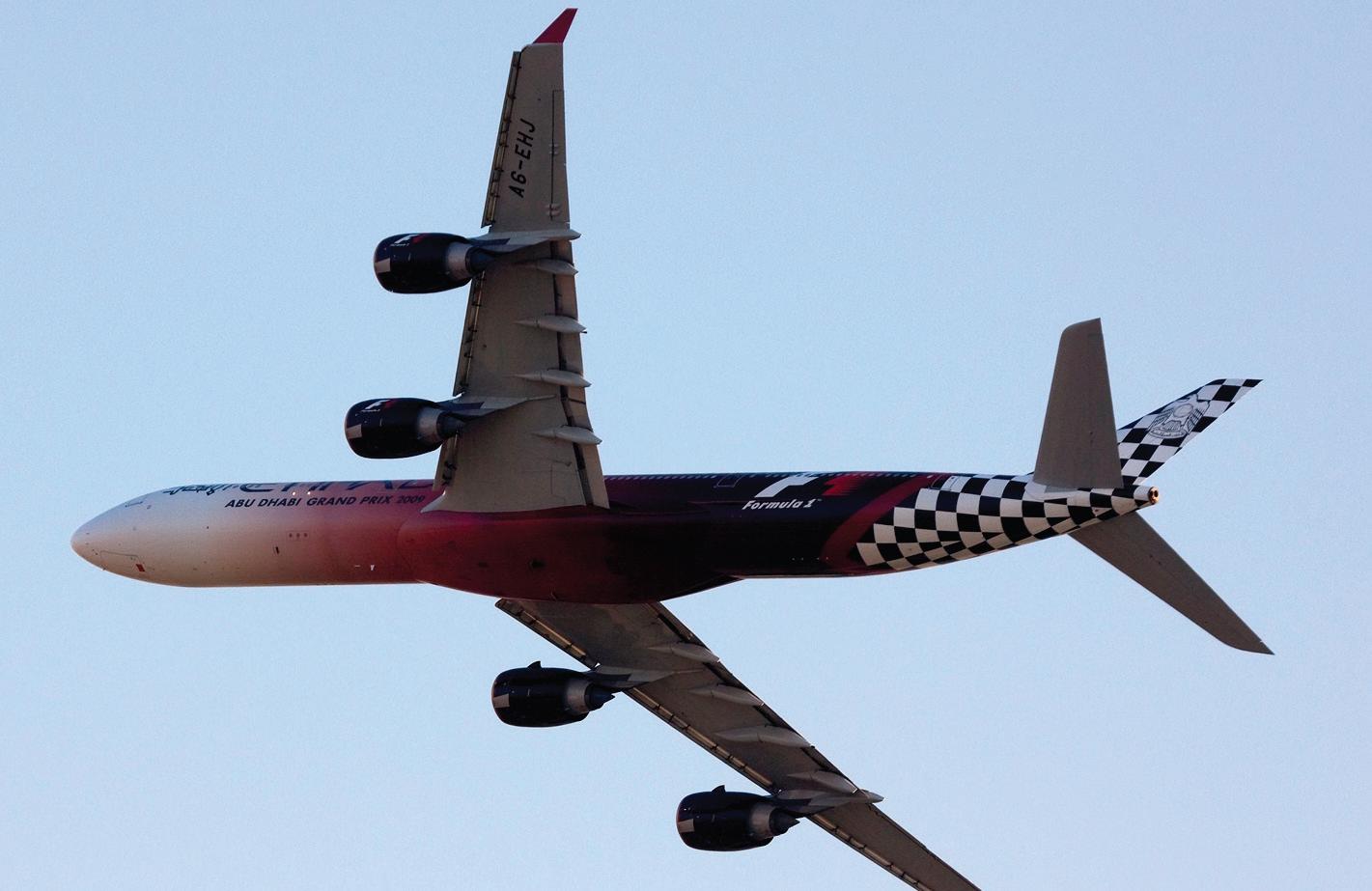
Etihad took top honours at the Arabian Sponsorship Awards for its support of the inaugural Abu Dhabi Grand Prix in 2009, which included two aircraft kitted out in a special F1 livery. In a twist on F1 car maker’s traditional win on Sunday, sell on Monday, business model, Etihad reported a record-breaking spike in website visits and bookings.
None of this comes cheap. Fees for hosting a race have doubled over the last five years to approximately $30 million as governments in Middle East and Asian countries use F1 and spectacular facilities to promote tourism and economic development even as they struggle to fill the stands. (It is estimated that Air Canada paid $5 million to host the 2003 Canadian Grand Prix.)
Except for Virgin, airline sponsorship has come from non-European markets. British Airways was reported to be kicking the tires of home team McLaren on a value-in-kind basis that would have reduced the race
team’s enormous transport costs in 2010, but no deal has surfaced. Two British world champions now drive for McLaren, a key selling point for British Airways’ so-called Revenue Lab, a cross-business unit aimed at filling seats by aligning the airline with changing markets. Emirates is also expected to jump back into F1 after sponsoring the McLaren team for one season in 2006.
Cost remains a factor, opening the door for advertisers to leverage the enormous viewership of F1 with one-race deals in home markets. Timing is everything. Last year, a Brazilian brewery paid $500,000 to sponsor Brawn at the Sao Paulo Grand Prix where Jenson Button captured the World Championship, for an estimated 853 per cent ROI.
F1 is not without challenges including rules that produce some very dull races. Sponsorship is not as stable as when big tobacco was involved. Value for money has squeezed premier car makers out of the sport and there is concern newer teams lack funding to make it through the season. But as a marquee sporting property F1 has the engines, luxury destinations and elite drivers that premium airline brands are paying to be a part of. | W
There are more than 100 airlines in Canada, large and small, offering passenger, charter and/or cargo service, but only a handful that serve Canada’s north. The major regionals serving the area include Air North, First Air and Canadian North.
That’s still a lot of capacity for a thinly populated region of the country, especially when you consider there are a number of smaller operators serving some of the same routes. So, Whitehorse-based Air North wasn’t too pleased when Air Canada expanded capacity by more than 40 per cent in a declining market last summer and started selling seats below cost, according to Joe Sparling, Air North’s president and CEO.
He sees a bit of a parallel between the situation in the north and Air Canada’s attempt to block Emirates Airlines from increasing frequencies to Canada. Air Canada claims there is already more than enough capacity to carry all the people who want to travel between Canada and the United Arab Emirates.
Sparling believes there is more than enough capacity to carry people who want to travel between the north and south.
“While there will always be mainline competitors, I would like to see them manage their capacity better. Their (increased) presence here is driven by the economic conditions in the southern markets, which has created difficult market conditions in the north.”
That sentiment is echoed by Scott Bateman, president and CEO of Kanata, Ont.based First Air, who believes both Air Canada and WestJet are increasing capacity in the north to offset tougher economic conditions in the south.
“If I were an Air Canada shareholder, I’d be scratching my head. There’s no rationale why they should be flying into our market. WestJet has also moved into the market.”
Bateman adds it’s a repeat of former Canadian Airlines International and Air Canada beating each other up for market share before Air Canada acquired its rival in 2001. The only difference is WestJet has replaced Canadian, with the northern carriers ending up as collateral damage.
Why would you support a southern carrier when they will be taking money out of your pocket?
He estimates the Edmonton-Yellowknife route is 300 per cent over capacity and Calgary-Yellowknife not much better, which has had a huge impact on First Air’s bottom line.
While he admits the presence of the mainline carriers has stimulated the market and load factors are up, it’s hard to make money with tickets priced at between $49 and $125.
“If we can’t compete with the mainline carriers on the major routes, we’ll have to move operations further north to our hubs.”
Bateman also took a swipe at Canadian North of Yellowknife which, on the one hand, lambasted Air Canada for launching service on the “overcrowded” Iqaluit, Ottawa and Montreal route, then agreed to provide baggage-handling and ticketcounter service to its rival.
“Why would you support a southern carrier when they will be taking money out of your pocket?”
The move was defended by Canadian North president Tracy Medve, who said ground handling was only part of the equation.
“We also entered into a commercial agreement with Air Canada by putting our code on some of their flights, which lowers the fare on some routes by offering a through fare. For example, someone flying from Pond Inlet (Nunavut) to Toronto will see a single fare and we also get access to Air Canada lounges.”
The market has improved since last year, according to Sparling, Bateman and Medve, with traffic starting to return to normal.
“We weren’t as badly impacted as the south because the territorial government had several capital projects going and the mining industry also kept us busy,” says Sparling.
Both First Air and Canadian North were badly hurt by a decline in mining and oil and gas exploration activity, which have since begun to pick up.
Canada’s airline industry as a whole is expected to eek out a modest profit this year, but will remain well below pre-recession levels, according to a report by the Conference Board of Canada.
Although earnings and revenue will climb steadily over the next four years, it won’t be until 2014 that profits surpass the recent high of $505 million in 2007, according to the board. | W
Brian Dunn is a Wings writer and columnist.
| By Peter Pigott
Fond farewell
Canada Aviation Museum says goodbye to Tony Smyth
The Ottawa suburb of Rockliffe is the home of the Canada Aviation Museum, one of the finest in the world with an internationally renowned aeronautical collection. Until the end of March 2010, it was under the stewardship of Anthony (Tony) Smyth.
A lifelong aviation enthusiast, Tony was born in England and attended his first air show at Farnborough in 1953. Immigrating to Canada, he was recruited by the Canadian Foreign Service in 1966, and was posted to Kenya and New Zealand. He joined the office of the Governor General of Canada in 1984 as Deputy Secretary, a position he held for 17 years.
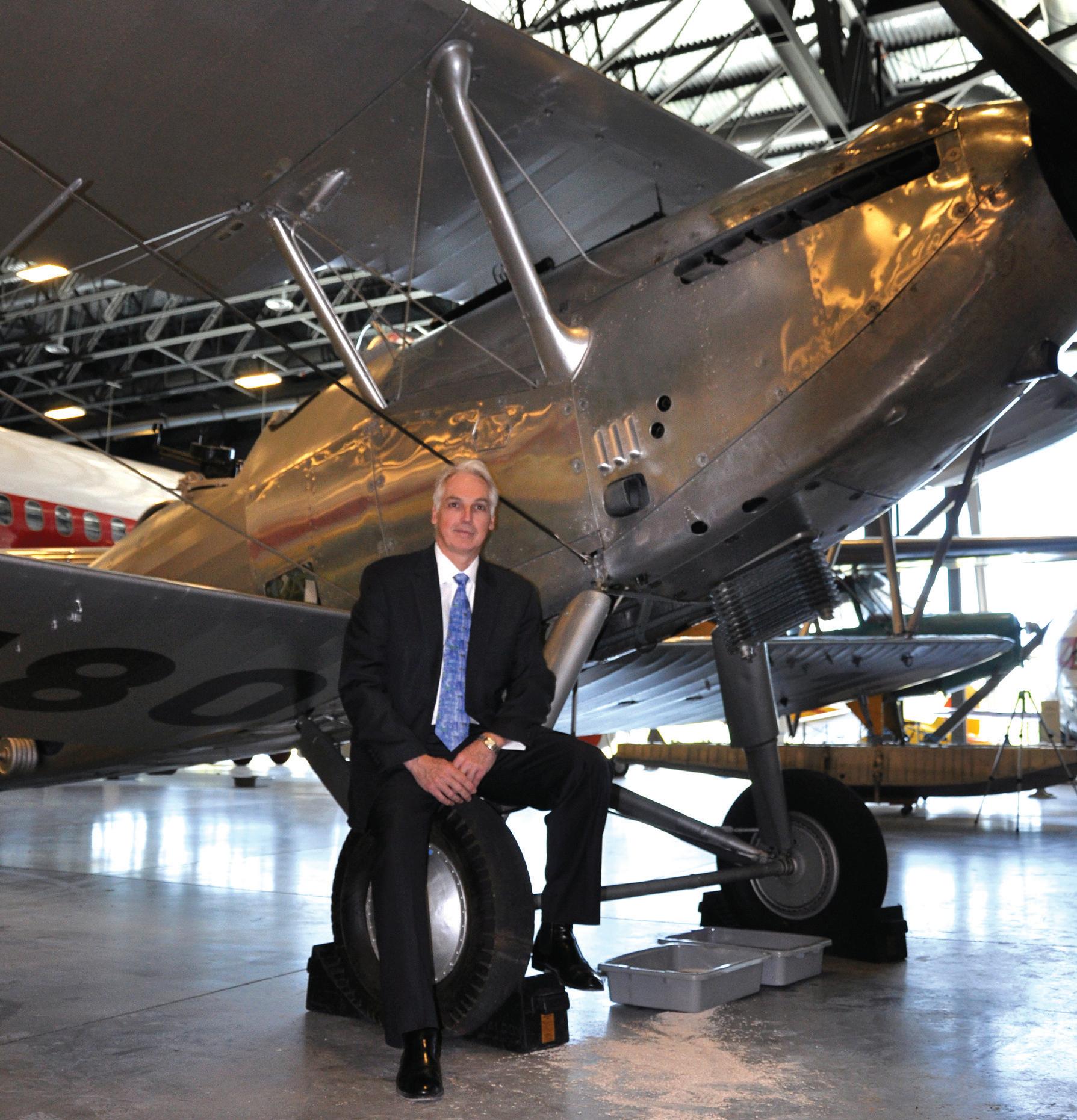
In January 2002, Tony was given the opportunity to combine his enthusiasm for aviation with his management experience by accepting the position of Director General of the Canada Aviation Museum. His first challenge was to complete major projects already under way – especially the design and building of a massive storage hangar to provide 8,200 square metres (87,000 square feet) of additional space to preserve key aircraft like Junkers J.1, Canadair C54GM North Star, wing tips of an Avro Arrow, a de Havilland D.H.98 Mosquito and North American P-51D Mustang IV.
The ground-breaking ceremony for the Storage Wing took place on November 7, 2002, and when completed on April 14, 2005, for the first time in 39 years, all of the aircraft in the collection were protected from the elements.
When opened with new administration, library and archives facilities, the Storage Wing was a striking addition to the existing Museum building creating a physical symbol representing the power and grace of flight.
In anticipation of the centennial of powered flight in Canada on February 23, 2009, Tony was involved in the publishing of Canadian Wings: A Remarkable Century of Flight. The book and the expansion of exhibition space were made available because of the storage hangar that led to the Canadian Wings exhibition, the Museum’s centennial project that was opened by the Governor General on the centenary of the first flight.
The centennial year was celebrated in the Museum with a progression of high-profile events, from the Genies awards ceremony
Tony enjoyed immensely the opportunity to work with a dedicated staff and enthusiastic colleagues.
and the hosting of the Mutual Concerns of Air and Space Museums, through to a successful career day on National Aviation Day on February 23, 2010. Even as this took place, Tony led the team working on the Museum’s next expansion project, to add an auditorium, classrooms and striking new entrance lobby the project due for completion by February, 2011.
Through his years at the Museum, several important aircraft were acquired. One was the Borel Morane monoplane, the oldest existing aircraft known to have flown in Canada. Then, Bombardier donated the oldest airworthy Canadair Challenger, which landed at the Museum in February, 2006. Tony negotiated to acquire an airworthy World War 1 Bristol F2.B Fighter, which arrived at the Museum in the
autumn of 2006. Today, the collection comprises more than 130 aircraft and countless other artifacts such as engines, propellers, and important works of aviation art, as well as library and archival resources.
One of the jewels in the crown of the Museum is the Library and Archives which houses several corporate and private archival collections from Air Canada, Canadair and Avro Canada as well as log books from aviators in the First and Second World War; the papers of bush pilot Stuart Graham; and those of Kenneth M. Molson, another Canadian devoted to aviation research and the first curator of the Canada Aviation Museum.
Ever the aviation enthusiast, to his delight, Tony’s position afforded him the chance to ride in vintage civil and military aircraft from a 1928 Waco to a Harvard, Lancaster, B-17, B-25 and Labrador helicopter. Throughout his tenure at the Museum, Tony enjoyed immensely the opportunity to work with a dedicated staff and enthusiastic colleagues, both at home and abroad. In retirement he intends to remain active through writing and – what else – volunteering at the Museum. Stephen Quick, Tony’s successor at the Canada Aviation Museum had this to say: “Anthony Smyth brought a great deal of experience and an undying passion for aviation to his position as Director General. He worked tirelessly to enhance the reputation and visibility of the Museum and to ensure that the collection was both relevant and accessible. There is no greater proof of his passion for the Museum than the fact that he signed up as a volunteer on his last day as DG.” | W
Peter Pigott is a Wings writer and columnist.
Last year was one most would prefer to forget – assuming they are still around to talk about it. Corporate aviation was bloodied and beaten not only by the companies who use it, but in an unprecedented manner in the world of public opinion. Taking private aircraft to Washington to beg for bailout money was probably about the worst PR move anyone could have imagined. What were the execs of the Big Three Automakers thinking? And it gathered speed from
there as the consumer media grabbed and pushed the antiquated image of corporate fat cats in their “Austin Powers-like aerial shaggin’ wagons.” They took about every opportunity to take a swing at an industry that provides needed jobs, access and support to global markets and remote domestic communities – not to mention aid to foreign lands in times of stress. This fuelled fear in the corporate community –one by one they shed themselves of obvious perks – private, timely and secure business aviation travel being the first to go in many
cases. Reputation aside, jobs were lost and an infrastructure that has taken years to develop was dealt a severe blow.
As we turned the page on a new decade, it seemed the worst was over for what many optimists called the natural cycle of things – an up and down trend that has been seen and weathered before. Today, inventories of resale aircraft have levelled to what many term as acceptable. The selloffs and quick dump or “for sale as theatrics only” opportunities seem to have dried up. That makes for a good start.
WHIle THere IS STIll WeaKNeSS IN maNY SecTorS of THe ecoNomY, THere are SIGNS a recoverY HaS BeGUN.
Mixed reviews
Like it or not, sales and resale inventory – coupled with new orders and deliveries – are big drivers of success in this business. The trickle-down effects cover everything from support and service operations like FBOs, limos, catering and such, to aftermarket items as simple as lubes and parts, to avionics and interior retrofits and upgrades. In the opinion of many, the bleeding is not quite over and the closure of at least three Montreal-based bizav specialty firms between January and March supports that thinking. That said, the general consensus is the worst is over and the turn-around is well underway.
On the new aircraft front, the news is mixed. Embraer recently announced that, while its overall sales were down, the corporate aircraft side was its market leader – understandable, as Phenom 100 and 300 aircraft come into service. That said, a quick scan of the sales books shows many positions in the near and longer term future for these aircraft are up for grabs. The same holds true for many other models.
Gone are the multi-year wait times for new aircraft. If you want one sooner rather than later, there is likely to be an opening or position up for grabs. And gone, too, are the premiums that were considered the norm a short while ago. Nervous holders of these aircraft futures who do not want to take delivery, are making attractive deals to simply get out of the commitment. So, a buyers’ market is still the current reality.
Dassault Falcon Jet recently reported record deliveries but profits are being challenged. Pilatus says 2009 for them was another year of records; however, the road ahead shows a possible slowdown as new orders are not rushing in. Together with Cessna, Gulfstream and Hawker Beech, just about all the OEMs are working to reduced manufacturing numbers in an effort to spread things out a little. Many have recalled at least some of the staff that was laid off within the last year, but nowhere near the numbers furloughed. And a few have even announced the reopening of facilities or limited development of new ones – completion and service facilities for the most part.
The resale story is a bit different and more subject to fluctuations and trends. As a case in point, former Canadian sales rep for Dassault Falcon Jet, Herbie Kane, an aircraft broker and the Falcon specialist now with large international brokerage and acquisition firm Avpro, says, “I see gradual improvement this year in both the U.S. and Canada. While there is still weakness in many sectors of the economy, there are signs a recovery has begun. More U.S. and Canadian buyers have come back into the market recently, inventories are down slightly and flight hours are up quite a bit. And while we still have a long way to go, these are indications 2010 will be a better year for the industry than the past 18 months have been.” Kane also notes larger aircraft like big Gulfstreams and Bombardier Global series aircraft are in increased demand. Prices have stabilized and inventory is tough to find in some cases, depending on what the buyer wants.
turNiNG beAsts
iNtO beAuties
A position report on Goderich Aircraft | By Frederick K. Larkin
When one thinks of aircraft that are selected to transport chieftains of industry or super celebrities around the world, three types come to mind – the Bombardier Global Express XRS, the Gulfstream G550 and the Falcon 7X. With acquisition costs that exceed US$50 million, these machines boast a range capability of at least 6,000 nautical miles at a cruise speed of Mach 0.80.
While these three models can comfortably carry eight passengers on 12-hour legs, some travellers prefer larger aircraft that provide truly palatial amenities such as a conference room, a
stateroom complete with en suite washroom with shower, and seven-foot-high ceilings. They need an airliner.
The concept of a jet airliner performing as a business jet is not new. Back in April 1966, Tenneco took delivery of a BAC 1-11 from the factory. By 1980, Tenneco would have a trio of 1-11s and a Boeing 727-100 among its fleet of a dozen jets. In September 1966, Victor Comptometer received a 1-11 to replace its Vickers Viscount turboprop.
The first Douglas business jet was a new DC-9-15 delivered to the renowned investor Kirk Kerkorian in April 1968. Today, the 92-year-old Kerkorian owns a Boeing BBJ. Ling-Temco-Vought became
the first operator of a corporate Boeing jet when it took delivery of a 737-200 in August 1969. A month later, Essex Wire received its 737-200. Playboy Enterprises got plenty of exposure in February 1970, when it bought a new DC-9-32. Nicknamed “Big Bunny,” it was painted black overall with the iconic Bunny logo in white emblazoned on its tail.
In 1970, only a dozen airliners operated as executive aircraft. This included eight BAC 1-11s, two 737-200s, a DC-9-15 and a DC-9-32. Forty years later, there are more than 350 airliners configured as VIP aircraft in commercial and military service around the world. Today, the
largest corporate operated machines include two Boeing 777-200s and a Boeing 747400 belonging to separate owners in the Middle East. Perhaps feeling somewhat constricted, the 747 owner has ordered an Airbus A380 that will have a MTOW of 1.2 million pounds.
While approximately 200 of these aircraft were delivered new, the others served with commercial carriers prior to becoming luxury liners. Modified models include Boeing 737-200/300/400/500s; 747-100/200/400/SPs; 757200s; 767-200/300s; and 777-200s; Douglas DC-8-70s; DC-9-10/30/80s; as well as Airbus A310-300s and A340200/500/600s. Not included
a Boeing Business Jet undergoing maintenance and interior refurbishment.
in the 350 aircraft are regional jets produced by Bombardier and Embraer that have either been purchased new as executive aircraft or converted to serve that role.
The jet set
Since the introduction of the Boeing BBJ and the Airbus ACJ families in 1996 and 1997, respectively, these aircraft have been well received by the VIP market. Their buyers tend to be governments, private corporations and wealthy families. The lines between these three categories are sometimes blurred.
The aircraft are delivered to the owner/operator without an interior or sophisticated avionics in a so-called “green” configuration. It is the completion centre’s job to outfit the aircraft to the specifications provided by the owner, a task that can take up to a year to complete.
Around the globe there are approximately two dozen companies that have the expertise to complete a new airliner or to convert an older one. Besides having the necessary physical assets (significant hangar capacity), these companies require personnel that are talented in the disciplines of sheet metal fabrication, woodworking and upholstery in addition to having airframe and avionics skills. Another invaluable talent, mandatory within senior management, is a set of interpersonal skills that enables constructive face-toface dealings with customers – most of whom are the antithesis of shrinking violets.
The largest North American completion centres specializing in airliners include: Associated Air Center in Dallas, Texas; Comlux Completion USA in Indianapolis, Ind.; Gore Design Completions in San Antonio, Texas; and L-3 Communications Integrated Systems in Greenville, Texas. The leading European outfits include Air France Industries in Le Bourget, France; Jet Aviation in Basel, Switzerland; and Lufthansa Technik in
the latest numbers from boeing and Airbus demonstrate how well their bizjets have sold
MODeL DeLivereD ON OrDer tOtAL
Hamburg, Germany.
It may come as a surprise that there is a company in southwestern Ontario that has been increasing its share of this specialized international market. Goderich Aircraft of Huron Park, Ont. (25 miles north of London), has completed/converted numerous airliners into bizjets in addition to its work on large cabin purpose-built jets such as Globals, Gulfstreams, Challengers and Falcons.
Can a small Canadian outfit compete against the established players in this niche? Before we attempt to answer that, it is useful to review how the company got to where it is today.
That was then…
Back in 1972, a Canadian named James T. Field, who had served as a mechanic with the U.S. Air Force in southeast Asia, started an aircraft maintenance business called Brant Aero in Brantford, Ont. His eldest son Blaine worked there for a decade until 1993, when the entrepreneurial urge took hold. Blaine created an outfit on the same field that specialized in interior refurbishments, but would also repaint aircraft and perform required maintenance while an aircraft was in its shop. Blaine later moved the operation to Goderich, Ont., but it
would be a short stay, as a better opportunity presented itself in 1997. That’s when he moved the company to Centralia Airport at Huron Park, Ont. The headcount stood at 50 at that time.
Centralia Airport was built as part of the British Commonwealth Air Training Plan
over the past 13 years, Goderich aircraft has seen its headcount triple to approximately 150.
and began as the home of the Number 9 Service Flying Training School on Sept. 21, 1942. Pilots were trained primarily for the Royal Canadian Air Force, but also for other Commonwealth nation forces. It was renamed RCAF Station Centralia in September 1947, and remained as such until its closure on March 31, 1967. During its military life, Centralia was the home to various aircraft types, including Ansons, Dakotas, Expeditors, Harvards and, latterly, Chipmunks. The airport was later renamed
Huron Air Park and became an industrial park, where numerous light manufacturing companies developed operations.
As far as aircraft activity was concerned, Centralia became a quiet country airfield. Strangely out of place among the resident taildraggers was the occasional sight of a large Grumman Gulfstream II jet, when U.S. Steel executives would drop in to inspect its Hughes Boat Works affiliate between 1969 and 1977. Who would ever have thought that three decades later even larger bizjets would frequent the place?
This is now…
Over the past 13 years, Goderich Aircraft has seen its headcount triple to approximately 150. During this time hundreds of aircraft have been processed. This has included some 40 models from such manufacturers as Boeing (BBJ); Bombardier (Global 5000, Challenger 604, Learjet 55/60, Dash 8); Cessna (Citation I/III/VII); Dornier (328JET); Douglas (DC-987); Fokker (F-28-4000); Gulfstream (IV, G550); and Hawker Beechcraft (125700/800/1000, 1900D, King Air 300). In order to differentiate itself amongst the many North American
GROWTH PROPOSITION ON MONTREAL'S SHORE
QuebeC’s PAsCAN
AviAtiON CONtiNues tO FLOurisH
bY CArrOLL MCCOrMiCK
When Montrealers and visitors think of air travel to and from the city, they mostly think of the Trudeau International Airport in Dorval. Yet across the St. Lawrence River from Montreal Island, a few short kilometres but often an arduous commute away, reside some one million people in the South Shore and greater Monteregie region; most Canadian airports thrive on far smaller population bases.
The South Shore does, however, have the Saint-Hubert Airport (formerly CFB Saint-Hubert). In 2004, Transport Canada divested its assets to the non-profit organization Développement Aéroport Saint-Hubert de Longueuil (DASH-L). It is said to be Canada’s busiest general aviation airport, with at least five fixedwing flying schools, several charter operations and other private and industry tenants.
A 15-minute commute from downtown Montreal on a quiet day, it has a 7,840- by 150-foot main runway (24R/06L) with an Instrument Landing System on 24R and localizer back course on 06L. There are two shorter secondary runways.
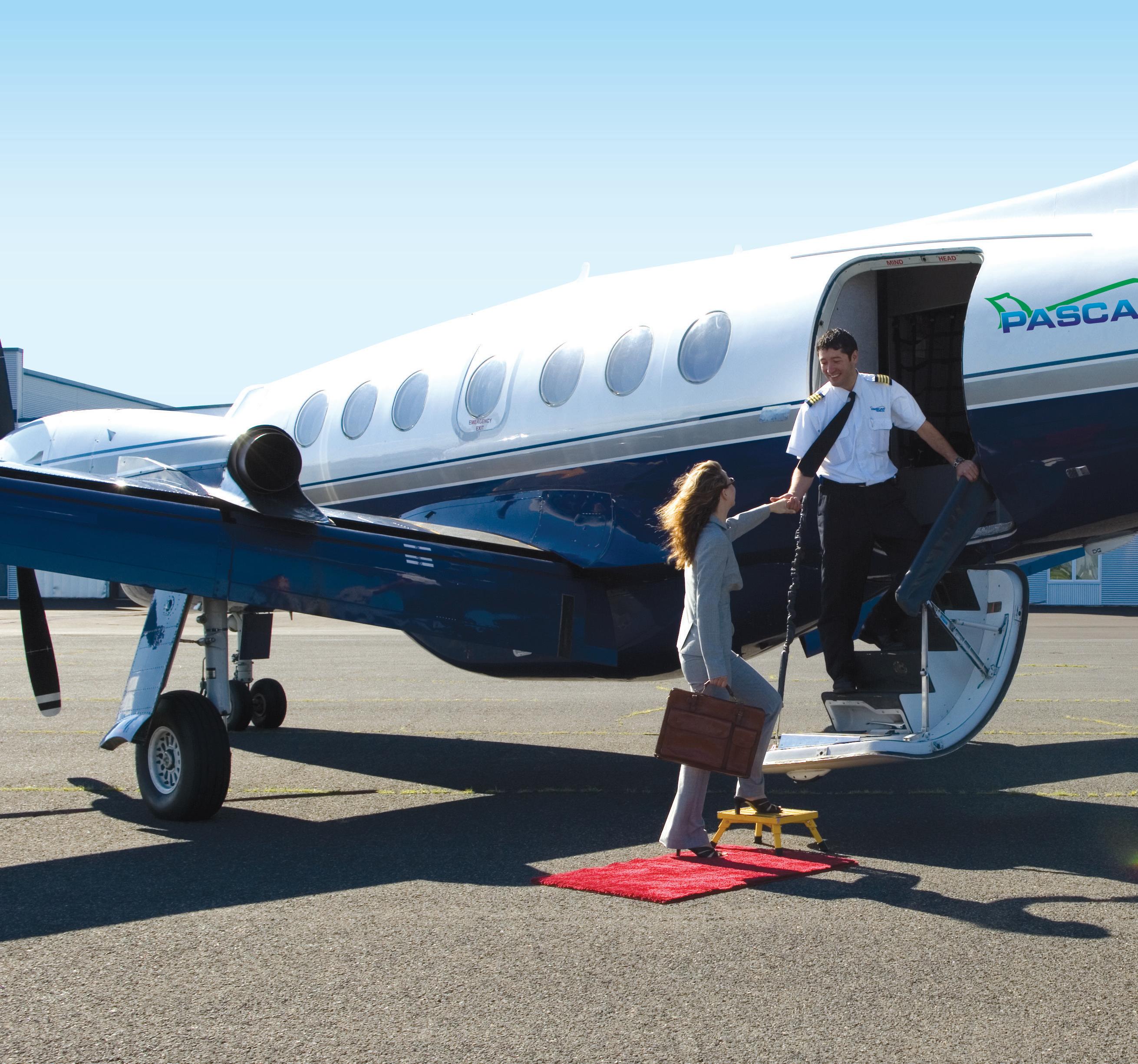
More than one airline has eyed the airport for scheduled service, but the only one to successfully establish a longterm scheduled service there is Pascan Aviation, founded in 1999. On most days, Pascan has 60-70 scheduled departures to and from 13 destinations, including Rouyn/Noranda to the west, Wabush to the north and Îles-de-la-Madeleine way out in the Gulf of St. Lawrence. As well, Pascan offers charter flights to anywhere in North America.
Maintaining this pace requires 13 aircraft and about 80 employees, including 35 pilots and co-pilots, some 15 ground vehicles (plus cars and trucks stationed at other airports), 2,786 square metres of office and hangar space and 14,000 square metres of ramp space.
Plans to expand the fleet this year will have the airline serving about 220 city pairs every day, further realizing the dream of its founder and president, Serge Charron, to create a truly regional airline in Quebec. “We are the only such airline here,” says Charron. “We can say Air Creebec, but it serves the Cree population. Air Inuit serves the Inuit.” Charron does not regard Air Canada Jazz as a competitor. “I’d like to say I am complimentary to Jazz. We go to some of the same places, but we do it different ways. Jazz feeds Air Canada to major airports. Pascan is more of an inter-city carrier.”
In an upstairs boardroom, with a view of a full parking lot out of one window and a row of GA hangars from the other,
Charron pokes at a map of eastern Canada and recites the names of regional carriers that have been relegated to Quebec aviation history. “Region Air, Air Shefferville, Air Alma, Air Satellite, Aviation Quebec-Labrador… These airlines were feeders to Inter Canadien, which closed in 1999, and Air Alliance, which became part of Air Canada. When Inter Canadien went bankrupt, it killed off these third level feeders, which had no reservation systems. As well, there was a silent rule for each to stay in its small region of Quebec. I wanted to cover the whole province independently,” Charron explains.
An Alberta-based aviation consultant once observed that airline founders are typically larger-than-life figures with
Pascan has logged 60,000 cycles and 50,000 hours without an incident.
ROPOSITION SHORE
turbo-charged egos and a powerful attraction to action and the limelight. Charron’s past, on the contrary, suggests his dream to launch a pan-Quebec airline was born more of a lifetime of flying, an intimate understanding of Quebec aviation – its successes, failures and shortcomings – and, one can assume, an astute business mind.
“Maybe I am an opportunist. I had a plan and a vision. I know the territory in Quebec. I know people everywhere,” Charron acknowledges. Thus equipped, Charron launched Pascan, with a single leased Pilatus PC-12, at the age of 49.
A pilot since he was just 16, he obtained his commercial licence at 18 and began working as bush pilot for Gagnon Air Service in 1970 at age 19, flying
Cessnas, Beavers, and Otters. He flew the DC-3 for Les Ailes du Nord in Sept-Îles at 23 and logged many hours flying them on skis. In 1976, he began flying for the Quebec Air Service. The planes he piloted included the PBY Catalina flying boat and the Canadair CL-215 water bomber. He chauffeured premiers in the Hawker Siddeley HS-125, and the Fokker F27. He even flew the CL-415 from 1998-1999 for Italy’s Dipartimento Della Protezione Civile, and taught flying. He flew the Fire Boss AT-802 Water Scooper in Sudbury, Ont., in 2004.
Charron has about 10 aircraft types on his licence and has flown many more. He has logged about 16,000 hours in fixedwing aircraft. He obtained his helicopter rating in early 2009 and by last December, had logged about 160 hours – the last few in a gorgeous blue and gold Robertson R44 he purchased. He still flies about 250 hours a year, mostly piloting scheduled flights for Pascan.
A new direction
In 1999, Charron left the Quebec Air Service to launch Pascan in Quebec City. Before long he had three leased PC-12s and a pretty good business that included scheduled, charter and cargo flights and a Canada Post contract to Îles-de-laMadeleine. In 2003, he set up shop in a 10,000 sq.-ft. hangar, plus 5,000 sq. ft. of office space, on the east side of the SaintHubert Airport.
Then disaster struck in the form of “helpful” government meddling: In the wake of 9-11, the Quebec government, in its infinite wisdom, handed Air Canada $14 million to subsidize its regional operations. “The goal of the Quebec government, to be nice, was to protect the regions. Air Canada opens the world to the regions,” Charron says.
Charron met with Quebec’s then minister of transportation and demanded his share: the difference between what Pascan was earning before Air Canada got the $14 million and what Pascan was taking in after that move decimated his passenger traffic. He received nothing.
“That loan forced me to restructure,’ Charron says. “What saved me was my cargo contract and the diversified nature of my company, such as cargo, charter and medevac. I had to abandon the Canada Post contract and some routes. We focussed more on charter and gradually got our passengers back.”
To help recover from that flameout, Charron took on Denis Charest in 2003 as a 50/50 partner. Charest is the president and chief executive officer of Boucherville, Que.-based Spectra Premium, a worldwide manufacturer of replacement car parts.
Pilots can combine their passion for flying with their desire to help people in need. Hundreds of pilots across Canada are VPP Pilots, but we need more, like you, to help us in our mission of Getting Canadians to getting better.
With leasing costs for the PC-12s soaring out of control, Charron returned them and bought four other PC-12s outright. In 2004, he sold one and bought four Beechcraft King Air B-100 twin turboprops. He bought three BAE Jetstream 32s in 2007, giving Pascan three aircraft types: the PC-12, King Air and Jetstream. He recently bought a Navajo Chieftain 350, dedicated to cargo runs between Saint-Hubert and Quebec City.
expanding horizons
Pascan opened an FBO in 2005. “We have some customers who come here all the time,” Charron explained. “Many customers used to fly to Dorval and drive to the South Shore for business. When they discovered they could fly here, they enjoyed that.”
Pascan completed a $3-million expansion in 2007 that increased the hangar
and office space to 2,786 square metres. The waiting room, with comfy couches, TV and apron view, seems spacious in the afternoon, but gets rather intimate weekday mornings. Two discrete hangar areas (one the original building and one part of the expansion) are for fixed wing maintenance, where Pascan’s mechanics perform everything up to “C” checks on its own fleet, and do maintenance for outside customers.
Several helicopters are shoehorned into a third area, where Pascan does thirdparty chopper maintenance. Growing that business, however, will require space in a planned 2,972-square-metre expansion. “We have one dedicated helicopter mechanic and will build this business when we have more room,” Charron notes.
The plan, once the next expansion happens, is to convert the original hangar,
P EOPLE POWERED
Pascan aviation is unusual among operators flying aircraft the size of the P c -12 in that it rewards its co-pilots with a salary and not only their flight hours, says founder and ceo s erge c harron. “ from the beginning i paid my co-pilots,” he says. “ i had to compete with other carriers who do not. i did not want to start a company on the back of my people. i wanted Pascan to be safe and the pilots to be well trained. i wanted a safe, pleasant company to work for.”
i t must certainly be inspiring to work for a boss who encourages independent thinking. “ i give my employees a lot of rope,” c harron says. e vents like the 10th anniversary celebration last summer, which opened with an f -18 fly by, and the c hristmas party last December, are also good for company spirit: Pascan paid the tab to fly all the employees into s aint-Hubert from all its destination airports for the party and they stayed the weekend at Hôtel Brossard, owned by Pascan’s co-owner Denis c harest.
w hat is the success of the company? i t is the spirit of the employees,” c harron says. “They are doing things with the same heart as if they were doing them for themselves. The success is not for me. i t is for my people.”
with its big skylight, into a spacious passenger terminal, complete with baggage check, baggage belt and other amenities. The upcoming fleet expansion (Charron wants to buy seven Jetstream 32s this year, and he is also looking for 40seat passenger aircraft) and the anticipated terminal expansion will push the airline’s stake in the airport well beyond the $20 million or so it has already invested. To protect his stake, Charron has a sweet insurance policy up his sleeve: “Pascan has exclusivity at Saint-Hubert for the routes it has now,” he explains. “No one else can come into this airport and launch service to the same towns I fly to.”
As to whether this is a usual sort of arrangement, Charron is frank: “When someone comes to this airport and spends several million dollars…” |
The Pascan waiting room hops with passengers on weekday mornings, and sits seconds from the parking lot and the apron.
montreal makes a beautiful backdrop to the nearby Saint-Hubert airport.
MANAGING OUR SAFETY RISKS
on March 16, 2010, the TSB issued its Watchlist of the nine safety issues in transportation that pose the greatest risk to Canadians. The Board identified the oversight and implementation of SMS by the entire transportation industry as one of these risks. This article describes some of the challenges and lessons learned by companies as they implement SMS. While it draws on examples from aviation, similar issues can be found in other safety critical organizations.
the roots of sMs
Organizations manage competing and often conflicting goals and priorities (such as safety, customer service, productivity, and return on investment) usually in the face of risk and uncertainty. How can they recognize when they are drifting outside the boundaries of safe operations while focusing on their other priorities?
The International Maritime Organization (IMO) and the International Civil Aviation Organization (ICAO) recognized that traditional approaches to safety
management based primarily on compliance with regulations, reactive responses following accidents and a ‘blame and punish’ philosophy were insufficient to reduce accident rates. Additionally, a number of researchers looked beyond human error as accident causes to examine organizational factors. They examined the goals and expectations organizations place on employees and their role in contributing to accidents. From this, they came up with approaches to enhance an organization’s ability to anticipate failure and rebound from unexpected events, which are the basis for SMS.
What is sMs?
SMS is generally defined as a formalized framework for integrating safety into an organization’s daily operations, including the necessary organizational structures, accountabilities, policies and procedures, so that as James Reason states, “… it becomes part of that organization’s culture, and of the way people go about their work” (See sidebar: Reason 2001:28). While individual employees routinely make decisions about risk, SMS focuses on organizational risk management, since organizations create the context where work gets done by setting priorities and providing resources such as staff, tools and training. (See sidebar: Dekker 2005).
SMS was first introduced in the 1980s in the chemical industry and gradually migrated to other safety critical industries. It was often introduced following high profile, tragic accidents recognizing the need for a better way to prevent them. Companies also adopted SMS as a result of new regulations.
SMS is sometimes misconstrued as a form of deregulation or industry selfregulation. In fact, SMS is a framework that enables companies to better manage safety risks. Just as they rely on financial and HR management systems to manage their financial assets and human resources so too they should have systems to manage safety. This does not preclude the need for effective regulatory oversight.
Lessons learned about sMs implementation
The TSB has been investigating accidents in the SMS environment since the early 2000s. Over the years, a number of TSB investigations found deficiencies related to developing and implementing SMS, including:
• Problems with risk analysis
• Goal conflicts
• Employee adaptations
• Early warning signs of hazardous situations (weak signals) not recognized or addressed
• Non-reporting of incidents
Through its Watchlist, the TSB has established the greatest risk factors in transportation to canadians.
the challenges of risk analysis
The biggest challenge of risk analysis is thinking of all of the possible ways things might go wrong, especially when complex systems and procedures interact with each other. Accident investigations often revealed shortcomings in how operators analyze risks. For example, some risk analysis processes were either too informal or participants were not sufficiently knowledgeable to identify all of the potential hazards. Companies often did not recognize the impact of operational changes, equipment design factors, operator training and experience on safety.
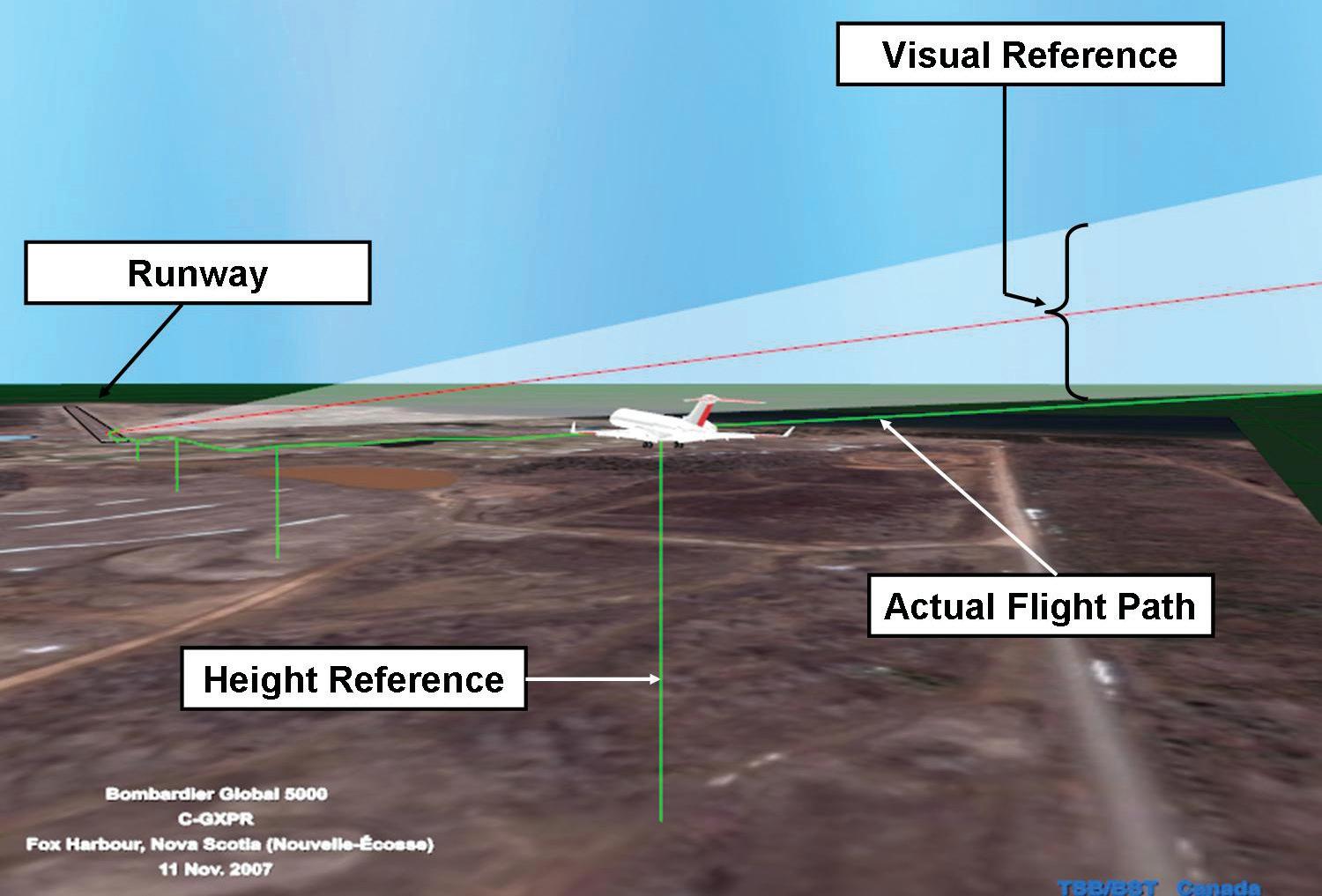
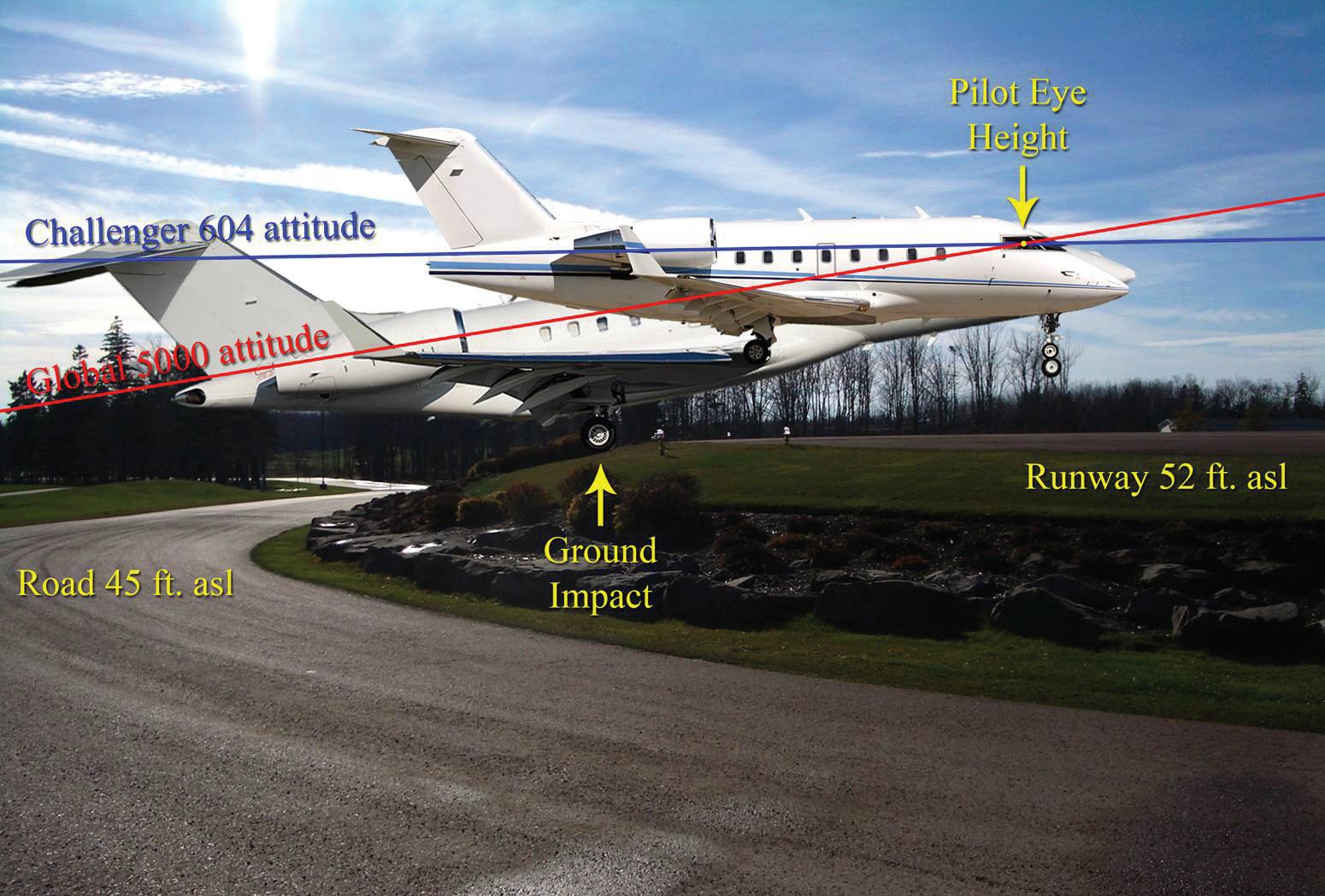
During its investigation into why a Bombardier Global 5000 business jet touched down short of the runway in Fox Harbour, N.S., in 2007, the TSB found that business aircraft operators were free to implement SMS on their own terms with no fixed timeframe. In contrast, commercial operators were required to implement SMS in stages on a fixed timeline. This meant that many operators did not have a fully functioning SMS, including the operator of the accident aircraft.
In the Fox Harbour accident, the operator did not properly assess the risks of introducing the Global 5000 into its operations, in accordance with safety management principles. As such, the Board recommended that the Canadian Business Aviation Association (CBAA) set SMS implementation milestones for private operator certificate holders and that Transport Canada ensure that the CBAA implement an effective quality assurance program for auditing certificate holders.
On March 16, 2010, Transport Canada announced that it would take back responsibility for the certification and oversight of business aircraft from the CBAA. This change will take effect on April 1, 2011.
Goal conflicts – drift into failure
Organizations can slowly drift into failure as employees and managers undertake what Sidney Dekker describes as the “normal processes of reconciling differential pressures on an organization (efficiency, capacity utilization, safety) against a background of uncertain technology and imperfect knowledge” (See sidebar: Dekker 2005:43).
There is a routine tension between acute
The Transportation safety Board of canada (TsB) advances safety by investigating selected air, rail, marine and pipeline accidents. TsB investigations often examine the influence of organizational factors, including the development and implementation of safety Management systems (sMs).
production goals and ongoing safety goals which may prompt people to make decisions that are riskier than they realize. In describing why deteriorations in safety defences leading up to two accidents had not been detected and repaired, James Reason suggested “the people involved had forgotten to be afraid...If eternal vigilance is the price of liberty, then chronic unease is the price of safety” (See sidebar: Reason 1997:37).
Drift into failure was evident in the TSB’s investigation into the 2004 crash on takeoff of a Boeing 747 freighter at Halifax International Airport. As the crew had been on duty
for 19 hours, fatigue likely contributed to a data input error which led to the incorrect calculation of takeoff speeds and engine power settings. Although the company had implemented a maximum 24-hour duty day, the report noted that this crew would have been on duty for about 30 hours had the flight reached its destination. As routes expanded, the crewing department gradually scheduled more flights in excess of the 24-hour limit. This routine non-adherence to company procedures contributed to an environment where some employees and company management felt that it was
Custom-designed and built 50% faster than conventional hangars
4-season construction » benefit from an earlier roi optimal thermal efficiency » significantly reduce your energy bills maximum value from investment » specify your exact needs industry leader » Quality you can trust Your
1.866.466.8769 www.canam.ws/hangars
acceptable to deviate from established policies and procedures when it was considered necessary.
employee adaptations – putting procedures into practice
resources and multiple goals. As Dekker points out, “Past success is taken as a guarantee of future safety. Each operational success achieved at incremental distances from the formal, original rules can establish a new norm….Departures from the routine become routine…violations become compliant behavior” (See sidebar: Dekker, 2003:236).
In the Fox Harbour accident, the crew adopted a company-sanctioned practice of “ducking under” visual glide slope indications to land near the beginning of a short, wet runway.
In the TSB investigation of a 2007 crash following an overshoot of a Beech King Air at Sandy Bay, Sask., the TSB found that deficiencies in the operator’s supervisory activities permitted substantial, widespread and undetected deviations from standard operating procedures.
A fuller understanding of why gaps exist between written procedures and real practices will help organizations intervene more effectively than simply telling workers to “Follow the rules!” or “Be more careful!”
‘Weak signals’ undetected
Front line workers often create “locally efficient practices” to get the job done, while facing pressures such as limited time and
There is frequently a mismatch between how written procedures specify work should be performed and how work actually gets done which may lead to drift into failure (Dekker, 2003).
In several accidents, early warning signs of hazardous situations (“weak signals”) were either not recognized or effectively addressed. By their nature, weak signals may
In the fox Harbour accident, the crew adopted a company-sanctioned practice of “ducking under” visual glide slope indications to land near the beginning of a short, wet runway.
not be sufficient to attract the attention of busy managers, as they are stretched too thin or focused on other priorities. It may also reflect on a company’s limited capabilities to gather and analyze this information effectively. In a recent article (2009), William Voss, President and CEO of Flight Safety Foundation said: “As random as these recent accidents look, though, one factor does connect them. We didn’t see them coming and we should have… the data were trying to tell us something but we weren’t listening (See sidebar: Voss, 2009).”
For example, in the Sandy Bay accident, the TSB found that crew coordination was inadequate to safely manage the risks associated with the flight. While company managers identified and addressed some crew pairing issues, they were unaware of the extent to which they could impair effective crew coordination.
incident reporting
One way to amplify weak signals may be to receive data from multiple sources. Confidential, internal incident reporting systems, which are an integral part of an effective SMS, can be a rich source of hazard information. But people won’t report their mistakes if they are afraid of being punished, representing a lost opportunity for organizational
learning and risk reduction (Dekker, 2007).
During the Sandy Bay investigation, the TSB found that:”In an SMS environment, inappropriate use of punitive actions can result in a decrease in the number of hazards and occurrences reported, thereby reducing effectiveness of the SMS.”
Vector Aerospace is a leading, global provider of Maintenance, Repair and Overhaul services for Pratt & Whitney Canada’s PT6A, PW100, JT15D, PW307A and PW308A/C series of
Our reputation for superior customer service continues to grow at Vector Aerospace, Engine Services – Atlantic.
We’re proud of our past –working hard for your future.
the way ahead
Implementing SMS does not and realistically cannot totally immunize organizations against failing to identify hazards and mitigate risks, ensure that goal conflicts
coNTINUed oN PG. 37
In the fox Harbour accident, the operator did not properly assess the risks of introducing the Global 5000 into its operations, in accordance with safety management principles.
THE vOLCANIC D ISRUPTION
Less ON s L e A r N e D F r OM eYJAFJALLAJ ö K u LL
bY JAM es CA re L ess
the April 2010 Eyjafjallajökull volcanic eruption brought European and North Atlantic air traffic to a halt. Billions of dollars were lost by the airline industry, and millions of travellers were stranded.
Following a two-week lull, new eruptions in early May continued to threaten the skies of Britain and Ireland. In light of this wide-spread natural disaster, it’s time to consider four lessons from this exceptional experience.
Lesson 1: somehow, We Need to Agree on scientifically sound standards
As aviation hazards go, volcanic eruptions are a rarity. Eruptions whose ash clouds pose a danger to heavily travelled air routes are even rarer. That’s why European officials really didn’t
know how to deal with the Eyjafjallajökull ash cloud, beyond grounding all air traffic.
Wings contacted major airlines and aircraft manufacturers for their comments on this decision. The only response we received was from Boeing. Speaking on background, a source with the company said, “The best way to deal with volcanic ash is for airplanes to avoid it. [Unfortunately] while obvious ash plumes are avoidable, not all ash can be picked up by radar and can damage engines, paint, ventilation and electronic systems.”
In agreeing with Boeing and grounding all planes, European air authorities were applying a “black and white rule,” said IATA North America spokesman Steve Lott. “Their stance was that if there’s any ash at all, you shouldn’t fly,” he said. “But we would argue that there are shades of grey when it comes to volcanic ash concentrations. That’s a point the U.K. Civil Aviation Authority
after flying through the ash cloud, the finnish air force noted varying amounts of damage to critical components.
(CAA) eventually grasped, when they defined no-fly, buffer and open flying areas around the ash cloud.”
“We achieved what often takes years in 96 hours,” boasted U.K. CAA Chief Executive Andrew Haines, in justifying the CAA’s speedy determination of safe ash levels for aviation. “We undertook much of this research and led the international discussions and investigation which brought manufacturers to agree on an accurate and evidence-based set of restrictions and agree on engine tolerance levels to ash density.”
Really? Robert Kokonis, president of airline consulting firm AirTrav Inc., doesn’t think so. “I don’t normally side with pilots’ unions – I’ve negotiated against them for the airlines – but I must agree with the union spokespersons that there is a lack of rigorous testing in this area,” he told Wings. “It just isn’t good enough for British Airways, KLM and Lufthansa to send a few aircraft through the ash cloud, land and have a chat with Pratt & Whitney, Rolls-Royce and GE, and then say, ‘we’ve got a new Standard Operating Procedure!’”
To put this risk into perspective: Currently about 28,000 aircraft fly through Euro-controlled airspace and 1,200 more use the North Atlantic Track on a daily basis, Kokonis said. “Even if only 0.1 per cent of these flights ran into trouble due to the Eyjafjallajökull ash cloud, you still would have been talking about 30 flights. Assuming 150 people per flight, that would have been 4,500 people put at risk daily. That’s just not an acceptable number.”
Clearly, realistic, scientifically sound volcanic ash flight thresholds are needed. The problem is that this requires research that takes considerably longer than 96 hours from start to finish. Moreover, “to get accurate data on ash levels, you have to deliberately fly into the ash clouds,” said Dr. Michael Fabian of Embry-Riddle Aeronautical University in Prescott, Ariz. “I would not recommend ‘ash damage testing’ in the air. That is a job for engine test cells on the ground. A few tried it in flight to prove a point but they don’t know the internal damage in the internal cooling channels yet.”
Worth noting: “AirBus has the equipment necessary to put an engine in a test chamber, run it up to operational speeds and then bombard it with varying concentrations of volcanic ash,” noted Dr. Fred Prata. He works at the Norwegian Institute for Air Research (NILU) in Kjeller, Norway. “The problem is, who will pay for this research, which could run into the millions?”
Lesson #2: Airlines Must Get More involved in volcanic Ash research
Dr. Prata and his atmospheric science colleagues actively research volcanic ash, and then share their results and ideas at conferences. “But you almost never see any airline people attending,” he said. “Qantas has been extremely good about taking part, and we’ve seen British Airways, Japan Airlines, Lufthansa and either Delta or United attend occasionally, but that’s it. You’d think they’d all want to be involved, given the impact volcanic ash can have on their business.”
Too true: perhaps this will change in the wake of the Eyjafjallajökull ash cloud. Logically, the loss of billions of dollars should convince airlines to get more involved in volcanic ash research.
Lesson #3: europe Needs One Air traffic Control system
“We don’t dispute the fact that ash clouds can cause serious damage to aircraft engines,” said IATA spokesman Steve Lott. “But why did we have to wait five days before Europe’s transportation ministers got together and discussed the airspace closure?” The answer is that European countries still control their national airspaces independently, without a single central authority coordinating it as a whole. “That’s got to change: We need some kind of central authority that can make these decisions quickly and deal with situations quickly,” Lott said.
Ironically, European countries have been working towards an integrated ATC solution known as the “Single European Sky” (SES) initiative, but they haven’t finalized it yet. Had SES been in place when the Eyjafjallajökull eruption occurred, the situation would likely have been handled in a timelier and far less confused fashion.
Lesson #4: it’s time for an Airborne solution
Developing acceptable volcanic ash thresholds for engines isn’t enough, nor are software programs that predict ash concentration. The reason is that volcanoes don’t emit ash on any sort of consistent, predictable basis. A volcanic “plume” cloud can have varying densities of ash in any given location. This is why aircraft venturing into volcanic ash need some kind of on-board ash detectors.
Dr. Fred Prata has developed such a detector; in fact, he has six prototypes already built. The device measures infrared light in an aircraft’s flight path. “Since the glass and rock particles that comprise volcanic ash absorb infrared light, their presence and density can be detected and avoided in real time,” he told Wings. “The ash detector was first developed in the early 1990s and has been field-tested over a number of active volcanoes, but has sat on the shelf due to lack of investor interest.” Dr. Prata estimates that a commercially certified ash detector could cost about $100,000.
the Devil is in the Details
The chaos caused by the Eyjafjallajökull ash cloud has revealed a serious vulnerability in the aviation industry. It has also highlighted the clear need for safe volcanic ash thresholds.
As for a solution? That’s going to require lots of research, money and air carrier involvement: the kind of details that cashstrapped companies don’t want to deal with. Unfortunately, unless this changes, the vulnerability remains. Should a future eruption similarly cut into busy airspace and last longer, the results will be financially apocalyptic for the aviation industry. | W
Managing our safety risks
continued from pg. 33
are always reconciled in favour of safety or avoid insidious adaptations and drift.
While SMS is an effective way of managing risk, its success depends on how it is implemented. SMS requires complete commitment from senior management, a significant investment of time and resources, a solid safety culture that permeates the organization and formal, documented processes that actually work for the operator. As well, regulators still need to provide
References
Dekker, s. (2003). failure to adapt or adaptations that fail: contrasting models on procedures and safety. applied ergonomics, 34, 233-238.
Dekker, s. (2005). Ten Questions about Human error: a new View of Human factors and system safety. Lawrence erlbaum associates, inc.
Dekker, s. (2007). Just culture: Balancing safety and accountability. ashgate Publishing company.
Reason, J. (1997). Managing the Risks of organizational accidents. ashgate Publishing Ltd.
Reason, J. (2001). in search of resilience. flight safety australia, september-october, 25-28.
Voss, w. R. (2009, May). Listening to the Data, flight safety foundation. aerosafetyworld.
TSB Investigation reports: aviation investigation Report a04H0004, Reduced Power at Takeoff and collision with Terrain, Mk airlines Limited, Boeing 747-244sf 9g-MkJ, Halifax international airport, nova scotia, october 14, 2004.
aviation investigation Report a07c0001, collision with Terrain, Transwest air, Beech a100 king air c-gffn, sandy Bay, saskatchewan, January 7, 2007.
aviation investigation Report a07a0134, Touchdown short of Runway, Jetport inc., Bombardier BD-700-1a11 (global 5000) c-gXPR, fox Harbour aerodrome, nova scotia, november 11, 2007.
effective safety oversight, especially during the transition to the SMS environment.
Organizations implementing SMS can and should learn from accident investigations since they also demonstrate patterns of accident pre-cursors (e.g. not thinking through what might go wrong, not having an effective means to track and highlight recurrent safety deficiencies, insufficient training and/or resources to deal with unexpected events).
As the implementation of SMS matures, the TSB will continue to investigate how effectively operators manage safety risks
and we will communicate the lessons we learn to regulators, the transportation industry and the Canadian public. | W
Kathy Fox is a board member of the TSB of Canada. Her experience includes air traffic controller, commercial pilot, flight instructor, management positions at Transport Canada and VP of Operations at Nav Canada. She holds a Bachelor of Science and a Master’s in Business Administration from McGill University. She also holds a Master of Science in Human Factors and System Safety from Lund University in Sweden.
FUELLING THE OWNERSHIP
strAteGies tO KeeP tHiNGs AbOve bOArD
bY rOb seAMAN
owning an aircraft is a dream for many, whether you’re able to fly yourself or intend to use the aircraft as a business tool. The freedom of flying where or as often as you’d like is appealing, but in some cases it’s the status symbol itself – being able to say “my plane” – that fuels the dream.
Time management is another key factor. The use of a personal, or corporate, aircraft puts you in charge – and you don’t need to spend hours in line at a commercial terminal. If attainable, a private or business aircraft just makes sense.
As with all things aviation related, the passing of time has brought with it new adaptations and innovations, not the least of which are various forms of aircraft ownership. The most popular methods still involve the traditional 100 per cent title by one individual, or, in more sophisticated situations, such as a corporate aircraft, a holding firm of some sort that may include multiple partners or a single entity.
Bill Clark is an aviation legal specialist based in Toronto. Clark’s area of expertise covers both commercial airline and private corporate aircraft interests. As he sees it, for those who want to share or jointly own an aircraft, the Special Purpose Corporation (SPC) is the method most sophisticated aircraft owners use. A SPC is essentially an independent holding company that owns the aircraft. The benefit of this arrangement is simple: potential new owners seek the elements of liability coverage for the partners as “shareholders” in the aircraft.
An alternative method is a Limited Liability Partnership. According to Clark, this ownership method is becoming more popular with new owners. Under this scenario, there is a general partner – the management company – and others who are equity participants. This model also includes liability protection but adds a tax benefit. The depreciation flows through and, while shareholders do not benefit from the depreciation, the partners do. This ownership method is most common for more sophisticated, bizjet-type aircraft.
Another ownership structure gaining prominence is our “homegrown” variation on the fractional model. As Clark points out, although no private factional ownership legislation exists in Canada at the moment, there is discussion by the rule-makers that one day this U.S. model could be employed here.
Currently, the majority of fractional ownerships are being sold as commercial ops – and, yes, potential buyers do get an ownership document that shows they own part of a specific aircraft – a bill of sale for one-eighth undivided interest in the aircraft. These arrangements are typically run under the Aircraft Operating Certificate (AOC) for the operator. In Canada, there are several firms actively selling their “fractional” business and they are recognized for it. The longest established firm is Airsprint, located in Calgary, Kitchener and Toronto. The others are Edmonton’s Morningstar and Toronto-based Jet Share. These firms operate under a somewhat different application. Morningstar, for example, has received an exemption and runs its fractional share program under a CBAA Private Operator Certificate (POC).
the Airsprint way
AirSprint Private Aviation is Canada’s largest fractional provider and reports indicate that fractional ownership has done (and is
doing) very well in our domestic market, contrary to the U.S. perspective. At the core of AirSprint’s model is fleet commonality. It operates Pilatus PC-12 and Citation Excel/XLS aircraft. According to company president Chris Richer, this provides AirSprint clients with the benefit of predictable operational overhead costs.
“In the AirSprint model, clients don’t buy shares in a corporation and don’t invest in a partnership deal,” he says. “In fact, they purchase an ‘undivided interest’ in a specific, serial-numbered aircraft. Accordingly, their ownership, for both tax and legal purposes, is no different than owning the entire plane. The size of the undivided interest purchased is directly proportional to the number of hours the client typically flies per year. Each 1/8th interest entitles the owner to one hundred occupied hours per year. The owners are only being charged for actual flight hours – not for hours required to reposition aircraft to them.”
Richer also points out that their model is not a time-sharing program restricted to a single aircraft. AirSprint owners have access to the entire fleet and are guaranteed that when they call, their aircraft, an identical one, or perhaps even a better one, will be dispatched.
AirSprint’s clients are also “secure” that their costs remain predictable for a minimum of five years. Should a client ever decide to leave the program, AirSprint will remarket their interest at fair market value and return the capital, less a standard brokerage charge.
“U.S. fractional companies experience difficulties operating in Canada due to federal cabotage restrictions on transporting passengers from point-to-point within Canada,” he says. “AirSprint has developed a very successful model that offers a Canadian fractional solution for private aviation travel.”
Detail oriented
Regardless of which ownership model is selected or put into use, all need good documentation detailing what the deal is. This tends to be inherent in the business aircraft realm and in the case of the “fractional” option, the operator does the detail work.
airSprint’s fleet commonality – it operates Pilatus Pc-12 and citation excel/ XlS aircraft – provides its clients with the benefit of predictable operational overhead costs.
WNERSHIP DREAM
However, as more and more people decide to share a private aircraft – especially in the recreational or owner/operator arena – the need for a solid paper trail ensures good partners, depending on how it is handled. Whether you’re thinking a C-172, a vintage gem, or a bizjet, taking the time to study, understand and create proper ownership documents and agreements is the most important aspect of new ownership. It’s as important as choosing the right aircraft.
With smaller, GA aircraft, the normal questions in a partnership or joint ownership include: who owns how much of the aircraft?; who is responsible for which elements of the upkeep and operational costs?; and who has priority for use, or what are the terms for determining such? These points can be quite involved and have a serious impact on the success or failure of the partnership/ownership. It’s paramount to take the time to properly assess all issues with a lawyer before you enter into a serious commitment. No partnership will be problem free, but an open discussion at least will set the right tone, manner and expectations from the beginning.
Given recent economic realities, it’s also prudent to consider other key points. For example, what happens if an owner runs into financial difficulties and is unable to complete obligations? And in the event the aircraft is involved in an incident or accident, rendering it inoperable (or lost), where do a share owner’s responsibilities begin and end? What investment
protection has been put in place? Understand all aspects of ownership before laying money on the table. It will make the experience more satisfactory down the line.
Another point to consider is succession rights in the event a partner dies. Many sales have been forced through estate issues that could have been handled ahead of time, eliminating the stress that ensues. Also, with smaller aircraft, the ownership structure tends to be among friends for recreational use as opposed to business objectives. As a result, maintenance responsibilities, insurance premiums, major expenses such as engine overhauls, and even basics such as hangar and fuel, all need proper discussion and documentation. It’s imperative to include these details within the ownership agreement, including financial considerations. The proverbial napkin and a handshake won’t hold up when stress and strain hits. A friendly relationship can become a dirty fight in no time.
A final note: with every deal, make sure all elements are fulfilled and maintained at all times. After the aircraft has experienced a hard landing and needs major service and repair is not the time to discover the parts quality, maintenance program or insurance premium has not been kept up to date. You can’t assume your partners will be as diligent as you are, friendships notwithstanding. Asking questions and reviewing paperwork will keep things above board and all participants’ best interests protected. | W
Taking the time to create proper ownership documents is the most important aspect of new ownership.
T ODAY ’ S E FFICIENT F LIGHT D EPARTMENTS
money has never been tighter for airlines large and small – which is precisely why flight departments are being expected to deliver more while costing less. It’s a tough feat, given most departments were running “mean and lean” before the recession hit. Still, some Canadian airlines have come up with creative new ways to maximize their flight departments. Here’s a look at how some of the country’s key industry players are doing it.
WestJet’s centralized ground operations
Ever wonder how WestJet manages to keep its fares so low? One reason is the
company’s innovative and economical management of its flight department.
Take ground operations, for example. Traditionally, airlines have established local ground operations offices in each of the major airports they serve. These offices handle local aircraft dispatch and communications, two-way radio links with crews fuelling, servicing and restocking aircraft parked at the terminal, plus the hundreds of other details that have to be handled to keep an airline on time and in the air. (Note: Customer service agents, although interacting with ground operations, are a separate entity.)
The traditional ground operations model comes with a
number of problems. First, there’s the tendency of some staff to be loyal to the office they are attached to, rather than the airline as a whole. Another challenge involves running a chain of local ground offices: it costs money for floor space, equipment and telephone/data lines. It can also be difficult for airline management to know what’s happening to their fleet at all times, because ground operations are not integrated. Finally, running separate ground offices can waste manpower, especially late at night when traffic drops off.
WestJet has solved this problem, and improved its ground operations as a result, by consolidating its 400 ground operations staff in
Calgary. They work in a centralized facility, with duties for each airport divided among them.
“For our pilots and runway crews, having ground operations in Calgary is an advantage,” says Shaun Horton, WestJet’s director of commercial operations. “This is due to our integrated communications network. Each ground operator has an ARINC communications terminal where, with the push of a button, they can talk to aircraft aloft or ground handlers. This makes for easy dispatch and ground system management.” Because WestJet’s ground operations crew is centralized, there are no conflicting loyalties, and handing off from one city
moving to a single aircraft type has saved Bearskin significant money.
to another is fast and easy. Moreover, the airline is able to maintain a bird’s eye view of its operations at all times.
“Having centralized ground operations also lets us use staff more effectively,” Horton says. “For instance, when things slow down in Toronto after dinner, some of its designated staff can be reassigned to help out in Calgary and Vancouver. This gives us more flexibility and allows us to provide much better service, while actually reducing costs.”
the advantage of centralized pilots
Many airlines have pilots assigned to certain cities, with the pilots living in these areas and using them as their personal “hubs.” This isn’t the case at WestJet: Its 3,000 aircrew members all work out of its Calgary headquarters. The result is that its HR infrastructure is significantly reduced. With the exception of Calgary, there are
people they have at hand, who can be moved from one flight to another as demand requires.
“We instituted this policy just four years ago,” Horton says. “That nearly 40 per cent of our workforce have used it to live outside of Calgary indicates just how popular it is. And yes, it does save us money.”
bearskin Airlines: one-aircraft model
Bearskin Airlines used to fly a range of aircraft, including Beechcraft 99s, Piper Navajos and King Air 100s. But that’s no longer the case. Today, this Ontario regional carrier flies 14 Fairchild Swearingen Metroliners (19-seats, twin turboprops) and nothing else.
“Moving to a single aircraft type is saving us money big time,” says Brad Martin, Bearskin’s director of operations. “Better yet, the savings are found across our entire airline.”
Montreal and Ottawa. The company’s fleet is quite varied, running the gamut from the ATR42-300 and HS-748 to the Boeing 737 and 767, plus the only two civilian Hercules operated in Canada. (Sadly, First Air’s beautiful, if noisy, Boeing 727s have been retired.)
To cut waste while improving overall flight department performance, First Air VP operations Mark Gallant has instituted a company-wide quality assurance program. In its simplest terms, quality assurance is a series of checks and balances that ensures things are running as they should, from office supply requisitions to aircraft fuelling and servicing.
“Quality assurance is not just about ensuring people follow company policies,” says Gallant. “It is also about serving our frontline workers, because they are the core of our airline.”
no offices that serve crew members, although R&R rooms are provided at some of Canada’s larger airports.
At the same time, nearly 40 per cent of WestJet’s employees do not live in Calgary. They live within driving range of one of the Canadian airports that WestJet serves – even though their official place of business is Calgary.
“The idea is simple,” Horton says. “Having a central crew office cuts costs and makes us more efficient. Meanwhile, letting pilots live where they want to – within reasonable limits –gives us aircrew nationwide. We simply arrange for them to start and end their workdays at their closest WestJet-served airport.”
Since this airline’s flight schedule varies considerably from summer to winter, this approach allows WestJet managers to be flexible in assigning flights. They just have to work with the distributed pool of
Take maintenance: By only flying Metroliners, Bearskin only has to maintain parts for this aircraft. “This has substantially reduced our parts inventory,” Martin says. “It has also allowed our technicians to become specialized on the Metroliner, which has made them into experts.” Such is Bearskin’s knowledge of the Metroliner, in fact, the other airlines are now bringing their Metros to Bearskin’s shop for service.
“Our pilots are also flying one type now,” he continues. “Again, this has resulted in them getting far more flying hours on the Metro, and thus becoming far more adept in this aircraft. Their increased experience translates into safer flying and better situational awareness. It also means that all of our pilots can fly this aircraft, which improves our scheduling flexibility.”
WestJet is following a similar path, having recently retired the Boeing 737-200 from its fleet. Today, the company only flies Boeing Next Generation 737s.
Quality assurance at First Air
First Air keeps Canada’s North connected with scheduled passenger and cargo service between 26 northern communities and Edmonton, Winnipeg,
To date, First Air’s quality assurance program has indeed cut costs while improving overall efficiency. “Getting things done efficiently is the name of the game for airlines today,” Mark Gallant concludes. “We have to keep costs down while keeping reliability and safety up. Quality assurance does this for us.”
Potent possibilities
The ideas implemented by WestJet, Bearskin Airlines and First Air prove it is possible to get more out of your flight department – and save money in the process. The best news is that all of these approaches are worthwhile based on the improvements they deliver, the cash savings being a bonus. But such bonuses are more precious than ever, given today’s economic climate.
The bottom line: It is worth the time and effort to take a hard look at your flight department, to see how you can make it do more for less. Sometimes the solutions are simple, such as streamlining procurement procedures. Sometimes they are complex, like centralizing local offices into one location, thus reducing staff and duplicated efforts. Whatever the option, anything that saves money without hurting operations is worth considering. | W
Nearly 40 per cent of WestJet’s employees do not live in calgary, yet live within driving range of one of the canadian airports that WestJet serves.
WestJet has implemented innovative and economical methods to manage its flight department.
WINGS ON SAFETY
WHeN zerO is everYtHiNG
Is a zero accident rate delusionary or visionary? |
Can we have zero accidents?
Twelve years ago, Transport Canada declared its intention to pursue a “zero” aircraft accident rate when it published “Challenge 98.” No doubt many people in the aviation industry rolled their eyes at the notion of zero; likely many still do. So was Transport Canada’s planned pursuit delusionary or visionary?
To answer this question, we must first start by asking ourselves “are all accidents preventable?” A number of years ago, the people at Petroleum Helicopters International (PHI) asked themselves just that. They looked at their accident history and they determined that all the contributors, links or dominos that led to each accident, were preventable. Faced with this somewhat frightening revelation, PHI questioned, “If they are all preventable, why don’t we prevent them?” This bold new approach became not just a staid corporate vision statement, but rather the way they did business. Over the following years they went from being a safety leader in their field to improving their already enviable record. Still, improving isn’t zero.
To imagine zero, we may need to travel back in time. Back to the beginnings of commercial aviation and some of the pioneers that brought us to the place we are today. Dr. Jerome Lederer, or Jerry, as he liked to be called, worked for the first commercial air service in North America, the U.S. Air Mail, in the 1920s at a time when the annual death rate for pilots was 1 in 5. A highly intelligent and practical individual, he helped that company reduce its accident rate without putting it out of business.
When Jerry was in his 90s, during a discussion on the
By Parker and Kapuscinski
zero preventable accidents is the unifying vision at the core of SmS.
possibility of zero, he posed this question: “If you had asked the pilots in the U.S. Air Mail whether they believed that in less than 70 years we could have the commercial aviation accident rate we currently have, do you think they
scenarios? If we consider only those accidents with multiple causes, which virtually all accidents in our complex system have, then we must redefine the statement of zero to “zero preventable accidents.”
This bold new approach became not just a staid corporate vision statement, but rather the way phi did business.
would have believed it possible?”
He followed that question up with an observation. He said that throughout his career he had heard the same arguments in every decade: “this is the best we can do, we have come as far as we can.” In the ’20s, Jerry was able to envision our present, and in the ’90s, he could see our future.
Most of us still balk at the concept of absolute zero. To prove that zero is impossible we point to rare single-cause uncontrollable scenarios. For example, how can we expect to prevent a meteor from striking an aircraft; with our current technology there is nothing to keep that from occurring. We use this type of event to support our belief in the futility of any quest for zero. However, what happens if we do not include these uncontrollable
How do we go from today towards this future of “zero?” In Canada, legislation has prompted a number of organizations to give this serious thought. Last year, Conair Group Inc., a leader in safety for a number of decades, launched “Target Zero” as the focus of its continuing internal safety program. This initiative was viewed by many as being far too ambitious. Conair suspected that any reference to zero would open
them to potential detractors, both internally and externally. To ensure long-term success, it planned its campaign to address directly the likelihood of setbacks. Within weeks of the official launch of “Target Zero,” the company experienced some damage/injury events that naysayers may have pointed to as proof that “zero preventable accidents” is not achievable. If Conair had lacked focus and leadership, that series of events could have derailed its program. Instead, Conair’s “Target Zero” is still on track, and employees within the organization believe it will work because they understand they are in this for the long haul.
We can learn many lessons from the efforts of PHI and Conair. Perhaps the most valuable is that we cannot expect instantaneous success. All aviators know they must make course corrections to stay on track. Our journey to “Target Zero” will need course corrections, too.
“Zero Preventable Accidents” is the unifying vision at the core of Safety Management Systems for long-term effectiveness. In our quest we must get past our seemingly logical objections and focus on the achievability of a “zero preventable accidents” culture. This isn’t just semantics; with work and by redirecting our focus now, we can make Transport Canada’s vision of “zero” mean everything. | W
Elaine Parker and Brendan Kapuscinski have extensive experience, derived from decades of practical application in the areas of safety, compliance, flight operations, security and emergency planning. Their company, Beyond Risk Management Ltd., was founded to help organizations promote a safety culture by “Professionalism and Confidence Through Training.”
This information is intended to increase overall safety awareness and is not a substitute for compliance with regulatory guidelines. We welcome your feedback and submissions at akwasnik@annexweb.com.
POSITION REPORT
Position report
continued from pg. 25
aircraft refurbishment outfits, Goderich has focused on the upper end of the market – narrow-body airliners. While this has resulted in a decline in the number of aircraft worked on in a given year, it has served to increase both the number of hours worked and revenues generated. This year, Goderich is expected to complete some 25 projects. The work can be as limited as a new paint scheme, or can be far more complex, involving a complete interior conversion, a cockpit upgrade and a new paint job – all done while the aircraft undergoes a heavy maintenance check. Such a program on an aircraft like a Boeing BBJ can require 120,000 hours of work over seven months.
Goderich Aircraft’s expertise can be segmented into the following four categories: Interiors – The company has developed a reputation for converting the interior of airliners from mass transportation vehicles into flying penthouses. In addition to airliners, the company has performed interior makeovers for jet and turboprop business aircraft of all sizes. The company has regulatory approvals from Transport Canada, the U.S. Federal Aviation Administration, the European Aviation Safety
Agency and the U.A.E. General Civil Aviation Authority that enable it to attract business from geographic markets that represent the bulk of business aircraft operators worldwide.
Exteriors – Whether it is a minor touch up or a completely new look that the customer requires, Goderich is able to strip, prime and repaint aircraft within its modern climate-controlled paint booth that meets all environmental requirements. Maintenance – Besides being able to make aircraft compliant with service bulletins and airworthiness directives, the company performs heavy maintenance on airframes while they are undergoing interior modifications. Goderich has also completed intricate structural repairs on aircraft. An example of this work is the complete reconstruction of an IAI 1125 Astra that had an I-beam punched through its fuselage after a hangar collapse in Texas. Goderich has also rebuilt the one-piece wing on two Cessna 525 Citation CJ aircraft.
Avionics – The company is well versed in the latest avionic technologies as it is a dealer for numerous leading manufacturers, including Honeywell, Rockwell Collins, Bendix King, Garmin, Aircell, S-TEC Cobham, Universal Avionics Systems and L-3 Avionics Systems. These
relationships enable Goderich to perform a wide range of avionics work, including upgrades to navigational systems and the installation of sophisticated in-flight entertainment systems.
In addition to its two hangars that provide it with 115,000 square feet of space, the company has an upholstery shop and a cabinetry operation in Brantford, Ont. Its airport, now named Centralia-James T. Field Memorial Aerodrome, has two hard surface runways (5,012 ft. x 100 ft. and 4,400 ft. x 150 ft.) that can accommodate narrow-body jet airliners.
In order to better understand any business model and therefore appreciate how a company may fare in the future, it is useful to perform a S.W.O.T. analysis (Strengths, Weaknesses, Opportunities and Threats). Doing so with Goderich Aircraft provides the following insights:
s .W.O. t . ANALY sis OF GOD eri CH A ir C r AF t
//// stre NGt H s
i N ter NAti ONAL re P utAti ON
Despite the absence of an extensive advertising campaign, details of the company’s work have been transmitted via word of mouth far afield. This has been a powerful
marketing tool that has assisted its efforts in winning new customers from around the world. approximately 95 per cent of its business is foreign.
COMP re H e N sive servi C e OFF eri NG
goderich’s breadth of technical capabilities, which cover interior design and engineering as well as airframe and avionics maintenance, enables the company to complete complex multiple tasks while an aircraft is in its facility. This “one stop shop” simplifies administrative issues for the client and can result in the aircraft being out of service for a shorter period of time.
CON stru Ctive CO
r
PO
r
Ate C u Lture
Highly skilled and well motivated employees are key to any successful business and goderich makes an effort to attract and retain talent. as Blaine field notes, “we hire attitude, then train.” The result is low annual turnover among the staff. The workforce is non-union.
i D e AL LOCAti ON out of the way, but not isolated, is one way to describe Huron Park’s location. with little conflicting air traffic, there is no problem with a Dc-9 doing “touch and go’s” during a test flight. airport costs are extremely reasonable.
for the employees, the
from left: an interior of a Gulfstream G550; a lavatory aboard a Global 5000.
area offers a pleasant lifestyle with an attractive cost of living. for those wishing city life, London is only a 45-minute drive to the south.
//// W e AKN esses
s O ur C i NG ADD iti ONAL tAL e N t
capable people with specialized skills are a prerequisite for achieving continued success. while the company has been able to retain talent, it will need to expand its team if it is to meet its growth targets. To assist in this effort, goderich has recently completed an aerospace manufacturing training centre on its property. The government of canada has assisted with $1.3 million of funding and fanshawe college of London has certified the curriculum and issues certificates of Training. The program is expected to produce more than 200 new hires for goderich over the next four years, including about 20 this year.
LOW P ub L i C P r OF i L e
Despite being appreciated by its clients, many of whom are repeat customers, the company is not widely known within the n orth a merican business aviation industry. Developing a greater presence could assist in attracting even more business. we may be hearing more from g oderich in the future.
//// OPPO rtu N ities :
bbJ COMPL eti ON s
g oderich is about to become a Boeing licensed completion centre for new BBJs. i t hopes to deliver its first “green completion” by the end of next year. This is quite a vote of confidence for g oderich, as there are only 10 completion centres listed on the Boeing Business Jets website.
re PLAC e M e N t MA r K et u PG r AD es when large-cabin ViP aircraft change owners, be they airliners or purposebuilt types, usually there is demand for interior, exterior and avionics modifications. as the global economy recovers, the pace of such activity is forecast to increase.
//// t H re Ats :
COMP etiti ON
Local competitors such as s ky Harbour a ircraft in g oderich, o nt., and f lying c olours in Peterborough, o nt., have long provided quality aircraft interior and exterior refurbishment services. w hile both have worked on
general aviation aircraft, including large business jets such as falcons and g ulfstreams, they have also pursued specific niches. s ky Harbour has developed a reputation related to war Birds – former military aircraft owned by civilians. f lying c olours has become a specialist in the conversion of Bombardier regional jets into corporate jets and is now doing “green completions” for buyers of the c hallenger 850 model. g oderich a ircraft’s primary competitors are the aforementioned international players in the U. s ., g ermany,
s witzerland and france. The fact that g oderich has received contracts from clients located in the Middle e ast and a frica, despite the efforts of established competitors, speaks volumes about its ability to compete on the world stage.
str ONG er CANAD i AN DOLLA r for many canadian companies that do most of their business with foreign customers, a stronger canadian dollar is a negative development. goderich deals with this dilemma by pricing most of its contracts in the U.s. currency. it also helps
that most of its material costs are priced in U.s. dollars.
What does this all mean?
Without making a lot of noise, Goderich Aircraft has steadily gone about building its business by providing a quality
product in a timely manner at a desirable price. By doing so it has developed an impressive list of international clients, many of whom have come back to have work performed on additional aircraft. It has also chosen to go after a segment of a luxury market that is somewhat less susceptible to the vagaries of the global economy.
In order to meet the potential that lies ahead, Goderich has decided to enhance its human capital by creating a training centre that will provide the additional skilled personnel that it needs. The expansion of its bricks and mortar, which will be necessary in order to achieve its growth aspirations will likely attract funding, now that the availability of manpower should be less of an issue.
Future prospects
Having grown from a crew of five to a team of 150 since its inception in 1993, Goderich Aircraft has achieved steady growth as it advanced its capabilities. Blaine Field expects the headcount to further increase to 250 over the next year or so. Five years from now, he sees the company employing 400 people. That could translate into annual revenues of approximately $70 million, up from a little more than $20 million in 2009. To handle the increased level of throughput, Goderich will be adding a third hangar. With an additional 60,000 sq. ft., it will boost the company’s workspace by 52 per cent.
The funding of this expansion will, in part, be done using the more than $4.4M that the company recently received from the Federal Economic Development Agency for Southern Ontario (FedDev Ontario). Upon learning of the federal government’s decision to assist Goderich Aircraft, Field commented, “We’re excited to be entering a phase of dynamic growth that will
strengthen the relationship that we are building with Boeing and allow us to bring new business from international markets to southern Ontario. Thanks to the federal government’s commitment to Canadian manufacturing and its investment in the region, Goderich Aircraft is now positioned to begin work completing Boeing Business Jets.”
Final thoughts
While the corporate/VIP airliner market is not immune to the economic cycle, the majority of its constituents (governments, large private companies and wealthy families) tend to have greater staying power during periods of financial turmoil. In fact, some operators use such downdrafts as an opportunity to upgrade their aircraft. When that occurs there is often a requirement for changes to the interior and exterior of the aircraft.
Goderich Aircraft has chosen to focus on this international niche market and the customer response has been rewarding. The company’s mission statement is straightforward: “Provide a cost-effective quality product.” This is done by fielding a talented team that is equipped with a broad range of technical expertise and can deliver a product that meets the customers’ needs based on design, finish and performance. Having accomplished that, the good folks at Huron Park should see many more metallic beasts touch down at their placid rural setting. | W
from left: a pair of douglas dc-9-87s in one of Goderich aircraft's pristine hangars. a Bombardier Global 5000 on the ramp at cYce
he says. “Jet charter declined modestly through 2009, but our turboprop charter, cargo and medevac business was unchanged. Year to date (2010) results show strong increases across all business sectors including aircraft sales and acquisitions.”
Darnley’s competitive edge? “While many of our smaller competitors experiment with costly fractional jet sales programs, our focus continues to be on providing the most diverse charter fleet available and many of our largest charter clients benefit from utilizing our full range of aircraft.” Sunwest offers a Charter Card program that is gaining momentum. It allows customers to gain access to their entire fleet at preferred rates.
Within the past 18 months, Sunwest has added to its managed aircraft fleet with the addition of a Citation Sovereign, G-150, Beech 1900D, Hawker 800 and two Lear 45s. It is scheduled to receive an additional Lear 45 and G-150 later in 2010. The firm has also strengthened its sales team in the past six months with the addition of Geoff Carlyle (charter sales manager) in Edmonton and Brian Granlien (charter sales co-ordinator) in Calgary.
issues at hand
The last area to look at in the Canadian
corporate aviation world is what the CBAA, as the industry guiding light, has on its to-do list – especially in light of the recent POC Programme announcement. Association president and CEO Sam Barone says there are many tasks at hand. First on his list is the Green & Climate Agenda and EU ETS environmental compliance. Part of the CBAA’s ongoing work is to maintain good relations with Nav Canada on air space management issues (costs and issues that have a link to the aforementioned green agenda). Barone also notes the FBO security screening/procedures are now on the radar, targeting business aviation. As he sees it, there will be changes here in the near future. Border management issues are also becoming more complex – TSA/CBP – and there is what he terms “regulatory burden creep,” i.e., CTA and other agencies, all of which require attention from CBAA. Also of note is the ongoing issue of managing Airport Authority relationships at key gateways, airport access and cost issues and on the short final – planning for the G8/G20 summit in Huntsville/YYZ in June of this year – which includes air space planning as a key component. For this, CBAA will
liaise with the Integrated Security Unit/ Nav Canada and others to help plan for business aviation issues during G8/ G20. Even without the POC, it is clear to see the continued need for the CBAA and its capabilities on behalf of bizav in Canada.
So barring natural disasters, raging fires, floods, swarms of locusts, economic meltdowns or other surprises – we should now be poised for recovery – we hope. | W
Handling In-Flight Emergencies
Item#: 0071376037 I Price: $44.30
Do you know the best way to get found if you’re forced down, radioless, in the wilderness? Can you land in heavy surface winds? What happens if your engine fails? Are you prepared for the unexpected?
Pilot Jerry Eichenberger’s Handling In-Flight Emergencies is the best way to prepare for the unexpected and to fly more confidently and safely. This guide can help you:
* Apply the best prevention, management, and correction strategies for all in-flight emergencies
* Fly knowing you’re armed with the best solutions to in-air crises
* Follow critical preflight and training procedures that protect you aloft
* Learn preferred ways of coping with icing, thunderstorms, wind shear, mechanical and electrical failures, IFR conditions, navigational errors, spatial disorientation, and more
* Discover equipment to help you identify and reduce dangers that might otherwise go undetected
* Evaluate avionics products before you need them
* Learn from other pilots’ errors
From the Flight Deck
Item#: 1550227653 I Price: $19.95
Perfect for informing the aviation enthusiast and calming the fearful flier, this insightful glimpse into the world of commercial airline travel explains all of the topics of any passenger would want to know about flying.
With a unique insiders perspective, a broad range of flight-related topics including the physics of flight, how airplanes work and what they are made of, and how pilots are trained are discussed at length in this account. Blending facts, trivia, and humor, this ultimate flight companion provides up-to-date, accurate information about the science of aviation.
The Beech 1900d is becoming a favoured choice of corporate flyers nationwide.
Advance your aviation career with AeroCourse
As the leader in advanced aviation seminars, AeroCourse has been offering IFR and ATPL/IATRA seminars across Canada for 20 years as well as Crew Resource Management and Flight Dispatcher seminars.
We pride ourselves on being leaders in advanced aviation materials providing current knowledge and experience-based manuals and seminars. Our publications and seminars provide you a solid foundation for your aviation career.
5th edition ATPL Workbook now
The workbook has been updated to keep current with Transport Canada, including Met Practical updates, new high-level charts, new GPS questions and much more. Together, Peter Shewring and Rick Stevens offer this informative exam question and reference guide, covering Canadian Airline Transport Rating exam questions.