










































4 McCarthy
No plane no gain.
6 On the Fly Industry news that’s important to Canadians.
8 On the Web
A sample of our comprehensive online coverage of the Canadian aviation industry.
9 Airline Insider
Brian Dunn covers the latest developments in the Canadian airline industry.
10 Carr
After Montie: Die neue Air Canada.
12 100 Years of Powered Flight in Canada
Raymond Canon discusses the role of the famous Canadian-built F-86 Sabre jet fighter and why aviation enthusiasts are delighted to see the rebuilt Hawk One F-86 flying our skies.
13 Providing Lift to Corporate Canada
Frederick K. Larkin provides an in-depth position report on Skyservice Business Aviation.
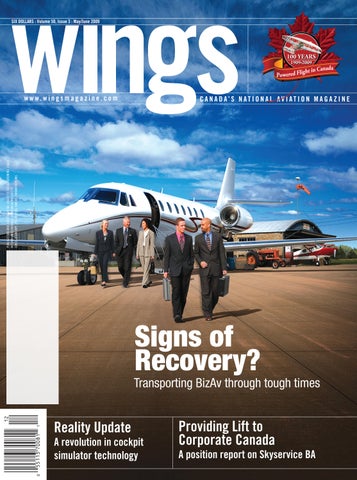
COVER STORY Signs of Recovery?
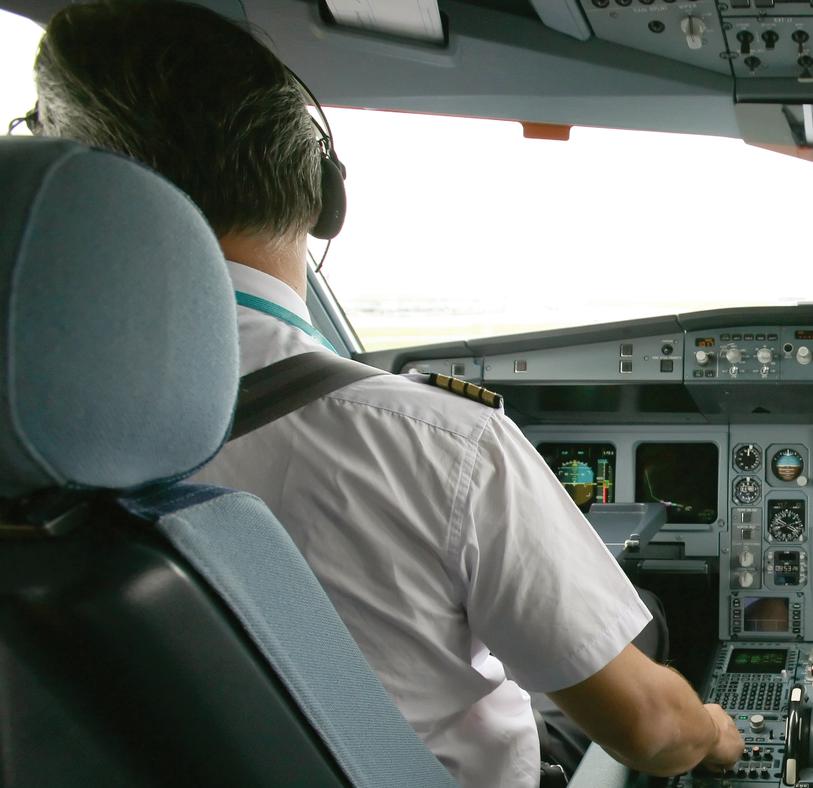
22 Sudden Aircrew Incapacitation
Dr. Tarek Sardana discusses the recent press coverage about sudden aircrew incapacitations and whether it is media hype or a real concern.
24 An Airport Is Worth How Much?
Rob Seaman discusses the economic benefits that our airports provide to communities and why they have been operated in an underfunded manner for too long.
28 Reality Update
Montreal-based Mechtronix Systems stood an established technological paradigm on its head and started a revolution in cockpit simulator technology, by Carroll McCormick.
33 Heavy Iron of the 60’s
Frederick K. Larkin provides a snapshot of Canada’s business aviation fleet in the 1960s.
42 Guest Column: Richard Aboulafia Forecasting the business aviation market.



No Plane No Gain
DREW MCCARTHY is the editor of Wings.
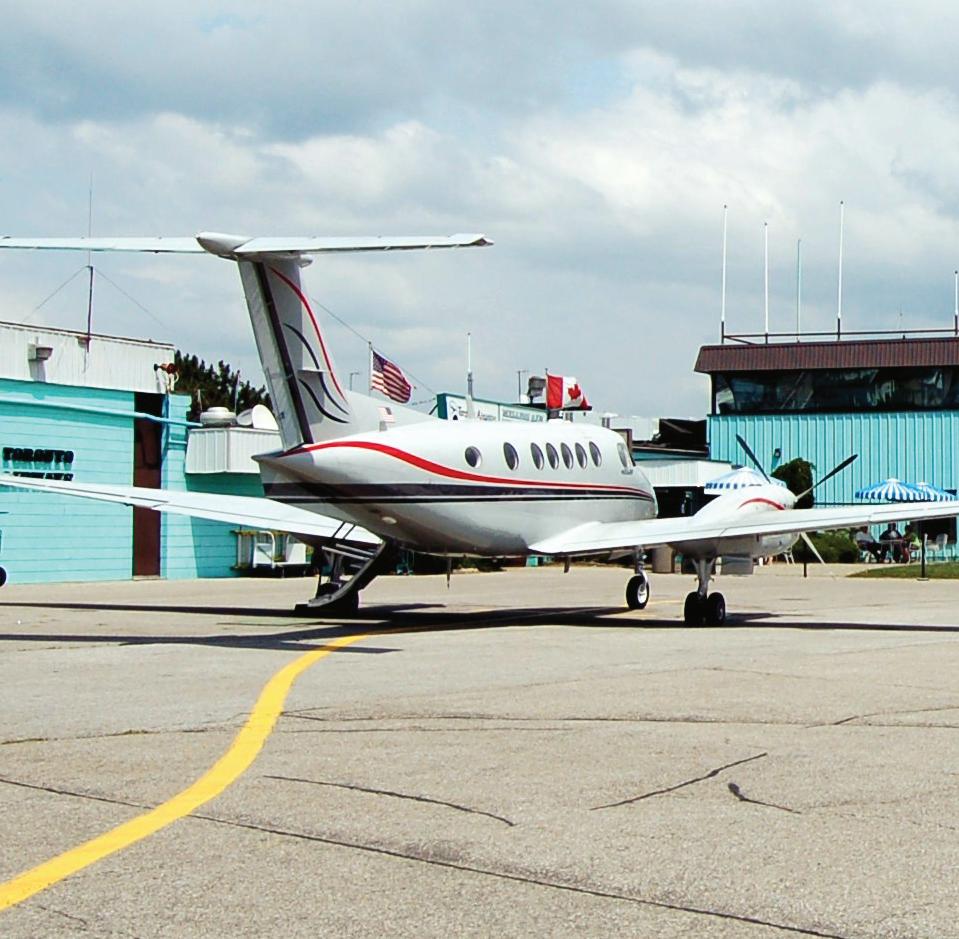
For more than three months now, business aviation south of the border has been engaged in a spirited counterattack against its critics. Ever since the public humiliation of Detroit’s Big Three automaker executives in Congress last November, the industry has been fighting an uphill battle against much of Capitol Hill and the media.
Determined not to take it any more, the NBAA and GAMA reactivated the popular “No Plane No Gain” slogan and on Feb. 17 launched an impressive multimedia campaign to combat antibusiness aviation sentiments.
The truth, the whole truth and nothing but the truth
The knock against business aviation has always hinged on the belief that private aircraft use in business is frivolous, extravagant and unnecessary. “No Plane No Gain” addresses that old chestnut head on, but then goes much further in fleshing out the totality of business aviation’s economic footprint.
The campaign is emphasizing studies and surveys that illustrate the value of business aviation based on current, quantifiable data, compiled by respected sources. Relying on this information, the campaign makes four solid arguments for policy makers and the public to consider:
In the U.S., business aviation employs more than a million people, it connects communities with little or no commercial airline service, it helps thousands of businesses of all sizes to be more productive, and it provides emergency and humanitarian services.
These are things that those in the industry have always known, but the message is directed to those outside the community. “No Plane No Gain” is about public education. The campaign has run print and television ads, webinars, YouTube videos, and podcasts to get the message out.
At the centre of the campaign is the dedicated “No Plane No Gain” website: www.noplanenogain.org. This site is an exceptionally professional undertaking. In addition to outlining the issues, the site provides an aggregation of relevant information including news, events, press releases, studies and statistics.
Beyond the important educational information, the site offers a set of valuable tools for those who are in the industry. The “Resources” section of the site is an absolute must-visit for business aviation professionals. It includes some leg-up information for anyone called on to defend the industry, including advocacy tools, onepagers, media tools, quick facts and more.
Under media tools, for example, there are ready-made and customizable letters to the editor and opinion pieces, along with interview tips. All of these tools are applicable and useful to Canadians, as are the four main issue points, all of which apply perfectly to Canada.
The root of all evil still remains the global recession and the impact of the congressional drubbing was probably more insult than injury. But it did create a catalyst for business aviation to get to work in telling the complete story about the industry. In the long run, that can only be a good thing. Be sure to visit www.noplanenogain.org.
Your feedback is welcome at dmccarthy@annexweb.com.

WINGS MAGAZINE PO Box 530, 105 Donly Dr. S., Simcoe, ON N3Y 4N5 Tel.: 428-3471 Fax: 429-3094
Toll Free: 1-888-599-2228
EDITOR DREW MCCARTHY dmccarthy@annexweb.com 519-429-5192 • 888-599-2228 ext. 265
ASSOCIATE EDITOR ANDREA kWASNIk akwasnik@annexweb.com 519-429-5181 • 888-599-2228 ext. 238
AD SALES/PUBLISHER SCOTT JAMIESON sjamieson@annexweb.com
PRODUCTION ARTIST BROOkE SHAW
OTTAWA CORRESPONDENT kEN POLE
AVIONICS EDITOR ROB SEAMAN
FLIGHT DECK RAY CANON, JAMES CARELESS, DAVID CARR, BRIAN DUNN, DARREN LOCkE, CARROLL McCORMICk, DR. TAREk SARDANA, BLAIR WATSON
ADVERTISING SALES PAULINE O’NEILL poneill@annexweb.com 519-429-5182 • 888-599-2228 ext. 273
GROUP PUBLISHER SCOTT JAMIESON sjamieson@annexweb.com
PRESIDENT MIkE FREDERICkS mfredericks@annexweb.com
PUBLICATION MAIL AGREEMENT #40065710
RETURN UNDELIVERABLE CANADIAN ADDRESSES TO CIRCULATION DEPT., P.O. BOX 530, SIMCOE, ON N3Y 4N5 e-mail: ncuerrier@annexweb.com
Published six times per year (Jan/Feb, Mar/Apr, May/ Jun, Jul/Aug, Sep/Oct, Nov/Dec) by Annex Publishing & Printing Inc.
Printed in Canada ISSN 0701-1369
CIRCULATION e-mail: ncuerrier@annexweb.com
Ph: 866-790-6070 ext. 208
Fax: 877-624-1940
Mail: P.O. Box 530, Simcoe, ON N3Y 4N5
SUBSCRIPTION RATES
Canada – 1 Year $ 34.00 (includes GST - #867172652RT0001) USA – 1 Year $ 50.00 Foreign – 1 Year $ 65.00
From time to time, we at Wings Magazine make our subscription list available to reputable companies and organizations whose products and services we believe may be of interest to you. If you do not want your name to be made available, contact our circulation department in any of the four ways listed above.
No part of the editorial content of this publication may be reprinted without the publisher’s written permission. ©2009 Annex Publishing & Printing Inc. All rights reserved. opinions expressed in this magazine are not necessarily those of the editor or the publisher. No liability is assumed for errors or omissions.
All advertising is subject to the publisher’s approval. Such approval does not imply any endorsement of the products or services advertised. Publisher reserves the right to refuse advertising that does not meet the standards of the publication.

APRIL 2009










Translation: Not just the most efcient in its large-cabin class. More efcient than “the most advanced” in the next smaller class. And less fuel means fewer emissions. Even with a 4000nm range – and the unique agility to hop from city to city, then leap over an ocean without stopping to refuel.






The newly certicated Falcon 2000LX proves again that we share a common sense of efciency with companies who need to stay close to their customers, get the most out of their best people, see and seize opportunities in person – and keep on working en-route. Visit us at falconjet.com/2000LX.
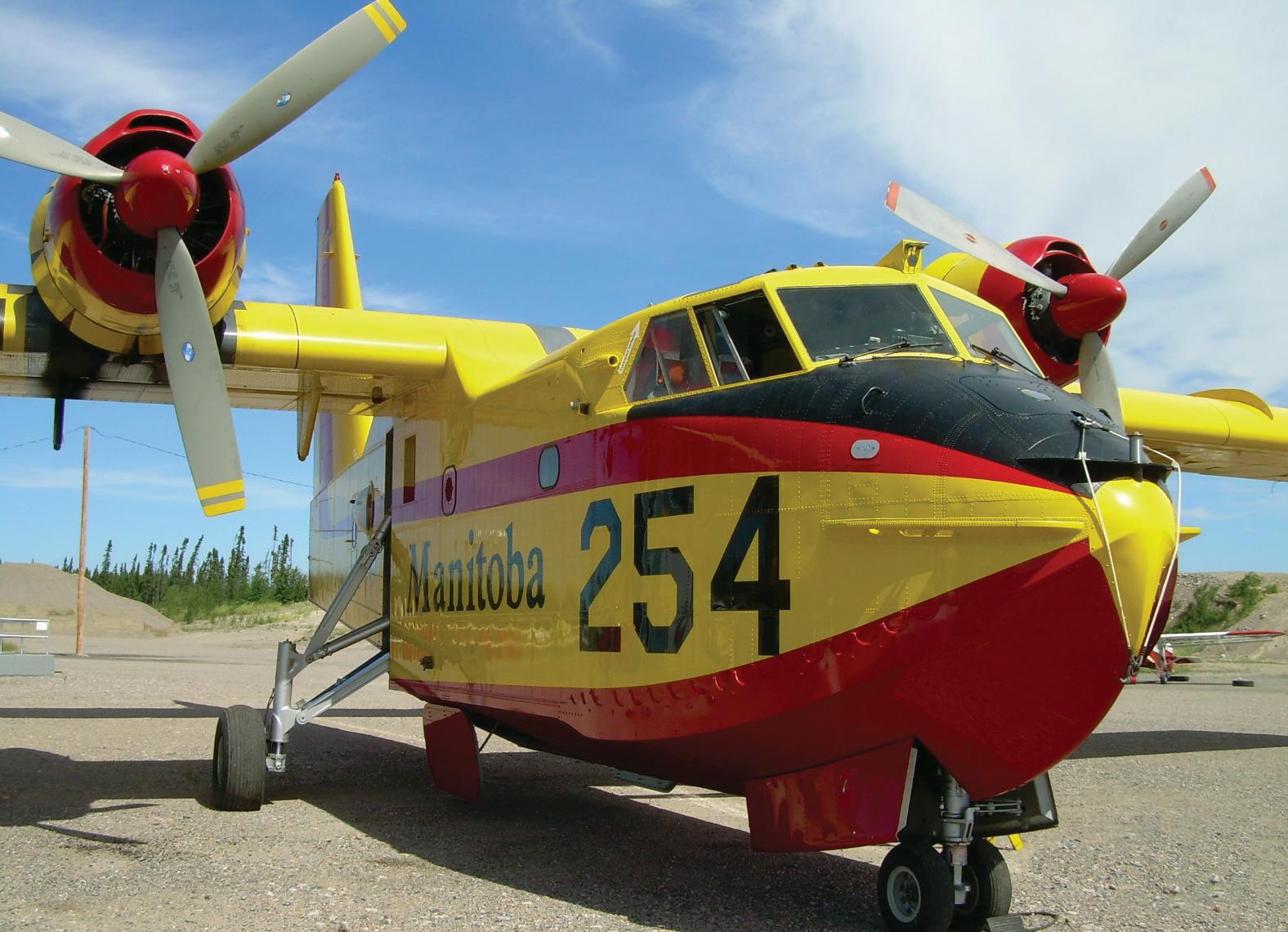
Max-Viz has announced the sale of six additional EVS1500 dual field of view infrared sensor systems to the Government of Manitoba Air Services Branch of Winnipeg, Man. The EVS systems are to be utilized in conjunction with CL-215 fire suppression bombers and spotter aircraft.
Max-Viz systems use real-

time infrared sensors, signal processing, and a cockpit display to provide flight crews with actual images of terrain, runways, taxiways, aircraft and other potential obstacles much better than the naked eye during poor visibility conditions such as light fog, haze, smoke, brown/whiteout, light precipitation and darkness.
StandardAero has appointed Jack Lawless president of Associated Air Center in Dallas, Texas. Lawless will manage his new duties as Associated Air Center’s president concurrent with his existing duties as StandardAero’s chief operating officer.
Prior to this most recent appointment, Lawless served as executive vice-president,
The original Twin Otter DHC-6 floats will be back in production in 2009 after a 15-year absence from the market. P.K. Floats Inc. and Kenn Borek Air Ltd. have announced a licensing partnership to manufacture the CAP 12000 model float for the de Havilland Twin Otter.
P.K. Floats Inc. will manufacture the CAP floats at its Lincoln, Maine, facility and will
also be responsible for the sales and parts distribution. Floats for the 100, 200 and 300 series Twin Otters will be available direct from P.K. Floats and, for the new 400 series, floats will be available through Viking Aircraft. For additional information on pricing, production schedule, upgrades, options and first delivery dates, visit www.pkfloats. com or www.borekair.com.
Global Supply Chain of DAE Manufacturing & Engineering, a position he held since April 2007. Immediately prior to joining StandardAero, Lawless was vice-president, Aerospace Global Sourcing, and vice-president, OEM, for Honeywell. Lawless began his business career with AlliedSignal in 1983 upon successfully serving in the U.S. Air Force.
Cargojet Airways Ltd. has recently earned the International Air Transport Association’s (IATA) Operational Safety certification. The IATA Operational Safety Audit (IOSA) program is an internationally recognized and accepted evaluation system designed to assess the operational management and control systems of an airline. IOSA uses internationally recognized quality audit principles and is designed to conduct audits in a standardized and consistent manner.
IATA’s mission is to represent, lead and serve the airline industry. Its members comprise 230 of the world’s leading passenger and cargo airlines – representing 93 per cent of scheduled international air traffic. Cargojet is the only Canadian air cargo carrier that is a full member of IATA.
MJET, an Elisen Group company, in March announced the release of a converted CRJ200. The 50-seat airliner has been transformed into an 18-seat VIP corporate-shuttle configuration and delivered to Avmax Group, a Canadian-owned company focusing on aviation support, training and management services. At press time, a second CRJ conversion was in its final
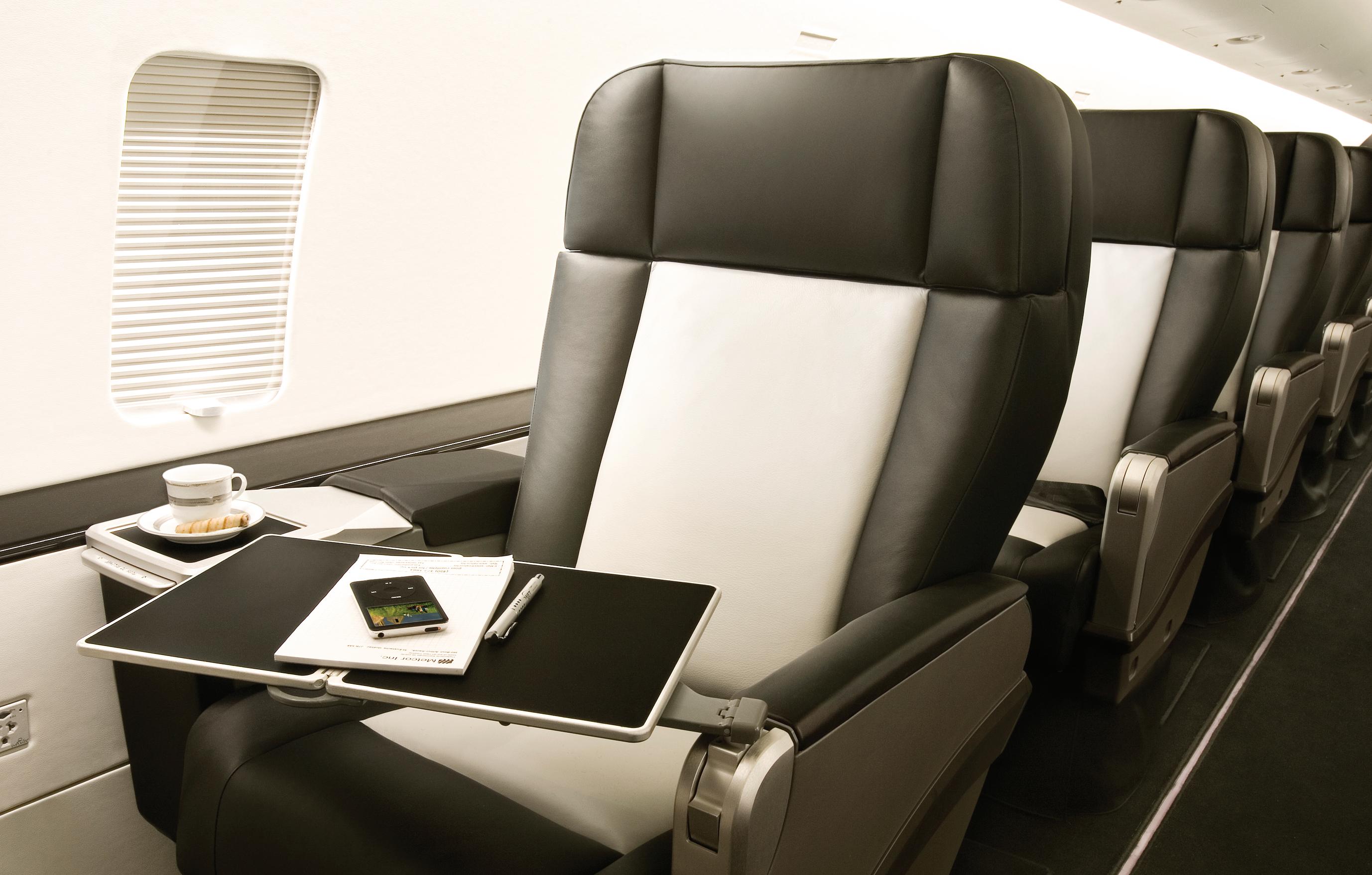
stage at the MJET facility and was scheduled for delivery to the same operator.
The Mounties and Transport Canada are teaming up to crack down on organized crime and other threats at Canadian airports after stinging criticism from Canada’s auditor-general.
Transport Canada and the RCMP announced in April that they have signed an information-sharing agreement to conduct expanded criminal background checks for workers who have access to secure areas
at Canada’s airports. The move comes after Auditor-General Sheila Fraser said in a report that suspicious characters, some with links to organized crime, are working in secure areas at airports because of poor co-operation between Transport Canada and the Mounties. The RCMP had terminated an information-sharing deal with Transport Canada back in December 2007.
Under the new deal signed
April 8, Transport Canada will be able to base decisions about security clearance for workers on more complete data from a broader range of intelligence sources. The announcement also comes after Transport Minister John Baird and Senator Colin Kenny tested security at the country’s largest airport – Toronto’s Pearson International Airport – last month and Baird was able to walk unchallenged onto the tarmac.
On Feb. 20, the Toronto Aerospace Museum, located in Downsview Park on the north end of the GTA, presented itself under a new image, with a new focus and goals, as the Canadian Air & Space Museum (CASM).
Claude Sherwood, CEO of the museum and a former Avro Arrow project employee, proudly stood in front of the only full-scale and museum quality replica of the historic aircraft, and announced to a standing room only audience, that the museum was undertaking not only a name change, but also an extensive revitalization of its
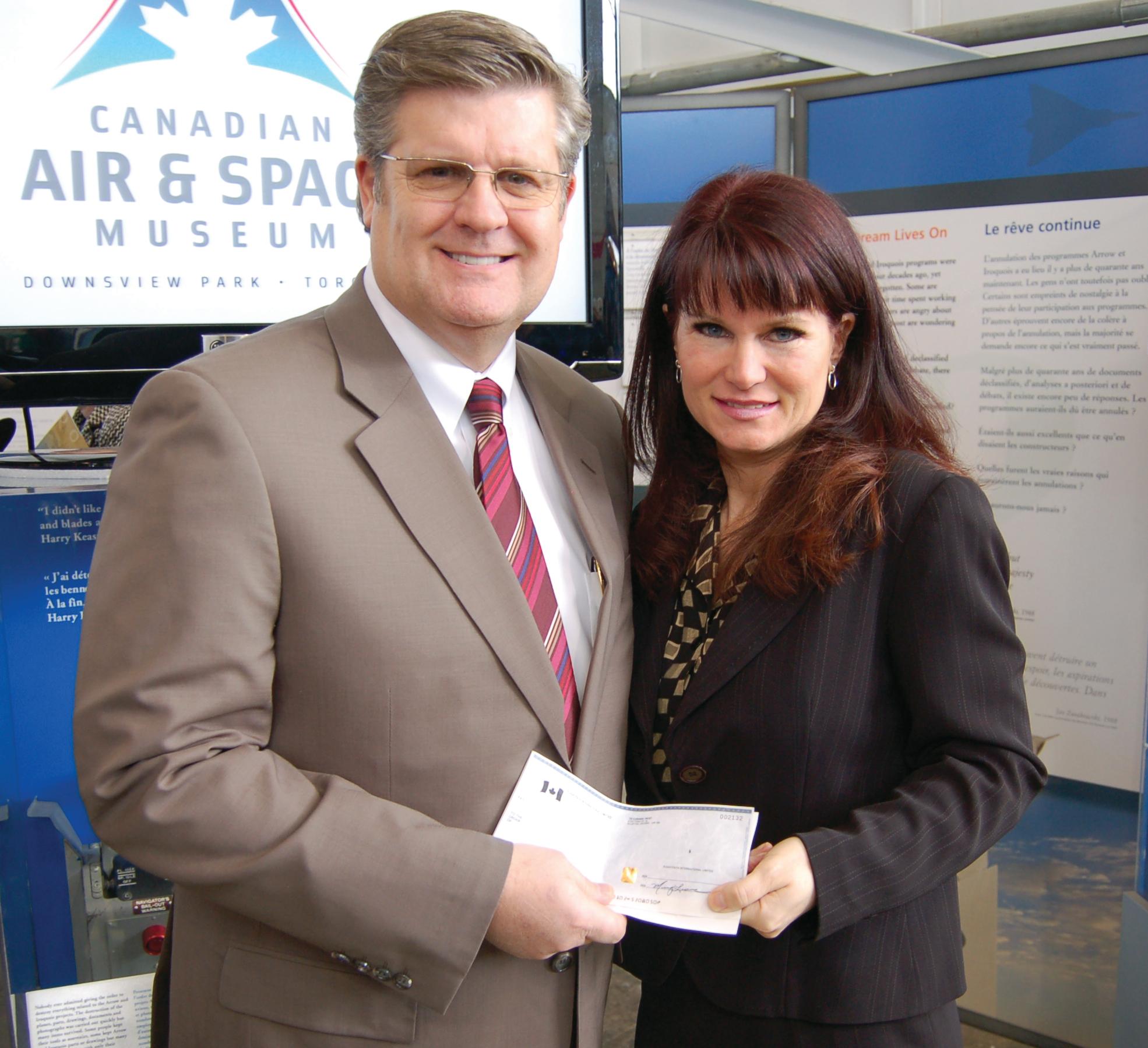
focus. The centre stone of this is a $2 million, 11,600-squaremetre expansion that will allow the museum to become a living
and breathing aviation centre and education facility for approximately 150,000 annual visitors.
The addition that CASM has planned will enable it to properly present its current completed aircraft and also the Lancaster bomber of which it will shortly begin reassembly. The expansion plans call for inclusion of new interactive and educational displays, theatres, archive facilities, restoration space and many other elements – all coming together to make it a premier aviation facility on the doorstep of Canada’s largest population area.
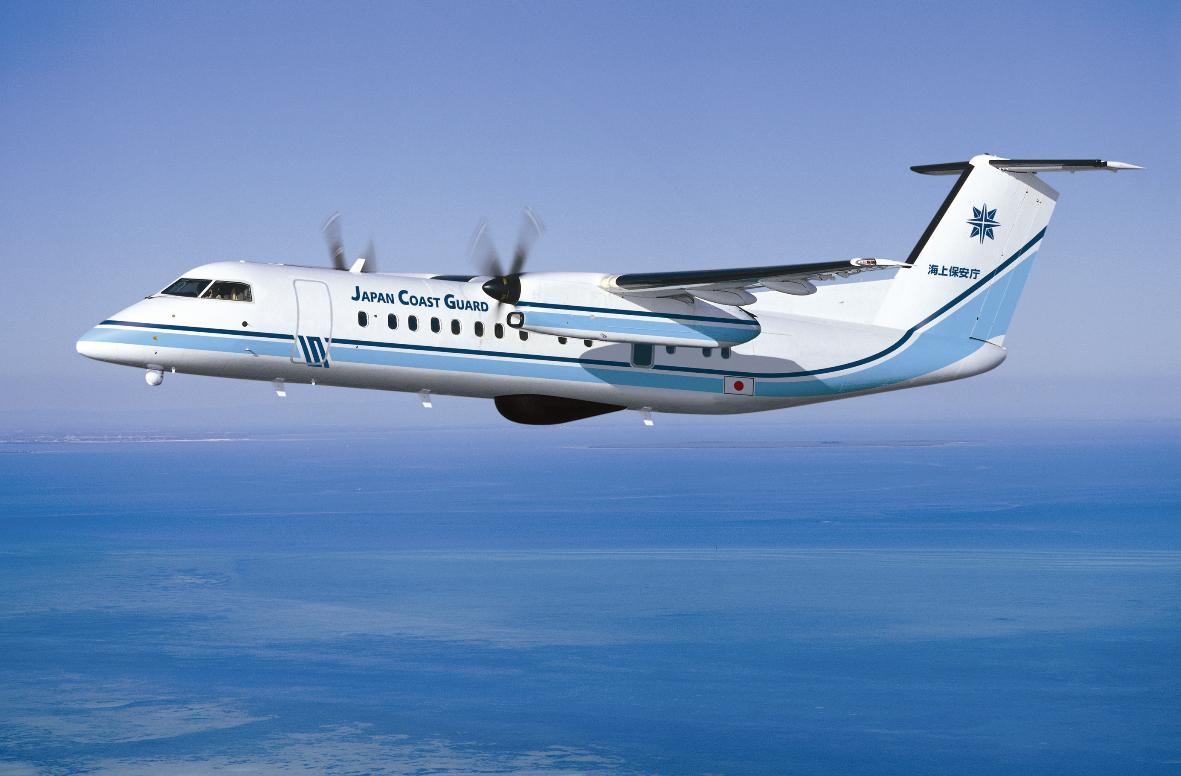
Following a Toronto handover ceremony of the third Maritime Surveillance Aircraft (MSA) for the Japan Coast Guard, Field Aviation’s modification centre has captured a follow-on contract for a further three Bombardier Dash 8 Q300 MSA destined for Japan, bringing the total contract to eight aircraft.
This brings to 33 the number
of Bombardier aircraft Field Aviation will have modified for use as patrol and surveillance platforms for six national governments worldwide: U.S., Australia, Japan, Sweden, Iceland and Denmark.
The maritime surveillance modifications include unique, Field Aviation designed features such as an air-operable rear cargo door and a fuselage drop
Project Phoenix, the Dubaibased Bombardier CRJ-200 executive VIP conversion specialist, is bolstering its sales team with two significant appointments.
hatch, both facilitating airborne dispersal of life rafts, survival supplies and paratroops.
Mike Creed, a wellknown figure in the business aviation industry, joins Project Phoenix as vice president sales after working with Action Aviation for just over three years. Creed’s 40 years’ experience will be invaluable at a time when Project Phoenix prepares to enter new territories later this year with new ventures that will complement its now established Phoenix CRJ line. In addition, David Barker joins Project Phoenix as sales director, based out of Tucson, Ariz., covering the western United States. Barker brings 13 years of diverse business aviation sales experience having worked at an FBO (in Chicago), an OEM and for a number of block charter, fractional and charter sales/management organizations. Barker worked with Bombardier’s Flexjet between 1997 and 2003 in a number of sales positions culminating in sales director – West Coast. Since 2004 he has worked independently, sourcing aircraft, brokering, jet card sales, completion center sales, and negotiating fractional ownership acquisitions for several Fortune 500 companies.
Hope Air is celebrating the 10th anniversary of the Volunteer Pilot Program (VPP). Since its inception, VPP has helped countless Canadians across the country. The program allows general aviation pilots to combine their love of flying with their desire to help people in need – it is the merging of these two passions that make the program such a success.

Visit www.wingsmagazine.com and click on web exclusives to read about the program.
During my 47 years in the business I have seen Crude Oil prices as low as $2 per barrel and as high as $147 per barrel but the rise to the high has not been a straight line. The future for energy prices looks just as bad, as the international political events, terrorism, hurricanes and economic swings will continue to make it difficult to determine direction and impossible to determine timing.
Bob Tebbutt is vice president, Risk management of Peregrine Financial Group, Canada, Inc.
To read his full article, visit www.wingsmagazine.com and click on web exclusives.
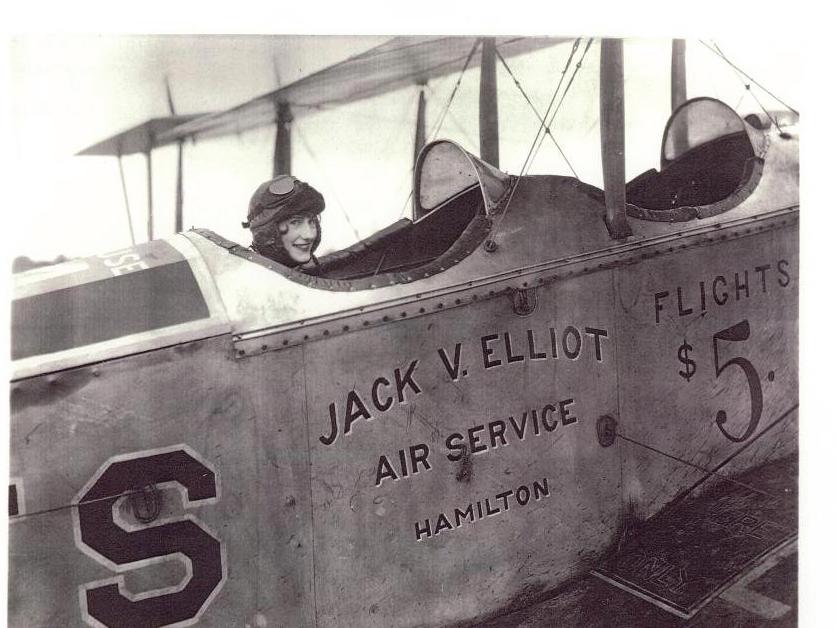
Whoever said chicks couldn’t fly did not know the story of this plucky little bird from southwestern Ontario. Eileen Vollick was just 19 when she earned her wings and the right to call herself a true Canadian pioneer, trailblazing the airways for thousands of women who came after her.
To read the full story about Canada’s first female licensed pilot, go to www.wingsmagazine.com and click on web exclusives or click on our 100 Years logo.
www.wingsmagazine.com
Visit www.wingsmagazine.com to sign up for a free trial of Wings magazine – digital version.
Garmin G1000 upgrade for king Air 200/B200
U.S. Public Debut of 2009 TBM 850

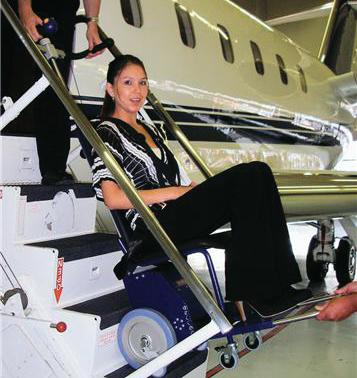
Amazon Stairclimber Arrives in North America
Have your say on a variety of industry topics…
• Too risky to buy right now?
• Upcoming Concorde disaster trial

• Remembering the human factor
Canadian Aviation Quiz
Visit our 100 Years page to test your knowledge of past and present aviation facts.
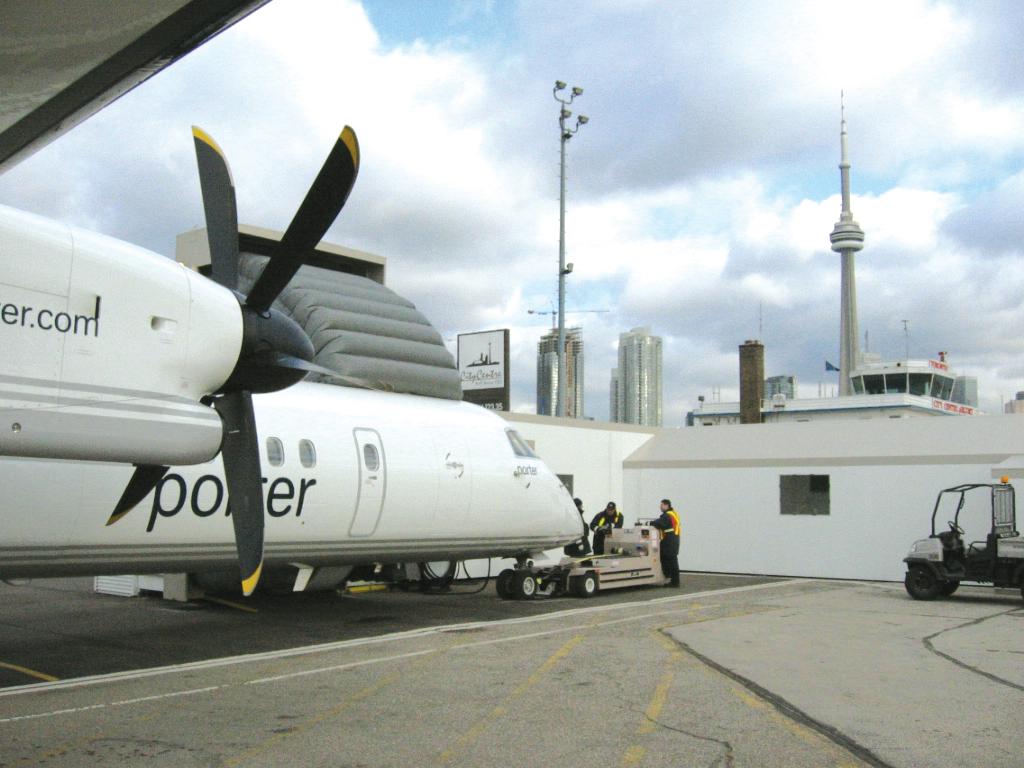
Porter Airlines is considering ordering more Q-400 turboprop planes once Bombardier delivers previously ordered aircraft to the regional carrier. Robert Deluce, president and CEO of the airline, told a transportation conference in Toronto that Porter is increasing the size of its fleet as it adds new destinations. On June 26, it will begin offering three daily round trips and two round trips on Saturday and Sunday between Toronto City Centre Airport and Thunder Bay throughout the summer. It will also add either Boston, Washington or Philadelphia before the end of the year, Deluce said.
Porter currently operates eight planes and was scheduled to add four 70-seat Q-400s in May as it doubles its daily service to Montreal to 18 round trips and increases flights to Ottawa from 10 daily round trips to 14. Weekend service is also increasing on both routes. Deluce said additional planes could be ordered after Porter’s fleet increases to 18 aircraft by the end of the year. The
network will be strengthened with 10 new city pairs that initially create various new routes among New York, Chicago, Montreal, Ottawa, Quebec City and Thunder Bay.
WestJet expects to achieve significant growth in market share over the medium to long term, despite what is anticipated to be a difficult year.
A strong cash balance and low debt leave the airline in a strong position to take advantage of growth opportunities in the current weak environment, Vito Culmone, WestJet’s chief financial officer, said at the same transportation conference that Deluce addressed. “We are one of only three airlines ... that made any money in 2008,” although this year will be much tougher, he added.
WestJet projects its capacity to grow between six and seven per cent in the first quarter and by a maximum of five per cent for all of 2009. In 2008, WestJet’s capacity increased by nearly 18 per
cent. Culmone said that the low ticket prices currently dominating the market were a problem, but lower fuel prices would provide “significant relief from a margin perspective.” The company’s fleet of Boeing 737 aircraft currently numbers 78. It will grow to 85 by the end of the year, and to 121 through 2013, adding to market share and revenues, Culmone said.
WestJet expects to boost its share of the $5 billion domestic market to 40 to 45 per cent by 2013 from the current 36 to 37 per cent, Culmone said. On flights to the United States, it plans to nearly double its market share to around 20 per cent by 2013 from 11 per cent. Culmone said significant contributors to WestJet’s growth would come from its WestJet Vacations unit, partnerships with other airlines such Southwest Airlines and more flights to Mexico and the Caribbean, markets the company only entered in 2006.
AeroMexico has added twiceweekly service between Montreal and Mexico City. The new route is part of its “strategic expansion of its North America operations,” the airline said. Flights from Montreal depart Thursdays and Sundays, and returning on the same days.
After 20 years of service, Singapore Airlines has halted flights to Vancouver. The airline said the route has been badly affected by the global economy and was part of the carrier’s “continuing com-
By Brian Dunn
mitment to ensure capacity is best matched with demand in the current economic conditions.” The airline had been offering flights three times a week between Vancouver and Singapore, via Seoul.
Transat A.T. said bookings were strong for winter travel down south as well as for European travel this summer, but industry overcapacity is hampering selling prices and margins for a third straight year. A recovery in airline travel isn’t expected until next year at the earliest, but Transat will turn a profit this year, according to CEO Jean-Marc Eustache. He said a new agreement with Canjet, replacing one with WestJet, will save the company millions of dollars.
Air Canada will launch the only daily service between Vancouver and Paris to meet seasonal travel demand. Between July 1 and Sept. 29, the carrier will operate daily onestop same plane flights linking Vancouver with the French capital via Montreal. This service complements Air Canada’s daily non-stop services between Toronto-Paris, and Montreal-Paris using brand new 349-seat Boeing 777-30ER aircraft. And effective June 1, Air Canada is scheduled to introduce new MontrealGeneva service also providing easy access to a number of popular destinations in France served by train such as nearby Lyon, Annecy, Dijon and Grenoble. Geneva flights are timed to offer Vancouver customers easy and convenient connections in Montreal.

President John F. Kennedy cautioned against career generals who fought a current war relying on tactics deployed in the previous skirmish. In its executive floor shakeup, Air Canada has done just that. Brought back two capable warhorses from its earlier campaign for survival. Calin Rovinescu, a numbers guy who was at the centre of the last restructuring, replaces Montie Brewer – an operations man – as chief executive officer.
Joining Rovinescu as chief operating officer is Duncan Dee, a former executive vice-president who departed the airline just last November. Dee’s return is seen as a signal that Air Canada wants to avoid seeking creditor protection for the second time in six years.
Ben Cherniavsky, an analyst with Raymond James in Vancouver, put the odds of avoiding creditor protection at 50/50. Others have touched down on either side of the ratio. What is clear is that the challenges facing Air Canada differ from those in 2003, and that Rovinescu and Dee have to retool rather than rebuild the business model as well as repair its lousy customer service image at home.
Under Brewer’s watch, Air Canada became an industry pioneer in simplifying its fare structure and offering economy passengers the chance to build their own in-flight experience online through a menu of service-for-a-fee add-ons, including seat selection and meals on domestic and transborder routes. It was an approach applauded in this space, although taken too far by nickel and diming for blankets and pillows, and not far enough with its limited food offerings.
Air Canada has received international awards for its in-flight product, and its reputation for poor customer service at home is largely undeserved and greatly exaggerated. Still, the company did itself no favours with public relations blunders such as “customer service insurance” in case a flight is grounded. (While reinventing themselves legacy carriers have sometimes forgotten they are in the service business.)
What is not exaggerated is that Air Canada is losing market share to WestJet across Canada and niche carrier Porter Airlines in the critical Toronto market. The competitive burden on Air Canada is going to get heavier, especially internationally where WestJet is building seamless
alliances with airlines such as Air France / KLM and Southwest. Likewise, Emirates is maximizing its three landing slots at Toronto’s Pearson International Airport by bringing the first Airbus A380 to Canada, a novelty that is certain to grab a greater share of the lucrative international transfer market when Air Canada cannot afford to lose a passenger.
Passengers have recently shown they have a breaking point. Air Canada has PR tools at its disposal such as scaling back fees and simplifying fares further by rolling charges such as taxes and user fees into the upfront price of the ticket.
That is tinkering. For 2009, Rovinescu’s more pressing to-do list includes keeping airplanes flying with limited cash flow, coping with a $3.2 billion hole in the company pension plan and expiring union contracts. At the same time, he will have to inoculate the company against the inevitable post-recession spike in fuel prices that nearly crippled air transport in 2008.
The airline is reported to have about $1 billion in cash and another $640 million in available credit. Its pension woes are shared by corporate Canada and will require assistance from Ottawa to resolve. Labour contracts may be the toughest challenge. Union leaders are skeptical of Rovinescu’s return and another hit to employee morale similar to 2003 will undermine what Air Canada must do to fix the customer service side of its business at a time when WestJet is preparing to tear into its competitor’s huge Aeroplan advantage with its own loyalty program.
A further cash infusion may also be enough to rescue Air Canada from creditor protection. Stephen Harper’s government recently doubled the cap on foreign ownership of Canadian airlines from 25 to 49 per cent, while a new bilateral agreement with Europe sets the stage for airlines to own domestic carriers in one another’s markets. Canada is Europe’s second largest market after the United States, and Star Alliance partner Lufthansa has been on a buying binge as of late, snapping up equity positions in Jet Blue Airways, Swiss International Air Lines, Austrian Airlines, bmi (80 per cent) and others. Lufthansa and United loaned Air Canada US$730 million during its first restructuring and if not already overextended, the German airline is favoured for an ownership position this time around.
The generals have returned, but the rules of engagement have clearly changed.






Picture



Whether it’s getting passengers where they need to be, hauling critical supplies to a remote destination, or deploying a paramedic crew for a life-saving mission, the versatile Beechcraft® 1900 is rugged enough to perform in some of the world’s toughest environments and sophisticated enough to get you there in style. Add turboprop efficiency and Beechcraft heritage, and you have a pre-owned aircraft that works as hard as an entire fleet to impact your bottom line. Visit the Beechcraft 1900 official website for a tour of its versatile configurations at www.raytheon.com, keyword: beechcraft1900.
www.raytheon.com Keyword: beechcraft1900
Airline Aviation Services, LLC
The F-86 Sabre jet fighter was undoubtedly one of the most popular aircraft ever flown by RCAF pilots and for years it formed the backbone of our Air Force both in Canada and in our NATO squadrons in France and Germany. What is not quite so well known is that these aircraft were produced under licence in Canada by Canadair (now Bombardier) in Montreal. There were whispers at the time that the version built there with the Orenda engine was one of the finest of the breed.
The Sabre was the first major fighter produced after the end of the Second World War. The earlier F-84 had turned out to be better suited as a fighter-bomber than a pure fighter and the development of the F-86 was awaited with increasing urgency in order to counter the Mig-15 that had entered service in the Communist countries in 1947. It was in 1948 that Ottawa chose it as the fighter to replace the RCAF’s de Havilland Vampires.
The outbreak of the Korean War added to the demand for the aircraft and Ottawa increased its initial order from 10 to 100. Before the last airframe rolled off the Canadair production line, close to 2,000 had been produced by the Canadian company. With the Norseman Mark VI powered by the Canadian-built Orenda engine, the Sabre had, in the eyes of many pilots, reached the epitome of success. This version gained widespread fame when it served with the RCAF’s contribution to NATO in Europe where as many as 12 squadrons were made available at four bases, two in France and two in Germany.
Perhaps the most interesting story about Canadair’s F-86s is what happened to the ones that didn’t go directly to the RCAF. They literally went in all directions, some actually to the United States but others to NATO allies. When NATO started phasing out the Sabre in favour of the F-104 Star-

fighter, a second wave of these F-86s went off in even more directions, some to other NATO allies who were happy to add to their stock of aircraft but many beyond that to such countries as Pakistan, Bangladesh, South Africa, Colombia and Yugoslavia.
The Sabre may have been designed as a day fighter but other versions soon appeared. There were all-weather, reconnaissance and training versions, and almost 10,000 were rolled out before production was terminated.
The Sabre’s main claim to fame was as a Mig-15 menace in Korea where it ran up a remarkable kill ratio. Although the Mig had a heavier armament and a higher ceiling, the superior training of the Sabre pilots plus the inspired design of the aircraft itself did the job. A total of 22 RCAF pilots flew with these jets in Korea and scored nine victories. Only one, Andy Mackenzie, was shot down (ironically by the Americans) and a total of 1,036 missions were flown. In addition, Canadair-built aircraft were sent to the U.S. Air Force, who then sent them on to Korea where they performed admirably. Canadian-built Sabres also performed

in another war – that of 1971 between Pakistan and India. They had long before left Canada for the German Luftwaffe, later being sold to Iran; from there they were transferred to Pakistan in time for the above mentioned conflict.
From the public’s point of view, the most memorable performances of the F-86 were those of RCAF display teams. In 1959, to commemorate the 50th anniversary of flight in Canada, the Golden Hawks were formed. Before they were disbanded in 1964 they flew a total of 317 demonstrations across North America to the delight of many spectators for whom air shows were still something of a novelty.
The Sabre was a winner; small wonder that aviation enthusiasts all over Canada are delighted that a group called Hawk One, led by former Snowbird commander Lt.Col. Steve Will, has rebuilt an F-86 in the colours of the Golden Hawks and will be flying it on a number of occasions in this year’s commemorative celebrations.
For more information on Hawk One, visit www.hawkone.ca.
- By Raymond Canon



By Frederick K. Larkin
A corporation owning an aircraft is analogous to a family owning a car. The alternative for company employees is to rely upon the schedules of airlines. Depending on the destination, this can mean one or more connections en route. Without a car, family mem-
bers are open to the vagaries of public transit systems. An aircraft, like an automobile, provides its passengers with four precious intangibles: efficiency, security, privacy and flexibility.
The resurgence of North America’s post-war economy was enabled by the expansion
of its transportation network. Corporate aircraft, like private automobiles, played a key role in that economic boom and their numbers multiplied as a result. Business aviation in Canada, as in the U.S., came into its own during the 1950s.
The “heavy iron” back then was represented by converted piston airliners. Examples were the Douglas DC-3, the Lockheed 18 Lodestar and the Convair 240 operated by Goodyear, Massey-Ferguson and Imperial Oil, respectively.
The industry matured further during the following decade, as evidenced by the incorporation of the Canadian
Business Aviation Association on May 8, 1962. The 1960s saw the arrival of the first turbinepowered business aircraft to Canada and, as the decade ended, there was an established Canadian jet set.
A review of the Canadian Civil Aircraft Register dated Sept. 30, 1969, shows that 42 business jets were operating in Canada. These included 18 DH-125s, nine Jet Commanders, five Falcon 20s, three JetStars, two Gulfstream IIs, two Sabreliners, two Learjet 23s and one MS-760 Paris. Today, the corporate jet fleet in Canada has reached approximately 350 aircraft. Clearly the productivity afforded companies utilizing these time machines has not gone unnoticed.
Rather than establishing their own flight departments, some companies preferred to outsource the duties associated with operating and maintaining their aircraft. This demand led to the creation of aircraft management companies that not only acted as the flight department for numerous corporations but made the aircraft available for charter by third parties. Of the business jets registered in Canada today, roughly a third are handled by about a dozen aircraft management companies. The largest of these companies is Skyservice Business Aviation (SBA).
The publicity surrounding the use of aircraft by executives of U.S. automotive and financial companies, who went begging for public funds from politicians in Washington, has led some to question the future of corporate aviation. Will negative sentiment, never mind the weakened economic environment, have a detrimental impact on Skyservice Business Aviation? Before we attempt
to answer that, let’s briefly review its history.
Back in the spring of 1986, L. Russell Payson purchased a fixed-base operation at YUL in Dorval, Que., that had been operated by Air Inuit. The new outfit that opened its doors on June 22 was named Sky Service F.B.O. Sound familiar? During the 1960s, the Texaco Sky Service division of Timmins Aviation had FBOs at YUL, YYZ (Mississauga, Ont.) and YYC (Calgary, Alta.) until they were sold to Atlantic Aviation of Wilmington, Del., on Jan. 1, 1967. Payson received permission from Texaco to use the Sky Service name. An important stage in the company’s growth began in the spring of 1990, when it began managing executive aircraft for owners who did not wish to have their own flight department. The first airplane was nothing less than a Falcon 900. In June of that year, Skyservice initiated its air ambulance business with a Citation S/II.
The FBO operations expanded to YYZ in August 1993, when it acquired the facilities of Worldways Canada from its receiver. The architecturally enhanced facility debuted on Jan. 1, 1994.
Until the fall of that year, Skyservice was known primarily within the corporate aviation world. That changed on Oct. 26, 1994, when Skyservice Airlines took flight. Operating a pair of A320s leased from Monarch Airlines of Luton, United Kingdom, the new carrier flew holiday-makers to southern destinations on behalf of Sunquest Vacations. Thus was the beginning of a major leisure-oriented airline
that would become a household name. Skyservice Airlines leased aircraft during the busy North American winter season then returned them to the lessors in the spring. These aircraft would then be used by other leisure carriers to meet their seasonal capacity demands in Europe and elsewhere. As the airline grew its customer base and widened its geographic focus, its fleet was ever changing due to scheduling requirements. Skyservice added wide-body equipment to its fleet on May 7, 1997, when it took delivery of “CFBUS” – the first Airbus A330 in North America.
While the Skyservice Airlines brand was largely associated with leisure travel, the carrier diversified its revenues by entering niche markets. It went after sports team charters with its Sport Hawk brand from 1998 until 2003. It later attempted to obtain a share of the scheduled business travel market with its Roots Air brand from March 26 to May 3 in 2001. Since its inception, Skyservice Airlines has at various times operated 28 Airbus A320-200s, 18 Boeing 757-200s, six A319-100s, five A330-300s, three 767300s and two 727-200s.
While the airline was achieving significant growth, the original business (since renamed Skyservice Business Aviation) had expanded dramatically as well. The two FBOs regularly won awards from leading industry magazines in recognition of their valued services. On June 14, 2005, Imperial Oil Aviation announced that Skyservice had been awarded the Esso Avitat dealership at YYC in Calgary. It now had FBOs at the three busiest corpo-
rate airfields in Canada. In the meantime, the air ambu lance unit had expanded to five Learjet 35s and operated medevac missions to destina tions around the globe. The fastest growing department within the company proved to be the aircraft management group. From its start in early 1990, SBA has managed some 80 airplanes.
On Aug. 27, 2007, Skyser vice Investments announced it was selling its interest in Skyservice Airlines to Gibralt Capital Corporation of Van couver, B.C. At the time, the airline was flying more than one million passengers an nually to 64 destinations in 25countries aboard a fleet of 21 aircraft. The deal closed on Oct. 19, 2007 leaving Skyser vice Investments with its 100 per cent interest in Skyservice Business Aviation. On May 28, 2008, Russ Payson ended his management role at the airline to concentrate on his position as chairman and chief executive officer of SBA.
Today, SBA’s business is seg mented into three activities: aircraft management and charter, aircraft maintenance, and fixed-base operations. The aircraft management group provides flight crews and performs missions for aircraft owners that have decided against investing in the assets and personnel required to create their own flight departments. The four dozen aircraft under management are based at seven airports across Canada. This group also provides charters using many of the aircraft under management and provides consulting services related to the purchase and/or sale of aircraft.

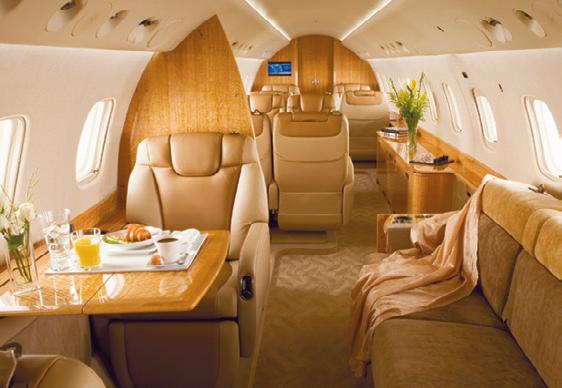
The aircraft maintenance group performs airframe inspections, avionics repair and modifications, power plant removals and installations, and non-destructive testing. This work is done according to long-term contracts as well as in response to one-time repair requests. The company is an authorized service provider for Bombardier Learjet and Challenger aircraft; for Dassault Falcon 50/2000/900 models; and for Beech King Airs. It is also approved by Rolls-Royce to support Spey and Tay turbofans and is an authorized sales and service dealer for Rockwell Collins avionics.
The fixed-base operations provide fuel and hangar space for resident customers as well


as for itinerant aircraft. In addition, numerous corporate flight departments operate from their rented offices within the FBO complexes. Executive lounges, courtesy offices and boardrooms, and ground transportation arrangements are some of the services provided for passengers at the FBOs. For the flight crews there are rest areas, computerized flight planning and weather briefing facilities, and in-flight catering services.
In order to gain a better understanding of any business model and therefore appreciate how a company may perform in the future, it is useful to perform a S.W.O.T. analysis (Strengths, Weaknesses, Opportunities and Threats). Doing so with Skyservice

Business Aviation provides the following insights:

STRENGTHS:
Growth industry –
The positive attributes of corporate aviation (improves productivity, while providing security, privacy and flexibility) pretty much guarantee ongoing demand for the range of services the company provides. Given the potential for more service reductions (fewer frequencies and/or withdrawal from communities) by scheduled carriers, the important role of business aircraft stands to be further enhanced in the future.
to entry – Capital
for facilities and inventory, highly trained and motivated personnel, and longstanding customer relationships are all ingredients necessary for success and difficult to replicate.
Revenue diversification –
The company’s revenues are evenly divided between the aircraft management/charter unit, the maintenance activities and the fixed-base operations.
Enviable reputation –Since its inception, the company has worked to a business plan that is focused on the customer. Having successfully executed on that strategy, Skyservice has developed a reputation for providing quality service. Such goodwill is an invaluable tool in its efforts to win and retain clients.


Corporate culture – SBA’s 470 employees have embraced the company’s philosophy that the customer is the top priority. The team is not unionized and therefore flexible in handling multiple tasks as required. Its high level of morale is confirmed by the low employee turnover.

WEAKNESSES:
Competitive environment – The corporate aircraft management industry in Canada is dominated by about a dozen major players of which Skyservice is the largest. While customer loyalty tends to be a hallmark of the business, there can be migration among managers. Given its growth, Skyservice appears
to have been a net beneficiary of such changes during the past decade. Even so, the market demands that fees remain competitive and that operating costs be disciplined.
Currency exchange – Any Canadian company whose key inputs are priced in U.S. dollars, is exposed to foreign exchange risk. However, in the case of Skyservice, most of these costs are passed through to the customers.
Not part of a major FBO chain – The effort to capture itinerant traffic can be assisted by being part of a well-recognized organization. Unlike the largest industry players (such as Atlantic Aviation, Signature Flight Support and Landmark Aviation) that have 40 to 60 FBOs across
North America, Skyservice is a regional operation. Having said that, Skyservice’s FBOs are branded as ExxonMobil/ Esso Avitats and therefore represent three of the nearly 70 Avitats in North America, Europe and the Middle East. Despite not having the North American profile that the three aforementioned chains enjoy, Skyservice has managed to capture the largest share of itinerant business at each of its locations.

Maintenance business growth – While its maintenance activities currently relate to aircraft under management and some work for regional airlines, additional
opportunities are on the horizon. As the average age of the business aircraft and regional jet fleets increase, there will be greater demand for maintenance on airframes and engine work. In order to be better equipped to efficiently process new business, the company is investing more than $3 million in software for its maintenance unit.
Building the charter business – As more companies and individuals become aware of the attributes of business aircraft, the demand for air charter services is expected to increase. Whether the customer is an occasional user or an aircraft owner that is seeking supplemental lift, the convenience of a charter versus the schedules of airlines is becoming
Revolutionary wing design at Airbus is just one way that EADS technology is balancing our need to travel with our need to safeguard the environment. It helps the A380 burn 17 per cent less fuel per seat than rival aircraft. And Eurocopter is reducing helicopter noise levels ahead of its competitors. EADS makes the transport solutions the world needs. And helps to protect the things we value most. www.eads.com/madebyeads




understood by a larger audience. As approximately 60 per cent of the aircraft it manages are available for charter, Skyservice has a wide range of equipment types at its disposal.
Expanding the FBO operation – The five largest Canadian corporate aviation markets are, in descending order, Toronto, Calgary, Montreal, Vancouver and Edmonton. With an established profile in the three largest centres, Skyservice has a solid domestic presence. Any expansion to other cities will likely be dictated by the incumbents wishing to divest. While that currently seems unlikely, the industry has a history that suggests anything can happen – if you wait long enough.

Economic adversity – A weakened economy means decreased flight activity and deferred customer fleet upgrade decisions. This translates into lower fuel sales, reduced charter revenues and a pullback in maintenance work. The business aviation industry recently experienced the most prosperous period in its history. Once the economic cycle works its way through the current challenging phase, the level of activity is expected to rebound. To what extent and over what time frame are the two major uncertainties.
Environmental activism – While the debate continues over the validity of the global warming theory, environmentalists are taking aim at the corporate aviation industry. By claiming that business aircraft are the most polluting method of transportation (in terms of the amount of carbon dioxide released per person-mile)
they are attempting to portray the industry as irresponsible. Down the road there will be programs that enable corporate aircraft operators to repent for their footprints by purchasing carbon offsets – a tax by any other name.
Negative media attention
– The business aviation industry has always been a lightning rod for the media. Lately, the strikes have been coming fast and furious. Despite the proven productivity of corporate aircraft, the media’s “airplane envy” can unduly influence key decision makers including significant investors, executives and politicians.
The business aviation industry has seen significant growth during the past half century despite the cyclical behaviour of the economy. In recognition of the enhanced productivity, security, privacy and logistical flexibility associated with aircraft, many corporations and some families have utilized this mode of transport regardless of the economic environment.
In order to best serve this expanding niche market, Skyservice Business Aviation has become a fully integrated provider of services to meet the needs of both frequent and occasional travellers, be they corporate executives or private individuals. Having assembled a team that has diversified skills, the company has been able to generate revenues from a variety of activities that complement each other. This has resulted in an enviable financial performance and provided stability.
Earlier this year, on Jan. 30,
SBA announced the sale of its air ambulance business to Emergency Medical Services Corporation (EMSC) of Greenwood, Colo. The deal is expected to close by May 30, if not sooner. Going forward SBA will manage the five Learjet 35 ambulances on behalf of EMSC’s American Medical Response subsidiary for 10 years. With this transaction, SBA will have reduced its fixed assets, expanded its aircraft management business and secured a decade-long contract with a specialist in the recession-resistant health-care sector. The proceeds from the sale are to be used to finance expansion programs within each of SBA’s three groups. This will assist in attaining the company’s goal of exiting the current economic downturn in an even stronger competitive position. Given that it has been profitable in every year since its inception and has a debt free balance sheet, it is already in fighting form.
Even though he has been the pilot in command of this enterprise since its inception, Russ Payson (SBA’s chairman and CEO) still has the “fire in the belly” of a classic entrepreneur. When asked what makes him still want to be in the office as opposed to leading a life of leisure he responded, “I love to come to work because this is an exciting place to be, the company is going places, we have a great team and we have lots of fun!” Succession planning is an ongoing program at any well managed organization. The situation at SBA was clarified last fall when Marshall Myles was appointed president and became a significant shareholder on Nov. 1. Prior to that, Myles had spent 30 years with Roots Canada where he had
served as president and CEO since December 2000. The aviation scene isn’t new to him as he served on the board of directors of Skyservice Airlines from September 2000 until it was sold and he has been on the Skyservice Investments board since the spring of 2008. He commented on SBA’s outlook by saying, “We are a debt free company looking to grow by being aggressive in our core business, as well as being interested in acquisitions.”
With respect to the question we posed earlier, the Canadian situation differs from that south of the border. It appears that our leading corporations, while not immune to financial distress, have managed their affairs with greater fiscal discipline. This should translate into a relatively smoother ride for the Canadian economy and our bizav community.
Nineteen years ago, Skyservice began operating its first managed aircraft. Today, it looks after approximately 50 – roughly double the number managed by the second largest player. When asked what he attributes that dominant position to, Russ Payson replied, “Service and outstanding customer relationships.”
Skyservice Business Aviation has evolved from a singlelocation FBO to a well-diversified provider of services to the Canadian corporate aviation market, a transformation has made it the industry leader. Given its range of services, the high regard with which it is held within the industry and its financial fitness, Skyservice Business Aviation appears to be positioned to achieve prosperous growth over the foreseeable future.

By Rob Seaman
It’s time to review the corporate aviation world in Canada and it goes without saying that this year’s report is different from those of previous years. Simply put, 2008 began like a space shuttle launch but finished on a downward slide and 2009 started where the previous year left off. However, there is some good news out there.
According to Sam Barone, president of the Canadian Business Aviation Association (CBAA), “Canada’s business aviation community is all about supporting Canadian business and the Canadian economy.… Business aviation is far more than luxury jets and travel perks.” Industries such as mining, hydroelectricity, petroleum and natural gas, and diamond and forestry sectors, depend on business aviation and have gone on to prove the value that corporate aircraft bring to their
bottom line. As Barone points out, the contributions of Canadian business aviation to our nation’s employment, commerce, international competitiveness and health care are profound, but not always well understood. He goes on to say that we need to get the word out to all Canadians that business aviation is working for Canada – both at home and abroad. It is also serving as a lifeline for communities all across the country that are seeing the scheduled airline service continually reduced or eliminated from the smaller regional markets. Says Barone, “At a time when we are facing almost unprecedented economic challenges, Canadian businesses need tools that will help them enhance productivity, maximize flexibility and maintain strong communications. Canadian business aviation is critical to tens of
thousands of cost-conscious companies fighting to succeed in a difficult market. Canadian business aviation also provides humanitarian assistance to charities such as Hope Air, where life-saving treatments are accessible and only possible through this mode of transportation.”
In speaking with many corporate aviation service and support facilities from coast to coast, it is evident that many companies are starting to notice some good news creep into their bottom lines. By March, many FBOs advised that traffic on their ramps was starting to increase and show signs of recovery. FBO managers reported, on average, a 10 to 20 per cent increase in financial numbers over the first couple of months of this year and fall of last year. That said, these numbers do not necessarily mean an increase

“Business aviation is critical to tens of thousands of costconscious companies...”
in fuel sales, as more and more operators – from the United States in particular –are putting into practice the “tanker fuel method.” This same sentiment is echoed by most of the fuel resellers. In addition, the overnight stays are not as frequent, especially for non-Canadian registered aircraft. Quick turns or day trips are more the norm.
Some have taken this opportunity to invest in the future and prepare for when the aircraft business returns to normal levels. Long-standing FBO pioneer Sky Charter at Toronto’s Pearson International Airport has recently completed a significant FBO improvement; the hangar facilities have been extensively upgraded and the passenger lounge has been increased in size, redecorated, and turned into a more modern facility – modelled after the more current global aviation standard. Fittingly, it has acquired a significant new tenant,
AirSprint, that will be relocating its Toronto offices and aircraft to Sky Charter.
As for news from the west coast, Scott Harold of Landmark Aviation reports most of the focus is still on getting ready for the 2010 Winter Olympics. This effort will require all the FBOs to work together to accommodate the anticipated influx of corporate aviation traffic and massive increase in heli support required for the event.
On the aircraft charter side, the latter part of 2008 and the first two months of 2009 were nothing less than a disaster according to most. One Toronto-based charter provider actually offered that in his opinion, the ad hoc charter market is dead forever. Fortunately, this opinion was not upheld in the marketplace and by March, most operators were reporting a healthy resurgence of interest in their charter aircraft. The market is still by no means back to levels of last year; however,
it’s a far cry from what it was through December, January and February.
Looking to the aircraft management side, several firms are reporting that their current owners are not only using their aircraft again, but also considering upgrades or replacements. There are also across-the-board reports from all operators of new owners and new shared ownerships coming their way in the near future. Calgary-based Sunwest Aviation’s Ian Darnley reports that despite the end of year slowdown, it added eight new managed aircraft to its fleet last year that included the recent delivery of a new G150 and the addition in the early part of 2009 of a new Citation Sovereign. Darnley says that for them, 2008 was a banner year in aircraft sales and acquisitions, worth more than $70 million. Likewise Toronto-based Image Air advised that it will be adding at least two new aircraft to its Toronto operation, with more to come. Similar news is coming from other operators in this field. Overall, these are signs of good news with some indication of a turnaround, and the continued acceptance of the value of corporate aviation as part of a company’s travel mix.
One firm that always seems to find new and different ways to promote itself is Toronto-based Chartright Air, which has subsidiary bases in Kitchener, Ont., Vancouver and Moscow. Its Vancouver operation recently participated in the launch of a new BMW series automobile and used the event as a way to cross-promote its aircraft services to the higher-end automotive market. Similarly, Skyservice Business Aviation has played host to Sports Hall of Fame events at its FBOs. As we all know, hard economic times breed innovative marketing and communication strategies. Both firms report that this mixed marketing approach has helped to bolster their image and create new business.
Generally, for the first part of 2009 most corporate flight departments were not flying very much at all. In fact, numbers tracked by various associations in the United States showed that across the board, corporate aviation flying was down by as much as 40 per cent due not
only to the downturn in business, but also to the increased sensitivity of many flight departments regarding the use of the corporate jet as a travel tool. The net result is that today in Canada and the U.S. there is a record number of corporate aircraft posted for sale through the various brokerage and resale outlets. That said, the numbers really do not tell the entire story. Many brokers and business analysts are stating that the inventory numbers are in fact artificially high, as many firms were pushed to post their aircraft for sale in order to appease investors and shareholders. The fact is these aircraft are not necessarily for sale if the price is not right. And with the flood of availability right now, prices are fluctuating -– mostly to the down side – and many owners are not willing to accept these deflated values. According to Brian Foley, a well-known and respected industry analyst, inventories will peak by midyear. “That’s not to say it will be an immediate decrease, just that it won’t be getting much higher,” says Foley. He goes on to say that “at the peak, inventory levels will meander for a few months be fore falling somewhat by year end. Soon, one in five of the world’s active business jet fleets will be up for sale.” According to Foley, used aircraft prices will continue to drop after the inventory peak and through almost to year end. Overall, he feels that the most desirable equipment on the mar ket will slowly begin selling through the second half of this year. In general, Foley predicts the market will further stabilize when those who have to sell get out of the market. When the market turns, as Foley says it will, buyers will be taking advan tage of the best pricing in years. At the same time, other sellers will simply take their jets off the market as their improving balance sheets will no longer justify the need to sell.
For those in the market to buy an air craft, choices have never been better. Many manufacturers have options and positions available as some of their purchasers are now trying to divest themselves of their commitments. As one broker said, desperation breeds interesting pricing strategies. On the downside, money is not as readily available as it once was. For those who qualify, there are lenders willing to work a
deal. Unfortunately the interest rates are nowhere near what they were at this time last year. The best deal you can find today starts around eight per cent.
The bottom line is that corporate aviation as an industry segment is alive and will survive. OEMs are continuing with new product development (in some cases at a reduced or revised pace), the avionics world continues with optimistic foresight
and generally everyone is working to preserve the bizav business model. Once we get past the CNN-driven recession and the business community becomes more comfortable with how it will conduct itself, things should start returning to a more sustainable and agreeable level. In the meantime, everybody is playing a wait and hope game and looking for the bright spots as they come along.

For over 50 years, StandardAero has been a leader in engine maintenance for military and commercial aviation. We’re known for our innovation and the efficiency of our work processes, helping to minimize costs and downtime. Now, we’ve joined forces with Landmark Aviation’s MRO services, allowing us to provide a global level of capabilities and service to business aviation. To find out more about the new StandardAero, and what we can do for you, visit our website at standardaero.com.
By Tarek Sardana, MD
In January 2008 the copilot of a Heathrow-bound passenger flight had to be dragged from the cockpit and handcuffed after suffering an apparent mental breakdown in mid-air. According to the Guardian newspaper, “Passengers on the flight from Toronto to London said the copilot was restrained after yelling and ‘invoking God’ while at the controls of the Boeing 767 plane more than 30,000 feet above the Atlantic. The flight was forced to make an emergency diversion to Ireland’s Shannon Airport and the unnamed crew member was taken to a nearby psychiatric unit.”
There has been significant press coverage about several sudden incapacitations among commercial aircrew recently, and this has raised the issue to a high profile, certainly among non-pilots and the media.
A month after the Heathrow-bound 767 incident, a photo was published (tastelessly in my opinion) of a relatively young co-pilot who died enroute on a flight within Europe. The photo showed the pilot collapsed in the copilot chair. I am not sure how the press managed to get such a photo; I would have hoped that the airline would have had the time to at least cover
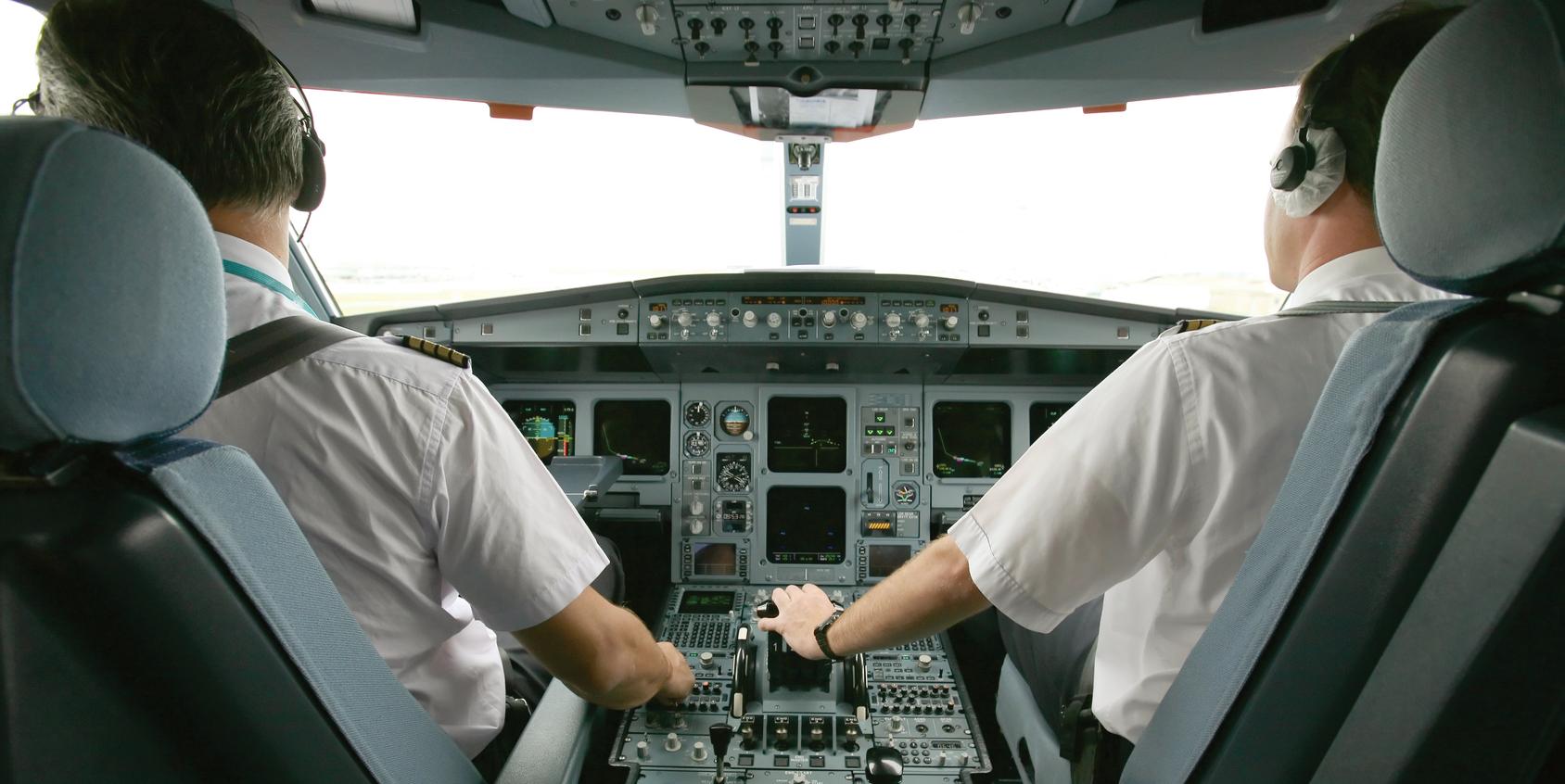
up the deceased, but this did not occur. I have no personal knowledge about these cases other than what I read in the newspapers, but I am comfortable commenting on this issue in general. These stories certainly sell newspapers, but the actual chance of a sudden incapacitating event among aircrew is extremely rare. If these events had happened to these individuals on the drive to the airport the stories wouldn’t have seen the light of day, as they wouldn’t be deemed newsworthy. For the travelling public, the odds of the two pilots (irrespective of their age) actually becoming incapacitated for medical reasons at the same time is almost
zero (pretty well the same odds as winning a lottery or being hit by lightning!). In fact, an article published in the journal of the Aerospace Medical Association noted that between 1972 and 1988 the world’s airlines flew more than 190 million hours without realizing a single accident involving pilot incapacitation. The latest estimated risk of cardiac incapacitation occurring at a critical point in a flight is less than one event among more than 20 million flight hours, with the risk of an accident occurring once every 400 years. The risk of other forms of incapacitation would be even lower.
When air crew undergo their favourite aviation medi-
cal, in any country, the medical examiner is particularly interested in anything that may indicate a risk for sudden incapacitation whether they are private or commercial pilots. The most common reasons for sudden incapacitation are cardiac – heart attack or stroke – metabolic (e.g., diabetes), malignancy (cancer that has spread to areas such as the brain) and psychiatric (as in the case described above). This is why there is a heavy focus, certainly in Canada, on cardiac and metabolic areas of the examination. To be honest, psychiatric issues are difficult to pick up in a brief medical encounter unless the individual is overtly psychotic,
and it is usually your staff that notices unusual behaviour first. Most folks, even if undergoing a mild to moderate psychiatric episode, can bluff their way through the halfhour aviation medical. In fact, the folks most likely to notice a psychiatric issue in a crew member are either other crew members or immediate family and/or friends. The point here is that we all get to know people very well, especially if we have flown with them for years, and if you notice a significant change in their behaviour it behooves you to bring it to the attention of the safety people at your organization. It may seem awkward to be “turning someone in,” but in the long run we will all be safer and that individual could receive appropriate treatment and be returned to flying duties – and it could prevent any other exciting media stories.
As aviation medical examiners, we are not as concerned about your athlete’s foot since this isn’t likely to bring down an airliner, but we do focus our examination in areas that may make someone suddenly unable to function on the flight deck. Of course, I am not advocating “turning in” your boss because he gave you a crappy flight schedule and telling the safety organization that you are concerned because you feel your boss is psychotic. There are other means of dealing with these issues but they are not the subject of aviation medicine! Most airlines have some form of standard operating procedure (SOP) in the event of the sudden incapacitation of a crew member. The general principles that are to be followed are as follows: 1) The in-charge flight attendant
will pull out and follow the medical emergency checklist; 2) The remaining pilot will contact flight dispatch and the contract Emergency Medical Company via radio and/or datalink; 3) A diversion will be planned if needed between dispatch, the Emergency Medical Company and the remaining pilot based on services needed and current situation (fuel, weather, etc.); 4) The incapacitated crew member will be cared for with the onboard medical kit and expertise; and 5) The remaining pilot will conduct the remainder of the flight as a single pilot.
Scenarios such as these are covered in both pilot and flight attendant training. Pilot simulator training includes scenarios such as incapacitation of the flying pilot in critical phases of flight (takeoff, approach and landing) to emphasize the need for following the SOPs, the use of the challenge-response concept, and to remind pilots that the pilot not flying should remain ready at all times to take the controls. The flying public should feel very comfortable that while an aircrew incapacitation can seem dramatic, the risk to safety is extremely low. These types of stories are more interesting to media organizations as they can be somewhat sensational, but have no real concern from a general flying safety perspective.
Dr. Sardana is a pilot, a Civil Aviation Medicine Examiner (CAME), coroner and president of Aviation Medicine International (AMI) Inc. (www. aviationmedintl.com). Comments on this article or future topic suggestions gladly appreciated at t.sardana@aviationmedintl.com.

By Rob Seaman
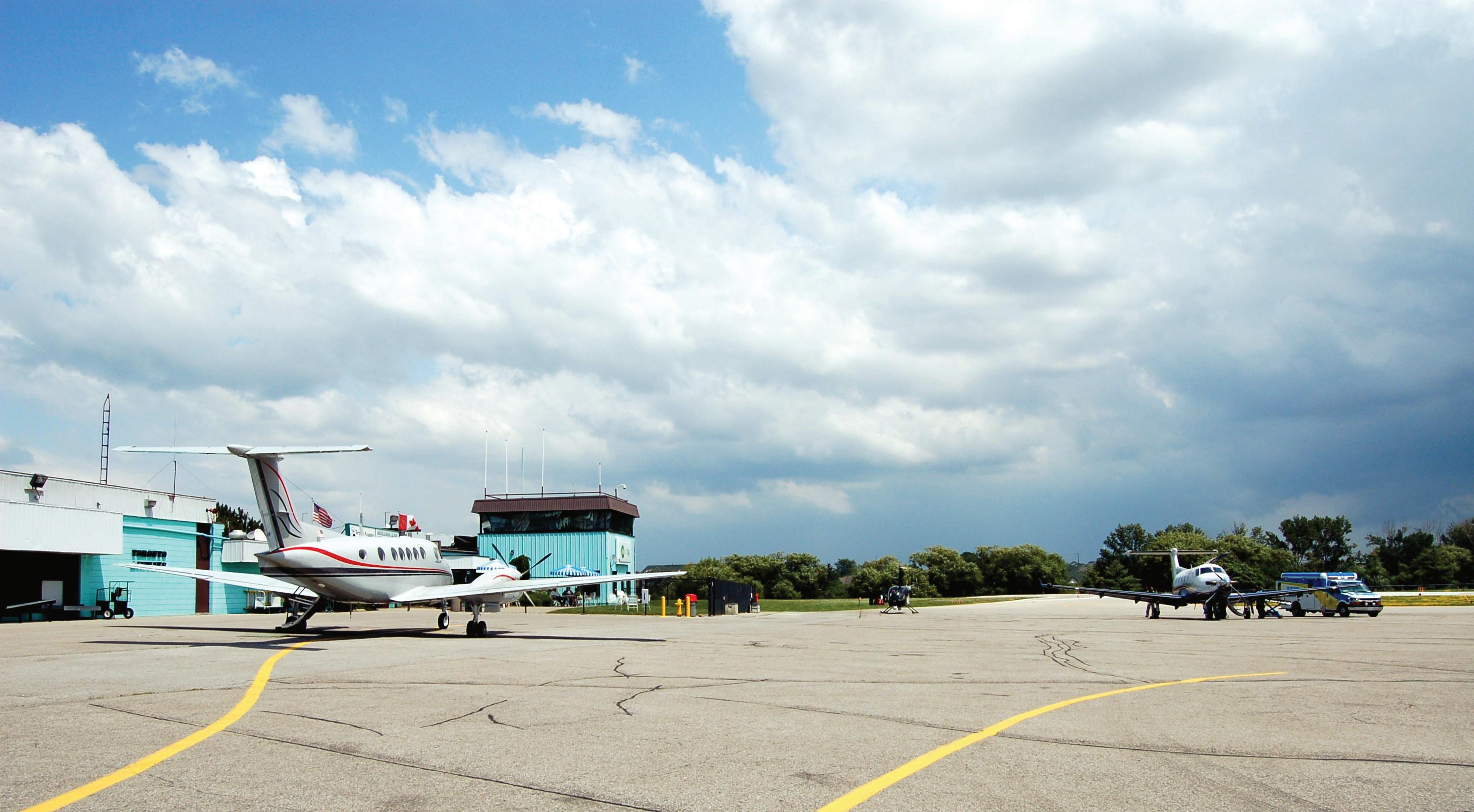
The question of how much an airport is worth seems to be coming up with more and more frequency. Unfortunately the reality is that most do not raise this question or even think about it until such time as the airport comes under threat of closure or restriction of services. Such has been the case far too often in recent years – many smaller regionally important airports that were cast upon their new owners through the national airports policy of the 1990s are now facing the realities of increasing operational costs and monetary inefficiencies that have accumulated over many years. The unfortunate truth is that these
airports have been operated in an underfunded manner for far too long and now as the infrastructure support systems and equipment become worn, used up or even inoperable, the monies are not in place to have improvements, repairs or even rudimentary support systems put into play.
The national airports policy was a concept by a government looking to divest itself of costs and programs that it deemed to be burdensome or unnecessary to its bottom line. Many communities were suddenly faced with their airports either closing altogether or being given the option to take them over for a
nominal fee – one that usually was far lower than the airport was realistically worth but that made it a viable business transaction. The problem in many cases was that the people acquiring the airport did not necessarily fully understand the value of the airport to their community or the actual cost of keeping and maintaining it. For many, the simple fact that there was an airport that was operational and had always been there meant they needed to retain it and keep it for their use. Little business planning or future exploration went into the big picture decision to acquire and operate these airfields.
For its part, when the gov-
ernment handed these facilities and operations over to the new owners, it did so inclusive of equipment and in some cases personnel and operating systems that were current at the time. Spending had been such that these airports worked well for the day, and continued to work well without their new owners having to be overly aware of operational issues for years to come. It was something akin to going to the pet store with your kids to buy a new low-cost pet. The fish or bird purchase is nothing in the big picture. It’s the tank, cage and other things that wind up costing money. The problem is, few realize at
training had to be done at third-party training hubs where there was sufficient wealth to buy and operate classic simulators. “We positioned our product specifically for the recurrent training market. Our niche was Tier 2 and 3 airlines, which are usually regional airlines with 10 to 20 planes. We introduced novel technology and training at home, instead of having to go to hubs to train,” Petruzziello explains.
Technology was no longer the limiting factor to the paradigm shift, but, as with Kuhn, there were those in the old guard who stood their ground. “The main issues with Tier 1 accounts are the old managers who don’t want to think,” Petruzziello says. They knew their comfort zone and had little interest in taking risks. Even WestJet, with its cost-conscious, shareholding employees, proved too tough a nut to crack when it was shopping for a simulator, he recalls. “The guys who ran it were ex-Tier 1 people. This is the kind of obstacle we faced. The airlines who took us seriously were airlines in China



and South America, then later Lufthansa. But now we are competing head to head with CAE and our technologies have become the standard.” Its clients now include Manitoba’s Perimeter Aviation, Air Canada, Turkey’s Gözen Group, Japan Airlines, Malév Hungarian Airlines, Northwest Airlines and TACA Airlines.
In 2002 Mechtronix decided to shoot for the moon and entered the FFS market. But when it went shopping for funding to build a Level D simulator, the best of the best, the going got tough. Petruzziello’s recollection echoes Kuhn’s description of the dynamic, sometimes for good, sometimes not, between the bold and the conservative players in a scientific field. “Our backers contacted the ‘industry experts’ to see if we could build a $10-million simulator. I said to them, ‘I am the expert.’ We ended up securing the financing at the end of the day, but it was a nightmare.” In 2004
Transport Canada qualified Mechtronix’s first Level D simulator, the FFS X.
Mechtronix went further than replacing avionics boxes and other airplane parts with microprocessors, an advancement in terms of replication technology. It collaborated with Airbus to use subsets of its data package to achieve this with its A320 FFS X. It rode the wave of PC-based image genera tion, which by then was killing off refrigerator-sized image generators, with their cold rooms and quarter-milliondollar-a-year service contracts.
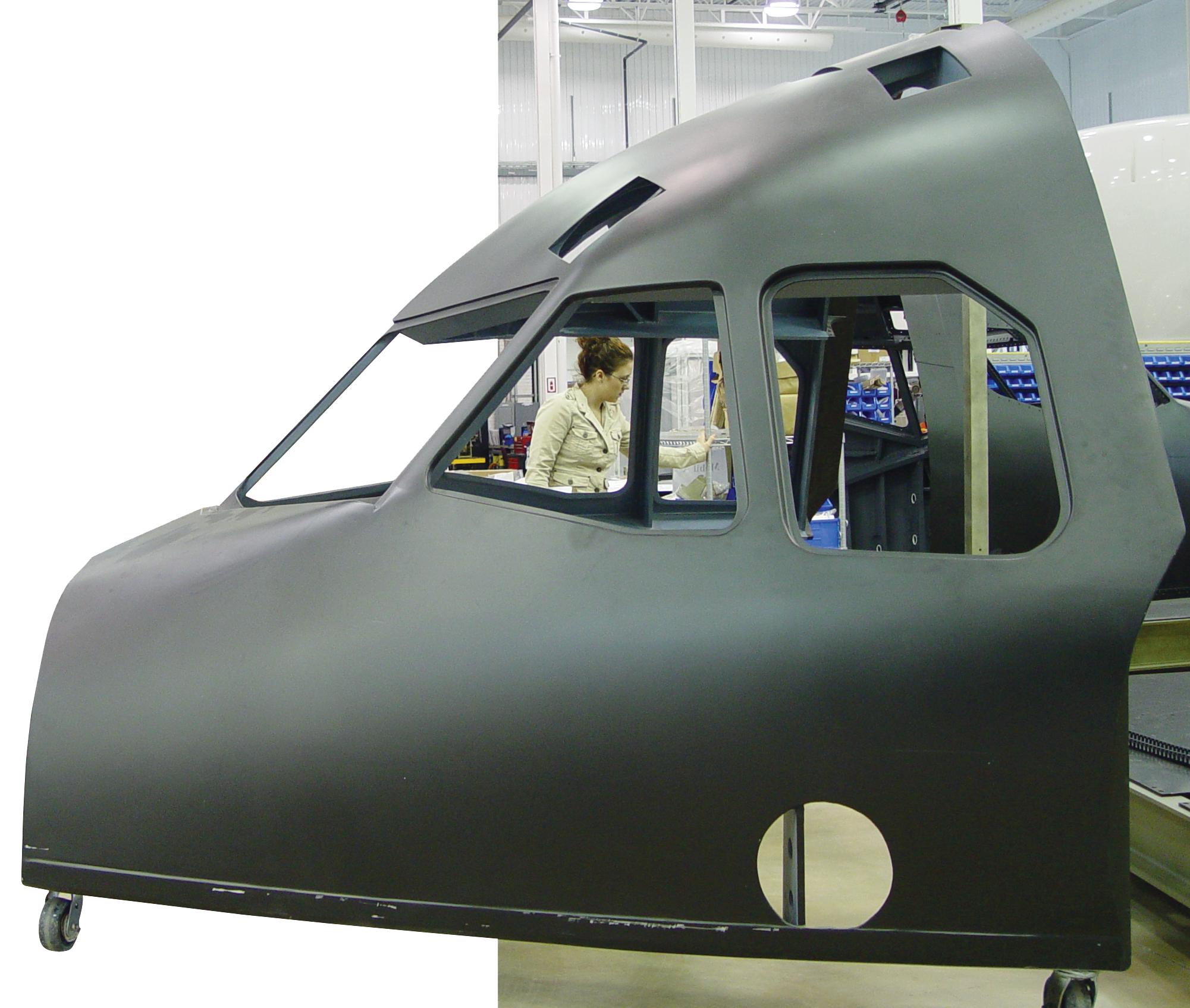
It replaced the hydraulically driven hexipods, with their attendant hydraulics technicians, with lower-maintenance and less costly
Mechtronix simulators represent a wide variety of aircraft, from narrow bodies like the A320 and B737 to turboprops like the Fairchild Metro, single- and multi-engine piston planes and speciality aircraft like the Bombardier 415 water bomber.
They come in a range of sophistication, depending on the training qualification level desired; e.g., direct transition with Zero Flight Time to real aircraft, a percentage of required flight time, multi-crew co-operation, recurrent, instrument, Flight Management System with lesson plans or ab initio training. Systems can include navigation, weather and air traffic control. There are separate control consoles from where trainers keep the pilots busy.
Simulators are qualified to various levels by the U.S. Federal Aviation Administration (FAA), International Civil Aviation Organisation (ICAO) and the Joint Aviation Authority (JAA), as well as local authorities such as Transport Canada. They must be qualified when they are installed, requalified every time they are moved, and also receive annual recurrent qualification.
Here is a broadbrush summary of the classes of simulators Mechtronix makes,
with some of their features:
The FFS X series, the white puffball shaped machines on hexipods, are the most sophisticated. They may be rated from Level A to D, that is, from recurrent training or Non Zero Flight Time training to Zero Flight Time training. The visual field is a minimum 40 degrees by 180 degrees. The cockpits are reproduced in exquisite and utterly convincing detail; everything is built in-house except the seats, which come from the aircraft maker.
It was one of these, a beautiful A320 destined for an airline in South America, that Mechtronix graciously let me take out for a 40-minute flight, with copious assistance from consultant test pilot Karl Drolet in the right-hand seat. We rotated off Pearson’s Runway 5, flew south and then east along the Toronto waterfront at 2000 AGL (more or less), turned back to the west, lined up and landed on Runway 6R, complete with runway landing lights, exited onto Taxiway C3 and taxied over to Terminal 3’s gate 37.
The FFT X series is like the FFS, except that the hexipod is not a standard option. It would be roughly correct to say that its main distinction from the FFS, from a
qualification point of view, is that it cannot be used for Zero Flight Time training; the full details are an alphabet soup of FAA, ICAO and JAA regulations beyond the scope of this article. Otherwise, the FFT X can be used for just about any kind of training.
The FFT series (without the X) resembles an office cubicle with an aircraft nose attached, and with a 35-degree by 80-degree visual display system stationed in front of it. Mechtronix purchases real aircraft cockpit/nose assemblies from boneyards, cleans them up and starts building. They don’t fly around on hexipods, but the flight decks are true to type, with lots of features like ground handling, A/C systems, flight controls and forces, sound, navigation, weather and air traffic control.
One rung further down are FTDs loaded onto PCs. They range from software packages that run on one laptop to spidery assemblies of as many as seven or more touch screens on which all of the instrument panel auxiliary control centre and the comm/nav console appear. These, like some of the other simulators, can be changed to other aircraft types by loading different software.

further information: Barbara Priestley, Tradeshow Coordinator Phone: 613-261-5121 • E-mail: barbp@rogers.com • www.atac.ca

founded in 1934, is Canada’s national trade association for commercial aviation and flight training industries as well as aviation industry suppliers.
and Tradeshow November 15–17, 2009 Check out ATAC’s website at www.atac.ca for information on membership and benefits or call 613-233-7727 ext. 311 or e-mail membership@atac.ca