

Riding the business wave
Riding the business wave
B.C's Seair expands operations
B.C's Seair expands operations







By DavID olSeN
By PeTer PIGoTT
By JaMeS MaraSa
BrIaN DuNN
DavID Carr
roB SeaMaN
top:

| By Matt Nicholls

Riding the business wave
Riding the business wave
B.C's Seair expands operations
B.C's Seair expands operations
By DavID olSeN
By PeTer PIGoTT
By JaMeS MaraSa
BrIaN DuNN
DavID Carr
roB SeaMaN
| By Matt Nicholls
“Leadership and learning are indispensable to each other.”
– John F. Kennedy
As a leader in many facets of aviation, Canada has long been lauded for its achievements on the world stage – be they in product development, training, navigation or implementing processes. Such positive acclamation extends to the safety realm as well.
As Canada’s director general of civil aviation (DGCA), Martin Eley, suggests in Wings’ cover story, “Building a new model,” pg. 18, “Canada’s safety record is among the best in the world, and Transport Canada (TC) is committed to maintaining and improving aviation safety.”
But while TC continues to work hard to strengthen its civil aviation performance management regimen and improve its inspection schedule, inspector training performance monitoring and quality assurance, there are cracks in the armour – and professional associations nationwide are more than a little concerned.
A spate of recent accidents to close out 2011, particularly in northern Canada, coupled with cuts in the number of TC inspectors, changes due to internal reorganization, and the introduction of Safety Management Systems (SMS) has many in the industry (and in the mainstream media) questioning the strength and service levels of our national regulator.
Based on feedback from industry leaders I have spoken with over the past couple of years, it’s a valid criticism. And as David Olsen notes in his piece, stark questions are being asked about the current regulatory model and whether or not the framework needs to be changed. Should TC be re-established as a statutory authority for civil aviation safety
at arm’s length from the government which, like the Transportation Safety Board, reports to Parliament and not solely to the government of the day? Is there a better model for TC – and what’s the best way to foster and implement change?
The answer is yes, there must be a better model – the current one needs to be carefully analyzed by industry and government and changes need to be made in the auspices of creating the safest regulatory environment possible.
The
ATAC president/CEO John McKenna is currently waiting for a date to discuss it with TC. The working group’s vision of a new system centres around improved communication with stakeholders, more deregulation to industry and improved service via the creation of a Civil Aviation Advisory Board to provide a forum for effective two-way feedback between certificate holders and the authorities. Establishing a TC working group made up of industry leaders and department leaders to review key regulatory priorities is another key recommendation.
current regulatory system in Canada is not broken –its processes are burdensome
and confrontational.
Fortunately, leaders from key industry associations have shown their commitment to finding potential solutions by establishing a sound action plan for change. Last May, the Air Transport Association of Canada (ATAC) presented an action plan at its symposium on “Transport Canada Level of Service” to deal with just these issues. The plan details 21 recommendations on communications, deregulation and targeted service improvement.
Top daTa BuRsTs in this issue
1. $100 million: The amount airbus will pay to fix wing cracks in a380 jets. (pg. 8). 2.: sunwing airlines operates 23 leased aircraft and flies to 44 international destinations. (pg. 15) 3. Transat a.T. is expected to add $20 to $25 million in margins next year. (pg. 34). 4. 132,000: number of annual aircraft movements at Vancouver Harbour waterfront airport (pg. 38). 5. naV canaDa has invested $1.7 billion since 1996 on navigation enhancements. (pg. 43)
As Dennis Lyons, president of the Manitoba Aviation Council (MAC), aptly points out, the current regulatory system in Canada is not broken – its processes are simply burdensome and confrontational, instead of collaborative. Having the opportunity for TC and key members of the industry to meet and address issues to create a more a viable system makes sense. “This new system would very likely look different from what we have today, and if done properly, I am sure there would be some services delivered by other agencies allowing TC to focus on oversight of all the industry,” Lyons suggests.
Wings applauds the work done by ATAC and supports industry leaders on both the rotary- and fixed-wing sides who are working to make the regulatory framework as efficient and safe as possible. Change only comes through careful analysis and an openminded collaboration on all fronts…a buy-in from both industry and government. | w
Your feedback is always welcome. Please contact me at mnicholls@annexweb.com.


ediToR Matt nicholls mnicholls@annexweb.com 416-725-5637
pRoduCTion aRTisT Brooke shaw fligHT deCK
Ray canon, David carr, Paul Dixon, Brian Dunn, Frederick k. Larkin, neil MacDonald, James Marasa, carroll Mccormick, David olsen, Peter Pigott, Rob seaman assoCiaTe puBlisHeR alison de groot adegroot@annexweb.com 1-888-599-2228 ext. 246
adveRTising sales adam szpakowski aszpakowski@annexweb.com 1-888-599-2228 ext. 246 sales assisTanT stephanie DeFields sdefields@annexweb.com 1-888-599-2228 ext. 257 gRoup puBlisHeR scott Jamieson sjamieson@annexweb.com
pResidenT Mike Fredericks mfredericks@annexweb.com
wings Magazine
P.o. Box 530, 105 Donly Dr. s., simcoe, on n3Y 4n5 Tel.: 428-3471 Fax: 429-3094
Toll Free: 1-888-599-2228
Publication Mail agreement #40065710
Return undeliverable canadian addresses to circulation Dept., P.o. Box 530, simcoe, ont. n3Y 4n5
e-mail: subscribe@wingsmagazine.com
Published six times per year (Jan/Feb, Mar/apr, May/ Jun, Jul/aug, sep/oct, nov/Dec) by annex Publishing & Printing inc.
Circulation
e-mail: subscribe@wingsmagazine.com
Ph: 866-790-6070 ext. 208
Fax: 877-624-1940
Mail: P.o. Box 530, simcoe, on n3Y 4n5
subscription Rates
canada – 1 Year $ 30.00
(includes gsT - #867172652RT0001)
usa – 1 Year $ 42.00
Foreign – 1 Year $ 65.00
occasionally, wings magazine will mail information on behalf of industry-related groups whose products and services we believe may be of interest to you. if you prefer not to receive this information, please contact our circulation department in any of the four ways listed above.
no part of the editorial content of this publication may be reprinted without the publisher’s written permission. ©2012 annex Publishing & Printing inc. all rights reserved. opinions expressed in this magazine are not necessarily those of the editor or the publisher. no liability is assumed for errors or omissions. all advertising is subject to the publisher’s approval. such approval does not imply any endorsement of the products or services advertised. Publisher reserves the right to refuse advertising that does not meet the standards of the publication.
Printed in canada issn 0701-1369


40 Aviall stocking locations around the world means we have a location close to you. Aviall works hard to provide you with exactly what you need, precisely when you need it. Aviall Delivers.
Bombardier has won an order for five allbusiness-class-configured CSeries 100s by Swiss high-end operator PrivatAir. The order, which includes options for a further five CS100s, is valued at approximately US$636 million if all five options are exercised. The deal was announced at the Bahrain air show in January.
Geneva-based PrivatAir operates a fleet of business jets and exclusively business class commercial aircraft, including the Bombardier Global Express and Boeing 737, for private charter and on behalf of partner airlines such as Lufthansa. “The CSeries aircraft represent cutting-edge technology and are true 21st-century jetliners,” said Greg Thomas, president and chief executive officer for PrivatAir. “It is very well suited for our route expansion plans.”
PrivatAir is the 11th CSeries customer, pushing Bombardier past the halfway point of 20 customers by the time the aircraft enters service in late 2013. Hopes for an order from Bahrain-based Gulf Air appear to have been dashed at the last minute.
Nevertheless, the existing order book underscores the versatility of the CSeries. “Included among the 11 customers are major network carriers, national carriers, premium airlines serving city centre airports, a low-cost airline, leasing companies and now, with the order from
Privatair, a full service provider to airline partners,” said Philippe Poutissou, vicepresident of marketing for Bombardier Commercial Aircraft. “This diversity of customers speaks volumes about the flexibility of the CSeries aircraft family to meet air transport requirements worldwide.”
Raymond Jaworowski, an analyst with the Connecticut-based consultancy Forecast International, told the Montreal Gazette that the CSeries, “is on its way to being a successful program – one that will make money for them.”
Meanwhile, Poutissou’s comments raised speculation that Bombardier’s mystery buyer of 10 CSeries aircraft at last year’s Paris air show is a group consisting of financial backers of Odyssey Airlines, a planned all-business-class trans-Atlantic operator based at London’s City Centre Airport. British Airways currently operates two premium class flights daily to New York from the City Centre Airport using Airbus A318 aircraft, with a fuel stop in Ireland. The CSeries is expected to cross the Atlantic non-stop in a 32-seat configuration.
Canadian North has added three Boeing 737s and is partnering with the Edmonton International Airport and FBO operator Executive Flight Centre (EFC) to grow its industrial charter business. Canadian North and EFC expect to build up to 500 additional staff to service industrial clients – primarily the oil and gas and mining sectors, working in northern Alberta and northern Canada.

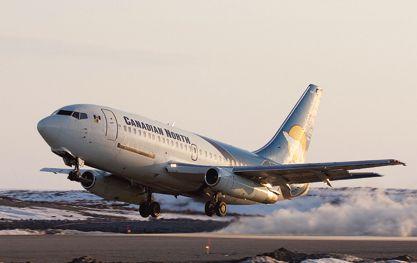
EFC, which operates 10 FBOs in western Canada, has extensively renovated and upgraded the largest hangar at the airport specifically to meet the Canadian North requirement. “The Canadian North Charter Terminal/Executive Flight Centre T3 offer everything we need to provide a seamless travel experience for our valued charter customers,” said Tracy Medve, president of the airline.
“Executive Flight Centre is pleased to have partnered with Canadian North and the Edmonton International Airport to create this much-needed northern gateway for the expanding industrial charter business,” said Dean Buckland, president of EFC. “We look forward to playing a leadership role in fuelling future developments and expansion of the industry charter market here in Edmonton.”
Tiny cracks discovered in the wing component of the Airbus A380 will be costly to repair but are not expected to slow sales for the superjumbo in 2012. In February, the European air safety regulator ramped up a directive to inspect all A380 aircraft when Qantas Airways grounded one of its airplanes after discovering 36 small fractures in the metal brackets that support the wing rib. The European Aviation Safety Agency had earlier issued a directive for an estimated 20 aircraft. All 68 A380s in service will have been inspected by mid-March.
The cracks are no apparent threat to safety. Singapore Airlines, the launch customer, has repaired its fleet. Philippa Oldham, head of transport at the U.K.’s Institution of Mechanical Engineers told
the BBC that, “these cracks seem like minor irritants. One would expect some teething troubles with any new aircraft.” Airbus has a temporary solution and is working on a permanent fix, but like any trip to the dentist, there is a cost. Airbus is not talking numbers, but Der Spiegel, an influential German magazine, reports the repair will be approximately $1.3 million per aircraft, bringing the final bill close to $100 million.
Air France and Emirates operate the A380 to Montreal and Toronto, respectively. Airbus does not expect cracks to dampen sales prospects over the next 12 months. The airframer predicts orders for 30 aircraft in 2012, an almost threefold increase over 2011. Even so, the fractures are an embarrassment to the manufacturer’s flagship airplane, and Airbus has ordered an internal investigation.
Rival Boeing has also experienced manufacturing difficulties with its 787 Dreamliner, which recently entered service with Japan’s All Nippon. Boeing must repair flawed shim work in the aft fuselage of up to 50 airframes. Boeing describes the latest setback for the chronically delayed airliner as a minor problem that will take days rather than months to fix and does not require immediate repairs to the five 787s in service.
Montreal-based American Iron and Metal (AIM) has added a Pilatus PC-12 NG to its fleet for greater versatility. A

global supplier of metal components for electronics assembly, AIM also owns and operates paper mills and is involved in paper manufacturing.
“We really like the Pilatus PC-12 as it allows us to access locations we previously could not reach efficiently, and do so in a very safe manner with greater operating economics. We see the PC-12 as a complementary addition to our current fleet of a helicopter and [Falcon 2000] jet,” said Ron Black, chief operating officer with AIM.
AIM was attracted to the single-engine PC-12 for its cabin size, advanced avionics suite and economies in both the purchase price and operational costs. “It can economically complete our one to twohour range trips and short field sorties. It can transport six to eight people 300 to 500 nautical miles almost as quickly as our jet but at an economy that allows us to use the leverage of business aviation deeper into the company,” said David Wickware, director of aviation.
Pilatus Centre Canada, the exclusive
authorized sales and service centre for Pilatus Aircraft of Switzerland in Canada, has delivered an estimated 105 PC-12 aircraft. “Canada is home to almost 10 per cent of the worldwide fleet of PC-12s, a testament to the [aircraft’s] ability to efficiently service Canada’s vast geography,” said Stan Kuliavas, director of sales. Prospects look good for the PC-12 NG as operators of aging twin-pistonengined aircraft look for replacements.
Bombardier was able to reveal that Garuda Indonesia and Ethiopian Airlines are the previously unidentified customers for six CRJ1000 NextGen regional jets and five Q400 NextGen turboprops respectively. Garuda is purchasing 18 CRJ1000s, with the remaining 12 coming from Nordic Aviation Capital, a Danish leasing company. Garuda has placed options for a further 18 CRJ1000s.
Bombardier also announced the sale of two more Q400s to Seattle-based Horizon Air.
“Key to our success this year will be our ability to expand our global reach and gain traction in new and exciting markets,” said Guy C. Hachley, president and chief operating officer for Bombardier.
Bombardier also received a welcome boost in Singapore from Export Development Canada (EDC), which used the air show to sign an agreement with China’s ICBC Financial Leasing, for the procurement and leasing of Bombardier aircraft. ICBC is a major player in the Chinese aircraft leasing market, in addition to other global leasing activities. The agreement recognizes that both Bombardier and ICBC are well-positioned to serve growing global demand for regional air travel.
The Montreal-based airframer rounded out the show by announcing it will open a full-scale owned and operated service centre in Singapore in 2013 to
support its growing Asia-Pacific business. “By 2030, there could be more than 1,100 business jets in service in the Asia-Pacific region, and we are ready and committed to support our existing and future customers, which we expected will make up a large portion of that fleet,” said Eric Martel, president of Bombardier customer services and specialized and amphibious aircraft.
The new facility will be the second service centre operated by Bombardier outside of North America, bringing the total number to 10 worldwide. It will be capable of performing a variety of light to heavy maintenance tasks on all Learjet, Challenger and Global aircraft.
News at the Singapore Air Show that Indonesian low-cost carrier Lion Air had confirmed its record breaking order for 230 Boeing 737s was not
unexpected, but dominated the headlines all the same. Several Canadian companies also made news at Asia’s largest air show, including British Columbia’s Viking Air, which brought a DH6 Twin Otter Series 400 to Singapore for the first time, and handed over the first of two Series 400s to OK Tedi Mining of Papau, New Guinea.
Viking Air announced orders for a further 15 aircraft from customers in Chile, Nigeria, Panama, Tahiti and Turkey. The largest order came from Istanbul-based Seabird Airlines and covers six aircraft configured with straight floats for water-based operations. Seabird will also act as exclusive representative for the Series 400 in Turkey. Lagos-based Caverton Helicopters, which has two legacy Twin Otters, will become the first airline to operate the Series 400 in western Africa.
“The growing list of international customers is market validation and approval for the new Twin Otter Series
400,” said Robert Mauracher, vice president of business development for Viking. The aircraft’s popularity with our new customers is due to its operational versatility, quick change interior and internal passenger to cargo flexibility.”
The aircraft, which was launched in 2007, is able to operate from remote and rugged air strips in any environment. Viking pegs the order book for the Series 400 to be more than $350 million.
Fractional operator Jet-Share Canada has added a third Cessna Citation 560 to its fleet, making the aviation firm the largest turbine-based fractional company headquartered at Toronto’s Pearson International Airport.
Jet-Share also operates a Citation Bravo, Citation VII and single King Air aircraft. With a range of just over 1,850 nautical miles, the 560 can transport
passengers nonstop directly to the Caribbean or west to Calgary. The aircraft has been completely refurbished including an updated interior and full exterior repaint.
Founded in 2002, Jet-Share is one of Canada’s first fractional aircraft ownership groups. Minimum share of an owner is one-third. The arrival of the 560 signals an uptick in the market for Jet-Share, which had put earlier expansion plans on hold as a result of soft demand. When not in use by its owners, the Citation will be available for charter and sub-charter.
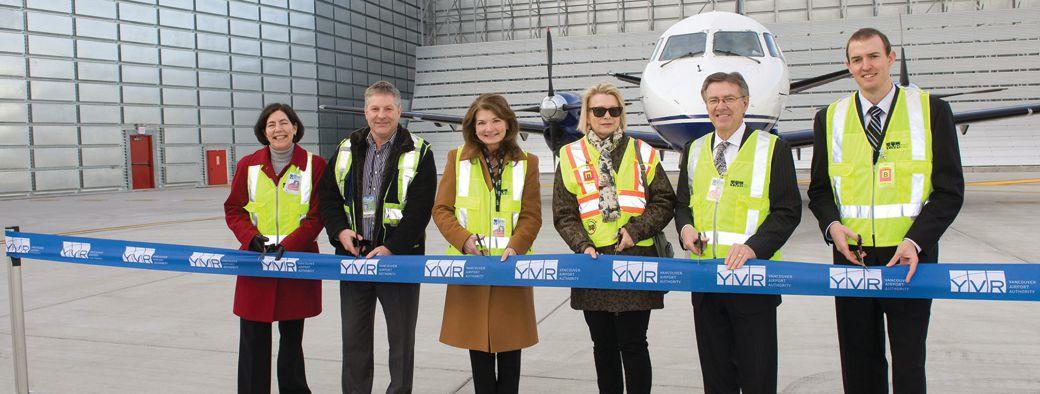
The Vancouver Airport Authority (VAA) has cut the ribbon on Canada’s first Ground Run-up Enclosure (GRE), a massive-three-sided steel facility that
will reduce noise from engine run-ups from regular aircraft maintenance by up to half.
Anne Murray, vice-president of community and environmental affairs with the VAA, said that 24-hour operations are vital for the airport, but need to be balanced with remaining a “good neighbour.”
The $12-million GRE, located adjacent to the airport’s south terminal, stands as tall as a five-storey building and effectively redirects noise up rather than out, while absorbing it with specialized panels perforated by louvred vents for aerodynamic purposes. It is the first structure of its kind at a Canadian airport, and is an integral component in YVR’s Noise Management Plan.
The GRE will provide time and fuel efficiencies to air carriers operating out of the airport’s southern sector by reducing taxiing distances and time. It will also offer environmental benefits with a glycol recovery system for de-icing of propeller aircraft during winter operations.

Mine and rig operations don’t depend on the weather. Transporting staff and hot-shot parts to the jobsite shouldn’t either. WAAS Flight Management Systems enable precision-like LPV approach procedures with lower minima that get them on-site, on time, every time.
Contact your Authorized Universal Avionics dealer or visit uasc.com to learn more.


By Rob Seaman |
In the Nov/Dec 2011 issue of Wings, we saluted different generations of aviation families, and explored the influence some multigenerational relationships have had on the aviation industry. We received much positive feedback – so much so, we felt compelled to highlight a few more industrious aviation families, specifically with a GTA connection.
As with many aspects of aviation, pilots tend to take centre stage but not all “father” influences have produced top high fliers. The engineering, design, support and AME sectors have had their share of multigenerational influences as well. Take Bill Arsenault, vice-president and co-founder of the Mid-Canada Mod Center, for instance. In business since 1997, the firm has become well known in North America for its avionics expertise, industry-first mods and STCs. Bill grew up around airplanes, while his father, Tony, was very well respected for his service and support work.
Tony Arsenault had one of those early three-digit AME licences. He started in Quebec at Nordair, then went to Canadair, and then looked after an executive Convair 580. Later in his career, he was one of the first hired at Execaire in Montreal. From there, he went to Toronto to work for Kenting Aviation and Skycharter. After Skycharter, Tony spent two years in Africa and then returned to work at Austin Airways in Timmins. He started his own overhaul company and earned what was then known as a “B” licence – with a list of endorsements a mile long.
At Toronto’s Skycharter, another father/ son combination have made their mark: Richard and Irving Shoicet. Richard now runs the show at this popular FBO since his father’s passing a few years ago. Under his leadership, the FBO and hangars so long associated with the north end GA side of YYZ have undergone upgrades and improvements.
Skycharter was founded in 1968 by Richard’s father, entrepreneur and airline transport pilot Irv Shoichet. Irv was definitely a trendsetter. By employing the most experienced people, using the latest aircraft and maintaining them to top standards, the Skycharter fleet became the largest privately owned fleet in Canada at the time,
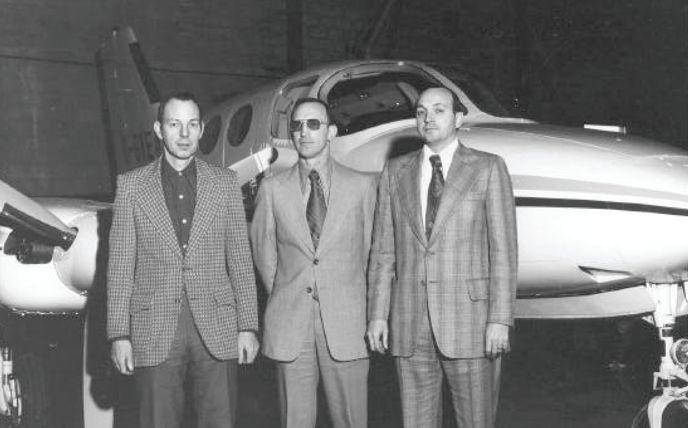
Irv was definitely a trendsetter, employing the most experienced people, using the latest aircraft and maintaining them to top standards.
numbering 11 executive jet aircraft. Irv had marketing savvy; all of the aircraft and hangars were clearly identified with clean, bright, white paint and orange banding and distinctive company logo. While this may seem common today, such was not the case when Irv was getting started.
No review of aviation pioneers in the Toronto area would be complete without mentioning Wayne and Carl Millard. The Millard name is linked to the careers of many pilots and engineers who earned their stripes flying one of Carl’s dated fleet of cargo and sometimes, passenger transports.
Today, Wayne Millard continues the family legacy. Since their exit and tear down of the iconic old facilities at the north end of YYZ, Wayne has built a new facility at the Region of Waterloo International Airport. He is setting up the new Millard Air hangar as a heavy commercial aircraft maintenance facility and plans to attract business to the Canadian market from the U.S and around the world, developing a niche for this at YKF.
Another name not to be missed is that of Leavens – Jeff in particular, who succeeded his uncle John. Leavens Aviation was
established in 1927 and over the past 84 years, has been an air carrier, an aircraft manufacturer and more recently a parts supplier and engine overhauler. Sadly, in June 2011, Jeff, Lea Anne, Heather and Bruce Leavens – the last family members involved with the business – announced the closing of their dynasty and avocation.
One last name is that of my family. I am a third-generation aviation family man. Both my grandfathers were carpenters and both worked in aviation – in the case of my maternal grandfather, it was a career choice that started with the Bristol Box Kite and concluded with Concorde. My father and mother also worked in the business and met when they were both at Bristol Aircraft. My father – an aircraft engineer in those days – also worked at Gloucester Aircraft. When we immigrated to Canada in 1958, he started with de Havilland. He later left aviation to pursue other engineering interests but remained an avid glider pilot and instructor for many years.
So for me, too, being around aircraft and involved with them has always been a natural part of life. I’m obviously in some very fine company, and it’s an honour to be part of the diverse aviation workforce in Canada – one rich in family connections. | w
Rob Seaman is a Wings writer and columnist.

Depart f from m th t e ordinar y a and d a arrive e at t thhe exttraorrdi d na n ry y wi w th h s supperior r ae a rospacce e pr prodduc u ts s from m BASF F -
T The e Chemmical a Compaanyny.
BAASF is proud to intro r duce c a b bro r ad d p por r tfol o io o of produccts f for t the A Aerros o pa p c ce e i indusstr t y:
Caabi b n Inteterior o s
St S r ruct c ural M Mater e ia i ls
Seatining g Commponennts ts
Fu F el a and n Lubricaant t Sol o ut utioons s
Co C atings g and d S Spepeci c alty P Pigme m ntts
F Flamme e Retardrdanantts a and Fire Pr P ot otec e tion o
Ot t O he her r Innno n va vation o s
At t B BASFF, w we e cr c eate chemi m st stry.

Get the free mobile app for your phone http://gettag.mobi

By David Carr |
Ten years ago, Air Canada celebrated the first anniversary of Tango, its short-lived, no-frills brand, with one-cent fares on the return portion of a roundtrip ticket. Unfortunately, the penny promotion was weighed down by user fees and other charges, leaving Robert Milton, Air Canada’s CEO to complain to this magazine that air transport was the only consumer business blocked from giving free samples.
Ever since, Canadian air transport correctly shifted course to a user pay system, which included local management of airports and the groundbreaking sale of NAV CANADA, the air navigation system (see, “Controlling their destiny,” pg. 43). Airlines have been accused of deception – or worse – for failing to roll third-party charges and taxes in advertised fares, either in print or online.
In the murky world of airline pricing, the current half-loaf approach to fare advertising is frustrating. How murky are the waters right now? For example, planning a trip to England this spring on Air Transat, the added charges are slightly higher or lower than the advertised fare, depending on the day of departure.
But consumer advocates are confusing frustration with transparency. In a Globe and Mail column, financial advisor Preet Banerjee likens the current airline pricing model to buying gasoline (another commodity larded with layers of taxation. For example, if the price per litre were 50 per cent higher at the cash register, than what is posted on roadside signage? It is flawed logic. Airlines do not wait until after the transaction to bulk up the ticket with additional charges. It’s more like the add-on of sales taxes at the point of purchase, except on a more eye-popping scale.
Four years after the government first announced it would require airlines to advertise the full price of a ticket, it is unlikely that there is a consumer who doesn’t see a posted airfare and automatically multiply by two (or more if the fare is deeply discounted).
Steve Fletcher, minister of state for transport, has dusted off the “all-in-one” airfare advertising pledge, declaring that the government will enhance “consumer protection while promoting fair competition” by ensuring “truth in [airline] pricing and
Added charges are an immovable lump that distorts the price an airline charges to deliver a product.
advertising” will occur by the end of 2012, when Canadian airlines will be required to advertise the full prices of airfares.
But putting to one side the richness of an elected politician championing truth in advertising, it is not clear how rolling every tax or user fee into the advertised fare makes airline pricing more transparent. It will certainly not lower fares.
The portion of the fare airlines have traditionally resisted putting in the shop window includes NAV CANADA and airport improvement fees, the air traveller security charge, taxes in addition to the HST and GST, and charges levied by foreign governments on international flights. These charges can gobble up between 30 and 70 per cent of the cost of a ticket depending on the route and point of origin according to a study conducted by York University’s Schulich School of Business.
Whereas airline pricing is fluid depending on the hour, day and time of year travelled, added charges are an immovable lump that distorts the price an airline charges to deliver a product. Where the government has a case, is the addition of fuel surcharges,
which a friend once likened to “chipping in for the gas.” Europe and the U.S. have already moved to regulate all-in pricing, and Canadian airlines have already jumped ahead of the government’s timetable. Will this be enough to satisfy government regulators, or will the Canadian Transport Agency (CTA) go deeper into the weeds by insisting, among other things, that an ancillary service such as baggage checkin fees be included in the posted fare?
The solution was as simple as airlines being more upfront by advertising the full fare alongside a highly visible box that separates charges the industry has no control over. The question is, why now?
If the Harper government is sincere in protecting air travellers and promoting competition, it is clearly working from the bottom of the pile.
Instead of grandstanding, the government should focus on making Canadian air transport more competitive by reducing airport rents and reversing the drain of an estimated 2.2 million Canadians who travel to U.S. border airports every year to take advantage of cheaper flights. But it won’t, because it doesn’t cost anything to kick the airline industry yet again. | w
David Carr is a Wings writer and columnist.

| By Brian Dunn
expect more bang for
David Neeleman, the man behind the launch of JetBlue Airways, once remarked that people who invest in aviation are “the biggest suckers in the world,” while former American Airlines president/CEO Robert Crandall called the airline industry “a nasty, rotten business.”
Well, the proof is in the pudding. During the past several years in Canada alone, more than 40 carriers have come and gone, including Wardair, Canada 3000, Canadian Airlines International, Intair, Jetsgo, Skyservice, Zip and Zoom.
But that didn’t deter Mark Williams from launching Sunwing Airlines in November 2005, after working for three of the defunct carriers – Wardair, Canadian and most recently, Skyservice, where he was president and chief operating officer. He left before the company went under in March 2010. Given the checkered history of the Canadian aviation sector, why did Williams even bother? After all, he’s often flying the same routes as some of his competitors.
“Starting a stand-alone airline today is not a recipe for success,” he says. “But back in 2005, tour operator Sunwing Vacations was doing well enough that I suggested to them they should start their own airline instead of getting a third party to fly their customers. And working with a tour operator offers tremendous synergies.”
Sunwing Vacations’ in-house airline began with two Boeing 737-800s to operate scheduled and charter flights from Canada to the U.S., Mexico, the Caribbean, Central and South America as well as domestic flights in the summer. In September 2009, Sunwing merged with Signature Vacations and SellOffVacations, Canada’s largest discount travel retailer, and signed a partnership deal with TUI Travel plc, which owns 49 per cent of the company. The remaining 51 per cent is privately held in Canada.
In December 2010, parent company Sunwing Travel Group acquired Caribbean Nexus Tours, one of the leading ground handlers and tour operators in the Dominican Republic and Mexico, giving more destination tour choices and flexibility to the Sunwing Group.
Last year, they arranged a wet lease deal with EuroAtlantic Airways to acquire two Boeing 767-300ERs for flights from

“We offer five-star service at three-star prices. We believe a vacation should start at the airport.”
Toronto to Lisbon, London, Paris, Rome and Porto as well as Montreal to Paris. Sunwing also operated service to Amsterdam in conjunction with Netherlandsbased ArkeFly. Today, Sunwing operates 23 leased aircraft and flies to 44 international destinations from 31 Canadian gateways, with North Bay the latest addition. It also added service to Nassau, La Ceiba in Honduras, Belize, Aruba and Saint-Martin this winter and will add Barcelona and Glasgow this summer, when it will also shift from Charles de Gaulle airport in Paris to Orly.
The airline is offering service to Europe again this summer using the two 767s, because it was pleased with the experience. “It’s a big commitment getting into widebodies,” explains Williams. “We tested the waters last summer and we’re comfortable with the results.” Many of its 737-800s and pilots used in winter are sent to Europe in the summer where they are leased by other operators.
What sets Sunwing apart from the competition? “We offer five-star service at three-star prices,” says Williams. “We believe a vacation should start at the
airport. We offer hot meals, free wine, free headsets and hot towels. We don’t try to nickel and dime our customers. We’re trying to emulate the good parts of Wardair.” (which provided good service at lower-than-average prices before being acquired by Canadian in 1989)
Sunwing’s load factors are over 90 per cent and it competes successfully against other Canadian carriers in the popular sun destination market. Hence Air Canada’s desire to start a low-cost model which is meeting resistance from the airline’s unions.
“We carried a million round-trip passengers in fiscal 2010-2011 (ended Sept 30) and we expect to carry 1.25 million passengers in 2011-2012,” Williams predicts. Sunwing is profitable, he says, and made a positive contribution to TUI’s bottom line.
Sunwing has been singled out by both Air Transat and Air Canada for hiring foreign pilots under a federal program at the expense of Canadian pilots.
“Last winter, we operated 19 aircraft. In the summer, we’re down to four. It’s difficult to hire part-time pilots in Canada for three months or less. In 2005, we started with 28 full-time pilots. Today, we’re up to 150.” | w
Brian Dunn is a Wings writer and columnist.

George Petsikas replenishing as NACC boss
Tucked away in a building behind Ottawa City Hall, sharing the floor with the Canadian Airports Council and the Tourism Industry Association of Canada (TIAC), is George Petsikas’s office. Grabbing a quick lunch between meetings, the president of the National Airlines Council of Canada (NACC) talked about the advocacy group.
A senior director of government and industry affairs at Air Transat, Petsikas trained at McGill University in aviation law. When asked about his job, he laughed: “I am able to combine my two interests – which are arguing and aviation – I mean law and aviation!”
In 2008, the four largest capacity airlines in Canada – Air Canada, Westjet, Air Transat and Jazz – withdrew from the Air Transport Association of Canada (ATAC) to form the NACC. When asked why, Petsikas explained, “The NACC was formed with the strict focus on major airline issues, both domestic and international. ATAC has a very wide-ranging membership that is its strength to a certain point, but also as far as we were concerned, tended to deviate from what we considered to be critical to issues that were front and centre in our work like resource allocation. In the U.S., you have more than one airline association and we felt we could do something similar in Canada strictly devoted to large air carrier issues.”
The NACC’s three pillars are safety, cost competitiveness and environment (sustainability). “This is what we share and work together for – but we are competitors,” he emphasized. “We have strict competition law guidelines not to discuss issues of commercial interest or market development like pricing – that is absolutely taboo. We do, however, share information on areas that are to the benefit of everybody – you don’t want to compete, for example, on safety. On cost competitiveness, we all share an interest with respect to ensuring a regulatory tax infrastructure and cost framework that allows us to keep a cap on costs. This translates into lower fares for our customers. These infrastructure costs are things like airport rents which has been a bugaboo for years, the airport security charge – one of the highest in the world – and fuel excise tax.”
The effects of these lead to the phenomenon that Petsikas called “cross border

I am able to combine my two interests – which are arguing and aviation –I mean law and aviation!
leakage.” “You have almost five million Canadians who annually make the decision to not travel on Canadian carriers from Canadian airports and would rather go south of the border to Plattsburgh, Bellingham and Buffalo. They say, ‘Hey, this is a better deal and we’ll fly from here.’ Why is that? Well, because those U.S. airports have cheaper operating costs because of the different policies that are applied to them.
Petsikas maintains that the U.S. and other countries view air transport as a major economic engine, as a facilitator of broader economic activity. “And if you have a sound competitive air transport system, you’ve got more productivity, goods going to market faster, cheaper imports, and of course you connect the country to the rest of the world, which is what as the major airlines in Canada we do,” he says. “To that end, we’ve produced a major study, which is on our website www. airlinecouncil.ca and which underlines the impact of the four NACC carriers on the Canadian economy.”
In 2010, the four current member airlines carried in excess of 50 million passengers and directly employed almost 43,000 people. Their total revenues exceeded $17 billion and their total expenditures in Canada
By Peter Pigott |
were slightly less than $15 billion. Their estimated total economic output impact was $27.4 billion, and they created 113,300 jobs.
“Sound public policy does not tax economic facilitators,” said Petsikas, “such as the air carriers in this country. You do what you can to keep their costs low so that they can produce more. You prime the engine by keeping the cost base low and then the ‘engine’ will produce more travellers, more tourists – tourism is a huge business in Canada.
Petsikas had recently been interviewed in the media with regard to the airlines having to quote full fare, a government regulation that will be effective as of January 2012. “The full fare quote,” he said, “has addressed a number of our concerns. When it was first debated, we wanted to have a level playing field because if we as Canadian carriers were subject to a certain price on a segment and the U.S. or EU competitor wasn’t, then obviously it skews the optics as to whose has the cheaper fare. For the consumer, the cheaper fare isn’t required to include the taxes that are high enough to begin with. The government will be developing the regulatory framework over the next nine to 12 months and the NACC will be front and centre with our input.”
With a president like Petsikas, there is no doubt of that. | w
Peter
Pigott is a Wings writer and columnist.

By david olsen wiTH files fRoM MaTT niCHolls

wAas 2011 a bad year for Canadian aviation and is the level of aviation safety in this country stagnating? Is our regulatory system working at the top of its
surprising these issues are coming to the forefront.
In the latest International Civil Aviation Organization (ICAO) report “State of Global Aviation Safety – 2011” released last December, ICAO secretary general Raymond Benjamin stressed, “we will need to do more to maintain this [impressive] record” [of safety]. The ICAO report also clearly outlines that the state of global aviation is excellent, and that the global accident rate has essentially remained unchanged in the past 10 years.
However, statistics and trends are only part of the story. In accidents and incidents, there is always a “why” the incident occurred in the first place – indeed multiple “whys.” For example, the Transportation Safety Board (TSB) January 2012 progress report of the investigation into the fatal First Air Flight 6560 Boeing 737 accident at Resolute Bay on Aug. 11 last year, classified the accident as Controlled Flight Into Terrain (CFIT). TSB was pursuing “several concurrent avenues of investigation, to understand why the aircraft struck terrain one nautical mile east of the runway.” Another important question: are we taking the right approach to regulations in Canada and specifically, can we do better? Do other countries have more efficient systems?
The CBC investigated these and other pressing questions in a compelling piece last November, exploring the importance of safety management systems (SMS) and the responsibility for compliance with regulations. Surprisingly, director general of civil aviation (DGCA) Martin Eley said, “it’s not our job to make sure you’re compliant.”
a dangerous experiment with the lives of Canadian air passengers.”
The CBC charged TC with insufficient monitoring/audit and enforcement and improper use of SMS. But the key point is TC did not introduce SMS because it felt like it – it is an international obligation. The issue is not that TC, in a non-political regulator role, ignores safety. It does not –and in fact, as Eley told Wings, Canada has been a world leader in the adoption of safety regulation, SMS and more.
“Canada’s safety record is among the best in the world, and TC is committed to maintaining and improving aviation safety,” Eley said. “TC is implementing and strengthening a civil aviation performance management regimen that includes a national risk-based plan and inspection schedule that is in keeping with the plan, inspector training performance monitoring and quality assurance.”
game?
Intriguing questions all and given the way 2012 began with the fatal crash of a Keystone Air Service Piper PA-31 at North Spirit Lake on Jan. 10, followed shortly by a fatal RCMP helicopter crash near Chilliwack, B.C., the next week, it’s not
This response signalled what appears to be a fundamental shift in the role of our national regulator, at a time when the government was under fire from many sources for what was perceived as a cutback on safety oversight. Critics pointed to cuts in the number of TC inspectors just when accidents in northern aviation, float plane and helicopter operations appeared to be increasing. One newspaper even accused the government of “conducting
But the question remains, as a government department, controlled by the minister and political party forming the government, can TC be non-political – or is it an instrument of the government of the day with all that that implies? And if the current political policy is to cut expenditures, cuts may bite into national and international statutory duties and functions of the safety regulation branches of TC. Should TC be re-established as a statutory authority for civil aviation safety at arms length from the government and which, like the TSB, reports to Parliament and not solely to the government of the day? These general principles are behind the civil aviation authorities of some states, particularly Australia, the U.K. and other Commonwealth countries (see “Beyond our borders,” page 22).
In May of last year, the Air Transport Association of Canada (ATAC) presented an action plan at its symposium on “Transport Canada Level of Service” to deal with just these questions. The event brought together 10 national and regional associations to explore how TC could improve service to industry. The group developed an action plan with 21 recommendations on

“Our industry and the travelling public are economically disadvantaged because the regulatory process is inefficient, expensive, overly bureaucratic.”
– Merlin Preuss, VP government and regulatory affairs, Canadian Business Aviation Association
communications, delegation and targeted service improvement. The plan was presented to the minister of transport in October last year, and according to ATAC president/CEO John McKenna, is currently waiting for a date to discuss.
One of the key findings of the report was that, in its current incarnation, TC must be all things to all people – and this model is difficult to pull off. TC covers every facet of transport –even pipelines – and is on one hand an instrument of government political policy (which can be notoriously fickle) while on the other, the guardian of public safety, with national and international obligations. It’s hard to do both. The question is, how can we organize our safety assessment, monitoring and enforcement more effectively?
Dennis Lyons, president of the Manitoba Aviation Council (MAC), maintains that the current regulatory system in Canada is not broken; however
its processes are burdensome and confrontational, instead of collaborative. He recognizes that some in TC are working to improve on these shortcomings. “Our safety rate is still one of the best in the world, so even with the bad press, industry and TC are doing a lot right,” Lyon says.
Merlin Preuss, vice-president government and regulatory affairs for the Canadian Business Aviation Association (CBAA), has a unique perspective on TC’s operations having served as DGCA for more than seven years prior to joining CBAA. He highlights the aviation safety record, documented by ICAO and TSB, as confirmation that industry, the travelling public and Canada’s trading partners need have no concerns about TC’s safety regulatory process.
“However, our industry and the travelling public are economically disadvantaged because the regulatory process is inefficient, expensive, overly bureaucratic, too prescriptive and unable to keep up with technological change and risk management innovations,” he says. As a result, Preuss notes, there are ongoing compliance costs, loss of competitive advantage and lost growth opportunities.
McKenna agrees and adds that part of the problem with TC is organizational: discrepancies that exist between TC regional operational units and national headquarters in Ottawa. The regional operations are the direct link with industry, supplying most of the services, while Ottawa establishes standards, guidelines and policies.
McKenna also suggests a human resources shortage, which causes backlogs of work, reduces the required level of service to industry and continues to be a major hindrance. “TC’s structure and culture make it difficult, if not impossible, to maximize use of existing human resources and until things change, progress will be very slow.”
Captain Bradley Small, Air Line Pilots Association (ALPA) vice-president and International Federation of Airline Pilots’ Association (IFALPA) director, is concerned by the inordinate time taken to enact recommendations of the TSB
into improved regulations. “For example, take the RESA recommendations stemming from TSB’s investigation of the Air France Airbus A340 crash on Aug. 2, 2005 runway over-run in Toronto,” Small says. “Six years later, this recommendation is finally being processed into regulations.” Furthermore, ALPA is calling for “archaic flight time and duty time regulations for aircrews to be revamped” while industry is still trying to have science-based regulations approved.
Eley admits that TC does have a problem with processes on a number of issues, but is working to find a workable solution for industry – particularly when it comes to TSB investigations. “Transport Canada is working hard at streamlining internal processes and redefining its
regulatory governance so that regulatory amendments resulting from a TSB recommendation can be implemented more quickly,” he says. “A modernized CARAC (Canadian Aviation Regulatory Advisor Council) process will also contribute to implementing these recommendations sooner.”
While industry experts contacted by Wings agree Canada has one of the safest, if not the safest operating environment in the world, they all contend that the nation’s regulating body isn’t so much as broken, as it is dysfunctional – and in its current state, is not producing the desired results. Preuss maintains the safety and economic benefits of the IMS (TC’s civil aviation integrated management system)
in 2010, icao recorded 121 scheduled commercial flight accidents compared to 113 in 2009 – a marginal rate increase. and while overall fatalities in 2010 were below those in 2005 and 2006, there was an increase from 2007 to 2010.
Preliminary 2011 statistics published by TsB canada in January 2012 show that in general, after the accident “blips” from 2008 to 2010, 2011 was generally a good year – things did not get worse. The bad news is, helicopter accidents did increase. The other issue is public perception. in our instant society with instant communications, video and news reports can create in the public mind a perception that all is not well, even if the dry statistics show otherwise.
statistics can also be confusing – and in some cases, misleading. The aviation safety network (asn, a service of the Flight safety Foundation) statistics to Dec. 31 2011 show global multi-engine airliner fatal accidents and total fatalities reflect a downward trend, and that for total worldwide fatalities, 2011 was the second “safest” year since 1945 – the third-safest year as noted by number of accidents. For 2011, asn recorded 28 fatal airliner accidents, resulting in 521 fatalities in the air and on the ground: lower than the 10-year average of 764 fatalities.
But this information comes with caveats. a multiengine airliner is defined by asn as one where the basic model has been certified for carrying 13 or more passengers, which means that many aircraft used in demanding environments in the arctic and sub-arctic, africa, south america and asia are not included. and a multi-engine airliner may or may not be an icao “scheduled commercial flight.” TsB canada, on the other hand, has a clearly defined set of parameters for its statistics, which are readily available on its website (http://www. tsb.gc.ca/eng/).
and, more critically, SMS have yet to be realized. Nevertheless, he points out that these systems indicate that, “TCCA is uniquely situated to make rapid decisions that could provide economic benefits to industry and the traveling public while improving an enviable safety performance.”
McKenna reiterates that inadequate HR planning, budget cuts and attrition have resulted in industry frustration with delays in getting even basic paperwork processed. Lyons agrees, adding that MAC has waited several months to meet the minister. MAC and other industry groups, including organized labour, have identified the dysfunctionality to the Minister and suggested a TC Industry Advisory Council.
ALPA’s Small suggests the role of Transport Minister should be just that – a dedicated minister to focus on transport issues. The current position is Minister of Transport, Infrastructure and Communities.
“Far too often, the Minister (Denis Lebel) is too busy to meet on transport issues because of the demands of infrastructure and communities,” says Small.
Eley disagrees and notes the diverse nature of the position is accurately reflected in the current portfolio. “Transportation systems, infrastructure and communities are intrinsically linked,” he argues. “The Minster of Transportation, Infrastructure and Communities, supported by Transport Canada and Infrastructure Canada, serves Canadians through the promotion of safe, secure, efficient and environmentally sustainable transportation systems and public infrastructure in Canada.”
Another issue TC faces, say industry experts, is organizational – it is hindered by the current management structure in its goal of meeting the needs of the aviation industry, the travelling public and employees (for
example, pilots, AMEs). Lyons suggests that although the current system relies on risk management and level of service systems, privately operated aircraft and those who maintain them outside the AMO system are never audited for compliance, obviously a real concern.
“The level of service model doesn’t work,” he says, “nor is it enforced by TC, while every company appears to have major delays with TC for service delivery.”
Another service concern, notes McKenna, is the fact TC rarely interfaces with passengers – something critics maintain is highly worthwhile and in many ways, is a missed opportunity. The U.K.’s Civil Aviation Authority (CAA, see “Beyond our borders”) has a consumer protection group and recently launched a dedicated website portal for passenger advice and support.
From his vantage point, Preuss maintains TC’s current organization and management
“Canada’s safety record is among the best in the world, and TC is committed to maintaining and improving aviation safety.”
– Transport Canada director general of civil aviation, Martin Eley

“Our safety rate is still one of the best in the world, so even with the bad press, industry and TC are doing a lot right.”
– Dennis Lyons, president of the Manitoba Aviation Council
structure leads to confusion and inequities in the marketplace and extra overhead costs to government and taxpayers. He stresses that regulatory standardization across the market is essential for a level economic playing field and productive working relationships between regulators and those regulated.
“Except for the oversight of, and service to, the large airlines,” he says, “Canada’s aviation safety program is delivered by five regions, and aviation safety officials report in-line to the regional directors general.”
Preuss adds that, although on paper TC headquarters has authority to ensure program activities adhere to national standards, in reality, without a clear line of authority over regional officials, it is very difficult and often impossible to do. The result is that standardization issues often force industry to go “region shopping” to find the most efficient way to get necessary approvals and authorizations.
To ALPA, it’s obvious that with present fiscal restraints and staff levels, TC is barely keeping its head above water, “having to give its attention primarily to
crisis issues, to the detriment of less demanding but nevertheless required actions to improve safety,” says Small.
Building a new mousetrap So, could there be a better way to regulate, monitor and improve aviation safety in the future – and if so, how? Lyons offers an emphatic “yes.” He contends that if TC and industry met to boldly address the issues, a more a viable system could be designed and implemented.
“This new system would very likely look different from what we have today, and if done properly, I am sure there would be some services delivered by other agencies allowing TC to focus on oversight of all the industry.”
Coming together on issues surrounding SMS is also paramount, says Small. The SMS program is based on the principle that operators and employees are best placed to determine their risks and should be able to fix safety deficiencies before they become accidents. “However, an important oversight role for the regulator is to ensure that operators have an effective SMS program, and ALPA feels that the aviation industry is so varied and complex that a single focal point for the regulatory system must remain,” he says.
Preuss maintains TC should reorganize its model based on mode instead of region. “[With this model] you would end up with modal assistant deputy ministers (ADMs) instead of one safety and security ADM. The regional structure would be left to support personnel in the field, providing a focus for politically driven regional issues.” Preuss adds that while creating a civil aviation authority has some appeal, it could be an expensive proposition for industry, and favours making existing processes more efficient and effective, not making change for change sake.
McKenna agrees, particularly when it comes to SMS. “SMS was intended to make operators more responsible and accountable for safety, and industry has gone a long way to embrace that culture,” he says.
McKenna identifies the problem that Transport Canada regional operational units either
resist changing from their traditional role to the new SMS supervisory mandate, or they are insufficiently trained. “Thus industry is asked to accept the new regulatory supervision and inspections, but TC inspectors are often unclear as to their modified mandate. They tell carriers that their Quality Assurance Program doesn’t meet requirements but they won’t say what needs correcting – consequently, the previous relationship, where TC assisted carriers to improve safety, has become one of strict enforcement.”
Industry experts Wings spoke with suggest actions needed to improve the safety regulation model include better communication, delegation and
cooperation, including sharing lessons learned during audits. Preuss also places high importance on reducing what appears to be a risk-averse mentality in TC, with performance-based regulations and risk management based SMS solutions needed to replace prescriptive regulations to mitigate safety risks. Preuss echoes McKenna in calling for improved delegation to industry, to reduce delays for important and costly issues.
“We’re not talking about delegating responsibility, but administrative processes such as temporary approvals of additional aircraft on an operating certificate, or delegation of authority to host professional pilot exams,” says McKenna.
when it comes to regulation around the globe, there isn’t a one-size-fits-all approach. so, how do some of canada’s icao partners regulate the skies? are their models better and offer solutions to enhance the canadian standard?
in the u s., the Federal aviation administration (Faa) has great strengths, but just as many weaknesses note its critics, including trying to fulfil a dual role of promoting and regulating u s. aviation. in the u k., the civil aviation authority (caa) has a sound formula that seems to work, as a number of countries have taken a similar route, such as australia (where the civil aviation safety authority of australia is an independent statutory authority), new zealand and others.
The caa, is a public corporation, established by British Parliament in 1972 as an independent specialist aviation regulator. it boasts a unique situation in that it receives no government funding and is required to be self-supporting. it also reports to Parliament rather than the government of the day, although the minister can give direction on certain matters.
important information can also be gleaned from annual reports. Transport canada presents an annual report to the governor general; and the Minister of Transport has a statutory responsibility to table in Parliament each year a brief overview of the state of transport. every five years, an expanded, more comprehensive review is tabled as per section 52 of the canada Transportation act (1996), as amended June 2007. But brief is the operative word. The 2010 report on canadian aviation and aviation safety amounted to just three-and-a-half pages. compare this with the 2011 report of the u k.’s caa at 110 pages – and the 2010/2011 report of the civil aviation safety authority (casa) of australia at 192 pages. Perhaps, aLPa’s view that canada should look around the globe and glean best practice deserves consideration.
Lyons pinpoints fixing CARAC as a key issue, citing the enactment of regulations from many years ago being enacted, which contradict newer NPA’s still in the queue (for example, TAWS/GPWS, while new aircraft are being built with EGPWS). ALPA’s Small agrees and details three other key actions: Accelerate the regulator’s response time and decisionmaking process for changes that do not imply or require regulatory change. Re-vamp the regulatory change presently effected through the CARAC process. Streamline CARAC attendance to stakeholders who really need to be there. Keep the group as small as possible. When a Notice of Proposed Amendment (NPA) is approved by the Civil Aviation Regulatory Committee (CARC), it often becomes moribund or dies before going to Gazette I. This needs to be fixed.
Such suggestions would
certainly help, and Eley contends changes are in the works to help streamline TC’s processes. “Transport Canada works in partnership with other international civil aviation authorities on topics of interest regarding SMS requirements and implementation activities,” he says. “The department benefits from collaboration and sharing of lessons learned and best practices. Looking ahead, TC is taking action to:
Improve the responsiveness of the rulemaking process. Increase the effectiveness of system-based surveillance. Introduce internal quality assurance assessments, as part of the Integrated Management System (IMS).
Complete the National Organization Transition Implementation Project (NOTIP)
“Once completed, these initiatives will collectively define how Transport Canada’s Civil Aviation Directorate will operate in the years to come,” says Eley.
Changes like these can’t come soon enough, notes McKenna, who suggests that Canada, “once having inspired many of the changes promoted by ICAO, is now lagging behind because of structural inefficiency and cultural resistance to ideas it came up with a few years ago. Other jurisdictions are pushing forward to adapt to the new reality.”
Preuss concurs, noting that the government is slow to use what is already available to improve safety performance and reduce regulatory and cost burdens. Small has a practical suggestion – visit other agencies, discuss how each manages regulatory issues and changes, then take the best methods of each and tailor that to Canadian needs.
“Canadians are resourceful people,” he says, “and with determination to improve what is already a relatively healthy system, they can create the regulatory system that they need and deserve.” | W
“TC’s structure and culture make it difficult, if not impossible, to maximize use of existing human resources.”
– John McKenna, president/CEO, Air Transport Association of Canada
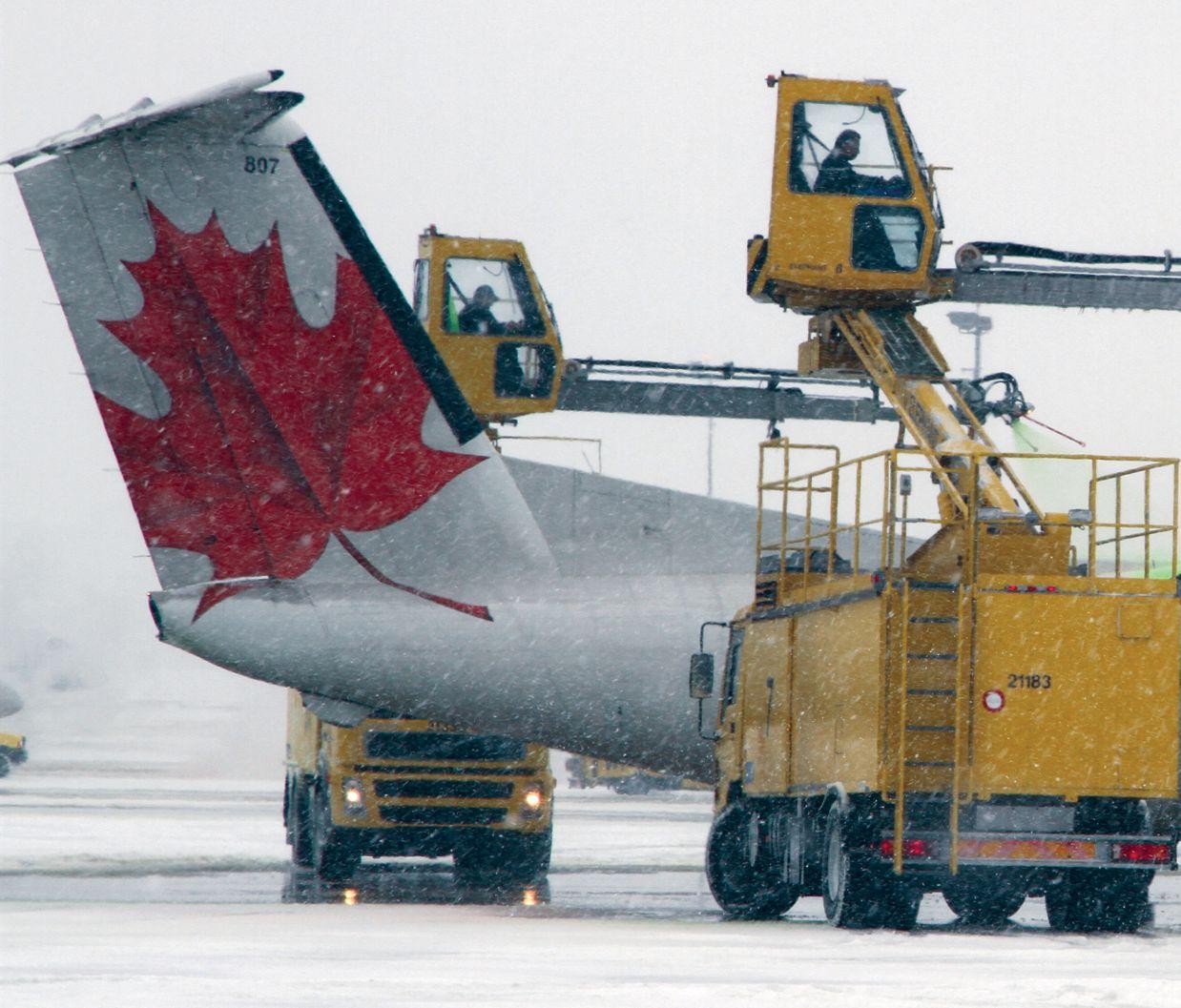
opeRaTing aiRCRafT in THe winTeR pResenTs uniQue CHallenges
By peTeR pigoTT
in a country “blessed” with frigid winter conditions for a good portion of the year, it’s not surprising aviation firms and universities studying the effects of winter conditions on aircraft have plenty of examples to work with.
And as Dr. Michael W. Holm, the technical officer, ICAO Meteorology Division aptly noted at the recent Winter Ops 2011
conference, most of the research reveals that “snow and planes don’t mix.” Holm might have continued that statement to note that the combination of ice and planes could be fatal.
Sponsored by the Flight Safety Division (FSD) of the Air Canada Pilots Association (ACPA), the International Winter Operations Conference was held last Oct. 5-6 in Montreal. Under the theme of “Safety is No Secret,” some 250 delegates from 18 countries came together to share their expertise in operating safely in winter conditions.
Led by two eminently qualified pilots, ACPA president captain Paul Strachan and FSD chairman captain Barry
Wiszniowski, the conference brought together experts from around the world – aircraft and power plant manufacturers, pilots, air traffic controllers, de-icing service providers and safety investigators – to share their experience in safe winter operations, specifically de-icing.
The presentations ranged from operations in active frost conditions, to implementing takeoff and landing performance assessments, to ice in the fuel, to cold weather testing – all interspersed with panel discussions. And while all sessions were informative and noteworthy, none could match the immensity of author Allan J. McDonald’s presentation from his book Truth, Lies and O-Rings: Inside the
Space Shuttle Challenger Disaster, which opened the conference. More than whistle blowing on the aerospace industry, it was a warning on lessons still unlearned on de-icing.
“Over the past 25 years, a number of fatal aircraft accidents have been attributed in part, to ice formation on the ground, prior to takeoff,” said Arlene Beisswenger, a consultant at the Anti-icing Materials International Laboratory at the Université du Québec à Chicoutimi. And indeed, one could not escape the seminal tragedy that focused attention on ice and snow: the Dryden air crash.
On March 10, 1989, an Air Ontario Fokker F-28 Mk 1000 with 65 passengers
and crew of three crashed off the end of the runway at Dryden, Ont. The captain had not done a proper “walk-around” or asked for de-icing, and by the time the aircraft took off, the half inch of wet snow on the wings had turned into opaque ice. Twenty-one passengers and three crew members were killed.
Occurring soon after the Arrow Air crash at Gander (256 U.S. military personnel were killed), the Dryden tragedy led to the scrapping of the investigating agency the Canadian Aviation Safety Board and the appointing of a Commission of Inquiry under the Honorable Virgil Moshansky. His report – and specifically the findings regarding ice build-up on the wings – led
With winter operations, a pilot’s focus of attention shifts to runway conditions, and stopping criteria is paramount.
to a better technical understanding of this phenomenon, and made Canada a world leader today in preventive measures.
“The de-icing industry has come a long way since the Dryden incident,” Aeromag 2000’s director Denis Gordon said. “Regulation changed from inspection to training. People don’t realize all the work and effort that is now done behind the scene – the testing of all glycol products, holdover time charts that are revised annually, standards and procedures that are updated prior to the next de-icing season.”
Meeting annually, the SAE G12 Aircraft Ground De-icing Committee of de-icing experts, aircraft manufacturers and regulators from around the world, address
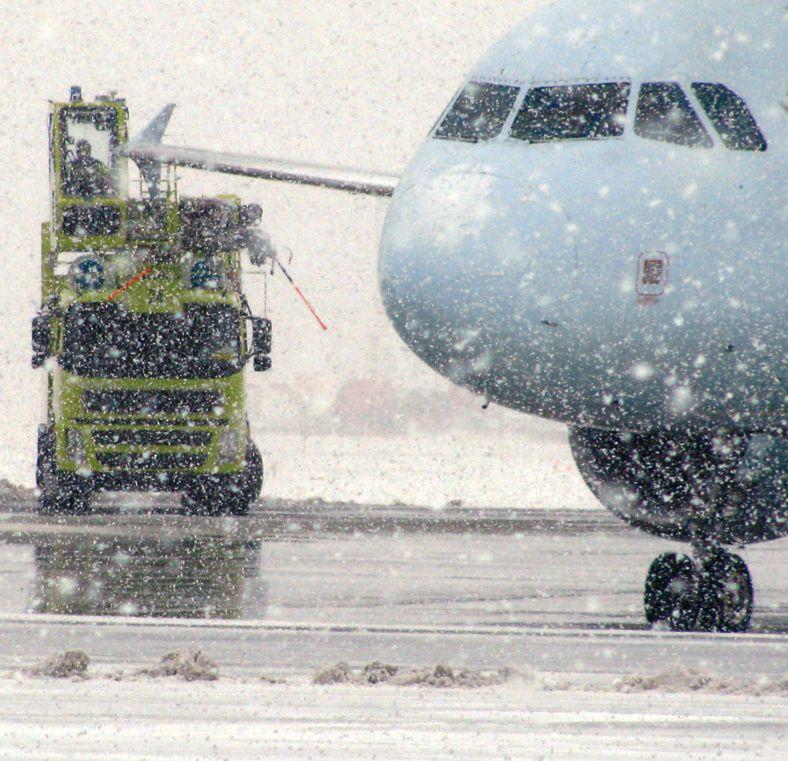
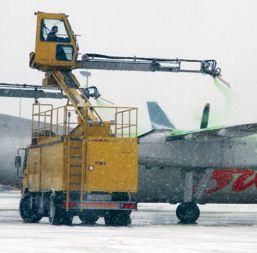
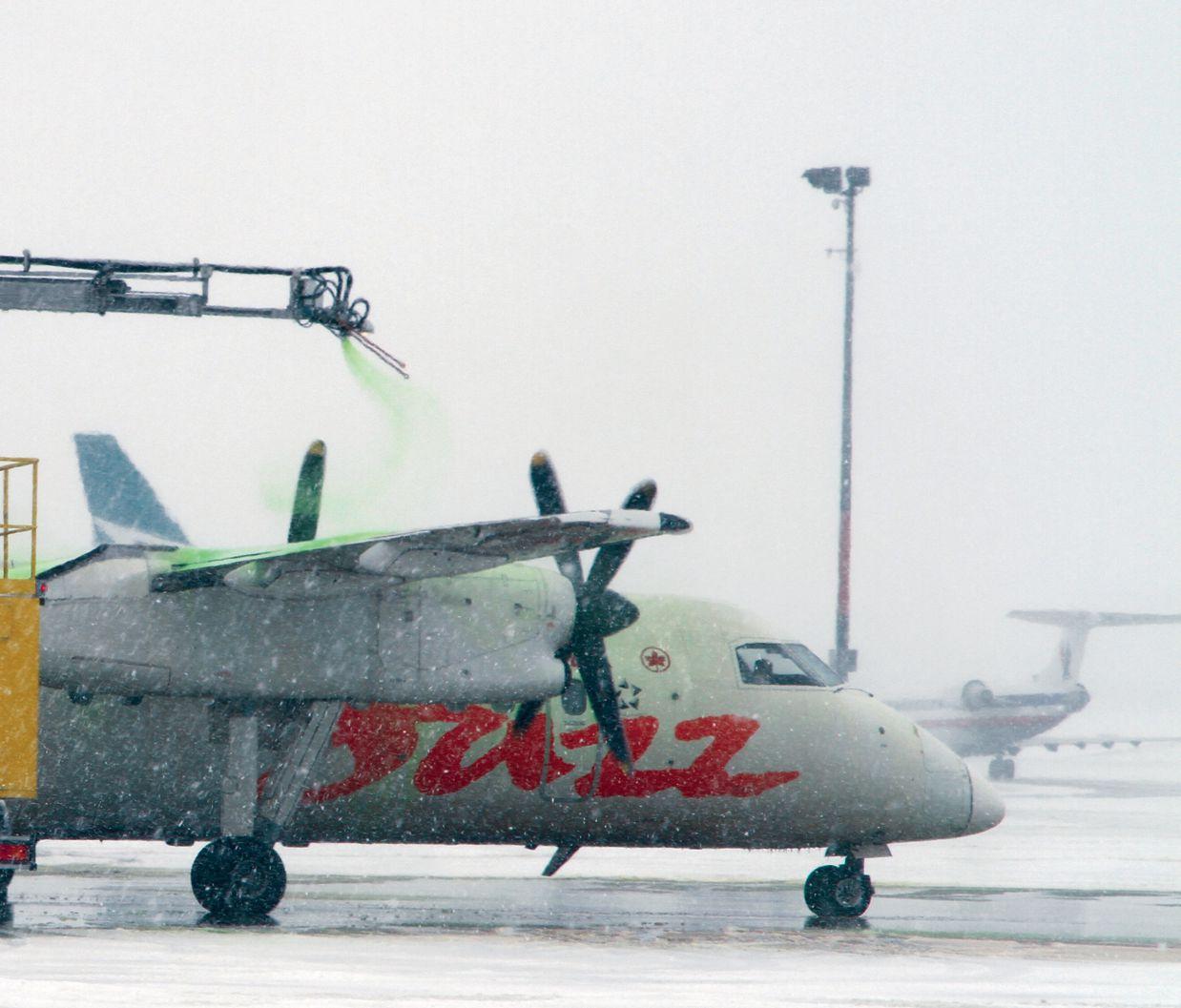
a vestergaard Beta de-icing vehicle about to commence activities in a heavy snow event.
all areas of ground de-icing procedures. “What is good about a committee like the G12,” Gordon said, “is the more information we have available, the better we are able to train the people that are involved in the day-to-day de-icing operations.”
leading the way
Canada is fortunate to have two academic institutions that are world leaders in the science of de-icing. Established in 1994, the Anti-Icing Materials International Laboratory (AMIL) at the Université du Québec à Chicoutimi studies and simulates ice formation. AMIL is the only laboratory in the world, Beisswenger said, that is accredited to qualify de-icing and anti-icing fluids used to protect airplanes prior to takeoff for icing protection and aerodynamic acceptance. Clients range from Dow Chemical Company to China’s Beijing Aviation.

AMIL operates five cold chambers capable of simulating freezing rain, drizzle and fog, frost, snow and ice pellets. To simulate medium and strong winds, or to reproduce aircraft flight conditions,


on Jan. 21, 1995, another tragic aviation event occurred on canadian soil that ultimately shaped the way current de-icing activities are performed in canada and on the global scale.
on this day, a Boeing 747-400, registration cnRga, operated by Royal air Maroc, was preparing for a scheduled flight from Mirabel international airport (YMX), Que., to casablanca, Morocco, with a stop in new York city. The aircraft was parked in the de-icing centre at the airport. The four engines were running during the de-icing operation. The flight crew heard “dégivrage terminé” (de-icing completed), and the captain asked the co-pilot to inform the apron controller that the aircraft was ready to taxi. Taxi instructions were issued. The aircraft started to move forward and overturned the two de-icing vehicles that were still in front of the aircraft’s horizontal stabilizers. The two vehicle drivers sustained minor injuries; the three occupants of the cherry-pickers received fatal injuries.
The Transportation safety Board of canada determined that the flight crew started to taxi the aircraft before its perimeter was clear, following confusion
in the radio communications. The following factors contributed to the accident:
• a lack of de-icing procedures within Royal air Maroc
• non-compliance with procedures on the part of the canadian airlines international Ltd. de-icing crew
• inadequate or inappropriate communications equipment
• incomplete training of snowman 1 (the chief de-icing attendant)
• a regulatory framework less demanding of foreign air carriers than of canadian carriers
• a lack of operational supervision
• a lack of adherence to radio protocol
The fallout of the Mirabel accident resulted in widespread changes on the global scale to de-icing facility procedures, engines-on de-icing procedures, communication and radio protocols. even today, the Mirabel accident is cited to reinforce the need for visual hold procedures to enhance verbal communication procedures in engines-on de-icing operations.

or in-cloud icing and freezing fog, AMIL uses two low-speed wind tunnels that can be operated at subfreezing temperatures. Other specialized equipment includes different apparatuses to measure the adhesion of ice by centrifuge, flexion, torsion or traction. With such world-class facilities, Beisswenger and her team manage research projects for airlines relating to de-icing and developing tests in freezing precipitation simulation.
From the University of Waterloo’s Department of Civil and Environmental Engineering, Dr. Susan Tighe, P.Eng., is the Canada Research Chair in Pavement and Infrastructure Management. Said Tighe: Measuring the surface conditions of a runway and properly assessing the wheel-braking capability is crucial in the planning for the safe landing or takeoff of an airplane, especially when the runway is contaminated during heavy rainstorms or
Mask, president of CORANNA Flight Safety Investigative Services. Mask discussed the use of routine Flight Data Analysis (FDA) and its value in improving overall safety.
“Winter conditions often influence variations in stable approach criteria, single-engine taxi procedures, use of reverse thrust and gate wait events as examples,” he said. With a sophisticated FDA program in place, an airline would be able to ascertain seasonal variations within their event set (flight safety measurements). A comprehensive parameter set with a programmer and flight data analyst is a necessity and Applied Informatics and Research Inc. can provide a realistic event playback capability suited to an airline’s needs.
“How much fan and spinner ice build up is acceptable before de-icing the engine?” asked Andy Mihalchik, flight operations from GE Aviation? Mihalchik discussed engine operations from the flight
service providers, centralized de-icing facilities and subject matter experts that is the envy of the world.”
To prove his point, Chaput mentioned companies such as Dan-Ice Canada, Chinook Mobile Heating and Deicing Corporation, and AIM Systems – all leaders in their field. Dan-Ice Canada has already implemented automated holdover time determination systems at Calgary, Toronto and Montreal airports, and currently has a commercial contract with Westjet. These systems measure meteorological conditions and send electronic de/antiicing fluid holdover time reports right to the flight deck, allowing the pilots to make correct de-icing decisions.
Chinook Mobile Heating and Deicing Corporation of Smiths Falls, Ont., has just signed its first commercial contract with Finnair for its non-glycol de-icing system for aircraft and engine fan blades
snow/ice during the winter.”
None of the commercially available friction measurement devices take the aircraft Anti-Skid Braking System (ASBS) into account in measuring runway surface characteristics. As a consequence, Tighe helped develop a new system to more accurately predict the braking performance of an aircraft by mimicking its actual stopping characteristics as closely as possible – and the first prototype machine has already been tested.
“With winter operations, a pilot’s focus of attention shifts to runway conditions, and stopping criteria is paramount,” said Bryon
crew perspective. When engine de-icing is not an option, the ice shed procedure must be accomplished, he warned, early on taxi-out. And spraying aircraft de-icing fluid into the engine is not approved.
“Dryden was certainly a wake-up call,” said Michael Chaput, president of Montreal-based Deicing Innovations, a firm that assists other aviation organizations with the design and implementation of customized de-icing strategies. “Since then, Transport Canada has played a leading role in funding ground de-icing research and the end result is a national system of air carriers, airports, de-icing
that uses heated, moisture-laden air as a medium. And in addition to Toronto and Vancouver, Amsterdam’s Schiphol Airport will soon have AIM Systems advanced LED-based electronic message boards for its airport and de-icing operations.
As ACPA director of communications Paul Howard noted, the purpose of Winter Ops 2011 was to share Canadian expertise in winter conditions with the rest of the world. It certainly accomplished its goal and underscored the importance of this important segment in Canadian aviation – an absolute necessity especially given our harsh and unpredicable climate. | w
By JaMes MaRasa
The departure lounge is as well appointed as that of any executive fixed-base operator. However, where one might traditionally expect to see BlackBerry-wielding businessmen dressed in suits and ties, those waiting to board North Cariboo Air on this day are more comfortably outfitted in hooded sweatshirts and work boots. The turboprops on North Cariboo’s ramp at Edmonton International are not bound for conventional business aviation hubs like Toronto or Teterboro – rather, the destinations today are Wabasca and Conklin Leismer in the oil fields of Alberta.
A perennial windfall to the economy of Canada’s only debt-free province, the oil sands speak for roughly 140,000 square kilometres of Northern Alberta real estate. Provincial government figures claim proven oil reserves of some 171.3 billion barrels, making the oil sands the third-largest crude oil reserve in the world. As the price of oil fluctuates between roughly $80 and north of $110 per barrel, the Canadian Energy
Research Institute estimates the oil sands will create more than $307 billion in tax revenue across Canada over the next 25 years. With new jobs continually being added to an industry that has already experienced considerable growth, the transport of workers to remote regions of Northern Alberta has revealed itself to be a major undertaking. As much as they aim to capitalize on this growth by moving people to and from the oil fields, in doing so, air operators must safely traverse inherent logistical challenges.
James Wakulchyk, North Cariboo’s quality assurance manager for flight operations, captains one of the company’s Dash-8 300s on the day I join the crew on a flight to Conklin. As the aircraft levels off at flight level 210, the ride is mostly smooth but flying the Alberta skies comes not without its seasonal hazards. Embedded in the broken cloud layers this afternoon are thunderstorms building with the summer warming of the prairie horizon.
As he monitors the more threatening cells on the aircraft’s weather radar, Wakulchyk
adjusts the heading bug to keep a safe distance. However, with the Cold Lake Air Weapons Range paralleling our track less than 10 miles off the right wing, room to manoeuvre is limited. In close proximity to an air-weapons range is no place for complacency, and Conklin-bound aircraft must duck below the 7,000-foot floor of Cold Lake’s restricted airspace before manoeuvring for an approach. As the Dash-8 descends out of controlled airspace the sky dissolves to a low overcast and radio chatter from the Edmonton Centre frequency fades. Before the aircraft banks right toward the airstrip, Wakulchyk remarks that on a clear day, it is possible to see CF-18 Hornets from 4 Wing Cold Lake dogfighting overhead.
On touchdown, Wakulchyk uses a balance of beta-range pitch and brakes to smoothly slow the turboprop. “Technically, this is a gravel runway,” he says as we taxi towards the portable terminal building. “We just get it down and get it stopped.”
Flight into uncontrolled airspace and remote airstrips typically gets oil sands flying, bringing what Wakulchyk describes as
The value MaNIFeSTS ITSelF IN The PreServaTIoN oF
“the potential for higher risk.” All the same, he insists that conceivable hazards are well mitigated through standard operating procedures and airport-specific training for flight crews. “We treat every airport with respect,” he says. “When deciding whether or not a flight can be undertaken at a remote airstrip, we always assess the risk first.”
The Conklin Leismer Aerodrome, operated by Leismer Aerodrome Limited, serves a long-term oil sands development project. Despite the remote setting and limited access, Wakulchyk explains that Statoil – a Norwaybased energy company – has invested heavily in the airport infrastructure. Among its other facilities, Conklin boasts a full weather
station and an aerodrome advisory service staffed by former Flight Service Specialists. Wakulchyk sums up his praise for the airport’s services in a single word: “Excellent.”
While charter work is at the core of North Cariboo’s business, it operates to the same regulated standards as a major airline. And though the idea of a bush pilot loading up an airplane and flying under the weather to try and “get in” seems to linger in the mind of the public, Wakulchyk is quick to dispel that notion. He explains that the Safety Management System (SMS) concept has been one of the driving forces behind an industrywide shift in attitude.
“We no longer accept risk – we manage
it,” he says, stressing that many multinational oil companies hold contracted air operators to more stringent standards than those prescribed by Transport Canada. “All our major clients review us,” he says. “They have a safety standard that they like to see. Maintaining a high standard in safety and service is how we keep the business.”
Nevertheless, safety is a collaborative process. Traffic has grown steadily in “the patch” and Wakulchyk expects those numbers to continue to rise. He is quick to praise NAV CANADA for its work done in consultation with local operators. Under an initiative whereby customers have been able to voice concerns and suggestions, levels of
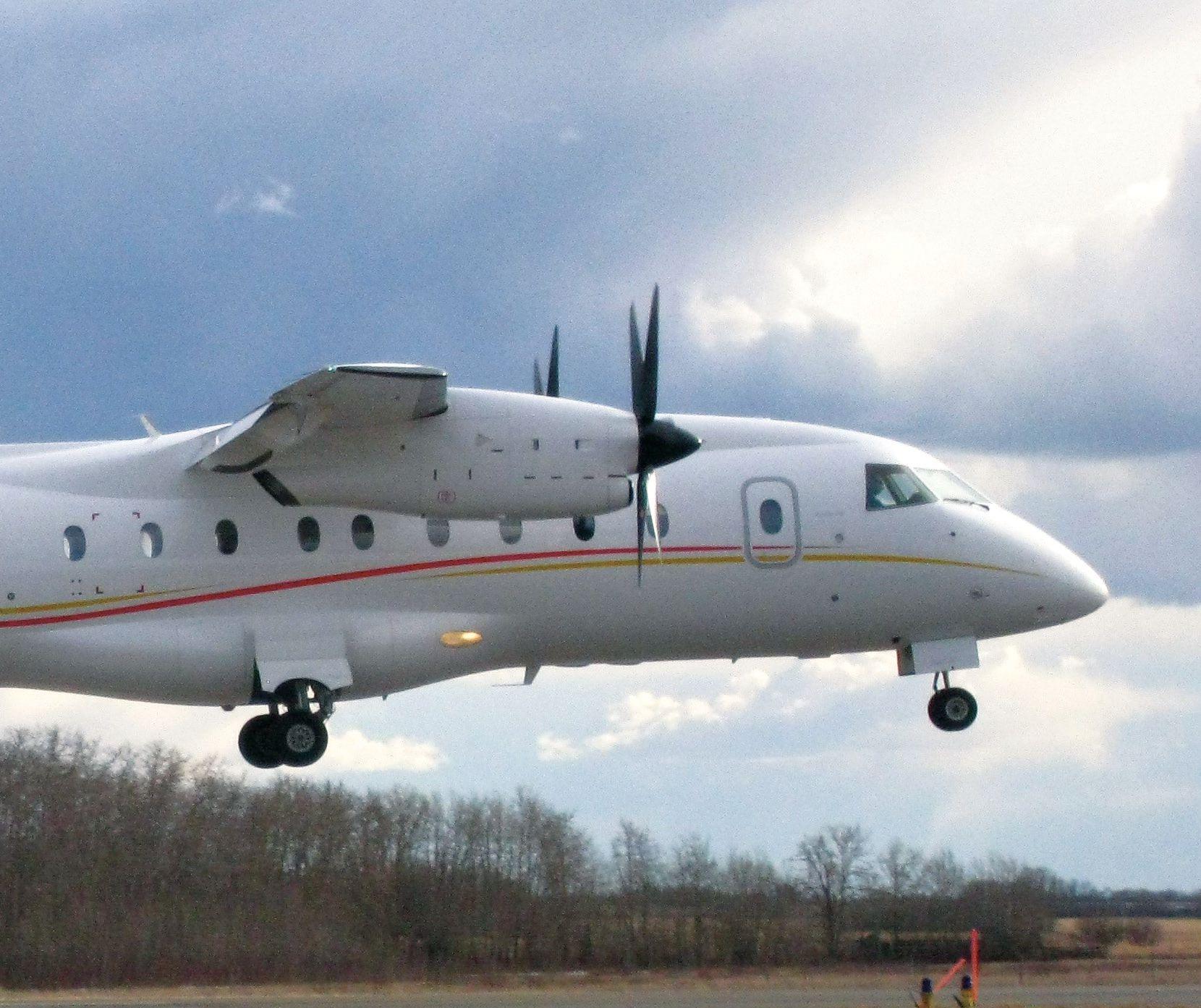
service have increased in the oil patch, most notably with the design and implementation of RNAV routes to de-conflict traffic in and out of uncontrolled airspace.
Private companies such as JetPro, an Alberta-based engineering firm, have been instrumental in that process with their design of GPS and WAAS approaches to some smaller and private airstrips. NAV CANADA has increased its level of service and surveillance capability at certain airports as well. “Around Fort McMurray, there are a lot of aerodromes close together – some with overlapping approach waypoints,” Wakulchyk says. “Installing a tower at Fort McMurray was huge.”
While most companies working in the oil sands rely on private air operators to ferry employees to and from work, others such as Calgary-based Suncor prefer the autonomy that only a dedicated fleet of aircraft can provide. “Suncor has operated its own aircraft for the past 65 years,” says Bill Grainger, Suncor’s director of transportation. “I think that comes as a surprise to most people.”
Grainger explains that over the past six decades, Suncor has cultivated what he calls a “longevity of understanding” when it comes to the value of operating an in-house flight department. Though the costs of maintaining a five-strong corporate jet fleet
boasting two CRJ900s and a Citation X would be prohibitive to many smaller companies, Grainger proclaims aviation to be “essential to Suncor’s business.” The value, he explains, manifests itself in the preservation of operational control of the company’s variable transportation elements.
According to Grainger, passenger loads carried by Suncor jets have increased from 800 per month to a dizzying 25,000 per month over the past six years. Grainger lauds the quality of an aviation wing that now employs over 70 people: “We run our flight department like an airline,” he says. “We employ flight attendants and maintain the operation to a high level of
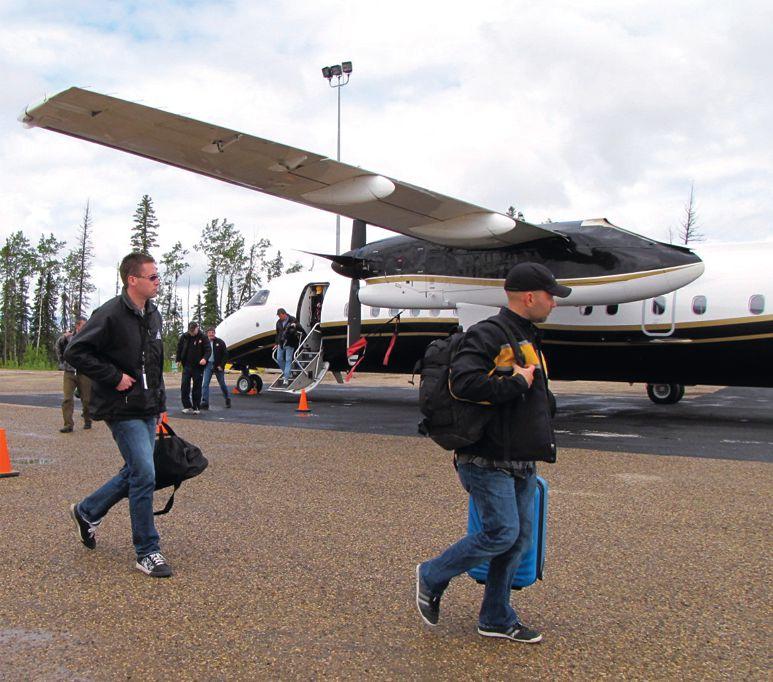

an expected surge in demand for workers in the oil sands bodes well for operators like North Cariboo who are poising themselves for continued growth in the region.
professionalism.”
While Suncor may utilize commercial carriers and charter companies to manage overflow on occasion, the sheer demand for aircraft means that Suncor could not afford to rely on outside transportation providers alone. Grainger explains that internal business units are generally able to tailor the flight schedule to their unique requirements. “Flexibility is very important to Suncor,” he says. And though he can’t say the same for aircraft availability among independent operators, Grainger sees Suncor’s aviation arm growing to keep pace with business over the foreseeable future.
“Over the next few years, people are going to be fighting over aircraft,” Grainger says. “We are already talking about a shortage of workers in the oil sands.” Suncor’s unique ability to adjust to changing demands on its workforce on short notice is made possible only by maintaining a corporate aviation department – an asset Suncor plans to preserve as new projects develop and current ones continue to expand.
In the meantime, a projected surge in demand for workers and the consequential

as a Dash-8 arrives at Conklin, ground crews prepare to disembark passengers on their way to work at Statoil. Despite Conklin’s remote setting and limited access, the Norway-based energy company has invested heavily in the airport infrastructure.
need to transport them, bodes well for operators such as North Cariboo. Already running private boarding lounges in Calgary and Edmonton with full security screening, Wakulchyk explains that the company is looking at ways to expand its capacity. “We are always asking what is going to take us to the next level?” he says.
Runways such as Conklin’s 5,200 feet of gravel preclude the use of conventional corporate jets. Consequently, the need for heavier lifting capability out of “austere airstrips” means that the acquisition of a larger transport category such as the BA-146 seems likely, according to Wakulchyk.
Looking forward, politically stable oil will without doubt, continue to play an important role in world economics. Emerging and growing economies increasingly bolstered by and reliant on Canadian oil will open up unique opportunities for air operators to thrive. With no easing in the price of oil expected, new work boots should be seen stepping on board Alberta airplanes for some time. | w
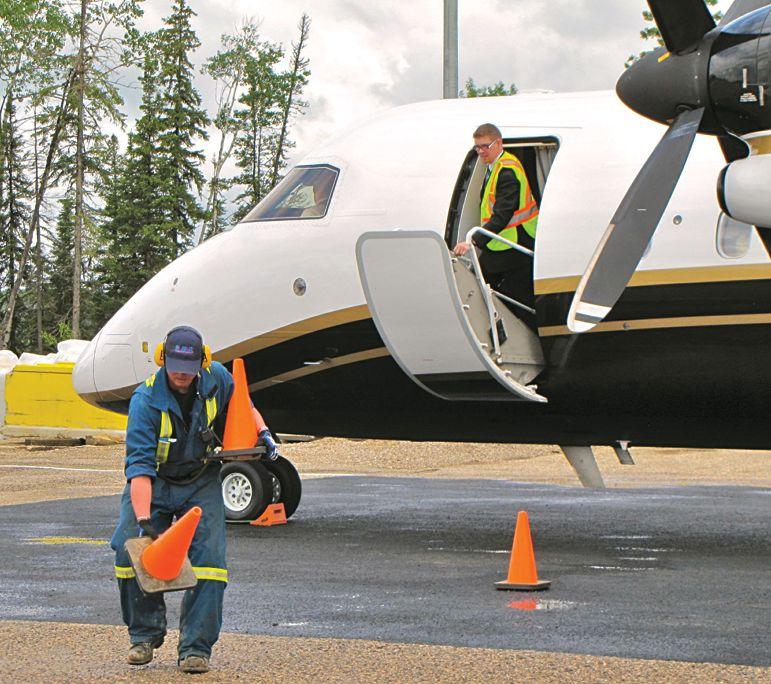


GE Capital LIKE A BANK: WE CAN LOAN YOU MONEY. UNLIKE A BANK: WE CAN LOAN YOU ONE OF OUR AVIATION EXPERTS.
At GE Capital, we’re not just bankers, we’re builders. So not only can we give you smart financing, we can also bring you expertise from across GE. Stop just banking. And start building.
GECapital.ca

By BRian dunn
after a couple of bumpy quarters, travel company
Transat A.T. of Montreal, hopes to turn its fortunes around this year through more cost-cutting measures to strengthen operations and return to profitability.
The firm is reducing overhead costs in Canada and France, abolished 143 positions last fall for an annual cost savings of $11 million, “optimized” its IT systems, and outsourced aircraft to third parties. Of the 143 cut positions, 80 were in Quebec, but about 20 of them had been vacated. Some 60 people in Montreal lost their jobs and about 55 in Western Canada.
The efforts are expected to add $20 million to $25 million in margins next year, $35 million to $40 million in 2013 and $50 million in 2014. “The problem was at the level of execution and now we’ve brought in new people and new ideas,” CEO and co-founder JeanMarc Eustache told analysts after reporting its disappointing fourth-quarter and year-end results. He warned that the return to profitability will be long and bumpy and that fiscal 2012 will be “challenging.” He says the current situation can’t continue and adds Transat may have to shed some leased aircraft if they can’t make money.
The fourth quarter was hit by increased competition, mainly from WestJet Vacations, Air Canada Vacations and Sunwing Vacations, the economic slowdown in Europe, restructuring costs and rising fuel prices.
Eustache said Transat is revitalizing its hotel network to reduce costs and offer “differentiated” products and upgrading its fleet with more entertainment and new seating. These initiatives will offset downward price pressures and improve margins.
The first A330 upgrade is scheduled for completion in April for $4 million and five more will follow over the next 12 months. Transat said quarterly revenue was helped by a 15.3 per cent rise in transatlantic travellers, partly offset by a 14.2 per cent decline in European revenue. Capacity was down two per cent in the winter season, including an eight per cent drop in the first quarter.
Transat posted adjusted (excluding special items) earnings of $10.1 million, or 27 cents a share, in the fourth quarter ended Oct. 31 compared to $47.7 million, or $1.25 a share, a year earlier, on revenue of $809.9 million, up from $778.6 million.
Including $16.5 million of restructuring costs, a $4.9-million fuel hedging loss and other special items, the quarter showed a $4.5-million loss compared to earnings of $52.4 million or $1.37 a share. For the full year, Transat had a final loss (including special items) of $12.2 million compared to earnings of $65.6 million, or $1.73 a share, a year earlier.
The results generated mixed reviews from industry analysts. Despite the poor results, Laurentian Bank Securities analyst Ben Vendittelli remains a strong Transat supporter, pointing out, “long term we still like the story and continue to believe the
business model remains viable, though in need of some restructuring. We believe Transat can return to higher profitability.”
Cameron Doerksen of National Bank Financial saw a few positive signs, but remains cautious. He was pleased Air
“The problem was at the level of execution and now we’ve brought in new people and new ideas.”
Transat reduced its winter capacity by two per cent instead of increasing it four per cent as previously planned. “The overcapacity in the sector remains a problem, especially in the face of another difficult winter. Transat’s activities in Europe (this summer) could also face a difficult period, given the economic context.”
Doerksen also suggests that given Transat’s proven track record of profitability over the past few years, it could become a takeover target. However, he adds the list of potential suitors would be very small due to foreign ownership restrictions.
While Transat revealed some details of its strategic initiatives, there were elements of its turnaround efforts that it couldn’t discuss for competitive reasons, notes Kevin Chang of CIBC. “Management refuses to discuss how it intends to convince
hotel operators to reduce their prices,” he says. “In addition, I’m not convinced that the changes Transat is making will be enough to increase demand. I applaud management for recognizing a need for a new strategy, but there is a risk of setting deadlines which could affect its financial position, particularly in the current economic context.”
Benoît Poirier of Desjardins Securities also saw some favourable organizational changes, but would have liked to have had more details from management. “There are still a lot of unanswered questions,” notes Poirier. “While the (restructuring) plan should help profitability, I think ultimately, the improvement of margins will depend on a balance between the supply and demand of the industry. And that’s something I don’t see happening in the short or medium term.”
food for thought
Looking ahead, Air Transat plans to offer 157 flights a week between Canada and Europe this summer, including 57 between Quebec and the continent. But the carrier isn’t adding any new destinations and will be dropping one – Vienna. However, it will be increasing frequencies to Italy and Portugal and is introducing a holiday package based on “slow food.” Launched in 1986 as an alternative to fast food, slow food strives to preserve traditional and regional cuisine and encourages farming of plants, seeds and livestock characteristic of the local ecosystem. Vienna was offered as a
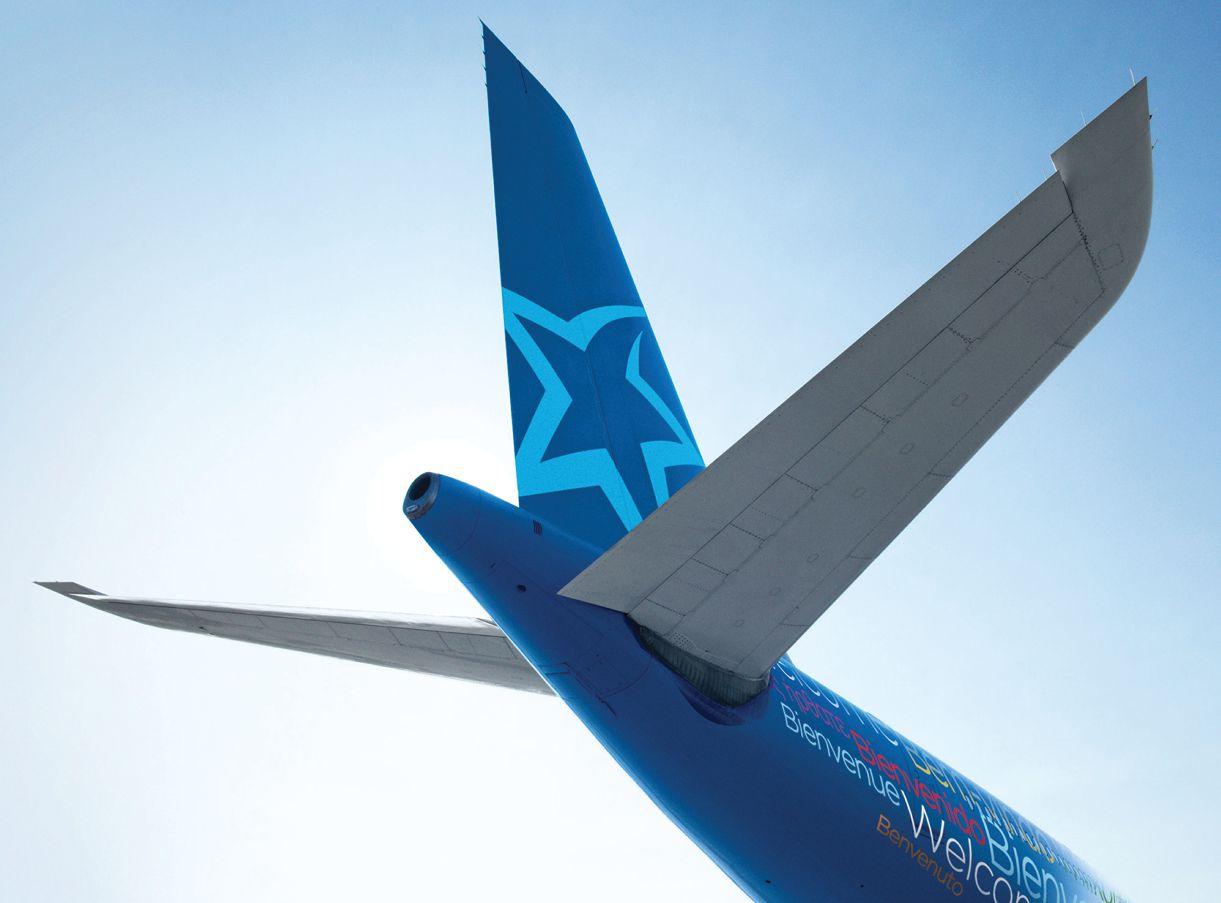
destination for the past three years and was popular among Canadian travellers going to Europe, but inbound traffic from the Austrian capital never caught on, according to the company. And with just one weekly flight, it couldn’t compete with Air Canada and other European carriers who often offered daily service, it added. Instead, Transat has opted to beef up service to more popular destinations such as Italy and Portugal. It will add another flight each week to Rome for a total of six flights a week from Montreal during the peak summer travel period. And unlike last summer, the two weekly flights to Lisbon, including one that will also serve Porto, will not be shared with Toronto.
The total number of seats from Canada to Europe will be increased by five per cent, compared to a 15 per cent increase last summer from the previous year. The difference is due to economic conditions in Europe,
“Long term we still like the story and continue to believe the business model remains viable, though in need of some restructuring.”
which are forcing Transat to be more cautious this summer, according to Transat spokesperson Debbie Cabana. Interestingly, demand by Europeans for travel to Canada is ahead of last year’s pace, while demand by Canadians heading across the “pond” is equally high, Cabana says.
Transat is offering slow food
packages based on Italian gastronomy whereby weekly packages will feature local products in Tuscany, Venice and Sicily. The offer will include food and wine tastings and visits to wine-growing regions.
Istanbul, last year’s new destination, is getting more ink in Transat’s travel brochures by offering a holiday in the Turkish city with time in Athens or the seaside resorts of Antalya or Bodrum. Similar options are being offered in France, Spain and Portugal, where stays in Lisbon can be combined with time in Porto.
Transat is also upgrading the cabins of its Airbus A330s for more passenger comfort, although exact details won’t be revealed until just before the start of the busy summer travel season in June.
Several nominations have also been made over the past few months. Chief operating officer Nelson Gentiletti and Michael DiLollo, president of
Transat Tours Canada, both long-serving executives, have stepped down as part of the senior management shuffle. Allen Graham, CEO of the Air Transit unit, becomes president of Transat Canada. Eustache, taking full charge at the operating level, says Transat is being split into three units – Transat Canada, Transat France and Transat International.
“Allen Graham will be my partner,” he says. “André de Montigny will head Transat International. Transat intends to sharpen inventory management, adjust prices more rapidly, improve load factors and speed up decision-making and management execution.
On the environmental front, Air Transat has become the first airline to be certified green by the World Green Aviation Council of Mississauga, Ont. The certification, Fly-360-Green, consists of a
comprehensive system for rating the design, innovation and operation of highly sustainable airlines and airports.
“We are extremely proud to have obtained this certification,” says Graham. “Our airline has implemented a great many measures and programs geared toward environmental protection and sustainable development, including a fuel management program to lower CO2 emissions. Over the past few years, we have adopted measures to save water and energy, promote recycling and reduce waste. And we are continuing our group effort with employees to keep on improving our environmental performance.”
The Fly-360-Green certification is intended to provide the airline industry and airports with a concise framework for identifying and implementing collaborative and measurable green aviation designs, innovations, and operations solutions.
Using the 55 different
environmental initiatives in the three main categories found in the Airline Environmental Management Framework (Daily Operational Activities, Corporate Environmental Management Practices, and Corporate Policies/Strategic Planning), airlines and airports can qualify for one of three certification levels: A-class (over 110 points), B-class (100-109 points) and Cclass (90-99 points) for airlines; and A-class (over 60 points), Bclass (50-59 points) and C-class (40-49 points) for airports.
The World Green Aviation Council consists of member airlines and airports from around the globe dedicated to a simple mission: foster an international standard for sustainable aviation through cutting-edge technological advancements, while also taking into consideration aviation’s absolute emissions, which are constantly on the rise despite various pro-environmental actions taken by stakeholders. | w

DTI – the training choice of North American federal regulators as well as individual operators – is offering its internationally heralded SMS/QA for the Aviation Industry to everyone interested in real world, practical applications of the new Safety Management Systems requirement in Canada.
DTI is expert in all aspects of SMS/QA, period! We’ve actually done it, hands on, no sugar coating, and have come to determine that if you are a reputable company, you are probably doing 80 to 90 percent of what you need to do to implement a great system. Let us show you how to get the extra 10% that will make you stand out in the crowd!

Visit: www.dtiatlanta.com Call: 1-866-870-5490
Email: staboada@dtiatlanta.com
calgary
March 13
SMS Implementation for the Real World
March 14
Quality Assurance for SMS & Beyond
March 15 (am)
How to Develop an Acceptable Corrective Action Plan (morning) Intro to Auditing (afternoon)
VancoUVer
April 25
SMS Implementation for the Real World
April 26
Quality Assurance for SMS & Beyond
April 27
How to Develop an Acceptable Corrective Action Plan Intro to Auditing

Winnipeg
May 22
SMS Implementation for the Real World
May 23
Quality Assurance for SMS & Beyond
May 24
How to Develop an Acceptable Corrective Action Plan Intro to Auditing
ToronTo
June 5
SMS Implementation for the Real World
June 6
Quality Assurance for SMS & beyond
June 7
How to Develop an Acceptable Corrective Action Plan Intro to Auditing

seaiR’s expanding opeRaTions now inClude MoRe CoMMeRCial Business
By david CaRR
inside Victoria’s picturesque harbour, work has begun upgrading an aging floatplane terminal. When it reopens later this year, it will be home to owner Seair Seaplanes and the terminus for new scheduled services between the British Columbia capital and Vancouver.
The face of the B.C. floatplane industry is changing. Fishing and recreational charters to remote areas on the B.C. coast remain an important market for most operators. But briefcases are overtaking fishing tackle, especially out of Vancouver, where the convenience of 13-minute
flights from Vancouver to Nanaimo, for example, are helping to drain commuters away from the spectacular but tired BC Ferries network.
“Scheduled services have become the mainstay of the business. Victoria and Nanaimo have almost become suburbs of Vancouver,” said Terry Hiebert, a director of the newly established Floatplane Operators Association and operations manager of Seair, the province’s second largest floatplane operator. “Passengers use our service as a bus ride to work, arriving in Vancouver on the Monday morning and flying home Friday.”
The growth of scheduled floatplane traffic over the past 15 years has helped fill a gap left by the dwindling forestry-based sector. At Seair, traffic on scheduled routes grew between 15 and 20 per cent last year. The airline expects similar growth in 2012. Based at the Vancouver International Seaplane Base, Seair started operations in 1980 with a single Cessna 185, serving the sport fishing market. The airline now operates a mixed fleet of 185 Skywagons, de Havilland Beavers, Turbo Beavers and the company’s flagship aircraft, five Wipline 8000 float-equipped Cessna 208 Caravans.

The strong push into scheduled service is the fourth time the operator has successfully caught the wave of a growing market, said Peter Clarke, Seair’s president and founder. “We have moved from strictly sport fishing to commercial fishing and to forestry. We are still busy with recreational charters, but now we are growing into the scheduled business by adding more frequencies and routes.”
Scheduled flights now account for approximately 50 per cent of Seair’s business. The airline shares a slip at the Vancouver International Seaplane base but owns its terminal building, one of three
the company owns and operates, including the Victoria terminal.
“We like to own our buildings,” said Clarke. “By owning our infrastructure we control our destiny. We can do what we want at our own place without interference from the landlord.” Ownership also delivers an added revenue stream from other user airlines such as Seattle-based Kenmore Air (the largest seaplane operator in the U.S.) that regularly fly into Seair facilities in Vancouver and Nanaimo for customs-clearance and refuelling as they travel northward.
Although Seair will only begin scheduled
service to Victoria later this year, the company is no stranger to the capital. It has been operating charters since 1980 and once occupied the passenger terminal it now owns. As is the practice with the other two terminals, Clarke will rent space to other operators.
Seair plans to serve Victoria from two Vancouver hubs: its home base, and the new Vancouver Harbour Flight Centre (VHFC), a privately owned and operated passenger terminal located behind the Trade and Convention Centre at the Vancouver Harbour Waterfront Airport. The $22-million facility opened in May 2011,
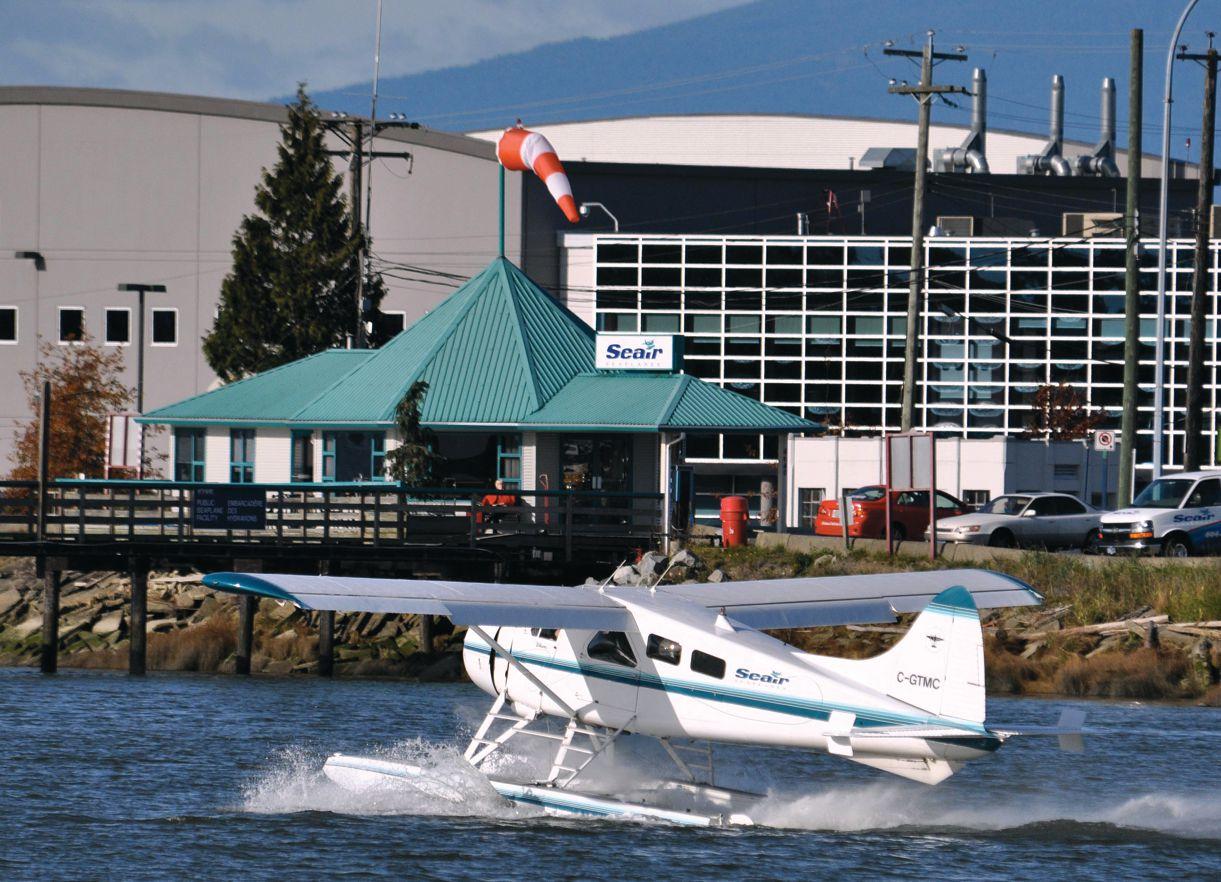
and primarily serves commuters travelling between the Pacific Northwest’s coastal communities.
Vancouver Harbour Waterfront Airport is one of the world’s busiest seaplane airports, handling approximately 132,000 aircraft movements and 300,000 passengers annually. VHFC is B.C.’s first for-profit floatplane base, something that has not gone over well with the bulk of operators flying from the harbour.
At the heart of the dispute is the cost of operating from the new building, which Harbour Air estimates will add $3 million to $4 million a year and which will have to be passed onto passengers in new user fees.
“This is the highest passenger fee ever charged in the history of the B.C. floatplane industry. In fact, it’s a radical departure for our industry, which has traditionally kept airport costs rock bottom by operating such passenger terminals on a
Tofino Air, is largely a charter operator with limited scheduled service.) But for how long?
The harbour’s seven-year-old temporary base was scheduled for demolition one month after the VHFC opened and appears to be operating on borrowed time. A campaign to turn the VHFC into a not-for-profit has fizzled and plans for an alternative floatplane terminal are going nowhere, suggesting that something is
Harbour Air, the province’s largest floatplane operator, accounting for an estimated 85 per cent of harbour traffic, is one of several companies who have refused to move to the VHFC from the temporary facility the new terminal was built to replace.
not-for-profit basis,” wrote Greg McDougall, Harbour Air chief executive in The Tyee, a popular B.C. daily online magazine.
As one of only two operators leasing space at the VHFC, Seair has almost free run of the airport’s plush passenger lounge and 18 floatplane slips. (The other tenant,
going to have to give between the holdouts and terminal owner.
Competition at the VHFC will eventually heat up and Clarke is ready, noting that the Caravan’s commercial airlinerstyle cabin, low cabin noise levels compared with the Beaver and the Twin Otter,

and speed, are all competitive advantages.
“It’s a fast machine,” Clarke said. “You fly the Caravan beside a turbine Otter and it looks like it is standing still.”
The first Caravan entered the Seair fleet in 2001. The airline now has five of the type, making it the largest operator of float-equipped Caravans in the world. Clarke is impressed with the versatility of the aircraft and hopes to add two more Caravan’s by 2013, as the company looks to retire its aging Beavers.
“We move hundreds of people and thousands of pounds of luggage and freight every day,” he told Cessna’s in-house publication, Caravan Chronicles. “We can quickly take the seats in and out for cargo or passengers. Our business model is flexibility, and the Caravan’s great for that.”
Clarke also likes to point to the safety features of the Caravan, including its terrain avoidance, synthetic vision and moving map features that help pilots operate in low-visibility conditions in remote areas. The Caravan’s Garmin G1000 glass panel is popular with Seair pilots even though the airline only operates in VFR
conditions. Each Seair pilot has an average of 10,500 hours of float time on the B.C. coast. Behind the flight deck, the cabin door is unobstructed, meaning passengers do not have to scrabble over seats to exit the aircraft, a longtime safety concern of the floatplane industry.
The aircraft also has appeal for the charter market, which according to Hiebert, has also evolved over the past 20 years from Dad flying out to the fishing lodge for the weekend to whole families travelling to coastal resorts for kayaking and whale watching.
British Columbia is home to approximately 20 per cent of Canada’s commercial floatplane operators and it is every bit as competitive as the country’s mainline air transport industry. Scheduled traffic is up, but there is concern that the market could become saturated by new entrants, especially on established routes. When it launches scheduled service to Victoria, for example, Seair will be breaking a virtual monopoly held by Harbour Air and its West Coast Air subsidiary. Clarke waved away the concern. “All the routes we are flying are growing,” he countered.
In some cases, airlines are serving different market segments on identical routes. Seair’s Nanaimo terminal, adjacent to the BC Ferries dock, is farther north than the Harbour Air base, splitting the market along geographic lines. Clarke likens it to Billy Bishop Airport, Toronto’s own harbour facility, where Porter Airlines has carved out a convenient alternative to Pearson International Airport for customers living and working in the city core.
As scheduled services increase, the floatplane industry is gradually moving away from its bush plane roots, although upgraded Beavers and Twin Otters will continue to dominate the airways. Despite growth opportunities, Seair continues to plot a cautious course. New airplanes are only bought when there is money in the bank and are used to upgrade rather than swell the fleet. “We are into slow, steady growth,” Clarke pointed out. “But we are adding frequencies to our existing routes, buying terminal buildings and factory-new airplanes. There are not too many in the floatplane business that can say that.” | w
to highlight the legacy fleet of de Havilland aircraft and new Viking Twin Otter Series 400, including static aircraft display, technical seminars, exhibition trade show, factory tours, gala evening, and more!
Dates:
Trade Exhibition & Technical Seminars:
Factory Tours & Aircraft Display:

April 17th – 19th, 2012 Mary Winspear Centre, Sidney British Columbia
Viking Corporate Headquarters Victoria International Airport (YYJ) Sidney, British Columbia
to receive a delegates package with more information, please contact: Angie Murray, Forum Coordinator angie.murray@vikingair.com North American Toll Free: 1.800.663.8444 International Toll Free: 1.800.6727.6727

afTeR MoRe THan 15 yeaRs, nav Canada ConTinues To safely MoniToR ouR sKies
By RoB seaMan
for just over 15 years, NAV CANADA has been safely navigating aircraft in Canadian airspace –and it’s not exactly an easy task.
As a private-sector, nonshare capital corporation, NAV CANADA owns and operates Canada’s civil air navigation service (ANS). Best known for its
roles in air-traffic control, flight information, weather briefings, aeronautical information, airport advisory services, and electronic aids to navigation – as well as, of course, assigning and collecting fees to pay for it all – NAV CANADA plays a huge role in one of the largest nationally assigned airspaces in the world.
NAV CANADA’s ANS facilities include seven area control centres and 41 control towers. The “company,” as they liked to be called, also operates 58 flight service stations and eight flight information centres. These facilities are supported by a network of more than 1,000 ground-based aids to navigation located across the country. In addition to the head office in Ottawa, NAV CANADA has a technical systems centre, simulation centre and a national operations centre also in Ottawa, as well as its NAV CENTRE, a conference facility located in Cornwall, Ont.
One fact lost on many Canadians is that NAV CANADA is a private-sector company and not an offshoot of the federal government. However, the company’s safety performance is regulated by Transport Canada, just as TC regulates the safety of individual airlines.
The company is governed by a board of directors – 10 appointees from the four founding members of NAV CANADA as follows:
• Air carriers (four);
• General and business aviation (one);
• Representatives of the federal government (three);
• Bargaining agents (two);
• Independent directors, appointed by the board, with no ties to stakeholders;
• The president and chief executive officer, John Crichton, is also a director.
NAV CANADA is financed through publicly traded debt that owns and operates Canada’s civil air navigation service ANS. The system was purchased from the federal government on Nov. 1, 1996, for $1.5 billion.
When first acquired, NAV CANADA inherited an organization of 6,300 employees with six regional administrative offices and duplication of administrative functions. It was a large system contract that was over budget and behind schedule, and much of the ANS infrastructure was obsolete.
“We had customers who were dissatisfied with the service they were getting, and with high expectations,” says Crichton. “We had a regulator that was watching us closely to ensure we lived up to our commitment to make the safe system we inherited even safer.”
After 15 years, Crichton says the system is indeed safer – traffic has grown but IFRto-IFR operating irregularities have come down. At the same time, the company is more efficient, with 4,800 employees, much less administrative overhead and the bulk of its investment directed towards a multitude of service-enhancing technologies and procedures.
Crichton notes that $1.7 billion has been

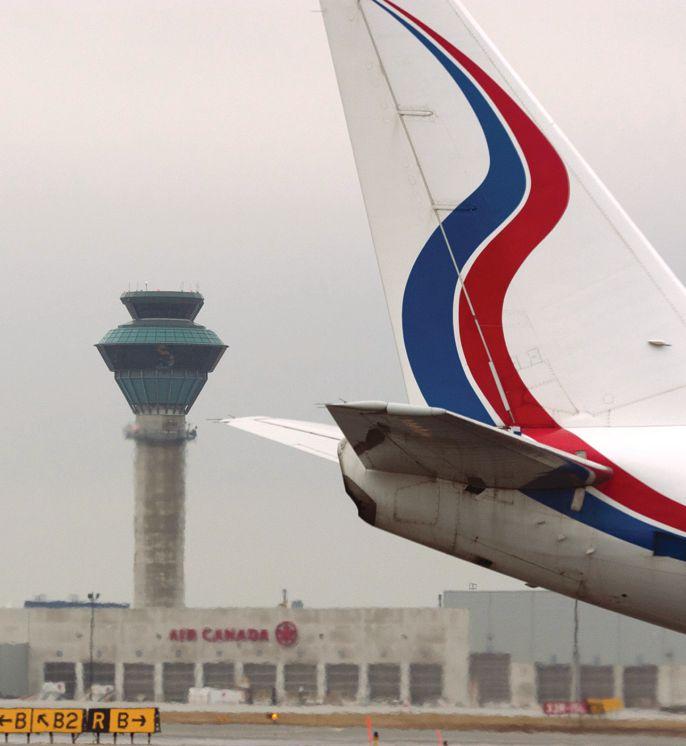
invested since 1996, and technology is being sold around the world to other Air Navigation Service Providers (ANSP). That large “system contract” has been delivered and deployed across the country.
“With regard to customer service, this is the one area with the most visible difference – the company has developed a strong customer service culture, and we are determined to maintain this edge as we set our course for 2020,” Crichton says.
knowing there is more to be done, confident in our ability to build on the progress we have made,” he says. “We are especially proud of our employees’ record of achievement. It is through their skill, dedication and determination that the private-sector model adopted for the company in 1996 has stood the test of time.”
Key achievements include the aforementioned and all-important enhanced safety, which defines the core of their
speed up decision making and empower employees to help solve business problems,” Crichton says. “Our customers have recognized these achievements with three International Air Transport Association (IATA) Eagle Awards over that 15-year period – two of them in the last two years, 2010 and 2011.”
NAV CANADA’s success is built on a solid relationship with its customers. These clients appoint five members to
The commitment to enhancement
NAV CANADA has made significant inroads in Canadian aviation, but Crichton is well aware much more needs to be done. A strong commitment to safety remains at the top of his wish list. “At this 15-year mark, we look back with pride on all that has been achieved, yet we also look ahead
business; a comprehensive $1.7-billion modernization program; substantially improved customer service; and success in managing an efficient operation with enhanced productivity and low services charges.
“With lower overhead and a sharper focus on our customers, we’ve been able to
the NAV CANADA board, through the National Airlines Council of Canada (four directors), and the Canadian Business Aircraft Association (one director). So, customers are involved in all processes. NAV CANADA also works with clients daily, whether through organizations such as the NACC or directly with airline staff


across the country, or in the many consultation forums they facilitate, including the Air Transport Operations Consultation Committee (ATOCC), the Air Navigation Services National Advisory Committee (ANSNAC), or the more recently established NAV CANADA Area Operations Consultation forums.
A significant change over the years has been the improved speed of response, and ability to stay ahead of the innovation curve, especially in areas that affect customer directly. Says Crichton: “Customers demand more efficient flight operations, and we are delivering, although there will always be new technologies and procedures to develop and implement, as we push the envelope together. Customers also expect we will invest in our core operation and avoid unnecessary overhead, and our track record in this area is sound. Our service charges have increased by only five per cent since 1999 – 24 percentage points less than inflation.”
Several examples illustrate how NAV CANADA has interacted/integrated with the industry and brought such advances into everyday application. For example, the $1.7-billion modernization program has been an important factor behind improvements in safety, with new tools such as conflict alert and minimum safe altitude warning, in addition to airspace warning features.

have the world’s most advanced oceanic air traffic system.
As well, NAV CANADA is on its way to doubling the amount of airspace covered by air traffic surveillance. They have accomplished this by expanding the use of radar in Canada’s north, and by pioneering the deployment of a new technology known as Automatic Dependent Surveillance – Broadcast (ADS-B), also in Canada’s north. Customer consultation
was a key factor in the decision to go with ADS-B.
“The value of expanded surveillance, for our customers, cannot be overstated,” says Crichton. “Today, in the airspace over Hudson Bay – which was formerly restricted to inefficient procedural separation based on H/F radio communications – more than 800 aircraft are now ADS-B
equipped and are taking advantage of the optimum altitudes and routes this makes available to them. That’s because ADS-B surveillance, combined with direct controller-to-pilot communications, allows for radar-like separation and thus a significant expansion of available airspace for equipped aircraft.”
In another region of significance – the busy airspace over the North Atlantic managed by controllers in the Gander Oceanic Centre – NAV CANADA has recently completed the second major upgrade in the last decade to its Oceanic Air Traffic Control System, now known as GAATS+. There are well over 1,000 flights per day in this airspace, to and from Europe. With GAATS+, the Gander controllers now have the world’s most advanced oceanic air traffic system, and will also soon be able to offer a significant enhancement in customer service as they bring on stream the ADS-B surveillance extending east of Greenland, integrated with the GAATS+ operation.
“One of our key areas of focus has been to work collaboratively with customers to take advantage of new technologies and procedures to improve flight efficiency and reduce customer fuel burn,” says Crichton. “We measure the impact of these initiatives – and we plan for future gains through a program called Collaborative Initiatives for Emission Reductions, or CIFER. We estimate that by 2016, cumulative customer fuel savings resulting from all our efficiency initiatives combined will total $4.3 billion dollars. We also forecast that corresponding reductions in greenhouse gas emissions will equal about 13.4 million metric tons.”
Some key CIFER initiatives include: the introduction of surveillance and enhanced communications in Canada’s North; the rollout of expanded surveillance, communications and other technologies in the North Atlantic Operation; and the continued expansion of polar routes, cutting flight times and fuel burn for


Bradley Potter, Managing Vice President, and John John Wright, Executive Vice President, are pleased to announce that Andrew J. Pell, CAIP, has joined BFL CANADA’s Vancouver office as Vice President Client Executive - Aviation.
Andrew has over 30 years experience with international and national insurance brokers, specializing in Aviation insurance as a client executive and a broker.
He brings expertise in servicing all classes of General Aviation including fixed wing and rotary wing aircraft operators, fixed base operators, and manufacturers.
BFL CANADA has experienced rapid growth throughout Canada by providing a unique entrepreneurial and creative environment for its employees resulting in exemplary service to its clients.
BFL CANADA is the largest employee-owned and operated commercial insurance brokerage and consulting services firm in Canada. BFL CANADA provides a complete range of insurance products, risk management and employee benefits services to all industry sectors across Canada and, through a strategic alliance with the Lockton Companies, LLC, in the U.S., as well as in over 100 countries around the world.
BFL MAKES A DIFFERENCE
200 - 1177 West Hastings Street, Vancouver, BC V6E 2K3 TEL: 604-669-9600 FAX: 604-683-9316
Vancouver • Kelowna • Calgary
flights to and from the Asia-Pacific region.
On the horizon is the deployment of new features in NAV CANADA’s advanced, integrated flight data management system known as the Canadian Automated Air Traffic System (CAATS). New CAATS features such as Medium-Term Conflict Detection will help to enhance efficiency and safety. NAV CANADA is also on the verge of deploying datalink in domestic airspace.
Working to take advantage of the fuel-saving capabilities of Performance Based Navigation (PBN) is another important initiative. NAV CANADA continues to work with customers and other stakeholders, to focus on the design and implementation of more efficient approaches across the country. A great deal of this work involves collaboration with customers, employees and TC on its PBN strategy.
“We are actively engaging our customers when we design and implement more efficient, PBN-based procedures through projects such as the Toronto-Ottawa-Montreal airspace review, for which we have just completed extensive community consultations, aiming for a 2012 implementation,” reports Crichton. “And we are working closely with customers and other stakeholders on the development of our RNP AR [Required Navigation Performance – Authorization Required] roadmap.”
On the international front, NAV CANADA works in support of TC in many International Civil Aviation Organization (ICOA) activities. Company personnel participate in ICAO panels and study groups to provide expertise and leadership in the development of standards and recommended practices, documents and guidance material. Areas of involvement include Performance Based Navigation, unmanned aerial systems and North Atlantic operations.
They also deal directly with international customers who fly through Canadian airspace. One prime example is their productive relationship with the IATA and its member airlines. In addition, they have extensive operational dealings with other Air Navigation Service Providers such as the Federal Aviation Authority (FAA,) NATS, NAV Portugal, ISAVIA and others with whom they exchange traffic.
“Our focus in all of these cases is to be a constructive voice in ensuring safe, efficient and cost-effective air navigation services worldwide” says Crichton. NAV CANADA is also an active member of the Civil Air Navigation Services Organization (CANSO).
With several impressive accomplishments in place after its first 15 years, NAV CANADA is looking forward to meeting the challenges of the future. The most important of these? Staying focused on the core safety and service mandate, especially as the aviation industry continues to face economic headwinds. And that means working to address demands to make the industry more efficient and environmentally friendly. Innovation in safety, service and efficiency, with all stakeholders – TC, airports, airlines, air navigation service providers, suppliers to the industry – is imperative.
Crichton is proud of the NAV CANADA team and is quick to highlight them for their contributions to the company’s success. “They are world leaders and they should be proud of what we have achieved,” he says. “I would also like to thank our customers, whose unwavering focus on safety, efficiency and innovation has been so important to our ability at NAV CANADA to set the right course and evolve along with them.”
With its own commitment to safety and innovation, it’s clear Canadians can count on NAV CANADA to deliver safe and efficient air traffic services in the years to come – no matter what the future might bring. Congratulations on more than 15 years of excellence in navigation. | w

Message from ATAC CEO | John McKenna
The New Year at ATAC saw the return of Les Aalders as Executive Vice President. A former Vice President at ATAC, Les had been Executive VP at the Aerospace Industries Association of Canada for the last two years. In addition to his duties as Executive VP, Les handles most Flight Operations and Technical Operations issues. Les is also the VP responsible for Atlantic Canada and British Columbia. Mike Skrobica is now Senior VP and CFO and continues to be responsible for Ontario. Bill Boucher has become Special Advisor with a focus on specific issues management and is responsible for Quebec. Wayne Gouveia, VP Commercial General Aviation, remains responsible for flight training, the ATAC SMS Toolkit, Toolkit workshops and dangerous goods. He is VP for the Prairie and Northern regions.
Michael Skrobica
Senior Vice President and CFO & VP Ontario
Government of Canada Announces New Air Fare Advertising Regulation
On December 16, 2011 the Government of Canada announced the coming into force of Clause 27 of the Act Amending the Canada Transportation Act. This clause provides for “making of regulations requiring air carriers to include in the price advertised all costs to the carrier providing the service and to indicate in the advertisement all fees, charges and taxes related to the service that are collected by the carrier on behalf of another person”.
This announcement puts into place a one year consultation on developing the regulations. This announcement follows similar regulations in both the USA and EU.
The Air Transport Association of Canada will participate in the consultation. The Association will attempt to ensure that the regulations are simple to comply with and do not require a release of proprietary information.
For more information please contact Mike Skrobica at mikes@atac.ca.
Les Aalders
Executive Vice President & VP Atlantic and British Columbia Maintenance, Repair & Overhaul (MRO)
ATAC is aggressively exploring new ways to fully support the Canadian MRO (Maintenance, Repair and Overhaul) industry. As an example of this important long-term support, ATAC is once again leading the Canadian MRO Alliance initiative at MRO Americas. The 2012 MRO Americas event will take place on April 3-5 at the Dallas Convention Center in Dallas, Texas. Following our long-standing successful formula, ATAC is once again facilitating the Canadian MRO Alliance group of trade show booths in premium locations which this year includes four 20’ x 20’ island booths. In addition we are cohosting with our government partners the always successful Canadian MRO Networking Event on the evening of Tuesday April 3rd. New for this year, a special breakfast briefing session will be held for Canadian companies on Wednesday morning, April 4th limited to Canadian company representatives.
If you are interested in being part of the Canadian Alliance at MRO Americas 2013 to be held in Atlanta, Georgia on April 16-18, 2013 please let me know as soon as possible as pricing will be made available in March 2012 for next year’s event and confirmations of intent to participate will need to be made prior to the end of that month.
The Canadian MRO Alliance participated in MRO Europe for the first time this past September in Madrid. Due to the success of that event we are now developing plans for MRO Europe 2012 in Amsterdam, taking place this coming October 9-11. We are working with our government colleagues at the Department of Foreign Affairs & International Trade (DFAIT), both at headquarters and in the Netherlands to grow the Canadian MRO presence in Europe. For those that are interested in sharing part of the Canadian MRO Alliance booth and/or taking part in a networking event please contact us as soon as possible.
For more information on these or other MRO events please contact Les Aalders at laalders@atac.ca.
ATAC is proud to welcome the following recent New Members:
Operator Members
• Pacific Rim Aviation Academy Inc., Pitt Meadows, BC
• Pascan Aviation, St-Hubert, QC
• Spectrum Airways, Burlington, ON
• Suncor Energy Inc., Calgary, AB
Associate Members
• 3 Points Machining & Aerospace, Charlottetown, PE
• Rapiscan Systems, Arlington, VA USA
• Red Deer Regional Airport, Penhold, AB
• Specific Range Solutions Ltd., Ottawa, ON
• Falko Regional Aircraft Limited, Hatfield, Hertfordshire UK
• WGA-NavStar Aviation Inc., Mississauga, ON
Supporting Associate Member
• Aerosolutions, Ottawa, ON
Mark your calendar now! Check our website for further details www.atac.ca

ATAC Annual Spring Symposium and Reception
Wednesday, May 9, 2012
The National Hotel and Suites Ottawa, ON
ATAC Annual General Meeting and Tradeshow
Tuesday, November 13 –Thursday, November 15, 2012
Westin Bayshore Hotel Vancouver, BC
SMS Toolkit Workshops
Visit our website for upcoming workshops
700 – 255 Albert Street Ottawa, Ontario K1P 6A9 Phone: (613) 233-7727
Fax: (613) 230-8648 Website: www.atac.ca
Ameeting between CBAA and CBSA held at the CBAA’s of ces on Feb. 22 led to signi cant progress on a number of key les. Members were invited to send their issues in to CBAA prior to the event, ensuring that the agenda dealt directly with their areas of concern.
Details will be made public as they become available in CBAA’s members-only email weekly Bulletins.
CBAA and CBSA have built a strong working relationship, and together have already resolved a number of issues raised by members, particularly at Toronto, Quebec City and St. Hubert. This meeting is a continuation of that relationship, and further enhances CBAA’s ability to resolve issues and add value to membership.
www.cbaa-acaa.ca

Direct access to industry e perts. Members can contact CBAA e perts at no charge to help them on a wide range of regulatory issues – translating to potential savings of hundreds or thousands of dollars in consultant fees;
A strategic relationship with WINGS Magazine, providing targeted media resources, complementary copies of WINGS and more.
Business aviation is a competitive business tool and provides unique access to markets and to small and remote communities. Its operations, needs and business models are wholly different from those of commercial carriers; The application of
commercial regulations is not only unnecessary, but would have perverse and potentially devastating consequences; Business aviation requires its own regulatory framework that recognizes its unique needs, and applies the right level and type of regulation to its operations.
Presenting at the Calgary International Airport’s Capacity Workshop held Jan. 19, CBAA CEO Sam Barone addressed a large group of stakeholders and airport management, calling for equitable access rights/ slot management and procedures for business aviation at YYC
Sam presented a point-by-point analysis of the access challenges faced by Calgary’s critically important business aviation sector and suggested ways of accommodating the needs of biz av within the larger air service community.
He emphasized the importance of business aviation to the airport, reminding attendees that “BA operators are the largest employers – and buyers of airline tickets – at the passenger terminal.” He continued by stating that “YYC-based aircraft should have some priority over itinerant air carriers and reminding the group that “there are no airport substitutes for business aviation operators at YYC”, so it was critical to ensure the system works.
“Calgary corporations use BA as a key business tool,” he concluded. “BA traf c is commercially important to the airport and contributes to economic development in Calgary, in Alberta and in Canada.”
This meeting is part of CBAA’s ongoing work with airports around the country to address speci c issues and eliminate access barriers faced by members.
CBAA members are invited to view the presentation at http://www.cbaa-acaa.ca/en/advocacy/cbaa-yyc.
The CBAA has drawn the best and most workable examples of regulation from other modes and from other nations to open a substantial dialogue with all of these departments. Our work is well begun, with a recent meeting with Public Safety Minister Vic Toews and our formal pre-budget submission
to the department of Finance. Changes won’t happen overnight – this is a government, after all! However, CBAA has a clear vision, a cogent argument and a strong case, and an unwavering commitment to our members and industry to see our way to Yes.
CBAA has again partnered with Canadian Business Magazine’s Business Aviation Supplement, to promote the value of business aviation and to increase sales opportunities for our members.
This supplement, now in its 11th year, is a targeted and effective way to highlight the advantages of business aviation for frequent-travelling e ecutives and corporate leaders. With insightful pro les and analysis, the Business Aviation special feature gives an enlightening description of the bene ts of business aircraft, and provides valuable tips on improving operational ef ciencies.
CBAA members who advertise can take advantage of e clusive discounted rates, overruns of the supplement distributed at CBAA 2012 and receive a digital “soft” copy to distribute or reprint.
Working closely with CBAA, Canadian Business offers the ideal environment to reach new prospects, e isting clients, stakeholders and key decision makers, by providing relevant content that engages readers and e poses them to your message.
To book ad space or for more information, contact Mitch Cruickshank at mitch.cruickshank@rci.rogers.com @g , 416-764-1409.
Aerosolutions has specialized in professional aviation training and consulting projects for the aviation industry since 199 Aerosolutions has completed quality training and aviation consulting projects for many aviation organizations, business operators and airlines in Canada. Aerosolutions delivers advanced training courses for managers, inspectors, pilots, Aircraft Maintenance Engineers (AMEs), schedulers and dispatchers These include CRM, Check Pilot, Instructor, SMS Audit, Aircraft Command, Aviation Manager, Threat and Error Management, IFR Refresher, Check Dispatcher and C 0 Type Training. Consulting projects include Operations Manual and Training Program development. See www.aerosolutions.ca for more information.
Air Maestro™ is an aviation software system designed to give operators control of core operational and safety information to effectively manage business and assist with achieving regulatory compliance.
The CBAA head of ces are now located at 9 Green Valley Crescent, Suite 1
Ottawa, ON K2C 3V4

An important link for Central Alberta, the Red Deer Airport is located 8 km south of the City of Red Deer and situated within Red Deer County. This airport serves a number of charter operations that provide weekly air transport to oil and gas project sites in northern Alberta and southern Saskatchewan. The airport is also served by Northwestern Air who provide scheduled service to Kelowna. Red Deer Airport is the third busiest regional airport in Canada based on aircraft movements and serves forty ve private and commercial tenants.

From Rob Madden, Chairman, CBAA
As Chairman of the CBAA, I have been privileged to witness its remarkable renaissance, becoming a member-driven, responsive trade association. This success would have been impossible without the ongoing support of our members, who have guided this transformation, helping ensure that CBAA is delivering what they need, and what they value.
I am gratified to say that literally hundreds of operators and associate members understand the value in continuing to support their national organization, and have renewed their membership for 2012. Because of their continued belief in the importance of a unified voice to represent their interests, CBAA has been able to reinvent itself, racking up a sizable number of advocacy wins, building a unique and valuable package of members-only services, and has reasserted itself as the one, and the only voice for business aviation.
CBAA’s ultimate success lies in our hands – as members, we support and direct its efforts. We determine its focus, which issues are important, and what the association should deliver. The professional staff in Ottawa works for us – and they are only a phone call away.
Membership is a choice – not a requirement. Every one of us has to justify every cent we spend, with no margin for error or waste. As Director of Flight Operators for the Province of Alberta’s Air Transportation Services is my responsibility, to ensure that the Province’s financial resources are used wisely. I can assure you that our 2012 membership has proven itself to be a wise investment that has already paid for itself.
You cannot sit passively on the sidelines and then wonder why you were ignored. I am a member of the CBAA today – and proud to be its chairman – because I believe the only way to get things done is to get involved, by joining forces, by speaking out. The CBAA ensures we have a place to voice and act on our concerns.
As Chair, I see the positive impact CBAA has on our industry – and my own operations – every day. We all share the responsibility to work together if we want to succeed as a sector – and the best way to do that is by being part of the new, strong CBAA.

www.cbaa-acaa.ca

Visit www.cbaa-acaa.ca or contact andrew Oestreich (613-236-5611 ext. 236, aoestreich@cbaa.ca) for more information on how yOU can benefit with a CBaa membership!





www.hartwig-fuelcell.com


AeroCourse offers both IFR and ATPL groundschool seminars and refresher courses taught by professional pilots specialized in training. The ATPL and IFR groundschools are three-day courses, designed to lead students through the steps and knowledge necessary to obtain their IFR or ATPL ratings.
Recently, an online IFR course has been added to enhance our IFR training. Workbooks are also available that significantly contribute to your success in obtaining the IFR and ATPL ratings. Courses are available across Canada and in conjunction with leading flying clubs.