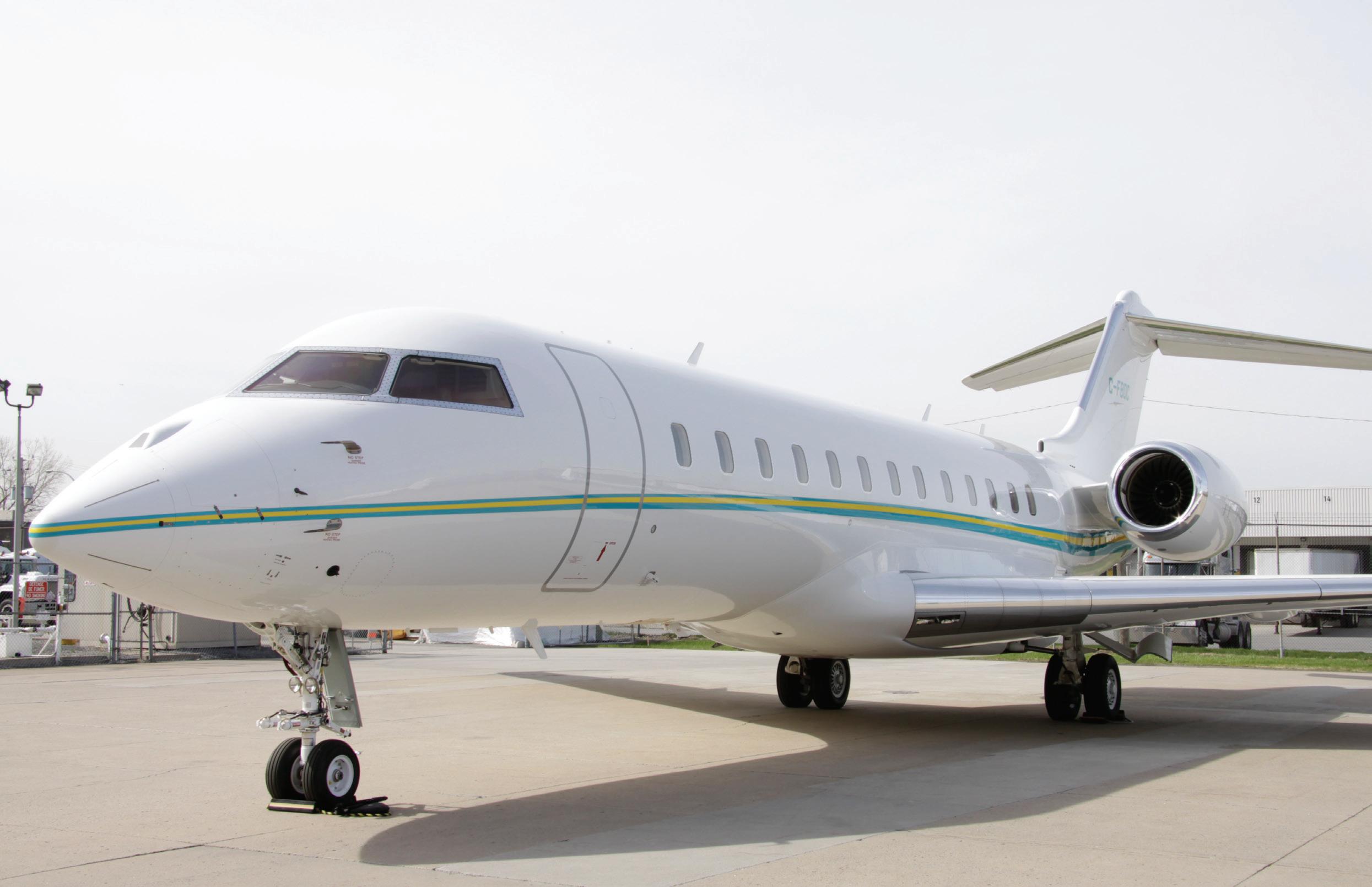
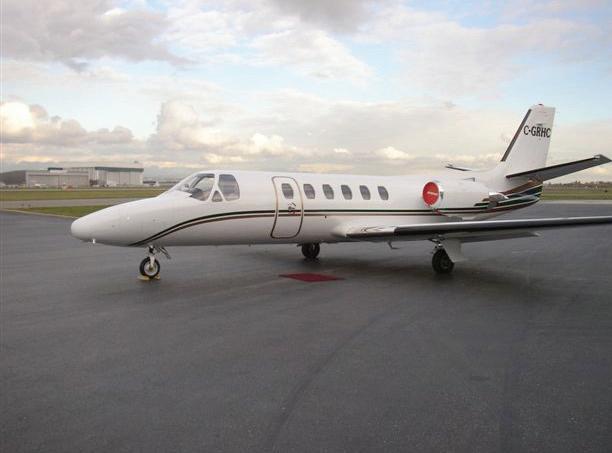
Call them contrarian. Label them renegades. Or visionaries. They refuse to follow the naysayers into misery’s pit. If you are one of them, you are already on your mission. While others flail dull weapons, you hone yours, carefully considering your flight department’s efficiency. Painstakingly matching aircraft to mission. Cessna will be here for you at every step of the way, with a full range of aircraft and flight solutions. Recognizing that victory doesn’t go only to the strongest or the swiftest, but to those with the best laid plan. So, in spite of today’s daunting economic uncertainty, or perhaps because of it, you will slip failure’s tenuous grasp. And emerge even stronger than before. RISE.
May we help you develop your plan? Visit www.wings.cessna.com or call 1.877.410.8650.
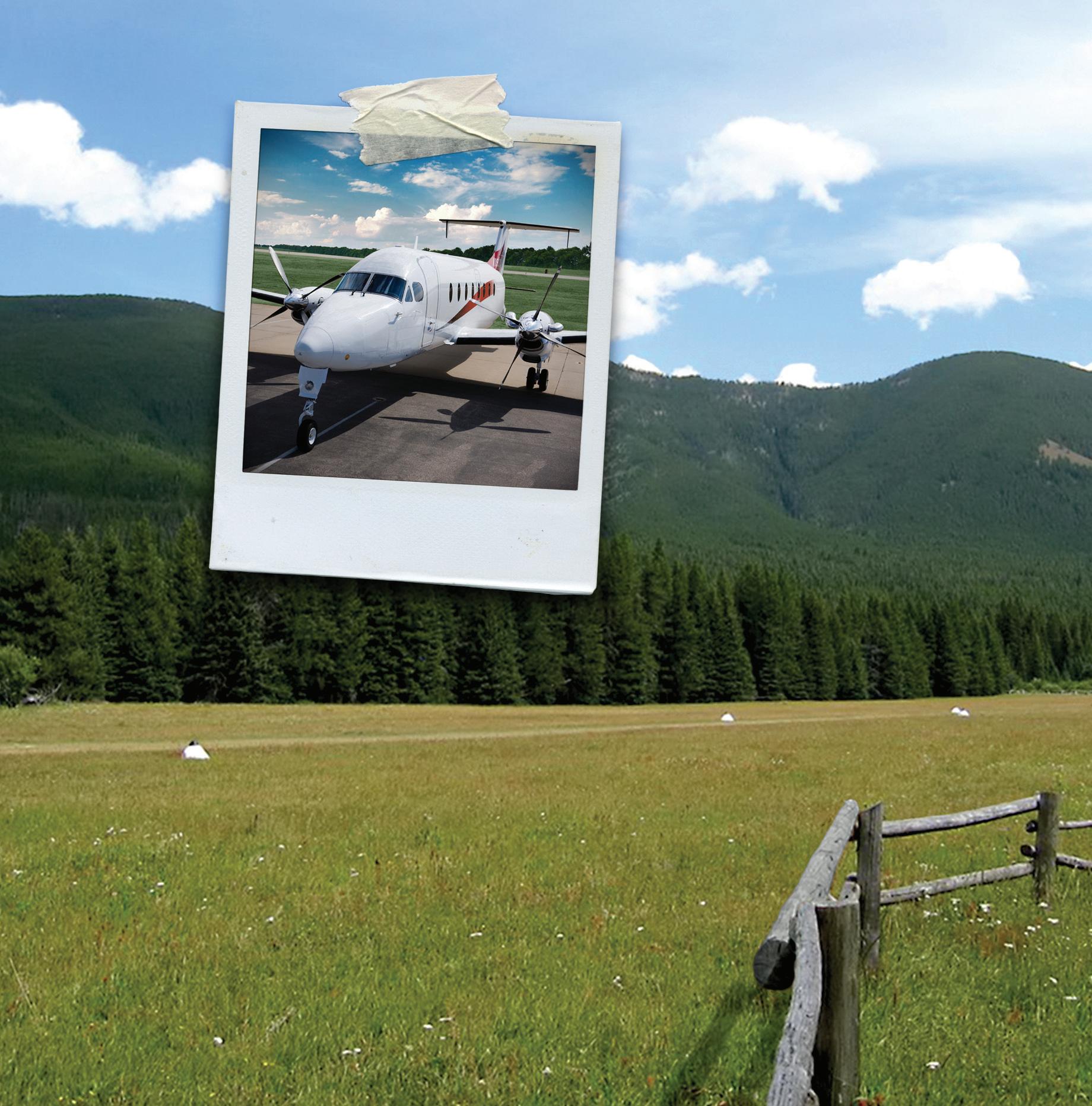
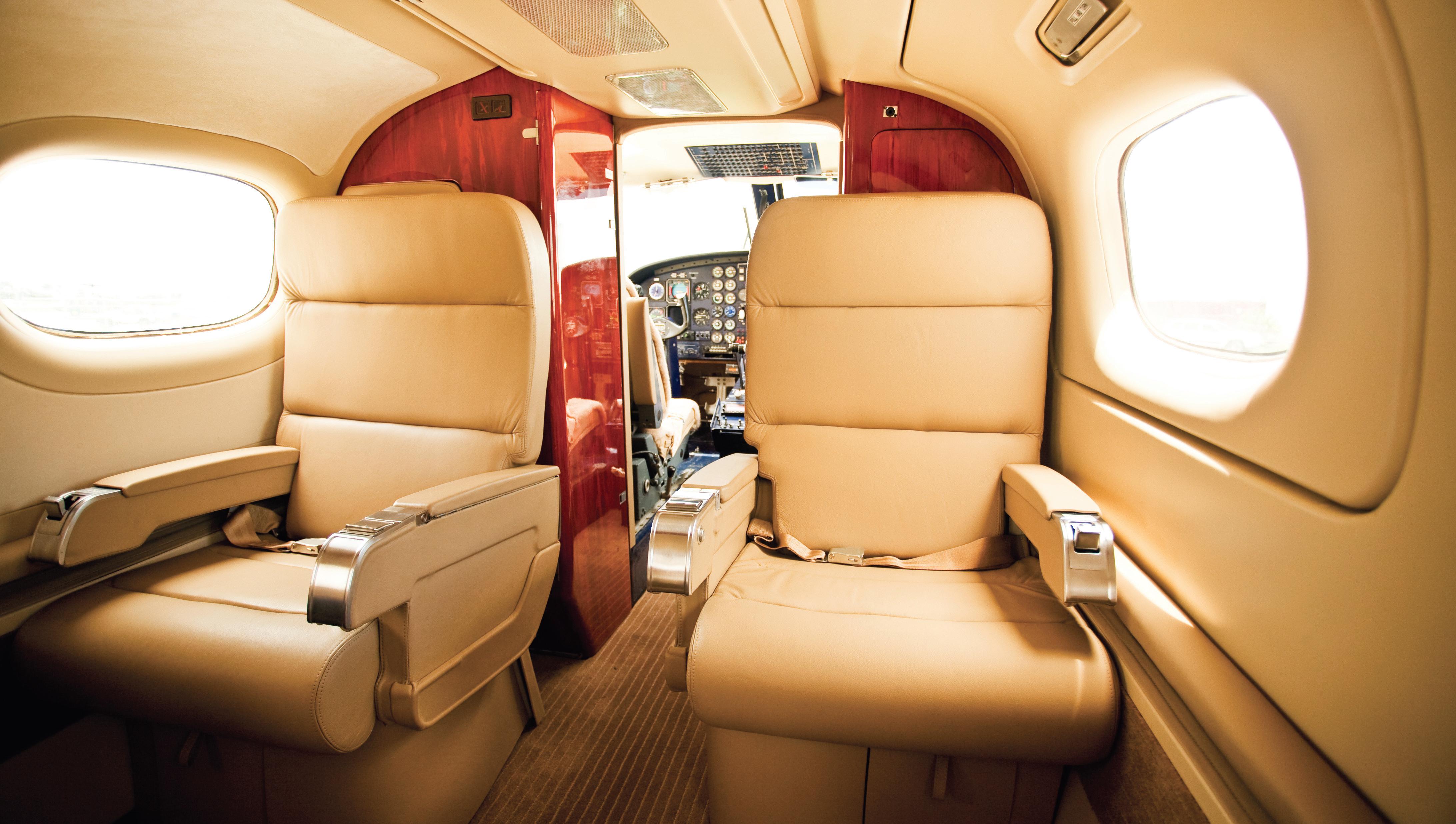
Whether it’s getting passengers where they need to be, hauling critical supplies to a remote destination, or deploying a paramedic crew for a life-saving mission, the versatile Beechcraft® 1900 is rugged enough to perform in some of the world’s toughest environments and sophisticated enough to get you there in style. Add turboprop efficiency and Beechcraft heritage, and you have a pre-owned aircraft that works as hard as an entire fleet to impact your bottom line. Visit the Beechcraft 1900 official website for a tour of its versatile configurations at www.raytheon.com, keyword: beechcraft1900.
www.raytheon.com
Keyword: beechcraft1900
Raytheon Airline Aviation Services, LLC
+1.316.676.1007
20 45˚42� North Operational flexibility uPFRONT BAck
7 leading edge Co-ordinated efforts for Haiti
10 On the fly News and opinion 14 Waypoint Changes on the horizon 16 Alternate approach Airline access and frequency
18 At the gate A synthetic future
19 An insider’s outlook Q&A with ATAC’s John McKenna
FEATuRES
45 Wings on safety Northern composure
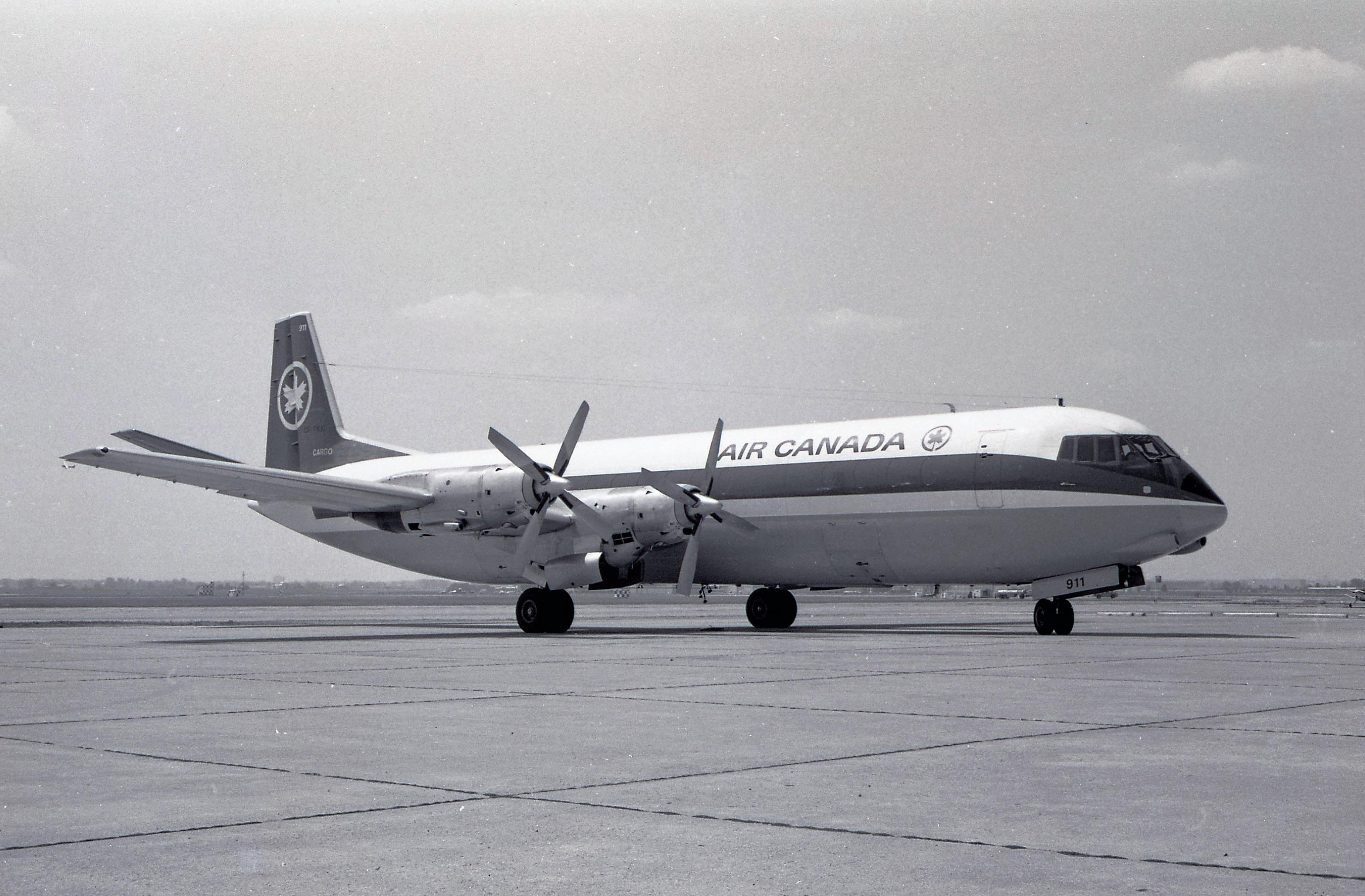
46 A look back The Vickers Vanguard
47 Marketplace
54 On final Addressing industry needs
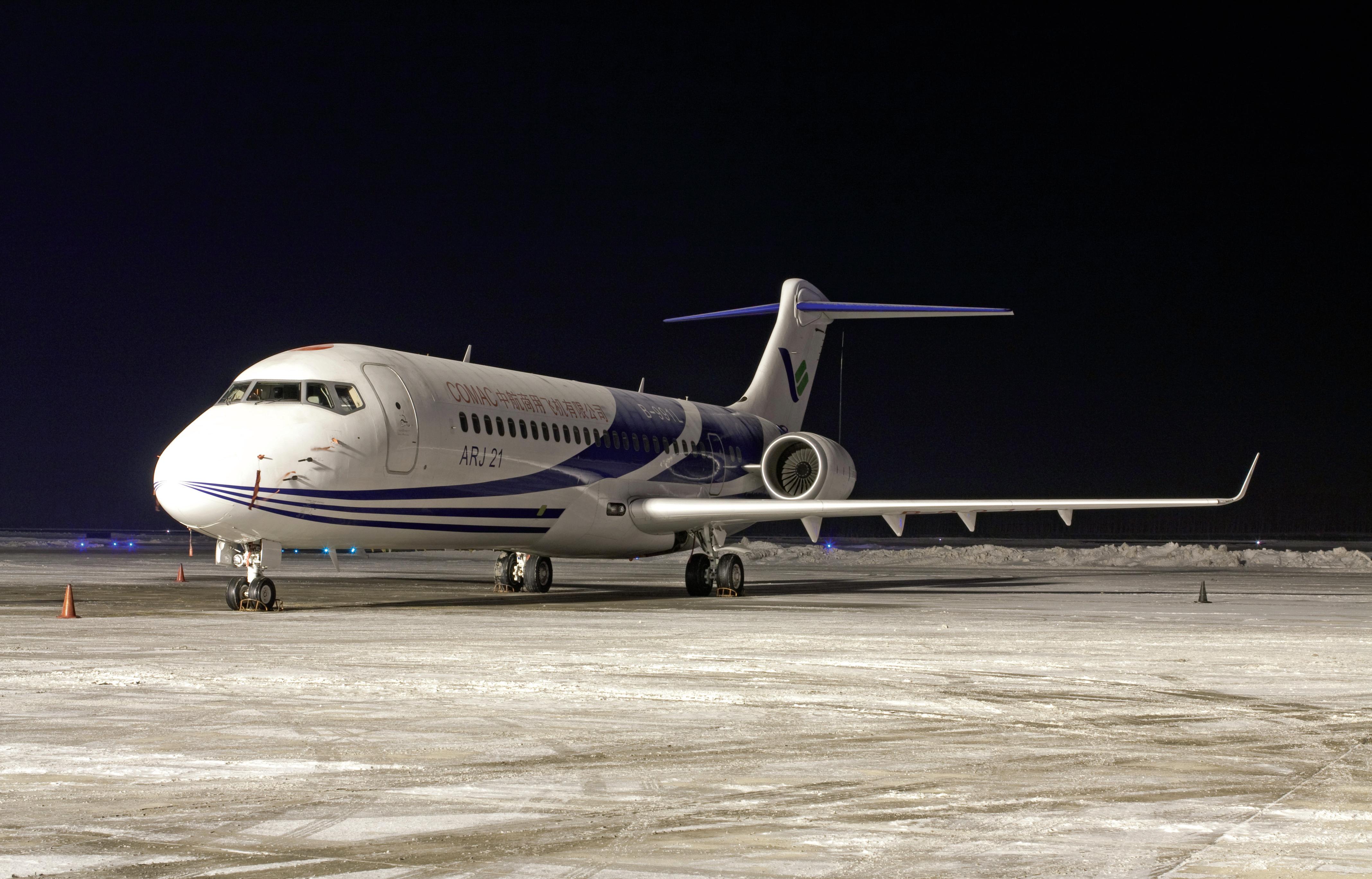
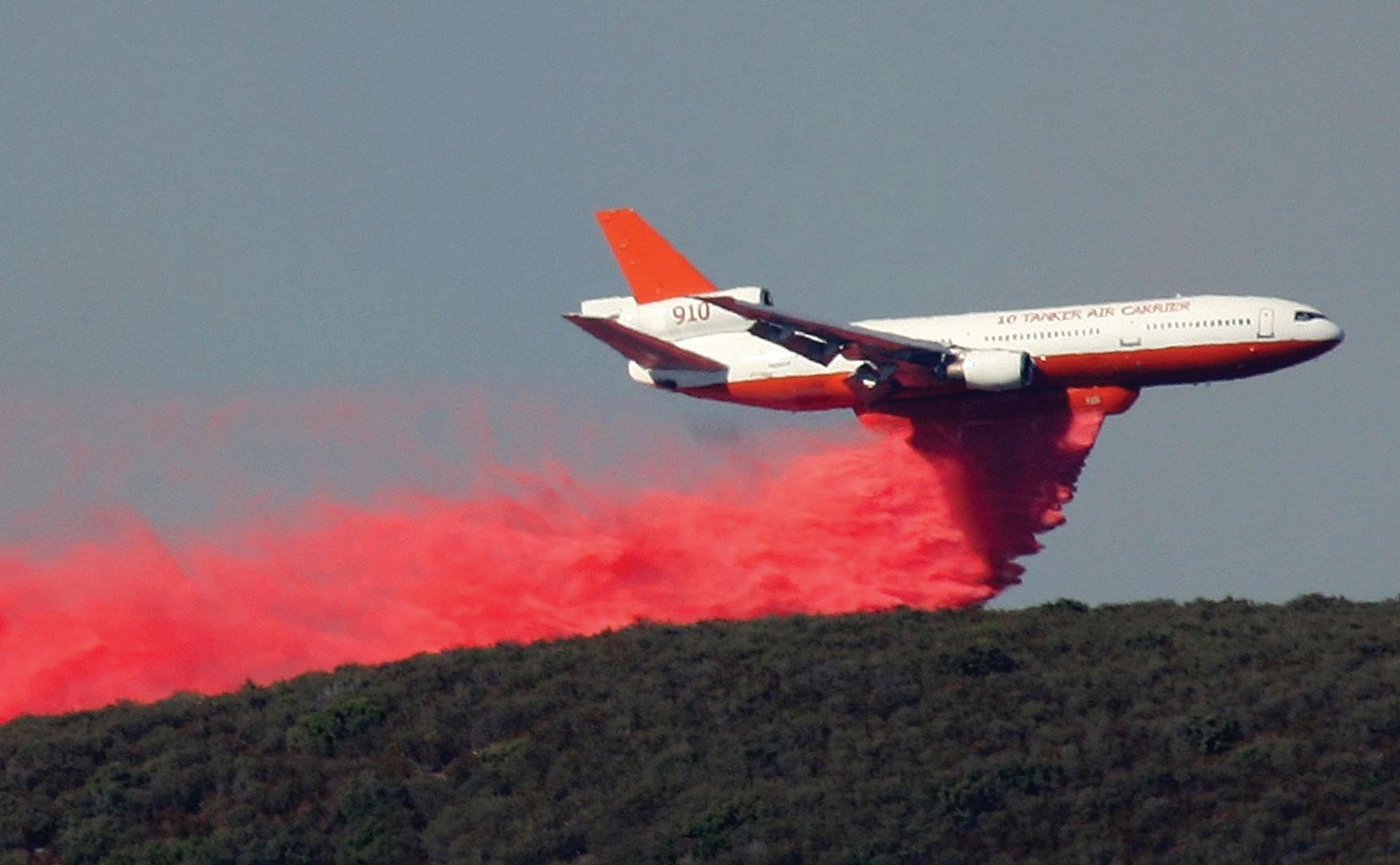
from top: comac’s key canuck. P.32. vlaTS – Too hot to handle? P.40.
21 SPARRINg PARTNERS TO ThE FORcES Top Aces puts training to the test BY JameS careleSS 24 ThE DORNIER SEASTAR The world is its oyster BY PeTer PIGoTT 29 NIghT vISION lESSONS NVEO conference tackles operational safety BY JameS careleSS 32 cOMAc’S kEy cANuck Capt. Parker succeeds in China BY frederIck k larkIN 36 ENSuRINg cONTINuOuS IMPROvEMENT Key aviation players invest in quality BY davId olSeN
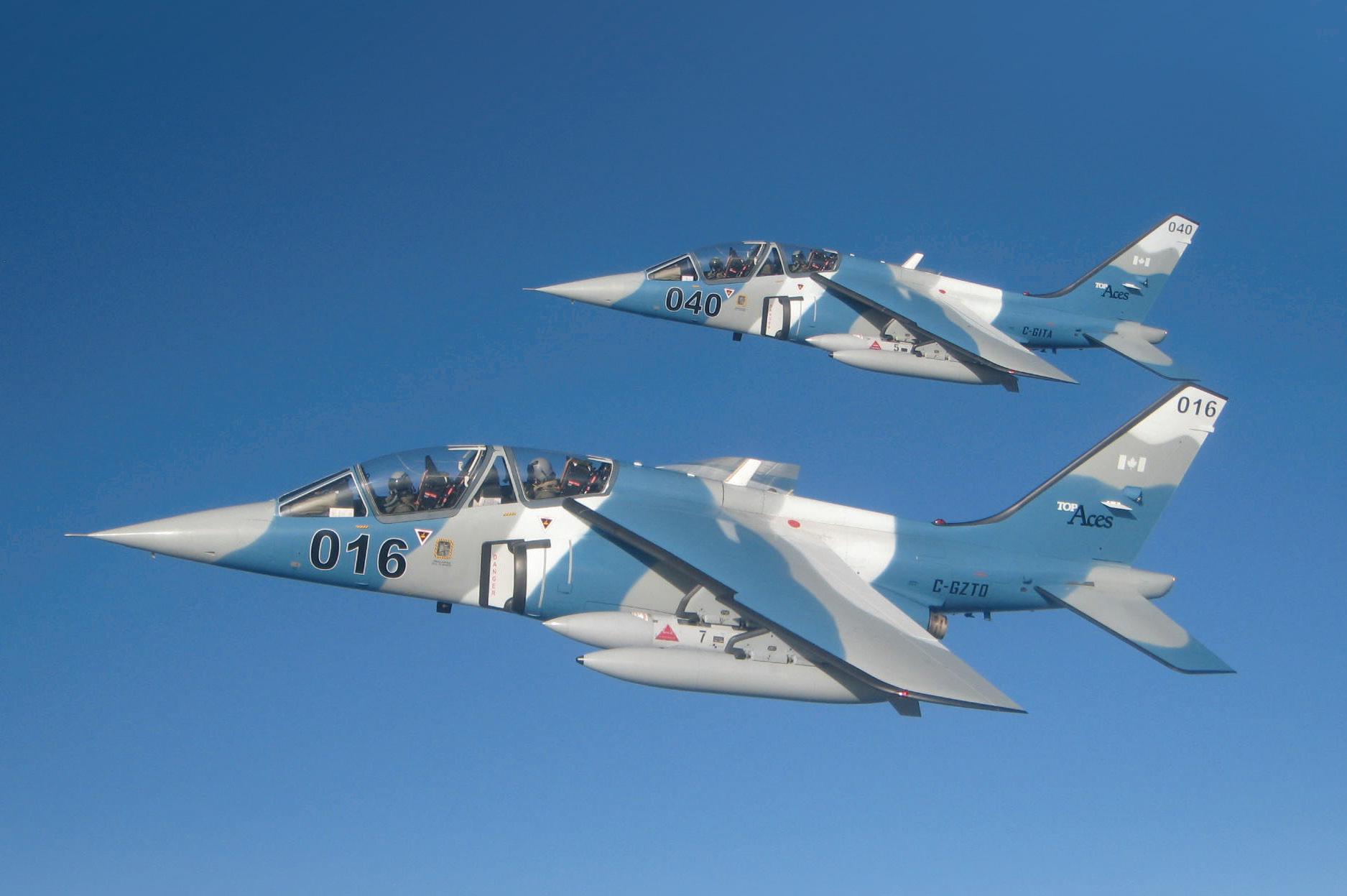
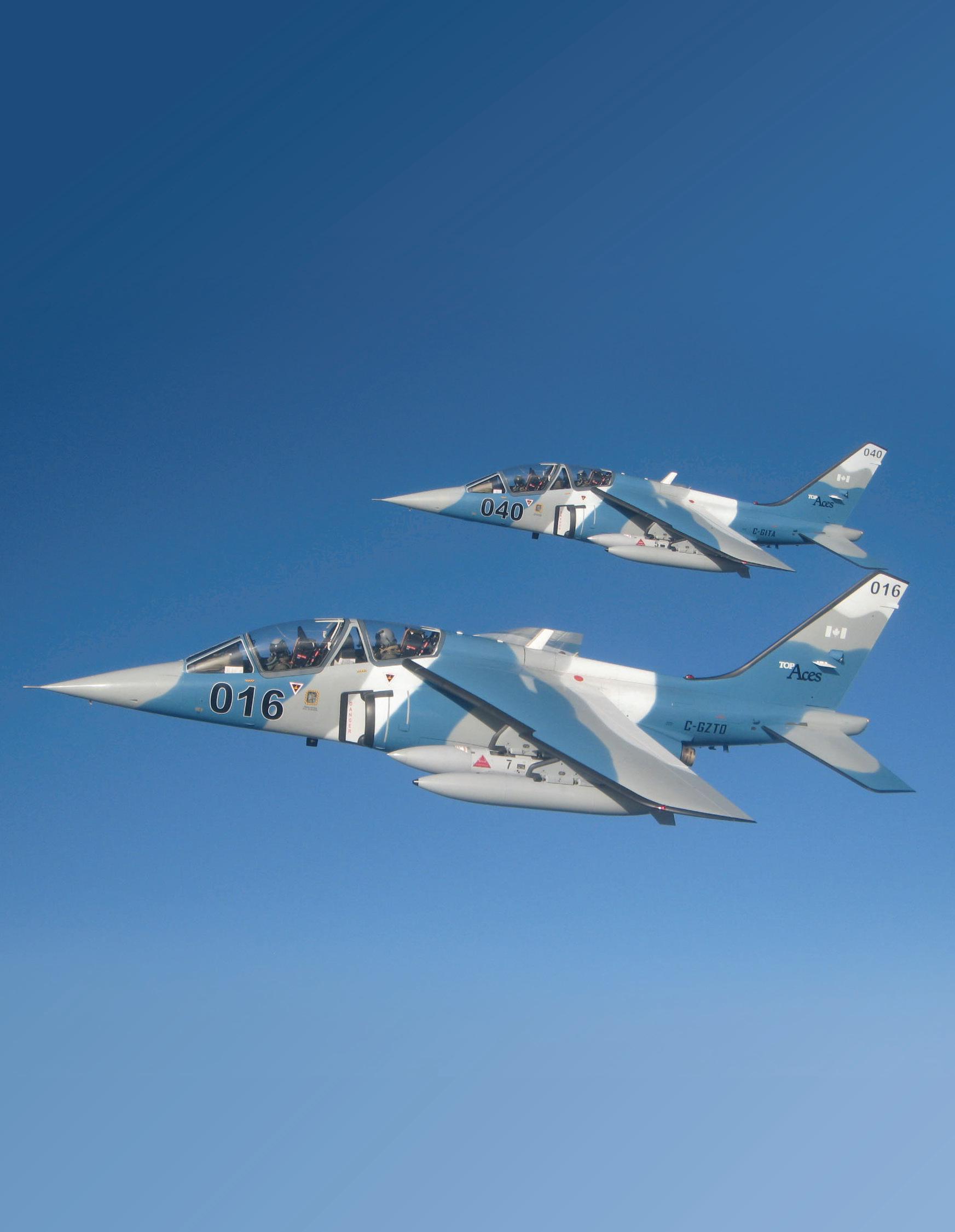
The Top aces fleet includes 16 ex-military dassault-Breguet-dornier alpha Jets. P.21.
| By Andrea Kwasnik
co-ordinated efforts for haiti
Aviation community rallies in support
There has been a swelling of national pride over Canada’s recent performance on the world stage; however, that pride should extend far beyond the podium. Canada’s response to the earthquake that devastated Haiti on January 12 was immediate and has for the most part been applauded by experts in largescale relief operations. In a testament to the strength and generosity of Canada’s aviation community, we continue to hear reports of support efforts being mounted across the country.
At the time of the earthquake our Air Force was spooled up to support the Olympics, the G-8 Summit, ongoing domestic operations and operations in Afghanistan. Its focus quickly turned to one of the largest airlift and humanitarian aid operations the Canadian Forces has seen in recent history. Within hours, CC-177 Globemaster III and CC-130 Hercules from 8 Wing Trenton were readying to transport critical supplies and personnel to Haiti. Within days, the Forces had set up a strong footprint in Haiti for staging SAR operations, relief efforts and aid delivery, and aircraft were returning carrying hundreds of evacuees.
Canada’s major airline carriers were also swift with their relief response. Air Canada, WestJet and Air Transat each quickly dispatched dedicated aircraft with critical relief supplies, mainly on behalf of humanitarian organizations. Working with relief partners, the airlines also donated flights for volunteer and relief workers, and supplied free return flights to orphans and adoptive parents. And to help in these relief efforts, various airline suppliers donated their services, and Nav Canada, the GTAA, the Ottawa International Airport Authority and Aéroports de Montréal all waived fees. Although the airlines have started to resume their regular scheduled
flights to Haiti, things are far from normal and many have committed to long-term humanitarian projects.
In addition to these efforts, many smaller organizations are also coming up with ways to contribute. One example is the effort be-
Each year, several BFC members fly their aircraft down to the Sun’n Fun fly-in in Lakeland, Fla. The annual migration involves extra side trips for pleasure, but this year the side trips will involve humanitarian flights to Haiti instead. Brooks’ affiliation with Neil Hetherington, CEO of Toronto’s Habitat for Humanity, proved to be an ideal fit. The BFC is currently raising money that will be used to buy tools and medical kits. The donations will be coordinated through Toronto’s Habitat for Humanity and will ultimately be delivered to the Habitat for Humanity in Haiti.
“Our plan is to ship the supplies via Air Canada to Punta Cana, Dominican Republic, and pre-position them there for our pickup,” said Brooks. “Once we get to the Dominican, we will fly the supplies from Punta Cana to Jacmel in southern Haiti where we will be met by representatives of Habitat for Humanity Haiti.”
The Canadian aviation community can be proud of what it is doing to help rebuild Haiti.
ing coordinated by the Buttonville Flying Club (BFC), based at the Toronto Buttonville Municipal Airport. Known as COPA Flight 44, BFC is the largest COPA Flight comprising 240 members who own and operate more than 70 planes. “Our members put their heads together to find a way to contribute, and we decided that our annual trip to Sun ’n Fun was a good starting point,” said Mark Brooks, president and flight captain of COPA Flight 44, who is spearheading the plan.
TOP DATA BuRSTS in this issue
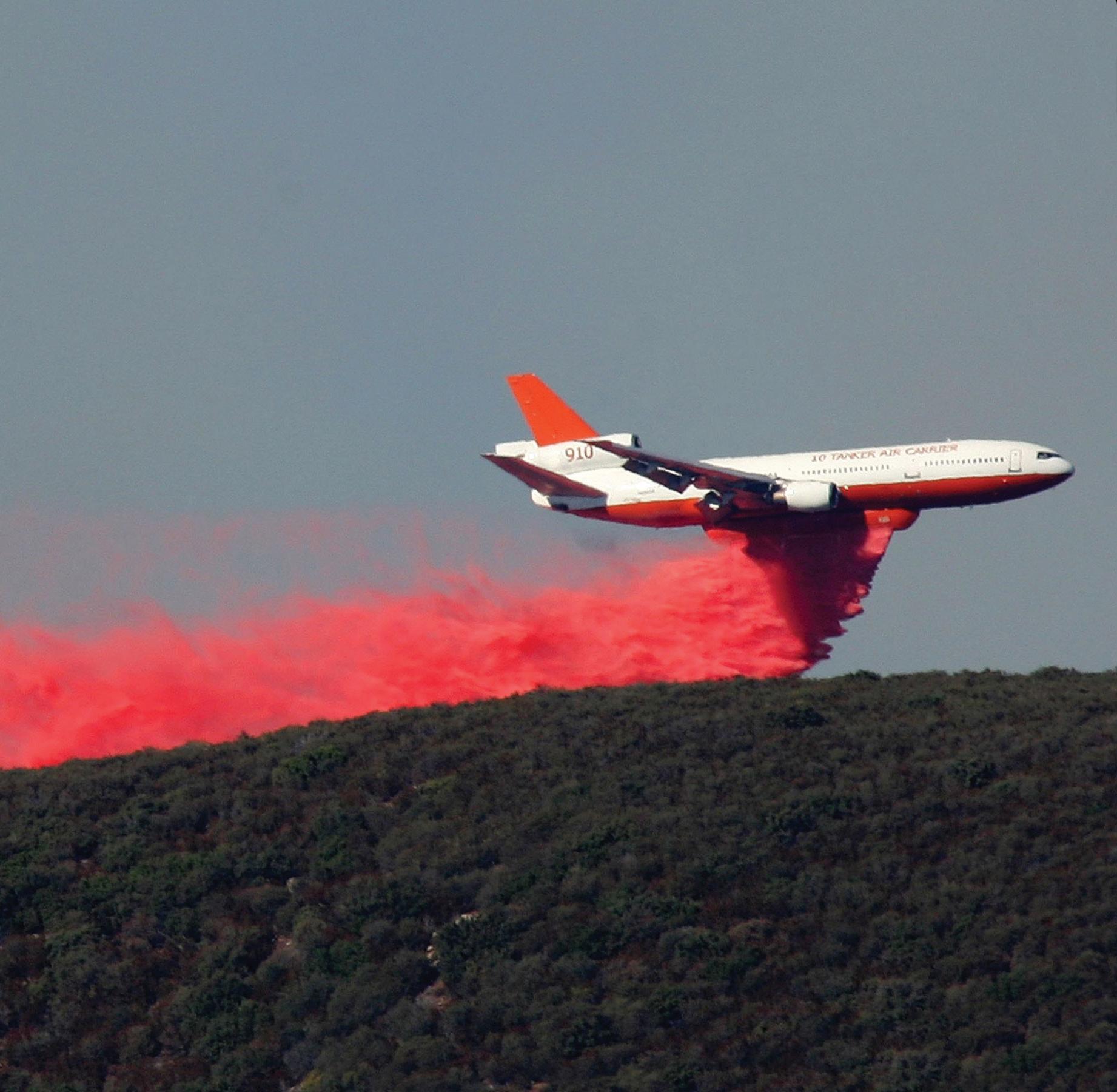
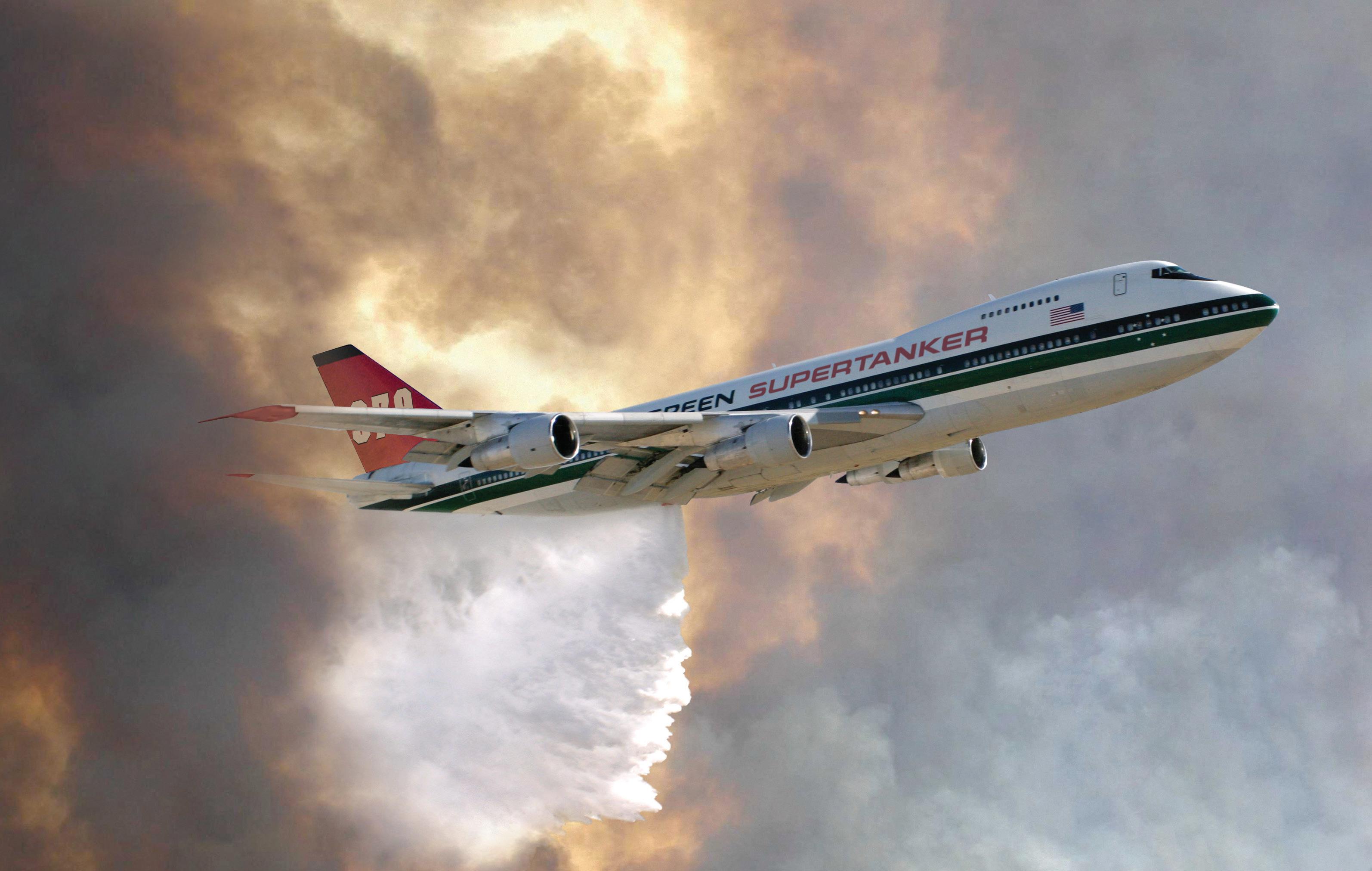
1. Dassault-Breguet-Dornier alpha Jets are capable of Mach 0.95 (pg. 22). 2. The per flight hour maintenance cost for the Dornier seastar is Us$90.15 (pg. 26). 3. Ottawa’s Neptec Design has created technology that “looks through” dust and snow (pg. 30). 4. cOMAc’s ARJ21-700 is billed as an advanced regional jet (pg. 33). 5. Evergreen’s 747 is the newest and largest VlaT. it carries 77,000 litres of liquid (pg. 41).
Brooks, an IFR-rated pilot who has flown for the last 15 years, owns a Cirrus aircraft. “I only need about 2,000 feet of runway to land, so we intend to fly to pre-planned smaller GA airports, bypassing bottlenecks and restrictions at the bigger airports.” Brooks and the other pilots plan to spend several days making the shuttle flights back and forth, which take approximately an hour and a half, one-way. “Our ultimate goal is to transport 1,000 kilograms of needed supplies to Habitat for Humanity.”
Logistics are still being worked out with Haitian authorities and contacts, and the BFC is optimistic about the plans. The club has set up a donation box at the Buttonville airport and has an ongoing fund-raising campaign on its website, www.buttonvilleflyingclub.com.
In a recent MacLean’s article, the Hon. Peter Kent, Minister of State of Foreign Affairs (Americas), put it into perspective: “These little kids that we see, the survivors coming out of the rubble…they will be adults by the time we actually get to a point of meaningful recovery and reconstruction in Haiti.”
While Haiti’s needs certainly dwarf any effort made by a single operator, as a group, the Canadian aviation community can be proud of what it is doing to help rebuild Haiti. | W
ASSOcIATE EDITOR andrea Kwasnik akwasnik@annexweb.com 519-429-5181 • 888-599-2228 ext. 238
cONSulTINg EDITOR Matt nicholls mnicholls@annexweb.com 416-725-5637
PRODucTION ARTIST Kelli Kramer
FlIghT DEck
Ken armstrong, Roger Beebe, Ray canon, James careless, David carr, Paul Dixon, Brian Dunn, Frederick K. larkin, neil MacDonald, carroll Mccormick, Mike Minnich, David olsen, Peter Pigott, Dr. Tarek sardana, Rob seaman, Blair watson
ADvERTISINg SAlES Ryan culver rculver@annexweb.com 519-429-5182 • 888-599-2228 ext. 273
ASSOcIATE PuBlIShER alison de groot adegroot@annexweb.com 1-888-599-2228 ext. 246
gROuP PuBlIShER scott Jamieson sjamieson@annexweb.com
PRESIDENT Mike Fredericks mfredericks@annexweb.com
WINgS MAgAzINE
Po Box 530, 105 Donly Dr. s., simcoe, on n3Y 4n5 Tel.: 428-3471 Fax: 429-3094 Toll Free: 1-888-599-2228
Publication Mail agreement #40065710
Return undeliverable canadian addresses to circulation Dept., P.o. Box 530, simcoe, on n3Y 4n5
e-mail: ncuerrier@annexweb.com
Published six times per year (Jan/Feb, Mar/apr, May/ Jun, Jul/aug, sep/oct, nov/Dec) by annex Publishing & Printing inc.
News highlights, web exclusives, blogs, job postings, new products, events and more www.wingsmagazine.com
ON THE FLY
hAWkER BEEchcRAFT, FlIghTSAFETy gRAND OPENINg
INDuSTRy NEWS
cAE AWARDED BOEINg SIMulATOR cONTRAcT
CAE has sold a CAE 7000 Series full-flight simulator (FFS) for the Boeing 737-800 aircraft to Skymark Airlines. This contract, in addition to the recently announced contract with Turkish Airlines, brings to 16 the total FFS sales that CAE has announced so far during fiscal year 2010.
The Boeing 737-800 FFS, as well as a brief-debrief station, will be delivered to Skymark’s main base at Tokyo International Airport in Haneda, Japan by the end of 2010. Skymark currently uses a CAE-produced 737-800 FFS that was delivered last year.
The simulator will incorporate a full six-degree-of-freedom CAE True electric motion system and new-generation CAE Tropos-6000 visual system, including liquid crystal on silicon (LCoS) projectors and 200- by 40-degree field-of-view visual display. The simulator will be certified to Level D, the highest qualification for flight simulators.
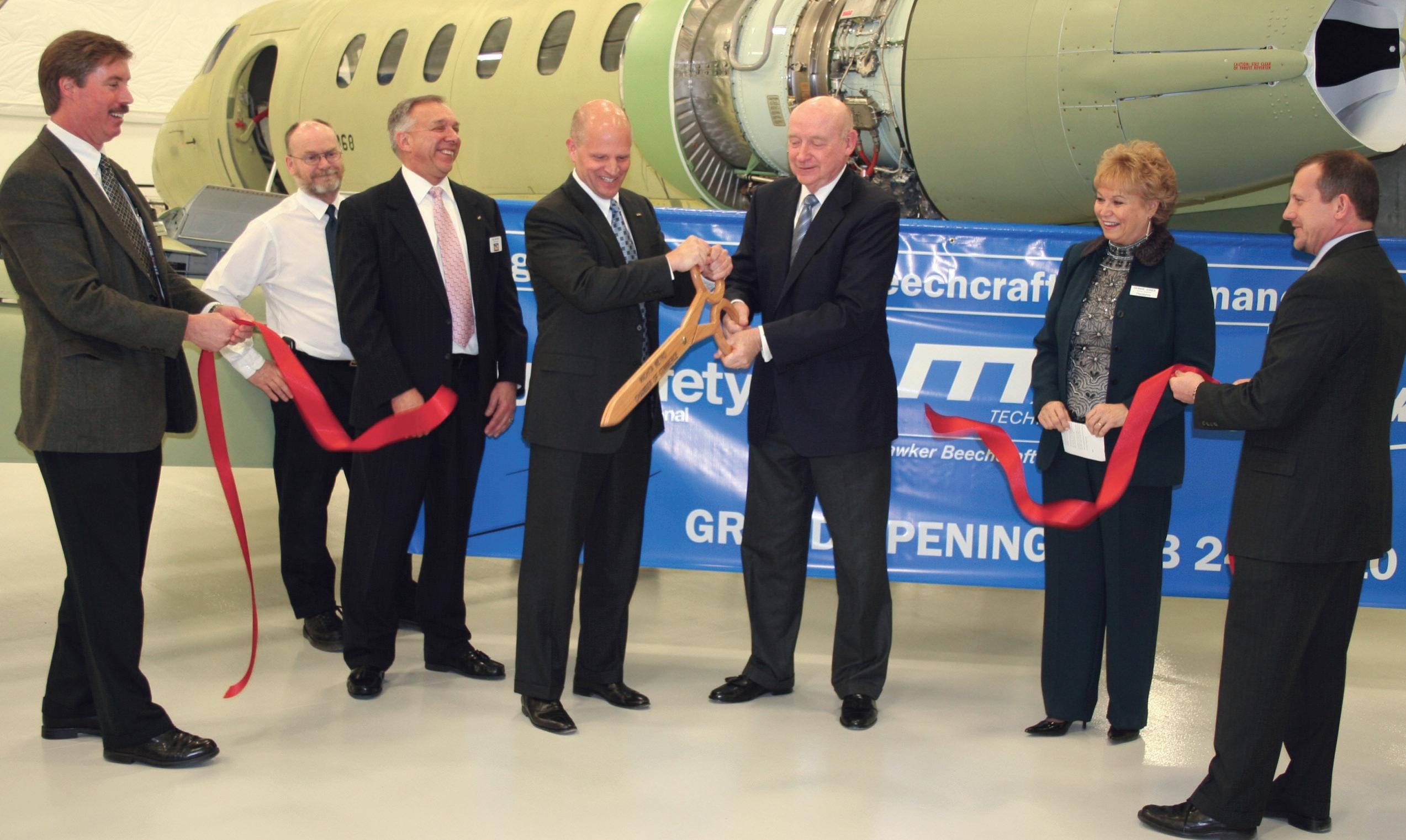
Hawker Beechcraft Corporation (HBC) and FlightSafety International hosted a grand opening and ribbon cutting ceremony in February at the recently completed FlightSafety International Hawker Beechcraft Maintenance Learning Center in Wichita, Kan. Located east of the approach end of HBC’s Runway 18, the new 44,000 square foot Maintenance Learning Center features 10 advanced technology classrooms, Graphical Flight-Deck simulators, composites and cabin systems labs, and direct runway access to a 10,000 square foot hangar.
Several technicians have already completed a MxPro program at the Maintenance Learning Center that began hosting classes in November.
cMc cOckPIT 4000 SElEcTED FOR MOROccAN TRAINER
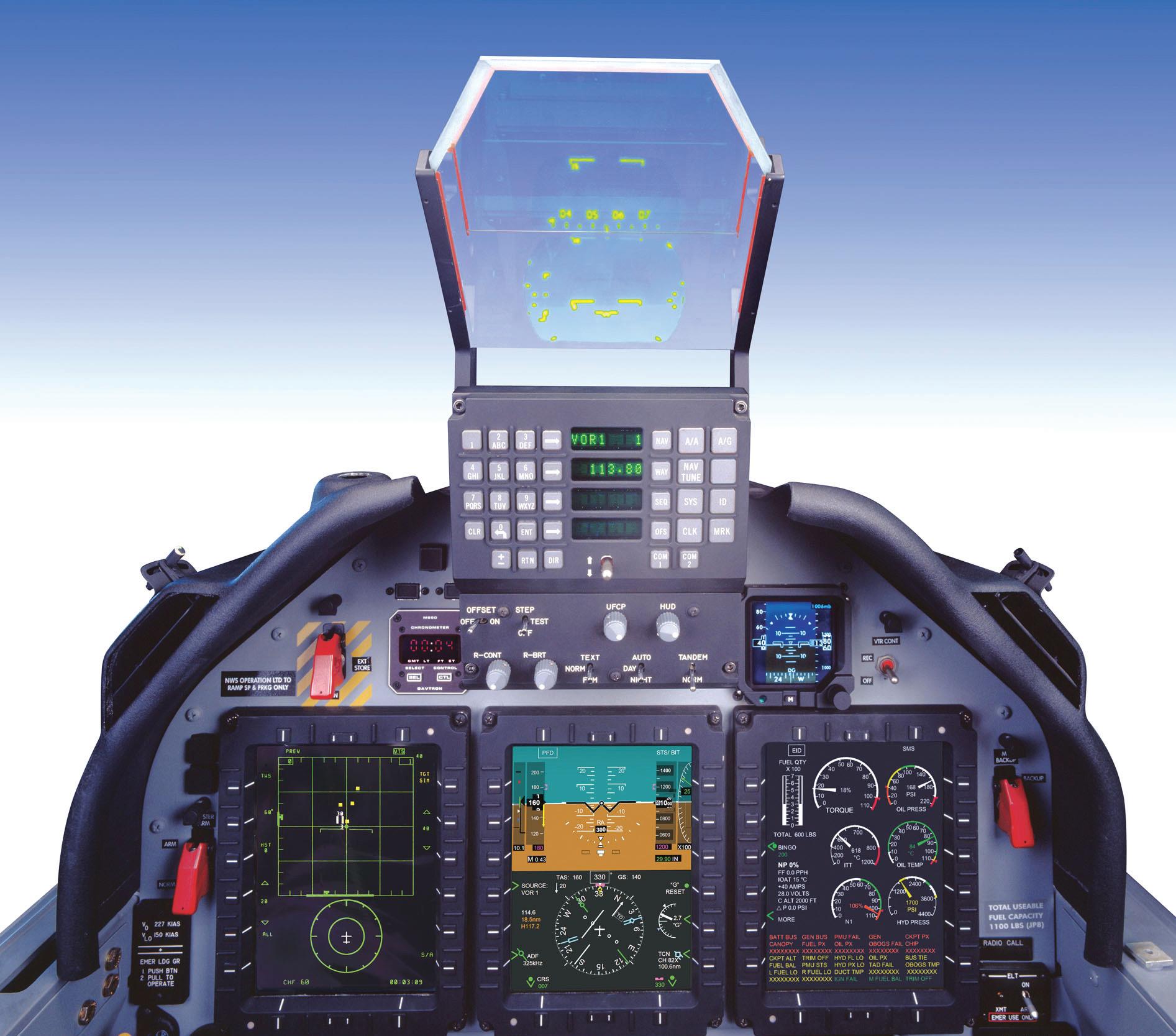
Esterline CMC Electronics (CMC) has received initial orders from Hawker Beechcraft Corporation (HBC) to supply its Cockpit 4000 integrated avionics suite for 24 T6-C trainers for the Royal Moroccan Air Force. Morocco is the first to purchase HBC’s newly introduced T-6C trainer, which is an improved version of the T-6A Texan II (the primary trainer
for the NATO Flying Training Canada (NFTC)). The avionics suite to be supplied by CMC will include an integrated avionics computer (IAC), a head-up display (HUD), up-front control panel (UFCP), six multifunction displays (MFDs), inertial reference unit (IRU), digital video recorder/data transfer System (DVR/ DTS) and radar altimeter (RADALT).
The Cockpit 4000 encompasses the full suite of primary flight, engine and navigation displays, and was certified recently by the FAA as installed on the T-6B trainer aircraft for the U.S. Navy. It comprises new-technology equipment that integrates CMC’s key product lines, such as flight management systems, global positioning systems, head-up displays, navigation and mission processors, multi-function displays and control panels.
uNIvERSAl TAkES DElIvERy OF NIghTFlyINg uAv
Universal Wing Technologies Inc. has taken delivery of its third Venturer-class unmanned airborne vehicle (UAV), targeted at night time “red eye” endurance missions. The aircraft will demonstrate that the Venturer design can fly reliably through the night, taking off at dusk and landing at dawn.
Flying night missions is an advantage for Universal because lower turbulence (at low altitude) makes flying smoother, improving data quality. Magnetic field variations are also reduced at night, improving geophysical data quality. The “red
cmc’s cockpit 4000 will be incorporated into 24 T6-c trainers for the royal moroccan air force.
executive vice president of flightSafety International, eric Hinson (centre left), and chairman & ceo of Hawker Beechcraft corporation, Bill Boisture (centre right), cut the ribbon with flightSafety International and Hawker Beechcraft employees at the ceremony.
eye” endurance tests will be conducted in the interior of B.C. and will be completed by August. Revenue-generating missions will then be initiated.
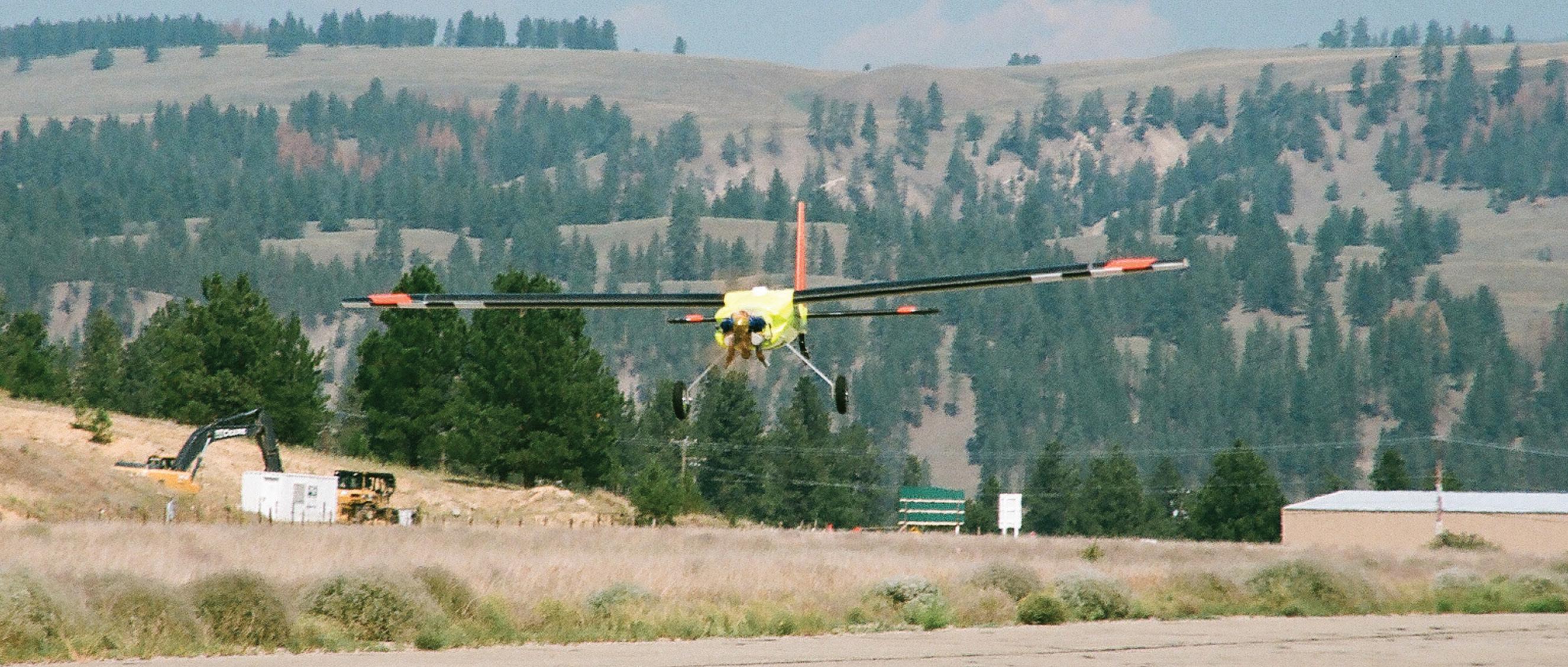
The Venturer UAV is a customdesigned workhorse manufactured exclusively for Universal by Stratus Aeronautics Inc. of Vancouver, B.C. The first Venturer carries a camera payload while the second is currently being used for promotion. Universal has ordered a fourth Venturer in which a horizontal gradiometer (two magnetometers in each wing tip) payload will be installed.
PEOPlE
AvcORP DIREcTOR OF quAlITy WINS AvIATION SAFETy AWARD
Vitorio Stana, director of quality at Avcorp Industries Inc. is the 2009 recipient of the prestigious Transport Canada Aviation Safety Award. The award recognizes persons, groups, companies, organizations, agencies or departments that have contributed, in an exceptional way, to aviation safety in Canada.
The Award, a certificate and letter signed by the Minister of Transport, was presented to Stana as part of the National Aviation Day proceedings at the Canadian Aviation Museum in Ottawa.
Mr. Stana has been the director of quality at Avcorp since 2006. During this time he has lead initiatives that have seen Avcorp obtain both NADCAP and AS9100
approvals, while establishing and maintaining Avcorp’s Quality Management System.
“I’m very honoured to accept this award,” Mr. Stana said, “but I am even prouder of our whole team at Avcorp. In this sense, this award reflects the safety awareness of all of us at Avcorp.”
AIRPORTS PORTER’S NEW TORONTO cITy AIRPORT hOME
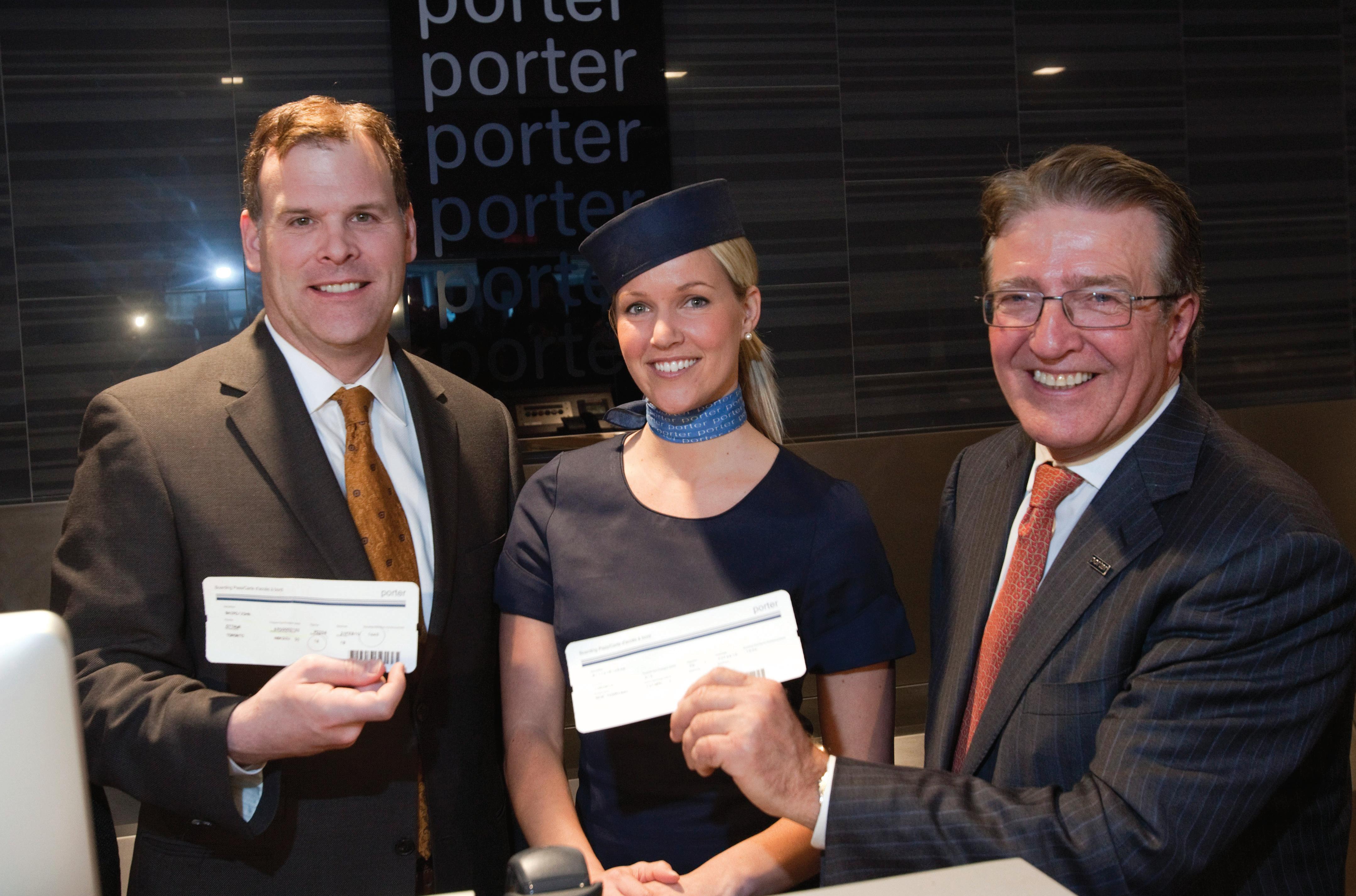
Porter Airlines new home at Billy Bishop Toronto City Airport opened to passengers March 7. The $50 million passenger terminal was unveiled at a ceremony showcasing enhanced passenger services, further improving the travel experience at this revitalized facility. Porter projects more than 1.3 million passengers using the airport in 2010.
Porter is a tenant of City Centre Terminal Corp., which operates the new terminal and
is seeking retail, food services, duty-free, and other tenants for the 150,000 sq. ft., twophase project. Phase one includes lounge facilities, a spacious check-in hall and office space. The full facility, including 10 bridged aircraft gates and two passenger lounges is scheduled for completion by fall 2010.
Porter recently announced it is expanding its schedule to offer five daily roundtrip flights between Boston Logan International Airport and Billy Bishop Toronto City Airport, starting March 31. The new schedule includes one additional roundtrip each weekday in the afternoon, and a further roundtrip on Sunday.
TORIES TO RAISE AIRPORT SEcuRITy TAx
The federal government is set to raise the airport security tax on April 1 – subject to parliamentary approval – to cover the cost of full-body screening and other new security measures.
The venturer Uav is a custom-designed workhorse manufactured by Stratus aeronautics of vancouver, B.c
Porter airlines president/ceo robert deluce (on right), with flight attendant, and John Baird, minister of Transport (on left), checking in as ceremonial first passengers.
Transport Minister John Baird recently announced the government will put up $1.5 billion over the next five years to tighten security. To cover that, air security fees will rise by $2.50 for a one-way flight in Canada, by $4.37 for transborder flights, and by $8.91 for international routes. The fees currently range from $5 to $16 a ticket, depending on the destination.
The government announced it will spend $11 million to buy 44 full-body scanners for airports. And the Canadian Air Transport Security Authority is bringing in a new behavioural observation program to look for suspicious travelers and will spend millions to train people in the techniques.
cOMMERcIAl
WESTJET REWARD PROgRAM TAkES FlIghT
WestJet is launching two new programs to reward travellers who fly with the airline. The WestJet Credit Card Program offered in partnership with RBC and MasterCard, and the WestJet Frequent Guest Program will offer guests the opportunity to earn and accumulate WestJet dollars. Every WestJet dollar can be used as cash toward the purchase of any flight on any date to any destination – including seat sales. WestJet dollars can also be used towards
WestJet Vacations packages (up to 500 WestJet dollars per person). There are no points, redemption grids, advance booking, blackouts or seat restrictions – just dollars off flights and vacation packages.
RBC’s first MasterCard product offering in Canada includes two new cards: the WestJet RBC World MasterCard and the WestJet RBC MasterCard. With each, cardholders
earn WestJet dollars on everyday purchases. The WestJet RBC World MasterCard provides 1.5 per cent in WestJet dollars, plus a bonus of 100 WestJet dollars. The card has an annual fee of $79, carries premium travel insurances and includes automatic membership to MasterCard World Experiences and Offers, which provides access to hotel discounts and upgrades, preferential golf and spa rates and other exclusive benefits.
With the WestJet RBC MasterCard, cardholders earn one per cent back in WestJet dollars on everyday credit card purchases, plus a bonus of 25 WestJet dollars the first time the card is used. The card has an annual fee of $39. Both cards provide a 0.5 per cent bonus in WestJet dollars for WestJet flights and WestJet Vacations packages purchased on the card.
OPERATORS
REPuBlIc AIRWAyS FIRST NA cuSTOMER FOR cSERIES
Bombardier Aerospace recently announced a major order for its all-new CSeries aircraft to Republic Airways Holdings Inc., the first North American airline to place a firm order for the jetliners. The Indianapolis, Ind.-based airline has signed a firm purchase agreement to acquire 40 CS300 jetliners with options for an additional 40 CS300 aircraft. Based on the list price for the CS300 aircraft, the contract is valued at approximately US$3.06 billion which could increase to approximately US$6.34 billion if all options are exercised.
Since launching the CSeries family of aircraft at the Farnborough Air Show in July 2008, Bombardier has recorded firm orders for a total of 90 CSeries aircraft which includes the order from Republic Airways, a firm order from Deutsche Lufthansa AG for 30 CS100, and one from Lease Corporation International Group for 17 CS300 and three CS100. The program has also booked options for an additional 90 CSeries aircraft.
The CSeries aircraft are optimized for the longer range, single-aisle 100- to 149seat market. Technological advancements of the aircraft include fourth generation aerodynamics, increased use of composites and advanced aluminum alloy in structures, a next-generation engine – the Pratt & Whitney PurePowerTM PW1000G –and the very latest in system technologies, such as fly-by-wire and electric brakes.
At entry into service in 2013, the CSeries family of aircraft are projected to emit 20 per cent less CO2 and 50 per cent less NOx, versus current in-production aircraft of similar size.
cORREcTION NOTIcES
In “A Winning Attitude” (Jan/Feb p.26) we erroneously referred to the Diamond Star as the Cessna Diamond Star. Diamond Aircraft manufactures the Diamond Star. We apologize for the error.
Oops, we went too fast!
In an interview with the Hon. John Baird (Jan/Feb pg. 17) there was a misprint regarding his flight in the F-18. He says he was travelling at Mach 7; this should have been Mach 0.7.
The cSeries aircraft are optimized for the longer range, single-aisle 100- to 149-seat market.
Two new reward programs will allow guests to earn WestJet dollars.
yyz IN ThE lATE hOuRS . . .
BY RoB seaMan
As many are aware, Toronto’s Lester B. Pearson International Airport (YYZ) recently implemented a revised Late Night Flight Program due to increased pressure for night flights and zero growth on the Transport Canada mandated YYZ night flight budget. The CBAA, FBOs and the GTAA have been working together to create a process that allows resident aircraft operators the ability to function during these fringe hours. They have been meeting on a monthly basis for the past several months keeping lines of communication open, addressing mutual issues and monitoring any needs or concerns.
The agreed procedure as published by the GTAA in an Advisory dated Nov. 20, 2009, states a limited number of night flight operations during the restricted hours (00:30 to 06:30 local) are available to YYZ-based GA operators. According to the Advisory, “The Toronto Pearson based night flight budget pool (YYZ GA Night Pool) has been created to facilitate requests for both pre-approved slots and ‘day of’ extensions.”
Priority is given to arrivals of Toronto-based aircraft. That said, consideration is given to departures on a per case basis. To qualify and participate, Toronto-based GA operators are requested to provide GTAA with current aircraft registrations.
The YYZ GA Night Pool (Pool) consisted of 175 slots for the winter season (November 2009 until March 2010), which translated into 35 slots per month. Currently, the YYZ GA Night Pool budget for the summer season is being reviewed and assessed in conjunction with airline summer scheduling.
Pre-approved YYZ GA Night Pool slots within the monthly allocation are accepted by submitting a Slot Request to the facility allocation office. Flights within 24 hours of the anticipated operating time (day of) are to call the Resource Management Unit (RMU) for a slot. Flights requests anticipated within 30 days but no less than 24 hours in advance need to be sent by email to yyzslots@gtaa.com using the appropriate GTAA issued form. The FBO operator collects the regular landing fee on pre-approved Pool flights operating during restricted hours.
Pool extensions for departure flight requests must be submitted to the Resource Management Unit (RMU) in the manner outlined above. Approval of these departure flights will be subject to a higher level of scrutiny to ensure the request is reasonable (i.e. a long-haul flight with a weather delay). These eligible operators are required to inform the RMU that they are “Toronto Pearson-based general aviation operators” when calling for a “day of” extension.
These flights do not count against the YYZ GA Night Pool but do count against the Transport Canada mandated night budget.
The escalation process remains unchanged with the GTAA duty manager making the final decision for any request up to 24 hours in advance of the intended flight operation.
Those who do not have an approved slot and choose to operate during the restricted hours could incur a penalty equivalent to as much as 16 times the applicable landing fee.
For more information, contact the duty manager at (416) 776-3030.
By Rob Seaman |
changes on the horizon
Security at FBOs could soon be a new game
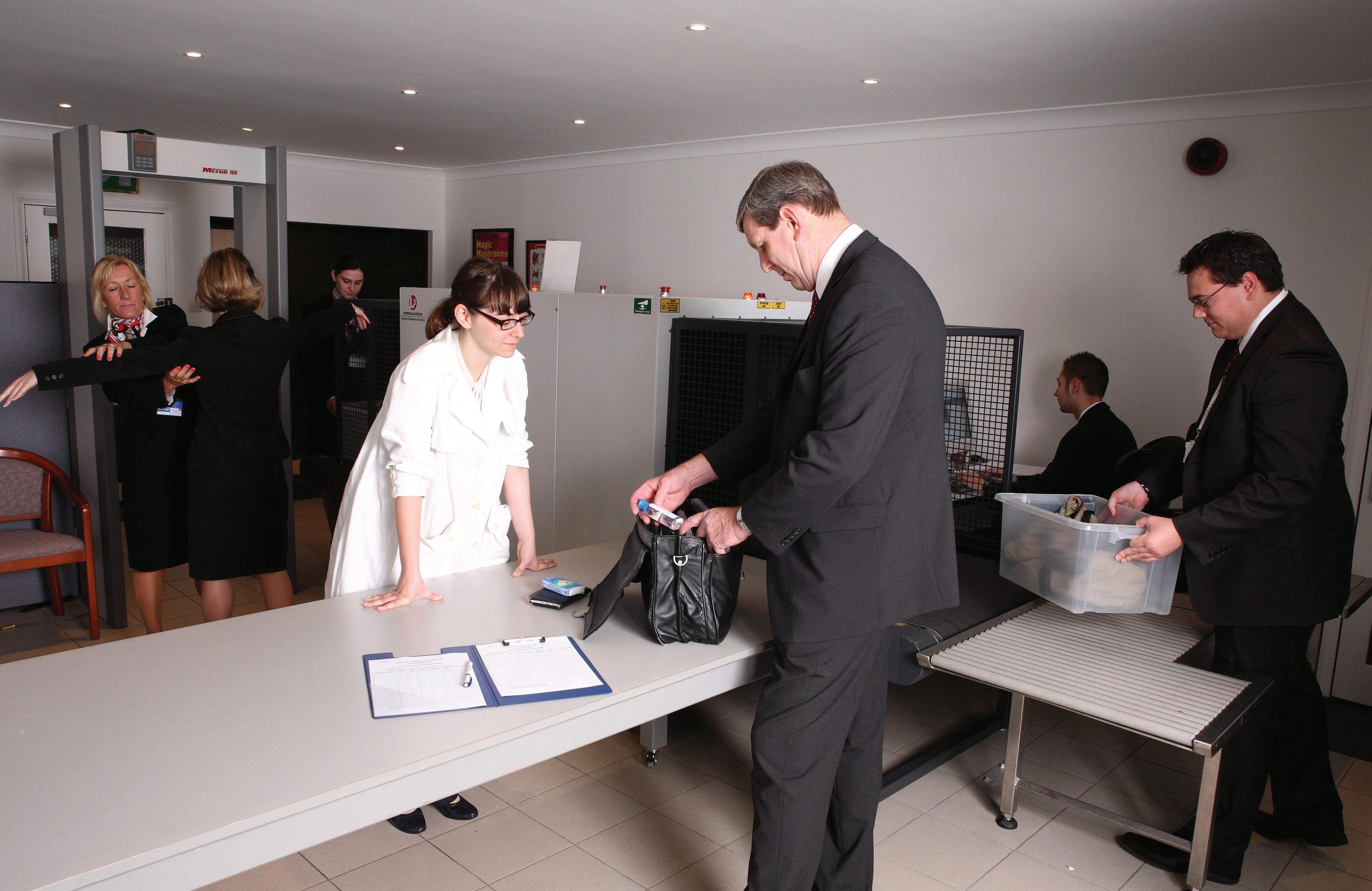
Just as we thought things were better in the aviation community, the Christmas Day “underwear bomber” incident sent everything into a backspin. One unsuccessful terrorist attempt has yet again profoundly and completely changed the day-to-day actions of others. Reaction was hard and swift and new measures were quickly brought into play. On the downside, many feel that Canada may have overreacted and in the process caused unnecessary stress and expense to the travelling public. We certainly were tougher than the U.S. this time.
The truth is that traveling commercially has once again demonstrated its vulnerability. Despite all the changes since 9/11, clearly the process to screen and profile failed. The bad guys can still get into a secure system and have found new ways to do so.
On the upside, business aviation continues to demonstrate its advantages of trusted, timely, secure and reliable transportation. There are some indicators that overall aircraft use, charter ops in particular, has seen a recent upswing as corporate professionals continue to find their time management capability tested with commercial airlines. Some from the bizav community are professing that business as it was prior to the recession could be a reality sooner than expected as a result of this incident. Only time will tell.
One looming concern is that the freedom and ease enjoyed through private aircraft use at FBOs could be challenged and under review sooner than later. We’ve been able to maintain a much more relaxed and trusted environment at private North American facilities until now. In Europe, the situation is entirely different. For some time now, baggage scanning and some form of personal screening have been considered the norm at most facilities. The theory has always been that once you board a private aircraft and travel to another place in Europe or across the ocean, you are in the secure air system and can travel to another airport and board a commercial flight without the likelihood of additional screening. Accordingly, systems
We’ve maintained a much more relaxed and trusted environment at private North American facilities until now.
and precautions were introduced and accepted by operators and travellers quite some time ago. On the home front, we always suspected the day would come when such security measures would be introduced into the North American business aviation environment. We just never knew when.
The argument against this is that by and large, corporate aviation operators have always had sufficient information on their customers to prove their credibility. It has also been widely thought that a business aircraft is highly unlikely to be used as a terrorist tool. While these considerations may be true, it is becoming more apparent that the people tasked to make policy and decisions on how to protect society, may now be looking for opportunities and vulnerabilities in the FBO system.
One of the early indications came last year, when a Government Cabinet Minister, along with a Senator who is known for his criticism of private aviation in this country, managed to breach security at one of Canada’s largest and
busiest airports. Embarrassment aside, these gentlemen managed to prove their point – that the FBO system could provide an opportunity for access to those who should not have it.
Those inside the business agree that if you try hard enough, you can always find an opportunity to access a restricted space at just about any airport. The bottom line – people in aviation in this country need to become more conscientious of their responsibility in maintaining security and access at our FBOs. If we don’t do so with the tools and systems in place today, those in a position to pass judgment and make decisions for us can and will do just that. With all the “talk” and now new terrorist attempts, logic would dictate that change is just a matter of time.
The shame of this is the terrorists have won. How is that? Well, not by inflicting death and personal injury – which would be tragic – but rather by creating chaos and unrest. As we know, their mandate is in part to disturb our peace and order, so once again, the views and issues of a minority have forced the rest of us to adjust our lives. | W
Rob Seaman is a Wings writer and columnist
AIRCRAFT TECHNICIANS
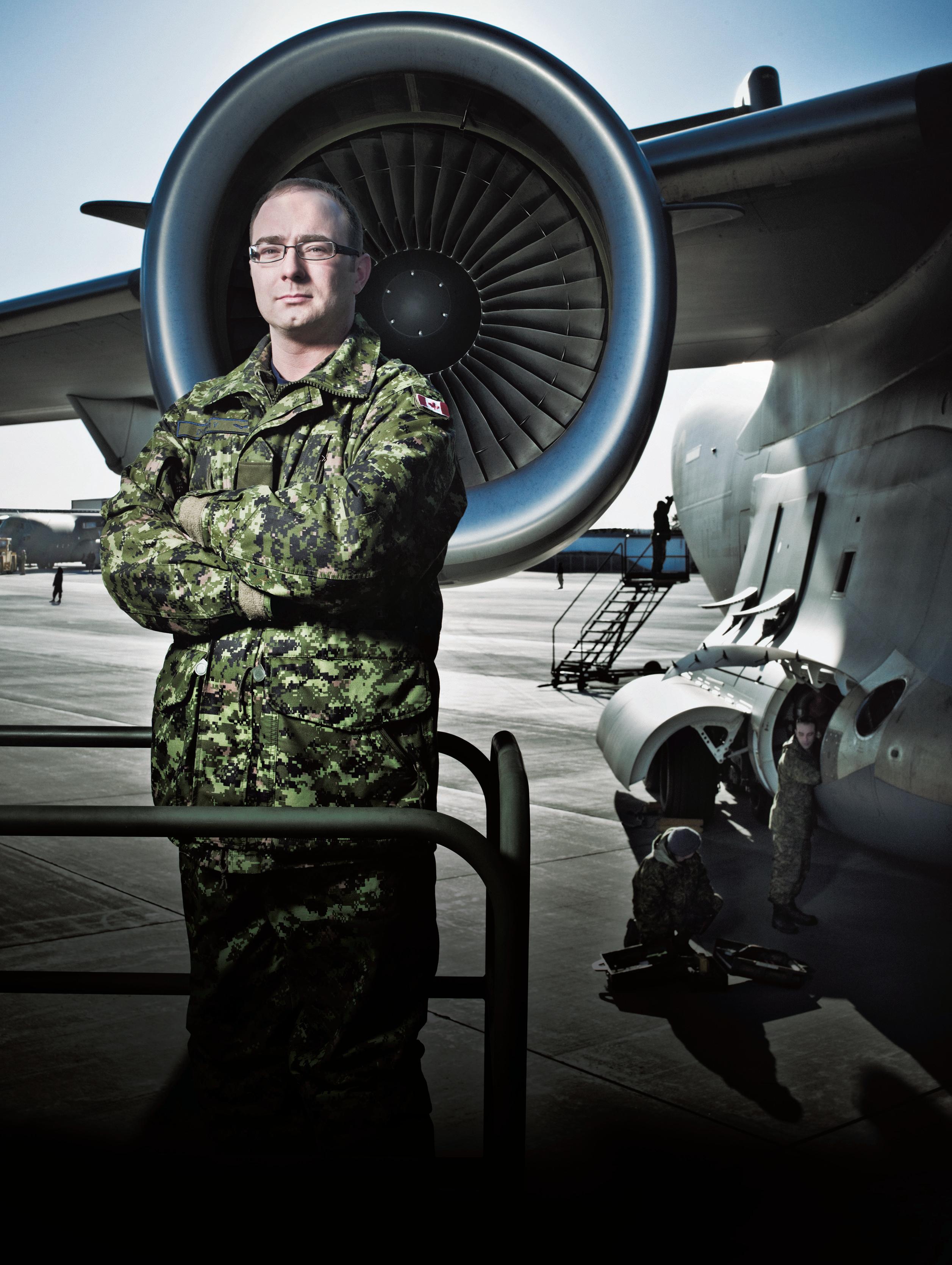
“Before I started this job I was thinking free education, only three years minimum service. Then one day I could open up my own shop, do small engine repairs. Dreams can change. Now, I’m here to stay.”
Master Corporal BRUNO DUGUAY
« Avant de commencer ce métier, je me disais : la formation est payée, l’engagement minimum dure seulement trois ans. Je me voyais ouvrir mon propre atelier, réparer des petits moteurs. J’ai complètement changé d’idée. Je suis ici pour rester. »
Caporal-chef BRUNO DUGUAY
By David Carr |
Airline access and frequency
Why is Transport Canada still picking winners and losers?
Having managed Canadian airports to the brink of bankruptcy in the 1970s and early 1980s, Transport Canada should have learned its lesson.
The devolution of Canadian airports that began with the Mulroney government in the mid-eighties marginalized Transport Canada’s centralized decision-making and reversed the flow of hundreds of millions of dollars going out to prop up Canada’s crumbling airport infrastructure, to where airports are now net contributors to the federal treasury.
Transport Canada resisted commercialization at every turn and at least one senior bureaucrat had to be removed for obstruction. Almost 25 years later, the ministry is trying to push through the back door what it can no longer get through the front. Ottawa remains the gatekeeper to airports for countries that do not have an open-skies agreement with Ottawa, which at this moment includes most of the planet. It is a position of authority that does not fit with the commercialized business model of Canadian airports.
Airports compete for traffic. Just as it would be wrong for Transport Canada to make decisions on access to Halifax based on how it affects St. John’s, it is just as egregious to starve airports of revenue based on the commercial interests of one airline or its international partners.
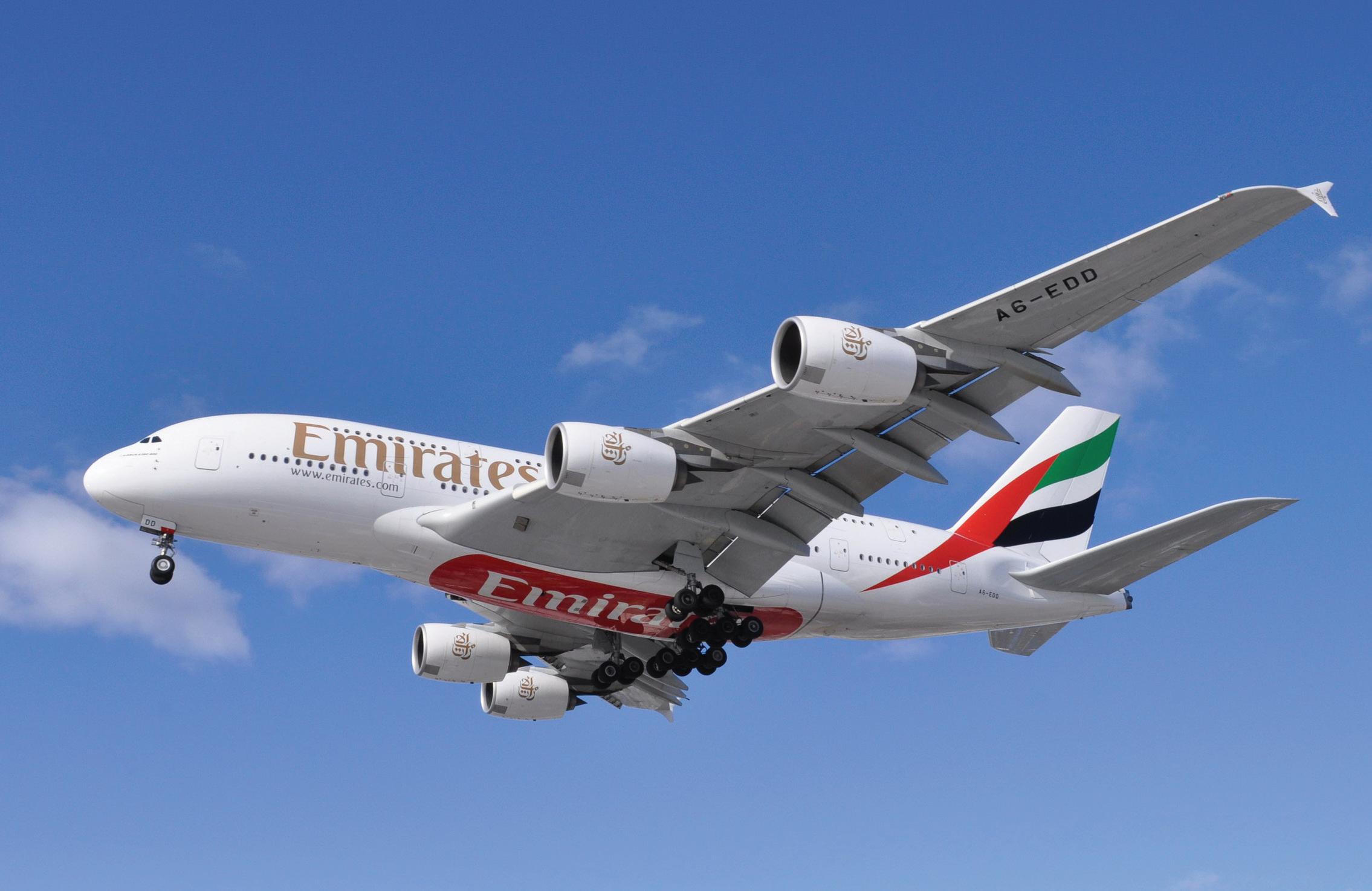
This appears to be the case in Calgary, Toronto and Vancouver, where Transport Canada stubbornly refuses to grant Emirates Airlines daily service at a cost of $480 million in economic benefits according to Vancouver-based InterVISTAS Consulting, a transport and tourism specialist hired by the airline. The Greater Toronto Airports Authority estimates daily service by Emirates and Etihad would result in an additional $3.2 million in revenue and create more than 500 jobs. Transport Canada’s position routes between Canada and the United Arab Emirates (UAE) are adequately served with six flights weekly split between Emirates and Adu Dhabi-based Etihad Airways. On the surface it would be right, but it is blinkered thinking. Air Canada does not have a presence in the growing markets where Emirates is strong. Lufthansa, Air Canada’s
It is a position of authority that does not fit with the commercialized business model of Canadian airports.
Star Alliance partner does, and there lies the rub. It is in Air Canada’s commercial interest to keep passengers in the Star Alliance pen. But should Transport Canada be playing the role of herder?
The issue is coming to a boil, with Premiers Ed Stelmach of Alberta and Gordon Campbell of British Columbia joining the fray. It is hard to see how the federal government, with its distinct western hue, can resist, except the UAE may have overplayed its hand by appearing to link the Canadian military’s future use of a Persian Gulf airbase to expanded commercial rights. The base gives the Canadian Forces critical logistical support for the Afghanistan mission and is up for renegotiation later this year.
Emirates is not a one off. Two years ago Ottawa prevented Singapore Airlines (SIA) from ramping up its Vancouver service to daily. SIA pulled out of Vancouver in April 2008 as part of a global retooling in response to plunging traffic volumes, evidence that a well run airline understands its market and can adjust its schedule accordingly.
Alliances such as Star and oneworld took a giant leap forward earlier this year
after the U.S. Department of Transportation approved an American Airlines/British Airways tie up that will result in greater collaboration on pricing, schedules and revenue splitting across the Atlantic. Star partners Air Canada, Continental, Lufthansa and United have a similar alliance within an alliance, loosely called Atlantic Plus. This could be the next step toward industry consolidation and the evolution of the global airline.
It also gives alliance partners greater clout at hubs such as London/Heathrow and Frankfurt, where Atlantic Plus will have a near monopoly on flights to Canada. All the more reason for Transport Canada to step aside and let access and frequencies be decided by airlines and the airport authorities that want to let them in.
A system where airports gain control over their runways is not perfect. Airports do compete, but they are monopolistic beasts at root. A dispute resolution mechanism would have to be set up to prevent airport authorities from negotiating cozy side deals with airlines to keep competitors out.
There is no place for Transport Canada bureaucrats, to be picking winners and losers. | W
David
Carr is a Wings writer and columnist.
“I was looking for a career that would offer job security. Here, I’m always in demand, testing and maintaining telecommunications systems for the team. Now, their security is my only concern.”
Corporal JESSICA WALKER
« Je cherchais une carrière qui m’offrirait la sécurité d’emploi. Ici, mon rôle consiste à tester et à garder les systèmes de télécommunications des équipes en parfait état. Maintenant, c’est leur sécurité qui est ma seule préoccupation. » Caporal JESSICA WALKER
By Brian Dunn |
A synthetic future
Airlines look to broaden fuel supply options
Here’s a carbon reduction initiative that appears to have legs. Air Canada is among 15 major airlines from around the world that have signed a memorandum of understanding (MOU) to purchase a supply of alternative aviation fuel from AltAir Fuels of Seattle and Rentech of Los Angeles.
These alternative fuels will be more environmentally friendly than today’s jet fuels, according to the Washington-based Air Transport Association of America (ATA) that represents over 90 per cent of all U.S. airline passenger and cargo traffic. The initiative also reinforces proactive steps that airlines are taking to stimulate competition among aviation fuel suppliers and to promote energy security, according to Glenn Tilton, ATA board chairman and United Airlines chairman, president/CEO. Discussions are also ongoing with several other alternative fuel producers, he added.
“Air Canada supports this initiative to develop jet fuel alternatives that are environmentally friendly and economically viable,” said Air Canada spokesperson Isabelle Arthur. “We hope this first step sets a new standard that will one day become available industry wide.”
The AltAir fuel project plans to produce about 75 million gallons of jet fuel and diesel fuel per year by blending camelina oils or comparable feedstock with petroleumbased jet fuel with first deliveries expected in the fourth quarter of 2012. The renewable fuel, to be produced at a new facility in Anacortes, Wash., would replace about 10 per cent of the petroleum fuel consumed annually at Seattle-Tacoma International Airport for example, reducing carbon emissions by about 14 billion pounds over 10 years. Multiply that several times at other airports around the world and you might see a light at the end of the pollution tunnel.
The Rentech project plans to produce about 250 million gallons a year of synthetic jet fuel derived mainly from coal or petroleum coke, with the resultant carbon dioxide sequestered. The drop in synthetic jet fuel will have lower regulated emissions and a lower carbon footprint than traditional jet fuel. Rentech intends to further reduce the carbon footprint by integrating
Multiply that several times at other airports …and you might just see a light at the end of the pollution tunnel.
biomass as a feedstock.
Continental Airlines has already conducted a successful Boeing 737 test flight using Jet A fuel, algae oil and jatropha oil. JetBlue has its own test, using an Airbus 320. Whether this alternative fuel supply will save airlines money is still up in the air, according to ATA communications manager Elizabeth Merida. “First, realize that since alternative aviation fuels are not currently commercially available, there are a lot of unknowns. There may not be a cost advantage.” But AltAir believes there will be cost savings. “We believe as crude prices rise and as biomass-derived prices drop because of improvements in yield, efficiencies and scale, our camelina-based fuel will
be less expensive than the petroleum version before the end of this new decade,” said AltAir spokesperson John Williams.
“There will be substantial cost savings in fuel to the airlines. Carbon taxes or tariffs will also de facto increase the cost of petroleum fuel, although we don’t know how much or exactly when.” But there’s a limit to how big a market share alternative fuels can capture, Williams added. “At present, the upper level of market penetration from this route (hydrotreated renewable jet) is limited by the upper level of what percentage of biojet fuel can be blended with petroleum jet fuel – 50 per cent. To replace 50 per cent of all jet fuel would require a dramatic increase in feed-oil availability through algae and other vegetable oil sources, including palm, jatropha, canola and soy. Assuming camelina is only grown in fallow-acreage, the narrow supply case of all domestic camelina oil going to all jet-fuel would serve to displace no more than about five per cent of current jet fuel needs in U.S.”
Rentech also believes there will be cost savings for the airlines, according to Julie Dawoodjee, vice president, investor relations and communications, who also expects first deliveries in late 2012. “Our synthetic jet fuel has lower density than traditional jet fuel which could enable aircraft to have a lower take-off weight, which conserves fuel and therefore, lowers operating costs.
“Moreover, our jet fuel reduces aircraft particulate matter emissions by 96 per cent in engine idle, a major source of ground level pollution.” | W
Brian Dunn is a Wings writer and columnist.
Q&A
John Mckenna discusses our
air transport industry
By Frederick K. Larkin
WINGS recently sat down with ATAC president/CEO John McKenna to discuss the key issues facing the air transport industry in Canada. Air Navigation fees, SMS, costs, Bill C-310 and high speed rail were top of mind.
Q| What were the costs to the air transport industry related to the Olympics? Do you envision a similar experience with the G20 summit?
A| There were many direct and indirect costs incurred by carriers during the 2010 Olympic Games. These included detours en route and extra stops to access Security Gateways, some of which were profiting from the situation by charging exorbitant access fees, restricted operations which limited flight time windows, and little or no tourist flights authorized in Vancouver air space, just to name a few. These restrictions resulted in less revenues and increased costs for operators. We are indeed afraid that the government will adopt the same “Security at all costs,” “Too bad for the little guy” and “Notify rather than consult” attitudes for the upcoming G20 meeting in Toronto.
Q| Does ATAC support SMS and are smaller operators capable of implementing it?
A| ATAC fully endorses SMS. There is resistance both on the part of operators and some Transport Canada personnel and such a reaction must be addressed. Smaller operators are certainly capable of implementing SMS, but not the SMS found in larger operations. Safety Management is the objective, not a unique model. SMS has to be designed to suit the smaller operators because they simply don’t have the same management structures as that of larger operators. For SMS to work for the smaller operator, TC has to accept the principle that one size doesn’t fit all. ATAC is in the process of drafting a SMS Guide designed for 406, 703, and to a
certain extent 704 operators, which would help them through the implementation stage. This guide will address the issue of “How to make SMS happen” in plain language, away from TC speak.
Q| Do you foresee any relief on the horizon regarding Air Navigation fees?
A| Operating an airline is a very expensive ordeal. Air Navigation costs, landing fees, jet fuel, fuel excise taxes, insurance, security, just to name a few, are very significant. Add to that Airport Improvement Fees and the Air Travellers Security Charge that passengers have to pay in addition to the price of their ticket, and it makes it very difficult for air transport to be a competitive mode of transportation. We fear that Nav Canada will increase user charges since traffic has dropped steadily since September 2008, but the level of service hasn’t. We petitioned Nav Canada last Spring to review its expenses before increasing user charges. We are happy to report that that seems to be the case, but we expected no less. Unfortunately, we don’t expect any relief in the future. On the contrary, we unfortunately expect many costs to increase.
Q| What is ATAC’s view towards the proposed Bill C-310 and do you anticipate it being enacted?
A| ATAC was against this proposed legislation for four major reasons. First, the way the bill was drafted, safety took a back seat to finances. The push-back decision made by the pilot should be based solely on safety concerns, not financial considerations. Secondly, we won’t want outlying regions that are subject to marginal flying conditions to lose the level of service they enjoy because
carriers would simply decide not to offer services out there rather than constantly be subjected to fines for delays and cancellations. Thirdly, not all airports are the same in Canada. Of the 600 or so airports, most don’t enjoy the same infrastructure that Canada’s eight largest airports offer. Some don’t even have terminals. You can’t expect them to offer the same level of service. Finally, we can’t accept that the fines paid by a carrier could exceed the very price of the ticket. We don’t expect Bill C-310 to survive the legislative process, but we do expect legislation in this matter to be tabled again soon.
Q| Does ATAC anticipate any emissions related fees/taxes to be imposed on the air transport industry in the near future?
A| ATAC and the Canadian carriers have been monitoring GHG emissions for many years. Emissions are continually dropping as technology improves and awareness increases. As of yet, we have no indications that a fuel emissions trading scheme similar to that found in Europe is in the works here in Canada.
Q| High speed rail continues to be a romantic concept supported by some. Do you expect such a project to ever proceed within Canada or could economic and operational issues derail such an enterprise?
A| High speed rail (HSR) is always the first project to surface when large infrastructure projects are needed to boost the economy or some party campaign platform. ATAC believes in multimodal transportation because no single mode can meet all needs. Realistically speaking, however, we don’t feel that HSR is a viable solution in Canada. We simply do not have enough population to warrant or support such a huge investment. We can’t endorse a competitive mode of transportation that would be financed both for its infrastructure and for its continued operations with our tax dollars. The government has to bail out passenger rail in Canada as it is. Even proponents agree that for HSR to survive, air carriers would have to agree not to compete on those routes served by the new rail system. In addition, the environmental consideration is greatly lessened when you consider that a whole new track would have to be developed since the present ones are dedicated to freight transport and not designed for high speed.
Q| Air Canada, Jazz Air, WestJet Airlines and Air Transat resigned from ATAC in April 2008. Has there been any shift in ATAC’s mandate or in the way it operates since then?
A| Not at all. ATAC has always been about serving its members, big and small. | W
By Peter Pigott |
Operational flexibility
Interview with Canada’s new CAS, Lt.-Gen. André Deschamps
On first meeting Lt.-Gen. André Deschamps, the new Chief of the Air Staff (CAS), one can’t help thinking of the Chinese curse: May you live in interesting times. With the closing of the Winter Olympic Games, Canada’s Air Force is presently heavily involved in three other massive operations: the Joint Task Force-Afghanistan Air Wing, the G8 Summit Canada is hosting, and most recently, the Haitian relief efforts. Next year, Canada will be pulling its forces out of Afghanistan, a logistical exercise that is sure to make heavy demands on airlift, military and civilian. And this is not even taking into account the usual duties with NORAD, NATO, northern re-supply and surveillance, to say nothing of Search and Rescue (SAR) operations over the massive landmass of Canada. And then there is the embarrassment of riches in new equipment. After decades of starvation, the Air Force is currently adapting to an influx of new aircraft. The last of its C-17s arrived last year and the first of the C-130Js are due this summer. Then there are the Chinooks CH-147 Deltas in theater now with the Chinook Foxtrots arriving in 2012, the conversion of the CH-146 Griffons into armed escorts, the CU-170 Heron UAVs, the Cyclones in the fall, and the decision on the Next Generation Fighter (the CF-18 replacement) due this summer.
Lt.-Gen. Deschamps joined the Canadian Forces in 1977 and was first employed as an instructor on the Musketeer trainer at Portage la Prairie, Man. Instructing was not his first choice – like all young pilots, he wanted to get on fighters right away but as it turned out, it was the best choice. Instructing on the Musketeer allowed him, he says, the chance to mature as a pilot.
Soon he got his chance to fly CF-104s in Europe. The Cold War was on and operating the Starfighter in the German environment, he says, “was very conducive to fighter operations.” In 1989, Deschamps transitioned to the transport world and served as a tactical pilot on the C-130 Hercules at both 436 and 429 Squadrons. Around the first month he got into Hercs, the Yugoslavia conflict began and he got to experience a type of flying that was completely different from the CF-104. He
Flexibility…is the essence of air power, to be able to respond quickly and with effect.
rounded out his multi-engine flying experience with a tour on NATO E-3A (AWACS).
When asked which aircraft he preferred or his most memorable experience, Deschamps gave a diplomatic answer. “It’s like asking a parent to choose his favorite child,” he laughed. “Each allowed me to explore skills I didn’t know I had until I was put in the cockpit of that aircraft.
But unlike his predecessor Lt.-Gen. Angus Watt who flew Sea Kings, the new CAS had never qualified on helicopters. “I’m bit of as closet helicopter pilot,” he admitted, “When I was at Portage as an instructor, we had a chance to do some cross-pollination in the instructor group and I got a chance to try my hand at helicopters. It was great
fun and… it forces you to try some skills you don’t typically employ.”
At the time of the interview, it was almost exactly a month since the earthquake in Haiti and the conversation turned to the Canadian Air Force’s role in Operation Hestia. It was a source of pride to Deschamps that within 18 hours of the earthquake, the first C-130 was taking off from CFB Trenton with the DART team and medical supplies. The first of the C-17s left the next day laden with a SAR Griffon, rations, water and tents. As we spoke, relays of CF aircraft were shuttling back and forth between CFB Trenton and Kingston, Jamaica, Port-au-Prince and Jacmel, creating a 4,000-mile air bridge. “Flexibility – that is the essence of air power,” he said, “to be able to respond quickly and with effect. And the addition of the C-17 multiplies the effect we can generate on very short notice.”
Nothing illustrated this better than Jacmel, says Deschamps. “The C-17/C-130 was a package that gave us the flexibility to go where we wanted with immediate effect by using our Hercs as a relay between Jamaica and the Dominican Republic without having to go through Port-au-Prince.” When asked how he viewed his tenure as CAS unfolding, Deschamps said he was focused on operational success and delivering that success across a broad front. “I can’t be successful in operations if we don’t transition these new fleets, integrating them into our operational structures. And it’s a handin-glove challenge as we are engaged on so many fronts at the same time. We can’t take a pause now; it’s a bit like a relay race.” Truly, interesting times for the new CAS. | W
Peter Pigott is a Wings writer and columnist.
SPARRING PARTNERS TO THE FORCES
TOP AcES PuTS TRAININg TO ThE TEST
By JAMES cARElESS
No matter how advanced the simulator, nothing trains fighter pilots better than going up against ‘aggressor aircraft.’ These are actual jet fighters flown by experienced pilots – unarmed for safety, but carrying electronic countermeasures – which challenge the trainees in the air, forcing them to put their ground-based training to the test.
Most militaries operate their own ‘aggressor squadrons’ as part of their
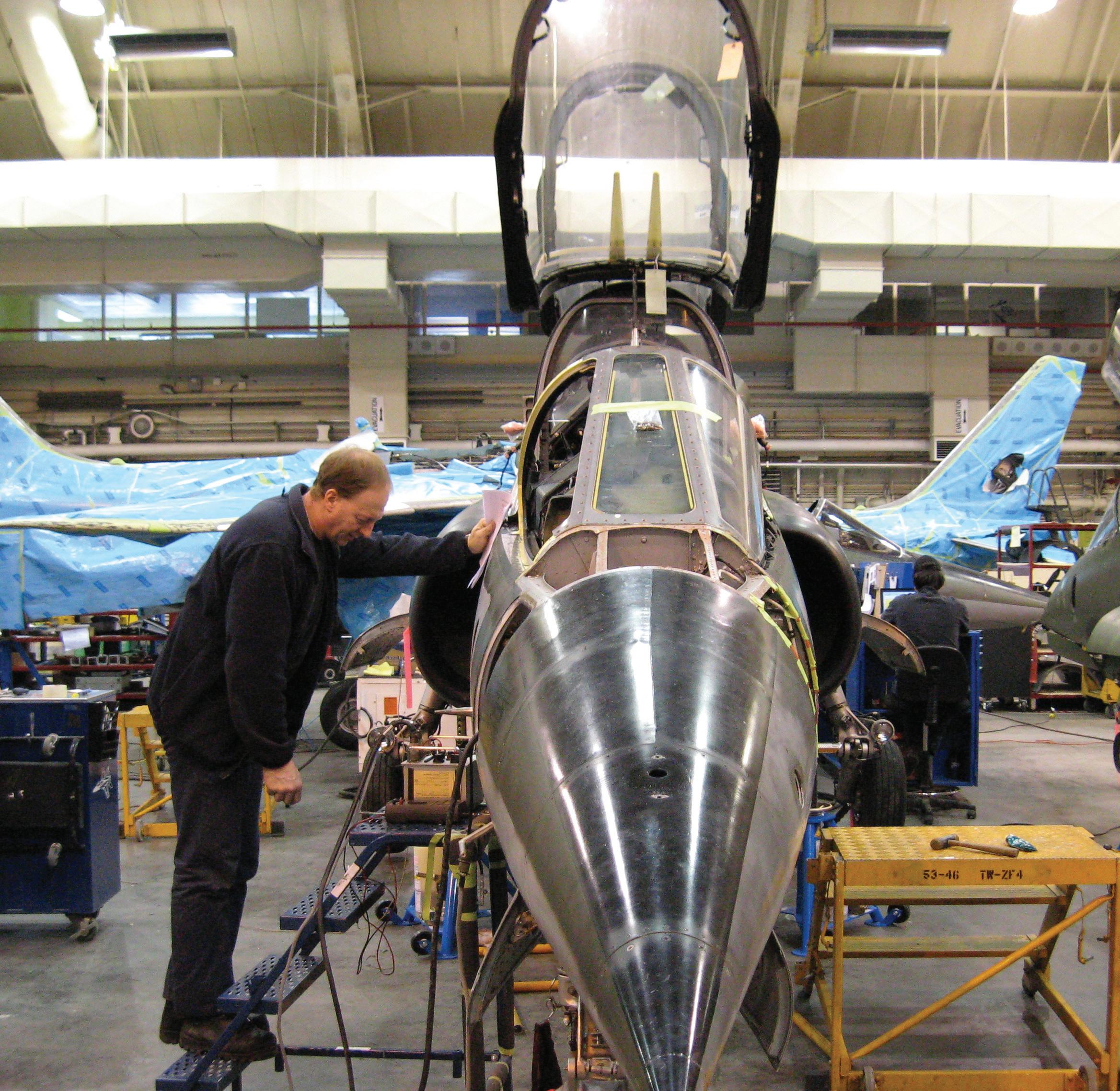
training regimes. But in Canada, our aggressor squadron is a privately-owned venture run by three former CF-18 fighter jocks. Known as Top Aces (now a wholly-owned subsidiary of Discovery Air), this company has its own fleet of 16 ex-military Dassault-Breguet-Dornier Alpha Jets, supplemented by four twinjet Westwind 1124s for carrying electronic warfare equipment and towing target arrays.
“We serve as the Canadian Forces’ aerial sparring partner,” says Garry Venman,
Top Aces’ VP of Business Development. “We give their CF-18 pilots the kind of aggressor aircraft training they need, at no capital cost to the Canadian government and the requirement to only pay for the training they use.”
The birth of Top Aces’ air force
Top Aces was founded in 2000 by Paul Bouchard, Dave Jennings and Didier Toussaint. All three were former military CF-18 pilots. Each had graduated from Canada’s highly-selective ‘Top Gun’ program, which is blandly referred to as the Fighter Weapons Instructor Course.
Initially, Top Aces began as an aerospace consulting firm in Pointe-Claire, Que. (part of Montreal). But the Canadian Forces’ decision to disband its own aggressor squadron as a cost-saving measure opened up an opportunity to venture into training. The result: In 2005, Top Aces was the lowest bidder on a five-year CF training contract, beating out Bombardier and three other bigger, better-funded competitors. At press time, the Government of Canada had just exercised an option to extend Top Aces services until 2011. Also, recently announced, Top Aces is continuing its review of the Government of Canada’s procurement plan for airborne training services beyond 2011 under a proposed new 20-year long term contract (10 years with two 5-year Government of Canada options) for both Type 1 (fast jet) and Type 2 services.
Today, Top Aces’ aircraft are based at CF training facilities at Cold Lake, Alta., Bagotville, Que., Victoria, B.C., and Halifax, N.S. In addition to providing CF-18 pilots with aggressor aircraft to fly against, Top Aces’ Alpha Jets fly mock attacks on CF navy ships. On the flip side, these same jets act as ‘friendlies’ for the CF Army, allowing their Forward Air Controllers to train with aircraft before shipping out to Afghanistan.
“Our job is to support the training efforts of the Canadian Forces, while saving them the expense of owning, operating and manning the aircraft,” Venman tells Wings magazine. “In doing so, the Canadian Forces saves millions on equipment costs, and is able to redeploy its personnel to other work.” In support of this mission, which is executed with close CF supervision, Top Aces has its own maintenance and repair shops.
Top-notch capabilities
Despite their military heritage, none of Top Aces’ Alpha Jets are capable of actual military warfare. “All of their weapons and weapons systems are either removed or disabled before we get them,” says Venman. “The governments we obtain
The Top aces fleet includes 16 ex-military dassault-Breguet-dornier alpha Jets.
these aircraft from, such as the Germans who used Alpha Jets as Light Strike aircraft from the late 1970s through 1990s, will not export them unless they have been demilitarized. The Canadian government is similarly vigilant about such imports, as are the Americans. Since the Alpha Jets incorporate some U.S. military technology, we have to get U.S. State Department approval to use them, which can be quite a challenge.”
The Dassault-Breguet-Dornier Alpha Jets flown by Top Aces are subsonic models, capable of a top speed of 550 kts (0.95 Mach). They are powered by two SNECMA/Turbomeca Larzac 04-C6 turbofans that can deliver a combined thrust of 5,952 pounds. The Alpha Jets are two-seaters, with the Top Aces pilot in the front and a CF electronics warfare specialist in the back. (The EW specialists belong to the CF’s newly-revived 414 Squadron, which is based in Ottawa.)
They have a ceiling of 50,000 feet, carry jamming/chaff/ACMI pods, threat simulators and AAG Target Tows, and have a range of 1,000 nautical miles when equipped with external fuel tanks.
“The Alpha Jet’s performance is akin to that of a BAE Systems Hawk,” Venman notes. “It is superior to the TC-133 Silver Stars that the CF had in its aggressor squadron.” Very true: The 1950s’ vintage TC-133’s top speed was 515 knots and its
ToP aceS aIrcrafT are BaSed aT cf TraINING facIlITIeS aT cold lake, alTa., BaGoTvIlle, QUe., vIcTorIa, B.c., aNd HalIfax, N.S.
operational ceiling was 47,000 feet. The only situation in which a CF-18 pilot would be likely to encounter a TC-133 (a.k.a. the Lockheed T-33 Shooting Star) or an adversary aircraft of similar capabilities would be at an air show. In terms of reallife training, the TC-133 is just too dated for military use. In fact, trainer versions of the Alpha Jet replaced T-33A trainers used by the French and West German air forces.
Rookies need not apply
Fighter jocks are known for their take-noprisoners approach to life. This is useful for the military, who need pilots determined to dominate the skies. But it is not
the sort of characteristic that Top Aces needs in its pilots; all of whom are experienced, retired CF-18 officers.
“In a training situation, aggressor pilots have to be able to back off whenever necessary, and to stay within the limits that the instructors impose on them,” Venman explains.
“The last thing you need is them flying with their egos out front, doing their best to dominate the students. This is why we only hire retired CF-18 pilots who have proven their maturity in the cockpit. These are guys who have done their 20 years and have nothing left to prove, unlike the students they are challenging. We can trust them to keep the flight exercises safe yet effective – and to bring themselves and the aircraft safely back to Earth.”
Moving to Top Aces after retiring from the Canadian Forces is a welcome option for many CF-18 pilots. Before the company came along, their best bet was to go to Air Canada, a career path that company founders Bouchard, Jennings and Toussaint took and then rejected for more exciting work.
c hallenges and opportunities
It only took Top Aces six months to begin flying aggressor flights for the Canadian Forces, after winning its contract in 2005. The initial Alpha Jet fleet was brought in from the United States. Further aircraft have since been purchased from Germany and other countries.
Even with this success, obtaining new aircraft remains a constant headache. “It is just not easy to find and then import former jet fighters,” Venman says. “When we do, there’s a lot of paperwork to be done – after ensuring that the aircraft is still flightworthy and maintainable.”
The second challenge is pilots: To date, Top Aces has stuck with former CF-18 pilots for its trainers, because of their in-depth knowledge of fighter operations and the ways in which the Canadian Forces work. However, there are not that many pilots retiring from the Forces each year, and those that do aren’t always interested in continuing the fighter jock life. “Because the quality of our pilots is paramount, we have to find them first and then figure out how to get them where we need them to be,” he notes. “This means that we fly them in from wherever they live to wherever we need them to be. Not everybody wants to keep living in Cold Lake after they’ve retired.”
The alpha Jets are capable of 550 kts (0.95 mach) and are powered by two SNecma/Turbomeca larzac 04-c6 turbofan engines.
As for the future? Top Aces’ success in fulfilling its CF contract opens up new opportunities. “We can foresee providing similar aggressor aircraft services in the U.S. and Europe,” Venman notes. “Of course, we would have to jump through a lot of hurdles to do so. Still, very few people believed that a private company could provide aggressor aircraft support to the Canadian Forces back in 2005, and we have made that happen. So I see no reason why we couldn’t meet the challenge of going international.” | W
DASSAuLTBREGuETDORNIER ALPHA JET HERITAGE
Dassault-Breguet-Dornier’s a lpha Jet was developed as a subsonic trainer and light attack aircraft by the French and west g erman governments in 1970. Four prototypes of this twin-engine, cantilever shoulder-wing two-seater were built, followed by the onset of full production. The French built 200 a lpha Jet e s ( e cole) as trainers, while the west g ermans built 176 a lpha Jet a s (mounted with a pointed nose, as opposed to the a lpha Jet e ’s blunt nose) for light strike deployments.
More than 500 a lpha Jets were built into the 1980s. a ccording to The e ncyclopedia of world a ircraft ( o rbis Publishing, 1997), Belgium purchased 33, c ameroon 7, e gypt 45, i vory c oast 7, Morocco 24, n igeria 24, Qatar 6 and Togo 5. Besides the a and e versions, this aircraft was also built as the a lpha Jet 2 with new avionics, a head-up display, inertial navigation system and a laser rangefinder; and finally as the a lpha Jet 3 aT s ( a dvanced Training s ystem/ a dvanced Tactical s upport). “ e volved from the a lpha Jet 2, the l arzac 04- c 20 powered a lpha Jet 3 aT s is effectively a flying simulator equipped to lead pilots into new advanced combat aircraft such as the Mirage 2000, Rafale, g ripen and F-16.”
Squadron 414 with alpha Jet.
THE DORNIER SEASTAR
ThE WORlD IS ITS OySTER
By PETER PIgOTT
The crowd of Montrealers had never seen anything like it. On a July day in 1932, they watched a metal seaplane land smoothly on the St. Lawrence River and taxi up to the Longueuil shore. Called “Greenland Whale,” the Dornier had been in the air for an amazing 10 hours, flying all the way from Labrador – and before that Greenland, Iceland and Germany. Interviewed later on Montreal radio station
CKAC, the pilot, Wolfgang von Gronau, told listeners he was demonstrating that by using seas, rivers and lakes, a seaplane could circumnavigate the globe. When asked about his aircraft’s unique design, von Gronau said the monohull with the parasol wing was typical of its builder, the German aviation pioneer Claude Dornier. Gronau would continue on to Winnipeg and then Prince Rupert, B.C., before making for Siberia and eventually back to Germany. His Dornier aircraft
would be the first flying boat to complete an around the world flight.
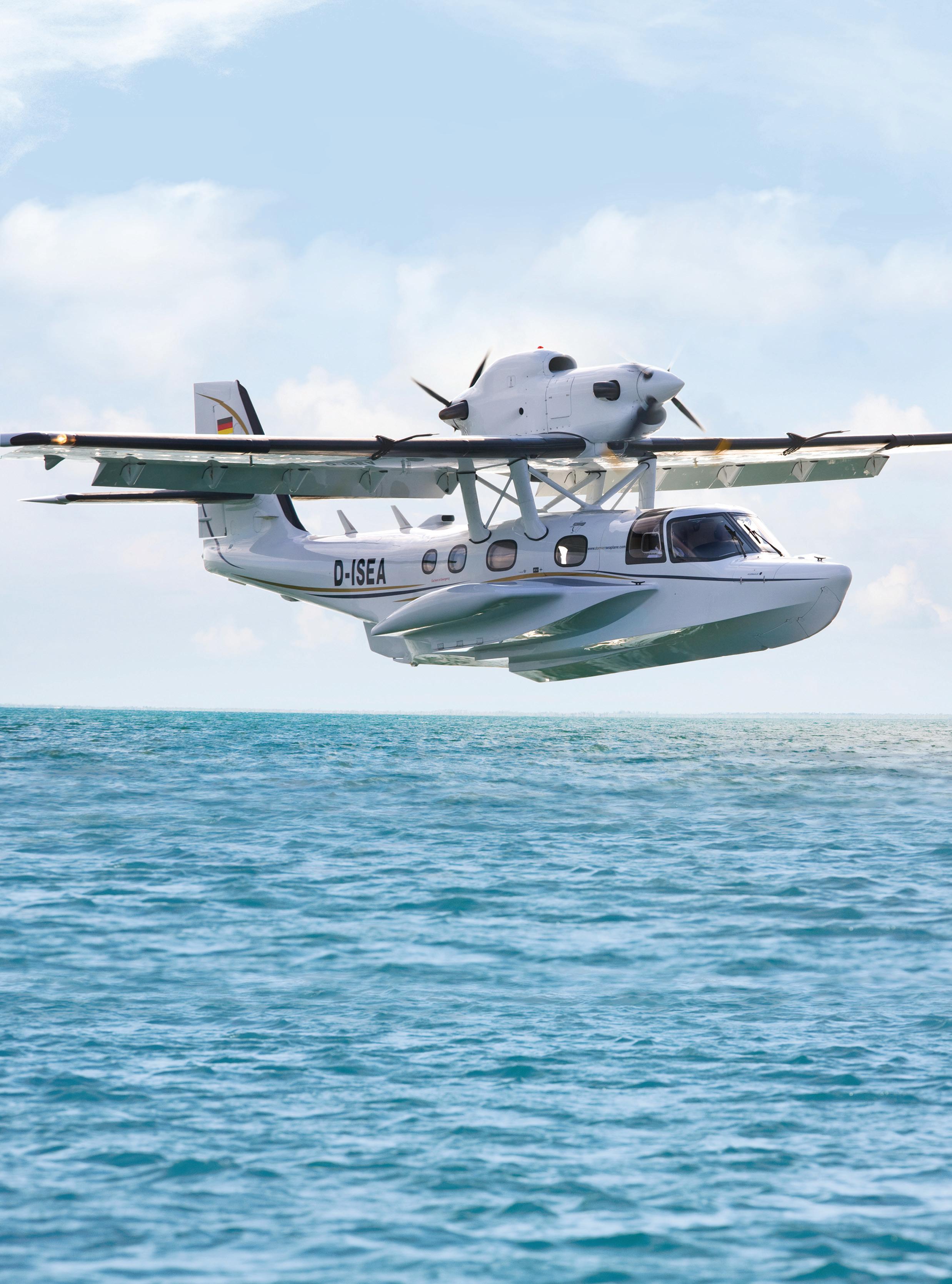
Seventy-seven years later, at the NBAA Annual Meeting & Convention in Orlando, Fla., on Oct. 20, 2009, it was announced that a Dornier seaplane was once again taking up shop in Canada. Joe Walker, Dornier Seaplane’s chief executive officer announced the Punta Gorda, Fla.-based company had more than 25 letters of intent, allowing it to launch production of its Seastar amphibian. A final
assembly site had been narrowed to two Canadian cities – St.-Jean-sur-Richelieu, Que., or North Bay, Ont. The cities had been selected because of the local labour pool, available real estate and infrastructure and also because the aircraft’s Pratt & Whitney Canada PT6-135A turboprop engines were built close by in Montreal. With so many lakes and rivers around each city, either would be a natural fit for the testing of the amphibious seaplane.
The Dornier Seaplane Company is owned by the family of Conrado Dornier whose grandfather had once worked with Count Zeppelin before he founded “Dornier Metallbauten” to build seaplanes. The Seastar had been designed by his son, Claudius Dornier Jr., chairman of the group of Dornier companies who sought to restart amphibious aviation by using an all-composite flying boat to overcome water corrosion and leakage. “The similarity of the Seastar to legacy
Dornier aircraft is apparent in its basic design,” said Jim Holcombe, head of sales and marketing. “The high wing design with the fore-and-aft facing engines is a proven design feature of Dornier aircraft dating to the 1930s.” But if the influence of the old Dornier design is still evident –this is an entirely new aircraft.
Wolfgang von Gronau would have appreciated the Seastar’s all-composite airframe, making it immune to hull leakage and salt-water corrosion. This is what every seaplane builder, from Glenn Curtiss onward, has dreamed of. From the Sunderland flying boat to the PBY Catalina, salt-water corrosion has been the Achilles heel in the development of metal seaplanes. Aircraft that operate on water are extremely susceptible to corrosion. (Simply put, corrosion weakens metal structures and must be constantly controlled to keep the aircraft in a safe, airworthy condition.) To overcome this,
other seaplane manufacturers have constructed their aircraft of aluminum – but that corrodes over time. Now using composite materials, Dornier has eliminated corrosion forever and with a virtually all-composite construction, the Seastar is effectively corrosion free.
Besides eliminating potential leaks, the composite airframe would warm the heart of the company accountant for its lower maintenance costs. The importance of this feature is illustrated by the information provided by the preeminent provider of aircraft cost and performance reports, Conklin & de Decker. It estimates that the total maintenance cost per flight hour of the twin-engine Seastar is US$90.15 versus US$95.94 for the single-engine Cessna Caravan, and US$151.25 for the twin-engine Twin Otter. This translates to a maintenance-per-seat mile cost of US$0.042 for the Seastar compared to US$0.071 for the Caravan and US$0.078
The Seastar’s all-composite airframe makes it immune to hull leakage and salt-water corrosion.
SEASTAR SPECIFICATIONS
THe SeaSTar IS THe SPorTS car IN a markeT domINaTed BY TrUckS.
for the Twin Otter – a sizeable advantage for the Seastar. The Seastar will have a much higher residual value than aluminum aircraft at the end of the product life cycle – something not lost on its owners.
The integrated-hull flying boat design also reduces drag and provides the aircraft with a considerable advantage in maximum cruise speeds. For example, the Seastar has a maximum cruise speed of 180 KTAS, 30 to 50 knots faster than its competition. Reduced drag also provides greater fuel efficiency and increased range. Because the Seastar is a true seaplane, a flying boat by its design, it offers a critical operational benefit over the float plane – the ability to safely operate in seas of up to three feet.
The parasol wing on struts would also have been familiar to Von Gronau.
He would agree it does create drag –but by separating the wing entirely from the fuselage (he might have pointed out), it produces more lift – making the wing more efficient. “As with everything in aviation,” said Holcombe, “it is all about trade-offs. The increase in height of the wing allows us to position our engines more effectively giving us negligible water ingestion into them and the props. Prop erosion is a constant battle on seaplanes that we have successfully avoided, along
with gaining the safety, operational, and training advantages of centerline thrust.”
In 1925, the great polar explorer Roald Amundsen chose Dornier flying boats to go to the North Pole because of their Duralumin flat-bottomed fuselages with projecting sponsons. He knew that the sponsons would stabilize the craft in icy seas much more than wing mounted stabilizer floats. But after the 1930s, because of their weight and rigidity, aircraft designers moved away from sponsons to lighter wing floats. For the Seastar, Dornier developed a streamlined two-stage sponson – the strong inboard section helps with moving the aircraft to the step while the higherriding outboard section keeps it level in displacement – as wing floats would. And you don’t have to be a globe-girdling pilot to know the sponsons are perfect for fuel storage, increasing stability on and off the step by lowering the center of gravity (CG) considerably. Take off and maneuvering is actually aided rather than hindered by the sponsons as the pilot is able to “lean” into the wind with less restriction, as there are no wing floats.
But the aircraft will spend most of its working life operating not from smooth runways but rough, often choppy, water. How would it handle then? “I have personally had the aircraft in 3.5 foot seas and
have had no difficulties flying it,” said Holcombe. “I did not feel that was the limit of its capability. In the 3 to 3.5 foot sea-states, the Dornier has proven to be extremely stable and forgiving when compared with other seaplanes, needing only very slight corrections to maintain proper step attitude in very rough water. I’ve never been more comfortable handing the aircraft over to a low-time seaplane pilot…The Seastar is the sports car in a market dominated by trucks.”
But what about those in-line engines – wouldn’t they be a disadvantage for taxiing? “In-line engines do lack the ‘convenience’ of having the multi-engine asymmetrical thrust used for taxiing on the water,” admitted Holcombe. “However, the most successful bush planes in history have been centerline thrust aircraft (single-engine), and most seaplane pilots would agree with me in saying that once properly trained in an aircraft, that a single-engine (centerline thrust) seaplane is not limiting in any way, it just takes a different technique than would a multi-engine (non-centerline thrust) seaplane. In short, our water rudder works quite well just as with most float planes.”
The high-wing design of the Seastar with fore-and-aft facing engines is a proven design feature of dornier aircraft.
NIGHT VISION LESSONS
NvEO cONFERENcE TAcklES OPERATIONAl SAFETy
By JAMES cARElESS
Ideally, night vision and electro optical (NVEO) equipment enhance the safe operation of airplanes and helicopters in low-light conditions. In reality, however, these systems can actually make flying more dangerous if the systems haven’t been thoughtfully integrated into a pilot’s operational regime.
“We’re finding there’s a common thread in the military and the civil sector that is showing bringing new technology into the cockpit is not necessarily making the flying better or safer,” said Ian McIntyre, VP Training with Gladstone Aerospace Consulting (GAC) in Ottawa. “People have these things – these tools – [and] they know how to use one or two of them, but they don’t know how to integrate them so that they lighten up their workloads a bit, make them more efficient, or [ensure that] they’re flying safer.”
To address this problem, GAC teamed with the Canadian Association of Defence and Security Industries (CADSI) to hold the Night Vision and Electro Optical Conference 2009 (NVEO 2009) in Ottawa. Staged at the Marriott Hotel from Nov. 16-17, NVEO 2009 brought together military and civilian users with research and industry experts to examine the best ways to operate NV/EO systems safely.
The conference
NVEO 2009 featured presentations covering various aspects of NVEO research, trials, deployments, and lessons learned – plus a small trade show comprised of NVEO vendors. The overarching impact, from an attendee’s standpoint, was a twoday crash course in all things NVEO.
On the fixed-wing side, Major William Radiff spoke about
Night vision goggles can also be useful for the canadian forces in afghanistan, where brownouts (dust storms) are major hazards for pilots flying desert missions.
the deployment of night vision systems in the Canadian Forces’ CF-18s. He told delegates that the CF pilots who collectively tested the system were careful and methodical in their approach. Much of the testing time was spent flying with night vision goggles in all kinds of terrain, to develop a uniquely Canadian understanding of the technology. “We spent a lot of time just gaining hours,” said Major Radiff. “Although people have been flying with night vision goggles for a long time, no one flies the way that we do.”
Indeed, Canada’s CF-18 pilots have to deal with unique challenges, such as wearing night vision goggles while the Northern Lights are ablaze overhead. As a result, safety came first, Major Radiff told delegates: For instance, the testing flights were always flights that could be executed without goggles, to ensure that the flights could be landed safely should the technology run into difficulties. This notwithstanding, the tests were a “great success,” he said. “Two months after implementation, people were dropping bombs.”
National Research Council engineer Sion Jennings was on hand to explain the NRC’s efforts to develop better low-level and dust-obscured vision systems. “Right now, if your naked eye can’t see through a brownout, it is doubtful that a sensor can,” Jennings told the audience. This is why the NRC is studying “augmented vision systems” that integrate other resources,
such as terrain databases used in flight simulators, to improve flight safety in poor visibility conditions.
There are numerous risks with such an approach as Jennings proved by showing a satellite photo of the Statue of Liberty rotated to represent a pilot’s eye view of the site. In the image, the statue’s base and shadow were clearly visible, but the statue’s true height was missing – simply because a top view does not provide such data. However, if the satellite imagery is combined with an onboard LIDAR scan and infrared imagery, the three can be used to create a reasonable 3-D model. This kind of data can then be viewed by a pilot in visually obscured conditions, providing a safe way to navigate in this space.
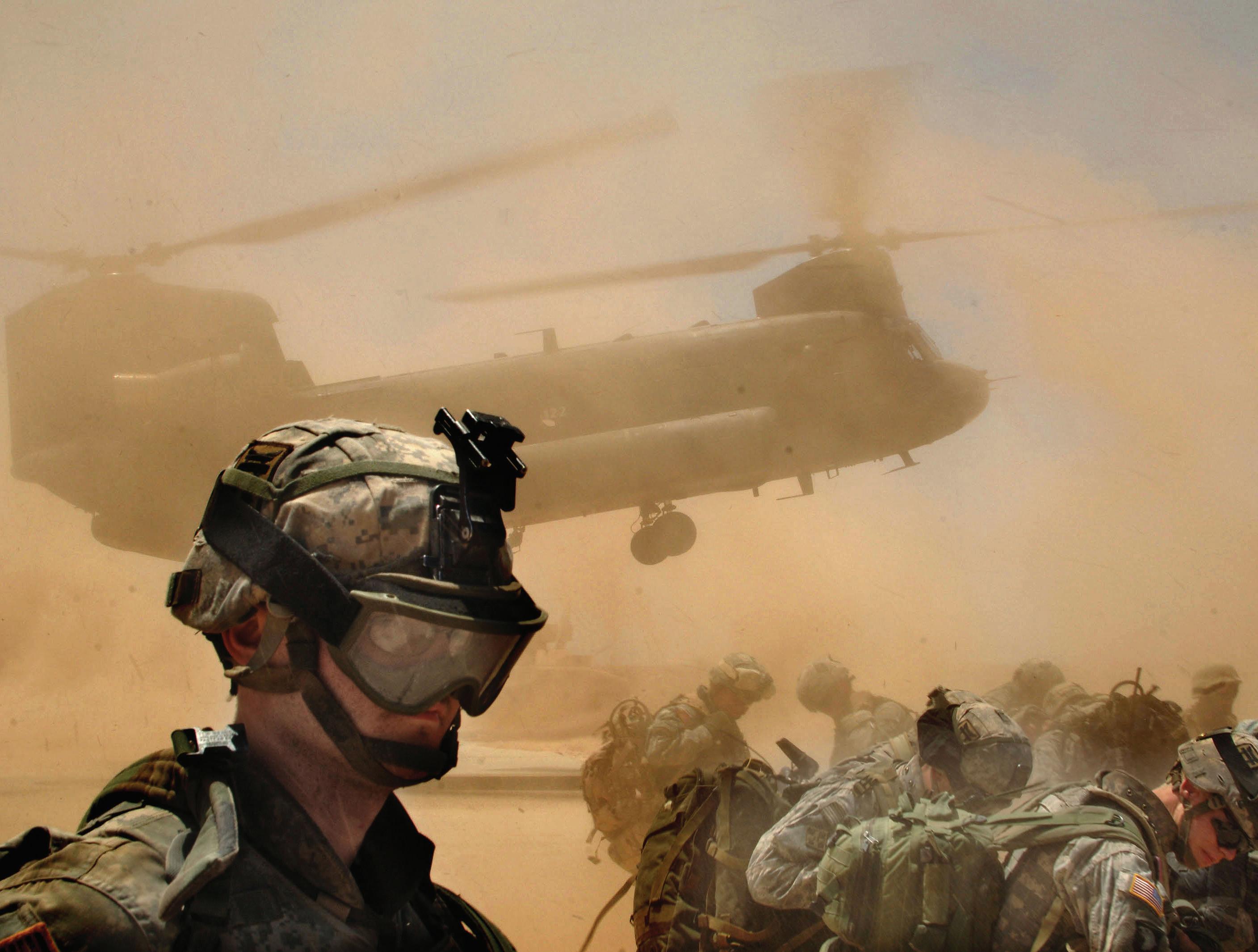
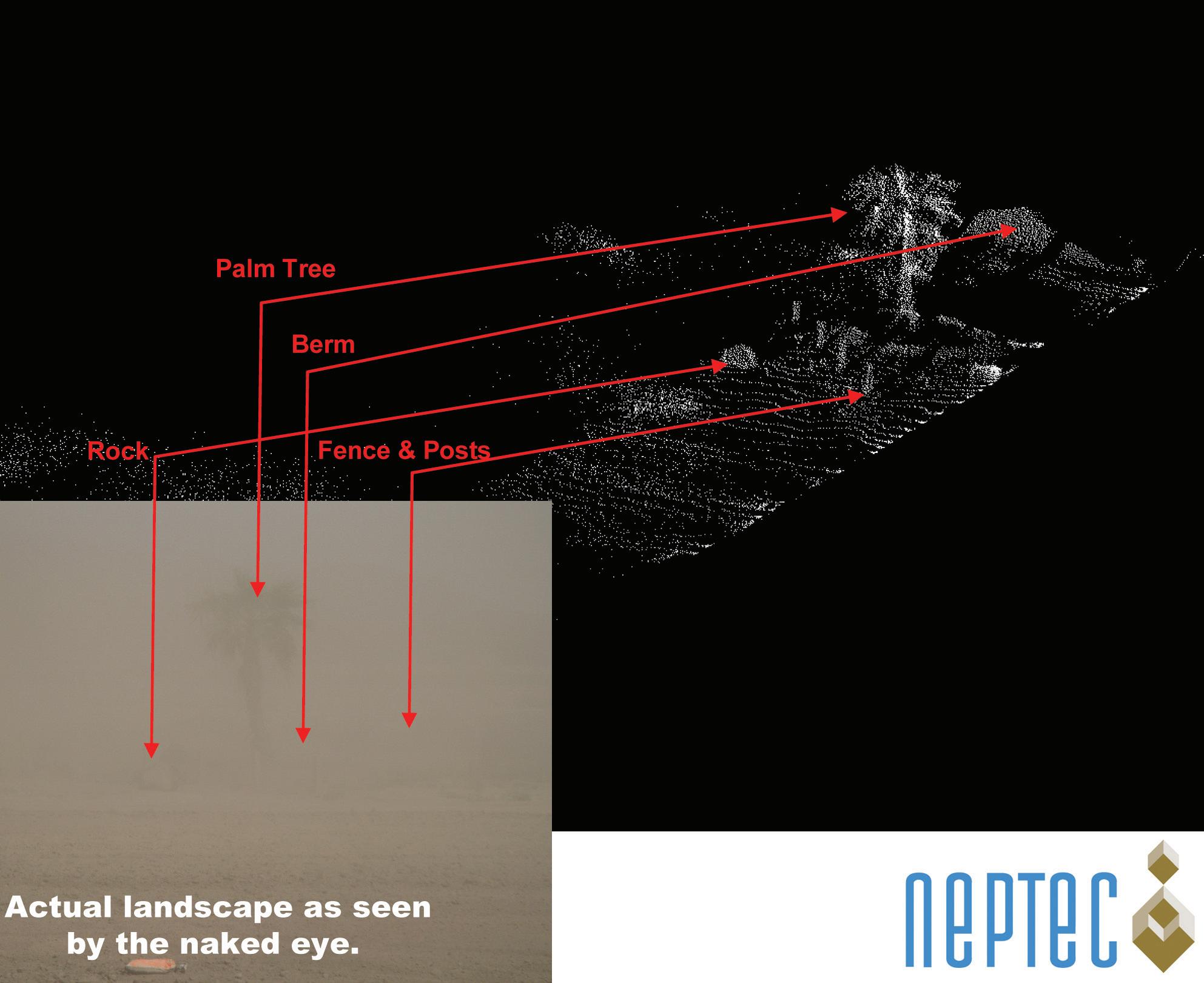
Night vision goggles can also be useful for the Canadian Forces in Afghanistan, where brownouts (dust storms) are major hazards for pilots flying desert missions. So how can pilots see through the dust? One possible answer is Obscurant Penetrating Autosynchronous LiDAR, or OPAL for short. Developed by Ottawa’s Neptec Design Group – and explained during an NVEO 2009 session by Neptec OPAL project manager Evan Trickey – OPAL uses LiDAR to ‘look through’ dust and snow, providing clear images to an in-cockpit display.
(Note: LiDAR is an acronym for Light Detection And Ranging. It uses laser light, rather than radio waves, to detect objects.)
Two months after implementation, people were dropping bombs.
Recent trials at the Yuma Proving Ground (operated by the U.S. Army in Phoenix, Ariz.) proved the OPAL concept. A brownout generated by a UH-1 was ‘seen through’ using both ground- and air-mounted OPAL units. Using multiple LIDAR scans of the target area, which had been filled with various obstacles, “we were able to distinguish rocks from trees,” said Trickey. “We could see wires 1/8 inch to 1/2 inch in diameter, and rebar.”
A second way to improve low-light flying is to improve aircraft handling, to give pilots more time to focus on obstacle detection. To this end, the NRC has been testing handling enhancements and brownout avionics symbology (for flight instruments) on its Bell 205 and 412 helicopters. The technology, which is due for testing at the Yuma Proving Grounds, “is suitable now for rapid integration with Canadian Forces helicopters,” Jennings said.
Introducing night vision goggles into the CF’s Sea King fleet was the subject of Lt. John Schein’s talk. The bad news: At this point the navy only has one Sea-King modified for night vision use. “When she breaks, you don’t go flying,” he said. The good news is that the rest of the Sea King fleet are scheduled to be modified for night vision flight.
Other topics covered at NVEO 2009 included virtual training systems for night operations, inspection and maintenance of NVIS crew stations, and a potential detection method for finding IEDs (Improvised Explosive Devices) using airborne polarized shortwave infrared hyperspectral imaging.
Reflections on N v EO technology
Overall, NVEO 2009 provided pilots and aircraft operators with an in-depth look at night vision and electro optical technology. It also begged the question: If night vision technology is so effective, then why are so many air ambulances experiencing accidents?
The answer, said McIntyre, is that the vast majority of
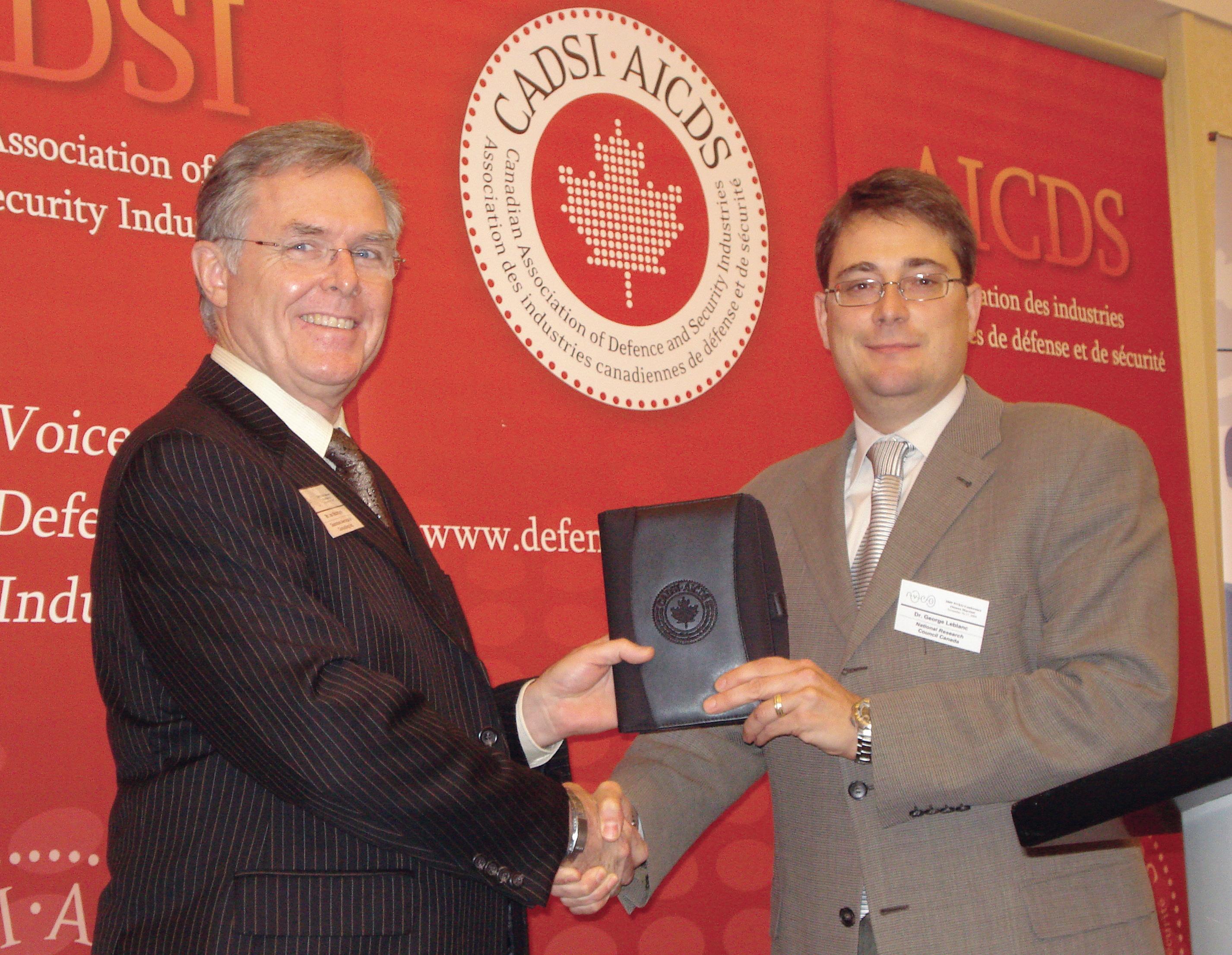
( l to r ): Ian m cIntyre, Gladstone a erospace, with d r. George l eblanc, from the N rc
d eveloped by o ttawa’s Neptec d esign Group, o Pal ( o bscurant Penetrating a utosynchronous l i dar ‘looks through’ dust and snow, providing clear images to an in-cockpit display.
accidents are happening south of the Canada-U.S. border. Here in the Great White North, Transport Canada requires air ambulance crews to have two pilots, not one. As well, if they use night vision goggles, both pilots must wear them. This ensures that “both pilots are operating in the same Crew Resource Management regime,” he says.
In the United States, the situation is altogether different. There is no requirement for two-pilot air ambulance crews, so many operators get by with just one person in the cockpit. Add the fact that many air ambulance helicopters are not equipped for IFR – nor have any form of night vision/collision avoidance technology – and the reasons for many of the crashes becomes clear.
“Thanks to the two-pilot system and their own operations management, STARS (The Alberta Shock Trauma Air Rescue Society) has been able to integrate night vision goggles safely and competently,” McIntyre said. “The impact on transport time to patients and then to hospital has been significant. For instance, when STARS would fly into Cranbrook without night vision goggles, they would have to gain altitude to fly over the mountains both there and back; a diversion that added an hour to their flight time. Now, with night vision goggles, they can fly through the valleys as they would in VFR conditions. The result is better medical care for patients, and enhanced flight safety for everyone on board.”
Will things change for the better in the U.S.? Ian McIntyre believes that they will. “Our understanding is that the FAA is thinking of making it mandatory for air ambulance operators to have night vision capability,” he said. “That would make a major difference, but what would really improve things is for the FAA to require two-pilot air ambulance crews. If that
happened, however, I suspect that a number of the smaller private operators would go out of business, depriving some communities of air ambulance service. So you can make arguments on either side of the issue.”
The value and risks of N v EO systems
As was proven by presentation after presentation at NVEO 2009, night vision and electro optical detection systems make safe night and low-light flying possible. In contrast, flying without such aids is asking for trouble, a point that was made by Lt. Schein when he described being assigned to Sea King flight duty. “I was used to flying at night with night vision goggles,” he told the audience. Subsequently, after having to fly a shipboard Sea King at night without night vision goggles, with visibility at near-zero and “snakes of snow in the wind,” Lt. Schein told his CF cohorts, “you guys are nuts!”
On the flip side, night vision goggles and electro optical systems come with their own risks. “People do make this mistake with NVEO technology; they think just having it makes them safer, whereas proper training and operational integration is a must,” said McIntyre. “With FLIR (forward looking infrared systems), they push the limits of image sensing without understanding the implications. They get a capability like night vision goggles and they don’t realize how to optimize them to their best advantage. It is vital to respect the limits and integrate such systems into your cockpit routine, to truly benefit from them safely.”
The bottom line: NVEO systems, when properly used by trained pilots, do save lives and make night flight far safer. That was the message of NVEO 2009 – a message that the 100-plus attendees received loud and clear. | W
CO m AC’S k CANuCk
cAPT. PARkER SuccEEDS IN chINA
By FREDERIck k. lARkIN
It is common knowledge China’s economy is currently the envy of its fellow G20 member nations. The country’s improving standard of living is fuelling the demand for domestic air services and as a result the government is embarking on an ambitious program to develop its own commercial airliners.
What is far less known is a Canadian is playing a key role in that project. Before we focus on that individual and learn how he expects to contribute, it is useful to review how the Chinese aviation industry has evolved.
The People’s Republic of China (PRC) celebrated its 60th anniversary last October. The PRC
represents the latest iteration of a society that has been around for thousands of years. For many centuries, China was a global leader in the development of arts and sciences. This record of innovation was interrupted during the 19th and 20th centuries as a result of civil unrest, wars and famines. However, during the past 30 years this socialist
nation has recognized some of the benefits associated with a market-oriented economy and the results have been staggering. Today, China boasts a Gross Domestic Product of approximately US$8 trillion – ranking it as the world’s second largest economy after the United States (US$14 trillion) and ahead of third place Japan (US$5 trillion).
k EY
In concert with this growth in economic activity has been the expansion of the country’s domestic airline industry and the infrastructure that supports it. Chinese domestic air travel is expected to increase at a compound rate of 8 per cent over the next 20 years. During the next five years, some 50 new airports are to be built to supplement the roughly 425 that currently exist. Today, Airbus and Boeing models dominate the fleets of China’s major airlines. To meet the demand for increased domestic air travel,
of sophisticated airliners is not a foreign concept for AVIC, as it and the Tianjin Free Trade Zone together hold a 49 per cent interest in the Airbus A320 Family Final Assembly Line China (FALC) operation at Tianjin. Last year, FALC produced and delivered six A320s and five A319s to Chinese customers. Its annual production rate is expected to ramp up to 48 units by the end of next year.
The success of COMAC’s mission will be dependent upon two airliner models: the first is the ARJ21-700. Billed as an Advanced Regional Jet for the 21st century, its design resembles a Douglas DC-9-10 with winglets and high bypass turbofans. The ARJ21Project was initiated by AVIC in March 2002, then inherited by COMAC in late 2008. With General Electric CF34-10A engines (similar to those on the Embraer 190), it is designed to carry 75-90 passengers over short to medium stage lengths. The first prototype flew on November 28, 2008 and now three aircraft are in the flight test program. COMAC has reportedly received orders for almost 250 ARJ21-700s, with the first delivery expected by the end of this year. The ARJ21-900, a stretched variant with a seat capacity of 95-105, is a proposed follow-on model.
of note that a Canadian has been selected as the assistant chief designer and as the deputy chief pilot. His name is Kevin Parker and his career has prepared him for this exciting and challenging opportunity.
A native of London, Ont., and a 1980 graduate of Sault College’s Aviation Technology program in Sault Ste. Marie, Ont., Parker flew as a Crew Commander and as an Instructor with the Canadian Forces aboard Lockheed CP-140 Auroras at Comox, B.C. and Greenwood, N.S. He later was a Captain with Nationair Canada aboard DC-8-60s, 757-200s and 747-200s. His entrepreneurial skills were then displayed as the founder and managing director of Aircrew Training Systems, where he developed courseware related to Airbus A320/330/340s for clients such as Air Canada, Canada 3000 and Transport Canada. That decade of experience earned him a position with CAE, where he spent two years as the director of Flight Training and Standards for the Americas and Asia, followed by five years as the director of Training at CAE’s centre at Zhuhai, China.
In September, 2009, he was appointed to his dual roles at COMAC in Shanghai. In an exclusive interview with Wings, Parker explained how he landed in his current situation, and what the future might hold.
a requirement for 3,800 airliners is forecast over the next 20 years. Currently, the fleet stands at approximately 1,200 aircraft.
Given this opportunity, the Chinese have decided to develop an indigenous source of air transport equipment. This has lead to the creation of the Commercial Aircraft Corporation of China, Ltd. (COMAC) in Shanghai on May 11, 2008. COMAC’s shareholders include the Chinese central government, the city of Shanghai and the Aviation Industry Corporation of China (AVIC). The production
The second airliner model is the C919. Designed for mediumlong range routes, this 168-190 seat narrow-body twin is targeted to compete with the Airbus A321 and the Boeing 737-800. With engines from CFM International, the prototype is due to fly in 2014 followed by initial deliveries in 2016. Demand is forecast to reach 2,000-2,500 units over two decades. The standard aircraft is expected to provide a 2,200 nautical mile range, while an extended range model is to have a 3,000 nautical mile capability.
The assembly of a team of professionals who have demonstrated talents in such disciplines as engineering, design, production, marketing and flight test will be crucial to the success of COMAC. It is therefore worthy
WINGS: How did a Canadian pilot end up playing such an important role in this potentially history making Chinese company?
PARKER: After working at the Zhuhai Flight Training Center in China for five years, I had built up a valuable network of relationships with aviation professionals. My job allowed me to come to know many important people in China, some of whom were involved in the ARJ21 program. When my friends heard I was available, it wasn’t long before I received an offer to work at COMAC.
COMAC is set to hire as many as 100 experts as part of an overall plan by the central government to expand the aircraft manufacturing industry. All of the experts will be expatriates. I am proud I was invited to be
kevin Parker in an arJ21 Simulator built by cae
caNada NeedS To kNoW HoW Well reSPecTed oUr avIaTIoN ProfeSSIoNalS are aroUNd THe World.
the first to be hired for the Customer Service Center. I am also proud a Canadian was chosen. As a product of Sault College’s aviation program and the Canadian Armed Forces, the training I received in these places game me the best foundation on which to build my career. Canada needs to know how well respected our aviation professionals are around the world. Even Canadian aviation companies tend to rely too much on outside support when the true expertise lies at their doorstep.
WINGS: What are the key responsibilities associated with each of your two titles?
PARKER: My role as deputy chief pilot is pretty straightforward. However, at this time we have not hired a chief pilot, so I am acting as chief pilot as well. I am responsible for Flight Operations Support. This includes the design and development of all the flight training programs,
training devices and Center certification. I’m also responsible for all instructor training programs and training delivery both at the training center and in the aircraft. After aircraft delivery, our pilots will be assisting clients to install the ARJ21 into their fleets which will mean line operations training and support.
As Assistant Chief Designer, I work for COMAC Head Office where I provide support to the rest of the company for design issues related to the ARJ21 and the new C919 programs. This support is mainly in the form of advice regarding man-machine interface, cockpit design and flight operations. At present, most of my time is being spent on the ARJ21 as we prepare for delivery of the first aircraft.
WINGS: The Chinese domestic market appears to have huge potential for airliner manufacturers over the next two
decades. Do you see COMAC’s ambitions being fulfilled?
PARKER: Absolutely! This is China’s third attempt at expanding their aviation industry. The Chinese excel at learning from the past and everyone here feels they are on the right track this time. The ARJ21 is a composite aircraft which, I’m sure most would agree, is the smartest way to produce your first aircraft. Using proven systems and technologies gives the project a greater likelihood of success and more acceptability in the market. Reaching out to the industry and hiring people with proven track records to step in to support the development of COMAC shows their desire to be successful. Combining western talent with the best people in the industry in China makes what I see as a winning team. With many B737 and A320 fleets in China scheduled for replacement
around 2015, the C919 will be delivered on time to take advantage of that program. Globally, the C919 will be a strong competitor in the single aisle/ twin jet market. Everyone here is excited about the challenge of going head-to-head with Airbus and Boeing.
WINGS: The dramatic forecast for aircraft requirements in China implies strong demand for pilots, AMEs, etc. What other opportunities might present themselves?
PARKER: There is a great deal of focus from the industry on Asia and China in particular. My experience has been that while many people want to explore opportunities here, they don’t know where to start. Many who do jump in, do so while applying western norms to business and to life. This inevitably ends in failure or at least a very expensive lesson learned. If you are able to leave
your ego at home, open your mind and accept the culture for what it is, you can do well here. You can’t come to China thinking you’re going to do anything your way. For those who can be flexible in their approach and work in this way, it can be a very rewarding experience. China is keen to have the West’s help in building their future. But, the building will take place using their terms. Many airlines are hiring pilots in China on contracts ranging from two to three years. It is a great opportunity for the right people. Unfortunately, for most, these airlines are only looking for current Captains.
WINGS: Could Canadian companies participate in the dramatic evolution of China’s aviation industry?
PARKER: There are several Canadian companies taking advantage of the demands here in China. There are airlines hiring in all areas of flight operations. However, as mentioned, individuals need to understand
that living and working here is not for everyone. Along with the strong need for flight and maintenance personnel, is a similar need for these people to have English language skills. I feel this provides a great opportunity to the post secondary education institutions in Canada to partner with schools in China to provide candidates for training as pilots, ATC Controllers and AMEs. Programs which provide a shared education with several years being taught in Canada would be ideal. Technology companies have either already started doing business here or have made a decision not to. The opportunity for Canada, I feel, comes more from education and helping prepare candidates for high tech jobs in China with international scope. This means the candidate would have a broad international education along with a strong set of language skills. The airline industry here is growing at an historic rate. Canadian companies involved in all areas related
to aviation would be foolish not to consider doing business here.
WINGS: With respect to your job, what gets your turbines spinning at the start of each day?
PARKER: The short answer is blue skies and a clean sheet of paper. Blue skies because that is somewhat rare in Shanghai. There are variations on the theme, but we get less blue skies here than in Zhuhai. It may have something to do with having 10 times the population. Shanghai has about 22 million people. I feel China is still new to me and flying around in clear skies allows me to see the sights better. It’s a beautiful country with marvellous landscapes, so it’s great when I can see that clearly. The clean sheet of paper represents the opportunity I have here at COMAC. Pilots and training managers everywhere dream of some day having the chance to write SOPs, FOM and standards for an OEM. In essence, this job has given me a clean sheet of paper to build a
team, design the programs and set the standards. New Aircraft OEMs with the potential to be another Airbus or Boeing aren’t born every day. Being the first pilot hired by such a company is the opportunity of a lifetime. I am proud of the achievement and at the same time humbled by the trust being placed in me by the senior management of the Company.
The Chinese are developing a commercial aircraft enterprise that has the potential of significantly modifying the current competitive landscape. Forty years ago Japanese automakers began to pursue the North American market – a fortress that was deemed to be impenetrable. Regardless of the industry, any new manufacturer that develops a product that is competitive with established products in terms of performance, reliability, quality of finish, after-sale support, selling price and cost of production can expect to take market share from the incumbents. | W
ENSuRING CONTINu
By DAvID OlSEN
Quality. An inescapable part of the aviation vocabulary but often misunderstood. Canadian Aviation Regulation (CAR) 107 links quality assurance (QA) with safety management (SMS) and, unfortunately, QA and SMS are sometimes described as being the same; but they are not, and Standards documents make no such claim. QA is one part of a quality management system (QMS) which the International Standards Organization (ISO) defines as quality policy, objectives, planning, control, assurance and improvement.
The links between SM and QA are easily blurred and Transport Canada (TC) believes misunderstandings arose because some certificate holders did not understand the human and organizational factors addressed by SMS, thinking that a QA program met the SMS requirements.
Are the ISO 9000 quality standards dreamed up by bureaucrats in Geneva just to annoy us? Think again. Quality management is very much a Canadian
initiative and Canada plays a major role in the development of ISO 9000 standards. The first ISO quality standards were based on those developed concurrently by the U.K. and the Canadian Standards Association (CSA) giving Canadian companies and exports a competitive edge.
CARs require that some air operators, maintenance organizations (AMOs), airports, air navigation services (ANS) and flight training units have a quality assurance program covering virtually all operations and maintenance activities. QA is part of the QM concept of getting it right – the first time. QA means operations, maintenance and the SMS are done right and subject to continuous scrutiny and improvement.
Do CARs define QA? No – but ISO and the American Society for Quality (ASQ) do. QA focuses on providing confidence that quality requirements will be fulfilled – leading to the question – what are they? Quality requirements are what the customers need or expect – in the case of Transport Canada and regulators, an expectation that is obligatory. Certificate holders are obliged to meet the requirements of the certificate and must do everything possible to provide confidence that they do – i.e.,
quality assurance. Don’t just say you run a safe airline or airport and your SMS works – show your training records, procedures, ramp accident records, risk assessments, checklists and your audit results.
The core of quality programs is designing things right, doing it right, documenting it clearly, proving that you do it right, and continuously improving it – in order to ensure customer satisfaction. Another quality mantra encapsulates what QA is about: “Say what you do, do what you say, prove it, and improve it.”
CARs do not require QA to address passenger complaints, although disgruntled airline passengers may wish that they did. However, air operators have a direct financial relationship with the travelling public, whereas ANS providers, AMOs and even airports may not. Thus, aviation quality systems have evolved primarily to ensure operational and maintenance services make an uncompromising contribution to safety, rather than passenger comfort. Nevertheless, mention “quality” to passengers and they will link it to their personal experience with airlines and airports. If check-in or security queues are long, or there is a technical delay, passengers may feel they have had a poor quality
air canada’s move to its current corporate quality system was achieved with company-wide standardization and co-operation.
kEy AvIATION PlAyERS INvEST IN quAlITy
uOuS ImPROVEmENT
experience – even though the operational QA program of the airport or airline contributes to safe travel. Just as absence of accidents does not imply safety or absence of risk (might just be good luck), passenger inconvenience may not imply absence of operational quality assurance. There is another deadly business trap – absence of complaints does not imply high customer satisfaction – the customer may just feel you don’t care, so your load factors go down while your competitor’s go up.
The IATA Operational Safety Audit (IOSA) program is a major force in aviation quality management and safety. All member airlines are committed to being audited by IOSA which “is a standardized audit program supported by a rigorous quality assurance process.” It can’t get much clearer than that.
Alarming media reports about the regulation of safety management, and implicitly the QA programs to underpin it, were quoted by Rose Simpson in the Canada Safety Council’s Fall 2009 magazine. Comments ranged from Virgil Moshansky (the Dryden Inquiry), “I think it’s scandalous that the government has abdicated its responsibilities to ensure the safety of its citizens,” to Kirsten Brazier who said
operators will try to cut corners when the regulator is not looking and that “there’s a kind of recklessness when people fly.” All the ingredients for public outrage, but as John David, Nav Canada’s vice president, Safety and Quality pointed out, “SMS is an ICAO program, agreed to by States and organizations worldwide.”
So why the hullabaloo in Canada about CARs requirements for SMS and QA? Perhaps it is presentation style or the increasing politicization of government departments such as Transport Canada. Politicians find it expedient to attack “big government” and call for tax cuts and dismantling of “bureaucratic structures.” In plain English (instead of politico-speak), that might seem to undermine the very institutions and structures that keep the travelling public safe. Thus, there is public suspicion that initiatives such as aviation SMS are merely political schemes to save money for electioneering tax cuts and make the industry self-regulating.
TC responds that SMS and QA are not self-regulation and companies are subject to on-going surveillance with enforcement action as necessary. Spokeswoman Maryse Durette explains that TC inspectors previously concentrated efforts on physical
inspections to determine if a company met regulations. Now, CARs enable inspectors to identify safety issues and measure how effectively the regulations are implemented and SMS is working. In addition, a proposed amendment to CARs will mandate QA for all air operators.
Let’s look at the facts. SMS and QA imply self-monitoring of compliance with CARs so we can get it right before the inspector calls. Canada’s key aviation players, such as airlines, manufacturers, NAV CANADA and major maintenance organizations have had quality and safety management systems in place for years as good business practice. NAV CANADA, with an enviable safety record, has had systems in place since 1997, and under a formal integrated safety management working group, these are reviewed and enhanced every year. Air Canada is IOSA certified every two years and completed its full TC SMS implementation in 2008.
NAV CANADA and Air Canada are adamant that self-regulation has no place in civil aviation. That doesn’t mean QA and SMS is easy and Natasha Kowalchuk, Manager Corporate Quality Services at Air Canada describes moving the previous Air Canada “silo oriented” quality management
systems to the current laterally-based corporate quality system, as “a long road.” “But it has been done,” she says, “with company wide standardization and co-operation – and it works.” Key components are quality, safety, and audit training, plus commitment, with staff trained to CSA, ISO and IATA standards as appropriate. Kowalchuk describes her experience as an investment in her by Air Canada, working in Customer Relations, In-Flight Service and Safety, Health and Safety, and training with CSA, and IATA. Now, as Manager Corporate Quality Services leading the IOSA re-certification and internal and external audit teams, Kowalchuk affirms “there is no easy ride from Transport – they come in and say, show us; and they look minutely.” As for the priority of safety – “it’s a line you cannot cross in Air Canada – no matter how tough the economy.”
NAV CANADA’s John David stresses that QMS and SMS are vital to the unforgiving safety-critical task of managing Canadian and international airspace. The Tech/Ops, Engineering and Environmental groups already meet the ISO 9001 and 14000 standards, while NAV CANADA fully supports the CARs SMS and QA requirements.
WestJet based its Flight Operations quality management program on the AS9100 quality standard as part of the SMS. Although not currently seeking ISO registration, Mike Plottel, Director Safety Services says that the AS9100 aerospace Standard provides a solid foundation for WestJet’s expanding operations and complex operating environment.
“Operational and system quality assurance play an important role in the success of WestJet’s SMS,” says Plottel, “enabling integration of elements throughout the organization and, ultimately, being most effective in managing operational risk.” The SMS QA component is seen to increase visibility and accountability for safety at Executive and Board levels, driving effective operational risk management programs and ensuring that all stakeholders are engaged in the “Plan-Do-Check-Act” cycle of continuous improvement.
The Canadian Airports Council (CAC) SMS Best Practices Working Group identifies, and standardizes the best safety and quality practices of member airports. “A program that works,” says Steve Burchi, Regina International Airport VP Operations, although CAC considers that the SMS regulatory requirements have placed an additional financial burden on airports through the increased staff and training needs.
Nevertheless, airports are committed and Regina International Airport is a classic example of doing it right. In 2008 Steve Burchi took the airport through the SMS roll-out, setting up an integrated team of
SMS/QA consultants and airport personnel headed by Airport Safety Manager Kevin Hembroff. The team laid a solid SMS
foundation and the consultants also provided CARs-compliant HF and SMS training. Hembroff has prime responsibility for
Top: air canada ground crew checking tires on a319. Bottom: Nav caNada says QmS and SmS are vital to the unforgiving safety-critical task of managing canadian and international airspace. Photo shows adS-B&Pal shelter tower, Saglek, labrador.
implementing all phases of the SMS and “keeping it on the front burner.”
This paid dividends, with Burchi able to complete most Phase 2 requirements well ahead of the March 31, 2010 deadline. He asserts it involves major culture change and different ways of managing and measuring performance but “it makes no sense to go through the transition without the QA
discipline of measuring how well we are doing.” Burchi believes firmly in the QM concept of continuous improvement as the cornerstone of SMS. “QA is not easy,” he says “but nor is it difficult or complex – what it needs is discipline and focus to stay the course.” He will implement a QA program well before the CARs deadline, helped by early progress on SMS Phases 2 & 3.
Burchi accepts that it will take time and resources – “that’s the reality of moving forward.” His key concern – “we don’t want a paper exercise or just check boxes on a form. We need to demonstrate the real value in what we are doing and prove it to whoever asks.” As he puts it, “QA is the string that ties the SMS and safe airport operations package together; it enables measurement of progress and continuous improvement.”
In B.C., Campbell River Airport demonstrates how smaller operators can implement QA and SMS if management is resolute. Airport manager Tyler Massee has led his airport and consultant team through Phases 1 and 2 and has already completed the safety, HF and QA training and SMS manual.
Finally, we can do no better than heed the words of leading quality expert Gary Grass, Quality/SMS Manager at prestigious charter operator Blackcomb Aviation:
Those who take the time and effort to develop, embrace and mature an integrated SMS, have consciously chosen to walk the path toward aviation excellence and establish a means by which they differentiate their business model from one of commonplace and mediocrity. The cornerstone of an effective SMS is Quality Assurance. | W
Vector Aerospace is a leading, global provider of Maintenance, Repair and Overhaul services for Pratt & Whitney Canada’s PT6A, PW100, JT15D, PW307A and PW308A/C series of engines.
Our reputation for superior customer service continues to grow at Vector Aerospace, Engine Services – Atlantic.
We’re proud of our past –working hard for your future.
as for the priority of safety, air canada says it’s a line you cannot cross, no matter how tough the economy.
For example, a 10 Tanker DC-10 was pulled out of service temporarily in 2007 after nearly clipping treetops in California.
The report, prepared by NASA, recommended VLATclass aircraft operate at 300 feet above ground level and should not be used in steep and rugged terrain unless delivery can be performed with minimal manoeuvring, adequate terrain clearance is available at both the wingtips and centreline, and a lead
airplane is always available. A summary report is available online at www.fs.fed.us/fire/ aviation/vlat.
Cost is also a factor, as VLATs don’t come cheap. Evergreen bills US$3 million a month to keep its 747
on retainer, guaranteeing the aircraft would be available for a large outbreak. Australia is paying US$10 million to keep its 10 Tanker DC-10 based in Victoria for three months. In the final analysis, the price tag for cash strapped natural resources ministries might be too hot to handle.
Last year, B.C. chose to not renew its contract with Port Alberni-based Coulson Flying Tankers for its Martin Hawaii Mars, one of only two flying boats in the world (both owned by Coulson and based in California) converted to use as water bombers. As fires burned out of control across the province, the 27,000-litre Hawaii Mars sat relatively idle on contract to the USFS in southern California. Coulson’s second flying boat, the Philippine Mars was in “dry dock” undergoing extensive maintenance. Cal Fire is likely to trim its VLAT contracts, having one platform on exclusiveuse, which means an aircraft
Two dc-10s owned by 10 Tanker air carrier have been converted to very large air tankers (vlaTs).
can be deployed within 30 minutes and at least one more on an as-needed basis, which requires 24-hours notice and carries the risk of the aircraft being otherwise engaged.
The price tag for leasing VLATs will haunt the potential of these aircraft in much the same way the cost of acquiring four Boeing C-17 heavy lift transports, which have recently been deployed to Haiti, dogged the Canadian Forces. Is there enough work to justify the cost? And as the frequency and destruction of wide-scale wilderness fires escalates, is it time for Canada to consider new approaches that include VLATs? Alberta has already shut the door on the VLATs, claiming the 747 is too big to land at any of the province’s 14 air-tanker bases. Because of its expansive range, the 747 is not as dependent on operating bases, needs approximately 8,000 feet of runway and can land fully loaded.
Given the flexibility of the aircraft, more pan-Canadian or even North American thinking might be called for. While based in Melbourne, Vicky was co-ordinated by Australia’s National Aerial Firefighting Centre to be
deployed throughout the country. B.C. spent more than $1.3 billion on fire suppression in 2003 and 2009 alone. The worst wilderness fires on record likely cost billions more in natural resource
loses, tourism and rehabilitation costs. Australia’s first report on the effectiveness of VLATs is expected in June. It should be required reading in Ottawa and provincial capitals across Canada. | W
vlaTs are supplementary vehicles intended to lay retardant lines to prevent the spread of stubborn fires that have proven resilient to more conventional aerial retardant platforms.
For an amphibious aircraft that can be configured to the customer’s requirements, the world is the Seastar’s oyster. It is an “executive jet” for wealthy individuals and corporations, allowing them to fly to remote destinations such as islands, fishing lodges, yachts or vacation areas where there are no airports and overland travel would be time consuming or laborious.
For commercial operators, the Seastar is ideal for commuter flights, charter operations, cargo/supply operations, real estate developing, tourist and customer transportation. The operators may be scheduled commuter airlines (operating in island groups such as the Maldives, the Fiji islands, the Greek islands, etc.), charter operators (flying customers to remote recreational hunting, fishing or camping locations), or operators in the tourism industry such as island resorts and hotels, and sightseeing operations. In particular, one of the significant trends developing in the travel and tourism industry is the adventure vacation trip that now accounts for approximately 20 per cent of the worldwide travel and
tourism industry. For this segment, the Seastar can offer safe and reliable travel to remote locations that would otherwise be inaccessible.
Governments, security forces and the military would see the advantages in using the Seastar for maritime patrol, customs enforcement, mail routes, search and rescue, surveillance operations, military interdiction operations, environmental and humanitarian missions.
The initial market for the Dornier Seastar CD 2 is conservatively estimated to be approximately 300 to 500 aircraft over a ten to twelve year period, Holcombe said. Each of the market segments mentioned should provide a demand for 10 to 15 aircraft per year for a total of 30 to 50 annually. “Because of the Seastar’s operating characteristics, we estimate Canada and Alaska will eventually be a major market for the aircraft,” he concluded. “While the aircraft is currently EASA and FAA certified, the cold weather testing on the aircraft has yet to be completed. However, the current operating plan calls for that testing to be done during the first year of operation.” A historic, proven design has been reborn in modern technology. Claude Dornier Sr. would have been proud. | W
Canadian Professional Pilot Studies
Item#: 0968192890 I Price: $82.35
OntariO Or Quebec?
ANNOuNCEmENT COmING SOON
The final assembly site for the Dornier seastar has been narrowed to two canadian cities – st.-Jean-surRichelieu, Que., and north Bay, ont. at press time, we were all waiting in anticipation for the final decision to be announced. as soon as the site is chosen, the news will be posted on the Wings website, so keep checking back!
www.wingsmagazine.com
Just as important as the exam is the interview panel, and this is the book for those who want to deal with both. Its purpose is to help you become a professional, for which the exams are but a step on the way - doing the bare minimum to pass them makes you ill-prepared to be a pilot, which is not fair to future passengers and painfully obvious to employers (and examiners) who certainly expect you to have more than the basic knowledge supplied by lesser material.
It covers the Commercial, ATP, INRAT and IATRA exams, written by a pilot with considerable operational experience in both categories, and includes professional tips and tricks not taught in the classroom, plus a lot you should be taught, were it not for time constraints, based on common questions asked during recurrent training, and known exam questions. It is also useful if you are waiting for a job to turn up and wish to keep your knowledge current, and for people with foreign licences who need to get their Canadian licence in a hurry. The contents include the usual subjects, that is, radio, weather, law and flight planning, right up to the ATPL, plus Human Factors and Going For a Job (with lots of interview questions!)
Toronto Ottawa
Quebec Montreal Thunder Bay North Bay St.-Jean-Sur-Richelieu
ThE vIckERS vANguARD
Largely ignored by the market |
By Raymond Canon
How often can you think of a successful military or commercial aircraft, followed by another aircraft produced by the same company, that failed to come close to the fame enjoyed by its predecessor? There was the Supermarine Spitfire followed eventually by the Swift, something of a disaster except for low-level photo-reconnaissance work. In Germany, the Me-110 had far more success than did either of its successors, the Me-210 and -410. In the United States the F-80 could not come close to competing with the Mig-15 but achieved fame when converted to the T-33 training aircraft. Finally, there was the Lockheed Electra, which did not come close to the fame enjoyed by the Constellation, one of the most elegant aircraft ever produced.
The Vickers Vanguard falls into a similar category. Built by the same company as the Viscount (a noticeable winner as a fourengined turbo-prop short-range passenger aircraft), the Vanguard never came close to its predecessor and your humble scribe, who has flown in both of them and liked them both, thinks he know why.
The Vanguard first appeared in 1959. This was well after the short-lived but epoch-making Avro Canada Jetliner from the same stable as the CF-100 and the Arrow. When the Vanguard took to the air, it was considered to be a turbo-prop contemporary of the DC-8 and the Boeing 707. There was nothing fundamentally wrong with the aircraft; it had several nice characteristics. The mistake, and it was a big one, was in the minds of the Vickers management who thought up the idea of producing a big brother to the Viscount in the face of the incipient jet onslaught.
Canadians, if they remember the aircraft at all, do so because TCA (Trans-Canada Airlines – later Air Canada during the
The mistake, and it was a big one, was producing a big brother to the Viscount in the face of the incipient
jet onslaught.
aircraft's years of service) was, after Britian’s BEA, the only other buyer, taking 23 of the 952 version which had a more powerful engine (Rolls-Royce Tyne) than the British European Airways (BEA) model. The Vanguard had twice the service ceiling of the Viscount and, at a top speed of 425 miles per hour, was one of the fastest turboprops ever. Had it come under different situations, it might have been as popular as the Viscount.
The aircraft offered capacity in the vicinity of 130 seats. Many flew with just one class – economy – but others had a small number of first-class seats. It was economical to operate and on short trips such as London-Paris or
quIck FAcTS… about the Vickers Vanguard
Role: Airline Manufacturer: Vickers-Armstrong First flight: Jan. 20, 1959
Introduced: 1961 Retired: 1993 Primary users: British European Airways, Trans-Canada Airlines Number Built: 43 Maximum speed: 684 km/h (425 mph) Range: 2,945 km (1,830 miles) Capacity: 139 passengers Crew: 2-3 Wingspan: 36.1 M (118 ft. 7 in.) Length: 37.45 m (122 ft. 10 in.) Height: 10.64 m (34 ft. 11 in.) Service Ceiling: 30,000 ft.
Toronto-Montreal/Ottawa, it could compete with jet rivals in cost and time. However, the arrival of commercial jets hastened its demise. It was actually Air Canada that pointed the way to the Vanguard’s alternative role. In 1966, one aircraft, C-FTKK, was taken from the airline’s passenger service, all seats were stripped from it and it became employed in the cargo-only role. Three years later, BEA did the same thing, operating no fewer than nine aircraft as “Merchantmen,” in which role they operated for a further 10 years.
In this fashion, the aircraft was able to extend its rather short life in as far away places as Indonesia. A number of smaller cargo companies subsequently bought up available Vanguards from the two airlines and used them for freight. Others were employed as charter passenger aircraft. There were several crashes, the most serious one being at Basel Airport in Switzerland in 1974, killing the four crew and more than 100 passengers. Another tried to take off at Toulouse with three engines and didn’t make it.
The last Vanguard, which flew under British registry, was retired in 1993. Sadly, no example of the aircraft remains in Canada, although there is one Viscount at the Canada Aviation Museum in Ottawa. | W
Advance your aviation career with AeroCourse
As the leader in advanced aviation seminars, AeroCourse has been offering IFR and ATPL/IATRA seminars across Canada for 20 years as well as Crew Resource Management and Flight Dispatcher seminars
We pride ourselves on being leaders in advanced aviation materials providing current knowledge and experience-based manuals and seminars. Our publications and seminars provide you a solid foundation for your aviation career
Our 6th edition workbook has been updated to reflect the ongoing GPS approach procedure changes along with new approach plates and associated questions. We have also updated the Met Practical section with a great new format and new exercises and questions
AircrAft SAleS
2004 Bombardier Global Express. Immaculate, low time, 2004 Global Express with CorpCare engines, aPU on MSP and Smart Parts. Elegant cabin with a forward full service galley, double club mid-cabin layout, aft stateroom, forward and aft lavatory. Further features include defibrillator, Securaplane, HUD, EVS and Pulselite system.
1979 Citation II. Equipped to perform med-i-vac work, or quick change to 8 passenger, center club. Cesscom maintained, Rohr TRs, Branson aft Baggage mod., Rosen visors, anti-skid, engine fan synch., and L.H. forward refreshment center. all offers considered. owner motivated to sell.
For more information contact: Bernie Scobie Basler Turbo Conversions Ontario, Canada 519-372-3302 bscobie@aerocanada.com www.aerocanada.com
John Crichton | guest columnist
Addressing industry needs NAV CANADA sets course for future efficiencies
So, NAV CANADA, what are you doing to keep aircraft moving safely and efficiently, at less cost to those paying your bills?
Given the adverse times of the past year, this question best sums up the expectations of NAV CANADA customers.
And it’s a reasonable question. One area worth noting is the range of air navigation system innovations developed and implemented with our customers over the past decade. These innovations are bolstering the operational performance of the country’s civil Air Navigation System (ANS), bringing safety and efficiency benefits along with fuel-cost savings and reductions in greenhouse gas emissions. And further improvements are on the horizon.
When major resources in time and money are at stake, it makes sense to involve customers from the earliest stages of a project. That collaborative dynamic was a major part of NAV CANADA’s decision to move forward with Automatic Dependent Surveillance – Broadcast (ADS-B).
In January 2009, we implemented the first-ever ADS-B system in Canadian airspace, introducing surveillance coverage over Hudson Bay in the North. In this hightraffic corridor, controllers can now separate ADS-B equipped aircraft by five nautical miles instead of 80 nautical miles under procedural airspace. Aircraft using ADS-B airspace must be properly equipped and certified. There are 17 certified airlines and 425 certified aircraft eligible to use ADS-B airspace over Hudson Bay. By late 2010, we expect about 80 per cent of aircraft transiting this airspace will be ADS-B eligible.
The next phase is underway, with plans this year to extend ADS-B coverage over northeast Canada and the southern part of Greenland, capturing a section of North Atlantic airspace.
Another new surveillance technology is Multilateration (MLAT). MLAT was recently implemented at the airport in the oilfield hub of Fort St. John, B.C., where it will improve the efficiency rate of arrivals and departures. MLAT is also going operational at Vancouver Harbour, providing a support tool for air traffic controllers.
The Winter Olympics in VancouverWhistler was a proving ground for MLAT. In advance of the Winter Games, NAV
Employees have developed some of the most important atm systems to come along in a generation
CANADA installed 32 MLAT stations along the region’s mountainous Sea-to-Sky Corridor. The system helped the Company meet the challenge of increased traffic volume and complexity.
Advances in technology have also generated innovative approaches to air-traffic management.
The implementation of Reduced Vertical Separation Minima (RVSM) is one such innovation. RVSM has increased airspace capacity by reducing vertical separation between flight levels 290 and 410 inclusive.
Other initiatives include Area Navigation (RNAV) and Required Navigation Performance (RNP). There are currently 85 published RNAV STAR (Standard Arrival Route) procedures at 20 Canadian airports and 19 published RNAV SID (Standard Instrument Departure) procedures at six airports.
More can and needs to be done in this area. The greater number of aircraft that are equipped for these kinds of procedures, the more we all benefit, especially in busy terminal areas of major airports. We will be proactive in addressing the gains that can be made.
In the meantime, the NAV CANADA
Scheduling and Sequencing System (SASS) is improving arrival rates at key airports by helping controllers allocate landing slots and reducing the potential for delays. At NAV CANADA, employees have developed some of the most important ATM systems to come along in a generation. The Canadian Automated Air Traffic System (CAATS) is one of the most advanced flight-data systems ever created. In 2010, CAATS will be fully deployed across the country, with new functionality that will bring added fuel savings for customers.
Innovations like these are producing significant cost savings for customers and reductions in greenhouse gas emissions. In October 2009, we produced a comprehensive report, called CIFER, which details these savings and forecasts future savings as new initiatives come on-stream. The full report is available on our website at www. navcanada.ca.
In other words, we hear and understand the concerns of our customers, and we are committed to addressing them through a joint commitment to being innovative in everything we do, especially during times of adversity. | W