Introducing Penta Aviation as BLR’s only authorized Canadian Dealer.
Keep your airplane. Change your performance with the BLR Winglet System for your King Air 90, 200 + 300.
The BLR Winglet System for your King Air 200 is an aluminum wing tip, carbon fiber winglet and integrated position, recognition and strobe lighting. The system increases overall wingspan by 3 feet 5 inches, providing an increase in wing aspect ratio and valuable reduction in induced drag. The Winglets act as a physical pressure barrier, preserving valuable lift at the outboard extremity of the wing. By increasing wing efficiency, the Winglet System provides superior handling qualities during slow flight, climb and at higher flight levels.
The winglet system will bear aesthetic and financial benefits. Many operators find that, depending on model mission profile, Winglets can reduce fuel consumption by more than 5 percent.
Penta Aviation Services, an authorized Hawker Beechcraft Service Facility, can accomplish the installation of your new
Winglet System in approximately one week. The paint required to match the existing Colour scheme can be accomplished in our own, state-of-the-art, downdraft paint facility, using premium conventional Jetglo paint. Extended length de-ice boots are available as an option. Installation of the winglet system does not affect the wing life and has no effect on the original OEM warranty.
Other benefits include:
• Reduced Time to Climb
• Extended Range
• Modernized Appearance
• Improved: Handling Qualities, OEI Climb, Hull Value High Altitude Performance, Slow Flight
| By Drew McCarthy
flying green
The issue of green aviation is both very complicated and very simple. Obviously complicated because the scientific and technological background that underlies the discussion and solutions of greenhouse gas (GHG) and other emis sions is entirely in the domain of specialized expertise; simple, because we are all aware that what we do when we are burning jet fuel, or aviation gas, is impacting the qual ity of the air. In the past, noise and low-level pollution near airports were aviation’s main pollution concerns. Today GHG emissions top the list. (The earlier concerns have not gone away.)
The most straightforward response to GHG emissions comes down to decreasing fuel burn. That’s simple because of its direct cause and effect dynamic. The less we fly, the less we pollute. It’s also not very practical. Aviation is a pillar of international trade, communication and travel, with no slowdown of activity in sight. (One needs only to look at the economic impact of Iceland’s Eyjafjallajökull volcanic ash fallout in Europe to see the devastation caused by weeks of not flying in parts of Europe.)
Aircraft engines produce fairly typical fossil fuel combustion. However, a substantial proportion is emitted at altitude and that exacerbates the impact. It was back in 1999 that the Special Report on Aviation and the Global Atmosphere was prepared for ICAO by the Intergovernmental Panel on Climate Change in collaboration with the Scientific Assessment Panel to the Montreal Protocol on Substances that Deplete the Ozone Layer.
That landmark report pointed out “that aircraft emit gases and particles which alter the atmospheric concentration of greenhouse gases, trigger the formation of condensation trails and may increase cirrus
that attitude has been completely reversed with almost all members of the international aviation community now showing unprecedented concern over the issue. Today, OEMs are investing in increasing fuel efficiency through more efficient engines, examining alternative fuels, and working on improving aerodynamic designs. Some of these projects will require decades of development.
What can be done in the near future is similarly of great interest. Great promise is being displayed with improved navigation systems designed to shorten flight routes and air traffic management that concentrates on more efficient air traffic flows.
cloudiness, all of which contribute to climate change; and
“That aircraft are estimated to contribute about 3.5 per cent of the total radiative forcing (a measure of change in climate) by all human activities and that
Major airlines such as Emirates, Singapore Airlines, American Airlines and Air France are testing environmentally friendly flights on long routes and the resulting fuel savings have been impressive. (In a recent test flight, Air France cut fuel burn by two to three metric tons gate-to-gate on a Paris CDG to Miami run.) But, there is no silver bullet and solutions lie in a myriad of innovations.
The most straightforward response to GHG emissions comes down to . . . the less we fly, the less we pollute. It’s also not very practical.
this percentage, which excludes the effects of possible changes in cirrus clouds, was projected to grow.”
For some years after the report, aviation felt that it was off the hook since at less than four per cent of the overall problem, its contribution was minimal. (Business aviation’s global CO2 emissions are approximately two per cent of all aviation and 0.04 per cent of global man-made carbon emissions.) Over the last four or five years
top dAtA bursts in this issue
1. north American carriers are expected to earn $1.9 billion in 2010 (pg. 10.) 2. north bay is planning an aerospace and industrial park (pg. 12). 3. Winnipeg’s new terminal is being built to leed standards (pg. 22). 4. the solar panel system at yVR saves $90,000 annually (pg. 23). 5. WestJet estimates that “short gate” approaches have saved more than 285,000 litres of fuel annually at abbotsford. (pg. 28)
Here at home, NAV CANADA has taken a leadership role through its Collaborative Initiatives for Emissions Reductions (CIFER). It is focusing on efficiencies with a number of new programs. One such program is Required Navigation Performance (RNP).
Through the program, in collaboration with WestJet, NAV CANADA has implemented a number of “short turn” instrument approaches that include a constant descent. There are more than 100 approaches published for 20 airports. WestJet is now reporting that the majority of its approaches are RNP. Read more about this in James Marasa’s article, “Rounding the Corners: RNP is revolutionizing the instrument approach,” on page 27.
The issue of flying greener is at the top of almost everyone’s list of concerns. It will be through the combined and ongoing efforts of all involved that aviation can continue to decrease its environmental footprint across Canada and the world. | W
Your feedback on our new design or any other issue is always welcome. Please contact me at dmccarthy@annexweb.com.
(USD)
PLeASe cHecK ONe:
❑ Commercial aircraft owner/operator
❑ Business/private aircraft owner/operator
❑ Military
❑ Aircraft maintenance/overhaul firm
❑ Airport
❑ Aerospace, airframe & component manufacturer and distributor
❑ Fixed base operator
❑ Aviation services, consultants and aircraft sales
AssociAte editor andrea kwasnik akwasnik@annexweb.com 519-429-5181 • 888-599-2228 ext. 238
consulting editor Matt nicholls mnicholls@annexweb.com 416-725-5637
production Artist kelli kramer
fligHt deck
ken armstrong, Roger beebe, Ray canon, James careless, david carr, Paul dixon, brian dunn, frederick k larkin, neil Macdonald, James Marasa, carroll Mccormick, Mike Minnich, david olsen, Peter Pigott, dr. Tarek sardana, Rob seaman, blair watson
Advertising sAles Ryan culver rculver@annexweb.com 519-429-5182 • 888-599-2228 ext. 273
AssociAte publisHer alison de groot adegroot@annexweb.com 1-888-599-2228 ext. 246
group publisHer scott Jamieson sjamieson@annexweb.com president Mike fredericks mfredericks@annexweb.com
Wings mAgAzine
Po box 530, 105 donly dr. s., simcoe, on n3y 4n5 Tel.: 428-3471 fax: 429-3094 Toll free: 1-888-599-2228
Publication Mail agreement #40065710
Return undeliverable canadian addresses to circulation dept., P.o box 530, simcoe, on n3y 4n5
e-mail: ncuerrier@annexweb.com
Published six times per year (Jan/feb, Mar/apr, May/ Jun, Jul/aug, sep/oct, nov/dec) by annex Publishing & Printing inc.
circulation
e-mail: ncuerrier@annexweb.com
Ph: 866-790-6070 ext. 208 fax: 877-624-1940
Mail: P.o box 530, simcoe, on n3y 4n5
subscription rates
canada – 1 year $ 30.00
(includes gsT - #867172652RT0001)
usa – 1 year $ 42.00
foreign – 1 year $ 65.00
occasionally, wings Magazine will mail information on behalf of industry-related groups whose products and services we believe may be of interest to you. if you prefer not to receive this information, please contact our circulation department in any of the four ways listed above.
In an economic climate that causes the most hardened executive to secondguess his every move, take comfort in the fact that 70% of companies bold enough to invest in themselves will hold onto market gains when the economy recovers. For the clear-minded, aircraft ownership is more attractive today than ever. Interest rates are at historic lows. Tax advantages abound. And Cessna offers a myriad of options, from full ownership to partial ownership to lift-on-demand. But the most persuasive argument for considering an aircraft today is based on a simple strategy that has always separated winners from losers. Cessna will put you in your strongest position precisely at the time when your competition is at its weakest.
ON THE FLY
iAtA upgrAdes 2010 forecAst
The International Air Transport Association (IATA) has upgraded its forecast for the global airline industry this year, forecasting that it will earn US$2.5 billion in profits, a vast improvement from the US$2.8 billion total loss it predicted three months ago.
cAe AcQuires stAke in trAining college
CAE Inc. has acquired a 43 per cent ownership interest in China Southern Airlines’ pilot training school in Western Australia. The Canadian company will manage the school, which becomes the 11th location for the CAE Global Academy.
The China Southern West Australian Flying College operates from two training bases: Jandakot Airport, just south of Perth, and Merredin Airport, about 250 kilometres east of the Western Australia state capital. The two locations have capacity for more than 280 cadets.
The school has 45 single-engine and twin-engine turboprop aircraft and highperformance jets, onsite aircraft maintenance, flight simulation training devices, classrooms, and living accommodations.
“As many as 18,000 new pilots will be needed per year over the next 20 years globally and one of the highest demands is expected to be in China,” said Marc Parent, CAE’s president and CEO.
However, IATA said Europe is a striking weak spot and it anticipates a $2.8 billion loss for airlines on the continent – worse than the $2.2 billion loss previously predicted. It cited Europe’s feeble growth, strikes at some airlines, the eurozone debt crisis and the volcanic ash cloud that caused major disruption this spring.
North American carriers are expected to earn $1.9 billion in 2010 – a turnaround from the previously predicted loss of $1.8 billion and the US$2.7 billion that carriers lost last year.
AurorA contrAct for imp AerospAce
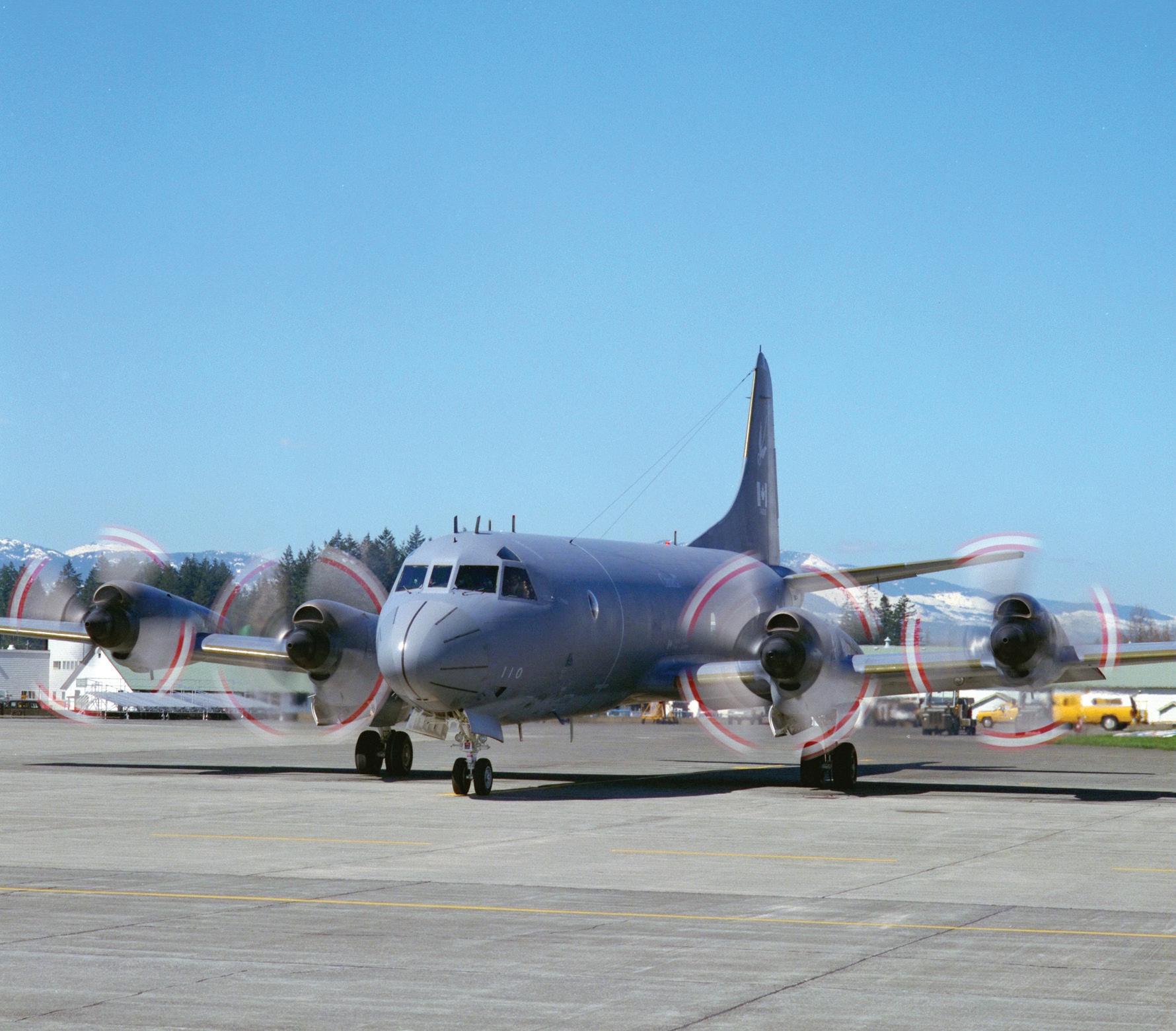
IMP Aerospace recently announced that installation work has commenced on the life-extension modification of 10 Canadian CP-140 Aurora aircraft to have their outer wings, lower centre wing and horizontal stabilizers replaced with new structural components supplied by Lockheed Martin Aeronautics Company for the Canadian Department of National Defence.
This life-extension program is known as the Aurora Service Life Extension Project (ASLEP) and will extend the CP-140 Aurora structural life well beyond 2025. This multimillion-dollar program will employ a team of approximately 100 personnel distributed between IMP Aerospace, Halifax Stanfield International Airport; IMP Aerospace Avionics, Hammonds Plains; and IMP Aerospace Components, Amherst.
sitA lAuncHes Air trAnsport commAnd centre
The world’s first global command centre dedicated to the air transport industry was launched May 25 in Montreal. This unique facility will monitor and manage mission-critical systems for the industry.
The centre is manned 24/7 by teams of IT experts who have real-time visibility of the IT and communications systems in use at airports, in airlines and aircraft by SITA’s 3,200 customers. This technology allows SITA to mitigate issues before they arise, or resolve them quickly and efficiently. More than 300 airports and 2,000 airlines will be supported.
All of SITA’s operations for its customers worldwide will be managed from Montreal. In addition, SITA’s AIRCOM services, for air to ground communications, will be monitored from there.
More than 90 staff will operate SITA’s Command Centre, consisting of network and infrastructure specialists, process and quality assurance analysts and customer service technical support representatives.
ImP aerospace will work on the life extension of cP-140 aurora aircraft.
dornier splAsHes doWn in Quebec
The Dornier Seaplane Company has elected Saint-Jean-sur-Richelieu, a southern suburb of Montreal, as its final assembly site for the Seastar Amphibious aircraft. The decision was based on many factors, including strong federal, provincial and local government support for aerospace, a skilled aerospace labour pool in the Montreal area, the large local aviation supply chain (including Pratt & Whitney Canada, which produces the Seastar engines) and the uncongested airspace surrounding Lake Champlain for demonstration and production flight test activities.
The arrival of Dornier Seaplane to Quebec brings exciting industrial opportunities and the creation of more than 500 jobs over a five-year period.
The Seastar is the first new purposedesigned amphibious aircraft developed within the past 50 years. It is an FAA- and EASA-certified all-composite seaplane, powered by two Pratt & Whitney Canada PT6A-135A turboprop engines.
operAtors
ottAWA AcQuires mecHtronix sim
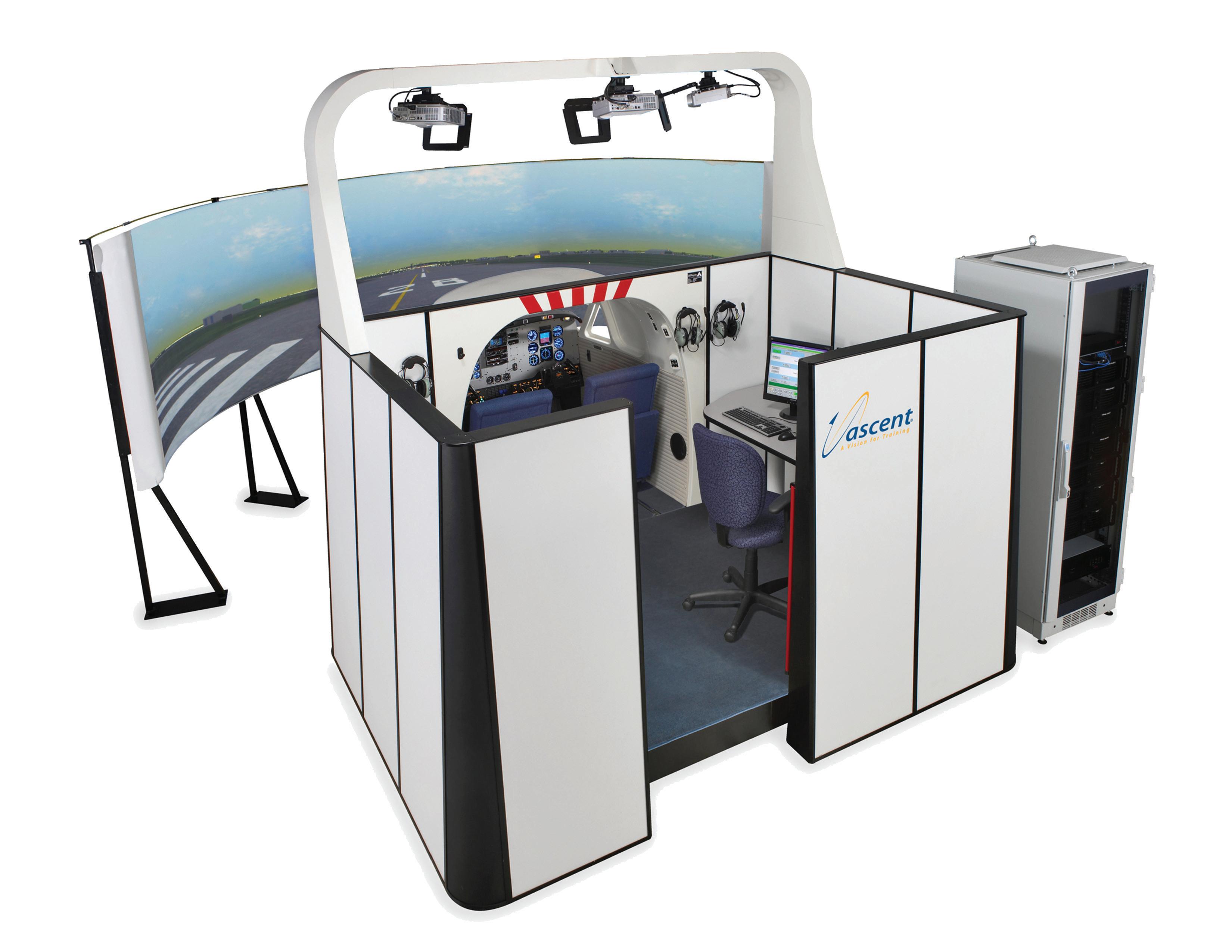
Ottawa Aviation Services (OAS) has acquired a Mechtronix Ascent Turboprop Trainer configured as a generic regional turboprop with conversion kits to multiand single-engine piston. The FSTD will
be used for ab-initio training, turboprop transition, crew resource management (CRM) as well as IFR courses.
The Ascent Turboprop Trainer will provide student pilots with the highest level of visual fidelity through a 180-degree x 35-degree visual display system along with superior definition, contrast, brightness and refresh rate via a FFS-quality Raster/xT Image Generator from RSI. The device brings additional flexibility to its users; it is equipped with conversion kits to single- and multi-engine piston to support VFR and IFR training sessions. The FSTD comes with a Garmin GNS 430 and a semi-enclosed Instructor Operating Station that facilitates the interaction between instructor and student.
The unit will be delivered this fall and will be located in OAS training facilities at the Ottawa International Airport. The Ascent Turboprop Trainer will be qualified
under the CARS (TP96-85), equivalent to JAR-FSTD A FNPT II MCC under EASA regulations.
HigH scHool AviAtion tAkes fligHt
A new partnership between Rick Hansen Secondary School and Coastal Pacific Aviation at Abbotsford Airport will provide high school students the opportunity to obtain their private pilot’s licence.
Students who complete the ground school course will be able to obtain their private pilot’s licence after completing 50 hours of flight training with Coastal Pacific. Also, preferential entrance into the bachelor of aviation program at the University of the Fraser Valley (UFV) will be provided to all
the ascent turboprop trainer configured as a regional turboprop will be delivered to ottawa aviation Services this fall.
events cAlendAr
JULY 2010
Farnborough International Airshow
July 19-25
Farnborough, U.K. www.farnborough.com
AUGUST 2010
Classic Air Rallye
Aug. 28-29
Ottawa, Ont. www.flightworks.ca
SEPTEMBER 2010
Aircraft Interiors Expo 2010
Sept. 14-16
Long Beach, Calif. www.aircraftinteriorsexpo-us.com
CAMC 18th Forum & AGM
Vancouver, B.C.
Sept. 29-Oct. 1
www.camc.ca
Supply Chains Connections Conference
Sept. 29-30
Winnipeg, Man. www.umti.ca
OCTOBER 2010
NBAA 63rd Annual Meeting and Convention Oct. 19-21
Atlanta, Ga. www.nbaa.org/events
NOVEMBER 2010
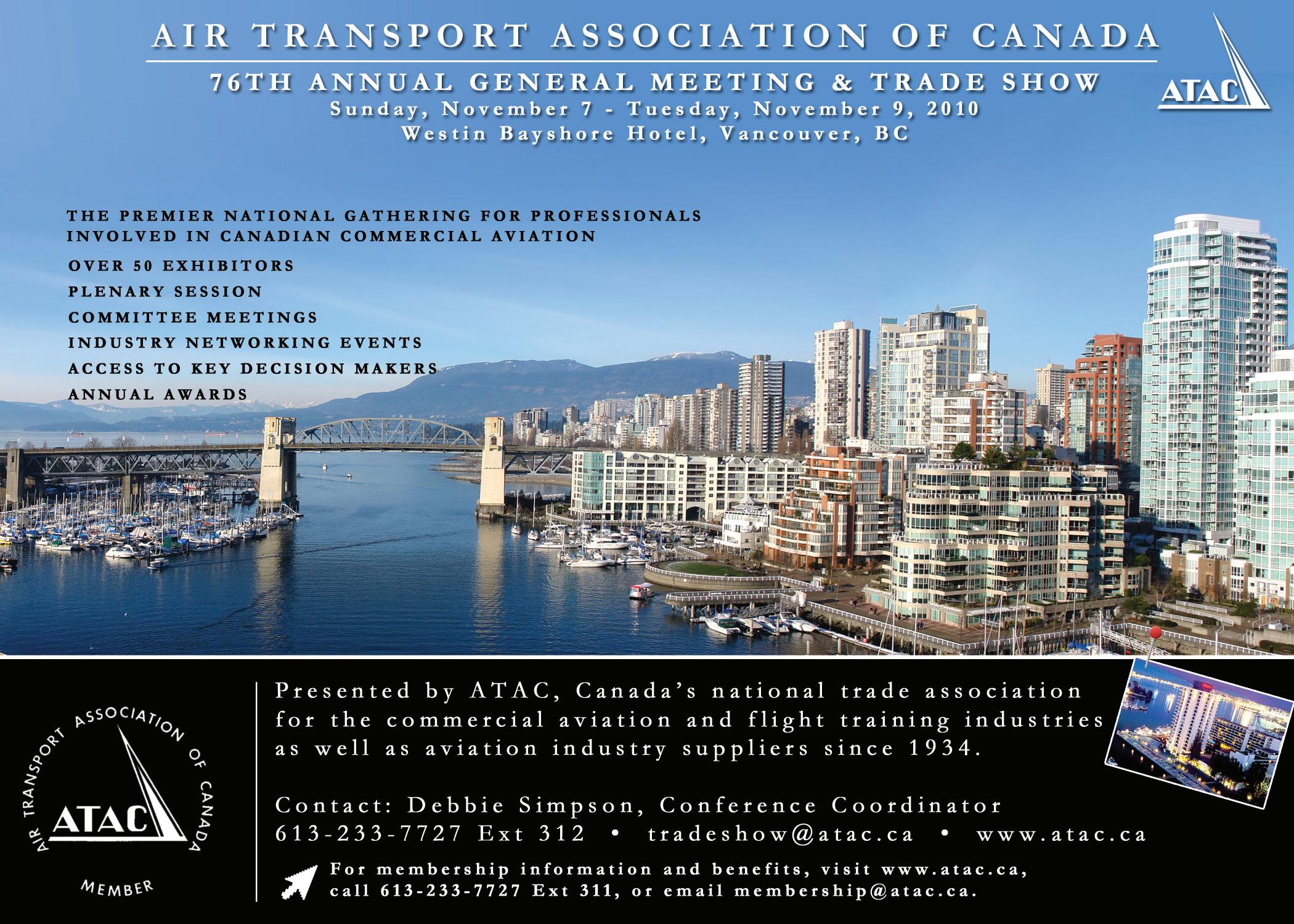
ATAC Annual General Meeting & Tradeshow 2010 Nov. 7-9
For a full list of events, please visit www.wingsmagazine.com and click on events.
Abbotsford School District students in this program who successfully complete ground school after writing the Transport Canada exam.
Students will be instructed in ground school as well as introduced to critical thinking and analytical skills in aerospace engineering, program management and maintenance, with added instructional components from the Canadian Aviation Maintenance Council.
Hansen vice-principal Michael Pearson notes the program “will definitely give students in the program the opportunity to see the various aviation employment opportunities in Abbotsford,” and it will give students the opportunity to transition directly into a specific program at UFV.
Airports
nortH bAy plAns AerospAce pArk
The city of North Bay, Ont., has plans to create a full-blown aviation hub at Jack Garland Airport. The Mayor’s Office of Economic Development has circulated a survey to North Bay area businesses and organizations to gauge interest in expanding into a combination aerospace and industrial park, in an effort to attract companies to the airport and improve commercial air service. There are more than 200 acres of greenfield airside acreage at Jack Garland “to put in play,” and about 350 acres of ground-side property for non-aviation business, said economic development officer Rick Evans.
Jacobs Consultancy will sort through the confidential responses and help assess what development opportunities exist. The results of the survey are expected in early July. Check www.wings magazine.com for updates.
cAnAdA’s Airports Welcome cArgo security progrAm
On May 25, the Canadian Airports Council pledged broad support for the Government of Canada’s recently announced cargo security program and pledged to work closely with the federal government to ensure the new program is implemented in a way that meets the unique needs of very different airports and shippers.
The government unveiled a $95.7 million Air Cargo Security Program on May 24 that will be phased-in over five years. Canada’s airports handle about 1.5 million tonnes a year from the nation’s largest airports to small, remote communities in Canada’s north. At the same time, airports around the country handle cargo in very different ways. Some airports are centres for large express mail operations, others handle mostly containerized commodities and others again have large amounts of live animals and perishable goods.
peArson receives iAtA eAgle AWArd
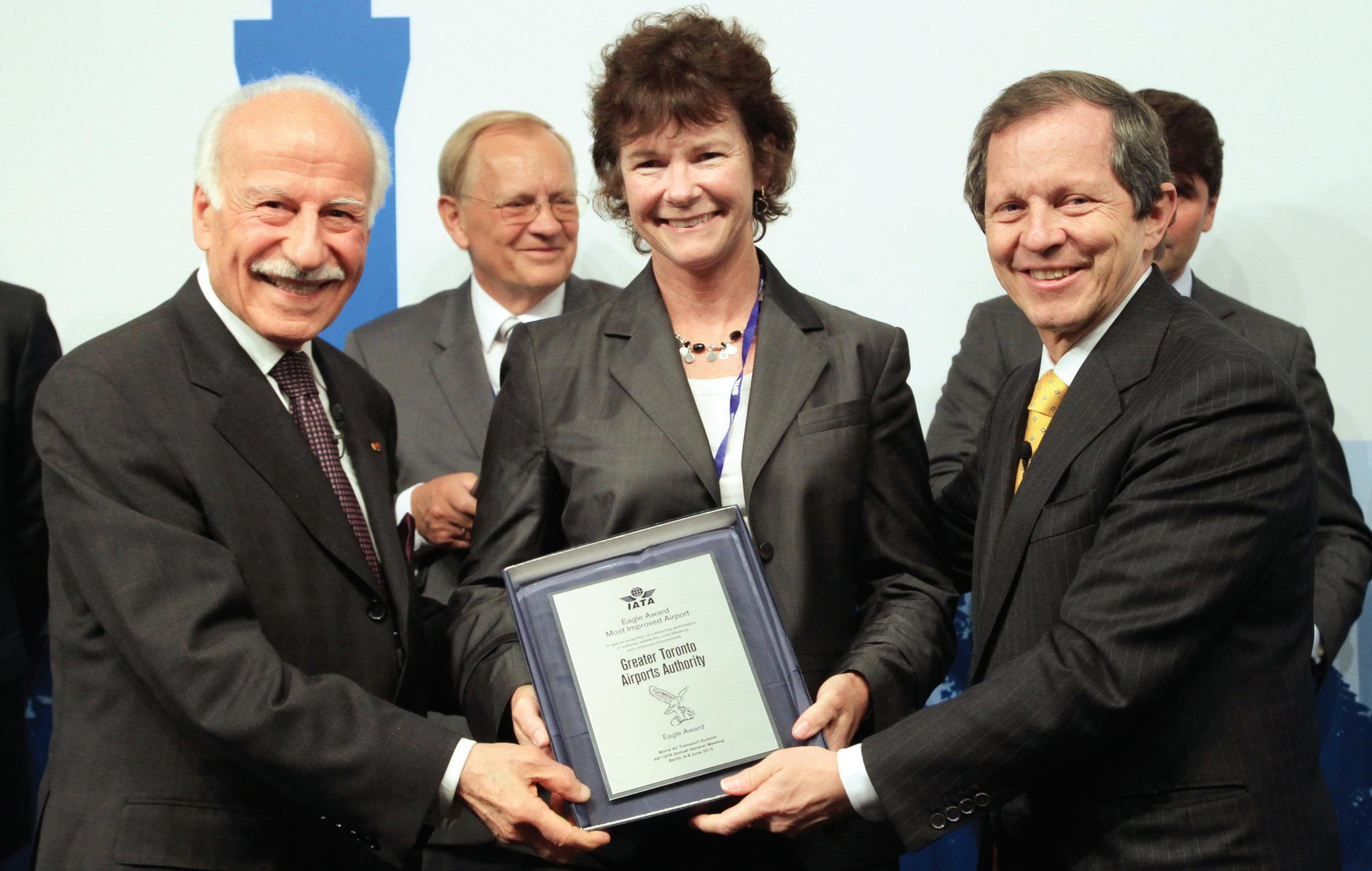
Canada’s busiest airport, Toronto’s Pearson International Airport, was honoured by airlines around the globe on June 7 with
assembly of the cl-415 Water Bomber by vortex aerospace in North Bay.
the 2010 IATA Eagle Award for Most Improved Airport. Awarded by the International Air Transport Association (IATA), the global industry award recognizes the significant strides made by Toronto Pearson in its commitment to working with the air carrier industry.
The IATA Eagle Awards are presented in recognition of an airport’s outstanding performance in airline satisfaction, cost efficiency and continuous improvement. The GTAA has taken significant initiatives to reduce costs and increase its commercial revenues. In January, it implemented a 10 per cent reduction in landing and terminal charges, which signalled the third consecutive year of reduced fees.
yukon Airport expAnsion
The new expansion at Erik Nielsen Whitehorse International Airport was officially opened in June. The expansion adds 2,767 square metres to the existing terminal building and includes additional space for security screening, a secure passenger holding area that can be occupied by 230 passengers, an in-transit lounge, a new baggage terminal and increased office space for airport staff.
The expansion was funded by an $11-million investment by the Government of Yukon with a $5-million contribution from the Government of Canada through the Canada Strategic Infrastructure Fund.
people
neW fAce in tHe cAbin
Since its inception 50 years ago, Wings magazine has provided readers nationwide with the best information possible to help them stay in touch with industry trends. It’s a successful model new editor Matt Nicholls plans to follow in the months and years ahead. Nicholls takes the helm with the September/October issue.
“Wings has a tradition of providing the best industry information from a Canadian perspective,” said
op/ed
emirAtes: Winners And losers
It was extremely disappointing to read David Carr’s column in the March/April Wings (Airline access and frequency: Why is Transport Canada still picking winners and losers?) advocating increased flights to Canada for Emirates airline. Carr observes that airports compete for traffic, but then makes the astounding leap to suggest that our national air transportation policy should be aimed at boosting traffic at airports, in order to meet their commercialized business model. Shouldn’t our country’s goal be to provide efficient transportation for Canadians and maximize the economic benefits associated with this activity?
Airports certainly aren’t the only businesses whose interests are at stake in Canada’s air transportation sector. Air Canada employs more Canadians than all “Big Three” domestic automakers combined. Those people are employed on Air Canada’s network, which supplies the lion’s share of the traffic that supports Canadian airports as commercial businesses. Eroding that network to build Emirates’ hub in Dubai would be like killing the goose that lays the golden egg for Canadian airports. Letting Emirates steal away traffic for its Dubai hub would only result in less direct service for Canadians, as other airlines must cut back the routes that become unprofitable.
Emirates’ goals are in complete contradiction with our interests. It has been very clever about getting some local airport authorities as well as provincial and municipal politicians to advance its case in Ottawa. It spins yarns about planeloads of Emirati tourists coming to Canada, though its native population is only about half the size of Vancouver. Even a cursory examination of its propaganda reveals there is little real benefit for Canada in its plans. It promises to build a few passenger lounges at Canadian airports and calls this job creation. That is like a foreign auto manufacturer promising to dump enough subsidized product to decimate our domestic industry, but build a few dealerships in Canada and call it an economic spinoff. This is the core issue facing our country and the reason why Transport Canada is resisting Emirates massive lobbying campaign. When another country wishes to compete freely and fairly, Canada willingly negotiates “open skies” agreements to ensure a level playing field. However, state-owned entities like Emirates, which are but one part of the UAE’s economic development strategy to suck global air traffic through its middleeastern hubs, do not want to play by these rules.
Emirates is solely-owned by the Investment Corporation of Dubai (ICD) which is, in turn, wholly-owned by the ruling family of Dubai. Most recently, we have seen the UAE threaten Canada’s continued access to our forward operating base for our military personnel and assets employed in the region. Let’s remember that these dedicated Canadian military personnel are serving very much in the national interest of the UAE, as did my colleagues and I during the Gulf and Kuwait conflict.
Canadian airports and other stakeholders in a healthy Canadian air transportation sector would be well-advised to ask themselves why Emirates and Etihad are taking such a hardball approach. They should take a closer look and then determine who the real winners and losers will be.
Captain Paul Strachan is president of the Air Canada Pilots Association. matt Nicholls is the new editor for Wings and Helicopters magazines.
left to right: dr. assad kotaite, former president of the council of Icao; marilynne day-linton, Gtaa Board chair; Giovanni Bisignani, Iata director general and ceo
Nicholls. “We will continue to highlight the people and organizations that make it so dynamic.”
Nicholls has worked with a number of business and consumer magazines including Marketing magazine, Ontario Out of Doors, Maximum Fitness, Meetings & Incentive Travel, Canadian Sport Fishing and Ontario Fisherman
commerciAl
Air frAnce mArks 60 yeArs in cAnAdA
Air France dates its presence in Canada to Oct. 2, 1950, when it flew a Lockheed Constellation 749 to Dorval, after stopovers in Shannon and Gander. The first Air France Montreal-to-Paris flight left for Orly on Oct. 5 with 40 passengers.
Air France says it will use one of its new Airbus A380s on a one-day-only flight to Montreal on Oct. 7 to mark the airline’s 60
years in Canada. The Air France anniversary event is planned for the flight from Paris to Montreal-Trudeau airport, followed by the outbound flight from Montreal.
The airline operates three of the 538-seat aircraft – the largest passenger airliner in the world – on flights from Paris to New York and Johannesburg. It plans to add Tokyo as a third destination in September.
Seats for the flights will be sold online at www.airfrance.ca and through travel agencies, the airline says. As well, some 60 seats will be reserved for various contests surrounding the 60th anniversary, including a photography contest the airline has launched on its website.
32 more A380s for emirAtes
Emirates says it has ordered 32 more A-380 superjumbo jets from European planemaker Airbus, bringing its total on order to 90. Emirates received its first
A-380 in July 2008 and now has 10 of the planes. It already had 58 on order.
The Dubai-based airline said the new order signed in early June has a list price of US$11.5 billion. It said the planes would be delivered by 2017. Airbus CEO Tom Enders says, “This is the single largest 380 order ever.” He described the order as a “sign of confidence in the 380 and in Airbus.”
trAnsAt lAuncHes green progrAm
Transat A.T. Inc. has successfully launched its allégo responsible-transportation program, aimed at promoting a means of transport for employees other than singleoccupant driving. Approximately 300 of Transat’s 1,000 downtown Montreal head office employees enrolled in the program, which offers a range of measures to encourage travel by public transit, carpooling, cycling or walking.
Some 250 employees have enrolled in the Accès annuel aux transports collectifs
(Annual Access to Public Transit) program, which encourages use of public transit by offering a free monthly transit pass to users who purchase 12 consecutive passes. Transat has enhanced the program by offering a second free month to its employees.
Employees who bike to and from work now enjoy additional parking space, better lighting and improved signage in the building’s underground garage. Lastly, 22 employees have registered for the Agence métropolitaine de transport’s (AMT) online carpooling tool, which helps them find ride-share partners for their work commutes.
Companies that want to start up a similar program have access to financial support from the Quebec Transport Ministry under the government assistance program.
book revieW soAring sAles, by J. tHomAs zeiser
Soaring Sales , written by aviation safety consultant and pilot Tom Zeiser, bridges the gap between the sales world and the flight training industry. The book focuses on techniques used to foster relationships between the flight instructor and student and bring about a strengthened commitment from both sides and an improvement in the bottom line of the flight school.
Some of the major topics include reinforcing a solid buying decision, the importance of making a good first impression and closing strategies.
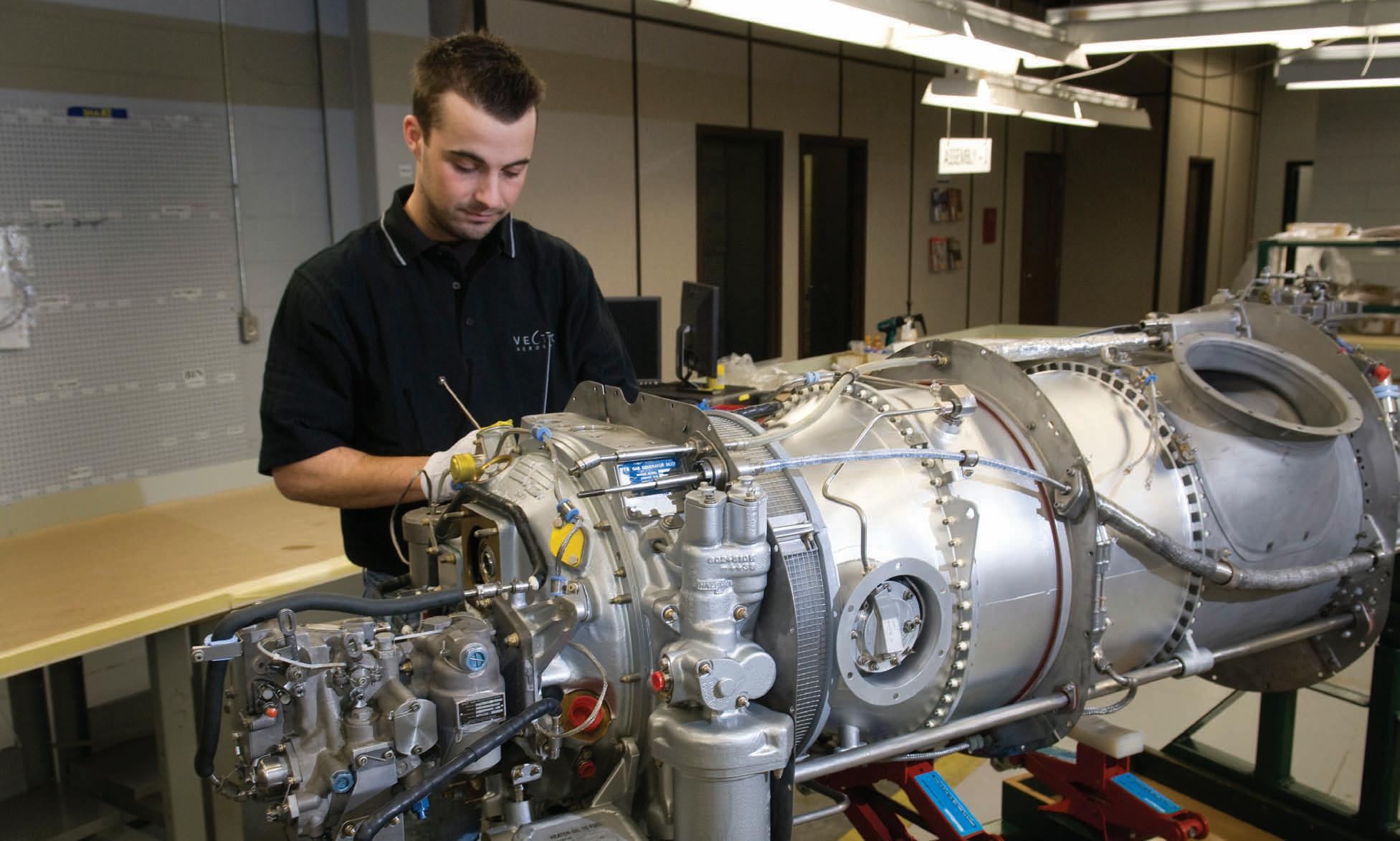
Vector Aerospace is a leading, global provider of Maintenance, Repair and Overhaul services for Pratt & Whitney Canada’s PT6A, PW100, JT15D, PW307A and PW308A/C series of
Our reputation for superior customer service continues to grow at Vector Aerospace, Engine Services – Atlantic.
We’re proud of our past –working hard for your future.
Each chapter focuses on a different element of the flight training process. Readers are creatively guided through each chapter and reminded of the importance of setting goals and developing a game plan. Comprehensive checklists and guides, useful in creating accountability and reinforcing positive actions, are found throughout the book to help flight instructors learn about themselves and their students.
Soaring Sales is an inspiring read for flight instructors, flight school management and sales professionals. It is available in most aviation specialty stores and online at www.pegasuspresentations.com.
correction notice
In the May/June issue on page 22, we incorrectly gave photo credit to Suneast Aviation. The photo was courtesy of Sunwest Aviation. We apologize for this error.
ALTERNATE APPROACH
the problem is piling up
Air transport’s green agenda has missed a step
Every year the U.S. airline industry tosses out enough cans to fill the aluminum content of 58 Boeing 747s, according to the National Resources Defense Council (NRDC), a New York-based environmental think tank.
These comparisons are well intentioned, sometimes suspect and always effective in helping to get the message across. The NRDC’s calculation is from 2004. Six years later, will the number of aluminum cans sent to landfill produce more or fewer 747s? Nothing curbs the packaging waste stream faster than a recession and fewer customers. What is clear, however, is that recycling lags behind alternative fuel sources, lighter aircraft and more efficient engines in the race for a greener airline industry. The average passenger generates approximately half a kilogram of waste of which 75 per cent is recyclable, but only 20 per cent recycled.
Approximately 50 per cent of package waste flows from the cabin. Green America, a Washington-based environmental group that advocates market solutions, recently published a dismal report card on nine U.S. domestic and two international airlines. The group found that while cabin service at all airlines is heavily dependent on disposable packaging, no carrier either recycles all major recyclables or has programs for minimizing onboard waste and composting leftover food.
Airlines are doing their part. Air Canada, which was not part of the Green America report card, claims to buy recycled products and recycle aluminum cans and newspapers where possible. Delta is much more aggressive, with recycling programs at 23 U.S. airports (up from five in 2007); that includes plastic trays and beverage cups. British Airways reports it recycles 30 per cent of its waste at its London Heathrow and Gatwick hubs. Hong Kong-based Cathay Pacific collects more than 4.6 million items from its flights for recycling annually and is experimenting with biodegradable plastic bags inflight.
Still, this commitment to onboard recycling can be described as piecemeal at best. Which raises the question, why has an industry so eager to establish its green bona fides in areas such as carbon emission reduction been slow to clean up its act when it comes to curbing the waste stream? Especially since, for example, the capture and recycling of 70
The greatest barrier to recycling is a disconnect between airlines and airports, the entry and end point for all disposable waste.
per cent of paper products – the single largest waste category generated by air transport – would reduce carbon emissions by an amount equal to removing 68,000 cars annually according to the NRDC.
There are obstacles to waste reduction and recycling. Passengers expect food items to be packaged individually for health reasons. There is limited time and space to collect and sort recyclables in flight, although commingled recycling technology is removing the requirement for reusable materials to be separated on board. Government regulations on the disposal of food waste taken off international flights make composting and recycling difficult, but not impossible.
The greatest barrier to recycling is a disconnect between airlines and airports, the entry and end point for all disposable waste.
By David Carr |
Decentralized recycling programs at most airports place the burden of waste management on the individual airlines with no incentive to recycle outside of hubs where the smaller volume of reusable materials makes recycling cost prohibitive.
Earlier this year, Seattle Tacoma International Airport, which had already centralized waste management for retail and restaurant tenants, introduced a centralized waste disposal system. Six pairs of computerized compactors have eliminated the need for airlines to coordinate their own pickups. The airport gives airlines free use of the recycling compactor. Currently, 90 per cent of airlines are using the system and Sea-Tac expects to recycle 50 per cent of airlinegenerated waste by 2014. There is evidence to suggest that airports are beginning to pick up their game. Airports such as Montreal’s Pierre Trudeau International are installing triple-compartment recycling bins in terminal buildings to capture the 40 per cent of passenger waste that flows from restaurants and retailers.
Even so, there has been no grand call to action by industry associations such as Airports Council International or IATA for a global recycling standard at international airports, or to set a target of zero waste by 2020, much the same way the industry is committed to building an airplane with zero emissions by 2060.
Air transport is not an environmental laggard. But a 20 per cent recycling threshold is shockingly low for an industry that consumes football fields of paper and gorges on over-packaged foods. Clearly the industry has missed a step in its green agenda, and the problem continues to pile up. | W
David Carr is a Wings writer and columnist.
| By Brian Dunn
poised for growth Virgin America goes international
With the introduction of service to Toronto on June 29 from Los Angeles and San Francisco, Virgin America marked the launch of its first international city.
“Today is a great day for airline competition, for our teammates and for travellers,” said Virgin America president and CEO David Cush. “When more airlines compete, consumers win with lower fares and better service. At a time when most airlines are contracting and consumers expect less and less, we’re proud to be growing, operating responsibly and offering travellers a very different kind of flight experience.”
Virgin America is one of the fastest growing start-up airlines of all time. The San Francisco-based carrier launched in August 2007, and now serves 11 destinations including Toronto, has 1,500 “teammates” or employees and plans to grow to 30 to 50 cities in the next three to five years. It is adding six more aircraft this year to its current fleet of 28 Airbus A-319s and A-320s and three more in the first quarter of 2011. By this time next year, the airline’s fleet will have grown by almost one-third and five new destinations added. Toronto also marks the first international destination for Virgin America, with a daily non-stop flight and a through flight to both San Francisco and LAX.
The airline reported its first operating profit in the third quarter of last year, although it had an operating loss of $48 million for the full year on revenues of $548 million, a $140 million year-overyear improvement over 2008. Virgin averaged an 84 per cent load factor in the fourth quarter of 2009, a 3.1 point improvement over the fourth quarter of 2008, despite a 47 per cent increase in scheduled service capacity for the quarter.
“With a strong financial performance, a new ownership structure and growth in fleet size, we’re pleased to be able to expand to world-class destinations like Toronto, and Vancouver will probably be our next Canadian destination, although no time line has been set,” says Abby Lunardini, director of corporate communications
Virgin America is like a hybrid model, positioned between legacy airlines and low-cost carriers.
at Virgin America. She says more flights between Toronto and California could be added if the demand is there.
Toronto has been on Virgin’s radar screen for a long time, because it’s a huge travel market, explains Lunardini. There is also strong high-tech and media traffic between Toronto and L.A.
“That was the business rationale behind the launch. We feel what the Virgin brand stands for will resonate with the Toronto business and vacation markets.” Service to Toronto is being promoted with a one-way introductory fare of $199 from LAX and $209 from San Francisco. The new service is backed by online ads along with a billboard and newspaper campaign. The route will be served by an A-320 with eight First Class seats, 12 Select Class seats and 130 seats in Economy.
Virgin America is like a hybrid model, positioned between legacy airlines and low-cost carriers, explains Lunardini. It is price competitive with the budget airlines, but with a major focus on corporate and business travellers.
“Our business model is built around reinventing flying and offering travellers more for less, so low-fares plus a host of different upscale/high-tech amenities. We were the first airline in the world to offer in-flight Wi-Fi fleet wide as of May 2009,” says Lunardini.
Virgin’s new A-320 fleet offers custom-designed mood lighting, deeper and more ergonomically correct leather seats, power outlets at every seat and the most advanced touch-screen in-flight entertainment platform in the skies, says Lunardini. In addition to movies, live TV, video games, an MP3 library, music videos, Google maps and more, its Red system allows travellers to order food and drinks right from their seatback screen and pay with a swipe of a credit card at their seat. The flight crew then serve guests on a tray, as opposed to the traditional cart service.
“As a start-up airline, we’ve been shaking things up in the U.S. by injecting healthy competition into new markets, with lower fares and better service. Once people try us, they tend to stay with us. That will be the focus of our Toronto marketing.” | W
Brian Dunn is a Wings writer and columnist.
By Rob Seaman |
good is not good enough
Be proactive with environmental
You are buying fuel. This is a fairly normal activity for most, and a fact of life for anything that has an engine. We mindlessly fill up on a regular basis with little thought other than price and perhaps choice of brand. The price is just so darn awful. But we pay it anyway. We trust that what is going in is good, clean and trustworthy fuel. We trust the system and accept that all is good. And for the most part, that is a fair assumption.
As meek and mild Canadians, we only complained when auto fuel hit 75 cents per litre. Then it went to 85 cents, so 75 cents didn’t seem so bad. Then from 85 cents it moved on until it reached our current rates – which can change depending on the day of week, the holiday that might be coming, and a whole bunch of other issues from hurricanes miles away, to international unrest in countries beyond. Despite what happens, we continue to buy and burn fuel.
For months now we’ve heard of various new fuel products undergoing testing for use in turbine-powered aircraft and more recently, for piston variants. We’ve been told repeatedly how bad we (the aviation community) are for the environment as a whole and that we need to change our Jet A1 and 100LL drinking habit. And I guess, like any addict, we are sitting back continuing our evil ways until someone really tells us what to do or presents a solid plan to change.
The General Aviation Manufacturers Association (GAMA) represents the interests of many of the international alphabet organizations and the OEMs from all walks of aviation. Its published stand on business aviation and climate change reads as follows: “The global business aviation operating and manufacturing communities support the International Civil Aviation Organization’s (ICAO) proposal for aviation sectoral management of targets and monitoring of greenhouse gas (GHG) emissions in a post-Kyoto Agreement. We support the ICAO Programme of Action on International Aviation and Climate Change and are in accord with the Declaration of the High Level Meeting on International Aviation and Climate Change convened by ICAO in Montreal on 7-9 October 2009.”
GAMA also notes that bizav is among the good guys in the environmental war. The
change
We can’t continue being the proverbial ostrich with our head in the sand . . . . This is real and the concern is global.
organization puts it best: “Business Aviation has established an excellent record of consistently improving fuel efficiency, delivering 40 per cent improvement over the past 40 years. Business aviation’s global CO2 emissions are approximately 2 per cent of all aviation and 0.04 per cent of global manmade carbon emissions.”
But good is never good enough. So GAMA has committed to the following targets for our industry:
• carbon-neutral growth by 2020
• an improvement in fuel efficiency on average of two per cent per year from today until 2020
• a reduction in total CO2 emissions by 50 per cent by 2050 relative to 2005
As GAMA sees it, we’ll achieve these objectives through expected advances in four areas: technology, infrastructure and operational improvements, alternative fuels, and market-based measures.
Many will think, here we go again with more political rhetoric. Another group of folks I really don’t know are making decisions yet again that are going to affect and cost me in some form. Just when will others
stop injecting themselves and their point of view into my world? I’ve done my bit. My car burns less gas. I recycle just about everything I can. And I changed all the light bulbs in my house to those ugly things they say I have to have. I really think I have done my part so please leave us aviation folks alone.
However, we can’t continue being the proverbial ostrich with our head in the sand, or worse, take the “not my issue” approach. This is real and the concern is global. We really need to start figuring out how to be a part of the solution as opposed to contributing to the problem.
Start by reading about alternative fuels and the discussion on biofuel, algae-based concepts and the replacements for 100LL. The U.S. Environmental Protection Agency (EPA) via the Clean Air Act is already working on standards mandating the transition to unleaded aviation gasoline (avgas). Fighting change in this case is not, in my opinion, the right thing to do. Learning about the issues and facts and gaining an understanding about alternatives and how to work with them is a better approach. Otherwise, you could be surprised and very unhappy about the changes. | W
Rob Seaman is a Wings writer and columnist.
| By Peter Pigott
Above it all
Vickers Vedette watches over Parliament
Two hundred and sixty-five feet above Wellington Street in Ottawa is an aircraft that has been airborne for some 80 years. It has never flown anywhere, seems determined to head into the wind and can execute a flat 360-degree turn in seconds. Finally, it is pilotless! The weathervane is a copper model of a Canadian Vickers Vedette flying boat and is perched on top of the tallest tower of the Confederation building. Only the Canadian flag on the Peace Tower flies higher.
In 1929, the foundations were laid for the Confederation Building on the corner of the parliamentary precinct to house the Department of Agriculture. Canada was an agricultural country then and the department was a powerful one, so no expense was spared in the construction of its new home. When it was completed, the architects looked for a suitable weathervane to crown the building’s tallest tower.
“The Department of Public Works was casting around for something typicalsymbolical-distinctive to finish the tower,” wrote the Ottawa Citizen on Feb.27, 1931, “and happening to view a moving picture show of aerial craft . . . the designer saw flashed across the screen exactly what he wanted as a model for a weather vane. Enquiry revealed this to be a Vickers Viditte (sic). . . So an exact scale model was developed in copper and bronze which was mounted over a globe.” A gift from the Royal Canadian Air Force, the replica has a wingspan and fuselage length of over five feet and weighs 140 lbs.
Why was a little-known 1920s flying boat accorded this honour? In these days of global positioning and Google Earth, it is hard to comprehend, but less than 100 years ago, most of Canada was still unmapped. The British Admiralty had charted the former colony’s coastline and the two railways – the Canadian Pacific and the Canadian National – had surveyed the land on either side of their tracks. But away from the cities, vast areas of the interior were still unexplored. Much of the prairie provinces, British Columbia and the Northwest Territories was simply described on the maps of the day as “Unknown.”
But the development of aircraft during the Great War had been so spectacular that in 1919, provincial governments, forestry,
The architects looked for a suitable weathervane to crown the building’s tallest tower.
shipping and hydroelectric companies all lobbied the federal government to use them to survey the country’s interior. The young RCAF was then looking for a raison d’être – there were no enemies to defend Canada from. Using the flying boats that the British and the United States Navy had donated, the RCAF agreed to take on the mission. The science of aerial surveying was simple. If an aircraft flew in a grid pattern and vertical photographs were taken from it straight down, when fitted together they would result in a map of the landscape flown over. If these photographs were complemented with those taken obliquely (taken at an angle to the earth’s surface) the relief of the area – mountains, valleys and trees – would emerge. Flying “lines,” as it was called, was monotonous but with a few variations, this
was how the country was mapped and by 1926, based at High River, Man., Ottawa and Jericho Beach, Vancouver, RCAF aircraft had photographed and mapped thousands of square miles.
But, never designed to carry heavy cameras in their nose cockpits, by 1924, the First World War flying boats were increasingly unsuitable. The British Vickers company, sensing a market, adapted its Viking for Canadian usage. But it was underpowered and the amount of water its hull absorbed meant that it rotted quickly. Then the Society of Forest Engineers teamed up with the RCAF to design the ideal aircraft for forest patrol and aerial surveying and Vickers built the aircraft at its Montreal plant. With a span of 42’ 2”, length of 32’ 11” and height of 11’ 2”, the threeplace flying boat was powered by a single 200-horsepower Wright J-4 Whirlwind engine. Cockpits were enlarged and hulls strengthened for conditions in the bush.”
By 1930, there were 36 Vedettes, allowing for survey operations across the country, particularly in the far north, which would be invaluable in the coming war. It must have been one of these that the architect of the Confederation building saw on the screen and decided to immortalize as the weathervane. In the decades that followed, exposed to the elements, the polished copper gradually oxidized to a dirty green and in 2009, the Vedette was removed for restoration.
As many of the offices in the Confederation building are now reserved for members of Parliament, particularly backbenchers, the weathervane is sorely missed. In a minority government, it is important to know which way the wind is blowing . . . | W
Peter Pigott is a Wings writer and columnist.
A BLUEPRINT FOR GREEN
Airport designs for tHe future
by cArroll mccormick
Airport authorities that have set themselves the task of reducing their environmental footprints (a handy catchall phrase for a multitude of activities) can collectively offer examples of reducing greenhouse gasses, glycol runoff, energy consumption, food and paper waste, and construction debris . . . the accomplishments in Canada are encouraging.
Take construction debris, for example, which can go to the dump, be recycled off
site or crushed and reused on site: The Montreal Trudeau International Airport, for one, recovered 58,000 tonnes of concrete and asphalt in 2009 and has recycled 600,000 tonnes of this material since 1998. This work is part of its aéroEco environmental policy which, in part, declares that Aéroports de Montréal (ADM) will “minimize the potential environmental impact of ADM operations and procurement activities by taking action to limit the emission of contaminants, consumption of energy and production of waste.” (Its many projects
include replacing cathode ray tubes with flat screen monitors and saving 500 megawatt hours, introducing vehicles that use propane and hydrogen technology and reducing its HVAC usage by 42 per cent.)
The Canadian Airports Council reports that the Pearson International Airport crushed and used 450,000 tons of concrete rubble for road base materials in the preparation of new aprons, and that in 2009 the Vancouver airport recycled 90 per cent of the material from its construction projects.
aIrPort lIGhtING IS a tree loaded WIth loW-haNGING fruIt, rIPe to BurStING WIth dazzlING eNerGY SavINGS PoteNtIal.
Sometimes one person’s trash is another’s treasure . . . in the same home! This happened in Winnipeg, where the Winnipeg Airport Authority (WAA) is building a 51,000-square-metre air terminal building. It needed fill, and the Canadian Air Force 17 Wing, which shares the airport with the WAA, had concrete waste from an apron rehabilitation. Simply moving the waste across the airport saved several hundred thousand dollars.
Winnipeg Airport Authority lays claim to being the first airport in North America to register on Canada’s Green Building Council for its new terminal. The WAA is building the terminal to Leadership in Energy and Environmental Design (LEED) standards, which rate the building in five categories: sustainable sites, water efficiency, energy and atmosphere, materials and resources, and indoor environmental quality. In simple strokes, LEED, which is a standard with a worldwide following, is a guide that helps architects and contractors put up buildings that are healthier, consume less energy and reduce their impact on the environment.
Edmonton International Airport’s control and office tower, part of its Expansion 2012 project, is being built to LEED standards. Features chosen or under consideration include a high-reflective roof,
fixtures that will reduce potable water use for toilets by 50 per cent, the optimization of energy performance, the use of 15 per cent recycled content and the use of lowemitting materials inside the building.
Late this spring, the Halifax International Airport Authority (HIAA) started moving its air services group (maintenance) and emergency response crew into its newly completed combined services complex. It will certainly achieve LEED certification and may earn a LEED silver rating.
“The complex is quite an efficient energy design and uses natural gas as a fuel source. It also uses a significant degree of natural light,” says Michael Healy, vicepresident, infrastructure and technology, HIAA. Charles Clow, the project manager of the complex, adds, “The outside of the building is designed with a minimum of lights to achieve the light pollution factor credit. We diverted 50 per cent of the waste from the construction into reuse or recycling. We used rubber floors with significant recycled content. We chose low VOC [volatile organic compounds] materials and did a full building flush after the building was completed. Indoor air quality is part of the LEED [process].”
It is difficult to gauge how widespread the effort is to reduce the environmental footprints of Canadian airports. Asked for
his opinion, Healy comments, “At a high level, all organizations in the Canadian aviation industry are being more environmentally sensitive.”
Steve Howards is the executive director of the Clean Airports Partnership (CAP) in Arvada, Colo. He looks at the efforts at Canadian airports and says, “Some have done some really cool stuff, but it is much more limited than in the United States. It is not just a shame: If you are not hitting the bar environmentally, you are also not hitting the bar in terms of operational efficiency.”
Clean Airports Partnership is a notfor-profit corporation established in 1998 and “devoted exclusively to improving environmental quality and energy efficiency at airports.” It seems that there is no analogous organization north of the border singularly devoted to promoting energy efficiency at Canada’s airports. There also appears to be no Canadian analogue of the Green Airport Initiative in the U.S., which is a “comprehensive, streamlined approach for helping airports shrink their environmental footprint while creating a blueprint for sustainable development.”
Howards declares, “I would say, without exception, that there is not an airport in Canada that could not save millions of dollars in energy efficiency. Airlines are
With abundant natural light, the need for artificial light in the daytime is significantly reduced at the halifax International airport.
taking peanuts off of planes and airports are wasting tens of millions of dollars.”
This is not to say that Canadian airports have been idle. The Calgary Airport Authority has reduced energy consumption by 20 per cent in the past six or seven years. As of three years ago it had implemented around 20 main projects, but had never benchmarked them until Blaine Adams, director, maintenance and utilities, spearheaded the certification of the airport through the Calgary branch of the Building Owners and Managers Association (BOMA); it has an environmental certification program for commercial buildings.
“BOMA certification provides a benchmarking tool. It is a standard you create for yourself. It brought to light that we were doing a lot of good things. We should have thanked ourselves years ago. We have to show the public that we care about the environment,” Adams says. (Calgary got its BOMA BESt Level 1 certification in 2007 and is re-certifying this year; Trudeau airport obtained its BOMA BESt Level 2 certification in 2008.)
Any energy use plan at the Calgary International Airport must meet certain criteria: does it make good business sense, does it reduce energy and is it friendly to the environment? Using the benchmark as a reference point, says Adams, allows him to better address the question, “How can we do better and what technologies will take us there? We don’t want to be leading edge or bleeding edge. We want to do what makes sense, because we are still running a business.” As a result of one study, Calgary installed variable frequency drives on its 18 escalators. The project cost $4,500 per unit, with $54,000 in energy savings a year.
Edmonton’s new baggage handling system (BHS) will offer GREENVEYOR conveyors that their manufacturer, Vanderlande Industries, reports are 30 per cent more efficient than conventional conveyors at a test installation at the Heathrow International Airport. Back in Montreal, each section in the 900 metres of belt conveyors in the BHS at Trudeau Airport’s transborder departure sector shuts down independently after a few seconds if it senses there is no baggage on it.
Airport lighting is a tree loaded with low-hanging fruit, ripe to bursting with dazzling energy savings potential: A growing wave of light emitting diode (LED) fixtures is washing over airports. The energy savings range from about 45 per cent to 95 per cent, depending on whether airports do simple fixture-by-fixture replacements of incandescent and halogen with LED, or change the power supply systems in airside circuits to take full advantage of LED’s potential.
The Vancouver International Airport was an early adopter of LED taxiway lighting in North America, and it continues to carry out LED taxiway and airfield lighting projects where appropriate. The Vancouver Airport Authority has saved more than C$4.6 million in electricity costs and more than 14 gigawatt hours of avoided electrical consumption as a result of programs completed between 2001 and 2007. Its new goal as of 2009 is to reduce electrical consumption by two per cent, year over year. One success story is a solar panel system it installed on the roof of the domestic terminal building, which is connected to 80 per cent of the hot water distribution system. It saves $90,000 in annual gas and electricity costs. “It has been so successful
that we installed another solar tube power water heating system on the roof of the West Chevron terminal,” says Toni Frisby, the airport authority’s manager of environment.
Vancouver also has a compost program for its retail food and beverage tenants. They can compost all food waste, including meats, paper products, coffee grounds and other organics. Since 2006, the airport has installed 450 new custom-made waste and recycling containers in all terminals and public areas. The airport reports, “These new containers have improved our terminal waste diversion rate (recycling rate) from 24 per cent to 38 per cent. This represents about 460,000 kilograms per year that is no longer going to the landfill.” | W
the solar panel rooftop system at the vancouver International airport (Yvr) supplies hot water to its West chevron terminal.
using the latest development of energy efficient thermal glass, heat producing uv rays are deflected in the daytime while the insulating sandwich glass protects from heat loss at night.
HEADING IN THE RIGHT DIRECTION
by rob seAmAn
the success or failure of FBOs is undeniably linked to the fortunes or losses of corporate flight departments. Using that as a starting point, generally, the North American market for aircraft was deplorable last year and, to no one’s surprise, travel was greatly reduced. So too went the fortunes of most FBOs.
One of the few saving graces for aircraft sales last year came from growth overseas. Many FBOs were blessed with continued out-of-country traffic as a result – a welcome bright spot in their business. Looking at this year so far, there has been more balance as North American firms get back into the game. Charter activity has been steady again and international travel, coupled with some special events, has without question fuelled activity for FBOs domestically.
Recently, things have shifted a bit according to industry analyst Brian Foley. He feels that we have entered another stagnant period for general aviation (GA). “I see no cause for panic or even pessimism – certainly not at this point,” says Foley. “Most recoveries aren’t linear and the occasional pullback can be expected. A year ago we postulated this recovery might have a W-shape, and that appears to be what’s happening. The industry takes one step back before taking two more forward.” Foley suggests that European troubles may explain the current situation. “Europe is the world’s second largest business-aviation market. Financially, it’s been in disarray. Worldwide stock markets have responded with double-digit percentage drops. So how can any industry go unaffected, at least temporarily? Yet I don’t believe the longterm outlook really suffers. Europe and the markets will adjust themselves (they always do), at which point the recovery can resume in sync.”
What other issues are on the FBO horizon? The first is security. There is no question that what we all consider the status quo today is going to change. Right
or wrong, FBOs are perceived by both media and some members of government as a weak link. According to comments made by the Hon. John Baird (Minister of Transport, Infrastructure and Communities) in the House of Commons on March 18, a new director general for Aviation Security has been appointed and the new director “is working hard with our team in every part of the country.” We have yet to hear something definitive from this office but, in the opinion of many, it is simply a matter of time before attention is turned to GA, and FBOs in particular.
Another area of interest will be environmental issues. FBOs have numerous conservation and environmental responsibilities. For example, when tank farm stations come to maturity or the expiration in their life limit, replacement involves new and extraneous measures. At larger airports, there is a swing to central fuel depots
from which all FBOs will draw their resale product. This should help mitigate fuel management issues going forward but the cost and effort to close and clean up a tank farm today is expensive and very involved. Increased pressure from communities adjacent to airports, environmentalists and liable-minded airport authorities also signals a further possible tightening of existing regulations with perhaps the introduction of new ones. What was at one time considered a small spill of almost anything aviation-related, now has new consequences and required procedures. More than one FBO has been caught in the midst of renovations having to correct product mismanagement or containment from years gone by. Basically, control and accountability of products – into and out of the aircraft – and management of them that includes removal and disposal are becoming bigger issues. FBOs are easy
fbos get bAck in tHe gAme
International travel, coupled with some special events, has without question fuelled activity for fBos domestically.
RIGHT
targets for the media and the misinformed public, so they must be seen as active and responsible and in many ways as partners for good environmental management.
Looking coast to coast to see where things are in the grand scheme, FBOs have varied reports. A major driver for the Vancouver market this year was the Winter Olympics and Winter Paralympics. A requirement for new and sophisticated security and passenger handling came with the potential increase in business. Farah Faruqi, sales and marketing at Avitat Vancouver/Interdel Aviation Services, feels that “the Vancouver 2010 Winter Olympics was a success. We were left with wonderful memories and an unforgettable experience. It truly has been a pleasure hosting the world and handling 350 plus corporate business jets from every corner of the globe.”
This event took years of detailed planning by all the FBOs, the airport authority,
government officials and the CBAA. According to Faruqi, the plans paid off as operations proceeded flawlessly. All the FBOs were required to create special space for passenger screening – while still maintaining FBO standards of service and convenience. At Avitat YVR, a hangar was converted into a VIP executive passenger screening lounge that was fully staffed and operational 24 hours a day. The FBO also worked with all the governing authorities from Slot Reservation Office, Transport Canada, Integrated Security Unit, RCMP, CATSA, and Canada Customs to ensure all safety and security standards were met. “Our liaison allowed us to keep flight departments and customers informed of any updates and changes and ensure their arrival and departures were smooth,” says Faruqi.
Moving eastward, Skyservice Business Aviation’s FBOs in Calgary, Toronto and Montreal collectively report they see an optimistic trend. “You can see a rebound in the industry for sure – a sign that we are heading in the right direction,” says Alain Champonnois, vice-president of FBO and maintenance. He reports definitively that the numbers are up from last year and is hopeful this will translate to a trend for the rest of the year. “I believe in the industry in general. We have not yet matched pre-recession numbers although we are getting closer. People need to get on with business sooner than later.” As part of Skyservice’s effort to maintain high-end facilities and continually invest in its business, it is undertaking lounge renovations in Toronto as part of its rotating facility upgrades. The size of the space will remain the same but it will have a fresh look.
Air Creebec provides fuel and ramp services as the Imperial Oil agent at the Timmins and Moosonee Airports for scheduled and itinerant aircraft. AnneMarie Farrington, marketing and operational support manager, reports that the company is taking voluntary action on the environmental challenge and have implemented an Energy Savings Plan in 2010 that involves every aspect of the company. From savings on heat to reducing paper usage, Farrington says it is already proving to be very successful. In terms of security concerns or the potential for new such initiatives, she echoes the feeling of most FBOs by saying that they are committed to ensuring adherence to security measures where applicable and are open to contemplating measures that might improve safety and security over time.
Innotech Aviation Services (Shell FBO) operates in Montreal, Halifax, Ottawa and Wabush, N.L. Joël Bédard, vice-president and general manager of Innotech-Execaire/Shell Aerocentre-Division of IMP Group Limited, comments,
Pilots can combine their passion for flying with their desire to help people in need. Hundreds of pilots across Canada are VPP Pilots, but we need more, like you, to help us in our mission of Getting Canadians to getting better.
“Our overall business in the last three years has steadily increased beyond our expectations. Although the recession normally affects the airline and FBO business, we were successful in maintaining what we had and also grew the business.” How, you might ask, did this company manage to grow during a recession? According to Bédard, it started by reviewing all operating costs and negotiating better rates with service providers. “We did not lay off any employees; quite the opposite. Our business grew steadily and created a few more jobs. Reducing your costs does not mean doing more with less all the time. Sometimes just changing a process in your operation can make the whole difference.”
Bédard reports positive environmental responsibility. “Environment is extremely important to all of our employees. This is a collective effort and we always recycle everything we can. Waste fuel products, paper, batteries, light bulbs and more are picked up by an environmental company to deliver to recycling companies.” As for security, he advises that each of the company’s facilities is already fully compliant with all Transport Canada Regulations in this area. “We do see a need to always improve the security around the FBOs and
this is a good thing for all our customers. Security is absolutely a must and we must never let our guards down. The most important piece of security is the employees, as they are the first barrier to ensuring that only authorized people gain access to the airport side and customer property.”
One thing you can always find in the
Canadian FBO world is optimism. The industry-wide feeling seems to be that the worst is over, and that we are moving forward and seeing better days. That said, there are still some unknowns to face from government and overseers of the industry, but with all such things, we will adapt and forge ahead. | W
Innotech’s new pilot lounge at the montreal fBo
ROUNDING THE CORNERS
rnp is revolutionizing tHe instrument ApproAcH
by JAmes mArAsA
those involved in aviation tend to get excited about most new technological advances. Yet now and then, certain enhancements present themselves in such a remarkable way, that it’s as though we’re glimpsing into the future. New technologies in aviation are often looked at in terms of potential lives saved. Yet with the ever-growing burden of man’s impact on the world’s climate, a corresponding benefit to our environment, such as an increase in fuel efficiency, could not be more timely.
No type of incident has proven more ominous and far-reaching than controlled flight into terrain (CFIT). During an instrument approach, an aircraft lacking a method of vertical guidance to a decision height is five times more likely to collide with the Earth than if it were following a precision approach such as an ILS. Such impactful evidence has led ICAO to request that
states establish approach procedures with vertical guidance to all instrument runway ends by 2016.
The fact that ILS equipment is costly is no secret; therefore, in lieu of relying on ground-based equipment, certain operators have found unique application for an advanced form of GPS navigation known as Required Navigation Performance (RNP). This is revolutionizing the way instrument approaches are designed and carried out, most notably in areas of hazardous terrain.
For Calgary-based WestJet, a comprehensive utilization of RNP became a realistic possibility at the roll-out of its first next-generation Boeing 737 in 2001. “The impetus for implementing RNP was safety,” says Capt. David Deere from WestJet’s home office. After serving on CF-18s in the first Gulf War and flying with the Snowbirds from 1994 through 1995, Deere’s
a 3-d image of Westjet’s rNP approach to runway 25 at abbotsford highlights how PBN is opening up new routes in obstacle-rich environments.
latest challenge is shepherding RNP into flight operations as project manager for WestJet’s RNP program.
“RNP was brand new in 2001 . . . . No one knew anything about it,” says Deere. “We knew about the capability for RNP in the 737NG but didn’t realize its full implications.”
According to Deere, WestJet approached RNP with the initial goal of eliminating multiple step-down “dive and drive” non-precision and circling approaches as well as reducing costly diversions. Yet after delving into the unique capabilities RNP had to offer, Deere confesses that the end result was “beyond expectations.”
Though both Area Navigation (RNAV) and GPS are modern staples in the everyday operations of commercial air carriers, their application has generally been limited to straight-line tracks between waypoints – perfectly suitable in the realm of en-route navigation, but limited in terms of flexibility. This has led to rigid instrument approach procedures with squared-off turns from base leg to final. As no airplane can actually perform a 90-degree course change over the ground, these “fly-by waypoints” serve as a guide while the actual track of the aircraft is markedly different from the perpendicular angles of the tracks depicted on the approach plate.
Required Navigation Performance offered the opportunity to change all that. Four years ago, when Deere took the reins of WestJet’s RNP program, he began to look at how the Performance-Based Navigation (PBN) capacity of the new 737 could help WestJet shave time and distance off existing procedures.
Performance-Based Navigation allows aircraft to accurately navigate along flexible, linear surfaces rather than point-to-point as does a standard GPS. Departure and instrument approach procedures can therefore be designed to quite literally “curve” around terrain and obstacles. With lateral position tolerance as low as 0.1 of a nautical mile, this capability has opened up new routes and improved WestJet’s service at airports surrounded by mountainous terrain such as Kelowna and Abbotsford.
Expansion of the PBN concept has led approach designers such as GE Naverus – a Seattle-based company who has worked closely with WestJet on the RNP program – to venture beyond the safety benefits of PBN and examine ways to save fuel and reduce greenhouse gas (GHG) emissions through improved aircraft efficiency. Such innovation has given rise to the short transition – a procedure built into the RNP/RNAV approach whereby the aircraft may navigate to the final approach course by means of a fixed-radius turn as it approaches the airport from a downwind or base leg. Colloquially referred to by pilots and controllers as the “Short Gate,” these arced transitions to final comprise 50 out of WestJet’s 80 RNP approaches. WestJet Flight Operations estimates the RNP approaches at Kelowna and Abbotsford have saved 265,000 and 285,000 litres of fuel annually at these airports. This translates to a reduction of 677 and 728 metric tons of GHG emissions.
During IFR weather when a precision approach is not available, the benefits of an RNP approach are immediately apparent. Yet through collaboration with NAV CANADA and GE
“The entire Canadian domestic industry is interested in the expansion of PBN. We get a bigger bang for our buck by getting everyone on board.”
Naverus, WestJet has opted to implement RNP approaches at airports already served by an ILS. Deere cites several reasons for the apparent redundancy, most notably the fact that an ILS often experiences signal interference and is not always operational due to scheduled maintenance or failure. Required Navigation Performance provides a superb backup in such cases, allowing the aircraft to be self-sufficient in terms of its navigational capacity.
As RNP does not rely on signal reception or the serviceability of ground-based navaids, it benefits smaller airport operators in WestJet’s route network by alleviating them of the need to invest in costly navigational infrastructure, such as ILS equipment. “We bring the technology with us,” says Deere.
In VFR weather, many pilots voluntarily abandon the confines of the instrument procedure for a less restrictive visual approach once the runway is in sight. But pilots at WestJet are beginning to appreciate the efficiency advantages of the Short Gate even over the stalwart visual.
After tracking descent profiles of WestJet’s visual approaches into Prince George, Deere presented a slide showing the graphical representation of each flight path. The enemies in terms of fuel efficiency are the segments of level flight. A 737NG, with gear down and flaps up, will burn fuel at a rate 3.5 times higher in level flight than during a continuous descent profile such as that on an RNP approach.
“A lot of pilots think they can fly more efficient visual profiles than the machine,” says Deere, “but after a close analysis of FDM data, numerous level flight segments really do add up in terms of fuel consumption.”
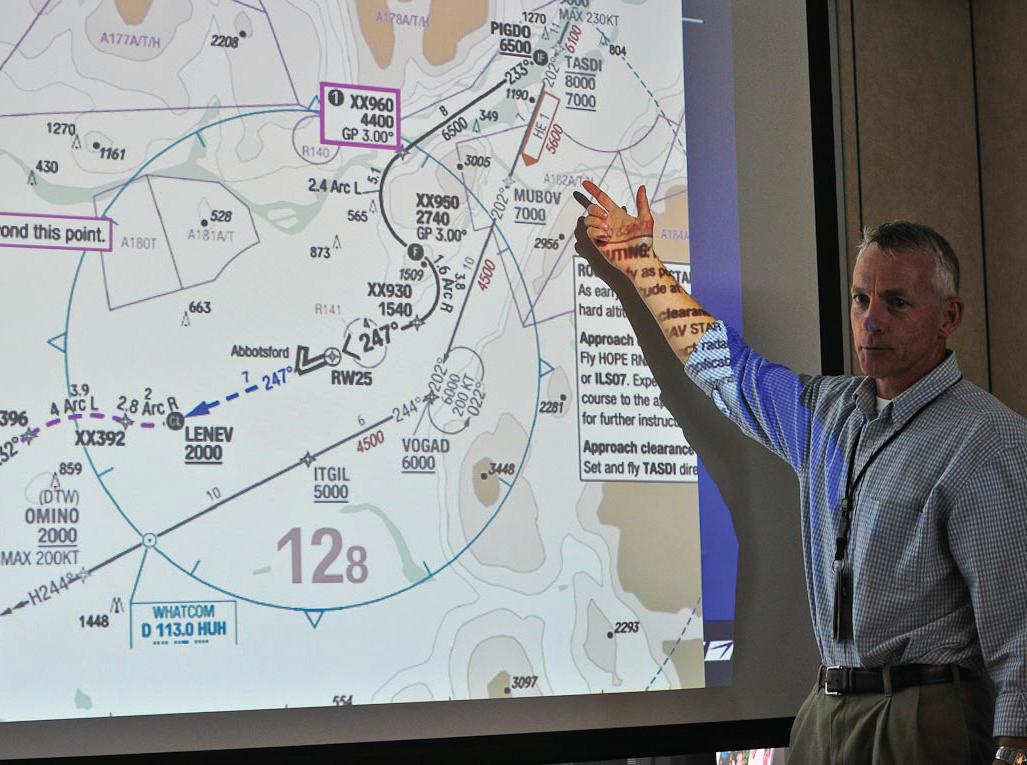
capt. david deere, rNP project manager at Westjet, introduces the new company rNP approach to runway 25 at abbotsford.
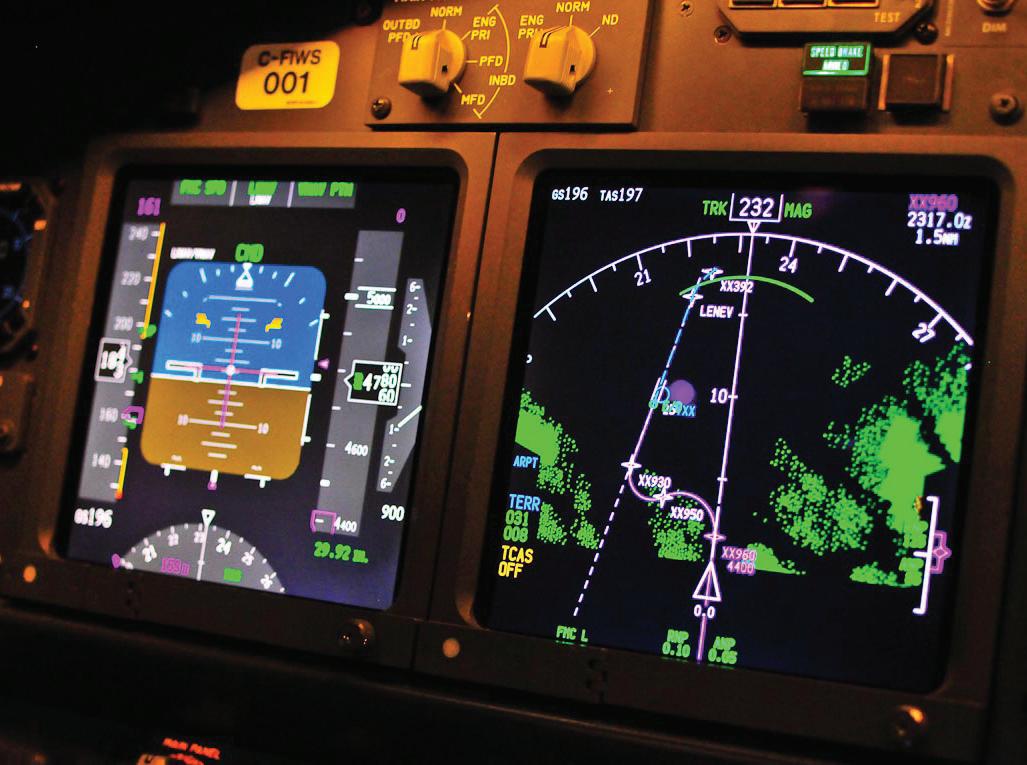
a series of fixed-radius turns to final depicted in the cockpit of a Westjet Boeing 737NG simulator.
By taking the lead in the RNP game, one might presume that WestJet would be inclined to keep the technology to itself to preserve a margin of competitive advantage. Some might find it surprising then, that last February, WestJet gave a full briefing to Air Canada on its RNP program.
“The entire Canadian domestic industry is interested in the expansion of PBN,” says Deere. “We get a bigger bang for our buck by getting everyone on board.”
From an air traffic management perspective, integrating RNP procedures with conventional approaches can pose a challenge. WestJet’s utilization of Short Gate approaches at its hub in Calgary is currently only 30 per cent – a figure Deere would like to see rise considerably. WestJet has yet to introduce Short Gate approaches at Montreal, Toronto or Vancouver, as integrating customized company routes into what is already complex and congested airspace is expected to be problematic.
However, Deere believes that if more operators were equipped for RNP, more resources would be allocated to RNP development, thereby increasing WestJet’s utilization of the cost-saving procedures.
Indeed, in the PBN Concept of Operations document released last November, NAV CANADA has indicated that the transition to RNP will occur on a schedule primarily dictated by customer needs and level of equipage. Interestingly, NAV CANADA states that the air traffic control mandate of “first come, first served” will be modified to allow an early return on investment in RNP technology by users.
NAV CANADA is supporting the implementation of RNP/ RNAV procedures in Canada through an Air Transport Operations Consultative Committee (ATOCC) working group composed of operators and NAV CANADA personnel. In the meantime, WestJet is paving the way for RNP through innovative approach designs such as the recently published procedure for runway 25 at Abbotsford.
Prior to WestJet’s exemption from CARs approach design criteria, designing an instrument approach to runway 25 was impossible due to terrain and the surrounding Class F airspace. As WestJet almost always approaches Abbotsford from the East, a prevailing westerly wind meant the aircraft would normally have to extend downwind to shoot the ILS for runway 07, only to circle back for 25. With RNP, an innovative procedure was designed for runway 25 which clears all terrain as well as surrounding Class F airspace, leading to a straightin approach. The result: a saving of 48 track miles, 560 litres of fuel and nearly 1.5 metric tons of GHG emissions.
Collectively, track miles flown have been reduced by well over 100,000 miles per year due to RNP operations. Overall, WestJet estimates that the efficiencies attributable directly to the RNP program will result in a reduction of GHG emissions by 4,930 tonnes of CO2 in 2010.
“Give us a reason not to do it,” says Deere.
While it remains to be seen exactly what public RNP approaches will look like, there can be no doubt that, as operators continue to modernize their avionics, we will be seeing more fixed-radius turns to final. At any rate, sometimes the shortest distance to the runway is not a series of straight lines. | W
In a resounding vote of confidence, NAV CANADA was the recipient of this year’s Eagle Award for best air navigation service provider from the International Air Transport Association (IATA). President and CEO John Crichton accepted the award on behalf of all NAV CANADA employees at the IATA Annual General meeting in Berlin on June 7.
Please visit www.wingsmagazine.com and click on web exclusives to read an aritcle by NAV CANADA called A Safer Approach: Pursuit of flight efficiency pays green dividend for air navigation system customers. The article discusses innovative approaches that NAV CANADA has been using to help its airline customers reduce fuel consumption.
Increasing efficiency
WINGLETS TAKE FUEL CONSERVATION TO NEW HEIGHTS
in keeping with the goal of decreasing fuel consumption, many companies are improving the efficiency of their aircraft by incorporating wingtip devices such as winglets. Here’s a look at how a few companies are taking fuel consumption reduction strategies to new heights with winglets.
Winglet technology
winglet Technology, lcc and cessna aircraft company have collaborated to develop an elliptical winglet system for the cessna citation X aircraft. The elliptical design spans the full width of the wingtip and is curved at all points along the structure, leading to lower loads on the aft spar of the wing and improved aerodynamic performance. www.winglettechnology.com
Blr Winglet System
The blR aerospace winglet system, designed for the beechcraft beech king air 90, 200 or 300 aircraft, consists of an aluminum wing tip, carbon fiber winglet and integrated position, recognition and strobe lighting. The system increases overall wingspan, resulting in better handling qualities, an increase in wing aspect ratio and a valuable reduction in induced drag. The winglets also aid in a maximum take-off weight increase of 175 kg (385 lb) to 4,760 kg for the Pratt & whitney canada PT6a-135a-powered twin. www.blrvgs.com
aviation Partners Blended Winglets
winglets from aviation Partners are flying on over 3,700 Hawker, boeing and falcon aircraft.
aviation Partners boeing, a joint venture between aviation Partners inc. and The boeing company, has supplied blended winglet shipsets to over 3,500 boeing aircraft worldwide. a typical blended winglet-equipped 737 saves 100,000 gallons of fuel per year. in addition, aviation Partners boeing has developed blended winglet programs for the boeing 757, which can save 300,000 gallons per year, and created a launch program for 767 series aircraft. aviation Partners’ winglets are also available for the Hawker 800 series and falcon 2000 series. www.aviationpartners.com, www.aviationpartnersboeing.com
Penta aviation Services in Richmond, B.C., is the exclusive Canadian dealer for Hawker Beechcraft Winglets from BLR. It is also the only Canadian installation centre for Blended Winglets from Aviation Partners. www.penta-aviation.com
SERVING THE FRACTIONAL
Airsprint's
secrets of success
by JAmes cAreless
the aviation industry devours companies new and old, from mom-and-pop operations to titans such as Canadian Airlines, Pan American and TWA. Yet Calgary’s AirSprint has prospered since being launched as Canada’s first fractional aircraft ownership company in 2000. Starting with two Pilatus PC-12 turboprops leased by AirSprint co-founder and Edmonton businessman Bob Maclean, Judson Macor has captained AirSprint to an owned fleet of 23 PC-12s and Cessna Citation XL/S business jets serving North America – and they’re still growing!
So how did AirSprint convince customers to buy 1/8th fractions of an aircraft, plus pay ongoing fees to cover monthly aircraft management, “variable rate” costs (i.e., actual occupied seat time) and ancillary expenses (such as catering and flight phone usage)? The short answer is that even with these costs, fractional ownership provides customers with a convenience akin to owning and operating their own aircraft, but at a much lower price. However, the real answer goes much further than this, leading to AirSprint’s “six secrets of success.”
secret number 1 | find an unserved niche
While in law school, Judson Macor and friend Phil Dewsnap became obsessed with launching their own aerospace company. It took a lot of brainstorming before the pair realized that fractional aircraft ownership was an unserved market in Canada.
The reason fractional ownership hadn’t been tried here had a lot to do with Canadian culture: “In the States, people buy corporate aircraft to show off their success and to make a statement about themselves,” says Chris Richer, AirSprint’s president. “This is why fractional aircraft ownership caught on there. But Canadians are more conservative about success. That’s why so many businesspeople were reluctant to use private aircraft – even though such aircraft can really boost productivity by reducing time wasted travelling to airports, enduring security and then waiting for flights.”
AirSprint succeeded not just by identifying this niche, but also by convincing image-conscious Canadian businesspeople that fractional ownership made economic sense. The company’s logic was typically Canadian: fractional ownership gives you all the productivity gains of whole aircraft ownership, but at a lower cost. Thus, owning and using a fractional aircraft wasn’t a sign of vanity, but rather intelligent business thrift.
secret number 2 | use the right aircraft for the job
AirSprint’s business plan called for customers each to invest in a 1/8th share of a particular aircraft, in order to become eligible to use the company’s aviation services. It also promised to give customers leaving the company fair market value for their share, based on AirSprint’s success in selling their shares to someone else.
This is why Macor started with the Pilatus PC-12. Priced between $3 million and $4 million per aircraft, the PC-12 “delivers the best range, speed and ability to use short runways of any turbo-prop plane out there,” says Macor, AirSprint’s chairman and CEO. “Inside, it feels like a business jet.” Add the PC-12’s low maintenance requirements and excellent resale value – “the highest for its class,” Macor tells Wings – and the Pilatus PC-12 is a good investment for AirSprint and its fractional owners.
When AirSprint decided to add business jets in 2002, the company chose the Cessna Citation XL/S, which is “the most popular business jet worldwide in fractional ownership,” says Richer. Like the PC-12, the Citation XL/S gets top marks for performance, reliability and resale value, making it a smart investment for fractional owners.
Worth noting: AirSprint has standardized on the PC-12 and XL/s platforms. By doing so, “our pilots only have to focus on these two aircraft, rather than being current on a number of platforms,” Richer says. “This is also true for our mechanics – we have our own AMO – and the people who maintain our spare parts inventory. They are all masters of two aircraft, rather than jacks-of-all-trades of many.”
secret number 3 | Hire the right people
“Our focus has always been to ‘put the right people in the right seats on the bus,’ ” says Macor. “In plain English, this means hiring people who are highly capable of doing their jobs in a way that is consistent with our values.”
At AirSprint, this process starts at the top. “Phil Dewsnap is a mastermind at flight operations, and is responsible for the professional flight department that exists today,” Macor says. “My talents lie with finances, marketing, customer service and sales, so that’s what I work on.”
Working down the ranks, AirSprint is careful to hire people who are not just capable of doing their jobs well, but are personally suited to doing so. “For instance, our pilots are much more than professional pilots; they are really customer service professionals,” Richer says. “They have to be: Our focus is on making our customers feel well cared for and personally known. So a pilot can’t just sit in the cockpit and look at the controls. He has to be comfortable with going into the cabin and taking care of his passengers.”
secret number 4 | offer great customer service
“Excellent customer service” is one of those standards companies often swear allegiance to in public, and ignore on the job. But at AirSprint, customer service is taken extremely seriously: from offering a 24/365 always-manned booking desk (staffed by actual
FRACTIONAL MARKET
company staff, not distant call centres) to providing cars to the airport and help with luggage, to delivering in-flight comfort, ontime arrivals and “standing by” return service.
“We are not an aviation company; we are a service company,” Macor declares. “People invest in us and stay with us because they appreciate the customer service we provide on a consistent basis. Ultimately, service is what convinces people to remain a customer, or to leave you for someone else. This includes the cleanliness and outward appearance of aircraft; the hotness of the catered food; the wine – everything!”
This commitment extends to keeping schedules: “We achieve dispatch availability 98 per cent of the time,” Judson Macor says. “By industry standards this is exceptional; after all, aircraft do break down. But our goal is to achieve 100 per cent, because that is what our customers are looking for. If this means we have to find another aircraft at the last minute, then we do it.”
secret number 5 | let success sell your service
Despite 10 years of success, AirSprint is not well known in Canada. This low profile is no accident: “We prefer to stay under the radar, allowing people to learn about us through referrals,”
Richer says. “Our success at satisfying our current customers is the most powerful tool in winning new ones. Word-of-mouth has really driven our growth.”
secret number 6 | don’t get blinded by growth
Given AirSprint’s success, the company could be forgiven for emphasizing growth ahead of everything else. After all, its strategy has proven itself: Why not use it to get as big and profitable as fast as possible? The answer is that AirSprint’s prosperity is the result of staying customer-focused. To give this up in favour of aggressive growth would likely kill the goose that laid the golden egg – and put AirSprint at risk of failure, like so many other aviation companies before it.
“We are growing modestly, but we are not focused on growth for growth’s sake,” Macor says. “In taking this course, we have weathered the recession. Sure, we are looking at introducing new programs such as a lower cost entry-level program to attract smaller business clients, and expanding into the U.S. as well, but our focus remains unchanged. Putting customers first has served AirSprint well during our first 10 years, and I expect it will continue to do so in the future.” | W
airSprint serves the North american market with a fleet of 23 Pc-12s and cessna citation Xl/S business jets.
F UNDAMENTAL A PPROACH
itps t r A ins t est p ilots for t H e r e A l World b y JA mes cA reless
What do you think when you see the words “test pilot”? Do you think of steely-eyed, rock-jawed fighter jocks willing to push cutting-edge aircraft past the limits? Do you imagine fearless risk-takers with ice water in their veins, skimming prototype jets mere inches above the earth, then rocketing vertically into the heavens?
The real world test pilot is not a daredevil. In real life, a test pilot is a methodical, highly-organized professional who flies prototypes according to highly detailed and rigid flight test plans. “I always tell my students the objective of test planning is to make the flight as boring as possible,” says Giorgio Clementi. “If the test flight suddenly becomes exciting, it’s probably because you’ve done something wrong.”
Clementi is a veteran flight test engineer, test pilot, aviation consultant, and president of the International Test Pilot School (ITPS). The ITPS is based at the London (Ontario) International Airport, sharing facilities with the Jet Aviation Museum (where Clementi is also director of flight operations). Clementi has been involved in flight testing since 1987 and training test pilots since 1991. His career spans 26 years in aviation, including instructing pilots and engineers from 18 countries. He has gathered an international team of highlyskilled instructors, including retired Canadian astronaut Bjarni Trygvasson, to provide a variety of training programs for flight testers in Canada.
“Our goal is to teach pilots and engineers – usually military fliers sent to us by industry or air forces – the fundamental approach and methods of real world flight test work,” Clementi
Giorgio clementi, third from right, with students at the International test Pilot School.
THE LEARNING CURVE
STATE-OF-THE-ART TRAINING AT ITPS
i t is vital for any educational establishment to keep abreast of latest developments in technology and techniques. i TP s is no exception and g iorgio c lementi has strived to strike a balance between training and consulting services. s ince establishing i TP s in c anada in 1991, g iorgio has been contracted to the flight test departments of a gusta, b ell Helicopter, g R ob a erospace and d iamond a ircraft, both in a ustria and c anada. This has provided an opportunity to participate in flight test programs of state-of-the-art aircraft and avionics. The breadth of expertise includes c ockpit and workload a ssessment, Helicopter Performance and Handling Qualities to civil and military requirements, Power plant and s ystems certification, f light i nto k nown i cing certification as well as a complete Proof of c oncept a ircraft flight test program. further, the other members of the team bring their own considerable body of professional experience. This breadth and depth of expertise is essential to ensuring that i TP s training reflects current industry best practices, technology and test methods. The customers for i TP s training are principally foreign air forces. Prior to incorporating i TP s in c anada, g iorgio had provided training in the u k . to 15 different air forces including the c anadian forces, the Royal a ustralian a ir force, the c zech af and the s panish a ir force. He also provided
Girorgio clementi taxies a da-42 with simulated ice shapes on wings and empennage.
specially designed programs for civil entities such as i PT n i ndonesia, fairchild d ornier and e mbraer and e urocopter g ermany. s tudents for the 2009 course came from as far a field as Malaysia, b elgium, Romania and c anada.
says. “We train them here in London in the classroom and aloft in a variety of fixed and rotary wing aircraft. We have also travelled to the customers’ countries to provide training in the aircraft and environment in which they operate everyday.”
A cornerstone of flight test training is exposing student flight testers to a variety of aircraft and avionics systems, typically 20 types or more on a typical Graduate Flight Test Course. Aircraft used by ITPS recently and on past programs have included the Dassault Falcon 10, Bell 412 (the Variable Stability 412 owned by the National Research Council), Piper Cheyenne, Mitsubishi MU-2, as well as the F-104, F-18, T-38, T-33, SIAI S-211 and Aero Vodochody L-39. (In most instances, ITPS uses London-based aircraft. In others, it has access to private aircraft and those provided by government agencies in Canada and abroad.)
the
curriculum
ITPS offers a number of options for test pilot and flight test engineer training. The graduate course prepares students for
the entire process of flight-testing, namely test planning, test flying, data analysis and report writing. Elements of the course are available as short courses on specific topics such as: flight testing avionics and weapons systems; understanding flight performance; learning to use Night Vision Systems; and a twoweek “Introduction to Flight Test.”
The school’s emphasis is on students understanding the underlying theory of flight to a much greater depth than the average operational pilot. They also need to develop a disciplined and methodical, step-by-step approach to test planning and flight-testing, including testing prototype aircraft.
“Students have to learn how to quickly familiarize themselves with the crucial systems and limitations of a given airplane or helicopter – because we train both helicopter and airplane flight testers – and to learn the aircraft’s avionics, performance envelope and limitations,” says Clementi. “They then have to learn how to assess the risks associated with a given flight test and take mitigating precautions. Thereafter, they apply the test techniques taught in the classroom and demonstrated to them
“I always tell my students the objective of test planning is to make the flight as boring as possible.”
in flight. The process is to teach them in the classroom, demonstrate in flight and then set them loose to conduct an evaluation independently, but supervised by our instructors.”
Another key aspect to the training is to enable students to analyze the data recorded in flight and draw conclusions on the aircraft or systems suitability for its intended application. This must be communicated in the form of written reports and oral presentations.
the logic of test flying
Would you strap yourself into an aircraft that has never flown before and roar down the runway with no clue as to the aircraft’s stall speed, safe rate of climb, or thresholds at which problems such as flutter (naturally-occurring vibrations of the wings, which can lead to catastrophic failure) manifest themselves? If you had no desire to make a second flight, then your answer would be “yes.” But if you are a professional test pilot – the kind ITPS trains – then your answer would most definitely be “no.”
Knowing what might happen is why professional test pilots start by first sitting down with the people who designed and built the prototype. The pilot’s goal is to understand the limits of the new aircraft – what it can and cannot theoretically do in flight. They want to know its stall speed, its safe rate of climb, permissible load factors and anything else that defines this aircraft’s individual flight envelope. Next, the test crew wants to work out, on a step-by-step basis, the precise profile and manoeuvres they will put the prototype through such that key parameters may be measured by themselves or by onboard recording equipment, as well as observers in other aircraft or at a telemetry station on the ground.
“In the case of a first flight, the goal is usually to conduct an initial assessment of the aircraft, within a limited but safe envelope determined by the engineers in consultation with the flight test department,” says Clementi. “The scope and complexity of the flight will depend on the organization and the level of confidence in the engineering of the prototype. However, in this flight, you want to take a particularly careful approach – get up to the predetermined test altitude, never exceeding pre-determined speeds, and staying well above the stall speed – usually no less than a factor of 1.4 times faster than stall at all times.”
ItPS student pilot.
maj. Bruno Beeckmans, Belgian af, with the challenger 604 he flew for his final project last december.
a cornerstone of flight test training is exposing student flight testers to a variety of aircraft and avionics systems.
By the time they have reached the test altitude, the pilot will have formed an initial opinion of the aircraft’s response and handling. The pilot will thus be able to tell the test director if he/she is prepared to progress with the test card, which will include stability assessments and one or more approaches to the stall as he needs to know how the airplane will handle when slowing down for the approach to land. Each test point on the card is incrementally cleared up to the planned maximum and minimum speeds and altitudes. All the tests are conducted under the watchful eye of the crew in the chase airplane, who ensure no “bits” fall off the test airplane and no unusual structural response or leaks develop on the prototype.
Only after the prototype has successfully functioned within this envelope, can the envelope be “opened up.” In other words, the test pilot can now take the aircraft faster and higher, and get closer to the maximum design and critical stall speeds. But even in doing this, there are no top gun heroics. Everything the test pilot does in the air is based on a detailed flight test plan that they and the engineers drew up before takeoff.
“As you open up the envelope, you test for flutter and this is hazardous flight testing,” Clementi says. “You don’t make radical changes only planned incremental changes, because you want to be ready and able to back off if ‘surprises’ happen. Sometimes surprises – such as flutter or loss of control – can be a cliff-edge effect: One second the aircraft is fine, the next it is in trouble due to a bit more speed being applied or a slightly higher angle of attack. The test pilot should be prepared for this, and to employ the appropriate recovery action, bringing himself and the aircraft safely back to earth.”
It is this kind of controlled calm that defines the “right stuff” in a test pilot, rather than ego or a desire for glory. Giorgio Clementi knows this from experience, having faced a number of “surprises” when flying prototypes.
“I recall one occasion that a flight engineer and I were testing a new jet, when a safety related system caught fire,” he says. “This flight test specific equipment had been installed to save our lives in an emergency, enabling us to abandon the aircraft, but on that occasion it actually caused the emergency!”
“What saved us was the fact we properly briefed including the emergency procedures checklist before we took off. So, when the fire broke out, we responded in a coordinated fashion as a crew despite a significant amount of smoke in the cockpit. The result is we got ourselves and the aircraft back on the
ground intact and in one piece, which is really the point of the job.”
got the right stuff?
At first glance, the ITPS would seem to be the exclusive preserve of military pilots. After all, they are the ones with access to government-funded aircraft and training. Surely there’s no room for civilians in this kind of club?
Well, actually there is – although weekend pilots who like to fly their Cessnas slowly should probably not apply. “We do get civilian pilots here from time to
time,” says Giorgio Clementi. “Typically, they are industry sponsored or high flight time private individuals who fly for a living, who wish to work their way into flight testing or simply want to learn more. All our candidates have a real passion for flight and want to understand it on the deeper level that test piloting offers.”
For these people, and the military pilots who attend ITPS in London, Clementi and his team of skilled instructors are happy to share their expertise – safely, smartly and with the utmost respect for the real limits of flight. | W
Custom-designed and built 50% faster than conventional hangars
4-season construction » benefit from an earlier roi optimal thermal efficiency » significantly reduce your energy bills maximum value from investment » specify your exact needs industry leader » Quality you can trust
1.866.466.8769
www.canam.ws/hangars
A CENTURY OF ACHIEVEMENT
mAnitobA AviAtion council furtHers tHe mission
aviation associations play an important role in Canadian aviation, none more so than the Manitoba Aviation Council (MAC). Promoting, facilitating and protecting the development of all facets of aviation within the province of Manitoba, the MAC’s mission is carried out through involvement in training, affiliations with other aviation groups, and staying current with regulatory changes and arising issues. The council represents some 250 entities and individuals, with a salaried staff and many volunteer members carrying out its work.
The aviation and aerospace industry is a large economic generator in Manitoba, and much of the industry has reacted well to the recession. The need for air transport in Manitoba ensures a lot of activity in transporting goods and people to remote communities, especially when it comes to medical aid. For towns with no
summer road access, aviation is a timeeffective way to provide medical care and evacuation, but it requires modern and robust navigation and airport facilities. This is an area of great interest to MAC. MAC also plays a vital role in keeping Manitoba’s entire aviation sector up to date on current activities, including liaising with the aerospace industry, airports, local governments and military units based in Manitoba.
Manitoba’s geographic location is often referred to as “in the middle.” Additionally, the term is indicative of how provincial aviation associations are in between the federal and provincial government’s jurisdictions. The federal government regulates civil aviation, with the provinces controlling most infrastructure and business opportunities. In Manitoba, there are 22 provincially owned and operated airports. The lone federally owned airport is located in Churchill. MAC often has to navigate between the different governments, as well as municipalities and First Nations jurisdictions, which makes for a challenging and interesting environment for MAC board members and the general membership.
At one time, aviation councils existed in all western provinces, but today, Saskatchewan, British Columbia and Manitoba keep the original titles. Aviation Alberta has replaced the previous council with much the same mandate. Northern Canada is represented by the Northern Air Transport Association. There is some overlap among membership, making for healthy interchange of options and knowledge.
On Dec. 31, 2009, Judy Saxby, an experience air carrier executive, resigned from the position of president. Craig Skonberg took over the role until May 19, when Dennis Lyons was elected president.
Lyons is the person responsible for maintenance for Fast Air Ltd., providing executive aviation services from its base in Winnipeg. He is a member of the CAMC Board of Directors. Locally, Lyons is the Chair of the Advisory Council for Red River College’s Aircraft Maintenance Engineer programs and a member of the Board of the Central Aircraft Maintenance Engineers Association. Lyons has been in the aviation industry since 1979, serving first with the Canadian Armed Forces and
manitoba aviation council plays a vital role in keeping manitoba’s entire aviation sector up to date on current activities.
by roger beebe
dinner. MAC established the award in 2006 to recognize achievements that have led to aviation development in Manitoba. This year’s award honoured Bill Jackson of Jackson Air. Jackson has been in business for 30 years, starting
in Saskatchewan before moving to Flin Flon. His company, Jackson Air Services, operates a charter service specializing in aerial survey and photography. In the spring of 2007, Jackson Air sold the floatplane base to Wings over
Kississing . It operates a complete line of float aircraft out of the Channing Base. In December 2007, Missinippi Airways bought the hangar at the Flin Flon Airport as well as two aircraft. They now operate from the Flin Flon base, using King Air and Piper Chieftain aircraft. Jackson has been very active in the repair, overhaul and rebuilding of aircraft, and currently operates the unique Partenavia P68-Observer for fire patrol contract and mapping/surveying work. He also actively serves the mining, tourism and health industries in Manitoba, and is highly involved in the community of Flin Flon. Jackson has left his mark as a member of many aviation organizations including MAC, the Air Transport Association of Canada (ATAC), and the Saskatchewan Aviation Council.
The previous winners of the MAC Pioneer of Flight are:
• 2006: Arnold Morberg and family (Calm Air International)
• 2007: James A. Richardson and family (Western Canadian Airways, Canadian Airways)
• 2008: Tom Lamb and family (Lambair)
• 2009: Bill Wehrle and family (Perimeter Aviation)
NORTHERN ONTARIO AIRPORTS
Wilderness hikes, extended canoe tripping and picturesque campgrounds welcome you!
Set Your Course... Set Your Course...
manitoba aviation council 2010 Pioneer of flight award winner Bill jackson, left, of jackson air, receives a commemorative painting from craig Skonberg, mac then-president.
Chair • Doug Ware Manager; FlightSafety Canada Ltd. Vice-Chair: • Rob Madden Director/Flight Operations Province of Alberta, Air Transportation Service
Secretary • Dave Anderson, Vice-president; Anderson Air Ltd.
Treasurer • Jean Ménard VP Commercial and Air Transport Sales, EMS Technologies
Past Chair • Jean Langevin Senior Vice-president Operations Skyservice Business Aviation Inc
Board Members-at-Large
Gary Banks • VP, Marketing & Sales
NAV CANADA | NEWS
nAv CAnAdA PArtiCiPAteS in green demonStrAtion Flight
n United AirlineS ChiCAgo to FrAnkFUrt triP will ProdUCe leSS emiSSionS on Un world environment dAy
NAV CANADA is pleased to be collaborating with United Airlines (UAL) on two special flights to demonstrate new greener air navigation procedures in the high altitudes of Canadian airspace and over the North Atlantic.
Flight UAL 945, Frankfurt to Chicago departed at 2:25 a.m., EDT on June 5, this year’s United Nations World Environment Day. Flight 944 departed Chicago for Frankfurt at 3:23 p.m., EDT. The aircraft to be flown for both trips will be a Boeing 777.
NAV CANADA Air Traffic Controllers at the Area Control Centres (ACC) in Toronto, Montreal, Moncton and Gander will facilitate more flexible routing by protecting a range of altitudes. This “altitude block” allows for greater variations in speed and provides quicker altitude changes.
This will give pilots and controllers increased opportunities to use more efficient routes thus saving fuel and greenhouse gas emissions as the plane enters Canadian airspace and transits the portion of the North Atlantic controlled by the Gander ACC.
“We are pleased to participate with United Airlines in these World Environment Day demonstration flights,” said Rudy Kellar, NAV CANADA Vice President, Operations. “This is just one example among many of the savings in fuel and GHG emissions being gener-
ated by the close collaboration of air carriers and air navigation service providers.”
Assuming operational conditions are met, it is anticipated that these flights will save close to two metric tons of GHG emissions and 900 litres of fuel while in Canadian domestic airspace and over the oceanic portion controlled by NAV CANADA.
NAV CANADA oceanic air traffic controllers in Gander are responsible for the airspace over the Western half of the North Atlantic. They work in close cooperation with their counterparts at U.K. NATS at the Shanwick Oceanic Centre in Prestwick, Scotland, who control the Eastern half.
In addition to the flexible routing at high altitudes, United’s demonstration flights will make use of other green procedures from gateto-gate. United estimates a total savings of 6,400 pounds (3,600 litres) of fuel and a reduction in GHG emissions of nearly nine metric tons.
The real-time progress of United 944 and 945 is being tracked and can be viewed on the NAV CANADA website, using Sabre Flight Explorer technology.
Other GHG and fuel savings initiatives are outlined in the Collaborative Initiatives for Emissions Reductions (CIFER) Progress Report.
NAV CANADA estimates total annual savings from existing initiatives of over 900,000 metric tons of GHG emissions. Projected savings of 8.4 million metric tons GHG emissions were forecast for the period of 2009 to 2016
CBAA Online Buyers Guide
Visit CBAA’s Online Buyers Guide for a complete listing of CBAA Associate Members to provide valuable services for your operations! Visit www.cbaa-acaa.ca for more information!
CALENDAR | OF EVENTS
CBAA Dates to Note:
September 15, Dorval
Quebec Chapter Meeting. Sponsored by Bombardier. 1730. Information: Jim Leggett, jleggett@acass.ca
September 30, Richmond
Pacific Chapter Meeting. Sponsored by Bombardier. 1730. Information: Scott Harrold, Scott.Harrold@landmarkaviation. com
October 26, Edmonton
Northern Alberta and the Territories Chapter Meeting. Information: Keith Tilley, tilleycbaa@gmail.com or Marty Hope, mhope@millarwestern.com
October 27, Calgary
Southern Alberta Chapter Meeting. Information: cbaa_cyyc@yahoo.ca
November 16, St. Johns Atlantic Provinces Chapter Meeting. Information: clementnadeau@hotmail.com
Other Dates of Interest:
October 19-21, Atlanta NBAA2010. Information: www.nbaa.org
November 7-9, Vancouver ATAC 2010. Information: www.atac.ca
Changes with CBAA News Brief
To our valued readers;
TheCBAA News Brief has changed once again to better suit the needs of the readership and provide timely, up to date information to CBAA Members and subscribers to Wings Magazine. The CBAA will now publish six 8 page print editions of the News Brief to appear in Wings Magazine and six 8 page digital versions that will be delivered directly to your e-mail. In an effort to provide CBAA members with continuous communications this initiative will provide CBAA members with the opportunity to receive information on a much timelier basis. In addition to these changes, a section dedicated to the CBAA News Brief has been added to the Wings Magazine website and can be viewed at http://www.wingsmagazine.com/content/view/4180/170/.
The CBAA would like to thank Wings Magazine for this exciting new initiative and would like to express their gratitude to the CBAA News Brief’s dedicated readership.
Responsible for the management and maintenance of Calgary International Airport (YYC), The Calgary Airport Authority is committed to creating and sustaining a world-class airport facility; adding value to the community and creating a positive first impression to travellers visiting the city. YYC is focused on developing a complete customer experience. As one of Canada’s fastest growing and friendliest airports, YYC’s 15,000 employees work cohesively to deliver an exceptional experience to the millions of passengers that visit YYC each year.
In its commitment to customer service, YYC goes above and beyond, offering complimentary luggage carts, wireless Internet throughout the Air Terminal Building, and free parking in the short-term lot for the first 30 minutes. Travellers can also catch a show on the free digital TV, take the kids to one of the Kidsport play areas, or learn about space and aeronautics at Spaceport. New to YYC is the Cell Phone Park and Wait Lot where arriving travellers can call their friends or family waiting for them in the designated complimentary lot, and let them know when they are ready to be picked up at the designated pick-up area curbside on the arrivals level.
YYC contributes over $6 billion in value-added GDP for the Alberta region (about 10 per cent of the economy). Passenger traffic has doubled over the last 15 years, making YYC Canada’s fourth busiest airport with 12.2 million passengers in 2009. In response to projected passenger growth, the airport has embarked on a $3 billion Airport Development Program, which includes a Parallel Runway and new International Concourse. Scheduled to be in service by 2014, the Parallel Runway will be Canada’s longest commercial runway at 14,000 feet and the new International Concourse will double the size of YYC’s existing terminal. These projects are heading the airport into an exciting and dynamic future!
The airport isn’t just growing; it is also becoming more comfortable. YYC’s award-winning concession program allows travellers to choose from a selection of 120 shops, restaurants, and services. Arriving passengers are welcomed by White Hat Volunteers in their white Stetsons and red vests. With over 220 volunteers, the White Hatters are a true testament to Calgary’s warm western hospitality and spirit of volunteerism. White Hat Volunteers are always ready to greet travellers with a welcoming smile and answer any questions. Their enthusiasm, dedication, genuine care, and desire to go the extra mile make YYC one of the friendliest airports in the world.
YYC is more than passengers; it is also a major international cargo hub. Calgary International Airport is situated in a prime strategic location ideal for receiving, transferring, storing, and distributing air, rail, and highway cargo, both domestically and internationally. In fact, cargo can be shipped from Calgary to anywhere in the world within 48 hours!
YYC was recently recognized as one of the most efficient airports in Canada, according to a 2009 global airport benchmarking report, based on operating efficiency and cost-competitiveness. It was also the first airport in Canada to be recognized for its environmental practices by the Building Owners and Managers Association of Canada. Most recently, The Calgary Airport Authority was recognized as one of Alberta’s Top 40 Employers for 2009.
YYC: The Energy Starts Here!
The Calgary Airport Authority
2000 Airport Rd. N.E. Calgary, Alberta T2E 6W5
Canada
Phone: 403-735-1200
Toll Free: 1-877-254-7427
Fax: 403-735-1281
Dennis Goll, President and CEO of West Wind Aviation, is pleased to announce the expansion of West Wind’s management team to include two new key positions. “I am very confident with the strength of our management team. This new organizational alignment will provide the support for the future direction of the company and will help ensure that West Wind is well positioned to achieve its goals and strategic objectives.” Dennis Goll
Shawn Passmore has joined West Wind Aviation as Vice President Business Development & Customer Relations. Shawn has over 20 years’ experience in a variety of Sales and Marketing management roles. Shawn has also led various successful entrepreneurial ventures and brings to West Wind his experience of building customer relationships, market analysis, and new business strategy development.
Martin Bean has been appointed Vice President Operations responsible for Flight Operations, Logistics and Maintenance. Martin comes to West Wind Aviation with over 20 years’ experience in the transportation industry in a variety of operation management roles. Martin brings experience in transportation logistics, on-time performance, quality, and customer service.
Chris Tabler began his employment with West Wind as the VP Administration & Marketing in 1993. Since that time, Chris has been a key member of West Wind’s senior executive team, playing a pivotal role in the growth of the company. In his new role as Vice President Corporate Services, Chris is responsible for all areas of Human Resources as well as facilities, insurance, and risk management.
West Wind Aviation specializes in air charter service, aircraft management, and scheduled flights with its ExpressAir and Pronto Airways divisions. West Wind was established in 1983 and has evolved into a dynamic, diversifed organization. Today West Wind operates a fleet of 21 aircraft, employs in excess of 225 people, and operates out of bases in Saskatoon and Regina, as well as various satellite locations in northern Saskatchewan. West Wind is western Canada’s largest fullsupport aviation company with its head office located in Saskatoon.
Hangar 3A, J. G. Diefenbaker Airport, Saskatoon 1-866-636-9121 • www.westwindaviation.ca