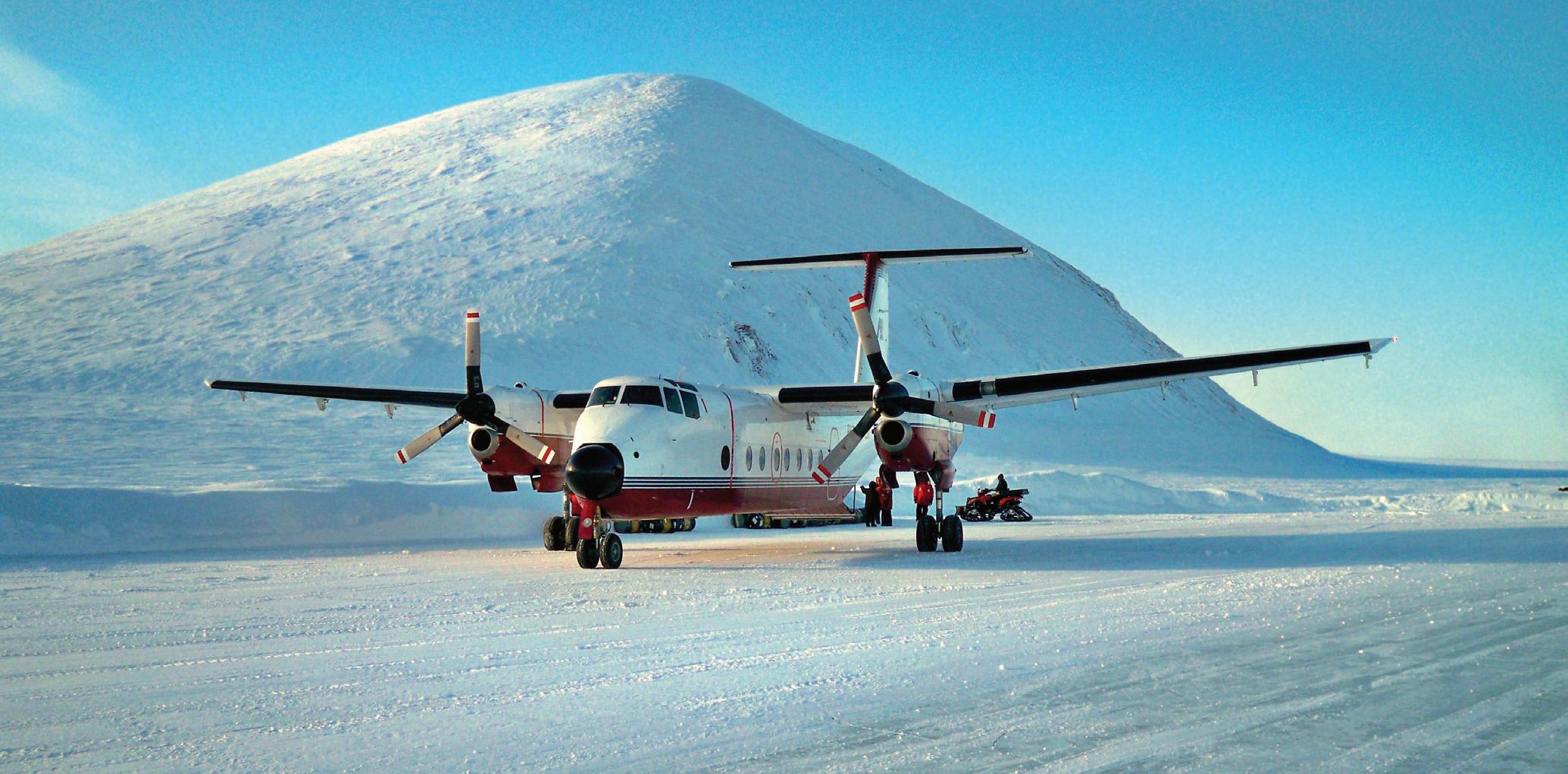
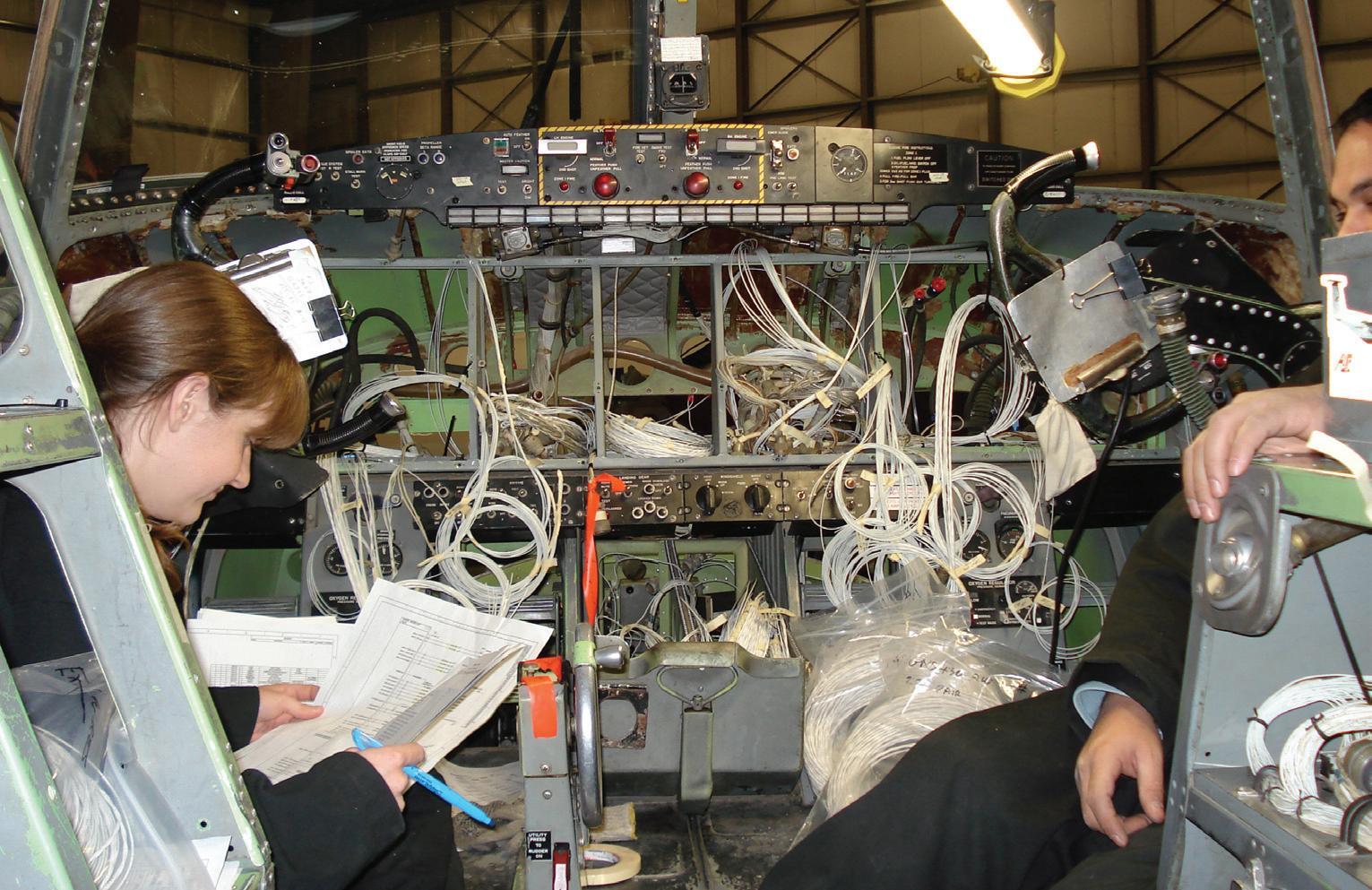
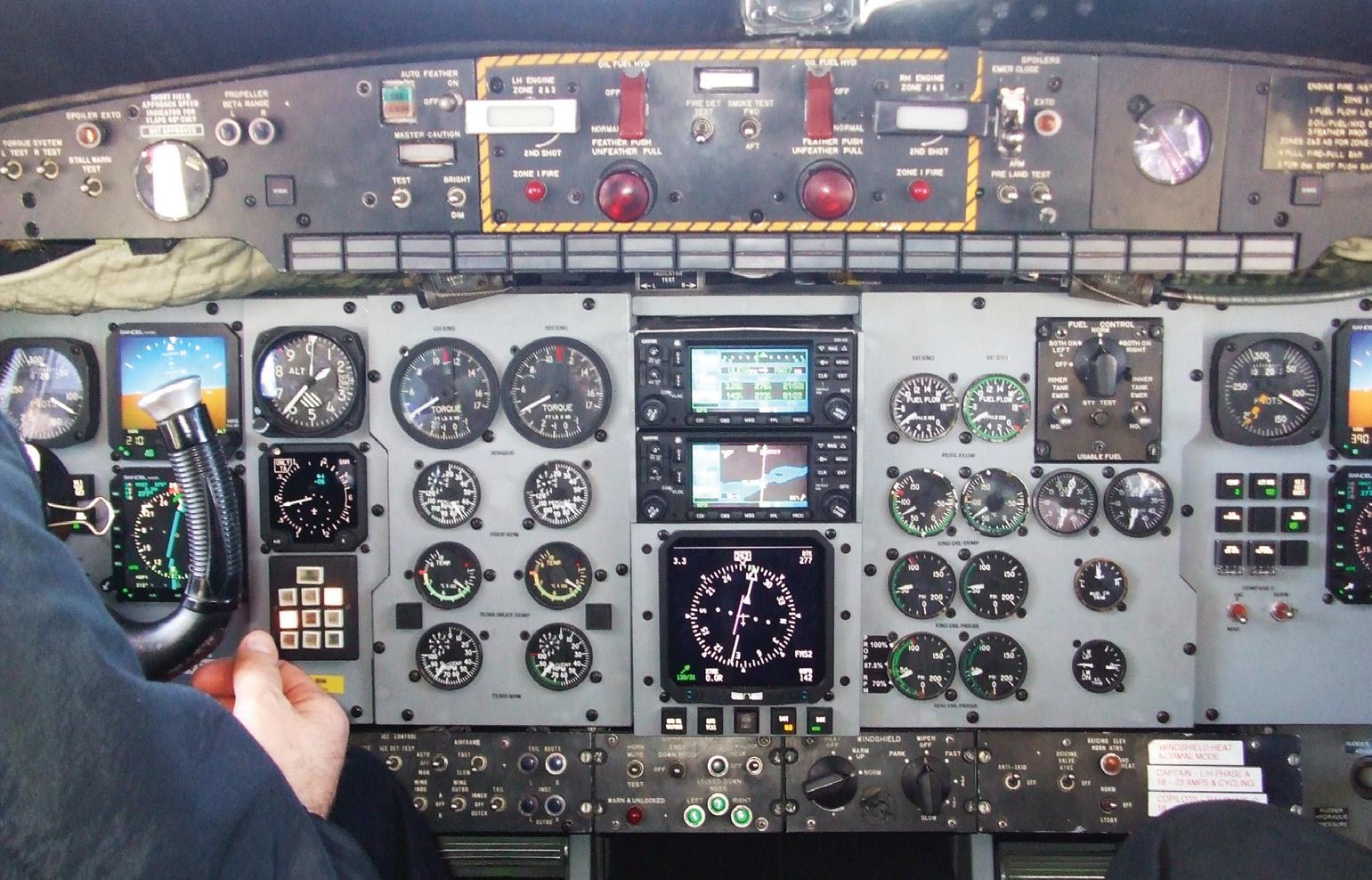
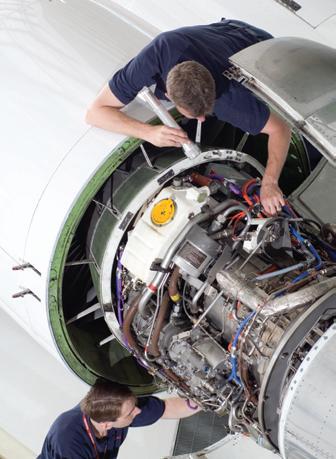
Whether it’s getting passengers where they need to be, hauling critical supplies to a remote destination, or deploying a paramedic crew for a life-saving mission, the versatile Beechcraft® 1900 is rugged enough to perform in some of the world’s toughest environments and sophisticated enough to get you there in style. Add turboprop efficiency and Beechcraft heritage, and you have a pre-owned aircraft that works as hard as an entire fleet to impact your bottom line. Visit the Beechcraft 1900 official website for a tour of its versatile configurations at www.raytheon.com, keyword: beechcraft1900.
6 On the Fly Industry news that’s important to Canadians.
9 Airline Insider
Brian Dunn covers the latest developments in the Canadian airline industry.
10 Carr
We will always have Paris.
11 On the Web
A sample of our comprehensive online coverage of the Canadian aviation industry.
12 100 years of Powered Flight in Canada
Max Ward set the bar high for future airlines with quality above all, writes Raymond Canon.
13 Seaman
Are we there yet?
14 Delivering the Goods
Frederick K. Larkin provides an in-depth position report on Cargojet.
18 Wings on Safety Battling Complacency.
23 Optimism in Tough Times
Canadian FBO operators are finding ways to excel in today’s tough market conditions. Rob Seaman reports.
25 Buffalo Makeover
Arctic Sunwest Charters has converted its fleet of legendary STOL DHC-5 Buffalos into cutting-edge flying machines, by James Careless.
28 Send Me a Kiss by Wire(less)
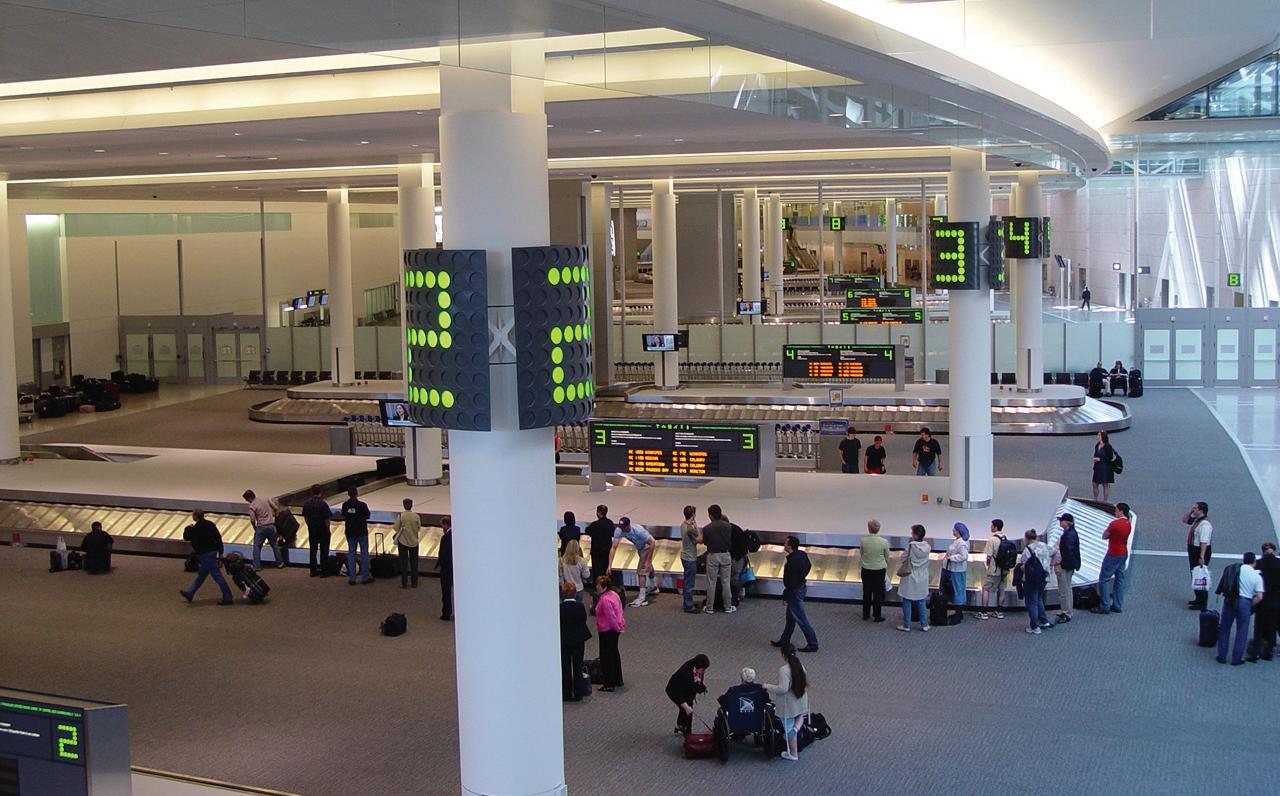
Carroll McCormick discusses the far-reaching airport wireless communications systems of today.
32 Emirates Ups the Ante
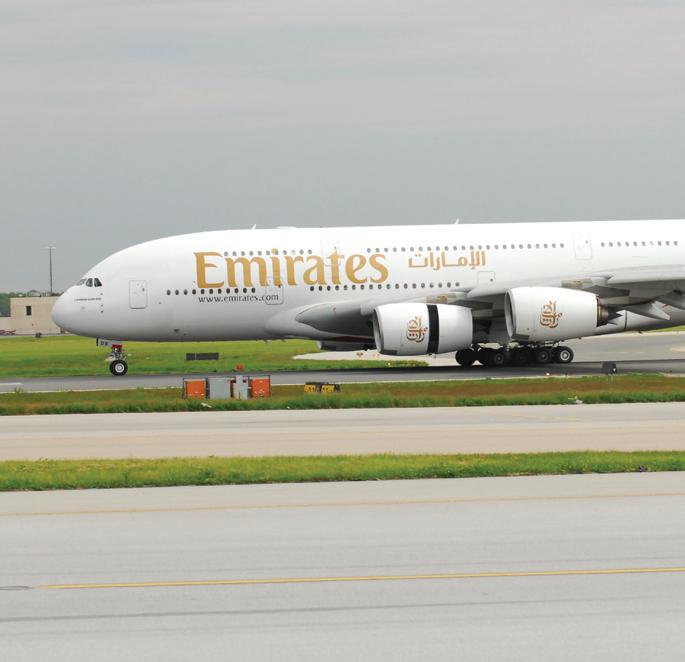
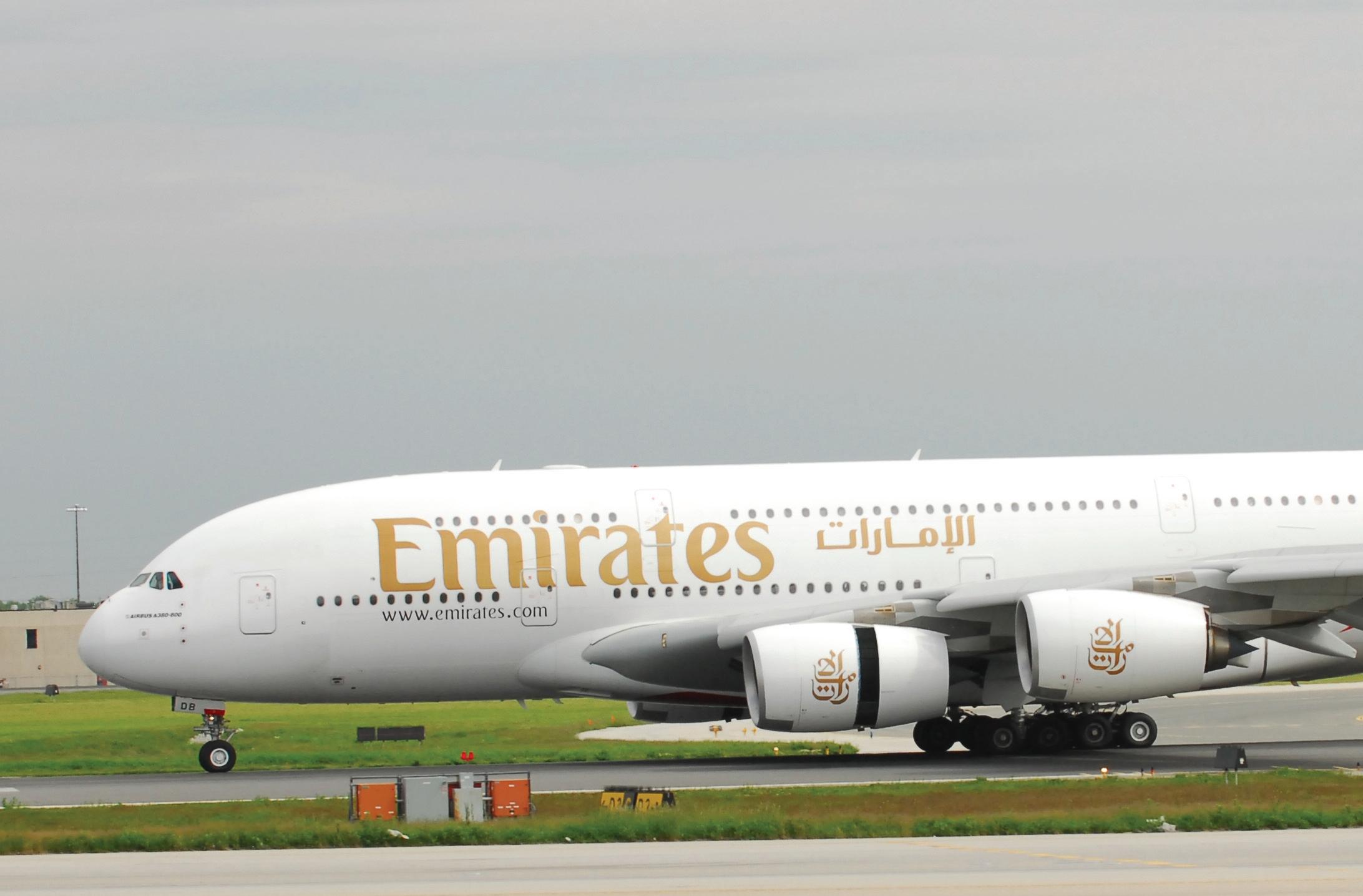
David Carr looks at how this MiddleEast airline is seeking northern exposure.
36 Morningstar Partners
Edmonton’s Morningstar Partners is taking a cautious approach to weathering the fractional jet storm. James Careless reports.
46 Guest Column: Neil MacDonald Upholding TSB’s Mandate.
McCarthy
Emissions
Expectations
DREW MCCARTHY is the editor of Wings.
Not very long ago, “flying green” looked like the most important challenge in aviation. Then along came the global economic crisis, and the issue quietly receded from the spotlight. For more than a year now, discussions about the environment have taken a back seat to stories of financial loss, unattainable credit and reduced flight operations. But now, looking beyond the current malaise, we can see that much of what once seemed distant is in fact rapidly approaching.
Most significantly, as the result of a directive passed in 2008, the Council of the European Union is planning to include “all flights by eligible aircraft arriving at and departing from EU airports” in the EU Emissions Trading Scheme. The date for implementation is Jan. 1, 2012.
Operators and governments have to work together
The Europeans have set the deadline over the protestations of much of the international community. From their perspective, the matter is so important that they are unwilling to wait for international agreement. Legislation currently being developed by individual European countries will require operators to report and account for their greenhouse gas emissions on an annual basis. To comply, operators must ensure that they have enough carbon credits for the fuel burned on flights to, from and within the EU. These obligations are mandatory. Internationally, many operators have already begun to employ a host of strategies to improve efficiency. Not long ago, Emirates decided to pull together all of the wisdom in the industry to plan “the ideal environmentally-sound flight.” Calling it the “Emvironment flight,” the airline chose as its test case a new route from Dubai to San Francisco. The flight took place last December.
Starting with the premise that upwards of 98 per cent of an airline’s environmental impact is based on aircraft types and how they are flown, the airline focused on aircraft design, selection and ATC.
For the flight, they chose a brand new Boeing 777-200LR. To reduce weight, they analyzed everything on board from curtain materials to service trolleys to food packaging. By the time the flight took place, the airline had already spent a couple of years working with Russian, Icelandic, Canadian and American air space authorities in establishing an efficient Polar route. While the creation of the new route was important, more important was the idea of flexible air space. Communications to the aircraft provided updated live weather information that was used to constantly bring about optimum flight routes and altitude. Among the numerous other efficiencies employed were a continuous descent path and a single-engine taxi.
By Emirates’ calculations, it saved approximately 2,000 gallons of fuel and 30,000 pounds of carbon emissions on the 16-hour direct flight. Although not everything done on the initial flight can be done on every flight, the airline is committed to using it as a benchmark. The airline undertook the project to show what can be done, and to motivate governments to work with industry; it also saved money. Emirates deserves credit for showing us what we all can do, once we decide to do it.
MAGAZINE PO Box 530, 105 Donly Dr. S., Simcoe, ON N3Y 4N5
Tel.: 428-3471 Fax: 429-3094
Toll Free: 1-888-599-2228
EDITOR DREW MCCARTHY dmccarthy@annexweb.com
519-429-5192 • 888-599-2228 ext. 265
ASSOCIATE EDITOR ANDREA kWASNIk akwasnik@annexweb.com 519-429-5181 • 888-599-2228 ext. 238
PRODUCTION ARTIST GERRY WIEBE
OTTAWA CORRESPONDENT kEN POLE
AVIONICS EDITOR ROB SEAMAN
FLIGhT DECK kEN ARMSTRONG, ROGER BEEBE, RAY CANON, JAMES CARELESS, DAVID CARR, BRIAN DUNN, DARREN LOCkE, CARROLL McCORMICk, TAREk SARDANA, BLAIR WATSON
Canada – 1 Year $ 30.00 (includes GST - #867172652RT0001)
USA – 1 Year $ 42.00 Foreign – 1 Year $ 65.00
From time to time, we at Wings Magazine make our subscription list available to reputable companies and organizations whose products and services we believe may be of interest to you. If you do not want your name to be made available, contact our circulation department in any of the four ways listed above.
All advertising is subject to the publisher’s approval. Such approval does not imply any endorsement of the products or services advertised. Publisher reserves the right to refuse advertising that does not meet the standards of the publication.
APRIL 2009
Translation: Not just the most efcient in its large-cabin class. More efcient than “the most advanced” in the next smaller class. And less fuel means fewer emissions. Even with a 4000nm range – and the unique agility to hop from city to city, then leap over an ocean without stopping to refuel.
The newly certicated Falcon 2000LX proves again that we share a common sense of efciency with companies who need to stay close to their customers, get the most out of their best people, see and seize opportunities in person – and keep on working en-route. Visit us at falconjet.com/2000LX.
Richard
Purser retires from Wings
We would like to thank Richard Purser for his many years of service and devotion to Wings magazine. After a distinguished career in the mainstream newspaper industry working with such papers as the Calgary Herald and Winnipeg Free Press, Richard joined Wings in 1993 and for 16 years played various roles with both Wings magazine and Helicopters magazine including editor, production editor and senior associate editor.
Standard Aero poised to fly with the big boys onthefly
Winnipeg-based Standard Aero has signed a more than US$850-million deal with WestJet Airlines to service CFM-56 engines powering its 737 ``next generation’’ aircraft.
The 15-year agreement will see Standard Aero build a new $13-million facility at its complex near the Winnipeg James Armstrong Richardson International Airport. It will house 60 employees initially and 250 by the time it’s fully up and running in 2012. Ian Smart, Standard Aero’s senior vice-president of airlines and fleets, said the deal is one of the two or three biggest it has ever signed.
Servicing the engines represents a jump into a new market – powering planes that carry between 130 and 150 passengers. Previously, the biggest engines in its port-
Two of our longtime contributors say it best:
Said David Carr, Wings columnist and former editor: “Writers are going to have to work that much harder.
With Richard’s retirement I have lost a great copy editor with a treasure trove of aviation knowledge that helped to keep my stories grounded and accurate. That may be the biggest challenge facing Canadian journalism today. We are
losing our Richards. Good luck my friend.”
Ken Armstrong, Wings and Helicopters contributor said, “Hi Richard. Have heard you were having health issues and wanted to pass on my best wishes. Enjoyed your March/ April Wings editorial and as always found your article eloquent, well researched and informative. Your contributions will be missed by Canadian aviators.” Many thanks.
Kuliavas celebrates quarter century with InnotechExecaire
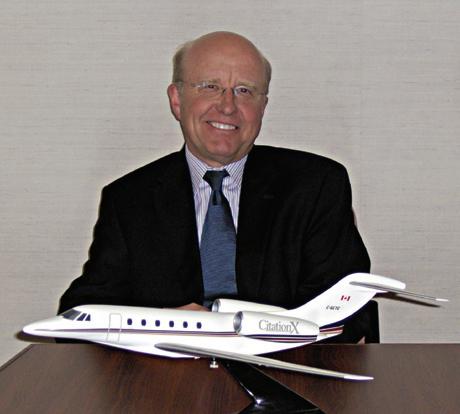
In 2009, industry veteran Ray Kuliavas, Innotech-Execaire Aviation Group’s vicepresident of aircraft sales, celebrates his 25th year with the company. As overseer of the IMP Group’s aircraft sales, Ray’s duties include heading up Citation Team Canada, Cessna’s exclusive authorized sales representative for Citation jets in Canada. He also manages a national sales team that provides full-service sales and support functions for preowned corporate aircraft.
folio were CF-34s, which are used in regional jets carrying up to 90 people. The CFM56-7 engines used by
WestJet, which are produced by General Electric, are found under the hoods of 737s and Airbus 320s.
Throughout the past quarter century with Innotech-Execaire, Kuliavas has led sales teams that have successfully marketed DASH-8 aircraft, as well as Hawker, Westwind and, of course, Cessna business jets. Prior to joining the IMP Group, he was a sales engineer with the de Havilland Aircraft Company of Canada.
Ray Kuliavas, vice-president aircraft sales, Innotech-Execaire Aviation Group.
From left to right: Bill Fitzgerald, vice-president and general manager, assembly and overhaul, GE Aviation; Jennifer McNeill, vice-president of fleet, StandardAero; Ian Smart, senior vicepresident of services, StandardAero; and Tom Gentile, vice-president and general manager, services, GE Aviation.
Viking certifies turbine conversion for DhC-3 Otter
Transport Canada has issued Supplemental Type Approval (SA08-17) to Viking Air Ltd. of Victoria, B.C., for the installation of the Pratt & Whitney PT6A-34 or PT6A35 turboprop engine on the DHC-3 Otter.
The original de Havilland factory Otter’s Pratt & Whitney Wasp R-1340 engine is now replaced with the higher 750-horsepower turbine engine with Hartzell 3 blade full feathering reversible propeller. In addition to the new engine and prop configuration, the modification encompasses improvements to design with new composite cowls, incorporation of a gross weight increase to 9,000
pounds, optional panoramic windows and optional extended range fuel tank. The modification involved an update to virtually every major system of the aircraft.
The Viking Turbo Otter is approved for operation on
wheels, skis, amphibious or straight floats, under both day and night VFR and IFR conditions. Viking provides OEM support for the worldwide fleet of de Havilland heritage line of aircraft (DHC-1 through DHC-7).
CMC achieves TC certification for Cockpit 4000
Esterline CMC Electronics (CMC) has achieved civil certification from Transport Canada for its Cockpit 4000 Integrated Avionics System as installed on the Hawker Beechcraft T-6B Texan trainer aircraft. The Cockpit 4000 includes two Integrated Avionics Computers (IAC), two Up Front Control Panels and six Multi-Function Displays (MFDs).
The certification represents CMC’s first civil cockpit certification and supports 14 CFR Part 23 Acrobatic Category, Class lll aircraft installation.
CMC received the order in November 2008 for the first 35 production aircraft and is on schedule to deliver the first cockpit avionics suite in the fourth quarter of this year. The T-6B Texan is based on the successful Beechcraft
T-6A, already in service as the U.S. military’s Joint Primary Aircraft Training System (JPATS) aircraft, and is also the primary trainer for the NATO Flying Training Canada (NFTC), and the Hellenic Air Force of Greece.
Through the introduction of the CMC advanced avionics upgrade, the T-6B aircraft will have a state-of-the-art open architecture advanced avionics suite that mirrors the systems and capabilities of today’s front-line military aircraft.
Events Calendar
AUGUST 2009
ALPA Air Safety Forum Aug. 3-6
Washington, DC http://safetyforum.alpa.org
SEPTEMBER 2009
2009 Bird Strike North America Conference Sept.14-17
Victoria, BC www.birdstrikecanada.com/ CanadaConference.htm
OCTOBER 2009
Safety is no Secret: International Winter Operations Conference Oct. 7-8
Toronto, ON www.winterops.ca
NBAA 62nd Annual Meeting & Convention Oct. 20-22
Orlando, FL www.nbaa.org
CAMC 18th Annual Forum & AGM Oct. 21-23
Halifax, NS www.camc.ca
Ontario AME Workshop and Symposium 2009 Oct. 28-30 Toronto, ON www.ame-ont.com
NOVEMBER 2009
ATAC 2009 Annual General Meeting and Tradeshow Nov. 15-17
Quebec City, QC www.atac.ca/index.html
For a full list of events, please visit www.wingsmagazine.com
The original de havilland factory Otter’s Pratt & Whitney Wasp R-1340 engine is now replaced with the higher 750-horsepower turbine engine.
Esterline CMC Electronics’ Cockpit 4000 integrated avionics suite has been selected by hawker Beechcraft for the T-6B Texan trainer aircraft.
Cyclone Manufacturing awarded Embraer contract
Cyclone Manufacturing of Mississauga, Ont., has signed a contract with Embraer to supply structural components on the Embraer 190/195 commercial aircraft and the Legacy 450-500 business jet. The contract has a value of $12 million over the next three years.
Cyclone will manufacture various large die forged
structural components for the commercial aircraft and deliveries will commence in late July 2009 with a delivery rate of eight aircraft per month. Deliveries for the Embraer Legacy 450-500 business jet will commence in the second quarter of 2010.
Cyclone will manufacture both upper- and lower-wing skins including the major
spars for the wings.
Cyclone manufactures spars, frames, longerons, bulkheads and many other components up to 480 inches in length for several leading companies including Bombardier, General Electric, Israel Aircraft Industries and Aerospace Industries Development Corporation (AIDC).
Our newest team member – Alison de Groot
Alison de Groot has joined Wings and Helicopters magazines as associate publisher. Alison has spent the last 15 years in publishing both in New York and Toronto. She began her career in editorial, working as a newspaper reporter in Ontario and New Jersey, before moving over to the business side where she has held positions as a marketing
manager and national account manager at Backpacker magazine (Rodale Press, N.Y.); marketing director and advertising director at Worth magazine (Worth Media, N.Y.); publisher at Ontario OUT OF DOORS magazine (Rogers Publishing, Toronto); and most recently as national director of
Magnaray’s RGB fluorescent sheds new light
Aviation facilities offering services to fixed- and rotarywing aircraft are increasingly in need of new and retrofit light sources that are more reliable and energy-efficient due to exorbitant energy costs. Perceived by some as old news, fluorescent lighting systems that have been continually evolving over the years are catching the attention of customers looking for an alternative to HID and other lighting sources.
Since 1964, Magnaray, a division of the World Institute of Lighting and Development Corporation, has been developing advanced outdoor and indoor fluorescent lighting systems to improve com-
new business development for MZ Media in Toronto. Over her career Alison has developed a keen understanding of brand marketing, strategic advertising, and consultative selling. Equal to her passion for publishing is Alison’s passion for adventure. She is an avid traveller, outdoor
mercial and industrial safety, security and productivity while lowering maintenance and energy costs as well as greenhouse gases.
A variety of businesses and institutions currently use Magnaray fluorescent systems, including border patrol installations, department stores, military bases, and recreational and parking facilities.
For more information, visit www.magnaray.com
The 2009/2010 Canadian Aviation Guide was mailed with this issue to all readers who have renewed their subscriptions within the past two years. To renew yours today, and make sure you get the 2010/2011 guide, visit our subscription centre at www.wingsmagazine.com.
enthusiast, and has explored all methods of recreational flight including skydiving, paragliding, ultralights, and parasailing. She is looking forward to exploring flying from inside an aircraft and is making plans to take her private flight training as part of her new role with Wings and Helicopters. Alison is married and is mom to a five-year-old daughter.
Cessna offering Aircell highspeed Internet on large Citations
Cessna Aircraft Company recently announced it will offer the Aircell in-flight, highspeed wireless data system for the Citation XLS+, Citation Sovereign and Citation X. The system provides complete wireless broadband laptop, tablet PC or PDA connectivity for passengers and crew at altitudes greater than 10,000 feet above the ground in the continental United States. The system will be an option for deliveries starting in the second quarter of 2010.
The system, delivering maximum speeds comparable to a typical DSL connection, features an ATG 4000 transceiver, a configuration module, and two antennas, and it
requires Aircell’s Axxess II dual-channel Iridium satellite telephone system (a standard feature on the Citation X).
Features of the system include multiple user access via the in-cabin wireless router, the ability to send and receive e-mails with attachments, access to virtual private networks (VPN), and various service plans.
Customers are increasingly installing fluorescent lighting for new and retrofit applications.
The Aircell in-flight, high-speed wireless will be an option on large Citations.
(Photo courtesy of Cessna Aircraft Company)
airlineinsider
SKySERVICE RE-SIGNS KEy CUSTOMERS
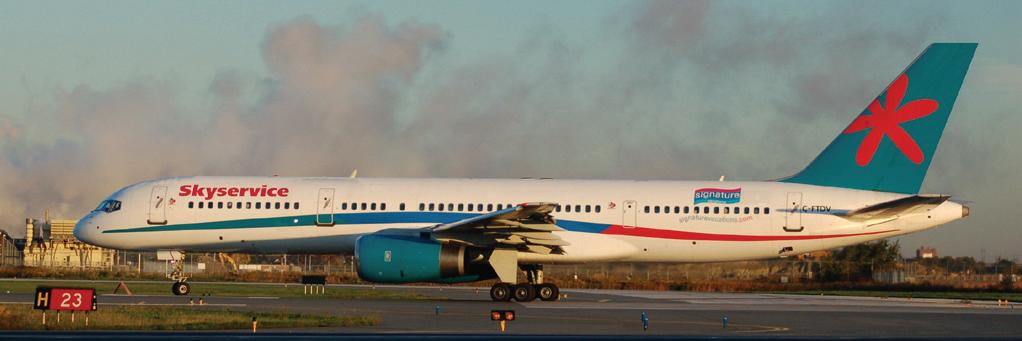
Skyservice has revealed a full 2009-2010 winter flying schedule with its two largest customers – Sunquest Vacations and Signature Vacations, operating eight aircraft for each company to traditional sun destinations. New agreements negotiated with both the pilot and cabin crew unions have contributed to the airlines’ ability to re-sign key customers. For the summer, four aircraft and crews are based in Europe and two aircraft are based in Canada.
CODE ShARE AGREEMENTS ON h0LD
A planned code-share partnership between WestJet Airlines and Southwest Airlines has been put on hold because of a sharp slowdown in air travel, according to WestJet. It said Southwest decided to put the funds earmarked for the codeshare program to other unnamed uses in the current slow travel environment.
The code-share program, which was announced last July and was expected to be operating by the end of 2009, would have seen the two airlines selling seats on each other’s flights. This would have meant cheaper and easier access to new customers for each carrier. Southwest said it will delay the startup of the code-share initiative until late 2010 at the earliest, at least a year behind schedule.
ThIRD, FOURTh QUARTERS BUSy FOR WESTJET
At press time, a smaller codeshare agreement was scheduled to begin in July for WestJet with Air France and KLM that covers baggage handling and electronic ticketing on inbound flights. WestJet also intends to launch its frequent flyer program by the end of the year and is set to implement its Sabre reservation system in the fourth quarter.
The airline has begun a new non-stop seasonal route between Edmonton and Yellowknife along with its summer service between Toronto and Sydney, N.S., with flights operating three days per week on Tuesdays, Thursdays and Sundays. Additional summer routes and increased service include flights between Vancouver and London, Ont., Saskatoon, Regina and Fort McMurray.
NEXT STOP, SAN DIEGO
Air Canada has launched a new daily, non-stop service between Calgary and San Diego, the only daily non-stop flight between the two cities.
Flights are operated by Air Canada Jazz 75-seat CRJ-705 aircraft with a choice of executive or economy class service, featuring individual seatback entertainment throughout the aircraft. Flights are timed for connections in Calgary to and from Edmonton, Regina, Winnipeg and Toronto. This
new service complements the carrier’s daily Vancouver-San Diego flights.
AIR CANADA EXPANDS NETWORKS TO ITALy, SPAIN
Air Canada has also increased its flights between Toronto and Rome from July to September to meet peak season summer demand on this route. Currently, there are daily flights from Toronto and Montreal to Rome. The new flights will boost the overall number of flights to 17 per week to Rome from Toronto and Montreal.
In addition, Air Canada and fellow Star Alliance partner Spanair have entered a code share agreement that expands their networks between popular business and leisure destinations in Canada and Spain. This follows the reintroduction on May 1 by Air Canada of non-stop flights between Toronto and Madrid, the only scheduled service between Canada and Spain.
The expanded agreement gives Air Canada access to six additional cities in Spain, including Barcelona, Palma de Mallorca, Malaga, Alicante, Bilbao and Valencia. Spanair customers will have connection service from Toronto to Montreal, Calgary and Vancouver. The daily nonstop 767-300 operated by Air Canada to/from Madrid will also carry the “JK” code for Spanair.
MORE TOUChDOWNS FOR PORTER
Porter Airlines is investing over $45 million in a new 150,000-square-foot passenger terminal at Toronto City Centre Airport (TCCA), as the carrier continues adding flights, creating jobs and
By Brian Dunn
contributing to economic growth. Phase one of the terminal is scheduled to open in November and includes passenger facilities, aircraft gates and office space. The full facility, including 10 bridged aircraft gates, U.S. and Canadian Customs, and two passenger lounges, is expected to be complete by next spring. The new terminal includes a mix of retail, food services, dutyfree, car rentals and other services. Standard complimentary Porter amenities, including business centres, loungestyle seating, beverages and Wi-Fi access will be enhanced in the new building. Porter Airlines recently took delivery of two additional DHC8Q402s and is expecting several more throughout the remainder of 2009. Schedule frequency has already increased on the Toronto-Ottawa and Toronto-Montreal routes.
Announced on June 18, Porter is adding Boston to its growing list of destinations as part of its fall schedule. Service between Toronto City Centre Airport (TCCA) and Boston Logan International Airport begins Sept. 14, with up to three daily non-stop roundtrips. Porter will be the only carrier offering service between these two airports.
Porter has also reintroduced seasonal flights to Halifax and Quebec City with up to five daily flights between Halifax, Ottawa and Toronto City Centre Airport and six weekly flights between Quebec City and TCCA. Porter also offers three daily round trips between Thunder Bay and TCCA with connections to Chicago, New York and Montreal.
This winter, Skyservice will operate eight aircraft for each of its two largest customers –Sunquest Vacations and Signature Vacations.
carr
We Will Always have Paris
It began modestly in 1908 as an add-on to the Paris Automobile Show. The inspiration of several handfuls of French aviation pioneers including Louis Blériot, who one year later would become the first aviator to cross the English Channel in a heavier-than-air machine, pocketing a £1,000 prize offered by London’s Daily Mail.
This history of aviation has unfolded on the grounds of the Paris Air Show. Beginning at the Grand-Palais near the Champs-élysées, where the world’s first exhibition devoted exclusively to aircraft took place in 1909, and later at Le Bourget Airport, which has been the show’s permanent home since 1951.
One hundred years on, Paris remains the hottest ticket to see and be seen
In June, a global aviation industry battered by depressed order books and billions of dollars in losses limped to the 48th edition of Salon International de l’Aéronautique et de l’Espace Paris to celebrate 100 years and try to breathe new life into a struggling business.
Paris has been home to triumph and tragedy. In 1927, Charles Lindbergh arrived at Le Bourget, completing his dramatic first solo non-stop crossing of the Atlantic. Paris’ first flying display took off from Orly Airport in 1946, and in 1961 organizers staged an eight-hour marathon air display (breaking for lunch – this being France after all) that began with smaller aircraft such as the Piper Comanche, moving up to heavier machinery such as bombers and fighters.
The 1969 edition hit the high watermark. The first Concorde test aircraft performed a pre-show fly-past over Paris, a Boeing 747 thrilled spectators with a surprise visit and the United States, weeks away from landing a man on the moon, made the Apollo space program its centrepiece.
On the darker side, a production version of the Russian Tu-144 supersonic transport broke up in mid-air in 1973, crashing into nearby houses and killing all six on board and eight on the ground. In 1988, pilot error caused an Airbus A320 to fly “dangerously low,” taking the tops off trees before crashing into a forest.
Still there is more to champion than mourn at Paris. This year’s centenary provided a snapshot of past glories as 30 vintage aircraft including the Blériot IX, a Junker Ju52, Supermarine Spitfire and Lockheed Constellation performed a star turn before vacating the skies for an A380, the first flying
display by Russia’s Sukhoï Super Jet 100 regional aircraft and the latest in advanced fighter technology. Canada, which is celebrating its own 100th anniversary of powered-flight, was represented by the Bombardier Challenger 860, Global Express, Learjet 60 and the first production model of the Q400 NextGen turboprop.
Readying Le Bourget for the bi-annual air show is a finely choreographed ballet. Since last December more than 6,000 workers utilizing 10,000 trucks have laid 30,000 kilometres of fibre optic cable, installed 4,000 telephone lines and constructed 73,000 square metres of temporary structures (the equivalent of 280 tennis courts) for this year’s extravaganza.
Many prime exhibitors reduced their presence this year, with Cessna and Gulfstream taking a pass on exhibiting altogether. It can cost up to US$1 million to display at Paris, and corporate aviation is realizing greater value for their investment at NBAA, EBACE and Dubai, where their product is not crowded out by military and commercial hardware.
Despite the no-shows and cost trimming, Paris has filled its 131,000 square metres of display space with a record number of exhibitors, the result of smaller companies filling in the gaps and countries like Australia and Mexico exhibiting for the first time.
Economics will continue to rewrite the rules of air shows. But trade shows remain the best platform to network and get the message out. The big ones are responding to the economic trend by trimming the length of shows and dedicating space for B2B meetings. Paris and Farnborough share a tight calendar with EBACE, a circumstance which may further erode the corporate aviation sector’s participation. But not entirely. France’s Dassault will always be compelled to fly the flag in its own backyard. That makes it difficult for competitors like Bombardier, a sponsor of this year’s show, to pull back, leaving one manufacturer as the only player in the sandbox.
In 2003, the United States all but shunned Paris – the consequence of worsening Franco-American relations – only to bounce back in force two years later. That is the allure of Paris, an expensive, exhausting and thundering whirlwind of metal, roaring engines, elegant luncheons, fine champagne and billion-dollar announcements (some years better than others). Executives will always complain over the cost, but are making plans for 2011. That is why we will always have Paris.
DAVID CARR is a Wings writer and columnist.
ontheweb
www.wingsmagazine.com
Web Exclusives: Wings That Waggle
Wings that redirect air to waggle sideways could cut airline fuel bills by 20 per cent.
To read the full story, visit www.wingsmagazine.com and click on Web Exclusives.
State of the Air Transport Industry
A report from the IATA Annual General Meeting and World Air Transport Summit, Kuala Lumpur, Malaysia, 2009.
To read the full story, visit www.wingsmagazine.com and click on Web Exclusives
CANADIAN AVIATION QUIZ
The Canadian Forces, which flies the Sea king helicopter, seems to have a thing about helicopters and royalty – or chess. Our Labrador chopper, used from 1963 to 2004 for search and rescue, is a variant of the Boeing Vertol CH-46 Sea ___?
a) Queen b) knight
c) Rook d) Prince
For more questions and answers go to www.wingsmagazine.com and click on the 100 years Logo.
Giovanni Bisignani, IATA director general and CEO
100years
Max Ward:
Quality above all
Aviation-minded people of all ages and nationalities tend to have an inner desire to do something notable to fulfil their dreams. For some, it may be to become a pilot – jet or otherwise. Another wish may well be to own an aircraft. Some people actually achieve their goals and for many others, the desire remains simply a dream.
One of these aviation enthusiasts was Max Ward. A native of Edmonton, he found the opportunity to explore aviation during the Second World War. He enlisted in the RCAF as a trainee pilot, won his wings, and spent the entire war at various bases instructing others in the art of flying. At the end of the war in 1945, he was discharged, and set about creating stage two of his flying career.
In the post-war period, there were aviation opportunities across Canada but there were far more aircraft and pilots than opportunities. The most successful solution was to find not only the right routes to fly but also the proper mix of aircraft. There was a lot of competition in the more populated south of Canada, and Trans Canada Airlines (with its government support) was vigorously trying to carve out as big a piece of the southern pie as possible. This meant slim pickings for Max Ward, so he wisely turned to the north, which he understood much better.
Max started out by using small biplanes such as the Fox Moth to carry both passengers and freight. This was a positive business move, and “expansion” became the key word in Ward’s aviation vocabulary.
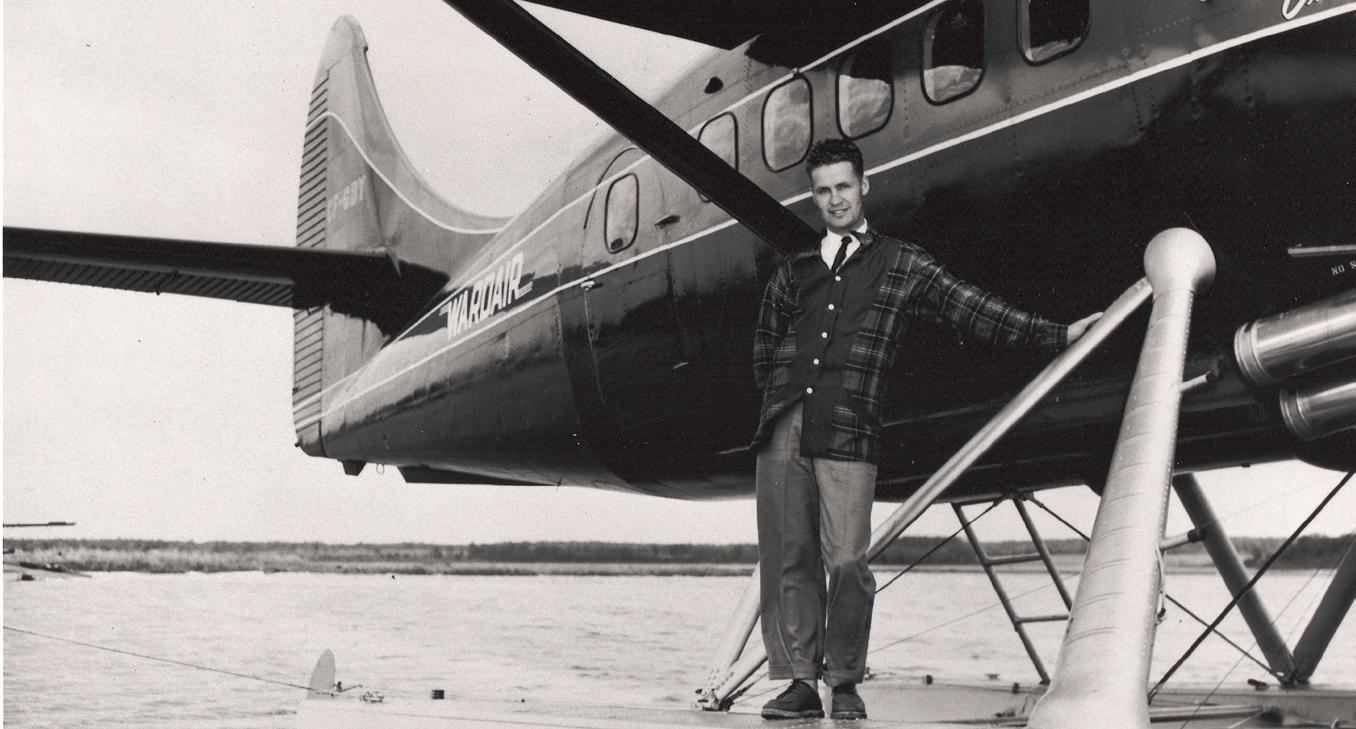
In 1953 Ward took another important step - the creation of Wardair. He chose an eclectic mix of aircraft suited to the north, one of which was the single-engined Otter from de Havilland’s famous STOL prodigy. This was soon followed by three
of the lesser-known twin-engined workhorse – the Bristol Freighter, an aircraft that superbly fit Ward’s requirements.
In 1962 came the next great leap forward with the lease of a Douglas DC-6B, which opened up valuable charter markets to Europe in the summer and to various southern destinations including Mexico, the Caribbean and the U.S. in the winter. Ward was on a roll. Other jets followed, including a Boeing 727, the first Boeing jet in Canada. In 1973 came the ultimate in aircraft – the Boeing 747 jumbo jet.
Wardair’s emphasis was first and foremost to establish a level of quality that did nothing less than astound the flying public. Your humble scribe confesses to having been among the astounded. For years I had flown on numerous airlines, compared levels of service, and resolutely settled on Swissair as the best of the best. My first flight on Wardair irrevocably changed my mind. From then on, I was a true fan of the airline’s unequalled quality of service.
It would be nice to report that Wardair went from victory to victory. However, storm clouds are a constantly occurring factor in aviation annals and no airline completely escapes them. Wardair’s problems were both internal and external. It had no domestic lines to supply it with passengers for its international routes and
it also failed to attract a sufficient number of business flyers. Externally, there were public and quasi-public organizations that believed Canada could not support three major airlines. Air Canada was the chosen airline to represent the country, and Canadian Pacific Airlines (CP Air), it was argued, could pick up the rest of the trade.
In spite of having ordered 38 new aircraft in 1986, three years later Max Ward was forced to sell his prize airline to the number two carrier – Canadian Airlines International (formerly CP Air). The name “Wardair” soon disappeared.
Is Max Ward’s concept of quality lost on the Canadian public? Perhaps not. In an interview I had with Robert Deluce, president and CEO of Toronto’s Porter Airlines, I suggested a possible similarity between his airline and Wardair. He smiled and replied that Porter did reflect Wardair’s qualities such as increased seat space, pleasant and efficient service, and free meals consisting of more than “coffee and pretzels.”
Since 1989, Max Ward has won numerous awards as well as a number of honorary doctorates from Canadian universities. Perhaps another special honour is in order – the DAQ – Doctor of Aviation Quality.
– By Raymond Canon
OF POWERED FLIGhT IN CANADA
Max Ward with a Wardair de havilland Otter.
If you earn your living in the corporate aviation world, chances are you have been forced to apologize for the business you are in to someone over the recent past.
Politicians will grab at anything to get some press. They often leap before they learn or think – many bashing the biz jet and everything associated with it. The CNN Recession unfortunately gives those who really do not know something well, just enough facts to chew on – in all the wrong ways.
In case you forgot, in many cases corporate aircraft are the sole lifeline to remote regions long since abandoned by the commercial carriers. Bizcraft deliver not just people but also just-in-time parts and materials necessary for such places. Remember too the empty seat that is happily and willingly given to a needy family being transported for medical attention. Yet we find ourselves apologizing?
We worked hard to lose the image of the corporate barge. But the public opinion generators have seized upon bizjets as an opportunity to try and bring disgrace and shame. Forget that most government officials utilize a private aircraft in some way. Most continued to find a rationale for their use as and when it suited them. They then turn and place a pall over the honour of our industry and those in it. How disgraceful!
The resurrected No Plane No Gain campaign from the 1990s has helped. The general media bashing has abated. Manufacturers’ public ads have promoted the efficiency and reliability of their respective products too. Cessna’s CEO recently reminded the world that general aviation contributes to the economy at many levels and includes at least 1.2 million jobs in the U.S. alone. According to Jack Pelton, general aviation contributes more than $150 billion annually to the US economy and is one of the few remaining industries that maintains a positive balance of trade with nearly 40 per cent of the country’s total 2007 production of $12 billion worth of aircraft being exported. And guess what – none of the folks in this industry have gone to Ottawa or Washington for bailouts. Investment and infrastructure funds – yes, but bailouts – no!
Brian Foley Associates sees a recovery of the business aviation industry by the middle of next year – but not before some more unavoid-
seaman
able pain. Foley predicts that there will likely be more shakeups and he feels FBOs, maintenance and other aviation service providers will find 2009 difficult, especially in light of reports that normal business jet activity was down 30 to 40 per cent. The good news as he sees it is that this activity decrease is only temporary until financial markets stabilize. Things will settle down by mid-2010 and the industry once again will be poised for growth, albeit slower than we’ve been accustomed to in the recent past, he says.
Are We There yet?
After the fall things get better – we hope!
In the US, the recent Economic Stimulus Bill included a return of the Bonus Tax Depreciation Write-Off of at least 60 per cent of a new aircraft purchase. Additionally, certain demonstration aircraft that were not previously titled may also qualify and improvements such as an avionics upgrade made to a used aircraft will also qualify for 50 per cent bonus depreciation. If only Ottawa were this progressive in their thinking!
And finally, there’s the sales end of the story. True, the OEMs have been laying-off but they were ramped up to produce aircraft based on extensive back orders and wait times. That crisis is past. But the business still remains active.
In the resale market, a lot of aircraft listed for sale really weren’t. Theatrics were put in play to appease the investors, making it appear that aircraft were being disposed of. When you looked closer, the price was such that in a depressed or recessed market, the alternatives pretty well assured limited interest. With the stock markets now heading mostly north, we should see many resale aircraft delisted. Further, many feel stable pricing and inventory will be the norm for a while. Add to that the exchange rate on the Canadian versus US dollar and now is a pretty good time to buy an aircraft – new or resale. And that is just what some are starting to do.
So – hey you – the bully! You tripped us. We took it from you. But we are still here. And will be for a while it seems. And we will even forgive you when you want to come and play with us again. Because we are bigger than you were it counts. So there!
ROB SEAMAN is a Wings writer and columnist.
DELIVERING ThE GOODS A position report on Cargojet
By Frederick K. Larkin
For almost a century, aircraft have hauled machinery and supplies to remote locations across Canada. Much of that activity has been related to the development of natural resources and performed by charter outfits or corporations. The arrival of scheduled domestic cargo flights came after the Second World War. It proved to be a niche business, as dedicated freighter aircraft adhering to timetables demanded a steady flow of time-sensitive traffic between major centres.
During the ’50s and early ’60s, the railroads dominated the inter-city trans-
port of freight. With the opening of the Trans-Canada Highway in July 1962, trucks began to compete against the two transcontinental railways for long-haul movements of goods. Scheduled airlines have tended to look at the cargo business as a byproduct of their raison d’etre – carrying people. The excess capacity in the bellies of their aircraft has provided a revenue-generating opportunity on flights across their networks. Throughout much of its history, Air Canada has operated scheduled cargo services.
Back in the ’50s, as Trans-Canada Air
Lines, it had three Bristol 170 freighters. Those high-winged bulbous-nosed beasts could carry 12,000 pounds at a blistering 140 knots; roughly twice the speed of a train. Later that decade, they were replaced by five cargo configured Canadair North Stars that could haul 16,500 pounds at 220 knots. With the advent of the turbine age block, speeds increased further, thereby enhancing the air cargo operators’ competitive position vis-à-vis the surface modes. Between 1966 and 1972 Air Canada (AC) operated a Vickers Vanguard Cargoliner that boasted a
42,000 pound payload. That aircraft was replaced by a pair of twin-jets (a DC-9-15F and a DC-9-32CF) from 1972 until 1978. From 1963 until 1994 it operated a succession of Douglas DC-8 freighters (-54Fs, then -63Fs and reengined -73Fs). That was it for AC’s scheduled cargo operations. Air Canada ordered a pair of Boeing 777Fs (with massive 229,000-pound payloads) in 2005 but they were subsequently cancelled. The only other domestic passenger airline to offer sked cargo service was Canadian Airlines. It briefly flew a pair of 737-200Cs on transcon routes during the mid-’90s. While regional carriers such as Pacific Western Airlines, Transair and Nordair operated cargo configured 707s and DC-8s during the ’70s and ’80s, those aircraft were tramps and could be found working charter contracts at airfields around the globe. Not to be left out of the action were six smaller scheduled cargo carriers that used jets to seek market share during the past two decades. They were AllCanada Express (727s), CanAir Cargo (737s), ICC International Cargo Charter Canada (A300s), Jetall Airways (737s), Swiftair Cargo (DC-8s) and World Wide Air Charter Transport Systems (DC-8s). Longevity was not their strong suit.
Today there are three major Canadian scheduled cargo airlines. The youngest of those, and the one that has achieved the fastest growth in recent years, is Cargojet. In light of the turbulent economic environment that is buffeting the business, it is fair to ask, “Will Cargojet be able to avoid the fate of the aforementioned six carriers?” Before we attempt to answer that,
it is worth reviewing the company’s history.
ThAT WAS ThEN…
The driving force behind Cargojet is Ajay K. Virmani. Ten years ago he owned a pair of freight forwarding companies that he later sold to EGL Eagle Global Logistics of Houston, Texas, in January 2000. Virmani became the president of EGL’s Canadian operations. He was now a manager in a large, well-run foreign company and his inner entrepreneur began to stir. Virmani believed that the cargo business at most major airlines was not treated as a top priority. He felt that an opportunity existed to develop a service-oriented air cargo organization in Canada. After all, as a freight forwarder he had been an airline customer and knew the customers’ needs. To that end he and two partners (Dan Mills and Jamie Porteous) purchased 50 per cent of Canada 3000 Airlines’ Royal Cargo unit for $10 million in July 2001. The new joint venture became Canada 3000 Cargo on Aug. 1, 2001, and Virmani was appointed president and CEO.
On Nov. 8, 2001, Canada 3000 Airlines declared bankruptcy and its liquidation began. Canada 3000 (C3) Cargo, however, continued to operate during that process with the support of its customers.
On Feb. 21, 2002, Virmani and company acquired the other half of C3 Cargo, which was renamed Cargojet Airways. Operations included a fleet of eight wet-leased aircraft that served a dozen domestic destinations. On July 21, 2002, Cargojet purchased Winnport Logistics of Winnipeg and thereby attained its own air operator certificate. That same month saw the delivery
DELIVERING ThE GOODS
of the carrier’s first aircraft –a pair of 727-200 freighters. Three months later Cargojet received its approved maintenance organization certificate enabling it to do all but heavy work. A significant development in the company’s history occurred on April 14, 2003, when it took over the UPS Canada contract. The following month it entered into marketing alliances with Air France and British Airways, and became a domestic feeder for those carriers.
On June 1, 2003, Cargojet joined the International Air Transport Association. That same month it established Winnipeg as its domestic hub. It now operated six flights each weeknight from Winnipeg to Hamilton, Montreal, Vancouver, Edmonton and Calgary. Effective Sept. 22, 2003, Cargojet expanded its marketing alliances with international carriers by adding Korean Air. It now provided feed to and received traffic from trans-Atlantic and transPacific flights.
In February 2004, Cargojet applied to the Canadian Transportation Agency for permission to create a passenger charter subsidiary. A month later Starjet Airways took delivery of two 727-200s, each configured with 60 first-class seats. Service began on April 1 from a base at Toronto. Starjet never achieved its financial performance goals and voluntarily ceased operations in October 2006. The company’s focus would be on the freight business.
The company became a publicly traded entity when Cargojet Income Fund completed its initial public offering of units on June 9, 2005. The fund controls Cargojet Holdings, which in turn owns
Cargojet Airways. In November of that year the company began operating five flights per week from Newark, N.J., to Bermuda. A month later, one of Cargojet’s domestic competitors, AllCanada Express, declared bankruptcy. This provided further opportunity to capture market share.
As major passenger airlines rely on regional carriers to feed traffic from smaller markets into their transcontinental networks, Cargojet recognized the potential to do the same with regional cargo operators. On July 17, 2007, it agreed to purchase Georgian Express of Toronto. Its fleet (two Beech 1900Cs and four Cessna 208B Caravans) began operating under the Cargojet Regional brand on Oct. 2, serving 19 destinations within Ontario, Quebec and the Maritimes. Cargojet announced its intention to acquire 51 per cent of Prince Edward Air (PEA) of Charlottetown on Jan. 18, 2008. The deal closed on May 1 of that year and resulted in a Cargojet Regional fleet of 19 aircraft operated by PEA.
Cargojet Income Fund completed a $36 million offering of 7.5 per cent convertible debentures on April 16, 2008. The proceeds were used to finance a fleet upgrade program at Cargojet Airways, to fund the acquisition of PEA and to repay short-term debt.
On Aug. 5, 2008, Cargojet took delivery of a Boeing 757-200F capable of carrying 80,000 pounds – a 33 per cent increase over the 727-200F’s 60,000-pound payload. Two days later, Cargojet’s first Boeing 767-200ERF arrived, followed by a second 767 in late September. These wide-bodies each have a 100,000-pound payload. This new trio of
leased aircraft entered revenue service at the end of September 2008 and represented a meaningful expansion of capacity and operating capabilities. On March 5, 2009, the company announced its plan to purchase the other 49 per cent of PEA.
ThIS IS NOW
Today Cargojet is a leading provider of time-sensitive overnight air cargo services. Its business is segmented into four categories:
Domestic cargo – oper- 1. ates a weekday overnight air cargo co-load network between 13 destinations. Non-scheduled charters are also operated during weekdays and on weekends.
International cargo – oper- 2. ates between Newark, N.J. and Bermuda five times per week.
ACMI – provides aircraft, 3. crew, maintenance and insurance for customers on operations within North America.
Regional cargo – operates 4. a fleet of smaller aircraft between 19 destinations within eastern Canada. Cargojet’s fleet of 13 jets
consists of 10 727-200Fs, one 757-200F and two 767200ERFs. Its regional fleet of 19 aircraft includes one Saab 340A, one King Air 200, three Beech 1900Cs, three Beech 99s, seven Navajo Chieftains and four Caravans. In addition, two Beech 1900Cs are operated by Skylink Express on behalf of Cargojet’s regional services. These 34 aircraft transport more than 760,000 pounds of freight each business night. The domestic cargo operations, which last year represented approximately 70 per cent of the company’s revenues, carry traffic from contract customers, non-contract clients and other airlines.
International cargo operations are represented by the Newark-Bermuda route as well as some charter work. The aircraft operated on that route is done so on an ACMI basis and is the only ACMI contract currently operated by the company. The regional cargo business is operated by Prince Edward Air and connects 19 points within the eastern half of Canada with Cargojet’s mainline network. It currently represents approximately 15 per cent of Cargojet’s total freight related
Ajay Virmani, president and CEO of Cargojet.
revenues. Cargojet’s more than 400 customers include leading courier companies, freight forwarders, manufacturers and scheduled passenger airlines. In addition, it performs ad hoc charters that carry atypical loads. UPS Canada, DHL Express Canada, Sameday Worldwide, ICS Courier Services, DB Schenker, CEVA Global Logistics, ATS Andlauer Transportation Services and Midland Transport are some of Cargojet’s largest clients. It also has commercial alliances with close to 40 passenger carriers that serve North America, South America, Europe, Asia and Oceania. Cargojet’s customer base includes companies from the agriculture, clothing, electronics, chemical, pharmaceutical, seafood and precious metals industries. Its charters can carry livestock, emergency relief supplies and military equipment. Last November, one of its 767s flew equipment for the band Coldplay from Phoenix, AZ, to Sheffield, UK. All of this work is performed by a team of approximately 520 members. Of these about 300 are in airline operations, 170 handle the cargo and 50 are in administration. To gain a better understanding of any business model and appreciate how a company may perform in the future, it is useful to perform a S.W.O.T. analysis (Strengths, Weaknesses, Opportunities and Threats). Doing so with Cargojet yields the following insights:
S.W.O.T. ANALySIS OF CARGOJET
STRENGThS: Cohesive culture
– From Day 1 Cargojet’s senior management has made it a priority to focus on the re-
quirements of its clients. This may sound trite, but when one reads customer testimonials on the Cargojet website there is a recurring theme. Terms such as “teamwork,” “a can do attitude,” “partnership with customers,” “attention to detail,” “commitment to service,” “exceed expectations,” “highly motivated,” “customer centric” and “integral partner” are peppered throughout comments made by senior officers of client companies. Nothing wins business and keeps customers like excellent service provided by user-friendly professionals. Such a culture is helpful in attracting and retaining capable staff. Interesting to note that approximately 80 per cent of its people hold units of Cargojet Income Fund. That makes them owners of the enterprise, not merely employees.
Revenue visibility – Approximately three-quarters of Cargojet’s revenues come from contracts that are three to five years long. These contracts provide for guaranteed minimum volumes, which enables the company to more accurately forecast its capacity requirements and thereby better control related costs. The balance of its revenues comes from ad hoc charters.
Reduced Capex requirements – With the investments related to the introduction of the 757 and 767s now behind it and with the completion of its new hangar at Hamilton, Cargojet’s discretionary spending should be lower going forward.
WEAKNESSES:
Aging fleet – The backbone of Cargojet’s fleet is the Boeing 727-200F. The average age of its ten 727s is approxi-
mately 29 years. Cargojet owns seven of those and leases three. Since these aircraft each have an annual utilization rate of about 1,200 hours, they still have years of useful life in them. The key to the timing of their retirement is likely going to be the price of fuel. The aircraft type that will eventually replace the 727s will probably be the 757-200F. Cargojet’s 757 is 19 years old.
Commercial concentration – During 2008 Cargojet generated 44 per cent of its sales from its top three customers each of whom represented more than 10 per cent of its total revenues. Furthermore, approximately 73 per cent of its revenues came from its ten largest customers. While this appears to be a high degree of concentration, its traffic is sourced from a diverse base of companies representing a wide range of industries.
OPPORTUNITIES:
International missions – Whether it be scheduled services or charters, Cargojet now has the equipment to pursue overseas business. The development of scheduled trans-Atlantic/Pacific services will probably not occur until pricing improves. Current inter-continental yields are depressed due to the passenger carriers’ massive amount of lower hold capacity. Providing supplemental lift for the Canadian Forces might be another possibility. In addition to its four Boeing CC-177 Globemaster IIIs, the Canadian military has relied upon chartered Antonov An-124100s and Ilyushin IL-76TDs for logistical support.
Regional expansion –Cargojet currently lacks
regional feed west of Thunder Bay. With its mainline service touching down in Vancouver, Calgary, Edmonton, Regina, Saskatoon and Winnipeg, it would make sense to access secondary markets in the four western provinces.
ACMI contracts – Operating cargo aircraft for North American scheduled passenger airlines and/or for charter carriers, where Cargojet provides the aircraft, crew, maintenance and insurance, is a possibility. These so-called wet leases provide additional capacity on a flexible basis to carriers that want to capture revenues without major capital outlays.
ThREATS:
Competitive environment – The domestic air cargo scene is reasonably balanced today with three dominant players. Kelowna Flightcraft Air Charter of Kelowna has served Canada Post and its 91 per cent owned subsidiary, Purolator Courier, since 1976. It operates a fleet that includes 15 727-200Fs and two DC-10-30Fs. Morningstar Air Express of Edmonton has provided lift for FedEx since 1990. Its fleet includes five 727-200Fs, seven Cessna 208Bs and an ATR42-300F. Could a new entrant be established and prove to be a destabilizing force? In theory yes, given the liberal regulatory environment. The biggest challenge, beyond assembling personnel and equipment, would be winning customers. The success of that effort would likely depend on a major slide in the quality of the service provided by the three incumbents.
CONTINUED ON PAGE 19
wingsonsafety
Battling
Complacency
It was a sun-dazzled day and the beautiful blue sky was beckoning me as I helped my passenger into the floatplane. We were departing for a long day of fishery patrol on the west coast of British Columbia, and it promised to be a beautiful day. I finished my walk around and hopped in, pushed off from the dock and the engine started smoothly. I was in great spirits as we taxied a short way up the river in preparation for takeoff. My mood darkened considerably just after takeoff as my vision was blocked by a stream of oil flowing up from the cowling and onto the windscreen. I quickly chopped the power, landed on the river, and taxied back to the dock. The problem? Can you guess? The oil cap had been left off by the engineer who had done some work on the airplane that morning. I had checked the dipstick and found plenty of oil, but had not reached forward and opened the other little door to confirm that the oil cap was in place.
Many people hear stories like this one and with a knowing nod offer their considered opinion of the cause. Complacency. I wasn’t being careful enough. I wasn’t being alert to all the potential dangers.
But if complacency is the cause, what is the cure? How do we combat this dreaded disease? The truth is that complacency is not unusual; in fact it is normal and natural for humans to become complacent. We all become complacent and it happens very easily. Now
“SAFETy
before you rush to string me up for heresy, let me defend that statement.
How often do you need to do something before you consider it extremely safe? If you do something 10 times in a row, and nothing bad happens, it starts to feel safe. Do it 100 times with no ill consequence and you start to feel pretty comfortable. Do it 1,000 times and you would laugh at someone who told you that it was dangerous. And yet in aviation, something that can cause a problem just one time in 1,000 is still 1,000 times more dangerous than we would want. We want people to be alert to risks that are so unlikely that if they flew 10 flights a day, 365 days a year, for 50 years, they still might not encounter the problem. Trying to maintain vigilance in the face of such a threat is not easy. In fact, it is almost unnatural.
Of course, I had been trained to check the oil cap on a walk around. And I believe I have checked the oil cap on every walk around I have ever done. But after thousands of flights, without ever finding the cap in anything but its on and locked position, something deep in my subconscious probably relegated that check to the category of “it’ll never be a problem.”
So please don’t shake your head and grumble about complacency when you hear about a pilot who makes this kind of error. Rather, ask yourself what you are doing about complacency. The only way to fight complacency is to keep yourself educated about the risks in your flying. Keep reading accident reports. Attend safety briefings. Make note of your own errors after each flight and make a point to learn from them. Little things happen in every flight and they provide an opportunity to learn free lessons. Even so, it probably won’t be enough. Our brain just isn’t wired to stay alert to such minute possibilities.
You need to participate in a larger pilot community or organization so that as a group you can communicate incident reports, hold safety meetings, and keep talking about the things that could go wrong. Your organization is exposed to far more opportunities for error because there are many more of you flying. Therefore it is quite likely that someone in your organization learned a lesson today that might save you some grief down the road, if only you could learn about it. If you are not actively communicating lessons to others, and learning from them, you
are missing out on opportunities. If your organization is not actively working to maintain vigilance, complacency will happen.
We cleaned up the cowl and the windscreen, replaced the oil that was lost and triple-checked that the oil cap was back in place, and off I went on a beautiful day of flying. But despite a really good clean-up job, a couple of thin black streaks made their way up the windscreen during the course of that day. They were a good reminder that it takes a determined effort, and the help of the whole organization, to keep complacency at bay.
Gerry Binnema has been in the aviation industry for 28 years, as a pilot, AME, accident investigator and safety officer. He has spoken at numerous conferences and provides training and consulting in SMS and human factors. Visit his website at www.gjbconsulting.com or e-mail him at gerry@gjbconsulting.com.
This information is intended to increase overall safety awareness and is not a substitute for compliance with regulatory guidelines. We welcome your feedback. Please contact us at Wings magazine, email: akwasnik@annexweb.com
IS ECONOMICAL ... SAFETy MANAGEMENT IS ACTUALLy A METhOD OF CONTROLLING COSTS.”- R.h. WOOD
The only way to fight complacency is to keep yourself educated about the risks in your flying.
CONTINUED FROM PAGE 17
Fuel prices – During periods of high fuel prices, Cargojet has implemented fuel surcharges to mitigate the impact on earnings. While jet fuel prices have retreated about 66 per cent from their peak, reduced levels of crude oil production might result in a rebound in fuel prices as global demand increases. The greater threat is what might happen to economic activity should crude oil ever return to its record high level.
Foreign exchange exposure – Cargojet purchases goods such as aircraft parts and components that are priced in US dollars. In January the company ended its foreign exchange hedging program and realized a small gain on the sale of its US dollar forward purchase contracts. Since then, the Canadian dollar has strengthened against its US counterpart and reduced the threat.
WhAT DOES ThIS ALL MEAN?
If it weren’t for repeat customers no company could survive, let alone expand. This fact is central to Cargojet’s business model and has been ingrained in its culture. Talking about providing
good service is one thing, but doing it on a consistent basis is quite another. By supporting its service offering with reliable operations the company has been able to deliver on its promise. What makes this feat all the more impressive is that it has been accomplished during a period of substantial growth.
To meet the challenges brought on by the economic meltdown, Cargojet staff meet regularly with its customers to discuss ways of enhancing service through co-ordinated strategies. The company has also rationalized its capacity and trimmed its headcount.”
WhAT DOES ThE FUTURE hOLD?
The major determinant of Cargojet’s future financial performance will be the level of economic activity within North America. The current pullback has been something of a test for this relatively young company. Proof of its ability to deal with the difficult conditions was provided with the release of Cargojet’s results for the three months ended March 31, 2009. While revenues were down 10 per cent, due primarily to reduced volumes, the gross profit was up almost 40 per cent – thanks
to 50 per cent lower fuel costs. The overall result was a profit of $1.2 million versus a $0.4 million loss in the year-earlier period. It is worth noting that this was achieved during what is seasonally the company’s weakest quarter. Given its disciplined approach to account management, provision of reliable service and attention to operating costs, it wouldn’t be a surprise to see Cargojet’s earnings plateau until the economy recovers. In light of the havoc being wreaked upon the global airline industry.
Having established a regional feeder network within eastern Canada, it only makes sense to do the same in the west. The mega energy projects currently on hiatus are expected to resume their expansion once commodity prices enable an acceptable return on capital. The long legs of its wide-body aircraft offer international potential. Be it scheduled services or charter work, the sight of Cargojet 767s in Europe and Asia may occur more frequently.
CONCLUSION
Cargojet’s story is one of classic entrepreneurial success. Having identified a market
niche, the management team has effectively executed a client-focused business plan. Very simply, Cargojet’s mission is to provide a reliable air transport service at a price that is both competitive and compensatory. To accomplish this, the company has built a team of skilled personnel and assembled a fleet of well-maintained aircraft. Has it succeeded? With its 98 per cent+ rate of on-time performance, its recognized esprit de corps and its expanding customer base, the answer is “affirmative.”
In so doing, it has achieved an enviable financial performance in a tough industry. During the past year, the economic environment has provided challenges to all businesses. Those companies that are flexible in their planning and adapt to changing market conditions will not only survive but be better positioned to achieve future growth. Cargojet’s moves to reduce fixed costs and to accumulate cash through the reduction of its distribution to unit holders are examples of enlightened thinking in perilous times. As the economy recovers, we expect to see Cargojet continuing to deliver the goods – in more ways than one.
MANAGING ThE SKIES
By James Marasa
Few barometers provide as accurate an indication of a changing economy as the aviation industry. Unfortunately, for operators weathering the economic climate of the past 12 months, the mercury has been steadily declining. As airlines worldwide restructure to traverse a challenging fiscal landscape, air navigation service (ANS) providers in the United States and Europe are undertaking a massive modernization of their air traffic management (ATM) systems.
Is there a limit?
Canada, as well as nearly every other developed nation in the world, has aircraft flying through these airspaces every day. In a time when every dollar counts, Canadian operators need to understand these changes and how they will impact their bottom line.
The modern era of air travel has brought with it an unfortunate expectation among passengers that their flight will likely be delayed. For the majority of these travellers, a delay is a mere
inconvenience; however, the compounding effect of delays spurs consequences far beyond travel insurance claims. Aviation is not a niche industry. In a very broad sense, air transportation is a pervasive conduit through which international business is able to flow. While efficiency will forever remain a functional objective, it becomes critically important as carriers worldwide seek to recover losses and remain solvent. Efficiency can be taken in
broader context than a purely economic one. Though responsible for only two per cent of the world’s carbon expenditure, air transportation has a particularly sour reputation among environmental circles. Even with fuel efficiency having improved roughly 70 per cent in the last 40 years, the International Panel on Climate Change (IPCC) has estimated a 12 per cent inefficiency exists in ATM worldwide. In tangible terms, airliners flying racetrack patterns as
they await further clearance pump roughly 80 million tonnes of carbon dioxide into the atmosphere each year.
Nevertheless, carbon credits do not pay the bills and economic pressure remains the most persuasive factor influencing change. Giovanni Bisignani, director general of the International Air Transportation Association (IATA) put it bluntly: “if there were ever an incentive to improve environmental performance, it is the industry’s US$186 billion fuel bill.”
Six years ago, US Congress
ration standards. Additionally, pilots will benefit from improved situational awareness in the cockpit due to enhanced, on-board traffic and weather displays. It has been argued that enhanced surveillance and navigational technologies could reduce current radar separation standards, allowing controllers to space aircraft more closely together and facilitate more fuel-efficient direct routings. Some believe that the vision of NextGen could be expanded to the point where all aircraft, using enhanced traffic information
point of potential conflict.
The European Economic Community faces a similar issue of congestion but must tackle an additional complication. While Canada and United States have the luxury of employing sweeping technological enhancements across vast expanses of airspace, Europe must massage such largescale changes across political boundaries. According to Harry Bush, director of Economic Regulation for the UK Civil Aviation Authority, setting up a system involving 27 service providers rather than
“The vast majority of air traffic control delays come down to runway capacity and arrival rates.”
released the “Century of Aviation Reauthorization Act,” calling for a revitalization of the FAA air traffic control system. The Next Generation Air Traffic System, known colloquially as “NextGen,” will incrementally replace the ground-based system of radar and VHF airways with satellite-based surveillance and GPS navigation over the next 15 years.
Automatic dependent surveillance broadcast (ADS-B) technology will eventually replace radar sites across North America giving controllers more accurate position information than ever before. Expected to be fully operational in the US by 2013, ADS-B will allow controllers to “see” aircraft where current gaps in radar coverage require the use of restrictive procedural sepa-
in the cockpit, could selfseparate, a concept known as “Free-Flight.”
In 1994, Michael Baiada, a captain at a major US airline, co-authored the first study that brought Free-Flight to the attention of the aviation community. The study prompted congressional hearings that directed the FAA to accelerate development of the Free-Flight concept. A critic of the legacy air traffic control system, Baiada has argued that pilots should be allowed greater autonomy in separation and navigation decisions. Proponents of Free-Flight favour broadening the scope of automated self-separation to foster a “collaborative decision-making process” between pilot and controller whereby finer adjustments are made farther out from the
bring about to the future of aviation; however, as Bush has suggested, this is an exceptional opportunity for air navigation service providers to raise capacity for the inevitable resurgence of demand. According to Bisignani as he spoke to the ICAO NextGen/ SESAR Coordination Meeting in Montreal last September, “this is a unique opportunity and we must get it right.”
With avionics upgrades required to operate under Next Gen and SESAR expected to cost as much as US$40 billion, users certainly have reason to hope the ANS providers get it right. Some operators have elected to wait for avionics requirements to stabilize before investing in new avionics, fearing costly upgrades may be required as the system is refined.
just one presents a huge challenge. Bush has publicly advocated that now, while there is some “breathing space,” is the time to build a stronger platform for sustainable growth in air traffic for the future.
Europe is no stranger to stretched capacity. From 2003-2008, air traffic in Europe has increased almost 20 per cent, driven primarily by the rise of low-cost carriers. Delays correspondingly increased roughly 34 per cent over the same time period with traffic expected to double by 2030. Single European Sky ATM Research, known as SESAR, is underway to harmonize air traffic management procedures across the European Union.
It may require a shift in perspective to see any benefit that a faltering economy could
As capable as these new systems may be, anything suggesting a fast or easy change to the way air traffic management is conducted could quickly be dismissed as unrealistic idealism. Though technology may one day give pilots the ability to self-separate, there are several factors that must come into play. For a pilot to make safe and effective separation decisions collaboratively with a controller, it would require local knowledge of traffic flows, departure and arrival routings, conflict points and restricted airspace. It is difficult to envision a “collaborative decision making process” having any practical application in a complicated and busy airspace where separation decisions are made and implemented very quickly. Though it is tempting to blame delays on an antiquated radar/airway system, will reducing separation standards create a definable gain in efficiency?
According to Eurocontrol, of the 11 per cent of flights that experienced delays in 2007, 56 per cent were attributable to the airlines themselves, with nine per cent due to weather. Of the remaining delays, only 12 per cent occurred while aircraft were operating in the en route environment, most likely due to holds imposed because of a congested airport or terminal. At any rate, that means 1.32 per cent of flights in Europe in 2007 experienced a non-weather-related delay en route with all other delays occurring from causes not attributable to en route ATC efficiency.
wonders if the effect of reducing separation standards, or allowing pilots to make their own separation decisions, would even be perceptible.
Additionally, even if aircraft are able to proceed without constraint direct to their destination, they may still need to hold once they get there. The vast majority of air traffic control delays come down to runway capacity and arrival rates. An aircraft cannot take off or land while another aircraft is occupying the same runway and technological advances will never change that. Approximately four
to accommodate lanes on the highway, a bottleneck forms and traffic congestion is the result. In aviation, most bottlenecks form when traffic demand exceeds an airport’s ability to handle arrivals and departures. The most efficient en route surveillance and separation techniques cannot improve overall efficiencies if there are not enough paved runways to accept those aircraft.
In an era of shrinking profit margins, it is incumbent upon the industry to ensure each dollar spent is being used as wisely as possible. Modernization
“Will reducing separation standards create a definable gain in efficiency?”
The advantages of ADS-B in what is currently non-radar airspace are indisputable. However, even if controllers could, with the advent of enhanced ADS-B precision, reduce radar separation standards, would it be prudent to do so? Medium aircraft such as the Boeing 737 are restricted to 5nm in trail of a heavy aircraft for wake turbulence. Instances involving loss of control have occurred with aircraft operating outside of the required separation minima, which begs the question: is it wise to run aircraft any closer together than they already are? One
miles of in-trail spacing is required between two arriving aircraft for an aircraft to safely depart in between. To reduce separation below the three miles currently used in terminal environments would run the risk of aircraft not being able to clear the runway in time for the next arrival.
The suggestion that reducing separation standards could improve ATC efficiency seems akin to allowing vehicles to follow each other more closely on the highway in the hopes that traffic will move more freely. When there are not enough lanes on the bridge
can facilitate a safer, more reliable ATM system, yet it remains to be seen how quickly these massive ventures in technology will return their sizeable upfront investment in terms of increased efficiency. Rather than taking a topdown approach to air traffic management, perhaps greater savings could be realized by improving efficiency at the airport, and working from the ground up.
Part two of our twopart series on managing the skies will examine projects currently underway to increase efficiency within Canadian airspace.
OPTIMISM IN TOUGh TIMES
Canada’s FBOs get ready for the recovery
By Rob Seaman
Simply put, the FBO business in Canada over the past year has been incredibly tough. Between skyrocketing fuel prices and the market downturn that started in the fall of 2008 – and continued through the first part of this year – business at most airports has been pretty bad. Across North America, sales have been down anywhere from 30 to 40 per cent on average. Like all things in business, this is cyclical, and there’ve been recent signs that the tide is changing. As many in the business point out: we have been here before, we will survive, and we will be here tomorrow.
Some have taken this period
as an opportunity to build and improve their facilities and infrastructure, so they are ready for the upturn when it arrives. Generally speaking, since the spring of 2009, most FBOs across the country have reported an increase in traffic – but nowhere near the volume or intensity that was considered the norm in recent years.
In Vancouver, all of the FBOs are focused on preparing for the 2010 Winter Olympics and the increase in business and world attention that they will bring. CBAA’s Sam Barone and Bill Boucher are confident that everything is on track for the successful han-
dling of corporate aircraft that will be heading to YVR. They report that the CBAA, working in conjunction with Scott Harold, its Pacific Chapter Chair, has been representing business aviation interests in Vancouver with the Olympic organizers and government officials for the past two years, getting ready for the event.
Why all the effort? According to the CBAA, all aircraft entering the Olympic area will be screened. In addition, all crews and passengers will have to be preauthorized under a system similar to the e-apis used for US Customs. There will be a reservation system for services at the Van-
couver area airports. Two key events will be covered by this planning: the Olympic Winter Games from Feb. 12 - 28, 2010, and the Paralympic Winter games from March 12 to 21, 2010. Restricted authorized operations will be in place for security, military, emergency response, VVIPs, and so forth, so the main FBOs at YVR have worked very carefully to orchestrate a common and well-planned service support structure for this period.
Avitat Vancouver reports that everything is in place to secure hangar and ramp space for both international and Canadian operations. According to Farah Faruqi, who’s in
Corporate traffic through the Irving Gander FBO this year is holding close to its 2008 numbers.
charge of marketing at Avitat, its primary focus is to assist corporate flight departments with planning for this event. Whether it be providing them with ground transportation and accommodation information; or notice of upcoming air traffic restrictions and regulations; information on slot reservations; or security and screening – they are ready. They have also developed a new 60,000-square-foot hangar that is complete and fully operational. This offers secure space capable of accommodating aircraft up to a Boeing 737 or fleet of various smaller corporate planes.
Speaking more to the current market, Landmark Aviation YVR general manager Scott Harold reports that while the airport’s overall traffic this year is down around 20-25 per cent, staff have seen signs of a rebound and expect growth over the coming months. As Harold notes, overall tourism, the mainstay of BC, is basi-
cally down – sports fishing, boating and so forth – and aviation is linked to all this too. He is, however, excited and optimistic about the opportunities that will come with the Winter Olympics, not only for his business, but for all of the FBOs at the airport.
In Calgary, Skyservice Business Aviation Services has completed a full renovation of its Avitat Calgary FBO at a cost of $10 million. Even during a recession, Skyservice is showing its confidence in the future growth of the market with a continued and sustained commitment to customer service. Bricks and mortar aside, the firm has also hired retail service specialist Jill Timmins as its vice-president, Western Canada.
The company reports that generally it finds business is showing signs of rebounding with fuel sales up in March and April across the country at all three of its locations. It has also added two new man-
aged aircraft, both large cabin, to its Calgary-based fleet. Recently, the company also announced that it will introduce a new look and image to the lounge at its Toronto operation, complete with Roots furniture. This will be completed during 2009.
Looking down the road, Landmark and Skyservice in Calgary will soon have some new competition in the region. Million Air recently announced that it has acquired land and will soon be starting construction on a new FBO at the airfield. This again indicates overall optimism in the growth and sustainability of this oil-patch-driven market.
Growth and development in central Canada has also been present in recent months. At YYZ, longstanding operator Skycharter has completed a multi-million dollar renovation and service improvement to its facilities. Included in this is a refreshed hangar with new doors and ground services and
a completely new, multilevel FBO. This is a significant and impressive change for one of Canada’s first FBO operators. Skycharter has also added a new and significant tenant, Air Sprint, to its newly renovated office facilities at the FBO.
Across town at the Toronto Buttonville Municipal Airport, facility renovations are now complete on the terminal building. This includes a new Million Air lounge and service counter, revamped and additional classroom space for its flight training operations, a new look and location for its Toronto Airways Flight Training dispatch area, and the addition of new flight simulators to support its University of Beijing-affiliated aviation training program. This program was undertaken by the owners and operators of the airport despite the fact that its funding support and future well-being has been brought
Skycharter has completed a multi-million dollar renovation and service improvement to its facilities.
BUFFALO MAKEOVER
Arctic Sunwest rejuvenates the fleet
By James Careless
The twin-turboprop DHC-5 Buffalo is a legendary STOL aircraft, which is why Arctic Sunwest Charters (ASC) of Yellowknife, N.W.T., flies two of them in the Far North. Not only can the Buffalo get in and out of short permanent runways, but it can cope with makeshift strips on snow, ice and tundra. Best of all, the Buffalo can bring up to 18,000 pounds in a single trip, and offload it quickly via the aircraft’s roller floor, fold-down ramp and rear fuselage doors.
Still, the Buffalo is a vintage aircraft, whose technology dates back to the 1960s. The two Buffalos flown by ASC – registration letters C-FASV and C-FASY – were both built in 1981, and have the avionics to prove it. At least, C-FASV
still does; C-FASY has been brought into the 21st century, thanks to an ambitious glass cockpit upgrade started in November 2008 and finished five months later. “It was a very big project,” says Larry Burkowski, ASC’s director of flight operations.
“But the changes we made have converted this aircraft into a cutting-edge flying machine, with lots of life left in her.”
ThE PROJECT
Both C-FASY and her sister Buffalo C-FASV came to Arctic Sunwest Charters with factory-installed avionics. These included Garmin 150 navigation avionics boasting Jeppesen databases and threeline vacuum-fluorescent dis-
plays, plus Primus 40 Weather Radars. The rest of the cockpit was analog.
Due to Transport Canadamandated upgrades, C-FASY and C-FASV were due to have new equipment installed in their cockpits. But given how useful and unique these Buffalos are in the North – in fact, Arctic Sunwest Charters is the only commercial Buffalo operator in Canada – “we decided to do full avionics upgrades,” Burkowski tells Wings. “It just made sense to give our pilots the additional advantages of moving map technology and other advances, to enhance both safety and the aircrafts’ operational envelopes.
In this instance, upgrading to a full glass cockpit meant
“tearing out the existing panels and starting from scratch,” says Craig Parr, ASC’s Buffalo co-ordinator. “We also had to spend a lot of time going over wiring diagrams, laying new wiring, and interconnecting the Buffalo’s legacy systems with the new avionics we installed.”
WhAT WAS INSTALLED
C-FASY’s glass cockpit is built around a Sandel SA4550 primary attitude display and a Sandel SN4550 primary navigation display. The SA4550 is an LED-backlit display that provides configurable singleor dual-cue flight director command bars, a glideslope/ localizer deviation scale, plus a fast/slow indicator and audio mode warnings. The SN4550
Arctic Sunwest Charters is the only commercial Buffalo operator in Canada.
BUFFALO MAKEOVER
is a full-colour moving map NAV system. Viewable in both 360-degree compass and a 70-degree ARC views, the SN-4550 supports GPS- or FMS-supplied waypoints, heading, bearing pointers for VOR and ADF, DME display and marker beacons. It comes with an internal Jeppesen NavData database.
C-FASY has two Garmin 430 GNS avionics, one serving as a backup to the other. Each serves as an all-in-one Communications, Navigation and GPS system, with the data being shown on a full-colour LCD map display. The 430’s COMM view features a VHF transceiver with 760-channel (25 kHz channel spacing) and 2,280-channel (8.33 kHz channel spacing) configurations. The NAV view provides conventional VOR, glideslope and localizer information, and the GPS system uses either a Jeppesen Americas or an International NavData card to illustrate 1,000 user-defined waypoints with 20 reversible flight paths (up to 31 waypoints each).
The Buffalo has been fitted
with a Honeywell Mk VIII Enhanced Ground Proximity Warning System (EGPWS). This is a Class A TAWS that prevents controlled flight into terrain (CFIT) accidents. The Mk VIII does this by applying alerting algorithms to data from the aircraft’s various inputs, then warning the crew with audio messages, visual indications, “and a display of terrain in the event the bound-
Arctic Sunwest Charters’ Fleet
With all of Canada’s North to serve, Arctic Sunwest Charters has built a varied fleet that can cover everything from cargo to passengers.
For cargo-only missions, ASC flies two DHC-5 Buffalos. However, the company also has two Dash-8s, which can carry freight or be configured to handle up to 37 passengers in a pressurized, leather-seated environment. The company’s four Twin Otters can handle both kinds of missions, and do so using wheels, floats, skis or soft, oversized “tundra tires.”
Arctic Sunwest Charters also flies one 14-seater Beech 99 twin-turboprop, one King Air 100 twin-prop, two Navajo Chieftain eight-seaters and two venerable Turbo Beavers that can be fitted with wheels, floats or skis.
“We can fly anywhere that our clients need us to go,” says Larry Burkowski, ASC’s director of flight operations. “We have the pilots, and we certainly have the aircraft!”
aries of the alerting envelope have been exceeded,” according to Honeywell’s website (www.honeywell.com).
For Traffic Alert/Collision Avoidance, this Buffalo has a Collins TCAS II that analyzes an approaching or intruding aircraft’s altitude, closure rate, direction and range. This data is displayed on an LCD screen, with alerts being delivered in audio. Also on board are an Artex 406 ELT, Becker digital audio system, and a Latitude Technologies S200 to support satellite phone and remote flight tracking by the nearest air traffic control station.
The bottom line: With just 15,010 on C-FASY’s airframe – which was undergoing a C check during the avionics upgrade – this Buffalo has been born again!
ChALLENGES
Without a doubt, it was tough to fit these new systems into an old aircraft, even with the removal of the instrument panels and other major obstacles. But what complicated
matters was getting the new systems to interface with the Buffalo’s legacy equipment.
“In particular, we had fun getting the autopilot to talk to the old systems,” says Craig Parr. “This was not surprising: We were mixing two different generations of technology. It took a lot of testing to get everything working 100 per cent.”
On the positive side, the avionics upgrade inside CFASY’s cockpit was so complete that “it is almost like flying a brand new airplane,” Burkowski says. “Just look inside and you will see what I mean: The rebuilt C-FASY’s cockpit looks entirely different from the version we got from the factory.”
RESULTS
At press time, C-FASY had re-entered service in Canada’s North. Meanwhile, C-FASV was being scheduled for her refit, to let her catch up with her sister.
Was the project (the cost of which Larry Burkowski will not detail beyond
Upgrading to a full glass cockpit meant tearing out the existing panels, laying new wiring, and interconnecting the Buffalo’s legacy systems with the new avionics installed.
calling it “substantial”) worth it? He thinks it was. “With these upgrades, we expect that the Buffalos will fly for us 10 years more; perhaps longer with continued vendor support,” says Burkowski. “This is an excellent aircraft that works well in the Arctic, and one that would be very hard to replace.”
Besides keeping this STOL capability, Arctic Sunwest Charters hopes to stimulate interest in other Buffalos needing similar upgrades. Although the Canadian Forces is upgrading its own Buffalos, other air forces may be interested in similar upgrades.
“The Buffalo is flown by the Egyptian, Brazilian and Peruvian air forces,” says Jay Dilley, director of business operations. “The hope is that
other operators see the benefit in these upgrades and are stimulated into doing it themselves; this will ensure world-
wide product support for all Buffalo operators.”
Whatever happens, one thing is certain: Arctic Sun-
west Charters will be flying two of the most advanced DHC-5 Buffalos in service anywhere on the planet!
Canada’s preferred maintenance facility and OEM-recommended warranty provider. For more information about Skyservice Aircraft Maintenance call 1 877 759 8585 or visit www.skyservicebas.com
Arctic Sunwest Charters decided to do full avionics upgrades to enhance safety and the aircrafts’ operational envelopes.
SEND ME A KISS By WIRE(LESS) Far-reaching airport communications
By Carroll McCormick
The term enabling technology could have been tailor-made for airport wireless communication systems. The uses to which they can be put seem limited only by the imagination and airport budgets: cellphone calls, Internet access, passenger check-in, random security checks, access to translation services, baggage reconciliation, mobile staff workstations, data transfer with aircraft, flight information display systems … all unfettered, as long as the users
are within the range of wireless antennae.
Innovative airports like Vancouver and Trudeau have pushed the applications of their wireless networks the furthest, and passengers are the big beneficiaries. In 2000 Vancouver became the first airport in North America to offer wireless Internet access via communications provider Nokia. Last Nov. 1, Vancouver became the first major Canadian airport to offer free wireless access to the Internet
throughout the whole airport, in both pre- and post-security areas and in all terminal buildings, according to Grant Fengstad, the airport’s manager, technology planning.
Wi-fi, as this wireless Internet access is called, can be free or for-fee. The Calgary airport also moved to a free access model just before last Christmas. Some airports, such as Pearson, Trudeau, Charlottetown and Abbotsford, offer a fee-based service, or service for passengers via
their existing subscriptions with hotspot providers such as Aliant, Boingo or Bell. Fee, free and by whom all depends on the airport and its revenue philosophy. Calgary decided that the added value of quick and easy passenger access was worth forgoing revenues and absorbing the added cost: “We had a lot of requests from passengers to have free access. We are always interested in enhancing the passenger experience and expect to pick up some revenues with our
Wireless transmission of boarding passes is convenient and paper-free.
revised model. The customers experienced some frustration with the original hotspot login process. Some users said it wasn’t worth the bother for the few minutes they wanted to use it. We have seen a tenfold growth in the public Wifi usage since we went to the free environment,” explains Paul Lawrence, director of information technology and telecommunications with the Calgary Airport Authority.
Wireless systems that are not owned by the host airports are common in North America. Big airports, like Trudeau, whose Wi-fi system was deployed by, and is operated by Bell, have them too, but they are particularly convenient for airports too small to justify having their own IT departments. Opti-Fi, now
owned by Boingo, installed its own turnkey system at the Abbotsford airport in 2004, and operates and maintains it under a pay-for-use model. It covers the terminal and the
trade and convention centre on the airport property.
Abbotsford is considering going to a hybrid free/ fee access model. “We would like to go to free Internet.
We are looking to move to 15 minutes free, and then if you want more time than that, you would pay for it. You would also see advertising,” says Parm Sidhu, the airport business development manager and operations manager. Staff at the airport have little occasion to use the system, but, Sidhu notes, “We occasionally use Wi-fi for presentations at meetings when someone does not have a land line for Internet access.”
The comment about advertising refers to a way of generating advertising revenues from the “splash page,” which is the first web page passengers splash down on, as one metaphor-enabled IT manager explained. Some splash pages just have airport logos and some information,
Passengers love free Internet access.
others have ads. For example, Vancouver currently does not offer advertising opportunities, but the greater Toronto Airports Authority (GTAA) earns revenues from splash page advertising and user fees. A splash page, typically the airport’s home page, is also a place where passengers can access flight information and, at hipper airports, inner-city happenings.
Ottawa-based BOLDstreet, which bills itself as Canada’s leading provider of public Wi-fi solutions, is helping Calgary develop a revenue model and provide some of the services (for the public side) needed to manage access and customer questions. BOLDstreet helped Calgary develop the interface page and put up the links to Facebook and the Internet One might expect regular old cellphones to work anywhere at any airport, given the reasonable assumption that they must be technology meccas. Some do have ubiquitous access, but at Pearson, for example, this ubiquity is an earned privilege for cell providers, so not all passengers’ cellphones have complete coverage there. Having decided that passengers should have excellent coverage, GTAA gave cellular providers a choice: use the airport antennae system and provide excellent service, or offer coverage from offairport equipment and provide “best effort service.” “It was a corporate position that if a cellular provider was to be allowed to have a cell site on our property, they would have to give customers ubiquitous coverage,” explains Thomas Tisch, GTAA’s director of information technologies and telecommunications operations. Bell agreed to use
our antennae system and provides excellent service. Telus and Rogers chose not to.”
Cellphones keep passengers busy, jacked in or amused, but airports like Trudeau are using the technology to smooth passengers’ transit through the airport. It allows more effective use of terminal space and enables paperless ticketing. The most advanced scenario, in use now, has passengers checking in remotely using personal digital assistants (PDA) or mobile phones. The airlines, most notably Air Canada, send unique 2D bar codes, which serve as boarding passes, to the passengers’ PDA. Passengers pull up the codes on their PDAs at the security checkpoints, where Canadian Air Transport Security Authority staff decode and read them. If the data matches the passengers, they are whisked through.
Other airlines offer lesser versions of this scenario; e.g., checking in at home on the Internet and receiving the 2D bar codes on PDA. A variation on the theme of accessing flight information with cellphones is called short message service (SMS). Trudeau has been using SMS for close to two years to get flight information to cellphones or PDAs. Briefly explained, this fee-foruse service lets people receive flight status and updates. Antoine Rostworowski, director of product development at Trudeau, gives an example: “If you want information on flight AY123 arriving from Calgary, say, text ‘’AY123’’ to the number 23636. One you have received your flight status, the system will ask you if you would like to receive an alert of change if the schedule changes.”
Common use self-serve
kiosks (CUSSK) at Trudeau can read 2D bar codes off PDAs, and then print out boarding passes and baggage tags. Speaking of CUSSK, airports are also quite capable of establishing wireless links to them, which allow them to be easily relocated to suit their changing needs. “We are looking at wireless CUSSK. We would like to deploy them for certain cases,” Rostworowski says.
Wi-Fi is the enabler of speedy baggage reconciliation – the practice of matching each piece of luggage with its owner before it is packed on the plane. Here is how it works. As baggage works its way through the baggage handling system, the baggage tags are scanned at various points. At the boarding gates, agents use barcode scanners to confirm passengers’ flight records and board the passengers in the Departure Control System (DCS). The Departure Control System is linked to the Baggage Reconciliation System (BRS), and each passenger’s status will generate a load/not load message for her baggage. The agents working in the baggage room use wireless handheld scanners to scan each bag tag, and BRS indicates whether the bag should be loaded. Bags belonging to passengers who do not board
the flight are not loaded in the airplane.
Airport staff use Wi-Fi for many other uses, although the degree to which Wi-Fi-enabled staff communication is found depends on factors like the size and IT budget of the airport and recent enlightening events. For example, after our RCMP Tasered distraught and unarmed Robert Dziekanski to death in October 2007, the Vancouver Airport Authority implemented many changes, some of which are enabled by wireless communications: “On Dec. 7, 2007 we announced a number of changes to customer care. Included in those changes was providing mobile communications devices (BlackBerrys) to customer care representatives in the customs hall. The devices provide access to a 24-hour language line, which offers translation services in more than 170 languages. In addition to providing access to these translation services, the devices may also be used to phone a passenger’s party in the public greeting area to let them know the passenger has arrived,” Fengstad explains.
Customer care representatives can receive e-mailed situation reports instantly on their mobile device rather than waiting until they get to their computers. “The addition of
Wireless systems permit baggage reconciliation.
Wi-Fi throughout our terminal buildings allows operations staff to access the intranet and share information from wherever they are,” Fengstad adds.
Car rental companies have also turned onto Wi-Fi. “The biggest non-passenger users of Wi-Fi at Pearson are the car rental companies, Tisch says. “Someone with a handheld unit collects information like mileage and gas. When the renter comes back the handheld unit obtains miles driven and gas left in the tank. This is all done with Wi-Fi.”
The sky would seem to be the limit for the uses for wireless networks, but even that may be shooting low. Global communications, engineering and integrations provider ARINC is poised to launch the next huge airport wireless
application, called GateFusion. Officially launched in June 2007, GateFusion allows large data transfers between planes at the gate and their ground applications. ARINC developed GateFusion to provide wireless data transfer services for e-enabled aircraft at airport gates around the world.
“One of the key drivers of the service is the B-787, whose sophisticated avionics and applications require a gate link solution. The A-380 is also coming equipped with WiFi capability requiring gate link connectivity. GateFusion supports large and small data transfers between these planes and their ground applications. Additionally, other applications such as in-flight entertainment and electronic flight
bags are driving the retrofit of Wi-Fi avionics on existing fleets,” explains Mike Dufton, sales director for commercial aviation solutions, ARINC.
“The 787 requires planeground-plane data transfer. Manuals, parts and applications updates are handled by the new wireless requirements. As a result, these aircraft are coming with Wi-Fi capability, but Boeing is not supplying the network solution for these updates. We are providing the common-use ground communications infrastructure,” Dufton adds. “Today, airlines are using various “sneakernet” update solutions, including disks, drives, and thumb drives to load and unload data from aircraft. GateFusion automates this process.”
ARINC installs GateFu-
sion servers at airports along with connectivity to its global network, which has connections to most of the world’s airlines. In most cases, ARINC becomes a customer of the airport for Wi-Fi on the ramp. ARINC has operating systems installed in Orlando, Fla., and Manchester, England, primarily for test and demonstration purposes with various airlines. Hong Kong is scheduled for installation later this year. GateFusion is currently not operating in Canada, but ARINC has been setting the stage by negotiating early with Wi-Fi service providers. For example, it has agreements in place to install GateFusion at Pearson with 90 days’ notice. Trudeau and Vancouver are the two other big candidates in Canada.
AIR TRANSPORT ASSOCIATION OF CANADA
75th
EMIRATES UPS ThE ANTE Middle-East airline seeks northern exposure
By David Carr
It is rare for time to stand still at Toronto’s Pearson International Airport, but the arrival of Emirates’ inaugural A380 service to Canada achieved just that. Thousands of airport employees and spectators crowded into every vantage point and stood atop idle ramp equipment to watch the double-decked behemoth descend gracefully to earth. It was a sense of occasion not experienced at the airport since the Concorde first visited Toronto in 1983.
Following cameo appearances in Vancouver in 2006 and Montreal in 2007, the A380 took centre stage at Pearson with its operator, Emirates, offering three-times-weekly, non-stop service to the unlikely destination of Dubai
in the United Arab Emirates (UAE). But for how long? The A380 was recently withdrawn from Emirates’ daily New York run because of soft demand. The substitution freed up aircraft for both Pearson and Bangkok, while raising questions over how Toronto can succeed where New York failed, especially if Emirates is cleared to operate daily.
“We brought the A380 to New York around the time Wall Street collapsed,” Timothy Clark, Emirates’ CEO told Wings. “The market there went south. Toronto keeps heading north.” To illustrate the point, Emirates reports that the A380 is booked near capacity for the first four months, with a half-year waiting list for cargo space.
Clark is confident that Toronto can support a daily A380 and even mused about adding a second Boeing 777. The airline is also anxious to add Calgary and Vancouver to its growing international route network. “Given the size of its oil industry, Calgary is an ideal route for Emirates,” he added.
Even so, Transport Canada has put the brakes on additional services. Etihad Airways, based in the neighbouring emirate of Abu Dhabi, operates three flights a week to Toronto from the UAE capital. The seven emirates have a combined population of approximately 4.5 million, roughly equal to the Greater Toronto Area. Etihad would also like to increase its
Toronto service to daily, but Transport Canada says six flights a week between the two airlines is sufficient, noting that additional flights could harm Air Canada and its Star Alliance partners, a position that runs counter to Ottawa’s Blue Sky policy to liberalize global air services.
Transport Canada’s position is a return to the bad ole days of the 1970s and ’80s when it was government policy to concentrate foreign airlines in Montreal, by blocking access to Toronto. It also sends a signal to airport authorities that ponied up over $1.2 billion in rent payments to the government last year that airlines trump airport revenues. The Greater Toronto Airports Authority
Emirates CEO Timothy Clark is confident that Toronto can support a daily A380 and is also anxious to add Calgary and Vancouver to its growing international route network.
estimates that increased flights to the UAE would generate an additional $3.2 million in airport revenues and create more than 500 jobs.
“The federal government
is turning into a nanny state whose decisions are increasingly detrimental to the economic growth of Toronto,” said Kyle Rae, a local councillor who heads up
“…the A380 is booked near capacity for the first four months, with a half-year waiting list for cargo space.”
the city’s influential economic development committee.
Clearly there is something larger at play here. Compared with service to other countries, Emirates’ Canadian operation looks like small change that slipped down the seat cushions. Of the 100 destinations the carrier serves worldwide, almost all receive at least one flight a day, including 98 flights a week to five cities in the U.K., 63 a week to four cities in Australia and 28 a week to two cities in New Zealand (via Australia).
It is an aggressive business model that leaves the airline vulnerable to accusations of predatory pricing and capacity dumping by Air Canada and others. The chairman of Air France proposed inspecting Emirates’ books while KLM has wondered aloud how the airline will cover the US$18 billion bill for an eye-popping 58 A380s. The A380 represents a fraction of the US$58 billion in aircraft Emirates has on order, including more 777-300s and 70 Airbus A350s.
“The fact that a tiny, tiny little city like Dubai can actually justify an airline the size of Emirates is a little risky,” Stelios Haji-loannou, the founder of U.K. discount airline easyJet told Associated Press soon after Dubai announced the launch of a stateowned low-cost airline.
At a meeting of the International Air Transport Association in Kuala Lumpur last June, Air Canada and Air New Zealand renewed attacks on the so-called big three Gulf airlines – Emirates, Etihad Airways and Qatar Airways.
“Let [Emirates] fly 100 times a day into Canada if
they want, but only flying customers from Canada to Dubai and not connecting to every other market on the planet,” ACE Aviation Holdings chair Robert Milton told the gathering.
It is an odd position for an airline executive to take given that international transfers are the core business of industry alliances like Star and oneworld. According to Airports Council International, airline alliances carry approximately two-thirds of international passengers at the top 10 airports ranked by international traffic.
Clark takes the criticisms in stride, sounding like the president of a low-cost airline up against the “legacy carriers.” “We’re not in the business of flying just 50 passengers and we are not diverting traffic away from Air Canada, which doesn’t fly to Dubai or anywhere in the Middle East. We are building a market where there wasn’t one before.” A claim disputed by Air New Zealand’s chief executive, who told Abu Dhabi’s The National newspaper that services from the Middle East had created very little new traffic.
Clark is also critical of what he has described as a “lunatic” price war, complaining to reporters at the Paris Air Show that one “major Asian carrier has introduced fares from the West coast of America to India that I’m surprised would cover the cost of catering.”
Depending on the time of year, approximately 50 per cent of Emirates’ Canadian market is transfer, meaning that the airline is using Dubai’s efficient, passenger-friendly, 24-hour airport and extensive Mid-East, Asian and African networks to draw from the
The A380 comes to town
By Neil Macdougall
When Emirates’ Airbus A380 landed at Toronto on the first scheduled flight of a super jumbo to Canada, the crowds didn’t realize the work that had gone into the venture. Fortunately, the airliner’s gestation coincided with the airport authority’s 10-year development program. The planners ensured that runways, taxiways and the deicing facility suited the A380, and two gates were equipped with double bridges.
Some parallel taxiways cannot be used during the A380’s arrival. Other airports like London Heathrow have more restrictions. In
larger Star Alliance, perhaps exposing a fault line in the alliance business model.
Clark uses Africa as an example. “The legacy carriers overlook Africa or only fly there when they feel like it. We fly to 14 cities in Africa, which are accessible through our Dubai hub. That’s Air Canada’s problem, unless you are a lead partner in the alliance you are handcuffed.”
Emirates arrived on the scene in 1988, with two leased aircraft serving regional trading partners. As the oilstarved Dubai emirate positioned itself as a recreational playground, global business centre and international crossroads, Emirates fortunes soared alongside its base. The wind has gone out of Dubai’s economic sails, dampening its once red hot real estate market and forcing the city-state to ask for help from oil and gas rich Abu Dhabi that would
Los Angeles, before A380 arrivals, authorities reportedly use vehicles to block taxiways where problems could arise and close an adjacent service road.
Airbus itself wanted the plane’s flying characteristics to be familiar and unremarkable. David Heino of Burlington, Ont., captain of the first flight, earlier flew smaller Airbuses. He said, “The A380’s nice and stable. It’s just like any other airliner until you get it on the ground. You have to be careful because thrust can cause damage.”
Moreover, the 261-foot-
span wings intrude on runways and taxiways at many airports. Pilots can’t see the wingtips from the cockpit, nor on the tail fin-mounted camera that shows passengers the view ahead. An under-the-nose camera enables the pilots to track the yellow lines precisely. A table showing the span of other airliners also helps A380 pilots avoid conflicts.
Captain Heino estimated that 80 per cent of Emirates’ pilots are expatriates. (Canadians and Australians are also well represented in cabin crews.) His first officer was trained at an American uni-
make some Canadian bailouts look like penny poker.
Emirates has not escaped unscathed from the downturn. While posting its 21st straight year of profit, earnings were down 71 per cent leaving analysts to speculate that some of its A380 order will be deferred. It is estimated that Middle East carriers will lose US$900 million this year for their sins. But what sins are they? Just as WestJet, Southwest and easyJet have used greater efficiency and a lower cost structure to challenge legacy carriers at the back end of the cabin in their
own backyard, Emirates and others have challenged those same airlines at the front end of the airplane and over a larger playing field.
Still, the airline is open to attack. It is a state-owned carrier whose stakeholder controls the airport and regulator – game, set and match. Privatization would reduce the sting, but the environment is identical to Canada’s before the privatization of Air Canada in 1987 and the commercialization of airports. (Would the Air Canada / Canadian merger have played out differently had
versity. Most new pilots have been British-trained, but are now Australian-trained, although the airline has its own flying school in Dubai. Emirates has an amazing 168 airliners on order; Qatar Airways has 200 and even hopes to speed deliveries. Other Middle East and Asian carriers have reduced recruiting, but are eager to replace expensive expats with natives, as evidenced by several 23-year-old first officers on heavy Boeings. A well-financed Canadian school might break into this market.
The crew rest area is at
predecessor CP Air not been restricted to only 25 per cent of Air Canada’s domestic capacity prior to 1979?).
Emirates is also making an impression in global marketing at cultural events and on the field of play. The number of sporting events showing the Fly Emirates logo reads like the pages of Sports Illustrated, and includes Formula One racing, the America’s World Cup, England’s Premier League Soccer, next year’s World Cup in South Africa and this year’s Roger’s Cup tennis tournament in Toronto and Montreal. Can local hockey rinks be far behind?
“We were inspired by Nike,” said Clark. “We want Fly Emirates to be as recognizable as the Nike swoosh.” And they want their aircraft arriving at Canadian airports more than three times a week.
Emirates competitor Etihad Airways, based in the neighbouring emirate of Abu Dhabi, operates three flights a week to Toronto from the UAE capital.
the aft end of the 399-passenger economy main deck. It’s so quiet that crews have complained they can’t sleep. Presumably it lacks the two showers in first-class. These have a heated floor, a limit of two people and a dinky bench with belt. In an emergency the crew would have to hustle 166 feet, past service carts and staff while ignoring the bar, where some passengers spend the entire 13-hour flight, according to a flight attendant.
Airbus had hoped the A380’s wake would be no greater than the Boeing 747400’s. Extensive wind tunnel tests on winglets were followed by more than 180 flying hours of wake measurements. A blue-ribbon
committee concluded the largest airliner (1,200,000 lb. GTOW) had a wake to match its size. Thus A380 pilots now follow their call sign with expression “Super.”
Nav Canada has adopted ICAO’s turbulence separation standards. The A380s require two to four miles more than heavy aircraft. Consequently a single A380 reduces landings on a runway, perhaps by two or three per hour. Air traffic isn’t congested now, but a healthier economy and more A380s might make airports think of higher landing fees for A380s.
The vertical wake separation for an A380 is 1,000 feet, but an Armair A320 flying 1,000 feet below an A380 en-
countered severe turbulence that caused the autopilot to disconnect and throw the aircraft into steep banks three times. A blog by another pilot reported severe turbulence when 4,000 feet below an A380. Airliners approaching Pearson’s runway 23 pass over Buttonville airport, an active general aviation field. Nav Canada controllers will ensure at least 1,000-foot vertical separation between aircraft on final and the top of the Buttonville Control Zone. It remains to be seen if this is adequate.
Remarkably, Emirates traded the A380s on its Dubai-New York run for the smaller Boeing 777s on the three-times-per-week Toronto run. Loads on the Toronto
run were said to be heavier. Bookings out of Toronto for the summer are reported to be 90 per cent of capacity. The proud airline has long been seeking Canadian rights for a daily service. Canada, likely fearing damage to Air Canada, has refused.
The plane’s arrival in Toronto was greeted with claps and smiles. Mayor Hazel McCallion of Mississauga, the city where Pearson airport is located, was so charmed that she urged both federal and Ontario government ministers to expedite approval of additional flights. Is it possible the airline is using the A380 to gain support for this change, and plans to return the A380 to New York if daily services are approved?
that Brooker ventured into leasing and charters using Learjets, Cessna Citations and Hawker jets.
Brooker Aviation became Morningstar in the early 1990s, when Kim Ward of the famed Ward aviation family (Wardair) bought half the company from owner Don Wheaton. This partnership expanded the company further, including winning a contract to operate Boeing cargo jets for Federal Express Canada. Today, when you see a Canadian B727 overhead flying FedEx’s white and purple colours, that’s a Morningstar jet you’re watching.
It was against this background of success that the company decided to tackle the fractional jet market. “We were already doing a lot of work for corporate aircraft owners,” says McGoey. “We were providing them with maintenance, staffing and hangar services on a Private Operator Certificate (POC). It just made sense for us to take it a step further and expand into the fractional aviation business.”
“The times were good,” McGoey adds. “We had come through a nice little time where jet demand was high. It
made good business sense to offer fractional jets, especially because they provide a lower cost route into corporate aviation than the traditional ‘buy one/run one’ approach.”
One point in Morningstar’s favour: Typically, the Canadian market is 1/10th the size of the US market. So if the US market will support more than 1,000 corporate jets in fractional ownership programs –as it currently does – it makes sense that Canadian business would be able to support more than 100. “Right now, there are less than 30 corporate jets in Canada operating in fractional ownership,” says Dziedzic. “The numbers are clearly right for our company, at least in a good economy.”
DEALING WITh ThE RECESSION
Unlike many companies – in aviation or business in general – Morningstar Partners has not been dealt a death blow by the recession. One reason is the nature of the fractional jet business model: Whenever a client buys a share of a given aircraft, “our risk is reduced,” McGoey says. “Once the entire aircraft has been ‘sold,’ our risk is nil.”
Still, sales are slow right now. It’s not due to a lack of
TODAy, AND TOMORROW
Currently, Morningstar Partner’s fractional jet fleet consists of two Hawker 900XPs (mid-size eight-passenger 2900nm jets), and one Challenger 604 (widebody 13-passenger 4000nm jet).
There are 13 fractional owners signed up with the company.
According to Phil Dziedzic, Morningstar plans to take delivery of one more Hawker 900XP within the next 10 to 12 months and will be taking delivery of a smaller jet option, the Hawker 450XP within approximately two years. Also, Morningstar has firm orders on four Hawker 450XPs (light-size six-passenger 1900nm jets).
desire; rather a lack of cash and credit. Complicating matters is the fact that companies with money are keeping tight control of their purse-strings as a hedge against the current economic slump going on for years, rather than months.
“We have a lot of potential customers who will sign as soon as they are sure that things are looking up again,” says Dziedzic. “Some prospects are actually ready to buy fractional jets today, but don’t feel it’s the right thing to do during a recession, when people are losing their jobs.”
However, the slowdown cannot last forever. Unlike unnecessary technology like the Segway two-wheeled “Personal Transporter” – a rolling replacement for walking that someone wittily described as ‘a very clever solution to a problem that doesn’t exist, but very clever nonetheless’ –there is a real need for corporate jets. High-salaried executives of major multinational companies need to be able to travel, on their own schedule and terms and, in some cases, to hard-to-reach locations. For them, plus those with the cash to pay, corporate jets perform a real service that commercial airlines do not.
It is these people that Morningstar Partners hopes to attract to fractional jets once the initial shock of the recession wears off and companies see business pick up. “The recession could help us in certain ways,” McGoey says. “For example, a company who needs to add a corporate aircraft to its fleet but doesn’t want to incur the cost of buying one could achieve its ends through fractional ownership. Not only does this keep capital costs down, but it’s more fiscally re-
sponsible and better from an optics standpoint.”
That’s not all: “There are many companies who own corporate aircraft who would like to get them off their balance sheets, Dziedzic says. “These companies could come to us after selling these assets. We might even be able to work a deal with them wherein they retain an ownership share in their aircraft, while we sell the rest and then manage it for them.”
“If I took the time to talk to every corporate aircraft owner in Canada, I could show them how we can provide them with equivalent service for less money by pooling aircraft and human resources,” McGoey sighs. “I didn’t say we don’t have time. We just aren’t taking that marketing approach – to ‘go after’ private flight departments.”
The future of Morningstar Partners and other fractional jet companies is unclear. After all, it is easy for cash-strapped executives to decide to forgo jet ownership entirely, rather than save money by going the fractional route. Still, Morningstar has weathered other recessions, and it is bolstered by its ongoing contract with FedEx, current fractional jet owners, and its maintenance and service business. “Times are tough, but they’re not fatal,” says McGoey.
Clearly, Morningstar Partners is not letting the recession destroy its plans for future growth. Instead, the company is taking a cautious approach that keeps tabs on the state of the market, without giving up its ambitions and goals. In this sense, the economic slump is a slowdown for this experienced Edmonton company, but not the end of the road.
CONTINUED FROM PAGE 24
into question in recent months. Company president Derek Sifton remains optimistic that the issues will be resolved and the airport will continue to provide the service and support to local and international aviation that it is known for. In business since 1963, Buttonville is the third busiest airport in the province of Ontario.
At the Montréal SaintHubert Airport (YHU), an announcement has just been made regarding a $20 million investment over the next three years that will include a new air terminal, FBO, and hangars. Work is slated to start in 2009. The new airport complex, which will be built and developed on the civil-
ian side (facing runway 06R /24L), should be operational before the end of 2010.
Aérocenter YHU, the operator of this new facility, is a recently formed company created to handle the development and operation of the project. The firm recently announced the appointment of Gordon Livingston as president and CEO. When complete, Saint-Hubert will offer an alternative that previously did not exist in this market for those not wanting to travel through MontréalTrudeau (YUL)
On the East Coast, Cindy Millet, Irving Aviation’s retail aviation sales manager, is the first to tell you that the company’s FBOs have seen their ups and downs before. Its business includes the corpo-
rate, cargo and military sectors, which means that dips in one segment are often offset by an increase in another. According to Millet, corporate traffic through its Newfoundland FBOs has dropped only slightly so far this year. Irving Gander is holding close to its 2008 numbers, Irving Goose Bay has seen a slight decline in overall corporate traffic and at Irving St. John’s, corporate traffic has actually increased since it became a UVAir Preferred Supplier.
As Millet sees it, even though the US economy is impacting discretionary travel of corporate fleets, in Goose Bay, cargo traffic has increased 10 per cent over 2008 (which was already a record-breaking year). And in St. John’s, military traffic has increased
slightly over last year.
In 2008, Irving implemented a formal program throughout all of its facilities that focused on customer service at all levels. In their opinion, it is a commitment like this that continues to benefit all locations, especially during trying economic periods.
While some would say that everything is simply bad right now, there are good news stories out there. You just have to look and ask. The FBO world has evolved and the operators in Canada continue to find ways to not only keep, but also exceed the global pace of excellence in their facilities and people. Even in bad times, our folks seem determined to use their time wisely getting ready for the next upswing.
Advance your aviation career with AeroCourse
As the leader in advanced aviation seminars, AeroCourse has been offering IFR and ATPL/IATRA seminars across Canada for 20 years as well as Crew Resource Management and Flight Dispatcher seminars.
We pride ourselves on being leaders in advanced aviation materials providing current knowledge and experience-based manuals and seminars. Our publications and seminars provide you a solid foundation for your aviation career.
Our ATPL workbook consists of six sections that includes extensive updates to each section. These updates include the latest material tested on the Transport Canada exams. The most notable changes are: navigation is now included in Section 4, Radio Aids and Flight Planning; the recent changes to GPS; and updated performance charts/tables.
Calgary .............August 14-16 Toronto August 21-23 Calgary September 11-13 Toronto ......September 18-20 Vancouver..September 18-20 Winnipeg October 2-4 Edmonton ..........October 2-4