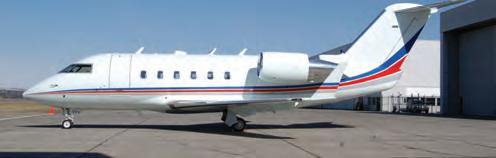
FOR THE PAST 45 YEARS, LEARJET HAS DEFINED AND REDEFINED WHAT A BUSINESS JET SHOULD BE. TODAY, LEARJET* IS BUILDING ON ITS LEADERSHIP POSITION WITH THE INTRODUCTION OF THE NEW BOMBARDIER* LEARJET 85* AIRCRAFT. FEATURING AN IMPRESSIVE LIST OF BEST-IN-CLASS FEATURES, INCLUDING THE LARGEST CABIN OF ITS KIND AND LEGENDARY LEARJET PERFORMANCE—ALL BUILT UPON THE OPERATING EFFICIENCY ONE EXPECTS FROM A LEARJET. THE LEARJET 85 BUSINESS JET STANDS TESTAMENT TO OUR LEGACY AND WILL REDEFINE WHAT BUSINESS TRAVEL CAN AND SHOULD BE. AFTER ALL, IN TODAY’S FAST PACED BUSINESS WORLD, LEADING REALLY IS EVERYTHING.
January/February
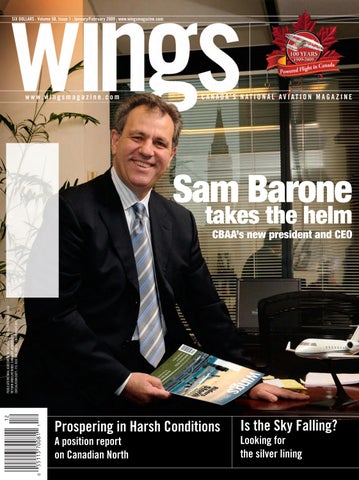
20 SAM BARONE TAKES THE HELM
CBAA’s new president and CEO
6 McCarthy Pride and Perseverance
8 On the Fly Industry news that’s important to Canadians.
12 Airline Insider
Brian Dunn covers the latest developments in the Canadian airline industry.
14 On The Web
A sample of our comprehensive online coverage of the Canadian aviation industry.
16 100 Years of Powered Flight in Canada
Ray Canon brings you a potpourri of must-see museums that showcase Canada’s heritage aircraft. Also, coverage of the Silver Dart replica, the Hawk One project, an aviation quiz and 100 Year celebrations and events.
18 Canadian Wings: A Remarkable Century of Flight
To commemorate the centennial of powered flight in Canada, the Canada Aviation Museum will open its newest exhibition, Canadian Wings: A Remarkable Century of Flight, in late February 2009. By Christina Lucas
19 Seaman
The Flim-Flam Man? Back with a new twist!
22 Prospering in Harsh Conditions
Frederick K. Larkin continues his series on Canada’s airline industry with an in-depth position report on Canadian North.
30 Is the Sky Falling?
Rob Seaman discusses the state of business aviation and where to look for a silver lining.
33 The Switch to 406 MHz
More than just a frequency change. By Carole Smith
42 Armstrong
What’s the Cost?
Faulty ELT technology foisted on aviation fleets
ON THE COVER
Sam Barone, CBAA’s president and CEO (Photo by Alain G. Dagenais)
he professionals at our new Technical Command Center have one of the world’s most sophisticated digital networks at their finger tips. Their desktops have real-time access to all Falcon systems diagrams, parts and repair details. And even more important, full access to the very engineers that built the plane.
Our aim is to help you solve the
most difficult problems in-person or online as quickly as humanly possible. Whether it means sending a team of Falcon trained service technicians across the globe. Or shipping one of the hundreds of thousands of parts from our nearest depot.
We stand ready with the people, systems and spirit that says “Do whatever it takes” to keep you flying. In all, Dassault Falcon has
over thirty service centers, nine parts centers and three tech centers waiting to serve you.
falconjet.com/service
McCarthy
Pride and Perseverance
DREW MCCARTHY is the editor of Wings.
The coming year promises to be one filled with both challenges and celebrations. As we kick off 2009, we face a daunting economic situation, some suggest the worse since the 1930s, and almost no one is predicting a fast recovery. Canadian aviation is already feeling the effects, but in an industry long inured to cyclical downturns, no one is overreacting. People are cautiously confident that we will all get through this; and in the words of Henry Ford, “Whether you think you can, or think you can’t, you’re right.”
Yet, amidst these trying times, there are still many things to celebrate. This year we are commemorating two important milestones in Canadian aviation.
WINGS MAGAZINE
PO Box 530, 105 Donly Dr. S., Simcoe, ON N3Y 4N5
Tel.: 428-3471 Fax: 429-3094
Toll Free: 1-888-599-2228
PUBLISHER TIM MUISE tmuise@annexweb.com
EDITOR DREW MCCARTHY dmccarthy@annexweb.com
ASSOCIATE EDITOR ANDREA KWASNIK akwasnik@annexweb.com
SENIOR ASSOCIATE EDITOR RICHARD PURSER
PRODUCTION ARTIST KELLI KRAMER
OTTAWA CORRESPONDENT KEN POLE
AVIONICS EDITOR ROB SEAMAN
FLIGHT DECK RAY CANON, JAMES CARELESS, DAVID CARR, NIKOLAS CHAPMAN, BRIAN DUNN, DARREN LOCKE, CARROLL McCORMICK, BLAIR WATSON
ADVERTISING SALES MARK MCWHIRTER mmcwhirter@annexweb.com
From the very beginning, Canada embraced aviation
On Feb. 23, 1909, from a frozen lake on Cape Breton Island, the AEA Silver Dart took off, marking the first heavier-than-air powered flight in Canadian history.
The AEA, an acronym for the Aerial Experiment Association, was made up of Casey Baldwin, Thomas Selfridge, Glenn Curtiss, Alexander Graham Bell and the man who piloted that first Canadian flight, J.A.D. McCurdy. Established in October of 1907, the association was funded and managed by Alexander Graham Bell’s wife, Mabel Gardiner Hubbard Bell. There are various estimates as to how much the project cost, but it was somewhere in the vicinity of $30,000 (approx. $700,000 in 2009 dollars).
One hundred years later, Canada is a recognized aerospace leader and the fourth largest aerospace producer in the world. Across the country, hundreds of aerospace companies employ more than 80,000 highly qualified Canadians. The industry produces almost $23 billion dollars annually, 82 per cent of which is exported. In fact, Canadian aerospace is the only advanced technology industry in the country that generates a consistent trade surplus.
From the very beginning, Canada embraced aviation. With nearly 10 million square kilometres of territory within its own borders and an entire world out there to discover by air, our nation has helped define aviation around the world.
At home, aerospace manufacturing, products and aviation services have played a vital role in regional economic development, tourism, moving people and goods and saving lives. Canadian aviators and Canadian aerospace products have touched virtually every corner of the earth and continue to do so on a daily basis.
Today, there are nearly 33,000 registered aircraft in Canada and hundreds of thousands of licensed pilots flying them.
In tribute to the Canadian centennial of flight, Wings magazine will be featuring historical articles and providing information about events that commemorate our 100 years. In May, we will be publishing a special supplement celebrating the anniversary. The second important milestone of 2009 is the 50th anniversary of Wings magazine. The aviation magazine that begins its story in 1959 in Calgary has covered the industry for a full half-century. In celebration of our proud history, we will be featuring special stories throughout the year and publishing our 50th anniversary issue in the fall.
PRESIDENT MIKE FREDERICKS mfredericks@annexweb.com
PUBLICATION MAIL AGREEMENT #40065710
RETURN UNDELIVERABLE CANADIAN ADDRESSES TO CIRCULATION DEPT., P.O. BOX 530, SIMCOE, ON N3Y 4N5 e-mail: awebster@annexweb.com
Periodical postage paid at Buffalo, NY. USPS 021-029, ISSN 0701-1369. Published six times per year (Jan/ Feb, Mar/Apr, May/Jun, Jul/Aug, Sep/Oct, Nov/Dec) by Annex Publishing & Printing Inc. US Office of publication c/of DDM Direct.com, 1175 William St., Buffalo, NY 14206-1805. US postmasster send address change to P.O. Box 611, Niagara Falls, NY 14304. Printed in Canada ISSN 0701-1369
CIRCULATION e-mail: awebster@annexweb.com
Ph: 866-790-6070 ext. 208 Fax: 877-624-1940
Mail: P.O. Box 530, Simcoe, ON N3Y 4N5
SUBSCRIPTION RATES Canada – 1 Year $ 34.00 (includes GST - #867172652RT0001) USA – 1 Year $ 50.00 Foreign – 1 Year $ 65.00
From time to time, we at Wings Magazine make our subscription list available to reputable companies and organizations whose products and services we believe may be of interest to you. If you do not want your name to be made available, contact our circulation department in any of the four ways listed above.
The Greater Toronto Airports Authority (GTAA) has opened the first common-use passenger lounge at Pearson International Airport. This new space, which opened on Nov. 1, is available for all international passengers travelling through Terminal 1, no matter which airline they are flying.
For a cost of $35, passengers have wireless internet access and the use of printers, monitors and flat-screen televisions. With admission comes unlimited food and beverage access. Meant to be a retreat for passengers who are looking for privacy, a place to
work or simply a place to relax before their flight, the lounge is operated by Plaza Premium.
Partnering with the GTAA
in the project was Samsung Electronics Canada, which provided all the monitors, printers and flatscreen televisions.
ATAC announces new president and CEO
John McKenna is the new president and CEO of the Air Transport Association of Canada (ATAC). McKenna has over 20 years of experience, having held a wide variety of transportation-related assignments in both the public and
private sectors. These include senior positions in the transportation sector of the Quebec provincial government. He has also been president and general manager of the Association québécoise du Transport Aérien since 2003.
McKenna holds a Master of Public Administration from Harvard University, a Master of Business Administration from Sherbrooke University and a Master of Arts in Soviet and East European studies from Carleton University.
Western Avionics retrofits Nav Canada CRJs
Western Avionics has completed the conversion of two Bombardier Regional Jets from passenger configuration into flight inspection aircraft for Nav Canada.
Working closely with Nav Canada, Western Avionics engineers developed, installed and certified a new Flight/Airways Inspection system in Nav Canada’s CRJ-200s. The systems consist of 17 new antennas, a Flight Inspection Services operator console and workstation, along with requisite equipment racks for easy access to
all necessary components.
Cockpit upgrades included dual GPS/WAAS-capable flight management systems for GPSbased precision approach capability, dual electronic flight bags and a new digital audio system configured for seven users. More extensive upgrades include a Cat III heads-up guidance landing system and ADS-B enabled ATC transponders.
The operator console is equipped with a Universal Avionics EFI-890R flat-panel PFD
with a Vision 1 synthetic vision system for increased situational awareness. The aircraft was then specifically certified for low-altitude “Clean Configuration” airwork.
Nav Canada’s next project is the conversion of a de Havilland DHC-8 from its current 37-seat passenger configuration into a Flight Inspection Services aircraft. This latest aircraft will arrive at Western’s Calgary International facility in January.
Lockheed Martin receives contract to extend Aurora service life
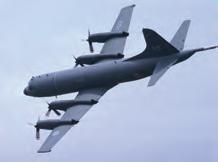
Lockheed Martin has received a $156-million contract to provide the P-3 Aircraft Service Life Extension Program (ASLEP) for Canadian Forces. Under this contract, 10 Canadian CP140 Aurora aircraft will receive Life Extension Kits consisting of all-new outer wings, centre wing lower surface assemblies, horizontal stabilizers, wing and horizontal stabilizer leading edges and various items to be installed on a conditional basis. Lockheed Martin Life Extension Kits will provide, on average, an additional 20-25 years of service life for the world’s Orion and Aurora fleets and will greatly reduce maintenance costs over the aircraft service life.
Canada becomes the fourth customer under the Lockheed Martin P-3 ASLEP. Other customers are the Royal Norwegian Air Force and U.S. Customs and Border Protection, and the U.S. Navy is under contract for 13 sets of new outer wings. A proposal for the Taiwan P-3 fleet is also in progress.
10 Canadian CP-140 Aurora aircraft will receive Life Extension Kits from Lockheed Martin.
The first common-use passenger lounge at Toronto Pearson International Airport is available for all international passengers travelling through Terminal 1.
(Photo courtesy of Den Pascoe)
JetPro completes WAAS instrument procedure development
JetPro, an Alberta-based engineering firm specializing in satellite-based instrument approach and departure procedure design, has successfully completed the development of Wide Area Augmentation System (WAAS) instrument approaches to eight airports in Canada. JetPro is the first organization in Canada to provide a totally integrated GPS instrument approach design and flight-checking capability.
Sixteen WAAS approaches
have been designed and flightchecked by JetPro and another four airports and six WAAS approaches were in the process at the end of 2008, including approaches to some challenging mountain airports in Western Canada. In 2009 JetPro anticipates implementing approximately 60 WAAS approaches at new and existing client sites throughout Canada.
WAAS approaches provide airport operators with an ILS capability for the cost of procedure
development with no airport infrastructure required. Airport operator clients include resource companies that own and operate their own airfields; community airports that seek the operational and economic advantages of GPS/WAAS approaches to their airports to support commercial flights and medical evacuations; and air carriers that see new market opportunities in introducing GPS approach and departure procedures to airports.
Cavalier becomes Canada’s newest Cessna Service Facility
Cavalier Aviation Ltd. has become Cessna’s newest Authorized Service Facility and parts distributor, serving the Calgary area. This service facility status covers the full line of all propeller aircraft ever produced by Cessna Aircraft Co.
Cavalier started the application process in January 2008 and was awarded the contract on Oct. 22 for single-engine (including the new 350 and 400), multi-engine, turboprop and Caravan. Cavalier can handle warranty claims for any owners of new Cessnas,
which is where it expects most of its new business to come from.
The company is also an authorized Garmin Service Centre and instrument-rated AMO for those who want to update their older Cessnas with new avionics or have warranty claims and recertifications done on their new G1000 models. The facility has a full-service sheet metal shop for larger projects including insurance repairs.
Cavalier has hired two more parts sales staff at its Springbank
Airport facility to handle the increased load and will continue to train more of its seven full-time engineers on the new products being offered by Cessna.
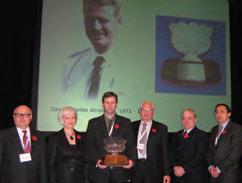
Bob Henderson receives DCAM Flight Instructor Safety Award
The 2008 recipient of the national David Charles Abramson Memorial Flight Instructor Safety Award is Bob Henderson, director of flight operations and chief flight instructor at Moncton Flight College. Henderson was presented with the trophy by Jane and Rikki Abramson, the founders, at the ATAC convention in Calgary in November.
With 500 full-time students in four different programs, Hen-
derson has worked tirelessly over the past several years with three different government aviation agencies – Transport Canada, the Civil Aviation Authority of China and Europe’s Joint
Events Calendar
MARCH 2009
Aviation Industry Expo
March 10-12
Las Vegas, NV www.AviationIndustryExpo.com
NBAA Inaugural Light Business Airplane Exhibition & Conference
Canadian Technical Security Conference & Trade Show
April 27-29
Mississauga, ON http://www.pdtg.ca/ CTSC005.htm
Canadian Aviation Safety Seminar (CASS) April 28-29
Calgary, AB http://www.tc.gc.ca/ civilaviation/systemsafety/ CASS/menu.htm
Aviation Authority Training.
To preserve the historical record of the award, the recipient’s name is engraved on the trophy and entered in the official logbook, which are both on permanent display at the Canada Aviation Museum in Ottawa.
For a full list of events, please visit www.wingsmagazine.com and go to events.
Cavalier is located at Springbank Airport (YBW).
(Left to right): Michael Skrobica, VP industry monetary affairs, ATAC; Jane Abramson; Bob Henderson; Rikki Abramson; Mike Doiron, chairman of the board of directors, ATAC, and principal and CEO of Moncton Flight College; Wayne Gouveia, VP commercial general aviation, ATAC.
Boeing completes destructive testing on 787 wing box
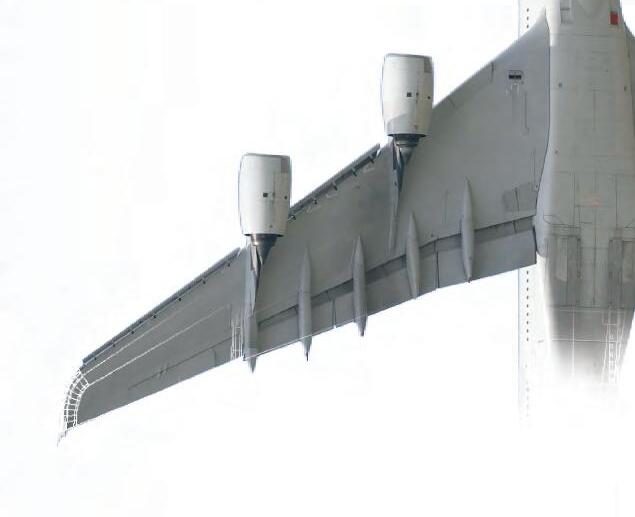
Boeing completed destructive testing in November on a full-scale composite wing box of the 787 Dreamliner, the first all-composite wing box ever built for a Boeing commercial airplane.
To meet certification requirements, the wings must withstand loads up to 1.5 times the highest aerodynamic load that the jet could ever be expected to see in the entire lifetime of the 787 fleet.
The test wing box weighs 55,000 pounds, including a great deal of test-only hardware and instrumentation. It was designed and built by a joint team of Boeing, Mitsubishi Heavy Industries and Fuji Heavy Industries.
Structural testing will continue on two full-scale 787 airframes, which will further demonstrate the performance of the structure through multiple lifetimes of
EADS opens office at NRC site
European Aeronautic Defence and Space (EADS) has opened an office at a National Research Council (NRC) site in Montreal to further strengthen its commitment to aerospace research and technology development in Canada. Opening an office within the NRC’s Institute for Aerospace Research will allow EADS and NRC to share expertise and resources in the
research and technology field and ultimately help to underpin more high-tech jobs in Quebec and Canada.
The agreement follows last June’s signing of a five-year memorandum of understanding between EADS and NRC to cooperate on R&D for aerospace applications within Canada. Under its terms, EADS-owned Airbus has already
normal operational loads and test it beyond the points expected to be seen in service.
London International Airport approved for international air cargo transshipment
signed a 10-year cooperation agreement with NRC covering subjects ranging from manufacturing technologies to flight tests for environmental investigations.
EADS has over 100 suppliers in Canada including Pratt & Whitney Canada, Bombardier, Thales Systems Canada, CMC Electronics, MDA, Com Dev and Messier-Dowty.
Embraer breaks ground for first U.S. assembly plant
Embraer broke ground in early December for its first U.S. aircraft assembly plant and customer centre at Melbourne International Airport in Florida. The new facility will be dedicated to the company’s executive jet business and is scheduled for completion in 2010.
When full capacity is reached, up to eight Phenom business jets
will be produced every month. The plant will become Embraer Executive Jets customer centre for the configuration of Phenom, Legacy and Lineage jets. Customers will be able to design their executive jets’ interiors with the use of 3D visualization technology, supported by a showroom with a collection of interior finishing materials.
Standard Aero names Claude Chidiac business development VP
Standard Aero has appointed Claude Chidiac as vice-president of development for business aviation, based in Tempe, Ariz. He will be responsible for developing a sustainable long-term strategy for the
business aviation sector and for creating innovative approaches to growing existing products and services.
Chidiac was earlier Program Management Office vice-president for Bombardier Aerospace
and was most recently managing director for Grob Aerospace. He is a pilot, and holds a master’s degree in business administration and a bachelor’s degree in mechanical engineering from McGill University.
Transport Minister John Baird announced in December the approval of London International Airport (YXU) to participate in the international air cargo transshipment program. This allows international air cargo to be moved through the airport for shipment to third countries, enabling the airport to seek new market opportunities and further develop its air cargo activity. The program enables the Canadian Transportation Agency to authorize any foreign or Canadian air carrier to use London International to transship international air cargo, even if these rights are not provided in Canada’s bilateral air transport agreements. In addition, air carriers will be able to combine such cargo transshipments with other services for which they may be licensed.
The international air cargo transshipment program was introduced at Mirabel Airport in 1982 as part of a larger effort to improve the use of Montreal-area airports. It has since been expanded to other airports, including Hamilton (1987), Windsor (1993), Gander (2000), Winnipeg (2004), Edmonton (2006), Calgary (2007), Abbotsford, Vancouver, Moncton, Toronto, Halifax and Prince George (2008).
Embraer’s new facility is scheduled for completion in 2010.
787 Dreamliner has the first all-composite wing box ever built for a Boeing commercial airplane.
Viking Air chasing deal to replace aging Buffalo fleet
Recent reports suggest that the Canadian Government intends to spend $3 billion for up to 17 new fixed-wing search and rescue aircraft to replace its aging CC-115 Buffalo fleet.
Viking Air of Victoria, B.C. is pitching the Harper government to reconsider plans for replacing the aging Buffalo planes with what industry sources speculate could be the sole-source purchase of the ItalianAmerican C-27J Spartan.
Viking Air Ltd. recently sent a letter to all MPs pressing its point as Defence Minister Peter MacKay prepares to tender the $3-billion contract. Viking Air president David Curtis said he can build a modernized version of the Buffalo for 40 per cent less than the C-27J, produced by Alenia North America, a subsidiary of Italy’s Alenia Aeronautica, while at the same time providing a much needed stimulus to revive the Canadian economy.
Curtis said Ottawa should consider a joint Viking Air-Bombardier Inc. proposal, because while Buffalos are ideal for Western Canada, Bombardier’s search and rescue plane, a variant of its Q-Series Dash 8 passenger aircraft, might work better on the East Coast.
Alenia is also pledging major industrial benefits for Canada if it wins the contract. It is promising to bring $3 billion in hightech aerospace work to Canadian companies and to provide access to further opportunities through parent Finmeccanica.
To read a letter to the editor from Viking Air, go to www.wingsmagazine. com and click on web exclusives.
Viking wants to build a modernized version of the CC-115 Buffalo.
airlineinsider
WEATHERING THE STORM
All things being equal, Canadian airlines will continue to face a challenging year for most of 2009, says McGill University marketing professor Karl Moore. On the positive side, fuel prices will remain low, but that will be offset by lower demand for both business and leisure travel.
“WestJet and Air Transat are both increasing capacity, which will make things much worse for Air Canada,” said Moore. “A lot of CEOs I’ve spoken with tell me the economy won’t improve before the second quarter of ’09, while people in Europe don’t expect things to turn around before the third or fourth quarter.”
What Air Canada does have in its favour, says Moore, is a relatively young fleet and a good international product in business class. “And Air Canada was anticipating problems with its unions in 2009, but the state of the economy should calm things down a bit.”
ENERJET – AN UPSTART WITH A UNIQUE FOCUS
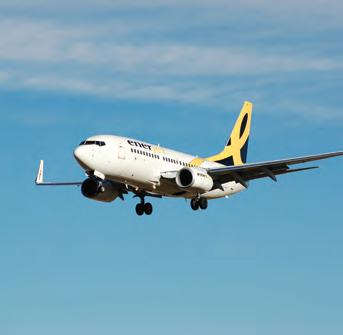
There’s a new player in Canada’s aviation industry with the Nov 30 launch of Calgary-based Enerjet by former executives of WestJet Airlines. The upstart carrier is leasing two 131-seat Boeing 737-700 Next-Generation aircraft and plans to avoid direct competition with Air Canada and WestJet by target-
ing smaller cities currently not served by the two carriers. The charter carrier’s main focus is the transportation of workers in the oil and gas, mining and hydroelectric sectors in Alberta, Ontario and the Maritimes, says Bill Lamberton, vice-president of marketing and sales.
“It’s a niche that nobody has focused on as a priority and we want to be the best in that business. Despite the current economic slowdown, we’re confident the projects we’re targeting are not cyclical and won’t be impacted over the long term by the recession.”
Looking ahead, EnerJet plans to add some tour operations in secondary Canadian cities as it acquires additional aircraft.
PORTER BREEZES INTO THE WINDY CITY
Porter Airlines continues its route expansion with the addition of Chicago Midway International Airport with six daily round-trip flights per weekday and two each on Saturday and Sunday from Toronto City Centre Airport.
“This is another milestone in Porter’s development and we’re pleased to bring our unique service to Chicago,” said Robert Deluce, president and CEO of Porter Airlines. “This will change the travel experience between Toronto and Chicago, making it fast, convenient and simple.”
Porter is bringing to Chicago its reputation for a refined travel experience, providing passengers with full service and value throughout the entire trip, Deluce added.
“Porter Airlines’ service offers a great opportunity for Chicago travellers to visit Toronto,” said Richard Rodriguez, Chicago aviation commissioner. “This new international service is a welcome addition to the numerous domestic destinations offered at Midway.”
Expanded service to further U.S. destinations such as Boston, Washington and Philadelphia is planned as additional aircraft are delivered over the next 18 months.
AIR CANADA COMMITS TO ATLANTIC CANADA
Beginning Feb. 6, Air Canada will offer twice-weekly seasonal service between Halifax and Orlando until May 10. The Friday departures from Halifax will use 120-seat Airbus A319 aircraft, while Sunday departures will use 93-seat Embraer E190 aircraft.
“The new Halifax-Orlando service reflects our ongoing commitment to pursue all viable market opportunities in Atlantic Canada,” said Daniel Shurz, Air Canada’s vice-president, network planning.
In addition to the new seasonal service to Orlando, Air Canada’s winter schedule includes flights to Cancun and Cozumel in Mexico, Cayo
By Brian Dunn
Coco, Holguin and Varadero in Cuba, Puerto Plata and Punta Cana in the Dominican Republic, Montego Bay in Jamaica, and Bermuda.
NEXT STOP, SWITZERLAND
Air Canada will also begin new year-round service on June 2 between Montreal and Geneva. Daily Boeing 767-300 service will be offered during the summer months and it will be codeshared by Star Alliance partner Swiss International Air Lines. The aircraft seats 211 passengers, including 24 lay-flat bed suites in Executive First Class. Flights will originate and terminate at Toronto and provide same-plane service via Montreal to Geneva. Flight AC830 will depart Toronto at 1800 and Montreal at 2045, arriving in Geneva at 1005 the next morning. Air Canada also offers service from Montreal and Toronto to Zürich.
Also recently announced is a non-stop service between Montreal and Rome to meet seasonal travel demand. Beginning June 20, 2009 the carrier will operate daily non-stop flights during the busy summer travel season linking the Italian capital with Air Canada’s extensive Québec and Atlantic Canada network, as well as major cities on the Eastern U.S. seaboard. Re-introduction of direct MontrealRome service complements Air Canada’s Toronto-Rome nonstop service set to resume in February 2009.
CHALLENGING WINTER AHEAD FOR TRANSAT
Tour operator Transat AT is expected to face a challenging winter season with margins www.wingsmagazine.com
Based in Calgary, Enerjet is an upstart carrier launched by former executives of WestJet Airlines.
Air Canada will offer twice-weekly seasonal service between Halifax and Orlando until May 10.
ontheweb
www.wingsmagazine.com
Web Exclusives:
LETTER: To the Honourable John Baird
Re: Future of Buttonville airport
“(The undersigned organizations)... have drafted this correspondence to convey to you our collective apprehension and concern regarding the future and well-being of the Buttonville Airport and its related community of resident and extended business and service interests. This has come to light after the recent disclosure by the Greater Toronto Airports Authority (GTAA) of their intent to cancel the current “Capacity Maintenance Agreement” between the GTAA and Buttonville, effective April of 2009.”
To read the full letter, go to www.wingsmagazine.com and click on Web Exclusives.
AME HALL OF FAME: HARRY E. HOPE
Harry Hope, the 2008 AME Hall of Fame Inductee, was born in Lashburn, Saskatchewan on July 13, 1931. During his 50 years of involvement in the aviation field, he was honoured with several awards for his outstanding contribution and service to the AME profession. Harry retired from Hope Aero in September 2001.
To read more about the AME Hall of Fame and its inductees, visit www.wingsmagazine.com and go to the Community section.
AIRLINE INSIDER
CONTINUED FROM PAGE 12
being driven down by fierce competition and increased capacity to sun destinations, says investment bank Versant Partners. The company is increasing capacity by 12 per cent during a weak economy when both consumer confidence and the loonie are heading south. Although Transat is a “well-run company,” Versant says the challenges facing it have increased significantly and the bank is lowering its expectations accordingly.
LIBERALIZED AIR AGREEMENT WITH EUROPE A BOOST FOR CANADA
Canada has successfully concluded negotiations with the European Union on a comprehensive air transport agreement. The EU is Canada’s
second-largest bilateral aviation, trade and investment market. A comprehensive Canada-EU air transport agreement will benefit travellers and shippers by providing more choices in terms of destinations, flights and routes, more direct services, and the potential for lower fares.
The landmark deal replaces a patchwork of bilateral agreements Canada had with 19 of the 27 EU member states. It allows any carrier from either market to operate direct service between anywhere in Canada and anywhere in the EU without restrictions on frequency, capacity, pricing or other artificial market barriers. It includes open skies for cargo.
The agreement also covers eight EU member states (Cyprus, Estonia, Latvia, Lithuania,
A-LIST
The Canadian Aviation Guide (A-List) is the only reference tool to bring the entire Canadian Aviation industry together in one directory.
Luxembourg, Malta, Slovakia and Slovenia) with which Canada did not previously have air agreements.
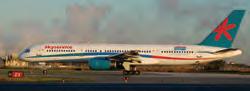
Skyservice Airlines and Signature Vacations have renewed their long-term agreement whereby Skyservice will continue as the exclusive provider of dedicated aircraft to Signature Vacations supporting its network of vacation packages.
Skyservice has been providing dedicated aircraft to Signature
Visit www.wingsmagazine.com to sign up for a free trial of Wings magazine – digital version
since early 2002.
“Over the past six years, Skyservice Airlines has provided Signature Vacations’ customers with superior customer service,” said Mike Price, president of Signature Vacations. “We are pleased to continue our partnership with Skyservice and will continue working together to maximize our customers’ in-flight experience.”
“We are delighted to have extended our agreement with Signature Vacations,” said Rob Giguere, president and CEO of Skyservice Airlines. “Over the years Skyservice and Signature have become excellent partners. We are looking forward to continuing to meet and exceed the expectations of Signature’s customers for a long time to come.”
Skyservice will continue as the exclusive provider of dedicated aircraft to Signature Vacations.
100
years
Canada’s Museums Tell the Story
Five years ago, Wings introduced the series, “A Look Back.” During those five years readers have been brought a whole series of aircraft designed, built or flown in Canada and, while your humble scribe must admit that he has never designed or built any of them, he can take pleasure in flying in many of them, with only one forced landing to his credit.
Many of these aircraft are to be found at various locations throughout the country and it is the purpose of this edition’s column to tell you about some of them. So varied and great is the quantity on display that it is impossible to mention all locations; instead we will bring you a potpourri of museums where the aircraft can be seen up close.
Our first article featured, quite appropriately, the Silver Dart, which on Feb. 23, 1909 became the first aircraft to fly not only in Canada but in the British Empire. The flight at Baddeck, N.S. was a short one but made history and today a replica of the plane may be seen in the international arrival area of Halifax Stanfield International Airport. A quick look at the Silver Dart and then the tarmac outside will remind you what giant strides aviation has made in precisely 100 years.
The Avro Arrow is arguably the most famous aircraft
ever to take to Canadian skies. Thanks to the Toronto Aerospace Museum (but no thanks to the Canadian government of that day) a full size replica of the Arrow may be seen. When it is realized that Canada designed not only the aircraft but also the Iroquois, the jet engine to go with it, it is not hard to understand that in the 1950’s this country was at the cutting edge of aviation technology.
At the CAF Trenton Museum some 100 miles east on Highway 401 sits a rebuilt HP Halifax Mark III fourengined bomber of World War II days. Retrieved from a lake in Norway, the model, after undergoing years of careful labour, is in pristine condition in honour of all the RCAF bomber crews who flew it as part of No. 6 Bomber Group.
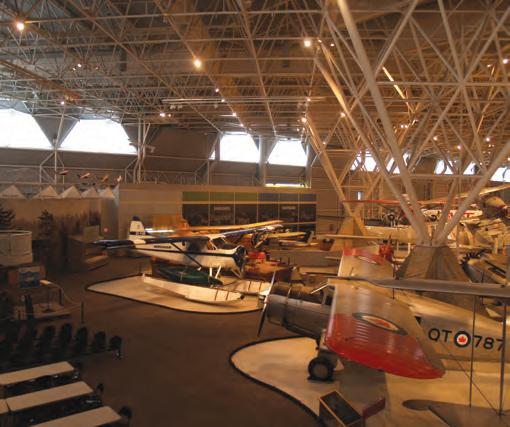
No tribute to aviation displays would be replete without mention of the Canada Aviation Museum situated on the former RCAF Station Rockcliffe, just east of Ottawa. On show is a veritable cornucopia of aircraft dating back to the early days of flying, including some that flew in battle against the RCAF.
On the other side of the Ottawa River is the collection at Gatineau P.Q., a mustsee on your museum visits, vicarious or otherwise. Mike Potter has invested millions into a flying display of vin-
tage aircraft that is known the world over. Included in his stable are flying versions of the Battle of Britain stalwarts – the Hurricane and Spitfire.
Joining the above two on occasion is the Avro Lancaster from the Canadian Warplane Heritage Museum at the John C. Munro Hamilton International Airport. The name reflects the type of aircraft to be found there and restoration projects are constantly underway.
Other museums, big and small, are to be found everywhere. Winnipeg’s Western Canada Aviation Museum, Canada’s second largest, displays a Bristol Freighter, while their A-26 Invader is definitely worth a look. In Calgary, one time zone to the west, the city’s Aero Space
Museum features, among other items, one of Burt Ruttan’s creations, along with the Sopwith Triplane of World War I vintage.
Still another time zone westward is the British Columbia Aviation Museum on Vancouver Island where you can see the Noorduyn Norseman and the Bristol Bolingbroke.
Have I missed some notable displays? Of course, but not intentionally! But I can conclude by reminding you that 25 odd miles from the editorial head office of Wings in Simcoe, Ontario is the country’s largest collection of flying Harvards in Tillsonburg. Nine of them in formation in the air is definitely a display! – By Raymond Canon
OF POWERED FLIGHT IN CANADA
The Canada Aviation Museum is situated on the former RCAF Station Rockcliffe, just east of Ottawa.
The Silver Dart replica
To commemorate the centenary of powered flight in Canada, a group of aviation enthusiasts in the Niagara Peninsula are building a replica of the Silver Dart, the first aircraft to achieve successful, controlled powered flight in Canada and the British Commonwealth. Piloted by flight pioneer John Alexander Douglas (J.A.D.) McCurdy, the flight took place off the ice-covered Baddeck Bay in Nova Scotia
To commemorate the centenary of powered fl ight in Canada, a group of aviation enthusiasts in the Niagara Peninsula are building a replica of the Silver Dart, the fi rst aircraft to achieve successful, controlled powered fl ight in and the British Commonwealth. Piloted by fl ight pioneer John Alexander Douglas (J.A.D.) McCurdy, the fl ight took place off ice-covered Baddeck Bay in Nova Scotia
on Feb. 23, 1909.
The Niagara group, known as the AEA 2005, commenced work on a full-scale, replica of the Silver Dart 2005 which is scheduled to fly on anniversary date Feb. 23, 2009, from Baddeck Bay, N.S. Bjarni Tryggvason, Canadian astronaut, aerobatic pilot and professor aerodynamics at the University of Ontario pilot the fl ight.
on Feb. 23, 1909. The Niagara group, known as the AEA 2005, commenced work on a full-scale, flying replica of the Silver Dart in 2005 which is scheduled to fly on the anniversary date of Feb. 23, 2009, from Baddeck Bay, N.S. Bjarni Trggvason, Canadian astronaut, aerobatic pilot and professor of aerodynamics at the University of Western Ontario will pilot the flight.
“Hawk One” of the Centennial Heritage Flight will constitute a highly visible tribute to the commemoration of 100 years of powered flight in Canada in 2009. “Resurrect, Celebrate and Motivate” is the theme behind the refurbishment of a classic
RCAF F-86 Sabre 5 (Canadair Serial Number 23314) in the colours of the legendary Golden Hawks aerobatic team that thrilled Canadians for five airshow seasons commencing 1959.
Led by former Snowbird commander LCol Steve Will,
TEST YOUR KNOWLEDGE: Canadian aviation
1. In 1959 the Diefenbaker government cancelled the Avro Arrow (CF-105) supersonic fighter jet program and tried to destroy all evidence of the project’s existence. Aside from bits and pieces in private hands, what parts of the plane survive in the Canada Aviation Museum in Ottawa?
a) one working prototype
b) the test pilot’s briefs
c) landing gear
d) two outer wing sections/ one cockpit
2. Canadian-made airplanes have been given charming names such as Harbin-
ger, Silver Dart, Aurora and Canuck. Which of the following aircraft types is not one of ours?
a) Chipmunk
b) Otter
c) Warthog
d) Beaver
3. For which feat was the CL-84-1 Dynavert known?
a) first inverted flight
b) fixed-wing/VTOL
c) first averted flight
d) wing-warping technology
4. Thirty-three Canadair CP-107 Argus anti-submarine aircraft were built, and entered service in 1958 (one
AEA 2005 group visit www. wingsmagazine.com and go to web exclusives, and www. silverdartreplica.com.
AEA group visit www. wingsmagazine.com and go web exclusives, and www. silverdartreplica.com.
the Hawk One team brings together a formidable group of highly experienced military and civilian professionals that includes one of Canada’s most famous aviators, astronaut Chris Hadfield. To read more about Hawk One, visit www.hawkone.ca.
Maritime Museum of the Atlantic Halifax, NS http://museum.gov.ns.ca/ mma/events/events.html
Winter Carnival Centennial Of Flight Theme Feb. 9
Greenwood Military Aviation Museum Greenwood, NS http://gmam.ca/
source dates it 1957). Where were they stationed?
a) CFB Greenwood
b) CFB Shearwater
c) CFB Goose Bay
d) CFB Wawa
5. In 1941 Wilbur Franks invented the anti-gravity suit. For what kind of aviator was this device designed?
a) parachutists
b) balloonists
c) bombardiers
d) fighter pilots
For more questions and answers, visit www.wingsmagazine.com and click on the 100 Years logo.
Flight of the Silver Dart Centennial Anniversary Feb. 20-24
Graham Bell Museum Baddeck, NS http://www.flightofthe silverdart.ca/
100th Anniversary event Alberta Aviation Museum Edmonton, AB Feb. 21-22
http://albertaaviation museum.com/index.php
Back to Baddeck Feb. 23 (flights begin in Baddeck, NS)
Canadian Aeronautical Preservation Association
http://www.capa-acca.com/ back_to_baddeck_toc.htm
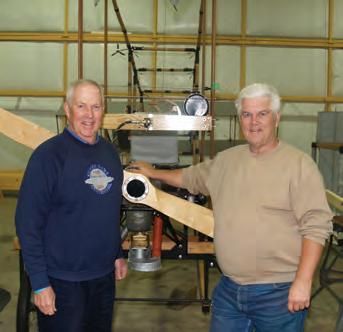
AEA 2005 members Gerald Haddon (left) and Doug Jermyn in front of Silver Dart replica during its construction.
CANADIAN WINGS
A Remarkable Century of Flight
By Christina Lucas
As we all know, 2009 is an important year in Canada’s history. It is the year that marks the centennial of powered flight in Canada. 100 years ago, on February 23, 1909, the Silver Dart, an experimental aircraft piloted by Canadian aviation pioneer J.A.D. McCurdy, a member of Alexander Graham Bell’s Aerial Experiment Association (A.E.A.), took off from Baddeck, Nova Scotia, achieving the first powered and controlled flight in our country.
To commemorate this significant milestone, the Canada Aviation Museum will open its newest exhibition, Canadian Wings: A Remarkable Century of Flight, in late February 2009. Museum visitors will discover the rich aeronautical heritage that has been established in this country since that first tentative flight.
The exhibition features four key themes:
Getting Into the Air (and Staying There): 1902-1918 is a tribute to the earliest days of aviation and examines the “Wonderful World of Flying Machines,” “Understanding
Canadian Wings
Flight,” and the impressive aviation innovations developed during the course of the First World War. Of special interest is the reproduction of the Silver Dart.
Tying the Country Together: 1919-1938 explores how powered flight connected Canada and Canadians in entirely new ways. Visitors will undoubtedly take pride in the truly Canadian concept of bush flying.
This period of ‘firsts’ included groundbreaking flights that inspired the imagination and cemented aviation in our collective consciousness. Highlighted are iconic bush aircraft such as the Curtiss HS-2L La Vigilance, the Noorduyn Norseman and the de Havilland Canada Beaver that played important roles in connecting Canadians by moving freight, mail and passengers in Canada’s more inaccessible areas.
Industry and War: 19391945 demonstrates the Second World War’s role as a catalyst for growth in all segments of aviation. During this rela-
A Remarkable Century of Flight
Lavishly illustrated and richly told, this stunning tribute to the pioneers of northern aviation and their daredevil feats puts Canadian achievements in their rightful place on the world stage. Author Stephen Payne is the curator of aeronautical technology at the Canada Aviation Museum.
tively short period of time, a rapid pace of innovation and change took place that included the emergence of a Canadian aircraft manufacturing industry and the development of the impressive British Commonwealth Air Training Plan which trained over 130,000 airmen for service overseas. Many of the aircraft from this period, such as the North American Harvard and the Avro Lancaster, still hold a particular significance in the lives of many Canadians.
Shrinking the World: 1946 to Present illustrates a period of growth in commercial aviation that is represented by aircraft such as the Douglas DC-3 and the Bombardier Challenger. The emergence of the airline industry has served Canadians in the remote North as well as urban areas, and has brought new Canadians from around the world to their new homes in this country. One of TransCanada Air Lines’ first Lockheed 10As and the Boeing 247, the world’s first modern airliner, are rare artefacts from
the 1930s that represent the dawn of airline travel.
The exhibition continues its march in time by highlighting more recent developments, such as Cold War technology. Some of the impressive aircraft that served with the RCAF and/or the Canadian Forces during this era, such as the Canadair Sabre, and the record-setting Lockheed Starfighter, are displayed.
This journey continues as Canada’s entrance to the jet age follows with a collection that features Canada’s first jet fighter, the de Havilland Vampire, the only remaining section of the legendary Avro Canada CF-105 Arrow, and the contemporary CF-18 Hornet, to name only a few.
Two specialized aspects of aviation history, naval and rotary-wing aircraft, are also represented. Fascinating naval aircraft, with their “folding wings” include the eminent Fairey Swordfish of Second World War fame, and the Museum’s helicopter display that features the last Boeing Vertol Labrador to fly with the Canadian Forces, with its life-saving legacy and many stories to tell.
Aviation has truly played a significant role in the growth and prosperity of Canada and still does today. The Canada Aviation Museum is an institution dedicated to the preservation of this aspect of Canada’s heritage.
When you hear the term Flim-Flam Man you may think first not of that 1967 film but of Professor Harold Hill in the 1957 musical The Music Man. His game was travelling town to town selling the idea of creating a town band. In the process he bilks an entire community, from the mayor on down, out of their cash to buy band instruments and uniforms – never intending to deliver on the promised training that is supposedly included.
The latest version of this kind of con artist is a supposed aircraft purchaser who never intends to buy any aircraft but succeeds in getting sellers to give him money! Ridiculous and highly unlikely, many would think? The truth is that this game is routinely being played out on a daily basis. The player is not as smooth as Professor Hill, but increasingly the banter and scam is getting better and more sophisticated. It is unfortunately part of the price we pay for an internet-based society and a very strange economy. The bottom line is that the aviation sector has become the latest playing field for those looking to make money from nothing. And the number of scams seems to be rising – along with the scammers’ reach and outright gall.
According to one Toronto-based lawyer, most of these scams originate from someone with a computer in an internet café somewhere. They Google a bunch of websites and rip off information to post on their own site, making them look credible. Look closer, though, and you can see that some of the letters are switched or the quality is not quite up to snuff. Case in point, Nav Canada has just issued a warning about an e-mail scheme that involves sending out phoney collection notices. The language is pretty threatening and leaves no doubt that failure to pay will result in grounding your future flights. But look carefully at the note and compare it to genuine notes from folks at the real office that have an e-mail address suffix of @navcanada.com. The address on the scam is @nav-canada.com. Little changes like that hyphen are the things that can be the “tell” between a genuine and fraudulent note. As the lawyer says – for every 10 or so of these things that they bang out while sipping coffee and laughing at us, there is inevitably one person who will reply and in the process become a victim of fraud.
seaman
It is by no means only inexperienced aviation professionals who are getting hit with these frauds. With the growing inventories of resale aircraft and the lack of solid buyers lined up at the door (as they were a few months back), the sales game has changed. As one broker noted, in this economy nobody can afford not to check out every opportunity. But figuring out the good from the bad takes time. These scams play on our need to make a living, and the time wasted is criminal in itself.
A recent large-scale airplanebuying scam involved the 2010 FIFA World Cup being hosted in South Africa. It started in September and has involved at least four Canadian and three U.S. brokers to date. Had everyone fallen for the ruse, with just the known brokers alone it could have netted almost $1 million to the scam artists.
The FlimFlam Man Back with a new twist!
In another twist, these scams have also been used as a means to gain illegal entry to Canada. According to some reports, there may be a request for a letter of invitation (from those living in nations that require such) to come and see the aircraft. This apparently is then used as a means for the person to gain entry – even though those selling the aircraft will never hear from that person again. This then becomes an issue of immigration regulations and can potentially put the invitee into hot water.
Fortunately, this industry is close-knit. Even though they might be competing for the same sale, people share information in this business. That openness can continue to save us from being future victims. When colleagues call to say they heard you might have some knowledge about doing business in South Africa, taking the time to explain will not only save them from the same loss and aggravation, it will thwart the scammers. This frequently opens networking opportunities on the real deals that are out there. Not very many other industries could brag about this sort of in-business camaraderie. Will we stop the scams? No. But keeping together makes it harder for their perpetrators to win.
As Red Green says – “We’re all in this together!”
ROB SEAMAN is a Wings writer and columnist.
SAM BARONE TAKES THE HELM
CBAA’s new president and CEO
By Ken Pole
Four hundred and ninety-nine — and counting. That’s the number of aircraft operated by the 518 members of the Canadian Business Aviation Association. The discrepancy arises from the fact that while some CBAA members have several aircraft, others such as fixedbase operators (FBOs), have none and there are fractional ownerships to consider as well.
Mostly a broad range of fixed-wing, but with 14 helicopters, the fleet mixture presents a considerable managerial challenge and the CBAA’s new president and CEO, Sam Barone, is certainly up to the job. Having recently moved over from the same job at the Air Transport Association of Canada (ATAC) and succeeding the equally personable Rich Gage, Barone brings expertise, affability and passion to the CBAA.
Fluent in English, French and Italian (hence the threesyllable pronunciation of his family name), Barone has been in the aviation business for 28 years in both the public and private sectors. His federal government experience includes Transport Canada, the Canadian Transportation Agency and the Competition Bureau. Economics degrees and post-grad business studies at Harvard and Queen’s have given him valuable insight into a broad spectrum of aviation issues, inter-
national as well as domestic.
Having settled in with a view of Parliament Hill from his fourth-floor office in the capital’s downtown core, Barone began his CBAA tenure with the obligatory review of files with an eye firmly on the organization’s strategic future in a rapidly-evolving economic, regulatory and political environment. In his first few weeks on the job, he visited CBAA chapters in Montreal, Toronto, Edmonton, Calgary and Vancouver for a first-hand look at members’ operational challenges.
“There’s no end of issues facing the aviation industry in general, particularly issues surrounding the cost of doing business, both with airports and our suppliers,” he said in an interview. “We’re also looking at security and border management issues that are continually coming up: the lack of standardization and harmonization, especially here in North America. While we are under the Security and Prosperity Partnership, an initiative that has come about in the last three or four years, there’s no end to the new initiatives that industry has to comply with.”
The environment and aircraft emissions are another hot button on which the CBAA is allied with the International Business Aviation Council (IBAC) within the framework
of the International Civil Aviation Organization (ICAO). The CBAA didn’t have a formal position on the “green shift” proposal that helped to scupper the Liberals in the October general election just as Barone was settling in. However, the organization’s position “has always been that anything that adds costs without mitigating greenhouse gas emissions . . . is an issue for us.”
Nor was former Liberal Leader Stéphane Dion’s carbon tax proposal “a very clear signal to the marketplace at a time when we have a good news story to tell.” That’s the fact that emissions as measured in flight hours and number of flights have been declining over the last couple of decades. “Put it
in perspective: aviation overall accounts for only 1.5 per cent of total greenhouse gas emissions in Canada and we’re about two-tenths of one per cent of that. We want to play our part but we can’t do it by crippling the job generators in this country and do it such a way that it’s not going to be standardized! We’ve seen a carbon tax in British Columbia; in terms of the cost of doing business, that’s a real concern.”
There is also the inescapable fact that aviation is a captive of technology; designing and manufacturing engines that emit fewer greenhouse gases isn’t done overnight. Barone agreed, adding that the CBAA works with the Washingtonbased General Aviation Manu-
Sam Barone has been in the aviation business for 28 years in both the public and private sectors. (Photo by Alain G. Dagenair)
Sam Barone has been in the aviation business for 28 years in both the public and private sectors. (Photo by Alain G. Dagenais)
facturers Association’s environmental committee on what the GAMA says is “rigorous, science-based analysis of environmental issues in aviation.”
As well, CBAA works with Nav Canada and its U.S. and European counterparts on reducing the amount of time aircraft fly. “Airspace management and air traffic secrecy really add needless fuel consumption in terms of crowded airspace,” Barone explained. “We’re fine on North Atlantic tracks but then we reach, for example, New York airspace and have to go into holding patterns, zig-zagging, indirect routing, descent procedures.”
The bottom line is that carbon taxes represent “another tax grab without correlation to research and development on alternative fuels or technological R&D on aerodynamics.”
The aforementioned traffic secrecy is one element of a broader agenda to tighten security, and while business aviation still enjoys more streamlined cross-border access, even that could be tightening. The U.S. recently published a Notice of Proposed Rulemaking which would more definitively identify people who travel on business aircraft. Is it something the industry should worry about? Probably not, because corporations and governments see their aircraft as a risk-reduction tool for their people, an easier job than in commercial aviation because the travellers essentially are a known commodity and, as such, tend not to be seen by security agencies as a potential threat.
But there’s no ignoring that since Sep. 11, 2001, security has become a huge private- and public-sector growth industry. But inadequate commonality adds to compliance costs.
“There are airspace, border management and security issues,” Barone said. “Having said that, we work with Canadian government agencies to ensure that the rules of the game are clear and understood by everyone. . . . But that definitely has become one of the more complex areas for business aviation.”
The CBAA cooperates on security issues not only with the Canada Border Services Agency (CBSA) but also with the U.S. Department of Homeland Security (DHS) through the NBAA and IBAC. Because of the nature of the bilateral relationship and its business linkages, the CBAA also works more directly with entities such as DHS and Customs & Border Protection on big-ticket issues. “We try to leverage those relationships when we can, and we certainly have contact with those agencies,” Barone said. “It is a day-to-day operational issue and by and large it’s pretty smooth, but you always have to monitor that environment to see what’s coming down the pike that can affect flight departments and the corporate and commercial side.”
FBOs, their personnel often better trained and more aware of corporate niceties than many in the public sector, are a key factor. It’s in their interest to facilitate incoming aircraft and then a quick turnaround when required, ensuring that people get to their meetings quickly. “One of the attractions of business aviation is the ability to come in and to clear an aircraft. FBOs play a big part and we partner with CBSA to ensure that we’re compliant at all times.”
Against this often daunting backdrop and the widespread caution in the industry, exacerbated by stock market chaos
and uncertainty about fuel prices, many companies evidently see an opportunity to re-equip their fleets. Honeywell Aerospace’s latest outlook points to nothing less than a 22-per-cent surge in new aircraft deliveries in 2008 over 2007 (for a related article on the 17th annual Honeywell Business Aviation Outlook, called “Business Aircraft: A Booming Market” please visit www.wingsmagazine.com and go to web exclusives). There is strong demand for more fuelefficient, quieter and longerrange aircraft. Although aviation may not be a core business for many CBAA members, they have a tendency to increase their amount of flight time in order to maintain customer contacts and relationships.
While those who are aware of the value of business aircraft don’t need convincing, what about shareholders? The archetypal umbrella-wielding grandmother who makes noise at shareholder meetings? Barone said there are studies showing a positive correlation between shareholder values and business aviation. “Volatile times . . . are actually when companies have to become ever more competitive. Customer contact is crucial, managing assets away from head office, and the ability to move people, parts and
equipment becomes a glaring advantage of business aviation. It’s not as evident in good times, but it does become evident when things slow down.”
Accordingly, he said, business aviation is here to stay, no question. “Canada has a long legacy of business aviation; it opened up a lot of remote resource development areas in this country. I think that will not change . . . Our solid banking system and our resource economy will be going strong and, given that strength and the fact that Canadian companies are going to be big players in a lot of international development, business aviation will continue to grow as an input. . . . It facilitates Canadian business, Canadian trade, our economy, and as long as it continues to do that, I see a robust future.”
Barone’s personal vision for that future is to continue the leadership CBAA has developed in areas such as safetymanagement systems. “We have a unique situation here in which the industry is able to play a leadership role in terms of issuing Private Operator Certificates to our members as a regulated third party working with Transport Canada.” At last count, the CBAA had
CONTINUED ON PAGE 32
Sam Barone and his management team. (Left to right) Gail Stubbs, director, finance, Terry Stonebridge, executive assistant and director communications, Sam Barone, president and CEO, Andrew Oestreich, VP, marketing and sales, Bill Boucher, VP. (Photo by Alain G. Dagenair)
Sam Barone and his management team. (Left to right) Gail Stubbs, director, fi nance, Terry Stonebridge, executive assistant and director communications, Sam Barone, president and CEO, Andrew Oestreich, VP, marketing and sales, Bill Boucher, VP. (Photo by Alain G. Dagenais)
PROSPERING IN HARSH CONDITIONS
A position report on Canadian North
By Frederick K. Larkin
THE LEGACY LIVES ON
A region of Canada that has forever captured the imagination of people from around the world is its north – specifically, the land above the 60th parallel. Canada’s north has a storied past, given its ever-changing mix of inhabitants and their cultures; its strategic location that prompted some to search for a maritime passage
to Asia; and its treasure trove of natural resources that has sparked economic activity over the past two centuries.
Likewise, the history of aviation in Northern Canada has a rich folklore. The innovative aircraft, the personalities who flew them and the companies that employed them have provided a bounty of fantastic tales. Thirty years ago, the two largest air carri-
ers operating “north of 60” were Pacific Western Airlines of Calgary and Nordair of Montreal. They operated Boeing 737 jets to such spots as Yellowknife, Norman Wells and Inuvik in the west, Resolute in the Far North and Hall Beach and Frobisher Bay (now Iqaluit) in the east. These airlines’ spirits fly on with Canadian North.
The Arctic has always
provided its visitors with challenges that all too often have proven to be unforgiving. Not only do companies operating in the North have to deal with the hardships brought on by uninhabitable conditions, they also have to face today’s harsh economic environment.
One might ask, “Will it be possible for Canadian North to continue to survive,
let alone prosper, in such a daunting situation?” Before we attempt to answer that, let’s briefly review its history.
THAT WAS THEN....
Since its earliest days, the Canadian airline industry has witnessed a never-ending string of corporate takeovers. Such was the case in the late 1980s. In December 1986, after almost a year’s effort, Canadian Pacific Airlines of Vancouver acquired Nordair. On Feb. 1, 1987, Pacific Western bought Canadian Pacific. The merged airline became Canadian Airlines International (CAI) on March 26 that year. The northern operations were now integrated into a route network that connected more than 90 destinations in 16 countries on five conti-
nents. About two and a half years later, in an attempt to provide a more parochial focus, CAI created a division aptly named Canadian North. It initiated service on Oct. 29, 1989 with a fleet of nine Boeing 737-200Cs to 10 communities in the Northwest Territories and Nunavut from bases at Edmonton and Montreal. Its aircraft, previously operated by Pacific Western, Nordair and Dome Petroleum, were all able to carry a variable mix of passengers and cargo.
In June 1993, two of its aircraft were repatriated by CAI to serve as dedicated freighters on domestic transcontinental routes. Another 737 was returned to its lessor in October 1995. Six years after start-up, the division’s fleet was down 33
per cent. In early 1997, four of its jets returned to CAI to operate in a dual-class passenger configuration as the battle for domestic market share with Air Canada raged. This left Canadian North with only two of its original nine aircraft.
After nine years of operating as a low-priority division of a financially challenged international airline, Canadian North was sold on Sep. 10, 1998.The buyer was Air NorTerra, a subsidiary of NorTerra Inc. of Edmonton. Founded in 1987, NorTerra was and remains owned equally by Inuvialuit Development Corporation of Inuvik, N.W.T. and Nunasi Corporation of Iqaluit, Nunavut. These companies represent the Inuvialuit of the Western Arctic and the Inuit of
Nunavut, respectively. Now the company was in the hands of owners who had a keen sense of what its customers required. Under its new ownership, Candian North continued to market itself as part of the CAI system. In March 2001, the company’s fleet doubled with the addition of a pair of 737200Cs. Later that year, Canadian North became an independent carrier. In July 2001, a second type of aircraft was added to the fleet when two 51-seat Fokker F-28 jets were acquired. A third F-28 joined the fleet in March 2002. The growing concern now had seven aircraft.
In August 2002, the company added a fifth 737 to replace one of the F-28s. Effective Dec. 21, 2002 Canadian North started selling tickets
on its website and tempted customers to use the costeffective distribution system by offering a $5 discount on every sale. To emphasize its independence. the carrier introduced its current logo and livery that features a polar bear, the midnight sun and the northern lights. The first aircraft to wear the new scheme (C-GDPA, a 737) exited a paint shop in Calgary on Feb. 19, 2003.
By 2006 Canadian North had acquired another 737200, and in June of that year a pair of 105-seat Fokker 100s joined the fleet and replaced one of the two remaining F-28s. The fleet was now back to nine aircraft: six 737s, two F-100s and one F-28.
An important step in the carrier’s development came on June 3, 2007 when it
Canadian North serves a total of 21 communities in Nunavut, the Northwest Territories, Alberta and Ontario.
began service to four communities in the Kitikmeot region of Nunavut. Matching capacity with demand, the company introduced de Havilland Canada DHC8-100 Dash 8s on the new routes. The turboprops have a variable cabin configuration and carry between 21 and 37 passengers, depending on the amount of cargo. The fleet underwent some rightsizing when it shed the two F-100s in 2007/8. In April 2008 Dash 8 service was expanded to seven communities in the Qikiqtani region of Nunavut.
THIS IS NOW....
Today Canadian North serves 21 communities including 14 in Nunavut, four in the Northwest Territories, two in Alberta and one in Ontario. An additional 29 communities are connected to the Canadian North network by its four partner carriers: Air Tindi of Yellowknife; Aklak Air of Inuvik; Calm Air of Thompson, Man.; and North-Wright Airways of Norman Wells, N.W.T.
Its operational fleet consists of nine B737-200s and four Dash 8s. The 737s are the workhorses of the fleet. Five of the nine are -200C models that offer six cabin layouts with variable layouts of seats/cargo pallets as follows:
Seats 112 76 60 34 24 6
Pallets 0 2 3 4 5 6
Given seasonal demand and customer requirements, this flexibility is necessary. The average daily block times logged by each 737 is 7.4 hours, while the Dash 8s each clock 7.7 hours. The company has approximately 430 fulltime-equivalent employees, including about 180 flight crew (pilots and flight attendants). The average company-wide length of employment is approximately three years. This number is skewed down by the large number of part-time positions that experience higher turnover. Among pilots, the average length of service is more than five years. As pilots hear of opportunities to fly larger aircraft in the south, they sometimes become migratory.
The pilots and flight attendants each have their own in-house associations to represent them. Customer service representatives and cargo personnel are members of the Canadian Auto Workers
union. All other employees, including administrative and maintenance personnel, are non-union. Canadian North farms out its heavy maintenance. Aveos Fleet Performance (née Air Canada Technical Services) looks after the 737s and Avmax Group takes care of the Dash 8s.
The company’s revenues are derived from its scheduled passenger traffic (44%), scheduled cargo traffic (12%) and charter operations (44%). The mix of
passenger traffic on scheduled services is largely from government and the natural resources industry. Bookings come from three sources: travel agents and direct sales (49%), the internet (27%) and the company’s call centre (24%). Charters are operated on behalf of governments, corporations and leisure travel companies.
Canadian North’s mission is to earn a profit by providing safe and reliable air transport while promoting the Spread your wings.
Your time is valuable and we take care of everything so you can do what you like with it. Relax. Million Air is at your service. From our luxurious amenities to high safety standards, we are committed to creating an unforgettable experience for you and your customers.
month’sTip
ARE YOU PREPARED?
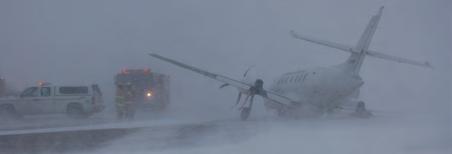
Picture this. On descent to a remote airport the flight crew delivers the customary briefing and for some inexplicable reason you have an uneasy feeling. As the aircraft is about to land something terrible occurs. The plane slams onto the ground then bounces back into the air and finally returns to earth on its side. It’s dark, you are hurting, the temperature outside is minus thirty degrees, and a full blown blizzard is raging on.
What do you do?
Would you be prepared to handle this situation?
According to the Transportation Safety Board of Canada, from 2002 to 2006, the yearly average of Canadian-registered aircraft involved in accidents was 268. Of the 268 accidents, only 30 involved fatalities.
While air travel remains the safest form of transportation, the question remains: With respect to aircraft departing from the general aviation terminals, how do we best address the concept of passenger safety? And, more importantly, who is ultimately responsible and liable when things go wrong?
Traditionally the concept of safety in air transportation lies with the carrier and ultimately the flight crew. The pilot-in-command assumes responsibility for everyone on board. Captain Dirk Migchels who flies a King Air 350 for Kos Air out of Calgary relayed it best by saying, “… to have a prepared load of passengers…boy that would give me a warm fuzzy feeling.”
Today, corporate due diligence has influenced a change in this philosophy. Safety has become the responsibility of everyone involved.
Beginning with the airline and flight crew, the responsibility must be shared with the passenger and the corporation requesting the flight. Education is required to inform the traveling public about the many safety concerns and protocols that are in place and are continually being challenged in the unique environment of transporting staff to the smaller airports and on-site airfields.
In the above example, it would be challenging at best to locate an emergency exit in an unusual attitude and in the darkness. The typical pre-flight briefing simply does not cover all contingencies. Or what about the passenger, who instead of walking around the wing of the Beech 1900, snuck under it while boarding the aircraft? The result of striking his head on the tie-down ring was that several stitches were required to repair the wound. That minor injury resulted in employee downtime, lost wages, a workers’ compensation claim, and a departure delay. The question of responsibility and liability remains.
Another example is an oil-field worker who is expecting to spend the next several days on foot in a bear-populated area. Prudence dictates that a tin of bear spray be at the ready should an encounter be experienced. Unfortunately, because the baggage compartment in many of these aircraft is not sealed from the cabin, a ruptured tin of bear spray could incapacitate everyone on board resulting in catastrophic consequences.
Today’s passengers need to know why certain policies and procedures are in place and then work closely together with the flight crew to ensure compliance and to minimize the risk of potentially hazardous situations. Also, in the unlikely event that something does go wrong, they will be equipped with the required skill set to handle the adverse situation – thus minimizing the risk of injuries.
About the author: With over 30 years in the aviation industry, Tom Zeiser is a corporate pilot, speaker, author of the book “Soaring Sales” and has an on-line safety course called “The Passenger Safety Awareness Program” which can be accessed through http:// www.ecompliance.ca/ec-elearning/courses.html or by contacting Tom Zeiser directly at Tom@PegasusPresentations.com for course details.
Tips are intended to increase overall safety awareness and are not a substitute for compliance with regulatory procedures.
January 2006 Fort St John BC
employment and career development of citizens of the Northwest Territories and Nunavut – its ultimate owners. Adhering to the three tenets of profit, safety and community involvement has served the company well since its change of ownership a little more than a decade ago.
To gain a better understanding of any business model and therefore appreciate how a company may perform in the future, it is useful to perform a S.W.O.T. analysis (Strengths, Weaknesses, Opportunities and Threats). Doing so with Canadian North yields the following insights:
S.W.O.T. ANALYSIS OF CANADIAN NORTH
STRENGTHS:
Dominant mode – When moving people or things in the Far North, aviation doesn’t have much competition from other modes of transport.
Respected service – Its focus on service, be it convenient scheduling, constructive relationships with customers, or the provision of hot meals on its flights, has enabled the company to develop a loyal following.
Strong corporate culture – By paying its employees competitively and providing a profit-sharing program, Canadian North is able to attract and retain good people.
Diversified revenue base – The company has developed a diversified customer base within its scheduled services, with only 23 per cent of those revenues coming from its top 15 customers. Canadian North does not receive any type of subsidy.
Simplified fleet – Over the past two years, the fleet has
been rationalized and now consists of two aircraft types. They are each ideally suited for the tasks that they perform. Fleet standardization provides savings related to maintenance, rotable inventories and personnel training.
Reasonable capital expenditures – In addition to the planned acquisition of two 140-seat Boeing 737-300s, the carrier is building a new hangar at Iqaluit and new cargo facility at Cambridge Bay. These expenditures are expected to be funded largely through internally generated cash flow. When it comes to spending, management appears to have a governor on the cash throttle.
Community relationships
– Canadian North has established relationships with the communities it serves by sponsoring events that primarily relate to sports and health. Last year, the company spent more than $1 million on its community relations sponsorship program. Since airline service is the only link to the rest of the world for most northern communities, it only makes sense for a carrier to develop a healthy rapport with its customers.
WEAKNESSES:
Geographic consequences
– The north has extreme weather conditions, somewhat rustic aviation infrastructure and a sparse population that is spread across three million square kilometres. Operating in this region is not a strategic priority for many airline executives.
Competition – Canadian North’s primary competitor is Bradley Air Services, which markets itself as First Air.
❑
PROSPERING IN HARSH CONDITIONS
Using a fleet of 737-200s and ATR42300s, First Air flies to 17 of the 21 communities served by Canadian North. The resulting competitive pricing demands a disciplined approach to operating costs.
OPPORTUNITIES:
SUBSCRIBE TODAY
PLEASE
Network expansion – Additional destinations and new nonstop routes are both possibilities. Increased use of Dash 8s to smaller communities is the most likely move. Over the past decade, the company has found that as it broadened its reach, its results improved.
Increased charter work – The movement of personnel from across Canada to oilsands projects and mining developments is a core part of its charter business. This activity is expected to increase at a gradual pace over time. Further down the road, there is the potential of additional natural resource developments. The Mackenzie Gas Project is planning to build and operate a 1,220-kilometre natural gas pipeline from the Beaufort Sea south along the Mackenzie River to northern Alberta. Inuvik and Norman Wells, both Canadian North stations, are expected to be active hubs during the project’s construction phase from 2011 until 2014.
THREATS:
Volatile commodity prices – The prices of base and precious metals, oil and natural gas have been extremely volatile during the past year. The development of mines, petroleum exploration activity, construction of oilsands upgraders and new pipeline projects are all dependent upon high commodity prices. While positive for operating expenses, weaker commodity prices could result in delayed or missed opportunities for the company.
Fleet renewal – Finding a suitable replacement for the 737-200Cs will likely be a difficult task. No other jet can operate from gravel strips and provide the operating flexibility of the quick-change cabin. While the renewal program is not a pressing priority, it will eventually have to be addressed.
Labour contracts – The contract with its pilots expired at the end of 2008
and the contracts with its flight attendants, customer service representatives and cargo personnel will expire at the end of this year.
WHAT DOES THIS ALL MEAN?
Canadian North’s business model may not be unique, but it certainly operates in an environment that is unique within North America. As such, it requires aircraft that are specially designed to meet the requirements for arctic operations and personnel who are capable of performing in situations that are vastly different from the southern norms. A successful assembly of these resources is not easily accomplished, hence it would be difficult for significant new competition to develop in short order.
While its northern market may not provide opportunities for rapid growth, neither is it significantly cyclical. Given the lack of any alternative mode of transport, there should be an ongoing level of demand for its services. Canadian North’s challenge, therefore, is to obtain a share of the traffic that permits it to remain viable.
If the airline continues to provide a positive experience for its customers, maintains its standard of operational reliability and takes a conservative approach toward expansion, Canadian North will most likely be around to celebrate its 20th anniversary in 2018.
WHAT DOES THE FUTURE HOLD?
Asked what the company might look like in 10 years’ time, Tracy Medve (Canadian North’s president) comments concisely: “Similar to how it looks today, but larger.” She explains that the focus will remain on its northern scheduled operations. In other words, look for more black dots on the route map. The airline has supportive shareholders, makes meaningful efforts to integrate itself into the communities that it serves, and is relentlessly customer-oriented. Since the airspace “north of 60” is deregulated, it is theoretically possible that some ambitious group could come north to challenge the region’s two dominant players. While such an effort would require significant funding, appropriate assets and skilled employees, not to mention psychological testing for the protagonists, it seems unlikely that the region’s competitive landscape will be altered anytime soon.
Sam Barone takes the helm CBAA’s
Where there has been increased competition is at the western gateway to the North – Yellowknife. Air Canada, utilizing Bombardier CRJs operated by Jazz Air, offers single daily nonstop flights from Yellowknife to Edmonton, Calgary and Vancouver. These may be only 50-seat aircraft, but they are nonetheless a burr under the saddles of the two major northern carriers. This has led some to suggest that such a practice is nothing more than “cherry picking” the best routes while ignoring the more difficult northern markets. It should be noted that Air Canada ended its presence in the North when it sold its Northwest Territorial Airways subsidiary to First Air in June 1997 and that it hasn’t expressed much interest in the region since then.
CONCLUSION
The company’s logo includes the branding slogan “Seriously Northern.” That implies that one cannot afford to be anything but focused on the task at hand when operating in the North. As nice as it is to have second chances, that option is often not available there. From dealing with demanding customers in a friendly but efficient manner, to making a safe approach at an isolated airfield in ugly meteorological conditions, getting it done right the first time is imperative for the continuing success of the business. It appears that Canadian North has filed its flight plan and that the routing will be more evolutionary than revolutionary. Seriously Northern indeed.
Tracy Medve is president of Canadian North.
IS THE SKY FALLING?
Looking for the silver lining
By Rob Seaman
Aviation is cyclical by nature. It has seen some pretty wild fluctuations over the years. The good times are great! Things are busy, everyone is in a great mood and there are jobs for those wanting to work. That has been the case over the last few years. So all was nice in our world until fuel prices started to creep up. That got folks flying a little less. In fact, by midsummer most FBOs were reporting jet fuel sales down an average of 30 per cent year over year. There was also talk about things starting to slow a bit, the rationale being that after all, we had been going hard and fast for so long that something was going to give – if only a little. Many offered that we had perhaps hit what was more than likely to be the norm and that things had reached a plateau for now.
Then the fall hit and things became even worse – despite the drop in fuel prices. At the NBAA the message was clearly business as usual, but the facts unfolding were running counter to that theme. As the bank bailouts became more public, the questions started about
aircraft and business financing. The word at the time was that money was still available, however, unlike a few months back when lenders were competing at rates in the mid single digits, the prevailing word of the day by early November was expect to borrow at 15-17 per cent – if they want your business at all.
At the same time as money started to tighten, the inventory of aircraft for sale was really starting to grow. Added to that, prices started to decline for certain types – mostly the midcabin or smaller and older aircraft. It has not been uncommon of late to find prices on aircraft like Cessna Excels, for example, dropping by $1 million over the ask over a few months. In another case, one seller of a Global 5000 was quoted to be asking for any offer and was willing to look at those below $40 million – well below the $50-55 million similar units have been asking.
The market has the inventory, and for those with the cash, the choices are plentiful.
On a brighter note, there is still some good news out there. One case in point, while the
global economy is in credit crisis mode, the Middle East seems to be insulated from these problems. With an estimated value of over $1 billion in aviation sales, this bodes well for the OEMs and resellers looking to sell business jets in the region. The Middle East Business Aviation 2008 show held in Dubai in November gave substance to this belief. As the three-day event wrapped up, there were reports of close to $1.5 billion in new aircraft orders for exhibitors. Among them was a $90-million order for new and used Cessna aircraft that reportedly included three of the firm’s new Citation Columbus large-cabin jets. You can even still find the odd OEM or broker sales rep who feels things are slow, but OK for now. So there is some optimism.
The crystal ball gazers are not so happy, though. They have been issuing their various predictions about the health of corporate aviation. Brian Foley Associates, a New Jersey-based group, issued a release in which Foley noted the peak for corporate aviation likely occurred
in the third quarter of 2008 and has now begun to contract. He observes that “the industry’s backlog levels were recently at historic highs, but there are now factors that will keep it from growing and will actually cause it to contract.” In Foley’s view, the worldwide economic crisis, declining company profits, tight credit, strengthening dollar and the plethora of available used aircraft will all combine to keep new sales at a trickle. This lack of sales activity will keep the backlog from being refreshed. Simultaneously, shrinkage of the existing backlog has begun in two ways. First, manufacturers are delivering aircraft at unprecedented rates to the tune of over 1,000 aircraft per year. This will work to deplete the backlog at a meaningful clip. The second factor will be order cancellations and deferrals.
“The OEMs were sincere when they said that there wasn’t a spike in order cancellations immediately following the worldwide financial market collapse, and that’s not surprising,” explains Foley. “When a business jet is sold, there’s perhaps a
We won’t know the full extent of the order fallout for another year.
modest five per cent due at contract signing and then a series of progress payments made every six or 12 months. The OEMs won’t see the order cancellations until these payments come due and a customer is unable to pay. As a result, cancellations don’t come all at once but rather over time as progress payments come due. We won’t know the full extent of the order fallout for another year.”
Other firms like UBS Investment Research seem to agree with Foley. In one of its fall reports, it notes a decrease of as much as nine per cent in the last year in business jet activity. The data also shows a decline of as much as 12 per cent in the light jet category alone – which makes sense given those are the aircraft that usually wind up being used by mid- and smaller-sized firms,
the types of business that have been fastest and hardest hit by the economic turmoil. The UBS report shows that longrange aircraft are only down six per cent in comparison and mid-sized jets by five per cent. Again, this report points to the growing inventories of resale aircraft as a factor to significantly slowing new OEM orders in the coming months.
For its part, Honeywell feels that orders will be slowing in 2009, leading to a decline in deliveries in 2010-11. But even that said, Honeywell still boldly projects that deliveries will exceed 2008’s record level of nearly 1,200 aircraft. Forecast International expects annual business jet production to exceed 1,600 units in 2009. The company projects that annual production will then suffer a three-year decline, dropping to
a level of 1,515 units by 2012 before beginning an upturn. To put this into focus, though, you might want to consider the fact that the corporate aviation industry never delivered more than 1,000 jets in a year before 2007 and barely managed 500 in 2003. So how bad is this downturn going to be? Only time will tell.
As for the smaller personal aircraft market and VLJs – the stress is starting to show for some. Probably the biggest – and not all that unexpected – news late in 2008 was that Eclipse filed for Chapter 11, right on the heels of obtaining European certification for its aircraft. At the same time, Cirrus furloughed its production workers until January 2009, while Mooney temporarily halted production as well – laying off 229 of its existing
FromStrength ToStrength
320 employees, virtually all of them on the production floor. Also AAI Acquisitions Inc., the company that bought the assets of bankrupt Adam Aircraft, plans to drastically cut operations, suspend airplane certification efforts and stop its previously announced hiring program. This could, some feel, spell the final end to the Adam 700 VLJ. Again, only time will tell how these firms recover or move on. This is just the news we have heard thus far. There is surely more to come.
So welcome to the tough times. From here on we will see what separates the truly devoted and deserving in this industry, from the fringe crowd who joined just for the party. Like everything in the aviation world, tomorrow will bring more news and change.
Which may explain why Atlantic Turbines is now Vector Aerospace Engine Services Atlantic, an international company. We specialize in numerous powerplant applications, now including the Pratt & Whitney Canada PW307A and PW308A/C series of engines, which will be serviced through Vector’s new engine shop in the United Kingdom. What more can we say? Atlantic Turbines’ reputation for sound advice, best in industry customer service, and our realistic repair or overhaul costs are now available at Vector Aerospace Engine Services Atlantic. Proud of our past – working hard for your future.
CONTINUED FROM PAGE 21
issued 342 POCs and Barone and his board of directors want the organization to become a global centre of excellence in that regard. “It’s something we’re becoming more and more recognized for, especially given the last five years of growth in that program. We have a lot of corporate intelligence that we can show other jurisdictions around the world. We have a mature business aviation community here as well, which gives us strength to move forward.”
A firm believer in the marketplace, Barone cannot countenance reversing the “devolution and deregulation” of the past couple of decades. “Government oversight in Canada is very strong and I think we need to have that in terms of safety. Moreover, our industry
understandably is committed to ensuring safe operations. Over-regulation is not the answer because it affects the cost of everything. So we’re always in favour of smart regulation, but needless regulatory burden really facilitates nothing; it doesn’t add value.”
He said that effecting more change is a challenge when the federal government is a minority. Proposed amendments to the 1985 Aeronautics Act, for example, date to June 2000 when the Liberals enjoyed a majority in Parliament. It touched off consultations with the industry and eventually resulted in the introduction of Bill C-6 in the House of Commons in April 2006, early in Prime Minister Stephen Harper’s first minority government. However, that first session of the 39th Parliament ended without the bill
being passed, prompting its reintroduction in the second session in October 2007, this time as bill C-7. But that too failed to make it out of the Commons before Parliament was dissolved for last October’s election.
“That kind of legislative or regulatory limbo or volatility is not good for . . . any industry,” Barone said, optimistic that it will be resurrected, hopefully with legislative success this time, early in the new 40th Parliament.
Last, but not least, there’s the ongoing evolution of the Canadian Aviation Regulations (CARs), “a forum at which we’re continually present.”
Given his eclectic background, it’s probably no surprise that Barone is “a big fan” of dialogue involving his sector, government and the other stakeholders. “It’s fair to say that
you can always streamline the process but it’s definitely something we actively support. Our mandate is derived from CAR 604; it’s a cornerstone mission for us. It’s here to stay.
“In a minority government, the dynamics of that become a little more interesting because how rule-making moves forward is a function of both the regulatory framework and what role parliamentary committees play. I think we’re going to spend more time in that process during a minority situation because consultation becomes even more of a critical path. . . . We support it for the very reason that in one fell swoop you have everyone around the same table. It’s not always conducive to quick agreement, but it is a process that is worth supporting.”
THE SWITCH TO 406 MHZ
More than just a frequency change
By Carole Smith, National Search and Rescue Secretariat
On February 1, 2009, the international satellite system for search and rescue, COSPASSARSAT, will complete its transition to the digital era. After 26 years of listening for analog distress beacons transmitting on 121.5 MHz and 243 MHz, the system will soon monitor digital 406 MHz signals only.
Why the change? Quite simply, analog beacon technology pre-dates the satellite age and has limited capability. After a quarter-century, it is time to embrace the full potential of this life-saving system.
Emergency locator transmitters (ELTs) were first developed in the 1950s to help locate military aircraft, and were later mandated for civilian use. The marine community also had emergency position-indicating radio beacons transmitting on 121.5 MHz. After being reported overdue, signals from these beacons helped rescuers find the distressed craft.
In the early 1980s, the COSPAS-SARSAT system was born after Canada, the United States, France, and Russia recognized the great advantages offered by satellite surveillance of these emergency signals. Satellites could automatically detect these beacons, calculate their position, and relay the information to a rescue coordination centre even before aircraft or vessels were reported overdue. The first rescue assisted by COSPAS-SARSAT
occurred in September 1982, just a few days after system testing began. Three lives were saved when a satellite detected the ELT from a downed aircraft in the mountains of British Columbia, 90 kilometres off its planned route.
By the mid-1990s, the COSPAS-SARSAT system was providing its “lifeline to survival” to over half-a-million aviation, maritime, and land-based users around the globe. Digital 406 MHz beacons designed specifically to work with satellite technology were now available. Recognizing these benefits, the International Civil Aviation Organization and the International Maritime Organization urged COSPAS-SARSAT to invest fully in the 406 MHz system. In October 2000, a unanimous decision was made to end the satellite processing of 121.5 MHz analog signals on February 1, 2009.
So what does the 406 MHz system offer that 121.5 MHz does not?
Unlike their analog cousins, emergency beacons transmitting on 406 MHz work with COSPAS-SARSAT’s geostationary satellites. These satellites continuously monitor the globe between 70° N and 70° S, detecting and relaying beacon alerts almost immediately.
406 MHz beacons are also optimized for use with COSPAS-SARSAT’s lowearth orbiting satellites, which
travel overhead the poles and “see” into areas that may otherwise be shielded from the geostationary satellites. Unlike 121.5 MHz models, data from 406 MHz beacons can be stored on board these low-earth orbiting satellites, and downloaded when the next ground station comes into view. This reduces the number of satellite passes required to calculate a position. And, thanks to greater frequency stability, 406 MHz beacons may be located within 2-5 km on the first satellite pass, rather than the 15-25 km accuracy generated by 121.5 MHz beacons.
Transmitting at 5 Watts, 406 MHz beacons send a signal that is at least fifty times stronger than analog beacons. They are also equipped with a 121.5 MHz homing frequency, to help rescuers go the final distance when visibility is reduced by darkness, fog, or vegetation.
Being digital, 406 MHz beacons are uniquely coded and can be registered to a specific aircraft, vessel, or individual. This enables search and rescue authorities to start a response even while a final location is being calculated. False alerts can also be resolved by contacting the owner, without needing to send rescue units to investigate.
The greater alerting and locating capability, and the positive identification offered by 406 MHz beacons
bring indisputable benefits. In the much-publicized case of a light aircraft forced down on the Arctic ice in early December 2008, signals from the aircraft’s 406 MHz ELT were successfully transmitted in the few minutes before the aircraft broke through the ice and sank.
The eight-year transition period to exclusive monitoring of 406 MHz by COSPASSARSAT is now coming to a close. In Canada, users of marine and land beacons have already moved to 406 MHz technology. While some in the aviation community have installed a 406 MHz ELT, many have not, citing concerns about cost and reliability. Do ELTs function 100 per cent of the time? No, but neither do any other safety devices. While some promising alternative technologies are emerging, none yet offer the same performance capabilities of COSPAS-SARSAT’s 406 MHz system, nor the extensive publicly-funded infrastructure that backs it up.
Regulatory requirements aside, it is hoped that aircraft owners will recognize that COSPAS-SARSAT’s switch to 406 MHz is more than just a frequency change, and will choose to continue taking advantage of this unique lifeline to survival.
The National Search and Rescue Secretariat is Canada’s representative to the COSPASSARSAT Council.
AIRCRAFT SALES
1999 Citation X. Low time. On MSG3 and engines on CorpCare. Equipment for global travel with iridium AirCell phone system, Mode-S enhanced transponders, EGPWS with Windshear, TCAS Change 7 with Elementary Surveillance, and SAT/AFIS. Light coloured interior; double club, with Airshow system & monitors at each seat.
1988 Challenger CL601-3A. One Fortune 100 owner since new. Professionally flown, and maintained, to the highest standard. Airframe and engines at 5460.5 hours and 2638 landings. 20-year inspection and gear overhauled June-07. 6 and 12 month; 100, 300, 600 & 1200 hour inspections carried out January 2008. Please make offer.
1984 Citation III, S/N 650-0046, TTAF 9729, Landings: 6735, EGPWS: HON KGP-860 Class B, TCAS: HON TCAS II Model 2000 Change 7, 731-3C-100S engines on MSP Gold, APU: Sundstrand T62T TTSOH:1117, RVSM, Hi-Gross Mod, CESCOM, FWD Club 4, 2 place divan w/belted lav. New paint, new carpet: August 2008.