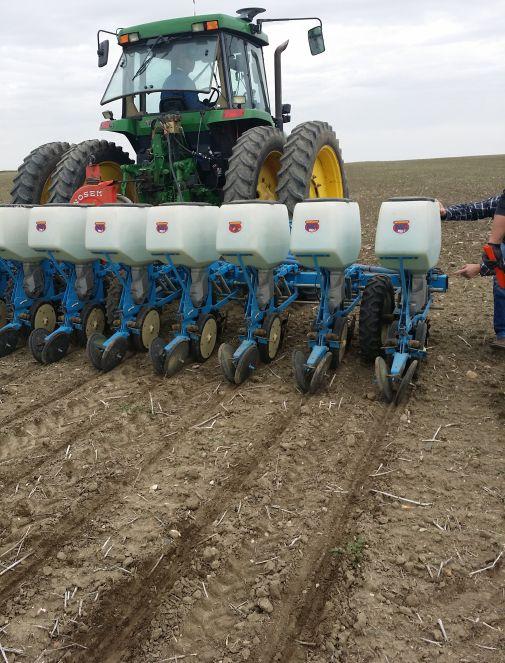
With the new Tiger-Mate ® 255 field cultivator and 2000 series Early Riser ® planter, you can maximize every single square inch you farm. It’s creating the most level seedbed in the industry, while others are just scratching the surface. It’s the ability to gauge ground pressure 200 times per second. It’s targeting a nickel-sized area to plant a seed — and never missing. Then, inch by inch, the result is productivity like you never thought was possible. Start rethinking the productivity of your seedbed by visiting a local Case IH dealer or caseih.com/Seedbed THERE ARE 6,272,640 SQUARE INCHES IN EVERY ACRE.
IN CANADA
5 | Tips for new growers of irrigated corn
A look at growing corn for silage, grazing or grain in Saskatchewan. By Carolyn King
By Carolyn King
8 | Variable rate irrigation for potatoes Compelling potential benefits for growers implementing this emerging practice. By Carolyn King
Brandi Cowen and Stefanie Croley
13 | Winterizing tips
Getting your irrigation equipment ready for winter.
By Carolyn King
BRANDI COWEN AND STEFANIE CROLEY | EDITORS
A NEW RESOURCE TO HELP YOU GROW
Producers across the country tapped more than 1.7 billion cubic metres of water to irrigate their crops in 2014. According to Statistics Canada’s 2014 Agriculture Water Survey (the most recent available), about 586,000 hectares of farmland were irrigated that year, and almost three-quarters of those (434,470 hectares) were located in Alberta. The data also revealed field and forage crops were the most popular targets for irrigation (350,340 hectares and 200,670 hectares, respectively); fruit and vegetable crops accounted for much smaller proportions of irrigated land in Canada (18,810 hectares and 16,050 hectares, respectively).
Irrigation is clearly an important piece of the production puzzle for field crop producers across parts of Western Canada. As with any other tool, growers must weigh many factors when deciding whether to irrigate. But the decisions don’t stop there. Those who opt to irrigate must decide how to incorporate this tool into their crop management strategies. After all, irrigation is no different from soil nutrition, disease management or any of the other strategies successful producers must diligently review and refine over time. Results can – and often do – vary from field to field and from crop to crop, so each producer must complete careful calculations to strike a balance, incorporating just the right inputs in their growing strategy to yield the most profitable return on investment.
At Top Crop Manager, we aim to provide readers with the information they need to make those calculations. That’s why we’re proud to bring you the inaugural issue of Irrigation in Canada – a niche supplement spotlighting irrigation in the South Saskatchewan River Basin, spanning southern Alberta, Saskatchewan and southern Manitoba.
Within these pages, we bring you valuable information tailored to help farmers in the region realize the full benefits of irrigation technology and how it can help farms grow more profitably and more sustainably.
Our cover story on page 5 offers advice to help producers get the most out of irrigated corn acres. Research shows irrigation can deliver notable benefits for producers growing both grain and silage corn hybrids in Saskatchewan’s dry conditions, but, as is so often the case in agriculture, success depends on a grower implementing the right combination of crop management techniques for their unique situation.
On the precision agriculture front, a variable rate irrigation (VRI) project now underway in Manitoba is using a variety of technologies and techniques to map variability on a 50-acre potato field. Side-by-side comparisons of VRI and even rate irrigation in small-scale plots suggest potential benefits from VRI, however, the findings also point to a number of challenges facing growers who hope to apply the technique in their fields. See page 8 for more details.
This issue also spotlights a double-cropping research project that aims to improve the productivity and sustainability of Prairie fields (see page 11). Results so far suggest moisture is just one of many pieces that will have to fall into place before double-cropping is widely adopted across the region.
To close out the issue, irrigation agrologist Jeff Ewen offers advice to protect your investment through a long, cold Prairie winter, with tips for winterizing irrigation equipment (page 13).
We hope Irrigation in Canada, like its parent publication, Top Crop Manager, proves to be a valuable resource you can turn to for the information you need to keep your business growing.
Cdn. plus tax Top Crop Manager East – 7 issues February, March, April, September, October, November and December – 1 Year - $45.95 Cdn. plus tax Potatoes in Canada – 1 issue Spring – 1 Year $16.50 Cdn. plus tax All of the above - $80.00 Cdn. plus tax
A look at growing corn for silage, grazing or grain in Saskatchewan.
by Carolyn King
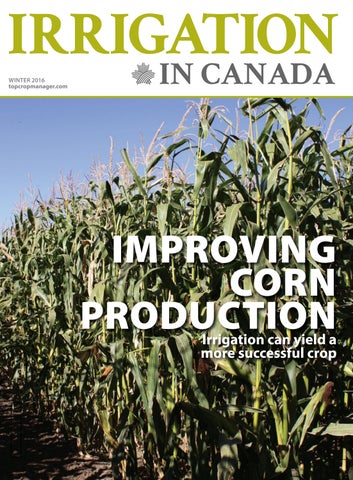
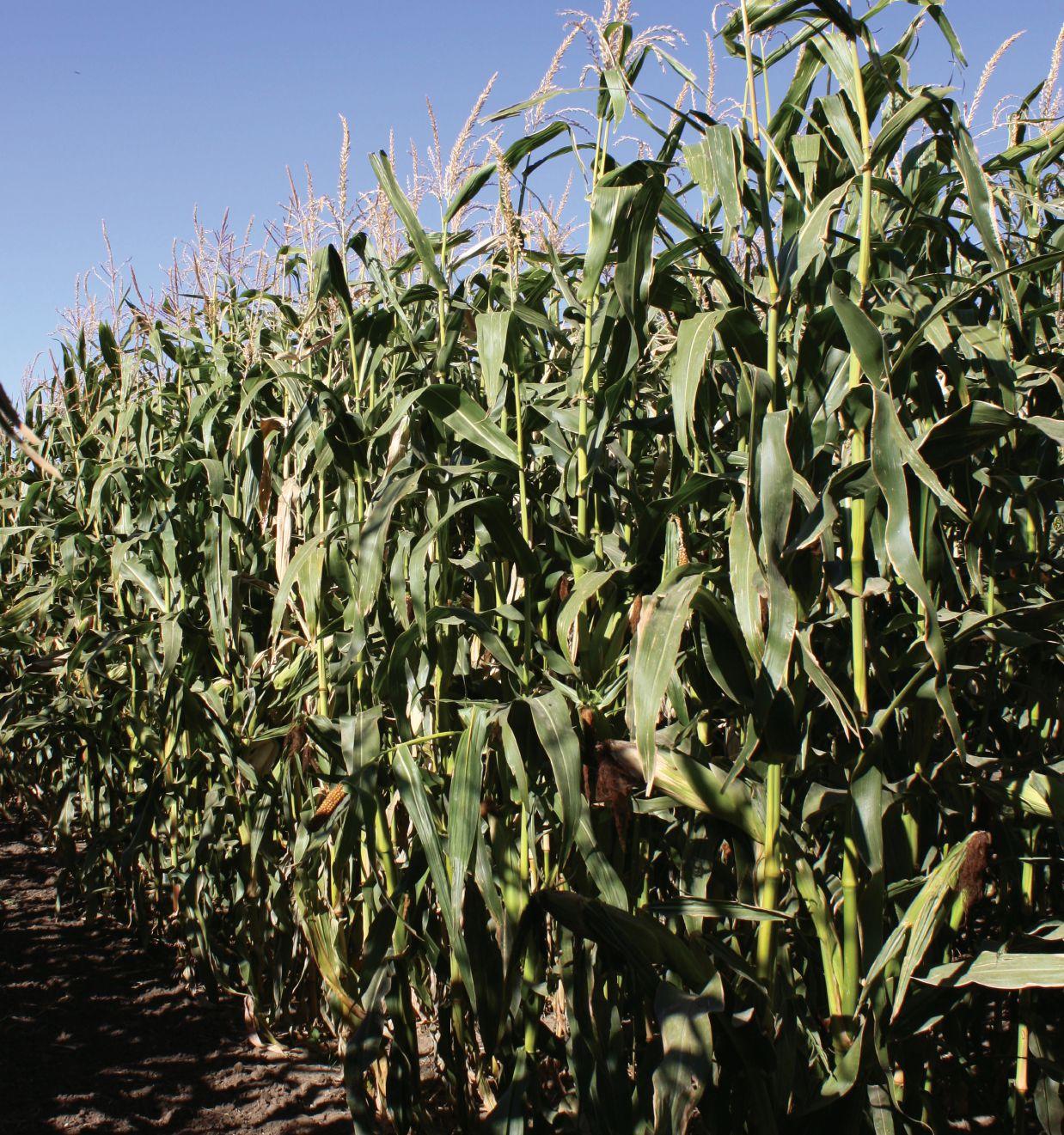
Saskatchewan’s growing conditions aren’t exactly ideal for corn, a crop that loves heat and water. But with the development of shorter-season hybrids, an increasing number of Saskatchewan growers are trying corn for silage, grazing or even grain. Irrigation can play a key part in making corn production more successful.
“Irrigation can definitely boost corn yields – whether that’s more tonnes of silage or more grazing days per acre,” says Sarah Sommerfeld, a regional forage specialist with the Saskatchewan Ministry of Agriculture in Outlook, Sask. “But the choice of whether to irrigate would relate back to the producer’s own management and how all the other pieces on the farm fit into production of that corn.”
In particular, irrigation is needed to maximize grain corn yields. “Grain corn uses from 16 to 20 inches of water. Our average [growing season] rainfall won’t cover that, so irrigation is always needed unless you have a year like 2016 when we have more than sufficient water,” notes Joel Peru, a provincial irrigation agrologist with Saskatchewan Agriculture, also based in Outlook.
If you’re growing grain corn under irrigation, Peru recommends ensuring the soil contains at least 60 per cent plant-available water throughout the growing season. “This will allow the corn to have sufficient water to reach its yield potential.”
He says the most critical stages for irrigation of grain corn are during germination and early growth – so the crop gets off to a good start – and during reproductive growth, from tasselling to grain filling. In the reproductive stages, corn can use almost 0.3 inches of water per day.
For irrigating silage and grazing corn, the reproductive growth stages are the most critical time. “The period from flowering right through to cob filling is where you’re going to get your yield, and where you really want to manage and monitor your moisture,” Sommerfeld says.
The recommended timing for irrigation termination is the dent stage for grain corn and grazing corn, and about two to three weeks before silage harvest for silage corn. Sommerfeld adds, “Corn is a long-season crop so make sure you’re not ending irrigation too early. For silage or grazing corn, make sure there is enough moisture to carry the plant through until the harvest end date, whether that’s your silage cutting date, or the first killing frost for grazing.”
More tips
Some of the most common questions that Peru and Sommerfeld get from new corn growers are about which hybrids are best, what equipment is needed and what yields to expect.
“When it comes to which corn hybrid to choose, first you need
to decide if you are going for silage, grazing or grain,” Sommerfeld explains. “For silage, you want to cut that crop at about the R5 to R6 growth stage, which is about the half to three-quarter milk line stage, when the whole plant moisture is about 65 to 70 per cent. With that as your harvest time, choose a silage variety that fits with your area and that is about 150 to 300 heat units longer than your area’s heat unit rating, which is the long-term average corn heat units for your area.”
Corn heat unit (CHU) maps for the province are available on Saskatchewan Agriculture’s website.
“For grazing, you want your crop maturity to be at about the R3 to R5 stage, which is dough to half milk line, on the date of the first killing frost. In Saskatchewan, the long-term average for the first
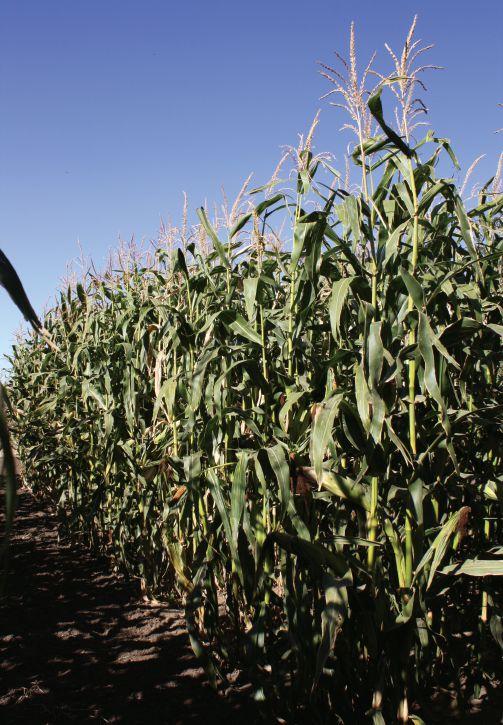
Silage corn production is increasing in Saskatchewan, providing a high production, high-quality forage crop.
killing frost is around Sept. 15. So try to align your planting date and your first killing frost date so your corn will be at the dough to half milk line stage at the time of first frost. Select a silage/grazing hybrid that is about 150 to 300 heat units longer than your area’s rating.”
“Only certain locations in the province give consistently high enough heat units to allow grain corn to mature,” Peru says. Since grain corn needs to reach maturity before the first killing frost, pick a grain hybrid with a CHU rating similar to your area’s rating, if you’re planting by mid-May. For delayed planting, choose a hybrid with a lower CHU rating, reducing the rating by 100 for each week of delay after mid-May.
Peru suggests seeding corn into pulse stubble or cereal stubble. He adds, “Don’t seed into canola stubble. Corn heavily relies on mycorrhizal fungi to take up phosphorus, especially during the plant’s early growth stages. Canola isn’t a host to these fungi, so if you seed corn into canola stubble there won’t be sufficient levels of the fungi to allow the young corn plant to take up enough phosphorus to meet its needs.”
Corn has high nutrient needs, no matter whether it is grown for grain, silage or grazing. Peru says, “It’s recommended to have at least 150 to 180 pounds per acre of actual nitrogen (N) in the soil. Also, make sure you have enough potassium (K) and phosphorus (P). Soil tests are highly recommended. Make sure you have at least 35 to 40 pounds of phosphorus available, and each year apply around 10 to 15 pounds of potash, unless you have sufficient amounts based on your soil test.”
The current agronomic recommendations for grain corn are listed in the table below. The requirements are generally similar for silage and grazing corn, but a new project is underway to determine the optimal seeding rates and nitrogen fertilizer rates for silage and grazing corn under Saskatchewan conditions.
Agronomic recommendations for grain corn production
Seeding rate
32,000 plants/acre
Seeding date May 1-15
Seeding soil temperature
Seeding depth
Row spacing
Actual nitrogen fertilizer
Phosphorus (P2O5) fertilizer
Potash (K2O)
lb/acre
lb/acre
lb/acre
Corn production also requires some specialized equipment. “You need a row planter to grow corn. Corn doesn’t like to compete with itself so you want the seeds placed equally apart from each other,” Peru explains. For grain corn, you also need a corn header for your combine and a grain dryer. Grain corn is usually harvested between 20 and 27 per cent moisture content and then dried down to below about 13 per cent for long-term storage. Letting it dry down in the field below 20 per cent moisture increases the risk of harvest losses. Overall, corn is a relatively high-input crop. The Irrigated Crop Diversification Corporation (ICDC) produces an annual booklet called “Irrigation Economics & Agronomics,” which includes worksheets for corn for grain, silage and grazing to help Saskatchewan farmers with irrigated land figure out if irrigated corn production makes economic sense for their farms. Peru adds, “For
grain corn, you would probably want to aim for at least 150 bushels an acre to make a good profit.”
Filling agronomic information gaps
ICDC, which is based in Outlook, has been conducting corn-related research for a little over a decade. Its primary focus has been on trials to evaluate the performance of different corn hybrids under irrigated and dryland conditions. “We typically see a benefit to irrigation in both grain corn and silage corn,” notes Garry Hnatowich, ICDC’s research director.
The hybrid trials, which began in 2003, were initially a subset of the Alberta Corn Committee’s annual trials; the results are available at www.albertacorn.com. “For those trials, seed companies were invited to enter hybrids and to check off whether they also wanted trials conducted at Outlook, the only Saskatchewan site within the Alberta test,” Hnatowich explains.
However, Hnatowich found most of the hybrids being tested at the Alberta Corn Committee trials in Outlook weren’t actually available in Saskatchewan’s irrigation districts. So he, Peru and Sommerfeld got together to ask the corn retailers in the irrigation districts to submit their hybrids for the Outlook trials. As a result, starting in 2012, ICDC conducted an additional set of silage trials with these locally available hybrids.
ICDC stopped participating in the Alberta trials in 2016, so now all of its testing involves locally available silage and grain corn hybrids.
These Saskatchewan-oriented hybrid trials are funded by the province’s Agriculture Demonstration of Practices and Technologies (ADOPT) program. The results are published in Saskatchewan’s Crop Varieties for Irrigation guide.
Since 2003, average corn yields in the Outlook trials have been increasing. “The breeding efforts that the major companies are putting into corn are resulting in better yield stability,” Hnatowich explains.
Courtesy of Joel Peru.
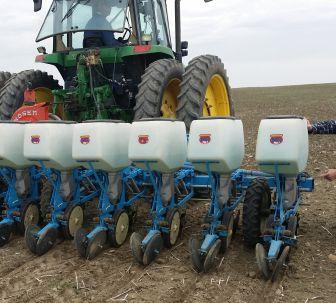
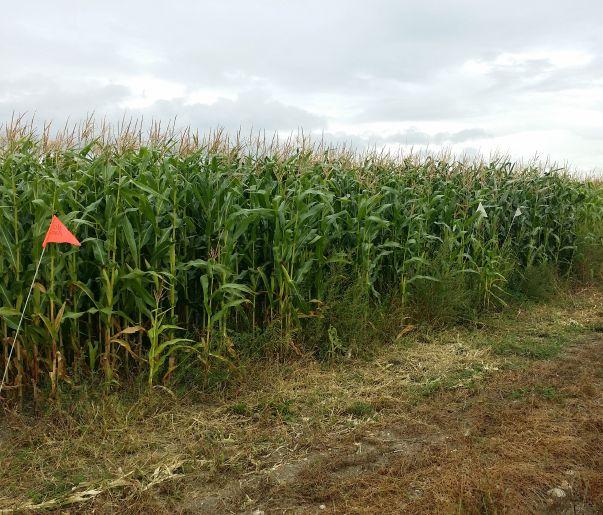
ABOVE One of the current corn agronomy projects is demonstrating the effect of a liquid starter fertilizer on the yields of different grain corn hybrids.
RIGHT The tractor had a liquid fertilizer injector that placed the starter fertilizer with the seed.
“The older hybrids tended to be longer maturing and often they were not ready to harvest when the first frost occurred. Over the last number of years, the days-to-maturity levels have been coming down significantly. Both for silage and grain, we are usually able to harvest prior to a frost event.”
Along with these Saskatchewan-focused hybrid trials, Hnatowich also emphasizes the need for made-in-Saskatchewan agronomic corn research. “In Saskatchewan, corn has been a very minor crop of interest, so we’ve got a bit of a learning curve in terms of corn agronomics compared to our sister Prairie provinces, Manitoba and Alberta. Manitoba gets the heat units, which we lack somewhat; it has a longer growing season that can accommodate corn. Southern Alberta has the heat units and it also has ‘Feedlot Alley,’ a concentration of beef production in the area that can utilize both silage and grain corn.”
He adds, “We can use the experiences of Alberta and Manitoba as a starting point for agronomic practices here, but there are refinements that need to be done for both grain and silage corn production in Saskatchewan.”
To get up to speed, ICDC’s corn agronomic research is starting with some basic considerations. As noted above, a new project is developing and refining recommendations for seeding rates and nitrogen rates for silage and grazing corn. ICDC and the Prairie Agricultural Machinery Institute are collaborating on this research.
“We don’t have a good handle on silage corn plant populations. So in our study we’re comparing 30,000, 40,000 and 50,000 plants per acre,” Hnatowich says. “In addition, we have very little information on fertility, in particular nitrogen fertility. So within those seeding rate experiments, we are also looking at three different levels of nitrogen fertilizer: 100, 150 and 200 pounds of nitrogen per acre (or kilograms of nitrogen per hectare). And on top of that, we are looking at two different hybrids at each site.”
The project is taking place at five sites in Saskatchewan: in Redvers, Yorkton, Outlook, Lanigan and Melfort. “At each site, we have different corn heat units, so we are using hybrids that we felt were best adapted to those climates. Typically they tend to be hybrids that retail outlets in the local area are selling,” Hnatowich explains. The Outlook site is irrigated; the other sites are dryland.
The project team will be examining silage yields, feed value and economics under the different treatments. The Western Beef Development Centre is conducting the feed testing. Project funding is from Saskatchewan’s Agriculture Development Fund.
Another agronomy project underway in 2016 involves grain corn. It is demonstrating the effect of a liquid starter fertilizer (6-22-2) on the yields of different hybrids under irrigation.
The idea is to use a small amount of fertilizer to boost early corn seedling growth. “Liquid phosphorus products are possibly more available to plants at early growth stages compared to granular products. Starter fertilizers improve early seedling development by providing available nutrients to the plant’s early root zone. Rapid crop establishment is desirable since plant development and yield can be influenced during early growth stages,” Peru, the project leader, explains.
The starter fertilizer treatments will be compared to untreated controls. Funded by ADOPT, this project is taking place on a 25acre, pivot-irrigated field near Birsay in Saskatchewan’s Luck Lake irrigation district.
Looking ahead
Hnatowich, Peru and Sommerfeld all see potential for continued increases in corn production in Saskatchewan.
“I think there is great potential. With silage corn, livestock producers are perhaps looking at utilizing corn as a high value, high production, high-quality forage crop for either backgrounding animals or supplementing cows through the winter. So they are looking at using corn to increase the amount of forage production while maintaining the same number of acres on their farm. I think that is really one of the best fits for silage corn,” Sommerfeld says.
“With grazing corn, they can look at extending their grazing season, reducing some of the costs associated with keeping cattle in the yards during the winter. So again it is about increasing forage production without needing to increase their land base. I think that is what producers are really looking for – maximizing production but also trying to minimize their costs.”
“I feel Saskatchewan is a little behind the eight-ball when it comes to basic agronomics in corn production,” Hnatowich says. But, he adds, “The DeKalbs and the Pioneers in this world are certainly looking at Western Canada and Saskatchewan in particular right now as an expanded area for corn, with the promise of very early maturing hybrids that provide an acceptable level of yield. I suspect the corn companies might have target acreages for the province that might be optimistic. But each and every year we have a growing number of producers calling about silage corn production and there’s increasing interest in corn grazing in a lot of the areas.”
When it comes to grain corn, Peru emphasizes the need for continued advances in hybrid performance and agronomics. “We still need to do a lot of agronomic research to figure out the best way to grow corn in Saskatchewan. And we really need varieties that not only require low heat units but also produce high yields in order to make a profit because corn is a very high input crop that requires specialized machinery.”
PHOTOS COURTESY OF JOEL PERU.
VARIABLE RATE IRRIGATION FOR POTATOES
Compelling potential benefits for growers implementing this emerging practice.
by Carolyn King
Variable rate irrigation is a challenging new topic for both producers and researchers, so we’re excited to be working on it and seeing what we can learn and share with producers,” says Alison Nelson, an agronomist with Agriculture and Agri-Food Canada (AAFC) in Manitoba. She is leading a three-year project, which began in 2015, to look into some of the key questions around variable rate irrigation (VRI) in potato production.
A couple of factors prompted Nelson to initiate investigations into VRI, starting in 2014. “Some potato producers in Manitoba were starting to look at this technology and starting to work with it on their own farms. And then at one of our own sites, we had the opportunity to upgrade our irrigation system for variable rate irrigation, so it opened up the opportunity to do some research into precision management of water.”
Applying variable irrigation rates that match up with a crop’s varying water needs across a field could produce important benefits. “In terms of managing a variable field with water, VRI
has the potential to even out the quality and yield of potatoes across the field, which can really have some economic benefits for producers,” Nelson says. VRI could also potentially improve efficiencies of inputs of water and energy, and decrease problems associated with overwatering.
Her project has two main components. One part involves comparing different technologies and techniques for mapping variability across a 50-acre field at AAFC’s research site near Carberry, Man. “We’re using methods that producers would be looking at, such as topography and proximal sensor mapping using equipment like a Veris or an EM38 sensor to map soil variability. And we’re using technologies like a radiometer to map surface soil moisture variability. We want to see what types of maps these technologies create and whether these maps are valuable in terms of managing a field for moisture variability,” she says.
“The other part of the project is looking at how VRI is being
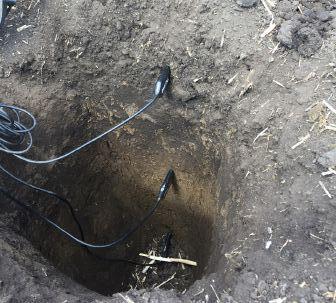
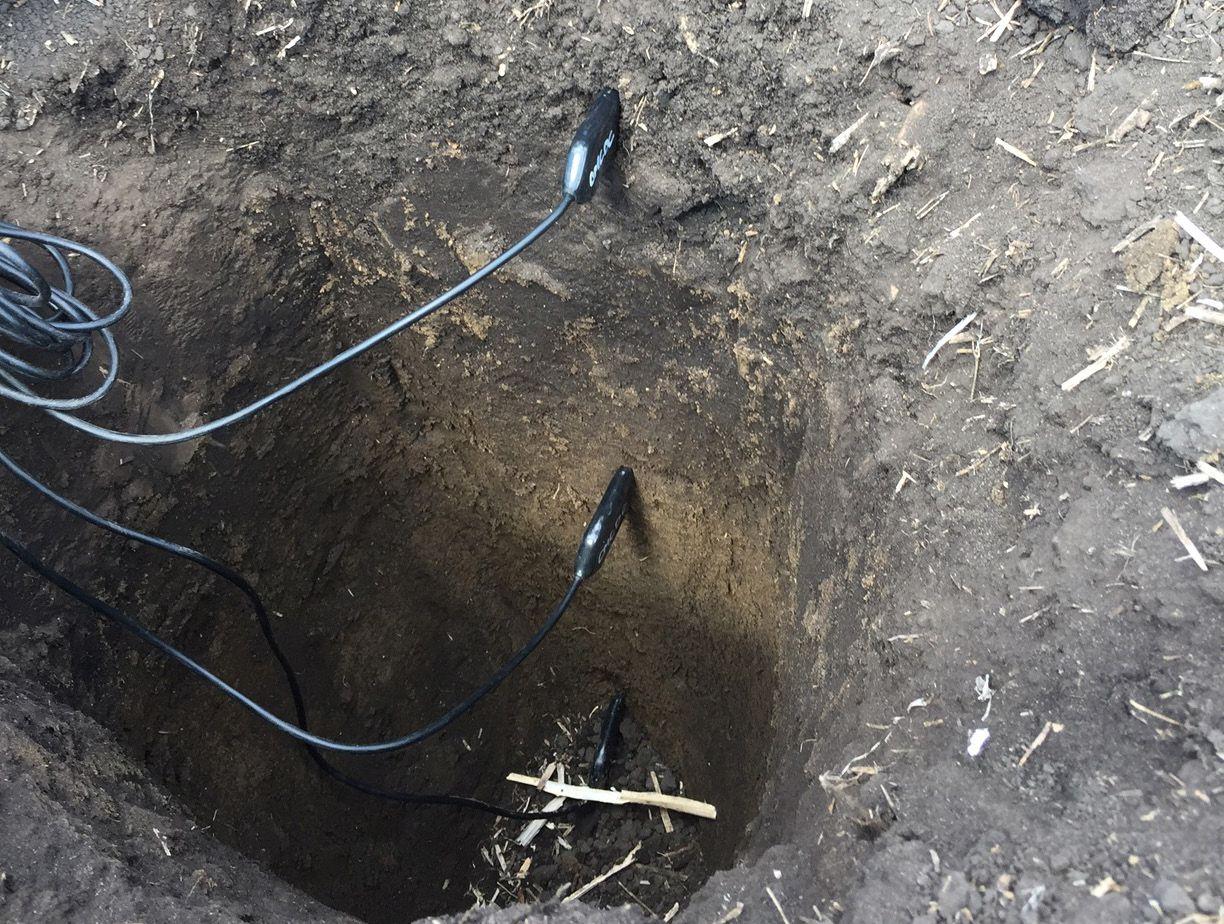
ABOVE: Soil moisture sensors were installed at various depths in selected plots as part of the variable rate irrigation project.
managed in potato fields right now, and doing a side-by-side comparison of small plots managed with a variable rate system and with an even rate, across the entire growing season. We have small plots in our research field and in a producer’s field. We’re going to look at tuber yield and quality across some areas of variability in those side-by-side comparisons.”
Activities in 2014 and 2015 laid the foundation for this project’s final years. For example, the research site’s lateral irrigation system was retrofitted with a VRI system that provides the precise singlenozzle control needed for accurate VRI applications on the small research plots. Also, the project team researched different mapping technologies, mapped the AAFC research field with various technologies, conducted soil sampling on a 30-metre grid, obtained drone imagery of the field at different times in the growing season, and determined where to set up the small plots for the side-by-side comparisons.
Nelson explains each of the mapping technologies being evaluated in the project has its advantages and disadvantages. “Topography can be closely linked to soil differences especially where you have large topography differences. So it’s a relatively logical and simple way to map a field. It tends to be a good mapping option to start with. But topography doesn’t tell the whole story, so there are challenges with that,” she says.
the possibility of creating detailed soil moisture maps in-season. According to Nelson, if this imagery provides useful soil moisture maps during the growing season, “it could be a very interesting and intriguing new technology for VRI use.”
Along with the drone/radiometer mapping, installed soil moisture sensors are monitoring soil moisture in selected plots in both fields. As well, AAFC has a permanent monitoring station in its field.
Nelson adds she is also exploring the possibility of in-season moisture monitoring using an EM38 meter. “As part of a complementary research project [with funding from a different source], we are running an EM38 sensor over differentially irrigated plots to see if this technology can be used to identify and map soil moisture differences over time. This data is scheduled to be collected at two-week intervals during the time of active potato crop growth.”
The sensor maps are used to create prescription maps that identify management zones for different VRI rates, which is harder than it sounds.
“We don’t have years of results yet, but what I’m seeing so far is that…we just can’t blindly use the sensor data to create a prescription,” Nelson says. “It’s a matter of trying to determine what are the major factors that you’ve found historically are affecting your moisture variability in the field, and boiling that information down to what is logical in terms of what you have seen in the past.”
The radiometer is mounted on a drone, which is flown over the project fields at three times during each growing season: early canopy, mid-season and full canopy cover. The idea is to evaluate the possibility of creating detailed soil moisture maps in-season.
“The Veris or an EM38 meter gives you a measure of soil variability that can be very instructive. The issue with those sensors is that a number of different soil factors – like salinity, moisture and texture – can all affect the sensor readings. So you have to combine the data from those types of sensors with measured soil values to understand what those maps are telling you about the soil variability in the field.
“The radiometer gives a relatively direct measure of how surface soil moisture varies over a field. However one of the issues with the radiometer is that it is only measuring the top few inches of soil. It is not telling us anything about moisture in the root zone, which can be a totally different story. So we have to work on those types of sensors in terms of how we are going to take the surface soil moisture data and understand what is happening below that into the plant root zone.”
The Veris and EM38 sensors measure variations in electrical conductivity of the soil across a field and also map the topography. A user drives the sensor over the field, covering the field in a series of parallel passes while the sensor continuously maps the in-field variation.
The AAFC field was mapped with the Veris and EM38 sensors in the fall of 2015. “That was a single mapping operation done after crop harvest, ensuring that the area being mapped had been evenly managed for the entire growing season,” Nelson explains.
The radiometer is mounted on a drone, which is flown over the project fields at three times during each growing season: early canopy, mid-season and full canopy cover. The idea is to evaluate
In 2016, the project’s paired plot comparison of VRI versus uniform rate irrigation is underway at the AAFC research field and the co-operating producer’s field. Data on potato yield and quality will be compared for the different irrigation management zones.
The producer has a prescription map for his field that he developed with his agronomist. He is managing most of his field as he would normally with variable irrigation rates based on his prescription, plus he has paired plots within the field where one plot in each pair receives a uniform rate of irrigation.
Nelson hopes the project will provide practical information for growers on tools and techniques for mapping in-field variability and for creating prescription VRI maps and adapting them over the course of the growing season.
“There are always struggles with new technology, but the real challenge is how to create the prescription and then how to manage it in-season. Water is very dynamic, so you have your prescription map, but how you manage that over the season can change depending on how the crop is growing and factors like diseases that come in. And then rainfall and humidity can also affect how the prescription map may need to change over the growing season,” Nelson explains.
She adds, “With a prescription map for nutrients, you make a map and you apply fertilizer and then you move on to your next thing. With VRI you’ve got a map, but every time you go to apply water you’ve got to look at that map and figure out if it still makes sense to be watering this area with this much water and that area with that much water.”
Nelson’s project is part of a large initiative supported by the AAFC AgriInnovation Program and potato industry groups in Canada, including agencies in Manitoba’s potato industry such as McCain Foods, J.R. Simplot Company and the Keystone Potato Producers Association.
SOWING THE SEEDS OF AN IDEA
Could double-cropping work on the southern Prairies?
by Carolyn King
Is it practical for farmers on the southern Canadian Prairies to harvest two crops on the same field in the same growing season?
It’s an intriguing idea that Jamie Larsen thinks just might work – especially in warmer areas that have irrigation and if one of the two crops is a winter cereal that can be taken off for silage.
Larsen, a research scientist with Agriculture and Agri-Food Canada (AAFC) in Lethbridge, is a cereal breeder whose work includes rye and triticale. Although triticale hasn’t really taken off in Canada, Larsen noticed winter triticale is often grown in double-cropping systems in Europe and the United States.
“Dairy farmers will grow winter triticale and silage it off, and then grow corn after. With this system, they are really increasing their yields in terms of biomass and tonnage, and it is quality forage,” he explains. “So I wondered if that type of system could work here. In southern Alberta, we have a fair number of growing degree days and we have irrigation, so that gets around some of the possible limitations to double-cropping.”
Larsen recognized double-cropping could offer important benefits to producers. Research shows silaging is a great way to control tough weeds, like herbicide-resistant wild oats, which can cause big problems in typical spring-seeded annual crop rotations. And given southern Alberta’s livestock industry, there are good opportunities to use silage. As well, for farmers growing a winter cereal, a second crop would help protect the soil from erosion and loss of organic matter after the winter cereal is harvested. And a double crop would make
greater use of the heat, moisture and nutrients available over the entire growing season, compared to a single crop.
In short, double-cropping could be a way to enhance the productivity and sustainability of agricultural production systems in the southern Prairies.
Doing the math
To see whether double-cropping might work in theory, Larsen examined weather and crop stage data for the last 10 years in southern Alberta.
Rob Graf, a research scientist who is also at AAFC Lethbridge, provided Larsen with some great data from winter cereal trials conducted each year. That data included details like dates for seeding, heading and maturity. Heading timing is important in Larsen’s calculations because at and around heading is the optimal stage for cutting rye for silage, and because this timing also coincides with crop insurance timing for seeding the second crop and with having sufficient growing conditions to take that second crop to maturity.
Using weather data from Alberta Agriculture and Forestry and AAFC, Larsen was able to relate the heading dates to growing degree days. “Rob and I were was amazed at how predictive the growing
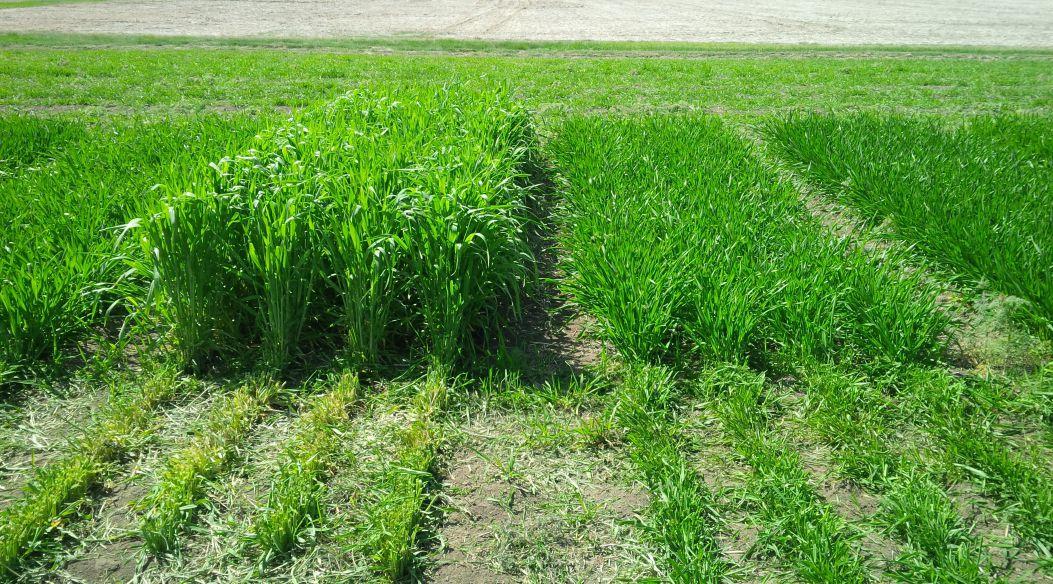
TOP: Compared to crops like winter wheat, fall rye produces more early-season biomass growth and heads earlier, making it a good option for silage production in a double-cropping system.
PHOTOS
degree days are – you can almost set your watch in terms of how many growing degree days the crop needs to get to heading,” he notes.
Cereal growing degree days are based on accumulated degrees above 0 C because cereals are able to grow when the temperature is above freezing. “For instance, in November, if the temperature is above 0 C and the soil isn’t frozen, a winter cereal would still be growing – really slowly, but it would be growing. In the Lethbridge region, its growth would end in November, typically, or even December in some years, and it would start growing again in about March.”
Based on data from the past decade, the Lethbridge region typically gets about 3010 growing degree days annually. Fall rye uses about 360 growing degree days in the fall and another 680 in the spring to reach the heading stage.
That leaves about 1970 degree days for a second crop, which is enough to grow a wide range of crops such as barley, oat, canary seed, flax, chick pea, canola, pea and sunflower. Of course, not every crop that needs fewer than 1970 degree days would be a good choice for a second crop; for instance, crops like pea don’t do well in hot conditions. But there are diverse possibilities that could be evaluated.
explains, “The first crop in a double-cropping system can use up a lot of moisture. In a really dry year, there might be moisture issues for the second crop, even on irrigated land.”
Another consideration is how much extra production growers might get for the extra work of growing a second crop. Larsen notes, “You may be thinking that double-cropping would mean one crop plus one crop equals two crops. But in reality it might be more like 0.75 plus 0.5, so 25 per cent higher than having just one crop, or it might be less, maybe 10 per cent higher than having one crop.” This lessthan-double productivity is the result of a variety of factors related to growing conditions, temperature, moisture and day length. He says, “Seeding late can cause reduced tillering, possibly due to photoperiod response. This needs to be looked at and why a higher seeding rate for the second crop might be critical to counter the late seeding date.”
Another issue is that crop insurance is not currently available for two crops harvested on one field in a single year. Also, the timing of operations in double-cropping systems may conflict with the timing of operations in single cropping systems. “For instance, taking off a fall cereal at the time we’re suggesting would probably line up with when farmers are spraying. So from a farming logistics perspective, it could take some thinking to make it work,” Larsen says.
“The
Larsen’s next step was to look at growing season precipitation. In southern Alberta and some other parts of the Prairies, most of the rainfall usually comes during the period from mid-May to the third week in June. The heading dates for fall rye and winter triticale typically occur towards the beginning of this rainy period. “So in theory, if you were to cut triticale, rye or even wheat at that time, you would have a replenishment of rain water, as well as irrigation, to get a second crop through to harvest,” he says.
And as a final step, Larsen delved into a detailed Alberta dataset developed by Stefan Kienzle at the University of Lethbridge. It shows a lengthening growing season over time, a trend that supports the increasing probability of having enough growing degree days to make double-cropping work.
Is it practical?
It’s a neat idea, but a number of pieces would need to be put into place to make double-cropping a success on the southern Prairies.
One of those pieces is crop performance data in the context of double-cropping systems. Most of the Prairie information on springseeded annual crops is based on seeding dates in April or May and a full growing season. “We know generally what the crop quality and yield will likely be in that situation. But for instance, if we plant them as a second crop in June, then how do those crops react?” Larsen asks.
He says some previous research by agronomist Ross McKenzie indicates that in certain crop types, later seeding causes yields to go down but protein levels to go up, which could be a benefit for some crops. With canola, later seeding changes the oil profile, which may be an issue. Larsen also notes that within each crop type, some varieties may be better suited than others to double-cropping systems. So comparisons of different crop types and varieties under doublecropping conditions would be needed to see which options work best.
Also, agronomic practices may need to be adjusted to suit doublecropping systems. For instance, a crop’s disease and/or insect pest spectrum could be different when it is seeded later as a second crop. One example is stripe rust, a serious disease in southern Alberta that tends to arrive later in the season. Stripe rust could have a significant impact on a susceptible crop that’s seeded later.
Moisture levels could also be a concern in some years. Larsen
first crop in a double-cropping system can use up a lot of moisture. In a really dry year, there might be moisture issues for the second crop, even on irrigated land.” Continued on page
He has talked to some Alberta growers who are already trying double-cropping. “A few southern Alberta growers are using hemp as a second crop. They have planted a winter cereal, rye, I think typically, and they silage it off in the first or second week of June. Then they plant hemp into that. Hemp’s normal planting time is the middle of June so that system should work quite well,” he says.
“Southern Alberta has enough growing degree days to do double spring-seeded cereal silage crops. So some growers are planting barley really early, at the end of April or early May, and they cut it for silage. Then they plant a second spring barley crop.”
He adds, “As more farmers try double-cropping, who knows what crops could fit? Maybe dry beans or some other really short-season crops could fit into that window for the second crop.”
Double-cropping research
Larsen is working on several research efforts that could help make double-cropping successful. In particular, he is breeding fall rye and winter triticale varieties with earlier heading dates.
“Think about our rainfall patterns where most of the rain comes between mid-May and the third week of June. If you can move the winter cereal’s heading date back even a week, that would be quite important in terms of the moisture and growing degree days available for the second crop,” he explains.
The desirable crop stage for silaging varies for fall rye and winter triticale. “Although the optimum for rye is at or around heading, the tonnage goes up as it fills grain, but the quality goes down due to the ‘stemminess’ of rye. Some people are okay with the lower quality and higher tonnage; it depends on the producer. Triticale is a higher quality feed and maintains the quality longer while it builds tonnage
WINTERIZING TIPS
Getting your irrigation equipment ready for winter.
by Carolyn King
If you leave your pivot exposed all through the winter, you’re going to be working on it a lot longer in the spring,” says Jeff Ewen, an irrigation agrologist with the Saskatchewan Ministry of Agriculture in Outlook, Sask. To help producers prevent damage from winter’s storms and bone-chilling temperatures, Ewen offers a number of winterizing tips.
“First of all, do a visual inspection before anything else is done,” he says. “The visual inspection includes looking to see that drive lines are attached, the gear boxes aren’t leaking oil, the tires are inflated, and the spans are in line and not damaged from use through the year.” Fix any problems that would restrict moving of the pivot, such as flat tires. Make a note of any other problems and carry out the repairs when you have time over the coming months.
Next, park the pivot in a safe position. On flat fields this means aligning the pivot so it is parallel with the prevailing winter winds in your area, not perpendicular to them, Ewen explains. For example, in the Outlook region, the winter winds tend to blow in from the northwest. “When the wind blows from the northwest, if you park the pivot oriented to the northeast or the southwest, the wind would hit perpendicularly across the pivot and can potentially topple it,” he says.
“For a rolling landscape, avoid parking the pivot in depressional areas that can hold a lot of water. And ideally, point the pivot in a downward slope direction versus an upward slope.”
A shelterbelt can provide some protection to parked equipment, but Ewen recommends taking a few precautions if you want to park your pivot beside a shelterbelt. Avoid parking the pivot in places where the shelterbelt tends to cause large snowdrifts to form. As well, remove any dead branches that might fall from the trees onto the equipment.
“Also, rodents tend to use shelterbelts and tree lines for protection. They can often cause problems in wiring and pipelines if they decide to inhabit the equipment as well,” he says. Be sure to cover any openings where rodents might enter, and cut away any brush near the control panels.
“Once the pivot is parked in its resting position, the main power supply should be disconnected to protect all electrical components and ensure the pivot does not accidentally attempt to move through the winter,” Ewen advises.
The next critical step is to prevent damage to the equipment from
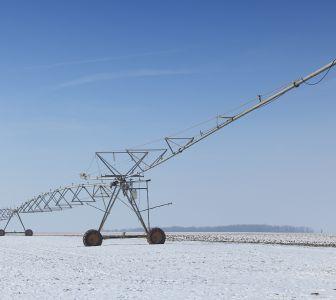
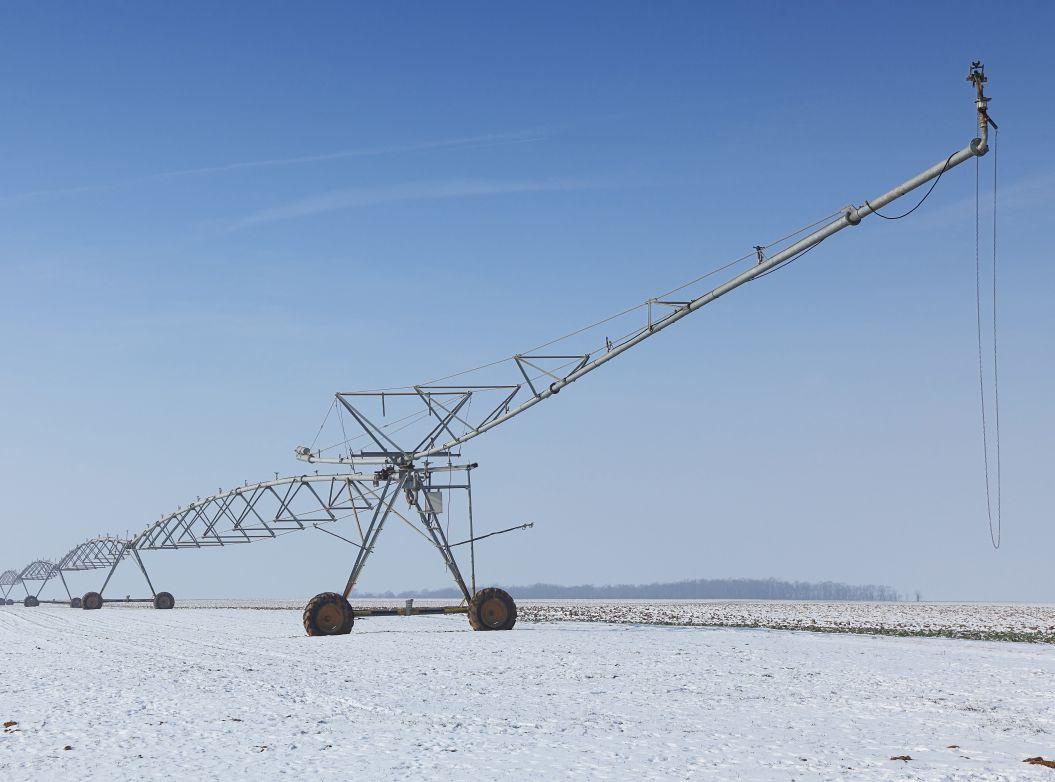
ABOVE: Properly preparing your pivot for the winter helps prevent damage and gives you a head start on preparations for the next irrigation season.
“
freezing. “All pipelines and pumps need to be drained and preferably air blown through them to remove all water from the pivot point to the pump,” Ewen says. “This requires detaching the pipeline from the pivot at the pivot point, where the clamp should be left loose to allow for expansion and contraction through the winter. Ensure the pipe opening is not exposed to allow rodents or debris to enter. Then the same rules apply at the other end of the line, at the pump, where the pipeline should also be removed and the clamps left loose for expansion and contraction through the winter.”
Next, if you have a little more time available, Ewen suggests tackling some of your annual pivot inspection and maintenance work. “A complete inspection of the pivot’s gearbox oil, tire pressures, sprinklers, drive lines and greasing the pivot point are always a good idea after a season of irrigation. If this is not completed in the fall, it will need to be done first thing in the spring before the new season starts,” he says.
Each fall, you’ll also need to get the pumps ready for winter. “The same kind of inspection and maintenance work should also be done on the pumps, including changing the oil. If the pumps are diesel-driven, then drain the fuel. If they are propane or electric, the fuel or electrical supply should be shut off.”
SEEDS OF AN IDEA
Continued from page 12
over the grain fill period. Its optimum cutting time is the soft dough stage.”
Some of his triticale lines look very promising in terms of the timing of grain filling. “Rye heads out quite early, but it doesn’t actually flower until a week to 14 days after that and then starts to set grain and fill. Some of the triticale lines in my program head out about two or three days later than rye, but they start grain filling two days after that. So these lines will start building energy and quality in the silage even earlier than rye, which would facilitate the whole double-cropping system.”
Larsen is also working on double-cropping with Eric Page, a research scientist with AAFC in Harrow, Ont. They are looking at various considerations related to how double-cropping could contribute to more productive, sustainable and holistic cropping systems.
This fall, Larsen is leading a new trial to test how double-
Then you can do a detailed visual inspection of the rest of the system and carry out any maintenance that is needed to ensure your equipment will last its full lifetime and will be ready for next season.
Ewen also recommends disking wheel ruts in either the fall or spring. This will reduce wear and tear on the drive components and make field operations across wheel tracks smoother.
In addition to these general tips, check your user manual or contact your equipment dealer for any system-specific winterizing requirements for your pivot.
To help farmers with pivot maintenance, Ewen has developed a handy booklet called Irrigation Pivot Annual Service, which is available online.
“The booklet has a numbered list of tasks you need to do each year,” Ewen says. “It also includes a diagram of your pivot where you can write down the tire pressures and check off each item so you can be sure to cover everything off. It also provides a reference point for the future. Next year, when you look at that pivot again, if the same tires are leaking or the same gearbox is leaking, then you know you will probably need to do some replacing or fixing.”
cropping might work in southern Alberta. This trial uses fall rye as the silage crop and involves several treatments. “For example, we’re going to time the cutting of the rye silage so we can seed wheat or barley as the second crop within their seeding dates for crop insurance. We’re going to compare that to letting the rye grow until it gets to the optimum biomass yield stage, and then we’ll plant the second crop after that.”
He adds, “This is really our first look-see at double-cropping. The math works, but does it really work from a practical perspective? We’re planting small plots so it’s not a big deal for us to take off the first crop and then go in the next day to seed the second crop. But the logistics from a farming perspective could be a challenge.
“So we want to get the idea of double-cropping out there. We want to do some research to see how it might work, and then see if it’s interesting to [growers and agronomists] and if they start thinking about what they might do to make it work.”
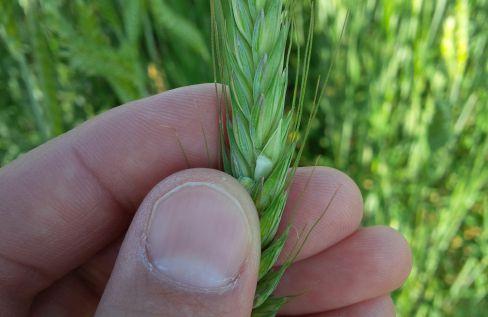
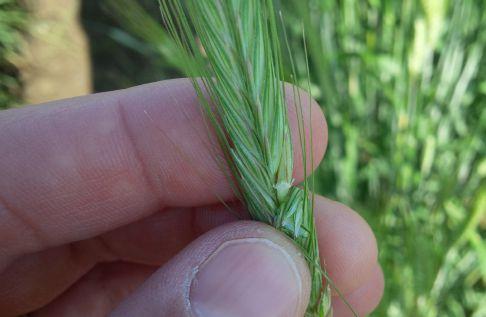
These two photos, taken on the same day, show one of Larsen’s early triticale lines (left) that starts grain filling even earlier than rye (right), so these early triticales could work well in a double-cropping system.
BUILT FOR SOIL PRODUCTIVITY
NO INTEREST, FOR UP TO 6 MONTHS NO PAYMENT FOR UP TO 1 YEAR* *
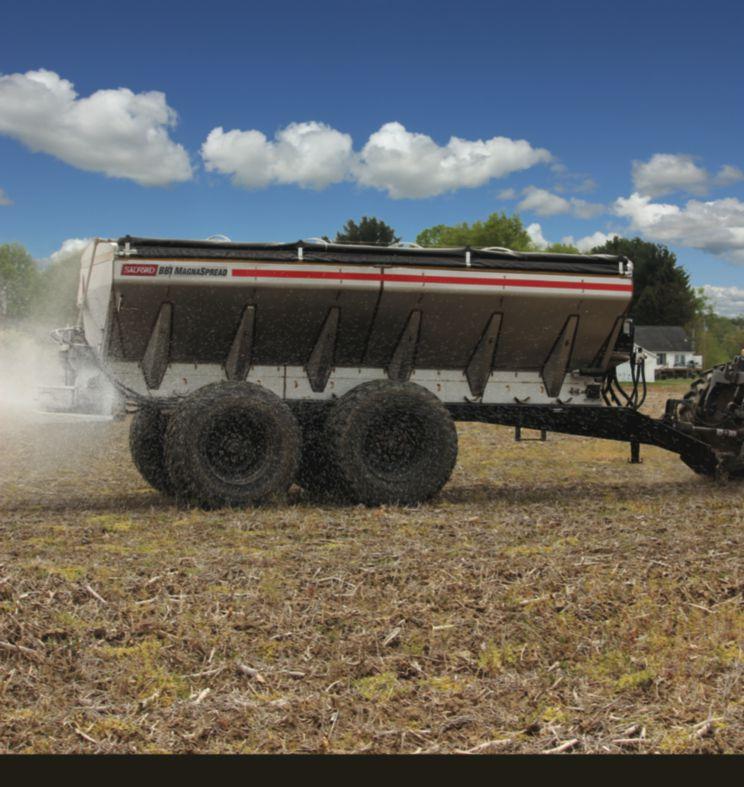
SALFORD’S BBI SPREADERS
FIT YOUR FARM - Wide range of pull type and truck mount models from 64 to 480 cu ft struck capacity.
FERTILIZER OR LIME - MagnaSpread and Liberty apply fertilizer 80 ft. or more and lime up to 60 ft.
SPREAD UP TO 120 FT. - Optional Javelin spinner system spreads Urea up to 120 ft.
MULTI-HOPPER CONVENIENCE - MagnaSpread 2 & 3 models apply multiple products in one pass.
VARIABLE RATE & SECTION CONTROL TECHNOLOGY - ISO compatible models follow your variable rate prescription or straight rate models are available for simplicity.