
CANADA’S SPORTS TURF MANAGER
Reliability that counts
KM 131 R KOMBISYSTEM
GivING professionals more tools to get the job done.
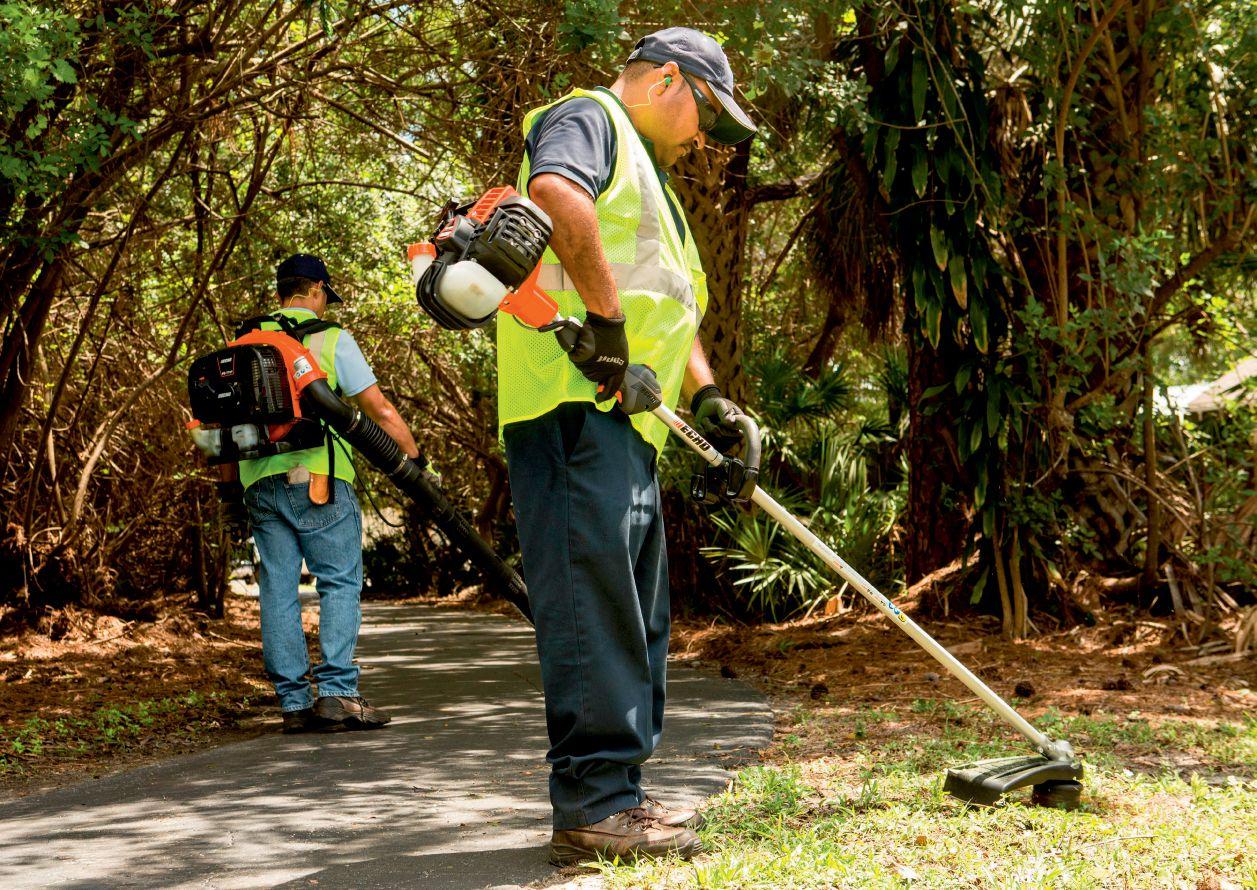
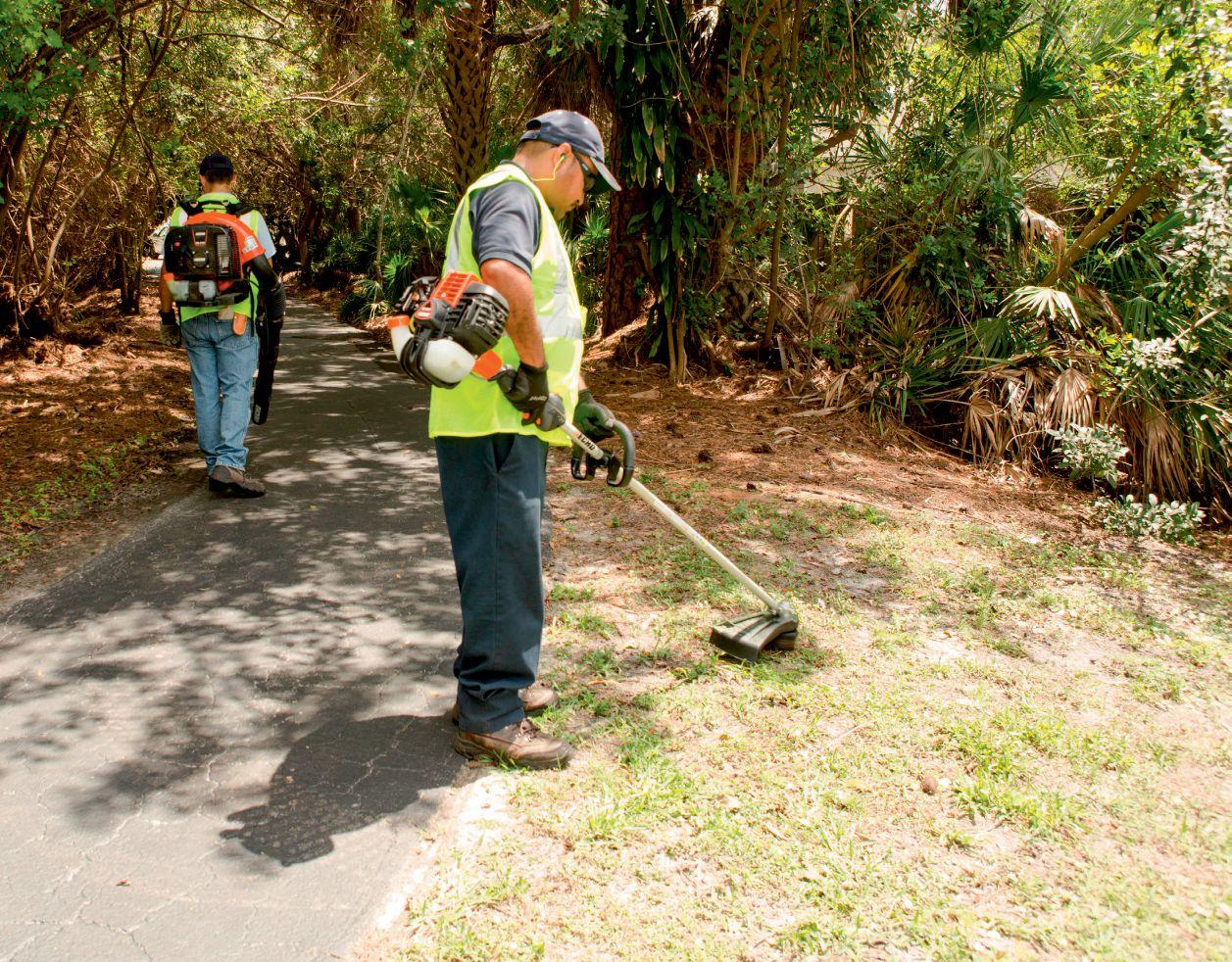
When you are on the job, which do you value more: power or versatility? If you answered “both,” then take a look at the KM 131 R KombiEngine. This multi-tasking tool is the most powerful in the STIHL KombiSystem family and features a low-emission engine, delivering 30% longer runtimes compared to its predecessor. It’s compatible with 15 KombiSystem tools, giving you incredible versatility in a fraction of the trailer space compared to stand-alone tools. Each tool slides into the KombiEngine effortlessly and is secured via a quick-release coupling system. Just slide, twist and you’re ready to go. The KM 131 R saves on storage space and is easy to operate, featuring a semi-automatic choke lever, one-touch stop switch and anti-vibration system.


SPECIFICATIONS
① Powerhead weight does not include fuel and attachment. NOTE: STIHL KombiEngines and STIHL KombiTools are sold separately.
PRO-FLEET COMMERCIAL LANDSCAPE PROGRAM
STIHL’s Pro-Fleet Commercial Landscape Program is designed to provide commercial landscapers a volume discount on major purchases of 5 or more landscaping power tools. Visit your STIHL Dealer today to find out more and take advantage of the savings!
STIHLCANADA
06 | In the news
Ongoing COVID-19 pandemic postpones first Canadian GIS 26 | Snow & Ice
Solving freezing rain
N.B. sports turf manager earns STC’s top honour Moncton’s Gorden Horsman named Canada’s sports turf manager of the year

04 | From the editor
Landscaping hanging tough amid COVID-19
38 | Health & Safety
Tree work demands utmost in safety
Landscaping and COVID-19
Businesses

From the editor
By Mike Jiggens
Landscaping hanging tough amid COVID-19
Much has been happening in the turf world since we last went to press with our April/May issue. At that time, the only golf courses that were open for play were in British Columbia, even though the weather was right for normal openings elsewhere.
Many landscaping and lawn care businesses were allowed at that time to offer their customers only basic services such as mowing and weed spraying. Sports fields in most areas were being mowed with little or no extra attention as team play was off the table and remains so.
I nterestingly, most golf courses are reporting strong numbers now that they’ve opened for play as golf is one of the few physical activities that can be conducted safely amid the COVID-19 pandemic. It’s a slightly different game with the various mandated health-related protocols in place that have also precluded certain maintenance practices. But the sparked interest in the game could perhaps be the impetus golf needs to reinvigorate itself.
Lawn care and landscaping businesses have been able to offer customers full service again, and several companies are finding the pandemic to be little more than a minor nuisance. The usual physical distancing requirements and equipment sanitation needs are
being practised, but many companies aren’t experiencing the major fall-off in business they had initially feared.
It’s an ideal time for them to have improvements made to their outdoor spaces
In early May, Turf & Rec produced a live webinar to explore how the novel coronavirus was impacting the landscaping industry. Our panelists noted that some employees were uncomfortable about the prospect of working amid a serious health crisis. Some, consequently, chose to remain home at the outset, but most have returned to work, realizing they can execute their daily tasks safely by making a few common sense adjustments. Employees have been diligent with regular hand washing, disinfecting equipment, remaining at least six feet apart from others, wearing masks and not touching anything touched by others.
We learned that some companies lost some jobs yet picked up others, essentially creating a balance. Maintenance work for residential clients remained strong for the most part as lockdowns kept people at home more than ever before, and they were looking to enjoy that additional time within the confines of their well-maintained properties.
Panelists expressed optimism that a silver lining could be found from the health crisis. Kathy Thomas, owner of Green Thumb Landscaping in Burlington, Ont., said with international travel likely being off the radar for some time, that people are going to want to spend more time at home.
She added that the crisis has given landscapers and lawn care operators the chance to think about what they do, how they do it and why they do it, and how it can be made better.
C hris Draaistra of The Grounds Guys in Abbotsford, B.C. said with people staying home more, it’s an ideal time for them to have improvements made to their outdoor spaces.
He added that companies not already sending invoices digitally or accepting payments digitally or electronically have been given a tremendous opportunity to incorporate such methods.
Jim Landry, executive director of Landscape New Brunswick and Prince Edward Island, said he foresees an increased focus on such things as food security. With borders shut down and trucks possibly not being able to cross, not enough food will be able to be produced locally. He said this will teach children about the importance of growing their own food.
Sports Turf Canada conducted a Zoom meeting of sports turf managers in late May during which representatives from three areas of the country shared what is being done with fields amid the pandemic. Team sports have yet to be cleared for play, leaving the fields largely unused.
www.turfandrec.com
Editor Mike Jiggens mjiggens@annexbusinessmedia.com
National Advertising Manager
Rebecca Lewis 519-400-0322 rlewis@annexbusinessmedia.com
Nashelle Barsky 905-431-8892 nbarsky@annexbusinessmedia.com
Account Coordinator Mary Burnie 519-429-5175 mburnie@annexbusinessmedia.com
Media Designer
Graham Jeffrey
Circulation Manager
Anita Madden 416-510-5183 amadden@annexbusinessmedia.com
Group Publisher
Todd Humber thumber@annexbusinessmedia.com
COO
Scott Jamieson sjamieson@annexbusinessmedia.com
Printed in Canada ISSN 1186-0170
PUBLICATION MAIL AGREEMENT #40065710
SUBSCRIPTION RATES
Published 7 times a year – Jan/Feb, Mar, Apr/May, June/July, Aug/Sept, Oct, Nov/Dec Canada – 1 year $35.00; 2 year $45.00 3 years $55.50 (plus applicable taxes HST 86717 2652 RT0001
CIRCULATION
email: blao@annexbusinesmedia.com Tel: 416.442-5600 ext 3552 Fax: 416.510.6875 (main) 416.442-2191 Mail: 111 Gordon Baker Rd., Suite 400, Toronto, ON M2H 3R1
Occasionally, Turf and Recreation will mail information on behalf of industry related groups whose products and services we believe may be of interest to you. If you prefer not to receive this information, please contact our circulation department in any of the four ways listed above.
Annex Privacy Office
privacy@annexbusinessmedia.com Tel: 800.668.2374
No part of the editorial content of this publication may be reprinted without the publisher’s written permission © 2020 Annex Publishing & Printing Inc. All rights reserved. Opinions expressed in this magazine are not necessarily those of the editor or the publisher. No liability is assumed for errors or omissions. All advertising is subject to the publisher’s approval. Such approval does not imply any endorsement of the products or services advertised. Publisher reserves the right to refuse advertising that does not meet the standards of the publication.

Z400 SERIES ROLL OUT WITH A HIGH-PERFORMANCE MOWER.

Four years or 750 hours
See a participating Husqvarna servicing dealer for details
Husqvarna’s Z400 series of professional zero-turn mowers is ready to deliver for your commercial operations. This highly productive and efficient lineup is designed for maximum performance and easy serviceability. From an optimal weight balance to the cutting-edge performance of the Parker HTE transmission, each mower in the Z400 series is ready to get the job done faster and more efficiently than ever before. HUSQVARNA.COM
Connect with HusqvarnaCA
Maximizes uptime
Ideal balance and traction New, highperformance transmission
© 2020 Husqvarna AB. All rights reserved.
N.B. user groups are not pleased to maintain turf
Sports field user groups in Saint John, N.B. aren’t too happy about the possibility of having to maintain the fields themselves this year. Budget shortfalls have equated to no field maintenance, meaning if “low contact” team sports are given approval to proceed, it will be the leagues’ responsibility to maintain the playing surfaces.
The cost to maintain the eight soccer fields used by the Saint John Soccer Club generally run into the hundreds of thousands of dollars.
Welland recalls laid-off city workers to cut weeds, tall grass
The City of Welland, Ont. is bringing back nine of its full-time public works staff on June 1 and another 14 to follow a week later, to tackle the tall grass and weeds growing on public property. The recalled staff will be dedicated to mowing grass and undertaking other maintenance tasks to address the backlog.
The layoffs of city staff were due to the COVID-19 pandemic.
“It was prudent to bring back those laid off staff to get the community back to looking the way we are accustomed to,” chief administrative officer Gary Long said.
Canadians are OB at N.B.-Maine border golf course
A golf course that straddles the New Brunswick and Maine borders is currently off limits to golfers in Canada, even though most of the course lies on Canadian soil. Golfers from New Brunswick can only access the Aroostook Valley Golf Course from the United States, but, with the border currently closed, they are being denied entry. Almost half of the club’s members are Canadian.


Ongoing COVID-19 pandemic postpones first Canadian GIS
The inaugural Canadian Golf Industry Show, originally scheduled for November in Vancouver, has been postponed until 2021. The event was to include three concurrent conferences, including the Canadian Golf Superintendents Association’s annual trade show and conference.
The uncertainty surrounding large group events amid the COVID-19 pandemic sparked the postponement.
Joining in with the CGSA for the conference were to have been the National Golf Course Owners Association and PGA of Canada.
No dates or venues have been announced for the Golf Industry Show for either 2021 or 2022. Postponement of the inaugural event was mutually decided by all three stakeholders. The format of the event was to have featured three concurrent conferences
with one all-encompassing trade show.
The decision to postpone or continue with this year’s event needed to be made in May to allow sufficient time to properly manage such a large gathering and provide enough time to negotiate the proper cancellation protocols. Government restrictions on large public events have remained unchanged since the pandemic was originally declared.
Other industry events have either been cancelled or rescheduled to later dates due to the ongoing pandemic.
The Snow and Ice Management Association’s annual conference, originally scheduled for late June in Hartford, Ct., has been moved to later in August. As of the end of May, the GIE+EXPO was still scheduled to take place in October in Louisville, Ky.
Find the latest turf-related news, stories, blogs and analysis from across Canada, and access our forum . . . www.turfandrec.com
Social distancing circles painted at Toronto park
Social distancing circles have been painted onto the turf at Toronto’s Trinity Bellwoods Park as a means of avoiding another fiasco as experienced the weekend of May 23-24. Thousands of people flocked to the park on the weekend, paying little heed to the need for social distancing.
Similar circles have been painted in parks in San Francisco and New York City to encourage visitors to practise social distancing.
Ticks can mimic symptoms of other medical conditions
The Canadian Lyme Disease Foundation is saying that no tick is a good tick. All ticks able to attach themselves to humans can carry various diseases. The bacteria Borrelia can mimic the symptoms of other ailments, including multiple sclerosis, Parkinson’s and heart problems.
Ticks prefer to be in tall grass and bushy areas where there is leaf litter, shade and humidity at the ground level.
A 2018 study showed that 93 per cent of people with Lyme disease don’t get diagnosed.
Record-breaking numbers reported for Ontario golf
Golf courses in Ontario are seeing record-breaking numbers among golfers since the game was green-lighted for play during the Victoria Day weekend. Courses were packed to capacity on opening day, and the trend seems to be continuing with an increase in golfers under the age of 18 who have few other options for physical exercise.
GolfNorth vice-president Doug Breen said golfers have adjusted to the new protocols necessary amid the COVID-19 pandemic.

SIMA reworks symposium to be offered as a virtual event
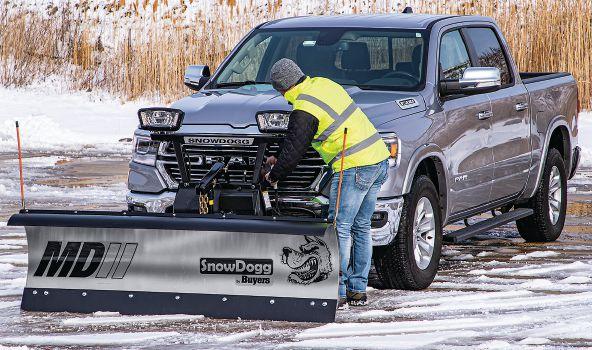
The Snow and Ice Management Association’s 23rd annual Snow & Ice Symposium has become a virtual event due to the ongoing COVID-19 pandemic. The original event was to have been held Aug. 25-28 in Hartford, CT after having been postponed from June. The virtual event is scheduled for Aug. 26-28.
The event will include eight live sessions and six on-demand tracks, and will feature a new keynote speaker.
A virtual trade show will include tech talks and one-on-one meetings.
“Earlier this week we were notified by the Connecticut Convention Center, our host facility for the 2020 Symposium, that they would not be able to open this August to host events,” a statement from SIMA read to its members. “These are challenging times dealing with the health and safety impact of COVID-19, and we have been preparing for the possibility that large events would not be able to be held in the near future.
“We are both saddened and disappointed that we will not be able to have an in-person symposium this summer. However, with
new challenges arises new opportunities.
“This event will include an individual and company pass options to maximize participation. While we can’t duplicate the in-person event, our focus will be to deliver all of the things the ‘Best Show in Snow’ is known for in a new format.
More information and registration is forthcoming. Anyone who was already registered for the symposium as an attendee or exhibitor will be contacted by SIMA to present its options.
“SIMA is working to make the virtual symposium the best possible for you in light of the regulations and limits on in-person events,” the association stated.
“By attending and utilizing the resources we have to offer, you will be better prepared to deal with the upcoming winter season when snow and ice is an essential service to be managed in order to ensure safety to our clients and communities.”
SIMA will be in Cleveland in 2021. To register for the virtual event, visit https://www.sima.org/ show/registration.
percentage of undiagnosed people with Lyme disease
Golfers under 18: age group contributes to increase in player
N.B. sports turf manager earns STC’s top honour
Moncton’s Gorden Horsman named Canada’s sports turf manager of the year
By Mike Jiggens
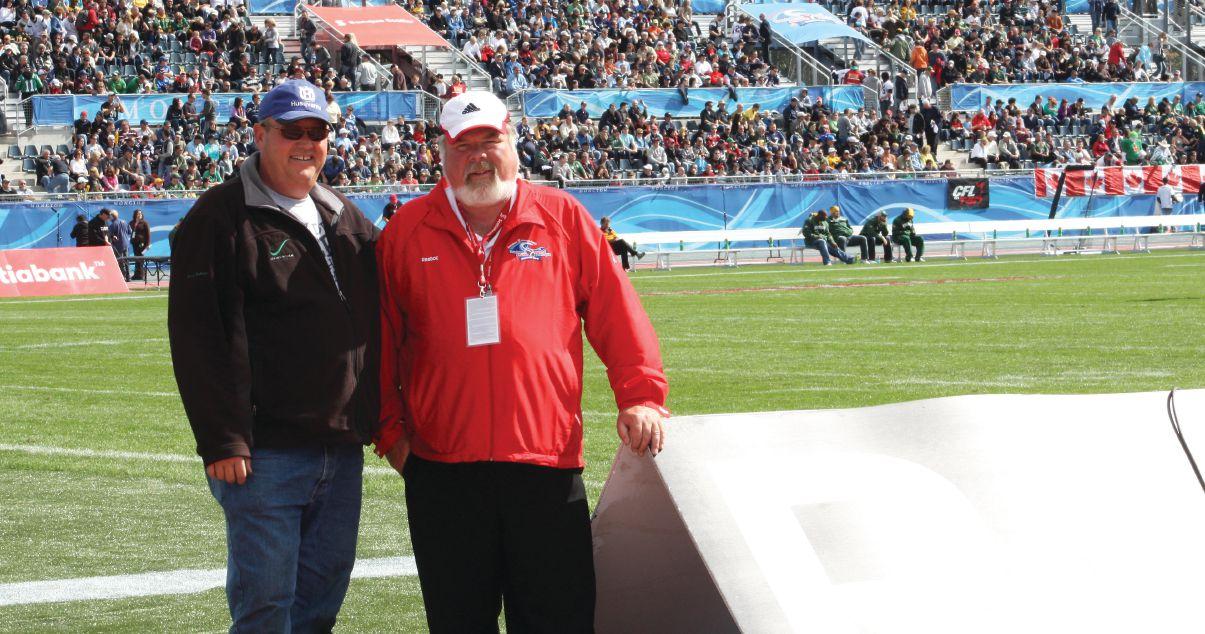
The man responsible for creating a liaison between New Brunswick and Sports Turf Canada has been named the association’s sports turf manager of the year. Gorden Horsman, superintendent at Moncton’s CN Sportplex, is the first recipient of the award from east of Ontario.
“I feel very lucky to have this opportunity to be voted as sports turf manager of the year for Canada,” he said. “It’s not bad for a Salisbury boy.”
Sports Turf Canada began as an Ontario-based organ-
ization – originally called the Sports Turf Association – but Horsman’s interest in what it offered its members led to the association spreading its wings into Atlantic Canada and precipitated a change in name to Sports Turf Canada.
“To be involved with Sports Turf Canada was incredible,” he said. “We opened up Atlantic Canada to Sports
Gord Horsman, right, with Gord Dol in 2010 at the University of Moncton where the Canadian Football League played a neutral site regular season game.

Turf Canada.”
Horsman became the association’s first non-Ontarian to be elected to its board of directors, a position from which he has since stepped down. Shortly after making a connection with Atlantic Canada, Sports Turf Canada expanded into British Columbia and Alberta by adopting a relationship with the Western Canada Turfgrass Association.
Horsman singled out former Sports Turf Canada executive director Lee Huether and board member Gord Dol, former owner of Dol Turf Restoration, as his key contacts who helped expand the association into New Brunswick. Currently, another of New Brunswick’s members – Bernie Hurley of the Town of Oromocto – is a member of Sports Turf Canada’s board of directors.
Sports Turf Canada has held a couple of successful fall field day events in Halifax and Moncton in recent years.
“People from all over were here, and we had great turnouts.”
Perhaps Horsman’s crowning achievement in the industry was the role he played in the development of Moncton’s CN Sportplex.
Originally called the Moncton Common, the home of 10 ball diamonds and six soccer fields has become renowned across Canada as one of the country’s foremost sportsplexes.

Before working for the City of Moncton, Horsman had access to a number of sand and gravel pits, turning out USGA-spec sands, blends and mixes. It presented an opportunity for him to enter the golf course construction market.
“That was a turning point for me because I had sand pits and gravel pits all over New Brunswick.”
It was a small operation, he said, but it did well at the time.
“We used to do a lot of composting before composting was the thing to do.”
His company was a supplier of potting soil material to a large peat moss company. Although his foray into the golf market didn’t work out as well as he hoped, opportunity knocked just prior to the turn of the millennium when plans were underway for the construction of the Moncton Common. He was sought after by the construction contractor to look after the project’s blending and sand mixes.
SUPPLYING FIELD MATERIAL

Horsman was hired by Turf Masters to blend and supply the necessary materials for the sand-based fields.
“That involved about 50,000 tons of sand, 20,000 yards of topsoil and about 15,000 tons of pea stone for drainage.”
Following the construction of the 10 ball diamonds and six soccer fields at the since renamed CN Sportplex, Horsman’s involvement in the project impressed then Moncton parks director Rod Higgins enough that he was offered a full-time job with the city to look after its sports fields.
“I wasn’t going to say no to an opportunity like that,” Horsman said, noting the timing of the offer couldn’t have come at a better time when things weren’t going so well with his business.
Since then, Horsman became involved in two other major construction projects in Moncton – Kiwanis Park and Hal Betts Commemorative Sportsplex. Along with the CN Sportplex, the
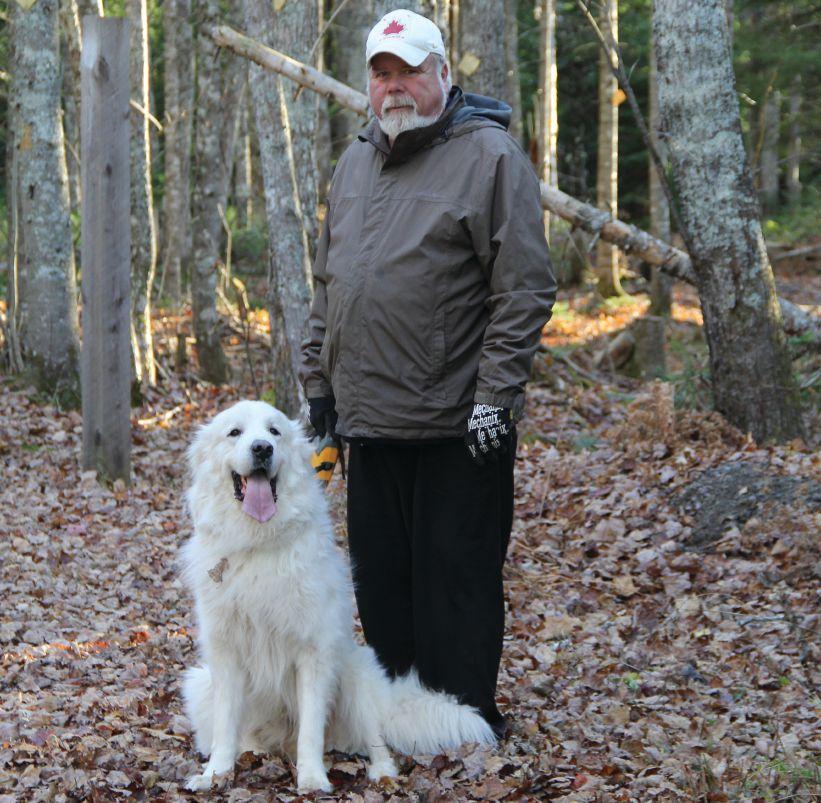
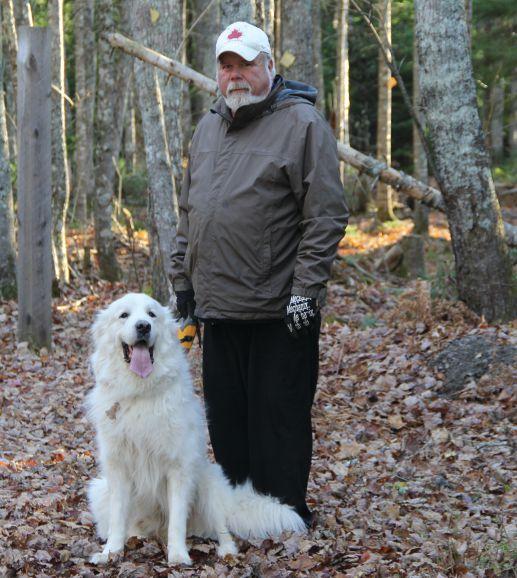
Horsman and his faithful companion Barkley.

‘People cannot believe what we have here compared to Toronto or Edmonton or Vancouver’
facilities helped establish Moncton’s reputation for its first-class sports venues. Kiwanis Park is the home of junior baseball and operates at capacity. Hal Betts Sportsplex is a softball and slo-pitch facility that is also at capacity.
“We’re keeping up with what we’ve built.”
People from across Canada have visited the CN Sportplex over the years, either as competitors or spectators at a number of high-end tournaments and events.
“People cannot believe what we have here compared to Toronto or Edmonton or Vancouver.”
More recently, Horsman oversaw the tearing up of one of the natural turf diamond infields at the CN Sportplex in order to accommodate the city’s “Field of Dreams” project. With funding from the Toronto Blue Jays’ charitable Jays Care Foundation, President’s Choice and other donations, an artificial turf infield was installed, allowing the diamond to become fully accessible.
“That was a wonderful project to be involved with. It went really well and people were just nothing but impressed by the artificial infield. It’s wheelchair accessible and it sees a lot of use. It’s a nice addition to the site.”
About eight years ago, Horsman joined a Plant Health Atlantic steering committee that was struck to persuade the New Brunswick government not to ban pesticide use in lawn care and on sports turf, and to allow only licensed professionals to do the work. The province agreed to adopt integrated pest management “as long as we didn’t spray more than 50 per cent of the aggregate properties.”
His work on the steering committee led to him becoming Plant Health Atlantic’s chairman of the board – a position he held for two years before stepping down three years ago.
Horsman said Moncton’s current parks director, Dan Hicks, has been involved in keeping the momentum going for the city’s prized sports facilities, which pleases Horsman no end.
“I enjoy coming to work every morning. There are a lot of challenges with employees and people and the
public, but we’ve had so many nice comments and accolades for this site (Field of Dreams) that I feel lucky to be part of that. We have some really incredible people working for the city who buy into what we have and what we’re trying to do and keep the end users happy.”
Horsman bolstered his knowledge of the industry by taking the University of Guelph’s turfgrass managers’ short course a number of years ago.
A BIG CHALLENGE
One of the biggest challenges he has faced during his tenure with the city was the preparations for the 2010 World Junior Track and Field Championships at the University of Moncton’s sports stadium, called CroixBleu Medavie Stadium. He was tasked with looking after the infield for the field events.
“That was a huge challenge. I had no idea what would be involved with it, but when it was done I was done. It
Terry Henderson takes over as Sports Turf Canada president
Sports Turf Canada has a new president. Terry Henderson, supervisor at Woodlawn Memorial Park in Guelph, has taken the gavel from Ken Pavely of Dol Turf Restoration in Bond Head, Ont.
The change in command was made official May 28 during a virtual annual general meeting of the association. Henderson has been with Sports Turf Canada for 19 years.
“I’m very excited about going forward with the board,” he said. “There are lots of fresh faces and good ideas, lots of good initiatives and we’re utilizing technology for our advantage.”
Pavely has stepped down following a two-year term as president.
“It’s rather strange to think that my term is coming to an end,” he said. “It’s been terrific and I’ve certainly enjoyed dealing with absolutely everybody. Thanks to the members for giving me your trust and support in electing me to the board.”
The strategies enacted by the board in 2019, especially in the development of education and training initiatives, were a highlight of his presidency, Pavely said.
“The feedback we’ve received has been very, very good, and we’ll continue to improve it as time goes on,” he said. “Secondly, we wanted to increase our number of members and improve our retention rates. We’re continuing our efforts to attract new members and encouraging existing members to retain their memberships.”
Pavely also noted the success of a Sports Turf Canada field day and instructional course in Saskatchewan in 2019.
“Both were very well received, and we have support going forward for more opportunities with other industry organizations, and it’s a fantastic chance for us all.”
Other noteworthy accomplishments by the association last year, he said, included moving the production of its publication more in-house and making it a resource for sports turf professionals with content provided by sports turf professionals.
was the busiest week I’ve ever had in my career – trying to get everything ready.”
Horsman said he and his “crackerjack” crew worked 14-to-16-hour days preparing for the championships and then worked from midnight until 6 a.m. on the field “to have everything camera-ready” during the week of the event.
Another notable career challenge he faced was getting the same field ready for Moncton’s first-ever regular season Canadian Football League game, which was played in September 2010 between the Edmonton Eskimos and Toronto Argonauts. The project involved the installation of artificial turf in the end zones.
“This presented new challenges that we did not expect. One jumped out at us when the teams had concerns
“Our strategies for 2020 are currently under review, and this (COVID-19) pandemic has allowed us to step back and look at all of our programs and services in ways to ensure increased value to our members. You’ll see change, and we’re excited to work on new initiatives. So stay tuned as our board will meet shortly to set up plans, and we’ll share those with you.”
Pavely acknowledged the support of industry suppliers “who continue to support us through all our operations.”
He said Henderson will make a “terrific” president as Sports Turf Canada moves forward.
Ending his term as a board member is past president Tab Buckner of the Township of Langley, B.C. Pavely said his predecessor will continue to be actively involved with the delivery of Sports Turf Canada’s instructional courses in the area of natural and synthetic turf fields.
Visit www.turfandrec.com to see the full roster of other Sports Turf Canada board members.
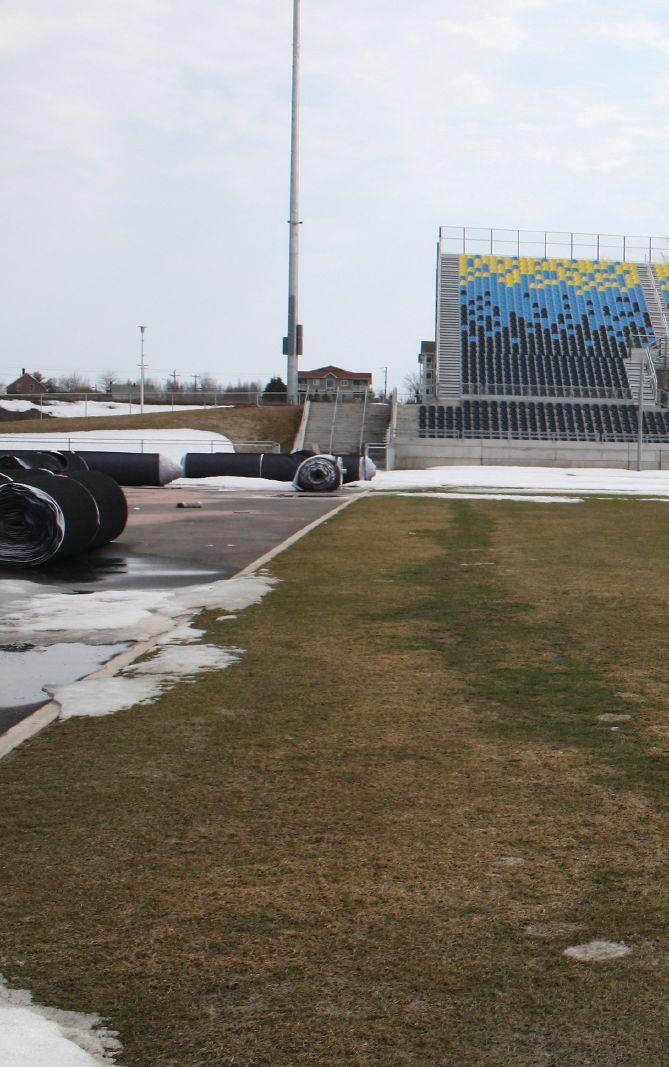
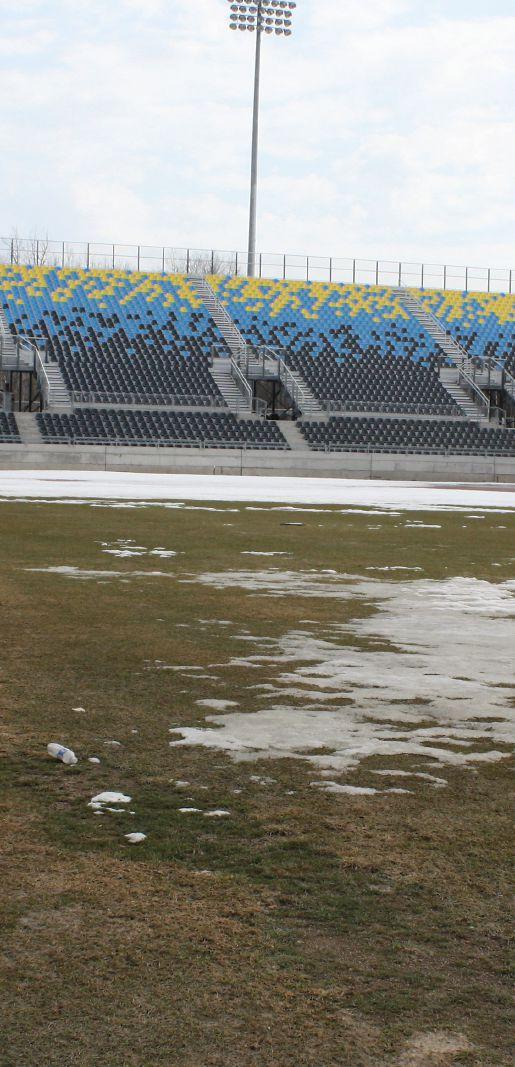
Dealing with winterkill was a constant challenge for Gord Horsman at the University of Moncton’s sports stadium.
that the line of scrimmage was the going to be on the goal line, which meant players would be digging in on the natural grass and the artificial. This was a ‘holy crap’ moment, and Gord Dol and I looked at each other and said let’s get 30-foot game ready and see what happens. Two or three hours later the teams came out and dug in like Clydesdales. They did not even leave a mark or a ripple on the artificial turf. Ian Fowler, who was instrumental in bringing these big events to Moncton and has since passed, came to us and said, ‘I knew you guys could pull this off.’ I looked him and said, ‘I am glad you knew we could do this.’”
Two other neutral-site CFL games have since been played there.
The stadium was converted to a full artificial turf surface in time for the 2015 FIFA World Women’s Cup, which Moncton co-hosted with Edmonton, Montreal, Ottawa, Vancouver and Winnipeg.
“When they took the natural grass out, I handed my keys to Jacques Bujold and Sara Yeomans – who look after the city’s other sports facilities – and said, ”Here
you go.’ They are the experts in this area.”
While continuing to promote Sports Turf Canada in New Brunswick – with Moncton, Oromocto and Saint John all on board – Horsman is contemplating his future upon retirement from the city, which he speculates will be in about five years. Sports turf consulting is something already on his mind when that day arrives.
Like all other Canadian municipalities, Moncton is dealing with the impact of COVID-19 on its sports fields.

Minor sports leagues in the city are “champing at the bit” to be playing, Horsman said, but they must wait until the green light is given by health authorities.
“We’re living through a game changer. How we deal with it will be remarkable.”
Horsman said being acknowledged as sports turf
‘They (CFL players) did not even leave a mark or a ripple on the artificial turf’ – in reference to CFL game in Moncton
manager of the year in Canada may not have been possible without the support of his wife, Barb; children Alex and Amanda; his grandchildren; Dr. Bob Daniels, adjunct professor of turfgrass science at Nova Scotia Agricultural College; Dr. Eric Lyons and Dr. Katerina Jordan of the University of Guelph; Nicole Cassie, technical liaison with the Field of Dreams project; the Stretch family, owners of Turf Masters; George Bannerman of Bannerman Ltd.; and Ken Brown of Plant Health Atlantic and his wife, Judy.


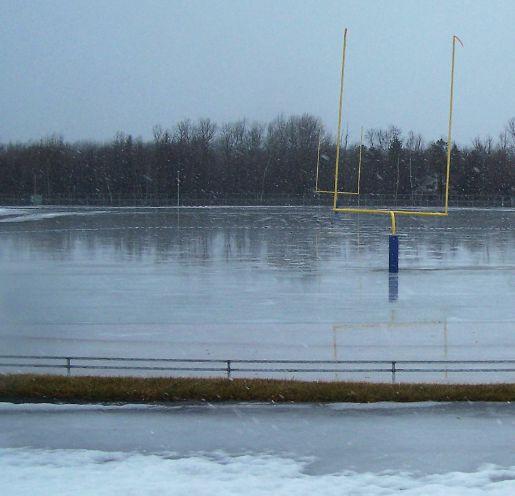
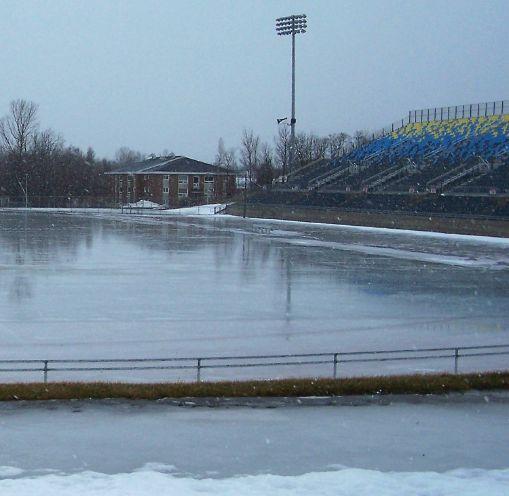
Prior to being converted to an artificial turf surface in 2015, the University of Moncton’s natural surface often succumbed to ice cover due to poor drainage.
The dangers of digging and how to avoid potential trouble
Whatever the digging project, know that danger is always present
By Mike Hale
Whether you’re using a hand shovel or an excavator, an earth drill or a trencher, a hole is a hole, and there are several safety precautions that come along with a digging project. Sharp tools present the opportunity for dangerous situations, let alone combined with the power of a mechanical or hydraulic rig. Choosing a safe machine, calling before you dig and operating the machine according to manufacturer recommendations are all things to consider before starting. Keeping safety in mind before starting any job is crucial to avoiding injuries, some of which can be serious.
SELECT A SAFE DRILL
Choosing a drill with safety-enhancing features can make or break a project. No matter what kind of drill you’re looking for – mechanical or hydraulic, a larger rig or smaller piece of equipment – there are certain features to look for to
ensure the safest operation.
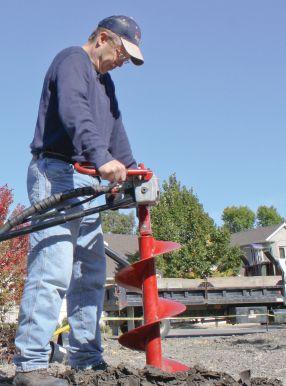
First, make sure the drill has a torque bar. This addition protects operators from the harmful effects of a drill’s torque by transferring kickback from the auger to the power source. By distributing force to the engine carriage as opposed to the handles, one person can safely and comfortably operate these drills. In addition to protecting the operator from harm, torque tubes reduce operator effort and fatigue.
Torque tubes are the only way to ensure safe operation of a one-man drill. The torque tube eliminates the kickback common with competitive earth augers, making oneman drilling safe, fast and productive. Many two-man drills exist, but if they’re not operated correctly, they present a handful of potential issues. If one operator slips or lets go, the other operator risks being thrown and injured. A one-man earth drill is designed to be a safe and efficient piece of equipment. Additionally, mechanical drills are often equipped with a centrifugal clutch. If the auger encounters
an object beneath the surface or if it’s overloaded, the clutch automatically slips to protect the operator from serious injury.
CALL BEFORE YOU START
Calling before you dig can be the difference between smooth sailing and a potential disaster. There are millions of miles of buried utilities below the surface, including gas lines, underground sprinklers, sewer pipes and more. Buried gas or power lines are the most dangerous, with the potential for electrocution, fire, severe burns or even fatalities. Always call the national diggers hotline at least 48 hours prior to digging to have underground utilities marked. When the inspector arrives, pay attention to the details since laws differ when it comes to how long your permits are valid and what the paint or flags indicate. There may be multiple utility lines to be aware of.
Besides underground utilities, you should have a general idea of what lies below. Fill material, wood, rocks and more can be hiding under-

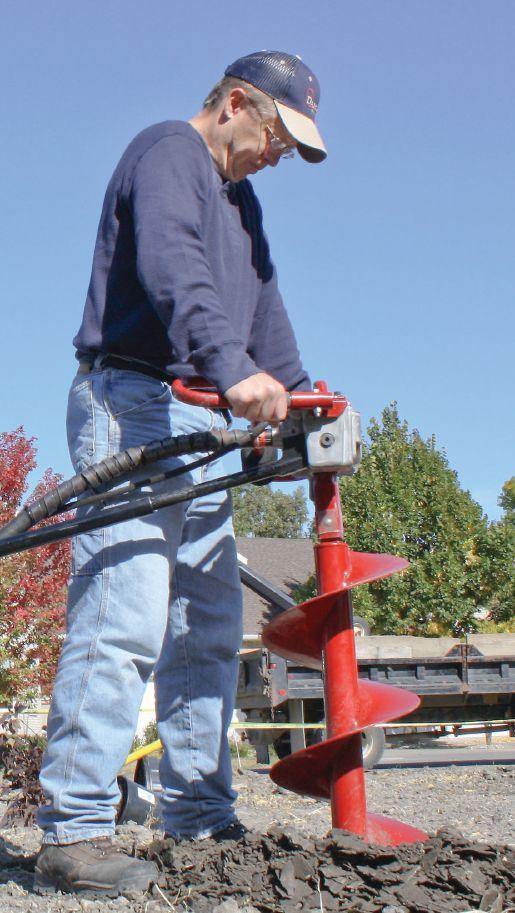
ground. Take a good survey of your site beforehand. Not only does this provide another level of safety, but it helps you make a decision on which kind of drill bit to select.
OPERATE SAFELY
After you’ve equipped yourself with the safest drill and underground utilities have been marked, it’s time to start your project. If you’ve chosen a one-man drill, it’s important to operate the drill alone, as the handles are designed for a solo operation. Bystanders should be at least 10 feet away, and everyone should be wearing hard hats and safety goggles.
Avoid loose-fitting clothing, including gloves. If work gloves are too loose, they can hinder your ability to appropriately operate the
Auger troubleshooting
Whatever the digging project, know that danger is always present
By Mike Hale
Mechanical drills are multi-functional, quick and efficient, making them a top choice among contractors and rental centres. However, their many moving parts sometimes present problems. It’s easy to get frustrated when the engine is running but the auger isn’t turning. Understanding what to look for and how to prevent issues is key to ensuring a smoothly operating, fully functioning auger.
IDENTIFYING THE ISSUE
A problem with the drivetrain, typically along the flexible drive shaft, is a common culprit when an auger won’t turn. To pinpoint the problem, start by examining the end fittings for cracks or breaks. If there are broken wires or sharp kinks, it’s time to replace the shaft housing. If things appear fine from the outside, remove the flex shaft for further inspection. Depending on the extent of the damage, the entire flex shaft assembly may need to be replaced.
PREVENTATIVE MAINTENANCE
To prevent flex shaft damage, it’s important to clean, examine and grease the flex shaft with white lithium tool grease after every 50 hours of operation. Check the owner’s manual or consult with the manufacturer to determine the correct amount of grease, as excessive grease can gum up in the flex shaft, reducing its operating life. Too little grease, on the other hand, might dry out the cable, causing it to break or generate enough heat and friction to burn through the outer housing. Ignoring flex shaft maintenance can also damage the core and housing, which can lead to $400 or more in repairs.
ADDITIONAL CONCERNS
Helixing of the flex shaft is another concern, especially if the auger repeatedly hits rocks or other solid objects during operation. When an obstruction causes the auger to stop abruptly while the engine delivers torque, the shaft can helix, which will lead to diminished performance and eventually cause the flex shaft to lock up.
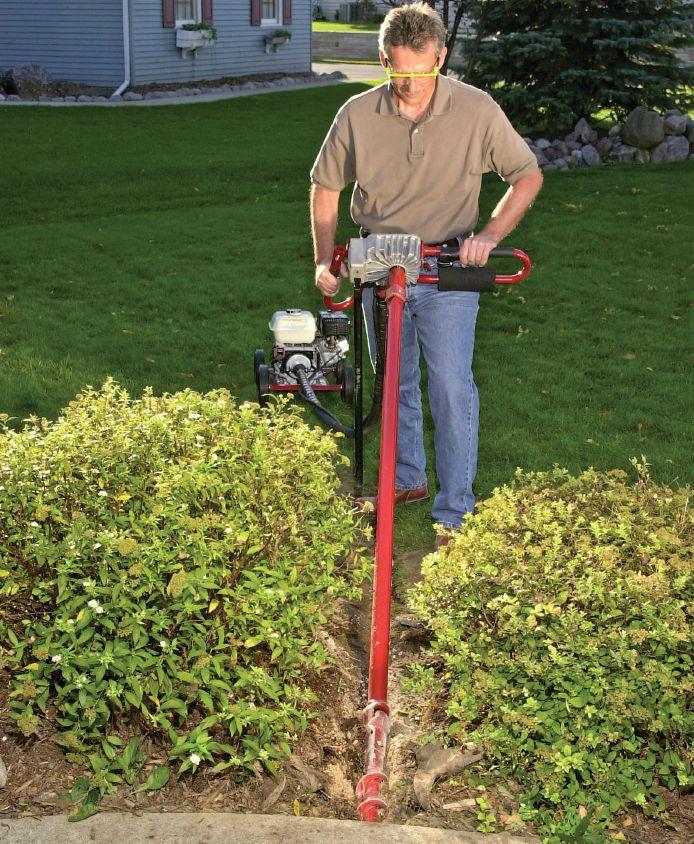
Torque tubes improve user safety and allow for one-person drill operation. Additionally, units with a centrifugal clutch protect the flex shaft by slipping when the auger strikes an object.
Knowing the drill, keeping up with maintenance and having quick access to useful online resources will go a long way toward successful drilling. When that’s not enough, work with a reliable manufacturer to help diagnose the issue and find a solution.
No matter the type of drill or whether it’s large or small, there are number of safety features to watch for to ensure safe operation.
Visit one of these participating Exmark Dealers to learn more about the full line of professional Exmark models.
BROTHERS TWO SMALL ENGINES INC ..
ALBERTA FOREST & GARDEN
HORIZON FOREST AND GARDEN LTD
EDGE EQUIPMENT LTD
FUTURE AG INC ...................
FORESHORE EQUIPMENT & SUPPLY
DIAMOND BAR RANCH LTD
C & L SUPPLY (1988) LTD ............
PILON TOOL RENTALS 1972 ..........
B & L SMALL MOTORS LTD
SAVOY EQUIPMENT
ARROW EQUIPMENT LTD
ARCOM POWER EQUIPMENT INC ......
FRASER VALLEY EQUIPMENT LTD
SAVOY EQUIPMENT
HEPBURN ENTERPRISES INC
ABC POWER TOOLS
NEW BRUNSWICK
SMALL ENGINE HOSPITAL
DC’S SMALL ENGINE EXPRESS .......
403-279-2244
403-248-0878
780-542-4446
780-455-3343
403-343-6101
604-744-0547
604-857-9191
250-287-9231
250-338-5361
250-376-0033
250-868-1010
604-987-9926
604-533-0081
604-590-1433
250-545-0627
204-889-3392
204-224-1760
506-854-2807
506-647-6522
Calling before you dig can be the difference between smooth sailing and a potential disaster
ONTARIO
WINDSOR
CARRIERE & POIRIER EQUIPMENT
MERCER EQUIPMENT INC.
BRADFORD RENTAL SALES & SERVICE .
GREEN TRACTORS INC
BOBCAT OF BRANTFORD INC
B.R. DICKSON EQUIPMENT INC .......
CHATHAM OUTDOOR POWER .........
MAPLE VALLEY SALES & SERVICE INC
WPE LANDSCAPE EQUIPMENT
MARTIN’S SMALL ENGINES LTD
A.S.E. EQUIPMENT .................
OUTDOOR SUPPLIES & EQUIPMENT
YORK REGION EQUIPMENT CENTRE
BOBCAT OF LONDON LTD
ZEHR’S SALES & MANUFACTURING ....
W.E. ENTERPRISES LTD .............
WPE LANDSCAPE EQUIPMENT
LAWN LIFE
PRICELESS PRODUCTS LANDSCAPE
M.C. POWER SPORT ................
PICKERING MOWER
ALPINE LAWN & GARDEN EQUIPMENT
ST. ANDREWS PARTS & POWER
SUDBURY SMALL ENGINE SALES ......
HURON TRACTOR LTD
M.R. BLAIS SALES & SERVICE INC
A TO Z RENTAL CENTRE
WELLESLEY HOME CENTRE ..........
CARRIER TRUCK CENTERS INC ........
613-679-1103
705-503-3535
905-775-7101
905-846-2511
519-752-7900
905-331-5040
519-354-3990
705-466-3138
905-628-3055
519-669-2884
519-820-9708
905-578-2411
905-478-1553
519-455-4900
519-595-7579
905-629-1424
905-569-2055
519-942-9333
416-410-2158
705-748-5189
905-426-2645
416-292-8900
204-953-0030
705-564-9772
519-285-3845
613-443-1230
519-885-5590
519-656-2010
519-539-0971
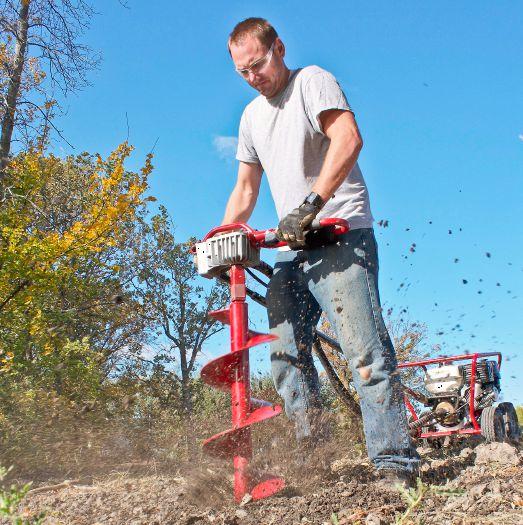
Be aware of the type of ground material present before digging. Not only does it promote safety, it also helps with drill bit selection.
drill. Wear work boots or quality athletic shoes, avoiding hanging shoelaces that could get caught in the auger.
Once the auger is running, position it perpendicular to the ground for the best possible control and optimal results. Touch the auger to the ground before you start rotating. For the best control, adjust the downward pressure based on the soil conditions. If the soil is soft, ease up slightly. If the ground is harder, apply a little more pressure, but not so much that rotation slows or stops.
Once you’ve reached the desired depth, there’s a proper procedure for safely removing the auger from the ground. Release the throttle control and allow the auger to come to a complete stop. Once the auger has stopped turning, it can safely be removed from the hole. Hydraulic rigs feature a forward/reverse lever to make it easier to lift the dirt out. This allows the operator to ease the drill out of the ground as opposed to tugging heavily on the equipment, greatly minimizing the physical effort required to get the job done.
By following a few easy steps, you can ensure your drilling operation is safe, efficient and injury-free.
Mike Hale is sales and marketing manager for Little Beaver.

Landscaping amid COVID-19 pandemic
Businesses are moving forward in spite of the health crisis.
By Mike Jiggens
With restrictions having been relaxed somewhat across Canada amid the COVID-19 pandemic, landscaping and lawn care businesses are able to return to full service work. That wasn’t the case, however, when the spring arrived and much of the country was in lockdown mode with only essential services being permitted to operate.
In several regions of Canada, landscap -
ing was deemed “semi-essential” with only limited services contractors could offer their customers. Mowing and herbicide applications were permitted in most areas, but construction jobs were off the table to a large extent.
In early May, just as announcements were being made in each province about the pending relaxation of restrictions, Turf & Rec presented a webinar – sponsored by Plant Products – to explore how the novel coronavirus was impacting the Canadian landscaping and lawn care industry.
On board to share their thoughts and experiences about how they were impacted were three seasoned veterans of the industry, representing three distinctly different regions of the country. Webinar panelists included Chris Draaistra, franchisee for The Grounds Guys of Abbots-
ford, B.C.; Kathy Thomas, owner of Green Thumb Landscaping of Burlington, Ont.; and Jim Landry, executive director of Landscape New Brunswick and P.E.I.
The panelists addressed a number of issues, including COVID-19’s impact on revenue, its effect on staff, the implementation of employee safety measures, and what might lie ahead, especially if a second wave of the virus becomes apparent.
The following is a condensed highlight package of the webinar panelists’ assessment of landscaping and lawn care in Canada in early May.
What has been the impact on revenue during this crisis?
Draaistra: We’re able to do landscaping throughout the year. We’re able to do a lot of pruning over the winter. We’ve been mowing grass for about five or six weeks
The Canadian lawn care and landscaping industry has been challenged this year by the COVID-19 pandemic, but most companies are continuing to move forward. John Deere photo




















Canadian Turf Distributors
Atlantic Provinces
Irri Plus Inc. (902) 405-4774
Quebec
Central Irrigation Supply
Ville St. Laurent, QC (514) 788-5884
Site One Landscape Supply
Ville St. Laurent, QC (514) 913-6719
Ontario
Site One Landscape Supply
Concord, ON (5 locations) (800) 347-4272
Vanden Bussche Irrigation Milton, ON (6 locations) (800) 263-4112
Central Irrigation Supply
Mississauga, ON (5 locations) (905) 795-8088
Manitoba
Consolidated Supply
Winnipeg, MB (204) 632-7643
Site One Landscape Supply Winnipeg, MB (204) 694-9442
Saskatchewan
Saskatchewan Consolidated Supply
Saskatoon, SK (306) 653-5444
Site One Landscape Supply Saskatoon, SK (306) 931-2440
Alberta Emco
Calgary, AB (403) 278-1470
Corix Water Products
Calgary, AB (5 locations in AB) (800) 242-3176
Consolidated Supply Calgary, AB (403) 203-7550 Edmonton, AB (780) 413-3173
Site One Landscape Supply (2 locations in AB) (403) 236-0102
British Columbia
Andrew Sheret Ltd. (24 locations in BC) (250)-386-7744
Consolidated Supply Kelowna BC (250) 863-8291
Corix Water Products Langley, BC (11 locations in B.C.) (800) 667-2445
Site One Landscape Supply (4 locations in B.C.) (250) 544-0401
Van-Kel/EMCO Corporation (8 locations in BC) (800) 667-8825
Vancouver Irrigation Supply
Vancouver, BC (604) 251-2258 (4 locations)
Rain Bird International Inc. www.rainbird.com/ca
now. We starting mowing grass about the time Prime Minister Trudeau said we’re looking at essential services only. The immediate impact on our sales has been fairly significant. It looks to me like people are looking to spend money, actually. We’ve had more calls for landscape renovations and projects than we’ve had in previous years. Because we’re primarily a maintenance company and we do primarily commercial work in maintenance, we’ve seen a couple of our maintenance clients drop off. Of the about 70 we do, maybe three or four had dropped off, but our staff dropped off at the same time. We lost quite a few staff who were afraid to
come in. So the financial impact was a little bit of a loss in sales, but we also didn’t have to pay as much in wages, so for us it’s going to even itself out.
Thomas: We initially saw in March a 28 per cent decrease year over year, and April has been a 32 per cent decrease. And that’s primarily because we couldn’t do the work that we would normally have been allowed to do – putting in mulches and doing some of those things and doing some enhancements that we would have started in April, and then, of course, we were shut down for a couple of weeks as well. But there are people looking down the road for us to do more work, so our sales are busy.
Landscaping crews are able to physically distance themselves from others to ensure safety is at the forefront. Little Beaver photo

Landry: New Brunswick and P.E.I. have later starts than most every place west of us. We learned a lot from what was happening across the country, starting in B.C., because they always have the earlier start. When all the announcements were made about restrictions on the businesses, there was a lot of concern and there were assumptions made that it was going to drive a lot of businesses right into the ground. But things have changed. It’s been a cool spring here, so most garden centres would not have opened until last weekend anyway, so they didn’t lose any revenue. The companies that had an online presence and allowed for online ordering, they certainly have an advantage. Some of the other companies have scrambled to allow them to have customers online and doing curbside pickup. I think they’re all pretty excited about the way things are turning out. It’s much better than they had anticipated back in March.
If there were any jobs cancelled or paused, what segment were they in?
Draaistra: We have a couple of commercial clients that are very seasonal. We have a client that sells RVs, so the impact on them is going to be very significant, especially if provincial parks don’t open or if Europeans aren’t able to come in and rent their units. We had a number of clients that warehouse food or produce food for the restaurant industry. They’re holding back. We do a lot of higher end residential, so most of those people are still working, so I think the impact on them is going to be less than those who don’t own a house or rent. They’ll have a bigger impact overall through this whole thing. Because of the client base we have, we’ve seen a blip, but it’s going to come back.
Thomas: High-end residential is our niche and a lot of our work comes from regular maintenance and then enhancements and various add-on jobs as the year goes on. We look after two fairly good sized malls, and they have come back and said, ‘We’re going to cancel our power sweeping segment this year, and we’re not going to put mulch on the beds this year, and what else can we cut out?’ With our residential clients, it’s been no problem at all, and we’ve actually picked up a few. For us it won’t be a big problem.
Landry: It was mostly new construction. People were a little hesitant to move forward with that. As the spring started to roll out, most of the customers were coming back. I think it was financial worries at the start. Even if they were working, they didn’t know for how long they’d be working. But I think that concern has dissipated quite a bit. Pretty much everything is going ahead. Some commercial jobs are holding off. Some municipal jobs are holding off, but residential clients are spending more time looking outside now, if not being outside. Two weeks ago, the phones weren’t ringing, but now the phones are ringing.
Have you had to deal with hiring freezes or layoffs?
Draaistra: We didn’t lay anybody off, but within a week or 10 days we had six of our staff who either refused to come into work or were afraid to come into work or had developed a cold or something like that, and we asked them to stay home, so that had a big impact on us. That was right at the beginning when people had no clue about what was going to happen with this thing. We gave them the time off and, as of now, we have almost all of them back. It’s better to have one guy sit at home than to have the rest of the team sick.
‘If you see three people in the cab of a truck, your eyes go to the logo that’s on the door’
Thomas: We did lay everybody off initially for two reasons – one, because we had no idea where things were going and I do have some people who are salaried. The government came out to be incredibly generous and remains so, so people didn’t have to worry as much about what was going to happen in their future. We did it with the promise that we’d get everybody back as quickly as we could. We came back within three weeks, and we had three people as well who were nervous and didn’t want to come back, but one started last week and then the
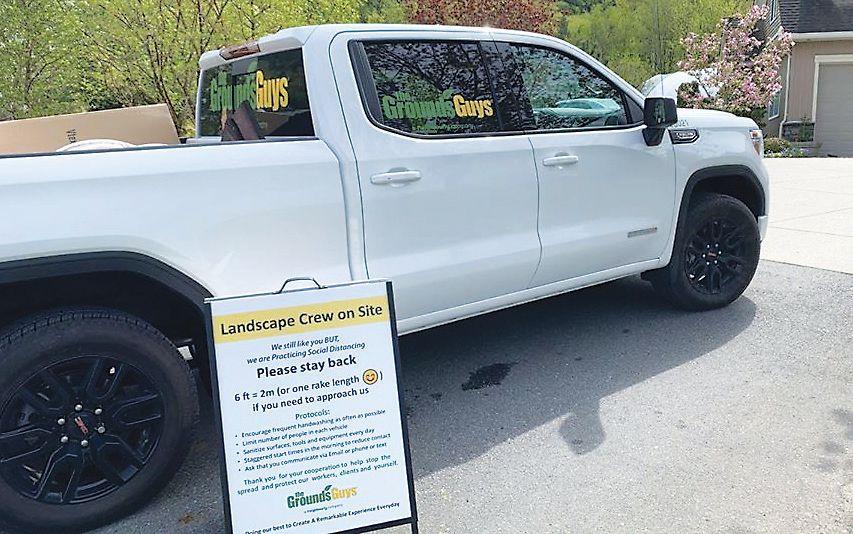
The Grounds Guys in Abbotsford, B.C. place information sandwich boards at their work sites to let the public know they are practising physical distancing while on the job.
‘We work in one of the safest environments you can possible work in. I tell that to the staff – you’re working outside, in the grass, you’re away from each other. We’re out in the open field, making minimal contact with each other.’
other two started yesterday. We did Zoom calls with them so that everyone could get that feeling of being together and understanding that we’re doing what we can and that we care about them. We had hired three new people as well and managed to do the onboarding, and they’re right now at the training stage.
Landry: A lot of our companies up until two weeks ago were doing the onboarding, so they found other ways to do that. People who were coming into the shop could come in and work on their own. There wasn’t a great deal of work to do because there was a lot of concern about how many trucks were they going to need or how many tractors were they going to need. Once that was all straightened out – within the last two weeks – I don’t know of any companies that had mass layoffs. I think it’s balanced with the number of people who voluntarily stayed home. I don’t hear HR being an issue, and in typical years that is the biggest issue that we have in our industry.
What protective measures have you implemented for your staff?
Draaistra: We’re doing our best to disinfect equipment throughout the day and wash hands throughout the day. It’s almost impossible to find face masks still, so we have balaclavas that we use. We work in one of the safest environments you can possibly work in. I tell that to the staff –you’re working outside, in the grass, you’re away from each other. We’re out in the open field, making minimal contact with each other. Homemade materials is what we’re using (due to difficulties finding supplies of disinfectant products) and we have soap and water in the trucks and
bleaching down the equipment at least once a day. Making sure our staff is safe is the important part.
Thomas: We gave each of our staff their own safety kit and it included a mask, gloves, hand sanitizer and their own roll of toilet paper and their own roll of paper towels, so that when they need to use a washroom they don’t have to use any of the products in those washrooms. And we gave everybody their own garbage bag. They take that every day and put all their stuff in it. Everything has to be wiped down at the end of the day, and our employees each have their own equipment, so when doing cleanups there are two rakes on a truck. One has a band of colour around it and that’s one guy’s rake and we don’t touch it. We have only one person per vehicle except for two married couples who work for us. When a truck goes out, the second person is in his own car.
Landry: You have to try to figure out a way to apply social distancing. Things have
gotten a little more relaxed in the past week or so. We can have a couple of people in a truck. They should be wearing a mask. I’m telling our members that one person in a truck is never wrong. If there’s a situation where you have to have two, and sometimes you do if a truck is broken down and you have to pick up a driver or if you have to pick up a second vehicle, then you need two people in the truck to get there. You’ve got to use your own best judgment and bear in mind it’s that six-foot thing that you really have to play with and work around. With vehicles, it’s just as much about optics as it is with safety. That’s where we get the most criticism. That’s what people see on the road. If you see three people in the cab of a truck, your eyes go to the logo that’s on the door. For the most part, people are finding ways to keep their employees safe because that’s the key point.
The full story from the webinar, including panelists’ answers to other questions, can be read online at www.turfandrec.com

Solving freezing rain

It’s one of the greatest challenges for snow and ice contractors. By Dale Keep
Different events can impact how contractors use labour, equipment and materials (LEM) to effectively and efficiently deal with the storm. This is especially true when freezing rain is involved. We all know that some storm events are tougher to handle than others, but a freezing rainstorm of even medium intensity and duration has to be the toughest.
G enerally, freezing rainstorm events represent receiving water over a short period of time and quickly occurring ice buildup. Because of these storm characteristics, applications of most any de-icer and/or grit generally are rendered in-
effective very quickly. To address how to best manage or approach a storm, one must first look at the contract and the level of service (LOS).
CONTRACT AND LOS
How to best manage LEM is easy on a high level. It’s simple – do the right thing, at the right time, in the right way and in the right quantity. Nothing to it! But one major detail is missing – what are you trying to accomplish?
Is the goal to use minimal de-icers? Keep the pavement bare and wet at all times? Bare and wet by 7 a.m.? Each goal as defined in the contract can demand a different approach to best manage LEM to accomplish it. The only way to deter-
Freezing rain is rain that hits a surface with a temperature below freezing, causing the formation of ice
mine how to best manage LEM when a freezing rainstorm is coming is to have a plan in mind before or as soon as it starts. The customers’ expectations or service goals should be clearly expressed in the LOS portion of the contract. I’ve said before, do not sign a contract until you have fully read and understand it. Does the contract address “what if” scenarios like a long-duration heavy buildup of freezing rain? In reality, with a storm of this type, most likely little can be done until it is over.
With freezing rain, the answer is probably not as much technical as it is legal. What does the contract say? What did you agree to do? Do you have any options, and if you do something wise technically or realistically speaking, what risks are you taking legally?
FREEZING RAIN
Freezing rain is rain that hits a surface with a temperature below freezing, causing the formation of ice since the rain freezes shortly after contact. Storms range in severity from light to severe. The real difference between them for the sake
A freezing rain storm of even medium intensity and duration presents a tough challenge for snow and ice contractors.
of this article is the amount of ice created by the event.
For example, assume an ice storm such as the one that occurred in northern Idaho, Jan. 1-3, 1961. This storm set a record for thickest recorded ice accumulation from a single storm in the United States, at up to eight inches. Historical weather data reveals that a combination of fog, sporadic freezing rain and subfreezing surface temperatures led to the heavier ice accretions.
Bear in mind that ice created by freezing rain at a depth as low as 0.012 inches deep is just as slick as ice created by freezing rain at a depth of 0.25 inches or more, even though the 0.25 is nearly 21 times as much ice and would require nearly 21 times as much de-icer to melt it. Also note that the “thin ice” can actually be more dangerous since it can be invis-
ible or appear wet on many surfaces. For this article, the terms light, medium and heavy are used as the three types of freezing rainstorms for comparison. Information presented is from a technical winter operations standpoint only.
Light
T he term “light” represents a small amount of moisture predicted and received. The ice created is very thin yet dangerous, but normally melts easily since temperatures during freezing rain events are typically favourable for better de-icer performance. General treatment steps:
• Step 1: Anti-ice ahead of the storm. With a light storm forecasted, the application rate should be enough to keep areas free of ice during the entire event.
• Step 2: Monitor and reapply as necessary.
• Step 3: Remember that after the event passes, clearing skies and colder temperatures may follow. Under such conditions, a de-icer reapplication may be required to prevent refreeze.
Medium
Medium is between light and heavy in moisture forecasted and received, and the depth of ice created. This can be the most difficult freezing rainstorm to manage but the easiest to write about. The answer to the correct approach to this storm is largely based on your operations and contract specifics. By considering these two things, you can determine if it is a light or heavy storm. Suggested treatment steps:
• Step 1: Review the weather forecast and LEM inventory.
• Step 2: Decide your approach (treat-

A major strength of the book is the wealth of information presented on management strategies, complete with do-it-yourself instructions for site selection, soil preparation, seed rates and planting, turf establishment, and renovation. Time and cost-saving techniques for effective mowing, thatch control, pest management, water conservation, water management, fertilizer use, stress management, and pest management are presented in a user-friendly manner—complete with helpful checklists, and step-by-step instructions. A vast amount of useful reference material will ensure the success of your maintenance program.
$148.99 Item #1575041063
Snow & Ice
ment as a light or heavy storm).
• Step 3: Anti-ice ahead of the storm, noting the surface temperature at the time of application. The application rate should be small. The goal is to have something under the ice when the
storm ends.
• Step 4: Review new forecasts, your operations and results achieved often to see if you need to change your approach. Be realistic and flexible.
• Step 5: Follow the general steps for
either the light or heavy storm events as appropriate.
Heavy
“Heavy” means a large amount of moisture predicted and received. Obviously the ice created in a storm of this magnitude is not going to be invisible or thin, but it is going to be very dangerous. With thick ice, its removal with de-icer melting alone is probably not the answer. Suggested treatment steps:
• Step 1 : Accept the fact that with a storm of heavy magnitude it is not going to be possible to stay ahead of it. Trying to do so often means cleaning out the salt supply and then not having any de-icer when the storm ends.
• Step 2: Anti-ice ahead of the storm, noting the surface temperature at the time of application. The application rate should be small since the goal is to have de-icer residual under the ice when the storm ends.
• Step 3: Now for the hardest step: Do nothing until the storm is over.
• Step 4: After the storm has subsided, apply de-icer. The goal is to penetrate the ice and get the solid de-icer to the bottom to mix with the residual from the earlier application and break the bond.
• Step 5: Plow as much as possible and reapply small amounts of de-icer as necessary to remove the remainder.
• Step 6: Follow up and reapply as necessary, understanding that after the event passes, clearing and colder temperatures may occur, and a reapplication may be necessary to prevent refreeze.
Only you and your team can decide how to approach each storm.
Dale Keep owns Ice & Snow Technologies, a training and consulting company based in Walla Walla, WA. Email him at snowbusiness@grandviewmedia.com. This information originally appeared in Snow Business magazine, the official publication of the Snow & Ice Management Association. Learn more about SIMA’s snow and ice resources at www.sima.org.


Turf & Rec will publish its annual Buyers Guide in its August/September 2020 issue. The annual feature has been given an entirely new look this year which has been designed to make the directory more user-friendly than ever before. Don’t miss out on having your company listed in this comprehensive guide to the products and services for the Canadian turf and grounds maintenance markets.

Go to https://www.turfandrec.com/add-company/ to list your company or contact Rebecca Lewis at rlewis@annexbusinessmedia.com for listing options.
Introducing the class of 2020 of the Top 10 Under 40
Turf & Rec honours the industry’s top young guns
The class of 2020 of Canada’s Top 10 Under 40 has been helping to shape the future of the Canadian turf and grounds maintenance industry since entering the profession, and these young individuals are poised to ensure that the qualities of leadership, innovation and teamwork are in strong supply for years to come.
This year marks Turf & Rec’s third consecutive mission to find the best young talent in the industry in Canada who have yet to reach their 40th birthdays. Whether they are employed in the golf, landscaping, sports turf or other sector of the industry, these chosen individuals have made significant contributions to their profession over the years and are setting an example for their peers, paving the way for the next wave of up-and-coming professionals.
The following young individuals constitute our “top 10 class of 2020,” listed alphabetically.
KEVIN BRANCH, CITY OF RICHMOND HILL, ONT.
field with years of experience that contributes to his professionalism and expertise.”
work needs to get done and what the best practices are for achieving top results.”
He and a co-worker earned a number of accolades for a training day they organized for new staff.
JOE BREEDON, OUTDOOR RECREATION FACILITY COORDINATOR, CITY OF BARRIE, ONT.

Branch is a natural and is always thinking of different ways to do something and learning from the experience, says Mike Rossi of Dol Turf in Bond Head, Ont. “He is formally trained and educated in his
Although his job can be challenging at times, he is a positive thinker and sees the good in everything, including opportunities that others may not see.
“Kevin comes to work every day with a very high level of enthusiasm for his job,” Rob Elliott of the City of Richmond Hill said. “He interacts very effectively with his team and steps up every chance he gets. He’s a decision maker with deciding what

Breedon began working for the City of Barrie in 2005 as an assistant with the recreation services department and became lead hand three years later. This led to him taking over operations at the Barrie Sports Complex in nearby Minesing, where he was originally hired in 2000 when it was privately owned.
“ Through the Ontario Parks Association, Joe holds every certification that they provide,” Trevor Warner, Precision Athletics/City of Woodstock, Ont., said. “That to me is impressive. More impres-
sive is that he is not mandated by the City of Barrie to have everything he has, but Joe does it to better himself and also to better his staff by having the confidence to teach them in all aspects of the parks environment and not just in the sports field environment.”
More recently, Breedon has joined Sports Turf Canada as a member of its board of directors.
KYLE BRODHAGEN, MANAGER OF OPERATIONS, THE STRATFORD MUNICIPAL GOLF COURSE ASSOCIATION, STRATFORD, ONT.
A long-serving member of the golf club summed up Brodhagen’s contributions to the property in this way: “I have been playing here for more than 50 years, and the course has never been in better condition.”

Along with managing the golf course, Brodhagen was tasked in 2018 with developing a lawn bowling green. Because the new green was to be located at one end of the club’s practice range, planning was required to extend its opposite end and develop a new tee area. Using his own skill set and those in his network of industry contacts, Brodhagen kept both projects moving along throughout the 2018 season. Partial use of the practice range was available in 2018, and it was in full swing for 2019.
“Because of Kyle’s hard work, and along with his staff, we now have one of the finest lawn bowling greens in southwestern On-
tario,” a club member said. “He is very friendly and co-operative to work with.”
MARCO CHINA, ASSISTANT SUPERINTENDENT, ST. GEORGE’S GOLF & COUNTRY CLUB, TORONTO, ONT.

China graduated in 2017 from the University of Guelph’s associate diploma in turfgrass management program and was co-president of the university’s turf club. During his studies, he was a member of the first Canadian team to ever place in the top 10 at the GCSAA Turf Bowl, capturing sixth place with his teammates. He has 13 years of experience in the turf



industry, playing notable roles at West Haven Golf & Country Club in London, Ont., Cutten Fields in Guelph, Ont. and the Merion Golf Club in Ardmore, Penn. Among his awards include the 2018 CGSA/Toro “Future Superintendent of the Year” award, the OGSA turfgrass education award and the Ontario Ministry of Agriculture, Food and Rural Affairs leadership prize.
In his current role at St. George’s, China has created and implemented a respected internship program, built and grown in a 25,000-square-foot nursery, participated in three USGA green renovation projects and a full bunker renovation project, and renovated and retrofitted an irrigation system for multiple greens complexes.
JESSE COWAN, SUPERINTENDENT, GALLAGHER’S CANYON, KELOWNA, B.C.
Gallagher’s Canyon and the Pinnacle at Gallagher’s are the only golf courses where Cowan has worked, but he has left his stamp since joining the Gallagher’s team in 2008. Perhaps topping the list of his on-course accomplishments included the

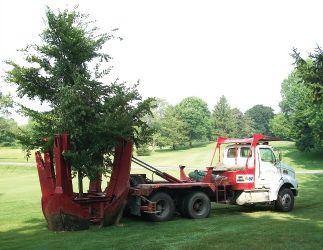
re-sodding of all 18 greens to bentgrass and the installation of a new pumphouse and mainline as the first phase of a project that will eventually lead to a “redo” of irrigation for all 18 holes.

The graduate of Kwantlen Polytechnic University became superintendent at Gallagher’s Canyon last December, and was gearing up to have the course ready this year for the Mackenzie Tour’s GolfBC Championship until the current COVID-19 pandemic suspended his hosting duties until 2021. He said this season – even without the Mackenzie Tour event – has been a hectic one amid the health crisis.
Cowan is serving his first year as a board member with the Western Canada Turfgrass Association, sitting on the communications and information committee.
CHAD DE GROOT, SUPERINTENDENT, THE VERNON GOLF & COUNTRY CLUB, VERNON, B.C.
With 17 years of experience in the golf course industry, de Groot has helped to successfully construct and maintain several world class golf courses.

A fter graduating from the University of Guelph, he completed an internship at Grey Wolf Golf Course under his long-time mentor Jason Carleton. From 2007 to 2017 he worked on three different, unique and challenging sites. He assisted with the construction, grow in and opening of The Rise, The Ridge Course and Tower Ranch.
He has also been fortunate to volunteer for several major PGA tournaments, including the Canadian Open and the Telus Skins Game.
His breakthrough into a superintendent’s role occurred in 2017 at the Shannon Lake Golf Club, where he not only achieved
some of the best conditions in the Okanagan, but also personally strived to create a team environment, elevating the Shannon Lake Golf Club to a new level.
This year marks his first year as superintendent of the Vernon Golf and Country Club.
ROBERT HEGGIE, DIRECTOR OF GROUNDS, MAPLE LEAF SPORTS & ENTERTAINMENT (TORONTO FC AND TORONTO ARGONAUTS), TORONTO, ONT.

Heggie has been employed with MLSE for 10 years and has been recognized as a sports turf industry leader in North America for several years. Named by Sports Turf Canada as its sports turf manager of the year in 2015, he has served as an active speaker at the Guelph Turfgrass Institute, the Ontario Turfgrass Symposium, the Ohio Turfgrass Conference and several other industry conferences.
His leadership in turf technology has resulted in ownership being sold ideas that have been brought into the country. This has led to BMO Field being one of the most technologically advanced sports fields in North America and the world. The technologies include a field warming system, SubAir system, grow lamps, inflatable grow covers and – most recently – the installation of a hybrid field. The latter project, which was installed during the spring of 2019, saw artificial turf fibres stitched in among the natural turf playing surface.
CURTIS PLAYFAIR, ASSISTANT SUPERINTENDENT, INNISFAIL GOLF CLUB, INNISFAIL, ALT.A
Playfair has been in the golf course industry for 15 years, including the past seven at the Innisfail Golf Club. Currently the club’s assistant superintendent, he has been an integral part of the turf care team for seven years and counting. He earned his degree in turf management at Olds College in Olds, Alta.



During his spare time at his home office, Playfair built and developed a website dedicated to the turf department. The site is detailed with information required for day-to-day tasks, including equipment inventory, fertilizer calculations, fungicide applications, a section for Audubon information (such as wildlife sightings and entomology records), updates on current events regarding the Alberta and Canadian Golf Superintendents Associations, measurements of the golf course in its entirety with the use of his personal drone and Go Pro, as well as hundreds of pictures of the golf course, including progress of construction projects.
He has also built an electronic job board that sits in the staff room for the seasonal employees to see. This process helps with time management and efficiency.
BRENDAN RUTLEY, IRRIGATION SALES REPRESENTATIVE, OAKCREEK GOLF & TURF, SURREY, B.C.
Rutley has been employed the past five
Rutley began on the grounds crew at Sandpiper GC, ‘not really knowing where I was going’
years at Oakcreek following a career as a golf superintendent at Sandpiper Golf Course in Harrison Mills, B.C. A native of Chilliwack, he spent seven seasons at the golf course. He began working there on the grounds crew while a university student “not really knowing where I was going.” He rose through the ranks to become assistant superintendent. While
During his free time, he enjoys playing hockey and slo-pitch in Chilliwack. He joined his local curling rink to both enjoy the game and provide volunteer work.

serving in that position, he attended Kwantlen Polytechnic University, earning his diploma in horticulture and turfgrass management, graduating with distinction and winning a couple of bursaries.
One of his most notable accomplishments on the job occurred last year when he installed three pump stations at the same time at three golf courses, tearing out the old stations and putting the new ones in.
TREVOR WARNER, CITY OF WOODSTOCK, ONT.

Warner is the most impassioned person when talking about sports fields, and especially his love of baseball, Cindy Summerfeldt-Madeley of Hutcheson Sand & Mixes, says. “Trevor is a perfectionist and never settles for less when building and maintaining fields. He never holds back, telling it like it is, ensuring you know where he stands using his experiences, knowledge and humour.”
While playing junior college baseball in Tennessee, one of his tasks as a team mem-

ber was to maintain the field. He found he not only enjoyed the work, but had an aptitude for it. Returning to Canada for summer break, he was hired by the City of Welland to maintain fields at a sports complex. Upon completion of his studies, he became head groundskeeper for the Niagara Stars of the Canadian Baseball League and was also responsible for major renovations in Quebec for the league.
Before joining the City of Woodstock, Warner worked for Mar-Co Clay Products for 10 years.
Honourable mentions
DAN ALLEN, TOWNSHIP OF LANGLEY, B.C.
Possessing the right leadership qualities, working well with others and being a team player are attributes that favour
Allen, says Tab Buckner, a past president of Sports Turf Canada.
“He is well regarded by his co-workers and fits wells into the maintenance protocols established,” Buckner, also from the Township of Langley, said. “Dan always thinks outside the box to solve challenges and is willing to try something new and learn from it. He’s very organized and ensures the details are always considered.”
A former golf course superintendent, Allen has a wealth of knowledge in the turf industry. He has high-level communications skills and likes to take initiative, not backing away from change.
BRIAN MACKLIN, CITY OF BRAMPTON, ONT.
Macklin is a natural leader in the industry, says Mike Rossi of Dol Turf in Bond Head, Ont. He said Macklin is detail-oriented and

ensures things are done right the first time. He shares his expertise in the field by making a number of industry presentations.
Coming from a golf background with a strong knowledge of turf, he has an understanding of the needs of turf maintenance.
“ When he joined the municipal side, he made (industry suppliers’) lives easier and helps them understand turf requirements so they can understand it clearly,” Gord Dol of Dol Turf said.
Macklin is a consistent contributor to the turf industry, volunteering his time and making technical presentations. His strong understanding of the science of turf shows in his work. Due to his attention to detail, his maintenance practices are both effective and efficient.
For a more detailed account of our 2020 Top 10 Under 40 honour roll, visit www.turfandrec.com.





Products Turf Prophit Mobile goes live
Turf Prophit has announced the launch of its new Turf Prophit Mobile, which allows entire maintenance teams to access their task management, fuel logging, pest and fertilizer applications, online health and safety, and other online documentation direct from their smart phone.

“We are thrilled to be able to deliver this tool to our existing clients, particularly with COVID-19 distancing protocols in place,” John R. Bladon, director and COO, Turf Prophit, said. “When the pandemic hit, we knew that we had to act quickly to make sure the safety of our customers’ maintenance teams was not jeopardized. Without having to interact with community tablets or computer terminals, this virtually eliminates the risks with system use during the current pandemic.
“This is also great news for our international ‘Powered by Turf Prophit’ partners and distributors as they seek to add value for their client bases. This news further reinforces our best-in-class approach.”
Turf Prophit is an industry-leading turfgrass software solution and is a simple, easy-to-use, and effective tool that uses touch technology to enhance the approach to turfgrass maintenance. Its secure cloudbased database is available for tablets, desktop, and now mobile access.
A short introductory video of Turf Prophit can be seen here: https://turfprophit.vids. io/videos/489ddbb91519e5c0c0/turfprophit-promo
Turf Prophit was incorporated in 2013. The company is a boutique software company that engineers and supplies innovative software solutions to the green industry. The company has offices in Guelph, Ont. and Houston, Texas. To learn more about Turf Prophit, visit www.turfprophit.com.
Bulletin Board


Professional
Perry Brazeau Toronto/ East perry.brazeau@target-specialty.com 416.705.8006
Colin Hindle Ottawa & Eastern Ontario colin.hindle@target-specialty.com 613.314.9711
Chris Lecour Georgian Bay chris.lecour@target-specialty.com 705.444.9010
Joey Losito Quebec South & East joseph.losito@target-specialty.com 819.571.1677
Jason MacRae Quebec North & West jason. macrae@target-specialty.com 514.712.8006
Craig McCutcheon Toronto West / Niagara craig.mccutcheon@target-specialty.com 905.351.6544




Scenna Sales Manager, Eastern Canada mark.scenna@target-specialty.com 416.458.2396



Health & Safety
By the CCOHS
The Canadian Centre for Occupational Health and Safety (CCOHS) promotes the total well being of workers in Canada by providing information, training, education, systems and solutions that support health and safety programs and injury and illness prevention. www.ccohs.ca
Tree work demands utmost in safety
Servicing trees can be dangerous work. Workers have been killed and hurt from falls, electrocutions and by being struck by trees and falling objects, which is why arborists are specially trained and should be certified. The arborists who do this work keep busy with the thousands of trees in need of trimming, felling, and removal, in cities, towns, and private properties across Canada.
Ensure worksites are checked prior to work being done and that any hazards are addressed
Tree service employers are required to provide a safe work environment. This obligation includes having safe work procedures in place, informing workers of any and all hazards of the job, and providing protective equipment and training for workers to ensure they can do their job safely.
TIPS FOR EMPLOYERS
• Ensure that all tools, lifts and ladders are well-maintained and in good working condition, and appropriate for the tree size.
• Provide appropriate personal protective equipment and ensure workers use it correctly.
• Ensure worksites are checked prior to work being done and that any hazards are addressed.
• Ensure work is at least 10 feet away from electric power lines – or call the power company to de-energize and ground the line.
• If rigging is necessary, ensure workers have the training and resources required to do it safely.
TIPS FOR WORKERS
Workers have the right to say something about safety concerns without fear of punishment. If you see hazards or an injury, let your supervisor know. You also
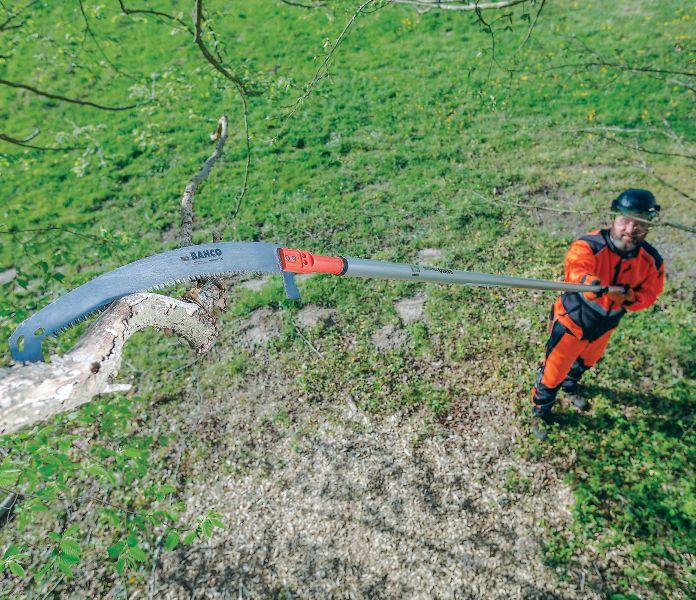
Helmets, visors, eye protection and other safety apparel are important protective equipment when pruning trees.
have the right to comprehensive training and information. Additional tips for workers include:
• Do not trim trees in dangerous weather conditions.
• Always use personal protective equipment (PPE), such as head, hearing, and eye protection and footwear protection with slip-resistant soles, as well as approved safety belts, lifelines, and leather gauntlet gloves, when required.
• Choose close-fitting, long-sleeved clothing.
• Assume that all power lines are energized and can electrocute a person at any time.
• If you will need to climb or use lifts, ensure that you can see and hear the other ground and elevated workers.
• Secure a drop zone with cones that is at least two times the height of the tree.
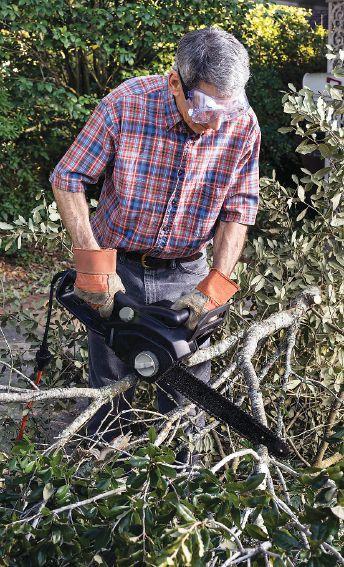
• Never turn your back on falling trees.
• Tree care work safety is the responsibility of employers and workers. Learn what you need to do and take the time to keep tree felling safe.
Wear eye protection to keep propelled particulates from causing injury. OPEI photo

Spring may be right around the corner, but this offer is right here now.



With one simple payment a month. JohnDeere.ca/MyBudget
In your business, you do a lot of different jobs. With a lot of different equipment. The last thing you need is a lot of different statements. At John Deere Financial, we understand this. That’s why we put all of your equipment purchases on one statement. So you only have to deal with one payment. That way, you can focus your attention on the things that matter: your customers. And your business. One name. One statement. John Deere Financial.
John Deere’s green and yellow color scheme, the leaping deer symbol, and JOHN DEERE are trademarks of Deere & Company.