In 2017, conditions across Western Canada were considerably dryer than previous years. While this could potentially lead to the lower presence of some pathogens in seed tests; seed-borne diseases are only half of the equation. The other half is soil-borne diseases and the serious threat they pose to your crop. They can overwinter on crop residue and/or remain dormant in the soil for up to seven years, or until favourable conditions present themselves.
Bayer SeedGrowth is the proud sponsor of Top Crop Manager’s 2018 Seed Treatment Guide.
Containing tips and advice to help you make a more informed treatment decision, this guide was created to help you produce a healthier, more productive crop. In addition to details on the diseases and pests you need to watch out for in 2018, you’ll find valuable information about the numerous benefits of a seed treatment as your crop’s first and best defence against disease.
All the best for a successful season
James Humphris Crop Manager – Cereals Bayer
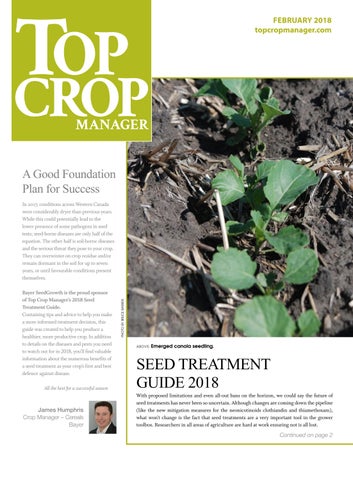
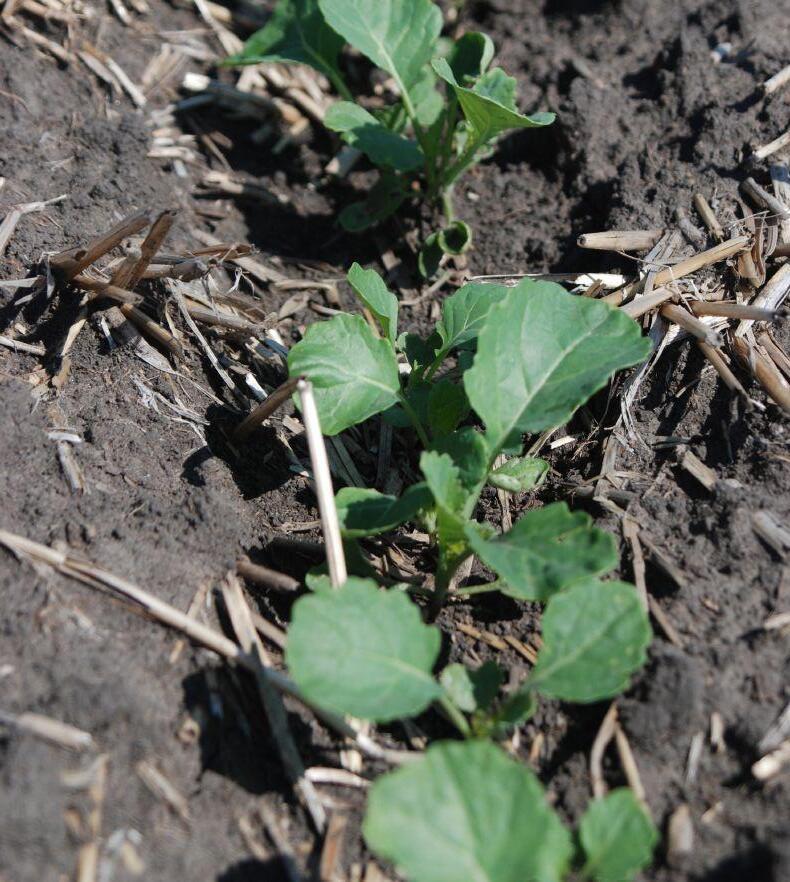
ABOVE: Emerged canola seedling.
SEED TREATMENT
GUIDE 2018
With proposed limitations and even all-out bans on the horizon, we could say the future of seed treatments has never been so uncertain. Although changes are coming down the pipeline (like the new mitigation measures for the neonicotinoids clothiandin and thiamethoxam), what won’t change is the fact that seed treatments are a very important tool in the grower toolbox. Researchers in all areas of agriculture are hard at work ensuring not is all lost.
Continued on page 2
PHOTO BY BRUCE BARKER.
Seed Treatment Guide 2018
Top Crop Manager would like to thank Bayer SeedGrowth for sponsoring this year’s Seed Treatment Guide. Through their support we are able to publish this information guide to assist our readers.
We are grateful to the numerous weed management specialists for their assistance and helpful suggestions contained in Top Crop Manager’s Seed Treatment Guide.
Published as part of Top Crop Manager, February 2018, by: Annex Publishing & Printing Inc. PO Box 530, 105 Donly Drive South, Simcoe, ON N3Y 4N5 Canada Tel: (519) 429-3966 Fax: (519) 429-3094
ASSOCIATE EDITORS
Jannen Belbeck and Jennifer Paige
WESTERN FIELD EDITOR
Bruce Barker
NATIONAL ACCOUNT MANAGERS
Michelle Allison and Danielle Labrie
VP PRODUCTION/GROUP PUBLISHER
Diane Kleer
Charts compiled by Mike Strang
This year in the Top Crop Manager Seed Treatment Guide, we’ve provided a couple of articles that focus on some of the research being done in Canada that display the important role these treatments have on pests and disease. Notice though, that seed treatments are but one part of managing diseases or pests. I think producers can count themselves lucky we’re still able to use these tools, as countries like the United Kingdom (U.K.) have had to swiftly deal with the ban of neonics and a disastrous couple of years thanks to the cabbage stem flee beetle (CSFB) causing chaos in their rapeseed crops. Researchers such as Simon Kightley, the oilseed and pulse crop specialist at the National Institute of Agricultural Botany in Cambridge, U.K., have used grower surveys to asses areas of the country most at risk of CSFB, and been dutifully studying whether companion crops can deter or distract the beetle, without out-competing the rapeseed.
Luckily, Canada is currently not without a variety of seed treatments to give us strong and successful crops. To simplify the decision-making process of what to use and provide a handy reference tool, our seed treatment guide is easy to read and covers products registered (at the time of publication) for cereals, corn, soybeans, pulse crops and canola.
Once again, we have done all we can to make the tables as user-friendly and concise as possible. Keep in mind, however, it is a guide adapted and compiled from crop protection resources and companies, and is not a definitive text. Growers should always double-check provincial guides and product labels to avoid errors.
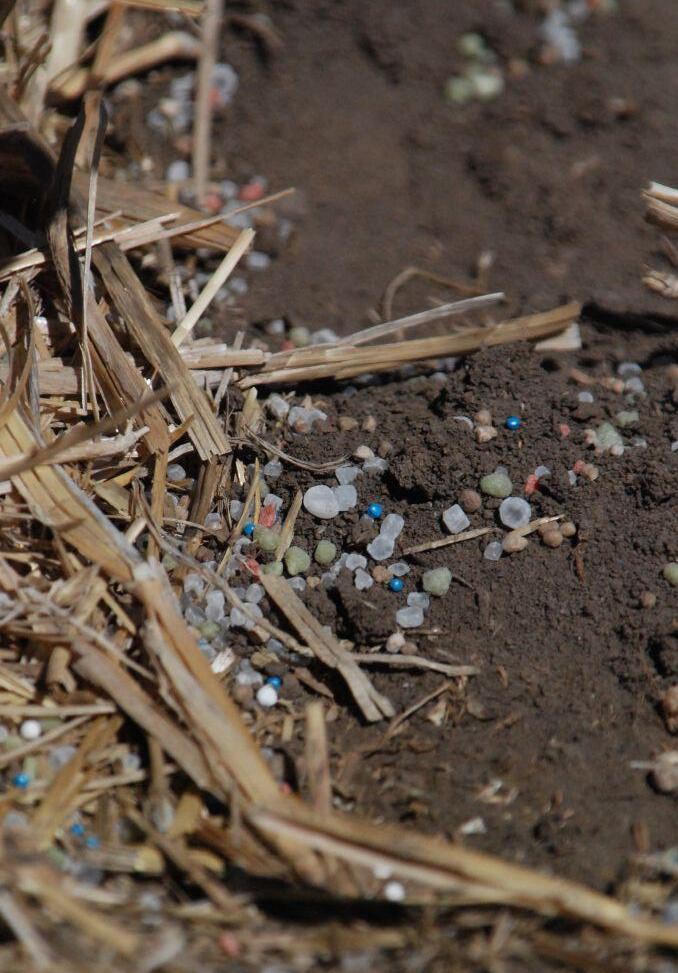
Treated seed in the field.
PHOTO BY BRUCE BARKER.
MANAGING ASCOCHYTA BLIGHT ON PEA
High quality seed, diverse crop rotations, and best available variety.
by Bruce Barker
Ascochyta blight is a perennial problem for pea growers on the Prairies. Fortunately, in 2017 Ascochyta blight was at lower levels than in the past few years.
Trevor Blois, disease diagnostician with 20/20
Seed Labs in Nisku, Alta., says that pea seed tested in November 2017 at their lab showed 41 per cent of pea samples from Alberta tested positive for Ascochyta, while in 2016 this number was about 87 per cent, and 2015 was 49 per cent. Disease severity is also lower, at around three per cent infected on average, compared to 5.2 per cent last year, and 1.9 per cent in 2015.
“The driving factor for this lower incidence and severity was the drier growing season, on average, that we saw across the Prairies in 2017. This is certainly good news for growers looking for good quality, pathogen-free seed as it will be much easier to obtain this year,” Blois says.
At BioVision Seed Labs in Sherwood Park, Alta., vice-president Holly Gelech sees a similar trend. She says the number of samples where the pathogen was identified during the fall of 2017 was less than half of 2016.
A complex list of pathogens including Mycosphaerella pinodes, Ascochyta pinodella, Ascochyta pisi, and Phoma medicaginis pinodella causes Ascochyta blight. On the Prairies, A. pinodes, the sexual form of M. pinodes, is the dominant pathogen. These pathogens also attack other pulses, and the Ascochyta blight complex is sometimes called Mycosphaerella blight to cover the disease on all pulses.
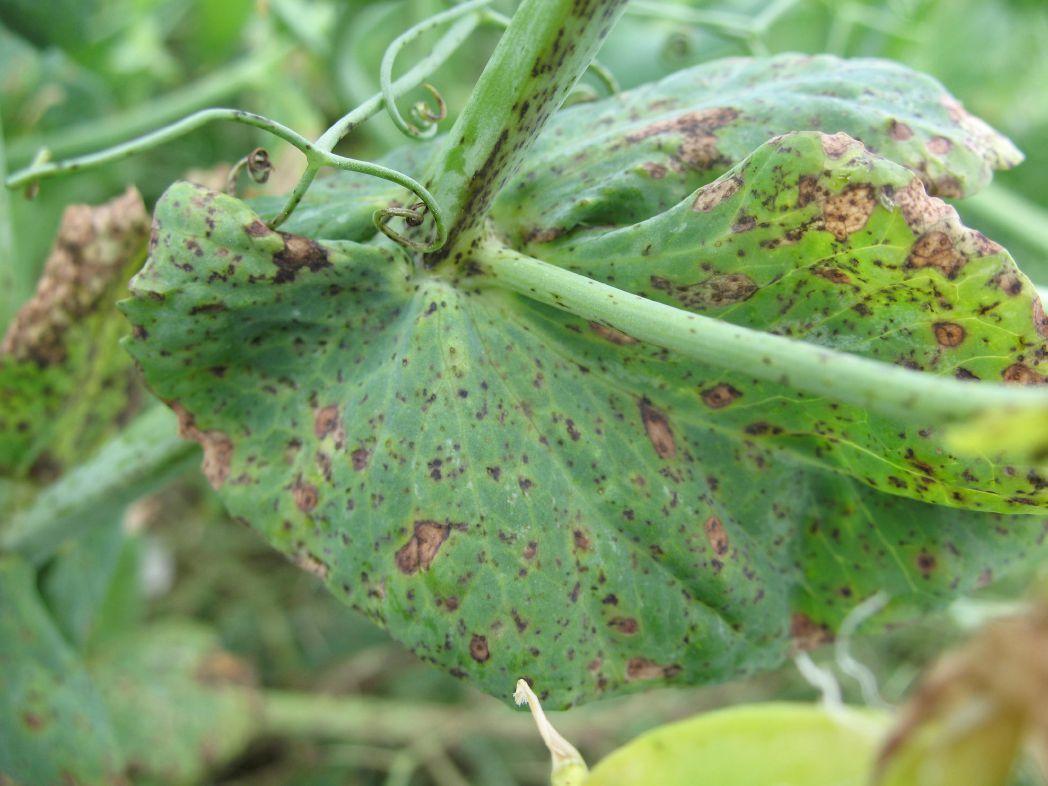
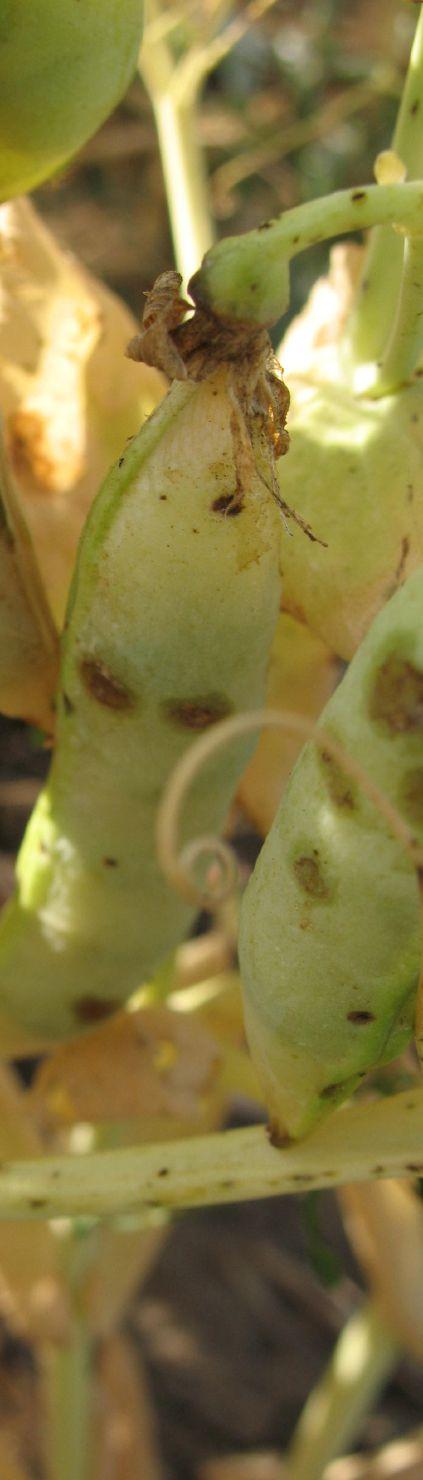
Symptoms of Ascochyta blight are found on leaves, stems, flowers, and pods of field pea. Small, purplish lesions with irregular margins develop on leaves. The lesions grow and can affect entire leaves. Under severe conditions, stem lesions weaken the stems and can cause lodging. Pods may be infected and result in infected seed. Research has found that Ascochyta blight can reduce pea yield by as much as 50 per cent.
In recent years, A. pisi has been observed to be increasing in frequency in some areas of Saskatchewan. However, research by Sabine Banniza with the department of plant science at the University of
ABOVE: Fungicide application can reduce the Ascochyta infection on the seed.
% Yield Advantage
* No significant yield advantage at
Saskatchewan found that A. pisi does not appear to pose a major risk to pea production. She compared pea seed lots infected with A. pisi at levels of 14.5, 10, five, and 0.5 per cent. Seed infection with A. pisi was shown to have no or minimal effects on pea crop establishment, disease development or seed yield. Seed infection at or above 10 per cent had a minor effect on emergence. The results indicate that M. pinodes remains the main pathogen of concern in the Ascochyta blight complex.
Use clean, treated seed
Since Ascochyta blight is widespread, the pathogens are commonly found on harvested pea seed. Mark Olson, unit head with the Livestock and Crops Division with Alberta Agriculture and Forestry (AAF) at Stony Plain, Alta., says that their research has found that a two to three per cent infection level is common on pea seed. The range in their field trials has been from 0.1 to 18.5 per cent.
The commonly cited guideline for seed pea is to use seed with less than 10 per cent Ascochyta infection. This level should not significantly affect plant establishment and yield, as long as the seed has good germination and spring conditions promote quick germination and good seedling vigour.
Seed treatment is also a recommended practice to encourage fast germination. Insure Pulse is registered for control of
Ascochyta blight on seed, and Trilex Evergol is registered for suppression. Both also provide broad-spectrum control of other seed rot and seedling blights caused by other pathogens such as Fusarium spp., Rhizoctonia solani, and Pythium spp.
Olson says one common misconception that pea growers have is that infected seed contributes to aboveground foliar infections. He says research has shown that the primary means of infection is airborne spores from the over-wintering stage of the pathogens on pea residues and not Ascochyta on the seed.
“Ascochyta on the seed is an indicator of Ascochyta infection the previous year, but it isn’t important in transmitting the disease to the next crop,” Olson says. “However, higher levels of Ascochyta on the seed can reduce germination and seedling vigour, which can reduce plant populations so using good quality seed is still important.”
Research by Saskatoon Agriculture and Agri-Food Canada research scientist Bruce Gossen in 2005 and 2006 looked at how the level of Ascochyta infection on field pea affected germination, growth and yield. Seed infection treatments included high (26-47 per cent of seed infected with M. pinodes), intermediate (six to 15 per cent of seed infected), and low (zero to two per cent of seed infected).
Gossen found that low seed infection had higher seedling establishment in four of eight
Source: Hoy, C., and Lopetinksy, K. 2008. A disease prediction system for Ascochyta of field pea. Alberta Agriculture and Forestry.
Jarvie.
Linaria Jarvie
Neerlandia
Manola Barrhead Site Location
The commonly cited guideline for seed pea is to use seed with less than 10 per cent Ascochyta infection. This level should not significantly affect plant establishment and yield, as long as the seed has good germination and spring conditions promote quick germination and good seedling vigour.
station years. He reported that “seed infection with M. pinodes did not contribute substantially to aboveground symptoms in the year of planting. However, very high levels of seed infection reduced seedling establishment, so continued seed testing for germination is recommended.”
Olson says that field pea stands that have less than seven to eight plants per square foot cannot compensate through increased branching, and low plant stands often result in low yields, especially if there is weed competition.
“Growers need to look at their seeding rates and ensure that they are targeting at least seven to eight plants per square foot. With the wide range in seed size and thousand kernel weight, you can’t just go out and seed three bushels per acre,” Olson says. “That’s especially important if you have infected seed.”
Crop rotation and variety selection
Crop rotation is an important practice for reducing the impact of Ascochyta blight. Pea fields with a history of peas in tight rotations are more susceptible to a build-up of the pathogens. The pathogens can survive several years on infected pea residue, so a three- to four-year crop rotation helps reduce the level of infection in subsequent years. However, longer crop rotations may not reduce infection to insignificant levels. This is because M. pinodes ascospores can blow in from nearby fields infected with the pathogen. But longer, diversified rotations are generally acknowledged to help reduce disease loads across all crops in the rotations, and are still recommended.
While there are differences in resistance to Ascochyta blight, most pea varieties currently available are only moderately resistant. On a disease rating scale of 1 (no disease) to 9 (completely blighted), resistance ratings for
registered pea varieties are between 4.0 and 5.5).
Foliar fungicide application
Foliar fungicide application is effective in reducing Ascochyta blight infection levels. AAF research from 2005 through 2008 by Christy Hoy and Ken Lopetinsky found that over the four years of trials, application of Headline fungicide produced a significant yield increase at 14 out of 19 locations with an average yield advantage of 17.8 per cent. Significant increase in thousand kernel weight also occurred.
Scouting early and monitoring is critical for control. When infection moves upward in the plant canopy beyond the lower third of the plant, fungicide application should be considered. AAF has developed an Ascochyta scoring system to help growers make the decision on fungicide application. It takes into consideration factors such as timing of infection, yield potential of the crop, weather conditions and value of the harvested seed. Fungicides work by stopping the spread of the disease but will not “cure” infected parts of the plant. As a result, maximum fungicide effectiveness is at early flowering application.
“We’ve seen that two applications can be beneficial in reducing Ascochyta, depending on the level of infection. However, growers need to watch out for the pre-harvest intervals. Some of the products must be applied prior to 21 days before harvest, so timing on the second application can be pretty tight,” Olson says.
Another benefit of a foliar fungicide application was that it also reduces Ascochyta infection on the seed. For pea crops grown for seed production, fungicide application is recommended.
Populations of M. pinodes are at a high risk to develop insensitivity or resistance, so fungicide rotations to different groups and the use of tank mixes from different fungicide groups are necessary to prevent development of resistant pathogen populations.
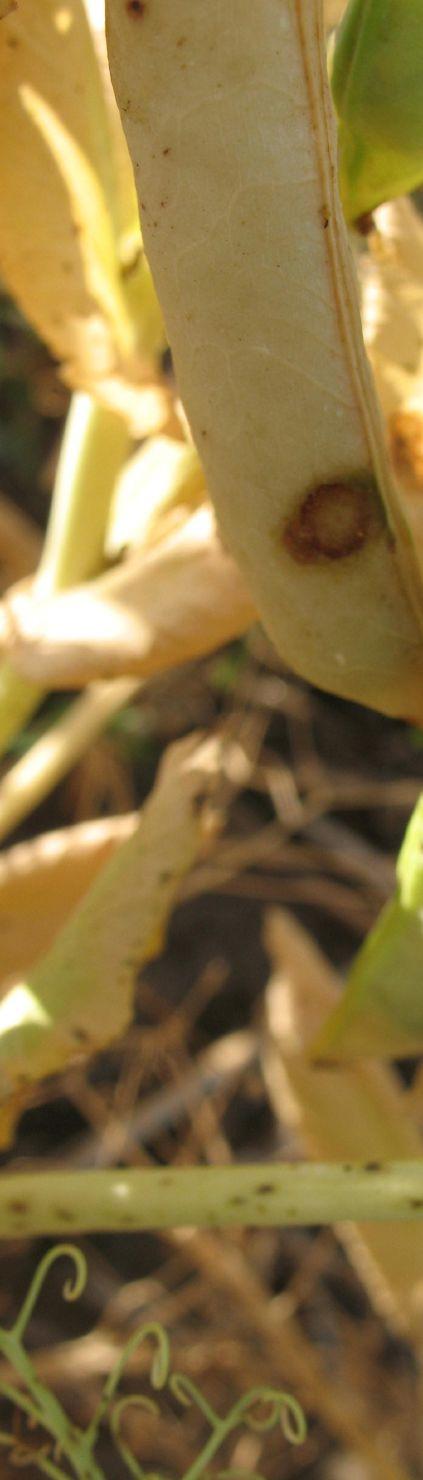
LEFT: Ascochyta on pods can infect the seed.
UNDERSTANDING FLEA BEETLE CONTROL
Research is looking at changes to species, and effectiveness of insecticides and natural predators.
by Bruce Barker
Even though flea beetles have been around for many years, there is still a surprising amount to learn about the insects. A multi-disciplinary group of researchers at the University of Manitoba (U of MB), Agriculture and Agri-Food Canada (AAFC), and Manitoba Agriculture are working on several research products to update economic thresholds, and better understand the insects and their predators.
“Despite being a really important pest, we know very little about important parts of the life cycle, such as the larval stage that lives below the ground, [which] can feed on plant roots,” says entomologist Alejandro Costamagna at the University of Manitoba, who presented the preliminary results of several research studies at the Manitoba Agronomist Update in Winnipeg in December 2017.
Other areas of interest are determining if there has been a shift in species of flea beetles, updating the economic threshold for foliar application, and identifying natural predators.
The two main flea beetle species are the striped (P. striolata) and crucifer (P. cruciferae). The most damaging life cycle stage is the adult that feeds on cotyledons and early leaf stages of canola. The
nominal economic threshold for spraying is 25 per cent defoliation, which was established over 30 years ago.
“We hope that the new hybrids can withstand more defoliation and recover from the damage better than older varieties,” Costamagna says.
Seed treatments effective
Small plot trials were set up at sites in Manitoba, Saskatchewan and Alberta. Forty trials were conducted over three years from 2015 through 2017. A control treatment was compared to seed treatment only (fungicide and insecticide), and treatments received a foliar application of Matador insecticide at 34 mililitres per acre (ml/ac) when defoliation reached 15-20, 25 and 45 per cent (seed received fungicide treatment only). SY 4135 Roundup Ready hybrid canola was grown.
Flea beetle abundance and species composition was observed weekly and defoliation was monitored Mondays, Wednesdays and
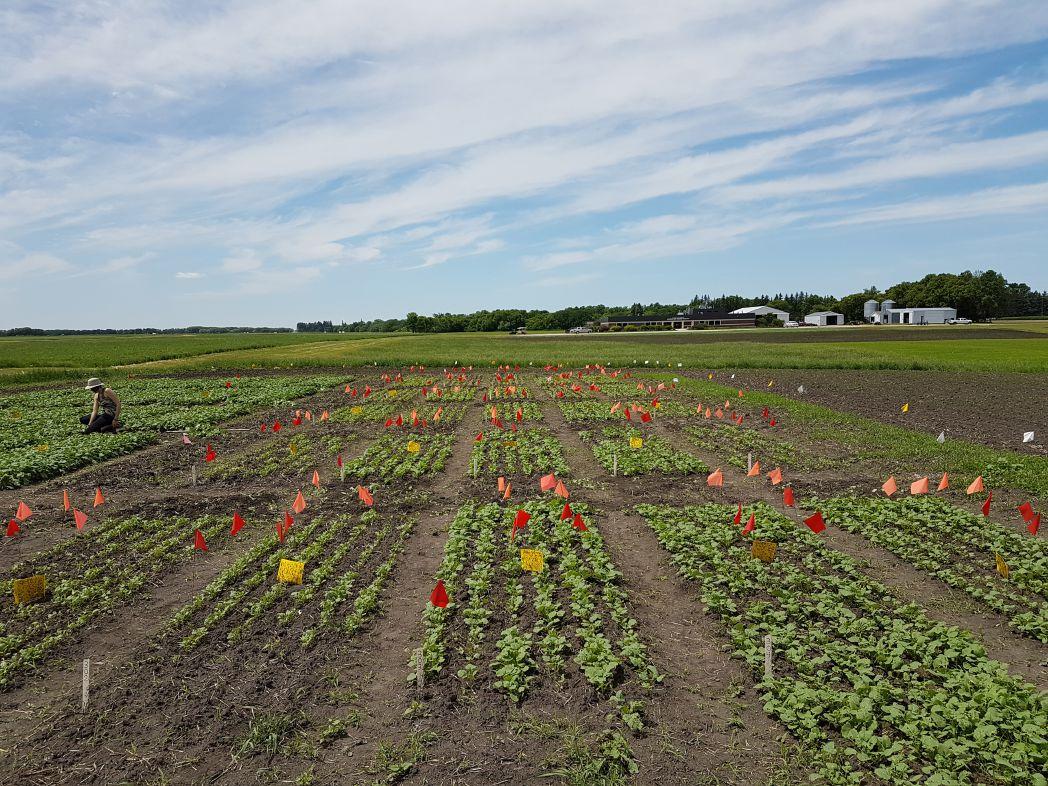
ABOVE: Plots showing flea beetle control with seed treatment, and defoliation levels for non-treated seed.
Table 1: Change in relative abundance
Source: Costamagna, U of MB.
Fridays on 40 plants per plot, and plant density was also assessed. Spraying was required on 35 of the trials, and yield data was obtained in 32 of the trials.
“In some cases, the level of defoliation didn’t reach 45 per cent. We learned really quickly that we had to analyze the data based on the level of defoliation,” Costamagna says. “We also learned that even if you go every other day during the week, if you skipped the weekend, you could go from 10 per cent to 50 per cent defoliation very quickly.”
Generally, Costamagna says the preliminary results indicate that the seed treatments worked very well, and yields were usually significantly higher than the control, and often similar to a foliar spray at around 25 per cent defoliation. Yields with foliar insecticide treatments were also effective. “When spraying around 25 per cent defoliation, we didn’t seem to loose yield.”
Future analysis of data will look at plant density, flea beetle species composition and abundance, and the effect of planting dates on flea beetle damage and insecticidal control.
Shift in flea beetle species
The research also looked at whether there has been a shift in flea beetle species across the Prairies. In the mid-2000s, James Tansey, working with Lloyd Dosdall at the University of Alberta, found that neonicotinoid seed treatments provided better control of crucifer flea beetles than striped flea beetles. Very little damage for crucifer flea beetle was seen but striped flea beetle caused significantly more canola seedling damage.
“One of the concerns that this raised was that these seed treatments would not be effective if there was a shift to more striped flea beetles,” Costamagna says. “The prediction that they made in this paper was that this might result in a shift in species because the level of control is not as effective. From our data that is what seems to be going on.”
As part of Costamagna’s research, species composition was assessed over three years across the Prairie provinces, at 25 to 29 sites per year. He compared the composition to historical results in the scientific literature.
“Aside from Beaverlodge where the striped flea beetle has been dominant, there is clearly a shift in species composition to increase the proportion of striped flea beetle, and that may have something to do with the striped flea beetle’s tolerance to insecticidal seed
treatment,” says Costamagna.
Natural enemies identified
Another component of the research was to identify beneficial insects that can help control flea beetles. Graduate student Thais Silva Guimaraes of the University of Manitoba set up several research trials. The first was a growth chamber trial where flea beetles and generalist predators were put in petri dishes for 72 hours. Daddy long leg spiders (Phalangium sp.) were not effective in capturing flea beetles, however several common ground beetles (Amara sp., Poecilus sp. and Pterostichus sp.) were able to significantly reduce flea beetle survival.
“The generalist ground beetle predators very quickly ate all of the flea beetles with no difference between flea beetle species. This is very encouraging,” Costamagna says.
A second experiment used caged potted plants in growth chambers. Predator ground beetles and striped or crucifer flea beetles were placed in the caged pots and flea beetle consumption was evaluated after 24 hours. The predators were able to catch and eat some of the flea beetles.
“Even if the predators didn’t eat the flea beetles, preliminary observations suggest less damage in cages with the predators and that seems to be independent of mortality. The presence of the predators seemed to make the flea beetles restless and they might not be feeding as much as they would in the absence of predators,” Costamagna says.
Another area of interest is what happens at night. Ground beetles are nocturnal, but scientists don’t know much about what flea beetles do at night. If flea beetles rest at night, ground beetles may more easily catch them.
“There are still a lot of questions we are interested in answering,” he says. The next stage of the research is to do caged studies under field conditions.
Additional work is also being conducted on using molecular methods to determine the natural enemies of flea beetles.
While the research is still being analyzed, and much more is to be done to understand flea beetle biology and predator behavior, current management practices for flea beetle control appear to be still valid. Seed treatments provide good control and spraying an insecticide if defoliation reaches 25 to 30 per cent is still the nominal economic threshold to observe.
It’s hard to imagine that one small seed could hold so much promise, but it does. And when you consider the importance of having a successful season, a cereal seed treatment you can rely on makes a huge difference. Raxil® seed treatments provide first-class disease control and a faster, stronger emergence that helps you realize the full potential of your crop. Depend on Raxil.
Provides enhanced control of striped and crucifer flea beetles and early season protection from cutworm feeding damage •
Provides enhanced control of striped and crucifer flea beetles and early season protection from cutworm feeding damage
Trilex it any way you want.
Trilex EverGol.
The fully customizable seed treatment for pulses.
Exceptional flexibility. Exceptional disease protection. Whatever your needs, applicators and growers like you can reap the rewards of its concentrated formulation to adjust water volumes and optimize coverage. And that’s just the start. You get superior protection against rhizoctonia, ascochyta, botrytis, fusarium spp. and pythium. Plus the ability to protect against insects including pea leaf weevils and wireworms when tank-mixed with Stress Shield® or when using Trilex® EverGol® SHIELD. This year, choose a pulse seed treatment that puts more control in your hands. Choose Trilex EverGol.