TCM West - October 2018

Page 1


TOP CROP MANAGER

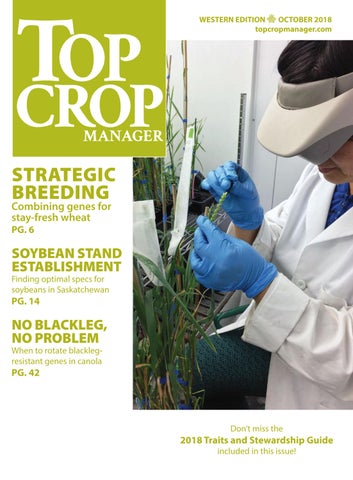
STRATEGIC BREEDING

Combining genes for stay-fresh wheat PG. 6

SOYBEAN STAND ESTABLISHMENT

Finding optimal specs for soybeans in Saskatchewan PG. 14

NO BLACKLEG, NO PROBLEM

When to rotate blacklegresistant genes in canola PG. 42

Don’t miss the 2018 Traits and Stewardship Guide included in this issue!

Richardson is committed to ensuring reliable and efficient services for our customers.

From increasing storage capacity to adding high-speed fertilizer blenders across our Richardson Pioneer network, we continue to invest in our facilities to enhance our operations and serve our customers. We are committed to operating the most efficient, fully integrated network of high throughput grain elevators and port terminals to move your grains and oilseeds from the Prairies to markets around the world.

Being truly invested is at the heart of everything we do. To learn more, visit richardson.ca

TOP CROP

MANAGER

CEREALS

6 | When opposites team up

Combining genes strategically makes bread that stays fresh naturally. By Carolyn King

4 Highlighting Innovation by Stefanie Croley SPECIAL CROPS

10 A fresh take on canaryseed by Mark Halsall

ON THE WEB

TOP CROP MANAGER’S 2018 COVER PHOTO CONTEST

FOCUS ON: SEED

14 | Researching Saskatchewan soybean stand establishment

Finding the optimum seeding date, rate, depth and row spacing for soybeans. by Bruce Barker

FOCUS ON: SEEDING

18 Doing less to grow more by Ross H. McKenzie

CANOLA

RESEARCH

24 | Scale-up and validation of a quick mycotoxin test

A visual test may help decision-making and provide cost savings. by Donna Fleury

30 Assessing the swede midge threat by Carolyn King CANOLA

You know what the words Top Crop Manager mean to us – now, we want to see what being a Top Crop Manager means to you. Enter our cover photo contest, sponsored by Meridian Manufacturing, for a chance to be featured on our December cover.

For submission guidelines and full rules and regulations, visit www.topcropmanager.com/photo-contest.

42 No blackleg, no problem By Bruce Barker

TILLAGE AND SEEDING

38 Reducing variable rate in air seeders by Bruce Barker

Readers will find numerous references to pesticide and fertility applications, methods, timing and rates in the pages of Top Crop Manager. We encourage growers to check product registration status and consult with provincial recommendations and product labels for complete instructions.

PHOTO COURTESY

HIGHLIGHTING INNOVATION

“There’s a way to do better – find it.”

During the span of my career, I’ve had the opportunity to cover several different markets from an editor’s desk. From professional services, like firefighting, to retail bakeries and pizzerias, I’ve seen different Canadian sectors change and grow toward the betterment of the industry. But I’d be willing to argue that the level of research and development in Canadian agriculture in unmatched.

Of course, the research doesn’t come without cost, and over recent months, Canada has made several investments in agriculture (most recently, in early September, the investment made toward supporting the canola sector to focus on growth and profitability). But the real work happens behind closed doors, in the labs and offices, by some of the top researchers in the world.

The quote above, from America’s greatest inventor, Thomas Edison, is particularly poignant to open our annual issue highlighting advanced genetic and plant breeding research. Arguably overused, innovation is a buzzword you’ll often hear in many industries, including agriculture. As you flip through this issue, I’m sure you’ll agree with me that it’s hard not to describe these projects as innovative.

This month’s cover story is a bit different than our usual content, but important nonetheless. In Saskatoon, Patricia Vrinten with Bioriginal Food and Science Corporation is working to develop a stay-fresh wheat variety. The benefits of this, according to Vrinten, would be two-fold: flour made from the stay-fresh wheat could prevent staling in bakery products, eliminating waste, and products would require fewer added ingredients to stay fresher for longer periods of time. You can read an update on the project on page 6.

And on page 34, Donna Fleury summarizes research on new ways to advance droughttolerant varieties of wheat that are high yielding and high quality. Led by Karen Tanino out of the University of Saskatchewan, several projects have recently launched to accelerate drought tolerance – particularly timely after an incredibly dry summer in the Prairies.

We’ve also included our Western Traits and Stewardship Guide in this issue, which highlights new technologies from the seeds and traits industries projected to provide more protection, reduce risk and add value to your bottom line.

Finally, I’d be remiss not to mention the 2019 Soil Management and Sustainability Summit during a discussion about innovation. Our fourth research-focused event, Top Crop Manager’s annual summit gathers producers, agronomists, industry members and the scientific community together to share new research and ideas. We hope you’ll join us on Feb. 26, 2019 in Saskatoon.

There’s constant change and growth happening, and we’re pleased to be able to provide a glimpse of what you can expect to see from the industry in the coming years. Happy reading.

Through our patented Fusion® technology, only MicroEssentials® combines all three dimensions of smarter crop nutrition: uniform nutrient distribution, increased nutrient uptake and season-long sulphur availability. When you look closer at other fertilizers, you’ll see they fall a little flat. Ask for MicroEssentials by name, and trust the only one with over 12 years of proven results.

WHEN OPPOSITES TEAM UP

Combining genes strategically makes bread that stays fresh naturally.

For bread lovers, there is nothing quite as delightful as a mouthful of soft, fresh bread – and nothing quite as disappointing as hard, stale bread. Now a new stay-fresh wheat line developed in Saskatchewan offers several extra days of that wonderful fresh-baked quality.

Patricia Vrinten, a researcher with Bioriginal Food and Science Corporation in Saskatoon, became interested in developing a stay-fresh wheat variety for a couple of reasons. “Staling is a big problem with bakery products, and a high percentage of bread is wasted, either in the bakery or after purchase, because of staleness. Another issue is the developing interest in clean labelling; perhaps especially in the United States, consumers increasingly would like a minimal number of ingredients in the food they purchase, with no chemicals or enzymes added. If bread could stay fresh longer without additives, both of these issues would be addressed.”

The development of the stay-fresh wheat line comes out of a broader research effort by Bioriginal and its collaborators. “Wheat grain is made up of approximately 70 per cent starch. For several years, we have been interested in modifying starch for new uses for the food industry and as a potential benefit for consumers,” she notes. “So we have been working to develop wheats with different types of starch.”

Vrinten explains that starch is composed of two kinds of molecules: amylose and amylopectin. The flours from most wheat varieties have around 25 per cent amylose and 75 per cent amylopectin. The relative proportions of amylose and amylopectin in a flour make a significant difference in such things as baking quality and digestion of the food product in the human body.

Vrinten and her colleagues have been working on both highamylose starch, in which the amylose content is increased by 30 per cent, and amylose-free starch, known as waxy starch, which has 100 per cent amylopectin.

“We noticed that waxy wheat was included in some flour mixes by some bakeries to slightly increase freshness. And high-amylose wheat has some potential health benefits [such as improving digestive health and helping to fight against diabetes]. So we thought it might be a good idea to combine these traits,” she says. “But neither amylose-free wheat nor high-amylose wheat used on its own produces top-quality bread loaves. And neither wheat produces a strong ‘stay-fresh’ quality.”

So, how do you bring these opposite traits together in the same wheat line in a way that captures desirable properties of high-

amylose wheat, amylose-free wheat and regular wheat – and really enhances freshness?

That may sound like a tall order. But fortunately, wheat has a hexaploid genome. “Hexaploid” means that wheat’s DNA consists of three complete genomes, known as the A, B and D genomes, and each gene has three copies, one in each genome. Genes can

Bioriginal research scientist Hui Yang crosses wheat plants to develop lines with different starch properties, including a “stayfresh” line.

be either active or inactive, and in a hexaploid plant like wheat, you can get a range of effects from a gene depending on which particular copies of the gene are active and which are inactive.

Wheat’s hexaploid genome allows Vrinten and her colleagues to achieve nuanced changes in their wheat lines through strategic combinations of active and inactive gene variants.

In the stay-fresh project, the researchers targeted two genes, called SSIIa and GBSSI, which are known to play a role in starch quality. They screened wheat germplasm from many different countries to find active and inactive variants of each of the two genes. Once they had identified these naturally occurring variants, the researchers developed perfect PCR markers so they could easily screen for the variants in their breeding materials.

“A comparison of bread made with flour from our stay-fresh line and bread made with flour from the control line showed that four days after baking, the bread made with the stay-fresh line is as soft and fresh as the control bread is just one day after baking. This means consumers can have fresh, soft bread for a longer period of time and without the addition of chemicals.”

lot of sugar. It potentially has some interesting uses, but it shrivels up when it is mature, like sweet corn. Therefore, its seed weight is greatly reduced and harvesting is difficult,” Vrinten says.

Then, using marker-assisted selection and conventional backcrossing, they developed a set of lines with different combinations of the active and inactive variants of the two genes in the three genomes. The initial crosses for these lines involved high-amylose and amylose-free parents. Inactive variants of the three copies of GBSSI are associated with the amylose-free trait, and inactive variants of SSIIa are associated with the high-amylose trait.

“When we combined the inactive variants for all three copies of these two genes, we ended up with sweet wheat, which produces a

She also notes, “For both genes, the expression of the B copy of the gene was highest. But when we developed a line that had only inactive variants of the B genes, we didn’t detect much difference in freshness compared to normal bread wheat.”

The researchers hit the optimum combination for stay-fresh wheat when they developed a line with inactive variants in the B and D genomes, and an active variant in the A genome, for each of the two genes. The results were impressive when they compared this stay-fresh line to a control wheat line with the same genetic background that had regular starch properties.

COMMUNITY HEROES IN THE MAKING

It’s the little things that make a big

difference. Recycle your containers, grain bags and other ag plastics. Lead the way for the next generation. cleanfarms.ca

“Compared to the control line, the stay-fresh line had a large improvement in freshness, while the yield, seed size, starch content and protein content did not change, and the amylose content was only very subtly reduced,” Vrinten notes.

“A comparison of bread made with flour from our stay-fresh line and bread made with flour from the control line showed that four days after baking, the bread made with the stay-fresh line is as soft and fresh as the control bread is just one day after baking. This means consumers can have fresh, soft bread for a longer period of time and without the addition of chemicals.”

Using conventional crossbreeding techniques, the researchers have moved this stay-fresh trait into a well-known bread wheat line from Agriculture and Agri-Food Canada (AAFC). They are now

multiplying seed in a greenhouse to obtain enough seed for registration trials.

AAFC is one of the key collaborating agencies on this project. Vrinten says, “We have been working with AAFC wheat breeders, originally with Ron DePauw [who has since retired], and now mostly with Richard Cuthbert. AAFC will also be strongly involved in the registration trials. And they may be involved with testing related to baking qualities, along with the Canadian and international milling companies that we are working with.” Saskatchewan’s Agriculture Development Fund contributed funding for the backcrossing work to move the trait into the AAFC line.

If all goes well, this elite bread wheat variety with the bonus of the stay-fresh trait could be available in a few years.

Possibility begins with empowering you.

No one knows your land, or operation quite like you. But that will never keep us from making sure you always know who you can count on no matter what comes your way. From best-in-class technology and unparalleled product solutions, to trusted local expertise, your Nutrien Ag Solutions™ retailer is your go-to resource for getting more out of your business than you ever thought possible. nutrienagsolutions.ca

A new wheat variety with a stay-fresh trait could be available in the future.

A FRESH TAKE ON CANARYSEED

A new type of canaryseed developed in Saskatchewan has been approved for human consumption, opening up new possibilities for province’s cereal farmers.

Since the early 1970s, canaryseed has become established as an alternative cereal crop for Saskatchewan farmers.

The province produces approximately 90 per cent of the canaryseed grown in Canada and about 65 per cent of the global supply of the crop, which is used to feed wild and caged birds the world over. Now, canaryseed was recently approved for human food use in Canada and the U.S., offering the potential for new opportunities for Saskatchewan producers.

The type of canaryseed approved for human consumption has ‘hairless’ seed and was developed by Pierre Hucl, a long-time canaryseed breeder at the University of Saskatchewan (U of S) in Saskatoon.

The hairy shell of canaryseed has largely limited its use to bird feed and can cause human skin and eye irritation during harvest and processing. Hucl, who first started working on a hairless variety about 20 years ago, says the original idea was to remove the

hairs to make the crop easier to handle.

“But then we thought, once we get rid of the hairs there could be some other options,” Hucl says. “It struck us that if you look at the quality profile, it might actually be interesting for human consumption.”

In addition to being gluten-free, canaryseed is high in protein, high in fat, and is a rich source of folate, phosphorous, magnesium, and manganese compared to other cereal grains. Potential food applications include adding the whole seed product to protein bars and whole grain breads, or grinding up the seed to make canaryseed flour.

TOP: A Saskatchewan canaryseed field in mid-July.

INSET: Long-time canaryseed breeder Pierre Hucl, pictured here during a tour of his research facility in July 2018, developed his ‘hairless’ variety through his work at the University of Saskatchewan Department of Plant Sciences’ Crop Development Centre.

PHOTOS

In 2016, Hucl’s hairless canaryseed earned the designations of Generally Recognized as Safe (GRAS) by the U.S. Food and Drug Administration and novel food by Health Canada, which recognizes that the substance is safe and can be lawfully used in food products.

Kevin Hursh is the executive director of the Canaryseed Development Commission of Saskatchewan, which was established in 2006 to help fund agronomic research and variety development as well as the extensive work involved in getting canaryseed registered for human food use.

“This proved to be much more onerous and expensive and timeconsuming than we ever thought at the onset,” Hursh says. “Basically, it took 10 years to get the novel food approval.”

Carol Ann Patterson, a food scientist with The Pathfinders Research & Management Ltd. in Saskatoon, orchestrated the toxicology, compositional and nutritional research needed to get canaryseed registered for human food use.

“She did just a tremendous amount of work on this file,” Hursh says.

LEFT: University of Saskatchewan canaryseed breeder Pierre Hucl continues to work on developing new hairless varieties. This breeder seed plot contains a new line that Hucl hopes to release in the next couple of years.

Today, research scientists like Lamia L’Hocine at AAFC’s SaintHyacinthe Research and Development Centre in Quebec continue to study the nutritional aspects of canaryseed and its unique starch, protein, and oil components for food as well as other uses, such as animal feed.

Search for higher yields

Up to now, hairless canaryseed hasn’t yielded quite as well as regular varieties, so Hucl, who works out of the U of S department of plant sciences’ Crop Development Centre, has been focusing on producing new hairless lines that are higher yielding.

“Producers are going to want to grow the highest yielding material they can . . . so closing or eliminating the gap between hairless and hairy varieties is something I’ve been working on,” says Hucl, who recently released a new yellow hairless variety that boasts higher yields and agronomic advantages such as stronger straw.

Bill May is another long-time canaryseed scientist. Working at AAFC’s Indian Head Research Farm in Indian Head, Sask., he’s been studying agronomic aspects of the crop, such as the right rates for seeding and fertilizer applications as well as herbicide and pesticide tolerances, for the past 20 years.

“To keep canaryseed as a viable crop in Western Canada, you have to do agronomic research on the crop to keep the production practices current,” May says.

May is currently carrying out a crop sequencing study involving

TOP AAFC research scientist Bill May demonstrating his work on aphid control in canaryseed to Saskatchewan canaryseed growers in July 2017. Pictured are Chad Haskey, Lucas Sutherland, May, Lance Stockbrugger and Darren Yungmann.
PHOTO COURTESY OF KEVIN HURSH.
PHOTO COURTESY OF GLORIA GINGERA.

canaryseed and researching chloride and micronutrient applications in the crop. The results so far indicate that canaryseed isn’t more responsive to micronutrients than other cereal crops, but that’s not the case with chloride, a key component of potash.

“Canaryseed is much more responsive to chloride than other cereal crops are,” May says. “We recommend that growers always apply some potash to their canaryseed when they’re growing it in their fields.”

Hursh, who’s been planting canaryseed at his farm near Cabri, Sask. since the 1980s, estimates there are about 1,000 farmers in Saskatchewan also growing it in any given year. He says there are numerous reasons why canaryseed is considered a valuable alternative crop.

For example, Hursh says, if the weather’s wet around harvest time, canaryseed won’t shatter and lose quality like some other crops.

“It’s quite forgiving to grow, and it isn’t a big nitrogen user,” he says. This makes canaryseed a little less expensive to farm than many other crops, he adds, and depending on the market condi-

tions, it can be a profitable option for growers in many years.

Another key benefit is that canaryseed allows cereal producers to diversify by providing with them a different market.

“It doesn’t fluctuate in the same timeframe as other markets do, and it’s more stable for farmers when they have multiple markets to sell their crops into,” May says.

“I think canaryseed has a good future, especially if we can develop the human food market,” May adds. “You’ll have to have an innovator who will drive that to the marketplace and it will be interesting to see how that happens.”

As Hursh points outs, some Saskatchewan companies are already testing the waters for new markets for hairless canaryseed that’s had the hulls removed.

Canpulse Foods Ltd. recently added a canaryseed dehulling line at its food processing facility in Zealandia, Sask. in anticipation of future demand, Hursh says, while Infraready Products Ltd. of Saskatoon has provided some dehulled canaryseed product to food ingredient companies to try out.

STAND YOUR GROUND

Lower the boom on your most serious weeds and safeguard the yield potential of your InVigor® hybrid canola with the powerful protection of Liberty® herbicide.

The Group-10 chemistry behind Liberty gives you a unique and highly-effective mode of action that tackles weeds, even if they’re resistant to glyphosate or other herbicide groups.

To learn more visit agsolutions.ca or call AgSolutions® Customer Care at 1-877-377-BASF (2273).

RESEARCHING SOYBEAN STAND ESTABLISHMENT

Looking for a made-in-Saskatchewan solution for soybean stand establishment, research manager Chris Holzapfel at the Indian Head Agricultural Research Foundation (IHARF) recently completed a four-year study on stand establishment. Similar to the answers that Manitoba soybean growers sought as acreage expanded, Holzapfel wanted to see if there were differences in seeding recommendations in southern Saskatchewan.

“Our growing conditions in southern Saskatchewan are different than the traditional soybean growing areas, and even different from some of the soybean areas in Manitoba. We wanted to see if the seeding recommendations in Manitoba would work here,” Holzapfel says.

Holzapfel looked at seeding date, seeding rate and seeding depth at Indian Head and Swift Current. Row spacing research was conducted only at Indian Head because the specialized seeding drill needed to vary row spacing was only available at Indian Head. The research was conducted from 2014 through 2017. During these four years, a wide range of growing conditions was encountered from very dry conditions at Swift Current in 2017 to wet conditions at Indian Head in 2014 and Swift Current in 2016. Plot seeders used side-band openers.

SEEDING DATE

Generally, the recommended time to seed soybeans is when the soil warms up to 10 C – usually mid-to-late May. To test this recommendation, Holzapfel evaluated three seeding dates targeted at early May, mid-May and late May-early June. He says that the research results support that recommendation. Seeding during the first two timings produced the highest yields, while delaying seeding into late May-early June resulted in yield loss approximately one-half of the time.

At Indian Head, soybean yields were the highest with the first two seeding dates. At Swift Current, yields were highest with the mid-May seeding dates, followed by the early seeding date and the late seeding date. Holzapfel says that with 14 to 20 per cent lower yields on average, late seeded soybeans tended to suffer from a shorter vegetative growth period and, in some cases, premature termination by fall frost.

“While we did not usually lose yield by seeding soybeans early, there was never any advantage as it took much longer for emergence to occur and there was essentially no difference in maturity between the first two seeding dates,” Holzapfel says. “It was occasionally noted that soybeans seeded at a more optimal time

Photos courtesy of Chris Holzapfel, IHARF.
IHARF’s plot seeder has adjustable row spacing.

Under stressful conditions, a slightly higher seeding rate might be appropriate in southern Saskatchewan.

emerged more uniformly and grew more vigorously with taller plants and higher pod clearance.”

SOYBEAN SEEDING DEPTH

Soybean seeding depth is generally recommended at a depth of less than one inch deep. In Holzapfel’s research, two seeding depths were tested. Shallow seeding was targeted at around three-quarters of an inch and deeper seeding at around 1.5 inches depth.

Differences in emergence were found at three of eight sites; two were better with shallow seeding and one better with deeper seeding (under very dry conditions). Plant densities were five per cent lower with deeper seeding. Pod clearance was slightly reduced with deeper seeding 25 per cent of the time. Maturity favoured shallow seeding, but by only 0.3 days.

Holzapfel says the results support the recommendation of sowing soybeans at a depth of one inch or less, unless soil is dry where seeding slightly deeper might be warranted. “This is contradictory to large-seeded, cool-season pulse crops like field peas and fababeans and is likely due in part to the warmer soils at a shallower depth.”

SEEDING RATE

Seeding rate recommendations for solid seeded soybeans in Western Canada range from 200,000 to 250,000 seeds per acre (49 to 55 seeds per square metre) targeting a minimum stand

establishment of 25 plants per square metre. Holzapfel evaluated seven seeding rates from 60,000 to 350,000 seeds per acre (15, 30, 40, 50, 60, 70, and 85 seeds per square metre).

Holzapfel says that averaged across all sites, yields were maximized at 70 seeds per square metre, but in years where growing conditions were better yields tended to level off at slightly lower rates of 50 to 60 seeds per square metre.

He says the yield benefits observed with higher seeding rates were at least partly due to increased pod clearance and larger seeds in addition to the higher plant densities.

“Overall, when considering the cost of seed, the traditional industry recommendations will likely be close to optimal on average,” Holzapfel says. “However, our results show potential for yield benefits to higher than normal seeding rates under the relatively stressful, low yielding conditions that are not uncommon in Saskatchewan.”

As part of soybean research in southern Saskatchewan, Chris Holzapfel compared soybean yield and net returns to field pea, canola and fababean. The research was conducted from 2014 to 2018. Yields of all crops were highly variable due to the differences in growing conditions over the four years. At Swift Current, the overall average soybean yield in the Brown soil zone was 16 bu/ac (1090 kg/ ha) while the estimated required yield to cover variable expenses in this zone is approximately 19 bu/ac. Canola, with an estimated breakeven yield of 22 bu/ac, was the only profitable crop at Swift Current. At Indian Head, factoring in yield and break even costs for each crop, soybeans were as or more profitable than fababeans, but less profitable than field peas and much less than canola.

Holzapfel says the research shows that the biggest limiting factor in soybean production is the lack of moisture during July and August during seed pod development and filling. Cool fall weather and an early frost can also have an impact on yield.

For more details on this project, visit topcropmanager.com.

Success for you is facing your challenges head on and still getting the results you strive for. So why should your canola be any different? At the heart of every InVigor® hybrid canola is the innovative genetics and advanced trait technologies that enable you to set your goals and then crush them.

To learn more visit agsolutions.ca or call AgSolutions® Customer Care at 1-877-377-BASF (2273).

START WITH INVIGOR AND OUT FARM THE FIELD

ROW SPACING

Previous research in other areas indicates that narrower row spacing produce similar yield as soybeans grown on wide row-crop spacings. Holzapfel looked at 10-, 12-, 14-, 16- and 24-inch row spacings at Indian Head over the four years in combination with the seven seeding rates. Yield response to row spacing varied widely, depending on the growing conditions at each site. Averaged across all four years, yield increased linearly with row spacing from 25 bushels per acre (bu/ac) (1688 kilograms per hectare or kg/ha) at 10-inch spacing to 27 bu/ac (1812 kg/ha) at 24-inch spacing, a seven per cent advantage. However, this was mostly due to increased yield at wider row spacing under very low yielding, stressful conditions in 2014 and 2017. Conversely, in the highest yielding year in 2015, yields were significantly higher at 10- or 12-inch spacing than at 14- or 24-inch row spacing.

“Broadly speaking, this study showed that soybeans are well adapted to wider row spacing but the higher overall average yields observed should not be taken to mean that wider row spacing is superior. This only occurred under very low-yielding conditions, which were encountered 50 per cent of the time,” Holzapfel says. “There was either no effect or an advantage to narrower spacing under the more optimal conditions.”

Holzapfel says that most research suggests no effect or a slight yield advantage to narrower row spacing, and his study seems to support those findings. The advantage to using planters on wider row spacing comes from lower seed mortality and the ability to reduce seeding rates and seed costs.

Putting all the trials together, under conditions encountered in southern Saskatchewan, the home-grown recommendations would be to seed in mid-May when temperatures reach 10 C, seed shallow at less than one-inch deep (except under very dry seedbed conditions), seed at 200,000 to 250,000 seeds per acre (49 to 55 seeds per square metre) targeting a minimum stand establishment of 25 plants per square metre. Soybeans are also well adapted to seeding with air drills on narrower row spacing.

DOING LESS TO GROW MORE

The shift toward no-till or minimum tillage, alongside the practice of continuous cropping, has improved soil quality and sparked an increase of soil organic matter. Now, producers must work toward understanding how direct seeding affects soil nutrient and fertilizer management in the long term.

Over the past 20 years, many western Canadian farmers have shifted to no-till or minimum tillage. During this time, the amount of summer-fallowed land has declined to the point that over 90 per cent of cultivated land is continuously cropped each year.

This dramatic shift to no-till or minimum tillage, coupled with continuous cropping, has elicited significant increases in soil organic matter (SOM) and improved soil quality across the Prairies. Additional benefits of reduced tillage include increased stored soil moisture, improved water infiltration, improved soil structure and improved soil aeration. No-till can also affect spring soil temperature and soil nutrient stratification. Generally, these combined benefits increase crop yield potential. However, to achieve optimum yield, farmers must pay increased attention to soil fertility and fertilizer management of their no-till fields.

SOIL NUTRIENT STRATIFICATION

Some nutrients will gradually accumulate in certain areas or layers in the soil profile in no-till and reduced tillage systems. This stratification is normal. Nutrient stratification results from methods of fertilization application, crop root uptake of nutrients and breakdown of crop residues.

In no-till systems, most farmers use a combination of seed-placed and side or mid-row banded fertilizers. Phosphorus (P) and potassium (K) fertilizers are relatively immobile, and if not taken up by plant roots, they mostly remain where they are placed. For example, when P fertilizer is seed-placed year after year, P will accumulate in the zone of placement. In contrast, nitrogen (N) and sulphate-sulphur (SO4-S) fertilizers are more mobile and are less likely to accumulate.

Plant roots extract soil nutrients and water throughout soil zone explored by the roots. This results in nutrient depletion throughout the root zone. In no-till systems, above ground plant residue remains on the soil surface and gradually decomposes, releasing nutrients into the surface soil and creating a nutrient rich layer.

Rather than worry about nutrient stratification, the best thing is to ensure excellent soil sampling procedures are used to identify the amount and location of each nutrient.

SOIL ORGANIC MATTER

The greatest benefits of no-till are increased SOM and improved soil quality. Research studies and farmer experience show that higher N fertilizer rates are often needed for optimum crop yields in the early years after shifting to no-till.

Photo courtesy of Ross McKenzie.
Direct-seeded wheat in a mid-slope field position fertilized with NP versus NPK.

What most farmers and agronomists don’t realize is that it takes additional N fertilizer to build SOM. Higher rates of N will increase yield, which also means more root material and crop residues are added to the soil, which contributes to more SOM accumulation. A study on nutrient management in no-till and minimum-till systems from Montana State University suggests it takes about 1,000 pounds of N per acre above normal crop requirements over a number of years to increase SOM by one per cent. This assumes a SOM to N ratio of 20:1 in the top six inches of soil. The extra nitrogen isn’t added all at once, but added over time, likely decades, according to the 2008 study.

NITROGEN AND MINERALIZATION POTENTIAL

Generally, research across the Prairies has shown crop yields on notill have been higher than conventional till over a range of N fertilizer rates. Differences are often greater in drier years due to increased soil moisture conservation because the elimination of tillage reduces soil moisture loss and increases water infiltration. The surface residue also reduces moisture evaporation from the soil surface. These factors increase crop yield potential and N fertilizer is used more effectively versus conventional tillage.

Various Prairie research studies comparing no-till versus conventional till soils show that additional N is needed for at least 15 years after shifting to no-till. Including pulse crops such as pea in a crop rotation can help to reduce the need for higher N requirement of no-till because these nitrogen-fixing crops help add nitrogen back into the soil when they become residue. After 10 to 15 years of no-till,

SO LONG summer. BRING ON HARVEST.

SOM will gradually contribute to increased soil N mineralization, which increases plant available soil N and contributes to increased crop yields. In the longer term, additional N fertilizer usually is not needed to optimize yield in no-till cropping systems as soil organic matter increases to a new equilibrium or steady state, which mineralizes addition N.

As SOM increases, increased mineralization of available N needs to be considered to determine optimum N fertilizer required in notill fields. Alberta research has shown that soil test N and potentially mineralizable N must both be considered to accurately predict N fertilizer requirements. Soil testing labs can estimate potentially mineralizable N by incubating a soil sample but generally, lab results are not well correlated with N mineralization in the field. Unfortunately, the amount of N that is mineralized in a field varies from year to year due to previous crops in the rotation and environmental conditions. A more reliable method to determine mineralization is to leave unfertilized check strips in fields and measure crop yield. Onfarm conducted check strips will take into account effects of previous crops, plant residues, volatilization, denitrification and immobilization over the growing season that cannot be determined in the lab. By knowing your soil test N level and crop yield in check strips, accurate estimates of N mineralization can be calculated. By conducting onfarm trials, reasonable field estimates can be made of N mineralization for specific fields. If you have fields that have been direct seeded for more that 20 years, odds are you will be pleasantly surprised at the amount of N your soils can mineralize.

Some labs and agronomists will estimate N mineralization based

on SOM percentage. This can be helpful, but research across the Prairies has generally shown a poor correlation between percentage SOM and N mineralization. Therefore, this method does not provide a very reliable estimate of N mineralization.

Nitrogen fertilizer should be side or mid-row banded at the time of planting for the best uptake efficiency in no-till fields. When using urea, place N about 25 to 50 millimetres (mm), or one to two inches, beside and 25 to 50 mm (one to two inches) below the seed row to minimize germination problems. To minimize N volatilization, N fertilizer bands should be 75 mm (three inches) below the soil surface. Volatilization can be a concern when urea bands are less than 50 mm (two inches) below the soil surface.

No-till fields tend to have lower soil test N levels versus convention tillage. No-till soils are usually seeded earlier than conventionally seeded fields; meaning seedbed temperature is often colder. To offset this, some starter N in the seed row may be beneficial to ensure N is adequate for earlier seedling growth.

Broadcast urea on conventional till tends to produce higher yields versus no-till. Urea broadcast onto no-till field is more easily immobilized or lost by volatilization as higher amounts of crop residue on the soil surface can enhance N tie-up and volatilization.

PHOSPHORUS AND POTASSIUM CONCERNS

As mentioned, no-till systems can result in greater stratification of soil nutrients. Seed-placed P fertilizer application can lead to increased concentration of available soil P in the 25- to 75-mm (oneto three-inch) soil depth. Research has not shown any significant

Direct-seeded wheat in upper slope field area showing response to N fertilizer at 120 versus 30 kg/ha rate.

differences in P uptake and crop yields because of P stratification in no-till soils.

In the zero- to 50-mm (zero- to two inch) soil layer, K levels are often greater under no-till than conventional till. High amounts of K naturally occur in crop residue. Potassium in crop residue is in inorganic form and leaches out of the residue into surface soil. But, K is positively charged and is not very mobile in soil and becomes concentrated in the top 50 mm (2 inch) soil zone. Potassium fertilizer that is side banded at 50 to 75 mm will tend to remain at this depth. Despite K stratification, research has not shown any significant differences in

Features & Benefits

JumpStart® XL liquid inoculant delivers a fast start and stronger finish by enhancing phosphate availability to the crop.

JumpStart XL helps provide the following potential benefits to your canola crop:

Order your canola seed for 2019 pre-treated with JumpStart XL inoculant

For more information visit: useJumpStartXL.ca

Photo courtesy of Ross McKenzie.

K uptake and crop yields in no-till soils. Stratification of sulphate-sulphur does not seem to occur due to no-till cropping. Often in Brown and Dark Brown soils there is the accumulation of sulphate in subsoil as calcium sulphate, but this is due to natural soil forming processes over several thousand years.

Generally, rates of P and K fertilizer in no-till cropping systems do not need to be adjusted due to soil stratification. Fertilizer rates should be based on soil test level and target yield.

To offset P and K stratification, farmers could use a combination of seed-placement, and side or mid-row banding of P and K fertilizers. Side or mid-row banding P and K about 50 mm (two inches) below the seeding depth may help promote slightly deeper root development and widen the zone of nutrient stratification.

Deep banding or placement of P or K fertilizer in separate operations can disrupt earthworm channels and other natural bio-pores that have formed due to no-till. Deep banding is disruptive on soil aggregates that have formed after years of no-till and could cause tillage soil compaction. Deep placement may not be an agronomically or economically wise practice.

SUMMARY

To accurately determine soil nutrient levels, greater attention to soil sampling is necessary in no-till fields to account for nutrient stratification and fertilizer bands. More soil samples must be taken to accurately characterize a no-till field or management zones. Some research suggests that about 40 samples per composite are necessary in no-till versus 20 samples in conventional till. Taking soil samples from the zero to 15, 15 to 30 and 30 to 60 centimetres (zero to six, six to 12 and 12 to 24 inch) depths are helpful to examine soil nutrient stratification.

The best approach for nutrient management in no-till cropping systems is to use the 4R philosophy (right source, right rate, right time and right place). Apply adequate rates of the required nutrients based on soil testing. Ideally, for cereal and canola crops, seed-place P fertilizer at the safe rate and apply N, K and S in side or mid-row bands at the time of planting. If possible, place the side or mid-row bands about 50 centimetres (two inches) below the seeding depth. Incrop applications of N should be done with caution to minimize potential losses.

PROVEN BY DESIGN

The way we see it, the Proven® Seed lineup is state of the art. Proven Seed offers leading edge technology you can count on in canola, cereals, corn, soybeans and forages. You get disease management, high yields and performance from every seed, across all your acres.

No matter how you look at it, there’s a Proven Seed that fits your farm.

SCALE-UP AND VALIDATION OF A QUICK MYCOTOXIN TEST

A quick and inexpensive visual test will help everyone along the supply chain make better decisions and save money.

Cereal grains and other major food crops can become contaminated with mycotoxins, which are naturally occurring toxins produced by mold that grow in certain conditions. Some of the mycotoxins familiar to the grains industry include Ochratoxin A, Deoxynivalenol (DON) and others, which are not only regulatory and international trade concerns, but also potential health issues. Mycotoxins can develop at various crop stages, pre-harvest, harvest and in storage, but cannot be detected visually and have no taste or smell.

Recognizing that testing crops and foods to ensure low levels of mycotoxins is a difficult and often expensive undertaking in laboratories, industry is looking for simple, inexpensive tools to detect and screen for mycotoxins. Marie DeRosa, professor and research scientist at Carleton University, is leading a research project developing quick low-cost tests for mycotoxins that could be used at the farm or grain elevator with minimal training or resources. In particular she is working on

a prototype to test for Ochratoxin A (OTA), one of the most abundant food-contaminating mycotoxins, which is found in cereals and cereal derived products, as well as other commodities including coffee, cocoa, wine and spices. This mycotoxin can cause health problems in humans and animals, such as kidney damage and potential human carcinogenicity.

“In previous research, we were working on developing small nanoparticle-based detectors for use in testing for health parameters for cancer, blood sampling and other factors,” DeRosa explains. “We discovered various aptamers, which are small pieces of DNA that are good at recognizing and sticking or binding to target molecules even when they are in a sea of other competing materials. We have identified specific aptamers that are able to quickly recognize and bind to targets such as drugs, proteins, toxins and other factors. This property

ABOVE: Professor Maria DeRosa working in her lab at Carleton University.

has been used in a range of sensing applications, including detection based on fluorescence, polarization, energy transfer, and colour change. They can also be used as receptors in diagnostics and sensor devices, which led us down the path to develop a tool to detect mycotoxins in crops, food or even in blood samples.”

DeRosa’s first mycotoxin project focused specifically on OTA mycotoxin in agriculture crops, with the goal to try and develop an inexpensive but robust method of detection. A search through millions of pieces of different DNA resulted in successfully finding an aptamer that would stick to OTA. Using nanotechnology and different particles that glow or change color depending on the environment, researchers were able to determine this technology would work for the detection of OTAs. Metal nanoparticle based colorimetric assays have received considerable attention due to the low cost, simplicity and convenience of these methods.

ABOVE: Students in the lab setting up to make the aptamer on a DNA synthesizer.
LEFT: Professor Maria DeRosa with DNA models.
PHOTO COURTESY OF LUTHER CAVERLY, CARLETON UNIVERSITY.
PHOTO COURTESY OF DEREK HODGSON, CARLETON UNIVERSITY.

LEAD THE FIELD.

Farming is a competitive business. You’ve got to have equipment you can rely on if you want to Lead the Field and Brandt’s newly redesigned lineup of transport augers will get you there. Our durable new design outlasts the competition with HP technology that delivers up to 25% greater performance than standard models, and it’s available in multiple configurations to match your bin unload system.

The result? You get the hardest-working augers in the industry and enjoy years of worry-free productivity from Brandt. That’s Powerful Value. Delivered.

“Our goal is the use science to design a detection system that can make food more affordable and help farmers in Canada, at the same time as save lives in other parts of the world.”

“Having developed a prototype, our current three-year project is focused on scale-up and validation of this detection or mycotoxin test strip technology,” DeRosa says. “We have narrowed down

what we think is the best way to make these tests, and have developed two different test strip approaches or assays using gold or silver nanoparticle-based detection using the OTA aptamer. Simi -

lar to a pregnancy test method, the test strip changes color if the results are positive. For example, a grain elevator sample may be able to be developed from the grain dust as a load of grain is being dumped, with a drop of water and then put on the test strip to look for a color change. Both methods are inexpensive, simple, rapid to perform and produce results visible to the naked-eye.”

Next steps

The next step was to develop a costeffective method to scale-up the technology and produce large batches of the test kits. Equipment has recently been put in place at the university to reliably reproduce hundreds of the test kits at a time. “With scalable test kit technology in place, we are now ready to go beyond lab samples and validate the test strips on real field samples. We are collaborating with another researcher who is working on a different OTA project with a collection of wheat and corn grain samples from multiple locations, and validating our test strip using these large batch, field scale samples. By the end of this final year of the current project, these results will provide a go or no-go decision to our research. We are optimistic that this test strip technology will work on these field samples, but the results of these trials will help us find out for sure.”

The easy way to manage your farm.

Analyze your data. Plan your strategy. Then track your performance. AgExpert Field gives you the details you need to know to make the best business decisions.

It’s all new. And seriously easy to use. Get it now and see.

fcc.ca/AgExpertField

If the results are a “go” decision, DeRosa anticipates engaging in another project in 2019 to move outside of the lab completely and into the field in grain elevators and on farms. This will provide the opportunity to validate how userfriendly the technology is outside of a controlled lab and its capability under different environments and uses. “If we are successful, then we really have developed a test kit or tool that will help farmers and the entire supply chain,” DeRosa adds. “A quick and inexpensive visual test will help everyone along the supply chain make better decisions and save money. The test strips are expected to be able to be used at different stages along the supply chain from raw materials to food products, and possibly even consumers. Although the test strips will help with monitoring, screening and general decision-making, they will not completely replace expensive labora -

tory testing that may still be required on questionable samples or in specific situations.”

Other potential advancements to the test strips could include improving the sensitivity of the test strips to be able to detect specific levels of mycotoxin contamination. DeRosa has also been in discussion with computer scientists about the potential for developing an app that could provide more advanced visual assessment beyond what the human eye is able to see. She is also looking at extending the technology to other mycotoxins of concern, or perhaps even test kits or other tools that could identify multiple toxins at one time in specific commodities. The goal is to design a versatile sys -

tem that can be used to develop multiple tools and technology to address industry problems in the field.

“So far through our research, we have learned how to identify the right aptamers, how to put these test strips together, which nano particles work best and strategies for detecting OTA,” DeRosa says. “Therefore, it shouldn’t take us as long to apply the technology platform to other mycotoxins in the future, such as Aflatoxin B1, Zearalenone and Deoxynivalenol (DON). This will also help industry be better prepared for potential new mycotoxins or other threats that may move in as a result of climate change or other factors. We have also developed a scalable manufacturing process for the

test kit technology, which we expect can be moved out to commercial production in the near future. Our goal is the use science to design a detection system that can make food more affordable and help farmers in Canada, at the same time as save lives in other parts of the world.”

The research has been funded by the Western Grains Research Foundation (WGRF), Alberta Wheat Commission (AWC), Saskatchewan Wheat Development Commission (SWDC) and Natural Sciences and Engineering Research Council of Canada (NSERC).

For more detailed information on this topic or others, please visit us online at www.topcropmanager.com

QUALITY TOP TO BOTTOM

ADVANCED CONTINUOUS ROOF ANGLE

15" ROUND GALVANIZED ROOF VENTS

24" - 36" WIDE FILL CAP WITH REMOTE OPENER

4" WIDE CORRUGATION WITH G115 GALVANIZED STEEL

VARIABLE SECTION STIFFENERS (VSS)

CONTINUOUS BOTTOM RING ANGLE

LOCK-N-LOAD FLOOR SYSTEM

ASSESSING THE SWEDE MIDGE THREAT

For Prairie researchers, forewarned is forearmed when it comes to this potential pest threat.

The recent identification of a new midge in Prairie canola crops has led researchers to revisit previous detections of what was thought to be swede midge. Boyd Mori, a research scientist with Agriculture and AgriFood Canada (AAFC) in Saskatoon, thinks most of the suspected swede midge detections in Western Canada have likely been the new midge, which is closely related to swede midge. That’s good news, since swede midge can be a very serious canola pest, while this new midge seems to be much less harmful.

But Mori and his colleagues are keeping in mind that swede midge still has the potential to become a significant threat to canola crops in Western Canada.

Swede midge attacks brassica plants like canola, mustard, broccoli and cabbage. The adult is a tiny fly. The females lay their eggs on areas of active new growth on brassica plants. After the eggs hatch, the larvae feed on those growing points. Swede midge can have multiple generations in a single growing season, and the damage the larvae cause will depend in part on the plant’s growth stage when the larvae are feeding. In canola, the symptoms can

include crinkled leaves, multiple branches, stunted inflorescences with few flowers, bunched-up pods (called witch’s broom) and dead plants. Yield impacts can be severe if swede midge populations are high.

This insect is native to Eurasia. In Canada, it was first identified in Ontario in 2000 in brassica vegetables. Mori notes that swede midge has since spread to Quebec, New York, Vermont, Massachusetts, Connecticut, New Jersey, Prince Edward Island, Nova Scotia, Ohio, Michigan, New Hampshire and Minnesota.

“In the United States, swede midge has been found as far west as Minnesota [in 2016],” he says. “The Minnesota detection was in vegetable plots, and the midge likely arrived there on transplants. They believe swede midge was originally moved around in southern Ontario and New York State on garden transplants of cauliflower and cabbage.”

ABOVE: AAFC’s swede midge research includes experiments to understand the pest’s interactions with different brassica species and hopefully find resistance traits for crop breeders to use.

SHATTER YIELD RECORDS. NOT PODS.

The perfect blend of strength and durability. The patented Pod Shatter Reduction technology canola hybrids from InVigor® help protect your yield potential and give you added flexibility at harvest, even when dealing with adverse weather conditions.

Stronger pod seams and stems protect you from potential yield loss –until you’re ready to harvest.

To learn more visit agsolutions.ca or call AgSolutions® Customer Care at 1-877-377-BASF (2273).

“The real question is whether or not we will get a large enough introduction of swede midge for the pest to actually establish itself and then continue its population cycle on the Prairies.”

The first Prairie detections of swede midge were in Saskatchewan in 2007 and Manitoba in 2008. At that time, the Canadian Food Inspection Agency (CFIA) was monitoring for swede midge in Canada because it was a regulated quarantine pest. In the three Prairie provinces, the CFIA monitored nine locations using pheromone traps in canola and brassica vegetable crops from 2006 to 2008. Swede midge was found at three sites in 2007 and four in 2008. After 2008, the CFIA stopped monitoring for the midge because it was no longer a regulated pest.

Since then, some pheromone trapping has been done for swede midge on the Prairies, but the insect hasn’t been found in those traps. Also, the symptoms detected in canola fields are not the classic swede midge symptoms; the symptoms are now known to be typical of the new midge, which is called the canola flower midge.

If swede midge is still present on the Prairies, the population is likely very low.

Mori says it is difficult to predict if swede midge will become a major pest in Western Canada. Bioclimatic modelling by AAFC researchers shows conditions on the Prairies are suitable to favourable for the pest to become established and thrive, so there is a potential threat. “The real question is whether or not we will get a large enough introduction of swede midge for the pest to actually establish itself and then continue its population cycle on the Prairies,” Mori says.

He notes that swede midge is a very small insect so it probably doesn’t have a very active dispersal phase, and it would be tough for this tiny, fragile insect to fly westward because it would be flying into the prevailing westerly winds.

That may sound like it would be unlikely for swede midge to invade the Prairies, until you remember that this delicate little fly managed to reach Ontario from Eurasia and to become very well established in that province. “Swede midge is really decimating canola production in Ontario,” Mori says.

So, Mori and his AAFC colleagues are conducting several swede midge projects for the Prairies. “With our research, we are trying to be prepared in case swede midge becomes a Prairie problem and we’re also looking for ways to control this species in areas where it is already a problem.”

Pest-host plant interactions

One of their projects is looking at resistance and susceptibility to swede midge in a wide range of host plants. The project’s long-term goal is to find some resistance traits that brassica crop breeders could use in their breeding programs.

Mori is working on this four-year project with AAFC colleagues Owen Olfert and Julie Soroka. Soroka, who is now a research scientist emeritus, initiated the project in 2016. The Saskatchewan Ministry of Agriculture’s Agriculture Development Fund, SaskCanola and the Western Grains Research Foundation are funding this research.

They are testing various cultivars of several brassica crops, such as canola, mustard, cauliflower and broccoli, and Prairie brassica weeds such as wild mustard, stinkweed, flixweed, peppergrass, wild mustard, wormseed mustard and ball mustard.

“Part of our work is looking at potential alternative hosts,” Mori says. “For instance, if breeders develop a canola cultivar that is resistant against swede midge, then what weed hosts are out there that the insect could still survive on?” Weed hosts could also be important if the weeds are actively growing very early or very late in the growing season when crop hosts aren’t available to the midge; that might allow more generations of the insect to develop each year.

Using the swede midge colony that has been set up in the lab at AAFC-Saskatoon, the researchers are conducting experiments to study the nature of the resistance/susceptibility characteristics in the different host species.

“We do ‘no-choice’ experiments in which we provide a single brassica plant, and we introduce male and female swede midges. Then we look for oviposition [egg laying] and larval development on the plant,” Mori explains.

“We also do ‘choice’ testing in which we provide the midges with several different plant species and then see which species they prefer and which ones they show some non-preference towards. Non-preference, or antixenosis, is when the midges prefer not to lay eggs on those plants.

“We’re also looking for antibiosis. For instance, if the midges lay eggs on the plants, do they lay fewer eggs because there is some factor that is discouraging them from laying more eggs on those plants? Or maybe the larvae take much longer to develop on those plants because of some chemical factor or some resistance factor in the plant. Or maybe the larvae begin to develop and then die.

“And we are looking at tolerance, whether a plant species can tolerate a swede midge infestation and still produce a good yield.”

They are partway through these experiments. Mori says, “Unfortunately, we haven’t found anything that is completely resistant so far. Swede midge will lay eggs and larvae will develop on pretty much all of the plant species we have tested.”

Feeding impacts, forecasting, monitoring and more Mori is involved in a study led by AAFC research scientists Martin Erlandson and Dwayne Hegedus, to investigate how swede midge feeding affects host plants on a molecular level, to see if that information might eventually lead to a way to protect host crops.

“Swede midge feeding causes severe distortions and crumpling in the host plant. That is what really hampers the plant and its growth. We are not really sure whether the larva rasps at the plant material using its mouthparts or if it releases some enzymes [to turn the plant tissue into a liquid] and feeds extra-orally. So, we would like to identify the feeding mechanism and find out what is occurring both on the midge side and the plant side,” Mori explains.

“At present, we’re trying to identify the proteins in the midge’s saliva that might be interacting with the plant to cause those distortions. Perhaps we could use these proteins to screen a large number of plants for swede midge resistance. Or if we can figure

out what the midge is releasing that is interacting with the plant to cause those distortions, then we might be able to turn off that response in the plant and see if the plant can then grow through the swede midge infestation.”

Mori and Olfert are part of a project team led by Rebecca Hallett at the University of Guelph and her graduate student Jenny Liu to develop a forecasting model for swede midge emergence under Ontario conditions. The hope is that Ontario growers will be able to use the forecasts for more effective management strategies, and that improved swede midge control will help limit the further spread of the pest into other canola-growing regions.

In addition, Mori and his AAFC colleague Meghan Vankosky are co-leading some Prairie research involving both swede midge and canola flower midge.

“We have a collaborative monitoring network with about 60 locations across the Prairies. The locations have pheromone traps for swede midge, which are monitored weekly throughout the growing season,” he says. “So far, no swede midges have been found in these traps.” As part of this project, the researchers are developing a pheromone trap for the canola flower midge; they plan to add those traps to the network. This monitoring effort is funded by the Canola Council of Canada through the Canola Agronomic Research Program, which is supported by the provincial canola grower organizations on the Prairies.

The AAFC researchers are also doing some work on the natural enemies of swede midge that is linked to their parasitism research with canola flower midge. Mori explains that canola flower midge has two known parasitoids: a Gastrancistrus species and an Inostemma species. These small wasps lay their eggs in canola flower midge eggs and/or larvae. The wasp eggs hatch and the larvae develop by feeding on the midge larvae, eventually killing the midges.

He notes that it can take time for a newly arrived invasive pest species to acquire natural enemies. “The first scientific paper on swede midge in Ontario was published in 2001 by Rebecca Hallett. She suspected that swede midge had probably been in southern Ontario since the mid 1990s. But the first natural enemy of swede midge in Ontario wasn’t recognized until 2016. It is a species of

Synopeas, a completely different parasitoid wasp species than the ones we have attacking our canola flower midge.”

So, the researchers want to see if the canola flower midge’s parasitoids will also attack swede midge. “If swede midge does arrive here one day, we want to know if there might already be natural enemies present,” he says.

He explains, “We actively collect canola flowers that are infested with the canola flower midge. Then, we look at how many parasitoids emerge from the

flower midge larvae to determine their parasitism levels. And when those parasitoids emerge, we transfer them to cages with swede midges to see if the wasps can also parasitize the swede midge larvae.”

These various projects will help in improving management strategies for swede midge. Mori concludes, “Hopefully swede midge won’t arrive on the Prairies, but if it does arrive, we want to be able to be proactive and really jump on it and try to prevent it from establishing here.”

Grain Guard has an established catalog of aeration and conditioning equipment to assist you in managing your grain storage. With more than 100,000 fans in operation Grain Guard remains the leader in aeration design.

ACCELERATING DROUGHT TOLERANCE IN WHEAT

Advancing high yielding resilient wheat cultivars with improved tolerance to drought, heat and cold stresses.

In Western Canada, wheat is the largest acreage cereal crop, however increasingly variable climate conditions and stresses such as drought can affect plant development, yield and profitability for growers. Researchers and plant breeders are looking for new tools and strategies to advance high yielding, more drought tolerant varieties of high quality wheat for growers.

“Our broader research program is focused on abiotic stresses of plants and takes an approach of avoidance to stress rather than tolerance,” explains Karen Tanino, professor and research scientist at the University of Saskatchewan. “Looking at the history of the mechanisms of plants that allowed them to colonize the land, they were mainly avoidance strategies. For example, the cuticular layer of the leaves was developed to prevent moisture losses. The combined cuticular layer and cell walls provide an effective barrier to various stresses enabling avoidance strategies, whether it is to drought or frost or many biotic stresses. Crops are continually exposed to various stresses in the field and no one knows which stress will predominate in any given year. Therefore, our approach to several projects in our program is looking at a plant strategy of barriers and avoidance to multiple stresses.”

Field to lab approach

A recent project launched in 2017 is looking at the development of new screening tools to help accelerate the selection of drought resistant lines in spring wheat breeding programs. Tanino works closely with plant breeders at the University of Saskatchewan’s Crop Development Centre, along with Agriculture and Agri-Food Canada, representing the largest cluster of crop breeding programs and germplasm in Canada. “We no longer think about a lab to field approach, rather we strongly believe in a field to lab and back to field approach to accelerate improvements in plant breeding,” Tanino says. “We start in the field first working with the breeders from the very beginning and utilizing all those decades of selection

ABOVE: Scanning electron micrographs of spring wheat cultivar Stettler flag leaf epicuticular wax. The top panel depicts the adaxial leaf surface composed of wax platelets. The bottom panel depicts the abaxial leaf surface composed of rod-like beta-diketone tubules. Selection of new cultivars with preferred epicuticular wax profiles will hopefully improve whole plant water transpiration rates and overall drought tolerance.

PHOTO COURTESY OF KAREN TANINO.

material. We asked them to identify contrasting resistant and sensitive wheat lines for our project, and once we have completed our part of the research we will go back to the breeders with our physiological and biochemical markers for selection, and validate them in the field again to see if they hold up.”

The two contrasting wheat cultivars selected for the project include ‘Stettler,’ which tends to perform well in the field in drought stress years, has a lower drought susceptibility index, greater harvest index and water-use efficiency, and ‘Superb’ a cultivar which tends to perform poorly under field conditions in drought stress years. Researchers wanted to understand why the contrasting cultivars are different and identify the compounds that distinguish drought resistant types from sensitive types. A suite of methods was used to compare the composition of cuticular leaf waxes of the flag leaf of the two contrasting cultivars. The comparison is done at the molecular level to try and identify physiological and biochemical markers to complement breeding programs and their efficiency of cultivar selection. The leaf cuticle is the first line of defense for the plant, whether to abiotic stresses such as drought or frost, or biotic stresses such as diseases, insects and other pests. Although there have been several water use efficiency studies completed on crops, many of the studies have focused on water losses from the leaf stomata, overlooking or possibly underestimating the importance of the cuticle in water loss prevention and drought resistance.

“In this project we used various lab methods, including the Canadian Light Source (CLS) synchrotron, electron microscopy and wetlab techniques to profile the biochemical and physiological components of the epicuticular waxes,” Tanino explains. “One of the advantages of the CLS synchrotron and the attenuated total reflectants device, which has several different beam lines, is we can measure molecular profiles in one beam line, and then take the sample over to another beam line to measure something else. Each different beam line gives different response measurements.” A synchrotron is a source of brilliant light that scientists can use to gather information about the structural and chemical properties of materials at the whole tissue, cellular and molecular level.

Breeding with goals in mind

One of the goals of the project was to identify a specific component in the cuticle layer that

is directly related to hydrophobicity, which will prevent water loss or frost, and then look at the metabolic regulation of that compound in the system. That information, together with more specific tools at the biochemical and physiological level can be provided to breeders to use in their cultivar selection process. A screening tool and protocol have been developed so far, and the next steps are to take it to the next level for more rapid, high throughput methods that breeders need. The screening protocol has been developed with spring wheat cultivars, and other crops will be added to the research in the future. The selection of new cultivars with preferred epicuticular wax profiles and cell wall profiles will hopefully improve whole plant water resistance to multiple stresses.

“We are also working on another project using a new seed treatment that induces earlier germination under cool temperature conditions in the majority of over 30 different crops and cultivars tested to date,” Tanino says. “The seed treatment also provides for faster root establishment and more lateral root growth. The project began in the university research field plots, but in 2018 included an 80 acre commercial farm field trial near

Saskatoon. The seed treatment will be inexpensive, easy to apply and is also suitable for organic production. So far results are positive, showing enhanced root growth in the farm field, helping earlier establishment and potentially avoid heat and drought stress during flowering, and avoid fall frosts through earlier maturity. We are interested to see the yield results this fall and hope this product, which has a patent pending, will be available in the near future for growers.”

Tanino adds, “we recognize that plants face multiple stresses, so we continue to develop new tools to rapidly select and screen molecular compounds for multiple stresses. The best adapted plants have more tools in the toolbox and use multiple mechanisms to avoid stress, making it more complicated, with no one silver bullet solution. But the cuticular layer and cell wall represent a critical barrier point to avoid many stresses. By collaborating with our plant breeder colleagues to identify key traits of interest in these cuticular layer and cell wall regions that can be targeted and rapidly screened, we hope to speed up the development of drought resistant and other stress resistant cultivars for industry.”

REDUCING VARIABLE RATE IN AIR SEEDERS

Air seeder distribution varies 11 to 20 per cent, and the uneven product distribution can mean differences in seed-placed fertilizer toxicity, crop development, lodging and maturity.

Row-to-row variance with bulk metering systems wasn’t really on the radar until recently, because farmers couldn’t really do much about it. Recent research by the Prairie Agricultural Machinery Institute (PAMI) at Portage la Prairie, Man. identified how much variation actually exists.

“The general trend toward larger seeding equipment – in the 60foot range and commonly even larger than that – created the need for information about how airflow rates affect both the delivery of seed and the potential for seed coat damage,” said Lorne Grieger, project manager with PAMI Agricultural Research and Development.

The PAMI study was carried out in 2017 and looked at two used 60-foot air drills as representative of the many drills on the market. Wheat, canola and soybeans were tested with fertilizer. Soybeans were also tested at three moisture levels of eight, 10 and 12 per cent. Three fans speeds, low, medium and high fan speeds were analyzed.

The stationary air drills were operated for the equivalent of one seeded acre at five miles per hour. A container under each opener collected the seed and fertilizer. Each test was repeated three times, and an independent laboratory analyzed seed damage and germination.

Manitoba Wheat and Barley Growers Association, Manitoba Canola Growers Association and Manitoba Pulse and Soybean Growers provided funding.

TOP: PAMI testing found air drill product variance from 11 to 20 per cent.
MIDDLE: A Tunable Tower at the manifold can be adjusted to reduce variance.

Source: Air Seeder Distribution and Damage. PAMI 2017.

Variation was between 11 to 20 per cent

Grieger found that variation was the highest for canola. Soybean and wheat were similar with one air drill, while soybean had higher variation than wheat with the other air drill. Manifolds on the outer extremes of the toolbar tended to receive less product. There was also variation between the front of the toolbar and rear, with the rear typically receiving less product in wheat and canola. Fan speed did not appear to have an effect on overall distribution.

Fan speed did have a slight effect on soybean germination with higher fan speeds generally causing a reduction, although minor. With average germination ranging from 93.4 per cent at eight per

Trait Stewardship Responsibilities Notice to Farmers

Monsanto Company is a member of Excellence Through Stewardship® (ETS). Monsanto products are commercialized in accordance with ETS Product Launch Stewardship Guidance, and in compliance with Monsanto’s Policy for Commercialization of Biotechnology-Derived Plant Products in Commodity Crops. These products have been approved for import into key export markets with functioning regulatory systems. Any crop or material produced from these products can only be exported to, or used, processed or sold in countries where all necessary regulatory approvals have been granted. It is a violation of national and international law to move material containing biotech traits across boundaries into nations where import is not permitted. Growers should talk to their grain handler or product purchaser to confirm their buying position for these products. Excellence Through Stewardship® is a registered trademark of Excellence Through Stewardship.

ALWAYS READ AND FOLLOW PESTICIDE LABEL DIRECTIONS. Roundup Ready 2 Xtend® soybeans contain genes that confer tolerance to glyphosate and dicamba. Agricultural herbicides containing glyphosate will kill crops that are not tolerant to glyphosate, and those containing dicamba will kill crops that are not tolerant to dicamba. Contact your Monsanto dealer or call the Monsanto technical support line at 1-800-667-4944 for recommended Roundup Ready® Xtend Crop System weed control programs. Roundup Ready® technology contains genes that confer tolerance to glyphosate, an active ingredient in Roundup® brand agricultural herbicides. Agricultural herbicides containing glyphosate will kill crops that are not tolerant to glyphosate.

Acceleron® seed applied solutions for corn (fungicides only) is a combination of three separate individually-registered products, which together contain the active ingredients metalaxyl, prothioconazole and fluoxystrobin. Acceleron® seed applied solutions for corn (fungicides and insecticide) is a combination of four separate individually-registered products, which together contain the active ingredients metalaxyl, prothioconazole, fluoxystrobin, and clothianidin. Acceleron® seed applied solutions for corn plus Poncho®/VOTiVO™ (fungicides, insecticide and nematicide) is a combination of five separate individually-registered products, which together contain the active ingredients metalaxyl, prothioconazole, fluoxystrobin, clothianidin and Bacillus firmus strain I-1582. Acceleron® Seed Applied Solutions for corn plus DuPont™ Lumivia® Seed Treatment (fungicides plus an insecticide) is a combination of four separate individually-registered products, which together contain the active ingredients metalaxyl, prothioconazole, fluoxastrobin and chlorantraniliprole. Acceleron® seed applied solutions for soybeans (fungicides and insecticide) is a combination of four separate individually registered products, which together contain the active ingredients fluxapyroxad, pyraclostrobin, metalaxyl and imidacloprid. Acceleron® seed applied solutions for soybeans (fungicides only) is a combination of three separate individually registered products, which together contain the active ingredients fluxapyroxad, pyraclostrobin and metalaxyl. Fortenza® contains the active ingredient cyantraniliprole. Visivio™ contains the active ingredients difenoconazole, metalaxyl (M and S isomers), fludioxonil, thiamethoxam, sedaxane and sulfoxaflor. Acceleron®, Acceleron BioAg™, Acceleron BioAg and Design™, Cell-Tech®, DEKALB and Design® DEKALB®, Genuity®, JumpStart®, Optimize®, QuickRoots®, Real Farm Rewards™, RIB Complete®, Roundup Ready 2 Xtend®, Roundup Ready 2 Yield®, Roundup Ready®, Roundup Transorb®, Roundup WeatherMAX®, Roundup Xtend® Roundup® SmartStax®, TagTeam®, Transorb®, TruFlex™, VaporGrip®, VT Double PRO®, VT Triple PRO® and XtendiMax® are trademarks of Monsanto Technology LLC. Used under license. BlackHawk®, Conquer® and GoldWing® are registered trademarks of Nufarm Agriculture Inc. Valtera™ is a trademark of Valent U.S.A. Corporation. Fortenza®, Helix®, Vibrance® and Visivio™ are trademarks of a Syngenta group company. DuPont™ and Lumivia® are trademarks of E.I. du Pont de Nemours and Company. Used under license. LibertyLink® and the Water Droplet Design are trademarks of Bayer. Used under license. Herculex® is a registered trademark of Dow AgroSciences LLC. Used under license. Poncho® and VOTiVO™ are trademarks of Bayer. Used under license. All other trademarks are the property of their respective owners.

cent moisture, through 95 per cent at medium speed and 97 per cent at high speed, the slight reduction may not be agronomically important. Fan speed had no effect on germination in wheat or canola.

What can be done?

At SeedMaster, marketing and communication manager Cory Beaujot says that the company did their own variance testing several years ago on different industry manifolds. They found that row-to-row variance was between 20 to 23 per cent, meaning product distribution could be 10 per cent above or below the targeted rate. He says that the variance not only may be wasting inputs, but uneven product distribution can mean differences in seed-placed fertilizer toxicity, crop development, lodging and maturity.

“Farmers try to get precise seed placement, but then have uneven seed and fertilizer rates that can impact stand establishment and uniformity,” Beaujot says.

SeedMaster came up with a solution to cut the variance by 50 per cent by combining two technologies. The first is the XeedSystem Monitor that continuously monitors product flow in each run in real time. It can identify row-to-row variance to 98 per cent seed accuracy.

The second technology is called Tunable Towers located within the distribution manifold. After variance is identified, a centre-cone adjustment allows product and airflow to be balanced between rows. The towers can be adjusted to balance product distribution between the rows down to about 10 per cent –that’s five per cent above or below the target rate or a Coefficient of Variation of five per cent.

“The technology has been available on all our Nova Ready toolbars for several years and the technology is working very well. Once farmers find the sweet spot in reducing variance, the towers don’t seem to need to be adjusted further,” Beaujot says. “But we would like to get some third party testing to provide further validity to the technology.”

Grieger says the PAMI results show the need for farmers to further understand the correlation between airflow, seed distribution and damage.

“If you’ve got more uniform distribution at a particular air flow rate but it’s causing seed damage, that’s a tradeoff that producers need to consider when they make decisions at seeding time,” Grieger says.

TOP CROP MANAGER

NO BLACKLEG, NO PROBLEM.

When to rotate blackleg-resistant genes in canola.

Since the early 1990s, blackleg resistant canola varieties have been available in Western Canada, and have helped to prevent yield losses caused by the main races of the pathogen, Leptosphaeria maculans. But the disease is on the rise due to a shift in the races of the pathogen that has resulted in the loss of resistance in some canola varieties in some fields.

“If you are in a tight rotation of canola-wheat, then you should be monitoring your fields over time to see if the disease is becoming worse,” says Justine Cornelsen, agronomist with the Canola Council of Canada.

In 2017, the Canadian Plant Disease Survey found that the occurrence of blackleg is wide spread across the Prairies, although at low levels of severity. In Alberta, blackleg was present on 82 per cent of fields surveyed, but at a severity of 0.26, indicating that infection rate and severity remains low overall.

In Saskatchewan, blackleg was present in 73 per cent of fields surveyed with an average severity of 0.2. Manitoba results found blackleg in 70 per cent of fields surveyed at severity ratings of two or less.

Research scientist Gary Peng with Agriculture and Agri-Food Canada in Saskatoon developed a Blackleg Field Rating Scale to guide agronomists and canola growers on assessing blackleg severity. It can be found at the Canola Council of Canada’s (blackleg.ca). The scale runs from zero, with no disease, to five, where the disease has completely overtaken the stems.

To assess severity, scout for the disease at swathing or straight cut combining by pulling at least 50 plants while walking in a w-pattern. Cut the stem at the base and look for blackened tissue inside the crown of the stem. Compare the stems to Peng’s field rating scale to estimate severity. Cornelsen says that yield impacts will start to be seen around 1.5 to 2 on the rating scale.

“You probably won’t see the disease uniformly across the field as the pathogen usually occurs in patches,” Cornelsen says.

During the winter of 2016-2017, the Western Canada Canola/Rapeseed Recommending Committee (WCC/RRC) voted in favour of the voluntary use of R-gene labels for the Canadian canola industry, as proposed by the Blackleg Steering Group. These labels are voluntary for seed companies, and some began using them in 2018.

Up to 10 new blackleg labels will be used, which correspond to the major resistant genes. They will use letters A, B, C, D, E₁, E , F, G, H, X to identify the major resistance genes present.

Resistance grouping

• Resistance A = Rlm1 or LepR3

• Resistance B = Rlm2

• Resistance C = Rlm3

• Resistance D = LepR1

• Resistance E 1 = Rlm4

• Resistance E2= Rlm7

• Resistance F = Rlm9

• Resistance G = RlmS

• Resistance H = LepR2

• X = unknown

No M, R or S group to avoid confusion with R/MR/MS/S

For example, if a variety was rated R (BC) this would mean it is rated Resistant with the variety containing the resistant genes Rlm2 and Rlm3. Another variety might be rated R (CX) meaning it is Resistant with the major genes Rlm3 and an unidentified major resistant gene conferring the resistance to blackleg. For growers, the new labeling system will help decide how to rotate varieties to help manage blackleg.

For growers in tight rotations, if blackleg severity and incidence start to build up over time, then rotating to a different resistant gene would be warranted. Seeing low severity across the field but with many plants infected, Cornelsen says that’s an indicator that the major gene is not matching the predominant blackleg race and the variety is now relying on quantitative resistance to hold back the disease.

“The decision to rotate to a different resistance gene really comes back to seeing an increase in disease severity and incidence overtime and how much yield the producer is willing to lose because of it.”

Cornelsen says that if growers have a diverse rotation and are not seeing blackleg in their fields becoming progressively worse, then there is no need to rotate genes. “You might be rotating to a resistant gene that isn’t as good as the one you are using now.”

NO ONE CARES MORE ABOUT PRESERVING THE LAND THAN THE PEOPLE WHOSE LIVELIHOODS DEPEND UPON IT. As the world’s population continues to grow, so does the demand for more efcient and effective farming practices. At Koch Agronomic Services, we’re focused on providing real solutions that maximize plant performance and minimize environmental impact. Like AGROTAIN® nitrogen stabilizer. It protects your nitrogen and your yield potential. A smart solution for today — and tomorrow. Consult with your retailer or visit AGROTAIN.com for additional information.

DuPont™ Lumiderm™ insecticide seed treatment provides:

• Enhanced protection against striped and crucifer flea beetles

• Early season cutworm control

• Excellent early season seedling stand establishment, vigour and biomass

Ask your seed provider to include Lumiderm™ on your 2019 canola seed order. For more information, call the Solutions Center at 1-800-667-3852 or visit lumiderm.dupont.ca.

Turn static files into dynamic content formats.

Create a flipbook
Issuu converts static files into: digital portfolios, online yearbooks, online catalogs, digital photo albums and more. Sign up and create your flipbook.