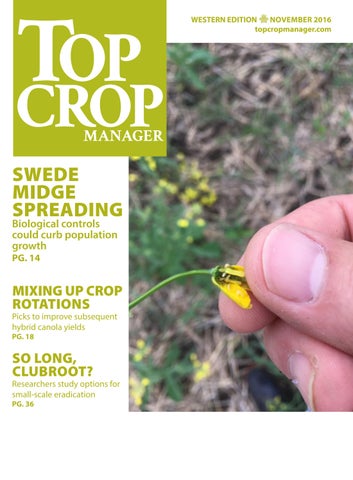
TCM West - November 2016

Page 1


TOP CROP MANAGER

SWEDE MIDGE SPREADING

Biological controls could curb population growth

PG. 14

MIXING UP CROP ROTATIONS

Picks to improve subsequent hybrid canola yields

PG. 18

SO LONG, CLUBROOT?

Researchers study options for small-scale eradication

PG. 36

STRAIGHT CUT YOUR WORKLOAD

Demonstration Strip Trials (DSTs) for the past three InVigor ® L140P, using the same agronomic has shown a 4.3% yield increase* when cut over normal swath timing. To see how L140P performed this season, check out results at InVigorResults.ca

I will not limit my potential, cut corners or compromise on quality. I will do things right the first time. I will work tirelessly to achieve my goals. I will make my farm a true reflection of me.

InVigor

TOP CROP

MANAGER

10 | Fighting cereal aphids with your smartphone

A decision-support tool will help growers make the most of the aphids’ enemies.

CROP MANAGEMENT

6 Grower insights into top canola production

By Bruce Barker

18 Mixing up crop rotations

By Bruce Barker

30 Effect of weeds on soil AMF and agronomic traits in organic wheat

By Hiroshi Kubota, Sylvie A. Quideau,

Pierre J. Hucl, and Dean M. Spaner

34 Pea and lentil improve profitability and energy use efficiency in rotations

By Bruce Barker

14 | Stamping out swede midge?

Swede midge continues to be a major pest in Ontario, while low populations are spreading across the Prairies.

SPECIAL CROPS

16 Camelina responds well to nitrogen

By Bruce Barker

FERTILITY AND NUTRIENTS

22 Managing copper deficiency in cereal crops

By Ross H. McKenzie, PhD, P.Ag.

STORAGE

26 In the bin, in the summer

By Carolyn King

36 | Small-scale clubroot eradication?

Researchers identify options that can potentially stamp out small patches of clubroot in fields.

PLANT BREEDING

24 Genetic tools help researchers tackle Ug99

By Julienne Isaacs

39 What’s new in canola?

By Blair McClinton, P.Ag.

FROM THE EDITOR

4 Adapt to survive and thrive

By Brandi Cowen

Readers will find numerous references to pesticide and fertility applications, methods, timing and

Manager. We encourage growers to check

labels for complete instructions.

BRANDI COWEN | EDITOR

ADAPT TO SURVIVE AND THRIVE

Amid the day-to-day hustle of checking weather forecasts for some much-needed rain (or, depending on the year, sun), applying just the right nutrients to a field, and scouting for problematic pests, weeds and diseases, it’s easy to lose sight of a simple fact: plants have an amazing ability to adapt and survive.

This trait can be unfortunate in unwanted plants, such as kochia or Canada fleabane, which can develop resistance to an important herbicide such as glyphosate, but it can also bring important benefits.

Researchers at the United Kingdom’s University of Southampton found plants are adapting to increasing levels of carbon dioxide (CO2) in the atmosphere. Gail Taylor, a professor with the biological sciences department and lead author of a report in the journal Global Change Biology, compared two types of plantago lanceolata plants. The first type, found near CO2 springs in Bossoleto, Italy, consisted of plants that have been exposed to high levels of naturally occurring carbon dioxide for centuries. The second type were grown at a control site nearby and exposed to lower levels of CO2 currently found in the atmosphere.

In a news release, Taylor explained, “The study shows that when we take plants from these two places that represent the atmosphere of today with that of the future (out to 2100), and place them together in the same environment, the plants from spring sites were bigger and had a better rate of photosynthesis. Most importantly, plants from the spring sites had differences in the expression of hundreds of genes. In particular, we predict from these gene expression data that planetary greening will continue – it won’t switch off or become acclimated as CO2 continues to rise, but some of the extra carbon in future plants is likely to go into secondary chemicals for plant defense. This is associated with more gene expression underpinning plant respiration.”

Taylor concludes plants will adapt to rising CO2 levels in “unpredictable” ways, raising an important question for agriculture: how will food crops evolve?

One researcher at the University of Illinois has some ideas. Andrew Leakey, a plant biology professor, led an eight-year study of soybeans grown outdoors in a CO2 rich environment similar to that expected by 2050. The results are a mixed bag for producers. The study, published in the journal Nature Plants, found that under ideal growing conditions, higher CO2 concentrations boosted plant growth. However, drought, which is expected to become more common thanks to a warmer climate and shifting rainfall patterns, seems to counter those benefits and reduce yield.

Leakey and his team found plants grown under hot, dry conditions with higher levels of CO2 used more water than those grown under current CO2 conditions. This runs counter to other research, which suggests plants exposed to high levels of CO2 will shrink the pores in their leaves, cutting back on both the exchange of gasses with the atmosphere and the amount of water they draw from the soil.

“What we think is happening is that early in the growing season, when the plant has enough water, it’s able to photosynthesize more as a result of the higher CO2 levels. It’s got more sugars to play with, it grows more, it creates all this extra leaf area,” Leakey said in a press release. “But when it gets dry, the plant has overextended itself, so later in the season it’s now using more water.”

The plant also seems to become more sensitive to changes in the hormones that send signals between its roots and leaves, leading to less photosynthesis under drought conditions.

Both studies offer important insights into the challenges agriculture will need to overcome going forward. Like plants, producers must continue to evolve if they are to thrive and grow.

We hope this issue of Top Crop Manager will help you do just that.

related groups whose products and services we believe may be of interest to you. If you prefer not to receive this information, please contact our circulation department in any of the four ways listed above.

Annex Privacy Office privacy@annexbizmedia.com • Tel: 800 668 2374

BUILT FOR SOIL PRODUCTIVITY

2017 ORDER PROGRAM

ORDER YOUR SALFORD NOW FOR THE BEST PRICE IN 2017*

NO INTEREST, FOR UP TO 6 MONTHS NO PAYMENT FOR UP TO 1 YEAR*

* Order program offer excludes some models. Terms and conditions apply to order program and financing deals. See dealer for details

VALMAR 8600 AIR BOOM APPLICATOR

BOOM WIDTH UP TO 66 FEET - Pull the leader in air boom delivery for a fraction of an air boom floaters’ cost. 1,000 LBS/AC AT 8 MPH - Deliver high rates from the high capacity hopper. 8 ton (260 cu. ft.) or 11 ton (357 cu. ft.) sizes available. TWO PRODUCT BLENDS - Optional two compartment tank allows for custom blends. PRECISION APPLICATOR - Options for ISOBUS compatible variable rate and left/right section control.

GROWER INSIGHTS INTO TOP CANOLA PRODUCTION

Seed early, shallow and into good moisture.

Research abounds on best management practices for top canola yields, but where the rubber hits the road is out in the field. A survey of 68 randomly selected canola farm fields across the Prairies identified the top practices farmers use to target high yield.

“Many canola producers have accumulated extensive knowledge and experience over the years in producing best canola crops under their specific growing environments and conditions. This knowledge and experience may serve as a first-hand source of information in the development of sound guidelines for less experienced canola producers,” says Yantai Gan, a research scientist with Agriculture and Agri-Food Canada (AAFC) in Swift Current, Sask. Gan led the team, along with a master’s student from the University of Manitoba.

The survey was conducted in spring 2011 and data collation was completed by October 2012. The research team made multiple field trips to collect data on soil properties and growing conditions, as well as measurements on seedling emergence, seeding depth,

row spacing and yield data.

Gan summarized the key management practices for high yield in canola were seeding shallow and directly into chemfallow (or crops with inherently short stubble) at earlier dates with narrow row spacing, and avoiding seeding into canola stubble.

There was a large variation in terms of data uniformity across the individual farm fields; some of the cropping practices were adopted by the majority of the canola producers, whereas other practices were used only by a few individual farmers.

Based on the survey data, canola produced in Alberta (44.6 bushels per acre, or bu/ac) averaged 23 per cent greater than canola produced in southern Saskatchewan (36.3 bu/ac), 10 per cent greater than canola produced in northern Saskatchewan (40.5 bu/ac), and 59 per cent greater than canola produced in Manitoba (28 bu/ac).

ABOVE: Seeding early and shallow are key management practices for high yield.

YOU’VE

For 20 years, we’ve left the competition with some pretty big tracks to fill. But in the rush to keep up, there are a few things the copies have missed. Like our exclusive five-axle design. It gives our Steiger ® Quadtrac,® Steiger Rowtrac™ and Magnum™ Rowtrac tractors a smoother ride and more power to the ground with less berming and compaction. Which is one of the advantages of paying your dues, instead of paying homage. Learn more at caseih.com/tracks.

Avoid canola on canola

Canola performed best on chemfallow and worst on canola stubble. About 40 per cent of the producers grew their canola on cereal stubble, 17 per cent on chemfallow, and the rest on other crop stubbles. Three of the fields were canola on canola.

Canola yield responses were as follows: chemfallow > barley = oat = wheat > others = grain legumes = corn > canola. Canola produced on chemfallow averaged seed yield of 45.5 bu/ac, which was 17 per cent greater than canola that was grown on barley, oat or wheat stubble. Canola grown on canola stubble produced 54 per cent of the seed yield compared to canola grown on cereal (barley, oat, wheat) stubble, or 46 per cent of the seed yield compared to canola grown on chemfallow.

Gan says these results suggest good soil moisture combined with soil available nutrients is a key factor in high yield, and that chemfallow was able to provide the highest yields because of better moisture and improved soil fertility.

Pre-seeding herbicide application significantly affected canola yield, with the use of glyphosate plus MCPA significantly increasing canola yield by 35 per cent compared with canola receiving none or glyphosate only, Gan says. Fall application of glyphosate and pre-seeding glyphosate plus MCPA yielded similarly. It should be noted, however, that a glyphosate-MCPA tank mix is not registered for pre-seed application prior to canola due to the risk of germination damage.

The survey found growers should target plant stand populations using thousand kernel weight calculations and germination rate to develop seeding rates. Gan says growers also should take note of the typical survival rate of the seedlings on their fields, and adjust their seeding rate accordingly to achieve the target plant stand.

About 10 per cent of the producers used a straight combine when harvesting canola crops. Straight combining resulted in a significantly higher yield of about 8.9 bu/ac, or 24 per cent more than swathing.

The negative factors

Deeper seeding, wider row spacing, increased stubble height of previous crops, and delayed seeding after April 25 all reduced canola seed

68 randomly selected fields.

Source: Liu et al. 2014. Can. J. Plant Sci. 94: 131-139

yield significantly. Gan says seeding depth research of canola on the Prairies has consistently found reduction in yield when canola is sown deep. Similarly, seeding date research on canola has found later seeding decreases yield. This was confirmed by farmers who participated in this survey.

Response of seeding into varying stubble heights can be more variable, depending on soil-climatic conditions. Research at AAFC Swift Current found tall stubble often helps conserve more soil moisture, minimize wind damage to canola seedlings in the early spring, and thus increase seed yield and water use efficiency. Conversely, in wetter, cooler areas, seeding canola into standing tall stubble may result in lower yields because soil temperatures may be lower, which delays seedling emergence.

Gan says the survey results help validate small plot research results but on a large-scale basis. “It would have been preferable to sample a greater number of farms, but it is a challenge to obtain such detailed on-farm information on a larger scale. Nonetheless, the knowledge and findings generated from this on-farm research may serve as the first-hand source of information in the development of sound guidelines for less experienced canola producers in Western Canada.”

Table 1. Mean canola yield response based on previous crop for
Growers should note typical survival rates of seedlings on their fields, and adjust seeding rates to achieve the target plant stand.
PHOTO BY TOP CROP MANAGER.

It’s hard to imagine that one small seed could hold so much promise, but it does. And when you consider the importance of having a successful season, a cereal seed treatment you can depend on makes a huge difference to the success of your family business.

With the full support of Raxil® seed treatments you’ll receive first-class disease control and a faster, stronger emergence that helps your field realize its full potential. Raxil lays the groundwork for a field that your neighbours will envy and that will ultimately help you achieve a superior performance.

Because from seeding to harvest, every seed counts.

FIGHTING CEREAL APHIDS WITH YOUR SMARTPHONE

A decision-support tool will help growers make the most of the aphids’ enemies.

Our enemy’s enemy is our friend. That’s the idea behind a calculator being developed to help Prairie cereal growers make decisions on whether to apply insecticides. In this case, our enemies are the various aphid species that infest cereal crops. If aphid populations are high during a sensitive crop stage, these delicate little insects can make a big dent in cereal yields. The aphids’ enemies include an array of insects that are able to chomp down, suck dry or otherwise destroy impressive numbers of aphids.

The tool includes the impacts of natural enemies in its calculations so it can better predict when spraying cereal aphids would be worthwhile economically.

Aphids reduce cereal yields by feeding on the plant’s sap and, depending on the aphid species, may also inject toxins into the plant or vector a plant pathogen called barley yellow dwarf virus. Also, aphids produce a sugary liquid known as honeydew that can promote fungal growth on the plant.

“Four main species of aphids attack cereal crops on the Prairies, but in the past few growing seasons the most common has been the English grain aphid, Sitobion avenae, with the oat-birdcherry aphid, Rhopalosiphum padi, the second most common. The greenbug aphid, Schizaphis graminum, is also present but at lower numbers,” says Tyler Wist, an entomologist with Agriculture and Agri-Food Canada (AAFC) in Saskatoon. He is leading the research to develop the calculator. He adds, “The fourth species is the corn leaf aphid, Rhopalosiphum maidis, but we really haven’t seen it in the last few years.”

John Gavloski, an entomologist with Manitoba Agriculture, is collaborating on the project. He says, “Neither the English grain aphid nor the oat-birdcherry aphid overwinters on the Prairies as far as we know; or if they do overwinter, they don’t do it very successfully.” Instead the aphids are blown in from the United States.

“The extent to which cereal aphids reduce yields depends on the crop stage when the aphid numbers get high, which also depends on when they blow in. Once the crop reaches the soft dough stage, aphid infestations have little effect on yields,” Gavloski notes.

A new tool will help growers to harness the pest control power of natural enemies like this seven spotted lady beetle larva that is stalking English grain aphids on a wheat head.

The only insecticides registered for controlling aphids in cereals on the Prairies are malathion and dimethoate. Both insecticides belong to the organophosphate chemical group. Gavloski says, “Luckily, aphids are not an annual problem in cereals. If they were an annual problem, then we’d have big concerns over resistance management with two products in the same chemical group.” These two insecticides kill not only aphids, but also a broad spectrum of other insects including many of the natural enemies of aphids. So it is especially important that growers know if the natural enemy populations are sufficient to stop the aphids from reaching damaging levels or if an insecticide application would make economic sense.

PHOTO COURTESY OF TYLER WIST.

Data and discoveries

The research to develop the calculator is funded by the Pesticide Risk Reduction Program, a joint effort of AAFC and Health Canada’s Pest Management Regulatory Agency. In an initial two-year project, Wist developed a prototype calculator and conducted some initial testing of it. His current project, which runs from 2015 to 2018, is further refining and testing the calculator and working towards a mobile-friendly version for use by growers.

The calculator works by predicting the growth rate of aphid populations over a set period of time, usually one week, under the predation pressure of the natural enemies counted in a survey of an affected field. For accurate results, the calculations must be based on a detailed understanding of the aphids and their enemies in Prairie cereal fields.

“So far we’ve spent several seasons surveying the natural enemy and aphid populations in wheat, barley and oat fields [in Saskatchewan and Manitoba] to understand what species are out there and to see if changes in the aphid populations correlate to increased or decreased pressure from natural enemies,” Wist says. “This approach has been used previously for soybean aphids and their natural enemies in Ontario [in an app developed by Rebecca Hallett and her colleagues], and is adapted from an older series of equations that describes the interaction of aphid predators with their aphid prey. I made it work for cereal aphids and the natural enemies that we find on the Canadian Prairies.”

The calculator uses what is called a “dynamic action threshold” (DAT). “The conventional action threshold (CAT) is the aphid population level where insecticidal control is recommended to keep the aphid population from exceeding the economic threshold where the

cost of controlling the aphids is less than the value of crop loss due to aphid feeding damage. The CAT doesn’t take into account the aphid population suppression by natural enemies,” Wist explains. “The DAT improves on the CAT by incorporating the number of aphids killed by natural enemies. Using a DAT instead of a CAT can reduce insecticide spraying and preserve any natural enemies that are present in the field.”

The main natural enemies of cereal aphids found by the project team over the past few years include lady beetles (adults and larvae), green lacewings (mostly larvae), damsel bugs and parasitoid wasps in the genus Aphidius

Wist notes, “Lady beetles chew the aphids; a large lady beetle larva can eat around 75 larger-sized aphids per day. Green lacewing larvae and damsel bugs pierce the aphids and suck out their bodily fluids. Aphidius wasps lay their eggs into the aphids and their offspring eat the insides of the aphids and cause death around eight days after the egg was laid.” Bug enthusiasts can check out Wist’s YouTube videos showing some of the natural enemies in action (https://www.youtube.com/ channel/UCGnNOA0VRVIBorl3UgLdXZA).

Gavloski says lady beetles and green lacewings are often seen in Manitoba cereal fields. A 1971 study of lady beetles in Manitoba found predation on aphids varied between species of lady beetles and species of aphids, with some lady beetle species eating over 100 aphids per day per individual. And green lacewing larvae are such good aphid predators that some people call them “aphid lions.”

Parasitoid wasps leave clear signs of their attacks on aphids. Gavloski explains, “After the aphid has died and the wasp has emerged, the aphid’s corpse is left behind; we call the corpse an ‘aphid mummy.’

Cash Flow Solutions For Your Farm

Whether you’re just getting started or have been farming for years, a cash advance offers solutions for your farm, including:

• financial flexibility, so you can market your crop or livestock when the timing and price is best for you,

• a low blended interest rate, so you can lower your cost of production, and

• cash flow solutions for the everyday challenges of managing a farm.

Applying is easier than ever too, with all your advance needs in one place at CCGA. Fall advances for livestock and stored grains are available now.

Aphid mummies are usually bronze coloured, although some might be a bit darker, depending on the species of parasitoid. The mummy looks like an inflated, bronzy aphid.”

Wist and his team have made some discoveries that are helping to further improve the calculator’s accuracy. For instance, they’ve discovered the main parasitoid wasp species to be Aphidius avenaphis They didn’t know how many aphids per day one of these wasps could kill, which is important for the tool’s calculations. So Wist conducted an experiment to answer that question.

He found an adult female Aphidius avenaphis kills 30 aphids per day on average. He also discovered that after the wasp larvae complete their development inside the aphids and emerge as adults from the mummies, they continue attacking aphids. A newly emerged female starts laying her eggs in aphids almost immediately after she emerges and mates, and she lays eggs for about five days.

Currently, Wist is continuing to refine the DAT equation with new data and information, making sure it matches the real world situation. He and his team are also continuing to take samples of the aphid and natural enemy populations in each field to ensure they haven’t missed any important species.

In the 2016 and 2017 field seasons, the project team is going to cereal fields with aphid populations that are just starting up, to assess the predictive ability of the calculator’s beta version. Wist notes, “The main challenge in this research comes from the migratory nature of the cereal aphids because I never know where or when the aphids will arrive. It’s difficult for me to cover the entire growing region and catch the aphid infestations when they start. [Next summer] if anybody sees aphids in their cereal fields, they can contact me (Tyler. Wist@canada.ca) and I’ll come out to take a look.”

As well, Wist and his team are now looking at turning the calculator into a web-based tool for field testing of the calculator and to see how it might work as a tool for growers. The provincial insect specialists from Alberta, Saskatchewan and Manitoba and some agronomists will be helping to test the web-based version. “After the web-based tool proves itself, we will look at rolling out mobile versions,” Wist says.

To use the tool, you would count the aphids on a set number of plant stems at several sites across a field, and input the data. You would also count the natural enemies on and around the sampled plants, and input that. The tool will have detailed photos so you can easily identify the aphids and their enemies.

The calculator takes all the input data and creates one number to describe the effect of all the natural enemies on the aphid population. Wist says, “The basic information that is then provided to the

user will be either that the aphid population will not reach a damaging level and no action is warranted, or that the aphids could reach the economic threshold soon and cause yield loss so control might be warranted.”

A commonly used economic threshold for cereal aphids is about 10 to 15 aphids per stem of the plant. Users would be able to choose that threshold or change it to whatever level they wish.

Tips for now

Aphids are small but they tend to occur in clusters, or colonies, so they are fairly easy to see when you’re looking for them. Each species has its own preferences for colonizing a cereal plant. “English grain aphids tend to like the upper parts of the plant. They feed on the upper leaves and the heads. Oat-birdcherry aphids often colonize lower on the plant,” Gavloski says. Symptoms of cereal aphid attacks depend on which aphid species is attacking the plant.

For growers who are considering whether to spray for cereal aphid control, Gavloski has a series of recommendations.

First, figure out if you’re near or above the economic threshold of 10 to 15 aphids per stem. Check 20 stems in each of five areas in the field. Be sure to include some areas well into the field because plants along the field margins, especially near shelterbelts, may have high aphid numbers that are not representative of the whole field.

“If you are above the threshold, I usually suggest considering the crop stage. Once the crop gets to the soft dough stage, where the grain is starting to harden, the aphids won’t be an issue any more,” he says.

“I also suggest considering the natural enemies present in the field. If there is a lot of evidence of diseased aphids or predators or parasitoids, especially if you’re borderline threshold, that could help with your decision-making on whether to spray.”

Another factor to consider is whether the crop is drought-stressed. “A drought-stressed crop will have a much harder time recovering from aphid feeding than if growing conditions are good,” Gavloski explains.

He also suggests checking whether heavy rain is in the forecast. “After a really heavy rainstorm, aphid population numbers can go down significantly. In a heavy rain, the aphids get knocked from the plant. They are very delicate insects, so if they get knocked to the ground and water is pooling on the soil, you can get a lot of aphid kill.”

Wist hopes to have the DAT tool ready within the next couple of years. The tool will enable growers to make a much more accurate estimate of the impact of the natural enemies on the cereal aphid populations in fields. This should help reduce insecticide inputs and preserve insect friends, while maintaining crop yields.

The damsel bug is one of the main natural enemies of cereal aphids.
Oat-birdcherry aphids tend to colonize the stems and lower leaves of cereal plants.
PHOTOS COURTESY OF JOHN GAVLOSKI.

A RHIZOBIUM DESIGNED WITH PEA AND LENTIL YIELDS IN MIND.

One of the most important decisions a grower can make when it comes to inoculation is strain choice. The more crop specific the strain is, the more efficient it will be. Nodulator® XL inoculant contains Rhizobium leguminosarum biovar viceae strain 1435, a rhizobium that’s specific to peas and lentils only. This highly efficient, nitrogen-fixing strain increases the number of active nodules per plant. That’s why it’s able to deliver 3 to 8%1 more yield compared to competitive inoculants. Now that’s precisely what your peas and lentils need. To find out more, visit agsolutions.ca/nodulatorxl or call AgSolutions® Customer Care at 1-877-371-BASF (2273).

1 Source: Independently generated field data from 87 station years (peas) and 84 station years (lentils). (n sites x n years). Always read and follow label directions.

AgSolutions is a registered trade-mark of BASF Corporation; NODULATOR is a registered trade-mark of Becker Underwood

all used with permission by BASF Canada Inc. © 2016 BASF Canada Inc.

STAMPING OUT SWEDE MIDGE?

Low populations of this pest are spreading across the Prairies.

Swede midge first appeared in canola in Ontario in 2003, and recent extreme populations in northeastern Ontario resulted in the Ontario Canola Growers’ Association (OCGA) strongly recommending in 2015 that producers avoid growing canola for three years across the New Liskeard area in an attempt to suppress swede midge populations.

“In 2016, swede midge populations in some areas in Ontario seemed to be less of a problem, likely due to a slow spring and very dry conditions,” explains Rebecca Hallett, a professor at the University of Guelph. “Earlier in the season populations appeared to be lower, however rainfall in late July saw numbers of swede midge increasing in some areas. In the New Liskeard and Temiskaming district, swede midge continues to cause significant concern for canola growers, although canola acreage is down as growers extend rotations with new crop options such as fababeans, peas and flax in an effort to reduce swede midge populations.”

Researchers have confirmed four generations of swede midge in Ontario, but with climate change and weather conditions, five generations are possible. Hallett is continuing to lead research on

pheromone action threshold development to try to develop economic recommendations for growers. The yield impact on canola depends on midge population levels, timing of infestation relative to plant stage and timing of insecticide application.

“Because of the variation at different sites across Ontario, it has been difficult to pinpoint the appropriate threshold and number of insecticide applications for swede midge control,” Hallett says. “With the repeated presence and successive generations of swede midge, it is difficult to determine the impact on yield. Currently, we are tentatively recommending that growers spray for swede midge when they are capturing five or more midge per pheromone trap per day. Populations tend to be field specific, so localized trap information is key. There should be multiple traps per field that are checked two or three times per week and the average number of midges captured per trap per day calculated. A spray application is only recommended at the most susceptible stages, particularly at the late vegetative and

ABOVE: Boyd Mori checking swede midge pheromone traps in early spring 2016.

early bud stages to protect the primary inflorescence. We hope to refine the timing and number of applications that are economic and needed to protect yield over the next couple of years.”

To get a better understanding of the impact of swede midge on canola in terms of growth and yield, Hallett and a new grad student are planning to conduct more laboratory experiments starting this fall. The objective is to look at the effect of single and multiple infestations of swede midge on growth and yield parameters.

“This work will help us understand the relationship between larval numbers in plants in the field and pheromone trap captures,” Hallett says. “For example, as the number of males in the traps goes up, we can assume there will be a peak of adult emergence, females will be laying eggs and larvae will begin developing within a week or so. If we see 10 males per trap per day, for example, what does that mean in terms of damage down the road and when is it going to be critical to spray? Bringing all of these aspects together will ultimately strengthen the action threshold we recommend.”

Determining when to spray and at what threshold has economic implications. Hallett explains a missed spray can have losses associated with it if there are yield losses. However, an unnecessary spray also has an associated cost. Depending on the year and the cost of production, an estimated six to nine per cent yield loss is required to justify an insecticide application. However, an unnecessary application, depending on the rate of return, could end up cutting profits by 30 to 40 per cent. So fine-tuning the economic threshold and timing of application recommendations is very important.

Currently, the recommended canola rotation for managing swede midge (and other pests and diseases) is one in four years or longer. Seeding early is also recommended, although in areas where cabbage seedpod weevil can also be a problem, earlier seeding may not be feasible. Growers need to determine which pest is more of a problem for their situation. In areas where swede midge is a problem, avoid growing other crucifers either as cover or field crops in rotation or in nearby fields. Use of pheromone traps and regular monitoring is important for determining the timing and necessity of a spray application. As economic threshold recommendations are refined, this decision will become more straightforward. Swede midge can persist even in areas with low canola acreage, so good management is key to keeping canola profitable in Ontario and other regions.

In Saskatchewan, swede midge was first observed in 2007 in small, scattered populations. Although monitoring efforts have confirmed swede midge across Western Canada, the populations are

still very low and not yet causing economic impacts. “Swede midge populations in 2016 in emergence trap monitoring were higher than in previous years, particularly in northeastern areas of Saskatchewan near Carrot River and Nipawin,” says Boyd Mori, an entomology biologist with Agriculture and Agri-Food Canada (AAFC) in Saskatoon. “In a driving survey across Saskatchewan, we found swede midge everywhere we looked, but in very low density. There were very minor symptoms on canola crops, and not nearly enough to cause concern or economic damage. Even with the higher populations in northeastern Saskatchewan, we don’t believe the levels would be causing economic damage yet.” Driving surveys conducted in Alberta in 2016 resulted in similar findings.

The warmer winter in Saskatchewan followed by warmer spring conditions saw swede midge adults flying a few weeks earlier than in previous years. For now, researchers have confirmed two generations of swede midge on the Prairies, but data collected over the summer may show three generations are possible under conditions like those in 2016. Warmer winters and wetter summers like those experienced this year are good conditions for swede midge, so populations could keep increasing, which could mean heavy damage in the future. Researchers are seeking funding to continue swede midge monitoring across the Prairies over the next few years.

Biological control options and other strategies

Researchers in Saskatchewan began looking at potential biological control in 2014 with the confirmation of two species of parasitoids in canola. Led by recently retired AAFC research scientist Julie Soroka and postdoc Lars Andreassan, these were the first parasitic wasps (Gastrancistrus sp. and Inostemma sp.) identified in Canada for potential control of swede midge. In Saskatchewan, parasitism was noted in the field during the 2016 driving surveys. Another parasitic wasp of swede midge was recently found in Quebec.

In Ontario, researchers started looking for parasitoids this summer and found fairly high rates of parasitism in some canola fields in southern areas of the province. “We did weekly sampling throughout the summer and found rates of four to 20 per cent parasitism over a six-week period at several different locations,” Hallett explains. “Species identification is tricky, so we are in the process of having these species identified by a specialist to determine if they are local species or not, but it is a good sign that natural enemies are beginning to show up against swede midge.”

Both Hallett and Mori are applying for funding to look at biological control with these parasitoids in more depth.

Another area of research is host plant resistance and other possible sources of genetics that may help with plant breeding efforts. Hallett and others have assessed several different host plants, including cruciferous weeds and cover crops in Ontario that have resistance to swede midge damage. Mori has a new four-year project underway to expand this work into the Prairies.

“The goal is to identify any resistance mechanisms in cruciferous weeds in the Prairies as well as older historical canola lines that swede midge may avoid and to determine why,” Mori says. “We will be looking at potential early season and late season host plants when canola is not at the right growing stage to see if they have any resistant properties. If we can identify resistance mechanisms in any cruciferous weed plants, or canola lines, then this technology can be provided to breeders for new canola lines under development.” The project is in very early stages, with seed and plant collections initiated in 2016 and laboratory bioassays to begin in the winter.

Canola infested with swede midge larvae in 2016.

CAMELINA RESPONDS WELL TO NITROGEN

Oil and protein yields increased with N input, similar to results seen in other oilseed crops.

Two research studies provide further evidence that camelina responds well to nitrogen (N) fertilizer.

The first study by Agriculture and Agri-Food Canada (AAFC) researchers Sukhdev Malhi (now at the University of Alberta), Eric Johnson (now at the University of Saskatchewan) and colleagues looked at camelina response to N on the Prairies. Two field experiments were conducted in Saskatchewan and Alberta to determine the effect of N fertilizer application on camelina plant establishment, seed and straw yield, total N uptake in seed and straw, seed oil and protein concentration, N fertilizer use efficiency (NFUE) and per cent recovery of applied N (%NR) in seed.

Nitrogen fertilizer rates ranged from zero to 160 kilograms of N per hectare (kg N/ha) (multiply by 0.89 for lb/ac) in Experiment 1, and from zero to 200 kg N/ha in Experiment 2. In Experiment 1, fertilizer rates were not high enough to attain a maximum seed yield, however, maximum seed yields of 2013 kg/ha (36 bu/ac) were achieved at a rate of 170 kg N/ha in Experiment 2. Seed oil concentration decreased while protein concentration increased with increasing N rate.

Johnson says the yield response model indicated N response in camelina similar to that of Brassica juncea on the Canadian Prairies – growers can use soil test recommendations for Brassica juncea as a guide for camelina production. The research indicates growers should manage camelina as a high-yield, responsive oilseed crop, not as a low-input crop that was originally promoted.

“Growers on productive land may be disappointed with seed yields if they manage it as a low-input crop without applying adequate levels of fertilizer nitrogen,” Johnson says. “In saying that, some growers are trying camelina on land that is marginally productive for annual cropping, which reduces the probability of N fertilizer responses.”

The other study looked at camelina seed quality and yield traits in response to N application in Atlantic Canada. Yunfei Jiang and Claude Caldwell at Dalhousie University in Truro, N.S., led the research, along with colleague Kevin Falk at AAFC Saskatoon. They analyzed the seed oil content, oil yield, protein content, protein yield, as well as fatty acid profile relative to varying N rates and in different genotypes (varieties) under several environmental conditions. Seed samples were obtained from a two-year field study with five site-years, five genotypes, and six N rates.

The experimental strains were grown at Truro and Canning, N.S., New Glasgow, P.E.I, and Fredericton, N.B. Nitrogen was applied at zero, 25, 50, 100, 150, and 200 kg N/ha.

Camelina seed oil content, oil yield, and fatty acid profile varied

N response in camelina Mean of seven site-years, 2008-2010

N input for maximum economic yield

N input for maximum yield

ASSUMPTIONS: N fertilizer cost = 45 cents/lb Camelina price = 18 cents/lb or $9.00/bushel

Source: Malhi, Johnson et al. Can. J. Soil Sci. (2014).

by location, probably due to the effects of environmental conditions, such as aerial temperatures, precipitation, and soil composition.

Applied N increased protein content, protein yield, oil yield and polyunsaturated fatty acids (PUFA), but decreased oil content and monounsaturated fatty acids (MUFA). PUFA play a key role in brain and eye development and the prevention of heart disease. In the biobased industrial market, a relatively high MUFA and a low PUFA content is desirable in many applications.

Oil and protein yields increased with N input because seed yield was positively associated with N rates. Saturated fatty acids did not respond consistently to applied N. Lower air temperatures during the reproductive stages increased total seed oil content, but fatty acid composition was not affected. Protein, oil, and fatty acid composition of camelina seed differed among the genotypes.

Caldwell says quality parameters are consistent across geography.

The future is here. InVigor® L140P and NEW InVigor L233P hybrids feature patented Pod Shatter Reduction technology, providing you with the ability to straight cut your canola.

MIXING UP CROP ROTATIONS

Growing field pea or lentil first can improve subsequent hybrid canola and barley yields.

What to do with all those lentil, pea and fababean stubble acres from 2016? Canola on pea or lentil stubble? Or maybe barley? Contrary to conventional thinking, research supports mixing it up.

“We did a study at seven locations across the Prairies to look at the agronomic and economic benefits of growing legume crops in the year preceding canola and two years preceding malt barley,” explains John O’Donovan, a retired research scientist at Agriculture and Agri-Food Canada (AAFC) in Lacombe, Alta. “We found that on average, all legumes, except fababean for seed, produced higher canola and barley yields than when wheat was the preceding crop. Fababean green manure produced the highest yields, while canola on canola produced the lowest canola yield.”

O’Donovan’s study is consistent with other research on the Prairies over the last few years. In Saskatchewan, research by Randy Kutcher, formerly of AAFC Melfort and now at the University of Saskatchewan, found canola yields were higher when canola was grown on field pea compared to wheat residue. Other research at the University of Alberta found canola grown on field pea or fababean residue without nitrogen (N) fertilization yielded higher or equal to canola grown on barley or canola residue with N fertilization.

In O’Donovan’s research, field pea, lentil, fababean, canola, and wheat harvested for grain, as well as fababean grown as a green manure (GRM), were direct-seeded at seven locations in 2009: at Beaverlodge, Lacombe and Lethbridge in Alberta, at Scott, Indian Head and Swift Current in Saskatchewan, and in Brandon, Man. Canola was seeded in 2010 and barley in 2011, with fertilizer nitrogen applied at zero, 30, 60, 90, and 120 kilograms per hectare (kg/ha).

First year effects

In the year following field pea, lentil, fababean, wheat, canola and fababean GRM, hybrid canola was seeded. Averaged across locations, there was a 27 per cent increase in canola yield following fababean GRM compared to where wheat was the preceding crop. Canola yield tended to increase following field pea and lentil compared to wheat stubble. Compared to wheat as the preceding crop, field pea significantly increased canola yield at Indian Head, Swift Current, and Brandon, while canola yield was higher on lentil stubble compared to wheat stubble at Beaverlodge, Indian Head, and Swift Current.

On average, compared to wheat stubble, canola yield increased by

four bushels per acre (bu/ac) on pea stubble and about six bu/ac on lentil stubble. Averaged across locations, growing canola after canola significantly reduced yield by 3.4 bu/ac (eight per cent) compared to when wheat was the preceding crop.

In other studies led by research scientist Kelly Turkington at AAFC Lacombe, similar results were found across the Prairies. Turkington’s work focused on malt barley production and compared growing malt barley on either barley, canola or field pea stubble. He found barley yields were 20 per cent higher when planted on field pea residue and 11 per cent higher on canola stubble compared to barley stubble.

ABOVE: Growing malt barley on pulse stubble did not result in higher protein content.
PHOTO

Table 1: Second year barley, canola and wheat yield and protein response to first year treatments at Barrhead and St. Albert, Alta., averaged across 2009 and 2010.

Source: William et al. AJ Vol. 106 No. 2, p. 343-350.

Additionally, planting malt barley on field pea stubble did not result in a significant increase in grain protein content. Turkington explains the factor that resulted in the largest and most consistent increase in grain protein level was increasing the N fertilizer rate from 50 to 100 per cent of the recommended rate.

At the University of Alberta, Christina Williams also looked at the effects of pulse crops on subsequent yield and protein content of barley, canola and wheat. The research was conducted at Barrhead and St. Albert, Alta., in the relative dry years of 2009 and 2010, which predisposed cereal crops to lower yield and higher protein. She found the highest (and statistically similar) barley, canola and wheat yields were on pea and fababean stubble without added N, and on barley and canola stubble with N applied to soil test recommendations.

When Williams looked at protein content of barley, she found protein content was high at the dry Barrhead site across all treatments ranging from 14 to 16.2 per cent. Barley grown on pea and fababean had statistically similar protein content as barley grown on canola or barley stubble with no added N, which were the lowest of all treatments. Barley seed protein at St. Albert on “+N,” fababean, and pea stubble was even greater than “no N” stubble.

Second year effects – same as the first

In O’Donovan’s study, in the second year following the preceding crops, green manure fababeans generally produced the highest

yields. Averaged across locations, there was a 14 per cent overall increase in barley yield where fababean GRM rather than wheat was the preceding crop. Averaged across locations, there were seven and six per cent overall increases in barley yield on lentil and field pea stubble, respectively, compared to when wheat was the preceding crop.

Averaged across locations, slight increases in barley kernel protein concentration occurred when fababean GRM and lentil were the preceding crops, while field pea had no effect. O’Donovan says these slight increases were unlikely to result in unacceptable protein concentrations for malting barley because the protein content was still quite low.

Implications

Based on O’Donovan’s research, growing canola or barley on pulse stubble presents two options for managing N fertilizer applications. He explains that if a producer were basing N management on a target yield, less fertilizer N would be required to maintain a given canola yield when field pea or lentil rather than wheat were the preceding crops. The other approach would be to maintain N application and attain a higher yield.

“The results indicate growing field pea or lentil as cash crops before hybrid canola can improve canola and subsequent barley yield without having a major negative impact on canola oil or malting barley protein concentration,” O’Donovan concludes.

From high-yielding hybrids to heart-healthy Omega-9 Oils to new, high-protein meal – only Nexera™ canola creates new markets that help produce the highest farmer returns per acre, year after year, across western Canada. SEED FOR YIELD, CONTRACT FOR PROFIT.™ See your contractor or retail.

MANAGING COPPER DEFICIENCY IN CEREAL CROPS

Thin black, black and gray-black Prairie soils are prone to deficiency.

Copper (Cu) is an essential micronutrient required to optimize cereal crop yield and quality. A typical 50 bushel per acre (bu/ac) wheat crop or 70 bu/ac barley crop will take up about 0.06 pounds of Cu per acre (lb Cu/ac) with about 0.02 and 0.04 lb Cu/ac contained in the seed of wheat and barley, respectively. Most soils across the Prairies have adequate levels of Cu and do not require Cu fertilizer, but a small percentage of soils are Cu deficient and cereal crops will benefit from an application of Cu fertilizer. Copper fertilizer is expensive. From an economic standpoint, farmers only want to apply a micronutrient fertilizer if there is a reasonable chance it will increase crop yield or quality. The challenge for farmers is to determine the need for or benefit from Cu fertilizer application.

Of all the cereal crops, wheat is the most sensitive to copper deficiency. Barley and triticale are moderately sensitive, followed by oats; rye is the least sensitive to copper deficiency. Research in the 1990s showed some cultivars of wheat were much more sensitive to Cu deficiency than others, but in recent years newer varieties have not been evaluated for relative sensitivity to Cu deficiency.

When there is adequate Cu in soil, adding more will not improve crop yield or uptake of other nutrients, such as nitrogen (N), phosphorus (P), potassium (K) and sulphur (S). Farmers should target application of Cu fertilizer on potentially deficient soils and to cereal crops that are more prone to copper deficiency. The challenge is how to do this.

Soils prone to CU deficiency

Thin black, black and gray-black transition soils across the Prairies are more prone to Cu deficiency. Copper deficiency in brown and dark brown soils in the southern Prairies is uncommon. Soils

that are sandy or have higher soil test P levels tend to be more prone to Cu deficiency. Soils with organic matter greater than six per cent and peat or muck soils are more prone to Cu deficiency.

The diethylenetriaminepentaacetic acid (DTPA) extractable soil test method is the standard test for determining Cu and other micronutrient metals in Western Canadian soils. This soil test is a good diagnostic tool to predict Cu deficient soils. The test is less effective at predicting reliable Cu fertilizer response when soils are marginally deficient in Cu. The critical level for Cu deficiency varies with soil type. (See the online version of this article for a table detailing general soil Cu levels and recommendations.)

Diagnosis of Cu deficiency

Correct diagnosis of Cu deficiency involves a laboratory soil test of zero- to six-inch and six- to 12-inch soil samples coupled with evaluation of a number of other soil and crop factors. Below is a list of questions; the greater the number of “yes” answers, the greater the probability of Cu deficiency:

1. Is soil test Cu less than 0.5 parts per million (ppm) in both the zero- to six-inch and six- to 12-inch soil depths?

2. Are cereal crop yields consistently below expectation?

3. Is the quality of cereal grain consistently poor, with shriveled or thin kernels and/or light bushel weight?

4. Does wheat often have high protein levels?

5. Do fields have irregular patches of poor growth when cropped to a cereal?

6. Do these poorer patches contain higher levels of disease?

ABOVE: Research in the 1990s showed some cultivars of wheat were much more sensitive to Cu deficiency than others, but newer varieties have not been evaluated for relative sensitivity to Cu deficiency.

7. Is ergot a problem?

8. Is the soil coarse-textured?

9. Is the topsoil rather deep (i.e. greater than eight to 10 inches)?

10. Does the soil have a higher level of organic matter (i.e. greater than six per cent)?

11. Does the soil test indicate relatively high levels of available nitrogen and/or phosphorus?

12. Is there a history of manure application?

Visual symptoms alone cannot be used to diagnose Cu deficiency but they can be used as part of the diagnosis. Symptoms may include:

1. Appearance of leaf wilting at tillering or stem elongation growth stages.

2. Pale yellow, curled young leaves at tillering.

3. Pig tailing or whip tailing of flag leaves. Leaf tips may die, roll or turn white.

4. Increased susceptibility and presences of diseases, including take-all root rot, stem or head melanosis, or ergot.

5. Reduced stem elongation causing the cereal crop to have the appearance of stunted growth.

6. Delayed heading and variable heading across a field, particularly on coarser-textured soil areas.

7. Delayed anthesis.

8. Aborted heads and spikelets.

9. Heads and spikes appear normal, but contain many empty spikelets (seed is not formed or poorly formed).

10. Delayed maturity and senescence for a few days to several weeks compared to better areas of the field.

11. Grain that is thin or shrivelled and endosperm of seed that may be blackened.

The most notable symptoms include patchy crop and poor growth areas in a field, greater disease pressure, delayed crop maturity, and a greater risk of frost injury due to late maturing grain.

It is important to note that Alberta research found plant tissue testing of whole plants was often not effective to diagnose Cu deficiency.

More research is needed to relate plant tissue testing with Cu deficiency to improve the ability to provide a correct diagnosis.

Correction of CU deficiency

Correction of Cu deficiency can dramatically improve cereal crop yield and grain quality. Application of surface broadcast, followed by incorporation of granular Cu fertilizer into soil at a rate of three to eight lb Cu/ac, is usually the most effective to prevent Cu deficiency in cereal crops. Banding, side-banding or seed-placement of Cu fertilizer is generally not as effective as broadcast-incorporation.

Alberta research has shown broadcast-incorporated rates of less than two lb Cu/ac were not effective in increasing seed yield of wheat in the year of application, but became effective after multi-year annual applications. Research has also shown surfacebroadcast application of granular Cu fertilizer, without incorporation, was much less effective in preventing Cu deficiency and improving yield of wheat versus broadcast-incorporated Cu fertilizers on Cu-deficient soils.

Alberta research also showed surface spray broadcast application, followed by incorporation of solution Cu fertilizer into soil, was usually equally effective compared to broadcast-incorporated

granular Cu fertilizer to prevent Cu deficiency.

When Cu deficiency is diagnosed in a growing crop, a foliar in-crop Cu application can be an effective emergency correction. Foliar application at tillering to flag leaf growth stages, at rates between 0.2 to 0.3 lb Cu/ac, can be used. In extremely Cu-deficient soils, two foliar applications with Cu fertilizer, one at late tillering and a second at flag-leaf, can be most effective.

A three to eight lb/ac broadcast-incorporated application of Cu is more expensive but a single application can be effective for many years. Copper sulphate is quite soluble and is generally the least expensive source of Cu. It typically is 25 per cent copper and should be broadcast and incorporated into the soil at rates of 12 to 32 pounds per acre of product (three to eight lb Cu/ac). A foliar application will correct a deficiency if applied during the tillering to flag leaf stage, but is only effective for that season.

When Cu deficiency is diagnosed, it is a relatively simple problem that can usually be corrected with a single application of soluble granular Cu fertilizer. The effects of one application should last for up to 10 years or more.

For more detailed information, consult with your provincial soil specialist and review your provincial agriculture department website.

For detailed soil micronutrient rating levels and recommendations, visit topcropmanager.com.

Trait Stewardship Responsibilities Notice to Farmers

Monsanto Company is a member of Excellence Through Stewardship® (ETS). Monsanto products are commercialized in accordance with ETS Product Launch Stewardship Guidance, and in compliance with Monsanto’s Policy for Commercialization of Biotechnology-Derived Plant Products in Commodity Crops. These products have been approved for import into key export markets with functioning regulatory systems. Any crop or material produced from these products can only be exported to, or used, processed or sold in countries where all necessary regulatory approvals have been granted. It is a violation of national and international law to move material containing biotech traits across boundaries into nations where import is not permitted. Growers should talk to their grain handler or product purchaser to confirm their buying position for these products. Excellence Through Stewardship ® is a registered trademark of Excellence Through Stewardship.

ALWAYS READ AND FOLLOW PESTICIDE LABEL DIRECTIONS. Roundup Ready ® technology contains genes that confer tolerance to glyphosate, an active ingredient in Roundup ® brand agricultural herbicides. Roundup Ready 2 Xtend™ soybeans contain genes that confer tolerance to glyphosate and dicamba. Agricultural herbicides containing glyphosate will kill crops that are not tolerant to glyphosate, and those containing dicamba will kill crops that are not tolerant to dicamba. Contact your Monsanto dealer or call the Monsanto technical support line at 1-800-667-4944 for recommended Roundup Ready ® Xtend Crop System weed control programs. Acceleron® seed applied solutions for canola contains the active ingredients difenoconazole, metalaxyl (M and S isomers), fludioxonil and thiamethoxam. Acceleron® seed applied solutions for canola plus Vibrance ® is a combination of two separate individually-registered products, which together contain the active ingredients difenoconazole, metalaxyl (M and S isomers), fludioxonil, thiamethoxam, and sedaxane. Acceleron® seed applied solutions for corn (fungicides and insecticide) is a combination of four separate individuallyregistered products, which together contain the active ingredients metalaxyl, trifloxystrobin, ipconazole, and clothianidin. Acceleron® seed applied solutions for corn (fungicides only) is a combination of three separate individually-registered products, which together contain the active ingredients metalaxyl, trifloxystrobin and ipconazole. Acceleron® seed applied solutions for corn with Poncho ®/VoTivo™ (fungicides, insecticide and nematicide) is a combination of five separate individually-registered products, which together contain the active ingredients metalaxyl, trifloxystrobin, ipconazole, clothianidin and Bacillus firmus strain I-1582. Acceleron® seed applied solutions for soybeans (fungicides and insecticide) is a combination of four separate individually registered products, which together contain the active ingredients fluxapyroxad, pyraclostrobin, metalaxyl and imidacloprid. Acceleron® seed applied solutions for soybeans (fungicides only) is a combination of three separate individually registered products, which together contain the active ingredients fluxapyroxad, pyraclostrobin and metalaxyl. Acceleron®, Cell-Tech™, DEKALB and Design®, DEKALB®, Genuity and Design®, Genuity ®, JumpStart ®, Optimize ®, RIB Complete ®, Roundup Ready 2 Technology and Design®, Roundup Ready 2 Xtend™, Roundup Ready 2 Yield®, Roundup Ready ®, Roundup Transorb ®, Roundup WeatherMAX®, Roundup Xtend™, Roundup ®, SmartStax ®, TagTeam®, Transorb ®, VaporGrip®, VT Double PRO ®, VT Triple PRO ® and XtendiMax ® are trademarks of Monsanto Technology LLC. Used under license. Fortenza® and Vibrance ® are registered trademarks of a Syngenta group company. LibertyLink® and the Water Droplet Design are trademarks of Bayer. Used under license. Herculex ® is a registered trademark of Dow AgroSciences LLC. Used under license. Poncho ® and Votivo™ are trademarks of Bayer. Used under license. ©2016 Monsanto Canada Inc.

GENETIC TOOLS HELP TACKLE UG99

Canadian team well positioned to continue work breeding new, resistant varieties.

Ug99” might not mean much to the world outside agriculture, but few wheat diseases have so much potential to devastate production – and ultimately, consumer access to a basic staple – around the world.

The strain of stem rust, which includes 13 variants, has spread through Uganda, Kenya, Tanzania, Ethiopia, Sudan, Yemen and Iran. It hasn’t reached Europe or North America yet, according to Curt McCartney, a research scientist at Agriculture and Agri-Food Canada’s (AAFC) Morden Research Station, but the risk is daily compounded by international air travel.

Ug99 can cause up to 100 per cent crop loss. Here in Canada, the last instance of major crop losses due to stem rust occurred in 1954, when production dropped to nearly half in the Prairies, from projected yields of 487 million bushels to actual wheat production of 272 million bushels.

“The message here is that stem rust can be a major problem and that the genetic resistance in wheat varieties prevents these massive losses from occurring,” McCartney says.

Canada became a global leader in breeding resistance to Ug99

almost by accident in 2005, when AAFC stem rust pathologist and the Ug99 breeding project’s principal investigator, Tom Fetch, discovered that the variety AC Cadillac was highly resistant to the disease. AC Cadillac was one of more than 100 wheat and durum varieties Fetch had sent to Kenya’s Njoro nursery for testing.

This variety is the source of the gene SrCad, discovered by Fetch and AAFC wheat geneticist Colin Hiebert in 2009. Along with the variety Peace, which also contains the gene, AC Cadillac has been available to Canadian producers for over a decade.

Currently, McCartney, along with Fetch, Hiebert and a team of AAFC researchers, are working to sequence SrCad in a collaborative effort between AAFC, the National Research Council in Saskatoon and the University of Saskatchewan. This work has brought some major breakthroughs: the team recently published some new SNP

CONTINUED ON PAGE 33

TOP: Of these two plots, one is very susceptible to Ug99, and one is resistant – similar to the AC Cadillac (SrCad gene) variety.

INSET: Severe Ug99 rust infection.

IN THE BIN, IN THE SUMMER

New research generates recommendations for safe summer storage of canola.

If you want to – or have to – store your grain into the summer, what are the best practices to prevent spoilage? Recently completed Prairie research gives a straightforward answer to that question.

The initial catalyst for this research was a bumper crop in 2013 followed by grain marketing and transportation issues in 2014. As a result, many Prairie farmers were looking at storing their grain into the summer of 2014. And quite a few of them called Joy Agnew at the Prairie Agricultural Machinery Institute (PAMI) to ask what they could do to improve their grain storage conditions over the summer.

At the time, Agnew’s expertise focused on natural air drying and aeration of grain in the fall after harvest, not summer storage. So she did some digging to see what other researchers had found. “I discovered there hadn’t been much research on it. There was anecdotal evidence, but nothing that conclusively said you should do one thing over another,” Agnew says.

To fill that information gap, she conducted an initial project in 2014 with the help of funding from the Canola Council of Canada.

“Storage in general is such a vital part of any producer’s operation. First and foremost, we want to understand techniques necessary to manage stored canola with no resulting losses or deterioration in quality,” says Angela Brackenreed, an agronomy specialist with the Canola Council of Canada. “We realized that we did not have a good handle on the best way to manage canola in the bin throughout the warm summer months. This practice may not be something that every farmer chooses to do, but if we can understand it, at least the option is there.”

She adds, “If producers can be confident in the management techniques necessary to ensure safety of their stored canola, it allows the ability to use storage as a marketing tool.” For instance, there might be situations where growers could get a much better price if they hold onto their canola into the summer.

In this project, Agnew worked with a Saskatchewan producer

ABOVE: The project compared three treatments of canola stored through the summer: one bin was left alone, one was aerated and one was turned.

who had three 4000-bushel, 18-foot diameter bins of canola that had been stored all winter and would be stored throughout the summer. Since the grain was already in the bins, Agnew’s team devised specially designed probes that could be inserted into that grain from the outside of the bin without disturbing the naturally occurring temperature and moisture profiles in the grain. In each bin, they installed nine in-grain sensors, plus two in the headspace and one near the bin’s fan.

They left one bin alone as the baseline bin. They aerated the second bin to even out the temperature profile. And they turned the third one – pulling out 700 bushels of grain and putting it back in at the top of the bin – to stir up the grain and even out the temperature profile.

Monitoring of temperature and relative humidity began in early June. The initial readings showed the canola was very dry, with an average moisture content of 6.5 per cent, and very cold. The producer had run the fans in the three bins during the winter when the outside air temperature was below -30 C, and the grain remained quite cold into the summer. Agnew says, “At the beginning of June, the coldest reading from the temperature sensors in the grain was -17 C. We also monitored the temperature of the grain that we were pulling out from the turned bin with an infrared thermometer, and got a reading of -25 C at one point.”

They monitored the bins all summer. “We didn’t see any hot spot formation or moisture migration, which is a good thing because that would have been a terrible loss for the farmer,” she notes. “But we did see some unstable conditions in both the aerated and turned bins.”

This instability occurred because aerating and turning the bins each caused very cold grain to be right next to warm grain. In the aerated bin, the abrupt hot-cold transition occurred as the front of warm air moved through the cold grain. In the turned bin, the warm seed at the top funnelled down into the very cold grain at the center of the bin during turning. Agnew explains, “Any time you have a sharp temperature change like that, you have the possibility of condensation. For instance, if you have a cold glass of water on your desk on a warm day, there’s a possibility of condensation. So there was some concern right after the aeration and the turning, but we kept a close eye on everything, and everything worked out.”

The left-alone bin had the most stable conditions because it didn’t have those sharp temperature transitions. Instead it had a large but gradual temperature gradient. By late July, the grain

In early June, the project team installed specially designed probes into the grain to monitor temperature and relative humidity in three bins of canola.

temperature was still below 0 C in the bin’s core and gradually increased to around 20 C to 25 C at the outside edge of the bin.

“So the take-home message from the 2014 trials was that leaving the bin alone was the best bet, but that was if the grain started off really cold and very dry,” Agnew explains. “The fact that we saw no moisture migration and no condensation may have been due to the fact that there was very little moisture in the grain to begin with.”

That raised the question: what is the best practice if the grain is stored under different conditions?

To answer this, Agnew conducted a follow-up project in 2016 with funding from the Canola Council of Canada and the Saskatchewan Ministry of Agriculture’s Agriculture Development Fund. This project had two parts: a three-bin experiment and occasional sampling of various bins covering a range of storage conditions.

For the three-bin experiment, they basically repeated what

When storing and managing grain, fertilizer and petroleum products, look to a name you trust. Westeel supplies a full line of farm management products and accessories, all manufactured to the same industry leading standards our bins are famous for. See everything we can bring to your farm. Talk to your Westeel dealer today.

FEED THE WORLD

Westeel Grain Storage

was done in 2014, but this time the canola had to be tougher than 6.5 per cent, ideally around nine or 10 per cent. Agnew had worried that they wouldn’t be able to find a producer with canola stored at that moisture. Although elevators consider canola to be dry at 10 per cent, the maximum moisture recommended for long-term storage of canola is eight per cent (when the temperature is 15 C or less).

Fortunately they found a willing Saskatchewan producer with three 4500-bushel, 19-foot diameter bins of canola with an average moisture content of nine per cent.

So, once again, the project team left one bin alone, aerated one, and turned one. Based on the 2014 project, they fine-tuned the procedures for inserting the probes and placed them at the same 12 bin positions as in 2014. At the start of the project, grain at the core of the bins was still frozen; for instance, the core temperature of the left-alone bin was -7 C. They monitored the bins until the grain was removed in mid August.

“In 2016, we saw the exact same thing that we saw two years ago. Even with the tougher canola, there was no evidence of moisture migration or condensation,” Agnew says.

“If canola has to be stored over the summer, cool it as much as you can over the winter and then leave it alone, but keep an eye on it.”

“The only difference between the data we collected in 2014 and this year was that two years ago we didn’t see any major difference between the temperature on the sunny side of the bin versus the shady side of the bin. This year the sunny side warmed up a little bit more than the shady side. The difference was less than 2 C, which shouldn’t cause any issues in bins.”

For the second part of the 2016 project, several producers allowed the project team to collect some data from their bins. “Rather than collecting the data continuously with those specially designed probes, we had staff go out to these farms once every two or three weeks and insert temporary probes and collect data from differently sized bins with different management conditions,” Agnew says. Although the bin sizes around 4000 bushels that were used in the three-bin experiments are fairly common on the Prairies, she says the average bin these days is closer to 12,000 bushels.

One intriguing example from this part of the project is the data from a 2700-bushel wooden bin. Interestingly, the canola in that bin was the coolest canola that they monitored all summer. Agnew emphasizes that they only monitored that bin for two days so she doesn’t have a comprehensive comparison between steel and wooden bins. Although she adds, “The producers that we talked to who store canola in wooden bins all said that they never have issues with canola in wooden bins.”

Based on the results from the two projects, Agnew’s recommendation is: “If canola has to be stored over the summer, cool it as much as you can over the winter and then leave it alone, but keep an eye on it. These two projects have provided great information, but they don’t cover every single situation that could happen, and canola is known to be very finicky and to spoil easily.”

She adds that this storage management recommendation also applies to other grains. “All the laws of physics are exactly the same. We focused on canola because it’s such a high-value crop. Any bin of grain that spoils is a serious problem, but spoiling a bin of canola is especially damaging to the pocketbook.”

PHOTO COURTESY OF PAMI.

EFFECT OF WEEDS ON SOIL AMF AND AGRONOMIC TRAITS IN ORGANIC WHEAT

Understanding the influence of weeds may aid in developing efficient and sustainable organic wheat production systems.

Arbuscular mycorrhizal fungi (AMF) are among the most common and ubiquitous soil microorganisms in almost all soil systems. They contribute to nitrogen and phosphorus absorption and translocation, alleviation of water stress, resistance to soil-borne pathogens and improvement of soil structure. Several studies have reported organic farming systems tend to have more diverse AMF communities.

This study was designed to increase knowledge of wheat-weedAMF community interactions. The specific objectives were to examine potential differences in soil microbial communities between weeded and weedy environments in organic wheat fields, and to examine the weed competitive ability of 13 Canadian spring wheat cultivars grown in the organic hand-weeded and weedy environments.

Thirteen Canadian spring wheat cultivars were grown in organically managed, hand-weeded and weedy treatments in 2010 and

2011 at the University of Alberta research centre. The plots were seeded with a self-propelled, no-till double-disk plot drill. Thirteen Western Canadian spring wheat cultivars were chosen to differ by registration year and weed competitive ability. Weeded plots were maintained by daily hand-weeding throughout the wheat growing seasons to avoid soil surface disruption, while no-weeding was applied in the weedy treatment. Soil microbial community structure was characterized using phospholipid fatty acid (PLFA) analysis.

In 2010, grain yield averaged 76 bushels per acre (bu/ac) (5.12 tonnes per hectare, or t/ha) in the weeded treatment and 64 bu/ac (4.29 t/ha) in the weedy treatment. In 2011, grain yield averaged 67 bu/ac (4.53 t/ha) in the weeded treatment and 53 bu/ac (3.58 t/ha) in

ABOVE: The weedy plots (left) had a higher percentage of AMF than the weeded plots (right).

Association between grain yield in the weeded treatment (t/ha) and

(c)

Source: Kubota et al. 2015.

the weedy treatment. The weeded treatment exhibited greater grain yield and more tillers. Kernel weight, test weight, days to maturity, plant height, grain phosphorus (P) and protein content were not altered by weed treatment.

The cultivars CDC Go and CDC Kernen were relatively higher yielding in both weedy and weeded treatments (9.1 and 8.4 per cent reduction, respectively, compared with the average reduction of 17.8 per cent). High yield CWRS cultivars AC Superb, AC

Barrie, CDC Go and CDC Kernen exhibited two different competitive strategies under weed stress. CDC Go and CDC Kernen maintained grain yield through minimizing tiller reduction caused by weed pressure. AC Superb and AC Barrie increased kernel weight, which minimized yield reduction. CDC Go and CDC Kernen were the most yield-stable cultivars in organic systems.

There was greater weed biomass in the weedy treatment. The average dry weed biomass at harvest was 2.15 and 1.87 t/ha for the weedy treatment in 2010 and 2011, respectively. The weeded treatment had an average dry weed biomass less than 0.03 t/ha in both years. We observed five main weed species in our weedy plots: Canada thistle, shepherd’s-purse, wild buckwheat, lamb’squarters, and field pennycress (stinkweed); and three weed species in the weeded plots: shepherd’s-purse, wild buckwheat and field pennycress.

Using combined data from 2010 and 2011, the per cent contribution of AMF to total PLFA was greater in the weedy than in the weeded treatment. Other soil microbial groups, species richness, diversity index and evenness were not altered in the weedy treatment and the weeded treatments. This result reinforces the notion that weeds are important for AMF development. The interaction between AMF communities and the density and species makeup of the weed population remains unclear. Further investigation is required to assess the function of mycorrhizal and non-mycorrhizal weed species in AMF proliferation.

*Editor’s note: This article is based on the Canadian Journal of Plant Science’s “Best Agronomy Article” for 2015. The journal article is open source to the public and can be downloaded in its entirety at http://www.nrcresearchpress.com/doi/abs/10.4141/cjps-2014-284.

Reference: Kubota et al. The effect of weeds on soil Arbuscular mycorrhizal fungi and agronomic traits in spring wheat (Triticum aestivum L.) under organic management in Canada. Can. J. Plant Sci. (2015) 95: 615-627.

GENETIC TOOLS HELP TACKLE UG99

CONTINUED FROM PAGE 24

markers for marker-assisted selection that can be used to develop Ug99 resistant varieties in breeding programs around the world.

Recently, the group released the Ug99 resistant variety AC Tenacious, which is also resistant to Fusarium head blight and tolerant to wheat midge. And more varieties are on the way.

Genetic mapping

Using next-generation sequencing technology and relying on their experience with Ug99 resistance, “Canadian researchers are definitely well positioned in Ug99 work,” McCartney says.

“What we’ve done is compared DNA sequences between wheat lines that have the resistance and those that don’t, and that helps us to identify differences in the DNA sequences that could be useful for markers,” he explains. “To test that association, we look at the progeny from a cross between a wheat that has the gene and one that doesn’t, and as long as the marker and the gene are highly correlated we’re in the right spot.”

Right now, the team has their sights set on three DNA markers that show a very close correlation between the stem rust-resistant phenotype and the data from the inoculation. “We’re over 99.9 per cent right in these predictions, I would say. So then the final step for a breeder is to send the variety for testing with this race in a disease nursery in Kenya,” he says.

Work is also underway in the level-three containment lab in Morden, where Fetch leads the charge testing new varieties against Ug99 samples imported from Kenya.

To reach the samples, Fetch has to go through four doors and disable an alarm system before changing into clean scrubs. No chances can be taken lest any spores escape the lab, nor is there any room for complacency in terms of resistance.

“There are some other genes that we’ve discovered and we’re working on doing some molecular marker work to get some better markers linked to those. That would enable our plant breeders to use a variety of genes. The SrCad gene has been resistant for a decade, but the pathogen is always mutating, so you need to have more than just a single gene to rely on,” he says.

This summer, Fetch received renewal of his Bill and Melinda Gates Foundation grant to work on rust resistant varieties for an additional three years. Part of that work involves monitoring and surveying for the movement of Ug99 and new strains of Ug99 wherever the disease has spread.

Most of his work will focus on Kenya, Ethiopia and Eritrea, but Fetch works as part of a group with members spread across the United States, Australia, South Africa and Denmark. “We all work to help track its movement and determine if there are new strains of Ug99 forming,” he says.

“The most important asset for a scientist is having a healthy curiosity for how things work and don’t work, and how they change,” says Fetch. “In my line of work things change all the time, so you have to be on the ball and alert for differences in disease reactions that indicate something has changed.”

THE FUTURE OF AGRICULTURE DEPENDS ON IT

The experts at Mix It Up are committed to help build a strong resistance management strategy for your farm.

PEA AND LENTIL IMPROVE PROFITABILITY AND ENERGY USE EFFICIENCY IN ROTATIONS

Canola on canola not recommended.

While canola-wheat rotations have been prominent on the Prairies over the last few years, the question must be asked: at what cost? There is no doubt high canola prices have driven tight rotations, but a three-year rotation with pulse crops can be the most profitable and energy efficient approach.

“To evaluate the combined effects of preceding crops and [nitrogen] N fertilizer rates, a large, three-year multi-location study was conducted to evaluate the economic effects of legume and non-legume crops and nitrogen rates on costs and net revenues,” says Mohammad Khakbazan, an agricultural economics scientist with Agriculture and Agri-Food Canada (AAFC) in Brandon, Man.

To look at these effects, Khakbazan analyzed a three-year crop rotation study led by John O’Donovan, a former research scientist at AAFC in Lacombe, Alta. He evaluated the economic effects of pulse and non-pulse crops and N rates on costs and net revenues of canola grown the following year, barley grown after canola in the next year, the canola-barley portion of the rotation, and the entire three-year rotation.

In the study, field pea, lentil, fababean, canola, wheat, and green manure (GRM) fababean were grown at seven sites across Western Canada in 2009: at Beaverlodge, Lacombe and Lethbridge, in Alberta, at Scott, Indian Head and Swift Current, in Saskatchewan, and at Brandon, Man. Canola was seeded in 2010 and barley in 2011, with fertilizer N applied at zero, 30, 60, 90, and 120 kilogram per hectare (kg/ha) to the canola and barley crops.

Net revenue was defined as the income remaining after paying for all cash costs (such as seed, nutrients, weed and disease control, transportation, fuel and oil, repairs, crop insurance premiums, miscellaneous expenses, land taxes and land investments, and interest costs on variable inputs), ownership costs on machinery and buildings (depreciation, interest on investment, and insurance and housing), and labour. No allowance was made for interest costs associated with land equity. Crop commodity prices were collected from various sources.

Net revenue was assessed for canola grown in 2010 on the six preceding crop stubbles, barley in 2011, canola and barley combined over the two years, and the preceding crop plus canola and barley net returns over the three years.

Growing lentil in a three-year rotation with canola and barley resulted in the most profitable crop rotation.

The economic analysis shows growing lentil, field pea and fababean in rotation produce superior net returns. Averaged over the three-year crop rotation, the lentil-canola-barley rotation delivered the highest net return averaged over the three years at $118 per acre (/ac) ($292 per hectare, or $292/ha); field peacanola-barley averaged $115/ac ($284/ha) and fababean-canolabarley averaged $104/ac ($256/ha).

“This indicates significant N fixing capacities of legumes and positive contribution to the yield of subsequent canola and barley

PHOTO BY BRUCE BARKER.

Table 1: Average annual net revenue of canola, barley, and cropping systems as affected by preceding crop over seven sites in Western Canada from 2009 to 2011

Source: Khakbazan et al. 2014. Agron. J. 106:2055-2066.

crops,” Khakbazan says.

The lowest three-year average return included fababean as a green manure in the first year. While there was a positive yield and economic response in the canola and barley years, the loss of revenue in the green manure year was not enough to make up for the canola and barley improvements.

The net return on N applications was maximized between 60 and 90 kilograms per hectare (kg/ha) depending on location and crop type (canola or barley). Khakbazan says growers could reduce the amount of N applied to canola and barley without diminishing net returns.

Pulses improve energy use efficiency

As a measure of profitability, energy use efficiency (EUE) is a measurement of the ratio of outputs (crop yield) to inputs (fertilizer, fuel, and machinery use). An analysis of EUE on the multi-year crop rotation found lentil and pea in the crop rotation provided the greatest EUE over a three-year cropping sequence, because N

fertilizer wasn’t required in the pulse phase and yields of canola and barley after pulse crops were generally higher.

“Energy use efficiency (EUE) is a key concept which may be used to benchmark best practices in cropping systems through comparison of the impacts of both preceding crops and agricultural inputs on crop yield. The EUE is a metric to measure how cultural practices, such as N application and rotational crop use, can influence sustainability in a canola-barley rotation,” Khakbazan says.

These results highlight the importance of including pulses in a crop rotation. Over the three-year crop rotation when a pulse crop was included, the combined reduction in N requirements and improved yields resulted in the most profitable and environmentally sustainable crop rotation. A rotation with canola in two of three years was not recommended.

For more on crop management, visit topcropmanager.com.

SMALL-SCALE CLUBROOT ERADICATION?

Researchers identify options that can potentially stamp out small patches of clubroot in fields.

In Western Canada, clubroot in canola is a serious problem. In Alberta alone, infestations have been identified in more than 2000 fields across several municipalities. Although clubroot represents a potentially serious threat to canola production in Saskatchewan, so far only a few isolated infestations have been identified. Industry approached researchers to see if there might be an option for controlling clubroot in these small areas and limiting the spread of this soilborne disease to other fields.

Researchers took up the challenge from growers and initiated a three-year project in 2013 to help determine if it might be possible to contain or even eliminate small areas of infestation if they were identified early enough. “When growers first approached us, pathologists weren’t sure this strategy would work, but growers convinced us to think small and see if it was possible to control these small patches before they caused bigger problems across whole fields,” explains Bruce Gossen, a research scientist with Agriculture and Agri-Food Canada in Saskatoon. “The intent was only to look at the feasibility of eradicating clubroot from small-scale infestations, we know it would never be feasible to do on larger areas or entire fields.”

In collaboration with the Muck Crops Research Station at the University of Guelph and Alberta Agriculture and Forestry, researchers conducted studies under both controlled conditions and field trials over three years to determine if fumigant treatments on the small areas could eradicate clubroot. The treatments included injecting fumigants into the soil in the plots and then tarping them with plastic covers for a two-week period.

“Under controlled conditions where there was really good contact between the fumigant and pathogen, every fumigant we tested was highly effective against resting spores,” Gossen says. “We moved the trials to the field, but the efficacy in field trials was consistently low, even when the fumigants were applied using professional-grade application equipment. We compared construction-grade plastic as a cover to a specialized totally impermeable film (TIF) cover, which did produce much higher efficacy, but at a higher cost. Applying the correct cover such as TIF improved the efficacy of the treatment

ABOVE: The fumigant applicator used in the clubroot field trials at the University of Guelph in 2016.

more than maintaining the cover for the two-week period. The results with the construction-grade plastic were very poor and similar to control trial measures. The study demonstrates that resting spore populations can only be reduced, not totally eliminated, by the application of fumigants. No treatment totally eradicated the pathogen on any soil or in any year.”

Gossen adds that since the project was initiated, federal legislation governing the use of fumigants has changed, requiring professional application and tarping of every application. “This not only adds to the cost, but in Saskatchewan and Alberta there are currently no professional fumigant applicators. We can continue to use fumigants in our research trials, but without access to professional fumigators, it is not practical for growers. However, in areas where fumigation is more available, this strategy could be a real option for controlling clubroot in small areas, and for large-scale industry activities such as oil and gas, pipelines and road construction.”

Researchers also wanted to determine how deep in the soil the resting spores went and what the distribution was in the soil profile at infested sites. The study showed the pathogen distribution was highly variable horizontally and vertically, with samples only 0.5 metres apart often containing very different levels of spores. However what was surprising is that spores were even found at a onemetre depth, suggesting the spores may move similar to bacteria in the soil through ground water channels. Studies are underway to try to determine the viability of the resting spores at the different depths.

the procedure to treat areas where new pathotypes are showing up. At least 11 new pathotypes of the clubroot pathogen have been confirmed, and more may be identified.

“The concept is when an infected patch is first identified, a treatment area is marked at least twice as large to make sure the complete area is managed, even if symptoms aren’t showing up yet,” Gossen explains. “The area needs to be marked properly to ensure all field activities or equipment moving in the field are kept away from the area and are prevented from moving any infected soil around. A lime application is also made, because we know that raising the pH makes the environment less suitable for the pathogen to develop infection. The area needs to sit idle or be seeded to grass for three to four years, followed by a field assay to determine if the infection has been eradicated and the area can be put back into the field. Growers should then be able to implement a four-year rotation using a clubroot-resistant canola variety and be able to go back into production.”

As part of the project, researchers have developed new technologies to provide better estimates of spore numbers in the soil and to be able to track them more effectively. Good progress has been made towards improving estimating tools and researchers continue to refine the technology. Initial results show that resting spore populations do

Good progress has been made towards improving estimating tools and researchers continue to refine the technology.

“For growers, the resting spores deep in the soil profile are really not a problem as any resulting infection will occur late and have little impact on crop development,” Gossen explains. “However, it does mean there is a reservoir for future infection sitting deep in the soil. On the other hand, for companies involved in large-scale soil movement, such as oil and gas companies and some construction activities, this could have a big impact. As the results of our viability studies become available, we can confirm the viability of resting spores at the deeper levels, but for now finding resting spores at a metre deep is a concern and these industries have been informed through the Saskatchewan Clubroot Initiative.”

Field trials continued in 2016 at the University of Guelph, and the hot dry conditions raised more questions about the possibility of solarization as an option. Plots were covered with TIF and left in the sun for two weeks. “Although this may not work in most years, under the very hot, dry conditions in Ontario this year compared to previous years, we couldn’t find any infected plants in the materials we seeded after the treatment, even in the untreated control,” says Gossen. “The results were unexpected, but also raises the question if solarization might be an option in areas of Saskatchewan where conditions tend to be hotter and drier than Ontario in some years. However, the challenge is this only works in the middle of summer, and would take that area of crop out of production for the whole year. It is also more expensive, but would also clean up weeds and other problems. We will continue to explore this concept.”

Proposed plan for managing small areas of clubroot infestation

Based on the results of the project, researchers have proposed a plan that may be reasonable for trying to manage small areas of clubroot infestation and are working with the Canola Council of Canada on the concept. They will start testing the concept in 2017 by implementing

drop substantially in the first two years, and using a four-year rotation could have a big impact on populations. Infections are often first identified near field entrances, so a small grass patch may be acceptable for growers in these types of field areas and provide an opportunity to try to stop the infection from spreading.

“Saskatchewan has the opportunity to be ahead of the curve and with new clubroot-resistant varieties now available, industry can continue to move in a positive direction despite all of the new pathotypes identified,” Gossen says. “Saskatchewan is in a good position for dealing with clubroot because we have resistant cultivars, growers can recognize clubroot when it appears and we have tests to confirm the disease. As well, clubroot doesn’t like dry conditions, high pH or high calcium soils, and Saskatchewan tends to have all three, so disease progress should be slower. So even though Saskatchewan is closer to the source of infection, levels of soil pathogens detected are higher in Manitoba already than in Saskatchewan, which is likely due to their wetter soils with lower pH and calcium. Clubroot is expected to continue to show up in pockets, and if those small areas can be managed, there may be a way to keep the pathogen from becoming a big issue in Saskatchewan.”

Growers need to be regularly monitoring for the disease no matter where they are growing canola and be reminded clubroot can show up anywhere. The current small patches of clubroot identified in Saskatchewan are not in places where they were expected, so no region is completely safe. Implementing recommended four-year crop rotations, using clubroot-resistant varieties in areas where infection has been identified and trying to provide spot treatment to small infected areas can hopefully keep the pathogen from becoming a big issue in Saskatchewan. Researchers are continuing their work to improve tools and technology for tracking and controlling the disease both in small areas and across larger fields.

PLANT BREEDING

WHAT’S NEW IN CANOLA?

New varieties are available for the 2017 growing season.

Breeders are once again introducing new canola varieties, releasing commercial quantities for the 2017 growing season. The respective seed companies have provided the following material to Top Crop Manager for informational purposes. Growers are encouraged to consult third-party trials, such as the Canola Council of Canada’s Canola Performance Trials, for further information, and talk to local seed suppliers to find out how new varieties performed in local trials.

InVigor L230 is an early-maturing canola hybrid from Bayer that displays outstanding yield potential with exceptional lodging resistance. It yielded 103.9 per cent of the checks (InVigor 5440 and Pioneer 45H29) in the 2014/2015 Western Canada Canola/Rapeseed Recommending Committee (WCC/RCC) co-op trials. This new Evolution hybrid is ideal for growers who prefer an early maturing hybrid.

InVigor L233P is a new Evolution canola hybrid from Bayer, with the pod shatter reduction trait. This early-maturing, high-yielding hybrid provides greater harvest flexibility for growers who want help managing their day-to-day workload during the busy harvest season. It yielded 108.8 per cent of the checks (InVigor 5440 and Pioneer 45H29) in the 2014/2015 WCC/RCC co-op trials.

5545 CL is the newest addition to the BrettYoung Clearfield portfolio. It is rated resistant (R) for blackleg with mid-maturity. 5545 CL maintains 5525 CL’s agronomic profile with excellent standability and ease of harvest while making a significant step forward in yield. Initial results obtained from 2016 yield trials indicate performance of 5545 CL is exceeding that of registration trial data.

Also from BrettYoung is clubroot-resistant 6086 CR. It has intermediate tolerance to 5X and excellent tolerance to blackleg in a hybrid that yields well with mid-maturity. 6086 CR is more compact and slightly earlier than 6076 CR.

VICTORY V14-1 (Roundup Ready) is part of the Cargill Specialty Canola Program. It reaches yields of 110 per cent of 74-44 BL and 107 per cent of VICTORY 12-1, with a unique, multigenic blackleg and clubroot resistance package. VICTORY V14-1 has an exceptional standability and simplifies harvest management, offering bigger yields and higher returns.

1022 RR is a Roundup Ready canola hybrid from Dow AgroSciences, offering yield potential of 104 per cent of 1012 RR. It offers multigenic blackleg resistance along with excellent standability and harvestability.

2022 CL is a Clearfield canola hybrid from Dow AgroSciences that offers yield potential of 101 per cent of 2020 CL. It has multigenic blackleg resistance and can be considered for straight cutting.

1024 RR is a Roundup Ready canola hybrid offered by Dow AgroSciences, with yield potential of 107 per cent of 1012 RR. It offers

clubroot resistance and excellent standability and harvestability.

2024 CL is a Clearfield canola hybrid from Dow AgroSciences offering yield potential of 103 per cent of 2020 CL. It also has multigenic blackleg resistance and excellent standability and harvestability.

Also, new for 2017, all of Dow AgroSciences’ Nexera canola hybrids come standard with the Visivio seed treatment. Visivio counteracts early-season canola threats from insects – including striped and crucifer flea beetles – and a broad range of seed- and soil-borne diseases.

45M35 is a Genuity Roundup Ready canola hybrid from DuPont Pioneer. It contains the Pioneer Protector HarvestMax traits and offered a yield potential of 105.8 per cent of Pioneer hybrid 45H29 in 31 large-scale, straight cutting trials across Western Canada in 2015. It has a moderately resistant (MR) rating for blackleg and an R rating for Fusarium wilt. Pioneer Protector HarvestMax 45M35 (RR) reduces risk of harvest losses from pod shatter. It is available at all local Pioneer Hi-bred sales representatives across Western Canada.

Also from DuPont Pioneer is 45CS40 – a Genuity Roundup Ready canola hybrid that contains built-in Pioneer Protector Plus traits with resistance to both clubroot and sclerotinia. It had a yield potential of 99.8 per cent of Pioneer hybrid 45H29 in 52 large-scale, grower-managed trials across Western Canada in 2015. It is rated R

The newest canola varieties push the boundaries of yield with improvements in disease resistance.
PHOTO BY BRUCE BARKER.

for blackleg and Fusarium wilt. This new canola hybrid with the Pioneer Protector Plus traits has excellent early growth, very good standability ratings and high yield potential. It is available at all local Pioneer Hi-bred sales representatives across Western Canada.

75-65 RR is a new broad-acre canola hybrid from Dekalb with solid agronomics, excellent dry-down and improved pod integrity that offers the option of straight cutting. It has an R rating for blackleg and competitive yield performance (101.7 per

cent of 45H33 in Dekalb’s field scale trials from 2011 to 2015).

Dekalb’s 75-45 RR is a new hybrid with a broad-acre fit, offering the unique combination of high yield potential and early maturity. It has an R rating for blackleg and was the highest yielding Dekalb canola hybrid in the 2015 Dekalb market development trials.

PV 540 G is a high-yielding and yield stable Genuity Roundup Ready canola hybrid from Proven Seed with a yield potential of 110 per cent of PV 530 G. It has world-class blackleg protection with a very strong R

AGRICULTURE SOLUTIONS

Cloud Based file sharing FMIS Data Management

Technology that turns data into smart decisions

Data has become a driving force in agriculture. Topcon FMIS or data management technology turns it into profit. Whether tracking crop health, analyzing precision farming data maps, producing planter or application prescriptions, or connecting field to office via a mobile ag network – Topcon FMIS drives farm productivity. Learn how to really put your data to work at topconpositioning.com/datasolutions

rating. PV 540 G has excellent standability and will perform across all geographies of Western Canada. It is available exclusively at Crop Production Services retails.

PV 560 GM from Proven Seed has builtin resistance to pod shatter and even maturity. It is a Genuity Roundup Ready canola hybrid powered by the Pioneer Protector HarvestMax trait and provides harvest flexibility for swathing or straight cut situations. Yield potential is 110 per cent of PV 530 G. PV 560 GM boasts excellent standability and a strong MR for blackleg. It is available exclusively at Crop Production Services retails.

PV 580 GC is the first true multigenic clubroot-resistant canola hybrid. A Genuity Roundup Ready hybrid from Proven Seed, it has a yield potential of 100 per cent of PV 530 G and an R rating for clubroot and blackleg. It is available in limited quantities exclusively at Crop Production Services retails.

PV 581 GC is a high-yielding clubrootresistant Genuity Roundup Ready canola hybrid with Pioneer Protector clubroot resistance traits. With a yield potential of 112 per cent of PV 530 G and excellent standability, Proven Seed’s PV 581 GC is an exceptional tool for use within a responsible clubroot management rotation. It is available exclusively at Crop Production Services retails.

PV 590 GCS from Proven Seed is the first canola hybrid developed with excellent yield potential and resistance to both clubroot and sclerotinia. This Genuity Roundup Ready hybrid with Pioneer Protector Plus traits has a yield potential of 105 per cent of PV 530 G, an R rating for clubroot and blackleg and an MR rating to sclerotinia. It is available exclusively at Crop Production Services retails.

XCEED X122 CL is bred specifically for the brown and dark brown soil zones to better tolerate heat and drought. A Clearfield canola from Proven Seed, it is canola-quality brassica juncea with excellent standability and blackleg resistance, plus improved pod shatter resistance for better straight cut performance. It is available exclusively at Crop Production Services retails.

Syngenta’s SY4187 Genuity Roundup Ready canola hybrid includes clubroot resistance and multigenic blackleg resistance. It’s an exceptional yielding hybrid with good standability and is best suited for the midto long-season growing regions in Western Canada. SY4187 has demonstrated earlyseason vigour and stand establishment, covering the ground quickly to better handle flea beetle pressure and moisture stress.

THE BROADLEAF PREDATOR

It’s time to get territorial. Strike early, hard and fast against your toughest broadleaf weeds. Now you’re on the hunt, hot on the trail of your prey, the air thick with the smell of their fear.

Lethal to cleavers and other broadleafs, Infinity® FX is changing the landscape of cereal weed control.

Turn static files into dynamic content formats.

Create a flipbook
Issuu converts static files into: digital portfolios, online yearbooks, online catalogs, digital photo albums and more. Sign up and create your flipbook.