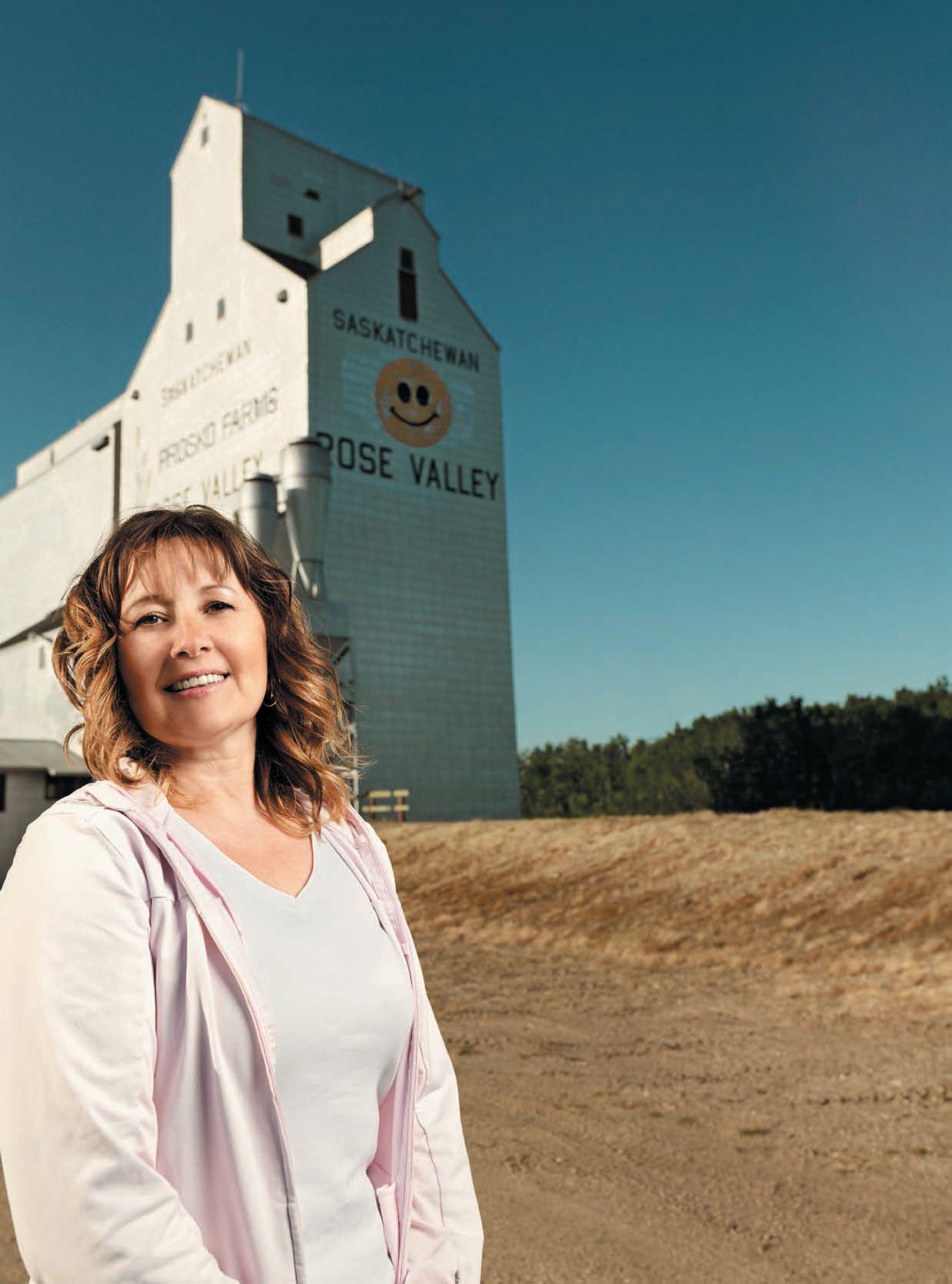
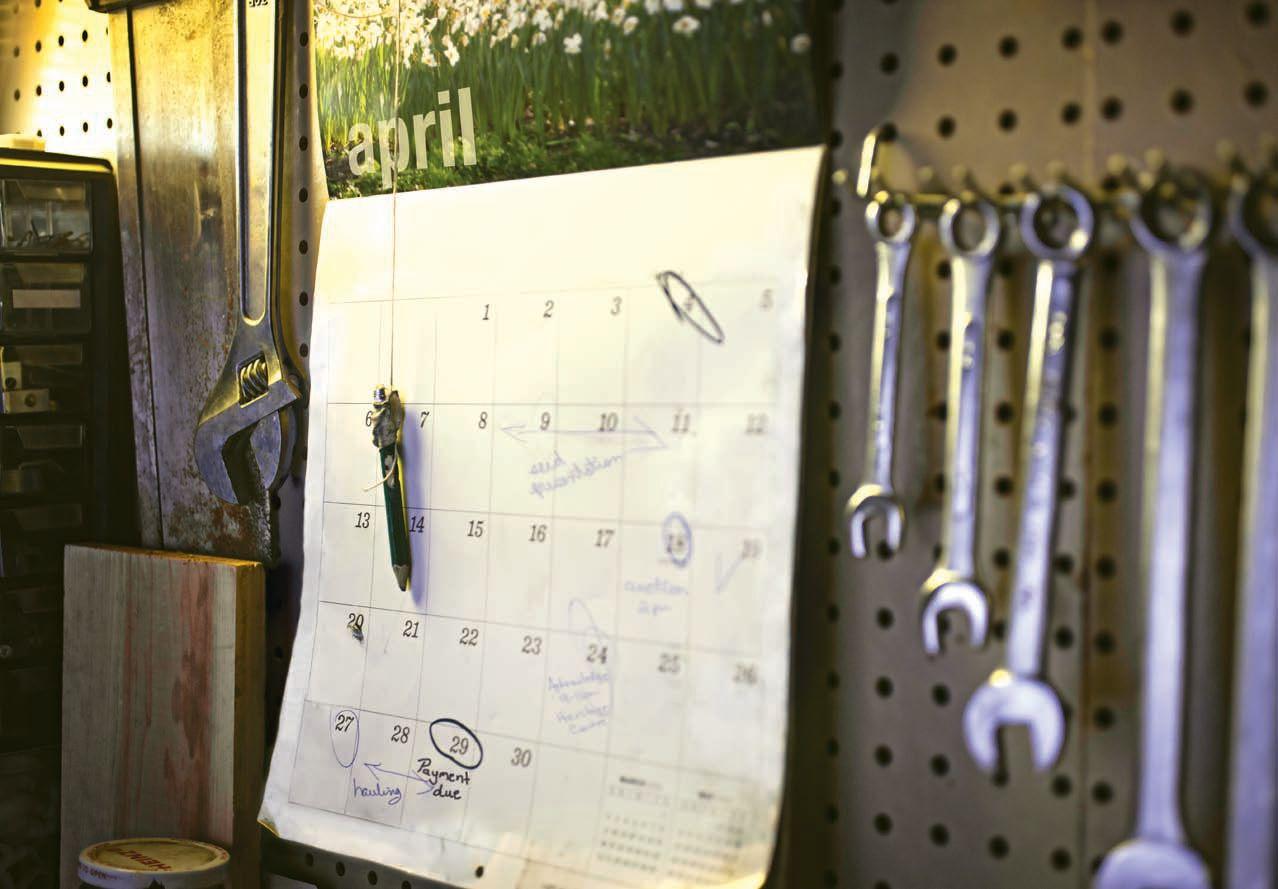
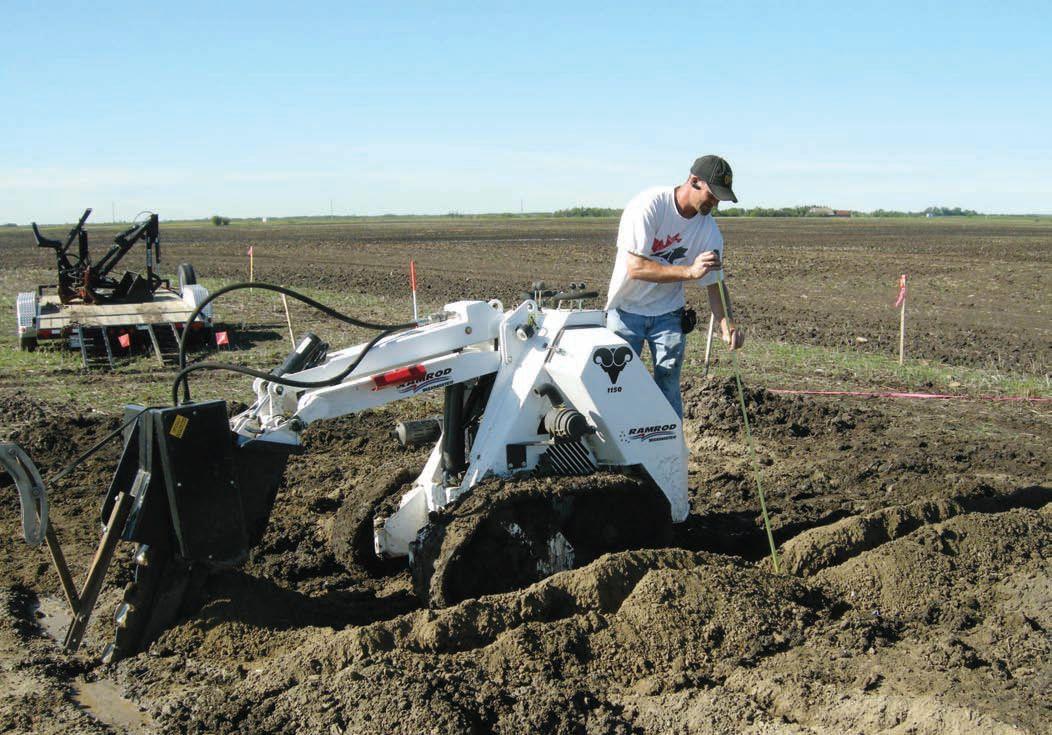
Wife, mother, grandmother, CFO, counselor, life coach, parts person, communications coordinator, accountant, nutritionist and motivator – besides being out there turning wrenches, she does it all.
InVigor® needs Liberty® the same way. Because powerful Liberty herbicide is the backbone of the LibertyLink® system and together, they’re partners.
Donna Prosko, ROSE VALLEY, SK
TOP CROP
MANAGER
6 | Managing phosphorus after canola available phosphorus levels can be lower after canola.
By Bruce Barker
20 The facts about phosphate rock By Dr. Robert Mikkelsen
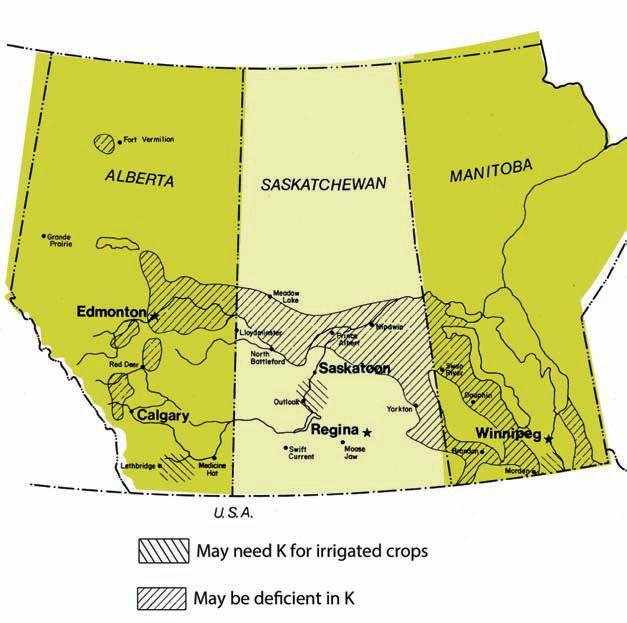
74 assessing the need for potassium fertilizer on canola
By Bruce Barker PLANT
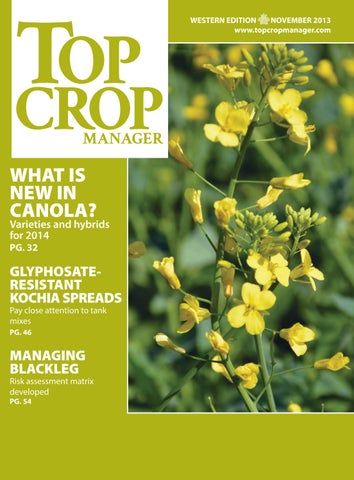
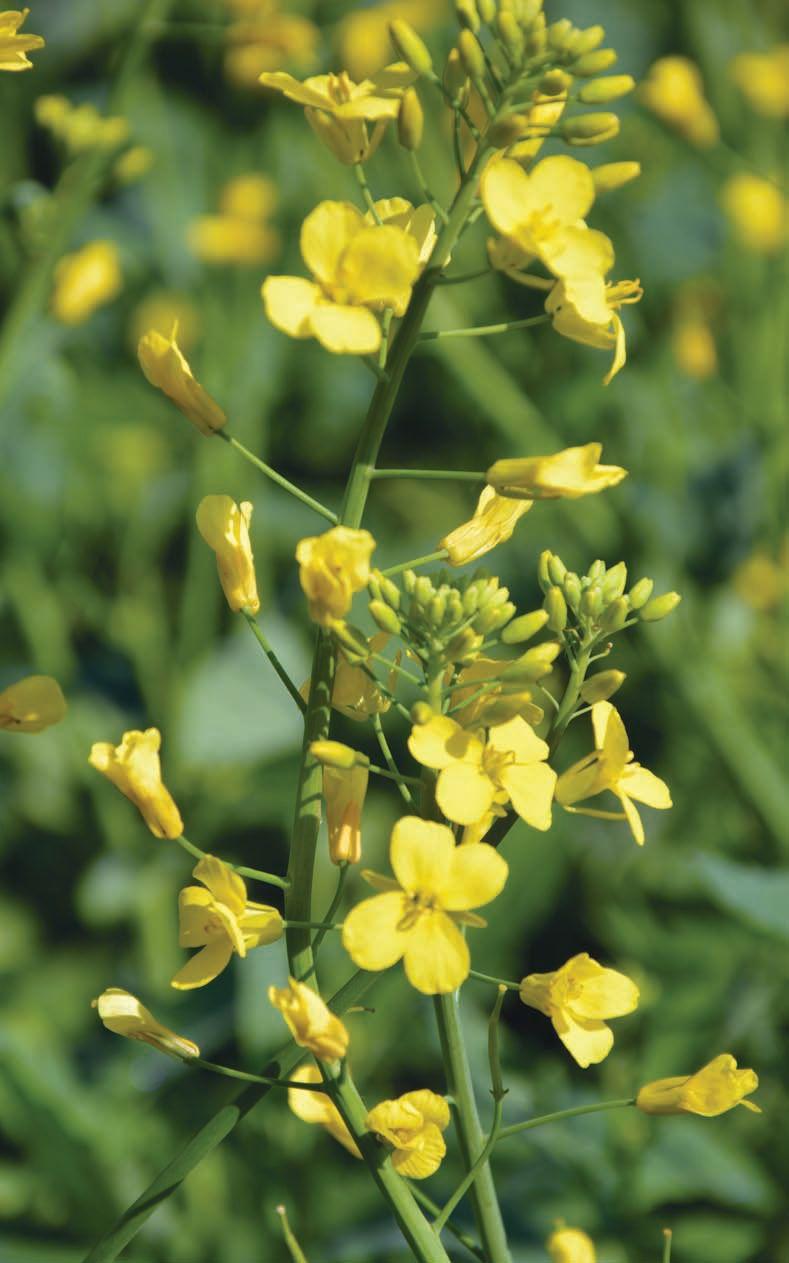
32 What is new in canola?
By Bruce Barker MARKETS AND
26 Taking the pulse of soybeans By Treena Hein
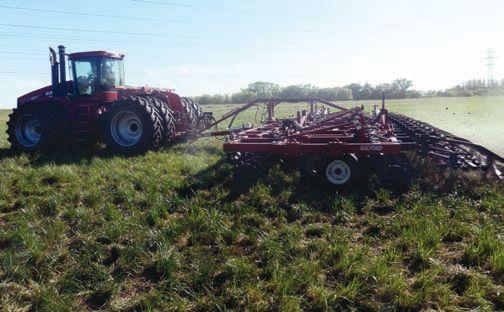
66 reviving soils with vertical tillage
By Rebeca Kuropatwa
34 | Wind erosion on the Prairies
Losses in soil fertility can be catastrophic. By Ross H. McKenzie, PhD, P. Ag.
WEED MANAGEMENT
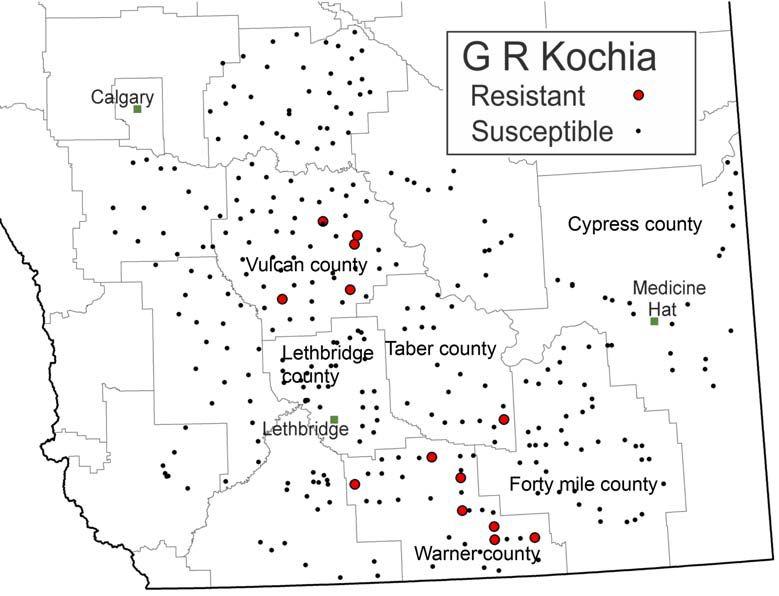
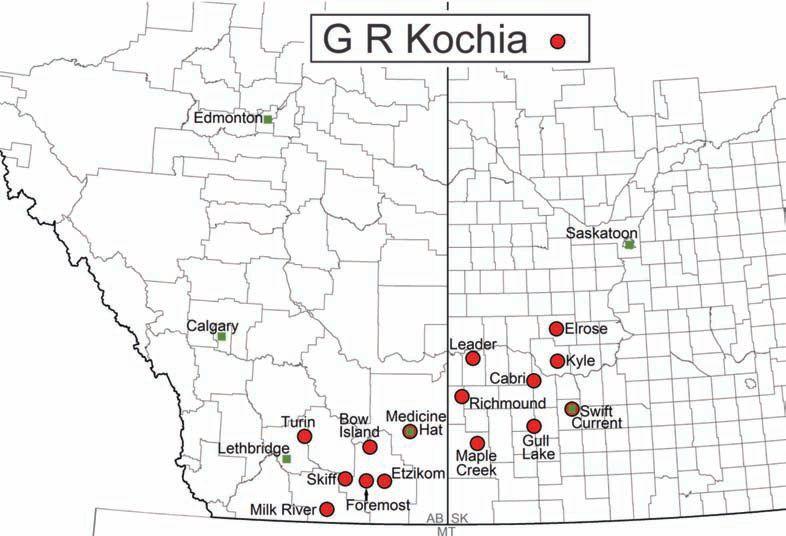
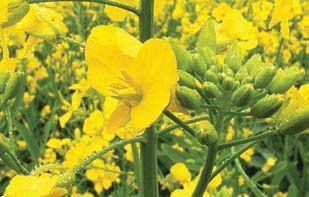
46 glyphosate-resistant kochia rolling across the west By Bruce Barker
CROP MANAGEMENT
10 polycultures for the semiarid prairies By Donna Fleury
22 evaluation of brassica juncea canola By Donna Fleury
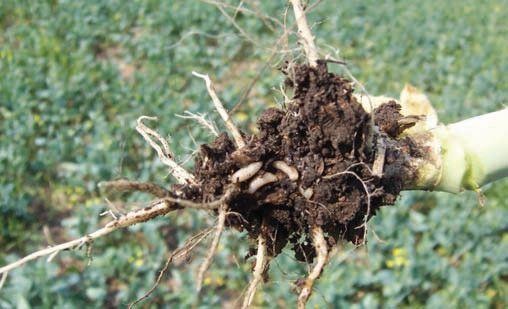
50 root maggot thrives under tight rotations
By Bruce Barker
70 | Getting value out of lower-grade canola advances in technology set the stage for biodiesel and biolubricant opportunities.
By Carolyn King
54 Blackleg and risk management By Donna Fleury MACHINERY
38 Tier 4 regulations update By Treena Hein
Readers will find numerous references to pesticide and fertility applications, methods, timing and rates in the pages of Top Crop Manager. We encourage growers to check product registration status and consult with provincial recommendations and product labels for complete instructions. FERTILITY AND NUTRIENTS
RESEARCH
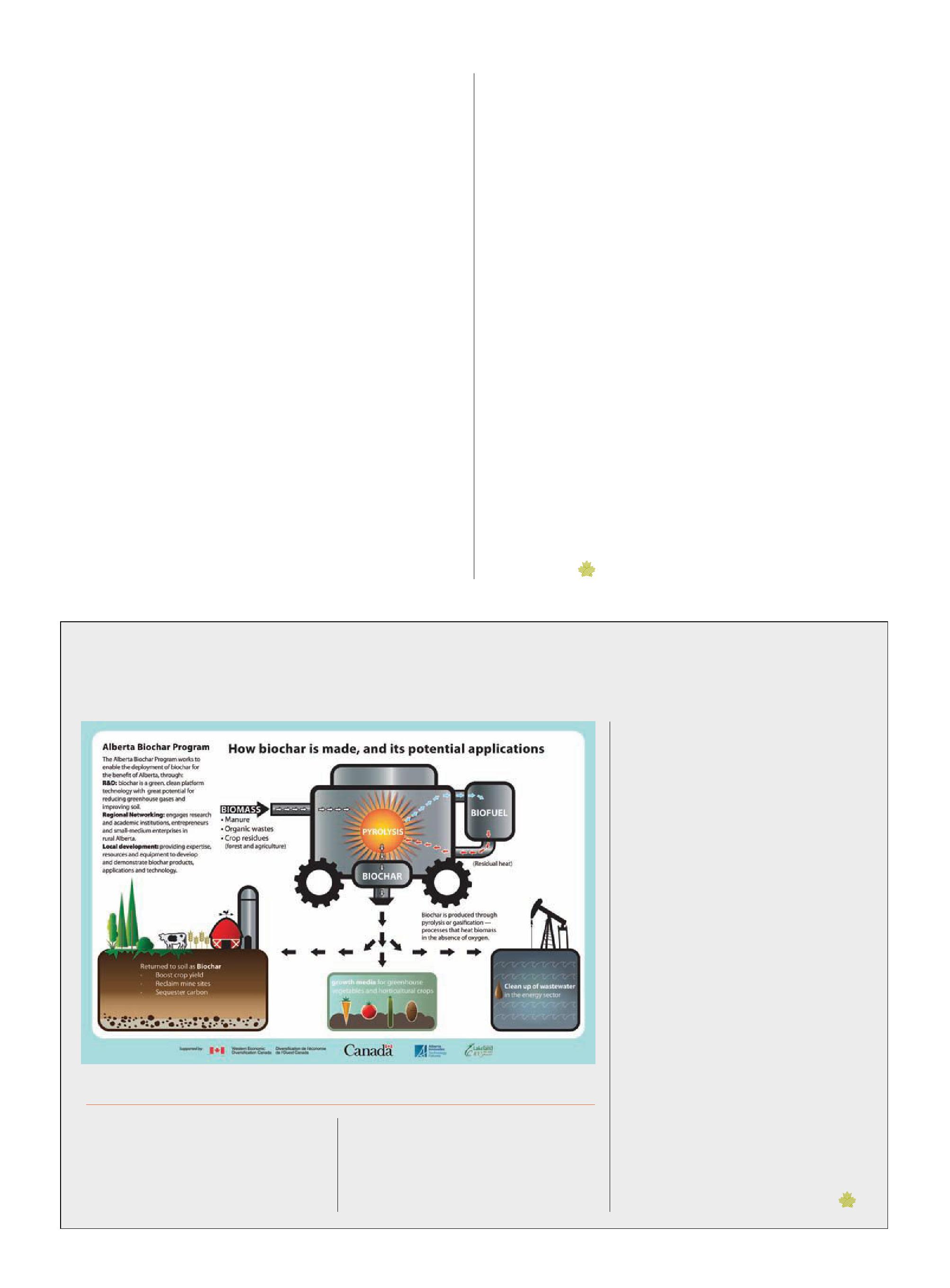
58 a little byproduct with big possibilities By Carolyn King
62 possible uses of biochar are many By Shari Narine
BUSINESS MANAGEMENT
14 Dollars and sense of field shelterbelts By Carolyn King
FROM THE EDITOR
4 record-setting year By Janet Kanters
Photo by bruce bArKer.
Photo courtesy of ccc.
Photo courtesy of ross McKenzie.
Janet Kanters | eDItOr
REc OR d- SETT iNg y EaR
Seven is a lucky number, or so they say. In the case of canola production, seven is definitely a lucky number. It was seven years ago that Canada’s canola production totalled what was then a staggering nine million tonnes. Based on that 2006 figure, the Canola Council of Canada (CCC) developed the growing great 2015 plan that set a production target of 15 million tonnes by 2015. But two years ahead of schedule, canola production has met – nay, surpassed – the 15 million tonnes goal set by the CCC. Just last month, a Statistics Canada production report forecasted Canada’s 2013-14 canola crop at a record 16 million tonnes. This, despite a lower harvested area compared with 2012. The actual number may rise before the year is out, with speculation of an actual crop of 16.5 million tonnes.
The numbers across the prairies break out like this: In Saskatchewan, canola production is expected to increase 24.2 per cent to a record high 8.1 million tonnes. average yield is forecasted to rise from 25.1 bushels per acre in 2012 to 35.2 bushels this year. This higher yield offsets a lower harvested area of 10.1 million acres, down 11.4 per cent. Manitoba farmers expect a 24.5 per cent production increase to 2.6 million tonnes, the result of a 44.8 per cent gain in average yield. and in alberta, canola production is anticipated to increase 2.3 per cent to 5.2 million tonnes.
It’s all fine and well that canola yielded exceptionally well this year. But what about crop quality? on oct. 7, the Canadian grain Commission released preliminary quality data for canola: this year’s harvest sample program received 670 samples (as at oct. 7), which include 202 from Manitoba, 388 from Saskatchewan and 130 from alberta and B.C.’s peace river region. approximately 94.2 per cent of the canola samples were graded as Canola, no. 1 Canada.
Samples showed that Canola, no. 1 Canada, has a mean oil content of 45.2 per cent (8.5 per cent Moisture basis). This is about a two per cent increase from last year’s mean of 43.5 per cent (8.5 per cent Moisture basis). The 10-year mean for Canola, no. 1 Canada, is 43.9 per cent. Crude protein levels, meanwhile, averaged 19.4 per cent (8.5 per cent Moisture basis), lower than last year’s mean of 21.3 per cent (8.5 per cent Moisture basis), and below the 10-year average of 21.0 per cent (8.5 per cent Moisture basis). The protein content on an oil-free basis is 38.3 per cent (8.5 per cent Moisture basis), lower than last year’s mean of 40.6 per cent (8.5 per cent Moisture basis) and similar to the 10-year mean of 40.3 per cent (8.5 per cent Moisture basis).
as at oct. 7, Canola, no. 1 Canada, has a mean chlorophyll content of 11.7 ppm, which is lower than last year’s mean of 17.4 ppm and below the 10-year average of 14.6 ppm. However, there are some differences from region to region where some areas may show higher chlorophyll content than others. In addition, this year’s crop is showing a lower iodine value with a mean of 112.2 units when compared to last year’s mean of 113.3 units. The 10-year average for iodine value is 113.6 units. glucosinolate content for this year has a mean of 10.0 mmoles/g (8.5 per cent Moisture basis), which is similar to the 10-year average of 10.9 mmoles/g (8.5 per cent Moisture basis).
With such a successful crop this year, we can be sure growers will continue to add canola into their rotations in years to come. and researchers and breeders continue to develop varieties and hybrids that thrive in the oft-unpredictable prairie landscape. In this issue of Top Crop Manager, western field editor Bruce Barker has assembled a list of new canola varieties and hybrids that are being introduced in commercial quantities for the 2014 growing season, including the first pod shatter resistant hybrid [see page 32]. The information is provided by seed companies and growers are encouraged to look at third-party trials, such as the CCC’s Canola performance Trials, for further performance and agronomic information. growers also should talk with their seed suppliers to see how new varieties performed in local trials.
It appears that as long as the world is buying canola, Canada will continue to be a leader in supplying it, with the help of Canadian researchers, plant breeders and – most importantly –growers.
Michael Fredericks mfredericks@annexweb.com PUBLICATION MAIL AGREEMENT #40065710
uNDElIVERABlE cANADIAN ADDRESSES TO cIRculATION DEPT. P.O. Box 530, Simcoe, ON N3Y 4N5 subscribe@topcropmanager.com Printed in canada ISSN 1717-452X cIRculATION e-mail: subscribe@topcropmanager.com Tel.: 866.790.6070 ext. 202 Fax: 877.624.1940 Mail: P.O. Box 530, Simcoe, ON N3Y 4N5
SuBScRIPTION RATES
Top Crop Manager West - 8 issuesFebruary, March, Mid-March, April, June, October, November and December1 Year - $45.00 Cdn. plus tax
Top Crop Manager East - 7 issuesFebruary, March, April, August, October, November and December - 1 Year - $45.00 Cdn. plus tax
Specialty Edition - Potatoes in Canada - February1 Year - $16.00 Cdn. plus tax
All of the above
www.topcropmanager.com
Ma Nagi Ng phOSphORuS afTER ca NOla
Available phosphorus levels can be lower after canola.
by Bruce Barker
Coming out of the 2013 crop year with almost 20 million acres of canola stubble, farmers are being advised to pay particular attention to their phosphorus (p) fertility plans for 2014. Very high canola yields removed a large amount of p from the soil, and mycorrhizal activity is delayed after canola.
“Canola is a big user of phosphorus, removing one pound per bushel of yield per acre. This year, with some pretty exceptional yields, we’ll be seeing 55 to 60 pounds of p2o5 removed per acre, and I’m pretty sure that the crop wasn’t fertilized for that kind of p removal,” says John Heard, soil fertility extension specialist with Manitoba agriculture, Food and rural Initiatives (MaFrI) at Carman, Man.
Wheat, on the other hand, removes about 0.60 pounds p2o5 per bushel per acre.
In addition to this large removal of p, canola is a non-host for mycorrhiza fungi, a beneficial organism that improves p uptake in host crops.
“after a canola crop there is a lag in time before the mycorrhizae re-establishes and becomes effective. This can impact p uptake of the following crop,” says Heard.
arbuscular mycorrhizal fungi (aMF) have a mutually beneficial relationship with many plants, and these fungi co-exist on the plant root of host crops. The main benefit of mycorrhizae is their ability to provide greater uptake of p and other non-mobile nutrients such as zinc and copper. The hyphae (strands of the fungi) are smaller than plant root hairs and can access water and nutrients in soil
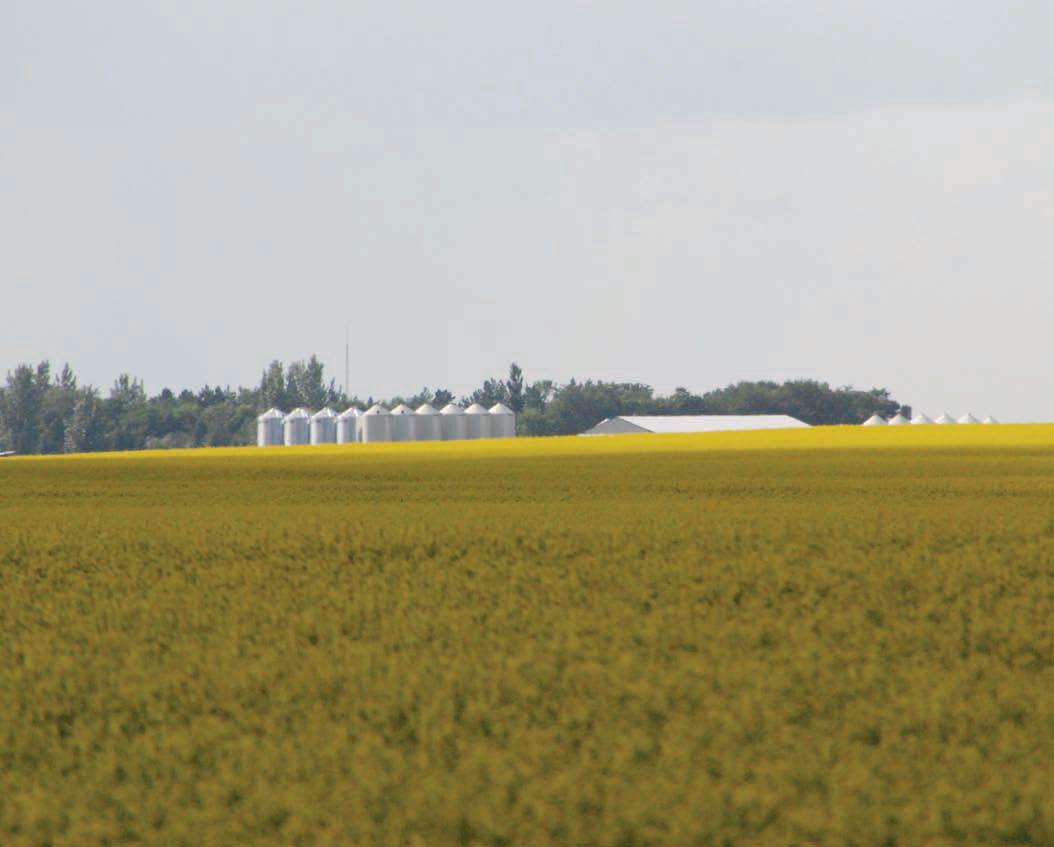
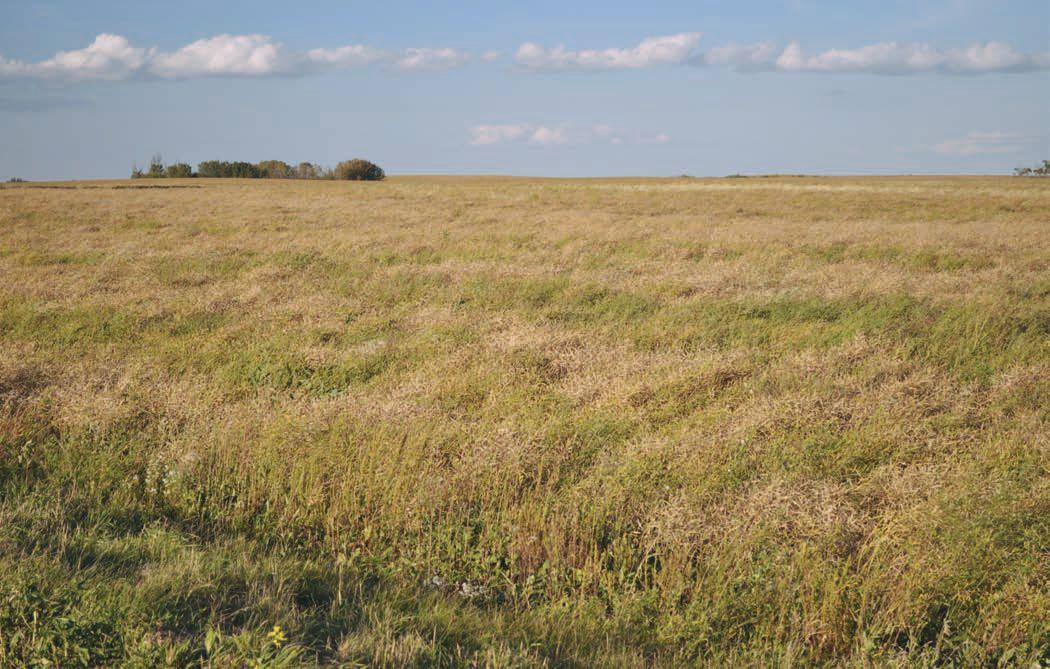
ABOVE: With canola as far as the eye can see, these stubble acres will require additional phosphorus management in 2014.
Photo by bruce bArKer.
Source: MAFRI
Pea, bean, soybean
Flax, sunflower
Corn
Dependency of crops on mycorrhizae
Wheat
Other cereals
crops
Brassica – canola, mustard, sugar beets
Buckwheat
Maximum safe rates of actual seed-placed phosphate (P2O5) fertilizer as monoammonium phosphate†.
Source: MAFRI
† Divide values in table by 0.52 or multiply by 1.96 to calculate lb. of 11-52-0 per acre.
‡ Rates are based on disk or knife openers with a 1-inch spread, six- to seven-inch row spacing and good to excellent soil moisture.
* When P soil test values are medium to high, no phosphorus should be placed with canola or pea seed.
** A low rate of seed-placed phosphorus is safe for beans and soybeans when seeded in row widths of 15 inches or less. Similar rates may cause unacceptable stand reductions in wider rows.
aggregates that plant roots cannot. In return, the host crop provides carbohydrates to the fungi. globally, the benefits of mycorrhizae have been well demonstrated, with several surveys of hundreds of field trials showing an average yield benefit of 23 to 37 per cent.
While the mycorrhizal fungi co-exist with 90 per cent of vascular plants, they do not co-exist with brassica species such as canola and mustard, nor sugar beets, lupines or buckwheat. In soils in which these crops are grown, or on summerfallow, the mycorrhizal fungi develop resting spores and wait for a host crop to be grown. There can be a delay of 50 to 60 days prior to recolonziation on a host crop.
Tillage can also destroy the mycorrhizal network and delay or reduce colonization on crops that are dependent on this symbiotic relationship.
Plan rotations with mycorrhizae in mind
For crops grown after canola, early season uptake of p may be lower than if a host crop has been grown the year before. For crops that are highly dependent on mycorrhizae, particular attention must be paid to p nutrition if grown after canola and other non-host plants or summerfallow.
Corn and flax are highly dependent on mycorrhizae for p uptake. Legumes such as pea, bean and soybean are also highly dependent on mycorrhizae. Wheat, oats and barley are not as dependent on mycorrhizae in high p soils, but do benefit from the fungi under lower p conditions.
Heard says growing cereals is likely the best option when seeding into canola or other non-host crop stubble, as cereals are not as dependent on mycorrhizae for early season p uptake. Still, starter phosphate fertilizer placed close to the seed is recommended for cereals, as the high level of p removal may mean lower p uptake early in the growing season. Conversely, he says corn and other non-host crops are usually successfully grown on soils with high soil test p levels or long-term manured land.
growing mycorrhizae-dependent crops after non-hosts will mean paying particular attention to starter phosphate fertilizer application. For crops highly dependent on mycorrhizae for nutrient uptake, safe levels of starter p also should be applied with or close to the seed. Caution is advised, though, as many of these crops such as sunflower, flax and pea have low tolerance to seed-placed p, so side-banding p close to the seed may also be required for optimum p response. Corn is highly responsive to p and placing p in a band close to the seed can help overcome low p soils.
Soybean and flax also respond better to soil p than fertilizer p, so having those crops in a rotation following a mycorrhizal host crop such as cereals helps to ensure better p uptake than if they were seeded into non-host stubble.
Developing a long-term plan also is key for maintaining p soil fertility. “There is no black and white way to go about doing it. Some farmers try to match crop removal with p applications each year, while others take a rotational approach where if the crops grown over a four-year rotation removed 150 pounds of p, they will try to ensure 150 pounds of p2o5 are applied over those four years,” says Heard. “Crop rotations, equipment capability, fertilizer prices, land tenure and historic p applications all play a role in how farmers approach their long-term fertility plan.”
Heard says soil tests should be a key part of monitoring fertility levels. In addition to monitoring p levels, he says farmers should also pay attention to copper and zinc after non-host crops. Zinc is currently recommended for corn on soils testing less than 1.0 ppm Zn, 0.5 ppm for field bean and 0.25 ppm for cereals. For copper, the critical soil test level is 0.2 to 0.4 ppm on mineral soils.
In the long term, growing cereals on non-host mycorrhizal crop stubble is one of the best strategies for achieving optimum yield, as this approach allows high levels of seed-placed p fertilizer to compensate for the low activity of mycorrhizae early in the season, and also to help build up p levels to maintain p fertility at
levels.
pOlyculTu RES f OR ThE
SEM ia R id pR ai Ri ES
Can cocktail mixtures of crops contribute to forage yield and soil improvement?
by Donna Fleury
Polycultures or mixed plantings using a diverse range of plant species have been shown to improve productivity, increase soil organic matter, and reduce weed, insect and disease pressure. polycultures have been used extensively in many areas as cover crops and for forage production. researchers and producers in the semi-arid prairies were interested to find out if polycultures had a fit in the drier regions of the prairies. researchers at agriculture and agri-Food Canada (aaFC) in Swift Current, Sask., initiated a three-year project in 2013 to evaluate polycultures or cocktail mixes of annual forage plant species in the semi-arid regions. “This was a producer-driven question, with an orientation towards forages,” explains Dr. Mike Schellenberg, research scientist, and range and forage plant ecologist. “We want to determine if this system that is being used extensively in other areas is transferrable to the more arid regions such as southwestern Saskatchewan and southeastern alberta. It’s a start on a question that will have larger advantages down the road, possibly including increased crop flexibility and productivity, and decreased erosion.”
Similar research has been done in other geographic areas including a recent project underway in north Dakota, and anecdotal evidence provided from the northern U.S. and a few locations in Canada. There is evidence that these mixtures could improve yield, amount of soil organic matter, moisture retention, and weed and insect control.
“our research project, which is focused on several annual spe-
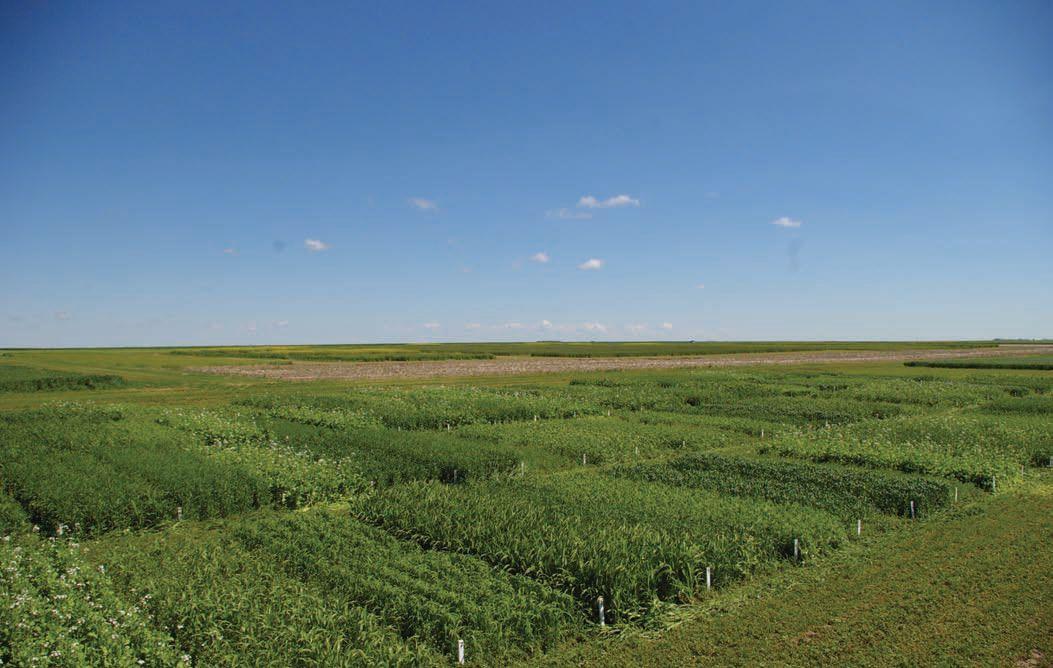
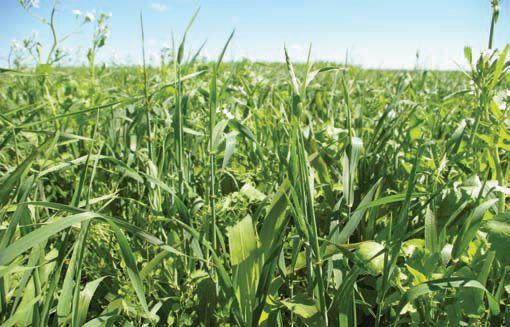
TOP AND ABOVE: Polyculture or annual forage cocktail mixtures research plots, 2013 (top). Polyculture 12-species mix plot, July 2013 (above).
cies for forage production, is trying to answer some of these questions,” says Schellenberg. “We are using the plantings in a forage system and taking the crop off as green feed, which is different than growing for grain production. We have selected 12 species that are divided into four groups, with each group providing different functions within the mixtures. The four groups of annual species include legumes, warm- and cool-season grasses, and
It’s Unanimous!
The formidable one-two punch in TagTeam® continues to knock out the competition. It beat single-action (nitrogen-only) competitors in farmer-conducted, head-to-head trials by a walloping 8%.* TagTeam boosts nitrogen and phosphate uptake to remain the world’s only undisputed MultiAction® champion. Give your crops twice the fight right from the start with TagTeam. Emerge victorious with
brassicas. The species selected are already adapted to and grown in this area, so we don’t have to look at trying to adapt new species into these systems.”
The legume group includes hairy vetch, forage pea and field pea, which are expected to provide nitrogen inputs into the system. Three cool-season grasses include triticale, barley and oats, and three warmseason grasses selected are corn, sorghum and millet. a brassica group that includes forage radish, purple top turnip and kale, which are deeper “root” crops, is expected to be able to make other nutrients besides nitrogen (n), such as trace elements, more available to the system. The root crops are left to die and rot in the soil, improving infiltration and breaking up hardpan or compacted soils.
“In our trials, we are evaluating these four groups in various mixtures and comparing to control plots,” says Schellenberg. “We are growing all 12 species as monocultures and then mixtures of two, four, eight and 12 species. one of the objectives is to determine if all 12 species are required to achieve the benefits, or do you just need one of each functional group or two, for example, as an optimal cocktail mix.” The control treat-
ments include one plot with all 12 species in year one, followed by barley in year two and the 12 species mix in year three. a second plot has barley in year one, followed by the 12 species mix in year two and barley in year three. “We have also planted control plots of perennial species, a twospecies mixture of meadow brome and alfalfa to compare to the annual mixes. My other research work with perennials shows that if we have the right species, a more diverse stand does show an increase in productivity over a monoculture perennial forage crop.”
The plots were direct seeded using a plot disc seeder in early June. The disc seeder was selected because it provides the least amount of soil disturbance. Schellenberg notes that previous studies in the semiarid regions show that if soil disturbance is minimized, then the moisture can be retained, which is important since the mixtures are being seeded later than most other crops. “We seeded all of the species at the same rate of 100 live seeds per metre to keep the comparisons more even. We know that is a bit high for corn, for example, but wanted to remove the seeding rate as a variable from the study.”
The first forage samples were cut in mid-July and the final samples
Prosko Family, ROSE VALLEY, SK
cut at the end of august to determine the forage quality. an evaluation of the nutritional package of these combinations of annual forages is also being completed. Soil quality information and water stable aggregates are being measured to assess changes in productivity.
preliminary observations are promising, with some of the plots providing much better cover than others. “The plots with more cover have reduced the number of weeds in the plots and therefore eliminated the need for chemical weed control,” says Schellenberg. “This could be a big benefit for low-input and organic producers who are looking for good weed control options. We are also seeing that some monoculture plots are providing ‘fine dining’ for insects, while the mixtures are making it difficult for insects to find their choice plant, providing some promise for insect control as well.”
Based on the first year, researchers are considering adding some additional seeding experiments to the project. In the first year in the 12-species mixtures, the smaller seeded crops such as sorghum or kale appeared in low numbers within the row. For next spring, researchers are considering placing the larger seeded crops in the main seed box of
the planter and putting the smaller seeded crops through the fertilizer box, then placing them in between the rows, to see if it will improve establishment.
“The project has created a fair amount of interest from producers, and so far in 2013 we have had three field tours,” says Schellenberg. “We plan to continue with field days and field tours in 2014, so producers who are interested can watch for more information. We will also be making the research results available as they are ready. We want to see the impact three years in a row to determine additive effects on soil nutrition and which combination is having the best effect with the least input.” project collaborators include Jillian Bainard, post doc and project manager at aaFC Swift Current, eric Lamb, University of Saskatchewan, reynald Lemke, aaFC Saskatoon and Herb Cutforth, aaFC Swift Current.
for More on CROP MANAGEMENT, visit the AgronoMy section of www.toPcroPMAnAger.coM
Runs
in
the family.
There’s no stronger tie than the family who works together on the same land. For them, farming’s a tradition.
And although each new generation has their own ideas, there are some things they will be reluctant to change, the things that have consistently performed for them, the things that aren’t broken.
InVigor® – proud to be part of your family farm for over 17 years.
dOllaRS aNd SENSE Of fiEld ShElTERBElTS
A long-term positive for crop production.
by Carolyn King
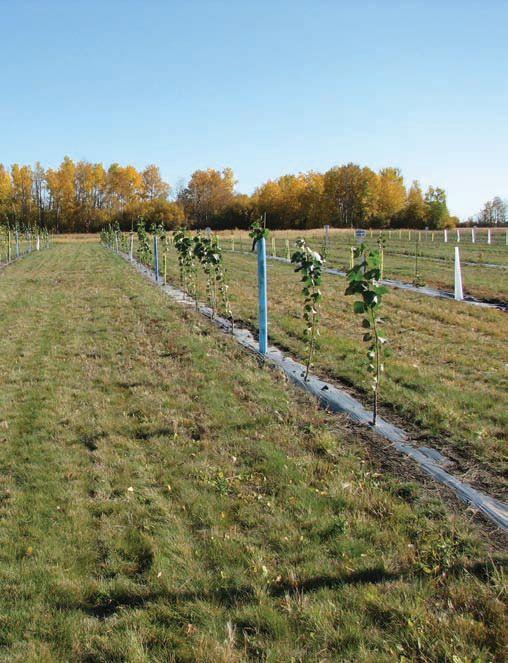
Is it worth it to plant a shelterbelt to improve crop yields? past studies say “yes” – field shelterbelts make economic sense. now a new study hopes to work with farmers on the Canadian prairies and the U.S. great plains to check that shelterbelts are still economically viable in today’s farming systems.
rows of trees, called shelterbelts or windbreaks, have been part of prairie landscapes for generations. In cropland, their main purpose is to create a sheltered zone with conditions that enhance crop yields.
Shelterbelts reduce wind speed for a distance of about 10 to 20 times the shelterbelt’s height (H), with the greatest protection within about 5 or 6H of the shelterbelt. The sheltered zone has less wind damage to crops and less wind erosion than in an open field. It’s also usually warmer and moister, due to more snow trapping and less evaporation. on average, the area extending from about 1H to 15H distance from the centre of shelterbelt has improved crop yields because of the enhanced growing conditions.
In the 1H to 15H zone, “the shelterbelt can increase crop yields by 10 per cent, 20 per cent or more in some cases,” says Toso Bozic, agroforester/bioenergy specialist with alberta agriculture and rural Development. “For a mature shelterbelt, the yield increases more than compensate for the yield losses due to the land taken out of production where the shelterbelt is planted and to competition with the crop right next to the shelterbelt.”
exact costs and benefits of an individual shelterbelt are affected by a long list of factors, such as how many rows are in the shelterbelt, which tree and shrub species are in it, how far apart the trees and shrubs are, how much it costs to plant and maintain the shelterbelt, how old the shelterbelt is, which crops are grown in the sheltered field, what their average yields are in an open field, how responsive they are to additional moisture, what weather conditions occur during the shelterbelt’s lifespan, and so on.
“For example, the cost of a tree or shrub seedling can range from 25 cents to $3, depending on what you want, and the planting costs can vary depending on whether you plant the trees yourself or hire professional tree planters,” notes Bozic.
“You’ll likely see a better return from a shelterbelt if you’re growing high-value, high-yielding crops. and shelterbelts usually tend to have a greater yield benefit in the drier parts of the prairies than in cooler, wetter areas. For instance in the peace region, a shelterbelt might reduce crop yields in some years if snow is kept on the field so
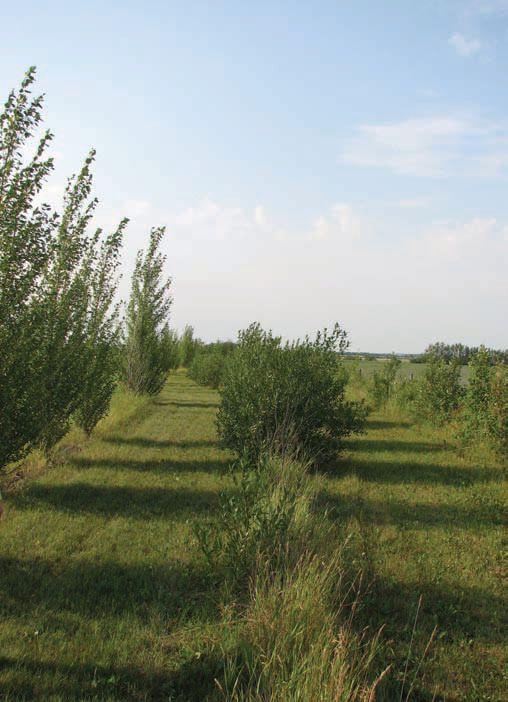
It may take 10 or more years for a shelterbelt to become tall enough to start giving protective benefits.
long that seeding is delayed. But it’s also true that some parts of the peace region have soil erosion problems in dry years; even where farmers are using zero till, they are worried about topsoil loss.”
Calculating costs and benefits
If you’re interested in predicting the economics for a field shelterbelt on your land, a free computer program called WBeCon (WindBreak eConomics) is available through the agriculture and agriFood Canada (aaFC) website. This model was developed by Dr. John
WHEN IT COMES TO CANOLA , YOU HAVE A LOT OF CHOICES.
UFA SHOULD BE THE FIRST.
Maximizing canola production is all about informed decision making. From yield performance to maturity dates, choose varieties that are best suited to your unique farming operation.
Talk to your local UFA Crop Production Representative today and we’ll help you make the best selections for your operation so you can grow with confidence all season long. Get your copy of the UFA Canola Guide now at UFA.com/canolaguide.
Kort from aaFC’s agroforestry Development Centre and Dr. James Brandle from the University of nebraska–Lincoln. They brought together a large body of data from many multi-year shelterbelt studies in the prairies, the great plains of the United States and other countries as the foundation for the model, as well as information on things like growth rates for different tree and shrub species.
WBeCon asks the user to enter information about the following: soil texture, moisture and prevailing wind; crop rotation, production costs, crop prices and expected yield without shelter; field size; and shelterbelt species, placement and number. Crop yield is the only benefit considered. You can try different scenarios to see how various choices for things like crop type and tree species would affect the economics.
The model calculates costs and benefits for a mature shelterbelt on an annual basis. and it determines the shelterbelt’s net present value, a measure of the shelterbelt’s economic value over its lifespan.
The costs and benefits change significantly over a shelterbelt’s lifespan. “There are upfront establishment costs for planting, weed control and so on, most of which are in about the first five years of the shelterbelt,” explains Kort. “Then it may take 10 or more years, depending on the shelterbelt species, for the shelterbelt to reach a reasonable size to start giving protective benefits.”
But those protective benefits can last a very long time. “again depending on the species, a shelterbelt may last 70 or 80 years. We have a lot of examples on the prairies of shelterbelts planted in the 1930s that are still out there. In southern Manitoba’s red river Valley, some shelterbelts date back to the 1910s and 1920s, and they are still pretty good shelterbelts,” says Kort, who adds the data show that, on average, shelterbelts are a good investment. “When the shelterbelt is mature, it works out to be a positive net benefit, on a year-by-year basis. also over the shelterbelt’s lifespan, you end up with a positive net present value.”
producers who are thinking about planting a shelterbelt in 2014
should be aware that aaFC’s long-running prairie Shelterbelt program is being discontinued in 2013. Since 1901, the federal government provided free tree and shrub seedlings to landowners from its tree nursery at Indian Head, Sask. The government is currently in discussions with groups interested in taking over the program.
Updating the economics
Much of our basic understanding of field shelterbelt economics comes from studies conducted more than 20 years ago. “From the time when the majority of the data was collected, quite a few things have changed in the agricultural production systems,” notes richard Straight, technology transfer lead with the national agroforestry Center of the United States Department of agriculture (USDa).
“Farming practices have changed, with greater use of minimum till and no till practices, different kinds of equipment, and more exacting applications of nutrients and pesticides. as well, crop hybrids have changed, and many are being designed to be responsive to greater extremes in weather conditions. Some drought-tolerant varieties are being developed. also cropping practices have changed. a number of crops are being planted further north than they were 20 or 30 years ago.
“So our question is: is our understanding of the windbreak-andcrop relations still valid in light of all these changes? Is this still an economically viable practice for crop producers to apply on their land?”
When Straight and others took that question to the agroforestry community in the U.S. great plains and the prairies, they found a lot of interest. as a result, researchers, extension agents and others in many states have come together in a multi-agency initiative. Kort and Bozic are considering how they can help their U.S. colleagues in this project.
The research team hopes to collect crop yield data over multiple years in relation to shelterbelts across the great plains states and
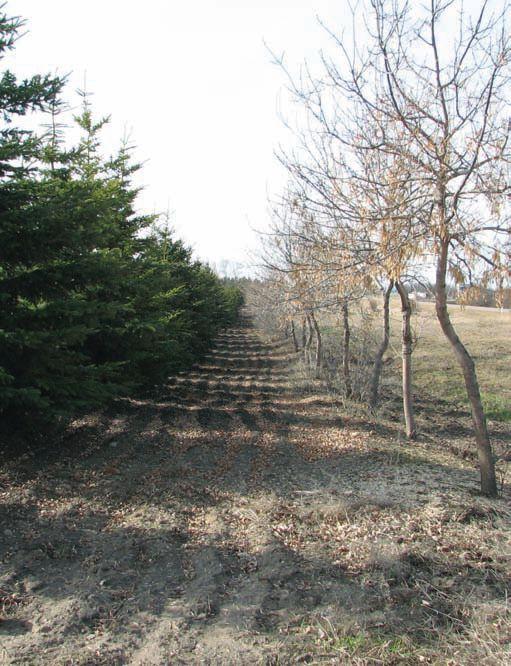
The amount of protection provided by a shelterbelt depends in part on the tree species.
Shelterbelts involve various upfront costs in the first few years for planting, weed control and so on.
Remote, but still in control.
You might know that you can manage your machines from almost anywhere. But you might not know that I might be able to get you up and running before I ever leave the shop.
If your tractor is generating a trouble code, we can use our systems to Ɵgure it out before we come out. If you need parts, we know which ones to bring.
With John Deere FarmSight,™ real-time information is as close as your tablet or smartphone, putting you in control, from almost any location.
With telematically enhanced equipment, and customized services, working together for your operation, no one else can turn data into information like John Deere.
This is just one of the many services our dealership can offer you. To learn more, stop in and ask us how we can help you.
I can Ɵx your combine from 100 kilometers away.
the prairie provinces. However, it would be a monumental task to conduct plot studies to cover all the different combinations of crops, climate, farming practices and so on for fields with and without windbreaks over such a large area. So the team hopes to partner with interested farmers.
“We realized a lot of the data was already out there with the farmers, with the yield monitors on their combines. If we could find a way to get enough of that data over a large enough area, then many of the problems that arise with setting up plot-type studies – like variations in weather patterns, soils and so forth – could be washed out just by the volume of data,” says ray Stoner, a forester with the USDa’s natural resources Conservation Service. “If we can get just a handful of landowners to participate, for example one per county in the United States, that would be a huge amount of data, especially if the landowners have several years of data.”
Stoner emphasizes that farmer participation is strictly voluntary and that the data for individual farms will be kept anonymous.
This year, the team is conducting a pilot study, working with one or two landowners per state and province. “With this pilot, we hope to answer two categories of questions,” explains Straight. “one is: have we designed the data collection process so it’s simple, easy to understand, and gives us the information we need? The other is: how many different fields and years of data do we need to have a statistically valid set of information, so we can say with some level of confidence that this is our understanding of the windbreak-and-crop interaction?”
If the pilot goes well, the researchers will start a full study to gradually build a comprehensive dataset. Initially, they want to be able to draw a general conclusion as to whether shelterbelts have a positive,
Trait Stewardship Responsibilities Notice to Farmers
Monsanto Company is a member of Excellence Through Stewardship® (ETS). Monsanto products are commercialized in accordance with ETS Product Launch Stewardship Guidance, and in compliance with Monsanto’s Policy for Commercialization of Biotechnology-Derived Plant Products in Commodity Crops. This product has been approved for import into key export markets with functioning regulatory systems. Any crop or material produced from this product can only be exported to, or used, processed or sold in countries where all necessary regulatory approvals have been granted. It is a violation of national and international law to move material containing biotech traits across boundaries into nations where import is not permitted. Growers should talk to their grain handler or product purchaser to confirm their buying position for this product. Excellence Through Stewardship® is a registered trademark of Excellence Through Stewardship.
ALWAYS READ AND FOLLOW PESTICIDE LABEL DIRECTIONS.
neutral or negative influence on crop yields. Then, as they collect more and more data, they hope to be able to predict yield responses for specific crops under specific soil and climate conditions.
“We certainly anticipate that we’ll find windbreaks are having a positive effect, but however it turns out, we’ll share that with the farmers,” notes Stoner.
In his earlier research, Kort examined in detail the data from past studies on yield response to shelterbelts, and he says, “Some of the data could be updated, but the basic data is still good.”
For example, he speculates that the shift from conventional to zero tillage might mean that a shelterbelt’s role in trapping snow or reducing wind erosion may not be as large under zero till, because the standing stubble on zero till land is also performing those functions. nevertheless, he says, “The main crop response to a shelterbelt is due to the growing-year shelter. So effects like less wind damage and more heat in the sheltered area will be there regardless of how you’re growing the crop.”
Kort also notes WBeCon was designed to be very flexible so that it won’t go out of date. For instance, because the users input their own crop prices and production costs, that information will always be up to date.
Additional benefits
Bozic notes that shelterbelt benefits to crop producers go beyond the improved yields from enhanced moisture and temperature conditions. For example, shelterbelts help increase yields by reducing soil erosion, and by providing habitat for native pollinators of crops and natural enemies of crop pests. as well, he says shelterbelts can enhance the real estate value of agricultural land, and once a shelterbelt reaches the end of its lifespan, the wood could be sold for wood chips or other uses.
In addition to the benefits to farmers, shelterbelts generate positive economic effects for everyone. To evaluate such economic effects, Kort worked with Dr. Surendra Kulshreshtha, an economist from the University of Saskatchewan. They studied the economic benefits to society from the tree seedlings distributed by aaFC’s Shelterbelt Centre at Indian Head from 1981 to 2001. They estimated the economic value of such benefits as increased carbon storage, reduced wind erosion, improved air and water quality, and conserved biodiversity to be over $140 million. They also identified various other benefits, like health values and transportation safety, but could not estimate their economic value due to a lack of data.
Bottom line
“In the long run the yield benefits from shelterbelts outweigh the costs. But the challenge is that you may have to wait 30 or more years to break even, which discourages many farmers,” says Bozic. “So my advice is to plant shelterbelts for more than just the direct yield benefits. plant them for benefits like protecting your topsoil and increasing biodiversity to create better conditions for crop production.”
He adds, “When I have shelterbelt workshops with people who are 60 or 80 years old, I tell them, ‘You’ll do all this work to establish and maintain your shelterbelts, and you may not see the economic benefits. But your kids and grandkids will be thankful to you.’ planting trees is a legacy to the next generation.”
Th E fac TS a BOuT phOSphaTE RO ck
Are we running out?
by Dr. robert Mikkelsen
Most of the phosphate rock that is mined from the earth goes towards making fertilizer for crop production. every cell in plants and animals requires phosphorus (p) to sustain itself and there is no substitute for it in nature.
During the past five years, several well-publicized reports have suggested the world phosphate rock supply is rapidly dwindling. In response, there has been widespread concern about whether or not we are reaching our “peak” supply of phosphate rock, and if fertilizer shortages are on the horizon.
recently updated estimates report that the earth has at least 300 years of known phosphate rock reserves (recoverable using current technology) and 1400 years of phosphate rock resources (phosphate rock that may be recovered at some time in the future). These numbers fluctuate somewhat since companies do not intensively explore resources that will be mined far into the future.
phosphate fertilizer can be a significant cost for crop production and an important mineral for animals. However from a global perspective, phosphate is considered as a low-price commodity. one recent publication estimated that each person consumes an equivalent of 67 lb phosphate rock each year. This results in an annual consumption of about 9 lb p per person (or 0.4 oz. daily consumption), which is equivalent to 1.7 cents per day.
phosphorus atoms do not disappear in a chemical sense, but they can be diluted in soil or water to the point where it is not economical to recover. annual p losses to the sea by erosion and river discharge roughly balance the quantity of p that is mined. This shows that there is substantial room for improvement in efficiency. Implementing appropriate recovery and recycling of p from animal manure, crop residue, food waste, and human excreta would make a major step in this direction.
efforts to improve p efficiency and build soil p concentrations to appropriate levels, serve to enhance its use. In developed countries with a history of adequate p fertilization, the need for high application rates diminishes over time. This contrasts with the situation in many developing countries where low soil p concentrations still require significant fertilizer inputs to overcome crop deficiencies.
Members of the public are encouraged to engage in debate over important issues, but there is a danger that oversimplification leads to incorrect conclusions. The case of looming p scarcity is an example where insufficient information led to a wrong conclu-
sion. Somehow the incorrect notion still persists that there is an impending shortage of p and that limited fertilizer availability will soon lead to global food insecurity.
There may be a scarcity of many earth minerals some day, but the p supply will not be a concern for hundreds of years. However responsible stewardship of rock phosphate resources still requires a close examination of improving efficiency throughout the entire process, including mining, fertilizing crops, and implementing strategic waste recovery. Working together to improve p management will allow us to conserve this precious resource for future generations.
Dr. Robert Mikkelsen is Western North America Director, International Plant Nutrition Institute (IPNI). Reprinted with permission from IPNI plant nutrition Today, Fall 2013, No. 3.
Photo courtesy of iPni.
Morocco holds some of the largest phosphate rock reserves in the world.
SOMETHING BIG IN STORE
Grain Guard’s new line of 4" wide corrugated grain bins are manufactured using state-of-the-art technology and are available in diameters from 15' to 105' in flat bottom models, as well as 15' to 27' in hopper bottom models.
With an established catalogue of aeration and conditioning equipment, high-quality grain storage bins are yet another solution provided by Grain Guard.
Since 2007, our Research and Development team has been working to improve our Classic Rocket design. Resulting in an innovative, stronger and even more reliable rocket. We are pleased to introduce The Next Generation Rocket.
The revolutionary Retro Rocket is the only do-it-yourself rocket system that allows you to retrofit existing hopper bottom and smooth-walled bins with farm proven Grain Guard aeration.
The Next Generation Rocket
EValuaTiON Of Brassica juncea caNOla
Improved hybrid canola will be key to increasing yield.
by Donna Fleury
Canola-oil-quality Brassica juncea was jointly developed by the Saskatchewan Wheat pool and agriculture and agriFood Canada (aaFC) to expand canola-quality production into the drier areas of the southern prairies. B. juncea canola is considered to be more drought tolerant, more upright and more resistant to shattering than B. napus canola. B. juncea is the same species as oriental and brown mustards. While the first varieties of B. juncea canola were introduced in 2002, aaFC recently revisited B. juncea performance to see how it compares with the new hybrid canolas that now dominate the marketplace.
“We had conducted some earlier research comparing B. juncea [canola] with canola and mustard varieties in the Swift Current area,” explains Dr. Yantai gan, research scientist with aaFC in Swift Current. “However, we realized we needed to do more research across multiple sites over southwest Saskatchewan and southeast alberta before we could be comfortable to make any conclusions. our earlier research did show that B. juncea [canola] can grow in drier, hotter areas and does tolerate the summer heat and drought. B. juncea [canola] is also blackleg resistant and matures more uniformly with
less seed shattering compared to B. napus or B. rapa, making straight combining a good option.”
gan initiated a three-year study with collaborators from 2010 to 2012 across multiple sites in Saskatchewan and alberta to determine the yield potential of B. juncea canola in comparison with B. napus.
The project also examined the suitability and feasibility of straightcombining B. juncea canola and B. napus canola by quantifying seed and pod losses during plant maturity.
Field trials were conducted at four experimental sites in Saskatchewan in 2010 and 2011 (Melfort, Indian Head, Scott and Swift Current), with the addition of another site at Lethbridge, alta., in 2011. at each location, seven Brassica varieties were compared, including: B. juncea hybrid canola (201045J10), three B. juncea canola varieties (XCeeD 8571 CF, XCeeD 8570 CF and a genetic line) B. napus canola rr (46p50), B. napus canola LL (5440) and B. juncea condiment mustard (cv. Cutlass). all of the plots were straight
ABOVE: In drier areas of the Prairies, B. juncea canola has the potential to replace canola.
Your Pioneer Hi-Bred sales representative is out there every day, working the same ground you are. Which gives them the unique expertise needed to recommend the right seed for your acres. They know your weather, your soil conditions and your challenges, because they’ve faced them too. It’s this type of deep knowledge that makes the DuPont Pioneer team both industry leaders and trusted local advisors. Talk to your local Pioneer Hi-Bred sales representatives or visit pioneer.com for more information.
Our experts are grown locally
Different small letter means significant difference between Brassicas at the level of 0.05. The bold bar in each box is the mean value of the days to 10 per cent flowering of each cultivar.
Source: Dr. Yanti Gan, AAFC, 2013.
combined. researchers measured plant growth and development, seed yields at harvest, and seed losses and pod shattering at pod maturity.
“The results showed that B. juncea canola does offer good growing characteristics and traits such as less seed shattering and more uniform maturity,” says gan. “Under drier spring conditions, B. juncea canola does emerge quicker than canola.”
In the study, mustard had the fastest growing speed to reach to 10 per cent flowering date. oriental mustard and B. juncea canola 1 variety had similar days to flower, but the other three B. juncea canola cultivars were similar to the B. napus cultivars (see Figure 1). Both canola cultivars showed significant slower growth speed to reach to 10 per cent flower date compared to oriental mustard. overall, mustard showed the shortest growing period to reach maturity. In the drier growing areas, B. napus reached maturity a bit sooner than the B. juncea canola cultivars, suggesting B. napus may be the better cultivar in short growing areas.
overall, the yield results were not as good as expected. “although both B. juncea canola and mustard proved to be suitable for drier areas and able to tolerate drought conditions, their final seed yields did not catch up to the yield of B. napus,” explains gan. “In the best year, yields of B. juncea were equal to B. napus, but in most cases B. juncea yield was statistically significantly lower.”
gan adds that until recently, B. juncea hybrids were not available. However, aaFC Saskatoon and Saskatchewan Wheat pool had developed a successful hybrid by changing the fatty acid profile to that found in B. napus and reducing the erucic acid and glucosinolate levels to the canola standard. “We did have a B. juncea canola hybrid in
this project, which we realize is only the initial state of the variety,” says gan. “as breeders put more efforts on the genetic enhancement for B. juncea hybrids, we are hopeful that yield increases will follow.”
although B. juncea has proven to be suitable for dry areas, the yields are still the lowest in the drier areas. reseachers think it is due to other factors, such as the physiological and morphological characteristics of the plants as compared to canola plants. For example, in situations where there is a less than ideal plant population density, B. napus may produce more pods on the plant to help with yield. However, B. juncea canola has a limited ability to produce a sufficient number of fertile pods (i.e., pods with at least one seed). as well, B. napus may have more seeds per pod, but B. juncea canola has a limited number of seeds per pod.
gan emphasizes that breeders need to look at all yield components, including pods per plant, number of seeds per pod and weight per seed for B. juncea hybrids, as well as to study the plant architecture to determine how yield components would compensate for each other under stressful growing conditions. These will help figure out where the yield potential will come from.
“I think this class of new canola species has a role to play, especially to expand the boundaries of where canola can be grown in Western Canada,” says gan. “Brassica juncea has lots of good agronomy traits and can become an alternative oilseed crop in those transitional, non-traditional B. napus growing areas of southwest Saskatchewan and southeast alberta. The next steps will be for breeders to enhance the genetic level of yielding in hybrid B. juncea to reach similar or higher yields than B. napus.”
juncea 1juncea 2juncea 3LL napus
Other
fungicides help protect yield potential. This increases it.
There are a lot of decisions to make when it comes to getting the most out of your crop. But there’s only one fungicide that goes above and beyond controlling disease in canola by helping increase yield potential. We’re talking, of course, about Headline® fungicide. Not only does it help control yield-robbing diseases like blackleg, it also delivers the unique, proven bene ts that we call AgCelence®. The evidence? Greener, larger leaves and stronger stems that ultimately result in higher yield potential. To nd out how Headline can take your canola to new heights, visit agsolutions.ca/headline or contact AgSolutions® Customer Care at 1-877-371-BASF (2273).
Always read and follow label directions. AgSolutions, and HEADLINE are registered trade-marks of
Taki Ng ThE pul SE Of SOy BE a NS
Acreage and opportunities for export are growing.
by Treena Hein
Growers in Manitoba have increased their soybean acreage over the last few years, and with good reason. prices have been quite good the last two years and demand for Canadian soybeans exports is booming, notes Canadian Soybean Council (CSC) program coordinator nicole MacKellar.
The CSC reports that from 2009 to 2012, Manitoba’s soybean acreage grew from about 167,900 to 341,800 hectares. There was a significant jump (approximately 32 per cent) in that growth from 2011 to 2012, likely due to farmers taking note of good prices in 2011. Farmers are also seeing the value of inserting soybeans into canolawheat rotations to help protect and nurture canola and wheat yields. The ability of soybeans to fix nitrogen, along with their tolerance for wet soils, low cost of production – and low incidence of weed and disease issues so far – also makes them attractive in Manitoba, but soybean cultivation has increased in other soybean-growing provinces as well. From 2009 to 2012, Quebec’s hectares grew from 242,000 to 292,000, ontario’s from 971,200 to 1,072,400 and p.e.I.’s from 14,200 to 22,300 hectares. It’s estimated that between 30,000 to 40,000 hectares of soybeans are currently grown in Saskatchewan, with varying estimates for some acreage in alberta.
early-maturing soybean varieties have made it possible to grow the crop beyond the traditional red river Valley region of Manitoba, in northern and western areas such as northern Interlake, Fisher Branch-arborg and Dauphin-Ste. rose. “almost all soybeans grown in Manitoba, about 96 per cent, are conventionally grown (gM) and mostly go to the crush market,” says MacKellar. “Ip [identity-preserved] soybean cultivation is a small percentage of the total because Ip varieties don’t tend to do as well with the province’s shorter growing season.”
ontario and Quebec have a little longer growing season, so a larger percentage of Ip beans are grown there. “However, a few Manitoba farmers have experimented and have had good success with Ip soybeans,” says MacKellar.
researchers at the University of Saskatchewan are currently doing soybean variety trials in that province. In addition, alberta agriculture and rural Development personnel are conducting trials there this year for the first time (and there has been private testing for almost a decade).
Asia now represents Canada’s largest soybean export market, totalling about 43 per cent by volume in 2012.
In addition to early maturation, another important soybean trait being closely examined for the prairies is daylight length sensitivity. Soybeans need a specific amount of light energy per day before the plants turn from vegetative growth to flowering/pod set. Varieties bred for use in eastern Canada are also suited for more acidic soils, and they can be prone to iron deficiency chlorosis in basic soils. This condition results in yellowing and poor growth six to eight weeks after planting.
Photo by JAnet KAnters.
Seek Treatment
Exports increasing
Soybeans are a very important export item for Canada and becoming more so year after year. They were the fourth largest Canadian agrifood export in 2012, with a sales value of over $2 billion. over the period of 2008 and 2012, soybean export volume increased by a whopping 90 per cent, according to Ken Hester, a sector specialist with agriculture and agri-food Canada (aaFC), who has recently done some calculations using data from Statistics Canada. Canadian farmers export anywhere from 50 and 70 per cent of total soybean production on a yearly basis these days, and that percentage is increasing.
Hester’s analysis shows that asia now represents Canada’s largest soybean export market, totalling about 43 per cent by volume in 2012. There has been a dramatic jump in exports to asia – about 97 per cent between 2008 and 2012, with most of the increase taking place between 2011 and 2012. Hester notes that in 2012, China became Canada’s largest single soybean export market, receiving about 24 per cent of total exports by volume, with the netherlands (a country that used to hold top spot) at 17 per cent, and Japan at 11 per cent.
Hester also looked at the value of export markets on a price received per metric tonnes (pmt) basis, and found that asian markets clearly provide higher value. “asian countries provide an average of $634.67 pmt – $683.04 if you exclude China – with Japan, South Korea, Thailand and Taiwan all above $700 pmt,” he says. “That’s significantly higher than to the U.S. at $567.83, the eU at $586.25 and Middle east/north african markets at $571.42.” Hester believes this is likely due to higher-value products such as non- gM Ip food grade soybeans being a larger portion of total exports in asia.
according to the CSC, in 2011 Manitoba produced on average 435,400 metric tonnes (MT) of soybeans, almost all for crushing. of this, just over 355,000 MT was exported. about 47 per cent of that amount went to the U.S. (mostly to north Dakota) and 29 per cent to China. Dollar amounts for 2012 are provided by Brad Havixbeck, a senior agribusiness manager at Manitoba’s Ministry of entrepreneurship, Training and Trade. He says last year, Manitoba exported approximately $190.7 million worth of soybeans, with about $100 million of that to the U.S., nearly $90 million to China, with remainder to Japan, panama, Spain, Vietnam, Trinidad and Tobago, and Lebanon.
“In 2009, Manitoba did not ship any soybeans to China, so you can see how fast the growth in exports to China has been,” notes Havixbeck. In 2012, Manitoba also exported about $140,000 of meal/flour, which all went to the U.S.
Havixbeck says his agency has held some discussions with Japanese representatives about the potential for Manitoba soybeans to be used in their market for products such as tofu, miso, soy sauce and soy beverages. But, he adds, “their comments were that our protein levels are too low for these premium products when compared to protein levels from the U.S. or ontario.”
a document on the soybean sector produced by Manitoba agriculture, Food and rural Initiatives addresses 2013 Manitoba soybean exports: “production and supply in Canada is forecast to decrease slightly. However, higher imports will partly offset the impact of lower carry-in stocks. exports are forecast to decline only marginally in the face of solid world demand for conventional-crush and foodgrade soybeans. Total domestic use is forecast to rise slightly on a steady crush pace supported by stable crush margins.”
Which soybean export markets will grow for Canada over others comes down to the interaction between factors such as quality standards, Ip demand and total value proposition, notes Dave Buttenham, secretary-manager at the Canadian Soybean exporters’ association (CSea).
Hester believes demand for specialty production such as non- gM soybeans will continue to remain strong in europe and asia. He says Japan continues to be one of Canada’s primary markets for specialty products because of the efforts Canada has made over the years to grow that market, tailoring soybeans that meet the specific needs and quality characteristics of different end-users. “The eU countries, like many other markets, are increasingly looking to sources such as Canada that can meet their quality, safety and traceability needs.” according to Hester, Canada should continue to take advantage of its strategy of product differentiation that has developed through significant investments made over the past 30 years in research capabilities, production practices, and grain handling and processing infrastructure. “It’s important that Canada continues to maintain and build relationships with key export markets,” he says. “as our soybean exports grow, it’s also important to continue to undertake market development programs, building on the Canadian brand for quality and reliability.”
The CSC continues to conduct several market development activities each year in partnership with CSea, aaFC and various countries’ trade commissioners. Countries are targeted for invitations to send delegations here, or for visitation, based on things like export trends. “Japan is a must for a visit each year as Japan is Canada’s largest market for food-grade soybeans,” says MacKellar. “It’s critical to maintain relationships that have taken several years to develop.”
The CSC also closely watches what is happening in various global markets and on production trends in competing countries. according to Soy Stats, produced by the american Soybean association, in 2011 Brazil led world soybean exports at 37.8 MT, with the U.S. following at 34.7, argentina 8.9, paraguay 5.0 and Canada 2.9. In 2010, the U.S. led with 43.3 MT exported, with Brazil at 32.5, argentina 11, paraguay 5.6 and Canada 2.8.
Havixbeck says greater soybean production in Manitoba ultimately means more exports, unless there is a large crush facility built in the province (there are two smaller ones), or unless an existing canola facility is expanded to include soybeans.
Photo by JAnet KAnters.
An important soybean trait being closely examined for the Prairies is daylight length sensitivity.
It’s all tied up.
When it comes to yield supremacy, it’s six of one, half dozen of the other.
It’s been talked about, debated, and argued amongst growers across the prairies. When it’s all said and done, according to yield trials, Genuity® Roundup Ready® hybrids yield on par with the competition. * Like all contests this close, the debate rages on... for now.
WhaT i S NEW i N ca NOla?
Top Crop Manager’s annual review of new cultivars.
by Bruce Barker
Top Crop Manager has assembled a list of new canola varieties and hybrids that are being introduced in commercial quantities for the 2014 growing season, including the first pod shatter resistant hybrid. The information is provided by the respective seed companies, and growers are encouraged to look at third-party trials, such as the Canola Council of Canada’s Canola performance Trials, for further performance and agronomic information. Talk to local seed suppliers to see how new varieties also performed in local trials.
Bayer Crop Science
Bayer CropScience introduces four new hybrids for 2014. Two high-performing, mid-maturing InVigor canola hybrids have high stress tolerance and early season vigour along with an increased yield advantage and greater harvest flexibility. also on offer is Bayer’s first sclerotinia-tolerant canola hybrid, and the first ever pod shatter reduction hybrid to hit the marketplace.
InVigor L252 is a LibertyLink hybrid that was 110 per cent of the new WCC/rrC checks (InVigor 5440 and pioneer Hi-Bred 45H29) in 2011 and 2012. The top performer at the 2012 WCC/ rrC trials, InVigor L252 is a mid-season hybrid that offers growers high yield performance, enhanced standability and superior blackleg resistance. available at all retailers.
InVigor L261 is a LibertyLink hybrid that was 107 per cent of the new WCC/rrC checks (InVigor 5440 and pioneer Hi-Bred 45H29) in 2011 and 2012. InVigor L261 delivers superior blackleg resistance and standability. available at all retailers.
InVigor L140P is a LibertyLink hybrid that was equal to the new WCC/rrC checks (InVigor 5440 and pioneer Hi-Bred 45H29) in 2011 and 2012. The patented pod shatter reduction technology of InVigor L140 offers growers excellent yield protection with greater harvest flexibility. available at all retailers in limited quantities for 2014.
InVigor L160S is a LibertyLink hybrid that was 97 per cent of the new checks (InVigor 5440 and pioneer Hi-Bred 45H29) in 2011 and 2012. as a first line of defence against sclerotinia, InVigor L160S provides valuable sclerotinia protection with all the benefits of the LibertyLink system and the yield potential of an InVigor. available at all retailers in limited quantities for 2014.
BrettYoung
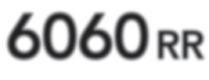
6044 RR is a new top yielding mid-maturity roundup ready hybrid suited to all canola production regions of Western Canada. 6044 rr is a medium height hybrid with excellent standability for an easy harvest. It is r for blackleg and has yield index of 132 per cent relative to 46a65/Q2. It is available at BrettYoung retailers.
Photo by bruce bArKer.
Cargill
Victory V12-2 hybrid is a genuity roundup ready canola hybrid that achieves yields of 103 per cent of Victory V12-1, which was the leading roundup ready hybrid in the 2011 and 2012 Canola performance Trials. In addition to high yields, V12-2 also provides growers an industry-leading multigenic blackleg resistance package delivering an r rating. It is r rated for Fusarium wilt and has exceptional standability that simplifies harvest management. V12-2 is available as part of the 2014 Cargill Specialty Canola program that delivers higher yields and higher returns in a simple program. For more information, visit www. cargillspecialtycanola.com.
Dekalb
74-54 RR canola hybrid is proving to be the highest yielding and most consistent hybrid canola Dekalb has ever introduced with a yield averaging 105 per cent of 45H29 in 2012 trials. With an r rating to blackleg and clubroot resistance built in, 74-54 rr features an ideal plant height and great standability, resulting in a plant that is generally easier to harvest. The clubrootresistant breeding trait provides exceptional resistance to the most common current clubroot pathotypes, including 3, 2, 5, 6 and 8.
DuPont Pioneer
While Dupont pioneer does not have any new canola varieties for the 2014 growing season, they continue to build on their current varieties by adding r&D staff – both in the lab and in the field, and increasing research budgets and infrastructure dedicated to canola, for example, the new greenhouse being built at Dupont pioneer’s Carman, Man., research station. They plan to launch LibertyLink herbicide tolerance in elite Dupont pioneer genetics in the next few years, along with shattertolerant roundup ready canola hybrids, and a next-generation glyphosate resistance trait in canola.
Proven Seeds
Proven VT 530 G is a medium maturing hybrid with a yield potential similar to proven Vr 9562 gC. It has an Mr rating for blackleg and an r rating for Fusarium wilt. proven VT 530 g’s excellent standability makes it easier to put more bushels in the bin. available exclusively at CpS Canada Inc. retail locations.
Proven VR 9562 GC is an exceptionally high yielding hybrid with yield potential similar to proven VT 530 g. It has r ratings for clubroot, blackleg and Fusarium wilt. proven Vr 9562 gC also has excellent standability. available exclusively at CpS Canada Inc. retail locations.
Proven VR 9561 GS is a high yielding roundup ready hybrid. It has a strong disease package with r ratings for blackleg and Fusarium wilt, and resistance to sclerotinia. available exclusively at CpS Canada
Inc. retail locations.
VT X121 CL is a Brassica juncea bred specifically for the Brown and Dark Brown soil zones. It is r rated for blackleg and Fusarium wilt. VT X121 CL has been bred to better tolerate heat and drought for consistent performance, reduced green seed, improved seed quality and higher yield potential. It comes with improved pod shatter resistance for straight-cut performance. available exclusively at CpS Canada Inc. retail locations.
Right place. Right time.
The superior placement and enhanced availability of Wolf Trax® DDP® Micronutrients guarantee more consistent, early plant uptake for optimum growth and productivity. Ask for Wolf Trax and deliver micronutrients to your crops on time. Call 855.237.9653, or visit wolftrax.com.
Wi N d EROSiON REMaiNS a pROB l EM ON ThE pR ai Ri ES
Losses in soil fertility can be catastrophic.
by ross H. McKenzie phD, p. ag., retired agronomy research Scientist
In the 1930s, wind erosion had severe effects on soil quality across the southern prairies. By the 1940s, adoption of strip farming and the use of the noble blade cultivator reduced the frequency and severity of wind erosion. But wind erosion continued to be a problem into the 1980s. By the 1990s, the gradual adoption of direct seeding to leave a protective crop residue on the land surface had greatly diminished wind erosion problems across the prairies.
Wind erosion events still occur occasionally when soils are left bare after harvest of row crops on irrigated land. However, fire is now the major culprit that leads to soil erosion. When fall conditions are warm with very little precipitation, dry residue on the soil surface becomes an excellent fuel source. The combination of wind and fire means hundreds or even thousands of acres can burn rapidly, leaving soil susceptible to wind and water erosion. When a fire does occur, organic matter recycling back to the soil is lost, valuable macro- and micronutrients are lost, and the protective cover on the soil surface is lost.
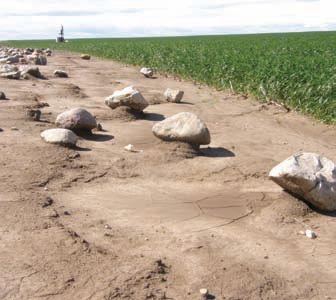
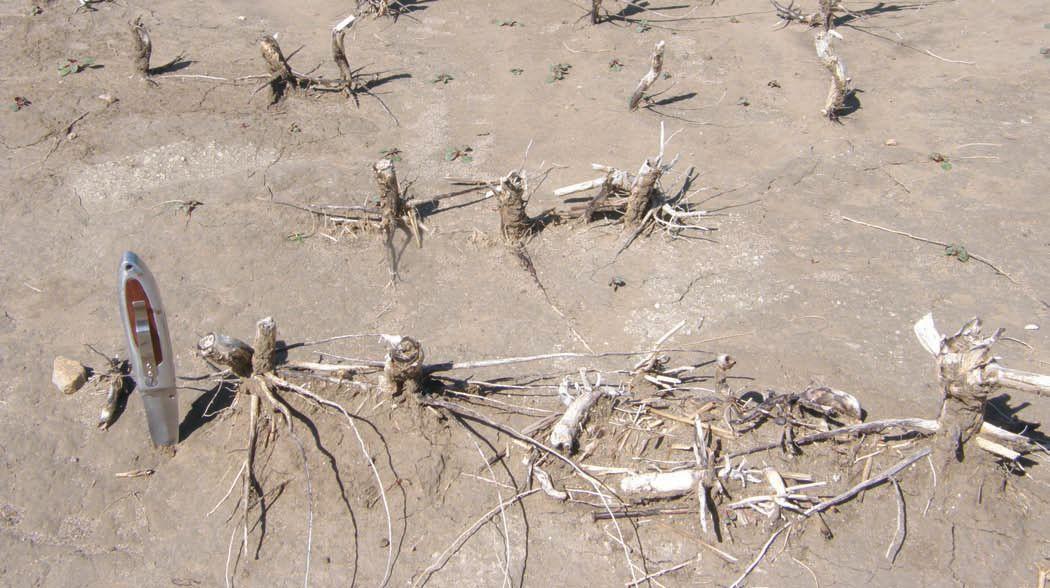
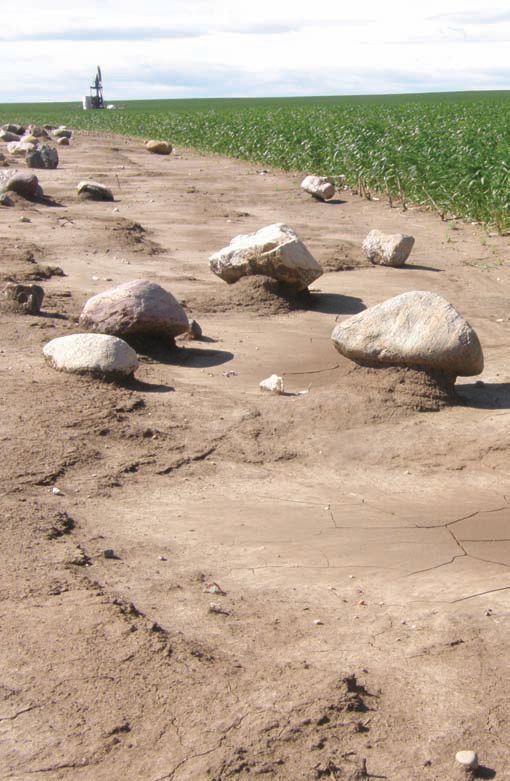
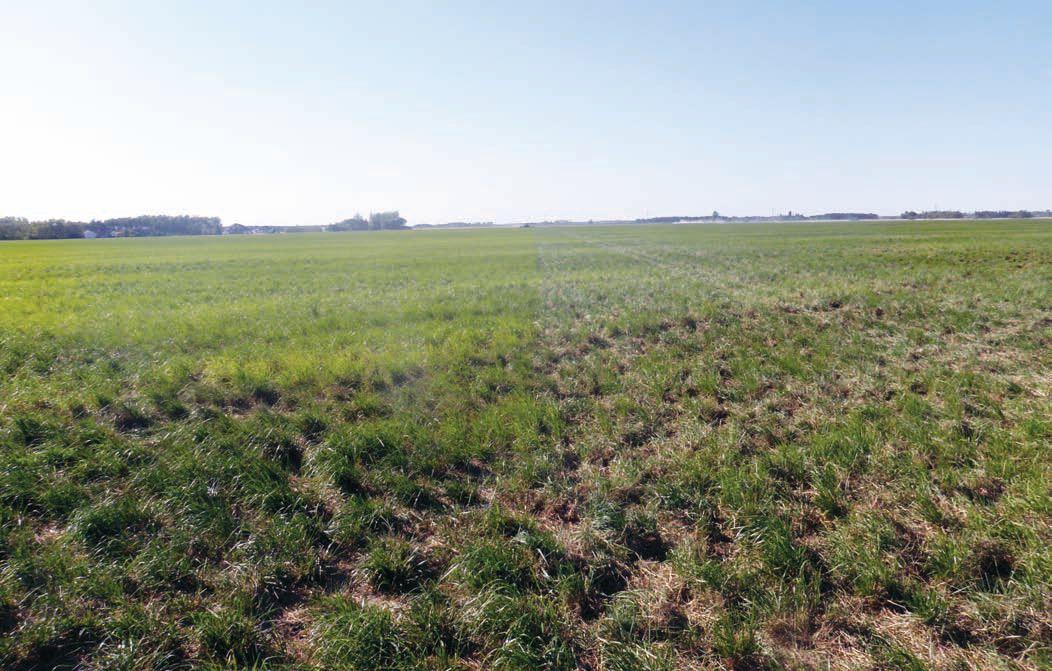
Wildfires in the fall or early spring are becoming increasingly common. a severe fire occurred west of Lethbridge, alta., on Sept. 10, 2012, burning about 30,000 acres of annual crop and grassland; and even threatened the western side of the city. The photos show some of the resulting wind erosion effects.
When a wildfire occurs after mid-September, it is usually too late to seed a winter cereal crop to provide protective crop cover for soil. normally, winter wheat needs to be established in the first two weeks of September to provide adequate protective cover. often due to the time of a fall fire, it is too late and soil conditions are too dry, making it impractical to seed a winter cereal crop.
For smaller areas that are burned, spreading straw and/or application of high rates of manure can be used to quickly provide cover on soil to prevent wind erosion. However, this becomes less practical for large burn areas.
To reduce wind erosion potential after a fire, fields that have loam to clay loam (medium- to fine-textured) soils may need to be worked using cultivators with spikes to roughen the soil surface and bring up soil clods to the soil surface. The roughened soil surface is intended to reduce the potential for soil particles to roll and bounce along the soil surface to become airborne. This is a practice used for emergency wind erosion control. It is very important that land be worked at a 90-degree angle to the direction of prevailing
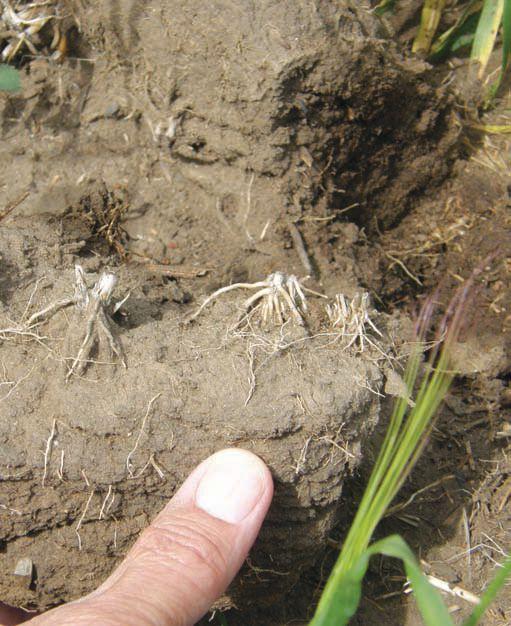
Close-up of exposed plants and roots. Note tops of stems were burned and roots are exposed showing soil loss.
winds. When spiking a field, leave alternate untilled strips, as these may need to be spiked when wetting-drying and freeze-thaw processes break down soil clods in the initially tilled strips.
For sandy soils, Lister shovels should be used, as spikes don’t produce durable soil clods; they will do a better job of ridging the soil and bring up firmer subsoil clods. Lister shovels should be mounted on the back gang of a heavy-duty cultivator and, ideally, be about 36 inches apart, penetrate to a depth of six to eight inches and create ridges that are 10 to 12 inches higher than the troughs.
Freeze-thaw and wetting-drying conditions over winter can result in breakdown of large soil clods created with tillage to roughen the soil surface. as soil clods degrade, the soils are left in a more
Photo courtesy of ross McKenzie.
The Leader in Overlap Control
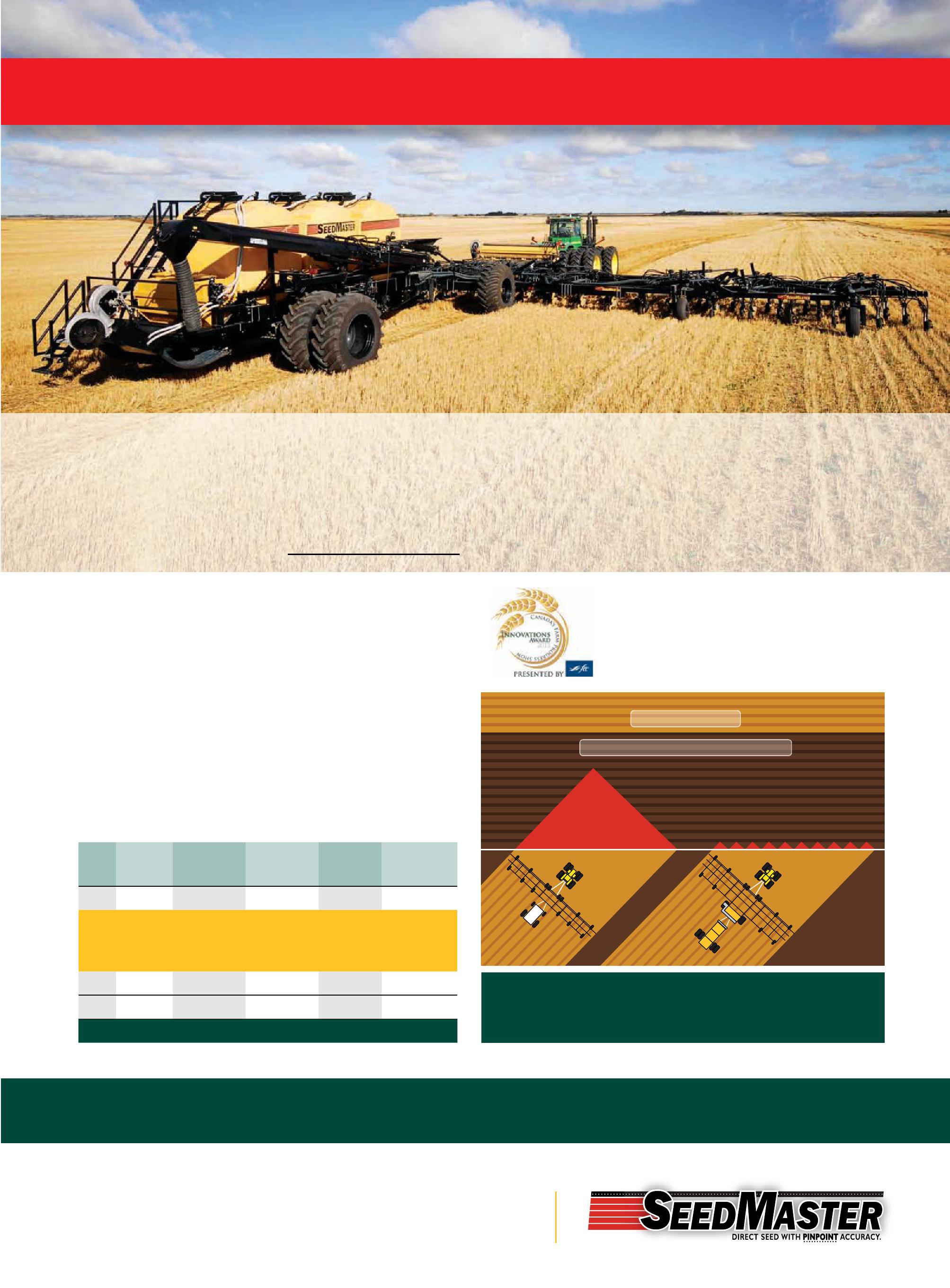
Auto Zone Command prevents costly input overlap by instantly stopping product flow in up to 10 metering zones. The more zones you control, the more money you will save.
FLIP is SeedMaster’s patented mapping software that activates Auto Zone Command and halts product flow the first time openers pass through an overlap area. Product is then applied on the last pass, preventing double seed and fertilizer from being applied, and avoiding any seedbed disturbance.
Big Payback – Savings using a 10 zone, 80 ft. drill
vulnerable condition for wind erosion. Therefore, as soon as soil conditions permit in the spring, annual cropland should be worked and seeded as quickly as possible to establish cover on the soil.
Significant losses occur
When wind erosion does occur, the damage affects the physical, chemical and biological characteristics of soil:
• Crop residue lost is often in the range of 5,000 to 8,000 pounds per acre of dry matter in varying stages of decomposition. The approximate amount of nutrient in the surface residue layer in pounds per acre is: nitrogen (n) – 50-100; phosphate (p2o5) – 10-20; potassium (K2o) – 50-80; sulphur (S) – 5-10; and carbon (C) – 2,000-3,000.
• The fine soil particles lost from fields during wind erosion are predominantly the clay-sized particles and organic matter. Clay particles and organic matter are important in holding soil water and retaining a number of soil nutrients required by plants. When fine soil particles are lost, soil productively declines. as the amount of topsoil loss increases, the fertility and productivity of soil declines.
• The nutrient value of topsoil is very high in terms of “replacement value.” For example, the loss of one inch of topsoil on one acre is about 160 tons. assuming soil organic matter content is about four per cent with about five per cent organic n content, this would be about 640 pounds per acre of actual n lost. Many other nutrients, including p, K, S and micronutrients, also are lost.
• good granular soil structure is diminished, resulting in increased soil crusting after precipitation, reduced crop emergence after seeding, reduced soil water infiltration, increased water runoff and increased water erosion potential.
Significant loss of fertile topsoil will result in crop yield loss. Considerable soil conservation and erosion research has been conducted by scientists at agriculture and agri-Food Canada’s Lethbridge
Exposed rock resulting from wind erosion.
Canola stems with exposed roots resulting from wind erosion.
Photos courtesy of ross McKenzie.
research Centre. a research trial conducted by Dr. Frank Larney on a Dark Brown dryland soil with topsoil stripped off at zero-, two-, four- and six-inch increments examined effects on subsequent wheat yield. In the first year after stripping, wheat yield declined by 40 per cent when two inches of topsoil was removed compared to the control treatment. In the second year after stripping, chemical fertilizers where used to examine restoring soil productivity. results showed added fertilizer only partly remedied yield losses. responses to n and p were more effective at moderate levels of erosion and less effective as the depth of stripped soil increased.
This study also compared the efficacy of livestock manures, crop residues, and combinations of straw and chemical fertilizer in restoring soil productivity. The overall best amendments were manures and alfalfa hay. application of feedlot manure at a rate of 30 to 50 tons per acre, or an equivalent amount of hog or poultry manure, will go a long way to improve the physical condition of the soil and increase the nutrient levels of the soil. While this amount of manure may sound like a lot, most eroded soils are very deficient in nutrients. Livestock manure will help to improve both the physical quality and the fertility of the soil.
Crop establishment is more difficult due to potential for seedbed drying, uneven topsoil depth, increased potential for soil crusting and reduced crop emergence potential. establishment of smaller seeded crops such as canola, mustard or flax is challenging, particularly in areas of more severe soil erosion. reclaiming eroded soils is a very long, slow process. Soil sampling of each field is needed to determine soil nutrient levels, soil organic matter levels and chemical factors such as surface soil
pH. after severe soil erosion events, soils have reduced nutrient levels and potential nutrient from soil release for crop growth is reduced. Therefore, higher rates of fertilizer are needed to offset the nutrient losses. Ideally, application of livestock manure is the most effective means of restoring soils to a reasonable production level, particularly on the more severely eroded areas. In areas with a higher level of stones on the soil surface where severe erosion occurred, stones should be removed.
a crop rotation plan should be developed, along with a welldeveloped fertilizer and manure management plan for each eroded field. In developing the crop rotation plan, consideration should be given to establish a forage crop, rather than annual crops, in more highly eroded fields. establishing a permanent crop for four to five years will help build up the soil organic matter level and increase root material, root mass and root channels, all of which are very beneficial.
Immediately after harvest each fall, land managers may want to consider cultivating strips about 100 to 150 feet wide in a northsouth direction every one-quarter mile, to serve as “fire guards,” so that in the event a wildfire does occur, the guards might help to reduce the rapid spread of fire. With very high velocity winds, burning embers can blow over a 150-foot fireguard, but guards might be effective to at least reduce that rapid spread of a wildfire and provide additional time to bring it under control. for
TiER 4 REgulaTiONS updaTE
New technologies being used by farm equipment manufacturers.
by Treena Hein
By now, most Canadian farmers are familiar with Tier 4 regulations, the reasons behind them and the technology involved. For us here in north america, it all began in 1996, when the U.S. government passed laws forcing off-road heavy equipment makers to gradually reduce the pollutants and particulates in engine exhaust. These laws – starting with Tier 1 and phasing through stricter and stricter Tier 2, 3 and 4 regulations throughout the years –are aimed at helping to reduce smog and acid rain, as well as associated crop damage and respiratory problems. The U.S was following europe’s lead, where heavy equipment manufacturers were already developing emissions-reduction technologies to meet legislative changes there.
Canada got on the Tier 4 bandwagon in 1999, when the federal government passed the off-road Compression-Ignition engine emission regulations, which fall under the Canadian environmental protection act. These standards were applicable to 2006-and-later diesel engines such as those found in agriculture and construction machinery.
“The standards, which are aligned with the U.S. environmental protection agency (epa) standards, were amended to include the epa Tier 4 emission standards starting in 2012,” says Danny Kingsberry, a media relations officer at environment Canada. “The upgrade to Tier 4 emissions standards for off-road diesel engines provides significant benefits in terms of improved air quality and reduced exposure to air pollutants and toxic substances.”
at this point, manufacturers already must meet Tier 4 Interim standards for some horsepower ranges, and must meet Tier 4 Final by Jan. 1, 2014, for equipment larger than 175 hp. They have an additional year to make sure equipment between 75 to 175 hp meets the regulations.
ABOVE: The CASE IH Magnum and Steiger tractor series use the company’s patented SCR technology to meet Tier 4 Final emissions standards. MACHINERY
These are the two emissions-reduction systems being used:
• With Cooled exhaust gas recirculation (Cegr), exhaust is fed back into the combustion chamber. This reduces the formation of nitrogen oxides. a Diesel oxidation Catalyst (DoC) and Diesel particulate Filter (DpF) are used to reduce particulates.
• With Selective Catalytic reduction (SCr), exhaust gases pass over a catalyst in the presence of Diesel exhaust Fluid (DeF, an ammonia-and-water-based substance), and nitrogen oxides are broken down into harmless nitrogen and water.
Which technology is used generally depends on what is required of the engine and the process that the machine is intended for. Cegr is well suited to steady engine rpMs, where fairly constant exhaust temperatures aid in the reduction of particulate matter. SCr is better for engines that must meet variable demands. It provides ongoing fresh air to the engine, allowing it to run at peak performance through the full rpM range.
Tractor engines fall somewhere in between, with steady rpMs needed for jobs like spraying a uniform field but variable power demands required for other tasks. For that reason, and because the Tier 4 Final standards are so much stricter than Tier 3, some tractor manufacturers like John Deere will likely employ both Cegr and SCr for Tier 4 Final. roger Hoy, director at the nebraska Tractor Test Lab (the officially designated tractor testing station for the United States), says,
Photo courtesy of cAse ih.
“Cummins has confirmed with me that they will use both.” He notes that full power can be achieved with either SCr or Cegr individually, but that Cegr uses a little more fuel.
agCo is another company using both types of technology to meet Tier 4 Final requirements, but it is using its patented SCr with only a small amount of Cegr to ensure nitrogen oxides are reduced in the cylinder. “This combination provides our customers fuel economy benefits, lower fluid consumption (fuel and DeF), longer engine service intervals and longer engine life,” says Conor Bergin, agCo’s product marketing manager for high-horsepower tractors.
other tractor makers, including new Holland and Case IH, are using only SCr. Leo Bose, commercial product training manager with Case IH, says his company chose SCr over Cegr because carbon in recirculated exhaust can be deposited into engine oil, creating the possibility of wear. “Using our patented SCr system allows our high-horsepower tractors and combines to lengthen service intervals,” he says, adding that it also keeps things simpler in terms of overall design to use only one system.
Operation and maintenance
The development and physical cost of any new add-on technology such as SCr or Cegr is, of course, passed on to the customer. on the positive side, however – besides the benefit of cleaner air – there is good news in that no action is needed to manage Tier 4 technologies by the tractor operator during ongoing operation.
During ongoing Cegr operation, the DpF filter is automatically “regenerated” (the par-
ticulate matter in the filter is reduced to ash) in three ways. The emissions-reduction interface in the cab lets the operator know what’s occurring. passive regeneration occurs during ongoing operation, and active regeneration occurs when sensors detect that particulate matter has accumulated to a certain level in the filter. Diesel fuel is injected into the exhaust to increase its temperature. Sensors also indicate
when forced regeneration is required. The engine must sit idle while the engine control unit conducts a very high temperature cycle. The ash that remains is not combustible and must be cleaned out. However, regulations require that this situation occur only after at least 4,500 hours of engine use, and some manufacturers claim it need only be done once or twice in the lifetime of the tractor. Low-ash engine oil with a CJ-4 rating is a must. The only maintenance required with SCr systems is checking the DeF filter and refilling the DeF tank when needed.
Companies are touting Tier 4 tractors as the most fuel-efficient ever, but that has nothing to do with Tier 4 technologies. as Barry nelson, John Deere’s media relations manager, agriculture and turf division, points out, Tier 4 emissions technologies consist of after-treatment exhaust systems. He says fuel efficiency gains have been made through things like electronic fuel injection, more efficient transmissions integrated with engine performance, and other cutting-edge electronic systems that adjust fuel usage according to many engine factors on a second-by-second basis.
more information contact your local dealer or call: 1-877-667-7421
AGCO’s newest Tier 4 Final tractors, the all-new Challenger MT800E Series.
Photo courtesy of Agco.
It’s timetotellthe realstory
Never has Canadian agriculture mattered more to Canada and the world. Ours is a modern and vibrant industry, a leading employer in our country and a major driver of our economy. The Canadian agri-food industry provides safe, high-quality food to millions – at home and around the world. Yet despite all this, we’re often misunderstood.
Research shows that while Canadians see agriculture as an essential industry, many don’t see it as progressive or vibrant. To reach our full potential, we need to clear up the misunderstandings – to enhance consumer trust, attract more capital,
accelerate innovation and grow our talent pool.
Canadians need to hear more positive talk about agriculture. Industry players deserve to blow their own horns a little, to say out loud that they’re proud of what they do. To celebrate their successes. That’s the story of agriculture that needs to be told – today, more than ever.
It has to start with each of us. Be an agvocate and join the conversation at AgMoreThanEver.ca.
It’s time to tell the real story.
35 Almost 1 in 8 Canadian ag and agri-food jobs are in of corn today than to grow an acre 1990
25,000
50,000 fewer gallons of water It takes in farm operators are under the age of
#1 canola producer of in the WORLD
25 billion contributes almost to the Canadian economy
annually $
5-part magnet $1 (5"
get
Ball cap $10
When
T-shirt $5
Wear
Be an AGvocate
Speak up, speak positively
Those of us involved in agriculture love what we do and we want the best for our industry. We know why agriculture is important to Canada and the world, and that it provides a lifestyle that can’t be beat. But we tend to be a humble group, so others may not hear this message.
We need to remember: image matters. What we say about agriculture influences how people view our industry. Share your passion and optimism for agriculture and let it shine through everything you say and do – being an agvocate is that easy.
Agvocates look for opportunities to talk about what’s going well in agriculture. They fill in information gaps, help dispel myths and learn more about the industry. Image is critical to our future, and fortunately we have a very positive story that we can tell. So let’s tell it.
• Get young people excited. There are jobs –great jobs. There’s farming of course, but many more options from science and sales to processing and manufacturing.
• Speak positively. Investment tends to flow to progressive industries that have a promising future.
• Inform consumers we’re capable business managers and stewards of the land, driven to produce safe, high-quality food using sustainable methods.
Our image matters –in fact, it has never mattered more. Tell the world why you love agriculture and what the industry means to you. We’re counting on you to tell the real, positive story of Canadian agriculture.
Speak up. Speak positively.
Our industry needs more agvocates
To reach its full potential, agriculture needs everyone in the industry to speak up and speak positively.
Agriculture More Than Ever is an industry-driven cause to improve perceptions and create positive dialogue about Canadian ag. Together we can share the facts and stories about this vibrant and modern industry, and tell the world why we love what we do.
It’s up to all of us to be agvocates and it’s easier than you think –visit AgMoreThanEver.ca and find out how you can get involved.
g lyphOS aTE - RESiSTa NT kO chia ROlli Ng ac ROSS ThE WEST
The tumbling weed presents a large threat.
by Bruce Barker
When glyphosate-resistant (gr) kochia was first identified in the County of Warner in southern alberta in 2012, weed scientists figured it could be the tip of the iceberg. In the fall of 2012, researchers embarked on a survey of southern alberta fields to identify the scope of the problem. Led by Linda Hall, a professor of weed science and environmental biosafety of transgenic crops at the University of alberta, the research group also included Hugh Beckie, Bob Blackshaw and Scott Shirriff with agriculture and agri-Food Canada (aaFC), ryan Low with the University of alberta, and nicole Kimmel and Chris neeser with alberta agriculture and rural Development (aarD).
“glyphosate is a very important herbicide for growers, so we wanted to see how widespread glyphosate-resistant kochia is to get a better understanding of how it might be managed,” says Hall.
The discovery of gr kochia in discontinuous fields didn’t come as a surprise. It was first reported in Kansas in 2007, South Dakota in 2009 and nebraska in 2011. In 2010, Beckie, a weed scientist with aaFC, developed a model to predict which weeds are the most likely to become glyphosate-resistant. In the grassland region, the top three weeds were kochia, wild oat and green foxtail.
To determine the distribution and amount of gr kochia, a randomized stratified survey of more than 300 locations in southern alberta was conducted in southern in September and october 2012. Mature plants were collected, and seed was separated and screened by spraying with glyphosate at 900 kg per ha under greenhouse conditions. populations were collected from field borders, ditches and industrial areas.
Hall says gr kochia was identified in four per cent of the fields at 13 of 309 sites (Fig. 1, pg 48). not surprising, seven sites within the County of Warner were identified with gr kochia. Beckie had previously confirmed gr kochia at 10 other sites in the County in a fall 2011 survey. Five more sites were identified in Vulcan County to the north, and one site to the east in the Municipal District of Taber.
These sites are in addition to the nine sites confirmed in alberta in 2012 from samples submitted by growers: three sites in County
of Warner, one site in County of Lethbridge, four sites in County of Forty Mile no. 8 and one site in Cypress County (Fig. 1, pg 48).
Two of the locations where gr kochia was found were non-agricultural areas (ditch and railway rights-of-way) adjacent to agricultural areas, highlighting the need for municipalities and industry to be aware of the problem and to manage their herbicide control programs with herbicide resistance in mind.
Beckie also confirmed the presence of gr kochia in west central and southwestern Saskatchewan from samples submitted by growers (Fig. 2, pg 48) in 2012. Ten samples were confirmed to be glyphosate resistant.
Hall says the frequency of glyphosate resistance in the confirmed
Photo courtesy of ryAn l ow.
Hugh Beckie collects kochia samples to screen for glyphosateresistant kochia.
A flushing weed control story worth telling. To everyone.
Growers can’t seem to stop talking about Ares™ herbicide for Clearfield® canola. Only Ares takes out the toughest ushing weeds and keeps them out. Including wild buckwheat, lamb’s quarters, cleavers—even volunteer canola from other systems. Ares also makes herbicide rotation easier, because it uses a different mode of action. You’ll be so impressed with its performance you’ll want to tell every canola grower you know. And almost anyone else who’ll stand still long enough. For the latest buzz visit agsolutions.ca/clearfieldcanola or contact AgSolutions® Customer Care at 1-877-371-BASF (2273).
Always read and follow label directions.
1. Location of glyphosate-resistant (GR) (large red circle) and -susceptible (small black circle) kochia, surveyed in fall 2012.
Source: Hall et al. Survey of glyphosate-resistant kochia in Alberta. Can. J. Plant Sci. 93.
populations ranged from very low – three per cent – to 98 per cent. While the reasons weren’t identified for the differences, given kochia’s prolific seed production, the low levels would be expected to increase if glyphosate alone was used for control.
Use multiple modes of action for control
Where gr kochia has been identified, most often it is in areas where chemfallow is practised. Because glyphosate has become very affordable and is very effective, growers have often applied it without additional tank-mix herbicides. This selection pressure has resulted in the development of gr kochia. In addition, the gr kochia populations were also resistant to group 2 aLS-inhibiting herbicides.
The good news, though, is that none of the gr kochia populations were resistant to dicamba, a group 4 herbicide. However, dicamba-resistant kochia has been found in the midwestern U.S., so growers will need to ensure they continue to rotate the tank-mix partners with glyphosate in chemfallow, and pre- and post-harvest.
Fig. 2. Glyphosate-resistant (GR) kochia confirmed in 2012 from samples submitted by growers. Note: The site at Milk River, Alta., represents three confirmed fields; the sites at Cabri and Kyle, Sask., represent two confirmed fields each.
Source: Hall et al. Survey of glyphosate-resistant kochia in Alberta. Can. J. Plant Sci. 93.
“What concerns me isn’t as much in chemfallow, where there are options for weed control. growers do not want to lose the ability to use glyphosate in roundup ready canola,” says Hall. “In crops other than canola, growers need to focus on stopping the spread of gr kochia and be aware that it has a large capacity for seed dispersal.”
Hall says controlling kochia in chemfallow, pre-seed and post-harvest applications is a big deal, and that growers should plan their crop and herbicide rotations to target gr kochia. Whether a grower has gr kochia, or just the “normal” group 2 resistant biotype, they should utilize tank-mixes wherever possible to control kochia in and out of crop.
The research team hopes to extend the survey to southern Saskatchewan and Manitoba in 2013. It is also working on evaluating herbicides for post-harvest applications to provide recommendations on another window for controlling kochia. In another twist, Hall, Beckie and Blackshaw will be chasing after kochia by embedding plants with gpS tags to see how far the tumbling weed can travel.
“Because of wind dispersal, gr kochia presents a large threat for growers across the southern prairies,” says Hall. “glyphosate is too valuable to lose.”
Fig.
Anyway you pencil it out, NexeraTM canola hybrids equal healthier profits.
In 2013, Nexera is expected to return over $115 million over and above the value of commodity canola. Since its launch, Nexera has returned over $426 million to Western Canadian growers – with more than half of that coming in the last three years.
“The higher returns are being driven by a number of factors,” says Kerry Freeman, Nexera Product Manager, Dow AgroSciences. “Superior canola yields combined with the grower premiums and incentives associated with Nexera canola are increasing returns. Strong market demand by new and growing end-use customers for heart-healthy Omega-9 Oil is also a big factor.”
Higher profitability starts with the proven performance of Nexera canola hybrids
Highest in grower satisfaction, too
These new hybrids are ideal for growers in the mid and long-season zones who are looking for hybrid yields and higher profit. They offer yield potential equivalent to any competitive canola hybrid, and result in profitability that’s higher than other canola brands. In fact, Nexera RR Hybrids rank highest in grower satisfaction, according to Canola Evaluation and Intentions, Canada, 2012, Stratus Agri-Marketing, Inc.
Freeman also points out that the heart-healthy Omega-9 Oil made from high-yielding Nexera canola is the new standard in today’s food industry. And the higher-value, end-use product translates into higher profits at the farm level.
New Nexera canola hybrids increase the profitability equation, and the number of Nexera canola acres grown continues to increase year over year. The Nexera canola hybrid Roundup Ready® Series and Clearfield® Series each offer two high-performing hybrids that are changing canola. Their success is driven by a number of factors, including:
• next-generation hybrid technology
• industry-leading hybrid yields
• early- and late-season hybrid vigour
• excellent standability
• superior disease resistance
The option of the Roundup Ready or Clearfield weed control system allows Nexera canola growers to choose the system that works best for them. Either way, growers get the advantages of convenience, flexibility and superior weed control from a production system designed to help them make the most of the Nexera canola profit opportunity. For more information on Nexera canola, go to healthierprofits.ca.
ROOT Magg OT ThRiVES
uNdER
Tigh T ROTaTiONS
Continuous canola results in greater damage and reduced yields.
by Bruce Barker
Here’s another knock against tight rotations. a research study in Western Canada found that when canola is grown continuously, root maggot damage increases on canola taproots. The costs, while not necessarily attributable to root maggot damage alone, ranged from $53 to $71 per acre.
“This study has shown that three consecutive years of canola production results in a buildup of root maggot infestations,” says professor and entomologist Lloyd Dosdall at the University of alberta at edmonton. Dosdall was the lead researcher on a team that included neil Harker, John o’Donovan, Bob Blackshaw, eric Johnson and Yantai gan of agriculture and agri-Food Canada, and randy Kutcher at the University of Saskatchewan.
The research was conducted from 2008 through 2010, and was recently published in the Journal of economic entomology by the entomological Society of america in 2012. In the trial, 10 different crop sequences were evaluated over three years at five locations in Western Canada: Lacombe and Lethbridge, alta., and Melfort, Swift Current and Scott, Sask. (Table 1, pg 52).
Canola was seeded at 20- to 30-cm row spacing at a depth of 1 cm using a Conserva pak no-till drill equipped with knife openers. Fertilizer was applied according to soil test recommendations. root maggot damage on canola roots was assessed immediately after harvest by using the root maggot rating scale that Dosdall developed in 1994 (Table 2, pg 52).
“There is a relationship between root maggot damage and yield
TOP AND ABOVE: When canola is grown continuously, the root maggot fly does not need to go far to lay eggs on canola host plants (top). Root maggot larvae cause yield loss by feeding on the canola taproot (above).
loss. In another study conducted at the Lacombe site, we determined that canola yield declined by 192 kg/ha (3.4 bu/ac) for each unit increase in root maggot damage rating. a mean damage rating of 3.5 would then correlate to a yield loss of 672 kg/ha (12 bu/ac),” explains Dosdall.
Doing the math, that damage rating of 3.5 would result in a 12 bu/ac loss or around $120 per acre. In Western Canada, root maggot infestations and damage are the greatest in the northern and central alberta regions, and in the parkland regions of Saskatchewan and
Photo courtesy of lloyD DosDAll. Photo courtesy of D. PenDree.
A CONSISTENT TOP PERFORMER 5525 Cl
5525 CL has been a proven performer across the Prairies in the many different environmental conditions experienced over the past few years.
Able to compete with the best in any system, 5525 CL is among the Clearfield® leaders in the field and, as always, offers complete marketing flexibility. One more benefit of growing 5525 CL: the new Ares™ Clearfield herbicide—another proven winner.
If you are planning to grow canola next year, take a look at 5525 CL.
In the end, it all comes down to performance and BrettYoung brings a new standard of excellence to the field.
Table 1. Crop sequences evaluated in each of three years at five study locations in Western Canada to assess effects of frequency of canola in rotations on infestations of root maggots.
Manitoba. no insecticides are available for control, and canola seed treatments for flea beetles do not provide effective control. Brassica rapa varieties are more susceptible to root maggot injury than are B. napus varieties.
Root maggot damage increased with continuous canola
a Glu,: B. napus InVigor 5440, resistant to the herbicide glufosinate.
b Gly,: B. napus 71-45RR, resistant to the herbicide glyphosate.
Source: Dosdall et al.
Source: Dosdall et al.
Source: Dosdall et al.
In the trial, root maggot damage increased in each year of the study on continuous canola. The three-year continuous canola rotation showed a progressive increase in root maggot damage each year (Table 3).
“This study has shown that three consecutive years of canola production results in a buildup of root maggot infestations, but not two consecutive years of production in the same field,” says Dosdall.
Looking at yield, analysis showed that the three-year continuous canola suffered yield losses compared to the two-year rotation where canola was rotated with a different crop in 2009. In 2010, the continuous glufosinate canola yielded 0.44 t/ha (7.8 bu/ac) less than the twoyear rotation. In addition, the glu-wheat-glu rotation yielded 0.46 t/ha (8.2 bu/ac) less in 2010 than the pea-barley-glu rotation. Comparing the three-year canola glufosinate rotation to the pea-barley-glu rotation, the 2010 yield of continuous glufosinate canola was 0.9 t/ha (16 bu/ac) less.
Similar trends were observed with the glyphosate canola rotations.
Dosdall explains that not all yield losses were necessarily due to root maggot damage. plant diseases such as blackleg and sclerotinia also increase under tight rotations and could have caused some yield loss.
In the study, the glufosinate-resistant LibertyLink variety, InVigor 5440, showed less root damage than the glyphosate-resistant roundup ready variety, 71-45rr. However, Dosdall cautions that this does not mean glufosinate-resistant varieties are more resistant to root maggot.
“I have done quite a few studies on root maggots over the years, and one consistent result is that canola varieties (and species) differ in their susceptibilities to attack by these pests. In this study, we found that the glyphosate-tolerant variety (71-45rr) was more susceptible to attack than the glufosinate-tolerant variety (InVigor 5440). However, there is no evidence from this study or any others I’ve done that all glufosinate-tolerant varieties are more resistant to attack than all glyphosate-tolerant varieties,” explains Dosdall.
overall, the average yield reductions in continuous canola for three years average 0.3 to 0.4 t/ha (5.3 to 7.1 bu/ac) less than canola grown in rotation. This loss is estimated at approximately $53 to $71 per acre at $10 per bushel canola. More evidence that short canola rotations are detrimental to the bottom line.
Table 2. Root Maggot
Table 3. Root maggot damage with continuous canola
Damage to the canola taproot by root maggot larvae.
Growers encouraged to use a risk management approach for blackleg.
by Donna Fleury
R-rated blackleg resistance used to be the cornerstone for managing blackleg in canola, but is it enough now?
Blackleg continues to be detected in disease surveys across the prairies, with 2012 showing the highest levels in recent years and 2013 also causing concern. Industry and growers are being encouraged to build risk management approaches into their systems when dealing with blackleg to keep the Canadian canola industry profitable and resilient.
“recently, some agronomists are finding fields where farmers were growing r-rated blackleg varieties that had higher than expected levels of blackleg disease,” says Clint Jurke, agronomy specialist with the Canola Council of Canada (CCC). “With tighter crop rotations, this is a risk that needs to be addressed by growers and industry. It is also the motivation for CCC initiating discussions with industry to try to come up with a better way of informing growers to make more strategic blackleg management decisions.”
Current research, led by Dr. Dilantha Fernando at the University of Manitoba and Dr. gary peng with agriculture and agri-Food Canada (aaFC) in Saskatoon, is trying to characterize resistance genes in many of the commercial canola varieties. “This research work is crucial for our basic understanding of how much genetic variability we have in the resistance genes currently being used,” explains Jurke. “So far, the initial research data shows that the majority of varieties are relying on one resistance gene, Rlm3. as a result, the pathogen has responded accordingly and races are being
selected that are virulent against that type of resistance.”
This may be a risk to the canola industry, and one that is going to require an industry strategy. “We may need to develop a better strategy of how we communicate blackleg risk and perhaps how we identify resistance in our varieties so growers can make better informed choices,” says Jurke. “once canola growers start select-
Photos courtesy of cAnolA council of cAnADA.
TOP AND ABOVE: If a field has a 50 per cent infection, a four-year rotation will be required to break the cycle (top). Scouting for blackleg symptoms is the first step in risk management (above).
Evidence of disease (pseudothecia)
Crop rotation 4 years or more 3 years 2 years or less
Source: Canola Council of Canada
ing for some of these more aggressive, more virulent races on a regular basis, and as these races become more dominant, then our current resistance strategy as a whole becomes compromised. We are in the early stages of seeing blackleg troubles, but we have the opportunity right now by tweaking our existing systems to stay ahead of blackleg in Canada. We don’t want to create a situation where blackleg is a huge problem for the entire industry such as it was in the 1980s and ’90s in Canada.”
Industry is beginning to see the need in the marketplace for more diversity in resistance in canola varieties. Some companies are developing varieties with more than one type of resistance in the germplasm. “We are looking forward to discussions with industry to address these needs, and to come out with a model on how to manage the risks,” notes Jurke. “In the meantime, we are working with growers to take a risk management approach to dealing with blackleg in their rotations.”
Blackleg risk assessment and management
The CCC has developed a risk matrix that helps growers assess strategies and implement low-risk decisions for blackleg management (see chart above). growers are encouraged to conduct a risk management assessment and to implement good management practices when developing a risk management strategy. risks are listed in terms of importance, with rotation being most important. If growers follow a tight rotation, then using other low-risk measures helps reduce the overall risk.
Jurke explains that the risk management approach has three main levels of control: scouting, crop rotations and variety rotations. Scouting is the first step and growers need to identify whether or not they have any fields where blackleg levels are high. Learning to identify blackleg properly and scout for the disease at the end of the season is important.
Crop rotation is the second important control strategy, and long-term crop rotations are ideal and especially recommended where blackleg levels are high. any field where more than 50 per
cent of the stems are infected with blackleg is a field of concern. “If growers have a field where blackleg levels are high, then they should move that field into a long-term crop rotation (four years) strategy,” says Jurke. “This is especially important for growers using tight rotations. although growers might not have experienced a yield loss if the severity is low, certainly the next time they grow that same variety in that field, it could be epidemic proportions.”
It takes two to three years for blackleg-infected canola stubble to decompose to the point where infection risk to the next crop is significantly reduced. The best strategy is to move these fields with high levels of blackleg infection into a long-term crop rotation, but if that is difficult financially then growers should move to the third level of control or variety rotation.
Variety rotation is important, and although there isn’t a listing available in Canada, the recommendation is for growers to not use the same variety on the same field in a tight rotation. “If growers really like variety ‘X’ but had some blackleg in it and the field has more than 50 per cent of the stems infected, then choose variety ‘Y’ from the same company or try a new variety from a different company,” recommends Jurke. “In a tight rotation it is also a good idea to rotate between roundup ready and Liberty Link systems, which is recommended for volunteer control and weed resistance management issues.”
growers and industry need to continue to work together to develop a proactive risk management approach to blackleg. australia already categorizes canola varieties based on specific blackleg resistance genes. The CCC is working together with industry and growers to develop blackleg management strategies, which may include a new variety rotation scheme that is appropriate for Canada.
a li TT lE B ypROducT
WiT h B ig p OSSiB ili Ti ES
A Prairie company is developing high-value flax extracts.
by Carolyn King
Prairie Tide Chemicals Inc. (pTC) is a small company with a bold vision for flax peptides. The Saskatoon-based company is commercializing its patented process to recover these high-value components from flaxseed. Flax peptides have the potential for use in a wide range of products, from health foods to pharmaceuticals to cosmetics.
“an important goal for us is to find some really big applications for these peptides and eventually produce an awful lot of peptides from the entire flax crop,” says Dr. Martin J.T. reaney, president and Ceo of pTC.
reaney is also the research chair of Lipid Quality and Utilization at the University of Saskatchewan. He formed pTC a few years ago as a start-up company to commercialize the advances he and his research team are making regarding flax peptides.
Flaxseed flavour-makers
reaney’s research into flax peptides started when he was working for agriculture and agri-Food Canada. a flaxseed oil company asked for his help in removing the bitter flavour that can develop in the oil with time. He determined that the bitterness plus some other flavour changes are due to changes in the flax peptides.
“The flavour chemistry of flax is quite interesting. When flaxseed oil is fresh, people describe its flavour as ‘nutty.’ We believe that nutty flavour is largely due to the peptides,” he explains. as time goes by, the peptides start to react with oxygen in the oil, the air or other sources. “When the peptides become partly oxidized, the oil has a bitter flavour, but the oil is still in very good shape.”
With further chemical reactions over time, the oil starts to spoil. “There’s development of another set of flavours which people call ‘painty’ or ‘grassy.’ When the painty flavour shows up, the oil is starting to go bad. The grassy flavour is probably another oxidation of peptides, but we’re not certain about that.”
To help the flaxseed oil company, reaney developed a process to remove peptides from the oil.
He also realized that the peptide-rich waste from this process could be extremely valuable.
peptides are short chains of amino acids, so they are like little proteins. The peptides in flaxseed oil are cyclic peptides – chains of amino acids connected together to form a circle. This circular
shape makes cyclic peptides chemically very stable and gives them the potential for use in diverse applications.
Cyclic peptides made in plants are known as orbitides. reaney notes, “There are about seven families of plants, including flax, that have orbitides. For instance, oranges and other species in the citrus family have orbitides; in the catnip family there’s a lot of known
Photo by bruce bArKer.
A Prairie company is extracting high-value components from flax.
orbitides; and there are some in the family with portulaca.”
Flaxseed turns out to be a great source of orbitides. In fact, it has 30 different orbitides, each with its own particular chemistry. “Imagine an orbitide as being like a Swiss army knife with the little blades and other tools sticking out, which are all the different [amino acids and other components]. What things are sticking out of it will greatly determine what the orbitide can be used for. In flax, we can find a wide range of orbitides that are very useful for different things,” explains reaney.
Through earlier research, reaney developed comprehensive information on orbitides in flax cultivars. as part of a major initiative called TUFgen (Total Utilization Flax genomics), about 400 flax varieties from the world collection were grown in Saskatoon and Morden. reaney measured the orbitides in all of those 400 varieties at each location.
He determined that orbitide concentrations vary tremendously depending on the flax variety. The concentrations also vary somewhat depending on the growing environment, but it’s a much less important factor.
He also found that the flax varieties currently grown on the prairies have about average orbitide levels. Because the variation in orbitide concentrations is heritable, plant breeders could potentially develop varieties with higher concentrations of particular orbitides to meet a market demand.
Harnessing orbitide potential
“We see the orbitides being used in almost anything you can imagine,” says reaney. “First of all, because they have potential healthy effects, they could be used in skin creams and in nutraceuticals, the foods you eat for health benefits. They could also be used in foods for companion animals and even feed for livestock, again all related to health.”
other possibilities include uses in pharmaceuticals, industrial chemistry and applications for harsh environments. For example, reaney’s collaborators are exploring uses of flax orbitides as anticancer agents, as drug carriers, in photodynamic therapy, and in photovoltaic technology to harvest solar energy.
as a key step in harnessing the potential of flax orbitides, pTC is currently working on commercializing its orbitide recovery process.
“as a company, we are focusing on being able to supply the orbitides to others. our technology relates to getting them out of the flaxseed as efficiently as possible, making them as pure as possible, and making them as reproducible as possible, so when someone buys an orbitide from us, it’s always the same thing,” explains reaney.
pTC’s focus is unique. “We’re the first in the world to be massproducing orbitides,” says reaney. “others are synthesizing peptides but that is generally a very expensive process. They get two amino acids and do a chemical reaction to link them. Then they do another chemical reaction to link a third amino acid, and so on. every time you do a chemical reaction, it is expensive. To link together eight or nine amino acids to make an orbitide-like molecule, you would need 10 or 11 reactions, which would be extremely expensive. It’s much less expensive to grow some flax and extract the orbitides than it is to synthesize them.”
according to reaney, some other types of cyclic molecules are worth over $10,000 per kilogram, so flax orbitides could be very valuable. pTC’s process has the capacity to recover up to about two
Examples of some cyclic peptides from flaxseed; each type has its own particular chemistry, which determines what it can be used for.
kilograms of orbitides from one tonne of flaxseed oil.
although there’s still a long way to go before pTC’s flax orbitide production would have much effect on the western Canadian flax industry, the long-term potential is intriguing.
“right now we’re selling high-value, low-volume products. all of the orbitides we have ever isolated would probably have been produced from less than 20 tonnes of flaxseed. For the next few years while we’re selling into very high-value markets, we might be making the product from perhaps a few hundred tonnes of flaxseed,” explains reaney.
“We’re working on applications at all scales, but we’re hoping
that eventually the value of the orbitides might actually exceed the value of the flax crop as it stands. If we find certain opportunities, which I believe are there, then the orbitides would sell for a pretty high value, but we would be selling 600 or 700 tonnes of orbitides, which would come from the entire flax crop.”
reaney’s flax orbitide research involves many partners, funders and other supporters, including the national research Council of Canada, Saskatchewan’s agriculture Development Fund, agriculture and agri-Food Canada’s growing Forward program, genome Canada, ag-West Bio, the University of Saskatchewan, the province of Saskatchewan and the Canadian Foundation for Innovation.
A LEADER IN BREEDING. Results matter. Our advanced breeding techniques bring to market canola hybrids that represent unsurpassed yield gains year after year. That’s business as usual for us, because every seed matters to you. Fly with a Leader. Talk to your DEKALB® dealer today, or visit DEKALB.ca
pOSSiBlE u SES Of BiO cha R a RE MaNy
Small-scale trial of biochar leads to promising results.
by Shari narine
The alberta Biochar program is a recent addition to the work undertaken by alberta Innovates Technology Futures (aITF) through a partnership with Lakeland College.
“We have a saying that not all biochars are created equal,” says anthony anyia, lead scientist and manager, Bioresource Technologies with aITF. “Depending on what you want to use biochar for, the feedstock you are using for the biochar may have some other components that may not necessarily be good for the application you are looking at.”
Biochar is the material created when biomass is combusted under low oxygen conditions, a process known as pyrolysis. It is a green platform technology with the potential to improve soil and reduce greenhouse gases.
alberta has yet to carry out any large-scale biochar studies, says anyia, which limits the information available on biochar. Studies underway right now are examining biochar production, standards, quality and different end-use applications.
anyia is hoping that recent funding from Western economic Diversification Canada, a number of provincial sources as well as industry partners will help provide answers.
Producing biochar
Two biochar production units have been acquired for the alberta Biochar program to demonstrate the biochar production process and produce biochar for different end-use pre-commercial testing. “With this now, we are in a position to make biochar from different feedstocks and we can now work with partners to evaluate the biochar,” says anyia.
Biochar can be made from a variety of materials, pulling on what is available in the area. a forest company could use wood and forest residue or pulp mill waste to make biochar, while a crop producer could use wheat or barley straw or residues from other crops.
Biochar could be an important ally in fighting greenhouse gas emissions. While all biomass eventually breaks down, releasing carbon back into the atmosphere, if biomass is used in making biochar, biochar stabilizes that biomass, cutting in half the carbon that will eventually be released and allows the carbon to remain sequestered for longer periods. Unlike biofuel that is carbon neutral, biochar is carbon negative and can potentially reduce methane and nitrous oxide emissions from soil.
ABOVE: Small equipment is utilized for deep-trenching in the solonetzic biochar trial.
DOES YOUR YIELD MEASURE UP?
It’s all tied up. When it comes to yield supremacy, it’s six of one, half dozen of the other.
It’s been talked about, debated, and argued amongst growers across the prairies. When it’s all said and done, according to yield trials, Genuity® Roundup Ready® hybrids yield on par with the competition. * Like all contests this close, the debate rages on... for now.
aITF is working with partners, who are using biochar as a horticulture growth media for vegetable crops in greenhouses. early indications show the same or higher yields achieved and the alleviation of herbicide toxicity. The demonstration phase is presently occurring in Brooks, alberta, where alberta agriculture and rural Development (aarD) has teamed up with a local commercial greenhouse facility and greenhouse growers. Work is also being carried out in British Columbia with a greenhouse company. That project is moving toward commercialization, says anyia.
Bonnie Drozdowski is the program leader for the reclamation group at aITF. Her work is with biochar as a soil amendment, which falls into two categories: land reclamation and marginal soil amelioration.
Soil amendments to boost crop yield
Three field seasons of soil trials on a private producer’s field in the Bruce/Tofield area have netted “some really interesting results,” says Drozdowski.
Drozdowski stresses that the plots used were small and that the focus was not on the mechanisms or the processes occurring within the soil, but to demonstrate crop response to biochar application into the Bnt horizon of solonetzic soils. The use of biochar was compared to a control treatment and to deep-trenching, and has resulted in improved productivity in the biochar treatments.
“We’re really quite positive that these results give us inclination to continue a further scaled-up research program in respect to enhancing marginal solonetzic soils,” says Drozdowski. She notes the trials did not take into consideration operational values; and while the operational costs for using biochar would be the same as deep-trenching, there would be the additional cost of purchasing biochar.
However, there would be long-term benefits in using biochar, which would include improving water and nutrient dynamics. “This is speculative because we haven’t done the actual science to prove out what is actually happening, but we believe it is occurring,” cautions Drozdowski.
Reclamation and remediation
Land reclamation requirements in the 1980s and early ’90s were not as stringent
Photo courtesy of bonnie DrozDowsKi.
Soil A horizon removed from plots in the biochar solonetzic trial to prevent soil admixing and prepare site for deep-trenching and biochar addition into the Bnt horizon.
Multi-Hearth (direct heat) Biochar Unit is supplied by a company based in Australia.
Auger Retort (indirect heat) Biochar Unit is supplied by a company based in Quebec.
Photo courtesy of Anthony AnyiA.
Photo courtesy of Anthony AnyiA.
THERE’S MORE THAN ONE WAY TO WIN THE BATTLE FOR INCREASED YIELDS.
It’s easy to track equipment, performance and efficiency with the AGCOMMAND® telemetry system.
As a professional applicator, you know that having the right tool for the job saves time, reduces crop damage and increases profit. That’s why we offer a complete line of application equipment in various configurations. There are four models in the RoGator® sprayer series and four models of the high-floatation TerraGator® . Build your application fleet, and you’ll be able to build a bigger and wider customer base. Plus, you can take control of your fleet with the AGCOMMAND® telemetry system. No one offers more options to defend the fields throughout the seasons.
RoGator and TerraGator are registered trademarks of AGCO Corporation.
REViViNg SOilS WiTh
VERTical TillagE
One Manitoba producer says vertical tillage has worked for him.
by rebeca Kuropatwa
Many Manitoba farmers struggle yearly with wet, compacted soils and high residue situations. Crop producer greg Smith is no different: his farm is situated in an area with very heavy clay soil that, when wet, compacts quite a bit, causing water infiltration and root growth issues. along with three brothers and a son, Smith – a pedigree forage seed producer in the oakbank/Dugald area – farms about 3300 acres. Smith’s Honey and Seed Farm produces perennial ryegrass, meadow fescue, timothy, orchardgrass, alfalfa and birdsfoot trefoil, along with rotation crops winter wheat, spring wheat, oats, canola and soybeans.
The Smiths’ forage seed production is under contract and, typically, the length of the contract for seed varieties is three to five years. These are generally the most productive years, and if left longer, weeds become more of an issue. Smith says many of the forages tend to produce a wonderful crop the first year, a good crop the second year, but by the third year the yield drops off dramatically.
“The timothy yields fall off less than some of the other grasses,” he says. “Meadow fescue can produce a wonderful crop the first year. The second year is okay, and then it really takes a nosedive.”
Smith felt the drop in productivity might be because of his heavy clay soil. as a result, several years ago, he decided to change up his tillage system. “We decided to try tillage to rejuvenate these fields with a deep tiller that has a narrow point,” he says. “But as soon as we’d get in there, we’d start creating a field that was extremely rough with sods. We did see a slight improvement, but not anything to write home about.”
So two years ago this fall, Smith tried using a demo vertical tillage unit in the forage fields. “I went into portions of a grass field and ran around some drains [shallow ditches] that were extremely rough with ruts from the sprayer going up and down to see what would happen to the field,” explains Smith. The next year, the timothy and orchardgrass crops showed great improvement.
In spring 2012, Smith purchased a Salford 41 foot Independent 2100 vertical tillage unit. “I went out that spring and did some more passes – going up and down the field on an angle, doing part
TOP AND ABOVE: One vertical tillage pass, on right, versus two passes, left, on established meadow brome grass (top). Rejuvination through vertical tillage of established meadow fescue (above).
With 8% more yield than other inoculants, it makes a welcome addition to any operation.
Chances are if you grow peas or lentils you’re already using inoculants. What you may not realize is they’re not all created equal. That’s why you should insist on Nodulator® XL. With the most active strain of rhizobia, it improves nitrogen xation for increased root biomass and top growth. It all adds up to higher yield potential. So when you choose Nodulator XL, we suggest you think ahead to harvest time—and think big. To nd out more, visit agsolutions.ca or contact AgSolutions® Customer Care at 1-877-371-BASF (2273).
of the field and then leaving the rest,” he says. “Come harvest, in the orchardgrass field, you could see where I went up and down the drains and where I worked the one side of the field the previous fall. The crop actually produced more heads; you could see a big difference. at that point, we figured we were on to something.
“now, we’ve gone in and harvested the crop and worked our fields in the fall after harvest – going in and working it twice with the vertical tillage unit.”
Smith admits to being new to the many benefits of using a vertical tillage unit, but is so far very impressed with the results. “I have a meadow fescue going into its third year of production and we have gone through it twice with the vertical tillage after harvest,” he says.
Most of Smith’s forage grasses are harvested relatively early –anywhere from the end of July to the end of august – and this is followed by chopping and spreading the crop residue. after about a week, when things become dry, Smith goes back in to do another pass with the vertical tillage unit. To date, he hasn’t seen any crop damage or other negative impact from vertical tillage on the grasses when it comes to over-wintering – only improvements.
although still on a learning curve, Smith says some of the benefits of using the vertical tillage unit he has seen so far include getting more water infiltration into the soil by opening up the soil. “We’re also getting rid of some of the sod-bound conditions, possibly forcing the plants to grow some new roots.”
The biggest production issue Smith has experienced over the last
two years is having very dry weather, which affects his yields. But overall, Smith says, “We think we’re on to something here, and I’d like to see other people try it too and confirm what we’re getting out of it.
“This machine works well without making a mess on the field. It’s also something we can use elsewhere on the farm with our regular cropping practices.”
Smith uses the vertical tillage unit in several of his other fields to break out the sod, effectively getting the field back into what Smith calls “a conventional cropping system.”
“It does a nice job of finishing the field off for next spring for seeding, making a really nice seed bed,” he notes. “We’ve switched to a disc drill seeding unit which doesn’t move any dirt, as we’ve found it to be very important to have a properly prepared seed bed. The vertical tillage unit works well in this area.”
Smith uses vertical tillage in his alfalfa fields in spring as well, which he says has helped in managing the previous year’s residue and in smoothing out the soil. “We’ve never baled the alfalfa,” he notes. “We chop and spread it, working it in with the tillage for residue management in the spring.
“In the grass fields, it gets rid of the trash well enough for us that we no longer need to bale any of the grass seed fields. So we’re not losing nutrients from our straw. not baling also reduces compaction.”
Smith hopes that, by using the vertical tillage unit to maintain his forage fields, he will get three or four years of consistent production. “at this point, the stands look good. Time will tell how we do from here.”
pOSSiBlE uSES Of BiOchaR aRE MaNy
CONTINUED FROM PAGE 64
Through pyrolysis, biomass is turned into biochar.
as they are now and many abandoned oil and gas sites were left in poor condition.
“So now when we’re going back to do the reclamation, it’s quite challenging to get the same level of productivity on the
sites or even the same capability, which is how reclamation in the province is governed,” says Drozdowski.
Coupled with that is the directive to not introduce new plant species or
sources of weeds to the reclaimed sites.
“Because biochar is an inert substance in nature but still has beneficial soil properties, it can enhance the productivity of soil without the subsequent issues that might be associated with a typical amendment application,” says Drozdowski.
Trials for this use of biochar will get underway in 2013 with two wellsites located in the peace region. aITF will be partnering with novanaIT’s northern Boreal research Institute in peace river where biochar and mechanical pulp sludge will be evaluated against a control on two different soil types. and, work is being undertaken with a partner to determine if biochar can be used as a filtration media for processing affected water.
also, because biochar is a fine material that faces up to a 30 per cent loss when applied on an operational large scale, which limits its applications, research is underway to determine if it is feasible to create a higher value biochar product that is easier for large-scale applications.
Front-folding Performance to the
The Unverferth® X-TREME™ grain cart delivers unmatched grainmovement performance with more outward, upward and forward reach than any other front-folding single-auger grain cart!
All X-TREME models feature a patent-pending auger design that allows the upper portion to store diagonally along the front of the cart for extreme auger reach. There’s also the Dyna-Torque auger drive with a 22” sump-mounted auger with leaned double flighting that feeds into the 20” unloading auger for optimum unloading efficiency – 620 bushels per minute.
• Capacities of 1,300, 1,100 and 1,000+ bushels
• Vortex downspout with 60° rotation for precisely controlling grain flow
• Undercarriage choices of high-flotation singles, walkingtandem duals, or tracks, depending on model
Move your harvest efficiency to the extreme. See your Unverferth dealer today for complete details about the X-TREME grain cart, check our website at umequip.com or call 1-800-322-6301.
gETT iNg Valu E OuT Of lOWER-g R adE ca NOla
Advances in technology set the stage for biodiesel and biolubricant opportunities.
by Carolyn King
Turning lower-grade canola into biodiesel presents some challenges, but prairie researchers are finding innovative ways to overcome those challenges. They’re developing new approaches that are more efficient, produce better biodiesel and valuable byproducts, and help improve the economics of biodiesel production from damaged canola seeds.
“In the short term, we’re working with others to generate a market for low-quality canola. So if a grower has a bin that overheats or a canola field that gets caught under a snow bank, we can at least redeem some value for that material for them by having an industry that is receptive to frost-damaged, heated and field-damaged materials,” explains Dr. Martin reaney, research chair of Lipid Quality and Utilization at the University of Saskatchewan.
“In the longer run, we are identifying added value in the crop. In my experience, when somebody discovers an added value opportunity, it doesn’t typically result in a much higher price. But it does tend to stabilize the price. We’re introducing technology that may lead to a more stable price by adding another market to the meal and oil
markets for the canola crop.”
reaney has been investigating opportunities for using damaged canola seed for many years, including research when he was at agriculture and agri-Food Canada and now at the University of Saskatchewan. He and his research team have tackled the topic from a number of angles.
“When we first went into making canola into biofuels, [Canada] didn’t have the subsidies that were available in the United States and europe. So we needed to take advantage of low-cost materials. For that purpose, we looked at seed that had been damaged either in the field or in storage,” he says.
“First we studied how to get the oil out of the seed. a lot of damaged seed has lost its structure, and it is not efficiently pressed to recover oil. So we developed more efficient pressing and extraction technology.” another early issue was that sources of damaged canola seed tend to
ABOVE: Bonnie Li and Katherine Gui, part of Reaney’s research group, prepare a reactor for biodiesel synthesis at the University of Saskatchewan’s Bioprocessing Pilot Plant.
Photo courtesy of Dr. youn young shiM.
be scattered all over the place, with amounts varying from year to year and place to place. reaney says, “So we came up with the hub-and-spoke approach, to collect and bring the seed to some common locations for processing.”
The researchers also improved the process of converting the oil into biodiesel. “Damaged seed produces quite low-quality oil with lots of different problems. So we had to figure out a very robust way of making biodiesel so that, no matter what, the biofuel would have good quality,” notes reaney.
although canola biodiesel has advantages over biodiesel made from products like tallow and soybean oil, its properties are still somewhat different from petroleum-based diesel. So reaney’s research group has developed processing technologies to improve such canola biodiesel properties as oxidative stability and low-temperature performance. He notes,
“Low-temperature performance hasn’t turned out to be a big problem with canola mainly because when you blend it with other diesel fuel, like with a Canadian winter diesel fuel, it takes on the performance of that fuel.”
one of the overarching themes of reaney’s research is to develop techniques that are practical on the prairies. “a lot of researchers will grab the latest technology, a ‘super-’ this or ‘ultra-’ that, and the equipment is very expensive. In my experience, western Canadian biofuel producers usually can’t use that kind of technology,” he explains. “So we look for the best biofuel properties – we can’t ever compromise on the properties of the material – that can be produced with rather conventional, simple, low-cost equipment.”
along with using damaged seed to reduce input costs, the researchers have been exploring other ways to improve the economics of biodiesel production. “[For example,] the catalyst for making biodiesel is actually quite expensive. We came up with a technology to lower the cost of that catalyst to about one-third of its original cost,” he says.
They are also developing a novel approach that turns a biodiesel processing waste into a valuable byproduct. “We developed a special lithium-based catalyst for biodiesel production, and we’ve developed a method of converting the leftover catalyst into lithium grease [a heavy-duty, long-lasting grease],” says reaney. “Lithium grease is broadly used all over the world – in heavy equipment, trains, planes, automobiles.” They are now scaling up the process for use at a commercial scale.
another current project involves making biofuels that are “drop-in” fuels. “right now, biodiesel still has to be handled somewhat differently than [petroleum-based] diesel,” he explains. “But there are approaches
Prairie researchers have developed ways to turn frostdamaged canola seed into biodiesel.
Photo courtesy of cAnolA council of cAnADA.
to make it into a drop-in fuel. a drop-in fuel means it would have exactly the properties of diesel. You would be able to use it as is and it would require no special handling.”
as well, the researchers are exploring motor oil technology that uses vegetable oils. “We have been working on trying to get the stability of these oils high enough for use in motor oil applications. We think we have some really good technology for this goal as well.”
reaney’s research on industrial uses for lower-grade canola has been supported by many agencies over the years such as Saskatchewan’s agriculture Development Fund, agriculture and agri-Food Canada, and the natural Sciences and engineering research Council of Canada. His research also has received support from such agencies as greenCentre Canada and from such companies as Milligan Biofuels Inc. (formerly Milligan Biotech).
Opportunities and challenges
The Canadian biodiesel industry has encountered a number of hurdles and has not grown as quickly as some people had hoped it would. For instance, the industry is still working towards meeting the increased demand arising from the Canadian government’s requirement for a minimum of two per cent renewable fuel content in diesel fuel. This requirement came into effect in 2011.
according to reaney, one of several issues hampering the Canadian biofuel industry has been the contentious food-versus-fuel debate, about the issue of using farmland to produce biofuel feedstocks. reaney’s group was ahead of the curve on this issue by focusing on the use of nonfood grade canola to make biodiesel. But beyond that, his opinion is that food production and fuel production are not mutually exclusive.
“It isn’t food versus fuel; it is food and fuel,” he says. “all these biofuel industries actually produce more food than would have been produced had they not entered the biofuel industry, because they are always producing a side stream that is edible. So I think that issue has been addressed by the biofuels industry, but I don’t know whether the public has caught up.”
Milligan Biofuels, based at Foam Lake, Sask., is one of the companies managing to weather the ups and downs of the Canadian biodiesel industry. along with making its own improvements to biodiesel production processes, the company has adopted some of the advances made by reaney’s research group.
“Their research proved the ability to produce consistent biodiesel from damaged seed, and that’s our business model,” says Len anderson, director of sales and marketing for Milligan Biofuels. The company manufactures and sells biodiesel and biodiesel byproducts, and provides canola meal and feed oil to the animal feed sector. all of its products are made from non-food grade canola, including green, wet, heated or spring-threshed canola.
“Milligan Biofuels is built in and by the ag community for the ag community,” notes anderson. “That’s why it is where it’s at and why it’s doing what it’s doing.”
He outlines how this type of market for damaged canola helps growers. “It’s giving them an opportunity for a local, reliable, year-round market. It creates a significant value for damaged canola because we aren’t just using it for cattle feed; we’re using the oil to produce biodiesel. So we’re probably on the higher end as far as value created for damaged seed. It creates value for what was once almost a waste product, is what it boils down to.”
donATE THrouGH
aSSESSiNg ThE NEEd fOR pOTaSSiuM fERTilizER ON caNOla
Soil type has the most influence on potassium response.
by Bruce Barker
Overheard on coffee row was the great response a neighbour received from applying potassium (K) fertilizer to canola. Setting aside the validity of coffee shop rumours, soil fertility specialists say that understanding soil chemistry and soil development will help determine the need for K fertilizer on canola. a soil test and knowledgeable agronomist doesn’t hurt, either.
“The majority of western Canadian soils have sufficient potassium to satisfy crop growth,” says ross McKenzie, a research agronomist (now retired) who spent many years with alberta a griculture and rural Development at Lethbridge, alta. McKenzie recently updated the arD publication potassium Fertilizer application in Crop production.
While the majority of alberta, if not most prairie soils, have adequate K for crop production, about 15 per cent of alberta soils are estimated to have a slight to moderate K deficiency. o ther areas of the prairies, mostly Black and g ray soils with coarser texture, may also have some deficiencies.
Clay soils contain large amounts of K o n the prairies, most soils developed from glacial till, and the most common soil texture is a clay loam soil. g lacial till soils are generally heterogeneous and can be quite variable, with a mixture of clay, silt and sand. However, clay in these types of soils have naturally high levels of K. In addition, prairie soils are young and only slightly weathered because of our cooler climate and moderate amounts of precipitation. a s a result, most prairie soils have a relatively high cation exchange capacity (C e C), which is an indication of the amount of positively charged ions (cations) that can be held by the soil. potassium is a positively charged cation and is closely held by soils with high C e C. a high C e C of 20 to 30 cmol/kg means the soil can hold on to nutrients like K very well, and the soil is highly fertile in that nutrient. a very low C e C of 1 to 5 cmol/kg could mean available K is low.
“o ur relatively unweathered soils on the prairies can hold a lot of potassium in the soil, but if you look at older soils in more tropical regions, or more highly weathered soils like southeastern U.S., potassium levels are much lower,” says McKenzie.
Source: Western Canada Potash Handbook,Western Canada Fertilizer Association.
The International p lant nutrition Institute (IpnI) analyzes soil test results across north america every five years. Its most recent analysis in 2010 showed median soil test K levels in alberta at 173 ppm, Saskatchewan at 236 ppm and Manitoba at 217 ppm. Critical ammonium acetate K equivalent levels for the relatively high cation exchange capacity (C e C) of prairie soils is about 160 ppm. Critical level is defined as the soil test level below which nutrient inputs are required to meet soil fertility management objectives. For canola, wheat, mustard, flax and pulse crops, arD guidelines indicate that soils testing greater
K Deficient Areas on Canadian Prairies
The SALFORD 70 ft. 525 disc drill can cover 55 acres/hr. SALFORD equipment combines efficient operating speeds,multiple applications in one pass and durability to maximize your time in the field and help you cover more acres, fast. Disc drills require 1/3 less fuel per acre vs. Hoe Drills. Cover more acres per hour with less horse power required. Salford meters accurately sow canola as low as 3lbs/ac. Precision double disc openers promote uniform emergence and high germination rates through precise depth control and exceptional closing,making them the opener of choice for seeding high value crops.
Table 1: Soil test potassium and corresponding recommended rate of potassium application for oilseed crops including canola, mustard
* Rates above 15 lb. K20/ac for small seeded crops should be banded or broadcast to avoid seedling injury. At low rates of application, placement with the seed is more effective than banding, and banding is more effective than broadcast.
Source: Potassium Fertilizer Application in Crop Production. Agdex 542-9. ARD.
1. Barley, wheat and canola response to K
N and P added to soil test recommendation.
*The ppm K/A are the soil test K levels.
Source: Henry, J.L. and E. Halstead. 1968. Potassium. Pp. 1622. In Soil plant nutrition report. Department of Soil Science, University of Saskatchewan, Saskatoon, SK.
than 150 ppm (300 lb./ac in 0-6 inch soil test depth) generally have adequate K levels for most crops. To convert ppm to lb./ac in a zero-to-six-inch soil test, multiply by a factor of two.
The IpnI report showed that 45 per cent of samples tested were below the critical level in alberta, 26 per cent in Saskatchewan and 32 per cent in Manitoba. While this seems to run contrary to our highly fertile K soils, part of the answer to the contradiction is found in the IpnI survey itself. The soil test summaries are based on tests performed by 60 private and public laboratories on 4.4 million soil samples in the fall of 2009 and spring of 2010. However, there is no way to know if these samples are representative of all areas of the prairies or if the soil tests were more heavily weighted to deficient areas.
also, most soil testing labs in Western Canada do not use the ammonium acetate method to determine soil test K.
The other part of the answer is shown in provincial estimates of where K deficiencies may occur (see map pg 74). Most often, K deficient soils can be found on peat and sandy soils in Western Canada. Coarse soils high in sand do not hold as much K in the soil profile and thus show up as deficient. Medium (loam) soils in the Black, gray-Black and gray soil zones also have greater potential to exhibit K deficiencies. In irrigated areas, coarse textured soils with intensive crop rotations that include potatoes, sugar beets and/or alfalfa in the rotation can require potassium.
“potassium fertility is very related to clay content. a s a result, peat soils are extremely low in potassium because peat is not a mineral soil,” says John Heard, soil fertility extension specialist with Manitoba a griculture, Food and rural Initiatives at Carman, Man.
Heard also has seen elevated large K levels under burn rows where poplar trees were piled during clearing and even under straw windrows that were burned after harvest.
K and canola
While canola has a high requirement for K, the crop does not remove much from the soil, and does not drain down the large reserves very quickly. a 35-bu/ac yield of canola requires 90 lb./ ac of K2o, but only 20 lb./ac is removed with the seed. Similarly, wheat, barley and flax remove only small amounts from the soil, and the majority of the soils in Western Canada can supply adequate amounts of K for many years. However, McKenzie points out that many prairie soils have been cropped for over 100 years. even though only small amounts of K are removed each year by most crops, the cumulative effect has been a gradual decline in plant-available soil K. While the majority of prairie soils still have adequate soil K levels, farmers should keep a close watch on their soil test reports for K, particularly on coarser textured soils.
Fig.
Barley
Canola Wheat
DestineD for greatness
6060 RR
realize your yield potential with 6060 rr
In three seasons, 6060 RR has established itself as a yield-leading variety in any herbicide system. 6060 RR has shown market leading performance and consistency of performance in a variety of growing conditions. In addition to the BCT and CPT trials, in over 40 dealer and strip trials conducted between 2010 and 2012, 6060 RR out-yielded the competition by 3%.
6060 RR produces a heavily-podded impressive crop with excellent standability and is rated R for Blackleg. With an early seeding date and top tier fertility management, 6060 RR shows how great your canola yields are destined to be.
In the end, it all comes down to performance and BrettYoung brings a new standard of excellence to the field.
Fig. 2. Frequency distribution of soil K on a 220 x 220 ft. grid at Mundare, AB
Mean = 135ppm
Mode = 108ppm
Soil K (ppm)
Source: Penny, D., T. Goddard and T. Roberts. 1996. High soil variability leads to under-fertilization. Better Crops with Plant Food 80(3): 37-39.
Higher-use crops that remove larger amounts, such as potatoes (300 lb./ac is removed in 20 t/ac yield of tubers) and alfalfa (300 lb./ac removed in a 5 t/ac yield) can draw down K fertility levels, and may require additional K fertilizer to maintain yields and prevent depletion of K in the soil.
research has shown that canola is responsive to K2o fertilizer under low fertility conditions where the nutrient is deficient. Barley is by far the most responsive, followed by wheat and then canola.
“From my observations, canola response to K fertilizer is not very spectacular. It takes up a fair bit of K, but removes precious little,” says Heard. “It seems to be able to grow on low K soils fairly well. It is those other crops in the rotation – cereals, corn, soybeans and alfalfa – that will first signal deficiencies and lower yields on low K soils.” (see Fig. 1, pg 76)
recommended K application rates for canola, flax and mustard in alberta were developed by McKenzie at arD. While most soils test well above the 300 lb./ac soil test K and do not require
potash fertilizer, the guidelines are useful on soils with marginal or deficient test levels (see Table 1, pg 76).
High yield on high soil test K
Back to that coffee shop talk. Yield increases in various crops have been observed on soils testing high in K, so what gives? possibilities include a response to the chloride ion found in potash fertilizer, field variability that is not reflected in soil test results and K response on cold soils in the spring where limited root growth prevents early season uptake.
For example, research on high K soils in Montana found that barley responded to 20 lb. K2o/ac when planted in early april and early May (7 and 6 bu/ac increase) compared to only a 3 bu/ ac increase when seeded in early June.
Field variability can also account for most of the responses found on high-soil-testing K fields. McKenzie says that K can be variable across a landscape and that growers should be aware of this when developing fertility plans. Soil K levels are often much lower on upper slope positions and eroded knolls versus the mid and lower slope positions. Therefore, a general field soil sample for an average of the field may show soil K level being adequate, but 20 or 30 per cent of the field may be deficient in soil K.
“potassium can be variable, absolutely. especially on hilltops that are eroded, potassium is usually lower, as is phosphorus and sulphur,” says McKenzie.
research conducted by Doug penny with alberta agriculture and published in 1996 showed the variability of K fertility on a rolling field at Mundare, alta. The average soil test K level was 135 ppm, but 30 per cent of the field tested less than 101 ppm. While an average soil test from this field would have been adequate to marginally deficient, 30 per cent was moderately deficient and may have responded to K application (see Fig. 2.).
on fields with variable soils, McKenzie says that farmers could look at variable rate K applications and should do this with side-by-side trials. “Yield monitors aren’t always that accurate, so unless you do side-by-side trials, you really aren’t sure if you are getting a response,” he says.
With large main frame front tires (800/65R32) and (540/65R24 singles) on the inner and outer wing caster wheels, the Hi-Flotation design feature keeps you afloat in wet seeding conditions. The wheel’s large diameter prevents the drill from “diving” into soft soils, while the wagon-style steering allows you to effectively manage turns. HF is an available option on 2014 3320-60, 3320-66 and 3320-76 and standard on 3320-86.
You spoke. We listened. You want maximum yield potential from every seed: our parallel-link row unit provides accurate seed placement in a range of soil conditions, improved depth control and seed-to-soil contact for even emergence. You need to get more seeding done in a day: quick adjustments, less daily maintenance and higher operating speeds help you cover more ground. You demand versatility: our system takes you from full till to no-till in just a few easy adjustments. Precision Disk™ 500 Single Disk Air Drills from Case IH. Count on us to make every seed count for you. Visit your local dealer or www.caseih.com/500cmw1113 to learn more.
Practically impenetrable yield protection. With two modes of action, Astound® stops Sclerotinia spores from germinating and fungal threads from growing. That frees your canola to do what it should: yield more. For more information, please contact our Customer Resource Centre at 1- 87- SYNGENTA ( 1- 877- 964 - 3682) or visit SyngentaFarm.ca