What the coming season may bring across the Prairies
PG. 6
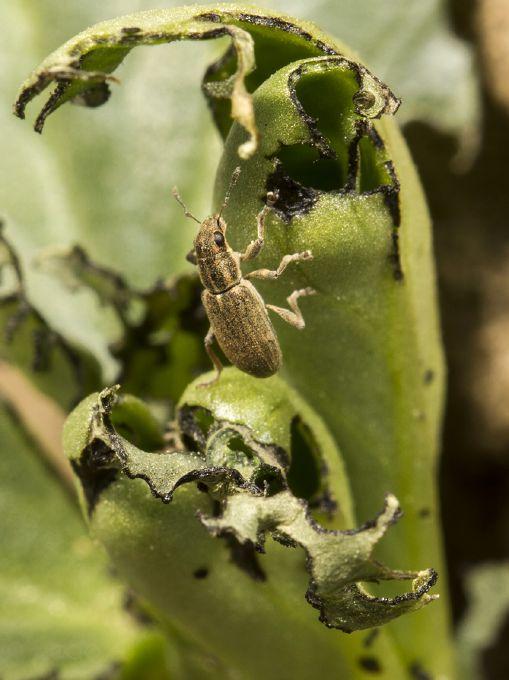
CEREAL LEAF BEETLE SPREADS
The pest is on the move – and so is one of its enemies
PG. 18
A GROWING CONCERN
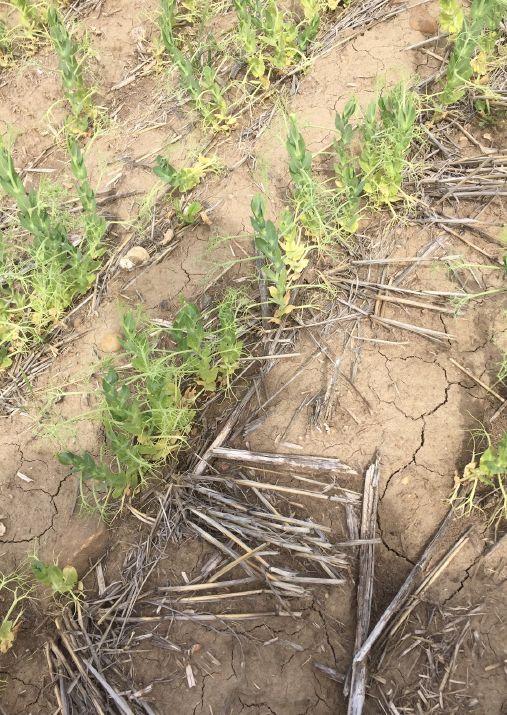
Pea and lentil crops are under threat from Aphanomyces
PG. 32
There’s nothing quite like knowing the worst weeds in your wheat fields have met with a fitting end. Following an application of Luxxur™ herbicide, you can have peace of mind that your wild oats and toughest broadleaf perennials have gotten exactly what they deserve.
SPRAY WITH CONFIDENCE.
TOP CROP
MANAGER
6 | What may bug you in 2017 Insect update and forecast for the year ahead.
By Bruce Barker
28 | Keeping an eye on fababean insect pests
What’s known and what’s not. By
Bruce Barker
32 | Aphanomyces root rot expanding across Western Canada
Aphanomyces euteiches is a serious soilborne pathogen in pea and lentils. By
Donna Fleury
PGRs on malting barley
Carolyn King
Enhancing efficient use of nitrogen fertilizer
Ross H. McKenzie, PhD, P. Ag.
STORMS TO SLAM WESTERN CANADA WITH RAIN, SNOW
The active weather pattern that has persisted across Western Canada throughout much of the winter will continue to deliver rain and snow to the region into the spring, according to reports from AccuWeather. www.TopCropManager.com
Bruce Barker
BRANDI COWEN | EDITOR
TOOLS OF THE FUTURE
The pace of progress can be astonishing when we slow down enough to reflect on where we’ve been, where we are, and where we’re going. Take, for instance, the rapid technological changes each of us has lived through. I have vague childhood memories of introducing my aunt to the wonders of Pac-Man on my family’s state-of-the-art Commodore 64. Fast-forward 20-odd years and I was introducing her to the much smaller, much more powerful iPad mini. Just think what I might be introducing her to in another 20 years. Our wildest imaginings will probably fall short of what two decades of innovation will accomplish.
Science, too, often seems to move at a breakneck pace. Last October, Top Crop Manager published an article exploring opportunities for researchers to use the CRISPR-Cas9 gene editing system to accelerate plant breeding (see “CRISPR-Cas9: A promising tool for plant breeding” in our Western edition). Just a few short months later, I found myself reading up on a related advancement – one that could have important implications for plant breeders.
CRISPR-Cas9 originally evolved as an immune system to protect bacteria from viral infections. In recent years, scientists discovered they could also use it to target and edit DNA, removing the genes responsible for various traits in an organism’s genetic code or adding genetic material from another organism to introduce new traits. Once the edits have achieved the desired results, researchers can remove the foreign genes, leaving them with a plant that’s not considered transgenic.
Though CRISPR-Cas9 shows promise, it’s not a perfect system for gene editing. The technique can be imprecise, leading to accidental edits in addition to the planned ones. That’s why researchers at the University of California San Francisco (UCSF) were excited to identify antiCRISPR proteins that can deactivate CRISPR-Cas9.
The team studied almost 300 strains of Listeria bacteria and found three per cent showed proof of so-called self-targeting – strains in which a virus made its way through the bacteria’s immune system to insert its genes into the bacteria’s DNA. In order to do so, the team reasoned, these viruses must possess some sort of anti-CRISPR trait.
“Cas9 isn’t very smart,” said Joseph Bondy-Denomy, a UCSF Sandler Faculty Fellow in the department of microbiology and immunology, in a press release. “It’s not able to avoid cutting the bacterium’s own DNA if it is programmed to do so. So we looked for strains of bacteria where the CRISPR-Cas9 system ought to be targeting its own genome. The fact that the cells do not self-destruct was a clue that the whole CRISPR system was inactivated.”
The team located four anti-CRISPR proteins that interfered with the Cas9 protein’s activity in Listeria. Further research found two of those proteins – AcrllA2 and AcrllA4 – can also interfere with the ability of SpyCas9 (the protein responsible for DNA clipping) to target genes in other bacteria and even in engineered human cells. This points to both proteins as effective inhibitors of CRISPR-Cas 9 editing.
“Researchers and the public are reasonably concerned about CRISPR being so powerful that it potentially gets put to dangerous uses. These inhibitors provide a mechanism to block nefarious or out-of-control CRISPR applications,” Bondy-Denomy said. The discovery of these anti-CRISPR proteins also opens up new avenues of research, including a search for more effective CRISPR-deactivating proteins.
Whatever the future holds for CRISPR-Cas9 and other plant breeding tools yet to be imagined, you can be sure we’ll explore it in the pages of Top Crop Manager
PESTS AND DISEASES WHAT MAY BUG YOU IN 2017
Insect update and forecast for the year ahead.
by Bruce Barker
Adry spring hindered crop growth and gave a leg up to early season insects like cutworms and flea beetles in some areas of the Prairies in 2016. Mid-season growing conditions favoured wheat midge.
Pests of all crops
Scott Hartley, provincial insect specialist with the Saskatchewan Ministry of Agriculture says cutworms became the main insect of concern in the last two weeks of May, with reports across Saskatchewan in most crops, including pea, lentil, wheat, oats, barley and canola. Due to favourable climatic conditions, cutworms developed faster than in previous, cooler springs. Damage was so extensive in some situations that crops were re-seeded.
In Manitoba and Alberta, cutworms were also problematic and continued to be at economic levels in many areas. Spraying and reseeding due to cutworm damage was reported in some areas across the Prairies.
“Get out and check your fields for cutworm. You have to scout for them,” says Scott Meers, provincial entomologist with Alberta Agriculture and Forestry.
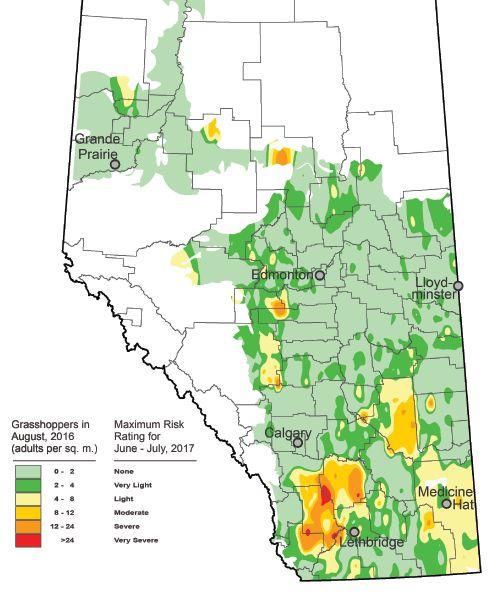
Grasshoppers were generally a minor concern across the Prairies in 2016. However, the dry spring that persisted in some areas has set up the potential for localized outbreaks in 2017. The 2017 grasshopper forecast map for Alberta shows areas west of Lethbridge have the highest risk, and Meers says if the spring is dry in these areas, growers should be scouting fields.
The Saskatchewan and Manitoba 2017 grasshopper forecast maps show none to very light risk across most of the two provinces. The Alberta grasshopper forecast also calls for no risk to very light risk across most of the province.
John Gavloski, an entomologist with Manitoba Agriculture, says aphids started to appear on cereal crops in Manitoba in late-May and became quite noticeable in some fields as the season progressed, but few insecticides were applied. “High levels of natural enemies of aphids were noted in some fields,” he says.
Hartley says reports of aphids started in early to mid-July, first in lentil crops and soon followed by pea, wheat and canaryseed. Initially most reports were a result of regular field scouting and aphid numbers were not at economic threshold levels.
Canola pests
Flea beetle damage was low to moderate across the Prairies, as the
use of seed treatments continues to be commonplace. Early seeded canola was more likely to have damage in 2016, as the crop grew slowly during the dry spring. In some cases, foliar insecticide application was required.
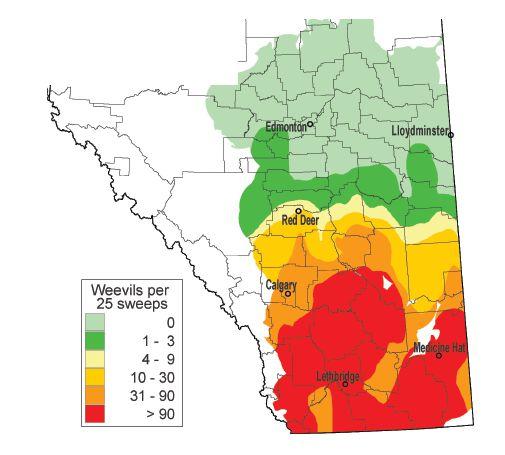
In southern Alberta, Meers says cabbage seedpod weevil is old news – and a regular occurrence. However, the pest continues to move northward. The 2016 Alberta survey now shows the pest has expanded beyond Red Deer to areas south of Edmonton.
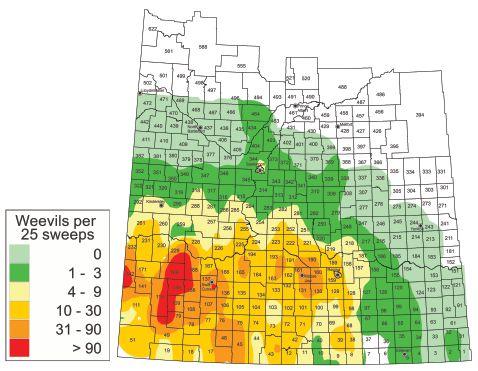
In Saskatchewan, Hartley says distribution of the cabbage seedpod weevil now includes most of southern Saskatchewan to near the Manitoba border and north to Kindersley and Outlook in the west.
“If your field is the first to flower in an area with cabbage seedpod weevil, it has the highest risk,” Meers says. “If you farm south of Red Deer, scout as your canola comes into flower. It is easy to manage: scout, sweep and spray if above economic thresholds.”
Populations of bertha armyworm were generally low and
Alberta Grasshopper Forecast for 2017
Tough broadleaves and flushing grassy weeds have met their match. No burndown product is more ruthless against problem weeds in spring wheat than INFERNO® DUO. Two active ingredients working together with glyphosate get hard-to-kill weeds like dandelion, hawk’s beard, foxtail barley and Roundup Ready® canola, while giving you longer lasting residual control of grassy weeds like green foxtail and up to two weeks for wild oats.
INFERNO DUO. It takes burndown to the next level.
uneconomical across the Prairies, with a few exceptions in the central part of Saskatchewan. All three provinces monitor the emergence of moths of bertha armyworm with pheromone-baited traps to provide a heads up if populations are building.
“This is a good system. It gives two to three weeks warning to get the word out and get insecticide and applicators lined up,” Meers says.
While swede midge has been identified in all three provinces, it has not reached economically damaging levels. Gavloski and Meers say no swede midge were captured in pheromone traps in 2016. In Saskatchewan, Agriculture and Agri-Food Canada (AAFC) Saskatoon reported swede midge emergence was about six to seven weeks earlier than in previous years due to higher temperatures in the spring. AAFC research continues on this pest to determine biology and potential management options. There were no reports of significant infestations in 2016.
High levels of lygus bug in canola were reported from the eastern, Interlake and central regions of Manitoba.
Cereal pests
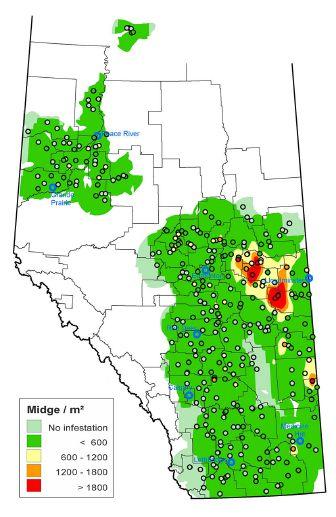
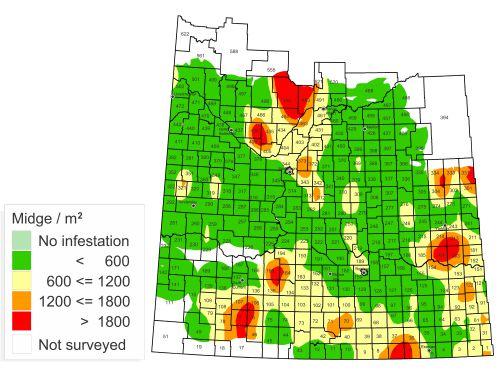
Humid conditions favoured wheat midge in eastern Saskatchewan, with very high numbers in many fields in 2016. The pest was not a concern in Alberta and Manitoba. For 2017, forecasts based on larval
cocoons collected in fall soil samples in Alberta and Saskatchewan indicate a continued high risk of the pest in some areas. The wheat midge forecast maps show high risk where more than 1,200 larvae per square metre are indicated; infestations over 600 may still result in significant damage and yield loss if environmental conditions are favourable. Midge-tolerant varieties are available in red spring, durum and extra strong wheat classes and are used on an estimated onethird of Canada Western Red Spring wheat in Saskatchewan.
The wheat stem sawfly has had low populations since 2010, but base populations exist in a few locations in Alberta. The 2016 Alberta wheat stem sawfly survey shows a few hot spots, with the potential to develop into a problem in 2017 under dry spring conditions, including north of Lethbridge and north of Vauxhall.
Gavloski says armyworms were a concern and resulted in insecticide applications in some small grain fields in central and eastern Manitoba. Most of the insecticide applications for armyworms occurred in July. Some head clipping was noted in some fields in late July. There has been some control of armyworms in small grains in Manitoba every year since 2010.
Pulse pests
In Alberta, Meers says evidence of pea leaf weevil feeding in 2016
Alberta Cabbage Seedpod Weevil 2016 Survey
Saskatchewan Cabbage Seedpod Weevil 2016 Survey
Alberta Wheat Midge Forecast 2017
Saskatchewan Wheat Midge Forecast 2017
Wind speed, pressure gauge, optimal nozzle settings, check. All systems are go and it’s time to take down the toughest weeds in your wheat field, whether they’re resistant or not.
With three different modes of action in a single solution, Velocity m3 herbicide provides you with exceptional activity on over 29 different tough-to-control grass and broadleaf weeds.
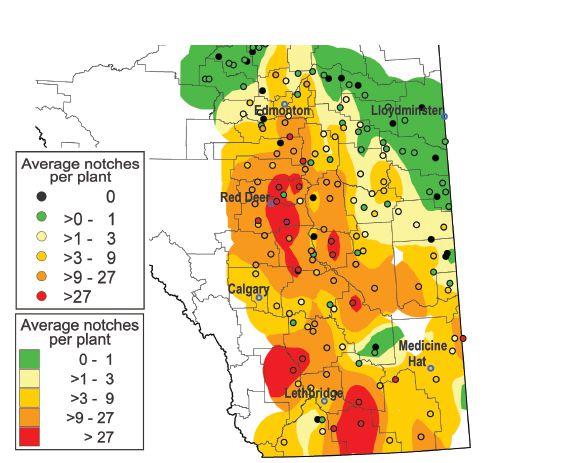
was present in a larger area than in 2015, expanding dramatically northward into central Alberta. Pea leaf weevil is now established from southern Alberta through west-central Alberta, as far north as Sturgeon County, north of Edmonton. In 2016, the most severe damage was in areas southeast and northwest of Lethbridge and in central Alberta between Highway 2 and Highway 21, from Calgary to north of Lacombe. For any producers south of Highway 9 and along Highway 2 up to Edmonton, there is a risk of damaging levels of pea leaf weevil in 2017, Meers warns.
“While this is not a strict forecast, experience has shown us that activity levels greater than nine notches per plant is sufficient to cause significant damage if conditions are favourable in the spring of 2017. This covers a large area of southern and west-central Alberta,” he says.
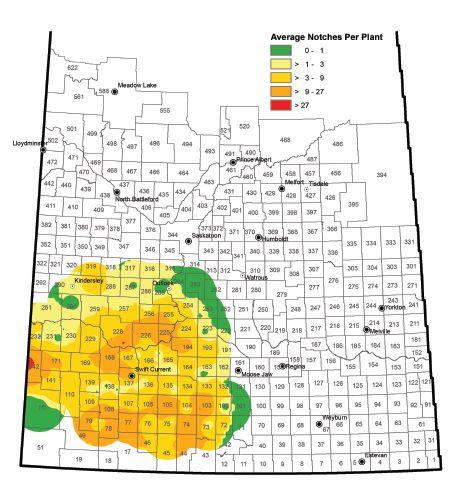
In Saskatchewan’s 2016 pea leaf weevil survey, and in additional reports, the pest has a much wider distribution to the east and north than previously known. The typical damage (notching) to the leaves of pea plants was noted southeast of Moose Jaw. Pea fields in the Outlook area had light levels of feeding, but fababean plots at the irrigation centre showed potentially economic levels of damage. There were also pea and fababean fields with high levels of feeding near
Alberta Pea Leaf Weevil 2016
Kyle and Davidson, and at fields around Saskatoon.
“Foliar application provides no yield benefit. If you are concerned, use a seed treatment and seed into warm soils so that the pea crop comes up quickly. The seed treatment provides only a certain window of protection, so if you are seeding early into cold soils, the clock is ticking and you may lose some of the insecticide control for when you really need it,” Meers says.
Pea aphid levels were above economic threshold in many Manitoba fields, and some pea fields in all areas were sprayed with insecticides. Pea aphids were also an issue in southern Alberta on lentil crops.
Forage pests
Feeding injury and high levels of alfalfa weevil larvae were common in many Manitoba alfalfa fields, Gavloski says. Some alfalfa for hay was cut early due to the presence of alfalfa weevil. Insecticides were applied in some fields and there were some reports they did not provide good control of alfalfa weevil. Meers says the pest is increasing in range and severity in southern Alberta, and resistance to the pyrethroid insecticide class has been reported at Brooks, Alta.
Saskatchewan Pea Leaf Weevil 2016
ADVANCING BIOHERBICIDE RESEARCH FOR AGRICULTURE CROPS
Phoma macrostoma is already registered for turf.
by Donna Fleury
Just over 20 years ago, researchers initiated the first bioherbicide research and development program in the country at Agriculture and Agri-Food Canada (AAFC) in Saskatoon.
Led by Karen Bailey (who recently retired), the program has made significant advancements in bioherbicide development for horticulture and turf crops, and more recently, promising solutions for agriculture. Bioherbicide product development is a welcome addition to the integrated weed management toolbox for crop production. Biopesticides are classified as “reduced-risk” products by the Pest Management Regulatory Agency (PMRA).
First discovery
Bailey was the first to discover a local fungus that naturally infects Canada thistle, causing plants to die, which set in motion the research and development program for a potential bioherbicide for
horticulture and turf vegetation. By the early 2000s Bailey and her team had identified and patented the most effective isolate of Phoma macrostoma. Since then, they have been working with industry partners to isolate and produce Phoma and to collect the multiple years of data on multiple crops required by regulators. In 2011 and 2012, P. macrostoma was registered for broadleaf weed control in turf grass in Canada and the United States, respectively. P. macrostoma controls Canada thistle and other broadleaf weeds such as dandelion, clover, wild mustard and others.
Russell Hynes, a research scientist at AAFC in Saskatoon, began working with Bailey in 2007, and for the past five years has been leading the efforts to help advance the research and development work in agriculture crops. “The alfalfa seed growers TOP: Wild mustard and wheat following the application of the bioherbicide Phoma.
TAKE CONTROL.
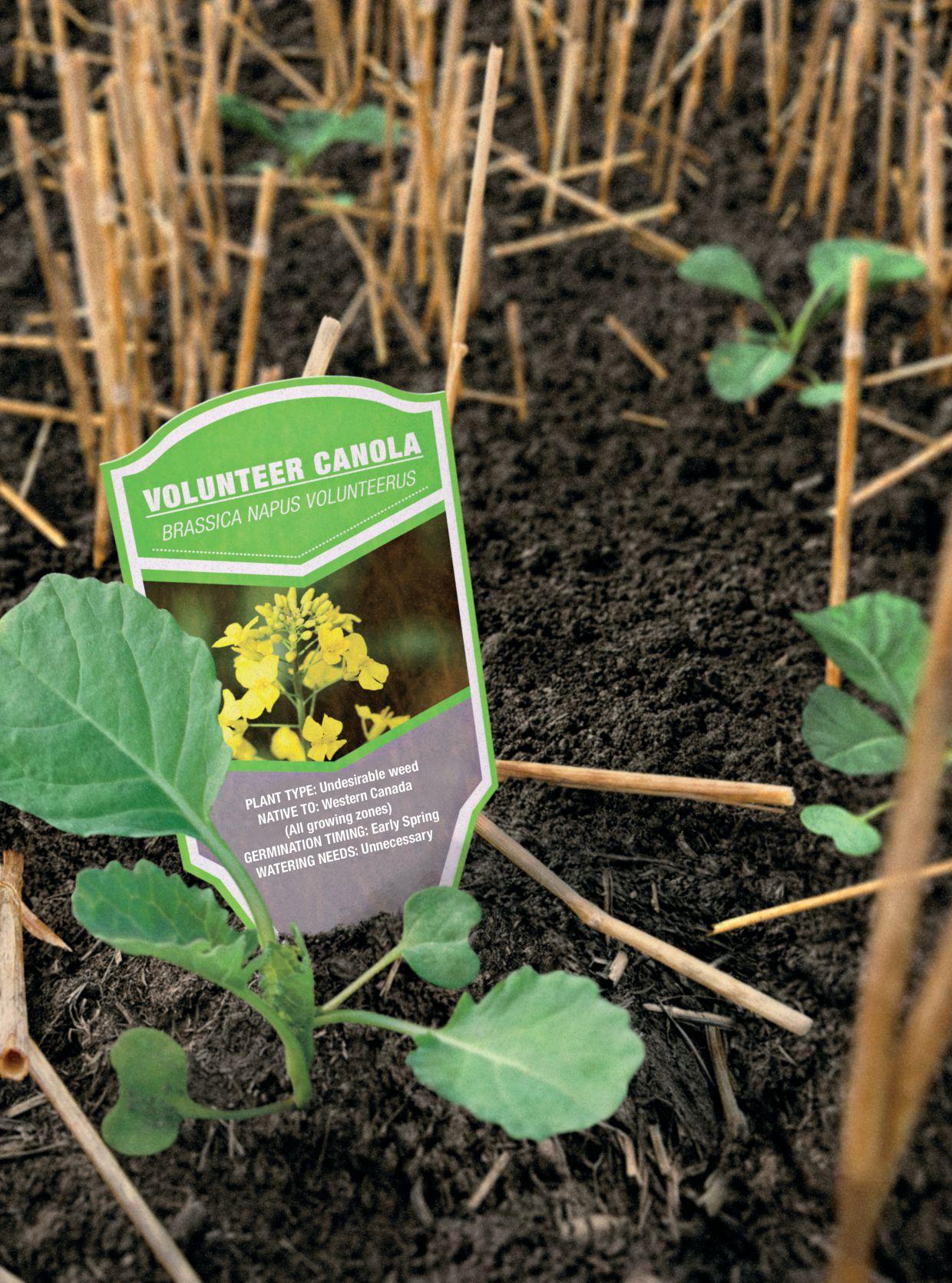
You’ve identified volunteer canola as a weed. Now it’s time to deal with it. For control of all volunteer canola, tank mix Pardner® herbicide with your pre-season application of glyphosate. Make Pardner your first choice.
JOIN THE UNDERGROUND REVOLUTION
Take a stand against resistance.
Arm yourself with the residual broadleaf control of Authority – a Group 14 pre-emergent herbicide. It’s your secret weapon for cleaner fields and higher yields.
in Saskatchewan and Alberta funded some of the first agriculture field crop research to see if Phoma could be used to control Canada thistle and wild mustard,” Hynes explains. “Regrettably, the research showed that in the first year of establishment alfalfa was sensitive to the product. However, in year two and in subsequent years, alfalfa proved to be quite tolerant of Phoma applications, and provided good control of Canada thistle, wild mustard and other broadleaved weeds. Early and mid-season applications were more effective in reducing weed numbers and biomass than late season applications.”
Hynes began working on Phoma broadleaf control with other
The results from the first year indicated that Phoma was very successful for cereals, corn and potatoes, showing no effects from application.
field crops in Western Canada, and after achieving proof of concept of good activity, additional funding from the Western Grains Research Foundation helped expand the program to include studies on crop tolerance and residual effects. Greenhouse experiments provided some background information, but researchers needed to find out what happened in the field.
“In 2015, we started new field experiments both under dry land conditions at the Saskatoon Research and Development Centre and replicated under irrigation at the Canada-Saskatchewan Irrigation Diversification Centre in Outlook,” Hynes says. “Various field crops … and horticulture crops were used in the trials, including wheat, barley, peas, lentils, soybeans, canola, flax, potato and corn. Two varieties of each crop were seeded into replicated research plots at both locations. Treatments included two doses of Phoma applied as a dry granular formulation at seeding to control weeds and monitor crop tolerance.”
The results from the first year indicated Phoma was very successful for cereals, corn and potatoes, showing no effects from application. However, there was a lack of tolerance by pulse and oilseed crops, with peas, lentils, flax and canola being sensitive to the treatment. The results provided a good indication of which western Canadian field crops Phoma could be used on. In 2016, the sensitive crops were grown on the previous plots to determine if there were any residual effects on crop tolerance. The results did not show any residual effects on any of the crops. Hynes adds they were very pleased with the results because they mean growers can follow their traditional crop rotations, using Phoma on cereals for weed control, without concerns of any impacts or any limitations on subsequent crops.
Recent research shows promise
In 2016, researchers also compared granular treatments of Phoma at different application timings, including at seeding and in-crop. Plots of wheat and barley were seeded together with wild mustard and other weeds, and initial results showed very good control at both timings. “We are also working on developing different formulations for agriculture use,” Hynes explains. “The formulation for turf grass applications is in granular form and will be economical for the
company who is going to advance this product into the market for turf. However, formulation development for agriculture use has to be considerably less expensive, so we are looking at different scenarios about how to control weeds with both spray and granular applications. In 2017, the first experiments with a spray application will be trialed, at both an early stage and after weed emergence, which may be more economical.”
Researchers continue to advance their understanding of exactly how Phoma moves into the plants and the complex mechanisms of control. Hynes and his colleagues published the results of an indepth study in 2015, outlining more precise details of how Phoma metabolites are taken up by the plant roots, causing phytotoxicity to the plant and providing control. The study showed the Phoma micro-organism produces secondary metabolites (macrocidins) that are taken up by the roots and moved through the plant into the young growing leaves. The metabolites interfere with the photosynthesis of the plant, preventing it from producing chlorophyll, eventually inducing chlorosis, bleaching and plant death.
Researchers also realized higher levels of the metabolites in P. macrostoma formulations correlated with improved weed control, which also points toward new strategies for developing a bioherbicide that would be more effective at lower doses, and therefore more cost-efficient.
Hynes explains the principles of a Phoma treatment follow the exact same process growers use when inoculating pulses with rhizobium micro-organisms.
“The Phoma micro-organisms are applied in a large dose, upwards of 1,000 times or more than what would naturally occur, either as a granular or a spray application, inundating the target broadleaf weeds and providing control. Studies measuring Phoma populations showed that the fungus was detected in soil at one, two and four months after application, but was not detected after 12 months. It also was not competitive with other naturally-occurring soil micro-organisms and fauna, all of which makes the use as a bioherbicide very attractive.”
After years of research and development efforts, Hynes says to expect an exciting announcement early in 2017 around the turf registration and products. As for agriculture, the research work on crop tolerance, formulations, timing and other aspects will continue in 2017 and over the next few years. “We will continue our work with cereals, potatoes and other crops with good crop tolerance to Phoma. We will also be focusing on spray application formulations, which we expect will be more cost-effective than granular formulations. Although granular formulations may be suitable for smaller areas or weed patches in agriculture operations, spray applications will likely be more cost effective for larger fields.”
The regulatory approval steps will take another few years, so growers will have to wait a bit longer before a commercial Phoma bioherbicide product is registered for use on agriculture crops. But when it is registered, it will be a welcome addition for integrated weed management programs.
Mix what you want, seed what you want with the freedom of Aim.
Get a more complete burn down that lets you seed almost anything. Tank mix Aim with your choice of products, so you can use what you’re used to with superior results and no fear of cropping restrictions.
EFFECTS OF PHOSPHORUS ON FABABEAN ESTABLISHMENT AND YIELD
Research shows fababeans are responsive to high rates of P fertilizer.
by Donna Fleury
Fababeans adapt well to cooler, wetter regions in Saskatchewan, and are proving to be a good option for growers who have been dealing with excess moisture and are looking for an alternative pulse option. Fababeans have the ability to withstand prolonged wet periods much better than field peas and lentils, and also have a high yield potential and resistance to root diseases. However, fababeans are also large users of phosphorus (P), something that needs to be considered in long-term nutrient management plans.
“Although fababeans are known to be relatively large users of P fertilizer, current recommendations for seed-placed P are still relatively conservative,” says Chris Holzapfel, research manager at the Indian Head Agricultural Research Foundation (IHARF) in Indian Head, Sask. “Fababean is generally considered to be sensitive to seed-placed fertilizer and therefore it is not recommended that more than 22 pounds per acre [lbs/ac], or 25 kilograms per
hectare (kg/ha), of phosphorous pentoxide, P2O5, be applied when using narrow openers as most modern no-till drills do. Therefore, we set up two similar demonstration trials in 2015 and 2016 to compare the application of various rates of P fertilizer on fababean establishment and seed yield for both side-banded and seedrow placement. In addition to measuring the yield response to P fertilization, we also wanted to assess the sensitivity of fababean to seed-placed P fertilizer when seeded into clay soils using a hoe drill with low seedbed utilization.”
In the demonstration trials, Snowbird fababeans were directly seeded into spring wheat stubble using a SeedMaster hoe drill on a 12-inch spacing. The replicated trials included two placement methods, seed-placed and side-banded, at various rates of monoammonium phosphate (11-52-0) and an unfertilized control. In 2016
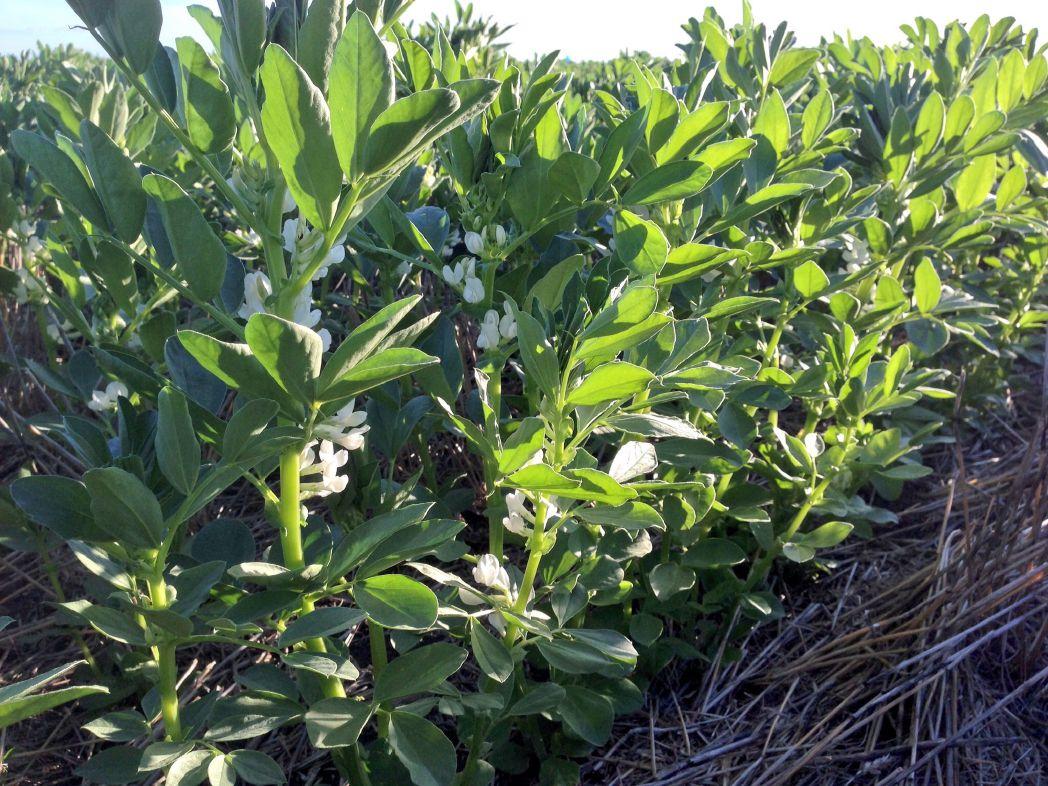
ABOVE: Fababean in flower in field plots at the end of June 2016.
the trials compared P rates of zero, 18, 36, 53 and 71 lb/ac of P2O5, with similar protocols in 2015. The effects on emergence and seed yield under the different placement methods and rates were compared.
“The project demonstrated that fababeans are responsive to high rates of P fertilizer in low P soils, and even respond to rates that are higher than those typically used by most producers,” Holzapfel says. “A relatively strong yield response to high rates of P fertilizer was observed in both years. In 2016, the highest yields occurred at the highest P application rate of 71 lb/ ac of P2O5 (80 kg/ha), where the observed yields were 15 per cent higher than the control plots. There was little impact on yield at lower P rates. In 2015, fababean yields were increased by 20 per cent at 45 lb/ac of P2O5 (50 kg/ha) but there was little impact on yield at the lower rate of 22 lb/ac P2O5 (25 kg/ha). Phosphorus effects on seed size were measured but were small and inconsistent over the two years of the project.”
Overall, the project did not demonstrate any impact on emergence or seedling injury regardless of fertilizer placement method or rate. There was also no evidence of seedling damage in any of the trials, even at the high rates of seed-placed fertilizer under the field conditions at Indian Head.
“Although we did not see any seedling toxicity at higher seed-placed P rates in fababean or other sensitive crops like canola and soybean in similar trials over the past few years, extreme caution is recommended if considering seed-placing fertilizer at rates exceeding the traditionally recommended limits,” Holzapfel says. “Potential seedling injury is a complex issue that can potentially be affected by many different factors including opener type (i.e. hoe versus disc), seedbed utilization, soil texture, pH, seeding depth, crop rotation/tillage system, and of course, weather.”
The project confirms that fababeans are high users of P fertilizer, and like many other crops, over 75 per cent of the P2O5 taken up by the crop is removed in the grain at harvest. For fababean that translates into 1.1 to 1.3 lbs/ac of P2O5 removed per bushel of grain. In 2016, the average fababean yield was 63 bushels per acre (bu/ac) or 4,213 kg/ha, and the estimated P removal was 69 to 84 lb/ac (77 to 94 kg/ha). Yields were slightly lower in 2015 at 50 bu/ac, but another trial at Indian
“The project demonstrated that fababeans are responsive to high rates of P fertilizer in low P soils, and even respond to rates that are higher than those typically used by most producers.”
Head in 2014 produced yields of 90 bu/ac, which translates into an estimated P removal of 99 to 120 lbs/ac of P2O5
“Therefore, growers achieving high yields with fababeans need to be aware that they are also removing large amounts of P from their fields,” Holzapfel says. “However, at these high removal rates, it may not be practical to match removal or build soil P with synthetic fertilizers in the fababean crop year.”
Growers need to develop a long-term strategy for managing P requirements and removal rates to ensure optimal yields and maintaining soil health. There are many different factors and individual logistics that will play a role in fertilizer management decisions.
Holzapfel adds, “There are also practical considerations of moving from high
fertilizer application rates in our demonstration plot trials and the implications of implementing these strategies using large field-scale seeding equipment and air delivery systems. And most importantly, growers must use extreme caution if considering seed-placing fertilizer at rates exceeding the traditionally recommended limits.
“While the results we have seen to date are certainly compelling, there are simply too many variables to consider before making any broad recommendations regarding seed safety. With heavy clay soils, moderately high organic matter and generally good spring moisture conditions, the risk of seedling injury has likely been lower at our location at Indian Head than it would be on fields with coarser soils or less favourable seeding conditions.”
Fit For Any Field
When it comes to farm equipment, one size doesn’t fit all. That’s why we’ve developed such a full line of Field Tested Tough™ equipment and attachments. No matter where, what or how you farm, we’ll have the equipment to address your unique challenges, while standing up to the toughest conditions.
Our Durable Versatile Land Rollers Can Meet Any Demand.
Trouble Managing Field Debris?
Use to reduce debris uptake, increase seed-to-soil contact or manage residue. 15- to 91-foot working widths with 36- and 42-inch diameter rollers.
Convenient hydraulic folding with two- and three-section SuperRoller models.
Tillage | Sprayers & Applicators | Land Rollers | Rock Pickers | Mounted Attachments
MAPPING THE CEREAL LEAF BEETLE
Staying one step ahead of the cereal leaf beetle.
by Julienne Isaacs
When the cereal leaf beetle (CLB) was first spotted in Alberta in 2005, the then-regulated pest was met with consternation by western Canadian producers. CLB can cause significant damage to all crops in the grass family, even forages, and yield losses in affected areas of the United States have reached 50 per cent.
But close on the heels of the discovery of CLB in Alberta came a second, mitigating finding: CLB’s chief natural enemy, a tiny parasitoid wasp called Tetrastichus julis, had followed it to the province.
T. julis works in the brutally effective fashion of all parasitoid wasps, laying eggs inside the host’s larvae that consume them from within until the larvae die.
Héctor A. Cárcamo, an insect pest management researcher with Agriculture and Agri-Food Canada (AAFC) based in Lethbridge, Alta., is head of AAFC’s T. julis biological control program. His team rears populations of the wasp and sends them to any areas in Western Canada that experience problems with CLB.
So far, T. julis populations have been steadily increasing. About nine per cent of CLB larvae in the Lethbridge area contained the parasitoid in initial surveys. Now that figure is higher than 40 per cent, Cárcamo says.
The wasp has generally followed the spread of CLB into some other areas of Western Canada as well. To make sure it gets to all of them, Cárcamo’s lab has sent supplementary wasps to Beaver Lodge, Alta., several locations in Saskatchewan and the Treherne and Swan River areas in Manitoba.
But though CLB is under control for the time being, Cárcamo’s lab has not slowed its research efforts.
Last year, Cárcamo’s then-graduate student, Swaroop Kher, published a study in Environmental Entomology looking at the spatiotemporal dynamics of interactions between CLB and T. julis, and the influence of plant vigour traits in their density. In other words, they asked whether good plant vigour means higher levels of colonization of the pest and its parasitoid.
Vigour as a pest control tool
Kher’s study was performed in three locations near Taber, Alta., in winter wheat fields organized into 100-square-metre grids.
Kher sampled once or twice per week for about six weeks and catalogued plant vigour expressed in crop growth, plant density, basal stem diameter, number of leaves per plant and height. The team sent samples to a lab in British Columbia for nutrient analysis.
“Our hypothesis was that the CLB populations colonize only
those areas in the field that provide more nutrition to the insect,” says Kher, now a pest prediction-modelling agrologist for Alberta Agriculture and Forestry. “We were trying to see how the plant vigour is distributed in the field and which areas were colonized, so if all those parameters were at the higher side, the patch would be called vigorous.”
What they found was what they expected: areas with good plant vigour were correlated with high beetle density; parasitoid populations were also high in those areas.
However, areas with good vigour were not vulnerable as a result. In fact, areas with good overall plant vigour that were attacked by CLB tended to recover quickly, while areas with patchy plant vigour were at greater risk of crop damage.
“Fields that are consistent are less at risk, because just part of the field will be attacked,” Kher explains. “If you have a field that is vigorous, the plants will compensate for the damage. If you have uneven vigour, the weak plants will die and the vigorous plants will
PHOTOS
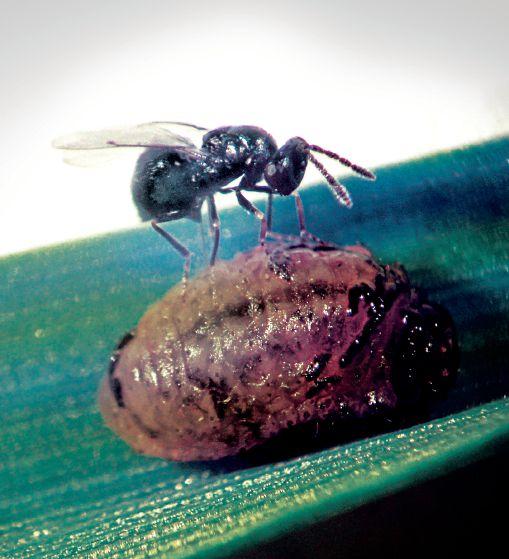
A T. julis adult female parasitoid laying eggs in a cereal leaf beetle larva.
be damaged, so there is nothing left to compensate for the damage.”
Kher’s recommendation to producers based on these results is to maintain good plant vigour and avoid chemical interventions, as T. julis is adequately managing CLB populations in most areas.
Landscape factors
Cárcamo’s lab is also partnering with researchers at the University of Manitoba to investigate the link between landscape features and CLB and T. julis populations. The project is funded by AAFC’s Pest Management Centre, which seeks alternatives to reduce pesticide use in Canadian cropping systems.
According to Alejandro Costamagna, an assistant professor with the University of Manitoba’s department of entomology, the project is investigating how the various types of habitats around
cereal fields in Alberta impact the abundance of CLB and parasitism of T. julis.
Costamagna’s graduate student, Arash Kheirodin, who collected data from more than 70 sites near Lethbridge in 2014 and 2015, is leading the project. Kheirodin will look at land cover types including nearby crops, natural habitats, riparian areas and grassland/ pastureland, and calculate habitat diversity using diversity indices.
“We haven’t exhausted all the important factors to test yet. Once we have all the data we will be able to see which landscape variables are more explanatory,” Costamagna says.
“The common wisdom has been that if you release T. julis in very dry areas, the parasitoid doesn’t do well, but no data has been published yet to suggest that,” he explains. “Once we have the data we can be more strategic about release. That’s the ultimate goal.”
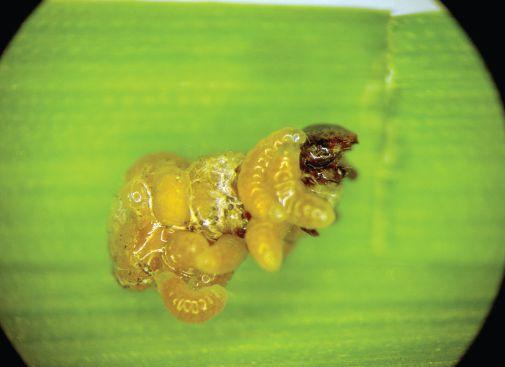
A dead CLB larva with several immature stages (larvae) of T. julis visible on the cadaver.
A CLB larva feeding on a healthy wheat plant. The insect can cause significant damage to all crops in the grass family.
MODERATE FLAX RESPONSE TO NITROGEN
Pushing nitrogen rates seldom provides an economic yield response.
by Bruce Barker
There’s good news for flax producers: if your soil has reasonable nitrogen (N) fertility, you can save on fertilizer costs because pushing the N rate seldom results in increased yield. The bad news is that flax, unlike canola or cereals, is not very responsive to N application, so yields are hard to push higher. Researchers are trying to find the compromise where N application rates provide optimum flax yield.
“What people mostly think with flax is that it doesn’t respond well to high rates of nitrogen fertilizer,” says Chris Holzapfel, research manager with the Indian Head Agricultural Research Foundation (IHARF) in Indian Head, Sask.
Flax requires relatively high N fertility. Generally, flax takes up 2.83 pounds of N per bushel of production, of which 2.23 pounds is removed with the seed at harvest. A 35 bushel per acre crop therefore requires approximately 100 pounds of N per acre sourced from both soil and fertilizer nutrients.
Flax is also very sensitive to seed-placed fertilizer. The Flax Council of Canada recommends N should not be placed directly
with the seed, and some provincial guidelines also recommend that no phosphate fertilizer be seed-placed.
Holzapfel conducted several Agriculture Demonstration of Practices and Technologies (ADOPT) trials in 2013 and 2014, sponsored by the Saskatchewan Flax Development Commission and looking at multiple rates of N, phosphorus (P), potassium (K) and sulphur (S). Nitrogen rates were zero, 45 and 90 kilograms per hectare – or kg/ha – (kg/ha x 0.89 = pounds per acre, or lbs/ac). Residual soil fertility was relatively low at the sites. In these demonstration trials, the overall response to N fertilizer was highly significant, and in both years the 90 kg N rate resulted in higher flax yields than the 45 kg N rate. However, Holzapfel says that because only two rates were demonstrated, it is impossible to determine whether yields would have been maximized at an intermediate rate between 45 and
Continued on page 39
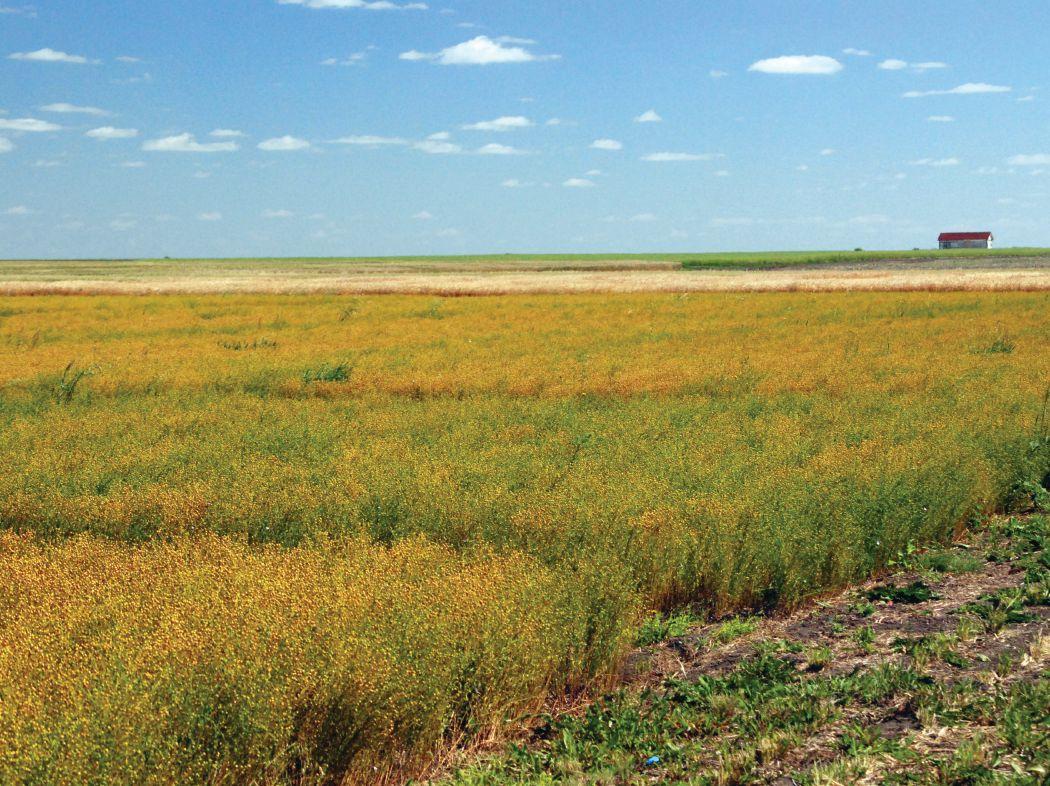
ABOVE: Research has found flax has a moderate response to nitrogen fertilizer.
Your mastery over sclerotinia has amazed everyone, but, truth be told, your assistant had a lot to do with it. Get the trusted protection of Proline ® fungicide and proactively protect your profits!
Proline provides a 4.1% yield increase over the tested competitors. *
PGRS ON MALTING BARLEY
Do they help improve yields and quality?
by Carolyn King
Most of the barley varieties that we grow in Western Canada tend to be malt varieties; growers are hoping to get the extra premium if it makes malting grade. But only about 20 per cent of the acres sown to malting barley each year actually make malting grade,” says John O’Donovan, a semi-retired research scientist with Agriculture and Agri-Food Canada (AAFC).
O’Donovan has been investigating various management practices to find options that would improve the chances of achieving malting grade. As part of that work, he is assessing the benefits and risks associated with applying plant growth regulators (PGRs) on malting barley.
PGRs are used to shorten and stiffen plant stems as a way to reduce lodging. “Lodging can be a serious problem in cereal crops. It is usually promoted by an abundant supply of plant nutrients, especially nitrogen, and by heavy rains, strong winds and so on. Some studies have shown that barley can be a bit more susceptible to lodging than wheat, and yield losses in certain situations can be very high,” he explains.
“If we could reduce the incidence of lodging, then overall yield and quality of malting barley may improve, and acceptability for malting grade could increase as well.”
In 2013, the study’s first year, the trials compared two PGRs: ethephon (Ethrel from Bayer CropScience) and chlormequat-chloride (Manipulator from Engage Agro). For 2014 to 2016, a third PGR was added: trinexapac-ethyl (from Syngenta, marketed as Palisade in the United States). “Ethephon achieves height reduction by releasing ethylene, whereas the other two PGRs block the synthesis of a plant hormone called gibberellic acid, which is involved in stem elongation,” O’Donovan says.
No PGRs are currently registered for use on barley in Canada, so growers can’t apply any of these products to their barley crops at this time. However, PGRs are used on barley in various other countries. “Plant growth regulators have been used for many years in Europe. They are routinely used, maybe one to two applications a year, in cereal crops,” O’Donovan says. He suspects one of the reasons that PGR use in cereals has been slow to take off in Canada could be that the crops tend to grow a bit faster here, so staging is especially crucial for PGR applications.
O’Donovan’s four-year study took place at five sites: Lacombe and Lethbridge in Alberta, Indian Head and Scott in Saskatchewan, and Brandon in Manitoba. The barley variety grown in the study was CDC Copeland, a high-yielding malt variety with good lodging resistance. This variety has been increasing in popularity in recent years;
ABOVE: John O’Donovan is leading a multi-site study to evaluate the effects of plant growth regulators on malting barley yields and quality.
the proportion of the total malting barley acres in Western Canada seeded to CDC Copeland rose to 44.7 per cent in 2016, up from 27.4 per cent in 2012.
Marta Izydorczyk at the Canadian Grain Commission is working on the study’s malting quality component. The study is funded under Growing Forward 2, with funds from Alberta Barley, Rahr Malting, the Brewing and Malting Barley Research Institute, the Western Grains Research Foundation and AAFC.
Results so far
Overall, based on three years of data with ethephon and chlormequat and two years with trinexapac, the results are variable.
“Of the three plant growth regulators, ethephon tended to reduce height and lodging more than the other two,” O’Donovan
says. “However, in some cases, ethephon tended to increase tillering. This resulted in a delay in maturity, and that’s not good from a malting barley perspective. Even more important, ethephon tended to reduce kernel plumpness, which may be a big negative since plump seed is used by the maltsters to select barley for malting grade.”
“We
saw yield increases with ethephon in four of the 14 site years, ranging from about six to 10 per cent. With chlormequat, the yield increase occurred in two of the 14 site years; we saw a yield increase of about seven to 14 per cent.”
The yield effects also varied. “For most of the site years, yield was not affected at all by PGR application. This is probably largely due to the fact that during a lot of the years we didn’t see any lodging,” he notes.
“We saw yield increases with ethephon in four of the 14 site years, ranging from about six to 10 per cent. With chlormequat, the yield increase occurred in two of the 14 site years; we saw a yield increase of about seven to 14 per cent. For the 10 sites years with trinexapac, we had a yield increase in two site years – a 13 per cent yield increase at one site and a 20 per cent increase at another,” he says.
However, O’Donovan offers a word of caution about ethephon: although it increased yield on more occasions than the other two PGRs, it also resulted in yield reductions in some cases. “We saw a five per cent yield reduction at Indian Head in 2014 and a 14 per cent reduction at Scott in 2015, so it appears to be riskier than the other two PGRs in terms of reducing yield. That might be due to the very short window of application with ethephon – it is applied at a later crop stage than the other two PGRs and the precise application timing is absolutely crucial with ethephon.”
He also notes, “Interestingly, the yield increases especially with chlormequat didn’t seem to always be related to a reduction in plant height, so there might be some stem strengthening involved there.” Also, some of the yield increases with chlormequat occurred even when lodging didn’t occur at the site.
The initial results from the malting quality analysis for the first few site years indicate that PGRs do not have any major negative effects on the malting process or malting quality (except for the reduced kernel plumpness with ethephon).
The final year for the project’s fieldwork was 2016; data analysis is not yet finished. O’Donovan says, “We’re going to hold off on making concrete conclusions or recommendations until we’ve completed the study, especially in terms of the effects on malting quality.”
However, he offers a few overall thoughts about PGRs on malting barley. “Generally speaking, PGRs are designed to mitigate lodging, so if you don’t have lodging occurring, then PGR application may not be cost-effective.”
Also, he thinks PGRs may have a better fit with wheat and feed barley than with malting barley. “With wheat and perhaps feed barley, growers are interested in applying as much nitrogen as possible to increase the yield. The more nitrogen you apply, the more likely the crop will lodge. So a PGR may come into play in situations where you want to push the yield as high as possible, but that may not be as relevant for malting barley production. Generally, to achieve malting grade, we need to keep the protein level down, so pushing the nitrogen up too high is not a good strategy.”
Other PGR studies on barley crops
O’Donovan’s project is one of several studies related to PGRs on barley in Western Canada. For instance, a project called Barley 180 assessed various advanced agronomic practices, such as plant growth regulators, fungicides, higher seeding rates and extra nitrogen (N),
and looked at the effects on yield and return on investment. The project involved side-by-side field-scale trials at various Alberta locations and ran from 2011 to 2014. It included both feed and malting varieties. The main PGR used in this study was Ethrel. Where Ethrel was applied, barley yields increased; those increases ranged from one to 18 bushels per acre (bu/ac), with an average of nine bu/ac.
Steve Larocque, an independent crop advisor and owner of Beyond Agronomy, was one of the agronomists involved in Barley 180. He says, “There is huge value in the use of PGRs in barley. Lodging is the number one factor holding us back from pushing fertility rates higher. Not only do we see yield responses outside of lodging from stem shortening, we see greater net returns from keeping the barley crop standing. High maintenance bills follow after picking up a flat barley crop – lifters, knives, guards, reels, etc. Then you factor in the time wasted going slow to pick up lodged barley. The expenses add up from lodging and PGRs offer a solution.”
Sheri Strydhorst, a research scientist at Alberta Agriculture and Forestry, led a three-year barley-PGR study completed in 2016. In this multi-site, small-plot study, Strydhorst and Laurel Perrott, a master’s student studying at the University of Alberta, looked at the effects on feed barley of various advanced agronomic practices, including Manipulator application, extra N application and foliar fungicides. One component of the study tested 64 combinations of the advanced practices on Amisk, a semi-dwarf variety with good lodging resistance. The study’s other component compared the responses of 10 different varieties to a set of standard practices versus a set of advanced practices. The results from using Manipulator on Amisk showed small but consistent yield increases, modest height decreases at some sites in some years, but no improved lodging resistance, since lodging was rarely a problem for this cultivar. The comparison of the 10 varieties showed the advanced management package resulted in both increases and decreases in height and didn’t usually improve lodging resistance. The variety was key in determining plant height and lodging.
“We certainly need tools to help improve standability of feed barley cultivars. But the PGR treatment used in this study may not be the optimum option,” Strydhorst says. “In a new collaborative study with Linda Hall at the University of Alberta, we are looking at different PGR timings, products and rates on different barley cultivars. Although we still have additional years of testing, preliminary results from the 2016 field trials suggest PGR rates, timings and products can be adjusted to improve PGR performance on barley.”
Engage Agro has been conducting some trials with Manipulator on barley. “So far, our results on barley do show an effect [on reducing plant height]. However it seems that Manipulator is not as effective on barley as it is on spring wheat,” says Tom Tregunno, product manager at Engage Agro.
He adds, “There is still a lot we need to figure out: How much does the barley variety affect the performance of the PGR? Does the application rate need to be higher? Would a split application (which is commonly done in the U.K.) increase performance?”
ENHANCING EFFICIENT USE OF NITROGEN FERTILIZER
Options for combatting N loss from volatilization, leaching and denitrification.
by Ross H. McKenzie, PhD, P. Ag.
Prairie farmers primarily use urea (46-0-0), anhydrous ammonia (82-0-0), or liquid urea-ammonium nitrate (UAN) (28-0-0) as their nitrogen (N) fertilizer sources. Nitrogen fertilizer can be lost due to volatilization, denitrification or leaching, depending on how the N is applied and the weather conditions after application.
In recent years, several different types of controlled-release N fertilizers have been developed to reduce losses by protecting or delaying the release of N. The two primary goals of these controlled-release fertilizers are to minimize N fertilizer loss and to control N release to try to better match N availability with crop uptake requirements.
Mechanisms of N loss
First, it is important to understand the mechanisms that cause N fertilizer loss. Figure 1 (above) shows the potential pathways urea fertilizer can take after application.
When urea fertilizer is broadcast applied onto the soil surface or shallow banded (less than five centimetres deep), it can be subject to significant volatilization when surface soil or air temperatures are greater than 3 to 5 C. Urease is an enzyme that occurs naturally in soil and catalyzes the breakdown of bonds in urea [CO(NH2)2] fertilizer to form carbon dioxide (CO2) and ammonia (NH3). Volatilization occurs when moisture activates the urease enzyme on or near the soil surface, converting the urea to gaseous ammonia that is lost to the atmosphere. Significant N loss to the atmosphere may occur depending on environmental conditions. UAN fertilizer, a liquid blend of urea and ammonium nitrate, is subject to the same potential volatilization losses as granular urea when sprayed or dribble banded onto the soil surface or when shallow banded.
Normally, when urea is banded or broadcast-incorporated into warm, moist soil, the urea converts to gaseous ammonia and then rapidly attaches to hydrogen (H+) ions found in water to convert to
ammonium (NH4+). Ammonium is quite stable in soil, as it is positively charged and normally will not leach.
Nitrate is the primary form of N that is taken up by cultivated crops. Typically, when urea fertilizer is banded into a warm, moist soil, soil bacteria including Nitrosomonas and Nitrobacter will convert the majority of the urea to nitrate (NO3-) within about three weeks through a process called nitrification. However, the conversion time is very dependent on soil temperature, moisture and other soil factors.
Once the N is in nitrate form, it is subject to leaching losses because nitrate is negatively charged and cannot be held on the negatively charged soil exchange complex. Leaching occurs when excess water from precipitation or irrigation moves the soluble nitrate downward in the soil profile, below the crop rooting depth. Coarse-textured sandy soils are most prone to leaching losses of nitrate. Soil clay particles and organic matter can only hold positively charged ions such as NH4+; they cannot hold negatively charged ions such as NO3-, which are subject to leaching under excess moisture conditions.
Denitrification of nitrate occurs most often in medium- to finetextured soils (loam to clay loam) when soil pores, particularly the soil micropores, are filled with water. The result is a lack of oxygen (O2) in the soil for microbes. Under very wet soil conditions, anaerobic bacteria strip the oxygen from nitrate, converting it to nitrite (NO2) and eventually gaseous nitrous oxide (N2O), which is then lost from the soil to the atmosphere. Nitrous oxide is a very harmful greenhouse gas with significant global warming potential. Nitrous oxide can trap almost 300 times more heat in the atmosphere than carbon dioxide.
Soil nitrate is mostly taken up by actively growing crops, but it ABOVE: The fate of urea fertilizer after application may include volatilization, denitrification or leaching losses before crops have an opportunity to take up nitrate nitrogen.
is also taken up by soil microbes, which require N to grow and to breakdown crop residue material. A handful of healthy topsoil can contain five to seven billion microbes. When fields are under-fertilized with N, soil micro-organisms compete with crops for nitrate. When microbes tie up soil N, it is called immobilization. This is not a loss of N from soil, however the soil N becomes unavailable for crop uptake nonetheless. As microbes die and decay, the N is released and recycled back into the soil.
Controlled-release products
It is important to develop a good understanding of when and how N may be lost from your fields. Understanding N dynamics in soil helps you to understand which products or practices might be best to manage N losses and improve N fertilizer efficiency on your farm.
The next step is to become familiar with controlled-release N fertilizer products and how they function to reduce N losses. The three main types of products available in Western Canada to control N release are: polymer-coated urea, urease inhibitors and nitrification inhibitors.
Polymer-coated urea: Urea coated with a synthetic polymer is an excellent slowrelease N fertilizer called Environmentally Smart Nitrogen – or ESN – (45-0-0). When banded or broadcast into soil, water in the soil diffuses through the micro-thin polymer coating, dissolves the urea pellet, allowing the urea to slowly diffuse out into the surrounding soil. Under typical soil moisture and temperature conditions, it takes about 60 days for full release to take place; about half of the N is released at roughly 30 days. Once the urea has moved into the surrounding soil, it is converted to ammonium and then nitrate. Some websites suggest the polymer coating must breakdown to release the urea, however this information is not correct.
One advantage of ESN’s slow-release characteristic is that it allows for as much as three to four times the rate of ESN to be seed-placed compared to urea. ESN works very well in banded or broadcastincorporated conditions in late fall or spring. It also works well to protect and slow N fertilizer release, reducing potential leaching and volatilization in a wide range of crops.
Urease inhibitors: Urease inhibitors stop the urease enzyme in soil from catalyzing the breakdown of urea. Inhibitors
are effective when urea is broadcast onto the soil surface or shallow banded into soil (less than five centimetres deep). As mentioned earlier, soil moisture causes unprotected urea to hydrolyze and convert to ammonia, which may then be lost through volatilization. Urease inhibitors protect urea when placed on or near the soil surface. The urea will not breakdown as quickly, allowing time for rainfall to move it into the soil.
Agrotain is one example of a urease inhibitor that can be used to protect granular urea or liquid UAN. The active chemical in
Agrotain is N-(n-butyl)-thiophosphoric triamide (NBPT). Agrotain generally protects urea from volatilization for 10 to 14 days after fertilizer application. The length of this protection period is affected by soil temperature and moisture conditions. Urease inhibitors are useful in no-till or reduced tillage systems when surface application of urea is necessary or when urea is broadcast onto forage or winter crops in spring. It also allows flexibility for broadcast application timing. It is important to note that when there are limited conditions for
YOU INVEST IN A BIN TO PROTECT YOUR PRODUCT FROM THE ELEMENTS, BUT WHAT IS GUARDING YOUR GRAIN FROM SPOILAGE ON THE INSIDE?
Grain Guard has an established catalog of aeration and conditioning equipment to assist you in managing your grain storage. With more than 100,000 fans in operation Grain Guard remains the leader in aeration design.
volatilization, urease inhibitors have limited value.
Nitrification inhibitors: Nitrification inhibitors prevent Nitrosomonas bacteria from starting the conversion of ammonium to nitrate nitrogen. Inhibiting the Nitrosomonas bacteria slows the conversion of ammonium to nitrate.
N-Serve is a nitrification inhibitor used with anhydrous ammonia (82-0-0) and eNtrench is an example of a nitrification inhibitor used with urea. The active chemical in both products is nitrapyrin [2-chloro-6-(trichloromethyl)-pyridine]. Instinct II is also a nitrification inhibitor used with urea or UAN and the active chemical is dicyandiamide (DCD). The length of the protection period is not clearly stated in promotional material, but should be at least two weeks and up to four weeks. Length of protection will be affected by soil pH, temperature and soil moisture conditions.
Nitrification inhibitors offer the greatest value when potential nitrate losses are high, either from leaching or denitrification. When field conditions are wet in spring or soils are poorly drained, nitrification inhibitors should be considered. They are also useful when applying N fertilizer in the fall, in no-till or reduced tillage systems in wetter regions of the Prairies and when leaching potential on tiledrained soils is high.
Urease + nitrification inhibitors: Some products provide multiple protections by inhibiting both the urease enzyme and inhibiting nitrification. An example of this type of product is SuperU, which contains NBPT and DCD.
Before using any bio-inhibitor product, always read and follow the label instructions to ensure the product is correctly used and only with the crops for which it is registered.
When a nitrogen control product is needed
All products mentioned here work when the specific conditions for N losses occur. However, when conditions for loss are not present, there may not be any crop yield benefit to using a nitrogen control product. Farmers must look at their potential risk of N loss: How frequently do you have conditions that result in significant N loss from volatilization, leaching or denitrification? The higher the potential risk, the more serious the consideration that should be given to using a product that protects N fertilizer from being lost. Look at the cost of the N fertilizer you use, then the cost of the various control products. For example, if urea is your N fertilizer of choice, know the cost per tonne of urea, then determine the cost of the control product you are considering per tonne. Calculate the difference in cost per acre between the urea alone and the controlled urea product, then look at your risk of N loss to decide if the additional per acre cost warrants the benefit of using a controlled-release N product.
“To the consumer, our story doesn’t exist until we tell it.”
Andrew Campbell, Agvocate Dairy Producer
THE BROADLEAF PREDATOR
It’s time to get territorial. Strike early, hard and fast against your toughest broadleaf weeds.
Lethal to cleavers and other broadleafs, Infinity ® FX is changing the landscape of cereal weed control.
KEEPING AN EYE ON FABABEAN INSECT PESTS
What’s known and what’s not.
by Bruce Barker
Set out a free smorgasbord and see who shows up. In the case of fababean, as acreage has risen, pea leaf weevil and lygus bug have been coming to dinner. For producers, the main concern with pea leaf weevil is feeding on nitrogen-fixing nodules, while for lygus bug, the economic impact is related to seed quality.
Pea leaf weevil
Pea growers in south and central Alberta and southwest Saskatchewan are very familiar with the pea leaf weevil. Evidence of the pest can be seen in the typical notching of pea leaves. However, larval feeding on root nodules is the primary cause of yield loss. The same damage occurs with fababean and as pea leaf weevil infestations expand, so too may economic losses occuring in fababean.
According to the 2016 Alberta survey conducted on pea fields, the pea leaf weevil is now found as far north as Sturgeon County, north of Edmonton, and is well established through west-central and southern Alberta.
“The pea leaf weevil range has expanded dramatically in Alberta since 2011. Since 2014, pea leaf weevil damage has been seen on fababeans in a larger area than shown in the survey for peas,” says Scott Meers, provincial entomologist with Alberta Agriculture and Forestry in Brooks, Alta.
However, in 2016 the areas infested with pea leaf weevil were similar with respect to pea and fababean. Central and west-central Alberta are prime fababean growing areas, and the impact of pea leaf weevil may soon be felt in these areas. Still, what is known about pea leaf weevil mostly relates to field pea.
“We have been looking at fababean seed treatments for pea leaf weevil control at Vauxhall, [Alta.],” says Héctor Cárcamo, research scientist with Agriculture and Agri-Food Canada (AAFC) at Lethbridge, Alta. “In the two years of seed treatments, we never saw a yield response. I suspect it is because there wasn’t enough pea leaf weevils at the site to cause yield damage, and the field also had a lot of variability from saline sites, so yields were variable as well.”
In 2016, Cárcamo started a multi-year pea leaf weevil study at AAFC Lethbridge and Lacombe, Alta., to investigate pea leaf weevil control with the seed treatment Cruiser 5FS (thiamethoxam, Group 4) on fababean or with foliar insecticides. He hasn’t had a chance to dig deep into the first year results, but some preliminary analysis from Lacombe suggests a yield increase from the seed treatments but not from the foliar sprays.
“That is a very preliminary observation at only one site so look at that with caution,” Cárcamo says. “We did still see some feeding damage on the nodules even when the seed treatment was applied. That is not surprising because we’ve seen the same thing with field pea research in the lab. In peas, only about 30 per cent of the adults are killed or knocked down by the seed treatment while the remaining adults survive. The surviving adult weevil females lay fewer eggs than healthy (non-intoxicated) females. Some larvae still hatch to feed on the nodules but about half of them will die compared to non-treated plants. We want to confirm if the same type of crop protection happens in fababean.”
Scott Hartley, provincial insect specialist with the Saskatchewan
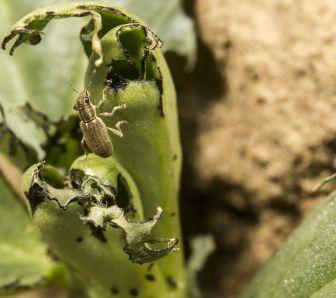
Pea leaf weevil adult feeding on fababean.
RANCONA® PINNACLE TAKES SEED TREATMENT TECHNOLOGY TO NEW LEVELS.
RANCONA® PINNACLE combines two powerful fungicides that provide both contact and systemic activity, with RANCONA micro-dispersion technology for superior adhesion and coverage. And when more active ingredient ends up on your seed and not your equipment, you’ll see improved seed emergence, healthier seedlings, and higher yields. To learn more, talk to your Arysta LifeScience representative or visit rancona.com.
Ministry of Agriculture says the pea leaf weevil was found primarily in southwest Saskatchewan, but in 2016 it was noted that pea leaf weevil distribution was considerably larger than previously known, and has been confirmed as far north as Saskatoon. While the range of pea leaf weevil had not historically overlapped with where fababeans are grown, that is no longer the case.
“We’ve seen pea leaf weevil feeding on irrigated fababean at Outlook, and high levels of feeding were also seen on pea near Kyle, and on fababean near Davidson and Saskatoon,” Hartley says.
Similar to field pea, foliar applications are not thought to provide adequate control of pea leaf weevil adults to prevent egg laying. Hartley says a pea leaf weevil adult female can lay as many as 3,000 eggs, and not all adults lay eggs at the same time, which makes foliar application control difficult. In research trials, even several foliar applications at the two- and four-leaf nodes have not provided a significant reduction in nodule feeding or a yield increase.
Anecdotal evidence also suggests pea leaf weevil prefers fababean over field pea as a host crop. Cárcamo theorizes this may be because field pea matures sooner, so fababeans are more attractive to the weevil later in the season. Ongoing research by students working with Cárcamo is looking at laboratory studies to determine feeding preferences between fababean and peas.
In Lethbridge, Cárcamo and AAFC research scientist Syama Chatterton are looking at the relationship between lygus bug and chocolate spot. In one study, done in collaboration with Meers, they surveyed about 25 commercial fababean fields in 2015 and 2016 for the presence of lygus bug and chocolate spot. The incidence of both was generally low, though there were a few cases of high instances.
Chatterton says the distribution of lygus bug and chocolate spot on fababean plants was not uniform. Chocolate spot was typically seen on pods in the lower crop canopy, while lygus bug feeding was typically on the higher pods. She says the main correlation for seed damage was from lygus bug feeding and not chocolate spot.
“There was a stratification to the seed damage. It occurred primarily in the top portion of the crop where the lygus were feeding,” Chatterton says. “We did find, though, that when we tested the damaged seed, we found the disease pathogen. We think that the lygus bug creates an entry wound and allows the pathogen to enter the pod. The damage, though, seems to be related to the lygus bug feeding.”
Chatterton and Cárcamo also had a two-year study looking at economic damage, yield response and seed quality of fababeans in relation to insecticide and fungicide application, alone or together, at Lethbridge, Lacombe and Saskatoon in 2015 and 2016. Those results are still being analyzed, but they hope to be able to develop recommendations for chocolate spot and lygus bug control.
Anecdotal evidence also suggests pea leaf weevil prefers fababean over field pea as a host crop.
Cárcamo theorizes this may be because field pea matures sooner, so fababeans are more attractive to the weevil later in the season.
Cárcamo received questions from growers and agronomists this past summer regarding the level of feeding and the impact on yield. He cautions growers to avoid foliar sprays, even if there appears to be a large amount of foliar feeding by pea leaf weevil.
“The foliar notching damage we’ve seen is usually less than 20 per cent of the crop canopy. It may look really bad, but this doesn’t cause economic damage. The crop can compensate for that level of damage, so spraying isn’t necessary in most years,” he explains.
Cárcamo and Hartley say the best advice is that if a fababean grower is in an area with historic pea leaf weevil infestations, use a seed treatment. Two are currently registered; Cruiser 5FS and Stress Shield (imidacloprid, Group 4A).
Lygus bug
The economic impact from lygus bug is due to feeding on developing seed, which can impact seed quality in the human consumption market. The adult lygus bug punctures the seed pod and sucks on sap in the developing seed. The damage causes dark spots on the seed. If more than one per cent of the seed sample has this damage, it will be downgraded from No. 1 Canada grade. The feeding may also cause yield loss, although this has not been quantified in Western Canada.
Another concern for growers and researchers is the relationship between lygus bug feeding and chocolate spot, a disease caused by Botrytis fabae and Botrytis cinerea. While chocolate spot has not been a major issue in Western Canada, in Europe and Australia it is a major disease, causing leaves to turn brown, reducing quality and yield under moderately warm temperatures.
A challenge for fababean growers in canola growing areas is that, since canola is harvested first, lygus bugs move from those fields to the still green fababean fields to feed on the developing seeds. The difficulty for growers is that research has not determined at what infestation levels lygus bug causes economic damage. Nor is it known if and when insecticide application will result in an economic benefit, although reinvasion has been shown to be problematic.
An older research study highlights the difficulty in controlling lygus bug with foliar applications. In a three-year research trial by the late Lloyd Dosdall, then a professor at the University of Alberta, at two locations in northwest Alberta from 2001 through 2003, the researchers found no economic benefit for applying an insecticide for lygus control in fababean. Matador was applied at four different treatment timings: July 2; July 2 and 15; July 2, 15 and 30; and July 2, 15, 30, and Aug. 13. While Matador application decreased lygus bug puncture wounds on the pods, the samples were still downgraded from No. 1 Canada grade after four applications of the insecticide.
Given the current lack of recommendations for insecticidal control of lygus bug, the best option to manage lygus bug is through cultural methods. Seed early to potentially help your fields escape the lygus bug flush from canola fields. Control preseed and in-crop weeds to remove plants that early emerging lygus bugs can feed on.
Cárcamo also says growers should avoid spraying insecticides for lygus bug control until more is known from the research. He says fababean requires bee pollination to produce high yields, and insecticide application may impact these pollinators. Additionally, several parasitoids of lygus have been noted on the Prairies, and these beneficials may help to keep lygus bug infestations to a non-economic level.
“If you are going to spray an insecticide, make sure you spray late in the evening or at night so that you reduce the impact on pollinators and beneficial insects,” Cárcamo cautions.
APHANOMYCES ROOT ROT
EXPANDING ACROSS WESTERN CANADA
Aphanomyces euteiches is a serious soilborne pathogen in pea and lentils.
by Donna Fleury
Arelatively new root rot disease in pea and lentil crops is steadily expanding across Alberta, Saskatchewan and Manitoba. Caused by the soilborne “watermould” pathogen Aphanomyces euteiches, the root rot can cause infection any time throughout the growing season under the right field conditions. Currently, longer crop rotations are recommended, but few management options are available.
“Aphanomyces euteiches was first identified in Saskatchewan in 2012 and in Alberta in 2013,” says Syama Chatterton, a research scientist with Agriculture and Agri-Food Canada (AAFC) in Lethbridge, Alta. “Since then, we have been conducting more widespread field surveys across Alberta and Saskatchewan and have found Aphanomyces root rot wherever peas or lentils have been grown. In 2016, some fields in Manitoba were included in the survey, and the disease is present there as well.”
Researchers suspect the disease may have been present earlier, but with disease symptoms similar to root rot caused by other pathogens such as Fusarium, Rhizoctonia, and Pythium, Aphanomyces may have been overlooked. “There are also a couple of other factors that have likely contributed to the recent increase in the disease,” Chatterton explains. “A. euteiches is a pathogen that requires moisture for infection, and we have been into a wet cycle with very wet springs over the last couple of years. We are also at that critical period of production time for peas and lentils, with many fields now having a longer history of production and the disease is beginning to show up in those fields.”
Root rots are widespread, but have less of an impact in dry years. For example, in 2015, which was a drier year, 20 to 30 per cent of fields tested positive for A. euteiches compared to wetter conditions seen in 2016, when between 60 and 70 per cent of fields in Alberta and Saskatchewan tested positive. In Alberta, root rots tended to be more prevalent in the Dark Brown soil zone, but in Saskatchewan it was the Brown soil zone, possibly due to wetter conditions over the past few growing seasons.
“The other main root rot pathogen of concern besides A. euteiches, is Fusarium spp, which is widely distributed and includes both beneficial and pathogenic disease-causing species that can often be difficult to distinguish,” Chatterton says. “Both root rot pathogens are a concern individually, however when they occur together, the disease symptoms are worse than either disease on
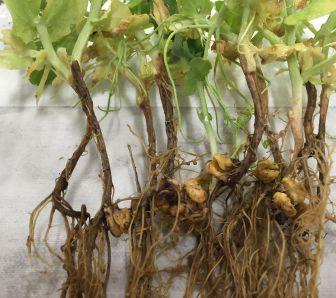
Early season symptoms of root rot (photo taken June 6, 2016).
their own.” The symptoms of A. euteiches in pea and lentil, which under optimal conditions will be seen within 10 days of infection, include yellowing and wilting of shoots, pinching of epicotyl stopping abruptly at the soil line, and below ground lateral root decay in which they become watery and honey-brown. With Fusarium, the shoots and lateral roots remain healthy while the taproot turns black, starting at the seed attachment.
“Currently the only feasible management option for controlling A. euteiches is prolonged rotations away from susceptible pulse
LIGHT ’EM UP
Resistant or not, powerful Infinity® herbicide takes out the toughest broadleaf weeds in your cereals including Canada fleabane. With its unique Group 27 mode of action, Infinity helps ensure the profitability of your farm today and for years to come.
Managing herbicide resistance is everyone’s fight; please spray responsibly.
crops, which are pea and lentil,” Chatterton says. “If a grower has confirmed A. euteiches in their field, the current recommendation is to look at prolonging rotations from six to eight years before returning to peas or lentils. Other pulse crops such as chickpeas, soybeans and fababeans, which are fairly resistant, can be options where they are suitable. We know those crops don’t work in every soil zone or location, so growers may have to consider other nonlegume crop alternatives.”
Similar to the soilborne clubroot disease in canola, growers with A. euteiches confirmed in a field need to avoid moving infested soil from one field to another. Consider seeding A. euteiches infected fields last and make sure to clean and sanitize field equipment before moving into the next field. Growers can look to sanitization and cleaning protocols recommended for clubroot as good examples for managing soils and field equipment in A. euteiches infected fields.
Chatterton and her colleagues have also been evaluating seed treatments in field trials over the past couple of years. Currently Intego Solo (ethaboxam) is the only seed treatment registered for
early season suppression of A. euteiches in lentil. “Intego Solo is designed to be used in combination with another product, so select a product that also has efficacy against Fusarium and some of the other soilborne pathogens. In our trials so far, we do see early season suppression, which is what Intego Solo is registered for. However, because infection with A. euteiches can occur any time over the
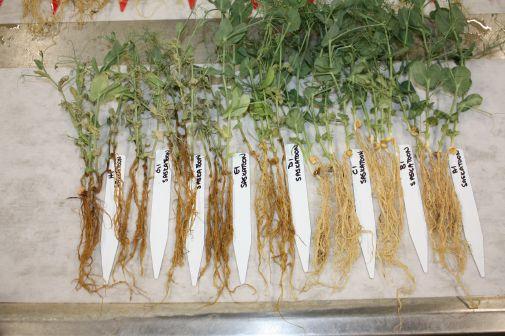
Disease progression of Aphanomyces root rot in peas inoculated with zero (right) up to 1,000 (left) oospores per gram of soil.
growing season as long as there is moisture, early seed treatment doesn’t help with late season root rot infections. We are also finding that early season infection seems to cause higher yield losses than infection that occurs later in the growing season when plants are more established.”
Another major research effort is focused on developing a quantitative soil test for estimating the risk of Aphanomyces root rot. Seed testing labs currently test for the presence or absence of the pathogen on the roots of the plants. “We are trying to determine how much inoculum is required in the soil to start the infection, and whether or not there are differences across the various soil zones,” Chatterton explains. “This information can then be used to develop a quantitative soil test that can provide growers with an assessment of low, medium or high risk of infection based on their soil test.”
Researchers are also looking at other agronomic and field-based solutions that may help reduce root rot impacts. Small-plot trials evaluating soil amendments like calcium are underway. Calcium can prevent the germination of infectious spores that attach to the
roots, therefore preventing infection. If the results are positive on small-plot trials, then researchers will have to determine whether or not this is a practical or feasible option for commercial-scale production.
Chatterton adds that in 2017, researchers will be taking a greenhouse project using Brassica cover crops as a green manure to the field. “In the greenhouse trials, research out of Sweden showed that as Brassica green manure crops break down, they biofumigate soil and suppress infection. We want to implement that same strategy in the field and evaluate if it is feasible in no-till systems directly or if the green manure needs to be incorporated to be most effective. Researchers and industry are working to find additional tools to help growers make more informed decisions regarding the length of crop rotations and field avoidance and other agronomic strategies for managing Aphanomyces root rot.”
For more on pest and diseases, visit topcropmanager.com.
TRASH TALK
Surface crop residue reduces root heat stress and improves yields.
by Bruce Barker
There was a time on the Prairies when heat and lack of moisture stress were more common than excess moisture and cool temperatures. Indeed, the movement to direct seeding and no-till was in response to droughts in the 1980s and early 2000s. Even though the last decade has seen more challenges with excess moisture than lack of moisture, for some growers the start of the growing season in 2016 was a reminder that dry conditions are never far off. With that in mind, a review of several research studies reinforces the value of surface residue on root heat stress and crop yield.
“In studies, we have seen that wheat growth is affected more by heat stress in roots than in the shoot. The cooling effect of no-till on soils can reduce the risk of root heat stress and improve yield compared with conventional tillage,” says Hong Wang, a research scientist with Agriculture and Agri-Food Canada (AAFC) in Swift Current, Sask.
Wang’s research stretches back to 2000 through 2003, during a central Alberta study conducted at the height of one of the last drought episodes. The drought of 1999 through 2004 was the worst drought in at least 100 years, according to the Drought Research Initiative, with well below normal precipitation levels in areas of Alberta and Saskatchewan that lasted more than four consecutive years.
Wang looked at soil temperature, soil moisture, root heat stress index and wheat yield from 2000 through 2003 at the long-term crop
rotation plots in Three Hills, Alta. The plots ran from 1992 to 2006, comparing conventional versus no-till seeding practices. Wang was keen to see how surface residues could reduce root heat stress, since other research had found root heat stress to cause lower root growth, reduced photosynthate partitioning to shoots, accelerated senescence and significant yield reductions.
In the Three Hills research, consistently lower soil temperatures were observed at five and 10 centimetre (cm) depths during the entire growing season each year. At the grain growth stage, no-till mitigated heat shock (defined as temperatures greater than 32 C at five-cm soil depth) occurred in 2001 and 2002 under conventional till but not under no-till. The root heat stress index (HSI) in no-till (calculated as accumulations of hourly soil temperatures greater than 20 C) was reduced every year when compared with conventional tillage.
By reducing root heat stress, especially during the grain growth stage and with slightly increased pre-seeding soil moisture in no-till plots, no-till increased above ground crop growth by 33 to 160 per cent and grain yield by 18 to 147 per cent every year except 2003, when heat and water stress were relatively mild. Over the four years, the
ABOVE: No-till protects roots from heat stress, resulting in higher above ground crop growth and increased yield.
PHOTO
From flag to head.
Folicur® EW fungicide provides you with the flexibility to spray any time from flag leaf through to head timing. This offers exceptional value for cereal growers who want long-lasting protection from a broad spectrum of diseases, including fusarium head blight and the most dangerous leaf diseases.
no-till system produced an extra 26 bushels of wheat.
Wang also looked at whether soil moisture differences or root HSI had a greater effect on crop growth and yield. He found the root heat stress index was responsible for 66 per cent of the direct impact on grain yield and 24 per cent of the indirect effect on yield. It was also responsible for 75 per cent of the direct and eight per cent of the indirect
impacted soil temperature and heat stress in wheat, canola and pea. A no-residue treatment was compared to a heavy residue treatment. For the no-residue treatment, all stubble and crop residue was cut and removed from the plot. The heavy residue treatment received the crop residue from the no-residue plot on top of the existing crop residue. The weather during the 2009 growing season was generally normal, and there
ment had higher soil moisture at zero to 10 cm than the no-residue treatment following emergence. The improved sub-surface soil environment under the high residue treatment tended to increase root length density compared to the no-residue treatment in all depths from zero to 50 cm for wheat and canola. There was no difference for pea. The high residue plots had 34 per cent higher yield for wheat and eight per cent higher yield for canola and pea. High residue plots also produced seven per cent more wheat straw, 20 per cent more pea straw and 52 per cent more canola straw, which may provide further soil and moisture conservation benefits the following growing season.
NITROGEN THAT RESPONDS TO YOUR PLANTS’ NEEDS
“The improved microclimate conditions near the soil surface caused by retaining surface residue may serve as a basis on which the benefits of no-till practices on promoting root growth, increasing aboveground biomass accumulation and enhancing crop yield can be further explored,” Wang says.
Other research supports Wang’s findings. Brian McConkey at AAFC Swift Current has demonstrated the benefits of tall standing stubble on microclimate and yield. A three-year study during the dry 2001 to 2003 period at Swift Current looked at how seeding canola, pulse, and wheat into cultivated, short (about 15 cm high), tall (about 30 cm high), and extra-tall (about 45 cm high) standing stubble affected yield. Yield and overall average water use efficiency increased linearly as stubble height increased to 45 cm.
In a three-year project that ran from 2008 to 2010, Herb Cutforth at AAFC Swift Current found that, similar to cereal stubble, spring wheat and canola yields and water use efficiencies were significantly greater for crops grown in tall standing canola stubble when compared to the cultivated stubble.
Building on these studies, University of Manitoba graduate student Michael Cardillo looked at tall stubble effects on canola for 11 site-years across Western Canada. Canola yields were significantly higher in the intact tall and short stubble treatments compared to treatments where the stubble was damaged by snow-flattening or seeding damage.
These studies suggest growers need to look at their situations one year and one field at a time. If fields are dry at harvest, leaving stubble standing as high as is practical may help preserve yields if the weather is dry the following growing season. If fields are wet, residue management with tillage or some sort of straw management will be critical in helping to get good stand establishment.
MODERATE FLAX RESPONSE TO NITROGEN
Continued from page 20
90 kg/ha, or if rates exceeding 90 kg N may have been beneficial.
In 2015, a further study was conducted at IHARF with three N rates of 45, 90 and 125 kg N per hectare, along with three P rates and two S rates. All fertilizer was sidebanded. Overall, there was a strong response to N fertilizer with yield increases of approximately 35 per cent relative to the control. Holzapfel says yields increased further when the rate was increased from 45 to 90 kg N, but only marginally, and yields were slightly lower with further increases to 135 kg N.
Flax trials were also conducted at the Northeast Agriculture Research Foundation (NARF) in Melfort, Sask., in 2014 and 2015 and at the East Central Research Foundation (ECRF) in Yorkton, Sask., in 2015. In those trials, N rates ranged from 34 to 168 kg N/ha. At Yorkton, the response was similar to that seen at Indian Head, with yields levelling off at approximately 67 kg N/ha. At Melfort, however, yields increased right up to the highest rates, showing gains of 55 to 60 per cent over the lowest rate of 34 kg/ha.
“The yield seemed to level off at around 45 to 90 kg N at most sites,” Holzapfel says. “That isn’t surprising, as it seems to follow other research, but these are only single site trials, so we need to look at further research.”
Three older Agriculture and Agri-Food Canada (AAFC) multi-site research studies looked at flax response to N and provide additional guidelines, albeit with older flax varieties. The first was a three-year multi-site study led by research scientist Guy Lafond at Indian Head from 1999 to 2001. He compared fertilizer rates of 67, 100 and 133 per cent of the N recommended for a target yield of 32 bushels per acre, placed as a sideband at seeding. Yield increased when moving from 67 to 100 per cent of recommended N, but when N was pushed to 133 per cent of the recommended rate, no further yield increase was observed. However, at later seeding dates after mid-May, there was no yield response to increasing N rates past the 67 per cent rate.
Another three-year study by AAFC research scientist Sukhdev Malhi at Melfort from 2000 to 2002 also found flax responded moderately to N fertilizer application. The trials were conducted at Indian Head, Melfort, Scott and Swift Current, Sask., to determine the effect of N formulation (urea and anhydrous ammonia), placement
(broadcast, sideband and mid-row band), timing, rate, and P placement (seven to 10 kg P/ha) on stand establishment, seed and straw yield, seed protein content, and N uptake in seed and straw under no-till conditions. N rates were zero, 40, 80 and 120 kg/ha at Melfort and Indian Head and zero, 30, 60 and 90 kg/ha at Swift Current and Scott. These rates represented none, 50, 100 and 150 per cent of recommended N.
Malhi reported flax yield often increased with the first increment of N fertilizer applied at 30 or 40 kg N per ha, and usually showed low to moderate increases thereafter, with only a few exceptions. He suggested broadcast urea can be less effective than side-banded urea, fall banded N can be inferior to spring banded N, and seedplaced P can reduce seed yield compared to side-banded P.
With accounting software built for agriculture
Keep your business on track and on budget with AgExpert Analyst – do everything from basic bookkeeping to GST returns, inventory management, payroll, forecasts, automated or customized reports, and more.
fccsoftware.ca | 1-800-667-7893
EVALUATING HARVEST WEED SEED CONTROL
It could be the only control method remaining to some producers.
by Julienne Isaacs
Harvest weed seed control is a last-ditch line of defence against herbicide-resistant weeds in Australia and one many producers there would rather not have to deploy in the field.
But in extreme cases of herbicide resistance, harvest weed seed control (HWSC) methods are the only control measures remaining to producers. What’s more, they are proven to work in Australia, which means they merit investigation in areas where herbicide resistance is on the rise.
In Western Canada, a number of recent, high-profile studies have looked at seed retention and seed shatter of economically important weed species as part of an effort to gather data assessing whether HWSC is a viable option for producers.
Breanne Tidemann, a research scientist in field agronomy and weed science for Agriculture and Agri-Food Canada (AAFC) based in Lacombe, Alta., was the lead on a study completed last year that looked at seed retention of three weed species – wild oat, volunteer canola and cleavers – as well as height of seed retention. Both factors are key when assessing whether these weeds can be controlled
using a Harrington Seed Destructor (HSD), a machine designed to be pulled behind a combine to collect chaff and destroy weed seed during harvest. If seeds are produced at ground level, they cannot be processed by the HSD.
Tidemann collected six site-years’ worth of data from three locations, two in Alberta and one in Scott, Sask. She found that, on average, 84 per cent of cleavers were retained at swathing and 60 per cent at straight cutting of wheat. The team used fababean harvest timing as the latest measure in the study, and found that volunteer canola had retention of 94 per cent on average, even that late in the season.
By contrast, wild oat lost seeds quite early in the season, Tidemann says, with about 56 per cent of seed, on average, retained at the time of wheat swathing.
“In terms of height, wild oat and volunteer canola were in the highest above-ground fraction that we tested, so those retained
ABOVE: Tidemann working with the Harrington Seed Destructor indoors in a stationary threshing study.
I will be a trailblazer by recognizing opportunity and embracing the future. I will meet challenges head-on, adapt and overcome. I will continually challenge the status quo and place my trust where it is deserved.
seeds can be easily collected; they were above 45 centimetres above ground levels. That bodes well for getting them into the combine,” Tidemann says. For cleavers, the team saw a minimum of 70 per cent of seeds in the collectible fraction.
“So what we’re saying is that the height of seed retention won’t be a constraint to using the HSD,” she explains.
As part of her master’s thesis work at the University of Saskatoon, Nikki Burton, who now works for BASF Canada, completed both a small-plot study and a two-year field study evaluating seed shatter of wild oat, green foxtail, wild mustard and cleavers in both an early (field pea) and late (spring wheat) maturity crop in field experiments at Scott.
“Both of my studies found that wild oat had the lowest potential to be controlled by HWSC systems, but other weeds had high potential to be controlled because of the amount and timing of weed seed shatter. For wild oat, there was a higher level of shatter at crop maturity,” Burton says.
about kochia or green foxtail? If you have a heavy weed patch, how well would the HSD work then? Those were the types of questions we were asking,” Tidemann says.
The short answer to those questions is that Tidemann’s team saw a statistical difference in how the HSD managed weed seeds, but not much of a practical difference.
“One example is that we went from running seeds through without any chaff, to running seeds through with eight five-gallon pails of chaff, just to look at whether a heavy crop going through the HSD impacts how it destroys seeds,” she says. “We did have a statistical difference, but my range of control was between 98 and 99 per cent. So the stats are finding differences, but does a producer care if they get 98 or 99 per cent control? Probably not – it’s really good control.”
Tidemann’s conclusion is that the HSD is effective for most seeds that could be fed into the machine, but getting the seed into the machine will be the problem for some species, like wild oat.
“We did have a statistical difference, but my range of control was between 98 and 99 per cent. So the stats are finding differences, but does a producer care if they get 98 or 99 per cent control? Probably not – it’s really good control.”
Harrington Seed Destructor
Tidemann has also worked with the HSD indoors in a stationary threshing study; field trials will follow over the next three years in central Alberta.
Her team was primarily interested in how factors like seed size, seed number and chaff number might impact how the HSD works.
“In Australia they’ve looked at bigger seeds like wild radish. What
“That’s the tricky part of the equation, dealing with your weed biology and your system, and knowing which weeds you can actually target,” she says. “It won’t be as effective on every weed species.”
More research is needed to assess how producers can best deploy HWSC methods like the HSD in the field, Burton cautions, adding that all weed control methods need to be used in an integrated weed management system and shouldn’t be used as standalone measures against herbicide resistance.
Though HWSC measures are hardly used in Canada, Tidemann says their uptake is increasing in other parts of the world, particularly Australia, and also the United States, where herbicide-resistant Palmer amaranth is spreading.
“As people are dealing with resistance, some alternative methods are starting to look more and more appealing.”
Barley chaff before (right) and after (left) processing in the Harrington Seed Destructor.
The Herbicide Resistance Summit aims to facilitate a more unified understanding of herbicide resistance issues across Canada and around the world.
Leading
Delegates
STRAIGHT UP WILD OAT CONTROL
Wild oats hanging above the crop canopy are like a billboard for poor weed control.
Varro® herbicide provides outstanding control of wild oats and other problem grass weeds to keep your wheat eld looking great all season.
Varro – wild oat control that’s worth talking about.