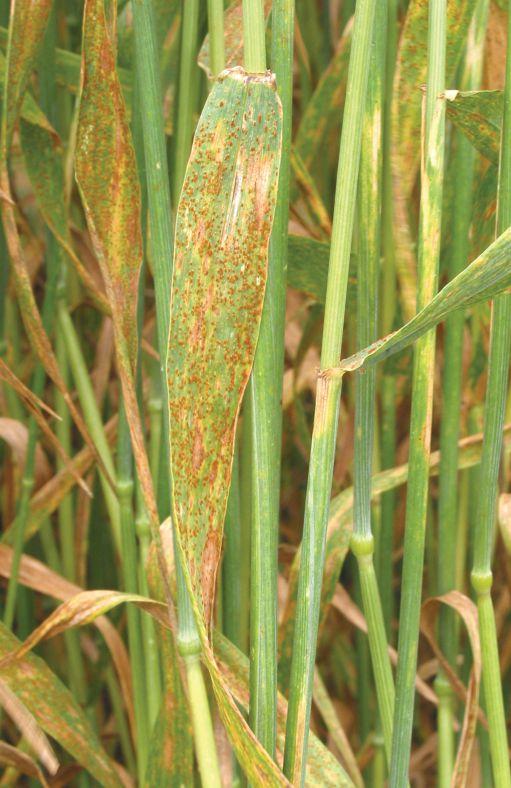
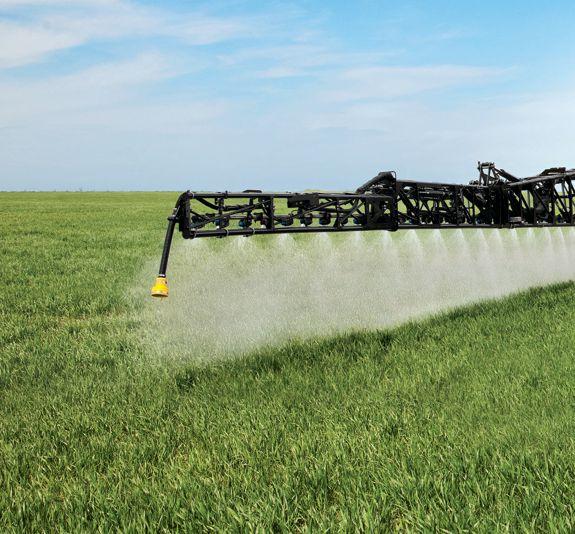
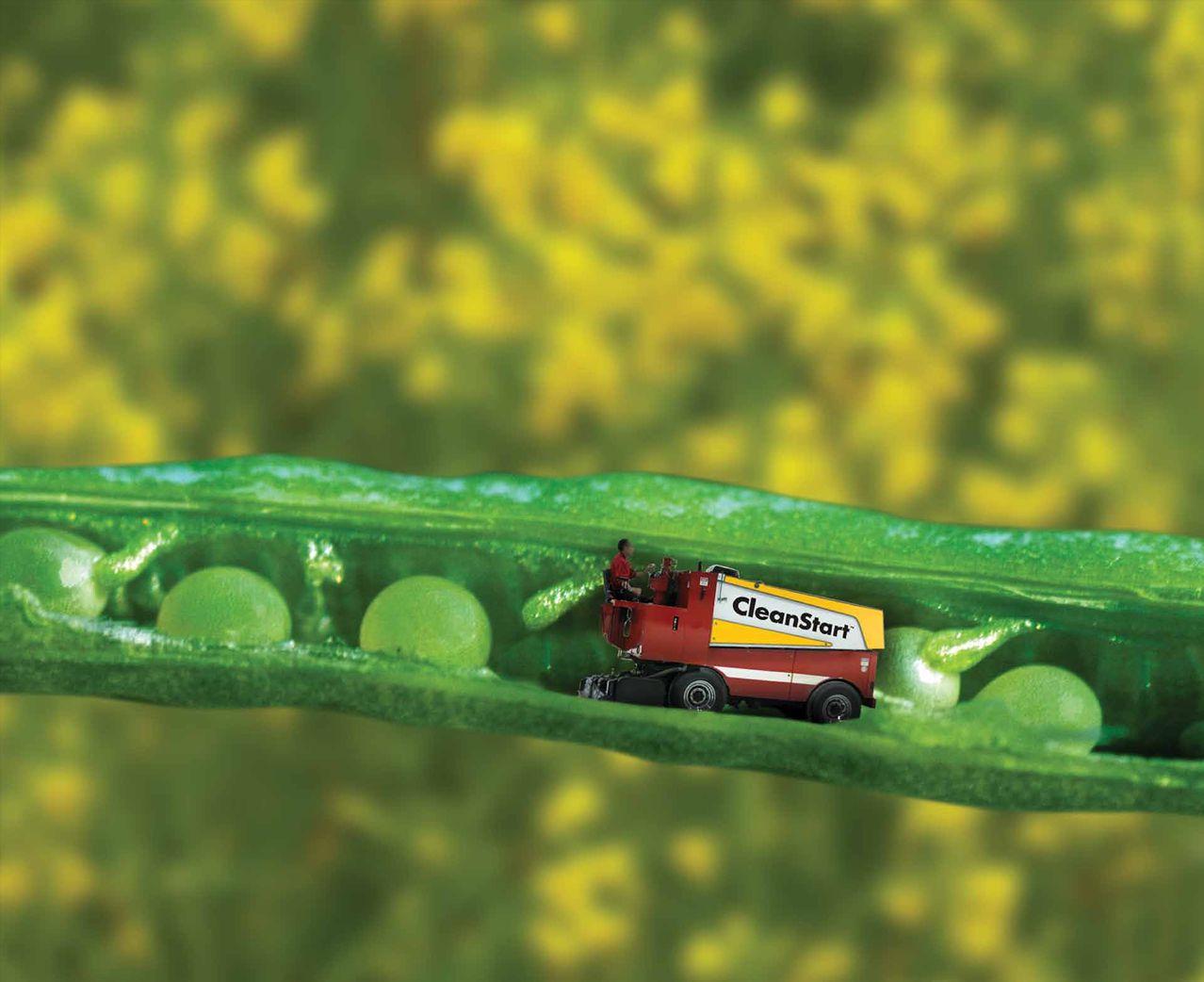
Get the cleanest fields in the fastest way possible this spring. Tank-mix glyphosate with HEAT® herbicide and you’ll get the most complete control from your pre-seed and chem-fallow applications. Learn more by visiting agsolutions.ca/heat or calling AgSolutions® Customer Care at 1-877-371-BASF (2273).
TOP CROP
MANAGER
18 | A Prairie-led search for enhanced wheat breeding genomics, Dna sequencing and Dna markers speed variety development. By Carolyn King
new cereal varieties update By Bruce Barker
a new oilseed crop could soon take off as a bio-jet fuel
By Carolyn King
Banking on residual phosphorus By Lisa Guenther Hulless barley:
and
By Carolyn King
30 | Crop rotations and net returns a look at the long-term shows diversity can improve net returns. By Carolyn King
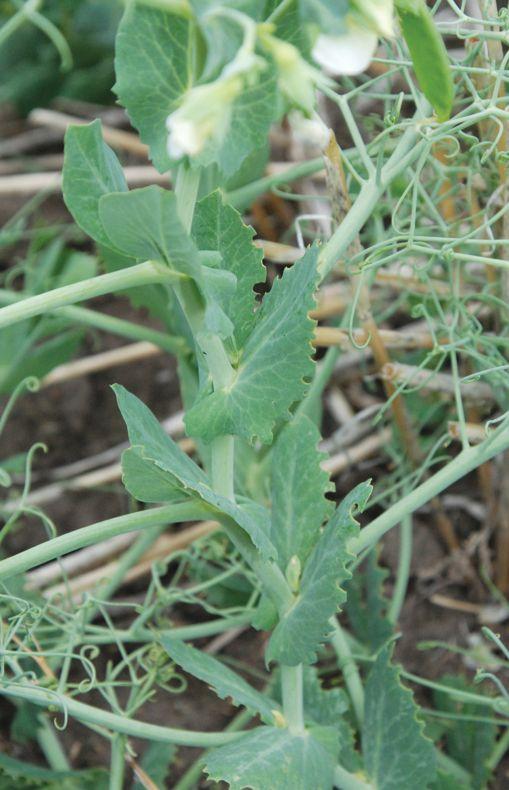
60 | Managing the pea leaf weevil in field peas By Héctor Cárcamo and Meghan Vankosky
By Donna Fleury
pedigreed seed: quality, questions and concerns for 2012 By Lorne McClinton
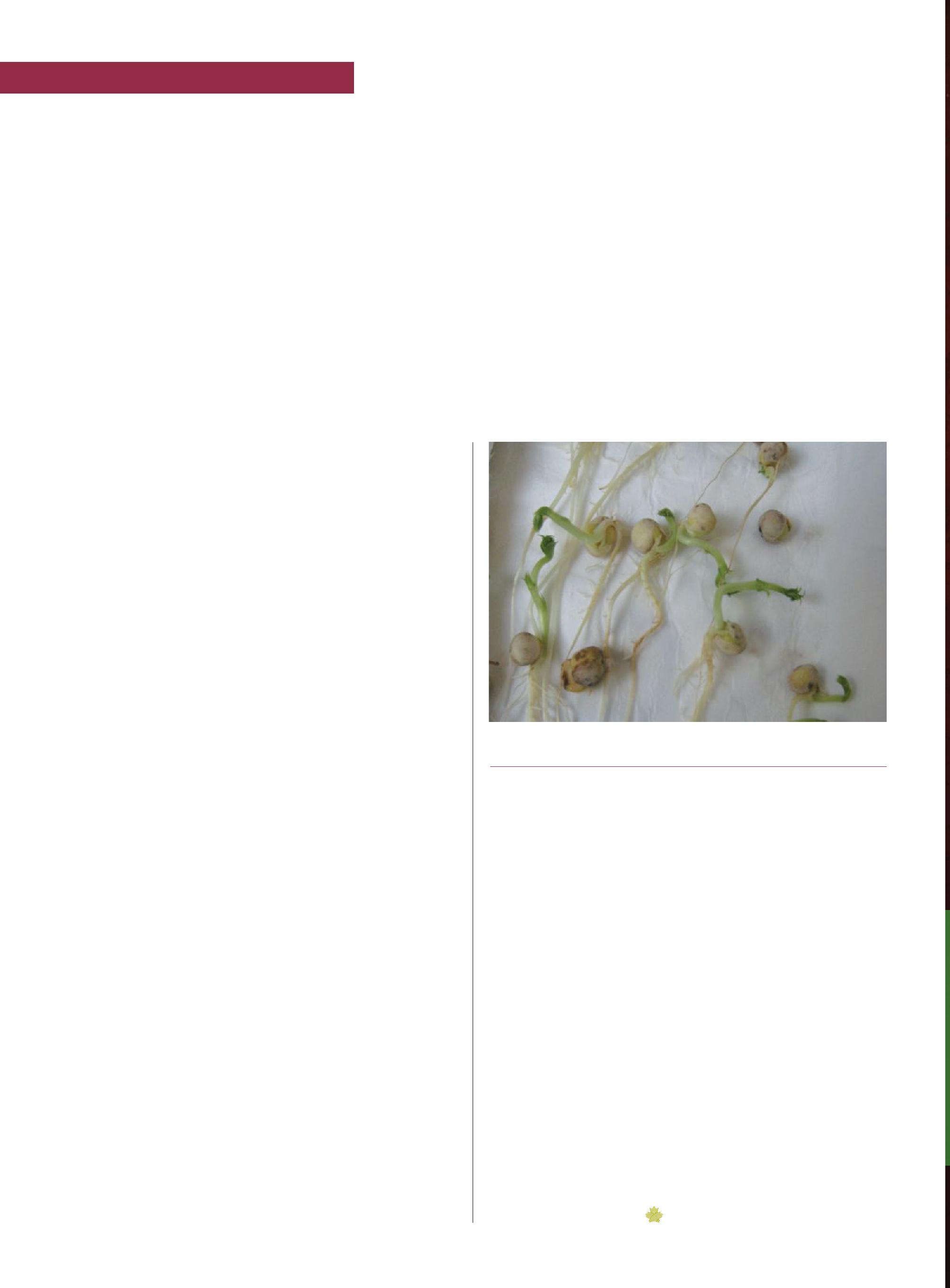
‘Signal molecules’ stimulate pulses By John Dietz
Kitchen-sink study analyzes soybean inputs By John Dietz
First case of glyphosate weed resistance confirmed By Bruce Barker
authority herbicide performing well By Bruce Barker
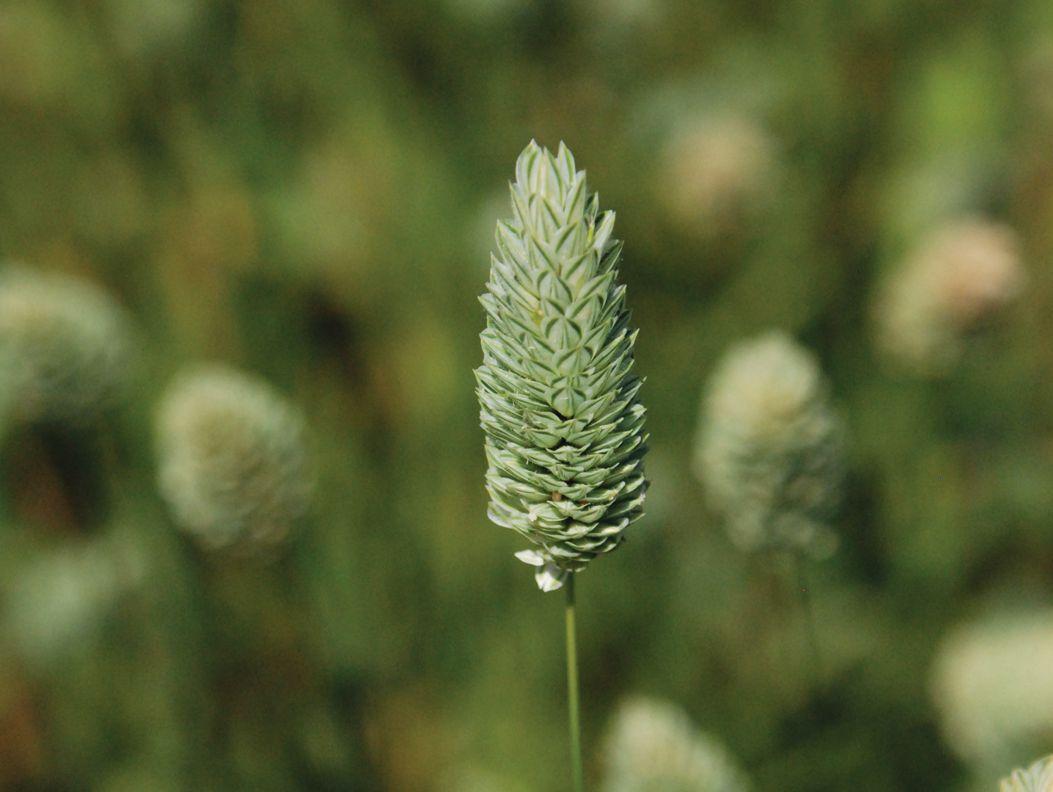
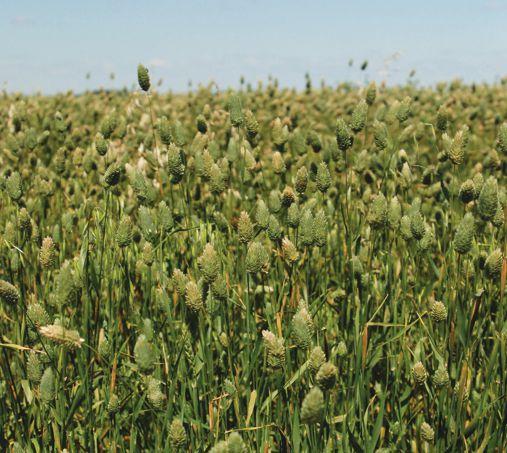
Canaryseed weed control By Donna Fleury
The elephant in the room By Bruce Barker
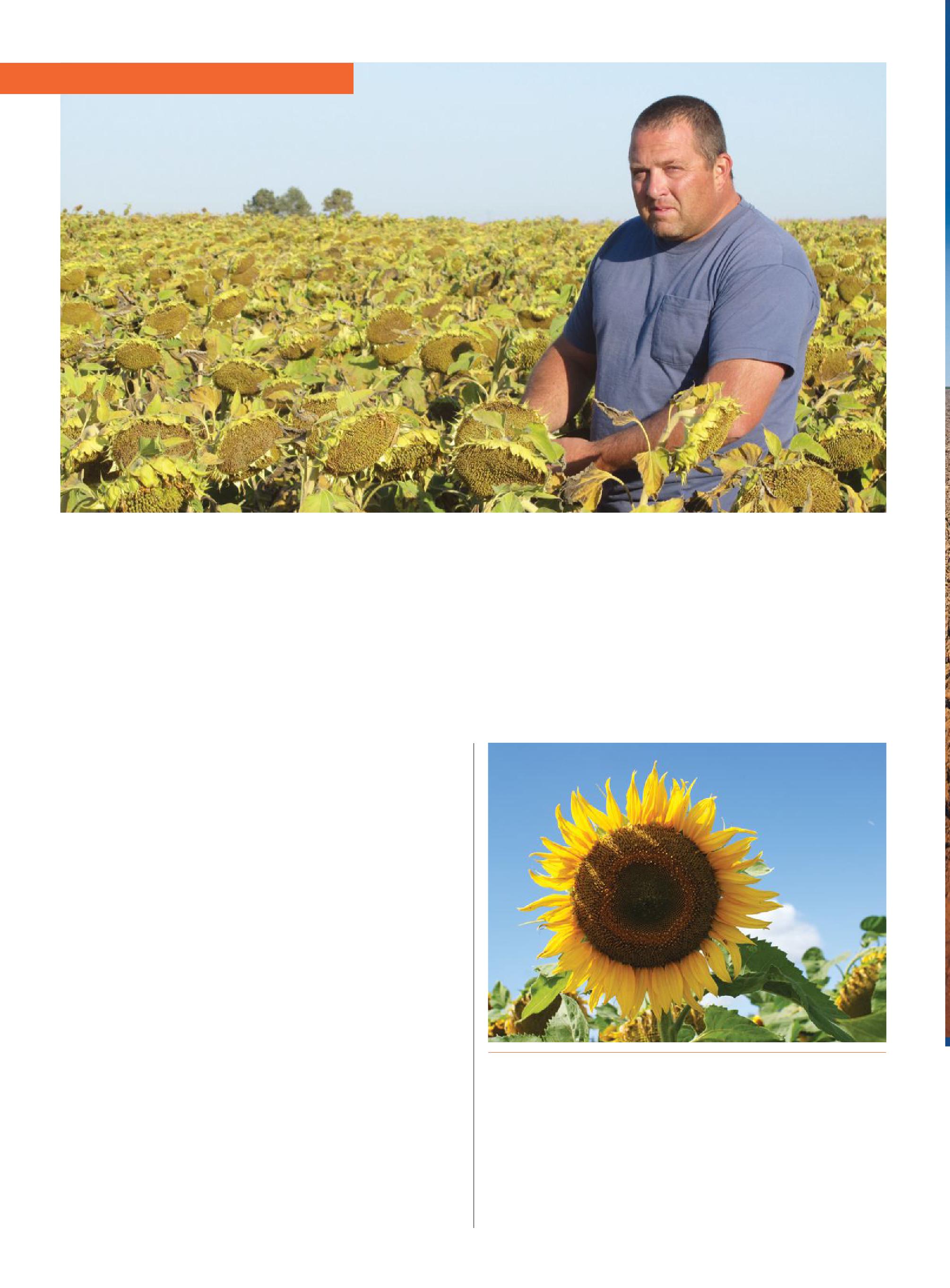
Sunflowers respond to Vr seed and fertility By John Dietz
Coming to grips with canola harvest loss By Carolyn King
a new era in grain marketing By Lisa Guenther
BRUCE BARKER | WESTERN FIELD EDITOR
THE ElEpHANT iN THE RooM
The confirmation of glyphosate-resistant kochia in several chemfallow fields in southern alberta may finally get people talking about the elephant. For years, a few weed scientists, agronomists and farmers have been talking about how best to help prevent glyphosate-resistant weeds from developing, but the talk has mostly fallen on deaf ears. While there is still much to be learned about how the glyphosate-resistant kochia developed or if it even developed on the land where it was found, what the discovery does highlight is the need for the research community, industry, agronomists and farmers to start working together to address glyphosate-resistance management.
Dr. Hugh Beckie, an agriculture and agri-Food Canada research scientist has worked extensively on herbicide resistance management, and he predicted that in the grassland region, the top three weeds at risk of developing glyphosate resistance were kochia, wild oat and green foxtail. He was correct on kochia, and he will likely be correct on the other two –the question is how long can they be delayed.
In talking with weed scientists over the last few months since the discovery was officially announced, the main topic of concern is that losing glyphosate as a weed management tool will be devastating. It is an important tool in controlling weeds that have developed resistance to other groups. Just imagine if wild oat, which already has widespread resistance to group 1 and group 2 herbicides, also developed glyphosate-resistance. With few new modes of action being discovered by the crop protection industry, it is imperative to manage glyphosate with an eye towards resistance prevention.
part of the challenge is that glyphosate is a victim of its own success. glyphosate is found in just about every cropping scenario: pre-seed burndown, roundup ready canola, preharvest application, post-harvest. glyphosate could be applied three to five times during a canola crop year. Most fields see at least one pre-seed application annually.
The selection pressure on the prairies isn’t as high as south of the border where roundup ready corn and roundup ready soybean are used as a standard rotation with multiple glyphosate applications each year. There resistance issues are rampant. But some rotations in Western Canada are coming close.
Tightening canola rotations are putting pressure on glyphosate resistance management. With canola every second year now the most common rotation on the prairies, the selection pressure for glyphosate resistance is higher where roundup ready canola is grown. In some cases canola-snow-canola is the rotation and the risk is further elevated. rotating to InVigor canola may help as that system uses Liberty herbicide, a group 10 product, but that may also bring challenges for Liberty-resistant weed development. another challenge is that glyphosate is so cheap. Where many farmers used to throw in a tank-mix partner for a pre-seed burndown, which provided dual modes of action, now glyphosate is often applied alone because it is cheaper to increase the rate of glyphosate than to throw in an extra tank-mix partner. as with many decisions in farming, farmers need to balance the risk of glyphosate developing on their farm with the extra cost of a pre-seed tank mix. For a few extra dollars, throwing 2,4-D, MCpa, bromoxynil, dicamba, Heat or tribenuron into a preseed burndown tank mix or a pre-package tank-mix like CleanStart or prepass seems like a good long-term decision.
There will be much written and talked about in the coming months on glyphosate-resistant weeds. The history of herbicide resistance has repeatedly shown that a tight cropping system and continual use of the same mode of action will eventually result in weed resistance. Farmers, researchers and industry are going to have to turn that talk into action – if they want to stop the elephant from stampeding.
MAIL
#40065710 RETURn UnDElIvERABlE CAnADIAn ADDRESSES To CIRCUlATIon DEPT. P.O. Box 530, Simcoe, ON N3Y 4N5 e-mail:subscribe@topcropmanager.com
Crop Manager West - 8 issuesFebruary, March, Mid-March, April, June, october, november and December1 Year - $44.25 Cdn. plus tax
Crop Manager East - 7 issuesFebruary, March, April, August, october, november
www.topcropmanager.com
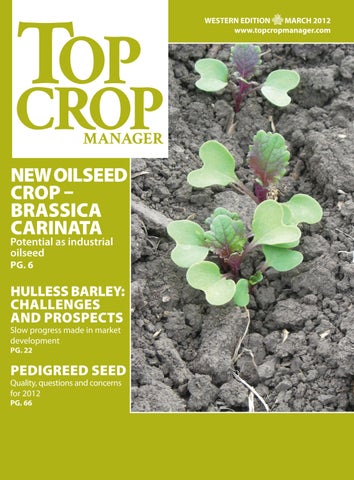
NEW oilSEEd CRop MAy SooN
TA
k E off AS A bio-j ET fu E l
Brassica carinata has potential as industrial oilseed.
by Carolyn King
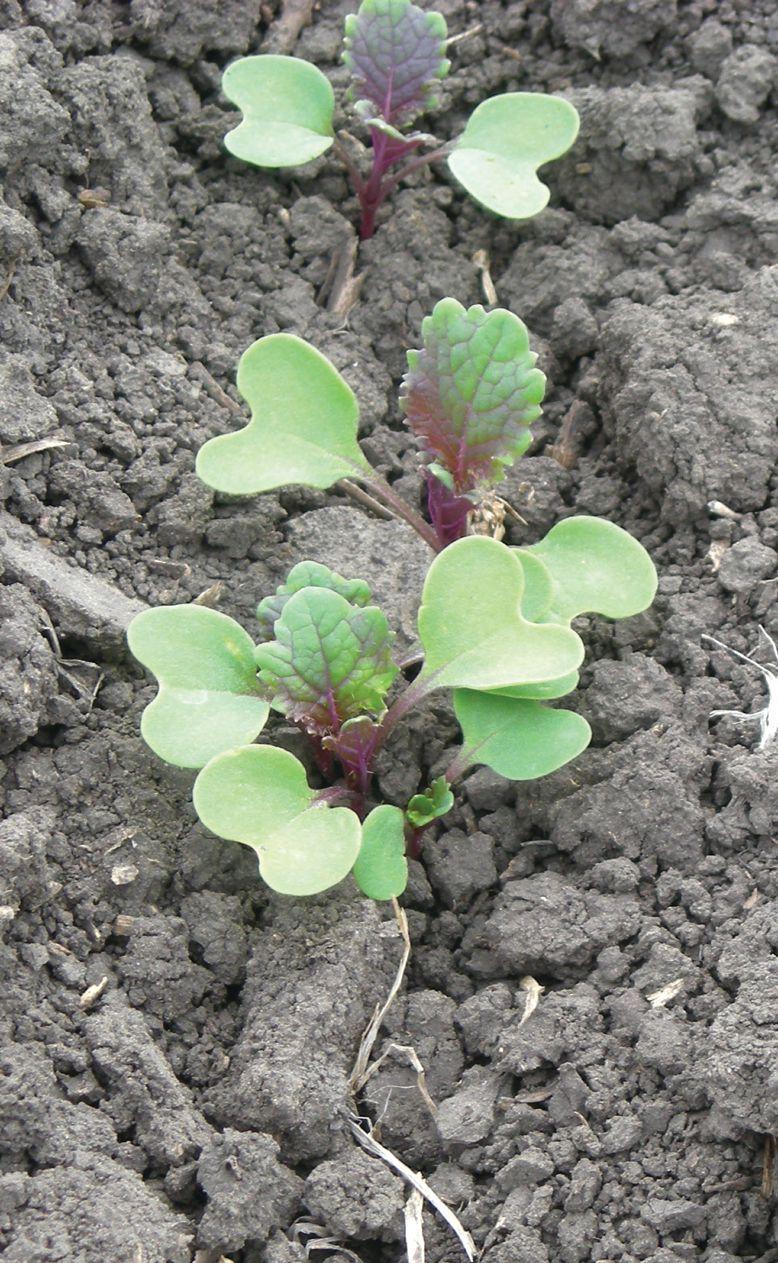
Through efforts on many fronts, a crop originally from east africa is approaching commercial production in Western Canada. The crop is Brassica carinata, called carinata or ethiopian mustard, and it is a cousin to canola that’s suited to the hotter and drier parts of the prairies. It is being developed as an industrial oilseed, with a wide range of potential uses including as a feedstock for bio-based jet fuel.
Breeding a crop with its own niche
The crop first came to the attention of Dr. Kevin Falk, an oilseed breeder at the Saskatoon research Centre of agriculture and agriFood Canada (aaFC), in the 1990s. at that time, getinet alemaw, an ethiopian who was then a graduate student at the University of Saskatchewan, was working on developing the species into a canola-type crop for ethiopia.
as a potential crop for Western Canada, ethiopian mustard offered both advantages and disadvantages. “It produced well. It was very heat- and drought-tolerant, and relatively large-seeded compared to argentine canola, for example, which was a bonus for the
hotter, drier areas in that you could seed deeper. and it was quite resistant to the diseases that were prevalent in the canola-growing areas,” explains Falk.
However, a major disadvantage was that its maturity was two to three weeks later than that of argentine canola. Falk says, “[From field testing,] it was apparent that if we could develop early maturing lines that were closer to the maturity of argentine canola, then we would have a good shot at developing a species that would move oilseed production in Western Canada into the Brown soil zone, a droughty region [in southwestern Saskatchewan and southeastern alberta] that’s typically grown to wheat or just pasture.”
So, when Falk started his conventional carinata breeding program in 1995, his first goal was to reduce the days to maturity. Within about two or three years, he managed to bring the maturity down to about 107 days without sacrificing yield.
next he had to decide whether to try to make carinata into another canola-like crop or develop it as a crop with its own niche.
TOP: Carinata can be seeded at about the same depth as canola.
Falk says, “The route to developing another canola would have taken 10-plus years, if we could get there at all.” For instance, to turn it into an oilseed for food uses would have required reducing the high levels of anti-nutritional components, including erucic acid and glucosinolate compounds. However, those same components can be useful for certain industrial purposes. another factor in his decision was that other researchers at Saskatoon were already developing oriental mustard (Brassica juncea) into a canola-like crop for the Brown soil zone.
So Falk decided to develop carinata as an industrial oilseed crop. Since then, he has made many improvements, with funding support from Mustard 21 Canada Inc., beginning in 2008, and from other sources such as the Saskatchewan a griculture Development Fund ( a DF).
For example, he has increased the oil content of the seeds from around 30 to 44 percent and modified the oil’s profile so it is much more suited to various industrial uses. a s well, his elite strains are higher yielding than o riental mustard, and have strong resistance to lodging and excellent resistance to blackleg. He also has lines in his program with resistance to alternaria and lines showing promise for resistance to clubroot, in preparation for when that disease becomes an issue in the Brown soil zone.
Falk notes, “I’ve developed a number of good strains that will get us through about the next three to five years, perhaps, but the next step is to get the yields up closer to argentine canola. That means we need to go the hybrid route, and we’re well underway with that.” He hopes to have his first carinata hybrids available for trialling by about 2015.
Growing carinata
another key to transforming carinata into a successful crop is development of an agronomic package for growers. eric Johnson, a researcher with aaFC at the research farm in Scott, Saskatchewan, is working on that, with funding support from aDF, Mustard 21 and growing Forward.
Johnson has already investigated nitrogen fertility and seeding rates for carinata. “We have found that the nitrogen requirements to maximize yields of Brassica carinata are similar to those of other Brassica species; they are pretty well the same as canola. So if farmers soil test, they can just follow the recommendations for canola,” he says.
He adds, “We haven’t done any work with sulphur on carinata yet, but based on some of our observations, we think the sulphur requirements would be similar to those for canola.”
Johnson suggests growers target plant densities of eight to 17 plants per square foot, which requires a seeding rate of six to 14 lb/ ac. He notes, “Because carinata is late maturing, a higher seeding rate is beneficial in northern areas. In the southern areas, there’s a longer growing season, so the need for a really high seeding rate is not as critical. Therefore, we are suggesting the low end of the seeding rate range in the Brown soil zone, the area in which production is targeted. optimum plant densities can reduce maturity by five or six days compared to below-optimum plant densities.”
Carinata can be seeded at about the same depth as canola. It is a vigorous crop with highly branching growth. It is tolerant of both disease and aphids. Carinata doesn’t require swathing; it is easy to straight combine and is quite shatter-resistant.
Johnson’s current carinata work focuses on weed control. He has already identified several herbicides that carinata will tolerate, and he is working towards obtaining minor use registrations for Muster, assure and Lontrel. In the longer term, the aim is to develop carinata with resistance to broad-spectrum herbicides. He notes, “We’re working on several options, including seed mutagenesis and some experimental approaches, to try to develop some herbicide resistance within the crop.”
A new crop and an emerging market
aaFC is partnering with various other agencies to develop uses for carinata. The oil has the potential to be used in diverse industrial products, including lubricants, biofuels and bioplastics, and examples of possible uses for the meal include high-protein fish feed and bio-pesticides. Falk notes, “The idea is to find a use for everything to help make it commercially viable.”
one of those industry partners is agrisoma Biosciences Inc., a private Canadian biotechnology that specializes in industrial crops. “our proprietary technology, called eTL [engineered Trait Loci], allows us to put multiple traits into a plant in one cycle and to get very high expression rates and a very stable transformation, which allows faster product development,” explains patrick Crampton, agrisoma’s vice-president of business and product development. of course, to apply this technology, the company needs a crop platform – a crop to improve – and a source of traits to move into the crop. Carinata offers a great platform because of all the work
Photo cou R tesy of eR ic Joh N so N /AA fc
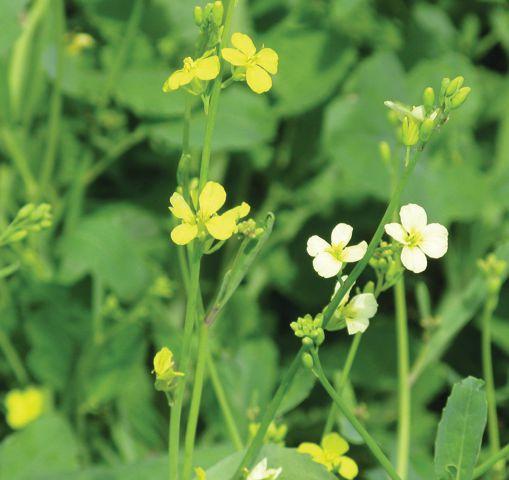
Carinata flowers can vary in colour from white to pale yellow.
Photo
Different carinata lines in Falk’s carinata breeding nursery.
aaFC has already done to develop the crop as an industrial oilseed for Western Canada. For a source of traits to further improve the crop, agrisoma is partnering with the national research Council’s plant Biotechnology Institute in Saskatoon.
agrisoma is currently developing carinata as a feedstock for biofuels, including biodiesel and the emerging bio-jet fuel market.
Crampton explains the bio-jet fuel market took a big step forward in July 2011 when the agency responsible for setting fuel specifications worldwide approved the use of up to a 50 percent blend of bio-based fuel in jet fuel. as well, the International air Transport association has stated goals to achieve carbon-neutral growth by 2020 and to reduce net carbon dioxide emissions by 50 percent, compared to 2005 levels, by 2050. The use of bio-jet fuel from non-food sources will be an important part of meeting those goals. Demand for bio-jet fuel could result in global production of billions of litres of jet fuel from various bio-based feedstocks in the coming decades.
agrisoma is using its eTL technology to add traits in three areas: “to improve carinata yields, improve the oil content in the seed, and further enhance its oil profile to get even better conversion efficiencies with different biofuel processes,” explains Crampton. The company hopes to have its first enhanced carinata lines available in about four years.
To commercialize carinata as a bio-jet fuel, agrisoma has been building a network of partnerships along the value chain. For instance, it is partnering with Mustard 21 and aaFC on crop production,
paterson grain on production contracts, poS Bio-Sciences on crushing, and jet fuel manufacturers on producing the fuel to aviation specifications.
In 2011, agrisoma had about 50 acres of pilot production in Saskatchewan, on two farms and at the Scott research Farm. Crampton says, “We were able to harvest and crush enough oil to work with two major bio-jet fuel manufacturers to get bio-jet fuel made from carinata oil. one of those manufacturers will be supplying enough jet fuel for multiple test flights to prove this made-in-Canada, ‘farm to fly’ fuel source.”
Crampton says 2012 will be “an introductory year” for carinata production. The crop will be grown on a contract basis, and agrisoma hopes to have contracts with about 50 growers this year. “We want to have 5,000 to 10,000 acres, with a maximum of a quarter section per grower to spread out production across southern Saskatchewan and southern alberta and get as much grower experience as possible.”
He adds, “The agronomics for carinata production are very similar to those for canola and mustard, but as we scale up production, we’ll learn new things, so we’re working closely with growers to understand how to grow the crop better.”
Trevor anderson, a seed grower near Frontier, Saskatchewan, in the southwestern corner of the province, will be helping out with that. He is one of the few people in Western Canada who have grown carinata for multiple years. even so, his experience is limited.
He explains, “I first grew carinata in 2010, and I grew only 2.5 acres because that’s all the seed that was available. It got hailed out on July 2. It came back unbelievably well – it’s more like canola in that respect. In 2011, I grew 20 acres because that was the maximum amount of seed available. and that year, we had the most unusual weather we’ve had in probably the last 50 years. We had three feet of snow in the winter, and about a week in May where you could get in the field, followed by about a month of rain. We didn’t finish seeding until June 20, which is two months later than normal.”
nevertheless, anderson is excited about carinata. “I think there are a whole bunch of good things coming together for this crop. I’m familiar with growing oriental mustard, which is common in our area, and this is going to be a better yielder than oriental mustard in the drier, hotter areas. also, there’s a huge demand for biofuels. airlines are interested because they want to be seen as green. Carinata is considered to be greener because it is a non-food oil and it’s going to be grown in the palliser Triangle, which is considered to be a marginal farmland area. and if there’s any problem in the world regarding the [petroleum] supply, it will make carinata biofuel that much more desirable. So it’s something that could increase fairly quickly if the price is there for the farmer.”
In 2012 anderson will be growing carinata and multiplying seed for agrisoma. He’ll also be talking to farmers who want to grow the crop and following up with them during the growing season to see how the crop is going and what they’ve learned.
a key challenge ahead for carinata-based jet fuel will be to achieve a smooth scale-up along the value chain. Crampton says, “as with any new industry, it’s the-chicken-and-the-egg scenario in terms of scaling up production of the feedstock source at the same time as you’re scaling up the facilities that produce the fuel.”
Crampton sees a very significant potential for carinata as a feedstock for bio-jet fuel and biodiesel. “There are millions of acres of opportunity for carinata for western Canadian growers and into the drier areas of the U.S.”
Photo cou R tesy of k evi
Falk’s carinata breeding nursery.
Photo cou R tesy of
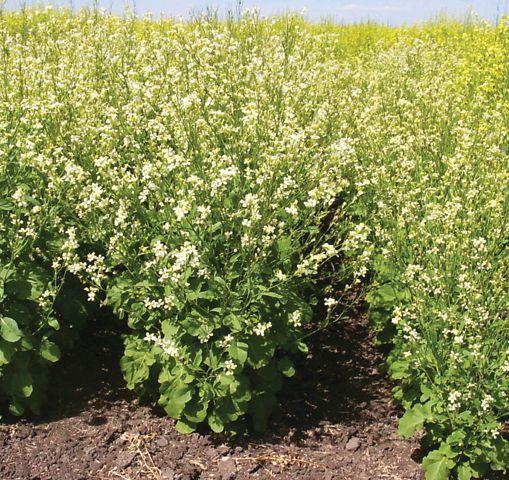
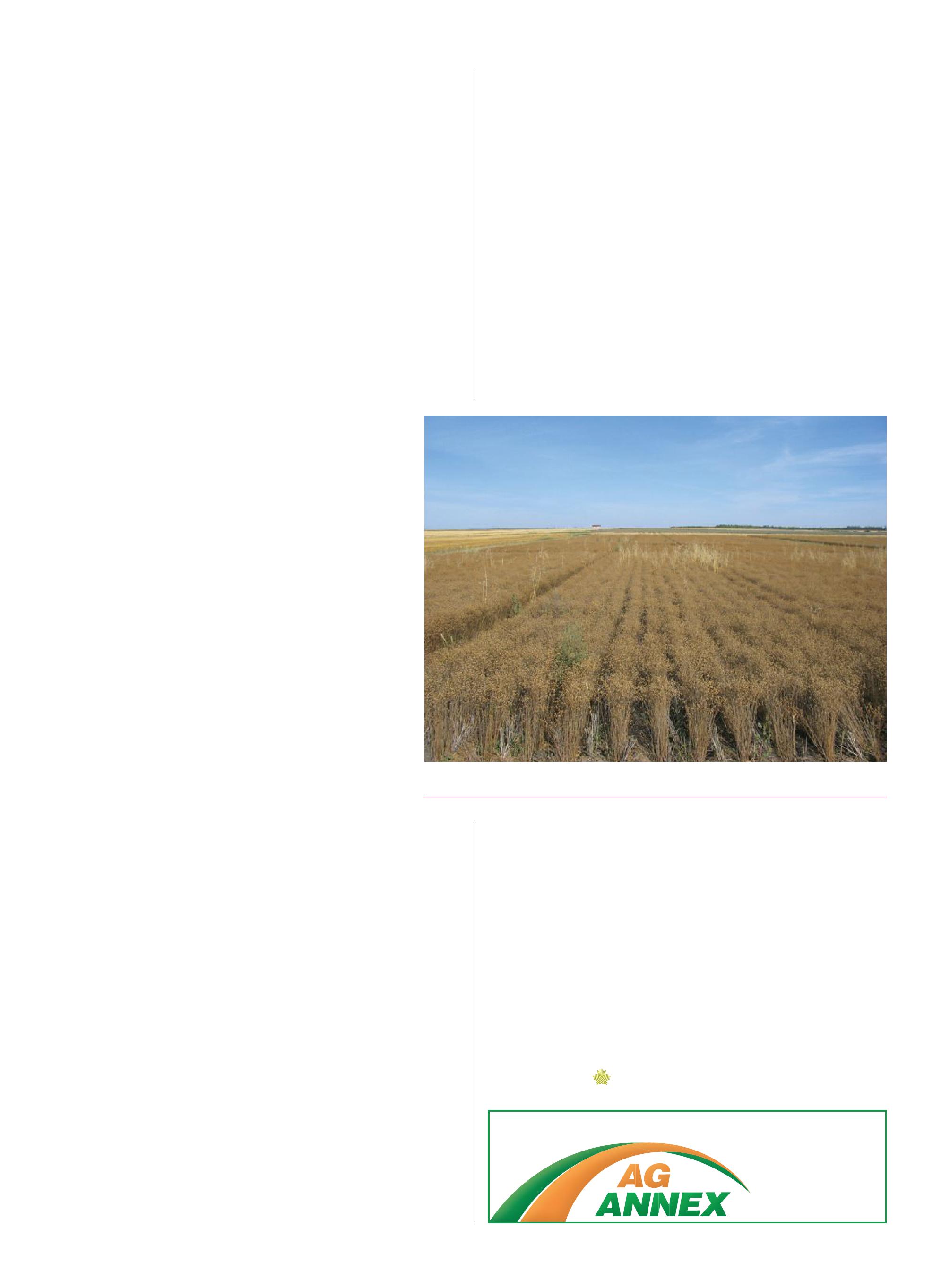
Carinata production at Scott, Saskatchewan, in 2011.
Protects the best.
Liberty® herbicide is sworn to protect number one yielding InVigor® hybrids at all costs. As a dedicated Group 10, it’s more than ready to take out the most dangerous weeds in your crop, including resistant ones.
Whether you want the added protection of a higher labelled rate or a 2-Pass, Liberty’s new lower price gives you the flexibility to decide how to best neutralize the threat. Unlock the yield potential of InVigor with Liberty.
f i RST CASE of glypHoSATE WEEd RESiSTANCE CoNfiRMEd
Resistant kochia found in southern Alberta.
by Bruce Barker
This was bound to happen. Based on experiences in other parts of the world, glyphosate-resistant weeds were likely to develop in Western Canada. and they did.
glyphosate-resistant kochia was suspected in three fields in southern alberta during the summer of 2011, and agriculture and agri-Food Canada scientists confirmed the resistance in early January 2012.
“In order to confirm resistance, you have to prove it is inherited,” explains Hugh Beckie, weed scientist with aaFC in Saskatoon, who worked with colleague Bob Blackshaw at aaFC Lethbridge to confirm the resistance.
To do that, Beckie and Blackshaw dug up 15 suspicious plants from each of the three fields last summer, grew them out, collected the seeds, and planted them in the greenhouse for assessment. They applied increasing rates of glyphosate to the three-inch-tall seedlings to assess the growth and survival rate – the standard protocol for confirming resistance. They applied up to 2250 grams active ingredient per hectare rate, which is equivalent to 2.5 litre per acre of the 360-gram formulation.
The level of resistance observed ranged from four to seven, making the populations moderately resistant. a rating of two to four is low; five to nine is moderate and 10 or higher is a high level of resistance.
“There was over 90 percent survival of the resistant populations at the one-litre-per-acre rate of the 360-gram formulation.
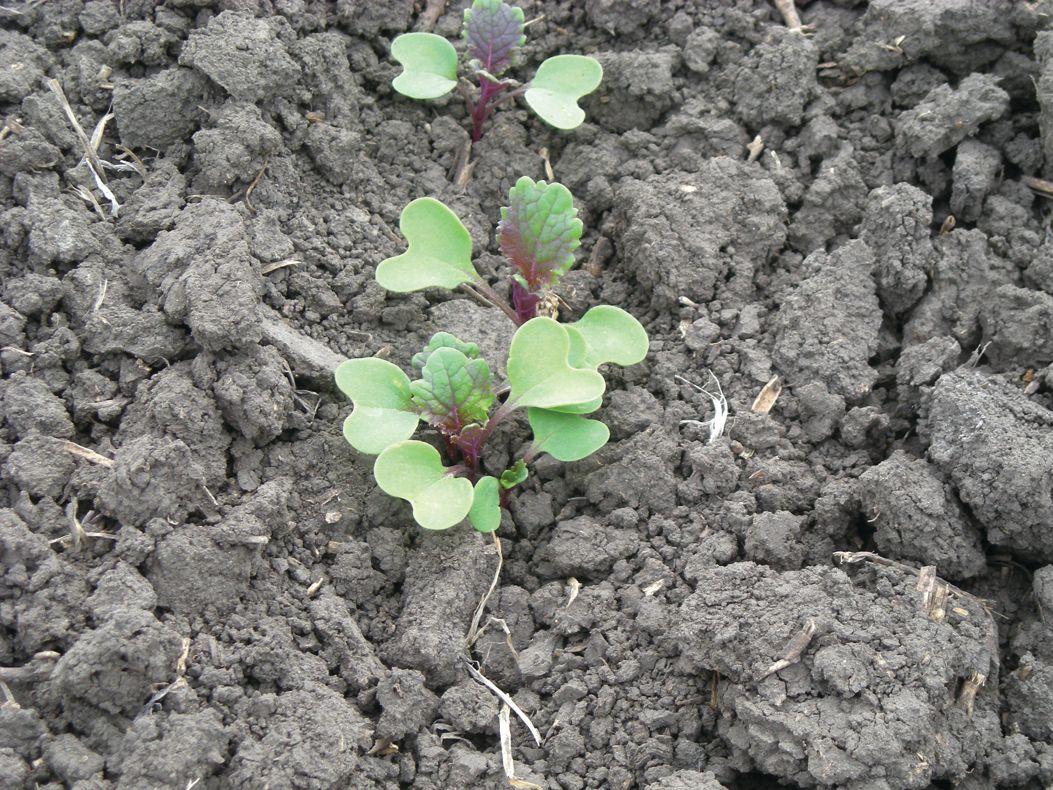
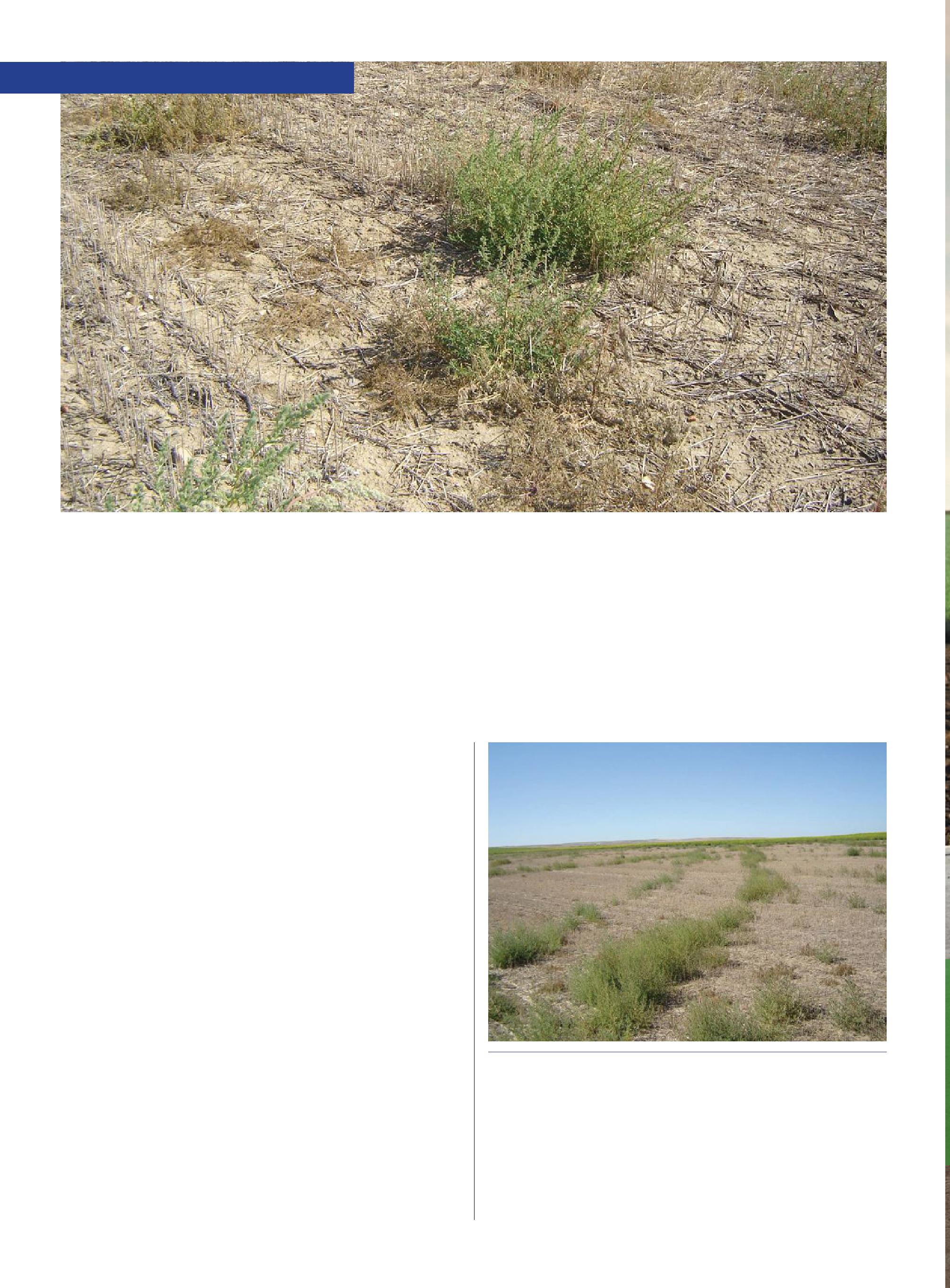
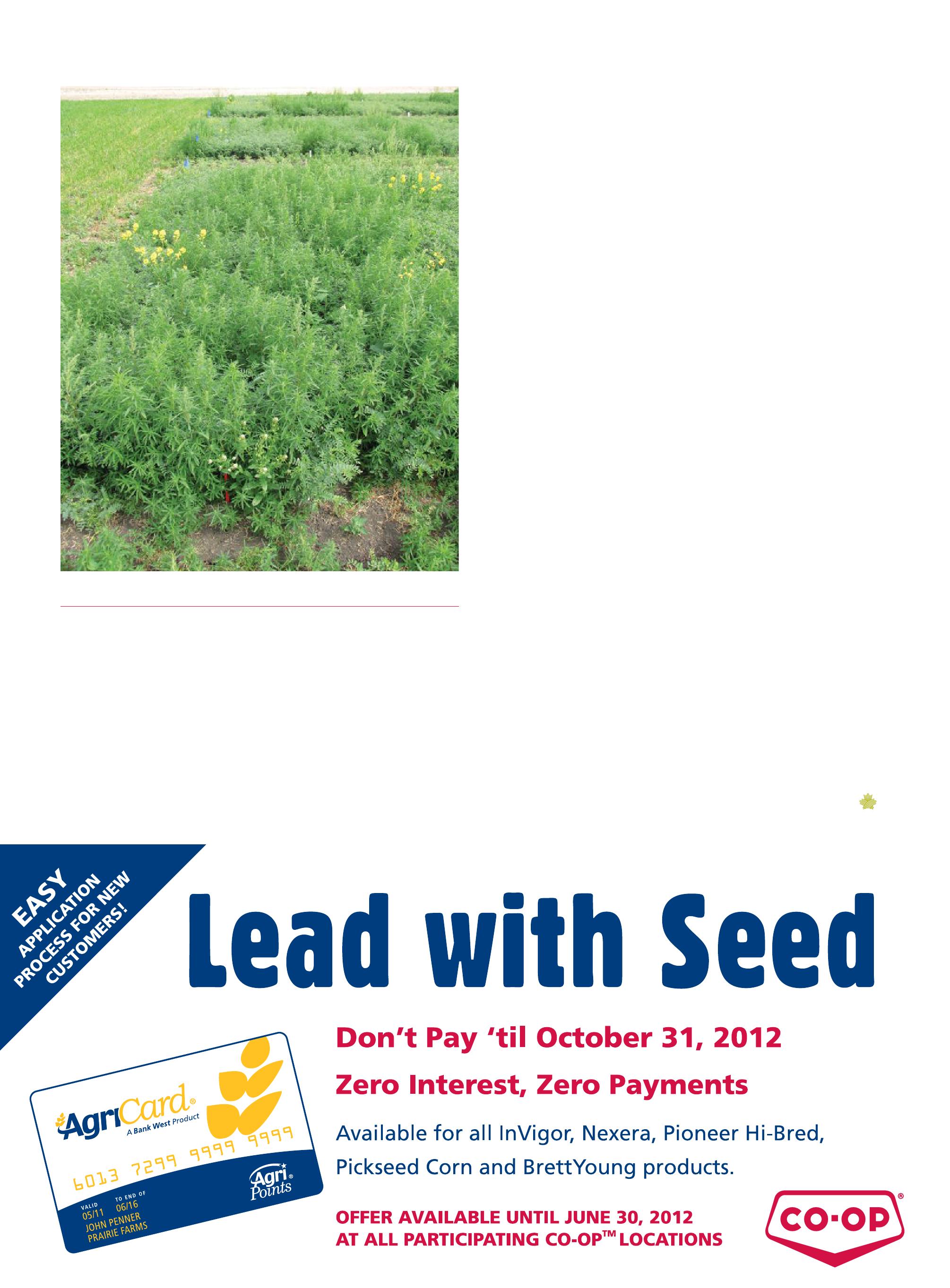
TOP: Glyphosate-resistant kochia remains green and healthy while dead kochia is visible – a clear indication of resistance.
ABOVE: Resistant kochia was found in strips running across the chemfallow fields, indicative of seeds spread by windblown, tumbling kochia.
It’s the canola herbicide you’ve been wishing for.
It’s no wonder farmers are just itching to get their hands on this. New ARES™ herbicide is an integral part of the enhanced Clearfield® Production System for canola. It controls all the weeds other systems get plus the ones they don’t, including tough weeds like lamb’s quarters, wild buckwheat and cleavers. And with its user-friendly, liquid formulation, it’s bound to be on most canola farmers’ wish lists this year. Visit your BASF retailer or agsolutions.ca/ARES for more details.
You wouldn’t be able to bump up rates to control them. What that would do is just select for higher resistance,” explains Beckie.
Jury is out on how resistance developed
Three different growers first brought the fields to the aaFC researchers’ attention on the chemfallow fields in close proximity to each other. glyphosate was generally used alone without a tank-mix in the
other fields,” says Beckie.
This isn’t the first time glyphosate resistance has been identified in kochia populations. Kansas, Colorado and nebraska have confirmed cases, and suspected cases are in north and South Dakota, Montana and oklahoma. The Kansas resistance was identified in 2007, and it has been found in corn, cotton, soybean, cropland and chemfallow at up to 500 sites and on up to 10,000 acres.
chemfallow years. The crops grown were mainly winter wheat, spring wheat, barley and mustard, with infrequent or no planting of roundup ready crops. Chemfallow was generally conducted every second or third year.
The resistant kochia were found in strips running across the chemfallow fields. The seeds were obviously deposited by mature plants tumbling across the field. Beckie observed dead plants alongside the strips of resistant plants.
“When I see that, it is likely resistance showing up,” says Beckie.
In 2011, the scientists also did a preliminary survey of 50 sites in surrounding fields within a 20-kilometre radius. They are assessing these plants to find out if glyphosate-resistant kochia is a problem on some of these fields as well. The results will be known by the spring of 2012.
“We still don’t know if the resistant populations were selected in the fields where we found them or blown in from
given that one kochia plant can produce 10,000 seeds and it has a windblown, tumbling nature, resistance can spread rapidly by seed. In Kansas, weed scientist phil Stahlman conducted a survey of 44 populations in 2011 and found that more than 50 percent of the populations he collected were resistant.
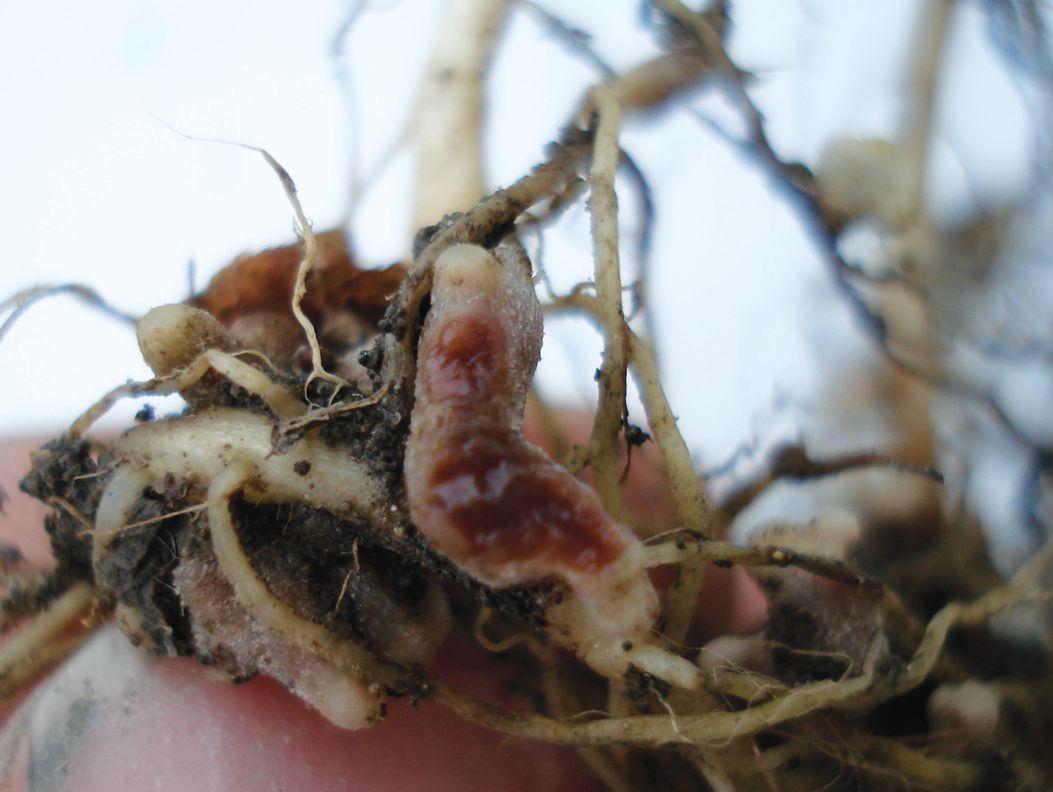
Beckie is investigating the mechanism of resistance. In Kansas, the resistance appears to be from gene amplification. This is where the plant produces multiple target sites, which overwhelms the herbicide. Beckie suspects the same mechanism may be found here.
Managing kochia resistance
g lyphosate-resistant kochia has the potential to become a widespread problem. Kochia is also resistant to g roup 2 herbicides (glyphosate is a g roup 9), with 90 percent of kochia populations sampled in alberta, Saskatchewan and Manitoba resistant.
“When you look at group 2 kochia resistance, it went from completely susceptible to completely resistant in 20 years. It has the potential to spread rapidly,” says Beckie.
For growers without glyphosate-resistant kochia – just group 2-resistant kochia – now is the time to act. For pre-seed control, CleanStart or an appropriate tank-mix partner with glyphosate are good choices – check label for cropping restrictions following a pre-seed burndown.
For in-crop applications to both glyphosate and group 2-resistant kochia, there are still good choices. In-crop applications in wheat can include herbicides like Triton K, attain, Target and Infinity. Several years ago, research by Ken Sapsford at the University of Saskatchewan illustrated some of the best choices for controlling group 2 resistant kochia, and these were primarily group 4 herbicides.
at the time, g F184 and Uap 0401 were unregistered, but are now registered as Stellar ( g F184) and o ptica Trio (Uap 040).
other herbicides that did not provide acceptable control of either type of kochia in wheat were the group 4 herbicide 2,4D ester at rates up to 8 ounces per acre, and group 6/4 combo Buctril M. Since this research was done, other herbicides have been registered that can control group 2-resistant kochia, and they contain a mixture of different compounds. Many of these products will contain dicamba or fluroxypyr in the mix.
In chickpea and field pea, authority is a good choice for both types of resistant kochia. In canola, Liberty will control both types in InVigor canola, and roundup will control group 2-resistant kochia in roundup ready canola.
Beckie reminds growers not to ignore kochia after harvest. He says kochia can produce significant amounts of seed after harvest if left uncontrolled.
“What growers have to do now is work to slow down the spread,” says Beckie.
For 2012, the scientists plan to conduct field trials to look at alternative herbicides, and are also collaborating with Linda Hall at the University of alberta on additional trials.
Farmers wanting to assess the likelihood of glyphosate developing on their farm can visit www.weedtool.com – a site hosted by Monsanto Canada but developed by western Canadian academic weed scientists.
Comparison of herbicide control of Group 2-resistant kochia in spring wheat
Kochia Control
Wins! New Nodulator ® XL
2011 yield trials prove it.
Nodulator ® XL features a new, highly efficient and more active strain of rhizobia, helping to pump up yields by 3% to 8% in peas and lentils.*
2011 yield results are proving it. In 12 head-to-head field-scale trials in peas, conducted by independent co-operators in Alberta and Saskatchewan, Nodulator ® XL won 92% of the time, out-yielding our competitor’s product by an average of 1.6 bu./ac. or 3.25%! And our small plot trials show even higher yield increases in lentils.
bAN ki Ng oN RESiduA l pHo SpHoRu S
Soil phosphorus remains available to crops in the long term.
by Lisa guenther
Conventional wisdom dictates that phosphorus fertilizer is tied up in the soil rapidly, leaving much of it unavailable for crop uptake. However, recent research looking at the longterm availability of phosphorus is changing that perception.
“all the studies that quote low-use efficiency used the ‘difference’ method. This method is based on calculating the difference in uptake between a crop that is fertilized with phosphorus and a crop that is not fertilized with phosphorus,” says Dr. Fernando Selles, a soil scientist previously with agriculture and agri-Food Canada. He adds that this method assumes that residual phosphorus in the soil is not available to the crop, which produces misleading data.
Selles and his colleagues with agriculture and agri-Food Canada recently published results from a 39-year field research trial. In 1967, researchers started applying phosphorus-only or phosphorus and nitrogen fertilizer to a continuous wheat rotation and a summer fallow-wheat-wheat rotation. Between 1994 and 2005, the researchers stopped applying phosphorus to some of these plots in order to see if the crops could use the phosphorus that accumulated in the soils.
Selles explains that they calculated how much phosphorus the crop used by tracking how much was applied, how much remained in the soil, and how much was present in the grain. They found that residual phosphorus from fertilizer tended to accumulate in the soil, but crops could eventually recover most of the excess phosphorus that was applied.
Dr. Cynthia grant, a soil scientist with agriculture and agri-Food Canada, says the results are supported by other evidence, as well as research out of rothamstead research.
“If you look at balance sheets from all over the prairies, it shows the same thing. If you look at the amount of phosphorus that’s exported in the crops we grow, and compare that to the amount of phosphorus that’s put on the soil, it’s a very, very close relationship,” says grant.
grain yield or production had the biggest effect on phosphorus uptake. anything that increased yield or production also increased the amount of phosphorus used by the crop. For example, Selles says that the fallow-wheat-wheat rotation used about two-thirds of the phosphorus as compared with the continuous wheat system, as only two-thirds of the land was cropped in the fallow-wheat-wheat rotation. proper nitrogen fertilization also played a role.
“The first thing that we found was that if you don’t properly fertilize your crop, you cannot expect it to do well when there are good growing conditions,” says Selles.
When nitrogen and phosphorus were applied to crops, the amount of residual phosphorus in the soil increased for the first 20 years. During this time, a water deficit limited crop yields and phosphorus uptake.
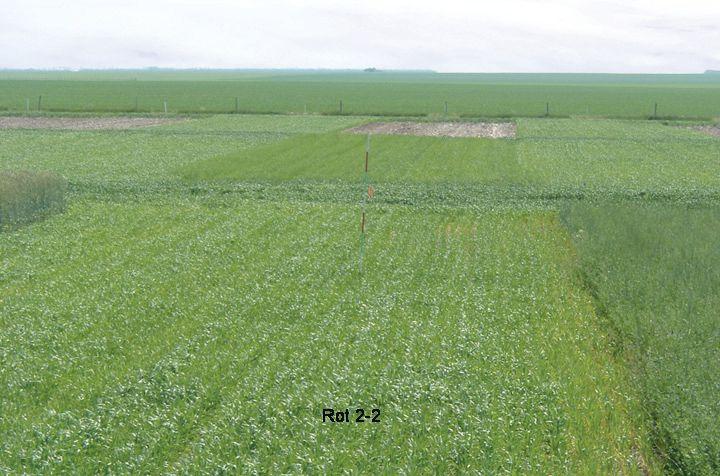
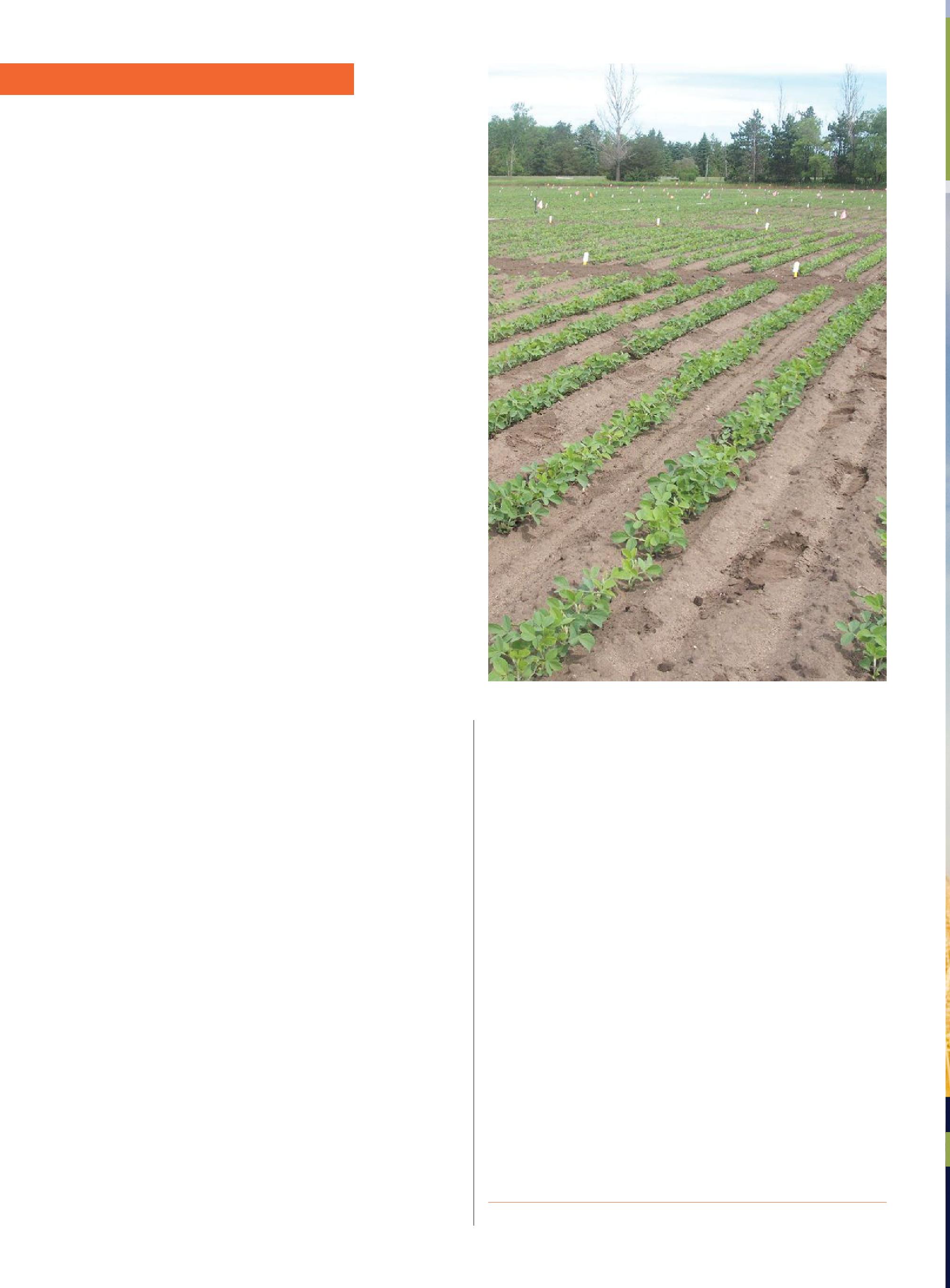
Fallow-wheat-wheat plot. Most of this fallow-wheat-wheat plot received N and P fertilizers; the flag indicates the subplot that received N but no P.
Between 1994 and 2005, growing conditions improved and grain yields increased. The crops used the equivalent of 100 percent of the applied phosphorus, and the residual soil phosphorus plateaued for 12 years.
However, the nitrogen-starved crops used the equivalent of just 75 percent of the applied phosphorus, revealing that crops deficient in another nutrient can’t take advantage of phosphorus fertilization.
During the dry years between 1967 and 1993, the wheat fertilized with nitrogen and phosphorus used an average of five kilograms of phosphorus per hectare, which was the equivalent of 63 percent of the applied phosphorus. When fertilized with phosphorus alone, the plants used only four kilograms per hectare every year, equivalent to only 50 percent of the applied phosphorus.
The trials also showed that crops will use phosphorus that has been banked in the soil. In the plots where phosphorus application stopped in 1993, crops that still received nitrogen used the equivalent of 109 percent of the phosphorus, on average. The extra nine percent represented phosphorus native to the soil. over the same 12-year period, the crop that didn’t receive nitrogen or phosphorus used just 90 percent of the banked phosphorous.
Such research leads grant to caution producers against purchasing products that promise to “unlock” phosphorus. “It’s like pulling a rope. If you pull the phosphorus out, it will move in from different pools and become available over time,” she says.
However, crops may need phosphorus close to the roots in the spring, especially if the soil is cold or wet.
Continued on page 34
Experience INNOVATION
“This year we’ll use our RTS on more acres, for more jobs.”
Regan Crone, Spalding, SK
570 RTS Equipped for Seeding/Fertilizing
What can the SALFORD RTS do for you?
Regan Crone didn’t buy his RTS for seeding, but to get an early start on his canola acres in May
“I used the RTS to give my canola a head start in ground too wet for my precision hoe drill. On top of that, the RTS left even, mellow ground that allowed my anhydrous applicator to pull easier.” more ground with his RTS.
Experience
Simplicity is victory in the complex game of weed control. Flexible, high-performance cross-spectrum weed control with no rotational restrictions. Simplicity wins. So do you. Accomplish more. Through higher performance. Call 1.800.667.3852 or visit www.dowagro.ca.
A pRAiRiE-lEd SEARCH foR ENHANCEd WHEAT bREEdiNg
Genomics, DNA sequencing and DNA markers speed variety development.
by Carolyn King
Getting down to the bread and butter of plant breeding, a collaborative five-year research initiative aims to develop improved techniques for use in wheat breeding programs in Western Canada. By advancing understanding of the inner workings of wheat cells, the researchers aim to develop more efficient, faster and less costly methods for creating better varieties.
This research, funded by the Western grains research Foundation, has three strategic activities. one component, led by Dr. Curtis pozniak of the Crop Development Centre (CDC) at the University of Saskatchewan, aims to improve and develop new Dna markers to improve selection efficiency in Canadian wheat breeding programs. a second component is focusing on enhancing leaf rust resistance; Dr. Brent McCallum of agriculture and agri-Food Canada (aaFC) leads this component. and aaFC’s Dr. François eudes leads the third component, which involves developing a more efficient way to create inbred lines that are breeding true. “This is a truly collaborative initiative that includes all major institutions in Canada involved in wheat research,” says pozniak.
The project involves CDC; aaFC’s research centres at Lethbridge, Swift Current and Winnipeg; the national research Council’s plant Biotechnology Institute; and the Universities of alberta and Manitoba. By bringing together all of their diverse expertise, the researchers hope to create synergies that will further advance wheat breeding on the prairies.
Improving DNA markers
a Dna marker is a specific sequence of Dna that is associated with a particular trait. researchers use these markers to quickly screen breeding material in the lab for the desired traits, rather than having to take weeks or months to grow seeds into plants and test them for those traits. “Breeders are currently using marker-assisted selection, but we hope to develop more effective markers,” explains pozniak, a durum wheat breeder who also specializes in molecular genetics. He will be taking a genomics
ABOVE: Seeds from the isolated microspore culture plants can go directly to breeders.
approach to marker development; genomics is the study of an organism’s complete Dna sequence.
He says, “We hope to sequence some of the very best Canadian wheat varieties that each contain genes of interest to our breeding programs. Using this information, we will then identify the ‘next generation’ of D na markers associated with traits that we can target with marker-assisted selection.”
These next-generation markers have several advantages. For instance, they’re more accurate than some of the existing markers. Some current markers are “linked markers”; that is, although they are near the gene’s location on the wheat chromosome, they may not actually be part of the gene. In that situation, there is a possibility the D na marker may be present, but the actual gene lost or altered, so that the desired trait will not be expressed in the field. With the genomics-assisted approach, pozniak’s research team will know exactly where the genes are located along the wheat chromosomes so that they can ensure the markers developed have a much higher probably of indicating the presence of the actual gene conferring a desirable trait. He says, “We’ll be able to track the individual genes with the desired traits and make sure that we retain them throughout the breeding cycle.”
another advantage of the new markers, which are called single nucleotide polymorphisms or S nps, is that they are well suited to high-throughput screening procedures. a s part of this project, pozniak’s research team will be developing procedures
that can screen tens of thousands of individual plants using D na markers much more quickly than before.
as well, pozniak’s research will indirectly help breeders to address traits such as yield, which are associated with multiple genes, rather than a single gene. He says, “Breeding is very much a numbers game where we’re selecting for a whole suite of traits: yield, maturity, straw strength, disease resistance and end-use quality, throughout the breeding cycle. any tools we use to ensure that the materials we’re advancing in our breeding programs carry a desirable complement of genes are going to improve breeding efficiency. and that will allow breeders to then focus on other high-priority traits like yield, where Dna markers can’t be used as effectively.”
These next-generation markers will increase the efficiency and effectiveness of our wheat breeding programs. pozniak says, “What’s most exciting is that we can go right from the Dna sequence, follow it in our breeding programs, and make sure those genes that are important to producers are maintained in newly developed varieties.”
Better rust resistance
These next-generation markers will be playing a crucial part in the research component looking to increase the level and durability of rust resistance in western Canadian wheat breeding programs. “a number of times, rust resistance genes have been introduced into cultivars, and the cultivars get into production,
Researchers aim to increase the level and durability of leaf rust resistance in wheat by putting three resistance genes together in cultivars.
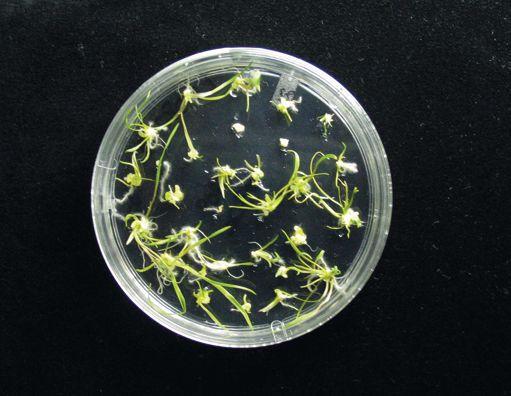
TOP: Doubled haploid embryos, derived from isolated microspore culture, are able to grow, germinate and produce plants right in a Petri dish.
ISOLATED MICROSPORE CULTURE
ISOLATED MICROSPORE CULTURE
STERILE CONDITION
STERILE CONDITION
STERILE CONDITION
STERILE CONDITION
CORN POLLINATION TECHNIQUE
CORN POLLINATION TECHNIQUE
CORN POLLINATION TECHNIQUE
CORN POLLINATION TECHNIQUE
and then the pathogen changes to overcome that resistance over time. This has happened with a number of resistance genes for a number of rusts, like stem rust of wheat, leaf rust of wheat, and crown rust of oats,” explains McCallum, a plant pathologist at aaFC’s Cereal research Centre in Winnipeg.
This component’s objectives are: to assess the effects of three leaf rust resistance genes, called Lr34, Lr46 and Lr67, individually and in combination in wheat plants; to develop better Dna markers for these genes; and to incorporate the three genes into elite wheat lines. These three genes appear to have a different mode of action than those genes that confer less durable leaf rust resistance. “Lr34 was introduced into wheat cultivars in Canada in the 1970s and it’s been effective ever since. It doesn’t give complete immunity to leaf rust, but it does give an intermediate level of resistance. So with just that single gene, we’ve been able to protect a number of cultivars from having very severe epidemics,” says McCallum. “Currently about half our wheat cultivars have Lr34. We’re working with the breeders to try to incorporate Lr34 into all future cultivars.”
“Lr46 has been used a lot in cultivars developed at CIMMYT (the International Maize and Wheat Improvement Centre) in Mexico for many years and has proven to be durable. We would like to start introducing it into our Canadian cultivars,” he adds. “Lr67 was discovered in Canada by peter Dyck in the 1970s. We just mapped it recently and named the gene. Lr67 really hasn’t been employed in agriculture anywhere in the world. However, it
acts in all aspects like Lr34 and Lr46, so we’re hoping it will prove to be durable and that we can get it into Canadian material so it will be the first material on the market with Lr67.”
McCallum hopes incorporating all three genes together in a cultivar will have an additive effect. “We hope we can move from Lr34’s intermediate level of resistance to fully resistant or nearly immune by adding these other two genes. and hopefully those two will be as durable as Lr34 has been, so the resistance won’t break down over time.”
He also notes the three genes confer more than just leaf rust resistance. “Lr34, Lr46 and Lr67 are unique in that they control not only leaf rust, but they also have an effect on stripe rust and stem rust, and they are supposed to have an effect on powdery mildew. Most other rust resistance genes control just one pathogen; the leaf rust genes only control leaf rust, and the stem rust genes only control stem rust.”
McCallum explains that the markers for Lr34 are already very good; they are located right inside the gene. But the markers for Lr46 and Lr67 are just linked markers. So pozniak and McCallum are collaborating to develop Snp markers for Lr46 and Lr67 that are much closer to the actual genes. That will allow McCallum’s team to use the markers in this project and will allow breeders in the years ahead to more easily screen breeding material to determine which particular rust resistance genes are present.
Hull ESS bAR l Ey: CHA ll ENg ES AN d pRo SpECTS
Slow progress made in market development.
by Carolyn King
Hulless barley has many positive characteristics for feed, food and malt uses. Yet according to the Canadian Wheat Board’s 2011-12 Variety Survey, hulless barley is estimated to account for less than one percent of the barley grown in Western Canada. nevertheless breeders, food scientists, industry development specialists and others continue to work on many fronts to help realize hulless barley’s full potential.
Hulless barley is not truly hulless, but the hull is much more loosely held onto the seed than in hulled barley, and the hulls are removed during combining. The absence of hulls means the grain has more nutrients and higher energy per unit weight than hulled barley and it requires less space to store and transport. The absence of hulls also means the seed is more easily damaged during handling, yields may sometimes be lower because the hulls are left in the field, and in some cases food and beverage processing is different than for hulled.
Feed uses: a price problem
Hulless feed barley has higher digestibility, higher protein and energy contents, and lower fibre than hulled barley, but that hasn’t been enough to ensure its success yet.
“We started developing hulless barley varieties here at Lacombe in the 1970s,” says Dr. Jim Helm, a barley breeder at the Field Crop Development Centre (FCDC) of alberta agriculture and rural Development (aarD). at the time, Helm and other Western Canadian breeders were excited by the potential of hulless feed barley. The first varieties were Scout (released in 1982) and Tupper (1984) from the Crop Development Centre (CDC) at the University of Saskatchewan, and Condor (1988) from FCDC.
Helm notes, “Condor was our first variety, and it quickly took a large part of the acreage. When we released the semi-dwarf, sixrow hulless barleys, like Falcon, that really boosted the acreage. But then the producers began to find that buyers would only pay regular barley prices for it, and not what it was actually worth, which caused them to quit growing it.”
He explains, “Hulled barley is approximately 15 percent hull, so in 100 truckloads of hulled barley, there are about 15 truckloads of just fibre. So producers should only have to bring 85 truckloads of hulless barley to get the same price as 100 truckloads of hulled.
CDC McGwire, a two-row hulless barley developed for food and feed markets.
But they are not getting that. right there they are starting to suffer a 15 percent loss.”
The price problem remains today. Helm says, “I think people especially in the hog industry would like to have it, but they still don’t want to pay for its value. So you can’t get seed growers and regular growers to grow it.”
Bill Chapman with aarD’s Crop Business Development Branch identifies several challenges for hulless feed barley over the
years. “early yields on the hulless varieties were a little lower than hulled barley. and the price was also a problem. originally palliser grain [a Calgary-based grain trading company] had paid a premium for it because they had developed some premium markets for hulless. But then palliser went by the wayside. and the feed industry wouldn’t give a premium for hulless.” He adds, “and then just when the feed market for hulless started to come back, the pork industry went into the tank and prices fell again.”
Chapman sees another obstacle. “With our grain industry going to larger terminals, they don’t have the small bins anymore for specialty products. and grain shipping is in 50-car or 100-car units for trains. So you won’t see a lot of large commercial interests getting into speciality products unless the products have really high premiums attached.”
nevertheless breeders haven’t given up on hulless feed barley. For instance, Dr. Joseph nyachiro, FCDC’s breeder for six-row barley and hulless barley, continues to work on improving hulless multipurpose barley that can be used for feed and food. nyachiro says, “I think hulless barley has potential for further improvements in agronomics, quality and multi-end uses to help capture opportuni-
GrowinG hulless barley
Management practices for hulless barley are similar to those for hulled barley. The main differences are in seeding and harvesting practices.
At seeding, the key factor is that the hulless embryo is exposed so it is more easily damaged. Damaged embryos result in lower emergence and poorer competition with weeds. A few years ago, Dr. John O’Donovan, now with Agriculture and Agri-Food Canada, was involved in a three-year study to assess seeding practices for hulless barley. The researchers compared the effects of different seeding rates and depths on emergence for AC Harper (hulled) and Peregrine (hulless) at Beaverlodge, Lacombe, and Fort Vermilion.
“We found generally that, with the hulled variety AC Harper, you needed to seed about 300 seeds per square metre to get 200 to 240 plants per square metre; some of our recent work with hulled malting barley varieties has corroborated that rate. But for the hulless variety Peregrine, you needed to seed 400 seeds per square metre and
ties that are yet to be exploited.” as well, Helm and others at FCDC are addressing that crucial issue: the price problem. They have been working with the hog and cattle industries on feed value and the advantages of using near infrared reflectance spectroscopy. This rapid, accurate method to measure feed quality allows producers to buy feed based on its quality, not just its weight.
Helm explains, “If livestock producers can actually put a figure on the true value of hulless barley in their feeding operation, and that value is significantly higher than regular barley or wheat, then they can decide if they can pay the grower a little more for hulless barley and still get a better advantage and make more money on the livestock end. That way, the two parts of the industry are working together. That’s our hope for future.”
Food uses: big potential, some risk, small supply Western Canadian researchers are working on various aspects of hulless barley for food uses, including developing food products, validating health benefits and breeding better varieties.
Continued on page 28
that was with a seeding depth of about an inch. When we seeded to 2.5 inches deep, emergence of the hulless variety was even lower – we had to seed 500 seeds per square metre to get the target number of plants,” says O’Donovan.
He adds, “We also found that emergence tended to be more variable with the hulless variety. You couldn’t depend on it as much to get that target number of plants per square metre at a specific seeding rate. That makes sense because damage to the embryo can be variable depending on what processes the seed has gone through.”
Bill Chapman with AARD’s Crop Business Development Branch says, “Because hulless barley is not as competitive as hulled barley during early growth until tillering, your seeding density should be at the maximum for your moisture level. In the drier parts of Alberta, that’s 130 to 150 plants per square metre (13 to 15 plants per square foot). In areas with medium moisture, the range is 180 to 220 plants per square metre, depending on the
soil’s moisture-holding capacity. With some of the clay soils, you can seed at the high end of that range. You can gain almost three to four days maturity by seeding a little heavier, but if it’s too heavy then you’ll get a lower percent plump. In wet areas, the range is 250 to 280 plants per square metre.”
Chapman also notes, “Because hulless barley is not as competitive, it’s important to spray early for good weed control.”
For harvesting hulless barley, he advises, “Set your combine like you would for combining wheat because hulless barley is a denser product; it is about 58 to 60 pounds per bushel.
“Also, adjust your cylinder speed and cylinder clearance or spacing to try to remove as many hulls as possible.” He explains that commercial users want less than about five percent of the grain to have the hulls attached. Because it can be very difficult to get down to five percent at the combine, some seed cleaners have de-bearders to remove the last few hulls.
Nyachiro’s advanced hulless barley lines at the Field Crop Development Centre at Lacombe.
Finally, a longer-lasting burndown that includes wild oats.
For the first time ever, wheat growers can now add residual grassy weed control to their burndown and take care of Roundup Ready® Canola volunteers and broadleaf weeds at the same time. Adding PRE-PARE™ to your glyphosate gives you a longer-lasting burndown of grassy weeds in wheat, including yield-robbing wild oats, green foxtail and foxtail barley. Plus, PRE-PARE takes care of Roundup Ready Canola. Your wheat gets the head start it needs. You get the yields you deserve. To learn more, visit preparefortheseason.ca.
Serious growers take weed control personally. With three modes of action in a single solution, Velocity m3 herbicide provides enough raw power to take down your toughest broadleaf and grassy weeds. Crush Group 1-resistant wild oats and Group 2-resistant broadleafs. For more information visit BayerCropScience.ca/Velocitym3
Let’s DO this!
BRING ITON
For example, Dr. Linda Malcolmson with the Canadian International grains Institute (CIgI) led a recent project on hulless barley food products. CIgI and aarD’s Food processing Development Centre partnered on this project, with funding from agriculture and agri-Food Canada, the alberta Barley Commission and the Canadian Wheat Board (CWB).
“We thought a flour application might be the easiest way to get uptake of barley ingredients by food manufacturers. We chose hulless over hulled types because the miller doesn’t have that extra step of removing the hull to produce flour from hulless barley. also, only the hulless types have the high beta-glucan content, and we thought the enhanced soluble fibre would be compelling to food companies [because of the health advantages],” notes Malcolmson.
The researchers used whole grain flour from five hulless varieties: CDC rattan and CDC Fibar, which are waxy hulless barleys with high beta-glucan contents that were bred for food uses; Falcon, developed as a multipurpose variety; CDC Mcgwire, which is for both food and feed markets; and Millhouse, a milling variety that can be processed in the same way as wheat.
They developed product prototypes, including bakery products, snack foods, nutrition bars and meat products (flour is added to hold water and to bind the meat). She says, “The products we developed were fantastic. The flavour of barley is unbelievably good. I was quite disappointed that the flavour alone didn’t translate into more motivation for food companies.”
There has been some interest from some smaller food companies. Malcolmson explains: “a large food company doesn’t make a change overnight, whereas a smaller food company is more willing to maybe make a switch or offer a new product.
“But the biggest problem was the hulless supply just wasn’t there. one company in particular was very interested, but they had difficulty sourcing the hulless barley. Unless the supply problem is taken care of, hulless barley is never going anywhere.”
a coalition of barley stakeholders is pursuing another angle – they have sub -
Pe rcentage of seeded acres
CWB Varity Survey 2002-2011
Percentage of Prairie barley seeded area by type
mitted a health claim for food barley to Health Canada. government-approved health claims help consumers make healthy choices and encourage product innovation by food manufacturers. Chapman says barley’s beta-glucan soluble fibre lowers blood cholesterol, reduces the risk of heart disease, helps with weight control, and improves glucose tolerance. He hopes approval of the health claim might increase interest along the value chain in hulless barley for food uses.
“If a company decides to take a chance and champion barley, that could make all the difference for hulless barley,” says Doug Munro of the CWB. But he cautions, “people had hoped that the health claim in the United States would significantly improve the market for food barley, but it doesn’t seem to have impacted it that much so far.” In 2006, the U.S. Food and Drug administration finalized its approval of a health claim for barley.
Munro adds, “It’s a big investment for food companies to bring a new product along. So, for instance in a product where they could use either oats or barley, they might choose oats because oats are already well known as healthy by consumers.”
The efforts of some small food companies on the prairies could help spark greater interest in hulless barley. nyachiro says, “There are some things happening in the niche markets, with companies embracing the use of hulless barley. right off the top of my head are: Hamilton’s
Barley Flour, which has done a great job of making barley flour available to grocery stores; and progressive Foods Inc., which has made great progress in inventing quick-cooking barley and promoting the use of barley as a healthy food.”
Malting: innovation versus tradition
“I started working on hulless barley for malting over 15 years ago. at that time none of the hulless lines had been bred for malting, but they tended to have not bad malting quality,” says Dr. Michael edney with the grain research Laboratory of the Canadian grain Commission.
“We analyzed the lines coming through the system for a number of years, and we talked to the malting industry and showed them the potential. Hulless barley has higher extracts (which indicates how much beer can be made). also, there is less spent grain afterwards and reduced transportation costs for both the barley going to the malt house and the malt going to the brewhouse. The maltsters got excited, but they never got excited commercially.
“Then a few years ago the malting industry finally said, ‘If we were ever to use hulless malt, only certain quality parameters should be worried about.’ So the breeders started breeding specifically for hulless malt. In 2009, Dr. Bill Legge from aaFC in Brandon released a variety called Taylor, and Dr. Brian rossnagel and Dr. aaron Beattie from the University of Saskatchewan released a variety called
Feed (2&6 Row)
Two-row (malt) Six-row (malt) Hulless (2&6 Row)
Barley acres by type for the Prairies, 2002 to 2011
CDC ExPlus. Those varieties had really high extract, low grain protein, no adhering hulls, and low wort beta-glucan. The breeders are continuing to breed hulless barley for malting, mainly concentrating on disease and agronomics. But they are also waiting for commercial demand from maltsters and brewers.”
There have been small bubbles of interest from the industry. Edney gives an example: “In the winter of 2011, some hulless barley was moved into the US and malted as a specialty malt. I heard they were very happy with the final product, especially the craft brewers.”
He thinks several factors are barriers to commercial use of hulless malting barley. “One factor is that the big brewers only have so many silos and they figure they have to keep hulless separate, so they are not sure how to handle hulless malt. Also, to use hulless malt, they need equipment called mash filters and not very many companies in North America have those. Another problem is that hulless barley behaves differently in the malt house because it’s very sticky. For instance when they are moving it between vessels, it sticks to the belt, and it sticks to the vessels when they are trying to empty them. However, they could work around that if there was demand for hulless malt.”
The supply of hulless malting barley is also an issue. Edney says, “Right now, if someone asked me to find even 10 tonnes of one of the new varieties I’d probably have a hard time finding it.”
Helm identifies another challenge. “The brewers really like to stay with tradition. . . . When we release a new [hulled] malting barley that has virtually the same qualities as one of the old ones, the brewers are very reluctant to try it in case somehow the new variety has a slightly different taste or they have to change their process in some way to make it work. I think it would be even harder to get them to use hulless varieties.”
Edney believes the greatest potential for hulless could be with moderate-sized breweries. “A lot of them have mash filters and they are willing to put up with the annoyance of an extra silo if they can make a product that is more economical or more interesting from a marketing perspective.”
He is “cautiously optimistic” about the future of hulless malt barley. “When
I did my master’s back in the early 1980s, I worked with Scout, the first hulless barley, and I was feeding that to chickens. There was all this excitement then, but nothing really came of it. So I don’t want to get too optimistic about malting, but we’ll continue to work on it.”
He adds, “Maybe if we keep plugging away at it, eventually we’ll have demand for this unique product. Maybe we need a new name for it. That’s what canola did, and look where it is now!”
Some people already refer to hulless
barley as “naked barley.” There’s a name that conjures up marketing possibilities for Naked Barley Nutrition Bars, or Naked Barley Pancakes, or Naked Beer!
With better placement, better availability and better uptake, it’s just not fair to compare Wolf Trax® DDP® Micronutrients to traditional granular and all-in-one products. With Wolf Trax Technology, your crops get the micronutrient they need, when they need it. And best of all, you’re covered by our Growing Forward® Guarantee.
See how Wolf Trax innovation can improve your crop’s performance at www.wolftrax.com or call 1-855-237-9653
Newest Agriculture Portal
C Rop RoTAT ioNS
AN d NET RET u RNS
A look at the long-term shows diversity can improve net returns.
by Carolyn King
While today’s high canola prices make short canola rotations very appealing, anastasia Kubinec of Manitoba agriculture, Food and rural Initiatives reminds farmers that a more diverse, agronomically sound rotation could actually make as much or more money over the long term.
as both an oilseed specialist and a farmer, Kubinec feels strongly about the value of longer rotations. “I participate in [Manitoba’s] canola disease survey every year and help crunch the numbers, and I see the increased disease levels in the shorter rotations. Then on our farm, we have some areas that have really good, diverse rotations and some areas that don’t, and when we’re doing the books at the end of the year we can definitely tell which areas are which.”
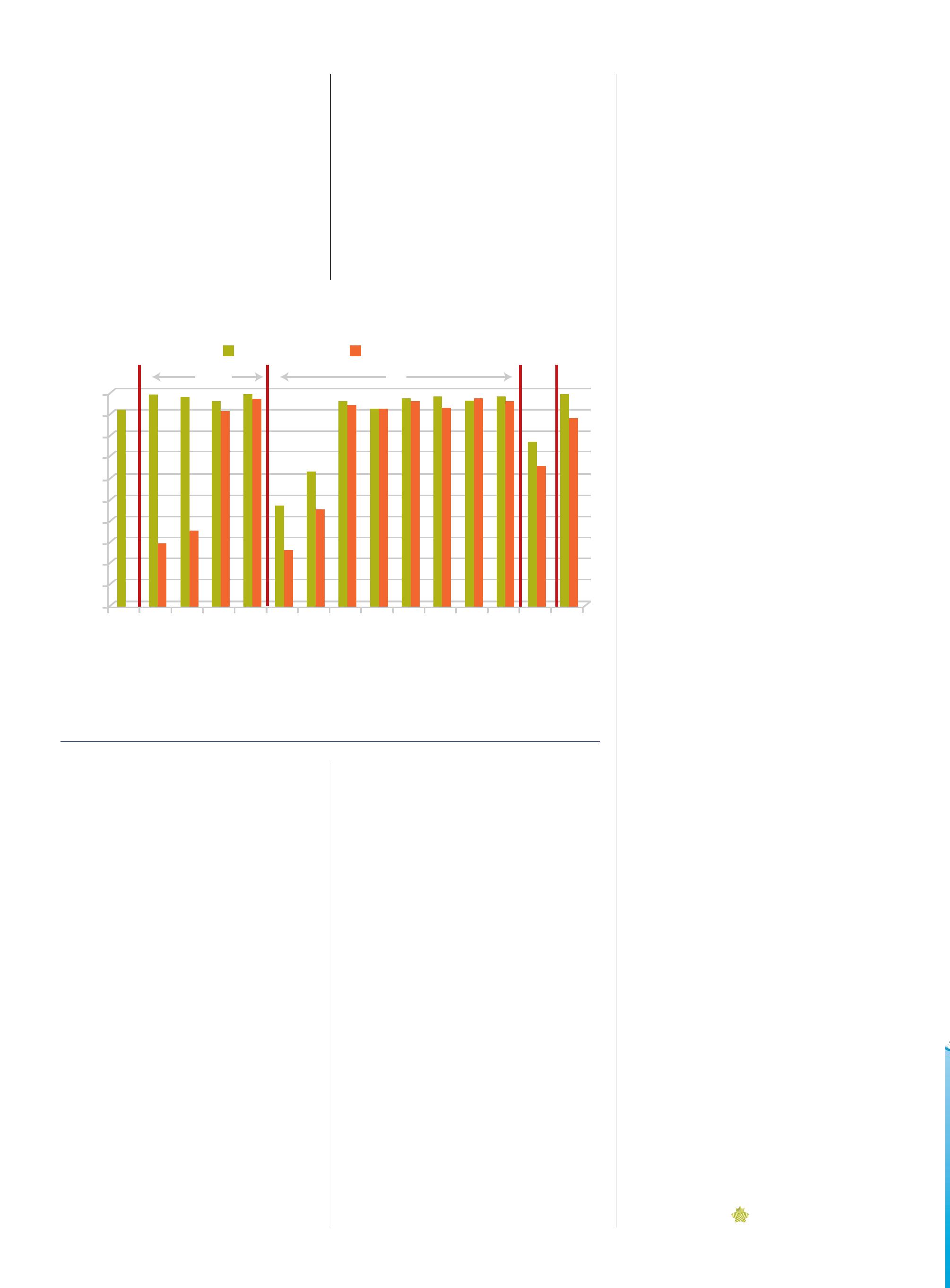
To demonstrate how tighter rotations can harm a farmer’s bottom line over the longer term, she compares net returns for three rotations: canola/wheat; canola/wheat/flax; and canola/winter wheat/flax/oat/canola/wheat, as shown in the chart below. In this chart, the net profit per acre is (crop yield per acre x crop price per acre) subtract operating costs per acre; the operating costs were determined from the MaFrI Cost of production guide for 2011.
In this example, the canola/wheat rotation results in increased disease problems over time, which causes the farmer to use a fungicide in Years 3 and 5 to try to maintain yields. With the added fungicide costs, the average annual net returns for the six-year period are about $20 lower for the canola/wheat rotation than for the two longer rotations, despite canola’s high price.
“For example, with blackleg in Manitoba, farmers with tight rota-
tions are now putting in a fungicide with their herbicide from the twoto six-leaf stage to try to control early blackleg. a farmer with a longer rotation and not as high blackleg pressure probably doesn’t need to have that extra $10 or $15 expense. Things like that start adding up to impact the net returns a farmer could potentially get,” says Kubinec.
She explains that Manitoba’s canola disease surveys, backed up by the field rotation information provided by the farmers, show clearly that the percentage of canola plants with blackleg increases as canola becomes more frequent in the rotation. She says, “Those are real-life results, not plot data. Farmers’ own fields are showing the impacts of shorter rotations.”
other diseases that tend to increase with shorter rotations include fusarium head blight in cereals, pasmo in flax, goss’s wilt in corn and ascochyta in field peas. a longer rotation lengthens the time a pathogen must survive without its host plant species, and some pathogen species can survive for only a short time without a host. Shortening the rotation gives the pathogen a better chance to survive and multiply, allowing its population to build up and cause greater damage year after year. In addition, as the population increases, the chances are higher that there will be individuals within the population that are resistant to a control measure. over time the number of resistant individuals can increase so much that the control measure is no longer effective.
ABOVE: Disease such as sclerotinia, and other factors, can lower net revenue in short crop rotations.
Photo by bR
Success through innovation.
With revolutionary new technology like the UltraPro Canola Meter, Zone Command, and the Nova XP-820 Smart Cart, we help you drive yields and profitability higher than ever.
SeedMaster is the only farm equipment manufacturer to win multiple Innovation Awards – including the coveted Gold Innovation Award –at the 2011 Farm Progress Show.
■ Gold: UltraPro Canola Meter
■ Sterling: Nova XP-820 Smart Cart
■ Sterling: Zone Command
» Massive 820-Bushel Capacity
» 10-Zone Overlap Control
» Real-Time Product Weighing
» Flexible, Modular Design: 4-Tanks-In-1
» Move More Product Without Plugging
BA BUILT FOR
Economical, high-performing, grass control in barley and wheat. Good thing you planted barley. Good thing you applied Liquid Achieve®.
Furthermore, increased disease is not the only problem that can reduce net returns in tight rotations over the long term. Similar to diseases, insect pests can build up under shorter rotations, resulting in decreased crop yields and/or increased control costs, as well as increased risk of the development of resistance. a short rotation may also draw down soil nutrient levels over time. “For instance, canola and wheat are both very high nitrogen users. If you’re always having canola/ wheat/canola/wheat, that can affect nitrogen levels. Canola also uses a lot of sulphur and needs sulphur to get great yields. So if farmers aren’t keeping nitrogen and sulphur levels up high enough, they could be hurting their returns later, especially with sulphur, because deficiencies can impact canola yields quite quickly,” explains Kubinec.
In addition, tight rotations may impact soil moisture content in the soil profile. She notes, “If you’re only using a couple of crops in your rotation, you’ll be taking the soil moisture out of the same few feet of soil from year to year and not accessing any of the moisture that’s lower or higher. So you could potentially be limiting your yields.”
Planning your rotation
a lot of factors go into choosing a good rotation. Kubinec points out that what you planted in 2011 will impact your yields in 2012. In particular, yield data from the Manitoba agricultural Services Corporation shows that growing the same crop two years in a row reduces yields. For example, the yield for canola grown on canola stubble is 81 percent of the yield for canola on wheat.
as well, certain crop combinations negatively affect yields, like flax on canola. These negative effects can be caused by a variety of things, such as disease carryover and residual herbicides. For flax on canola, one reason for lower flax yields is that volunteer canola can be challenging to control in flax. another reason is that flax depends strongly on mycorrhizal fungi in the soil to bring nutrients back to the plant’s roots. But canola is not a mycorrhizae host, so it doesn’t leave behind a network of mycorrhizal strands capable of colonizing the new flax roots early in the season. as a result, the young flax plants have a difficult time getting the nutrients they need.
Farmers consider many other factors when planning a rotation, such as which crops are best suited to the growing conditions in their area and which crops could help in overcoming troublesome disease, weed or insect issues in a field; could allow rotation of herbicide, fungicide and insecticide groups; could require lower inputs, and – of course –have favourable crop prices.
overall, Kubinec recommends that farmers think about the long term when planning their rotations. “I’ve seen long rotations versus short rotations, and how quickly some problems can start to happen with shorter rotations, causing net returns to start going down. The way that canola prices have been in the past few years definitely makes farmers lean toward shorter rotations, but it’s important to think long term as well.”
bAN ki Ng oN RESiduA l pHo SpHoRu S
Continued from page 14
“When soils are cold, if the concentration of phosphorus in the soil is relatively low, you might have to have some phosphorus close to the seed to sort of jump-start the whole process. phosphorus that’s taken up later in the season may not have as big of an effect on crop yield because it doesn’t help the plant early enough,” says grant.
Balancing the bank account grant advises producers to use this type of research to develop longterm strategies for managing phosphorus. “If you manage your entire rotation and make sure you’re applying adequate amounts of phosphorus in the preceding crops, it can carry you through for the other crops and maybe a little bit of starter is all you need to optimize your crop yield, as long as you’re maintaining the fertility through the rotation.”
During the agriculture and agri-Food Canada trials, the crops continued to yield well on stored phosphorus for 12 years. Usually the yield was the same as the crops still receiving phosphorus. Selles reports that there were four years of particularly cool, wet springs which led to reduced yields for the crops without applied phosphorus. overall, the continuous wheat crops saw a total production reduction of 10 percent in the 12 years they didn’t receive phosphorus.
rotations that included a fallow year saw no significant reduction in crop yield, possibly because of phosphorus mineralization in the fallow year.
Selles likens the accumulation of phosphorus to socking away money in a savings account. producers who have been adding phosphorus for several years can then use some of their savings, as long as they don’t overdo it. “You don’t want to get down to zero. It’s the same thing, pretty well, as with your bank account,” he says.
Soil tests are good at detecting rising levels of phosphorus, but poor at identifying decreasing phosphorus. Selles recommends not only taking soil samples every three to five years, but also testing the amount of phosphorus in the grain. In the future, the same infrared technology that measures protein levels could be calibrated to measure phosphorus, which would help producers calculate the balance of phosphorus left in the soil.
There is still more research to be done on the subject. Scientists at agriculture and agri-Food Canada are now studying what type of phosphorus is contained in the soil from the original plots used in the research trials.
“That will be the next step. When we know that, we will know even better how to manage phosphorus,” says Selles.
DuPont™ t Express® brand herbicides don’t just burn weeds down, they get right to the root of your weed problems for super-hot performance.
Add an Express® herbicide to glyphosate in pre-seed, chemfallow or post-harvest applications. Express® SG: turn up the heat ™ on dandelion, volunteer canola and narrow-leaved hawk’s-beard. Express® PRO delivers up to 15 days of extended control† on tough weeds like cleavers, dandelion and narrow-leaved hawk’s-beard.
DuPont™ t Express® herbicides - Canada’s #1 glyphosate partner, used on more pre-seed acres than any other brand in Western Canada. They’re that hot!
†Depending
f l A x pRodu CT ioN
REvi Si TE d
Flax responds best to moderate fertilizer applications.
by Donna Fleury
Everything in moderation. That’s the message coming from researchers who have tried over the years to identify best practices that can help flax growers optimize flaxseed yields. r ecommended agronomic practices that can help achieve higher yields have been developed, but finding a consistent yield response to fertilizer applications beyond current recommendations remains a challenge. Unlike other crops such as canola or wheat where yields can be pushed higher with higher applications of fertilizer n, flax seems to only respond to moderate levels. “ e ven with all of the research work we’ve done, flax and its response to fertilizer is still baffling,” says Dr. g uy Lafond, research scientist at a griculture and a gri-Food Canada ( aa FC) in Indian Head, Saskatchewan. “Flax does not want to get pushed, so putting on higher rates of n fertilizer seldom improves yield or crop performance. e ven in comparing different cultivars, in the end they all yielded about the same and the highest yields were obtained with the recommended n fertilizer rate.”
Lafond led a three-year multi-site study from 1999 to 2001 at five locations across Western Canada looking at various factors such as seeding rate and date, fertilizer rates and different cultivars. “The study confirmed that flax is well adapted to notill and performs well under these systems,” explains Lafond. “The results also showed that flax can be safely seeded later in the spring in more northerly locations, even past the middle of May with no yield decrease, while more southerly sites benefited from seeding earlier near the first of May.”
Lafond compared three fertilizer rates of 67, 100 and 133 percent of the n recommended for a target flax yield of 32.3 bu/acre, placed as a side-band at the time of seeding. The results showed a seed yield increase with n when going from 66 to 100 percent of the recommended rate, with no increases past 100 percent. adding n resulted in a small drop in seed oil
ABOVE: Flax trials comparing preceding crop, P application and Cd levels in flax in Manitoba.
Photo
content. Researchers also found a lack of response to N with the later planting date beyond 66 percent of the recommended N rate, suggesting reduced nitrogen rates with later plantings are possible. Given the overall results, and with continued research over the past few years, current recommended N fertilizer rates remain the same.
Dr. Cynthia Grant, research scientist at AAFC in Brandon, Manitoba, has had similar findings with various flax research projects she’s been involved in over the years and notes the secret to getting a high yield with flax is not putting on extra fertilizer. “It is important to have adequate levels of nutrients, but if you think you can get high yields by boosting your N and P rate, it’s not necessarily true,” says Grant. “The reasons people get good yields of flax compared to poorer yields remains a bit of a mystery.”
Grant led a three-year study at two locations in western Manitoba from 2000 to 2002 comparing P fertilizer applications, impacts of preceding crops and mycorrhizal association. “Flax is sensitive to seed-place P and tends to be less efficient than many other crops at using fertilizer P,” explains Grant. “Many other crops will put out more roots to take advantage of an area of high P concentration around the granule, while flax will grow right through it. Therefore, flax is more of a bulk soil feeder than a point source feeder.”
The study results showed that preceding crop had the greatest influence on all factors, with seed yield being significantly greater when flax was seeded after wheat than after canola. “Flax is more reliant on mycorrhizal associations as an alternate way of accessing P, and yields were much higher when flax followed a cereal or mycorrhizal crop in rotation rather than canola, a nonmycorrhizal crop,” says Grant. “In our study, flax yields were reduced by 15 percent when seeded on canola stubble, as compared to wheat stubble, emphasizing the importance of the mycorrhizal association.”
Early-season P nutrition was enhanced by residual P and by side-banded P fertilizer, but effects on final seed yield were minor. “Phosphorus fertilization of flax may be more beneficial on soils where P supply is extremely depleted,” says Grant. “However, with moderate deficiencies, the benefit is likely to be low.” Maintaining P through the rotation by targeting applications to more responsive crops, she suggests, would possibly be more cost-effective than application of P to flax.
Grant also looked at the impact of the preceding crop and P fertilizer on cadmium (Cd) levels in flax, which if too high may limit acceptability for the health food market. “In our study, flaxseed Cd was higher after canola than after wheat,” says Grant. “Overall, preceding crop had the biggest impact on Cd levels. The impact of fertilizer management on Cd levels was very low.”
Agronomic practices important
Researchers have developed good agronomic practices that can increase the likelihood of maximizing flax yields. Lafond’s research showed that higher seeding rates are important for optimizing yield, and a target plant density of 300 plants per square metre or more is recommended. “Even with high seeding rates
in our multi-site study, the target plant population was only achieved 60 percent of the time at early seeding and 73 percent of the time for late planting,” says Lafond. “To achieve optimum yields under no-till, growers should seed heavy and make sure to have good seed and fertilizer separation for good stand establishment. ”
Using soil test recommendations and avoiding excess N or P in the seedrow are recommended practices for flax production. “Flax is sensitive to seed-placed fertilizer and too much N or P in the seedrow can harm stand and yield potential,” explains Grant. “Although some recommendations indicate that there will not be a decrease in grain yield by putting P on with the seed, you likely won’t see a yield increase either unless the soil P is very low.” If soil test P is low and a P application is considered necessary, side-banding is a good placement method, whereas N can be effectively applied as either a side-band or mid-row band.
Flax is not a competitive crop early on, making early weed control very important. “One of the biggest challenges flax growers may face going into the future is volunteer canola,” adds Lafond. “As the acres of canola have increased, so have the levels of volunteer canola in many areas, making weed control in less competitive crops such as flax and other specialty crops more of a challenge.”
Lafond adds that he has had flax research plots at Indian Head for over 25 years, and still hasn’t really figured out how to get yields of 30 to 40 bushels/acre consistently. “Perhaps the development of higher yielding cultivars in the future may help, but for now growers should continue to use good agronomic practices and soil test recommendations to optimize flaxseed yields.”
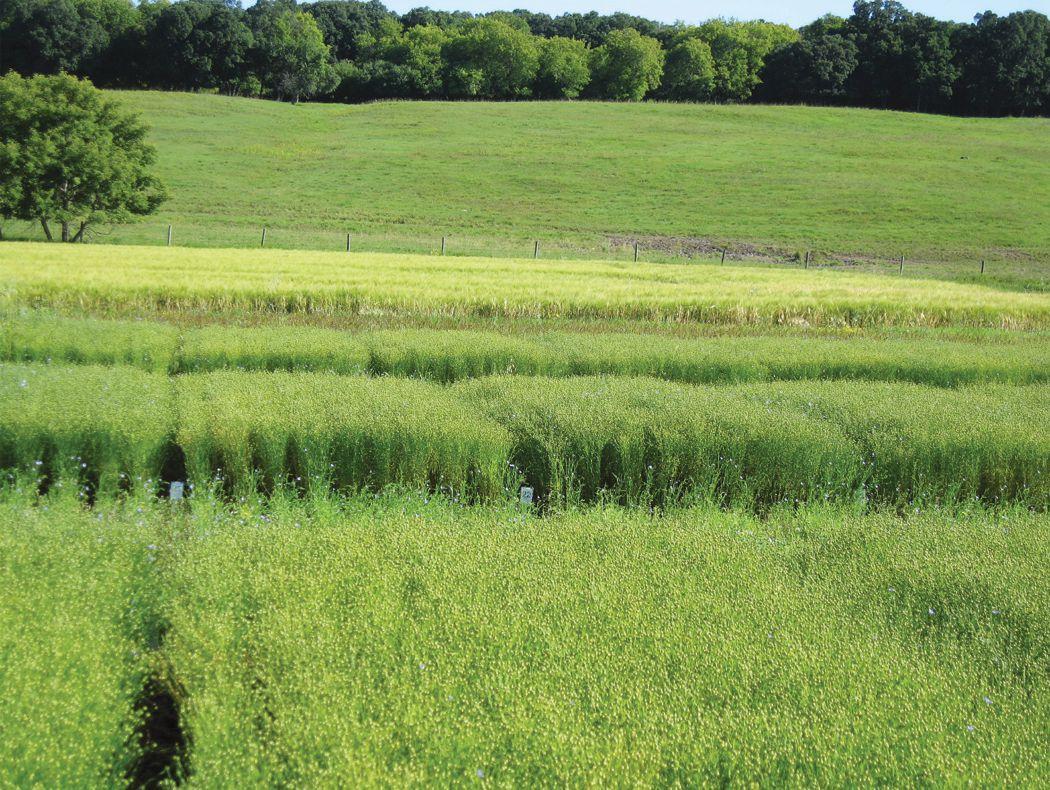
Flax plots in Saskatchewan on Sept. 3, 2011.
PHOTO COURTESY OF DR. G. LAFOND, AAFC.
Continued from page 20
A faster route to fixed breeding lines
Eudes’ component is targeting a process called isolated microspore culture. He aims to make this procedure more efficient and to share the resulting know-how with the research centres involved in the project and possibly with other wheat breeding programs.
Isolated microspore culture is already a couple of steps up from the conventional breeding techniques used to create fixed breeding lines. In simple terms, conventional breeding involves crossing two lines to produce offspring with half the genes from the mother and half from the father. It then takes a number of generations of self-pollination to get an inbred line, in which both sets of genes are identical, so that the genetics are fixed. This process can take about eight to 10 years, including the time needed to screen out unwanted offspring from each generation.
For much of the past 20 to 30 years, techniques have been
available to more quickly fix the genetics of breeding lines by creating what are called “doubled haploids” in the lab. Currently, the doubled haploid process used in most of AAFC’s wheat breeding programs in Western Canada is complicated. It involves corn pollination of an emasculated wheat plant and “rescuing” the 12-day-old embryo because it has only half the usual set of chromosomes (the corn set of chromosomes is naturally eliminated from the egg cell), then getting the embryo to germinate, and treating the plantlet with colchicine, a chemical to induce chromosome doubling. “The colchicine treatment is so harsh that the plants are only able to produce one or two spikes with seeds, and the breeder needs to do a seed multiplication, which takes a minimum of four months for spring wheats and eight or 10 months in winter wheats,” notes Eudes, a cereal biotechnologist at AAFC’s Lethbridge Research Centre. “This is a cumbersome process that takes a lot of human resources and quite a lot of time. I think we’ve reached the point where the technique is well mastered and there’s not much more progress that can be done in this area.”
The isolated microspore culture technique for creating doubled haploids is faster. Eudes says, “Isolated microspore culture involves culturing immature pollen grains. It produces embryos, with spontaneous chromosome doubling, so that both sets of genes are identical. These embryos grow, germinate and produce a green plant that can be given to breeders. The seed set produced from the doubled haploids deriving from isolated microspore culture is much bigger, so the breeder doesn’t need to do a seed multiplication step before going to the field. He can collect the seeds from that plant coming from the Petri dish and right away go to the field, have two rows of plants and start to evaluate the lines.”
Now, Eudes wants to make the isolated microspore culture procedure even more efficient by addressing two key issues that currently limit its success rate and broad adoption by breeding programs. He hopes to greatly increase the number of cells that survive and go through the embryo generation process so more plants can be produced in the lab. And he would like to reduce oxidative stress within the cells. Oxidative stress can result in serious
problems, like albino plants lacking photosynthetic capacity. These efficiencies could save about three to four years in the cycle of cultivar development and would reduce the cost of producing doubled haploids. He says, “The costliness of the method currently used to produce doubled haploids is a limiting factor for the use of doubled haploids in breeding programs. Programs without enough funding have to use conventional techniques, going through those eight to 10 years to really fix the genetic material.”
Eudes notes, “We also hope to simplify the process and make it user-friendly. We would like to develop it as a kit, so we can easily transfer the know-how to the breeding programs.”
He hopes to create an isolated microspore culture lab service at CDC to produce doubled haploids for breeders.
By gaining a deeper understanding of the wheat genome and the inner workings of plant cells, the project’s three components will contribute to valuable practical advances in wheat breeding for Western Canada.
PULSES
‘SigNAl MolECulES’
ST i M ul ATE pul SES
An underground dialogue is going on between pulses and rhizobia.
by John Dietz
It’s silent, but there’s definitely a dialogue going on under your feet when pulse seed is germinating, says Jeff Bennett, agronomist with novozymes Bioag Canada, Saskatoon.
When the plant-bacteria conversation goes the way you want, it will improve your income from the field by increasing the root nodulation on peas, lentils, and soybeans. The increase can provide up to an extra 3 bu/ac, according to novozymes.
The dialogue
Understanding the science of the plant-bacteria dialogue that leads to nodulation in legumes has been a slow process. In the past 20 years or so, scientists have unveiled why and how the underground dialogue takes place. The root and the rhizobia each send signals so they can “find” each other.
Legume roots secrete a complex molecule known as a flavonoid. When the rhizobia detect the flavonoid, in response the rhizobia sends back a signal by secreting a compound known as LCo
or “nod” factor. In effect, it’s a polite “nod” to the root that the bacteria it needs for nitrogen is nearby.
“plant signal molecules or flavonoids, is a general term for molecular compounds that plants exude to communicate with microorganisms. Many plants, including lentils, peas, and soybeans, use them,” says Bennett. “The return signals from the bacteria are lipochitooligosaccharide, also known as LCos or nod factors.”
“Think of it this way: the plant says ‘I need nitrogen.’ It sends out a signal for help in the form of a flavonoid molecule. The rhizobia or bacteria are just hanging out in the soil. When they receive the flavonoid, it stimulates a gene inside the bacteria to produce nod factor. When nod factor is received, the root hair starts to curl and that’s when the infection process takes place,” Bennett says.
TOP: A healthy nodule on pea generated by Optimize inoculant. INSET: The early stage of rhizobial attachment to the tip of a root hair in the Rhizobium-white clover symbiosis.
Photo
Photo
After the nod factor is detected, responses are triggered in the plant. The root hair starts to deform and curl. As it curls, cracks develop that open gateways for the rhizobia to enter (infect) the plant.
The infection spreads from the hair to the root, triggering a specialized cell division in the root. Out of this process, a nodule appears. More bacteria now enter the new nodule. Like caterpillars, the infecting bacteria metamorphose into nitrogen-fixing bacteroids, which then turn into nodules.
The nodules take nitrogen from air in the soil, making it available for the legume’s metabolic processes. The legume feeds the rhizobia with carbohydrates, so it can produce more nitrogen to feed the plant.
“In the rhizosphere, rhizobia feed off other sources, but a symbiotic relationship is a much more effective and efficient food source. With the right legume, the bacteria can make nitrogen available to the plant while the plant feeds carbohydrates to the bacteria. It’s energy-driven,” explains Bennett.
Starter signals
Peas, lentils, and soybeans are relatively new to the southern Prairies. The rhizobia they require for nodulation need to be introduced. Several companies supply that inoculant; however, only Novozymes has the technology to supply both the rhizobia and the patents to produce flavonoid and LCO products.
On the flavonoid side of communication, Novozymes released PulseSignal II, in 2010, a liquid product for peas and lentils. The corresponding nod dialogue comes in a different product,
Optimize. It becomes available in 2012 as a granular formulation for peas. Optimize was registered for soybeans in 2011.
“We start the process before the plant discovers it needs nitrogen,” Bennett says. “It’s energy-efficient, and you see immediate benefits. Optimize is the LCO molecule from the bacteria to the plant. PulseSignal II contains the flavonoid. We have two unique products utilizing this technology; you can take your pick as to which is a better fit.”
In the granular form, Optimize can be put in the air tank and go into the furrow with the seed. PulseSignal II, is a liquid, and can be mixed with certain seed treatments. The treated seed should be planted the same day.
“Both products get that relationship going, as soon as possible, between the plant and the bacteria,” says Bennett. “If you’re a liquid guy, try PulseSignal II. If you’re set up for granular and don’t need the phosphate benefit of Pencillium bilaii, [found in TagTeam] then use Optimize.”
Bennett ran field trials in 2010 with PulseSignal II on lentils and peas. Generally, he says, it produced one to three bushels more yield than competitive liquid or granular products.
“Everyone who did a trial with PulseSignal II in 2010, used it again in 2011. There has been a very positive uptake,” he says.
New programs for a new era
The grain-marketing landscape is changing.
But your farm business needs are the same. You want a good return, solid risk management and timely cash flow.
Our team is ready to work for you. Whether you choose pooling options, futures-based contracts or cash prices, you can have confidence in the CWB. Our programs are built on 75 years of grain-marketing experience, backed by government guarantees and focused on farmers. Don’t miss out. Register now for program updates at www.cwb.ca/email .
Prairie strong, worldwide
www.cwb.ca m.cwb.ca
k i TCHENSi N k ST udy ANA lyz ES
by John Dietz
When they throw the “kitchen sink” at soybeans, researchers find narrow rows and foliar fungicide give the best bang-for-the-buck. For maximum soybean yields, these two factors are standing out as essential in a three-year, six-state research project that has been focused on improving soybean yields. The findings are considered relevant, as well, for Manitoba’s burgeoning soybean industry.
University of Minnesota colleagues Wade Kent and Landon ries reported some findings in Winnipeg at the 2011 Special Crops Symposium. Third-year trials were completed with the 2011 growing season. The research is sponsored by the United Soybean Board. as the Monsanto doctoral fellow for corn and soybean production and physiology at the University of Minnesota, Kent co-ordinates and analyzes the crop inputs portion of the multifaceted research in all six states. economic analysis, the final stage, is due to be complete by the end of 2012.
essentially, the soybean board invited researchers to apply all the crop input options in a systematic fashion, to tease out what is really important for improving soybean yields. It’s being called the “kitchensink” study.
other aspects include seeding rates and a soil fertility study focused on fertilizer carryover in soybean grown in rotation with corn.
researchers in three northern states (Minnesota, Michigan and Iowa) and three southern states (Kentucky, arkansas and Louisiana) participated. at each trial site, the kitchen-sink study had 14 treatments with six replications. each state used adapted soybean varieties and
locally recommended production practices.
In the big picture, soybean yields have been increasing at 0.3 to 0.4 bushels a year, Kent says. Corn has been doing better, as a production system, with average annual yield increases close to two bushels a year.
“High commodity prices (for soybeans) have caused growers to look at alternative methods to increase yields,” Kent says. “This study looked at all the popular inputs that growers are implementing, from a system perspective, to test whether applying all these products would increase yields.”
The researchers set up a control plot with basic recommended inputs and a “kitchen-sink” plot with five extra inputs pushed to the limit. In the plots between, they systematically removed the extra inputs, one by one. They also explored the impact of heavy seed populations with narrow row spacing.
The kitchen-sink ingredients were: seed-applied inoculant, fungicidal and insecticidal seed treatments, a soil fertility treatment, foliar fertilizer and foliar fungicide. The general seeding rate was 140,000 seeds per acre, but two trials had 240,000 seeds per acre. In Manitoba the standard recommended rate is 180,000 to 210,000 seeds per acre.
With exceptions, the research is showing “a significant yield increase when we apply the kitchen-sink system to the control,” Kent says.
Wide-rows limited
They discovered that throwing the kitchen-sink at 30-inch rows failed
ABOVE: University of Minnesota kitchen-sink trial plots
High-input soybeans favour foliar fungicide.
Al-Katib President and Chief Executive Officer Alliance Grain Traders inc.
Jolene Brown, CSP Professional Speaker Business-First Family Consultant
Professor at the Prairie Adaptation Research Collaborative University of Regina
General Manager The Canadian Wheat Board Tokyo Office
Dr. Raj Khosla President and Chief Distinguished Monfort Professor of Precision Agriculture Colorado State Univeristy
Murad
Dave Sauchyn
Derek Silworsky
Dr Sylcain Charlebois Expert in Agricultural/Food Policy University of Guelph, Canada
Hybrid i t’s a
HealtHier yields by tHe busHel. even more profit by tHe bottle. now the profit is really flowing, with nexeratm canola roundup ready® and Clearfield® hybrids.
gusHer.
Our hybrids are backed by healthier agronomic performance, higher profits from healthier oil premiums and contracts, and the Healthiest Profit Challenge. More acres are needed right now to meet the growing demand for heart-healthy Omega-9 Oils. Talk to your Nexera canola crusher or retailer. Call 1.800.667.3852 or visit healthierprofits.ca.
to produce any more yield than the matching control sites with 30-inch spacing. With present input options, yields on wide row spacing seem to be limited or capped.
“If you plant soybeans in 30-inch rows or wider, the application of these products does not seem at all warranted,” Kent says. “application of all the products available seems to be a beneficial management step only if you’re in narrow row spacing. For 30-inch row spacing, go back to basic soybean production and accept that you probably are sacrificing some yield compared to planting in 15-inch rows. You will benefit more from hitting your target population, planting on time and selecting high-yielding varieties adapted for your region.”
Kent further explains that Integrated pest Management should be implemented. “If disease gets to an economic threshold, application of fungicide is warranted. If you plant early into cold, wet soil, utilize a seed-applied fungicide. I would not recommend a soil inoculant if you’ve had soybeans in the last five years on those soils.”
on narrow rows, however, there appears to be real room to improve yields with a kitchensink approach to treatments.
“We see a favourable response to narrow row spacing across everything, especially due to the fungicide application. From an economic standpoint, on 15-inch rows, you’re going to see some return on your investment for the application of these products as a system,” says Kent.
Foliar fungicide essential
With the five kitchen-sink applications, the scientists hoped to identify some interaction and differences in yield-boosting roles within the overall yield increase.
There was “little to no interaction between products” that they could observe, Kent says. ability to discern those differences, however, was limited in this study. It would have required six replications of each possible input combination, or approximately 300 trial plots, to develop solid science for the kitchen-sink treatment components.
“We went through and systematically removed single products. There was no significant change in yield until we removed the foliar fungicide,” Kent says.
To enhance the response difference, the research tried “early” and “late” management approaches. For the early approach,
they applied only soil fertility, a seed treatment and a seed inoculant. For the late system, they only applied foliar fertilizer and foliar fungicide.
“We noticed that the late-season treatment responded favourably, and was comparable to the kitchen-sink yield. of the two products, it looks like that’s solely due to the application of the foliar fungicide,” he says.
Kent did a disease rating before and after the fungicide application. The disease ratings were below the economic thresholds before, and a week after, the foliar fungicide treatment.
“So, it looks like the response is likely due to the control of fungal pathogens that are present at the time of application, even though they are below economic thresholds,” Kent says.
one theory, he says, is that early senescence is being prevented because the fungicide is suppressing ethylene production. Under stress, soybeans produce ethylene and ethylene is known to induce early senescence. In these trials, they did not see any maturity differences as kitchen-sink treatments varied.
This finding also gives reason to reconsider the economic threshold for foliar fungicide applications. “The northern states seem to show the most consistent yield response to foliar fungicide. I am going to do a complete economic analysis of this when I have all the data for the six states,” he says.
only one foliar fungicide, Headline, was used in the study. “We did not look at response differences with fungicides, but that is a potential avenue of research now.”
The overall impact of the kitchen-sink approach, across six states and 54 research sites, shows a general yield benefit of two to four bushels per acre.
Soybean producers have at least five options for improving their yields with specialized inputs and attractive commodity prices that make them more willing to invest in the products.
Kent says, “We took all of those products and used them as a day-to-day management system. growers are more willing to apply multiple products in one growing season, today. By going through and removing one at a time, we tried to identify whether one of these products was providing a consistent response, or the greatest percentage of response. What we’re seeing is that it looks like the fungicides were doing that.”
as a footnote, he noted, they discovered no benefit in the northern states from the higher seeding rate.
Western Barley Growers Association
The elimination of the Canadian Wheat Board (CWB) monopoly of wheat and barley sales in Western Canada August 1, 2012 will create many opportunities for the barley industry on the prairies. Barley production has been in steady decline over the last five years from a high of 12 million acres a few years ago to a low of 5.8 million acres in 2010. Last year our malt industry was challenged to find enough malt barley in the supply chain to maintain operations until new crop malt barley was harvested. Farm gate returns from the sales of barley struggle to compete with returns from competing crops and this has led the way to reduced barley production. The question is “will this scenario continue into the new marketing era after August1?”
T he Western Barley Growers Association (WBGA) believe that the barley industry is poised to grow and rejuvenate itself as we move forward into the new market environment for the next crop year. The WBGA initiated a study “In Search of the Optimal Marketing Structure” to identify the strengths and weaknesses in the value change and make recommendations to create the best commercial model for barley moving forward in the new deregulated market place. The final report for our study will be released at the WBGA annual meeting February 15th – 17th, 2012.
There has been a lot of negativity from some self-interested groups and individuals surrounding the change to an open market and the misconception there will be difficult challenges for producers after these changes are in place. Contrary to the negativity, our study identified opportunities that exist in the market place that would allow the industry to grow and compete for acres on the farm. These opportunities will bring prosperity to the barley sector through clear market signals and a more aggressive effort to access existing barley markets that we have not pursued in the past.
The study identified a growing market demand for what is referred to as “mid-range quality barley”. This is barley that does not meet the high standard specifications of our malt industry but has better quality than what is needed in feed markets. There is growing demand in China for mid-range barley and one that presents an opportunity for barley producers in Western Canada. Australia recognised this mid-range quality market for barley a few years ago and has pursued this growing demand. Canada is recognised for growing some of the best quality barley the world and has the ability to compete in this developing market.
We also identified a growing niche market in the Craft Brewery industry. Although, each craft brewery may be small in the nature of its business, they are growing very popular in the beer consuming public and the industry is growing. The single desk did not attempt to satisfy the needs of these niche markets but an open market will be better positioned to accommodate this growing market. The ability to embrace these niche market demands helps to build a stronger and more vibrant barley industry.
We also found that there is an international feed barley market that we have not fully pursued in the past. In 2007, when former Minister Strahl removed barley from the CWB monopoly for a short time, the private industry marketed 800,000 tonnes of barley offshore. The industry has already demonstrated the ability to locate these markets and link them to Western Canadian barley production. The international feed barley trade brings competition to a traditionally landlocked domestic feed market which has been influenced by CWB feed barley pricing. Off shore competition for western Canadian feed barley will create more demand and lead to increased barley acres on the prairies.
The changed marketing structure will also bring efficiencies in the marketing system. Producers will have access to transparent prices reflecting real world prices signals. Malt companies will be able to offer fully transparent prices to producers to encourage malt barley production. They will have the ability to establish contractual relationships with reliable malt barley producers to ensure malt barley supplies going out more than one year. This will help to alleviate the uncertainty of supply which has plagued the industry in the past. Malt barley producers will have the opportunity to manage their risks through longer term agreements with malt companies. Malt sales in Western Canada currently are about 2.1 million tonnes. WBGA fully believes, after studying the industry, that we can expand this part of our industry by 1 million tonnes in an open market.
The introduction of a new revised barley futures contract at ICE Futures in Winnipeg will also enable the industry management manage risk. This will be important in bringing confidence to the barley industry and is significant in the rebuilding process.
Barley plays an important role in contributing to farm incomes on the prairies. The barley industry contributes from $1.4 billion up to $3 billion at the farm gate to the Western Canadian agriculture economy. This does not take into account the value it brings to processors, grain handling companies, transportation and the brokerage businesses. It is significant to the Western Canadian economic growth and will increase in importance as an open and competitive market develops with the changes that are coming.
The barley industry is poised to embrace the market opportunities that have always existed but have not been pursued within the confines of the existing single desk marketing model. It will require all sectors in the value chain working together to build on the strengths in our industry. The concept of a National Barley Council is important as it would engage all sectors in the barley value chain to work together in this building process. Indentifying the growing and changing demands for barley will enabled our industry to adapt and prosper. As new markets are accessed, the barley industry will continue to grow and continue to be an important part the Western Canadian agriculture industry.
Brian Otto President ~ Western Barley Growers Association
A NEW ERA i N g RA i N MAR k ET i Ng
We explore the differences in marketing wheat and malt barley.
by Lisa guenther
With the end of the Canadian Wheat Board’s single-desk selling, producers will be selling their high-quality wheat and malt barley in an open market for the first time in more than 60 years. It’s impossible to say exactly what will happen in the coming months, but producers will need to market their wheat and barley more aggressively to benefit from the open market.
Selling wheat is very different from selling a crop like canola. neil Blue, a market specialist with alberta a griculture and rural Development, says that the first difference that comes to mind is the grading system for wheat.
“There are the one, two, three, four or more grades for some classes of wheat. and then we have the protein separation that payments have been based on, and they’ve been fine-tuned to one-tenth of a per cent. In the future, it’s quite possible that we’ll see a movement towards falling number differentiation… the bottom line to falling number is that it’s a measure of sprouting damage and an indication of bread making quality,” Blue explains.
“The other thing that wheat has is quite a different volume than canola, in terms of production and comparative export versus domestic use. Including durum, which was about four million tonnes of the Canadian wheat crop, the total wheat production was about 24 million tonnes, compared to this last year about 13 million for canola,” Blue says. He adds that the domestic market for canola is now nearly equal to the export market. Though the
domestic market may grow for wheat, right now the amount of wheat exported is more than double what is used domestically.
Blue also sees challenges for producers with the consolidation of ownership in country elevators, port handling facilities, and railways. “It makes it more of a challenge, I think, for the farmer side because farmers have really needed to have more storage on the farm than they did 10, 20, or 30 years ago, so that makes it more of a cost from a storage point of view.”
Pooled contracts may still be possible
Whether or not pool contracts will be a viable option for companies in an open market remains to be seen. a 2006 report titled “The Canadian Wheat Board in an o pen Market: The Impact of removing the Single-Desk Selling powers” looks at the effect of removing the single desk. In the report Murray Fulton, a professor at the University of Saskatchewan, states that enforcing delivery for contractual pools would be difficult when the cash price is higher than the pool contract price. producers would also likely only contract a portion of their crop to the pool to offset production risks, limiting the grain available to the pool.
“I believe there are many farmers who will want to use the pool pricing system...the demand for price pooling, which I think farmers see as a method of hedging the sale of grain over a period of time to get a blended price, will be met,” Blue says.
ABOVE: Selling wheat may be very different than selling other crops.
Photo
Market prices over the next few years will help determine how much producers use the pool, Blue adds. “a s it stands right now in the world markets, we have quite a strong supply of wheat, and so that may imply that prices could remain weak going into this next crop year. and that may have an effect on the popularity of pool versus contract spot pricing.”
The Canadian Wheat Board is offering pool contracts, and other private companies, such as Cargill, may offer a pooling option. o ther options have been announced, and some grain handlers are signing forward contracts with producers for delivery after aug. 1, 2012. The marketing options change almost weekly, as grain companies manoeuvre to capture market share.
However, it’s impossible to say exactly what options producers will have for selling their grain, Blue adds. “o ther than some deferred delivery contracts and prices for post-July 31, we haven’t seen a lot of detail yet from the private grain trade, so there are a lot of unknowns as far as exactly what alternatives there’ll be.”
Grain quality will be important g etting accurate samples will likely be critical to the marketing process, Blue states. Inaccurate samples could lead to disagreements with customers, or even penalties, if the final product is inferior to what the contract called for. producers could also lose out if they don’t market their high-quality wheat and barley appropriately.
“ relating to that will be the need to know the terms of any contracts that farmers sign and to understand those terms and
any premiums or discounts that may apply to grades other than the base grade for an individual contract,” Blue says. “and on that note, I think producers may need to be more proactive in their marketing, particularly of the higher-quality wheat and barley. That is, to investigate all the contract and delivery and pricing alternatives that become available both through the private grain trade and Canadian Wheat Board, and also including the direct sales to processors that they can now access.”
More niche markets may pop up outside the bulk grain marketing system. producers may be able to access such markets through cash grain brokers, the Canadian Wheat Board, and smaller, farmer-owned grain companies. o thers who enjoy marketing their crops may be able to connect directly with processors.
Blue recommends that farmers consider setting up a futures account with a commodity futures broker. IC e Canada Futures is listing three new or revised contracts, and producers can follow those contracts as well as US-based futures. “ producers who don’t have a futures account, and are interested in adding to their list of pricing alternatives, may wish to follow those new futures contracts, see how they work out, and decide if using those pricing tools as part of their operation has potential.”
Blue teaches grain and oilseed marketing courses across alberta. The courses cover grain-marketing basics, including strategies, contracts, options, futures, and basis. at press time, two courses were scheduled for March. For more information on the courses, visit the alberta Canola producers Commission website at canola.ab.ca.
When it comes to the next generation of tough, we don’t beat around the bush. With models up to 20' wide, Land Pride’s full line of Rotary Cutters have the features and
tackle the toughest job. Engineered durability. Stronger gearboxes. Built like a brute. That’s redefining the next generation of tough.
Au THoR i T y HER biC idE pER foRM i Ng WE ll
Researchers and manufacturer continue to refine uses.
by Bruce Barker
In 2008 authority herbicide was granted initial registration for chickpeas in Saskatchewan only. The label was expanded in December 2010 to include flax, sunflower and field peas. While growers have only had a couple of years to use authority in their fields, researchers at a griculture and a gri-Food Canada Scott and the University of Saskatchewan have many more years of experience from their research trials.
“I’ve been researching authority for over 10 years and found it to be very effective on kochia and wild buckwheat and it is quite good on red root pigweed and lamb’s quarters,” says weed scientist e ric Johnson at aa FC Scott. “a s a g roup 14 product, it is a very good product for managing resistant weeds, especially g roup 2 broadleaf resistance.”
authority is soil applied and can be tank-mixed with CleanStart or glyphosate in a pre-seed burn off. It contains the active ingredient sulfentrazone, and requires adequate rainfall to move it into the rooting zone of the weeds and to activate it. Incorporation is not necessary.
“When we first started looking at it in 2000 through 2002, the environmental conditions were very dry and we didn’t have any activity,” says the University of Saskatchewan’s Ken Sapsford. “Most years, though, there is enough moisture to get activity.”
Johnson had the same experience saying that in dry spring conditions, activity was reduced. “We’ve had two years in the time we have tested it in which performance was reduced due to dry weather. In one of the years, weeds were still suppressed; in the other year, control was unacceptable. o n the other hand, for a soil-applied herbicide, it is fairly consistent,” he explains.
The amount of precipitation required to activate the herbicide can vary due to factors such as existing soil moisture, soil type, organic matter and pH. The label also states that the product should not be applied to soils containing more than six percent organic matter.
Mitch Long, FMC Corporation’s product development manager for Canada says that feedback from growers in 2011 has been very favourable. FMC manufactures authority and nuFarm Canada retails it in Canada. While sunflower and flax acres were both low in western Canada in 2011, Long says the use of authority on field peas was quite good.
“The feedback we have received is that farmers like the early
1X rate of Authority
weed control and are seeing significant yield benefits with authority,” says Long.
Research ongoing
Johnson says his research work is now focused on the Brown and Dark Brown soil zones where organic matter is lower. In his research on black soils at Melfort, he found that even at four
N EW CEREA l vAR i ET i ES updATE
Breeders offer more choices in cereal crop production.
by Bruce Barker
Public and private plant breeders have worked hard to continually improve the choices available to cereal growers. These are varieties that are available to farmers in commercial quantities in 2012.
Hard red spring wheat varieties
AC Muchmore is a hard red spring wheat variety with a yield potential of 118 percent of aC Barrie. It has a Vg rating for leaf rust, stem rust and common bunt, and a g rating for stripe rust and loose smut. aC Muchmore has very good lodging resistance, with short strong straw, and resists sprouting. available from Fp genetics.
CDC Utmost VB is a hard red spring wheat variety with a yield potential of 121 percent of aC Barrie. It has the Sm1 gene for midge tolerance. It has a Vg rating for leaf rust and a g rating for stem rust. It has good lodging and sprouting resistance and strong straw. available from Fp genetics.
CDC Kernen has a high yield potential and is suited to all wheatgrowing zones. It matures one day later than aC Barrie and is slightly taller than aC Barrie, with intermediate lodging resistance. The grain quality of CDC Kernen is exceptional. available from CanTerra Seeds.
AC Carberry has a very good agronomic package with high yield potential, excellent disease resistance, short strong straw, and large seed and test weight. It yields 109 percent of aC Barrie and matures three days later. It is moderately resistant to fusarium head blight. available from SeCan association retailers.
AC Shaw VB is a new wheat midge-tolerant variety with the highest tolerance rating. It has very high yield potential at 120 percent of aC Barrie, maturity similar to aC Barrier, and tall but strong straw. available from SeCan association.
CDC Thrive is a Clearfield tolerant variety with yield 106 percent of aC Barrie. It has medium to early maturity and is well suited to the parkland growing regions. available from SeCan association retailers.
AC Stettler has higher grain yield than Superb with yield at 113 percent of aC Barrie. It has short, strong straw, matures one day earlier than Superb, has higher protein than Superb or aC Barrie, and offers improved grade retention. available from SeCan association retailers.
VR CDC Stanley has the highest yield results in Viterra’s wheat performance checks, with yield 117 percent of aC Barrier. It has short stature, excellent standability, and a great disease package.
Improved varieties continue to raise the bar for yield, quality and disease resistance.
Vr CDC Stanley has excellent general leaf-spotting resistance, moderate resistance to stem rust, and intermediate resistance to leaf rust and fusarium head blight. available from Viterra.
VR 5604HR CL is a Clearfield tolerant variety with high yield potential, short stature, great standability, and an excellent disease package. It matures two days earlier than aC Barrie, and yielded 105 percent yield of the check variety, aC Barrie. available from Viterra.
Photo by bR
VR 5603HR has a high yield potential and a premium disease package. It is resistant to leaf rust, moderately resistant to stem rust, and has intermediate to moderate resistance to fusarium head blight. Yield trials showed yields 115 percent of the aC Barrie. available from Viterra.
Durum
AC Enterprise is a CWaD wheat that is suited to all durum-growing regions. It yielded two percent higher than Strongfield with similar maturity, but is two centimetres taller, with a slightly weaker straw strength. aC enterprise has an intense pigment concentration, similar to those of navigator and Commander, and has grain protein, grain cadmium concentration, gluten index and semolina yield similar to Strongfield. available from CanTerra Seeds.
AC Brigade offers improved agronomic performance, high yields, high test weights and high pigments traits that end-users have come to expect from western Canadian durum growers. It yields 107 percent of Strongfield with very good standability. available from Viterra.
Canadian prairie red spring wheat
AC Conquer VB is suited to all wheat-growing areas of the western prairies, in particular, areas where the orange wheat blossom midge occurs. It is the only CpSr that is resistant to wheat midge. aC Conquer VB has high yield potential, matures 0.5 and one day later than 5701pr and 5702pr respectively, and is rated r to stem rust, bunt and stripe rust. available from CanTerra Seeds.
General-purpose wheat
Pasteur is a top-yielding, general-purpose wheat with exceptionally strong straw, and low Don accumulation. It is very late maturing at seven days later than aC Barrie but has very high yield potential at 140
percent of aC Barrie. pasteur is resistant to leaf and stem rust, and is well adapted to the eastern prairies. available from SeCan association.
Malting barley
Merit 57 is a two row malt barley that possesses a superior malting profile accepted by anheuser-Busch. It is a later-maturing variety, which contributes to its very high yield potential. Merit 57 has intermediate straw strength and is slightly better than aC Metcalfe for lodging resistance. available from CanTerra Seeds.
CDC Meredith two-row malt barley yields 113 percent of aC Metcalf with higher plump kernels and lower grain protein, providing excellent malting quality. It is grown under Ip contracts through domestic maltsters or richardson International. available from SeCan association retailers.
AC Major two-row malt barley has superior agronomics, excellent malt quality, and yields similar to top feed barley. aC Major offers a shorter, stronger straw with an excellent disease package, high plump percentage and lower protein than aC Metcalfe. available from Viterra.
Taylor is a two-row hulless barley with malting quality. It yields 92 percent of CDC Mcgwire but has stronger straw and earlier maturity than CDC Mcgwire. It has heavier, plumper kernels than CDC Mcgwire, lower FHB and Don content than the checks. It has resistance to loose smut and moderate resistance to spotted net blotch. Mr to MS to spot blotch, stem rust and surface-borne smuts. It is available through alliance Seed Corporation.
CDC Mayfair is six-row malting barley, which is high yielding and has a unique malt-quality profile with plumper kernels and higher extract. It is suited to all growing zones and displays maturity and lodging results similar to the malting checks. It is rated r to the surface-borne smuts and also displays a disease package that is similar to the malting checks. available from CanTerra Seeds.
Feed barley
CDC Austenson is a two-row feed barley with a strong combination of yield, straw strength, test weight and improved disease resistance. It yields 116 percent of aC Metcalfe and has a test weight similar to Xena. available from SeCan association retailers.
Oat
CDC Minstrel is a white milling oat with a yield potential of 111 percent of aC Leggett in Manitoba and 106 percent of CDC Dancer in Saskatchewan. CDC Minstrel is rated r for smut, MS for crown rust, I for stem rust and MS for BYDV. It has a white hull, good test weight and plump kernels. CDC Minstrel is rated Vg for lodging resistance. available from Fp genetics.
1000 Large-scale canola, soybean and corn trials across Western Canada.
More than any other seed company, Pioneer Hi-Bred tests our genetics where it really matters: in fields close to yours. In 2011, over 1000 largescale Proving Ground™ plots were grown across Western Canada. These canola, corn and soybean trials are grower-managed under real-world growing conditions and farming practices.
Our goal is to give you “advice well-grounded” so together we can help position the right Pioneer® brand seed product for every acre you grow. Talk with your local Pioneer Hi-Bred sales rep for more information.
to five times labelled rates, he could not get satisfactory weed control.
“growers need to follow the label restriction of six percent organic matter. Sulfentrazone binds to organic matter and activity is reduced on soils with more than six percent organic matter,” says Johnson.
a major focus is to further refine the recropping restrictions. Currently, spring and durum wheat, alfalfa, barley, and field corn can be planted 12 months after authority application and winter wheat 16 months after application. Canola, sweet corn
and popcorn, and sorghum are restricted to 24 months after application. Lentils and other crops not listed are restricted to a recropping interval of 36 months.
“We’re trying to see if we can reduce the recrop on canola to 12 months. Lentils are more challenging. They are sensitive, at least some of the varieties are sensitive,” says Johnson.
If drought conditions exist, though, these recropping restrictions may need to be extended. The label states: “If there is a lack of adequate or normal soil moisture due to drought conditions following an application of authority 480 Herbicide, the minimum rotational crop interval listed in the table must be extended for one additional year and a representative bioassay of the field must be conducted with the potential rotational crop and adequate soil moisture to determine the crop sensitivity to authority 480 Herbicide.”
at the University of Saskatchewan, researchers are trying to identify why some lentil varieties are less sensitive to sulfentrazone than others. It seems to be something in the parentage of certain lines. Johnson says the research may not be able to develop authority-resistant lines along the lines of glyphosate-resistant canola, but that it may help them to identify ways to reduce recropping intervals.
one focus is to try to get cleavers on the label. Johnson and Sapsford have seen strong activity on cleavers in the Brown, Dark Brown, and grey soil zones. That’s good news for growers struggling with group 2-resistant cleavers. He is working with FMC to get enough data points together for a label submission. another effort is to improve the consistency of weed control. Johnson and Sapsford are looking at fall versus spring application. The theory is that snowmelt could move sulfentrazone into the soil and activate it. The jury is still out on that one.
Long says FMC is working on clarifying several points on the label, to make it more user-friendly. He says that there are still many minor use registrations in Canada that are worth pursuing. authority was first registered in the US on soybeans, and the company continues to work with weed scientists like Johnson and Sapsford to see if additional weeds and crops can be added to the label.
Much of the research conducted in support of authority registration was funded by aaFC’s Minor Use pesticides program.
Untreated check
Askabout theTagTeam ROIguarantee
The ultimate combination
Hit the field with TagTeam® and win the fight for more phosphate and nitrogen.
TagTeam is the ONLY inoculant that gives your pulse crops access to more phosphate and nitrogen By increasing uptake of these crucial elements, TagTeam improves overall crop growth and standability Your crops grow bigger, stronger, and deliver an average of 8% more yield compared to single-action competitors –that’s more than $18 00* profit per acre! When phosphate is limiting, nothing beats TagTeam –we guarantee it ** Get the most from your crops with the powerful combination of TagTeam
TagTeam mini-bulk is now available for pea/lentil and soybean.
Novozymes is the world leader in bioinnovation Together with customers across a broad array of industries we create tomorrow’s industrial solutions, improving our customers’ business and the use of our planet’s resources Read more at www novozymes com
Smart farmers read the fine print
Source: Summary of 36 lentil and 177 pea independent large-plot research trials *On average, TagTeam inoculants for pea and lentil outperformed competitor, single-action (nitrogen fixing only) inoculants by 8% in independent large-plot research trials That’s an average increase of 2 6 bushels per acre, for a net return of $18 82/ac Net return is calculated after the cost of inoculants is removed, using current commodity prices of $15 00/bu for lentils and $8 00/bu for peas See our website for details **For details on the TagTeam ROI guarantee, call Novozymes at 1-888-744-5662
Pests ANd DISEASES
M ANAgi Ng THE pEA l EA f WEEvil i N
fi E ld pEAS
by Héctor Cárcamo and Meghan Vankosky
The pea leaf weevil, Sitona lineatus L., is one of the few insect pests of field peas in southern alberta and southwest Saskatchewan. It was first reported in southern alberta in 1997 and Saskatchewan in 2007.
Host damage and nitrogen
although pea leaf weevil adults have several legume hosts, egglaying and larval fitness are maximized on fababean and field pea. an adult weevil consumes about 6 mm 2 of pea seedling foliage per day. Feeding results in a characteristic scalloping on the leaf margins. Under high infestations at the early seedling stage, feeding damage can severely reduce stand density. However, older seedlings can usually compensate for this damage so yield losses are minimal. Larvae feed on root nodules, which contain Rhizobium leguminosarum bacteria that fix atmospheric nitrogen.
The impact of pea leaf weevil on nitrogen fixation and uptake by field pea accounts for its pest status. Under controlled conditions, up to 98 percent of nodules were excavated. In plots near Lethbridge in 2007 under extremely high weevil pressure (>100 notches/plant), over 90 percent of the nodules were damaged regardless of the crop stage when a foliar insecticide was applied. Depending on soil nitrogen levels, larval feeding had a greater impact on yield than adult feeding. according to studies elsewhere in fababeans, yield loss was due to fewer pods rather than fewer or lighter seeds per pod.
Field plot and cage studies were conducted near Lethbridge and Vauxhall from 2007 to 2009 to validate economic thresholds and assess pea leaf weevil – field pea interactions with soil nitrogen. Significant yield reductions were observed when field pea stands had more than 30 percent of seedlings with terminal leaf damage. This threshold was validated in alberta using field pea plots planted with or without thiamethoxam insecticide seed treatment. plots that had less than 30 percent seedling damage before the fifth node stage yielded at least 155 kg/ha more than those with 40 percent or more damage. removing the insecticide-treated plots from the analysis did not affect results.
Interactions with nitrogen were more subtle and no significant effects were observed in the field. However, at the Lethbridge cage study site, plants growing in nitrogen-depleted soil experienced a greater yield loss (17 percent) than plants that were amended with urea (three percent yield loss). a greenhouse study to further investigate the effects of larval feeding on plant and soil nitrogen also suggested that soil amendment with urea can buffer the negative effects of pea leaf weevil on plant nitrogen content and soil nitrogen. Therefore, if nitrogen is sufficient, the pea leaf weevil poses less of a risk and control measures are not required.
Continued on page 72
ABOVE: Notches on pea leaves are typical signs of pea leaf weevil adult feeding.
Photo
C ANARySEE d WEE d
C oNTRol
Residual
herbicides and recropping considerations important.
by Donna Fleury
Canaryseed is an annual cereal crop grown primarily in no-till systems in clay soils. The majority of canaryseed is grown in Saskatchewan. a s a cereal crop, control of grassy weeds and recropping restrictions can be a big challenge for growers.
Canaryseed is not competitive early on in the season, so field selection is important. “ g rowers in northeastern Saskatchewan will often seed canaryseed into canola stubble, whereas growers in the western parts of the province will usually seed canaryseed on lentil or durum stubble, depending on the crop rotation,” says Bill May, crop management agronomist with a griculture and a gri-Food Canada ( aa FC) in Indian Head. “avoid areas where volunteer cereal competition may be a concern and don’t seed canaryseed on flax stubble, as the two seeds are difficult to separate.”
For grassy weed control, avadex is one of two labelled products for wild oat control. “Fall-applied as a granular product, even in no-till systems, seems to work very well,” says May. “In
our research plots, all avadex was applied by early november. Many growers successfully use a spring application of avadex. This provides very good wild oat control, but does not control foxtail. a lthough most growers don’t have major foxtail issues, there are a few and we are still looking for an answer for foxtail control for those growers.”
In addition, many growers are interested in tank mixing avadex liquid and glyphosate,” adds May. “ o ne problem is that the optimum timing of both products is different. avadex should be applied as early in the spring as possible to improve soil activation and wild oat control, while glyphosate should be applied close to seeding to kill as many emerging weeds as possible. The other problem is that there is very limited information on this tank mix.”
avenge is also registered for control of wild oats as an
ABOVE: Canaryseed is not competitive with weeds early in the season.
Photos
Watch your crops grow stronger than ever before.
The unique Vigor Trigger ® effect of Cruiser Maxx® Cereals goes beyond insect and disease control, causing your plants to emerge faster, resulting in stronger plants and a higher return on your investment. Cruiser Maxx seed treatment also combines a powerful insecticide with two fungicides to protect your wheat and barley crops against early season disease and wireworm attack. It’s available as a pre-mix to apply on-farm.
Crop and herbicide rotations are key components of weed control.
incrop treatment; however, damage to the foliage is possible. “High temperatures and humidity should be avoided when applying avenge to canaryseed and I don’t recommend tank mixing it with a broadleaf herbicide,” adds May. “avadex has been our preferred method of wild oat control to reduce the risk of crop injury.” a number of other grassy weed herbicides can cause injury to canaryseed, so avoiding drift from adjacent fields is important. There are also no control options for volunteer cereals.
There are several registered products for control of broadleaf weeds in canaryseed. “Broadleaf weed control is not a major issue in canaryseed anymore. I think we have the tools to go out and do a good job of control,” says May. “a s a general rule, don’t put any herbicide on canaryseed that has 2,4-D in the mix. Look for herbicide mixes with MC pa instead, which
seems to be safer on canary seed.”
Make sure products are registered and check labels for application and timing.
Herbicide carryover is also an issue with canaryseed. a lways check herbicide labels and provincial crop protection guides for recropping restrictions. Saskatchewan Ministry of a griculture information states that canaryseed should not be seeded for at least 24 months after a spring trifluralin or e dge treatment, or 30 months after fall trifluralin or e dge. It should also not be seeded until at least the second season following an application of a ssert or Unity. Fields treated with a lly, g lean, a mber, Muster, e verest, Sundance or p ursuit should not be sown to canaryseed until a field bioassay determines it is safe to do so. e xtended periods without rainfall during the growing season may extend the recropping restrictions on residual products. This may also impact waiting periods for products like o dyssey that do not have restrictions for the following year under normal moisture conditions.
a nother consideration is using glyphosate pre-burn applications in the spring. Check labels on burndown combination products to ensure that herbicide residue is not an issue and to see if canaryseed is labelled, or check with the company before using the product.
“For new growers, one of the biggest issues for weed control in canaryseed is residual herbicides in the soil from the previous year,” explains May. “The downfall for many growers and researchers new to growing canaryseed is [not] being aware of herbicides used in the preceding crop. It can take a while to get used to growing the crop and understanding recropping considerations. In a series of drier years, even experienced growers can experience problems with residual herbicides impacting canaryseed, from products that under normal moisture conditions don’t cause any issues. Therefore, it’s critical to know what herbicides were used on that field last year and even two years prior, so you don’t have any residual herbicide issues.”
d SEE d: quA li T y, qu EST ioNS AN d
C oNCERNS foR 2012
Quality is excellent but Fusarium head blight is creeping west.
by Lorne McClinton
Growers can expect to find ample quantities of good-quality pedigreed seed for the upcoming 2012-13 crop year, says Bruce Carriere with Discovery Seed Labs in Saskatoon. Seed germination is testing well above the long-term average at labs across the prairies, and for the most part, seed-borne diseases are down significantly. This year’s test results really stand out in stark contrast to 2011 seed quality.
“Last year we had such terrible growing conditions throughout the whole year,” Carriere says. “We had the wet summer and a wet fall; we’ve been doing this for 20 years and I guarantee you that (2011) was the ugliest year that we’d ever seen as far as seed goes. This year was just the opposite, we had some nice temperatures over the summer, never got too hot, never got too cold. Yes, we had a bit of a delay on some of the seeding going in the ground but once it got in the ground it was beautiful.”
Spring wheat tests this winter, for example, averaged 93.5 percent germination and 89 percent vigour. Durum was only slightly lower at 89 percent germination and 84 percent vigour while barley came in at 93 percent and 84 percent respectively. results for oats, field peas, lentils and flax were also in the same ballpark.
These results shouldn’t come as too much of a surprise for most producers. While southeast Saskatchewan and parts of Manitoba fought with excessive rainfall and locally severe flooding, the rest of the prairies had nearly ideal growing conditions. There was good rainfall in the spring and early summer then the tap shut off producing sunny and dry conditions through the end of harvest. This meant that nearly all seed crops were harvested in near textbook perfect shape.
“Most of the samples are pretty darn good,” Carriere says. But while the overall averages were high, the range was often extreme. The range for oats for example went from three percent to 99 percent germination. Most of the low ones have a story behind them; often they came from fields that were planted extremely late due to the wet spring weather.
Flax growers will be pleased to hear that there are no signs of the herbicide tolerant triffid gene in the pedigreed seed samples for the second year in a row. The incidence of triffid is falling in commercial seed varieties too. There was a seven percent triffid rejection level in the 2010-11 crop year but this year it’s down to three percent. This means it’s slowly being eliminated from the system but Carriere cautions producers to continue to be vigilant until it’s completely gone.
“Disease levels are very low in both the field pea and lentil samples,” Carriere says. “It’s so low in peas that we can’t find it at statistically significant levels. The average disease level in lentils is just 0.2 percent across all crop districts. Most test zero but there are still 15 percent of the samples that have come in with an infection rate as high as 14.5 percent. ones that are up to that 14.5 range usually have a story associated with them and that story usually has the word hail in it.”
Fusarium spreading west
The one significant problem test results are highlighting in winter 201112 is the continual westward spread of fusarium head blight (FHB). Samples are now starting to show up with the disease right across the board in Saskatchewan.
Fusarium spreads in one of two ways; it can be spread on contaminated seed or can spread by airborne spores, Carriere says. producers in the west side of the province have been fairly diligent in not transporting seed from the east side of Saskatchewan but the disease has still been slowly spreading westward on the wind.
“Four years ago you wouldn’t have found any in the west half of Saskatchewan today it’s showing up in all crop districts in the province,” Carriere says. “Some of them are still at trace levels but it’s showing up virtually everywhere. It sucks to be in alberta because they’re going to be the next recipients of it.”
Photo by bR uce bAR ke R
For 2012 seed quality, disease levels were low in field pea samples analyzed by Discovery Seed Labs.
It’s what you’ll feel when you get an extra 3 to 4 bushels of canola an acre.
Always read and follow
Peace of mind can be yours now that Headline® fungicide is registered for canola. not only is it unrivalled in Blackleg control, it gives plants inner strength through AgCelenceTM- greener leaves, stronger stems and as a result, higher yields.* and since it can be applied with your herbicide, it saves you work too. So your feelings of tranquility will be as bountiful as your yield. Visit agsolutions.ca for more.
Su N floWERS RESpoN d To v R SEE d AN d f ERT ili T y
Winning combination with two-in-one prescriptions.
by John Dietz
North Dakota grower Meilon Hildebrant says he’s seen tremendous differences in sunflower performance with variable rate seeding.
“eastern north Dakota can get 2000- to 3000-pound yields, but it’s tough to achieve that here in the West. on a typical year, we see 1200- to 1500-pound yields,” Hildebrant says. “This time [2011], we had an abundance of moisture, and we certainly had the heat units we needed. everything yielded in that 1800- to 2200-pound range, which is excellent for our area.”
The results of using variable rates for seeding were most evident on two fields with challenging mixes of soils and topography. one has a “massive hill.” There, he usually sees overpopulated stands, small heads on small plants, and yield-monitor reports of around 500 to 600 pounds. The 2011 crop harvested nov. 18 was different.
“I was really impressed,” he says. We still had a good, respectable yield up on the mountain: 1100- to 1300-pound rates. By dropping the population, we maintained the yields in a nice standing crop. You weren’t digging in the dirt to get it. I was real happy with it.”
Meanwhile, Hildebrant had high sunflower populations in the high-potential areas. This time, these areas had the moisture and heat to maximize his yields.
“Stalk strength on the bottoms was good. nothing was down. They were rooted good. They looked healthy. Head sizes were all respectable, and that’s where we got into the 2300- to 2400-pound
ABOVE: Variable rate seeding made sense in sunflowers.
Photo
TOP: North Dakota grower Meilon Hildebrant found that variable rate seeding produced more uniform and higher-yielding sunflowers.
The Field-IQ™ crop input control system from Trimble allows you to control up to 48 individual rows and is compatible with the Trimble® FmX® integrated display and CFX-750™ display. The Field-IQ system can simultaneously control up to six materials, and provides seed monitoring as well as singulation analysis. New Trimble Vehicle Sync technology connects vehicles in the same field by allowing them to wirelessly transfer guidance lines and coverage maps, creating a planting solution that saves you time, energy, and input costs.
yields. at times, the monitor hit 3000 pounds. I was slowing the machine up, and it was just a massive amount of material coming in.”
Popular prescriptions
Hildebrant farms adjacent to the Montana border on a rolling dryland landscape. The Beach, north Dakota, farmer has two advisors and the latest John Deere technology. He’s been using prescription maps and variable rate urea fertilizer applications for about eight years.
His advisors are Jim Campbell, John Deere aMS consultant at Dakota Farm equipment, and Jeran Honeyman, an independent crop consultant from Bismarck.
“We don’t have the climate, don’t have the soil, to provide our producers ability to seed whatever they want at whatever rate they want and get an excellent crop. They’ve got to be smart about what they’re doing. Climate, soil and input costs are what drive the whole application picture,” Campbell says. “In the last five years, guys who thought a prescription application wasn’t much benefit have come to the point where now they’re starting to really look at it. They’re trying to get either the same bushels or more bushels while trying to keep their input costs in check.”
Campbell has customers applying both dry and liquid variable rate fertilizer. Some stream liquid fertilizer through self-propelled sprayers. about 20 percent are starting to work with prescriptions for seeding rates.
“We’ve got guys top-dressing wheat. You name it, they’ll topdress it. It’s catching on; I think it’s moving from row crops. guys are trying to adapt it to the crops we raise around here. The only down side is that the timing is finicky. If you get it on at the right time, it really works,” he says.
Prescribed planting rates
Hildebrant is more diversified than many western north Dakota growers, says Honeyman. Most of the farms have small grains such as wheat, winter wheat and durum wheat. Hildebrant also grows field peas, sunflowers, and sometimes mustard or canola. Most years, he has seven or eight fields of sunflowers. In the past, he’s worked with north Dakota State University and Mosaic fertilizer. His crops currently are planted using an 1895 John Deere disk drill for zero-till. Soils and landscape are highly variable.
Questions and answers
Q | Is variable rate seeding and fertility giving you a return on investment?
MH | We have the equipment. Most of the technology comes loaded and ready to use. If it’s available, we need to use it. Many times, it ends up being extremely time consuming and a lot of experimenting, but that’s how all of us learn. We needed to apply the seed, fertilizer and chemicals, so all we are doing is rearranging where and how much.
The major investment is time. That is why I choose to find specialists. I cannot afford mistakes with misinterpreting data or assembling it improperly. I find it essential to have a consultant that can include me in the decision-making pro-
“His land has varying topography and can be extremely variable. You can have sand-and-gravel hilltops, eroded clay knolls, very productive toe-slopes and foot-slopes, all in very close proximity. This is where I think Vr seeding pays off,” Honeyman says.
Hildebrant and Honeyman like to assess soil samples before setting up n rates for a new prescription. First, they like to refresh existing zone maps after harvest for every field. The consultant draws at least five zones on a quarter of land, often seven zones, and has gone as high as 10 zones. It doesn’t always happen, but they would like to have 10 fresh core samples for every zone. They then set yield goals for each zone.
“Soils don’t follow straight lines,” Honeyman says. “We set up zones for productivity based on multiple years of yield data, satellite imagery, bare soil images and/or electrical conductivity (eC) data collected with a Veris cart.”
In the medium zones, they fertilize and seed for the target yield. For the other zones, they prescribe input adjustments by 10 percent increments. In practice, Hildebrant planted sunflowers in zones at rates between 17,000 and 24,000 plants per acre. That ranges a little below, and a little above, typical planting rates in the region.
although there isn’t any science yet to guide their rate adjustments for sunflowers, they can draw on experience.
“Before, Meilon could get too much seed on hilltops, and get really small heads. By knocking back the seeding rate, those plants stay healthy. They stand better, and get bigger heads,” explains Honeyman. “If you can get better uniformity and if the stand looks better overall, then the quality should be better. You’re not stressing hilltops; you’re giving more to parts of the field that can produce more. Hopefully you’re improving the yield as well.”
Hildebrant explains that the decision to try variable rate seeding was the next logical step.
“It made perfect sense. The second pass on headlands where seeding rates were doubled up always was a wreck in solid seeding. and, that last pass with overlap was always a horrific sight. Hilltops suffered from overpopulation. on bottom ground, I had giant heads that ran up the moisture. It was obvious that more plant population easily could be supported in those areas,” he says. “This first two years, the facts that visually there was a difference and that quality and yield have not suffered but benefited, have given me all I need to continue with the Vr. I feel we are taking steps forward, not backwards.”
cess. Grower knowledge is a key part of making this work, and I am fortunate to have a consultant who understands that.
Q | Do you foresee doing VR treatments for disease or insect control?
MH | Absolutely. With technology moving the way it does I believe that VR treatments could be coupled with remote sensing equipment for fungicide or insecticide applications. This would have huge environmental benefits and economic returns.
Q | What happened to sunflower harvestability when you changed to air seeding from row crop?
MH | I saw huge differences with the solid seeding approach. We are able to
maintain reasonable plant height, head size and seed size. We make better time harvesting because we are not hugging the ground to get the heads and, with adequate head size, they are not falling through. With increased seed size and weight, we don’t get erratic readings on the loss monitor. That puts an end to constant on-the-fly machine adjustments and spills over into maintaining accuracy in the yield maps. Helping the yield monitor maintain stability is a great asset when we gather information to make informed decisions. It is also extremely beneficial to keep the machine running with an even flow and full and it certainly contributes to less moisture fluctuation.
Monitoring and chemical management
adult pea leaf weevils are difficult to monitor because they drop to the ground when approached and their cryptic colour makes them difficult to see against the soil. Despite these challenges a nominal threshold of 0.3 to one adult weevil per seedling has been recommended by researchers in the US. an alternative, more practical, method to assess thresholds is to count the number of seedlings with
terminal leaf feeding. at least five locations along the field margin and five locations approximately 100 metre into the field should be selected. at each location, a row of 10 to 20 seedlings should be selected and the terminal leaf on each seedling examined. If the average proportion of seedlings with terminal leaf damage at all spots exceeds 30 percent (i.e., more than three of 10 seedlings, or six out of 20), then the weevil poses a yield risk and warrants control. Field peas should be monitored from the second to fifth node growth stages. after the sixth node, plants are less vulnerable to both larval damage, as shown in a greenhouse study, and defoliation, as shown in a field study.
Managing the pea leaf weevil after damage reaches the economic thresholds is a challenge. Several foliar insecticides were tested in southern alberta from 2007 to 2010 but no yield benefits were observed. The same result was observed in plots near Lethbridge where a pyrethroid insecticide was applied at various crop stages to earlyand late-seeded field peas.
Insecticides applied as seed coatings are generally more efficacious than foliar treatments. In alberta, a neonicotinoid seed treatment Cruiser (thiamethoxam) was registered on an emergency basis and later received full registration against pea leaf weevil based on reduced foliar feeding by adults.
Alternative agronomic management strategies alternative pea leaf weevil management strategies, suitable for use in an integrated pest management program, have also been studied on the Canadian prairies. In alberta, a two-year trap crop study was conducted near Lethbridge using winter peas as the trap crop. austrian winter peas were planted in autumn around the perimeter
All the power you need to control a wide spectrum of broadleaf weeds in wheat, barley and oats. With the application flexibility for larger broadleaf challenges. That’s what it means to be NimbleTM New from Cheminova. Enormously flexible weed control. All at a down to earth price.
Pea leaf weevil larvae feeding on pea nodule.
of fields that were seeded with spring pea (main crop) the following spring. In 2007, weevil damage to pea seedlings was very high in the trap crop and was negligible in the spring peas before mid-May. Delays in insecticide application to the trap crop, or extended weevil migration, led to significant damage in the main crop and the entire field had to be sprayed. Less damage was observed in winter pea (Whistler variety) trap crops in 2008, as was damage in the main crop. This was probably because cool, wet spring conditions delayed weevil emergence. These are only preliminary results; however, trap cropping has potential to manage the pea leaf weevil and merits further investigation.
Biological control
natural enemies of pea leaf weevil have been more thoroughly investigated in europe than in north america; a number of potential natural enemies have been identified. generalists predators such as ground beetles (Coleoptera: Carabidae) attack adult weevils, especially as they emerge from the soil. Small carabid beetles in the genus Bembidion (e.g., B. quadrimaculatum L.) are well-known predators of insect eggs and this species was a voracious predator of pea leaf weevil eggs under laboratory conditions. Bembidion quadrimaculatum and other small ground beetle species are common in agroecosystems. To better promote carabid beetle populations in field pea crops, the application of foliar insecticides should be avoided as much as possible. Systemic insecticides employed as seed treatments are more compatible with biological control programs, although further investigation regarding the efficacy of systemic insecticides against pea leaf weevil is required.
Conclusions
The pea leaf weevil is well established in the southern prairies in alberta and in southwestern Saskatchewan, but it is unclear if it can expand northward where peas are grown extensively. Damage to field pea is more likely to occur in early planted fields if spring conditions are warmer than average and weevil arrival coincides with the vulnerable crop stages (before the sixth node). a key area of research for the pea leaf weevil is population forecasting to assess damage risk at the local level. Currently, risk maps indicate the general region of potential damage based on spring counts of plant damage. However, it is difficult to determine if a
seed treatment will be cost-effective locally. at this point growers need to rely on both the regional map and their local observations of weevil abundance at the end of the summer. a quantitative predictive model to estimate weevil populations in the spring and the need to plant seed treated with an insecticide, will require more research on overwintering survivorship and local sampling of populations at the end of the summer that could be highly laborious. over the long term, a biological control program may provide sustainable management if exotic
parasitoids of the egg and the adult stage could be introduced from the native range of this insect.
The complete, unedited version of this Journal article can be found at www.prairiesoilsandcrops.ca. Prairie Soils & Crops: Scientific Perspectives for Innovative Management is a “peer-reviewed” e-Journal that provides agronomists, producers, agrologists and certified crop advisors with current perspectives on various issues pertaining to soil and crop management on the Prairies.
CoM i Ng To g R ip S
W i TH CANol A HARv EST lo SS
Losses can average 2 bu/ac.
by Carolyn King
Yield loss during harvest has been a longstanding problem for canola growers. now a prairie-wide on-farm study aims to quantify those losses, identify the contributing factors and, hopefully, point to ways to reduce them.
Jim Bessel, senior agronomy specialist with the Canola Council of Canada (CCC), is looking forward to the study’s results. “The information being gathered in this study will add a really solid scientific foundation to the issue of canola harvest loss. If we can reduce harvest losses as much as possible, it will help growers to become more cost-efficient, improve harvest management, reduce volunteers, and sustain their agricultural operations for the long term.”
Dr. rob gulden, a weed scientist at the University of Manitoba, is leading the study. It was spurred by a similar study conducted by gulden about 10 years ago for his phD. That two-year study involved 35 fields of 15 different producers in the Saskatoon area. gulden says, “In that study, we found that farmers were losing on average 2 bu/ac of canola and in some cases much more than that, sometimes close
to 10 percent of their yield. That’s quite a substantial economic loss.”
In the earlier study, losses averaged 5.9 percent of crop yield. That’s equal to an average of about 3000 canola seeds per square metre left behind in the field, which is roughly 20 times the CCC’s recommended plant population for a canola crop. and that makes for an enormous number of volunteers.
“Canola harvest loss is your source of future volunteer canola populations. Most of the seed will become volunteers in the next spring, but the research I did during my phD showed those seeds can stay in the seed bank for quite a number of years before they germinate,” notes gulden.
The earlier study found harvest losses varied greatly from field to field and from farm to farm. However, the study’s focus was on weeds
TOP: Volunteer canola populations can be many times higher than the recommended plant populations for a canola crop. INSET: No matter the colour of the combine, producers should check for harvest loss.
Photo by bR
Outback® S3™ + AC110™ GPS with Auto and Section Rate Control
· Now features 10 section automated rate control
· Single product, liquid, constant rate control
· Offers straight, contour, circle pivot, and A+ direction guidance modes
· 8.4” high-resolution color touch screen
Check for current Outback Specials.
Scan the QR Code to the left to be linked directly to the Current Outback Specials page on our website.
For an RTK System to be complete, it must have an autoturn solution. The Outback® eDriveX™ with eTurns is the industry’s only aftermarket RTK system with a proven autoturn solution.
Outback® eDriveX™ with eTurns
· Exclusive eTurns – the industry’s first aftermarket autoturn solution (optional)
· Centimeter level autosteer system with slow speed control (0.25 mph) reverse operation
· Season-after-season repeatability for nutrient placement
· Over 310 vehicle kits now available
Outback® A320™/A321™ Dual Frequency GPS/GLONASS RTK
· Features Eclipse II GPS/GLONASS technology
· High-precision positioning in RTK, OmniSTAR HP/XP and SBAS/DGPS modes
· Full long-range RTK functionality up to 15 miles from base station
Without eTurns, your RTK System isn’t complete. Watch eTurns video now by visiting www.edrivex.com and register to win.
so there wasn’t enough data concerning the factors causing the yield losses to explain the variation. gulden says, “So, with our current study, we are trying to figure out some of the underlying reasons for the relatively high harvest losses in canola and the high variability in harvest losses from field to field and sometimes farm to farm.”
The current study, which started in 2010, is funded by the Canola/Flax Canadian agriScience Cluster, a joint initiative of agriculture and agriFood Canada (aaFC) and the CCC. The other members of the research team are Dr. neil Harker with aaFC at Lacombe, Dr. Steve Shirtliffe at the University of Saskatchewan, and Dr. Linda Hall at the University of alberta (she took over Dr. Christian Willenborg’s role in the study in 2011, after he moved to Saskatchewan).
reduce harvest losses, keeping in mind that canola harvest losses are also affected by the weather, among other things. There are some things farmers can do and some things they have very little control over,” says gulden.
The researchers are surveying between 30 and 40 canola fields each year for three years. Both swathed and straight cut fields are included. The fields are in the areas around Winnipeg, Saskatoon, Lacombe and edmonton. “To get a good idea of what’s happening on the millions of acres of canola grown in Western Canada every year, I think the best approach is to go on-farm and get real numbers and a real sense of what’s going on,” explains gulden.
He outlines how the researchers are measuring yield losses. “If the field is a swathed field, we go out before the farmer swaths and we place small trays into the standing canola crop before it shatters and try to get an estimate before harvest of the amount being lost in the swath and during the swathing process. Then, more importantly and more accurately, we go in the fields right after the farmers are finished harvesting, or as close to that as possible, and vacuum up all the bits and pieces – the crop residue, seeds and soil – on small areas along three transects across two adjacent swaths/ combine passes. Then we recover the seeds from the samples and determine the harvest losses.”
The researchers then follow up with a questionnaire for the participating farmers. gulden notes, “We ask the farmers about the specific canola field, their canola overall and their canola management, including information on the variety, nutrients that were supplied, seeding dates, harvest dates, swathing dates, time of day of swathing or harvesting, equipment type and size, equipment speed, use of pod sealants, total acres of canola, and so on, as well as other factors they may think are important in explaining their specific harvest losses.”
Similar to the results of the earlier study, the data from 2010 show average yield losses around two to three bushels per acre and a lot of variation in yield loss on a field-to-field and farm-to-farm basis. However, it’s too early in the study to determine which are the most important factors affecting the losses.
“Hopefully, once we have enough information and a solid statistical analysis, we’ll be able to say where improvements can be made and what individual producers should focus on to help
Bessel notes, “over the last 30 years that I’ve been involved with canola production, I’ve seen all kinds of factors affecting harvest losses. Usually the biggest one is being caught by the weather, like heavy rain, hail, really wet conditions so you can’t swath, frost, very strong winds, and so forth. But there are also losses where the mechanical aspect comes into play, whether it’s at the pickup as the product is entering the combine, or losses around the combine. often there are some losses through little holes around seals or around shaker arms or places where wear and tear has taken place. and then there is what can be thrown out the back end of the combine, which is affected by a number of factors including travelling speed, combine adjustments and settings, and the conditions at the time, whether it’s in the heat of the day or at night, and so on.”
Bessel offers some key tips on harvest losses. “once you get into the crop and start harvesting, you should stop the combine, and go out and check what’s on the ground. It can be quite difficult to see how much canola seed there is – the black colour of the seed camouflages it quite nicely against the black soil, and the crop residues can also hide the seed. So you have to really get down on your hands and knees and do some intensive checking. Then you need to determine approximately where the losses are occurring, whether it’s at the pickup, or around the combine’s sides, or under it, or out the back.”
He recommends growers capture a sample using drop pans while the combine is operating, to determine exactly how much loss is occurring. “The pans drop onto the stubble as you’re going along, the combine passes over pans, and pans collect the seeds and crop residue that falls. Then you remove the crop residue from the pans and determine how much seed there is.
“next you calculate what that amount of seed represents in terms of total losses. The amount of those losses often surprises people.
“once you calculate the total losses, then you make adjustments accordingly to take into account how much productivity you want to be accomplishing in relation to the efficiency of the machine you’re operating. For instance, if a storm is coming and you’ve only got an hour left to combine, you may push the throttle ahead a little further to get done before the weather changes. So you’re going to end up losing a little more yield on that field than you would otherwise. Those choices around productivity versus efficiency are a judgment call for every grower every season.”
For details on how to measure and calculate harvest losses, Bessel advises growers to visit the CCC’s website (www.canola-council.org) and go to the harvest management articles in the Canola Watch section.
Photo by bR uce bAR ke R
Harvest losses averaged 5.9 percent of crop yield in one study.
You only have one shot to get it right this season. Choose the proven, industry-leading technology that meets tough Tier 4A standards and yours. The Ef cient Power of Case IH Selective Catalytic Reduction (SCR) technology means more productivity on less fuel. And it’s available on our family of equipment, from tractors to all-new combines and the 4430 sprayer. So you can make the most of your resources and reduce your input costs. To learn more, visit your local Case IH dealer or caseih.com/ef cientpower.
A new formulation with advanced safener technology built in gives new EVEREST® 2.0 an extra measure of crop safety in a wide range of conditions. EVEREST 2.0 is easy on wheat, but relentless on weeds, giving you Flush after flush™ control of green foxtail, wild oat and key broadleaf weeds. It’s highly concentrated, so you’ll use less product. And with a flexible application window and exceptional tank mixability, nothing is easier to use. EVEREST 2.0. What a difference one generation can make.