TCM West - June 2013

Page 1


TOP CROP MANAGER

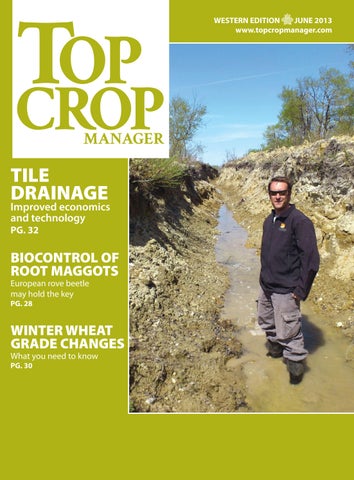
TILE DRAINAGE

BIOCONTROL OF ROOT MAGGOTS

European rove beetle may hold the key PG. 28

WINTER WHEAT GRADE CHANGES

What you need to know PG. 30

You spoke. We listened. You want maximum yield potential from every seed: our parallel-link row unit provides accurate seed placement in a range of soil conditions, improved depth control and seed-to-soil contact for even emergence. You need to get more seeding done in a day: quick adjustments, less daily maintenance and higher operating speeds help you cover more ground. You demand versatility: our system takes you from full till to no-till in just a few easy adjustments. Precision Disk™ 500 Single Disk Air Drills from Case IH. Count on us to make every seed count for you. Visit your local dealer or www.caseih.com/500tcmw613 to learn more.

TOP CROP

MANAGER

PESTS AND DISEASES

6 | Swede midge on the radar screen no cause for alarm, but worth looking for when scouting.

By Bruce Barker

18 | Winter wheat has a good fit in cropping plans

potential profitability is surprisingly high. By Bruce Barker

PESTS AND DISEASES

14 Year-round management key to FHB control

By Andrea Hilderman

28 Biological control of root maggots possible in the near future By Madeleine Baerg

WEED MANAGEMENT

8 Weed prevention plus control equals big benefits

By Carolyn King

32 Tile drainage gaining in popularity

By John Dietz

30 grade designation changes for winter wheat

26 | Off-label glyphosate can reduce yield

Too much or too late cuts yield by an average of 3 bu/ac.

By Bruce Barker

By Bruce Barker GRAIN GUARDIAN

22 effectiveness of different aeration systems

4 Managing clubroot takes diligence By Janet Kanters

Readers will find numerous references to pesticide and fertility applications, methods, timing and rates in the pages of Top Crop Manager. We encourage growers to check product registration status and consult with provincial recommendations and product labels for complete instructions.

MANAGING CLUBROOT TAKES DILIGENCE

Looking at the list of diseases in the Canola Council of Canada’s Canola growers Manual can be depressing. one would think that managing this high-value crop would be nigh to impossible, given the myriad disease pressure that it faces from year to year. But for the most part, effective crop management, along with a slew of chemistries, is helping to beat back the diseases that are all too common.

one disease in particular, however, is challenging even the best crop manager out there. Clubroot, a serious disease of cruciferous crops, including canola, mustard, cabbage, cauliflower, broccoli and rutabaga, is taking on renewed importance for western Canadian producers.

a lot has been written on clubroot over the past dozen or so years. But to recap (from the Canola Council of Canada): the pathogen induces root galls on infected plants, reducing the capacity for water and nutrient uptake, resulting in stunting, wilting, lodging and finally significant yield losses; preventing the spread of clubroot spores by restricting soil movement is critical to managing this disease; the most effective method to prevent the spread of clubroot is through equipment sanitation and managing infected fields through crop rotation combined with the use of resistant varieties; and currently there are no economical control measures that can remove the disease from a canola field once it has been infected.

The chief concern of many producers is the longevity of the clubroot pathogen in soil, which has the potential to survive for 10 to 20 years even in the absence of a canola crop. and once the pathogen has established in a field, it is difficult to manage. Fungicides are not a practical solution for clubroot in canola and there are no foliar products or seed treatments registered for control of clubroot on canola in Canada. The only preventive actions include longer crop rotations, and disinfecting contaminated equipment to prevent spread of soilborne resting spores.

The issue of rotation is an important point. In the april 1999 issue of Top Crop Manager, I wrote a story entitled “Canola on canola? It can work” citing several government canola specialists and plant pathologists. Their opinions on canola rotations were varied – some said canola could be grown every year in the same field. Some said it could be grown every two years with little risk. Some stood by the four-year rotation. While much of the research at that time focused on loss of yield in short rotations, additional research began to show that an increased incidence of disease was a major factor in shorter rotations. all of the specialists agreed then, as many do today, that every situation is different, and that growers need to be diligent about their own situation and determine what risks they are willing to take.

There are more questions than answers on clubroot, and the Canola Council of Canada is taking a proactive approach to providing the best, most up-to-date information it can for canola growers – from June 19-22, it is hosting the 2013 International Clubroot Workshop in edmonton. preceded by a wine and cheese reception on the 19th, the first day of the actual workshop – June 20 – will focus on clubroot research from Canada and from around the world. Day 2 of the workshop will highlight clubroot management. The morning session will update participants on key research findings and practical applications. The afternoon session will be hands-on learning, with a tour of a clubroot nursery to demonstrate the value of soil amendments, fumigation treatments, resistant varieties and dust traps as management tools. The tour also has an equipment sanitation demonstration.

The workshop will have practical value for anyone in contact with clubroot, including growers, ag retailers, agronomists, county and municipal staff, government extension staff, and field workers in the oil and gas industry. If all these folks can take home at least one solution that they can adopt toward the management of clubroot, we’ll be well on our way to mitigating this disease.

June 2013, vol. 39, no. 10

eDIToR Janet Kanters • 403.499.9754 jkanters@annexweb.com

WeSTeRn FIelD eDIToR Bruce Barker • 403.949.0070 bruce@haywirecreative.ca

WeSTeRn SAleS MAnAGeR Kevin Yaworsky • 250.317.1992 kyaworsky@annexweb.com

eASTeRn SAleS MAnAGeR Steve McCabe • 519.400.0332 smccabe@annexweb.com

SAleS ASSISTAnT Alice Chen • 905.713.4369 achen@annexweb.com

MeDIA DeSIGneR Brooke Shaw vP PRoDucTIon/GRouP PuBlISheR Diane Kleer dkleer@annexweb.com

PReSIDenT Michael Fredericks mfredericks@annexweb.com

PUBLICATION MAIL AGREEMENT #40065710 ReTuRn unDelIveRABle cAnADIAn ADDReSSeS To cIRculATIon DePT. P.O. Box 530, Simcoe, ON N3Y 4N5 subscribe@topcropmanager.com Printed in canada ISSN 1717-452X cIRculATIon e-mail: subscribe@topcropmanager.com Tel.: 866.790.6070 ext. 202 Fax: 877.624.1940 Mail: P.O. Box 530, Simcoe, ON N3Y 4N5

SuBScRIPTIon RATeS

Top Crop Manager West - 8 issuesFebruary, March, Mid-March, April, June, October, November and December1 Year - $45.00 Cdn. plus tax

Top Crop Manager East - 7 issuesFebruary, March, April, August, october, november and December - 1 Year - $45.00 Cdn. plus tax

Specialty Edition - Potatoes in Canada - February1 Year - $16.00 Cdn. plus tax

All of the above

SWede Mid Ge on The RAdAR SCReen

No cause for alarm, but worth looking for when scouting.

First identified in ontario in 2000, the swede midge has spread its wings to parts of the rest of Canada and into the northeast United States. as a cruciferous feeder, it has likely caused economic loss in ontario crops as far back as 1996. The adult flies were first observed in Saskatchewan in 2007 and Manitoba in 2008. Last year (2012) was another milestone year, with the first economic damage seen in canola fields in northeast Saskatchewan.

“We are in the discovery phase on the prairies. It has the potential to be a significant pest, and is in ontario, but we don’t know how the biology of the pest will pan out here,” says Julie Soroka, research scientist, entomology, with agriculture and agri-Food Canada’s Saskatoon research Centre. “Farmers and agronomists should be aware of the pest, and be familiar with the damage symptoms it causes.”

The swede midge is native to eurasia, and belongs to the fly family Cecidomyiidae, as does the wheat midge. The swede midge feeds only on crucifer plants.

Swede midge may have been in Saskatchewan even earlier, with suspected larval specimens collected west of nipawin in 2003, although the specimens weren’t positively identified. While the swede midge was a regulated, quarantined pest in Canada, in 2002 the Canadian Food Inspection agency (CFIa) initiated a monitoring program and implemented measures to prevent the entry and spread of swede midge from infested areas to non-infested areas of Canada and the US. The CFIa program caught small numbers

of adult swede midge in pheromone traps in the nipawin, Melfort and Yorkton areas in 2007 and 2008, although no crop damage was evident. CFIa field surveys also found swede midge in Manitoba in 2008, as well as in prince edward Island and nova Scotia. after 2008, the CFIa and the United States Department of

TOP AND ABOVE: Flower petals “glued” together (top). Swede midge larvae in a canola flower (above).

The Leader in Overlap Control

Auto Zone Command prevents costly input overlap by instantly stopping product flow in up to 10 metering zones. The more zones you control, the more money you will save.

FLIP is SeedMaster’s patented mapping software that activates Auto Zone Command and halts product flow the first time openers pass through an overlap area. Product is then applied on the last pass, preventing double seed and fertilizer from being applied, and avoiding any seedbed disturbance.

The Big Payback – Savings using a 10 zone, 80 ft. drill

1

4

Weed pR even T ion pLu S C on TRoL equALS B iG B enefi TS

Combining

cultural tactics to disrupt weed life cycles can hammer weed populations.

By using a set of cultural practices that disrupt weed population growth, producers in the United States’ semi-arid great plains have reduced their weed control costs by 50 percent compared to conventional systems. These types of practices are suited to Canadian prairie conditions, too.

“In the great plains, where producers are using this approach extensively, they are able to grow three crops out of four without needing any herbicide in those crops, and they’re getting very good yields,” says Dr. randy anderson, a research agronomist with the United States Department of agriculture (USDa) in South Dakota.

“The most common rotation in the region used to be winter wheatfallow. But when farmers started to use no-till, they could grow crops much more frequently without having to fallow. and when they added other crops to their rotations, they gained a lot of benefits, such as improved crop yield,” notes anderson. “Then when they started to organize their rotations to include cultural tactics for suppressing weeds, the impact on weed dynamics was very striking. They really reduced their input costs for weeds.”

The set of tactics (shown in Figure 1) includes five components: retaining crop residues on the soil surface; using no-till; growing competitive crop canopies; using a rotation with two cool-season crops followed by two warm-season crops; and including various crops with different planting dates in the rotation.

anderson explains the basics of this approach. “a key point is that we’re adding cultural tactics to crop production systems to disrupt weed population growth. For example, if you grow continuous spring wheat, you select for weeds like wild oats because they are able to complete their life cycle to produce seeds each year, year after year. But when we bring in these tactics, such as growing crops with different life cycles, we prevent the weeds from increasing their population across time.

“a second key point is multiple tactics. It’s critical that you have at least four of the five tactics because the value of the whole is much greater than the sum of the parts,” adds anderson. “In other words, a single tactic has a small impact on weed dynamics, but that impact can be greatly enhanced by using the other practices. and when you put all five of them together, it really hammers the weeds.”

A look at the components

Together, the five components take a population-based approach to weed management – they reduce weed populations over time

The differences in planting and harvesting dates between warm-season crops, such as corn and sunflower, and coolseason crops, such as wheat and barley, provide opportunities for weed management.

by minimizing weed growth, weed seed production and weed seed survival in the soil seed bank.

Crop residues on the soil surface can impact weed seedling growth in various ways, such as physically impeding the seedlings or inhibiting growth by allelopathy. practices that increase crop

Photo by Ja N et Ka N ter S

residue levels – such as using higher seeding rates, growing taller varieties, and banding nitrogen and phosphorus near the seed row – help increase weed suppression.

Practices that increase crop residue levels also help create a thick crop canopy that can outcompete weeds for water, sunlight and nutrients. The impact is much greater if several of these practices are combined. Anderson gives one example: “Seed production of wild rye in winter wheat was reduced five percent by a single tactic, such as growing a tall cultivar, increasing the crop’s seeding rate or banding fertilizer. But combining these three tactics reduced weed seed production by 40 percent.”

A no-till system helps with weed management because the weed seeds are left on the soil surface where they’re exposed to weather extremes and predation by birds and rodents. Over time, the result is fewer viable weed seeds than if the seeds were buried in soil. Surprisingly, burying seeds in soil with tillage actually prolongs weed seed survival.

The differences in planting and

Rotation Design

Crop Canopies Diversity Within Life Cycle Interval

harvesting dates between warm-season crops, such as corn or sunflower, and cool-season crops, such as wheat or barley, provide opportunities for weed management. That is, cool-season weeds can be controlled more easily in warmseason crops, and vice versa. For instance, cool-season weeds can be controlled before

Speed Tills.

seeding of a warm-season crop. Anderson has found that a four-year rotation with two cool-season crops followed by two warm-season crops is most effective for weed management (see Figure 2). Two years of each type are needed because that allows more time for more of the opposite-season weed seeds to die from

The Joker RT Series from HORSCH

Th T e un u iq i ue u d desesigign n of t the h J Jokker e a alllowows s yo y u to a accccompl p issh h li l gh g t to a aggggress s iv ive e ti tilllagage e and d ex excecelllen e t soil l fi fini n shhinng. g W it ith h de d pt p h ma mananage g ment f froom m 1" 1 -5" " an a d wo w rk r inng g wi widths h o of f 233'' 37', ' , t the h R RT T Seeri r es e g gives e y you u preccisse e ti t lllage e at h high h sppee e d. d

Thhe e Jo Joke k r give v s yo y u wh w at v verticaal l tiill l ag age e ca can’ n t.

Unlike k v verrti t caal l ti t ll l agge, e t the e J Jokker i is s a tr t ue e reesidue e ma m naageme m nt t s sysste t m. m T That t me m an ans s it perfectl t y si s zees s residue e an a d incorporates e i it t into o the sooil for f fasst t deco c mposittion. n T The J Joker al a so c consoli l dates s the e soil i a and p promotes s faast s er w war a ming n This h hel e ps m managge e moistuure e be b ttter a and gets s yoou u pllannting f faster. r

Manage heavy residue/stubble Fast seedbed preparation

Pasture/hayland/CRP renovation

Manure/Fertilizer incorporation

passion www.horsch.com

TO SPRAY

FLAGLEAF TIMING HEAD TIMING

The only time you shouldn’t spray is when you have a poor looking crop and you are not in a fusarium head blight (FHB) area.

If your crop doesn’t look good, but you are in an FHB area, a fungicide application can still pay for itself and safeguard the yield and quality of your grain. Do some calculations and if your potential disease risk and ROI exceed the cost of application – you should protect your crop with a fungicide.

No visible disease present

No visible disease present

Leaf disease on upper leaves and/or flag leaf

Leaf disease on upper leaves and/or flag leaf

If your crop looks good, you will definitely want to protect your investment with a fungicide application. Which product will provide the most bang for your buck? It depends on crop staging, current disease pressure and potential disease risks. Here is a quick chart to help make your fungicide decision easier.

Leaf disease only (lower to mid leaves)

Leaf disease only (lower to mid leaves)

No visible disease present

No visible disease present

NOT TO SPRAY

FHB AREA

WHAT SHOULD YOU SPRAY?

Even when you can’t see disease symptoms, there is no such thing as a disease-free crop. A good crop is worth protecting – consider spraying an application of Folicur® EW or Prosaro® applied at head timing to help ensure top grade, quality and yield.

There is no such thing as a disease-free crop. Even in the absence of disease symptoms, the mere fact that you are in an FHB area means you need to protect your crop. Apply Prosaro at head timing.

Leaf disease damage to upper leaves or the flag leaf can cause irreparable injury to your crop and immediate action is required. Spray Folicur EW and re-assess at head timing to determine whether a second fungicide application is required.

Spray Folicur EW and re-assess at head timing to determine whether a second fungicide application is required.

When leaf disease is limited to lower/mid leaves at flag leaf timing, the damage is negligible. Re-assess at head timing and if you still only see leaf disease you can spray either Folicur EW or Prosaro.

Whenever you are in an FHB area, you should spray Prosaro. However, if leaf disease is limited to the lower/mid leaves you have the ability to make your Prosaro application at head timing to cover both leaf disease and FHB.

GAIN IN YIELD*

+ 4.6 bu./ac.

Folicur EW 3/4 rate, flag leaf OR + 9.4 bu./ac.

Prosaro, head

+ 1.8 bu./ac.

Folicur EW full rate, head OR + 3.1 bu./ac.

Prosaro, head

+ 9.8 bu./ac.

Folicur EW 3/4 rate, flag leaf

+ 4.4 bu./ac.

Folicur EW 3/4 rate, flag leaf OR + 8.5 bu./ac.

Prosaro, head

+ 7 bu./ac.

Folicur EW 3/4 rate, flag leaf OR + 7 bu./ac.

Folicur EW full rate, head OR + 10 bu./ac.

Prosaro full rate, head

+ 5.8 bu./ac.

Folicur EW full rate, head OR + 8.5 bu./ac.

Prosaro, head

*Gain in yield based on multi-year wheat Demonstration Strip Trial (DST) results in Western Canada, 2008-2012. Results compared to yield of untreated check.

crops had different planting dates from each other, and the two warm-season crops had different planting dates.

anderson notes that, along with reducing herbicide costs, this population-based approach to weed management also helps slow the development of herbicide resistance. as well, diverse rotations provide other advantages to cropping systems, such as reduced disease and insect problems.

For Prairie conditions

Like anderson’s great plains research, studies by agriculture and agri-Food Canada researchers and others show the value of integrating herbicide and non-herbicide methods for effective long-term weed management on the prairies. prairie research also shows that perseverance pays when using non-chemical methods such as diverse rotations, competitive crops, higher seeding rates, and spring-applied, banded fertilizer. although the effect on weeds may be minimal in the first year, by continuing to use these practices year after year, producers can have a significant effect on weed populations.

such causes as predation, desiccation or attacks by pathogens. In contrast, a two-year rotation with one cool-season crop followed by one warm-season crop actually increases weed density over time. growing crops with different planting dates is another way to vary the selection pressure on weeds. For example, great plains producers found that the four-year cool-cool-warm-warm rotation design had a much greater impact on weeds if the two cool-season

Our next CCA exam will be held on August 2, 2013. Please refer to our website www.prairiecca.ca for the exam registration deadline.

So the population-based approach brings together a variety of proven weed management practices into an overall strategy that really works for great plains farmers. a cornerstone of that strategy is the synergistic benefit of multiple practices. as anderson notes, “The great plains farmers felt they needed four of the five components to have a meaningful impact on the weed population dynamics.”

Many prairie farmers already use one or more components of the population-based approach, such as growing competitive crop canopies, retaining crop residues on the soil surface or using no-till. However, tighter rotations have become fairly common because of higher canola prices. So if you’re considering the population-based approach to weed management, you may need to take another look at your rotations.

If warm-season crops aren’t suited to your area, anderson encourages diversifying the crop rotation in other ways. “If producers can include a greater diversity of life cycles in their rotations, it will help them gain the benefits of the multi-tactic approach to weed management.”

He offers some ideas for increasing the diversity of crop life cycles. For instance, one option could be to add a perennial legume such as alfalfa to the rotation. “The interval of alfalfa is no-till, which accelerates death of weed seeds on the soil surface, and when you harvest it, you prevent weeds in alfalfa from producing seeds,” he notes. “But you don’t want to keep the rotation in perennial legumes for too long, because there are weeds that can adapt to alfalfa and increase their density over time. a good rotation for weed management would be three years of alfalfa, followed by spring wheat-peas-barley-canola.”

other options could be to harvest an annual crop for hay or silage, which would remove weeds and potential weed seeds from the system, or to include a winter cereal, which would vary the planting and harvesting dates in the rotation.

a different tactic could be to collect the chaff that comes off the combine. “one study in Canada found that 74 percent of wild oat seed passing through the combine was collected by the chaff cart, reducing the number of weed seeds being added to the soil.”

overall, the population-based approach keeps weeds off balance with multiple tactics over multiple years for a major impact on weeds.

SWede MidGe on The RAdAR SCReen

CONTINUED FROM PAGE 6

agriculture (USDa) reviewed the regulated pest status, and because the midge and already “flown the coop” to many areas of Canada and the northeast US, the regulated quarantine status was dropped, as was the monitoring program.

after CFIa stopped its monitoring program, swede midge remained on the radar screen for entomologists on the prairies. In 2012, Soroka carried out a survey around the nipawin, Melfort and Tisdale areas, while Saskatchewan’s Ministry of agriculture (SMa) surveyed canola fields in the Yorkton/Melville area. Larvae were found in eight fields around nipawin and three fields south of Tisdale. Damage symptoms were found in three fields south of Tisdale. prior to 2012, no symptoms of swede midge damage had been recorded in Saskatchewan.

Damage symptoms

The actual swede midge adult fly is difficult to detect and is similar in size to the wheat midge. The swede midge is a tiny, lightbrown fly about 1.5 to two millimetres long, with very hairy wings. The insect overwinters in the larval stage in cocoons in the soil and adults emerge during May-June. The females lay eggs on the youngest parts of the

plant such as flower buds or the base of leaf stalks. The larvae hatch within a few days and feed mainly near the growing point. In two to three weeks, the fully grown larvae are about two millimetres long. They drop to the ground, pupate in the soil and the next generation emerges as adult flies two weeks later. In europe, there are four overlapping generations, while ontario has at least three generations.

“There may be two generations on the prairies. It is unlikely that we would see three to four generations here, but we need to keep monitoring so we can find out more,” says Scott Hartley, provincial entomologist with SMa

Damage to canola and other cruciferous crops is caused by larvae feeding on the plant. In ontario, symptoms of damage associated with swede midge depend on the growth stage of canola. In younger plants, young shoots and leaf stalks may be swollen, distorted and twisted, resulting in the death of the main shoot or in the development of secondary shoots. The growing point may become necrotic and bolting might not occur. Damage to a bolting stem may cause a “palm tree” effect, with a shortened raceme crowned with a bouquet of pods radiating out from one point rather than along a typical raceme. after full flowering, swede midge has not been found to impact canola yields.

Soroka says that in northeast Saskatchewan in 2012, the racemes appeared normal except that some flowers had fused petals that did not open. When dissected, the flowers contained small larvae, with up to 14 found in one flower. Small, misshapen or missing pods occasionally were found below the infested flowers.

When scouting, farmers and agronomist can also look for the tiny, yellowish, jumping larvae.

The reason for the 2012 outbreak in Saskatchewan is unclear. The swede midge likes moist soil conditions, and certainly the last few years in northeast Saskatchewan have included wet weather. In addition, mild winter weather may have allowed better over-winter survival of the swede midge.

“This was the first year we saw economic damage in canola,” says Hartley. “We’re not sure why there was damage this year

when the pest has been here for at least five years.”

Could this be the next big insect pest to cause economic damage on the prairies? no natural predators have been found. Climex modelling by aaFC research scientist owen olfert shows the swede midge could potentially expand across many areas of the prairies, but there are many unknowns. The adult fly is a very weak flier, so expansion may be slow. a lot depends on the weather.

Soroka cites another previous pest –the russian wheat aphid – that was a potential threat back in the late 1980s. It, too, had the potential to cause economic damage on the prairies, but the populations didn’t survive.

“nature is very plastic. The swede midge might be able to adapt, or another insect might learn to feed on it,” says Soroka. “at this point, we don’t know, so we’ll just have to continue to monitor and see how it develops.”

Farmers or agronomists who find suspected crop damage or swede midge larvae should contact their provincial entomologists to help track the spread of the pest.

Photo courte S y of Julie Soro K a, aafc
Photo courte S y of l yle c owell, Viterra.
Damaged canola plant showing aborted petals.
Sterile floret with brown, retained petals.

Ye AR- Round MA nAG e M en T K eY To fh B C on TRoL

Multiple strategies, starting with crop planning, are crucial.

Managing fusarium head blight (FHB) incorporates overarching considerations around crop planning, variety selection, utilizing decision support tools as well as spraying fungicides in-season to suppress the organism actively growing on the crop. By looking at it in this more global way, many growers have been able to harvest clean, highyielding crops despite the disease being present.

In Manitoba, growers have been dealing with FHB for longer than those growers in Saskatchewan and alberta. rather than reinventing the wheel and learning from scratch, those growers have the benefit of learning from Manitoba growers and advisors who have adopted a range of FHB fighting tools that are successful in keeping yields up and quality as high as possible.

“Managing FHB on our farm starts with crop planning,” explains randy Court of Court Seeds & greenhouses based out of plumas, Man. “That means considering field rotations, variety selections and tillage methods.”

one aspect of Court’s approach is looking at ways of reducing inoculum levels. “FHB is basically a mould,” he says. “The more trash there is with the right conditions and FHB will grow and reproduce, and be a source of disease in future years.”

Holly Derksen is the field crop pathologist with Manitoba agriculture, Food and rural Development (MaFrI). Her advice follows the same theme as Court. “FHB is best managed by multiple strategies,” says Derksen. “Crop rotation, tillage, planting dates, days to maturity, genetic resistance, seed treatments and fungicides should all be considered as a package to manage FHB in the field. no one strategy alone will be successful, but all together will yield results.”

Both Court and Derksen think most everyone understands the rotation message. “This is as simple as avoiding back-to-back

cereals in the rotation and especially avoiding putting spring wheat on corn stubble,” explains Derksen. “Corn stubble takes a long time to decompose, more so than cereal stubble, so it acts as a source of infection for a much longer time.”

That said, it is not necessary to completely eliminate all stubble, as infection can occur under ideal conditions from headlands or spores carried on the wind. Derksen notes that central and eastern Manitoba in particular have had lower levels of FHB over the last two years due to environmental conditions not favouring disease development. However, the fusarium organism can cause other diseases such as root rots on a broader host range and that will replenish inoculum. “There is more than sufficient fusarium present to cause FHB if conditions present as favourable,” warns Derksen.

preventing infection by using genetic resistance is an important tool in the FHB management toolbox. There has been considerable emphasis in breeding programs to developing and commercializing genetic resistance to FHB. “Spring wheat varieties exhibit a range of resistance to FHB, all the way from susceptible to Mr, or moderately resistant,” says Derksen.

The 2013 Manitoba Seed guide data for spring wheat indicates that the highest rating so far for varieties is Mr. There are no resistant or r rated varieties available. There are eight Canada Western red Spring wheat varieties with Mr ratings. “But it’s important to realize that Mr rated varieties, or even one that might be rated r, can be infected and will sustain disease damage under high levels of disease pressure combined with ideal conditions,” notes Derksen.

ABOVE: Randy Court (far right) says he assesses the risk of FHB infection long before he seeds. “The decision to spray can’t be made in-crop because you can’t actually see FHB until it’s too late.”

Come harvest time, only one thing matters: Filling the grain tank as quickly and efficiently as possible. So we designed our 500C Series combine with a new processor that delivers our greatest capacity yetwhile providing up to 20% greater fuel savings. Even better, we kept things simple. So you get more capacity with less complications. To take advantage of the special, limited time offers below visit www.challenger-ag.us/King

The other aspect of variety selection is looking at staggering days to maturity and planting dates to ensure not all the crop is flowering at the same time.

“Seed treatments are a very important part of my management strategy for a host of reasons, but when it comes to in-crop control of FHB, I don’t rely on seed treatment alone,” says Court, who adds that while seed treatment is critical to establish a healthy, uniform plant stand and prevent soil-borne fusarium seedling infections, which result in damping off, seed treatments won’t prevent FHB infection at flowering.

“a healthy, uniform stand will give you a yield advantage but also it’s important at the time I spray for FHB in-crop,” he notes. “It increases the effectiveness of the fungicide because more of the crop is at the right stage when I am spraying.” In his experience, Court feels some growers are looking to seed treatments to control FHB in-crop, and that is not what seed treatments are designed to do.

This takes us to the next tool – spraying in-crop for FHB disease control. “assess the risk,” advises Court, who determines whether he is going to spray long before he seeds. “The decision to spray can’t be made in-crop because you can’t actually see FHB until it’s too late.”

Court’s own philosophy is born out of his business, growing seed. “Yield is only a small part of what Court Seeds is all about,” he says. “My family business is all about quality targets. everyone knows seed has high quality standards to meet; however, I believe all growers should be looking at it the way we do.”

Court estimates it might cost $15/acre to have fungicide custom applied. “at today’s commercial prices, a guy only needs to get two more bushels to cover that cost,” he explains. “and that is not even

taking into account quality.”

Court’s view on farming generally is to maximize returns, not minimize costs. “I know what my fields are capable of and I will throw the inputs at the crop to maximize returns,” he says. “Bankers and accountants are pressuring guys to reduce costs, but that is very short-sighted in my opinion.”

Court also operates a seed-cleaning plant and does custom seed cleaning for local farmers. “I see quality that is unbelievable compared to what we took off,” he says. “This is why I think everyone should spray for FHB whether or not the conditions and the decision support tools says risk is low. I see it in improved quality year-in and year-out.”

Derksen agrees, adding that timing is critical when spraying for FHB. “There are a number of decision support tools, including MaFrI’s FHB Forecasting System,” she notes. “Weatherfarm is another and north Dakota has one too. Check all these tools, not just one, to assess risk. Flowering occurs very quickly so you have to be out in the fields scouting.”

Court concurs. “What I do is check those areas of my fields I know flower first,” he explains. “I know this from experience, but it’s usually the headlands. every farmer knows this. This helps me gauge when the rest of the field will flower.”

He then keeps going back to those same spots to check progress until such time as flowering is occurring on the main stems. “at that point, I start estimating flowering in the main part of the field, twice a day,” he says. “I look only at the main stems, and once I determine

Photo courte S y of mafri
Single head of wheat showing FHB damaged kernels.
Photo courte S y of mafri
Holly Derksen, MAFRI field crop pathologist, says preventing FHB infection by using genetic resistance is an important tool in the FHB management toolbox.

Sink sclerotinia.

The need for sclerotinia protection has never been greater. The disease continues to be found in more plants, in more fields and with higher levels of infection than ever before. Don’t be taken unaware. Arm yourself with Proline® fungicide to keep sclerotinia at bay.

Proline safeguards the yield and quality of your canola by reducing sclerotinia infection rates by an average of 80%*.

For more information please visit: BayerCropScience.ca/Proline

Win T e R W he AT hAS A G ood fi T in CRoppinG pLA n S

Potential profitability is surprisingly high.

In the open market era of wheat marketing, farmers have been assessing their cropping options. With marketing freedom, wheat – and especially winter wheat – is getting a second look. and so it should be. Crop planning estimates put winter wheat at the top of cereal profitability, and at or near the top for all crops.

“experienced winter wheat growers will tell you that in most years, winter wheat provides the highest net returns of all cereals and better than many other crops. That surprises a lot of people,” says paul Thoroughgood, regional agronomist with Ducks Unlimited at Moose Jaw, Saskatchewan. “I am also a grower, and it has certainly been my experience that winter wheat is usually near the top for profitability.”

Thoroughgood’s observations are supported by the Manitoba and Saskatchewan crop planning guides for 2013. The guides provide an economic evaluation of inputs and estimated yields required to cover all costs including labour, investment and depreciation before management costs. The guides are available online at the provincial websites and are customizable for your own figures.

“If we saw a crop like flax with income projections similar to

winter wheat, I think we would have seen a huge amount of excitement and an acreage shift to flax, but there is still some hesitancy to commit to growing winter wheat,” says Thoroughgood.

John Duvenaud says now that wheat can be sold on the open market, farmers need to assess their grain markets above and beyond traditional Canada Western red Spring (CWrS) varieties. In a Ducks Unlimited Winter Wheat advisor newsletter, he says that “growing the best quality wheat in the world has certainly been morally satisfying but it is probably not the way to maximize your wheat profits.” Duvenaud is the publisher of the Wild oats grain Market advisory, a newsletter covering prairie crop marketing.

Duvenaud says the total global market for high protein #1 and #2 CWrS is about five million tonnes, mainly in the United States, Japan, Britain and a few asian countries. In the Canadian Wheat Board marketing era in 2011, the prairies grew 88 percent hard red Spring, four percent hard red Winter, four percent Canada

ABOVE: Projected winter wheat profitability puts it at or near the top of cropping choices.

Photo by b ruce b ar K er.

NA: not calculated.

prairie Spring (CpS), three percent soft White and extra Strong, and one percent general purpose wheat. For the 2012 growing season, those figures shifted slightly, but winter wheat and CpS wheat remained relatively unchanged.

“Hard red Spring wheat was overproduced to the extent that the CWB routinely overdelivered on quality specs. In the CWB monopoly world, that simply meant that the pool was somewhat diluted for every farmer. In the post monopoly world that will mean direct competition, mainly using price, to determine whose wheat hits those high-paying users. It is safe to say that any huge quality premiums are unlikely,” explains Duvenaud.

Duvenaud still believes there are substantial opportunities for growers who want to move to higher yielding and lower quality wheat such as winter wheat or CpS red or White. He says these mid-protein wheats can be milled but most will be used as feed. His ideal cropping mixture for 2013 was 50 percent winter wheat, 25 percent CpS red and 25 percent spring. The price fundamentals

FROM PAGE 16 Estimated crop net returns over variable and fixed costs for 2013

20 percent emergence, we start spraying. From seeing the first flowers in the main areas of the field to 20 percent flower could be less than a day, so you have to be on the ball with scouting and having your custom sprayer or your own sprayer ready to go.”

Court and Derksen agree that without this level of precision when it comes to spraying for FHB, a grower is wasting money. They also agree that this is where the staggered days to maturity and seeding dates can give the farmer the time required to get the entire crop sprayed at the right time.

have changed a bit with corn prices moving lower, but Duvenaud says that farmers should take some time to assess winter wheat profitability to determine if they should be planting more acres in the fall of 2013.

Thoroughgood says that generally, if winter wheat is trading at a discount of less than10 to 15 percent to CWrS, winter wheat will often be more profitable. “Winter wheat wins on net returns because of its higher yield,” he says.

now that wheat has been removed from the central selling desk of the CWB, farmers also have much more freedom in marketing their winter wheat crops. They can still market through a pooled

turn or other contracts with the CWB, and the other grain companies also offer many different types of contracting options. Wheat can also be moved directly into the feedlot and ethanol markets.

“To me, it makes a lot of sense to look at moving some of your CW r S acres over to winter wheat and C p S,” says Thoroughgood.

To summarize, Derksen has another warning for growers. “Fusarium is not a static disease in the sense that it is capable of, and does, change,” she explains. “We know there are a number of species of fusarium, the most prevalent of which is Fusarium graminearum. What we’ve seen is the more aggressive chemotypes of Fusarium graminearum becoming even more prevalent.” What this shows is that growers can never let their guard down with this organism, and constant vigilance and management is always necessary.

Company on the Move

Univar Canada Agricultural Division

For over 50 years, Univar has demonstrated an unwavering commitment to support the independent agricultural retailer in Western Canada – in everything they do.

Since 1958, Univar has been a fixture in Canada’s agricultural marketplace. The agricultural division is headquartered in Winnipeg, Manitoba. The company is a leading supplier of crop protection products, storage and logistics services to the cereal, oilseed, specialty crop and horticultural markets.

But what started out as a distribution service has evolved into so much more. Univar’s commitment to the growing needs of the independent retailer, in an ever-changing Canadian agricultural market, has seen the company grow from a distribution supplier to a trusted business partner. But what exactly does that mean?

According to Ray Redfern, President and CEO of Redfern Farm Services, his company has built a personal relationship with Univar who helps him meet his customer’s immediate requests. Univar does that not by simply delivering products, but coordinating and simplifying the entire purchase transaction.

“Univar went above and beyond – not only by sourcing the product, but also arranging and completing the logistics...”

“As a company like ours gets bigger, our processes become more complex and demanding,” says Redfern. “As much as we have any right to ask for, Univar arranges supply and logistics for products that we sometimes haven’t even planned or forecasted for. We work together, sometimes in a matter of hours, to get the specialized products our customers need.”

Redfern Farm Services is one of the larger independent retail groups in western Canada and has been servicing southwestern Manitoba since 1973. In addition to supplying crop protection products, they have been a long-term retail industry leader of NH3, granular, and liquid fertilizer products and services as well as other services including product application and agronomic support. Redfern takes pride in providing valueadded services to meet growers’ individual needs.

“We help our customers see the agronomic benefits of products based on technical expertise and specialized services like soil testing and crop scouting. There have been times when a customer had an immediate need for a product that was not in the plan. Univar went above and beyond – not only by

sourcing the product, but also arranging and completing the logistics to move the products between warehouses. Univar understands farming. We’ve built a solid, trusted relationship with them – they work farmers’ hours too which is a major advantage for Redfern.”

Rick Pierson is Vice President at Univar Canada. He appreciates hearing testimonials like Redfern’s.

“We want to work with our customers and service them beyond their expectations,” he says. “The business of farming is changing – for growers and the independent retailer. As farming gets more sophisticated, we have to adapt our business too. Because of that, we will be introducing more ways to add value for our retailer partners.”

Univar believes the independent agricultural retailer is the cornerstone of the Canadian farming sector. They have built their business by helping retailers build theirs. Whether it’s offering a broad product line, local stocking or even financing, Univar has evolved into so much more than a distribution company.

“Univar is a valued partner who has proven themselves as an important resource in ensuring we meet our growers’ product needs time and time again,” Redfern says.

To learn more about how Univar can help your retail business, contact Rick Pierson at Rick.Pierson@univarcanada.com or 1-800-665-8888.

www.univar.com

From its roots as a distribution company, Univar has built their business by helping the independent retailer build theirs.

effeCTiveneSS of diffeRenT AeRATion SYSTeMS

There are many things to consider when choosing your bin aeration system.

Looking for an aeration or natural air-drying system for your flat bottom bin, but don’t know which system will be the most effective for your needs? aeration systems come in several different arrangements and various configurations.

Flat-bottom bin configurations

Flat-bottom bins have several configurations that can be used for aeration. a fully perforated floor, where 100 percent of the floor has louvred or round perforations, is by far the top choice for a natural airdrying floor in flat-bottom bins. These floors provide the maximum open area and least resistance to airflow. Because of this, maximum airflow can be achieved for best results. The fully louvred floor also provides the most uniform distribution of air into the grain mass.

a square or round pit, where only a portion of the inside comprises louvred or perforated flooring, is another option. The outer perimeter of this system is a concrete floor that is flush with the perforated inner portion of the floor. Compared to the full floor, these floors have more limited maximum airflow rates. The uniformity of air distribution also varies. In smaller kernel crops, there is a risk of

the air not penetrating the lower portion of the outer ring of grain around the outer perimeter of the bin. Some producers, however, prefer this system, as it concentrates the airflow into the grain mass at the centre of the bin. This allows the air to penetrate the more densely packed centre core of the bin that may not get as much air penetration in a full floor system.

Flush, in-floor tunnel systems have a series of tunnels in the concrete floor that have a louvered top flush with the floor. These patterns can include a straight line, an H, a double D or a Y pattern. These systems are generally used on large bins in commercial terminals or port facilities. The reduced amount of louvred/perforated area limits these systems to aeration only. However, these systems allow themselves to be installed in much taller bins than any other system on the market. Because these systems are only used for the conditioning/cooling of grain, the lack of open area in the floor is not a problem due to the small amounts of airflow involved. Flush

ABOVE: A well-designed aeration system will provide better performance.

As a key partner in the business of farming, Parrish & Heimbecker (P&H) continues to look for ways to improve the bottom line for their customers. Field Intelligence Trials, or FIT trials, are a new way of providing field scale, unbiased, science-based information for farmers to assist in the decisionmaking process.

“Farmers look to us for reliable advice for their cropping plans and product information,” says John Devos, manager of seed and crop protection at P&H. “If we can provide high quality, unbiased

Field i ntelligence

t rials

information from field-scale trials conducted with strict protocols at our locations throughout the Prairies, then we are providing a valuable service and continuing P&H’s tradition of being the farmer’s partner in business.”

FIT trials will provide farmers with unbiased data as well as an opportunity to learn about new products and technologies. P&H employs highly qualified agronomists at most locations and through FIT trials they will be able to determine what works best in their regions to enhance their customers businesses.

Patrick Bartko, P. Ag., is the Crops Inputs manager at Parrish siding, just south of Watrous, sK.

Highly skilled and experienced, he wants to ensure that any product or service he advises customers to use to grow a better crop is right. For him that means rigorous testing at the local level. “my customers put a lot of stock in research or trials conducted locally,” explains Bartko. “my customers look to me for professional advice, not a sales pitch. With P&H’s FIT trials at our location I can provide that advice with confidence.” Look to see exciting new wheat varieties Prosper1 and Cardale2, as well as micro-nutrient and other product demonstrations at the P&H Watrous FIT trial.

The key to success of P&H’s FIT field trials will be professional agronomists executing field scale trials with an engaged farmer-cooperator and following a strict protocol. Whether it is evaluating wheat or Canola varieties or pesticide efficacy or crop micro or macro nutrients, because the protocols are in place, the data collected will be valuable in making input decisions for the upcoming season.

Continuous evaluation, smart location of trials and excellent signage will make the FIT trials accessible to farmers throughout the growing season. Farmers are encouraged to ask their local Parrish & Heimbecker agronomist about the latest findings.

Parrish & Heimbecker is a privatelyowned Canadian company that has been a fixture across the country for over 104 years. As well as being one of the largest grain handling companies, it is Canada’s largest Canadian owned milling company. With over 1,400 employees, P&H is big enough to the get the job done, but still small enough to care.

1Prosper is a very high yielding Us variety available through P&H on an IP contract only. It is distributed in Canada by seed

2Cardale is a new CWrs that has excellent FHB resistance. It will be commercially available in 2014 and is distributed in Canada by seed Depot Corp. It will be available through P&H.

Depot Corp. Prosper is currently unregistered in Canada.

in-floor tunnel systems can be found on the farm, but as mentioned earlier, they are limited to aeration only and cannot be used for natural air-drying.

Tube or half round duct systems utilize a tube or duct that lays on the floor in a cross, double cross or Y configuration. These systems are usually temporary installations that can be removed during the unloading of the bin to facilitate easier cleanout. These systems afford decent aeration should the need arise, but are also limited with regard to airflow. They are not ideal for natural air-drying due to the lack of louvred/perforated surface area and limited pattern layout.

Louvred versus round perforations

In addition to system design, there are several other key factors to consider for maximum performance of your aeration system. a very critical component in maximizing the effectiveness of your system is the type of opening and size. For wheat, oilseed and small kernel storage, a round perforated opening should not be considered. The

smaller, roundish kernels will sit right on the round opening and essentially block the entire opening from allowing air through. It is impossible for a round kernel to block off the opening of a long, rectangular louvre.

Floors that will be used for oilseed storage should have a maximum louvre opening height of roughly .035 inch. For cereal grains, a slightly larger opening of .045 inch is sufficient. In any system, the feature of a down-facing opening is preferred, as it tends to collect less debris from flowing grain and cleans out nicer. The use of round perforations is best suited for bins that will hold larger kernels such as pulse crops and corn.

The second critical component of a system is its percentage of open area. even if there is a large surface area, if the percentage of open area is small, your system will not perform well. Most singlesided louvres range from eight percent to 12 percent open area depending on the opening height of the louvre. another option is a double-sided louvre that has a 21 percent open area. The key is that

COULDASHOULDAWOULDADID

for natural air drying at least one square foot of open area is needed for each 1000 cubic feet per minute (cfm) put into the bin.

For example, to dry a 5000-bushel bin at 1 cfm per bushel, 5000 cfm going through the openings is required. In order to accommodate that airflow, five square feet of open area is needed. Let’s assume the louvres have 10 percent open area. The system will need a minimum 50 square feet of total surface area. The most important point to remember here is that without the minimum open area, the aeration system will place static pressure on your fan, limiting its performance. The system has to have enough open area so that the static pressure the fan is working against is that of the grain and not the aeration system.

Cleanliness and uniformity of grain air flowing through the grain takes the path of least resistance. If the grain in the bin is filled with debris such as chaff, fines and weed seeds, its density will vary throughout. This will result in non-

For unparalleled yield and quality in your wheat and barley crops, choose Prosaro® fungicide. It delivers premium disease protection against fusarium head blight (FHB), reduces DON levels and controls leaf diseases.

Two leading actives – tebuconazole for fast activity and prothioconazole for future defence – bring curative and preventative properties to your crop. Prosaro is truly the complete package for protecting both cereal crops and your peace of mind.

For more information, visit BayerCropScience.ca/Prosaro

uniform flow of air through the grain. pockets of densely packed grain that cannot be penetrated by the airflow are a problem, and it is only a matter of time until some form of heating starts. For this reason, it is well worth the effort to ensure that grain going into the bin is as clean as possible. This can be done with as simple a process as running the grain through a screening device. Some producers prefer to have the grain spread in the bin as they are loading. The spreader will make the bin somewhat uniform throughout and thus allow uniform airflow in the bin. a word of caution: some producers refrain from spreading such oilseed crops as canola as it may produce a denser packing of the crop in some cases and consequently raise the static pressure in the bin.

natural air drying/aeration is a simple process and does not need to be complicated. Using these guidelines will help achieve a welldesigned and functioning system that provides the best performance when drying/aerating grain.

For further information, got to www.grainguardian.com.

PROSARO

off-LABeL GLYphoSATe CAn ReduCe YieLd

Too much or too late cuts yield by an average of 3 bu/ac.

The irony is plain to see. Farmers used to cut herbicide rates to save on costs, but now Monsanto Canada is cautioning farmers against the opposite – applying rates of glyphosate higher or outside the label. The reason, explains Jesse Hamonic, canola trait marketing lead with Monsanto Canada at Winnipeg, Manitoba, is that spraying at a higher rate or past the six-leaf stage of canola can cut yield by 3 bu/ac or more.

“I realize farmers have valid reasons for increasing the application rate, such as trying to target hard-to-control weeds, or having application delays due to weather conditions, but we want to let farmers know there is a yield penalty for applying outside of label recommendations,” says Hamonic.

In a 2012 survey done by Stratus agri-Marketing Inc. for Monsanto, 45 percent of farmers sprayed above label rates, and that was up from 37 percent in 2011. In addition, 30 percent of farmers sprayed after the six-leaf stage of genuity roundup ready canola. The findings were common across the prairies.

Monsanto conducted a two-year study with 53 data points across the prairies to quantify the impact. The results pointed to an average 6.4 percent yield loss, equating to 3 bu/ac. The research was done in weed-free plots, which shows the true loss due to off-label application.

The recommended label rate of a roundup brand agricultural herbicide applied to genuity roundup ready canola is either two applications of 0.33 l/ac or one application of 0.5 l/ac applied at the zero-tosix-leaf stage.

The decline of glyphosate pricing has contributed to the practice of higher application rates. Six years ago, roundup WeatherMax was selling for approximately $14 per litre. now, that price is closer to $6.85 per litre. as a result, farmers are more likely to increase application rates to target tougher broadleaf weeds like dandelion, foxtail barley or wild buckwheat.

on the surface, the logic works. roundup ready canola is resistant to glyphosate, so why not increase the glyphosate rate to get cleaner fields and higher yields? Dave Kelner, canola technical lead with Monsanto Canada at Winnipeg, Manitoba, explains there is a limit to the tolerance, which is why the label guidelines were developed. He supervised the two-year Monsanto research on off-label applications.

“The symptoms are subtle. Sometimes we didn’t see them at all, but still measured yield loss,” he explains. “It’s very difficult to pick out a three-bushel difference in the field just by looking at it.”

Kelner also explains that the three-bushel average loss doesn’t tell the full story. The worst loss from spraying off-label was 33 percent. another impact of off-label spraying that Kelner observed was delayed maturity. Later maturity can lead to frost damage and increased green

seed, although this impact wasn’t specifically measured in the study.

Sometimes, though, farmers’ hands are tied if weather delays spraying past the six-leaf stage. In this case, it’s a tough call for farmers: whether to proceed with spraying and risk yield loss due to late application, or risk yield loss due to weed competition. In this scenario, if the decision is made to go ahead and spray, at least stay within label rates to help minimize the impact of late application; but since the application is off-label the risk lies with the farmer.

Hamonic says that Monsanto wants to get the message out so that farmers can make their own decision with full information on whether to increase application rates. “There is a risk/reward equation. We want farmers to know what the risks are as they may not even know there can be a detrimental impact on yield. But at today’s canola prices, 3 bu/ac loss can add up to about $40/ac.

Pale or “bleached” flowers come from a plot sprayed offlabel compared to a check plot (deep yellow flowers).

Preserving our wheat quality

In the past 5 years, the average quality of our CWRS has been "weak" in terms of its dough strength. The problem seems to have arisen primarily because of weather factors - mainly excess moisture during the growing season - and the genetic make-up of some of our more popular varieties.

The low gluten strength makes for a poorer loaf of bread and has led to some customer complaints. In the past, Canadian wheat has been used by many foreign customers to blend with other varieties, local or imported, to help improve the milling and baking quality. Some customers are now saying our wheat can no longer be counted on to perform this role, which of course lessens its value as a blending wheat.

There is no need to panic, however the issue does raise some questions about how we approve new varieties for registration, and whether steps could be taken to help encourage more new varieties with better strength properties.

Three months ago, the Wheat Growers proposed a new wheat classification model which we believe will do just that. The model would preserve the very best of our present class system, and yet give seed developers a much more predictable registration process.

The proposed model is based on the Australian wheat classification system, which was introduced in that country in 2011, after the country had experienced some quality control problems. Under the Australian model, seed developers submit new varieties for classification in any one of several wheat classes. A panel determines whether the quality characteristics fit a particular class, but have no say over whether a developer can bring the variety to market. That decision rests with the seed developer.

If this model were adopted in Canada, it would encourage more investment in wheat variety development, as seed developers would be assured that any variety they wish to bring to market would have that chance.

Moving to this model would also give us a better opportunity to bring genetics with improved gluten strength to market. We might even see more Warburton-type contracts where farmers grow specific varieties to meet specific market needs.

Preserving our class system, and yet reducing the rigidities of our registration system, gives us the best chance of speeding up our access to a broader range of new wheat varieties, so we can better meet the needs of all our customers.

BioLo G iCAL C on TRoL of RooT MAGG oTS po SSi BL e

in T he ne AR fu T u R e

A small European rove beetle may hold the key.

For Canadian canola growers, root-eating maggots are a notoriously difficult to manage problem. existing seed treatments are ineffective; insecticides are impractical given the long window during which adult flies lay their eggs; and cultural practices that might slow the maggots are unpopular as they also decrease crop yield.

Due at least in part to increasingly tight canola rotations, root maggot numbers have risen sharply over the past 30 years, and the pest now holds the dubious distinction of being one of canola’s most damaging insect pests. However, good news may be on the horizon. a new and powerful tool to counter root maggots may soon be available from a direction few might anticipate: biocontrol.

First recorded in Canadian canola in 1964, root maggots can now be found in virtually every western Canadian canola field. In hard hit fields, they can be found on almost every plant. published estimates suggest that root maggots may be responsible for in excess of $100 million worth of damage across the prairies in bad years. However, because moderate damage can be hidden in the roots of an outwardly healthy looking plant, yield losses may in fact be far higher than estimates.

Dr. neil Holliday, an entomologist at the University of Mani-

toba, has dedicated the past 15 years to researching potential root maggot biocontrol agents, with encouraging success.

root maggots in the Canadian prairies are themselves an invasive species that originated in europe. Therefore, Holliday and a phD student went to europe in search of a natural enemy. Three to four years into the search, they found a small but voracious rove beetle called Aleochara bipustulata. In field conditions in europe, Aleochara bipustulata larvae specifically parasitize root maggot pupae, while the beetle’s adult stage specifically preys on root maggot eggs and larvae. over the last decade, Holliday has run trial after trial to test both the effectiveness and selectiveness of these beetles.

“parasites are generally very specific, but predators tend to feed on anything that’s about the right size. We were surprised by the narrow range of things we could get them to eat, even when they had no choice in the lab,” says Holliday. “Then we did molecular studies on what was in the gut of beetles in the field to determine what they were eating when they had free choice, and all we were able to detect were root maggots.”

Selectivity proven, Holliday is now just steps away from seeking approval to import these beetles into Canada.

ATTENTION FLAX GROWERS

We need to remove Triffid from the flax supply. Please deliver existing flax into the commercial system before 2014—preferably your oldest seed first.

Contact your grain buyer to make arrangements now.

With your help, we can start fresh. Let’s move our industry forward.

For more information, see www.saskflax.com

While biological control is, by definition, a very natural pest management system, there are risks associated with bringing alien species into an ecosystem. In order to prove beyond doubt that an introduced biocontrol species will not be detrimental to its new environment, government approval is required, and the path to approval is long and costly: in this case, in the range of $1.5 million, despite the fact that this project is, as Holliday says, “run on a shoestring.”

Very few potential biocontrol species manage to meet the rigorous requirements. However, Aleochara bipustulata appears to be beating all odds.

“We’re in the process of starting the final step between research and implementation,” notes Holliday. “We will submit a petition, hopefully by the end of this year, to the Canadian Food Inspection agency asking for approval to introduce an alien species to north america. If they say our petition is good enough, we will receive permission, and could be introducing them in 2014 in a few selected places across the prairies.

“Imagine introducing just a few thousand of these tiny insects into the Canadian prairies. They usually just disappear,” he adds. “It will be a little while before we know if any survived the winter, and whether they can be successful in their new environment. It’ll likely be about four years before we know if the introductions are successful.”

Should the beetles survive and populate the prairies, root maggot control should be prairie-wide and self-sustaining, while not directly costing individual farmers.

It wasn’t always so difficult to gain approval to release alien species for the purposes of biocontrol.

From the late 1950s through the end of the 1970s, an enormous number of alien species were introduced to environments around the world to counter all kinds of pests. Canada had an entire research station devoted to biocontrol in the 1950s and ’60s, which resulted in many new biocontrol agents that produced good success in both forestry and agricultural pest management.

“It was very much the favoured method of pest control even after synthetic insecticides were introduced,” says Holliday. “It was

supported because it was considered benign, and once a species is introduced, it doesn’t need any help and doesn’t cost anything.”

However, there were some catastrophic mistakes: poisonous cane toads from South and Central america, as just one example, were introduced to more than 15 countries over 150 years for the purposes of controlling everything from beetles (which they did to some degree in certain areas) to rats (which they did not). In australia, cane toads – which were introduced in 1935 – now number in the range of 200 million, and have decimated prey and competing predators.

“We’re now much more cautious about biological control than we used to be. and, that’s a good thing,” says Holliday. “agriculture is not a risk-free occupation. It’s impossible to do almost anything without having some effect on the environment. We try to balance the risks of biological control with the very real costs associated with not doing anything.”

Despite being very close to his goal of implementation, Holliday – ever a true scientist – sees intrinsic value in the research process.

“My role in this research is to produce information for others to judge,” he says. “Whether or not this biocontrol is implemented, I will have provided all the information that I can. I think this is a worthwhile exercise even if CFIa says no, because at least we have the information that, if not now, at some point might be of value.

“But yes, if we do go forward to implementation, I think producers should greet this with open arms.”

Adult Aleochara bipustulata attacking root maggot larva.

CEREALS

Know which varieties qualify for Canada Western Red Winter.

If you grow winter wheat and are targeting the Canada Western Red Winter (CWRW) class, you should be aware that some varieties will be moving from CWRW into the General Purpose (GP) class on August 1, 2013. The Canadian Grain Commission (CGC), which oversees class designations in Canada, has been working towards segregating winter wheat varieties into different classes for the last several years.

“Under the Canadian Wheat Board, some winter wheat varieties were marketed to milling markets under the CWRW Select program that included some of the CWRW varieties but not all,” says Daryl Beswitherick, program manager, quality assurance standards and re-inspection, with the Canadian Grain Commission in Winnipeg, Manitoba. “Three years ago, the decision was made to segregate the varieties into a CWRW milling class and the rest into the General Purpose class.”

Those segregations are determined by intrinsic quality parameters, including the ability of these varieties to meet a minimum 11 percent protein level for CWRW #1 and #2 grades.

On August 1, 2013, the winter wheat varieties CDC Clair, CDC Harrier, CDC Kestrel and CDC Raptor will move out of the CWRW class into the GP class. CDC Falcon will move into the GP class on August 1, 2014. These varieties have lower milling qualities than some of the new varieties on the market. The moves help to make the CWRW class more consistent in milling quality.

Beswitherick says that the CGC worked with winter wheat industry stakeholders to make sure there were good CWRW replacements for the varieties that were being moved over to the General Purpose class. As new varieties came along, the low milling quality CWRW varieties are being moved over to GP.

CWRW Varieties. Effective August 1, 2013

AAC Gateway

AC Bellatrix

AC Readymade

AC Tempest

CDC Buteo

CDC Osprey

CDC Falcon

Emerson Flourish

McClintock

Moats

Norstar

Radiant

“CDC Falcon was an exception. It is the number 1 winter wheat variety in Manitoba and the CGC wanted to make sure there was a good replacement for Falcon available to producers prior to moving CDC Falcon to the General Purpose class,” says Beswitherick.

CDC Falcon accounted for almost two-thirds of Manitoba’s insured winter wheat acreage last fall. It is popular with farmers because of its high yield and short straw that resists lodging.

A few replacements are coming on line for CDC Falcon. Flourish, a new CWRW variety developed by Rob Graf with Agriculture and Agri-Food Canada at Lethbridge, Alberta, is one of them. SeCan Association distributes it and expects relatively good seed supply for planting this fall. Flourish has short straw of excellent strength, high yield potential similar to CDC Falcon, early maturity, and good disease resistance to leaf and stem rust, and resistance to common bunt. It is well adapted across the Prairies.

Emerson is being touted as another CDC Falcon replacement. It is being handled by Canterra Seeds and is one of the first western Canadian wheat varieties to have resistance to fusarium head blight. Rob Graf at AAFC also developed it. In registration trials, Emerson yielded similar to CDC Falcon, with intermediate maturity and excellent lodging resistance. A limited supply is available for 2013.

Another potential CDC Falcon replacement is another Graf variety named AAC Gateway. Seed Depot is distributing it, but commercial quantities won’t be available until 2014. In the Western Winter Wheat Cooperative Registration trials from 2009 to 2011, AAC Gateway exhibited high grain yield similar to CDC Falcon, good winter survival, short straw of excellent strength, high grain protein concentration, and resistance to intermediate responses to stem rust, leaf rust, stripe rust and fusarium head blight.

General Purpose winter wheat. Effective August 1, 2013

Accipiter

Broadview

CDC Clair

CDC Harrier

CDC Kestrel

CDC Raptor

Peregrine

CDC Ptarmigan

Sunrise

Ti L e d RA inAG e GA inin G in popu LAR i TY

The

economics of putting in tiles to drain land has improved, and so has the technology.

Installing thousands of feet of buried drainage pipes in fields has never been cheap, but it has been economical in a few circumstances, such as vegetable production. now, more and more prairie grain farmers are finding that tile drainage can make sense and benefit their fields, too.

So says Simon Knutson, co-founder and general manager of northern plains Drainage Systems, based in Carman, Manitoba. Knutson and business partner (and brother-in-law) Joel Classen both come from extensive drainage backgrounds – before forming the partnership in January 2012, Knutson was producing topography maps for drainage and developing his own software. Classen was doing drainage installations and surveying.

as a software developer, Knutson developed the precision Water Management process that is now offered by agri-Trend network geocoaches in Canada and the United States. Most areas of Western Canada now have a geo-coach who can help with assessing the benefits of a tile drainage installation for specific fields.

Southern Manitoba has other tile drainage contractors around Winkler and rosenort that operate closer to home and on larger projects, says Knutson. His company was installing tile in western Manitoba in 2012 and was working with relatively small projects, draining just a few acres at some locations.

“We’ve been involved in drainage for five years,” he notes. “Drainage systems in Saskatchewan are usually seasonal, built around potholes that load with water in spring. In Manitoba, tiling is on larger areas that have a high water table.”

Land values

a dramatic rise in farmland values has been underway for several years, long enough to change the balance on the economics of tile drainage. as well, mainstream crops like wheat, canola, soybeans and corn have been sustaining record high net returns for producers. and, very low interest rates have encouraged investments in land and land improvement.

“Tiling is becoming a more realistic option for a lot of land,” says Knutson. “people call us saying they’ve bought more land or want to improve the land they currently have. With land prices as they are, it’s making more and more sense to stick with the acres you have and improve them.”

If a Saskatchewan acre was worth $600 five or six years ago, it’s probably worth $1,200 today. However, potholes can downgrade the value on 20 percent of the field or more. They don’t get seeded if they’re too wet, or they get seeded and then drown out by early June.

“It’s costing you potentially $100 to $200 an acre every time you put in crop inputs and get nothing back,” says Knutson. “and, you could be looking at losing another $150 an acre every year on the lost potential from that land. That’s what we’re hearing every day.”

Meanwhile, the price of tile has been fairly steady. Knutson says the

Simon Knutson surveys a potential outlet for a tile installation.

cost today is roughly $400 to $500 an acre for the tile and $15 an acre for the survey work and drainage layout design. It can be installed by a contractor for about $250 to $350 an acre, or it can be installed by the farm manager using his own time and a specialized plow for tiling.

In a single growing season, some growers can recover their investment cost. “People think now about spending $20,000 to $30,000 on a quarter [section] to really improve it. It doesn’t take long to repay that,” he says.

Nuts and bolts

Tile drainage pipe has been standard for decades. The plastic, perforated and corrugated pipe comes in rolls that vary from four-inch diameter with up to 4000 feet per roll to 12-inch pipe with roughly 330 feet per roll. Self-propelled drainage plows are being built, but the common choice today for growers is a pull-type plow. It takes one (and sometimes two) 400-horsepower (or more) tractors to pull these plows as they cut up to six feet deep to lay the pipe.

Northern Plains Drainage retails the Soil-Max Gold Digger Stealth ZD plow, a popular pull-type tile drainage plow that’s used and built in the United States. It also has one crew available for installations.

In practice, most farms now are choosing to buy a tile plow and train their own operator. The setup cost for the plow is about $50,000. It could be used for one or two seasons and resold, but it may stay on the farm for many years.

“Once they do a little they see how well it’s going to work, and they will probably want to keep doing it,” says Knutson of installing drainage tile. “People start with a mindset they are going to just target a few places, and it takes off when they see better yields. The potato industry has gone from targeting problem areas of fields to having everything tiled because it gives them better yields and better quality and less nuisance when they get to the harvest.”

Precision guidance for the heavy work requires an RTK GPS receiver that is mounted on the plow. The grade control system uses this input plus a slope sensor to maintain grade. A drainage design layout

also can be loaded into the controller display to guide the operator, making sure the tile is installed in the correct locations.

Northern Plains can work with most RTK systems, but retails the Hemisphere/Outback A320 and A321 RTK GPS systems. For depth and grade control, it retails the Ag Leader Intellislope Grade Control software.

Most farms need a consultant to help with the mapping phase, even if they have the RTK equipment. “In theory, anybody who has an RTK system now can survey their own land,” notes Knutson. “Usually, we still need to take some survey shots in wet spots, and we need to know where the water is going to go, to make sure we can bring the tile out two to three feet deeper than the edge of the field.”

Most people struggle a little with the software. Northern Plains now offers drainage workshops throughout the year and can arrange for participation in one-week advanced courses in Ontario or the United States.

Expectations

Weather conditions and the type of tiling determine how much land can be tiled in a season. Tiling normally begins when the crop is off in late August or September. It can continue until the ground has several inches of frost.

Typical tile spacing is 50 feet. At that spacing, it normally takes 870 feet of tile to drain an acre. Realistically, for potholes, one farm can take on three to six quarters of drainage work in a season. In southwest Manitoba in 2012, one farm installed about a half-million feet of tile in the fall and placed an order for more.

As of 2012, Knutson says his was the only company providing tile drainage service for Saskatchewan. They sold several plows to farms and worked with other farms that already had plows to develop drainage layouts. At the moment, he says, Redvers is the tile drainage capital of Saskatchewan. West-central Saskatchewan and southwest Manitoba growers also are installing tile drainage.

For further information on tile drainage, growers can visit www.drainage.ag.

Two tractors being used to install eight-inch tile at a depth of six feet.

Turn static files into dynamic content formats.

Create a flipbook
Issuu converts static files into: digital portfolios, online yearbooks, online catalogs, digital photo albums and more. Sign up and create your flipbook.