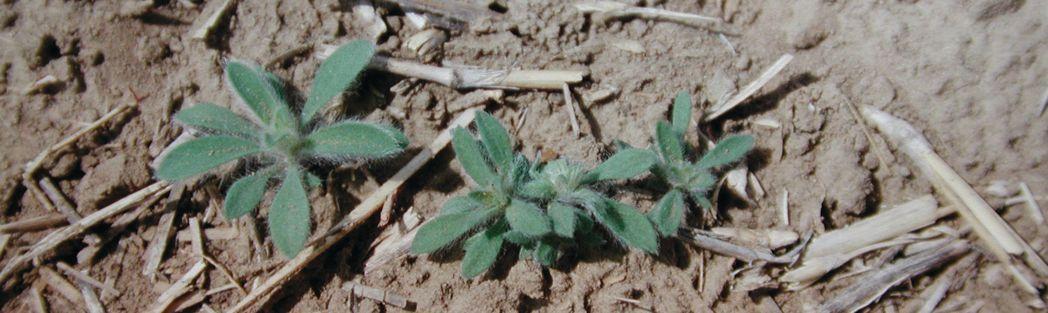
New Varro™ herbicide for wheat. Freedom from Group 1 herbicide resistance. Freedom to select your preferred broadleaf partner. Freedom to re-crop.
To learn more about Varro visit BayerCropScience.ca/Freedom
While some manufacturers are just moving Catalytic Reduction) technology to meet fuel Case IH has been supporting it since the beginning. 10,000 tractors in the field, our SCR track record recent independent tests, * the Steiger ® 600 horsepower and fuel efficiency, outperforming across the entire powerband. To learn more be ready with the proven leader, visit caseih.com/efficient
to SCR (Selective fuel and emissions needs, beginning. And with over record is proven. In fact, in set a record for drawbar outperforming the Deere 9630 more about how you can caseih.com/efficient power.
TOP CROP
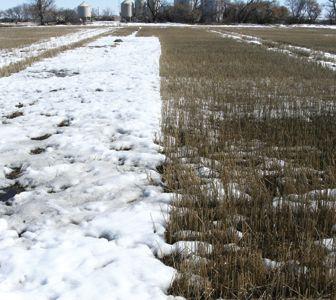
6 | Mid-March snowpack worth a thousand words The snow is on fallow and the stubble is almost free of snow!
By John Dietz
| Chemfallow chemistries
up herbicides in a glyphosateresistance world.
| Of solar flares and GPS – What’s next?
flares and cellular RTK should be on your GPS radar for 2012.
John Dietz
PHOTO COURTESY OF SCOTT CHALMERS.
PHOTO BY KEN SAPSFORD.
PHOTO COURTESY OF PAM WILSON.
DIANE KLEER | GROUP PUBLISHER
When Sir Francis Bacon first coined the Latin phrase Scientia potential est (knowledge is power), he was not thinking of farming and certainly not Canadian agriculture. Canada had barely been discovered when this Renaissance man and pioneer in the scientific method uttered these words, but the phrase is very appropriate for the knowledge level required by today’s producer, as well as the science behind the agriculture sector.
As always, farming takes a lot of skill and luck with the weather, but it most definitely requires knowledge. Producers are continually reading, observing, researching and communicating with their peers, their suppliers and their CCA to better understand the many obstacles that they face every year. It’s no surprise that this year brings a fresh crop of challenges.
One such obstacle is the spread of Group 2-resistant kochia throughout much of Western Canada, and the identification of Group 2 glyphosate-resistant kochia in numerous fields in southern Alberta. As part of the farmer’s information arsenal, this issue of Top Crop Manager provides recommendations and guidelines from within the industry on managing this rapidly evolving situation.
The article “Chemfallow chemistries” by Bruce Barker on page 8 discusses how farmers and weed scientists are reassessing their chemfallow weed control programs to manage Group 2-resistant kochia and glyphosate-resistant kochia. Ken Sapsford, research associate at the University of Saskatchewan, provides advice on how farmers can help manage resistance. One major tip – farmers with chemfallow acres need to mix glyphosate with other groups to help manage resistance.
As well, inserted with this issue is a chart outlining herbicides that can be used to control Group 2-resistant kochia or Group 2+9 (glyphosate) resistant kochia. With most kochia recognized as Group 2 resistant, and the discovery of Group 9 (glyphosate) resistant in southern Alberta, selecting and rotating herbicide groups is a key way to manage herbicide resistance. This chart, courtesy of Western Canada’s leading weed scientists, will help farmers and agronomists more easily select herbicides for kochia control. The chart was developed by Hugh Beckie, Bob Blackshaw and Eric Johnson, Agriculture and Agri-Food Canada (AAFC), Ken Sapsford, University of Saskatchewan, and Linda Hall, University of Alberta.
We’ve also provided our readers with information on Distinct herbicide, which is in the final stages of registration (see page 26). If registered in time for 2012 chemfallow or post-harvest season, the new chemistry may be an important tool for managing herbicide resistance and improving broadleaf weed control. As you read this, research continues to be done on this issue. As Sapsford concludes, “there are a lot of questions to be answered.”
Salty soils
Also in this issue find an article by Carolyn King on sodic soils. It’s a more common condition across Western Canada than many realize, so we chat with Dr. Ross McKenzie, agronomy research scientist with Alberta Agriculture and Rural Development, about identifying and managing these nasty soil combinations. The physical and chemical properties of sodic soils make them very difficult to manage for annual crop production, and options for managing sodium-affected land depend in part on how severe the soil conditions are.
As a result, Dr. McKenzie suggests that the first step for anyone who thinks they may be dealing with sodic soils is to have an agronomist come in and sample soils. He highlights factors to consider in doing this sampling work, and in managing soils once the problem is quantified.
Knowledge is power, and our goal through Top Crop Manager and our recently launched AgAnnex.com is to be a regular source for some of that knowledge. You can’t control what Mother Nature may be sending you this season, but with the right knowledge and understanding, you can minimize its effect on your crop.
TOP CROP
JUNE 2012, VOL. 38, NO. 9
GROUP PUBLISHER Diane Kleer dkleer@annexweb.com
WESTERN FIELD EDITOR bruce@haywirecreative.ca
WESTERN SALES MANAGER kyaworsky@annexweb.com
EASTERN SALES MANAGER smccabe@annexweb.com
SALES ASSISTANT
mburnie@annexweb.com
MEDIA DESIGNER Gerry Wiebe
PRESIDENT Michael Fredericks mfredericks@annexweb.com
CIRCULATION
e-mail: subscribe@topcropmanager.com Printed in Canada CIRCULATION e-mail: subscribe@topcropmanager.com
GROW WITH US
When you choose to partner with us, you grow with us.
Partnering with Richardson Pioneer gives you a distinct advantage in the field. Our passion for agriculture comes through in the way we support producers throughout the entire growing cycle. At Richardson Pioneer, our professional agrologists and Certified Crop Advisors use a combination of in-field testing, advanced technology, and hands-on experience to help you maximize your farm’s profit.
In addition to our field-level agronomic support, Richardson Pioneer’s grain merchandising team has a wide range of expertise that makes bringing your grain to market as easy as possible. We work with you, on your farm, to create personal plans that fit the needs of your business.
Contact your local Richardson Pioneer Ag Business Centre today to get started.
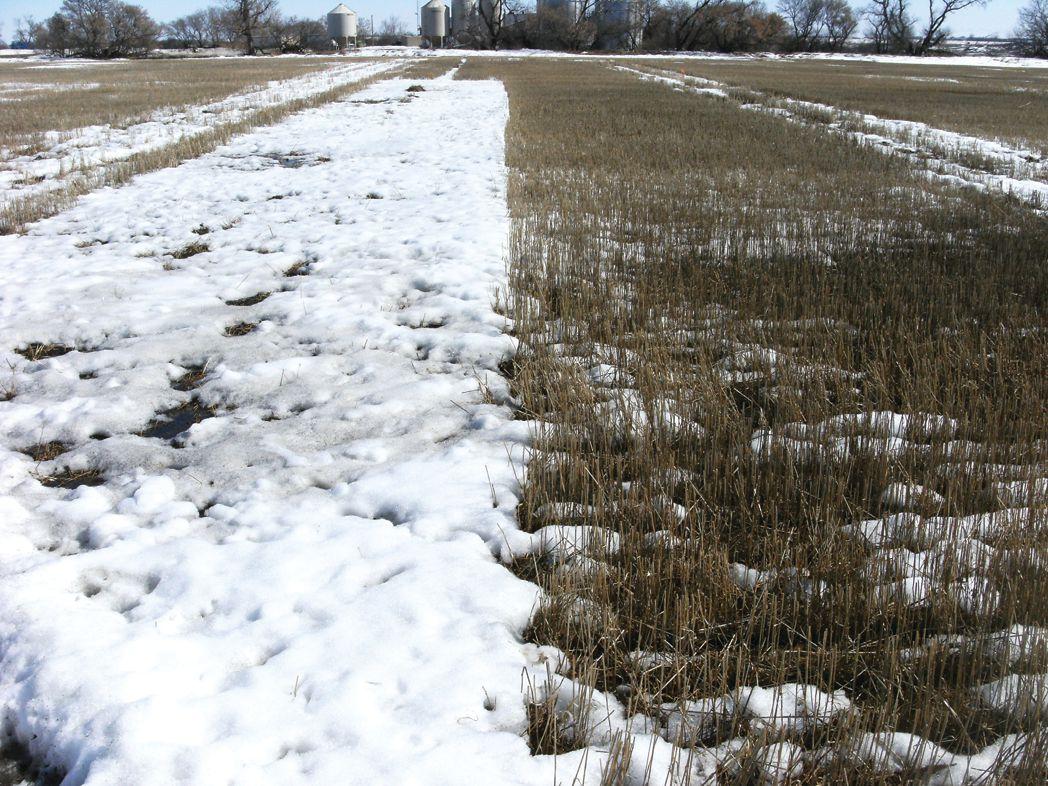
What’s wrong with this picture? The snow is on fallow and the stubble is almost free of snow!
by John Dietz
It was the Ides of March 2010, when Scott Chalmers stopped to take the photo above. The moderating winter temperature soared to 4.5 at Melita, Manitoba, that sunny day. The official Environment Canada snowpack had shrunk from 22 centimetres a week earlier to just eight centimetres remaining on this day, March 15. Days later, only a trace of snow remained, and then it was gone for the season.
Two years later, to start 2012, the diversification technician from Melita for Manitoba Agriculture Food and Rural Initiatives sent along the photo with this comment: “This is our most interesting photo we experienced with strip till. This is likely worth a thousand words.”
It appears the standing stubble holds very little snow at this late point in the winter. Adjacent to it, several inches of snow blankets an area without stubble. And, to each side, something else is going on.
The location, Chalmers says, is a trial site at Melita for the Westman Agricultural Diversification Organization (WADO). It’s a well-sheltered few acres adjacent to the Souris River, which is
on the far side of the trees. The view is looking east.
In a typical growing season, WADO has hundreds of small trial plots here for most of the crops found in southern Manitoba. Some management techniques are always being tested, too. This is a sandy-loam area, generally the driest and warmest portion of Southwest Manitoba.
The big block in the centre of the photo, with most of the snow, was tilled up black with a rotovator in the fall, Chalmers says, to produce a ground situation similar to results from fall cultivation.
Wheat stubble is standing in the adjacent block, where the snow has nearly melted away. It’s a zero-till site; the residue wasn’t touched.
To the sides are trials with strip tillage, cultivating eight-inch strips on 30-inch row spacing.
“Those strips are where we did the strip-till, and you can
ABOVE: This photo was taken in March 2010 at a trial site for the Westman Agricultural Diversification Organization (WADO) at Melita, Manitoba.
see the stubble sticking up between. That’s the part that wasn’t disturbed. It’s a medium situation, between what a cultivator and zero-till situation would be. We suspect, as well, there would be medium temperatures in those soils,” Chalmers says.
“Strip-till was a blend of the two, with the tilled strips remaining as snowpack ice while the zero-till strips melted,” he says.
At its February peak in the winter of 2009-2010, the Melita area had a 22-centimetre snowpack (about nine inches), according to Environment Canada records. At this WADO site, Chalmers recalls, the snow was fairly well packed and fairly even over the area. Drifting wasn’t a factor.
“It had snowed well above the stubble height, so it took several meltdown days to get it to this point. We had quite a bit of snow.”
Upside down
In this particular tillage trial situation, the photo clearly shows that the zero-till stubble contains less snow than the adjacent black conventional tillage site. Obviously, Nature is messing with good science.
There’s a theory, Chalmers suggests, that exposed stubble conducts heat down and radiates it inside the snowpack. Maybe the stubble contained more snow and simply melted it down faster than the adjacent glazed-over snowpack could melt. A snowpack, glazed over, could insulate the lower snow from early mild temperatures.
He adds, “You‘d think those soils (without stubble) would take longer to warm up but, probably, in the short term when it does melt they get very warm very quickly.”
The same situation occurs on a nearby farm that has both conventional and zero-tillage practices, Chalmers says. When the snowpack begins to melt, it goes down faster on the field of zero-till wheat stubble.
But, he adds, it’s a little different with canola stubble. “What you see in this picture actually seems to flip. The canola stubble will be full of snow; the black side will melt faster.”
As for the strip-tillage aspect, the agronomist says it does have some appeal for sandy-loam soil that may be subject to erosion, if the farm also has GPS autosteer with enough accuracy to plant seed down the middle of the cleared strips.
“It’s something from both worlds. Strip-till alleviates that risk of your soil blowing into a ditch. Also, that strip is supposed to warm up faster so your seed will germinate faster.
“Based on what’s going on here, it makes you wonder if we shouldn’t strip till in the spring rather than the fall. You’d get quick spring melt with the stubble cover, then rip up the strips to get it nice and warm for seeding.”
SWIFT CURRENT PERSPECTIVE
Dr. Harold Steppuhn, Agriculture and Agri-Food Canada research scientist and veteran observer of snow and stubble at Swift Current, comments that these differences in snow cover in the photograph are common in locations with clear winter days, and may not be due to differences in snow deposits.
He writes, “The sharp, even separation in snow cover between the tall stubble and the rotovated area suggests that the difference as photographed stems from greater ablation in the tall stubble.”
Both sides reflect an equal amount of warming solar radiation at first, but that changes as the stubble emerges. The stubble reduces
Brandon perspective
The situation in this mid-March photo looks a little odd but doesn’t really challenge the experience and science that’s been learned by Agriculture and Agri-Food Canada through work with stubble and snow on the Prairies, says Dr. Byron Irvine, AAFC research manager, Brandon.
“If you work them down, most fields end up catching a lot less snow because the stubble isn’t standing,” Irvine says. “They have lots of dark spots where the snow blows off. There are places for the melting to start, with almost bare soils. A normal field that’s been worked, most of the time, will actually melt faster.”
These alternate stubble heights are making a different scenario, he suggests.
At mid-March, Irvine says, the field still is five or six weeks away from the earliest seeding opportunity. Under the insulation of residue and snow, the uncultivated soil will be less cold through the winter. It’s a good thing. Four inches of trapped snow insulation will keep a winter wheat crop alive through the coldest winter.
Differences in stubble cover probably did play a role in this photo because of the narrow trial treatments, Irvine suggests.
“Given the narrowness of the strips, there is a possibility that they are catching more snow. It’s likely to be more dense in those locations because snow blows out of the tall stuff once it gets full at the ends. The other thing is, there’s not as much dark material in there to have it melt.”
In larger AAFC trial plots at Brandon over 10 years, both temperature and snow cover were tracked. While insulation did moderate the soil temperature, the overhead snowpack varied greatly.
“The depth of snow changes so much around a field, surprisingly enough, in stubble,” Irvine says.
Using premarked stakes at their own trial sites, the Brandon research team used binoculars to read the snow cover from a distance while driving past, so they wouldn’t disturb the setting.
“There was a lot of variability, even in settings that looked uniform. Once that eight-inch stubble got full, you would find anywhere between six and 12 inches of snow in it depending on where the drifting happened,” he says.
And, given a few weeks of spring weather, the reality is that the cultivated ground with the higher snow cover in mid-March will dry and warm up earlier than adjacent standing stubble. The stubble will have the advantage in a dry year or dry area, but may hold back spring field work in a wetter year or wetter area.
As for which caught more snow – if either one did – we don’t know. It was the Ides of March, when Brutus betrayed Caesar.
the reflection, providing more energy to its contiguous snowpack. The difference increases as the solar angle increases and the day lengthens.
He adds, “Sometimes we notice a melt of snow around standing stems, producing spaces up to one centimetre in diameter. This allows small measures of convected air to deliver energy down into the snowpack, but this is much less than the radiant energy transfer.”
In short, given equal starting amounts of snow, the snow in stubble melts away faster – until the snow depth in the worked stubble drops below about 10 centimetres.
CROP MANAGEMENT
Mix up herbicides in a glyphosate-resistance world.
by Bruce Barker
With Group 2-resistant kochia a given throughout much of Western Canada, and Group 2 glyphosate-resistant kochia identified in numerous fields in southern Alberta, farmers and weed scientists are having to reassess their chemfallow weed control programs.
For farmers with or without glyphosate/Group 2-resistant kochia, the message is clear: include multiple modes of action in your chemfallow herbicides.
“I would recommend that any farmer with chemfallow acres needs to mix glyphosate with other groups to help manage resistance,” explains Ken Sapsford, research associate at the University of Saskatchewan. “With the way kochia blows around, even if you have been trying to manage for glyphosate resistance, it could still be in your field.”
With the likelihood of Group 2-resistant kochia on every field, and the additional possibility of glyphosate-resistant kochia, weed scientists Hugh Beckie and Eric Johnson with Agriculture and AgriFood Canada, along with Linda Hall at the University of Alberta, and Sapsford, put together a table that shows which herbicides can control Group 2- or Group 2/9-resistant kochia.
“The difficulty in looking at labels is that kochia may be controlled by a combination but with glyphosate-resistant kochia, the chemfallow herbicide may not necessarily control it because it is the glyphosate in the mix that is controlling the kochia. There are a lot of questions to be answered,” explains Sapsford.
Sapsford cites the example of Rustler, a glyphosate/dicamba combination. Rustler controls kochia, including Group 2-resistant kochia. However, if there is also glyphosate resistance, the dicamba rate in Rustler won’t necessarily control the kochia as that rate is only rated for suppression when applied as dicamba alone. Also unclear is whether a Group2/9-resistant kochia plant is as robust as a normal kochia plant.
Herbicides to control Group 2-resistant kochia or Group 2+9 (glyphosate)-resistant kochia in field crops
INFORMATION COMPILED FROM 2012 SASKATCHEWAN / MANITOBA GUIDE TO CROP
– FOLLOW
New research looking at alternatives
The weed scientists are collaborating on research to develop new control solutions for Group 2/9-resistant kochia in all cropping situations. They are looking at both existing and new chemistries. Some may be too expensive for chemfallow, but would provide a last-resort option for growers with Group 2/9 resistance. Another option that may have to be considered is the return to the old conservation tillage technology called the Noble blade cultivator. Developed in response to the Dirty ’30s, and common on the southern Prairies for many decades, the Noble blade might just be making a comeback.
ABOVE: It takes extra consideration to manage herbicide resistance in kochia.
PHOTO BY KEN SAPSFORD.
The Harvest Grainbelt is faster, more reliable, and easier on your grain. The Brandt Harvest Grainbelt delivers superior reliability and reduced maintenance with exclusive features like our new precision drive rollers that extend roller bearing life, and our new synchronous belt drive system that delivers enhanced wear advantages over a conventional chain drive –which of course means less downtime and more productivity for you come harvest time. That’s powerful value, delivered. Per formance, Conveyed.
Rebate on Harvest Grainbelt
COULDASHOULDAWOULDA
PROSARO
For unparalleled yield and quality in your wheat and barley crops, choose NEW Prosaro® fungicide. It delivers premium disease protection against fusarium head blight (FHB), reduces DON levels and controls leaf diseases.
Two leading actives – tebuconazole for fast activity and prothioconazole for future defense – bring curative and preventative properties to your crop. Prosaro is truly the complete package for protecting both cereal crops and your peace of mind.
For more information visit: BayerCropScience.ca/Prosaro
MACHINERY
When you do start kicking tires, it doesn’t take long to know you’re swimming in lingo soup!
by John Dietz
Many farmers now have autosteer, and rely heavily on it.
Others, not so much. For those who are interested in adding GPS autosteer to a tractor they already have, or interested in buying a tractor already equipped, here’s the background you’ll need.
Doug Mackay, who has 15 years in precision farming as a researcher, manufacturer and precision farming consultant in south-central Alberta, provided much of this background information.
GPS lightbars were the first effective guidance device to come along, in the early 1990s. With a specialized radio antenna and receiver, they could convert line-of-sight signals from U.S. Global Positioning System (GPS) mid-level satellites into location co-ordinates on the ground.
By 1994, the earth had 19 GPS satellites stationed in orbits. Approximately 32 are available now in six orbital levels.
Similar systems are being developed. The Russian Global Navigation Satellite System (GLONASS), originally military, was opened for civilian use in 2007. The European Union is developing the Galileo positioning system; China, India and Japan have plans for navigation systems.
Collectively, they are known as the Global Navigation Satellite System or GNSS. Some receivers built since 2007 can work with GLONASS as well as GPS.
Continuous, relatively weak, time and location signals are broadcast by these satellites in a dedicated section of channels (or frequencies) on the broadcast band. Receivers require signals from four satellites to determine location. Internal calculations triangulate field position from the overlapping signals.
“Way back you had 12 or 24 channels. Now it’s way beyond that. More satellites at one time means more coverage, not more accuracy, especially in areas blocked by hills or trees,” Mackay says.
WAAS accuracy
GPS or GNSS alone is inadequate for positioning a tractor in a field. Systems were developed with a ground-based component to correct/ fine-tune/augment the basic GPS calculations.
Accuracy in GPS terms has two components. Repeatable accuracy is the ability to return to the same point at any time in the future. Relative accuracy is the ability of the receiver to rove and return to the same absolute location within about 15 minutes. Both are important, but repeatability is key to avoiding overlap and misses on return passes with equipment.
Mackay consults on precision farming projects, including autosteer.
Accuracy was improved with the development of Satellite-based Augmentation Systems (SBAS). They produce correction signals that improve repeatability with the aid of ground base stations that are precisely surveyed and able to collect signals from GNSS satellites. Another term for this is Wide Area Differential (WADGPS).
The Federal Aviation Agency operates the Wide Area Augmentation System (WAAS), which is a form of SBAS. WAAS has a network of ground-based stations that measure small variations in the GPS signals and high-altitude, geo-stationary satellites. It generates a correction
PHOTO COURTESY OF DOUG MACKAY.
Doug
Make molehills out of mountains.
Challenger machines are built for the most demanding environments on earth. Our legendary Mobil-trac™ system features oscillating midwheels that mold to every ridge and rut, delivering unrivaled power to the ground. Yet with strength, comes equally devastating smarts. When armed with AGCO’s System 350
productivity skyrocket. It’s enough to make a mountain shiver. For more, visit challenger-ag.us.
signal that is sent every five seconds.
The U.S. Coast Guard operates an alternative, the Differential Global Positioning System (DGPS), for the United States. This system relies on a large network of ground-based stations that generate and broadcast corrections signals without using geo-stationary satellites.
Every receiver for farming today in Canada is enabled for WAAS or DGPS. There is no charge for using the WAAS signal, which can produce a location accuracy of about eight to 12 inches.
WAD accuracy
Private subscription-based commercial systems have been developed to improve the accuracy of correction for farming. Together, OmniSTAR and StarFire are known as wide-area differential (WAD) GPS service providers.
Many GPS receivers work with OmniSTAR, which became available in 1994. The company today has four levels of signal correction service.
The lowest accuracy correction signal, OmniSTAR VBS, uses a single frequency L1 receiver. L1 refers to a radio frequency band, between 1559 and 1610 MHz. The VBS horizontal position error is described as “significantly less than 1 metre” for 95 percent of the time.
The second and third levels of accuracy use dual band L1/L2 receivers. OmniSTAR XP, provides long-term repeatability of better than 10 centimetres (four inches), 95 percent of the time. OmniSTAR HP usually has a horizontal error of about six centimetres (2.5 inches) 95 percent of the time, along with a vertical error of less than 10 centimetres. The L2 frequency band correction signal became available in 2005.
OmniSTAR G2 service, the latest advance, provides short-term accuracy of one to two inches and long-term repeatability of better than 10 centimetres, 95 percent of the time. It uses both GPS and GLONASS satellites.
A similar correction service, CenterPoint-RTX, was announced in January 2012 by Trimble.
StarFire was developed by John Deere and first offered in 1998. When a newer system was released in 2004, they became known as SF1 and SF2. The SF1 correction now is a free service for any John Deere receiver. The SF1 specifies repeatable accuracy at +/- 10 inches pass to pass. The SF2 is accurate to +/- four inches pass to pass.
RTK accuracy
Absolute location accuracy measured in increments of one or two centimetres and relative, repeatable accuracy measured in millimetres, is available through Real Time Kinematic (RTK) components for guidance. Relative and repeatable accuracy are generally the same for RTK.
In effect, RTK resembles a survey instrument for farming. For instance, tripods equipped with a second GPS receiver can be placed at the corner of a field, or elevated to a tower or other high point, to send line-of-sight correction signals to equipment moving in the fields. Machinery dealers have developed RTK networks for customers in some regions.
“RTK is the big thing now,” Mackay says. “Guys want to get into inter-row seeding and controlled traffic farming.”
A grain farm equipped with RTK and 10-inch drill spacing, or tighter, can drill the new crop midway between the stubble rows of an earlier crop. That concept became achievable with RTK autosteer, as did tramline-type farming, in the past five years.
Since about 2010, RTK services through cellphones or the Internet have become available. A cellular modem installed in the receiver, or even the driver’s cellphone, may be used to bring a high-accuracy
correction signal to the steering control.
Continuously Operating Reference Stations (CORS) and Virtual Reference Stations (VRS) are two of several names for the groundbased networks now providing RTK for farming. Some U.S. states provide the service without charge through the Department of Transport.
Implement steering is becoming significant in relation to GPS autosteer accuracy discussions. Implements are being equipped with GPS receivers and a communications link to the controller in the cab. Thus, autosteer is applied to the implement for centimetre accuracy regardless of the tractor’s position on a slope.
Steering components
Manual steering within field boundaries is being replaced with one of two methods. One is permanently installed into the steering hydraulics and wiring. Integral autosteer is generally regarded as the most accurate way to control the machine. Some manufacturers already install it at the factory, and will fully service or warrantee the system.
The second method uses a transferable device that attaches externally to the steering wheel. It probably can be moved in less than 30 minutes to another machine. It has been sold as a lower-priced and only slightly less accurate option.
Aftermarket autosteer-makers are making equipment for both methods of autosteer as well as installation kits for tractors, sprayers and harvesters that were built before the age of autosteer.
Controllers
Since about 2006, autosteer system components have become able to talk to each other through manufacturer compliance with a new international protocol for agriculture known as ISO 11783. It is seen in new electrical connectors, for instance, that link a tractor’s cab electronics with the electronics in whatever cart or implement it is towing. Regardless of make, if the units are ISOBUS compliant they should be able to work together.
Mackay says, “It’s becoming a trend to use ISOBUS plug and play. Via ISOBUS, one manufacturer’s autosteer controller can be plugged into another manufacturer’s existing tractor hydraulics.”
About 11 makers of controllers for GPS autosteer farming are available. The controller is a form of computer, operating with various software programs and storing field information in internal memory. It can be fed with certain types of data, such as previous field maps and “prescription” maps for applications of seed, fertilizer or chemical.
Controllers operate the monitors or displays in the cab, plus the autosteer units and rate controls for applications. They also create files that store logs or data of whatever is going on in the system. Mapping, or a system of geo-reference files, are being created continuously.
Some lightbars still are being manufactured. They still require manual steering, but have some of the memory and display associated with GPS autosteer.
Autosteer software
Autosteer software enables a controller to keep a machine on course from pass to pass in a field. The accuracy will be as good, or weak, as the signals that are being processed. In practice, more than 95 percent of the time, each pass will be perfectly parallel to the previous pass. The first pass can be done manually, or it already can be done using specifications stored in the memory from a previous operation in that field. Once the field has been mapped, the controller needs only to establish its exact location before starting a new operation in the field.
CONTINUED ON PAGE 20
Blackleg becoming a big concern in canola.
The importance of canola to Canadian growers is easily seen in the numbers. The Canola Council of Canada reports over 18 million total acres harvested in 2011, an increase of over 42% in five years. With increasing acres due mostly to tighter rotations, Blackleg has again become a concern. And it’s a concern that is growing. Shortened rotations put more pressure on resistant (R-rated) canola varieties, currently the primary defense against the disease in Western Canada. If genetic resistance breaks down, Blackleg will become a problem for growers looking to maximize their canola production. Blackleg is common in Alberta, Saskatchewan and Manitoba and has been consistently found in over half the canola fields in provincial disease surveys. What is surprising is that Blackleg is an increasing concern despite the fact that R-rated varieties are being seeded. There are a variety of tools recommended for reducing Blackleg’s impact on yield. While it’s always best to rotate canola one in four years, growers should also rotate R-rated varieties and be vigilant about scouting for the disease. Rotation combined with the use of a fungicide can also be an excellent strategy against Blackleg. The decision is up to the grower as to whether the return on investment demands the additional protection delivered by a fungicide, but increasingly it is becoming a more important tool to consider.
Blackleg is a fungal disease in canola caused by the pathogen, Leptosphaeria maculans. Symptoms appear as greyish white lesions with black spots (pycnidia, which contain spores) on leaves
and stems early on at the 4-leaf stage, then subsequently as stem cankers in the mature plant. There is no cure once Blackleg appears and so a preventative fungicide treatment is strongly recommended.
One effective option for control of Blackleg is HEADLINE® fungicide from BASF. What differentiates HEADLINE from other fungicides are the additional benefits BASF calls AgCelence™. AgCelence is unique to HEADLINE and has been observed by growers to increase yield with or without the presence of disease. Over the past three years, grower trials have also shown that the greater the yield potential of a canola crop, the greater that yield increased with an application of HEADLINE. Growers also report seeing greener, larger leaves, taller plants with more pods and stronger stems that help improve harvestability.
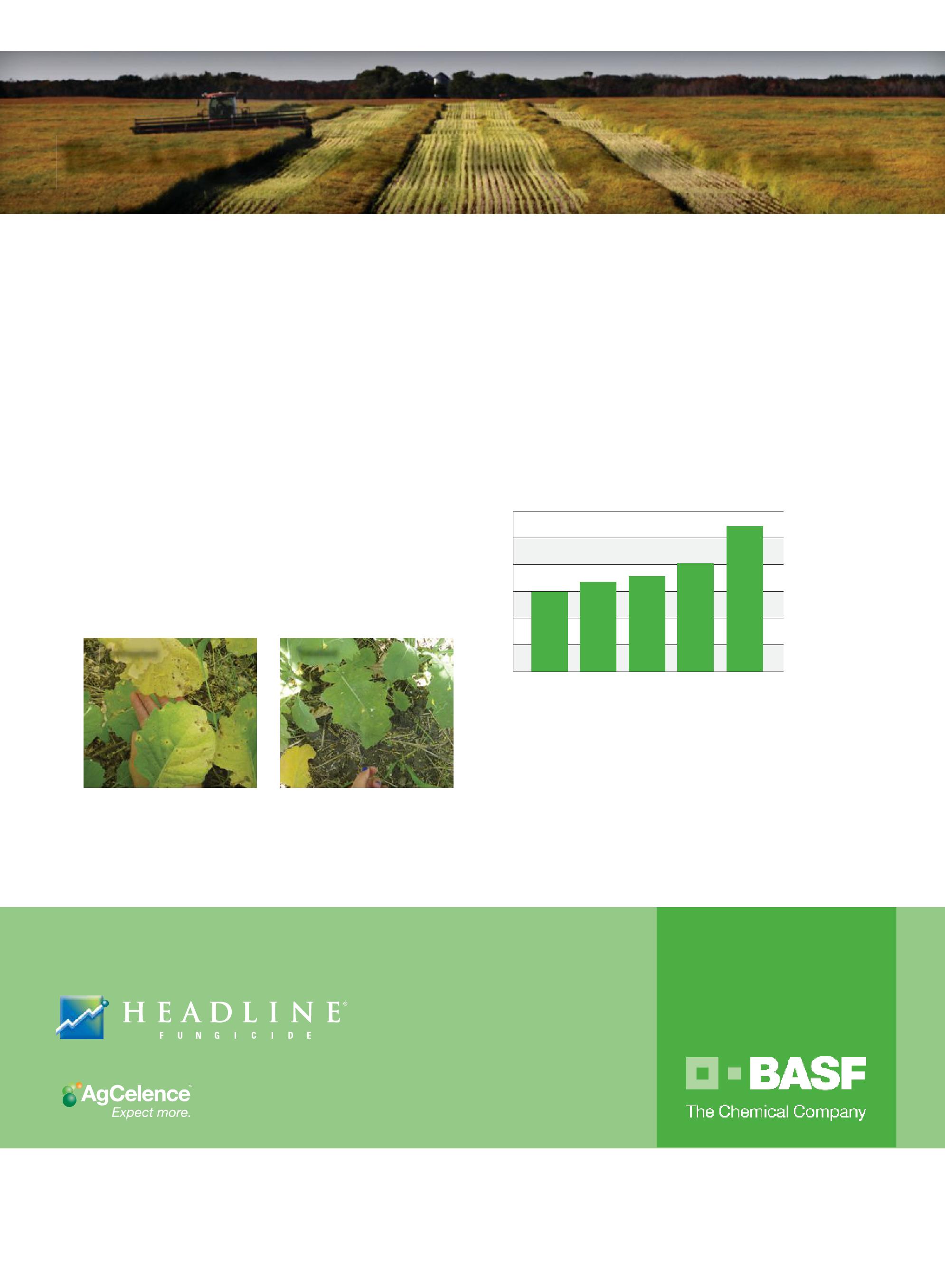
Yield increase vs yield potential with HEADLINE
When HEADLINE is added with any canola system* herbicide at the 2-6 leaf stage, the greater the yield potential, the greater the crop response and yield increase.
With tighter canola rotations and the growing presence of Blackleg increasing the pressure on current R-rated canola varieties, a preventative fungicide application is due to become more common. For canola growers looking to control the disease and increase yields, HEADLINE fungicide is a highly effective tool to help get a leg up in the battle against Blackleg.
To find out more about HEADLINE, visit agsolutions.ca/HEADLINE or call AgSolutions® Customer Care at 1-877-371-BASF (2273).
* Canola production systems include Clearfield® canola, InVigor® canola or Roundup Ready® canola.
Source: Grower yield data, HEADLINE at herbicide timing, 2009 to 2011, N=70
Untreated canola can suffer yield loss if Blackleg is present.
A preventative application of HEADLINE fungicide can help preserve yield
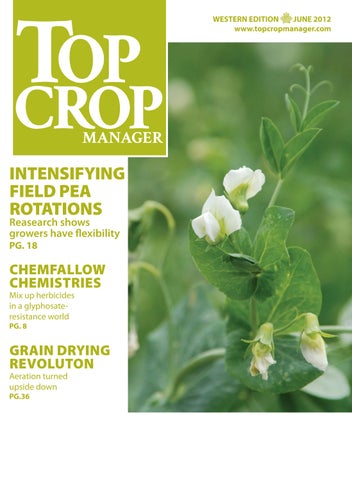
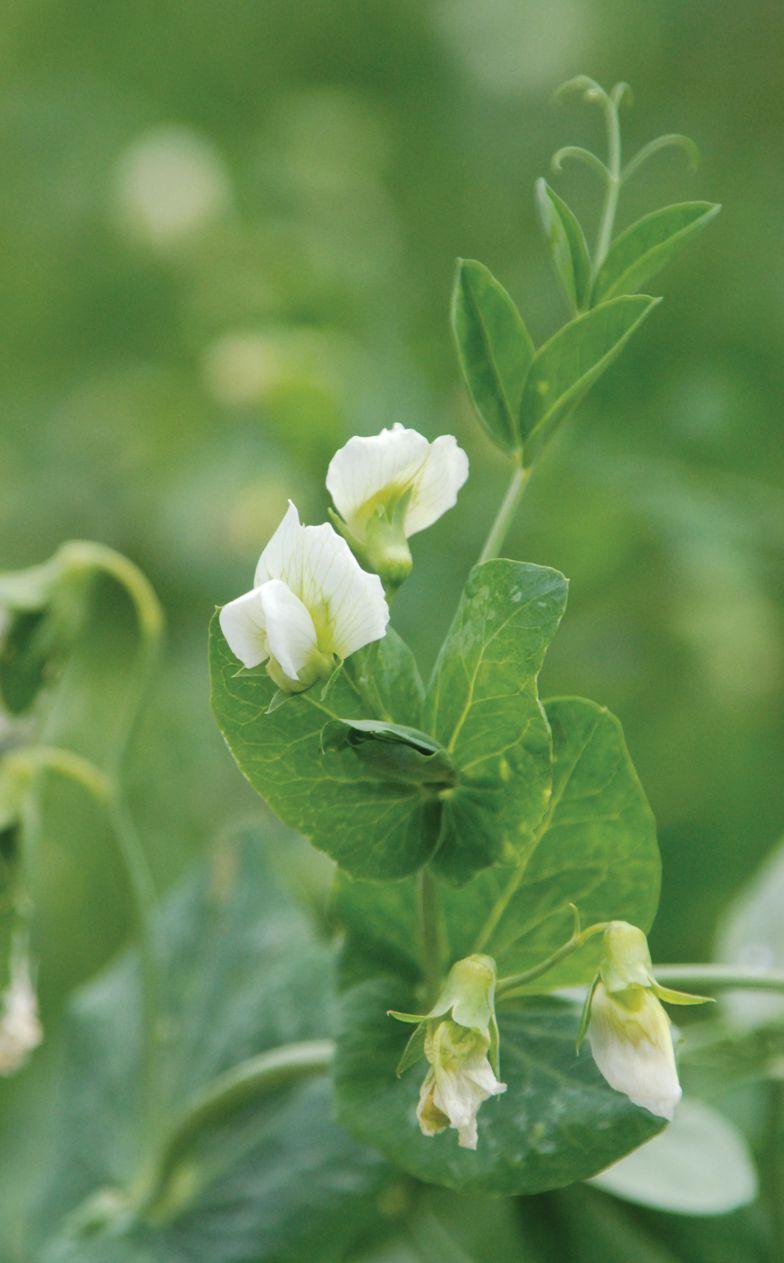
Research shows growers have flexibility in field pea rotation frequency.
by Donna Fleury
Field pea is regularly grown in rotation with wheat and other cereals in Western Canada. Generally, the recommendation is for three consecutive years between pulse crops to minimize plant disease risks. However, there are many agronomic and economic benefits of including grain legumes such as field pea in rotation, and growers expressed interest in the mid-1990s in increasing the frequency of growing pulses.
Researchers at the Agriculture and Agri-Food Canada (AAFC) Indian Head Research Farm in Saskatchewan conducted a 10-year study to evaluate the risks of intensifying rotations. “When we started the study in 1998, we were trying to answer questions for farmers about the risks of increasing field pea frequency in rotation,” explains Dr. Guy Lafond, scientist, Production System Agronomy. “Growers may rent or purchase land that had recently been seeded to pulses, or consolidating fields and expanding acreage, or simply wanted to grow field pea more often to take advantage of economic opportunities. We wanted to determine what the risks and impacts would be on agronomic performance.”
The research, conducted at the Indian Head Research Farm from 1998 to 2007, evaluated three crop rotations with field pea (FP) and wheat (W) over the 10-year period, including continuous pea (C-Pea), W-FP and W-W-FP. The objectives of this study were to examine the effects of increasing the frequency of field pea in cropping systems with wheat on crop establishment, grain yield, crop water use, and grain quality of both field pea and wheat.
The plots were seeded as early as possible each year and on the same day. For field pea, a seeding rate of approximately 190 kg/ha was used and a granular, peat-based Rhizobium leguminosarum inoculant was applied with the seed at a rate of 5.6 kg/ha. No fungicidal seed treatments or foliar fungicides were used in either the wheat or field pea phases of the rotation.
In the field pea phase of continuous pea and wheat-field pea rotation, starter fertilizer N treatments consisting of 5, 20, and 40 kg/ha N were added as urea. The field pea plots present in wheat-wheat-field pea received no starter N. However, monoammonium phosphate, which adds approximately 5 kg/ha N per year, was applied at a rate of 10.3 kg/ha P in wheat and field
Wheat yielded four percent more on pea stubble than on wheat stubble.
pea annually. The wheat plots received 80 kg/ha N as urea every year. All N (when used) and P fertilizers were side-banded at time of seeding (2.5 cm to the side and 7.5 cm below the seed) for both wheat and field pea.
“Overall, the research shows that there is very little risk to increasing the frequency of field pea in rotation in the short term,” explains Lafond. “This provides flexibility for growers to
PHOTO COURTESY OF GUY LAFOND.
Crop rotation and starter N generally had similar effects for field pea and wheat plant densities. The similar field pea plant densities regardless of the frequency of field pea in the cropping system would suggest that adjustments in seeding rates are not required. Some starter-N benefits were observed in the wheat-pea sequence but not the continuous pea sequence. Grain protein was higher in the continuous pea than the average of the wheat-pea and wheatwheat-field pea, likely the result of lower overall grain yields. Higher grain protein in field pea was observed with the starter N rate of 40 kg/ha N in both continuous and wheat-field pea rotations, but not at the N rate of 20 kg/ha. Grain protein concentration was greater for wheat on field pea than for wheat stubble.
shorten rotations when the price is good, for example, and they want to take advantage of marketing opportunities, or changes in their cropping management. This strategy offers flexibility over the short term, but is not something that should be done continuously.”
Weeds were one of the biggest agronomic problems of increasing the frequency of field pea over the long term. “Over the years of the study we observed that weed control was always more challenging as the intensity of FP in the cropping system increased,” says Lafond. “Therefore, we recommend that the intensification should be more short term in nature to avoid difficult weed control situations. Diseases can also become more of a problem as the frequency is increased.”
The results showed that the intensification of field pea in a wheat cropping system did not result in adverse effects on plant densities in field pea after 13 years of continuous pea. The overall observed plant densities for field pea averaged 65 plants per square metre, which falls into the recommended range of 50 to 75 plants per square metre. Plant densities for W averaged 307 plants per square metre, which exceeded the recommended range of 200 to 250 plants, and did not reduce yields, even in dry years. Equivalent field pea plant populations were observed among the other rotations. The plant densities were obtained without the used of a fungicidal seed treatment.
CONTINUED FROM PAGE 14
One difference in controllers is pattern recognition. Most can do a few patterns, like straight A-B, curved A-B, or pivot. Other examples include headland, boxed rounds, circle, spiral, ditch, levee tracks, swap, adaptive curve, contour and next row.
Controllers also generate different displays of a field, depending on their software and hardware. Most will give two or three views of the field map and the machine’s location in the field. Video cameras mounted on the machinery also can be plugged into some displays, so a driver can monitor what he can’t see from inside the cab.
Autosteer pricing
Pricing for autosteer components has come down dramatically as industry has tooled up and the market has grown.
“Overall, wheat grown on field pea stubble yielded about four percent more than wheat on wheat stubble,” says Lafond. “The yield difference between continuous pea and wheat-field pea was the same regardless of whether growing season precipitation was below or above average. When we compared the yields of field pea in wheat-field pea and wheat-wheat-field pea with the yields of wheat in the same rotations, the average yields were the same for field pea (2365 kg/ha) and wheat (2307 kg/ha).”
The impact on agronomic performance of shortening rotations also depends on location and climate conditions. “In the drier areas in Saskatchewan, some growers follow a durum-lentil rotation and have been doing that for a long time,” says Lafond. “The climate is a bit drier in those areas, so that helps reduce the disease risk. However, over the long term, weeds could become a problem. In the wetter areas of the province, diseases could more quickly become a problem with too intensive of rotations.”
“Based on the results of this study, intensification of field pea in cropping systems is feasible using a cereal-pea rotation providing for a one-year break between successive field pea crops,” says Lafond. “However, from a crop management perspective, the recommendation would be to intensify only intermittently to take advantage of marketing and agronomic opportunities such as field consolidation. Growers have the flexibility to adjust their rotations to take advantage of the agronomic and economic benefits of growing field pea, as well as contributing to a reduction in greenhouse gas emissions.”
An informal dealer survey in January indicated hydraulicmounted RTK autosteer can be purchased in a pricing range of about $15,000 to $30,000 for all the components. Without RTK, expect to pay $10,000 to $15,000. A new steering wheel-mounted autosteer system will retail for perhaps $16,000 at the high end and for less than $6,000 with only WAAS access.
The big choice for most farms that want autosteer will be in where to buy it, according to Mackay.
“Shop around?” he asks. “That depends on whether you want an aftermarket system or a factory-installed and serviced system. Dealer support is important. Fine-tuning the autosteer can sometimes take a while, so you want to make sure the manufacturer will provide that support.”
Growers could take advantage of market opportunities to grow pea more frequently on a short-term basis.
PHOTO BY BRUCE BARKER.
With the demand for specific product growing, grades may not matter as much.
by Lorne McClinton
Western Canadian wheat growers entered a new world when the federal government passed Bill C-18, legislation that stripped the Canadian Wheat Board’s wheat and barley sales monopoly last December. However, Brenda Tjaden-Lepp, Farmlink Marketing Solution’s chief analyst, told winter wheat producers attending the Saskatchewan Winter Cereals Development commission’s meeting at Crop Production Week, in January, that they should expect to have a smooth transition to the new market realities.
Buyers and sellers have long been able to hedge their winter wheat marketing decisions on both the Kansas City Board of Trade (KCBT) and the Chicago Board of Trade (CBOT), Tjaden- Lepp says. She notes these markets are so large that they will quickly become the price setters for the crop in Canada and companies will set their own Basis for Prairie delivery.
Tjaden-Lepp says that with winter wheat prices being set in US dollars the currency exchange rate will play a big role in setting producers’ profits in the future. She says it might be a good idea for producers to adopt a currency hedging strategy, like hog producers use, to protect themselves.
“Winter Cereals Manitoba and the Saskatchewan Winter Cereals Development Commission have kept very, very far away from the whole Wheat Board issue because their members’ views fell on both sides of the debates,” says the groups’ executive director Jake Davidson in Minnedosa, Man. “However after talking with the grain companies we believe that producers are going to see a lot more opportunities now that this [the market] has opened up. Several companies who have not really taken a role in marketing winter wheat before have told us that they are going to be much more aggressive in the marketing and the searching out winter wheat now that the Wheat Board’s strict control over the product is gone. They see a profit in it.”
Davidson believes there is going to be quite a change in the way the whole system will operate. He says that a couple of years from now he doesn’t think you’re going to see a boatload of number 1 or number 2 leave a port. Instead, he says, you will see boatload of specific product leaving a port.
“For example, a customer might buy wheat with 11 ½ protein, a certain falling number, maximum dockage of and whatever other specifications, like colour, that they might have,” Davidson says.
“We just have a gut feeling that it’s not going to be as important for wheat to be a number 1 as it is for it to be what the market wants.
The market for number 1 isn’t that big. A downwards shift in the type or the quality of what people grow may become an absolute fact because people are going to grow more what there’s a demand for; grades won’t matter as much.”
Western Canadian winter wheat markets will continue to be anchored by the huge demand from the domestic ethanol and feed market, Davidson says. This market has become so large in recent years that it has started to overshadow the CWB in the sector. Growers found that the freight savings they gained by selling to a local buyer really added up and left them with a lot more dollars in their pockets.
Like Tjaden-Lepp, Davidson believes it will take a bit of time for the new marketing system to fully sort itself out. At present there’s no consistency in the contracts that are being offered by the different grain companies. However, the information Davidson is hearing from the industry players is making him very optimistic about the future.
PHOTO BY BRUCE BARKER.
Winter wheat growers could see more aggressive grain marketing.
Research shows good potential for winter pea and lentil production in southern Alberta.
by Donna Fleury
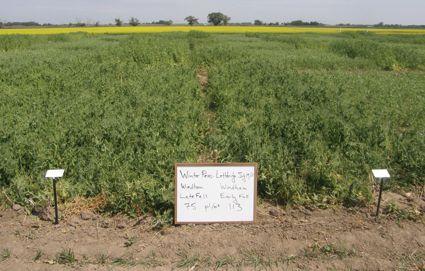
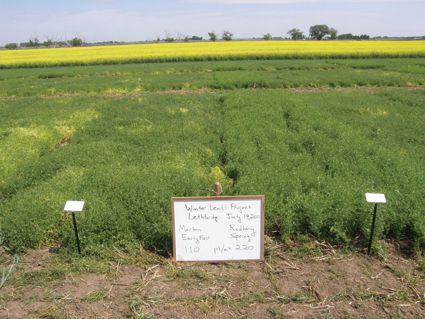
Pulse crops bring many advantages to cropping systems in Western Canada, including environmental, agronomic and economic advantages. Until now, pulse crops, including pea, lentil and fababean, have been grown as spring seeded crops. However, researchers in Alberta are seeing potential for winter pulse crops in the southern parts of Alberta.
In 2008, researchers with Alberta Agriculture and Rural Development (AARD) initiated a three-year project to assess the feasibility of winter pea, winter lentil and winter fababean. Plots were seeded in Lethbridge, Brooks, Bow Island, High River, Lacombe and Edmonton. “We have had success with winter pea and winter lentil in southern Alberta and have extended the research for another year,” explains Mark Olson, Unit Head – Pulse Crops with ARD’s Research and Innovation Division in Stony Plain. “However, the research was not very successful at Lacombe or Edmonton, so we have not continued in those areas for now.”
The winter pea and winter lentil varieties used in the trials are from USDA germplasm and work done by Dr. Kevin McPhee, a researcher formerly at Pullman, Washington, and now at North Dakota State University, and his colleagues. “These varieties are a regular pea crossed with a winter Austrian pea; however, they don’t have coloured flowers or dark coloured seed coats like the Austrian varieties,” says Olson. “They are clear coat varieties, just like spring green and yellow pea; however, the seed size is a bit small for the human food market.” McPhee and his colleagues are continuing to work on better lines with improved winter hardiness and seed size.
“From the results of our research, we believe there is potential for winter pea and lentil in southern Alberta south of Highway 1 in the Brown and Dark Brown soil zones,” says Dr. Ross McKenzie, Research Scientist – Agronomy with AARD’s Research and Innovation Division in Lethbridge. “We don’t recommend these crops north of Highway 1 until the winter hardiness of varieties are improved. Where they have potential, there are some fundamental production things that have to be done correctly for success.”
Both winter pea and lentil must be direct seeded in the first two weeks of September, preferably into standing stubble, and must be seeded into good moisture to guarantee good germination and emergence. “These winter crops are similar to winter wheat, and fall moisture conditions are very important,” adds Olson. “Winter pulses are also a larger seed than winter wheat and require quite a bit more water to
start the germination process.” Moisture conditions in drier falls will be a limiting factor to production.
“The seeding window is actually quite narrow, and putting them in earlier than the first of September isn’t really an advantage,” says Olson. “We tried seeding earlier, but the plants tended to get too large and lanky and too far advanced, so in the spring they didn’t come back as well. Typically these winter varieties will die back or freeze right to the scale nodes. If it is a good winter, there will be a bit of green leaves at the base of the plant, but if it is a tougher winter, they will die back and start regrowing from just below or at ground level.”
From the research, a seeding rate of 1.5 times (the normal target plant population is seven to eight plants per square foot for spring field pea) is recommended and all seed should be inoculated. The higher seeding rate doesn’t increase a farmer’s seeding costs because the seed size of these winter varieties is significantly smaller (range is 125 – 150g per 1000 seed weight). “For weeds, products such as Edge can be used for initial weed control and if necessary some in-crop grassy weed control,” says McKenzie. “However, if you have a good stand establishment and the crop gets a good head start with the weeds, you may not need
PHOTO COURTESY OF ROB DUNN.
Winter pea matures earlier and can produce higher yields.
much in-crop control.”
Depending on the conditions, harvest is usually between the third week of July to the middle of August. “If the season is drier than normal, the crop will mature sooner or if it is wetter, it will mature later into August,” explains McKenzie. “The yields for winter lentil were comparable to spring lentil yields; however, winter pea usually showed a 20 to 30 percent yield advantage over spring pea. For example, in one trial spring pea yielded 30 bu/ acre, while our winter pea yielded 80 bu/acre because of some very timely early rains and
quality of these winter pea and winter lentil varieties. “Once the samples were harvested, they were sent to Dr. Thava Vasanthan at the University of Alberta to conduct a constituent analysis to assess the fibre, starch and protein content, and other fractional components of winter pulses compared to the spring types. As well, Dr. Gene Arganosa at the University of Saskatchewan is doing a cooking quality assessment of the whole seed for field pea, comparing winter and spring types. “We are hoping to determine whether there might be some unique constituents or functionality in the winter varieties as compared to spring,” says Olson. “The information will also help us determine if these winter crops meet the quality parameters of the food and feed marketplace.”
Next step field demonstrations
dry conditions after mid-June. So if you end up with a drier than normal June into July, then the winter crop can really perform.”
In areas with pea weevil concerns, researchers are still trying to find out more information. “There is a concern that the fall seeded pulse crops could act as a green bridge to spring seeded pulse crops in heavily infested areas,” says Olson. “However, we still have lots of unanswered questions at this time.” Olson has also developed a Crop Decision Support System Checklist to help growers determine if they have all of the right conditions in place to reduce the risk of seeding winter pea or lentil in southern Alberta and to improve their chances of success.
Another component of the research is an assessment of the composition and cooking
The three-year project has been extended for another year, with a larger five-acre plot of winter pea and winter lentil seeded at Lethbridge in the fall of 2011. “We brought in some larger quantities of the winter pea and lentil varieties we were working with in our research to assess on a large field scale,” says McKenzie. “They arrived a bit late, so we didn’t seed until the third week of September and with the dry conditions, we had to irrigate enough to get the crop to germinate. Our goal is to shift the project from small research plots to larger on-farm demonstrations. We hope to increase the seed lot enough so that interested farmers can try their own demonstrations in the fall of 2012.”
“I like winter crops and see some opportunities in the future,” adds McKenzie. “Winter crops usually yield a little better, are more competitive with weeds and often get ahead of insects and diseases. They also offer several benefits to spreading out workload and machinery use on farm, as well as expand market opportunities. Winter pea would also fit in well with a winter wheat rotation and in the future if we can get a broader selection of winter crops, this could work well for some growers. Winter fababean did not overwinter or perform very well in any of the locations and until more winter hardy varieties become available, they aren’t a good option. Current work on winter canola is showing some promise as another winter crop option in Alberta.”
BE READY WITH EFFICIENT POWER. BE READY FOR THE BEST OFFERS OF THE YEAR.
Pre-order 2013 Case IH models today for the best offers of the year on proven equipment that gives you more power on less fuel. To learn more, visit your local Case IH dealer or caseihdeals.com
PHOTO COURTESY OF ROSS MCKENZIE.
Researchers are digging into the agronomics of winter pulse production.
Distinct herbicide awaiting registration.
by Bruce Barker
At press time Distinct herbicide was in the final stages of registration. If registered in time for the 2012 chemfallow or post-harvest season, the new chemistry will be an important tool for managing herbicide resistance and improving broadleaf weed control.
Distinct has a combination of two active ingredients, diflufenzopyr, (Group 19), a new active ingredient to Western Canada, and dicamba (Group 4). Distinct will be used for chemfallow and post-harvest application when tank-mixed with glyphosate.
“Diflufenzopyr synergizes the activity of dicamba to provide improved weed control at lower rates of dicamba. When it is added to dicamba, we see two to three times the activity on weeds than dicamba alone,” explains Mark Oostlander, technical development specialist with BASF at Innisfail, Alberta.
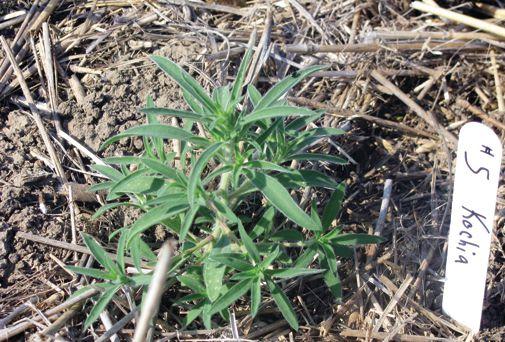
Adding Distinct to a glyphosate chemfallow application provides a broader weed spectrum than glyphosate alone, with a higher level of control on larger weeds. Because Distinct contains both Group 19 and Group 4 active ingredients, it will also control Group 2 and Group 9 (glyphosate) herbicide-resistant kochia.
“Kochia is on the label, and Distinct will control Group 2 and Group 9 herbicide-esistant biotypes of kochia,” says Oostlander.
Tank-mixed with glyphosate, Distinct herbicide complements control of all weeds on the glyphosate label, including kochia, Russian thistle, sow thistle, wild buckwheat, flixweed, round leaved mallow, cleavers and winter annuals. Dandelion, Canada thistle and narrow leaved hawk’s beard are controlled using fall applications during September and October, and suppressed during spring and summer applications from May through August.
Comparative weed control in chemfallow applications
Wheat, oats, barley, corn and canary seed can be planted the following year after application of Distinct. If Distinct is applied before Oct. 1, field peas, lentils, chickpeas, soybeans, canola, flax and sunflower can also be safely planted the following year.
Distinct will be packaged as a wettable granule formulation with two 2.3-kilogram jugs per case. One jug will treat 40 acres at the standard rate or 20 acres at the high rate. The high rate is used when weed populations are dense, or weeds are large. The low rate must be used for post-harvest applications. For glyphosate-resistant kochia one to three inches tall, the standard rate is recommended; for glyphosate-resistant kochia four to six inches tall, the high rate is recommended. Merge
surfactant must be included in the tank mix with glyphosate, no matter which glyphosate formulation is used.
In chemfallow, BASF recommends that a Heat and glyphosate tank mix be used for May/June applications, and a Distinct and glyphosate tank mix be used for July/August applications and post-harvest applications. Heat is a Group 14 herbicide and provides an additional rotational choice for managing herbicide resistance.
Watch for announcements from BASF if Distinct is registered in 2012 for use on chemfallow.
CHART: Comparative weed control in chemfallow applications.
PHOTO BY MARK OOSTLANDER.
TOP: New Distinct chemfallow herbicide will control Group 2and Group 9-resistant kochia.
SOURCE: BASF RESEARCH TRIALS, 2009-2011.
Folicur® EW fungicide protects the yield and quality of your cereals from disease pressures including rust, tan spot, septoria leaf blotch and fusarium head blight in wheat. The formulation provides growers with outstanding disease control without needing to add a surfactant on wheat, barley and oats. Solid investment protection so all your cereals are safe.
For more information visit BayerCropScience.ca/Folicur
Solar flares and cellular RTK should be on your GPS radar for 2012.
by John Dietz
GPS reception trouble is on the short-term horizon for 2012, but the outlook is getting better and better, according to Pam Wilson, instructor in precision agriculture at Assiniboine Community College, Brandon, Manitoba.
Be prepared to lose your precision lock on field location more often, and for longer times, in the coming season. Everybody using GPS is familiar with waiting a few minutes while the system gains a precision lock on its location in a field. After that first location lock in the morning, weeks can go by without a connection issue. That could change in 2012.
“If there’s a really strong solar flare, it might knock out signal reception for a day or more,” Wilson says.
Solar activity runs in 11-year cycles. The last peak was in 2001. GPS was relatively new for farming, and flares produced serious problems for some receivers. Equipment should be better today; we’re about to find out, she says.
“Some people had issues already last year, in 2011,” she says. “Farmers in one vicinity were all having issues; 20 miles west, other farmers were fine.”
The GPS was in and out all day. It had trouble locking. Messages on the monitors were confusing. When the interference was happening, it amounted to signal jamming, in spurts or waves.
Before she became an ACC instructor, Wilson did seven years of service work with the internal components and circuit boards for John Deere, Trimble, Raven and Outback GPS steering systems. She worked at machinery dealerships in Brandon and Portage la Prairie.
There are internal differences among systems that can be important in a year like 2012.
“The $400 cheapie WAAS antennas are perfect 98 percent of the time, but there are better quality components in the more expensive antennas,” she says. “If you have a dual band L2 receiver, usually those have better components. If you have an antenna that’s just a tiny button you stick on the roof, those I predict will definitely have issues.”
Normally, the L2 receivers are used with subscriptions to OmniSTAR or RTK signals. But, they work fine with basic WAAS signals. In
ABOVE: Pam Wilson discusses precision farming factors to watch in 2012, including cellular RTK.
a situation where the GPS signals need extra filtering to separate them from incoming solar storms, the L2 receivers should outperform the L1 receivers, she says.
Pay attention to solar weather forecasts this season, Wilson suggests. Solar forecasts are available as apps for smartphones and online at websites such as www.spaceweather.com.
The good news, she says, is that Earth- and space-based instruments are detecting, measuring and forecasting solar activity far better than even five years ago.
When the sun is about to emit a blast of electromagnetic radiation that will strike this planet, these instruments can give a day of warning, or more. They measure the strength, direction and speed of the flare. Usually, they can forecast an impact timing within about six hours.
Instruments also can indicate the probable strength across earth’s lower, mid and upper latitudes. Finer differences, across a region the size of Western Canada, aren’t being forecast.
The most recent major solar flare to strike Earth occurred on August 10, 2011.
The strongest, known as the Carrington flare, occurred on Sept. 1, 1859. It was visible to the naked eye, left a measurable trace in Greenland ice, produced aurora activity in Cuba, and set new telegraph systems on fire.
Cellular RTK
Wilson also forecasts continuing adoption and improvement in GPS technology for farming. Cellular phone service now is available on nearly any acre of farmland in Western Canada. Along with that, upgrades to cellular broadband services have enabled RTK equipment to move from tripods and farm towers to cellular towers. Correction signals for RTK, through a wireless data package or Internet service, now are easy and reliable.
Wilson says, “You put a modem in your tractor and go wireless RTK with cellphone communication.” Wireless RTK and Internet RTK are sweeping into service in Western Canada, for grain farming.
“About half my farmers can really, really benefit from this. They’re going from the WAAS signal at about four-inch or so accuracy down to RTK one-inch accuracy or better. So they’re saving gas, fuel, fertilizer, chemical, seed, time, and reducing compaction on the field,” she says.
The cellular RTK does not require line of sight. The tower position eliminates most issues with signal shading. It can provide repeatable sub-inch steering accuracy at a range of 30 miles from the signal source.
Cellular RTK became an option for Prairie farming for the 2010 season, in some areas. It will nearly blanket the Prairies in 2012. Furthermore, it’s now an option through GPS dealers for
TWO TYPES OF CELLULAR
There are two types of cellular RTK, single-base and networked solutions, according to Paul Park, Pat Inc. general manager, Killarney. Pat Inc. is a Trimble dealer and service provider for Trimble, Case, New Holland, Hardi and AgLeader GPS products.
A single-base solution can pump the signal farther out than the traditional radio RTK signal and does not require line of sight. After 10 miles, however, the accuracy degrades. At 30 miles, it could have two-inch accuracy with repeatability.
A networked solution has base stations strategically placed about 50 to 60 miles apart, Park says. With sophisticated computer software, these base stations connect and become a network, giving sub-inch accuracy through the interior of the network. Outside the network,
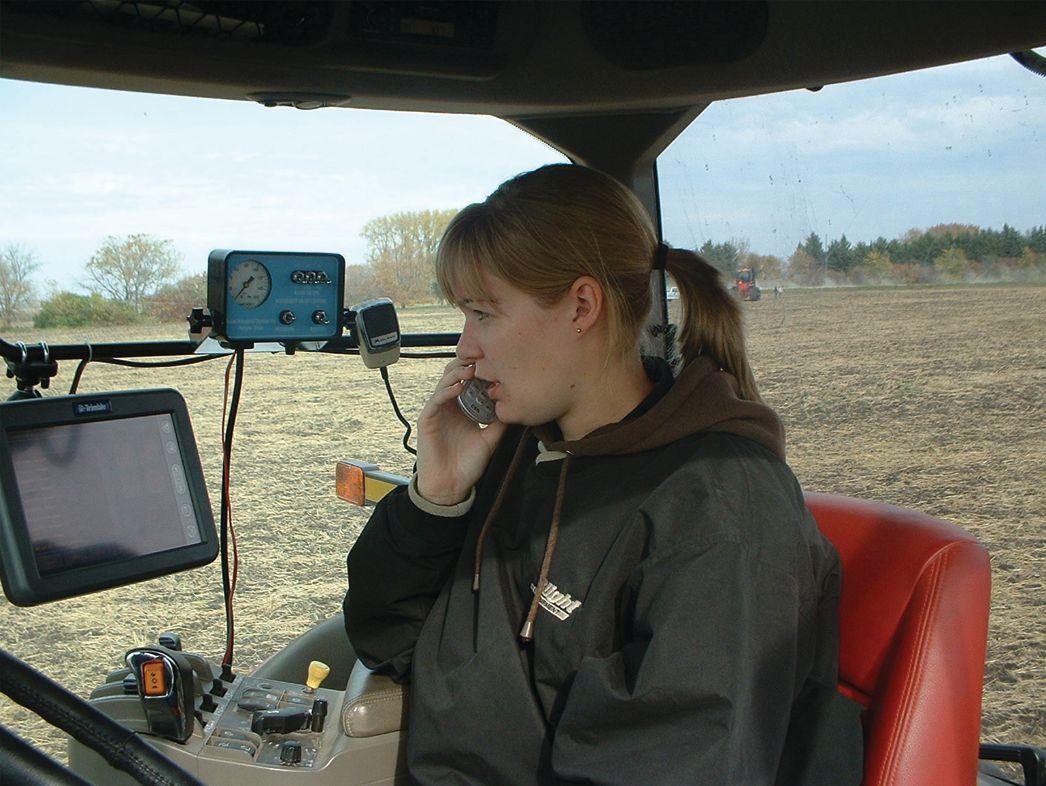
Leica, Raven, Trimble and John Deere.
Raven Industries, for instance, introduced the Slingshot RTK correction, data transfer, remote support and high-speed Internet access system in Canada in 2010. Last year, Raven made its technology platform available for use by other manufacturers.
A Slingshot correction signal originates at a Raven server in the United States. Dealers license rights to supply modems and subscriptions to farmers. They also place signal relay transmitters on cellular towers for their service area.
“The trick with these is that you need to get the signal. Watch the bars on your cellphone. If service is good, you’re good to go. If you have a few fields that are not so great for cell service, then you need a backup plan. That could be a WAAS signal or a subscription,” Wilson says. “As long as you’ve got cell signals, you’ve got RTK signals.”
Other developments
When the monitor in a cab has a cellular link to the Internet, it opens other windows besides wireless RTK.
“Some of these monitors are like computers running on wireless Internet. You can check the weather, do your taxes, basically anything you want. And, if you have an issue in the field, your tech can log into your monitor, fix stuff, download files, do a firmware update, get you ready to go and log out again. Bang, you’re done,” she says.
Improvements in processing capacity and memory for monitors are, at the same time, reducing the risk of information overload. Too much data coming too fast can stall or freeze an older monitor. The new monitors can handle RTK wireless as well as data for variable rate controls, new sensors and video cameras.
“When I first started, you’d freeze up your screen from too much information. Now, advances are making the technology much better.”
Until GPS autosteer came along, GPS-assisted steering with lightbar technology was cutting-edge technology. Today, autosteer is shifting toward an increasing percentage of integral hydraulic autosteer systems and fewer sales of external systems mounted on the steering column or wheel, Wilson says.
“When I started, having autosteer was a luxury. It was rare to have one installed from the factory. Now, the industry definitely is going to systems that are plumbed and installed at the factory,” she says.
When ordering a new tractor, it is much less expensive to get the plumbing installed at the factory than to do it later. Even if autosteer isn’t installed, the tractor gains in resale value if the option is ready to hook up.
“It’s very uncommon now to go to someone’s place where they don’t have at least one steering system,” she says.
accuracy is at the level of a single-base solution.
The customer who has cellular RTK does not have to worry as much about range and line of sight. In a networked solution, he doesn’t have to worry about range at all; the network will switch him from base station to base station seamlessly.
Park adds, OmniSTAR now is able to give certain Trimble products one-and-a-half-inch repeatability without the extra costs associated with RTK radio or cellular initial start-up costs.
The Killarney dealer says that, because the cellular world is based on voice or data technologies, there are some issues with cellular signals going down when the voice side is peaking, such as right after school.
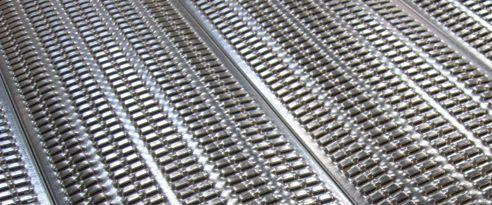
Matching perforations with aeration and drying systems.
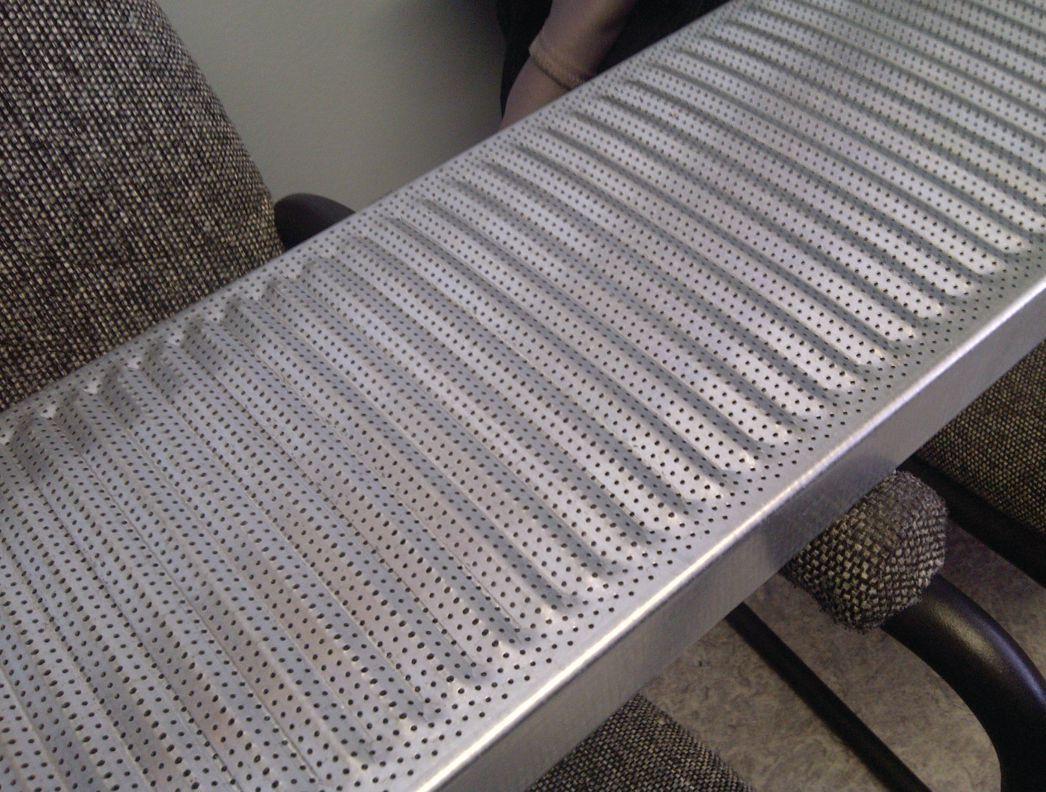
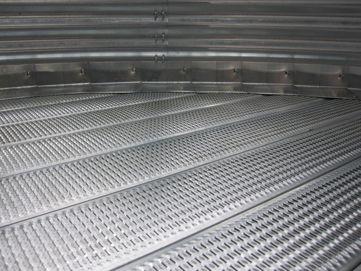
This might seem like a small detail – most perforations are less than 0.04 inches wide – but the style of perforation you use can have a significant effect on the performance of your aeration or drying system. The perforations in ducting and flooring are what allow air to be directed through the grain mass, drying or cooling it. Improperly sized or shaped perforations can allow grain kernels to block the opening, and staunch airflow. Proper perforation will allow the ideal amount of air through the grain mass without rendering it susceptible to blockages.
There are three basic configurations of aeration system openings to choose from, with the percentage of open area of these configurations ranging from 10 to 22 percent of the duct or floor panel’s total surface area.
Currently, the most widely available opening style is the round perforation. These perforations come in sizes ranging from 0.03 to 0.09 inches in diameter, and the cover roughly 10 to 12 percent of the panels they are in. In Western Canada, round openings ranging in size from
0.03 to 0.04 inches are the most common style, and are used in systems for drying both oilseed and cereal crops. Although this style of perforation is very common, unfortunately, it does have one main weakness: the round opening of these perforations can be vulnerable to blockage when in use with smaller kernel grains, such as canola and wheat. The rounded shape of these grain kernels often causes them to sit in the perforation and at least partially block it, thus reducing the airflow through that opening. Despite this limitation, this type of perforation often works well with larger kernel grains, which are less likely to sit in the opening and block airflow.
The second available style of perforation is a single-sided louvre, or lanced opening. This style of perforation has a somewhat rectangular shape with a wedge-like appearance and opens at a
CONTINUED ON PAGE 34
TOP: Round perforation.
INSET: Single-sided louvre (or lanced opening).
PHOTOS
SOIL AND WATER
These tough-to-manage soils are surprisingly common in Western Canada.
by Carolyn King
High-sodium soils, called sodic soils, have a nasty combination of poor soil structure and toxicity to sensitive crops, and may have very alkaline conditions with soil pH levels higher than 8.5. They also affect a surprisingly large portion of the agricultural lands in Alberta and Saskatchewan. If you suspect you have sodium-affected fields, it’s important to have your soils tested and to understand the options for managing and possibly improving these soils.
“Sodic soils are usually naturally high in sodium,” explains Dr. Ross McKenzie, agronomy research scientist with Alberta Agriculture and Rural Development. “Either groundwater has moved sodium into those areas or the soils have formed on parent materials that are very high in sodium, such as ancient marine deposits.”
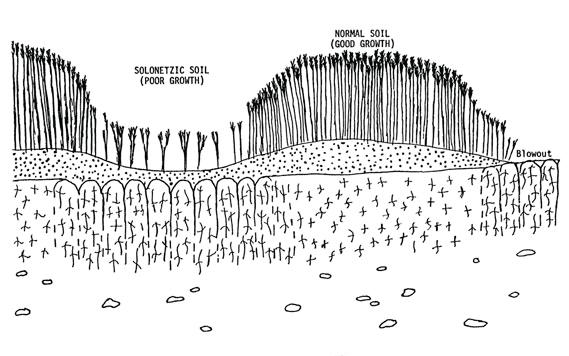
In Western Canada, most sodic soils are classified as Solonetzic soils. Solonetzic soils are often mixed with non-Solonetzic soils so that affected fields have a wavy pattern with patches of poor crop growth and areas of normal growth.
In Alberta, roughly 30 percent of the arable land has Solonetzic soils intermingled with normal soils. McKenzie says, “A large band with Solonetzic soils runs from the Taber area to the Vegreville area. The reason for that band is the parent material for those soils tended to be marinedeposited and fairly high in sodium. The Peace River region also has a significant area that is prone to having Solonetzic soils.”
Solonetzic soils tend to have stunted crop growth and reduced yields due to their physical and chemical characteristics. They have a hard, sodium-rich, columnar-structured B horizon (the soil layer below the topsoil, or A horizon). As well, these soils have very high pH levels and often have high clay contents. When dry, they are very hard, massive and cloddy. When wet, they tend to seal up, so water infiltration is very slow. Plant roots have trouble penetrating the B horizon, so their access to nutrients and water is limited. Also, the high sodium levels are toxic to sensitive crops such as pea and dry bean.
The characteristics of Solonetzic soils come about because of the way sodium interacts with clay particles in the soil. Clay particles have a negative charge so they attractive positively charged particles such as sodium, calcium and magnesium ions. Calcium and magnesium ions are able to neutralize the negative charges, but sodium ions aren’t able to do that very well. The interactions between positive ions and clay particles affect how soil particles group together, which affects soil structure.
Solonetzic soil associated with a normal soil resulting in a wavy crop pattern.
THE SOURCE OF THIS DIAGRAM IS MANAGEMENT OF SOLONETZIC SOILS (AGDEX 518-8) AVAILABLE AT HTTP://WWW.AGRICULTURE.ALBERTA.CA. THE USE OF THIS DIAGRAM BY TOP CROP MANAGER IS DONE WITHOUT ANY AFFILIATION WITH OR ENDORSEMENT BY THE GOVERNMENT OF ALBERTA. RELIANCE UPON TOP CROP MANAGER’S USE OF THIS DIAGRAM IS AT THE RISK OF THE END USER.
For instance, in Chernozemic soils, which are the typical prairie grassland soils, calcium and magnesium predominate. In those soils, the soil particles come together in a nice crumb structure that allows good water infiltration and root penetration. In a Solonetzic soil, when the soil is wet, the negatively charged soil particles repel each other, causing the soil to seal off, and when the soil dries out, the particles cement themselves together.
Diagnosing sodic soils
“Sodic soils are a type of salt-affected soil,” says McKenzie. “The saltaffected soils we commonly hear about are saline soils. Saline soils have concentrations of soluble salts that are high enough to affect crop growth, and they can be seen as white patches in a field. But with sodic soils we don’t see white patches. If anything, a sodic soil would be dark in colour because sodic soil clods sometimes have a dark coating of sodium-enriched organic matter.”
Trying to diagnose sodic soils by visual symptoms, such as dark clods or a wavy pattern of crop growth, can be iffy. McKenzie says the only way to be sure is to have your soil tested.
If you’re having crop growth problems that you think might be due to a soil problem such as high sodium levels, he suggests working with an agronomist who has a strong soils background to carefully sample
FROM
the field and assess the problem.
“The agronomist will separately sample the poor or affected areas of the field and the areas that look normal. In a normal soil, I recommend taking samples at 0 to 6, 6 to 12, and 12 to 24 inches deep. But with a Solonetzic soil, you must separately sample the A horizon and the B horizon, and the depth of those horizons will vary across the field.”
The soil samples can be tested for sodium content and for other possible factors that might be causing the crop problems. Two tests are available to determine sodium levels: sodium adsorption ratio (SAR) and exchangeable sodium percentage.
SAR is more commonly used. It is the ratio of sodium relative to calcium and magnesium in the soil. An SAR value below 2 is best for crop growth. A soil with an SAR level above 13 is classified as sodic, but soils with SAR values as low as 5 to 6 may have sodium-related problems.
Managing sodic soils
The physical and chemical properties of sodic soils make them very difficult to manage for annual crop production.
Options for managing sodium-affected land depend in part on how severe the soil conditions are. If the land is strongly Solonetzic and is currently in native grassland, often the best option is to keep it in that state and use the land for grazing. If the land is strongly Solonetzic and is cultivated, then a good option can be to establish a sodium-tolerant forage mixture, including crops like alfalfa and various wheat grasses, and use the land for grazing.
If SAR levels are not severe and the A horizon is fairly deep, then growing sodium-tolerant annual crops could be a good option. Barley is the most sodium-tolerant crop, and wheat, oat and rye are moderately tolerant.
Some types of sodic soils can also be improved. Improvement techniques include deep ripping to loosen up a hard B horizon, applying a calcium amendment, applying organic matter, and deep plowing to move calcium from the C horizon and the subsoil up into the B horizon. However, many of these practices are expensive, improvement can take a considerable time, and not every technique is suited to every type of sodic soil.
If you’re considering trying to improve a sodic soil, it’s important to work with a knowledgeable agronomist who has a very strong soils
background to conduct detailed soil sampling, decide which, if any, improvement technique would make sense agronomically and economically, and determine exactly how to carry out the technique given the specific characteristics of the field.
McKenzie hasn’t seen many farmers using any of these improvement techniques in recent years. He notes, “Agriculture Canada had conducted research on Solonetzic soil management practices in the 1960s and 1970s when it had a substation at Vegreville. Then from about 1990 to about 2002, Alberta Agriculture had a specialist who worked with farmers to manage their Solonetzic soils. But we don’t have anyone who does that kind of work anymore. As a result, interest in improving and managing these soils has really fallen by the wayside.”
Is it time to take a fresh look at ways to manage Solonetzic soils? McKenzie notes, “We really haven’t done much research with Solonetzic soils in the last 20 years. But in that time, the majority of farmers have moved to direct seeding. I think direct seeding would be beneficial for Solonetzic soils because tilling them in the spring before seeding tends to make them very rough and lumpy and causes them to dry out.”
That change in seeding practice opens the door for new studies to evaluate direct seeding in combination with other practices with the goal of enhancing annual crop production on Solonetzic soils that aren’t severely sodic. One example would be to add deep-rooted perennials to a crop rotation in a direct-seeded system.
“The perennial crops would add organic matter to the surface soil, and a lot of these sodic soils, especially in the Brown and Dark Brown soil zones and in the Peace River region, tend to be low in soil organic matter. As well, if the B horizon is not really hard, then the plant roots might provide a physical benefit by creating root channels and helping to degrade the B horizon. Also, in some cases the deep roots could possibly act like a calcium pump, bringing calcium up from the C horizon to the B horizon for the plant’s nutrition. Then when the plant dies and the roots degrade, the calcium would remain in the B horizon,” explains McKenzie.
He adds, “I think there certainly are some opportunities down the road for more research in terms of improvement because Solonetzic soils are a significant acreage in Alberta and Saskatchewan.”
For more detailed information, refer to Alberta Agdex Publication 518-20, Management of Sodic Soils in Alberta.
CONTINUED FROM PAGE 30
90-degree angle to the panel. This type of opening is approximately 0.03 to 0.04 inches in width and up to half an inch in length. In use, it usually covers 12 to 14 percent of the duct or floor panel.
This shape lends itself much better to proper airflow when compared to the round perforation, as kernels with a rounded shape are not able to sit in the opening and block it. Therefore, this perforation style allows more air to flow around the kernels and into the grain, making it effective for both aeration and drying applications.
The final perforation style is a double-sided louvre with 90-degree rectangular openings on both sides. This style of opening almost identical in size to the single-sided louvre, and once again ranges from 0.03 to 0.04 inches in width and up to half an inch in length.
The major difference between the single-sided and double-sided louvres is the two openings on the double-sided louvre. These provide twice the amount of open area on the duct or floor panel when compared to the single-sided louvre’s one opening. This provides the
A double-sided louvre is best for natural air drying systems where larger volumes of airflow are required.
major advantage of allowing much larger volumes of airflow to pass through without increasing the chances of blockage. This type of perforation is therefore most ideal for use in natural air drying systems, where larger volumes of airflow are required.
For further information, go to www.grainguardian.com.
Storage
of new crop canola in grain bags passes initial Manitoba trials.
by John Dietz
Tightly stuffed long white tubes of grain are appearing more frequently on farm fields. If it works for wheat, farmers are asking if it also might work for canola.
It appears that the answer is yes if the canola is dry, at eight percent moisture content [MC] or lower, says Digvir Jayas, University of Manitoba research scientist.
At high moisture, 14 percent, the answer is definitely no. At 10 percent, it probably can survive up to 10 months of storage with very little spoilage, he says.
Jayas launched a three-year study in 2010 to answer questions about safe storage of canola in grain bags. At meetings in early 2012, he was able to report on the results of the first completed year and talked about the initial results of the second year.
“We were getting calls from farmers who were having difficulty storing grain in the bags, and I found that almost no one had done research under Canadian conditions,” Jayas says. “The goal is to come up with guidelines growers could use for storing canola in bags. Guidelines would specify moisture content, how to monitor the grain in the bags and, depending on the moisture content, when
to unload.”
Grain bags can be nine feet in diameter and more than 200 feet long. They are filled once, sealed and airtight, in principle, until the grain is ready to be removed. They offer low-cost temporary storage and many other advantages, but also are relatively new and untested in Canadian conditions. Most of the technology is from Argentina and the southern United States.
“The company that came up with this bag technology says this [technology] is for storing dry grain for short durations,” Jayas says. “When we start storing grain longer, or less than dry, then I think assessment is needed.”
Support for the independent Canadian research project on grain bag technology comes from the Canola Council of Canada and Agriculture and Agri-Food Canada. Richardson International is providing canola for experiments. Grainbags Canada staff assisted with filling and emptying bags.
ABOVE: New research is looking at grain bag storage under western Canadian conditions.
PHOTO
Jolene Brown, CSP Family Buisness Consultant, Agriculture Industry
For the seminar schedule see our website.
Keynote speakers include:
Research Collaborative University of Regina
Dr. Raj Khosla President and Chief Distinguished Monfort Professor of Precision Agriculture Colorado State Univeristy
Expert in Agricultural/Food Policy University of
Murad Al-Katib Alliance Grain Traders inc.
Dave Sauchyn Professor at the Prairie Adaptation
Derek Silworsky General Manager The Canadian Wheat Board
Dr Sylcain Charlebois
Guelph, Canada
Nine 25-foot grain bags were filled in late 2010 on the University of Manitoba campus, with canola supplied by Richardson International. Moisture content was eight, 10 and 14 percent. In year 2 of the study, three 70-foot bags were filled with canola at 12 percent moisture.
“The 14 percent MC grain spoiled very quickly and quite significantly. It had a very heavy fungal infection and caked quite heavily. Certainly I would not recommend that farmers store 14 percent canola in the bag,” Jayas says.
Samples were collected from each bag every two weeks. The canola was monitored for germination, free fatty acids, carbon dioxide and temperature, and all nine bags were unloaded after 10 months.
In the second year, one bag was unloaded while the ground was frozen, just before spring thaw. A second will be unloaded after the spring, when the ground is dry and firm enough for machinery. A third bag will be unloaded in August. These preliminary results may be available in time for the fall harvest season.
Jayas brings 30 years of grain storage research experience to the project. As of March 2012, his study results are lining up with his expectations for canola storage performance in airtight bags.
Going into the second year, his theory was that it would be safe in the fall to load a bag with 12 percent MC canola. He felt the canola would store without any issue in cold conditions, if it was unloaded before the spring thaw.
“I expect some spoilage at the second unload, and more at the last unload,” he says.
At 10 percent and lower, it seems to be safe to store canola in the
bags for up to 10 months, although that remains to be confirmed by the second and third year of research using mathematical models.
Testing under the various conditions that occur each winter helps to strengthen confidence in the recommendations.
“By going three years we hope to get data from three weather patterns. Warm winter is a worst-case scenario [for storage]. If the 12 percent stores OK when it’s warm, it certainly would store OK under cooler conditions. We just unloaded the first bag, and I think the canola is in pretty good shape,” said Jayas in March 2012.
Plan to monitor
Jayas suggests those who are planning to use grain bags should be ready to monitor conditions inside any bags where moisture might lead to deterioration.
The most readily available tool is a handheld temperature probe. The technique is simple: cut the plastic with a knife high on the side, insert the probe as deep as it will go and reseal the hole with some patching tape.
Thermocouples can be pushed deep into the grain using a wood or metal rod. Only a pair of wires needs to protrude, whereas the original hole is sealed. Later, the wires can be connected to a handheld monitor to read the internal temperature.
A third option is to use a handheld grain probe to remove a small sample of kernels for a germination test. The test requires about 25 seeds, a shallow dish with some distilled water and approximately a week for the seeds to germinate. It’s a sensitive test, Jayas says, in that germination is one of the first qualities to change when storage conditions are an issue.
Avoid the hazards, enjoy the green
Some hazards are hard to avoid. When it comes to wheat marketing, prices and grade/protein spreads can fluctuate dramatically.
CWB pools deliver solid, risk-free returns. Our expert team spreads your risk across several months and all markets, so you’ll never be stuck in the trap. Don’t miss out – pool size may be limited. Sign up now to guarantee your access. Contact your local Farm Business Representative (check cwb.ca/fbr) or call 1-800-275-4292.
Outback®
RTK Unleashed
T
For an RTK System to be complete, it must have an autoturn solution. The Outback® eDriveX™ with eTurns is the industry’s only aftermarket RTK system with a proven autoturn solution.
Outback® eDriveX™ with eTurns
Outback® S3™ + AC110™ GPS with Auto and Section Rate Control
· Now features 10 section automated rate control
· Single product, liquid, constant rate control
· Offers straight, contour, circle pivot, and A+ direction guidance modes
· Centimeter level autosteer system with slow speed control (0.25 mph) reverse operation
· Season-after-season repeatability for nutrient placement
· Over 310 vehicle kits now available
Outback® A320™/A321™ Dual Frequency GPS/GLONASS RTK
· Features Eclipse II GPS/GLONASS technology
· 8.4” high-resolution color touch screen ge RTK up to 15 miles ation
Scan the QR Code to the left to be linked directly to the Current Outback Specials page on our website.
· High-precision positioning in RTK, OmniSTAR HP/XP and SBAS/DGPS modes
· Full long-range RTK functionality up to 15 miles from base station
Without eTurns, your RTK System isn’t complete. Watch eTurns video now by visiting www.edrivex.com and register to win.
STORAGE
by Kevin Hursh
Every now and then you hear a presentation at a farm meeting that blows you away. You end up wide-eyed sitting on the edge of your seat wanting more.
When I attended the Indian Head Agricultural Research Foundation (IHARF) meeting back on Feb. 1, 2012, I didn’t have such high expectations. One of the presentations was called “New Insights into Natural Aeration Grain Drying Systems” and the speaker was Ron Palmer, a former professor with the University of Regina. Palmer has done a lot of work and presentations on tractor guidance systems.
I was expecting a presentation that would confirm and hopefully enhance my understanding of aeration. That’s probably what the other 200 attendees at this meeting in Melville were also anticipating. What we got instead was a presentation that turned previous grain drying assumptions upside down.
Palmer was asked to come aboard an IHARF project that had been running since 2007. Data has been collected on a couple of aeration bins over multiple seasons. His initial objective was to build a fan controller that would save power by only having the fan on when necessary. If the fan was drying the grain, it would be on. If not, the fan would turn off.
But how does one know what air conditions result in grain drying and what conditions will produce no drying or even wetting of the grain?
Because it’s very difficult to know what’s happening within a bin, Palmer used a black box approach. He concentrated on the moisture in the airflow leaving the bin as compared to the moisture coming into the bin. From this, it was easy to determine whether or not there was net drying.
For example, if in one hour 80 pounds of water goes into the bin and 90 pounds of water comes out, there is 10 pounds of water coming out of the grain.
The airflow of the fan is easy to measure. The amount of water in the air is directly related to its temperature and relative humidity.
At 100 percent relative humidity at a temperature of 60 degrees Fahrenheit, 6,000 cubic feet of air holds five pounds of water. At 80 degrees F, that same 6,000 cubic feet of air holds 9.5 pounds of water. A psychrometric chart shows this basic
relationship. The important principle is that cold air is dry air. By definition, at X percent relative humidity, the water in the air is X per cent of the total that can be held at any given temperature.
Here’s an example. You have a 2,000-bushel bin with an aeration fan that has a flow of 3,000 cubic feet per minute. The air going into the fan and into the bin is at 60 degrees F with a relative humidity of 55 percent. The air leaving the bin is 80
Aeration turned upside down.
PHOTOS AND CHARTS COURTESY OF RON PALMER.
Control panels are used to measure moisture movement and control fan operation.
degrees F at 45 per cent relative humidity. Is the grain drying?
For every two minutes the fan runs, 1.53 pounds of water is removed. This is nearly 46 pounds per hour. The grain is drying, even though the air going in is relatively cool with a fairly high relative humidity.
Two IHARF bins were instrumented for hourly readings. Airflow was measured. Temperature and relative humidity were measured in the air going in and the air coming out. The temperature of the grain was measured at three levels. On a daily basis, the grain moisture was measured at four levels.
This was done for four years with three different grains –peas, barley and wheat. Hourly charts were produced showing when moisture was being removed from the grain and when moisture was being added.
The results were shocking
During the first day of storage, there’s typically a lot of moisture removed by a fan no matter the outside air temperature. After that, it’s much better to have the fan running during cool nights than during warm days.
During hot days, the ones we typically assume are the best for drying, Palmer found that fans were actually putting water back into the grain. The warm air carrying lots of moisture hit the cooler grain and moisture was released into the grain.
At night, when the incoming air was cooler, both cooling and drying of the grain occurred.
Relative humidity matters, but it’s not nearly as important as the temperature. Palmer’s work shows that temperature alone is a great guide for knowing when the fan should be on and when it should be off.
If the temperature of the air going into the bin is higher than the temperature of the air coming out, turn the fan off. You’re heating up the grain and you’re actually adding moisture.
If the temperature of the air going in is lower than the temperature of the air exiting, you’re cooling and drying the grain. Keep the fan running. The temperature of the air coming out of the bin will be roughly the same as the temperature of the grain near the top.
Moisture fluctuations in pea bin
Producers should note that in any aeration drying regime, the grain at the top of the bin remains at the same moisture content until the drying front goes through.
The recommendation has always been to start the fan and
let it run continuously. Palmer’s work indicates that we can run the fan half the time and the grain will end up cooler and safer. Meanwhile, we’ll only use half the electricity.
Palmer points out that there’s no rush to dry grain. The rush is to cool it before spoilage can occur, and the colder the better.
Watch the yard light
Palmer, a PhD in engineering, is working on a controller that will automatically turn fans on and off based on the intake air temperature versus the temperature of the air exiting the bin. In the meantime, producers can accomplish the same benefits by manually turning on and off their aeration fans.
He calls it the yard light rule – off during the day and on at night.
Palmer says that if you don’t entirely swallow this new way of thinking and you insist on running your fans continuously, at least shut them off for the last time in the morning when the grain is as cool as it can be.
IHARF has applied for research funding from the Western Grains Research Foundation and hopes to expand the project dramatically.
It’s amazing that we’ve had it so wrong for so long. Some producers won’t believe the findings until they are confirmed by further research. However, nearly 200 producers in that Melville meeting room had the first glimpse of what promises to be a quantum change in natural air grain drying procedures.
PESTS AND DISEASES
A sustainable, integrated approach to controlling a serious pest.
by Carolyn King
For over a century, the wheat stem sawfly has plagued wheat crops in Canada’s southern prairies, causing serious yield and quality losses, especially in dry years. Assorted measures are available for managing the pest, but no single measure provides complete control. A new decision support strategy (DSS) brings together all those practices in an integrated approach to sawfly management – an approach that enhances wheat yields even when sawflies aren’t a problem.
Wheat stem sawfly adults are black wasp-like insects. In June and early July, the females lay their eggs in the stems of grassy plants, including most cereal crops – their favourites being spring and durum wheat. One female can lay up to 50 eggs, which will hatch about a week after deposition. Usually only one larva survives per plant as the first one to hatch consumes the others. During the growing season, the larva feeds within the stem, causing damage that hinders nutrient movement to the wheat head. Affected plants have fewer seeds and shrivelled seeds.
Then, as the plant ripens, the larva goes to the bottom of the stem and cuts a groove around the inside of the stem less than 2.5 centimetres above the soil surface. The weakened stem falls over easily, and the fallen plants are difficult to harvest, resulting in further yield losses. The larva overwinters at the bottom of the stem, and then develops into a pupa in May and emerges as an adult in June.
Wheat stem sawflies can reduce wheat yields by 30 percent or more. The worst damage is usually in the field margins. However, severe infestations can affect entire fields. Sawflies thrive in dry conditions and when an abundance of hosts are available. They tend to prefer spring-seeded wheats because winter wheat plants are usually too far advanced when female sawflies are looking for nice places to lay their eggs. No insecticides are registered for this pest, and insecticides are generally ineffective at controlling it. As well, insecticides kill the parasitoid wasps that prey on sawflies.
Development of the DSS was led by Dr. Brian Beres of Agriculture and Agri-Food Canada in Lethbridge. He began investigating wheat stem sawfly management in 1999-2000, when the pest was starting to resurge first in southern Alberta and then southern Saskatchewan. The resurgence was due to a combination of factors including a major drought, tight wheat rotations, limited use of sawfly-tolerant wheat varieties and unintended damage to parasitoid wasp populations.
Beres and his research team conducted a complex series of experiments to examine how agronomic practices affected sawfly populations and wheat yields.
“My goal was to target every link along the chain of production. We started with activities related to preseeding, such as residue management and variety selection, and studied how those, along with seeding systems, would interact with the wheat stem sawfly. Then we moved to components like seeding density and nitrogen management, and then into harvest management strategies,” he explains.
Beres adds, “Developing the decision support system for managing wheat stem sawfly also gave me the opportunity to
PHOTO BY BRUCE BARKER.
Harvestability is a key issue with wheat stem sawfly damage.
By Kevin Bender President Western Canadian Wheat Growers Association
Every farmer in western Canada is always looking for ways to increase yields on our farms. In wheat, it's a slow grind. Data presented earlier this year at the Wheat Summit in Saskatoon showed that our average annual rate of yield gain on CWRS over the past century has been 0.7%. Based on today's yields, that means it takes about 3 years to get a 1 bushel per acre yield gain.
Canada has the lowest rate of yield gain among all the developed nations. This is largely because the focus of our breeding programs has been geared toward meeting the needs of the high quality bread markets. Those markets continue to be very important for prairie farmers, however the demand from this high-end market is about 5 million tonnes annually, which is roughly a third of our total CWRS production.
The real growth opportunities are in the low to mid-quality milling wheat markets, especially in Asia.
To capture these opportunities, we need to have access to improved wheat genetics. Our variety registration system needs to become more flexible and give farmers the ability to grow a greater range of wheat varieties.
No two farms are alike. There is tremendous variation across the prairies in terms of soil and climatic conditions. For example, the average frost-free period across the prairies ranges from 95 to 135 days. Average rainfall during the growing season varies from 7 inches to over 13 inches. And as we've seen in recent years, the yearly variation can be much greater than these averages.
On top of this, disease and insect pressures vary considerably from region to region.
Each of us also face different market opportunities, whether that's the high-end quality market, a mid-quality market, or local feed or ethanol markets.
Our variety registration system in western Canada needs to do a better job of recognizing these differences. Farmers need greater flexibility to use the genetics that work best on their farm, to meet specific agronomic challenges or to go after certain markets.
Prairie farmers are well-positioned to capture all of these opportunities. Allowing a greater range of varieties to be registered will allow us to boost our yields and better match the marketplace. It's a case where we can have our cake and eat it too!
review wheat production practices even in the absence of the sawfly and to update those for producers.”
The DSS, shown in the diagram, integrates all the important components that comprise a sustainable agronomic system for growing wheat. It is designed for spring-seeded wheats, although many of the practices also apply to winter wheat.
Sawfly risk assessment
Wheat stem sawfly damage levels in one year can be used to predict the risk of damage in the following year. Provincial and federal agencies survey damage levels each year in Alberta and Saskatchewan, and then generate forecasts of the risk for the coming growing season. Growers can add that information to their own knowledge of previous on-farm damage levels as input for their cropping decisions. For instance, if the risk level is high, a grower might decide to choose a sawfly-tolerant wheat variety or a non-host crop, such as oats or a broad-leaved crop.
As well, in late July, growers need to assess the current level of infestation in their wheat fields to help with harvest management decisions. To scout for the sawfly, Beres suggests starting in the field margins. At several spots, select 10 stems, split the stems lengthwise and look for the larvae or damage from larvae. The larvae are cream-coloured and 10 to 25 millimetres long, and they excrete fuzzy, sawdust-like frass when boring the stem.
“If the number of infested stems is really low in the field margin, it’s probably going to be even lower in the interior of the field. However, if you are routinely getting 4 to 6 infested stems out of the samples of 10 stems in the field margins, then I suggest sampling further into the field to try to get a handle on the level of infestation in the whole field,” he says.
Preseeding residue management and direct seeding Beres’ research shows that, for spring-seeded wheat, preseeding residue management using harrows and direct seeding using an air drill with knife openers reduce sawfly emergence, possibly because stubble damage caused by these operations kills the sawfly larvae or pupae. He notes, “Together these practices create better seedto-soil contact and as a result produce high grain yields, and in the process also set back the wheat stem sawfly population.”
However, for winter wheat, it’s important to maintain standing stubble, so minimal harrowing and low-disturbance seeders are recommended; these produced the highest grain yield for winter wheat in the study.
Crop and variety choice
Sawfly-tolerant wheat varieties have solid stems filled with pith, rather than hollow stems. However, at present, the only available solid-stemmed varieties are in the bread wheat class. A durum line from AAFC’s Semiarid Prairie Agricultural Research Centre was recommended for registration February 2012 at the Prairie Recommending Committee for Wheat, Rye and Triticale.
If the sawfly risk is low to moderate and a solid-stemmed option isn’t available, then the grower could plant a hollow-stemmed variety with a trap crop of a non-host crop around the field edges. However, if the risk is high, a trap crop may not help because the infestation will likely go beyond the field margins.
If the sawfly risk is moderate to high, crop options include: a blend of solid- and hollow-stemmed wheats; a solid-stemmed bread wheat; or a non-host crop.
Cropping system and nutrient management
The DSS recommends eliminating fallow and using direct seeding. Beres’ studies show high-disturbance direct seeding is better than chemical fallow for reducing sawfly emergence. As well, other research shows direct-seeded continuous cropping systems are more sustainable than wheat-fallow systems, even without a sawfly risk.
Reducing the frequency of wheat in the rotation reduces the number of sawfly hosts, which reduces sawfly populations. More diverse rotations also have many other crop production benefits.
Seeding rates in the DSS depend on whether the wheat is hollow- or solid-stemmed. For hollow-stemmed varieties, Beres advises using seeding rates between 350 and 450 seeds per square metre. The higher plant densities result in lower whole-plant moisture, which is less attractive to egg-laying sawflies. Furthermore, his research shows higher plant densities improve the yield potential for the hollow-stemmed varieties, even in the absence of sawflies.
For solid-stemmed varieties, seeding rates should be no more than 300 plants per square metres. In many solid-stemmed varieties, pith development is inhibited by shady or cloudy conditions. Thus lower seeding rates help ensure that canopy shading doesn’t affect pith development.
Nutrient applications should follow the recommended rates for a healthy crop.
Harvesting
Decisions on harvest management options are based on the grower’s earlier assessment of sawfly infestation levels. An important option for infested areas is early swathing to gather the stems together in windrows before they fall over and become unharvestable.
Beres says, “If only the field margin seems to be infested, then you could either swath the margin early or just be prepared that the margin might go down. If the entire field looks like it’s infested, then I would monitor that field a little more closely and harvest it as early as possible. If I have the option of swathing ahead of time, I might do that. And if I didn’t have a pickup reel with nice pickup fingers, I would probably be investing in that because it doesn’t take much of a wind storm timed right with the maturity of that crop to have a field standing nicely one day and 40 to 50 percent lodged the next.”
Setting the cutting bar height to higher than 15 centimetres is another practice that’s a good idea, whether or not the sawfly risk is high. “There are a lot of good reasons for cutting high, including residue management, minimizing soil erosion and greatly reducing evapotranspiration. And one specific advantage in relation to sawfly management is much greater conservation of the populations of its natural enemies,” explains Beres.
Next steps for the DSS
Beres’ next goal for the decision support strategy is to convert it into an online model so growers could input their own information, step by step, to get recommendations for their own situation.
He also sees other possible applications for this DSS approach. “This was a really neat area of research to work on because many of the components in this system could transfer over to any crop production system,” says Beres.
“Using the same principles we used in this model for sawfly management, the model could be adjusted for managing a different insect pest, disease or weed. I think the big take-home message is the importance of integration of all the key steps that make up a solid agronomic system.”
For accuracy and reliability, look no further. Case IH provides accurate and reliable air seeding tools that make producers more profitable. The Precision Hoe™ 800 air hoe drill provides superior depth control for small-seeded crops and is ideally matched to the industry-leading Case IH Precision 3430 Air™ cart, with advanced electronic controls powered by Case IH Advanced Farming Systems components. To learn more, visit your local Case IH dealer or caseih.com
BE READY. ORDER NOW FOR THE BEST PRE-ORDER PRICES ON 2013 MODELS.
Keep Sclerotinia at bay.
ive sclerotinia no quarter and defend your golden treasure with Proline® fungicide. Proline provides canola growers with unparalleled sclerotinia control, increasing both yield and quality. With Proline, ye be protected.
Find out just how much loot you can make at BayerCropScience.ca/ProlineROICalculator