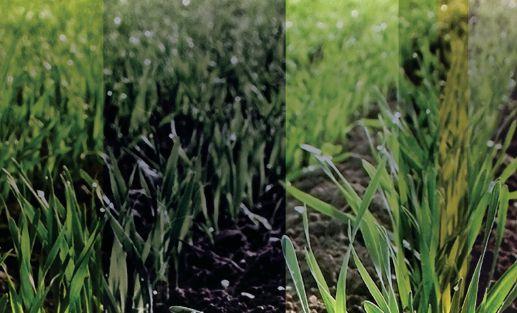
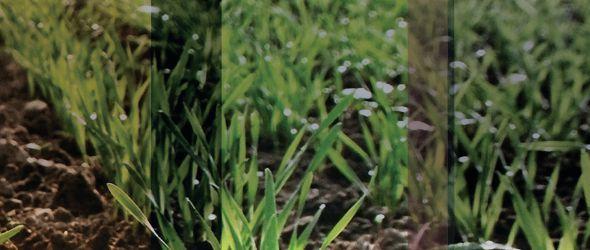
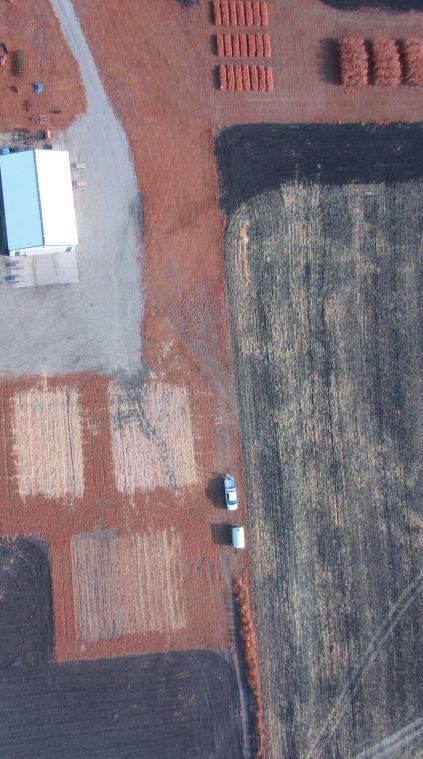
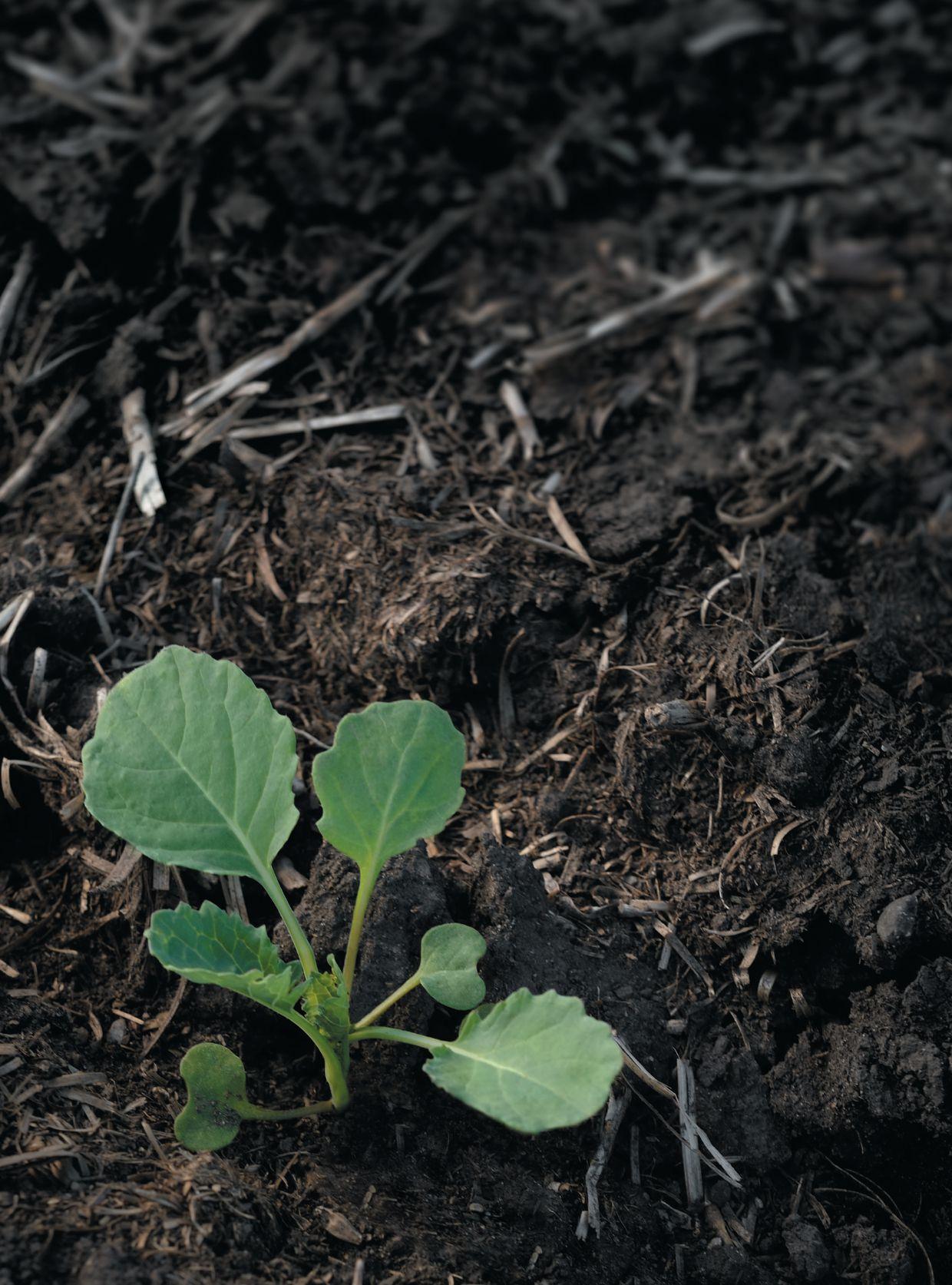
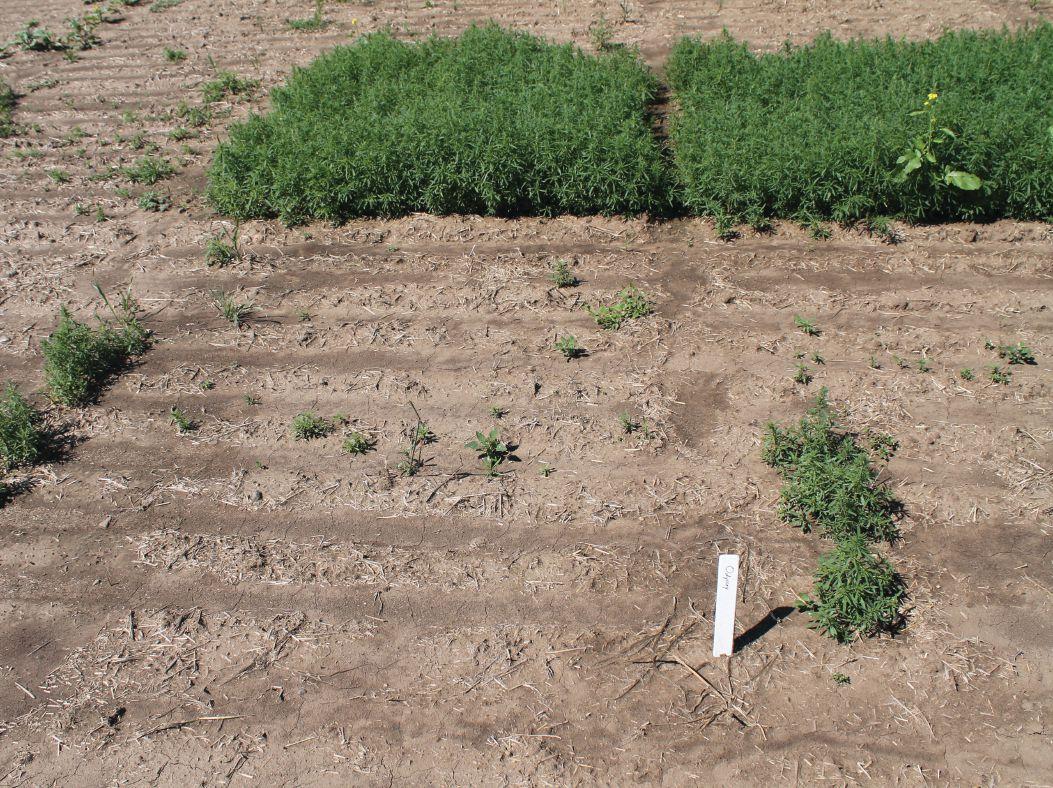
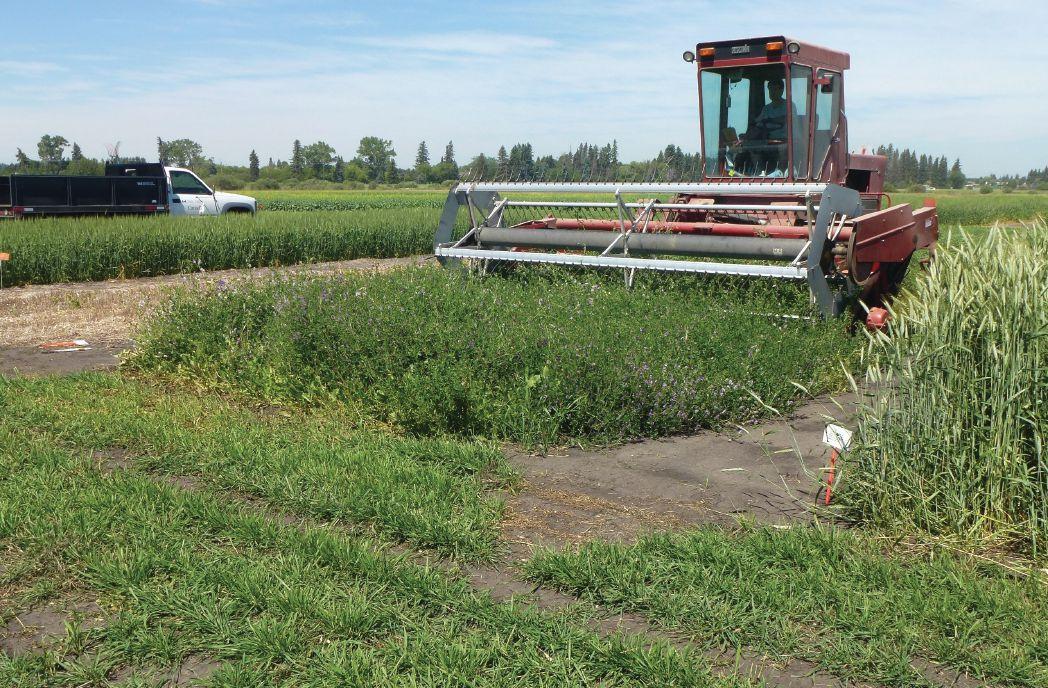
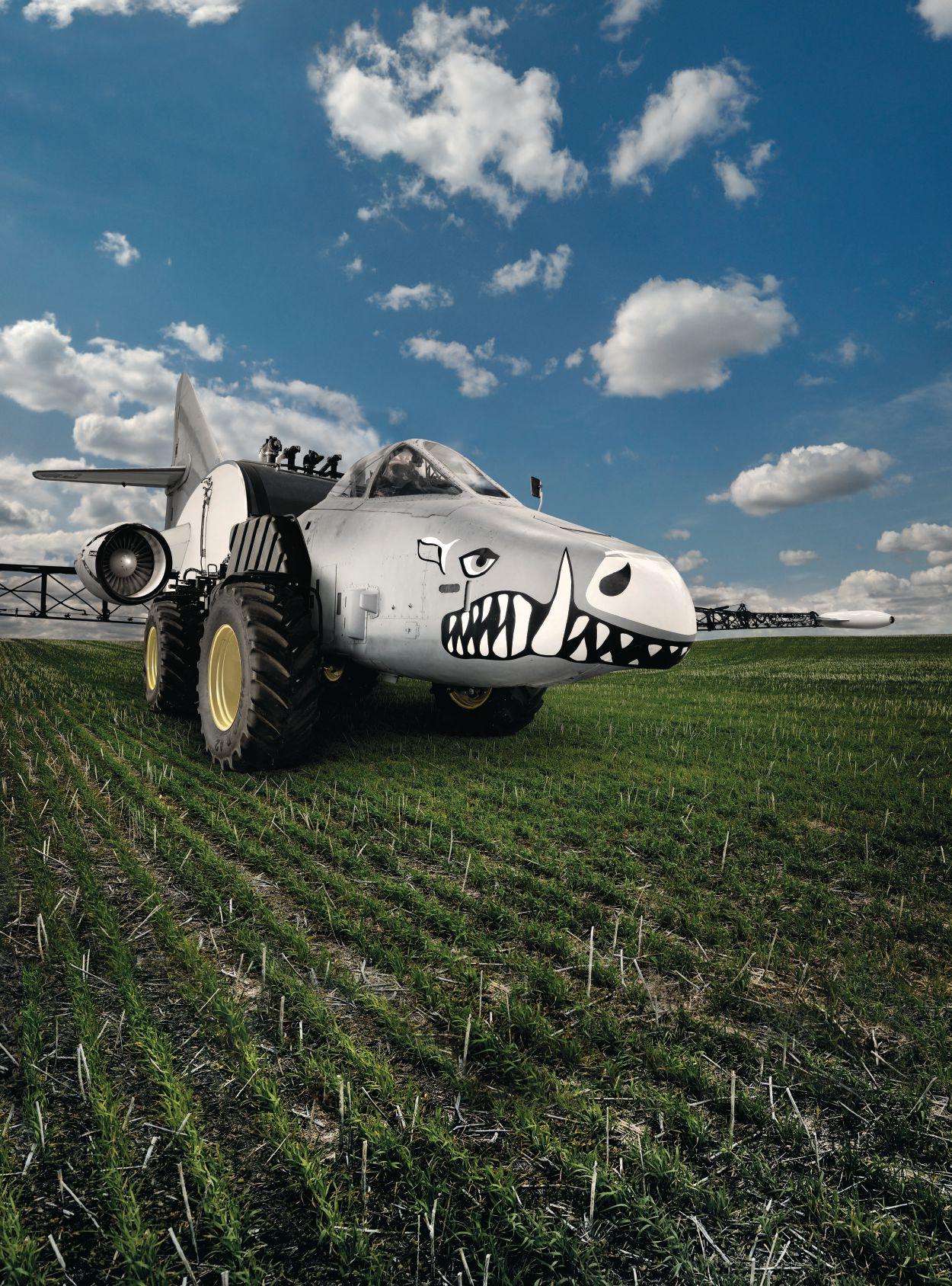
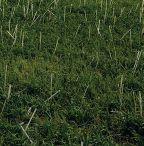
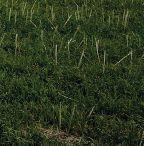
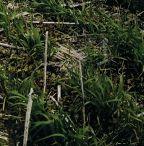
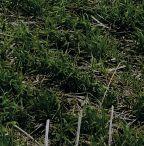
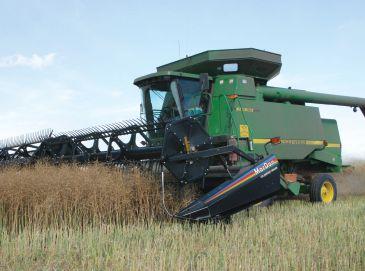
In farming, you never know what to expect; but when you use Raxil® PRO Shield seed treatment with Stress Shield®, you can count on a healthier, stronger standing cereal crop that’s better able to withstand unforeseen seasonal stresses.
With three different fungicide actives, you also receive full contact and systemic protection from the most dangerous seed- and soil-borne diseases.
With Raxil PRO Shield, what you seed is what you get.
For more information visit: BayerCropScience.ca/Raxil
TOP CROP
MANAGER
JANUARY 2015
MACHINERY
6 Views from the sky
By Carolyn King
WEED MANAGEMENT
11 Tackling a growing threat
By Carolyn King
CROP MANAGEMENT
16 Innovations in crop planning
By Madeleine Baerg
17 Tweeting as a pest management tool
By Carolyn King
MARKETING
22 The future of the canola market
By Donna Fleury
HARVEST MANAGEMENT
25 Canola harvesting techniques
By Donna Fleury
ON THE COVER: Canada’s canola oil is primarily consumed by the food market, but the Canola Council of Canada has big plans for future markets.
Photo courtesy of CCC.
WESTERN EDITION
Readers will find numerous references to pesticide and fertility applications, methods, timing and rates in the pages of Top Crop Manager. We encourage growers to check product registration status and consult with provincial recommendations and product labels for complete instructions.
ACCOUNT COORDINATOR Alice Chen • 905.713.4369 achen@annexweb.com
MEDIA DESIGNER Brooke Shaw PRESIDENT Michael Fredericks mfredericks@annexweb.com
PUBLICATION MAIL AGREEMENT #40065710 RETURN UNDELIVERABLE CANADIAN ADDRESSES TO CIRCULATION DEPT. P.O. Box 530, Simcoe, ON N3Y 4N5 subscribe@topcropmanager.com
Top Crop Manager West - 9 issuesFebruary, March, Mid-March, April, June, September, October, November and December1 Year - $45.00 Cdn. plus tax
Top Crop Manager East - 7 issuesFebruary, March, April, September, October, November and December - 1 Year - $45.00 Cdn. plus tax
Potatoes in Canada 4 issues Spring, Summer, Fall, Winter 1 Year $16.00 Cdn plus tax
All of the above - $80.00 Cdn. plus tax
Occasionally, Top Crop Manager will mail information on behalf of industry-related groups whose products and services we believe may be of interest to you. If you prefer not to receive this information, please contact our circulation department in any of the four ways listed above.
All advertising is subject to the publisher’s approval. Such approval does not imply any endorsement of the products or services advertised. Publisher reserves the right to refuse advertising that does not meet the standards of the publication.
VIEWS FROM THE SKY
Exploring the use of drones in crop production.
by Carolyn King
Does using an unmanned aerial vehicle (UAV) make sense for your crop operation? UAVs, also called drones or unmanned aerial systems, are available as fixed-wing types, like little airplanes, or rotor types, like little helicopters. They are catching the attention of Prairie crop growers and specialists who want to see how well they work for crop scouting and field mapping, and how the costs compare to the benefits.
UAVs for weed and disease issues
In Alberta, a project is underway to evaluate the use of UAVs to generate field maps to help in making decisions on weed and disease management. Dr. Chris Neeser, a weed research scientist with Alberta Agriculture and Rural Development (AARD), is leading the project. He wants to develop a set of procedures for acquiring and processing high-resolution UAV imagery and to assess the usefulness and economics of this tool.
To map a field, the UAV flies over the field in parallel passes and takes photos at regular intervals. Imagery software is then used to stitch all the photos together to create a map of the whole field.
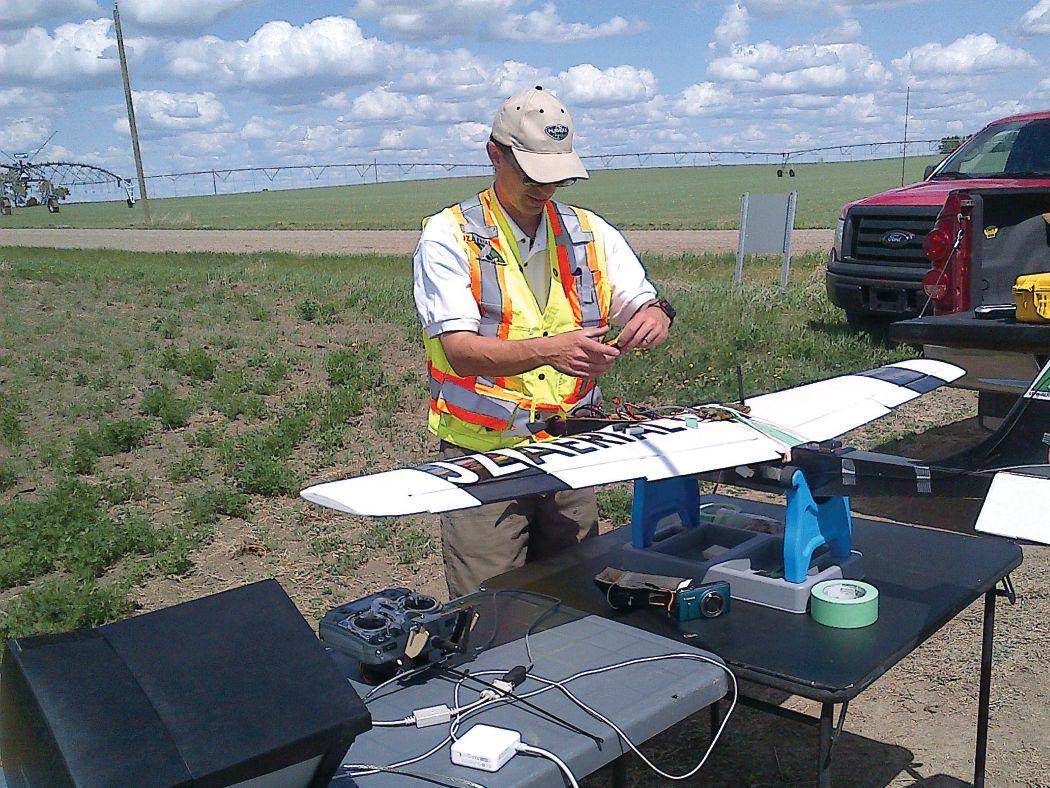
The fixed-wing UAV used in Neeser’s project is a prototype de -
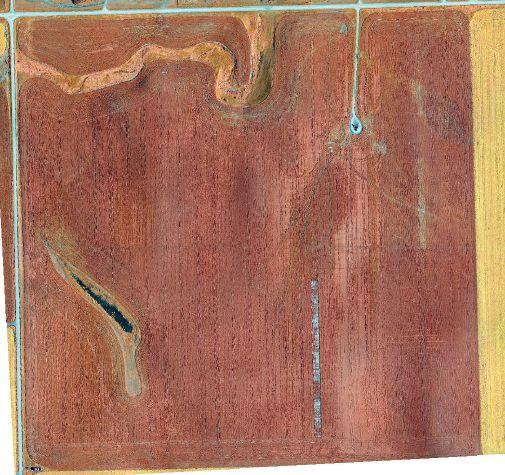
veloped and flown by Jan Zalud of JZAerial in Calgary. Neeser says, “It can fly for about 15 to 20 minutes before you have to change the battery. That is just enough time to map a quarter section, taking about 120 images per quarter and flying at an altitude of about 600 feet.”
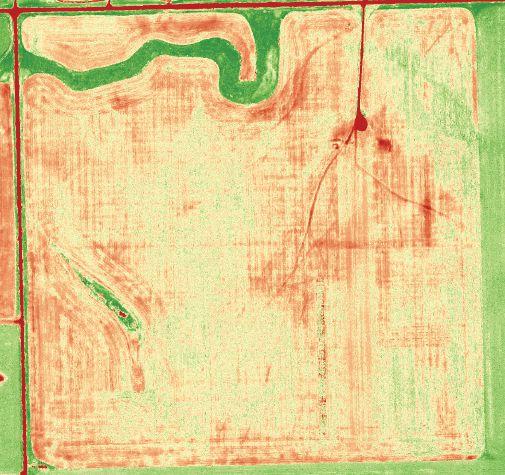
A small digital camera is attached under the UAV’s wing. The camera’s filters have been modified to capture near-infrared light. “Instead of the red, green, blue spectrum, we get the near-infrared, green, blue spectrum,” explains Neeser. “Vegetation reflects near-infrared wavelengths better than the other wavelengths, so it allows you to do NDVI (normalized difference vegetation index) mapping.”
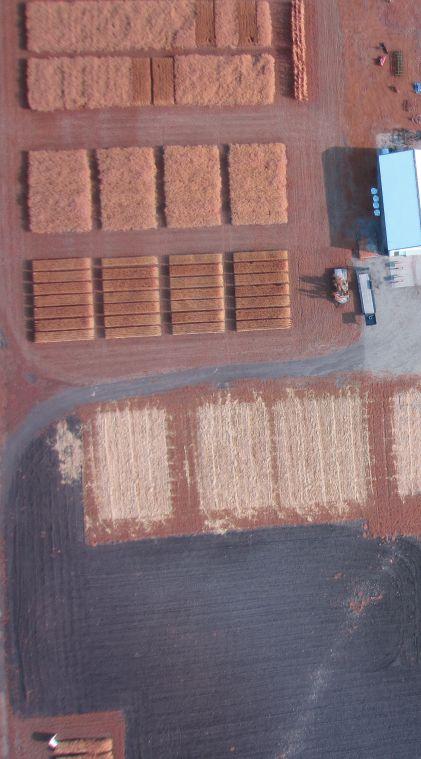
Healthy plants reflect more near-infrared light than stressed or dead plants, so NDVI maps can be used to evaluate factors like plant stress due to disease, drought or low available nitrogen. So, with proper interpretation and analysis, the maps could help with decisions on variable rate applications of inputs.
Neeser explains that because the photos were taken from a
ABOVE: Zalud prepares JZAerial’s fixed-wing UAV to map a southern Alberta field as part of Neeser’s research project.
height of 600 feet, the imagery has a resolution of about six centimetres to the pixel; that is, each image pixel covers a 6 cm by 6 cm area on the ground. So the UAV imagery can show things like crop rows and any seeding errors in those rows, but not the individual leaves on a plant. Problems that occur fairly uniformly across a field are hard to detect on the imagery, but patchy problems, like a patch of weeds or diseased plants, are easy to see.
“To detect greater detail, the UAV could fly lower. But it would take longer to get coverage of the whole field, longer to analyze the imagery, and more processing power. So it’s a trade-off,” he says.
In co-operation with several southern Alberta crop growers, the UAV was flown over 12 fields and six crop types in 2014. In the coming months, Neeser will be analyzing the maps, comparing them to what was actually happening on the ground, called “ground-truthing,” and evaluating the costs and benefits of using UAV imagery.
The project is funded through the Alberta Crop Industry Development Fund, with funds from the Alfalfa Seed Commission, Alberta Pulse Growers Commission, Alberta Wheat Commission, Western Grains Research Foundation, Alberta Canola Producers Commission and Potato Growers of Alberta.
Quadcopter explorations
In Manitoba, Rejean Picard, farm production advisor with Manitoba Agriculture, Food and Rural Development (MAFRD), has been trying out a DJI Phantom 2 quadcopter (a helicopter-type UAV with four rotors).
He has been using the Phantom 2 for freestyle flying, guiding it as it flies over the field. “Because it’s freestyle flying, it’s very quick to start and fly and collect imagery and be back to the operator in minutes.” The UAV’s camera is a GoPro model that can take still colour images and HD video.
“A UAV gives you that eye-in-the-sky perspective, so you can see much more of the field than you can standing at ground level. I also like that you can collect pictures of a field over time to see how things change, and you have a permanent record of what the field
looked like at different times of the year,” he notes.
Picard especially likes his system’s ability to receive live images while the drone is flying. “With the live on-screen display, you can see what the camera is seeing. For example, if the field is wet so you can’t drive through it, and you want to see the extent of water damage or flooding in the field, then the live images allow you to do that.”
Learning to fly his quadcopter took some practice, especially to land it without damaging the rotors. Picard says it can fly for about 20 minutes before the battery needs to be recharged, and it can operate in wind speeds up to about 40 kilometres per hour. “It is GPS-driven and designed to hover. With the GPS, it will find and maintain its position, within a certain range [even in breezy conditions].” The UAV weighs about one kilogram.
“The costs for my unit include the UAV itself with the gimbal (the supporting arm that holds the camera), which is about $1,000. The camera is another $400. The live on-screen display is about $400 to $500. So the total cost would be between $2,000 and $2,500, tax included. For that you get an effective entry-level UAV for growers,” he notes.
One of the tools Picard has been playing with recently is imagery analysis software called Assess, which costs about $300. “The still images that I collect with my UAV are distorted somewhat because the camera uses a wide-angle lens. But, by using the software and knowing the field’s size, I was able to differentiate the different colours in the images, such as thinner patches versus thick green patches. And I was able to determine fairly closely what proportion of the field had a thin plant stand, which could be drowned-out spots or a knoll where there is little growth,” he explains. “So with other tools, a person can use even this basic UAV effectively.”
Geo-referenced mapping and scouting
Jeff Kostuik, a diversification specialist with MAFRD, has been experimenting with a fixed-wing UAV. He says, “We run a small applied research farm here [at Roblin] with the Diversification Centres in Manitoba, and we’re always looking for different ways
PHOTO COURTESY OF GOVERNMENT OF ALBERTA.
Near-infrared photos from the UAV have been stitched together to create a map of a southern Alberta wheat field.
Neeser can use this NDVI map of the same field to evaluate factors like plant stress due to disease, drought or available nitrogen.
of gathering data. I thought being able to fly the drone on a regular basis would be a good fit for what we’re doing. But more importantly, I wanted to figure out how using a drone might fit for regular farmers, would it be worth the cost, and how would they get a return on investment.”
He is using one of senseFly’s earlier introductory models called the swinglet CAM. “We’re able to fly our UAV only if the wind is under 20 km/h, but senseFly’s newer models perform quite well in winds up to 40 to 45 km/h. Depending on weather conditions like wind speed and temperature, ours will stay in the air from 10 to 20 minutes; newer models can stay up longer.”
Kostuik’s system costs about $20,000 to $25,000. It has GIS (geographic information system) capability so it can create geo-referenced imagery for precision farming uses. It can provide regular photos, as well as near-infrared and NDVI imagery. It weighs about 0.5 kg.
He says the swinglet CAM is extremely easy to fly. “The computer does all the work for you. You do pre-flight programming for exactly what you want. The resolution you want will determine how high it will fly and the amount of [photo overlap between passes]. Then you just shake
the drone three times to start the motor and throw it into the wind. It automatically flies your programmed route. When it’s done, you basically hit ‘come home’ on the computer, and the plane lands within about 15 metres of where you are.”
He notes, “You can view the pictures individually once the plane lands – you just take the SD [memory card] out of the UAV and put it into your laptop to view them. But to stitch all those photos together to get a map of the entire field takes a few hours.”
To Kostuik, the most obvious use for UAV technology is crop scouting, especially when it is difficult to walk or drive into a field. On the images that Kostuik is obtaining, it’s easy to see things like crop rows, lodging, weed patches and cutworm-damaged areas.
However, he emphasizes that the NDVI images need to be ground-truthed to be sure they’re interpreted correctly. “We’re finding that you still can’t beat boots on the ground. A drone can be a tool in the toolbox, but it is not something that you can rely on [by itself] to tell you what is going on in the field,” says Kostuik.
On the plus side, he says UAV imagery is great for targeted on-the-ground scouting.
UAVs and the bottom line UAV technology is pretty cool, but will it improve your bottom line? “You need to look at the costs and the type of information the drones can glean from the field and then how you’ll deploy that information to make more informed business decisions,” says Nevin Rosaasen, a research economist with AARD. “At the end of the day, it’s how you leverage it to put more dollars in your jeans.”
One consideration is how the costs and benefits of UAV imagery compare with other ways to get information about your fields. Compared to satellite imagery and conventional air photographs, UAV imagery has advantages like higher spatial resolution, better timeliness and the ability to tailor the data collection to a specific site. Compared to boots on the ground, UAV imagery provides quick, easy access to the whole field and helps improve the efficiency of on-the-ground scouting. On the other hand, there’s the cost of purchasing and repairing the UAV system, the time to learn to use it, and the time to operate it and analyze the imagery.
The time needed to learn how to fly a UAV varies; some are easy to learn and others are a little more complicated. All UAV operators must follow Transport Canada’s
air safety requirements (see sidebar).
The cost of UAVs varies quite a bit. “An entry-level recreational drone with two cameras, for instance, is as cheap as $350. For drones that provide more accurate information, with higher resolution photo and video images, you’re looking at a base entry of around $3,000 to $4,000,” says Rosaasen. Also, “some UAV parts can be costly if you have some crashes as you learn to fly it. And if your drone goes down in a fairly tall or dense crop, it can be tough to find.”
Systems with the GIS capabilities needed for precision farming applications are more expensive and require a greater time investment for imagery analysis.
“We’ve created a bunch of very nice photographs, but what does the imagery mean to the producer and how does he make money from that? I’m not a GIS specialist and all that is a steep learning curve for me,” notes Kostuik. “It’s more suited to people who are a little more advanced in precision farming and variable rate applications. You can generate a prescription map fairly easily and quickly, and it’s real-time as opposed to satellite imagery. Our imagery has about 6to 10-cm pixel resolution, whereas satellite imagery has about 30-m pixel resolution, so ours is a lot more precise.
“If you have the ability to use those
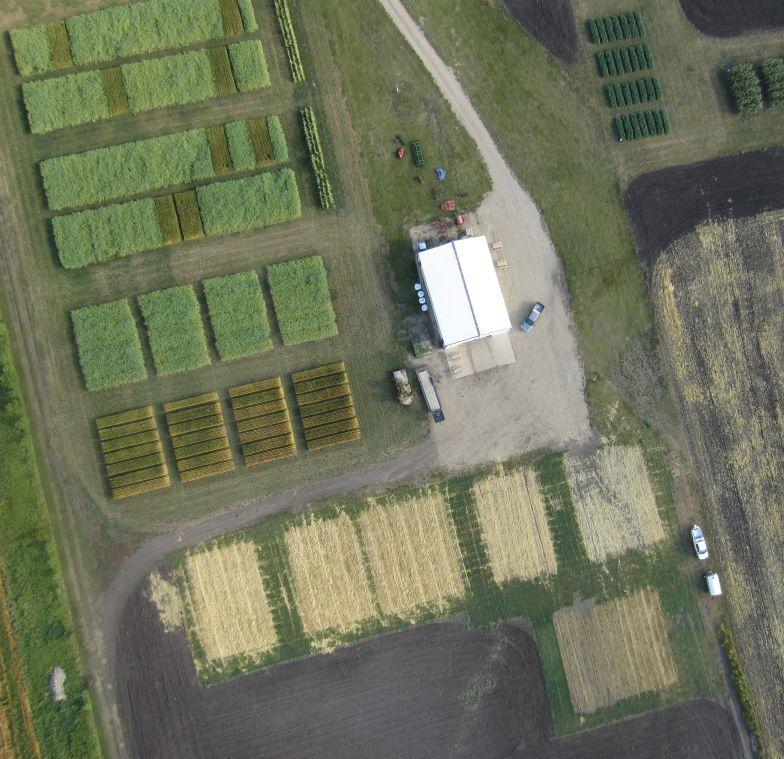
FAR LEFT One of the ways Kostuik uses his UAV is to gather information on field plots at the Parkland Crop Diversification Foundation (PCDF) farm.
LEFT A near-infrared photo of the PCDF farm taken on the same day by the UAV; healthy plants reflect more near-infrared light than stressed or dead plants.
prescription maps, then this technology could to save you money. If you’re using it for crop scouting, it could save a little time, but not necessarily a lot of time.”
Kostuik thinks a higher-end system, like his $20,000-plus system, would be cost-prohibitive for an individual farmer to purchase, but it could make economic sense for an agronomist who is providing precision farming services for a number of clients.
Neeser has a similar view. “I can see crop consultants using this as one of their tools to collect information about their clients’ fields. They would need to import the UAV images into a GIS program and overlay those over images with other information, like yield maps, fertilizer application maps, soil maps and so on. In conjunction with all the other information, the UAV imagery could be valuable to help make better decisions, as they accumulate several years of these images and see the differences depending on what crops are grown,” he says.
“But combining the UAV imagery with GIS would require a substantial investment of time to learn how to do it, because it requires some specialized knowledge. And it takes time to get the images and analyze them. Also, there is a significant risk with this kind of equipment; it could crash, for instance.”
Neeser expects UAV use in agriculture to continue to increase. “It is rapidly developing technology, so it looks like we’ll see UAVs being used more and more in the future.”
Rosaasen says the use of the technology provides a lot of opportunity to revolutionize the way crops are produced. “Thinking out to 2025 or 2030, drones could be delivering small shots of fertilizer or a specific herbicide to individual plants. We have all the tools to do that; we just haven’t put it all together in a complete package yet. I think producers will find innovative ways to deploy this technology faster than analysts can speculate on how it might be used. If there’s a way to make a dollar, farmers will figure out how.”
OPERATING YOUR UAV SAFELY AND LEGALLY
Anyone operating a UAV in Canada must follow the rules set out in the CanadianAviation Regulations and must respect all federal, provincial/territorial and municipal laws related to trespassing and privacy.
Until recently, use of a UAV for work purposes, including things like crop scouting, required a Special Flight Operations Certificate (SFOC) from Transport Canada. However, in November 2014, Transport Canada brought in two exemptions that simplify small UAV operations.
Under the new exemptions, an SFOC is no longer required for work use of UAVs under 2 kg and certain operations involving UAVs under 25 kg. However, operational limitations apply to both these exemptions (for example, restrictions related to flying height, distance from aerodromes, and type of airspace in which the UAV operation is taking place). Anyone wishing to operate a UAV outside of these limitations must still obtain an SFOC. In addition, the exemptions apply only to operations within visual line of sight. This means the pilot or his visual observer must maintain visual contact with the aircraft, without any aid such as binoculars, to maintain control and decisively see and avoid other aircraft or objects.
Transport Canada is also simplifying the application process and reducing the time it takes to issue SFOCs for larger UAV operators.
“We’re trying very hard to give UAV users the easiest possible access to being able to operate, while balancing that with the need to make sure things are safe for people on the ground and people in the air,” says Martin Eley, director general of Civil Aviation at Transport Canada. “So we’re encouraging people to understand and live up to their responsibilities and become familiar with the basic rules of the air, because UAV operators are sharing the air with people in larger aircraft.”
Visit Transport Canada’s website (www.tc.gc.ca) for more details on flying your UAV safely and legally.
PHOTOS COURTESY OF JEFF KOSTUIK, MAFRD.
Canola like you’ve never seeded.
Tighter canola rotations and increasingly common prairie wind events have led to massive seed deposits across the Canadian Prairies. Avoid reaping what you didn’t sow. Pardner® herbicide is now registered as a pre-season, tank-mix partner with Roundup WeatherMAX® herbicide and other glyphosate technologies for control of all volunteer canola, even if they’re resistant to other herbicide groups.
For more information, please visit: BayerCropScience.ca/Pardner
TACKLING A GROWING THREAT
Innovations in herbicide resistance management can help growers.
by Carolyn King
The first case of herbicide resistance in Western Canada was identified in 1988, and the problem has increased continually since then. Herbicide-resistant weeds currently affect millions of acres of Prairie farmland. Impacts on growers can include fewer herbicide options, higher weed control costs and reduced crop yields.
It’s crucial for growers to act now, before the problem gets any worse. Fortunately, advances in technology and knowledge can help crop growers fight resistance.
“The herbicide resistance problem on the Prairies is not as far along as it is in some other areas, like Australia and the southern U.S., and we’re at a time when we can prevent ourselves from getting there,” says Dr. Neil Harker, a weed scientist with Agriculture and Agri-Food Canada (AAFC).
Herbicides are grouped based on their mode of action. For example, Group 2 includes many different active ingredients, but they all control weeds by blocking the normal function of acetolactate synthase (ALS), an enzyme important in the production of
certain amino acids. Group 9 includes only one active ingredient, glyphosate, which inhibits the EPSPS enzyme. So far on the Prairies, 19 weed species are known to have Group 2-resistant biotypes, and one species, kochia, is known to have Group 9 resistance. Resistance to Groups 1, 3, 4, 5, 8 and 25 has also been found on the Prairies, and some biotypes of certain weed species, such as wild oat and kochia, have resistance to multiple herbicide groups.
Growers shouldn’t pin their hopes on a new mode of action coming along soon. “According to the experts, there is no new herbicide mode of action in the pipeline in the next 10 years,” says Dr. Hugh Beckie, an AAFC researcher who specializes in herbicide-resistant plants. “We’ve had no new herbicide mode of action worldwide since 1982. So herbicide discovery and commercialization doesn’t look promising as a solution to the problem, at least in the short-term.”
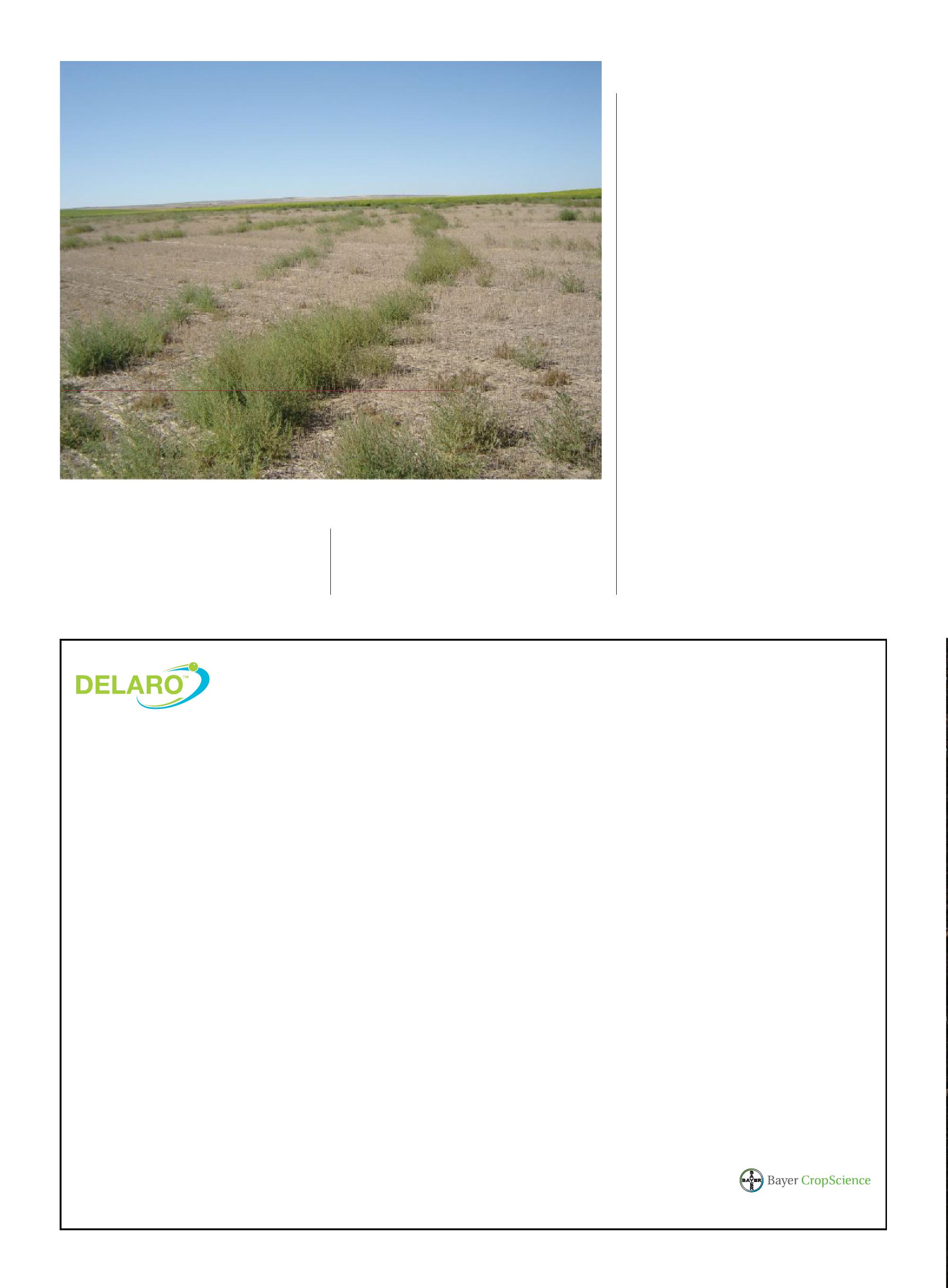
ABOVE: Group 2-susceptible kochia (foreground) and Group-2 resistant kochia (background).
Along with the loss of herbicide options due to resistant weeds, it’s possible that some existing herbicide options may be deregistered in the future. In December 2013, Canada’s Pest Management Regulatory Agency (PMRA) announced that it would review 23 registered pest control products, including some common herbicides such as 2,4-D and trifluralin. This review is required under Canadian legislation because one or more member countries of the Organization for Economic Co-operation and Development prohibit the use of these active ingredients for health or environmental reasons. If the review finds reasonable grounds for believing that a product endangers human health or the environment, then PMRA may cancel or amend the product’s registration.
The potential to lose some of these older herbicides is a worry for Beckie. “Given the lack of new modes of action in the pipeline, we really can’t afford to lose any herbicides if they can help to manage herbicide-resistant weeds,” he says. “For example, trifluralin has been a stalwart herbicide in terms of managing resistance in Australia. It’s an old Group 3 herbicide and if we lost it, it might have significant repercussions for being able to manage resistance.”
Making the most of existing herbicides
With no new modes of action on the doorstep, it’s important to make good use of the existing modes of action. For instance, Group 9 is still a growing concern, and glyphosate resistance needs to be managed. So it’s important to rotate out of glyphosate herbicide systems, including for your canola crop.
Indeed, strategies such as identifying herbicide alternatives to control resistant weeds, applying multiple modes of action and breeding crop cultivars with improved herbicide tolerance are crucial. To that end, Eric Johnson, a weed biologist with AAFC, has been leading studies to evaluate some fairly recent active ingredients in Group 14 and Group 15 for controlling Group 2-resistant weeds and to develop data needed for minor use registrations.
“Group 2 resistance is the most prevalent resistance in Western Canada right now. Pulse crops are quite reliant on Group 2 products, so we are looking for alternative herbicides,” Johnson explains. He has been focusing on products that could possibly be tank mixed with a Group 2 herbicide, “because we know that tank mixes of different herbicide groups are one of the best options for delaying herbicide resistance.”
This research has shown that the Group 14 herbicide sulfentrazone (Authority) works well on a number of Group 2-resistant weeds, such as kochia, wild buckwheat, lamb’s-quarters and, in some soils, cleavers. Chickpea, pea, flax and sunflower are tolerant of sulfentrazone, so the product is now registered in all those crops. The researchers are also trying to develop safe rates to at least suppress kochia in tame mustard. As well, although lentil is currently quite sensitive to sulfentrazone, University of Saskatchewan breeders are working to improve its tolerance.
Another example is fluthiacet-methyl (Cadet), a post-emergence Group 14 product. Johnson is finding that it looks promising as a tank mix partner with a product like imazamox (Solo) to control Group 2-resistant weeds like wild mustard and kochia in lentil, although the researchers are still working to find the optimal rate and timing.
In Group 15, Johnson has been assessing pyroxasulfone (called Focus in Eastern Canada), a soil-applied herbicide. “It has some broadleaf activity, but we’re mainly focusing on possibly controlling grassy weeds as an alternative mode of action for things like Group 1- and 2-resistant wild oats.” Wheat and peas are very tolerant of pyroxasulfone, and lentil has fairly good tolerance.
Johnson notes, “I think we’ll probably see more herbicides available within Group 14 and perhaps in Group 27. Again, Group 27 is another mode of action [active ingredient pyrasulfotole], so that would help in dealing with resistant weeds.”
In addition, Johnson says researchers in Australia and also at
Neil Harker has found that including alfalfa in the rotation is a very effective non-chemical tool for wild oat management.
PHOTO COURTESY OF NEIL HARKER, AAFC.
More power to you.
Wind speed, pressure gauge, optimal nozzle settings, check. All systems are go and it’s time to take down the toughest weeds in your wheat eld, whether they’re resistant or not.
With three different modes of action in a single solution, Velocity m3 herbicide provides you with exceptional activity on over 29 different tough-to-control grassy and broadleaf weeds.
For more information, please visit: BayerCropScience.ca/Velocitym3
the University of Saskatchewan are working to improve the tolerance of lentil to metribuzin (Sencor, Group 5). “Improved tolerance would allow application of
higher rates of Sencor for better control of weeds like kochia in lentil. That would be positive because we don’t have much Group 5 resistance in Western Canada.”
Reducing herbicide selection pressure
Harker and his colleagues have been evaluating various cropping options to control weeds, and they’ve found some that are quite effective. “Some of the best non-chemical options are growing perennial forages [and winter cereals so the rotation isn’t always favouring weeds that do well in spring-seeded annual crops] or growing early-cut silage so you can chop the silage before the weed seeds are viable. Another effective option is to use higher-than-normal seeding rates, so you prevent weeds from growing in the crop canopy.”
AAFC researchers are also starting to assess non-chemical options for harvest weed seed control. Harker says, “Rather than rewarding our most successful weeds for getting through the crop season by spreading them all over the field with the combine, we are looking at ways of taking the chaff, which has most of the weed seeds, and trying to bale it, remove it or kill the weed seeds with the Harrington Seed
New Delaro fungicide delivers for pulse and soybean growers
Long-lasting disease protection resulting in higher yields
New Delaro™ fungicide from Bayer CropScience, set to debut for the 2015 growing season, has demonstrated outstanding performance in field testing across Western Canada.
“Delaro is truly an exceptional fungicide,” says Jared Veness, Portfolio Manager - Cereal & Pulse Fungicides. “Based on our rigorous field trials and track record of delivering high performing fungicides to western Canadian growers, we are confident that Delaro will set new standards in pulse and soybean disease control, helping growers protect their yields.”
Product highlights
“Delaro delivers on what matters to growers and what they would expect from a top-performing fungicide,” says Veness.
• Comprehensive label and control of all major stem, pod and leaf diseases that challenge pulse and soybean growers.
• Long-lasting control of all major pathogens, helping growers maximize yields.
• Dual modes of action resulting in robust control of overlapping spectrum (contains prothioconazole, Group 3, and trifloxystrobin, Group 11).
or 1 888-283-6847 or contact your
Through extensive field testing across the Prairies, under a wide range of environments and disease pressure, Delaro’s results stand out.
The 2011-2013 results of 15 pea trials and 19 lentil trials delivered an average yield improvement of 30% and 70% over their untreated checks respectively.
“With its comprehensive control and long-lasting protection, Delaro has proven itself in all our years of research, and Bayer CropScience is very excited to bring this innovation to western Canadian pulse and soybean growers,” says Veness.
Application timing
For peas, lentils and chickpeas, target application is at the beginning of flowering, or at the first sign of infection. For optimal disease control in soybean crops, apply preventatively (prior to infection), or at the first signs of disease from early flowering to complete pod fill.
In 2015 Delaro will be available at retails across Western Canada. For more information on Delaro, visit BayerCropScience.ca or contact your local Bayer CropScience representative.
Glyphosate-resistant kochia in chemfallow.
PHOTO COURTESY OF HUGH BECKIE, AAFC.
Destructor.” These types of approaches are already being used successfully to deal with very serious herbicide resistance issues in Australia.
Beckie is leading a study to evaluate the use of the Harrington Seed Destructor. This machine crushes weed seeds that come out of the combine with the chaff. The researchers will be testing it on the Prairies in 2015. In 2014, they started assessing which Prairie weed species would be good candidates for the Destructor; for instance, the weeds would need to retain their seeds during harvest and their seeds would have to be high enough on the plant to go through the combine.
Tillage is sometimes dismissed as a weed control option these days, but Beckie says, “Tillage is one of the pillars of integrated weed management. Whether it’s vertical tillage or new tillage technology that conserves soil while helping with weed management, it should be part of a grower’s toolbox.”
Johnson’s research shows min-till rotary hoes could help in dealing with resistant weeds. These hoes can maintain
most of the crop residue cover while providing some incorporation of the soil-applied Group 3 herbicides like ethalfluralin (Edge), which improves the herbicide’s activity. The spoons on the hoes are able to remove very small weeds in cereal and pulse crops without damaging crop, so they are good for controlling weed escapes in-crop.
Other research has shown that rotary hoes can be integrated with high seeding rates and low herbicide rates to provide effective control of Group 2-resistant wild mustard in lentils. “I wouldn’t advise farmers to start buying rotary hoes,” notes Johnson. “This work is to develop alternatives for growers if we run into situations where there are very few options for controlling herbicide-resistant weeds.”
Tips for growers
For tackling herbicide resistance, Beckie’s first recommendation is to use less glyphosate. His second piece of advice is: “Spray a herbicide only when you need to. Having a few weeds in your fields and feeling that you have to control them is what has got us
into the problem.”
Scout right after seeding and before spraying to determine the weed species spectrum and populations in order to decide whether or not to spray. Then scout again after spraying to assess the herbicide’s performance and look for resistant weeds.
Johnson recommends that growers combine many weed management techniques. “Look at increasing plant populations, diversifying your crop rotation, integrating mechanical methods and herbicides, and so on to reduce the herbicide selection pressure.” He also suggests growers consider alternatives to chemfallow, like partial cover crops or even using tillage.
Harker emphasizes the value of diversified crop rotations, although he is not optimistic that most growers will adopt this practice. “Until growers are willing to take a bit of a hit on short-term profits and get more cropping diversity with perennial forages and winter cereals – crops that may not be as profitable as canola-wheat or continuous canola – we’re going to have not only weed resistance problems but also insect and disease resistance issues.”
A strong pulse.
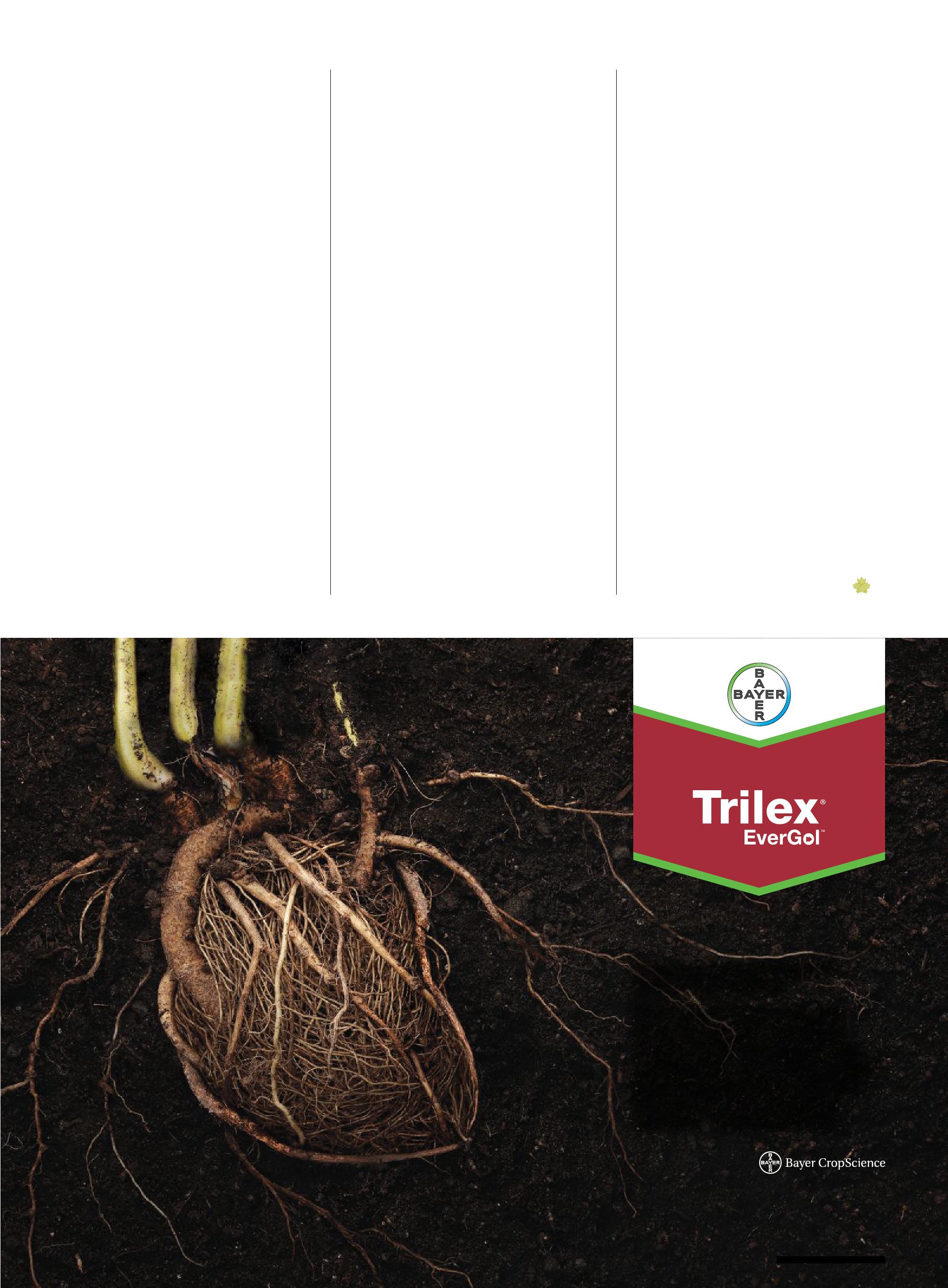
At the heart of plant health is a quality seed treatment.
Trilex® EverGol™ seed treatment for pulses provides exceptional disease control and superior crop establishment. The result is a higher performing root system, increased biomass and faster emergence, regardless of disease pressure.
CROP MANAGEMENT INNOVATIONS IN CROP PLANNING
Crop rotations and new hybrids are crucial
by Madeleine Baerg
Agronomically, there’s little debate: in the interests of pest control, soil management and long-term sustainability, most experts agree growers should hold to a fouryear crop rotation. In practice, of course, economics will almost always trump agronomics.
Because canola and cereals usually capture the greatest returns per acre, growers now routinely push rotations way beyond the ideal. If, despite all advice to the contrary, you feel you absolutely must grow on a two-year rotation, carefully analyze and select for varieties (hybrids) that optimize the traits your operation needs most.
“Producers need to look at hybrids as a whole package. They need to consider a whole host of characteristics that will maximize the potential for top yield and great returns, from standability to days to maturity to harvestability to disease resistance,” says Leighton Blashko, market development specialist with Bayer CropScience. “Your needs aren’t the same from year to year, and the hybrids available are constantly improving. So staying up-to-date with what is available is a real key to success.”
Diseases that overcome genetic resistance and weeds that overcome glyphosate are arguably the two biggest operational concerns facing agriculture today. The inevitable results of over-tight rotations and excessive dependence on scientific solutions rather than good management, breakdowns in resistance are essentially a numbers game. Growing the same variety (in cereals) or hybrid (in canola) multiple times allows repeated opportunities for a disease to overcome genetic resistance. Likewise, replanting the same crop repeatedly is a far less integrated method of weed management, elevating the chances of weeds naturally selecting for herbicide resistance.
“It’s human nature to want to grow something you’re comfortable with, that you don’t have to risk the unknown on. But, growing the same hybrid over and over could be adding more risk – significant risk – to your operation,” says Blashko. “If a grower has an issue with disease, certainly one key decision-making factor will be opting for a hybrid that offers the most up-to-date disease resistance package to protect from new pathotypes.”
In Canada, a hybrid that is rated “resistant” to a particular disease may not be resistant to all pathotypes. This is an issue because there are as many as a dozen pathotypes of virulent blackleg, and at least five pathotypes of clubroot in the Prairie Provinces.
“Australia has a system that groups varieties based on how they perform against blackleg. For example, growers would know that varieties x, y and z are in the same genetic grouping, meaning they behave as if they have a similar type of resistance. So, they can rotate resistance groups the way we rotate herbicides here. They even have
some ability to predict which strains of the disease will affect which areas so they can choose a hybrid to counter the expected disease strain,” says Keith Gabert, an agronomist with the Canola Council of Canada. “Until we start having access to information like that here in Canada, the only thing we know for sure is that, if you grow the same hybrid over and over, you are guaranteed not to get any benefits from rotation. If you switch hybrids, you’ll increase your chances of accessing different disease resistance packages.”
According to Blashko, in Australia blackleg infection is so bad they wouldn’t be able to successfully grow some of the hybrids grown
PHOTO BY JANET KANTERS.
If you switch canola hybrids, you’ll increase your chances of accessing different disease resistance packages.
CROP MANAGEMENT
TWEETING AS A PEST MANAGEMENT TOOL
Crop producers and specialists are using Twitter to advance pest management.
by Carolyn King
Immediate, open, interactive – those key traits make Twitter a powerful tool for sharing information, ideas and advice on weeds, diseases and insect pests. Twitter is allowing Prairie crop growers and specialists to tap into the diverse expertise and experiences in crop pest management available out there in the “Twitterverse.”
“Twitter is made for being mobile, for smartphones and tablets, and for farmers with time on their hands when autosteer is running,” says Rick Taillieu (@albertacanola), grower relations and extension co-ordinator with the Alberta Canola Producers Commission (ACPC).
“Some farmers and agronomists are very actively involved in Twitter and put a lot of information up. Others use it like a newspaper – they don’t make any comments, but they roll through it every day and look at things that interest them.”
One common way growers and agronomists use Twitter is to get immediate answers to their pest questions. Although the 140-character limit means tweets have to be concise, tweeting a related picture can be worth a thousand characters.
Scott Meers (@ABbugcounter), insect management specialist
with Alberta Agriculture and Rural Development, is very active in insect identification and management issues on Twitter. “In our program, we have a weekly interactive talk on Twitter during the summer, and we send out tweets about various insect management issues. We also get lots of agronomists and farmers sending pictures of insects to us and asking what they are. And we get questions about specific insects, such as how to look for them and what to do about them.”
He notes, “I like Twitter because it’s like an email with that individual person, but everybody can see it. So you have a fairly large audience for each discussion, and if the discussion is interesting, people will retweet it and join the conversation.”
Taillieu says, “Growers and agronomists are posing questions on Twitter like: ‘What’s this bug?’ or ‘What’s this symptom I’m seeing on this canola plant?’ They may get an answer from anyone who is following them on Twitter. If they mention Alberta Canola
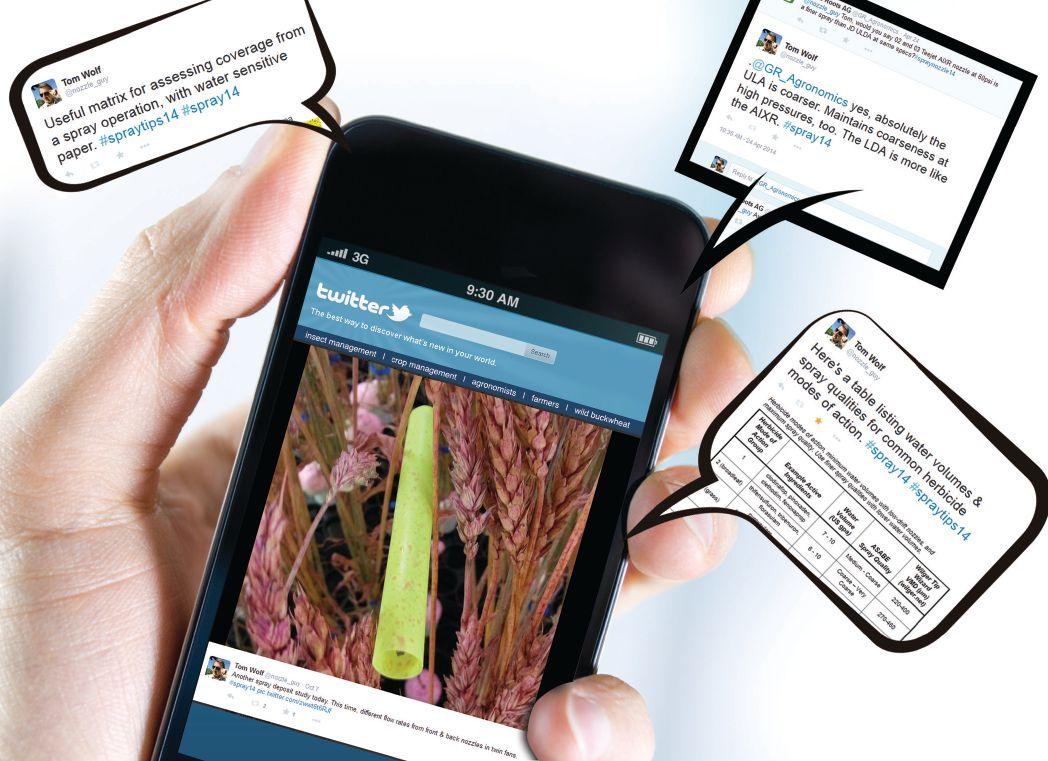
ABOVE: Wolf tweets spray-related tips, tools and research results, responds to growers’ questions, and learns about their experiences.
Freedom from wild oats.
or Canola Watch or one of the agronomists, then they are much more likely to get a response from us. And with Twitter, we are able to not only answer the person who actually asked the question, but we put the answer out there for everyone to see. That’s great because a hundred other people might have that same question.”
Dr. Tom Wolf (@nozzle_guy) of AgriMetrix Research & Training answers many questions about spraying from growers on Twitter. Some simply ask a question, and others send pictures related to their concern. “For example, water-sensitive paper, which is yellow paper that turns blue when water droplets hit it, can be used to assess spray coverage or droplet size. So some farmers throw some paper down, make a pass with their sprayer, take a picture of the paper, and tweet it to me, and ask: ‘Is this good enough? What should I do?’ A quick qualitative assessment of the picture will tell me if your droplet sizes are too large or too small, or your water volume is too high or too low, and I make that recommendation based on my expertise.”
At the same time, Wolf learns a lot from listening to farmers on Twitter. “It’s fantastic to follow farmers on Twitter because they are so interested in their topic. You gain a tremendous insight into what they are going through, what kinds of logic they use in making key decisions, whose advice they seek, and also what advice comes their way, because you’re listening in on other people’s advice to them, as well,” he says.
“Twitter helps me to get a much better sense of what farmers are doing right now, how they are doing it, and what their concerns are – for example, if there are issues with windiness, or temperature, or wetness, or frost on the farm, that affect spraying.”
That information helps Wolf to be more relevant to his clients. “The worst thing that can happen to a scientist like myself is to be holed up in the office, needing to do important tasks, but losing touch with farmers.”
Instant information
Twitter is very handy for providing time-sensitive information. “For us at ACPC, as well as the Canola Council of Canada, Twitter is an excellent way to get just-in-time information out very quickly,” Taillieu explains. “As fast as we can compose a 140-character tweet or throw on a picture, we can get the information out to the 3,600 people who are following us. It’s a short message that they can read quickly, and it usually directs them to our website or some other place if they want more information.”
Meers adds, “I don’t think anything else has the instantaneous fan-out effect that Twitter has. For instance, there was an unexpected cutworm outbreak around Lethbridge, and I tweeted that out. It got retweeted 15 times in 5 minutes.”
Eric Johnson (@ericscottweeds), weed biologist with Agriculture and Agri-Food Canada at Scott, Sask., says Twitter helps him interact with the people he serves and works with. He uses Twitter for things like updating agronomists and growers about his research, answering questions and discussing issues related to herbicide use, and sharing timely information.
“For instance, last spring some growers asked me if there were any [in-crop herbicides] to deal with Group 1 herbicide-resistant wild oat in their flax crop. And there really isn’t; you have to use a pre-emergence herbicide. So this October I tweeted that if you’re considering growing flax in 2015, you should start planning your herbicide options now. It was a very simple posting and created quite a thread,” says Johnson.
He adds, “Twitter is not only a way for me to get information out, but it is also a learning process for me. [People participating in a Twitter conversation] may have further questions, but they may have further insights into the topic.” For instance, as part of that Twitter conversation on weed issues in flax, one grower shared some work he was doing with tall stubble and the benefits for weed management in flax, an idea that Johnson thinks would be useful to integrate into a research study.
Similarly, Wolf gets ideas for research from Twitter. “Let me give you a good example. In the last few years, there has been more and more interest in the application of fungicides. Certainly that has been promoted by the crop protection industry, but our weather has also been conducive to disease development. So people have been asking me questions like: ‘How should I be spraying this fungicide product on this crop?’
“When I get that type of question and if I am not aware of any research on it, then that gives me an idea of what needs to be done. So we wrote a grant application to study fungicide spray application into mature canopies. We got the grant and we’re doing experiments this fall. So it has directly led to what I think is quite relevant work.”
Meers draws on Twitter to identify emerging insect issues. Even though he’s the only AARD entomologist who is in the field, he and his technicians are able to keep on top of insect issues because he has Twitter followers all over the province. “When a farmer or an agronomist sends a picture of a bug to ask what it is, most of the time it’s just a bug that doesn’t matter, but that is how we will find the next new thing. It won’t be a government guy; it will be somebody out checking their fields,” he says.
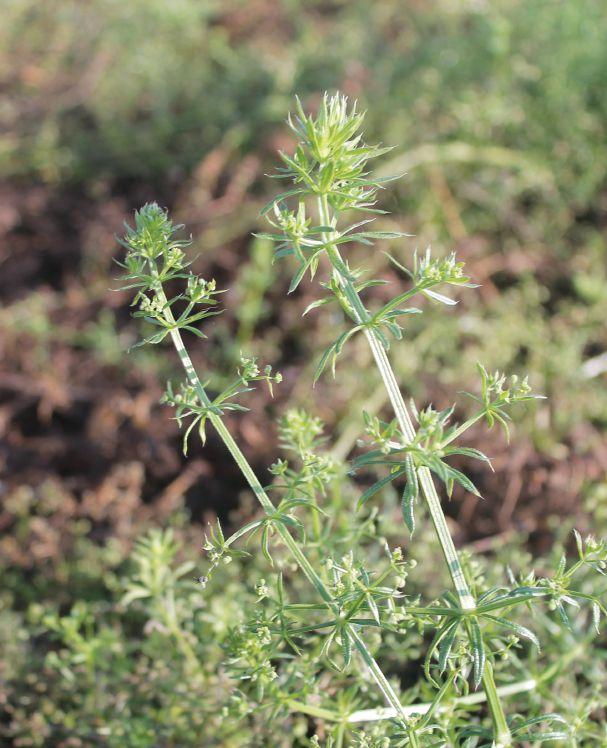
After seeing high numbers of cleavers last spring, Eric Johnson tweeted a cleaver photo and asked if others were seeing the same thing so he could gather information on this weed issue.
PHOTO COURTESY OF ERIC JOHNSON, AAFC.
“For instance, Saskatchewan has an issue with swede midge in canola, and we’ve had several questions about swede midge in Alberta. We were able to get one of my technicians or myself or an agrologist who’s in the area to swing by the field and have a look. So people are tweeting with their concerns and we’re able to check out potential hot spots.”
Johnson gives an example of using Twitter to gather information on weed trends. “This past spring, we had a high emergence of cleavers and wild buckwheat in our fields [at AAFC’s Scott Research Farm]. So I took pictures of them and tweeted, ‘Noticing fairly high levels of emergence of cleavers and wild buckwheat, is anybody else seeing the same?’ I got quite a few responses.”
And Twitter can help in the creation of new knowledge. One farmer tweeted Meers about bertha armyworm in corn. Meers says, “I thought, ‘that doesn’t sound right.’ But I happened to be in the area, so I went and looked at it. We were able to figure out that the bertha armyworm had started in the weeds in the field and then moved up and started eating the kernels off the cobs. So we figured out this new association between bertha armyworm and corn. Without Twitter, that never would have happened.”
Hot topics
Twitter is also a valuable tool to help extension agents to identify hot topics. “If a lot of people are asking questions on Twitter about a certain insect, that tells us it’s time to do a news release on this bug, or feature it in Canola Watch, or put links to that information on our home page,” says Taillieu.
Meers notes, “We schedule our weekly Twitter chat ahead of my weekly radio talk on Call of the Land. If there are emerging issues that I’m not aware of, they’ll often get picked up in the Twitter chat, and then I use them as topics for the radio talk. I think the real power is when we link these different communication tools
together. So we link Twitter conversations to a radio talk and to our weekly email-out of issues and links. And then everything links back to our website; it’s a very dynamic website during the summer.”
He adds, “It sounds all very formal and calculated, but Twitter is organic – you never know what you’re going to get through Twitter. And like anything organic, you have to care for it and feed it. If you don’t answer people and stay engaged, then it withers and dies. But that’s like any relationship, and Twitter is a relationship with your followers.”
The flip side of that is it can be hard to get away from Twitter. Meers says, “You are forever connected to Twitter as long as you have a device that is connected to either Wi-Fi or a cell system.”
And if you let it, Twitter can take up a lot of your time. Johnson notes, “You could spend all day reading tweets, so I keep the number of people I follow to a minimum. If you’re using Twitter for professional information, you’ll find out pretty quickly who is worth following.”
Overall, Twitter can be a valuable tool for advancing pest management on the farm.
“You wouldn’t believe how much useful information is shared through Twitter, with extension specialists and scientists interacting with farmers directly,” says Wolf. He adds, “I would recommend to any producer or agricultural researcher or extension specialist to go on Twitter.”
Meers agrees. “I’ve been in extension for over 30 years, and Twitter is one of the most powerful tools I’ve ever seen for messaging and being connected to an audience.”
Taillieu notes, “At ACPC, we’ve been using Twitter for five years, and our number of users has grown exponentially. We’re seeing lots of good discussions on all aspects of the farm, especially on pest management. It has really become a fabulous way to share information.”
INNOVATIONS IN CROP PLANNING
CONTINUED FROM PAGE 16
here because yield loss would be so high. “There are currently no viable tests available in Canada to know what strains of blackleg a grower has in his field. Our resistant varieties are still working well; we’re not yet at the point of seeing hybrids break down and significant yield loss.
“If producers manage the resistance genes well, if they use them carefully as just one tool in the disease toolbox, we hopefully won’t get into a situation where we need to use the types of tests they have to do in Australia,” adds Blashko.
Some agrologists recommend switching breeding programs entirely, believing hybrids from different companies will have different resistance genes. This is an “old-school” perspective, says Blashko.
“Every hybrid is made up of a unique combination of a huge number of possible genes, making it different than any other hybrid, so each will draw resistance from differing genetics. You need to let science guide you,” he says. “We’re constantly trying to improve the level of disease resistance in our hybrids, so each newer generation of hybrid will have additional layers of resistance built on top of them.”
Just as selecting hybrids for their disease package can make a vital difference to countering disease resistance, so too can selecting for herbicide system make an important difference to staving off weed challenges.
“When we are talking about herbicide rotation, including a Liberty Link system will add more diversity into your system than Roundup because glyphosate already occupies a very significant place in most producers’ herbicide toolbox, given its use at burn-down and pre-harvest,” says Gabert.
Several companies now offer support to help growers make good hybrid decisions. Bayer CropScience, for example, recently released a simple, at-a-glance decision-making matrix on their website, BayerCropScience.ca/InVigor, that classifies hybrids by key attributes. This type of decision-making tool is particularly useful given the constantly changing nature of hybrid options. Most hybrids last in the market for less than a handful of years before being replaced by something newer.
No matter how good the matrix, of course, the success of your hybrid choices will be largely based on the knowledge you’ve acquired in previous seasons.
Take charge of your resistance concerns by making Liberty® herbicide a regular part of your canola rotation. As the only Group 10 in canola, Liberty combines powerful weed control with effective resistance management to help protect the future of your farm.
To learn more visit: BayerCropScience.ca/Liberty
THE FUTURE OF THE CANOLA MARKET
Achieving 26 million metric tonnes by 2025 – is it possible?
by Donna Fleury
Across Western Canada, canola production continues to increase, and in 2013, final harvest volumes surpassed the initial goal of 15 million metric tonnes (MT) by 2015.
The Canola Council of Canada (CCC) has developed a new strategy for moving forward, and set a new target of 26 million MT by 2025.
“Our new target is driven by long-term demand and was developed in conjunction with the economic consultancy group LMC International,” explains Curtis Rempel, CCC vice president, crop production and innovation. “They have forecast that, by 2025, the demand for an oil with the health and flavour profile of canola will reach 26 million MT. This is a component of the overall vegetable oil demand estimated at 200 million MT. We know we have the capability in Western Canada to achieve that target and that if Canada doesn’t rise to meet the demand, someone else will.”
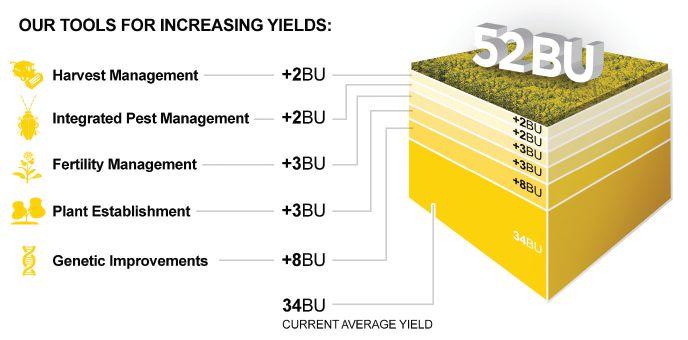
The target will be achieved on an existing acreage mix of 18 to 21 million acres of canola on the Prairies. To meet that demand, production will need to increase to around 52 bu/ac across the canola acres to achieve 26 million MT.
On the demand side of the plan, efforts are being focused on the current major markets and strategies to develop the next wave of market opportunities. “With the increasing concerns that people have for their own personal health and governments looking to the health of their people, there is an increasing desire for higher quality food ingredients with health benefits,” says Bruce Jowett, CCC vice president, market development. “Canola fits nicely into that demand, being the healthiest cooking oil available. We think, based on the science and level of advancements of growers in production systems, that we can meet the growing demand for healthy oil.”
Currently, 90 per cent of Canadian canola production is exported, either in the form of seed or oil, primarily going to the U.S., China, Japan or Mexico. As part of the long-term strategy, new markets are being identified and developed.
“In other markets, canola competes with other types of oils that are better known, so our challenge is to find ways to continue to tell the canola story and get that information out to those people it will make a difference to,” explains Jowett.
Getting to 52 by 25
To get to 52 bu/ac by 2025 requires an incremental approach for both yield and profitability. The current canola yield over a five-year average of all planted acres is about 35 bu/ac. To achieve an average yield increase across the acreage to 52 bushels, CCC is looking both
to genetic improvements and improvements in production.
“We know over the long-term, many growers are already over that 52 bushels per acre; however, the goal is to help minimize the downside where weather or other factors significantly reduce yields in a given year,” says Rempel. “The increases are expected to come from both genetic improvements from seed companies and grower production targets. We factored in an estimated eight to 10 bushels per acre increase from general genetic improvements from seed companies. Under production, we have targeted four pillars with yield increases targeted in each area, including stand establishment, fertilizer and soils, integrated pest management, and harvest
PHOTO BY JANET KANTERS.
Although canola is a well-known product in Western Canada, in other markets it is still a relatively unknown commodity.
management and storage. Adding these targets to the eight to 10 from germplasm gets us to 52 bushels by 2025.” (See Fig. 1.)
Under the CCC’s strategic plan, the agronomy group is focusing on four key strategies to help growers improve profitability along with yield increases, including: increased yields, increased profitability, reduced production risk and increased sustainability. “This strategy will be implemented in partnership with provincial grower associations and growers, industry technology providers, public sector scientists and extension specialists who are integral to us and to the industry,” notes Rempel, who adds the CCC recognizes that growers and their operations are not the same; the goal is to help all of them make advancements profitability in their operations.
“I have been a long-time follower of Danny Kleinfelter from Texas A&M University, who has identified the factors that separate the top 10 to 15 per cent of U.S. growers. Those top farmers, whether they are cotton, soybean, corn or other crop growers, are five per cent better overall. They have five per cent better yields, lower costs and greater return on their marketing dollar. We are helping all growers go after that five per cent that matters and find ways to optimize their cost of production and returns on every acre and every bushel.
“My job is to keep canola as profitable as any crop in Canada,” adds Rempel. “We expect to see genetic improvements in other crops as well, but canola is my proxy for profitable. If canola is not profitable it will be replaced. If it is [profitable], it will be grown on a lot of acres. We will work with industry and academic scientists to address rotation, diseases, pests and other management issues to help growers achieve the targeted yields and optimize the profitability of their operations.”
Innovation and new markets
The CCC also has an innovation strategy for end use markets over the next decade, with the two big opportunities in human food and aquaculture. “We expect to see significant changes in oil profiles coming, in particular to replace fish oil omega-3 EPA and DHA products,” explains Rempel. “The global fish stocks are near global collapse, and farmed fish operations need to use fish feed with omega-3s included, which is not sustainable. Therefore, if we
can get plants to produce EPA and DHA itself, then it can take a lot of pressure off marine stocks as we rebuild them. I believe a number of companies have material to produce high levels of EPA and DHA in canola without too much yield drag in the pipeline.”
For other markets, Rempel doesn’t expect bioplastics to be an opportunity for canola oil as there are other crops that have a better fit and some countries are already breeding non-edible crops specifically for that purpose without having to focus on flavour or anything else. “We also don’t have a big focus on biofuels, however we do participate in certification schemes so canola oil can be used for biodiesel if needed and necessary for oil surplus. Unlike soy, which has a surplus of oil to give away right now, the current supply of canola oil is primarily consumed by the food market. Our goal is to keep developing canola oil as a flavourful, multipurpose and healthy oil with essential omega-3s like EPA and DHA.”
Canola meal innovation will expand the benefits beyond animal feed to beneficial products for humans. “The big opportunity is based on protein availability in food products, as well as fibre,” says Rempel. “The UN Food and Agriculture Organization is focused on food security and nutrition, not just protein amount. They are particularly concerned about the bioavailability of proteins for infants and pre-teens. We believe that canola meal can fill that need, and with breeding and genomics efforts to increase the bioavailability of protein, the demand for canola meal will rise both for human food and as a feed source for aquaculture production. As canola-based omega-3s replace fish oil for heart and brain health, canola meal has potential to ensure fish are a sustainable
source of protein for consumers.”
Another innovations strategy is focused on the biorefining model for canola and looking at the co-streams and waste streams from processing oil and meal. “The canola industry and many food processing manufacturing processes use bleaching clay to filter impurities from the crushing process,” explains Rempel. “These inert, safe and widely used bleaching clays are already reused in the manufacturing processes. However, there are some potentially valuable products that are left behind from the manufacturing process that could be recovered, such as antioxidants, plant sterols and others. We need to determine the volumes and value of these products, the processes required to recover them and then develop a strategy for introducing into the food stream.” These products could address the demand for natural ingredient replacements that help companies achieve green label certifications. There is also emerging technology that may make components of canola meal attractive for bioplastics.
Rempel and Jowett are both very excited about the strategic plan and the opportunities for Canada to meet the global demand for healthy oils and new innovative products. “We are keen to work with seed companies, growers and others across the value chain on executing this plan,” says Rempel. “We set a target of 52 bushels per acre by 2025 to meet the 26 million MT demand as a strategy, and although we may not exactly get there, we may also exceed that. With the innovation in seed technology, planting and harvesting technology over the next decade, we could easily surpass our targets. Our goal is to get to 52 by 25 by lowering production risk, sustainability and profitability, which will make us a more successful economy period.”
The Evolution of Harvest Management.
NEW InVigor® L140P is the first canola hybrid to ever feature our patented POD SHATTER REDUCTION technology, providing growers with optimal pod protection for straight cutting canola or delayed swathing.
Whether you’re looking to minimize input costs, mitigate weather concerns or need a reliable time-management tool at harvest, InVigor L140P helps ensure you get every bushel in the bin.
To learn more, visit: BayerCropScience.ca/InVigorL140P
CANOLA HARVESTING TECHNIQUES
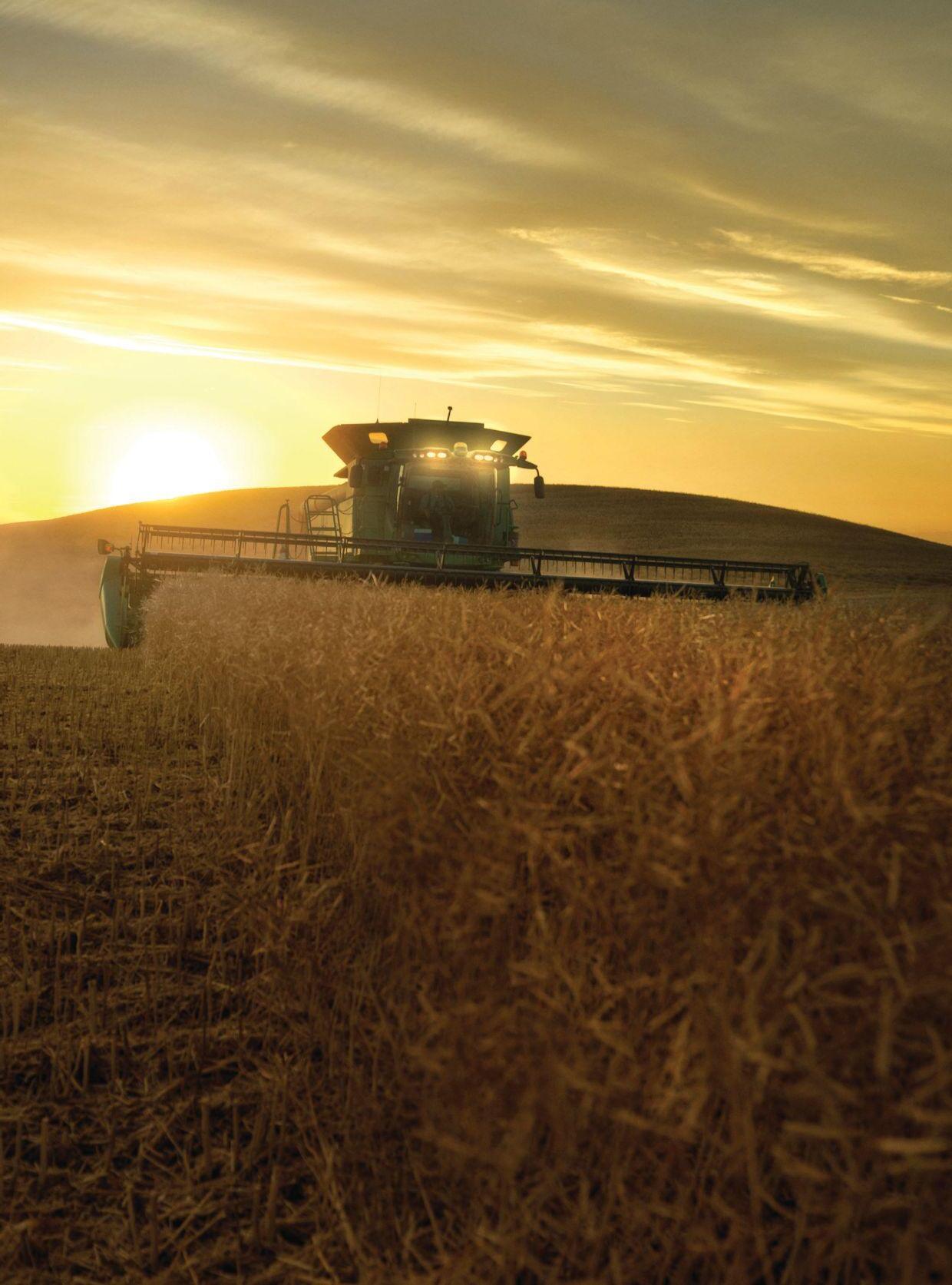
Under certain conditions, straight cutting can provide better capture of crop yields.
by Donna Fleury
Maximizing yield and quality at harvest and balancing all of the variables can be challenging. However, planning ahead and timing swathing and straight cutting operations properly can reduce losses and improve profitability.
For growers who plan to swath all or a portion of their canola crop, the main recommendation is to get that timing right. Research shows swathing canola when the main stem is 50 to 70 per cent colour change will provide yield and quality improvements. When possible, waiting until canola is at 60 per cent seed colour change on the main stem gives more seeds a chance to reach full maturity, which means higher yield and reduced green seed counts.
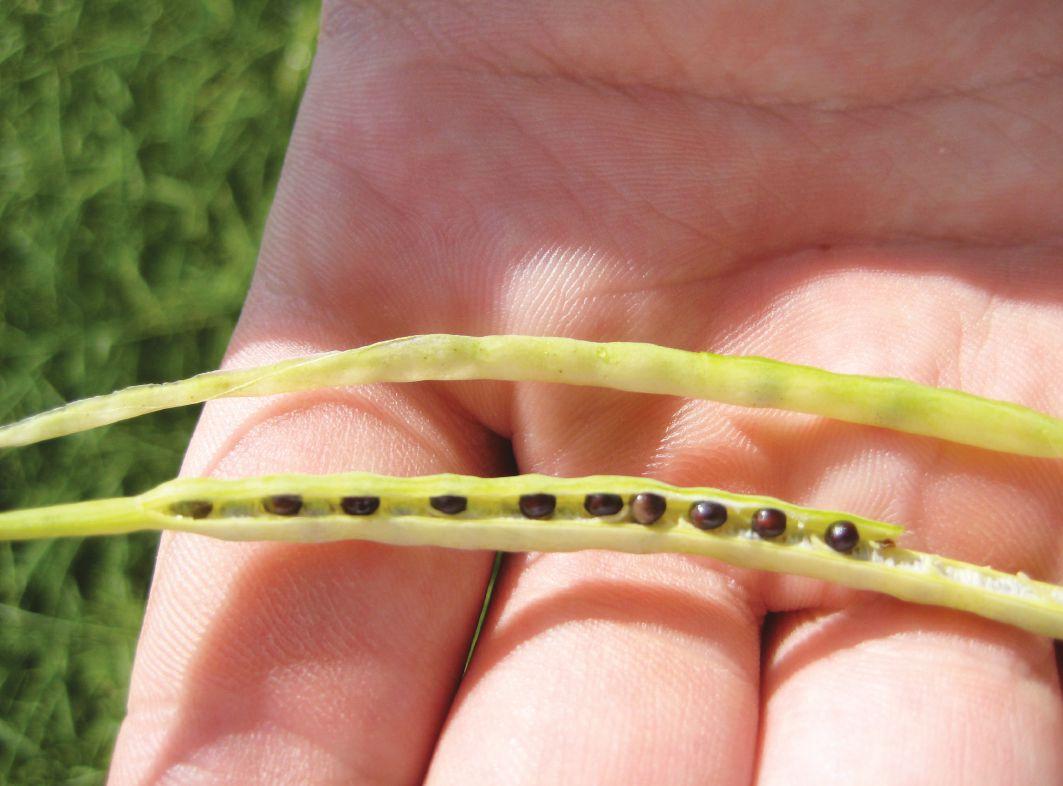
“Swathing ahead of that 50 to 70 per cent seed colour change on the main stem will cause a yield drag,” explains Angela Brackenreed, agronomist with the Canola Council of Canada. “It is very important for growers to educate themselves on how to assess seed colour change, which is considered any amount of brown on the seed. Get out into the field and crack open some pods to make the
best assessment.”
Brackenreed stresses that pod colour change is not an accurate indicator, because although visually the pods can look mature or immature, when you actually crack open a pod the seeds can look very different. The number one recommendation for growers is to time swathing to where the majority of the yield will be.
Timing to reduce shattering losses is important whether growers plan to swath or straight cut their crop. “The longer a crop stands, obviously the more vulnerable it can be to shatter loss,” says Murray Hartman, oilseed specialist with Alberta Agriculture and Rural Development. “Growers realize that, and looking at the data, losses on average are five or six per cent, which is not a small amount. So growers should have in the back of their mind – wheth-
TOP: It is very important for growers to educate themselves on how to assess seed colour change.
INSET: Equipment for straight cutting varies, although some headers are better suited than others.
PHOTO BY BRUCE BARKER.
er they plan to straight cut or swath – how to reduce shatter loss.”
Don’t swath too early, particularly when the densities in the field tend to be on the low side with a lot of branching. “Even using the more recent guidelines of waiting for 50 to 60 per cent colour change on the main stem may not be late enough for a thin stand if there is lots of material on the branches, both from the standpoint of yield and quality,” explains Hartman. “If growers have a thin stand, it is better to delay swathing even if there is some shatter loss of the first pods. These tend to be on the lower part of the main raceme and are the most protected from wind, so I don’t think those are the ones that are of a big concern from delaying. That’s why some growers switch from swathing to straight cutting and get a yield improvement. If they would have delayed swathing to a more appropriate timing, the yields would likely have been the same.”
Shattering losses are not just about yield, but also the impact on subsequent crops as well. “Those seeds that shatter can become volunteer weeds that require effort and herbicide costs to control them,” notes Hartman. “If not controlled, those volunteers that do grow can contribute to a green bridge for diseases like blackleg and clubroot. When growing hybrids, there can be some segregation to parental types in the volunteers where one may not have the disease resistance, adding to the risk of a green bridge.”
For straight cutting, the most important consideration is field selection and variety choices. Ideally, canola is straight cut when it is dry, which is 10 per cent moisture or lower to be safe for storage. “Assess a field for straight cutting just prior to swath timing; then, if the field doesn’t meet the criteria, you can still go in and swath at that ideal 60 per cent colour change,” explains Brackenreed. (Bayer CropScience recommends 50 to 60 per cent colour change.) “Fields suitable for straight cutting should have uniform maturity through the field and good pod integrity, meaning little disease such as sclerotinia or alternaria that could cause the pods to be prone to shattering or dropping. Fields should have good density and be well knit together to minimize potential wind damage and shattering losses.”
For straight cutting, the most important consideration is field selection and variety choices.
Wind is a complex consideration and has impacts on both swathing and straight cutting operations. Hartman says that up to a certain point at about 40 to 50 mph wind, there will be some shatter losses in a standing crop. “However, if the wind is really strong, there can actually be greater losses with swathed crops because they start rolling and moving around, and the damage can be worse than if left standing. Predicting wind is difficult, but research trials show that it is about one-in-20 times when a wind event will be strong enough at harvest when the crop is still standing to cause significant shatter loss.”
There are new varieties specifically bred for improved shatter tolerance, and considering such a variety is a good strategy for straight cutting. InVigor L140P is one example of new varieties specifically bred for improved shatter tolerance. “This can be an important step in making straight cutting a more consistent practice and probably will result in a little higher yield on average and better quality be-
cause of leaving the crop standing longer,” explains Hartman. These varieties can also be a good strategy for swathed crops.
Brackenreed suggests that because growers like to try different varieties, they should experiment with different ones, testing them in their fields and finding the ones that work for them.
Having the flexibility for both swathing and straight cutting can be a benefit for time management and potential quality improvements. “The main benefit for moving to straight cutting is more about time management, with potential yield and quality improvements secondary,” says Brackenreed. “Straight cutting is likely not going to produce a consistent yield benefit on it’s own when compared to swathing at 60 per cent seed colour change. However, growers will see an indirect economic benefit by practicing straight cutting in combination with swathing, including less labour and machinery operation costs, as well as the opportunity to perfect timing of the swathed acres by moving some into straight cut acres.”
Moving some of those swathed acres into a straight cutting situation can really help with time management and helps move more of the swathed acres into that ideal time so you aren’t incurring the yield drag by swathing too early. Trying to get everything swathed in a short period of time often results in swathing some fields too early, some too late and only a small portion of the canola is swathed in that ideal time for maximizing yield. A combination of swathing and straight cutting can help maximize yields and quality across the acres.
Equipment for straight cutting varies, although some headers are better suited than others. “A narrow header for straight cutting is easier than a huge wide one especially on hills, and the deeper the header table the better in case of shatter loss, which will fall on the table rather than in front,” says Hartman. In Europe, cutter dividers are highly recommended for straight cutting.
Brackenreed adds that growers who don’t have specialty headers should not let that deter them from trying straight cutting for the first time. “You can be successful with any type of header, it just takes some patience, adjustments, playing around until you get it right, and eventually it will become just like anything else once you get used to it.”
Making the decision of whether to swath or straight cut depends on many variables and unknowns such as weather. Hartman adds that a grower’s propensity for risk of shatter loss may be the biggest one although there are a lot of “ifs” and “buts” – if there is a frost and the stems are green, if there is a shower or wet weather, if the straight combining equipment is already maxed out on cereal harvest, if the crop is still standing, and so on.
“It is never too late to straight cut; an over-ripe crop may suffer more shatter losses from swathing. So balancing a combination of swathing and straight cutting at the best timing for maximizing yield and quality along with growing shatter tolerant varieties may be a good solution,” he says.
Adds Brackenreed: “Every year, growers are able to get a lot of acres seeded in a short period of time in the spring, but when it comes to harvest, there isn’t always enough manpower or resources to harvest that same amount of crop in that short period of time. Timing it right is much easier said than done as every year there are fields with variability. Throw in risks such as frost and disease pressure, and all of these things add to the challenge of when to swath or straight cut. Planning ahead and timing swathing and straight cutting operations properly can reduce losses and improve profitability.”
Quality meets quantity.
In addition to providing an exceptional yield increase, Prosaro® fungicide protects the high quality of your cereals and helps ensure a better grade.
With two powerful actives, Prosaro provides long-lasting preventative and curative activity, resulting in superior protection against fusarium head blight, effective DON reduction and unmatched leaf disease control.
With Prosaro you’ll never have to settle for second-best again.
For more information, please visit: BayerCropScience.ca/Prosaro
One-of-a-kind broadleaf weed control.
As the only Group 27 and the first new mode of action in cereals for over 25 years, powerful, one-of-a-kind Infinity® herbicide controls the toughest broadleaf weeds from across the Canadian Prairies, even if they are resistant to other herbicide classes.
Infinity – truly in a class of its own.
For more information, please visit: BayerCropScience.ca/Infinity