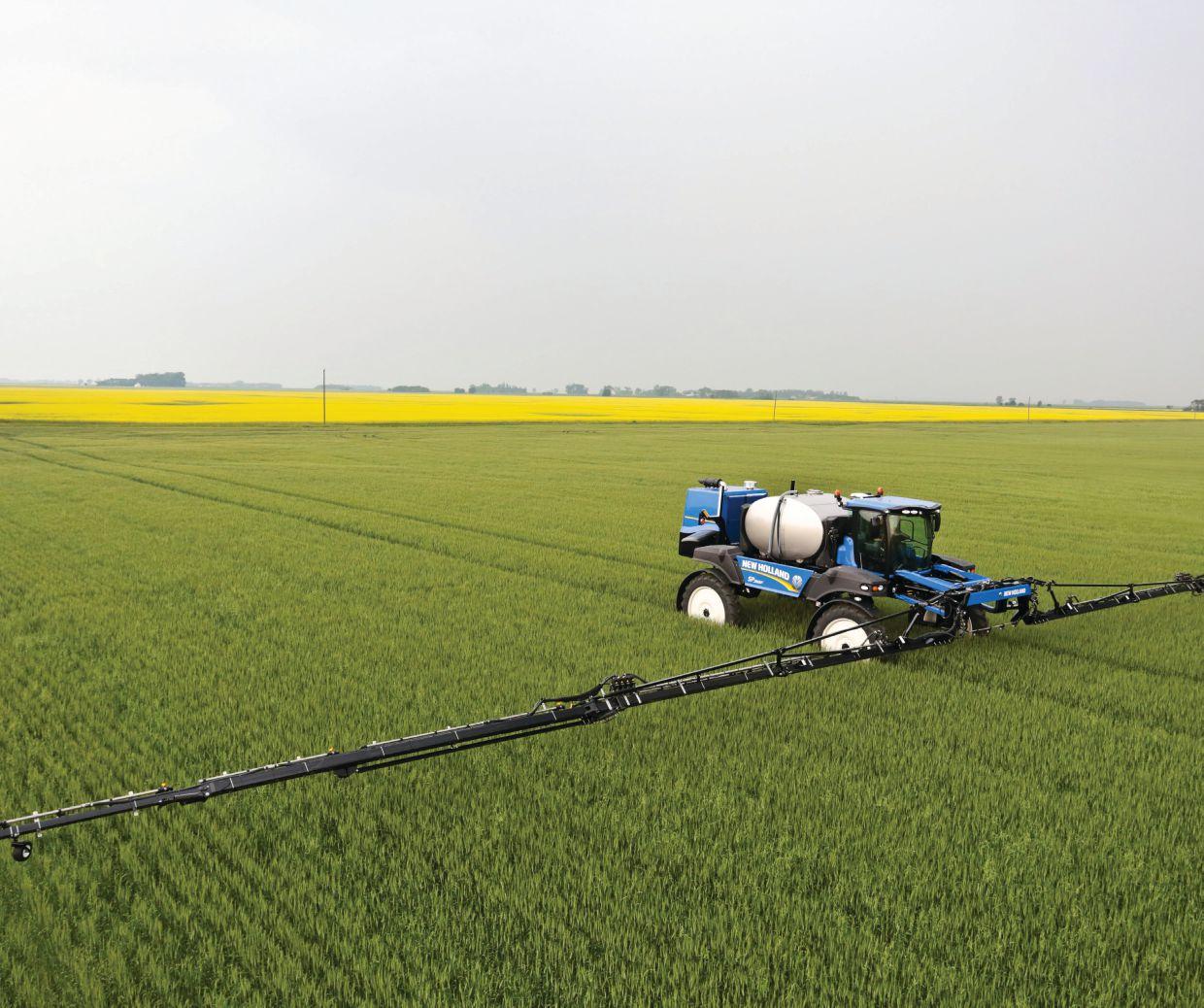
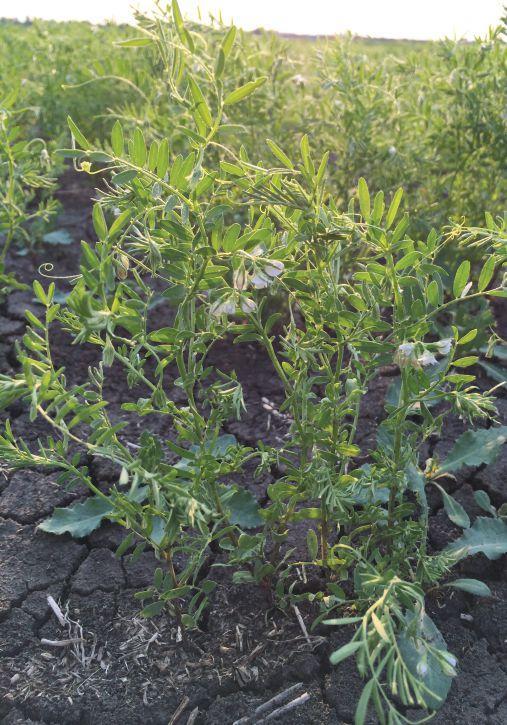
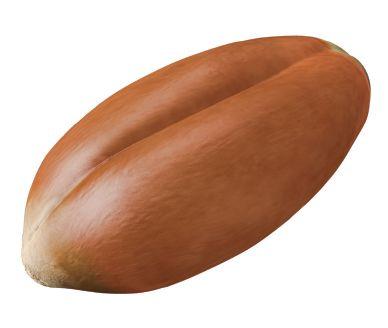
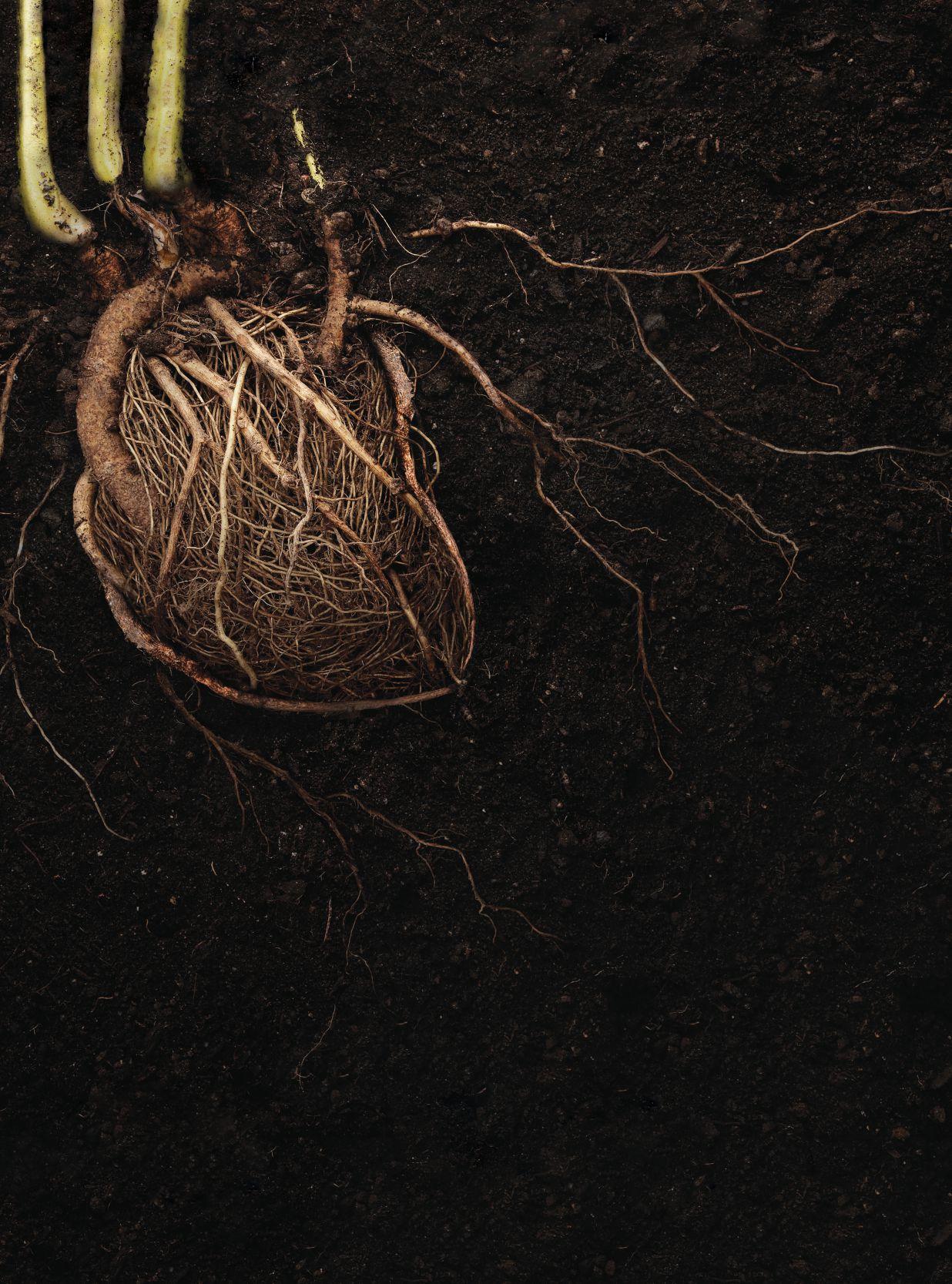
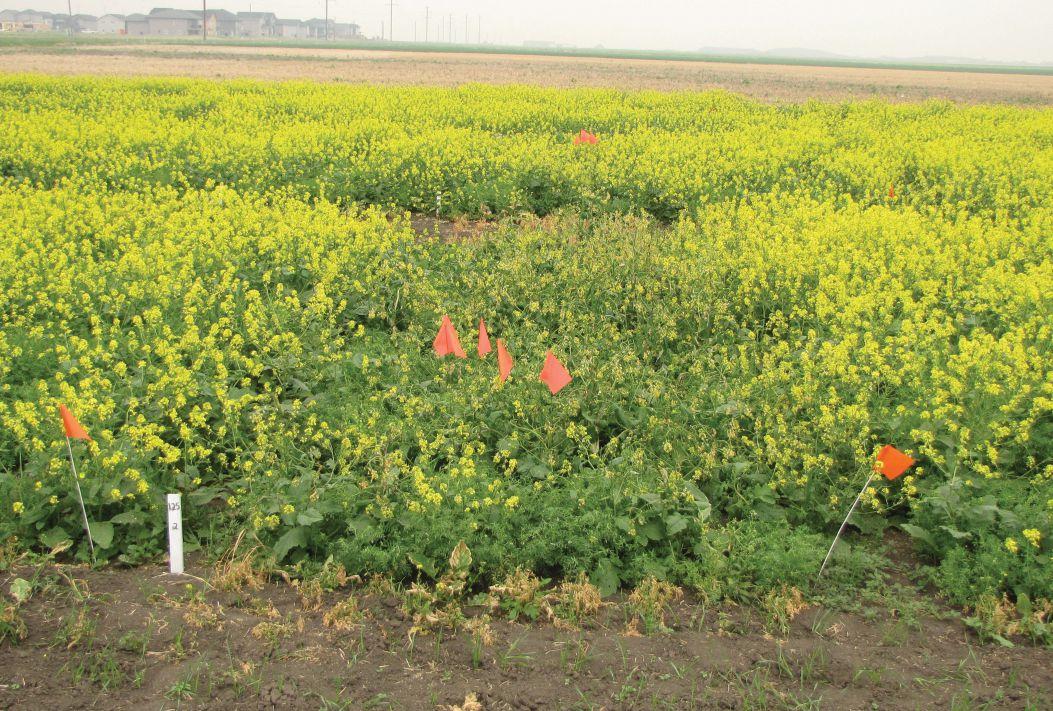
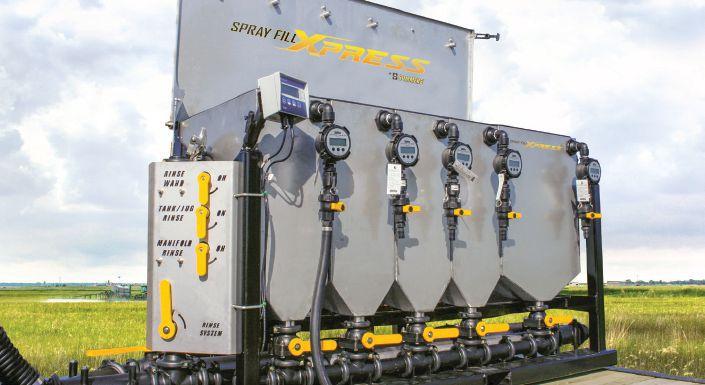
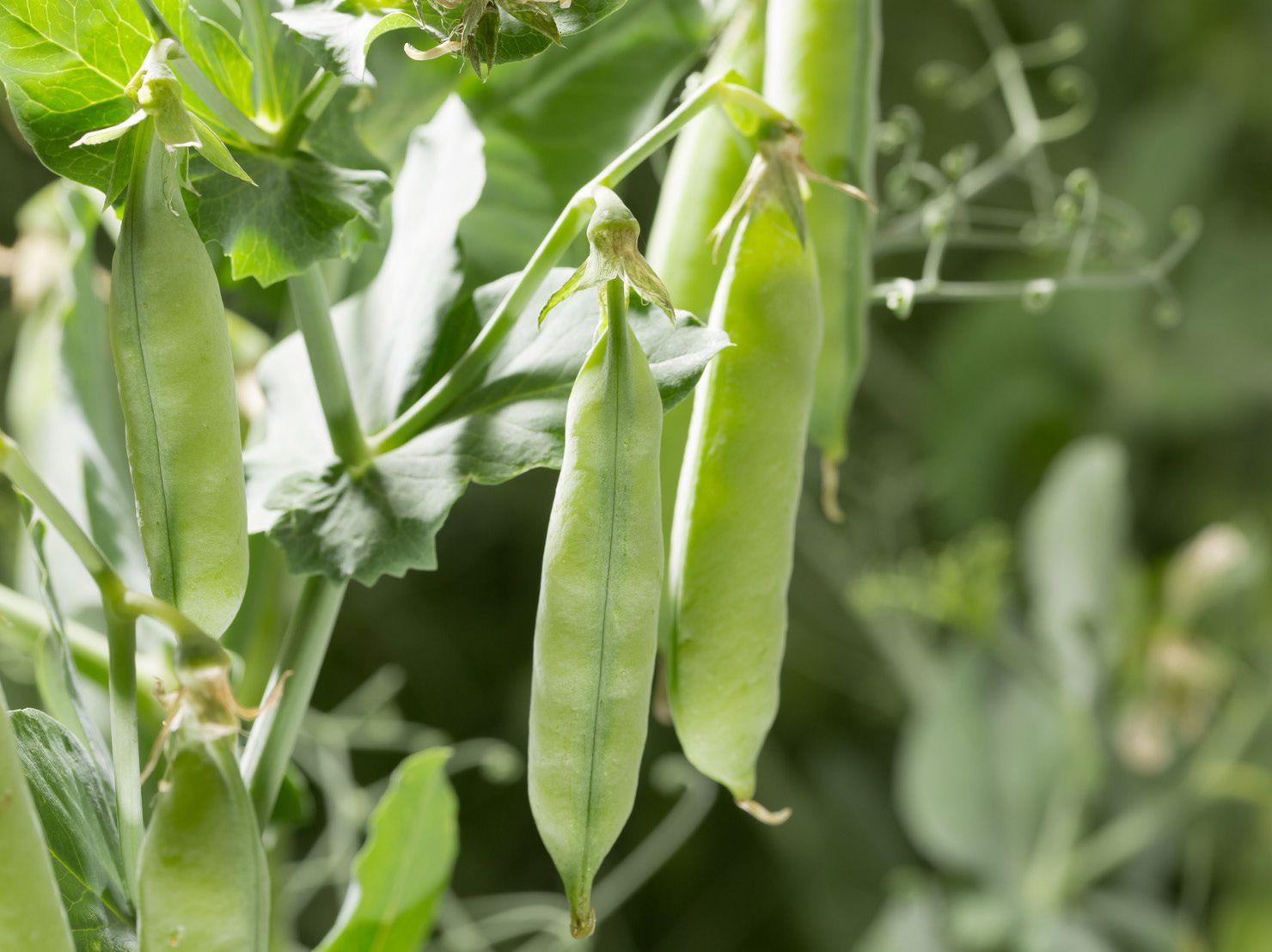
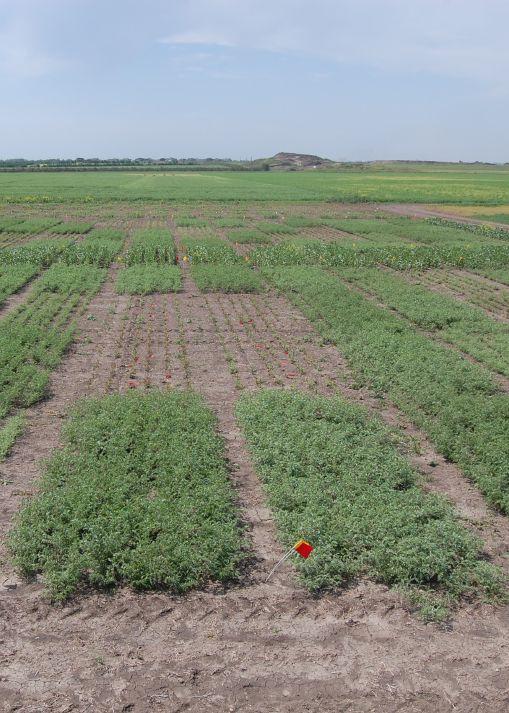
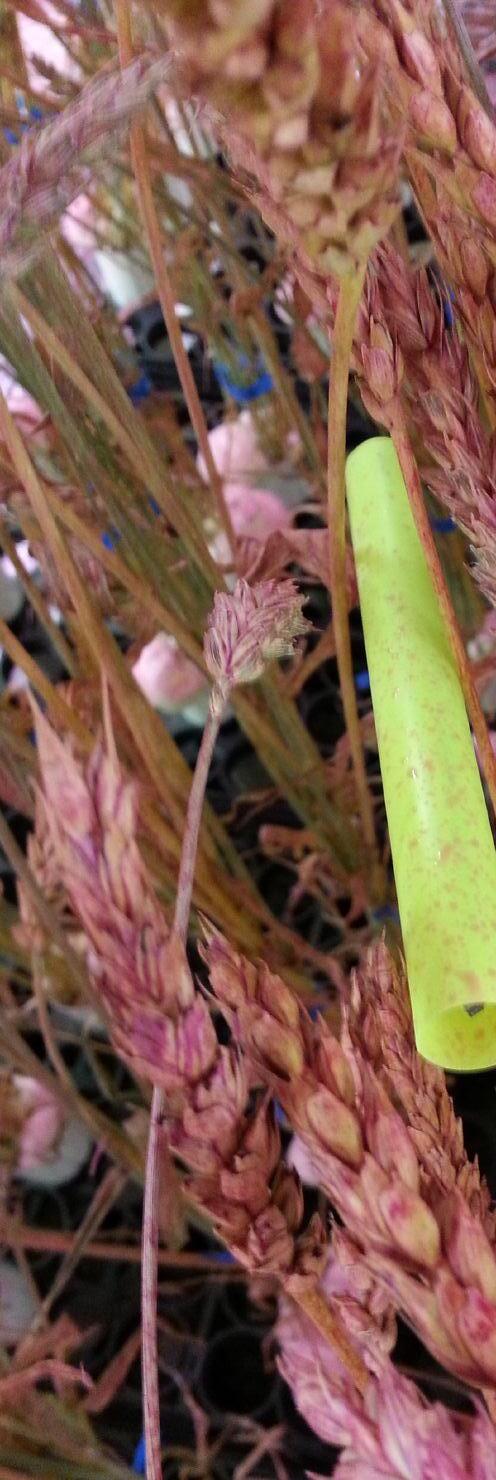
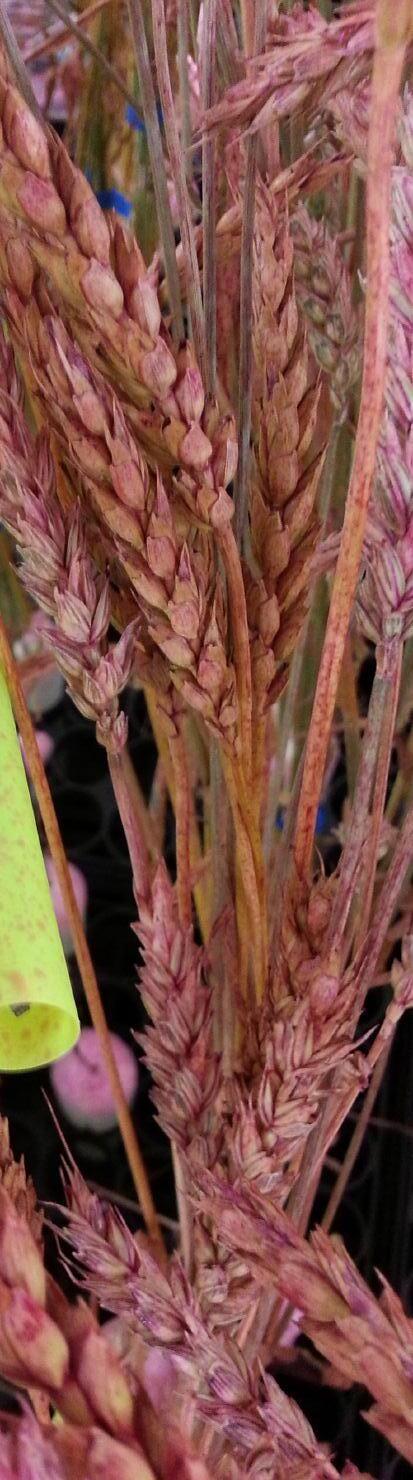
Reviewing the latest in weed control for pulses PG. 40
Here’s to the farmer who’s willing and able, Who’s at every meal, but not at the table.
Here’s to the farmer who cares for the earth, Who loves every creature and knows their true worth.
Who wears many hats with honour and pride, With love for their business that shines from inside.
Who respects what they do and how to get through it, Constantly learning the best ways to do it.
Who’s open and honest and willing to share, With nothing to hide, anytime, anywhere.
Here’s to the farmer, who’s in every bite, Feeding the world and doing it right.
Canada’s Agriculture Day is February 16th and FCC is proud to celebrate our wonderful industry.
Here’s to the farmer. Here’s to Canadian ag. Here’s to you.
TOP CROP
10 | Comparing nutrient content and release Research shows soybeans are good yielders and N fixers, comparable to pea and lentil in rotation.
By Donna Fleury
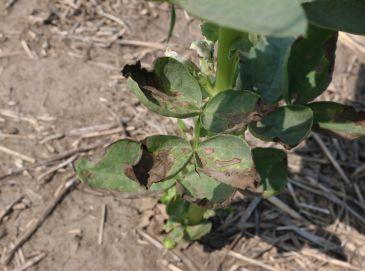
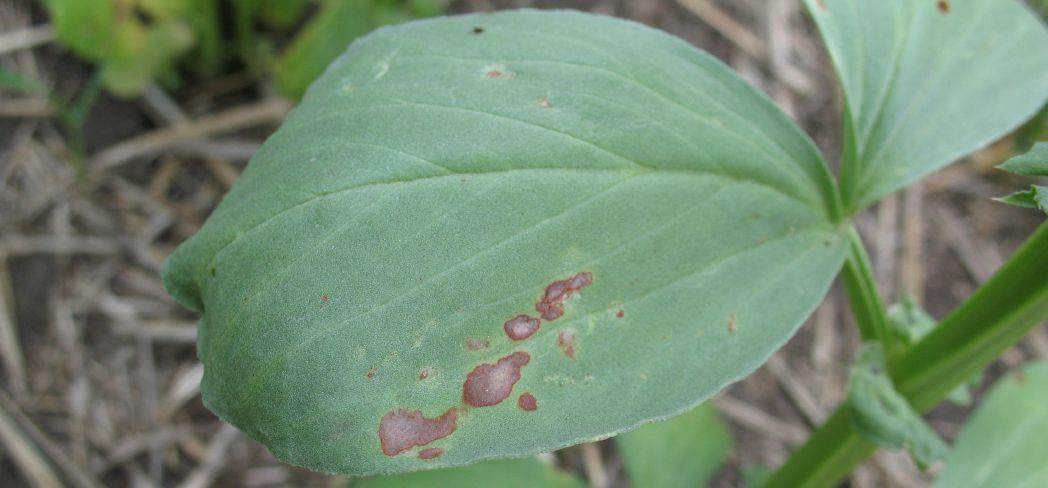
56 | Keeping an eye on chocolate spot The fababean disease is here, but so far damage has been limited. By Bruce Barker
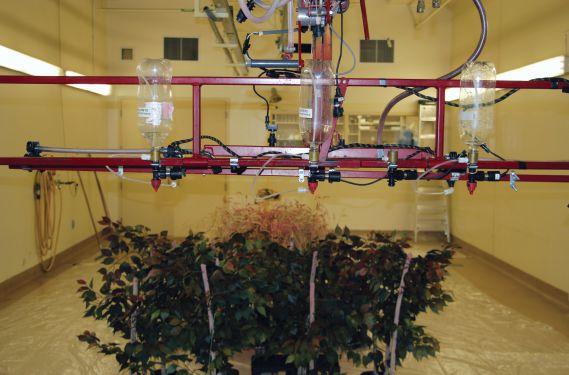
62 | Optimizing pesticide efficiency: A study of spray deposition into canopies Higher water volumes and slower travel speeds are key. By Donna Fleury
To disc or not to disc?
Biofortification of pulses could make Canada a ‘preferred supplier’
No simple solution for weed control in pulses
50 Updating N recommendations for wheat
Carolyn King
Benefits from on-farm research
Donna Fleury
STEFANIE CROLEY | EDITOR
NEW MARKET OPPORTUNITY FOR PULSES
The health benefits of pulses – lentils, beans, peas and chickpeas – have been proven over and over again. Now, new research out of Agriculture and Agri-Food Canada’s Guelph Research and Development Centre in Ontario is looking at ways to improve the nutritional properties of food ingredients made from pulses, specifically by manipulating the types of starch found in the pulses.
Qiang Liu and his team in Guelph have been developing new bread recipes that use pulse ingredients, employing different techniques to alter the starch structure of the pulse flours and the interactions between the starch and other ingredients.
Ultimately, the team was able to increase the amount of slowly digestible starch and resistant starch in pulse-based breads. These two types of starch can improve gut health, slow the absorption of glucose into the bloodstream and help stabilize blood sugar levels. By modifying the ingredients made from pulses (like flour), they can be used to improve or increase the nutritional value of common foods.
As an added benefit, people with gluten sensitivities and food intolerances may be able to tolerate breads made with pulse ingredients, extending the potential pulse-based food market. Going forward, Liu and his team are experimenting with pulse ingredients in other foods, including muffins, cookies and pasta.
The timing of this news release landing in my email inbox was especially fitting for several reasons: this issue of Top Crop Manager West is pulse-focused, and although the year is behind us, 2016 was the International Year of Pulses. But perhaps most fitting is the way this research connects producers, industry and consumers, following Canada’s Agriculture Day, which the industry celebrated on Feb. 16.
Organized by Agriculture More Than Ever, the day was dedicated to gathering together as an industry to showcase our ag pride and create a closer connection with consumers about where food comes from – and the people who produce it.
Although the day has passed, the initiative remains important year-round. As producers, it’s easy to get caught up in your core tasks and not think about what happens after your crop is harvested. But research like Liu’s is part of the grander scheme of agriculture, and your role in growing the crop is another important piece of the puzzle. It’s important to share your involvement in the story and it’s never too late to get started.
When you’re visiting one of the many conferences or trade shows this season, or when you’re chatting with a neighbour in the grocery store about your crop, we encourage you to share your ag story with your fellow producers and consumers.
It’s hard to imagine that one small seed could hold so much promise, but it does. And when you consider the importance of having a successful season, a cereal seed treatment you can depend on makes a huge difference to the success of your family business.
With the full support of Raxil® seed treatments you’ll receive first-class disease control and a faster, stronger emergence that helps your field realize its full potential. Raxil lays the groundwork for a field that your neighbours will envy and that will ultimately help you achieve a superior performance.
Because from seeding to harvest, every seed counts.
HEAT STRESS EFFECT ON PEA POLLINATION AND SEED SET
Microscopic photography reveals the impact of heat on this field crop.
by Bruce Barker
Field pea is generally thought to be relatively heat tolerant, but there are limits. Research by PhD candidate Yunfei Jiang in the department of plant sciences at the University of Saskatchewan is delving into how heat specifically affects pollination, seed set and the processes associated with pollen fertilizing an ovule to form an embryo and seed.
“I conducted my research in the lab, growth chamber and in the field, but the majority of my experiments were carried out in growth chambers using 24 C day and 18 C night temperature with a 16hour day length as the control temperature regime and 35 C day and 18 C night temperature as the high temperature regime,” Jiang says.
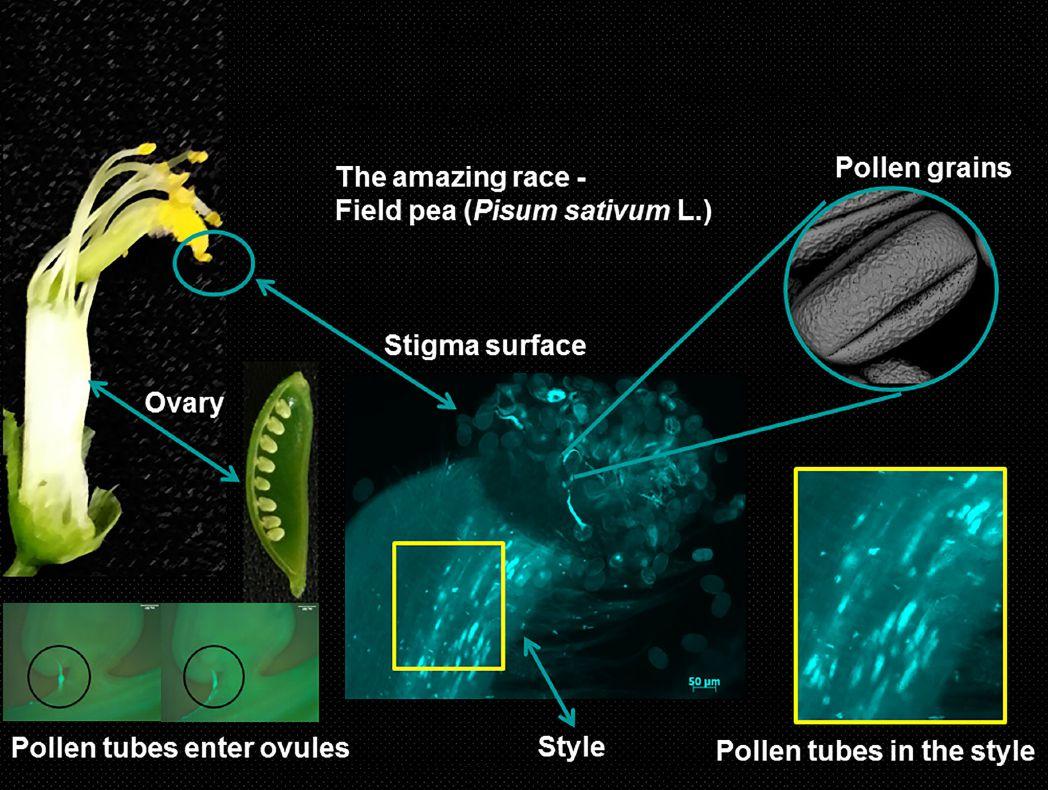
Jiang, working under the supervision of faculty members Rosalind Bueckert and Arthur Davis, found high temperatures can reduce pollination and seed set, but a quick review of the basics of pea pollination and seed set will help put the research into focus. A pea flower is made up of male (stamen) and female (pistil) parts. The male stamen has a filament that holds an anther, which produces and releases pollen. The female pistil consists of a stigma, style and ovary. The stigma surface receives pollen from the anther,
where the pollen grains germinate and grow pollen tubes through the style to the ovary below. The fertilized ovules become seeds in the pea pod. Field pea is primarily self-pollinating. Pollination mostly occurs just before the flower opening.
Jiang looked at pollen germination and pollen tube growth under five temperatures ranging from 24 to 36 C with a 10-hour incubation period. High temperatures reduced the amount of pollen germination by about one-third in CDC Sage and by over one-half in CDC Golden, and most significantly when moving from 34 C to 36 C. While 36 C may seem like a fairly extreme temperature, consider that on a 30 C day measured in the shade, field temperatures in full sunlight can easily reach 36 C. On a 32 C day, the top of pea plants in a field would also reach 34 C to 36 C.
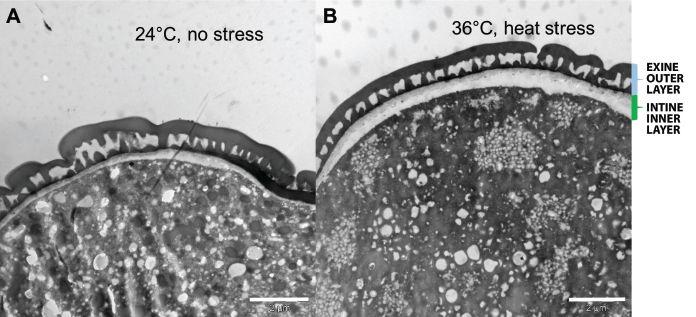
Jiang examined the structure of the pollen wall using a transmission electron microscope and found that heat stress caused the inner wall layer (intine) to almost double in thickness. She explains that the increased wall thickness might be a protective mechanism;
ABOVE: Field pea pollination.
BUILT FOR SOIL PRODUCTIVITY
PRECISION
SWITCHBLADE 1+1=3 - Hydraulic shanks convert equipment into coulter chisel or fertilizer applicator in seconds
FLEX FINISH - Hydraulic finishing options adapt to match soil management needs with on-the-fly finishing adjustments
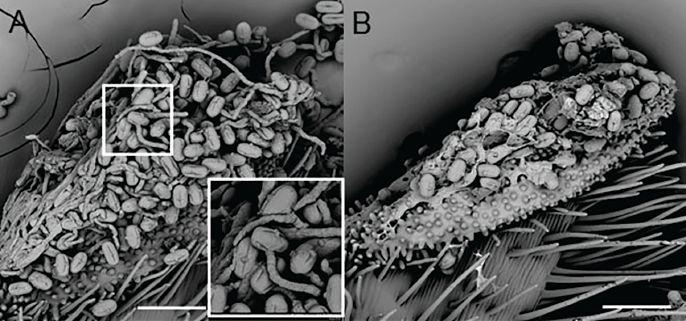
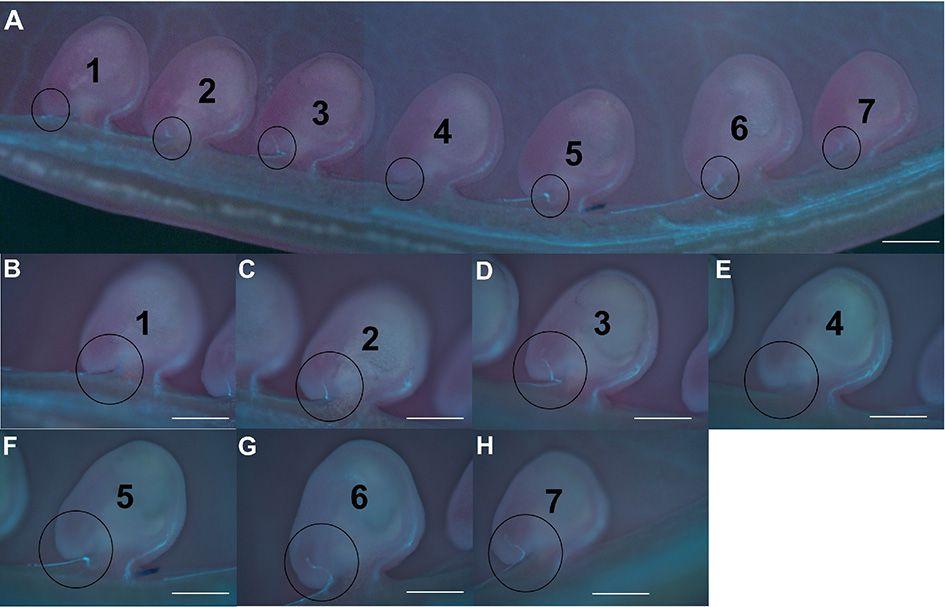
heat stress, and how heat stress and ovule position affect seed development. In this experiment, CDC Golden and CDC Sage were treated in two heat regimes of 24/18 C day/ night temperature with a 16-hour photoperiod and 35/18 C day/night temperature for four to seven days. Using a fluorescence microscope, Jiang was able to show pollen tubes could grow through the style of the pistil to fertilize the ovules. After four days of heat, the proportion of ovules that received pollen tubes was similar to control plants. However, after seven days of heat, fewer ovules received a pollen tube.
Pollen viability was also measured at two stages: flower bud and anthesis, when pollen is shed. CDC Sage had good pollen viability at 24 C at the bud and anthesis stages, and at the high temperature bud stage. Both varieties lost pollen viability at 35 C at anthesis, but CDC Golden also lost viability at the bud stage in heat. The pollen coat of CDC Sage was more stable compared to CDC Golden, which may explain the greater robustness of CDC Sage pollen in high heat situations. This heat stress also reduced the number of seeds per pod. Heat stress impacted young, barely visible floral buds more than advanced buds and open flowers. The flower abortion rate was greater when flower buds were exposed to heat, compared to open flowers or very young pods. Similarly, when flowers were in the youngest bud stages, seed set, pod development, and seed yield were reduced when high temperature exposure started.
Jiang also looked at the effect of heat on seed development within a pod. Seed development was negatively impacted by heat, reducing the amount of pollen released with fewer fertilized ovules (less seed). The release of pollen from anther failed to occur following exposure to 35/18 C day/ night for seven days. In half of the cultivars tested, ovules in the middle of the pod and at the furthest end from the pod stalk were more likely to develop into seeds than those at the stalk end of the pod. Cultivars with smaller thousand seed weight were able to retain the most ovules and seeds per pod compared to large-seeded cultivars. Largeseeded cultivars aborted more seeds when exposed to heat.
plants may produce a thicker pollen wall in order to protect the sperm cell(s) inside from environmental stress.
“Further research is required to investigate the dynamics of the intine layer of pollen from legume plants subjected to high
temperatures. Any detrimental effects of heat stress on either the intine and outer (exine) layers of pollen could cause abnormal pollen function,” Jiang says.
Another study looked at how pollen grains interact with the female pistil under
“Seeding small-seeded pea offers a mode of heat resistance,” Jiang says. She adds that her research provides better understanding of these processes, and can help plant physiologists and plant breeders improve field pea cultivar development.
Control and heat-stressed pollen wall. A: CDC Golden, 24/18 C day/night temperature. B: CDC Golden, 36/18 C day/night temperature for four days. Scale bar = 2 µm.
Pollen interaction with the pistil’s stigma region. High temperature resulted in fewer pollen grains on the stigma. Left: CDC Sage, 24/18 C day/night temperature. Right: CDC Sage, 35/18 C day/night temperature for five days. Scale bar = 100 µm.
Ovules 2, 3, 6 and 7 received pollen tubes, but ovules 1, 4 and 5 did not receive a pollen tube after seven days of heat. Scale bars = 200 µm.
SEND WEEDS TO THE PLACE OF NO RETURN.
Turn the tables on broadleaf weeds like narrow-leaved hawk’s-beard, cleavers and kochia with Barricade® II – without compromising your crop health. With two modes of action built in plus a wide window of application and outstanding re-cropping flexibility, Barricade® II is a sound choice for growers. Save up to $5.50 per acre with the DuPontTM FarmCare® Connect Grower Program.
Questions? Ask your retailer, call 1-800-667-3925 or visit barricade.dupont.ca
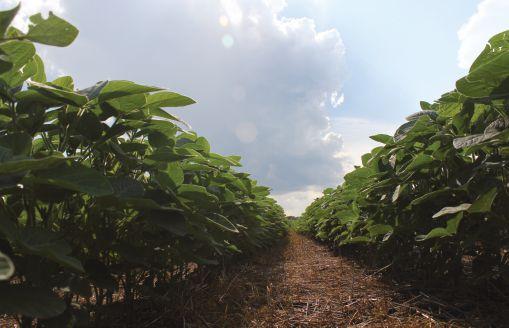
COMPARING NUTRIENT CONTENT AND RELEASE
Research shows soybeans are good yielders and N fixers, comparable to pea and lentil in rotation.
by Donna Fleury
Pulse crops play an important role in many cropping systems. Along with field pea and lentil, growers are increasingly adding short-season soybeans into their crop rotations. Because soybeans are relatively new in Saskatchewan, growers and researchers are interested in how they compare in rotation to other pulse crops.
A three-year research project initiated in 2014 and led by Jeff Schoenau, professor and Ministry of Agriculture Strategic Research Chair at the University of Saskatchewan, along with PhD graduate student Jing Xie, and Tom Warkentin of the Crop Development Centre, set out to compare production and rotational contributions of soybean with field pea and lentil at different locations across Saskatchewan. The key objective of the project was to determine the yield, nitrogen (N) fixation, plant nutrient content, uptake and composition of the residue of soybean grown under Saskatchewan conditions. Researchers also wanted to determine the contribution soybean residue makes to nutrition and yield of subsequent cereal and canola crops in comparison to pea and lentil.
In 2014, three varieties each of field pea, lentil and short-season
soybeans, along with wheat as a control, were seeded in replicated trials at sites in Saskatoon, Scott, Rosthern and Yorkton, Sask. In 2015, hard red spring wheat was seeded across all of the plots, followed by canola in 2016. Researchers are still analyzing the 2016 project data, with final results expected to be available in early 2017, once Xie’s PhD thesis defence is completed.
“Results from the first year show that short-season soybeans performed very well at all sites, with comparable grain, straw yields and nutrient uptake to the pea and lentil varieties,” Schoenau says. “Some of the sites tend to be more north and west of the traditional soybean growing range, but all of the varieties did very well in all of the trials. Soybean yields were intermediate between pea and lentil at all of the sites. Soybean had higher grain N and [phosphorus] P concentrations, but lower straw N and P concentrations compared to pea and lentil.”
In terms of the amount of N derived from biological N fixation, pea was the highest overall, with soybean equal to or greater
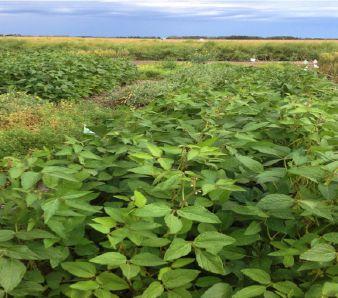
ABOVE: Soybean plots ready for harvest in Scott, Sask.
PHOTOS BY JING XIE.
PERFORMING GROUP 2 HERBICIDE?
THREE WORDS: FLUSH AFTER FLUSH™ WHY DO SOME CALL IT THE
No other Group 2 herbicide offers the kind of relentless, Flush after flush ™ control you’ll get with EVEREST® 2.0. It doesn’t just get the hard-to-kill weeds you see — like wild oats, green foxtail and other resistant biotypes — it gets the weeds you know are coming. Young wheat gets an important head start. And you get higher yields. Ask your retailer about EVEREST 2.0. A herbicide you can count on.
Cumulative N (left) and P (right) supply rates in soybean, pea, or lentil stubble in the 2015 growing season.
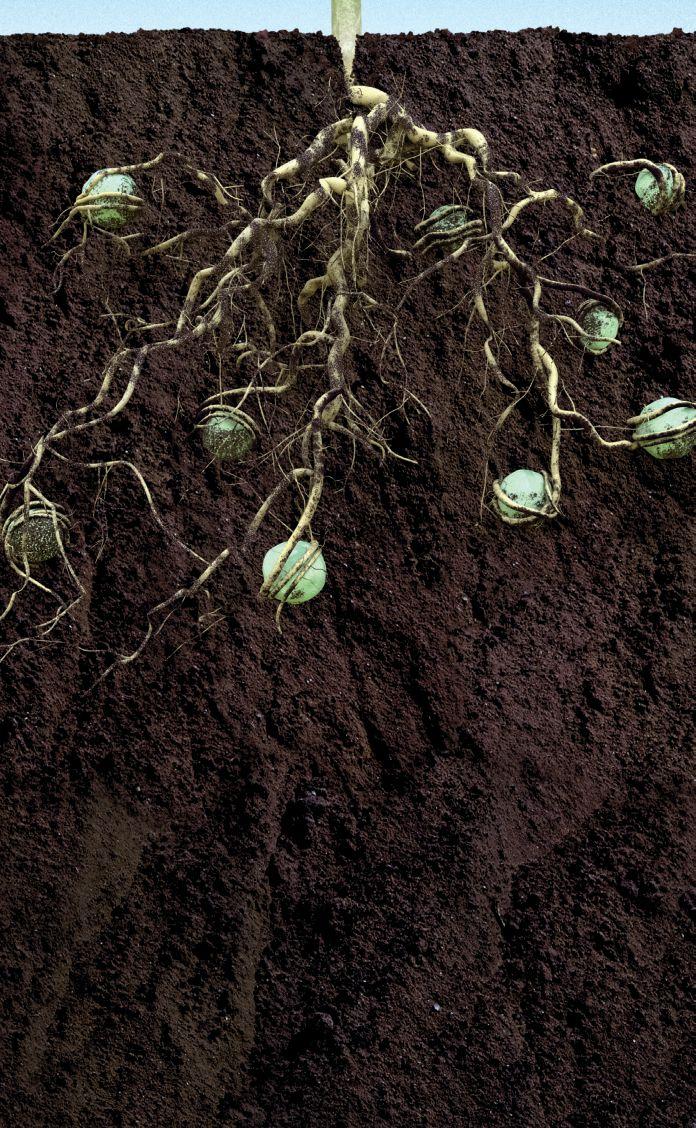
than pea in some plots, followed by lentil. The project found soybean had the highest proportion of N derived from fixation of the three pulse crops. Schoenau adds that although soybeans have sometimes been considered to be poorer N fixers, this research showed they are capable N fixers. The results showed soybean N fixation ability was good, with 60 to 70 per cent of its N derived from fixation. Generally 50 to 80 per cent of N in legumes comes from the atmosphere via biological fixation in the root nodules. The actual amount depends on inoculation/nodulation, environmental conditions, soil available N and other nutrients like P.
“One of the interesting findings was that soybean grain had higher P and [potassium] K content compared to the other crops,” Schoeneau says. “Therefore, when soybean is included in rotation, there is potentially a greater depletion of P and K from crop removals, so that is something growers will want to take into consideration in long-term fertility planning. This can be readily addressed in the following cereal or other crops over the long term.”
In 2015, wheat was seeded across the stubble plots to determine the rotational contributions of the different pulse residues. The results were positive, showing the three grain legume crops
had similar effects on the N recovery rates by wheat grown in the subsequent year. Overall, the cumulative nutrient supplies were similar, and did not show statistically significant differences in soils with soybean, pea, or lentil residue either under a controlled environment or under field conditions.
“We didn’t see big differences among the three pulse crops in their contribution to N or to P availability to the following wheat crop,” Schoenau says. “Aside from the fertility aspect, we didn’t see a large difference in any other effects on the following crops at those four sites.”
The results found wheat grown on soybean, pea and lentil stubble had similar grain and straw yield, grain and straw N and P uptake, and residue N recovery ratios at all sites.
Overall, the selected soybean varieties showed comparable agronomic and environmental impacts compared to pea and lentil grown under Saskatchewan conditions. Soybean is a good yielder and N fixer with a similar contribution to the nutrition and yield of subsequent crops compared to pea and lentil. Pulses have a good fit in rotation and this research indicates soybean can be another good option for growers to consider.
RED PEA OFFERS NEW MARKET OPPORTUNITIES
Market development underway at ILTA Grain.
by Bruce Barker
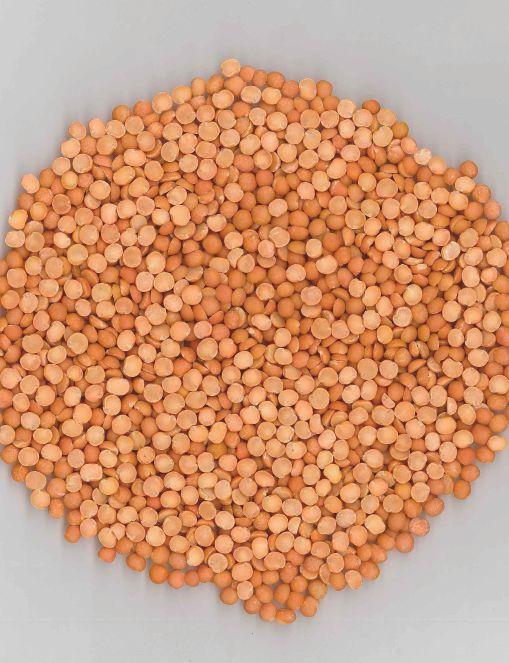
Anew pea class may break new ground for growers and processors on the Prairies. The first varieties, Redbat 8 and Redbat 88, were developed by the Crop Development Centre at the University of Saskatchewan. Both have been released by the Saskatchewan Pulse Growers (SPG) to ILTA Grain through SPG’s Tender Release Program.
“We thought that the red pea could be something new and different for us to develop. As a split pea, it might be able to fit into the same market as red split lentils. There may be some interest there with buyers, and possibly some other markets as well,” says Dan Burneski, president at ILTA Grain in Surrey, B.C.
SPG’s Tender Release Program is designed for varieties that are unique, have little or no established market demand and are developed through the Crop Development Centre’s breeding program. The thinking is that increased collaboration and communication with growers, plant breeders, processors and exporters could result in premiums for growers.
ILTA Grain has the rights to red pea market class for eight years, until 2021. Over the past several years, they have been working primarily on seed production with grower contracts through their North Battleford, Sask., location, where they have a pea splitting facility.
In 2016, ITLA Grain contracted about 20,000 acres of red pea, mostly in Saskatchewan. Burneski says the red pea grew well, yielding similar to yellow pea with similar agronomic performance. He says the 2016 crop came off with good quality, beating the wet fall harvest weather that plagued many farmers.
Information from the Saskatchewan Varieties of Grain Crops 2016 guide showed that, based on three years of performance trials, Redbat 8 has strong yield potential, measuring 106 per cent of CDC Golden yellow pea in the south and 103 per cent in the north. Redbat 8 is a smaller seeded pea, with a thousand-kernel weight of 190 grams. It has medium maturity with lodging rated similar to CDC Golden, but not quite as good as CDC Amarillo and CDC Greenwater.
Redbat 88 has similar agronomics but even better yield than Redbat 8.
New market opportunities
Burneski says the company is just getting started with market development. After the 2016 harvest, they now have enough seed to start working with customers around the world to see how a split red pea might fit in those markets. He is marketing into major pulse markets in the Middle East, Turkey, Bangladesh, China, India and the U.S. Originally, Burneski thought a split red pea would compete with split red lentils as a lower cost alternative. However, since red lentil
new markets.
prices have come down from their recent highs, the substitution is more difficult to sell. Potential also exists for new markets; for example, China has expressed significant interest in red pea as a snack food.
ILTA Grain’s 2017 contracting program is currently being assessed, based on interest from international buyers. Burneski believes it will likely be similar to last year’s program, in the 15,000 to 20,000 acre range.
“This [2016] is the first year we’ve really had a significant amount of red pea available for customers to look at. We’re waiting on feedback from them before we finalize our 2017 contracting program,” Burneski says.
Pea growers interested in contracting red pea production in 2017 should contact ILTA Grain in North Battleford.
PHOTO COURTESY OF ILTA GRAIN.
Red split pea may open up opportunities in
The built-for-Canada-all-in-oneso-your-cereals-can-thrive treatment. We know you love to see your cereal crops grow to their fullest potential. And in true Canadian fashion, we’d like to give you a hand with that. Meet our Cruiser ® Vibrance® Quattro seed treatment. With four fungicides, an insecticide and the added benefits of Vigor Trigger ® and Rooting Power™, this all-in-one liquid formulation offers superior protection plus enhanced crop establishment for early-season growth. Just the helping hand you can use, eh?
SOME GOOD, SOME BAD: NEWS ON POTATO PSYLLID
Increasing numbers, but free of the zebra chip pathogen.
by Bruce Barker
For potato growers in Western Canada who are nervously watching the progress of potato psyllids (Bactericera cockerelli) moving in from the northwest United States, there’s good news: none of the potato psyllids found in Western Canada are carrying the zebra chip pathogen, Candidatus Liberibacter solanacearum (Lso). The Lso pathogen is transmitted by the potato psyllid, and zebra chip has caused severe damage in potatoes in the western United States, Mexico, Central America and New Zealand.
“The bottom line is that over 200 [potato psyllid] were found in Alberta in 2016, plus some in Manitoba and Saskatchewan. The main result of interest is that all the DNA testing done by collaborating researcher Larry Kawchuk at [Agriculture and AgriFood Canada] Lethbridge shows no Lso bacterium,” says Dan Johnson, an entomologist at the University of Lethbridge.
The insect was not found in other Canadian provinces. Johnson has led the potato psyllid monitoring program in
Canada since May 2013. The program is funded by Growing Forward 2 through Agriculture and Agri-Food Canada (AAFC), and Agri-Science Clusters and managed by the Canadian Horticultural Council, with the participation of regional grower groups like the Potato Growers of Alberta. Larry Kawchuk at the AAFC Lethbridge Research Centre carries out DNA testing. Scott Meers, an entomologist with Alberta Agriculture and Forestry, is co-ordinating insect monitoring in Alberta.
The monitoring and research network also includes people from potato grower associations in other provinces, the Canadian Potato Council, the Canadian Horticultural Council, agronomists, federal and provincial specialists, university researchers, potato processors and others in the potato value chain.
In addition to yellow sticky card monitoring of potato psyllids
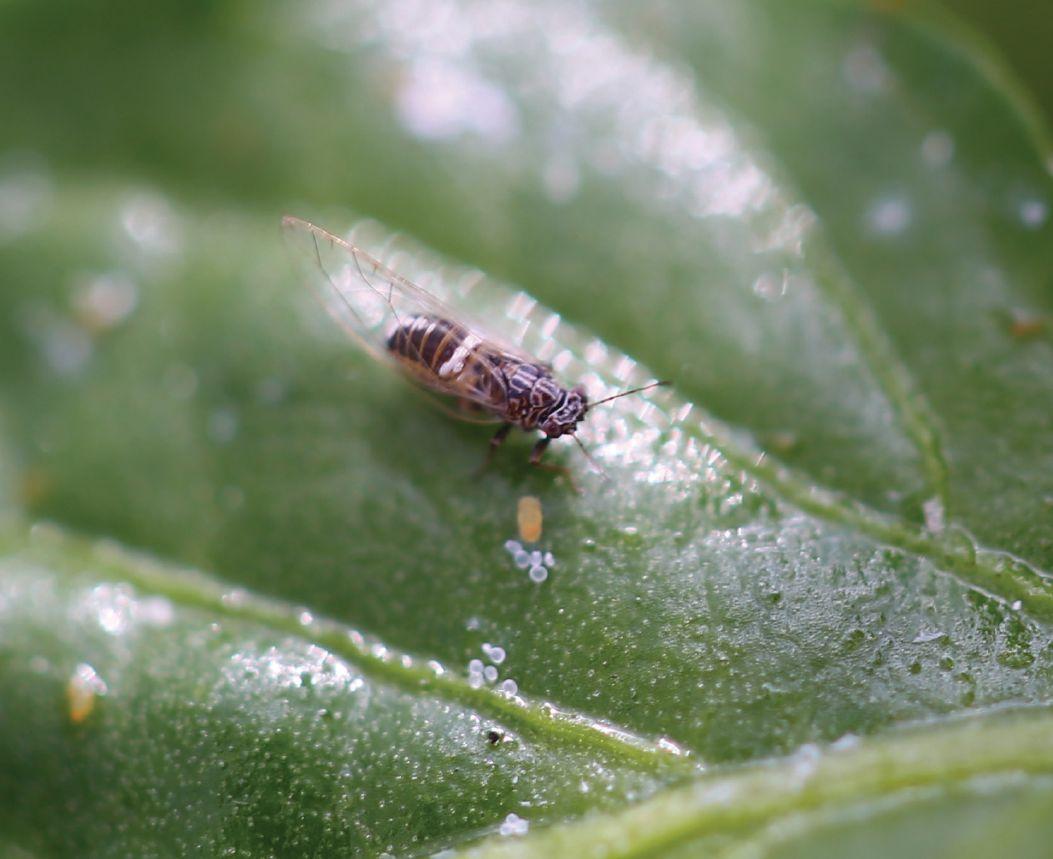
ABOVE: Potato psyllid is distinguished by a broad white strip on the adult’s abdomen.
Wind speed, pressure gauge, optimal nozzle settings, check. All systems are go and it’s time to take down the toughest weeds in your wheat field, whether they’re resistant or not.
With three different modes of action in a single solution, Velocity m3 herbicide provides you with exceptional activity on over 29 different tough-to-control grass and broadleaf weeds.
across Canada, more than 1,000 suspect plant tissue samples of potato, tomato, and Solanaceous (nightshade) weeds from across Canada were collected between 2013 and 2016. The samples were visually examined for Lso symptoms and polymerase chain reaction (PCR) tested for the presence of the pathogen. These also tested negative for Lso.
The pathogen infects the phloem tissue in potatoes. Foliar symptoms include stunting, chlorosis, vascular tissue browning and curled leaf edges that turn yellow or brown.
The main areas of potato psyllid infestation in North America include California, Kansas and Texas, but populations are also found in Washington, Oregon, Idaho, Colorado, New Mexico, Arizona, Nevada, Utah and Wyoming.
Potato psyllids have been collected rarely in Montana, Alberta and Manitoba since the 1930s, however, they are appearing more frequently as warmer weather allows populations to expand into Canada.
Potato psyllids feeding on potato plants (by sucking on the plant’s juices) is the only known vector for transmitting the Lso pathogen from plant to plant. The pathogen infects the phloem tissue in potatoes. Foliar symptoms include stunting, chlorosis, vascular tissue browning and curled leaf edges that turn yellow or brown. Tuber symptoms include vascular tissue browning resulting in a striped appearance that reduces processing value.
“Although potato psyllids have been known in the past to cause some damage themselves, the real concern is mainly from
the bacterium, and we don’t have it in Canada yet. But if our potato psyllid population continues to increase – as it has done during 2013 to 2016 – and if it becomes more continuous with U.S. populations, and if tomato and potato plants (and tubers) are shipped more frequently, then it could arrive,” Johnson says.
The economic impact can be large. Annual losses in Texas have been in the $25 to $30 million U.S. range, while estimates in Idaho predict a 55 per cent reduction in returns if the Lso pathogen becomes established.
Potato psyllids can survive freezing temperatures, and Johnson says the potato psyllids collected during 2015 and 2016 did not appear to have undergone long-distance flights, indicating they may have survived from previously established, low-density populations and are not recent arrivals from the U.S.
The potato psyllids were collected from a broad area across southern Alberta, and some areas farther north.
Sampling and DNA analysis is trying to identify their haplotypes
(genetic characteristics). Sampling and monitoring of diseased plant samples and potato psyllids will continue in 2017.
A parallel project is looking at potential natural enemies of potato psyllids.
“The very low level of insecticide use, often none at all, in potato fields in Alberta allows natural enemies of potato psyllid to exist,” Johnson says. “When conditions exist, like in this case, a better scenario [than insecticides] is to have healthy populations of insects that are natural enemies of potato psyllids and other small insects. In this situation, we may have natural controls in place that we can encourage.”
Potato growers who are interested in participating in the monitoring program should contact their regional potato growers’ association.
For more on pests and diseases, visit topcropmanager.com.
THE 2017 CANADIAN TRUCK KING CHALLENGE
Ram’s 2017 Hemi-powered 1500 nabs this year’s top spot.
by Howard J. Elmer
The Canadian pickup truck market caters to the multiple needs of those in need of a truck for either work or personal use. But pickups that serve both the workplace and family are becoming the norm. Trying to offer buyers an unbiased perspective is one of the reasons I started the Canadian Truck King Challenge 10 years ago. Each year, a group of journalist judges continue to fulfill that original mandate: testing pickup trucks and vans the same way owners use them.
The judges are members of the Automobile Journalist Association of Canada – men and women who devote their entire year to driving, evaluating and writing about the Canadian automotive marketplace. Collectively they brought over 200 years of trucking experience to this year’s testing while driving a combined total of almost 4,000 empty, loaded and towing kilometres over three long days.
This year judges travelled from Quebec in the east and British Columbia and Saskatchewan in the west to attend the event, which takes place at a private 70-acre site in the Kawartha Lakes region of Ontario.
The testing pool
Since there are rarely more than two new trucks in a given year, we look to fill out each group to offer a decent sized comparison. For this year’s testing of 2017 models, we had a field of 11 pickup trucks, which fell into four classes: mid-size, full-size half-ton and full-size three-quarter-ton, tested in the Kawartha Lakes region, and full-size one-ton trucks, tested in London, Ont. a few days later. There were no commercial vans tested this year due to lack of new inventory following last year’s tests.
The testing method
The route we use is called the Head River test loop. It’s a combination of public roads spread over 17 kilometres. It starts on gravel, moves to a secondary paved road and finally a highway. Speed limits vary from 50 to 80 kilometres per hour, and the road climbs and drops off an escarpment several times, giving good elevation changes. Driving over the same route, the judges first drive each truck empty, then with a payload on board, before finally towing a trailer, Although this is repetitive, it’s the best way to feel the differences from one truck to the next. Trucks are scored in 20 different categories before being averaged across the field of judges and converted into a percentage. The “as tested” price of each vehicle is then weighed against the average price of the group (which adds or
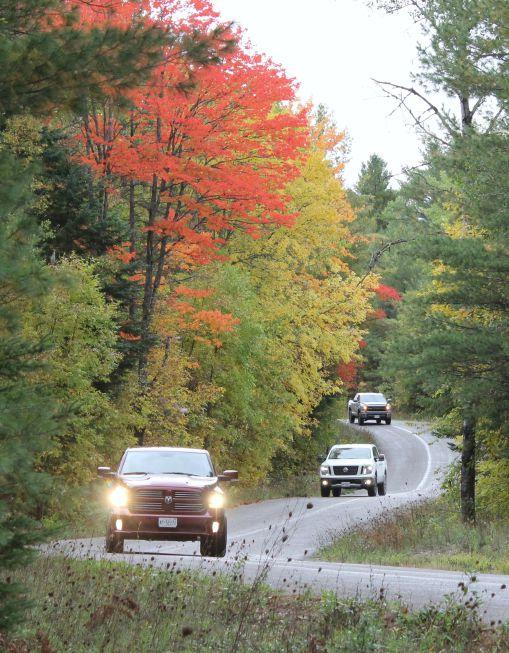
Eleven pickup trucks were put to the test during the 2017 Truck King Challenge, travelling nearly 4,000 kilometres over three days.
subtracts points) for the final outcome. Four-wheel drive equipped trucks (which all of our entries were) are driven on an internal offroad course built for that purpose at the IronWood test site.
This year the mid-size trucks carried a payload of 500 pounds and towed 4,000 pounds. The full-size half-tons hauled a payload of 1,000 pounds and towed 6,000 pounds. The three-quarter-tons towed 10,000 pounds and also used 1,000 pounds for payload. We choose these loads by taking into consideration the lowest manufacturer set limits among each group of entries. The weights we use never exceed those published limits.
For the one-ton trucks, we changed locations to London. Here we had access to partners who loaned us the weight and trailers necessary to test the big pickups. Patene Building Supplies and
PHOTO COURTESY OF HOWARD J. ELMER.
IKO let us use 4,000 pounds of shingles for payload, while CanAm RV Centre let us tow 15,000 pound fifth-wheel travel trailers.
Mid-size group
• Honda Ridgeline – 3.5L V6 gas, 6-speed auto, AWD, crew cab, Touring trim. Price as tested: $47,090. Final score of 75.5 per cent.
• Chevrolet Colorado – 2.8L Duramax turbo-diesel, 6-speed auto, 4WD, crew cab, Z71 trim. Price as tested: $44,695. Final score of 72.2 per cent.
Of the two, the Honda impressed the judges. As with anything new, it had an edge, but it wasn’t just the new factor that pushed its score past the Colorado. The prior generation of Ridgeline had a niche: a quirky truck that appealed to a select buyer. This time the Ridgeline moved closer to the mainstream while retaining some of its unique characterises. It did most everything well (payload, towing, even off-road) and still offered the most “car-like” ride. The judges rewarded Honda for a significant generational update. Toyota opted not to participate with the Tacoma (which we tested last year). The Nissan Frontier was also not offered, perhaps because it’s in its last cycle before a major upgrade.
Full-size half-ton group
• Ram 1500 – 5.7L Hemi V8 gas, 8-speed auto, 4WD, crew cab, Sport trim. Price as tested: $58,110. Final score of 79.4 per cent.
• Chevrolet Silverado 1500 – 5.3L V8 gas, 6-speed auto, 4WD, crew cab, Z71 trim. Price as tested: $59,890. Final score of 76.7 per cent.
• Nissan Titan – 5.6L V8 gas, 7-speed auto, 4WD, crew cab, PRO-4X trim. Price as tested: $63,050. Final score of 74.3 per cent.
• Toyota Tundra – 5.7L V8 gas, 6-speed auto, 4WD, crew cab, TRD Pro trim. Price as tested: $60,025. Final score of 73.7 per cent.
In Canada, this group makes up almost 80 per cent of total pickup sales. For us at the Truck King Challenge, it’s a segment where we consider what models to test carefully.
This year we asked each of the manufacturers to give us their bestseller in the half-ton category (the most popular combination of body style, trim and powertrain).
BlackHawk ® , CONQUER ® , GoldWing ® and Valtera , when tank mixed with glyphosate, provide greater weed control today and stronger stewardship for tomorrow. It’s time for progress in your pre-seed burndown. Before you plant your next canola, cereal, pulse or soybean crop, choose an advanced burndown for a better future.
Fuel economy results | All figures are given in litres per 100 kilometres. All trucks are the 2017 model year unless otherwise specified.
This way we would test the trucks Canadians buy most often.
The Nissan Titan is new, while the Chevrolet and Ram are midway through their current life cycle. Toyota gave us an offroad version of its Tundra, the TRD Pro. This is the newest truck they had, but not necessarily the model purchased most often. As you would expect, it did really well off-road. The Ram emerged as the judges’ choice for best all-around half-ton.
Ford – the leader in half-ton Canadian truck sales – chose not to compete.
Full-size three-quarter-ton group
• Ram 2500 – 6.7L Cummins I6 turbo-diesel, 6-speed auto, 4WD, crew cab, Laramie trim. Price as tested: $86,830. Final score of 77 per cent.
• Nissan Titan XD – 5L Cummins V8 turbo-diesel, 6-speed auto, 4WD, crew cab, PRO-4X trim. Price as tested: $64,950. Final score of 74.9 per cent.
• Chevrolet Silverado 2500 – 6.6L Duramax V8 turbo-diesel, 6-speed auto, 4WD, crew cab, LTZ trim. Price as tested: $82,560. Final score of 74.9 per cent
In the three-quarter-ton category, each of the trucks were dieselpowered. Since these are the most common big haulers purchased by Canadians, we towed 10,000 pounds of concrete. The judges made a point of saying they really felt how the trucks behaved when under-loaded. The scoring here was close, but the Ram 2500 with the Cummins 6.7L diesel came out slightly ahead. The Nissan tied
with the Chevrolet.
The Titan XD has the lightest gross vehicle weight rating (GVWR) of the three trucks and has the lowest tow and payload limits, which is reflected in its price and elevates its overall score. These lower limits are not a disadvantage though – if anything, it means the segment is growing and offering up more choices for consumers.
This was the first time we tested Nissan’s new 5L Cummins diesel V8. It’s worth noting that Chevy’s veteran 6.6L Duramax diesel will be generationally updated next year.
Full-size one-ton group
• Chevrolet Silverado 3500 – 6.6L Duramax V8 turbo-diesel, 6-speed auto, 4WD, DRW, crew cab, High Country trim. Price as tested: $83,390. Final score of 75.1 per cent.
• Ram 3500 – Cummins I6 turbo-diesel, 6-speed auto, 4WD, DRW, crew cab, Laramie trim. Price as tested: $88,085. Final score of 71.8 per cent.
We missed having Ford in this category, particularly because its 2017 Super Duty trucks are all new. After a full day of driving the Chevrolet and Ram trucks back to back, the judges awarded the win to the Chevrolet Silverado 3500. Both trucks worked well; the key difference was ride-quality when towing, where the Chevy outperformed the Ram.
Fuel economy data
For the fourth year in a row, MyCarma of Kitchener, Ont., collected
FEED THE WORLD
and translated fuel economy data during the challenge. These results, which are collected using data logs plugged into the on-board diagnostic readers of each truck, are as close to the real world as it gets. The report gives the fuel consumption results for each condition during testing: empty runs, loaded runs and even consumption while towing. The averages include each judge’s driving style, acceleration, braking and idling (we don’t shut the engines down during seat changes).
Conclusions
It’s worth noting that all of the trucks performed well, as seen in
*Comparable average removes trip segments that are not sufficiently similar between vehicles.
how close the scores are; none of these trucks is considered “bad.” The close scores also reflect how fierce the competition is among companies. This competition is good, as it results in sharp, constant innovation. Consider Nissan. This year it’s virtually a new player in the market, while others have brought significant improvements to powertrains. These changes give buyers an ever-widening range of choices. As for electronic conveniences and luxury appointments, the variety and range for 2017 continues to expand unabated.
The overall winner of the 10 th annual Canadian Truck King Challenge with the highest collective score of 79.4 per cent is the 2017 Hemi-powered Ram 1500.
NEW CORN VARIETIES FOR 2017
Breeders are expanding the corn hybrids available to producers.
by Blair McClinton, P.Ag.
Breeders continue to focus on early maturing hybrids and bring a variety of stacked traits to western Canadian corn growers. Seed companies have supplied Top Crop Manager with the following information on the new corn hybrids for 2017. Growers are advised to check local performance trials to help in variety selection. The listing is by ascending crop heat units (CHU).
A4099RR is a new Pride Roundup Ready 2 at 2,125 CHU for grain usage. It features early pollination and finish, and offers a very nice grain quality and consistency, plus rapid emergence and aggressive seedling vigour for a fast, early season start. It also has a good Goss’s wilt rating and very quick grain drydown in the fall. It is available at Pride Seed dealers.
A4199G2 RIB is a new Pride G2 VT Double PRO RIB Complete at 2,150 CHU for grain usage. It features early pollination and an early finish, very nice grain quality and good consistency. It offers rapid emergence and aggressive seedling vigour for a fast, early season start, and a good Goss’s wilt rating, plus very quick grain drydown in the fall. It is available at Pride Seed dealers.
PV 60075 RIB is an early-maturing VT Double Pro RIB Complete grain and silage corn hybrid with yield potential of 104.6 per cent of
check. At 2,150 heat units, it offers good tolerance to Goss’s wilt, strong roots and stalks plus fast drydown. It offers the added convenience of European corn borer protection with refuge in the bag (RIB), and is also available as PV 60075 RR with a straight Roundup Ready 2 technology trait package. It is the first corn hybrid family from Proven Seed and is available exclusively at Crop Production Services retails.
PS 2320RR is a Roundup Ready 2 hybrid at 2,200 CHU. It is an early flowering, flint kernel grain type hybrid with tall plant height. PS 2320RR has very good seedling vigour and stalk strength and excellent silage potential. It is available at DLF Pickseed dealers.
PS 2332 is a conventional hybrid at 2,250 CHU. It is an early flowering, flint kernel grain type hybrid with medium plant height. PS 2332 has excellent stalk strength for a conventional hybrid, combined with very good seedling vigour and silage potential. It is available at DLF Pickseed dealers.
E50P52 R is a new VT Double PRO RIB Complete Corn Blend technology from Elite that delivers corn borer protection without the hassle of planting a separate refuge. It has excellent spring vigour and ABOVE: New early maturing corn hybrids bring a variety of stacked traits to western Canadian corn growers.
PHOTO BY BRANDI COWEN.
THE BROADLEAF PREDATOR
It’s time to get territorial. Strike early, hard and fast against your toughest broadleaf weeds.
Lethal to cleavers and other broadleafs, Infinity ® FX is changing the landscape of cereal weed control.
EARLY BOOK BY MARCH 17, 2017
SAVE $2 /ACRE UP TO ASK YOUR RETAILER FOR DETAILS
high-yielding genetics, and offers a solid agronomic profile that adapts to varying growth conditions. It is rated at 2,300 CHU and has a dent type kernel with excellent drydown and bushel weight characteristics. It has good resistance to Goss’s wilt and is available from BrettYoung seed dealers.
TMF8106RA is a 2,425 CHU corn silage hybrid that features the SmartStax Refuge Advanced (RA) trait. It is a tall, healthy hybrid with a very dense canopy and large ear, which provides impressive tonnage and allows growers to make the most of every acre planted. Above- and below-ground insect protection combined with the single bag refuge solution make SmartStax RA a solid choice to protect the abundant yield provided by TMF8106RA and optimize harvestability. This variety is available from Dow Seeds.
DKC34-57RIB is a new Genuity VT Double Pro hybrid with 2,550 CHU. It has high yield potential and offers a strong performance in all yield environments. This hybrid performs best on loamy soils and is available from DeKalb Seed dealers.
BMR90B94 is a 2,600 CHU Herculex Xtra and Roundup Ready, Brown Mid Rib (BMR) silage corn. It provides producers with above average neutral detergent fibre digestibility for improved feed performance. BMR90B94 has excellent standability and good stress tolerance, and moves north well. It also features solid plant agronomics that will support high plant densities and narrow row widths. It is available from Dow Seeds.
DKC35-88RIB is a new Genuity VT Double Pro hybrid with 2,600 CHU. It offers excellent yield potential in all soil types and yield environments. It flowers and dries down true to relative maturity. It also has excellent stalks and roots and is available at DeKalb seed dealers.
A5432G2 RIB is a new benchmark product family for silage and high moisture corn use, now available as PRIDE G2 VT Double PRO RIB Complete, which delivers aboveground insect control at 2,650 CHU. It offers high starch content with very good tonnage potential. It also offers great drought and stress tolerance. It is early flowering with excellent health, digestibility, and milk and beef per acre scores, plus a very good Goss’s wilt rating. It is available at Pride Seeds dealers.
DKC38-55RIB is a new Genuity VT Double Pro hybrid with 2,675 CHU. This is a medium statured hybrid that flowers early for its relative maturity. It performs best on loamy soils, and growers should plant at medium to high populations for best results. DKC3855RIB is available at DeKalb seed dealers.
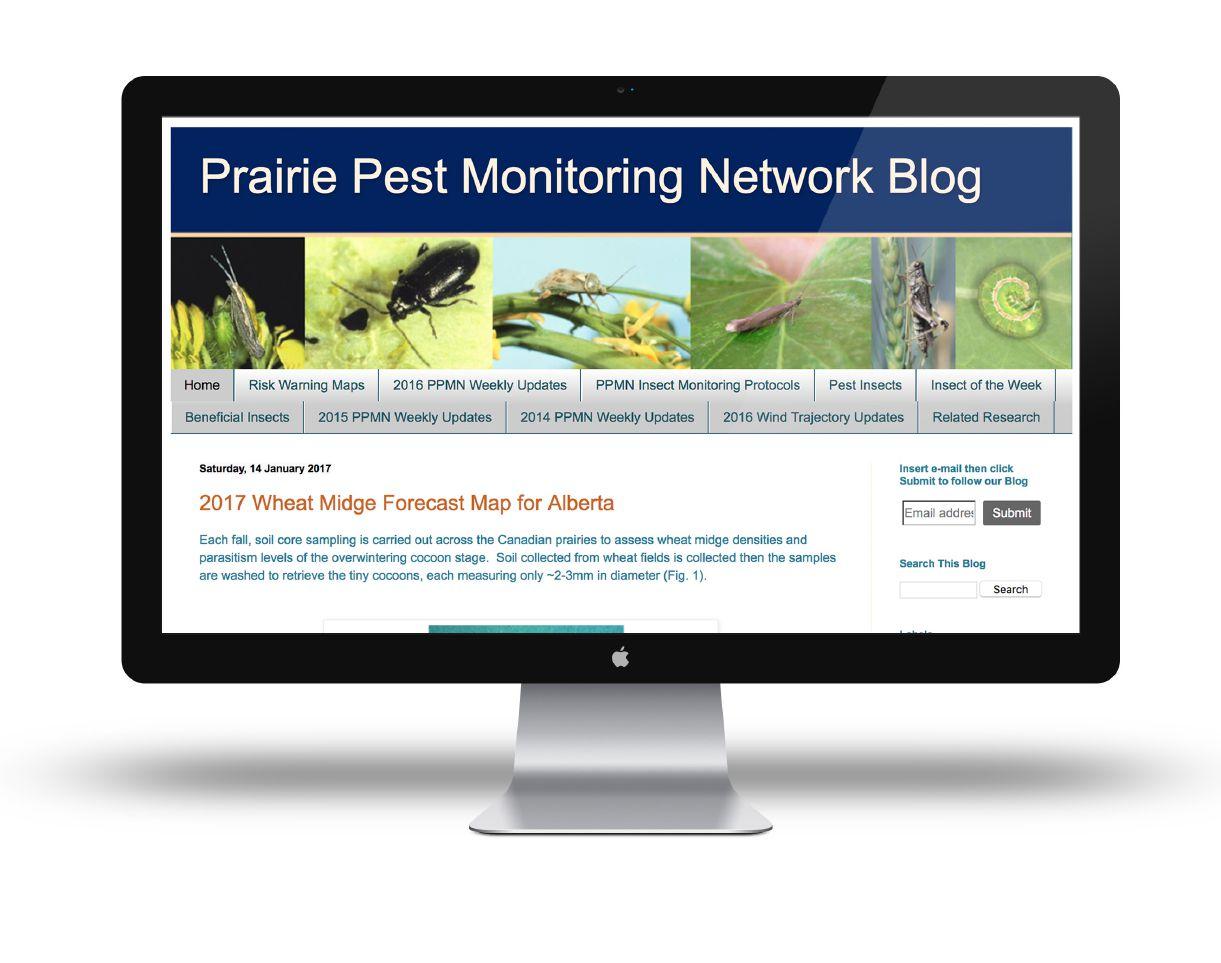
PPMN PASSES THE 20-YEAR MARK
Blogging reliable and timely Prairie-wide pest updates.
by Donna Fleury
The Prairie Pest Monitoring Network (PPMN), now in its 20 th year, continues to provide timely crop insect pest risk and forecasting tools for growers and the industry across Western Canada. As technology and forecasting tools advance, so does the ability of the network to provide relevant insect pest information related to scouting, identification and monitoring tools and information, plus links to provincial monitoring and support relevant to the Canadian Prairies. In 2015, the PPMN took advantage of new technology and moved to a regular blog with its own email subscription service to improve timely access and keep users regularly updated on emerging issues, especially during the growing season.
“The network was developed 20 years ago and is based on a unique integrated level of collaboration amongst various partners who are active in extension, research and field monitoring across the Prairie provinces,” says Jennifer Otani, pest management biologist with Agriculture and Agri-Food Canada (AAFC) and network co-ordinator. “The network’s ongoing collaboration amongst federal, provincial and
university entomologists, plus the integration of vast provincial networks of co-operators, generates the invaluable benefits of increased monitoring on a Prairie-wide scale using scientifically valid monitoring methods for multiple economically important field crop pests. And, as insect pests change and evolve on the Prairies, so does the network because its participants are able to meet and discuss what we’re observing in the field and in our research, what’s working and what trends are we seeing and, even more importantly, what’s emerging as important insect pest issues and where do our research gaps exist.”
The network researchers and collaborators combine data collection and their modelling expertise to develop insect pest risk maps and forecast maps for each province. The data is also used to develop and improve various bioclimatic modelling efforts, led by Owen Olfert, a research scientist at AAFC Saskatoon and one of the founders of the PPMN. Based on the data and risks identified, network participants work together to identify emerging pest
ABOVE: The PPMN Blog.
DON’T LET GROUP-2 AND GLYPHOSATE-RESISTANT WEEDS SLOW YOU DOWN.
Powered by the unique chemistry of Kixor, Heat LQ delivers the fastest, most complete burndown.
Strap yourself in. The convenient liquid formulation of Heat® LQ herbicide offers the fastest, most reliable weed control to get crops off to a clean start. It’s also the only solution that lets you choose between a pre-seed or pre-emerge application in cereals and pulses, with both burndown and the option for residual control. So why hesitate when it comes to resistance? Step on it. For details, visit agsolutions.ca/HeatLQ or call AgSolutions® Customer Care at 1-877-371-BASF (2273).
Always read and follow label directions.
BIOCLIMATIC MODELS IMPROVE PREDICTIONS
The long-term monitoring information and extensive database of the Prairie Pest Monitoring Network (PPMN) supports another important research project focused on bioclimatic mod elling. Led by Owen Olfert, a research scientist at Agriculture and Agri-Food Canada (AAFC) Saskatoon, the bioclimatic modelling long-term project is the foundation of the risk and forecasting components of the network. Olfert and his team have developed several robust models that use the monitoring data to help growers and industry prepare for established and new insect pest problems. Olfert and his team work with other scientists around the world to develop the best models possible.
“Through our bioclimatic modelling, we can assess the risk and forecast potential outbreaks of the various crop insect pests across Western Canada,” Olfert says. “There are three groups of insect pests that we are concerned about, including native species [e.g. grasshoppers, bertha armyworms], invasive alien species [e.g. cabbage seedpod weevil, wheat midge] and in sects that arrive during the growing season on wind trajectories [e.g. diamondback moth]. The native species tend to be cyclical and have natural enemies that help with control, however the invasive alien species are a major concern and require a collaborative effort to develop management strategies.”
Researchers have developed very robust bioclimatic models for most of the major insect pests and they have a good start on several others in terms of what might happen with changing weather patterns and climate. Warming conditions can affect insects by extending their growing season and life cycle, alter the timing of spring emergence and increase the rate of reproduction and development.
“One of the most important concerns of warming conditions is winters are expected to be milder and reduce the overwintering mortality of some of our insect pests,” Olfert says. “As climate changes, the distribution and abundance for many of these insects is expected to shift further north. For example, cabbage seedpod weevil is currently found mostly in the southern half of Saskatchewan, but with warming temperatures the population could easily shift north into more typical canola growing areas. With our models in place, we can have a bit of an advanced window to develop and transfer new IPM or mitigation tactics.” Having bioclimatic models in place also puts pest alerts out in advance and helps growers in these potentially new high-risk areas be more proactive in monitoring and assessing their risks. The models tend to focus on Western Canada, but are usually applicable for North America. The growing season monitoring data are used to validate existing models and to provide advance notice of new insect pests. For example, when cabbage seedpod weevil first appeared in southern Alberta, researchers worked with collaborators in Europe to develop bioclimatic models to predict the potential range and relative abundance of the insect pest and begin advance work on biological control.
“We are continuing to develop new bioclimatic models for new emerging insect pests and their natural enemies to predict the potential impact of climate on insect pest distribution and density,” Olfert says. “We will also continue to update existing models to ensure we are providing the best risk and forecasting maps possible, as well as address changes in growing conditions, climate and new crops. These models and tools help us keep growers and industry prepared to adapt to new management strategies and IPM mitigation tactics to manage existing and new crop insect pests.”
issues and research gaps, which helps participants, growers and the agricultural industry address critical insect pest issues. Examples of forecast maps include the Prairie-wide annual grasshopper forecast and wheat midge forecast maps. Both are released by mid-January and can help growers as they make their seeding decisions.
“The wheat midge forecast map identifies areas of high risk across the Prairies in January so growers hopefully use that information to seek out midge-tolerant cultivars to manage their risk,” Otani says. Likewise, the risk maps for bertha armyworm, cabbage seedpod weevil, swede midge, diamondback moth, wheat stem sawfly and pea leaf weevil all help growers and the agricultural industry review the previous growing season and identify areas of high risk so scouting can be prioritized for the next season.
During the growing season, the network helps keep growers, the agricultural industry and the general public informed by generating a weekly update. Each weekly update is a synthesis of scouting information, bioclimate predictions for significant economic pests, the rates of development for various insect stages, updates from provincial entomologists, plus links to relevant information. It’s all geared to help growers increase their knowledge of what to look for, how to look for it, and when to time their scouting to best manage and protect their crops.
“Historically, over 20 years, key stakeholders and participants were part of an email list that received weekly updates or risk and forecast maps, and then distributed that information through their networks,” Otani says. “However, as things changed and the distribution lists became increasingly difficult to manage with fewer people, the network decided to try a new approach with an online blog in 2015. We were looking for an efficient way to get information out quickly and potentially increase its accessibility. The blog now allows us to post the weekly updates online, either as a downloadable file or a series of searchable posts, and we can get it up very quickly.”
The blog offers additional benefits to participants, including the ability to subscribe and receive automatic email updates within 12 hours of an update being posted. The blog is fairly smartphonefriendly, too, so growers can access the weekly update’s scouting and monitoring tips plus hyperlinks, all while standing in the field.
An example of a PPMN blog risk map.
“We are trying to provide reliable information that is seasonally relevant in a format that is accessible and even links growers with additional resources like provincial sources and contacts,” Otani says.
During the growing season, the weekly updates profile seasonally appropriate information for insect pests – whether it’s scouting tips and details from predictive modelling work (which indicates what stages of which pests might be present that week), or highlights of emerging issues that growers should be scouting. Many subscribers review the current temperature, precipitation and wind trajectories. In 2015, reviewing this information helped time deployment of diamondback moth pheromone traps.
One of the surprises has been the popularity of the “insect of the week” feature posted on the blog throughout the growing season by Erl Svendsen with AAFC Saskatoon. Starting in 2015, an insect pest was featured every week in a post that linked directly to the pages of AAFC’s “Field Crop and Forage Pests and their Natural Enemies in Western Canada: Identification and Management Field Guide.” In 2016, natural enemies were featured weekly. “We’re excited that it’s popular because it’s showing us that people want to learn more about what’s in their fields,” Otani says. “Not all of those six- and eight-legged things in the field are pests. We hope growers are recognizing that their pest management decisions, particularly when densities remain below economic threshold, will have an impact on these organisms.”
Otani reminds growers that although the risk and forecast maps and weekly updates are great tools for keeping on top of potential insect pests, in-field monitoring is still critical. “The risk and forecast maps, along with the weekly updates, are best used as an outline or guide to be used by growers and agrologists so they can plan and build their own scouting plan. Ultimately growers need to be in their fields and actively monitoring, and absolutely remember that the maps and weekly updates are at a regional scale so it’s vital to get out and confirm what’s in individual fields so you can make informed decisions.”
Monitoring remains the foundation of the network and allows researchers to better understand these economically important insect pests in terms of the crops they affect and how pest densities change over time and geography.
Monitoring remains the foundation of the network and allows researchers to better understand these economically important insect pests in terms of the crops they affect and how pest densities change over time and geography. The monitoring data is also very important in helping establish priorities for research and future directions for research programs and bioclimatic modelling strategies.
To access and sign up for the blog, visit prairiepestmonitoring.blogspot.ca.
“ It’s important for us to connect with those who aren’t involved in ag and explain what
Pamela Ganske, Agvocate Ag Retailer
SOYBEANS
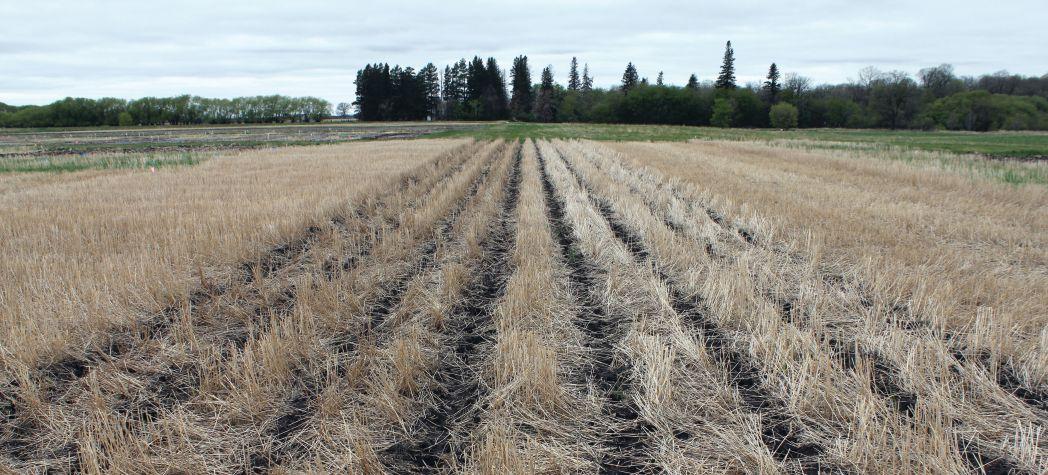
TO DISC OR NOT TO DISC?
Manitoba research evaluates options for residue management before soybeans.
by Carolyn King
Alot of Manitoba soybean growers are using tillage to try to extend their growing season by warming up and drying out their soils earlier in the spring. They want to be able to plant earlier so their soybeans will have a good chance of maturing before a fall frost arrives,” says Yvonne Lawley, a professor of agronomy and cropping systems at the University of Manitoba.
But tillage costs growers time and money and increases the risk of soil erosion. So, she explains, “Our research question was: do farmers need to use tillage to grow soybeans well in Manitoba?”
To answer this question, Lawley and her graduate student, Greg Bartley, conducted a two-year field project. They chose wheat for the crop before soybeans because this is a common rotational sequence in the province. They set up five different residue treatments in the fall, then planted soybeans the following spring. Soybeans were grown in 2014 and 2015.
“The control treatment was the conventional tillage practice [for this region], where we disced the soil in the fall and the spring to make the soil as black as possible,” says Bartley, who is currently finishing his master’s thesis and is also the On-Farm Network coordinator for the Manitoba Pulse & Soybean Growers. “We had two no-till treatments: a short stubble that was about 15 centimetres high, and a tall stubble that was about 40 centimetres high. We also had a strip till treatment. We tilled strips about [10 to 15 centimetres wide] where the soybeans would be planted, and the rest of the field was left undisturbed.”
“The final treatment was a fall rye cover crop. We planted fall rye in the fall and let it establish in the spring. We planted soybeans
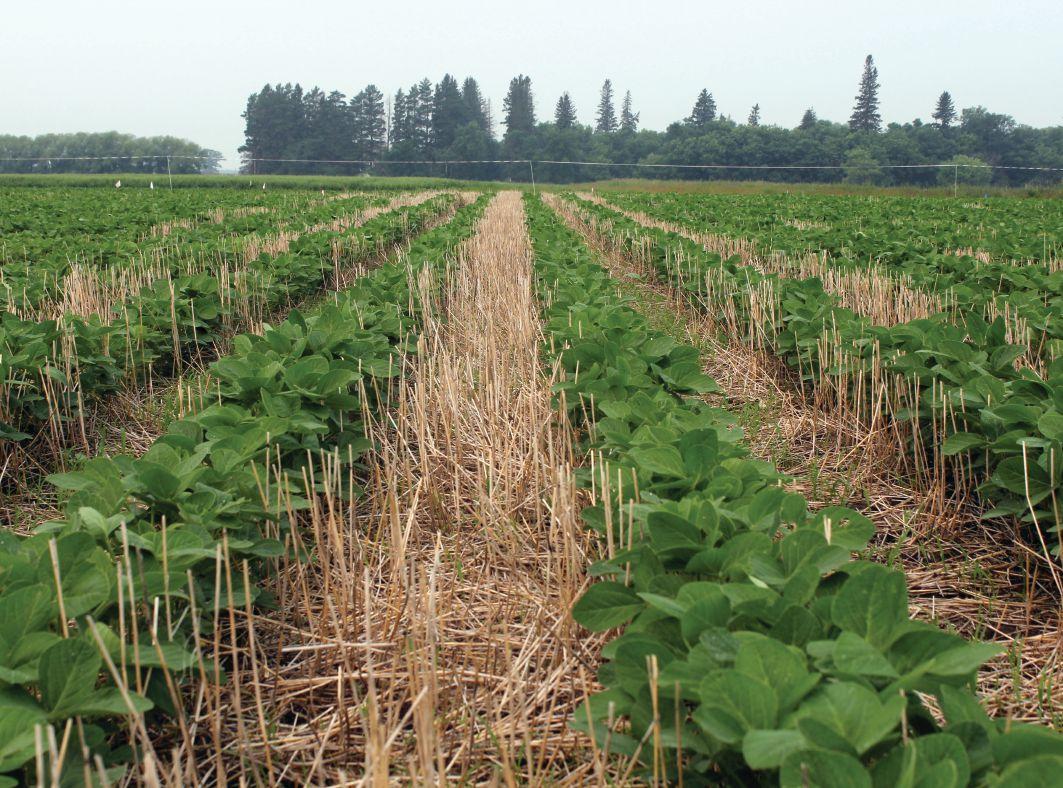
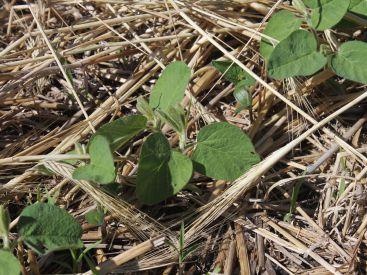
TOP: The project’s tall stubble treatment produced soybean yields that were as good as or better than the disc treatment. INSET: In 2015, when the project team had a planter that could handle crop residues, soybean yields were the same in all the treatments – even the fall rye cover crop.
PHOTOS COURTESY OF GREG BARTLEY.
I will be a trailblazer by recognizing opportunity and embracing the future. I will meet challenges head-on, adapt and overcome. I will continually challenge the status quo and place my trust where it is deserved.
straight into that living fall rye crop and then we sprayed out the rye right after planting.”
The project took place in Carman, Man. At that location, the soils are managed conventionally, so the no-till treatments had less thatch than would be typical in fields under long-term no-till systems.
The project team followed the current recommendation to plant soybeans when the average soil temperature is at least 10 C; they waited to plant until about the third week of May when all the treatments were above that temperature.
In 2014, they used a disc drill that had little ability to seed through crop residue. In 2015, they opted to use a planter with good residue capabilities.
The team collected data on a number of factors, such as soil temperature, amount of residue ground cover, soybean emergence and final plant stands, and soybean yields.
“The soil temperature differences between the treatments weren’t as big as I would have expected,” Bartley says. “The black part of the strip till treatment had the highest daytime temperatures, about a degree or two higher than the next warmest treatment, which was the conventional disc tillage.”
Lawley thinks the tilled strips had the highest daytime temperatures because of the way the strip till unit worked and shaped the soil. “Strip tillage is very intensive with the unit we were using, so we had a black, fluffy, warm seedbed. Also the strip till unit creates
a berm that catches the sun, which may have also made the strips warm up faster, compared to a flat surface.”
The team found the soil temperatures in the tall stubble treatment were very similar to those in the disc treatment. In contrast, the short stubble treatments had cooler daytime soil temperatures that were similar to those in the undisturbed, residue-covered parts of the strip till treatment. That’s because when stubble is cut shorter, more straw will be laying on the soil surface, creating a residue blanket that slows soil warming.
With soil temperatures above 10 C at planting, soybean emergence was good. Bartley says, “All the soybeans emerged relatively quickly and there was little difference in emergence between the different treatments.” For example, in 2015, at 10 days after planting, there were some differences in emergence, with the strip till treatment having the highest emergence and the short stubble the lowest. About a week later, the plant stands in all the treatments were very similar.
A key factor influencing soybean emergence and final plant stands was the type of planting equipment used. “In 2014, when we didn’t have a seeder that could cut through residue or handle residue very well, we saw a reduction in the soybean stand in the living fall rye treatment, but not in either of the stubble treatments,” Lawley says. “In 2015, when we had a planter that could handle planting into residue, our final plant stand counts were the same in all the treatments – even the cover crop treatment,
In the spring, the black part of the strip till treatment had the highest daytime temperatures of all the treatments, including the disc tillage.
When the stubble was cut shorter, more residue lay on the soil, creating a residue blanket that slowed soil warming.
The project’s control treatment was discing in the fall and spring, which can increase the risk of soil erosion.
which had the most residue.”
Soybean yields in 2014 were fairly similar for most of the treatments: the strip till and tall stubble treatments each yielded 39 bushels/acre (bu/ac), the discing treatment yielded 35 bu/ac, and the short stubble treatment yielded 34 bu/ac. The exception was the fall rye treatment, which had a significantly lower yield of 29 bu/ac. “In 2014, when the plant stand count was lower in the fall rye treatment, we also saw a yield hit in that treatment,” Bartley says. “However, in 2015, when we used that planter [that could handle residue] and got good stands in all the treatments, there were no differences in soybean yields. All the treatments had between 53 and 54 bushels per acre.”
What the results mean for growers
“Our findings show you can plant soybeans without tillage, but you need to think about leaving the wheat stubble taller,” Lawley says. “Our findings also point to strip tillage as a possible fit for some growers. If you’re not comfortable with the straw residue, then strip tillage may be a good compromise because you have tillage in that row for planting soybeans and you also have residue where it’s needed to protect the soil.”
“We also learned that the planter itself is very important, especially if you’re working in higher residue environments,” she added. The planter needs to operate effectively for the field’s residue conditions.
The project was funded by the Western Grains Research Foundation, Growing Forward 2 and the Manitoba Pulse & Soybean Growers, and Bartley received a scholarship from the Natural Sciences and Engineering Research Council of Canada.
Next steps
Lawley sees two important next steps for this research. “One is that we need to take this experiment to western Manitoba, into areas that have been in no-till production for many years and have more thatch than the soils at Carman. In those areas, the use of tillage before soybeans is a more pressing issue in terms of the long-term sustainability of the cropping system,” she says.
“The other step is to look at early versus the ideal planting date in these treatments. We started working on this in 2016 at Carman and we will repeat the experiment in
2017. In 2016, we took the three top treatments [from Bartley’s project] – the strip till, tall stubble and discing treatments – and looked at early and late planting of soybeans in those three treatments.”
Other studies by Lawley’s group are indicating early planting dates could result in higher soybean yields in Manitoba, even when soil temperatures at planting are as cool as 6 C. So, early planting could be a better choice for growers.
It may also be that early planting
might result in some soybean yield differences between the three wheat residue treatments.
Lawley is also hoping to do more work on options for seeding soybeans into a fall rye cover crop, like strip tilling of the cover crop.
“I would like to look at whether we can overcome some of the challenges we see with giving soybean plants enough time and space to establish within the cover crop.”
Crops really go for ESN® SMART NITROGEN®, and so does your bottom line. That’s because its unique technology responds to the same factors that spur plant growth. How does it do it? ESN is a urea granule encapsulated in a polymer coating that protects the nitrogen from loss through leaching, volatilization and denitrification. ESN technology controls its release to match plant demand based on soil temperature. Your crops get the nitrogen they need, when they need it. That’s what we mean by responsive. Minimize N loss. Maximize Yield.
DISEASE DEFEATED IN FOUR QUICK MOVES.
Crop diseases travel fast. Your fungicide needs to move quicker. DuPont™ Acapela® fungicide unleashes 4 unique movement properties to surround and penetrate each plant, stopping key diseases in canola, cereals, corn, soybeans and pulses. And because it’s rapidly absorbed, you can spray even under challenging conditions. Acapela® delivers more consistent protection and plant performance bene ts for a greener, healthier plant, so you can take your yields all the way.
Questions? Ask your retailer, call 1-800-667-3925 or visit acapela.dupont.ca
OPTIMIZING DESICCANTS IN LENTIL
Glufosinate or diquat tank mixed with glyphosate aid dry down without adverse effects.
by Julienne Isaacs
Most lentil producers in Western Canada use preharvest desiccants in lentil for two reasons: to speed up crop dry down, which helps with ease and efficiency of harvest, and to achieve perennial weed control going into the next growing season.
But the wrong tank mixes – or the wrong timing – for desiccant application may result in unintended consequences.
In 2011, the European Union rejected a shipment containing Canadian lentils for exceeding its 0.1 parts per million (PPM) default maximum residue limit (MRL) for glyphosate. Following that episode, Pulse Canada reached out to the University of Saskatchewan, asking researchers to look into growing conditions that might precede similar trade issues in the future.
“In 2013, after a year or two of hard lobbying, the EU did increase the glyphosate MRL to 10 PPM, but at the same time we had already begun our research to build on the things that were known in other pulse crops about glyphosate used as a desiccant in combination with other products,” says Christian Willenborg, an associate professor in the university’s department of plant sciences.
Pyraflufen-ethyl and flumioxazin didn’t have an adequate effect on dry down and also failed to consistently decrease glyphosate residues.
Similar work had just been initiated in bean crops by researchers at the University of Guelph, so Willenborg and his graduate student, Ti Zhang, took their inspiration from that project.
From 2012 to 2014, they conducted field trials in Saskatoon and Scott, Sask., to test whether a variety of desiccants applied alone or tank mixed with glyphosate improved desiccation and reduced the potential for high glyphosate residue in lentil seed.
Treatments tested in the study included glufosinate, diquat, saflufenacil, pyraflufen-ethyl (not registered) and flumioxazin (not registered) applied alone and mixed with glyphosate.
The researchers found the best combinations were glufosinate or diquat tank mixed with glyphosate.
“Basically, glufosinate and diquat, when they were mixed with glyphosate, were the most consistent, and resulted in a general reduction in seed residues,” Willenborg says. These treatments had no
effect on yield or seed weight.
By contrast, saflufenacil didn’t result in the reduction in residues the researchers were looking for. Pyraflufen-ethyl and flumioxazin didn’t have an adequate effect on dry down and also failed to consistently decrease glyphosate residues.
Timing
The right desiccant combinations are not the only consideration for growers hoping to optimize dry down and minimize residues. Timing is another major factor.
“Applying too early can result in high herbicide residue lev-
PHOTO
Glufosinate or diquat tank mixed with glyphosate had no effect on yield or seed weight.
els concentrated in the seed and it can also detract from crop yield and quality,” Willenborg says. “If you’re a seed grower, applying glyphosate too early can often inhibit germination for the following year. It detracts from yield because if you get it too early you’re stopping the plant from filling those seeds.”
Proof that desiccants are being applied too early comes in the form of shriveled seeds and higher residue levels later on.
But desiccant application timing is a catch-22 situation for many growers.
“Part of the reason it’s happening too soon is that it’s hard for growers to time it exactly, and the other reason is pragmatic. We have big farms and, when frost is coming, they need to get that product dried down and sometimes they have to pull the trigger,” Willenborg says. “Maybe it’s not the best time, but they have to get that crop off.”
A second aspect of Willenborg and Zhang’s desiccant study looked at application timing. Results from this component of the study were published early this year in Agronomy Journal
Treatments were applied at seed moisture content levels ranging from 20 per cent to 60 per cent. Based on residue levels and crop yield and quality, the researchers concluded applications before 30 per cent seed moisture resulted in detrimental effects.
“Regardless of the product chosen, our results with respect to seed residue levels show it is imperative to ensure applications of glyphosate or saflufenacil are not made prior to the 30 per cent seed moisture stage,” the authors concluded.
Willenborg suspects premature application of desiccants is happening in other crops as well. He’s just begun a similar study in fababean, for which good desiccant choices are not known. Willenborg says it’s possible tannin and non-tannin varieties have different responses to treatment.
He’s also working on a major oat research project instigated by a push from grain millers to reject oats treated with pre-harvest desiccants.
Further research is needed to look at the effects of desiccant products and application timing in many crops, but for now the chapter’s closed on lentil. All that remains is getting the word out to growers.
For more on Pulses, visit topcropmanager.com.
THIS IS THE ONE
CDC TITANIUM is an excellent choice — anywhere across the Prairies — for yield and agronomics that include a complete disease package. It’s the leading CWRS choice on acres with the potential for midge and rusts. CDC TITANIUM. Proven performance, and more, on farms across Western Canada. This is the one, available only at your CPS retail.
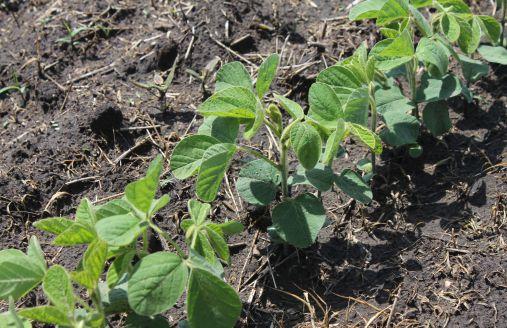
NO SIMPLE SOLUTION FOR WEED CONTROL IN PULSES
An overview of current weed control research.
by Bruce Barker
Weed control challenges are becoming even more difficult as the number of herbicide-resistant weeds in pulse crops continues to grow. With more than 60 unique cases of herbicide resistance identified in Canada and some weeds developing resistance to key pulse herbicides such as Pursuit (imazethapyr, Group 2) and Solo (imazamox, Group 2), the challenges will become even more daunting in the future.
“Canada has the third highest recorded number of herbicideresistant cases in the world,” says Eric Johnson, a research assistant at the University of Saskatchewan. “One of the biggest concerns is the rapid increase in Group 9- or glyphosate-resistant weeds over the last 20 years.”
Group 2 and 9 herbicide-resistant kochia has been identified across the Prairies, and Group 2- and 4-resistant kochia was recently identified in Western Canada. Group 2-resistant cleavers is a challenge for pea growers, and Group 2-resistant kochia, stinkweed and wild mustard challenges lentil growers. Glyphosate-resistant Russian thistle has been confirmed in Montana.
“There won’t be easy solutions as resistant weeds become more prevalent. We are screening a number of potential herbicides but haven’t made a lot of progress,” Johnson says. “It will take an integrated approach that will rely on multiple herbicides and different cultural practices.”
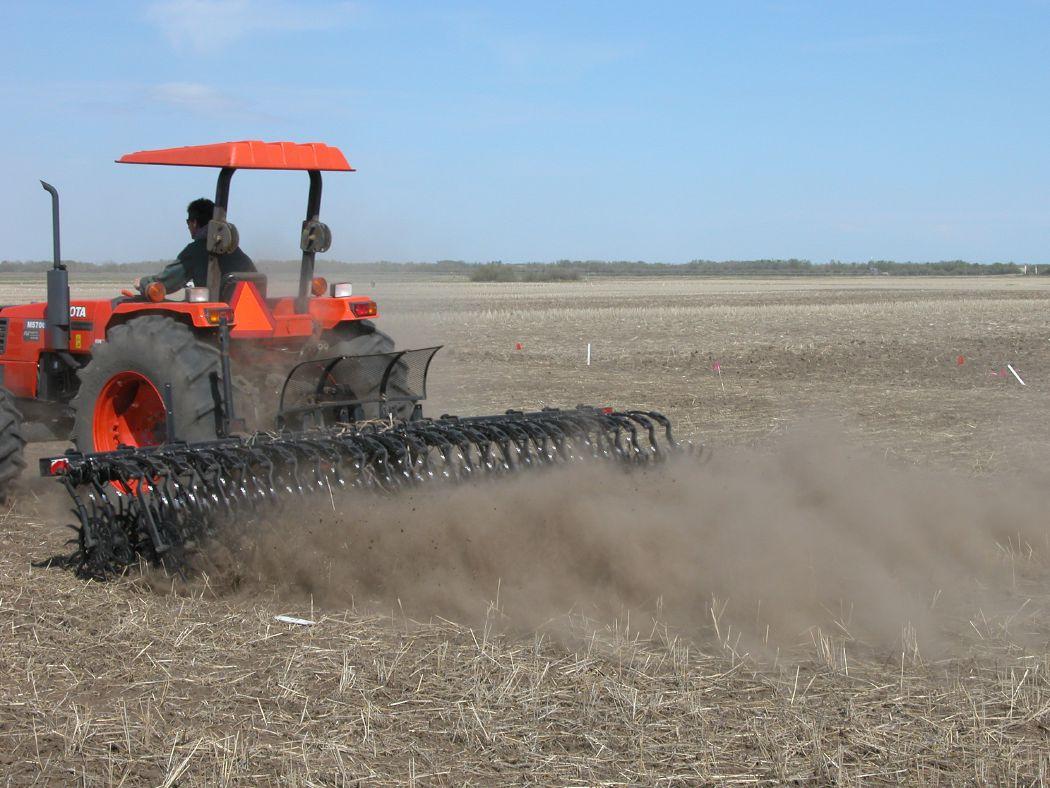
Some of the research being done at the University of Saskatchewan, led by Chris Willenborg and Steve Shirtliffe, includes cultural practices such as increasing seed rates and using competitive cultivars, as well as mechanical approaches, such as rotary hoeing, inter-row cultivation, weed wiping, crop topping, weed seedhead clipping and use of the Harrington Seed Destructor.
Lentil herbicide research
In lentils, herbicide research is underway looking at Valtera herbicide (flumioxazin, Group 14), Focus herbicide (pyroxasulfone and carfentrazone; Groups 15 and 14, respectively), and post-emergent
ABOVE: Research found rotary hoeing could be used to control weeds and protect yield potential.
PHOTOS COURTESY OF ERIC JOHNSON.
Every season starts with hope. We hope for good soil, good weather and low disease pressure. But now there’s a way to get even more than you hoped for. Trilex® EverGol® seed treatment for pulses provides a better start to the season with exceptional protection from diseases like rhizoctonia and ascochyta. Additionally, it promotes overall plant health, resulting in a higher performing root system, increased biomass, faster emergence and superior yield. Take your pulse crop health to a new level, because it’s not just about surviving, it’s about thriving.
Learn more at cropscience.bayer.ca/Trilex A strong pulse.
Cadet herbicide (fluthiacet-methyl, Group 14) as a tank-mix with Solo or Sencor. Only Sencor and Solo (Clearfield lentil only) are currently registered on lentil.
Valtera is a soil-applied herbicide with a shorter residual than Authority herbicide, and controls broadleaf weeds like chickweed, kochia, lamb’s-quarters and pigweeds. Spring-applied Valtera had injury risk to lentil. In limited site-years of research, fall-applied Valtera provided acceptable control of the early flush of kochia, but further research is required to confirm efficacy and crop safety.
Focus herbicide is highly effective in controlling downy and
of cleavers but not wild oat.
For wild oat control with pyroxasulfone, Johnson says research has shown an average of about 70 per cent control, but with a range of 40 to 90 per cent control. Limited research found wild mustard control at about 50 per cent and effective cleaver control on soils with three to five per cent organic matter content.
“For kochia, we had a range of zero to 90 per cent control depending on spring rainfall. Any level of control for kochia would be a bonus for pyroxasulfone in pulse crops,” Johnson says.
“What we are finding with all the research that has been done is that there are no silver bullets.”
Japanese brome in winter wheat. It is applied prior to seeding or up to three days after seeding spring or winter wheat. At labelled rates, it controls a range of grassy and broadleaf weeds including kochia, lamb’s-quarters, stinkweed, pigweeds, and cleavers.
Johnson says their research has found that pea and lentils exhibited good tolerance to the pyroxasulfone active in Focus, with pea showing better tolerance than lentil. Chickpea appears to have very good tolerance as well.
Weed control requires moisture and a dry spring can result in poor weed control. Research in Scott, Sask., under dry spring conditions showed fall application could successfully control wild oat and cleavers, while spring application had good control
Cadet herbicide is a corn and soybean herbicide registered in the United States for post-emergent control of broadleaf weeds. Researchers at the University of Saskatchewan are looking at the herbicide as a tank-mix partner with Solo or Sencor in lentils. Researchers found improved control of wild mustard in lentil as seeding rates increased from 70 seeds per square metre to 280 seeds per square metre. The recommended target plant population is 120 plants per square metre.
Other pulse weed control research
In chickpea, the focus of weed control has been to develop varieties that are tolerant of imidazolinone (IMI) and can tolerate application of Solo herbicide. All varieties under development will have IMI tolerance and a minor use permit has been submitted for registration of Solo herbicide on IMI-tolerant chickpea. However, Solo will not control Group 2-resistant weeds.
In field pea, herbicide layering is a management approach that
Weed wiping (centre plot) reduced the production of wild mustard seed in lentil plots.
uses both pre- and post-emergent herbicides offering different modes of action to reduce the risk of weed resistance and improve overall weed control. The main focus has been on controlling Group 2-resistant cleavers on soils with soil organic matter greater than five per cent.
“The ideal approach would be to layer different herbicide groups like Group 3 or Group 4 to help control Group 2-resistant weeds,” Johnson says.
Research in Rosthern, Sask., in 2014 demonstrated the concept and found the following combinations provided acceptable control of Group 2-resistant cleavers in pea:
• Fall Edge (ethalfluralin, Group 3) followed by spring pre-emerge Authority (sulfentrazone, Group 14)
• Fall Edge followed by spring postemerge Viper (imazamox and bentazon, Groups 2 and 6, respectively)
• Spring pre-seed Heat (saflufenacil, Group 14) followed by post-emerge Viper
• Spring pre-emerge Authority followed by post-emerge Viper
• Spring pre-emerge Command (clomazone, Group 13) followed by postemerge Viper
In fababean, research has been conducted to support minor use registrations of Heat pre-seed, Authority pre-seed, Viper post-emergent, and Heat and Heat plus glyphosate for desiccation. Data has been generated at both the University of Saskatchewan and the Scott Research Farm, and Johnson is hopeful that these potential minor uses will be submitted and registered in the future
Integrated control research
The University of Saskatchewan weed science and agronomy programs (led by Willenborg and Shirtliffe, respectively) have been involved in multiple studies looking at other non-traditional herbicide and non-herbicide weed control methods.
One method used a weed-wiping wick to reduce wild mustard seed production in lentils. Wild mustard grows above the lentil canopy, so the weed can be wiped with a wick without touching the lentil stand. The best result was obtained with 2, 4-D or glyphosate when 80 per cent of the wild mustard had bolted. Seed production was basically eliminated. Delaying herbicide wiping past 80 per cent bolting resulted in increasing wild mustard seed
production.
In Australia, Johnson says crop topping is used to control ryegrass at the post-flowering to soft-dough stages using diquat and paraquat herbicides. Growers will even sacrifice crop yield to apply the herbicide at the right timing. A University of Saskatchewan research trial with bromoxynil, diquat, fluroxypyr, Liberty and Heat did not reduce wild mustard seed production in lentil at any stage tested in the first year of trials. In a different desiccation study, Liberty was shown to reduce kochia seed production when desiccating lentils at physiological maturity.
Another research trial led by Shirtliffe at the University of Saskatchewan compared integrated mechanical and herbicide control methods and the impact on lentil yield and net profit. In this experiment, three seeding rates were used for an extra small red lentil (130, 260, and 520 plants per square metre) and six levels of weed control: control; rotary hoe; Heat; one-half Sencor; full rate Sencor; Heat plus half Sencor plus rotary hoe). Rotary hoeing was performed as required when weeds were in the white-thread stage.
Seeding small red lentils at 260 plants per square metre (double the normal rate) resulted in the greatest economic return under this system.
Yields were even higher with good herbicide control. In 2011 and 2013 with “normal” growing conditions, the highest net profit was the full herbicide treatment at the 130 plants seeding rate, followed closely by the half Sencor rate and full herbicide treatment at the 260 seeding rate, and the integrated approach at the 520 plants seeding rate.
In 2012 (a wet year) rotary hoeing at both 130 and 260 plants per square metre had the highest net returns.
Many of the other treatments had similar or even lower profitability than the control treatment with no weed control methods.
“What we are finding with all the research that has been done is that there are no silver bullets. One of the main problems is the frequency in which producers grow pulses – in particular, lentils. If growers want to grow lentils every second year, they are going to have to expect more problems with resistant weeds,” Johnson says.
Want to Boost Spraying Productivity?
Turbocharge Your Efficiency with the Spray Fill Xpress
•Decreases 30-minute fill times to just 7 minutes, increasing productivity by 82 percent.
•Unique batching system safely stores precisely measured chemicals until delivered to the sprayer.
PROFIT CLIMBS.
Exciting, isn’t it? The start of a new season and another opportunity to prove yourself. Bag after bag, field after field — Nexera™ delivers hybrid performance and profit potential that’s higher than any other canola on the market.
SEED FOR YIELD, CONTRACT FOR PROFIT.™
See your contractor or retail. NexeraCanola.ca
BIOFORTIFICATION OF PULSES COULD MAKE CANADA A ‘PREFERRED SUPPLIER’
No biofortified pulse crops are in the field yet, but they’re on the way.
by Julienne Isaacs
Biofortification is the process by which the nutritional profile of a given food crop is improved through plant breeding. In Canada, the biofortification of pulse crops to improve micronutrient content (or “trace elements”) is becoming a major focus of breeding programs.
Tom Warkentin, a breeder at the University of Saskatchewan’s Crop Development Centre (CDC), has been working on the biofortification of pea crops for several years. Before breeding projects began, Warkentin and his colleagues surveyed pulses grown in Saskatchewan (pea, lentil, chickpea and common bean) and looked at the levels of micronutrients in harvested seeds.
“We found they’re all quite rich in many minerals, including iron [and] zinc,” Warkentin says. “We looked at a series of varieties within each crop and a series of growing regions, and did the statistics. If you were going to describe them nutritionally, you could
say they were a good source of those nutrients.”
But how available are those nutrients to the human diet? Much of Warkentin’s work revolves around phytate, the major storage form of phosphorous in seeds. Warkentin says phytate is a negatively charged molecule that can’t be easily digested by humans since it passes through the gut, carrying positively charged nutrients like iron and zinc along with it. This means these nutrients are essentially lost to us.
Low-phytate crops have been a focus of several breeding programs in North America for the past two decades, Warkentin says. He and his colleagues at the CDC began working with low-phytate pea in 2002, and discovered these lines have at least 50 per cent
ABOVE: Warkentin’s project is mainly focused on breeding peas with increased availability of the micronutrient iron, as well as zinc, selenium and potassium.
PHOTOS
Special Delivery for Your Crops.
Nu-Trax P+™ with CropStart™ Technology turns every granule of your fertilizer blend into a special delivery of early season nutrition.
Nu-Trax P+ is the ideal blend of phosphorus, zinc and other nutrients essential for vigorous crop growth. Featuring patented EvenCoat™ Technology, it coats onto dry fertilizer, ensuring blanket-like distribution near young plant roots.
See how Nu-Trax P+ can deliver the agronomic benefits of a starter to your crops. Ask your retailer to add Nu-Trax P+ to your dry fertilizer blends.
SEED EVERYTHING AND THE KITCHEN SINK.
Mix what you want, seed what you want with the freedom of Aim.
Get a more complete burn down that lets you seed almost anything. Tank mix Aim with your choice of products, so you can use what you’re used to with superior results and no fear of cropping restrictions.
Biofortified peas rich in micronutrients like iron could help address “hidden hunger,” a vitamin and mineral deficiency that affects an estimated two billion people around the world.
more available iron compared to normal varieties.
‘Micro’ breeding
Warkentin’s project is mainly focused on breeding peas with increased availability of the micronutrient iron, as well as zinc, selenium and potassium. The first is a key component in what’s often called “hidden hunger,” a deficiency in vitamins and minerals that, according to World Health Organization estimates, currently affects two billion people worldwide.
Iron is also a focus for Ravindra Chibbar, Canada’s research chair in molecular biology for crop quality and a professor in plant sciences at the University of Saskatchewan. Chibbar has recently made strides in screening for micronutrients in plant samples.
“If you want to biofortify crops, whether it’s cereals or pulses, you first need to have a method to see what elements are in the seed already,” he says.
Most methods of analysis look at one element at a time and rely on chemicals that ultimately destroy the sample. At the Canadian Light Source in Saskatoon, Chibbar’s team has developed a high throughput screening method that can analyze multiple minerals in a batch of 84 grain meal samples without any chemical treatment.
Using data from this analysis, Chibbar can identify the genotypes of different crop types with high or low micronutrient content. The micronutrient analyses, combined with DNA marker technology, can identify genomic regions associated with mineral concentration.
IMPROVING THE NUTRITION PROFILE OF PULSES
Joyce Boye, director of research, development and technology at the Agriculture and Agri-Food Canada (AAFC) Summerland Research and Development Centre in B.C., is focused on another angle of pulse nutrition.
As one of five United Nations Food and Agriculture Organization special ambassadors for the International Year of Pulses in 2016, Boye spent the year getting the word out about the benefits of pulses for the human diet and the environment.
But in the past, her research has zeroed in on the impact of processing methods on the composition of pulses and their nutritional value overall.
“Depending on the cooking process you use, you can modulate or change the content of anti-nutritional factors such as
“If we know the genomic regions, we can use genetic markers in marker assisted selection to accelerate the development of new varieties with desired mineral concentration,” Chibbar says. He is working in collaboration with colleagues in India at the International Crops Research Institute for the Semi-Arid Tropics (ICRISAT), who are developing biofortified lines of chickpea.
These researchers send new mapping populations to Chibbar’s lab for analysis; the breeding lines with increased mineral concentrations they ultimately develop can be used in breeding programs globally.
“Biofortification is a major focus for crop improvement all over the world,” he says.
There’s still breeding work to do before new varieties will hit the market –low-phytate varieties tend to perform well overall but are still lower-yielding than normal varieties – but Warkentin hopes to send something to the national variety trials within a year.
Warkentin says his breeding program is focused on crossing low-phytate lines with the best high-yielding pea breeding lines that will result in new varieties highly adapted to Canadian growing conditions.
There’s still breeding work to do before new varieties will hit the market – low-phytate varieties tend to perform well overall but are still lower-yielding than normal varieties – but Warkentin hopes to send something to the national variety trials within a year.
Warkentin says farmers often ask how these new biofortified varieties will benefit their bottom line.
“Whenever we try to improve a food crop, it doesn’t necessarily directly make money for the farmer, but indirectly I think it does,” he says. “If a country has an advantage over another country’s crop we might become a preferred supplier.”
JOIN THE UNDERGROUND REVOLUTION
Take a stand against resistance.
Arm yourself with the residual broadleaf control of Authority – a Group 14 pre-emergent herbicide. It’s your secret weapon for cleaner fields and higher yields.
phytic acid [phytate] in pulses,” Boye says. “This can complement breeding to improve the nutritional quality of pulses.”
Boye has also studied protein digestibility in pulses – in other words, the ratios of “limiting” amino acids in different pulse crops, which can impact the quality of their protein.
“How the body breaks these down is affected by processing,” she says. “We looked at how we could increase the digestibility of proteins in order to increase their nutritional quality.”
Boye says it’s critical to look at pulse nutrition from both the breeding and processing standpoints. This will ultimately help industry stakeholders increase the nutritional value of pulse crops and bolster demand domestically and abroad.
UPDATING N RECOMMENDATIONS FOR WHEAT
Nitrogen management is essential for high-yielding, high protein wheat.
by Carolyn King
What nitrogen rates should you use with today’s high-yielding hard red spring wheat varieties to reach your yield and protein goals? And what are the optimum choices for nitrogen (N) fertilizer sources, placement and timing? A two-pronged research effort is underway to answer these crucial questions for Manitoba wheat growers.
“It has been about 40 years since Manitoba did some of the experiments to determine wheat’s nitrogen fertilizer needs. So our historical recommendations are limited to obsolete wheat varieties like Neepawa that don’t yield as much as today’s varieties, and the yield goal is limited to 50 bushels per acre maximum yield,” notes Don Flaten, a soil scientist at the University of Manitoba. “But modern wheat varieties are yielding up to 100 bushels per acre. So if we use our traditional rule of thumb of 2.5 pounds of N per bushel of wheat for milling quality, we would need 250 pounds of N, as soil nitrogen plus fertilizer nitrogen, to achieve the yield potential of the current varieties.”
Such rates would be well above traditional nitrogen rates. “We were concerned that such high rates would be agronomically risky, because the risk of lodging or disease with all that nitrogen at planting could be very substantial, and also economically risky,” Flaten says. He adds it would also be environmentally risky, due to leaching and gaseous losses of nitrogen to the environment.
The Manitoba Wheat and Barley Growers Association (MWBGA) and John Heard, soil fertility extension specialist with Manitoba Agriculture, shared Flaten’s concerns. They have joined forces to reexamine Manitoba’s nitrogen fertilizer recommendations in light of the new high-yielding wheat varieties.
This work has two components: a small-plot project led by Flaten and his colleagues at the university, comparing a large range of nitrogen management options; and on-farm strip trials co-ordinated by Heard, which are looking at a few key possibilities.
Many, many small-plot treatments
The two-year, small-plot project started in 2016 with funding from the MWBGA. It involves six sites across Manitoba: two intensive “gold” sites hosted by the University of Manitoba and four less intensive “silver” sites managed mainly by Manitoba’s Diversification Centres. Amy Mangin, a technician in the university’s department
In the small-plot trials in 2016, the post-anthesis foliar nitrogen treatments had slightly lower yields, probably due to leaf burn.
of soil science, is managing this complex project’s diverse nitrogen rate, source, timing and placement treatments. Table 1 lists the treatment details.
One group of treatments is studying nitrogen fertilizer in a single spring application. These treatments are comparing rates from zero to 200 pounds per acre, applied as urea mid-row banded at seeding or as Agrotain-treated urea broadcast after seeding. Agrotain, a nitrogen stabilizer, is added to reduce volatilization losses from the
PHOTO COURTESY OF AMY MANGIN.
You’ve identified volunteer canola as a weed. Now it’s time to deal with it. For control of all volunteer canola, tank mix Pardner® herbicide with your pre-season application of glyphosate. Make Pardner your first choice.
Table 1. Treatment list for University of Manitoba (gold) and Diversification Centre (silver) small-plot sites across Manitoba
Brandon (CWRS) and Prosper (CNHR)
80 30
80 60
80 30
80 60
Urea (gold), Agrotain-treated urea (silver)
ESN:Urea (40:40)
ESN:Urea (100:40)
Urea, Agrotain-treated urea
Mid-row band at seeding (gold), Broadcast after seeding (silver)
Agrotain-treated urea
80 30 UAN
80 30
broadcast urea. The other group of spring-only treatments involves two combinations of environmentally smart nitrogen (also known as ESN, polymer-coated urea) and urea, to see if ESN provides yield and/or protein advantages.
The project is also evaluating various split nitrogen treatments to see if applying some of the nitrogen later in the growing season helps reduce the problems associated with a single application of a high fertilizer rate at planting. Researchers are applying 80 pounds of nitrogen per acre at planting (either mid-row banded urea or broadcast Agrotain-treated urea), and then applying another 30 or 60 pounds in-season.
These in-season applications are applied at stem elongation, flag-leaf, or one week after flowering (anthesis). Flaten notes, “The applications at stem elongation and flag-leaf are designed to increase both yield and protein. The applications at a week after anthesis are for increasing protein only.”
The stem elongation and flag-leaf applications are broadcast Agrotain-treated urea. The post-anthesis applications are liquid foliar applications: either a urea ammonium nitrate (UAN) solution diluted by 50 per cent with water, or urea dissolved in water, which is thought to be a little less damaging to the plant’s leaves. To reduce leaf burn from the foliar treatments, the project team not only diluted the fertilizer but also applied it in the evening and, if possible, when a fair amount of dew was present.
“The theory is that, because nitrogen [by the flowering stage] is being remobilized or transported from the wheat’s leaf material to the head where the grain is forming, then this post-anthesis foliar application would supplement the plant’s own vegetative reserves of nitrogen with some extra fertilizer nitrogen,” Flaten says.
All of the project’s nitrogen treatments are done with two highyielding spring wheat varieties: AAC Brandon (Canada Western Red Spring) and Prosper (Canada Northern Hard Red).
In addition, Mangin and Flaten are assessing various tools for estimating nitrogen levels during the growing season. The project team is taking readings with a GreenSeeker sensor, an active normalized difference vegetation index (NDVI) sensor, and a SPAD chlorophyll meter before each nitrogen application at stem elongation, flag-leaf and anthesis. Just prior to heading, they are collecting flag-leaf samples for nitrogen testing and soil samples for
Urea solution
Stem elongation, broadcast
Flag-leaf, broadcast
Post-anthesis, foliar
Post-anthesis, foliar
soil nitrate-nitrogen analysis. They will be analyzing the data to see if the tools would help make decisions on in-season nitrogen applications.
And, as if all that work isn’t enough, Flaten and Mangin are also evaluating three soil tests that have been proposed for estimating the amount of soil nitrogen that will become available during the growing season through the breakdown of organic matter. Accurate estimates of this would be very helpful in making nitrogen fertilizer decisions, but there is no standard test at present.
Flaten describes the three tests: “One is a measure of soil respiration or carbon dioxide, but respiration isn’t always related with nitrogen release, so that may not be an excellent method. We’ve got another method that uses a weak solution of baking soda as a very mild chemical extractive that takes out some of the easily decomposed organic matter. And we are using a very simple test where the soil samples are split in half. One half goes directly to the lab [for nitrogen analysis] as soon as possible after the sample has been collected. The other half is retained at room temperature for four weeks and then it is sent to the lab to see how much additional nitrogen has come out from the sample over that onemonth period.”
Preliminary small-plot results
“In our preliminary yield results, we are seeing nice rate responses to our spring-applied fertilizer. And our in-season top-up treatments – the stem elongation and flag-leaf applications – are yielding just as good as the spring-applied treatments if not better. But we are seeing a bit of a yield decrease with our foliar applications after flowering, probably due to leaf burn from the foliar application,” Mangin says.
“Overall for nitrogen rates, we are seeing that the standard recommendation of 2.5 pounds of N per bushel might be overrecommending our nitrogen for our yield potential that we have.”
They expect to have the protein results analyzed by late winter.
“This is just the first year of the project; there is another year to go,” Flaten says. “One of the big challenges with these types of recommendations is that we need to account for the variability in growing conditions from one year to the next or one site to the next. So it is not only a case of getting all of our data pulled together for the 2016 growing season, but we are also really looking forward
Table courtesy of Amy Mangin.
to incorporating the information from 2017 before we start making any conclusions.”
Their goal is to translate the results into some key agronomic decision-making tools.
For example, they are hoping to come up with an updated typical value for the number of pounds of nitrogen it takes to grow a bushel of high quality, high protein, milling quality wheat with today’s high-yielding varieties. Flaten says, “That number will likely vary from variety to variety, from location to location, and with the fertilizer placement, timing and source, so we are anticipating we’ll get a range of values. But we want to know what a typical value would be. For instance, if we can cut the traditional rate of 2.5 pounds down to two pounds of nitrogen, then that will be good for farmers’ pocketbooks and good for the environment.”
Highlights from the on-farm trials
So far, the on-farm strip trials have taken place in 2015 and 2016 with support from the MWBGA and the Growing Forward 2 Growing Innovation On-Farm Program.
Heard has been working with the MWBGA and interested farmers to decide which treatments to include in these trials. “On-farm testing demands research techniques, meaning that the strips need to be replicated, so the most we can compare in a field are two or three treatments at a time,” he says. “We have to be very selective.”
They have chosen to tackle three aspects of nitrogen management for high yield and high protein wheat: higher nitrogen rates; post-anthesis nitrogen; and ESN. Each of the treatments have
predominantly been applied to AAC Brandon, Prosper or Faller varieties.
They have conducted 30 trials to date. In each trial, the farm co-operator applied the treatments in field-length strips that were replicated three or four times, depending on the co-operator. Heard notes, “Part of my objective was to work with these top, keen farmers as they hone their on-farm testing skills. The legacy of this project is that these farmers now are familiar with the rigour and procedures by which to test practices or products on their farms.”
Three different rates of spring-applied nitrogen were compared in 12 trials. “Each farmer applied their base rate of nitrogen – what they thought was an appropriate rate – and then applied an additional 30 pounds or an additional 60 pounds of nitrogen per acre. Then we compared the results to see if their current fertilization practices were adequate or not,” Heard says.
The farmers’ base fertilizer rates ranged from 70 to 145 pounds of nitrogen per acre. And, when the soil nitrate-nitrogen content was included, the total base rate nitrogen supplies ranged from 105 to 173 pounds per acre.
“Judging from our results from the 12 trials, in most cases the base rates were adequate for yield and generally adequate to produce good protein. Only once was there a yield or protein advantage to increasing nitrogen above the farmers’ base rates,” Heard says.
“So that is good news – the current nitrogen fertilizer rates of those producers are close to optimum for yield levels the past two years.”
Fifteen trials looked at post-anthesis nitrogen treatments. Heard notes, “A number of farmers are already using post-anthesis
LEAVE NOTHING BEHIND.
“Overall for nitrogen rates, we are seeing that the standard recommendation of 2.5 pounds of N per bushel might be over-recommending our nitrogen for our yield potential that we have.”
applications to try to boost protein levels. We decided to compare a recipe that has been around for some 20 years, and we were hoping that, with a number of farmers to evaluate the practice, we would be able to see how consistent and predictable the increase in protein is.”
In the post-anthesis treatments, the farmers applied their base rate of nitrogen in the spring and then, about a week after flowering, they applied a foliar application of UAN at 30 pounds of nitrogen per acre, diluted 50:50 with water. They applied the diluted UAN either at night or in the morning, avoiding the heat of the day to reduce the risk of leaf burn. This treatment was compared to the farmer’s standard spring-applied nitrogen methods.
“The foliar application usually caused some leaf burn but avoided yield loss. Seven out of 15 of the trials had significant increases in protein. However, those increases varied a lot, so the practice is unpredictable regarding how much, if any, benefit you are going to receive,” Heard says.
The average yields were 69.6 bushels per acre (bu/ac) at the base rate and 68.8 bu/ac with the post-anthesis treatment. The average protein contents were 13.9 per cent (base rate) and 14.4 per cent (post-anthesis). A premium of some 60 to 70 cents per
protein point would be required to cover a cost of $20 to $25 per acre for the nitrogen fertilizer and its application, assuming a yield of 70 bu/ac and a 0.5 percentage point increase in protein.
In the ESN treatments, a portion of the farmer’s base rate was applied as ESN, either seed-placed or side-banded, depending on the co-operator. Those strips were compared to the farmer’s base rate in his usual nitrogen source and usual placement.
“The idea with the slower, controlled-release nitrogen – ESN – is that it might release nitrogen later when more of the nitrogen uptake goes into protein in the grain,” Heard says.
Two of the three ESN trials had a slight but significant increase in protein. Yield was not significantly affected by the ESN treatment. The economic analysis of these results has not yet been completed.
Overall, the leading-edge farmers involved in these trials were using sufficient base rates of nitrogen, so the higher nitrogen rates, post-anthesis treatments and ESN treatments rarely increased yields and resulted in only low to modest increases in protein. The ESN and post-anthesis treatments were more consistent in increasing protein than the spring-applied extra nitrogen treatment.
In the coming months, Heard will be meeting with the MWBGA and the participating farmers to discuss the 2016 results in depth and to ask the farmers whether they want to conduct more on-farm trials in 2017.
On the surface, under the surface, up to two weeks ahead of your cereals.
Choose one of these pre-seed options for the cleanest start possible in cereals, in spring, guaranteed. All with SoilActive™ weed control that lets you spray up to two weeks before seeding. For peace of mind in spring to get at it when you’re ready.
For your cleanest start possible. LeaveNothingBehind.ca PER ACRE when you book by March 15, 2017 with Diamond Rewards™
PESTS AND DISEASES
KEEPING AN EYE ON CHOCOLATE SPOT
The fababean disease is here, but so far damage has been limited.
by Bruce Barker
There is nothing sweet about this disease. Chocolate spot has devastated fababean crops in Australia and Europe, but so far, western Canadian growers have managed to miss most of the damaging effects of the disease.
“In fababean, we know the disease is here, but there have only been a couple cases where we thought there might have been an impact. In those cases, the quality was still there, but we don’t know if it affected yield,” says Robyne Bowness, pulse research scientist with Alberta Agriculture and Forestry (AAF) in Lacombe, Alta.
Bowness says chocolate spot prevalence in 2016 was similar to 2014, when it was seen at low levels throughout the province. It was too dry for chocolate spot to develop in 2015, but inoculum carry over into 2016 meant that, although the 2016 growing season started off dry, the wet summer and fall resulted in the development of the disease. Still, damage in 2016 seemed to be limited; the bigger concern last year was alternaria.
Chocolate spot is caused by Botrytis fabae and Botrytis cinerea, and
can be residue-borne or seed-borne. B. cinerea is the same species that infects lentil, causing grey mould stem and pod rot. The B. fabae species is the most devastating in Australia and Europe, causing quality and yield loss under moderately warm temperatures (10 to 20 C) and humid, wet conditions, especially at flowering time.
“B. cinerea doesn’t seem to be as devastating. The spotting seems to be cosmetic and doesn’t seem to affect yield, from what we know so far,” Bowness says.
Sherrilyn Phelps, agronomy and seed program manager with Saskatchewan Pulse Growers, says that, like in Alberta, chocolate spot was observed in Saskatchewan but quality and yield impacts were not common.
“I didn’t see a lot of fields where the infection levels would have
TOP: Lesions can grow and merge, turning the whole leaf brown. INSET: Herbicide burn on fababean can sometimes be confused with chocolate spot.
PHOTO
PHOTO COURTESY OF ROBYNE BOWNESS.
You might think that when nitrogen fertilizer is in the ground, it’s safe. Research suggests you need to think again. When shallow banding unprotected urea less than two inches deep, researchers found that nitrogen loss due to ammonia volatilization can be even greater than unprotected broadcast urea. Protect your nitrogen while maintaining the operational efficiencies of side banding or mid-row banding at seeding by using AGROTAIN® DRI-MAXX nitrogen stabilizer. Whether you choose to band or broadcast, you’ll be confident that you’re protecting your nitrogen investment, your yield potential and your return on investment.
Ask your retailer to protect your urea today with AGROTAIN® DRI-MAXX nitrogen stabilizer.
agrotain.com/getthedirt
been damaging. There was spotting, but it was likely the less virulent species that was causing the infection,” Phelps says.
In the Saskatchewan survey funded by the Saskatchewan Pulse Growers and led by Sabine Banniza at the University of Saskatchewan, 18 fields were evaluated for foliar diseases. Analysis of leaf tissue from the fields for the presence of Botrytis (chocolate spot) was conducted at the University of Saskatchewan. Lab analysis confirmed the presence of Botrytis from 16 of the 18 fields (89 per cent incidence). The incidence of Botrytis within lesions from each field ranged from zero to 100 per cent, with a mean of 49 per cent. These results correlated poorly with field observations where visual ratings indicated higher incidence, suggesting the visual foliar disease ratings likely included other diseases than just Botrytis infections on the plants.
Symptoms first appear as small reddish dots, which look like spots splattered on the leaves. Under warm temperatures and good moisture, the spots grow into well-defined blotches with reddish brown margins and tan centres on the leaves, stems and pods. If conditions are suitable, these lesions grow and merge, resulting in the whole leaf turning brown and some leaves dropping from the plant. Small sclerotia bodies similar to Sclerotinia sclerotium (white mould) can be found inside the stems of badly diseased plants.
Leaf spotting on lower leaves can sometimes be caused by herbicide application from Group 4 and 5 herbicides. In this instance, only leaves that had emerged at the time of herbicide application would have spotting. The spots would not continue to grow, as with chocolate spot, nor would the spots infect newly emerging leaves.
Many known unknowns
Much of what researchers know about chocolate spot comes from Australia and Europe. In Western Canada, several research studies are underway or have been proposed to better understand chocolate spot. At Agriculture and Agri-Food Canada, research scientists Syama Chatterton and Héctor Cárcamo are wrapping up a study looking at the potential for an interaction between B. fabae and lygus bug in fababean, separate and combined damage, and yield response and seed quality of fababeans in relation to
insecticide and fungicide application.
Chatterton and Bowness have also submitted a joint research proposal for funding on aspects of the epidemiology of chocolate spot. The objectives of the proposal are to: assess incidence and severity of chocolate spot and other foliar diseases on fababean in Saskatchewan and Alberta; determine conditions leading to Botrytis spore release and infection in the field; and examine the effect of leaf wetness duration, temperature and inoculum concentration on disease development.
“It is difficult to make management recommendations when there are gaps in understanding in the biology of the pathogens in Canada,” Chatterton says.
Reliable control methods are limited, since so little is known about the disease. There are no economic thresholds established in Western Canada, so timing of fungicide application based on infection levels and growth stages of fababean are a guess. Information from the 2016 Saskatchewan Guide to Crop Protection indicates only Priaxor fungicide is registered for Botytris control in fababean. Other fungicides registered on fababean for control of other diseases may not control Botrytis. Check labels carefully and ask manufacturers if a fungicide is registered on fababean for control of B. fabae, the most damaging species.
“I’ve only heard of a few cases where leaf spotting was terrible and the crop was sprayed with positive results. But if we can positively identify that B. fabae is causing a problem, and we can establish economic thresholds, that would have us reconsider fungicide applications,” Bowness says. “Right now, it appears B. cinerea is causing most of the leaf spotting and the infection is only cosmetic, not requiring fungicide application.”
Until more is known about the disease, growers are advised to avoid fungicide applications as much as possible. Because the pathogen can also infect lentil, producers should avoid growing fababean on lentil stubble. The Saskatchewan Ministry of Agriculture recommends a four-year crop rotation and avoiding lentil and buckwheat in the rotation. However, Botrytis can survive in the absence of a host crop, so crop rotations will not completely eliminate the disease. Using disease-free seed is also important.
Chocolate spot on the leaf of a fababean plant.
seedmaster.ca We’re farmers, too.
IMIDAZOLINONE-TOLERANT
CHICKPEA SYSTEM
COMING SOON
Full registration of the system, which is similar to the Clearfield system, could occur this year.
by Bruce Barker
Full registration of the imidazolinone-tolerant (IMItolerant) chickpea system with recommended chickpea varieties and registered Solo herbicide is imminent. Two IMI-tolerant chickpea varieties – CDC Alma (Kabulitype) and CDC Cory (Desi-type) – have already been developed. The Prairie Pesticide Minor Use Consortium has submitted the application for Solo herbicide use on IMI-tolerant chickpea to the Pesticide Management Regulatory Agency (PMRA) and registration could be received in early 2017.
“The program is in full swing for development of IMI-tolerant chickpea, however, the paperwork/labelling is still in progress for the herbicide. We are expecting it will be in place for the 2017 season,” says Bunyamin Tar’an, chickpea breeder at the University of Saskatchewan’s Crop Development Centre (CDC).
Development of IMI-tolerant chickpea began in 2008 at the CDC, when Tar’an screened 299 chickpea genotypes from around the world, including Canadian genotypes, for tolerance to Group 2 imidazolinone herbicides. A total of 169 genotypes were in the Desi market class and 130 in the Kabuli market class.
The chickpea genotypes were grown in greenhouse pots and sprayed with Odyssey herbicide (imazamox+imazethapyr) at the recommended pea rate at the three-node stage. Tolerance was rated at seven, 14 and 21 days after treatment.
Large differences among the genotypes in response to a mixture of imazethapyr and imazamox were observed with several accessions identified with tolerance. A single nucleotide substitution in the AHAS1 gene leading to resistance to imidazolinone in chickpea was identified. The resistance is inherited as a single gene. A molecular marker targeting the single nucleotide substitution (polymorphism) was developed to allow early selection and speed up the development of chickpea varieties with resistance to IMI herbicides.
“To our knowledge, this was the first report of screening for tolerance to a mixture of imazethapyr and imazamox in chickpea,” Tar’an says.
Conventional breeding using natural variation in the germplasm pool as the source for imazethapyr/imazamox tolerance in chickpea means the new varieties are non-GMO, and CDC Alma and CDC Cory are the first of the IMI-tolerant varieties to be registered.
Field trials showed the crop tolerance and yield impact of Odyssey herbicide application to IMI-tolerant and conventional chickpea varieties.
Tar’an says all future chickpea varieties developed at CDC will be IMI-tolerant.
System benefits
Chickpea is a poor weed competitor because it has slow seedling growth, low stature and is slow to close the canopy, especially on wider seedrows. Yield loss without weed control has been reported
PHOTO
as high as 81 to 97 per cent. The main weeds of concern include kochia, Russian thistle, wild mustard, and stinkweed.
Several good options exist for grassy weed control, such as the Group 1 herbicides Poast Ultra, clethodim (i.e. Select) and quizalofop (i.e. Assure II), but broadleaf weed control options are more limited.
The Group 14 herbicides Authority and Authority Charge are pre-plant or preemergent surface applied for control of kochia, lamb’s-quarters, redroot pigweed and wild buckwheat, and suppression of cleavers. Valtera, another Group 14 herbicide, is also surface applied in the fall or in the spring pre-seed or pre-emergent. Valtera controls kochia, pigweeds, lamb’squarters, chickweed and a few other broadleaf species. These herbicides are important for controlling kochia, which is generally recognized as having broad Group 2 resistance.
Metribuzin (i.e Sencor, a Group 5 herbicide) is the only broadleaf herbicide that can be applied post-emergence. However, application can only be made up to the three-node stage when the plant is less than three inches in height. Application past this stage can result in severe crop injury. After application, some leaf scorch almost always occurs, but plants usually recover quickly. Metribuzin suppresses a range of broadleaf weeds, including chickweed, wild mustard, stinkweed, lamb’s-quarters, volunteer canola and green smartweed.
By comparison, once registered for use on IMI-tolerant chickpea, Solo herbicide will offer a wider post-emergent application range and will control both grassy and broadleaf weeds. Broadleaf weeds controlled include wild mustard, stinkweed, shepherd’s-purse, redroot pigweed, lamb’s-quarters, cow cockle, and green smartweed, with suppression of cleavers and wild buckwheat.
The IMI tolerance was tested in field trials in 2012 and 2013 to verify the tolerance and weed control benefits. Conventional chickpea varieties CDC Luna and CDC Corinne were compared with IMItolerant CDC Alma and CDC Cory. Odyssey herbicide was applied at the two- to four-, five- to eight- and nine- to twelvenode growth stages.
Control plots without herbicides were hand-weeded.
Visual injury estimates were 50 per cent for CDC Luna and CDC Corinne for
all growth stage applications, while IMItolerant CDC Alma and CDC Cory showed no negative response at any growth stage of IMI herbicide application. In 2013, the herbicide caused yield reduction in the conventional varieties, but yield with the IMI-tolerant varieties was the same as in the hand-weeded control.
Sherrilyn Phelps, agronomy and seed program manager with Saskatchewan Pulse Growers, says CDC Cory shows good performance in the Desi-type class
with yields similar to other Desi-type chickpea varieties in the Brown soil zone.
In the Kabuli-type class, CDC Alma doesn’t have as good a performance as popular conventional varieties CDC Orion and CDC Leader. CDC Alma has good seed size but is weaker in yield and disease resistance.
“When better performing IMI-tolerant Kabuli-type varieties come to market and growers can legally apply Solo, I expect they will move towards these newer varieties,” Phelps says.
OPTIMIZING PESTICIDE EFFICIENCY:
A STUDY OF SPRAY DEPOSITION INTO CANOPIES
Higher water volumes and slower travel speeds are key.
by Donna Fleury
Spraying chemicals has expanded far beyond in-crop herbicides to include fungicides, pre-harvest, and other late season applications in many fields. Challenges arise as growers transition to spraying at different times of the year and into different crops, canopy heights and densities.
A recent research project led by Tom Wolf of Agrimetrix Research and Training is trying to answer questions about how to effectively and efficiently spray into different crop canopies. Wolf notes a large number of crops are new to late season spray applications, raising questions that need answering. The three-year project was initiated in Saskatchewan in 2014 in collaboration with Randy Kutcher at the University of Saskatchewan and Bruce Gossen of Agriculture and Agri-Food Canada. It includes both controlled lab and field spray trials.
“The main project component is the laboratory trials started in 2014, where we put sprays through a track sprayer and trace them through a crop canopy to determine where the spray goes and how we could affect that,” Wolf says. The main variables include water volume, travel speed, boom height, nozzle type, nozzle angle and spray pressure – all factors applicators would have control over. “We conducted much of the lab work during the winter months and used both a mature wheat crop canopy transplanted from the field and a simulated generic broadleaf crop canopy similar to a fairly tall canola or dense field pea crop for testing. The lab work is mostly completed, with a few final details to finish.”
Field trials were included to validate the lab results. The first field season was planned for 2015, but with the very dry growing conditions later in the season, project co-operators opted against late season applications. In 2016, four field-scale trials were successfully completed and the data is now being analyzed. Part of the project included an evaluation and incidence rating of cereal diseases, including Fusarium head blight and leaf spot complex, which are being completed by Kutcher’s research lab.
“Although we don’t have final results to share yet, there are some preliminary observations we can make,” Wolf says. “As always, the news is both good and bad. The bad news is there is no silver bullet to getting through a dense canopy – it is simply difficult. There are no magic nozzles or travel speeds that will solve the problem. However, the good news is that we found some ways in which canopy placement can be improved, and we also learned a lot more about twin fan nozzles, which are becoming more common for late season sprays.”
Although Wolf notes the two most important factors may be somewhat unpopular, they are necessary and are the best strategies available. “The single most important variable we found was water volume, which is not necessarily new, but
<LEFT: Spraying fungicides using a track sprayer in the lab and tracing them through a crop canopy.
BOTTOM: Twin fan nozzles, which are becoming more common for late season spray applications.
<LEFT: Assessing spray deposition into crop canopies in the lab.
our new project data provides affirmation of previous work. The best way to get more spray through the canopy is to increase the amount of water applied with it. Go with higher water volumes and slower travel speeds to maximize canopy penetration. Another interesting observation has to do with double or twin fan nozzles. Although more applicators are moving these types of sprays, we found that the angling of the spray is really only effective when boom heights are relatively low, less than 30 inches above the canopy. The lower the better, but we realize that is difficult with high clearance spraying applications.”
The project showed boom heights tend to be a bit too high, particularly for fungicide applications for diseases like Fusarium head blight. Results also show the most effective applications using twin nozzles were done at lower boom heights. “Boom heights of 20 inches and lower work the best. However, 20 inches is likely the most practical lower boom limit,” Wolf says. “We didn’t see a loss of deposition with higher booms for leaf diseases, just for head diseases like Fusarium head blight.” Although 25 to 35 inch boom heights are not uncommon, the challenge lies in moving over rough terrain during the spray operation. Even with boom levellers, the boom height can easily vary by as much as 10 to 20 inches or more as you move across the boom width.
“The key message is that farmers and applicators need to make an assessment of the kind of crop canopy they have and where the spray needs to go in the canopy,” Wolf says. “Not all sprays have to go deep into the canopy, but some do, so making the proper assessment is important.”
With sclerotinia in canola, a spray application only has to penetrate the top third of the canopy, where most of the canola flowers and petals are located. Lentils, on the other hand, tend to be a relatively short crop and most of the fungicide must penetrate deep into the lower canopy. This can be difficult to achieve with a very closed canopy. For a sclerotinia application, a traditional 10 gallons per acre of water (or a bit more) may be adequate, but for a closed lentil canopy, going to 15, 20 or even 30 gallons per acre of water may be necessary to penetrate the canopy adequately.
Although there are several challenges, maximizing the effectiveness and performance of the spray application optimizes control and protects yield. A spray operation is costly and doing it right is important. “The quality control onus is on the farmer, so if you are hiring a custom applicator, ask some questions,” Wolf says. “Particularly with fungicides, you want to know if they will be there on time. The window for application can be very tight, so tomorrow may be okay but the day after may be too late. Ask what water volume they plan to use. If it’s lower than you would like, ask how much it will cost to put on more water.” He says the cost is often quite reasonable.
Wolf emphasizes that the trends are for farmers to cover all of their acres with various chemical applications four or five times per season. With all sorts of pressure from the weather forecast and other tasks, it’s tempting to rush it, but a lot rides on getting the proper results. It’s important to do the job right and on time.
PHOTOS COURTESY OF TOM WOLF.
BENEFITS FROM ON-FARM RESEARCH
Network helps growers conduct applied research and find answers on their own farms.
by Donna Fleury
On-farm research networks provide an innovative opportunity for growers to conduct applied research to test products and practices on their farms. The Manitoba Pulse and Soybean Growers (MPSG) formed an onfarm research network in 2011 to address new challenges and help answer questions for growers. There were less than one million acres of soybeans at that time, but acreage keeps expanding with expectations of up to two million acres to be seeded in 2017.
“The expansion of acreage and soybean growers has allowed for a lot of growth in the industry, along with raising a lot of new research questions,” says Kristen Podolsky MacMillan, former MPSG production specialist and now a research agronomist with the University of Manitoba. “With this growth, we have been able to invest in innovative research programs, the on-farm network being one of them. We looked to the Iowa On-Farm Network as a model when we started, working with agronomists and deploying on-farm research trials on soybean farms across Manitoba. We started with one project on 10 farms in 2011 and in 2016 expanded to almost 50 trials on the ground.”
This expansion in capacity for on-farm applied research along with the growing interest among farmers to use new technology, tools and their equipment to conduct research on their farms is driving the projects. “With the various tools and technology available, it is becoming simpler to deploy research on farms,” Podolsky MacMillan says. “Many of the research questions are focused around crop inputs, and farmers are interested in testing products at the same time that industry is interested in collaborating on the projects. We want to facilitate an environment where everyone in the network is using common protocols and methodology to collect high quality data that is pooled and shared with the entire industry.”
A unique aspect of the MPSG On-Farm Network is the on-farm partner component, where consultants or agronomists are in charge of working directly with each grower on a project. The on-farm partner is responsible for helping growers understand the project and protocols, assisting with setting up the replicated research plots and
ABOVE: This on-farm research project uses weigh wagons at harvest to ensure the accuracy and reliability of the collected data.
collecting data from each farmer in the project to ensure consistency. The growers are responsible for setting up the trial with their equipment on their farm and harvesting the plots using a weigh wagon.
“One of our key roles is to keep the on-farm research simple, comparing a grower’s normal practice with just one alternative,” Podolsky MacMillan says. “Focusing on crop inputs allows us to do that, so the research trials compare treated and untreated plots, or sprayed and unsprayed plots, replicated a few times across the production field. We want to work with growers to help answer questions on their farm that can improve efficiency and profitability and try to keep it easy and practical.”
The network follows three key principles: being participatory, precise and proactive. Farmers are involved and participate directly in the research process, learning about research methods and utilizing technology and equipment to answer questions they care about. The research is based on precise, scientific principles and uses standard measures like weigh wagons and statistical analysis to make sure the results are real and reliable. Finally, the network is proactive to ensure the research is relevant today and in the future.
Research projects are usually set up on 10 farms for three years on average, which will result in 30 site-years of data. For example, in 2013 one of the first on-farm research trials was set up on 10 farms focused on inoculants and the question of the benefit of double compared to single inoculation. The standard recommendation at the
applied research projects, which test one treatment over several different farm operations and environments in a shorter time. We will be able to extend and share the results and transform them into new recommendations, extension tools, research projects and ultimately the probability of a return on investment for growers.”
Getting involved with on-farm research
The well-established MPSG On-Farm Research Network is continuing to expand its program, with Greg Bartley, the MPSG On-Farm Network specialist, taking over as program lead.
“We are encouraging growers to get involved with the on-farm research projects,” Bartley says. “Although it is a bit of a time commitment, growers should consider the benefits the research will bring back to their farm based on the recommendations and results. It’s a great way for growers to see what works on their farm in real-time using their own equipment.” MPSG will be looking for another 50 growers to participate in on-farm trials in the 2017 growing season. Growers must be equipped with GPS and yield monitors and agree to carefully record field management. At harvest, some extra time is required to harvest the different plots using a weigh wagon to ensure the accuracy and reliability of data collection.
Farmers are involved and participate directly in the research process, learning about research methods and utilizing technology and equipment to answer questions they care about.
time was double inoculation, but long-time growers were wondering if they could reduce the amount of inoculant they were using.
“The results from the three years across several different environments showed that only two of 25 sites showed a significant response to double inoculant,” Podolsky MacMillan says. “Those results led to a strong conclusion and new recommendations for single inoculation in fields that have a good history of soybeans. A checklist for what defines a good history of soybeans was also developed. In 2016 a new three-year project was launched for those growers who have grown soybeans on the same piece of land at least three times, to look at single inoculant versus no inoculation and is being paired with a university research project. Alongside the on-farm trials, a university soil biologist will be collecting soil samples to measure the rhizobia in the field.”
This type of collaborative project supports the new role Podolsky MacMillan assumed in December 2016 as research agronomist with the University of Manitoba’s plant science department. In this role, she will be conducting small plot applied research and facilitating a greater connection between industry, the on-farm network growers and farm partners, and university/government research programs.
“This is a brand new position at the University of Manitoba that will not only establish new applied research but also disseminate current knowledge and keep up-to-date with grower questions and technology. Small plot research remains critical since it allows researchers to intensively compare numerous treatments at one time, usually in fewer locations, and can be complemented by the on-farm
“One of the first projects I worked on this year was an edible bean project, comparing a single fungicide application to an untreated check replicated across the field,” Bartley says. “Based on previous on-farm trials, the response to a single fungicide application on edible beans to control white mould has been variable. In 2016 we did not see a statistically significant yield response to the fungicide application. For any on-farm project you need more than one growing season to see if that response holds true over several growing seasons. Therefore we will continue this project next year. If we continue to see this response, then perhaps we need to look at risk factors for white mould development in edible beans and see if it holds true across the growing season. The project results should help guide when and if a fungicide application is required for white mould in edible beans in Manitoba.” Fungicide application in soybean is also being studied and three years of data (2014-2016) will soon be available.
For Bartley, the benefits of being involved with on-farm research outweigh the time commitment. “I encourage growers to embrace the benefits of on-farm research; don’t be scared of the process,” he says. “Finding answers to questions on your farm can help save money, time or improve yields.” An added benefit is the opportunity to share results and ideas with other growers, researchers and extension staff in the network. During the growing season, the network holds field days that include visits to some of the on-farm research sites. Farmers and agronomists get to look at the results in the field and use that information in planning for next year.
The innovative approach the MPSG took in developing its onfarm network is now being looked to as a model in other jurisdictions in Canada and elsewhere.
The MPSG is expanding its early connections with the Iowa network to include others in various regions. “There is definitely interest in Saskatchewan and Alberta, although every province and state seems to be taking a slightly different approach to their strategy,” Podolsky MacMillan says. “Each program is slightly unique, however, we are all connected and work together to share our successes and lessons learned.”
There’s nothing quite like knowing the toughest weeds in your wheat fields have met with a fitting end. Following an application of Luxxur™ herbicide, you can have peace of mind that your wild oats and toughest broadleaf perennials have gotten exactly what they deserve and will no longer be robbing your crop of its yield potential.
SPRAY WITH CONFIDENCE.
AGRONOMIC MANAGEMENT OF PEA
Optimum production depends on strong nutrient management practices.
by Ross H. McKenzie PhD, P. Ag.
Prairie farmers seeded over four million acres to pea in 2016. In 1975, peas were grown on about 10,000 acres. Peas have become a very important crop over the last 40 years, and Canada has become the world’s largest exporter of both yellow and green pea. As western Canadian pea acreage has grown, so has the demand for information on agronomy and nutrient management to achieve optimum production.
Pea in a crop rotation
Pea is a great crop to include in your rotation, but it is important to grow pea after a crop that is not susceptible to the same diseases. For example, pea is somewhat susceptible to certain strains of Sclerotinia, also referred to as white mould. Most pulse crops, as well as crops such as canola, sunflower and flax, are also susceptible to certain Sclerotinia strains, therefore it is usually best to grow pea after a cereal crop.
Pea is an efficient nitrogen-fixing crop. Pea residue will release significant nitrogen (N) the following year, benefiting the next crop. Growing spring or durum wheat after pea can significantly benefit grain protein the following year. Recent research in Western Canada has shown malt barley yield and quality are very good when barley is grown after pea with half the normal rate of nitrogen fertilizer.
Pea cultivars
Significant market types include green, yellow, maple, dun and forage pea. A few farmers in southern Alberta are now growing winter pea. Check your provincial department of agriculture for the list of pea cultivars and how each is rated for yield, vein length, standability, disease tolerance (e.g. powdery mildew, Fusarium wilt, Ascochyta blight, etc.) maturity, thousand seed weight, and other factors such as seed coat breakage and bleaching tolerance. Review how each variety performs in your region and consider which agronomic characteristics are most important in the region you farm. Newer pea cultivars developed for Prairie conditions have better agronomic characteristics and yield potential than previously available cultivars. Most varieties are semi-leafless with shorter vine length and upright growth habit, which increase the ease of harvest.
Seeding depth, rate and date
Ideally, pea should be seeded between 1.5 and 2.5 inches deep into a moist seedbed. Pea should be seeded at a rate of seven to nine seeds per square foot (seeds/ft2). Thousand seed weight is quite variable among pea varieties; always use seeding rate and thousand seed weight to determine the seeding rate in pounds per acre.
For most Prairie farmers, field pea should be one of the first crops seeded in the spring. Early seeding often results in higher yield and better quality. Pea is quite tolerant to late spring frost: In the event of a very heavy frost, pea will almost always regrow successfully from below ground nodes.
Pea is very sensitive to heat when flowering. Extended high temperature in excess of 25 C to 30 C may cause pea flowering to terminate and yield to decline. Seeding peas early can result in flowering before the arrival of hot summer temperatures, which in turn can help achieve optimum yield.
Seed quality and treatment
Be sure to use good quality seed. Testing seed to determine the presence of seed-borne disease is important. The use of a registered fungicide seed treatment is important, particularly when seeding early into wet, cool soils. If wireworm or pea leaf weevil are concerns in your area, seed treatment is recommended for control.
Newer pea cultivars developed for the Prairies offer better agronomic characteristics and yield potential than previously available cultivars.
PHOTO BY FOTOLIA.
Source: Alberta Agriculture Agdex 142/532-2.
Nitrogen fertilizer and inoculant response
Pea field research in Alberta has shown that rhizobia inoculation increased pea seed yield in more than 40 per cent of trials by an average of 14 per cent. In rhizobia inoculated treatments on land with no history of peas, the yield increase with inoculation was 19 per cent. Given the uncertainty of naturally occurring levels of rhizobia in soil and the responsiveness of the many pea cultivars available to growers, rhizobia inoculation is strongly recommended. Rhizobia inoculation represents a cost-effective means of ensuring maximum pea yields. However, the frequency and magnitude of inoculation benefits are likely to be less than 50 per cent, especially in fields that have regularly grown a pea crop.
In the Alberta study, approximately 80 per cent of N in the pea plants came from N fixation. Generally, it took rhizobia bacteria three to five weeks to inflect pea roots and start to fix N, depending on environmental conditions.
Pea benefited little from starter N fertilizer; normally N fertilizer is not recommended for pea. The Alberta research did show that on Brown and Dark Brown soils, a small amount of fertilizer N was beneficial when soil test N was less than 15 pounds per acre (lb/ac) in the top 12 inches of soil. No benefits were observed on Thin Black, Black or Gray soils.
Phosphorus fertilizer
Research in Alberta showed applying phosphate fertilizer significantly increased pea seed yield at 37 per cent of sites with an average increase of seven per cent. The average yield benefit was greater in the Thin Black, Black and Gray Wooded soil zones versus Brown and Dark Brown soil zones. More than half of the research sites responded to phosphorus (P) fertilizer when soil test P was less than 30 lb P/ac in the zero- to six-inch depth, using the modified Kelowna method. This would be about 15 lb P/ac using the Olson method. Results showed only six per cent of trials with soil test P levels greater than 30 lb P/ac (modified Kelowna method) had a significant yield increase. Generally, peas are only responsive to P fertilizer when soil test levels are low to very low. Application of 25 to 30 lbs of phosphorus pentoxide (P2O5) per acre was usually
enough to achieve optimum yield. Phosphate fertilizer should be either side-banded or seed placed. Seed placement should not exceed 25 to 30 lb P2O5/ac to avoid significant seed germination injury.
Potassium and sulphur fertilizer
The Alberta results rarely showed yield benefits from adding potassium (K) and sulphur (S) fertilizer. These fertilizers should be applied based on soil test level and yield potential.
Pea takes up relatively large amounts of K. However, only 20 per cent of the K is contained in pea seed, while the remaining K, contained in the leaves and stems, is returned to the soil. Many Prairie soils have K levels in the range of 400 to more than 1,000 lb/ac. Generally, K fertilizer is ineffective in increasing pea yield when soil test K levels are more than 250 to 300 lb/ac. Potassium fertilizer is recommended on fields that test less than 250 lb/ac, or on sandy soils or intensively cropped fields.
Potassium fertilizer should be side-banded and not seed-placed. Even small amounts of seed-placed K with pea may reduce germination and emergence. If potassium is required, banding is the better placement method. Table 1 gives generalized K fertilizer recommendations for pea grown on various Prairie soil types.
Soil sulphate-sulphur (SO4-S) levels are generally adequate in the Brown and Dark Brown soil zones; however, some soil types are occasionally low in sulphur. Much of the sulphur in the topsoil is contained in the soil organic matter and is slowly released as sulphate-S – the form a pea crop takes up. Thin Black, Black and Gray soils are more frequently low in sulphur. Irrigation water usually contains substantial amounts of sulphate-S. Typically, 12 inches of irrigation water will add approximately 30 lb/ac of sulphate-S to the soil in southern Alberta. Therefore, pea crops usually do not require S when grown on irrigated land. (To see a table that can be used as a guide to determine if sulphate fertilizer is required for growing pea, visit www.topcropmanager.com.)
Sulphate-S can be highly variable across fields. When a field is uniformly low in S, a soil test is very useful to estimate S fertilizer needs. However, if 10 to 20 per cent of a field is low in S, it can be difficult to identify low S areas without intensive soil sampling.
COMPETITION + GLYPHOSATE DAY 21: re-growth occurs
SEE THE PROOF FOR YOURSELF
DuPont™ Express® burns to the roots with no re-growth. Add Express® to your pre-seed glyphosate burn-o this spring and you’ll eliminate your toughest weeds from the shoots to roots with its complete systemic activity. For cleaner elds and higher yields, get a head start this spring with Express® brand herbicides.
Actual test results. University of Guelph, 2014.
THERE’S A NEW SHERIFF IN TOWN.
Delaro® fungicide doesn’t take kindly to diseases like anthracnose, ascochyta, mycosphaerella, grey mould and white mould threatening the yield potential of innocent pulse and soybean crops.
Powerful broad-spectrum, long-lasting disease control with exceptional yield protection, Delaro sets a new standard in pulse and soybean crops.