TOP CROP MANAGER
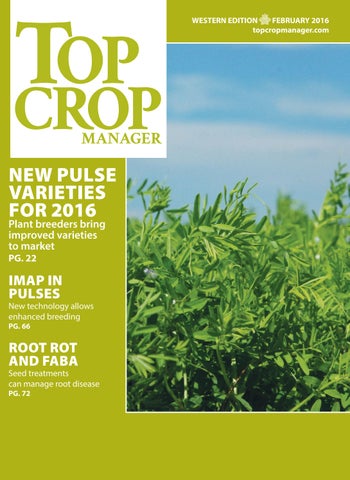
NEW PULSE VARIETIES FOR 2016
Plant breeders bring improved varieties to market
PG. 22
IMAP IN PULSES
New technology allows enhanced breeding
PG. 66
ROOT ROT AND FABA
Seed treatments can manage root disease
PG. 72
Plant breeders bring improved varieties to market
PG. 22
New technology allows enhanced breeding
PG. 66
Seed treatments can manage root disease
PG. 72
TIGER XP™ sets a new industry standard for performance. With a unique composition of sulphur bentonite and a proprietary activator, TIGER XP provides higher sulphate availability that addresses early season sulphate deficiencies and provides crops more sulphate throughout the growing season. With added dust suppressant coating for improved safety and handling, TIGER XP is optimized to outperform traditional sulphur products. Learn more at Tigersul.com
6 | Economics of short rotation legume forages
Forages in rotation provide higher net cropping system returns.
Donna Fleury
on soil and weather conditions.
Bruce Barker
Simulating hail damage to assess hail-rescue products for crops.
Carolyn King
Barker
22 New pulse varieties for 2016 By Bruce Barker
iMap technology in pulses By Julienne Isaacs
Toward healthier oats By Carolyn King FERTILITY
8 Developing phosphorus recommendations By Ross H. McKenzie PhD, P.Ag. 40 Determining plant available phosphorus By Ross H. McKenzie PhD, P.Ag. 42 Developing K recommendations By Ross H. McKenzie PhD, P.Ag.
84 Broadcast urea losses can be high By Bruce Barker
MACHINERY
62 2016 Canadian Truck King Challenge By Howard J Elmer
PRECISION FARMING
64 Managing yield data By Dale Steele, P.Ag.
SOYBEANS
81 What are the best soybean rotations? By Carolyn King
RESEARCH
80 Spotlight on fababean By Julienne Isaacs
PESTS AND DISEASES
28 Another root rot By Carolyn King
PULSES
20 The Goldilocks of pea production By Bruce Barker
48 Rotational-nitrogen credits in pulses By Bruce Barker CANOLA
52 Seed treatments improve emergence, yield By Bruce Barker
67 Reconciling canola seeding rate and seed size By Bruce Barker
JANET
Unless you’ve been under a rock over the latter part of 2015, you’ll have heard 2016 is the International Year of Pulses. Which means pulse crops such as lentils, beans, peas and chickpeas take centre stage this year throughout Canada and beyond.
Throughout the year, governments, organizations, non-governmental organizations and all other relevant stakeholders will work hard to heighten public awareness of the nutritional benefits of pulses as part of sustainable food production aimed towards food security and nutrition.
But what does IYOP 2016 mean to Canadian pulse growers? According to Pulse Canada, this is an unprecedented opportunity for Canadian pulse growers to showcase one of our major crops to national and international customers.
Canada is the world’s largest producer and exporter of dry peas and lentils, with 77 per cent of pulses grown here being exported to more than 150 countries around the world each year. Indeed, in 2014, Canadian pulse exports were valued at over $3 billion, with our biggest export markets being India, China and Turkey. Pulses are Canada’s fifth largest crop, after wheat, canola, corn and barley.
The International Year of Pulses, or IYOP, will focus activities this year on a few key areas of importance to producers. These include production and environmental sustainability; market access and sustainability; and health, nutrition and food innovation.
“IYOP will draw attention to important global issues related to pulses being grown here in Canada, which will ensure that we can sustain the growth of the industry and keep pulses competitive at the farm gate,” notes Pulse Canada.
Top Crop Manager salutes IYOP and Canadian pulse producers. And as in years past, we are proud to present our annual February issue, which focuses on pulse crops.
In this issue, we include stories that touch on pulse breeding, including new iMAP technology being studied at the University of Saskatchewan’s Crop Development Centre. This technology has revolutionized pulse breeding in Canada, with growers the primary beneficiaries due to quicker delivery of improved cultivars. See more on page 66.
We also have stories that provide new information on some tough diseases, including a new root rot pathogen in pulse. Aphanomyces euteiches loves peas, lentils and waterlogged soils. Researchers are working diligently to provide new crop management tools to deal with this pest. See more on this topic on page 28.
And still on the subject of crop management, a recent study looked at the optimum agronomic package for pea production. The objective of the experiment was to determine which individual agronomic inputs contribute most to field pea seed yield, which combination produces the highest seed yield and economic return, and how plant population, leaf and stem disease, crop maturity, grain yield and quality are affected by input interactions. Read what researchers found on page 24.

On March 2, Top Crop Manager magazine presents the 2016 Herbicide Resistance Summit in Saskatoon. With this Summit, we hope to facilitate a more unified understanding of herbicide resistance issues across Canada and around the world, and to increase awareness that everyone engaged with agriculture has a role in managing herbicide resistance. While huge strides have been made to understand and deal with herbicide resistance, challenges remain. We hope to have some answers for Herbicide Resistance Summit participants come March 2. For more information or to register for the conference, visit weedsummit.ca.
2S9 SUBSCRIPTION RATES
Crop Manager West – 9 issues February, March, Mid-March, April, June, September, October, November and December – 1 Year - $45.95 Cdn. plus tax
Brandt is celebrating $1billion in annual revenue and we’re thanking our customers by offering special rebates throughout the year. Visit thanksabillion.ca for details.
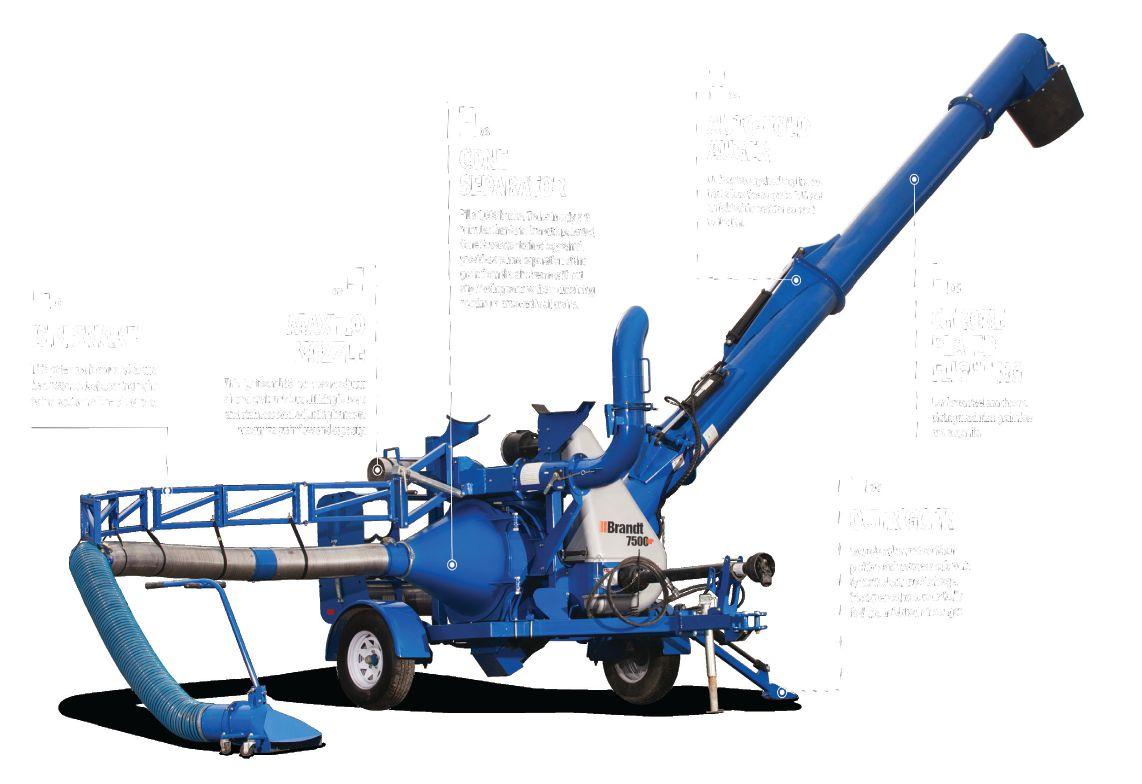
Designed for maximum capacity and speed, the Brandt 7500 HP GrainVac helps you operate at peak efficiency. With input from producers like you, we’ve refined our GrainVacs to include many innovative features only available from Brandt. With fewer moving parts, and premium build quality this GrainVac delivers unrivaled reliability and durability. That’s Powerful Value. Delivered.

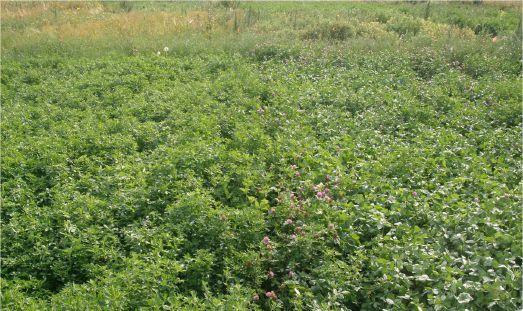
Forages in rotation provide higher net cropping system returns.
by Donna Fleury
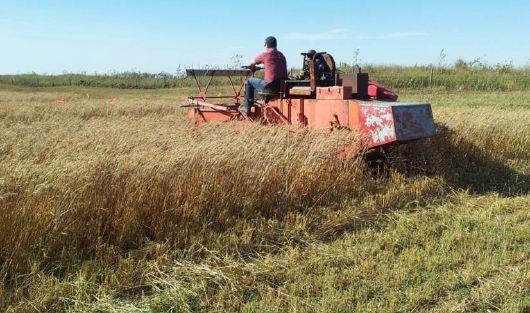
Including legume forages in short rotation in cropping systems can provide advantages and benefits for both crop and beef producers. Research shows that adding legume forages into an annual cropping rotation can be a viable option, providing high quality feed, good yields and reasonable levels of residual soil nitrogen (N) two years after legumes are taken out of a cropping system, providing an alternative way to build soil N. Overall, net returns after four years were higher for those rotations that included forages as compared to standard annual crop rotations.
Over four years from 2010 to 2014, different rotations were compared at four locations across Saskatchewan, including Swift Current, Lanigan, Saskatoon and Melfort. The objective of this collaborative study undertaken by the Western Beef Development Centre (WBDC) and three Agriculture and Agri-Food Canada (AAFC) research stations was to determine the amount of residual N from a two-year crop of alfalfa or red clover in a four-year rotation with wheat and canola. The rotations included: alfalfa-alfalfa-wheat-canola; red clover-red clover-wheat-canola; barley-pea-wheat-canola; and a control barley-flax-wheat-canola. The legume forages were terminated at the end of year two, followed by Unity wheat grown on all treatments in 2012, and Liberty Link (L130) canola on all treatments in 2013, with no additional N fertilizer applied to either crop.
“Overall, the economic analysis showed higher cumulative net returns from the rotations that included two years of legume forages, although the economics varied by location and soil zone,” explains Kathy Larson, beef economist with WBDC in Humboldt, Sask. “The Swift Current site suffered from drought conditions during the four-year project, which impacted the results. As well, the alfalfa rotations resulted in higher net returns for Melfort and Swift Current, while red clover yielded better returns at the Lanigan and Saskatoon sites, emphasizing how different legumes respond to different soil zones and climate
conditions across the province.”
In the economic analysis, average crop year prices were used. For 2010, forage was valued at just under $86/MT and barley at $152/MT. In 2011 forage was valued at just under $70/MT, peas at $8.49/bu and flax at $525/MT. For 2012, wheat was valued at $280/MT and canola at $428/MT in 2013. The stored N for use by subsequent crops (wheat and canola) was measured and valued using urea prices reported by the Alberta Farm Input Price Survey from 2009 to 2013, which averaged $0.58/lb, and was calculated as the Nitrogen Fertilizer Equivalent (NFE) value. In year one, the net returns on the legume forages were negative largely due to the establishment costs and typically lower harvest yields. However, after the second year, both alfalfa and red clover were very competitive with positive net returns and after four years, higher net returns than other rotations.
“In the second year, we were able to take multiple cuts on the forage crops without worrying about leaving any carryover, because the forage crops were terminated at the end of year two and seeded to wheat in year three,” says Larson. “The forage legumes provided revenues that exceeded the control rotation at all sites, except Melfort, which experienced exceptional yields on flax.” The flax yield at Melfort was 3456 kg/ha or 55 bu/ac, nearly double the five-year average yield (28.6 bu/ac) in the surrounding rural municipality. If flax yield had been in line with the five-year average, the alfalfa-alfalfa-wheat-canola rotation would have had the highest cumulative net returns at Melfort.
Overall, the cumulative average net returns for all sites after two years was $346/ha on alfalfa, $236/ha on red clover and
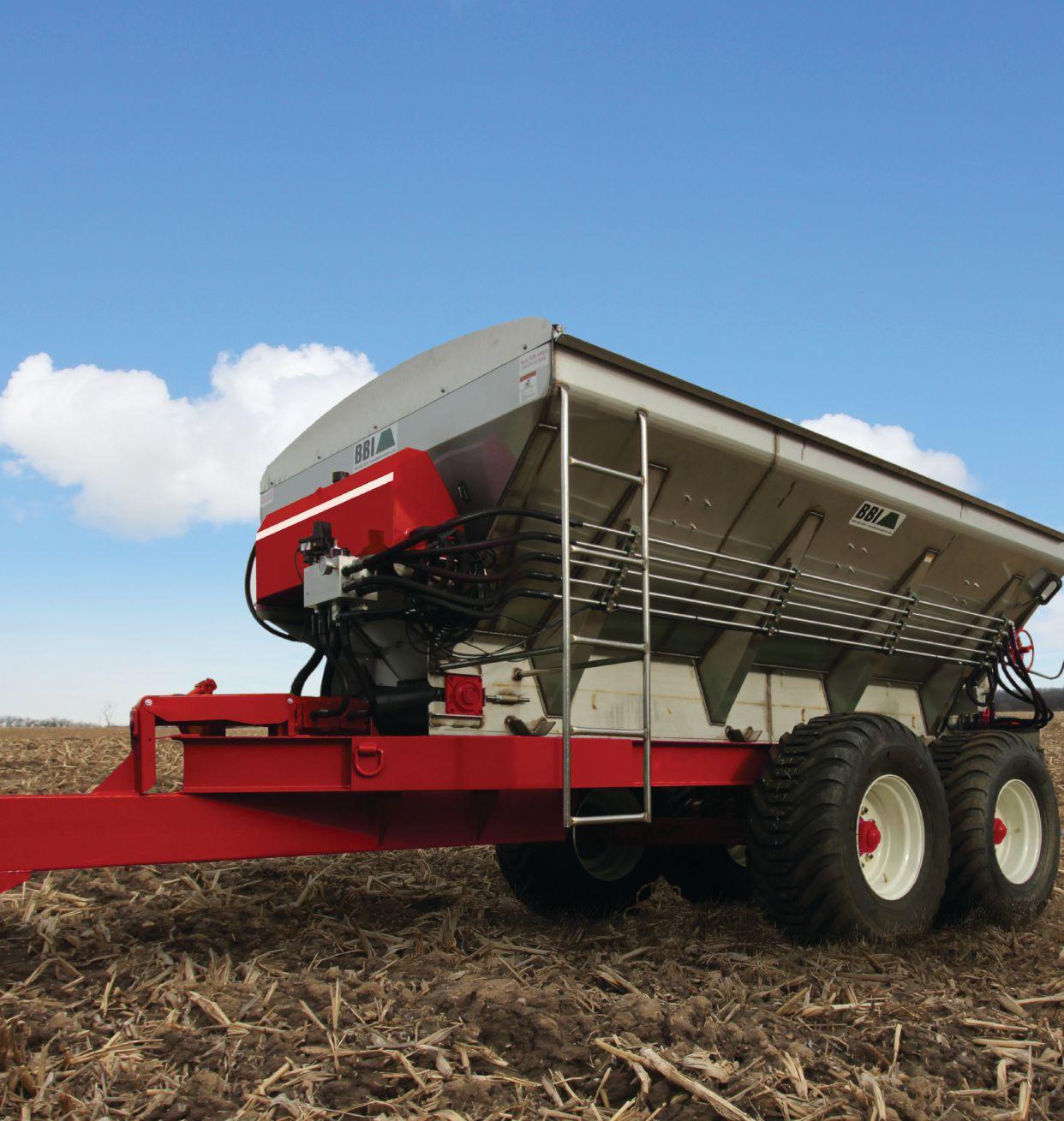
PRECISION APPLICATORS - Variable Rate capabilities and ISO compatibility are standard on our wide range of models.
LOWEST COST-IN-USE - Maximize productivity with wide flat spread patterns that minimize overlap and reduce fuel use.
OPTION RICH - Models available for fertilizer/lime,
or truck mount options available.
Phosphorus is deficient in about 80 per cent of Prairie soils.
by Ross H. McKenzie PhD, P.Ag.
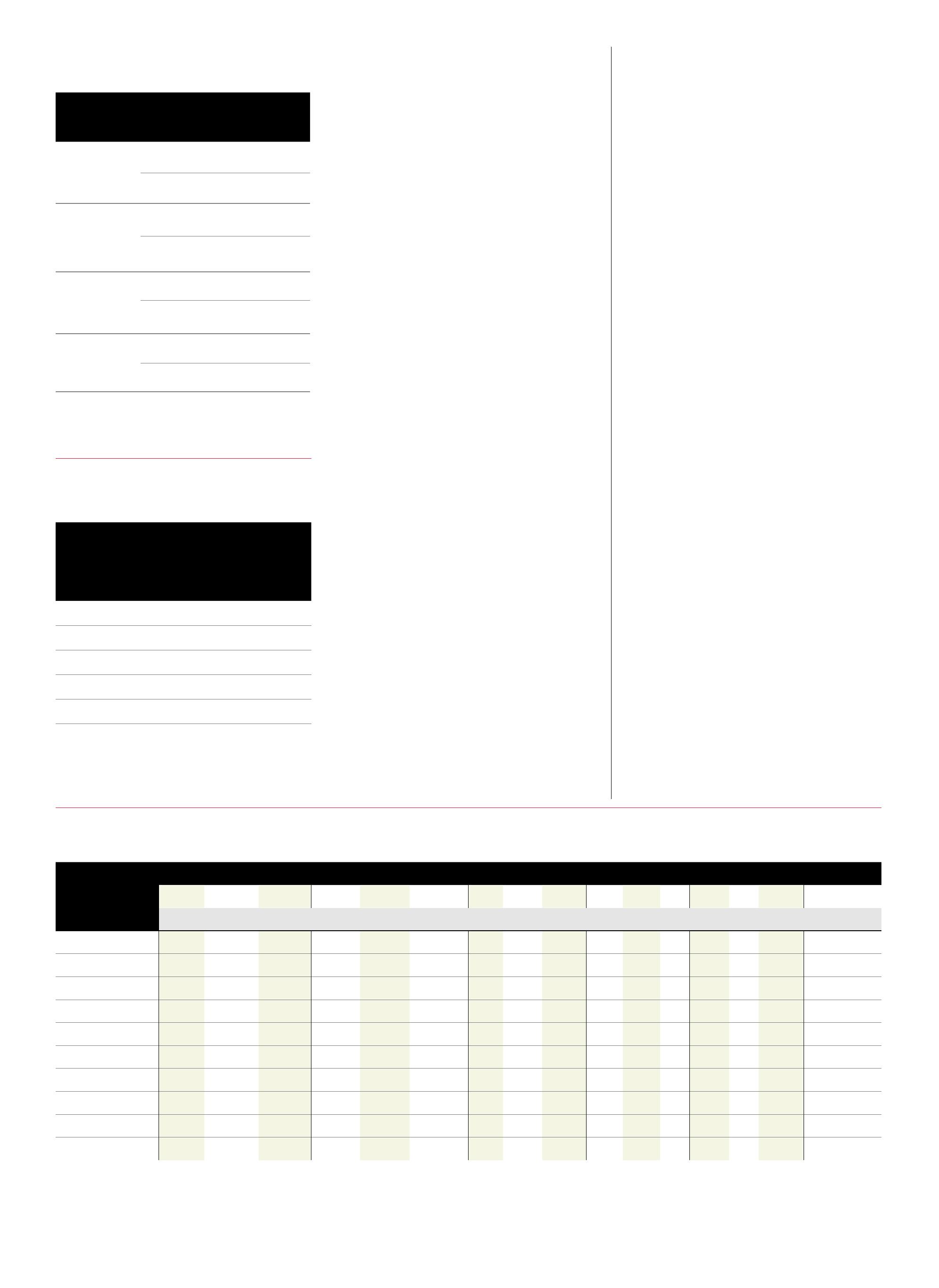
Phosphorus (P), essential for optimum crop production, is deficient in about 80 per cent of Prairie soils. Soils deficient in P cause slower plant growth, delayed crop maturity and reduced yield. Fortunately, P deficiencies can be corrected with phosphate fertilizer. (Table 1 on page 10 shows the approximate amounts of phosphate (P2O5) uptake by various crops.)
Plant-available soil phosphorus is taken up from soil by plant roots. While soil testing can estimate plant-available soil P, they cannot predict with 100 per cent accuracy when crops will respond to added P fertilizer. The frequency of crop response is strongly influenced by environmental conditions, particularly soil temperature and moisture. For example, at research sites in Alberta, the observed response to P fertilizer, particularly with wheat, barley and canola, tended to be greater with wetter, cooler spring soil conditions. Generally, farmers can expect greater crop response to P fertilizer in a year with wetter and/or cooler spring conditions than in a spring with warmer, drier conditions.
It is important to note soil P levels have increased in some fields over
the years as a result of repeated annual commercial fertilizer P application or frequent livestock manure application. But, many farmers have been cutting back on P fertilizer application, causing soils to gradually become more deficient in soil P.
A province-wide Alberta research project was conducted with wheat, barley and canola, and found that 81 per cent of wheat sites, 90 per cent of barley sites and 72 per cent of canola sites responded to added phosphate fertilizer.
To optimize P fertilizer application, soil testing is the place to start. Make sure soil sampling is done properly (see Soil sampling and testing – doing it right in the September 2015 issue of Top Crop Manager) and the correct P soil test method is used (see Determining plant available phosphorus in this issue on page 40).
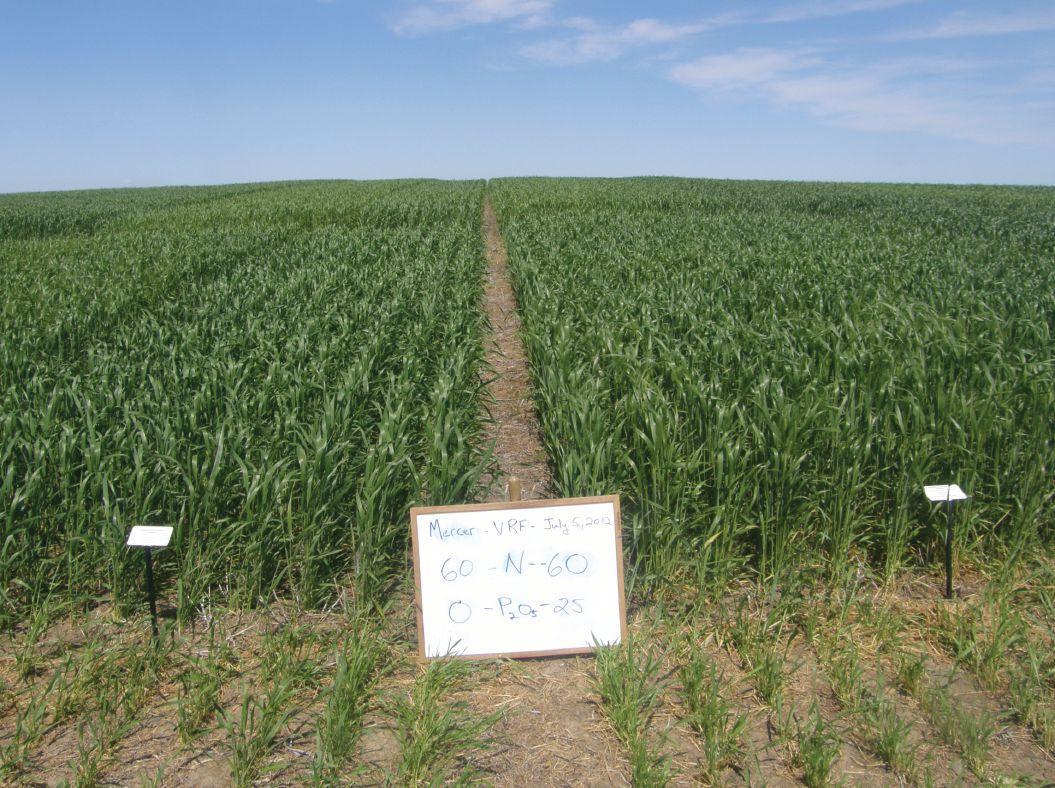
ABOVE: Wheat response to P fertilizer on an upper slope position in a variable rate fertilizer research study. Strip on the left side had no P fertilizer and strip on the right had 25 kg/ha of seedplaced phosphate.


Wheat (40
Barley (80 bu/ac)
Total
Seed 30 - 37
Total Uptake 40 - 49 Canola (35 bu/ac)
Total
Total
Source: Ross McKenzie.
Across the Prairies, response to P fertilizer has been correlated to the amount of soil P extracted from the soil. Soil test P correlation work has been with the 0 to 6 inch sampling depth. Ensure to sample the 0 to 6 inch depth separately from deeper depth samples to accurately determine P fertilizer requirements. Table 2 provides a guide for soil P levels for the modified Kelowna method. Generally, cereal and oilseed crops grown on soils with a very low or low P level have a high probability of response to P fertilizer, often in the range of 90 per cent.
Ortho phosphate, the form of P taken up by plants, is highly reactive with certain soil elements. Generally, soil P is slightly more available to plants in a pH range of 6.0 to 7.8. At higher pH levels (>7.8), calcium is more reactive with phosphate, creating forms that have slightly lower availability to plants. Magnesium acts in the same manner, forming less available magnesium phosphate compounds. In more acidic soils, aluminum and some other elements will increase in solubility and tie up soil P. This reaction limits the availability of inorganic P to plants at soil pH levels <5.5. Generally, I am far more concerned about P tie-up at low soil pH than higher soil pH. Normally, I do not adjust P fertilizer recommendations based only on soil pH when the range is between 5.5 and 8.0.
recommendations
Phosphate fertilizer recommendations for various crops are provided on the Alberta,
Saskatchewan and Manitoba departments of agriculture websites. Tables 3 (below) and 4 (page 12) are examples for spring wheat in Alberta. To determine the recommended rate of P, simply look at the soil test level in Table 3 and match it with the soil zone of your farm. For example, if you are growing wheat in the Thin Black soil zone and your soil test level is 35 lb P/ac, the recommended phosphate rate would be 30, 35 or 40 lb P2O5/ac, depending if seedbed moisture conditions are dry, moist or wet, respectively. Normally, I would use the moist to wet values for the recommendation.
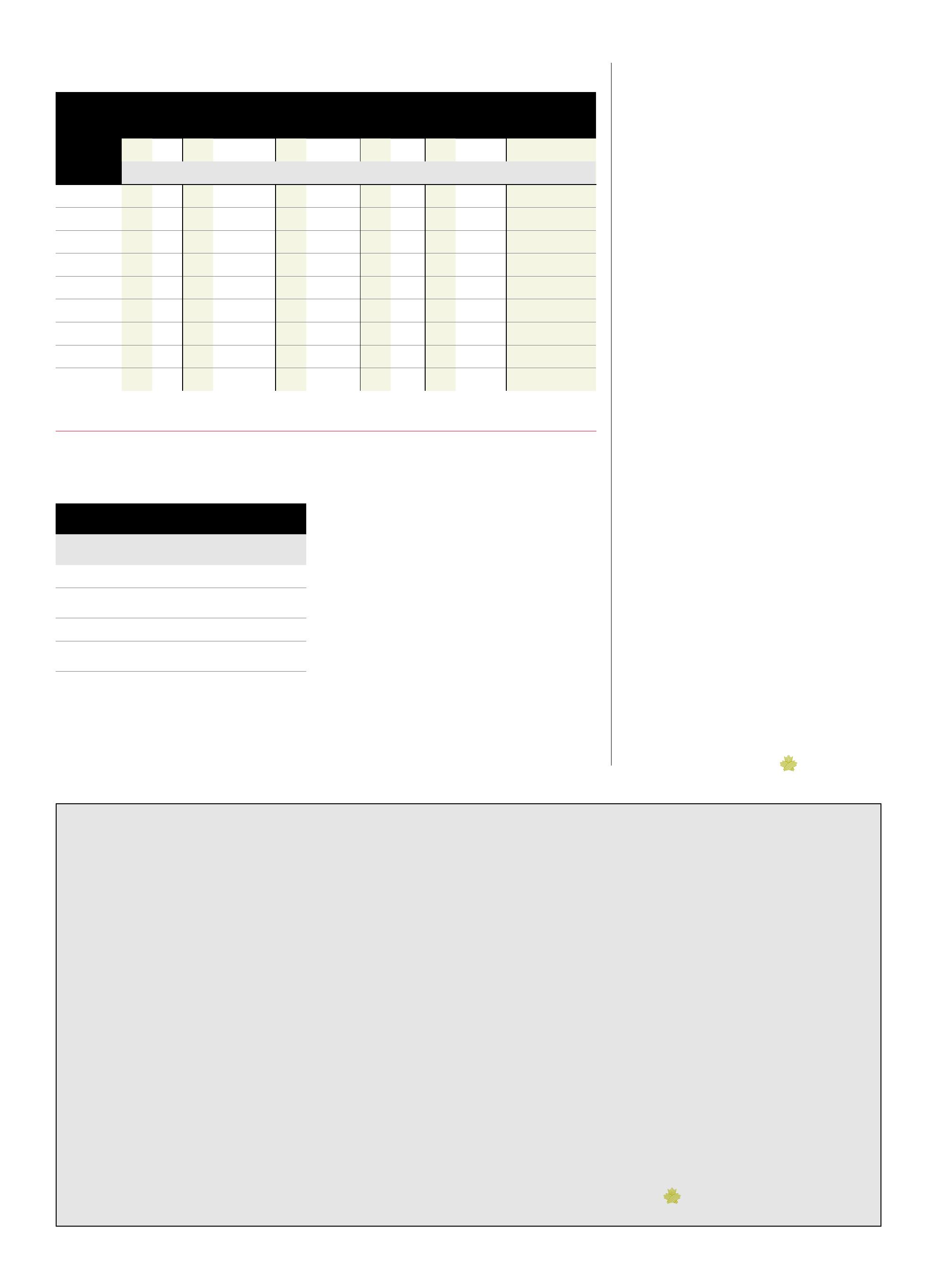
From Table 4, a farmer could expect a 90 per cent probability of at least a 2 bu/ac yield increase and expect a 70 per cent probability of a 5 bu/ac yield increase. These probabilities are based on a number of years of field research. This information is also available for barley and canola on a probability basis, and P recommendations are provided for a number of other crops in Alberta Agriculture’s Agdex.
Phosphate fertilizer placement
Most field research has shown that placement of P fertilizer with or near the seed is best for most annual crops; therefore phosphate recommendations are typically based on P placement with or near the seed. However, care is needed not to exceed the safe seed-placed rate for each crop grown (see Table 5, page 12).
For cereal crops grown on soils that are medium to low in available P, seed-placed phosphate at recommended rates is equal to or better than banding near the seed and far superior to broadcast and incorporation.
For canola grown on soils very low to medium in available P, rates up to 15 to
Table 3. Phosphate fertilizer recommendations for spring wheat on a medium to fine textured soil based on the modified Kelowna soil test method.
* Seedbed soil moisture conditions at seeding D = 25%; M = 50%; W = 75% of field capacity.
Note: Recommendations are given for each soil zone at three soil moisture condition levels at the time of seeding.
Source: Alberta Agriculture Agdex 542-3 Phosphate fertilizer application in crop production.
{ And how its benefits go well beyond the seed. }
The first truly systemic pulse seed treatment with Xemium® , for broad-spectrum disease control

Increased seedling vigour both above and below ground
Enhanced ability to manage environmental stresses
More consistent and increased emergence, including under cold conditions
To find out what Insure® Pulse fungicide seed treatment and the benefits1 of AgCelence® can do for your lentils, field peas, chickpeas, dry beans, faba beans and flax, visit agsolutions.ca/insurepulse or contact AgSolutions® Customer Care at 1-877-371-BASF (2273).
1 AgCelence benefits refer to products that contain the active ingredient pyraclostrobin. Always read and follow label directions.
AgSolutions,
Table 4. Approximate probability of a greater than 2 bu/ac and 5 bu/ac wheat response to phosphate fertilizer when following phosphate fertilizer recommendations
Source: Alberta Agriculture Agdex 542-3 Phosphate fertilizer application in crop production.
Canola 15 25 20
Pea 25 15 20
Note: Recommended safe rates vary among Alberta, Saskatchewan and Manitoba departments of Agriculture.
Source: Provincial Agriculture publications.
20 lb/ac P2O5 can be seed-placed using a seedbed utilization of 10 per cent. Higher P rates should be either side- or mid-row banded at the time of seeding or banded prior to seeding. Seed-placed or banded fertilizer P on soils high in available P at rates up to 15 lb/ac of P2O5 may result in a crop response 30 to 50 per cent of the time, depending on soil zone and environmental conditions.
Phosphate fertilizer does not have nearly as strong a beneficial effect on pulse crops as these crops are fairly efficient at taking up soil P. Alberta research suggests pea is most responsive to P fertilizer when soil P levels are less than 30 lb P/ac (modified Kelowna method). Above this level, there is a relatively low chance P fertilizer will increase yield.
When soil test P levels are medium to high, an annual maintenance application of phosphate fertilizer should be considered to meet crop requirements and replenish soil P that is removed.
Canola has a relatively high demand for soil P. It is a non mycorrhizal crop and uses different means to aid in soil P uptake, leaving soil P more depleted compared to cereal or pulse crops. As a result, cereals and other crops that follow canola tend to be more responsive to P fertilizer. Often I suggest adding an additional 10 lb/ac of phosphate over and above the P recommendation for cereal or pulse crops, when following a good yielding canola crop.
For optimum annual crop production, an adequate supply of P close to the seed during the first six weeks of growth is best. Most annual crops take up the majority of their P requirements in the first 40 days after emergence. Placement of P in or near the seedrow with cereal and oilseed crops has traditionally been the best method used for P fertilization across the Prairies. Preplant banding of P with nitrogen has been found to be a good alternative method of application under certain conditions. However, under conditions of low to medium soil P coupled with low soil temperatures, “starter” P in the seed row is frequently very beneficial for annual crops. Finally, be cautious not to exceed the safe seed-placed fertilizer rate for each crop.
$7/ha for the barley-pea rotation. Due to the exceptionally high flax yields at Melfort, the cumulative average net return for the barleyflax rotation was $297/ha. The four-year cumulative net returns were highest for the forage legume-forage legume-grain-oilseed rotations in Saskatoon ($1435/ha), Lanigan ($1147/ha), and Swift Current ($482/ha). The cumulative net return for alfalfa-alfalfawheat-canola in Melfort ($2012/ha) exceeded the other forage legume rotations at the other locations; however, the control rotation (grain-oilseed-grain-oilseed) at Melfort had the highest cumulative net returns ($2650/ha), largely due to the exceptional flax yield.
“With the exception of Swift Current, the wheat and canola yields from the plots that grew alfalfa and red clover for two years outyielded the control rotation by 40 per cent on average,” Larson explains. “The amount of nitrogen fixed by the legumes varied by soil zone and climatic conditions with no NFE benefit measurable at the Swift Current site (except with the alfalfa-alfalfa-
wheat-canola in year four) due to drought stress.”
The NFE values for alfalfa ranged from $43/ha in Swift Current to a high of $460/ha in Melfort, while the NFE for red clover rotations were higher at Saskatoon ($239/ha) and Lanigan ($300/ha). These differences clearly illustrate that environment and soil zone can impact the amount of nitrogen fixed by the legumes. Taking four-year cumulative net returns and NFE values together, the alfalfa rotation was the highest at Melfort ($2558/ha) and Swift Current ($613/ha); however, the red clover rotation was higher at Saskatoon ($1764/ha) and Lanigan ($1577/ha). (See Fig. 1.)
“Overall, the project results show that including short rotation legumes can provide residual soil N for uptake by subsequent annual crops and the net returns are competitive with a typical rotation like the control (barley-flax-wheat-canola),” explains Larson. “The soil zone and climatic conditions have an impact on the yield and the legume’s ability to fix nitrogen.”

by Bruce Barker
ESN controlled release nitrogen (N) from Agrium is well proven in the U.S. Over 1000 site years of research have very well documented where ESN can be profitable, specifically on soils with risk of leaching, volatilization or denitrification losses due to excess moisture. Research is only beginning to identify where ESN fertilizer on corn makes sense in Western Canada.
“In Western Canada, corn growers most always put all their nitrogen on upfront as urea in some type of preseed – fall or spring –or side-banding application at seeding. Whether ESN is a good fit needs to be looked at on a case-by-case basis,” says Ray Dowbenko, agronomist with Agrium at Calgary. “If there is high loss potential, a split application of urea N or using ESN makes sense.
High yielding corn has high N fertility needs in the middle to later part of the growing season. Research by soil fertility specialist John Heard with Manitoba Agriculture, Food and Rural Development (MAFRD) showed the maximum rate of N uptake in corn is 1.8 to 1.9 lbs N/ac per day between V8-VT and R1-R5 growth stages.
Unlike other small grains like wheat and canola, which have significant N needs right out of the starting gate and a shorter maturity, N uptake in corn is delayed to the V4 stage of growth, with increasing and large demands later in the growing season. That means N can be sitting in the soil for a longer period of time and at greater risk of loss.
From 2005 to 2007, Heard conducted one of the only Manitoba studies in a three-year research trial on ESN (44-0-0) compared to urea (46-0-0) at Carman and Reinland. ESN and urea at rates of 0, 50, 100, 150, and 200 lbs N/ac were compared with one additional treatment of 100 lbs N in a 50:50 mix of urea/ESN. All treatments were broadcast incorporated prior to, or shortly following, corn seeding. A fall treatment of 100 lbs N was broadcast and incorporated in the fall of 2005 for the 2006 Carman site.
“Fall applied is done by many Manitoba corn growers because they do not wish to work the soil in the spring and want to seed directly into a firm, moist seedbed. The single year we tried this [Carman in 2006] it was a very dry spring, and fall N worked well since there were probably minimal losses,” Heard explains.
The Carman soil is a well-drained Neuenberg loam soil. At Reinland, it is a Hochfeld fine sandy loam in 2005, Neuenberg fine sandy loam in 2006, and Edenburg clay loam in 2007. Significant rainfall fell early in 2005 and 2007, while 2006 was drier.
Heard reported: “There was no yield advantage to controlled
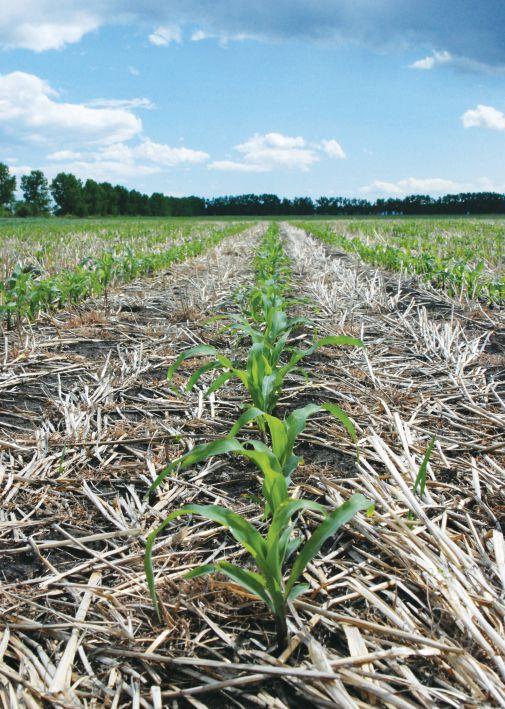
release N (ESN) compared to urea fertilizer. Springtime rainfall was insufficient to cause yield-limiting losses of applied urea. Benefits to controlled release N would be limited to situations when nitrogen losses are higher than observed in the study.”
In years when early spring conditions have higher rainfall, especially on well-drained soils, the potential for loss is higher, and a case for ESN or other controlled release N products could show a benefit over urea.
Research shows value of ESN
Dowbenko says ESN has the best fit where most of the N is applied
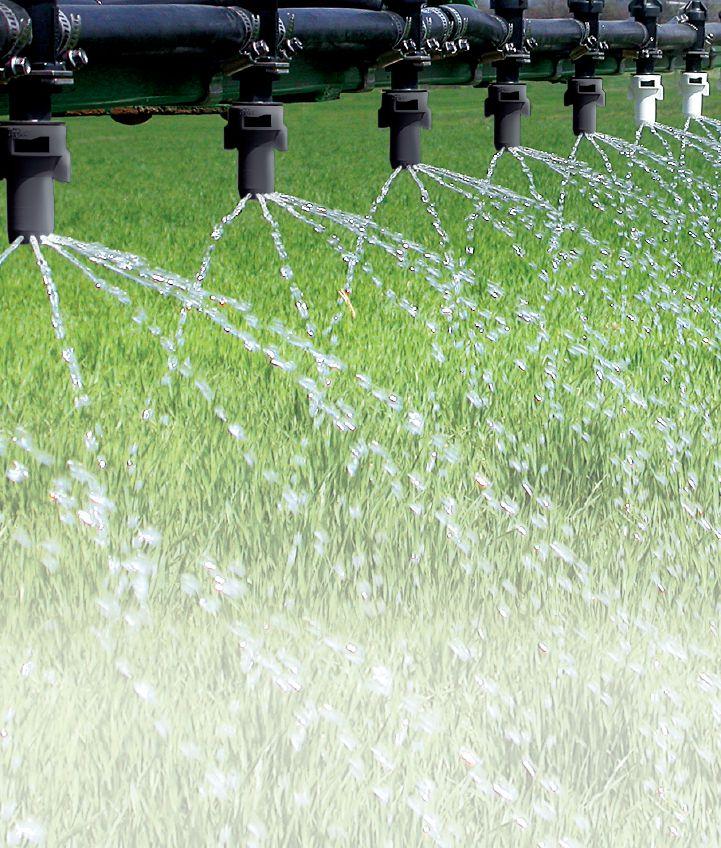
in advance of crop demand, and winter and spring is generally characterized by excess moisture. If the soil is sandy and subject to leaching, the benefit may be even greater.
The rate of N release for ESN is governed by soil temperature, which also influences corn growth. The rate that water and N move through the ESN polymer coating is slow in cold soils and increases as the soils warm up. This may help match N release with corn growth. Typically, about eight to 15 per cent of N is released in the first 10 days, 40 to 60 per cent in the first month and 85 to 90 per cent within 60 days.
“In the U.S. we have over 1000 site years of data. We’ve seen a 19 bushel per acre better yield with ESN compared to a split application of urea at seeding and UAN side-dressed,” Dowbenko says. “In many comparisons, there are large yield advantages with ESN in the U.S.” (See Fig. 1.)
In Canada, few studies have looked at ESN performance under cool and humid climatic conditions. A three-year study led by Bernard Gagnon with Agriculture and Agri-Food Canada (AAFC) on a clay soil near Quebec City compared the effect of ESN, a nitrification inhibitor N, dry urea, and UAN on corn yield. Urea, ESN and the nitrification inhibitor N were pre-plant broadcast and incorporated, and the UAN was applied as 30 lbs N pre-plant broadcast and the remainder of 120 lbs N side-banded at the six leaf stage of corn.
In the wet years of 2008 and 2009, ESN produced the highest yields, followed by the nitrogen-inhibited N (see Fig. 2, page 16). At the 150 lbs N rate, ESN gave a 10.3-bushel higher yield
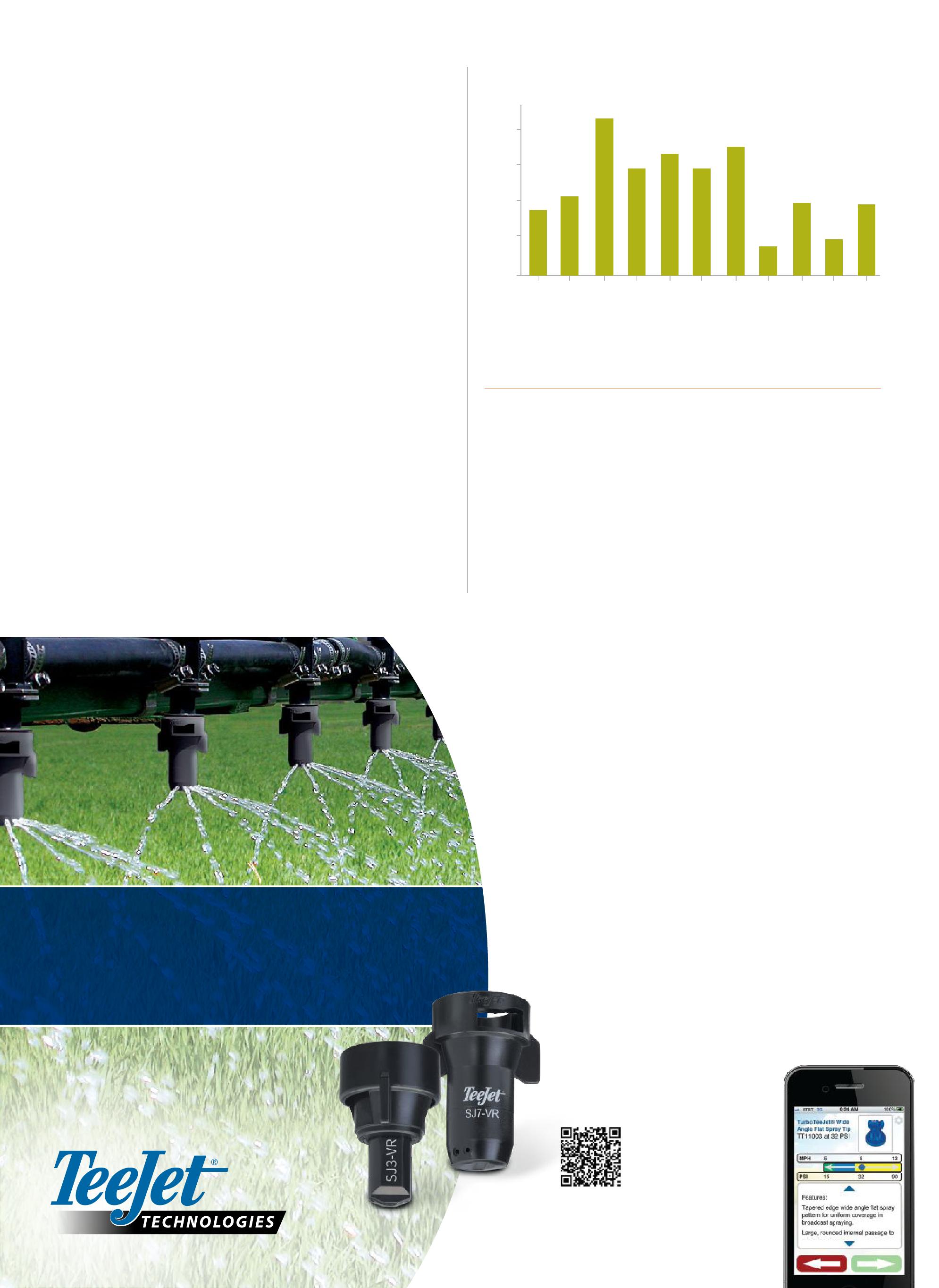
1. Distribution of corn yield response to ESN
Compilation of all comparisons of pre-plant ESN with pre-plant conventional N sources at the same N rate.
Source: Agrium.
than urea, and three bushels more than UAN. In the drier 2010 cropping year, there was no difference between ESN, urea or the nitrogen-inhibited N.
An economic analysis by Gagnon revealed that ESN gave comparable net returns at equivalent N rate as UAN in wet years. Results indicated both the PCU and UAN treatments outperformed urea by approximately $38/ac in 2008 and $106/ac in 2009. The researchers concluded that controlled-release urea would be an additional option for farmers instead of side-dress UAN for fertilizing corn grown in Eastern Canada.
SJ3-VR and SJ7-VR StreamJet tips feature a unique variable orifice design to boost your productivity in the field. It’s like having 5 tip sizes in one.
• Support a wide range of rates including variable-rate, prescription map application with a single tip
• Simple design has no moving parts for long-term accurate and reliable operation
• Solid stream pattern directs fertilizer to the root zone and minimizes leaf coverage to prevent crop damage and yield loss
Response of corn grain yield to four fertilizer urea forms (dry urea, PCU polymercoated urea, NIU nitrification inhibitor, UAN) in 2009 on a clay soil.
Source: Gagnon et al. Can. J. Soil Sci. (2012) 92: 341-351.
More western Canadian research underway
In Manitoba, AAFC agronomist Curtis Cavers is researching ESN on corn. In 2014 and 2015, he had research sites located at Elm Creek (loamy fine sand), Carman (loamy very fine sandy) and Portage la Prairie (clay loam).
In 2014, Cavers had 10 treatments with a zero N check, N rates for urea/ESN of 60, 120 and 180 lbs N per acre broadcast and incorporate pre-plant; urea broadcast/incorporate pre-plant at 120 lbs N; UAN banded at stage V6-V8 at 60, 120, and 180 lbs N; urea broadcast at V6-V8 at 120 lbs N; and Agrotain-treated urea broadcast at V6-V8 at 120 lbs N. In 2015, he added in two more treatments that corn producers say they might use: urea broadcast immediately after seeding with no incorporation; and a dribbleband UAN at V6.
“We know these two additional treatments might not be the ideal choice for application, but sometimes producers might have to do it because of weather conditions,” Cavers says.
Once the three years of trials are completed, Cavers hopes to see some trends in which ESN best fits for corn growers in Manitoba. Based on what he has seen so far, he thinks ESN might have
a fit where soil and weather conditions are sub-optimal, such as heavy rain during the growing season and sandier soils.
“That’s part of the reason we are doing the research over three years, to get variable rainfall patterns on the different soil types and see the impact on the various fertilization methods,” Cavers explains. “Producers may not always have the best conditions to seed under, so we wanted to look at many different treatments over the three years.”
Dowbenko says while the research on the benefits of ESN is clear in the U.S. and Eastern Canada, the cooler soils and more variable rainfall patterns mean more work like Cavers’s is needed in Western Canada. With expanding corn acreage in Western Canada, Agrium, too, is embarking on ESN research on corn.
“With shorter season corn that matures earlier, we need to find out if ESN with controlled release is as important to match corn growth rates as in the U.S. with a longer growing season and higher yield potential,” Dowbenko says.
For now, Dowbenko refers growers to a matrix developed based on U.S. data, which shows the yield benefit of using ESN under various soil and precipitation expectations (see Table 1). If farmers grow corn in a heavy rainfall area or under irrigation, and with lower organic matter soils, ESN might make sense.
Currently, ESN is priced at approximately $0.20 lbs N more than urea. At a 120 lbs N/ac fertilizer rate, that means an additional $24 per acre cost. With corn prices around $4.30 per bushel, ESN corn yields would have to be 5.5 bushels per acre higher than if fertilized with urea.
Based on what he has seen, Heard sums up best where ESN could be of benefit in Manitoba. “My extension message is if it is a wet year or soil prone to wetness we might experience losses, especially to fall applied N. ESN would be expected to prevent that loss, leading to higher yield. In years that are normal or dry, N losses are insufficient to cause yield differences,” Heard explains. “It is up to the grower to assess their level of risk – they know the field, whether it is well drained or not – and then they can fertilize accordingly.”
Looking beyond just yield, Dowbenko says ESN offers some other benefits corn growers may consider. It gives flexibility in the application window, and could replace a V6 top dress with N application at seeding or even a fall ESN application under certain conditions. This flexibility could help offset some of the additional cost of ESN. ESN can also provide environmental benefits by reducing N loss to the environment.
Table 1. Yield benefit of using ESN under various soil and precipitation expectations
Expectations are based on 80% of N coming in the form of ESN.
Greater precipitation = 6 to 8 inches of combined rainfall in May and June (which the majority of the corn belt receives).
Higher organic matter represents more than 3% to 4%.
Areas with not enough data are based on theoretical expectations.
Source: Agrium
Take a stand against resistance. Arm yourself with the revolutionary residual broadleaf control of Authority – the only Group 14 pre-emergent herbicide. It’s your secret weapon for cleaner fields and higher yields.
FMCcrop.ca
Resistant or not, powerful Infinity ® herbicide provides you with the ability to take out the toughest broadleaf weeds in your cereals. With its unique Group 27 mode of action, Infinity helps ensure the profitability of your farm today and for years to come.
Managing herbicide resistance is everyone’s fight. Spray Responsibly.
Not too hot, too cold, too wet or too dry.
by Bruce Barker
What are the key environmental parameters that impact pea yield? On the surface, the easy answer is temperature and moisture. Get them right and you get a top-yielding crop.
But what is the right combination? That’s what Rosalind Bueckert, a professor in the plant sciences department at the University of Saskatchewan (U of S) wanted to find out in an effort to better understand pea growth habits and to help improve pea breeding at the U of S Crop Development Centre (CDC).
“Pea cultivars are heat-sensitive so our goal was to investigate how weather impacted growth and yield for a dryland and an irrigated location,” explains Bueckert, who published the research in the Canadian Journal of Plant Science in 2015. “We explored relationships between days to maturity, days spent in reproductive growth – flowering to maturity – yield and various weather factors.”
Research in other countries had identified that high yield was related to early flowering, a large number of reproductive nodes and soil moisture availability during flowering. The longer the plant remained in the reproductive growth period, the higher the yield. Research had found that high daily maximum temperatures (31 C to > 34 C) during flowering for at least two to four days reduced yield due to abortion of buds and flowers, aborted young seed and potentially smaller seed. In Canada, though, the relationship between daily high temperatures, precipitation, and yield had not been explored.
Bueckert, along with colleagues Stacey Wagenhoffer and Tom Warkentin at CDC and Garry Hnatowich at Saskatchewan Irrigation Diversification Centre, Agriculture and Agri-Food Canada at Outlook, Sask., utilized the nine years of Co-op variety registration trials at the dryland Saskatoon site and the irrigated Outlook site to look at environmental effects on yield. They measured days to flowering when 50 per cent of the plants in a plot had an open flower, days to maturity, disease rating and seed size. The nine years covered the range of weather patterns with some hot and dry, warm, or cool and wet.
Check varieties in each year were utilized and represented current popular varieties. For example, in 2009 the five varieties were Eclipse, Cutlass, CDC Striker, CDC Cooper and CDC Golden. Peas were grown using recommended production practices. At Saskatoon, pea was not sprayed with a fungicide except in 2005 and 2009 when disease pressure was observed. At Outlook, pea was sprayed every year with a fungicide at flowering followed by a second application 10 to 14 days later.
Fig. 1. Pea yield response surface as fitted by a quadratic regression model for mean seasonal daily temperature, seasonal cumulative precipitation (which would include irrigation) and the number of hot days (above 28 C).
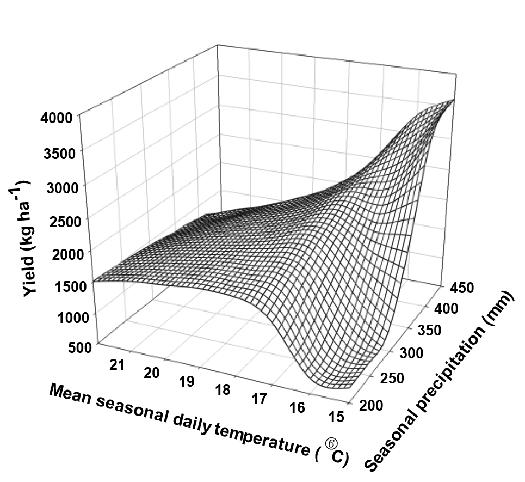
Note: 1 bu/ac = 67.2 kg/ha. To convert kg/ha to bu/ac divide by 67 for field pea. 1000 kg/ha is about 15 bu/ac.
The data set has 1555 total combinations of temperature, precipitation and days above 28 C for a range typical of Saskatchewan, and includes a further 2 C increase in the range of mean seasonal daily temperature.
Source: Bueckert et al. Effect of heat and precipitation on pea yield and reproductive performance in the field. Can. J. Plant Sci. (2015) 95: 629-639.
Bueckert says the length of reproductive growth was an important factor in yield, and that heat stress or lack of moisture caused flower and reproductive node abortion. Conversely, the longer the pea spent in the reproductive growth phase, the higher the yield.
“Pea was sensitive to heat but heat units did not satisfactorily describe growth and yield in all environments,” reports Bueckert. “Strong relationships were observed between crop growth and mean maximum daily temperature experienced during reproductive growth, and between crop growth and mean minimum temperature.”
CONTINUED ON PAGE 23


K-Row 23 ® (0-0-23-8S) is an efficient, chloride-free source of soluble potassium and sulfur developed for starter and in-furrow (pop-up) fertilizer applications. It is effective, easy to blend and seed-safe when applied at recommended rates.
K-Row 23 contains 2.6 pounds of potassium (K 2 O) and 1.0 pound of sulfur in each gallon.
by Bruce Barker
Here’s a look at new pulse varieties available as Certified seed in 2016 and beyond. This information comes from pulse crop plant breeders, seed companies and Saskatchewan Pulse Growers.
FP Genetics has a new yellow pea for commercial growers to seed in 2016. Also, at the University of Saskatchewan’s Crop Development Centre (CDC), plant breeder Tom Warkentin and his team are bringing several new varieties to market in 2016-2017 and beyond.
Yellow: New Abarth yellow pea from FP Genetics provides growers with competitive yield, good disease resistance and larger seed size. Abarth has medium maturity with very good resistance to powdery mildew, and fair resistance to mycosphaerella blight and Fusarium wilt. It has good lodging resistance with best in class standability for ease of harvesting.
Breeder seed of CDC Inca has strong yield potential in southern Saskatchewan and was first released to seed growers in 2015. It has good lodging resistance, medium seed size, round seed shape, medium protein content and good cooking quality. Certified seed of CDC Inca should first become available in 2018.
Green: Breeder seed of CDC Greenwater was first released to seed growers in 2014. It has strong yield potential and good lodging resistance. CDC Greenwater has medium seed size and round seed shape. Certified seed of CDC Greenwater should first become available in 2017.
Maple: CDC Blazer (3012-1LT) is a new maple pea variety with a lighter seed coat colour. It has higher yield than the other maple peas, similar to CDC Meadow, and seed size similar to CDC Rocket. Certified seed of CDC 3012-1LT will become available in 2018.
The CDC is the only lentil breeding institution in Canada, and is led by Bert Vandenberg.
Extra small red: CDC Roxy (3959-6) is a new variety that was released to seed growers in 2014. It has plump seed and is consistently higher yielding than CDC Maxim (103 per cent). It is not imidazolinone tolerant. Seed supply for this variety will be limited but it is one to watch for and should be commercially available by 2018.
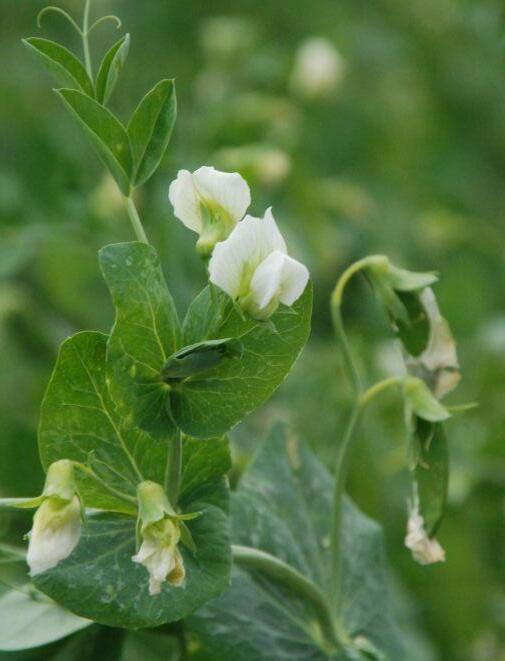
New Abarth yellow pea from FP Genetics provides growers with competitive yield.
Small red: CDC Cherie is a newer variety released in 2012 and is not imidazolinone tolerant, but it is high yielding (109 per cent of CDC Maxim). Commercial seed of CDC Cherie may be available for 2016 in limited supply.
CDC Impulse (IBC 479) is higher yielding, especially in the south (108 per cent of CDC Maxim), with slightly larger seed than CDC Maxim, as well as a bit taller and a bit later. It is imidazolinone tolerant.
CDC Proclaim (IBC 550) is another higher yielding small red that is imidazolinone tolerant.
CDC Redmoon (3646-4) is a new variety similar to CDC Maxim with thicker seed and higher yields and is not imidazolinone tolerant.
CDC Impulse and CDC Proclaim were released to seed
growers in 2014 and CDC Redmoon in 2015 so Certified seed won’t be available for a few years.
Large green: CDC Greenstar is a newer large green lentil that has high yield potential but is not imidazolinone tolerant. Seed supply may be limited for CDC Greenstar for 2016.
Small green: CDC Kermit (3592-13) released in 2014 has seed similar to CDC Viceroy, better lodging, and yield is much higher than CDC Viceroy and CDC Maxim so far. Not imidazolinone tolerant. Limited seed may be available in 2017.
Plant breeder Bunyamin Tar’an at the CDC says the major objectives of the chickpea breeding program are high yield potential with acceptable seed quality characteristics, reduced production risk through improved resistance to ascochyta blight and early maturity, and plant characteristics for better crop management.
Kabuli: CDC Palmer is a new variety released in 2014 and Certified seed may be available in limited amounts by 2016. CDC Palmer is a high yielding kabuli chickpea cultivar with medium large (9-10 mm) seed size. The seed of CDC Palmer is a light cream-beige colour with typical ram-head kabuli seed shape. It is earlier maturing than CDC Orion and moderately resistant to ascochyta blight. CDC Palmer is well adapted to all current chickpea growing regions of Brown and Dark Brown soil zones of southern Saskatchewan and southeastern Alberta.
Desi: CDC Consul is a relatively new high yielding desi chickpea, and is an alternative to the production of small kabuli chickpea types. It has good resistance to ascochyta blight. CDC Consul is suited to all current chickpea growing regions of Brown (Area 1) and Dark Brown (Area 2) soil zones of southern Saskatchewan and southeastern Alberta.
Public dry bean plant breeding programs are at the CDC, Agriculture
and Agri-Food Canada (AAFC) Lethbridge and Morden Research Centres, and the University of Guelph. Parthiba Balasubramanian at AAFC Lethbridge focuses on developing cultivars of various dry bean market classes for irrigated production under both wide row (60 cm or higher) and narrow row (30 cm or less) spacing.
At CDC, Kirstin Bett is breeding dry bean for short season environments. The main breeding objectives include early maturity, improved pod clearance and high yield combined with market acceptability within market classes.
In addition to the publicly developed varieties at CDC and AAFC, private plant breeding companies, including GenTec Seeds, Seminis Vegetable Seeds, Globe Seeds and Rogers Brothers have also developed dry bean varieties suitable for Saskatchewan.
AAC Tundra, developed at AAFC Lethbridge, is a high-yielding, early-maturing great northern bean with an upright, indeterminate bush growth habit with long vines (Type IIb). It entered the commercial market in 2015. AAC Tundra has a large seed size and improved field resistance to white mould compared with the check cultivar AC Polaris. AAC Tundra is suitable for irrigated wide row production in Alberta and Saskatchewan.
AAC Burdett, developed at AAFC Lethbridge, is an earlymaturing pinto bean cultivar with an upright, indeterminate bush growth habit, lodging resistance, white mould avoidance and high yield potential. AAC Burdett, registered in 2014, is suitable for irrigated production in Alberta and Saskatchewan.
AAC Whitehorse, developed at AAFC Lethbridge, is a highyielding, early-maturing great northern bean cultivar with an upright, indeterminate bush growth habit, large seed size and partial field resistance to white mould. AAC Whitehorse, registered in 2014, is suitable for irrigated wide row production in Alberta and Saskatchewan.
AAC Black Diamond 2, developed at AAFC Lethbridge, is a high-yielding black bean cultivar with an upright, indeterminate bush growth habit, lodging resistance, shiny black seed coat and improved resistance to seed-borne common bacterial blight caused by Xanthomonas axonopodis pv. phaseoli. AAC Black Diamond 2, registered in 2014, is suitable for irrigated production in Alberta and Saskatchewan.
CONTINUED FROM PAGE 20
The researchers found that when the mean maximum temperature was greater than 25.5 C at the dryland site, the number of days in reproductive growth was reduced to less than 35 days. More than 20 days above 28 C meant less time in the reproductive phase and lower yield for dryland pea.
“The threshold maximum temperature for yield reduction in the field was closer to 28 C than 32 C from [other] published studies, and above the 17.5 C mean seasonal daily temperature,” Bueckert explains.
At Outlook, irrigation helped to buffer the effect of heat, and the pea remained in reproductive growth for 35 to 40 days in a wider temperature range of 24.5 C to 27 C.
To put those temperatures into perspective, average climate data shows that from June to August, Saskatoon experiences
11.5 days above 30 C and Outlook 12.3 days.
“Clearly, mean daily maximum temperatures exceeding 25 C were associated with shortened reproductive phases of less than 35 days at both Saskatoon and Outlook,” Bueckert says.
On the Prairies, late-maturing varieties take about 94 days to mature, with medium maturity varieties around 90 days and the earliest at 86 days. Yet the normal frost-free period for Outlook is 123 days and 117 days for Saskatoon. Bueckert says plant breeders could lengthen maturity in pea by at least seven days without frost risk. If plant breeders could get the pea to flower earlier and longer (more indeterminate growth), yield potential could be increased.
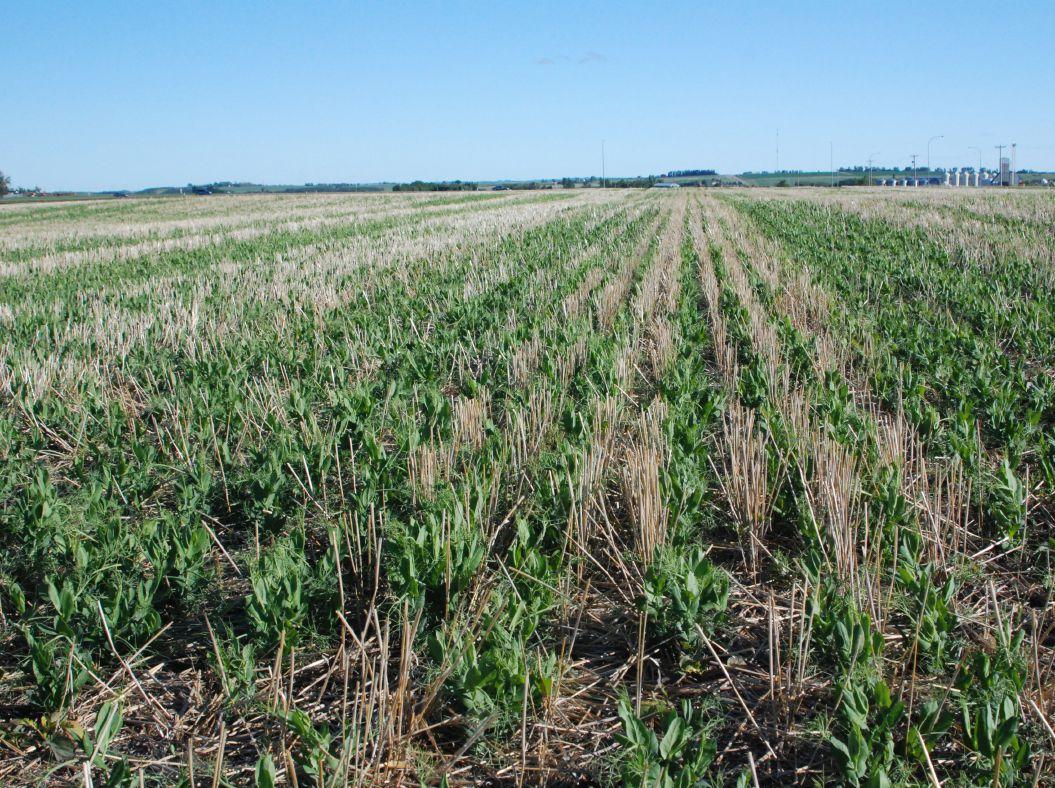
Pea input study investigates optimum agronomic package.
by Bruce Barker
Farmers often wonder how to get the best bang for their buck with pea inputs. Seed, seed treatments, inoculants and foliar fungicide packages can quickly add up so they have to pay off.
Inspired by a canola input study conducted by research scientist Stu Brandt, formerly of Agriculture and Agri-Food Canada at Scott, Sask., the Western Applied Research Corporation (WARC) spearheaded a study at five sites in Saskatchewan and Manitoba to look at the optimum agronomic package for pea production.
“Many growers are managing pea inputs for high yield, but there wasn’t much research into which ones contributed the most or if the inputs had an additive effect on yield,” says Jessica Weber, WARC general manager.
The Saskatchewan Pulse Growers, and Manitoba Pulse and Soybean Growers provided funding for the trial. The objective of the experiment was to determine which individual agronomic inputs contribute most to field pea seed yield, which combination produces the highest seed yield and economic return, and how plant population, leaf and stem disease, crop maturity, grain yield and quality are affect-
ed by input interactions. Field trials were conducted in 2012-2014 at the Agri-ARM sites located at Scott, Swift Current, Melfort and Indian Head, Sask., with a fifth site at Minto, Man. added in 2014. Due to excess moisture in 2013, the trial at Melfort was terminated; data was collected from 12 site years.
The five inputs studied were:
• Seeding rate – 60 seeds/m2 vs. 120 seeds/m2 (roughly 1.8 bu/ac vs. 3.8 bu/ac)
• Seed treatment – no seed treatment vs. Apron Maxx
• Inoculant – liquid vs. granular (at recommended rates of each)
• Starter fertilizer – none vs. 34 lbs actual nitrogen (N) sidebanded
• Foliar fungicide – none vs. a two pass system (Headline EC and Priaxor DS)
The low input package was called the “empty” package and the high input package included all inputs at the highest level. Each input was tested individually and then in additive combinations of two, three, four and all five as the “full” package.
ABOVE: High seeding rates are the foundation of a profitable pea crop.
Source: WARC.
Weber says the researchers found a split in yield at the different sites around 45 bu/ac. Melfort, Scott and Minto sites had higher yields, while Swift Current and Indian Head had lower yields. The data was analyzed on the basis of high or low yield potential.
At the low yielding sites – the cause wasn’t identified if it was because of root rots, moisture stress or other factors – there was a consistent advantage to seeding at the higher rate. Inoculant type did not provide a difference in yield or economic return. Foliar fungicide application in lower yielding sites depends on growing season conditions if they favoured disease development. The higher seeding rate at the low yield sites still provided a $44 per acre economic return.
“Using a seeding rate that helps establish a good plant stand was very important on the low yielding sites,” Weber says.
effect with inputs at high yield sites
At the high yield sites, the higher seeding rate plus granular inoculant Table 1. Net revenue comparing treatments
plus double foliar fungicide application consistently produced higher yield and better economic returns. The biggest yield responses came from higher seeding rates and foliar fungicide application. Weber says the results were additive, meaning that yield increased when each additional input was included in the treatment.
Looking at the economic analysis in further detail, WARC ran net revenue comparing the treatments at the high and low yielding sites.
“These three inputs of high seeding rate, granular inoculant and foliar fungicide application provided an economic gain of $72 per acre over the empty package at the high yielding sites,” Weber says. (See Table 1.)
Given that higher seeding rates provided the basis for higher yield and increased net returns at both high and low yielding sites, Weber says establishing a good plant stand should be at the foundation of any pea crop. In this research, plant density was increased from an average of 56 plants per square metre at the low seeding rate to 102 plants per square metre with high seeding rates at the high yielding sites. At the low yielding sites, plant populations increased from an average of 52 plants per square metre at the low
seeding rate to 89 plants per square metre with high seeding rates.
On the low end, this range of densities is outside the traditionally recommended plant density. Current recommendations for pea growers are a target of 75 to 80 plants per square metre.
Interestingly, seed treatment for seedling diseases, which usually result in a better plant stand, did not produce a consistent yield improvement. This finding was unexplained and warrants further investigation.
“The results show that you should ensure your seeding rate is high enough to establish a good plant population,” Weber says.
WARC’s final summary report “recommends all farmers use seeding rates to target the recommended plant population to maximize yield potential. Under situations where the farmer targets relatively high yields, we recommend also using a granular inoculant to ensure nodulation and nitrogen fixation to provide sufficient levels of nitrogen to the crop. If the crop develops a thick canopy and/or disease develops, adding a foliar fungicide will protect and maintain the yield potential of the crop.”
The full report is available at westernappliedresearch.com

• Spray when you want with new PixxaroTM or ParadigmTM
• Two revolutionary Group 4 herbicides with ArylexTM Active
• Ultimate broadleaf weed control performance in wheat and barley
• Extreme productivity and convenience in the conditions you’ve got Go to the new dowagro.ca or call 1-800-667-3852.
This one is especially tough to manage.
by Carolyn King
There’s another root rot pathogen in the neighbourhood. It’s called Aphanomyces euteiches. It loves peas, lentils and waterlogged soils. And it’s tough to deal with because its resting spores can survive in the soil for many years. Although Aphanomyces has been present in Manitoba since the late 1970s, researchers only recently identified it in Saskatchewan and Alberta. Now they are at work on some new strategies for managing it.
Aphanomyces euteiches is an oomycete, or water mould, which is a fungus-like organism. It produces one generation in a season. “The oospores are the primary inoculum left behind in the soil or decaying host tissue. They are thick-walled, very resistant resting structures. Reports in the literature indicate they can survive in the soil from five to upwards of 20 years, depending on weather conditions,” explains Syama Chatterton, a plant pathologist with Agriculture and Agri-Food Canada (AAFC) in Lethbridge, Alta.
“A susceptible host plant releases root exudates and signals into the soil. Oospores respond to those signals and germinate. Through a complicated germination process, they eventually produce zoo -
spores, which are single cells with two flagella that help them swim.” They swim in soil water films to the host root and attach themselves to it.
“Then they produce hyphae, the fungal strands that penetrate into the root, and very rapidly begin colonizing it.” They break down the root tissues, feeding on the nutrients. Once they have used up all the nutrients in the root, they form oospores.
The whole life cycle can be completed in about three weeks if temperature and moisture conditions are ideal. Infection can occur at any stage of the host’s development, with the timing depending on the environmental conditions.
Soggy, warm conditions are ideal for infection. “Aphanomyces often occurs in a complex with other root rot pathogens, like Fusarium, Pythium and Rhizoctonia. They all like moist conditions, but
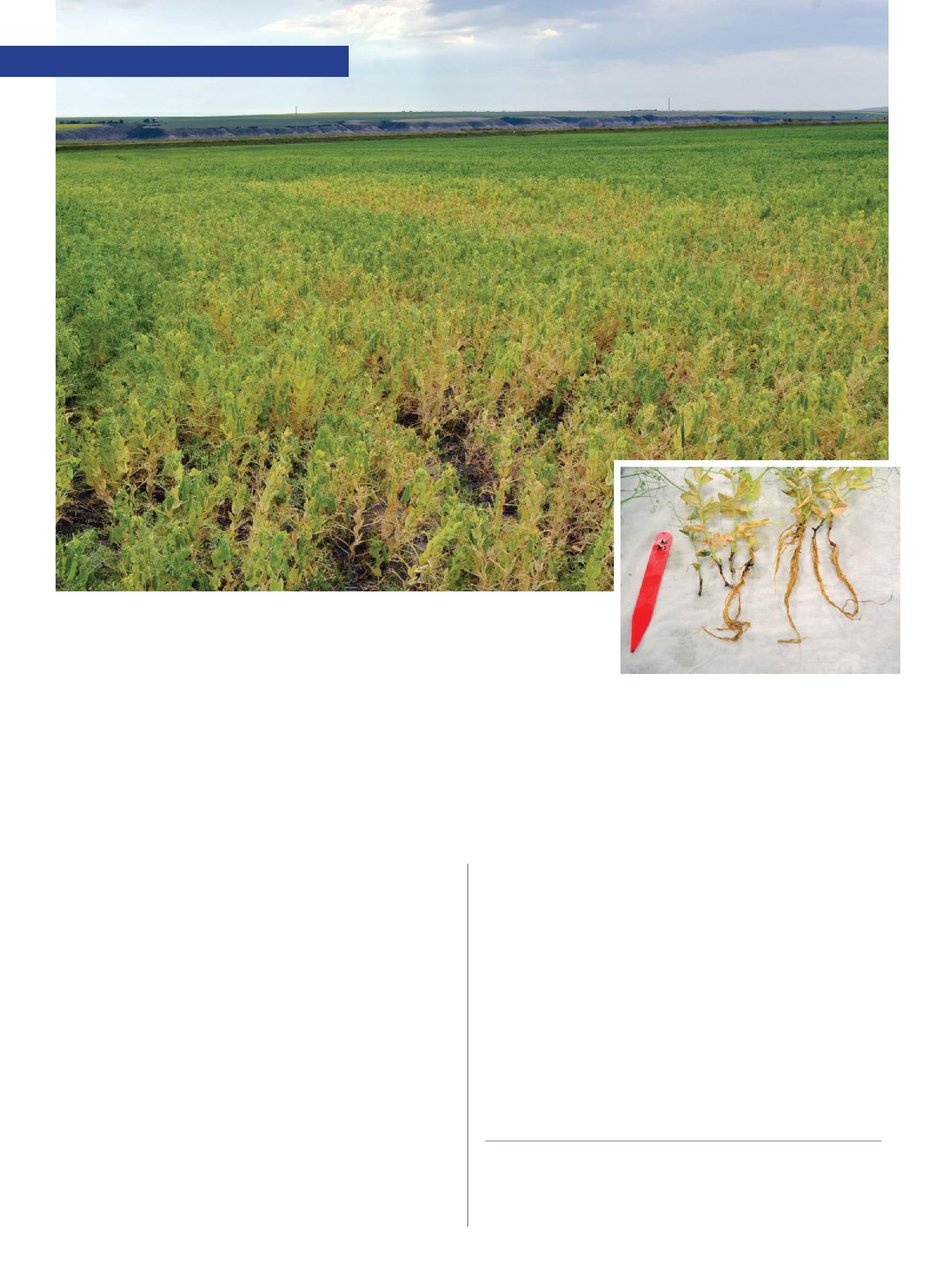
TOP: Patches of yellowing plants caused by Aphanomyces develop in the field 10 to 14 days after a significant rainfall event. INSET: Classical Aphanomyces root rot symptoms include honeybrown discoloration of the roots, constriction of the epicotyl, and complete decay of the roots in advanced stages.


Table 1. Conditions favouring infection by root rot pathogens
Aphanomyces 22 to 27
Fusarium 25 to 30 Moderate
Pythium 17 to 23 Wet
Rhizoctonia
Can damage at 18 but most aggressive at 24 to 30
Source: Faye Bouchard, Saskatchewan Ministry of Agriculture.
the oomycetes – Pythium and Aphanomyces – do even better with excess moisture,” says Faye Bouchard, provincial plant disease specialist with the Saskatchewan Ministry of Agriculture. On the Prairies, optimal soil temperatures for Aphanomyces infection (22 to 27 C) are typically reached by about July (see Table 1).
Chatterton has done Aphanomyces host range work with Sabine Banniza at the University of Saskatchewan. They have found that peas and lentils are both highly susceptible, whereas dry beans, fababeans, chickpeas and soybeans all have pretty good resistance. Alfalfa is somewhat susceptible, but some alfalfa cultivars are resistant. In 2015, Chatterton surveyed alfalfa crops grown on fields that have had peas in the rotation and found that the alfalfa roots were very healthy, suggesting that Aphanomyces is probably not a big concern for alfalfa.
“Aphanomyces has been around in Canada since the 1930s. But we just found it in Saskatchewan in 2012 in peas,” Bouchard notes. “Then we started doing more surveys for it, and Alberta started looking for it [and found it in 2013].” These surveys show the pathogen is fairly widespread in both provinces.
So why has Aphanomyces root rot suddenly become an issue? “My hypothesis comes down to three reasons that have all come together in a perfect storm,” Chatterton says.
“The first reason is that we’re reaching the point where most places in Alberta and Saskatchewan have had a good 25-year cropping history of either peas or lentils. So, if producers are using good rotational practices with a pea or lentil crop once in every four to five years, then some fields would have had a pea or lentil crop six to seven times, or more often if they have tighter rotations. If a field started with a low inoculum level…the amount of inoculum would gradually build up every time a susceptible host crop was planted because the oospores can survive for a long time. It would take about six to seven cropping cycles to reach a threshold level of inoculum where it is more widespread throughout the field and can cause visible damage,” she explains.
“The second reason is that we had several really wet springs in a row, and Aphanomyces is dependent on having saturated soils in order to infect. So you get increased infections because the environmental conditions are right, and the inoculum load in the soil increases quite quickly.”
And the third reason is a detection issue. “In previous root rot surveys, they were taking pieces of roots and plating them out on agar to determine the causal agent. But usually Fusarium over-grows Aphanomyces on the culture, so it can be really hard to confirm Apha-
Wide range of conditions
nomyces. I think it was Sabina Banniza who decided in 2012 to do a PCR test [which uses DNA markers specific to Aphanomyces euteiches]. That was the first time we were able to confirm Aphanomyces in [a Saskatchewan sample]. For our Alberta surveys in 2013 and onwards, we’ve expanded to using that PCR test. It has definitely improved detection of Aphanomyces.”
In Chatterton’s root rot surveys for 2013, 2014 and 2015, root rot was found in about 70 per cent of the surveyed fields each year, but disease severity varied greatly from year to year. The highest root rot levels occurred in 2014 because it was a particularly wet year. Chatterton says, “In 2014, we found that root rot was common and widespread throughout Alberta. The results from the PCR tests showed Aphanomyces was present in about 44 per cent of all fields in Alberta and in 60 per cent of fields that had root rot symptoms.”
The PCR analysis of the 2015 Alberta samples is not yet complete, but the field surveys showed root rot severity was definitely lower than in 2014, due to the very dry conditions in 2015.
The Alberta surveys also show that “Aphanomyces-positive fields are more common in the Black and Gray soil zones that are more typical of central Alberta. I think that is because they have had a pretty long history of pea production there, and those areas tend to be wetter than southern Alberta,” Chatterton notes. “In southern Alberta’s Brown soil zone in 2014, only about 18 per cent of the fields were positive.”
Although Saskatchewan didn’t do a formal root rot survey in 2015, the dry conditions in the spring and early summer likely reduced the amount of disease. Bouchard didn’t see as much root rot in the field, she didn’t get as many inquiries about it from growers, and fewer samples were submitted to the ministry’s Crop Protection Lab.
Trying to figure out which root rot pathogens you have in your field isn’t easy. Aboveground, they share the same symptoms, like poor emergence, wilting, yellowing and stunting. The belowground symptoms are usually a confusing mix caused by a complex of pathogens.
In the lab, if you infect plants with only Aphanomyces, the symptoms are distinctive. “The whole root system will have a honey-caramel discoloration. And the classical symptomology is that the epicotyl, which is the portion between the point of seed attachment and the green stem, becomes very tightly constricted and has that same honey-brown colour, which stops abruptly right at the green stem,” Chatterton explains. “Also, because the disease causes decay of the entire root cortex but not the vascular system, oftentimes if you pull up the plant from the soil, only the white vascular bundle is left and the rest of the roots are gone.”

Now in our 4th year, this two-day grain marketing conference will feature a current market outlook and interactive workshops for a fictional farm, complete with its own unique marketing challenges.
We will focus on advanced financial strategies, further education and standards for wheat basis and introduce a new tool for managing risk.
Register TODAY by calling 1-877-947-2549 (limited spaces available).
January 28-29 Saskatoon – Radisson Hotel, 405 Twentieth Street East
February 2-3 Red Deer – Sheraton Hotel, 3310 50th Avenue
February 11-12 Grande Prairie – Pomeroy Hotel, 11633 100th Street
February 23-24 Regina – Double Tree Hilton, 1975 Broad Street
March 1-2 Portage la Prairie – Canad Inns, 2401 Saskatchewan Avenue W
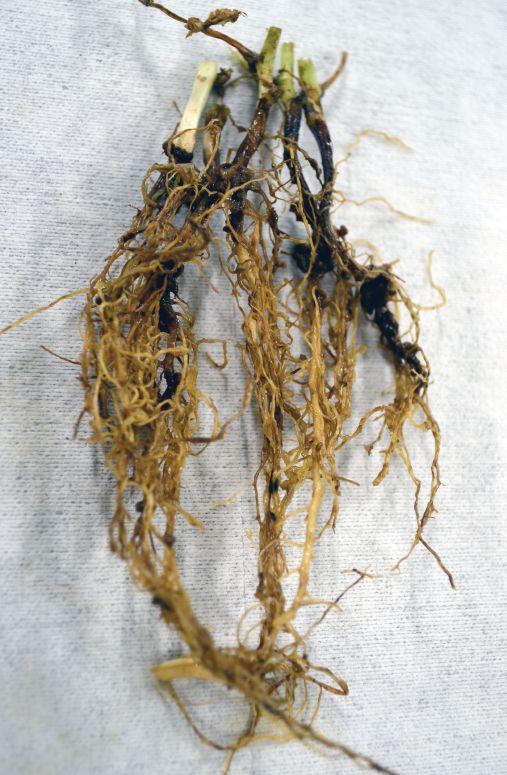
In the field, Fusarium species tend to colonize tissue that Aphanomyces has already started to infect, producing mixed symptoms. “The roots will look black and will be pruned away; Fusarium causes pruning of the roots. So you get an ugly mess of a black taproot and brown decaying lateral roots,” Chatterton says. “A good way to check for Fusarium is that it causes red colouring in the vascular system.”
When a root rot infection is advanced, it is especially difficult to figure out the original cause. “Not only are the roots rotting and the plant dying, but there could be multiple root rot pathogens as well as saprophytes, which are fungal organisms that live on the decaying and dead plant material,” Bouchard says.
She adds, “The other difficulty is that it is hard to separate out the damage that excess moisture causes to the crop, even without any pathogens present. Lentils and especially peas don’t like wet feet, when the plant is sitting in too much water. Those conditions alone will mean that the roots won’t develop as well and probably won’t form nodules as nicely, and the above-ground plant parts will probably be yellowing, stunting and wilting. But those wet conditions stress the plant, so if a pathogen is present, it will probably cause even more damage because of the stress.”
The best way to tell which root rot pathogens are present is to send samples to a diagnostic lab, such as Saskatchewan’s Crop Protection Lab, Discovery Seed Labs or BioVision Seed Labs.
Researchers in Alberta and Saskatchewan are tackling Aphanomyces from several angles. For example, at the University of Saskatchewan, they are working on developing resistant lines of peas and lentils.
To assess various Aphanomyces management practices in field peas, Chatterton initiated a large study in 2015. The study is taking place at Drumheller, Brooks, Taber, Lethbridge, Saskatoon, and two sites in the Red Deer-Lacombe area. Collaborating with Chatterton are Mike Harding and Robyne Bowness at Alberta Agriculture and Forestry, and Bruce Gossen at AAFC in Saskatoon. The Alberta Crop Industry Development Fund, Alberta Pulse Growers and AAFC, through the Growing Forward 2 Pulse Cluster, are funding the study.
At each site, the study is evaluating seed treatments, cultivar resistance and soil amendments. All sites are in producers’ fields. Six of the seven sites were selected because the fields had a high risk for Aphanomyces root rot; the Lethbridge site only had Fusarium root rot.
The seed treatment trials include different combinations of various products with activity against Fusarium, Pythium, Rhizoctonia and Aphanomyces. The seed treatment for Aphanomyces is ethaboxam (Intego Solo) – a new option that was given emergency use registration on field peas in Alberta, Saskatchewan and Manitoba in 2015.
The cultivar trials involve 20 pea cultivars, including some currently popular cultivars as well as some that are just about to be released.
The soil amendment trials are comparing three possibilities. “We searched the literature for any instance of something that might have some effect against Aphanomyces,” Chatterton explains. One treatment uses calcium, involving spent lime from the sugar beet industry; calcium has reduced zoospore production in greenhouse tests. Another treatment is Phostrol, a phosphite-based product, which has activity against oomycetes and provided some suppression of Aphanomyces in peas in the Pacific Northwest. The third treatment is the herbicide Edge (ethalfluralin), which showed Aphanomyces suppression in some preliminary work a few decades ago.
In the study’s first year, all the cultivars were susceptible to Aphanomyces root rot, as expected from previous greenhouse testing at the University of Saskatchewan.
“The seed treatments and soil amendments gave some promising results early in the season. By about five to six weeks, we could see some nice visual differences in root rot severity between some of the treatments,” Chatterton says. “But by the end of the growing season, the root rots were pretty similar across the board. Some treatments definitely yielded better than others, but we didn’t find any statistically significant differences between treatments.”
With only one year of data in an unusually dry year, it’s too soon to draw any conclusions. Also, Chatterton points to a key challenge with trying to do these types of field trials. “Because the distribution [of Aphanomyces] can be very patchy in fields, we had to choose sites with very high levels of Aphanomyces root rots. I think the inoculum load at some of these sites is too high, and at that level, disease management strategies often aren’t going to work. We could try to find sites that have a lower level of Aphanomyces, but then we won’t be certain that the inoculum has spread throughout the soil [so some plots might have different levels of inoculum].”
The researchers will be repeating the trials in 2016. Then, Chatterton hopes to get continued funding for several more years to determine how low the inoculum levels need to be for the practices to be effective.
In a project funded by the Saskatchewan Pulse Growers, Chatterton and Banniza are determining how much Aphanomyces inoculum is needed to cause different levels of the disease. “Right
now, you can submit samples to a lab to find out if Aphanomyces is present or absent, but the lab can’t determine if you have a low or high risk of getting Aphanomyces root rot,” Chatterton says.
“So we want to determine the amount of inoculum needed in the Brown, Dark Brown and Black soil zones to get low, medium or high disease levels. The idea is that interested testing labs could then offer a DNA quantification service for Aphanomyces and be able to use the DNA levels to determine if a field has a low, moderate or high level of Aphanomyces. That should help inform decisions on the length of time peas or lentils might need to be out of the rotation, or whether the grower could look at seed treatments or maybe a soil amendment treatment.”
At present, the best strategy is to submit plant or soil samples to a diagnostic lab to determine which root rots are causing problems in your fields, and if Aphanomyces is an issue, then use that information in your management decisions.
For fields that are highly infested with Aphanomyces, Bouchard and Chatterton advise waiting at least six years before planting peas or lentils again. Bouchard says, “Hopefully growers won’t have to do that on a permanent basis because there should be more options available as more research is done. One seed treatment, called Intego Solo, is available now, and there are potentially other treatment options coming down the pipeline. And hopefully we’ll get some resistant varieties.”
In the meantime, Chatterton suggests, “If you want to grow a pulse crop [on a field that is heavily infested with Aphanomyces], then fababeans are a really good option because they are really resistant to Aphanomyces.“
For fields with low to moderate Aphanomyces infestations, Chatterton recommends extending pea or lentil rotations from three or four years to perhaps five or six years. She adds, “Those are good fields for possibly using a seed treatment with activity against all the pathogens in the root rot complex, and that should help to boost your crop and keep it healthier.”
When your goal is fast, even crop emergence, trust Väderstad to help. With innovations like Patented Precision Openers and Wireless iCon™ Control, our Seed Hawk Seeding System places seed and fertilizer with unparalleled accuracy, in all soil conditions. Which gives you the greatest opportunity for higher yield.
Evolve your farm. Ask your equipment dealer about the Seed Hawk Seeding System, or visit SeedHawkSeeder.com Evolve your farm.
Leaving wheat stubble tall can produce higher yields – sometimes.
by Bruce Barker
Seeding canola into tall standing stubble doesn’t always produce higher yield, and carries some risk in some geographic locations, but under the right conditions, the practice can work.
Building on research conducted by Agriculture and Agri-Food Canada scientists Herb Cutforth and Brian McConkey at Swift Current, Sask., University of Manitoba (U of M) graduate student Michael Cardillo expanded the research to look at tall stubble effects at 11 site-years across Western Canada.
“The climate is changing, and with increasing world population, we need to look at management practices that farmers can very easily implement that can help them produce more food,” Cardillo says. “Cutforth’s work at Swift Current showed that leaving stubble taller was very successful in improving the microclimate in tall stubble and producing higher yield under semi-arid conditions. We wanted to see if it would work for canola in a larger eco-climate across the Prairies.”
Cardillo’s research, conducted with Paul Bullock and Rob Gulden of the U of M, Aaron Glen of AAFC Brandon and Cutforth, included four locations in 2011 at Swan Lake, Man., Indian Head and Swift Current, Sask., and Grimshaw, Alta. In 2012, an additional three sites were added at Kenton, Man., and Falher and Lethbridge, Alta. The sites provided a broad range of eco-districts, climatic conditions and soil types.
Cereal stubble heights compared were 20 cm (7.9 in) and 50 cm (19.6 in). In some cases, the stubble was cut to height in the fall. In other cases, the stubble was left tall over winter, and then cut to the shorter height in the spring ahead of canola seeding. At
some sites, the tall stubble was flattened as a result of lodging from over-wintered snow, strong winds or mechanical damage during seeding. This created an additional factor to consider, and so the sites were further classified into whether the tall and short stubble treatments were intact or damaged.
“One of the risks farmers have to assess is whether the tall stubble might be flattened by snowfall, and how that will impact their ability to seed, and the potential for cooler, wetter spring soils,” Cardillo says.
The snowpack was assessed at Swan Lake and Indian Head in both 2011 and 2012 because the tall and short stubble was established in the fall. Overall, Cardillo says, as expected, the tall stubble had higher snow water equivalent than the short stubble.
“Historically, 30 per cent of precipitation falls as snowfall, so in a dry year, tall stubble can help recapture moisture loss coming into the spring,” Cardillo says.
In 2011 and 2012, growing season precipitation was above average at 10 of the 11 site-years, with generally wetter conditions earlier in the growing season and a gradual reduction in rainfall to below-average levels.
Canola emergence and plant populations were compared across intact and damaged sites for both tall and short stubble. Plant populations were greater in intact tall stubble than damaged tall
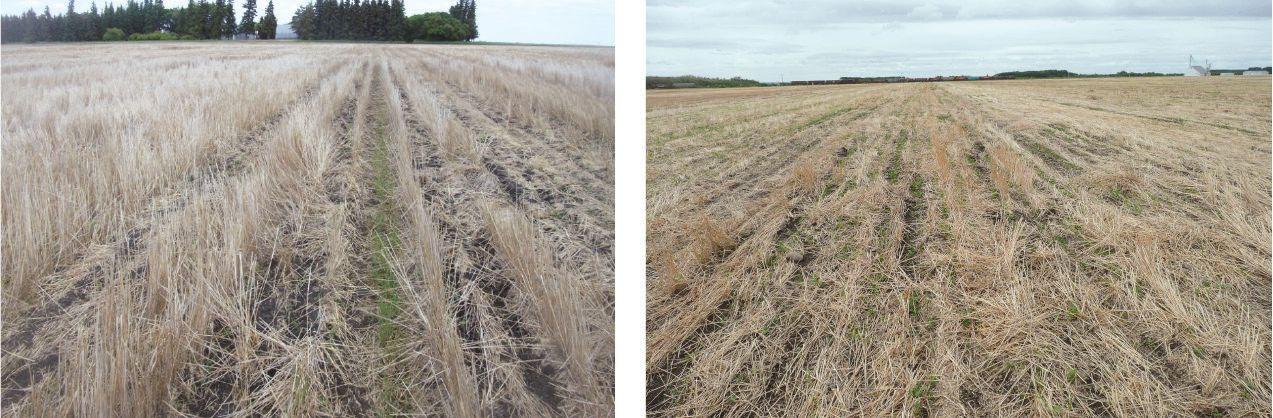
ABOVE: Intact stubble (left) produced significantly higher canola yields than damaged stubble (right).









and rewards.
Site-years where both the tall and short stubble remained intact for (a) emergence rate (%), (b) canola plant population, (c) biomass, and (d) yield. Note: Emergence rate includes 3 site-years with intact tall and short stubble all from the 2012 growing season; all others include 6 site-years with intact tall and short stubble from both 2011 and 2012. Error bars indicate the standard error of the mean. Capital letters indicate significant differences between treatments across all sites at P=0.05.
Source: Cardillo et al. 2015. Stubble management effects on canola performance across different climatic regions of Western Canada. Can. J. Plant Sci. 95: 149-159.
stubble. But for short stubble, the plant population was significantly higher in the damaged stubble. On the intact stubble sites, there was no significant difference in plant populations between tall and short stubble.
“The wet spring conditions provided good seedbed conditions in the intact stubble treatments, and resulted in good stand establishment at the intact stubble sites,” Cardillo says.
Canola yields were significantly higher in the intact stubble rather than the damaged stubble, for both tall and short treatments. Cardillo explains this is likely due to the soil warming and drying more quickly in the intact stubble than on the sites where the stubble was flattened on the ground. The tall intact stubble sites also had significantly higher yield than the short intact stubble treatments.
“There was enough moisture stress later in the growing season to provide an advantage to the tall stubble. The tall stubble provided a better microclimate with reduced evaporative water loss, which resulted in higher yield,” Cardillo explains. (See Fig. 1.)
Cardillo says results of the research show both the risk and rewards of leaving stubble tall prior to seeding canola the following spring. In areas with typically heavier snowpack and wetter spring conditions, tall stubble may be flattened in the spring, slowing soil warming and making seeding difficult. Short stubble may also be flattened and suffer lower yields as well, but with less straw to contend with short stubble may present fewer seeding challenges.
In areas where snowfall is lower and growing conditions drier, the potential for higher canola yields when seeded into tall stubble is well proven by Cutforth’s and Cardillo’s research. In these areas, tall stubble will usually remain standing overwinter, thus capturing more snow and providing a better microclimate, resulting in higher yield.
“Leaving stubble tall is a nice useful tool for farmers. But it isn’t written in stone. You don’t have to do it every year. It’s a judgment call. Farmers can assess soil moisture conditions at harvest and decide if they want to take the risk of leaving stubble high. And you don’t have to cut at 50 cm. Maybe there is less risk of lodging at 30 cm, or maybe a greater advantage at 60 cm. It is a potentially good management practice that has flexibil-
by Bruce Barker
In the short term, farmers have moved to a canola-wheat rotation as the most popular rotation on the Prairies. Driven by economics, this rotation has proven profitable – but at what cost?
Researchers at Agriculture and Agri-Food Canada (AAFC) conducted research from 2008 to 2013 to determine the effect of canola rotation frequency on canola seed yield, quality and pest impacts. The results were published in the Canadian Journal of Plant Science
The objective of the study was to determine the effect of canola rotation frequency on canola pests (weeds, blackleg disease and root maggots), seed yield and quality in a six-year, all phases, rotation study at five sites in Western Canada. From 2008 to 2013, continuous canola and all rotation phases of wheat and canola or field pea, barley and canola were conducted at five Western Canada locations. LibertyLink and Roundup Ready canola were grown. Fertilizers, herbicides, and insecticides were applied as required. (See Table 1.)
The five sites were at Lacombe and Lethbridge, Alta., and Melfort, Scott and Swift Current, Sask. The crops were directseeded on no-till plots. Most fertilizer was side-banded 0.75 to 1.5 inches beside and 1.2 to 1.6 inches below the seed row with small amounts of nitrogen and phosphorus also placed with crop seeds. Seeding was performed with air seeders equipped with knife openers, and crops were seeded at optimal depths in nine to 11.8 inch rows.
In the research, AAFC research scientist Neil Harker did not observe any significant rotation frequency by canola cultivar interaction, so all yield data was averaged across variety, and herbicide
type. Yields were also averaged across location. An average of 3.5 to 6.4 bu/ac (200-360 kg/ha) increase was seen for each year that a wheat, barley or pea crop was added to the rotation.
“Canola yields were always improved by adding wheat or field pea followed by barley to the rotation,” cited Harker in the journal article. “These results are consistent with many other studies suggesting canola yield improvements with increased rotational diversity.”
Looking at the more diverse rotation of lentil-wheat-canolapea-barley-canola, the researchers did not find a yield advantage compared to a field pea-barley-canola rotation. Seed oil or protein concentration and oil quality were not impacted by rotation frequency (see Fig. 1).
The higher canola yields with more diverse rotations were attributed to decreasing blackleg severity and incidence, and decreasing root maggot damage.
Blackleg severity and incidence were both strongly influenced by canola rotation frequency with blackleg severity and incidence increasing as canola rotations tightened. Despite using canola rated as resistant in the study, blackleg disease was worse with short rotations. The authors believe it may reflect a breakdown in cultivar resistance or at least a gradual erosion of resistance over time. This is supported by other research that found changes in blackleg virulence with high disease severity in some cases, usually associated with shorter rotations.
Root maggot damage also increased as canola was grown more
ABOVE: Fig. 1. Canola yield response to rotation frequency Note: Means are averaged over glyphosate- and glufosinateresistant canola. Wheat was the rotational crop for a one-year rotation break; field peas and barley were the rotational crops for a two-year rotation break.
1-in-3
1-in-3
1-in-3
1-in-3 RR-phase 2 Pea
1-in-3
1-in-3
w Data from canola (C) plots proceeded by canola, wheat (W) or field pea (P) and barley (B) were collected at the completion of the following rotation sequences: C_C_C, C_W_C or P_B_C (2010); C_C_C_C, W_C_W_C or C_P_B_C (2011); C_C_C_C_C, C_W_C_W_C or B_C_P_B_C (2012); and C_C_C_C_C_C, W_C_W_C_W_C or P_B_C_P_B_C (2013).
Source: Harker et al. Can. J. Plant Sci. (2015) 95: 9-20.
frequently in rotation during the first three years. However, in the last three years of the study, root maggot damage did not increase, leading the authors to conclude that: “Year-to-year variability in root maggot populations and the abundance of root maggot predator species may be more important than rotational diversity effects on root maggots.”
The study also looked at the impact environmental factors had on canola yield. High canola yield was associated with cooler temperatures and adequate, but uniform, precipitation over the growing season.
In concluding, the authors state: “In spite of reduced yields, rotations with high canola frequency may still be more profitable in the short-term, but long-term pest (disease, insect and weed) management issues could be problematic, if not dire. Growers should balance high immediateincome, low-diversity cropping systems with lower immediate-income, higher diversity systems to ensure long-term sustainable canola production.”
For more on new crop management, visit topcropmanager.com.
When it comes to farm equipment, one size doesn’t fit all. That’s why we’ve developed such a full line of Field Tested Tough™ equipment and attachments. No matter where you farm, what type of operation you run, or what conditions you face, we’ll have the equipment to address your unique challenges, while holding up to the toughest abuse.
Our Durable Versatile Land Rollers Can Meet Any Demand
•Use to reduce debris uptake, increase seed-to-soil contact or manage residue.
•15- to 91-foot working widths with 36- and 42-inch diameter rollers.
•Convenient hydraulic folding with two- and three-section SuperRoller models.
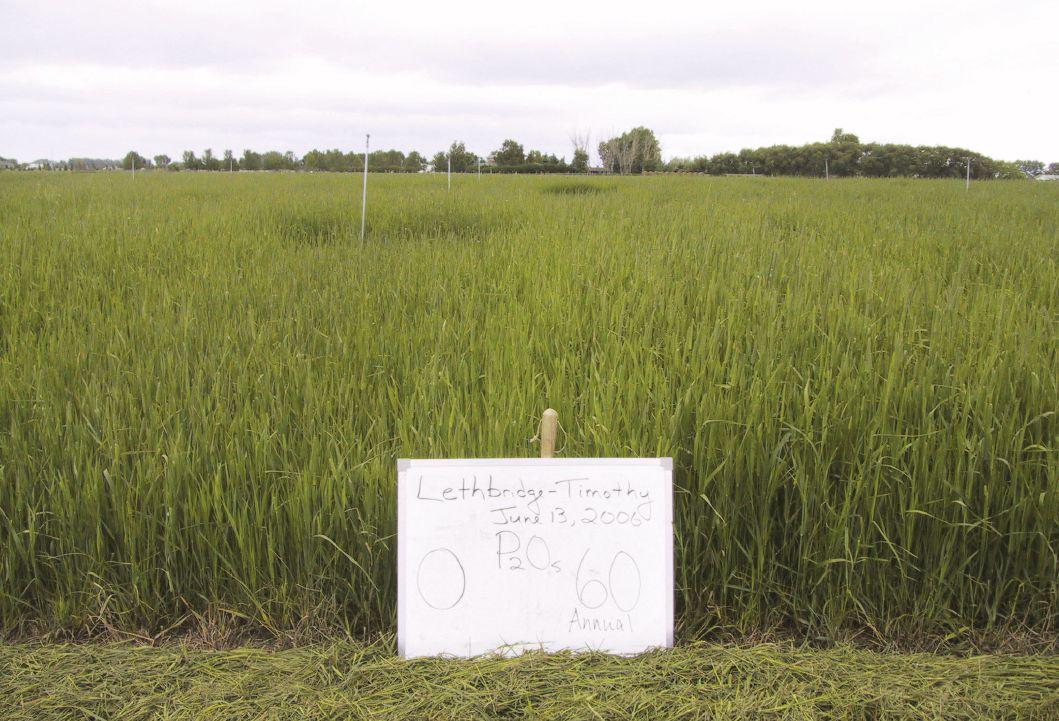
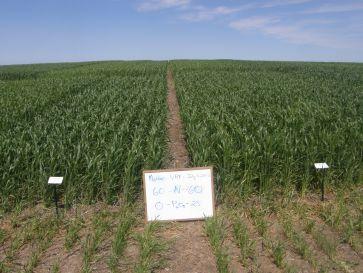
Various soil test methods have been used to estimate plant available soil P.
by Ross H. McKenzie PhD, P.Ag.
The goal of a laboratory soil test for phosphorus (P) is to estimate how much soil P will become available to plants during the growing season. To put it more simply, the laboratory test must try to duplicate, in about one hour, what plant roots will have access to over several months during the growing season.
P availability can be assessed by measuring phosphate concentration in the soil solution, and the soil’s ability to maintain the soil solution concentration. The quantity of P in the soil solution is only in the range of 0.3 - 3 lb/ac. Rapidly growing crops will absorb about 1 lb/ac of phosphate per day. Therefore, soil solution P is constantly being replenished by the “labile” pool of soil P. Labile P is a pool of soil P that is less available to plants but can undergo rapid chemical or biological changes to replenish the plant available soil P pool.
Soil tests cannot predict with 100 per cent accuracy when crops will respond to added phosphate fertilizer because the frequency of crop response can be strongly influenced by environmental conditions, particularly soil temperature and moisture early in the growing season. Also, different crop types use different mechanisms to aid in taking up soil P.
Various soil test methods have been used to estimate plant available soil P to make phosphate fertilizer recommendations for crops in Western Canada. Extensive field-testing in the 1950s led to the establishment of the Olsen method (Olsen et al. 1954) in the U.S., also referred to as the sodium bicarbonate or “bicarb” method. The Olsen method was developed specifically for higher pH, alkaline soils (soil pH >7) and was not intended for use on acid soils. This method has been widely used as the basis for making P fertilizer recommendations in Saskatchewan and Manitoba (Cowell and Doyle 1993).
Early work by the University of Alberta led to the use of the MillerAxley method as the basis for P fertilizer recommendations in Alberta (Robertson 1962). This was an acid extractant that worked satisfactorily with lower pH, acidic soils (soil pH <7) but worked very poorly with alkaline soils.
The Kelowna method was developed at the B.C. Ministry of Agriculture soil testing lab in Kelowna in the mid-1980s (Van Lierop 1988).
TOP: Timothy response to annual broadcast P fertilizer in southern Alberta.
INSET: Wheat response to seed-placed P fertilizer in upper slope position in variable rate research study in southern Alberta.
The method was analytically convenient and worked well to determine plant available soil P over a broad soil pH range with both calcareous and non-calcareous soils.
By the early 1990s, two modified versions of the Kelowna method were developed by Qian et al. (1994) at the University of Saskatchewan, and Ashworth and Mrazek (1995) at Norwest Labs. Acetic acid was added to the Kelowna extract by both groups to allow extraction of both P and potassium (K) with one extraction solution. The concentrations of ammonium acetate and acetic acid are slightly stronger in the Ashworth and Mrazek modification.
In the 1980s in Alberta, it was recognized that the Miller-Axley method performed poorly, particularly on alkaline soils. From 1991 to 1993, Alberta Agriculture led a major soil P calibration study at about 450 sites in the province to correlate P fertilizer response of wheat, barley and canola with a number of different soil test P methods (McKenzie et al. 2003). The Kelowna method and both modified Kelowna methods had the best correlation with P fertilizer crop response. The Kelowna method and the two derivatives of the soil test P methods were highly correlated, but there were slight differences. The two derivatives of the Kelowna method extracted slightly less P than the Kelowna method, but were still very highly correlated with the Kelowna method and each other. Generally, the modified Kelowna methods will extract more soil P versus the Olsen method, and perform much better over a wide soil pH range.
McKenzie et al found the modified Kelowna methods were well correlated for all soil types in Alberta and these have been the recommended test methods for Alberta soils since 1994. In Manitoba and Saskatchewan, most of the P soil test correlation has been with the Olsen method. Today, the Olsen P soil test method is recommended for growers in Manitoba, while in Saskatchewan both the modified Kelowna or Olsen methods are used.
Most Western Canada soil testing labs have adopted one of the two modifications of the Kelowna method. Most labs will also determine P by the Olsen method when requested. Exova and Farmers Edge soil testing labs use the Ashworth and Mrazek (1995) method and ALS lab uses the Qian et al method (1994).
Soil test P correlation work across the Prairies has been with 0 to 6 inch sampling
FACT #1: Proven® Seed is the total, all-around package for success in cereal and canola crops. It’s NEW genetics and varieties. It’s also 25 years of groundbreaking research — plus leading agronomics and field trials.
FACT #13: We have two new CWRS varieties from Proven Seed: CDC Titanium offers midge tolerance and improved yields; and 5605HR CL is the next step in Clearfield® wheat with high yields, FHB resistance and easy weed management.
FACT #27:
FACT #119: Champion is the highestyielding feed barley available in Western Canada.
FACT #29: Seed production is our priority, so we work with CSGA growers to produce clean, and test our seed to ensure the highest level of quality control. Through an accredited seed laboratory, we screen every seed lot extensively for disease, purity and germination — for confidence in your seed investment.
(that our cereal varieties yield confidence and performance)
Certified seed guarantees growers the best genetic strength and varietal purity plus improved disease tolerance and higher yield potential.
FACT #92: Our Proven Performance Trials is the largest comparison program in Western Canada. In 2015, we tested Proven Seed across 200 performance trials on large-scale, producer-managed fields — to ensure it performs best where it counts. See for yourself at provenseed.ca/performance-trials.
FACT #331: Proven Seed offers the highest-yielding choices for durum growers, including the popular variety AC Brigade New for 2016, CDC Fortitude is the first solid stem, sawfly resistant CWAD variety.
FACT #47: Proven Seed products are only available at CPS retail locations across Western Canada. Your CPS advisor will guide you through seed, fertility and crop protection requirements to find a solution tailored for your farm. Find a retailer near you at provenseed.ca/find-a-retailer.
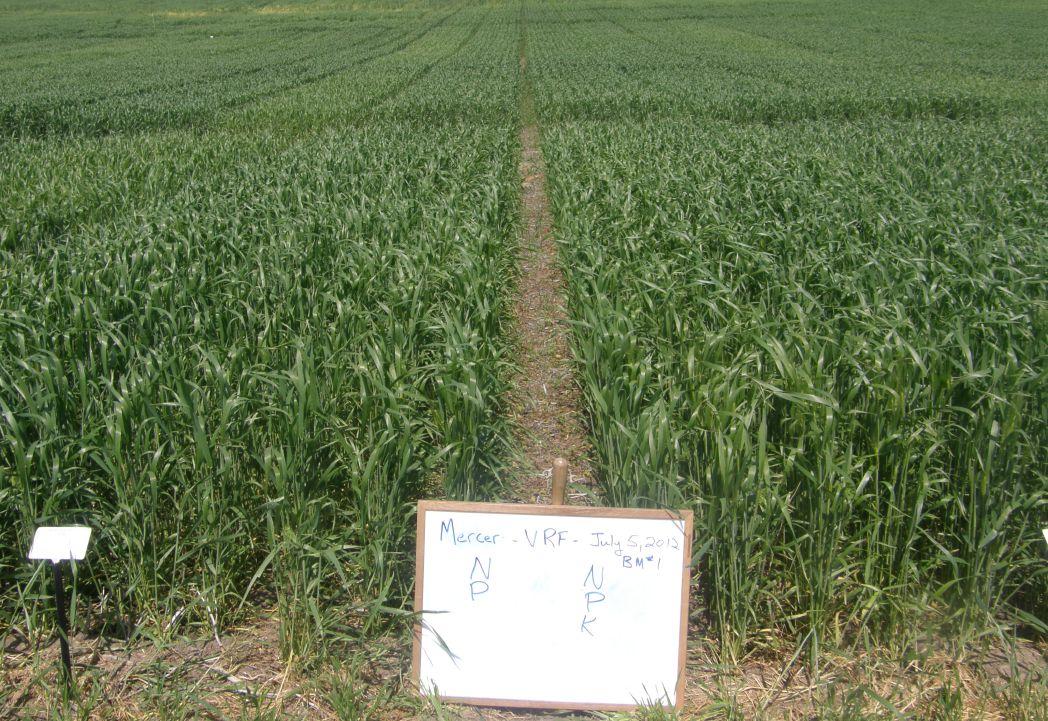
Soil K levels are slowly declining in many soils.
by Ross H. McKenzie PhD, P.Ag.
Potassium (K) is required by all plants and is taken up in relatively high amounts by most crops. Although K deficiency across the Prairies is less common than nitrogen, phosphorus or sulphur deficiencies, continuous cropping is resulting in declining soil K levels. Today, about 25 per cent of Prairie soils are estimated to have slight to moderate K deficiency.
Sufficient levels of soil K result in stronger straw of cereal crops and assists in seed filling. A deficiency results in reduced growth, delayed maturity, increased lodging caused by weaker straw and lower bushel weight. Deficiencies are most common on well drained, intensively cropped, sandy-textured soils. These deficiencies can be corrected with potassium (potash) fertilizer (K2O).
Soil potassium
The total amount of K in soil often exceeds 40,000 to 50,000 lb/ac in the top six inches of a clay loam soil. About 90 to 95 per cent of total soil K is contained in clay minerals but is locked within the structure of the clay and is not available to plants. About five to 10 per cent of total soil K slowly becomes available to plants due to weathering of clay minerals, unlocking K from within.
Only one to two per cent of total K in soil is in a form available
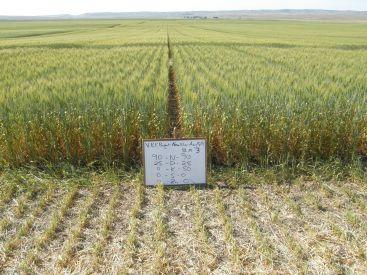
and exchangeable to plants: K in soil available to plants is dissolved in soil water, while exchangeable K is loosely held on the exchange sites on the surface of clay particles. As available K dissolves in soil water and is taken up by plant roots, exchangeable K is released into the soil solution to maintain equilibrium between the two forms.
Soil tests attempt to measure available and exchangeable K in soil to determine the K-supplying power of soil K for crop production. Available and exchangeable levels generally range between 100 and 1000 lb/ac in the top 0 to 6 inch depth of soil. A minimum of 200 to 250 lb/ac of K in the top six inches of soil is generally required for adequate growth of most annual crops.
K only occurs in soils in inorganic form and does not make up part of the soil organic matter. K in soil solution and in exchange -
CONTINUED ON PAGE 46
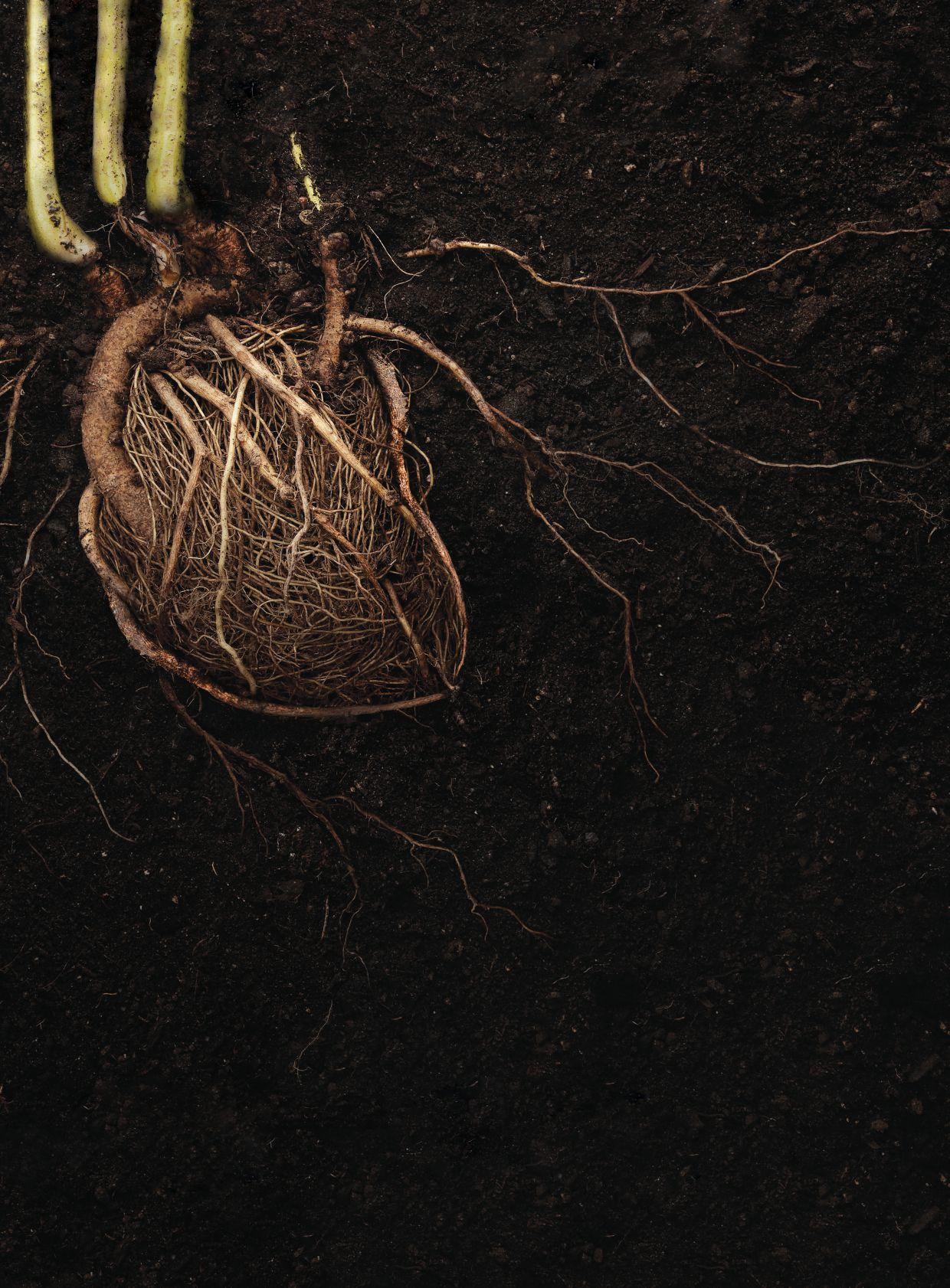
Every season starts with hope. We hope for good soil, good weather and low disease pressure. But now there’s a way to get even more than you hoped for, even in the absence of all of these.
Trilex® EverGol® for pulses provides a better start to the season with exceptional protection from diseases like rhizoctonia and ascochyta. Additionally, it also promotes overall plant health, resulting in a higher performing root system, increased biomass, faster emergence and superior yield. Take your pulse crop health to a new level, because it’s not just about surviving, it’s about thriving.

CONTINUED FROM PAGE 42
able form occurs as a positively charged ion K+ and is adsorbed onto the surface of negatively charged soil particles. As a result, soil K tends to be fairly immobile in soil and is not subject to leaching or downward movement in soil.
Soils with the greatest potential for K deficiencies are the coarse (sandy) and medium (loam) textured soils in the Black, Dark Gray and Gray soil zones as well as organic soils.
Table 1 shows the K content of seed and straw of commonly grown crops. For most annual crops, the majority of K remains in the leaves and straw with only a small portion of K in the seed. As a result, K removal from the soil is relatively low when only the grain of crops is removed and the straw left in the field. K removal is much higher with forage or silage crops as all aboveground biomass is removed from the field. If the forage is fed to livestock and the manure is returned to fields, much of the K will be returned to the soil.
Soil testing will determine the need for K fertilizer. Across the Prairies, response to fertilizer has been correlated to the amount of soil K extracted from the soil with ammonium acetate and with the modified Kelowna method which includes ammonium acetate. Soil test K correlation work has been done with the 0 to 6 inch sampling depth. Ensure to sample the 0 to 6 inch depth separately from deeper depth samples to accurately determine K fertilizer requirements.
In field studies, large increases in barley yield have occurred when K fertilizer was applied to soils with less than 150 lb/ac of extractable K. On soils with 150 to 200 lb/ac of extractable K, moderate fertilization of 15 to 30 lb/ac of K20 may result in a profitable response.
The probability of K response above a soil test level of 250 lb/ac is low. However, at soil test K levels between 250 and 300 lb/ac, producers should consider a maintenance application of 15 to 30 lb K20/ac to help replace K taken up and removed by crops. This application could also potentially increase crop yield in areas of a field that may have slightly deficient soil K levels.
A response to potassium chloride (KCl) fertilizer is sometimes obtained with cereal crops on soils not considered deficient in K. Research done principally in Oregon, Washington and South Dakota
has shown that the presence of chloride (Cl) in KCl fertilizer can result in increased yield through the suppression of plant diseases such as take-all rot in wheat and barley.
Since soil K is not mobile in soil, placement of K fertilizers with or near the seed is usually the most effective and efficient method of application, but the rate of application must not be greater than the seed can tolerate. KCl is a salt and if too much KCl or a combination with other fertilizers that have a high salt index are placed with the seed, a “salt effect” can reduce seed germination and emergence. The salt effect of fertilizer will interfere with the moisture uptake by the seed and can result in the death of a germinating seed.
The safe level of K that can be applied with the seed depends on the crop. In general, smaller seeded crops such as canola have a much lower tolerance than cereal crops. The clay and organic matter content of the soil and the soil moisture content will also have an effect on possible germination problems.
Often K fertilizer cannot be placed with the seed as the maximum amount of phosphate and sulphur fertilizer is already being seed-placed. The alternative is to sideband or mid-row band K fertilizer at the time of seeding. The fertilizer should be banded at least 1.5 inches to the side and preferably about 1.5 inches below the depth of seeding. When higher K fertilizer rates are needed, banding prior to seeding is another good option.

Note: Rates above 30 lb K2O /ac for cereals crops should be banded or broadcast to avoid seedling injury. At low rates of application, placement with the seed is more effective than banding, and banding is more effective than broadcast incorporation.
Source: Alberta Agriculture Agdex 542-9 Potassium fertilizer application in crop production.
Powered by the unique chemistry of Kixor, Heat LQ delivers the fastest, most complete burndown.
Strap yourself in. The convenient liquid formulation of Heat® LQ offers the fastest, most reliable weed control to get crops off to a clean start. It’s also the only solution that lets you choose between a pre-seed or pre-emerge application in cereals and pulses, with both burndown and residual control. So why hesitate when it comes to resistance? Step on it. For details, visit agsolutions.ca/HeatLQ or call AgSolutions® Customer Care at 1-877-371-BASF (2273).
Always read and follow label directions.
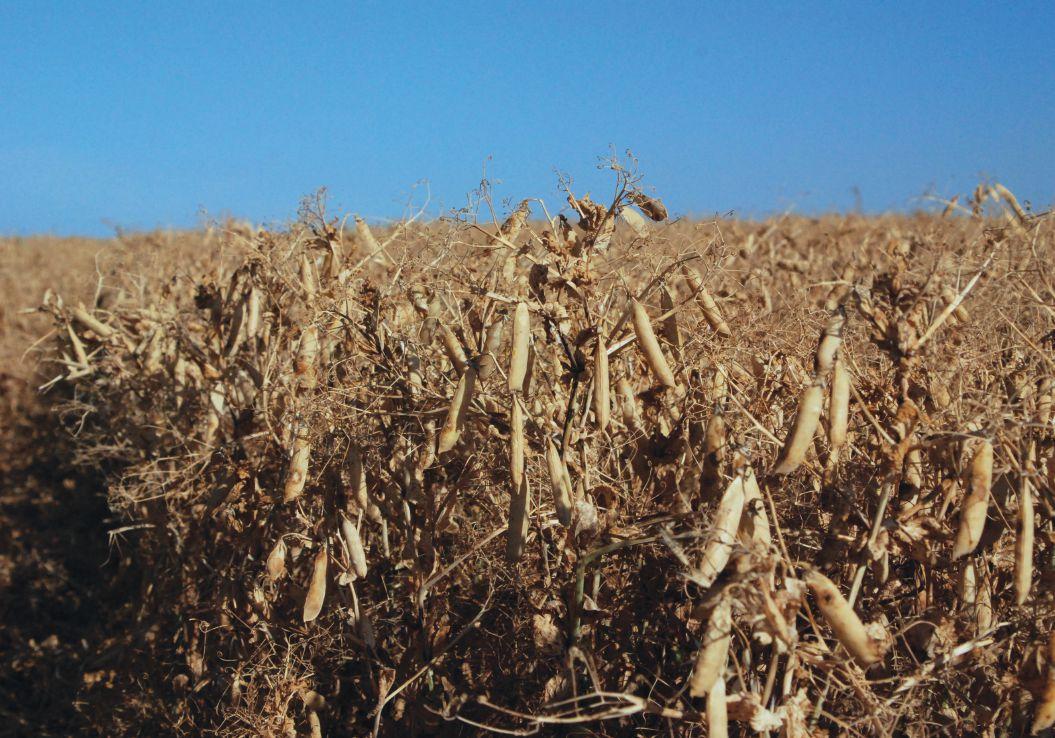
Look beyond the first year for nitrogen benefits.
by Bruce Barker
Respect the pulse. That’s the result of a research study that looked at the value of nitrogen (N) credits from pulse crops past the first subsequent crop.
“In most studies, N release from legume crop residues is determined in only one subsequent crop, and results on pea residues usually show that little of the N is released in the subsequent crop season,” says research scientist Newton Lupwayi with Agriculture and Agri-Food Canada (AAFC) at Lethbridge, Alta. “We wanted to look beyond the first subsequent crop to understand pulse contributions over the longer term.”
The notion that pulse crops contribute N to the subsequent crop – usually wheat and usually for higher protein content – is well known. Cereals grown in rotation with pulses usually have reduced N requirements because the pulse crop contributes substantial amounts of N from decomposing residues to the subsequent crop. Surprisingly, though, research has shown that less than 20 per cent of pea residue N is released in the first year under zero tillage. That led Lupwayi to question what happens to the remaining N in pulse residue and to determine whether it contributes beyond the first subsequent crop.
Lupwayi, and AAFC colleague Yoong Soon at Beaverlodge,
Alta., looked at carbon (C) and N release from legume residues to three subsequent crops. They thought some of the N that was not released in the first year from pulse residue would get released in subsequent years. A four-year rotation was set up at Beaverlodge in 2007 on land that had previously been in oats. All the crops were managed under no-till on nine-inch row spacing according to standard agronomic practices.
In the year of establishment, green pea, forage pea, fababean, fababean green manure (GM), chickling vetch GM, and hulless barley were grown. Barley was used as a control for estimating N fixation by legumes in the year of establishment. The green pea variety, Camry, was a semi-leafless type, and the forage pea variety, 4010, was a bushy normal-leafed type. Wheat in 2008, canola in 2009 and hulless barley in 2010, were planted on the legume plots.
In the legume year, the GM crops were terminated by cutting at full bloom on July 24 and residues spread on the surface. However, the GM crops re-grew and a second cut was done on Sept. 18. The other crops were harvested for seed at maturity in September.
ABOVE: Pulse crop residue should get credit for more N-release in subsequent crop years.

Delaro® fungicide doesn’t take kindly to diseases like anthracnose, ascochyta and white mould threatening the yield potential of innocent pulse and soybean crops.
Powerful, long-lasting disease control with exceptional yield protection, Delaro is setting a new standard in pulse and soybean crops.
Source: Lupwayi, N.Z. and Soon, Y.K. Carbon and Nitrogen Release from Legume Crop Residues over Three Subsequent Crops.
Fababean fixed the most N Nitrogen fixation was estimated for each legume crop. The crops grown for seed fixed the most N, estimated at 184 kg N/ha for fababean, 165 kg/ha for forage pea, and green pea at 129 kg/ha. Chickling vetch GM was estimated at 95 kg N/ha and fababean GM at 77 kg/ha.
“The high N-fixing ability of fababean has been reported in other studies,” Lupwayi says.
Looking at the amount of N accumulated and left on the field in the crop residue, Lupwayi says the fababean, forage pea and vetch GM residues accumulated the most N (129-153 kg N/ha) and green pea the least (65 kg N/ha). Green pea residues contained the least N because 66 per cent (124 kg N/ha) of the aboveground N was removed at harvest in the seed.
“Fababean and forage pea residues contained more N than expected from a pulse crop because their seed yields were lower than that of green pea. The seed yield of these two legumes was low mainly because the growing season of northern Alberta is too short for them and fababean in particular was harvested before full maturity,” Lupwayi explains. “Therefore, these two legumes exported less N off the farm through the seed at harvest than green pea.”
Lupwayi says there were essentially no differences between the residues in C concentrations, except that it was lower in fababean GM residues than in chickling vetch GM residues.
N release goes beyond first year
The pattern of N release varied between the GM residue and the pulse crops grown for seed. For the GM residues, most of the N was released in the first year – mostly in the first 10 weeks of GM residue placement in July of 2007. Since the first subsequent wheat crop wasn’t seeded until 10 months later in May 2008, Lupwayi says the released N could have been susceptible to losses through leaching,
Residues of grain legumes, especially forage pea and fababean, released more N during growth of subsequent crops than GM residues.
Source: Lupwayi, N.Z. and Soon, Y.K. Carbon and Nitrogen Release from Legume Crop Residues over Three Subsequent Crops.
denitrificaiton and ammonia volatilization.
“In this study, it is most likely that these losses were considerably higher with the GM crops with their low C:N ratios than with pulse crop residues,” he says.
In the first year after the legumes, chickling vetch GM released 87 per cent of initial N in the residue, fababean GM released 83 per cent, fababean grown for seed released 63 per cent, forage pea 51 per cent and green pea 51 per cent. In subsequent years, the GM crops had little N left to release, while the fababean and pea crops released another 15 to 23 per cent of the initial N, and nine to 12 per cent in the third subsequent crop.
The fababean and pea residues also initially had a variable rate of release at the start, but became more steady and consistent as time progressed. A more consistent release would help feed the crop more uniformly throughout the growing season. (See Figs. 1 and 2.)
“The release of N from pulse crop residues was probably better synchronized with crop uptake than the GM residues because the latter released their N too quickly. Among the pulse crops, the residues of fababean and forage pea had a good combination of high initial N contents and a low C:N ratio relative to green pea residues, which released the least N,” Lupwayi says.
Another interesting finding was the yield of the barley crop in the third subsequent year after the study was established. Barley grown on the forage pea residue produced the highest yield, with green pea at approximately 95 per cent of forage pea and fababean at about 87 per cent. The green pea result was surprising, considering that it had lower initial N fixation – perhaps explained by other non-N factors.
“Pulse crops deserve more N credit than they get for the yield responses of subsequent crops,” Lupwayi says. “The rotational value is underestimated if you only evaluate the first subsequent crop.”

RANCONA® PINNACLE combines two powerful fungicides that provide both contact and systemic activity, with RANCONA® microdispersion technology for superior adhesion and coverage. And when more active ingredient ends up on your seed and not your equipment, you’ll see improved seed emergence, healthier seedlings, and higher yields. To learn more, talk to your Arysta LifeScience representative or visit rancona.com.
Canola seedling diseases less impacted by seeding date, depth, seed size.
by Bruce Barker
Ahealthy, uniform canola plant stand is one of the keys to establishing high yield potential – that’s generally accepted knowledge in the canola industry. And farmers routinely use fungicide seed treatments to help control the seedling disease complex that cause seed decay, damping-off, seedling blight and root rot.
But how impactful are these seedling diseases, and can other management practices help to mitigate their effects? Those are questions that Alberta Agriculture and Forestry (AAF) researcher Sheau-Fang Hwang set out to understand in a series of greenhouse and field trials from 2007 to 2012.
“Seedling blight has a substantial impact on stand establishment and productivity of canola on the Canadian prairies,” Hwang says. “The causal agent of seedling blight of canola at many sites is Rhizoctonia solani, but Fusarium avenaceum and Pythium species are also important.”
Information from the Canola Council of Canada indicate that seed and seedling losses from these diseases tend to be highest under cold wet conditions or when the seedbed is not firmly packed under dry, cool conditions. Not surprisingly, these conditions are common for canola producers who seed early.
Hwang works at AAF’s Crop Diversification Centre North in
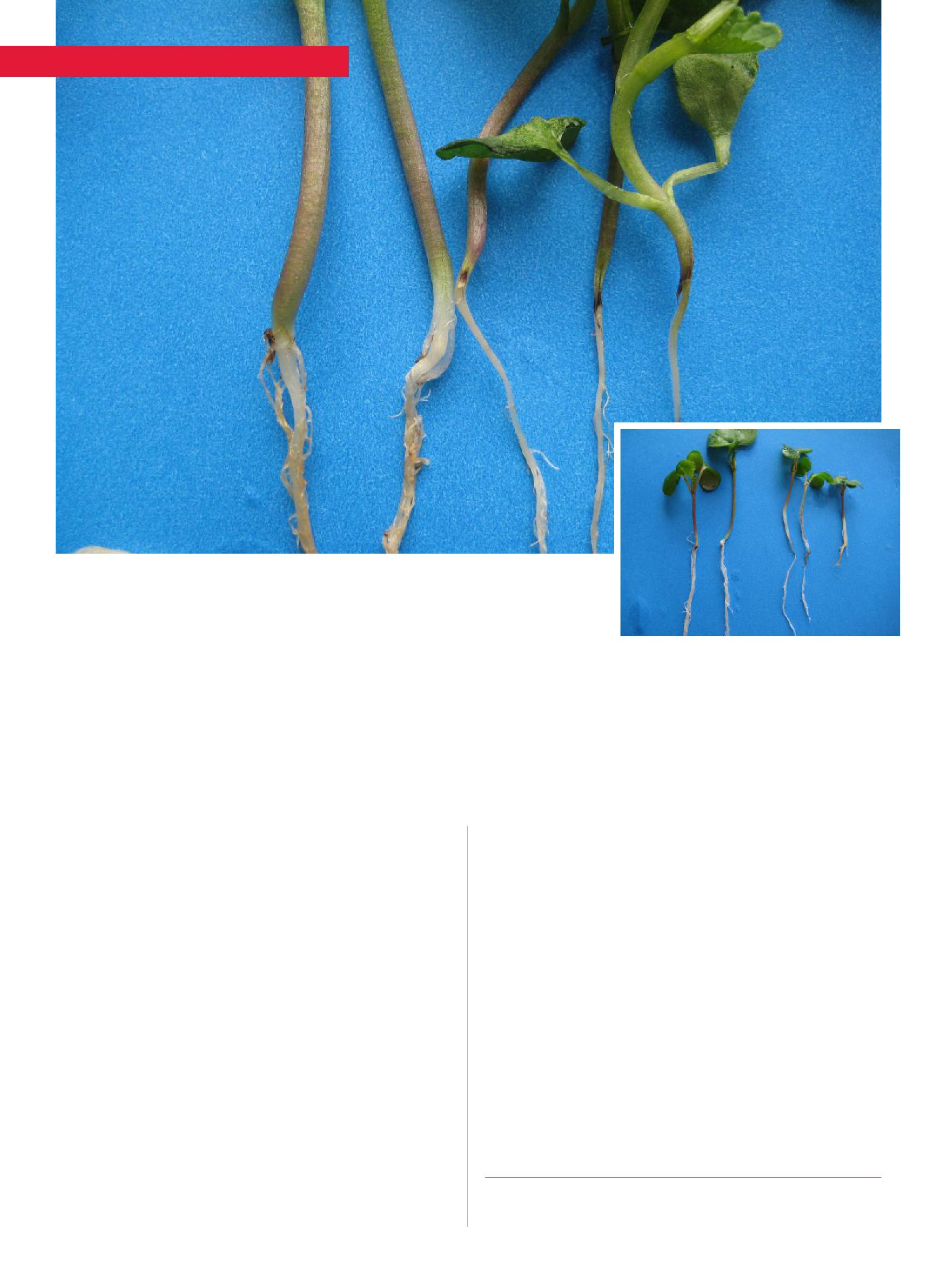
Edmonton. In 2007, she initiated two trials to look at the effects of seeding date, seed size, seeding depth and seed treatment fungicides on seedling blight of canola. One study looked at R. solani, and the other looked at F. avenaceum and Pythium ultimum. She wanted to find out how impactful the diseases were on canola; how effective fungicide seed treatments were; and if manipulating seeding date, seed size or seeding depth could reduce seedling diseases.
In the seeding date field trial, soil inoculation with R. solani reduced seedling emergence by 96 per cent in 2007, 98 per cent in 2008 and 91 per cent in 2011. Yield reductions were 81, 87, and 93 per cent respectively, relative to the non-inoculated control.
“Seedling blight of canola caused by R. solani can result in poor stand establishment and severe yield loss in Alberta when soil populations of the pathogen are high and conditions are conducive for infection,” Hwang reports.
She adds seedling emergence was greatly reduced in R. solani
TOP: Root rot caused by Fusarium species. INSET: Pythium damage is more pronounced with early seeding.

inoculated plots for all seeding dates, not only those associated with low temperatures or high moisture.
Inoculation with F. avenaceum reduced seedling establishment by more than 50 per cent each year, with corresponding reductions in seed yield ranging from 20 to 86 per cent over the four years of the study in 2007, 2008, 2009 and 2012. Seeding date did not have a consistent effect on seedling blight in trials inoculated with F. avenaceum
In treatments inoculated with P. ultimum, seeding in mid-May improved stand establishment compared with early seeding in two of three site-years, and seeding in late May improved seedling establishment compared with early seeding in all three site-years.
“The results indicate that P. ultimum is favoured by cooler temperatures and moist conditions, while F. avenaceum is favoured by warmer soil temperatures,” Hwang says.
The effect of seed size was significant in inoculated R. solani treatments for seedling emergence, plant height, shoot dry weight and
root damage severity in the greenhouse trial. Mid-sized seed produced greater seedling emergence, while large-sized seed produced greater seedling height, shoot weight and root damage severity. However, under field conditions, seed size did not affect seedling emergence nor did it have a consistent impact on seed yield.
Similarly, with Fusarium and Pythium species, seed size did not affect seedling establishment or seed yield.
In the field trials, two seeding depths were compared at 0.6 inch and one inch. Seeding depth did not affect seedling emergence or severity of root damage caused by R. solani, F. avenaceum or P. ultimum. However, seeding shallow into a firm, warm, moist seedbed is recommended as a good practice for fast, uniform stand establishment.
Fungicide impact
Hwang compared Helix Xtra (thiamethoxam + difenconazole + metalaxyl + fludioxonil) and Prosper FX (clothianidin + carboxin
+ trifloxystrobin + metalaxyl) fungicide seed treatments. In 2008 and 2009, both seed treatments significantly increased seedling emergence and seed yield compared to an R. solani inoculated control treatment. In 2008, untreated canola seed yielded 68 per cent less than the fungicide treatments.
In the F. avenaceum and P. ultimum trials, canola seedling establishment and seed yield were substantially increased by seed treatment with Prosper FX or Helix Xtra. Both fungicides contain metalaxyl, which has activity against Pythium spp. and R. solani. In the trials inoculated with F. avenaceum, Helix Xtra increased yield by 32 per cent and Prosper FX by 38 per cent, although the difference between the two fungicides was not statistically significant. In the trials inoculated with P. ultimum, seed treatment with Helix Xtra increased seedling establishment by 300 per cent and seed yield by 81 per cent compared to the inoculated, non-treated fungicide seed (Prosper FX was not compared).
“These studies emphasize the importance of fungicidal seed treatments in stabilizing canola stand establishment under seed-
ling disease pressure,” Hwang says. “The observation that P. ultimum is more active at early seeding, while both F. avenaceum and R. solani appear to be favoured by warm soils, indicates that the manipulation of seeding date will not substantially improve canola stand establishment and yield. In addition, manipulation of seeding depth and seed size is unlikely to significantly improve seedling emergence under heavy disease pressure.”
Hwang’s research supports the use of fungicide treatments, but also indicates that more than one species is involved in the seedling disease complex. Based on this research, growers should select a broad-spectrum fungicide with multiple modes of action that control Rhizoctonia, Pythium and Fusarium species.
For more on canola disease management, visit topcropmanager.com.
Same superior control. New GoDRI formulation.
• The #1 graminicide brand used in wheat
• High performing on a wide range of weeds
• Superior wild oat control + bonus broadleaf control
• No re-cropping restrictions, wide application window
• Convenient GoDRI formulation for fast, easy mixing and handling
Go to the new dowagro.ca or call 1.800.667.3852 PER ACRE $4
SAVE UP TO when you book by March 15, 2016 with Diamond RewardsTM.
by Carolyn King
The first step in getting reliable data on the value of hailrescue products is to be able to accurately and consistently simulate hail damage to crops. That’s not as simple as you might think. But Alberta researchers have come up with an innovative, inexpensive and effective hail simulation tool. So in 2016 they’ll start evaluating a variety of hail-rescue products in replicated, multi-location trials.
Hail can shred and strip off leaves and flowers, break stems, bruise seeds, aggravate crop disease, produce uneven maturity in crop stands and reduce yields. In Alberta, hail damage is a serious issue. Agriculture Financial Services Corporation (AFSC), an Alberta crown corporation that has been providing hail insurance to Alberta farmers for over 75 years, had its highest hail claim year in 2012, when it paid $445.6 million on 8400 claims.
Ken Coles, general manager of Farming Smarter, is leading the hail-rescue project, which started in 2015. His interest in hail damage was sparked by Alberta farmers who wanted to learn more about the effects of products such as fungicides and nutrient blends that were being marketed as treatments to help crops recover from hail damage. “We felt fairly strongly that we could answer their questions, but we’d have to do it in a controlled manner and probably in small plot studies, which meant we had to simulate hail,” he explains.
“We tried for a couple of years to get a project funded with not much success because the funders didn’t like the chances of us being able to come up with something that could simulate hail in a meaningful way. They seemed more interested in having us go to actual hailed fields, but my experience in field-scale research indicates we wouldn’t be able to control the variables enough to learn what’s what with any confidence, if we used that approach.”
He adds, “I think farmers have found the same thing when they try to evaluate the effects of a hail-rescue product on their own fields. The hail itself is so variable that you can’t know with any certainty whether spraying the product was worth it or not.”
Fortunately, the Alberta Pulse Growers Commission (APG) was willing to fund the project without shared funding from other crop producer groups. According to Coles, APG’s interest in the project was sparked by the experiences of pulse growers. “Some of the best anecdotal stories about hail-rescue products come from pulses, peas in particular. I’ve heard stories about responses to some of the strobilurin fungicides applied after hail that sound like big fish stories – farmers would spray half their hail-damaged field with the product and that half would out-yield the other half by 80 or 100 per cent. So the thought is that maybe there is something happening.”
Phase one of the project was to develop a hail simulation tool. To do this, Coles teamed up with Ralph Lange at Alberta Innovates Technology Futures (AITF).
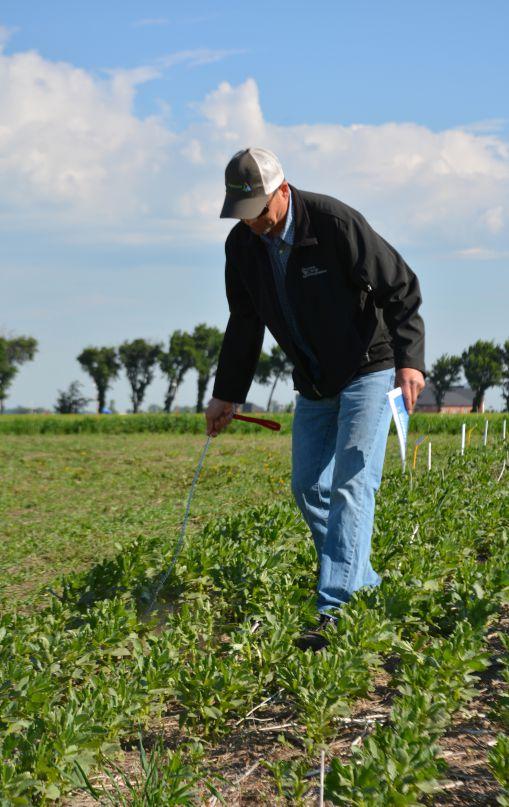
AITF researchers, including Rod Werezuk, a research technologist with AITF, came up with the innovative idea of hitting their plots with a hand-held chain to simulate hail damage.
Lange and his lab started experimenting with hail simulation about four years ago when AFSC asked them to study some issues around hail damage in canola. “AFSC wanted to look at the interaction between crop disease and hail. They also wanted to update the data used to correlate yield loss with the amount of hail damage; the existing tables were developed for canola varieties that were in production a long time ago. As well, we conduct some education and training for AFSC, so our hail damage work is also tied into that,” Lange explains.

Nu-Trax P+™ with CropStart™ Technology puts you in charge of delivering the nutrition crops need for a strong start. And a strong start can lead to a better harvest.
It features an ideal blend of phosphorus, zinc and other nutrients essential for early season growth. With patented EvenCoat ™ Technology, Nu-Trax P+ is coated onto your dry fertilizer blends. And with blanket-like distribution across the field, it’s placed close to young plant roots where they can access the nutrients earlier, especially in cold and wet soils.
This spring, take control of your crop’s early season nutrition. Ask your retailer for Nu-Trax P+.
Rethink your phos
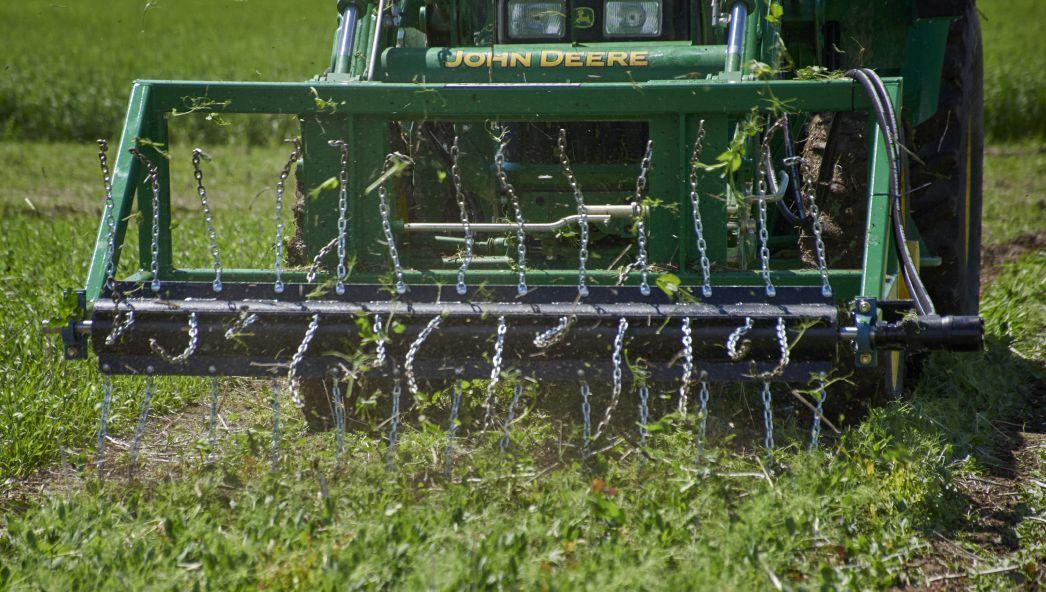
To find reliable, accurate answers to AFSC’s questions, they needed to figure out how to simulate hail. Lange says, “When you do herbicide, fungicide or fertilizer experiments, it is easy to do each treatment several times at a location and at several locations. But you can’t get a cloud to hail on your treatment plots and not on your control plots.”
Lange’s group tried various ways to solve the create-your-own-hail challenge. For instance, they used scissors to remove branches from canola plants. “However, when a hail stone strikes a plant, it doesn’t always remove a branch completely. The branch may hang there by threads, or the hail may simply bruise it without breaking it. The scissors didn’t replicate that damage accurately enough,” he notes.
They also experimented with throwing pea-sized gravel by hand from a high vantage point down onto the plots, which produced fairly realistic damage. However, the people throwing the gravel would have risked getting repetitive strain injuries to create high levels of crop damage on replicated plot trials. Plus there was gravel all over the plots. Yet another method they tried was to use a flail mower, keeping the mower at a low speed and a relatively high height above the plots. However, it caused too much damage to accurately replicate what happens to hail-damaged plants.
“Then Rod Werezuk [a research technologist in Lange’s lab] came up with the idea of hitting the plants with a chain to simulate something with a roundish shape falling out of the sky,” Lange says. “We found that a fairly small chain – the original one was a dog leash – creates damage that looks a lot like hail. We confirmed that with the AFSC crop adjustors because they have seen thousands and thousands of instances of hail damage.” So Lange’s group has successfully been using hand-held chains for their canola plots.
“But of course, if you want to do multiple experiments over different locations, with different damage levels and all those things, then doing it by hand isn’t practical,” Lange notes.
ABOVE: The researchers have mechanized the chain method for hail simulation so they can carry out their research on hailrescue products on multiple plots at multiple locations.
LEFT: The custom-built hail simulation machine involves many small chains on a rotating drum.
So Coles took the chain idea and mechanized it. This custombuilt machine involves many small chains on a rotating drum that is attached to the front of a small tractor. To test the machine, Coles collaborated with Lange’s group on their canola project in 2015. Lange’s team used their hand-held chains and Coles used the machine, and they compared the results. As well, AFSC crop adjustors evaluated the hail simulation effects on the plants.
“Amazingly enough, the machine turns out to be quite effective at simulating hail damage,” Coles says. “It’s not perfect yet, but we’ve identified where we need to make some tweaks to make it a little better.”
One of the great things about the machine is that the researchers have all sorts of ways to adjust it so they can get the exact hail effect they want. For instance, they can control the tractor speed, the drum speed and the direction of travel, and they can change the chain configurations and use different sizes or lengths of chains.
Coles says, “It gives us the ability to repeat the treatments, for replicated treatment plots. It also allows us to compare a haildamaged crop to the same crop that wasn’t damaged. That’s critical to doing good science so we can know what the crop’s yield potential was without the hail.”
Lange adds, “We think this has great potential to put some solid numbers behind hail research. You can think of all kinds of scenarios. For instance, we’re looking at crop disease. Your first-year university plant pathology textbook will say hail damage to a plant will promote disease. Now we can replicate that to see if that is true or not, and to see how much damage it takes and when that damage has to occur, which diseases are affected more than others, and so on.”
Now that they have a mechanized hail simulator, the researchers will be starting phase two of the project: the hail-rescue trials in pulses. It will be a collaborative effort between Coles, Lange and the Smoky Applied Research and Demonstration Association (SARDA), involving three years of trials at Lethbridge (Coles), Vegreville (Lange) and
Falher (SARDA). This fall they are building two more of the simulators, so each site will have its own machine. All the sites will have pea plots, and the Lethbridge site will also have dry bean plots.
They are planning to have five hail damage levels (0, 25, 50, 75 and 100 per cent) and probably three timings for the hail damage (early, mid and late season). For the hail-rescue treatments, they will be comparing two fungicides, two nutrient blends and a combination of fungicides and nutrients. They will be evaluating the treatment effects on such factors as crop growth, harvestability and yields.
They have also added a new component to the project for 2016. Coles explains, “I’m going to work with Dr. Anne Smith, a remote sensing scientist with Agriculture and Agri-Food Canada, to look at the use of drones. I’m excited about the potential of drones, but I think it’s been a little overhyped and underdeveloped. Everyone is struggling with finding true value for drones in the agriculture industry, and much of the evaluation is being done in a way that is not reproducible, not even comparable. So I wanted to do a project where drones might help, and we thought this hail project would be a neat one.”
The idea is to use the plots to calibrate hail-damage imagery from drones. A drone can be flown over a crop field in parallel passes, taking photos at regular intervals to map the field. The drone’s camera can be set up to capture different wavelengths of light reflected from the field’s surface. Healthy plants have different reflectance characteristics than damaged or dead plants. The resulting imagery can be correlated with the crop’s actual condition, if the imagery has been “ground-truthed,” where known crop conditions are associated with the patterns in the imagery. So Coles and Smith will be flying a drone
over the hail simulation plots to get the necessary ground-truthing data. Then they can develop a formula, or “algorithm,” to convert the patterns in the imagery into information on hail damage.
“If we can calibrate the imagery, then we could fly a farmer’s field and assess the level of hail damage and the spatial distribution of the damage,” Coles explains. “That might give the farmer better information for decision-making. For example, let’s say half the field is ranked at 90 per cent damage and the other half is 30 per cent. So if the farmer wants to apply a hail-rescue product, then he knows where to apply it.”
Looking further down the road, Coles might want to explore other questions about hail-damaged crops. In 2015, he had hail damage on his own farm for the first time, so his personal interest in the issue has skyrocketed. “It opened up my eyes to the challenges associated with hail – the percentage damage versus the timing of the damage, the crop type, the spatial distribution of the hail damage. There’s more to dealing with hail than just decisions about hail-rescue products. Around my farm, everyone with hail damage phoned the feedlot and ended up silaging their crops off. And I wondered, ‘Should I be doing that?’ I have a seed production contract with a local seed grower, so whether I can still make seed affects the decision. And then wherever there’s hail damage you get secondary growth with tillers. In my case, I estimated that I had 30 to 40 per cent regrowth. So if I have part of my crop ready to harvest and the other part is still green, what should I do? No one I asked really knew what to do.”
He adds, “Hail is a tough thing to deal with as a farmer because you have so much invested in your crops and you want to make the best of what you do have.”
CONTINUED FROM PAGE 41
depth. Ensure to sample the 0 to 6 inch depth separately from deeper depth samples to accurately determine P fertilizer requirements.
A new method to test for a wide range of nutrients including plant available P is the Plant Root Simulator (PRS) probes (Qian and Schoenau 2002). Originally developed at the University of Saskatchewan, PRS probes are ion exchange resin membranes held on plastic stakes that are inserted into a moist soil sample to estimate nutrient supply. There are two probes, one to adsorb cations and one to adsorb anions. One limitation of this method is there has been less field calibration with P fertilizer research trials versus the modified Kelowna and Olsen methods.
Some fertilizer dealers and agronomists use soil testing labs in Eastern Canada or the U.S. that determine soil P using other soil test P methods, such as the Bray method (Bray and Kurtz 1945). This method uses unbuffered ammonium fluoride and hydrochloric acid. Bray and Kurtz developed the method in the 1940s specifically for acid soils but not for use on alkaline soils (pH > 7.0). The test is not recommended for alkaline soils because it results in very inaccurate available soil P estimates. Because of the inaccuracies of this method, it has not been calibrated to western Canadian soils and its use is not recommended for making P fertilizer recommendations.
Ashworth, J. and Mrazek, K. 1995. “Modified Kelowna” test for available phosphorus and potassium in soil. Commun. Soil Sci. Plant Anal. 26: 731–739. Bray, R.H., and Kurtz. L.T. 1945. Determination of total, organic and available forms of phosphorus in soils. Soil Sci., 59:39-45.
Cowell, L.E. and Doyle, P. J. 1993. The changing fertility of prairie soils. Pages 26–48 in D.A. Rennie, C.A. Campbell, and T.L. Roberts, eds. Impact of macronutrients on crop responses and environmental sustainability on the Canadian prairies. Canadian Society of Soil Science, Ottawa, Ont.
McKenzie, R.H., Bremer, E., Kryzanowski, L., Middleton, A.B., Solberg, E.D., Heaney, D., Coy, G. and Harapiak, J. 2003. Yield benefit of phosphorus fertilizer for wheat, barley and canola in Alberta. Can. J. Soil Sci. 83: 431–441.
Miller, J.R. and Axley, J.H. 1956. Correlation of chemical soil tests for available phosphorus with crop response, including a proposed method. Soil Sci. 82: 117–127.
Olsen, S.R., Cole, C.V., Watanabe, F.S. and Dean, L.A. 1954. Estimation of available phosphorus in soils by extraction with sodium bicarbonate. US Department of Agriculture, Washington, D.C. Circ. 939.
Qian, P., Schoenau, J.J. and Karamanos, R.E. 1994. Simultaneous extraction of available P and K with a new soil test: A modification of Kelowna extraction. Commun. Soil Sci. Plant Anal. 25: 627–635.
Qian, P. and Schoenau, J.J. 2002. Practical applications of ion exchange resins in agriculture and environmental soil research. Can. J. Soil Sci. 82: 9-21.
Robertson, J.A. 1962. Comparison of an acid and an alkaline extracting solution for measuring available phosphorus in Alberta soils. Can. J. Soil Sci. 42: 115–121.
Research update – what’s been revealed, what’s still unknown.
by John Dietz
Soybean research by the Manitoba Pulse and Soybean Growers (MPSG) has been steadily increasing over the past five years. In that time, the province has seen a significant increase in acres of the crop, from 587,000 acres five years ago to 1.35 million acres in 2015.
According to Kristen Podolsky, MPSG production specialist, growers had a really positive experience with soybeans in 2015, “and there’s probably going to be an increase next year. We likely set a new provincial record for soybean yield in 2015, attributed to a warm growing season with good moisture distribution and an open fall.
“As the acres have increased in the past five years, so has our investment in research,” Podolsky adds. “Now we’re starting to see the results and interpret them into new production recommendations.”
“Plant population is one area where [we] are starting to make new recommendations,” she says. “We didn’t know how they would perform with our climate, soil type and our residue when they first came to Manitoba. Now we are starting to zero in on what provides the highest economic return.”
But the highest population may not provide the highest net return. “We are finding that, with current markets and seed costs, the best target population for soybeans is about 140,000 plants per acre. When you’re checking fields a few weeks after seeding, that’s how many live plants you want in the field.”
Row crop planters have better seed distribution and seed depth placement than air drills. With more controlled planting, there is better germination, survival and emergence. “We’ve found that farmers who were using air drills tended to have about 70 per cent survival. So, we suggest those growers start with a seeding rate of about 200,000 seeds per acre in order to land somewhere around 140,000 plants per acre,” Podolsky says. “Usually, the survival rate in our on-farm trials for farmers who used planters is about 80 per cent. So, growers who use planters usually can use a little lower seeding rate, usually about 175,000 seeds per acre.”
Podolsky notes the industry expected numbers like this to emerge. Now it serves as a Manitoba-based baseline for recommendations. “The really new information is still in the works,” she says. “We’re trying to look at interactions between factors that happen before and at seeding.”
For example, should seeding rate change with seeding date and/or maturity grouping? What is the relative importance of seeding date vs. soil temperature? What is the impact of tillage/residue management? Do we need to increase that seeding rate if planting is delayed? Does
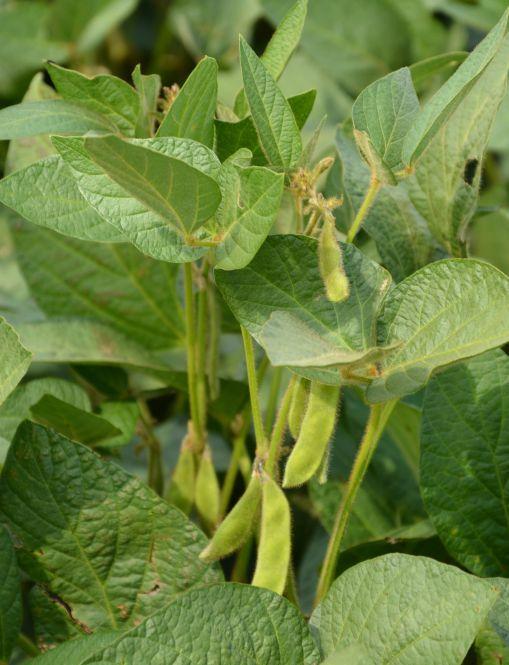
Soybean yields on canola and soybean residue tend to be less consistent than yields on corn and wheat residue.
seeding date/soil temperature affect pod height? “That new information probably won’t be available until 2017.”
“We have done 21 on-farm trials over two years with and without fungicide, and now have some of the answers we need,” Podolsky says.
“The difference in yield on average is about 1.1 bushels per acre. When we think of the cost per acre of the fungicide and the application, this only provides an economic return for growers about three out of 21 times (about 14 per cent). The odds are not in our favour for that,” Podolsky notes.
Fungicides mostly target leaf diseases as the canopy closes, in midsummer and later. The good news is these leaf diseases seem to have very little yield impact. “We really don’t see a lot of pressure from diseases
such as septoria brown spot or downy mildew. Bacterial blight is also very common but this cannot be managed with a fungicide. That’s why we aren’t necessarily seeing a yield benefit from a fungicide application,” she says.
Sclerotinia could be an important disease for soybeans, and it looked like the 2015 growing season would see a major sclerotinia outbreak. July was warm. Conditions were wet. “When we went into fields doing disease surveys in late August, we really didn’t see the disease levels we expected, based on the moisture we had received. It was good news, very good news,” Podolsky says.
“I think a lot of growers across the province were surprised. Soybeans are naturally more tolerant to sclerotinia compared to canola and other broadleaf crops. And, while it was very moist for sclerotinia, it also was too hot at times. Sclerotinia favours cool and warm temperatures, but not hot,” she says.
Inoculation strategy
Double inoculation, on the seed and in the furrow, has been a standard recommendation for Manitoba’s soybean industry, to ensure the crop has adequate nitrogen-fixing bacteria. After compiling three years of on-farm data, in late 2015 the MPSG realized fields with a history of two previous well-nodulated soybean crops were not responding to the additional infurrow inoculant.
“Fields with at least two previous soybean crops are only getting an economic response to the additional in-furrow inoculant about three out of 26 times,” Podolsky says. “With the previous soybean history, there is enough rhizobium in the soil that we don’t need to continue double-inoculating.”
In thinking about that change – saving about $12 to $13 an acre –Podolsky suggests growers ponder these questions: Has the field had at least two crops of soybeans? Has the most recent soybean crop been within the past three years? Have the previous crops been well inoculated? Has that field had flooding recently?
“If the previous crops have been well nodulated, if the most recent was within three years, and if the field hasn’t seen flooding, then you probably can skip the in-furrow inoculant in that field,” Podolsky says. “Seed applied inoculant is a lot more cost-effective.”
She adds, “In the U.S. soybean belt, many growers are not inoculating at all. We aren’t there yet. We do need to inoculate, we are just trying to identify the most economic strategy for farmers.”
Using Manitoba crop insurance and some preliminary research data, Podolsky is convinced the best management practice for crop rotation is to put soybeans on a cereal crop residue, to break the disease cycle. But there is a short-term alternative to consider: a portion of the soybean crop is planted on soybean or canola ground.
“Long-term, risks build up with a tight rotation, especially for disease, but there’s no clear answer in the short term,” she says. “By insurance data, quite a few growers follow canola with soybeans, and farmers are reporting this is working well in the short term. The key is short term. The longer you continue that, the higher the risk that the yield will decline,” she says.
If there is a trend, from looking at early research, soybean yields on canola and soybean residue tend to be less consistent than yields on corn and wheat residue. And, some site-years show a significant yield penalty for the tight rotation.
“Farmers are experimenting with their own management on things like rotation, stubble height, strip tillage, vertical tillage and no-till. It’s difficult to do research on this, because conditions are unique between regions and within fields, but we have had a good start in 2015 on answering some of these questions,” Podolsky concludes.
AKRAS R2 was bred by Elite® and selected from their Western Canadian breeding program because of its excellent yield and industry standard- setting pod height. Higher pods mean easier harvest, fewer pods on the ground and more beans in your bin. AKRAS R2 also has excellent disease resistance and has an early-to mid- maturity, making it well adapted to all soybean growing areas.
TELL US ABOUT YOUR EXPERIENCE WITH ELITE® SOYBEANS FROM BrettYoung: @BY_Seeds | #BYSoybean15
The Ram 1500 EcoDiesel takes top spot.
by Howard J Elmer
For the past nine years veteran automotive journalists have donated their time to act as judges in the only annual North American truck competition that tests pickup and van models head to head – while hauling payload and also towing.
The Canadian Truck King Challenge started in 2006, and each year these writers return because they believe in this straightforward approach to testing and they know their readers want the results it creates.
This year, nine judges travelled from Quebec, Saskatchewan and across Ontario to the Kawartha Lakes Region where we test the trucks each year. All the entries are delivered to my 70-acre IronWood test site days before the judges arrive so we can prepare them for hauling and towing. In the meantime they are all outfitted with digital data collectors. These gadgets plug into the USB readers on each vehicle and transmit fuel consumption data to a company in Kitchener, Ont. (MyCarma) which records, compiles and translates those readings into fuel economy results that span the almost 4000 test kilometres that we accumulate over two long days.
These results are as real-world as it gets. The numbers are broken into empty runs, loaded results and even consumption while towing. Each segment is measured during test loops with the trucks being driven by five judges – one after the other. That’s five different driving styles, acceleration, braking and idling (we don’t shut the engines down during seat changes).
The Head River test loop itself is also a combination of road surfaces and speed limits. At 17 kilometres long, it runs on gravel, secondary paved road and highway. Speed limits vary from 50 to 80 km/h and the road climbs and drops off an escarpment-like ridgeline several times; plus it crosses the Head River twice at its lowest elevation. The off-road part of our testing is done on my own course at IronWood.
This is the third year that we have used the data collection system and released the final fuel consumption report that MyCarma prepares for the Truck King Challenge. It’s become one of our most anticipated results.
But how do we decide what to test? Well as anyone who’s bought a truck knows, the manufacturers never sleep, bringing something different to market every year. As the challenge looks to follow market trends, what and how we test must change each year too, and the coming 2016 model year proved no different. In the full-size and mid-size pickup truck categories, we had a field of seven contenders:
• Ford F-150, Platinum, 3.5L, V6 EcoBoost, gas, 6-speed Auto
• Ford F-150, XLT, 2.7L, V6 EcoBoost, gas, 6-speed Auto
• Chevrolet Silverado, High Country, 6.2L, V8, gas, 8-speed Auto
• Ram 1500, Laramie, 3L EcoDiesel, V6, diesel, 8-speed Auto
• Toyota Tacoma, TRD Off-Road, 3.5L V6, gas, 6-speed Auto
• GMC Canyon, SLT, 2.8L Duramax, I-4 diesel, 6-speed Auto
• Chevrolet Colorado, Z71, 3.6L V6, gas, 6-speed Auto
These vehicles are each all-new, or have significant changes made to them. However this year the Truck King Challenge decided to try something else new by offering a returning champion category.
This idea had been growing for a while having everything to do with the engineering cycles that each manufacturer follows. Simply put, trucks are not significantly updated each year and, to date, we have only included “new” iron in each year’s competition. However, we started to think that just because a truck is in the second or third year of its current generational life shouldn’t make it non-competitive.
So, this spring we decided that for the first time the immediate previous year’s winner (in each category) would be offered the chance to send its current truck back to IronWood to compete against what’s new on the market. Thus, this year the invitation was sent to the Ram 1500 EcoDiesel, a previous winner that accepted the offer to return and fight for its crown.
All vehicles took the tests over two days with the judges evaluating everything from towing feel to interior features. The judges score each vehicle in 20 different categories; these scores are then averaged across the field of judges and converted to a score out of 100. Finally the “as tested” price of each vehicle is also weighted against the average (adding or subtracting points) for the final outcome.
And this year’s winners are...
• Full-Size Half-Ton Pickup Truck – Ram 1500 EcoDiesel –82.97%
• Mid-Size Pickup Truck – GMC Canyon Duramax – 76.30%
The overall top scoring 2016 Canadian Truck King Challenge winner is the Ram 1500, Laramie, 3L EcoDiesel, V6, diesel, 8-speed Auto.
Full details and scores are now available online at canadiantruckkingchallenge.ca.

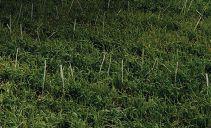
More power to you.
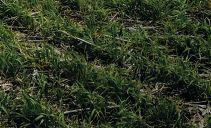
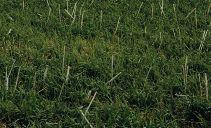
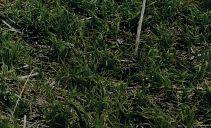
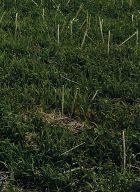
Wind speed, pressure gauge, optimal nozzle settings, check. All systems are go and it’s time to take down the toughest weeds in your wheat eld, whether they’re resistant or not.
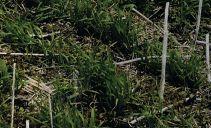
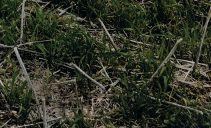
With three different modes of action in a single solution, Velocity m3 herbicide provides you with exceptional activity on over 29 different tough-to-control grassy and broadleaf weeds.


Collecting, managing, processing and studying yield data.
by Dale Steele, P.Ag., Precision Agronomist
Harvest is the time of year when farmers reap the rewards from a season of hard work, worry and risk. They treasure the perfect harvests when the weather co-operated and yields surpassed expectations. The worst years serve as useful reminders of the challenges of farming.
Crop yield is the measurement of crop production on a given area of land. It refers to the average of the field and is usually stated in bushels per acre or tonne/ton per acre. Average yield is the benchmark to compare with neighbours, assess management decisions and report for crop insurance. Average yield tells you only part of the story, since it is product of the area of maximum yields and the area of minimum yields within the field.
Prior to combine yield monitors, farmers relied on subjective assessments to determine the best management decisions for their geography. People tend to rely on subjective information from magazine articles, comments from neighbours and their judgment on what seemed to work last year. Field assessments and summer crop tours are also useful to compare and assess crop input options. Each of these is a source of information, but farmers really need accurate and measurable results to make informed decisions.
Years ago, I was launching a canola variety in a large strip-trial comparison with 10 other varieties. A top yielding variety was assigned as the “check variety” for the site. This check variety was replicated with a strip on each side of the field. My variety was located near the end of the site and it placed second when it lost the comparison by 4 bu/ac. While reviewing the raw data, I noticed a 6 bu/ac yield difference between the two strips of the check variety. From that moment on, I realized the impact that field variability can have on future management decisions.
Precision agriculture utilizes data and measurement techniques to enhance traditional decision-making. The data required depends on the questions you want answered. Yield data can consist of general information, such as historic average yields, or the average yield for a specific field. GPS coordinates can also define areas within a field where the combine collected yield data every second. Each type of data is valuable and can be useful to answer different questions.
Combine yield monitors have been around for years, but many farms don’t take the steps to turn that data into valuable information. Logging yield data is easier than many people think. The combine operators must enter some variation of farm/field/crop type into the controller and indicate where to save the data. If farm/ field/crop type is not entered, you may watch the controller display yields, but yield data is not saved. Many combine brands require a

Field Area (ac): 612.5
Harvested Area (ac) 609.3
Average Yield (bu/ac) 103.0
Total Yield (bu) 62,757.9
Average Moisture (%) 10.9
Protein (%) N/A
Intake (bu/hr) 1,464.8
Working Time (hr) 42.8
Productivity (ac/hr) 14.7
USB or compact flash card inserted into the yield monitor to store the data during combining. John Deere yield monitors have internal memory to store the data once the controller is set up.
Many operators don’t calibrate the combine yield monitor during harvest. So even though they watch yields during 200 hours of harvesting, they know the data is not accurate. Inaccurate yield data can still be useful because it can be corrected from a known number. For example, the truck weights or bin measurement might confirm the combine yield monitor was +4 bu/ac high (on average). Newer yield monitors can reformat a prior field’s yield data to the corrected values from a calibration. Post-harvest data analysis can also correct inaccurate yield values. The final option is to just keep the inaccurate yield data knowing it is +4 bu/ac overstated. Either way, you can still make decisions with inaccurate data just like farmers have been making decisions for generations with no data at all. But a quick combine calibration can accurately capture the year’s final results.
I encourage farmers to install a GPS receiver on every combine to provide a GPS signal to the yield monitor, enabling advanced yield data analysis. Combines usually collect yield data every one to three seconds depending on the combine model. The GPS coor-
dinates aid the merging of yield data from multiple combines and even multiple combine brands in a field. Auto-steer or GPS guidance is an option on combines, but a basic GPS receiver can provide a GPS signal to the yield monitor at minimal expense.
Do-it-yourself yield software such as APEX, AFS, SMS, FarmWorks and Yield Editor is available to process your yield data into yield maps. If you didn’t process your own yield maps by Christmas, consider hiring an experienced technician to do it for you. Yield data is like a Christmas present; you really should open it.
During harvest 2015, a new record wheat yield of 16.5 t/ha (245 bu/ac) was achieved in England. The media article didn’t say what the minimum yield of the field was, but a maximum yield of 342 bu/ac was mentioned. What future decisions can you make on this information? World records are interesting but without more information and yield maps to review, the information is not that useful.
Yield maps identify where your opportunities are and where improvements can be made. The farmer, the equipment operators and anyone involved with the farm can review each field after harvest to identify learnings prior to the next crop year. Was there a crop input comparison or unintended crop input comparison in the field? Perhaps there was no difference in yield from the additional crop inputs, or you identify a +5 bu/ac difference that was not noticed during crop scouting. Reviewing past years’ yield maps and/or satellite imagery can also identify chronic yield differences within a field that Grandpa could probably tell you a story about. From my experience, reviewing combine yield maps will always identify something interesting.
CONQUER™ , BlackHawk® , NEW GoldWing™ and NEW Valtera™, when tank mixed with glyphosate, provide greater weed control today and stronger stewardship for tomorrow. It’s time for progress in your pre-seed burndown. Before you plant your next canola, cereal, pulse or soybean crop, choose an advanced burndown for a better future. Ask your local retailer for more information.
This new technology means new varieties are available sooner.
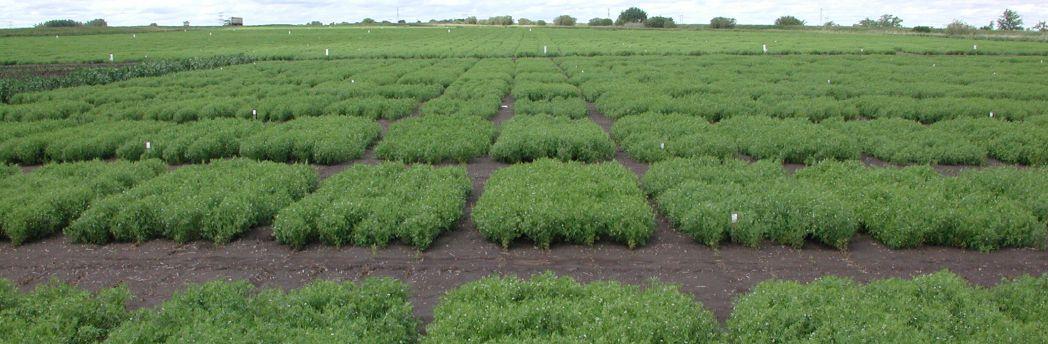
by Julienne Isaacs
Saskatchewan pulse growers have reason to be excited about the future: pulse breeding has taken a dramatic step forward, thanks to the use of Implementation of Markers in Pulses (iMAP) technology.
Traditional plant breeding can take up to 10 years, but iMAP technology allows researchers to analyze DNA “landmarks” in genomes to speed up and enhance breeding, meaning new varieties are available faster.
In 2010, Saskatchewan Pulse Growers (SPG) invested $2,678,508 in a project investigating the use of iMAP technology in pulse breeding. The project wrapped up in late 2014, and according to project lead Bunyamin Tar’an, it yielded extremely positive results.
Tar’an is an associate professor and Agri-Food Innovation Chair at the University of Saskatchewan’s Crop Development Centre (CDC). He says that before 2010, Saskatchewan was behind in the use of molecular tools in pulse breeding compared to other crops, even though Saskatchewan is the world’s leading producer of pea, lentil and chickpea.
“The high throughput molecular technology has been around since mid 2000s, but with only very little use in pulses within our program,” he says. “iMAP technology allows us to use molecular tools in selection, so instead of conventional screening alone and following lines with uncertainty, now we can do that more effectively and efficiently when we’re selecting parents in crosses and following their progeny.”
Tar’an’s project, which ran until winter 2014, was solely funded by SPG. Research work was conducted in collaboration with the National Research Council’s Andrew Sharpe.
According to SPG’s director of research and development, Lisette Mascarenhas, SPG appreciated that outcomes of this project had a strategic fit with organizational research and development priorities. “It was of interest to the growers,” she says. “It sets up the path to improving the genetics of pulses in an efficient manner. This means that new variety development is better streamlined and more productive.”
Using iMAP technology, the team developed and analyzed thousands of DNA landmarks in plant genomes to identify genes responsible for economically important traits.
One practical example of the application of iMAP technology is in the selection of imidazolinone (IMI) herbicide resistant chickpea and lentil in the breeding program. “First we have to find out what is causing the plants to become tolerant to the herbicide. Then we know the genes, and what mutations or changes in the sequence make the plant resistant to IMI,” Tar’an says. “Then we develop a marker called KASP [Kompetitive Allele Specific PCR], targeting that one single nucleotide.
“So you make the crosses, get the seed, scratch the seed, get the DNA, and then test it for that particular DNA sequence – and you know exactly whether the plants will be susceptible or resistant to IMI with 99.9 per cent accuracy.”
ABOVE: Pulse breeding has taken a dramatic step forward, thanks to the use of Implementation of Markers in Pulses (iMAP) technology.
Target optimum plant populations.
by Bruce Barker
In an effort to reduce canola seeding costs, some growers are cutting seeding rates from five pounds an acre to four and even three pounds per acre. At the same time, hybrid canola seed size has been increasing, resulting in the possibility of inadequate stand establishment. To better understand the interaction of seed size and seeding rate, Agriculture and Agri-Food Canada (AAFC) research scientist Neil Harker at the Lacombe Research Centre led a study comparing two seeding rates with four canola seed sizes.
“Relatively high seed costs have prompted growers to seed canola at suboptimal rates,” states Harker in his journal article, Seed size and seeding rate effects on canola emergence, yield and seed weight. “As seed costs increase, growers are pressured to reduced seeding rates; the combined effect of reduced seeding rates and the trend for larger seeds can threaten canola yield potential.”
Harker’s research was published in the January 2015 issue of the Canadian Journal of Plant Science: Harker, K. N., O’Donovan, J. T., Smith, E. G., Johnson, E. N., Peng, G., Willenborg, C. J., Gulden, R. H., Mohr, R., Gill, K. S. and Grenkow, L. A. 2015. Seed size and seeding rate effects on canola emergence, development, yield and seed weight. Can. J. Plant Sci. 95: 1-8.
In 2013, a Canola Council of Canada (CCC) survey found that approximately one-half of western Canadian canola growers had stand establishment of less than the minimum of at least 40 plants per square metre required for optimal yields. In previous research, Harker also found that across Western Canada, only about 50 per cent of canola seeds emerge. This highlights the importance of understanding the interaction of seeding rate and seed size, and why 50 per cent of canola fields have inadequate stand establishment.
Harker’s research partially builds on research done by AAFC researcher Bob Elliott at the Saskatoon Research Centre in the late 1990s. Elliott’s research provides an indication of how canola seed has grown in size. He classed small canola seed at 1.9 g/1000 seed, large at 4.0 g, and very large seed ranged from 4.2 to 4.7 g. Today, seed weights greater than 6.0 g/1000 are not uncommon. Using relatively small seed, Elliott found that canola emergence and yield increased as seed size increased. Other studies, though, did not find the same correlation.
“With continual canola improvement and cultivar changes, we felt it necessary to re-examine seed size effects on growth and yield,” Harker says. “Our hypothesis was that several canola growth, productivity and quality traits would improve as seed size increased.”
Harker’s 2013 research project looked at the effect of two canola
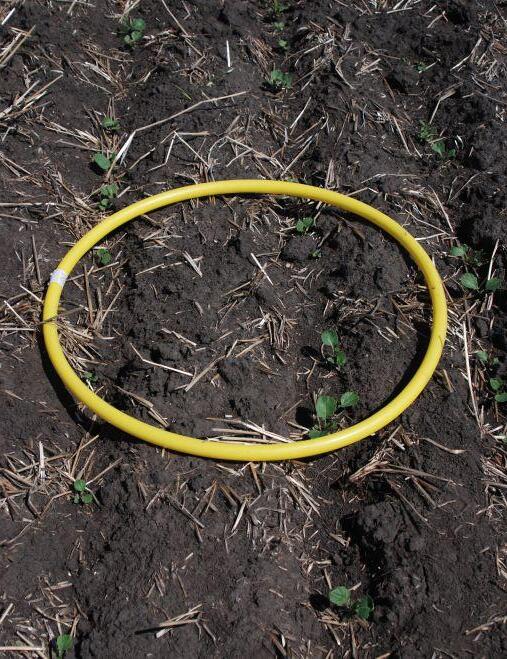
seeding rates and a range of current canola seed sizes on crop emergence, growth, yield and quality at nine western Canadian sites. Each site was direct seeded into wheat, barley or oat fields, and agronomic inputs were applied based on standard recommendations. Canola was seeded at a target depth of 0.4 to 0.75 inch deep in 7.5 to 11.8 inch row spacings. Weather patterns were similar to long-term averages at most sites.
Canola seeding rates were 75 and 150 plants per square metre. Canola seed sizes based on average 1000-seed weight were 3.96, 4.6, 4.8 and 5.7 g per 1000 seeds, and one un-sized treatment at 4.4 g. Preliminary germination tests found all seed sizes exceeded 97 per cent.
Yield unaffected
Neither seeding rate nor seed size had a significant effect on yield.
Fig. 1. Seeding rate (no. m2) effects on canola yield for individual sites and the means of all sites

Horizontal lines on each orange bar are standard errors for the difference among means for each site and for the all sites means. Asterisks (*) adjacent to bar ends indicate statistically different (P<0.05) seeding rate effects on yield at the respective sites.
Source: Harker et al. 2015. Seed size and seeding rate effects on canola emergence, development, yield and seed weight. Can. J. Plant Sci. 95: 1-8.
In addition, seeding rate did not interact with seed size for any factor measured.
Emergence percentage was 55 per cent for both seeding rates. This resulted in an effective stand establishment of 35 plants per square metre for the 75 plants per square metre seeding rate, and 67 plants per square metre for the 150 plants per square metre seeding rate. The lower seeding rate was close to the optimum stand establishment recommended by the CCC of 40 plants per
square metre. With near normal growing conditions, the good stand establishment likely explains why seeding rate did not impact yield. (See Fig. 1.)
While the higher seeding rate did not increase yield, it did result in increased early crop growth that helped the crop compete with weeds better. Higher seeding rate also resulted in the crop coming into flower sooner and decreased days to maturity. It also produced larger seed with higher oil content. All can be important factors in canola production over the longer term – flowering before high summer temperatures; avoiding early frosts; managing herbicide resistance.
Increasing seed size did not have any effect on emergence, seed quality or yield. It did, though, increase early season growth. Days to flower and days to end of flowering were also decreased with increasing seed size. Increasing seed size resulted in increased 1000 seed weight at harvest.
While not measured in this study, other researchers have found that seedlings from larger seed are less susceptible to flea beetle damage.
“Greater biomass from large seeds increases crop competition with weeds and also hastens flowering, shortens the flowering period and reduces the risk that canola will be exposed to high temperatures that can negatively impact flowering and pod development,” Harker reports.
The lessons found in the research supports the need to establish seeding rates based on plant populations and 1000 kernel weight, which can be done using an online seeding rate calculator found on various government websites. While 40 plants per square metre is the minimum recommended, the CCC recommends targeting at least 70 healthy, surviving plants per square metre to maintain yield potential for canola. This allows for some plant mortality due to post-seeding stresses such as frost, disease and insects.
CONTINUED FROM PAGE 66
Tar’an says the project has revolutionized pulse breeding in Canada, and growers are the primary beneficiaries, although processors and the public will also benefit.
“Eventually what this will mean to the growers is delivery of improved cultivars more quickly, like the example of herbicide tolerant chickpea. That’s the end point,” he says. “We aim to improve the traits that are important to farmers, but we also like to see improvement in the nutritional value of the product. So that will benefit people globally, here and abroad.”
One very practical – and exciting – result of the iMAP project is the sequencing of the CDC Frontier chickpea genome.
Using iMAP technology, Tar’an’s team at CDC collaborated with almost 50 colleagues from dozens of institutions globally in the project, many of which contributed funding to the shared effort. Now that the chickpea code is “cracked,” breeding programs around the world can use that information to improve, among other things, carotenoid concentration in chickpea.
“There are other traits that are important in other parts of the
globe, so they can use that information from the iMAP in their environments,” Tar’an says.
Another very practical result of the project is the University of Saskatchewan’s development of a “KnowPulse” database, which stores sequences and other information of chickpea and other pulses, some of which is available to the public.
Tar’an calls this not an “endpoint,” but rather a good beginning for chickpea breeding. “Now we know where the target genes are, rather than randomly selecting, breeders can use that information,” he says. “This year is the International Year of Pulses, which makes it even more exciting.”
These days, Tar’an’s team is using iMAP technology to re-sequence all the pulse varieties currently in common use, and developing genomic selection for complex and simple traits in chickpea.
“We’re leading globally on pulse research and production,” he says. “I acknowledge the support from the growers here. We really do what we can do to benefit the industry. The main goal here, the ultimate goal, is to keep our industry competitive as a supplier globally.”

A project aims to pave the way for breeding varieties with higher levels of unique oat compounds.
by Carolyn King
Oats have a lot of things going for them when it comes to human health, and one of those things is a group of bioactive compounds called avenanthramides. So a threeyear project at the University of Saskatchewan is laying the foundation to help breeders develop oat varieties with higher avenanthramide levels.
“Oats are a very unique crop. They are a cereal crop, but they are very different from most cereal crops, such as corn, rice and wheat. First of all, oats have a high oil content, which is not usual in cereal grains. For example, rice has about two per cent oil, but oats may have up to 18 per cent. The high oil content gives high energy, which is very good for feed,” explains Xiao Qiu, a professor in the university’s department of food and bioproduct sciences who is leading the avenanthramide project.
“Second, oats contain beta-glucan, a type of water-soluble dietary fibre with important health benefits.” The health effects of beta-glucan have been examined in many studies, and the two best-documented benefits are that it lowers cholesterol, which helps reduce the risk of heart disease, and that it reduces glycemic response after a meal, which helps control or prevent diabetes.
“And third, oats have avenanthramides, a type of polyphenol. Polyphenols are a big group of compounds that have many different types of functions, but avenanthramides are a unique type of polyphenol. They have very high antioxidant activity compared with some other polyphenols, and antioxidants are good for protection against cardiovascular disease and many other things. Avenanthramides also have strong anti-skin-irritation and anti-allergic activity. As well, [some research indicates] avenanthramides have high anti-proliferative activity; cancer cells grow very fast, so these kinds of compounds could inhibit cancer growth.” Although more research needs to be done to confirm the human health benefits of consuming avenanthramides, results so far suggest they may provide a variety of important benefits such as contributing to a reduced risk of colon cancer and a reduced risk of heart disease.
Avenanthramides are found only in oats, not other cereals. In fact, the “avena” in “avenanthramide” comes from the scientific name for oats, Avena sativa. The oat plant uses avenanthramides to help defend itself against pathogens.
Qiu notes that avenanthramides are being used commercially in skin lotions, creams and other personal care products. For example, Aveeno is a company whose name comes from its use of oats and oat extracts in its personal care products. “The basic functional compounds in Aveeno’s products are avenanthramides because of their very high antioxidant and anti-irritation activity.” Also, an Albertabased company called Ceapro extracts avenanthramides from oats and sells the extract to companies for use in such products.
Qiu’s research program investigates the biosynthesis of bioactive compounds in plants and microbes, and includes studies of oat oil, beta-glucan and avenanthramides. His current avenanthramide project started in January 2015 and is funded by Saskatchewan’s Agriculture Development Fund and the Prairie Oat Growers Association (POGA).
Qiu and his research team have already completed this project’s first objective, which was to survey avenanthramide levels in oat germplasm. “If we want to increase the avenanthramide content in oats, we have to know which germplasm samples have higher levels. If the level is high in a sample, then an oat breeder could potentially use it as a parent for crossbreeding,” he says.
The researchers obtained germplasm samples from the university’s plant sciences department and from Plant Gene Resources of
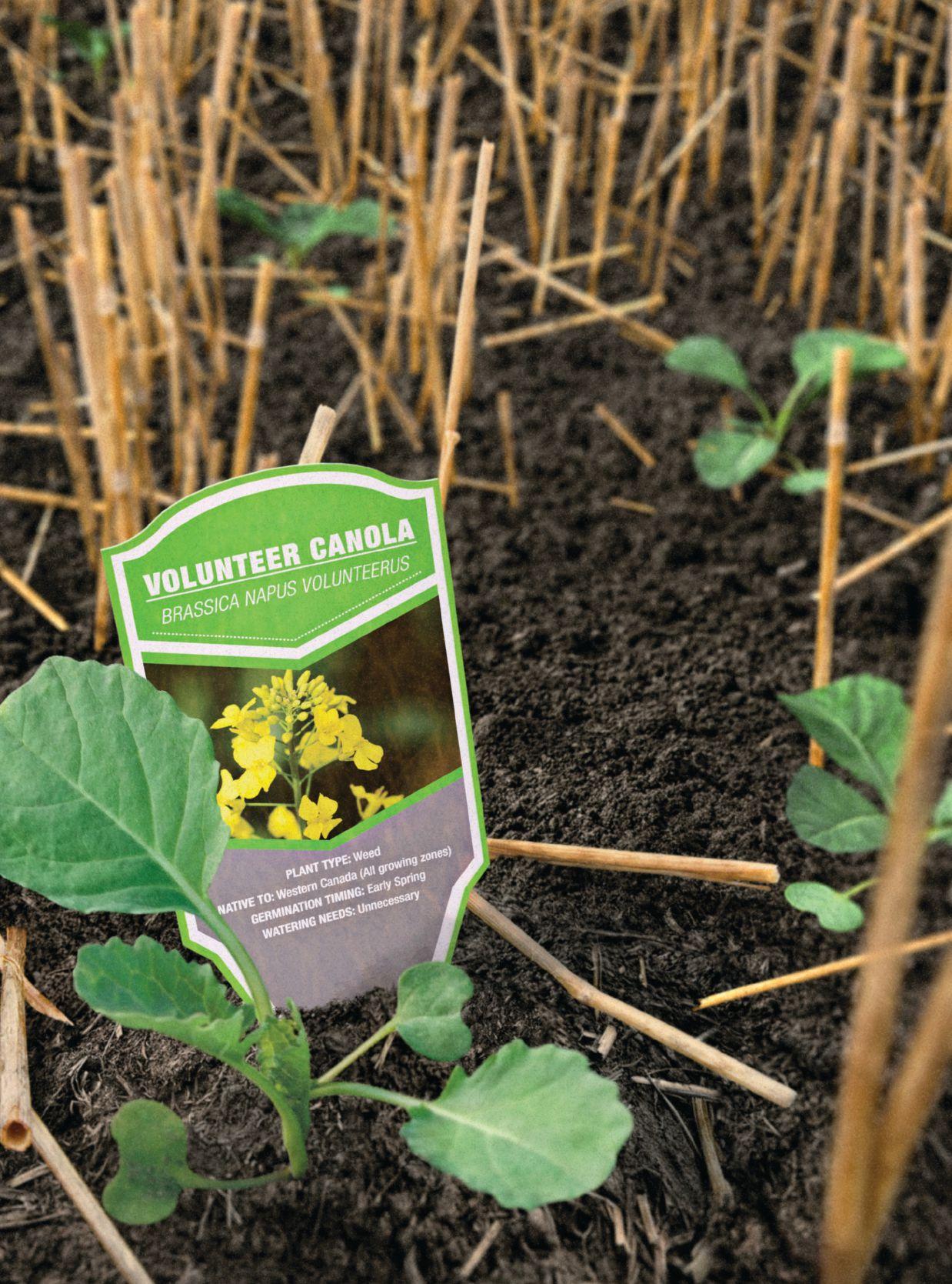


You didn’t plant it, but you can certainly expect it. Volunteer canola is virtually indistinguishable from your intended canola crop and can introduce disease, carry unwanted herbicide tolerance, steal nutrients and otherwise limit the yield potential of your new crop.
Tank mix Pardner® herbicide with your pre-season application of glyphosate for control of all volunteer canola.
For more information, visit: cropscience.bayer.ca/Pardner Expect it.
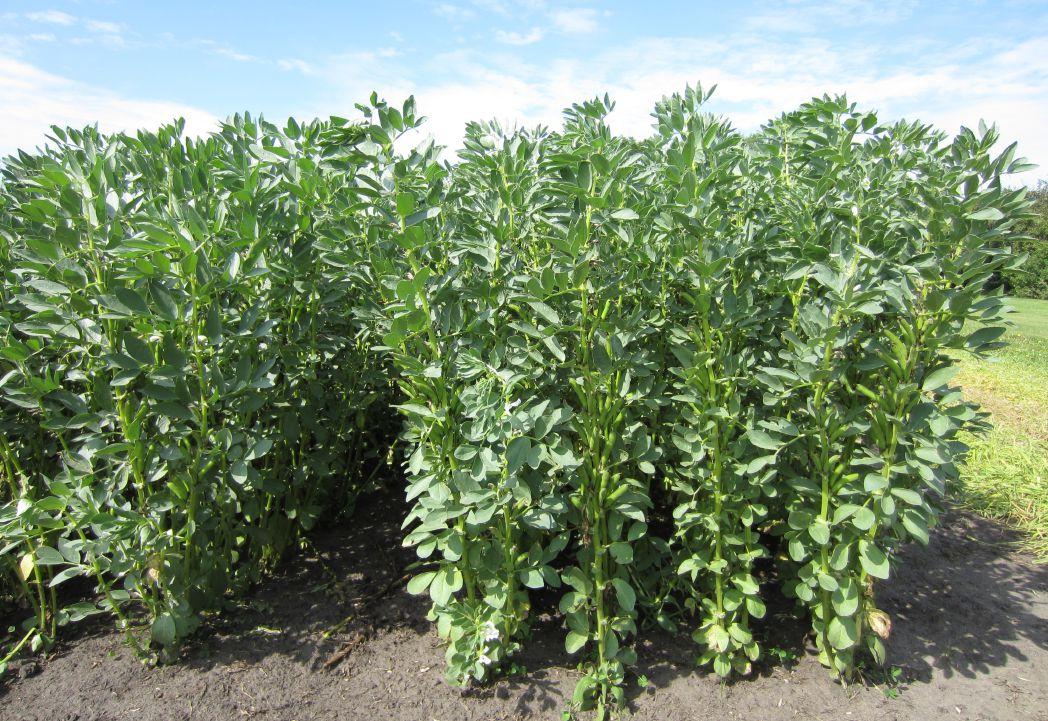
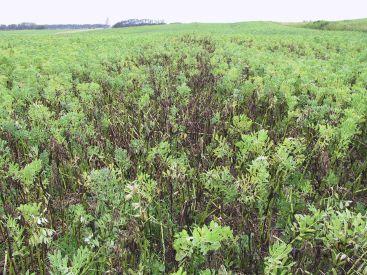
Research shows fungicidal treatments improve emergence and seed yield.
by Bruce Barker
As fababean production ramps up on the Prairies, growers are having to contend with gaining a better understanding of production practices in the face of limited agronomic research. One area lacking research is control of pathogens that cause root rot. However, recent research by Alberta Agriculture and Forestry (AAF) and Agriculture and Agri-Food Canada (AAFC) provides some reassuring and validating results to prove that seed treatment to manage root rot of fababean is warranted.
“Tannin-free fababean cultivars have a thin seed coat with low concentrations of saponins and alkaloids. This increases susceptibility to severe seedling blight and root rot,” says Kan-Fa Chang, a researcher at AAF’s Crop Diversification Centre (CDC) North, in Edmonton.
Chang was involved in several research programs that looked at the effect of seed treatments and pathogen density on seedling blight and root rot of fababean. The results were published in the Canadian Journal of Plant Science in 2014. Chang, along with co-researchers Robert Conner and Debra McLaren with AAFC Morden and AAFC Brandon, respectively, and Sheau-Fang Hwang with CDC North, focused on root rots caused by Fusarium
avenaceum and Rhizoctonia solani because surveys have shown that Fusarium and Rhizoctonia root and foot rots were major diseases of fababeans as well as many other crops including pea. The research included two parts.
The first study used isolates of F. avenaceum and R. solani obtained from symptomatic roots of fababean plants collected from a survey of commercial fields conducted in central Alberta. The pathogens were colonized on wheat grain kernels, air-dried, ground into powder and stored at 4C. The powdered inoculum was mixed and planted with the seed at 15 mL per 6 m row for R. solani or 30 mL per 6 m row for F. avenaceum and compared to a noninoculated control. These rates were selected based on previous studies with other pulse crops.
Seed treatments included Apron Maxx, Thiram and Vitaflo 280. A Rhizobium inoculant was also applied to the seed. This trial ran at Lacombe and Vegreville, Alta.
The second study assessed the interaction of fungicide seed treatments with inoculum density of F. avenaceum and R. solani, in a
TOP: Healthy fababean plants.
INSET: Fababean plants affected by root rot.
total of 12 trials over three years at Lacombe, Alta., and Morden and Brandon, Man. The main plot treatments were inoculation with either F. avenaceum or R. solani at 15, 30 or 45 mL per row or a non-inoculated control. The subplots included fungicide seed treatments of Apron Maxx, Trilex, Vitaflo 280, Trilex EverGol and a non-treated control.
In the first study, F. avenaceum reduced seedling emergence more than R. solani, but both pathogens had a similar impact on seed yield, reducing it by 17 to 23 per cent. Chang says that in the treatments inoculated with F. avenaceum, Apron Maxx and Vitaflo 280 increased seedling emergence and yield compared to the non-treated inoculated control or Thiram. In the treatments inoculated with R. solani, Apron Maxx and Vitaflo 280 improved emergence compared with the non-treated control and Thiram, but only application of Apron Maxx increased yield.
In the second study at three sites with six station years, Chang explains the interaction effects of inoculum density x seed treatment for F. avenaceum and R. solani were only significant for seed yield, and indicated significant effects on root rot severity and seedling emergence. “Seedling emergence and seed yield declined with increasing inoculum level for both F. avenaceum and R. solani,” he says. Nodulation was not affected by inoculum density, reports Chang.
Overall, the fungicidal seed treatments with Apron Maxx and Vitaflo 280 consistently improved emergence and seed yield in trials inoculated with F. avenaceum or R. solani. However, of all the fungicide seed treatments tested, only Apron Maxx is registered for use on fababean, and growers should not use unregistered seed treatments.
While seed treatments can be effective in helping to control the pathogens, Chang also notes that keeping inoculum levels low in the field with good crop rotations should be a priority as well. He says root rot pathogens such as F. avenaceum have thick-walled chlamydospores that can last several years in the soil so rotation to non-host crops can help, especially away from field pea and other pulses. However, because F. avenaceum and R. solani are common pathogens in so many crops, seed treatments will likely become a required input for high yields and improved economic returns in fababean.
CONTINUED FROM PAGE 70
Canada, the Saskatoon-based national germplasm bank. Most of the samples were oat breeding lines and cultivars from Aaron Beattie, an oat breeder at the university and long-term partner in oat research with Qiu, but they also tested some wild Avena species to get a general idea of the range in avenanthramide levels.
Analyzing samples for avenanthramides is fairly complex. Qiu explains that oats contain up to 20 different types of avenanthramides, although normally there are only three major ones, which are known as avenanthramide-A, avenanthramide-B and avenanthramide-C. So his lab tested about 30 different germplasm samples for those three avenanthramides. The tests showed quite a wide range in avenanthramide levels.
His lab is now working on the second of the project’s two objectives: to find out how avenanthramides are made in the oat plant. “To improve this trait in oat varieties, you have to know the biosynthetic pathway – how avenanthramides are synthesized biochemically in the plant, what genes control the synthesis, what kinds of enzymes are involved, and all these kind of things,” Qiu says.
He adds, “If we know the genes involved, then oat breeders can design a molecular marker for the trait.” A molecular marker is a short sequence of DNA associated with a specific trait. Breeders use these types of markers to quickly screen germplasm for the desired traits in the lab, making their breeding efforts more efficient and effective.
Qiu notes, “I’ve talked to oat breeders here, and they haven’t made avenanthramides a priority trait in their breeding programs. Right now, they are focusing on things like disease resistance and yield. But you never know how things might go in the future.”
For more on crop management, visit topcropmanager.com.
Down the road, if breeders are able to develop oat varieties with higher amounts of avenanthramides, then there could potentially be benefits along the oat value chain. “With an increased amount of
avenanthramides, companies could use more oats in products like lotions and creams where they want anti-itching and anti-inflammatory properties,” says Shawna Mathieson, POGA’s executive director.
“And people would have even more reasons to eat this ‘superfood.’ Oats are already recommended by many doctors because the fibre in oats helps to reduce cholesterol. Some studies have shown that individuals with high cholesterol who consume just three grams of soluble fibre every day, or about the amount in a bowl of oatmeal, can lower their cholesterol. Avenanthramides have also been linked to prevention of cardiovascular disease and to protection against colon cancer and skin irritation. So higher avenanthramide levels would make oats even better for consumers.”
As research information about the health benefits of eating avenanthramides increases and as consumers become aware of these benefits, then higher levels of avenanthramides in oats could help to increase oat consumption by healthconscious consumers. She says, “That would mean higher sales and hopefully higher profitability not only for oat producers but also for those down the oat value chain.”
Qiu thinks avenanthramides could play a valuable part in further improving the reputation of oats as a functional food. “Although oats already have a healthy image, people are only paying attention to the beta-glucan content. But oats are not just about beta-glucan; they also have avenanthramides. Right now avenanthramides are used for cosmetics, but consuming avenanthramides is also good for you. Adding avenanthramides to the good image of oats would create more demand,” he says.
“For instance, people drink red wine because of the polyphenolics, but oats have a unique group of polyphenolics with stronger antioxidant activity than wine polyphenolics. People drink tea partially because of the tannins and other polyphenolics, but oats have avenanthramides with a better activity. So why not eat more oats?”
Feeding the world is not just a big responsibility, it’s big business – with a world population over 7.3 billion, it has to be. However, many consumers don’t associate large-scale business with family business, even though 98% of
Canadian farms are family-owned and operated. As a result, many consumers don’t trust their food supply. We need to make sure the story of the family farm is being told, and that “big” doesn’t mean “bad.”
We all have stories we can share, whether you grew up on a family farm, or you work in an industry that serves farm families. Look for opportunities to tell the real story of Canadian agriculture, whether it be online, in the grocery store or at the dinner table.
98% of Canadian farms are family farms
Almost all of the farms in Canada are family-owned and operated, and producing healthy, sustainable food is their first priority. Remember, farmers feed their own families the food they produce.
Family farms have evolved
They look different today than they did 50 years ago. But that doesn’t mean our food supply isn’t safe and healthy anymore. New technology has allowed farmers to do more with less, making agriculture more sustainable today. Farmers protect the environment because they want to pass their business on to the next generation.
Farming is a complex business
Families must manage food safety and traceability, detailed budgets and accounting, marketing, employees, everchanging technology, and more. Modern farms must be run as a business, and it makes good business sense for many family farms to incorporate. As a company, farms can minimize taxes. Plus, family members can own shares in the company, making it easier to pass the farm from generation to generation. But their business structure doesn’t change the fact that family members work side by side every day, bringing to life their shared passion and dedication for producing safe, healthy food.
Everyone in the industry needs to work together to help improve perceptions. By being open and proactively communicating with the public about how we grow food and why we operate in the ways we do, we can maintain consumer trust and continue to produce high-quality, nutritious food in ways that are efficient and sustainable.
The importance of family is something everyone can understand and relate to, whether you’re in ag or not. It’s common ground that can start a conversation.
Visit AgMoreThanEver.ca/resources to find a collection of photos that you can easily share on social media to start or support conversations about family farming.

The land is my lifestyle and my livelihood, but it’s also my legacy.
Providing
safe, healthy food for my family is
important
to me too.
That’s why I farm.
I love ag for the life it gives my kids now…and the opportunities it gives in the future
Or, even better, share your own pictures and make your story personal.

“Agriculture is a fast-growing business, and it has to be run as a business. It involves family, of course, but we’re always looking at the latest research, we’re looking at what practices are evolving in other countries, and we’re adapting those practices so we can become more efficient to get our product into the marketplace.”
– John Thwaites, Ontario fruit and vegetable grower
“My farm is a family farm. It is 100% owned by myself, my husband and his two parents. We love everything about agriculture with a fierce passion. We have never, ever, sold a product that we wouldn’t happily serve to our children. Every decision on the farm takes more than just finances into consideration. Our number one goal is to leave a farm to our children that is both environmentally and economically viable.”
– Adrienne Ivey, Saskatchewan rancher
Watch The power of shared values webinar featuring Charlie Arnot, CEO of the Center for Food Integrity, who shares three simple steps to gain consumers’ trust by tapping into the power of shared values. Charlie helps bridge the divide between science and consumer perception and offers great insight into creating messages that are proven to resonate with consumers.
Visit AgMoreThanEver.ca/tag/webinar

There are 2.1 million Canadians working in agriculture and agri-food. Imagine the impact we could make if we all made a commitment to improve perceptions of agriculture. There are simple ways you can start being an agvocate today. Just choose to do one of the following:
1. Search the hashtags #FutureFarmer, #AgMoreThanEver, or #Farm365 and find a positive post to retweet.
2. When you overhear a misleading or inaccurate conversation about farming, find an appropriate time to share your story.
3. Dedicate one day to volunteer at an event that promotes agriculture such as Open Farm Days or Ag Literacy Week
4. Tell a friend or co-worker about the need to speak up, and ask them to take the agvocate challenge.

Pul l up a c hai r.
“ The natural environment is critical to farmers – we depend on soil and water for the production of food. But we also live on our farms, so it’s essential that we act as responsible stewards.”
– Doug Chorney, Manitoba
“ We take pride in knowing we would feel safe consuming any of the crops we sell. If we would not use it ourselves , it does not go to market.”
– Katelyn Duncan, Saskatchewan
“ The welfare of my animals is one of my highest priorities. If I don’t give my cows a high quality of life, they won’t grow up to be great cows.”
– Andrew Campbell,
Ontario
Safe food; animal welfare; sustainability; people care deeply about these things when they make food choices. And all of us in the agriculture industry care deeply about them too. But sometimes the general public doesn’t see it that way. Why? Because, for the most part, we’re not telling them our story and, too often, someone outside the industry is.
The journey from farm to table is a conversation we need to make sure we’re a part of. So let’s talk about it, together.
Visit AgMoreThanEver.ca to discover how you can help improve and create realistic perceptions of Canadian ag. We a ll sha re t he
The pulse crop has received increasing attention over the last five years.
by Julienne Isaacs
Fababean has received increasing attention – and research dollars – over the last five years. Two new studies in Saskatchewan, working in tandem with the University of Saskatchewan’s breeding program, aim to develop best practices for the crop, and the timing couldn’t be better.
In 2015, more than 100,000 acres were planted to fababean in the province. A string of disappointing years have left pea growers looking for a replacement rotational pulse, and fababean is a good fit. But it’s also a booming business in its own right.
“Les Henry once told me, ‘Fababean is the only crop that will stand up and look you in the eye at harvest,’” says Bert Vandenberg, professor and Natural Sciences and Engineering Research Council (NSERC) Industrial Research Chair at the University of Saskatchewan.
“Peas have had tough times in the rough years, but fababean can take a lot of moisture and doesn’t get root rot,” he says. “And fababean stands up at harvest. Farmers love that. You can combine more fababeans per hour than peas. It’s a farmer-friendly crop.”
In addition, fababean has higher nitrogen fixation and higher protein than pea and lentil.
Vandenberg is the head of the fababean breeding program at the University of Saskatchewan. Since he took over the fababean portfolio more than a dozen years ago, investment in the crop has slowly begun to ramp up with the increase in acreage.
Breeding objectives have shifted over the years based on resources, but the first priority of the program was to develop small-seeded varieties that won’t plug up farmers’ air drills or require special equipment. Most breeding projects also seek to develop varieties with high yield and good seed quality.
“What we need to work on is disease resistance for chocolate spot. That’s a high priority right now,” Vandenberg says.
Over the next few years, Prairie growers will start to see the products of the breeding program – zero-tannin varieties, which work well as feed, are already being released. In a few years, low vicine varieties will follow.
“We’re probably behind where we should be, but now the investment is going to come,” Vandenberg says.
Two new studies focused on agronomic best practices are underway in Saskatchewan.
One study, led by Garry Hnatowich, a research director at the Irrigation Crop Diversification Corporation (ICDC), aims to determine the effects of two inoculation formulations: a peat-based inoculant and granular treatment at differing rates, and in combination with one another, on fababean growth.
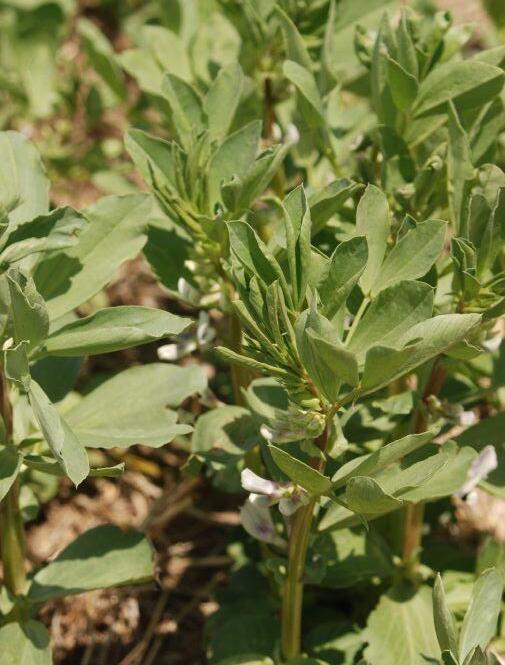
A secondary focus of the study will look at whether tannins, which are naturally found in most fababean varieties and have some antibiotic properties, diminish the effectiveness of inoculants.
“Of the pulse crops, fababeans are far and away greater fixers of atmospheric nitrogen than any of the other pulse crops, so more of their nitrogen requirements can be met through fixation, as opposed to relying on soil or fertilizer nitrogen,” Hnatowich explains. “Fababeans will fix about 90 per cent of their nitrogen requirements, as opposed to 70 to 80 per cent in pea crops. We want to know the best way of getting to that number.”
The three-year study, which began in 2015, will take place on eight participating sites across all of Saskatchewan’s climatic regions. The study is funded by the Saskatchewan Pulse Growers Association.
“Because the interest in fababean was low historically, there’s
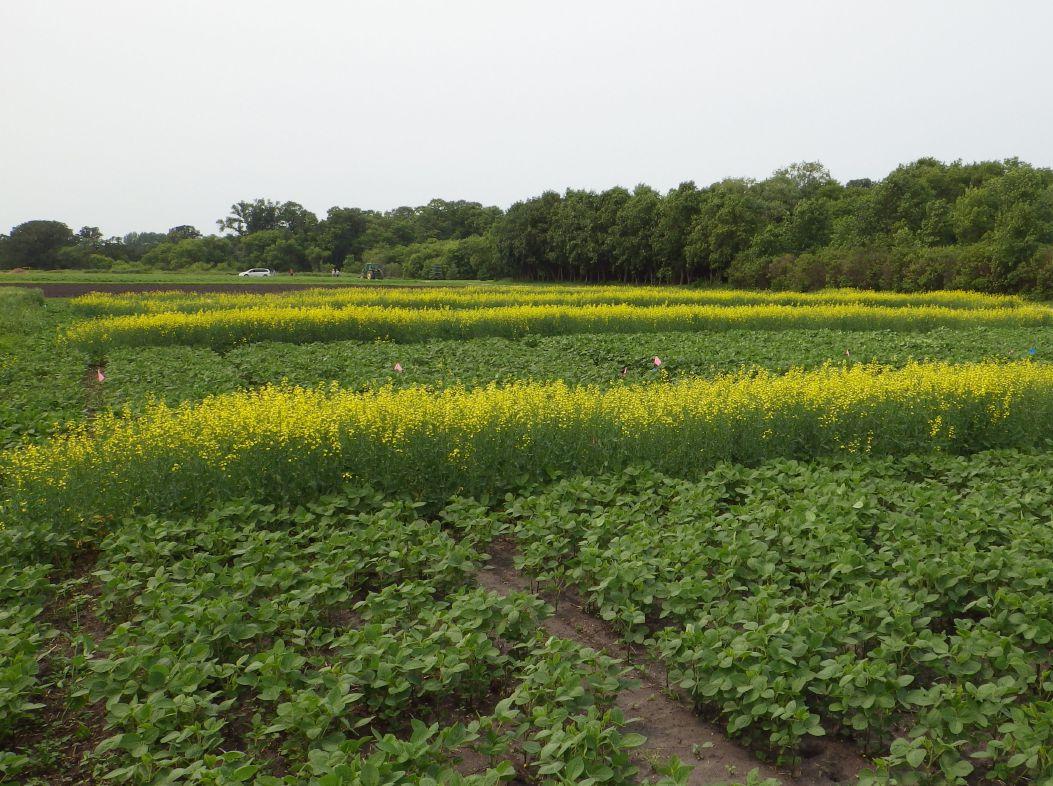
Current research and grower experiences point to effective options.
by Carolyn King
As soybean production becomes more and more popular in Manitoba, what are researchers and growers learning about which crop rotation options work best?
Soybeans have gone from about 50,000 to 1,330,000 acres in Manitoba in just 15 years. “This is exciting in that it brings more diversity into Manitoba crop rotations, which are dominated by wheat and canola, by adding another very profitable crop,” says Yvonne Lawley, agronomist in the plant science department at the University of Manitoba, who is leading a soybean rotation study.
“In general, farmers have characterized soybeans as a thrifty crop in that soybeans don’t require a lot of inputs. Very limited or no fertilizer is applied, and they grow well, produce good yields and are profitable. I’m interested in looking at soybean crop rotations and crop sequences in terms of how can we optimize this thrifty crop,” she notes.
Lawley explains that soybean’s thrifty nature comes from its symbiotic relationships with Bradyrhizobium japonicum bacteria and arbuscular mycorrhizal fungi (AMF), which both provide nutrients to the plants. However, the crop grown before soybeans influences the
level of benefits to soybeans from these microbial relationships.
The objectives of Lawley’s study are: to identify the best crops to plant before soybeans, to examine the effects of the preceding crop on nitrogen fixation and mycorrhizal colonization in soybeans, and to measure soybean’s nitrogen contribution to the following crop in the rotation. Funding for the study is from the Manitoba Pulse and Soybean Growers, and Manitoba’s Agri-Food Research and Development Initiative.
The previous crop influences the amount of nitrogen provided to soybeans by their Bradyrhizobium bacteria by affecting the amount of soil nitrogen in the field. “Soybeans give photosynthate – essentially sugars and energy – to the bacteria in exchange for the nitrogen. But if nitrogen is abundant in the soil, then the plant doesn’t need to spend those resources feeding the bacteria,” Lawley explains. “The amount of nitrogen fertilizer left over from the preceding crop and the dynamics of the crop residue breakdown can both play into how
ABOVE: In year 2 of the study, soybeans were grown on all the plots and evaluated for yield, nitrogen fixation and mycorrhizal root colonization.
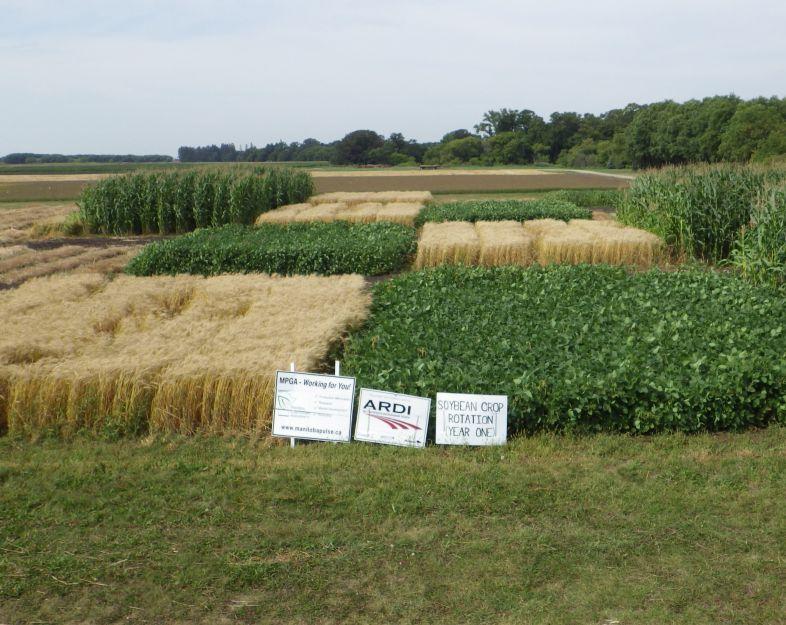
much nitrogen is around when you plant your soybeans, as the relationship between the bacteria and the soybean roots is forming, and influences how the soybean plant is going to partition its resources for its symbiosis with Bradyrhizobium.”
Like many other plant species, soybeans form a symbiotic relationship with AMF. These fungi provide phosphorus to their host plants, and in return the hosts provide energy to the fungi. Lawley says, “The fungi’s hyphae, what we would think of as ‘roots’ of the fungi, grow throughout the soil. Because the fungi infect the roots of soybeans, soybeans can tap into that second network of hyphae. Another exciting thing about AMF is that their hyphae are smaller in diameter than some plant roots, so they can access pools of phosphorus that a larger plant root can’t physically get to.”
Certain crops, such as flax and corn, really depend on a strong mycorrhizal network being in place at planting time so the fungi can colonize the roots of the young plants and provide early-season phosphorus. Other crops, such as wheat and soybeans, are helped by AMF but are not quite so dependent on them. Yet other crops, such as canola, don’t form symbiotic relationships with AMF, so mycorrhizal populations tend to be lower after a canola crop.
Lawley notes that, on the Prairies, nitrogen-fixing crops tend to be thought of as crops that will provide nitrogen to subsequent crops in the rotation. However, many
U.S. studies have found soybeans actually contribute little nitrogen to the next crop. “We haven’t done research on it here in Manitoba, so I wanted to do that to clarify and document the situation and to get farmers to think about it, because soybeans may be different than the pulse crops they’re familiar with.”
Her study, which is nearing completion, involved two field experiments.
Experiment 1 examined the effects of growing different crops before soybeans. In year 1, Lawley’s research group grew wheat, canola, corn and soybeans. Then in year 2, they grew the soybean test crop on each of those plots. They repeated the experiment over two cycles: the first cycle was in 2012 and 2013, at Carman and Kelburn; and the second cycle was in 2013 and 2014, at Carman, Kelburn and Portage. So they have soybean test crop data for five site years, including data on plant stand densities, plant development and yields. They also assessed the amount of nitrogen fixation by the soybean plants and the amount of AMF colonization of the soybean roots. Lawley’s graduate student Don Sanders is working on this project, and he has almost completed the analysis of the field and lab data.
Experiment 2 evaluated the nitrogen contribution of soybeans to the following crop in the rotation. It involved two cycles of trials, and took place at Carman and Glenlea. In year 1 of each cycle, the researchers grew soybeans and canola. Then in year 2,
they seeded all the plots to wheat and applied a range of nitrogen fertilizer treatments. They measured wheat stand density, plant development, aboveground biomass and yield, and determined the amount of nitrogen in the wheat’s biomass. Lawley’s lab is in the process of analyzing the data from Experiment 2.
Experiment 1 is generating useful information on which crops to grow before soybeans. “For the mycorrhizal fungi results, we found very consistently through all the site years that colonization in soybean roots was highest following corn and soybeans, lowest following canola, and intermediate following wheat,” Lawley says.
“Canola is not a mycorrhizal host crop, and we grow a lot of canola in Manitoba, so we were interested to see whether canola in the rotation was a good thing or a bad thing for soybean yields. In our experiment, we saw the negative impact of canola on AMF root colonization in soybeans, but that didn’t necessarily translate into a lower soybean yield.” In only one of the five site years, did soybeans after canola have significantly lower yields than soybeans after the other three crops. So the soybeans were able to compensate for the lower AMF root colonization after canola.
“Nitrogen fixation tended to be higher following soybeans and corn, but it really depended on the soil test nitrogen values in the spring,” Lawley notes. That is, when spring soil nitrogen levels were high, the soybean crop didn’t invest as much energy in nitrogen fixation.
She says, “We saw lower nitrogen fixation following canola in three of the five site years, but again it was driven by spring soil test nitrogen levels. For example, at the end of the 2012 growing season, we didn’t have rain for a month and a half when the canola crop was growing. So the canola plants didn’t utilize all the nitrogen and there was a lot of leftover nitrogen. That translated into lower nitrogen fixation in the following soybean crop, but it didn’t necessarily result in lower soybean yields.”
The soybean yield results were mixed. “When we started this experiment, my hope was to make some very broad conclusions about what the best crops would be to grow before soybeans. Although we have fairly strong trends in AMF root colonization and nitrogen fixation, the yield trends are all over the place. Right now in our analysis, we are looking at which crop sequences have the most stable soybean yields,” she says.
“For sure, the most consistent performers for soybean yields were wheat and corn. They didn’t necessarily always result in the highest soybean yields in the experiment, but they never had the lowest. That result is also promising in that wheat-soybean and corn-soybean are good crop sequences in terms of the traditional recommendation of mixing broadleaf and grass crops in the rotation, both for disease management and herbicide rotation.”
So the main story from Experiment 1 is about nutrient use efficiency as a driver for crop sequencing. Lawley says, “I think it explains why soybeans are this Cinderella crop. It shows soybeans can do a really great job exploiting symbiosis in low phosphorus and low nitrogen soils, and that you are going to get the most out of soybeans in those situations because they have higher nitrogen fixation where there is low soil nitrogen, and they have higher root colonization by mycorrhizae when there’s low soil test phosphorus.” Soil testing will help growers to make crop sequence choices that make the most of soybeans’ thriftiness.
However, she adds, “Research on phosphorus recommendations for soybeans by Don Flaten in the University of Manitoba’s soil science department has been showing that soybeans respond much more to residual phosphorus in the soil than to starter phosphorus fertilizer. That finding underlines the need to maintain adequate soil phosphorus levels in your overall crop rotation.”
Soybean rotation trends in Manitoba “Soybeans have been very profitable for many farmers in Manitoba. And some farmers are actually designing their rotations around their soybeans because they have been so profitable,” says Anastasia Kubinec, oilseeds crop specialist with Manitoba Agriculture, Food and Rural Development (MAFRD).
Kubinec, Dennis Lange, MAFRD’s pulse specialist, and Terry Buss, a farm production advisor out of Beausejour, have observed that many Manitoba soybean producers are choosing to grow cereals both before and after their soybean crops. Manitoba data show cereals and soybeans both yield well in cereal-soybean and soybeancereal sequences. Kubinec says spring wheat and oats are the most common cereal choices, but all cereals perform well in rotations with soybeans.
“Some farmers are still growing soybeans on soybeans, but that is becoming less and less common,” Kubinec notes. “They are finding that if they grow too many soybean crops in a rotation, there are issues with Phytophthora root rot. Also, there is concern about soybean cyst nematode if it moves into Manitoba and its impact on soybean yields and frequency of soybeans in crop rotations.” She points out that both Phytophthora and soybean cyst nematode are long-term disease problems – once they’re in a field, they’ll be there for a long time.
Growing soybean on soybean or soybean and corn in tight rotation also increases the potential for developing Roundup-resistant weeds since most soybean and corn varieties grown in the province are Roundup Ready. Some growers are planting soybean after canola, but there can be an issue with canola volunteers.
Soybeans are a host for sclerotinia, and so are many other Manitoba crops such as canola, sunflowers, flax and edible beans. “If you have too many of those crops in the rotation, then you are going to get sclerotinia problems,” Kubinec says.
She doesn’t recommend growing edible beans directly after soybeans because of marketing issues. “There is a very low tolerance for soybeans in edible beans – growers can’t sell their edible beans if there are too many soybeans in the sample because the soybeans are a contaminant and an allergen. If producers are growing both soybeans and edible beans in their rotation, then they need to have several years between those two crops to ensure no soybeans are growing in the edible beans. Or they need to designate certain fields for rotations with edible beans, and different fields for rotations with soybeans.”
Her other soybean rotation tip is to keep an eye on soil nutrient levels. “Producers are finding that fields with soybeans in the rotation are getting lower on phosphate and potassium, especially if they also have canola somewhere in their rotation because soybeans and canola are both very high users. So, you need to be watching your soil test to make sure the soil has adequate fertility. As well, you need to know when and how you can apply fertilizer to support that crop, as applying it with the seed is not recommended. For example, you might want to apply additional phosphorus in the previous year with your cereal crop.”
CONTINUED FROM PAGE 80
been relatively little agronomy,” says Hnatowich. “The hope is that agronomic services will leap up to meet this demand.”
Another study, led by University of Saskatchewan professor Steve Shirtliffe, aims to analyze seeding rates and fungicide efficacy. This study, which will also run for three years, began in 2015, so no results have been released as yet.
“There have been trials over a period of 30-odd years looking at seeding rates in Saskatchewan. But they conflict,” says Hnatowich, who is collaborating with Shirtliffe on the study. “None of the trials really came up with an answer on seeding rate, and this may have been due to the short-term nature of the trials, or limited locations.”
In Shirtliffe’s study, 20, 40, 60, 80 and 100 seeds will be plant-
ed per metre in each plot over a wide range of locations, at up to six sites in Saskatchewan. The second part of the study will analyze the efficacy of four different foliar fungicide treatments – Bravo, Priaxor, ProPulse and Vertisan – in tandem with seeding rate. “Fababeans are prone to some foliar diseases: chocolate spot (botrytis) is a problem in the province not infrequently, as is ascochyta. And these two diseases are often problematic under irrigated conditions,” Hnatowich says.
The ability of fababean to cope well in high moisture conditions makes it unique, and desirable, especially as pea acreage continues to decrease in Saskatchewan.
“Farmers are interested in fababean because it’s a pulse crop that fits back into their rotational strategy,” he says.
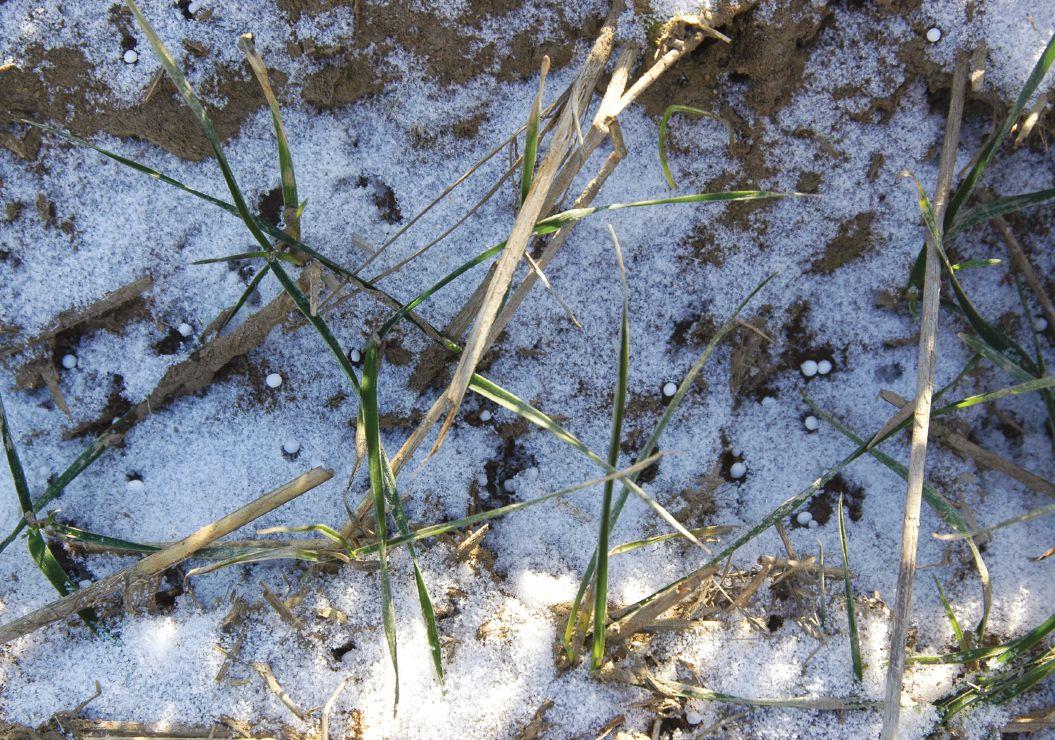
by Bruce Barker
Try this exercise. Take five $20 bills, scatter them on the ground, then light one on fire and watch it go up in smoke.
That’s what researchers at the Montana State University (MSU) found could happen if you broadcast urea fertilizer in the late fall or winter without incorporation. Previously, it was commonly thought that broadcast urea on cold soils would not result in very large urea losses.
“Cumulative losses, expressed as a percentage of applied N rate, averaged 16.1 per cent for 23 trials conducted between 2008 and 2014, and there were trials where losses were greater than 20 per cent,” says lead researcher Richard Engel with the land resources and environmental sciences department at MSU at Bozeman, Mont., who collaborated with colleague Clain Jones.
The trials were established to quantify ammonia (NH3) volatilization loss from surface applications of urea and determine under what conditions urea became susceptible to volatility. A total of 23 trials over seven years were conducted on private farms in Hill, Fergus and Gallatin Counties.
In Montana, winter wheat growers commonly broadcast urea fertilizer on winter wheat, often during cold weather in late fall and extending into early spring, and typically on frozen ground with a modest
snow cover. On the Canadian Prairies, the practice of fertilizing over the winter months is less common because of our heavier snow pack. The research provides a glimpse into scenarios in which losses can be high from broadcast urea, whether applied in the late fall or early spring prior to seeding.
When applied to soil, urea granules dissolve when in contact with moisture and are converted to ammonium (NH4+). Engel says that at the same time, the pH in the soil microenvironment rises and ammonium becomes unstable, and part of it can be lost to the atmosphere as NH3 gas. Not only is part of your fertilizer dollar going up in smoke, but NH3 gas also contributes to greenhouse gases. A 20 per cent volatilization loss not only costs money – about $10/ac with urea around $554/t and a 90 lbs/ac fertilization rate – but it can also potentially affect yield and protein.
In the Montana research, ammonia losses were quantified using a micrometeorological mass-balance approach with circular plots (0.3
ABOVE: NH3 loss was equivalent to 22.4 per cent of applied N over the first week following fertilization as the soil dried.
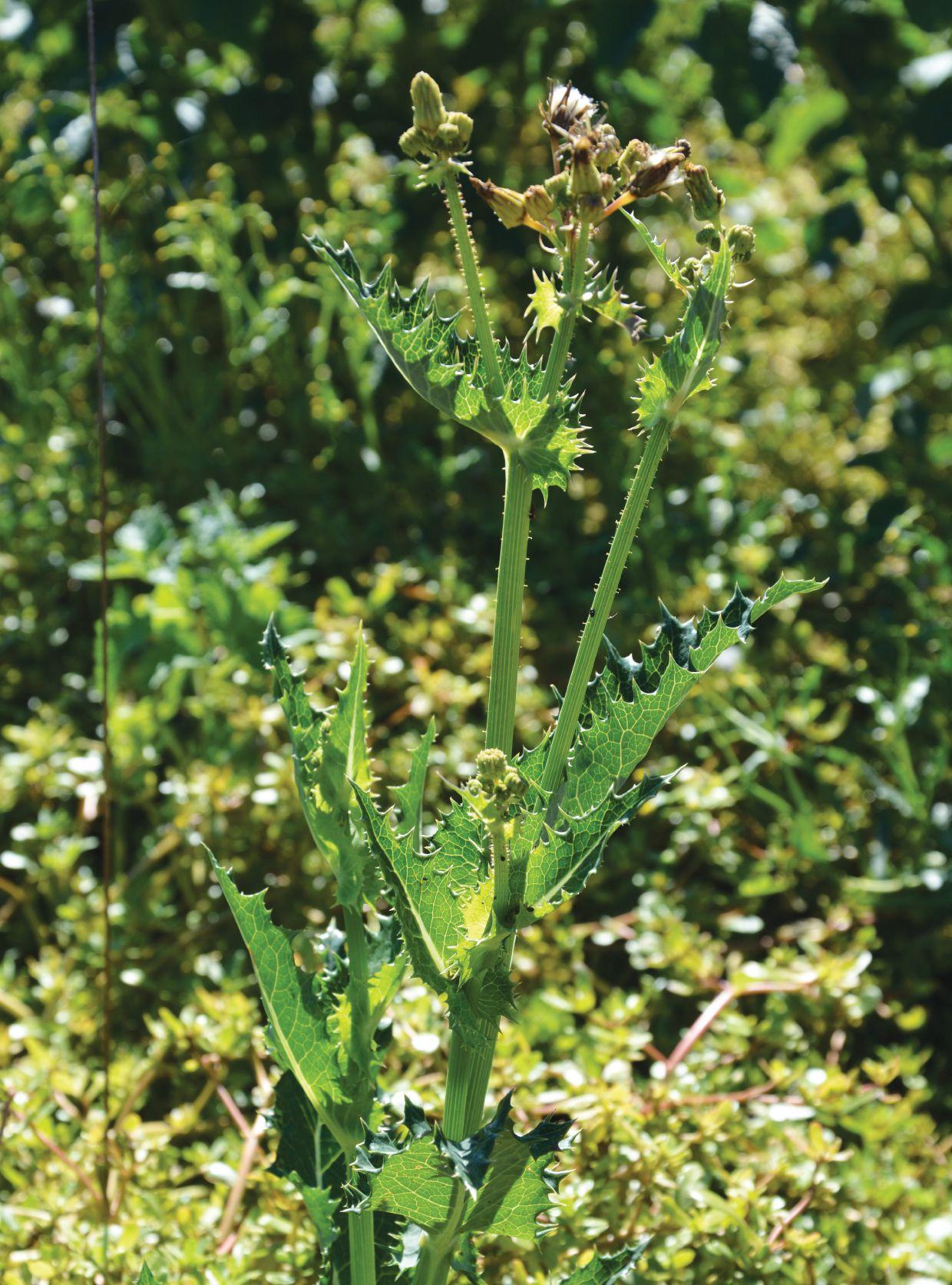
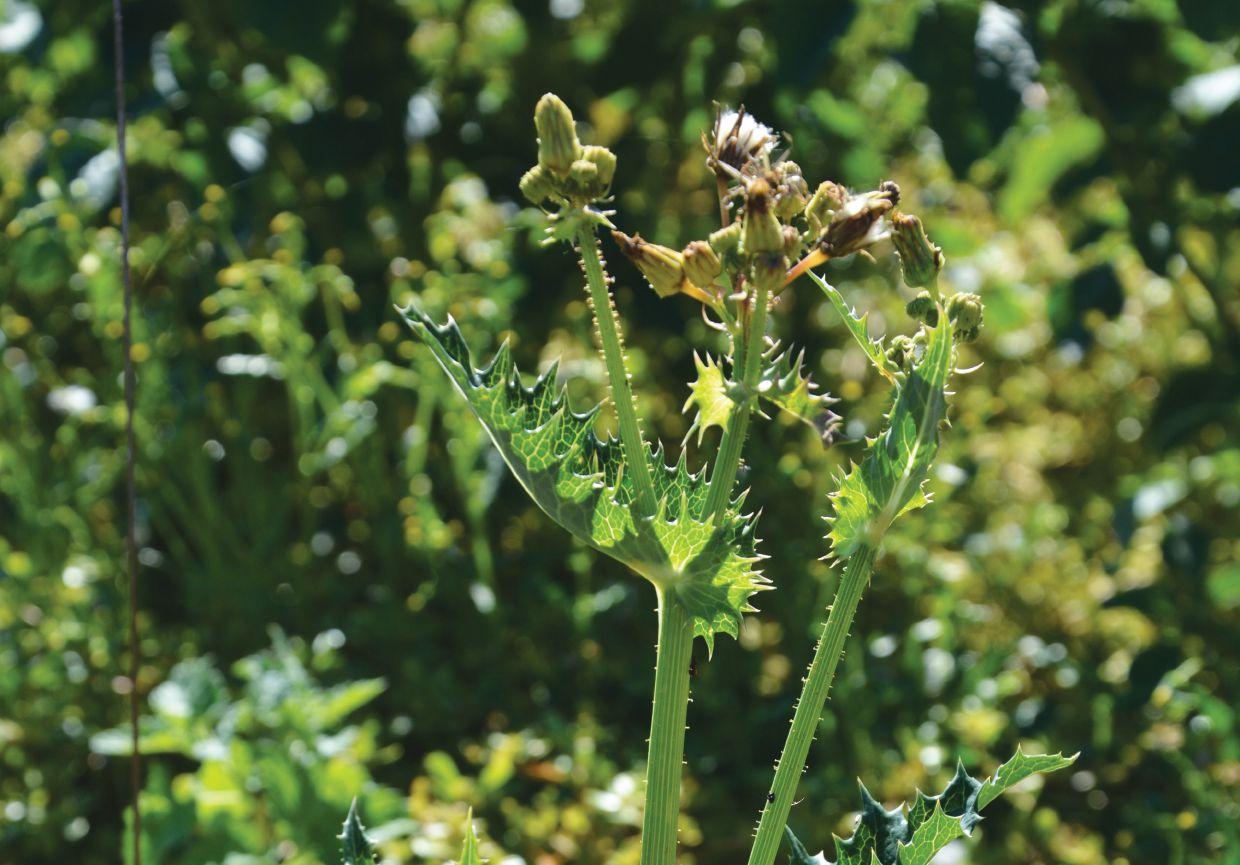

To gain a better understanding of herbicide resistance issues across Canada and around the world.
Our goal is to ensure participants walk away with a clear understanding on specific actions they can take to help minimize the devastating impact of herbicide resistance on agricultural productivity in Canada.
Some topics that will be discussed are:
• A global overview of herbicide resistance
• State of weed resistance in Western Canada and future outlook
• Managing herbicide resistant wild oat on the Prairies
• Distribution and control of glyphosate-resistant weeds in Ontario
• The role of pre-emergent herbicides, and tank-mixes and integrated weed management
• Implementing harvest weed seed control (HWSC) methods in Canada
Measuring ammonia losses.
acre), a center mast and samplers that provided for continuous measurement of NH3 loss. Ammonia samplers were exchanged approximately once per week over trials lasting up to 12 weeks.
In the trials, Engel found that surface moisture conditions at the time of fertilization and precipitation amounts and timing following fertilization had a large impact on NH3 loss. He looked at worse case scenarios where losses were greater than 20 per cent. A commonality of all high NH3 loss trials was the soil surface at time of application was high in water content or covered with a modest depth of snow. Precipitation events that followed application were light (less than 0.2 inches) and scattered through the first 30 days after fertilization. The urea granules dissolved quickly resulting in very high NH3 losses during the first week following fertilization.
“One example is provided by a trial west of Havre, Mont. Urea was applied to a very moist soil surface with a light dusting of snow. Within 30 minutes following fertilization, the urea granules started to dissolve,” Engel reports. “NH3 loss was equivalent to 22.4 per cent of applied N over the first week following fertilization as the soil dried.” (See Fig. 1)
To avoid NH3 losses, broadcast application of urea should avoid the conditions that cause large losses – wet soils and scattered, light precipita-
Fig. 1. Cumulative NH3 lost from urea (A) and urea+Agrotain (B) broadcast on the soil surface at different sampling dates.
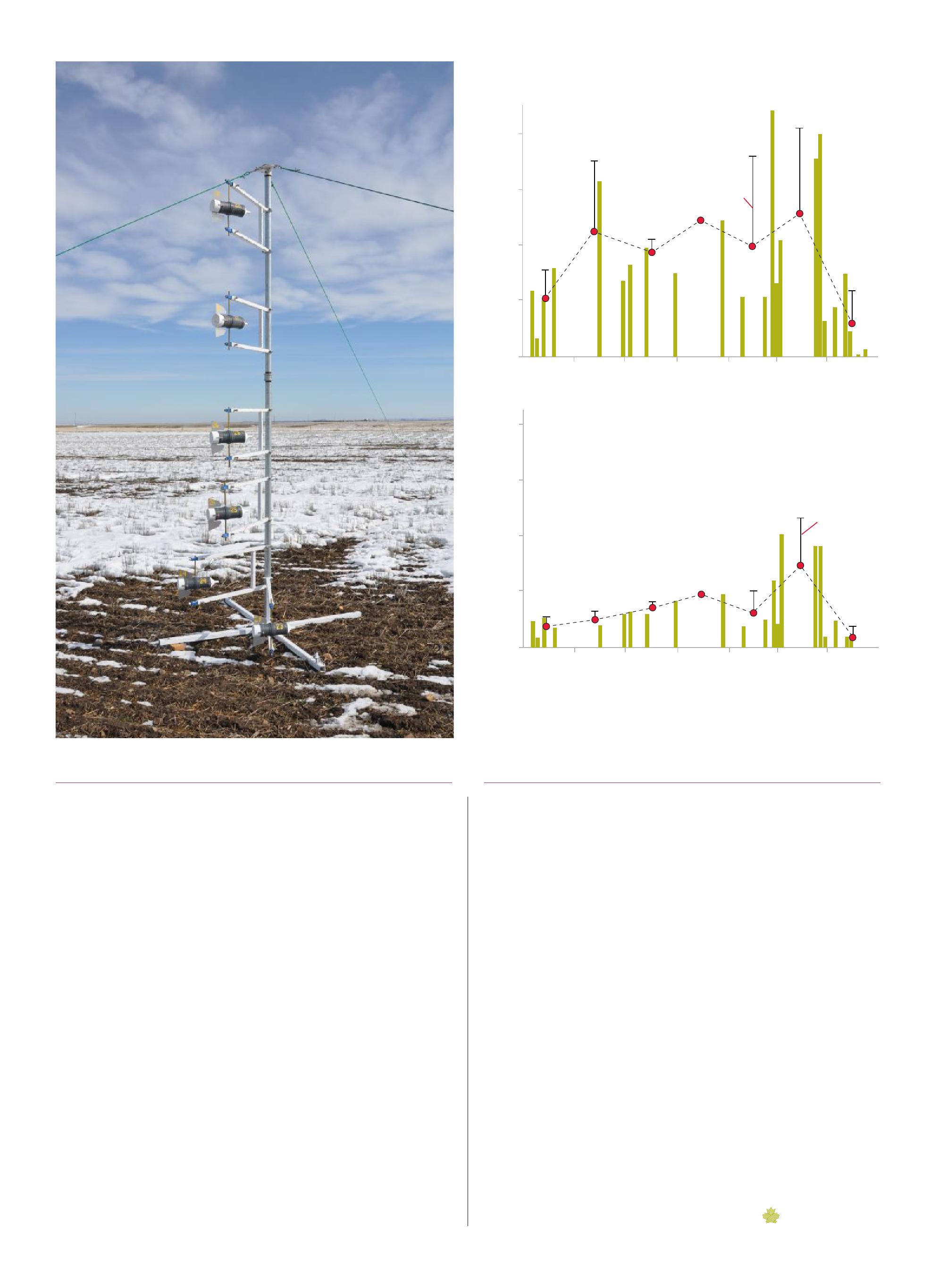
Vertical bars indicate results from 23 trials conducted over 7 seasons (20082014). Green and white circles are mean of individual trials conducted during the specified month.
Source: Richard Engel and Clain Jones, Montana Fertilizer eFacts. No. 70 June 2015.
tion. In the research trials, Engel observed losses were lower (typically less than 10 per cent) if urea was broadcast onto a dry soil surface and a large precipitation event of more than 0.7 inches fell within a few days of application. In Montana, these conditions commonly occurred in April. Applications from November through March, when precipitation is lighter and more scattered, all resulted in losses more than 10 per cent.
Engel also looked at the use of Agrotain, which contains a urease inhibitor. Urease inhibitors slow the rate of urea hydrolysis. He found that adding Agrotain typically reduced cumulative NH3 loss by 60 to 65 per cent compared to untreated urea.
For Canadian farmers, the lessons learned are to try to time broadcast urea applications in the early spring with significant rainfall in the forecast. Ideally, apply to a dry, cold soil, and then get at least one halfinch of rain shortly after application. However, as the soil and air temperature warms up, and if there is enough moisture to dissolve the urea granule, then the risk of volatilization goes up as well.
Another practice would be to dribble band 28-0-0 (UAN) liquid fertilizer, but one-half of it is still in the urea form and susceptible to volatilization as well. And the use of a urease inhibitor would be a good practice as well.
A report on the research is now available online at http://landresources.montana.edu/fertilizerfacts/.
Reach for Wolf Trax Copper DDP ®, the nutrient tool that is field-proven by wheat growers like you.
With our patented EvenCoat™ Technology, Copper DDP coats onto your N-P-K fertilizer blend, delivering blanket-like distribution across the field for easier root access. Plus our innovative PlantActiv™ Formulation ensures the copper is available when your wheat crop needs it most.
See how the right tool can boost your wheat crop and your bottom line. Have your dealer customize your fertilizer blend with Wolf Trax Copper DDP.
Copyright © 2016, All Rights Reserved - Compass Minerals Manitoba Inc. Wolf Trax and Design, DDP, EvenCoat and PlantActiv are trademarks of Compass Minerals Manitoba Inc.
Compass Minerals is the proud supplier of Wolf Trax Innovative Nutrients. Not all products are registered in all areas. Contact wolftrax@compassminerals.com for more information.
Product depicted is Wolf Trax Iron DDP coated onto urea fertilizer. Other DDP Nutrients may not appear exactly as shown.
46833-5 TCMW
Raxil® PRO can help connect the dots between that strong, healthy emergence and your beautiful high-yielding crop at harvest. With three different actives and its microdispersion formulation, Raxil PRO provides advanced seed coverage for rst-class contact and systemic protection from the most serious seed- and soil-borne diseases in cereals including Fusarium graminearum. Strong start, strong nish.