TOP CROP MANAGER
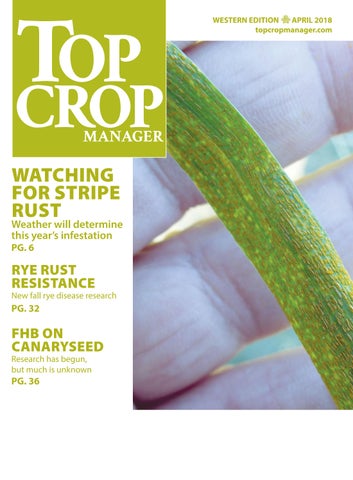
WATCHING FOR STRIPE RUST
Weather will determine this year’s infestation PG. 6
RYE RUST RESISTANCE
New fall rye disease research PG. 32
FHB ON CANARYSEED
Research has begun, but much is unknown PG. 36


![]()
Weather will determine this year’s infestation PG. 6
New fall rye disease research PG. 32
FHB ON CANARYSEED
Research has begun, but much is unknown PG. 36


Never lose focus on cleaner fields with a pre-emergent that works for you!
Focus® is an easy to use, liquid pre-emergent herbicide that provides extended weed control over tough-to-kill grass weeds in your lentils and wheat. Save time tomorrow by targeting resilient weeds today and achieve cleaner fields and higher yields!

6 | Keeping an eye on stripe rust
This year’s infestation will depend on weather.
By Bruce Barker

for extreme weather events.
Trudy Kelly Forsythe

40 | Impacts of fungicide and herbicide timing on barley
Fungicide applications at flag leaf stage or later are crucial. By
Donna Fleury

Changing rules, changing tools
Ron Pidskalny, M.Sc., P.Ag.
in quicksand?
Readers will find numerous references to
Manager. We encourage growers to
What the proposed tax changes mean for the family
Fusarium head blight on canaryseed
Alfalfa weevil control gets tougher
52 Reducing harvest seed losses in canola
Julienne Isaacs
Crop-water relations
Ross H. McKenzie, PhD, P. Ag.

STEFANIE CROLEY | EDITOR
“An ounce of prevention is worth a pound of cure.” Benjamin Franklin was reportedly referring to fire safety when he penned this quote, and at the risk of sounding cliché, it is more pertinent now than ever before.
In February, just down the road from Top Crop Manager’s head office in Simcoe, Ont., the county of Brant and the area surrounding the Grand River suffered serious flooding due to a quick thaw and excessive rain. Roads were washed out, homes were damaged, fields were completely underwater and a state of emergency was declared. In contrast, Western Canada experienced a severely dry winter, and the lack of moisture has producers concerned about the state of their winter wheat. Two completely opposite problems, but both equally concerning as the spring approaches.
If you’ve ever experienced a devastating event on your farm, you’ll know it’s not always possible to prevent things like extreme weather changes from happening. But with a little preparation and planning, you can prevent everything from completely falling apart. As spring approaches and minds shift toward seeding and strategies for the upcoming growing season, it’s important to remember how the decisions you make now (and all throughout the year) can impact your crops – and your bottom line. We tend to put a heavy focus on the well-being of the outside of the farm: warding off disease and insect pest threats; choosing the best varieties and crop rotations; selecting the best crop chemicals. But as the daughter of an accountant, I’ve always associated April with “tax season,” so I’d be remiss not to mention the importance of taking the time to check up on the inside of your business too. How organized is your paperwork? Are you prepared for a potentially disastrous event? Do you have a succession plan? Though these facets of the farm may take a backseat during the busy crop season, it’s important to take some time to complete those administrative tasks and organize what’s often thought of as the more mundane portion of your business.
We strive to fill each edition of Top Crop Manager with information to help you make the best decisions for your farm. So, in addition to our usual stories on plant breeding, pests and diseases, and crop management, we’ve included a special business management section in this issue. Starting on page 28, you’ll find an update on proposed tax changes that will directly impact tax planning for family farm corporations and tips on how to protect your farm from extreme weather events.
Planning is key to preventing problems in any business, and only you can choose the right options for your operation. So when you’re deciding what chemicals to use, what rotation to try, or what new equipment to buy, consider re-evaluating your insurance options, succession plan and financial management strategies. We can’t always prevent bad things from happening, but with the right tools and resources (and undoubtedly a little bit of trial and error), you’ll be able to make informed choices to help your operation succeed, even in a potentially devastating situation.
Best of luck.
Markle • tmarkle@annexbusinessmedia.com
PRESIDENT & CEO Mike Fredericks Printed in Canada ISSN 1717-452X
PUBLICATION MAIL AGREEMENT #40065710
CIRCULATION
email: rthava@annexbusinessmedia.com Tel: 416.442.5600 ext. 3555 Fax: 416.510.6875 or 416.442.2191 Mail: 111 Gordon Baker Rd., Suite 400, Toronto, ON M2H 3R1
SUBSCRIPTION RATES
Top Crop Manager West – 9 issues Feb, Mar, Mid-Mar, Apr, June, Sept, Oct, Nov and Dec – 1 Year - $47.50 Cdn. plus tax
Top Crop Manager East – 7 issues Feb, Mar, Apr, Sept, Oct, Nov and Dec – 1 Year - $47.50 Cdn. plus tax
Potatoes in Canada – 1


RANCONA® TRIO seed treatment for cereals takes disease protection and improved crop emergence to new levels. By combining three powerful fungicides that provide both contact and systemic activity, with the superior coverage and adhesion of RANCONA advanced flowable technology, you have a seed treatment that delivers more consistent protection under a wider range of conditions. Because when more seed treatment stays on the seed, you get more out of your seed treatment. To learn more, talk to your Arysta LifeScience representative or visit ranconatrio.ca

2017 levels were low so 2018 infestation will depend on the weather.
by Bruce Barker
Like most crop diseases in 2017, infestation levels and severity of stripe rust were low, because of the warm, dry weather that occurred in many parts of Alberta and Saskatchewan. Going into 2018, the risk of stripe rust developing in Alberta will depend on the spores blowing up from the United States.
“We have to keep an eye on what the rust situation in the U.S. will be this upcoming growing season. Rust spores usually travel with the wind from the U.S. into Canada, and if the inoculum arrives early enough, and if weather condition are favourable for rust infection and development, we may get bad disease regardless if the pathogen overwinters locally or not,” says Reem Aboukhaddour, a research scientist with Agriculture and Agri-Food Canada (AAFC) in Lethbridge, Alta.
Stripe rust is caused by the fungus Puccinia striiformis and has the potential to severely infect winter and spring wheat, causing defoliation, shrunken kernels and yield loss. It is primarily a
disease of cool climates, and is most commonly found in southern and central Alberta, although it also occurs in Saskatchewan and Manitoba. Recent outbreaks of cereal stripe rust in Alberta occurred in 2005, 2006 and 2012 and were attributed to mild winters and cool, wet summers. In Saskatchewan, 2011 was an epidemic year.
In Alberta and Saskatchewan, stripe rust infection occurs mainly from spores blown up from the Pacific Northwest of the United States. Spores may also blow up from Texas to infect Manitoba and Saskatchewan wheat fields. When spores arrive, they need several hours of moisture on plant leaves to germinate and infect the host plant. Older races of stripe rust germinate at between eight and 12 C but new races can now germinate at temperatures up to 18 C. Symptoms appear about one week after infection. Fungal
ABOVE: Stripe rust infestations in 2018 will largely depend on winds blowing the pathogen up from the United States.


It’s time to get territorial. Strike early, hard and fast against your toughest broadleaf weeds.
Lethal to cleavers up to 9 whorls and kochia up to 15 centimeters, Infinity ® FX is changing the landscape of cereal weed control.


researchers don’t
mycelia from the spores grow, resulting in a yellow stripe appearance following the production of spores that extends the entire length of the leaf. Production of spores takes place eight to 14 days after infection and are dispersed causing additional infections. Several infection cycles can occur and infect the middle and upper parts of the plant canopy, causing yield reductions.
Research in 2007-08 and in 2015-16 by Kequan Xi and Krishan Kumar with Alberta Agriculture and Forestry found that stripe rust can also overwinter on winter wheat in central Alberta (Lacombe and Olds). At AAFC Lethbridge, Aboukhaddour has been monitoring stripe rust infections and overwintering potential. In November 2016, stripe rust was observed on winter wheat. Subsequently, a few winter wheat plants were recovered from under the snow blanket on Dec. 23, 2016. These plants showed no visible sign of rust infection, but when the plants were placed inside a growth chamber, stripe rust developed within three weeks.
“This was clear evidence that stripe rust was overwintering as a dormant mycelia inside the green leaves. In early March 2017, stripe rust was also observed on winter wheat plants in the field,” Aboukhaddour says.
In surveys conducted by Aboukhaddour during the spring/ summer season of 2017, only one field out of 64 had a severe infection (less than two per cent), and that infection was found only at the edge of that field. Most of the infected fields were at trace or light levels of infection, and 75 per cent of the surveyed
fields were reported clean.
“You could say 2017 was not a bad year because in 2016 about 11 per cent of surveyed fields suffered severe infection by the stripe rust in southern Alberta,” Aboukhaddour says. “The exceptional dry and hot weather and the lack of precipitation in 2017 spring and summer created unfavourable conditions for infection and disease spreading, compared to 2016.”
From the fall of 2016 to October 2017, 27 spring wheat and 18 winter wheat fields in central Alberta were surveyed by Xi and Kumar from AAFC Lacombe. No stripe rust was found in spring wheat during August 2017, nor was it observed at the seedling stage in four fields of winter wheat in the fall of 2016. Intermediate to severe levels of stripe rust developed in two of the four winter wheat fields surveyed during July 2017
Aboukhaddour conducted surveys in the fall of 2017 in southern Alberta and could not find any rust infections. She says given the low incidence of stripe rust in the spring and summer of 2017 and absence in fall 2017, the likelihood of it overwintering into 2018 in southern Alberta is low. That leaves the potential for stripe rust infections dependent on spores arriving from the United States. However, Xi and Kumar observed light to intermediate levels of stripe rust at the seedling stage in four of 14 winter wheat fields in October of 2017. So winter wheat growers in central Alberta should

scout their fields in early spring 2018, especially where stripe rust symptoms were observed during the previous fall.
Foliar fungicide application may be warranted on varieties rated as susceptible and moderately susceptible. Protecting the flag leaf and penultimate leaf (the upper two leaves), and the upper part of the stem is important because they provide almost all of the photosynthesis needed to fill the head.
Randy Kutcher, plant pathologist, and Keiko Nabetani, masters of science student at the University of Saskatchewan, are currently analyzing research on foliar fungicide applications to winter wheat. They did not find fall fungicide application provided any benefit, but spring application to winter wheat was often of benefit when stripe rust severity was high.
Kutcher and Tatiana Vera Ardila, masters of science grad student, are also wrapping up a research project on stripe rust impact on spring wheat. Kutcher says results to date indicate when seeding date was “normal” (roughly mid-May) in central Saskatchewan, most often the optimum time for fungicide application was at heading. If seeding was delayed into early June, then in some years (cool, moist springs) they were getting reasonable responses to fungicides at earlier application timing around the jointing stage of the crop.
One of the cornerstones of stripe rust management is selecting a variety with some level of resistance. Most spring, durum and winter wheat classes have varieties with resistant or moderately resistant ratings. The challenge for wheat breeders is the wide range of races of P. striiformis. Depending on the climate and the
One of the cornerstones of stripe rust management is selecting a variety with some level of resistance. Most spring, durum and winter wheat classes have varieties with resistant or moderately resistant ratings.
use of resistant varieties, the population of pathogen races may be constantly changing. Additionally, some of the resistant genes are temperature or light sensitive and may not activate to provide resistance.
“There is a wide range of reaction to infection from very susceptible to very resistant,” Aboukhaddour says.
Kutcher says if growing a susceptible spring wheat variety like AC Barrie, foliar fungicide application provided a high yield improvement in an epidemic year, such as in Saskatchewan in 2011. For moderate resistance (MR) varieties, fungicide response can depend on the type of resistant genes in the variety. CDC Imagine carries one resistance gene, Lr34/Yr18, and may not benefit from fungicide application if the severity of disease is moderate, but in a severe stripe rust year, MR cultivars could benefit economically from a foliar fungicide.
“Cultivars with multiple stripe rust resistance genes, such as Lillian, did not benefit from foliar fungicide applications in our study,” Kutcher says.
Kelly Turkington, plant pathologist with Agriculture and AgriFood Canada in Lacombe, Alta., has seen similar interactions between variety resistance and foliar fungicide response. “My general feeling is that varieties rated R [resistant] or MR [moderately resistant] will not show any response or very limited and likely not economic to fungicide application. As the level of resistance declines, varieties with a VS or S [very susceptible or susceptible] rating will show substantial responses – 20 to 50 per cent increase in yield when stripe rust is severe,” he says. “Regional differences can be a factor. At Lacombe, varieties like Radiant still show limited to no response to fungicide because the pathotypes in central Alberta are not as virulent on this variety as they are in southern Alberta, where Radiant may show more of a response.”
Recently, Xi and Kumar found that based on three years of testing in central Alberta, that Radiant tended to show a borderline significant or significant yield loss, which translated into an average of 15 per cent loss, so the pathotypes may be changing in central Alberta.
Given the unpredictable nature of stripe rust incidence, Turkington says agronomists and growers should make disease scouting a key part of their spring activities. Plant pathologists monitor for the arrival of the pathogen in the spring and provide alerts to agronomists if the pathogen arrives.
“Good technology transfer and extension are key, and alerts to growers and industry would indicate potential issues and the need to do careful field inspections. Based on these inspections for symptoms of stripe rust, growers could spray early if needed and then again later if necessary,” Turkington says. “Growing susceptible varieties and a favourable environment [cool and moist] would also exacerbate the risk.”
As soybean acreage has expanded, so have reports of iron deficiency chlorosis in some fields under certain soil conditions.
by Donna Fleury
Until recently, iron (Fe) deficiencies in field crops in the prairies were mostly unheard of until soybean acreages began to expand. In Saskatchewan, with the growing acreage of soybeans, iron deficiency chlorosis (IDC) began to show up in some soybean fields under certain soil and environmental conditions. Although soybeans can sometimes grow out of a deficiency, researchers at the University of Saskatchewan wanted to find out more about IDC in Saskatchewan soils and under the province’s conditions.
“In more traditional soybean growing areas, such as in the United States, they have dealt with this for much longer, mainly addressing it through genetics,” explains Jeff Schoenau, professor with the department of soil science at the University of Saskatchewan and strategic research chair with the Ministry of Agriculture. “We wanted to learn more about the nature of iron deficiency development in soybeans under our conditions and to evaluate the effect, if any, of various iron fertilization strategies in our soils.” Led by post-doc Ryan Hangs, a two-year project was initiated in 2015 to answer some of these questions.
The two-year project included field studies and controlledenvironment experiments to identify favourable combinations of soybean variety and soil type that result in IDC symptoms, and to assess the effect of different fertilizer Fe rates, formulations, and application methods. Two field studies were conducted in south-central Saskatchewan in 2015 and 2016 with IDC-prone soils that examined the ability of Fe fertilization to alleviate IDC in two soybean varieties: McLeod (IDC tolerant) and Moosomin (IDC sensitive). The study also included seven iron fertilizer treatments, varying in rate, form and application method, along with an unfertilized control. The treatments included soil-applied iron at seeding, and foliar-applied at the V2-V3 growth stage, comparing two different forms: iron sulphate and iron chelate.
Similar to other micronutrient deficiencies, the incidence of IDC is difficult to predict. It takes a unique combination of soil and environmental conditions for IDC to appear. Fields where IDC tends to develop typically have soils with a higher pH, and are often exposed to some flooding and saturation, elevated nitrate and salinity. Typical IDC symptoms are yellow (and/or necrotic) interveinal leaf tissue, especially on the upper leaves, while the leaf veins remain dark green. IDC can result in yield loss or plant death in extreme cases. Under some conditions, IDC might appear only for a short time and then disappear, while

Soybean controlled-environment studies comparing a wide range of soils from several different locations across Saskatchewan.
under others patches across the field may be impacted.
“We selected field sites with the kind of soil conditions and landscape conducive to the development of IDC,” Schoenau says. “Environmental conditions during the study in 2015 were very dry, while wetter conditions were prevalent in 2016, especially in June, with some temporary soil saturation and development of IDC evident. The environmental conditions had a major effect on the development of IDC and the effects of the different iron treatments in the two field seasons. In 2015, we didn’t see any response to any of the treatments at all, consistent with the dry
conditions all season long. However, in 2016 we did see a significant response to the foliar-applied iron treatments in the IDC susceptible cultivar. We did not see any response to soil-applied iron.”
The project also included similar controlled-environment studies in the lab on a wider range of soils from several different locations across Saskatchewan. The findings were similar to the field trials, with responses explained primarily by soil and environmental conditions. With the exception of an IDC susceptible soybean cultivar grown on a flooded Black Chernozem soil, the Fe fertilization treatments had limited effect on grain yield. The most effective fertilizer treatment appeared to be foliar-applied chelated Fe.
It takes a unique combination of soil and envrionmental conditions for IDC to appear. Fields where IDC tends to develop typically have soils with a higher level pH, and are often exposed to some flooding and saturation, elevated nitrate and salinity.
“Keeping in mind the results are from just one field location and the controlled-environment experiments, a foliar application of iron appears to be an effective rescue strategy for IDC,” explains Schoenau. “If growers are concerned about IDC, have seen it before and have the kind of soil conditions conducive for development, selection of an IDC-tolerant variety may be wise. If they decide to grow an IDC-susceptible variety, then a foliar application could be a suitable rescue treatment if IDC arises. Most soybean seed guides will typically include an IDC rating, which is something that should be of interest to growers if they are concerned about IDC development.”
Schoenau emphasizes that although some fertilizer Fe treatments resulted in significant seed yield increases in the field, these were
less than 10 per cent and Fe fertilization may not be economical unless the fertilizer Fe can be easily and precisely applied only to those field areas identified as suffering from IDC. From results of this study, precision foliar application appears to be the most effective Fe fertilization strategy if a grower decides to grow an IDC susceptible variety for reasons such as maturity, yield potential, or resistance to other stresses. Soil application of Fe fertilizer at seeding to the entire field would not appear to be justified.
“Overall the results show that soil and environmental conditions along with genetics ultimately control whether IDC develops and/or if fertilizer Fe applications are warranted,” Schoenau says. “If a grower decides to grow an IDC susceptible variety and IDC symptoms appear at the V1-V3 stage, then a precision foliar application of Fe to these problem areas as a rescue strategy would be more cost-effective than a soil application made at seeding to the entire field area. Growers who prefer not to take a risk or are unable to make a fertilizer Fe application if needed, can select varieties with high IDC tolerance, especially if conditions conducive to IDC exist or are anticipated.”


Genes from wild sunflowers are improving sclerotinia resistance in sunflower hybrid.
By Carolyn King
Those humble wild sunflowers you see growing along prairie roadsides are key weapons in the fight against sclerotinia in sunflower crops. Through a long, complex process, researchers are transferring resistance genes from wild species into cultivated sunflower and gradually upping the crop’s ability to fight off this pathogen.
“Sclerotinia sclerotiorum is a very obnoxious fungus. It causes disease in over 400 species of plants including some of our major field crops like canola, sunflower, soybeans, peas and beans, and some vegetable crops,” says Khalid Rashid, a plant pathologist with Agriculture and Agri-Food Canada (AAFC) in Morden, Man.
He explains this pathogen causes three different diseases in sunflower: basal stalk rot, mid-stalk rot and head rot. Basal stalk rot, also called sclerotinia wilt, is a soilborne disease. “The fungus overwinters as hard, black masses of mycelia called sclerotia, which are roughly the size of sunflower seeds. In the spring, if soil moisture conditions are normal in the sunflower field, sclerotia in the soil will germinate by forming mycelia. The mycelia infect the roots and cause rot of the root or the basal part of the stem.” Symptoms can include
a tan canker at the base of the stem, white mould around the canker, and wilting and death of the plant.
In mid-stalk rot and head rot, infection is initiated by windborne spores originating in the sunflower field or a nearby field. “If the soil is saturated with water and the sclerotia are close to the soil surface, they produce mushroom bodies called apothecia, which look like inverted cups. The apothecia release ascospores into the air. In mid-stalk rot, the spores land on the stem, with the infection sometimes starting at a leaf axil. The infected stem becomes bleached and shredded, and the white fungus and black sclerotia form on the stem,” Rashid notes.
“If the ascospores land on the sunflower head at flowering or after, they cause head rot.” Early head rot symptoms can include spots on the back of the head or white mould on the seeds. As the disease develops, the whole head may eventually rot. Sclerotia form on the
MAIN: Part of Seiler’s work involves collecting germplasm from wild sunflower species.
INSET: Head rot results from infections by air-borne sclerotinia spores.
head and may be harvested with the seed or fall to the ground.
“Over the years, we have seen quite an increase in the incidence and severity of sclerotinia in sunflower and other susceptible crops in the Prairie provinces. Because of short rotations between host crops, there is now a lot of inoculum in the soil – we have about 20 million acres of canola, about three million acres of soybeans, and so forth,” he says. “From year to year, the incidence and severity of head rot and mid-stalk rot vary. In dry conditions, infection levels will be low. In humid, cloudy, drizzly or rainy conditions, you get more chances of infection.”
Practices like crop rotation with cereals and fungicide application help in managing sclerotinia in sunflower. Several fungicides for sclerotinia suppression in sunflower are now registered in Canada.
However, highly resistant hybrids would be an invaluable tool for controlling sclerotinia in sunflower, so researchers are working towards that goal. “Because we could not find any meaningful genetic resistance to sclerotinia in cultivated hybrids or inbred lines, we have resorted to looking at the wild relatives of sunflower,” Rashid explains.
Those wild relatives are found in North America. “Sunflower is one of the few crops native to North America. The Native Americans were cultivating sunflower and did the early selection. Then in the 1500s, the Spanish introduced sunflower into Europe. The crop was further developed in Spain and then Russia. Then it was reintroduced into North America with the immigration particularly of Mennonites who settled in Canada,” explains Gerald Seiler, a research botanist with the U.S. Department of Agriculture’s Agricultural Research Service (USDA-ARS) in Fargo, N.D.
“[Through this long history of selection and breeding,] we’ve gone from a branched plant with multiple heads to a plant with a single head. And the plant has gone from just surviving and producing seed for the next generation, to a crop that has been selected for very high yield under optimum conditions. So the theory is that the wild relatives have traits that were lost in cultivated sunflower through this process.”
The presence of wild relatives has both positives and negatives for North American sunflower crops. “We have every disease and insect pest you can imagine because a
lot of the wild species are alternate hosts,” Seiler says. “However, the wild relatives are still surviving so the thought is they might have some genetic components that defend against these pests.”
And that thought has proven to be true. “The first downy mildew resistance, the first verticillium resistance, the first rust resistance came from wild sunflowers back in the 1970s,” Seiler notes.
A long, complicated process
Using traits from wild relatives is an
important part of the USDA-ARS sunflower breeding program. “Getting genetic diversity into a crop is a long-term, high-risk research endeavour, and that is why most companies in the sunflower business aren’t in this type of work,” Seiler explains. “At USDA-ARS, we undertake long-term, high-risk research.”
According to Rashid, the Canadian sunflower breeding program in Morden ended in 1995, but AAFC collaborates with sunflower breeding efforts at USDA-ARS and North Dakota State University. Rashid has worked with them on various studies.


At USDA-ARS, Seiler works on collecting wild sunflower germplasm, screening the material for various traits, and prebreeding to move the traits into cultivated sunflower material.
The sunflower germplasm samples are stored at the USDAARS National Plant Germplasm System, North Central Regional Plant Introduction Station gene bank in Ames, Iowa, which is a cooperative effort between USDA-ARS, Iowa State University, and State Agricultural Experiment Stations. It is the world’s most diverse gene bank collection of sunflower germplasm. The collection includes cultivated sunflower, Helianthus annuus, and its 14 annual and 39 perennial wild relatives. Seiler says, “We have about 2,500 accessions of the wild relatives and about an equal number for cultivated sunflower, including cultivars from all over the world. The gene bank also distributes the material to researchers around the world.”
The breeding program screens the wild material in the greenhouse or field. Disease screening may involve either natural infection or inoculation, depending on the situation.
“Pre-breeding refers to crossing the wilds with the cultivated and trying to get something that looks like a cultivated sunflower but has the genetics of the crop wild relatives,” Seiler explains. “Then the industry can take the material at an early generation and incorporate the trait into their lines.”
Although the program has developed advanced techniques over the past 40 years, pre-breeding is still a complicated process that takes many years. “Three-fourths of our crop wild relatives are perennial, but we are trying to produce an annual crop. Generally we can get around the perennial nature by backcrossing, which means crossing it twice to the cultivated side,” Seiler says. “There are also differences in the size of the genetic content and
differences in chromosome numbers, which can cause problems with fertility. As well, the crop and the wild relatives have different breeding systems and strategies. For example, an annual wild relative has to produce seed to continue the next generation so it produces a lot of heads with a lot of seeds and builds up a seed bank, but the seed sheds very easily. For cultivated sunflower, you don’t want traits like multiple heads and seed shedding, so they have to be bred out.”
In the early 2000s, Rashid and Seiler collaborated on collecting wild sunflowers in Canada. “We collected around 400 samples of wild sunflower from southern Manitoba,” Rashid says. “We collected samples of two species, Helianthus maximiliani and Helianthus nuttallii. We studied those accessions for their reactions to sclerotinia, rust, downy mildew, powdery mildew, and other diseases to see if we could find some good sources of genetic resistance.” Rashid has provided seed from those wild samples to AAFC’s gene bank in Saskatoon and to Doug Cattani at the University of Manitoba, whose research focuses on perennial breeding of grains and oilseeds. So even though Rashid is retiring this year, those accessions are available to other researchers.
“Some of the best material we have for sclerotinia resistance came from the Morden area, and some of the releases [of sclerotiniaresistant germplasms developed by USDA-ARS] were from those original populations collected there,” Seiler says. “One of our priority areas for sunflower collection in the future is to go back to Canada.”
Transferring sclerotinia resistance to cultivated lines presents some special complications. One complication is that each of the
three sclerotinia diseases in sunflower requires its own selection and breeding work. USDA-ARS’s current efforts target head rot and basal stalk rot.
The other complication is that sclerotinia resistance involves multiple genes. “In diseases like sunflower rust or sunflower downy mildew, we have major genes that control resistance to specific races of the pathogen [and transferring a single resistance gene to cultivated sunflower is relatively straightforward]. But resistance to sclerotinia is quantitative,” Rashid explains.
In quantitative resistance, many genes are involved, with each gene having a small effect. “Every time a cross is made with the cultivated material there is the possibility that some of those sclerotinia resistance genes from the wild source can be lost,” Seiler notes. “So we have been able to develop germplasm or lines that have higher resistance to sclerotinia but not immunity.” However, each time they are able to find and add a new gene, it can add to the resistance already in the cultivated line.
“And that is what we have done with sclerotinia resistance. Finally, after almost 12 years, we have gone from some of our lines being 40 per cent infected to some lines being about two to five per cent to about 15 per cent infected,” he says. These latest lines have not yet been incorporated into commercial hybrids because they have just been released.
The USDA releases its sunflower germplasms for use by the seed industry and public researchers in creating parental lines or germplasms. The seed industry is making progress on sclerotinia resistance; for instance, some U.S. commercial hybrids are rated as resistant for head rot and/or basal stalk rot (on a scale ranging from
highly resistant to susceptible).
“In Canada, most of the seed for our sunflower hybrids comes from the U.S. The seed companies may do their own testing of their lines in Canada or have testing done by private seed testing companies or the National Sunflower Association of Canada [NSAC],” Rashid explains.
The NSAC runs annual trials in co-ordination with Manitoba Agriculture, to provide third-party performance data for sunflower growers. These trials include both registered and experimental hybrids, and take place at several locations in the province.
Each year, Daryl Rex, the NSAC’s research agronomist, puts out a call for entries for these trials. He is hopeful that some hybrids with good sclerotinia resistance might be included in the 2018 trials. He notes that some of the hybrids with the best resistance are later maturing ones developed for U.S. conditions so maturity may be an issue. But, he says, “I think even if they are slightly later maturing hybrids, it would be interesting to see what the sclerotinia tolerance would be like under Manitoba conditions.”
“Over many years, we have been able ‘fish out’ these resistance genes from the large pool of genetic resources and utilize those genes to keep sunflower as a viable crop,” Seiler says.
In the years ahead, this process could become more efficient as advances enable the researchers to check a plant’s DNA for the desired traits rather than having to grow the seed into plants and test the plants for the traits. “We have a really good gene bank,” Seiler says. “We just have to be able to go in and pinpoint the genes. If we can save a few years in that process, then that will make everything better for everybody.”

“We know the work we put in to grow
Join Canadian canola growers who use Proline and reach your biggest yields yet.
4-year canola competitive results – 25 trials

· More growers use Proline fungicide on their canola than any other sclerotinia product on the market*
· Easy-to-use liquid formulation for ground or aerial application
· Rainfast one hour after application
· Consistently provides sclerotinia protection for outstanding yield performance

When you get right down to it, growing canola is about one thing. Yield. Protect your yield potential with the time-tested effectiveness of Proline ® fungicide. It’s as good as good gets. But don’t just take our word for it. More growers use Proline than any other canola fungicide*, and the numbers show why.
Find out the full details, including why Bayer is Canada’s first choice in fungicides, at ItsGrowTime.ca

Building and maintaining soil P levels to above 15 parts per million (ppm) is critical to maximizing yield potential and fertilizer use efficiency.
by Donna Fleury
In Western Canada, more phosphorus (P) continues to be removed in cropping systems than is being replaced. On average only about 75 per cent of P is being replaced every year, and although the gap is closing, it is probably not quick enough.
Recent data shows that soil test P levels in Saskatchewan are probably the lowest in Canada at 14 parts per million (ppm), Alberta at 21 ppm and Manitoba at 19 ppm. Ontario is considerably higher at 35 ppm in their primarily corn and soybean cropping systems, and can actually have the opposite problem of excess P.
“Research shows that in Saskatchewan, and other parts of Western Canada, the critical level of P is 15 ppm in the soil,” explains Stewart Brandt, researcher with the Northeast Agriculture Research Foundation (NARF). “The further below that level, the less efficiently the crop uses fertilizer P and the more fertilizer P gets tied up in unavailable forms than is being released to the soil. Therefore,
building soil P levels to above 15 ppm is very important. It is more efficient to maintain soil P fertility than to restore it if it is depleted.”
In addition to low soil P levels, the genetic yield potential of current crops has increased dramatically over the last 20 years. New canola varieties have an increased yield potential of about 90 per cent, field peas about 60 per cent and cereals about 30 per cent or more. Therefore, to take full advantage of the genetic yield potential of these new varieties growers should be using more P, not less. Soils with low P levels won’t be able to support the full yield potential of these crops.
Brandt says there are some reasons why growers may be under applying P to their cropping systems. A lot of focus is on N because deficiency symptoms are much more visible than P
ABOVE: Seeding field research trials in northeastern Saskatchewan.


So tell me Barley Baron, how will you protect your land from would-be thieves and invaders?
See to it that your uninvited guests receive the royal treatment. With three herbicide Groups and outstanding activity on both grass and broadleaf weeds, Tundra® herbicide is the complete solution for barley and wheat growers. Rule with an iron fist.

deficiencies. “The notion that seed-placing P is the main strategy may be over emphasized, because only limited amounts of P can be safely placed with the seed,” Brandt says. “In most cropping situations, there is no way to safely replace all of the P required by crops through seed placement. There is lots of evidence that side-banding is a very good and efficient method of applying P fertilizer. Although there is less information available for midrow banding, preliminary research is showing that placing the safe rate of P with the seed and topping up to the recommended amount with a mid-row fertilizer band is expected be a good option as well. Growers can consider seed-placing the maximum safe rate of P with each crop, and then sideband additional P to meet recommended levels.”
For soils that are depleted or below the critical 15 ppm, then broadcasting or banding P at high rates as a one-time correction is an option. Research conducted at the University of Saskatchewan in the mid 1980s compared a single broadcast application of 180 pounds per acre (lbs/ac) of P2O5 in year one with annual applications of 45 lbs/ac for four years on a soil that tested five ppm of available P. The initial high rate application yielded more than the annual applications despite having the same total amount applied over the four years. The yield difference of about two bushels/acre/year was due to the P deficiency being corrected the first year with the high rate, rather than taking four years with the annual applications.
Brandt validated this work on five farmer fields in Northeast Saskatchewan by banding high rates of P on fields that tested between seven and 10 ppm of available P. Two separate strips were applied on each of the five fields and the farmer managed the whole field as he would normally. At harvest, yield maps were generated for the field and analyzed to measure treatment effects. “Not all yield maps were usable,” Brandt says, “but those that were showed yield responses similar to those in the university study. The cost of the high rate fertilizer was recovered in three to four years. Thereafter, we would expect that the yield benefit would remain to provide a return on this investment almost indefinitely.”
Therefore, look at soil tests and try to build soil P where it is below
15 ppm. There is lots of evidence that applying fertilizer P above crop removal rates can build soil P with very little risk of leaching out of the soil because it is immobile. When fertilizer P is priced relatively low, it likely makes sense to go in and broadcast P on those areas of fields that test low in available P, don’t rely on seed-placed P as the only strategy.
Also consider crop rotation, because not only do different crops require different rates of P, they also use and take up P in different ways. Some crops rely on mycorhizzae to help with nutrient uptake, which can be suppressed by fertilizer P. Mycorrhizal fungi form associations with crop roots to get energy from the crop and in exchange they effectively increase area of roots to enhance nutrient uptake. For example, canola and mustard are non-mycorrhizal crops and can more easily access available fertilizer P.
Cereals are mycorrhizal but not as dependent as other crops like pulses and flax, which are heavily reliant on mycorrhizae. The mycorrhizal fungi prefer to access soil available P that is more uniformly distributed in the soil. Therefore, some of these crops have a reputation of not responding very well to fertilizer P applied in the year of application, so building soil P levels ahead of these crops can be a benefit.
“For most of our cool season crops that we generally grow, the target level for P is 15 ppm,” Brandt adds. “We are starting to see other crops like soybeans grown in this area, which are much higher users of P. The recommended target for crops like soybeans or corn in the more common growing areas in the U.S. and Canada is closer to 20 ppm. Planning ahead for the higher yielding crop varieties and different crops in rotation means focusing on elevating P levels to at least 15 ppm and above to maximize fertilizer use efficiency. Soil testing regularly is a good idea to know what direction soil P levels are going in your fields. Based on our research results, applying high rates of P to elevate levels above 15 ppm on low P fields or field areas, then manage normally after that provides a return on investment in about three-years. Particularly on owned land, it is likely prudent to start building and maintaining soil P levels above removal rates over the long term, to maximize crop yield potential and returns.”


by Ross H. McKenzie, PhD, P. Ag.
Plant hormones are chemicals in plants that regulate almost all aspects of plant growth and development. Hormones play a critical role in how plants response to biotic and abiotic factors, including sunlight, soil conditions, soil water and nutrients. Hormones are naturally occurring in plants, but some specific hormones can be made synthetically for application to crops.
Plant hormones are grouped into five classes depending on their chemical makeup: abscisic acid, auxins, cytokinins, ethylene and gibberellins. These hormones control or influence all aspects of plant growth and reproduction, including seed germination, growth of roots, stems and leaves, plant flowering, seed development, seed fill and seed dormancy.
In Western Canada, we presently use two types of plant growth regulators (PGRs) that are commercially available. The first type are ethylene-releasing agents (for example, Ethrel, with the active ingredient ethephon) registered for use with wheat. When applied at the flag leaf growth stage (GS 38), an ethylene-releasing agent decreases plant height and increases stem wall thickness. The second type of PGR is the gibberellin inhibitor, which reduces stem
elongation, shorten the crop and reduce lodging. In Western Canada, Manipulator (active ingredient chlormequat chloride) is registered for use on wheat.
Plant hormones are frequently interactive to assist crops to respond to varying environmental conditions. As we learn more about how crops grow and how hormones influence crop growth and yield, the more we can use science to improve crop growth and production.
The principal effect of abscisic acid is inhibition of cell growth. Abscisic acid concentration increases in developing seeds to promote dormancy. Abscisic acid is relatively high in seed but just before the seed germinates, abscisic acid level decreases. During germination and early seedling growth, abscisic acid level continues to decrease. When plants start to produce shoots and leaves, abscisic acid levels increase. As levels continue to increase, growth in older, mature plant parts is slowed and terminated.
ABOVE: The lodging shown in this cereal crop lodging could potentially be reduced with the use of plant growth regulators.
Plants produce abscisic acid in response to water stress. Abscisic acid is made in drought-affected leaves and roots and developing seeds. Abscisic acid travels to the stomata to prevent water loss through the stomata.
Auxins are responsible for many aspects of plant growth, including cellular elongation and stimulating shoot growth. Auxins are responsible for the way plants grow towards light, a process called phototropism. Auxins regulate which cells elongate to control plant growth direction. Auxin is manufactured mostly in the shoot tips, and in parts of developing flowers and seeds. Auxins maintain dominance of the main shoot over the growth of tillers and buds, and maintain dominance of main root growth over lateral root growth. Auxins control plant aging and senescence and play a role in seed dormancy. However, plant roots are very sensitive to auxin levels, which can inhibit root growth.
Synthetic auxins, such as 2,4-D, are used as herbicides to kill many types of broad-leaved plants. This herbicide works by causing the cells in the tissues that carry water and nutrients, to divide and grow without stopping, causing plants to literally growth themselves to death.
Cytokinins and auxins tend to work together. The ratio of these two hormone groups affect growth throughout a plant’s lifecycle. Normally, both are relatively even in concentration in plants. When cytokinin levels are lower than auxin levels, the plant is in vegetative growth.
As cytokinin levels increase and auxin levels decrease, the plant transitions into reproductive growth stage. Higher cytokinin level can cause plants to have shorter internodal spacings.
Ethylene is a gaseous hydrocarbon that often occurs in larger amounts when plants respond to biotic or abiotic stress. Ethylene can diffuse from its site of origin into the air to affect surrounding plants. Roots, senescing flowers and ripening seed can produce large amounts of ethylene. Ethylene production can be promoted by auxins.
Gibberellin hormones play a number of roles. They are present in plant shoots and seeds. Initially, gibberellins cause seeds to initiate germination. Gibberellins help to control the transition from vegetative to the reproductive growth. Gibberellins play an important role in stem strength and promote stem elongation between nodes on the stem. Increased gibberellin levels will elongate the internodes to increase stem length. A reduction of gibberellin reduces stem length between internodes to cause dwarf plants. This results in less space between nodes on a stem and leaves are clustered closer together.
Canola growers are constantly striving to achieve higher yields by maximizing their plant populations, which increase competition among neighboring plants for sunlight. Hormones respond to increased sunlight competition by stimulating increased stem elongation. Increased competition can cause plants to put more energy


into stem elongation growth versus expanded leaf area. This causes taller plants with thinner stems and reduced leaf area development, ultimately causing reduced yields rather than increased yield.
Increased inter-plant competition can increase gibberellin and auxin levels, coupled with reduced ethylene levels. In theory, the application of ethephon, or a growth retardant, could be used to regulate shoot morphology and growth. In the future, canola breeders may need to include dwarf characteristics in new canola varieties to reduce plant height and increase leaf area to increase canola yield potential.
Canola yield is strongly affected by water and nutrient availability and is also influenced by several plant hormones. An optimum level of ethylene is needed for reproductive development in canola. Ethylene can play a role in seed development and maturity in canola. The number of seeds per pod in canola is affected by gibberellin. An increase or decrease in ethylene production from normal levels during flowering can cause abortion of seed and seed loss.
Ethylene controls stem elongation in pea. When germinating pea seedlings encounter a surface soil crust, the ethylene hormone increases in response to this abiotic stress by inhibiting cell elongation and in turn, promotes the pea stems to be shorter and thicker. This gives the pea shoot greater strength to effectively push and break through the crusted soil to successfully emerge.
Pea cultivars in Western Canada are typically semi-dwarf and semi-leafless at growth. The development of pea leaves and tendrils is strongly controlled by plant hormones. Shorter stem length is caused by gene mutation that decreases the efficiency gibberellin. The mutation results in lower levels of gibberellin in the stem resulting in pea plants with shorter internodes and reduced stem length. A semileafless pea has stipule leaves that surround the main stem, but does not have leaflets. Tendrils are more pronounced, causing the intertwining of tendrils among plants to keep plants upright. This causes the pea to remain more upright as it grows and matures, which makes harvesting easier. During the development of leaves and tendrils, which originate


from the apical bud (growing point), leaflets form in areas with low auxin levels and tendrils form in areas with high auxin.
In recent years, cereal crop breeding has used dwarfed wheat varieties with altered or a modified sensitivity to gibberellins. Research has shown that wheat with reduced levels of growth-active gibberellins have shorter stems that reduce lodging and can improve grain yield.
Plant growth regulating chemicals can be applied to control lodging of taller wheat genotypes. Recent research in Western Canada has shown the effects of PGR application but results are greatly affected, by application rates and the crop growth stage of application. There are even varietal differences in response to PGR application.
Various types of PGR products are used in Europe with cereal grains. The most common inhibitors of gibberellins are chlormequat chloride (Cycocel), trinexapac-ethyl (PrimoMaxx or Moddus) and paclobutrazol (Cultar) (Kurepin et al. 2013). Most are applied at
earlier growth stages to reduce lodging and increase grain yield. Later applications have been shown to reduce grain yield.
There have been promising advances in understanding of abscisic acid, ethylene and cytokinin hormones in signaling response pathways in plants and the interactions between them that can impact crop growth and yield. Researchers are realizing that changing the ratios and relative abundance of hormone concentrations in plants may be a better strategy than changes in the concentration of a single hormone to improved crop response to stress or to achieve optimum crop yield.
Research is noting that crop response to abiotic or biotic stresses often cause overlapping hormone responses. Crop breeding and crop management for particular abscisic acid:ethylene and abscisic acid:cytokinin ratios or relative abundances may be an appropriate strategy in the future.
As researchers develop a greater knowledge and understanding of plant hormones on crop growth, crop breeding and management practices can be developed to further enhance crop production and yield.


Canadian producers dealt with their fair share of extreme weather events in 2017. Western Canada had record-breaking summer temperatures with many areas recording less than half their normal rainfall during the growing season. British Columbia experienced its longest and most destructive wildfire season in its history. And, record rainfalls caused severe flooding in Quebec and Ontario.
BY Trudy Kelly Forsythe
Keith Currie, president of the Ontario Federation of Agriculture, says while the agricultural sector has a long history of learning and adapting to the variability of Canada’s weather and climate, global warming and climate change present a much more formidable challenge to agricultural production because of more frequent extreme weather events and changes to regional water cycles.
“The uncertainty and variability resulting from climate change presents significant increased risk to food production and rural livelihoods,” Currie says.
To protect their livelihoods, farmers can access a number of programs that offer coverage in the case of extreme weather. In Ontario, Agricorp delivers a variety of programs and payments on behalf of the federal and provincial governments to help protect Ontario producers against many of the business and agricultural risks they face every day.
“Right now happens to be renewal and enrolment time for most business risk management programs,” says Stephanie Charest, AgriCorp’s customer communications manager. “Having the right risk management coverage to meet the unique needs of a farm is important, and application and renewal season is a good time for producers to make sure their coverage is a good match to what their farms look like today.”
“As a farm evolves and the industry changes, so can coverage needs,” Charest says, explaining that the federal and provincial governments provide a comprehensive suite of business risk management programs to help mitigate risks. “Producers can maximize their coverage by enrolling in these programs.”
It is important to note that different programs cover different risks.
Production insurance guarantees producers a level of production in case they experience challenges beyond their control, such as hail, excessive rainfall and drought. Plans are available for more than 100 commodities based on yield, dollar value or acreage loss with producers receiving a payment when an insured peril, such as hail, excessive rainfall and drought, causes their yield to fall below their guaranteed production.
“Final production losses are known after harvest when we have the full picture of crop results,” Charest says. “Generally, our customers report their final harvested yields from late November to early December. Producers also report crop damage as soon as it occurs.”
Most production insurance plans offer the following types of claim payments:
• Reseeding claims cover the costs of replanting some or all of a crop that experiences damage because of an insured peril, such as hail, excess rainfall or drought
• The unseeded acreage benefit helps offset the financial burden when a farmer is unable to plant a crop due to an insured peril, except drought
• Production claims are determined at the end of the growing season (late fall) when actual yield is known.
There is also a forage rainfall plan with excess rainfall and insufficient rainfall options. It uses measured rainfall as

an indicator of forage quality.
Application and renewal time for most production insurance plans is May 1, 2018.
Wildfires are not an insured natural weather peril so they are not eligible for production insurance, which covers weather risks that are beyond a producer’s control, such as drought, hail and wind. That said, there are options to buy private insurance coverage for fire due to third party liability, such as machinery breakdown, which is typically more common. If this occurs, Agricorp would make sure any crop losses do not affect their yield averages that are used for future coverage.
Producers who experience production losses due to wildfires can access coverage through business risk management programs with AgriStability, protecting the farm income as a whole; AgriInvest helping producers recover from small income shortfalls; and Ontario’s SDRM: Edible Horticulture, helping producers mitigate general risks associated with their farm business.
AgriStability helps protect against risks like unexpected, large declines in income. It protects the farm income as a whole instead of one commodity at a time.
“AgriStability is an affordable option and producers can get coverage for a low fee of $315 for every $100,000 of their reference margin,” says Charest. “Producers receive a payment if their farming income falls below 70 per cent of their farm’s recent average income.”
April 30 is the last day to apply and renew for the 2018 tax year. Producers submit claim forms by June 30, 2019 to determine if they qualify for a payment.

The risk management program (RMP) helps producers offset losses caused by low commodity prices and rising production costs. RMP is available for grains and oilseeds, as well as cattle, hogs, sheep and veal. Producers receive payments if the market prices fall below their chosen support level. There are three payment periods for RMP for livestock and two for RMP for grains and oilseeds.
The application and renewal dates are April 1 for RMP for livestock and May 1 for RMP for grains and oilseeds.
SDRM: Edible Horticulture is part of RMP and helps edible horticulture producers mitigate general risks associated with their farm business. Producers receive a government contribution based on their annual deposit into an SDRM account. Their maximum deposit is a percentage of their allowable net sales and is set in September.
A withdrawal request can be submitted at any time after a deposit has been made.
AgriInvest helps producers recover from small income shortfalls or make investments to reduce their farm’s risk. Producers receive a matching government contribution based on their annual deposits into an AgriInvest account. Their deposit is a percentage of their allowable net sales.
The application and renewal date for AgriInvest is Sept. 30, 2018.
There is also an AgriRecovery Framework, which may respond when natural disasters occur.

On July 18, 2017, Canada’s Minister of Finance, Bill Morneau, proposed changes to the taxation of private corporations. Following criticism about how the changes would impact businesses like family farms, Minister Morneau announced revised changes in October followed by draft legislation mid December. The proposals went into effect on Jan. 1.
BY Trudy Kelly Forsythe

While the proposed tax amendments will affect all private corporations, several of them will significantly impact tax planning for family farm corporations – an estimated 25 per cent of Canadian farms, according to Norm Hall, a producer in Saskatchewan and first vice-president of the Canadian Federation of Agriculture.
Two of the greatest impacts are the ability of a business to income split with related family members – not including aunts, uncles, nieces or nephews – and inter-generational transfers of farm property – such as land, shares of family farm corporations (FFCs) or an interest in a family farm partnership.
Income splitting, or sprinkling, is the process of redirecting taxable income between family members to lower tax burden. Based on the draft legislation, split income is subject to the tax on split income (TOSI), which has now been extended to adults.
TOSI applies the highest tax rate to that income, which generally includes:
• Dividends and shareholder benefits from a private company
• Income received from a partnership or trust where the income is derived from a related business
• Interest on certain debt obligations (e.g. interest on loans to a related business)
• Income or capital gains from the disposition of certain property associated with a related business.
Related business will generally be a business carried on by a related individual, or by a partnership, corporation or trust where the related individual is actively engaged on a regular basis; a business of a partnership where a related individual has partnership interest; or a business of corporation where a related individual owns shares of the corporation (or property deriving all or part of its fair market value from the shares of the corporation) with a fair market value equal to or greater than 10 per cent of the fair market value of all the issued and outstanding shares.
“So all our family-owned-and-operated farm operations will be considered a related business for the related family members, spouses, siblings, parents, grandparents, children, grandchildren and so on,” explains Kurt Oelschlagel, a chartered professional accountant with BDO Canada LLP.
TOSI EXCLUSIONS
There are a number of exclusions, or safe harbours, from the TOSI rules.
One very important exclusion for farmers is that any capital gains from qualified farm property, which is farm property eligible for the lifetime capital gains exemption, or capital gains on death, are excluded and not subject to the TOSI. Income to spouses of business owners over age 65 is also excluded as long as it would have been an excluded amount for the business owner.
The more inputs you apply; the more coverage you get. As your input costs increase over the year, so does your coverage—without any ceiling or increase of your premium. Global Ag Risk Solutions guarantees your revenue and 100% of your seed, fertilizer and chemical costs. You give it your all, and so do we.
Tax time can be confusing and stressful, and proposed tax changes can exacerbate the issue. Following is a list of links with information about Canada’s proposed tax changes:
Income splitting or sprinkling www.canada.ca/en/revenueagency/programs/aboutcanada-revenue-agency-cra/ federal-government-budgets/ income-sprinkling/guidancesplit-income-rules-adults.html
www.canada.ca/en/revenueagency/programs/aboutcanada-revenue-agency-cra/ federal-government-budgets/ income-sprinkling/frequentlyasked-questions-incomesprinkling.html
Tax support for farming www.fin.gc.ca/n17/data/17100_1-eng.asp
General information
The Canadian Federation of Agriculture and BDO Canada websites also has more information: www.cfa-fca.ca/ action-alert-ask-your-mp-torethink-tax-proposals www.bdo.ca/en-ca/insights/ industries/agriculture/howthe-proposed-tax-changeswill-impact-canadianfarmers/.
Provincial farm organizations also have information posted on their websites.
Be sure to seek qualified professional advice to understand the changes and how they will impact your family farm.

There is also a safe harbour for income or gains earned directly or indirectly by a person from an excluded business, generally a related business where the individual is actively engaged in the business. To determine this, the government has developed a “bright-line” test.
“If an individual works at least an average of 20 hours per week during the portion of the year the business operates, or in any of the five prior years, then the individual is considered actively engaged on a regular and substantial basis,” Oelschlagel says. “If this test is not met then it will depend on the facts and circumstances.”
This test is one area farmers have concerns. “We haven’t seen what the test is yet,” says Hall. “We are asking that it not be subjective.”
Oelschlagel says the changes are significant and recommends that farmers seek tax advice regarding their specific situation to see if changes are necessary. “The rules are very specific and complicated, so a one-size-fits-all solution is not possible. The solution must be tailored to each client and their specific situation.”
“With farm corporations, extra diligence will be needed to determine if one of the safe harbour exclusions can apply to each shareholder,” Oelschlagel says. “Family members who are actively engaged and fulfil the excluded business requirement should not have any issues.”
However, family members who own shares of the family farm corporation and are not active in the farm operation will be at risk. Planning will need to be undertaken to ensure to determine if they can take advantage of another exclusion, such as holding excluded shares.
“Share of the family farm corporation that are owned by another company, such as a holding company, or held by a family trust will be an issue and any producers with that type of structure should review it with their tax advisor,” Oelschlagel says.
As for succession planning, there should be no impact when farm operations are transferred to family members who will be active in the farm business. These family members will be able to receive income, such as dividends, and not be subject to the TOSI.
It will impact the ability to issue shares of the family farm
corporation to family members who are not active in the business. If they do not own excluded shares, then any dividend income will likely be subject to TOSI, Oelschlagel says.
“The capital gain on such shares will not be subject to TOSI as long as it is eligible for the lifetime capital gains exemption, but otherwise it will be,” he explains. “The definition of excluded shares has a lot of nuances right now. For example, shares of the family farm corporation held directly may qualify but shares held indirectly, say through a holding company or family trust, will not qualify.
“We need significantly more detailed guidance from the tax authorities on the interpretation of the various provisions.”
Oelschlagel points out that the proposed legislation is subject to interpretation in many areas.
“We have approached the government to get clarification and guidance, so things may change,” he says. “Unfortunately, the rules are complicated and expert advice will be needed.”
And there are more changes to come. Oelschlagel says the government is expected to introduce tax legislation in the 2018 federal budget that will affect corporations that hold passive investments. This may affect farmers who have built up other assets inside corporations, such as investment portfolios and rental properties.
The CFA agrees that producers need to seek qualified professional advice to understand the changes and how they will impact their family farms. “Farmers are a lot of things but we aren’t experts in tax,” Hall says.

“We are proud that for the last four years our customers have made AG Direct Hail the fastest growing crop hail insurance provider on the Prairies.”
Bruce Lowe – CEO
Below is a Q&A with CEO Bruce Lowe on why thousands of Prairie farmers have made AG Direct Hail their first choice for crop hail insurance. Was it their rates? Customer service? Professional claims handling? Convenience? Or all of the above?
Q: Am I correct that AG Direct Hail is going into its fifth season providing private line crop hail insurance to Prairie farmers?
Bruce: It’s exciting to hear you say that but, yes, five very quick years. We are looking forward to May when we post our rates on our website.
Q: How has it been going?
Bruce: We are proud that for the last four years our customers have made AG Direct Hail the fastest growing hail insurance provider on the Prairies.
Q. That is impressive. Why do you think farmers are choosing AG Direct Hail over the other private line insurers?
Bruce: In our first couple of years, I would say that our growth was primarily driven by our attractive rates. Because we are direct and online, farmers apply for a policy directly from us on our website, and we eliminate the middleman or broker. The other private line companies rely on brokers or agents to sell their policies and pay them about 12% commission. “No broker” means we don’t layer that 12% onto the cost of a policy from AG Direct Hail.
Q. So it’s your rates that are fueling your growth?
Bruce: Initially yes but our customers tell us there are many other reasons why they choose to purchase a policy with us and why they return year after year.
Q: What other factors would a farmer consider when purchasing a crop hail insurance policy?
Bruce: One of the most important considerations is the claim process. I say “process” because we handle every claim with the same urgency and seamless attention to detail. From the moment a policyholder files a claim online, they experience the AG Direct Hail difference. They get an email confirmation indicating we have received their claim. Our Claims Office calls within 48 hours after receipt of the notice of loss to schedule an adjustment. A highly skilled, experienced adjuster attends the claim within our internal goal of two weeks depending on the crop and growth stage. Immediately after the proof of loss is signed, a cheque is mailed or a direct deposit issued. We are exclusively backed by Allianz Global Risks Insurance; Allianz is the second largest insurance company in the world and a gold standard reinsurer. The AG Direct Hail claims process emulates that same high standard.
Q: So price and claims handling are important. What else?
Bruce: Because there is no middleman, our customers develop an unmatched relationship with us. AG Direct Hail policyholders know that if they have questions or want to discuss their coverage or claim,
they can call toll free and speak to me, Ellen, Beth, Sarah, Megan…. the entire team is available seven days a week. We are not a broker that will sell you a policy from some random company..….we are your private line insurance company. Customers also tell me they like the convenience of buying hail insurance 24/7 and how easy our website makes it to apply for a policy online.
Q: It sounds like you spend a lot of time interacting with your customers.
Bruce: Absolutely and we love it. I believe that any private line insurer that isn’t openly and actively looking for feedback directly from farmers doesn’t have a clue about what is important. We communicate with…. and I’m not exaggerating….thousands of farmers at tradeshows, conferences, on the phone and via email. Why? How else would we know what’s important to them? In many respects, AG Direct Hail was built with and by farmers. They told us what they wanted in a crop hail insurance provider. We conducted an end-of-season customer satisfaction survey and 98% of our policyholders were satisfied or very satisfied with their overall experience this past season…..that is how we measure success.
Q: So how can a producer learn about AG Direct, check rates, and then apply?
Bruce: Producers simply have to go to www.agdirecthail.com to register which involves entering their email and creating a password. Registration is without obligation but is required before viewing our rates in the spring. We will only send emails to our registrants when we have something important to say.
Q: You also have a toll-free number?
Bruce: Yes. We are available seven days a week. Simply call us at 1 855 686-5596 We would be pleased to speak to farmers who would like to know more.
Q: Anything else that you would like to share with Prairie farmers, Bruce?
Bruce: There are many factors that hardworking farmers must consider when deciding on their crop hail insurance needs. Which company to insure with? How much coverage to buy? What about a deductible? The deadline for some of those decisions is fast approaching or may be made automatically. If farmers would like to discuss their personal options or have questions answered, simply call or email us. We are ready and willing to help. Advertorial

Where no Canadian fall rye researchers have gone before.
By Carolyn King
Rust is one of the issues targeted in a major project to advance disease management in fall rye. Not only is this project breaking new ground by breeding for rust resistance in western Canadian rye cultivars, but the research could also help shed light on some of the basics about this little-studied disease problem on the Prairies.
“We have observed leaf rust on rye almost every year here in Lethbridge. Some years it can be very severe and other years you just see a little bit. We don’t typically see a lot of leaf rust in wheat in the Lethbridge area, so I was surprised to see it on rye because one of rye’s hallmarks is that it is pretty resistant to a lot of problems,” says Jamie Larsen with Agriculture and Agri-Food Canada (AAFC), the project’s lead researcher.
He adds, “I’ve seen the disease at many other locations –Alberta, Saskatchewan and Manitoba all have some level of leaf rust on rye. But it is not talked about very much in Canada, although in Europe they have worked on the disease and they are concerned about it.”
“We really don’t have a lot of information on diseases in

[Canadian] rye, other than ergot. Most other diseases that we would normally monitor in other cereals are not being monitored in rye, and one of those diseases is rust,” notes Anita Brûlé-Babel with the University of Manitoba, who is collaborating with Larsen on the project.
However, change is on the horizon. The arrival of highyielding rye hybrids on the Prairies is sparking new interest in rye among growers and researchers, including an interest in increasing productivity through improved disease management.
In addition to rust, the project also involves work on Fusarium head blight and ergot. Funders for the project are Saskatchewan’s Agriculture Development Fund, Western Grains Research Foundation, Western Winter Wheat Initiative, Saskatchewan Winter Cereals Development Commission, FP Genetics, KWS and Bayer CropScience.
MAIN: Leaf rust on rye occurs almost every year at Lethbridge and in some years it can be severe.
INSET: Natural infections of stem rust (shown here) and leaf rust occurred in the Manitoba fall rye plots.


Brûlé-Babel’s group runs stem rust and leaf rust disease nurseries in Winnipeg for her winter wheat breeding program. So when she and Larsen were developing their plans for this project, they saw a great opportunity to test rye lines in both Lethbridge and Winnipeg to look for sources of rust resistance genes.
The researchers are evaluating about 75 fall rye lines at both locations. These lines include historical and current Canadian materials, and materials from other countries, including the United States, Germany and Russia. There are also lines from Larsen’s open-pollinated rye breeding program and from KWS, the German crop breeding company that has developed the hybrid ryes now available in Western Canada.
This rust testing will help the breeders in selecting material for their programs
and it will provide rust ratings for current Canadian rye cultivars to help growers in choosing rye varieties.
In Brûlé-Babel’s rust nurseries, they inoculate the plants with rust pathogens to assess the disease reaction. Using inoculation ensures the lines will be exposed to significant rust inoculum levels every year; sometimes the timing of natural infections and the maturity of the different lines have a lot to do with how serious the infection becomes.
Although Brûlé-Babel has inoculum for wheat rust species, the rusts that infect rye are a little different. Rye stem rust is caused by Puccinia graminis f. sp. secalis, while wheat stem rust is caused by Puccinia graminis f. sp. tritici, a different form of the same species. Rye leaf rust is caused by Puccinia recondite, whereas wheat leaf rust is caused by Puccinia triticina. (Stripe rust
is not much of a concern in the area.)
So in 2017, the project’s first year, Brûlé-Babel’s group relied on natural rust infections in the rye lines. Both leaf rust and stem rust occurred in plots at Winnipeg and Carman, Man. Some lines were definitely more susceptible than others.
Duoduo Wang, who is Brûlé-Babel’s graduate student working on the project, collected spores from the susceptible materials, and grew rye leaf rust inoculum and rye stem rust inoculum. Single spore isolates were developed, and the final inoculum that will be used will contain a mixture of different isolates in case several races of the pathogen occur in the area.
Brûlé-Babel’s group will be inoculating the rye lines starting in 2018. The inoculations will be done when the air temperatures in the spring reach at least 10 C at night so the conditions will be warm enough for the spores to germinate and infect the plants.
In the Lethbridge area, leaf rust is the only rust issue on rye. “We’ve never seen stem rust on rye in Lethbridge. We’ve only seen stripe rust once [and that was under extremely unusual conditions],” Larsen explains. “Rye is pretty resistant to stripe rust.”
Larsen’s leaf rust nursery relies on natural infection, although his group irrigates the plots to provide a good environment for the disease if it is present in the area. Rye leaf rust typically comes into the Lethbridge area in late June or July, well after flowering.
Larsen is seeing a wide range of responses to leaf rust in his nursery, from resistant or moderately resistant all the way to susceptible. He notes, “We’ve seen some lines from the U.S. having some leaf rust resistance. Those lines are from the southern U.S. – Georgia, Florida and Oklahoma – and many of those lines are used for forage. If rye is going to be used for pasture, silage or hay, it has to have diseasefree leaves. So they put a high emphasis on selecting for rust resistance. That resistance appears to translate up here, but when we make crosses and select for rust resistance, we have to also make sure they are coldtolerant enough for our conditions.”
One question the researchers would like to answer is whether the rust races are different at Lethbridge and Winnipeg. Leaf rust and stem rust are blown into the Prairies from other regions, and

Lethbridge and Winnipeg may be getting rust spores from different source regions. The Winnipeg area’s spores are brought in on the “Puccinia Pathway” from Mexico and Texas through the central U.S. and into Manitoba and Saskatchewan. Although it’s not yet known for sure, the Lethbridge area may get some or most of its leaf rust spores from the U.S. Pacific Northwest. “So we are curious whether the rust resistance genes will be effective all the way across western Canada, or if there will be some regional differences,” Larsen says.
Brûlé-Babel notes, “Because we are growing the same rye lines here and at Lethbridge, if we see differences in how the different lines respond to the rusts in the two different areas that will give us a clue as to whether those rust races are similar or not.”
For Canadian wheats, differential wheat lines with known rust resistance genes are available for classifying wheat rust races based on how the different lines respond
to a rust isolate. No such differential lines have been developed for rust resistance genes in Canadian rye. However, Larsen says, “KWS is going to send us some differential rye lines with known leaf rust resistance genes that resist the leaf rust strains in Europe. So we’ll be able to see which of those genes are effective here and which aren’t.”
The project could also help provide a better understanding around another fundamental question: how serious a problem is rust going to be in Prairie rye crops?
“When breeders started working on winter wheat for Western Canada, they used to say, ‘We don’t need to worry about leaf and stem rust in winter wheat because the crop matures too early before the epidemics get moving. So it is not going to cause yield losses.’ Well, we had a massive rust epidemic in winter wheat in 1986, proving them completely wrong,” she notes. “It was a stem rust epidemic, and stem rust is
absolutely devastating to a crop; if it comes in early enough, you are usually looking at 50 per cent yield losses or more. And what you harvest is usually not saleable because the seeds are very shrivelled so even the feed industry may not want it.”
Since fall rye and winter wheat mature at similar times, perhaps rust damage in rye might be minor in most years. But Larsen has already seen some fairly serious outbreaks of leaf rust at Lethbridge. And in years when the rust season starts earlier than usual in Mexico and the southern United States, perhaps rye crops in Manitoba and Saskatchewan might have some significant rust problems where conditions favour the disease.
Brûlé-Babel says, “It is really important to look into these basics so we don’t have wrecks [like the winter wheat rust epidemic in 1986]. If growers have bad experiences with a crop, they drop it. Rye is emerging with renewed interest and I would hate to see it hit a stumbling block.”

The research is just starting, with many things unknown.
by Bruce Barker
Fusarium head blight (FHB) on canaryseed is on the radar for growers and researchers. Although it was only recently confirmed at the University of Saskatchewan by Paulina Cholango Martinez and Randy Kutcher, Kevin Hursh, executive director of the Canaryseed Development Commission of Saskatchewan, says that Fusarium has been showing up in seed tested for germination when a disease screening was also conducted.
“A seed grower on our board flagged the concern a number of years ago. For most producers, it hasn’t been a yield issue with the exception of 2016, which was exceptionally wet throughout the growing season,” Hursh says.
Members of the Fusarium species complex mainly cause FHB. The most common species detected in disease surveys in cereals are F. avenaceum, F. poae and F. graminearum. FHB can cause significant
yield and quality losses in wheat, oat and barley. In those crops, the main concern is mycotoxins produced by F. graminearum. In wheat, the level of Fusarium damaged kernels is 0.25 per cent for No. 1 Canadian Western Red Spring, 0.8 per cent for No. 2, 1.5 per cent for No. 3 and four per cent for Canadian Western feed wheat.
In canaryseed, the main concern to date appears to be yield loss under very favourable disease conditions. The Canadian Grain Commission does not regulate canaryseed so there are no grades or grading factors established. Quality is determined by buyer preference. Hursh says he has not heard of any problems regarding mycotoxins in canaryseed for birdseed, but says it is important to know more as the product gradually moves into the human food market. He is currently
ABOVE: Fusarium head blight was first confirmed in canaryseed in 2014.
collecting samples for Cholango Martinez to test for mycotoxins.
The first confirmed case of FHB on canaryseed was in 2014 by Cholango Martinez, Kutcher and colleagues. In August 2014 in Saskatchewan, symptoms of FHB were observed in commercial annual canaryseed fields. The panicles appeared bleached and prematurely ripened. Twentyone canaryseed fields were surveyed from five crop districts across the province of Saskatchewan. Twenty heads from each field were collected and analyzed for FHB. The average incidence of seed infected by F. graminearum was found to be 28 per cent.
In 2016, Hursh says canaryseed on his own farm suffered some yield loss. He had canaryseed tested and the Fusarium level was high. “One lab identified quite a bit of F. graminearum but another lab indicated it was not the dominant species.”
Kutcher and Cholango Martinez are now investigating the impact of FHB on canaryseed and possible management solutions. Disease surveys of canaryseed conducted by Cholango Martinez and colleagues at the Crop Development Centre at the University of Saskatchewan confirm that Fusarium was high in 2016, although less than in 2015. The prevalence of Fusarium species on seeds of canaryseed was 64 per cent in 2016. By comparison, the prevalence of Fusarium species on canaryseed was 88 per cent in 2015.
The drier growing conditions of 2017 resulted in greatly reduced Fusarium infection. Cholango Martinez reports in the Canadian Plant Disease Survey for 2017 that Fusarium seed infection was detected in only 19 per cent of canaryseed fields surveyed. She says the only Fusarium spp. identified in 2017 was F. poae
“The absence of F. avenaceum, F. graminearum and F. equiseti found in the canary seed in previous years, indicates that each of these species has different environmental requirements, which influence its establishment and development on canary seed crops, during the field season. Also, it seems that F. poae is more likely to survive high temperatures and low precipitation than F. graminearum, which is more frequent in wet years,” reports Cholango Martinez in her paper in the Canadian Plant Disease Survey.
Currently, no fungicides are registered for FHB control in canaryseed. Cholango
Martinez says that fungicide field trials to manage leaf mottle (not Fusarium) during 2014 and 2015 found no effect on yield. However, infection levels of Fusarium on canaryseed were less than 12 per cent in those years in her trials. Cholango Martinez and Kutcher started a new round of fungicide trials in 2017 that target Fusarium infection, and will carry on in 2018 and 2019.
“For FHB control in canaryseed we do not know appropriate strategies at this time,” Cholango Martinez says. “Rotation
REMOTE VENTED LID
INTERIOR EPOXY COATING (on Magnum-F™ )
INDUSTRIAL GRADE COATING FOR SUPERIOR FINISH
PRESSED CONE SHEETS FOR OPTIMUM STRENGTH INSPECTION HATCH
RACK & PINION SLIDE GATE (Stainless Steel Components on Magnum-F™)
of canaryseed with other less susceptible hosts like pulses and canola is likely to be beneficial, but untested.”
Hursh says that for now, canaryseed growers really can’t do much about Fusarium. Typically in canaryseed, leaf mottle has been the concern, and propiconazole fungicide is registered for control. For Fusarium, Hursh says much is yet to be investigated.
“We need to know more and we need to get more registered fungicides, but this all takes time.”


6" SIGHT GLASS
LADDER & OPTIONAL WELDED SAFETY CAGE POKE HOLE (on Magnum-F™ )
HEAVY-DUTY CONSTRUCTED FOUNDATION (Varies Depending on Model)
CUSTOM OPTIONS AVAILABLE
by Ron Pidskalny, M.Sc., P.Ag. Strategic Vision Consulting Ltd
Canadian growers may find it challenging to remain globally competitive due to an accelerating reduction in access to pest management tools. Two ongoing issues have reduced the competitiveness of Canadian farmers for decades: The continuing loss of or lack of access to pest management products due to regulatory issues, and regulatory impediments to the registration of new crop protection products.
A third issue – the loss of pest-management tools due to pest resistance issues – is an on-farm management concern; however, the Canadian regulatory environment has exacerbated the extent and seriousness of specific pest problems.
Two recent regulatory issues have had a direct effect on producers: the proposed phase-out of all agricultural uses of the neonicotinoid insecticide, imidacloprid, over a three- to five-year period, and the proposed cancellation of all uses on food and feed commodities for lambda-cyhalothrin.
In any re-evaluation decision, there may be consequences that compromise the ability of farmers to control a range of existing pests, manage the rotation of modes-of-action of herbicides, fungicides and insecticides, and deal with new and emerging pests in the future.
In its proposal to phase out all agricultural uses of imidacloprid, the Pest Management Regulatory Agency (PMRA) takes a different position than that of the United States of America. The U.S. Environmental Protection Agency (EPA) concluded in its own assessment of imidacloprid that it was “ . . . in general agreement with recent findings published by Canada’s Pest Management Regulatory Agency,” yet the EPA made no proposal to phase out the use of imidacloprid in the U.S. This discrepancy may be rooted in the key differences between Canada’s re-evaluation process compared to that of the U.S. Nevertheless, there may be a need for the PMRA to re-examine its re-evaluation process to seek greater input from grower groups – to assess the potential impact of these types of decisions before proposing the phase-out of a safe, efficacious, cost effective and widely used pest management tool.
The loss of imidacloprid seed treatments for the control of insect pests may have a considerable impact on the competitiveness of Canadian producers. Not only may U.S.-based producers continue to access imidacloprid in an open and competitive insecticide market, a phase-out of its use in Canada would leave one company with a virtual monopoly in some seed treatment markets. The extent

The loss of imidacloprid seed treatments for the control of insect pests may have a considerable impact on the competitiveness of Canadian producers.
to which seed treatment prices could rise in Canada relative to other commodity exporting nations, and to what extent Canadian production margins decline relative to those of U.S.-based growers has yet to be determined. Unfortunately, the PMRA has not examined the potential economic impact of this decision on the competitiveness of Canadian farming operations within the context of the global commodity market.
The recently proposed re-evaluation decision (PRVD2017-03, Lambda-cyhalothrin) conducted by the PMRA advised cancelling all uses of lambda-cyhalothrin on food and feed commodities. The key points in the PMRA’s re-evaluation decision suggest that under the current conditions of use, “human health risks for most products containing lambda-cyhalothrin do not meet current safety standards” and that “there are potential risks of concern from dietary . . . exposures to lambda-cyhalothrin.” The PMRA also proposes that Canadian Maximum Residue Limits (MRLs) for lambda-cyhalothrin be revoked – an action which may have serious implications in terms of international trade and access to food and food products grown outside of Canada.
The threat of the simultaneous loss of imidacloprid and lambda-cyhalothrin, combined with additional re-evaluations, has the potential to leave the average Canadian farmer in an uncompetitive position relative to producers in other jurisdictions. One may also argue that Canadian producers are already at a competitive disadvantage as a consequence of regulatory decisions that have been made by the PMRA over the last 15 years.
The continuing loss of pest management products due to regulatory issues
Pest management tools continue to disappear from the producer’s toolbox. For example, the pulse industry has lost three insecticidal
active ingredients included in a range of products: Sevin XLR Plus (carbaryl – for use on bean, chickpea, lentil and pea), Lorsban 4E (chlorpyrifos – for use on bean, chickpea and pea), and Agrox B-2, Agrox CD and Agrox DCT (all diazinon – for use on bean, pea and soybean). The cereal industry lost lindane in 2004. Lindane is designated as a Persistent Organic Pollutant (POP) and has been banned in over 50 countries besides Canada. The canola industry has lost lindane, Counter (terbufos) and Furadan (carbofuran). Counter and Furadan were very effective in controlling flea beetles for longer periods after emergence of the cotyledons.
The transition from older, potentially more toxic or environmentally less-friendly active ingredients, to newer and more benign products, is expected. Unfortunately, newer insecticide technologies, such as neonicotinoids (which were expected to be available to replace older active ingredients), are now proposed for phase-out.
What is more important to note is older technologies tend to be off-patent and consequently, less expensive – as opposed to newer technologies that are increasingly costly to develop and tend to be ever more pricey in the retail market. In addition, new modes of action (MOA) tend to replace existing MOA and the toolbox becomes less diverse as fewer active ingredients replace those that have been phased out.
continued on page 48

“If we talk about what we’re doing, people will understand how their food is grown and why
Research shows fungicide applications on barley around the flag leaf stage or later are crucial to ensuring improved grain yield and kernel weights.
by Donna Fleury
Foliar diseases in barley can be a challenge for growers; increasingly so as the trend to shorter rotations continues. Fungicides are just one of many disease-management tools. Protecting the upper leaves in the barley canopy are important for grain filling and yield, with flag leaf to head emergence in barley as the recommended fungicide application timing. However, there has been an increasing interest in tank-mixing fungicides with herbicides and applying the combination at an early crop growth stage. Recent research efforts have helped answer questions about this management strategy.
“We initiated a three-year project in 2010 to take a look at the impact of fungicide and herbicide timing on disease severity and barley productivity and quality,” explains Kelly Turkington, research scientist with Agriculture and Agri-Food Canada in Lacombe, Alta. “This project is part of a progression of research over the previous decade that has studied fungicide timing, comparing application at flag
The study showed the biggest impact on foliar disease and barley yield and quality was a fungicide application at the flag leaf stage . . . fungicides applied at herbicide timing may not play much of a role in disease management.
leaf emergence and earlier timings, and more recently head emergence. There was also an increasing interest in the impact of split fungicide applications, as well as tank-mixing fungicides with herbicides. In this study we wanted to find out more about the effect of early versus mid-season application of fungicides in relation to barley productivity and kernel quality. With research at Lacombe and elsewhere showing that early weed control can be an important strategy in terms of limiting


<LEFT: A typical example of net-form net blotch. Note that the bulk of the leaves are still green, except perhaps with severe infection where there can be some yellowing immediately around the lesions.
BOTTOM:A typical example of scald. Note that the bulk of the leaf is still green. The symptom is an isolated lesion, however with very severe scald levels there can be some yellowing immediately around the lesions.

early season weed interference, we also wanted to compare early and later herbicide application timing, as farmers may delay their herbicide applications to try to get better disease control when tank mixing with a fungicide.”
The project was conducted at six sites across Western Canada for three field seasons from 2010 to 2012, including Lacombe and Lethbridge, Alta., Scott, Melfort and Indian Head in Saskatchewan, and Brandon, Man. The barley variety AC Metcalfe, which is susceptible to scald and net-form net blotch and has intermediate resistance to spot-form net blotch, was used in the trials. Combinations of 10 different herbicide and fungicide treatments were compared at each location, including herbicide only at early and later stages and fungicide only treatments at half and full rates at early and later timings. Fungicide treatments (propiconazole) were applied to barley at the two- to three-leaf stage (herbicide and half-rate fungicide), five- to six-leaf stage (herbicide and half-rate fungicide), and/or the flag leaf stage (full or half-rate fungicide only). Leaf disease assessments were conducted at the early dough growth stage, and weed biomass, grain yield and quality were determined.
“The study showed that the biggest impact on foliar disease and barley yield and quality was a fungicide application at the flag leaf stage,” Turkington says. “Under conditions in Western Canada, our research shows that fungicides applied at a herbicide timing may not play much of a role in disease management and crop productivity. To manage the disease and maximize productivity, the fungicide application timing needs to target the upper leaves in the crop canopy. The yield results mirrored those findings, showing there was no real benefit to an early fungicide application; only when applications were made at the flag leaf emergence was there any significant increase in productivity. In addition, there was a significant reduction in yield when the herbicide was applied at the five- to six-leaf versus the two- to three-leaf stage. By delaying the tank-mix application to try and get more activity from the fungicide, growers are compromising herbicide efficacy and weed control.”
The results also showed no real benefits to split applications of fungicide at the time of herbicide application and at flag leaf emergence. Split applications did not improve disease management and crop productivity compared with a single full rate fungicide application at the flag leaf stage. The key to foliar disease management is applying the fungicide on the right target, which is protection of the upper canopy leaves, flag leaf tissue and head


tissue – the key plant parts that contribute to grain filling and yield. Although spraying early at the herbicide timing is done with the idea of protecting the healthy green leaf tissue, it will not kill the pathogen in well-established infections. Therefore, new upper leaves that emerge after that early application are unprotected and the pathogen will continue to infect new leaf tissues.
Another important factor at the early crop stage, Turkington adds, is proper identification of the leaf diseases in the field. “I’ve seen many times over the past 10 to 20 years in farmer fields and even research plots where early-season crop problems were attributed to leaf disease, but were actually due to other issues.” For example, in 2006 in Lacombe, colleagues were evaluating the impact of seeding rate, variety, nitrogen rate and other factors on barley, and were concerned they may have a potential early-season leaf disease problem that needed a fungicide spray. However, scouting confirmed the symptoms were not indicative of foliar diseases like net blotch or scald. It turns out that cool and dry spring conditions had resulted in poor
nitrogen mineralization and a transient N deficiency that disappeared a couple of weeks later when temperatures warmed up and precipitation arrived. Other problems such as foliar fertilizer or herbicide injury to barley can produce similar symptoms to leaf disease. Thus, if a fungicide application is made based on the assumption symptoms are from a leaf disease, an individual would incorrectly assume that the fungicide worked when the conditions disappeared over the next couple of weeks.
“Although it may seem that a combined herbicide and fungicide application offers some piece of mind and reduces field operations, in our shorter growing season, growers looking at tweaking yields and controlling foliar diseases are best served by focusing on a fungicide application around flag leaf emergence or perhaps following head emergence if leaf disease development is delayed and/or Fusarium head blight is also a concern,” Turkington says. “This timing offers the best foliar leaf disease control for net blotch and scald and provides significant benefits to barley productivity and yield. The only caveat is
stripe rust in cereals where, if symptoms are identified at an early stage and scattered across the field, then a fungicide application prior to flag leaf emergence is recommended. In addition, ongoing scouting is important, as a second fungicide application may be required for stripe rust management. From a herbicide perspective, an early herbicide-only application at the two- to three-leaf stage also significantly contributes to reduced weed interference and increased yield and productivity, as compared to delaying weed control to the five- to six-leaf stage.”
Looking to the future, Turkington is interested in some recent barley research he observed in Australia using seed treatments as an option for early to mid-season control of foliar leaf diseases. The particular seed treatment, based on new SDHI fungicides, is not available or registered for use on barley in Canada, but is showing good success in Australia. “We recently completed research with a triazole- and strobilurin-based seed treatment that is registered in Canada, and in some years and at some sites it did appear to have a
potential benefit in terms of leaf disease management. Down the road, access to newer, more mobile seed treatments may help to limit early to mid-season leaf disease concerns, thus allowing farmers to focus an in-crop fungicide application when needed after head emergence for prolonged upper canopy leaf disease management and potential suppression of Fusarium head blight.
“The results of our study and other research confirms that fungicide application around the flag leaf to head emergence stage in barley, and other cereals like wheat, is the best leaf spot disease management strategy in Western Canada,” Turkington says. “Combining this upper canopy leaf protection using a fungicide, while targeting early-season weed removal using

herbicides can help minimize the impact of leaf diseases and weeds and promote high and less-variable grain yields.”
Turkington says another important benefit of limiting disease control to one
<LEFT: Healthy Harrington barley plots (2006) for comparison.
fungicide application in a season is the risk of the pathogen developing resistance reduces. “The more times a fungicide is used within and between seasons, the more selection pressure is put on the pathogen population to adapt to the fungicide, especially if the same fungicide group is being used. Unfortunately, we are beginning to see evidence of the potential for shifts in sensitivity based on recent research focused on the net blotch pathogen. Scouting fields at or just prior to flag leaf emergence can be used to assess disease risk and the need for a foliar fungicide application to target leaf diseases, whiles maximizing yield and productivity in barley and other cereals.”

A volunteer canola plant can produce up to 500 seeds, a wild buckwheat plant, 1,000 seeds, a single cleavers plant, 3500 seeds, and worse still a kochia plant can generate up to 25,000 seeds.
Enforcer® controls all these tough weeds and more. It’s part of Nufarm’s hard-hitting cereal product portfolio that targets your toughest weed challenges with Curtail ® M, Signal ® FSU and Trophy® .
Ask your local retailer for more information.


The Prairie Weed Survey top three weeds haven’t changed since 1973.
by Bruce Barker
After 44 years, you would think something would change. But in the latest Prairie Weed Survey report, green foxtail, wild buckwheat and wild oats still come out on top as the three most troublesome weeds, measured as relative abundance.
“The consistent top ranking suggests they are well adapted to growing in western Canadian conditions. Green foxtail is a late emerging weed, a warm, climate-loving plant, and typically is present in high numbers where it is found. These high numbers alone put strong upward pressure on green foxtail’s ranking,” says Clark Brenzil, Saskatchewan Agriculture’s provincial weed specialist in Regina.
Julia Leeson, a biologist with Agriculture and Agri-Food Canada (AAFC) in Saskatoon, led the most recent provincial weed surveys in collaboration with the Alberta, Saskatchewan and Manitoba
departments of agriculture. Gord Thomas, a now-retired research scientist with AAFC, initiated the original weed surveys in the early 1970s. Funding comes from a wide spectrum of provincial and federal agencies and grower groups. The survey targets weeds remaining in fields in July after normal weed management operations have been completed, and prior to harvest. Surveys are repeated approximately every 10 years to highlight shifts in populations. A relative abundance index of a weed is developed based on weed frequency of fields, uniformity within the field and the density it is found at within the surveyed spots within the field.
Brenzil says that in the case of green foxtail, the weeds counted in the survey may well have emerged after the in-crop weed
control pass was completed meaning it didn’t come under control pressure from the herbicides used in the field unless a soil active product such as Edge or pyroxasulfone (Focus, Fierce, Authority Supreme) were applied prior to the emergence of the crop and weeds.
“The other thing to remember is that the ranking in the survey is not necessarily a correlation to economic impact, since relative competitiveness is not measured. Any research that has been done on green foxtail suggests that it is relatively uncompetitive compared to other weeds. Over 200 plants per square metre are required to register a blip on the competition scale unless the weed emerges before or in close relationship to the crop and temperatures are averaging more than 20 C,” Brenzil explains.
There may be several reasons why wild buckwheat remains in the top three. It has a wide range of emergence due to its hard seed coat, so wild buckwheat showing up in July may have emerged after the incrop spray application. In addition, wild buckwheat is a tough weed to control since it quickly grows beyond the ideal growth stage for good herbicide control (typically 4 leaf), Brenzil says.
Wild oat is a cool, wet-weather-loving weed that is also well adapted to the Canadian Prairies. Despite the many very effective herbicides that were developed over the last 40 years, herbicide resistance is now limiting control options. Hugh Beckie, a research scientist at AAFC Saskatoon, looked at herbicide resistance as part of the weed survey. He found that roughly 60 per cent of wild oat populations surveyed in Saskatchewan are resistant to a Group 1 herbicide and 30 per cent are resistant to Group 2 herbicides.
“These two herbicide resistance groups make up a large chunk of the wild oat herbicides sold in Saskatchewan and the rest of the Prairies, so it doesn’t take a weed specialist to figure out that this will increase the number of plants showing up in counts when the survey is conducted,” Brenzil says.
Sign up today your first 200 acres of Zone Spray are
In addition to the top three weed species of green foxtail, wild buckwheat and wild oats, seven other weed species have been in the top 20 since the 1970s: Canada thistle, lamb’s-quarters, chickweed, perennial sow-thistle, stinkweed, redroot pigweed and shepherd’s purse. Similar to To learn
“I think it was a great decision to use Zone Spray, it’s a very efficient way of applying fungicides and I’d recommend it to other farmers.”
- James Jackson, Grower, Jarvie, Alberta
Just because you can’t walk every acre, doesn’t mean you can’t be there for your farm. Using in-season satellite imagery, Zone Spray enables you to make a more informed decision on which parts of your field are best worth protecting. Once uploaded to your sprayer, Zone Spray maps control the sprayer’s nozzles automatically, turning sections on and off to selectively protect the highest production zones of your crop while optimizing your fungicide application.
40 30 20 10 0
Source: Leeson et al.
*Average uniformity and density in occurrence fields
2 )
*Percent weed-free quadrats in 1973 to 1981 based on Manitoba and Saskatchewan data only
Source: Leeson et al.
the top three, these weeds are well adapted to Prairie growing conditions.
Spiny annual sow-thistle, foxtail barley and broad-leaved plantain appeared in the top 20 for the first time in recent surveys. Other weeds that are increasing in recent surveys include canola/rapeseed, false cleavers, dandelion, wheat, narrow-leaved hawk’s-beard and barnyard grass and kochia.
Clark Brenzil, Saskatchewan Agriculture’s provincial weed specialist at Regina provides insight into why some weeds are increasing in relative abundance: Spiny annual sow-thistle may be a
case of mistaken identity. In Saskatchewan producers are more accustomed to the presence of perennial sow-thistle than annual sow-thistles in cropland and as such they plan for managing a perennial through preharvest glyphosate treatments rather than in-crop herbicides that are effective for managing annual sowthistle. While Group 2 herbicide resistant spiny annual sow-thistle didn’t show up in Hugh Beckie’s resistance survey in Saskatchewan, it has been confirmed in northern Alberta. Producers in Saskatchewan should keep an eye out for and collect for testing at Saskatchewan Agriculture’s Crop Protection Laboratory if they suspect resistance. Spiny annual
sow-thistle seed can be easily collected with a battery powered hand-held vacuum. Foxtail barley is an adaptive species that grows well in uncompetitive crops because of factors such as flooding or drought or salinity. The first year of the survey was a very wet year in many locations, so foxtail barley would have done very well. Foxtail barley also has a very effective defense system in the form of hairy leaves that have evolved to protect the plant from dry conditions, but work very well for preventing herbicides from penetrating into the leaf surface as well. Foxtail barley is a perennial species that if hit with effective herbicides is relatively easy to control in conjunction with crop competition, but the trend toward wider rows and producers trying to reduce costs by reducing seeding rates provides less competition so foxtail barley thrives. Perennial foxtail barley also emerges from under the dead material of its crown from the previous year very slowly in the spring, reducing the available target for glyphosate. As a result early applications need to go on at roughly 720 grams of active glyphosate per acre for effective control whereas late applications when foliage is fully emerged only needs 180 grams of active glyphosate per acre.
Plantain is a fairly common perennial weed in areas that traditionally get high rainfall. The presence of plantain in the top twenty is simply a result of consistently high moisture over the last decade allowing it to increase in predominance over other species better adapted to a more arid climate.
Volunteer canola/rapeseed and volunteer wheat are a result of more canola acres and less diverse rotations, or simple alternating between canola and wheat in northern regions, and pulse crops and durum in southern regions, which are not rotations. This will mean a higher frequency of these crops as volunteers in the alternate year by comparison to a longer rotation, say wheat, canola, barley, pulse, where the further out you go in the rotation the more dilute the volunteer population of the first crop in the rotation becomes in the soil seed bank.
False cleavers may be the result of more canola acres. There is also a predominance of a winter annual or short lived perennial life habit that may be a response to the environment that is created by direct seeding such as snow capture with standing
stubble that improves winter survival and creates better moisture conditions.
Dandelion, similar to cleavers, may be increasing in response to the habitat created by direct seeding. AAFC research scientist Gord Thomas (ret.), who used to do the surveys, observed that in a tillage system dandelion was concentrated more to the edge of a field because the airborne seed would blow across the tilled field to that point before settling. In no-till fields with standing stubble the seed lands and doesn’t blow so it germinates where it lands initially. The survey doesn’t assess the edges of fields so older surveys would not have picked up dandelion.
Dandelion can be easily managed with the use of fall or early spring applications of glyphosate and its more popular tank mix options. Timing is more important than the particular herbicide choice – waiting until just before seeding can mean that dandelion has already gone to seed by the time you hit it with a burnoff. In addition, fall and early spring applications result in higher yield response from the crop. This will be particularly important going into 2018 where soil moisture reserve may be at a premium.
Narrow-leaved hawk’s beard grows at high densities, and its presence is similar to why green foxtail remains in the top three. Narrow-leaved hawk’s beard is also spreading out of its more traditional range in the northwest of Saskatchewan in response to available moisture. Group 2 resistant biotypes have also been documented in Alberta but did not show up in Beckie’s resistance survey in Saskatchewan.
Barnyard grass could be increasing strictly because of reduced competition in the cropping system. Barnyard grass is a low-growing, heat-loving weed that responds to open soil. It germinates late in the season after soils have warmed, and as with green foxtail, could miss the in-crop treatment. There are also two different species of barnyard grass; Echinochloa muricata or western barnyard grass is the native species to western Canada and less aggressive than the introduced Echinochloa crus-galli which is common in eastern Canada. There is a suggestion that E. crus-galli is moving westward into Saskatchewan, which may account for this increase. E. crus-galli is more likely to respond to warm, wet conditions than the native western barnyard grass.
In addition to green foxtail, wild buckwheat and wild oats, seven other weed species have been in the top 20 since the 1970s: Canada thistle, lamb’s-quarters, chickweed, perennial sow-thistle, stinkweed, redroot pigweed and shepherd’s purse.
Threshed E. crus-galli seed also has three distinctive veins or lines, whereas rough barnyardgrass has none or very faint lines.
On the good news front, overall weed pressure has trended downward since the 1970s, with the exception of the most recent survey period from 2009-2017. The changes are attributed to weather conditions. The total weed densities in 2009-2017 were higher than the previous two surveys, attributable to relatively wet conditions in most of the survey years. Similarly, there were more weedfree quadrats in 2001-2003 due to dry conditions in each province at the time of the surveys, Leeson says. Brenzil also explains that some of the
progress towards improved weed control may be a direct result of the move to direct seeding with less tillage. Seeds left sitting on the soil surface while dormant are more susceptible to mortality from various causes, such as feeding by small rodents, birds and insects, as well as decay organisms – things they would otherwise be protected from as a result of burial in a tillage system.
“Since this survey takes place after the in-crop foliar herbicide timing, this suggests that weed control overall has gotten better. So progress may have been made on these weeds, but the rankings that come out of these surveys is a relative ranking making it appear as though there has been no progress on some of the top ranking weeds,” says Brenzil.


When it comes to farm equipment, one size doesn’t fit all. That’s why we’ve developed such a full line of Field Tested Tough™ equipment and attachments. No matter where, what or how you farm, we’ll have the equipment to address your unique challenges, while standing up to the toughest conditions.


Coulter blades size residue, provide natural soil fracturing, and promote deep root growth.


Patented hydraulic hitch transfers weight between front and rear disk gangs. Super-Flex™ C-shank mounting minimizes rock damage.


continued from page 39
Crop pest management in the U.S. versus Canada Canadian regulatory impediments continue to restrict the number of active ingredients and commercial products available to producers. For example, Canadian pea growers have access to 11 active ingredients with six unique MOA or groups. U.S.-based producers, on the other hand, have access to 17 different active ingredients in six groups. Canadian wheat and barley growers have access to 10 active ingredients with five unique MOA or groups. U.S.-based producers, on the other hand, have access to 15 different active ingredients in seven groups. What is most apparent from these comparisons of these product/crop profiles between Canada and the U.S. is that U.S.-based producers have access to:
1. A greater number of product formulations, including coformulations
2. More options for application methods
3. A higher range of use rates
4. Crop markets segmented by formulated product
5. Greater flexibility in use patterns.
Overall, this means greater competition in the marketplace, which in turn results in more choice of commercial products, more manufacturers and distributors, and more choice of retail sales locations.
LIn addition, the regulatory system in the U.S. allows producers to purchase pesticides over the internet on various auction sites, including agricultural chemical auction sites and eBay, as well as commercial user and applicator sites, foreign sites, registrant or producer sites and retail or distributor sites.
Increases in farm productivity fuel growth in agricultural production and exports – but growers need to realize gains in agricultural productivity to drive the continuing expansion of the Canadian agricultural economy. Most would agree that the supply of high quality farmland is not increasing, advances in agricultural technology are slowing and agricultural productivity gains may not continue forever. Access to a wide range of competitively priced inputs such as seed, fertilizer, pest management tools and machinery help Canadian producers maintain a competitive position in the global agricultural economy. The continuing termination and phase out of safe, efficacious, cost effective and widely used pest management tools, combined with impediments to the registration of new crop protection technologies is counterproductive. It increases the complexity of farm management and may ultimately compromise the economic success of Canadian farm operations.
indane was one the most effective treatments for the control of wireworms. This active ingredient killed 65 to 70 per cent of the resident wireworm larvae and more than 85 per cent of new neonate larvae that were produced later in the season – knocking back populations for three years. The neonicotinoid insecticides replaced lindane, but these active ingredients do not have the capacity to kill many resident larvae – allowing the larvae to recover fully by mid-summer. Then in early- to mid-summer, new neonate wireworms hatch and survive the treatment as well. This leaves large populations of wireworms in the field for the following season, and leads to an increase in wireworm populations over time. Many Canadian farmers have noticed that wireworms have become much more prevalent since the loss of lindane. Why have U.S.-based producers not voiced similar concerns? The range of pest-management tools available to producers for the control of wireworms in field crops in the U.S., relative to their Canadian counterparts, may provide some insight.
Canadian producers have access to four active ingredients for the control of wireworms in a range of field crops; whereas U.S.based farmers have access 22 active ingredients. Of the 18 active ingredients not available in Canada, the PMRA has:
• never registered seven,
• phased out the use of five,
• not registered use patterns for field crops for four,
• not registered any use pattern in any crops for one, and
• phased out the relevant use pattern for wireworm control for one.

Wireworm control has become more difficult in Canada. Selatosomus destructor is up to 2.5 centimetres in length, while Hypnoides bicolor can grow to one centimetre.
Two of these 22 active ingredients include imidacloprid and lambda-cyhalothrin and two are, or will soon be, subject to reevaluation. Should Canadian farmers lose any of the four active ingredients left for the control of wireworms, it may no longer be possible to control wireworms with any crop protection product in Canada.


Insecticide resistance identified in Alberta.
by Bruce Barker
The alfalfa weevil (Hypera postica) is turning into a bigger challenge for some alfalfa growers. Populations of the insect pest in the Rosemary area of Alberta (about 170 kilometres east of Calgary, near Brooks) have been confirmed as resistant to the Group 3A synthetic pyrethroid insecticide Matador. By extension, those populations are likely also resistant to the other pyrethroid insecticide Decis, which is registered for alfalfa weevil control in alfalfa.
“Currently these resistant populations are isolated in the Rosemary area but are slowly moving outward,” says Brad Alexander, research and extension manager with the Alberta Alfalfa Seed Commission in Brooks, Alta.
Alfalfa weevil is found in most alfalfa-seed producing areas on the Prairies.
Alberta populations were causing concern in late-cut hay and
alfalfa seed crops but populations were generally lower in 2017. In Saskatchewan, alfalfa weevils continue to be problematic in some areas, primarily in eastern regions though populations tended to be lower in 2017 than in previous years.
John Gavloski, provincial entomologist in Manitoba, says alfalfa weevil was a concern in many alfalfa fields in 2017, and has been in recent years. Feeding injury and high levels of larvae of alfalfa weevil were common in many alfalfa fields in 2017. Some alfalfa for hay was cut early because of the presence of alfalfa weevil. Insecticides were applied in some fields. Alfalfa weevil control started in earlyJune and extended into early-July.
The alfalfa weevil adult overwinters in alfalfa crowns or crop
ABOVE: Both adult and larval alfalfa weevils feed on foliage and on opening leaf buds.

debris in alfalfa fields. The adult is about four to five millimetres long. In the spring, eggs are laid on alfalfa leaves, leaf sheaths, buds and petioles on in surface litter. The eggs hatch and the worm-like larvae go through four instar stages. Peak larval activity is from late June to mid-July. The fourth instar larvae pupate, and new adults appear in a few weeks later in the summer.
Cold winters can help control the overwintering pest. Extended periods of -20 C are required to kill them.
Both adult and larval alfalfa weevils feed on foliage and on opening leaf buds, although the primary damage is from larvae. Feeding can reduce hay tonnage and damage flowers to reduce seed formation. Economic thresholds have been established, varying by growth stage and whether the alfalfa is grown for hay or seed.
In alfalfa grown for hay, scout fields by collecting 30 stems in an M-shaped pattern in the field. Beat stems inside a pail to knock off the larvae and count the larvae. Determine the average height of the alfalfa as well. Economic threshold for insecticide control is reached if larval counts are greater than one larvae per stem, for alfalfa under 30 cm, and two larvae per stem, for alfalfa between 30 and 40 cm. Three larvae per stem is generally economical to control, regardless of the height of the crop.
For hay production, alfalfa growers have the option of taking an early cut of hay to avoid insecticide application. Early cutting is recommended when alfalfa has reached 50 per cent budding and alfalfa weevil has reached economic thresholds. If two or more larvae per stem reappear in regrowth after cutting, insecticide may be necessary if a second cut is anticipated.
In alfalfa grown for seed, scout to assess the damage to leaf tips, and conduct sweep net sampling. The economic threshold is 20 to 30 third to fourth instar larvae per sweep, or 35 to 50 per cent of the leaf tips showing damage.
Alexander says that for alfalfa growers where pyrethroid resistance has been identified, the other main insecticide group registered for alfalfa weevil control is the Group 1B organophosphates. Malathion, Cygon/Lagon (dimethoate) and Imidan (phosmet) are registered for alfalfa weevil control. Coragen (cholrantranilprole), a Group 28 insecticide, is also
registered, but only for suppression of alfalfa weevil.
“The pyrethroids were popular because they were effective. The problem with the organophosphates is that the air temperature during application needs to be warm for them to work well,” Alexander says. “The organophosphates worked well in 2017 because it was so warm but that doesn’t always happen.”
Entomologist Héctor Cárcamo with AAFC in Lethbridge, Alta., says alfalfa growers hoping to avoid insecticide resistance should follow recommended guidelines for management. This includes only applying insecticides when economic thresholds are reached and rotating insecticide groups.
Another benefit of only spraying when economic thresholds are reached is that beneficial parasitoids are encouraged. Several parasitic wasp species, including Anaphes luna, Bathyplectes anurus, B. curculionis and Oomyzus incertus have been introduced in the United States to control alfalfa weevil. A study in Montana found an average parasitism rate by B. curculionis of 37.2 per cent in the North Dakota/Montana border region.
Cárcamo says some of these wasps are also found on the Prairies. However, he says B. curculionis is more effective at controlling alfalfa weevil populations in eastern North America than in the west.
“Research by Julie Soroka at Saskatoon (AAFC) found parasitism, but not at high levels. Maybe the wasp is not the same species as is found in the east,” Cárcamo says.
David Ostermann with Manitoba Agriculture assessed the percentage of alfalfa weevil parasitized at four locations in Manitoba (near Fannystelle, the Winnipeg floodway, Arborg, and Fisher Branch), in 2017. Levels of parasitism by the larval parasitoid Bathyplectes sp. (Ichneumonidae) were 9.9 per cent (Fannystelle), 7.1 per cent (Winnipeg), 39.4 per cent (Arborg), and 20.8 per cent (Fisher Branch). Levels of parasitism by the larval parasitoid Oomyzus incertus (Eulophidae) were 9.9 per cent (Fannystelle), 10 per cent (Winnipeg), 2.8 per cent (Arborg), and 1.4 per cent (Fisher Branch). Parasitism by unidentified larvae was also observed.
“Bathyplectes species are key biological control agents for alfalfa weevil in some regions of North America, and it is hoped that biological control can eventually be a greater factor in alfalfa weevil management in Manitoba,” Gavloski says.
More time spent adjusting settings means more canola in the bin.
by Julienne Isaacs
According to Angela Brackenreed, an agronomy specialist for the Canola Council of Canada, seed losses during canola harvest are often higher than producers might think – about two bushels per acre on average, but can reach double digits in in extreme cases.
A few years ago, University of Manitoba plant scientist Rob Gulden conducted an absolute loss survey across the Prairies after harvest, measuring losses due to environmental causes, as well as header, shatter and threshing losses. “There was a big range, and it really highlighted how complex canola losses are,” Brackenreed says. “What the study did show was that in a lot of cases losses are higher than people would expect or want to see – over 10 per cent in some cases.”
Threshing losses should be in the range of one to two per cent if producers can manage to balance acceptable losses and efficiency, she says. Brackenreed’s focus is on educating producers on how to measure losses and calibrate their equipment to reduce them. The good news is that it’s possible to reduce losses to that two per cent or less range with a little extra legwork.
Producers can take steps to minimize harvest seed losses well before harvest actually begins, by collecting a few key materials and getting prepared for the season, Brackenreed says.
The most important of these materials is a drop pan or other measuring device that can be used to capture residue heading out the back of the combine once the chopping and spreading mechanism is disengaged. Magnetic drop pans connect magnetically to the belly of the combine and can be released remotely, which makes the process easier and safer.
Producers will also need a volumetric cylinder or scale, and ideally a screening system, says Brackenreed, for separating the seed and taking a measurement by weight or volume. This number can be punched into an app to generate a loss measurement. The Canola Council of Canada (CCC) and the Prairie Agricultural Machinery Institute (PAMI) have also produced a pocket reference guide for losses.
Brackenreed recommends producers do a thorough evaluation of seed losses and setting adjustment at the beginning of the harvest season, and as often as they can manage it – from morning to afternoon, and field to field, or anytime there is a significant change in conditions – during harvest.
“Every combine has a loss monitor but these are typically not accurate enough to give us a good picture,” she says. “They’re good tools but if they’re not calibrated properly, by actually measuring what’s coming out the back of the machine, they can be next to useless.”

Most size and styles of pans can work for the loss measurement process. Here, the seed is measured by volume (ml) with household measuring devices. A weight measurement (g) can also be used.
Brackenreed says modern combines have a lot of power but when they’re operating at high speeds, the cleaning system can’t always keep up. Accordingly, she says speed is the first setting she looks at for its impact on losses.
“With too high of a feed rate, we tend to overload the cleaning system and, for example, can have seed slough right out the back of the machine, exponentially increasing our losses,” she says.
But adjusting settings isn’t only a matter of adjusting speed. Producers should also check fan speed, rotor speed, concave clearance and, as they get to the back of the combine, top and bottom sieve openings.
Because changing one setting can have an impact on other settings, what the CCC recommends is changing one setting at a time during a loss evaluation so it’s easier to zero in on the source of the problem. “Most producers know that these main settings should be adjusted, but the ease of doing so can lead to overzealously changing settings,” Brackenreed says.
“If you change your rotor speed, that can have an impact on the back end. A change in fan velocity can impact material flow and require a change of sieve opening or vice versa. It’s quite complex but you can eliminate some of the uncertainty by changing one setting and checking again.”
But it’s important to consider the fact that not every variable is under the producer’s control. Sometimes straw conditions can be the limiting factor – not combine settings, she says. “There are conditions where you can’t get those losses into the acceptable range – sometimes the producer has to get the crop off and accept those losses, but sometimes the best thing is to give it more time.”
Nathan Gregg, a program manager of applied agricultural services at PAMI, says the organization has spent a lot of time optimizing combines and testing them. “We feel that there’s a message there for producers that trying to go through the exercise of determining combine loss is the first step in managing it,” he says.
He says there are several tools available to producers to assist them with harvest loss measurements, including the seed loss guide from PAMI, which has recently been updated.

an interactive problem-solving tool for producers evaluating harvest losses.
“It’s meant to guide producers through the steps of adjusting a combine in the right pattern to get a better sample and reduce losses without having to understand all the intricacies of how the machinery works,” Gregg says.
Joel McDonald, a program manager at PAMI, says the app works like a flow chart for diagnosing problems with harvest losses; once diagnosed, the app helps producers decide how to achieve acceptable losses. “So, you either make adjustment to improve your loss at the current ground speed or vice versa. That’s the purpose of this app.”
PAMI just completed work on a project in Saskatchewan looking at the effectiveness of grain loss monitors.
“Often there’s a chart or a bar graph monitoring system in the cab but unless you calibrate it you don’t know what the graph means – it’s a unitless indication of how much loss you have,” Gregg explains.
The study’s results will be released this spring, but McDonald says the team was surprised to find that in the conditions they tested for losses in wheat and peas, combine monitors were more accurate, but in canola the monitors didn’t correlate as well with actual losses.
“The more information we can provide farmers, the better chance they have of doing a good job. We can’t blame them for being ignorant of loss if we don’t provide them with the tools to make those decisions,” he says.
Online harvest loss apps can be found at agrimetrixapps.com/ harvest-loss/#/ and farmpro.ca/ref/CombineLoss/index.html. The seed loss guide can be found at pami.ca/resources/other-information/ calculators/.
No two farms are the same. Your farm is as unique as you. Climate FieldView™ is an integrated digital platform that allows you to easily aggregate your field data in one easy to use software application. Simplify field data management. Climate FieldView is your data partner to support the decisions you make every day.
Get started today at

Several factors determine how much water a crop needs and uses.
by Ross H. McKenzie, PhD, P. Ag.
High-yielding crops require large amounts of water during the growing season. A healthy, high-yielding wheat or canola crop requires up to 480 millimetres (mm) or 19 inches of water during the growing season. A good, average crop will take up 300 mm (12 inches) of water from the soil over the course of the growing season, which works out to about 2,718,000 lb/ac of water over the growing season. Water is required in far greater amounts than any other nutrient taken up from soil. Crops need water for both growth and cooling. Crop water use can be determined on a daily, weekly or growing season basis.
A number of factors affect the amount of water used by a crop, including:
• crop type
• different stages of crop growth
• effective crop rooting depth
• amount of available water in soil
• precipitation during the growing season, and
• environmental factors including solar radiation, humidity,

temperature and wind.
A prolonged water deficit will have a significant adverse effect on a crop growth and reduced yield potential.
Crop water use is referred to as evapotranspiration or ET. Evapotranspiration is the combination of water evaporation (E) from soil and plant surfaces, and water used by plants for growth and transpiration (T).
Transpiration refers to the water lost to the atmosphere through the stomata, which are small pores mostly on the undersides of plant leaves. Water released through the stomata keep plants cool to avoid heat stress. Evaporation losses are usually only significant when the soil surface is moist or when the crop canopy is wet, which occurs after precipitation or irrigation events. After the top
ABOVE: The difference in water availability (irrigation versus no irrigation) caused visible distinctions in these two areas of the same barley field.
two to four centimetres (cm) of surface soil have dried, evaporation of water from soil is usually minimal.
Evaporation from the soil surface is gradually reduced as the crop canopy closes in to completely shade the soil surface. At full crop canopy, almost all the ET is from transpiration by the crop.
Maximum ET rate occurs when soil water is not a limiting factor and crops are able to take up water to completely meet growth requirements and transpiration needs for keeping cool.
Crops utilize their root system to extract water from the soil. The rate and amount of water taken up by a crop is affected by the soil water content, stage of plant growth and effective rooting depth. Typically, barley, canola and wheat will root to about 100 cm to extract moisture, while pea typically will only root to about 75 cm.
The average daily amounts of ET for barley, canola, pea, and wheat during the growing season are provided in Figure 1. Daily crop water use is low at the beginning of the growing season and gradually increases as the crop develops through the various vegetative growth stages, peaks at reproductive growth and then gradually declines as the crop matures.
The approximate growing season water requirement for barley is 380 to 420 mm; canola requires 400 to 480 mm; pea requires 300 to 370 mm and spring wheat requires 420 to 480 mm, based on research in southern Alberta. These moisture-use curves and total crop water use values are based on adequate soil moisture conditions. Crop water use can be quite variable depending on environmental conditions. For example, wheat and canola water use can be 10 mm per day when air temperatures are over 30 C and the weather is sunny and windy.
For annual crops such as barley, canola, pea and wheat, a certain amount of moisture is needed to initiate germination and take the crop through the vegetative growth stages. These four crops typically need at least 100 mm (four inches) and often closer to 125 mm (five inches) of water to get a crop from germination through to the start of reproductive growth stage. The amount of moisture needed during vegetative growth varies because crops do not need as much moisture for transpiration in a cooler spring compared to a warm, windy spring.
Figure 1. Approximate daily water use and total water use for barley, canola, pea and spring wheat from Alberta studies. Average daily water use shown is when soil moisture is adequate throughout the growing season. Shaded area indicates variability in daily water use due to crop cultivar, plant density and environmental conditions.

The first effect of a moisture deficit condition during vegetative growth is a reduction in the growth rate of leaves and stems. When soil moisture availability becomes limited, cell expansion and division within the plant slows down and plants reduce the production of enzymes and proteins needed for growth.
As soil moisture deficiency increases, plant roots cannot take up enough water to meet transpiration needs of a crop to remain cool. Plant leaves show signs of wilting in mid-day heat. Crops respond to moisture stress by closing their stomata. As evening approaches, air temperatures cool down and solar radiation decreases. Plants gradually recover from mid-day wilting and stomata re-open to meet transpiration needs.
When wilting becomes more prolonged in cereal crops, older leaves and tillers are aborted and stem elongation is reduced. When wilting becomes more prolonged in oilseed crops, plants respond by abortion of older leaves, reduced stem elongation, reduced branching and flowers may be aborted, which reduce crop yield potential.
If the moisture deficiency becomes very advanced, wilting becomes more prolonged each day until plants reach a condition where recovery overnight does not occur, and plants will completely senesce and die.
Most crops grown in Western Canada are cool season crops, with the exception of few crops, such as corn. For cool season crops, daytime high temperatures in the range of 20 C are ideal for growth. Under ideal temperature conditions, plants use soil moisture more efficiently for vegetative crop growth.
Cereal crops at tillering use about two to three mm of water per day, and at the stem elongation stage, need about three to five mm of water per day. When temperatures are above 25 C, the moisture needed is about five mm per day. On warm days at the stem elongation growth stage, a cereal crop will use about 20 to 35 mm of water in one week, depending on environmental conditions including solar radiation, temperature, humidity and wind.
When cereal crops are at the heading stage, water use is seven to eight mm per day under ideal conditions. This means that peak water use is substantial from mid-June to late July or early August for cereal crops. If moisture is lacking during this period, significant yield reduction can occur.
Once a crop shifts from vegetative to reproductive growth, water use remains high. Cereal crops after heading and canola at the flowering growth stage will continue to use seven to eight mm of water per day from heading to flowering and to grain filling, under optimum growth conditions. But during this time, water use can be over 10 mm per day on very hot days. As grain filling nears completion, crop water use declines and drops off rapidly as plants approach maturity.
Alberta research has shown that under good environmental conditions, for each 25 mm (one inch) of water used during reproductive growth, wheat produces about five to eight bushels per acre, barley produces seven to 10 bushels per acre and canola produces 3.5 to five bushels per acre.
It is wise for dryland farmers to develop a good understanding of how much water their soil types hold and learn how to check their soil moisture levels (refer to the story entitled Understanding water holding capacities of different soil types on page 18 of the March 2018 issue of Top Crop Manager West for more information).
Knowing soil moisture level relative to field capacity and wilting point is important to determine the plant available water content in soil. For farmers, the simplest and easiest way is using the hand-feel method to simply feel the soil to estimate how much water is in the soil. Using a Dutch soil auger or soil probe, you can take soil samples from specific depths in the plant root zone and feel the soil to estimate the soil water content. Different soil textures have a unique feel with specific characteristics relative to the soil water content.
With experience, a farmer or agronomist can estimate a soil’s moisture content with reasonable accuracy. The United States Department of Agriculture has excellent information on using the hand-feel method to estimate soil moisture, available online at: https://www.nrcs.usda.gov/Internet/FSE_DOCUMENTS/nrcs144p2_051845.pdf.
Checking your soil moisture throughout the growing season and knowing how much water your crops are using on a daily basis can be very helpful when making decisions on in-crop nitrogen, plant growth regulators or fungicide treatments. When soil moisture conditions are good and crop water use is high, additional inputs can be very economical. But when available plant soil moisture levels are rapidly being depleted and crops cannot keep up with water requirements, additional inputs would likely not be beneficial. Checking soil moisture, knowing as much as you can about your soil moisture conditions and crop water use, can be very helpful to estimate the benefit versus risk of additional in-crop inputs.


There’s nothing quite like knowing the worst weeds in your wheat fields have met with a fitting end. Following an application of Luxxur ™ herbicide, you can have peace of mind that your wild oats and toughest broadleaf perennials have gotten exactly what they deserve.
SPRAY WITH CONFIDENCE.