TCM West - April 2017

Page 1


TOP CROP MANAGER

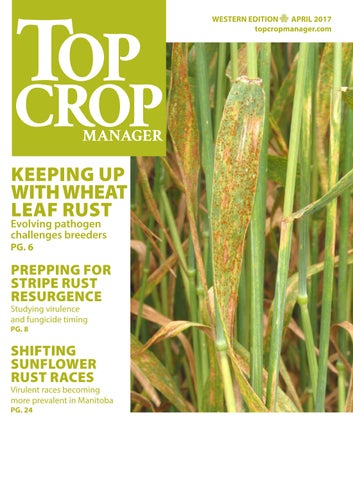
KEEPING UP WITH WHEAT LEAF RUST

Evolving pathogen challenges breeders PG. 6

PREPPING FOR STRIPE RUST RESURGENCE

Studying virulence and fungicide timing PG. 8

SHIFTING SUNFLOWER

R UST RACES

Virulent races becoming more prevalent in Manitoba PG. 24

TOP CROP

6 | The battle against wheat leaf rust Breeders are challenged to keep up with the ever-evolving pathogen behind this disease.

8 | Potential resurgence of stripe rust Research furthers understanding of pathogen virulence, temperature effects and fungicide timing. By

24 | Rust shift

Very virulent sunflower rust races have become more prevalent in Manitoba.

WEB

Only three plant species – rice, wheat, and maize – account for most of the plant matter humans consume, partly because of the mutations that made these crops the easiest to harvest. But with CRISPR technology, researchers argue we don’t have to wait for nature to help us domesticate plants.

TALKING TRADE

While making the rounds at industry events this winter, I noticed one topic was sure to draw a crowd every time. It seems producers, suppliers and other industry stakeholders are eager to soak up whatever information they can on international markets and trade – and with good reason.

Within days of taking office, President Donald Trump signed an executive order withdrawing the United States from the Trans-Pacific Partnership (TPP), a 12-country deal representing about 40 per cent of the global economy. The move essentially killed the trade deal since, as Canada’s Foreign Affairs Minister, Chrystia Freeland, told reporters, “This agreement was so constructed that it can only enter into force with the United States as a ratifying country.” Many Canadian producers and commodity groups were hopeful the TPP would improve market access for agricultural exports to Australia, Vietnam, Chile, Japan, Malaysia, Mexico, New Zealand, Peru, Singapore, the U.S. and Brunei.

Overshadowing disappointment over the failure of TPP for many in the agriculture world is fear the North American Free Trade Agreement (NAFTA) may be radically transformed if Trump succeeds in “tweaking” the agreement, as he’s promised to do. According to the Council on Foreign Relations (an independent, non-partisan organization with offices in Washington and New York), Canada is a leading importer of American agricultural products, and “one of NAFTA’s biggest economic effects for Canada has been to increase bilateral U.S.-Canada agricultural flows.” The organization reports Canada’s total agricultural exports to NAFTA members have more than tripled since the mid-‘90s. What might happen now is anybody’s guess. But, as Glen Hodgson, a senior fellow at the Conference Board of Canada, told the audience at the CropConnect Conference in Winnipeg in mid-February, we need to watch developments in all sectors covered by NAFTA and remember that disruptions to Mexican imports to the United States will have an effect on Canada’s economy, too.

Across the pond, the European Union ratified the Comprehensive Economic Trade Agreement (CETA) in mid-February. Under the terms of the new agreement, for example, various processed pulse products including canned pulses, lentil flour, pulse meal and powder, and soups and broths will be permitted for export to the EU duty-free. Agriculture and Agri-Food Canada (AAFC) reports that in the past, EU tariffs on processed pulse products have been as high as 19.2 per cent. When CETA comes into force, likely sometime this spring, whole pulse exports to the EU will remain duty-free. All things considered, the Canadian Agri-Food Trade Alliance estimates CETA could drive up to $1.5 billion in additional exports, including a $100 million bump in grain and oilseed exports.

However, as Mike Krueger, founder of Money Farm in North Dakota, told the audience at CropCronnect, scheduled elections in a number of member states throughout the spring and into the summer could have important implications for the EU, its Common Agricultural Policy and taxes and duties on imports. The ripple effects could very well affect the EU’s trading partners too.

Given all the external factors at play, what are Canadian producers to do?

The answer is straightforward: get involved. Get involved with your neighbours and help them understand what you do. Get involved with grower associations and commodity groups and help shape the messages being passed along to the officials who negotiate trade deals that affect your business.

Other sectors will be actively advocating for their own interests. Agriculture, too, must have a voice at the negotiating table.

SUBSCRIPTION RATES

Crop Manager West – 9 issues Feb, Mar, Mid-Mar, Apr, June, Sept, Oct, Nov and Dec – 1 Year - $45.95 Cdn. plus tax

Crop Manager East – 7 issues Feb, Mar, Apr, Sept,

STRAIGHT UP WILD OAT CONTROL

Wild oats hanging above the crop canopy are like a billboard for poor weed control.

Varro ® herbicide provides outstanding control of wild oats and other problem grass weeds to keep your wheat eld looking great all season.

Varro – wild oat control that’s worth talking about.

THE BATTLE AGAINST WHEAT LEAF RUST

Breeders are challenged to keep up with the ever-evolving pathogen behind this disease.

Awheat leaf rust resistance gene that’s been overcome by virulent pathogens is called a “defeated gene,” according to Brent McCallum, a pathologist with Agriculture and Agri-Food Canada. But its counterparts – resistance genes that still prove effective against pathogens in the field – are not called “victorious genes.” They’re known as “durable genes” that can be depended on for good control, year after year.

McCallum says wheat leaf rust, a fungal disease caused by the pathogen Puccinia triticina, has been a production problem in Canada ever since producers started to grow wheat. Varieties with poor or intermediate levels of resistance can take heavy yield hits in the field if producers don’t spray.

“In the early years of production it was a much worse problem because we didn’t have the tools to deal with it. Most varieties were susceptible to the disease,” he says. “AC Barrie was our number one

variety for a long time, and fairly susceptible to leaf rust. If producers didn’t spray, they’d get yield losses. The leaves look rusted and have a loss of moisture, anywhere from five to 15 per cent.”

Breeders and pathologists have been working on leaf rust for nearly a century. In that time, they’ve developed varieties with good resistance. Good genetics combined with fungicides keep leaf rust mostly curbed in Western Canada.

But behind the scenes, scientists continue working to maintain that level of control. The job of breeding high-performing varieties is never done, as pathogens are constantly evolving to cope with environmental challenges and can mutate to overcome resistance genes.

This is the case with the gene Lr21, discovered by researchers

ABOVE: Severe leaf rust infection on AC Barrie in 2005.

in the 1970s and used in wheat breeding programs through the 1980s and 1990s. Around 2012, P. triticina changed to exhibit more virulence against Lr21. Over the last few years, researchers have watched Lr21’s effectiveness break down.

For all the defeated genes, there are still some that stand strong. For example, Lr34, a resistance gene that has been used for over 50 years in Canadian wheat breeding programs, continues to be durable against P. triticina

However, McCallum says there’s still room for defeated genes like Lr21 in breeding programs.

“No resistance gene is ever useless. Now we’re finding that socalled defeated genes should be kept in your cultivars and more effective genes can be added in ‘gene pyramids’ – three to six genes that build a pyramid of resistance,” he explains.

Resistance genes work as a unit and help prolong a variety’s lifetime. Because of these gene pyramids, producers are unlikely to notice problems with varieties containing Lr21 in the field, at least when the other genes in the pyramid are still effective.

Annual surveys

If it’s hard to spot problems in the field, how do researchers know that Lr21 is defeated?

McCallum is part of a team that conducts annual crop surveys to check in on how wheat leaf rust pathogen populations are changing over time, where the disease is present in Canada, how severe it is, and which cultivars it’s affecting. The team collects samples locally and receives samples from co-operators located across Canada’s wheat-growing regions.

“In the winter we do a virulence survey, isolating something like 300 isolates from across Canada, which represents the populations in the field, and then we determine the virulence of those populations,” he explains. “We test isolates coming in on lines with just one resistance gene and from this we can see which genes are effective and which ineffective, and the proportion of the population that is virulent.”

This survey data is less for producers and more for the benefit of researchers, to help breeding programs stay up to date. But it has an obvious trickle-down effect for producers: susceptibility or resistance of all varieties is listed in annual seed guides and McCallum’s research group continues to test all varieties, even after registration.

“If there are relevant changes, such as the emergence of Lr21

example, the inoculum, or the rust that we put out in the spring this year, would be made from the isolates that we collected last year, in 2016,” he says.

Staying on top of wheat leaf rust is a concerted effort involving many people across Canada, from geneticists to breeders.

“It’s very collaborative. I work with a lot of other scientists from other programs and that’s been really rewarding. Nearly all my projects have five or six scientists working on them,” McCallum says.

This is the picture painted in McCallum’s recent review of wheat leaf rust research and the development of resistant cultivars in Canada, published in the Canadian Journal of Plant Pathology.

“No resistance gene is ever useless. Now we’re finding that so-called defeated genes should be kept in your cultivars and more effective genes can be added in ‘gene pyramids’ – three to six genes that build a pyramid of resistance.”

virulence, we try to alert the breeders and closely watch the levels of disease on the wheat cultivars in trials such as the Manitoba Crop Variety Evaluation Trials, as well as our own nurseries, to detect any changes in the resistance of the cultivars,” McCallum says.

As P. triticina evolves rapidly, he explains, breeders update their disease inoculum to be made up of the current population. “For

“The body of knowledge generated by pioneering Canadian rust scientists has been capitalized upon by successive generations of dedicated scientists in Canada and around the world to further understand the P. triticinawheat system towards even more effective and durable genetic control of leaf rust in the future,” McCallum writes in the paper’s conclusion.

But if wheat leaf rust breeding is a battle, producers are on the front lines. McCallum says a producer’s best strategy is still to purchase seed with good resistance and spray when necessary.

“Early seeding helps because the epidemic builds up every year from southern U.S. spores, and if you can seed early, you can avoid a lot of it,” McCallum says. “Use best management practices and watch your crop so you can see if anything is developing.”

AC Superb severely infected with leaf rust.

PREPARING FOR POTENTIAL RESURGENCE OF STRIPE RUST

Research furthers understanding of pathogen virulence, temperature effects and fungicide timing.

Although stripe rust is not a new disease, it was rarely considered an economic concern, except in some irrigated crops in southern Alberta. However, in 2011 stripe rust caused serious economic impacts in both Saskatchewan and southern Alberta. Unusually high spring precipitation resulted in high moisture conditions in spring wheat crops, which created favourable crop canopy conditions for the pathogen. Another factor was the large diversity of pathogen races that appeared in 2011, including a race virulent on Yr10, a major gene in the popular winter wheat AC Radiant. Researchers are trying to learn more about the disease and find ways to help both plant breeders and growers manage the disease.

Randy Kutcher, associate professor of cereal and flax pathology at the University of Saskatchewan, has a few projects nearing completion looking at various aspects of stripe rust, including pathogen characterization, temperature effects and fungicide timing. “In field surveys, we are finding stripe rust every year across the Prairies, but nothing like the 2011 crop year, which was the worst year of infection in many years. Although field surveys show stripe rust continues to be widely distributed, the disease levels have been much lower since 2011 and in most cases, a fungicide application hasn’t been necessary in Saskatchewan crops.”

One of the challenges of stripe rust, and other pathogens, is the variability of pathogen populations and the potential for the development of new, more virulent races, which have been little studied in Western Canada. Kutcher and PhD graduate student Gurcharn Brar recently finished a project analyzing and characterizing stripe rust pathogen isolates collected from Saskatchewan and southern Alberta between 2011 and 2013 for virulence. Fifty-nine isolates of P. striiformis f. sp. tritici were analyzed for virulence frequency and diversity and compared with isolates characterized in the Pacific Northwest and Great Plains regions of the United States. Most of the rust diseases in Saskatchewan and Alberta arrive on wind currents from rust-infested cereal regions in the U.S., either from the Pacific Northwest or via the “Puccinia Pathway” from the southern and Great Plains regions, typically arriving a bit later in the spring.

“The study results, which were recently published, indicate that although the isolates in Alberta and Saskatchewan are similar, there are some subtle differences in virulence between these regions,” Kutcher says. “In southern Alberta, most of the isolates represented races from the Pacific Northwest, however

ABOVE: Stripe rust pustules on winter wheat leaf.

in Saskatchewan, the isolates were a mixture of inoculum from both the Pacific Northwest and the Great Plains regions of the U.S. This may also be a reason why some winter wheat fields in Alberta seem to [get] infected earlier: possibly from overwintering inoculum, something we haven’t confirmed to date in Saskatchewan. This overwintering potential, the early stage susceptibility of wheat varieties and the potential green bridge between winter and spring wheat may result in more stripe rust epidemics and make regular and frequent pathogen characterization very important.”

PHOTO COURTESY OF GURCHARN BRAR.

LIGHT ’EM UP

Resistant or not, powerful Infinity® herbicide takes out the toughest broadleaf weeds in your cereals including Canada fleabane. With its unique Group 27 mode of action, Infinity helps ensure the profitability of your farm today and for years to come.

Managing herbicide resistance is everyone’s fight; please spray responsibly.

In a separate study, Kutcher also looked at temperature and its effects on the stripe rust pathogen. Isolates collected prior to 2000 were compared with more recent isolates to see whether newer isolates may be more tolerant to warmer temperatures. “Speculation worldwide is that pathogens seemed to make a big change after 2000, not just in North America, but worldwide,” Kutcher says. “Although not completed, our data collected so far shows that newer stripe rust isolates still tolerate cooler temperatures better than stem or leaf rust, but seem to have become adapted to warmer summer temperatures better than older stripe rust isolates. This may explain why stripe rust is becoming more of a problem. It’s not just the development of new races in terms of overcoming resistance, but the pathogen may be more adapted to warmer temperatures and has become a problem across North America and Europe. Recently in Europe, new races of stripe and stem rusts have been identified and new races appear to be much more aggressive than older races – something we need to keep an eye on in Western Canada.”

Fungicide timing for control of stripe rust

In another important study, Kutcher and graduate student Tatiana Vera Ardila evaluated fungicide application and timing to control stripe rust in wheat in Saskatchewan. The project field trials, which used similar protocols to other studies completed in Alberta, wrapped up at the end of 2015, providing several years of data for comparison.

“The results showed that the optimal timing for fungicide application for control of stripe rust in spring wheat seeded in May was at early flowering or anthesis stage, similar to timing for Fusarium,” Kutcher explains. “An application at this timing when the pathogen is starting to build up and pustules are beginning to form provides good control of stripe rust. However, for later seeded crops for whatever reason, such as into June, fungicides might need to be applied earlier at the flag-leaf stage or before the head comes out. In southern Alberta, seeding often begins earlier and therefore the optimal timing for stripe rust may also be earlier.”

There are also varietal differences in susceptibility or resistance

to stripe rust, including both seedling resistance and adult plant resistance genes. For varieties with adult plant resistance genes, which are expressed as the plant begins to head, a fungicide application would likely not be required, depending on seeding date.

“For varieties such as Lillian, or other similar varieties with the Lr34 gene and/or one or two other adult plant stripe rust resistance genes, a fungicide application does not appear to be required,” Kutcher says. “However, for susceptible varieties such as AC Barrie, AC Avonlea, and CDC Teal, under the right conditions, then a fungicide application can be very effective against stripe rust.”

One of the challenges of stripe rust, and other pathogens, is the variability of pathogen populations and the potential for the development of new, more virulent races, which have been little studied in Western Canada.

Efforts are underway by plant breeders to better understand which genes are present in which wheat varieties, and to try to bring resistance genes into new varieties being developed. “In the future it may mean that varietal specific recommendations for fungicides could be made for stripe rust,” Kutcher says. “For now, seed guides provide the

best information on whether a variety has resistance or is susceptible to stripe rust. For varieties resistant or moderately resistant, then avoiding unnecessary fungicide applications can help reduce the potential risk of fungicide insensitivity. For varieties rated moderately susceptible and susceptible and in fields where stripe rust is developing, then a fungicide application will likely be necessary. Growers should continue to carefully scout and monitor their fields each season, particularly when weather conditions are right for disease infection, and select the most resistant varieties available each year.”

ASSESSING DISEASE RESISTANCE

Resistance to root rots and spots vary between wheat varieties.

Root rot and leaf spot diseases can be an annual problem for cereal growers, yet despite many years of cereal production in Western Canada, much is still to be learned about controlling these diseases in both organic and conventional farming systems. Research in Western Canada assessed resistance to the diseases some years ago, but much more could be done.

“As far as I know there is no work on root rot in wheat being done at the present time,” says Myriam Fernandez, a research scientist at Agriculture and Agri-Food Canada’s Swift Current Research and Development Centre. “Unfortunately, root rots are on the rise in all crop species because of increased growing season precipitation. It’s not easy for producers to identify this disease, even though root rot also causes symptoms above ground. Unless the plants are pulled up and roots examined, a producer would most likely not associate

those symptoms with what’s happening below ground.”

Several years ago, Fernandez obtained funding from the Organic Market Sector Development Initiative of the Canadian Wheat Board, which allowed her to evaluate the cultivars and species most widely used by organic producers for leaf spot and root rot reactions. The research was conducted over the 2010 to 2012 growing seasons.

A total of 13 common wheat cultivars (AC Andrew, AC Barrie, AC Cadillac, AC Elsa, CDC Bounty, CDC Go, CDC Kernen, CDC Rama, Lillian, Red Fife, Stettler, Superb, and Unity), six durum wheats (AC Avonlea, CDC Verona, Enterprise, Kyle, Strongfield, and Transcend), and two spelt wheat cultivars (CDC Origin and CDC Zorba), plus Kamut wheat were included in the trial.

Red Fife was one of the original hard red spring wheat varieties

ABOVE: Root rot is on the rise in all crops.

Raise your expectations this season with the proven protection of Proline® fungicide. When it comes to mastering sclerotinia, Proline is the number one brand choice of canola growers across Canada. No smoke and mirrors, no strings attached – just the straight-up sclerotinia protection that you’ve come to trust.

grown in Western Canada and is popular with organic wheat growers. Kamut is a registered trademark of khorasan wheat – an ancient grain also popular in organic circles.

Resistance to root rots

Common root rot is caused by fungal pathogens; Cochliobolus sativus and Fusarium species are the two main pathogens in Western Canada. Root rot stunts the plant’s roots and interferes with moisture and nutrient uptake. They are expected in most fields.

Overall, in all of the varieties Fernandez tested, Cochliobolus sativus was the most commonly isolated pathogen at 36.4 per cent, followed by Fusarium spp. at 19.3 per cent. Of the Fusarium spp., F. equiseti was the most common, followed by F. avenaceum, F. acuminatum and F. oxysporum. Other Fusarium spp. known to be wheat pathogens were isolated at lower levels.

For all three years, the greatest mean common root rot severity was observed in spelt wheat, followed by durum wheat and Kamut; common wheat had the lowest average severity.

For individual cultivars, the durum wheats AC Avonlea, Kyle and

Severity scores among wheat species and cultivars

1 Leaf spot scores based on per cent infected by leaf spots (0-11 scale).

2 Root rot scores as percentage of subcrown internodes with moderate or severe dark discolouration, or severe discolouration alone.

* Red Fife leaf spot scores for two years, 2011 (8.3) and 2012 (8.2).

Source: Myriam Fernandez, AAFC, 2014.

Transcend had the greatest common root rot severity of all cultivars in this species, while CDC Verona had the lowest. Common wheat cultivars AC Elsa, CDC Kernen and Red Fife had the greatest common root rot severity, while Superb and Unity had the lowest severity within their species.

Resistance to leaf spot

The leaf spot complex consists of several different diseases including tan spot, septoria leaf blotch complex and spot blotch. Leaf spots are widespread across Western Canada and can cause significant yield and quality reductions. Fernandez assessed leaf spot resistance within the same common wheat, durum wheat, spelt and Kamut varieties tested for root rot resistance.

“For leaf spots, although every year we contribute to the leaf spot ratings in the Varieties of Grain Crops, those ratings are from different years, under different conditions and different areas, given that they are taken from the co-op registration trials we evaluate every year,” Fernandez explains.

For all three years, the common wheat cultivars with the highest

Leaf spots in durum wheat.

Tough broadleaves and flushing grassy weeds have met their match. No burndown product is more ruthless against problem weeds in spring wheat than INFERNO® DUO. Two active ingredients working together with glyphosate get hard-to-kill weeds like dandelion, hawk’s beard, foxtail barley and Roundup Ready® canola, while giving you longer lasting residual control of grassy weeds like green foxtail and up to two weeks for wild oats.

INFERNO DUO. It takes burndown to the next level.

leaf spot scores were AC Barrie, CDC Go, Superb and Unity, while those with the lowest scores were AC Andrew, CDC Bounty and Lillian. For durum wheat, Kyle had the greatest leaf spot scores overall. CDC Zorba had lower leaf spot scores than the other spelt wheat, CDC Origin, and it also had the lowest leaf spot levels of all enotypes in this study. Kamut wheat was similar to the common and durum wheat cultivars in its reaction to leaf spots.

organic ystems, while the Cochliobolus sativus pathogen was less common in conventional compared to organic systems. The Cochliobolus sativus root rot and leaf spotting pathogen (responsible for spot blotch) appears to react differently depending on agronomic practices.

“When we started our organic research program here at Swift Current, we observed that these differences between conventional and organic management in root and crown infection by Fusarium spp. were even greater,” Fernandez says. “Our report on these findings at Scott was the first, and I believe it’s still the only one, reporting these differences in North America.”

For all three years, the common wheat cultivars with the highest leaf spot scores were AC Barrie, CDC Go, Superb and Unity, while those with the lowest scores were AC Andrew, CDC Bounty and Lillian.

What it all means

“Although the study took place under organic conditions, the results are also useful for conventional and low-input production systems for helping growers to decide which cultivars to grow,” Fernandez says. “This information is, in particular, useful for producers who are looking for alternatives to chemical control.”

There is also evidence that Fusarium spp. in roots and/or crowns not only increase with conventional management, but also with rotation with susceptible species, especially pulses. A number of years ago, Fernandez was involved in research at AAFC Scott, in Saskatchewan, and found that Fusarium spp. were more frequently isolated from roots/crowns of wheat in conventional rather than

While leaf spot resistance ratings in wheat are provided in the seed variety guides published by the agriculture departments in each province, root rot resistance ratings are not available. Fernandez says that although some of the seedling blight in cereals can be controlled, to a certain extent, by chemical seed treatments, it is not possible to control root rot chemically, so having individual variety ratings is a benefit to both organic and conventional producers.

Moreover, some of the pathogens that cause root rot in cereals and other crops are Fusarium spp., some of which also cause Fusarium head blight, while C. sativus, which causes spot blotch on leaves, also causes black point and root and/or crown rot.

“It’s expected that information on the relative susceptibility of registered cultivars to root rot would help farmers to make a decision, especially if this disease has been affecting their cereal crops,” Fernandez says. “The same applies to leaf spots.”

SCOUTING YOUR FIELDS

Tips to help you spot and solve problems on your fields before they hit you in the pocketbook.

P.Ag.

Field scouting is an essential part of integrated pest management, used to examine all aspects of crop production to achieve optimum yield. Scouting is the process of monitoring crop development in each of your fields to evaluate crop concerns and economic risks from potential pests and diseases.

Ideally, farmers should scout their own fields to know first-hand how their crops are performing. For various reasons, many farmers are using commercial agronomy services for field scouting. A highly trained and skilled agronomist should have complete knowledge of crop biology, pest identification, life cycles of pests, pest habits, and know the correct crop sampling methods and economic thresholds for pests.

Whether you scout your fields or use the services of an agronomist, a detailed assessment of your crop conditions and pest populations is needed on a weekly basis during the growing season. Your goal is to have an accurate picture every week of potential crop and

pest concerns in each of your fields. If you are using an agronomist for scouting, make sure their advice is completely unbiased. Accurate field scouting will ensure crop protection chemicals are only recommended when economically required and environmentally sound.

Preparing for scouting

For most annual crops in Western Canada, fields should be scouted weekly starting before seeding until after harvest. When the risk of insect or disease pressure is high during peak crop growth, monitoring every two or three days may be needed, especially if weather conditions are ideal for rapid development of specific pests or infestation levels are nearing the economic threshold.

When scouting fields, be prepared with the necessary tools,

TOP: For most annual crops in Western Canada, fields should be scouted weekly starting before seeding and until after harvest.

equipment and resource information including: clipboard with scouting sheets, tablet or smartphone with a scouting app; smartphone with a good quality camera; hand trowel or shovel; pocket knife; 10X magnifying lens; clear sample bags and vials for collecting plant or insect specimens; labels for samples; soil sample bags; hand counter for accurate plant, weed or insect counting; and flagging tape, pin flags or hand held GPS for marking field sites. In your vehicle, you should carry: reference materials to assist with identification of weeds, diseases and insects; a hand soil auger to check soil moisture and take soil samples; a one by one metre (m) square or 0.5 x 0.5 m square for plant counts and weed counts; a soil sieve; sweep net; shovel; and a cooler for specimen preservation. Some agronomists are now using unmanned aerial vehicles (UAVs) for some aspects of field scouting – a shift that could dramatically change crop scouting in the future.

If you have an agronomist scouting your fields, ensure they use proper sanitization for themselves, their equipment and their ATV or truck in order to prevent carrying any types of pests or diseases into your fields.

Scouting patterns

It is not possible to inspect an entire field, so randomly selected sample populations within a field should be observed to efficiently collect data and determine the distribution of any pests present. Sampling patterns must be completely randomized to ensure all areas within a field have an equal chance of being sampled. In fields of 80 to 160 acres, check at least five to seven locations. For larger fields, observe at least 10 to 15 sample locations.

There are various scouting patterns that can be used when scouting fields. Alberta Agriculture suggests using one or more of three different scouting patterns:

• Pattern I: When scouting for pests that are more or less uniformly distributed throughout the field, sampling sites should be evenly distributed across the field, excluding field edges, knolls or problem soil areas. Sample patterns typically look like a W or Z (see Figure 1).

• Pattern II: When pests are unevenly distributed, such as those associated with specific field areas like low, wet, dry, or unusual soil areas, the sampling should be concentrated in those areas.

• Pattern III: When pests are concentrated near field edges, sample by walking adjacent to field edges, fence lines or road ditches.

Depending on the issues of concern, different sampling patterns are used. For example, weeds like wild oats are usually throughout a field, while Canada thistle more often occurs in patches or near field edges. Herbicide-resistant weeds initially tend to be in patches. Some insects, like flea beetles or grasshoppers, are more prevalent along field edges, as they migrate from one field to another.

Previous field history

It is important to have a good history record for each field. This information is very useful for an agronomy field scout. But it is also helpful when a farmer has a complete record of field history. For each field, list: the legal land location; field name; history of previous crops; soil fertility problems or nutrient deficiencies; any soil problems; previous problems with insects such as wireworms or cut worms; past weed types and populations; herbicide-resistant weeds; previous disease problems; previous herbicides and herbicide groups used; and crop yields. For the current crop year, list the specific crop variety,

seeding date, seeding rate, fertilizer used (including types, rates and placement) and tillage operations. Previous history can be very important when assessing crop problems.

Getting started

Field scouting starts before seeding, observing soil moisture conditions and the status of annual, biannual and perennial weed populations. Decide if, when and what herbicides to spray for weed control prior to seeding.

After seeding, scout for crop germination and emergence. Is crop emergence patchy – what conditions are causing patchy emergence conditions? Is seed bed moisture adequate for germination or is soil crusting affecting crop emergence?

During crop germination and emergence, watch for seedling diseases and insect feeding on roots or emerging leaves. After full crop emergence, conduct plant stand counts at a minimum number of observation sites – was the target plant population achieved? If not, what are the possible explanations? Learn as much as possible from your observations.

On each scouting date, record environmental conditions, crop growth stage, overall crop health and any visual crop concerns, weeds present before herbicide application, weeds controlled after herbicide application, weed patches not controlled, insect pests and number, beneficial insects, and diseases and disease pressure. This information will give a complete picture of developing problems. In fields with variable landscape, careful scouting is needed to observe the variation in crop growth, crop damage and pest distribution on knolls and upper, mid and lower slope positions.

Weed scouting

Scouting for weeds should start as soon as weeds appear in the field and continue until late fall. Scouting fields before seeding allows for planning weed control. After seeding, while assessing crop emergence, is the time to determine the infestation levels of the known weeds in your fields and to carefully determine if any new invading weeds are observed at very low levels. With good scouting information, you can select the best herbicides for effective control.

Figure

There’s nothing quite like knowing the worst weeds in your wheat fields have met with a fitting end. Following an application of Luxxur™ herbicide, you can have peace of mind that your wild oats and toughest broadleaf perennials have gotten exactly what they deserve.

SPRAY WITH CONFIDENCE.

CHEMFALLOW BEST MANAGEMENT

With the confirmation of glyphosate-resistant (Group 9) kochia across the Prairies, a renewed focus on best chemfallow management practices is needed.

1. Scout fields and apply herbicides at the optimum timing for the best weed control. Weed control is generally best when weeds are small and actively growing.

2. Apply glyphosate with a tank-mix partner that is effective on all weeds and herbicide-resistant biotypes. For example, all kochia on the Prairies is considered to be resistant to Group 2 herbicides. Tank-mixing glyphosate with a Group 2 herbicide will not control kochia that is also resistant to glyphosate.

3. Group 2 + 4-resistant kochia has been confirmed on the Prairies. Use “effective” tank mix-partners with multiple modes of action to delay the development of herbicide resistance. Use herbicides with multiple modes of action from different groups; each mode of action should be effective on the target weed.

4. Diversify your chemfallow tank-mixes (groups) throughout the growing season.

5. Use full rates of herbicides. Reduced rates may help select for herbicide resistance.

6. Note re-cropping restrictions that may prevent planned crop rotations in the following year.

7. Consider using tillage that conserves crop residues in combination with herbicides. Wide-blade cultivators that leave the majority of the stubble standing are a good choice because they help preserve moisture and protect the soil from erosion.

8. Scout after application to assess weed control and possible herbicide resistance. Control weed escapes before they go to seed. Consider physical destruction utilizing tillage of patches, mowing, or hand trimming. Re-application of the same group of herbicides on weed escapes will put further selection pressure on weed escapes and could speed the development of herbicide resistance.

9. Plan ahead for pre-seed burndown so you aren’t using the same modes of action or compromising cropping restrictions.

10. Change things up. What worked well yesterday and today may not work tomorrow. Change up your crop rotations, application timings and seeding dates. If a chemfallow program worked this past year, try something different in 2017 to keep weeds off-balance.

There are no re-cropping restrictions for the following year with any of the products listed when used according to the chemfallow label.

Chart developed by Blair McClinton, P.Ag., with information compiled from the Saskatchewan/Manitoba Guide to Crop Protection and herbicide labels.

Follow the information on product labels if there are any discrepancies with information in this table.

Glyphosate (25 different trade name products) Glyphosate 9

Glykamba Glyphosate + dicamba 9, 4

CleanStart Glyphosate + carfentrazone 9, 14

Gramoxone Paraquat 22

Will not control volunteer glyphosatetolerant crops or glyphosate-resistant weeds. Higher rates required for perennial weeds and some tough to control broadleaf weeds.

Canola is best controlled in the one- to three-leaf stage.

Controls annual weeds only. Use a minimum water volume of 10 gallons per acre. Paraquat has a “danger” safety warning. Take appropriate safety precautions.

The following products will provide enhanced control of the weeds listed when mixed with glyphosate, compared to glyphosate alone

Express SG, Nuance, MPower X, Inferno WDG, Spike Tribenuron 2

Express Pro, Nuance Pro Tribenuron, metsulfuron 2

PrePass Flex, Priority, Spitfire, MPower Battlefront, Blitz Florasulam 2

2,4-D 2,4-D 4

Banvel II, Banvel VM, Oracle, VMD 480 Dicamba, Hawkeye Power Dicamba 4

Dyvel DSp Dicamba + 2,4-D + mecoprop 4

Target, Sword, Tracker SP Dicamba + mecoprop + MCPA 4

Pardner, Brotex 240, Brotex 480, Koril 235, Bromotril II, Loveland Bromax Bromoxynil 6

Amitrol Amitrol 11 Aim Carfentrazone 14

Saflufenacil 14 Ko-Act 2,4-D + tribenuron 4, 2

Korrex II Dicamba + florasulam 4, 2

M, Logic M, Mextrol 450, Badge II MCPA + bromoxynil

Do not use tribenuron/metsulfuron on highly variable soils that have large gravelly or sandy areas, eroded knolls or calcium deposits.

Maximum one application of these products or other products containing florasulam within a two-year time span.

Grow only cereals, corn, field beans, soybeans or canola the year after applications of 0.5 litres per acre.

Kochia must be less than two inches and volunteer canola should have one to three leaves for best control.

Canola is best controlled in the one- to three-leaf stage.

Maximum one application of this product or other products containing florasulam in back-to-back years.

must be less than two inches for best control.

Buctril
4, 6
Kochia
BlackHawk 2,4-D + pyraflufen 4, 14
Canola is best controlled in the one- to three-leaf stage.
Distinct Dicamba + diflufenzopyr 4, 19

MANAGEMENT PRACTICES

SCOUTING YOUR FIELDS

Continued from page 18

If new weeds are detected very early, intensive control practices could allow for complete eradication.

When scouting for weeds, make sure you can recognize all the common types of weed seedlings and have resources to assist with identifying less common weeds. At each random observation site, record the number of each type of weed per square metre and the stages of growth of both broad-leaved and grassy weeds. Remember to be diligent after crop emergence to complete weed assessments and then apply the most appropriate herbicides. Research has clearly shown early weed control is often most economically beneficial.

Scout each field using a uniform sample pattern, but remember to sample in low or problem soil areas, which may have different weed types. Also observe field borders and adjacent road ditches to assess for encroaching weeds.

Continue scouting for weeds throughout the season. After spraying, watch for potential herbicide-resistant weeds and second flush weed patches. If observed, develop a management plan for future years.

your provincial specialist for diagnosis. Plant samples may need to be sent to a provincial lab for culture and final diagnosis. For fungal disease, is pressure significant enough for fungicide application?

Insect scouting

Scouting for insects needs to start at the time of crop emergence. As mentioned, insects and diseases can often be assessed at the same time. Identifying all insects and population levels is useful to assess which ones may become a problem during the growing season. When the population level of an insect nears threshold level and damage is observed, a rapid decision is needed for control.

Scouting for weeds should start as soon as weeds appear in the field and continue until late fall.

Disease scouting

Crop disease issues can be caused by either biotic or abiotic factors. Biotic crop diseases are caused by pathogens, such as viruses, fungi and bacteria. Abiotic or environmentally-induced physiological conditions are caused by factors such as wind, frost, drought stress, excess moisture, nutrient deficiency, herbicide injury or problematic soil conditions. When scouting crops, it is critical to determine the cause of disease symptoms. The cause of symptoms is not always clear or easy to determine. Microscope and laboratory culture examinations may be required to confirm a diagnosis.

Scouting for diseases and insect damage can often be done at the same time and includes careful observation of roots, stems, leaves and seed pods/heads.

• Roots: When plants look unhealthy, be sure to examine the roots and the base of the stem for browning and for lesions. Wash roots with water to allow proper examination. Cut into roots to examine internal infection or browning.

• Stem sampling: Carefully examine stems for signs of diseased material or lesions. Split stems to examine for discolouration caused by pathogens.

• Leaf sampling: Examine all leaves on each plant for lesions. Estimate the amount of leaf surface area infection on lower and upper leaves. Leaf diseases tend to cause the most damage at the seedling and flowering stages of plant growth.

• Head/pod sampling: As heads or pods are developing, carefully examine for signs of pathogen material or lesions. The heads or pods should be split or taken apart and examined for discolouration caused by pathogens.

Use reference materials to assist with disease identification. If you are unsure of the crop disease, take pictures and email them to

Insects vary in their level of mobility, therefore, different methods must be used for estimating population levels. Some insects can be estimated using a 38-centimetre (cm) diameter sweep net. Make sure you understand how to correctly use a sweep net. Some lessmobile insects (like armyworms) can simply be shaken from plants onto the ground and counted in a 50 cm by 50 cm area. Multiply the number by four to estimate pests per square metre. For grasshoppers that are quite mobile, hold a one-metre stick in front of you, walk in a line and estimate the number of grasshoppers that rise-up at five one-metre square areas along the 50metre strip. Add the five counts together and divide by five for the estimate of grasshoppers per square metre. Getting exact counts is difficult, so the number is simply an estimate.

Also make sure you understand how to scout for and estimate populations of various insects you may encounter in your crops, then find out the threshold level when it is economical to spray for control. When you are unable to identify an insect, take pictures and forward them to your provincial specialist for assistance with identification.

• Root damage: Clean away soil from a plant’s roots and check for insects such as wireworms, cutworms and maggots. Look for feeding damage; if no insects are observed then sieve the soil adjacent to roots. If insects are very small, try spreading the soil very thinly onto a dark plastic garbage bag and carefully examine that soil.

• Foliage damage: Examine individual leaves and pay greater attention to the upper leaves, looking for the presence of insects and assess any visual damage. Examine the entire leaf and the sheath for the insect and scrapping or feeding damage. Handle and disturb the leaves as little as possible to prevent insects from falling off.

• Seed head and pod damage: Examine the surface of the seed head or pod for signs of feeding or puncture by insects. Open seed pods to examine inside of pods and check seeds to see if they are shriveled.

In summary, field scouting requires a very good knowledge of crop biology, weeds, insects and diseases. Your field scouting skills will improve as you gain more experience. Remember: for challenging diagnostic problems, be sure to seek assistance from your provincial department of agriculture specialists and local agronomists. Finally, the ultimate goal of field scouting is to help you with your crop management to achieve optimum economic yields.

PESTS AND DISEASES

RUST SHIFT

Very virulent sunflower rust races have become more prevalent in Manitoba.

Surveys of sunflower rust in Manitoba show variations in the predominance of different races from year to year, but the overall trend is towards races with greater virulence.

Sunflower rust is one of the main diseases affecting sunflower crops in Manitoba. Heavy infestations cause serious reductions in sunflower yield and quality. The impact of the disease increases when the infection starts early in the growing season, when warm, moist conditions occur during the summer, and when sunflower hybrids susceptible to the prevalent rust races are grown.

“Susceptible hybrids may reach greater than 50 per cent yield loss due to sunflower rust in some years,” says Khalid Rashid, a research scientist with Agriculture and Agri-Food Canada (AAFC) in Morden, Man. He leads the annual sunflower rust surveys.

Those surveys show the disease occurs in the province every year, but in some years it is worse than others. In the last 10 years, the most severe, widespread epidemics occurred in 2008 and 2009. During this decade, Rashid has also seen an increase in the severity of local sunflower rust outbreaks, with the outbreak location varying from one year to another depending on factors like local weather conditions.

“In a lot of years, sunflower rust can be really hit and miss,” says Anastasia Kubinec with Manitoba Agriculture. “But there is always some area where, probably around the middle of July, all of a sudden growers are saying, ‘There is rust in the field, flowering hasn’t even started or it has just started, and we really need to get something done now.’”

Disease detail

Sunflower rust is caused by the fungus Puccinia helianthi. This pathogen is specific to cultivated and wild sunflowers and does not affect other crops.

Rashid explains that the pathogen has five spore stages. “During

the summer, the rust propagates itself asexually in the brown stage, which is called the uredial stage. Almost every week to 10 days, you get a new cycle of inoculum in that asexual stage.” Because these brown spores are clones, one generation is genetically the same as the next, although mutations can occur occasionally.

If conditions are warm and humid, this brown stage can produce millions of spores in each cycle. Infection can occur when the temperature is between about 13 C and 30 C, but more infection occurs if the temperature is around 20 C to 25 C. High humidity or overnight dews are necessary for the spores to germinate and infect leaves. “Quite often we get enough dew in the summertime; about six hours or so of dew would be enough to get infection,” Rashid says.

After the brown stage comes the black stage. Rashid explains, “Towards the end of the growing season, when the plants start getting mature and the weather starts getting cold, the fungus changes to the black stage – the telial stage.” This is the overwintering stage, which survives on sunflower stubble.

In the spring, the telial spores germinate, giving rise to two spore stages including a stage that involves sexual reproduction, where genetic recombination and hybridization between different races of the pathogen can occur.

Next comes the aecial or orange stage. Aecial spores usually infect the cotyledons of sunflower plants. These orange spores live for only one cycle and produce the brown spores.

A key aspect of the pathogen’s life cycle is that it can propagate itself sexually and asexually on sunflower. In other words, sunflower rust does not require an alternate host, unlike the cereal rust

ABOVE: The black spore stage is the overwintering form of the pathogen (left). The orange stage infects sunflower seedlings (right).

Quality meets quantity.

In addition to providing an exceptional yield increase, Prosaro® fungicide protects the high quality of your cereals and helps ensure a better grade.

With two powerful actives, Prosaro provides long-lasting preventative and curative activity, resulting in superior protection against fusarium head blight, effective DON reduction and unmatched leaf disease control.

With Prosaro you’ll never have to settle for second best again.

Rust resistance

Resistant crop varieties are a powerful tool for managing any disease. Ideally sunflower growers would be able to choose the best available rust-resistant sunflower hybrid from among hybrids with weak, moderate or strong rust resistance. Unfortunately, all the sunflower hybrids currently available in Manitoba are susceptible to the sunflower rust races present in Manitoba.

It is a continuous challenge for breeders and plant pathologists to keep up with the changing races of sunflower rust. They have to look for and test new sources of resistance against the latest rust races and to move those new resistance genes into superior sunflower hybrids, all of which can take many years.

pathogens; for instance, the sexual phase of wheat stem rust has to occur on barberry plants. So, compared to cereal rusts, sunflower rust has a much greater chance of completing its sexual life cycle. As a result, it has a much greater probability of producing new races, some of which could be more virulent than the existing races.

“To develop races that are more virulent than the current races, there has to be a combination of virulences from different races,” Rashid says. “For instance, let’s say race 1 has one virulent gene and race 2 has another virulent gene. A cross between race 1 and 2 might combine those virulent genes together into a new race that is more virulent than either one of the two.” New races that are more virulent are more likely to survive and become prevalent.

Not only can new races develop locally, but they can also blow into Manitoba from the United States, which has a much larger sunflower production area and, consequently, a greater potential for generating new races.

Race trends

“Usually when we do our disease surveys in the summer, we collect samples of rust from any rust-infected sunflower crop that we see,” Rashid says. To determine the races in those samples, Rashid’s team inoculates isolates from the samples into an international set of nine sunflower genotypes. Depending on the reaction of each of these differential lines to an isolate, the researchers can determine the race of that isolate.

“Usually we see between at least five and 10 prevalent races every year, although it varies from year to year. Some of those races might have been present in the previous year, and some could be new races,” he explains.

“Races are designated following an international system that uses a three-digit number; the higher the digits, the more virulent the race. In 2016, the most prevalent race in Manitoba was 777, and the next most common race was 735, followed by 727, then 357 and 377.” Over about the past 15 years, the races in the province have gradually shifted from race groups 100 and 500 towards race groups 300 and especially 700.

Rashid says, “The race 777 is the most virulent race we have seen so far in Manitoba. It had shown up in the province in recent years at around 10 to 20 per cent of the population of the fungus, but in 2015 about 75 per cent of population was 777 and in 2016 about 65 per cent was 777.”

“We do not produce any sunflower seed in Manitoba for seeding; all our seed comes from the United States. So sunflower breeding is a collaborative effort between us and the sunflower industry in the U.S. – the USDA [United States Department of Agriculture], seed companies, breeding companies, and universities in North Dakota, South Dakota and Minnesota,” Rashid says. “Our rust disease information feeds back to them so they know what rust resistance genes to include in their future hybrids. And under the umbrella of the National Sunflower Association of Canada, hybrids are tested in Manitoba and recommended to growers.” Hybrid testing is done in Manitoba because it is Canada’s main sunflower growing area.

The National Sunflower Association of Canada (NSAC) currently has a program to develop new confection sunflower hybrids for Manitoba, and one of the program’s main objectives is to improve rust resistance. “The program has fully incorporated a new gene for rust resistance (R13) into the program. R13 is considered to be significantly better than R12 in terms of the level of resistance conveyed,” says Darcelle Graham, NSAC’s executive director.

“The hybrids that are being developed are currently not available for purchase; however, as we continue to move lines through the various testing streams, our goal is to release a hybrid that has both downy mildew and rust resistance on a long seed type confection sunflower,” Graham says.

R13 is reported to be highly effective against many rust races, including races found in Manitoba, like 777.

Managing sunflower rust

“The tell-tale sign of rust is the pustules on the leaves,” Kubinec says. She is describing the uredial stage, with its reddish brown pustules that speckle the leaves. This is the key stage to monitor for making decisions on fungicide applications.

The pustules first appear in the lower canopy and gradually move up towards the head with each new cycle of infection. Kubinec notes that sometimes, especially when the disease is lower down in a dense canopy, growers may not notice the symptoms until they walk out of the field and see the rusty hue on their clothes. She adds, “When the pustules are halfway up the leaves you’ll probably start to notice them. When the pustules get up towards the leaves right around the head, the disease is really obvious.”

As more and more pustules appear on the plant, the impacts on the leaves and the rest of the plant increase. “In the first cycle of infection, there may not be much disease. But during the growing season, there is continued cycling of the infection. By the end of the season, under severe conditions, rust pustules might occupy 50 per cent of the leaf area,” Rashid notes. “With a heavy infection, the

When conditions favour sunflower rust, the crop impacts can be severe.

plant turns brown and dries up, looking as if it has been burnt.”

If pustules are found on the lower leaves, then growers should check the field every few days to monitor the progress of the disease in order to make spray decisions. He says, “If you spray when it’s too early in the season and the disease is too light, then you’re not going to get much benefit from that application.”

“When you should get concerned about sunflower rust is when it becomes economical to spray,” Kubinec says. “That’s when the four leaves just below the head have a rust pustule incidence of five per cent or more and the crop is less than R6; we have charts that show what five per cent looks like. So, if the four leaves have lots of pustules and the crop is just starting flowering, then it’s time to spray.” Otherwise, the benefits from the fungicide application won’t cover the cost of the fungicide and the application.

The economic threshold depends in part on the current price for sunflowers as well as the fungicide and application costs, so the recommended pustule incidence threshold may vary between one and five per cent. Rashid also notes that, if the infestation is very severe and the price for sunflower is high, then it may be worthwhile to do two fungicide applications about two weeks apart.

Spraying at or after R6 does not provide a yield benefit. Kubinec says, “By the end of the season, we tend to see a little bit of rust on most sunflowers. However, at that stage, it is not economical to spray and it’s far beyond the stage where it’s really causing any issues to the crop.”

Rashid’s research on sunflower rust includes conducting fungicide trials in Morden to see which products are most effective in managing the disease. The trials include registered fungicides and also experimental fungicides, to help support registration of new products on sunflower. He notes, “Several fungicides are available that reduce the disease and improve the yield significantly.” He advises growers to check Manitoba’s annual Guide to Field Crop Protection for the fungicides currently labelled for control of sunflower rust.

When a rust infection starts early in the growing season, it has a greater potential for causing more severe impacts because the earlier start increases the possible number of cycles of infection. Early rust infections may start on volunteer and wild sunflower

plants that have emerged before the sunflower crop is up. Growers may want to control volunteer sunflowers in fields adjacent to the current sunflower crop.

Crop rotation and field selection are important tools for managing sunflower rust. Rashid says, “The telial stage can survive for about one or two winters under our conditions. That is why we always recommend at least two years between sunflower crops in a field. Also, try to avoid planting sunflowers in fields that are adjacent to fields that had sunflower rust in the previous year.” If

QUALITY

VENTED LID

INDUSTRIAL FOOD-GRADE EPOXY COATING (on Magnum-F™ )

INDUSTRIAL GRADE COATING FOR SUPERIOR FINISH PRESSED CONE SHEETS FOR OPTIMUM STRENGTH

INSPECTION HATCH

RACK & PINION SLIDE GATE (Stainless Steel Components on Magnum-F™)

local inoculum is produced in the current sunflower field or adjacent fields, the pathogen could start infecting the crop around two weeks earlier than inoculum that is blown into the field from further away. Reducing local inoculum will help reduce early infection.

For now, crop rotation, field selection, and fungicide applications based on economic thresholds are key to managing sunflower rust. And hopefully, in a few years, new rust-resistant sunflower hybrids will be coming along.

6" SIGHT GLASS

LADDER & OPTIONAL WELDED SAFETY CAGE POKE HOLE (on Magnum-F™ )

HEAVY-DUTY CONSTRUCTED FOUNDATION (Varies Depending on Model)

CUSTOM OPTIONS AVAILABLE

THE SEARCH FOR THE OPTIMUM LENTIL SEEDING RATE

Research finds smaller seeded lentil classes respond to higher seeding rates –and may help with weed suppression.

There are 10 different lentil classes with many different seed sizes, yet still only one general recommendation for a seeding rate of 130 seeds per square metre (seeds/m2), or 13 plants per square foot (plants/ft2). But with lentil seed sizes varying widely, ranging from 70 grams per 1,000 seeds down to 29 grams per 1,000 seeds, does that recommendation hold up with today’s varieties? Research is trying to find the balance between seed cost, disease levels, yield and economics. Add in the relatively poor weed competition provided by lentils and it’s clear why optimum stand establishment is critical for high yields and economic returns.

“For a long time, lentil growers dealt with weeds with Sencor, but it was hot on the crop and had to be applied too early to provide the best weed control. Then we saw imidazolinone-resistant (IMIresistant) weeds like kochia, wild mustard, wild buckwheat and red root pigweed develop, so we started to look at other ways of reducing the impact of weeds,” says Steve Shirtliffe, a professor with the department of plant sciences at the University of Saskatchewan.

In lentil, the critical period of weed control (CPWC) – the period when weeds must be controlled to prevent yield loss – was identified by Leah Fedoruk, Shirtliffe, and Eric Johnson, all at the University of Saskatchewan. In the research conducted in 2011, the CPWC was determined to be from the fifth to 10th node. This timing is essentially when the weeds start to accumulate significant growth through to crop canopy closure.

Subsequent research by Fedoruk and Shirtliffe looked at the best timing for IMI herbicide application in Clearfield lentil. This research compared herbicide application at either the two- or six-node stage of lentil growth. Application of IMI herbicides at the six-node stage resulted in 30 per cent higher yield than the two-node stage. Based on these results, an IMI herbicide application on Clearfield lentil was recommended at the five- to six-node stage of the crop.

“But Group 2 wild mustard is a huge nemesis for lentil production and the IMI herbicides were no longer effective on the resistant Group 2 weeds, so we started to look at agronomic practices like seeding rate to help control weeds,” Shirtliffe says.

Increasing seeding rate

Shirtliffe was involved in earlier research in 2005 and 2006 looking at seeding rates in organic lentil production. Large green CDC Sovereign lentil was sown on nine-inch row spacings. The research found

Increasing small and extra small red lentil seeding rates will help the crop canopy sooner, compete with weeds better, and improve yield.

seed yield increased up to 1,290 kilograms per hectare (kg/ha) or 1,148 pounds per acre (lbs/ac) with an increased seeding rate. Weed biomass was reduced by 59 per cent at the highest seeding rate of 375 seeds/m2 as compared with the lowest seeding rate. Economic return was maximized at $385 per acre at the highest density of 229 plants/m2, achieved with a seeding rate of 375 seeds/m2

“This organic research trial got us thinking about how seeding rate and seed size impacted weed control, disease levels and yield in

PHOTO BY BRUCE BARKER.

Wind speed, pressure gauge, optimal nozzle settings, check. All systems are go and it’s time to take down the toughest weeds in your wheat field, whether they’re resistant or not.

With three different modes of action in a single solution, Velocity m3 herbicide provides you with exceptional activity on over 29 different tough-to-control grass and broadleaf weeds.

conventional lentil production. In organic production, increased seeding rate gave better weed suppression and higher economic return under really heavy weed pressure, so we wanted to look at the responses in conventional lentils,” Shirtliffe says.

Research by graduate student Colleen Redlick and Shirtliffe looked at an integrated approach to weed control in CDC Impala, an extra small red lentil, using seeding rate, herbicides and rotary hoeing. Seeding rates were 130, 260 and 520 plants/m2.

“We found that increasing seeding rate reduced mustard biomass and improved herbicide effective ness. A lot of herbicides don’t work that well in lentil, so improving crop competition provides better weed control,” Shirtliffe says.

More recently, University of Saskatchewan graduate student Kali Kasper and Shirtliffe looked at the effect of seeding rate on lentil disease, weeds, yields and profitability in two separate experiments. In the first experiment, Kasper looked at two seeding rates of 120 and 240 seeds/m2 for extra small red, small red and large red lentil varieties. Fungicide treatments included Head line fungicide sprayed once, Headline sprayed twice, and Fracture fungicide sprayed once.

In the second experiment, Kasper looked at the optimum seeding rate for the different seed classes. Rates of 60, 120, 180, 240, and 320 seeds/m2 were planted across six different lentil classes: large green, larger red, medium green, small green, small red and extra small red. She is also looking at disease development and yield.

Shirtliffe says they are still analyzing the data from these two experiments, but taken in context with the other research trials he has conducted, he says there are some solid trends emerging.

“With seeding rate, there is pretty good evidence now that smaller red lentils seem to respond to a higher seeding rate than other classes. We haven’t done an economic analysis yet, but there is good agronomic data that shows seeding rate for small red lentils can be doubled from the standard recommendation of 130 seeds per square metre to 260 seeds per square metre,” Shirtliffe says. There was no weed effect on yield since the plots were hand-weeded.

Larger green lentil with a thousand kernel weight of 64 (top); extra small red lentil with a thousand kernel weight of 31 (bottom).

Shirtliffe also says questions arise regarding what happens to disease levels with higher seeding rates and thicker crop canopies. In Kasper’s research, they noticed Sclerotinia disease levels increased with higher seeding rates in the three lentil classes of extra small red, small red and large red varieties, but not anthracnose and Ascochyta.

“We also found that applying fungicides twice instead of once gave higher yields when seeding rates were increased,” Shirtliffe explains. The trials were conducted in the relatively wet years of 2015 and 2016.

At one site, they sent an unmanned aerial vehicle (UAV) up to take crop stand density imagery. They noted that the smaller red lentil classes did not fill in the canopy as quickly as the larger seeded varieties. This has implications for weed competition and potential yield and may explain why seeding rate can be pushed for small seeded varieties.

“Typical with all crops, to get high yield, you want to get a full canopy to capture sunlight. Farmers and agronomists forget that sunlight is the most important input, so what you are trying to do with seeding rates and stand establishment is building a solar panel to help the crop [with photosynthesis],” Shirtliffe explains.

Taking all the research into consideration, Shirtliffe says that for extra small and small red lentil classes, he recommends the seeding rate could be doubled to 260 seeds/m2. For larger green and bigger red lentil classes, he says producers should stick to the standard 130 seeds/m2 seeding rate.

“For larger seeded lentils, there may be a yield advantage with higher seeding rates but the additional seed cost may eat up any yield benefit,” Shirtliffe says. He adds Sclerotinia may also be a risk for higher seeding rates, and that growers need to avoid cropping on canola and other host crop stubbles, and use fungicides to help manage diseases.

SEEDING RATE AND STAND DENSITIES

To achieve the currently recommended stand density of 130 plants per square metre for medium and large seeded classes, using a seeding rate based on thousand kernel weight is recommended. A similar calculation can be made for small seeded red lentil classes targeting 260 seeds per square metre. The Alberta Agriculture and Forestry website has a seeding rate calculator that can provide a seeding rate based on thousand kernel weight.

Example 1: Large green lentil

• Target plant density: 12 plants per square foot (130 plants/square metre)

• Germination rate: 90 per cent

• Emergence mortality: 20 per cent

• Row spacing: 12 inches

• Thousand kernel weight: 66 grams

• Seeding rate required: 105.6 lbs/acre, resulting in seed placement of 16.7 seeds per foot of row.

Example 2: Small red lentil

• Target plant density: 12 plants per square foot (130 plants/square metre)

• Germination rate: 90 per cent

• Emergence mortality: 20 per cent

• Row spacing: 12 inches

• Thousand kernel weight: 34 grams

• Seeding rate required: 54.4 lbs/acre, resulting in seed placement of 16.7 seeds per foot of row.

Rule with an iron fist.

So tell me Barley Baron, how will you protect your land from would-be thieves and invaders?

See to it that your uninvited guests receive the royal treatmwent. With three herbicide Groups and outstanding activity on both grass and broadleaf weeds, Tundra® herbicide is the complete solution for barley and wheat growers. One for all, and all-in-one.

CULTIVAR MATTERS FOR PRAIRIE PRODUCERS

What do cultivar-specific responses to intensive management mean for Alberta wheat growers?

Recent Alberta research shows that some wheat cultivars have a higher respose to more intensive agronomic management practices than others. This type of cultivarspecific information could help growers make more informed decisions on variety selection and management. It opens up exciting possibilities for improved input use efficiency, so producers could get a bigger bang for their buck when investing in inputs.

Alberta findings

Sheri Strydhorst, research scientist with Alberta Agriculture and Forestry, led this multi-cultivar wheat research. Her interest in this issue began a few years ago, when some anecdotal hints suggested some wheat cultivars might respond differently than others to intensive management.

“The Wheat 150 field-scale trials [which assessed the effects of intensive management practices on wheat yields] were showing that the CPS [Canada Prairie Spring] class of wheat was responding really well, but we had heard that the CWRS [Canada Western Red Spring] class was not responding nearly as well,” Strydhorst says.

“The other thing that really put me on to this was when we were approached by a company with some European special purpose cultivars. In some trials those cultivars were performing just average with everything else. But when extra management was applied to those cultivars they performed and yielded like crazy.”

In 2013, Strydhorst and her team did some preliminary trials and found there might really be something to this concept.

So from 2014 to 2016, she led a multi-site project to evaluate the responses of different wheat cultivars to a set of standard agronomic practices versus a set of standard-plus-advanced practices. The 12 cultivars included: three CPS varieties (5700PR, AC Foremost and AAC Penhold), six CWRS varieties (Harvest, CDC Go, Stettler, CDC Stanley, Thorsby and Coleman), two Canada Western Special Purpose (CWSP) wheats (Sparrow and Belvoir) and one Canada Western Soft White Spring (CWSWS) wheat (AC Andrew). (AC Foremost’s class will be changed to Canada Northern Hard Red, or CNHR, as of Aug. 1, 2018, because of revised CPS quality parameters.)

The advanced practices included: a plant growth regulator (chlormequat chloride) at the recommended timing; an extra 34 kilograms of nitrogen per hectare with urea ammonium nitrate (UAN) with Agrotain nitrogen stabilizer applied at the end of tillering; and two fungicide applications (pyraclostrobin + metconazole at flag-leaf, and prothioconazole + tebuconazole at heading).

“We had 15 site years of data over three growing seasons with sites

This site was part of a three-year, multi-location study in Alberta that discovered wheat cultivar-specific responses to intensive agronomic management.

down in southern Alberta up to the Peace Region. So we had a great diversity of growing environments, and growing season precipitation ranged from four inches to about 20 inches. We would naturally expect big differences under those conditions,” Strydhorst explains. “In a dry year, like we had in Falher in 2014 with four inches of rain over the growing season, nothing responded to anything because the rain was the limiting factor, whereas in Bon Accord in 2016, we had 14 inches of rain that was really well-timed and all cultivars responded. So at the extremes, as farmers would probably expect, in a drought year it doesn’t matter what you do and in a wet year you’ve got to put the extra management in.”

The results got very interesting when the growing conditions were between those extremes.

Strydhorst highlights some of the CPS results as examples. “On an

old cultivar like AC Foremost, we got a yield response 79 per cent of the time and a 14 bushel yield increase. So it was a frequent yield response that was fairly large. If we contrast that with new genetics like AAC Penhold, we got a yield response only 36 per cent of the time and that yield response was only 5.6 bushels per acre.”

“This type of very responsible input management could also be a real opportunity for telling our social licence story.”

Similarly, the responses of the CWRS varieties differed from one another. For instance, Stettler responded 50 per cent of the time, achieving an extra 6.7 bushels of yield. In contrast, CDC Go responded 71 per cent of the time with an additional 8.2 bushels.

Strydhorst says, “So some varieties are responding more frequently, and when they are responding more frequently it is usually with a bigger yield response.”

It’s not clear why the responses differ from one cultivar to another. Strydhorst thinks in some cases the variety’s age might be a factor.

“The new genetics may have disease resistance built into them, and that resistance is relevant for the pathogens out there today. A cultivar bred 20 years ago might have had some disease resistance but it is not relevant for the pathogens we have today.” So a newer variety might have smaller responses to a fungicide than an older variety. However, this doesn’t explain all the differences in the cultivar responses.

Implications for Alberta growers

Strydhorst sees a strong potential for growers to improve their input

use efficiency by managing their crops on a cultivar-by-cultivar basis because they could apply just the right amount of inputs. For example, if a variety is unlikely to respond to extra nitrogen, then growers could save time and money by not applying extra nitrogen. That would also reduce the risk of nitrogen loss to the air and water. She adds, “This type of very responsible input management could also be a real opportunity for telling our social licence story.”

But how do Alberta wheat growers get this type of information?

“For the cultivars where I have done the research, I’ve prepared a ‘recipe sheet’ that gives the cultivar, how many times we saw a response and to which of the factors we think we are getting a response, whether it’s the plant growth regulator, the extra nitrogen or the foliar fungicide,” Strydhorst says.

For varieties that aren’t covered by her recipe sheets, she suggests growers could consider having some strips in their field to compare the variety’s performance with and without an input, such as a fungicide application.

Information in the provincial seed guide could also help. “Let’s say

the growers look at the leaf spot ratings. A cultivar with a moderately susceptible (MS) rating will likely respond to a fungicide more than a cultivar with an intermediate (I) rating,” she says. “But I don’t think growers can rely exclusively on that because they have to factor in the weather and the conditions on their farm – have they grown a tight wheat rotation so they might have more disease inoculum and things like that.”

Similarly, the height and lodging ratings could provide some guidance on whether a

plant growth regulator (PGR) application might be warranted, but that information doesn’t tell the whole story. “If a cultivar has a fair (F) lodging rating, then it likely will have a lodging problem, and you might want to consider a plant growth regulator for a tall cultivar,” Strydhorst says. “But the height and lodging ratings won’t tell you if the plant growth regulator is going to significantly improve the cultivar’s standability.”

Another option would be to modify Alberta’s variety trials to provide some of the data. For instance, Strydhorst notes that

Ontario’s cereal variety performance trials compare cultivar responses with and without fungicide applications.

She thinks more research needs to be done to determine optimal nitrogen fertility rates on a cultivar basis. she is also involved in further research to figure out which cultivars are the most responsive to PGRs.

One key challenge in her research is to figure out which new cultivars to evaluate. “If we could look into a crystal ball and see which newly registered cultivars have the potential for big acreage, then as seed is being multiplied for commercial use, I could start doing some of this research to help give growers some of that information.” In the future, Strydhorst says her vision “would be when growers buy seed from their certified seed provider, they would also get that recipe book that would say, for instance, this cultivar responds 80 per cent of the time to a late fungicide application but it doesn’t respond to fertilizer plus soil test rates over 100 pounds of nitrogen per acre. It would be fantastic if we could eventually get there. But we have a long way to go, and it will need many players coming together to make that happen.”

Alberta’s current regional cereal variety trials involve a multi-agency approach. The trials are funded by Alberta Agriculture and Forestry, the Alberta Wheat Commission, Alberta Barley Commission, Alberta Oat Growers Association, Alberta Seed Growers and Alberta Seed Processors, and by entry fees paid by companies for their varieties to be tested.

A similar group of agencies, as well as breeders and other researchers, might also have an interest in some form of data collection on cultivar-specific responses to intensive management. Producer groups and government agencies would have a stake in this work because it could improve input management, which could benefit growers and the environment. The input companies would be able to provide better information to their customers. For instance, the company that produces the PGR used in Strydhorst’s project has already begun testing the PGR on different wheat varieties so it will be able to tell growers where the PGR would be most effective.

Cultivar-specific management data could be a powerful tool for Alberta wheat growers. Although more work needs to be done to provide this information to growers, Strydhorst’s research has achieved some crucial steps forward.

OPTIMAL SEEDING PRACTICES FOR FLAX

The

latest findings on rates, dates, row spacings and seed treatments.

If flax gets off to a weak start, it seems to struggle all season long; it has a hard time competing with weeds, and maturity can be delayed,” says Chris Holzapfel, research manager for the Indian Head Agricultural Research Foundation (IHARF) in Saskatchewan. To find out which seeding practices give flax crops a better start and better yields, Holzapfel and his colleagues have been assessing the effects of different seeding rates, seeding dates, row spacings and seed treatments.

Seeding rate results

Their seeding date and rate trials took place at Indian Head from 2013 to 2016, at Melfort in 2014 and 2015, and at Yorkton in 2015. Stewart Brandt, research manager with the Northeast Agriculture Research Foundation (NARF) led the Melfort trials and Mike Hall, research manager with the East Central Research Foundation (ECRF), led the Yorkton trials.

According to Holzapfel, typical flax seeding rates in Saskatchewan are around 45 to 55 pounds per acre (50 to 62 kilograms per hectare). The trials compared three rates: low (about 35 kilograms per hectare), normal (about 55 kilograms per hectare) and high (about 75 kilograms per hectare).

For the 2013 to 2015 trials, higher seeding rates tended to result in earlier and more uniform maturity. However, the effect on yield was inconsistent and not statistically significant in most cases.

Holzapfel points to a couple of reasons why yield wasn’t more strongly related to seeding rate. “For flax, the minimum recommended plant population is about 300 plants per square metre. The seeding rate that it takes to achieve that population can vary depending on seeding equipment, soil conditions, overall planting practices, and seed characteristics like size and per cent germination. In our study, we very rarely fell below the 300 plants per square metre threshold.” Also, flax has some ability to compensate for low densities through

increased branching, so even if the plant population is a little below the 300 plant threshold, that may not translate into a lower yield if the growing conditions are good.

In the 2016 trials, plant populations per square metre were unusually high for all seeding rates; the populations ranged from 472 at the low seeding rate to 744 at the high rate. In contrast, from 2013 to 2015, average plant populations ranged from 320 (low seeding rate) to 507 (high rate).

Holzapfel explains, “In 2016, the combination of warm conditions, optimal placement of seed and fertilizer, adequate initial soil moisture and frequent precipitation all contributed to excellent emergence and seedling survival. And seeding equipment is a factor as well; our SeedMaster drill did an exceptionally nice job in the relatively dry spring of 2016.”

Yields in 2016 for the low and medium seeding rates were similar; however, yields were slightly but significantly lower for the high rate. Holzapfel thinks the very high plant populations at the high seeding rate combined with wet conditions late in the growing season led to high disease pressure and probably contributed to this yield reduction.

Overall, Holzapfel concludes, “Anywhere in that 45 to 55 pounds per acre rate is typically pretty good.” He adds, “It would be beneficial to start looking more closely at thousand kernel weight and actual flax seedling mortality, similar to what we’ve done with canola, in particular. But with flax being a little lower seed cost, it’s not something I have looked at so far and we do not have a really good understanding of the actual mortality in Saskatchewan flax fields.”

“I encourage growers to always go back and look at what they are

ABOVE: A series of trials in Saskatchewan compared different seeding practices to evaluate which options would give flax crops a better start and better yields.

actually achieving for plant populations,” Holzapfel says. “Your specific soil conditions, seeding equipment, seeding speed, seeding depth, fertilizer practices – many factors can influence plant populations. If you look at your specific practices and your seeding rate, and you do plant counts, then that will help guide decisions in the future.”

Some flexibility on seeding date

Seeding date had a variable effect on flax yields.

In 2013, early planting (early May) tended to produce slightly but not significantly higher yields. In 2014, the yields were statistically the same for the two dates. In 2015 at Indian Head, yields were slightly but not significantly better with late planting (late May), and at the other two sites yields were significantly better with late planting; precipitation timing favoured late planting that year. The results for 2016 were unusual in that yield strongly declined with late planting.

“We always encourage early planting, but to me it was quite a positive to see that, with the exception of 2016, flax is relatively insensitive to small delays in planting. So, although we would not specifically recommend later seeding, it is not necessarily a bad thing. You obviously can’t seed all your crops first, so if something has to go in a little bit later, then flax could be a fairly good candidate,” Holzapfel explains.

“I like planting flax early because it handles cool, early spring conditions quite well. For instance, we don’t see early season insect

decrease just going from 10 to 12 inches which continued as row spacing increased to 24 inches.” Overall yields were much higher in 2016, but the effects of row spacing were consistent with previous years.

Averaged across the three years, flax yields were reduced by two per cent per inch as row spacing increased from 10 to 24 inches.

“As a general rule, yield potential is likely to be higher with narrower row spacing, but row spacing is a complex issue,” Holzapfel says. He explains that row spacing decisions depend on things like seeding equipment, other crops grown and residue management. In some situations, a slightly wider row spacing could make sense. “For instance, a little wider row spacing can really help in fields with heavier crop residue, so you can do a better job of seeding. It can increase overall efficiency of seeding, reduce the cost of seeding, including fuel costs, and reduce soil disturbance. On the flip side, wider row spacing can, particularly in the case of flax, lead to lower or more variable yields and reduce the ability of the crop to compete with weeds. Things like overall weed populations or the presence of herbicide-resistant weeds can have a major impact on potential results.”

Even though a 10-inch spacing would likely produce the highest yields, spacings of 12 to 14 or even 15 inches would generally produce reasonably good results. He says, “There might be advantages to a 15inch spacing [in your farming system], so if that’s what you have for equipment, then I wouldn’t be afraid to grow flax. Just stay on top of your weed control and expect that you might see slightly lower yields compared to narrower spacing with all other factors being equal.”

“A seed treatment could be a good risk management tool to help ensure good crop establishment, particularly if you are seeding flax quite early in the season.”

pest issues with flax. In canola, sometimes if it’s too slow a start with early planting, flea beetles become problematic after the seed treatment has worn off. In terms of spring frost tolerance, flax is similar to canola, but I have seen several cases of very small flax plants touched by light frost with virtually no impact. So flax is not overly frost sensitive, although you do have to be a little careful,” Holzapfel notes.

His general advice is to try to seed flax by mid-May because it’s a long-season crop. However, as long as the flax crop is at or near physiological maturity, a fall frost would not be an issue. He says, “Often if your seed is mostly mature, a hard frost is almost a good thing because it will help kill those green stems off and dry things down.” Also, he adds, flax weathers well, standing up late, so growers will often leave it until after harvesting crops like cereals and canola, which are more susceptible to yield and quality loss.

Row spacing options

Holzapfel evaluated row spacing at Indian Head from 2014 to 2016. These trials compared spacings of 10 inches (25 centimetres), 12 inches (30 centimetres), 14 inches (36 centimetres), 16 inches (41 centimetres), and 24 inches (61 centimetres).

Narrower row spacing resulted in greater yields. He explains, “In 2014, we had a shallow linear decline in yield with increasing row spacing. There were no significant yield differences amongst the row spacings from 10 to 16 inches, but at 24 inches, the yield was significantly lower. In 2015, we had a stronger overall yield reduction with increasing row spacing. We even saw a small but significant yield

Initial results from seed treatments

Holzapfel has carried out two small trials on flax seed treatments and found some encouraging results.

The first trial took place at Indian Head (IHARF) and Melfort (NARF) in 2013 and involved Vitaflo. “At our two locations, we saw a significant increase in plant populations, so we had improved crop establishment. And at Indian Head we had a slight but not significant yield increase with the seed treatment,” Holzapfel says. That year had a very high yield potential for flax, but wet conditions early on may have increased the potential for seedling disease and higher mortality.

The second trial was at Indian Head in 2016 and involved Insure Pulse. “Again, we saw a significant increase in plant populations with the seed treatment. It didn’t result in a yield benefit, but that is not surprising, given that we had such high populations to begin with and that we had really good conditions for both emergence and early season growth,” he says.

Holzapfel notes seed treatments are often used as a way to help plants deal with early season stresses, like cool conditions or seedling diseases. “A seed treatment could be a good risk management tool to help ensure good crop establishment, particularly if you are seeding flax quite early in the season. If it’s a relatively inexpensive tool that could help the crop have a more vigourous, healthy start, then I think a seed treatment is worth considering.”

For the seeding date, rate and row spacing trials and the 2016 seed treatment trial, the sponsoring agency was the Saskatchewan Flax Development Commission and in most cases funding was from Saskatchewan’s Agricultural Demonstration of Practices and Technologies (ADOPT) initiative under Growing Forward 2. Many of the crop inputs were provided by Bayer CropScience, BASF, Syngenta, FMC and Crop Production Services.

From flag to head.

Folicur® EW fungicide provides you with the flexibility to spray any time from flag leaf through to head timing. This offers exceptional value for cereal growers who want long-lasting protection from a broad spectrum of diseases, including fusarium head blight and the most dangerous leaf diseases.

NEW SEED TREATMENTS, FOLIAR FUNGICIDES AND INSECTICIDES

A review of new registrations and label updates for the 2017 growing season.

With the 2017 growing season upon us, here’s a look at the latest seed treatments, foliar fungicides and label updates. Product information is provided to Top Crop Manager by the manufacturers.

Seed treatments

Intego Solo (ethaboxam, Group 22) is now fully registered for field peas and sunflower crops. Intego Solo is the only seed treatment available to protect field crops from Aphanomyces root rot. Also, Intego Solo provides control of Phytophthora root rot in soybeans (caused by Phytophthora sojae) and controls several common species of Pythium not controlled by metalaxyl alone. The full registration on field peas also includes the removal of feeding restrictions for crop residue.

Trilex EverGol + Stress Shield [penflufen (fungicide Group 7), trifloxystrobin (fungicide Group 11), metalaxyl (fungicide Group 4) + imidacloprid (insecticide Group 4A)]. Trilex EverGol Shield is a complete fungicide and insecticide seed treatment containing two small jugs of Trilex EverGol and one 6.25 litre jug of Stress Shield. It has exceptional disease protection plus pea leaf weevil and wireworm control in pulses. It is ideal for on-farm treating or for smaller batches towards the end of the treating season.

Visivio [sulfoxaflor (insecticide Group 4C), thiamethoxam

represents a new era in Sclerotinia management, combining two leading actives in a convenient liquid pre-mix. Cotegra is registered for canola, peas, lentils, chickpeas, dry beans and soybeans.

Elixir [mancozeb (Group M3) and chlorothalonil (Group M5)] is a dry flowable, multi-site, protectant fungicide specifically designed for potato crops. When applied at the beginning of a disease management program, Elixir controls both early and late blight. Elixir is an effective and economical option for potato protection with very low risk of building resistance.

Hornet (tebuconazole, Group 3), Nufarm’s new foliar fungicide, contains a proprietary brand of tebuconazole in a 432 grams per litre SC formulation. It is registered for use on barley, oats, spring, durum and winter wheat. Hornet protects cereal crops from Fusarium head blight, and leaf, stem and stripe rust. Hornet also has activity on septoria leaf blotch, tan spot, net blotch, spot blotch, scald, powdery mildew, crown rust and septoria glume blotch.

Trivapro [propiconazole (Group 3), benzovindiflupyr (Group 7) and azoxystrobin (Group 11)] is the first foliar fungicide to combine three powerful active ingredients and three modes of action to provide preventative, curative and long-lasting residual leaf disease control for cereal growers. Key diseases in barley include scald and net blotch, as well as diseases such as tan spot, septoria and rusts in wheat.

With the 2017 growing season upon us, here’s a look at the latest seed treatments, foliar fungicides and label updates.

(insecticide Group 4A), difenoconazole (fungicide Group 3), metalaxyl-M (fungicide Group 4), fludioxonil (fungicide Group 12) and sedaxane (fungicide Group 7)]. Visivio is a new canola seed treatment from Syngenta that represents the next evolution of flea beetle control for canola growers. It is a comprehensive seed treatment that controls both striped and crucifer flea beetles as well as seed- and soilborne diseases.

Foliar fungicides

Cotegra [boscalid (Group 7) and prothioconazole (Group 3)]

Label updates

Acapela (picoxystrobin, Group 11) foliar fungicide controls many key diseases in all major crops, including canola, corn, soybeans, pulses and cereals. Check the label for a complete list of diseases it controls. Acapela is now registered to control anthracnose in dry beans and anthracnose and ascochyta blight in lentils.

Vibrance Maxx with Intego [fludioxonil (Group 12), metalaxylM (Group 4), Sedaxane (Group 7) and ethaboxam (Group 22)] seed treatment is a convenient co-pack that offers broad spectrum seedand soilborne disease control in pulse crops, including early season protection against Aphanomyces root rot.

Vibrance Maxx RFC [fludioxonil (Group 12), metalaxyl-M (Group 4), and sedaxane (Group 7)] seed treatment is now available in a new pre-mixed rhizobia-friendly concentrated formulation. Vibrance Maxx RFC is registered for use in soybeans, peas, chickpeas, lentils and fababeans.

THERE’S A NEW SHERIFF IN TOWN.

Delaro® fungicide doesn’t take kindly to diseases like anthracnose, ascochyta, mycosphaerella, grey mould and white mould threatening the yield potential of innocent pulse and soybean crops.

Powerful broad-spectrum, long-lasting disease control with exceptional yield protection, Delaro sets a new standard in pulse and soybean crops.

TELL ’EM DELARO’S COMING

Turn static files into dynamic content formats.

Create a flipbook
Issuu converts static files into: digital portfolios, online yearbooks, online catalogs, digital photo albums and more. Sign up and create your flipbook.