TOP CROP MANAGER
A special report jointly produced by Top Crop Manager and Bayer CropScience
JANUARY 2014
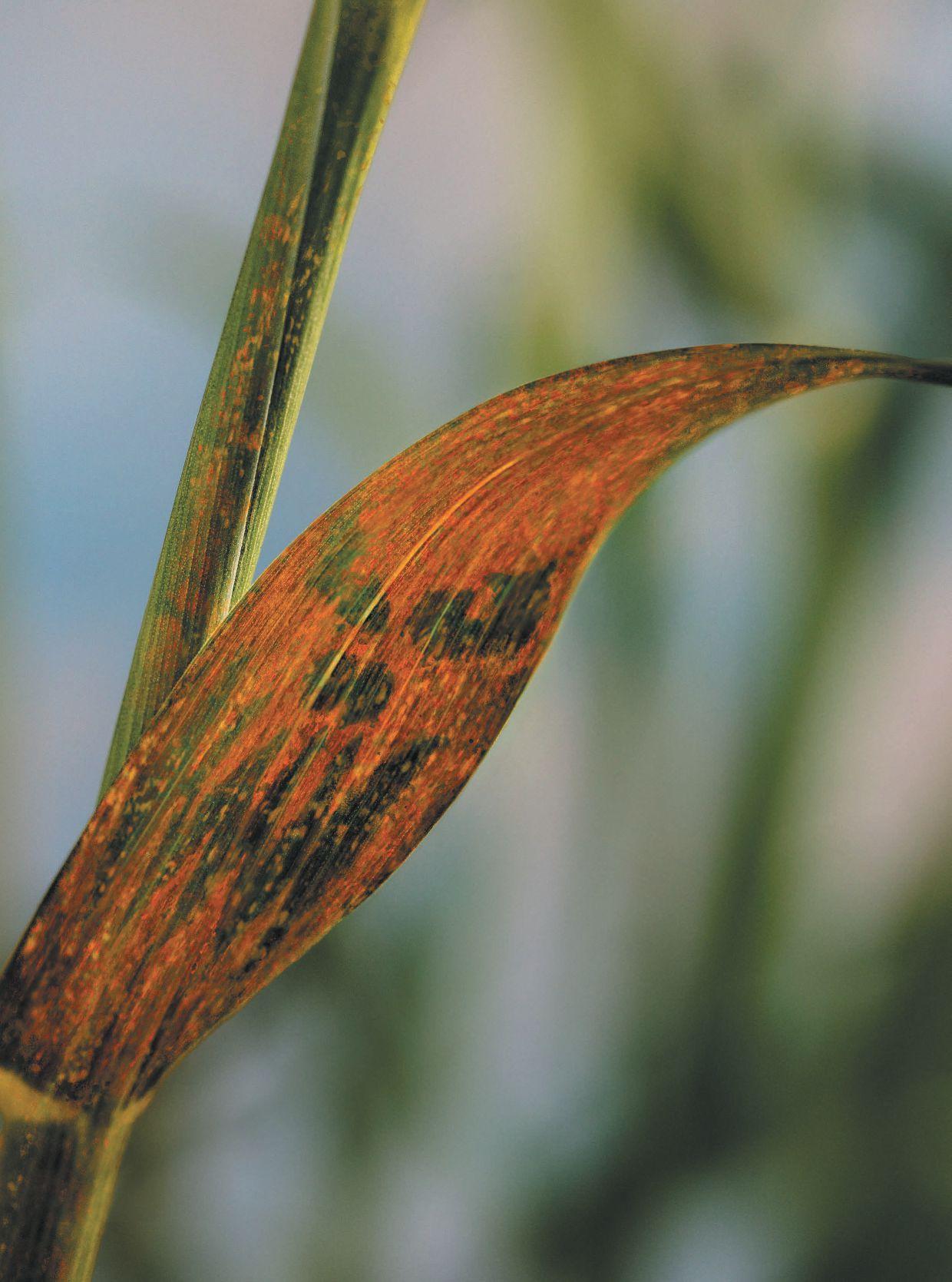
Unchecked, leaf disease can reduce cereal crop yields by up to 40%.
Folicur® EW delivers exceptional leaf disease control, including rust, tan spot and septoria leaf blotch. Additionally, its wide window of application also provides outstanding suppression of fusarium.
Folicur EW – the most trusted disease protection you can get.
Visit BayerCropScience.ca/ItPaystoSpray to see how Folicur EW is performing in your area.
In addition to providing an exceptional yield increase, Prosaro® fungicide protects the high quality of your cereals and helps ensure a better grade.
With two powerful actives, Prosaro provides long-lasting preventative and curative activity, resulting in superior protection against fusarium head blight, effective DON reduction and unmatched leaf disease control.
With Prosaro you’ll never have to settle for second-best again.
For more information, please visit BayerCropScience.ca/Prosaro
CROP MANAGEMENT PLANT BREEDING
5 | Understanding fungicide timing Finding answers to the latest fungicide timing question from cereal growers.
By Carolyn King
12 | FHB and plant breeding advancements
What to expect with increased disease resistant varieties.
By Donna Fleury
Readers will find numerous references to pesticide and fertility applications, methods, timing and rates in the pages of Top Crop Manager. We encourage growers to check product registration status and consult with provincial recommendations and product labels for complete instructions.
Janet Kanters • 403.499.9754 jkanters@annexweb.com WESTERN FIElD EDIToR Bruce Barker • 403.949.0070 bruce@haywirecreative.ca
EASTERN SAlES MANAGER Steve McCabe • 519.400.0332 smccabe@annexweb.com
vP PRoDUcTIoN/GRoUP PUblIShER Diane Kleer dkleer@annexweb.com
SAlES ASSISTANT Alice Chen • 905.713.4369 achen@annexweb.com
MEDIA DESIGNER brooke Shaw PRESIDENT Michael Fredericks mfredericks@annexweb.com
PUBLICATION MAIL AGREEMENT #40065710 RETURN UNDElIvERAblE cANADIAN ADDRESSES To cIRcUlATIoN DEPT. P.O. Box 530, Simcoe, ON N3Y 4N5 subscribe@topcropmanager.com
Printed in canada ISSN 1717-452X
cIRcUlATIoN e-mail: subscribe@topcropmanager.com Tel.: 866.790.6070 ext. 202 Fax: 877.624.1940 Mail: P.O. Box 530, Simcoe, ON N3Y 4N5
SUbScRIPTIoN RATES
Top Crop Manager West - 8 issuesFebruary, March, Mid-March, April, June, October, November and December1 Year - $45.00 Cdn. plus tax
Top Crop Manager East
Finding answers to the latest fungicide timing question from cereal growers.
by Carolyn King
Application timing is key to fungicide effectiveness. But changes in pathogen concerns, new fungicide products, new crop varieties and other issues can raise new questions about the optimal fungicide timing for a grower’s specific situation.
For cereal diseases on the prairies, researchers are looking into the latest questions and generating practical answers about fungicide timing.
Flag leaf timing for foliar fungicides
a 2010-12 fungicide timing project was sparked by grower questions after a 2009 memorandum from Canada’s pest Management regulatory agency (pMra). The memo clarified that unlabelled tank mixes of registered control products could be used in crop production under certain conditions. For cereal growers, that policy opened up the option of mixing a foliar fungicide with a herbicide and applying the mix at herbicide timing, when the crop is in the seedling stage. a single pass to apply a herbicide and a fungicide is convenient. But
is herbicide timing effective for controlling leaf diseases and protecting yield potential in cereals?
To answer that question, Dr. Kelly Turkington, a plant pathologist with agriculture and agri-Food Canada (aaFC) at Lacombe, alta., led the three-year project in collaboration with other researchers from aaFC, the University of Saskatchewan and alberta agriculture and rural Development (aarD).
In an earlier trial in barley, Turkington and his colleagues had found that a fungicide application at flag leaf emergence had the biggest benefit in terms of reducing disease and increasing yield, while a full-rate fungicide applied at herbicide timing had limited benefit.
For the 2010-12 project, the researchers wanted to assess
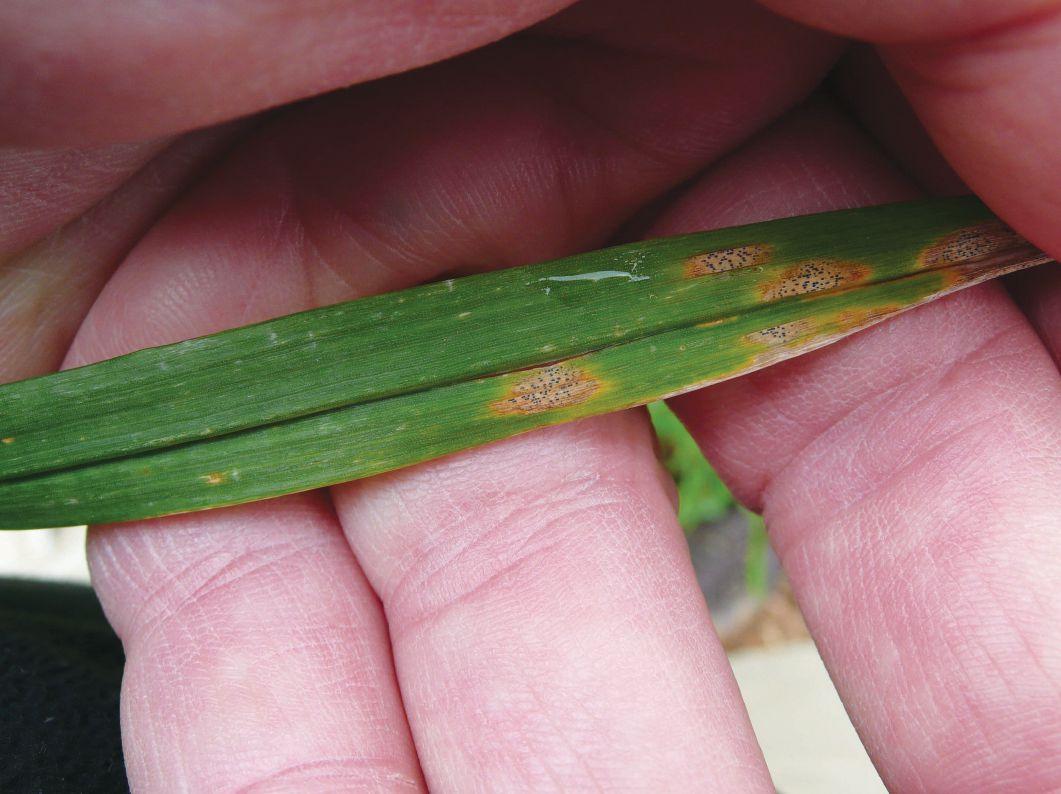
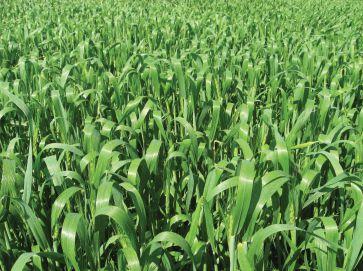
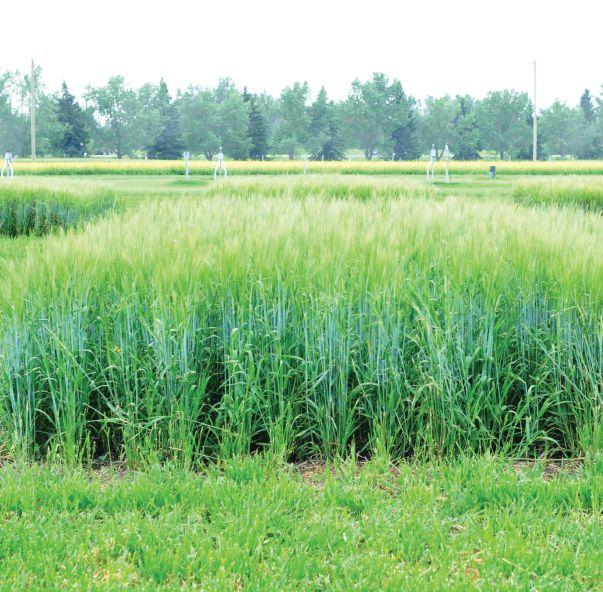
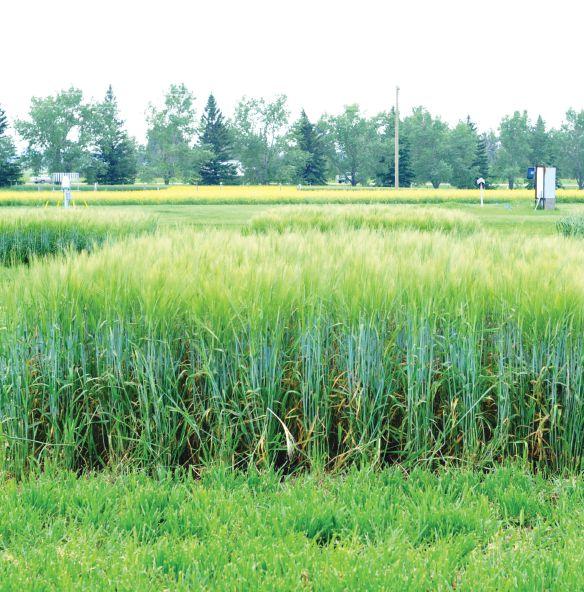
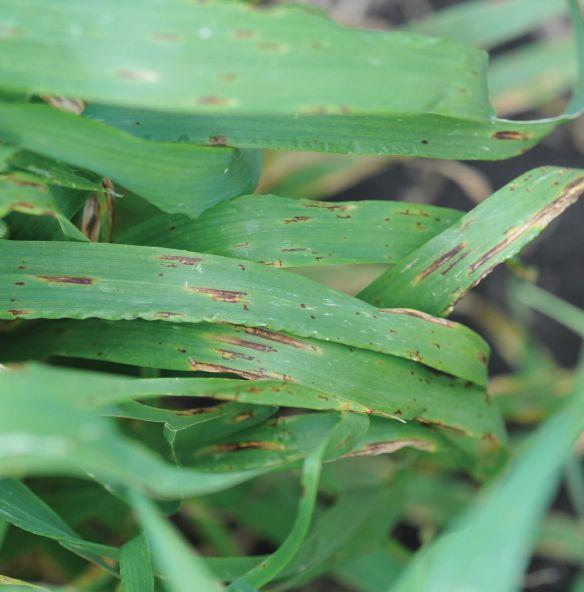
TOP: Crop residues infested with leaf spot diseases, such as septoria, continually release spores so they continue to threaten leaf tissue that emerges after a herbicide timing application. INSET: Kutcher and Harding want to determine if spraying a fungicide at head emergence to control Fusarium head blight would also provide reasonable control of leaf spot diseases.
fungicide timing options in more detail, including split applications. “growers were interested in applying a half-rate fungicide with their herbicide, and then if they needed an additional application, they could apply it at flag leaf emergence at either a half rate or a full rate,” notes Turkington.
The trial involved combinations of the herbicides axial + Frontline (with the active ingredients pinoxaden and florasulam) and the fungicide Tilt (propiconazole) applied to malting barley at the two- to three-leaf stage, five- to six-leaf stage, or the flag leaf stage. In 2010, the trials were at Lacombe in alberta, and at Melfort and Scott in Saskatchewan. In 2011 and 2012, the researchers added sites at Lethbridge, alta., Brandon, Man. and Indian Head, Sask.
The results confirmed the effectiveness of flag leaf timing. “We found that if you are going to use a fungicide and you want to get the most out of it in terms of leaf disease management in barley, then target your upper canopy leaves. You want to directly protect those leaves that contribute most to grain filling and yield,” notes Turkington.
He adds, “The split application did not perform any better than a single application at flag leaf emergence.” This was consistent with some earlier work in 1999 and 2000 that they did with split applications using half rates at Lacombe and Beaverlodge, alta., and Melfort.
Turkington is currently leading a small trial at Lacombe for a preliminary look at the same timing question, but this time in wheat. “It’s sort of a companion trial to our barley trial. We’re just gathering the second year of data, and we’re seeing somewhat similar results,” he says.
So, the upper canopy leaves in cereals are the most important leaves to protect from disease because the sugars and starches produced by these leaves make a big contribution to grain fill and yield. In wheat, the key leaves are the flag leaf and the penultimate leaf. In barley, the top three leaves are important, especially the penultimate leaf and the third leaf; the flag leaves in some varieties are quite small, so they are not always as crucial.
But why doesn’t applying a foliar fungicide at the seedling stage
help protect later leaves? The main reason is that these fungicides primarily tackle a pathogen when spores are actively germinating on the leaf surface, so they are best at protecting those leaves that have unfurled just before spray time. These fungicides have a tough time eradicating the pathogen from within lesions that are more than about a week old. and these fungicides don’t move backwards from the leaf into the rest of the plant.
“Unlike some herbicides, none of these fungicides move backwards, down to the base of the leaf and into the plant itself and the growing point. So they will not provide protection for any new tissue that emerges after the fungicide application,” explains Turkington. “all of the fungicides we deal with are xylem mobile. So, if they are systemic fungicides, they move via the water transpiration stream up from the base of the leaf to its tip, not backwards into the plant. also, the extent of movement depends on the fungicide as some products, although systemic, are only locally systemic, meaning they have limited movement once they have penetrated the plant surface.”
In addition, these fungicides typically are active for only two to four weeks, depending on the product. as a result, if you apply the fungicide at herbicide timing, there won’t be much activity left by the flag leaf stage. Finally, for leaf spots like net blotch, scald, tan spot and septoria, infested crop residues continually produce spores, so they continue to threaten any leaf tissue that emerges after a herbicide timing application.
Since a foliar fungicide at herbicide timing doesn’t provide much benefit, Turkington is leading two trials in barley to see if fungicide seed treatments might be a good option for managing early leaf disease.
These trials build on some preliminary work he and his colleagues conducted in the 1990s. That earlier project found a reduction in leaf disease at the two- to four-leaf stage from using a fungicide seed treatment. So it is possible that a seed treatment would not only benefit seed and seedling health, but also provide
some leaf disease suppression early in the season.
“The seed treatments are all xylem mobile, so when they are absorbed by the seed tissue and plant tissue, they are not moved down into the root tissue; instead they are moved up with the water transpiration stream,” says Turkington. “as the young leaf tissue emerges from the soil, the seed treatment fungicide is drawn up into that tissue with the water transpiration stream, providing some disease protection there.”
These trials are evaluating a range of fungicide timing options: a check (no fungicides); a seed treatment alone; a flag leaf emergence application alone; a head emergence application alone; and then various combinations of those three.
FHB timing or leaf spot timing or both?
Head emergence timing is recommended for fungicide applications to manage Fusarium head blight (FHB). But when should you apply a fungicide if your field has both FHB and leaf disease?
“With Fusarium head blight becoming an issue, many growers are asking: ‘Do I really need to spray at flag leaf time and then again seven to 10 days later when the head has emerged? or can I get reasonably effective leaf spot control if I delay spraying until Fusarium head blight timing?’ ” says Dr. randy Kutcher, a cereal pathologist at the University of Saskatchewan.
To answer this question, Kutcher and Dr. Michael Harding, a plant pathologist with aarD, are leading a fungicide study in wheat in collaboration with their colleagues at various research centres. The study, which started in 2013, has sites at Saskatoon, Melfort and Indian Head in Saskatchewan, and at Brooks, Lethbridge and Lacombe in alberta.
The researchers are comparing three fungicides: Folicur (tebuconazole), prosaro (prothioconazole and tebuconazole), and optimum, a biological fungicide that uses the bacterium Bacillus subtilis. They are applying these products singly, and applying optimum in tank mixes with the two other products.
The researchers are measuring the level of control of FHB and leaf spot diseases like tan spot and the septoria complex under the
different treatments. They hope to develop recommendations for wheat fields with both FHB and leaf spot diseases.
Don’t forget your other tools
Fungicides are valuable tools, and proper timing is important for getting the most benefit from your fungicide applications. But Kutcher reminds growers to also consider other tools as part of an integrated approach to disease management.
Both Kutcher and Turkington point out that fungicide has become a more important tool for cereal producers on the prairies in recent years. one reason is that many producers are using very short rotations, such as canola-wheat. “Usually to see a benefit from crop rotation for cereal leaf disease management, you have to leave two full years between cereal crops, so wheat-canola-peas-wheat, for example. If you have only a single year of a non-host crop, such as canola, you’re not going to see that benefit,” says Turkington.
He also notes that many cereal varieties don’t have a complete package of resistance to the diseases of concern. “In malt barley, for instance, some varieties don’t have much resistance at all to the leaf diseases, while some of the newer varieties might be good for net-form net blotch or spot-form net blotch but not both, and certainly not for scald. If we had a complete suite of resistance genes in the plant targeting all the issues that might attack it, then we might be able to rely more on disease resistance.
“So we’re not using rotation, and our varieties in some cases are not resistant to the diseases of concern. So then we look at other strategies, and that’s where fungicides come into play.”
Wet weather in parts of the prairies in recent years has also played a role in increasing fungicide use. “With the weather we’ve been having in the last four or five years on the prairies, growers have had some pretty good returns on fungicide application. But the diseases in general are really weather-dependent. If we get a drier late June and early July, the growers may see less return on fungicides,” notes Kutcher.
He emphasizes, “Fungicides are just one tool. other tools, such as resistant varieties, crop and varietal rotation, and knowledge of the pathogen, can be as effective.”
i S T hi S a r E al T hr E aT ?
by Donna Fleury
Fungicide resistance in Western Canada in cereal crops has not been identified as a problem so far; however, growers and industry should use best management practices and planning to keep it that way. The trend towards shorter crop rotations and a dramatic increase in the use of foliar fungicides for disease management in cereal crops over the past few years warrants caution.
“Fungicide resistance is not a problem in Western Canada at the moment,” says Dr. andy Tekauz, plant pathologist in Winnipeg, Man. “I don’t believe there are reports of any foliar fungicides or seed treatments currently being used in cereals here in the west that have shown reduced efficacy as a result of the pathogen showing resistance. However, these things do happen with other crops and in other situations, particularly when using a greater number of fungicide applications every growing season, and it could happen with cereals down the road.”
For example, with crops like potatoes and a disease called late blight, growers can make up to 10 fungicide applications during a growing season. This is a situation where growers have to manage resistance and not use the same product time after time, plus use best practices the same way as they manage for herbicides. In comparison, most cereal growers typically use a single foliar fungicide application during the growing season. occasionally two applications of a foliar fungicide may be used – an earlier application to cover off some of the leaf diseases, and a later application to cover off Fusarium at heading time. Tekauz adds that is one of the reasons there really hasn’t been a problem here with cereals and is likely not to be in the near future.
However, in the last couple of years, the level of fungicide use in Canada against Fusarium head blight (FHB) and other diseases in cereal crops, particularly in wheat, has increased quite dramatically. “according to Statistics Canada census data from 1996, 2001 and 2006, the frequency of fungicide application has really gone up in the last few years,” says Dr. Bruce gossen, research scientist with agriculture and agri-Food Canada (aaFC) in Saskatoon, Sask. “Instead of one field in 10 in 1996 receiving a fungicide application, now it is closer to eight or nine fields out of 10 receiving at least one foliar fungicide application every year. That’s a significant increase in fungicide use.”
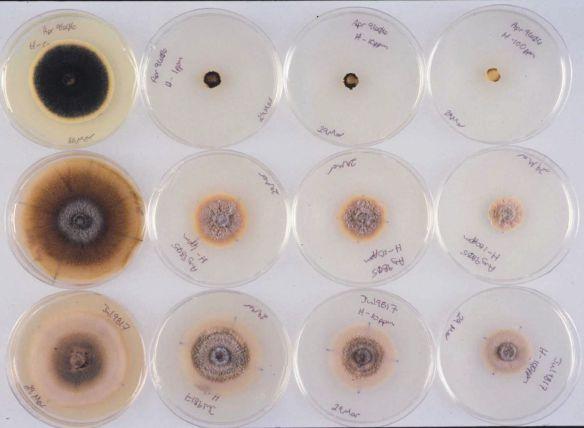
The response of an insensitive isolate (bottom) compared with a sensitive isolate (top) and an unusual isolate (middle) after two weeks of growth on media + fungicide. The concentration of fungicide’s active ingredient increases from left to right: 0, 1, 10 and 100 parts per million. The pathogen used in this illustration is Ascochyta rabiei, which causes ascochyta blight on chickpea.
Tekauz adds that fungicide use in Manitoba reflects that data, with about 25 per cent of crops being treated with foliar fungicides in the past, whereas today it is closer to 90 to 95 per cent of wheat crops being treated with foliar fungicides. “That means growers should take a cautionary approach to using fungicides and use best practices,” he notes.
one reason for caution is there is always the potential for problems with diseases like FHB where conditions may push the pathogen to select for insensitivity. “Those insensitive isolates are already there at a very low level, so using the same fungicides time after time may select for insensitive isolates, and they can quickly build up in a population,” explains gossen. “This is especially a challenge where there are a limited number of effective fungicides for the particular pathogen.”

As the only Group 27 and the first new mode of action in cereals for over 25 years, powerful, one of a kind Infinity® herbicide controls the toughest broadleaf weeds from across the Canadian prairies, even if they are resistant to other herbicide classes.
Infinity – truly in a class of its own.
For more information, please visit BayerCropScience.ca/Infinity
FHB has a sexual stage, where a lot of re-combinations are occurring and new genotypes are being developed. It also has an airborne phase, so once insensitive isolates are in one field, they can quickly spread to many fields close by. Because it is polycyclic, FHB builds up quickly on susceptible plants under good conditions and many generations can occur during the year. although g ossen doesn’t expect to see fungicide insensitivity in cereals in the near future, there are examples of crops in Western Canada where problems were identified and, fortunately, timely solutions were put in place. He explains that a few years ago a fungicide was introduced to control a disease problem in chickpeas. It worked really well, growers liked it, it was easy to apply and had high efficacy. However, the type of chemistry had a risk where pathogens could develop insensitivity with a simple change, and within five years everything was insensitive to that pathogen, not just in Saskatchewan, but also in alberta, north Dakota and across the production area. Fortu -
nately the problem was caught in time, the life science industry quickly changed their recommendations and growers moved to a different chemistry, averting a disaster for chickpea growers.
“although w e don’t expect to see that happen in cereals, that example emphasizes the importance of rotating fungicides and making sure agronomic practices are not pushing the pathogen to select for this insensitivity,” says g ossen. “With FHB, for example, using a combination of FHB resistant varieties and foliar fungicides when needed is likely to be more effective as a strategy, to drive the entire population of the pathogen down. Lower pathogen populations means fewer individuals that might carry the specific mutation that allows for insensitivity.”
Similar to herbicide management, good stewardship of fungicides means planning ahead and implementing best practices. “Varietal selection is important, and there are wheat and barley varieties available with Mr resistance ratings to FHB, for example,” says Tekauz. “We always stress variety selection even though it’s not
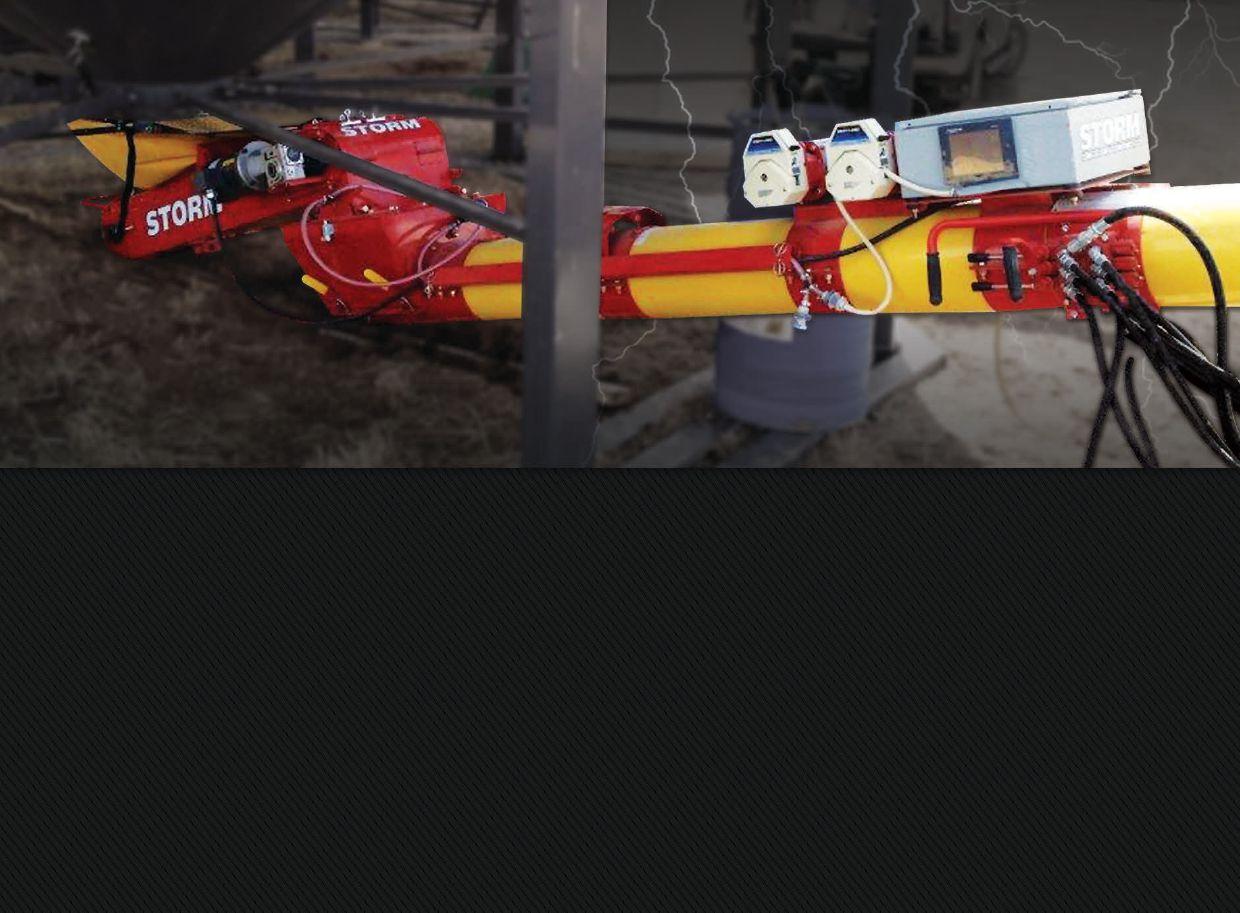
TAKE THE GUESSWORK
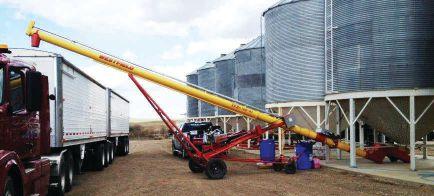
Take control of seed treatment. Revolutionary in design, the STORM seed treater and integrated auger unit allows you to finally treat your seed with absolute accuracy.
Electronic controls provide a simple interface with touch screen input and pre-programmed recipes. The metering conveyor accurately measures seed flow and automatically adjusts the peristaltic pumps to match treatment flow for optimal coverage.
This reduces waste and ensures consistent coating from the first seed to the last. The STORM is suitable for a wide variety of seed types including wheat, barley, oats, peas and lentils.
See your local Westfield or Wheatheart dealer to book the STORM today! Limited quantities available.

always easy as a number of diseases that producers are faced with don’t have a top level of resistance to everything. But if FHB is the top concern in a region in the prairies, then choosing a variety of wheat or barley that has a resistance rating of Mr is a recommended strategy.”
g ossen says using good quality seed that is disease free, thereby improving emergence and plant stands, is a good practice as well. “Make sure to have a cropping rotation that is sustainable for your farm,” he adds. “Crop rotations mean different things to different farms and geographic areas, but too short of rotations can add risk to the system. For example, make sure if you or a neighbour had a big FHB disease problem that carried over in the trash, then don’t plant a highly susceptible crop of that same cultivar and same crop species right beside it next year.”
The use of chemistry, and where available a forecasting system, is also part of a good management strategy, notes Tekauz. “Fungi-
cide use, especially foliar, can certainly benefit from disease forecasting models if available, such as for FHB in Manitoba. rotating fungicides where possible is also recommended; however, for cereals, in most instances although farmers may be using different products, the fungicides from the various companies mostly have the same mode of action, with the two main groups being either group 3 or group 11.”
FHB is only one of the many disease issues growers deal with. Thinking of fungicide rotation the same way as herbicide rotation may be more work, but it reduces the chances of a potentially bigger problem to deal with later.
“g ood stewardship of fungicides means using best practices and good agronomics to reduce the risk of developing resistance problems in cropping systems,” says g ossen. “I always encourage growers that forward planning during the winter can save them a lot of headache later. about 95 per cent of disease management should occur before the crop goes in the ground.”
There’s no stronger tie than the family who works together on the same land. For them, farming’s a tradition.
And although each new generation has their own ideas, there are some things they will be reluctant to change, the things that have consistently performed for them, the things that aren’t broken.
InVigor® – proud to be part of your family farm for over 17 years.
What to expect with increased disease resistant varieties.
by Donna Fleury
Fusarium head blight (FHB), considered the number 1 problem facing Canadian wheat producers, poses a serious risk to an estimated $5.4-billion export market. The impact of the disease is far reaching: it causes poor quality and reduced yields in the field, while mycotoxins that accumulate in the grain make it unfit for consumption by humans and animals, impacting the sale and export of quality grain.
Disease-resistant varieties are key to an integrated strategy for addressing this FHB problem. researchers are using genomics tools such as genetic markers and plant breeding techniques to advance FHB-resistant wheat varieties. Upstream from the plant breeding efforts is research on specific genes and molecular mechanisms of disease resistance that will assist with the resistance breeding efforts.
researchers at agriculture and agri-Food Canada (aaFC) are using modern genomics tools and molecular studies to try to understand the genes in wheat that are associated with FHB resistance, the FHB pathogen and mycotoxins such as deoxynivalenol
(Don). “The wheat genome is very complex and FHB is a much more complicated disease than any other disease the scientific community has done molecular work with in the past 20 years,” explains Dr. Thérèse ouellet, research scientist with aaFC in ottawa. “We have had to collect a lot more information than in other systems just to get to this stage of our research.”
ouellet and her collaborators are trying to identify genetic markers that are directly associated with resistance or that “express” resistance. genetic markers are indicators pointing to specific parts of the genetic make-up of FHB-resistant varieties that
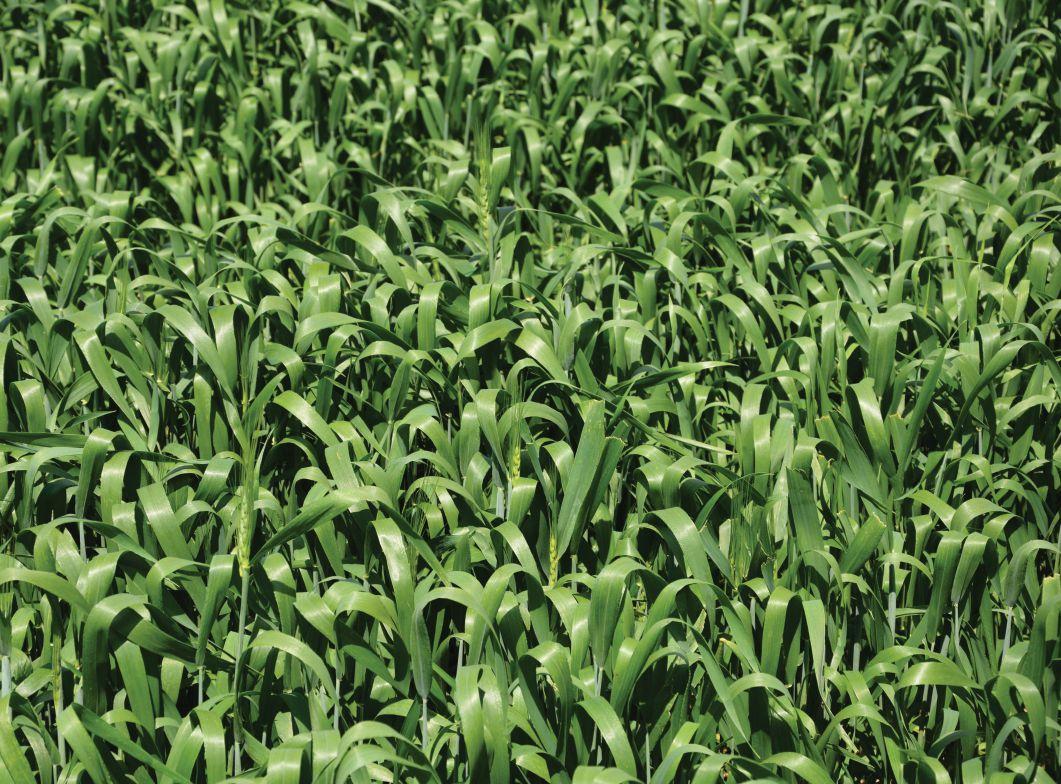
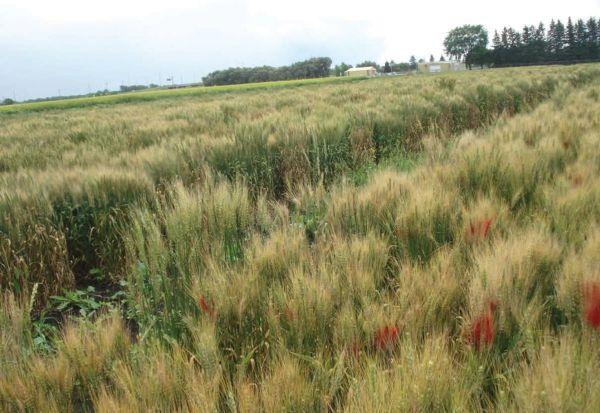
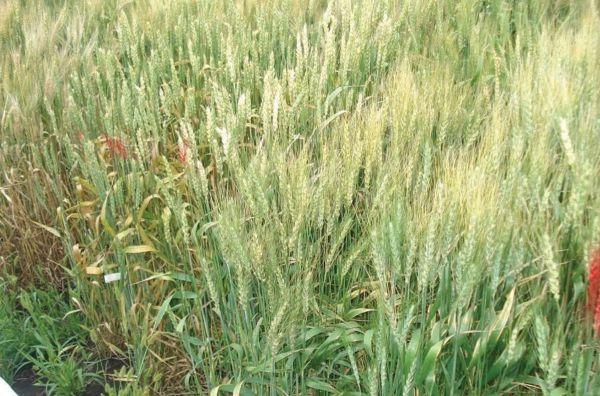
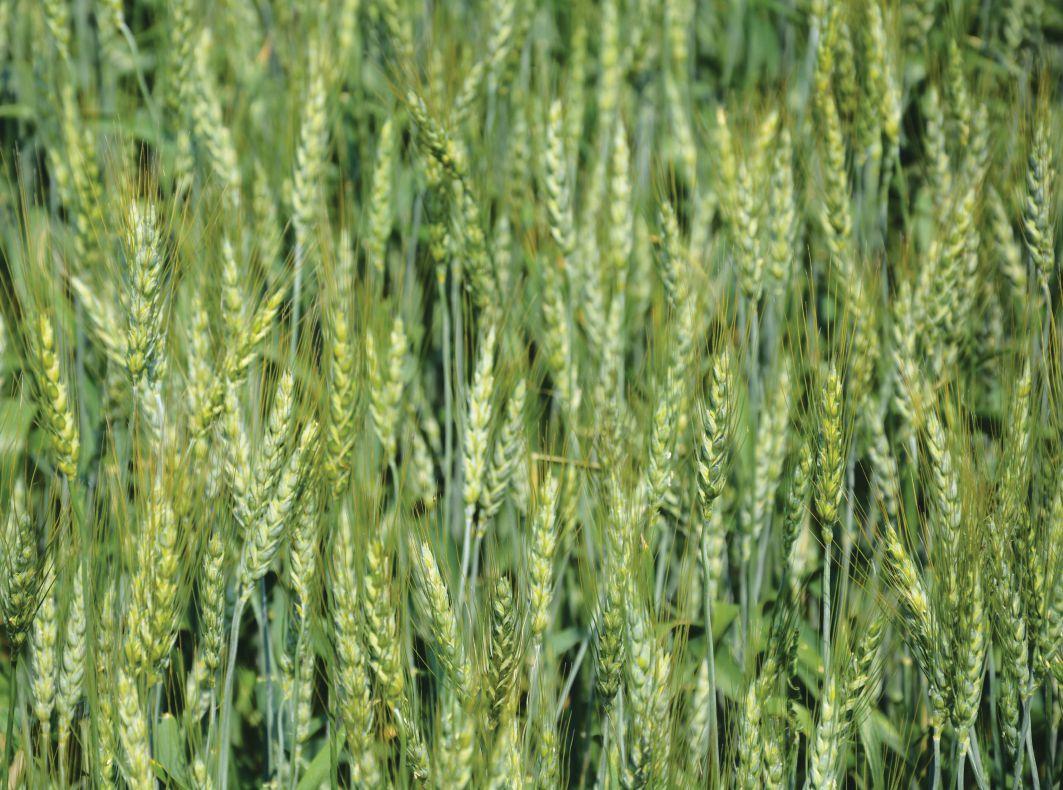
TOP: Disease-resistant varieties are key to an integrated strategy for addressing the Fusarium head blight problem.
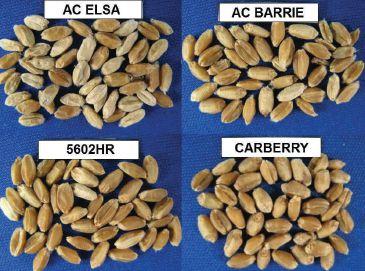
INSET: Plant breeding has resulted in improvements in FHB resistance in cultivars, and researchers emphasize the importance of FHB nurseries for screening genetics. Top left – AC Elsa: Poor FHB resistance, high fusarium damaged kernels (FDK). Top right – AC Barrie: Fair FHB resistance, few FDK. Bottom left – 5602HR: Good FHB resistance, few FDK. Bottom right – Carberry: Good FHB resistance, low FDK.
enable them to fight off the disease. “We are sifting through the large number of potential genetic markers that we have identified to determine which are the most specific, and to describe among the corresponding genes which are associated with either FHB resistance or FHB susceptibility,” she says. “Until recently, we were mostly focused on finding the genes that provide resistance to FHB, but we realized that there are important genes with a lot of activity in plants that make them more susceptible. Therefore, we need to also focus on eliminating the genes that make the plant more susceptible to FHB at the same time as adding genes that make the plant more resistant.”
She adds another challenge is that the pathogen seems to be much more cunning than other ones. For example, some pathogens seem to have one strategy, while Fusarium appears to have several strategies. When researchers find a way to stop one strategy in wheat, they quickly realize that the pathogen has another way to fight back. The genomics and plant breeding efforts are working together to overcome these challenges.
“We are just on the edge of this research that is helping us understand which combination of elements in the plant provides the best resistance,” explains ouellet. “We recently received some new funding that will help us take the advancements we have developed so far and determine which markers will really make a difference and drop off the ones that don’t have a good enough correlation with resistance for FHB. We will also be identifying existing wheat genotypes in the breeding program that already carry the subset of the important genes to help speed up the process. We continue to bring these genomic advances and information to plant breeders to help with their FHB resistance breeding programs.”
Wheat breeders are using the genomics advances along with selected breeding strategies to try to get a high level of FHB resistance into existing good wheat breeding backgrounds. “our goal is to combine durable FHB resistance with all of the important production traits in a package that a farmer will want to grow,” says Dr. richard Cuthbert, wheat breeder with aaFC in Swift Current, Sask. “We are trying to combine FHB resistance with improved agronomics, quality, disease resistance and end-use quality traits to develop high yielding commercial cultivars.”
Cuthbert explains that his team also spends a lot of time in germplasm development. as part of a multiple pest resistance project, their team uses a combination of cutting edge technologies and applied traditional approaches to develop germplasm containing many resistance genes in adapted genetic backgrounds.
“FHB resistance is complex and very polygenic, meaning there are many genes involved. We are using genetic markers with phenotypic selection in disease nurseries to select the best lines for resistance,” he notes. “Markers can increase the odds of selecting the best lines and could help with selecting combinations to prevent mycotoxins such as Don However, markers alone aren’t the answer and phenotypic selection alone is a slow process; therefore, a combination of these tools is the best strategy. although it may not save time to market, it will improve the efficiency and predictability of the disease nursery, which ultimately improves our chances to find lines to become cultivars for farmers.”
aaFC has released some FHB-resistant varieties using more conventional approaches, including aC Cardale and aC Carberry, which are hard red spring wheat varieties with moderate resistance
(Mr) to FHB. More recently aaFC released a CpS red variety, HY 1615, which is the first spring wheat registered with an r rating for FHB. However, Cuthbert notes, there still needs to be some work to improve the production value for growers, as the variety is taller and has weaker straw.
“getting everything together is a challenge,” adds Cuthbert. “We are continuing to do a lot of research to improve FHB resistance in durum wheat for example, but so far we haven’t succeeded. Durum is a tetraploid with one less genome compared to a hexaploid of bread wheat. We still don’t know why we can’t get the resistance to express in durum like we can in bread wheat.”
Cuthbert emphasizes that for growers, the combination of FHB-resistant varieties, fungicides and best management practices is the key. “although fungicides can play a role in managing FHB, alone they won’t work without a good level of genetic resistance in the background,” he says. “ever ything has to go together. as plant breeders, we have to use both new tools like markers and old technologies for field screening to get to the stage of resistant cultivars that farmers want to grow. We expect to see more FHB-resistant varieties available in the near future.”

Varro™ herbicide for wheat.
Freedom from Group 1 herbicide resistance.
Freedom to select your preferred broadleaf partner. Freedom to re-crop back to sensitive crops like lentils.
Alternative non-chemical weed control strategies making a difference.
by Donna Fleury
In australia, the development of multiple herbicide resistance in some of the most serious annual weeds has been the catalyst for the development of new agronomic practices. researchers and industry have developed new non-chemical weed control techniques focused on weed seed capture and destruction during commercial grain crop harvest.
“Herbicide resistance in problematic weeds is extensive across the australian crop production zone,” explains Dr. Michael Walsh, research associate professor at the University of Western australia, in Crawley, Western australia. “It is particularly severe across the western australian wheat production region (10 million hectares) where 98 per cent of annual ryegrass populations are resistant to at least one mode of action herbicide.” The majority of populations are now multi-resistant (i.e., have multiple resistance mechanisms), with the resistance problem consistently severe across all cropping systems and crop types.
The biggest problem weeds infesting australian cropping fields are annual ryegrass, wild radish, wild oats and brome grass. Walsh explains that these annual species all have high genetic diversity, boast prolific seed production, can establish high population densities and have relatively short-lived seed banks. They also retain a significant portion of their seeds at maturity, meaning that many seeds remain attached to the upright plant and are collected during the grain crop harvest. Walsh and his colleagues have developed alternative weed control strategies or harvest weed seed control (HWSC) systems used during commercial grain harvest operations to minimize fresh seed inputs to the seedbank and lower overall weed populations.
“The clear message now emerging from our research is that all
feasible and practical means need to be used to drive weed populations to the lowest possible levels in crop production fields,” explains Walsh. “Very low weed populations are not just about avoiding or managing herbicide resistance, but more about improved crop production systems. When weeds are not dictating the cropping practices, the production system becomes much more flexible and profitable. More specifically though, we have learned that adding HWSC at the end of the growing season to target weed seeds perfectly complements herbicide-based weed control programs to deliver very low crop-weed densities.”
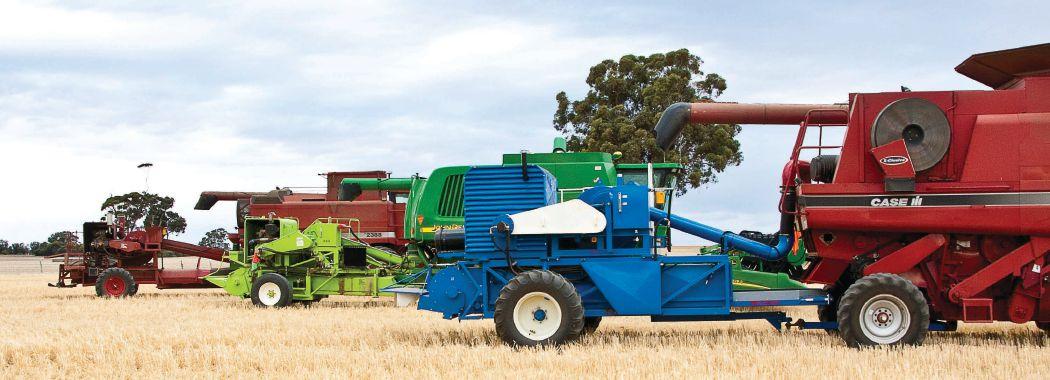
Walsh and his team have developed and tested HWSC systems in australia including narrow-windrow burning, chaff carts, bale direct and the Harrington Seed Destructor. These HWSC systems target the weed seed bearing chaff material during commercial grain harvest. The research program, part of the australian Herbicide resistance Initiative (aHrI), also provides growers with best practices for adopting and implementing these systems (http:// www.ahri.uwa.edu.au).
narrow-windrow burning is currently the most widely adopted HWSC system in australia and is used by about 70 per cent of crop producers in Western australia. This simple, effective and inexpensive system uses a grain harvester mounted chute to concentrate all of the chaff and straw residues into a narrow-windrow (500 to 600 millimetres, or 20 to 24 inches). “These narrow windrows are burned after harvest, with weed seed kill levels averaging 70 to 80
ABOVE: Three prototype HSD systems being tested.
per cent and as high as 99 per cent for both annual ryegrass and wild radish in wheat, canola and lupin chaff, and straw residues,” says Walsh. “narrow windrows are ideal because they burn hotter and longer, killing the weed seeds and minimizing the area burned, which keeps residue on the fields to minimize erosion risk.”
Chaff cart systems consist of a chaff collection and transfer mechanism attached to a grain harvester that delivers the weed seed bearing chaff fraction into a bulk collection bin. The collected chaff must be managed properly to prevent returning the weed seeds to the field. The chaff is usually dumped in heaps in a line across fields to be burned or used for livestock feed. a Bale Direct System consists of a large square baler directly attached to the harvester that constructs bales from the chaff and straw residues exiting the grain harvester. although both are efficient systems, the post-harvest management requirement for chaff and the lack of markets for baled materials has currently limited the adoption of these systems.
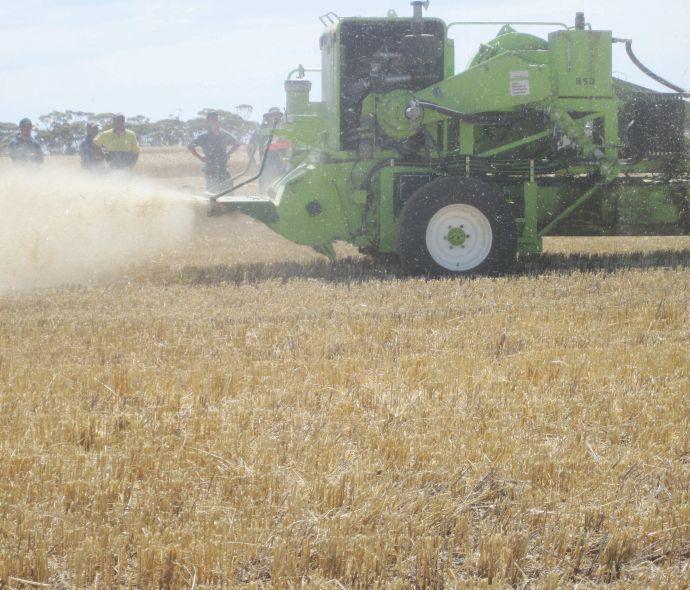
The Harrington Seed Destructor (HSD) was developed in 2007 by an innovative australian crop producer, ray Harrington, as a system to process the weed-seed bearing chaff during the harvest operation. The HSD technology went into commercial production in 2012 and comprises a trailer-mounted cage mill, with chaff and straw transfer systems, and a diesel motor as a power source that is hooked to the rear of the combine. evaluation of this system under commercial harvest conditions by aHrI over a number of seasons determined that HSD destroyed at least 95 per cent of annual weed seeds during harvest. The cost of purchasing an HSD system is approximately $240,000 (aUD).
“ We have established estimated costs for these systems here in australia; however, they may not necessarily be the same in other countries such as Canada because of the differences in cropping systems and production capacities,” explains Walsh. Based on a typical 4,000 ha cropping program in australia, the costs for using HWSC systems per ha are roughly as follows (these numbers do not include the cost of nutrient removal):
• narrow-windrow burning ......................$2/ha
• Chaff cart ..................$6/ha
• Bale Direct ................$18/ha
• HSD ..........................$16/ha
peter newman, an aHrI colleague, evaluated the combined impact of herbicides plus HWSC over 10 consecutive seasons from 2002 to 2012, and found that targeted low weed densities were only achieved in fields where both early-season herbicides and HWSC were routinely practised. The research, conducted on fields where annual ryegrass densities were very high (35 to 50 plants per square metre), compared trials with herbicide treatments alone and trials with both in-crop herbicide treatments and late-season HWSC treatments. The goal was to reduce annual ryegrass populations to less than one plant per square metre. The annual ryegrass populations in the study were not herbicide resistant to the herbicides used in these studies.
as expected, effective herbicide treatments reduced in-crop annual ryegrass populations to less than 10 plants per square metre within five consecutive growing seasons, with populations averaging four plants per square metre for the rest of the study. The combined treatments of early-season herbicides and HWSC reduced annual ryegrass populations from an average of 35 plants per square metre in 2002 to 0.5 plants per square metre in 2011.
“our research results confirm that the
real value of HWSC systems is as part of a system that includes early-season weed control practices on weed seedlings, such as herbicides, and HWSC on late-season mature seed-bearing weeds to lower weed populations and minimize seedbank contributions,” says Walsh. “Low weed densities in cropping systems not only provide flexibility in crop choice, seeding time and herbicide use, they also play a critical role in sustaining herbicide resources for the ongoing control of crop weeds.
“restricting weed population densities to very low levels also reduces the potential for resistance evolution to our remaining highly valued herbicide resources,” he adds. “Herbicide preservation is essential for sustaining future crop production so the addition of HWSC and other control strategies is absolutely necessary in supporting the ongoing efficacy of herbicides.”
Walsh says he believes the HWSC systems have potential as a new non-chemical weed control tool not only in australia, but also in other major crop producing countries with similar crop weed populations, such as Canada, the U.S., Spain, Italy and argentina. “The HWSC system is a tool to help achieve herbicide sustainability, to improve diversity and to help avoid exclusive reliance on herbicides for weed control,” he notes.

Look what the cat dragged in.
Puma® Advance isn’t just tough on wild oats, it’s also the #1 performing herbicide on barnyard grass, green foxtail and yellow foxtail making it the preferred choice of growers who want dependable grassy weed control in their wheat and barley. The advanced formulation offers superior crop safety and an affordable solution that delivers an excellent return on investment.
A natural grassy weed predator, Puma Advance also provides the ability to move between barley and wheat without having to clean out your sprayer. Available in convenient 300 and 1,000 acre BigBoys®.
For more information visit BayerCropScience.ca/PumaAdvance
Instantly save $1.00/ac. on full rate Puma. Ask your retailer for details.
Herbicide-resistant weeds are a “major threat to crop production.”
by Carolyn King
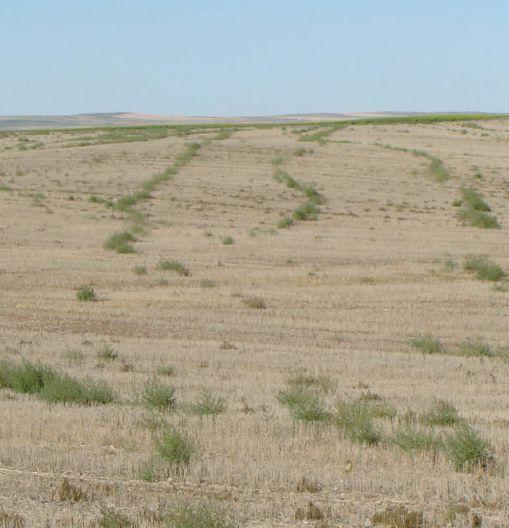
The discovery of glyphosate-resistant kochia is a startling reminder that herbicide resistance is a serious concern on the Canadian prairies and the bordering U.S. states. It also underlines the crucial importance of taking steps to slow the development of resistance.
Kochia is the first glyphosate-resistant weed confirmed on the Canadian prairies. But kochia is not the only prairie weed with herbicide resistance, and glyphosate is not the only herbicide that prairie weed species have overcome. With the increasing spread of herbicide resistance, crop growers could face higher weed control costs and, if they run out of herbicide options, the possibility of yield losses, quality losses and loss of preferred crop options.
“I believe herbicide resistance is a major threat to crop production, not just here but around the world. I think it deserves more attention than it has been getting,” says Dr. Bill Dyer, a professor and researcher specializing in weed physiology at Montana State University (MSU).
In the U.S., the first documented case of glyphosate-resistant kochia was in Kansas in 2007. Since then it has been found in nearby states such as South Dakota in 2009, nebraska in 2011, Montana, north Dakota and Colorado in 2012, and oklahoma in 2013.
“In north Dakota, we had an inkling there were some glyphosate-resistant kochia populations in 2011. But in 2012, after normal spring moisture, the weather turned dry and hot, and kochia just loves those conditions. We expected kochia would increase, but it exploded,” explains Dr. rich Zollinger, a professor and extension specialist in weed control at north Dakota State University (nDSU).
“So in the fall, Dr. Kirk Howatt, a weed scientist at nDSU, asked people across the state to collect kochia seed in fields and field borders, and send the samples to him. He germinated the seeds in the lab and tested the plants for resistance to glyphosate. More than half were resistant.”
on the Canadian prairies, the first cases were found in 2011. “The three original cases were discovered in chemfallow fields in southern alberta in 2011. By 2012, we had about 50 cases documented in southern alberta, all the way from the foothills to the Saskatchewan border, and in west central and southwestern Saskatchewan,” says Dr. Hugh Beckie, a research scientist at agriculture and agri-Food Canada (aaFC) who specializes in herbicide-resistant plants.
In the fall of 2013 Beckie led surveys for glyphosate-resistant
kochia in Saskatchewan and Manitoba. The collected samples will be tested for resistance in the coming months. “We’ll have to see what the survey results tell us, but I expect that we’ll have considerably more than the 50 documented cases that we officially have,” he notes. even though glyphosate-resistant kochia was first documented in the U.S., that doesn’t necessarily mean the resistance spread from the U.S. to Canada. Beckie is leading some research to determine the genotypes of the various glyphosate-resistant populations to see if individual populations spread from the same source or arose independently.
Kochia has a history of developing resistance to herbicides in various groups. Herbicide groups are based on their mode of action – the way they attack the plant. For example, group 4 herbicides disrupt plant cell growth. This group includes herbicides with various active ingredients, such as dicamba, fluroxypyr, MCpa, 2,4-D
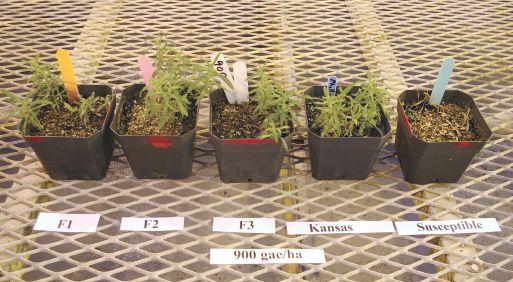
AAFC’s screening for resistance to glyphosate (at 900 g/ha) with kochia samples from the original three Alberta populations (F1, F2, F3), a Kansas glyphosate-resistant kochia population (resistant control), and a susceptible control.
and others. group 9 herbicides block amino acid synthesis. This group contains only one active ingredient, glyphosate, which is in products such as roundup
When you apply a herbicide to control a weed population, you select for those few individual plants within the population that are able to resist the herbicide’s mode of action. Those survivors go on to produce seeds that carry the genetics to resist that mode of action. If you use herbicides with that same mode of action year after year, eventually the only weeds remaining in the field will be ones that are resistant to the mode of action.
“Farmers need to know the herbicide group so they can rotate modes of action,” emphasizes Dyer. “Just knowing the trade name, like roundup, or the active ingredient, like glyphosate, doesn’t help.”
Beckie explains that simply switching to a herbicide that has a different active ingredient but is still in the same herbicide group is at best a short-term option. “Usually the weed can quickly develop resistance to other herbicides within the same group.”
In north Dakota, kochia has developed resistance to several groups. “In the United States, 2,4-D, a group 4 herbicide, was registered in 1945. It was about the only tool farmers had to kill weeds, so everybody used it,” says Zollinger. “over the next 10 to 25 years, we killed all the wimpy 2,4-D-susceptible kochia. So then we had only 2,4-D-resistant kochia. next, within about three years of the release of the group 2 herbicides in the United States [in the mid1980s], we got group 2-resistant kochia.”
In the mid-1990s, Zollinger says they found kochia populations resistant to dicamba, another group 4. “But dicamba-resistant soybean has not [become very widespread], and dicamba will still hurt kochia. We think the hurt from the dicamba and crop competition from wheat have kept that biotype pretty much under control.”
He adds, “When Dr. Howatt tested the 2012 kochia samples for glyphosate resistance, he also tested them with the best kochia herbicide that we know of in small grains. In the United States we call it Starane, and the active ingredient is fluroxypyr. a number of the samples had some level of resistance to fluroxypyr.” (In Canada, fluroxypyr is found in products like attain.)
Similarly in Montana, kochia populations have developed resistance to herbicides in groups 2, 4 and 9. The group 4-resistant types haven’t been as troublesome as the other types, according to Dyer. “That is probably because nobody uses dicamba alone or 2,4D alone. It’s always mixed with another herbicide. So chances are that the other herbicide would still be effective on the kochia.”
on the prairies, group 2-resistant kochia populations started to develop shortly after these herbicides became available, with the first confirmed cases in southern Saskatchewan and southern Manitoba in 1988, and in southern alberta in 1989. “By 2007, our surveys throughout the prairies indicated that about 90 per cent of the kochia populations were group 2-resistant,” says Beckie.
aaFC is also testing glyphosate-resistant kochia samples for resistance to other herbicides. all of the 50 glyphosate-resistant populations are also group 2-resistant, but none are resistant to dicamba. Beckie notes, “Based on previous research, if it is resistant to dicamba, it’s likely also resistant to fluroxypyr and vice versa. But just to make sure, in our next stage screening, we will screen those 50 samples for fluroxypyr resistance, because it is a herbicide that is often used in Western Canada.”
Beckie and his colleagues are also watching for glyphosate resistance in other weeds. “Based on our predictive modelling, we think some other weeds such as wild oats, green foxtail and cleavers, in particular, appear to be at high risk of developing glyphosate resistance. So we’re keeping a close eye on any [suspect weed] populations reported by growers or found in our surveys; those are species that we’re paying particular attention to.”
Beckie says two strong indicators that a weed species might be prone to glyphosate resistance are a history of resistance to other herbicide modes of action and a large population size. Kochia is a good example of a weed with both characteristics.
“a single kochia plant produces at least 20,000 seeds. and if conditions favour the weed, it can produce two, three or even four times that number of seeds. It also spreads its seeds easily – the plants blow as tumbleweeds across fields, dropping their seeds for miles in long, winding trails as they bounce and roll,” explains Zollinger.
Dyer adds, “Kochia is also cross-pollinated, meaning that it is mostly pollinated from another plant [rather than being self-pollinated]. Its pollen lives for longer than most pollen, and it can blow a long way. So it can spread its genes for resistance through pollen and through seed.”
as well, Zollinger notes that kochia loves salty soil and dry conditions. Under such conditions, large populations of the weed can develop whereas most field crops struggle.
Herbicide resistance can have significant economic impacts for farmers. Beckie explains that the impacts will depend on the weed and the cost of the alternative herbicides for controlling that weed. “If that weed population has developed resistance to a number of herbicide modes of action, then you may run into a situation where you don’t have the herbicides available to control it,” he says. “Then the cost gets into yield loss and crop quality losses and so forth.”
Dyer gives an example of such a situation in the Fairfield Bench area of Montana. “almost all of the farmers there grow malt barley every year. It’s irrigated ground so they can crop every year. and there is really nothing else they can grow that has as good an income.” With this cropping system, the growers have very limited herbicide choices, so they’re at high risk of developing resistant weeds.
one of the farmers in this area now has wild oats that are resistant to five different herbicide modes of action. “That farmer
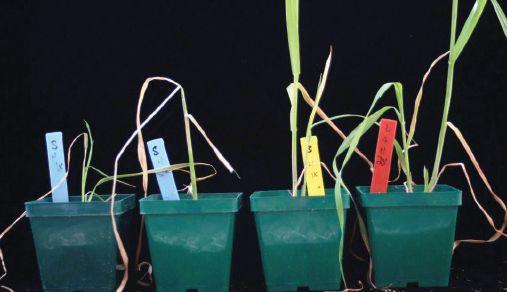
In an area of Montana where most farmers grow continuous malt barley, selection pressures have resulted in wild oat populations resistant to multiple herbicide groups, as shown in these Montana State University tests of multiple herbicideresistant wild oat populations (MHR3 and MHR4) and herbicidesusceptible populations (HS1 and HS2).
had to quit growing malt barley because he cannot kill the wild oats. He put the fields in alfalfa, which is not nearly as high value. Because of [the relatively long] seed dormancy in wild oat, as soon as he takes those fields out of alfalfa and goes back to malt barley, the resistant wild oats will be right back,” says Dyer.
“So resistance can be an extremely serious problem if the weeds are resistant to multiple herbicides and if the farmer is constrained by the kinds of crops he can grow.”
and if you do develop weed populations with multiple resistances, it could be many years before a new mode of resistance comes along to help you kill that weed. “according to the experts, new modes of action will be few and far between. It will certainly not be like it was in the 1960s, 1970s or even the 1980s, because a lot of companies are out of herbicide discovery totally. Those that are still investing in herbicide discovery are having to spend more and more money to find a promising candidate,” says Beckie.
Preventing and managing resistance
according to Zollinger, growers have been spoiled by the low cost of weed control with a glyphosate-based weed control system. “If you have glyphosate-resistant weeds, then it will take two or even three times the money to control that weed than if you were to take some preventive action in the first place,” he notes.
Dyer says the best prevention is to change the selection pressure that is put on weeds every year. That includes key practices like rotating crops and rotating herbicide modes of action.
“Crop rotation is always a good idea for many, many reasons,” he says. “For herbicide resistance, crop rotation allows farmers to use different suites of herbicide action to change the selection pressure year by year. rotating from a grass crop to a broadleaf crop can help a lot because there are very different modes of action that can be used in the other crop. of course we always recommend if it’s possible to not use a herbicide, then don’t use one.”
Beckie advises focusing on good agronomy. “Crop health is the number 1 thing farmers can do. Make sure you have a competitive crop, and try to diversify your crop rotation as much as possible.” along with rotating herbicide groups, Beckie also suggests considering herbicide mixtures with two modes of action.
“Hopefully we’ll have some new tools to manage weeds in the near future; not just herbicides, but other technologies that might
be five or 10 years away that may help growers,” he says. For example, during the next three or four years, Beckie will be investigating technologies for capturing or destroying weed seeds at harvest time to minimize the amount of weed seeds that go into the seed bank.
Dyer says regular scouting is also essential to catch herbicide resistance before it escalates into a major problem. “Usually the population of resistant plants gets up to 20 to 25 per cent of the whole field before the farmer takes notice. Then he will start to realize that the problem isn’t just due to a misapplication or a sprayer skip or a plugged nozzle; that it’s probably resistance. as a result, he has already a lot of resistant weeds before he even notices the problem,” he notes.
Dyer recommends scouting about a week after spraying. “Look for a dead weed next to a living weed. The dead weed tells you the herbicide was put on correctly and it did what it was supposed to do. If a metre away, there’s an uninjured weed by itself, that is a pretty good indication the individual weed is resistant.”
If you find weeds that you suspect might be resistant, you can collect some seeds and send them for testing to see if they are indeed resistant.
Zollinger says if you see a weed you suspect might be resistant, the safest course is to treat it as though it is resistant. “If it is resistant and you don’t do anything about it, then you’re in trouble.”
Zollinger also offers some tips for growers who are dealing with
Crop health is the number 1 thing farmers can do.
– Hugh Beckie
glyphosate-resistant kochia. “our number 1 practice we’re asking our growers to consider is to use a pre-emergence herbicide. There aren’t many labelled in wheat, but many are available for crops like chickpeas, lentils, field peas and soybeans. These herbicides do cost some money, and they do need to be activated by rain, so if you don’t get timely rain, then they don’t work as well. But they are a first line of defence in kochia control.”
He also suggests field perimeter management. “Most of the resistance seems to start on the field perimeter and then travel into the field. If farmers could kill the resistant plants in the field perimeter, then that would take care of a lot of the resistance.” perimeter management options include using a different herbicide or cultivation around the field edges, or planting a strip of corn around the field edges to create a barrier to stop kochia tumbleweeds from rolling across the field.
So, to slow the development of herbicide-resistant weeds – and their serious economic impacts – change the selection pressure on weeds every year. That includes practices like rotating herbicide groups, rotating crops, using herbicide mixtures with two modes of action, and using cultural control measures. and scout after you spray to look for weeds that might be resistant so you can tackle the problem before it explodes.
SEE d T r E aTm E n T
Seed treatments can provide a second mode of action to optimize plant health.
by Donna Fleury
Optimizing plant health and minimizing plant stress increases yield potential and profitability in crop production. For all crops, including cereals, there are two principal stresses that impact plant health: biotic and abiotic.
Dr. Wolfgang Thielert, crop protection scientist with Bayer CropScience Inc. in germany, explains that biotic stresses such as bacteria, fungi, viruses, pests and weeds are significant, but generally there are good crop protection tools, such as fungicides, insecticides and herbicides, available to deal with these stresses. abiotic stresses, such as temperature stress, drought, water logging, soil salinity and other environmental factors can account for up to 70 per cent of the yield gap between record yields and average yield. However, there are limited tools, such as irrigation, to mitigate the impact of these stresses.
“Both abiotic and biotic stresses impact a plant cell’s physiological balance, reducing its ability to efficiently use the resources
necessary for growth and yield development,” says Thielert. “When plants are subject to stress, sensing compounds within the cells signal them to divert valuable energy to prevent or repair stress damage, leaving less energy available for growth and yield production. Stressed plants produce fewer leaves, flowers and grain, which, in turn, leads to considerable losses in crop yields.”
Seed treatments are the first building block to achieve an even germination, high emergence rate and even crop stand, all prerequisites for efficient crop management and securing high yields and quality. “Seed treatments are among the first and foremost of crop protection products that control fungal and insect pests, and help optimize plant health and improve yields,” explains Kelly patzer, cereals development manager, Bayer CropScience Inc., in Calgary, alta. “However, broad spectrum cereal seed treatments like raxil
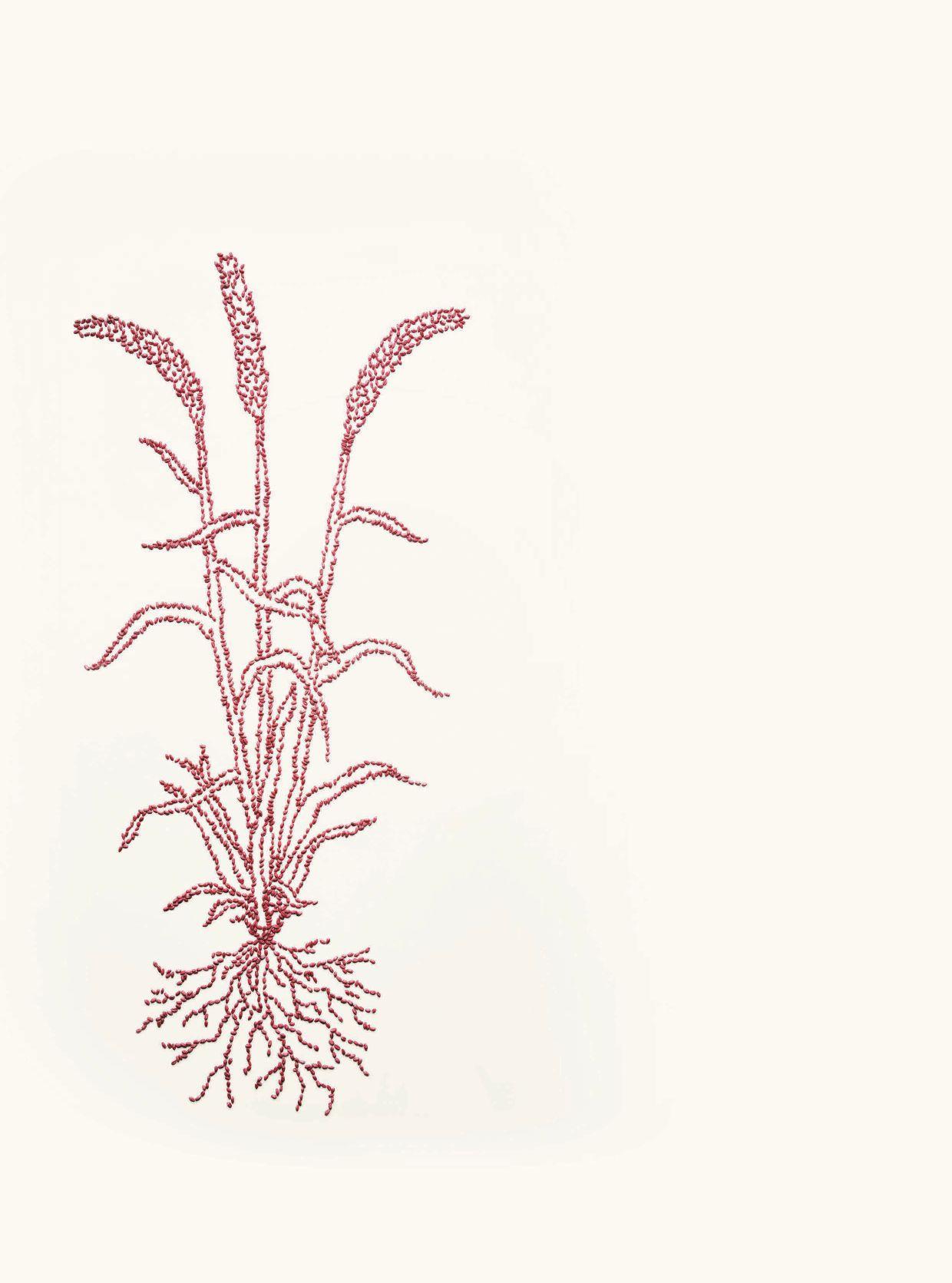
ABOVE: Both abiotic and biotic stresses impact a plant cell’s physiological balance, reducing its ability to efficiently use the resources necessary for growth and yield development.
When it’s the first thing you do in the season it can be difficult to link your seed treatment to the end result, but Raxil® PRO helps connect the dots between that critical first step and your beautiful cereal crop at harvest.
From start to finish, Raxil PRO has three different fungicidal actives, including NEW prothioconazole, for unmatched contact and systemic protection from the most serious seed- and soil-borne diseases, including fusarium graminearum, true loose smut and much more. Raxil – Still the toughest thing in pink.
To learn more about Raxil PRO, visit BayerCropScience.ca/Raxil

Abiotic Losses
Biotic Losses
Abiotic stresses, such as temperature stress, drought, water logging, soil salinity and other environmental factors can account for up to 70 per cent of the yield gap between record yields and average yield.
Source: Buchanan, Gruissem, Jones: Biochemistry and Molecular Biology of Plants American Society of Plant Physiologists, 2000.
WW (which contains Stress Shield) or raxil pro Shield also have a second mode of action that works to mitigate the impact of abiotic and biotic stress on plant cells right from the beginning of crop establishment and therefore increase yield potential.”
This second mode of action works to mitigate the impact of abiotic and biotic stress on plant cells. It does this by triggering certain compounds and pathways in the plant, such as the salicylic acid pathway. “This stimulates activity in what is the closest thing a plant has to an immune system, boosting resistance to viruses, bacteria and fungi in a number of crops,” explains Thielert. “For example, the compound imidacloprid mitigates crop stress by delaying the reduction of photosynthesis and lowering the expression of drought marker genes under stress. This keeps the energy production going and reduces canopy decline under stress. It also triggers the expression of pathogenesis-related (pr) proteins. Imidacloprid triggers the highest and fastest expression of pr proteins among the neonic insecticides.”
Tebuconazole and prothioconazole (the active ingredients in raxil pro and prosaro) also produce plant health effects beyond fungicidal activity alone. In a seed treatment application, these compounds inhibit gibberellic acid synthesis and shorten the subcrown internode in cereals. This improves frost tolerance by lowering the crown in the soil profile, providing greater protection from freezing temperatures. It also increases shoot stem diameter and root length, leading to improved seed vigour, plant stand and nutrient access. Salicylic acid production is increased, which prolongs transpiration and growth under stress and enhances disease resistance through the stimulation of pr protein production. Thielert stresses it is important to realize that plant health compounds do not provide stress immunity but a level of stress tolerance that helps the plant minimize the negative effects during a transient sublethal stress period and recover and resume optimal growth quicker after the stress has been relieved.
Bayer has conducted research with raxil WW and raxil pro both in controlled conditions and in field trials to evaluate this second mode of action. “We have had the ability to conduct evaluations both in the lab and in trials in the field in the absence of pest pressure, and the results show there is still a clear and definable yield benefit,” adds patzer. “relieving abiotic stresses by stimulating the plant’s own built-in defense system mechanism helps growers increase the efficiency of crop production. This means growers are able to get higher yields and quality out of the same resource use (such as fuel and fertilizer), which is a true increase in efficiency. This is a win-win for growers with obvious benefits also for the environment.”
There are similar benefits for plant health from foliar fungicides used for control of leaf and head diseases in cereals. Foliar fungicides such as prosaro provide yield increase benefits outside of the benefits provided by controlling disease. “Using tools and techniques such as nDVI measurements and greenseeker Technology, we have been able to measure the effect of products such as foliar fungicides on crops,” explains patzer. “From our measurements, we have been able to demonstrate increased efficiency of photosynthesis, increased chlorophyll content and increased leaf area in the absence of disease pressure, all resulting in greater yield potential.” patzer adds that seed treatments and fungicides should be used first and foremost for the crop protection benefits they provide. However, when growers select crop protection products, using the particular active ingredients in Stress Shield and raxil pro for example, will provide additional plant health benefits that increase a crop’s yield potential and have a positive influence on the bottom line. “Comparing the benefits of a seed treatment in relation to the potential risk of yield and quality losses without, seed treatments are a ‘must’ for efficient crop management. not only do growers get a yield increase from disease and insect control, but also additional benefits due to the plant health benefit of these materials.”
A revolution in dry bean disease protection, NEW Propulse™ fungicide has exceptional activity on ascochyta and most importantly, white mould.
By combining the proven protection of prothioconazole and NEW fluopyram, Propulse offers groundbreaking disease protection and exceptional yields.
At the heart of plant health is a quality seed treatment. Trilex® EverGol™ seed treatment for pulses provides exceptional disease control and superior crop establishment.
Not only does Trilex EverGol provide exceptional protection from diseases like rhizoctonia and ascochyta, it also promotes overall plant health. The result is a higher performing root system, increased biomass and faster emergence, even when facing minimal disease pressure.
To learn more about Trilex EverGol, visit BayerCropScience.ca/Trilex
The Stress Shield® component of Raxil® PRO Shield provides superior emergence, increased vigour and a healthier plant that’s better able to withstand unforeseen seasonal stresses. This includes things like drought, disease, nutrient loss, frost as well as wireworms.
This NEW formulation combines the power of three different fungicide actives, including NEW prothioconazole, for complete systemic and contact protection from the most serious seed- and soil-borne disease like fusarium graminearum, true loose smut and pythium.
Don’t limit the potential of your crop –use the toughest thing in pink.
To learn more about Raxil PRO Shield, visit BayerCropScience.ca/Raxil