
Serving Installers, Dealers and Integrators Across Canada










Tech Systems (TSI) has achieved the ISO 27001 certification, an international standard that comprises best practices for an information security management system (ISMS).
TSI is a Buford, Ga.-based systems integrator that operates across the U.S. and in Canada via a Toronto location. The company’s president Wayne Smith says he set the company on the path to achieving ISO 27001 a little more than two years ago. The physical security industry as a whole has been trending towards IP-based systems for some time, notes Smith.
“The majority of products that we sell, service, deploy today are all IP centric,” he explains. “We work with a lot of Fortune 500 companies. They have some pretty serious demands on their network security.
“The majority of products that we sell, service, deploy today are all IP centric.” — Wayne Smith,TSI
We felt like, both internally, with all of our IT infrastructure, and all the products that we sell, service, deploy, we needed to have sort of a compliance and process as to how to select those products, how we install them, and how we service them.”
The company earned an ISO 9001 certification — part of a family of ISO standards for quality management — back in 2008. ISO 27001 is a logical progression, says Smith.
The goals are two-fold: maintain an internal organization that adheres to the guidelines set out in
ISO 27001 and improve connections with clients.
The former requires a systematic approach to patching schedules, systems updates, acceptable use polices for technology, as well as training tools. “We do everything from phishing exercises to security tips on how to be more aware of network security pitfalls,” says Smith. And “not just internally… [but for] all our folks out there in the field.”
For client interactions, it’s about managing touchpoints, says Smith. The company maintains its business primarily on installing
physical security equipment, but is placing more emphasis on managed services for security controls, either through remote management or remote monitoring.
Smith says his company has fostered relationships with many IT departments that operate within Fortune 500 companies. He says some companies, particularly financial institutions, are now looking for ISO 27001 as a pre-requisite before working with a contractor.
“Certainly, that’s something that I think you’re going to see much, much more of, even within the physical security space,” says Smith. “ISO 27001 started in the European market. It’s becoming more much prominent in the U.S. We’re seeing it in a lot of documents now.”
— Neil Sutton
Security standards body ONVIF recently announced its first Open Source Spotlight Challenge was won by a Waterloo, Ont., resident.
ONVIF’s challenge is a technology competition that encouraged entrants to provide open source solutions applicable to IP video streaming applications.
The contest, provided in conjunction with BeMyApp, received 37 entries, which were judged based on innovation, viability, functionality and ease of use. The judging committee included representatives from ONVIF members Axis Communications, Bosch, Dahua Technology, Hikvision and Uniview. Cash prizes of up to $3,000 were awarded to seven finalists and judges ultimately select-

ed an app submitted by Liqiao Ying, a developer who works for Waterloo-based Aimetis, a division of Senstar. Ying’s winning app, CAM X, comprises “an AI-based object detection system that utilizes blockchain solutions for storing information obtained from ONVIF cameras,” according to ONVIF.
Ying originally moved to Canada from China to attend the University of Waterloo. He started working for Aimetis as a developer upon graduation and heard about ONVIF’s contest through a co-worker.
“In the last few years, deep learning and blockchain are the hottest technologies. Early this year, I decided to take a deep learning course,” explains Ying.
“When this [contest] came up, I thought, it’s a great opportunity to practice what I’ve learned.”
Hans Busch, chairman of ONVIF’s Technical Committee and a senior engineer with Bosch, says the organization wanted to explore new ways of utilizing the ONVIF standard. That led to the launch of the open source challenge.

“In the beginning, I was a bit skeptical of what the outcome would be, but in the end, we were surprised to get almost 40 submissions in eight different programming languages,” says Busch. “We never dreamed of that.”
ONVIF received entries from all over the world, including India, Russia, Europe and North America.
Making the contest open source (i.e., code or software that is non-proprietary and freely available) was key, says Busch, to encourage the sharing of information across the developer community and avoid the issues that come with proprietary code belonging to an ONVIF member.
“All [submissions] are good ideas, especially the winning application… great ideas,” adds Busch.
Deep learning and blockchain have the potential to be revolutionary technologies for the security industry, says Ying. “I encourage everyone to learn about it. It’s already happening… it’s transforming the industry.”
— Neil Sutton
Bosch is now offering a “Boost Onsite Support” service to North American integrators, a service designed to assist with the commissioning of large, complex installations, according to the company.
The service includes on-site support from a Bosch technical expert, as well as phone and email access to the specialist throughout the project.
The Bosch expert will provide guidance and expertise on the programming of Bosch systems to ensure they meet the end user’s specifications.
The expert will be available to assist with end user training and also advise on aspects such as testing, network functionality, and
interfaces to systems from other manufacturers.
“With this level of onsite support, installations are more efficient and the integrator gains valuable experience that can be applied to future projects,” said Eric Cechak, vice-president of after sales service in North America for Bosch, in a statement.
“Integrators that participated in our initial pilot program of the service have seen the requirement for additional phone-based technical support greatly reduced on projects where Boost Onsite Support was used,” he added.
Bosch also offers an online database of solutions articles called Knowledgebase, as well as tutorials on its YouTube channel.
Research firm IHS Markit recently released its global video surveillance market trends to watch for in 2018 (excerpted below).
1. Driven by the R&D investment, deep learning video analytic algorithms have been developed into fully deployable projects, with user-friendly interfaces and scenario-focused solutions.
2. In 2018, there will be an increase in the wider discussion about privacy and how the video surveillance industry protects the data it gathers. Much of this discussion will stem from the new EU General Data Protection Regulation (GDPR), which will become law in May.
3. China is forecast to account for 46 per cent of global professional video surveillance equipment revenue in 2018.
4. Recent developments in drone detection technology mean that securing a perimeter in 2018 will have to take into account the aerial threat.
5. As the multiple uses and perceived value of video surveillance data increases, we can expect to see increased demands for greater failover, redundancy and backups from end users.
6. We can expect to see increased convergence in post-recording video repositories, where multiple video sources are brought together and investigated using deep-learning video analytics.
7. The Xue Liang program aims to connect all the video surveillance cameras installed in Chinese districts, towns and villages to a central surveillance platform at the county and national levels.

IPConfigure, Orchid Core VMS
IPConfigure’s Orchid Core VMS for AXIS
Camera Application Platform (ACAP) “provides local and remote access to live and recorded video through an intuitive web browser interface, with the same user experience on both workstations and mobile devices. In addition, each Axis Communications network camera and video encoder equipped with an ARTPEC-6 processor can now host Orchid Core VMS’ recording engine, database, video storage and an encrypted web browser interface for live viewing, search and video playback functions.”
uJudges’ Choice Award
Allegion, Von Duprin Remote Undogging and Monitoring Kit
u Access Control Devices & Peripherals
RBH Access Technologies, Blueline
HonourableMention:
FEIG Electronics, Weigand Switch
u Access Control Devices & Peripherals
Wireless
ASSA ABLOY
Yale nexTouch Sectional Mortise Lock
u Access Control Software & Controllers
Brivo, Brivo ACS300 Wireless Access Controller
u Cloud Solutions
Honeywell, MAXPRO Cloud
u Commercial Monitoring Solutions
NETGEAR, FlexPower Camera & FlexPower Base Station
HonourableMention:
Louroe Electronics, Digifact A
u Convergence and Integrated Software and Solutions
ASSA ABLOY, ASSA ABLOY Openings Studio Electrical Elevations
u Cybersecurity
Razberi Technologies, Razberi CameraDefense
u Drones/Robotics
Cobalt Robotics, Cobalt
u Emergency Communication/Mass Notification Systems
Telecor, eVisual Console
HonourableMention:
Pro-Lite Inc., ReAct! by Pro-Lite
u Fire/Life Safety Advanced, DynamixSmoke
u Green/Sustainable Solutions Product
ASSA ABLOY, Ecoflex Electrified Exit Trim
u Intrusion Detection and Prevention Solutions
Axis Communications, AXIS D2050-VE Network
Radar Detector
HonourableMention: Gallagher, Gallagher Class 5 Intruder Alarm System
u Intrusion Detection & Prevention Solutions Wireless Johnson Controls, iotega
u Law Enforcement/Guarding Systems Robotic Assistance Devices, Security Control Observation Tower (SCOT)
u Lock Systems and Secure Storage Containers
BQT Solutions, Electronic Roller Door Lock
u Loss Prevention and Article Surveillance Solutions
Dri Mark Products Inc. , FlashTest Counterfeit Detector
u Mobile Apps Iris ID Systems Inc. , iCAM M4300 Biometric Multimode Android Phone
u Network Support Solutions Microsemi, SyncServer S80
u Outdoor Perimeter Protection NETGEAR, Arlo Security Light
u Personal Protective Equipment Ontech Security S.L., Wardiam Safety
u Residential and Monitoring Solutions Reliance Worldwide Corporation Streamlabs Smart Home Water Monitor
u Tools and Hardware
Axis Communications, AXIS Device Manager
u User Authentication, Identification, Credentialing & Management IDEMIA, MorphoWave Compact by IDEMIA
u Video Analytics IC Realtime, Ella
HonourableMention: Verint, Verint FaceDetect
u Video Surveillance Advanced Imaging Technologies Vumii Imaging Inc., Sii FG
HonourableMention:
Axis Communications
AXIS P1280-E Thermal Network Camera
u Video Surviellance Cameras HD Hanwha Techwin, XNV-6085
u Video Surveillance Cameras IP MOBOTIX AG, M16 Thermal
u Video Surveillance Data Storage Micron Technology Inc., Micron Industrial microSD Card
u Video Surveillance Hardware and Accessories
Paige Datacom Solutions, GameChanger Cable
u Video Surveillance Management Systems March Networks, March Networks 8724 V Tribrid NVR

ABy Colin Bodbyl
AI has automated many tedious tasks — making good use of all that data is the next challenge
rtificial intelligence (AI) and deep learning for video has opened the door to new possibilities where computers can analyze both live and recorded video to produce surprisingly accurate data.
“Manufacturers and developers will need to find ways to make the data actionable and generate a tangible return on investment.”
Information such as colour, quantity, frequency, gender, age, and more can all be collected automatically through AI and reported back to users. Previously, collecting such information would require a person to manually review hours of footage and document each data point.
There are two primary methods developers are using to present and utilize this data. The first is to present the data in a table as a report that outlines information about the people or objects the system observed over a set period of time. Retailers, for example, can use this data to see customer demographics in their store. They can analyze the average age group of their customers, their gender, or the colour clothing they wore.
While this data may be fascinating, it is challenging for users to generate revenue or reduce costs simply by having the data. Retailers still need to take action based on the data. This could mean changing their store layout or adjusting the products they sell. In addition, retailers then need to analyze how
these changes affected their sales and finally they can connect that return on investment back to the data they originally collected from their surveillance system.
It is a long and challenging path for users to take action on this data and prove a return on investment in AI technology. How the data is used is key to proving its value, but without users taking further action the data is essentially useless. This requirement for further action, which users need to solve on their own accord, is a significant barrier to user adoption.
The second application of AI is to use the data as a tool to help users locate specific objects in recorded video using keywords. Most commonly we see this type of technology marketed as a tool
for speeding up the search and video review process. Using AI, users are able to search video footage in a similar manner to how you would search the Internet using Google. A user could search for a white pickup truck travelling westbound and the AI could process the recorded video and show only events that show a white pickup truck travelling westbound. At first glance this may seem extremely useful to many users.
The unfortunate reality is that in the majority of cases where users are searching through video to find an incident, they do not know what the suspect looks like, or the vehicle, or any details on the event for that matter. In addition, the current process of searching through video by simply skimming through motion events is already very efficient.
In rare cases, law enforcement may find themselves searching through hundreds of cameras for a specific object where this would be helpful, but the applications are few and far between.
Artificial intelligence will undoubtedly change our industry in the upcoming years. For this to happen, however, manufacturers and developers will need to find ways to make the data actionable and generate a tangible return on investment for end users. Current solutions are expensive and without a simple method to prove the technology is profitable, users will not adopt it.
Colin Bodbyl is the chief technology officer of Stealth Monitoring (www.stealthmonitoring.com).










2008:
Retailers cash in with IP video: Use for systems now extends beyond surveillance
2009:
Retailers brace for more crime as economy worsens: Hard times tend to bring out more crime, particularly in the retail sector
2009:
Using analytics as a business intelligence tool: Can retailers leverage video analytics beyond loss prevention?
2011::
IMS report: Retailers looking for more than just security from integrators
2012:




Retail and security seem to go hand in hand — the sale of goods requires a keen eye to help prevent theft and thus improve a retailer’s bottom line.
When the general public thinks about security, their first thought might be the guards they see at the mall, or they may notice the preponderance of cameras in almost every retail outlet.
The cameras themselves have shrunk over time, becoming cheaper, more efficient, and more useful. Even the smallest of retailers are able to deploy cutting edge camera tools, thanks to their affordability and the availability of cloud-based services that provide effective stor-
age solutions.
Retail is also surely one of the major benefactors of the rise of video intelligence. Analytics tools have turned the humble camera, ostensibly a security device, into a data-generating machine.
Cameras see all and are thus ideally suited to: count the number of people in a store at any given moment, analyze their traffic patterns, and even determine where and how long they stop at points along their travels (dwell time and hot spots).
Measured against point-of-sale data, the value of this information becomes... priceless.
“It helps with organizing merchandise and changing traffic flow
and with marketing,” noted analyst Katherine Brink of the Freedonia Group in an October 2016 article in SP&T News
The data can also be aggregated over a number of stores, leading to broader operational insights.
“The real trick of this is to be able to take the information you’re seeing from all the different stores every second, every hour and be able to chart it out into a dashboard to see trends over time,” said Dan Cremins of March Networks, in a January 2016 article.
The role of surveillance analytics in retail is hardly new.
Analyst Steve Hunt commented in a June 2008 article that the technology has massive potential.
Using video beyond the security department: IP systems can provide a range of benefits for business operations. Everything from health care to education facilities can benefit from the data that video provides
At the time, however, the hype probably exceeded the reality of what was possible, leading Hunt to conclude that “analytics cannot do that (right now), except in the most primitive means.”
The technology is not yet perfect and requires careful oversight (in 2016, Brink cautioned that “it takes investment to find out how much of [that data] can be useful”), yet it seems to be improving all the time, strengthening that connection between security and retail. The camera in particular has taken on a much larger role, providing not only security data, but operational and marketing functions that have improved their usefulness.
OBy Colin Bodbyl
Remote troubleshooting of CCTV systems may be one of the most overlooked aspects of IP-based equipment
ne of the greatest benefits of using network cameras is the ability to monitor their health and troubleshoot issues remotely.
“Despite the obvious benefits of remote health monitoring and service, many integrators and even manufacturers are not leveraging it fully.”
Cameras or video management systems (VMS) with access to the Internet can alert users any time a camera fails or goes offline. Once a user receives notification of the problem, they can log in remotely and troubleshoot the camera without having to travel to a site. While not all issues can be resolved remotely, the ability for users to troubleshoot cameras remotely drastically reduces the number of times a technician has to conduct a site visit for simple issues.
Despite the obvious benefits of remote health monitoring and service, many integrators and even manufacturers are not leveraging it fully. Most integrators rely on their VMS manufacturer to provide them with health monitoring tools within the software. Typical health alerts include camera failures, storage errors and VMS offline. To most integrators, the built-in health monitoring of the VMS is sufficient, but for largescale health monitoring, these alarms can become overwhelming

without proper controls.
Camera failure alerts are often reported as a nuisance. This is because, like most networks, IP camera networks will occasionally drop connections or suffer from packet loss. This is very common where wireless links are in use and do not always signal a serious issue. To make this service more valuable, VMS manufacturers need to extend the criteria required to send a camera failure alert. For instance, frequency and duration are key indicators of critical issues on a camera network. If a camera connection fails for half a second once a year, this would not warrant a health notification. In other cases, a camera may be losing connections for a fraction of a second every minute, which would signal a serious network issue. Of course, a camera failure that extends beyond a few minutes almost always requires attention. Without frequency and duration thresholds, many
integrators choose not to use the health monitoring features in an effort to avoid unnecessary alerts.
While VMS manufacturers are responsible for providing health alert services for the video system, integrators are responsible for monitoring the health of the video servers and networks on which the VMS operates. One common problem integrators encounter when setting up remote access for clients is port blocking. For end-users to view their cameras remotely, certain ports on the network need to be open. Sometimes these ports are open when the system is first installed, but may be blocked later by an IT department that does not understand their purpose. This would prevent the end user from viewing video remotely, but the VMS would not report any health issues because it does not monitor ports on the network. To monitor problems like this, integrators need to
use third-party software tools.
Health monitoring has changed the way integrators service their customers. It has created a valuable method for remote support and drastically reduced (or eliminated) the costs associated with many service calls. That being said, both VMS manufacturers and system integrators have opportunities to improve and better utilize the technology. Manufacturers who build a comprehensive health monitoring tool in their VMS create a far more positive experience for users. Integrators, on the other hand, benefit from reduced costs, faster service response times, and improved customer satisfaction. With such obvious benefits, health monitoring may become the most overlooked and yet valuable benefit of the network camera.
Colin Bodbyl is the chief technology officer of Stealth Monitoring (www.stealthmonitoring.com).
Consider how lighting and surveillance cameras can work best together to promote security and deter crime.
By Latif Jamani
Beyond the look that lighting adds to a building, it must also serve the greater purpose of adding security to a property. Lighting is the primary deterrent of crime on any property, so when it comes to building an effective security system, it plays a critical role.
During the design and decision-making process for security lighting, there can be a disconnect between selecting the technology (primarily cameras) and adding light to the space. These decisions are made for the same areas:
• entrances and exits
• public spaces
• perimeter areas
• shared spaces
• parking areas
Lighting is the primary deterrent of crime on any property, so when it comes to building an effective security system, it plays a critical role.
These choices can be made concurrently during the planning stages for new construction. However, when updating the security and lighting of an existing building, lighting selection often comes after both camera selection and placement have been established. This results in poor visibility and can lead to issues obtaining useful footage in the event of a crime.
The Illuminating Engineering Society’s (IES) “Guideline for Security Lighting for People, Property, and Public Spaces” recommends a
vertical illuminance of 5-8 lux or lumen/m2, or a luminance ratio of 4:1 for facial recognition, and to be able to read the body language of a person “as either familiar, unfamiliar, or threatening at a distance of at least 9m from the viewer.”
IES also has average recommendations for the illuminance of certain spaces, including the areas highlighted in the graphic on p. 8.1
On the other hand, the selection of security cameras depends on the decision-maker’s budget and preference. Sometimes they choose the highest-quality equipment available, which may have the ability to capture images in low light.
Lower-quality cameras, however, may re-
quire additional lighting to capture clear images. Since cameras cost more and require a higher investment per unit compared to lighting, the choice of camera, number of units and placement must be well-planned to maximize this investment.
While the lighting selection process is usually done with the human experience in mind, time and consideration should also be given to how these decisions impact the surveillance system being installed on the property. The colour, levels and placement of lighting can work against security cameras when the decisions are not made in unison.
For example, a camera that captures images in low light should probably be placed away from brightly lit areas. Motion sensor cameras should be placed near motion sensor lighting to properly secure an area. Cameras that need lighting assistance must have lighting nearby that is sufficient to illuminate the area without producing glare.
CCTV or video surveillance systems do specify their lux ratings. The lux rating indicates the minimum amount of light needed to capture a usable picture, as well as the amount of light required for full video. Cameras can be tested in the areas in which they are going to be installed. Also, the amount of light needed for the camera can be determined with this equation from IES:2
E = π LT 4N2
where
E = Illuminance on the image sensor, lm/m2 (lm/ft2)
L = Luminance of scene (cd/m2) (cd/ft2)
T = Transmittance of lens (usually 0.70 to 0.90)
N = F-number or F-stop of the lens
Illuminance (lux) meters are used to measure luminance, which is the amount of light that will hit the area where a camera is intended to be placed. If the camera being considered is not fixed, it is recommended that the light is measured from all possible directions at which the
camera will be pointing.
This ensures every possible camera angle will be lit well enough to capture the best and most useful image possible.
Another important consideration for selecting light sources for use with security cameras is colour. IES regards the Colour Rendering Index (CRI) as the most important measurement of colour. CRI “measures the degree of colour shift objects undergo when illuminated by a particular light source as compared with the same objects when lighted by a reference source of comparable colour temperature.”3 Light sources with a CRI of 50 or higher (usually white light) are best for accurate colour identification. These include standard incandescents, tungsten halogens, fluorescents and metal halide.
When we are engaged in the lighting design process, and working with the surveillance system that is being put into place, the areas most often addressed are entrances and exits, alleyways, driveways (which are areas that show perimeter access), as well as building enclosure access points (doors, windows, loading docks, parkade doors). The goal is to capture the maximum angle where the light fixture can be placed in a way to project maximum light output for the camera while reducing glare.
A great lighting option for general security — as well as making sure the areas are well-lit for security cameras — are LEDs, which provide a better-quality of light for security purposes as compared to, say, incandescents. The white light from LEDs makes for a better environment for users of the space, and works well for lighting an area where surveillance cameras are installed. LEDs also have a higher lumen output per watt, giving brighter light with lower wattage, saving on electricity consumption. They also have a longer lifespan, saving on maintenance and overall costs.
Since improving the lighting around properties can work to deter crime in general, it may reduce the need for installing additional security cameras in certain areas, helping to reduce costs. Keeping the access points of all buildings well-lit — especially ones in densely populated areas — can help deter criminal activity. Since
breaking into a building can take time, criminals will want to avoid spending too much time in areas of high visibility and, therefore, move on. Good lighting also benefits users of these buildings — such as residents of an apartment building or guests of a hotel — as they will have a better sense of safety and security around the building.
Take, for example, an apartment building with basic exterior lighting. The goal is to improve security as well as increase general feelings of safety around the building. An inexpensive way to do this is to increase the light levels in the areas around the building’s access points (front and rear entrances, parking garages). Check whether the building meets the recommended vertical illuminance of between 5-20 Lux and adjust accordingly.
In common areas inside the building, make sure that the horizontal illuminance is at 30 Lux, and 100 Lux at the common mailbox area. If the building already has surveillance cameras installed in these areas, assess any changes that occurred as a result of the improved lighting before considering adding any more. In most cases, updating the lighting of buildings works to improve security without having to spend more on increasing the number of security cameras.
Having well-lit buildings can also pay dividends for property owners. Whitestone Properties — a company that owns apartment buildings in Edmonton — recently had the exterior lighting of its buildings updated to make them more safe and secure.
“The tenants seem quite happy with the improved appearance at night,” says Whitestone’s James Knull. “There are no creepy, shadowed spots at night anymore, and we have received lots of positive feedback.” Since updating their exterior lighting, they have seen a decrease in illegal dumping and car-related crime. “In the winter, when it gets dark closer to 5 pm, we have had a much easier time with prospective tenants appearing for showings and filling out applications during evening showings.”
Security systems for any property must have elements that work together to be effective. This also empowers security personnel to do their jobs well by giving them a visual of certain areas of the property. By having all the elements of a security system designed to work together, the return on investment will be maximized. Most importantly, the property and its occupants will be kept safe and secure.
Notes
1. “Guideline for Security Lighting for People, Property, and Public Spaces,” Illuminating Engineering Society, p. 7-12.
2. As above, p. 58.
3. As above, p. 16.
Latif Jamani is the president of Calgary Lighting Products (calgarylightingproducts.com), which specializes in commercial solutions,
and


boardroom. products are risks, and make functions for security events. Bosch solutions.

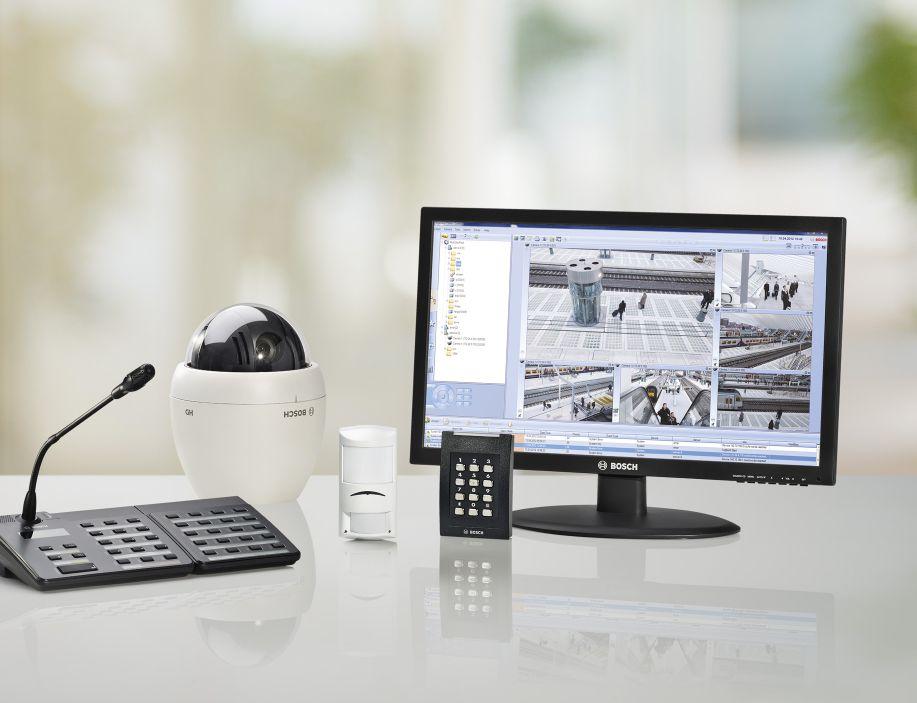
Networking and IT skillsets are taking centre stage as security systems run increasingly complex software
By Ellen Cools

Internet of Things (IoT), big data, video analytics and the cloud are terms security professionals hear constantly these days.
But they’re not just buzzwords. These technologies are making security systems such as cameras and access control much more complex.
As solutions become increasingly complicated, the question arises — are integrators (and vendors) finding qualified installers for today’s systems, and, by extension, what skillsets and qualifications should installers have?
Before that question can be answered, let’s look at how the industry has evolved.
“In the last 10, 20 years…the industry has transformed from analogue to IP cameras,” shares Ken Francis, president of Eagle Eye Networks. “In the analogue world, we used coaxial cable, and when you plugged the camera in, it just worked — there was no programming or networking necessary to get a camera image.
“As we moved into IP and we introduced cameras and recorders and things with software that were all requiring networks, the technicians had to get a lot smarter and more certified,” Francis adds.
“The previous training was strictly limited
“As we moved into IP …the technicians had to get a lot smarter and more certified.”
— Ken Francis, Eagle Eye Networks
to a single device configuration, checkboxes,” says Liliana Andjic, general manager, low voltage services, at Houle, a Vancouver-based systems integrator. (Houle is also a two-time winner of SP&T’s Integrator of the Year award.) “There wasn’t really a level of complexity from the device itself, because…each and every single system was operating in an isolated environment.”
But as the industry has turned toward more connected solutions, often running on the cloud, this is no longer the case.
“We’re looking at the systems, including the camera systems, as part of the total operational delivery,” Andjic explains. “The camera system becomes a part of the bigger ecosystem — that requires software configuration, that requires networking experiences in order to achieve the outcome the end user is looking for.”
This means that installers have to focus not just on the installation, but also on the information that a device transmits to the whole system,
she says.
“You’re talking about information sharing, you’re talking about dashboards, you’re talking about end users having information at the tips of their fingers,” she continues. “So it’s not just…a device sitting on the wall.”
Consequently, the necessary qualifications and skillsets for installers and integrators have changed.
Installers need a greater understanding of the software, networking and routing, Andjic says.
“They don’t have to be Cisco trained but they have to have VMware, which is becoming a big part of the virtualization, becoming a big part of the camera installation,” she elaborates. “So the technicians have to understand how to configure the system, and, sometimes, work the applications [and] create the software applications that the camera will actually do.”
Jim DeStefano, head of security solutions for Siemens Building Technologies, adds, “While we still need installers to know inputs, relays and basic wiring, we now favour more IT backgrounds, a problem-solving mentality when it comes to the more complex projects.”
Consequently, “those that have an extensive IT knowhow and expertise are more in-demand as installers,” he says. Networking skills are high-


ly desirable “because our customers expect us to be the experts.”
As a result, when hiring new technicians, Siemens is particularly interested in those with networking degrees and prior experience.
Additionally, cybersecurity education is key.
“Cybersecurity is a very important step that can’t be overlooked because most of our systems are on our customers’ networks, so we need to stay on top of these,” DeStefano says.
If technicians install a device and set it to its default password, “it creates a huge risk, a security hole in the customer’s network,” Andjic adds. “So it’s very instrumental that any installer has a very basic knowledge of cybersecurity.”
Sam Shalaby, CEO of Feenics, maker of the cloud-based access control solution Keep, agrees: “We need them to be in tune with the latest available technology, i.e., whether it’s software, whether we’re using the cloud, why and how we’re using the cloud, etc. The hardware is changing a bit so they need to be in tune with what changes.”
With regards to access control solutions, “Every controller has a resident IP on board, so it’s changed from the days of RS45 communication to now IP communications. So they need to understand IP communication, the utilities that allow them to address these panels,” says Shalaby. “They don’t need to be full-fledged IT people,
“You’re talking about information sharing, you’re talking about dashboards, you’re talking about end users having information at the tips of their fingers.”
— LilianaAndjic, Houle
but more or less [they need to] understand IP, understand cloud, understand the internet.”
Consequently, certifications are important.
“Installers should have networking skills and certificates that relate to their primary job responsibilities,” DeStefano says.
Certifications such as Cisco Certified Network Associate Routing and Switching (CCNA), Microsoft Certified Solutions Associate (MCSA) and Microsoft Certified Solutions Expert (MCSE) are particularly helpful, he says, along with other BICSI certifications.
Feenics also looks at integrators’ and installers’ certifications when choosing a dealer.
“We like to qualify our integrators to see if they can handle the software that we are selling, because the more qualified they are, the less tax-
ing it would be on us,” Shalaby explains.
But Cisco and Microsoft certifications are not 100 per cent necessary, he argues.
“If you [the integrator] have a Cisco certification, if you have a Microsoft certification, ofcourse it’s a plus,” he explains. “But we also look at how long you’ve been in the business, who are the installers that you have — are they technologists, do you have engineering staff or engineering qualifications on staff?”
Houle, Feenics and Siemens all provide training for their installers.
Andjic says that continuous training is integral to ensuring installers understand the potential vulnerabilities in today’s security systems, as well as networking skills.
“It’s essential that ongoing training is being provided, not only from the manufacturing side, because there’s always critical updates that the manufacturer provides us …but in this complex Internet of Things environment … we have to make sure that we recognize what impact the camera creates on, perhaps, the building automation system,” Andjic explains.
“If they’re sharing several devices sitting on the same network, how to build secure networks, how to re-route a secure network, what sort of information can be stored at the facili-

ty, what sort of information can be transferred off the site [is important to understand],” she continues.
Houle has adopted a layered approach to training, Andjic shares, with entry-level, mid-level and then professional level networking training. The professional service group are Cisco trained and certified.
Likewise, Siemens provides a lot of on-thejob training.
The company provides basic training on topics such as compliance, data privacy and security. New installers also shadow experienced colleagues in similar roles and take online courses that are pre-requisites for classroom courses, DeStefano explains.
“Typical on-the-job training might include basic wiring techniques, reviewing project drawings, basic access control and video terms,” he elaborates. “We also partner with certain equipment manufacturers and have technicians become certified in specific products and competencies.”
But in addition to general IT security training and education, “installers need to share effectively their experience as they encounter new areas of vulnerability. Lessons learned and information sharing need to be institutionalized in the organization through regular workshops with peers,” he says
As a vendor, Feenics also provides training, both online and in classroom settings, on their software.
“We do training on the hardware itself and the utility that we use for the hardware to address the panel and how to address it,” Shalaby elaborates. “And we do a little bit of recap on the network and how it works, and that’s not specifically our network but in general.”
Additionally, Feenics provides cybersecurity education to both vendors and end users.
“If an integrator took our product, we explain what we’re doing and how we’re doing it and what their role is and our role,” he shares. “We really take all the responsibility about cybersecurity ourselves, and we explain it to the integrator so the integrator can explain it to the end user. But we are also available for the end
user to address all cybersecurity skills.”
Eagle Eye Networks also provides web-based and classroom training teaching technicians how to install their products, Francis shares.
However, Francis has a different opinion about the impact of today’s security systems, particularly those that operate via the cloud, on the installer’s role.
“In a cloud system, when you install the appliance or bridge, the bridge phones home to the cloud, like E.T.,” he explains. “And it does it on its own without the technician having to know how to do that. The technician does not have to open any of the customer’s ports and their networks, there’s no cybersecurity vulnerability that’s created through installing the appliance.”
In Eagle Eye Networks’ case, their cloud software identifies cameras and automatically sets them up for the installer, essentially making the camera plug-and-play, Francis says.
“That removes the burden of network skills and network savviness from the technician altogether,” he argues. “The installing company needs to understand networking skills because they have to decide whether or not they’re selling the right product,” he continues. “But the onsite technician does not.”
As a result, the company does not look for heavy certification such as Microsoft or Cisco, he says.
“The quality of the installation for the customer is really about three things. One, everything is done on a schedule. Two is the quality of the craftsmanship of the cable and device being installed. And three is the programming of the system,” Francis says.
Consequently, Eagle Eye Networks looks for program management and cabling skills in installers.
Specifically, the company looks for RCDD (Registered Communications Distribution Designer) certification, which “teaches [installers] how to properly install the cable so that the cable is not damaged, and how to put the ends on the cable so you get the best possible connection between the cable you’re installing and the network
“While we still need installers to know inputs, relays and basic wiring, we now favour more IT backgrounds.”
— Jim DeStefano, Siemens Building Technologies
you’re plugging it into.”
Meanwhile, program management skills are key to meeting customers’ needs, Francis says.
There are a lot of logistics with customers who have a large number of sites spread out across the world, he explains. The project manager has to co-ordinate with other teams to get the equipment and cable-running parties to the correct locations.
“Getting all of that done on schedule for the customer and communicating with the customer about how they’re progressing with the schedule are all elements of project management that are really important,” he concludes.
So are integrators and vendors finding qualified installers for today’s systems?
Francis argues that there are more qualified installers in the industry compared to 10 years ago.
Shalaby agrees that while it’s difficult, the industry is “getting there.”
“And we’re helping them get there,” he says. “As a vendor, we have a role to play with the integrators and we’re doing the best we can.”
However, DeStefano says, “Finding new people to go into the trades has become somewhat challenging.”
Siemens, therefore, is working with technical schools and high school programs to interest students in technology and recruit from that base, he says.
Andjic agrees that the challenge today is a lack of education.
“From a typical program, they [installers] come with a very limited knowledge,” she explains.
“We ended up finding the young engineers that have a combination of electrical or software development or electronics background, and we trained them to become some of those technicians.”
“It’s very, very difficult to find qualified techs,” she adds.
As such, Andjic believes the industry must create more awareness about this need and the current market.
“The industry has to educate more institutions, [develop] more programs that are tailored along the lines of where the industry is going,” she concludes. “Because I would say we are 10 years back in terms of training and where the industry is going, and it’s changing fast and furious.”

Artificial intelligence has taken the security industry by storm. Understanding its promise and current limitations is an important step to take.
By Paul Kong
has become a trending topic this year. Whether it is artificial intelligence, machine learning, or deep learning with neural nets, the terms are mentioned seemingly interchangeably in conversation and marketing materials. Before moving forward, it’s time to define some terms and set boundaries so our conversations and expectations can be better informed.
Definitions
• AI (Artificial Intelligence)
AI is the theory and development of computer systems that can perform
tasks which usually require human intelligence. For the security industry, AI might represent a self-aware intelligence, similar to the human brain, that is capable of learning by itself, reasoning, and making decisions, even when presented with new and complex situations. We are still a long way away from such a machine, but there’s no doubt we are headed in this ultimate direction. Because we’re far from actual AI, it is helpful for the industry to refrain from using the term when describing some of the current sub-domains of AI such as machine learning and deep learning.
• Machine Learning
Machine learning is a subset of AI and more correctly mirrors where we are today with technology and where we’ll be in the near future. Stanford University defines machine learning as “the science of get

Based on the construction of algorithms, statistical data can be analyzed and compared against known data models. This allows a machine to then make informed predictions, and in a sense, “learn.” A good example is self-driving cars. Self-driving cars are not yet completely autonomous and certainly not 100 per cent safe. Using these same technologies, we can teach cameras or servers to recognize patterns in objects and alert us or take actions when it finds matches. There can be no AI without machine learning, since “learning” is an essential part of any AI.
• Deep learning and convolutional neural networks
Deep learning takes machine learning to a new level based on neural network theory that mimics the complexity of the human brain. Deep learning is a specialized subset of machine learning algorithms and is typically used to analyze video and still images. Although deep learning is still in the early stages of development, it is a natural fit for security system analytics both for server-based and on-the-edge processing.
Current use and limitations for security and surveillance
Machine and deep learning-based analytics are actively being marketed and productized by some vendors.
However, many customers have been dismayed at the number of false positives (or false negatives) that are generated. The algorithms in use are frequently not mature enough to provide the 100 per cent accuracy that many businesses require for real-time event notification and decision making. It’s not necessarily the algorithm’s fault, as ultimately they are only as good as the data they have been given.
Existing data models can be purchased from third-party companies, but the question remains: How accurate are they?
as “post processes” run on a server or workstation, when a majority of customer use cases demand real-time feedback.
It takes a significant amount of computational power for a machine to “self-learn” in the field, so learning might be best left to powerful server farms in R&D laboratories and universities for now. Real-time analytics also require that video streams be uncompressed to be analyzed. While this might make sense for installations with a few cameras connected to a server, it’s clearly an unacceptable resource drain to decode (open) each compressed camera stream when hundreds of cameras are involved. Once an algorithm and data set are created, it can be “packed up” and embedded on the edge to perform real-time detection and alerts for the specific conditions it has been trained to recognize. It will not self-learn, but it can provide a useful function for recognizing known objects or behaviours.
Having deep learning analytics on the edge — analyzing the image before it is compressed and sent to storage — is clearly what everyone has in mind when they imagine the usefulness of such technology to alert staff and make decisions in real time.
The more we can automate video processing and decision making, the more we can save operators from redundant and mundane tasks. Computers capable of sophisticated analysis, self-learning and basic decision making are much better and faster at analyzing large volumes of data while humans are best utilized where advanced intelligence, situational analysis and dynamic interactions are required. Increased value comes from the efficiencies gained when each resource is used most effectively. The goal is to help operators make better informed judgements by providing detailed input and analytics. This way, false alarms can be drastically reduced. Precise object classification will be a big part of the future, as will action
and other mass transit customers as early adopters of this technology. Detecting objects left behind is crucial in the world we live in today. The benefits to retail organizations wanting to optimize their business operations is equally important. It may even be possible to rank reaction to products based on learned postures and skeletal movements.
Systems integrators will be able to sell value far beyond a security system. Integrations with other systems, even customer relationship management (CRM) systems will be not only possible, but desirable as a way to enhance metrics for retail establishments.
Solutions for the near future may be a hybrid model where on the edge hardware combines with server software to deliver a powerful combination of analysis and early warning and detection capabilities. Comprehensive facial recognition will not be practical on the edge anytime soon, so that is a good example of where servers can do some heavy lifting. Object recognition and classification is perfectly suited for in-camera analytics. We can easily imagine that deep learning-based analytics might take the same progression as traditional analytics.
The first implementations were server-based, then there was a migration to a hybrid approach where some algorithms were in the camera, but a server was still required for in-depth analysis, and ultimately the entire analytic process could be hosted on the edge.
Being able to identify what’s going on in a still or moving image is one of the most interesting areas of development in machine and deep learning. With moving images, analysis goes beyond simply classifying objects, to classifying the behaviours and moods of those in the frame. Already, vendors are talking about “aggression detection” as a desirable feature, but it’s
false negative in such a scenario could be very high.
Whether it’s big players like Facebook, Google or Nvidia, significant investments are being made in AI and machine learning to classify images and objects as well as text and speech. Some of this technology development will trickle down into the security industry, and much of it will have to be custom developed to suit the needs of surveillance workflows.
It may be OK to mis-label a person’s face in Facebook, but security organizations should not be willing to make such a mistake. This is one of many reasons why our industry must insist on higher standards.
Customer expectations for AI and all its variants are understandably high. However, careful consideration is needed when choosing any AI type solution, as the reality of where the technology is today and the marketing hype may not line up.
At Hanwha Techwin, our R&D department continues to actively develop deep learning algorithms. We are training edge devices to correctly recognize actions and motion of interest separately from normal environmental variables such as wind, snow and rain. Our continued focus is to streamline operations and deliver truly actionable intelligence. Object classification and skeleton-based action recognition lets us better detect violent postures and abnormal behaviours.
We are currently developing our Wisenet 7 chip, which will be focused on providing deep learning analytics on the edge. Hanwha invests a significant amount of resources to develop its own SoC. This allows us to make edge devices smarter, while focusing on an analytic engine geared toward video surveillance specific intelligence. Our development so far has shown that the benefits to surveillance analytics, as this field continues to evolve, will be substantial.
Paul Kong is the technical director for Hanwha Techwin (www. hanwhatechwin.com).

The Project Assistant app makes pre-configuration, commissioning and reporting for video projects more efficient by up to 30 percent. With the project plans, IP addresses and client password a new project can be created in the app and pre-configuration can be done without having the cameras physically present. This eliminates the need to unbox, label, and connect the cameras for pre-configuration, and they can now be transferred directly from manufacturer to client. https://www.boschsecurity. com/xc/en/products/videosystems/solutions/projectassistant/
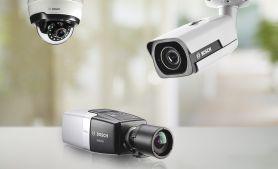
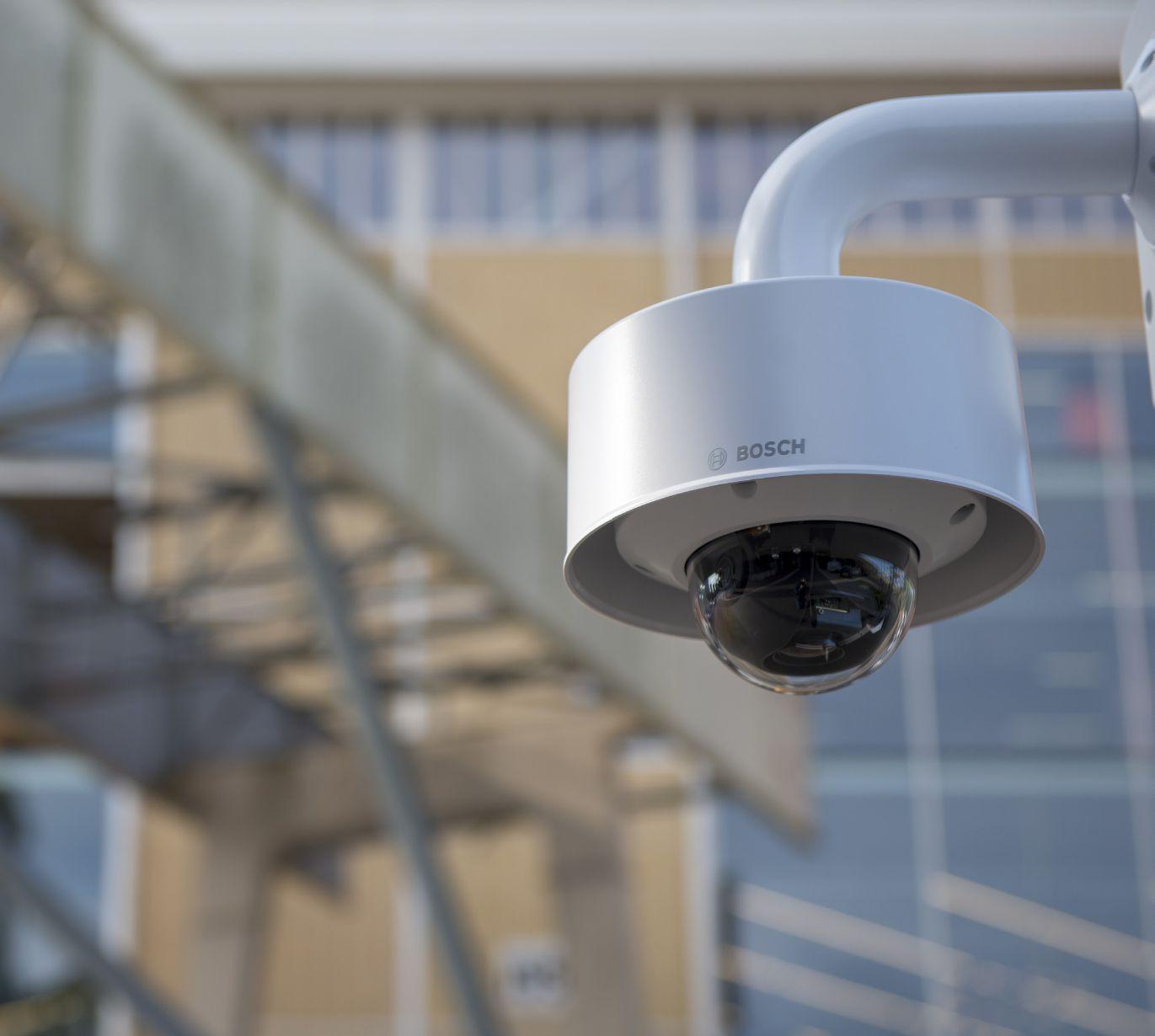
FLEXIDOME IP 4000i and IP 5000i cameras offer resolutions up to 5 MP and built-in Essential Video Analytics as standard for quick retrieval of data from hours of stored video as well as alerts to improve security. Onboard analytics also offers the ability repurpose captured video data for uses other than security alone. Intelligent Dynamic Noise Reduction, intelligent streaming and H.265 compression reduce bitrate up to 80%, lowering storage requirements without compromising quality.
https://www.boschsecurity. com/xc/en/products/videosystems/solutions/ip-cameras/
Bosch develops intelligent solutions that exceed the highest security demands and that deliver clear business advantages beyond security.
The next-step for security is to enable customers to start repurposing their video data, and Bosch enables this with built-in video analytics as standard in Bosch IP cameras 4000 series and above. The ability to interpret video data directly at the source substantially improves levels of security and helps users make smarter business decisions.
The latest AUTODOME IP starlight 5000i cameras provide color images in extremely low light environmentsdown to 0.018 lux - where other cameras switch to monochrome. With Essential Video Analytics as standard, the cameras are also able to understand what they’re seeing and alert you to any potential threats the moment they happen. These 1080p cameras feature Essential Video Analytics as standard to alert users to potential threats and deliver data for use beyond security.
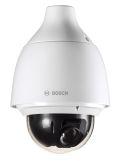

Intelligent Video Analytics offers the ultimate in built-in video analytics and is designed for the most demanding environments. This state-of-the-art solution is ideal for mission-critical applications like perimeter protection, critical infrastructure, government buildings, border patrol and traffic monitoring, including wrongway detection, traffic counts, and parked cars. It has the ability to perform video content analysis over large distances and differentiate between genuine security events and known false triggers, such as snow, moving trees, rain, and water reflections.
https://www.boschsecurity. com/xc/en/products/videosystems/video-analytics/
https://www.boschsecurity.com/xc/en/products/video-systems/ solutions/autodome-ip-cameras/
MIC IP cameras are built to perform in practically any environment. The IP68-rated moving cameras withstand severe weather, including high winds, rain, 100% humidity, temperatures from -40°C to +65°C, extreme vibrations, and high impacts (IK10). Starlight technology ensures detailed color images in extreme low light and built-in video analytics alerts to potential threats. MIC IP fusion 9000i cameras fuse the metadata of the built-in optical and thermal imagers to help users focus on unseen things that need attention.
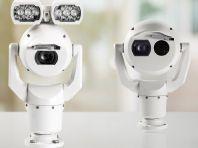
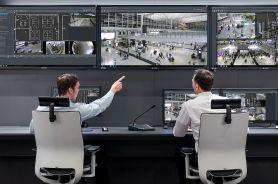
https://www.boschsecurity.com/xc/en/products/video-systems/ solutions/mic-ip-cameras/
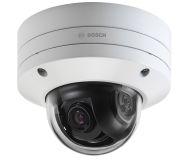
The FLEXIDOME IP starlight 8000i fixed dome cameras save up to 75 percent of camera set-up time. They feature remote commissioning, and when used with the Project Assistant App, the pan, tilt, roll and zoom (PRTZ) function can set the field of view after the initial set-up. The cameras also feature built-in Intelligent Video Analytics, are water and vandal resistant, and can operate at temperatures of -50 to +60 degrees Celsius.
https://www.boschsecurity.com/xc/en/news/news/flexidome-ip/
The Bosch Video Management System provides seamless management of digital video, audio and data across an IP network. It is a scalable solution that grows from BVMS Viewer for small to medium installations to BVMS Enterprise that can connect multiple systems to support monitoring up to 10,000 sites by a single operator and 200,000 cameras by the total system. BVMS offers unique features, including maximum resilience, integration with third-party solutions, and compatibility with IT environments. https://www.boschsecurity. com/xc/en/products/ management-software/bvms/
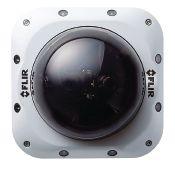
The Quasar 4x2K panoramic camera, featuring four, high-definition visible sensors, produces 4K resolution. The mini-dome camera offers wide area surveillance and interchangeable field-of-view options of 180- and 360-degrees. Consequently, the 4x2K can replace multiple individual cameras. With automatic stitching that combines the four sensors into a 180-degree view, the camera generates an image that eliminates blind spots and scene duplication. Built-in infrared illumination automatically adjusts to the 180- or 360-degree viewing mode. www.flir.com
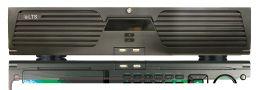
The Platinum Enterprise Level 32 Channel Deep Learning NVR, LTN0732D-R8, features deep learning technology and integrates advanced algorithms for perimeter prevention. The Deep Learning NVR is built with nearly the same precision of a human eye, according to the company, identifying objects versus human intrusion and reducing the number of false alarms. Smart Motion Detection is inspired by the brain’s ability to process data critically and works to understand the human body through enhanced secondary analyses like face detection and object analytics. The Platinum Enterprise Level NVR integrates to existing IP cameras and security infrastructures. www.LTSecurityinc.com
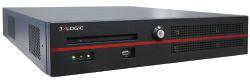
VIGIL V500 Hybrids are fully-integrated intelligent video appliances pre-configured with VIGIL Video Management System (VMS) software. The V500 design provides all the network components required to deploy this NVR. Not only are alarm, serial, and audio inputs built in, this hybrid includes 16 embedded PoE ports for IP devices. The V500 also integrates with the full VIGIL suite of products. MULTIVIEW Technology and its RapidStream video compression engine enables users to remotely stream and view high-definition video with minimal impact on bandwidth. www.3xlogic.com
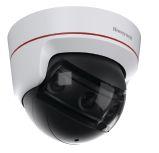
Honeywell has expanded the equIP Series Cameras line with the 1080p 30x Zoom Explosion-Proof IP PTZ Camera, the Network TDN 8 MP IP Rugged Multi-Imager and the Network TDN Low-Light 6 MP IR Rugged models. The line is supported by new versions of the MAXPRO network video recorder (NVR) and video management system (VMS) to offer a complete, integrated video management solution. The new multi-imager equIP cameras, available in both dome and bullet models, cover a wider area with fewer cameras, and leverage MAXPRO VMS to combine multiple images into one picture. www.honeywellvideo.com
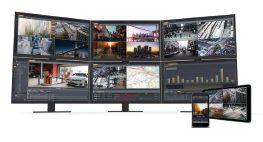
The victor Video Management System and VideoEdge Network Video Recorders (NVRs) from American Dynamics, version 5.2, is a video management system that provides enhanced video intelligence and analytics. The victor client on VideoEdge hardware platforms allows users to leverage video streaming, audio, motion meta-data and a feature set for improved real-time command and management. The combination of victor and VideoEdge maximizes smart streaming resources to optimize operation of high-resolution cameras and analytics while providing more efficient bandwidth management. www.americandynamics.net
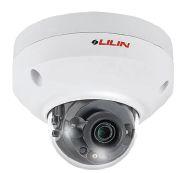
LILIN has added the new MR6342A IR fixed dome IP camera to its M-Series IP network cameras. Equipped with built-in Sense up+ technology, the MR6342A provides video quality in 4MP resolution, and is IK10-rated for protection against vandalism. Intelligent Video Surveillance (IVS) functionality is a cornerstone of the M-Series cameras; the MR6342A IVS analytics include advanced motion detection, object counting and tripwire detection. Outdoor-ready with an IP66 rating for rain and dust resistance, the camera also has 30-meter infrared night vision. www.meritlilin.com
Hanwha Techwin America
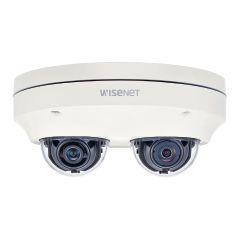
Two new Wisenet multi-sensor cameras include the Wisenet PNM7000VD (2-head) and PNM-9000VQ (4-head). For maximum adaptability, configurable fixed-focus lens/CMOS sensor modules are available in multiple fields of view which can be easily installed onsite. The cameras are equipped with high frame-rates (60/30fps), true WDR (Wide Dynamic Range) and a suite of analytics built in. Utilizing a single IP address over one cat5 cable requires only one VMS license. A suitable solution for hospi tals, schools, and retail, both cameras allow for individual on-screen displays and a full suite of video analytics. www.hanwhasecurity.com
Speco Technologies
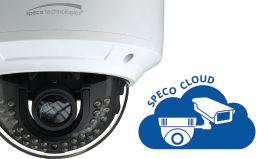
These Cloud-enabled IP cameras are designed to record to the Speco Cloud video storage platform. Also launched simultaneously is the Speco Cloud Channel Partner Program that allows dealers to share in recurring monthly revenue. Speco Cloud is a solution for both residential and business applications with its plug-and-play setup and convenient monitoring. It also provides mobile viewing with the Speco Cloud App, available for both iOS and Android devices. These vandal and weather resistant IP cameras are capable of recording video as well as audio.
www.specotech.com
V5 Systems and Pelco
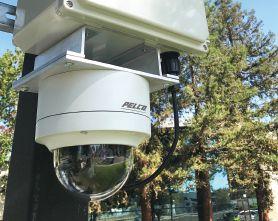
V5 Systems has integrated its V5 Camera Adaptive Platform (V5 CAP) with Pelco’s Sarix Professional IP Surveillance Cameras.
The V5 CAP is an ongoing power, computing and communications platform for third-party cameras. It features ongoing power via a combination of proprietary bullet-resistant solar technology and a battery management system; up to 1TB of storage; and wireless communication via Wi-Fi, cellular or RF. www.v5systems.us
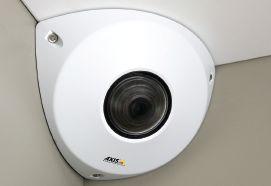
Axis recently released two models of AXIS P9106-V Network Cameras, which are suited for corner surveillance. AXIS
P9106-V Network Camera
Brushed Steel model has a design that is suitable for blending into elevators, whereas AXIS P9106-V Network Camera
White model is ligature-resistant, ideal for the health-care sector. The 3 MP cameras are specially designed for out-of-thebox optimized corner-to-corner coverage. They can cover up to 130 degrees horizontally and 95 degrees vertically, without blind spots. Both models are IK10and IP66-rated. www.axis.com
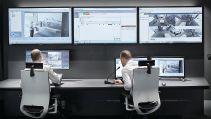
The new Video Management System 8.0 (BVMS 8.0) offers stitching, GPU decoding and 64-bit function. The Bosch Video Stitcher combines video from up to 16 cameras into a single view. BVMS 8.0 runs as a 64-bit application, up from 32-bit in its previous versions. This raises the maximum capacity of a single BVMS from 30 management servers with 100 cameras per server to 50 management servers with 200 cameras per server. With VMS 8.0, users are able to configure Bosch H.265 enabled cameras, allowing them to reduce bandwidth and storage needs. The system also allows operators to switch between the optical and thermal view.
www.boschsecurity.us
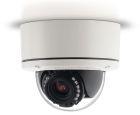
The new MegaDome and MegaVideo UltraHD series cameras offer users the choice of 12MP at 20fps for maximum resolution and image clarity, 4K at 30fps with BMP high definition image quality for high speed requirements, or 1080p at 60fps for maximum frame rate. The MegaDome UltraHD dome camera includes a motorized remote focus/zoom 4.4-10 mm P-Iris lens mounted in a 3-axis gimbal. Wide dynamic range, NightView low-light technology, SNAPstream technology, and dual encoder H.264/MJPEG capabilities are built in.
www.arecontvision.com
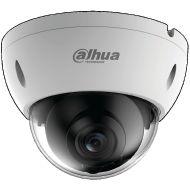
The DH-IPC-HFW4239TN-ASE 2MP Fixed Bullet and the DHIPC-HDBW4239RN-ASE 2MP Fixed Dome are two new additions to Dahua’s ePoE product family. Dahua Night Color Technology cameras use a high-performance sensor and ISP and an achromatic, large aperture lens (F1.0) to produce clear colour images in lowlight environments. This technology allows the camera to remain in Color Mode and to capture more available light to reproduce colour images with superior detail in applications with at least 1 lux of ambient or artificial light. dahuasecurity.com
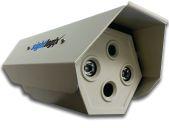
The dual-stream SightSensor HD combines a thermal sensor for intruder detection, a high-definition colour imager for detection verification, integrated video analytics and NIR illumination. The thermal SightSensor HD combines SightLogix’s video analytics with HD colour video into a single solution for shorter ranges at critical sites and commercial applications. The product is available in three models that detect inbound targets at 42m, 74m and 80m. Integrated with NIR illumination, both thermal and colour video streams are viewable through third-party VMS systems. www.sightlogix.com
Johnson Controls
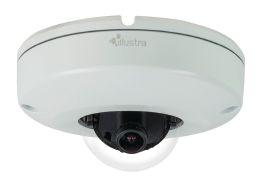
Small enough to fit into discrete settings, the Illustra Flex3MP Compact Mini-Dome is an outdoor quality day/night camera that can product HD-quality images in low light conditions. The Mini-Dome goes beyond H.264 and H.26 for bandwidth management via its Illustra IntelliZip compression technology. It also optimizes the bitrate when activity ceases to reduce network bandwidth and video storage needs. Advanced VideoEdge TrickleStor technology enables edge-based video recording, even in an outage. www.johnsoncontrols.com
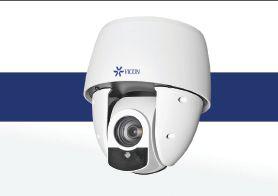
The Cruiser SN673V-C outdoor PTZ dome combines a 1080p day/night H.265 camera with 23X optical zoom. Featuring 360° continuous rotation and full -5° to 90° tilt range, this dome can provide coverage in all directions. This latest Cruiser model offers synchronized IR illuminators that support distances of up to 196 feet. In-camera video content analysis can alert system operators to camera tampering, video motion and intrusion detection. Quad streaming capabilities include H.265 compression technology, reducing file sizes and bandwidths.
www.vicon-security.com