
Total Chemistry Management

A smart new way to improve your operational efficiency
Kemira TCM (Total Chemistry Management) is a system that enables pulp and paper makers to improve operational efficiency and save costs through the optimized use of chemicals. With this strong partnership you get a full range of chemicals from a single supplier and benefit from the best-in-class application know-how and technical service.
In addition, we provide you with direct access to our smart process management technologies and the latest innovations from Kemira R&D.
Let’s work together to build value into paper.
https://tcm.kemira.com










Cover photo by A. Snook: Mitch Dunlop, Zellstoff Celgar L. P.
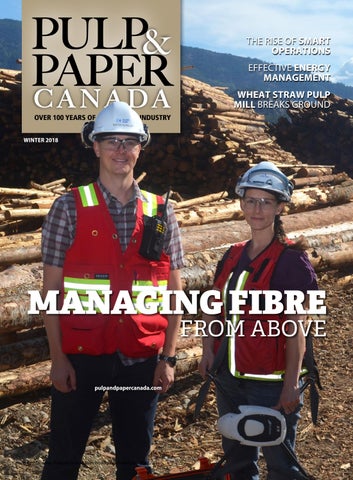
manager, and Leslie Rowe, Celgar
WTO complaint and proposed U.S. newsprint duties fuel trade battle
OnJanuary 10, the Feds made public a World Trade Organization complaint over the United States’ trade remedy measures, arguing its use of anti-dumping and anti-subsidy duties violates global trade rules. The 32-page complaint is Canada’s most recent attempt to counter import duties imposed by the U.S., particularly on Canadian softwood lumber products. Its publication came just hours after the U.S. announced countervailing duties of 0.65 to 9.93 per cent on Canadian exports of uncoated groundwood paper or newsprint.

The disputes are occurring in the midst of difficult NAFTA renegotiations between Canada and the U.S. Canada is the largest exporter of newsprint in the world. According to the U.S. Department of Commerce, Canada exported more than $2.4 billion worth of newsprint to the U.S. in 2016.
“[This] preliminary decision allows U.S. producers to receive relief from the marketdistorting effects of potential government subsidies while taking into account the need to keep groundwood paper prices affordable for domestic consumers,” stated U.S. Commerce
Secretary Wilbur Ross.
Derek Nighbor, CEO of Forest Products Association of Canada, called the duties “unjustified and protectionist in nature.”
“These rates...on uncoated groundwood paper represent the third action that stands to hurt hard-working men and women in our mill communities across Canada,” he said.
An overall tariff of 6.53 per cent has been levied on about 25 Canadian plants. Kruger faces a preliminary duty of 9.93 per cent, while the duty against Catalyst Paper is 6.09 per cent, 4.42 per cent for Resolute, and 0.65 per cent for White Birch.
Many argue the proposed U.S. duties on newsprint will have a severe impact beyond the national level.
“This decision will not only affect pulp and paper producers but also their entire supply chain,” said Dennis Darby, Canadian Manufacturers & Exporters president and CEO.
“There are 600,000 workers in the newspaper publishing sector as well as the commercial printing sector who are at risk,” said Resolute spokesperson Seth Kursman, as reported by The Canadian Press. “And we know as a manufacturer of this product that if demand continues to go down over time, this has an impact on our ability to operate facilities.”
Canada will host the next round of NAFTA talks on January 23 to 28; until then, the industry must wait to see how the conversation plays out.
As Resolute president and CEO Richard Garneau puts it, “Free trade between the two nations is in the best interests of both countries and their shared economic prosperity.” PPC
Editor ALYSSA DALTON 416-510-5225 adalton@annexweb.com
National Accounts Manager LAURA GOODWIN 289-928-8543 lgoodwin@annexbusinessmedia.com
Group Publisher/Director of Content and Engagement
SCOTT JAMIESON 519-429-5180 sjamieson@annexweb.com
COO
TED MARKLE tmarkle@annexbusinessmedia.com
President & CEO MIKE FREDERICKS
EDITORIAL/SALES OFFICES
111 Gordon Baker Road, Suite 400, Toronto, ON M2H 3R1
Phone: 416-442-5600 Toll Free: cda 800-268-7742; usa 800-387-0273
PRODUCTION
Media Designer EMILY SUN
Circulation Manager BEATA OLECHNOWICZ bolechnowicz@annexbusinessmedia.com
Print in Canada
ISSN 0316-4004 (Print)
ISSN 1923-3515 (Digital)
Account Coordinator
STEPHANIE DEFIELDS sdefields@annexweb.com
PUBLICATION MAIL AGREEMENT #40065710
CIRCULATION
email: mchana@annexbusinessmedia.com
Tel: 416-510-5109
Fax: 416-510-6875 (main) 416-510-5133
Mail: 111 Gordon Baker Road, Suite 400, Toronto, ON M2H 3R1
SUBSCRIPTION RATES
Canada $53,95 - 1 year; $72.95 - 2 year
Outside of Canada - $101.95 per year
Occasionally, Pulp and Paper Canada will mail information on behalf of industry related groups whose products and services we believe may be of interest to you. If you prefer not to receive this information, please contact our circulation department in any of the four ways listed above.
Annex Privacy Office privacy@annexbizmedia.com
Tel: 800-668-2374
The editors have made every reasonable effort to provide accurate and authoritative information but they assume no liability for the accuracy or completeness of the text or its fitness for any particular purpose. All rights reserved. The contents of this publication may not be reproduced in part or in full without the publisher’s written permission © Annex Publishing & Printing Inc.
Sustaining member, Pulp and Paper Technical Association of Canada; Member, Alliance for Audited Media.
“We acknowledge the financial support of the Government of Canada through the Canada Periodical Fund of the Department of Canadian Heritage.”




Alyssa Dalton Editor
Ned Dwyer to lead Catalyst Paper as president/CEO Catalyst Paper has appointed Edward (Ned) Dwyer president and CEO. With more than 30 years in the pulp and paper industry, Dwyer is an industry veteran who has held progressively senior roles with global companies. He most recently served as the company’s chief operating officer.
“Ned is recognized for successfully leading major operational and performance improvements in cost, productivity, efficiency, quality and safety. He has a track record for successful machine start-ups and rebuilds, as well as leading product development for emerging markets,” according to a company statement.
Stéphane Renou named president/CEO of FPInnovations

Stéphane Renou assumed the role of president and CEO of FPInnovations in December, succeeding Pierre Lapointe who has held the position since December 2008. Lapointe spearheaded many major projects at FPInnovations and, according to the organization, is leaving a rich and promising legacy to the Canadian forest industry. His commitment was recognized last year when he was welcomed to the Royal Swedish Academy of Engineering Sciences.
A Montreal native, Renou has a number of degrees from Université de Sherbrooke as well as Polytechnique Montréal where he went on to complete a master’s degree in Electrical Engineering and a Ph.D. in Chemical Engineering. In 2015, he earned a MBA (Innovation Management) from the University of Colorado.
“We are confident that Stéphane, working closely with the members of our senior management, will further increase our current momentum and take FPInnovations to the next level,” said Yvon Pelletier. “Stéphane’s background and interests fit very well with FPInnovations’ strategies and plans for the future, and we are confident that he has the skills and competencies that will make him a successful president and CEO.”
Cascades boosts containerboard packaging capacity with latest acquisition

Cascades says it has acquired four plants in Ontario to strengthen its position in the containerboard packaging sector, and the purchase of an ownership position in Tencorr Holdings Corp. The company also announced an increase in its equity holding of the Greenpac Mill LLC.
“We are very pleased to expand our presence in Ontario and increase our stake in Greenpac for the second time this year. These transactions align perfectly with our vision and strategy for our containerboard activities,” said Cascades president and CEO Mario Plourde.
The four following plants were acquired from the Coyle family, and specialize in the manufacturing of boxes and specialty products:
• McLeish Corr-a-Box Packaging & Design – Etobicoke
• Brown Packaging – Burlington
• Coyle Corrugated Containers Inc. – Scarborough
• Coyle Packaging (Peterborough) Ltd. – Peterborough
According to the company, the transaction will allow Cascades to expand its presence in Ontario, increase its production capacity by 500 million square feet per year, and strengthen its ability to serve customers. The plants already have procurement agreements with Greenpac, and as such, the transaction will have little impact on Cascades’ integration rate, it notes.
Cascades has also acquired the Coyle family’s 33-per-cent stake in Tencorr, a company specialized in manufacturing sheet stock for box producers.
Furthermore, Cascades has also acquired an additional interest in Containerboard Partners, one of Greenpac’s shareholders, thus increasing its holdings in Greenpac to 66.1 per cent from 62.5 per cent. The company has been consolidating the Greenpac results since April 2017.
“These new assets will support our growth by providing us with increased capacity and flexibility. This transaction will also enable us to better serve our customers as we will be better positioned to provide them with the packaging solutions they seek,” said Charles Malo, president and COO of Cascades Containerboard Packaging.
The total cost of the transaction amounts to $49 million, of which $21 million is related to the increased stake in Greenpac and its new position in Tencorr. The containerboard packaging plants were acquired for a consideration of $28 million, including an assumed debt of $4 million, which represents a multiple of 6.5 times the adjusted operating income before depreciation of these operations, and excludes anticipated synergies.
Photo: Cascades
Stéphane Renou
Report: Biomass and other renewables grow in Canada
Canada’s non-hydro renewable power capacity grew by more than 8 per cent in 2016, adding nearly 1,300 megawatts of solar, biomass and wind-generated power, according to a National Energy Board (NEB) report.
In 2016, Canada’s electricity generation was 66-per-cent renewable, with non-hydro renewables accounting for 7.2 per cent and hydro accounting for 58.8 per cent. When nuclear power generation is added, a total of 80.6 per cent of Canada’s electricity was non-emitting in terms of greenhouse gases.
The long-term trend in Canada since 2005 has been increased power generation from natural gas and wind, and decreased generation from coal.
In 2016, total Canadian natural gasfired power generation actually dropped due to decreases in British Columbia, the Northwest Territories, Manitoba, Ontario, and Newfoundland and Labrador. However, in Alberta, Saskatchewan, New Brunswick, and Nova Scotia, natural gas generation increased as part of these provinces’ ongoing transition away from coal.
“Since 2005, the electricity sector has cut its greenhouse gas emissions by onethird, even though Canada’s total emissions only fell by 2.2 per cent in that same time period,” NEB chief economist Shelley Milutinovic said. “While hydro will remain Canada’s dominant source of power, we continue to see impressive gains in non-hydro renewable capacity from wind, solar and biomass.”
Kruger dedicates PM10 linerboard machine in Trois-Rivières
Kruger officially dedicated Paper Machine No. 10 (PM10), which was completely rebuilt to manufacture 100-per-cent “lightweight and high-strength” linerboard at its Trois-Rivières Mill in Quebec.
The $250-million investment went toward a full rebuild of the PM10 for “optimal results,” says Kruger, noting that before work got underway, Kruger engineers toured manufacturing plants in North America and Europe to find the best technology for manufacturing 100-per-cent recycled linerboard.
Commercialized as XTR, the new linerboard grades manufactured on PM10 will help meet increasing demand for
Sappi buys Cham Paper’s specialty paper business
Sappi Ltd., a global producer of dissolving wood pulp, specialty and packaging papers, graphic (printing and writing) paper and biomaterials, plans to acquire the specialty paper business of Cham Paper Group Holding AG (CPG) for roughly US$149 million.
The transaction includes the acquisition of CPG’s Carmignano and Condino Mills in Italy, its digital imaging business located in Cham, Switzerland, as well as all brands and know-how.
The deal is expected to be completed during the first calendar quarter of 2018, and will be funded through internal cash resources.
Employing 210 people, the Carmignano Mill is a non-integrated paper mill with two paper machines and produces 100,000 tonnes of paper. The paper grades include C1S FlexPack, C1S Label Papers, Wet Glue and Self-Adhesive applications base paper for metallization.
Meanwhile, the Condino Mill is a nonintegrated paper mill with one paper
machine. It employs 120 employees and can produce 60,000 tonnes of paper per year. Paper grades include glassine (silicone base paper) and super calendared, uncoated flexible packaging papers.
The Digital Imaging Business operates a finishing plant in a 4,000-squaremetre industrial warehouse where the base paper mills is converted to produce 12,000 tonnes of digital imaging paper. The business employs 50 people.
According to Sappi, the main benefits of the acquisition include:
• Supporting the company’s diversification strategy and 2020 vision to grow in higher margin growth segments;
• Strengthening Sappi Europe’s specialty and packaging papers footprint and skills by adding 160,000 tonnes of specialty paper to its capacity;
• Increasing Sappi’s relevance in specialty papers, opening up new customers and markets to existing

The $250-million investment went toward a full rebuild of Trois-Rivières’ PM10 which produces lightweight linerboard.
ultra-light packaging without compromising on strength, performance or environmental footprint, adds Kruger.
PM10’s annual production will total 360,000 metric tonnes of XTR linerboard, an exclusive product that Kruger says it is the first to manufacture in North America. A portion of the production will be used by Kruger’s packaging plants in LaSalle, Que., and Brampton, Ont., while the remainder will be sold to packaging manufacturers in Canada and the United States.
The project consolidated 270 jobs at the Trois-Rivières Mill, in addition to the Mauricie region and Quebec.

products and generating economies of scale and synergies;
• Gaining greater share-of-wallet with valued brand owners and accelerating new product development;
• Improved near-term profitability and serving as a platform for organic growth and further acquisitions. The deal will add €183 million of sales and approximately €20 million of EBITDA;
• Building on the investments currently underway to increase specialty paper capacity at Sappi’s Somerset, Maastricht and Alfeld Mills; and
• Unlocking the growth potential of the CPG specialty paper business.
Photo: Kruger Inc.
Isabelle Males and Tristan Flood win 2017 Skills Awards for Aboriginal Youth
Isabelle Males of Temiskaming First Nation from New Liskeard, Ont., and Tristan Flood of Matachewan First Nation from North Bay, Ont., are the 2017 recipients of the CCFM-FPAC Indigenous Youth Award.
The winners of the Skills Awards for Aboriginal Youth were announced at the Conference Board of Canada’s National Summit on Indigenous Youth and Natural Resource Development in Calgary, Alta., by Forest Products Association of Canada (FPAC) and the Canadian Council of Forest Ministers (CCFM).
“Ms. Males and Mr. Flood are both exceptional youth working to improve and support their communities and the forest sector,” said Derek Nighbor, FPAC CEO. “The forest sector benefits greatly and relies on the enthusiasm and dedication of Aboriginal youth pursuing careers in the forest sector for its future success.”
New $155-million program launched to address climate change
Canadian Minister of Natural Resources Jim Carr has announced a $155-million program that will fund clean technology projects in the areas of energy, mining and forestry, which aims to help reduce greenhouse gas emissions and improve environmental outcomes.
The federal government says the Clean Growth Program is the “first of its kind to promote and require collaboration with the provinces and territories.” It covers five areas: Reducing greenhouse gas and air emissions from natural resources operations; minimizing landscape disturbances and improving waste management in natural resource operations; the production and use of advanced materials and bioproducts in natural resource operations; efficient energy use and productivity in natural resource operations; and reducing water use and impacts on aquatic ecosystems from natural resource operations.
“The Clean Growth Program will provide much needed support to forest product companies working hard to mitigate climate change,” said Derek Nighbor, CEO of FPAC. “We are a sustainable industry committed to doing our part to take care of the environment for generations to come.”
Budget 2017 committed $200 million to encourage clean technology in the natural resource sectors. Natural Resources Canada will deliver $155 million of this funding under the Clean Growth Program.
“Strategically developing and using clean technologies in our natural resource sectors is one more way we can make Canada stronger and more sustainable, future-proof our economy and create new opportunities for generations to come,” added Carr.
Fortress Paper sells off security paper business
Fortress Paper’s wholly owned subsidiary, Fortress Security Papers AG, is selling its Switzerland banknote and security paper business for roughly $28 million.
Currently pursuing a master’s of sustainable forest management at the University of British Columbia, Males plans to become a Registered Professional Forester. She holds a bachelor of science in environmental sciences, majoring in resource management from the University of Guelph. As part of her undergraduate studies, she completed research with the Saugeen Ojibway First Nation Environment Department. Once certified as an RPF, Males intends on working as an Aboriginal liaison in northern Ontario.
Flood is pursuing a bachelor of science in forest operations with a minor in commerce at the University of British Columbia. In 2016, he created his own small wood operation business, combining his interests in entrepreneurship and the forest industry. He previously volunteered with the Temiskaming Native Women’s Support Group and assists his community to plan Pow Wows. Upon graduation, he intends to continue operating his business in the forest sector.
The Swiss National Bank and Orell Füssli Holding AG, a printing and banknote producer, have agreed to purchase Fortress’ full stake in the Landqart mill and its related operations.
Located approximately 100 kilometres east of Zurich, the mill employs more than 275 workers and produces banknote, passport, visa and other brand protection and security papers. Since 1979, the mill has been the sole provider of banknote paper for the Swiss currency and has produced banknote paper for over 100 currency denominations for more than 50 countries. In 2011, it completed the rebuild of its PM1 paper machine, increasing its total capacity for producing security paper to approximately 10,500 tonnes per year.
“As was previously announced in the third quarter, Landqart was confronted with the loss of material purchase orders by one of its significant international customers,” said Chadwick Wasilenkoff, Fortress Paper CEO. “As a result, Landqart required an injection of new capital and continued financial support of a magnitude that
Fortress Paper as the parent company deemed as not strategically viable.”
With the sale, the company is officially out of the banknote business and says it will focus on its dissolving pulp operations in Canada as well as other new initiatives.
BillerudKorsnäs
sees pulpwood shortage due to wet, mild winter
BillerudKorsnäs says wet and mild weather in the fall and early winter has led to a shortage of pulpwood in late 2017 and early 2018.
“The root cause of the shortage of pulp wood is the unusually wet and mild start of the winter. In normal winters, the ground freezes which allows for efficient forestry. At present, forestry machines cannot be used in the forests in certain areas. In addition, the possibility of driving on the forest road network is limited in some areas, which also reduces the flow of wood. The situation is the same in the Nordic countries, western Russia and the three Baltic states,” according to a statement from the company.
Uno Brinnen, senior vice-president Forestry, said the company has taken measures to minimize the effects of the shortage, mainly by changing the product mix in its production to optimize wood usage. PPC

Land secured for new biomaterials innovation centre
Technoparc Montréal and FPInnovations have concluded the purchase of lands by FPInnovations for its establishment at the Technoparc de Montréal. The lands, totalling more than 360,000 square feet, are in the southern part of the Technoparc de Montréal, the Eco-campus Hubert Reeves section.
“This is an opportunity for the greater Montreal area as well as for the Quebec and Canadian forest industry to lead the way in the field of biomaterials and clean technologies,” said Pierre Lapointe, president and CEO of FPInnovations. “The location chosen at the Technoparc will allow us to get closer to our current partners, to facilitate travel for our collaborators, and to allow our employees to work within an environment that promotes innovation and cooperation.”
“We are very proud of this transaction, which marks a real kick-off in the development of the Eco-campus Hubert Reeves. FPInnovations corresponds exactly to the type of resident companies looking for a workplace with a perfect symbiosis between humans and nature. We are convinced that the arrival of FPInnovations will attract a growing interest for companies wishing to settle in an environment where nature protection is a priority,” said Mario Monette, president and CEO of Technoparc Montréal.
Anomera raises $1.7 million to turn wood waste into cellulose microbead
The Research Innovation Commercialization (RIC) Centre says its client Anomera has raised $1.7 million in financing to aid with its seed-stage phase.
The Montreal, Quebec-based company converts raw materials from certified, biodiversity forest management origins into a biodegradable, cellulose platform. It conserves the strength of native cellulose while elaborating it into highly performing products, creating a new class of cellulose microbeads for the cosmetics and skin care industries, describes the company.
As consumers become increasingly concerned about what goes into these products and the impact of industrial practices on the environment, founders Dr. Mark Andrews, Tim Morse, Monika Rak and Nathan Hordy say they have found a way to replace environmentally damaging plastic microbeads.
“We have been able to use Canadian forest industry cellulose to make game-changing cosmetic ingredients that can outperform microplastics. We really have a natural alternative to mineral, ceramic and artificial ingredients,” said Dr. Andrews.
Anomera says it is looking to use its early seed-stage funding for significant scale-up to supply large quantities of ingredients to its first customer. In the near future, Anomera will seek A-round financing to build a manufacturing facility, distribution channels, staff key employees, and invest in R&D as well as business development.
The company has received support from the incubation services of CEIM in Montreal, Que., the RIC Centre in Mississauga, Ont., and Green Centre Canada in Kingston, Ont.
“With the great support of the Xerox Research Centre of Canada in Mississauga, we have nearly completed scale up to significant quantities of cosmetic ingredients, and run-to-run validation of our processes,” said Dr. Andrews.
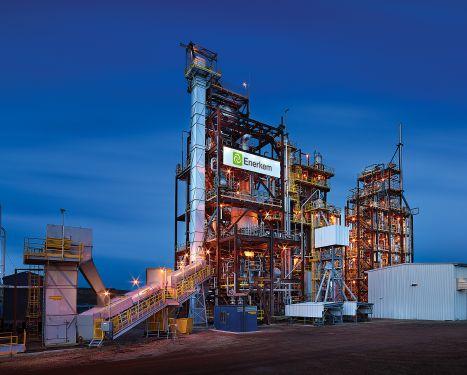
Enerkem approved to sell cellulosic ethanol in U.S. Waste-to-biofuels and renewable chemicals producer Enerkem has received approval from the United States Environmental Protection Agency (EPA) to sell cellulosic ethanol produced at its Edmonton, Alta., facility under the U.S. Renewable Fuels Standard (RFS).
Enerkem’s advanced biofuels facility has completed the necessary steps required by the EPA and is the first ever municipal waste-to-cellulosic ethanol plant to receive approval to sell in the United States. Under the 2007 Energy Independence and Security Act, 16 billion gallons of cellulosic biofuels are to be blended in the conventional transportation fuel pool by 2022, notes Enerkem.
“With this EPA approval, we are now able to sell one of the lowest-carbon transportation fuels into the world’s largest biofuels market,” said Vincent Chornet, Enerkem president and CEO. “This provides further validation of Enerkem’s leading position in the global race to decarbonizing the transportation fuel sector, which is a major source of greenhouse gas emissions.”
Enerkem is now registered for D3 Renewable identification numbers (RINs) credits. These RIN credits are purchased by U.S. refiners to comply with the U.S. RFS program. The EPA has established that cellulosic biofuels reduce greenhouse gas emissions by at least 60 per cent when compared to gasoline.
Earlier this year, Enerkem expanded its Edmonton biofuel facility to produce some 13 million gallons of cellulosic ethanol annually following the commissioning of its methanolto-ethanol conversion unit. This pioneering facility has been financed by private sources and received funding support from Sustainable Development Technology Canada (SDTC), Alberta Innovates and Alberta Energy.
Headquartered in Montreal, Que., Enerkem produces biofuels and renewable chemicals from waste. Its technology converts non-recyclable, non-compostable municipal solid waste into methanol, ethanol and other chemical intermediates.
Enerkem produces biofuels and renewable chemicals from waste.
Photo: Merle Prosofsky
Renewing the workforce with training options
Submitted by FPInnovations

Vision2020, developed by the Forest Products Association of Canada (FPAC), expects to renew the workforce in the forest products industry with at least 60,000 new recruits. To help the pulp and paper industry address the challenges associated with the increased workforce, FPInnovations has developed different training programs with a focus on newly hired employees and those who need to update their skills.
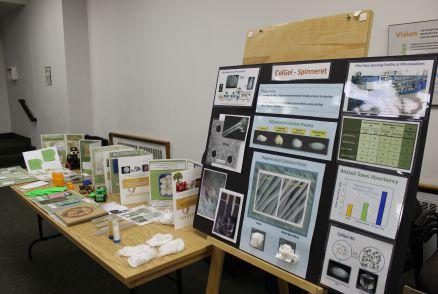
The most popular of these training programs is a five-day course covering pulp, paper and bioproducts, which is open to staff working in pulp and paper as well as other industries. The course has been very popular over the years, with new lectures constantly being added. The latest addition, Innovation Day, introduces new emerging biomaterials and biochemicals — such as nanocellulose, lignin and biofuel — to students. Designed in a way so that demonstrations coincide with the lectures, the course aims to give students an opportunity to discuss in more detail what they learned in the lectures in an
informal setting. The feedback on this course has been very positive and is highly recommended by former students each year.
There are other options for companies that require training for the specific needs of pulp and paper mills, such as mechanical pulping, chemical pulping, papermaking, printing and tissue making. Demands are changing with the growth in tissue, hygiene, packaging, specialties and automation. FPInnovations has designed customized courses and onsite training for large and small groups. These delivery alternatives are ideal when staff cannot travel and when mills face changes in operation.
Tutoring sessions at PaperWeek Canada, presented in conjunction with PAPTAC, include topics ranging from How to select your furnish to Absorption and softness These sessions are being attended by mill staff and give new employees a chance to meet others and have an open dialogue.
Held in partnership with PAPTAC and TAPPI, topic-specific webinars are another
option for new employees to receive training. In 2016, PAPTAC delivered nine webinars on a wide range of topics. FPInnovations also offers webinars which can be viewed on its website. Past webinars can be revisited at any time.
The industry is transforming and moving away from traditional markets. New employees need to embrace these new technologies and take advantage of the many options for learning which are offered to them.
Please visit https://fpinnovations. ca/solutions-and-technologies/Pages/ overview-pulp-and-paper.aspx to learn more about the various training options available from FPInnovations. PPC
TAKING SUSTAINABILITY TO A NEW LEVEL
With its new facility, Columbia Pulp joins the roster of firms delving into wheat straw pulp production
By Treena Hein
Some projects can demonstrate sustainability in one or two ways, but Columbia Pulp’s new Lyons Ferry pulp mill takes sustainability to an entirely new level. From slashing greenhouse gases to sourcing local feedstock
to using efficient production processes, this plant does it all.
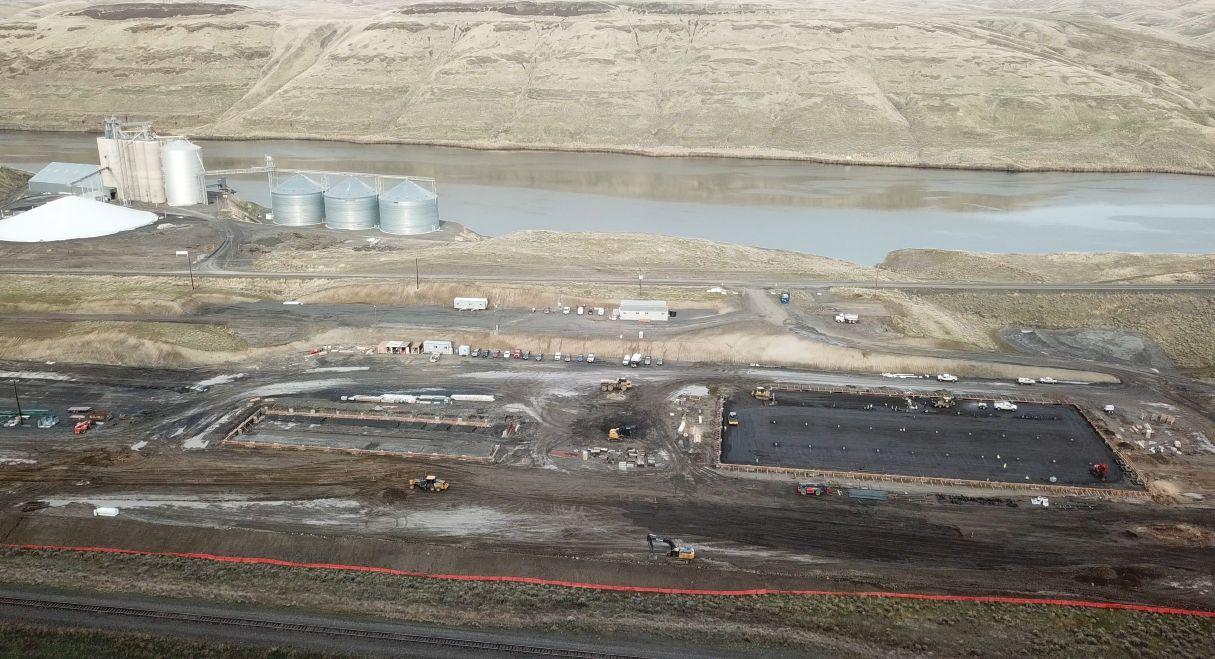
Located in Columbia County, Wash., the mill will produce 140,000 tonnes a year of commodity and specialty straw pulp for direct sale to paper and packaging manufacturers as an alternative to wood-based pulp material — which Columbia Pulp says will have “quality specifications equal to or better than virgin hardwood pulp or recycled pulp.” Like trees, straw is renewable, but the added benefit of using straw is that farmers in the region are currently burning it in huge amounts, which adds significant amounts of greenhouse gases to the atmosphere.
Another sustainability aspect of the operation is the local sourcing of the straw, all coming from within a 75-mile radius. Transport of this raw material to the plant, as well as shipment of finished products, is possible in two efficient ways.
“[The plant is] right on major rail access,” notes president John Begley, “and right on a major highway.” It is also located where there is a natural gas pipeline. Construction started in August 2017 and is expected to finish in October 2018.
A third significant sustainability factor is the production process itself, which Columbia Pulp says is proven to use fewer chemicals and less energy than conventional pulping.
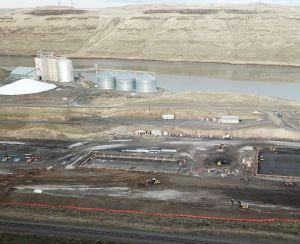
Construction has begun on the 140,000-tonne/year Lyons Ferry wheat straw pulp mill in Columbia County, Wash.
Photo: Columbia Pulp
“Most notably, the process is conducted at atmospheric conditions and is ‘gentler’ on the raw material,” the firm explains on its website, “resulting in a significant competitive advantage in terms of cost, product quality and environmental impact.”
Begley considers the ability to process at atmospheric conditions — with no high-pressure boilers needed — as one of the most unique aspects of the facility. He says the mixing process uses only a tiny amount — roughly 10 per cent — of the water used in traditional sulfur-based cooking processes.
According to Begley, the Columbia Pulp plant is “designated a minor source of air emissions,” and there is “virtually no water discharge.” Along with wheat straw pulp, it will also produce various valuable byproducts such as sugars and lignin.
The Washingtonbased wheat straw pulp mill will produce commodity and specialty straw pulp for direct sale to paper and packaging manufacturers as an alternative to woodbased pulp material.
It’s the existence of new technologies like the ones about to be employed at Lyons Ferry that have enabled Columbia Pulp and others to use straw at all. Traditional pulp production technologies just aren’t well suited to processing it. Indeed, the Washington Post recently reported that construction of a $2-billion straw pulp plant in the state of Virginia by Chinese-based Tranlin is delayed because “a new technology that the company has been testing in China is working so well that the firm wants to rethink how it approaches manufacturing elsewhere.”
In addition to Columbia Pulp and Tranlin, Canadian environmental nonprofit Canopy reports on its website that
Kimberly-Clark has increased its use of straw, and that “about 30 per cent of India’s paper and about 20 per cent of the paper manufactured in China is made from agricultural residue and/or non-wood fibres.” Canopy put Canadian wheat production at over 22 million acres, resulting in 13 to 20 million tonnes of wheat straw.
Canadian farmers also grow between one and two million acres of flax. Like wheat straw, some flax straw is burned, but the Flax Grower’s Guide produced by
the Flax Council of Canada and partners states that there are now several processors located in Manitoba, Saskatchewan and Alberta who purchase it. Several others accept hemp stalk fibre. Flax straw is being currently used for everything from animal bedding, linage for drainage ditches and building construction to covering golf course greens and production of biofuel, composite plastics, textiles and cigarette papers. Hemp fibre is being used in Canada to make paper, textiles and more. PPC
Once the first pulp
in
MANAGING FIBRE FROM ABOVE
Zellstoff Celgar invests in drones for inventory management
By Andrew Snook
Nestled in the West Kootenays of British Columbia alongside the Columbia River in Castlegar lies Zellstoff Celgar, the first pulp mill built in the B.C. Interior.
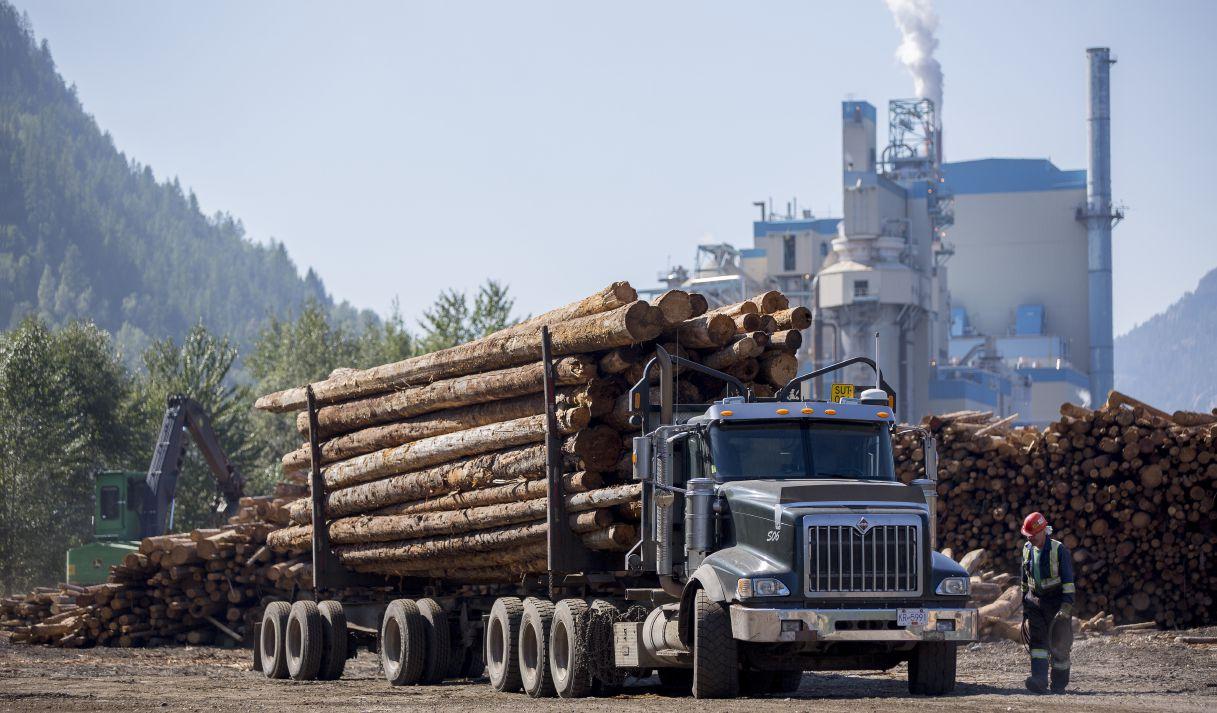
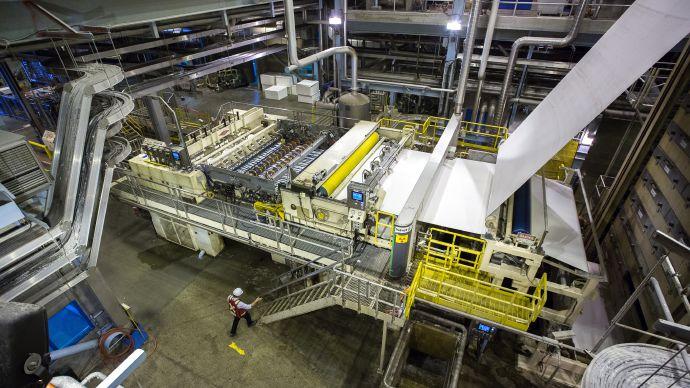
Originally built in 1961 with an annual production capacity of 160,000 air dried metric tonnes (ADMT), Zellstoff Celgar has grown to become one of the largest modern single-line Northern Softwood Bleached Kraft (NBSK) pulp mills in the country. Thanks to several major investments — including an $850-million rebuild and modernization in 1993, and approximately $180 million in additional capital improvements by current owner Mercer International — the mill’s annual production capacity has grown to 520,000 ADMT. The pulp produced
at the mill is sold across the world and is used in the production of printing and writing papers, board products for packaging, and hygiene products.
To keep up with annual production, the Celgar mill requires upwards of 2.7 million cubic metres of wood. The fibre used in pulp production at the mill comes from 10 different softwood species found throughout Western Canada: Engelmann Spruce, Subalpine Fir, Lodgepole Pine, Ponderosa Pine, White Pine, Western Hemlock, Grand Fir, Douglas Fir, Western Red Cedar and Western Larch.
To obtain this fibre, Celgar pays out more than $100 million to various forest operations across the region. The Castlegar location manages approximately 200 truckloads of chips into the mill on a daily basis. Keeping a close eye on such a high volume of fibre can present
significant challenges to any operation, especially since the fibre is stored in various locations across the mill’s property in the form of wood chips piled in a designated storage area, pulp logs stacked in the log yard, and additional pulp logs organized in bundles floating throughout the Columbia River & Arrow Lakes.
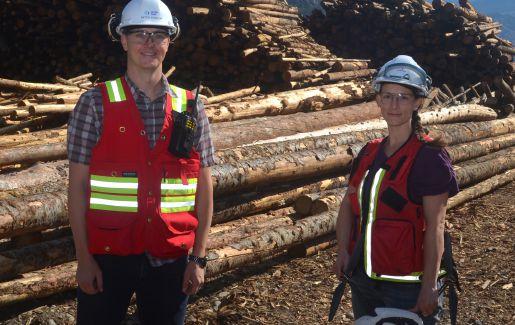
To help keep an accurate count of the available fibre at the mill, Zellstoff Celgar invested in a Kespry automated drone system. Mitch Dunlop, accounting manager for Zellstoff Celgar Limited Partnership, says the investment has already improved the mill’s inventory reporting processes.
“We bought it for inventory reporting and management because we were using a third party [quarterly] that was expensive,” he says, adding that by leasing the drone, his company was able to perform monthly flights and generate monthly reports for
mill built
the B.C. Interior, Zellstoff Celgar has grown to become one of the largest modern single-line Northern Softwood Bleached Kraft (NBSK) pulp mills in the country.
Photos: Zellstoff Celgar

fibre inventory in the yard for less than it cost to outsource volumetric surveying to a third party on a quarterly basis.
By moving from quarterly to monthly inventory, the company is able to more accurately assess the amount of fibre within the Castlegar property.
Celgar now has control of when they receive the reports, which helps the financial statement close process. Previously the report could take a few days, potentially delaying the time-sensitive financial statements. Now, Dunlop goes out with the drone pre-programmed, flies it for 15 minutes and generates the report the same afternoon.
“The report is robust enough to use in our financial statements. Because we are a publicly traded company, our inventory methods must meet strict auditing requirements,” he says.
Additional applications
Currently, the drone can only be used for mapping fibre on the mill’s property due to
flight restrictions, but Dunlop says the company also hopes to expand its flight permit to allow the drone to help manage log inventory on the Columbia River and Arrow Lakes. Dunlop says the drone could save significant amounts of time being used for this application. Currently, employees go out on boats and manually count the number of log bundles on the water in an annual inventory count.
“Inventory management can be a real challenge for the logs on the water, since they can be floating hundreds of kilometres away,” Dunlop says.
The Environmental department at Celgar is also using the drone for surveys of the hog fuel piles and some waste management monitoring that was previously contracted out.
Mill mapping
The company is also utilizing the drone to generate a base map of the Celgar mill property for use in a geographic information system (GIS).
“We’re currently employing Esri’s ArcGIS platform to integrate layered GIS mapping into our site-wide asset management strategy,” explains Leslie Rowe, a network administrator and GIS professional at Celgar, adding that the detailed electronic mapping of resources such as underground utilities will be a very useful tool for Celgar’s Engineering and Maintenance departments.
The mill is aiming to integrate the GIS with its Enterprise Asset Management System to contribute to mill performance by optimizing maintenance schedules, finding efficiencies in work order planning and improving resource utilization.
A community leader
With 410 employees, the Zellstoff Celgar mill is the main employer in the Castlegar area.
The community-supporting company and its employees donate to various causes in the area on a regular basis, including community enhancement projects, nonprofit associations and charities, and sports and community events. Some of the more recent projects include the construction of the Celgar Pavilion, a multi-use facility in Castlegar’s Millennium Park, the Celgar Drive-In, Drop-In launching ramp at the Bike Skills Park, and a new activity bus for Stanley Humphries Senior Secondary School, and the BE SEEN pedestrian safety campaign. The company also awards annual scholarships totalling $4,500 to qualifying local high school graduates. By optimizing its inventory management practices, Zellstoff Celgar is helping to ensure its continued success, creating stable employment to hundreds of local residents while helping out the surrounding community. PPC
The mill has an annual production capacity of 520,000 air dried metric tonnes (ADMT).
Left: Mitch Dunlop, Zellstoff Celgar accounting manager, and Leslie Rowe, Celgar network administrator and GIS professional.
Right: The mill employs a workforce of 410 members.
Photo: A. Snook

TRACKING PRICE MOVEMENTS IN THE PULP MARKET
Participation is growing in an independent platform designed to confidentially aggregate spot pulp price movements into reference price indices
By Treena Hein
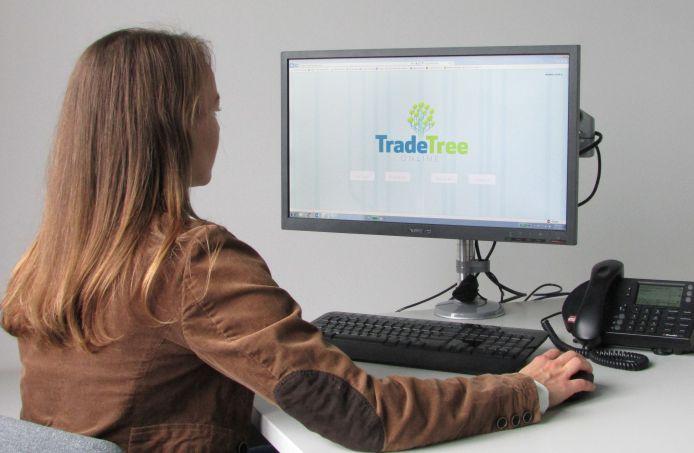
By now, you will have likely heard about the global pulp price indices and trading platform called Trade Tree Online (TTO). Founded in May 2016 by Brian McClay and Fraser Hart, TTO is an independent company that turns verified spot pulp price movements into reliable reference price indices. It collects monthly spot pricing data from market participants in a standardized and consistent manner and then confidentially aggregates this pricing to generate volume weighted-average, transactions-based indices.
McClay, who serves as TTO chair, is
principle at Montreal-based Brian McClay & Associates market intelligence consulting firm. Meanwhile, Hart most recently held the position of director of sales, North America Pulp at Resolute Forest Products.
“Our index launched in May 2016 and we have been very successful at recruiting an increasing number of pricing data providers since then,” says Hart, TTO managing partner. “Our goal was to create reliable, transparent and transaction-based indices that properly track the market. Most commodities traded on a regulated exchange have a cash market which sets the price for the overall market. For pulp, that is the spot market and for TTO, it
is these market-based transactions that drive our indices. Moreover, our trading platform is designed to increase the efficiency of the spot market by making it easier and more transparent to reach a much wider marketplace.”
Hart says the TTO platform also facilitates the more efficient exchange of commercial information, like product specifications, documentation requirements and other important information like environmental, safety and sustainability certifications.
It took more than a year to sketch out and develop the initial concept for the TTO indices and platform, and the team continues to refine and enhance them to
meet the needs of market participants. “We continue to add capabilities to the site and market coverage of the indices,” Hart says. “We’ve had very useful feedback, advice and support from market participants and we continue to listen and evolve.”
Successfully implementing innovative systems of this complexity in a traditional industry like pulp has come with challenges. One hurdle centred on the need to provide transparency and accurate price movements without divulging sensitive underlying transaction information. “This is why TTO features an index rather than a dollar-based system,” he explains. “We’ve also developed innovative solutions to ensure the TTO model factors out the effects of differing shipping locations and quality differences between pulps.”
Another challenge is resistance to change. “While people are aware of some of the flaws of the current list price system, it takes time to get comfortable with another way of doing things,” Hart observes. “But just as it has done in many other industries, technology and better measurement has the potential to drastically improve performance. We’ve seen a dramatic shift toward technology and measurement tools in other areas of the pulp business, but it’s amazing how much of the commercial side of the business has relied on anecdotal pricing information and hearsay.”
The fact that 2017 has been a very unusual year for pulp markets, with almost unprecedented price volatility, brings another challenge. “I think there is a contingent of market participants that need to see the new TTO indices moving through different market cycles before they trust it fully,” he says. “We’re confident that over time the TTO model will prove to be highly accurate, robust and reliable.”
Futures market to come
The TTO team believes the creation of independent and reliable price indices will finally provide the basis for a viable financial futures market for pulp, which will come after a number of failed past attempts by various parties.
“Those models were typically based on anecdotal list price indices,” explains Sean Curran, industry consultant and TTO board member. His previous roles include senior vice-president positions
“We’ve seen a dramatic shift toward technology and measurement tools.”
with Catalyst Paper and Canfor. “TTO is based on net pulp prices from auditable transactions consistent with objective data collection principles.” He says that with TTO’s use of spot prices only, its indices can act as a clear point of reference for any physical or financial futures contracts, as they do for other commodities.
Curran says, that overall, TTO’s systematic approach takes the guessing and emotion out of the market, and he believes its independence and reliability should attract more interest in transacting from third-party financial parties, not just traditional pulp industry buyers and sellers. Additionally, he says the development of a financial futures market for pulp will enable sellers and buyers to better de-risk through more reliable hedging programs.
“We believe that one of the critical components to a thriving futures market is an active and transparent cash market,” Hart adds. “We believe that with TTO capturing auditable pricing information from a robust and transparent spot market, that more entities in the pulp business and beyond will reference TTO for both financial and physical transactions.”
Hart says that having a transparent way for setting prices will avoid conflict between buyers and sellers, as well as minimize antitrust issues. Spot markets work very well at price discovery,
he explains, and when they’re open and transparent, they can resolve a lot of the market participant conflict and inefficiency. An inefficient pricing environment will lead the inefficient supply allocation, which hurts sellers in the form of lower mill-nets and buyers in the form of higher prices.
“For years, the pulp and paper industry has complained about the opaqueness and unsystematic approach of traditional pulp and paper price index providers,” notes Curran. “I’ve heard thousands of comments like ‘We don’t trust the info going into the data. Who are they talking to? Do they adjust for volume and location?’ The polling size is too narrow and changes month-to-month. TTO’s approach avoids all of this uncertainty.”
Hart agrees. While it will take a bit of effort for people to find the time to learn about TTO’s new system, he says it will be worth it. Hart adds that as new members join the industry, TTO will help them look at things differently.
“That will also help with large-scale adoption,” he says. “We need strong leadership and vision from some of the more forward-thinking and dynamic companies in the industry. Companies that are willing to learn and adapt to new ideas and technology such as this are going to have a huge advantage, as they always have.”
Since its inception, TTO (www.tradetreeonline.com) has published monthly price indices for NBSK, SBSK and BHK in North America. It launched a China NBSK index at the end of 2017, and plans to launch several others this year. PPC
REDUCING CONSUMPTION
By Anatoli Naoumov
When it comes to energy management, the key word is management, not energy. As such, all the rules of management apply, which means everything starts at the top. This reality determines everything. So how do we achieve effective energy management in a manufacturing setting?
Step #1 - Effective energy management requires a C-level champion
Practically speaking, when none of the top guns care about energy management — or, at the very least, energy efficiency — nothing significant will be achieved. There can be implementations and installations of energy efficiency projects, conservation programs and initiatives,
reports and presentations — even incentives and bonuses — but the company will miss a major opportunity for reaping strategic benefits offered by effective energy management: differentiation and cost.
Step #2 - Energy is everywhere, and so should energy management
Your top gun’s job is to set up a crossfunctional team to figure out the role energy plays in the value creation chain, and what changes would create the most bang for the buck. The team must identify current consumption and its key drivers, develop energy use reduction strategies, and set targets. Those targets should then be linked to performance evaluation of unit managers. After all, energy is procured for the production floor, not the corner office.
To make energy efficiency results possible, people on the production floor must have understanding and real-time visibility of consumption. To make efficiency results happen, people on the floor must also have the means and authority to take action and share benefits from achieved results.
Step #3 - Set an energy consumption baseline and track usage regularly
The creation of an energy consumption baseline must be the starting point of any energy management effort. This understanding will direct energy efficiency work and enable actionable evaluation of results. In the absence of a baseline, how else are you going to determine and report results? A comparison to last year’s bill is a risky idea, especially for the energy manager’s year-end bonus. I mean, just try
Photo: Getty Images
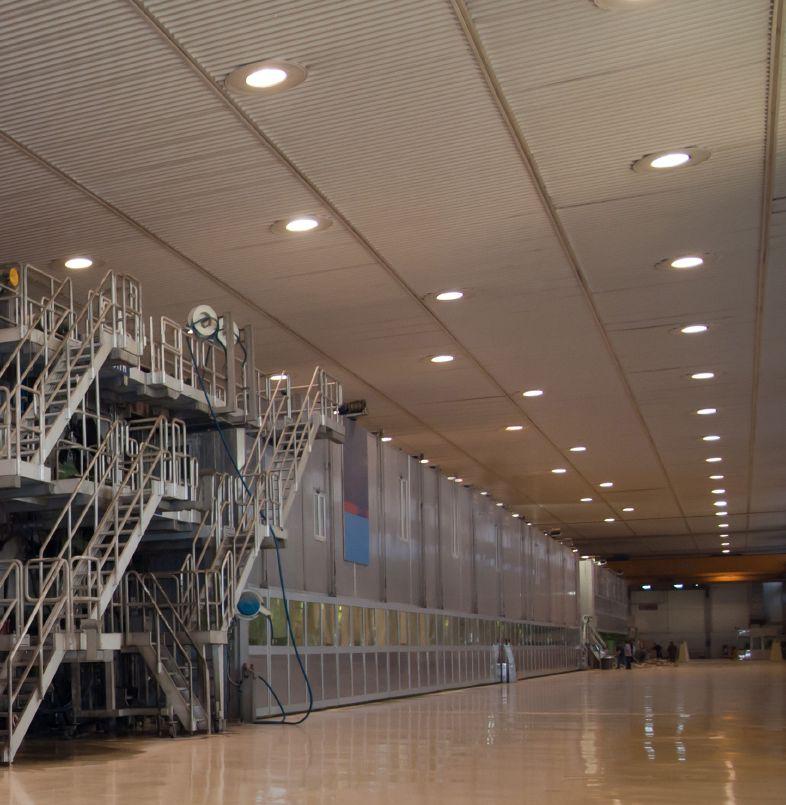
predicting your utility bill after the following: high-efficiency motors installed on the production floor; production volume increased by 5 per cent; size of final product changed by 12 per cent; tariffs grew by 5 per cent; reject rate varied between 5 to 8 per cent. Were I in charge of energy efficiency, I would not like my performance evaluated against the utility bill.
Tracking energy efficiency projects results may make the difference between triumph and disaster in the boardroom. Accurate energy consumption tracking and recording any changes in factors that drive consumption are the keys to demonstrating results that can withstand any boardroom criticism.
Besides, accurately tracking energy use and acting on deviations not only routinely leads to reduced consumption, but also uncovers operational issues, quality risks and performance losses.
Energy is procured for the production floor, not the corner office.
Step #4 - Distinguish between utility bill and utility consumption
Your utility bill is determined by consumption and tariffs, while energy consumption is determined by production needs. Plus, not all kWhs cost the same. Natural gas can be procured at substantially different prices. Consider both energy procurement and consumption to find ways of lowering the bill. Consider:
• Over-cooling a frozen food warehouse overnight at lower nightly rates will lower consumption during peak times, or reduce peak demand;
• Staged start of major machines decreases demand; and
• An accurate forecast of natural gas consumption allows you to buy it in lower-priced blocks.
Step #5 - Recognize value beyond energy cost reduction. Energy does not disappear; it powers up machines that either create value or create waste. Non-energy waste routinely exceeds the cost of wasted energy. Consider these examples of energy trouble alerts at an industrial bakery:
• Increased electricity consumption at freezer may signal loss of insulation or open door. Both may lead to product loss (e.g. production, quality), slippery floor (safety) or mould (sanitation);
• Compressor coming online during non-production hours signals air leaks or unauthorized operations; and
• Increased electricity consumption by a dough mixer during stable production may mean wrong recipe (quality) or the need for preventive maintenance (production stoppage).
On the positive side:
• Better lighting means fewer mistakes in packaging and sorting; and
• Stable load extends life of motors and prevents production stoppage.
Energy management measures often create value for businesses even without a reduction in energy consumption. For example, power factor correction can reduce the electricity bill with no changes on the production floor. In the same manner, harmonics do not affect electricity consumption, yet they can disable electronics, leading to costly production stoppages.
Step #6 - Communicate results consistently
Stakeholders and employees pay attention to their company’s environmental standing, so make results public, visible and transparent. Better yet, engage employees in energy conservation and link results to their paycheques, or maybe offer a $50 energy conservation year-end bonus. Proud employees demonstrate higher productivity and lower absenteeism, and stay longer with the company as well — all this because you embraced the rules of management. PPC
Anatoli Naoumov, MBA, MSc, CMVP, is a managing partner and “chief energy waste buster” at GreenQ Partners, and has been involved in various areas of business analysis and development for over 15 years for companies in Canada, the Netherlands and Russia. He has been certified as measurement and verification professional (CMVP) by The Association of Energy Engineers (AEE) and The Efficiency Valuation Organization (EVO).
SMART OPERATIONS
The Industrial Internet of Things will usher in a new Golden Era
By Dan O’Brien
Seeking profitability, pulp and paper companies have found growth in segments such as corrugated paper, packaging and specialty tissue papers, but are challenged by rising production and raw material costs. In addition, many are experiencing soldout asset availability which is restricting their production potential.
One way to control costs and maximize efficiencies is for manufacturers to define, implement, monitor, and continuously improve their production process and quality parameters. This can help them reduce — or even eliminate — variability on the production line. Variability, after all, leads to higher costs, lower product quality, reduced asset availability and, potentially, reputational damage.
The Industrial Internet of Things (IIoT) is helping to tame long-standing production variability by connecting formerly disparate parts of the manufacturing process, including control, quality, manufacturing execution systems (MES) and enterprise resource planning (ERP) systems. Data from sources — such as raw material costs, quality results, process asset status, recipes, and production schedules — can be aggregated and analyzed for the first time, creating new production capabilities and opportunities. This new, IIoT-enabled level of insight and control is called Smart Operations.
The rise of Smart Operations Software, analytics and connectivity are allowing companies to create better integrated supply chains and to more acutely understand how key process variables impact product quality — and how quality impacts the customer experience. The health of plant equipment can
also be better gauged, leading to higher levels of asset performance. In tandem, manufacturers can create connected ecosystems with OEM partners to drive greater understanding of asset and equipment performance. Collectively, Smart Operations are helping companies align their businesses to customer needs by maintaining a focus on speed to market, quality and price.
Informed operations and management decisions provide asset intelligence across the enterprise to drive short-term actions required for mid- to long-term business success. This helps drive a cultural shift toward increased accountability within production environments by:
• Allowing operators to use historical trends to make better decisions to improve long-term production;
• Enabling operations engineers to define exception-based alerting to detect anomalies that could jeopardize plant production before they occur;
• Providing maintenance and

support engineers with a diagnostic support solution that allows real-time collaborative discussions and decisions about asset maintenance;
• Providing consistent plant-level business KPIs that can be linked to the operational understanding required to optimize production assets.
Smart Operations across the enterprise make strategic use of plant-wide connected data to deliver real-time insights and drive the actions required. The result? Increased uptime, lower manufacturing costs and better production efficiency and quality.
Centrelining: Tackling production line variability
One byproduct of Smart Operations is centrelining, a methodology to reduce product and process variability and maximize machine efficiency in the manufacturing process. Centrelining removes operating variability by clearly marking
specific process set points on machines. Its aim is to eliminate the infinite and often detrimental tweaking by operators on production equipment.
Centrelining determines the best settings for a production process and ensures these settings are consistently used. This yields benefits such as: building quality into the process; reducing waste; improving machine operating efficiency; and reducing the setup required for stable production.
Golden Run:
From concept to reality
Centrelining also has the distinction of supporting Golden Run production. Golden Run is a condition through which batch production undergoes continuous improvement to deliver stand-out yields and product quality, allowing manufacturers to achieve unprecedented production efficiencies and vastly improved operating margins. Various players have attempted Golden Run solutions over the years, but technology and usability issues have limited their success, until now.
Within the industry, Golden Run
production exploits plant-wide data by allowing manufacturers to set batch parameters for grades of paper that can be contextualized vis-à-vis factors, such as quality, energy efficiency and productivity. These parameters are then benchmarked by comparing baseline and estimated rates, with any anomalies corrected on the production line. Alerts provide instant notification when machine limits or moving averages are violated or in the event of deviation or movement. Continuous monitoring in real time ensures the stabilization of production efficiency, avoiding unplanned downtime, and effectively creates Golden Run production conditions.
Golden Run production employs Statistical Process Control (SPC) for measuring and controlling quality during the manufacturing process. SPC uses data from product or process measurements, which are obtained in real time during manufacturing. Control limits are process limits, drawn on a statistical process control chart, from the mean. Control charts help identify how a process changes over time. Typically, a control chart has a central line for the average, an upper line for
the upper control limit and a lower line for the lower control limit.
Key process parameters plotted on control charts ensure that products are produced in an economical way, meeting quality specifications without compromising quality. These parameters also provide a historical analysis of quality from which manufacturers can determine set points and specifications.
The scalability of the IIoT means that Golden Run conditions can be set up for every grade of paper produced, resulting in significant, cumulative benefits.
In conclusion
Thanks to the IIoT, paper mills finally have the capability to improve their asset uptime and availability and create Golden Run operating conditions for every grade of paper they produce, giving them new, strategic levers to boost their operating margins. Arguably, these developments could usher in a new golden era for the pulp and paper industry. PPC
Dan O’Brien is product director at Honeywell Connected Plant.

FOCUS ON CHEMICALS
Kemira and Valmet partner to develop industrial Internet solutions
Kemira and Valmet have signed a partnership agreement to develop digitalized data-based applications and services for the pulp and paper industry.
With a workforce of around 4,800 employees, Kemira is a global chemicals company serving customers in water intensive industries.
Valmet is a developer and supplier of process technologies, automation and services for the pulp, paper and energy industries with its global headquarters in Espoo, Finland.
“Kemira and Valmet are leading suppliers to the industry globally and both companies are also actively developing digital solutions,” said Antti Matula, vice-president of product lines and business development at Kemira. “Ultimately, the goal is to improve the speed, quality, reliability, predictability and performance of our customers’ business. With these synergies, it makes great sense to join forces to create value and reshape business collaboration models.”
“Through this co-operation and the companies’ complementary know-how, customers’ production process data can be integrated and optimized for the customers’ benefit. This provides superior performance for the customers instead of each actor operating independently,” added Jari Almi, director of industrial Internet at Valmet.
www.kemira.com
www.valmet.com
Buckman and Engro form digital strategic alliance
Buckman has entered into a strategic alliance with Engro Corp., through its digital business arm Engro Digital, in an effort to deliver process and reliability optimization to utilities and industries.
The parties say the partnership will focus on developing apps on Predix, GE’s application development platform for the industrial Internet. Engro has already partnered with GE Digital to leverage Predix for developing Digital Industrial Solutions.
The agreement was signed by Najam
Saeed, Head of Business Development, Energy and Infrastructure, Engro Corporation – Digital Business, and Junai Maharaj, CEO and president of Bulab Holdings Inc., in the presence of senior executives from both companies at Buckman’s headquarters in Memphis, Tenn.
The already decade-long partnership between Engro and Buckman will now deliver digital solutions to help industrial plants operate their utilities at optimum performance for cost optimization, asset life extension, and energy and water conservation. The first digital solutions will be available in 2018 with multiple clients already identified for pre-launch implementations, according to company representatives. www.buckman.com www.engro.com
Ingevity purchases GeorgiaPacific pine chemicals business Georgia-Pacific LLC has reached an agreement to sell its pine chemicals business to Ingevity for US$315 million, including certain pine chemicals-related assets at the Crossett, Ark., plant.
Separately, Ingevity will enter into several contract manufacturing arrangements for oilfield and mining products currently produced at other Georgia-Pacific facilities. The parties will also separately enter into a 20-year, market-based crude tall oil supply contract.
“Although the pine chemical business has been profitable and our employees have done a great job running safe, productive assets and meeting our customers’ needs, we believe this sale to an established player in the industry is in the best interest of our customers and stakeholders,” said Rick Urschel, president, Georgia-Pacific Chemicals.
Ingevity will not acquire the merchant crude tall oil or crude sulfate turpentine business; this business will be retained and operated by Georgia-Pacific. GP will continue to operate its 10 chemical facilities within the Americas to service customers in these segments. www.ingevity.com www.gp.com
Organic additive for soft water pulp and papermaking

Archroma, a colour and specialty chemicals company, has introduced Cartaspers PLH liquid, a one-product, organic additive that delivers “easy and highly-effective” control of pitch and stickies deposition in soft water pulp and papermaking environments. According to the company, pulp mill tests already report easier application, better performance and significant cost savings compared to alternative deposit control systems. Pitch, occurring from natural resins in virgin pulp, and stickies in recycled paper fibres, pose a challenge to pulp and paper producers because of their negative influence on papermaking productivity and paper quality. Archroma estimates packaging and tissues machines lose the equivalent of 4 per cent of their output per day due to machine contamination and sheet breaks caused by deposits, contributing to holes in the sheet, specks and printability issues, in addition to causing machine downtime and cleaning time. The anionic pale yellow, low viscosity liquid helps to passivate contamination and prevent agglomeration and deposition, without any impact on cellulosic material, explains Archroma. Cartaspers PLH liquid is suitable for use with brown stock and can be applied throughout the pulping process, as a washing aid or to passivate remaining particles in finished pulp.
www.archroma.com
Simulation-based operator training tool

Andritz Separation has developed a new computer-assisted tool for operator training that aims to help maximize machine and process performance with minimal training time. Described as a sophisticated solution, Andritz SmartSIM aims to help users efficiently implement new machine control systems and optimize new operator training. It is available for various models of solid/liquid separation machines and systems with a Metris addIQ control system. According to the company, the benefits of Andritz SmartSIM training are reduced downtimes because there are fewer operating errors and lower maintenance costs due to operators being highly trained. The solution includes a computer-assisted classroom training course, which can be used at any time without affecting actual plant operation. Using the original operating interface, trainees have the opportunity to control a digital twin of the machine, including the individual parameters of production operations. In the course of the training, participants learn — with on-site support from Andritz — how to run the machine, respond to alarm situations, and improve the performance of the machine or the process. The goal is that at the end of the training course, every operator will be able to respond to real-life operating challenges and achieve certification level.
www.andritz.com
Workplace wellness e-course
An open network-based control system
Yokogawa Electric plans to release an enhanced version of the Stardom network-based control system in the first quarter of fiscal year 2018. This new version will include a new E2 bus interface module that has been developed for use in FCN-500 autonomous controller extension units. This enables the construction of systems that have more I/O points and cover a wider area. STARDOM is an open network-based control system consisting of components for control, operation and monitoring functionality through the FCN autonomous controller, the VDS web-based HMI, and the FAST/ TOOLS SCADA package.

One need is for the collective monitoring and control of applications where many different input and output devices are distributed over a wide area, in locations where conditions are often harsh. Other needs have included the reduction of wiring and maintenance costs while ensuring high reliability. Three different base modules are available: a long base module with slots for 10 modules, a short base module with slots for five modules, and a compact base module with slots for three modules. Customers can combine different base module types depending on the required number of I/O points and the amount of space available for installation. www.yokogawa.com
In an effort to help employers better understand the value of workplace wellness programs, the Canadian Centre for Occupational Health and Safety (CCOHS) has launched the e-course, Business Case for Workplace Wellness. Business Case for Workplace Wellness is a free, 30-minute e-course that provides business owners, managers, and supervisors with an introduction to establishing a workplace wellness program. The course strives to help participants better understand the benefits of having a workplace wellness program, and what the return on investment of these initiatives can be. www.ccohs.ca/products/courses/wellness
New press fabrics promise improved batt fibre anchorage
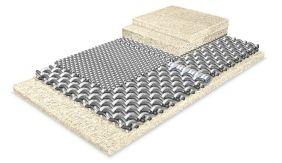
Voith Paper says the Voith Infinity seam and endless press fabrics use cabled yarn in the base structure, improving batt fibre anchorage and delivering consistent performance over the entire runtime life cycle for paper manufacturers. Part of the PressMax family of Voith AdvancedPRODUCTS, Infinity press fabrics provide paper manufacturers adaptability and can reduce machine downtime by up to 25 per cent, says Voith Paper. New press fabric is available with a seam, says the company, noting that the cabled seam offers the most efficient twist level in the base fabric with mono loops in the engineered seam area. Infinity can be adapted to special requirements of their respective application.
www.voith.com
Press felt technology

Xerium Technologies has introduced Maximus, describing it as a new portfolio of press felt technology for today’s most demanding press positions. Maximus technology is designed for machines producing containerboard, packaging and graphical paper grades. Maximus’ single-base structure design with lower fabric caliper delivers immediate startup without the typical long break-in periods often required for conventional technology, explains the company, adding that the portfolio is engineered for faster start-up, wider operational window and extended life. As well, its drainage channels and warp-bound weave concept promise maximum dimensional stability and compaction resistance for “highperformance dewatering, longer running life and excellent end-product quality.” www.xerium.com
New performance technology aims to increase fibre yield
Kadant Lamort SAS, a subsidiary of Kadant Inc., has released the BoosTEK Performance Pack for screening applications in OCC recycling, stock preparation, and pulp mills.
According to the company, the BoosTEK Performance Pack utilizes system pressure to amplify the breakdown of stock mats that form on, and ultimately block, the screen cylinder, adding that the proprietary technology improves the performance of the screen resulting in increased capacity, improved contaminant collection, and higher yield of clean pulp fibre.
“Significant savings make this a costeffective upgrade with a compelling return on investment,” said Jordi Goma, mill manager at Spanish tissue paper manufacturer Goma-Camps. “We have achieved up to a 40-per-cent reduction in energy consumption or up to a 65-percent gain in fibre yield depending on the operational focus.”
Installed on either the accept or the reject line of the screen, the gains can be both qualitative and quantitative, says Kadant. The BoosTEK Performance Pack’s adaptive and intelligent technology reacts to the needs of the upstream screen, optimizing the running conditions of the stock flow to maximize performance and output, it adds. The system also provides actionable feedback to allow operators the ability to fine-tune the device for the desired results. www.kadant.com

Pneumatically actuated dosing valve
GF Piping Systems has introduced a corrosion-resistant pneumatic diaphragm valve that promises to provide a new, long-lasting solution for not only highly corrosive dosing applications, but also open/close applications.

The Type 604/605 Pneumatically Actuated Dosing Valve is designed and tested to surpass two million life cycles, says the company. Boasting a lower price point than other similar models on the market, the 1/2-inch (d20) size 604/605 valve is available in body materials PVC, CPVC, PROGEF Standard PP, and SYGEF Standard PVDF with a range of end connections and custom assemblies. The valve is pressure rated at 90 psi unidirectional with operating temperatures ranging from -4 to 284 degrees F, depending on body material. According to the company, GF’s threaded bonnet design eliminates both the need for metallic body bolts and retorquing after hot line shutdowns, adding that oversized pneumatic ports decrease cycle time to maintain accurate dosing with minimal overrun.
www.gfps.com
Self-calibrating temperature sensor
Endress+Hauser has introduced what it says is the world’s first self-calibrating temperature sensor, the iTHERM TrustSens hygienic RTD. Traditionally, calibration cycles for standard temperature sensors in critical service are every six to 12 months. This leaves the potential for undetected drift in the sensor between cycles, which could result in product quality issues or even a complete loss of the production run. TrustSens’ selfcalibration process functions in situ and provides the documentation to meet the conformance requirements for various
Electromechnical actuator
SKF has launched the CASM 100 electromechanical actuator with a range of modules, describing it as “exceptionally adaptable” to satisfy various applications in different sectors. The technology can be used in the automation sector on applications including servo presses, test benches, plastic injection moulding, dosing machinery and conveyors, says SKF, as well as for roll adjustment in pulp and paper mills. The CASM 100’s modular design offers a base platform with new modules planned for release over time to cater for future needs. The standardized interface between modules – similar to the concept of Lego bricks – increases the unit’s flexibility and makes it backward compatible, says the company. According to SKF, the actuator consumes up to 80 per cent less energy than pneumatic alternatives and 50 per cent compared to hydraulic solutions. It also uses fewer consumables because, in many applications, is virtually maintenance-free, only requiring re-lubrication using standard grease. There is also no need to change hydraulic fluids and seals and promises to be clean, leak-free, cost-effective and environmentally-friendly. www.skf.com

regulatory agencies. With TrustSens, the temperature sensor is calibrated after every Sterilize in Place (SIP) process cycle, and works to eliminate the risk of an undetected calibration drift and the risk of bad batches. It also reduces the need for frequent calibrations by verifying the sensor is working as designed in between manual calibration cycles, according to the company. TrustSens has a built-in ceramic reference based on the Curie Point of the reference material; that is, the temperature at which its ferromagnetic properties abruptly change. The change can be detected electronically. For applications using SIP operations — where steam at 121 degrees C is used to sterilize equipment — TrustSens uses a reference material with a Curie Point of 118 degrees C. The sensor is available with a range of hygienic process connections, such as 1/2- to 3-inch Tri-Clamp and Varivent. It can also be configured for direct immersion measurement or with a protective thermowell for easy removal from the process. www.ca.endress.com
Mini-series sensors for corrugated board manufacturing

Proton Products, a provider of noncontact laser Doppler speed and length measurement, says it is setting “new standards for precise, reliable measurement of corrugated board products.” The company has introduced its new InteliSENS SL/SLR Mini Series non-contact laser Doppler speed and length sensors, describing them as solid state instruments with no moving parts. Characterized as “permanently calibrated and completely reliable,” the InteliSENS mini-series sensors are designed to replace contacting speed and length measurement encoders with a sensor whose accuracy is better than ±0.05 per cent, says Proton, noting that the sensors can provide speed and length measurement starting with a stationary product and communicate a set length contact output to the cutter for highly accurate board size. According to the company, the sensors can be used at the wet-end of a corrugator to measure the product length prior to the stacker to help reduce waste at the double facer, as well as to measure the roll speeds at the unwind stands to reduce splice failures. www.protonproducts.com
New cable option extends industrial accelerometer performance
Hansford Sensors is offering the FEP cable option for its high-performance vibration sensors, designed to meet the extreme demands of heavy applications. The cable features a protective conduit made from stainless steel that promises to resist oil, rust and corrosion. Boasting reliable compression, impact and tensile strength with notable resistance to abrasion and tearing, the FEP cable can withstand temperatures ranging from -80 to 200 degrees C. Available with both dual acceleration and temperature outputs, the FEP cable and protective conduit suits a range of industries including building services, pulp and paper, mining, metals, utilities, automotive, water, and pharmaceutical. www.hansfordsensors.com/us
Side-mounted agitator range
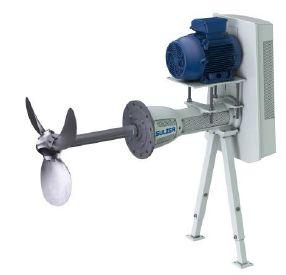
Sulzer says it has taken a “significant step” to further decrease power consumption and reduce the environmental impact of its product portfolio with the Agistar SSA side-mounted agitator. Designed for demanding applications in various industries, such as pulp and paper, sludge, and municipal and industrial wastewater, the construction of the Agistar SSA features “low vibration” and long seals and bearing lifetime. Its equipped with a duplex stainless steel EX3 propeller that promises to deliver higher strength and wear properties. In addition, the performance of the agitator can be adapted with the adjustable propeller blades. The EX3 propeller can also be used in Salomix side-entry agitators. According to the company, Sulzer’s EX3 propeller exceeds the current Salomix MX-4 propeller in both efficiency and thrust. With a smart retrofit system, the EX3 propeller can replace MX4 propellers on Salomix side-entry agitators. www.sulzer.com
Frequency to analogue converter
AW-Lake Company has introduced the FAC-R frequency to analogue converter that changes incoming sensor frequency to both current and voltage analogue output. FAC-R interfaces with a range of frequency-out sensors and instrumentation, including flow meters, tachometers and motors. An alternative to a PLC card, the converter is suitable for use in process monitoring, data acquisition and other applications when sending an analogue signal to a PLC or other control system. A Bluetooth communication interface supports basic scaling and advanced functions using a tablet or smartphone, such as linearization table programming that helps improve output of non-linear devices or extend the range of a flow meter beyond its linear range. With the Bluetooth mobile application on a smartphone, users have a wireless flow monitor in their hands. Operators can utilize the Bluetooth capability on a mobile device for remote setup, troubleshooting, and reconfiguration. www.aw-lake.com


GIVING BACK
Making a difference in the community
The Canadian forest products sector is one that is passionate and devoted — not just to the industry itself, but also to its local communities. In this new department, we will share the initiatives of pulp and paper companies working to make positive social, environmental and economic impacts across the country.



More than 70 Domtar and Student Conservation Association volunteers helped remove invasive buckthorn and collect garbage at Parc Thomas-Chapais, a community park and urban forest, in Montreal.
Let us help you share your successes. Tag @PulpPaperCanada on Facebook and Twitter or send an email to the editor at adalton@annexweb.com. We’d love to hear from you! #PPCGivingBack


Photo: Kruger Products Twitter
Photo: Domtar
In Vernon, B.C., Tolko Industries VP Forestry and Environment Bob Fleet packs knapsacks for the Starfish Program which helps feed local elementary school children.
Donations from employees, Local 601-N, Local 907 and Irving Paper provided families in Saint John, N.B., with holiday hampers.
Kruger Products’ head office employees donated more than 500 pounds of food to the Mississauga Food Bank in Ontario to help those in need over the holiday season.
Photo: Tolko Industries Twitter
Photo: J.D. Irving
NORTHAMERICAN LOCATION EASYACCESS FROM CANADA
APRIL 15-18, 2018 • CHARLOTTE, NORTH CAROLINA
SHAPING THE FUTURE THROUGH INNOVATION
Experience the world’s largest technical conference for the paper and packaging industry.

KEYNOTE SPEAKER Hannah Ubl Research Director BridgeWorks
Special Mill Program & Discounts
CO-LOCATED EVENTS: HELD IN CONJUNCTION WITH: 15TH ADVANCED COATING SYMPOSIUM & WOMEN’S SUMMIT



MORE CONTROL. LESS INTRUSION.

Get superior process control with ECHOWISE , ™ the revolutionary, non-invasive technology from Buckman.
An exclusive from Buckman and a first for pulp and paper, ECHOWISE 360 uses sound waves to precisely measure entrained air in your process—from outside the system! Advanced process control with ECHOWISE allows Buckman to partner with you to shift your process to new levels of performance.
Let’s make waves.
Sound waves, sound data, and sound decision-making! That’s ECHOWISE 360, specially designed to work in concert with Buckman’s comprehensive pulp and paper technologies and mill-specific solutions to help you improve productivity and profitability. Contact your Buckman representative or visit buckman.com for more information about this and other new ECHOWISE monitoring solutions.
Before Control With ECHOWISE